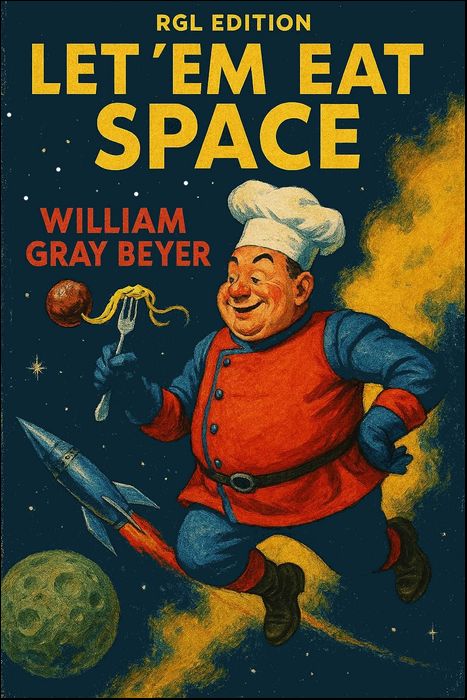
RGL e-Book Cover
Based on an image created with Microsoft Bing software
Roy Glashan's Library
Non sibi sed omnibus
Go to Home Page
This work is out of copyright in countries with a copyright
period of 70 years or less, after the year of the author's death.
If it is under copyright in your country of residence,
do not download or redistribute this file.
Original content added by RGL (e.g., introductions, notes,
RGL covers) is proprietary and protected by copyright.
RGL e-Book Cover
Based on an image created with Microsoft Bing software
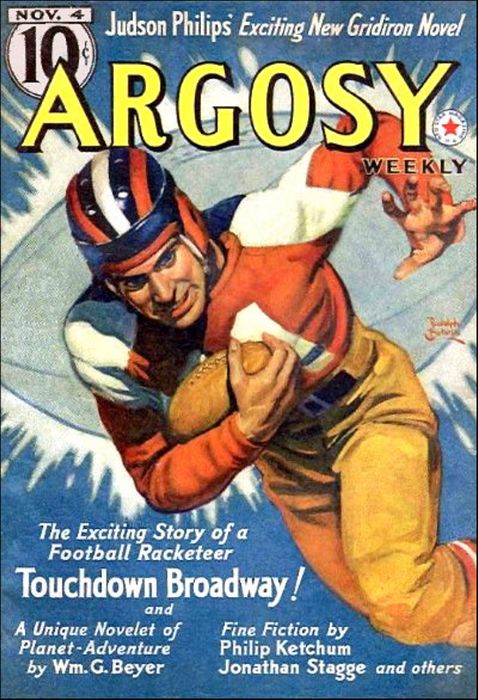
Argosy, 4 November 1939 with "Let 'Em Eat Space"

Just a few plush-lined seats left on the space-ship. folks—and well worth scrambling for. Today's excursion takes us to Propus, where shadows eat rabbits and you meet the nicest, wackiest people found on any planet.
MR. MONTGOMERY, first vice-president of Interplanetary Insurance, Incorporated, was gazing in a severe and somewhat disapproving manner over the upper rim of his horn-rimmed spectacles. Across the polished desk fidgeted Mr. Ham Eggles, small and dapper, and Mr. Slim Winters, tall, thin and unkempt.
Ham, with a small portion of his mind, was wondering what would happen if Mr. Montgomery ever should happen to look through those specs. By far the greater part of his gray matter, however, was engaged in pleasant contemplation of the charms of a certain barmaid of his acquaintance.
Slim, on the other hand, was a man who invariably concentrated on the matter at hand. He was busy worrying why the boss had summoned them.
Mr. Montgomery cleared his throat. "I suppose," he said, "that you gentlemen are familiar with the phenomenon of metabolism."
Ham looked at Slim and Slim looked at Ham. "Why sure," they chorused; then abruptly fell into an embarrassed silence.
"Yes, of course," said Mr. Montgomery dryly. "I knew also, after I had consulted a dictionary. But I'll save you that trouble. Metabolism is the process of building up and breaking down of tissues and cells in living organisms. It constitutes the vital chemical processes of life itself."
His audience revealed by facial expression that it had heard of some such thing back in its school days.
"Now that you thoroughly understand the subject," continued the boss, "you will probably be interested to know that it has slowed up."
"What has?" queried Ham, absently.
"Metabolism, you rum-soaked Casanova!" supplied Slim.
"This fact came to us as a result of diligent investigation on the part of our research department," said Mr. Montgomery, ignoring the by-play.
"We have been deluged with industrial claims that have been pouring in from all over the solar system. This unexpected departure from normal began in the spring of 2074, over a year ago. We have traced the cause of most of the accidents to a lack of alertness and agility on the part of the victims. Workers are no longer able to keep up with their machines.
"All sorts of things have been happening. Men are getting their hands taken off in punch presses; airplanes are making poor landings; bus drivers are getting in accidents, trying to make their schedules. In short, wherever men are engaged in work with machines which are normally geared to keep pace with human ability, they are having trouble."
Mr. Montgomery leveled an accusing finger.
"It has also come to light that men engaged in sound research, in connection with the cinema and radio industries, have found that women who formerly sang soprano are now baritones, and men who were baritones are now making sounds far below the audible range of normal hearing. And yet the ear has failed to detect any change.
"WITH these facts to work on, we soon discovered that the reason for the condition lies in the fact that metabolism has slowed up. Further investigation has proven that all life in the solar system has been similarly affected. To sum up the situation: life has been slowed down to a crawl. And we must do something about it!"
He emphasized his words with a resounding thump on the desk with a balled fist. Slim and Ham were looking slightly bewildered by this time, for metabolism, a purely biological business, was entirely out of their scope. Slim hesitantly advanced this information.
"I'm coming to that," said the boss. "As I mentioned, we must do something about this deplorable situation. For although the company has weathered the storm of claims, and keeping in mind that mankind is becoming accustomed to the slower rate of metabolism, we have no assurance that the thing may not occur again. We could scarcely hope to retain our solvency if that happened.
"And then, too," he added, as an afterthought of little consequence, "mankind might not survive another such drastic change.
"But to continue: our research workers have further discovered that concurrent with the deluge of accident claims, certain scientists reported a sharp decrease in the amount of cosmic rays which reach the solar system. The inference is obvious—that the rate of metabolism is directly dependent upon intensity of cosmic rays absorbed by the living being.
"And there," the boss concluded, "is where you gentlemen enter the picture. It is your job to determine the cause of the decreased density of these rays."
Ham remained in a state of bewilderment—at least that portion of his mind which was not lingering on the aforementioned barmaid. The problem of the cosmic rays seemed as remote from his field as had the matter of metabolism. For he and Slim were not engaged by the company as scientists or research workers, but rather as detectives, confining their activities to doubtful claims in various parts of the solar system.
But where Ham failed to see the connection, Slim apparently grasped the idea immediately.
"You mean... interstellar space?"
"Precisely. Cosmic rays originate far outside the solar system, and you'll have to follow them if you intend to learn anything. Our experts will give you all the necessary information.
"Your ship is equipped with the most modern of gravity drives, capable of many times the speed of light. The latest space-warp principle will be incorporated into the design of the drive. That will take only a few days. You are to use it, of course, only after you are well out of the system."
SOMEWHAT less than a week later, a silvery torpedo may have been seen flashing past the outermost planet of the solar system.
But if it was seen at all, it couldn't have been observed for any great length of time. For shortly after passing the orbit of the most distant rampart of old Sol, the ship surpassed the speed of light itself, immediately becoming invisible to any observer in the rear of its line of flight.
Ham was staring contentedly ahead into the void, through which they were rushing with such speed that the light of the stars ahead was of a decided bluish tinge, when a frown came to mar his usual serenity of countenance.
"I know it's none of my business," he complained to Slim, "but if it's not too much to ask, just where the heck are we headed for?"
The elongated one lifted his eyes momentarily from a sheaf of astronomical charts and grunted, "Eta Geminorum, Propus!"
"Never heard of it," remarked Ham, returning to his star-gazing.
"A Cepheid variable of the long-period variety," informed Slim. "Has a period of 231.4 days during which it varies in magnitude from 3.2 to 4.2."
Ham continued staring for several minutes before his placidly preoccupied mind digested this. Slim was always babbling miscellaneous bits of information, interesting to him at the moment; and Ham had developed the faculty of completely ignoring him, especially when he had something on his own mind.
But when the intelligence did finally sink in, he snapped to attention.
"That's quite a ways out, isn't it?" he asked. "Is that where the cosmic ray experts said we'd find the trouble?"
Slim slowly uncoiled himself, deserting the charts, and rose to creakily stretch his great length. He was about six feet six, and so thin that Ham always insisted that he had to stand still for at least five minutes to cast a visible shadow.
"That's what they said, little one," affirmed Slim. "I should think you'd take more interest in these minor details. You've been acting as if this little jaunt were in the nature of a pleasure trip."
"It probably is. I don't see what we can do about it, anyway. We didn't even know we had slowed up until old specs-on-the-nose told us. And neither does anybody else. By the time we get back people will be completely adjusted to the slower rate of metabolism. Or the machines will be adjusted, which amounts to the same thing. I can't see where the matter is of any great importance."
"You can't, eh? Suppose the thing happens again? Suppose the rays decrease until metabolism is slowed down to about one-third. Humanity would be very likely to suffer a fatal attack of indigestion."
Patiently, Slim explained.
"In the normal operation of the human body, a series of complicated chemical processes are constantly in progress. And the whole works would be thrown out of kilter by such a drastic departure from the proper speed of anabolism and katabolism."
"You certainly know a lot of words," Ham commented, not greatly concerned by the dire prospect. "But what has all that to do with this variable star we're heading for?"
Slim chuckled. Ham's question took a lot more words to answer.
"LOOK," he said, "It's believed that the cause of the decreased cosmic ray intensity lies somewhere in the vicinity of that star. Science has long been aware that the rays are sent out by every one of the Cepheid variables. Just why, is not known. But the inference is that whatever force causes these peculiar stars to pulsate, also generates the rays in enormous quantities.
"It has been observed that the short-period Cepheids appear to emit the greater number of rays. Of these, Zeta Geminorum is about the most active. On the other hand, the long-period variables gives off very few of the rays. All but one, and that's the one we're going to investigate.
"Propus, unbelievably, has always furnished the solar system with as great an intensity of cosmic rays as all of the other variables put together. And now, practically overnight, Propus diminishes its output to a point comparable with other long-period variables of similar size."
"Unbelievable!" mocked Ham.
"Don't be so darned flippant," exclaimed Slim, somewhat exasperated. "The fate of humanity is at stake if the thing should go any further."
"Not according to what you told me," said Ham. "The solar system is receiving its present diminished supply from the other Cepheids, and is managing to get along just the same. The mysterious decrease from Propus isn't likely to be repeated over such a widely scattered area. My deduction is that the tremendous output from that star was an unstable phenomenon, and something happened to restore it to normal. Logical, what?"
Slim clasped and unclasped his hands several times, meanwhile looking very thoughtful. He then grunted eloquently and sat down to resume study of the star charts.
"While you're looking at those road maps," Ham suggested, "see if you can find if our shrinking violet has any planets, and if so, how big."
Slim grunted again, riffled the charts and picked out the desired one. "The best telescope ever developed couldn't see a planet small enough for us to stand up on, at that distance. The chart shows one planet, about the size of Jupiter, and notes that there are probably four more. Maybe one of them will be our size."
The chart-maker turned out to be a fairly accurate guesser. The travelers were able to spot four satellites of the pulsating luminary, including the one shown on the map. It was altogether possible that there was one or two more, either extremely distant from their sun, or of very low albedo.
But they weren't greatly interested in the possibility, for their attention was immediately attracted to the second world in the system.
Approximately nine thousand miles in diameter it gave off a bluish-green light, similar to that of the earth, when seen from a proximity of a few million miles. The resemblance decided them. They would land.
If intelligent life was to be found in the system, this seemed the most likely place to find it. Slim was on fire with the thought that he might be able to communicate with the denizens of this planet, and learn from them the reason for their sun's peculiar actions.
AS the ship approached, the planet's resemblance to earth became even more marked. There were mighty oceans, vast forests and even greater areas of arid desert. The proportion of water to land was somewhat less, indicating greater age; but it was still a fair substitute for Mother Earth.
"There's one thing missing," Slim noticed.
"Cities," supplied Ham. "I've been looking for them."
"Wait'll we get closer. Maybe they don't live in cities."
"Maybe they don't. And then again, maybe there aren't any 'they'."
But there were. As the ship neared the planet it became evident that some sort of a civilization was flourishing below them. Scattered widely over the surface of this world, were hundreds of large buildings of peculiar construction.
There seemed to be no system to their distribution, for they were situated in the most unusual spots. Invariably dome-shaped, and of a grayish-white color, the structures were just as likely to be seen in the middle of a desert, or perched precariously on the side of a mountain, as in a more conventional position.
"Look at that one!" Slim pointed. "Tilted on its edge, and half buried in the side of that hill!"
"Looks like the inhabitants of this sphere are among the dear departed," Ham guessed. "It's a cinch they didn't build those things in such dizzy places. More likely they've been there for thousands of years, and the topography of the land has altered."
"I guess so," admitted Slim, gloomily. "They weren't built for human use anyway. I haven't seen a window or door in any of them."
"Well, let's land, get into one of them, and take some pictures."
It was several minutes before they decided on one of the structures, situated in a desirable spot. The one selected lay almost in the center of a broad, grassy plain, and they picked it because a clear view was to be had for miles in all directions. If there happened to be any dangerous animal life on the planet they wouldn't be caught unaware.
The ship landed about a hundred yards from the curious structure.
Slim turned off the gravity controls, and they took a few cautious steps.
"Don't notice any difference," Ham remarked. "Should be heavier."
"Maybe this planet is composed of lighter materials," Slim hazarded, busy with the analysis of a sample of the outside air. "You can't always depend on size. Look at that little baby that balances Sirius. Smaller than the earth, and heavier than the sun."
"You look at it. How's the air?" piped Ham.
"Nineteen percent oxygen, and three percent carbon dioxide. The rest is helium, except for small quantities of some of the rarer gases found in our own atmosphere. Pressure, about seventeen pounds."
"Ought to be breathable," decided Ham. "Bring the torch."
HE released the latches on the inner airlock door, while Slim produced the torch from a locker. The outer door followed, and in a minute they had jumped to the ground and were breathing the air of the new planet.
They wasted no time looking around them, but set out immediately to cover the short distance to the hive-like building. Slim was carrying the torch, with which they intended to burn their way inside; Ham was lugging a camera and a few dozen flash bulbs. They were about half-way to the structure when involuntarily both stopped dead in their tracks.
"I THOUGHT that was a rock!" exclaimed Ham, gazing in consternation at an object slightly to the right of their path. The object, about three feet in diameter and smoothly rounded, when they first sighted it, was now about five feet long and as thick through as Ham's thigh.
"Looks more like a worm to me," said Slim, judiciously, "Except that it's brown—although that could be sun-tan."
"Which end is which?" inquired Ham.
"Neither. A worm's the same on each end. You have to wait until it moves, and even then you might be fooled. It might be backing up."
But it became immediately apparent that this system, admittedly unreliable, was less than useless in the case at hand. For the worm moved, and in a quite unpredictable manner. Its opposite sides bulged and kept bulging until it resembled a four-pointed starfish.
"It'll never get anywhere that way," was Ham's comment.
"Maybe it's not going anywhere. Maybe it wants to hear you make some more silly remarks. Come on."
"But suppose this is an intelligent creature?" suggested Ham "Maybe we should try to communicate with it."
"Phooey! That's an amoeba-like animal on the order of those creatures that infest the marshes of Venus, except for the healthy color and the larger size. They live sluggishly by ingesting nourishment from the grasses and other vegetation with which their bodies come in contact. Reproduce by fission."
"You seem well acquainted around here," Ham murmured.
But inasmuch as the strange creature seemed satisfied to retain his star-fish shape, and made no further effort to be entertaining, Ham decided that Slim was probably right, and the two resumed their former course.
They had taken only a few steps, when they were again brought up short. They both distinctly heard the word, "Wait!" They looked at each other, each thinking for a brief instant that the other had spoken. Then the answer dawned on them.
"It was the worm!" Slim exclaimed.
"You mean the amoeba-like creature," corrected Ham, sarcastically.
"Which is correct," informed the starfish. "My composition is very similar to the picture your mind gives me of the amoeba."
The two voyagers looked incredulously at the astounding creature. Their astonishment was due to the fact that they now realized the thing was causing the words to be formed in their minds, and making no audible sound while doing it.
Such an accomplishment had often been imagined, and indeed it was believed that certain men had abilities in that direction; but neither had ever encountered the phenomenon and the experience was eerie in the extreme.
"Did I hear you infer that you can read our minds?" Slim finally queried.
"NOT your ordinary thoughts," explained the amoeba. "They are not strong enough to transmit themselves. But I do receive impressions when you speak, for the effort expended makes the waves stronger. And of course I can make my own thoughts strong enough to impress them on your primitive minds."
Slim turned to Ham. "I think he's pulling our collective leg. What could be more primitive than an amoeba?"
"But there's nothing primitive about telepathy," Ham reminded.
"And I didn't say that I was an amoeba," corrected the creature. "I merely said that I am similar to one. As a matter of fact, my people represent the evolution of that unicellular form carried out to the nth degree."
"Then you, personally, are not unicellular?" deduced Ham.
"No more than you are."
The starfish stretched forth one of its members for their examination. "You will notice that my skin is of a rubbery nature, and quite tangible and opaque. The unicellular creature is transparent, and the outer covering is so tenuous that it readily allows food and moisture to pass through.
"The amoeba, as such, is strictly limited as far as size is concerned. Its cell walls would break down from its own weight if it grew too much. So obviously I am constructed of many cells."
"Sounds reasonable," Slim admitted. "But if your skin is so tough, how do you eat? Or don't you need nourishment?"
Again one of the pseudopodia was thrust out, this time bottom side up. There were dozens of small openings on the under side of the member, some of them gaping and closing rhythmically.
The men shuddered involuntarily, for the whole thing looked very much like one of the arms of an octopus. Then, abruptly, all of the openings closed and the rubbery texture of the skin became smooth and unbroken.
"I was only demonstrating," explained the evolved amoeba, apologetically. "The mouths are not there when I don't need them to admit food. Merely a multi-celled adaptation of the unicellular form. Even my brain is but the highly evolved replica of the nucleus of a primitive amoeba."
"If it's not too much to ask," ventured Ham, "do you have, concealed somewhere about your person, a pair of eyes?"
"Nothing so complicated. Instead I see with every nerve on the surface of my body. It is by far the most simple and efficient visional apparatus, for I can see in all directions. All the nerve-ends are sensitive to light."
"Amazing," claimed Ham. "But how about..."
"Wait a minute," Slim broke in. "We're forgetting what we came here for. Maybe this gent knows the answer."
But before either man could put the question to the amoeba, a feeling of acute alarm swept into their consciousness with such intensity that both cringed as if threatened with instant extinction. They knew that the sensation was caused by a similar feeling in their new acquaintance, but it was none the less real.
"
RUN!... Run!" shrilled the next mental message. And run they did. There was no time wasted in looking about for danger.
Too many times in the course of their interplanetary wanderings they had been in spots where instant flight was the only means of survival; they did not hesitate now.
But before they had covered half the distance to the space ship, an unseen blow from behind knocked them flat. Scrambling wildly to their feet, they fairly flew the rest of the way.
As they were about to leap for the edge of the airlock, Ham let out a yelp as he was again knocked down, this time more forcibly than before. But Slim made the jump, lithely pulled his lanky body up, and turned in time to lend the other a hand.
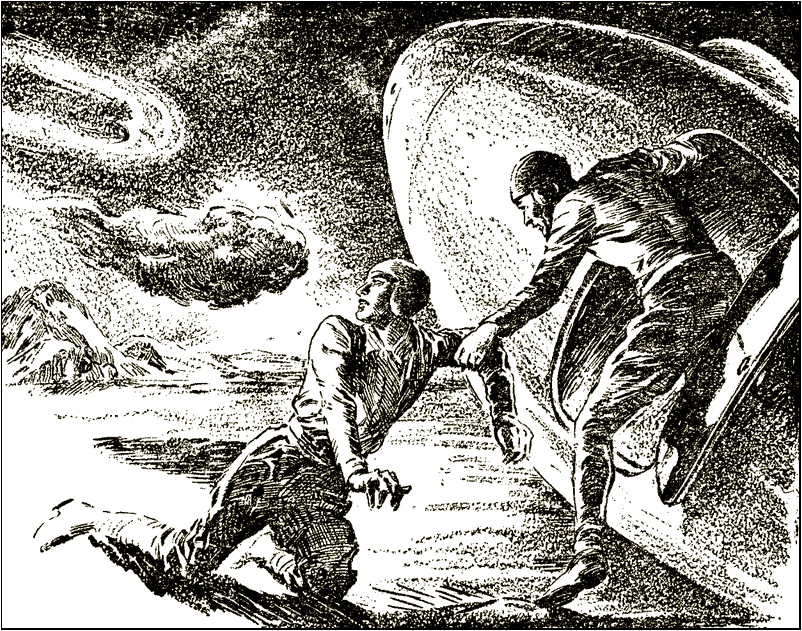
Ham, down again, let out a yelp; but Slim made
the jump in time and turned to lend a hand.
Slamming the outer door, after hurriedly noting that the amoeba was nowhere to be seen, they stood panting and trembling. Finally Ham, having caught his breath, chuckled at the ludicrous expression of fright on Slim's face.
"Funny, eh?" Slim panted. "I suppose you know what it's all about. What knocked us down, and what became of our pal... Come on, let me in on it."
Ham sobered and looked out of the nearest port. An empty plain stretched in all directions. Empty, that is, except for the mysterious building and the camera, flash bulbs and torch, which they had dropped when ordered to run. There was no sign of their recent acquaintance, the high evolved amoeba.
"I've sort of run out of ideas," he admitted, shakily.
It was a full hour later, and almost a full quart of Scotch whisky later, when Slim again voiced wonderment at the creature's strange absence from the landscape.
"I wonder what became of Jasper," said he.
Ham dwelt sadly on this mystery as he poured out the last of the Scotch. For several minutes the silence was broken only by the occasional liquid gurgle of a trickle of Haig and Haig passing an unsteady epiglottis.
Both men were mourning the disappearance, but for different reasons. Slim's mind was wholly filled with the lost opportunity for gaining some knowledge of the strange behavior of Propus; his friend had conceived a genuine—if slightly alcoholic—affection for the missing amoeba.
"He seemed such a friendly sort of a critter," said Ham, half tearfully. "No harm in 'im a-tall."
"And so darned willing to oblige," supplemented Slim. "He was willing to tell all—if we had only been given time to ask him."
"And not only that," enlarged Ham, striding uncertainly toward one of the ports, "but he wasn't impolitely asking us a bunch of questions about our origin. And he must have been very curious about it, too... Say!"
He broke off, attracted by something outside. "Come here, quick!"
Slim bounded to his feet, almost folded up, but managed to reach the bullet-like window. He arrived just in time to see a small rabbit, or something that looked like a rabbit, come to an untimely end. The animal had been chased, and overtaken, by a shadow.
At least it had seemed to be a shadow while it was in motion, but now as it stopped and engulfed the rabbit in its indefinable blackness, it looked more like a hole in the ground. It was impossible to focus the eyes on the thing.
SLIM blinked several times, thinking of the pernicious effects of alcohol on the optic nerve, but was still unable to determine anything about the blob of darkness other than the fact that it appeared to be about the size of the vanished creature he had called Jasper.
"I'll bet that's the jigger that bowled us over," he finally said, turning to Ham, who was futilely trying to coax a few more drops from the bottle.
"Wouldn't be surprised," sighed Ham, returning to the port for another look. "What do you think we should... Hey! It has went! What became of it?"
Slim again looked out, but saw nothing of the shadow and no sign of the unfortunate rabbit, if that's what it was.
He explained patiently that he had no part in the phenomenon and that the shadow had certainly been there when he looked away, and followed this intelligence with the suggestion that inasmuch as Propus was getting ready to set, it might be a good idea if they both sought relief from the harrowing memories of the day's happenings, by catching a little sleep.
Ham, with a solemn gravity reminiscent of the bottle, agreed wholeheartedly. Tomorrow, he averred, was another day.
TOMORROW, indeed, was another day; although as events progressed, it turned out to be quite as harrowing as the one it followed.
It was a good twelve hours after the setting of Propus that the first ruddy rays of the morning entered a port and moved to the point where they shone directly on Ham's face. He opened slitted eyes, sat erect and groaned.
But there was no time for him to collect his sense and realize to the fullest how terrible he felt, for a diversion occurred immediately. The light which had awakened him was shut off abruptly; and, quite startled, he got up to investigate.
The port in question was a good ten feet above the ground, and the ship was still situated in the middle of a treeless plain. That he was startled is easy to understand.
For nothing—except a cloud, which would have made the light dim gradually—should have been there to cast that shadow. Uneasy thoughts of the rabbit-killing menace of the night before coursed through his head as he peered through the little window.
"Good morning," greeted a familiar voice.
"It's Jasper!" he muttered, incredulously. And then he saw the obstruction. It was, indeed, Jasper. And that personage was hovering, quite nonchalantly—as if such doings were a regular thing with him, which, of course, was altogether possible—a short distance above the window.
"I don't wish to disturb you," came the emanation. "But will you please let me come inside?"
Ham thought he detected a note of urgency in the message. He seemed to be experiencing, in a slighter degree, the same feeling of horror and fear that had preceded the attack of the day before. He made record time of opening the airlock, admitting the amoeba, who floated eerily past him, and shutting it again.
"I was afraid you wouldn't awake in time," said Jasper, gently settling to the floor. "I was about to be attacked by one of the Mad Ones."
"Why didn't you wake us? Your thoughts seemed to penetrate the walls of the ship easily enough."
"Oh, I wouldn't have considered it! We Jaspers are very considerate of each other's privacy."
HAM'S slightly blood-shot eyes widened perceptibly. Slim had referred to the amoeba by that name Jasper, not knowing his real one, and now the critter had evidently accepted it for his own.
No... that wasn't it. The amoeba hadn't used a name at all. He was using thoughts. And Ham's mind was automatically translating the thoughts into words, without even realizing it. And the word his mind had given him for the highly evolved amoeba, and all of its kind, was naturally the same one he had mentally been using to designate him.
Further deductive reasoning along those lines was abruptly interrupted by a minor explosion from the direction of Slim's bed. That gentleman had begun to squirm and thrash about as the sound of the conversation penetrated his dim consciousness.
Suddenly he yelled in a fear-filled voice, "Get him off a me!" and sat up, looking a bit sheepish.
"Musta been something I et," he explained, looking with pleased surprise at Jasper. "What became of you last night?"
"I rose in the air, out of harm's way. My people utilize the principle of levitation as a normal function of our bodies."
"Amazing!"
"If you'll remember," suggested Ham, "this is your week to get the meals. Suppose you break out the tomato juice while I converse with our guest. By the way Jasper, is there anything my friend can prepare for you? I don't know whether our sort of food would agree with you."
"Nothing, thank you. I have eaten my usual meal of grasses and require no more."
"Well—in that case let's get back to where we left off. You were about to be attacked by one of the Mad Ones. And what might they be?"
"They are really Jaspers like myself," informed the guest. "Except that they are changed in a horrible and irreversible way. I'll tell you about it. A few hundred years ago, there was a very adventuresome Jasper who wanted to explore into the outer gaseous envelope of our luminary. He protected himself with very strong walls of force surrounding his body, and set out to do this very thing.
"For ordinary travel in space he had taken more than sufficient precautions, for the force-screen he set up about himself was several times the intensity of the ones we Jaspers have been using for millions of years.
"But never before had we undertaken to approach a sun closely, let alone actually enter one. And evidently there was something lacking in his screen, admitting an unknown vibration; for a peculiar mutation occurred in both brain and body."
Jasper's thoughts appeared troubled for a moment, before his discourse continued.
"THIS wasn't noticed for some time after his return. But when he divided—we follow the same lines of development as the unicellular creature in regards to division by fission—the effects became at once apparent. The two smaller beings became almost invisible, reflecting only the infrared vibrations, and absorbing all the higher ones.
"They also became carnivorous. An unheard-of thing, for we Jaspers respect the right of all living creatures to exist without interference. And to make this change even more horrible, the Mad Ones took to devouring their own brothers, when they were unable to find other animal food.
"They are becoming quite a problem, for since the mutation occurred they have multiplied at a much faster rate than normal Jaspers, and now number almost one-tenth of our population. And all of our ingenuity has failed to find a means of returning the Mad Ones to normal."
Slim looked thoughtfully over the rim of his glass of tomato juice.
"You mentioned 'brothers,' " he observed. "I can easily see how beings who reproduce as you do, would all be brothers—or perhaps fathers or uncles. Is that why it has never occurred to you to exterminate these Mad Ones?"
Jasper didn't answer immediately. Although he possessed no features with which to express emotion, it was evident that Slim's words had shocked him, and probably started a train of thought in an unexplored direction.
"I can see that such a course would be natural to a race of beings who developed under a more competitive environment," he finally said. "But you must understand that such a thing would be abhorrent to my people. We have never known strife; not even mild competition. We have never been faced with the need for fighting with any of the myriad forms of life with which we have come in contact.
"Whenever a Jasper is attacked by a carnivorous life-form, he merely rises and moves to a place where he is safe. So naturally the instinct to kill when menaced has never been developed in us."
"You wouldn't even fight when you know that eventually these Mad Ones will multiply to the point where the planet will be uninhabitable for you?"
"I'm afraid not. I know that I could not kill a Mad One, even if he were eating me. And therefore no other Jasper could, for we are all alike."
"That certainly is a sad state of affairs," Slim commiserated.
"And it looks as if nothing we could think of would be of any help. We're too barbaric."
"Without any intention of offending, I'm afraid you are. And it is not likely that you could help solve the problem in the only way acceptable to us—that of correcting the mutation. For our civilization is millions of years older than yours, and we have spent that time profitably, not in war and strife. And so our minds are much better equipped to reason logically.
"Yet we have failed. Therefore, let us drop the subject and return to the point where we were interrupted yesterday."
The two men looked blankly at each other.
"You were going to tell me what you came here for," supplied Jasper. "You said, 'Maybe this gent knows the answer.' "
Slim grinned broadly and then proceeded to expound volubly on the solar system's metabolism trouble.
"We Jaspers were afraid of that," said the amoeba.
"Then you know what caused the phenomenon. Tell us."
"WE caused it," admitted Jasper. "In fact we caused your race to come into existence, though of course we didn't plan it that way. I'll explain.
"Millions of years past, when the pulsations of our luminary were of much shorter duration, my race came into conscious existence. The property of levitation was ours even then, and to that gift is given credit for our rapid advancement in becoming sentient beings.
"For as we became larger and multicelled, we could avoid the terrible heat of our sun, during its intense periods, by flying through the air and continually keeping on the night side of the planet.
"This enabled the race to continue its mental development, while lesser creatures were forced to go into periods of hibernation when the sun was hot, and spend all of their time stuffing themselves with food when the sun was cool. Our periods of flying became periods of study and mental communion, during which great advancement took place."
"Pardon me a moment," Slim interrupted. "You mean that you flew for days at a time, keeping pace with the planet's rotation? Wouldn't that require a terrific amount of energy?"
"Quite the contrary. Our levitation mechanism operates on the same principle as the gravity drive of your ship. And it takes almost no energy to maintain a warp in the gravitational lines of force of a planet. The chief difference lies in the fact that the mechanism is a normal bodily function with us.
"But to continue. As time went on, and our population increased, it became apparent that new worlds would have to be found. At that time our numbers were doubling—by division, of course—every hundred years, and it was estimated that before another ten thousand years had passed, this planet would become uncomfortably crowded.
"And it was decided that we would choose, for the overflow, a world in some solar system where it would not be necessary continually to dodge the waxing periods of a pulsating sun.
"Such a world we thought we had found in your own planet. But we knew that your sun gave off but few of the emanations that made life possible to us. I refer to the cosmic rays. Accordingly we set up a tremendous projector at our south pole, which always faces toward your system, to compensate for the deficiency.
"It was necessary to make this projector powerful enough to manufacture many times the quantity of rays that any one Cepheid emits. This, of course, to compensate for the greater distance.
"We were still faced with the problem of taking care of our immediate increase, for it would be many times ten thousand years before your planet would be suitable for us.
"But, tragically, nature solved the problem for us. There came an extended period of volcanic activity on this planet which resulted in the deaths of thousands and thousands of Jaspers. Our population fell off considerably, rather than increasing. But eventually normal circumstances returned and once again we multiplied.
"After a few million years it was decided that your planet should have by then developed the proper sort of plant life to support our race, and accordingly an expedition was sent out to investigate.
"But something had gone wrong. The earth was found to be inhabited by many forms of giant reptilian life, some of them carnivorous. The whole project was therefore a failure. The world was obviously unsuited to us. It was then necessary—"
"WHOA there!" Slim again interrupted. "You said the expedition found gigantic reptiles. The age of saurians was way back in the Triassic and Jurassic periods, almost two hundred million years ago."
"Oh yes. The projector was built long before that—somewhere in the Carboniferous era!"
"Well why didn't you shut the thing off, once you saw that the earth was covered with the reptiles?" Ham wanted to know.
"But we couldn't do that!" exclaimed the amoeba, sounding a bit horrified. "The reptiles required the rays, and to cease sending them would have been murder."
"And we invent such words as 'altruism,' " was Ham's mumbled comment.
"But the projector was no drain on our resources or our time," Jasper said deprecatingly. "It required no effort to maintain, for it operated by transforming useless emanations of our sun into the desired ones."
"But what finally caused it to cease functioning?" inquired Slim.
"The Mad Ones turned it off. Why, I can't say, for in the vicinity of the machine there is an abundance of game, which they value. But they are quite irrational, and it is useless to conjecture on their motives. Several of my people have made attempts to start the mechanism, fearing that its failure might be causing suffering on your system; but each time they were driven away by the voracious Mad Ones."
Slim looked at Ham and screwed his face into a ludicrous expression of thoughtfulness. After several minutes of this, he evidently came to a momentous decision.
"It looks as if we had better take a trip to the south pole," he announced. "And the sooner, the quicker."
Ham, who had also been giving the matter some thought, saw a few objections.
"And if the place is crawling with Jasper's demented relatives, what do you propose to do? I've always been superstitious about being eaten. Don't think I'd like it—nohow!"
"Contrariwise!" supplemented Slim. "I don't intend to be eaten. I've got an idea."
"Most anything can happen now. All right, you start the ship, and our pal will show the way. Won't you, Jasper?"
"Of course," agreed the amoeba. "But I don't see how..."
"NATURALLY not. Beings with your finer instincts couldn't possibly think the things I'm thinking. But let's see if my idea isn't okay. You said that the Mad Ones reflect only infra-red from the surface of their bodies. And absorb all the visual light vibrations.
"My deduction is therefore, that such beings would not be able to stand much light. It would burn them up, inasmuch as light which is absorbed becomes heat. Am I right so far?"
"Yes, I believe you are. The Mad Ones are almost entirely nocturnal creatures. They never come out in the full light of day, and only occasionally in the late afternoon, when the rays of Propus are red and weak."
He hesitated. "But if you are contemplating the use of light rays to kill them, I think I would rather not have anything to do with such an undertaking."
"But I assure you, my dear Jasper, I am by nature as gentle as a lamb. Which reminds me—I was bitten by a lamb once. But he, of course, was a very vicious lamb.
"Here is the situation: We, as humans, wish to start up the cosmic ray apparatus. And that is just what we intend to do. Now, if in the act of so doing we are attacked by anybody at all, we must defend ourselves. Self-preservation is the first law of nature.
"To you, that takes the form of flight. But inasmuch as we are not endowed with the gift of levitation, we would have to fight to defend ourselves. And, knowing what we might have to fight, we would naturally prepare ourselves accordingly.
"Now that doesn't sound like premeditated murder, does it? We certainly are not asking them to attack us. In fact, we will go out of our way to avoid them."
THERE was a long minute of silence while Jasper weighed the finer moral aspects of the situation. He finally came to a decision, but it was not so much Slim's words as his own sense of responsibility which was the balancing factor.
On Slim's line of reasoning alone, he would still have refrained from having any hand in an act which might result in violence. But there was the annoying thought that the beings of the solar system were suffering because of a condition which was the direct responsibility of his race. And, in all justice, he must make sacrifices to help them.
Even if it meant going counter to his own moral convictions.
In a few minutes the ship was silently winging its way southward. Slim was at the controls, with Jasper hovering at his shoulder, while Ham was busily hooking small atomic generators to a pair of powerful searchlights. When he was finished, he tried them out, producing a light to rival the sun in brilliance, but still he seemed a bit dissatisfied.
He stood surveying his handiwork for a minute, decided the lights were too heavy for easy carrying, and set about to correct the fault by attaching leather straps.
Suddenly he stopped work, partially paralyzed by an idea. "Say!" he erupted. "What are we bothering with these lights for? Why not do our dirty work in the full light of day, about noon, when the Mad Ones are under cover?"
"Because there isn't any full light of day," Slim informed. "The place we are headed for is the south pole, and as you should have noticed, this planet rotates on an axis perpendicular to the plane of the ecliptic.
"Which means, of course, that the south pole region has a night and day of the same duration as at the equator, but receives very little light, even at high noon. Therefore, the Mad Ones are able to travel around without any discomfort all day long."
Ham went back to work, muttering to himself. There was one more thing he wanted to know, but he would be darned if he'd say anything and give Slim a chance to pop out the answer in his superior manner. But Jasper came to the rescue without being asked.
"I SUPPOSE you have both been wondering why this planet does not possess the usual polar ice-caps that would be expected on a planet so far from its luminary," he telepathed.
"The reason has to do with our failure to find a suitable world to colonize. I told you that shortly after setting up the cosmic ray projector we were subjected to a long period of intense volcanic activity. This had two effects. Vast quantities of carbon dioxide were released, causing the average temperature of the planet to rise. And the added heat caused prolific vegetable growths, most of them unsuitable for our consumption."
Jasper waxed happily professorial.
"So abundant was the undesirable plant life that it choked out most of the sort of vegetable food we require. As a result, and this in spite of our decreased numbers, there came a shortage of food.
"To beings of our sort, however, this is not really serious, for when we eat less, we merely lessen our bodily activity. And we found it very easy to do this, for the volcanoes caused a thick cloud blanket to cover the planet, nullifying the pulsations of Propus, and removing the necessity for our periodic flying excursions.
"But perhaps the greatest result of the activity was to teach us that we needn't ever multiply to such numbers that the planet cannot hold us. For with the lessened food consumption and lessened activity we found that our division period was lengthened to more than a thousand years.
"And inasmuch as our mental keenness was not impaired by slowing down our bodily activity, it was decided to continue at the new rate, even after food became plentiful."
"How about the sun's pulsations, after the volcanic activity had ceased?" Ham inquired.
"We had learned our lesson," replied Jasper. "And thereafter we took steps to control our climate so that all portions of the planet are ideal for our own existence. It was simply a matter of the amount of suspended dust particles in the atmosphere, and providing means of controlling the proper percentage of carbon dioxide.
"That is why we have no terrifically hot torrid zone, and also no polar ice-caps. The machinery for maintaining this ideal climate is housed in those hemispherical structures you were so curious about, and is completely automatic and self-repairing."
THE ship terminated its swift flight in a land of broad plains covered by dense, but stunted, shrubbery. The light of Propus was dim and reddish, coming from such an oblique angle that it lost most of its brightness in the thick blanket of atmosphere through which it passed.
Slim set the ship down a short distance from a structure similar in general appearance to the one they had intended to cut into the day before. This one, Jasper assured them, contained the cosmic ray projector.
It differed from the other buildings in two respects. For one thing, it had a small opening in its lower rim—left there, Jasper told them, so that they could gain entrance to make adjustments in the apparatus.
He explained that while this planet would continue to face its south pole toward the solar system for many ages to come, there was a slow, continual shift taking place, which necessitated correcting the aim of the projector every few millions of years.
The other difference was that the upper portion of the dome was made of a darker colored substance—a better conductor of the rays, they were informed.
Once outside of the ship, Ham strapped one of the lights on Slim's chest, and showed him where to turn on the switch. Slim, in turn, strapped the other on Ham.
There were no blobs of shadow in sight, and they decided that the Mad Ones were temporarily elsewhere. But to warn them of any unexpected attack, Jasper hovered in the air behind them as they headed for the opening in the structure. His brain, keen in telepathic reception, could pick up the jumbled thoughts of the Mad Ones, long before the two men could detect their presence by the sense of sight.
And besides acting as lookout, it was necessary for him to go along to start the machinery of the projector. He had decided against attempting to explain its intricacies, so that they could do it themselves.
But short as the distance to the building was, and clear of menace as the plain seemed to be, there was nevertheless plenty of time for distant Mad Ones to detect their presence and propel themselves to the spot. Like Jasper, they could attain terrific speeds.
The trio had barely gone twenty feet when Slim and Ham were again almost knocked senseless from the intensity of the horror emanations from Jasper's agitated mind.
"Protect yourselves!" he shrilled, the terror thoughts waning and in their stead coming sensations of urgency and desperation.
The two men whirled and darted their eyes all over the landscape, trying to see the shadows that would reveal the Mad Ones. Possibly only a few seconds passed until they saw the inky blobs, hurtling toward them, but those seconds were stretched into minutes by their terrified minds.
But if their brains were temporarily paralyzed by the strength of Jasper's emotions, the condition didn't continue once they had sighted the enemy.
Twin beams of blinding light centered on the nearer of the shadows. When it struck them, clearly outlining their dead-black forms, they seemed to shrivel, hesitate for an instant, and madly plummet to the ground below.
"It works!" Ham exulted. "You're a genius, my boy—albeit a stupid sort of genius." He felt obliged to temper the praise a bit, considering how easily Slim's head was apt to enlarge.
But he had spoken too soon. It became apparent that there were quite a few of the shadows still in the way, and that some of these had evidently retained enough intelligence to see the danger in the searchlights.
For Ham saw out of the corner of his eye several black streaks fly off to the left of the main body. Divining their purpose, he frantically swerved and caught several of them in the beam from his lamp; but even as he saw them fall, he realized that in the moment that he must hold the beam on them, others were escaping off at a tangent. In a minute they would be coming from all directions.
"Head back for the ship, Slim," he urged. "They're flanking us!"
SLIM needed no coaxing. He had seen those oblique streaks of black and had come to the same conclusion. Grimly the two men strode along, hampered by the necessity of keeping the heavy searchlights continually swerving to catch those of the Mad Ones who were tearing in from the sides.
Sometimes one or the other of them would suddenly whirl and face the rear, warned by some mysterious sense that some of the enemy had managed to circle them.
And each time this occurred they would be rewarded by the sight of one or more of the inky blobs shriveling and dropping. The thought never occurred to them in the heat of the battle, that those warnings could hardly be part of their own sensory equipment. But as it became increasingly apparent that they never could fend off the menacing Mad Ones long enough to reach the safety of the ship, the source of the warnings made itself known.
Unexpectedly, each man felt a constricting band tighten around his waist and abruptly jerk him off his feet. Both thought the same thing—that one of the Mad Ones had finally reached them. They struggled frantically to free themselves, as the unseen being lifted them through the air.
"It is I," came the reassuring tones of Jasper. "Keep the lights working, or they may get us yet."
But in spite of the almost invisible rapidity of their dartings, the searchlights kept the menacing shadows at bay. Several times Jasper was forced to swing one of the men suddenly outward, to let him get a shot at one of the blobs attacking from above; but such was the coordination between amoeba and man, made possible by Jasper's mental equipment, that every attempt by the Mad Ones was frustrated.
Once inside the ship, Slim slumped down at the controls.
"Where do we go from here?"
"We might learn how to build one of those projectors," Ham suggested. "Jasper could give us the dope."
"Where, stupid?"
"Why... How about Pluto? That's far enough out that a wide-angle projector would cover the rest of the system."
Slim snorted his disgust. "Pluto turns on its axis. How could you keep it aimed?"
Ham pondered this, discarded it; thought up some more ideas, and discarded them too. He was reduced to mentally kicking himself for having voiced a half-baked idea for Slim to scoff at, when suddenly he thought of another, and put it into words without thinking.
"Say!" he exploded. "Suppose we had managed to start that contraption. What was there to stop the Mad Ones from turning it off again?"
"Nothing except that I intended to seal the door over after we came out. The Mad Ones are too concerned with the business of finding raw meat to be bothered going to the trouble of breaking in. They weren't after us because we wanted to turn on the projector. All they wanted was a meal."
HAM paced the floor nervously. Slim continued to slump. Jasper said nothing and did nothing. Ham, glancing at him, decided he looked more like an oversized sofa pillow than an animate being. But then, you could not expect the guy to come out with an idea of how to murder his own relatives.
His glance then strayed idly to the medicine chest. His eyes lighted up avidly. With a quick stride, he reached the cabinet and jerked open the door.
Slim was too far gone in the doldrums even to raise his head at the sound of a familiar gurgle. But he roused himself at the satisfied aah which followed.
"Where did you get that?" he wanted to know.
"Medicinal purposes, old chap," explained Ham. "I'm sick. In fact I almost got et. That's enough to make anybody sick."
"I'm sick too," declared Slim, reaching for the bottle.
Fortunately it was only an eight-ounce bottle. If it had been a quart, it would have probably had the unusual effect of putting the pair of them asleep. Jasper, of course, didn't drink.
And if it had been a quart, and they had gone to sleep, then Ham wouldn't have become talkative, and Slim wouldn't have given birth to his prize idea. Such a catastrophe would very likely have changed the course of history on two solar systems.
But, as the chronicle has already recorded, it was an eight-ounce bottle. And Ham did become talkative.
At first he merely marveled that a machine that was potentially capable of operating for millions of years was stilled merely because they couldn't cross a few feet of ground to start it up.
From that his verbal wanderings progressed to wonderment at the methods used to supply power to run the machine all those millions of years. He had completely forgotten Jasper's explanation of that point.
Then he began to reminisce. In the course of which he covered much ground on the subject of power.
"Do you remember," he asked, "back before atomic power was developed?"
"Before my time," Slim grunted, somewhat annoyed.
He was in no mood to be tolerant toward Ham's lapses.
"I'm referring," Ham enlarged, "to the time just before atomic power was harnessed, and shortly after they learned to transmit tight beams of radio power. That was when the Sun Power Company made fortunes for a half-dozen men who had vision. They bought up a vast stretch of jungle land in South America, right on the equator, installed half a million selenium light-gatherers, on poles, and broadcast the power all over the world. Made a fortune selling the receivers.
"But the clever thing about the idea was the way they managed to put power production on a twenty-four hour basis. Broadcasting power from the sun after the sun had set!"
Slim, who had again sunk into a sort of apathy after guzzling his half of the bottle's contents, suddenly snapped to attention, Ham, not noticing, droned on.
"Yeah, that was pretty clever," he repeated. "Hiring two space ships—they were rockets then, too—and having them set up a orbit so that a light-reflecting screen, stretched between them, would send the sun's rays down to make daylight on the night side of the planet. They used to stay there a month at a time, conserving power by dissipating the screen when the sun was shining directly on the Amazon territory."
SLIM, by this time, was on his feet, striding toward a door which led into the ship's laboratory and work-shop. Jasper, suddenly come to life, floated after him. Ham, a bit bewildered but determined not to show it, followed in their footsteps.
Slim was already at work with a slide rule and a book of logarithms. After a few minutes he stopped, cupped chin in palm, and frowned. Ham was no less bewildered; but Jasper seemed quite aware of what was in Slim's mind. "Power?" he inquired.
"Yes," answered Slim. "It would take more than this ship could produce. I would want a screen a lot bigger than the one those Sun Power lads used."
"Why?" asked Ham, suddenly realizing what they were talking about. "You only need a screen big enough to bathe this particular region, say a mile on all sides, with the full rays of Propus. And while you are up there maintaining the screen, I'll be down here turning on the projector and fusing the doorway shut. Simple, eh?"
"Goofy would be a better word," Slim asserted. "Where would you be while I am going up to erect the screen?"
Ham's face fell. "Et, I suppose," he said, lamely.
But Jasper, who had been indulging in quite a bit of thought along lines foreign to him before meeting these two representatives of a more primitive civilization, decided to take a hand in the discussion.
"Why did you wish to make a screen larger than the one suggested by your friend?" he inquired.
Slim looked steadily at the amoeba.
"Jasper, old son, I think you know the answer to that. It was my hope that I could erect a screen, a curved screen, so huge in area that it would bathe the entire night side of this planet with intense sunlight. The thing is possible, too, with enough power. I wanted to exterminate every damned one of those Mad Ones."
"Why, may I ask?" the amoeba calmly insisted.
"You may," returned Slim. "Though I think you know the answer to that also. It was because I think you Jaspers are too danged fine a race of beings to be killed off. And that's just what will happen eventually, if the Mad Ones are allowed to continue in existence.
"While your people are living sedate lives, curtailing your rate of division so that the planet will not become over-populated, these creatures are madly thinking of nothing but their carnivorous appetites. And dividing at a terrific pace!
"You have deliberately understated the plight of your people, but I managed to see through your pretense that a reckoning was far in the future. It is imminent!
"Your doom is on top of you. How else could you unconsciously emit such a strong feeling of horror, at the presence of the Mad Ones? At first I thought it was a revulsion at the thought of cannibalism, but the last time it was much too strong to be merely that.
"And yet, in spite of that horror, you forced yourself to stay with us and help us out when the pinch came, even to swinging us around to get a shot at the enemy. Say, old boy, did you realize you were fighting? Well, after the way you acted, even if you had the instincts of a wild boar, I would want to do something for you. That's why I wanted to set up the big screen."
JASPER evidently required some time to digest all this, for he ventured no comment. Ham, usually voluble, was shocked into temporary silence by the sudden realization that ever since Jasper had explained the nature of the Mad Ones earlier in the day, he had been unconsciously puzzled by hazy, nebulous thoughts about the ultimate fate of the amoebas.
Even then his mind had been toying with the memory of the soul-chilling emanations the amoeba had loosed on the night previous. But it had taken Slim's keen insight to make those thoughts concrete.
"Say, Jasper," Ham finally exploded. "You were saying something about your people never being required to fight any other forms of life in the past. You just rose in the air and fled.
"But just the same your flight was an expression of a universal instinct called self-preservation. And maybe when flight won't do you any good, you'll forget your principles and do what any other form of life does when it's cornered.
"My personal opinion is that you only think you could stand being eaten by a Mad One without trying to fight back. I figure that as individuals you Jaspers will fight when the time comes.
"The only trouble is that when the time comes that you can no longer run, it will be because the Mad Ones have multiplied to the extent that they will begin to pick you off, one at a time, by ganging on you.
"What I'm getting at is that if I'm right, and your people will be forced by the instinct of self-preservation to fight when you are ultimately cornered, why can't you push the calendar ahead a little bit and do your fighting now, collectively while there is still time to save yourselves? You'll do it in the end, anyway, in spite of your finer instincts—but it'll be too late then."
THE two men looked at Jasper expectantly but once again he declined to answer.
For a brief moment they fancied there was some mysterious aura surrounding the amoeba. There was an electric tensity in the air that made the silence seem tangible. For a short space they imagined the air shimmered and waved about the figure.
But the impression lasted only an instant, and Jasper became the same inscrutable being he always was. His smooth body was devoid of a revealing feature to indicate the workings of his mind. The incongruous thought passed fleetingly through Ham's mind that the amoeba had the ideal equipment for playing poker. He had something better than a poker face. He had no face at all.
"It'll be too late then," repeated Jasper, absently. "We must find out!"
This made no particular sense to either of the men, nor did Jasper's following actions. He rose slowly from the floor, as if reluctant to continue, and floated toward the airlock. He hesitated over the spot where the men had dropped the powerful searchlights when they had dashed into the ship.
Then abruptly four pseudopodia thrust forth and grasped the two lamps, while a fifth reached out to open the door.
"Remain inside, please," he said, and swung the door inward just far enough to let himself through. It slammed shut before any of the Mad Ones even noticed it had been opened.
AS one man, Ham and Slim rushed to the nearest porthole. At first there was nothing to be seen. Jasper was not yet in their range of vision, and the reddish-gray landscape was broken only by an occasional hazy blot, marking the spot where one of the Mad Ones had fallen in the recent skirmish.
Floating in the air were still a few who had not been struck by the light beams; but evidently the majority had moved on in quest of easier prey.
Presently Jasper came in sight as he moved slowly away from the ship; and simultaneously with his appearance two of the hovering Mad Ones plummeted toward him. Twin beams of blinding light met them half-way and down they dropped, seared inwardly by the converted heat from the rays.
JASPER evidently didn't invite further attack, for he retreated toward the ship.
Ham dashed to the door to let him in, then stepped back as Jasper floated slowly past him and deposited the lamps on the floor. Neither he nor Slim spoke when Jasper silently descended to rest beside the searchlights. Both knew that they had witnessed a momentous event.
For Jasper had, without even the driving urge of self-preservation, actually wreaked violence on a living creature. The experience must have shaken him to the core.
"Gentlemen." Jasper finally broke the silence. "My people have come to a decision. I have purposely refrained from telling you this, but ever since your ship entered our atmosphere you have been under observation. And ever since you began to inspect my body, your thoughts have gone forth to all of my race.
"I lied when I said that only when you spoke could I hear your thought vibrations. You would have realized that if you had remembered how long my people have been communicating by this means. The deception was advisable, for if you had known your mind was being probed, you would have been uneasy and suspicious.
"At first we were merely interested in you as two intrepid travelers, exploring a new world. We are great space-people ourselves, and took a kindly interest in you. But before long your thoughts began to stir up something in our placid egos.
"You thought primitive thoughts. Struggle and competition seemed to be the very essence of your existence. Your determination to find a way to restore the decreased rate of metabolism in your people interested us.
"To us, who have lived for millions of years in blissful tranquility, our needs foreseen and provided for without effort, so slothful that we could face our own destruction with equanimity, you—to use your own idiom—started something.
"Possibly it was an eon-long submerged racial vitality coming to the surface; some vital urge dating back before the conscious life of the race; something from the days when our unicelled ancestors struggled in the primal slime of this planet—but your vigorous thoughts of self-perpetuation have stirred a similar urge in us.
"We have come to a decision. We shall throw off this slothful inertia which has gripped us for so long, and destroy the Mad Ones before they destroy us!"
SLIM jumped to his feet with a whoop and grabbed the extended hand of a gleeful Ham. Then they turned to Jasper with the full intention of slapping him on the shoulder, but this being obviously impractical, they just stood and grinned.
"But before this decision was made," the amoeba continued, "it was necessary to determine whether or not a Jasper was capable of killing. Your argument that we would do it anyway, after it was too late, had to be tested. It was, therefore, suggested that I try it.
"As I once told you, we are alike in our reactions: if it were possible for me to force myself to do violence, then it would be equally possible for us all to do the necessary thing. And as you saw, I killed.
"You have shown us the way. We shall erect the screen—our mastery of vibration will make it simple—and maintain it until the last of the Mad Ones is dead. We can do this without regret, brothers though they may be, for we know that their state of mentality has fallen below that of the beast.
"Those of the present generation are conscious of but one thing, their appetites. They have no other mental pursuits, so we are fortifying ourselves with the thought that to kill them is no more a crime against our principles than killing the plant life which we use for food.
"We wish to assure you that this is to be accomplished immediately; and as soon as it is done, the cosmic ray projector will be restored to operation.
"Now I must request that you start your homeward journey at once. The thing we are about to do is to us a shameful act, for all its necessity, and we would rather it not be witnessed."
THE two earth dwellers, however, saw nothing shameful or degrading about an act of self-preservation; and accordingly, like Lot's wife, looked back. In fact, they did more than look back. They stopped the ship well out of sight of any of the intellectual beings of Propus' second planet, and trained a telescope on it.
Their point of view, it became apparent, was perfect. They had taken off from a point directly at the south-pole of a world of the Jaspers, and were afforded a vision of the complete southern hemisphere. The day side of the planet was a brilliant crescent, vivid in detail, while the night side was a shadowy world.
The Jaspers were as good as their word. After a few minutes of watching it became evident that the work was already begun.
Slim, working frantically at the adjustment knobs on the telescope, brought into focus a vast cloud, its edges wavering and constantly changing, rising from a point on the lighted side of the planet.
Gradually the telescope brought the image closer and defined it more clearly.
Ham gasped as it became apparent that the cloud was composed of millions of Jaspers, rocketing through space at a terrific speed. Neither man had expected anything like this. They had expected to wait several days before anything happened, while the Jaspers constructed machinery to accomplish their purpose.
But obviously these beings were too advanced to require any such crude methods. They would make the necessary light-reflecting screen by direct manipulation of the energies thrown off by their sun, Propus. Each individual would do his part in constructing the vast reflector.
THE cloud approached a point several millions of miles above the dark side of the planet; and as it did the Jaspers which composed it began to diverge, taking paths away from the center of the cloud.
The two men scarcely breathed as they watched the magnificence of the spectacle. Each Jasper was taking his position as if with rehearsed precision. The whole formed a pattern millions of miles across. If lines could have been drawn through the tiny points in the pattern the result would have resembled a circular spider's web of almost unimaginable proportions.
Abruptly the two men slitted their eyes as the vast design flashed into blinding light. Each Jasper, utilizing the accumulated knowledge of a civilization old beyond human conception, was throwing off his portion of that huge mirror.
THE darkness below was suddenly turned into blazing day. The reflector was steady, motionless; and the two men knew that it would be maintained that way until every Mad One had given up the ghost.
Swiftly Slim pointed the telescope toward the ground below. But as quickly as he manipulated its controls, even quicker had been the action of the light.
Scattered from pole to equator were evidences that the menace of the Mad Ones was no more. Several times the telescope caught images of animals of varying sizes, dead and partially devoured; and each time they saw the shriveled remains of Mad Ones stricken in the middle of their carnivorous repasts.
At length the two men turned from the telescope and started the ship on its swift journey homeward.
Ham, a few minutes later, was struck with a familiar urge and began to rummage through the supply lockers. He wasn't exactly disappointed when he didn't find any Scotch.
"Some sight, wasn't it?" he remarked.
"Sure was," admitted Slim, bending over a sheaf of charts. "We ought to get a bonus for starting the ball a-rolling."
No answer. Silence, in fact—which was a thoroughly unnatural reaction to the mention of increased emolument. Somewhat alarmed, Slim looked up from the charts. And his alarm was not mitigated by what he saw.
Ham had found a bottle—a pint one, with the amber approximation of one slug of Scotch at the bottom. Yet he had apparently forgotten it; was, in fact, standing rigid, holding the bottle without seeing it. On his face was an expression of deep bereavement.
"For Propus' sake!" Slim exploded. "What's happened now? Who's died? Gimme that—"
Ham shook his head mournfully. "I was just thinking of Jasper. Nicest little gent you'd care to meet on any planet. I guess I'm going to kind of miss him."
"Oh that." Slim started a laugh. "Why he's just—" He paused, nodded. "Yeah," he finished lamely. "Yeah... me too."
And then it came, like a faint music seeping into their minds. Like a memory, distinct but impalpable. "Are my rays strong enough, earth-gentlemen? We are grateful to you, and I personally shall miss you very much."
The two earth-gentlemen stared at each other, nodded slowly in unison. It was the McCoy.
"And now that things are already back to normal on your planet, I have begun to think how pleasant it would be to visit you there. Perhaps, at some future time, it would not be impossible. Meanwhile..."
Ham raised the bottle to his lips, drank exactly half a slug. Bowed profoundly.
And passed the other half-slug over to Slim.
Mother Earth sang happily in her course.
Roy Glashan's Library
Non sibi sed omnibus
Go to Home Page
This work is out of copyright in countries with a copyright
period of 70 years or less, after the year of the author's death.
If it is under copyright in your country of residence,
do not download or redistribute this file.
Original content added by RGL (e.g., introductions, notes,
RGL covers) is proprietary and protected by copyright.