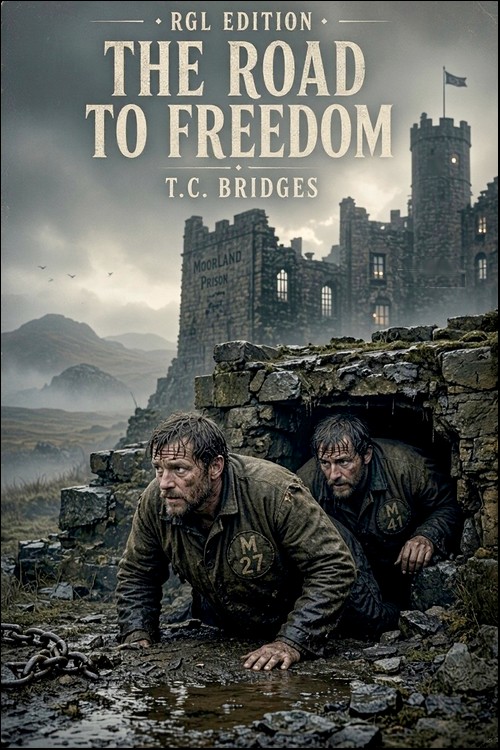
RGL e-Book Cover
Based on an image created with Microsoft Bing software
Roy Glashan's Library
Non sibi sed omnibus
Go to Home Page
This work is out of copyright in countries with a copyright
period of 70 years or less, after the year of the author's death.
If it is under copyright in your country of residence,
do not download or redistribute this file.
Original content added by RGL (e.g., introductions, notes,
RGL covers) is proprietary and protected by copyright.
RGL e-Book Cover
Based on an image created with Microsoft Bing software


Title from "The Evening Journal"
JOHN GARNETT swung his heavy pickaxe with a will, and at each blow the tough, hundred-year-old mortar crumbled, while every now and then a heavy block of granite broke away, and fell with a crash to the flagged floor below.
Warders and fellow convicts alike allowed that Garnett was easily the best man in Party 19, and in his silent way he was proud of the distinction and did his best to retain it. He was one of the very few prisoners in Moorlands who worked for the sake of working, instead of just scraping through without loss of marks.
The order had gone forth from Whitehall that the old war prison was to be demolished, and a new "hall" built in its stead. This was the task on which Party 19 were engaged, and Garnett, as befitted his reputation, was given the most difficult, and in a way the most dangerous, place.
Gradually the wall crumbled down under his heavy strokes, and he came back towards ground level. In spite of the nip of the open air, the perspiration was standing in great beads on his brown forehead, and he paused and wiped the moisture away with the coarse handkerchief which he kept clean by washing it each night in his cell.
Then he dropped down off the wall, and set to work on the huge blocks which composed its foundations. The floor was cumbered with fallen stuff. He laid his pickaxe down, and pitched the rubble aside noticing as he did so how worn and uneven was the pavement below.
No wonder, for this had been the main hall of the old war prison where day by day for years on end, hundreds of French prisoners of war had spent their nights and the greater part of their days.
Presently his pickaxe slipped off a particularly hard layer of mortar, and its point struck the pavement—struck it with such a curiously hollow sound as startled Garnett.
He glanced sharply round in order to make sure that no one else had noticed it, then gave a lighter blow on the same spot. The floor gave back the same hollow ring. Without a doubt there was an empty space beneath the flags.
Instantly Garnett was filled with curiosity. It might, of course be an old well, a drain, or pit, but, on the other hand—well, he remembered to have read that the war prisoners had made several attempts to dig out, and that at least one was successful. At any rate, he meant to find out.
At the same time, he had no notion of sharing his discovery with the warders or his fellow prisoners; so, instead of at once proceeding to lever up the flag, he went quietly on with the wall, and was careful, as he continued his work, to cover the hollow flag with small stuff. The wall which he was demolishing was only a few yards from the boundary wall of the prison, and he reasoned that if he had indeed hit upon the old passage it must run right under both walls.
Therefore, in taking down the war prison wall, he would probably hit upon the opening below it.
It was ten in the morning when he first made his discovery. An hour later he, with the rest, was marched to the cells for dinner, and it was not until one o'clock that he got to work at the same spot.
"Those stones are pretty big," said stout Jarvis, the warder in charge of No. 19, as he came up to where Garnett was working. "Don't you want help to shift 'em?"
"No thank you, sir," answered Garnett, in his usual quiet and courteous fashion. "I can handle them quite well."
Jarvis glanced admiringly at the swelling muscles under the rolled-up shirt-sleeves.
"He's a wonder, he is," he muttered under his breath, as he passed along the line of workers. I wish there were more like him."
In spite of his boast, it was all that Garnett could do to get the bottom row of stones out of their solid bed, but he did at last; then stacking them cunningly so as partly to shelter his proceedings from the eyes of his neighbours, he proceeded to dig down into the rubble under the foundations.
He worked very cautiously, and kept constantly looking round to make sure no warder was approaching.
All of a sudden the point of his pick sank through to the haft, and, with a slight rattle, some small stones dropped into an opening beneath.
Garnett's heart beat furiously, but he did not show the slightest outward sign of his excitement. He pulled the pick out, and worked on quietly at another part of the wall until Jarvis, who was moving slowly up and down, had passed by. Then he bent down deliberately, and put his head over the opening.
A current of air, fresh and cool, blew up against his face, and from that he knew, without a shadow of a doubt, that the hollow was no mere pit, but that it must have another opening at a distance.
Waiting his chance again, he took a mason's plumb-line which lay near, and dropped the weight into the hole. He found that it was near four feet deep. Then, still acting with the same extreme caution, he probed the aperture with a shovel handle, and discovered that there was certainly a passage running to the south-east, in the direction of the boundary wall.
He would dearly have liked to go down it, but that was for the present out of the question, so with hands that shook a trifle in spite of himself, he placed a big, flat slab so as to cover and hide the hole and set himself coolly to continue the work.
Coolly as far as outward appearances went, inwardly he was blazing with excitement.
Escape—escape is the one subject which is uppermost in the thoughts of every prisoner in every prison in the world. It does not matter that hardly anyone ever does escape. Each thinks that he will be the fortunate one.
But John Garnett had always had far more reason than his companions in misfortune to hope that, if the chance came to him, he would get clear away. While many of them who bolted must wander on the moor in the cold and wet or risk a burglary to get food and clothes, he had someone ready to give him all possible assistance.
His twin brother, Robert, had a cottage at Lastleigh, which he had taken in the one hope that John could one day make a run for it and reach the cottage and safety.
Safety, because although they had been as poor as rats three years ago, when John Garnett was sentenced to seven years' penal servitude for a crime he had never committed, the brothers had since come into money, and disguises, motor-cars, a fast launch—all that wealth could buy—were now at John's service to aid his escape abroad.
That night John hardly closed his eyes. For hours on end he was considering how best to make use of his discovery.
That the passage had an exit outside the main wall, he had little doubt. The chances were that the opening was in the plantation just beyond the narrow path that ran right round the prison.
On the surface, escape by means of the passage was easy enough. In reality, it was beset with difficulties.
In the first place a fog or storm was essential to success. On a clear day he was bound to be spotted almost as soon as he got outside. For the plantation was small, and there was a lot of open ground to be crossed before be could reach the shelter of the big wood on Stony Hill.
At first he decided the best plan would be to hide in the tunnel until night. But there again he was bound to be caught. As soon as his absence was noticed a score of warders would be ransacking the scene of his disappearance. They could hardly miss the burrow by which he had gone into the ground.
The more he considered the matter, the more he saw he must have a confederate—someone who he could trust to cover up the mouth of the hole after he had dropped down into it.
A confederate! At first the idea seemed hopeless. There is hardly a convict in any prison who will not give the next man away. Then all in a flash it came to him.
Abel Perry! Perry was a great, gaunt fellow who had lived in the little country parish of which John Garnett's father had been vicar. He was serving a long term for killing a game keeper. In some ways the man was a brute, but he was a very staunch brute, and the Garnetts had been good to his wife years before, when Perry was in the local gaol for poaching. John knew that he was grateful, and believed he would do what he asked him. Best of all, Perry, too, was a member of Party 19.
The next thing was to ask him. This would be easy. To-day was a Friday. On Sunday good-conduct men were allowed to talk at exercise. He and Perry both wore the blue collar awarded for good behaviour. That would be his chance.
Little outdoor work is done on Saturday. The day is devoted to cleaning up for Sunday. For Garnett the next day dragged worse than any day he ever remembered. But Sunday came at last and fortunately it was fine.
At ten Jarvis unlocked the cell door and Garnett and the others were marshalled out into the yard.
Perry showed no surprise when Garnett approached him. It was not the first time that the son of his former vicar had expressed a wish for his company.
"How be you, Mr. Garnett?" he said, as the latter ranged alongside.
"All right, Perry, and for heaven's sake stop the mister!"
"Ay, I forgot," answered Perry. Garnett was struck by the dull way in which the man spoke, and, looking at him, saw that his gaunt face seemed even more gaunt and grim than usual, while his eyes were dull and sunken.
"You're ill, Perry," he said sharply.
Perry shook his head slowly.
"No, I ain't ill. Leastways, not in body," he answered.
"Then what makes you look so bad?"
For a moment or two Perry did not answer. He paced onwards, his head hanging, his heavily-booted feet dragging on the gravel.
"What is it, Perry?" repeated Garnett, in a kindly tone. He had a real affection for the big, simple man whose moment of passion had resulted in this terrible punishment.
"Heard from the missus yesterday," answered Perry, in a lifeless voice.
"Then she's better?" said Garnett.
"She's worse," returned the other.
"'Twas the doctor that wrote the letter for her."
"Worse! I'm sorry."
"She's dying," said Perry, with a groan. "Susan's dying, and—oh, Heaven, I'd give the rest of my life to see her afore she goes!"
The passion in Perry's voice affected Garnett painfully. He felt it would be waste of time to try and comfort him.
"To think that they should keep me here just when she needs me most," went on Perry. "'Tisn't fair nor right. Susan's been a good wife to me, and now I've got to leave her to die in the hands of strangers."
As he spoke he was twisting his great hands together—twisting them with such force that the knuckles shone white.
"It's infernally hard," said Garnett in a low voice.
Perry hardly seemed to hear. Presently he turned to Garnett, and there was a queer gleam in his sunken eyes.
"I'd do a bunk if I got half a chance," he whispered hoarsely. Then, shaking his bead: "But there isn't one."
Garnett hesitated a moment. Then, as if the words were rung from him:
"There is a chance. I can give you one," he answered.
Perry started violently.
"Steady man!" muttered Garnett. "Steady! The warder will spot you. Walk on quietly. I'll tell you what I mean."
With an effort Perry got command of himself and the two walked on side by side, while Garnett told of his strange discovery among the remains of the war prison.
"If there's a fog any time inside a weak, it ought to be all right," he ended.
Perry had listened in absolute silence. When Garnett stopped speaking he turned his eyes upon him.
"And what about you?" he asked. "Be you coming too?"
"No." Garnett spoke very quietly, "No. It wouldn't work. But if you get away safely, I might have a shot by the same road another day."
"You knows that's not to be done," answered Perry. "The screws is bound to be put on it."
Garnett shrugged his shoulders.
"If they are it can't be helped," he said lightly. "Anyhow, you'll get a fair show."
For some moments Perry remained silent. At last he looked up.
"God bless you sir!" he said, with intense earnestness. If man can do it, I'll see Susan once more afore she dies."
Garnett gave Perry exact directions how to reach his brother's house at Lastleigh, and a note scribbled on a tiny morsel of wrapping paper which would ensure Robert's helping him.
It was on the following Wednesday that the fog came. No farm parties went out, but as there was no rain Party 19 continued their work.
It was not difficult for Perry to place himself alongside of Garnett, as they were both such steady workers, the warders left them pretty much to their own devices.
It was arranged between them that Perry should wait till about four in the afternoon to make his attempt. His absence would probably not be noticed until the party was collected, and by that time it would be dark, and he would have the whole night before him to make his way to Lastleigh.
The hours dragged terribly, but at last the prison clock struck four. Still half an hour to wait. Would the slow afternoon never drag to an end? The fog was thickening, and turning to a misty drizzle. Garnett looked round to see what Jarvis was about, and saw the warder at some distance, doing his usual sentry-go, and stamping his feet to keep warm.
Then his attention was caught by two men on the opposite wall. They were at some height above the ground—perhaps twelve or fifteen feet—and both picking away steadily.
It was a partition wall on which they were working, and all of a sudden it struck him that they were in a singularly unsafe position. The mortar was flaking away out of the stones beneath them, and the whole wall looked to him to be in a very shaky condition.
He resolved to call Jarvis's attention to their danger and his mouth was actually open to shout when, without further warning, the wall curved over towards him, and fell with a dull, heavy roar, sending up a cloud of choking dust which hid everything. For a second or two there was dead silence, then every one, warders and convicts alike—began to run towards the scene of the accident.
Horrified, Garnett was about to plunge through the dust to the rescue when a hand seized him with a grip of iron.
"Now's our chance!" hissed Perry in his ear. "A chance for us both. This dust'll hide us. They'll never see us."
As he spoke he dragged Garnett back towards the opening.
Instinctively Garnett knew that he was right. It was a Heaven sent chance.
Perry seized the flagstone which covered the hole leading down into the tunnel, and flung it aside as lightly as though it had been a pebble.
"Go on!" he whispered hoarsely. "You first"
Garnett hesitated no longer, but went down like a bolting rabbit. Perry followed.
Bent double, they scrambled desperately through the low-roofed tunnel towards a dim grey patch of light in the distance.
A minute more they were racing silently across the fog-bound moor.
Later that evening, Warder Jarvis was supervising a gang who dug frantically among the great heap of rubble. The injured men were in the infirmary, and the workers were searching for the bodies presumably buried in the ruins.
Jarvis turned to his companion, Principal Warder Ives.
"My two best men," he said dolefully. "And I'll never see 'em alive again."
He was quite right. He never did—or dead, either!
Roy Glashan's Library
Non sibi sed omnibus
Go to Home Page
This work is out of copyright in countries with a copyright
period of 70 years or less, after the year of the author's death.
If it is under copyright in your country of residence,
do not download or redistribute this file.
Original content added by RGL (e.g., introductions, notes,
RGL covers) is proprietary and protected by copyright.