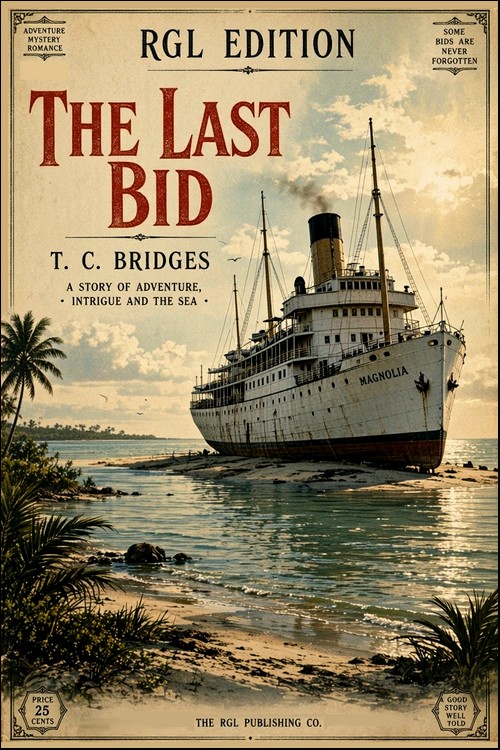
RGL e-Book Cover
Based on an image created with Microsoft Bing software
Roy Glashan's Library
Non sibi sed omnibus
Go to Home Page
This work is out of copyright in countries with a copyright
period of 70 years or less, after the year of the author's death.
If it is under copyright in your country of residence,
do not download or redistribute this file.
Original content added by RGL (e.g., introductions, notes,
RGL covers) is proprietary and protected by copyright.
RGL e-Book Cover
Based on an image created with Microsoft Bing software
Title from "The Evening Journal"
WHEN you have spent four years on a piece of land of your own; when your own blistered fingers have cleared that ground of its native forest and ploughed and planted it; when, in short, you have created a home, however humble, out of the primeval wilderness, you are apt to feel a certain affection for the place.
It was a sentiment of this kind which loomed large in the mind of Robert Heritage, as he stood by the edge of Lemon Lake and looked back at the snug little frame-built house under the live oaks, and orange grove behind it.
For the past 12 months he had been gradually realizing that any attempt to make the place pay without capital for labour and fertilizers was completely out of the question, and now, at last, he had made up his mind to cut his loss, and go and look for a job on the big drainage works on Lake Okeechobee.
His pleasant, sun-browned face was set in harder lines than usual as he turned and tramped stolidly away, making for the railway station at Rosalia, seven miles away through the pine woods.
He had just rounded the corner where the road left the lake when he caught sight of a pony cropping the coarse wire grass at the edge of the track. There was nothing in this, for plenty of ponies run half-wild in the woods. What startled him was the fact that the pony was saddled and bridled; yet there was no sign of his rider.
He walked quietly up, and the animal allowed itself to be caught without trouble.
"Wonder if I'm going to get a free ride," he remarked to himself, and just then was startled by a deep groan. He glanced round quickly in the direction from which the sound proceeded, and saw a man lying on his back under the scanty shade of a scrub oak. A middle-aged man, small and spare, and by the yellow pallor of his ill-shaven face, evidently very ill.
"Hullo, what's up?" enquired Heritage.
"Ch-chills and fever," replied the other between chattering teeth. "C-couldn't stick it any longer."
"Gad, I don't wonder!" said Heritage. "You must have been crazy to start."
"I—I had to. G-got an engagement over on the coast."
"The deuce you have! You'll have an engagement with the undertaker if you're not careful. Here, the sooner you're in bed the better."
Heritage picked him up bodily, hoisted him into the saddle, and held him there. Then he turned the pony in the direction of the house which he had just left.
Luckily his furniture still remained in the locked up shanty, and within half-an-hour he had his man between blankets in his own bed. In spite of the blankets and a hot brick at his feet the unfortunate fellow was shivering till the cot rattled. After the chill came the fever, and soon the patient was raving in delirium.
All his talk was of the sea. Several times he mentioned Neptune Inlet; then the word Magnolia, seemingly the name of a ship, cropped up endlessly. It was dark before he came to his senses again, when he was weak as a baby, and Heritage had to sit up with him most of the night, feeding him now and then with condensed milk and warm water.
IN the morning Heritage found him up and trying to get into his clothes. He was much annoyed.
"See here," he said, "if you want to commit suicide you can choose some other place but my house for it. I've given up a journey I was taking and sat up all night with you, and I'm hanged if I'm going to have it all chucked away!"
The little man dropped panting on the bed.
"I'm real sorry, mister, but I simply got to get over to the coast "
"And I say you've simply got to get back to bed and stay there," retorted Heritage.
"But I'll be losing the chance of a lifetime, mister."
"Better that than losing your life," said Heritage drily.
"Do you reckon I'm that bad?"
"I know it," said Heritage. "Lie down again, and I'll bring you some bread-and-milk."
The little man groaned, but obeyed. Heritage went out and came back in a little while with the food.
But the other was too unhappy to eat.
"Mister," he said, "I been a poor man all o' my life, and now I got the chance o' making a bit of money. I guess, if I can't take that there chance, I'd jest as soon die as not."
Heritage looked at him keenly.
"So the fortune's waiting for you at Neptune Inlet, eh?"
The other started and stared.
"What you know about Neptune Inlet?"
"You forget you've been raving for hours," said Heritage, with a shrug.
"How much did I say?"
"You talked of a ship called the Magnolia and mentioned Neptune Inlet a few score of times."
The wizened little man was silent for several seconds. His eyes, bright with fever, searched Heritage's face.
"You're British, I reckon?" he said at last.
"Right! My name is Robert Heritage. I own this place, but I've gone broke over it. I'm as poor as you—probably poorer."
"And straight by the looks o' you," said the other, as if thinking aloud. "See here, Mister Heritage," he went on in a stronger tone; "I'm a-going to trust you. I got to trust somebody, and I'd as lief trust a Britisher as most. My name's Jenson—Matt Jenson, and I've followed the sea all my life. I was second mate in the Magnolia. A tramp she were, and bound that voyage from Iquique to Savannah with nitrate. We got into bad weather off Cape Florida, sprung a leak, broke the rudder, and run for Neptune Inlet. Got right there, too, and then blamed if she didn't hit the bar and sink in five fathom not three mile off the shore. We got the boats out, but there was a ugly surf running, and two was upset right off. Only one got in with me and three other chaps in her."
He paused to take breath, then went on.
"I went right up to Connecticut, where I owned a few acres that my dad left me, sold 'em, and come straight back with the money in my pocket. I guessed I'd be just in time for the sale, and so I would if it hadn't been for this here cussed fever catching me"
"The sale of the wreck, you mean?" cut in Heritage.
"Aye. They auctions her off on Saturday. Now do you catch on?"
"I think so. You want me to go and bid on your behalf."
"That's so, and if you gets her, it's halves."
"But is she worth anything? Nitrate's no good, once it's wet."
A ghost of a twinkle gleamed in Jenson's eyes. "That's so, mister—that's so. But there's more'n nitrate aboard." He lowered his voice. "There's better'n a hundred ton o' copper in her hold."
Heritage gave a low whistle.
"The deuce there is! But surely others know that besides you?"
"They don't, Mr. Heritage. So fur as I'm aware, there ain't another soul in the United States as knows it. It were a private spec o' the skipper's and he kep' it dark."
"But what about those three other survivors?"
"Greasers, sir. Greasers all on 'em. They don't know nothing. And," he added. "Skipper Anderson, he didn't have no family. So I guess I got as good a right to the plunder as the next man. Now what do you say?"
"I'm your man," replied Heritage briskly. "Let me see. To-day's Wednesday. It's only a day's ride. I'll stay with you till Friday and shove along."
"No, sir!" retorted Jenson. "You go right away. You want a day or two to sniff around and see as no one's been fooling with that there wreck. Get some nigger to look after me and go right along."
Heritage nodded. "Right you are! I can get Scipio Edwards. He can cook like an angel if you keep him off the whisky. Now, what about the cash?"
"Right here, mister," as he fished a battered pocket book from under his pillow, and took out a roll of bills. "Eleven hundred dollars all told. I don't reckon she'll fetch more'n half that, but you bid the lot rather than lose her."
THE sun had just dropped behind the black line of pines inland as Heritage rode into Neptune City. "City," the inhabitants called it, but it was nothing but a row of brightly painted frame houses strung along the sandy bluff facing the bay.
Heritage left Jenson's weary beast at the livery stable, shouldered his saddlebags and tramped across to the Palmetto House. It was April; most of the Northern tourists had returned to their homes, and the place was beginning to assume the half-alive appearance peculiar to all seaside resorts in the off season.
After a wash, Heritage made his way to the big airy dining room. It would easily hold 50, but at present there were less than half a dozen people in it.
The sea breeze blew pleasantly off the Atlantic through the open windows, and Heritage was snuffing the salt air gratefully, when his attention was attracted by the arrival of a girl, who, accompanied by an older lady, sat down at the table next his.
She was a very charming-looking person, with coils of the most wonderful coppery hair, and a clear complexion and red-brown eyes, which go best with it. But it was not her hair, nor her eyes, nor her complexion which most appealed to Bob Heritage; rather was it the wonderful atmosphere of health and strength that seemed to radiate from her. He stared at her for quite 10 seconds before he remembered his manners, and then the red which rose beneath his own tan was far richer in hue than the delicate tint which coloured her clear cheeks.
He had hoped to make her acquaintance after supper, but, much to his disappointment, she left the room early, and he saw no more of her that evening.
Deadly tired from his long ride, he turned in early, but even so overslept himself badly, and found the dining room deserted when he got down. As he disposed of some very tough steak and some very excellent hot bread and coffee, he bethought himself that this was no time for thinking of young women, however attractive. The very first business in hand was to "sniff around," as Jensen had it, and get a look at the wreck.
The main business of Neptune Inlet is salt water angling, of which sport it offers a choice ranging from giant Jew fish and bats weighing a quarter of a ton each down to modest striped bass, mere chickens, rarely exceeding 40 lb.
Heritage, who, in his earlier and more prosperous days, had twice visited the place, and knew both the water and the sport, selected a stout 18-ft. centre-board catboat, and refused the services of its owner. Spreading the big sail, he skimmed gaily out across the azure ripples of the bay.
Naturally, he did not head at once in the direction of the wreck. On the contrary, he sailed away towards the northern entrance of the inlet, the wreck, as he very well knew, lying much nearer to the southern point.
Soon he was opposite the bar. Calm as it was in the inlet, there was quite a sea outside. There had been a gale somewhere, and long, purple rollers came swelling majestically out of the Atlantic, to burst in muffled thunder on the plank-hard sands of the bar.
Heritage, being in no hurry, took down his sail and put out a float line baited with a 2-lb. mullet. Inside five minutes he was fast in a 6-ft. shark, which towed him half a mile to southward before he got on terms with it. He was hauling in the brute, when he became conscious of another boat travelling at a great rate across the bows of his own.
One glance was enough to show him that this was a small rowboat tenanted by one person only, a girl—and that the girl was no other than his charming neighbour of the previous evening. It showed more. The boat was evidently in tow of something considerably bigger than his own shark, which was taking it straight towards the bar and the heavy surf that thundered ceaselessly upon it.
"Cut!" he shouted. "Cut!"
She turned her head, and he caught a glimpse of her face pink with excitement.
"I can't!" she answered breathlessly. "I've lost my knife!"
"Just as well I've got mine," muttered Heritage, as he drew it and slashed his own line. In a trice he had his sail up and was in full pursuit.
Straight as an arrow the rowboat flew towards the danger zone. The sea outside was ugly for any small craft. As for the girl's frail skiff, the first wave would inevitably swamp it. Heritage's blood ran cold, for he knew—none better—that these outer waters swarmed with tiger sharks.
He fully realized her predicament. She had made her line fast and now the strain was so heavy that she could not untie it. The fish that had her in tow was clearly something out of the ordinary, for the bow of the little boat was almost buried, and the girl herself forced to sit right back in the stern in order to prevent it from driving under altogether.
The wind was off shore, but light. Heritage grew more and more alarmed as he realized that he was gaining but very slightly. And every moment brought them both nearer to the roaring surf belt.
Then came a welcome puff, and the catboat, heeling till the foam creamed along her gunwale, shot forward more rapidly. Now he was gaining fast, yet, even so, saw that he would not reach the smaller boat before she was in the surf. Already she was rising dangerously to the first tall swell.
If the girl were to be saved, he must act quickly. Porting his helm and tightening his sheet, he turned sharp in across the bows of the smaller boat.
"Jump!" he shouted. "Jump!"
There was a crash which nearly knocked him overboard as the bow of the girl's boat collided violently with the side of his. But the shock snapped her line, and as the two boats swung together the girl gathered herself, made a flying leap, and landed half in, half out of the catboat on the windward side.
Leaning forward, he got one arm around her, and by main force dragged her dripping over the gunwale, while at the same time he put the tiller still further over. A white-crested comber roared above them, half as high as the mast, and for a very unpleasant moment Heritage firmly believed it was all over. But the catboat came round like a top, and just escaped the worst of it.
Even so her occupants were drenched and blinded by a cataract of spray, and the boat filled so that the bottom boards were afloat. The girl snatched up a tin and baled hard, and in a moment or two they were in smoother water and the danger was over.
The girl looked up.
"I'm so sorry," she said penitently.
"For your fish or your boat?" enquired Heritage.
"For your fish," she retorted, quickly. "You had to cut, didn't you?"
"I never made better use of a knife," said Heritage.
"You certainly were very prompt—and very clever."
"I could never have done anything if you hadn't kept your head," declared Heritage.
The girl broke into a rippling laugh.
"I can't cap any more compliments," she said. "All the same"—more seriously—"I am really very grateful to you—the more so because it was all my own fault. I knew I had hooked a big sea bat, and had no business to make my line fast. I was really frightened when I could not find my knife."
"You didn't show any sign of it, anyhow," Heritage assured her. "Now I am going to run you straight back to change your wet things. Then, if you really want to show your gratitude, you can come out with me again while I try to salve your skiff."
"I am spoiling your fishing," remonstrated the girl.
"You have done that already," replied Heritage, and something in his tone brought a faint flush to her check.
But she made no objection, and an hour later they were out again, this time making for the south side of the inlet, where the set of the current would probably beach the skiff.
The breeze was still brisk, and it was not long before they approached the white sand flat which formed the southern horn of the inlet.
The girl stood up, shading her eyes with her hands from the dazzling sun glare.
"I see her," she said eagerly.
Heritage shook his head. "I'm afraid not, Miss—"
"Abercrombie," she supplied with a smile. "Sybil Abercrombie."
"And my name is Robert Heritage," he answered. "But that's not the skiff. That's a wreck, or what is left of it."
"Oh, "the Magnolia! Yes, remember." Her face clouded. "The poor men were all drowned, were they not?"
"Not all. Four got ashore. Do you mind if we have a look at the wreck?"
THE tide was low. It was easy enough to reach the spot where the battered steamer had sunk, and through the transparent blue water every detail of her long black hull was plainly visible. Heritage, leaning out over the gunwale, peered down at her eagerly. The hatches were intact, and so far she had evidently not been tampered with.
"You are very interested, Mr. Heritage."
He started. For the moment he had actually almost forgotten his companion.
"I am," he confessed.
"Her hull seems quite good," said Miss Abercrombie, looking down. "Could she not be raised?"
"That is possible. But she is an old ship, and badly strained. It is probably not worth while."
"There is a notice up in the town that she is to be sold by auction" she said. "I wonder is any one will bid for her."
Heritage had a sudden impulse to confide in her, but the thought of Jenson checked him.
"There are always people to risk such a chance," he said, then changed the subject abruptly.
"Look! There is the skiff," he said, pointing. "We had better get her before she grounds.
The skiff was, in fact floating, waterlogged, not far away. Heritage soon reached her, and had just baled her out and got her in tow, when he noticed another boat close by the wreck.
His start was not lost on Sybil Abercrombie.
"Some one else is interested in the wreck," she said softly.
Heritage's eyes were fixed on the big, heavily built young man in the other boat. "You know him?" he asked quickly.
"I have met him," she answered. "He is Mr. Fisher Harney. He has land here, and they say has a finger in every pie."
Heritage was silent. He was suddenly very anxious. Could this man possibly have any idea of the real value of the wreck. According to Jenson it was impossible, and yet—
Just then Harney looked up and pulled towards them.
"How do, Miss Sybil!" he shouted. "I heard you had an upset. I'm real glad you're all right."
"Thanks to Mr. Heritage, I am," replied Miss Abercrombie. "Let me introduce you. Mr. Harney—Mr. Heritage."
"How do!" said Harney casually. His voice was as big as his frame. If his pocket matched them both Heritage realized that his chance of securing the wreck was a slim one.
"Say, Miss Sybil," went on Harney, "I wanted to ask you if you'd come out with me to-morrow. I've got a new rod I want you to try."
Miss Abercrombie hesitated. Heritage watched her eagerly.
"Thank you, I shall like to," she said, and Heritage was instantly filled with an intense desire to kick his rival.
"I'll call round for you about 10," answered Harney briefly, and pulled on.
Heritage, too, pulled, and for some time in a silence which was very near to sulks. But Miss Abercrombie wisely paid no attention. In fact she entirely ignored his mood, and began to ask tactful questions about England, about his life in Florida, about anything, in fact, which would take his mind off Harney. And Heritage, being anything but a boor, soon responded to her interest, and ended by enjoying the last part of his row even better than the first.
SATURDAY, the morning of the sale, broke as brilliant as the two preceding days.
There were more people in the auction room than Heritage had anticipated. Most of them, no doubt, were not bidders, but drawn merely by curiosity; still, it was clear that the sale was attracting a certain amount of attention.
Presently Harney came in, and greeted Heritage with a curt nod. He looked bigger than ever, a great bull of a man, and his prominent jaw was set in a way which seemed to indicate that he was bad to beat. Heritage was conscious of a growing dislike for his rival.
Sharp at 11 Mr. Samuel Knight entered. The auctioneer was a pursy little man, who wiped his hot face frequently with a coloured silk handkerchief.
"Gentlemen," he began in a wheezy voice, "I am instructed by the Mercantile Insurance Company of Hertford, Connecticut, to sell the wreck of the steamship Magnolia. I reckon you all know where she lies, so I needn't tell you that there isn't but five fathoms over her at low tide. She's a steel-built ship, 12-hundred ton burden, and ain't broke up anything to signify. She'd ought to be worth raising, but even if she ain't raised whole, there's a lot of stuff about her as can be salved easy. I ain't saying nothing about her cargo—"
"There ain't any to say about," broke in a voice. "'Tis all melted up weeks ago."
"That's jest what I was going to tell you," went on Mr. Knight, rather sharply. "Still, I reckons her fittings is worth a thousand dollars of anybody's money. Any gent say a thousand?"
"I'll say a hundred," suggested the interrupter with a grin.
Mr. Knight looked at the man reproachfully.
"You always would have your joke, Mr. Collis."
"No joke at all," returned Collis. "Who's agoing to bid more?"
"I'll offer two hundred," said Heritage.
Every one looked at him, and there was a short pause.
"Three hundred." The deep, heavy voice was Harney's.
Heritage bit his lip. He had not been mistaken. This man was his real rival. Again he wondered if Harney could by any possibility have heard any rumour of the copper. One of those greasers might have known more than Jenson had supposed.
"Five hundred," he said boldly.
Harney glared at him. "Six!" he boomed.
"Seven," retorted Heritage.
"Eight," came from Harney.
The room was very quiet. Every eye was fixed on the two rivals. Heritage's heart was pounding, yet his voice was steady enough as he answered "Nine!"
Harney was silent. Heritage watched him breathlessly.
"Nine hundred I am offered," said the auctioneer, and in his voice surprise struggled with delight. He would get a 10 per cent. commission on the sale. "Nine hundred—any further offers.
He raised his hammer.
"A thousand!" roared Harney.
Heritage reckoned that, after paying his expenses, he would have about thirty dollars less than Jenson's original eleven hundred. But he also had fifty dollars left of his own.
"And a hundred," he said curtly.
Harney drew a slip of paper from his pocket and glanced at it. His heavy face was dull red.
"And a hundred better," he said, with an evident effort.
Heritage was beaten. There was nothing for it but to take his defeat with as good grace as he might. He made a step backwards.
"Twelve hundred I'm offered," said Knight. "Any advance on twelve hundred."
Once more his arm was rising when a clear voice came from the back of the room.
"Thirteen hundred, Mr Knight."
Heritage started violently. It was Sybil Abercrombie who had made the last bid. He turned and saw her standing there, dressed very quietly in a coat and skirt of tan-coloured drill, and with the sunlight from a window turning her copper hair to ruddy gold.
But if Heritage was amazed, the effect on Harney was startling. He glared at Sybil as though he could not believe his eyes or ears. His colour was almost apoplectic, and his prominent eyes were full of rage. For a moment he seemed unable to speak, but Knight waited for him.
"Fourteen hundred," he said thickly.
"It's cash down, Mr. Harney," Knight reminded him.
Harney did not seem to hear. His eyes were on Sybil.
"Fifteen hundred dollars," she answered calmly.
A savage exclamation burst from Harney's lips. He spun around suddenly; and plunged for the door, ploughing his way through the bystanders like a bull through a hedge.
Knight saw it was all over.
"Fifteen hundred dollars," he repeated. "Going! Going! Gone!" Down came the hammer "And the lady's name is—"
"Sybil Abercrombie," was the quiet answer.
Heritage stepped across to her as she advanced.
"I congratulate you, Miss Abercrombie," he said, in a low voice. "I suppose you know that you have a prize?"
"I—I don't know anything about it," she answered in an equally low tone.
Heritage could only stare.
"It is true. Indeed it is true, I—I didn't want to see you beaten.
Heritage could find no words. He was conscious only of an overwhelming surprise.
Sybil spoke again a hurried whisper. "I—I haven't got 1,500 dollars, Mr. Heritage. I have only 500."
Heritage found his voice.
"I—I don't understand," he said confusedly.
"Men are proverbially stupid," said Sybil, and now she was smiling, "Still I should have thought that a sum in simple addition was not beyond you."
Light dawned on Heritage. You mean—?"
"Of course I do. And you can repay me when you have sold the cargo."
As she spoke she slipped a roll of notes into his hand, and was back by the door before he could say another word.
There was nothing to do but to satisfy the pursy Mr. Knight and parry the latter's amazement at this strange partnership between two apparently rival bidders. This completed and the receipt pocketed, Heritage presently found himself walking side by side with Sybil along the lonely sandhills by the sea, and unfolding to her the whole story of his meeting with Jenson and its results.
"So now," he ended, "we three are partners, and there ought to be a matter of 50,000 dollars to divide between us."
"And you will be able to go back to your little place at Lemon Lake," she said softly.
He looked at her, and something that he saw in her face gave him sudden courage.
"But not alone, Sybil," he answered, and took her in his arms.
Roy Glashan's Library
Non sibi sed omnibus
Go to Home Page
This work is out of copyright in countries with a copyright
period of 70 years or less, after the year of the author's death.
If it is under copyright in your country of residence,
do not download or redistribute this file.
Original content added by RGL (e.g., introductions, notes,
RGL covers) is proprietary and protected by copyright.