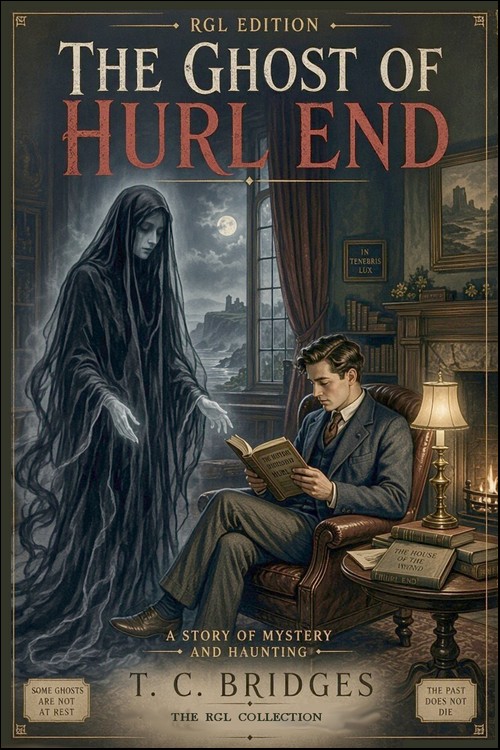
RGL e-Book Cover
Based on an image created with Microsoft Bing software
Roy Glashan's Library
Non sibi sed omnibus
Go to Home Page
This work is out of copyright in countries with a copyright
period of 70 years or less, after the year of the author's death.
If it is under copyright in your country of residence,
do not download or redistribute this file.
Original content added by RGL (e.g., introductions, notes,
RGL covers) is proprietary and protected by copyright.
RGL e-Book Cover
Based on an image created with Microsoft Bing software
When young artist Kit Coote snaps up the lonely cottage known as Hurl End for a suspiciously low price, he dismisses talk of ghosts as village gossip. But strange midnight moans, a shadowy black-clad apparition, and increasingly desperate attempts by unknown parties to buy the property soon convince him that the house hides a dangerous secret...
"YOU'RE right, sir," said the auctioneer. "It's the cheapest house I've sold since the war, and a bargain at £400."
"But why did it go so cheaply?" asked Christopher Coote. "Is it haunted?"
The auctioneer grinned broadly. "If, it is, you've bought the ghost, Mr. Coote. Here's the receipt for your deposit, and I wish you luck with your purchase."
Kit Coote went out of the room feeling extraordinarily pleased with himself. Ever since he first set eyes on the cottage at Hurl End he had loved it, but he had never dreamed of being able to own it.
Even now he could scarcely believe his luck in having it knocked down to him at such a low figure.
Just as he got outside he met a man hurrying in—a heavily built, harsh-faced person.
"Has Hurl End been sold yet?" he asked breathlessly.
"Yes. I've just bought it," replied Kit.
The other muttered an oath. "How much did you give?" he growled.
Kit looked at him. "Four hundred, if you want to know."
"I'll give you five," snapped the other.
Kit shook his head. "I'm quite pleased with my bargain, thank you."
"Five-fifty," said the other. "Hang it! You don't make £150 in five minutes every day." As he spoke he clutched at Kit's arm.
Kit shook him off. "I'm not selling," he replied curtly, and walked off.
A week later he was comfortably installed in his new home. The more he saw of the old place, the better he liked it.
Kit was an artist, young and very keen, but since he had little money he lived alone, doing his own cooking and merely getting in a woman from the village each morning to sweep and tidy up. She was a Mrs. Soanes, and from her he learned that Hurl End had been occupied by a Mr. Frayne, an elderly man, and his daughter, "a real nice young lady."
Mr. Frayne had died, and the daughter, she believed, had gone to live in London. When Kit enquired about ghosts, Mrs. Soanes declared that she had never heard of anything of the kind.
"If there is a ghost, it ought to be a nice cheery one," said Kit to himself that evening, as he sat over a glowing wood fire.
At that moment a curious sound—a sort of deep sigh—made him turn sharply.
At the far end of the room was a door leading to the back premises. This stood open, and in the opening stood a figure. The only light in the room was his shaded reading lamp, and all that Kit could see was that the figure was tall, slim, shadowy, and apparently covered from head to foot in some black gauzy material, which shimmered in a queer unsubstantial fashion.
For the moment he was too surprised to move. Then, as he jumped to his feet, the figure vanished without a sound.
Kit dashed out. He hunted high and low, but could find nothing.
The night passed quietly, and next day Kit, busy with his painting, had almost forgotten the affair. But that night, after he had gone to bed, and just as he was falling asleep, he heard a low moan.
He listened. It came again, a sound so eerie that it chilled his blood.
He was out of bed like a shot, and, lighting a candle, started a fresh search, which was as futile as the first.
Early next morning the postman arrived with the London paper and one letter.
This proved to be an offer for the cottage.
The sum suggested was £600, and the letter was signed "John Rutherford."
Kit frowned. "I wonder if it's the same chap who tried to buy from me after the auction?" he said aloud. He started up, and going to his desk dashed off a curt refusal.
That day he could not settle down to work, and before nightfall he had made full preparations to receive the ghost. He tied string across the stairs, locked the doors, fastened the windows, and then went to his room.
Nothing happened, and at last he got so bored with waiting that he fell asleep.
Three days passed, and not a sign of the ghost; so, after nearly breaking his own neck over his booby traps, Kit got rid of them.
After tea on the third day he went out to do some gardening. He worked until it was too dark to see, and was just coming in, when once more he heard that same low moan and, looking up, saw the spectral figure standing near the open window of his studio.
For a moment he was too startled to move. Then he dashed for the door. But the studio was empty.
Kit sat down feeling oddly shaken. "It must be a ghost after all," he muttered. "That's why I got the place so cheaply."
It was too cold to eat in the kitchen, so Kit put everything on a tray, and was carrying this into the studio when he felt rather than heard a movement close by. Before he could turn, a gruff voice addressed him:—
"Lay that tray down and put your hands above your head."
Instead of obeying, Kit spun round and faced a big, heavily-built man, the upper part of whose face was hidden by a black mask.
"Put that tray down, you fool!" repeated the latter, but, instead, Kit raised it and threw it with all his might full in the intruder's face.
The man flung up his arm and saved his face, and down went the tray with an appalling clatter. With a savage oath the intruder sprang at Kit.
Kit met him with a blow which missed his chin, but struck him full in the mouth. Then the fellow closed, and the two went reeling and rocking round the room.
Luck was against Kit, for his heels caught in a rug and down he went, the back of his head striking the polished boards with a force that stunned him.
When he came to he was tied hard and fast in one of his own chairs, and his enemy was standing over him. The big man shook a huge fist in Kit's face.
"All right, my beauty!" he said, in a voice that grated with malice. "I'll be even with you for this. But first I've a job to do. When it's finished I'm going to fix you proper."
With that he disappeared in the direction of the kitchen.
Kit's head was aching, but he had sense enough left to know that the brute meant what he had said, and he struggled desperately to get free. It was no manner of use, and at last he went faint and lay back with a dreadful sick feeling of utter helplessness.
Nearly half an hour passed before his enemy appeared again, and now he was carrying a candle in one hand and something heavy in a sack across his shoulder. He dropped the sack on the floor, laid the candle down, and then came across to Kit and stood over him. "I told you I'd fix you," he said thickly. "Do you want to know how I'm going to do it?"
"Hit me over the head with a poker, I should think," said Kit recklessly. "That seems to be about your form."
The fellow laughed harshly. "You'll wish I had before you're finished," he jeered. As he spoke he picked up Kit's reading-lamp, unscrewed the top, and proceeded to pour the oil over the tablecloth. "They say dead men tell no tales, but ashes tell less," he remarked.
The brute's purpose struck Kit like a blow. "You're not going to burn me alive!" he cried. "Man, you've got what you came for. For heaven's sake take it and go."
"What?" retorted the other. "Let me tell you, there's no one ever gave James Mold the trouble you have and lived to remember it."
Kit's face hardened. "You coward!" he exclaimed. "Bah! You're not a man. You're a devil."
Mold, who was crumpling a quantity of newspaper and piling it on the table, paid no attention, and Kit gave up hope.
To be burnt alive! The thing was ghastly.
Mold was taking a match-box from his pocket when, from somewhere behind him, came the same low moan that Kit had heard before. Kit turned his head, and there, by the inner door stood the ghost.
It was a fearsome object, for its long black robe was speckled with a hundred small blue flames which flickered and shimmered in the gloom of the doorway.
Mold, too, heard the groan and turned. Kit saw him go quite stiff. The ghost moaned again, and then came gliding forward.
From Mold's lips came a hoarse yell of terror. The match-box dropped from his nerveless fingers, and he bolted frantically for the outer door.
The bag lay in his way, but he never saw it. It tripped him, and be pitched forward, striking his head with fearful force against the edge of Kit's big easel.
He lay quite still.
"Finished him!" cried Kit, and then, to his utter amazement, a voice came from the ghost, a human, feminine voice:—"Oh, I'm so glad!"
Scarcely able to believe his eyes, Kit saw the ghost shed its black robe and stand revealed as a tall, slim, and charmingly pretty girl dressed in plain tweeds.
"YOU are sure he is dead?" asked the girl shakily. She had cut Kit loose and was standing beside him as he examined Mold's body.
"Quite dead," replied Kit, looking up. "Don't say you are sorry, for it's the best thing that could have happened."
"I—I—perhaps it is," she faltered.
Kit gazed at her. "And you—," he began, then stopped.
The girl's cheeks flushed scarlet. "What am I doing here?" she answered. "That is what you wanted to ask. I—I am Betty Frayne. You—you see, you would not sell, and I was trying to frighten you away."
"But this man, Mold. I thought it was he who had been trying to buy."
"No—no. Mr. Rutherford was my agent. You see, I had not the money when dad died. Then my uncle left me a legacy and—and I loved the place and wanted it so badly." She covered her face with her hands. "How terrible you must think me."
"Terrible—when you saved me from being burned alive! Miss Frayne, I think you're the bravest—and—and best girl I ever met." He paused. "But this fellow—what was he after?"
"Something he had hidden in the cellar. The spoil of some robbery, I expect. Oh, he came down almost on top of me and frightened me nearly out of my life. I had only just time to hide."
"I didn't know there was a cellar," said Kit blankly.
"No, you would not. The door is hidden. But he knew."
"Let us see what is in the sack," suggested Kit, as he picked it up. The contents turned out on the floor were enough to stock a jeweller's shop. Plate, medals, snuff-boxes, a string of pearls, and a quantity of other jewellery.
"They are from Catour Court!" exclaimed Betty. "The big robbery seven years ago. There was a reward of a thousand pounds."
"A thousand pounds," repeated Kit slowly. "That is five hundred each?"
"Five hundred each!" cried Betty. "It has nothing to do with me."
"It might," said Kit significantly.
And something in his voice made Betty Frayne blush more vividly than before.
Roy Glashan's Library
Non sibi sed omnibus
Go to Home Page
This work is out of copyright in countries with a copyright
period of 70 years or less, after the year of the author's death.
If it is under copyright in your country of residence,
do not download or redistribute this file.
Original content added by RGL (e.g., introductions, notes,
RGL covers) is proprietary and protected by copyright.