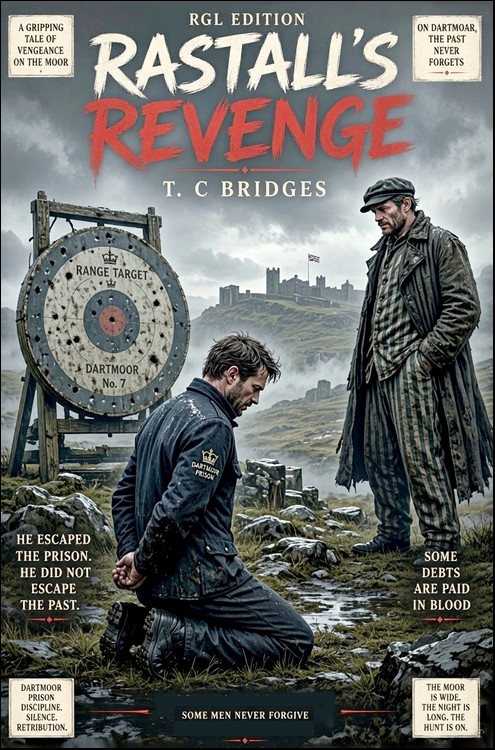
RGL e-Book Cover
Based on an image created with Microsoft Bing software
Roy Glashan's Library
Non sibi sed omnibus
Go to Home Page
This work is out of copyright in countries with a copyright
period of 70 years or less, after the year of the author's death.
If it is under copyright in your country of residence,
do not download or redistribute this file.
Original content added by RGL (e.g., introductions, notes,
RGL covers) is proprietary and protected by copyright.
RGL e-Book Cover
Based on an image created with Microsoft Bing software

Title from "The Ottawa Journal"
Fresh from prison, the brutal and vengeful convict Luke Rastall escapes onto the lonely moor with one goal in mind: settling an old score with warder Robert Salter, the man he blames for his hardships behind bars. When Salter sets off alone in pursuit, he walks straight into a deadly trap, finding himself shackled to an artillery target on a remote military firing range with dawn fast approaching...
"HERE'S Bob, father!" joyfully exclaimed Miriam Bowen, as she caught sight of a young man in the dark blue uniform of a prison warder coming quickly up the garden path.
John Bowen, her father, who was washing his hands in the little scullery at the back of the kitchen, gave a deep laugh.
"Now you'll be happy, my girl. Tell him to stop to supper."
But Miriam was already outside.
"This is splendid, Bob!" she said, as she ran to meet the young warder. "Especially as I wasn't expecting you. You never said you could come to supper to-night."
"I can't, dear," answered Robert Salter as he took the girl in his arms and kissed her. "I really oughtn't to be here at all, and I can't stay more than a minute or two."
"Why, whatever is the matter?"
"There's a chap bolted. Didn't you hear the bell?"
"No. I never heard anything," answered Miriam, her pretty face clouding. "A prisoner has run away? Who is it, Bob?"
"A man called Rastall."
"Rastall?" repeated Miriam in dismay. "Not Luke Rastall, the man you had much trouble with before?"
"Same chap, Miriam. But don't you worry your heart, my dear. As likely as not they've got him already. There are seventy men out now, to say nothing of the police.
"Oh, I hope they have!" said the girl, nervously. "It would be terrible if you met him all alone up there on the moor."
"No, no; I know you're not afraid of him. But he's a terrible man; and I've heard how he threatened to kill you after that time you had to report him."
"Oh, there's lots of 'em talk that way," said Salter lightly. "Their bark's a deal worse than their bite. And now I must be getting along, Miriam. Good night, my dear!"
He kissed her and hurried away. She stood and watched him, and the last she saw of him was as he turned at the bend of the lane and waved his cap. At last, with a sigh, she turned back into the house.
Meantime Salter had come to the end of the lane, and was striding away along a rough cart track leading up across the open moor.
Daylight was fading, and the great bare heights, crowned with fantastic turrets of broken rock, stood out stark against a windy yellow sky.
No one knew in which direction Rastall had gone. Most supposed that he would make for Tarnmouth, the big town on the coast to the south, but Salter had it in his mind that, trusting to his enormous physical powers, the convict would very likely brave the twelve miles of high moor which lay between the prison and Okestock, a station on the South Western Railway.
Acting on this idea, he took a line of his own, and made as straight as he could across the mass of tors and bogs which make up the great wilderness of the central moor.
"If I could catch the beggar," he muttered as he stopped to take breath on the top of a rise, "it would be a feather in my cap. Might mean promotion and more money for Miriam and me."
The track led to some turf ties. As he came near Salter caught sight of a bent figure walking slowly towards him.
"Who's that?" he called out.
"It be me—Abraham Crocker," came the husky reply.
"Have you seen anything of the chap who's escaped?" demanded Salter.
"I have that," replied the old man grimly. "I reckon you can tell it by the looks of me. The wicked scamp; he've stripped me pretty nigh bare."
As he came nearer, and in the dim light, Salter saw that the old turf cutter had nothing on but the convict's trousers and his own shirt and boots.
A thrill of excitement shot through him.
"Which way did he go?" he asked sharply.
"Right up over the hill there. You catch him warder, and get my clothes back. I can't afford to lose a good suit like that, I can't."
"How long ago was it?" questioned Salter.
"Half an hour, I reckon," was the reply. "But I was that mazed I don't rightly know."
"Are you all right now? Can you get back home?" said Salter.
"Ay, I'll get home. I were only waiting for dark."
"Right. Then I'll go on. If you see any other warders tell them I've gone Okestock way."
The old man nodded, and shambled away downhill.
It was cruel travelling. First he would have to slide down a steep rock-strewn slope, then to pick his way among the deep mires in the valley below, after that to clamber up the far side among more stones and knee-deep heather, then to do the whole thing over again.
After two long hours of this sort of thing he stopped to rest a moment under shelter of a pile of weather-worn granite, which rose like a ruined castle out of the top of a broad ridge. He had a packet of sandwiches in his pocket, and, taking them out, he ate a couple. Then, feeling a keen desire for tobacco, he filled his pipe and felt in his pocket for matches.
To his disgust he had forgotten his box, but, fumbling about in the lining, he found a single vesta. Anxious not to waste it, he leaned down behind the rocks so as to get as much shelter as possible from the wind. He had struck the match, and was in the act of lighting his pipe when a heavy weight suddenly dropped upon his shoulders, flinging him down and flattening him against the wet turf.
He struggled hard, but a pair of huge bony hands gripped him by the neck and tightened round his throat, choking him into helplessness. He kicked and writhed and tried to shout but it was useless. He could not shake off that deadly grip.
Just as he felt as though his lungs would burst the pressure slackened, the hands shifted their grip to his shoulders, and turned him over as easily as though he had been a child. He found himself sprawling on his back with his opponent kneeling on his chest.
A gaunt hideous face stared down into his, a face which even in the pale starlight he had no difficulty in recognizing as that of Rastall.
"Ha!" growled the convict. "So it's you, is it? This is a bit of luck, and no mistake. I've got a long score to settle with you, Mr. Warder Salter, and I never reckoned to get so good an opportunity."
"Don't be a fool, Rastall," retorted Salter, getting his breath back with an effort. "You're sure to be caught sooner or later, and it won't make things any better for you if you play tricks like this."
"Bah! D'ye think I care about that?" answered Rastall, with an oath. "When you reported me that last time and got me fourteen days' cells, I swore I'd be even with you if I had to wait ten years. If you think I'm going to give up my chance now you must be a bigger fool than even I took you for! Ah, would you?" he broke off, as Salter made a sudden effort to free himself.
Salter was no chicken, but he was completely helpless in Rastall's tremendous grasp. The man was a giant, and to the temper of a tiger added the strength of that king of beasts. In a few seconds he was pinned down again as helpless as before.
In the struggle something that glimmered faintly in the dim light had fallen out of Salter's pocket. The object was a pair of handcuffs. Rastall made a snatch at them.
He chuckled evilly.
"Ha, ha; so you meant these pretty bracelets for me! Perhaps they'll fit you just as well." And in a trice he had turned the warder over again, twisted his arms together behind him and snapped the handcuffs on his wrists.
"Now, you dirty screw, I've got you to rights!" he said, with ugly triumph in his tones. "And now that I've got you, what shall I do with you?"
He paused and considered a moment while Salter lay helpless, panting on the ground.
"I've got it," he exclaimed a moment later, "I've got it! By gum, but it's a fine notion. I'll make you suffer a bit of what I've had. Aye, and more, too. But I'll make all safe first."
He pulled out Salter's handkerchief as he spoke, and gagged him with it. Then he jerked the warder to his feet and dragged him away along the ridge.
After travelling about half a mile there came in sight, outlined against the sky, several large square objects, the nature of which Salter could not at first divine. Behind them the ground was much broken and full of small pits and holes.
Rastall hauled Salter straight up to the centre of one of these curious objects, which, as they came near, the warder saw to be large squares of canvas supported by stout frames of timber.
"D'ye know what these are?" asked Rastall, with a savage chuckle. "They are the targets of the Okestock Artillery range. And they're shooting tomorrow. I know that, for I heard the guns today. They'll begin about eight in the morning.
As he spoke he forced Salter up against the back of the target, and holding him there with one great hand, with the other unlocked the handcuffs. Then, pulling both the warder's hands back round the balk of timber, he snapped the wristlets on again and threw the key away.
Salter resisted with all his might, and kicked out fiercely. The only result was a blow over the head from the convict's huge fist which almost stunned him. When he came to he found that his legs also had been fastened to the upright with a piece of cord.
Next the convict went through his victim's pockets, and helped himself to what loose cash he could find. He also took Salter's watch, pipe, and tobacco pouch.
"Good night," he said jeeringly as he pocketed the spoil. "I told you I'd be the death of you some day, but by crumbs I never dreamed I'd get such a chance as this!"
Left to himself, Salter made a fresh effort to free himself. But Rastall had done his work too well. Struggle as he might, he could not loosen the rope around his ankles, while the handcuffs rendered his arms useless.
After a time he gave it up in despair and remained still. The more he thought over his position the more hopeless it seemed. He was miles from the prison. It was a hundred to one against any of his fellow warders finding him. Gagged as he was, he could not shout for help. And, being at the back of the target, the gunners at the camps three miles away on the opposite ridge, could not see him.
The night wind was bitter. Soon he was shivering with cold. Cramp racked him, and he was in such agony that he almost prayed for dawn and the end.
How the hours passed he could not tell. At last the stars began to dim and the east turned gray. The cold became even more piercing. Then the sun rose, tipping the great hills with golden light.
Salter was very near to unconsciousness when a faint sound broke upon his numbed senses. It was the soft thud of a horse's hoofs galloping across the turf.
Rousing himself with an effort, he gazed out over the vast spaces of the empty moor. The sound came from the valley below, and suddenly there swept into sight a girl mounted on a pony.
It was Miriam.
Suddenly she pulled up. Salter saw her swing her pony and ride straight towards him. Another minute and she was alongside.
"Bob—oh, Bob!" she cried, and sprang from her saddle.
Next moment her shaking fingers were busy with the handkerchief. "My poor boy!" she muttered as she unknotted and flung it aside. "My poor boy!"
"What's the time, Miriam?" he asked thickly.
"Nearly eight, dear," she answered.
"Quickly, then. They begin firing at eight."
She had no knife. She knelt down and untied the rope that bound his ankles. But the handcuffs defied her.
"What shall I do?" she asked breathlessly.
"Get a stone and break them."
She found a stone and battered at the fetters. But the tempered steel resisted all her efforts.
Suddenly came a crash which shook the clear, thin air of the heights.
"They've begun. Go! For Heaven's sake, go!" cried Salter desperately.
"No, no! I'd rather die with you," she answered, as she struck with all her force at the fetters.
A shrill whistling sound, then a thud that made the ground quiver as a great shell, passing overhead, buried itself deep in the soft turf some distance behind the targets. Miriam's pony, terrified, galloped off.
"Go, Miriam! please go!" Salter implored her.
"No!" she said doggedly, and once more struck with her stone, and this time with such good aim that the stout links at last gave, and Salter found his hands free. Then he and she together went staggering away as rapidly as his numbed muscles allowed.
"HOW did you know?" he asked, when at last they sank down in safety under lee of the hillside.
"They found your watch and pouch on Rastall," she answered breathlessly.
"Found them on him? Then he's caught?"
"He is dead. He tried to climb on to a freight train as it left Okestock Station. He fell and was run over."
Roy Glashan's Library
Non sibi sed omnibus
Go to Home Page
This work is out of copyright in countries with a copyright
period of 70 years or less, after the year of the author's death.
If it is under copyright in your country of residence,
do not download or redistribute this file.
Original content added by RGL (e.g., introductions, notes,
RGL covers) is proprietary and protected by copyright.