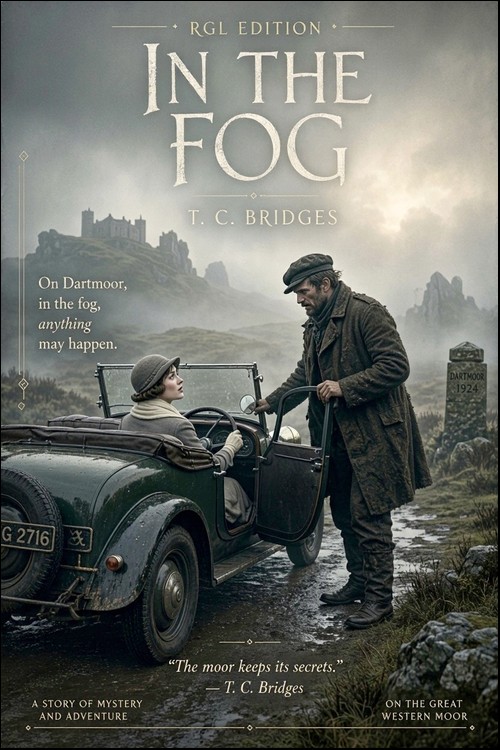
RGL e-Book Cover
Based on an image created with Microsoft Bing software
Roy Glashan's Library
Non sibi sed omnibus
Go to Home Page
This work is out of copyright in countries with a copyright
period of 70 years or less, after the year of the author's death.
If it is under copyright in your country of residence,
do not download or redistribute this file.
Original content added by RGL (e.g., introductions, notes,
RGL covers) is proprietary and protected by copyright.
RGL e-Book Cover
Based on an image created with Microsoft Bing software

On a fog-shrouded moor, Dorothy Dale waits in terror beside a prison road, ready to risk everything to help the man she loves escape from custody. When a fugitive finally leaps into her car, she believes her daring plan has succeeded, only to discover that the stranger beside her is not Jack Havelock at all but a ruthless convict who has stolen his chance at freedom. Trapped by her own involvement and forced to aid the dangerous intruder, Dorothy is drawn into a desperate game of deception, blackmail, and hidden identities...
IT was the waiting that told so terribly on Dorothy Dale's nerves. The narrow lane above the prison road into which she had backed her car was so hideously quiet. There was not a sound except the drip, drip of the fog dew from the leaves of the wind-warped beech trees which shut in the lane on either side. There was nothing to see, for the mist that shrouded the whole of the moor hid everything from her eyes.
How the time dragged! Already it seemed as though she had been there for hours. She tried to stop her teeth from chattering, and to subdue that nervous choking which caught at her throat.
She went back in her mind over all the details of the plan. Jack Havelock knew that she was waiting for him—of that, at any rate, she was sure. She was certain, too, that he was in the gang working up at Round Stone, for she had actually seen him as she passed. And this fog, it was surely thick enough for him to take his chance.
Yet nothing was happening. There was not a sound to indicate that any attempt at escape had been made.
Fresh panic seized her. Suppose he did bolt and was shot down by a warder as he ran? Then she would be his murderess. Oh, how crooked the world was! Her world and Jack's! Why should Jack be sentenced to seven years' penal servitude for killing a man he had never touched in anger? Again, suppose he did escape, and then that her own nerve failed and they were both caught! She tightened her lips and refused to allow her imagination to run wild any longer.
Drip—drip! Drip—drip! How cold it was, and the fog was getting thicker.
The silence broke. Thud-thud! Deadened as the sounds were by the fog. Dorothy knew them for rifle shots, and her heart began to thump as if it would suffocate her. The seconds dragged like years. Then at last she heard someone running hard down the steep road. It must be Jack, for this was part of the plan—that he should bolt towards the prison, in the very direction which no warder would dream of being taken by a runaway.
The necessity for immediate action steadied Dorothy. She pressed the self-starter, the engine woke, and almost at the same moment a man dressed in canvas breeches and a red and blue slop jacket, with cap pulled low over his eyes, dashed around the corner and made a flying leap into the seat beside Dorothy.
"The coat, Jack," whispered Dorothy, "and the cap, and the muffler."
Quick as a flash the man flung himself into the huge ulster, changed his glengarry for the wide-peaked tweed cap, and twisted the muffler round his throat.
"Shove on!" he said, hoarsely. "The screws know I'm gone. The bell will ring in two ticks."
Dorothy released the clutch, pressed the accelerator, and the car glided forward. Yet as she swung it into the main road she was conscious of a curiously blank feeling. Jack had not kissed her. He had not even uttered one word of thanks.
But there was no time to sort her thoughts or emotions. She must drive—drive as she had never driven before.
And drive she did. There was no faltering. She made no mistakes, and the car was well past the prison gates and turning into the Tarnmouth-road before the harsh note of the prison bell came clanging through the fog.
Down in the Devil's Dip the fog lay so thick that she was forced to slacken speed, and then for the first time the man beside her spoke.
"Where are you going?" he demanded.
Dorothy started so sharply that the car swung sideways, missing the bank only by inches.
"Be careful, you little fool!" snarled her companion.
"You are not Jack!" said Dorothy, in a strangled voice. "Who are you?"
"No, I'm not Jack," sneered, the other. "My name is Calvert."
Dorothy's brain was reeling, but she managed to master her voice. "Then where is Mr. Havelock?" she demanded.
"Back in the stone jug, I reckon," answered Calvert.
"How do you come here?"
"Havelock talked a bit too much," grinned the convict. "And you can take your oath that I'm not one to miss my chances."
Dorothy put out the clutch and flung on both brakes. "Get out of the car," she cried.
Calvert leaned towards her, and for the first time she saw his face with its crooked nose, thin lips, and deep-set, greenish eyes.
"It's you will go out, my gal, if you talk like that," he said, with cold ferocity. "You drive on till I tell you to stop. And no monkey business! Yes, I know what's in your mind. You'd give me up to the first policeman, but if you do, remember you go up as well as me. It's two years' hard for assisting a prisoner to escape."
The words sank like lead into Dorothy's heart, and suddenly she realised how completely she was in the power of this brute. She drove on, her face quite blank, but inwardly striving desperately for any way out of this ghastly predicament. Seven miles reeled by without a word from either. Then Calvert spoke again.
"Where were you going to take Havelock?" he demanded, suddenly.
"To my brother's house."
"Where's that?"
"Otters Holt, on the edge of the moor."
"Who lives there?"
"My brother and his old housekeeper. But she is out. We got rid of her for the day."
Calvert considered. "Why didn't your brother come instead of you?"
"He is lame," replied Dorothy, curtly.
An expression that might have been relief showed for an instant in Calvert's green eyes. "You've got stuff for Havelock in the house—clothes, I mean?" he asked.
"Of course."
"And money?"
"Enough to take him abroad."
"And there's no one there but this lame brother?"
"I have told you so," Dorothy answered. "Then drive straight there," ordered Calvert.
TWENTY minutes later the two-seater drew up in front of a small bungalow-like building. As it stopped the door was flung open, and a slightly-built man limped out. "You've got him, Dorry?" he exclaimed.
It was Calvert who answered, "Not the one you expected. Havelock wasn't quite smart enough, so I took his place." He got out as he spoke and went straight up to Alan Dale. "I've explained to your sister just how she stands," he continued. "I've told her that if she tries anything she goes to quod as quick as I do. And as you're in it with her, you'll go, too. The best thing you can do is to fix me up just as you'd have fixed Havelock. I'll change first, then I want some grub. After that you'll give me the cash and the young lady here will drive me to Tarnmouth. Now, don't start arguing, or I'll be apt to get ugly."
There was no arguing. Alan was no fool, and he saw at once that the only way to get rid of this brute was to comply with his demands. Half an hour later Calvert, wearing a blue serge suit, was seated in the dining-room, eating enormously and washing down his food with whisky and water.
"That's better," said Calvert as he rose. "Now I trouble you for a smoke, mister, and that cash."
Money in pocket, cigar in mouth, Calvert lounged in an armchair on the verandah. Dorothy, outside, was refilling the tank with petrol when she heard a whistle, and, looking up, saw a man coming through the gate.
Calvert, too, heard the whistle, and came straight out. "Who's that?" he demanded in a fierce whisper.
"A neighbor—Mr. Heriot. I don't know what brings him here."
"Then I'm Mr. Montague, from London. An old friend of yours," snapped Calvert. "You'll remember that, if you know what's good for you."
"Oh, I shall not forget," replied Dorothy bitterly.
Young Heriot came up. He was a clever-looking youngster who had once been Alan's secretary, but had lately come into a small estate near by. He greeted Dorothy cheerily. "Just came in to tell you I'm off to Tarnmouth. Is there anything I can do for you, or are you going yourself?"
"I am going myself," Frank," replied Dorothy. "I am driving Mr. Montague. Mr. Montague is down from town to see Alan on business, and is going up by the mail train. Let me introduce you. Mr. Montague—Mr. Heriot."
Frank Heriot nodded, and for a moment his eyes dwelt keenly on Calvert's face, "I'll go in and see Alan a moment," he said, carelessly.
"You did that all right," said Calvert to Dorothy, "but bear in mind, I'm not taking any chances. Hurry with that petrol. We'll be off before he comes out again."
Dorothy got into the driving seat. By this time she was so crushed that she scarcely cared what happened. Calvert, too, got in. Dorothy was stooping to press the self-starter when she heard Frank's voice. "Just a moment, Mr. Montague," he said quietly.
"What's the matter?" snapped Calvert. "I'm in a hurry, I don't want to lose that train."
"I won't keep you long, Mr.—er—Montague," replied Frank, but something in his voice set Dorothy's heart thumping again. "I just wanted to ask you which way you went after you left Penlee on the evening of February 17, two years ago?"
"What the—" gasped Calvert as he sprang to his feet, with his great hands reaching for Frank Heriot's throat. But Frank stepped back swiftly, and Calvert found himself gazing straight into the muzzle of a dead-looking revolver. Behind was Alan with a double-barrelled gun.
"Yes, he's the man, Alan," said Frank coolly. "The same that I saw run past the study window the night poor Mackenzie was murdered. I could swear to his face in any court."
Dorothy drew a long breath. "Then he—he is the man who killed Mackenzie?" she cried.
"Not a doubt about it?" replied Frank.
Calvert recovered himself a little. "And if I am, what about it?" he snarled. "The girl here got me out of quod. If you give me up she goes, too, and so does her brother."
"I was trying to get Jack," explained Dorothy swiftly.
"I thought as much," said Frank. "But anyhow, we've got the real murderer, so Jack will go free."
"I didn't murder the man," said Calvert, fiercely. "It was a clean fight. Mackenzie caught me at the safe, closed with me, and I tripped him. It wasn't my fault his head hit the fender. I'm speaking truth."
Frank looked hard at him. "I almost think you are. Miss Dale, I believe I see a way out of this. If this man will sign a confession that he killed Mackenzie—"
"I won't! Curse you! I'll—" began Calvert, but Frank cut him short. "I think you will. You see, you will get something in return."
"What?"
"Those clothes, the money, and twenty-four hours before your confession is put into the hands of the authorities."
Calvert gazed hard at him. "Is that straight?" he demanded.
"On my word," replied Frank gravely.
Calvert gave in. "I'll do it," he said gruffly.
Roy Glashan's Library
Non sibi sed omnibus
Go to Home Page
This work is out of copyright in countries with a copyright
period of 70 years or less, after the year of the author's death.
If it is under copyright in your country of residence,
do not download or redistribute this file.
Original content added by RGL (e.g., introductions, notes,
RGL covers) is proprietary and protected by copyright.