
RGL e-Book Cover©
Roy Glashan's Library
Non sibi sed omnibus
Go to Home Page
This work is out of copyright in countries with a copyright
period of 70 years or less, after the year of the author's death.
If it is under copyright in your country of residence,
do not download or redistribute this file.
Original content added by RGL (e.g., introductions, notes,
RGL covers) is proprietary and protected by copyright.
RGL e-Book Cover©
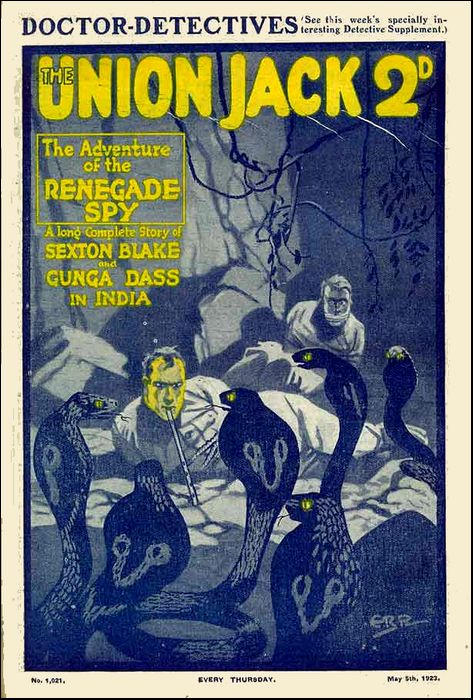
The Union Jack, 05/05/1923, with
"The Adventure Of The Renegade Spy"
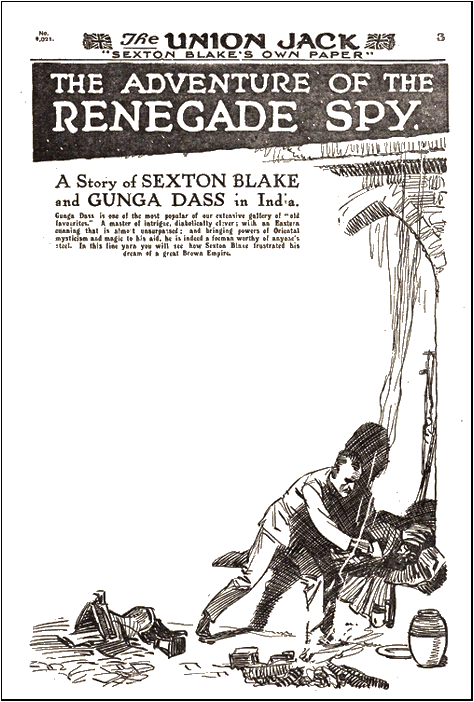
Gunga Dass is one of the most popular of our extensive gallery of "old favourites." A master of intrigue, diabolically clever; with an Eastern cunning that is almost unsurpassed; and bringing powers of Oriental mysticism and magic to his aid, he is indeed a foeman worthy of anyone's steel. In this fine yarn you will see how Sexton Blake frustrated his dream of a great Brown Empire.
WITHIN forty koss of where the Himalayas rise from the plains, and the sunrise tints the blushing snows, lies the vast jungle of Haru.
The soft hour of sunset lay over the jungle tract, bird life was stilled, great bats were flickering to and fro, and wisps of smoke lay like a pale blue veil over the Rahani clearing—smoke from the fire where the two shikari (hunter) beaters of Sir Edward Sinclair were baking the universal chupati.
The yellow evening light quickly faded, and was succeeded by a deathly grey pallor that settled upon the whole face of Nature. From the jungle slopes came the sharp yelp of prowling jackals, the chattering laugh of the hyena, and every now and then sounded the dread note of a tiger, which for quite ten minutes made every other animal within hearing dumb with terror.
"In an hour, sahib, we will go forth and seek the shaitan (tiger) that lurks yonder to kill." It was Karwassa, Sir Edward's chief beater, who spoke. No flat-faced Gond of Haru this, but a shikari from the Marathi lands, supremely handsome, and with the stature of a giant. "But I beg of you to use caution, lord!"
Karwassa paused for a moment, and his eyes flashed with earnestness as they met the rather indolent glance of his master.
"This is no broken-toothed old female worn with nursing, but a shaitan such as even I"—pointing to the imprint of an enormous five-clawed paw visible in a path of sand—"who for many years beat the preserves of the Terai for the Royal Sahibs, have never before seen.
The beater shook his enormous orange turban in a melancholy fashion.
"Thou art not the first sahib who has come to Haru to shoot the notorious man-eater. Ay, many sahibs have come and gone, and nought availed them against the bagh. He is no janwar, but an evil spirit. I fear he will never be caught except by one bait, and that bait the sahibs would never use."
Sir Edward Sinclair, Political Agent for the Frontier District of Tungarh, and a shikari of repute, smiled as he saw the expression of extreme earnestness on the face of Karwassa.
"And what is that bait, O Karwassa?" he asked, speaking in the patois of the district.
"A man or a woman," was the startling reply; "and those we cannot give."
"Yea, but we can!" came the shrill voice of Nerbucka, the second beater. "I am willing, and thou shalt give me. The shaitan (tiger) has slain my wife and carried off my son. This devil of tigers has eaten more than twenty of my people, and I gladly offer my life in exchange for his."
The native rose to his feet, his big, expressive eyes staring wildly.
"Cattle? No!"—with scorn. "He seeks not our herds; he seeks us! Have we not learned that, above all, he prefers the flesh of humans? Therefore, behold I give myself"—half turning, with a dramatic gesture of his hand—"to save my people in the village yonder."
"He is mad, sahib, though the truth is in him!" muttered Karwassa. "It is three days since his wife and child were carried off. By all accounts the tiger is lame of one hind leg, and has discovered that we are far easier prey than nimble cattle or fleeting deer. He has studied our habits, and stalks the unwary like a great cat.
"Alas! Many are the tragedies. With success he has grown bolder, and even broad noonday now affords no protection from his rapacity. But Nerbucka is mad. Mad he has been since he lost his wife and child."
In spite of Sir Edward's protesting hand, Nerbucka sprang forward.
"Nay, my father, but I am wise. Truly, Karwassa, it is thou who art foolish, and of little wit. You shall tie me up to yonder tree. Lo, I will sing, yea, loudly, and perchance the tiger will come. He is now three days without human food. Surely he must be hungered!"
The beater paused, a light of insanity in his eyes.
"I will sing, and bring him to the great lord's feet—even to his death, and, if the Great Ram wills it, mine also. Then will my folk be avenged, and my name remembered Nerbucka, the Marathi and Bhil; who gave his life for his people!"
He paused, awaiting their answer, as immovable as a statue.
"Truly, what talk is so foolish as thine?" began Karwassa fretfully. "Small mouth, big speech—"
"Nerbucka," said Sir Edward, "if I ever hear you air those sentiments again I'll send you back to the village. I know the thing is done amongst you natives in the Punjab, but I don't want that sort of bait. Come, trample out the ashes of your fire. We will tie the deer to a stake and see if its bleating will attract."
Within a few minutes preparations were finished. In the centre of the clearing a small deer had been tied to a stake, and its pitiful bleatings rose high above the discordant sounds of jungle life. Sir Edward, vigilant and watchful, crouched in the long jungle grass, the beaters taking up a position behind him.
Presently the full moon rose up and bathed the jungle with silver light. The hours passed, but although the thunderous roar of the beast occasionally reached their ears the night as yet was uneventful.
Sir Edward had not moved. Rifle in hand he bent forward, listening intently. The forest around him seemed full of stealthy noises, but he strained his ears in vain for the soft pad, pad, and crackle of underbush which would herald the tiger's coming.
Suddenly he heard a gasp of alarm from behind. Turning swiftly, he saw that Karwassa had jumped excitedly to his feet.
"Nerbucka, sahib! Where is he? By my son's head, he was kneeling beside me but a little while since!"
Even whilst he spoke they heard, not fifty yards away, the voice of a man singing in the glade, and Sir Edward started up erect, his horrified eyes peering ahead.
"Come back, man!" shouted Sir Edward. "Are you mad, Nerbucka?"
The heroic—or insane—beater made no answer. As the moon shed its light between the interlacing branches of the great peepul-trees they beheld Nerbucka advancing slowly in their direction, singing in a loud, clear voice an invocation to Mahadeo, God of Death.
When he had approached to within thirty yards he halted, and, raising his statuesque bronze face to the moon, chanted:
"O great lord, behold, lo! I have come.
I sing. to my gods, and perchance I will bring the devil tiger to my lord's feet."
For the space of three heart-beats Sir Edward remained motionless, paralysed with horror, and then Karwassa, who was gibbering with terror, gave him a sudden and an involuntary push.
To the left something was coming with great leaps and bounds through the undergrowth. The stunted bushes parted and waved wildly as it passed. In a moment a huge, striped tiger form bounded into the clearing and crouched before the singer.
For the space of three seconds it lay there, its great lithe body quivering for the spring, angry tail-tip swishing through the yellow grass, its crimson jaws agape.
"Kubberdar! Bagh! Bagh!" roared Karwassa to Nerbucka. And to Sir Edward, "Shoot, sahib, shoot!"
But Sir Edward was flurried. It was new to him to have a human life hanging on his trigger. The brute sprang upon the singer, and he fired, wildly, without aim.
As the sound of the shot crashed out the monster, stretched over the body of his voluntary prey, turned his blazing yellow eyes upon the white man and the remaining bearer. Terror-stricken, Karwassa turned to fly into the jungle, but scarcely had he taken a dozen steps than the tiger leapt upon him from behind.
Sir Edward again fired, aiming between the devilish eyes. The bullet evidently glanced along the thick skull, momentarily stunning the brute. Opening his cavernous mouth he emitted a terrible roar, then leapt upon the white man, a bundle of yellow fur and fury.
The cruel hooked talons tore through Sir Edward's tunic and bit deep into his chest. In falling beneath the tiger's weight his head struck the trunk of a mango-tree, and already a semi-unconsciousness robbed him of clear thought.
As he felt the scorching breath on his face, as the slavering fangs sought his throat, he instinctively thrust up his rifle and fired into the yellow-white belly.
The next second a darkness as of death spread over his eyes, and he knew no more.
The shot, however, went home. A quiver shot through the lithe body. With a fearful roar the monster reared on his hind-legs and leapt against the tree, his claws tearing great gashes in the bark, his slobbering mouth streaming red as the life's blood left him.
Roar after roar boomed out, sending the startled denizens of the jungle scurrying to their lairs. Soon the burning eyes glazed, the limbs twitched painfully.
With a crash that made the nearby ground tremble; the jungle king toppled backwards into the yellow grass and lay still.
Sir Edward and the two beaters lay motionless. The moon climbed higher into the jewelled night sky, and one by one the startled animals returned to their lairs. Hour after hour passed and the clearing became filled with monstrous jungle creatures, small things that ran hither and thither, drinking the still warm blood of the slain man-eater.
The night slowly vanished, the grey dawn stole softly over the sky, and the tender pink, like the flush of youth on a young girl's cheek, kissed the morning twilight and deepened into amethyst and gold; the sun rose as a giant refreshed from sleep, and threw a smile upon the waking earth.
SUDDENLY those feasting jungle creatures scurried off and left the clearing. In the distance sounded the tramp of feet, the mutter of voices, and the throb of tom-toms. It rapidly grew nearer, and at last into the clearing there entered a native and an Englishman, mounted on shaggy Kabuli ponies, and surrounded by a party of evil-looking, flat-faced Gonds, a servile native caste.
As the native rode forward and his brilliant dark eyes took in the tragedy of the night he dismounted. Walking towards the still figure of Sir Edward, he dropped to one knee beside him, making a cursory examination.
The rich silken robes of the Asiatic denoted him to be a person of rank.
From the folds of his crimson cummerbund the jewelled hilt of a sword reared like the head of a snake, and across his back hung a metal shield, richly gilded and inlaid with precious stones after the manner of Hindustan.
In person he was tall and gracefully built. His eyes were unusually brilliant even for one of his race.
His features, holding something of the cruel nobility of the eagle in the hooked nose and thin lips, were undeniably handsome in a sinister fashion, and at once bespoke a higher caste than the one of Thuggee, the worshippers of Kali the Black, Goddess of Evil, which the red triangular caste mark on his brow denoted.
His flowing black beard and curling moustachios completed a countenance that was inexpressibly striking, and even in the meanest robes the Hindu would at once have been pronounced a man of distinguished birth.
It was hard to realise that those slender, artistic hands were as cruel as the talons of an eagle. Yet this magnificent specimen of barbaric splendour was the man who had blazed a trail of crime across half the civilised world.
Sexton Blake, the great London detective, would instantly have recognised in this figure of Eastern splendour the most notorious criminal the Orient has yet produced.
It was Gunga Dass who knelt beside Sir Edward, and the man's cunning and subtle brain was already planning how to turn the Englishman's misfortune to his own advantage.
A flitting, mysterious figure, the embodiment of evil, the religion of Dass was to kill and plunder, counting his atrocious deeds with the reverence a nun counts the beads of her rosary.
To him religion was but to destroy, and to that end he lent his perverted genius, and his knowledge of the hidden sciences of the Orient, content in a childish belief, incongruous to his appearance, that when at last he sank into the eternal sleep, the seventy houris of Paradise, and the eternal youth which is the portion of every true believer, would be vouchsafed him by Kali, Goddess of Thuggee, the terrible religion of the criminal tribes of India.
As the Englishman, as typically British with his blue eyes and fair hair as was the prostrate Sir Edward, joined him, Dass rose to his feet, his dark eyes holding a curious expression as they rested upon the white face of the unconscious man.
The Gond servants were silent, staring from wondering eyes at the great striped body of the jungle king who at last had met his Waterloo.
"He is only slightly injured, Marshall," said Dass, speaking in English, as he turned to the Britisher. "Do you recognise him? This is an excellent piece of fortune."
Ralph Marshall, one time minor Government official at Peshawar, now outlaw and jemadar (junior leader) of Dass' criminal band, flung the Hindu a curious glance, then peered forward into the still face of his countryman.
"Sir Edward Sinclair, by all that's wonderful," he said, speaking in cultured English. "The man is political agent for Tungarh. I knew him well in the old days when at the Residency. Is he badly injured?"
"Merely stunned and a little clawed across the chest," replied Dass. "He will regain consciousness in a couple of hours and be none the worse for his adventures. I also recognise him. Marshall, I have work here for you which your knowledge of official India will help you to successfully handle."
Marshall drew a native-made cigarette from his pocket, lighted it, and seated himself on the now stiff bulk of the tiger.
The ex-official of Peshawar was a man with a strange and wholly discreditable career. Educated at Oxford, the son of wealthy and respectable parents, he had taken up office in Peshawar about nine years ago.
Evidently departmental worries had no attraction for the pleasure-seeking Britisher. His work was neglected, and the doubtful pleasures of the gay Pathan bazaars claimed him. The silvery tongues of the sedition-mongers guided him into the wrong channels, and a year afterwards the Englishman was asked to resign, suspected by his seniors of selling information to the enemy tribes of the frontier to find the money for his wild extravagances.
An outcast from all European society, disgraced, and with his career wrecked, the young man had embarked tentatively upon many criminal enterprises, coming at last into contact with Gunga Dass.
Knowing what a valuable ally to him in his crimes the renegade and educated Englishman would be, Dass had made him assistant leader of his gang, and the two now earned excellent remuneration from their criminal enterprises. Nothing was too evil or too dirty for them to touch, and the brilliant combination of brains had enabled them to keep at bay the Indian police since the time when, a few months ago, Dass had fled from British shores, fearing the vengeance of Sexton Blake.
"Out with it, Dass," said the Britisher, his hard, blue eyes searching the brown man's face. "Hanged of I can get what you're driving at, though."
Dass smiled his wily smile.
"How would you like to become a respectable member of English society again, Marshall?" he said softly. "How would you, Ralph Marshall, the outcast, care to become political agent for Tungarb?"
The white man turned amazed eyes upon the native.
"You talk in riddles, Dass. the thing you suggest is impossible."
Dass bent his handsome head closer.
"The thing is not only possible, but will turn out to be extremely remunerative if you follow out my instructions," he said suavely. "How long could you manage to administer to a State as political agent in a thorough manner? You know what the work entails. Judging at local courts, the suppressing of seditious literature, and reporting the movements of all political and seditious suspects in the district.
"It is no fool's work, for your reports would have to be made out in a competent manner, or suspicion would quickly fall upon you."
"I could handle the work all right," said Marshall. Was I not assistant political agent at Peshawar? But what the deuce—"
"Listen," interposed Dass. "This affair is going to be one of the biggest coups we have yet handled. I wish you to impersonate Sir Edward at Tungarh for a period of three months. In that time you should have filched out all secrets pertaining to the British Raj I wish to secure."
Marshall raised a protesting hand.
"The affair is too risky, Dass. Sir Edward is well known throughout India. My disguise would soon be penetrated. I should be slipping my head into a noose."
"You invent difficulties. Take a good look at Sir Edward. You Englishmen of the Saxon type are amazingly similar in build and features. Your colourings are identical. In a shaded light it would be difficult to tell one of you from the other, even without the slightest trace of make-up.
"You are an Oxford man, so is Sir Edward. Your accent is naturally similar to his. With your abilities for disguise and your histrionic talent you would have very little difficulty in carrying the impersonation through successfully."
It was as Dass had said. Although the paths of crime had hardened the fair features of Ralph Marshall, the two men were very similar both in build and features. As the renegade peered closely into the white face of his countryman he evidently realised the truth of the arch-schemer's words, for a gleam of interest entered his blue eyes.
"What exactly are your plans, Dass? I admit, upon second thoughts, that there is a possibility of success in the affair. The game will have to be played carefully, though."
Dass did not answer for a moment. He went to the unconscious man and extracted a leather wallet from his tunic-pocket. Opening it, he searched amongst the contents, finally selecting an official-looking document.
"These are Sir Edward's leave-papers," he said. "There are also other papers here which will prove useful to you. The leave-paper tells us that Sir Edward is due back in Tungarh to take up his official duties again on the twenty-second of this month, which will be three days hence."
"Therefore you have little time to lose. I shall accompany you to Tungarh and remain there until you have gleaned for me the information I require.
"Your duties will put you in touch with many secrets pertaining to the emergency measures the British Raj have drawn up to stem any lightning revolution. Once you have passed that information on to me your work is finished. I—"
Dass broke off suddenly, glancing from watchful, suspicious eyes at the still figure of Sir Edward. Some slight movement from the baronet had reached his keen ears. He went to him, peering down into the white and still features.
But Sir Edward never stirred.
Dass turned once more to his confederate.
"You know the nature of those secrets as well as I do, Marshall," he resumed.
"It is well known throughout India that at the last Commission the Raj formed safeguards for the protection of isolated garrisons. Underground cables are laid, in case the enemy should cut overhead wires before they could summon reinforcements.
"There are hidden ammunition dumps, cannon, rifles, tinned foodstuffs, everything, in fact, which goes to make modern warfare successful."
"And what do I get out of it? It seems that my part of the work is going to carry the lion's share of risk."
There was something like contempt in the eyes of Dass as he looked squarely into the fair face of the Britisher who was bargaining to sell his country to its bitterest foe. Black as was the soul of Dass, one virtue gleamed like a bright jewel in its sordid setting.
Thief, murderer, and dacoit though he was, the Hindu would have given his life to save his country from what he considered to be the thraldom of the British rule.
And with the death of Dass one of the most illustrious houses in India would cease to exist, for Dass was the last of his royal line, the son of a dethroned Rajah of the North, who had died at the head of his troops when directing them against the invasion of the Raj.
The father of the Hindu had been a despot and a tyrant, and because Dass, although a boy in those days, had shown the same tendencies, he was banished from the State with a pension sufficient for his every need.
Thus Dass became an outcast; a wanderer in the dark places of India, embittered against the Raj, and living only for the day when fate would put in his hands a weapon with which he could strike back at the British.
Yet great as was the Hindu's hatred for the Raj, there was one man he hated yet more, hated with all the strength of his savage, passionate nature. That man was Sexton Blake, who had hitherto thwarted his every move, bringing disaster upon his most carefully planned schemes.
"The day your duties have brought me the full information I require I will place ten thousand rupees to your account," Dass said. "You know my plans, how I consider a lightning attack against the Raj would carry success. Thousands of my caste would flock to my banner to-morrow should I require them.
"Long ago I planted the seeds of dissension among them, and through the years I have trained and fostered those seeds like a rare and precious plant. Yet what chance would an unarmed rabble stand against the well-armed and organised forces of the Raj?
"But how different would be the story should the secrets of the Raj, which are so carefully hidden, become mine. From those concealed stores I could arm my troops as the so-called loyal native and the British troops are armed. I could cut every line of communication between the frontier troops, or send through to British headquarters at Poona misleading messages, which would send reinforcement miles out of their way, to perish in the heat of the jungles.
"You know my countrymen, Marshall, as no Feringhi knows them, for you have lived amongst us. Many there are, I admit, who love the Raj, but there are many thousands more, dacoit and criminal tribes, the finest fighters India breeds, who would bear arms against them, attracted to my banner by the hope of plunder.
"We could sweep the whole brood of your accursed race from our land, for I could arm a quarter of a million desperate and patriotic men from those hidden reserves of the Raj. Do you agree to my suggestion? I assure you that you run but little risk."
Marshall puffed thoughtfully at his cigarette for some moments. He had little doubt that he would be able to carry the impersonation successfully through, aided, as he was, by the similarity of colouring, build, and features which existed between the two.
He was entirely familiar, too, with the intricacies of Sir Edward's duties, and knew most of the Britishers who would be quartered at the garrison of Tungarh.
"I'll do it, Dass," he said. "There is little time to lose. It is thirty-six hours' journey from here to Tungarh. Better instruct the bearers to make a litter, then we can cart Sinclair back to the camp. You carry a very efficient make-up case for the purpose of disguise, I know.
"Just a few lines about the eyes and a slight building up of features with wax is all that will be required. I am a little thinner than Sinclair, but I can put that down to a bout of malaria during the shooting trip. His handwriting will prove difficult, but I think I can manage that; I have found forgery profitable in the past."
Dass nodded with satisfaction, and ordered the bearers to construct a litter and to bury the bodies of the two beaters, the tiger's last victims. In a few minutes the party were moving off towards the Thugs' jungle camp.
An hour later they entered the clearing where the camp, consisting of about a dozen mud and wattle huts was situated. Through the clearing ran a jungle stream, half covered with water-lilies, and from whose sedgy margins flocks of brightly-plumed water-fowl flashed, and which evidently supplied the camp with water.
"Take the sahib to my hut," commanded Marshall.
He turned to Dass.
"I will get on with the impersonation at once," he said. "I had better come across to your hut for the make-up case. I reckon it will feel good to be a respectable member of British society again, if even, only in the position of an impostor. I'm sick of the discomfiture of the jungle and the tasteless khana (food)."
Marshall accompanied Dass to his hut, where the master criminal handed the Englishman an exceedingly compact and well-fitted make-up case, bearing on its polished lid the name of a famous London maker.
"Shall I accompany you?"
"No, Dass. It will be better for you to view the transformation complete. I'll be across again in an hour. What are your plans for getting rid of Sir Edward? I don't care a hang what you do with him. It was partly owing to his infernal meddling that I got hounded out of office.
Dass pointed through the glassless window to the river. It was very low, and fat muggers (crocodiles) lay upon its grey mud banks, as lazy as so many logs of wood, though their evil little eyes were alert enough, watching for anything edible floating down stream.
With an evil smile that denoted comprehension, Marshall left the hut. Dass flung himself upon the only article of furniture the mean habitation contained, a bamboo charpoy. An hour later a shadow fell across the threshold of the doorway, and the Hindu, who had been meditating upon the success of his audacious plans, sat up with a start.
Before him stood the living embodiment of Sir Edward Sinclair.
"Wonderful, Marshall!" he said, a light of satisfaction in his dark eyes. "Wonderful! You need have little fear. Your disguise is a masterpiece. After we have disposed of Sinclair, we will perfect the details of our plans. The muggers of the river will leave behind but few clues as to his fate."
The Englishman stared out of the window upon those sinister, log-like shapes, and his lips twitched for a moment.
"Is there no other way?" he said, and to Dass it appeared that there was a peculiar note, almost of pleading, in the white man's voice.
Dass stared at him from wondering eyes, and his cruel lips curled contemptuously.
"Bah! You are getting squeamish, Marshall. Dead men tell no tales. If we held Sinclair prisoner, he might escape, and then the consequences to you would turn out disastrous."
The Englishman nodded, but that strange expression did not leave his eyes as he glanced at these motionless logs, crafty as foxes, voracious as South Sea sharks. It seemed as if Ralph Marshall's hard, criminal nature had left him in this hour, and that the clean and manly spirit of the man he was impersonating had entered his soul.
"Sir Edward Sinclair is a Traitor to his Country."
SIR ROGER MAYNE stood at the big window of his cabinet in the India Office; gazing down at the busy thoroughfare of Whitehall with a worried frown upon his aristocratic features.
The Minister's office, like all the rooms in the building, was big and bare. The Walls were coloured dark red, and the heavy furniture was upholstered in red leather, whilst in one corner was a handsome marble bust of the late Governor of India.
In the centre stood a huge writing-table of carved walnut, with a great high-backed chair, the seat of the man whose finger-tips were on the pulse of the Indian Empire.
The doors were double, with a wide space between, so that the messengers in uniform who lounged outside should overhear nothing, while so hemmed in by secretaries was the Minister, that he was as difficult of approach as the Sovereign himself.
Presently there was a rap at the door, Sir Roger turned eagerly and took a card from the hand of a uniformed messenger who had entered.
"Ah, Mr. Sexton Blake!" he said. "Show the gentleman in."
A few moments later the famous London detective entered—a tall man, lean but muscular of build, with keen grey eyes and clean-cut features.
"It is good of you to come in answer to my summons so quickly, Mr. Blake," said the Minister. "Please be seated. I need scarcely add that my business with you is both urgent and serious. I wish you to start for India immediately. I have arranged passages for you and your assistant to sail from Tilbury at midnight."
The detective held up a protesting hand.
"Really, Sir Roger, I am a very busy man. Unless the business is of vital interest to my country—"
"It is most vital, Mr. Blake, and, as I have said, extremely urgent. There are few men I would trust with the work. In short, that arch-rebel, Gunga Dass, is planning a great brown rising, and it would seem, according to the confidential report I received from India this morning, that no less a person than Sir Edward Sinclair, political agent for Tungarh, is his confederate."
Blake, shaken out of his usual calm, stared at the Minister from amazed eyes.
"What?" he exclaimed. "Impossible, Sir Roger! I have known Sir Edward Sinclair for many years. He is patriotic to the core, and a man of untarnished honour. I cannot credit the charge against him. I am, however, little surprised at the activities of Dass. The man is the greatest enemy of the Raj living."
Sir Roger did not answer for a moment. He took up an official-looking document from the desk, and, screwing a monocle into his eye, read it carefully through, then handed it to the detective.
"Here is the report, Mr. Blake," he said, "I, too, had a great respect for Sir Edward and the admirable way in which he carried out his official duties—before reading this. I am afraid we have been badly mistaken in the man. The author of this report is a man prominent in the Secret Service.
"There can be no mistake. Documents have been tampered with; he has even been seen talking to Dass in a low bazaar drinking shop."
Blake glanced through the document, an expression of doubt upon his thoughtful features. He handed it back to the Minister.
"You see how conclusive the evidence is, Mr. Blake," said Sir Roger. "Sinclair is in garrison on Mount Abka, where we have recently constructed a new fortress for the protection of the frontier at that point.
"This fortress, which is sunk out of sight, has taken four and a half years to construct, and was only completed and garrisoned six months ago. It commands the Abka plains, which, in the event of hostilities with the rebels of the frontier would be a most vulnerable point.
"Indian agents have from time to time endeavoured to learn something of our works up there: but so well has the spot been guarded that only two agents have succeeded in obtaining a sight of it, and both were arrested and are now in the penal settlement at Penang.
"And yet, in spite of this; there was found in Sir Edward's quarters fragments of a curious letter in Hindustani addressed to him, and acknowledging the receipt of a copy of the plans and other information."
Blake stared thoughtfully out of the window for a moment. There was something here he did not understand.
He did not entertain for one minute that the man he had been happy in the past to call his friend had turned so black a traitor to his country. Motive was lacking, too, for Sir Edward was a wealthy man, working for his country on the far outskirts of the Empire for purely patriotic reasons.
The whole affair was unbelievable.
"What steps have you taken in the matter, Sir Roger? Has any arrest been made?"
"None, Mr. Blake. If possible, we wish to avoid anything in the nature of a scandal. We must have evidence more conclusive, too, before we can compel Sir Edward's resignation, black as the affair already looks against him. That is why I sent for you.
"I wish you to go to Tungarh and investigate the matter thoroughly, collect what proofs you can, and cable them to me here. The necessary action can then be taken."
Blake laughed a trifle harshly.
"In short, Sir Roger, I am to spy upon my friend's movements? No. I will go out to India on the next boat, however; but I shall work in Sir Edward's interests. I am still convinced that he has no hand in treachery. He has the interests of his country at heart. I hold the opinion that this evidence against him has been manufactured; that it is the work of an enemy."
Sir Roger sighed.
"I trust you are right, Mr. Blake," he said. "But how do you account for the fact that the man has been seen in the company of Dass?"
"I have no doubt that even that blackening piece of evidence can be explained." Blake said. "I shall devote my entire energies to the clearing of his name. Should pressure be brought upon him to resign he would be a ruined and disgraced man. And nobody knows better than I how little he deserves such a fate.
"And while I am out there I shall endeavour to put a stop to the rebel activities of Gunga Dass. The man is a menace to the Empire, and continually plotting and planning to overthrow the Raj. That is my answer, Sir Roger.
"My assistant and I will sail for India to-night—but we make our investigation in the interests of Sir Edward Sinclair."
On the Trail of Gunga Dass—Blake Witnesses a Strange Meeting.
AS the evening mail train steamed into the busy station of Tungarh the platform instantly became alive with a struggling mass of gaily-dressed natives.
Fat merchants, balancing mountainous bales of silks upon their heads, and wearing on their brows the caste mark of the Bengalis, perspired and pushed their way through the crowd. Sellers of pan and betel vociferously cried their wares, evading with the dexterity of long practice the lusty kicks of the station officials, who tried vainly to keep order.
Into this din, from a third-class compartment, stepped Sexton Blake and his astute assistant, Tinker. Few, however, would have recognised the famous pair. Blake was attired in a suit of stained and dirty duck, dilapidated topee, and shapeless native-made shoes. His skin had been darkened with walnut stain to the sallow, unhealthy tint of the Eurasian, and a wispy black moustache straggled over his upper lip. Tinker, minus the moustache, presented a youthful edition of his master, and the two appeared similar to the hundred and one half-castes that lounged about them.
"What's the next move, guv'nor? It was a good idea of yours to come to Tungarh in disguise. If Dass is still in the district he would have recognised us immediately and would have been put on his guard. We want to catch the beggar napping if we can."
"You are right, young 'un," Blake said as they left the station and made for the native quarter. "I think our best plan will be to take lodgings in a serai (rest-house) for the night. It is dusk already. To-morrow we can talk over our plans. I shall, of course, call on Sir Edward in the morning and obtain an explanation from him. Mount Abka is a good five miles out of the town, and after our grueling journey I feel too tired to call upon him tonight. I am fairly familiar with the town, and we shall have little difficulty in obtaining lodgings."
Many interesting sights met their eyes as they advanced deeper into the bazaars. The gutters were lined with stalls of every description, and the beauty of many of the goods ill contrasted with their sordid surroundings.
Outside one of the many small temples was a tangle-haired, ash-bedaubed fakir, with his head thrust through a square iron frame so devised that rest was impossible. He could never lean back, never lie down, never know ease. He had worn this instrument of torture for twelve years, and was a most holy man—so the brown-skinned boy pleading for alms beside him stated.
Tall Pathans, lithe and muscular, walked the streets, gaily-coloured blankets concealing their dark, bearded faces from view. The night life of the bazaars was now in full swing. Coloured lanterns hung outside the drinking-shops and eating-houses, robbing the scene of much of its daytime squalor, whilst the weird, bizarre music from tom-toms and stringed instruments sounded on all sides.
"This is the serai," Blake said, halting before a stone arch lighted at one end by an inhospitable kerosene lamp.
"Keep a tight check on yourself, lad. Tungarh is of evil repute. Should the natives suspect we are Britishers in disguise our lives wouldn't be worth a nigger pice*."
* A British-East Indian bronze coin.
Entering the arch, they found themselves in an inclosed space, with plenty of accommodation for camels, ekkas (traps), and horses, and little niches, or three walled rooms, all around, for the travellers.
Hairy Punjaubi dealers were watering and feeding their ponies; the bearded camel-men giving fodder to their screaming, bubbling, discontented animals.
The "purda nashins," women, were hidden behind a screen in the corner, from whence came much shrill laughter and chattering. at the far end were several rude tables and benches, and the detectives made for this, ordering native khana (food) from a greasy-skinned dher, who acted as waiter.
To Blake's relief their entrance had not caused the slightest comment. He glanced unobtrusively at the occupants of the tables. They were of a common Indian type, low-browed, flat-faced, and flashily dressed.
Then his heart leaped.
His eyes became riveted upon the face of a striking-looking man opposite, who was deep in conversation with two stalwart and well-armed Pathans.
There was no mistaking those handsome, high-bred features, those great flashing eyes and cruel lips.
"Tinker," he whispered, "look yonder!"
Tinker turned his eyes in the direction indicated. As his glance fell upon the Hindu he started slightly, then turned startled eyes upon his master.
"Gunga Dass!" he said in low tones. "What luck! He is slightly disguised, but nothing could conceal that hawk-like expression of his features."
"Turn your eyes away, young 'un. we must not give him the slightest cause for suspicion. Ah, he is preparing to leave. Remain here until my return. I intend to shadow him."
As Dass rose to his feet and made for the serai exit, the detective left his assistant and set off in pursuit. Through the heart of the native quarter the chase led, the Hindu finally entering a dak-bungalow on the outskirts of the city.
As the master criminal entered the doorway the detective heard the clatter of horse hoofs on the road behind. He darted into a shrub, from where he could command a view by the glassless window of the interior of the building.
Scarcely had he concealed himself than the horseman dismounted before the door of the bungalow and tethered his mount to the railings. Blake breathed quickly as he heard the man's firm tread on the path. It was not the shuffle of an Asiatic, but the tread of a well-booted European.
A light sprang up in the bungalow, and to the detective's ears came words of greeting. As the newcomer neared the window Blake gave a gasp of astonishment. Dass's visitor was Sir Edward Sinclair.
Taking a sheaf of documents from his pocket the Political Agent handed them to Dass, who quickly scanned them through, his dark eyes glowing with satisfaction.
"Excellent, Marshall," Dass said, and Blake started at the sound of the unusual name. "You have done splendidly; in a month your work will be finished. Already you have placed me in possession of many valuable secrets. But you must go to work with greater caution. Rumours have reached me that Sir Edward Sinclair is suspected of holding communication with the rebel forces. I saw a man, prominent in the Secret Service, prying around the city a few days ago."
The Englishman laughed carelessly and extracted a cigarette from his case.
"Have no fear, Dass; the game has been easy so far. And now I should like a little on account of the money you owe me for the information. A thousand rupees will be sufficient for the time being. The social life of an Anglo-Indian, even in this hole, is expensive."
Blake listened in astonishment. He was familiar with the appearance of Sir Edward, and the evidence of his eyes told him that it was the British official who stood before him, greedily snatching a roll of banknotes from the Hindu, calmly and nonchalantly selling precious information to the greatest living enemy of his country. His lips curled with contempt, and in that moment every ounce of respect he had possessed for the official vanished.
"You will find a thousand there," Dass said, "You shall have full payment the day when all the knowledge I require is in my possession. Go now; should you be seen in my company people will begin to talk. Meet me here again in three days time."
A few seconds later the Englishman left the hut, mounted, and turned his horse in the direction of the frontier. As the clatter of horse hoofs died away in the distance Dass turned out the light in the bungalow, securely fastened the door, and set off for the native quarter.
Knowing that the Hindu would return to the serai, Blake did not trouble to shadow him, but followed a few hundred yards behind at a leisurely pace, his mind busy with the problem confronting him.
Why had Dass called Sir Edward by the name of Marshall? This was the question uppermost in the detective's mind.
"Marshall?" Blake repeated the name softly. It had a familiar ring. Somewhere before he had either met the man or heard his name. True, it was a common name in England; but in India, where Britishers are few, it could be thinned down to apply to less than half a score.
The Englishmen had lived long in India, for the detective's keen eyes had detected that sallow tint of skin and the heavy eyes that come from long periods spent beneath the fierce tropical sun.
As the detective repeated the name once more it struck some hidden chord in his memory, and a flush of excitement crept into his cheeks.
"Can it be?" he muttered. "I have fixed the man now. There is but one Marshall in India who would become a confederate of Gunga Dass. Marshall, the renegade, traitor and crook, who was hounded from an official appointment because of suspected treachery."
He had reached the serai now. Watching from the shadows of the stone arch, he saw Dass curl himself up in a blanket beside the fire which crackled and blazed in the centre of the apartment.
Keeping to the shadows of the walls, Blake approached Tinker, who was spreading out a blanket over one of the bunks set in a niche in the wall.
"Well, guv'nor?" Tinker said, as his master reached him. "What luck? I saw Dass come in about half a minute ago looking jolly pleased with himself."
Blake looked round cautiously, then said, in a low voice that could not be heard by anyone else but his assistant:
"Tinker, there is a greater mystery here than I dreamt of. We have stumbled against the greatest criminal enterprise Dass has yet ventured into. I feel convinced that Sir Edward is being impersonated."
Tinker's eyes opened wide in astonishment.
"Impersonated, guv'nor? Great pip! Then Dass must have a Britisher as a confederate? Only one of our race could carry the business through. Who is the cur? He must be a thorough out-and-outer!"
"I believe the man who has assumed Sir Edward's identity to be Ralph Marshall, once a minor official of the Indian Civil Service, but better known as a crook of the first water. The scoundrel has a bad record in India. Dass called him by name in a bungalow on the outskirts of Tungarh this evening, and that put me on the scent."
Blake then gave his assistant an account of his adventure. In conclusion, he said:
"The impersonation has been very cleverly planned out. I have known Sir Edward for many years, but could have sworn it was he who stood before Dass this evening, and demanded money for the information he had sold.
"His demand for money puzzled me at first, for Sir Edward is an extremely wealthy man. He had money of his own before his marriage, and his wife is also well endowed with this world's goods. She is the only daughter of Lord Harcourt, one of the wealthiest of our peers—"
"His wife, guv'nor? Isn't it strange that she has not suspected the truth? This affair must have been going on for some months now."
Blake nodded thoughtfully.
"That is another puzzling feature, young 'un. She always remains with him on the Frontier, sharing his hardships. But the impersonation is so cleverly done that even now a doubt assails me. The lamp was shining full on the Englishman's face, yet I could not detect the slightest trace of make-up."
"Perhaps Marshall is Sir Edward's double. It is said we all have one somewhere in the world."
Blake shook his head.
"No, lad. Many years ago I met Marshall, when he was a respected member of Anglo-Indian society, at a reception held at the Bombay Residency. I admit they are both of the same type, similar build and colouring. But, even so, it would require a great deal of make-up to bring about the astonishing resemblance which now exists. I am convinced that as yet we are but on the fringe of the mystery."
"What are your plans, guv'nor? Will you confront the impostor, and then return for Dass?"
Blake glanced at the sleeping form of his enemy. The flickering glow from the fire lit up the dark, eagle-like features, lending them a strangely sinister expression. The man was evidently sleeping, for his eyes were closed; his breath came evenly and regular.
"I could have effected the arrest of Dass at the bungalow, young 'un; but I had a reason for permitting him his liberty for a time," he whispered. "If my theory that Sir Edward is being impersonated is correct, then he must be held prisoner somewhere. You know Dass' vindictive nature. Once we had him under lock and key he would refuse to divulge where he has Sir Edward concealed."
Tinker nodded in agreement.
"That's true. Hidden away somewhere in the darkest haunts of the native quarter, without food and water, Sir Edward would die. Dass cherishes a deep hatred against our race, and to his perverted mind the death of his prisoner would seem a fitting vengeance for his arrest."
Blake glanced once more in the direction of the sleeping Hindu, watching him intently for some seconds.
"But one thing calls for immediate attention," he said. "Dass has certain documents in his possession which relate to Government plans. I intend getting my hands upon them before he has time to digest their contents. Up till now he has merely glanced through them."
"But how, guv'nor? You must use caution. Death would be the penalty of discovery. I have listened to the talk of many here to-night. They are fanatics of the worst type—men to whom murder means nothing."
Blake glanced around him. At the entrance the watchman slept soundly, and all in the vast and gloomy apartment were wrapped in their blankets.
Except for the bubbling and chuckling sound made by the camels, the occasional whinny of a horse, all was still and silent.
"My best plan will be to crawl out and take the documents from Dass' pocket as he sleeps," Blake said. "Draw your automatic in readiness to fight your way to the entrance in case of discovery."
Before Tinker could reply his master had gone. Crawling steadily in the direction of the sleeping man, Blake soon reached him, and the next moment his fingers were softly searching the Hindu's cummerbund.
Tinker heard the rustle of papers, and in a few seconds the detective returned, the documents gripped between his teeth.
"Easier than I thought," he said, and rising brushing the sand from his knees. "We will just glance through these."
The detective opened them, and as he glanced at the contents a grim smile lifted the corners of his mouth.
"We have been fortunate enough to have rendered our country a great service to-night, Tinker. These papers deal with—"
Blake broke off suddenly. A gasp of pain sounding behind caused him to wheel round in the direction of Dass.
The Hindu was on his feet, plucking at a curious, crab-like creature which clung tenaciously to the flesh of his leg.
It was a scorpion, a species of stinging land-crab that are common throughout India, and a bite from one of them is a frequent occurrence. Blake watched the horny tail, sharp as a needle, dart and bury itself many times in the quivering brown flesh before Dass could tear it from him,
Then the Hindu's pain-distorted face turned in the direction of the disguised detectives. Blake hastily slipped the papers into his pocket—too late!
The keen eyes of Dass had followed the movement, and in a second his brown hand slipped to his cummerbund from where Blake had taken the documents.
"Padalon!" he cried; and the firelight reflected redly on steel as he sprang forward. "Who art thou? Nunka! Rahal! Rouse yourself! There are spies here. See that the exit is guarded!"
"Come, Tinker! We must fight our way out," Blake said collectedly. He leapt forward, clutching Dass' knife-arm by the wrist before the Hindu had time to throw the weapon, dart-like, at him.
Commotion reigned. Tinker was about to dart to his master's aid, when a bearded Pathan sprang like a tiger upon him, bearing him to the ground.
Blake, seeing Tinker's mishap from the corner of his eyes, attempted to break away from the sinuous clutch of Dass in order to aid the youth.
But the Hindu seemed possessed of an almost superhuman strength, lent by the rage within him, and at first, strong man that he was, the detective was almost helpless in his iron grasp.
Dass was slowly forcing him backwards, the sinewy brown fingers clutching at his throat. The knife had slipped to the floor, and the detective thrust out his foot and kicked it from the Hindu's reach. Blake felt his senses reeling under that unrelaxing grip, and he summoned all his strength to shake it off.
He struck out with a savageness rare to him at the blazing eyes, and the impact of the blow split his knuckles to the bone. With a scream of pain, and half blinded, Dass staggered back.
Then the detective sprang to his assistant's aid. Tinker, pluckily as he fought, was faring badly in his encounter with the lithe and sinewy tribesman.
Catching the native from behind, Blake picked him up in his arms like a bundle of rags, and flung him into the midst of the excited rabble that raced towards him.
Tinker's face was white with pain.
"I'm done, guv'nor! My ankle twisted in the loose sand as I fell. Leave me. You haven't a second to spare."
Blake snatched up the lad in his arms and raced with his burden towards the exit. There the burly watchman, together with a group of Dass' minions, confronted him.
"Stop them!" yelled Dass, struggling to his feet. "They are Feringhi spies."
Dropping Tinker to the ground, Blake sprang upon the guardians of the door.
Now began—and ended in the space of two minutes—one of those Homeric struggles of one man against twenty.
Shaking off his assailant as easily as a wild boar shakes off the dogs that clamber upon his bristly sides, the detective flung his assailants to the floor, fighting a way through the crowd for the badly limping Tinker, who rendered what service he could with the butt of his automatic.
Blake, his eyes like flames, his muscular arms darting out like pistons, fought like a madman, knowing full well that capture meant death.
At one moment, bunched with clinging adversaries—his arms, legs, and shoulders a hanging mass of brown human bodies—at the next, free, desperate, alone in the midst of his foes, he seemed at that moment less a man than a demon.
Then the treacherous sand caused him to slip. He lost his balance, swayed and fell. Ere he could rise he was pinioned by twenty brown hands. Something descended with crashing force upon his head, and his world turned to a red haze.
In the Snake-infested Grotto.
WHEN Sexton Blake opened his eyes to the world again, he found himself bound hand and foot in the serai. Tinker lay beside him, and about them stood Gunga Dass and his Thug minions.
"Well, O son of inferior cunning, so we meet again! During your unconsciousness I removed your disguise. Greetings, Blake sahib, greetings!"
Despite the bantering note in the Hindu's voice, unrepressed cruelty flamed for a moment in the dark, almond-shaped eyes, but, dying away, left them inscrutably smiling.
Blake struggled into a sitting position.
His head ached from the effects of the blow, and his senses were reeling.
Dimly his vision marked the regal figure of Dass and the man's mocking smile.
"The luck has been on your side, Dass," he said quietly. "Had it been with me, you and your rascally confederate, Ralph Marshall, would have been under lock and key within the next twenty-four hours."
Dass smiled suavely.
"But the victory is mine, Blake sahib." He laughed with a note that struck chill. "I can assure you that within the next twenty-four hours the affairs of Gunga Dass will cease to interest you. By dawn you and the chota-sabib (youth) will meet with the vengeance I have sworn on the sacred shrine of Kali to visit upon you."
Blake felt a strange dread at his heart. He knew this was no bluff. With an in-ward groan he resigned himself to his fate, caring little that the shadow of death lay over him, but with despair in his heart born of the knowledge that whatever punishment was meted out to him Tinker must also share.
"I have planned a fitting vengeance," Dass resumed, enjoying to the full the torture expressed in Blake's eyes. "About a mile from the city is a snake-infested grotto. Bound hand and foot as you are, it will take all your accursed wits to escape the stinging death.
"My intentions are to have you and the chota-sahib flung into the grotto. By morning every trace of you will have disappeared, and Gunga Dass will have redeemed his vow to Kali, the all-powerful."
Helpless as he was, Blake flung him self against his foe. Dass struck out with a mocking laugh at his unprotected face, and Blake crashed back to the floor, half stunned by the cowardly blow.
"You skunk!" Tinker cried, white with rage. "I'll make you pay for that if ever I get out of this mess alive!"
Dass smiled suavely into the enraged face of Tinker.
"Still the same game little bantam, I see," he said mockingly. "You and your master have been brave enemies. I almost believe that my farewell will be tinged with a regret that the struggle between us is done for ever."
As Dass turned to the fine, manly face of Blake, that mask of grim and intolerable humour vanished. His expression became calm, wooden—even a little sad.
"To that place which is the heaven of your faith you must surely go, Blake sahib, it was an ill day for you when you matched your sword against the cunning of Gunga Dass. Older in civilisation than your accursed Feringhi race, we are ever a match for you. Do you share my regrets now that it is too late, Blake sahib?"
Blake stared at the Hindu contemptuously.
"My one regret is that I must die before my vow to bring you to justice is redeemed," he said sternly. "But I do not share your opinions. A bloodthirsty, barbaric scoundrel to boast of his higher civilisation! You who have joined the votaries of Kali, goddess of the ancient Thugs and stranglers! A case of scum to the scum again!"
The cold contempt in his voice stung the vain and sensitive Asiatic like the lash of a whip. In the dark eyes sprang the transient gleam of evil. He went to the detective, and the brown fingers looked like the talons of an eagle as they softly caressed the detective's throat.
Tinker looked on from horrified eyes. For a moment it seemed that the deadly and malignant hatred in the brown man's heart would not allow him to delay his vengeance.
"By Padalon (Hindu appellation for Satan) I am tempted to destroy you as you lie there, you accursed Feringhi!" His voice became low and sibilant, and his eyes were like flames. "But for you and your accursed race I should bear an honoured name, be a man of rank and power instead of an outcast.
"I am a man of noble birth. Some of the purest blood in India flows in my veins, purer than even the highest in your land can boast of. My father—may his beard be blessed!—was a great man, a rajah of a territory in Northern India, who died fighting against the invasion of the accursed Raj.
"Because of that I was banished from my country, charged with aiding him to stir up sedition. At boyhood I became a wanderer over the earth, without caste, friendless and homeless. Can you wonder then, Feringhi, that my hand is against you all?"
Dass paused for a moment, and the fury in his heart transformed those handsome, eagle-like features into the face of a fiend.
Always there was a wild beast within this man. Sometimes it slept, but its sleep was light and uncertain. It dashed against the bars now, seeing before him the one man whose superior genius had brought his carefully planned intrigues to naught, and, glaring out of his eyes, transformed him more into animal than man.
"But for you and your accursed chota-sahib, this Tinker, I might by now have my lost possessions," he resumed, calming his voice with an effort. "Money is the golden key to power in my country, and my genius, perverted though you may call it; served me well in my desire to gain wealth in order to harass the thrice cursed British Raj.
"But you thwarted me at every turn, tore the spoils from my fingers at the eleventh hour, and would have had my life forfeited on your gallows. Can you wonder, then, Blake sahib, that my hatred against you and yours is the greatest of all?"
Despite the dread in his heart Blake looked squarely into the Hindu's blazing eyes.
"I am acquainted with your past, Dass," he said steadily. "My countrymen saw fit to dethrone your father, because he was one of the greatest tyrants and despots even in a country notorious in the past for harsh ruling.
"The rule of the sahibs was distasteful to him because it gave India and your subjects the justice that evil and despotic old tyrant denied them."
Dass' face grew livid with rage, and he mouthed foul curses in Hindustani on the head of the man who, even when death's shadow fell upon him, could denounce the evil done by the despotic forefathers of the man in whose power he lay.
"You sneer, son of an infidel faith," he said passionately, "Soon your lips shall twist with a different meaning—the twist of death.
"My one regret is that you will not live to see my triumph. Since I fear you no longer I will reveal my hand. You have an inkling of the truth—you shall now know all.
"Sir Edward Sinclair is dead, A few weeks ago I was roaming the jungle with my band, and fortune guided my footsteps to a glade, where we came across your countryman.
"He lay unconscious beside the body of a great shaitan, and his beaters were dead. Marshall, jemadar of my band, agreed to assume his identity at Tungarh in order that important military secrets would pass through our hands.
"The knowledge of the secret emergency measures of the Raj to stem rebel risings which we have gained is now great, and soon I shall launch my attack against your people.
"My enterprises in India have brought me many lakhs of rupees, and my wealth has enabled me to call every Thug in India to my standard.
"Many of them possess silvery tongues to charm the people, and soon we shall fan into flame the hidden spark which has burned in the breasts of many since the days when a single sepoy set the whole country ablaze.
"It is the Mutiny I refer to, Blake sahib. Think you the mind of an Eastern man changes in a day? You sneer! I tell you there are thousands now waiting to answer the call. Muscular tribesmen all, the finest breed of fighters in the world, and my knowledge of the hidden war stores of the Raj will enable me to arm them all."
"But there are many more who would remain loyal to the Raj," Blake said quietly. "Your last attempt to stir up sedition ended in disaster for yourself. Beware, lest the same fate befalls you again!
"The Raj is not a house of cards, to be tumbled down at the first breath of sedition—and yours is not the voice of the people. The hooligan element, attracted by the prospect of plunder, may join you, but you will find they carry a double edge to their blades."
"By Kali, but that was well spoken, Blake sahib!" said Dass. "You are a brave man, and even where I hate I admire, But we waste time in foolish talk." He turned to his men. "Rahal, harness the gharry. You know the grotto, where these sons of an infidel faith are to meet with death? Sikabah had better accompany you. He is a snake charmer of repute, and his music will provide the reptiles with more zest for the kill."
Blake looked from horrified eyes into the cruel face of the Indian.
"Blake sahib," said Dass softly. "Truly have the gods looked upon me with favour this night. I shall live to see my greatest enemy die."
"Not that, Dass," said Blake. In his voice was the first note of pleading an enemy had ever heard. "Do what you will with me, wreak your vengeance upon me now, but let my assistant go free. He is but a youth. Is there no pity in that cold and callous heart of yours?"
Dass laughed sneeringly, and looked down with a gloating smile in his eyes at the white and pleading face of the man before him—a man who would have died a hundred times rather than open his lips to utter one plea for mercy for himself.
"So the lion is tamed at last?" he said mockingly. "Bah! You are a fool to ask for mercy for him, who, although but a youth in years, is nearly as keen-witted as yourself.
"Were I to spare his life he would hunt me down as relentlessly as before. While either of you live, Blake sahib, there can be no security for me."
"That is true, Dass," said Blake.
"Since there is no pity in your heart, we will place our fate in hands of a higher power than the heathen Kali of Ganga Dass. Should your fiendish plot fail, and freedom be once more ours, I vow that we will drag you to justice, and that the death of Sir Edward Sinclair shall be avenged!
"I will search India for you—the whole world if necessary, and one day, should you live, you will pay the penalty of your crimes!"
"Fine, guv'nor!" said Tinker; his scornful eyes calmly meeting the burning orbs of their foe. "Don't plead for me. I want no mercy from his treacherous hands."
"Your talk is idle," sneered Dass. "My plans are too well executed to admit the barest possibility of your escape. But here come my men. Quick, hoist them into the gharry. In an hour it will be dawn. Farewell, my brave and courageous foes. In an hour you will have gone to your deaths—the one end for the enemies of Gunga Dass!"
The detectives were roughly picked up, gagged, and placed in the rear of a gharry which was drawn up outside. A sheet was thrown over them, concealing them from view, and the next moment the gharry was in motion.
Half an hour later the vehicle halted.
The sheet was pulled aside, and, bound hand and foot as they were, detective and assistant were unable to offer resistance to the Thugs, who, taking them to the edge of a large but shallow grotto, lowered them by ropes to the bottom.
The place was boulder-strewn and matted by great snake-like vines, through which a tiny stream gLeamed like a silver serpent as it reflected the moonlight.
From above them they heard the soft, seductive notes of a snake-charmer's reed, rising and falling in minor cadences.
Its effect upon the reptiles was electrical. From beneath boulders, out of great holes and from the slimy banks they came, long, slithering and writhing shapes, the most deadly serpents of the East, the dread cobra-di-capellos, whose slightest sting brings death.
The moonlight lit up the scene as bright as day. Suddenly the cobras paused, coiled themselves, and with hoods distended, swayed gently to and fro in rhythm to the bizarre tune, forked tongues darting out with the rapidity of lightning, eyes glowing like dabs of green phosphorescent light.
Suddenly the tune changed. It became wild, passionate, instantly lashing the reptiles into fury. Blake and Tinker looked on from horrified eyes. This was the end.
A gentle hissing arose, changing to a sibilant note like the rush of wind through leafless branches. These sinister and slimy shapes uncoiled, and slithered towards the helpless white men with fury blazing in their beady eyes.
"That will do, Sikabar. Nothing can save the accursed Feringhis now."
As the snakes approached nearer the detectives heard the gharry drive away.
Blake struggled like a madman at his ropes, but the minions of Dass had done their work only too well.
He glanced wildly about. Suddenly, a gurgling sound from Tinker caused him to turn his head quickly in the youth's direction, Tinker was making frantic motions with his head towards an object which lay a few feet from them.
As Blake turned his eyes in the direction they lit up with hope. It was a snake-charmer's reed which lay there, right in the path of the oncoming reptiles.
Lifting his heels, Blake tapped out a message to Tinker in Morse code upon the rocky bed of the grotto.
"Gag-—fingers—release!"
Tinker turned on his back and his master inclined his gagged mouth towards the lad's fingers, which were free, his wrists only being tied.
Tinker somehow tore the gag from the detective's mouth at last, and Blake rolled himself towards the precious reed, evidently dropped by a charmer who had visited the grotto in search of snakes for the usual Indian street corner entertainment.
As he reached it he felt the sharp tap of a reptile's head against his stout shoes, and kicked out his bound legs frantically.
He was in the midst of the serpents now, but the reed was already between his lips.
Blake had spent a great amount of time in India, for his profession took him to the ends of the earth. He had witnessed many snake-charmers' entertainments, and their bizarre music had a haunting melody which had impressed itself upon his brain.
The instrument was a simple one, and he had little difficulty in imitating the tune. As the first minor notes, like the chuckle of a red-fringed brook, piped out that wild hissing ceased. The Western was calling the magic of the East to his aid now, and well it served him.
As the reptiles sank to quietude beneath the witching spell of the seductive tune, as his eyes, compelling as a magnet, met their beady, black orbs, they uncoiled, swaying their hideous, shapeless heads like wind-swept boughs.
Tinker, his eyes alight with hope and wonder, rolled himself to a rock, utilising its sharp, saw-like edges to sever his bonds. In a few minutes he was free, crawling towards his master as quietly as possible in order not to break the spell.
"Good old guv'nor!" he mumbled. "I thought we were goners that time. You're a wonder!"
"It was simple," Blake whispered. "That's right, lad. Get busy on my bonds, I don't think I can hold them much longer. These instruments are extremely primitive and easy to play, and Eastern tunes are the simplest in the world to copy. I have heard the charmers play hundreds of times. The most savage reptile quickly succumbs beneath the bizarre, yet strangely soothing and appealing music."
A few moments later the detective was free. Still piping softly on the reed, he rose cautiously on his feet and backed towards the side of the grotto.
"How's the foot, young 'un?" he breathed. "Feel equal to the climb? If not I must carry you."
"I'm as right as rain now, guv'nor. It was only a twist. I vote we run for it now. Some of the bigger cobras are getting restless. Look, one is slithering towards us. This way. The climb is easier here."
A minute later, breathing heavily, they stood on the top of the grotto. Now that the music had stopped a sibilant hissing rose from the pit. Blake took the reed from his mouth, placing it carefully in his pocket.
"I'm going to keep this for the rest of my days, young 'un," he said, smiling grimly. "Finding this was the greatest bit of luck ever. It must have been lost by one of the snake-charming fraternity."
Tinker nodded, shuddering slightly as he glanced at the writhing, scaly shapes in the pit.
"We're well out of that, anyway," he said. "And now to get that murdering hound, Dass. How do you propose going about the affair? We shall have to seek help if we are to capture the whole bunch. I reckon the air round here will smell sweeter when they're gracing the penal settlement at Penang."
"I think my best move will be to ride over to the hill station and arrest Marshall at Sir Edward's office," said Blake.
"I shall have the sad duty of breaking the news of her husband's death to Lady Sinclair, but she will at least have the satisfaction of knowing that her husband was not the traitor he was suspected to be."
"And what of me, guv'nor?"
"I want you to return to the serai and keep an eye on Dass' movements," said Blake. "I do not intend that he shall slip through the net this time. Here is my make-up case. At the bazaar you will be able to buy native robes.
"Get yourself up carefully as a coolie, and hang on to Dass like grim death. I will return in about two hours' time from the hills with a strong force of military, and we shall then stand a fair chance of netting the whole gang at one sweep."
A Bewildering Development.
AN hour later Sexton Blake drew up at the wooden bungalow which was the office of the Political Agent for Tungarh. About him were rows of white tents, gleaming like alabaster in the rays of the morning sun. Groups of British soldiers, in various stages of undress, lounged about the camp, smoking their pipes, or cleaning equipment.
As Blake dismounted from the flea-bitten Kabuli he had hired from a Punjabi in the bazaar, he caught sight of his quarry sitting at a desk beneath the wide veranda of the bungalow, busily writing.
For some moments Blake watched him in silence, marvelling at the man's amazing sang-froid. Even now, as he studied the man intently, he felt a vague doubt assail him. The man was the living embodiment of Sir Edward, and every line of those familiar features were impressed so clearly upon his mind met the detective's critical survey.
Suddenly an expression of amazement crossed his features. Marshall had risen to his feet and was pinning a notice to a board hanging outside the office. Every feature of the white hands was outlined against the dark background of green-painted wood, and the detective perceived that the little finger of the left hand was missing.
"There is some deep mystery here," he muttered, keeping his eyes fixed on the man's face. "I could stake my reputation on the fact that it is the real Sir Edward who stands there. I remember his deformity perfectly well. That little finger was blown off during a fracas with the hill tribes three years ago. But what the deuce does' it all mean, and what has happened to Marshall?"
As Blake pondered over the strange affair there came to his keen brain one of those brilliant flashes of insight which had raised him to the topmost pinnacle of his profession. The thoughtful expression vanished from his features, to be followed by a broad smile.
"I've got the affair in a nutshell," he chuckled. "Great Scott, it's the most amusing affair I've come across for years! Sinclair, my boy, you're a wonder for an amateur. You've hoodwinked Dass as no other crook has been hoodwinked before."
Springing up the veranda steps, the detective quietly approached the desk where the white man had seated himself.
"Ralph Marshall," he said, assuming a note of sternness, "I arrest you on a charge of being implicated in the murder of Sir Edward Sinclair, and for being in traitorous communication with the enemy. I am Sexton Blake, and am acting under the authority of the India Office."
The seated man wheeled around in his chair with a gasp of astonishment; then those lazy, deceiving eyes twinkled with humour.
"Hallo, Blake, old scout!" he said warmly. "I shouldn't have recognised you in that get-up. But I reckon you're on a wrong scent this time, old friend."
Blake chuckled and slapped his old friend heartily on the back.
"I know it, old son!" he said. "It'll be worth something to see Dass' face, too, when he knows the truth. I heard the story of the impersonation from Dass' own lips and came on here post-haste to effect your arrest as an impostor. It was not until I caught sight of your deformed hand that the truth came to me. I've got the whole hang of it now, though. I take it that, by some means or other, you managed to get Marshall out of the way and appeared before Dass as his accomplice made up in impersonation of you?"
"You've got it exactly," said Sir Edward. "I'll give you the story in detail. It sounds a darned sight more humorous now than it did at the time.
"I was out with a couple of beaters after a large man-eater in the Haru jungle. One of the men, who had suffered the loss of his family at the tiger's claws, went potty and made himself the bait. It was a terrible affair, and the poor fellow was killed and mauled before I could get in a telling shot.
"I was about to fire again when my other beater foolishly ran into the jungle.
The tiger was upon him in a few seconds, of course. I fired at the brute, merely stunning him, and so the second beater met his death.
"The next moment the tiger, maddened with pain, leapt upon me. His weight sent me to the ground like a ninepin, and, in falling, my head struck a tree-root. I fired up into his belly, however, finishing him off before he had a chance to maul.
"I remembered no more until I regained consciousness and found the glade full of natives, Dass and Marshall stood beside me, and I heard every word of their conversation and decided that my only chance was to lie 'doggo.'
"They carried me to a bungalow in the Thug camp, where Marshall and I were left alone. I saw the man make up his features in exact resemblance to mine, and then realised that the time for action had come.
"As he bent over me to take a close scrutiny of my face, I snatched up a heavy stone water chatti which stood on a table near the charpoy and knocked him clean out. Then—he was already disguised to resemble me—I placed him on the charpoy in the place I had occupied, tidied myself up, and appeared before Dass as the disguised Marshall.
"The scoundrel suspected nothing, and, after complimenting me upon the excellence of my disguise, discussed further plans with me. Later that night he accompanied me to Tungarh. Marshall, poor fellow, was flung into a river near the camp which was infested with great muggers. I attempted to stay Dass' hand, but the wretch waved my objections aside, and thus Marshall received the terrible death which he and Dass had planned for me."
"You handled the business splendidly," Blake said; "and Marshall, tragic as his end was, fully deserved his fate. The documents you handed Dass are all fakes, I take it? But why did you keep up the deception so long? Would it not have been better to have arrested Dass as soon as you reached Tungarh?"
"I had an object in postponing the scoundrel's arrest," said Sir Edward. "There are many hidden dens of intrigue in this district—places where seditious newspapers and the like are printed, and which are run by Dass for propaganda purposes. Once we could wipe out these dens, our task of administering law and order in this wild spot would be greatly simplified.
"I handed him faked documents in order that I could meet him frequently and gradually pump him for all the information I require. Already much valuable information regarding these places has come into my— Hallo!"
Sir Edward broke off suddenly and stared at a corner of the bungalow, where a native on horseback, within earshot, had reined in. Blake turned and glanced in the same direction.
"Dass!' he cried. "After him, Sinclair! The game is up now, for he must have heard every word of our conversation!"
As they dashed forward, Dass wheeled his horse in the direction of the hills and set off of full gallop. Blake vaulted into the saddle of his wiry Kabull and set off in pursuit, while Sir Edward shouted to his orderly to saddle his horse.
But, hard as the detective rode, he soon realised that his hired mount was no match for the Hindu's fast Arab. Slowly but surely Dass increased the distance between them, finally becoming lost to view in the belt of jungle covering the slopes of the hills.
Realising it was futile to carry the chase farther, the detective turned his pony in the direction of the camp.
A few minutes later Sir Edward reached him.
"The beggar's gone, then, Blake?" he said. "Hard luck! There are hundreds of places in the jungle yonder which would afford him concealment. I suppose this is the end of the trail. I can now send in a report of the true state of affairs to my seniors and clear myself of all suspicion. It is useless to carry on the pretence further."
Blake nodded glumly.
"The scoundrel has slipped through my fingers once more," he said. "He will be too wise to show himself in the district again. I can only hang on until he reveals his hand in some fresh coup."
They rode slowly back to the camp. Blake, who had eaten nothing for some hours, accepted Sir Edward's invitation to breakfast with him; and so an hour passed pleasantly.
"How is Lady Sinclair?" said Blake, proffering his cigar-case.
"Fine, thanks, old man! Why don't you and that cheeky rascal, Tinker, run over to tiffin to-morrow? The wife will be delighted to see you again. I expect you have been wondering where she is? We have a bungalow up in the hills, about two miles from here, and she lives there in the summer, the heat of the plains being too much for her."
"But don't you think it a little risky, the frontier being so near?"
"All the passes are well guarded, Blake, and she has two reliable native servants there. I—"
Sir Edward broke off suddenly. A commotion sounded outside the bungalow, and the next moment a native servant rushed into the room. The man's clothing was torn to shreds, and he was bleeding slightly from a cut on the forehead.
"Good heavens, what has happened, Bahadar?" cried the official, springing to his feet.
"The mem-sahib Sinclair has been carried off by robbers, lord!" panted the native. "The bungalow was attacked an hour ago by a party of men who rode up on horseback and demanded to see the mem-sahib. Chakra and I refused him admittance, but they attacked us, and, after dragging your honourable wife from the bungalow, rode off with her towards the frontier."
Sir Edward turned his white face to the detective.
"Dass!' he groaned. "The scoundrel has done this to be revenged. Come Blake, we must get her out of his murdering hands as soon as possible."
Soon they were in the saddle, riding hard in the direction of the bungalow. To Blake's surprise, Tinker was on the scene, effectively disguised as a native.
"You here, Tinker. I thought Dass had managed to throw you off the trail."
"I didn't get a chance to shadow him, guv'nor. He was not at the serai when I returned. His men were saddling up though, and I followed them to a belt of jungle at the foot of the hills. Dass rode up to them a little later with a brow like a storm-cloud. I heard him tell his men of the trick Sir Edward had played on him, and in order to be revenged the whole bunch rode over here and carried Lady Sinclair off."
"In what direction did they go, young 'un?"
"They left here for Bahabad, a small town twenty miles over the frontier. It is enemy country, of course. The best thing we can do is to get into disguise and follow them. They did not go by the pass, for the British guards would have stopped them.
"They crossed the hills by a secret path which Dass knew of, although it took them a few miles out of their way. I gained all this information from their conversation. I could do nothing to save Lady Sinclair, being alone, one against fifty.
"You have done splendidly said Blake. He turned to Sir Edward. "Buck up, old friend. We can reach Bahabad by nightfall, and perhaps an opportunity will soon occur for us to rescue Lady Sinclair. Dass does not contemplate murder; if that was the case he would not have troubled to carry her off. Get your servant to supply us with a native rig-out each. Tinker is quite all right in his make-up."
"Here's your make-up box," said Tinker. "You will find plenty of brown stain left. Our best plan will be to make for Bahabad by way of the pass. We shall then reach the place almost as soon as Dass."
Within half an hour they were off again, riding at full gallop for the Tungarh Pass, that much-guarded key to the most vulnerable points of the North-West Frontier.
As they entered the rocky cut, surrounded by towering hills, the officer in charge of the military forces posted there challenged them.
A few words of explanation from Sir Edward, and they were off again, now across the rebel tribes' country. Vast plains, boulder-strewn and tufted with dwarf, sun-wilted shrubs lay before them, and on the distant sky-line they could faintly see the gleaming white dome and slender minarets of a Hindu temple.
"Twenty miles if it's an inch," said Blake, as they cantered along. "The atmosphere in India, though, has a knack of making miles appear yards."
At sunset they watered and rested their mounts beside a tiny hill stream. The short twilight faded and gloom filled the hollows. The sky changed to a hazy grey, then gradually cleared and darkened to a deep velvety blue, which blazed with millions of stars.
An hour later they were in the saddle again, their eyes fixed on the walls of the town ahead. The camp-fires of the rebel forces twinkled on the plains, and occasionally they were challenged by the Pathan sentries; but after Sir Edward had described the little party as being bearers of dispatches to Ameer Khan, the notorious rebel leader of the district, they were immediately permitted to resume their journey.
Before the night was well advanced, they reached the mud and wattle walls which guarded the town. A light blazed over the city gates, revealing the sentries pacing to and fro. Blake motioned them to follow him to the left of the gates, finally halting in the dark shadows of the wall.
"It was too risky to attempt to enter the town gates," he said, dismounting and tethering his animal to a shrub. "We can easily clamber over the wall at this point by the aid of the vines growing to its surface."
A few moments later they stood within the town confines. Cautiously, with no settled plan of action, they made for the main street, and were immediately impressed by the dense crowds which thronged the thoroughfare, especially in the vicinity of the temple.
"It looks as if there is some religious festival on," said Blake. "I thought so. Here comes the procession of deities."
A fanfare of trumpets sounded along the wide street. Immediately every native in the vicinity prostrated himself on the ground, and the white men followed suit. Their appearance had excited no comment, for their disguises rendered them similar to the many hundreds of tribesmen about them.
Following the blatant notes of the trumpets came the throbbing wail of stringed instruments and the rattle of tom-toms. Soon the procession came into view, and a mighty shout thundered from hundreds of throats as an image of the goddess Parvati, borne by poles on the shoulders of fifty half-naked, ash-bedaubed natives came past, finally turning into the great doors of the temple.
Next followed a score of monkey-men, wearing hideous and grotesque masks, with their great apes uncouthly ambling beside them. Although they were considered most holy men, it was difficult to tell who were the filthiest, the men or the monkeys.
Then came fakirs, their naked chests streaked with red and yellow ochre, tangle-haired, chained, and excited to a fanatical frenzy. In the light of the torches which were carried on lofty bamboos, they appeared more like demons than men. As these uncouth creatures passed, a silence fell upon the watching people, for these were holy men indeed.
They appeared insensible to pain, so great was their religious fervour, for their knives, driven by their own hands, inflicted ghastly wounds upon their shriveled flesh.
Suddenly Blake caught his breath, and his hand fell like a vice upon Sir Edward's arm.
"Look, Sinclair!" he breathed. "Your wife!"
A great gilded throne, supported by poles on the shoulders of a dozen stalwart Pathans, came into view. On the throne was seated a woman, gorgeously dressed in crimson, wearing on her saree head-dress a crown which glittered with a thousand gems.
The shouts of the natives rose high and in a second they were crowding round the woman, prostrating themselves reverently before her, performing every obeisance.
"Good heavens, Blake; there can be no doubt that she is my wife! "But what does it all mean? Why is she dressed in those robes of a native princess, with her features stained, acknowledging, as if she had been used to it all her life, the reverence of this fanatical rabble?"
The three looked on in amazement. With regal bearing the woman rose to her feet, swaying with the motions of the supported throne. Suddenly there was a lull in the loud hum of voluble Pathan tongues. A figure in the robes of a high priest stepped forward with a huge Nepaulese sacrificial knife in his hand; and with one swift, dexterous blow, severed the ponderous head of a buffalo, dragged forward by three men, from its body.
Lady Sinclair never blanched before the horrible sight. As the beheaded beast writhed convulsively, there ensued a frenzied rush on the part of the spectators to dip their fingers in the smoking blood.
Then the procession turned slowly into the vast temple, followed by the excitedly jabbering rabble.
Sir Edward turned dazedly towards Blake.
"What mystery is this? I can hardly believe the evidence of my eyes."
"Lady Sinclair is in an hypnotic trance," Blake said quietly. "It was Dass who severed the buffalo's head, and his eyes were intently fixed on your wife's the whole of the time. She is acting entirely under his influence."
"But what is his object in all this, guv'nor?"
Blake turned grave eyes upon his assistant.
"We have stumbled across the most amazing happening of the century," he said. "I have a knowledge of the Pathan tongue, and the cries of the people gave me the information that Lady Sinclair has been foisted upon the people by Dass as the Immaculate Ruler, the legendary deliverer of the Eastern races."
"For heaven's sake," cried Sir Edward, "what and who is the Immaculate Ruler?"
"The greatest mystery of the mysterious East. You know that Dass and his hirelings have for years been paving the way for a giant Brown Empire.
"There is a persistent tradition throughout the Far and Near East that a woman will one day rule over the coloured people. I was assured some years ago, by a very learned pundit, that a princess of incalculably ancient lineage, residing in some secret monastery in India, was to be the future empress of the East.
"Even the best educated and most enlightened natives believe in this tradition, and that the Immaculate Ruler, or empress, always remains young and beautiful by a continuous series of reincarnation; also, she thus conserves the collated wisdom of many ages.
"This is Dass' daring scheme. He knows, as you and I know, Sinclair, that this woman only has an existence in legend. But to the superstitious and illiterate natives she is very real. They regard her as the saviour of her race, the woman who will lead them to victory against the Raj. Millions would flock to her side, for she is considered holy.
"This is the Hindu's cunning plan. He has kidnapped your wife, had her dressed in native robes, and shown her to the people as the Immaculate Ruler, come to deliver her people from a foreign yoke.
"The news will spread like fire across the plains, and the rebel tribesmen from hundreds of miles around will come to fight beneath her banner. The population in India is nearly four hundred millions, and, in time, Dass will be able to form an army of fierce fanatics probably a couple of millions strong.
"Think what that would mean, and you will realise that our race would be swept from the land or massacred before reinforcements from England could reach them."
Sir Edward nodded dazedly.
"Good heavens, Blake! What a cunning, subtle scoundrel Dass must be. But what are we to do?"
The tramp of feet arrested their attention and they glanced down the road, flanked on each side by dwelling-houses, lime-washed pink, yellow and blue.
Hundreds of Pathans, headed by their leaders, were marching towards the temple. Their swarthy, bearded faces; glittering, gilded shields; and brightly-hued garments formed a striking picture as they marched quickly along with the lithe, free steps characteristic of these nomads of the mighty Indian plains.
"You and I will enter the temple, Sinclair," Blake said quickly. "Tinker, I want you to ride back to Tungarh with all speed for the military."
A quick handshake and the lad was gone. A minute later Blake and Sir Edward entered the vast temple, where a strange sight met their gaze.
The Rescue of Lady Sinclair.
THE vast hall of the temple was packed with a chanting, fervent multitude. On the durgah steps, with the grotesque figure of a three-headed god as a background, stood Lady Sinclair, and at her side was that wizard of Eastern intrigue and mystery, Gunga Dass.
On the beautiful face of Sir Edward's wife was no sign of fear as she met the dark, flashing eyes of the natives. Her expression was wooden, inanimate, and Blake had little doubt but that her brain was completely dominated by Dass' mesmeric influence.
The temple was brilliant with the exotic furnishings of the East. On the high altar a crimson flame from the holy lamp burned steadily, and the moonlight, coming from a cunningly-contrived aperture in the domed roof, descended in a ladder of silver fire, mingling its pure light with the ruddy glow.
The air was heavy with the perfume of frankincense, which smouldered in brass vessels carried aloft on bamboo poles by the white-robed priests, ranged about the altar. Rich hangings, lavishly embroidered with semi-precious stones, were draped around the marble walls, and the great domed roof was gilded so that it gleamed yellow with the sheen of virgin gold.
Taking a bell from the altar, Dass rang it three times. As the silvery clangs rang out the chanting ceased.
"Children of Kali," he said, speaking in the sibilant dialect of the tribesmen, "truly this is a great day in the lives of you all. Mahadea, the daughter of your goddess, stands before you.
"From the Great Beyond she has come, the saviour of her people, to lead you to victory against the forces of the accursed Raj. The star of the Sahib Log has set, their days in India are no more, and under the teachings of Mahadea shall you grow prosperous and flourish."
Turning to Lady Sinclair, Dass inclined his head in a reverent salaam, then led her to the front of the durgah. His brilliant eyes never left her face. Wonderful eyes they were, set in almond-shaped lids, and possessing an uncanny brightness which made them appear to be lit by some internal radiance and lent them a fascination which held one's gaze.
"I am Mahadea, daughter of thy goddess, I have come to deliver my people from their bondage."
"Mahadea! Mahadea! Mahadea!"
The cry was thundered to her from a hundred throats.
Lady Sinclair had spoken in a stiff, unnatural voice, the voice of a person in an hypnotic trance, but the natives failed to notice this in their excitement. Rebel chiefs pressed eagerly forward, touching the hilts of their swords and prostrating themselves before her.
On the durgah steps Dass smiled in triumph. A ring was formed in the centre of the temple, and many of the fakirs began to give exhibitions of their magic.
At a sign from Dass, two native women stepped from the shadows of the shrine and led Lady Sinclair away.
"Where are they taking her, Blake?" said Sir Edward. "I can see through the whole fiendish business now. She is completely in that scoundrel's power."
Blake nodded grimly.
"She has probably been led to a room of the rear of the shrine," he said. "At any moment her own will might assert itself and throw off Dass' hypnotic influence. Fearing this, he ordered the women to take her away. Wonderful as his uncanny art and powers seem, there is nothing supernatural about them.
"Hypnotism is a very common gift in this country, as you know, for the brilliant eyes of the Asiatic lend themselves admirably to the practice. Watch the fakirs. We are possibly being semi-hypnotised ourselves, also every person in the temple."
One of the fakirs had dragged a large basket into the centre of the temple, his brilliant orbs, sweeping the faces of the crowd that surged about him. At his side was a ragged, half-starved lad of about eleven years, who, obeying his "holy" master's command, stepped into the basket, and the lid was then closed upon him.
Taking up a bundle of sharp-pointed swords the fakir proceeded to drive them through the basket, the concealed youngster at the same time letting out realistic screams of agony. Fully twenty weapons appeared to have transfixed the lad before the fakir ceased.
Then the swords were withdrawn, and a red substance, which appeared to be blood, was wiped from them. The lid of the basket was then opened, and to the reverent admiration of the watching, jabbering crowd, the boy stepped out with a half-hearted grin on his brown face, quite uninjured.
As the bottom of the basket had rested on the hard and solid marble floor of the temple, and the swords had really pierced every inch of the interior, the affair seemed little short of a miracle. Crowds surged about the holy man, brown hands attempted to touch the hem of his garments, and the grinning youth was laden with many-hued, sticky barakah-sticks, a sweet-meat dear to the native heart.
"Wonderful as if seems, the whole affair was merely an optical illusion, possibly brought about by hypnotic suggestion," Blake said. "How it is actually done no Western mind has yet fathomed, although the cleverest brains in the world have long been at work in attempting to find out the fakirs' secrets. They guard them closely, and nothing in the world would induce them to part with them."
"It verges upon the miraculous," said Sir Edward. "Look at that burly Pathan yonder. He is strong enough to lift up a young ox, yet he cannot move an inch that melon the fakir is inviting him to pick up although it weighs but a few ounces."
The revelries were kept up far into the night. Great jars of bhang. (native spirit) were brought in, and scenes of wild abandonment followed. The tribesmen laughed and sang—sang the ballads of Hindustani in mellow harmony, which, mingling with the fierce cries of those who found no pleasure in their cups, set the echoes ringing.
Towards dawn, however, the crowd began to thin down. A few of the devil-dancers, with their great masks resembling the heads of monstrous snakes, muggers, and buffaloes, kept up a bizarre dance before the altar, but one by one they slipped to the floor, prostrated with exhaustion.
"Come, Sinclair," said Blake. "We will conceal ourselves in the shadow of that pillar yonder. In half an hour the temple will be clear, and possibly we might find a chance to get Lady Sinclair away."
Cautiously they moved to the shadows flung down by a great pillar supporting the roof. One by one the belated revellers left, and only the white-robed figure of Dass and the exhausted devil-dancers remained.
The Hindu was seated on the altar steps, his back half-turned to the watching white men. Evidently the town slept, for no sound from the outer world penetrated to the temple.
"As far as I can see, there is only one possible plan open for us," Blake whispered. "We must act immediately, for in an hour it will be dawn. I will creep out to Dass, put him out of the reckoning as mercifully as possible, although the scoundrel deserves little charity, then assume his robes and identity, and demand the release of your wife from the ayah women. We can then get to our ponies and ride as hard as possible for Tungarh."
Sir Edward's face brightened considerably at the prospect of action.
"Good egg, Blake," he breathed. "You will have to go to work cautiously. There is nothing to fear from those crazy devil-dancers, for they are beat to the wide."
Blake nodded, and, drawing his automatic, he crawled on hands and knees behind the seated figure of Dass. In half a minute he had reached him, and, raising the butt of his weapon, he brought it down forcibly on the Hindu's head. Without a groan the brown man crumpled up on the durgah steps.
To Blake the act had been distasteful, but this was no time for etiquette.
As quickly as possible he tore off the Hindu's outer robes of priesthood and slipped them over his own native garments, bringing down the boorka (net worn on head-dress to prevent mosquito bites) in order to conceal his features.
Slowly and noiselessly he made his way to the back of the altar. A door confronted him, and, placing his ear to the lock, he vaguely heard the excited chatter of the native ayahs. He rapped softly upon the door, which was immediately opened by a hard-featured, thin-lipped Pathan woman.
"Bring. the mem-sahib to me," said Blake, assuming fairly well the harsh, sibilant tones of Dass. "I wish to question her."
To his relief the woman salaamed lowly, then vanished in the shadowy background of the apartment. A minute later she appeared again, leading Lady Sinclair with her. Sir Edward's wife had by now recovered from the hypnotic trance which Dass had exercised over her, and her eyes were expressive of fear as they fell upon the white-clad figure of the detective.
"That will do," Blake said gruffly. "I will call you when I wish you to return for the mem-sahib."
As the woman disappeared into the room, Blake bent towards her ladyship.
"Fear nothing, Lady Sinclair," he whispered. "I am Sexton Blake. Your husband is waiting for you in the temple yonder."
Lady Sinclair impulsively caught his hands.
"Sexton Blake!" she said. "Thank Heaven! I was beginning to despair. It has been terrible!"
As they merged into the main hall of the temple, Sir Edward ran forward to meet them.
"Thank Heaven you are safe, dear!" he said. "But there is no time to be lost. We must get away from here as quickly as possible."
"You and Lady Sinclair had better hurry on ahead," said Blake. "I am going to get Dass. Lady Sinclair had better mount behind you on the pony. I will sling Dass across the saddle of mine."
As Sir Edward and Lady Sinclair left the temple, Blake picked up Dass, slinging him over his shoulder like a sack, and hurried after them. As he neared the doorway leading to the street he paused, listening intently.
The tramp of feet reached his keen ears. He darted into the friendly shadow of the great pillar—just in time.
The next moment a score of tribesmen entered the temple. Their dress denoted them to be men of rank, possibly chiefs who had come to pay homage to the supposed daughter of their goddess.
As they passed the pillar, entirely unconscious of the detective's presence, Blake made a move for the doorway.
As he reached it a knife whistled viciously through the air, narrowly missing his head, and burying itself deeply in the woodwork.
The rebels were but a few yards behind. Dropping Dass unceremoniously in the street. Blake sprang to the door, closing it, and turning the ponderous key in the lock.
Then he picked up the unconscious man and hurried as fast as he could to the town wall. The streets were deserted, save for an occasional prowling pariah, and Blake caught up with Sir Edward and his wife just as they had reached the part of the wall behind which the ponies were tethered.
"Help Lady Sinclair over first," said Blake, "then you can give me a hand with Dass. We shall have to look slippy. I met a crowd of the rebels just as I was bringing Dass out of the temple. With a bit of luck, I managed to lock them in, but the door won't hold them for long."
Three minutes later they stood on the other side of the wall. The ponies had not been interfered. with, and were fresh from their long rest, Blake helped Lady Sinclair to mount behind her husband, and, to his relief, the extra weight did not seem to trouble the sturdy animal at all, for it trotted off at a smart pace.
The next moment he had swung the limp figure of Dass across the front pommel of his saddle, and was riding after them across the plains to Tungarh.
No sounds of pursuit followed them, The heat and dust became stifling as the grey light, of dawn glimmered on the eastern horizon. Soon the sun rose over the ridges, a great yellow ball.
Carefully they skirted the Pathan camps on the plain. By noon a good fifteen miles had been traversed, and the hill pass was clearly visible in the clear air.
"We seem to be well out of that, Blake," said Sir Edward. "I suggest we halt here for an hour and rest our mounts."
Blake nodded and drew rein. As he slipped from the saddle, however, a startled cry from Lady Sinclair arrested his attention.
"Look, Edward!" she cried, pointing in the direction they had come. "We are being followed."
Blake turned his face towards the distant town, the highest buildings of which were visible on the sky-line. In the distance he saw a great cloud of dust, which rapidly drew nearer. Soon the party could distinguish the blurred forms of several horses and riders.
"Mount!" he said grimly. "Ride for the pass! Their Arabs will gain on us quickly. I will stay behind and do what I can to cover your retreat."
"No, no, Mr. Blake!" protested Lady Sinclair. "Your fate would be terrible at their bloodthirsty hands. My husband and I cannot allow you to make this sacrifice. Whatever our fate is to be we will all share it together."
"I tell you it is madness for you to remain, Lady Sinclair," Blake said urgently. "They will be greatly incensed against you when they discover you are a Feringhi instead of the daughter of their goddess. Your peril is even greater than ours."
"You must ride on alone, dear," said Sir Edward. "Mr. Blake and I will remain here and attempt to hold them back while you get clear. The pony will be able to travel faster with its lighter burden. We are well armed, and at any moment Mr. Blake's assistant may arrive with help."
Reluctantly, Lady Sinclair accepted their advice.
"Since you desire me to leave you, I will, Edward," she said, her lovely features pale with emotion. "God protect you both!"
As she rode away, Blake-and Sir Edward exchanged grim looks.
"This is the end, old man," said the official. "In less than half an hour they will be on us. We can expect no mercy."
Blake nodded and turned his face to the hills. There was no sign of Tinker or the military forces from Tungarh. Save for the lone figure of Lady Sinclair the plains behind them were deserted.
"We had better take up position amongst the rocks yonder," he said. "Being armed, we perhaps may hold them for an hour. By that time Lady Sinclair will have reached the pass."
Reaching the rocks, they hastily constructed an embankment of boulders, behind which they stretched themselves at full-length.
Ten minutes later the first horseman was upon them.
Blake raised his automatic and took steady aim. As he fired the Pathan crashed to earth, and the riderless horse galloped madly on.
"One!" he said grimly.
Then he forgot to count. Each time his tiny weapon spoke the bullet sped true to its aim. Sir Edward also put in some useful work. Time after time the Pathans charged upon their flimsy stronghold, and each charge lessened their numbers.
Suddenly a mighty British cheer rang out. So hot had the engagement been that the white men had lost all count of time. As Blake turned quickly in the direction of the frontier, his heart leapt with hope. Coming with whirlwind speed across the plains was a strong detachment of cavalry, and Blake could already discern the mufti-clad figure of Tinker riding at their head.
"If we can keep them back for another two minutes we are safe," Blake said. "Look out, they are lining up for another charge!"
As the Pathans wheeled into line and rode down upon them, the Englishmen again opened fire. But so determined was this last charge that the horsemen leapt over the rocky embankment, and Blake and Sir Edward found themselves surrounded on all sides.
As they crouched amongst the rocks, their weapons spitting death and desolation amongst the enemy ranks, their rescuers, in a whirl of dust, smoke, and noise, galloped up.
In a few minutes the British had won the day. As they charged with bared blades upon the enemy, the Pathans turned their horses and fled.
"Thank heavens we were in time, guv'nor!" said Tinker, slipping from his horse. We met Lady Sinclair as we were riding along, and she informed us of your peril. She would have returned with us, but, seeing she was greatly exhausted, I persuaded her to ride straight for Tungarh. You have Dass with you, I see. Good egg! Let's have the whole story."
Briefly the detective told his assistant of their adventures in the temple. In conclusion, Blake said:
"After the wounded have been attended to we will make for Tungarh, I shall feel more easy in my mind when Dass is safely under lock and key. Our work in India is now finished, young 'un. I shall get extradition papers for Dass, and to-morrow we return to England. There he will expiate his crimes upon the scaffold, for he has already been sentenced to death, and would have met his fate long ago had not his cunning enabled him to escape from the condemned cell."
*
Some three hours later, Blake and Tinker, with their prisoner, were riding through the streets of Tungarh towards the city gaol. Dass by now had recovered consciousness, and was seated, handcuffed, on a pony between the two, his eyes glancing from side to side with snake-like movements, as though seeking an avenue of escape.
"Now then, Dass," Blake said sternly: "no monkey tricks. I shall shoot at the least suspicious movement. The sooner you realise you are badly up against it the better. Your fiendish career is at an end. To-morrow you are to be taken to England."
Dass turned his burning eyes upon the detective.
"You are a fool to think you can hold me for long, Blake sahib!" he snarled. "Iron bars are no match for the cunning of Gunga Dass. Have I not proved it before? Soon I shall be free, and then beware, Feringhi! The snake shall be less venomous in his sting than I."
"Oh, shut up, Cherry Blossom!" Tinker said contemptuously. "You're like a cheap villain in a drama. You're nabbed properly this time, my friend, and don't forget it!"
Dass scowled savagely and lapsed into a sullen silence.
They were riding through the bazaars now, on the way to the fort where the gaol was situated.
Blake kept a watchful eye on his prisoner. The bazaars were filled with a crowd of picturesque natives, who turned curious and unfriendly eyes upon the white men and their prisoner. But Blake had no fear of outside intervention. The streets were patrolled by native and white-clad European police, and at a signal from the detective half a dozen of them drew up as an escort in the rear.
But the luck was against Blake. A piece of white paper, fluttering from a stall, caused his pony to plunge violently. In a second Dass had seized his opportunity. Raising his manacled hands aloft, he brought the links of the cuffs with all the force of his muscular arms across the steel pommel of his saddle.
There was a sharp snap, and the next moment, before Blake could calm his terrified animal, the Hindu's hands were free. As Tinker attempted to draw his mount closer, Dass struck the beast on the point of the nose with his foot, sending it plunging and bucking all over the road.
In a moment the Hindu had slipped from the saddle, and, evading the desperate clutches of the police, ran at full speed towards a dense crowd who were watching an aged fakir perform that illusion so dear to the native heart, the boy-and-rope trick.
Almost together Blake and Tinker managed to get their startled animals under control. Slipping to the ground, they started off in chase; but before they could penetrate the dense, unfriendly crowd an amazing happening occurred.
Reaching the fakir's side, Dass commenced talking rapidly to him in Ramasee, the fakir dialect. The old man, tangle-haired, and with great streaks of red pigment painted across his naked chest, fixed his brilliant and strangely fascinating eyes upon the struggling detectives.
Muttering in some outlandish jargon, never removing his eyes from the white men, the fakir threw a stout rope into the air, retaining one end in his brown hand.
Almost immediately the rope became as stiff as a pole, and, placing one end on the ground, the old man supported it in a perpendicular position.
A strange, numbing sensation seemed to take possession of the Westerners' brains, so slight as to be almost imperceptible, yet sufficient to haze their thoughts. Dass was clambering up the rope now, and to their amazed eyes his figure grew more indistinct and hazy with every foot he climbed.
The gibberish leaving the fakir's lips seemed, to their ears, to come from a great distance. This was something the Western mind was unable to cope with. Higher and higher climbed Dass, and although but twenty feet from the ground, his figure had grown so vague and wraith-like as to be almost invisible.
Collecting his wits, Blake dashed into the crowd, scattering them right and left. Reaching the fakir, he shook the man violently, heedless of the ugly mutterings of the "holy" man's audience, in order to break any hypnotic spell the man of magic might have placed upon him.
Something hit him sharply on the head, and, turning round, he saw that if was the rope, which now lay in a limp coil at his feet. But where was Dass? Blake looked up into the blue sky like a man bewildered. The Hindu had completely disappeared!
The angry crowd now surged about him, and brown fists were shaken in his direction. Tinker had already reached his side, and the two were being jostled roughly about. Order was quickly restored, however, by the police, and after a slight charge the crowd was dispersed.
"What the deuce has become of Dass?" Tinker asked blankly. "This takes the giddy ox!"
"He can't be more than a quarter of a mile away," said a constable of the European Police. "We'll make a search of the native quarter. It is useless to attempt to get any information from the fakir, for nothing could drag their unholy secrets from them."
"Search the place at once!" Blake said. "The man is Gunga Dass. Report to me at Sir Edward Sinclair's office if you hit his trail. I am afraid your search will be without reward, however. Within an hour Dass will have disguised himself beyond recognition."
As the constable saluted and left with his men, Blake turned to his assistant.
"Dass has done us clean, lad," he said heavily. "Once more has he brought the occult weapon of the mysterious East to his aid."
"But where is he, guv'nor? He simply disappeared into thin air."
Blake smiled grimly at the youth's incredulous tones.
"The whole thing is inexplicable. By some uncanny means the fakir induced us to see what did not really happen. We have been the victims of a clever optical illusion.
"It was not Dass we saw on the rope—in fact, there was no one there to see; but, accepting unconsciously the suggestion which the fakir transmitted through space to us by some intangible means—means that are independent of our known senses—our eyes were dead to everything save the vision thus induced. That is the only way in which I can explain the affair."
"It is wonderful, guv'nor! If this thing had happened in a book instead of real life, the reader would feel inclined to scoff at the unrestrained imagination of the writer.
"But in this wonderful and mystic country all things seem possible, I suppose Dass was able to slip away while our full attention was concentrated by his vision, or what-you-may-call-it, on the rope?"
"Something like that, young 'un," Blake said. "And now, I think, our best plan will be to return to Sir Edward's bungalow and accept his invitation to spend two days with him as his guest.
We shall then be able to organise a thorough search of the town. I doubt if any success will attend the comb-out, though, Dass is too cunning to be caught so easily."
And Blake's prophecy was, fulfilled. A week later he and Tinker stood on the saloon-deck of a vessel which was bearing them homewards.
In spite of a most thorough and energetic search of the town, not the slightest trace of Dass could be found.
Dass had employed the occult weapon of the mysterious East—a weapon against which even the genius of Sexton Blake was helpless.
As the detective stared out across the Indian Ocean, he sighed a little, and Tinker, who understood his master's moods, went to him and slipped a hand beneath his arm.
"Buck up, guv'nor!" said the lad cheerily. "We'll have old Cherry Blossom again one of these fine days."
Blake smiled at the lad's tone, but the shadows did not leave the alertly thoughtful eyes.
"We have at least the satisfaction of knowing we have confounded his plans," he said. "This has been one of the most remarkable cases of our careers. But we must remember that Dass will be even more incensed against us than before."
Blake paused for a moment, and a far-away look crept into his grey eyes.
"Tinker,' he said gravely. "I don't hesitate to say I fear this man; but, my boy, as Dass has taken a vow to kill us on the shrine of his evil goddess, our duel will assuredly be one to the death. At any moment we may expect him to strike."
THE END.
Author's note.—This world-famous trick has been witnessed by many Europeans in India, and it forms one of the most baffling mysteries of the mysterious East. The common theory is that the audience, held by the hypnotic suggestion of the fakir, are compelled to see what does not actually take place—that the whole affair is a well-staged optical illusion.
But the author does not hold this opinion. In Calcutta, three years ago, a fakir was performing the trick to a group of natives about a quarter of a mile away from the author's quarters. In an attempt to solve the mystery, the writer stationed himself on the flat top of the bungalow and viewed the affair through a pair of field-glasses.
At this distance it was impossible that he could be in any way under the fakir's hypnotic suggestion; yet he witnessed exactly the same as did the audience. The fakir flung a rope up into the air, which, in some unaccountable way, stiffened like a barge-pole. His assistant, a boy of about ten years, proceeded to clamber up the rope, growing fainter at every foot he travelled, finally entirely disappearing from view. The fakir then shook the rope, and it dropped in limp coil at his feet.
Many of the cleverest brains in the world have investigated the trick, but have been forced to admit themselves beaten.
To the natives the fakirs are holy men, empowered by the gods to work these wonders. Consequently they have grown wealthy and powerful, and many of them are sedition-mongers of the worst type.
But, whatever their faults, they must at least be granted the honour of being the most wonderful magicians in the world, for their uncanny arts fall little short of the miraculous.
Roy Glashan's Library
Non sibi sed omnibus
Go to Home Page
This work is out of copyright in countries with a copyright
period of 70 years or less, after the year of the author's death.
If it is under copyright in your country of residence,
do not download or redistribute this file.
Original content added by RGL (e.g., introductions, notes,
RGL covers) is proprietary and protected by copyright.