
RGL e-Book Cover
Roy Glashan's Library
Non sibi sed omnibus
Go to Home Page
This work is out of copyright in countries with a copyright
period of 70 years or less, after the year of the author's death.
If it is under copyright in your country of residence,
do not download or redistribute this file.
Original content added by RGL (e.g., introductions, notes,
RGL covers) is proprietary and protected by copyright.
RGL e-Book Cover

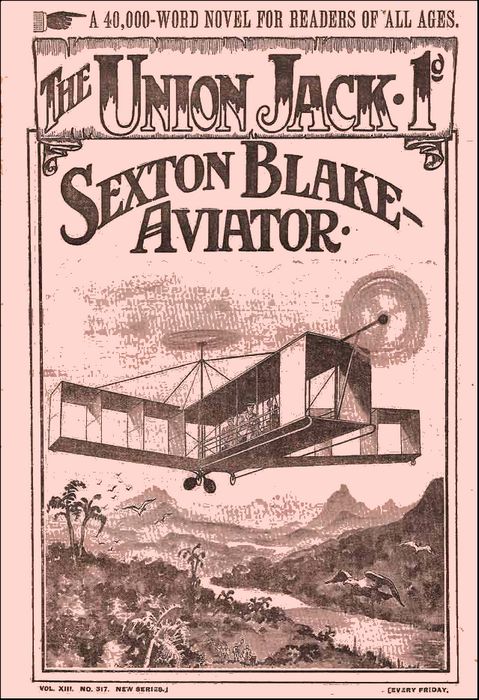

A Grand Novel Story of the Adventures of Sexton Blake, Detective, in an
Entirely New Role. Specially Written to Appeal to Readers of All Ages.
IF you know Paris, you know the Hill of Montmartre, crowned by the church which is such a landmark on the northern heights.
Possibly you have never noticed the Passage of the Four Cats, although it is not a stone's throw from the Place Pigalle.
In the Passage of the Four Cats is the Brasserie Zumacque, which I certainly hope you do not know, for it is a place with a very evil reputation.
When the police of Paris want to find a particularly notorious criminal, they go to the Brasserie Zumacque, and they go disguised, and well armed.
I do not mean to say that all the customers are rogues— far from it; some very respectable folk, whose only crime is poverty, pass down the two steps that lead from the swing-doors to the long, low room, with its little tables and the perpetual rattle of dominoes.
And some people go there out of curiosity, but they go at their own risk; it is said of these latter, that they do not always return.
The brasserie has a counter at one end, whereon are displayed bottles of absinthe and avocat, and other curious compounds, which are not supposed to be altogether respectable. The place has not been painted within the memory of man, and the gas, although it flares loudly enough, gives a bad light.
Three new customers entered the brasserie one evening, and took their places quietly at an unoccupied table at the far end of the room.
To look at them—and the majority of the other people present did so—they seemed ordinary folk enough; all three wore blouses—they might have been artists—and none of them appeared to be in affluent circumstances; though, in reality, the fat man with the bull-neck, who paid for the absinthe, was Monsieur Brignollas, the celebrated Parisian detective, and his companions were Sexton Blake and a Lancashire friend of his, named Brierley, who were seeing the seamy side of Paris under the guidance of Monsieur Brignollas.
The attention they had attracted was soon over; no one seemed to recognise Brignollas; the domino players resumed their games, and the talkers their conversation.
The room was dirty, the talk chiefly in argot; it was hot and stuffy, and smelt of coarse tobacco, and Mr. Brierley began to think it was the slowest place they had seen as yet, and to wish they had not left the Moulin Rouge so soon.
The types were few, and the only one that interested him was an old gentleman with snow-white hair and beard, who was playing dominoes at the table nearest to them; he seemed oddly out of place among the rest, for he said little, when everyone else was talking volubly, and drank his coffee, and smoked a Russian cigarette in a long holder.
"Well, I could find you a livelier place than this within a stone's throw of Deansgate," whispered Mr. Brierley to Blake, "Shall we move on somewhere else?"
"Your friend is impatient," said Brignollas, with a smile. "Wait a moment, what have we here?"
The swing-doors were flung open with a bang, and a girl entered.
"Ah," murmured Monsieur Brignollas, with the slightest possible movement of his eyebrows, "Mimi of the Studios! Where have you been hiding these past six months, I wonder?"
"Who is she," asked Sexton Blake—"a criminal?"
"No—oh, dear, no! A celebrated artist's model who is seldom seen on this side of the river. She's the best-hearted girl in the world, but erratic; sometimes she will get down in the middle of a sitting, stretch herself, say 'Good-day, my friend, I am tired of this life; I am sorry for your picture, but I cannot help it,' and away she will go—a hatful of gold would not keep her another moment. But if the painter should chance to be poor, and a good comrade, there is nothing Mimi would not do to help him— a child of Nature, absolutely irresponsible. Wait, I think she is coming over here, you may see her for yourself."
Sexton Blake translated for Mr. Brierley's benefit, and, as the girl moved towards their table which had one vacant chair, he politely moved it aside for her.
"Thank you, monsieur!" said the girl, with a little smile; and she sat down.
It was winter time, and a rich fur coat, cut tight to the hips, and a sealskin toque perched on her jet black hair looked oddly out of place in the brasserie.
The same swift, furtive glances had been thrown upon her as at the entry of the trio, and the momentary lull in the conversation gave place to the same babel of noise once more,
She ordered a 'gloria,' and they had time to note that in spite of her dress, and the expensive gloves she wore, her face was very pale, and that her dark eyes burned with a curious smouldering fire.
"To your health, messieurs!" she said, raising her little glass.
"To yours, mademoiselle!" replied the three men; and the little courtesy over, Mimi of the Studios drew a small book from the handbag on her wrist, and began to study its contents.
Brignollas touched Blake's foot under the table, and they waited developments.
Mr. Brierley was particularly alert, being something of an amateur detective in his spare moments; and he had been very disappointed that nothing had happened during the three evenings they had spent in Brignollas' company.
To-night he was to be rewarded for his patience, but not at all in the way he imagined; the tragic things that he was about to witness—nay, almost participate in—were to have very far-reaching consequences in the future.
Monsieur Brignollas was flattering himself that his disguise had baffled even Mimi's keen eyes, when the girl turned them upon him, and smiled.
The little book she had been studying was just an ordinary memorandum-book, such as a model might use to set down the dates and times of her professional engagements, and she wrote some lines on a blank page with the stab of a pencil.
The French detective had already noted that her face was very pale, and that her mouth was very unlike the merry, laughing mouth of Mimi of the Studios.
"Surely the minx does not know who I am?" he was thinking to himself, when she made a sign with her little finger, tore out the leaf, and pushed it across the table among the glasses.
He did not seem to have noticed the action, but, calling the waiter, he gathered the glasses to one side, and in so doing transferred the note to the palm of his hand.
He read it under the edge of the table, and Sexton Blake saw his eyes suddenly shine.
"Don't think you are invisible, my friend. I have followed you for three days, and the two Englishmen to whom you are showing the sights of Paris—you did me a kindness once, Brignollas; would you like to capture Balthazar Benedict to-night? He is in this room now!"
Monsieur Brignollas was too clever to even as much as glance in the direction of the girl, although the words made his heart leap, and he sat watching the sugar melt in the spoon, and then leaned towards Sexton Blake.
They were old comrades, those two men, and had been associated together in more than one dangerous and difficult piece of work.
"Ah, monsieur," said the detective to Mr. Brierley, "you are new to absinthe, you do not mix it quite properly—allow me!" And, leaning in front of Sexton Blake, who sat in the middle, he whispered in English: "You remember the Anarchist, Balthazar Benedict, do you not? I shall be able to show you something after all. I am going to arrest him almost immediately—the girl here is about to betray him.
Not a muscle of Sexton Blake's face moved, and he showed no trace of the expectant thrill that passed like a galvanic shock through his frame.
"Which is he?" he asked quietly.
"I do not know yet; Mimi will tell us," was the reply. "Watch that girl's face, it is a study!"
Brignollas was right. It was a study in fear, in anguish; of a tenderness trampled under foot, that seemed on the point of melting as she stirred the dregs at the bottom of her coffee-cup, and then hardened into stone.
Sexton Blake never forgot the pretty profile, marble white in the shadow of the wavy masses of her black hair. It was the face of an angel, transformed by cruelty and neglect into that of a veritable fiend.
She laid the spoon down and wrote again in the open notebook, which she passed across the table quite openly this time.
"He is my husband," she had written. "I shall speak openly at the trial; that man is not fit to live!"
There was a slight movement behind her, as the white-haired gentleman rose slowly from his seat with the deliberation of one who is feeling the approach of age, and, to their surprise, Mimi sprang up and faced him.
The two actions were almost simultaneous, but no one was prepared for the thing that followed.
The three men at the table saw the white-haired man lurch forward and clutch the girl, a piercing scream startled the brasserie, and, as everyone leapt to his feet, Brignollas caught her as she fell back dead across the little table, and her murderer gained the door in two bounds.
There was no sign of old age as he turned and looked back with a mocking laugh; and, as he plucked the wig and false beard off by the simple action of dashing his hat on the ground, they caught one glimpse of a red head, set on a bull-neck.
"Good-night, Monsieur Brignollas!" he cried, with a sneer; and he was gone before anyone could raise a hand to detain him.
"There was a rush, of course, in the wake of the celebrated French detective, but although he had two agents in plain clothes at one end of the passage, the Passage of the Four Cats is a curious thoroughfare, and Balthazar Benedict was gone.
That was three years ago, but the memory of that awful moment in the Brasserie Zumacque remained a vivid nightmare in the brains of Sexton Blake and his friend Mr. Brierley, which the rattle of a domino was sufficient to rekindle, and the mere mention of Paris to revive.
SEXTON BLAKE was in the act of replacing the silver cigarette-case in the pocket of the light over-coat that covered his evening clothes, when the telegraph-boy knocked.
"Confound it, this is to put off the dinner!" muttered Blake, who had been looking eagerly forward to dining with an old friend that night. "You'd better wait a moment," he said to the messenger, who gazed open-eyed at the tall figure of the great detective, and then he tore the envelope open and read the wire under the electrolier.
The boy saw his face grow grave as he proceeded, and before he came to the end of the message, which was in cypher, Sexton Blake said abruptly: "No answer," and closed the door.
He went upstairs thoughtfully, and called for Tinker, who came into the study.
"There's strange news here from Liverpool," said the great detective, removing his gloves. "If Brierley's right, and he's not often far out, we're on the track of a man who has borne a charmed life, and escaped capture for years."
"Who do you mean?" questioned Tinker, who saw from Blake's manner that he was very excited.
"Balthazar Benedict, the Anarchist," said Sexton Blake, looking at him with a strange smile.
"James"—and Tinker's eyebrows rose almost to his hair—"at last! Why, nobody has known for three years where the scoundrel is hiding."
"True, but I think we've got him now!" said Sexton Blake. "Mysterious messages have been received from time to time, veiled threats, and much boasting of some terrible contrivance he is making that will enable him to annihilate civilization, but no one has paid much heed; now it looks as though there were something in it. Listen, this is what Brierley says!" And he translated the cyphered telegram for Tinker's benefit.
"Red-whiskered man. Obviously in fear of detection, has chartered brig at Caernarvon, and is loading her with machinery, generally after dark. Have seen him, and he tallies perfectly with description you furnished of B.B., of Barcelona. Come down without delay, and have a look at him. Customs people beginning to smell a rat. Will meet you at Chester if you wire train."
The pair exchanged looks.
"There's something in it" said Blake. "Brierley's too cautious to make a decided statement of this kind without being pretty sure."
"Well, what do you think?" queried Tinker.
"We'll go to-night and take Pedro with us," replied Sexton Blake. "We sha'n't want any clothes—just a couple of handbags will do. You pack, and I'll glance through my notes on Balthazar Benedict, and his many misdeeds, Eight forty-five Euston is our train."
From one of the pigeon-holes in his fireproof desk he drew out a wad of papers secured by an india-rubber ring, all bearing on Benedict, and the record of the Barcelona Anarchist was a red one, like the scoundrel's hair.
Three insurrections had he led, burning and destroying, and ending in massacre by the troops, and five bombs had he thrown in various European capitals, each time with a fearful loss of innocent life.
He was the head-centre of the most dangerous band of Anarchists in the world, and from his secret printing-press he issued hideous manifestoes, calling upon his brethren to slay all kings, potentates, millionaires, and capitalists—in short, everybody who was better off than themselves.
The police of Paris raided him unexpectedly, and he shot three of them the night he escaped from Montmartre—the night of the murder in the brasserie—afterwards coming to London, which is the only refuge for such curs.
We are absurdly lenient with wild beasts of his description, provided they behave themselves, although we know perfectly well they are only maturing their foul schemes all the time.
But it was not in the man's turbulent, warped nature to remain quiet; he grew bolder, and had to fly again, this time disappearing altogether, no man knew whither.
It was rumoured that he was inventing some wonderful mechanism that would destroy his enemies, and cripple the trade of the world, and though some made light of it, there were others, and among them, Sexton Blake himself, who, knowing the fellow's cleverness, thought seriously of the matter.
At any rate, the man was alive, though nothing had been directly heard of him for two years; he had funds at his disposal, he was an accomplished chemist, and not the sort of individual to idle his time to no purpose.
And this was the man of whom the cypher message spoke, and whom Blake was prepared to hunt down if possible, although the chase should lead him to the uttermost parts of the earth.
Benedict had been pointed out to him in a foreign cafe in Charlotte Street, a year before that terrible incident they had witnessed, and he would know him again at sight; and Sexton Blake smiled grimly as he made some notes in his pocket-book, and took a little pile of gold from the desk, where he always kept a considerable sum against just such a contingency as the present one.
"Ah, Pedro!" he said, as the noble hound bounded in and laid his magnificent head on his master's knee. "If only human nature were as clean and honest as yours, old fellow, what a vast amount of trouble and misery would be avoided!"
There were not many passengers by the 8.45, and our three friends attracted little notice.
The reserved compartment was warm and snug, even on the cold October night, and Tinker, curling himself in one corner, slept all the way after leaving Rugby behind. Pedro roused him by licking his hand, and Tinker awoke to find the train standing in Chester Station, half an hour after midnight.
"It's a case of hotel," said Sexton Blake; "a special arriving in Caernarvon in the small hours of the morning would create suspicion in one man's mind at once. Hallo, there's Brierley! But what's wrong with him? He's seen us, and he's beckoning frantically. Keep Pedro out of sight for a few minutes, until I speak to him." And he opened the door and walked across the platform, pulling his soft hat over his eyes.
"Great Scott, you've just missed him!" exclaimed Mr. Brierley, who was a short, stout, Lancashire man, wearing a tweed cap and a mackintosh. "He travelled down on your train, and he jumped out before it stopped. Oh, you needn't look at the door! I know who the motor was waiting for now. Hark! He's gone! If I'd only guessed, I'd have stolen the sparking plug, or done something to it; the driver left it alone for twenty minutes."
"Well, it's unfortunate," said Sexton Blake coolly; "but that is not the only motor-car in Chester, Tom Brierley."
"Not by any means," said Mr. Brierley. "We got another waiting below, yonder. I thought you would not want to wait here until the first train—eh?"
"Capital!" said Sexton Blake. "Let me get my friends out of the compartment, and we'll have a midnight chase, if we can only find out which way they've gone. I say, Tom, I hope he didn't spot me on the way down?"
"We'll chance that, old chap," replied Brierley. "I'm game for anything you like; but hurry up, for they're getting a good start, with a powerful car, too, and the hills when we pass Conway—by gum, they're awful!"
It was a clear, cold, autumn night, and they were glad of the coats which thoughtful Mr. Brierley had provided.
Tinker occupied the seat next to the driver, Sexton Blake and the owner sitting behind; Blake being anxious to hear fuller particulars than the telegram could convey.
Mr. Brierley was the owner of a slate quarry in the Snowdon range, and having been associated with Sexton Blake in a famous murder mystery which our friend had solved, he had become greatly interested in amateur detective work.
When Balthazar Benedict escaped the clutches of the London police he went to Liverpool, where Mr. Brierley then resided, and his photographs being in all the illustrated papers, Mr. Brierley had tried his 'prentice hand on a capture, of course, without success.
"Oh, it's the rascal right enough!" said the quarry owner, as they left Chester behind them. "I've seen him twice—short, square-shouldered, red hair and whiskers, and speaks Spanish—not the ghost of a doubt, my dear Blake, and the man goes about with eyes in the back of his neck."
"The only weak part about it to my mind is, that he should be in England and attempt no disguise," said Sexton Blake thoughtfully.
"But he's not in England—he's in Wales, where, in spite of all we hear about Lloyd George, and Disestablishment, and the rest of it, things are hundreds of years behind the times. I'll show you grass growing in Caernarvon streets to-morrow." And little Mr. Brierley smacked his knee with the air of a man who has settled the point conclusively.
"Well, go on," said the detective, stroking the silky ear of the huge hound at his feet, "how did you come across him, and what led to your suspicions?"
"I'll tell you," said Mr. Brierley, lighting his pipe with difficulty, for the car was travelling at a great rate, "I've two coasters loading with slate in the harbour, and a fortnight ago a large brig, the Agnes and Mary, of Cardiff, anchored about three cables' length outside my vessels; there was nothing in that—there are dozens of similar craft all round us—but, one of my skippers, a man named Evan Evans, was walking on the quay with me on Thursday, and pointing to the brig, said, 'There's something strange about that vessel, Mr. Brierley. Look you! They load her at night mostly, the harbour-master has been making inquiries, and they say her cargo is going to be overhauled—large cases, very heavy.'"
"Is it gun-running, do you think?" suggested Blake.
"No, machinery—cranks, wheels, gas-engines. Some of the cases are sent direct from the makers. My men have watched. And another suspicious circumstance is this; there is room enough and to spare at the quay, but she is anchored out in the fairway, so that the tide would not affect her if she wanted to clear in a hurry."
"But, about the man—is he skipper or owner?" asked Blake.
"Owner, and he never walks twenty yards without looking over his shoulder to see if he is followed. No one has seen him in broad daylight, he lives on the brig, and is rowed ashore after dusk. By gum, wait until you clap eyes on him. It's the Spanish Anarchist, or I'm a Dutchman!"
"I am sure no one would ever accuse you of being anything but the enthusiastic Lancashire lad that you are, Tom," said Sexton Blake, smiling; "but which way are we going? Where are we?"
"On the straight for Mold," replied his friend. "He may have gone through Hawarden, but I doubt it; anyway, I think our course is to push ahead by St. Asaph, and get on to the coast road at Abergele; we shall learn there whether his car has passed, and if not, we can wait for him."
"And what do you propose to do in that case?"
"Pull across the road when we see his headlight, manufacture an accident, and ask their assistance—that'll give you time to have a squint at his physog. Don't you think that's a good idea?"
"Perfect, if one wanted a brace of bullets in one," said Blake. "No, Tom, you may know all about slate, but that's too transparent; Caernarvon's the spot we want to reach before he does. How far is it now?"
"Somewhere between forty-five and fifty miles—to say nothing of hills." And there was a ring of disappointment in Brierley's voice.
"Then tell your driver to open her out, we must get ahead of him, or he'll smell a rat," said Sexton Blake.
When they reached the coast road, the air was keen and salt, and the surge of the white horses on the shingle beach somewhere beyond the railway line, they slowed down, and none too soon, for the figure of a constable on a bicycle loomed round a bend in the track, before they were aware.
He was perspiring freely, and very cross.
"Car!" he replied in answer to their question. "Yes, indeed; I was nearly killed myself. Look you, it is a great shame to drive at that speed, and the light put out on purpose over the number-plate. I am going to telegraph through to have them stopped. it is murder and nothing less, whatever."
"Did you see what kind of car if was?" inquired Mr. Brierley in a sympathetic voice.
"Yes, indeed; a yellow car, with two men in it, and I know they heard me," snapped the constable. "I shall have them stopped—yes, indeed!" And he pedalled away in the direction of Abergele.
"They've passed us!" said Brierley, in a low voice. "Get on, Jim!?"
And the Napier leaped forward like an obedient horse, the bright headlights showing the stone walls on either side of the road crested with hart's tongue fern.
"We ought to see something of them before they clear Penmaenmawr, Blake," said Brierley, when they had left the quaint old town of Conway behind them. "What are we to do—the tables are turned now?"
"We will see them first," said Sexton Blake. "as we have an equal right to make road hogs of ourselves they will hardly suspect that we are following them, unless they have guilty consciences in some other quarter."
For several miles they flew along seeing nothing ahead, until, at the top of a very steep rise the driver suddenly shut off and rammed his brakes on hard, at the same time shouting angrily: "Now, then, you confounded lubbers, what the deuce do you mean by pulling up here and not a light showing?"
"I am sorry to incommode you, gentlemen," said a voice out of the darkness; "but there are reasons why I find your company objectionable on the road to-night."
And the wicked report of a revolver woke the echoes of the mountain-side, as the unseen speaker fired six bullets in quick succession into one of the front tyres!
All they could see was the shadowy form of a man in motor goggles, bending over the back of a large yellow car. The next instant the headlights were relit, and something like a mocking laugh came to them on the wind as the car started and tore madly away in the direction of Bangor.
"By James, there's a cool hand for you!" said Sexton Blake, replacing his own weapon which he had drawn, fearing serious trouble. "He was anticipating pursuit, and he has taken a very effectual way of stopping it!"
"Out with that Stepney-wheel, Jim!" cried Mr. Brierley, jumping down.
"Do you know, sir, I'm very sorry," faltered the crest-fallen chauffeur, "but I haven't one with me."
"Then take a week's notice!" said the owner of the disabled Napier. "What on earth are we to do?" and he stared at Blake in a hopeless manner that was really comical.
'Whose is the nearest house, driver?" said Sexton Blake, looking at the desolate loneliness of the dark country.
"There's only Colonel Burleigh's, sir, about a mile ahead," was the reply.
"The very thing. By gad, we'll not be far behind them yet!" exclaimed Blake. "I know the colonel intimately, and he will lend us a car if he is at home. We'll push the Napier to the side of the road, and lose no time. The only trouble is, the scoundrel will be on the alert now. He must have soon me on the train."
As he spoke, from somewhere a long way ahead, there came back to them the faint toot of a motor-horn, and there was no mistaking the intended triumph in its note!
It is rather a tall order to knock up a country house at half-past two in the morning, and ask for the loan of a motor-car, but Colonel Burleigh rose to the occasion when he found that Sexton Blake had disturbed his slumbers. Nay, the gallant soldier did more, when he heard of the outrage on the hilltop—he insisted on driving himself.
"My dear fellow," he exclaimed, "I may be useful, as I'm a J.P. for the county. Are you all in? Now then, hold tight! We're going to defy speed limits." And they did.
Up hill and down dale, the keen night air stinging their faces until all sensation was lost, the colonel drove as only one acquainted with every inch of the mountainous road might drive.
Now and then his companions caught a glimpse of the Straits through the trees that overhung the way, and added to its Stygian gloom, Now breasting a stony rise, now plunging down a winding slope into a fir-wood. A hoot as they rushed through a sleeping village. It was awe-inspiring, it was Homeric; it was a death-race if the slightest thing should go wrong, or the other car should repeat its tactics and wait for them at a curve!
The other car was already an hour ahead when they had cut up the gravel at the colonel's lodge gates, and the road was empty of living soul.
As they whizzed through Port Dinorwie an officer of the law shouted to them to stop, and the colonel shouted something in Hindustani over his shoulder.
"We're doing sixty miles an hour, Blake!" he laughed, through his set teeth, "And here we are at last."
He slowed down presently as they reached the straight road that leads into the town, and skirting the fine, old castle, whose empty shell keeps watch and ward over the harbour, where the black-hulled coasters lie, ran down the broad quay, and came to a stop.
"By gum! Where's the brig?" exclaimed Mr. Brierley, dizzy with the terrific ride.
A watchman who stood talking in Welsh to a coastguard at the quay-head, heard the words, and came to the side of the car.
"If you mean the Agnes and Mary, sir, she sailed about half-hour ago. Upped anchor and away all in a moment, like. I reckon she's cleared the Gap by now, for she's got the wind behind her."
"Did you see anything of her owner, John Jones?" demanded Mr. Brierley, recognising the man's voice.
"Ay—ay, sir! The Spanish gentleman came in a motor-car, and went aboard. They shook her topsails not five minutes afterwards!"
"Done!" said Sexton Blake, and the colonel took refuge once more in Hindustani!
"WHICH way did the car go, after—after the owner of the vessel went aboard?" said Blake.
"Back into the town, sir," said the coastguard. "My mate followed it, and we shall hear something when he returns."
"You were watching the brig and its doings, then?"
The man smiled oddly.
"We were going to board her in the morning, sir," he replied. "There have been some rum things stowed away in that hold during the last week, I can assure you."
"What sort of things?" demanded the colonel.
"Dynamite for one, sir, compressed gas in cylinders, and one case of something that slipped on to those rocks there and broke, and, my lord! it stopped all the men working on the quay until the wind blew it away seawards. We thought the main sewer must have busted!"
Sexton Blake and Mr. Brierley exchanged glances.
"What do you make of it now?" whispered Mr. Brierley.
"Certainly very suspicious. But who is this coming?" said Sexton Blake, as what sounded like a fearful altercation, mingled with the noise of running feet.
It proved to be the coastguard's mate, who, having seen the last of the car, had roused the harbour-master on his way back.
Now, if you start two men along a quay in the dark, both speaking Welsh at the tops of their voices, and occasionally tripping over a hawser, or running into a bollard, you get the nearest approach to a catfight known, and Pedro's neck showed a decided inclination to bristle.
The colonel recognised the voice of the harbour-master, and sang out in his best barrack-square manner:
"That you, captain? By gad, sir, do you. know this pirate has slipped through your fingers?" he cried, "What do you mean by it. Suppose he'd been a German spy—eh?"
A harbour-master is a very important functionary, and his word is law when his foot is, so to speak, "upon his native heath," and that "heath" being the great stone quay that surrounded the basin where the colliers and coasters lay at all angles on the mud—it being low-tide—the fussy little ex-sea captain bubbled like a turkey-cock.
It was hard enough to be dragged out of bed at half-past three on a pitch black October morning, to bark your shins, and run yourself out of breath, without having insult added to injury, look you!
Moreover, he did not care a jot for the colonel, even if he were a J.P., and being a Welshman, his temper was always short and easily roused.
"Will you have the goodness to mind your own concerns, Colonel Burleigh?" he replied, with considerable dignity. "Do you expect me to chain every suspected vessel up like a dog? I served the captain of the brig with a notice yesterday that he must not weigh his anchor until the Board of Trade gave him permission. Yes, indeed, look you, however!"
"Well, the beggar's gone, anyway!" said the colonel, pressing Blake's arm. "Excellent little chap, but fiery as shrapnel!" he whispered. "Let me introduce you. Captain Owen Griffiths—Mr. Sexton Blake, the celebrated detective. Mr. Blake has come down from London, Griffiths, to catch this fellow."
The two men shook hands in the dark, and Blake pressed the colonel's foot with his own warningly.
"Yes, I believe he is a criminal I have been hunting for some years," he said. "I understand you have spoken to him, Captain Griffiths?"
"Only once," said the harbour-master, his anger softening before the charm of Blake's manner. "And that was in Spanish. He pulled his collar round his neck, and his hat over his eyes, and he was wearing blue glasses. Oh, yes, there was something very fishy about that man! He did not wish to be recognised. Is it murder?"
"It is murder," said Sexton Blake.
"What a pity there is not a gunboat here," said the harbour-master. "I am afraid the only thing we can do is to telegraph the brig's sailing, and trust to her being stopped in the Channel. She must be well out in the bay by this time."
Colonel Burleigh drew Blake on one side.
"What do you think? Is he the man you want?"
"I have no doubt," was the reply. "Is there nothing else to be done? That scoundrel is a menace to civilisation, and I must track him to his lair"
The colonel led him away well out of earshot.
"Look here!" he said, in an excited whisper. "My steam-yacht lies over yonder under the wall of the castle. I was starting for the Mediterranean to-morrow. She is at your disposal, Blake, if you'll let me come with you. I've nothing on but to kill time, and a man-hunt would be as the very breath to my nostrils!""
"Do you mean this, Burleigh?" exclaimed Sexton Blake.
"By gad, I do! Give me a couple of hours to drive home. I'll be back before daylight, and we'll start at once!"
"My dear fellow, you've seen a lot of service in your country's cause, as all the world knows," said Blake, gripping his hand. "But you are doing a service to humanity by this act, I accept your offer."
"Bravo! It's a sporting one, anyway!" laughed the colonel. "Nuts and gingerbread to me, old chap, I can assure you. Now, I'll bunk back to my place, stick some guns in the car, and be here again before you've had breakfast. By the way, why not turn in on board? Everything's ready for a start as soon as they've got steam up."
"Nothing could be better," assented Sexton Blake. "But don't give it away that our man is Balthazar Benedict, or the Sunday papers will get hold of the yarn, and perhaps queer our pitch!"
The only disappointed member of the party, as they picked their way round the basin, was Mr. Tom Brierley.
"I'd give both ears to go with you," he said ruefully; "but Elizabeth Ann would have something to say about it."
Elizabeth Ann was Mrs. Brierley's Christian appellation, and that good lady was a tartar in her own house.
The smell of seaweed and salt mud filled the air as Colonel Burleigh floundered down to the water's edge, and sent a stentorian hail through his hands.
They could just make out the form of the steam-yacht Ranee, lying in deep water, for the grey light of approaching dawn began to show beyond the low line of the Island of Anglesey across the Straits.
"Hallo, there! Bluff! Donaldson! Confound you! Are you all dead?" bellowed the colonel. And after repeated efforts a sleepy voice replied:
"Aye—aye, sir, coming in a minute!"
Then they heard the splash of an oar, and knew that someone was pulling from the yacht.
"There's a deuce of a current here," explained the colonel. "Vile place for small boats. Ah, it's you, Donaldson, is it? My engineer. Donaldson, this is Mr. Sexton Blake, who is coming with us. Do the honours, and make them merry until I return, and be ready for sea at once. Mr. Brierley, I can give you a lift back if you want to see what has happened to your car?"
He talked like a man suffering from violent excitement, gave half a dozen orders all at once, and seizing Brierley by the sleeve, dragged him back up the shingle to the car, and whirled him away all before one might say 'Jack Robinson,' had one been minded to say anything so foolish.
"By James, Tinker!" said Sexton Blake, as the Scottish engineer pushed off. "'A stern chase is a long chase,' the old adage has it. Where will this chase end, I wonder?"
They clambered up the side, and turned in, Mr. Donaldson remaining a good half hour with Sexton Blake in the latter's state-room, imparting certain things to the great detective that he himself had observed during the week the Ranee had lain astern of the brig.
"There is only one point that troubles me," said Sexton Blake, as the engineer turned to the door."How are we going to pick up this boat, considering the start she has had?"
"That's easy as tumbling off a chair," replied Mr. Donaldson. "If she's gone northward round the island they'd sight her at Llandwyn; if south, the lighthouse keeper on Bardsey will signal us, and that's the course they've sailed.
"Why, how do you know?"
"Because the crew gave it out that they were bound for Belfast, and that's the other direction," laughed the engineer, leaving Sexton Blake to snatch what sleep he might before his friend the colonel should come aboard.
The Ranee was a screw steamer of a couple of hundred tons burthen, sumptuously fitted up, and smart as a man-of- war.
Her decks were holystoned, her brasswork shone like gold in the rising sun; the deckhouse was as brilliantly white as new paint could make it, and, above all, she had a rakish cut of her hull that suggested speed—a very necessary thing if there is a chase on the carpet.
The colonel, who came off in a dinghey about seven o'clock, was a bronze-faced man of fifty-five, running some-what to fat, to his great disgust, but very active, and keen as mustard on every kind of sport.
He had retired from the Indian cavalry about five years before on coming into a fortune, and he had been killing time ever since, with no particular object in life; building up a reputation for short temper and great good-heartedness—two opposite qualities that often go together.
Now, he seemed to have suddenly become younger in the last few hours. Here was a task after his own heart, and in his inmost soul he hoped the hunt would be a long one, with fighting at the finish.
He was to get his wish, with a vengeance!
"Ah, what have we got? Kidneys—good! — Curry— capital! Peg in, Master Tinker! Lay in a foundation for the voyage—something to build your sea-legs upon, eh!" cried the colonel, as they sat down to an early breakfast.
They had just finished when the vibration of the engines was felt, and going up on deck they saw the town, with its background of green hills and the magnificent castle at the waterside, dropping astern.
The deep-green waters of the Menai Straits were flecked with the white foam from the screw, and a soft creamy haze lay over the land.
The yacht's skipper, Captain Bluff, had come aboard with the colonel, and they saw at once that he was a jovial, merry fellow, and a good seaman.
He had commanded a steamer on the Indian station for years, plying between Calcutta and the Persian Gulf, and many an exciting yarn did he spin for their benefit before the voyage of the Ranee came to its extraordinary termination.
The harbour-master and the chief coastguard were on the end of the quay, looking out the spot where the brig had been anchored, as though there were anything to be derived from a contemplation of her empty berth, and our friends waved farewells, which were answered rather testily.
They passed the dangerous Gap slowly, and as they came out into the bay the gulls were screaming over the sand-tanks, st disappearing as the rising tide lapped them.
Captain Bluff turned a critical eye in the direction of the jutting point of Llandwyn on their starboard bow.
"They'll know nothing yonder," he said, "if the brig passed, it would be in the dark." And he signalled to the engine-room for more speed, "Bardsey's the place we shall learn something. If not, I propose to run ahead down St. George's Channel, and keep a sharp look-out. If we sight nothing, then we'll try the Irish coast. She's bound to have been seen somewhere, and we'll pick her up within forty-eight hours."
"You understand, captain, my object is to follow her— not to alarm her company?" said Sexton Blake, turning up his collar, for the morning air was keen.
"Leave that to me," said the skipper, with a wink. "Once we clap a glass on her, we'll dog her if she's bound for the Antarctic! We've got grub enough on this little beauty for a six-weeks' cruise without touching port!"
Off Bardsey Island they signalled the lighthouse.
"Has Agnes and Mary brig passed this morning?"
And the hearts of everyone on the bridge bounded as the answer came:
"Passed sunrise, steering west by south."
"Full speed ahead!" roared the skipper down the engine-room tube, and the Ranee seemed to walk away from the pilgrims' isle, the Welsh coast quickly fading into an irregular blue line far astern.
There was a strong breeze, and the rolling waves were topped with flying foam. The smoke of distant steamers heading up Channel lay out in long bars parallel with the horizon, and a big three-master pitched heavily as she bore up against the wind.
"In half an hour, at this rate, we may begin to look for her," said the skipper. "Sing out anybody who sights a square rig ahead of us."
Tinker had possessed himself of a large binocular, of which there were several pairs in the chart-house, and trotting up and down to keep himself warm, he swept the distant sea every five minutes.
Presently he shouted, "Ship ahoy!" and pointed to a faint blur that might have been a cloud low down on the western horizon.
"You're right, boy," confirmed Captain Bluff. "That's a square rig right enough—and sailing, too. We'll be better able to tell her in another ten minutes."
Bearing away a couple of points, and slowing down a little lest they should put the idea of pursuit into the minds of those on board the brig, they passed her half a mile away, all her canvas set to make the most of the breeze while it lasted. And, by the skipper's advice, Sexton Blake retired into the chart-house.
"Their glasses will be as good as ours," said Captain Bluff, "and we don't want to frighten them for a start."
He passed the word to the crew to look at the brig, and one and all proclaimed her the Agnes and Mary, surprising Tinker by the little points of identification that a landsman would never have noticed.
"Well," said Bluff, when they were all satisfied of their neighbour's identity, "what are your orders, gentlemen?"
"Only to follow that vessel wherever she goes," said Sexton Blake, lighting a cigar. "If it takes a year, I'll run Benedict to earth—always assuming, Burleigh, that you are willing?"
"My dear boy, the Ranee is yours, from her tops to her keelson! Do what you like, go where you like—only, let me be in at the finish if there's going to be a scrap!" cried the colonel. "Here, Adams"—and he called to the steward who passed at the moment—"bring us in a magnum of that Perrier Jouet! We must drink success to our voyage, whether it be long or short! I've shot almost everything that goes on four legs, and a good many that went on two— professionally, of course—but I've never had a chance of winging an Anarchist, and the idea appeals to me!"
"Fearful sell if it turns out not to be the blackguard after all!" laughed the skipper.
"Pooh, Bluff, absurd!" cried Colonel Burleigh. "Do you take us for a pack of fools?"
"No," said the skipper, with a twinkle in his keen, grey eyes as he stroked his close-cut beard. "I admit there's a certain amount of method in your apparent madness, colonel. Hallo, there, Barnett"—this to the man at the wheel—"let her away another couple of points! It'll disarm suspicion! We can always lie to and let the brig overhaul us."
The wind held, and the brig kept on a straight course, the Ranee shadowing her away in the offing, almost hull down, with a look-out at the masthead, relieved every hour, to keep her in sight.
At night they drew in closer, making her lights at dusk and never losing them until the dawn came.
Passing Milford Haven the Agnes and Mary stood in closer to shore, and seemed to hesitate, but afterwards continued on her way down Channel, past the terrible Cornish cliffs, until she came abreast of Land's End, when, to their surprise, she went to port and entered Mount's Bay.
"What's the meaning of that?" growled the skipper. "She's bound up the Channel then!"
But he was wrong, for they sighted her making for Penzance, where she dropped anchor.
"How now?" said Bluff.
"I'm going ashore," replied Sexton Blake. "By the time you've lowered a boat I shall be ready for you." And he dived down the companion-way into his cabin.
To the surprise of everyone but Tinker, it was an elderly gentleman in a huge travelling ulster who came on deck and begged in querulous tones to be assisted into the boat waiting under the yacht's side.
"If he lands I'm going to have a close look at him," laughed Sexton Blake, putting on a pair of smoked glasses, and muffling his neck in a silk handkerchief.
"Give way, lads!" And the bewildered sailors pulled off for the pretty harbour.
THE harbour was full of shipping, and they had no difficulty in landing unseen by those on board the rig. "Wait, and be ready for me. I may be gone some time," said the elderly gentleman, getting clumsily ashore, and hobbling away by the help of his thick stick.
"Rum go, Bill!" said one of the men to his companion.
"A bloomin' rum go!" was the reply. "The boss has some strange pals!" And they lit their pipes and looked about them.
Sexton Blake made his way to the post-office in the centre of the town, and, greatly relieved to find that he was the first in the field, secured the telephone, was put through to his housekeeper, and settled himself to wait developments.
"Keeping his eye on the door, he was presently rewarded by the sight of a seaman in a pea-jacket, who entered, looked at the telephone-box, and went out again quickly.
Blake intimated to the clerk that he would want the 'phone for some time, and waited patiently.
In less than five minutes the sailor returned, put his head in, and said something to someone who was outside.
There was a short conversation, which ended in the appearance of a short man in oilskins and a sou'-wester, an unmistakable patch of red whisker glowing on his cheek.
He was the height and build of Balthazar Benedict, and Blake's heart leaped.
The man came up to the counter, glancing sideways at the box, and asked in broken English how long the elderly customer would be.
The clerk did not know.
Would he find out? The questioner was in a great hurry, and only wanted the wire a few moments himself.
He was impatient, speaking sharply, and the clerk was not in the best of tempers.
"You'd better ask him yourself!" he snapped, pointing to the box.
The questioner was only a few feet away, and Blake opened the glazed door quickly.
"I shall be some time, sir," he said politely. "If you like you can use the telephone now," And he replaced the receiver and came out.
The man in oilskins mumbled some words to the effect that "it didn't matter," pulled his sow'-wester down over his face, and went towards the office door.
Sexton Blake forgot his assumed role for a moment, and strode after him.
The man in oilskins looked over his shoulder, saw the movement, and quickened his pace, speaking to the sailor as he passed out.
As Blake pushed the swing-door he found the sailor had his foot against it, so he grasped the other handle and pulled with such force that the man who was holding it on the other side nearly fell over into the office.
"You're in a deuce of a hurry, governor!" said the sailor, squaring his broad shoulders, and evidently bent on picking a quarrel.
The people in the post-office turned round, hearing the disturbance, and were in time to see the elderly gentleman drive his fist into the sailor's chest with a suddenness and a force that spun him backwards, all arms and legs.
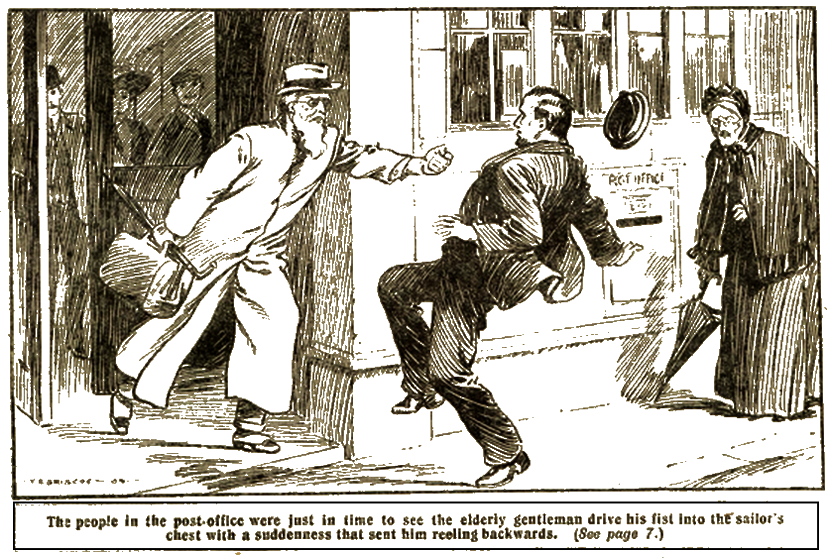
Outside some carts were rumbling by, and Sexton Blake caught a glimpse of the short man with the red whiskers, who cast one startled glance back at him, and dived down a street opposite.
"Look here, master, you hit blazing hard for an old gentleman!" said the sailor.
"I shall hit harder next time!" replied Blake. And ignoring the fellow altogether, he dodged round the carts, and followed the direction taken by the short man.
Unfortunately he was out of sight. Some narrow alley had hidden him, and he had escaped.
Half-way down the street Blake stopped.
"There's no doubt about it now," he said to himself, "Shall I tackle this fellow, or not?"
He turned back, and went towards the post-office again, where a little group of people were talking excitedly over the assault, with all the empty verbosity of those who have only witnessed half an occurrence, and fill in the other half with indignant vapouring.
The sailor had vanished, thinking.
If the man had gone to the police-station, it would mean delay; but he was convinced in his own mind that he had done nothing of the sort, and he decided to rest content with what he had already learned, and return to the Ranee as soon as possible.
As he reached the boat, he saw that a light mist was creeping up in the harbour, and away out in the Channel several large steamers were blowing their sirens.
"Fog coming up, sir," was Bill's greeting, to which his companion added the information that a boat had pushed off in a hurry, and was pulling hard towards the open water.
Sexton Blake smiled to himself.
"All right, men; give way," he said. "We want to reach the yacht before the fog thickens."
"And that'll take us all our time," said Bill, as they dipped their oars.
There is something weirdly mysterious in a sea fog. It rolls round one like a blanket, blotting out water and sky, and muffling all sound, And they had nearly a mile to row in it, with only the faint scream of the distant sirens to tell them where the open sea lay.
Once they fouled an anchor-chain, and were nearly upset, and as they fended themselves with their hands along the side of the vessel, the seaman, Bill, leaned towards Sexton Blake, and whispered:
"Did you hear that, sir?"
Several heavy drops of salt water splashed from above them into the boat, and a rough voice cried:
"Swing her in!"
"This is the brig," whispered Bill. "They've just hoisted the boat." They let their own craft float clear on the falling tide, listening for the sound of the surf, that would denote the presence of the shore under their lea; but now a fresh siren began its melancholy hoot, and the two men recognised the Ranee.
In half an hour, by great good luck, they ran alongside, and the first words that Blake uttered, in response to the eager questioning of those on deck were:
"I've seen him, and there's no doubt about it, Balthazar Benedict is aboard that brig, and we've got to make sure he doesn't slip through our fingers this time!"
All that day the fog lasted.
The shrouds dripped moisture on to the decks, which were wet and clammy. Captain Bluff was anxious, for their position was a dangerous one, and a more miserable time none of them had ever spent.
The foghorn at the Lizard was going continuously; a big ship lying-to outside, afraid to stir, kept up a doleful plaint; dismal bells tolled every minute, and Pedro showed a strong desire to lift up his nose and join in.
"There's one comfort," said the colonel, helping himself to the whisky, "that scoundrel can't get out. How long do these confounded things last, Bluff?"
"Never know. I've lain out yonder three days at a stretch before now," was the grumpy reply, as the skipper groped his way back to the bridge.
Happily, just before midnight, the curtain blew aside before an easterly wind, and while it still shrouded the Ranee, the look-out forward reported a vessel crossing her bows against the misty moon.
It was the Agnes and Mary drifting by silently, like some spectral ship, spreading her canvas as she glided among the fog wreaths down Channel.
Her bell was going—it had a peculiar, resonant ring—and, slipping their anchor, they followed. guided by the sound.
Across the Bay, down the coast of Portugal, they kept on her heels. She went into Funchal for water, and the Ranee remained outside, waiting for her.
Then she was away with every stitch of sail set, bowling along before the N.E. Trades, and Captain Bluff said sententiously in the smoke-room that night: "South America, Mr. Blake, that's her destination."
"Great Scott, that's a far cry," said the colonel, "and a man once landed in South America might take a deal of finding. Got any notion, Blake, what his game is at the back of that wonderful mind of yours?"
"Anarchist colony, undoubtedly," said Sexton Blake gravely. "Great bomb ranche, and general training establishment for death and destruction; assassination of kings a speciality; houses of parliament blown up while you wait. What else does he want a shipload of dynamite and compressed gas for? By James, if we can only get close enough without his spotting us, there will be things to be seen, and, afterwards, things to be done, my friends!"
It was soon after this scrap of conversation that a great change took place in the outward appearance of the Ranee.
Her engines slowed down until the topsails of the brig were just above the horizon, and then cradles were rigged, the smart crew mustered in overalls, with paint-pots, and the first thing they did, under Captain Bluff's orders, was to paint the two yellow ochre smoke-stacks red, with a black band round their tops; to obliterate the name of the yacht on bows and stern; to turn the white deckhouse, bridge, and rails to a dull greystone colour, and carry the monotonous and inconspicuous hue over the upper works, until, by the time the yards had been stowed away below, and her two masts stood naked against the quivering blue sky, the Ranee might have passed for a tramp steamer, and none too clean at that.
"That'll puzzle 'em," said Captain Bluff, with a snort. "I reckon they're making for Para, and we may have to run in there ourselves—coals getting low, Donaldson tells me. Joke to fly the black flag, and start as pirates on our own account—eh?"
"I've often thought what a long run an unscrupulous rogue might have if he suddenly did such a thing," said Sexton Blake. "There's a fortune in it!"
"Not a bit of it!" And the skipper's face grow red and angry. "You talk like a landsman, Mr. Blake, and a landsman thinks a ship once out at sea could do what she liked, and none the wiser. Great mistake. You don't understand. A vessel's doings are better known than a motor-car's, I can tell you!"
"Oh, very well!" laughed Blake, who was always having little encounters with the peppery skipper. "Every man to his trade. But what lies beyond Para?"
"Brazil, the Amazon, thousands of miles of it, jungle, forest, snakes, red-hot sun—everything that's tropical and unknown and beastly," replied the skipper.
"Sounds promising," interjected the colonel, from behind a big cigar. "Shooting, evidently—Anarchists and alligators—good egg!"
The tropical sun was sinking beyond the top of the primeval forest, and the sounds of animal life were beginning again after the fearful heat of the day.
The howling monkeys had started their dismal wail, and blue macaws and gaudy parrots flew in flocks overhead against the brilliant sky.
Tinker knelt in the bows of a large canoe, which was being paddled softly up a narrow stream that flowed into the Amazon, six hundred miles above Para.
A good deal had happened since the Ranee's prow cleft the yellow waters of the mighty river, and anchored astern of the brig, as she had done at Caernarvon.
Thanks to Captain Bluff's ruse she was not recognised; but, though they kept watch day and night, not a glimpse did they succeed in catching of the Anarchist, who remained below for the entire week the brig lay off the Spanish-American port.
Something was evidently going forward, for there was much passing to and fro of white-clad officials; carts drove up to the quay, and more mysterious cases were carried on board the Agnes and Mary, until her deck was filled with them.
Then, one morning. when a light breeze from the Atlantic made life tolerable, after a fashion, the brig's sails were shaken out, and she glided slowly away up the huge inlet towards the interior.
Sexton Blake was jubilant, and he went ashore with Pedro, who was overjoyed to be free again after a week's confinement below; and three hours later the Ranee steamed in the wake of the brig, repainting her funnel black when she was out of sight of Para.
For three hundred and fifty miles they dogged the unsuspecting craft, until they passed the narrow channel, and reached the Amazon proper, even then so wide that, as they hugged one bank, it was difficult to make out the opposite shore.
One writes with respect of a river which, two thousand miles from its mouth, is still a mile and a half across.
Tinker was all eyes and ears, as he knelt in the canoe, with Pedro crouching beside him, with Sexton Blake, the colonel, and Captain Bluff, while three sailors paddled silently, following the direction of Tinker's hand.
The steam-yacht lay three miles behind them, moored stem and stern in a little inlet, her hull completely hidden by the giant grasses, and her masts and smoke-stacks so shrouded by the plume-like leaves of the jupati, that you might have rowed past her in her own length and never suspected her presence.
The brig—two miles higher up the river—had anchored fearlessly to the bank, and from her side three boats, heavily laden with men and stores, had rowed away in the blazing heat of noon.
From the masthead of the yacht, Sexton Blake, armed with a powerful binocular, had marked their going, and watched them turn into the mouth of a tributary, where a clump of enormous palms made a distinguishing landmark.
The bank of the Amazon there was honeycombed with innumerable water-channels, or igarapes, as they are called, and, by threading these with great care, they passed the brig, and reached the clump of palms.
Turning out of the scorching blaze of the vertical sun, they suddenly found themselves in fairyland.
Overhead, the leafage met, making a shady tunnel, down which a cool air fanned their cheeks.
The inlet wound through groves of drooping bamboos, where the great purple convolvulus clustered; orange-coloured mallow, and starry myrtle gemmed the banks, and the golden begonias clung to the taller trees, gaudy butter-flies flitting about them, and the yellow tanager birds darting among the floating islands of bright green capim grass.
Festoons of enormous creeper hung from the branches above their heads, and Tinker's impulse was to clap his hands, and exclaim aloud, as every bend of the inland river revealed some fresh charm; but somewhere ahead of them were the three boats, and a single sound meant betrayal.
Now and then a shout came back down the echoing aisle, and Tinker lifted his arm as, round the next bend floated a broad-brimmed native straw hat on the gentle current, whose surface showed no ripple.
"We're close on them now," he whispered. "Look at that!" And Sexton Blake passed the word to the paddlers to stop.
"Put us into the bank yonder," he said; "we can pull ourselves along by the roots. There is a change in the nature of the country just ahead—an opening of some kind."
It was time, for the impenetrable forest that had so far bordered the igarape on either hand, seemed to be thinning out, and the yellow glare of the sun slanted in through the overarching boughs.
Everyone instinctively glanced at his revolver, and, with a warning pat on Pedro's head, Sexton Blake took his place be-side Tinker.
Inch by inch the sailors worked the canoe along, until Blake motioned them to stop, and, raising himself with great care, looked over the sedge.
About a hundred yards in front, an isolated clump of miriti, or fan-palm, formed an oasis on the verge of a wide plain that stretched away out of sight beyond the edge of the forest.
Perhaps a couple of miles off a tall mountain closed the plain to the north, its lower slopes clothed with a dense tangle, its crest rising bare and gaunt against the dazzling blue sky.
"This is the settlement, surely!" he whispered to Tinker, who had stood up beside him. "But I don't see any sign of habitations—no doubt those palms hide them. See, the boats have gone ashore, and there is smoke curling up above the trees.
"Hark, those are cheers!" whispered Tinker. "The scoundrels have a welcome-home!"
The hoarse shout of many voices, repeated again and again, came from the plain, and Sexton Blake made a sudden resolve.
"Tinker," he said, looking into the boy's eyes, "it's only a stone's-throw to that clump—I'm going to reconnoitre the villains."
"Oh, I say, look out! It's death if they spot you!" urged Tinker. "Let me come, too!"
"No, lad. Besides, they won't spot me," replied Sexton Blake, a fearless smile playing round his sensitive mouth. "I shall be back in ten minutes."
Before the others realised what he was about, he had stepped on to the bank.
"Here, what's your little game, Blake?" said Colonel Burleigh, preparing to follow him. But Blake bent down towards him.
"Stay where you are unless you hear my whistle," he whispered. "I know what I'm doing, and I am in no danger."
"I don't know so much about that," growled the colonel, as the tall grasses closed behind Blake's form, leaving a sense of uncomfortable suspense as his companions looked at each other in the strange stillness of the tropical forest.
"I know what it'll be, the headstrong idiot!" said Captain Bluff, with his usual outspoken candour. "If he comes back at all, which I doubt, he'll drive it till the sun sets! And how, in Heaven's name, we're going to get to the yacht in the dark through this infernal tangle—well, ask me another! Or else he'll have the whole pack yelling at his heels!"
"That would be rather good business!" said the colonel, fingering a repeating-rifle grimly.
Five minutes, ten minutes, the time dragged on to half an hour—they were beginning to grow seriously alarmed—and still there was no sign of their comrade.
Suddenly a voice fell on their listening ears, and with it the crackle of someone forcing his way through the tangle.
"Come on!" cried Colonel Burleigh, almost upsetting the canoe as he leaped out on to the bank, followed by the others. But instead of a panting, hard-pressed fugitive, Sexton Blake burst upon them, followed by a thick-set man with a pair of very broad shoulders, and both were laughing.
"Gentlemen," said Sexton Blake, "we are absolutely done in the eye! Let me introduce you to the supposed Anarchist —the bloodthirsty Balthazar Benedict! This is my old friend Dr. Martin Wells, the famous specialist, who for purposes of his own has been searching for a solitude of which we have innocently deprived him! It's his own fault, for making-up like Benedict in his anxiety to escape observation!"
"Gentlemen," said Dr. Martin Wells, "in spite of all Blake has said, I'm glad to see you! Welcome to a spot destined, I hope, to prove the cradle of an invention which is going to revolutionise the world—certainly not to destroy it! Come ashore, and we'll have supper!"
A RAMPART of huge cases; a young fellow in a white suit; a group of six men, British and honest, every one of them; the three boats they had tracked with such elaborate caution up the igarape drawn up on the bank —that was the Anarchist colony that unfolded itself before the astonished eyes of Sexton Blake's companions when they followed the doctor and his friend beyond the clump of fan-palms.
"Well, but hang it all, what does it mean?" demanded the colonel, who was obviously disappointed that there was going to be no fight. "Why have you disguised yourself, and behaved in this extraordinary manner, doctor?"
"The explanation is simple," said the great scientist, wiping his glasses. "All the world knows that I have been trying for years to solve the problem of aerial flight—long before they heard anything of the Wright brothers, Bleriot, Latham, or any of the modern aviators; all honour to them. Last summer I struck a new idea, and some kind friend spread it abroad, with the result that I have been pestered with interviewers and spies until my life has been a perfect misery. Then when my nephew there—Mr. Dick Wells, gentlemen—suddenly solved the solution, I determined to work it out in some unknown, inaccessible spot, where press-men and inventor's touts could not reach me."
"And so you left England under a disguise!" interrupted Captain Bluff, who had evinced the keenest interest in the narration. "And now, here are we, come to disturb you! By gad, sir, I wonder you don't shoot us! For my part, I apologise from the bottom of my heart for a most unwarrantable intrusion!"
Everybody laughed, for the captain stuttered and grew scarlet, and was evidently quite sincere.
"Oh, you may snigger, you confounded young rascal!" he bellowed, glaring at Tinker. "It's only a man who has paced the bridge all his life who can understand how sacred the bridge is!"
"My dear sir," said Dr. Martin Wells, "your sentiments do you infinite credit! But you are all gentlemen, and men of honour, and it is not from such as you that I wish to conceal myself. This spot is perfect for my experiments, stay as long as you like. An audience, if it is a sympathetic one, is no hindrance to an inventor. The cheers of the troops at Aldershot are music in my friend Cody's ears, I know. And as for you, Blake, you sly dog, you have seen something of my former successes, and I could almost believe that you have followed me on purpose!"
"Nay, on my word of honour, that is not so!" laughed Sexton Blake. "But since I am here, it only rests with the colonel, who provided the means of transport, to say how long I stay. I'm in no hurry to go, I can assure you!"
"If there's anything to shoot I'll stop six months!" said Colonel Burleigh. "This climate reminds me of Bengal, and suits me down to the ground! What do you say, Dr. Wells? Shall we bring our stores up here and swell your camp? I'll undertake to supply it with fresh meat!"
"Nothing could be better!" cried the genial doctor. "Now, men, isn't that supper ready yet?"
It was a merry meal, for everyone felt a sense of relief in throwing off the mysterious methods of the past few weeks.
"And you really never knew we were following you?" said Captain Bluff, lighting his pipe from the fire.
"Of course, the motor incident alarmed me," replied the doctor, "and the Penzance encounter seemed proof that I was known, and once, when we were crossing the Bay of Biscay, we had some suspicion that we knew the strange steamer that hung so persistently astern of us; but after that we thought we had shaken you off, and our minds were quite easy.
Bluff's eyes sparkled with pleasure.
"It's wonderful what a little paint will do, properly put on!" he laughed, rolling out a great cloud of tobacco. "I remember once, when we were off Pondicherry——" And he launched into one of his interminable yarns of adventure in the Indian seas.
Sexton Blake, Tinker, and Pedro strolled away from the encampment over the open plain as the sun rolled down to its grave beyond the black belt of forest.
"It is a keen disappointment to me, and poor Brierley will be fearfully sick," said the great detective; "but a month here will be a distinct novelty, and, after all said and done, we shall find plenty to interest ourselves, what with Martin Wells' experiments and the exploration of these wilds. I don't suppose there is another human being within three hundred miles of us at the present moment!"
He did not see the little speck of light that shone high up on the mountain-top that overlooked the plain, as a pair of excellent field-glasses followed the movements of the fresh arrivals.
"What do you think of the new development, Tinker?"
"Ripping!" said Tinker, his face glowing with pleasure. "If the colonel will lend me a gun, and let me go with him after wild game, I don't care if we stop here a year! It's better than Baker Street, anyway—isn't it, Pedro?"
Pedro looked up into the boy's face with a little whimper of delight, as though he, too, scented possibility of adventure. Then the sun went down, and they retraced their steps to the camp, where already the men had set up a couple of tents, and were preparing to make all snug for the night.
Tinker lay awake, unable to catch sleep for a long time: and getting up, he went softly to the tent-door and looked out.
The velvet blackness of the tropical night lay all about them; overhead the sky stretched, a star-spangled vault of deepest blue, in which the constellations hung, brighter than we ever see them in this island of ours.
Myriads of fireflies, flashing their red lights, danced over the low ground, and now and then one of the larger elators showed lights red and green alternately.
Tinker stood amazed. He wanted to waken the rest, that they might see the spectacle also, but the multitudinous sounds that came from the forest and the river chained him to the spot.
A slight noise at his elbow made him turn, and he saw Dick Wells, the doctor's nephew, standing there.
He was a nice young fellow, wildly enthusiastic over his uncle's inventions and a born engineer, and he, with six mechanics, formed the doctor's staff.
"I can't sleep, can you?" whispered Dick Wells. "Isn't it weird? Do you hear that!"
A loud splash came from the river, some distance away, followed by a piteous squealing and a tremendous struggle. One of the huge alligators that infest all the tributaries of the Amazon had seized some creature drinking on the bank, and dragged it under water, and the squeals ceased almost immediately.
The minor noises were instantly stilled, but the tree-frogs were at it all the time, "Drum, drum! Hoo, hoo! Quack, quack!" and the howling monkeys kept up their melancholy note.
"We'll give some of those beggars gyp when we get the electric plant fixed up!" said Dick Wells. "It'll be a startle to turn a searchlight slap into the forest!"
"But are there no inhabitants in all these miles and miles of river and forest?" asked Tinker.
"Not a soul for a week's journey," replied Dick. "We've got two Indians on the brig, and they say this region is unknown—that's why uncle fixed on it! There's a run of twenty miles along this plain, and the plain varies from two miles to ten in width—forest on one side, and those mountains on the other—no wind, just perfect for us!"
"And do you think you are going to fly?" asked Tinker, very much interested.
"I don't think anything at all—I know it!" said Dick emphatically. "I struck an idea, uncle worked it out, and we've only to construct an absolutely new engine, and there you are! We've got the sheds in sections, and in a week we'll be in full blast! Our chaps are as keen as mustard, and sworn to secrecy! Oh, I tell you, it's a big thing! And to think you tracked us down for Anarchists!"
"Well, you seemed very suspicious!" said Tinker, smiling.
"Yes, I know—I told uncle he was worrying himself out of all reason! But, look here, what do you say to turning in again? I'm fearfully tired!"
Tinker began to feel his eyelids heavy, and, leaving the nocturnal denizens of the forest to roar, and howl, and stalk each other, he drew his mosquito-net carefully about his hammock, and was asleep in five minutes.
When the gloom was still upon the water, and even the birds were scarcely stirring, a canoe came up from the brig, bringing their skipper and the two Indians.
They were copper-coloured, active men, with straight black hair, natives of the Gapo, and the colonel pounced upon them as the very thing for the hunting expeditions he had planned already in his mind.
But the first thing to do was to build huts, sheds, and store-houses, and to unpack the portions of the aeroplane which Dr. Martin Wells had brought out from home, And for a solid week the air resounded to the grating of saws, the blows of innumerable hammers, and the constant passing to and from the brig with boatloads of materials.
Captain Bluff went down to the yacht, and brought her up alongside the brig. And as it was a case of all hands to the pumps, a very busy little settlement had soon reared its head on the bank of the igarape, and the doctor was ready to begin.
Hundreds of miles from civilisation, secure from all prying eyes, as they thought, the inventors toiled at their work, and at the end of ten days a huge spider-like machine sprawled its limbs on the grass, and everyone began to grow excited.
Sexton Blake was keenly interested, and the doctor delivered quite a series of lectures on his behalf, while Colonel Burleigh, who rather scouted the whole thing, went away with his gun, and Pongo and Gapo, as he had christened the Indians.
He spoke a little Spanish, and swore lustily in Hindustani, and being a marvellous shot, he won the admiration of the pair, and thoroughly enjoyed himself for the first time since he left the Service.
The colonel had taken a fancy to Tinker, and they never returned empty handed.
In the evening they went along the bank, or paddled across to a little island opposite the camp and shot alligators, and it was coming back one sunset, when the air literally seemed alive with fire beetles and elators, that they found the doctor and Sexton Blake talking gravely as they paced together, a little way from the camp.
"Is there something wrong?" queried Tinker.
"Yes, we are afraid there is a traitor among us," replied Blake. "The doctor's plans have been tampered with. I am going to shut Pedro up in the 'shop' to-night, and see if anything happens."
"Who do you suspect?" asked the colonel.
"Know no more than Adam," replied the doctor, who looked very worried. "I'll swear it's none of my men, and the Indians are out of the question."
"Send my fellows back to the yacht, and all the brig's crew," said Colonel Burleigh. 'That will clear the air a little and you'll see whether the thing stops. Has anything been stolen?"
"No, but my calculations have certainly been overhauled, and by some very cautious individual," said Dr. Martin Wells. "I'm going to keep a sharp eye on the machinery shed, for we're now making a wonderful engine, which is a profound secret. If it answers, we shall have practically discovered a new motive power."
"You have every confidence in your six men?"
"I would trust them anywhere."
"Work for you, Blake," said the colonel, smiling. "Some have greatness thrust upon them. My word, we've had a capital night with the caimans! Tinker's shot five, never missed!"
As they walked from the bank to the camp, which was a couple of hundred yards away. they met Dick Wells and the two Indians.
"I can't make head or tail of these fellows, colonel, but I think they've found something important for you," said Dick.
"Ah, Pongo, what is it—the big jaguar we lost last night?"
Pongo shook his head and gabbled something unintelligible to the rest.
"Hallo!" exclaimed Colonel Burleigh, after he had questioned them closely. "There must be someone prowling round, They say they have come across a man's footprints, wearing a different kind of shoe to anyone here."
The Indians stood stolidly in the glow of the campfire, their black eyes very bright.
"Has some beggar followed you up from Para?" suggested the colonel. "Some Yankee pressman—eh?"
"Of course if is possible; but in that case he must either be camping out in the forest, or living in his canoe."
"That we will find out," said Sexton Blake, "if the Indians will take me to one of the footprints. Pedro will soon track the man down. There's a bright moon to-night, and after supper we'll have a hunt. Meanwhile, don't say anything to the others."
It happened that Captain Bluff and his crew were all away on the yacht, getting rid of the paint with which they had smeared her, only Mr. Donaldson, the engineer, being up at the camp.
When the meal was ended Sexton Blake rose. Tinker was already all agog, and the colonel had brought his gun into the mess tent.
Sexton Blake had arranged that Dick Wells should work the powerful searchlight about fifty yards ahead of them, and holding Pedro's collar, he followed the Indians who, all barefooted as they were, set off through the grass that swarmed with snakes towards the brink of a waterway that wound over the open plain.
Pongo and Gapo regarded Pedro with a certain amount of awe, probably thinking him the father of all bloodhounds; but their awe turned to a mighty respect when they reached the spot where they had seen the footprint.
It was invisible to European eyes, but Pedro promptly snuffed it, gave a low whimper of eagerness, and set off at a run along the bank.
The Indians were wild with delight, and followed the hound, gesticulating and jabbering as they explained to the colonel that Pedro was upon the trail, but after threading two or three loops of the waterway, and plunging through the tall sedge and flowering bushes, the hound came to a fault, where a palm tree had fallen into the water, which it bridged as far as a little islet of capim grass.
The islet was not more than twenty yards away, and the channel beyond it perhaps a dozen feet to the opposite bank, but there were things floating in the water easily mistaken for logs of driftwood, until one would suddenly disappear with a swirl, to come up again in another place with a curious sigh:
The whole stream swarmed with alligators!
"Ask them if they think the man crossed the fallen tree," said Sexton Blake to the colonel, who repeated the question.
"They say no," he translated, "there is no foothold there. It is spongy, and would let a man down to his middle. They think he came to this place by water and walked along the bank."
Sexton Blake blew his whistle, which was the signal he had arranged with Dick Wells, who instantly turned on the searchlight from the camp.
Like magic the plain was lit up with a brilliance that almost startled them, and the Indians fell on their knees.
The alligators sank out of sight, and from the brake and bush came the sounds of animal life fleeing in terror, while flocks of parrots and toucans, and wild pigeons flow chattering and screaming in the air.
Everyone looked for the mysterious individual, but there was no sign of him, and the search party returned, disappointed, and with the added annoyance of knowing that the stranger would understand that their suspicions had been aroused.
A fresh trouble awaited them, for Dr. Martin Wells met them with the announcement that four of his mechanics had gone down with fever, and were raving.
"If they were not properly treated they will die," said the doctor gloomily. "I've brought the usual quinine remedies, and all that sort of thing, but I don't understand the symptoms at all."
A sudden shadow seemed to have fallen over the camp.
The colonel, who had had experience of fevers and cholera in India, went and examined the sufferers in the men's hut, and gave it as his opinion that they ought to be sent down without delay to the nearest town that boasted a doctor, and he placed his yacht at their disposal forthwith.
In an hour they had been placed in a couple of boats, and Dr. Martin Wells turned sorrowfully from the bank as a bend of the stream hid the electric from view.
"Poor fellows!" he said, with a sigh. "They were devoted to me, and I am responsible for them. But how on earth am I going on without them? Here's the new evaporator fitted with the Wells piston, all ready for trial, and now we're hopelessly short-handed. If only three of them had gone sick we could have done at a pinch." And he lit a cigar with the air of a man to whom blank failure has come with no way out of it.
That night Sexton Blake turned Pedro loose, and every hour he stole out on tiptoe and listened.
Pedro gave no note of warning, and the night passed quietly without interruption.
The searchlight was kept full on the sleeping huts every night to scare any prowling jaguar or puma that might feel a craving for human flesh, and several times Sexton Blake switched it along the edge of the forest, or flashed it suddenly over the valley without seeing sign of the mysterious stranger.
He had already discounted the idea in his own mind that the inventor's plans had been examined. It was so highly improbable in the heart of those Brazilian wilds, As for the trail, what more likely than that some roving Indian, paddling down the tributary in his canoe, had come suddenly in sight of the encampment and stolen on foot to obtain a closer view.
He communicated these thoughts to Tinker, who agreed with him. If the plans had indeed been tampered with the offender must be one of the staff, and even then the object might well have been a legitimate one, as the doctor took all his employees into his confidence, and they worked together in perfect harmony.
"No, Tinker, it is a false alarm," said the great detective, "and we shall hear no more about it. What are you doing with yourself to-morrow? You seem to get on first rate with Colonel Burleigh."
"Rather, he's a ripping chap!" exclaimed Tinker, enthusiastically. "I'm going up the igarape in the morning, after a whopping alligator. I've hit him twice, but he's so tough that you can't get at his inside. The colonel advises an explosive bullet and I'm trying one."
Blake smiled as he turned into his hammock, and in five minutes both were sound asleep.
TINKER was up betimes, and slipping down to the water's edge, where half a dozen craft lay fastened to the mangrove roots, he untied a small canoe, laid his gun in the bottom, and pushed off.
He wore a white linen suit, and a broad leaved hat, and his face was brown as a berry from the fierce sun that had beaten upon it for the last few weeks.
There was something supremely fascinating and romantic in being out there alone, in that mysterious fairyland, where the cicadas were just beginning their ceaseless chirp high in the overhanging trees.
Behind him the eastern sky had suddenly turned to a lovely blue, banded by long streaks of white cloud, but a mysterious gloom still lingered in the winding channel up which he paddled so noiselessly.
A cool wind blew down the feathery aisle of palms; a flock of ducks flew past him overhead on their way to the more open waters; a white heron, fishing there solitary, after the manner of white herons, rose and flapped lazily away at his approach,.
The igarape widened considerably about a quarter of a mile from the camp, and it was among the tufted islets that clustered there that Tinker knew he would find the gigantic alligator.
There was nothing to show that a great surprise awaited him there, that he was to find a very strange thing, and he had shipped his paddle, and was stooping to pick up the colonel's gun, when the strange thing came upon him.
The first indication of its approach was a large ripple that rolled into view round the corner of the islets. a ripple of such magnitude, that it could only mean one thing, and Tinker placed the gun to his shoulder, ready for the huge snout with the two wicked little eyes under their horny brows that he thought would follow.
Instead, a clumsy raft paddled by a half-naked figure swung round the reeds, and the figure gave an inarticulate cry and shrank with upraised arms before the shining barrel of the elephant rifle.
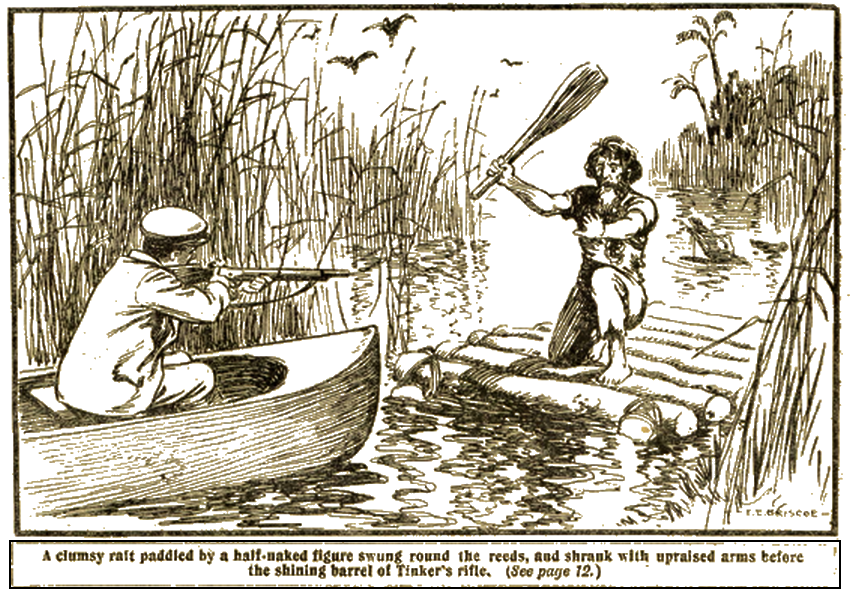
"All right, I'm sorry!" exclaimed Tinker a feeling of devout thankfulness thrilling his breast as he lowered the gun.
"Ah, you speak Ingleesh! Thank Heaven, I am saved!" said the man on the raft, and Tinker saw, as he gave a sweep with his rude paddle, that it was a European, and not a native as he had at first imagined.
The man's skin was brown as Pongo's, and his black hair was long and whisping about his face; a straggling beard covered his chin, and he bore the obvious signs of exposure to the elements.
"Who on earth are you?" said the boy.
"Five minutes ago one of the most wretched creatures alive; now, unless I am still pursued"—and he threw a frightened look over his shoulder—"I live again, because I know that with the brave Ingleesh I am safe. How are you here? Take me to your boat, your camp, wherever your companions be. Give me food, and you shall hear my pitiful story."
There was desperate pleading in the man's voice, and Tinker, recovering from his first surprise, took up his own paddle.
"I say, are you the man who has been prowling round the huts yonder?" he said, pointing back towards the camp.
"Huts? No; I have not seen human habitation for two months. I have come from the north yonder—hundreds of miles beyond the mountains there. I am an escaped convict from the French penal settlements of Cayenne," replied the man bitterly; and he buried his face in both hands and wept aloud.
There was an awkward pause, which Tinker broke by running his canoe alongside the raft.
"I don't know your name, sir, but come on board, and I'll take you back with me," said the boy.
"My name? Ah, five years of Cayenne makes one almost forget that one ever had a name!" exclaimed the fugitive. "I am Raoul Delgarno, falsely condemned for the crime of another. But my story can have no interest for you. Only give me food; let me hear voices once more that are not the voices of wild beasts, and I will go on my way."
"But, Mr. Delgarno, do you know where you are?" asked Tinker, as his new acquaintance climbed into the canoe. "It's hundreds of miles to the coast."
The man tossed back his tangled mane, and looked at the boy as though he hardly understood what he was saying, and he mumbled something in French, as he once more buried his face in his hands.
Whatever his condemnation and terrible punishment, and the privations he had undergone since his escape, he was evidently a gentleman, and Tinker's sympathies rose as he paddled back as hard as he could.
The colonel was at the bank, waiting for him.
"Did you get the beast?" he called while Tinker was some way off. "Hallo, what on earth have you brought home with you?"
"You'll see in a moment, colonel," cried Tinker, very excited.
The Frenchman started at the sound of the loud voice, and then, turning round, stood up in the canoe.
"Monsieur is right," he said, with dignity, "I have lost all claim to be regarded as a human being, although I had once the honour to serve, even as you did, mon colonel."
"The deuce you have!" cried Colonel Burleigh. "Then what are you doing in that rig? Where have you come from?"
"From the Devil's Island, mon colonel," said the escaped prisoner, with a quiet significance that went home to the soldier's heart.
Colonel Burleigh started.
The Devil's Island and its ill-used prisoner will never be forgotten by the civilised world.
"And your crime?" he demanded sharply.
"I was a lieutenant in the Engineers. Plans of a fortification on the eastern frontier found their way into Prussian hands. They bragged openly of it at the German Embassy in Paris, and it got into the papers. My colonel sold them, and I knew it, but I dare not speak. A victim was necessary to sacrifice to the popular clamour, and I was that victim." He shrugged his naked shoulders, as much as to say, "What would you have?" and fell into an unconscious posture of attention.
He was a good-looking man, when they had clipped his hair into a civilised crop, and found him some clothes.
He ate ravenously, and between whiles he told them of his life, before and after his wrongful conviction.
The man had suffered, whether innocent or guilty, and his gratitude at their hospitality was unbounded.
For the first time for two months he slept without fear of waking to find himself either recaptured or in peril from some wild animal or noxious snake, and while he slept our friends discussed his coming, and what was best to be done with him.
"If he were any good as a mechanic I could take him on," said the doctor; "we're so desperately short-handed. What do you think of him, Blake?"
"Sad business," replied the great detective. "We'll take him down to the coast when we go. Meantime, he's a very pleasant fellow, and I don't see any harm in keeping him here. What do you say, colonel?"
"I say let him stay, poor beggar, I was present at the Dreyfus trial, and a man that's escaped from the Devil's Island deserves a pension," grunted the colonel.
"Very well," said Dr. Martin Wells. And as Lieutenant Delgarno approached he offered him a cigar, which little act of kindness almost broke the fugitive down again.
"You are too good, gentlemen," he faltered. "Why is there no way by which I can show my gratitude? Let me hunt and fish for you. I know something of the habits of the wild things that surround us. I will cut wood, I will perform any task, however menial, so that I earn my bread and salt."
"Do you know anything about machinery?" said the doctor at a venture.
"Machinery! Why, that was my profession before I went into the Army!" exclaimed Delgarno. "And if it is not an impertinence, may I ask what you are engaged on in this desolate spot? Is it a mine?" And he waved his arm towards the little town of sheds and shafts, and the tall ladder-like structure which Dick Wells had erected for the movable searchlight.
"No," laughed the doctor, his eyes sparkling behind his glasses; "we are not concerned with the contents of the earth, monsieur. We are about to conquer the air. Come, you shall see my aeroplanes. Good heavens, is it possible that you were sent here just in the nick of time to help us?" And the two men shook hands warmly, both feeling how strange was the coincidence that had brought the fugitive to that place of all others.
That evening Dick Wells came up to Tinker.
"Look here, old chap," he said, clapping him on the shoulder, "go out into the wilds and bring us in a few more Delgarnos. He's a perfect treasure. I can't get the governor to come in to dinner, Do you know, he made a suggestion at sight for an improvement in our pet engine, which we're going to carry out at once. He's one of the most accomplished mechanicians I've ever met."
For all that, it was hard for the Frenchman to get over the feeling that he was being followed. He would not stray a yard from the camp, and it was a week before he overcame the desire to start up if a shadow fell across the tent door, or anyone came suddenly into the hut where he was working.
Nevertheless, all things wear off with time; and when he had been in the camp.a fortnight, Delgarno's was the most radiant face there, always smeared with oil, always laughing delightedly, and as enthusiastic as a child over the progress of the wonderful mechanism that was progressing so well under his direction, while the rest prepared the huge wings, and built up the body of the aeroplane ready for the forthcoming test.
A line of rails a quarter of a mile in length had been constructed along the valley, and everyone was looking forward to the great moment which should prove Dr. Martin Wells the aviator of the century.
No one saw the speck on the mountain-top; no one suspected that eyes were watching day by day through glasses so powerful that everything was as an open book to them, save only the work that went forward within the sheds.
One night Pedro gave a howl that startled the sleeping camp, and there was a general stampede with revolvers and guns, while Dick switched on the searchlight; but though they turned out and hunted everywhere, there was nothing to be found.
The whole of the following day Lieutenant Delgarno was in a state of collapse, and nothing could induce him to leave the living-hut.
"I am a doomed man," he said. "The dog has senses acuter than a man's. They are searching for me; they will come. Mark my words, they will come; but I will not be taken alive."
The doctor looked serious, and gave him a powerful tonic.
"If you break down, my friend, we are done," he said. "You are invaluable. Once let us succeed, and the machine shall be called the Wells-Delgarno. You shall come into partnership with me."
But it was forty-eight hours' before the shattered nerves could be brought under control, and all that time he remained alone at his own request, poring over the plans, and working at the most complicated calculations that covered sheets of paper, every now and then protruding a scared face round the lintel of the hut door, the revolver the colonel had given him in his hand.
"Look here, doctor," said Sexton Blake, strolling up to his friend, who was manipulating a screw in the middle of a huge network of steel arms stretched out upon the ground, "when are you going to give me my first flight? It's weeks since you promised to take me up."
"My dear old man," cried the doctor, "you shall come up now. You know how absorbed I have been, and the arrival of our excellent Delgarno has turned all my thoughts in one channel. To-morrow we make our grand attempt." And he pointed with pride to the shed that housed the completed engine that was to revolutionise all previous inventions. "But I'm about to test the air density in this valley here, and if you can possess your soul in patience for twenty minutes while we fix the dynamo, I'll give you the sensation of your life."
"Do you mean it?" cried Sexton Blake.
"Mean it! Just hold on," cried the inventor. "Hallo there, Dick, bring those aluminium struts out of Case B. Blake is yearning for a chance to break his long neck."
Dick Wells, dirty as a stoker in his once white overalls, hallooed in reply, and presently came over to them with a couple of slender rods in his hand.
"Screw those in yonder," said his uncle, "and fill the petrol-tank. There are enough hands to give us a start, and this long grass will make soft letting.'
An uncomfortable feeling took possession of Sexton Blake now that the moment he had longed for was so imminent; but the sight of Dick's good-humoured smile reassured him.
"There's no danger worth speaking of," explained the young enthusiast, tightening a nut with his spanner. "This old crock is the second one we made, and uncle and I have been up in her over a score of times. She kicks a bit when she comes down, but all you've got to do is to grip the strap hard, and don't let yourself be jerked out."
"How high can you go?" questioned Blake.
"Well, that's the trouble," said Master Richard. "She's safe as an omnibus at a hundred feet altitude, but if you go higher and want to come down within, say, fifty yards of your shadow, there's such a pitch forward with every twenty yards of descent that the chances are you're as sick as a dog before you land. If you don't mind dropping a quarter of a mile away, you're right as rain. It's the balance adjustment that's faulty, and we've altered that in our recent models."
"You're a cool hand, Dick," said the colonel, who had no intention of trusting his skin above the tree-tops.
"Have to be, sir, at this game," laughed Dick Wells. "Now, I'll get some more petrol, and you'll be off in five minutes. The motor works like glass."
"Don't you be a fool, Blake!" said Colonel Burleigh, who was as brave as a lion on dry land, but could not stand a height. "You're a heavy man, you know."
"Pardon!" said a voice behind them. "I am as heavy as Monsieur Blake. I have no fear; let me ascend."
"No, no, my dear Delgarno," said Sexton Blake, "I claim the privilege, for which I have longed for months."
"Then in you get," said Dr. Martin Wells, who had come from the engine-room, followed by his two workmen.
"First of all, tell me something about it." said Blake.
"What do you want to know? This is a biplane; that brass barrel holds ten gallons of petrol, enough for a flight of fifty miles. That's the lifting-plane, which I can set at any angle. Those at the other end are the balancing-planes. Here's your seat, immediately behind me, and the one thing you've got to remember is, don't speak a word to me until we alight again. I want all my faculties on the manipulation."
Sexton Blake nodded, shook the hand which Colonel Burleigh held out, and stepped lightly on to the frail platform.
The doctor examined the nose of the machine before he took his place.
"This is in reality a tractor, for its action is to pull us along, though we call it a propeller," he explained, pointing to the huge blades, not unlike the screw of a steamer. "Now, lads, get ready!" And he climbed nimbly up to his place behind the four-cylinder motor.
The aeroplane had been lifted on to the rails already, and as the doctor started the engine, which raised a loud buzzing sound, Dick held on to the rudder, while one of the assistants restrained the machine at each end of the lifting-plane.
"Remember, complete silence!" shouted the doctor over his shoulder, as his passenger grasped the strap.
For a few moments all was buzz and din, and a confused sensation that was like nothing he had ever experienced before. The colonel and Delgarno seemed to grow misty, as though they were being violently shaken; and then the doctor raised his right hand.
Instantly the assistants let go and sprang backwards, as the machine glided along the shining steel rails towards a dip in the surface of the ground.
Blake had that momentary feeling in the pit of his stomach that heralds the approaching dive of the switch-back, but as the aeroplane reached the dip it seemed to float off into space, and he knew that they were flying.
In front of him was the hunched-up figure of his friend, bending over the controlling levers and steering-wheel. On either side the huge lifting-planes flung their black shadow on to the ground beneath; while behind he realised, rather than saw, that something moved at the tail of the machine, which he knew must the balancing-planes and the rudder.
His impulse was to remain rigid, lest the slightest alteration of weight should overbalance them, but by degrees he turned his head and looked about him.
The ground was far below, perhaps fifty feet; the map of the plain, the broad igarape, the mass of forest on their right, and the tree-clad mountain on the other side began to unfold in a wonderful bird's-eye view, and a sense of exhilaration, of mastery, of illimitable power, swept over him like a wave, and he realised that of all sensations. in the world, this one of flight through the air was the latest and the best that will ever be known to man.
High overhead the sun poured almost vertically down; their voyage would be a short one, for they must soon seek the shade, or be smitten with the inevitable consequences of the Brazilian noon. But he wished to go on, on, on; never to stop until soul and body, heart and eye should be satiated, glutted, drunken with the glory and the joy of this new-found pleasure.
A group of half a dozen assai-palms grew up from the plain about half a mile off, and the machine was rapidly nearing them.
It was the landmark for which Dr. Martin Wells was making, and with a suddenness that was astonishing the aeroplane whirled round in a short circle, and returned towards the camp.
It cost Blake a mighty effort to restrain a shout of "Bravo!" and his hands itched to seize the broad shoulders before him with a grip of heartfelt admiration and applause, but he knew that his feelings must remain under a control as perfect as that which the doctor exercised over the creature of his invention.
He understood now the awful fascination that prompts the aviator, that renders him absolutely blind to all sense at physical risk; and Martin Wells's journey across sea and continent seemed no longer an act of folly.
The risks attendant of the descent did not trouble him, and as the doctor made another curve, and started back along the course, Blake's heart gave a wild leap of delight that there was to be more of it, that the thrill of his life was not to end then.
This time the doctor altered the angle of the lifting-plane and rose higher in the air, at the same time turning the aeroplane towards the mountain.
Blake ventured to peep over the edge of the platform, and saw the stream underneath them. A magic carpet of vegetation spread out below. They were above the tree-tops, and could look down into savannahs and natural clearings, where, from the ground plane, all had seemed impassible forest.
Once, as their shadow reached it, he saw a large creature start, terrified, and bound into the woods, and the detective laughed silently, with a feeling of conquest, although he knew that he must be as pale as ashes all the time.
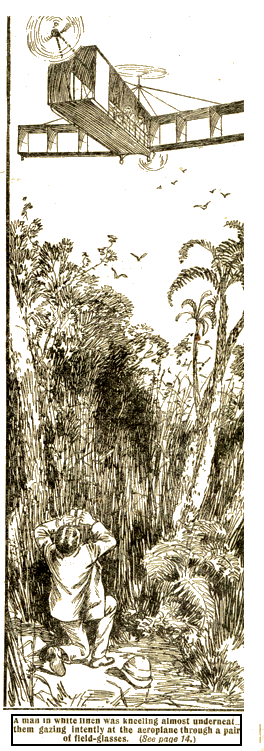
A mile or more the inventor flew in the direction of the huge mountain, and then, turning again, he came down to an altitude of perhaps thirty feet from the ground, and headed straight back to the starting-place.
It was then that a bright flash caught his eye from the long grass below them, and Sexton Blake, looking down, saw this thing.
A man in a white linen suit was kneeling there, almost underneath them, gazing intently upwards at the aeroplane through a pair of field-glasses.
The glint of the sun upon the lenses it was that had attracted Sexton Blake's attention.
The man was a stranger, and he was hidden in the tall grass. They were spied upon, then, The Indians had been right, and he had to bite his lips hard to keep in the words that rushed to his tongue.
The man was on the edge of an opening beyond the stream, an opening that was roughly of triangular form, and the only salient feature by which Blake could mark the spot was a huge cluster of begonias over-running a fallen tree.
A moment before the aeroplane had seemed to annihilate space, now it seemed to crawl on its way back, and it was an interminable age before it dived three times, and came to rest within a yard of the rails, where strong arms secured it, and the doctor shut off the engines.
"Well, what do you think of it?" cried the enthusiast. "Been a bit too much for a start—eh? You look very white about the gills!"
"It is magnificent!" said Sexton Blake. "My dear Wells, I have never felt anything like it!" And as Delgarno climbed into the machine and examined the engine, he added, in a whisper: "Come into the shed at once; I cannot tell you here without alarming the Frenchman.
At the same time Blake signalled to the colonel, and the three walked away.
When the angle of the petrol-store hid them from view, he turned to his companions.
"Quick, Burleigh! Get your guns ready, and invent a hunting-party," he said. "There's a spy yonder, and we must take him at all risks!"
IT was the doctor's turn to look pale now. "Do you mean to say you saw him when you were up there, and you never opened your mouth?" he exclaimed angrily.
"Steady, old man! You told me on no condition was I to speak. Besides, one must have a megaphone to be heard among that machinery."
"Yes, true," said the inventer. "Great Scott! I'll take my oath it's Townley—an assistant I dismissed: for dishonesty! I know he was in communication with a German firm, and they must have supplied him with money to come out here."
"Now, that's where I come in," said Blake, smiling. "Not a soul knew you had left England, and as we were on your heels all the way out I can answer for your not being followed. No; if it's anyone after the secret, they have come up from Para. But here's the colonel and his nigger-troop, and there's no time to be lost. You keep cool, and don't let Delgarno know anything until we return. I've an idea it may be the Cayenne people."
"Feel inclined to have another hunt for that happy family, Blake?" said the colonel, in a loud voice. "Or have you had enough adventure for one day?"
"Not at all. I hope to have another fly in the cool of the evening. Come along, Tinker, and bring the hound with you." And they went away through a grove that afforded some slight protection against the burning glare of the sun.
Nature was sunk in that lethargic drowse that takes possession of Brazil during the day; the birds were hushed the palm-trees drooped their leaves, everything seemed asleep, exhausted, worn-out by the terrific heat.
They made straight for the fallen tree that partially spanned the alligator-stream, carrying with them a plan they had used before to cross to the other side.
Pongo and Gapo beat the water with bamboos to scare the monsters, for Pedro must swim; and when the Europeans were across, the magnificent hound took to the water, and landed safely on the opposite bank, the Indians following.
It was hot as an oven, and they panted as they went, forcing their way through vegetation so dense that in places it was necessary to cut it with wood-knives and hatchets.
Now and then a boa-constrictor glided away like a streak of brown liquid, into the tangle. and the warning of the rattlesnake made them pause several times.
Lizards basked in the sun, and overhead the monkeys, disturbed in their siesta chattered as they sought safety among the higher branches.
The colonel was in his element; he and Sexton Blake leading the advance, while Tinker came close upon their heels, with Pedro beside him.
Sometimes they would halt, and send the two natives forward to reconnoitre; and for an hour they searched in vain for the open space.
The Indians grew weary, for the heat was suffocating; and once, when they had been absent some time, they were discovered sound asleep under a spreading muriti-palm.
"Well, I'm hanged!" roared the colonel, giving Pongo a hearty kick. "Umba (get up), you copper-coloured spawn of iniquity!" And he accompanied his words with such terrible contortions of his perspiring face, that Pongo and his brother began to search in real earnest, and soon intimated that they had found something.
"What is it?" asked the colonel, as they pointed to the grass, which had been recently trodden down.
"Men passed this way," said Gapo.
"Chantos (how many), you blithering idiot?" And he gripped him by the hair.
"One!" jibbered Gapo, raising a howl.
"Chito!" (silent) thundered the colonel. "Follow up the trail, or, by all the monkeys that ever cracked a nut, I'll crack the skulls of the pair of you!" And he added some choice specimens of Hindustani, not having enough Spanish to go round.
"The only way to deal with niggers is to keep 'em up to concert-pitch all the time," explained the colonel, in a whisper. "I've not spent twenty years in the glowing East without learning things."
Sexton Blake made no reply, but drew a little closer to their guides. He thought he detected a look of meaning that passed between the brothers, and he had his doubts about the colonel's methods.
Suddenly they reached the edge of an open space, and Blake saw the forest giant overgrown with the trumpet-shaped blooms that had caught his eye as the aeroplane passed over them; and he knew it was the spot where the man with the field-glass had knelt in the flowering grasses.
That he had gone did not surprise them; they did not expect to find him there. It was his trail that concerned them, knowing that, once found, Pedro would unearth him wherever he might be hiding.
"Now, good boy, it is your turn," whispered Blake, caressing the golden-brown head, and eliciting a whimper of delight from Pedro. "Find it, boy—find, and follow, and silence everyone!"
Pedro muzzled about where the crushed grass showed clearly that the watcher had stayed there some time, and then, with an upward look at his master from those honest eyes, that shone like jewels in the rough setting of his wrinkled brow, he set off at a trot across the opening, northward, and plunged into the silent gloom of the sleeping forest.
It was weary going, for the bloodhound led them into an almost impenetrable belt of bamboo brake, and they had to force their passage by sheer strength of shoulder and arm. The guns they carried were awkward things to manipulate, and to catch a trigger meant to alarm their quarry
"Why on earth did he choose this way?" growled the colonel, crushing his way backwards, and setting his gun at half-cock to avoid accidents. "Thank goodness we're through at last!" And the canes parting on a sudden he nearly lost his balance.
They were now in a large glade, cool and solemn, the matted leaves effectually barring the sun's entrance.
And still Pedro never checked, but ran forward, his nose to the ground, and his coat bristling as he made strange gurgles of delight which told Blake and Tinker that the good hound knew what he was doing.
Save the swish of their own feet, and the occasional angry cry of a monkey, there was no sound, and the profound silence appalled them.
It might have been an enchanted forest over which some evil spirit had cast a spell. One would not have been surprised to come across a knight in armour sleeping beside his war-horse.
Once a strange sound made them all stop and look at one another.
It was like the clang of an iron bar against a tree trunk, and though they waited there was no repetition of the mysterious noise, which came from the very heart of the woods.
The two Indians looked very frightened, and spoke in their own language.
"Now then, you sons of the pit, what was that noise?" said the colonel, in a fierce whisper, "Is there someone cutting timber yonder?"
They replied that it was the curupira—the wild man of the woods.
All the noises of the forest are supposed, by the natives, to be the work of this mysterious creature, a kind of glorified orang-outang, said to have a bright red visage, and a body covered with shaggy hair.
"Keep an eye on those two," whispered Blake to Tinker, as they went on again, after listening intently but in vain. "I believe they intend to bolt if they get a chance,"
"We're a goodish distance from camp now," said the colonel, vainly endeavouring to beat away the flies that tormented them at every stride. "I wonder if there is going to be much more of this. The scent seems fresh, and there's something like a beaten track here, as though the fellow had been in the habit of coming backwards and forwards."
"Which discounts the idea that they are after Delgarno," said Blake. "I'm afraid the doctor's experiments are the object of the espionage."
Pedro, all this time, never hesitated, but plunged through the tangle, following a straight line down a natural avenue of enormous trees from whose outspread branches dangled festooning creepers, until, without warning, the forest ceased, and an immense, undulating plain stretched before them, upon which the vertical sun poured so fiercely that the colonel stopped.
"Call the dog back, Blake!" he said. "This is madness. There's not a bit of shelter for a couple of miles, and the mountain beyond that."
Blake realised that it was true, and gave a low whistle, Pedro coming to a halt and looking back with great reluctance before he obeyed.
"I say, look here!" cried Tinker "What's this?" and he pointed to a cross-cut in the bark of a seringa tree, from which a creamy liquid had oozed and dried in the air.
"That's a blaze," said Colonel Burleigh. "We shall find our way back much more readily. Hi, you niggers—Pongo, Gapo! How long has this been cut?"
There was no reply, and our friends looked round, but saw no sign of their native companions.
"They've stolen away to reconnoitre," said the colonel. "We can't hail for fear of betraying our whereabouts to the enemy.
"I've an idea they didn't altogether relish your 'concert pitch,' Burleigh," said Sexton Blake, with a grave smile.
"What do you mean?"
"That we sha'n't see any more of Pongo, Gapo, & Co. You've scared them, my friend," replied Blake.
The colonel seemed on the point of losing his temper, but a cry from Tinker turned their eyes to the plain, where, in the far distance, a white speck had come in sight, moving away from them towards a spur of the distant mountain range.
"By Jove! We've missed him," exclaimed the three in a breath, and they watched the speck growing smaller and smaller through their glasses, seeing only the unmistakable shape of a pith helmet, whose wearer was completely hidden by the tall grass.
It was fortunate that they stood in the impenetrable shadow of the primeval forest, for the man, whoever he was, climbed on to a boulder that some ancient storm had trundled down the mountain spur, and, raising his glasses, looked back towards them, searching the trees and the plain as one who would make quite sure that he had not been followed.
"Down, all of you!" cried Sexton Blake, suiting the action to the word, and they crouched low, exchanging glances, but no one speaking.
For a good minute they waited, and then Blake rose to his knees.
"I must have a look at him, cost what it may!" he said. And stealing behind the india-rubber tree, he cautiously brought his own glass to bear upon the spot.
They watched him with bated breath, not daring to ask a question, until Blake lowered the binocular with a gesture of great disappointment.
"Held his arms in front of his face the whole time," he said. "He swept the sky, and then jumped down and vanished. This is only the first act of the drama."
"And what will be the next act?" asked the colonel.
"Why, the edge of a forest, men discovered in the bushes, awaiting the approach of the villain!" replied Sexton Blake, with a curious smile, and a strange glitter in his eyes, which only Tinker understood. "We must get back now, and, having formed our plans, we will return here again, and ambush that man. He shall render an account of his actions before we are forty-eight hours older, if I have to spend a day and a night in this tree!"
The colonel nodded.
"Pity about those niggers," he said, in rather a shame-faced manner. "I think you're wrong, Blake, I'll bet you a Spanish dollar we find them at the camp when we get there!"
"All right! But you'll lose, Burleigh," said Sexton Blake, And he did. Pongo and Gapo had bolted!
ABOUT an hour after darkness settled over the land, and they were smoking a last pipe before turning in, Pedro suddenly rose from the ground, where he had lain stretched out with his nose between his forepaws at his master's feet, and gazed into the darkness.
There was something so deliberate in the bloodhound's action, and it stood so rigidly motionless that all conversation ceased, and the colonel touched Blake's elbow.
The escaped Frenchman, who had been sketching out a brilliant idea for an improved rudder-gear, with Dick and the doctor holding their breaths at his side, looked quickly up, and turned.very pale as he followed the direction of the hound's gaze.
"Monsieur Blake," he said, in a husky whisper, "what does he hear?"
Blake shook his head, and put up his hand to enforce silence.
There was something weird in the situation of those men, sitting there in the mess-tent, hundreds of miles from civilisation, and the huge hound, suddenly chaining their attention as he looked into the Stygian blackness of the forest, his finer senses rivetted on something they could neither see nor hear, and Tinker began to feel a creepy sensation down his back between his shoulder-blades.
All at once, without warning of any kind, Pedro's coat bristled, and springing out into the open air twice his own length, he flung up his head, and delivered the most doleful howl imaginable, ending in a gurgling sob.
"What on earth's the matter?" exclaimed Sexton Blake. "I never knew him do that before. Pedro, boy, what is it?"
Pedro looked round at the sound of the beloved voice, and repeated the howl, shrinking backwards, and cowering against Blake's legs with every indication of terror, and everyone looked at everyone else, strong men that they were, yet coming under the spell of an uncontrollable fear!
Delgarno shrank behind the doctor.
"Save me!" he said, in a trembling voice. "They have come for me at last." And he drew his revolver.
" Don't be an ass, man!" said Dr. Martin Wells sternly. "The night is stiller than I have known it here. There's no one coming. It must be some nocturnal prowler. Look, those green eyes, yonder beyond the petrol-hut! Quick, someone, a rifle! There's a jaguar there!"
The eyes vanished as he shouted, before Colonel Burleigh could reach his gun which stood in one corner of the tent.
"It was not that that frightened the dog," said Blake, in a low voice. "See, he is looking in the opposite direction. Great Scott! He's quivering like a leaf."
"I'm going to switch the searchlight on," said Dick Wells, in a whisper, picking up a lamp from the table. "Someone come over with me, in case that beast's still on the prowl!"
"You stay where you are, you young idiot!" commanded the doctor angrily. "We had better give the men a shout of warning, don't you think so, colonel?"
Colonel Burleigh opened his lips, but the words froze upon them, as, from somewhere near the bank of the igarape, there rose a most appalling shriek, the unmistakable cry of a human being in his death agony.
Wild and high it rang above the stillness of the forest, followed by the frightened chatter of birds, some of which flew past the tent, and then a silence so profound that Blake could hear the ticking of his watch.
"This has got to be seen into!" exclaimed Colonel Burleigh. "Has one of the assistants been fool enough to go near the water after dark? If ever I heard death in a cry I heard it then. Come, all of you, bring the torches, and we'll start the searchlight as well!"
It was a wonderful relief after the acute tension of the past few minutes, that stern, soldierly voice that seemed to grasp the situation and enforce obedience.
Even poor Delgarno forgot his dread, and became a soldier once more.
"Did you hear that awful yell, sir?" said one of the mechanics, running over from the men's quarters, followed by his mate. "It was just beyond the landing-place, and there was a loud splash afterwards!"
"Just so!" said the doctor. "The alligators. But who is the victim?"
"We shall see in a few moments," said the colonel. "Follow me!" And he pressed the button of the electric torch with which they were all provided, shouting to Dick Wells, who had reached the searchlight tower, to turn it on to the landing-place.
Dick obeyed, and as the brilliant shaft cleft the night in twain they ran along the path it made, seeing every leaf and palm-frond, and the vegetation on the opposite side of the igarape as though it were noontide.
For an instant there was a swirl of the yellow water, and with a disappointed snapping of their strong jaws eight or nine huge caimans dived out of sight as Pedro sprang into a tuft of capim grass and gave a guttural bark.
"He's found it!" cried Sexton Blake, and he and Tinker plunged into the grass. Pedro, one paw raised, and his neck bristling again, stood irresolute, looking up at Blake, for there on the bank, not a yard from the water's edge, lay the two Indians—Pongo and Gapo—stone dead, one on his face with both arms extended, his brother half-turned, as though to meet a fate that had come upon him from the rear!
Beside them lay their blow-pipes and a bundle of arrows, and on the bank itself the freshly made tracks of an alligator that had been disturbed by the searchlight before he could reach his ghastly feast among the flowering grasses.
No one spoke for a moment, and then Blake stooped down and passed his hand down Gapo's spine.
"Look," he said. "Stabbed to the heart, and the knife fast in a bone. I cannot draw it out."
Dr. Martin Wells bent at his side, and examined the unfortunate wretches.
"Stone dead, both of them," was his verdict, "and a very good thing too. Do you see those?" And he pointed to the blow-pipes.
"What do you mean?" said Blake, as the others crowded round equally mystified.
"Poisoned arrows, wourali, They were stalking the camp, the wretches, when fate overtook them," said the doctor; "but whose was the hand that struck those terrible blows; a past-master in the art of slaying; a Spanish matador has not a surer eye!"
Sexton Blake swung round on his heel and examined the bank.
"Stay where you are," he said. "Down, Pedro, down, good boy. Your feet may destroy more than your nose can ferret out." And he proceeded very cautiously along the soft earth, stopping every now and then.
When he came back, and it was quickly, for he did not pass beyond the circle of the searchlight, he had made all the discovery that was possible then.
"A man must have followed the Indians in a canoe," he said thoughtfully. "He was alone, and there are unmistakable marks of his landing and his departure after the murders. They drifted down the igarape on a log, which still lies there, but we are no nearer the motive of this crime than we were an hour before its perpetration."
"Except that the weapon was of British manufacture," said Dr. Martin Wells. "See, have drawn it from the wound, and you can read, 'Rogers, Sheffield,' on the blade."
The colonel had been silent. He was thinking over Blake's words yonder on the edge of the forest, and wondering whether the poisoned arrows had been intended for his own back?
"Here, Tinker," he said. "You have done more exploring than anyone else. Where does the igarape lead to?"
"Into a wide lake full of islets," replied the boy. "There are two openings on the right hand side going that way, but the left bank is all spongy, and nothing but a bird could walk on it."
"And beyond the lake?"
"There is no beyond," said Tinker. "The lake ends in a mangrove swamp where the heron fish. The whole thing is surrounded by trees, and you might easily miss the openings. They're only like black tunnels into the forest."
Delgarno had returned to the camp.
"There's not much bottom in those excitable Frenchmen," said the colonel, "He's as nervous as an owl."
"I'm not surprised," said the doctor. "Lucky thing he fell across us. His brain was on the point of giving out, and it's only working on the invention that has saved him. But this is a hideous business, and I don't see what's to be done except to bury these poor beggars."
"We must keep the searchlight on here all night, and watch into the bargain, in case the fellow tries to pass us and get down stream," said Sexton Blake. "In the morning we will form two parties, and thoroughly search the igarape, and the two channels that Tinker speaks of. There are evidently inhabitants in this place that we know nothing about."
There was little sleep for the camp that night.
They took it in turns to watch by the waterside, Blake and Tinker taking first spell, relieved by Dick and the colonel, whose place was occupied two hours later by the two mechanics.
They had scraped a hole in the bank, and laid the Indians in it, piling up stones and the boughs of a tree over the spot, to keep away the land-crabs, or any prowling jaguar, and the mess-tent was turned into a guardhouse for the nonce.
"You think me a coward!" exclaimed Delgarno, his voice quivering with emotion. "You do not know—you cannot realise what the Devil's Island does for a man. I seem to see them yonder in the forest, searching, waiting, knowing that sooner or later I must come forth into their clutch once more."
"A stiff dose of 'brom.' is what you want," said the doctor, coming back with a phial in his hand. "Here, drink this, and remember we can't do without you for the big trial, so, for mercy's sake, pull yourself together, You're under the British flag here, and we won't give you up."
"My dear friend, you put heart in me. I am overwhelmed with gratitude!" cried the excitable Frenchman. "To-morrow we shall solve this horrid mystery, and I shall be myself once more."
The colonel puffed hard at his cigar, having little patience with any show of fear, and he reamed off stories of his own campaigning to keep them from dwelling on the startling interruption that had banished sleep from them all.
Tinker alone lay curled up on a mat, and when a hand shook him, the searchlight was still turning night into day outside the tent, while within a chorus of snores told him that the others were braving the mosquitoes, and sleeping just as they were in the luxurious lounge chairs that the doctor had brought up from Para.
It was Sexton Blake who roused him, and made a sign for him to follow.
"How long have I slept?" said Tinker, when they were out of earshot.
"About an hour."
"And you?"
"I have been thinking," said Blake, in a low voice.
Pedro joined them, thrusting his muzzle into his master's hand, and then into Tinker's, as though he would have said, "Well, here we are, the old firm once more; now, what's to be done?"
After a few turns within the radius of the light, Sexton Blake sat down on an empty case, and filled his pipe with a slow deliberation that told Tinker he was cogitating deeply, and did not wish to be disturbed until he was ready.
"Delgarno has gone to bed," he said, after a longish panse.
Tinker looked at him.
"I shall be glad when Captain Bluff returns. We want all the men we can get," said Blake, after another pause.
"Have you a clue, then?"
"I have an idea, but no definite clue," was the reply.
"Do you think those Indians intended to kill Colonel Burleigh?" asked Tinker thoughtfully.
"Certainly, and I am really not surprised. Burleigh's a good chap, but he's a nigger-driver, and the natives of South America will not stand the same bullying that the Asiatic puts up with. The East Indian respects the white men because they are just in the end, and there is a fine military past that can never be forgotten. Here, the whites are Spanish in origin, and earn no respect."
"But who killed them?" said Tinker. "I've thought of everything under the sun, but I'm whacked."
"We must look for the motive," said Blake, rolling out a cloud of smoke. "The poor brutes were in the way, and had to be removed for some reason."
"By whom? And how could they be in anyone's way. I don't see it at all," said Tinker.
"Possibly not. I am in the dark, but there is a light dawning, and we shall find the motive in a few hours. After that—well, we may hunt the murderer down. We may not, but I'm going to try. I wish Bluff and his crew were back again. Look at this." And he handed Tinker a card on which were written in fresh ink some Spanish words.
Tinker took it, and examined it attentively.
"Been in the water," was his comment. "Did you find it over there?"
"Yes; the blackguard had dropped it in his hurry. I think it was a message he intended to leave somewhere, The words mean in English, 'are you asleep?'"
As Tinker held the card in his hand, and looked wonderingly at Sexton Blake, Pedro lifted his head and snuffed it attentively.
"Let him have it," said Blake quickly. "Good boy, you recognise it, then?"
Pedro gave a little whimper, and gazed away in the direction they had searched that day.
"Hallo, that tells me something!" exclaimed Blake, "I wish to Heaven it was morning. We'll take up the trail where we left it, and as soon as there's light enough."
"Well, are you going to sit up all night as a preparation for the hunt?" said Tinker yawning.
"Yes, I am. Delgarno's gone to bed," was the quiet rejoinder.
"I say, that's twice you've mentioned the fact. What's Delgarno to do with it, any way?" said Tinker, looking at him.
"Everything," was the reply. "That's why I don't stir from the front of that hut, my boy."
"Great Scott!" exclaimed Tinker. "You don't mean that you suspect the French engineer?" "You'll see for yourself at sunrise when I hand him this card," said Blake. "That man is no more French than I am, and he has never been to Cayenne in his life."
The great detective spoke very calmly, in a low murmur, scarcely louder than a whisper, and not a muscle of his face moved.
"Mark what I say," he continued. "Bluff is coming up the igarape to-morrow. Our interesting escaped prisoner would not be here then if we left that door unwatched. I have said nothing, although I have had suspicions for several days. When I see a man look on unmoved at the discovery of two murdered fellow-creatures, when that man turns white as a ghost as the inscription of the knife-blade is read out, and when I find a note dropped beside a freshly-cleft stick, written in that man's language, then I understand things, eh?"
Tinker grew pale.
"You think Delgarno is a Spaniard, then?"
"I know it," replied Sexton Blake. "And now listen very carefully to what I am saying. Day will dawn in less than two hours now, and before that the doctor and the colonel must be ready and on the alert. Even as we talk here we are being watched through yonder open door, but if he tries a rush I shall drop him without hesitation. Jones and Macfarlane are watching the bank, with orders to raise an alarm if any one comes down the igarape."
"But why do you think he means to clear out now?" interrupted Tinker, very much mystified.
"Never mind, I have my reasons," continued Blake. "I want you to go back to the tent and tell the colonel to be ready with a shot-gun, and let him have it in the legs if necessary."
"And you?"
"My chance of safety is in keeping here in the full glare of the searchlight," said Sexton Blake quietly. "He won't attempt to escape until daylight in this impenetrable wilderness."
"Shall I come back to you?" said Tinker
"No, stay in the tent, and tell young Wells that on no account must the searchlight flag!"
And pulling Pedro's long ears, Sexton Blake continued to sit there in an attitude of deep thought, occasionally turning his head round the circle of the camp, but never allowing his gaze to linger perceptibly on the machinery-shed, at one end of which Delgarno had his quarters.
The ex-convict had elected to sleep there, and had a hammock slung inside the doorway.
Sexton Blake looked at his watch, to find that it wanted a short half-hour of the coming of the dawn.
The moment was at hand when he would either find his suspicions justified or the reverse, and knowing that the man, if he were guilty, would make a strenuous fight for it, he was turning over in his mind how best to avoid the loss of a valuable life, when he saw one of the engineers approaching quickly.
Lest the man should betray himself by some incautious speech—for Delgarno's door was scarcely sixty feet away, standing slightly ajar—Blake beckoned him, at the same time making a sign in the direction of the mess-tent, as though he would have said, "Hush, don't disturb them!"
The engineer came in haste, and when he was within earshot, Blake said in a low voice:
"Speak softly."
"My mate and I have just discovered that the small canoe Mr. Tinker uses has been taken away," he said. "We thought you ought to know it, sir."
"It was there an hour ago," said Blake quickly; "tied up on the other side of the ship's boat. Are you sure?"
"Positive!" said the man. "The long boat's all right, and the punt, and the three large canoes."
Sexton Blake rose to his feet.
"Have you got a revolver?" he said; and the man tapped his side pocket significantly. "Follow me, then. I am going to wake Monsieur Delgarno. If he should fire at me, you will know what to do."
The man looked at him incredulously, and said slowly:
"You surely don't mean, sir, that-"
"Never mind what I mean," replied Sexton Blake. "Keep your wits about you, and do as I tell you." And thrusting his hand into his own pocket, he strode resolutely to the half-open door that gave on to the French engineer's hammock.
"Delgarno!" he said. "Delgarno!"
There was no reply.
"Are you awake?"
Still no answer.
Bending down, he threw the door wide open. The hammock hung motionless, the single blanket lay folded in its place, and the mosquito-curtain had not been spread.
"By heavens, he's stolen a march on us!" he cried. "Rouse the rest!" And he snatched a sheet of paper—a leaf rudely torn from a pocket-book—which was pinned to the folded blanket.
On the leaf were some words written in lead-pencil, and, holding them in the glare of the searchlight, Sexton Blake read:
"I thank you, gentlemen, for your hospitality. Your compassion and your friendliness I shall never forget. I have had a most delightful sojourn in your camp, and for a company of absolute idiots you are the most charming I have ever met! I have taken the liberty of carrying away the steel piston-rod for the new engine, as it will save me the trouble of making another one—and also the movement, which was to be called the 'Wells-Delgarno' movement. It was that I came for, and I am contented. You are a very clever man, Dr. Martin Wells, but I think you will admit that you have met a cleverer in the person of Raoul Delgarno, as I prefer to call myself! Adios, and good luck be with you. Pursuit will be useless for my friends await me with a motor-launch that will carry us to Para before you have rubbed the sleep out of your blind eyes!"
"By the living jingo!" cried Sexton Blake, as the doctor and the colonel came rushing out of the mess-tent on the heels of Dick and Tinker. "The cleverest villain I have ever known has slipped through my fingers! Read this, doctor, while I hunt for a pair of the scoundrel's shoes!"
DOCTOR MARTIN WELL'S groan of mental agony was a thing to be remembered! It came from his very soul as he read Delgarno's insolent farewell, and when he came to the mention of the theft he let the paper fall from his fingers, drew out his pocket torch, and rushed like a man possessed to the machinery-tent—to the spot where they had left the precious little mechanism that was to revolutionise everything carefully covered with an oil-cloth as a protection against the damp of the Brazilian night.
"It is gone!" he wailed, "The scoundrel! The thief! The ungrateful blackguard! The——"
"Come, come, doctor! You'll be gone, too, at this rate!" said the colonel, grasping him firmly by the shoulder as he took in the position with military promptitude. "We'll have the beggar before the sun's over the tree-tops! I'm not talking through my hat! He's not gone to Para! His confederate is the man we followed yesterday—Blake, here, is certain of it—and by good luck the unmentionable pig has left behind him a pair of my shooting-boots, which he has been wearing for the last week! He's gone north, I tell you, and when the light comes in ten minutes we'll be after him hot-foot!"
The doctor was too sane a man to let even so great a blow as this disturb him for long. The hope that springs eternal in the inventor's breast—perhaps more so than in that of any living creature—came to his aid.
"I must have a little brandy," he said, "I am shaking like a leaf, and I'll be ready to come with you."
"Not so," said Sexton Blake firmly. "This is where I come in, Wells. Water, as you know, will baffle the truest hound that was ever bred, and our search will be northward. There is just a chance, however, that these two scoundrels may still be in the vicinity of the camp, and you must not leave that unguarded. Dick will paddle down to the brig and bring the crew here. In a pursuit of this kind, the fewer engaged upon it the better for its chances of success. The colonel and I, with Tinker a Pedro, will search the two streams that flow into the igarape yonder." We will find where Delgarno left the canoe, and from that point Pedro will be worth a regiment of soldiers!"
"Heaven bless you, Blake!" said the doctor, shaking both his hands. "There was a Providence in it when you mistook me for the Anarchist and followed us here!" And he turned hastily away that they should not see the tears that started into his eyes, strong man as he was.
And then the dawn came slowly, filtering through the dense vapour that all night long had wreathed the forest and its winding waterways.
As Sexton Blake stepped quickly into one of the large canoes, Dick Wells poled the punt on his way to the brig.
"Keep a sharp look-out, in case we miss them among the floating islands, and they make a dash downstream!" said Blake. And he and Tinker dashed their paddles into the water and shot the canoe up the igarape.
Colonel Burleigh, nursing a Winchester repeating-rifle, sat in the bows, a grim look on his face showing that he meant business, and in a few minutes the canoe passed out of sight, leaving its swirling wake on the surface of the yellowish-brown water.
Life was awaking in the forest, and a clumsy toucan, settling among the branches overhead, sent a shower of berries pattering like small shot about them.
A flock of blue parrots flew screaming across the water, and a cormorant fishing on a dead branch regarded them with suspicion.
As they reached the floating islands, tufted with green capim grass, several chestnut-brown jacanas ran splashing out of the reeds across the lily pads, and a flight of long-tailed, gilded moths floated over them.
The oppressive silence of the forest was just awaking into multitudinous sounds before the heat should lull all living things into the day drowse that would last till sunset.
The howling of monkeys had begun, there was the twitter of birds in the bushes, a pair of ash-coloured herons got up ahead of them and flew away, and creatures were awaking on every side.
"Yonder is the first opening," said Tinker, pointing with his paddle-blade. "We can see whether he has turned in there, because the mouth is covered with weed."
A dozen strokes brought them to the entrance, and the colonel made a movement of his hand.
"Something's been through here not long ago," he said. "Give way!" And the canoe glided over the green scum, through masses of spotted orchid blossom, its occupants seeing unmistakable signs of the recent passage of a boat.
They all,started at a heavy splash ahead, and the colonel raised his rifle, but it was only an alligator that had dived at their approach.
"How much start do you think he's got?" said the colonel, in a low voice.
"Three hours good—perhaps four," said Blake. "He must have gone into his hut and straight out through the window at the other end, picking up the machine as he went."
"Stop!" said the colonel, interrupting him in an excited whisper. "There's the canoe, empty!"
They saw it floating there in the middle of the sluggish stream, and Blake's heart sank.
"Take her in to the left bank, Tinker," he said. "We must search for signs of his landing." And they paddled cautiously under the overarching trees, through a paradise that would have brought a cry of admiration from all of them, had not all their thoughts been bent upon their dramatic quest.
With the tail of his eye, Tinker saw a large sloth sleeping in the fork of a branch, and a hideous anaconda slide from a root and plunge noiselessly into the water.
"We must look out for snakes and every kind of horrible thing," said the colonel, "when we're ashore! Hallo, what's that yonder? By Jove, it's the canoe-paddle sticking up in the rushes! Turn her in—turn her in!" And they obeyed him.
A fallen tree projected itself into the narrow stream, and one of its branches had been broken, and that recently.
They brought the canoe alongside it, and Sexton Blake climbed out.
"Stay where you are a moment," he said. And he held one of the colonel's shooting-boots to Pedro, who snuffed it eagerly and gave a low yelp as he sprang on to the tree-trunk.
They had found the spot, no doubt about that, for the sagacious brute nosed his way on to the bank, looking back with an invitation that was almost human, and darted along a narrow trail to the heart of the woods.
They could see where feet had trodden a way, and made a path through the prickly sarsaparilla-bushes.
"This has been used frequently," said Blake. "Steady, Pedro! If you don't mind, colonel, I'll go first. For mercy's sake mind your gun among these twigs!"
Without Pedro's aid it would have been impossible to have followed the trail, and before they had gone twenty yards the colonel plunged up to his middle in a water-hole.
"You're not the first man that's done that," said Blake. "Look here!" And he picked up a little morocco case filled with Russian cigarettes, which he put in his pocket. Then they went on, the stillness deepening all around them as they penetrated further and further into the forest.
Sometimes a family of monkeys chattered at them from the low boughs, but these they soon left behind, and they had come into a region of enormous trees, tapering higher than the eye could scan—trees whose bark reminded them of the corrugated hide of the alligators that haunted the waterways; trees festooned with gaily-flowering creepers that seemed to stretch out their tendrils as if they would have stopped their going; nothing but trees wherever one looked—bewildering, awe-inspiring, a place where if a man lost himself he must inevitably die.
Once—twice—they heard that mysterious clang as of an iron bar, which the Indians had ascribed with a shudder to the wild man of the woods who was supposed to haunt these solitudes, and once again there was a crash that made them stop in-voluntarily as some forest giant fell, bearing down his lesser brethren on his way to the ground.
For an hour they continued, Pedro never faltering—sometimes turning aside round a huge trunk, sometimes leaping over a fallen one, where they could see for themselves that the green moss had been trampled underfoot.
And when at last the trees thinned out, and daylight twinkled through the grey gloom that had surrounded them, they knew that the heat was upon them, and that the pursuit would tax all their strength and powers of endurance.
"We've been here before," said Blake quietly. "See, there is the blaze on the seringa." And through a network of wild vines they saw the spot to which they had come when the dead Indians deserted them.
Pedro came to a stand at a grassy mound, where he sniffed so long that they all glanced instinctively about, thinking the chase must end there; but with another of those little gurgling yaps, the bloodhound left it with some reluctance, and followed a line that led over the open savannah towards the distant mountain spur.
"We must have rested there," said Blake, jerking his head backward. "And now we are in for it!"
From the polished blue dome of the sky the fierce heat poured down, and the colonel tucked his handkerchief under the brim of the broad-leaved grass hat he wore.
"By gad," he said, with a glance at the gloom behind them, "fancy that fellow threading the forest in the dark! I've been out in the jungles of Nepaul after man-eaters, but India is a fool to Brazil, you may take that from me!"
And something less than a league in front of them, three other men were toiling through the dreadful heat, two of them carrying the doctor's invention slung from a stout bamboo between their shoulders, while a third, who, like the colonel, nursed a Winchester in the hollow, of his arm, led the way with unerring steps, as a man who had traversed that road before and often!
He was a thick-set, very broad-shouldered man, with a red beard, fringing a face that exposure to the sun had bronzed to the hue of mahogany.
"Another mile, Delgarno," he said, "and then we will rest in the caves. Malediction! I wonder where I could have dropped my cigarettes?"
Panting, dizzy; and exhausted, the pursuers reached the spot where Sexton Blake, through his glasses, had seen the solitary man in the white linen suit look back along his trail before he disappeared; and there, as they flung themselves down under the shadow of a slab of rock, they found a surprise awaiting them.
They were on the edge of a dip, whose sides enclosed a large plain, or campos baked by the heat of the sun, and intersected by dry watercourses.
On the right, a spur of the high mountain that had been such a prominent feature from their camp in the forest, jutted into the plain, but seemingly as far away as ever.
Nothing grew on the campos but prickly cacti, curua palm, and a few wild pineapples, and there was not a soul in sight.
The prints of men's feet led away towards the mountain spur, and there were signs that Delgarno and his companions, whoever they might be, had rested under the self-same shadow.
The upper part of the slab of rock was too hot to touch with the bare hand, and the whole prospect was scorched and unpromising.
"I'll tell you what it is," said Blake, "we've made a great error of judgment. One does foolish things in one's haste. We ought to have gone up in the doctor's aeroplane. We could have followed them then."
"We've got to follow them now," said the colonel doggedly. "I propose we rest here for a quarter of an hour, and then push on."
Sexton Blake looked at Tinker, who had borrowed his glass, and was examining the distance.
The boy had climbed a few feet up the shadow-side of the rock, and before Blake could speak, he cried excitedly:
"I see them!" which brought the colonel and the detective to their feet with a bound. "Hold on! Let me keep the glasses a minute! There's a cave at the edge of the mountain, and they're going in!"
"How many of them?" said Blake.
"I saw three," cried Tinker. "Delgarno's the last, but I don't know how many there may have been before I spotted them."
"Here, make room for me, youngster," said the colonel, who had drawn his field-glass from its case. "Now then, where did you see them?"
"You can't miss it, sir," replied Tinker. "Look past that big cactus-bush, straight across the plain until you come to a white-stemmed tree, bending over to the right. The tree's outside the cave."
"I've got it!" said the colonel, adjusting his focus. "We've run them to earth, Blake, at last. But what a hiding-place! And how on earth did they discover it? There isn't a human habitation within three hundred miles! I can't make top or bottom of the business!"
"They are no fools, anyway," said Sexton Blake, who had now taken Tinker's place on the rock, and had located the cavern. "There's no knowing what we shall find inside there."
"Oh, yes, there is," said the colonel, knocking the ash off his cigar. "We shall find three men at least, sound asleep, and suspecting nothing. I'm an old campaigner, and my advice is that we have breakfast; we shall be rested by then, and take them unawares. It's not more than a mile and a half to that spot. What do you say?"
"I say right-ho!" was Sexton Blake's reply; and creeping as far as they could into the shade, he opened the bag he carried over his shoulder, into which he had put some food and a flask.
Two hours later—they had not counted on time flying so fast—the trio crept up the clay side of a parched ravine, following the trail of the men they were hunting,
Pedro, obedient to his master's word, followed a pace or two behind, and, at a sign from the colonel, they examined their guns as they reached the top of the ravine, and saw the mouth of the cavern yawning not fifty yards in front of them.
The white tree, which they found to be withered and dead, flung a blue-black shadow across the entrance, and with a whisper of "Take your cue from me," the colonel straightened his back and advanced noiselessly through the white dust.
Without warning, a volley of bullets suddenly whistled past them, one passing through the sleeve of Blake's jacket, another carrying the colonel's hat high into the air.
His practised ear told him that they were Winchesters, and nearly a dozen of them, and with a shout of "Back into the nullah! Take cover!" he sprang down the side of the dry watercourse again.
It was broad and deep, its bed and sides strewn with large boulders of red sandstone, and their only chance was to get behind one of these and open fire in reply.
Looking over his shoulders as he sprang down, he saw a gang of ruffians burst from the cavern, in hot pursuit, and the colonel knew that their tactics must be altered.
"Run!" he cried. "They're firing wildly. It's our only chance!" And the tables being thus unexpectedly turned, the pursuers became the pursued, and bolted for their lives!
THE last thing Tinker heard amid the din of the rifles was a shout from Sexton Blake, a shout of "If we are separated, let every one make for the flat rock!" And Tinker, looking round and seeing neither of his two friends, sprinted down the dry river-bed, intending to scramble up the opposite side and see if he could not cover his comrades' retreat.
In front of him, behind him, on either side, the yellow sand spurted up in little puffs, and one bullet passed so close to his cheek that he jerked his head away instinctively, feeling the wind of it.
It was a veritable fusillade, and, whether or no it was the echo peculiar to that stony gorge, the hoarse shouts seemed to follow him along the top of the bank, and he kept on running.
He was looking for a curious cactus growth that they had registered as a landmark on their way to the cavern, but somehow he had missed it, and ran—and ran—and ran, the shots growing fainter at last, until they died away about the moment that his strength gave out, and he reeled, utterly exhausted, under a clump of curua palms.
The curua has no stem, and its spiked leaves grow upward from the ground, spreading out fan-wise.
Any shelter from the scorching sun, now high overhead, was welcome, and, lying flat on his back, he crept as far under the plant as he could, and remained motionless for a long time.
The shadow, of a vulture alighting near him seemed to bring him to his senses, and, sitting up, he seized a stone and flung it at the hideous bird, which only rose a-few feet, and settled down again, watching him with its wicked eye, as if anticipating a meal.
"This won't do," said the lad, getting up and grasping his gun, but, as he looked round, a terrible pang seemed to pass through his heart, for he could see nothing but the high, ochre-coloured banks that hemmed in the view, and the red boulders half-buried in the sand, with here and there the flash of a jewelled humming-bird.
"Where on earth am I?" was Tinker's thought; and his despair deepened as he looked round, for at least half a dozen dry channels, all exactly alike, seemed to concentrate at that spot.
It was his first experience of those sun-burnt campos of Brazil that one meets with where the forest lands give place to the plains.
What puzzled him most was the circumstance that the lofty mountain range that had seemed to dominate everything, was nowhere to be seen, ignorant as he was that the basin at the bottom of which he had rested was, in the rainy season, a large lake of great depth.
"I am lost," said the boy, "and the others are taken!"
It was a situation that needed all the pluck at his command, and as pluck was one of Tinker's strong points, combined with a marvellous sagacity, he immediately began to climb out of the hollow, only to realise, as he crept cautiously on to the ridge, behind a huge cactus, that he had run much farther than he could have thought possible.
He saw the mountain at last, but a long way off, beyond a belt of trees—tall miriti palms that he had never seen before.
"My way lies south, that's evident," he thought, and after feeling that cartridges were safe in his side-pocket, he took his bearings by the sun, then rapidly approaching its zenith, and struck out gamely through the desert sand.
Several times he stopped and listened, hearing nothing, but the sight of a flock of vultures streaming in what he judged to be in the direction of the cavern, struck dread into the poor lad's soul.
He pictured his friend with whom he had braved so many dangers in the past, and the gallant colonel, who, in spite of his short temper, had proved such a charming companion when they had gone out shooting together, lying prone over yonder where they had made their last stand, the foul scavengers scouting them from afar, and no doubt at that very moment wrangling over their corpses.
"Where the carnage is there the vultures are gathered together." He remembered the well-known line, and the tears filled his eyes and made deep furrows down his hot cheeks as he stumbled and staggered blindly on his way.
"He ought to have stayed beside them," he thought, and they ought to have died together; but it was too late now for repining. His duty was to reach the camp if he could, and avenge them.
After a while, when he was once more almost spent, Tinker found that he was going downhill, and that below him lay the forest, with the gleam of water not far off.
The sight gave him fresh courage, and in another half-hour he came to the edge of a wide marsh, where count-less alligators sunned themselves on the sandy bank, and a large turtle lay basking in the glare.
It tucked its head in as he approached, and he gave it a wide berth, not knowing much about the creature and its habits.
And then he did a very foolish thing, for, coming to a tiny creek and seeing no alligators about, he lay down over head and ears, and, refreshed by his bath, climbed out on the opposite side, thus destroying any chance of rescue by the gallant bloodhound, that, unknown to him, was even then upon his trail.
A few yards farther on he reached the shade of the forest, and, although be had entirely lost his direction, his spirits rose a little, anything being better than that pitiless, vertical sun.
He tried to remember all he had ever learnt of woodcraft from books, and he recalled how the German cavalry are taught to find the north by the moss that is supposed to grow more thickly on that side of trees and tombstones and the like.
The theory was a good one, but the practice impossible in that place; for the moss grew everywhere, spreading its green and gold velvet completely round some of the stately trunks.
He was lost—lost in the forests of Brazil! And it was small blame to the boy if his lower lip quivered a little as he gazed round about him, hopelessly bewildered.
He thought he would try and get back to the plain again; but the more he tried, the deeper he seemed to plunge into the almost impenetrable undergrowth.
The sipos, or wild vines, coiled about the trees in marvellous luxuriance; large, climbing arms swung their dark-green leaves in mid-air, and enormous ferns barred the way.
High up overhead he caught dim glimpses of the clear blue sky, and every now and then there was a quick rustling of leaves like running water, as a breeze swept through the forest-top.
Once, as he was on the point of grasping an overhanging bough, he drew back in horror, for the bough began to move, gliding slowly on a level with his eyes, and he saw that it was a huge boa-constrictor as thick as his own thigh!
His hair stood on end, and all life seemed to leave him as he remained rooted to_the spot.
When he went on again, down a long vista of cow-trees, with their reddish, rugged bark, he suddenly came upon a little spring welling up in a mossy hollow, and he drank, and drank until the ache left his parched throat, and something like hope was rekindled in his heart.
He knew the place swarmed with deadly snakes; and, cutting a long wand, he beat the tangled grass before him. But soon the fearful solitude, the never-to-be-forgotten stillness of the Brazilian forest when the noontide heat is upon it, smote him like a blow, and he stopped, glancing round — a prayer mingling with the cry that burst from his lips:
"I cannot go any further!"
A dry twig snapped behind him and a little to his left hand, and, jumping round, he saw, stopping as he stepped, a crouching, catlike form, its palish-brown yellow body streaked and dotted with black, and he knew that the most terrible denizen of the woods was before him.
He was being stalked by a jaguar!
Tinker threw forward his gun, aimed at the creature's head and missed. And the beast, with an angry growl, leapt away a few yards, and crouched down again, its tail swinging backwards and forwards like a pendulum, and its cruel eyes fixed upon him.
All the stories he had heard round the campfire of the remorseless way in which the jaguar would track its prey mile after mile came back to him; hideous accounts they were, losing nothing from the broken Spanish in which Pongo and Gapo had told them, and which the colonel had roughly translated.
Of all the inhabitants of those forests, the jaguar is the, only one the Indian fears; its strength is enormous, and it attacks anything; it has been known to seize the largest alligator, tear out its side, and eat it slowly to death, in spite of the snapping jaws; and before now it has dragged a horse down the bank, and swum with it across a broad river, to devour it at its leisure on the opposite side.
The Indian's only chance against it lies in his poisoned arrows; but even armed with these he will go leagues out of his way to avoid the giant cat, which sometimes grows to the size of a Bengal tiger.
A cold sweat broke out on Tinker's brow, and he began to back slowly away, keeping his eye fixed on the animal, which followed slowly, creeping along on its belly, purring loudly.
Once he tripped over a root and nearly fell, and the beast raised his head quickly; and, to Tinker's dismay, he saw another head lifted above the bushes, and knew that there were two of them!
Completely unnerved, he dared not fire lest he should miss again and have no time to slip in another cartridge, and so he retreated inch by inch, his foes following.
He stopped with a shock as his back came against the trunk of a large tree, to which the wild vines clung in a trellis-like network, forming a natural ladder.
The tree itself was dead, a monarch of the forest, slain by the gaily-flowering parasites that had hugged the life out a it, and which still flourished on the ruin they had caused.
Twenty feet above him was a stout branch, and he was seized with the idea that he would be safe there if he could reach it.
Keeping his eyes fixed on the crouching beasts, which were now close together, and not a dozen yards from him, he drew another cartridge from his pocket and slipped it into the breech, and, that done, he raised the gun slowly to his shoulder, aimed with great care at the larger of the two, and pressed both triggers.
With a scream like a cat in pain, the creature jumped its height in the air, and rolled, lashing out with its powerful claws among the dead leaves; and, possessed by a sudden panic, Tinker dropped the gun, and began to climb the creeper for dear life.
He dared not look back, but, with his heart in his mouth, clutched desperately at the wreathing stems, and mounted higher and higher.
Only when his arm encircled the bough and he set himself astride, did he venture to gaze down below him, where the wounded beast still writhed in convulsive agonies, biting and clawing at everything within reach.
The hunted lad heaved a sigh of unutterable relief, which changed next moment to a low moan of terror; for the female jaguar bounded at the tree, and was following him with astonishing agility.
He remembered now that the brutes will climb the tallest trees, leaping from one bough to another, in pursuit of the larger monkeys, and he sidled out along the bough, with nothing but his clasped knife with which to defend himself.
With her ears flattened upon her neck, the jaguar drew nearer and nearer, until she had reached the fork, where she crouched like a cat hunting for birds, and watched him.
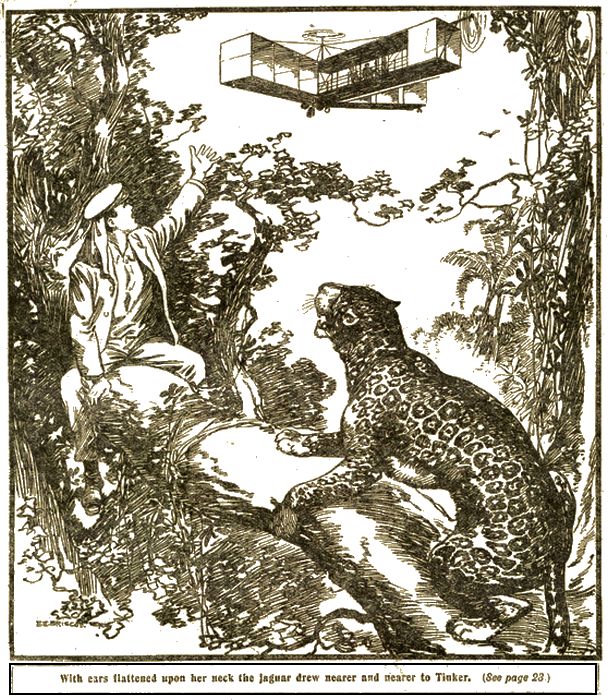
There seemed no hope, no chance. He saw, now that it was too late, that had he mounted higher and chosen a bough more slender he might have retreated beyond the reach of the creature, whose instinct would have made it pause.
As it was, the limb on which he perched was stout enough to bear them both; but he could not understand what made the brute hesitate.
Every now and then, as the jaguar crouched there, she raised her eyes and looked upwards, and it was not until the gloom seemed to suddenly intensify that Tinker knew what was coming.
The sky to eastward had grown suddenly black as ink, a vivid flash of lightning, that almost blinded him, was followed by a mighty rush of wind that swayed the trees and tossed the bough backwards and forwards in an alarming manner, and then the storm burst, the heavens seemed to open, and the rain poured down in a deluge.
Even the jaguar gave a low, yapping cry, and dug her claws into the dead bark, as though in fear; for a Brazilian tempest is a thing that strikes terror into the hearts of men and beasts alike.
For half an hour it continued, the tree tossing and groaning until the boy feared that he would not be able to hold on; and then it passed away as quickly as it had come, leaving some blue-black clouds that hung motionless overhead, and the sun to blaze forth again with apparently redoubled fury.
Every time he moved, the beast gave a fierce growl, and he saw its muscles tighten.
Its beautiful hide smoked and steamed, and gave forth an unpleasant odour, which reminded Tinker of menageries at home; but there the beasts had been behind strong iron bars, now there were a dozen feet at most between the jaguar and himself!
How long he remained facing the brute he never knew; his eyes ached with the intensity of his gaze, and he was feeling sick and faint when overhead a whistling whirr fell upon his ears, and a shadow passed over him.
Looking upwards, he saw the doctor's aeroplane passing slowly across the forest, and over the side of the platform the head of a man protruding, searching the ground through a pair of field-glasses.
Wild hope surged up in the boy's heart, and he shouted at the top of his voice, only to realise that the roar of the engines prevented any sound reaching them up there, as the monoplane passed out of sight
His only chance—and that a very slender one—would have lain in their catching sight of his white jacket, which the sun had now dried; but as the screaming of the engines died away in the distance that hope died with it.
He gave himself up for lost, and even went so far as to wonder whether or no he should fling himself from the bough, and trust to the fall putting him out of his misery.
It would be better than a hideous, mawling death under the terrible claws and yellow fangs of the crouching panther that had now begun to lick her chops, as if in anticipation of a speedy meal.
The sight of the cunning, catlike face fired him of sudden with an immense wrath at this foul creature who was taking things so much for granted; he remembered, too, that fire was a thing they could not stand, and how at the camp they had kept half a dozen burning at nights, when they were building the huts.
Branches grew in profusion within reach of his hand, tinder and touchwood, now dried again by the fierce sun, and he had an air-tight box of wax matches in his pocket!
The jaguar was growling now, as though she suspected something was about to happen. All would depend whether the snapping of the twigs would rouse her into action or not.
Tinker drew out his matchbox, and commenced his perilous experiment. Gripping the bough tightly with his knees, he stretched out his arm, and broke off a large branch covered with little twigs, another, and another, till he had as many as his hand could grasp.
The jaguar raised her head and looked at him, and her tail ceased to sway like a pendulum. Was she stiffening herself for a spring? He neither knew nor cared. It was the cast of a die for life or death! And, striking a match, he let the tiny flame touch the twigs.
In an instant the mass burst into a huge flame, and, leaning forward, he thrust it into the beast's face.
With a yap of astonishment, not unmingled with pain, the jaguar drew back closer into the fork of the bough; and, tearing another branch, Tinker added it to the blazing mass, and thrust again, at the same time shouting at the top of his voice.
There was an abundance of this strange fuel within reach, and, though it burnt out with great rapidity, he fed it branch after branch, working himself still forward towards the now startled creature.
The effect exceeded all Tinker's hopes, for the bark of the tree, inflammable as a handful of shavings, had caught fire, and began to burn with a roaring cackle.
Snarling and spitting, the singed brute retreated backwards, clasp'@g the creeper with her fore paws, and feeling her way with her huge hind feet, descended the trunk.
"Saved! Saved!" cried Tinker aloud,
But the next moment his triumph had gone.
The top of the tree was blazing fiercely, and the bough on which he depended for support had caught, too!
The brute was now only a few feet from the ground; but it would wait for him, not very particular whether its meal should be raw or roasted!
"What shall I do?" wailed the boy aloud. "Heaven help me!"
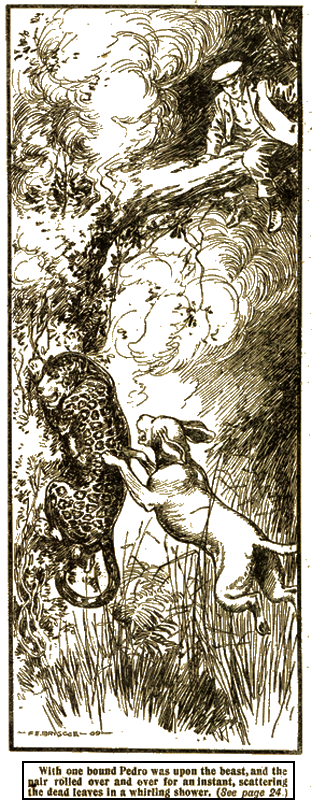
And as if in answer to his prayer he saw a movement in the bushes below him, and a well-known, tawny coat dash straight for the blazing tree.
The jaguar heard it coming, and saw it, too, but not in time to disengage her claws from the creeper.
With one bound Pedro was upon her, and the pair rolled over and over for an instant, scattering the dead leaves in a whirling shower.
All thought of his own imminent danger left him as he watched; but he saw the gallant bloodhound shake himself free, and, standing astride the dead beast, raise a howl of delight, which went echoing through the silence of the forest.
"Bravo, Pedro!" cried the boy, as an ominous crack brought him to his senses, and warned him that it was time to leave.
His hands and hair were scorched, but he did not mind that; and grasping the trailing creeper, whose presence there he had so much cause to bless, he climbed down and stood once more on terra firma, flinging his arms round his preserver's neck with more thoughts in his head than he had power to utter.
"Now, boy, show me the way home," he cried, picking up the gun he had dropped, and releasing himself with difficulty from Pedro's affectionate caresses.
As he rose to his feet the shadow of the aeroplane fell once more upon the mossy sward, and he saw the doctor's flying-machine sail past above them, still pursuing its fruit-less search for the missing boy.
What had happened was this: Sexton Blake and the colonel had raced together along a narrow cleft in the plain, until they came to a rampart of red sandstone rock, behind which the colonel called a halt.
"We cannot leave the boy," he said, "and we can't let these demons have it all their own way, either."
With that they opened fire on their pursuers, who, finding they had a couple of resolute men armed with Winchesters like themselves to deal with, drew off after a dozen shots had been exchanged, leaving three dead and one wounded man for the vultures to inter.
For a long time Blake and the colonel waited, with Pedro crouching beside them, expecting every moment to be attacked again; but nothing happened, and when at last, dreading what they should find, they stole back along the cleft» there was no sign of the boy, nor of the enemy, save only the three dead men, and the wounded ruffian, who was gasping out his life into the red-hot sand.
The colonel bent over him, and, seeing that nothing could be done for the fellow, commenced to question him.
"Now, my man," he said, "who are you, and where are the rest of you?" But the man only gave a little shiver and died.
"What do you make of him, Blake?" said the colonel, turning him over on to his back.
"Spanish-American, I should think," said the detective; "but where's that boy?"
He set Pedro to work, but so many feet had crossed and recrossed the bed of the dry watercourse, that even the sagacious hound seemed nonplussed, and could not pick up Tinker's trail.
For two long hours they searched, but: in the wrong direction. A puff of hot wind had drifted the sand over Tinker's footprints, and with a heart of lead Sexton Blake allowed the colonel to take him by the arm and lead him back towards the forest once more.
THE sudden retreat and subsequent silence of the men who had fired at them with the obvious intention of wiping them off the face of the earth puzzled them both, nor had the close examination of the dead bodies thrown any light on the matter.
Three of them were obviously cross-breeds, and one had on his heels a pair of spurs, whose rowels had been made out of Spanish dollars.
The fourth might have been a German or a Swede, from the type of his face, and his fair moustache; but that they had some common cause of brotherhood was made plain by a tattoo mark on the back of every left hand—an eye in a circle.
"I think we shall find that they are members of a band of robbers, or possibly convicts escaped from the Penal Settlement," said Blake, as they plodded their way slowly back, ankle deep in the white dust of the campos. "That scoundrel, Delgarno, had certainly a very intimate knowledge of Cayenne and the French methods there, too intimate to have been learned at second-hand, moreover, he knew several of the officials there, and his descriptions of them were quite correct."
"Why, what do you know of Cayenne, old chap? the colonel.
"Oh, I have been there, that's all," said Sexton Blake.
"What a wonderful fellow you are!" exclaimed Burleigh, "There's hardly a place you have not been to, it seems to me and very little you don't know."
"Ah, there you are wrong, my friend!" said Blake. "I'd give a good deal to know where my poor boy is just now, and whether he is dead or alive."
The colonel nodded in sympathy.
"Yes," he said, "my impression is they've taken him prisoner, and he'll have to be rescued."
At that moment they had reached the forest again, and having taken a last sweeping survey through their glasses, they turned their backs on the campos, and plunged into the silence and the gloom.
There was dismay in the camp when they told their story, and they found the eight men that formed the crew of the brig had brought some news with them.
They had heard far off across the forest, as they tumbled out to obey Dick Wells's summons, the distant hoot of a steam siren, which meant that Captain Bluff was returning to his moorings.
Their skipper had had the forethought to write on a sheet of letter-paper: 'Come up to camp at once," and this he placed in a cleft-stick on the bank where they were bound to see' it; but everyone knew that the progress of the Ranee would be very slow, her screw getting entangled in the floating weeds that sometimes drifted almost from one bank of the river to the other.
"Well," said the doctor, "what do you propose, Blake? Of course we'll follow the fiends up with every man-jack we've got, but we can't leave poor Tinker out yonder alone, perhaps wounded."
"I've been thinking of a plan," said Blake. "Did that scoundrel content himself with his daring theft, or did he damage anything before he went?"
"No," said the doctor, "I was afraid of that; but everything else is in order."
"Very well," said Sexton Blake, "you and I will go up in the aeroplane; there is just a chance that he has lost his way and may-be roaming hopelessly about. We might even hear a shout if your confounded engines did not keep up such an infernal roar all the time."
"Ah, Blake," said the doctor, a look of anguish passing over his face, "that was one of the points I have been working so hard to improve! Our big biplane yonder would have been absolutely noiseless, and now the secret is in other hands. Oh, what fools we were to trust that plausible rascal with his specious tale!"
It was all hands to the pumps, and to the great delight of the brig's crew, none of whom had seen an aeroplane in action, the machine was speedily placed upon the rails, the doctor waved to signify "Let go!" and Sexton Blake made his second acquaintance with the delights and possibilities of aviation.
Not that the present trip was to afford him any pleasure, for his heart was sore, and every nerve was strained to obtain tidings of the lost one.
They experimented before starting to readjust the balance of the monoplane, so that Blake, instead of sitting rigid and motionless behind the doctor, could lie at full length across the little platform, and sweep the earth beneath with his glasses.
By means of a compensating weight attached to the opposite edge, this was accomplished to the doctor's satisfaction; the propeller revolved and they were off, followed by a cheer and a "God speed" from those behind them.
Dr. Martin Wells had arranged beforehand to make as slow a flight as possible, and to accomplish this he immediately rose to an immense altitude, having explained to Blake that the machine would make a succession of upward sweeps, which was accordingly done.
But oh, the futility of it, as Blake realised from the start!
Below them stretched the dark carpet of forest land, through which Nature had woven the innumerable silver threads that were her waterways, and so different was the aspect of the country when seen from above, that the watcher had great difficulty in locating the identical campos where the fray had taken place.
A signal had been agreed upon between them, that when they should come over the plain Blake would touch his friend upon the back, and all at once Dr. Martin Wells felt a bang with the hard rim of the binocular, that made him start.
"Gently, you fool; you'll have us out of this!" he bellowed over his shoulder, forgetting that his words were totally lost in the deafening whirr of the machinery; but casting his eyes to earth, he saw the wide irregular plain below them, and manipulating his depressing fans, the machine swooped down with a velocity that almost took Blake's breath away.
It was at that moment, as he steadied it, about eighty feet above a strip of forest that surrounded a marsh, that their shadow fell upon the boy in the tree, and, meanwhile, something had been happening unknown to the searchers.
Pedro had howled so dismally when he saw his beloved master climb into the monoplane, and made such frantic efforts to join him, that Blake had called to Dick Wells to tie the hound up; but Pedro had the strength of a horse, and though the doctor's nephew held stoutly on to his chain, the faithful creature snapped it off short, and bounded in the wake of the flying-machine.
He seemed to know that be had lost one friend in Tinker, and was determined to keep his master in sight; and wherever the aeroplane went Pedro followed its shadow on the ground.
The salt tears coursed down his rugged face, and the sight was pathetic in the extreme.
The brave beast plunged without hesitation info the tributary that flowed into the igarape, and swam across regardless of alligators.
He came upon a great ant-eater moving slowly along, and leapt over him at a bound; but as the shadow moved across the edge of the plain Pedro stopped, thrust his nose into the sand, and lifting up his head gave a howl, which said as plainly as human words: "I've found him!"
High overhead Blake saw the action through his glass, and cursed all machinery and everything that ever made a noise with a mighty curse.
He could not communicate with the doctor, but he knew the hound had struck the trail, and his heart leapt within him.
All oblivious of the fact and doing his very best to handle the machine in a way that would give his friend every possible opportunity, the doctor glided onwards, blissfully unconscious of the storm raging in Sexton Blake's heart.
When at the end of a long dive he looked over his shoulder for instructions, he saw Blake hopelessly staring at him, understood that he had gone far enough; and making a magnificent circling sweep, returned almost along the same course.
There was no sign of Pedro now, but on a sudden a wavering flame shot out up from the centre of the belt of forest, and so low down were they that they could feel the hot waft from the burning tree.
"Oh, bless you for a scientific ass! exclaimed Blake himself. "The boy is safe, and has fired the bush in the hopes that we shall see the signal.
Unfortunately Dr. Martin Wells was not struck with the same idea, and continuing calmly on his way with some doubt in his mind whether he was not running short of petrol, he made another bird-like circle and dropped within twenty feet of the mess-tent.
"Well, no luck I'm afraid," said the doctor, removing the cotton wool from his ears, and Blake forgot his anger as he pointed to Dick Wells, who flung his hat in the air and whooped like a Red Indian.
"Luck, my dear fellow!" shouted the detective. "What do you call that?" And there sure enough a woe-begone and utterly exhausted figure staggered towards them with Pedro prancing like a baby elephant at its side.
It was Tinker, in reality none the worse for the deadly peril through which he had passed, and the meeting between the two friends was touching in the extreme, even the colonel was affected by it, and after he had wrung the lad's hand warmly and pulled Pedro's ear, he stalked away in search of a whisky-peg, taking his handkerchief from his jacket sleeve, and blowing his nose violently.
They carried Tinker in among them, and when they had revived him he told his story; but before he had come to the end of it a cheery hallo from the waterside turned all their eyes in that direction, and they saw Captain Bluff and the yacht hands jumping ashore.
"Think I was never coming?" cried the little man. "What with weeds and floating bamboo-stalks, and the manatee that got churned up somehow in our propeller, we've only done two knots an hour since sunrise; but I've brought you a letter, Blake, from the poste restante at Para. But, by the way, why do you want us all up here in such a deuce of a hurry?"
"Tell him, somebody," said Blake, and he opened his letter.
When the detective had gone ashore at the Brazilian city, one of the first things he had done was to despatch a picture postcard to Mr. Brierley, in Liverpool, on which he wrote: "If you have anything to communicate, there's a poste restante here; we are going strong, and quite convinced that you were right." And Mr. Brierley, who had come into possession of some interesting information, had conveyed it in a letter on the off-chance of it reaching his friend.
In it he told him that the police officials of every European capital had just received a simultaneous communication, signed by the famous Anarchist, Balthazar Benedict, warning them of a mysterious blow that would fall ere long.
Most of them treated it with contempt—there had been so many of these threatening warnings since the scoundrel's disappearance—but the French Government offered a reward for his capture, dead or alive—a reward equivalent to five thousand pounds of our money.
"I thought this would interest you," wrote Brierley; "and if you find him I suggest that we shall go halves."
"Certainly, my friend," muttered Blake, with a smile, "When we find him! Ye gods, you are building castles in the air, if you only knew it!"
He folded up the letter and placed it in his pocket, and at that moment the colonel came bustling into the tent.
"I say, Blake," he cried, "I've been thinking matters over, and it seems to me that we'd better defer our pursuit until night. With Pedro's nose and plenty of electric torches we can arrive at the cavern about daybreak, in better condition, to run them down than if we march in this terrible heat."
"I am quite with you, Burleigh," said the detective. "I had the same idea myself." And so they waited.
Three of the sick assistants had returned in the yacht, quite recovered from their fever, and the doctor was anxious to begin another engine without delay.
He had constructed a kind of suction pump, connected with the igarape, and a sprinkler which played on the roof of the workshop, rendering the temperature within not altogether cool, but, at any rate, bearable, and all day long, while the others dozed, panting and exhausted under the punkah, there were hammerings, and filings, and sawings from the workshop, with the sharp hiss of red-hot iron plunged suddenly into water.
And when the doctor was dragged reluctantly over to the mess-tent, when evening came, he was very dirty and very greasy, but altogether jubilant, having laid down the lines of a marvellous mechanism, which would not only replace the one Delgarno had stolen, but would, he was confident, be a decided advance.
"Grand—grand!" he exclaimed. "In ten days we will make the great trial!" And then he fell to eating ravenously.
"You've knocked yourself up, doctor," said the colonel, "and that's a pity."
"My dear fellow," replied Dr. Martin Wells, "I shall smoke one cigar, sleep one hour, and be the most active man among you!"
They smiled at his enthusiasm, but they found that his words were true.
One of the engineers was to remain behind to keep the searchlight going over the camp, and two sailors were to stay with him; the vest fell in briskly when the word went round, and, every man being well armed, they set out silently on their night march.
It was a weird procession that followed Pedro into the sleeping forest. The alarming clamour, that sounded like an army of men approaching, but which was only the even-song of the frogs and toads, had died away, and everything was very still.
When they reached the edge of the forest belt, where it gave on to the campos, they stopped.
The moon shone with wonderful brilliance over the grey plain in front of them, and the colonel commanded all lights to be extinguished.
"That will set in a couple of hours," he said, pointing to the orb. "We'll rest here until then. A mile and a half in such moonlight as this, with no shelter of any kind, would be nothing less than madness. You and I, Blake, will go forward to the flat rock and see if any of the dogs are stirring."
When they came back everyone was asleep, with the exception of Tinker and the doctor, and, after a whispered consultation among themselves, they lay down and waited.
The mouth of the cavern had stood out a black spot on the face of the spur, but if the ruffians kept watch they also kept well out of sight, and nothing had moved.
"Wake up, boy!" said a voice in Tinker's ear, for he had dozed with his head pillowed on Pedro's broad back, and he found the colonel bending over him, and the moon just sinking out of view.
A greenish light lingered in the sky, but as they reached the rock under whose welcome shadow they had lain the light faded out, leaving a dome of velvet blackness overhead, and only the stars to guide them.
Slowly and stealthily they crept across the plain, now dipping into a deep nullah, now scrambling up the side of one of those innumerable watercourses which had served them so well not many hours before, until at last a low murmur came back along the straggling line as Colonel Burleigh passed the word that they had reached the place, at the same time telling them one and all to look to their, weapons.
The plan of action had been arranged beforehand, and the little force of twenty extended in open order along the edge of the watercourse, within fifty yards of the cavern's mouth, waiting for the signal.
The colonel whistled, and they raised a yell loud enough to have raised the dead.
But, instead of a startled clamour in reply, the echo alone mocked them, and the colonel knit his brows.
They tried another yell, but the result was the same.
"I say, Blake," he whispered, "they're either lying uncommonly doggo or they've cleared out!"
Nobody spoke, and the silence became unbearable. They could just make out the rugged outline of the spur, silhouetted against the stars in front of them, and those who had any imagination thought they could distinguish the blackness of the cavern's mouth.
"I can't stand this!" whispered Colonel Burleigh. "I'm going forward to reconnoitre."
"Don't be an ass!" replied Blake. "We must wait till daylight," but before he realised his precise intention the soft scrunch of the sand told him that the reckless soldier had left his side.
To Sexton Blake's calmer mind, accustomed though he was to facing risk and peril of no ordinary sort, the action seemed madness, and he waited, listening with "all his ears, expecting every moment a shot and a shout to tell him that his old friend was battling single-handed for his life
Instead, there was nothing but the appalling silence and the whisk of the sand, as the hot night wind strayed across the campos.
Already the light was breaking, and a ghostly grey made everything visible with startling suddenness; then the sky flushed. red, and out of the mouth of the cavern stalked Colonel Burleigh, his Winchester in the hollow of his arm.
"Can't understand it!" he cried. "The mountain is honeycombed with caves, but I've not heard a sound."
Blake got on to his feet with a sigh of relief. "You deserve to be shot for your foolhardiness!" he said. "Have you found nothing?"
"Nothing at all," replied the colonel, "except one of those beggars we killed yesterday, half eaten, and very unpleasant. I tumbled over him, and made no end of a row." He turned as he spoke, and pointed with his hand into the cave, crying: "Hallo, what's that light?"
At the other end of the rocky tunnel they saw what seemed at first sight to be a fire, until they recognised the red eye of the sun shining through the rock.
The whole party started forward. with a simultaneous run, led by the hardy soldier, and, pouring along the tunnel, came with unexpected suddenness into the wonderful sunrise.
"Oh, this explains it!" said Burleigh savagely, pointing to the ground. "We may whistle for a fight now!" And they all saw where more than a dozen horses had stood there, and that a well-defined track led down a frowning gorge in a south-easterly direction.
Their night march had been of no avail, and all their labour undertaken for nothing, The ruffians and their stolen treasure were leagues away!
The colonel exhausted the vocabulary of Hindustani, and resorted to eleven different dialects.
"Done in the eye, Blake—done in the eye!" he exclaimed at last, coming back to his mother-tongue. "About turn—quick march! No good waiting till it gets hotter!" And, feeling that the advice was good and that there was nothing else to be done, the disappointed men returned on their own trail, and reached the camp thoroughly exhausted.
An immense amount of idle talk was expended in trying to solve the problem of the clever theft to no purpose, though everyone was unanimous that somehow or other the doctor's secret had been betrayed, and that they had waited for his coming in Para.
This caused bad blood among the engineers, and a little head-punching was the result, but it soon simmered down. They had come there for a certain purpose, and the doctor and his helpers worked with feverish anxiety to complete the new motor.
Little by little it grew under their practised hand, and, meanwhile, the colonel was adding every day to his collection of skins, of which something like thirty cases had been conveyed on board the Ranee."Sexton Blake grew moody and restless about this time, often pacing alone, and frequently taking out Mr. Brierley's letter and poring over the contents.
Tinker watched him closely, and knew that he was meditating over something of great importance.
"Tinker," he said, one day, as the lad was preparing to go in search of that gigantic alligator which up to then had baffled all his attempts to kill it, although he must have lodged several pounds of lead in its wicked old hide, "we've been here long enough—too long, in fact—although it has been a very pleasant as well as an exciting stay. We will wait to witness the doctor's great trial—he says he'll be ready for it in a week—and then we'll return to Europe. I have an idea of following up a clue I abandoned three years ago, when the hunt after Balthazar Benedict was at its hottest."
"Well, I'm ready when you are," said Tinker; "although I should like to bag the father of all alligators first. The colonel has promised to have him set up for me,"
"Great Scott!" laughed Sexton Blake. "What on earth would you do with it? I'm not going to have the beastly thing in my rooms, remember!"
"Oh, I should probably present it to the Natural History Museum," said Tinker merrily, as he pushed off, leaving Sexton Blake to go in search of the colonel.
"Oh, want to go, do you?" said that gentleman, who was lamenting the fact that during the night the ants had played the dickens with the skin of a large puma he had shot the previous evening. "Well, any time you say the word the Ranee is at your disposal, but I'd like to see our dear old friend Wells succeed before we start. We'll make it the day after his big flight, eh?"
Once—it was about the middle of the week—Pedro again brought the camp to arms by raising a lugubrious howl at midnight, and everybody rushed cut in their pyjamas, expecting nothing less than an attack from their mysterious enemy,
It was a cloudy night, and dark shadows floated o'er the moon.
The hound, his coat bristling with fury, stood alternately barking and baying like a dog possessed; but though they switched on the searchlight at once, and swept it rapidly round the forest on all sides, they could see nothing, and as Pedro seemed to be rather ashamed of himself, and retired to his bed and lay down with a troubled sigh, they went back to theirs, knowing that the trusty fellow would give them due warning of any danger.
They never knew what roused him, although their subsequent conjectures were very near the mark; but that was afterwards, and we are coming to that.
"HAIL, smiling morn!"" sang Dick Wells, his merry face beaming with delight.
"If you pay a little more attention to that carburetter, and leave the 'smiling morn' alone, I shall be glad," said his uncle, looking out of the door of his sleeping hut, a razor in his hand, and his chin thickly lathered.
Notwithstanding his rebuke, the doctor's face beamed as gaily as his nephew's, for this was the day of the great ascent, when, the stolen engine replaced, and wonderfully improved upon, the results of long years of experiment and labour were to bear fruit—or the reverse.
A huge biplane, constructed to carry three persons; stood on the rails, and although the light had only just made its appearance, the whole camp was up and doing.
The doctor was shaving himself for the first time for the last three weeks, and was arrayed in a new flannel suit, his flying-jacket and hood hanging on a nail ready to be put on.
The colonel had sent down to the yacht for a case of champagne, and, in spite of his prejudice against all flying machines, and the principle of the thing in toto, he solemnly toasted the doctor, who, in response to loud cries of "Speech!" rose to his feet, looking very bashful, and thanked them.
It was a good thing that the heat would be upon them very soon, or the doctor might have got scientific, instead, he made a move towards the huge machine, and they followed him.
The doctor and Dick, with Sexton Blake as the distinguished passenger, were to make the trial trip, and as they took up their positions in the various compartments of the biplane, which were like a series of little rooms without any sides, the doctor pointed in triumph to his engine, which, working at an enormous rate of speed, made less noise than a sewing-machine.
"There will be a certain amount of whir from the propellers," he explained, pointing to the enormous blades, "but we'll take up some megaphones, and we'll tell you poor mortals clinging safely to Mother Earth down below what it feels like."
He reseated himself, and a moment of breathless silence fell over the camp. The propeller began to revolve at a speed that rendered it practically invisible, and as the doctor cried, "Now then!" the assistants loosed their hold, and the machine rose majestically into the air.
In response to the lusty cheer that followed them, Dick tootled the megaphone like a coach-horn, and as the doctor made his first circle, almost in the length of the machine, the engineers below knew that he had accomplished all he had set to do.
Back came the mighty creature like a thing of life, her balance perfect, her every movement one of grace, as obedient to the doctor's hand as a well-trained horse.
"Wait a bit," said the delighted inventor; "we'll see how she rises. I'm going up a couple of thousand feet now. There's not a thing flying that can do what we're doing." And the huge machine sailed upwards into the cloudless blue.
The words had scarcely left the doctor's lips, when his mouth opened wide, and an expression of astonishment passed over his face.
From the other side of the mountain range an soared into view—line for line the counterpart of his own—and onward it came towards them, skilfully steered in a straight line.
Blake and Dick saw it at the same moment, and their astonishment was too great for words.
The doctor spoke first.
"Blake," he exclaimed, in a voice of anguish, "this is our rival! That scoundrel Delgarno was the tool of those American aviators, who have been spying upon me for years!"
"Hark!" said Blake. "They're hailing us!" And as the bell of the megaphone showed against the sky, he seized his field-glass, and cried: "By heavens, it's Delgarno himself!"
"Good-morning, doctor!" came a mocking voice through the megaphone. "I see Sexton Blake is with you, and my friend here would like a word with him."
Dick Wells, who was immediately behind Blake, saw his features, pale as ashes, as he focussed the pilot of the rival airship.
"Keep your head, Wells," he said; "we may in greater danger than we know of. Be ready to descend if I tell you to do so. I understand many things now, The man who is driving that biplane is the fiend in human form for whom we mistook you—it is Balthazar Benedict, the Anarchist!" And to Sexton Blake came hack the memory of that night in the Brasserie Zumacque, and the death of poor Mimi of the Studios.
The doctor started, and, keeping one hand on the steering-wheel, he levelled his own glass at the approaching aviator.
Save that Benedict's face had been burnt a deep mahogany colour by the sun of Brazil, he saw that his own disguise had indeed been the identical facsimile of the red-haired Spaniard, whose life was such a menace to the world.
Balthazar Benedict handled his machine with consummate skill, and the rival aviators circled round each other, both bending forward with undisguised curiosity.
The biplanes were identical in shape an measurement, thanks to Delgarno, the s the only difference being that Benedict's engine gave out more sound, thereby rendering the use of the megaphone necessary for conversation. The Anarchist now took one from Delgarno's hand, and spoke:
"It is a strange coincidence, Dr. Wells," he said, in excellent English, "that you should have chosen this spot, of all others, for your work. For nearly three years I have been experimenting in the valley on the other side of that mountain, and round my workshops a colony has risen, a little community of men, who, thanks to you, are going to revolutionise life and society.
"From our look-out on the peak we saw you the day you arrived. Ha, ha! Ha, ha! Everything has played into our hands, At this very moment skilled workmen are building a fleet of airships—a battery, if you like— for in another month we shall lay waste all the great American cities, and the capitalists will perish in the ruins!"
"This is lively, Blake," said the doctor ever his shoulder.
"Keep your head," replied Sexton Blake:
"I see you have a man with you who has done his best to hunt me down," resumed the Anarchist. "You might have met your death in better company."
"I say," cried Dick Wells, "Delgarno's got a rifle with him!" A bullet whistled through Sexton Blake's hat.
"Hold tight!" shouted the doctor, and he dived.
The biplane tilted forward at an alarming angle, and shot headlong through the air before the doctor steadied it again, But the Anarchist foresaw the stratagem, and he, too, swooped down like a mighty bird, so close that the doctor had to swerve away to the left to avoid a collision.
They were over the forest now, and, putting on full speed, the inventor whizzed through the air in an attempt to circle back to camp, the enemy in hot pursuit.
He missed the top of a tall palm by a few inches only, and as he did so a sharp explosion made them all look back.
Their pursuers' biplane was oscillating violently, and the doctor and his nephew cried simultaneously;
"He's blown the head of a cylinder out! Look—look!"
Their rival was jumping like a bucking horse, and descending with fearful speed.
They saw their own friends run forward, led by the colonel, who suddenly stopped, and made frantic movements with his arms for them to hold back, at the same time firing a shot that split one of the propeller-blades; and, pitching forward in a complete somersault, the biplane turned over, and fell within twenty yards of the igarape, catching in the boughs of a huge tree, and flinging its occupants to the ground.
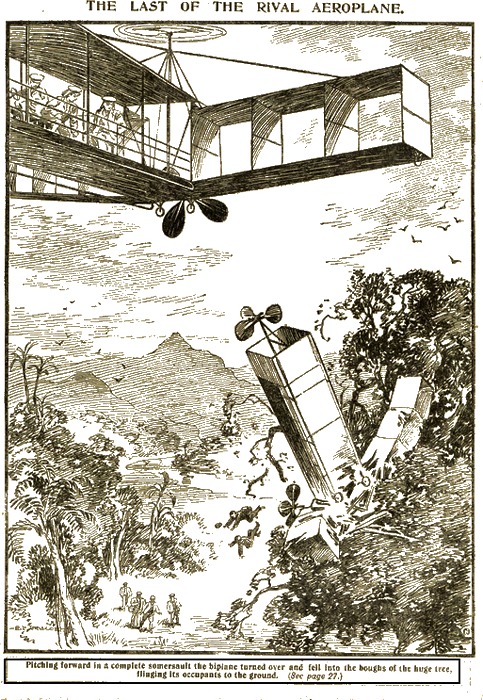
"Look out—look out!" yelled the doctor, as he turned in a short circle and came to earth, light as a bird, Sexton Blake springing out almost before the biplane stopped, and leaping upon the Anarchist, who tried to raise himself, but legs broken.
"At last, you hound!" said Blake, passing his hands quickly over him, and removing the firearms for which he fumbled. "The guillotine shall be your reward, and all your boasted schemes will have ended in naught!"
The Anarchist's reply was a curse, which was drowned in the crack of a revolver, as Delgarno, who had been stunned for the moment, sprang to his feet, and, firing point-blank at those who surrounded him, made a dash for the igarape, and plunged in.
"Stop," screamed Tinker, "the alligator has got him—my alligator!" And those on the bank 'saw the water suddenly swirl like a whirlpool, and Delgarno throw up his arms.
His. face was turned towards them, handsome still, but with an awful expression upon it that they will remember till their dying day.
The enormous jaws closed about his middle; and then Tinker, forgetting everything else, snatched the rifle from the colonel's nerveless hand, and, scarcely taking aim, fired.
Next morning there drifted on to the sandbank at the an enormous caiman that had been shot through the right eye; but Tinker had little joy in his triumph, although the brute measured twenty-seven feet from snout to tail. The sight of its bloated carcase, and the turned him sick, as he thought of Delgarno, the spy!
"What are you going to do with me?" said Balthazar Benedict, when Sexton Blake had bound his fractured limbs with considerable skill, and a general movement seemed to be taking place in the camp outside.
"We are going to nurse you very carefully," said Blake, looking at him with contempt and loathing. You are going to be conveyed to Europe in a luxurious steam-yacht. You'll have time to ponder on the way over what money can buy. You Anarchists are all of you selfish brutes, wanting other people's wealth because you have not had the brains to make enough yourselves. If you show me an Anarchist millionaire, I'll believe in your teachings!"
The Spaniard glared at him."You've not answered my question," he said. "What is to be my fate?"
"Monsieur Brignollas, of the Paris police, will arrange that," said Sexton Blake. "There is that little matter of Mimi of the Studios to be expiated. I believe you smoke Russian cigarettes. I found this case in the forest." And he left him to his own thoughts, which were not enviable ones.
"You've done enough, Wells," said the great detective. "We are going, and you cannot stay behind. The Governments of Brazil and Venezuela will look to Benedict's colony of unhung ruffians, but they may come south in search of their leader."
"You are right," said the doctor, nodding his head. "My discovery is complete, and I will give orders for the camp to be broken up forthwith."
And so it happened that, within a week of that tragic morning, a hawser was passed over the stern of the Ranee, and they towed the brig down the mighty Amazon.
Two telegrams did Sexton Blake despatch before they left Para and made for the open sea—one was to Monsieur Brignollas, and the other to Mr. Brierley,
"You were wrong, and you were right," wired Sexton Blake to the latter; "but we have him at last. The 'terror of the world' is bemoaning his fate in the cabin with two broken legs. Yes; we'll halve that reward."
Roy Glashan's Library
Non sibi sed omnibus
Go to Home Page
This work is out of copyright in countries with a copyright
period of 70 years or less, after the year of the author's death.
If it is under copyright in your country of residence,
do not download or redistribute this file.
Original content added by RGL (e.g., introductions, notes,
RGL covers) is proprietary and protected by copyright.