RGL e-Book Cover
Based on an image created with Microsoft Bing software
Roy Glashan's Library
Non sibi sed omnibus
Go to Home Page
This work is out of copyright in countries with a copyright
period of 70 years or less, after the year of the author's death.
If it is under copyright in your country of residence,
do not download or redistribute this file.
Original content added by RGL (e.g., introductions, notes,
RGL covers) is proprietary and protected by copyright.
RGL e-Book Cover
Based on an image created with Microsoft Bing software

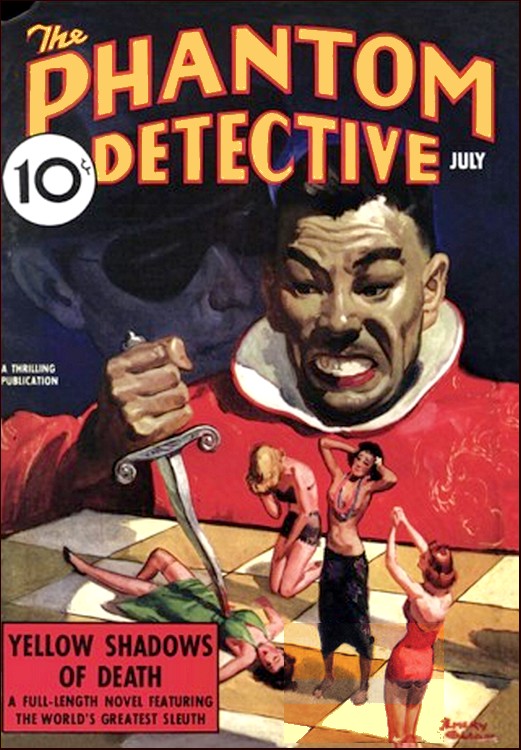
The Phantom Detective, July 1938, with "Yellow Shadows of Death"
A Robin Hood of Chinatown turns killer—and as the hue and cry of the betrayed swells to a chorus of, doom, The Phantom steps in to probe a blood-drenched, sinister mystery!
AT noon, the fog began rolling in through the Golden Gate's tapering cliffs. By three o'clock San Francisco was muffled in a clammy grey blanket.
As if breathing defiance against the murk of the afternoon, Willowby's jewelry store, enjoying on the West Coast the distinction of Tiffany's, splashed its electric glow over the pavement of Van Ness Avenue.
Only plate glass guarded the world's most precious gems, nestling there in scarlet, black and purple plush, from the greed of passersby.
Within, an austere dignity ever prevailed. Customers never haggled over prices at Willowby's. Voices were never raised above the polite conversational murmur. The place functioned with the smooth purr of an expensive piece of machinery. For wasn't its slogan: "Only the Best People Call at Willowby's"?
That slogan was about to be strained a bit that murky afternoon. There was a vacant store next to Willowby's. Five men had gained entrance into it—unofficially, and through the rear alley window. These men were now preparing themselves to "call at Willowby's."
They were dressed in the padded coats, black trousers and felt slippers of Chinese. Their leader, distinguished from the others by his superior height, already had a black handkerchief masking his face. The others quickly followed his example. Their pagan yellow faces were impassive, but lust and greed glittered, in their slanted eyes.
No one spoke. The scene evidently had been carefully rehearsed. When masked, the Chinese drew automatics from beneath their jackets. Several also held empty canvas bags. The leader edged nearer the dirty window, peering out until he saw in the fog the moving blur of a heavy black sedan.
The big car slowly passed the vacant store. A hand holding a cigarette extended from the driver's window, and the reddish glow of it made a minute arc as the driver waved briefly. The car went on a few feet further and came to a stop.
Drawing a heavy blue automatic, the leader unlocked the door, opened it a bit, looked up and down the street. Visibility was limited to perhaps twenty feet.
LIKE a stalking Apache, sinister and silent, the leader slipped out into the street. Hugging the wall, he edged swiftly toward the splash of light thrown off by the nearest Willowby window. The others followed in a single file.
An immaculately dressed clerk inside the store, idle for the moment, leaned on one elbow on a showcase near the entrance door. Then he saw a shadow appear outside the door. His eyes widened. Before he could make up his mind whether the sinister masked figure outside was real or an ugly figment of his imagination, the leader's left hand was pushing the door inward.
The clerk yelled a hoarse shout of warning to the armed guard always on duty in the store—but he was a second too late. The masked leader leaped into the store. He, too, knew precisely where the guard was, and he had the advantage of holding a gun while the other clawed at his in an open holster.
Twice, flame hosed from the snout of the bandit's automatic. The grey-haired guard crashed against one of the showcases, his blood swiftly staining the immaculately polished glass. He slid off it, and fell in an inert, crumpled heap at the feet of two women customers, who now stared down at him with dumb, incredulous horror.
"Everybody—quiet!" the leader crackled a guttural warning. "Hands up!"
There were five clerks in the store, as many customers, and a florid-faced manager sitting at a desk in the far left corner. Their hands shot up with the automatic precision of puppets operated by the same control string.
The leader's four henchmen had by now entered the store, the last one closing the door behind him. They deployed, two on either side, and waited with ready guns for further orders. A deathly, spine-tingling stillness now prevailed in the store.
The leader made a jerky motion with his left hand. Like bloodhounds released on a hot scent his henchmen leaped ahead eagerly. Ahead to those glittering showcases. To the fortune of precious stones, some in exquisite settings of platinum and gold; the expensive watches; the gold-and-jewel-encrusted cigarette cases.
Eager hands held open the mouths of the canvas bags. Other eager hands began scooping into them a precious glittering cascade of assorted jewelry.
The feverish activity of the bandits contrasted sharply with the immobility of the leader. He crouched motionless, smoking automatic in hand. Only his head moved, swaying slowly, like that of a vicious snake seeking a victim at which to strike.
The five customers stood in a huddled, frozen group. Perhaps the florid-faced manager, still sitting at the desk with hands high in the air, had more courage than intelligence. He suddenly jerked his body to the left and clawed at the partly open drawer of his desk.
His hand came in contact with the butt of the revolver there, but never had an opportunity to grab it. For the third time, the leader's big automatic crashed the stillness. The manager's head jerked to one side, and he half-spun about in his swivel chair. Both he and the chair crashed over to the floor.
A TALL, gaunt woman, seeing the gory horror of the manager's head, began screaming hysterically.
The leader's gun crashed once more, and the woman's scream was choked off with the abruptness of a blaring radio suddenly snapped shut. She fell close to the dead manager, and their blood intermingled on the inlaid mosaic floor.
The dead woman's companion dropped in a dead faint. The leader's voice, muffled as it came through the mask, told one of the clerks: "So you think you're smart, eh? You think I didn't see you—sneaking a little bit more to the left all the time. I saw you press the burglar alarm button on the floor!"
That clerk, a small, meek-faced young chap, looked ghastly as he stared back at the masked leader.
"I—I—"
The crash of a gun drowned out the rest of his words. The heavy slug caught him in the chest, smashed on through, and drilled a hole in the showcase behind him. The clerk crumpled.
"God! Oh, merciful God!" one of the customers exclaimed, swept away by hysteria.
Perhaps it was the same hysteria which motivated the tall, blond clerk standing close to the leader. With a stifled curse, he threw himself on the masked bandit. His left hand caught the gun-wrist; his right arm encircled the bandit's neck.
But it was a futile attempt. With a vicious knee jab, the leader doubled up the clerk, forcing him to drop his arms. Then he crashed the barrel of his automatic across the other's blond head. The clerk dropped as if a bullet had just plowed through his heart.
As the leader straightened from the blow, his black handkerchief, evidently loosened by the clerk's arm on the back of his neck, slid downward. It exposed his face—very swarthy, broad, high-cheekboned, with a black patch over his left eye, and a crescent-shaped, hideous white scar running from his right eye down across the cheek to the corner of his mouth.
"Sin Lui!" one of the remaining clerks gasped incredulously.
The leader glared at him with his one good eye, and the clerk's face became the color of cold ashes. But immediate subsequent murder did not stalk now. The bandit leader snapped a guttural command to his men. They instantly ceased their looting and ran toward him with the bulging bags.
In parting warning, the leader brandished his automatic. Then he jerked open the entrance door to find himself face to face with a burly policeman who had just loomed up out of the fog. Both were startled, but again the bandit had the advantage of holding a gun in his fist while his adversary had to reach for a holster.
A little black hole appeared magically below the patrolman's badge. The blue-coated figure seemed sucked back by the fog as he reeled away from the killer, arms flailing, desperately trying to maintain his balance.
A SHRILL whistle left the leader's lips, but it wasn't necessary. The big black sedan had begun backing at the sound of the shot. Swiftly the leader got in front with the driver; the others scrambled into the rear.
They weren't a moment too soon. The sedan had just begun edging from the curb, when a radio patrol car, its siren screaming, slithered on two wheels around the corner behind them. The wounded patrolman rolled over his huge bulk, reared up with his revolver to a kneeling position and drove two bullets into the escaping sedan.
Glass of its rear windows cob-webbed, but did not splinter. Bulletproof. The driver of the radio car swung grimly in pursuit. His companion, as grimly, brought down an automatic rifle slung behind him. He was about to lean out with it, when the rear window of the sedan lowered. A chattering, flaming hell burst from it.
Bulletproof glass is not made to withstand the pounding of a tommy gun. With a kind of sighing gasp, the driver laid his head down on the steering wheel. His companion dropped the rifle, and hung, dripping crimson, over the window sill.
The squad car kept racing at a sixty-mile momentum, gradually veering left on the two-way street. There was a trolley coming from the opposite direction. The motorman saw the juggernaut of death bearing down upon him. He braked the trolley to a violent stop, throwing some of the standing passengers off their feet.
Then the squad car hit. Hit head on, with a sixty mile per hour impetus behind it. There was a mad crashing sound of crumpling metal. The roadster tried to climb the trolley like some wild frantic thing. It rolled completely over, fell on its back and burst into flames—a crematory for the two policemen already dead inside.
The motorman felt his trolley, crowded with many women and children, heave slowly to one side. It came within a hair's breadth of turning over, and the screams of the women behind him were something that would haunt the motorman for many nights to come. But the trolley righted itself, and the motorman automatically opened all exit doors. His terror-maddened passengers spilled out into the street—
BACK at Willowby's confusion still reigned. The highest officials of San Francisco's police and civic government had come to the scene. It was the bloodiest, the most shocking hold-up in the history of San Francisco.
"And they were Chinks!" A bald-headed fat man who had been in the store at the time of the holdup was yelling. "Chinks—killing white men and women in our own country. Why, look at that!"
He pointed to a sign reading "Help China" that stood over a barrel bank on one of the showcases.
"Help China!" he roared, and viciously slapped the bank off the showcase.
"All right, take it easy, brother," a white-haired inspector advised him. "Don't judge an entire race by what five rats might have pulled. I know many decent Chinese."
The police commissioner himself was stooping over the wounded patrolman, who'd been brought into the store, and was lying, his tunic unbuttoned, on the floor.
"You're quite certain, Jackson, that you recognized the leader as Sin Lui?"
"Absolutely, sir," was the patrolman's weak but emphatic reply. "I pounded a beat in Chinatown, and knew him well. It was Sin Lui!" Two of the clerks, who also knew Sin Lui, immediately substantiated that assertion. The commissioner looked around at what fifteen minutes ago had been a place of serenity, of austere dignity. He glanced at the looted showcase, at the bodies awaiting the morgue wagon, at the gore splattering the clean mosaic.
"By God," he said softly, "San Francisco is going to have the biggest manhunt in its history. We'll get 'em! We'll get 'em!"
LATE that following afternoon in New York, three thousand miles away, Frank Havens, the grey-haired, stocky publisher of the Clarion, sat behind his huge desk. He was thumbing the last edition of his newspaper, and he paused, shaking his head, at the headline which, by now, had shifted to the third page. It read:
CHINESE BANDITS STILL AT LARGE
Patrolman Who Identified Sin Lui Dies
of Gun Wound; Culprit Still Eludes Police
"What a devilish mess," Havens murmured. He looked up when his secretary entered noiselessly. "Yes, Harkness?"
"Two Chinese gentlemen to see you, sir. Dr. Sue Yat and Lin Young. They said their business was very confidential."
His thoughts on the Sin Lui hold-up, Havens couldn't help being startled.
"By all means, show them right in," he said eagerly.
A minute later, two men entered the huge office. One had a round moonlike face, wore thick-lensed glasses and had a pouch belly, while the other was as gaunt and thin as a skeleton.
Havens made no effort to disguise the pleasure on his face. He knew both as the biggest Chinese importers in America, in business in San Francisco as well as New York. He knew both to be shrewd business men, but also men of unquestionable honor. For twenty years the two of them, friendly competitors, had advertised in the Clarion to the tune of thousands of dollars, and Havens had learned to like and respect them.
He shook hands with the moonfaced Dr. Yat, with the gaunt Mr. Young. The dignity of wealth and prestige of generations was in their bearing.
"China has a broad and long-suffering back, Mr. Havens," began the white-haired Lin Young in perfect English. "Another knife is being driven into it now. This knife is wielded right here in America. China, betrayed so often within her own borders and elsewhere, is now also being betrayed in the United States."
"You mean by this government?" Havens gasped.
Lin Young shook his head. "No. By the agents, I am convinced, of a certain foreign power which is trying to dismember China. I am sure, Mr. Havens, that I need not name that power to you."
"Then why did you come here?" Havens asked curiously. "What do you want from me?"
"It is known, Mr. Havens, that you are the contact for one who calls himself the Phantom. For one who is considered the greatest detective of all time. We wish him to investigate certain information that we have. Any material reward that he might want—"
He paused when Havens raised his hand.
"The Phantom needs no money, Lin Young."
"Then," the old Chinese went on with quiet dignity, "if he succeeds, his reward will be the gratitude of the Chinese people. His reward will be the checking of what threatens to be the most terrible injustice ever forced on an entire race. Mr. Havens, as an unforgettable favor, will you try to contact the Phantom?"
"I will," Havens said very quietly. The white-haired Chinese reached in his pocket. He brought forth a tiny black jade dragon, with eyes made of diamonds, and a fiery tail of rubies.
"Only very high officials of my tong have these," he told Havens, placing the little dragon on the publisher's desk. "It will gain instant admittance for the Phantom into my New York home. It's at Sixteen Drew Street, in Chinatown. I shall await him."
Lin Young nodded to his companion. Both got up off their chairs, formally shook hands with Havens again and quietly walked out.
TWENTY-FIVE minutes later a long-legged, broad-shouldered young man lowered his book as the doorbell rang in his Park Avenue penthouse apartment. It was Richard Curtis Van Loan, the well-known and much rotogravured society playboy. The title of the book he was reading, however, would have set his friends blinking—and wondering whether Van had suddenly gone crazy. For it was called: "Advanced Theories in Ballistics."
They never knew Van to be interested in any theories except, perhaps, which vintage of champagne was most desirable. There was really very little that the world knew about Dick Van Loan, aside from the superficial surface. Yet crowds would gather gaping, pointing at the penthouse atop that Park Avenue building, were it suddenly announced that the Phantom lived there.
The glamorous, mysterious master of disguise—the Man of a Thousand Faces, as he was sometimes called—the grim Nemesis of crime whose very name sent a ripple of terror into the core of the underworld—the Phantom Detective.
Yet there was nothing menacing, nothing hardboiled about the pleasant-faced young man who went to the door. The one hint one might have had was the lithe, catlike grace with which he moved his body. It was a storehouse of dynamic energy. The life of a society playboy would have given it no outlet.
Van, answering his doorbell—he deliberately kept no steady servants who might become curious about the erratic behavior of their master—received a little package from Harkness, Havens' personal secretary.
He thanked the secretary and dismissed him. Returning to the living room, Van eagerly tore the string and opened the package. The little dragon attracted his attention first. When he loosened the tissue paper which sheathed it, he could only admire its exquisite workmanship. It had no further significance for him. Then he saw Havens' folded note. Swiftly he unfolded it. It read:
Two old friends of mine, Lin Young and Dr. Sue Yat, the most prominent, commercially, Chinese living in this country, have just visited me. They told me some alarming things. Some ugly hell is brewing.
Go see them, Van. They are men of unquestionable honor. When old, wise, cultured Chinese are frightened, you may depend upon it that it is something gigantic. Young lives at 16 Drew Street. The little dragon enclosed will gain you instant admission into his home.
Van carefully reread the note, memorizing the few details. Then he went over to his fireplace, dropped the paper on the grate and burned it. He stood by until the last corner of it was finally shriveled and consumed by the flames. Picking up a poker, he forced the ashes through the grate.
Turning from the fireplace, he walked swiftly to his bedroom. Inside a specially built-in closet were a number of disguises that Van could quickly lay his hands on, without making a special trip to his much better equipped laboratory.
In this case, Van needed simply a cheap, worn, somewhat wrinkled dark suit and overcoat which would make him inconspicuous in the crowds which generally mill the crooked Chinatown streets. And equally simple was the disguise altering his features. That is, simple for the master of disguise that Van was.
A few strokes of the shading pencil made his lower jaw appear heavier, and mechanical gadgets along the bone below the lower lip still furthered that illusion. The contents of a little jar gave a roughened, brick-reddish appearance to his smooth, bronzed skin. Two tiny pellets broadened his nostrils, at the same time flattening his nose.
He strapped a shoulder holster over his vest, and, with characteristic thoroughness, carefully examined the heavy .45 automatic before he slipped it into the holster. Two extra clips of cartridges went into his left jacket pocket when he put it on. In a specially constructed waistband pocket which all of Van's disguise suits had, he slipped a tiny mask, made of platinum and precious stones. And in another pocket he slid a compact little make-up kit.
The Phantom was ready!
A PRIVATE, self-service elevator took Van down from his penthouse. From its ground exit it was only a few feet to a side door of the building, with no appraising eyes of uniformed lackeys to pass. It was a convenience which Van, as the Phantom, had found useful more than once.
He hailed a cruising cab, and gave the hackie Lin Young's Chinatown address.
Presently the cab drew up to a narrow green door. Van paid off the cabbie, mounted three steps.
He looked for a bell. There was none. So he rapped his knuckles on the weathered wood. Instantly, a small square section of the door swung inward, to form a kind of peephole. Slanted black eyes appraised him.
"What do you want, please?"
The Phantom removed his left hand from the overcoat pocket, exposing the tiny jeweled dragon to view.
Those black eyes immediately lost their inscrutability, became friendly, eager.
"Yes, please," the man behind the door said.
Van heard the metallic clang of several bolts shot back. The door swung inward. Van, entering, stared at the edge of the door as it slowly swung past him to close again. The outside of it was wood—yes; but the wood was only a misleading superstructure built onto a half-inch steel plate. The door was actually made of steel plate! Three enormous, yet modern bolts shot back in place automatically and silently when the door edge touched the jamb. Only an acetylene torch or high explosives could gain one admittance here.
THEN the Phantom saw something else which startled him. Some sort of indirect lighting illuminated the corridor in which he stood. When it terminated at the far end, there was a three-inch-wide loophole. Van had seen the muzzle of a tommy gun too often not to recognize the little black protrusion from the loophole into the corridor. The white blob of a man's face was beyond it.
So that steel door wasn't the only obstacle an unwelcome intruder had to overcome! A submachine gun awaited him even if he succeeded in breaking down the door, or tricking someone into opening it. All of which, to Van, was grimly interesting.
The Phantom trailed the shuffling Chinese down the corridor. He suddenly realized, to his amazement, that there were no doors of any kind. Just straight blank walls—a kind of blind tunnel, with the street door apparently its only entrance or exit.
Then the Chinese paused, extended his hand and touched something on the wall. Abruptly and without a sound, a section of the wall slid upward into the ceiling. Van found himself entering another, shorter corridor. He had a creepy feeling when the wall slid back into place behind him.
Van wanted to rub his eyes. The spectacle before him seemed like some lovely dream; his brain could not accept its reality. Steps, inlaid with rare mosaics, led downward from where he stood into a huge room, the sunken floor of which must have been considerably below the street level.
Flowers of every known pigment blossomed in orderly profusion, edged with trim, geometric borders of dwarfed shrubbery. Gem-encrusted treasures were there in abundance. Immense vases, studded with intricate and multi-colored mosaics, and exuding the aroma of a million rose petals, flanked the doorway entrances.
In the center, and molded in the form of a sleeping dragon, a fountain played. The iridescent water fell on frond-like tropical leaves and ferns. Its delicate music mingled with the breeze-blown tinkling of hanging glass suspended high in the ceiling panels.
A tall, gaunt man stood near the fountain. It was Lin Young, regal-looking in long silken robes. Dr. Sue Yat, sitting near him, also wore Chinese clothes. A beautiful white cockatoo was perched on Lin Young's shoulder.
The servant with Van bowed, and told Lin Young something in swift Chinese.
"Ah!" the old man said sibilantly. And added, glancing at Van: "I am glad you have come, sir. I am Lin Young."
He walked over as the Phantom descended the stairs, and they shook hands. Van instantly liked that proud-faced, white-haired old man. He felt himself being studied. His eyes interlocked for perhaps thirty seconds with the Chinese, then Lin Young nodded imperceptibly. He extended a gracious hand.
"Please allow me to introduce you to my colleague, Dr. Sue Yat, and my son Chang," he said quietly.
He led the way back to the fountain, and it was only when Van reached it that he saw the young chap who must be Lin Young's son. He was a small, wiry, handsome young chap, and his eyes glittered with the thrill of meeting the famous Phantom.
"And now," said Van, "I would like you to explain to me just why you have sent for me."
Lin Young's long bony fingers stroked gently the cockatoo's plume.
"You have read in the newspapers, I suppose, of the holdup by Chinese bandits in San Francisco?"
"I have," Van nodded. "But surely no intelligent person would indict an entire race for a crime committed by four or five of its members. Our jails are full of Americans; you wouldn't deduce from that that Americans are thieves and murderers."
"Phantom," Lin Young asked softly, "have you ever heard of the name of Sin Lui before?"
"The man recognized as leader of those holdup men?"
"Yes."
"No, I haven't."
"Then," said Lin Young, "I shall tell you his story. Sin Lui was the last male descendant—even as my son Chang now is—of an old and honorable family. He received an excellent education in America here. He had intelligence and ability; he might have made anything he wanted of himself. But one day about three years ago, he suddenly sold the business he had inherited from his father. He distributed his fortune, amounting to some two hundred thousand dollars, amongst the poor Chinese. And then Sin Lui, scholar and gentleman, became—a bandit."
Lin Young paused a moment, then went on:
"A bandit—yes; but a strange sort of bandit, Phantom. He preyed on the wolves and vultures of San Francisco's Chinatown. He held up the owners of opium dens, of gambling houses. If a money lender charged some defenseless victim too great an interest, Sin Lui would pay him a visit one night. He would rob him, he would prick him with a knife a few times. This money lender would be very careful in the future not to squeeze his victims too tightly. And every dollar that Sin Lui got at the point of a gun promptly went to the poor the next day.
"He came and went like the shadow, this Sin Lui. The police never tried hard to catch him. Because they knew that Sin Lui helped the poor and robbed the vultures. Sin Lui meted out punishment much more swiftly and efficiently than the courts ever could, and with a fine sense of justice.
"The average Chinese in the United States leads a hard, drab life. He works many hours. He has no time for recreation. Sin Lui's dramatic exploits supplied him with something to chuckle over as he sweated over the ironing board or in some hot kitchen. It warmed his heart and fired his imagination. Sin Lui, to conclude, was the Robin Hood of Chinatown, and undoubtedly the most beloved Chinese in the United States. Beloved, that is, by our people, who would do anything for him."
"May I point out," Van said quietly, "that your story, while interesting, certainly clashes with Sin Lui's behavior in that San Francisco jewelry store. It isn't at all in character with the way you've described him."
There was a long pause, and all Van could hear was the gurgling of the fountain. The old man was still stroking the cockatoo, but his eyes were now cloudy and distant.
"You might have noticed," he said finally, "that I've been referring to Sin Lui in the past tense. Phantom, two weeks ago in San Francisco Sin Lui's head lay on my lap. Thus he died, and with my own fingers I closed his eyes. Sin Lui is dead—and has been dead two weeks!"
THERE was a long pause, filled in by the gurgling of the fountain. Van stared at the old Chinese.
"Your implication, then," he said slowly, "is that an impostor impersonated Sin Lui during that holdup."
"Not an implication," Lin Young corrected gently. "I say it as a positive statement of fact."
"But isn't it known that Sin Lui is dead?"
The old man shook his head. "Four people know of it," he said—"or so I thought, anyway. None of my servants knew that Sin Lui had been fatally stabbed when he came to my other home in San Francisco two weeks ago. In the presence only of my son Chang, and Dr. Sue Yat, who is my best friend, Sin Lui made me promise that, as soon as he died, I would have his body cremated, without telling anyone else of his death. He did not want his body to be shipped back to China. So we secretly cremated his body.
"Sin Lui had a reason, Phantom, for not wishing to have his death known. The wolves and vultures in Chinatown whom he had cowed so thoroughly—who dared not continue their evil activity for fear of his vengeance—would joyfully come out of their holes. They would try to make up for lost time, and there would be a new crime wave in Chinatown."
"But I still can't quite understand," Van insisted, "why the leader of those holdup men should go to the trouble of impersonating Sin Lui?"
"I am glad you have asked this question," Lin Young said softly. "Because it brings us to a subtle undercurrent which is much more alarming than the holdup itself. I am head of the On Leong tong, the most powerful and respected tong in the United States. Our tong has sent a great deal of money to China, but it still wasn't enough. Three weeks ago, we pledged ourselves to raise in one month a half million dollars to help the poor innocent refugees of the war.
"Sin Lui wrote a short article, which was printed in all Chinese newspapers, begging every Chinese in America to do his bit. He concluded his article with—'The money must be raised —one way or another!' Do you see now, Phantom, how these last four words could be misinterpreted, when Sin Lui himself supposedly illustrated them by holding up that jewelry store?"
Van nodded briefly, his eyes narrowed now, his mouth grim.
"Remember," Lin Young went on, "that Sin Lui was the idol of our people. Remember, further, that they have no idea that he is dead. The seed of a vicious idea is being planted even now in the minds of hundreds of other Chinese throughout the nation. These men, believing they are doing the right thing since Sin Lui himself has shown the way, would confuse dishonesty and banditry with patriotism. They would go out to get money for China—from Americans, and at the point of a gun or a knife.
"I want Sin Lui's name to be cleared, not only amongst the Chinese, but also with the police. And I still want to maintain the illusion of his being alive—so that the wolves and vultures remain cowering in their holes."
"A pretty big assignment," Van murmured.
"That's why I sent for you, Phantom," Lin Young said quietly. "I cannot appeal to the police, for they are convinced that Sin Lui headed those holdup men. I cannot appeal to the Chinese people, for then I would have to expose the fact that he is dead. In my helplessness, I thought I would turn for aid to one who has set up an unprecedented record in the combat of crime, the one man who might successfully cope with this situation. Yes, I thought I would ask you to help me, Phantom.
"What has been started in the jewelry store in San Francisco will, if unchecked, have a far-reaching and poisonous effect. It will turn the sympathy that America bears for China now into hatred and persecution. It may even lead to wholesale deportation of our people. Many lives will be lost. Something must be done!"
"I agree with that," Van said earnestly. "Do you think that the man impersonating Sin Lui knows of the latter's death?"
"He must—otherwise he wouldn't have dared the impersonation. For Sin Lui, were he alive, would have had a knife in his throat an hour after the holdup. And in another hour he would have convinced the people that the other was an impostor. For I may as well tell you now, those bandits were able to make their getaway from the police only through the cooperation of the Chinese people. People who are under the impression that they are hiding and protecting Sin Lui, the man to whom they owe so much."
Suddenly Van said softly, out of the corner of his mouth.
"Keep talking—regardless of what you may see me doing. Let your voice be casually conversational. Check—by gesture—any exclamation from the others."
Van had noticed the flimsy-looking, lacquered door on the left when he had first approached the fountain—for the simple reason that it was the first door he had seen since he entered. A reddish fluid was oozing-into the room from beneath the lower edge of that door. Oozing very slowly, the crimson stain widening almost imperceptibly. Blood! Someone had been stabbed just beyond that door.
Lin Young's soft, musical voice continued, saying something to which Van no longer listened. He saw there was no keyhole in the door, through which the room might have been watched. Only a delicately-shaped, ivory handle. And the door edges seemed to fit too snugly to permit anyone to peer in.
The Phantom jerked out his automatic. Three silent, catlike strides carried him to the door. He stepped to one side of it, appraised the handle a moment longer, then reached for it swiftly with his left hand. A downward jerk—and the door swung toward him. It released into the room the crumpled body lying at the foot of it. And it released—swift death!
The Chinese crouching over the crumpled body at the foot of the door, held a bloody knife in his right hand and a long-barreled Luger in the left. Two other Chinese, armed with automatics, crowded the narrow passageway behind him.
The first man, whose face was hideously pock-marked, responded to the violent opening of the door with equally violent, yet purely animallike, reaction. For he certainly had not time to think yet. The fatal mistake he had made, however, was instinctively using the knife when he might have dropped Van by a trigger jerk on the Luger.
Van saw that vicious, already murder-dipped ten-inch blade jerk toward him. The completed stroke would have disemboweled him. He evaded it with a convulsive side-twist, felt the point of the knife rip, without touching the skin, through his clothes.
And then flame, smoke and hot lead belched from the snout of his own automatic.
The hideous pock-marked face, caught almost pointblank by the heavy .45 slug, mushroomed into bloody horror. The killer crumpled, giving the men behind him opportunity to use their guns now. But only one remained there to face Van. The third man was escaping down the passageway.
Again a gun roared and reechoed in that narrow passageway, choking it with the acrid stench of cordite. An invisible hand seemed to have slapped Van's hat off his head, and somewhere behind him there was a mad splintering of glass. Then his big .45 spoke again, and the second killer, struck in the chest, was literally lifted off his feet by the terrific impact of a .45 bullet at close quarters. He fell like a limp, carelessly thrown cloth dummy.
Van leaped over the two bodies immediately before the door. He slithered and almost fell on the slippery gore there, and the stumbling lurch carried him over the third body. Then he regained his balance and raced down the passageway.
One man had escaped! He might have overheard far too much ever to be permitted to get away. Van had to take this survivor of the trio alive and make him talk!
He jerked around the turn, saw another stretch of passageway. Empty. At its far end, stairs led upward. He could see only the slightly protruding first step, and the tunnel of the stairhead. The other hadn't had much more than perhaps a ten-second start.
A half dozen strides carried Van to the stairs. Then he recoiled and twisted to one side as a deadly hail of lead spewed from above. The heavy bullets clipped plaster inches from Van's face, driving sharp little particles of it into his flesh. A piece of the handrail of the stairs splintered off as Van jerked back past it. The man above had the important advantage of knowing precisely where Van would appear into view at the mouth of the stair tunnel, whereas Van had no clear idea where the killer was.
He cursed softly under his breath, trying to make up his mind whether he should take the suicidal risk anyway of charging up those stairs. Chang, brandishing a gun, and followed by four neatly-dressed Chinese who looked as if they were intimately familiar with the big automatics they held, now came plunging around the turn in the passageway.
IN that moment, Van heard above him the metallic clang of a bolt being driven back. He thought he even felt cold air come down the stair tunnel, at the very edge of which he crouched.
Abandoning caution, he leaped to the stairs again. There was only one flight of them, and Van was just in time to see the killer dart through an outside door at the top of the landing there. In three seconds, Van reached that outside door. He catapulted himself through it—and found himself in a narrow, malodorous alley.
On the right, two dirty little Chinese children stared at him open-mouthed. On the left—Van sucked in his breath sharply, and his rangy body broke into a run again. For he'd just caught glimpse of a man's body disappearing over a low fence fifty feet down the alley. A man wearing the killer's brown overcoat.
Almost without pausing in his stride, Van vaulted that fence—a little stunt that a trained trackman would have admired. He came down on a piled-up heap of rubbish, lost his balance and dropped to his hands and knees.
And it was then, with spine-tingling abruptness, that he saw the third killer. The man was obliquely to the left, about fifteen feet away, clawing at the boards which had been nailed across a window there. A grim smile flitted over Van's lips as he came up to a kneeling position with the gun. For he realized now that the other had, unwittingly, darted into a trap.
Two buildings on either side sandwiched a smaller dwelling house, the back yard of which was the plot of ground on which Van and the killer now were. Therefore there were brick walls on either side, a fence in the rear, and the dwelling dead ahead. The dwelling had been boarded up, heavy planks protecting the windows and the one rear door.
Unless one actually broke into the house, there was no way out of that small rectangle, except back over the fence. And the killer must have known what reception awaited him there. So terribly anxious was he to pry loose the planks boarding the window that he did not even hear Van's descent upon the rubbish.
His automatic lay on the window sill. It was only when the man turned, apparently searching for some lever to pry the boards loose, that he saw Van quietly watching him there. He stiffened. Van anticipated his darting for the gun on the window sill by neatly knocking it off with a bullet.
"You good shot," the man murmured. He looked around the dirty slush in the yard, the garbage, the depressing squalidness of it, and said:
"Ugly place to die, no?"
Van, getting up on his feet, appraised the other curiously. A pudgy-faced little Chinese, he now showed no fear, no nervousness. In his black eyes was the fatalistic resignation of his race. The race, Van was sure, he was betraying now, but certain characteristics of which he could not lose.
Beyond the fence, feet were now pounding. Excited voices questioned each other.
"Chang!" Van yelled.
Instantly, there was a reply.
"They're on the other side of that fence, men," he heard Chang's voice. "Come on!"
In a few seconds, a half-dozen armed men grimly watched the unruffled captive. He looked back at them, and there was even the suspicion of a smile on his lips. Then he coughed. Jerking his hands to his chest, as if to break the spasm of coughing, his right hand suddenly darted further beneath his jacket.
A needlelike stiletto flashed for a moment, and then disappeared again, buried to the hilt in the little Chinaman's heart. He buckled forward, and the one bright touch in that squalid backyard was his blood crimsoning the slush.
"He knew the penalty for failure," Chang told Van very softly. "He chose to self-inflict it. And so his lips will tell us nothing now. The other two are also dead."
The crimson stain in the slush widened with avid eagerness.
PATROLMEN'S whistles now shrilled from several points beyond the fence. There was a swiftly mounting jabber of excited Chinese voices, sounds of running feet.
Van approached the still body below the boarded window. With swift, experienced fingers he began searching the body. A gleam of interest flickered in Van's eyes when he noticed that the lining of the overcoat bore the label of a San Francisco clothing store.
He continued searching the body, finding nothing of significance until he came to the left-hip trouser pocket. There he found an old wallet, crisscrossed with broad rubber-bands. Removing the bands, Van swiftly examined the contents of the wallet. There was about a hundred dollars' worth of currency, a diamond stick-pin wrapped in tissue paper—and three round-trip tickets between San Francisco and New York on the National Air Lines.
Narrow-eyed, Van stared at those tickets. The East-bound trip had already been punched, and the time of the take-off was stamped at 4:35 p.m. The holdup had taken place shortly after three o'clock. If these were some of the holdup men, they had had plenty of time to get to the airport and catch the plane. But this was only guessing—
Then Van noticed something else. The dead gunman wore cheap clothes. Yet strapped on his left wrist was the very latest gold model of a modernistic Berkley watch. Only a few weeks ago, Van had made a friend a birthday gift of one of these watches, and he knew them to be worth one hundred and fifty dollars.
Dropping to one knee, Van unstrapped the watch. The leather band was stiff, still brand new. Nodding grimly to himself, he turned the watch over. A serial number was stamped into the back of the gold case. Van jotted it down, and glanced up as a rough voice said: "What the devil's goin' on here?" A patrolman had just scrambled over the fence. Another blue-coated figure followed him. Both cops had their guns drawn. Van stood up, motioned to one of the patrolmen.
"Step aside with me a moment, will you?"
As the copper obeyed, his face darkly suspicious, Van fumbled for an instant at his waistband. A moment later, the patrolman stared, his eyes bulging, at a tiny mask made of platinum and precious stones.
"The—the Phantom!" he gasped. "I don't want it broadcast," Van whispered tersely. "Who's head of the Chinatown Squad here?"
"Captain Merkel."
"Get in touch with him and have him come to Lin Young's home. I would like that body brought there."
"Yes, sir." The patrolman was almost falling over himself in his anxiety to be of service to the man recognized internationally as the greatest sleuth of all time. "I'll contact Captain Merkel just as soon as I can grab a telephone."
"Thanks." Van now glanced at Chang. "Let's go back," he clipped. "I want to see your father."
They climbed the fence, elbowed through the crowd of staring, jabbering Chinese and soon reached the alley door. It was ajar, two neatly dressed Chinese on guard in front of it. Van saw that it, too, had a misleading superstructure of old, weathered wood attached onto a steel plate.
Van in the lead, they ran down the stairs, traversed both angles of the corridor. The bodies of the servant and the two gunmen lay near the fountain, clashing violently with the peaceful beauty of the room. Lin Young and Dr. Yat stood near them. Both turned at the sound of Van's footsteps.
"How is it," Van asked, wasting no time, "that you have a submachine gun and secret panels instead of doors guarding unwelcome intrusion in the entrance which I used, and yet you haven't taken similar precautions with that rear alley entrance?"
"Phantom," Lin Young said, his voice barely audible, "only ten of the very highest officials of my tong knew that alley door to be the rear entrance into my house. These ten alone knew, do you understand? And all ten have been sworn to secrecy. Thus we were able to hold secret meetings in New York here.
"One of my oldest servants was always on duty before that door. Never was he to open it, unless he heard a secret knock—a knock which only the ten men I mentioned knew. He heard it today, or he would not have admitted these killers."
"WHICH means," Van said tersely, "treachery on the part of one of the officials of your tong?"
"Exactly," Lin Young agreed miserably. "And the ten men I have mentioned—one of whom must be a traitor and desirous of my death—compose the committee which handles the money coming in from our campaign to raise a half million for the poor refugees of China."
"Campaign money," Van repeated slowly. "This is a new angle, but I can't see how the Sin Lui impersonation ties in with it. I can understand why they would want to assassinate you and Dr. Sue Yat, fearing that you would publicly proclaim that Sin Lui is dead and that the other is an impostor. Yet what could the traitor in your tong hope to gain?"
He lighted a cigarette, dragged the blue smoke deep into his lungs.
"I believe," he went on sharply, "I can verify without any element of doubt that I have broken up an attempt at your assassination, and that it is connected with the San Francisco holdup. But I'll have to make a long-distance call to the West Coast."
Lin Young walked over to a carved teakwood cabinet. He opened the doors. There, in a receptacle that was probably two thousand years old, rested a modern dial telephone. Van dialed long distance, then:
"I want Police Headquarters, San Francisco."
Thirty seconds later, three thousand-odd miles away, a man's voice said:
"Police Headquarters."
"Let me speak to Commissioner Bayliss. Tell him this is Paul Craig calling."
Two years ago, Van Loan had worked with Commissioner Bayliss on the notorious Sergoff case, which had rocked the West Coast. Van had cracked it, after the police had given up; and though Bayliss knew Van to be the Phantom, he had respected Van's wish to be called Paul Craig.
"Craig!" Bayliss' voice boomed into the phone. "Are you the Paul Craig who worked with us on the Sergoff case?"
"That's right. Look, Commissioner. I am calling you in reference to that vicious holdup," Van cut in. "I've an idea three of the holdup men have showed up in New York here, trying to stage a little bumping party. Broke into the home of Lin Young—you know him?"
"Know him? Hell, he's a good friend of mine. A fine old gentleman. But," Bayliss' tone was wildly incredulous, "how could they get over there so quickly?"
"That question," said Van, "I can answer easily enough. "They took the four thirty-five National Air Lines plane yesterday afternoon from San Francisco. Don't you people watch the airports after a holdup?"
There was a pause.
"I thought," Bayliss replied slowly, "we had them cooped up in Chinatown. Had a cordon around it that a mouse couldn't have slipped through fifteen minutes after the holdup."
"Tell me," Van continued, "have you an itemized list of everything stolen from Willowby's?"
"Of course."
"Well, here's the serial number of a watch. See if it checks with any one on your list. The number is one-three-four-two-seven."
Van waited, impatiently drumming his fingers on the cabinet top.
"Yeah, it's one of them stolen watches," he heard Bayliss say at last. "Where are those rats now?"
"In hell, most likely," Van said grimly. "I shot two of them. The third committed suicide when faced with certain capture. I've asked the head of New York's Chinatown Squad to come here. He'll forward you their descriptions and fingerprints. And I'll be seeing you myself pretty soon."
"You mean you're coming out to 'Frisco?" Bayliss asked eagerly. "On this case?"
"Right. And this isn't for publication. Good-by."
HE hung up, and turned slowly to Lin Young.
"My suspicions were accurate," he told the Chinese. "At least one of these three men had participated in that holdup."
Chang now stepped up and lightly touched Van's arm. The boy's face was pale, and intense sincerity gave a feverish glitter to his eyes.
"I have heard you say you were going to San Francisco," he said. "I do not know what your plans are. But I may be of some help to you. Allow me to do my bit—for China."
"When I was your age, Chang," Lin Young said gently, "I would think of consulting my father first." Chang drew himself up straighter and his face now was ghastly. Lin Young smiled.
"You are my only son, Chang," he said. "Yet—if he is willing to take you—you may go!"
Van grinned. The boy was obviously intelligent, and he looked as if he had courage as well as brains.
"You'd probably be safer in the front-line trenches in China," he said pleasantly, "but you may come along, if you like."
Then Lin Young turned to Van. "I can think of one man in San Francisco who might be able to help you. He is called Big Bill Donahue, and he is the ward leader of the district which includes Chinatown. He is also a power in San Francisco's politics. No one knows the Chinese and Chinatown better than he does. He is a friend of mine and I would advise you to look him up if you should want some specific information."
"Thanks," said Van. "I may do that."
"Your eyes—they are of the fox now," the old man murmured, appraising Van shrewdly. "You have a scheme?"
"I've several of 'em," Van replied quietly. "The first I'm going to try at the Newark Airport. If I'm lucky —if I'm lucky—"
The twist to Van's mouth wasn't pleasant now, and his jaw muscles stood out in hard little balls. The Phantom was about to take the trail—and criminal rats have said time and again that they would rather be unarmed and at the mercy of a jungle cat!
WITH a grinding stop, a taxicab discharged two passengers at the Newark Airport. One was grey-haired, florid-faced, with a touch of alcoholic red in his nose. He was expensively overdressed in clothes which were far too young for his obvious middle-age.
The other apparently was his valet, a young Chinese. The general effect of the pair was immediate and unmistakable: a wealthy, pleasure-loving old bachelor traveling with his Chinese valet.
A ten-minute pause in Lin Young's house had accomplished this phenomenon. He had even disguised Chang's face, eliminating for the most part the latter's clean-cut, collegiate intelligence, making it look fuller, rounder. Lin Young was not able to recognize his own son after Van had finished with him.
Paying the driver, Van, trailed by Chang and the suitcases, walked to the administration office of the National Air Lines.
"I want to see the manager," he told the ticket agent. "It's important."
"Very well. Follow me, please."
The agent opened a gate in the railing and, Van following, weaved between desks, until he came to a door on the frost glass of which was printed: Roger White, Manager. A sandy-haired, stocky man, behind a desk, looked up when they entered.
"This gentleman," the clerk announced, "claims he wants to see you on some very important matter."
"Yes?" White prompted curiously, looking at Van.
Van glanced at the door. The clerk took the hint and walked out, closing the door behind him. Then the manager was startled by the spectacle of this supposedly middle-aged man crossing the huge office with three tigerish strides. His astonishment heightened when Van exhibited a glittering little mask of platinum and diamonds in the palm of his left hand.
The manager half-rose out of his chair.
"The Phantom!" he whispered.
"Right," Van snapped. "And you can be of considerable help to me."
"Just tell me what you want," White returned promptly, settling back in the chair.
"Three Chinese landed here on one of your planes which took off from San Francisco at four-thirty-five yesterday afternoon. Can you get the stewardess who serviced that plane here?"
White nodded. He reached for his telephone.
"Let me have the restaurant." There was a brief pause, then: "Hello, this is Roger White. Is Miss Ryan still there? Oh, she's just leaving. Well, please ask her to step into my office immediately—Thanks."
He hung up.
Presently knuckles rapped on the door and a pretty, red-headed girl entered the office. Van, giving her a swift appraising look, was glad to notice that she seemed intelligent.
"You've had three Chinese as passengers on your last trip East," Van began swiftly. "I suppose you remember them?"
"They aren't easy to forget—especially the pock-faced devil," the girl replied wryly.
"Well, I may as well tell you," Van went on. "I'm from the D.A.'s office. Those men came East for the express purpose of assassinating someone. The attempt failed, and the three of them—died. I've an idea that a fourth man—someone who wasn't on the actual scene of the attempted murder but who supervised and directed it from a distance—someone of much superior intelligence—had come along with them. That's what I would like to find out from you."
"So far as I know," the girl said thoughtfully, "they had nothing to do with any other passengers on that trip."
VAN cursed under his breath. His little scheme seemed to be fizzling out.
"Tell me this," he said, addressing White now. "Anyone holding a return to 'Frisco on your line, and wishing to get the first plane West at any time during the past hour and a half, would have to get the five-thirty, the one I have a reservation on, right?"
"That's right," White agreed. "The last plane left at three o'clock." Van glanced at his wrist-watch. "We've seven minutes before the take-off," he said tersely. "Most of the passengers ought to be aboard the plane now. Look, Miss, here's what you do! Wait a few minutes longer. Then go aboard that plane. Pretend to exchange some gossip with the stewardess there and look the passengers over. See if any one of them had come East with you when those Chinese had. You get the idea?"
"Sure. But how will I let you know, if I do recognize one of the passengers?" the girl asked, her eyes sparkling with excitement.
"Have a small slip of paper and pencil ready. Simply write his seat number, and slip it to me as you pass."
Two minutes later, Van, the jovial old bachelor again, was seated in the great trans-continental plane. Chang sat behind him. Every other passenger seat in the plane was occupied.
Van waited patiently. He knew that, in essence, his theory was sound. Those three Chinese gunmen would, logically, have someone of superior intelligence to supervise their moves. And this man should have no reason for remaining in New York once he knew that the assassination attempt had failed. Wasn't it reasonable to suppose that he would take the first plane back to San Francisco?
Van stiffened in his seat as the girl entered the plane. Perfectly at ease, she strolled between the two aisles of passengers, nodding to some of them. She chatted a little while with the regular stewardess up in the front. Then she disappeared into the cubbyhole where the provisions were kept.
She remained there only a few seconds. When she came out, Van's heart began to pound. Her left hand was clenched, obviously holding something. She strolled back down the aisle, and paused before Van.
"Oh, hello," she said gayly. "So you're flying West again, eh? You're looking younger and handsomer every time I see you."
Van guffawed delightedly. He folded her left hand in both of his, and said with ponderous gallantry: "And you're more and more beautiful every time I see you, my dear." He felt her hand relax and the folded note drop on his palm.
"Well," she laughed. "I've got to go home and get some sleep. Good luck to you."
"Same to you, my dear," said Van and their eyes met and held for a moment.
Then Van edged back to the window. The girl waved and got out of the plane. Deftly, Van unfolded the note between his knees. Instead of simply writing a number on it, the girl hadn't been able to resist the temptation to scribble:
In the seat right ahead of you.
Van tore the note into minute pieces and let them drift to the floor. When he looked up, there was a momentary steely glint in his eyes which betrayed his disguise.
The plane seats were swiveled, and the man ahead sat in profile to Van. He was a big, handsome chap, immaculately dressed. His skin was too dark for a Latin and yet not quite as black as that of an Egyptian or an Arab.
He turned a bit further in his chair, and now Van saw his eyes. There was just the faint suggestion of the slant in them that some Polynesians have. Then Van thought he understood. An Eurasian!
Grim-eyed, he continued watching the man. The latter was reading a newspaper, but it was obvious that he was nervous. He fidgeted in the chair. He constantly bit his lower lips. His brows were drawn together to form a deep cleft above the bridge of his nose.
Finally, with a wordless curse, he threw the newspaper away. He drew a gold cigarette case from his pocket, extracted one, tried to work the lighter on top of the case. The wick would not ignite. With a savage gesture, he crumpled the cigarette in his hand and threw the tobacco between his legs.
The stewardess passed then.
"When is this plane taking off, anyway?" he snarled at the girl.
"In two minutes, sir," she replied coldly.
The man got up, brushed the loose tobacco off his coat. He was obviously going to the washroom. Van held up his hand when the latter was about to pass him.
"Look!" he said jovially. "You shouldn't be so discouraged, really. Just because you failed once, there's nothing to prevent you from trying it again. It's just a matter of—keep trying, you know."
The man dropped into a half-crouch. His right arm stiffened, shot jerkily across his chest, and his hand slid out of sight beneath his coat. Murder, swift and merciless, glared at Van from the other's black eyes.
"What do you mean?" he asked in a kind of panting whisper.
VAN faked bewildered astonishment.
"Why," he stammered—"why, I meant your lighter. I watched you trying to light it. I've got one just like it. Sometimes the darn things don't work and you—you've got to keep fiddling with it. What did you think I meant?"
Van saw sweat of relief bead on the man's face. The Eurasian straightened.
"Sorry, sir," he said jerkily. "It's just that I'm so—so nervous nowadays."
He walked on toward the washroom. Van looked after him a moment, thoughtfully. The Phantom's brilliant deductive ability had scored the initial triumph. He'd found out what he wanted to know. The next problem was—how best to exploit it? For from now on he would walk a narrow ledge from which a single misstep meant swift and certain death.
MAKING a perfect three-point landing, the plane landed for an exchange of passengers in Chicago, and Van, seeing that Chang was tortured by curiosity, drew him aside and told him about the Eurasian.
"Then why don't you have him arrested?" Chang whispered, his eyes glittering.
Van shook his head grimly.
"Oh, no! When you pull a chain up by one link part way out of the water, you're not going to break that link, are you? Both ends of the chain will drop right back, and you'll have nothing left but a single broken link. No, Chang, the first tenet of good detective work is slow thoroughness, and the completion of your case before you crack down on it."
"Of course," Chang said ruefully. "I spoke hastily."
Van tossed away his cigarette.
"And now I'll give you something to think about. Remember Rodney, the heroic clerk who attacked the supposed Sin Lui during the holdup? It was as the immediate result of this attack, as you probably remember, that the latter's mask came down off his face. Think about this, Chang!"
"You mean—Rodney must be in league with those killers!" Chang declared softly.
"Very good," Van complimented. "And absolutely correct. Now your reasons for making that deduction?"
"We know that one of the chief objects of the entire scheme was to make the Chinese people believe that Sin Lui had headed that holdup. No one would expect Sin Lui, in his right senses, to pull the holdup unmasked; it would instantly seem like a frame-up of some sort. And yet Sin Lui's name had to get into the headlines, somehow. To make it convincing, that clerk's bit of faked heroism had to be done. It was the only way to have Sin Lui identified as head of the holdup men."
"To say nothing," Van rejoined dryly, "that it would be sort of foolish for the impostor to disguise himself as Sin Lui—and then hide the disguise behind a mask. And it gives an additional reason for the attempted assassination of your father and Dr. Yat. Because they, with the facts that they possess, might have arrived at the same conclusion, and quietly collared Rodney—with perhaps disastrous results."
What do you propose to do about Rodney?"
"I don't know yet. But I'll also play him very carefully on a long and thin line. I'm thinking now, though, of Commissioner Bayliss' statement that he had had an impenetrable, cordon around Chinatown fifteen minutes after the holdup. Because the bandits apparently did not go to Chinatown, I believe that their leader—the murderous devil disguised as Sin Lui—was a white man!"
Chang began making excited comments, which Van checked with a curt gesture. He was sick of deductions by now, as successful as his had been. He was restless. He wanted to get into the thick of that murderous intrigue—and with a blazing gun—if necessary!
Back on the plane, Van kept his nerves under control, but the Eurasian was beginning to look like a caged wild beast. The stewardess, cautiously questioned, told Van that his name on the passenger list was Lai Kurda.
Finally, on the grey, drizzling, miserable afternoon of the following day, they landed at the San Francisco Airport. Relieved, weary passengers climbed out, and ran to the shelter of an awning in front of a refreshment stand.
Van, quietly watching Kurda who stood at the opposite edge of the crowd, suddenly saw him wave to a huge tan limousine parked only a few feet beyond, in a roped-off space for cars there. A woman instantly got out of the tonneau of the limousine, followed by a lean-shouldered lantern-jawed man who wore a broad-brimmed sombrero.
"Lai!" she shouted gayly. "We were hoping you might return on this plane."
Her voice was husky, and it had a slight foreign accent. Van knew that the women were gaping enviously at her close-fitting obviously Parisian clothes. Van could see that she was exotically, dangerously beautiful.
Her face was a series of extremes. A mouth that was far too red—and yet one knew instinctively that it was not from too much lipstick. Her face had the whiteness of marble, apparently lacking all pigment. Her eyes were far too large, too black, too heavily lidded. The composite whole was hypnotically fascinating.
She was quite tall, and she moved her slim body with a kind of an effortless glide as she proceeded closer to the rope to meet the Eurasian. He kissed her lightly, then shook hands with the other man.
"Very decent of you to accompany Stella, Judge Stewart," he said cordially. "Thanks very much."
"You're thanking me?" The judge laughed. "I assure you it's been no hardship." Now he jerked a thumb over his shoulder to the restaurant behind the parked cars. "How about a cocktail in the bar downstairs there? It'll take them at least twenty minutes longer to sort out the baggage."
Kurda nodded.
The woman also murmured in assent, and the three of them sauntered off.
"If he's the man we suspect him to be," Chang said softly, his voice puzzled, "then I cannot understand his apparent friendship with Judge Stewart. Judge Stewart is a very prominent San Franciscan. It is openly understood that he will be a candidate for the mayor of San Francisco in the campaign which opens next month."
Van received, narrow-eyed, this rather startling bit of information. Then he glanced at the young Chinese chauffeur who sat stiffly at the wheel of the limousine. The gaudy car evidently belonged to the beautiful young woman supposedly the Eurasian's sister. If Van could get Chang into the chauffeur's uniform and behind that wheel he could be of incalculable value. But how could he bring about the substitution?
He mentioned this to Chang.
"If we are lucky in one detail, then this can be accomplished very simply," the youth told him.
Leisurely, Chang crossed to the limousine. He spoke to the chauffeur a little while. Then Van saw him swiftly unbutton the top of his vest and shirt and show the chauffeur a glimpse of something suspended by a chain from his neck. The chauffeur became servile in the way he began to nod now, touching his forehead with his fingertips.
As the porters were distributing the luggage, no one paid any attention to them.
Chang walked back.
"She hired the limousine two days ago," he reported. "Rented it for an indefinite period from an agency in town. The chauffeur came with it. He belongs to my tong. He will do anything we ask him."
There was a restroom to the left of the refreshment stand. Van glanced at it, then at Chang.
"Watch that door," he ordered. "I'm going in there. If it's empty now, I'll quickly open and close the door. That'll be your signal to follow with the chauffeur."
CHANG nodded, and Van strolled to the washroom. He breathed a sigh of relief when he found it empty, and made the pre-arranged signal. A few seconds later, the two Chinese entered. Van shot the bolt on the door.
"All right, start exchanging clothes," he said swiftly. "And make it snappy, because you haven't much time. In the meanwhile, Chang, you might pump him out for any information he's supposed to have learned in the two days that he's worked for her."
"Not learn much," the chauffeur said. "Never go inside house. Live home in Chinatown. Just know her adless. Adless of her dressmaker. Adless of her bank. She don't use car much."
"That ought to make it simple enough," Van said grimly. "Especially since you two look pretty much alike."
Both Chang and the chauffeur were about the same age and build, and the disguised face Van had given Chang strikingly resembled the chauffeur's. All Van had to do was to thicken Chang's eyebrows a bit with a shading pencil.
When Chang stood in his underclothes, reaching for the other's uniform, Van saw the object Chang had shown the chauffeur earlier. It was a dragon similar to the one Havens had sent him, only considerably larger. A huge pearl of exquisite beauty was in the dragon's mouth.
Chang's identification to tong members—just as Van's little platinum and gold mask was to the world!
In a few minutes both Chinese had completely exchanged clothes and swapped the contents of their pockets. Van now saw that Chang carried a small, deadly-looking .25-caliber automatic, with several extra clips of cartridges. The chauffeur told Chang the address he had mentioned earlier, then Chang looked at Van for further instructions.
"You go home now," Van told the chauffeur. "I'll handle my bags myself. No one will particularly miss the absence of my valet. You understand that you're to say nothing about this to anyone?"
"I understand," the chauffeur nodded.
Chang said, in swift Cantonese which Van could follow, "What you have done shall not be forgotten. A position of worth in the tong shall be provided for you, and you shall fill it for the rest of your days."
The chauffeur, his eyes glistening, placed his right hand over his heart and bowed quickly three times from the hip.
He turned, opened the door and—walked out.
"Now listen, Chang," said Van. "You are simply to keep your eyes and ears open, that's all, but you're to do absolutely nothing. You're proving a very valuable ally to me; don't spoil it by some impulsive deed. Telephone and report to me at the Wesley Arms at the first opportunity you get. I'll be registered there under the name of Paul Craig. Now you'd better leave first. I'll stay here a minute or two longer. We mustn't be seen together."
They gripped hands, and the Chinese youth strolled out. When Van emerged from the washroom a few minutes later, he saw a uniformed figure, stiff and formal, at the wheel of the tan limousine. And in that precise moment, Lai Kurda, together with his beautiful sister and Judge Stewart, returned from the bar.
Kurda swung open the tonneau door himself, helped his sister inside, waited until the judge got in, then gave Chang directions before entering himself. A few seconds later the big limousine backed expertly out of the lane, swung left toward the city.
Van smiled grimly. So far, things were breaking beautifully. He had succeeded in spotting the man who had a major—if not the leading—role in that deviltry. A new character had come on the stage—Judge Stewart. Van had no proof of the judge's complicity—true; but sheep dogs, as a rule, do not run with wolves. And instinct warned Van that Lai's sister was as treacherous and as dangerous as a cobra.
A hot, hot trail there, and Van had a spy planted on the inside track who could report their movements, their other tie-ups. Van was perfectly content with this stage of development for the time being.
HE carried his two pigskin bags to a taxi.
"Wesley Arms," he told the driver.
Sinking back on the cushion, there was a grim, contented smile on his lips. Yet that smile wouldn't have lingered there if Van had any inkling of the maelstrom of bloody deviltry that he would be sucked into before long. A flaming hell of crashing guns, and spilled gore, and vicious murder on the rampage awaited the Phantom!
TWO men fidgeted in leather visitor's chairs in Commissioner Bayliss' office. The one on the left was the lantern-jawed, raw-boned Judge Stewart. The other man was as big as Stewart, but heavier, burlier, with a bland beefy face, very sharp grey eyes and the pugnacious, fighting lower jaw of a man of action. His strong white teeth clamped a cold cigar. It was Big Bill Donahue, for years a very popular leader of San Francisco's most powerful ward, and a shrewd, resourceful politician.
"But, really, this is ridiculous, Commissioner," Judge Stewart was saying angrily. "At least you might give us an idea why you have sent for us."
Commissioner Bayliss, behind his desk, remained unruffled. He was a white-haired, stout man, with pug-nosed, lugubrious features.
"I told you," he replied, "that I would explain when the three of you were here. Mr. Kennedy said he was coming right down, and he should be here any second now. There is no sense me repeating the same thing twice for his benefit alone."
Judge Stewart muttered something and relapsed into broody silence. Then knuckles sounded on the door panel.
"Come in," said Bayliss.
The commissioner's secretary entered.
"Mr. Paul Craig is out there," he said hesitantly. "Will you see him?"
"Bring him in," instructed Bayliss. "I'm expecting him."
"Now, who in the name of seven ring-tailed monkeys," Donahue murmured, "is Mr. Paul Craig?"
"A more important person than the office that you gentlemen are striving for," Bayliss replied quietly.
"Bayliss, you're insulting!" Judge Stewart reprimanded sharply.
"Oh, am I, Judge?" Bayliss drawled. "Would you say that the mayor of San Francisco is a more important person in the eyes of the world than—the Phantom?"
Judge Stewart's jaw dropped. "The Phantom! What the devil!" he whispered hoarsely.
Just then Van entered. He greeted Bayliss, who introduced him to the other men. Van had just concluded shaking Donahue's hand, when Walter Kennedy was announced.
"One of our most brilliant young business executives," Bayliss said, waving to Kennedy as the latter entered the office. "Head of the Business Men's League, President of this-that-and-the-other-thing, a true native son, Mr. Walter Kennedy. Walter, meet the Phantom."
The faint amusement with which Kennedy watched Van died in his eyes. He was a big, dark, rugged-looking chap. There was intelligence in his steady grey eyes, and ruthlessness in the twist of his mouth. Van knew instantly that Kennedy was the sort of man who would make a dangerous enemy. But so would Donahue, for that matter, and the grim-faced, taciturn judge.
Any or all of that trio might have their faults; but none looked as if they lacked courage, initiative or brains. They were dangerous men to cross swords with!
Kennedy pumped Van's hand. "This is a privilege, really. So we've been asked to come over so that we might meet the Phantom, eh, Joe?"
"No, Walter," Bayliss denied. "He just dropped in coincidentally at the time that I've called this meeting. But I want him to hear what I have to say, because he has an indirect tie-up with it. I may as well get down to facts without any further delay."
Bayliss chewed off the end of a cigar, lighted it.
"Six weeks from today," he began evenly, "citizens of San Francisco will go to the polls to elect a new mayor. Although it isn't officially recognized yet, you three men will be the three candidates, the whole town knows this. And so, of course, you are sketching out your campaign plans now, ready to blast loose with them when you are officially nominated next week.
"San Francisco has had many bloody elections. Paid gunmen, and a lot of free liquor deliberately passed around, can create some merry hell. And it is no secret that this coming election is going to be very, very close. So I'm afraid ethics will be sort of—overlooked. I am determined as head of the police force to crack down—and crack down hard—at the first sign of dirty work or violence. I don't care if it costs me my job later, but I will not follow the usual precedent of half-closing my eyes during the elections.
"This is fair and impartial warning, gentlemen. Plan your respective campaigns strictly according to Hoyle, or you'll find your entire campaign committees unceremoniously slapped into jail. As you probably know, I generally keep my word. That is why I called you here this afternoon. This murderous holdup at Willowby's has given San Francisco a black eye as it is. I want no more violence here if I can possibly circumvent it."
"Do you mean," Kennedy asked incredulously, "that the Phantom is here just to see to it that there is no dirty work at our next municipal elections?"
"The Phantom," said Bayliss, "is here to help us get the rats who pulled the Willowby holdup. For which I, personally, am intensely grateful. Frankly, in spite of the fact that I have been on the case day and night, I have made absolutely no headway."
"Who hired you?" Judge Stewart asked Van sharply:
"I am not a professional detective," the Phantom replied.
"You're simply evading now," Stewart snapped. "Who asked you to take on this case?"
A COLD gleam crept into Van's eyes.
"May I remind you, Judge," he drawled, "that you are not on the bench now compelling some poor devil to answer the court's question. Why I took on this case is none of your business."
There was a brief pause.
"Sorry," Stewart said sullenly. "Where are you stopping?" Bayliss asked Van.
"At the Wesley Arms," answered Kennedy before Van could speak. "I saw him around there this morning. I've got a suite there myself. Which reminds me that I've got to be running along—if there's nothing more you want to say, Bayliss. I've an appointment at four-thirty, and I'll be late for it as it is."
"Is it a blonde?" Donahue laughed from his chair. "Or is it maybe a tall, slinky girl, with big wicked black eyes? A girl who drives around in a nifty limousine, and keeps somebody's endearingly inscribed photograph in a silver frame in her bedroom? Got a date with her, Walter?"
Van, steady-nerved as he was, almost dropped the match with which he was about to light a cigarette. Donahue might as well have named—Stella Kurda!
Kennedy's face undertook the immobility, hardness and color of granite.
Donahue shrugged.
"All right, don't talk. Maybe," he drawled, "you're shrewd enough to cover up pretty well. But whether our dear judge over here is—well, that's a horse of another color. How about it, Judge? Do you know the gal I referred to? And the photograph—the autographed studio photograph—"
Judge Stewart's face was now the color of cold ashes, and it twitched like that of a drug addict suddenly deprived of his stimulant. If Van ever read murder in anyone's eyes, he read it now in Stewart's.
"All this," Van said coldly, "isn't getting us anywhere. Why, Judge Stewart, are you so angry by what Donahue said?"
THE hatchet-faced judge shook his head.
"I will not discuss it."
"Mr. Kennedy?" Van clipped. Again there was a negative shake of the head.
"I've nothing to say."
"Nor," Donahue put in, getting out of his chair, "have I. That is, right now." He smiled maliciously at the other two. "Tomorrow night, I am holding what I jokingly call my press conference. I get all the reporters and feed them excellent Scotch. It pays to be on the right side of the newspaper boys."
He paused, looked down at the back of his hands, glanced up mockingly.
"Sometimes I am able to supply them a juicy bit of news. I think tomorrow night I'll make them happy by dishing out nice black front page headlines. And now I'll be running along, Joe," he told the police commissioner. "If something should happen to me before tomorrow night, you'll know where to look for your answer."
He waved to Van and strolled out unhurriedly.
"May I leave, Mr. Commissioner?" Kennedy said.
"Yes," Bayliss replied heavily. Without another word Kennedy left the office.
"Still determined not to talk, Judge?" Bayliss asked.
"Right," Stewart replied.
"Okay," Bayliss sighed. "You may leave now if you wish."
Judge Stewart stood up and strode out swiftly from the room. When the door closed behind him Bayliss turned toward Van.
"Do you know what they were talking about? That girl—and picture? What got the judge so mad?"
"I've an idea," Van replied evasively. "But tell me this. Can you get me some dope on a man named Lai Kurda?"
Bayliss picked up the telephone, and spoke briefly into the mouthpiece.
"We'll know in a few minutes," he said, hanging up. "Incidentally, I've received from New York descriptions and fingerprints of the three gunmen knocked off there. They check with three well-known Chinatown bad eggs. The kind of guys that Sin Lui used to drive like rats. Damn it, I just can't understand how he ever took them into his gang!"
Van was tempted to tell the white-haired Irishman the whole story, but he resisted the impulse. The time wasn't ripe for it yet. He merely shook his head when Bayliss questioned him how he happened to have got on the case, what was the motive behind Lin Young's attempted assassination.
"The trouble with you," Bayliss said gloomily, "is that you talk too much." He placed a bottle of brandy and two glasses on the desk. "Well, I'll drink to your health, anyway."
IN a dingy bar just one block from Police Headquarters, another man was raising a brandy-filled glass. He, too, was thinking of the Phantom. But he wasn't drinking to Van's health. Viciousness in his eyes, hatred born of fear, he was saying to himself: "Carefully thought out plans, and their perfect execution; success, swift, absolute, in every move I have tried so far—it should give me confidence, assurance of victory. Instead I'm—nervous, jittery. It's the Phantom, damn him! The knowledge that he's on my trail. The damnable conviction that, sooner or later, he'll get me! No, I must strike first. Get him—before it's too late! Get Mm, if I'm to get an hour's sleep from now on, a moment's peace."
He cursed savagely, tossed down his drink, threw a coin on the bar and walked to a phone booth. He called the Wesley Arms Hotel.
"Mr. Paul Craig, please," he asked the switchboard girl. "I believe he's at five-o-nine, isn't he?"
"Oh, no, sir. Mr. Craig's suite is fourteen-nineteen. I'll ring it."
The man, who already had the information he really wanted, fidgeted until the operator told him the suite did not answer. Then he dialed another number.
A few seconds later, a voice drawled lazily:
"Yeah?"
"Hello, Chris. I've got work for you."
The other's voice suddenly became sharp and clipped.
"Get Mike Ricco and wait for me at the Clifford Street side exit of the Wesley Arms Hotel. Have Mike bring his typewriter with him. Scram, out there right away."
Fifteen minutes after the call, two men stood waiting at the Clifford Street exit of the Wesley Arms Hotel. One held a banjo case in his hand. He was small, slight, rather timid-looking. The other was tall and stoop-shouldered, and looked like some grey-haired office worker. Both were quietly, inconspicuously dressed.
No one paid any attention to them as they stood there to the left of the door. But a Detroit plainclothes man would have had his gun out by now, training it on the timid-looking youth with the banjo case. Mike Ricco was one killer who pathologically enjoyed murder—and a dozen indictments awaited Ricco should Detroit and the State of Michigan ever locate him.
The police of Boston, New York, Philadelphia and Baltimore would have burned up wires if they knew that Chris Herrick, who'd left a trail of bloody hell in those four cities, was quietly lounging then outside a San Francisco hotel.
"Ah," said Herrick, as a man stepped out of a cab and walked up to them. "Well, we got here ahead of you, Chief."
"Give me a two-minute start, then go up to suite fourteen-nineteen!" the man clipped out of the side of his mouth.
HE kept walking, entering the hotel now. No one paid any attention to him as he stepped into one of the elevators and rode up to the fourteenth floor.
The long, carpeted corridor was deserted. He paused before a door numbered 1419 and put on a pair of cotton gloves. Then he drew a ring of keys from his pocket. Several of them were skeleton keys, and the third one he tried opened the door. He eased in, quickly closed the door behind him, switched on the lights.
Sweat glistened on his face, and his heart pounded violently. He was no coward, but he knew this suite to have been engaged by the Phantom. These were the Phantom's bags. The Phantom's spirit still seemed to linger here, and he could not shake off the chill induced by the thought of that name and the grim personality it stood for.
He stood there in the hallway, breathing heavily, waiting. Knuckles rapped on the door, and he jumped, his hand instinctively darting to a shoulder holster. Then he remembered, and, cursing his nerves, opened the door. Ricco and Herrick slipped in quickly.
"What's the matter, Chief?" Herrick asked curiously. "It's the first time I've ever seen you look jittery."
"All right, so I'm jittery. Get your chopper out, Mike. Come on, move! This guy is liable to be showing up any second now."
Mike Ricco opened the banjo case and drew out from it a gleaming Thompson submachine gun. His thin white fingers caressed it.
"All that fuss just about bumpin' some mug," he murmured. "Chris is right, Chief; you do look jittery. What the hell's eatin' you?"
"Sure, I'll tell you," the leader gritted. "Let's see how steady your nerves will be then. We're here to rub out the Phantom!"
Mike Ricco wetted his lips and made a hissing sound.
"The Phantom will stop lead, just like anybody else."
"Shut your yap," the leader clipped. "Drag a chair over and plant yourself at the other end of this corridor, Mike, just inside the living room, so that you can have the tommy trained on the door. Get the Phantom the second he opens the door and reaches for the light switch."
"You gonna stick around with us, Chief?" Herrick asked.
"Yes. It'll be worth the risk, if I can see the Phantom dead with my own eyes. Now blast the moment that door is opened, then run out. You'll see a stairs exit twenty feet to the right. You leave your tommy here, Ricco, run down one flight and then ring for the elevator. You go down two flights, Chris. I'll descend three. Better mask your faces with a handkerchief now, as I'm doing. Someone might happen to see us when we come popping out."
One minute later, the suite was dark, silent. But a tommy gun in mike Ricco's capable hands was supported over the back of a chair, ever trained on the exit door. So was the big automatic in Herrick's hand. And the gun in the hand of the leader.
Death, swift, sure, merciless, like a coiled spring on a hair trigger, awaited the Phantom—
VAN puffed complacently at a cigarette, exhaled twin streamers of smoke.
"Lai Kurda," the commissioner said. "Where the devil did I hear that name before?"
The telephone rang on his desk. He answered it, listened a while.
"Oh, yes!" he said finally. "Yes, of course. Okay!"
Hanging up, he swiveled in the chair toward Van.
"Well," he said grimly, "it touches another sore still festering in my side. Do you recall the kidnapping we had here about three weeks ago?"
"Only vaguely," said Van.
"It was the rich Lambert kid. He went in his motor cruiser out on the Bay, and someone hiding inside the boat conked him on the head. The unconscious boy was transferred to another craft. When the harbor patrol boat investigated the kid's cruiser, left adrift, they found a letter addressed jointly to myself and the kid's father.
"It was the usual thing. The father was to prepare fifty thousand dollars. I was not to hinder the negotiations with police interference. Then the boy would be returned, safe and unharmed. The kidnappers appointed Judge Stewart as the intermediary."
"Judge Stewart?" Van repeated sharply. "Why was he chosen?"
"As a prominent San Francisco jurist, known never to break his word. I suppose that was the reason. Anyway, the judge took the waterproofed and corked package containing the money, went out alone on a foggy morning into the Bay, and dropped it, as per instructions, near a certain buoy. Four hours later, the boy was picked up unhurt, adrift in an open boat."
"Where does Lai Kurda come in in connection with this?"
"Well, we hauled in for questioning the owners of every boat reported near the scene there. Lai Kurda was one of them, owning a forty-foot cruiser, the Dolphin. But his boat was only one of the dozen others under suspicion; we had nothing further to connect Kurda with the kidnapping. The boy's eyes had been taped all the time; he could give us no information whatsoever."
"What else," asked Van, "did you find out about Kurda?"
"Plenty! He's supposed to import art objects from Japan and China, to resell them to wealthy people here. But he's known to the Intelligence Bureau of the War Department as a freelance secret agent employed on various occasions by, Austrian, Greek and Japanese governments. His presence in the United States is viewed with suspicion. He has no sister!"
Van whistled.
"Did the kidnapping investigation make any further headway?" he pursued.
"No. And here's a strange thing, Phantom. The fifty thousand dollars paid as ransom was in one hundred dollar bills. We recorded the serial numbers of those bills, and every bank throughout the nation has been notified. Naturally, you would go into a bank to cash a hundred dollar bill. In the three weeks since the ransom has been paid, not one—not a single one of those hundred dollar bills—has shown up yet!" Bayliss emphasized his words by banging his fist with savage futility on the desk top.
"Take it easy," Van interrupted, getting up. "Think of your blood pressure. You'll be hearing from me soon. I'll have to leave now." Van grinned pleasantly and walked out into the drizzle-swept street. There was much buzzing in his brain that he wanted to organize, to fit into some sane pattern as one would the jagged pieces of a jigsaw puzzle. This case was unlike any that he had ever pursued. For there seemed no direct continuation of the murderous activity initiated at Willowby's.
Van cursed softly under his breath. These muddy undercurrents, sly, furtive—what did they mean? Whom did George Rodney, the clerk who'd unmasked the face of Sin Lui, serve? Who was the impostor? That brief but ugly moment when Donahue had brought up Stella Kurda, without actually naming her—establishing the fact that the judge, Kennedy and Donahue himself were tied up somehow with the Kurdas! And these three men were openly known to be candidates for the next mayor of San Francisco!
THE case was growing, assuming more sinister importance, dragging in San Francisco politics—and yet the motives behind it were becoming as elusive as the night wind.
Then Van's keen brain groped with another point that puzzled him. The very smoothness with which the kidnapping had come off clashed with one angle of it. The fifty-thousand dollar ransom paid in century notes—surely the evil genius behind the kidnapping should have had sense enough to realize that such large bills would certainly be recorded, and extremely difficult to pass. It was such outright stupidity that Van couldn't accept it, viewing it in contrast with the apparent cleverness of the kidnapping itself.
Those bills, as Bayliss said, had not been passed anywhere. For what purpose, then, were they kept? The entire business smacked of insanity.
"Insanity—hell!" Van told himself grimly. "The fiend behind all that business is damnably sane. It is just that I don't know his motive—yet! Why—why was that kidnapping staged? What is its tie-up with Judge Stewart, Lai Kurda, the spy, and the Willowby murders?"
He shook his head. As yet, he did not know the answers. It was five o'clock when, still brooding over these questions, Van reached his hotel. He rode up to the fourteenth floor, traversed the carpeted corridor, and paused before the entrance to his suite.
He had the key out, about to insert into the lock, when something suddenly caught his attention. Van had trained himself to ignore no detail, no matter how insignificant. He stood now, abruptly tense, half-crouching, staring at something which no average man would have noticed.
The Yale lock on the door was brass, of course, and there were bright little scratches around the keyhole. Someone had obviously tried to force a key into it that was too large. It must have been recently, for the bright little scratches were much brighter than the rest of the metal and hadn't a chance to tarnish yet.
Someone had tried to get into Van's suite! Tried? Van had no proof that the attempt was not successful; that another key might not have fitted, admitting the intruder into the suite. Twice, the key in his hand neared the lock; each time he lowered it again.
An ugly warning pounded at him.
Theft might have been the intruder's object. But it also might be—murder! And it wasn't fear that now checked Van. It was simply the grim knowledge that the corridor was lighted, and that he himself would stand in a rectangle of light the moment he opened the door. Whereas the killer—if one lurked in the suite—could blast from protective darkness.
Swiftly, Van edged away from the door.
He traversed the corridor to the entrance of the adjoining suite on the left. He grimaced when he heard a radio blaring inside. These people were in, and Van did not want to waste time answering questions only to appear ridiculous if his suspicions were wrong.
He glided back to his own door, passed it, and crouched listening outside the adjoining suite on the right. No sound here. Softly, he rapped his knuckles on the door panel, waited a few seconds. He tried it again. There were no answering footsteps. The suite was either unoccupied, or its owner was out at present.
To pick that lock was child's play to Van, who had made an intimate study of locks. Within ten seconds, he had the door open, entering the dark hallway. He closed the door behind him, traversed the hallway, quickly crossing the living room. One of the windows here formed a French door through which one could gain access on the balcony.
Out on the balcony a moment later, Van sneaked left to the partition separating it from the section before his own suite. He straddled it, squeezed in the space between the wall and the wiry hedge. Wraithlike, he glided to one of his windows.
His mouth twisted grimly, and with a swift, snaky motion he drew his automatic. For he had sinister proof now of the accuracy of his suspicions. Just enough grey light filtered in to make objects in the living room barely distinguishable. Van could see, across the living room, just inside the hallway to the front door, the murderous trio awaiting his arrival.
He saw the low-slung, modernistic chair dragged there, with Mike Ricco, kneeling in its seat, the tommy gun resting across the top of it. Chris Herrick crouched with a gun to the left of it. The leader stood against the wall to the right of the chair. All three had their backs to Van.
Slowly, cautiously, only a silent moving shadow, Van edged on to the French door in the center of the balcony. He had opened those doors before to air out the mustiness in the suite, and he remembered that he hadn't bothered locking the catch.
He reached for the outside knob, turned it, at the same time bringing up the automatic. With grim patience, an inch at a time, he began pushing the door inward. More, still more. He wanted an opening wide enough to permit the passage of his body. Then those murderers would be given the choice of dropping their weapons—or death!
The Phantom was about to slip into the room, the trio ahead still unaware of his presence, when a curt voice yelled behind him:
"Freeze, brother! And drop that gat!"
STARTLED, Van jerked around instinctively. A fat man, brandishing a heavy revolver, was looking over the partition Van had just crossed.
"I said," he added coldly—"drop that gat! Or you're stopping lead, big boy! Now!"
Death was the unmistakable alternative in the other's voice unless Van obeyed instantly. Jerking his eyes back to the living room, he saw swift death reaching for him from that direction. The three killers there were like surprised rats caught by electric lights suddenly flashed on. In instant motion, they whirled with their weapons. Just a heartbeat before all hell broke loose—and Van was trapped between two fires!
VAN hurled himself forward through the partly open door a split second ahead of the shot which cracked behind him. And then Mike Ricco depressed the trigger of the tommy gun. It hammered its strident song of death, and a thousand-fingered demon went on a mad rampage of destruction inside the living room.
The French doors instantly became a wreckage of smashed glass, splintered wood. Plaster chipped and crumpled. Stuffed furniture jerked, and became gutted, ripped, pockmarked. The room rocked with the mad inferno of pounding bullets.
Van struck the floor on his left shoulder. He rolled completely over, came up to his knees. It was impossible to think, to plan, in that mad bedlam. His one thought was a kind of amazed wonder that he hadn't been hit yet.
On the left, he saw the little red tongues of fire darting from the barrel of the machine gun. The shade of a bridge lamp just above his head was slapped off into shapeless, torn parchment as Ricco directed his murderous spray a few inches too high.
Twice, Van jerked the trigger of his automatic. Ricco abruptly changed shape. He was no longer firing the tommy. Stiff, rigid, both hands clamped to his stomach, with crimson oozing between the fingers, he reeled drunkenly into the bedroom. He kept reeling, blind, unaware of where he was going, to the open window.
Perhaps it was the curious instinct of a dying man gasping for air which had taken him to this window. He leaned out, panting, choking. A spasm of frightful pain doubled him up over the sill. Another drew a convulsive jerk from his body, and forced a scream to his lips. He leaned further, further out, and then lost his balance. There was another short, hoarse scream, and a human body, twisting grotesquely, plunged downward into the air shaft on which that window faced.
The people crowding the huge lobby downstairs had dramatic evidence of the hell flaring upstairs even before the first frantic call had reached the desk phone. The glass central dome of the lobby was actually the bottom of the air shaft, forming a kind of skylight there. A wire mesh protected it on the outside. Mike Ricco's body crashed through the wire mesh and the glass beneath it. In a shower of small splinters of glass, it smashed to the marble floor of the lobby.
By inches, the body had missed a group of women gossiping in the center of the lobby. Its gore splattered like a water-filled bag that had burst. Women screamed and fainted. Men shouted, cursed, or stood frozen with horror.
Up in the suite, Van was again murderously sandwiched between two fires. Chris Herrick blasted away first—from the left. Herrick crouched behind the chair in which Ricco had kneeled with the tommy. His head and gun-hand over the back of the chair, he pumped three swift shots at Van.
A searing pain touched Van's left biceps like a white hot poker. Another bullet tugged at his hip, just barely grazing the flesh there. The third brought a scream of pain from someone behind him. Then Van was savagely jerking the trigger of his automatic. He drove a hail of slugs right through the chair where he judged Herrick's body was.
His forefinger was constricting for still another shot, when a gun crashed at his right. He felt the automatic flying out of his fingers. A numbness instantly paralyzed his hand, his forearm. The masked leader leaped triumphantly from the wall. Cursing unintelligibly behind his mask, he fired again.
Only a convulsive side-twist gave Van a temporary lease on life. It was a catlike motion, a twist and a back-jerk. His left hand scooped up a heavy upright ashtray stand. Underhandedly, his body still in twisting motion, he hurled it at the masked leader.
The ashes in the tray were perhaps more effective than the actual blow, which had caught the masked man high up on the chest. He recoiled, blinked for a moment. Then Van was on his feet, leaping in savagely.
A hard left full into the masked face drove the leader further back. Another sent him smashing into the wall. He fired again, blindly, and an instant later had his gun kicked out of his gloved hand.
"This," Van panted, "ought to make us even. And now, rat!"
"Yes," a thick voice snarled behind Van, "now what? It's hell-ward bound for you, Phantom. Try to duck this slug, if you can!"
Chris Herrick crouched there. His coat was open, and Van could see blood staining his white shirt. He could see the terrible agony in the gunman's eyes. But the hand holding the big automatic was grimly steady. Steady on Van's chest—and but ten feet away. So it was—the end!
"This is one time," Herrick whispered, "that I'm not goin' to miss!"
Van's spine crawled as he anticipated the burning impact of hot lead crashing through his body. A thin smile on his lips, he awaited—death!
Wham!
IT wasn't Herrick who had fired the next shot. It came from the ruin of the French window, a single booming report of a heavy-calibered gun. Chris Herrick jerked back and crashed against a table as if he had just been roped from a galloping horse.
"I wasn't goin' to miss—this time—either!" a low, pain-choked voice said.
Dumfounded, Van swung to the window. The fat man who'd fired the first shot—who, Van had thought, was another of these killers—stood swaying there with a smoking revolver. His eyes were closed now, and even as Van watched, he crumpled forward.
Running footsteps jerked Van out of his momentary paralysis. The masked leader had taken this opportunity to dart out into the hallway. Van pounced after him across the living room, into the hallway—only to go sprawling headlong in the darkness over an end table the other had deliberately crashed over as he was escaping.
On the floor, swearing softly, Van saw the front door open and slam shut again. He scrambled to his feet, went on relentlessly. He was out the door two seconds later, outside in the corridor.
One of the elevators on the right had just disgorged several passengers. A woman screamed as the masked man sent her sprawling in his leap into the elevator. An instant later, the metal door slammed shut, and the indicator arrow began moving to the left, showing the car's descent.
Van raced to the elevators. He pressed his finger on the button and held it there, in the meanwhile watching the indicator. It went to the first floor, and then moved still another notch. The basement!
When an elevator finally came to his floor, Van snarled:
"Down to the basement! Quick!" The frightened operator obeyed automatically. Floor levels whizzed by. Then a cushioned stop in the basement, and Van himself jerked open the door.
The basement was deserted. An elevator cage, its door open, stood next to the one in which Van had descended. Its floor level was slightly above that of the cement floor, and an arm dangled over the edge.
It prepared Van for the bloody horror which he saw when he crossed a moment later. A knife had been driven into the operator's throat several times. Both jugular veins had been severed, and the floor of the cage was a lake of blood on which the operator's body was a blood-soaked island. The killer's mask must have slipped down. So the operator's lips were permanently sealed.
"Any exits from the basement here?" Van snapped at the other operator.
"Four of 'em. For tradesmen and such. There's one right around the corner there."
Van whirled, ran around the corner the boy had indicated. A ramp here led upward directly to the street. Van traversed it quickly. It was a side street, empty because of the miserable weather. The third killer might have gone on up the street, or turned any of the corners. Further pursuit was hopeless!
His eyes coldly murderous, Van returned to the elevator, and found the second operator in a dead faint. The sight of the blood-soaked body had evidently been too much for him! Van, revulsion seething in him as he looked again at the gory scene, did not blame the boy.
He carried him into the cage, and drove the elevator up to the lobby floor. Policemen swarmed there, questioning the white-faced clerk. Van saw Commissioner Bayliss, crouching over Ricco's smashed body in the center of the lobby.
"Bayliss!" he yelled.
The commissioner looked up, saw him, ran toward him, followed by several detectives.
"In God's name, what happened here?" he demanded tersely. "I just came in. Got a riot call."
"Come up and I'll show you," Van replied grimly. In the car, and while walking to his suite, he sketched briefly to the commissioner what had happened.
"Who the fourth man on the balcony was, I've no idea. But he saved my life."
ALL were speechless, standing about in silence for a few seconds, as they stared at the incredible havoc of that living room. Then Van darted out of the group. He vaulted an overturned chair, and paused near the table. Chris Herrick was alive, sitting up, swaying gently from side to side. Sweat glistened on his bony face. Indescribable agony was in his eyes. Then his pain-twisted lips moved. "Where in hell do you get all your luck, Phantom?" he said quite clearly.
"Get a doctor, somebody," Van threw over his shoulder.
"Oh, it's no use," Herrick murmured. "I know when I'm through. I'll croak by the time the doc would get here."
"How," Van asked quietly, "do you know I'm the Phantom?" Mockery now mingled with the pain in the gunman's eyes. Also fierce hatred.
"No," he said. "If I wouldn't squeal to a copper, you think I'd tell you anythin'? The third guy with us got away, didn't he?"
"All right, he got away," Van replied truthfully.
"Then you lose anyway, Phantom. I don't count for much. Nor did Ricco. But he—he'll lick you yet. Sooner or later, he'll get you."
"The hell he will!" Van wasn't boasting. He was merely trying to keep the conversation alive, hoping to incense the gunman into betraying some information. "Many a rat tried it; no one succeeded yet."
"Sure, brag about it!" the gunman snarled. "You and those red-faced dicks behind you are gonna start turnin' green as the days go on. It's beginning tomorrow morning. One job will be cracked after another, each one makin' the stick-up at Willowby's look like small change. I got him a mob together the likes of which never was in this country before. And he's the guy who'll lead that mob to collectin' a million a week from this state. From 'Frisco to San Diego—all those banks—all those—"
He choked, coughed, and bloody froth now appeared on his lips.
"An' the joke of it," he went on, his voice lower now, weaker, "the funny thing about it, is that while you'll be lookin' all over for him, combin' underworld dives, he—well, what the hell do you think he'll be doin'? You're supposed to be such a smart guy, Phantom—what do you think he'll be doin'?"
A terrible grin on those blood-flecked lips, he mockingly awaited Van's answer.
"I'll write it out for you," Van replied quietly.
He brought a pencil out of his pocket, and his small black notebook. Then he scribbled quickly on one page:
He'll be trying to get the citizens of San Francisco to elect him mayor!
He tore out the sheet, dropped on one knee over the dying gunman, and held the piece of paper in front of his eyes.
"Can you read this?"
Herrick's eyes dropped from Van's to the note extended to him. The mocking grin left his lips.
"You—devil!" he screamed. "You—"
A sudden gush of blood checked the rest of his words. He stiffened, held the arched position for a moment, head thrown back, saliva and blood drooling from his mouth. Then he dropped back and his head slumped on his chest. Dead!
EYES blazing, Van straightened slowly and tore the piece of paper he held into minute fragments. He had assurance now of something he'd known to be a fact anyway.
Bayliss took a quick step toward him, grabbed Van's arm.
"You know what he'd been driving at? The note you'd written him, which hastened his death—what's up, Phantom? Don't you think that, as head of the police department, I should know what's going on in my own town?"
"I've no specific evidence yet," Van replied flatly. "The moment I have, the moment we're set for arrest—you'll be right there, Bayliss. Otherwise, as ever, I'm playing a solo game. Now let's see who the fat man was."
Bayliss clamped his jaws down hard. Without any other comment, he followed Van to the French window in the ruin of which the fat man lay. Van rolled him over on his back.
"Hell, I know him," one of the detectives said instantly. "It's Bill Parrish, the house dick here."
Dropping on his knees, Van quickly examined the house detective.
"Get some water," he said over his shoulder. "He's alive. A bullet in the thigh, and one in the shoulder. Passed out from loss of blood." A water-soaked towel soon revived Parrish. Van questioned him, and from a few broken sentences, learned the mystery of how Parrish happened to have appeared behind him on the balcony. It was simple enough. The house detective saw Van pick the lock of a suite known to be vacant. Believing Van to be a burglar, he sneaked after him.
"But who—who is this gentleman?" quavered the white-faced manager of the hotel, who had just entered the suite.
"The Phantom," Bayliss growled back.
Van scowled as the men crowding the room began gaping at him.
"Listen," he told the manager. "Will you have my luggage transferred to another suite immediately?" The manager waved to the scared bellhops peering in from the hallway.
"Will the adjoining suite do?" he asked nervously.
"Yes."
"Who," asked Bayliss, "knew that you were registered here as Paul Craig?"
VAN'S lips twisted in a mirthless smile.
"We'll skip this, for the time being," he said shortly. "If you'll excuse me, I have some work to do." Without waiting for Bayliss' answer, he strode out, following the bellhops who carried his baggage to the adjoining suite. Who, indeed, knew that the Phantom, as Paul Craig, occupied that suite? Five persons. One was Chang—above suspicion. One was Bayliss himself—also above suspicion. It left only the three candidates for the mayoralty of San Francisco: Walter Kennedy, Big Bill Donahue and Judge Stewart. The latter two had heard Kennedy announce the name of the hotel where Van was stopping. Of course, that did not eliminate Kennedy as a suspect. That might have been a clever move on Kennedy's part to implicate the other two.
The dying gunman's last few words, his reaction to what Van had written, clinched that fact without the faintest element of doubt. Banditry on an immense scale was scheduled ahead. The bloodthirsty fiend behind it, if successful, might become mayor of one of America's greatest cities.
A grim task lay ahead of the Phantom!
The moment the bellhops were gone, Van opened one of his bags. He examined and bandaged the shallow bullet gash in his arm. His hip did not need bandaging; merely a bruise there. Then Van changed to darker, less conspicuous clothes. He crammed a disreputable old overcoat and greasy cap into a small zipper bag. He adjusted the automatic holster over his vest, and carefully relocked the gun.
Then he reached for his make-up kit. He did not want to use the disguise of Paul Craig any longer. Deft, experienced fingers flying between the make-up kit and his face, he returned to the disguise he had originally used when calling on Lin Young—that of a tough mug who might have been an ex-pug.
He slid the make-up kit back in his pocket and appraised his bags again. Later he would have to move to other headquarters, now that the killer knew where the Phantom lived. Then Van put on his hat and coat and picked up the swollen zipper bag containing the greasy cap and old overcoat. Two minutes later, he was out of the hotel, walking up the grey, drizzle-swept street.
Several blocks carried him into the poorer slum section. A derelict huddled, cold and miserable, in a dark hallway. He whined for alms when Van passed him. Van stopped short.
"You're going to get more than you expected, brother," he said grimly.
He took off his hat and clamped it on the miserable creature's head. A moment later he tossed him his expensive overcoat. The derelict gaped back at him, open-mouthed, speechless. Van grinned again and strolled on.
Van reached the mouth of a dark alley and veered into it. Here he emptied the contents of the zipper bag. He pulled the greasy cap low over his eyes, put on the shabby old overcoat, fastening it together with the one remaining button.
Panhandlers no longer approached him as he continued up the street, his walk a loose-jointed shamble now. Gradually, he circled back to the main thoroughfare again.
Presently he saw the neon sign of Willowby's two blocks ahead, and, glancing into one of the shop windows, he noticed that it was five minutes to six. His timing—he had meant to reach Willowby's when the store was about to close—was perfect.
A FEW minutes later Van saw George Rodney come out of the store. He recognized him from his photographs in the paper. The jewelry clerk, hands in his pocket and overcoat collar thrown up against the nasty drizzle, proceeded quickly up the street. The Phantom shuffled after him.
The fact that Rodney hadn't waited for a cab or paused at the trolley station on the corner brought a gleam of triumph to Van's eyes. It simplified what Van intended to do. The Phantom was going to hold up George Rodney at the point of a gun. Van had a twin purpose for doing so; first to test, once and for all, the clerk's supposed much lauded nerve. He was also hoping to find some evidence, some clue on the clerk, without actually tipping him off that he was the victim of anything but a simple holdup.
If the clerk ahead knew Van's object, he couldn't have picked his course more advantageously to help. For he now swung off the well-lighted Van Ness Avenue into a quiet, dark side street. He traversed it several blocks, Van following close behind. Then the clerk paused by an alley, apparently to light a cigarette. Van leaped in swiftly.
Rodney gasped as steel fingers gripped his arm, jerking him into the alley. He gasped again when the snout of Van's automatic rammed into his stomach.
"Stick 'em up!" Van snarled. "Or some slugs're gonna give you an awful bellyache."
Rodney's arms shot upward. Van could feel his body trembling against the barrel of the automatic.
"What—what is this?" he stammered.
"A stick-up!" Van snapped. "Behave yourself, an' you ain't gonna get hurt. Make one funny move, an' I'll plug you."
"I'll behave!" Rodney answered. "Just—just take it easy with that gun."
Van's eyes, accustomed to the darkness now, saw that Rodney's face was twitching with terror. This was the supposed hero who had attacked the bandit leader!
"You'd better have some dough on you," Van said ominously. "I need it—to get out of this damn town!"
"My wallet—left hip pocket," Rodney said, his voice shrill with fear. "Over a hundred dollars in it. Just—just take it easy with that gun."
Van yanked the wallet out of Rodney's hip pocket. He swiftly searched the clerk's other pockets. But aside from a key case and a package of cigarettes, Rodney had nothing else.
"A hundred bucks will help," he said grimly. "Now just keep walkin'."
"Sure, sure, but—listen, you look like a good guy. Give me a break, will you?"
There was desperation now in Rodney's voice.
"The hell I look like a good guy!" Van said roughly. "Not to you, anyway. But what do you want?"
"Would you give me five dollars?" Rodney pleaded. "I've a dinner engagement with—with a young lady. I can't show up without a cent. Be a good fellow, huh?"
And then a gun jammed into the small of Van's back.
"Sure, be a good fellow, mug!" a low, mocking voice said: "Drop that gat, eh?"
Van knew this was a case when a moment's hesitation would mean swift death.
So he dropped the automatic as if it were hot.
"San Quentin, open those gates again," he drawled, "and have a nice cell all swept out. 'Cause your old buddy is comin' back to stay a while."
NOW he glanced over his shoulder. Two men stood there, both with drawn guns. One was short and squat, with the immense shoulders and long arms of a gorilla. The other was a red-faced thug of about Van's build.
Rodney nervously voiced aloud what Van was thinking.
"You—you men don't look like detectives. But you are, of course."
"No," the squat man said, "we're not dicks. Lefty an' me are nursemaids, brother."
Rodney's jaw was gaping now. "Nursemaids," he echoed stupidly. "You're kidding—"
"The hell we are," Lefty growled. "We're your nursemaids. For two days now. From the minute that you get up until the minute that you go to sleep. Even to make sure that you don't walk in your sleep, we rented two rooms in that roomin' house o' yours."
"Will you tell me," Rodney demanded, recovering his wits somewhat, "what right you have to shadow me? Certainly I haven't employed you."
"You save a guy from bein' heisted for a hundred bucks." Van murmured, "an' he's complainin' yet!"
"Oh, so you're still around," the squat man drawled.
"Well, I ain't been told I could scram," Van retorted coolly.
"I still would like to know," Rodney demanded, "why you two are trailing me?"
"Because," Lefty replied, "the Chief has an idea that the wrong guys might get hold o' you. Or that you should suddenly get it into your head to take a trip somewhere. Our job is to see to it that such things don't happen."
"So he has me followed," Rodney whispered. "He's no right to do that. He has no right, I tell you."
"Why don't you take it up with him?" the squat man said. "By the way, where are you bound for now? This ain't on your way home."
"I've got a date," Rodney said.
"I guess you can expect a stand—up," Lefty growled. "Miss Kurda told me to tell you she had to see Judge Stewart tonight—business!"
"Business!" echoed Rodney sorrowfully, disappointment written on his face. "Does the chief know about it?"
"I don't know," answered Lefty. "By the way—who is the chief?" the gangster asked, a wheedling note now in his voice. "What's his name, Bright Eyes?"
Rodney shrugged. "I don't know. It might be Judge Stewart himself."
"Okay, Lefty, that'll be enough o' that," the squat man said sharply. "If you wanna know the chief's name, ask him for it at the meetin' tomorrow morning. I ain't lookin' for any trouble with him."
Then Van saw himself being appraised by the squat man.
"You takin' all this in, brother?"
"Well, so far," said Van, "I ain't heard you say one thing that makes sense to me. An' look, guy! I didn't know that mug was sort of under your protection when I stuck him up. If you turn me over to the cops, I'll get twenty years surer than hell. I've got a bad record in this state."
"You know damn well," Dutch drawled, "that we won't turn you over to the cops."
"Then," said Van, "you'll either bump me—or you'll let me go. An' why waste good lead? I ain't never done you guys no harm. I pulled this stick-up because I needed some dough to get out of this damn town."
"What do you say, Lefty?" the squat man asked his companion.
Lefty shrugged.
"What the hell! I pull a heist myself when things get slow. I guess it ain't the mug's fault if he picked the wrong guy. Hell, let him scram!"
"Okay," said Dutch, jerking Rodney's wallet from Van's hand, "beat it!"
"Gee, thanks, buddy," Van said. "How about my gat? Can I pick it up? It's kind of my bread and butter, if you get the idea."
Both gunmen laughed. Lefty picked up Van's automatic. With deft, experienced fingers, he withdrew the cartridge clip, flipped out the bullet in the chamber. He handed Van the empty gun.
"That's so that you don't get no ideas," he remarked. "You can always buy shells, an' in a stick-up an empty gun will pull the trick just the same. Okay, scram!"
Van thanked him again, slipped the gun in his pocket and went up the alley. Behind him, he could hear a continued discussion between Rodney and the two gunmen. Fierce excitement—almost painful in intensity—pounded his heart. He had talked himself glibly out of what might have been an ugly jam—and he had learned information of incalculable value.
Rodney was an important cog in that sinister machinery. The two gunmen themselves did not know their leader's identity. And the girl with whom Rodney had had a date—Stella Kurda—was seeing Judge Stewart instead!
STELLA KURDA'S big limousine coasted to a stop a half-block ahead and across the street from Rodney's rooming house, Chang at the wheel, Van alongside him. Van had learned the clerk's address by an earlier phone call to Commissioner Bayliss.
The fourth second-story window on the left side of the detached old house, which Van had ascertained belonged, to Rodney, was still lighted, signifying that Rodney was home.
There was also a light in the window of the room adjoining it. Probably one of the two rooms which the gunmen had taken so that they might keep a twenty-four hour vigil on Rodney.
"Well," muttered Van impatiently, "we'll have to wait for that light to go out."
"Yes," agreed Chang. "It's a good thing Judge Stewart brought Miss Kurda home early. Otherwise we wouldn't have been able to use this car. It certainly looks as if Judge Stewart is our man."
Van shrugged. "Trying to guess which one of the three is, the killer is still like pulling something blindly out of a hat."
There followed three of the most nerve-racking hours that Van had experienced since entering this case. Hours of simply sitting there, watching the lighted blur in the fog which was Rodney's window, waiting for that light to go out.
Finally Van inhaled sharply. The blur of light marking Rodney's room was blotted out.
"At last!" he forced through clenched teeth. "Wait by the house!" he told Chang.
Crossing the deserted street, Van sneaked up to the side of the house. He edged toward a rainspout, tested it. Though rusty and showing signs of neglect that the entire house exhibited, it still seemed sturdy enough.
Using one of the extra clips of cartridges he always carried, Van reloaded his automatic which Lefty had emptied. Then swiftly, hand over hand, his lower torso swaying in the fog, he went up the rainspout. In a few seconds he was kneeling on the roof of the wing, the sharp gravel with which it was covered cutting into his knees.
Knowing the treachery of gravel as far as noise was concerned, the Phantom devoted nerve-racking seconds to getting up on his feet. Other seconds to take the first tentative step toward the nearest darkened window, infinitely careful how he placed his weight.
Slowly, only a silent moving blur in the swirling fog, he passed that window. He rested a few seconds, then went on, skirting the second window. The third window was illuminated, and Van was about to proceed toward it, when Lefty's voice froze him.
"I thought you was gonna grab some shut-eye, Dutch, until we're ready to scram out of here."
Bending down, Van was able to peer into the window around the wall recess. Lefty, fully dressed, sat in a rocker, a tabloid on his lap and a pint of rye within his reach on a nearby table. Dutch, grotesque in flamboyant pajamas, which were too long and too tight for his squat frame, was reaching for the door.
"Don't worry, I'll be up in time," the squat man promised, and waddled out of the room.
Van watched Lefty take another drink and return to a bored perusal of the tabloid. The door of the room was left open, and Van guessed that Rodney would have to pass it before he could sneak out of the house. Dutch's room was directly across the narrow hallway, for Van had caught a glimpse of the squat gunman closing his door. They must have taken two separate rooms so that one could sleep undisturbed while the other was on guard.
For at least twenty minutes, holding his quivering nerves under control, Van waited near that window. Dutch had to be given a chance to go to sleep. Then he reached over and softly tapped the glass, jerking himself back out of sight an instant later.
He heard a rustle as the gunman lowered his newspaper. Heard even a puzzled: "What the hell!" He waited another minute or two, then again reached over and tapped the glass. He gambled on Lefty being intrigued and curious by now, doing what ninety-nine men out of a hundred would do; raise the window and investigate what was making that mysterious tapping sound.
THE Phantom nodded grimly as he heard the creaking of the chair, signifying that Lefty stood up. He heard the other's heavy footsteps approaching the window. Swiftly, he drew his automatic. The gun raised shoulder high, he stood poised with it—until there was the scraping sound of the window being raised.
Lefty's head looked out, and then Van's automatic descended in a swift, savage arc. There was a dull thud as it crashed across Lefty's skull. Without a sound, the gunman fell senseless over the window sill.
His eyes grimly triumphant, Van put away the automatic and reached for the unconscious gunman. Careful to make as little sound as possible, he dragged his body out on the roof of the wing, lifted it in his arms, crossed cautiously to the edge where he had first ascended.
"Chang!" he whispered, as he swung Lefty's body over the edge of the roof, an easy task for his steel muscles.
"Yes?" Chang's voice drifted up.
"I am lowering a body to you. Try to catch it. And no noise, if you can help it."
"Okay," Chang whispered below, "you can drop him."
VAN released the body. There was a scraping sound below, but no other noise. Swinging down on the rainspout, Van saw Chang tottering beneath Lefty's weight. He grabbed the gunman, transferred him to his own shoulder.
"Back to the car!" Van panted. "And let's hope we don't run into some suspicious copper."
Luck stayed with them. The street was still deserted as they darted across to the waiting limousine. Van climbed in the rear with the unconscious gunman; Chang, his eyes popping with puzzled amazement, slid behind the wheel.
His chest heaving, Van slid Lefty off his shoulder into a corner of the seat. He grabbed the speaking tube, pressed the button which made the through connection, and snapped to Chang: "We passed a park a few blocks back. Drive into it, and find a dark lane."
Chang had the limousine moving, making a slithering U-turn, even before Van had concluded his orders. Now Van carefully drew all the window shades. He groped along the cushioned side of the tonneau until he found the switch to the ceiling light. Snapping it on, he swung to Lefty.
For long minutes, as the big automobile tunneled submarine-like into the fog, Van studied the gunman's face. Studied every feature of it—the exact contour of the lower jaw, the shape of the mouth and nose, other intimate details. He studied it as an artist would, before attempting to reproduce its exact likeness on canvas or in clay.
And, in a way, Van could attempt to do precisely that—with one sharp and tricky difference. His own face would serve as base upon which Lefty's likeness would be reproduced. When the limousine was lurching over the unpaved surface of a narrow, tree-bordered park lane, finally coming to a stop, Van was ready to begin.
"Turn off your headlights," he ordered Chang.
Then his compact little make-up kit was on his lap, the back of its lifted top serving as a mirror. Swiftly, without any waste of time or lost motion, Van's hand began to ply between the make-up kit and his face.
Chang, watching through the communicating glass, turned pale at what looked like sheer black magic and loosened the collar of his tunic. For, though forewarned, though he knew that the Phantom could do this, the Chinese youth could not help the chill of superstitious terror that raced through his blood. He was seeing a twin brother to the unconscious gunman, subtly, gradually, being created from the contents of innocent-looking little jars and tubes.
Lefty's hair was sandy-colored. A little tube and a light powder changed Van's hair to that precise shade. He recombed his hair, parting it in the center as Lefty did, and now the illusion was complete. Two men, looking absolutely alike, were in the rear of that limousine. The sole difference—one was unconscious.
Van pressed the button of the speaking tube.
"What do you think, Chang? Think I'll get away with it?"
Even his voice was different now harsh, the words slurred, spoken out of the corner of his mouth.
"It's—it's uncanny!" Chang gasped back. "If I didn't see it done with my own eyes, I wouldn't have believed it possible."
Van grinned pleasantly.
Changing clothes with the unconscious gunman within the confines of the car was an acrobatic and nerve-racking stunt. Van strapped back his own automatic holster, transferred the Phantom's insignia from his clothes. Then he rummaged through the pockets until he found a pencil and an old envelope. Tearing the envelope open, he scribbled quickly:
Bayliss:
The Chinese chauffeur who will give you this is one of my men, and can be absolutely trusted. He will have a prisoner for you, whom you'll please hold under arrest in some outlying precinct. Do not let anyone know that he is being held by you, because I will impersonate him within the bandit gang. Be ready to act instantly on further instructions which I will try to get to you at the first opportunity presented to me.
The Phantom.
Van folded the note. A brief examination of Lefty, whom Van had left stripped to his underclothes, showed that the gunman would remain unconscious at least thirty minutes longer.
"Now listen!" Van said tersely to Chang. "Drive me back to the rooming house. Then give this note to Commissioner Bayliss. Act dumb when he asks you questions. You know nothing, understand? The one thing I do not want at this stage of the game is police interference, no matter how well meant."
Chang nodded and swung the big limousine out of the park lane.
"If you don't hear from me by this time tomorrow night," Van added grimly, " then tell the commissioner everything you know about this case. I have a hunch I'm in for some merry hell!"
AGAIN the gunman called Lefty apparently occupied the rocking chair in that small bedroom. Those silent, long hours as the night dragged on were, to Van, like an endless belt of emery cloth scraped over raw nerves. The house was deathly still. Nothing to do except to sit in that rocker and wait!
Morning was greying the window when Van stiffened in the chair. He heard motion in the room across the corridor. The creak of bed springs, of a shoe lifted and dropped. In a few minutes, Dutch, fully dressed, came out and crossed into Van's room. The gunman yawned, rubbed his eyes sleepily.
"Well, it's just six on the dot," he said. "Told you I'd be up in time. You didn't do much about murderin' that pint, did you?"
"Naw," Van yawned back. "I thought I wouldn't be able to keep my eyes open if I had a couple more drinks."
It was the first crucial test of his disguise, and Van held his breath as he coolly appraised Dutch. But there was no suspicion in the other's eyes. He merely yawned again.
"Well, let's get goin'," he said. "Bright Eyes next door oughta keep for the next two-three hours."
Van nodded, stood up and reached for Lefty's battered hat. Dutch in the lead, they walked out. Outside, the squat gunman led, as Van expected, to the small sedan parked near the curb. And then, abruptly, the first crisis came. Dutch entered the right side of the front seat and settled there, obviously expecting Van to slide behind the wheel.
Van, of course, hadn't the faintest idea where he was supposed to drive the car, and he knew he would instantly betray himself if he asked questions. It was a case of split-second thinking.
"Hell," he said miserably, "you might give a guy a break. I've been sittin' up all night while you was snoozin' away, an' my eyes hurt like hell. Why don't you grab the wheel?"
"I never seen a mug like you," Dutch said. "Always belly-achin' about somethin'. Okay, I'll drive."
He edged over behind the wheel, and sweat moistened Van's palms as he climbed in beside him. He'd got around that pitfall—but always from now on the scythe of the Grim Reaper would be poised over his head. One wrong comment, one slip-up—and he was through!
The car sped crosstown. Chinatown, Van knew, lay in that direction. Was it their destination? But it was a wrong guess as Van learned ten minutes later. In the heart of the slum section now, Dutch swung the car to the curb. He got out, Van trailing him, and crossed to a dingy cigar store.
A single bulb lighted the store. A wizened, ratlike old man came cringing from around a dirty counter. Dutch ignored him, walking straight on to a shoddy curtain in back of the shop. He parted the curtain, and Van, close behind him, saw a heavy door straight ahead.
Three times, Dutch's knuckles rapped on the door, then rapped twice again with only a brief pause in between. The door swung open, apparently of its own accord, for no one stood beyond it. It was only when Van followed Dutch through it, that he saw a man on the right. A man holding a submachine gun.
Another man, also armed with a tommy gun, stood near another door directly across. And the place itself, Van noticed instantly, was a ruinous, abandoned cleaning and dyeing store. The windows looking out on the street were heavily soaped, making it impossible for anyone to peer inside.
So the dingy cigar store was only a blind to supply secret entry into the vacant store next door. Another shop, Van suspected, permitted entrance from the opposite side, now guarded by the other machine gunner.
"Is the chief here yet?" Dutch asked the first man with the tommy gun.
"No. But he's due any minute now."
Surely, thought Van, the meeting wasn't going to be held in the dark filth of this abandoned shop? Dutch now moved to the left. There stood a short, dust-padded counter. Dutch stepped around it, stooped.
"Well, what the hell are you waitin' for?" he growled at Van, who had remained where he was.
Van passed his hand wearily over his eyes.
"I feel like I'm punch drunk," he muttered.
He followed around the counter, and his breath came faster as he saw Dutch lift a heavy, oblong-shaped trapdoor cut into the floor between the counter and the wall. It exposed stone steps leading downward. Light sheened from below. Van heard a mumble of voices, a man's coarse laughter.
Dutch's squat torso was already disappearing down the steps. Van followed. A few seconds later, he found himself standing in a long, brightly lighted cellar. On the left wall hung a huge map of San Francisco, and below it was the long bench on which several men sprawled lazily.
Other men sat on a bench at the opposite wall, and still others were in a huddled group over a crap game. Tobacco smoke hung over the cellar like a blue smoke.
Altogether there were at least a dozen men here. Every face had depravity indelibly stamped on it. They looked the human wolves they were, a vicious scum of the underworld. And what had instantly struck Van as being perhaps most significant was the fact that all, with the exception of two were white men!
The other two were Chinese, who kept themselves separate from the rest, sitting quietly on the edge of a bench. Then Van was startled to see another Chinese, propped up against a huge furnace to the left of the stairs. He was bound and gagged—a prisoner. Fatalistic resignment was in his black eyes, but beyond it Van sensed haunting terror.
A CURIOUS kind of strain seemed to reign here. An air of tense expectancy. They all seemed to be awaiting—something. Van had the answer to what it was a moment later, when a scar-faced thug swaggered toward Dutch.
"Didn't the chief come with you?" he asked viciously. "What the hell does he mean keepin' us waitin' all this time? We ain't no small-time chiselers."
"Take it easy, Jeff," Dutch advised coolly. "You don't want things happenin' to you."
"Aw, I ain't afraid o' him," the thug sneered, riding the courage of alcohol. "He's afraid of us, see? 'Cause why else does he have his face covered up all the time. I'm kinda playin' with the idea o' snatchin' that mask off—just to see what's behind it."
"Oh, is that so?" a voice came behind Van.
Van whirled. A man stood halfway down the stone steps, his hands in the pockets of his coat. Black slouch hat, silk black handkerchief masking his face, yellow trench coat—so had been dressed the third killer who'd escaped, leaving a murdered kid elevator operator on the floor of the cage. The sinister leader!
"So you've been playing with that idea, eh, Jeff?" he went on, his voice a curious hissing whisper. A disguised voice, obviously. A disguise which was absolutely impenetrable. "Well, I suggest you keep playing with it, Jeff. But not here. In hell, Jeff!"
THE thug, his face suddenly blanching, jerked for a gun in a shoulder holster. The leader's right hand snaked out of the trench coat. Like scurrying rats, the men behind Jeff scattered. Flame lanced from the leader's snub-nosed automatic. A crack of the report, a sudden acrid stench of cordite—and Jeff's knees buckled.
A crimson smear where his teeth had been, a bloody clot at the back of his skull where the bullet had plowed on through, the scar-faced thug lay motionless on the cement floor. A thick silence reigned a few seconds, then came the leader's hissing whisper:
"He died, men, not just because he was insubordinate. A drunken blabber-mouth who thinks he's a big shot jeopardizes us all, and we have no place for him in our organization. Now has anyone else anything to say?"
A brief pause, then a hard-faced, cold-eyed man stepped out from the group.
"I'm not drunk," he said steadily. "I'm not impudent. And I don't think I'm such a hell of a big shot. But I speak for the rest of us when I ask you this question: why're you always masked? Have we—or have we not—the right to know whom we're workin' for?"
A low murmur from the others backed the question. Van stiffened. Would the leader expose his identity?
"Kelly," the masked man said, "you've brains as well as guts. I'll tell you my reason for not exposing to you who I am—and then you tell me if it's a good one. Chris Herrick, through his various contacts, had built up this mob for me. Every one of you is wanted, dead or alive, in some state of the Union. If you're caught, regardless of what charge California might have against you, there is no sense in trying to beat the rap. Somewhere, in some state, there is a death cell awaiting you for another crime.
"If one of you should be caught," the leader went on in his hissing whisper, "the police would third-degree you—fists and lights and rubber hose—until you're a damn sight more dead than alive. And the one question that the police will pound at you is—who's the leader of your mob? It's me that they'll want to get. Because through me, Kelly, they can trap the rest of you.
"I'm not saying that any of you is a squealer. But if beaten long enough, if driven sufficiently crazy, a man cannot help talking. So long as none of you know who I am, you couldn't give any information to the police that's worth a damn. And so the rest of the gang is safe. I can always find a new hideout. Now, Kelly, is this sound reasoning?"
"It is," Kelly replied quietly. "I agree that it's safer for all of us if we don't know who you are."
"All right," the leader said. "Now let's get down to business."
He ran down the steps and approached the huge map of San Francisco on the wall. Picking up a long stick, like a school teacher about to address his class, he said:
"As you all know, we're going to knock over this morning the payroll of the Anderson Tractor Works. The six thousand men employed there draw a weekly payroll of about one hundred and sixty thousand dollars. An armored truck will bring the payroll to the plant at precisely eight o'clock. Now I've outlined the details to you last night; all of you men know exactly what to do. There is only one other thing that I want to take care of this morning. The drivers of the three cars step up here. Move, you guys, we haven't much time left." Three men walked up to him—and Van exhaled a sigh of relief. If he was supposed to be one of those three men, his hesitancy at approaching the leader would have betrayed him.
"You, Red," the leader said, addressing a big red-headed thug. "You'll be driving the Lincoln. And here's your route."
He swung the stick to the map. "You'll start out from Diamond Street. Driving at an average speed of thirty-five miles an hour ought to bring you to the corner of Jackson Street at ten minutes of eight. I've timed the run from there. At exactly eight o'clock head for the plant. Repeat what I told you!" The red-headed gunman did, quickly, concisely. He had a good memory. Van couldn't help but admire the thoroughness, the meticulous attention to detail that the leader exhibited. He was like a general planning a campaign.
The grim, immediate problem facing the Phantom now was—how to stop this hold-up? How to throw a monkey wrench into those plans? How to trap these murderous rats?
CAREFULLY, the leader studied the map.
"Okay," he told the red-headed gunman. "Now you, Lonnigan. You'll be driving the Cadillac. And here's your route." Again detailed directions, illustrated on the map; specific orders where to be at a certain time, how to proceed and when. The second gunman repeated the instructions given to him.
"I'll be in the third car," the leader went on, "so I'll give you instructions, Borelli, as we go along. Remember that you're all to drive back here after the stick-up. I don't want any of you getting any original ideas. This basement is where you all come back. If cops are on your tail, shoot it out with 'em, but dodge down here.
"The men in Red's car will go in through the stationery store. The rest of us will use the fruit store entrance. Remember to mask your faces before you're inside the gate there."
Van felt his right jacket pocket to see if the black handkerchief he'd found in it earlier still remained there.
But his eyes were puzzled. This was something else he could not understand. If all of these men were already wanted by the police—a death penalty awaiting them for another crime if they were caught—why should they fear identification? Why go to the trouble of masking their faces?
The leader glanced at his wrist-watch.
"Okay, go get the cars, you three. I'll give you twelve minutes to have them at the starting points I designated. We'll leave then."
The three men crossed the basement and ran up the steps. Van strolled over to a bench, sat down. The fact that the three cars would use different routes presented a tricky problem. At the risk of his life, he might escape from his car and tip the police off about the holdup. But it would be running a great risk, and it was no indication that the bandits would be caught. It would probably be a drawn-out fight, with half of the gang escaping, and many lives lost.
Van writhed on the bench. What to do? The fact that they would all return to this cellar seemed the only break he had. Once trapped in this cellar, surrounded, they could be smoked out and killed like rats. Van couldn't help wondering at the apparent stupidity of this final move. Didn't the leader realize what a trap this cellar was, once the police could block it off?
He shrugged. An old newspaper at his feet attracted his attention. He picked it up, lazily ruffled the pages until he came to the daily crossword puzzle. He folded it to that page, drew a pencil from his pocket and, surreptitiously, a blank sheet from his notebook.
Wetting the tip of the pencil, Van faked a few seconds of ponderous concentration. He raised his knees, placed the newspaper on it, and began scribbling with the pencil, pausing every few seconds apparently to think. Actually, the small sheet from his notebook was on the crossword puzzle, and Van was writing on it, snatching in a few words at the time:
Get this message through to Commissioner Bayliss immediately. The getaway spot of the holdup men planning the stick-up of the Anderson Tractor Works' payroll is the cellar below an empty cleaning and dyeing of Anderson. Secret entrances to store in store on the south side of Rolf Street, east stationery and fruit stores on either side. Once they're bottled up in it, certain capture of all is assured. Suggest they're permitted to gain the basement, as it would minimize the loss of police lives. All men are desperate killers and will not be taken alive. Act accordingly.
The Phantom.
He folded and refolded the small sheet until it was a tiny cube, and he just had time to thrust it in his pocket, when the leader's hissing whisper said:
"Lefty!"
Van's heart missed a beat as a cold, clammy hand seemed to grip it. But there was no indication of this on his face as he looked up.
"Yes, Chief?" he said easily.
"What's the report on Rodney?"
Sweat of relief flooded Van's body.
"Oh, he's been behavin' himself."
"Okay, keep shadowing him as soon as you get back from the stick-up!"
"Right, Chief."
Damn the masked leader's hissing whisper! If he would only speak once, in his natural voice!
THE leader glanced again at his wristwatch.
"All right," he commanded, "the men who're to ride with Red will leave now."
And again came one of these ugly little crises! Was Lefty supposed to have gone with Red? Van forced a breath of relief through clenched teeth as Dutch, getting up, motioned to him to follow.
Van appraised the three other men accompanying them. Hard-faced, wise-eyed gunmen, far above the usual run of underworld rats. And Dutch was no fool. Trying to hand that note to someone before the holdup would be the equivalent of committing suicide. One of those men was bound to spot him.
"But they're not getting away with that payroll," Van swore to himself grimly. "Somehow, I'll break it up!"
They crossed the stationery store, strolled out unhurriedly into the street. Here a heavy Lincoln sedan, Red at the wheel, awaited them. They piled in, and the big car lurched away.
The tenseness of soldiers about to be sent over the top began to possess the men. There was no talk. Van sat in the rear seat, sandwiched between Dutch and another man. Somewhere, at some time during the holdup, he would have to pass that note, pass it while in the midst of these sharp-eyed human wolves. But how to do so?
The heavy car purred on. Every once in the while, the driver would consult his wrist-watch. He stopped on the corner of the dismal Jackson Street, and threw over his shoulder: "Ten to eight, on the dot. That's timin' it, eh?"
NO one made any reply. Minutes dragged. Red kept consulting his watch. Then he tied a black handkerchief over his face, and said tersely:
"You guys better do the same—though I'll be damned if I can see why it's necessary. And have your gats ready. We'll be pulling out for the last lap in thirty seconds."
The men on either side of Van masked their faces with identical black handkerchiefs, and drew their guns. Van hurriedly followed suit. Then the big sedan roared away, the driver's foot now jamming the accelerator down to the floorboards.
Faster, faster, in a few seconds hitting a good seventy miles per hour clip. The sparsely settled, suburban blocks blurred past. Tires screeching, Red made a slithering right turn. Now Van saw a wide fence dead ahead, its huge gate open. He even caught glimpse of a sign "Anderson Tractor Works" above it.
Two other cars were roaring toward it, both much closer than the one the Phantom was in. A big green Packard came from the right, a black Cadillac from the left. The Packard catapulted first through the gate. The Cadillac shot through an instant later. And then Red swung the big Lincoln after the other two cars.
Straining forward, Van saw, a hundred yards ahead, an ungainly looking, turreted armored truck. Two uniformed men had just descended with suitcases from its open rear door. Four other men stood by with drawn guns. Perhaps fifty overalled workmen lounged nearby. And two police cars, parked hoods touching in a kind of V, were a dozen feet to the right.
This Van saw in a sudden swift tableau, as if a streak of lightning had for an instant thrown into a bright glare a dark countryside.
The green Packard slithered with brake-locked wheels between the armored truck and the two police cars.
The large Cadillac grounded to a stop to the left of the truck, the workmen standing there scattering wildly. Red hurled the big Lincoln directly for the rear of the truck, jamming on the brakes when a head-on collision seemed certain and unavoidable.
And then hell broke loose!
The guards with the suitcases made a hopeless dash back for the truck. A single gun began crashing from the Packard. One guard fell, tried to get up, fell again. The other was now twirling fantastically on one foot, as if executing some grotesque dance step. He fell over his suitcase.
Then a deafening riveting sound pounded at Van's eardrums. Four tommy guns were going off simultaneously: two from the Packard, one from the man in the front seat of Van's car, the fourth from the Lincoln.
The four guards went down like so many pins smashed over by an expert bowler. The two radio cars vibrated before the pounding of lead, their tops torn off, metal doors crumpling. The four patrolmen in the cars hadn't a chance to fire a single return shot.
There was a red glare before Van's eyes as he wrenched open the door and leaped out of the Lincoln. This wholesale, cold-blooded massacre was the most horrible thing he'd ever seen. Only the recollection of the note he must contrive to pass checked him from going completely haywire. His own death would accomplish nothing, even if he did succeed in driving several of these rats hell-ward.
Van saw a hand fling something from the radio car on the left—a moving hand when he thought nothing alive in it could have survived that terrible barrage of lead. A black object dropped a dozen feet from Van. It exploded. Instantly, a choking, acrid billow of smoke spread fanwise.
A TEAR-GAS bomb! Van understood the patrolman's object—a desperate attempt to delay the killers from grabbing the suitcases. A wild hope that reenforcement of fellow officers might arrive in time. But had that patrolman been in league with Van, had he known what Van wanted to do, he could have done nothing better to help.
Thick, blinding, eye-smarting, lung-tearing gas. A perfect camouflage. Though Van felt the torture of it in his eyes and lungs, he welcomed the pain with savage glee. Blind, tears streaming down his face, he ran to where he'd seen the group of workmen.
His outstretched arms caught someone reeling blindly; ahead. He felt the rough denim of overalls, the peaked workman's cap. The man, terrified, tried to break away. Van held on to him grimly.
"Listen, buddy!" he panted. "I'm the Phantom. You can help to avenge the murders committed here by getting this message to Commissioner Bayliss. Here, take it!"
He pressed the folded note into the man's hand, felt the other's fingers close over it. The man was no longer struggling.
"Did you understand what I told you? Try to get to a telephone. Then read the message to the commissioner. Or, what's better maybe, hand it to the cops who ought to be here in a matter of minutes."
"All right, I'll do that," the man said steadily. "I'm to hand the message you gave me to the cops as soon as they get here."
"Right. And—thanks."
Van swung away and began groping back in the general direction of where he thought the truck was. Seconds were precious now. The gas was already thinning, permitting some visibility. It would clear soon enough—and there was still one important matter Van had to take care of.
He bumped into the metal side of the truck, groped swiftly to the rear of it. The murdered guards and the money suitcases should be a dozen feet straight back. Then he saw, vague and indistinct, a man's figure. And another next to him. Each was lifting a suitcase. There was a black space where the white blurs of their faces should be.
With the same lack of emotion that one would exhibit shooting a mad dog, Van twice jerked the trigger of his automatic. Now there were only figures then in the murky atmosphere, swaying, falling even as Van watched them through tear-dimmed eyes.
It took him two seconds to reach that pair. He slid the automatic into his shoulder holster. Then he scooped up both suitcases and ran with them back to the truck. He tossed them inside. A moment later, he slammed shut the heavy steel door. There was a click of the spring lock catching. Van tried the door. It would not open.
As he thought, that door could only be opened from the inside. Nothing short of an acetylene torch would enable one to get inside the truck now. Crouching, a grim satisfaction in his heart, Van raced away from the truck.
Ten seconds, twenty, thirty. The gas had dissipated, permitting full visibility. That moment found Van close to the big Lincoln, cursing loudly, savagely, as he rubbed his eyes.
"The suitcases!" he heard the hissing whisper of the leader. "Where are they? Who shot those two men?"
"Say, the truck's door is closed now, Chief," another man yelled. "The guy must have dodged in there with the suitcases and locked himself in."
The leader raised a clenched fist over his head. His burly body trembled with wordless fury.
"Should I try a tommy gun on the lock?" one of the men suggested.
The masked leader ran to the rear of the truck. He examined briefly the massive steel door, shook his head.
"Pick those bodies up," he said, gesturing to the two gunmen Van had shot. "Load them in my car. We're going back. Going back—empty-handed!"
Again his clenched fist was raised over his head. Without any other comment, he ran back to the Packard.
A grimly sardonic smile twisted Van's lips beneath the handkerchief mask. Yes, the murderous rat was going back empty-handed with his crew of cutthroats! Going back to the trap that cellar would be!
The Phantom had scored again. Now there remained only the final showdown, vengeance for the blood spilled here and at Willowby's!
ONE after another, the three cars roared back through the gate in the fence. They separated, each using the route again worked out by the leader. Now Red drove like a bat out of hell, back to the slum section. The men ripped their masks off, scrambled out of the car. Unhurriedly, separating so that they wouldn't be noticeable as a group, they walked back to the stationery store. Past the rat-faced, cringing owner, through the passageway, down the stone steps.
As fast as Red had driven, the occupants of the other two cars were already in the cellar. The masked leader was questioning a peak-faced man whose eyes were bright with fear.
"Are you sure of that?"
"Yes, Chief," the man panted. "Plainclothes men an' uniformed cops. There's maybe ten of 'em in the fruit store, hiding in the back. The clerks didn't dare to tip you off when you come in. I seen 'em through the peephole in the passageway. An' Joe seen about ten of 'em come in the stationery store. They're hidin' in the back too, a tommy gun guardin' the passageway."
It was only with an effort that Van could conceal the fierce triumph in his eyes as he heard these reports. Yes, the rats were trapped!
"All right," the leader whispered, "don't get excited. We'll be out of here, thumbing our noses at the cops, in about two minutes. Free that Chink."
Van's eyes narrowed. Out of here in two minutes, thumbing their noses at the cops! How? How could they escape the trap set for them? Even on the assumption that there was another secret exit out of here, surely Bayliss had taken the precaution of surrounding the entire block.
And what were they about to do to the captive Chinese? His ropes were cut now, his mouth freed of the gag. The leader jerked him erect. Under his directions, a section of rope was tied to each of the Chinaman's wrists.
"You grab one rope, Kelly. You take the other, Dutch. Pull tight. I want you to hold him upright thus in front of the window."
VAN stared, unable to guess the leader's object, as this order was obeyed. The two gunmen tugging at the opposite ends of the rope, the little Chinese, eyes rolling with terror, was forced to stand in front of the window.
"Give me a tommy gun, Red," the leader asked. "The rest of you better stand away from the window."
He received the submachine gun, and moved swiftly with it to the window. Raising it, he placed the tommy on the sill, sighted carefully and jerked the trigger. The room rocked and vibrated with the staccato pounding of the gun.
Only a short burst, and now the leader dropped to his knees. He wasn't a moment too soon. From across the street, another machine gun echoed. Glass and splintered wood showered into the cellar. At the opposite wall, great holes were chipped out of the plaster.
But many of these bullets had passed a human target before they reached the wall. The little Chinese, a crimson devil's stitch across his chest, was hurled a dozen feet by the terrific impact of that spray of lead. He lay there now like a bundle of old wet clothes.
And Van, his lips drawn back from tightly clenched teeth, heard the leader say in his hissing whisper:
"Let him say hello to Sin Lui—in hell!"
Then the masked man drew an automatic out of his pocket, wiped the fingerprints on it and crossed to the machine-gunned Chinaman. He forced the dead hand to close over the butt, and he left the gun in it.
Hammering blows now came from upstairs. Hoarse voices. The rattle of a tommy gun again.
"It'll take them two minutes to break down the doors upstairs," the leader said. "Let's get going."—
Van's senses were reeling. Why had the Chinese been murdered in that strange manner? Why the planted gun? What avenue of escape was the leader thinking of?
The masked man now crossed quickly to the huge furnace. He swung open the fire doors. Van saw the usual grates, filmed with ashes, inside. But these grates separated noiselessly as the leader touched something on the furnace. They left a yawning black hole easily large enough to permit the passage of a man's body.
And even as Van was staring at it, men began lowering themselves into the hole. One after another, swiftly, magically disappearing inside the furnace. He suddenly noticed that the leader was watching him.
"I'd like to know what the hell you're waiting for?" the hissing voice said.
Van, now only one of three men still in the basement, ran to the furnace. The pounding upstairs was louder now, more violent. Van stepped in backward through the fire doors, as he had seen the others do. He drew back his other foot, caught the lower edge of the rectangle in which the doors were set, and let himself drop.
The fall was six feet or so. Realizing that someone else was coming down any moment, he jerked quickly to one side and stared around a tiny cubic chamber, dimly illuminated by light from upstairs. Three walls were of packed earth, the fourth had a circular hole in it which tunneled back an indeterminable distance.
The next man who dropped immediately climbed on his hands and knees into the hole in the wall. Realizing that his hesitation would instantly arouse suspicion, Van climbed in after him. He soon heard still another body thud behind him, and the sound of someone else creeping into the tube.
Suddenly Van identified this underground tube. It was simply an old disused sewer. But from where was the grey light ahead filtering? He had the explanation a few seconds later, when the man ahead of him straightened abruptly, only his legs visible now. And those legs disappeared by the time Van reached the spot.
The round well of a manhole telescoped above him, iron rungs easily enabling one to climb it. The rumble of street traffic and even voices came from above. Some object seemed literally suspended over the manhole on the street level, because, though Van couldn't see the sky, some light filtered down.
Van climbed the rungs, swiftly catching up with the man above him. Distinctly, he heard excited voices.
"What's going on there, officer?" he heard someone saying.
"Never mind that. Keep moving."
A policeman, surely not more than six feet away! What was above that open manhole? Then Van recognized the transmission and other part of an automobile which was parked directly over it.
The man above, reaching the top, squirmed to one side. And Van, following, saw on the left a boarded partition descending until it was flush with the curb. A similar partition was on the other side. Overhead was a square hole, obviously cut into the floor of a truck's body.
The man ahead had wriggled up into it.
Van followed.
"Don't get up so high, you fool!" a voice whispered fiercely. "Roll—roll—to the edge of the tarpaulin there. Quick!"
THE man wore white pants and coat. There was a smell of roasted popcorn, and Van saw equipment for its making. Upper half-sections of the truck's side, hinged and dropping over made the partitions which had puzzled him. On the left, weathered tarpaulin covered some shapeless bulk.
All this Van saw with one swift glance. Then he followed orders and rolled toward the tarpaulin. The man in white now stooped and raised the edge of it. Van caught a glimpse of a body lying there. He rolled twice again, until he was up against that body. The tarpaulin was drawn over him. A few seconds later, its edge was lifted again and another body rolled over up against him.
For perhaps another minute he felt again and again the jerk of the tarpaulin as it was pulled over to cover someone else. Then there was the sound of an engine being started and the truck lumbered away.
Though disappointment ate at him like slow acid, Van couldn't help marveling at the ingenuity of the criminals.
"God, how clever! How damnably clever!" he told himself.
He fully understood now the daring method of escape. First, the huge furnace, through which one could drop to a sub-cellar—an abandoned sewer, leading to a manhole. Over that manhole, an innocent looking popcorn truck was parked. Drop leaf side, on the truck so that the vendor could sell his popcorn to people passing by.
Convenient sides to screen the manhole cover quietly being lifted from beneath. A hole in the bottom of the truck. Men climb through, lie on the floor, are covered with tarpaulin. Then the manhole cover is quietly replaced. The vendor draws up the sides, and gets behind the wheel of the truck.
The truck moves away while police are swarming about it, and—"that's that!"
"Yes," Van whispered bitterly, "that's that!"
THE truck rumbled on. Van no longer heard the faint sound of street traffic. They must be out in some suburban section. Then there was the grinding of a clutch thrown in low. The truck heaved and lurched over what seemed a dirt road. It slowed, made a sharp left turn, came to a stop.
The tarpaulin was dragged off them. Men began getting up, sighing their relief.
"Pile out!" the leader's hissing voice commanded. "Over the front seat there. Come on, snap into it!" He stood near the head of the truck, waving on impatiently. One after another, the gunmen began climbing over the rear cushion of the front seat. Following, Van found himself standing in the semidarkness of a private three-car garage. The outside doors were already closed. Another truck, black, without any name on its sides, stood parked on the left. A few feet from its hood was an open inner door, leading into the building itself.
The masked leader, running to that door, began herding the men through it, his voice the hissing of an aroused and angry snake. Wooden steps, thick with dust, led upward to a small square landing. The dust rose up in a choking cloud as they scurried upstairs.
Here the leader tapped another door with the butt of a gun. A pause, then shuffling footsteps sounded beyond the door. There was the clang of a bolt drawn back. The door swung inward, and Van sucked in his breath involuntarily.
A hideous travesty of a man stood crouching in the doorway. He had the body of a giant supported on ridiculous dwarf's legs, and the head of a midget peered at a horribly lopsided angle from behind those huge shoulders. His face was chinless, with sparse whiskers, a flat smashed nose, evil reddish little eyes. His long arms dangling limply like those of a gorilla, he crouched grinning with his thin gash of a mouth—the meaningless grin of an idiot.
"Hello, Hugo," the masked man said. "Lai and Stella—they're in?"
The midget head nodded quickly, and the knuckles of his hands scraped the floor as he turned to lead the way. His walk was the crouching, rolling sway of a gorilla.
"Cute, ain't he?" Dutch whispered to Van.
Van made no reply. His eyes were narrowed, and his nostrils dilated slightly. Through another door which some of the others had already passed he saw George Rodney's pale face. The broad-shouldered Eurasian, Lai Kurda, stood near him. Both were staring to the right, at some point which Van couldn't see yet.
And in that direction whirled the men who'd gone ahead. Whirled, several drawing their guns. Fear chalked their faces. Then Van heard a sound which chilled his blood. A scream—yet no human lungs could have made it. A scream which symbolized the height of blood-eager savagery; something that, once heard, one could never forget.
Van had heard it once before on a black jungle night, and he instantly identified the sound. It was the blood-curdling scream of an angry panther!
FINALLY the hellish scream subsided.
"Put those guns away, you fools!" the leader's voice said. "He's chained, and he can't hurt you."
He waved angrily for the men in the passageway to come in. Entering, Van found himself staring at a scene which might have had its birth in the drugged imagination of an opium addict. The huge room was Oriental in its furnishings, but it lacked the delicate beauty of Lin Young's home.
Sensual and exotic was its barbaric splendor, with vivid-hued hangings and silver and low inlaid furniture. A low red damask couch stood at the wall. Stella Kurda reclined on it. If striking in Parisian clothes, she was trebly so in the Oriental costume in which she was now clad. She wore an embroidered tunic and yellow pantaloons. Silver bracelets, one next to another, ran up from her wrists almost to her shoulders. Drooping silver earrings contrasted effectively with her hair.
At her bare feet, a huge black panther crouched, head between its front paws, its tail lashing slowly. Van had a crazy thought as he stared at the two. He saw a striking similarity between the girl on the couch and the great beast at her feet. The same feline slinkiness in both. The same savage, barbaric beauty. It seemed to him that one was merely the reflection of the other; and that the soul of the girl on the couch took a physical manifestation in the beast at her feet.
"Jetan," the dwarfed monstrosity cackled horribly, "he is nervous. He does not like company, ah?"
Lai Kurda swung to the masked leader.
"What does this mean?" he snapped angrily. "Why did you bring your mugs here?"
Some seconds passed before the leader answered. The one sound audible was the soft thumping of the panther's tail.
"I'm going to hold court here," he replied in his inhuman whisper. "The Anderson hold-up has failed. Failed, not because of any weak spot in my plans. It failed, Lai, because one of these men is a traitor!" Another spine-tingling pause. Now feet were scraping. Van saw the gunmen looking at each other suspiciously. He became acutely aware of the fact that half-dozen of them were between himself and the exit door. To the depth of his soul he knew that death, dogging his footsteps for the past few hours, was closing in swiftly.
"A traitor?" Lai Kurda echoed. "But these are your men—" The leader checked him with an impatient gesture.
"So I thought. But I'll ferret out the truth soon enough. First there's something else I want to look into." His masked face turned to Rodney. "I thought I'd given you orders never to come here."
RODNEY leaped off the edge of his chair. Something akin to madness glittered in his eyes.
"Stella is my wife—although she chooses to joke about it," he said hoarsely. "And though you two have arranged this mock marriage to further your dirty plans, I'm going to claim my right as her legal husband. Because I did marry her three weeks ago."
"Very dramatic," the leader whispered. "But, you young fool, you'll do precisely as I order you. You'll go see Schmidt today. Today, Rodney!"
"I won't," the clerk screamed. "I've told that shyster what I intended to do. I won't see him again."
With a sinuous, snakelike motion, the girl slid off the couch. Her bracelets jangled as, slowly, she glided toward Rodney. In the mausoleum-like hush now hanging over the room, Van could hear the slow thudding of his heart.
Closer, closer she approached Rodney. The clerk watched her, unblinking, frozen, like a mesmerized bird watching the approach of a snake. She placed her hands on his shoulders.
"Look into my eyes, George," she said softly. "Look deep into my eyes, George. Relax and—look—deep into—my eyes!"
Rodney closed his eyes. Closed them tightly, his face screwed up, shoulders hunched, like someone revolting from some horror. Then it happened, with stunning abruptness! No one had seen him thrust his hand into his coat pocket. He began shooting through it—one, two, three, four shots!
The girl recoiled from him. She screamed once, her pain-twisted face robbed of its barbaric beauty, and crumpled to the floor. And still Rodney, his eyes tightly closed, kept shooting.
When his gun was empty, he began laughing, wildly, madly.
Again a blood-chilling scream came from the panther. Fangs bared, paws outstretched, the great beast hurled itself forward. The chain attached to its collar brought it short, snarling horribly, razor claws shredding the rug, scarring the wood beneath.
Stupefaction still held frozen every man except Rodney and the dwarfed monstrosity called Hugo. It was the latter who staged the next mad development in this hellish scene. With a bestial growl, he leaped toward Rodney. His great, hairy, gorilla arms scooped up the cleric.
Rodney was still laughing madly even as the dwarf lifted him over his head. For an instant, those hairy arms held Rodney aloft. Then they hurled him across the room. Hurled him, head first, against the wall ten feet away. There was a horrible crunching sound. Blood and grey matter spattered the wall there, dribbling from the spot where Rodney's head struck to where his body lay slumped on the floor.
Lai Kurda darted to where the girl lay. Shouldering the dwarf aside, the big Eurasian felt the girl's pulse, raised one of her eyelids. He glanced at the masked leader.
"Dead!" he said softly.
Again Van saw the leader's clenched fist raised overhead in his savage, helpless frustration.
"She was a useful partner," the Eurasian went on in a low undertone. "From the day that I picked her up in a Cairo cabaret, she served me well. Treacherous—yes; cruel and heartless and sometimes terrifying even to me, yet—"
He shrugged, stood up, faced the masked leader.
"The Anderson holdup has failed, you say. Stella is dead. Rodney is dead. What now?"
"My plans," the leader replied slowly, "shall still bear fruit. I need only modify them somewhat. I shall still attain what I have set out to get. But first I must ferret out the traitor within this mob."
"You've said that before," Kurda declared. "What makes you think there is a traitor within the mob?"
"The police did not know about the cellar hideout before the holdup, otherwise they'd have cracked down on us. And yet the police had a trap set for us there before the first car had a chance to return. So we haven't been followed to that basement. Someone, during the holdup, must have slipped through a message, exposing the fact that we had planned to return there."
"But if everyone of them is wanted for murder somewhere," Kurda objected curiously, "what could turning stool-pigeon gain the traitor?"
"Nothing," the leader hissed. "But one of these men isn't—what he pretends to be. The Phantom is on this case, Lai. He escaped the trap I set for him at the hotel. You know his uncanny skill at impersonation. It isn't too wild a conjecture to suppose that he might have—"
THE hissing voice, trailed off. The masked face began rotating as the leader slowly appraised the gunmen. Van, slouching against a wall, ran the treadmill of a thought cycle which always returned to the same desperate deadlock. Fifteen men in this room. All armed. Even if he drew his gun and tried to blast his way out, it was still hopeless. Only six shots in his automatic—and fifteen men. They were bound to get him.
And if he stayed here, doing nothing, was it possible that he could still bluff his way through? That the masked devil would not be able to spot him as the impostor?
"Two men got out of my car," the leader said. "Both were killed. Everyone else in my car came out with me. So these men are in the clear. You drove the Cadillac, Lonnigan, and you had charge of your men. Your orders were to stay in the car as cover-up in case more cops arrived."
"An' we did that, Chief," a thick-shouldered bruiser declared. "Nobody got out o' that Cadillac." Several other men instantly substantiated this.
"All right, that leaves your car, Red," the leader went on. "Who piled out of it just before that gas bomb went off?"
Van's right arm was stiff now, hooked fingers ready to dart for his gun. The jaws of death were closing swiftly now. His death might have some justification—if he drove that masked devil hell-ward. And quietly, grimly, he decided to do that, once his discovery looked certain!
Red scratched the stubble of beard on his chin.
"Well, Chief, I stayed behind the wheel, o' course," he said. "Pete triggered the tommy. Lefty, Dutch an' Smitty got out."
"Lefty and Dutch, eh?" the leader said. "The two men appointed to guard Rodney. Day and night. And one would sleep during the night while the other, alone, would—" Again the hissing voice broke off, and the thudding of Van's heart ticked off the subsequent silence.
"Lefty!" The masked man was now crouching in Van's direction. "Suppose you tell me, Lefty, where I first interviewed you when Chris Herrick brought you?"
Yes, it was—the end!
"Why, sure, Chief," he said easily. "You interviewed me at—" With a lightninglike motion, his hand crossed his chest, darted beneath his jacket.
It was a movement almost quicker than the eye could follow. Twice Van's big .45 crashed and roared, and the masked leader went lurching, stumbling to the wall behind him.
"Alive! I want him alive!" he heard the leader roar as the pack of maddened wolves closed in.
Then—gun-butts and fists. Heavy boots pounding. Someone leaping on his back. Someone else tackling his legs. He went down to his knees, and fought his way up to his feet again. Gun empty now, he used it as a club. He smashed with it, blindly, madly.
Twice Van cleared a circle around him. Only the Phantom's fighting heart kept him going now. The stubborn refusal to admit himself licked. Blood from a cut in his forehead blinded him. His lungs seemed to touch needles each time they expanded.
Still he fought on. Another body on his back—and he threw it over with a jackknife jerk. A face blur—and he buried his fist into it. He went down again, with at least four men savagely kicking at his head and ribs. Someone jumped with both feet on the small of his back.
And always above this mad bedlam, piercing and terrible, was the scream of the panther!
EVEN when he could no longer raise his arms, when he lay limply, semi-conscious, they kept pounding at him. Piling on pain, until the point when Van no longer felt it. When, though still conscious, he was beyond pain, beyond all sensation.
As if from a great distance, the words reaching him slowly like a run-down record, he heard the leaders' hissing voice.
"Enough. I said I wanted him alive. Throw him in the chair there. No, not that chair; the one to the right there."
Rough hands lifted Van, carried him, slammed him into a low-slung, wooden Moorish chair with high carved arms. Some part of Van wanted to laugh hysterically. Why did the masked devil specify the chair? What difference did it make?
He lay slumped against one of the arms, in a kind of coma, only vaguely conscious and utterly unable to move. Again, as if from a great distance, the leader's voice reached him.
"Kelly!" he hissed, "you take charge of the rest of the men. Take them to our first hideout. And these bodies—you know how to dispose of them. Use the black truck in the garage."
"Right, Chief. It looks like it's blowin' up, so I'm sorry I had a big breakfast."
No, Van thought, he was imagining now that he heard conversation. For the last sentence, spoken in Kelly's flat slurred voice, certainly made no sense. He was sorry it was blowing up because he had had a heavy breakfast!
The leader's voice again.
"One other thing, Kelly. You know where the steel box with the Willowby loot is. If I'm not there by six o'clock, get the key to it, which is under the blotter of the desk. You may open it and distribute among the men pieces of jewelry of about a thousand dollars in value. Don't open it before six, though; I may be able to reward you in cash if I return by then."
This also, somehow, made no sense to Van. Why specify the time when the box should be opened? Wasn't it far more logical that the leader should supervise the distribution of the loot? And how could that masked devil speak? Van knew he hadn't missed. He had seen the leader recoil from the impact of the bullets. This dialogue must be a figment of his imagination!
"All right," Kelly said, "pick up those bodies, some o' you. And let's go!"
There was a tramp of feet, swiftly becoming fainter. Then silence, disturbed only by the incessant growling of the panther.
"So you'll let them open the box, eh?" Kurda asked.
"I may have to. Things are breaking far too fast now. I must condense my moves from now on. Is your end of it completely taken care of?"
"Well, I'll let him swap the last batch this afternoon," Kurda replied. "It's eight thousand dollars—a larger amount than I give him ordinarily, but the deadline is at eleven tomorrow morning. So this business must be complete tonight. I was told at the Embassy that we could expect no assistance if anything went wrong. They'll plead complete ignorance of knowing anything about our plans. How did the Phantom ever get to impersonating Lefty?"
"To find this out was the reason why I didn't want him killed. It's a good thing I'm wearing a bulletproof vest, or I'd have a slug through my heart. Hugo, see if you can bring him to—in your own inimitable fashion."
Van heard the dwarf's idiotic cackle, heard shuffling footsteps approach him. Through bleary, bloodshot eyes, he saw Hugo standing in front of him. The dwarf held a lighted match, and he touched the flame now to the palm of Van's hand where it overhung the arm of the chair.
A searing pain, and Van jerked his hand away instinctively. This action seemed to break the paralysis which had numbed him. He opened his eyes wide.
PAIN returned in a dozen places on his body, but he was able to move now. Able to sit up straighter, strength flowing back into his muscles.
Hugo, with the throaty cackle which served him for laughter, stepped back, and now the masked leader towered over Van.
"You may die quickly, Phantom," he said sibilantly. "Or you may have a slow and horrible death. I leave the choice up to you. How did you happen to learn that Lefty, was a member of my mob?"
"You go to hell!" Van croaked through bruised bloody lips.
The masked man raised his clenched fist, but he did not strike him.
"I might have known that you wouldn't talk. Well, it doesn't matter. So long's you're dead, I've nothing to fear. And you will be dead—soon. Very unpleasantly dead, Phantom. Because I'm going to leave you to the tender mercies of that inimitable pair—Hugo and Jetan."
Now he did smash his fist into Van's face. Van jerked against the back of the chair.
"You yellow rat," he said coolly.
He saw the gloved hand dart out now to the left arm of the chair. It touched something beneath it. The back of the chair, flush up against the wall, suddenly dropped back. The same mechanism which operated it tilted with a sharp jerk the broad wooden seat of the chair. And Van hurled backward into the chute which opened behind him.
It was a short drop, only ten feet or so, the metal chute leveling off at the bottom. Van found himself an instant later sprawling on a mattress in a dungeon-like little room. Still on his back, the breath knocked out of him, he stared at the mouth of the chute in one wall three feet above the floor.
The leader's hissing voice now came down the chute.
"Jetan, the gentle animal you've seen up here, sometimes has to be sent down that way when visitors who might be alarmed by him drop in unexpectedly. And you are now sharing Jetan's private quarters. He might resent the intrusion when slowly—very slowly—Hugo lowers him to join you. I wish you a merry trip hell-ward!"
There was a pause, the idiot's cackling laughter, then the leader's voice again.
"Come on, Lai," he said, "we've work to do. Between Jetan and Hugo, the Phantom will be very well taken care of. Houdini couldn't escape from down there."
Van heard their receding footsteps. Getting up stiffly, he looked around him. There was little enough to see. The stone cell in which he stood was about eight-feet square, and he could touch the ceiling with his head by lifting himself up on his toes.
At the left wall was a narrow loopholed window, a single iron bar bisecting it. Light trickled through it. Looking out, Van saw that it faced a desolate-looking, junglelike stretch of woods. Even if he succeeded in tearing loose that bar, the loophole was still far too narrow to permit the passage of his body.
The opposite wall had a steel plate for a door, about three feet high and as square. Bolts on the outside, and a brief examination showed Van that trying to batter it open was utterly hopeless. This opening obviously, was the normal entrance for the panther.
An impregnable stone cell from which there was absolutely no means of escape. His bare hands were his sole weapon. A full-grown panther about to be thrown to tear him apart. A certain and horrible death!
AGAIN and again, driven by the remnants of hope which still lingered within him, Van kept looking around the cell. There was a wire-caged electric bulb overhead, insulated black wire supplying current to it. He thought for a moment of using the electricity as an ally. Electrocuting the beast somehow. He dismissed the thought with a bitter grin.
Ordinary house voltage would not affect the great beast, even if he somehow managed to exploit the current. The moment he'd make a short, the fuse would blow. No, it was just a crazy thought born of desperation.
Grimly, he tried to fight down the panic welling up within him. Yet he couldn't help the sweat which oozed out of his pores when he heard again the blood-curdling scream of the panther, heard those razor claws scraping within the chute now.
It slid through the chute, that long, black, lithe body. It made a thud as it dropped to the floor. Body down, the triangular head between the front paws from which inch-long claws now extended, its great fangs dripped saliva. Almost human murderous hatred gleamed in those greenish eyes.
Van watched, his throat dry, his heart pounding a mad tattoo against his ribs, as the panther's body slowly drew itself back on the rear paws and gathered for the leap. The huge tail ceased lashing. For an instant the panther was totally motionless. But Van felt those whipcord muscles tightening, tightening. Another second—
Then the Phantom heard a sound that he would remember to the end of his days—the shrill, piercing cry of the panther about to kill. The black body shot forward, front paws apart and murderous claws ready, the huge jaws and white fangs eager for his flesh.
Van couldn't help cringing back against the wall. He couldn't help the wave of terror flooding over him as he instinctively threw up his arms—in a pitifully futile gesture to ward off the fanged and clawed death hurtling toward him.
BUT the panther never reached him. The steel chain attached to its collar—the chain continuing up the chute—checked it in mid-air. The huge cat dropped back in a snarling, writhing mass. And from the chute came the dwarf's insane cackle.
"Now I make chain little longer, eh? Next time Jetan jump maybe he make it. Or maybe not. Then I'll make chain little bit longer again. There is no hurry, ah?"
The idiotic cackle, deep in the little monster's throat, rumbled on and on. The panther replied to it with a vicious snarl, its head down between its front paws again, tail lashing slowly, green eyes hateful as they watched Van. It seemed that the big cat understood that it would soon have another chance to use those fangs and claws, that it understood the devilish game now being played.
For the second time Van fought down the brain-numbing panic welling up within him. Wasn't there anything that he could do? He swore under his breath as he found his eyes centering on the electric bulb overhead.
Then he was staring at the wire leading across the cement ceiling to the bulb. Sturdy, insulated black wire. Once such wire had saved his life, enabling him to descend from a burning building. Had supported his weight, when he thought it would snap. But this wasn't a burning building. No hope here—
Van's eyes narrowed suddenly. He brushed the sweat and blood out of them, glanced quickly at the panther, looked up again. An idea was taking shape in his fertile brain. He glanced at the single iron bar bisecting vertically the loop-holed window. Then he looked at the panther's triangular head.
It might—it might work! If he could only have another minute's grace! Another minute's safety from the ripping horror of those fangs and claws. He took a tentative step forward. The panther's tail ceased moving. Again Van saw its body crouch back for the spring.
He took a deep breath, and then jumped wildly for the wire. His right hand caught it, ripped it loose. He threw himself back desperately as the panther screamed and made its murderous leap again. His back crashed into the wall. He felt four razor-like points scrape his chest, tearing his jacket, the vest beneath it, cutting without apparent friction the tough leather of his holster straps, ripping furrows into his skin.
And then once more the chain brought short the great beast, throwing it back. It went mad, snapping at the chain, twisting, writhing, snarling horribly.
The dwarf's thick voice came from above.
"Not yet, ah, Jetan," he cackled. "Well, have patience. Soon now—"
The idiot's blood-chilling laughter joined the snarling of the huge cat. Again Van wiped the sweat and blood out of his eyes. In his right hand he now held a six-foot section of the tough black wire. Swiftly he doubled it for greater strength.
His knowledge of knots came in handy now. He made a slip noose of the doubled wire. Then he unloosened his belt, jerked it out. In another few seconds he had the free end of the noose tied securely to the buckle of the belt. A broad leather belt, the buckle thrice riveted, he knew it could withstand terrific tension. The rest was on the lap of the gods.
Slowly, he edged along the wall to the window. The big cat quieted down when it saw him move. For the third time it began going down on its haunches. Holding his breath, Van passed the belt around the back of the bar in the window. The free end of the belt he coiled once around his left palm. In his right he still held the wire noose.
The bar in the window, around the back of which the belt passed, was about halfway in the combined length of both belt and wire. It supplied the point of a V, the noose being one end and the belt the other.
NOW! There was a throbbing in Van's temples as he judged the space between the panther's triangular head and the cement floor. With a swift, underhand motion he threw the noose. Neatly, it settled around the panther's neck. And even as the great beast roared, crouching back for the leap, Van threw his full weight on the belt.
The leather slithered around the bar in the loophole. The wire noose instantly tightened on the panther's throat. The huge cat rolled over, jerked to the loopholed window by Van's tug on the belt.
Had it the momentum of the leap, the beast might have snapped the doubled wire or the belt, just as a fish can snap a line if given a slack. But Van, his hundred and eighty pounds of bone and muscle hanging on to the belt, one leg using the wall as leverage, hadn't given the panther that chance.
The first jerk slid the panther to the wall beneath the window. Continued merciless pressure lifted its head halfway to the bar. And a beast as well as a man loses strength swiftly once the windpipe is shut off.
The wire made a cruel noose, instantly cutting deeply into the panther's throat. Its whole four paws thrashed madly, scraping the cement. A strangling gurgle, similar to that which a human would have made, came from its throat. Still Van, sweat flooding his body, kept tightening the noose. Slowly, slowly, the panther's triangular head slid upward along the wall closer to the bar in the loophole. The beast's mouth was agape now, though no sound came from it. Its paws thrashed less violently. When another minute had passed, only its body writhed.
Van was blinded by sweat and blood in his eyes. But he dared not release the tug of both hands on the belt to clear his eyes. He held on for dear life, and began to count. It was only when he reached fifty that he took the chance of removing one hand.
He wiped the back of his sleeve across his eyes, looked at the window. Motionless, not a quiver now in its lithe body, the panther hung from the wire noose. Choked to death!
VAN dropped the belt and the panther thudded to the floor. There was a roaring sound now in his ears, and his knees felt weak, wobbly. The loss of blood, the terrible beating he had received, and the desperate exertion of the past two minutes were beginning to take their toll now.
"You are quiet now, ah, Jetan?" the dwarf's voice came down the chute. "You lap his blood, black devil that you are. Beautiful black devil whose mistress is now dead. Aieee! I come down to see what you did with him. Then, together, we shall mourn our Stella."
Shuffling footsteps sounded above, moving away from the chute, becoming fainter. It was the dwarf coming down. It was hardly likely that he would venture to enter the panther's cell, assuming as he did that the beast had just killed, was still ferocious with the taste of blood.
The dwarf probably intended to look in through the window. And then a gun could quickly finish what the panther had failed to do. Van staggered to the chute. The chain still descended from it. Testing it, Van saw that its other end was yet attached to something above.
Gritting his teeth, he fought down the weakness and nausea now sickening him. He reached as far as he could into the chute, grabbed the chain. Hand over hand, every motion of his body an aching torture, he dragged himself up into the chute.
Higher, higher, he ascended the smooth metal sides. Only sheer will power drove him on now, forcing the muscles of his arms to drag him upward along the guide of the chain.
His breath was a sob in his throat when he finally reached the chair. He climbed out of it, took two steps and promptly fell on his face. Again his indomitable will forced him to get up. He reeled toward the door which opened on the staircase to the garage below. Staggering through it, he grabbed and held on to the wooden railing guarding the stairwell.
He had reached the end of his endurance, and he knew it. It would be a matter of seconds before the blackness of unconsciousness would finally triumph.
There was a faint scraping sound on his left. He swung groggily in its direction. The dwarfed monstrosity crouched there. One long arm held a knife. Even as Van stared at him, the dwarf leaped in on his absurd little legs. The knife jerked toward him.
Van did not remember the instinctive convulsive side-twist with which he escaped the first murderous thrust. He did not remember catching the hairy wrist. Only vaguely did he recall the two of them struggling there on the small landing.
Both lurched into the wooden railing. There was a splintering sound. The railing gave way before their combined weight. And for the second time within the past ten minutes Van was hurtling backward into space.
He felt a jar, but it only seemed a momentary check. He kept falling, falling, falling—
A nightmare haunted Van. There were flashes of the panther and Stella, constantly merging and interchanging with each other. He heard again men blasted down by machine guns at the Anderson plant, and he pursued for endless miles the masked leader.
Van yelled something, writhed, and then suddenly found himself staring at a face looking down upon him. A round, bespectacled, kindly face. White ceiling, white walls—where the devil was he?
"Take it easy," the bespectacled man said as Van tried to sit up.
Van dropped back on the pillow. He realized now that he was in a hospital, that the man above him was a physician.
"Say," he asked, "how long have I been here?"
"About nine hours—and out of your head most of the time. But you'll be all right now. Just take it easy."
"Take it easy—hell!" Van said wildly. "Nine hours—good Lord! Who brought me here?"
"A young Chinese who claims he's your valet. He's out in the corridor now with Commissioner Bayliss."
"Send them in here!"
THE physician looked thoughtfully at a hypodermic needle in his hand. Then he shrugged.
"Admit the gentlemen who want to see the patient," he told the nurse standing at the foot of the bed. He turned to Van: "I'll look at you again in a half hour or so. By some miracle you escaped broken bones, but don't ride your luck too hard. Lie still and behave yourself, and you'll be out of here tomorrow." Trailed by the orderlies, he walked out. Bayliss, followed by Chang, swiftly entered the room. "How do you feel?" he asked. The commissioner's face was drawn, haggard. Grim tenseness lurked in his eyes.
"Terrible," Van replied. He then glanced at the Chinese youth. "You had me brought here, Chang?"
"Yes. I delivered the car at ten o'clock this morning, as Stella Kurda asked me to do. No one answered when I rang the bell. Then I—I thought I would—disobey your orders." He looked embarrassed now. "I thought I had an opportunity to—to search the house, since no one seemed at home. I found you at the foot of stairs leading to the garage. You were unconscious, but the other man lying near you—a hideous little dwarf—was dead."
"Dead?"
"He fell impaled on the knife his right hand was still clutching." Commissioner Bayliss took a quick step closer to the bed.
"Phantom," he said tersely, "San Francisco is boiling now. Sin Lui and his devils escaped the cellar trap I set for them. Have you any idea where they might be now? We've got to get them, before there's a general massacre in Chinatown. Eleven men have been murdered in the attempted Anderson holdup and the citizens of San Francisco are seeing red. I've already stopped three riots in Chinatown."
Van jerked himself up on one elbow.
"Sin Lui and his devils—what makes you think they staged that stick-up?"
"A machine gun burst from some of my men planted across the street from the cellar blasted one of them. His body was abandoned there. He was identified as one of Sin Lui's best friends, his constant companion in crime. What's more, the rifling of his automatic matches the bullets which had brought down the two guards."
Now Van understood why the little Chinaman had been taken captive. Why he'd been murdered the way he was. Why the masked man had planted the gun there. Why he'd ordered the members of the mob to be masked.
"A vigilante committee is being formed," Bayliss went on. "There's wild talk of wholesale deportation of every Chinese in San Francisco. Phantom, something must be done—quickly."
VAN'S mouth was a straight grim line. So that masked devil had never forgotten his original object; to discredit the Chinese and arouse the hatred of Americans against them. Even the Anderson holdup had been planned so that the Chinese took the rap for it.
"Another thing," Bayliss added. "Lai Kurda's big cruiser, the Dolphin, exploded in the Bay early this evening. Men on the patrol boat who saw the explosion claimed that only high explosives could have done such terrible damage. The cruiser had been blown into kindling wood. No survivors. No bodies, even, which could be recognized."
"And that explosion," Van clipped, "took place at exactly, six o'clock, eh?"
Bayliss gaped at him.
"Yes, but how do you know that?" The metal box to be opened if the leader did not return at six! Kelly's remark: "It looks like it's blowin' up, so I'm sorry I had a heavy breakfast." It didn't sound so crazy now. The leader had directed the men to Kurda's boat—and destroyed them when he had them open the metal box. The metal box was actually a bomb!
Frustration, a sickening feeling of defeat, ate at Van. The murderous fiend knew there was one safe, sure way of silencing awkward witnesses. With the gang destroyed, how could Van ever prove now that Chinese did not pull that holdup? The girl was dead. Rodney was dead. Lefty, though held prisoner by Bayliss, was hardly a good witness.
Without definite, concrete proof Van couldn't begin, to accuse men who would be nominated for mayor of San Francisco next week—although he was absolutely certain that one of them was the masked leader. Every trail was swiftly being blocked. Only Lai Kurda remained alive aside from the masked devil. But if the Eurasian chose to admit nothing—as he certainly would—there was no evidence aside from Van's unsupported word which could incriminate him.
Then he sat up jerkily in the bed. "Get the classified telephone directory," he clipped to Chang. "Quick! There ought to be one at the desk." Chang stared at him a moment, then turned and ran out of the room.
A minute later, Van was riffling swiftly through the directory. He came to the classification "Lawyers." The masked leader had insisted that Rodney went to see someone called Schmidt. The clerk had defied him, screaming that he refused to see the "shyster" again.
Was the masked man urging Rodney to visit an attorney? Yes, there was a Schmidt listed—Joseph P. Schmidt, with a Wister Street address. Only one attorney by that name in San Francisco.
"Throw me my clothes," Van snapped to Chang.
"But the doctor—"
"Damn the doctor! Do as I ask you!"
Chang obeyed.
Dressing, every muscle in his body aching in protest, was agony. But he managed it finally.
"Come on," he told Bayliss. "We're going places. And don't ask me any questions now."
There was only a slight stagger in his walk when he passed the gaping nurse outside. A moment later, they piled into the commissioner's big sedan. Van gave the address to the uniformed driver. Siren screaming, the big car shot away from the curb.
Van fidgeted restlessly in the rear seat as the sedan roared on. Of course, it needn't have been a San Francisco attorney. And surely no attorney would still be in his office this hour. Well, they could probably get Schmidt's home address then.
The sedan skidded to a stop in the middle of a dingy block. Getting out, Van saw a chain grocery store on the ground floor. Above it, a sign on a dirty window proclaimed:
JOSEPH P. SCHMIDT
ATTORNEY
INSURANCE
REAL ESTATE
Van in the lead, the men climbed the stairs to Schmidt's office. At the second story landing, Van saw a glass paneled door, Schmidt's name printed on it. That door was ajar slightly ajar—though the office beyond was empty!
"That's strange," Bayliss muttered. "Doesn't the guy lock up when he goes home?"
"I've a hunch," Van replied tersely, "that he never went home."
He pushed the door wide open, struck a match, found the light switch on the left. He snapped it on, and then recoiled involuntarily. The glare of the unshaded electric bulb overhead exposed—murder!
INERT, the man lay at Van's feet, his bald head inches from Van's right toe. A barrel-bodied, thick-necked man dressed in shiny blue serge, he was sprawled on his side, knees drawn up, a pool of blood seeping from beneath him.
The office itself looked as if a cyclone had struck it. Every drawer of the old-fashioned rolltop desk had been pulled out, papers littering the floor around it. Someone had made a hasty, almost frantic, search.
"His—his right hand!" exclaimed Chang.
Van had already noticed what the Chinese youth was pointing to. The dead man's right arm was stiffly extended at an oblique angle from his body. Blood stained his pudgy hand. Blood with which he had printed on the floor the smeared crimson letters RAD I—Apparently he had not had the strength to complete the word, death claiming him after the fourth letter.
"Radiator!" Bayliss said. "No, radio! That must be the word he tried to write. There's a radio on top of the desk there."
Chang followed the commissioner as the latter now strode swiftly to the desk. Van remained where he was, his eyes narrowed, thoughtful as he appraised the four crimson letters. Then he dropped on his knees over the body.
A well-lined wallet swiftly identified the body as that of Schmidt. The fat attorney had been shot three times; through the left lung, the stomach, and the right thigh. The first two wounds were fatal, if quick medical attention wasn't available, yet loss of consciousness or death needn't have been instantaneous. He might have recovered sufficiently to have printed with his own blood those four letters.
Yet Van kept shaking his head as he straightened and stared a few seconds longer at the crimson letters. He shrugged and walked to the desk where Bayliss was stooping over the radio. It was a small arch-shaped portable set. A wooden panel was screwed onto the back, protecting the mechanism inside.
BAYLISS drew a knife and eagerly attacked the small screws. "Here's where the thing that killer had searched for must be hidden," the commissioner said excitedly. "That's the message Schmidt tried to write before he died." Finally the thin panel slipped off. Behind it was a brown manila envelope. Bayliss opened it quickly.
Glancing over his shoulder, Van saw that a white envelope was inside the other one. Across the top of that envelope was typed;
Action for Absolute Divorce.
Below it:
Plaintiff: George A. Rodney.
Defendant: Stella Rodney.
It was the final sentence, typed in red and underlined, which brought the incredulous exclamation from the commissioner. The sentence read:
Judge Jeffery Stewart named as co-respondent by the plaintiff. Enclosed photographic and written evidence, as submitted by plaintiff, to be used in the proceedings.
"Don't just stare at it," Van said curtly. "Open the envelope!" Bayliss nodded dazedly, thrust his stubby fingers inside. First he drew forth a thin batch of photographs. He riffled through them, whistled softly, passed them, to Van. They would be damning, indisputable evidence in any divorce court. A shot of Judge Stewart in pajamas extending a cigarette to the girl, who wore her barbaric costume. Judge Stewart lying on the couch, with the girl sitting near him, her hand stroking his hair.
Van was an expert photographer. He knew that these weren't superimposed photographs, tricks of a clever photographer blending separate and innocent photographs into a misleading composite. These shots were genuine!
"And now," the commissioner said grimly, "just glance through these." The letters Bayliss handed Van were written in a bold, scrawling hand, each signed Jeffery. The one on top read:
Darling Stella:
I count the hours until I can be with you again. Day and night you haunt me. I never dreamed I could love someone so intensely. I think of you always—
Thus it went on for several paragraphs. The other letters, Van saw quickly.
"George Rodney!" Bayliss exclaimed aloud. "That's the name of the Willowby clerk who unmasked Sin Lui. If he's the Rodney who's plaintiff in this divorce suit, we can get hold of him easily enough. That is, if the judge hasn't already murdered him too!"
He paused, took a step closer to Van. His pug-nosed Irish face was set grimly, his lower jaw bulged out stubbornly.
"Look, Phantom!" he said quietly. "So far, I've respected your wish, to operate alone. But the situation is reaching a crisis. I fear bloody riots in Chinatown. Now Judge Stewart, one of San Francisco's leading citizens, is implicated in a murder. You must share your information with me. For God's sake, man, you've got to let me in on it!"
"I will," Van replied as quietly. "I'll tell you the whole story—after I make several phone calls."
He moved to the telephone on the desk. A directory lay near it. Quickly, he riffled the pages until he came to the name Jeffery Stewart.
Van called the number listed after the name. When a woman's voice answered, he said glibly:
"Is Judge Stewart at home now? I'm from the San Francisco Herald, and I should like to arrange an interview with him."
"I'm sorry, sir," the voice replied, "but the judge isn't home. This is Mrs. Stewart."
"That's too bad," Van murmured. "Do you know when he'll be back?"
"No. I do not," the woman said after a pause. "To be frank with you, I'm a bit worried about Jeffery. He left at seven o'clock this morning, without telling me where he went, and he hasn't been back yet. If you manage to locate him elsewhere, would you please ask him to telephone me immediately?"
"Surely," said Van.
He hung up slowly. So the judge had left his home at seven o'clock in the morning, for some unknown destination! He shrugged slightly and rang the Wesley Arms Hotel. Walter Kennedy had said he had a suite there. A sing-song, waspish voice of a Japanese servant replied when Van got Kennedy's suite.
"Very sorry," the servant said. "Mr. Kennedy drive to his hunting lodge last night. Not come back yet. Message, please?"
"No message," said Van.
Hanging up, he remained crouched over the phone a few seconds. Then he straightened and ascertained Donahue's phone number from Bayliss. He rang it. No, he was told, Mr. Donahue wasn't at home. Left early in the morning and hadn't returned yet. The man—who claimed to be Donahue's secretary—had no idea where his employer had gone.
Each one of those three suspects might have been the masked leader this morning—unless they had ironclad alibis between the hours of seven-thirty and nine o'clock.
Van dropped down on the edge of the desk. He lighted a cigarette. Quickly, concisely, without any attempt at dramatization, he told the commissioner the whirlwind chain of events preceding the discovery of the murdered attorney.
"THIS is the damnedest yarn I've ever heard," Bayliss said softly when Van concluded, "and I've twenty years of police work behind me. Sin Lui is dead, an impostor is impersonating him—to arouse popular hatred against the Chinese. Judge Stewart is supposed to be a wealthy man, but who knows what financial losses he might have suffered lately. A political campaign is a costly proposition, so he went into that deviltry to raise the money through holdups—plus the sum the government fighting China now must have secretly paid him for his hellish work."
Van made no comment.
"The Stella girl had married Rodney," the commissioner went on, "so they would have a stooge to unmask the fake Sin Lui at Willowby's. Rodney, though, found out that Stella was actually the judge's sweetheart. He managed, somehow, to steal this photographic and written evidence of it. Gave it over to Schmidt, with instructions to start a divorce suit. That was how he planned revenge on the judge. He knew that such scandal would ruin the judge politically. The judge ordered him to drop the suit. It fits in, doesn't it?"
"Yes, it seems so," Van said. "When Rodney shot Stella and was killed himself by the dwarf, the judge had no other alternative but to murder Schmidt and get the evidence back. But the lawyer had taken the precaution to hide the evidence inside that radio. Dying, he tipped us off to the identity of the murderer by leaving a clue in his own blood as to where the divorce evidence was hidden. And to clinch the case, Mrs. Stewart informed you that the judge left his home at seven in the morning, without telling her where he went. He went to meet the killers in that basement. Went with them, later, to the Anderson plant. The damned old hypocrite!"
"Have you the serial numbers of the hundred-dollar bills paid the kidnappers of the Lambert kid?" Van asked quietly.
Bayliss stared at him.
"Yes, I've got them jotted down in my notebook here."
"Will you let me copy them?"
BAYLISS made a wry face, muttered something under his breath, but did not question Van any further. He brought forth a flat notebook, and tore out two pages. Glancing at them, Van saw columns of neatly written serial numbers.
"Thanks," he said, pocketing the pages. "I'll get in touch with you again later in the evening. Come on, Chang."
Before Bayliss could say anything, Van was out of the door, groping down the dark stairs. Chang followed him. In another few seconds they were outside. It was a raw, windy evening. Van walked on in silence, Chang half-trotting to keep up with his long legs.
"I'm going to rationalize," Van said finally. "Try to follow my reasoning, Chang. Every move except one that the masked devil has pulled has been planned so that the Chinese are taking the rap for it. In the Willowby holdup, Sin Lui was supposedly unmasked. After the raid on the Anderson plant, leaving Sin Lui's interpreter dead, supposedly shot by the police, was a definite part of the scheme. You'll grant me that, eh?"
"Yes," said Chang. "But you stated every move except one—the kidnapping?"
"The kidnapping of the Lambert kid. I am convinced that the same murderous crew pulled off that kidnapping. I am certain that there was some definite reason why they asked the ransom to be paid in hundred dollar bills. They knew the serial numbers of those bills would be recorded; I'll give the masked leader credit for that much intelligence. The fact that not a single one of these bills have been passed yet proves that they are being held for some specific purpose. What do you think it could be?"
Chang shook his head.
"I've no idea."
"Money, Chang," Van insisted sharply. "A large sum of money. Lai Kurda's remark that he'll get someone to swap the last batch this afternoon—and he specified the sum of eight thousand dollars. Swap! Think of that word, Chang. Now recall your own father's claim that there was a traitor within the tong, who had tipped off the would-be assassins in New York how to gain entrance into your father's home. Your father claimed further that the traitor must be one of the ten men serving on the committee who have charge of the money the tong is now trying to raise for Chinese refugees."
"You mean," Chang whispered—"you mean that the traitor in the tong is substituting these recorded bills for those legitimately raised by the tong?"
"Exactly," Van snapped. "Is the money being shipped daily to some bank as it comes in?"
Chang's face was grey now.
"No. It's kept in the private vaults of the tong. Tomorrow is the last day of the campaign, and we've arranged for an armored truck to transfer the money from the tong headquarters to a downtown bank."
"When," Van asked tersely, "is that truck due to arrive?"
"At eleven o'clock tomorrow morning."
Again Van heard Lai Kurda's words: "The deadline is at eleven tomorrow morning."
"Come on!" he yelled, leaping to the curb and flagging a cruising cab. "We're going to your tong's headquarters."
ROLLING along very smoothly, the cab sped downtown. Van took out his make-up kit and applied a certain cream to Chang's face which softened and removed his disguise.
"You'll be using your own identity there," he told the Chinese youth.
The taxi entered Chinatown now, but Chinatown as Van had never seen it before. Crowds no longer milled its streets. Every store was closed, every shade drawn. Several policemen stood on each corner, and police cars slowly cruised the streets. The entire police force of San Francisco must have been assigned here. Van didn't see a single Chinese face among the few pedestrians.
An air of crouching terror seemed to lie over the entire section. It looked like a community expecting an enemy raid. The cab stopped before a well-kept brick building. Chinese characters were inscribed on both sides of the entrance door.
As Van got out with Chang and paused to pay the hackie, a car crowded with men drove by slowly. There was a sudden crashing of glass—once, twice, three times. Paving bricks hurled through the plate windows of the better Chinese stores on the street.
Two radio cruisers, sirens screaming, instantly headed off and stopped the car.
"What the hell do you think you guys are doing?" Van heard a policeman with sergeant's stripes shout to the driver.
"What do you think these Chinese rats did to the Anderson plant?" the driver retorted. "We oughta drive them all to the Bay an' drown 'em."
"All right, beat it!" the sergeant snapped. "I should run you in, but one of the men machine gunned at that holdup was an old buddy of mine. Go on, scram—before I change my mind!"
Van glanced at the white-faced Chang.
"Take it easy," he said softly. "We've still time to check it. Come on, minutes are precious now!"
Chang nodded mutely, unclenched his fists and ran up the steps. A gargoyle brass knocker was on the door. Chang tapped it. The door opened instantly, first the length of a chain, then all the way as the servant inside recognized Chang.
The servant now led them across a corridor. He opened another door and stood respectfully to one side as Chang passed through. It was a narrow passageway, its ceiling just high enough to clear Van's head. As he went along behind Chang, Van had the impression that eyes were watching them from some hidden points. He had a hunch that death would strike down quickly any intruder who had no business in that passageway.
Tunneled steps led steeply downward behind a secret panel there. They were dimly lighted, and dank dampness assailed Van's nostrils as he descended behind Chang. At the bottom was a passageway much narrower than the other, and so low that Van had to stoop. It must be at least twenty feet below the ground level.
Twenty feet further, other steep tunneled steps led upward. The door at which they terminated mysteriously opened before Chang had quite reached it. The transformation was as abruptly startling as the one in Lin Young's home.
A damp, low stair tunnel one moment, and the next an exquisitely furnished, huge room. Chinese art treasures clashed grotesquely with the long mahogany table surrounded by chairs. Ten Chinese, all dressed in Western clothes, sat around that table. Most of them were old men; all had breeding and intelligence stamped on their faces. Van felt himself appraised curiously, then the white-haired man at the head of the table stood up.
"WE'RE happy to see you, Chang," he said in perfect English, "particularly now that grave disaster threatens our people. Your honorable father is even now flying to San Francisco, to contribute the wisdom of his council in this black hour."
"A black hour—true," Chang said gravely. "Yet my guest has already done much to help our cause. He was kind enough to agree to help us when my Father asked his assistance. I introduce you to—the Phantom."
There was silence for a few seconds. Then the old man spoke:
"We have all heard of you, of course," he said simply. "You have our gratitude."
"The Phantom," said Chang, "is here now to conduct an investigation of something which has never yet happened in the history of our tong." Chang nodded to Van.
"I want to examine your vaults," Van said quietly. "I should like all of you to be there when I do that."
The Phantom saw the Chinese looking curiously at each other. Then chairs scraped as they stood up.
Chang led the way to a screen at the opposite end of the room. He drew it aside. A blank wall was beyond it. Yet it turned on a central pivot, opening a passageway, when his toe touched a certain part of the moulding.
Light flashed on, showing steps downward. It was a short flight. Descending it, Van found himself standing in a square, concrete-walled room. Huge vault doors, with a modern combination lock, made a black rectangle in one wall of it. Stooping, Chang began twirling the combination dial. There was a faint clicking sound. He pressed down both handles and swung the heavy vault doors outward.
Van did not have to ask where the money was kept. Facing the vault doors was a compartment a foot wide and three feet high. Fully two-thirds of it was filled with labeled and banded packages of currency—money for the refugees in China.
"In what denominations are those bills?" asked Van.
"Twenties, fifties and one hundred dollars bills. Faced with the problem of bulk, we thought that we would restrict ourselves to these denominations, changing the smaller; bills as they came in."
"What amount do you think you have in one hundred dollar bills?" The old man smiled faintly. "Eighty-seven thousand, seven hundred dollars. Two of us check off the money three times a day, adding to it whatever contributions might come in. Mr. Sin Foy and I took the last shift this evening. This is how I happen to remember it."
"Will you bring out the hundred dollar bills, please?" Van asked. "I would rather not enter your vault." The old man nodded, and, stooping, walked into the vault. Out of the corner of his eyes, Van saw Chang staring at a tall, gaunt Chinese. That must be Sin Foy. Did the clever youngster reason out that if Kurda had given the traitor the marked ransom money later in the afternoon, only at the evening checkup could the money have been substituted? Which meant that either Sin Foy or the old man who'd entered the vault was the traitor!
That tall, gaunt Chinese—was there fear in his black eyes? And why, if he were innocent, should that sweat sheen suddenly appear on his face?
Van turned as the old man's footsteps sounded behind him. The Chinese supported on his palms banded packages of bills. Van motioned him to place them on a narrow table near the vault doors. There were nine packets. The colored band on eight of them had $10,000 printed in blue crayon, signifying that there were one hundred bills in each packet. The ninth was a bit thinner, and the band on it read $8,700.
Van lifted that packet. He drew from his pocket the two notebook pages Bayliss had given him, and compared the serial numbers on those bills with those in the neat columns printed there. Almost immediately, he found one bill that corresponded with the serial numbers of the ransom paid the kidnappers. Then he saw another, and still another. There was no need to look any further.
HE tossed the packet of bills back on the table.
"Were you out this afternoon?" he asked the old man.
The other shook his head.
"No, I spent the entire day here." Now Van faced the tall, gaunt Chinese.
"Are you Sin Foy?"
"Yes," the Chinese replied harshly. "Did you leave the tong headquarters this afternoon?"
The black eyes staring back at Van became veiled, sleepy.
"Yes," he said, "I had some business to attend to."
"I know you did," Van said grimly. "It was business with a man called Lai Kurda. He gave you eight thousand dollars of marked ransom money paid the kidnappers of the Lambert kid. You brought this money here. You substituted it, when checking over the money, for the legitimately acquired hundred-dollar bills in that vault."
His voice rang sharp and clear in the mausoleum-like silence.
"You've been doing that for days now, betraying your tong, betraying your people. One hour after this money reached the bank tomorrow, the officers of this tong would be arrested and charged with the kidnapping—adding still another crime now attributed to your own countrymen."
Sin Foy twisted to one side. His hand jerked in his pocket. Then Van was upon him. His fists smashed into the Chinaman's face. Sin Foy crashed into the wall, blood trickling from the corner of his mouth. Savagely, Van twisted a stubby automatic out of his fingers.
"Oh, no!" he gritted. "We're not going to have another suicide this time!"
FACE impressive, Sin Foy straightened, dabbed at the blood trickling down his chin, then dropped his arms and quietly faced Van. His face and eyes were unreadable.
"Eight thousand dollars in unrecorded money has been taken from the vault," Van said coldly. "Let me have it."
Without a word, Sin Foy reached inside his coat, drew from it a wad of bills, handed them to Van.
"To whom were you supposed to give this?" Van snapped.
The Chinese smiled faintly.
"I am prepared to die," he said tonelessly.
Chang and two men swiftly moved toward him. Van checked them with a curt gesture. He had the feeling that torture, physical pain, could not force those thin lips to speak.
"You will gain nothing by remaining silent," Van clipped. "Sooner or later, you will give us the information we want. Why not save yourself much agony?"
"I have already spoken," Sin Foy drawled.
"Have you a family, Sin Foy?" Van was stabbing in the dark now, but he saw a moment later that it was a shrewd guess. For fear flickered through the gaunt Chinaman's eyes.
"I have three sons," Sin Foy replied harshly, "and have been less fortunate in two daughters. But they are innocent. They knew nothing of my plans."
Chang's quick brain constantly picked up Van's cue. He leaped to the wall to the right of the safe, pressed some hidden button there. A bell rang faintly upstairs somewhere. Van heard a door bang. Running footsteps. Four Chinese, each brandishing a heavy automatic, catapulted down the steps.
They paused in a sinister little group, silently awaiting further instructions from Chang.
"Your three sons, Sin Foy," said Chang slowly—"do you desire their death? Speak quickly, treacherous dog! Shall the hatchet men of the tong visit your home?"
Sweat now stood out in globules on Sin Foy's gaunt face. His fists opened and closed spasmodically. Then his shoulders slumped.
"I will talk," he said.
A gleam of triumph in his eyes, Van took a quick step closer to the Chinaman.
"What was the price to be paid to you for treachery?"
"A province in China when the enemy is victorious."
"Who approached you as emissary of that government?"
"Lai Kurda, whom I have known a long time."
"And who is the white man in league with Kurda?"
"I do not know," Sin Foy replied. "You have never seen him?"
"Only when I would return the money for the substitution. But always, then, he would be masked."
"You're to return the money this, evening?"
"Yes."
"How?" Van snapped. "When?" Sin Foy glanced at Chang.
"My sons will live—without knowledge of the disgrace of their father?"
"By my ancestors, I promise you this—if you tell the truth," Chang replied.
Sin Foy nodded slightly, swung back to Van.
"I am to walk out at eight o'clock.
I am to walk slowly left up the street. Somewhere a car will draw up to me, and the driver will blow his horn twice. Then I will get into the rear seat. Lai Kurda will be there, and he will have a gun in my side. The car will drive on and at some point another car will swing out toward it. The masked man will be in it."
"Then what?" Van prompted tersely.
"The masked man will reach his hand out through the window, and I will pass him the money. Then he will drive on. If police should attempt to stop him, or if Lai Kurda should see that another car follows—if there is any suspicion of treachery—Lai Kurda will empty his gun in my body. Otherwise, I would be permitted to leave shortly afterward."
Van strode to the table and picked up the packet of hundred dollar bills which was short of the ten thousand dollar mark. Another swift examination showed him that every one of these bills had been recorded as the ransom money. He tore off the paper band, removed seven bills and handed the rest to Sin Foy.
"You will go through with what you've just told me, but you will give this money to the masked man."
"And you know," Chang said softly, "what the price of more treachery will be?"
Again Sin Foy nodded.
"I know," he said.
CHANG at his side, Van sat behind the wheel of a small coupe parked across the street from the tong headquarters. Chang had obtained that car for him, and both were silent, watching the entrance door of the brick building across the street.
At precisely eight o'clock, Sin Foy's gaunt figure came out and descended the stairs. Swiftly, the Chinaman walked left up the street. Van started the coupe, threw in the clutch.
"The last lap," he said grimly.
Chang's eyes glittered, and he drew an automatic, holding the gun between his knees. It was only then that Van remembered that his shoulder holster was empty, his automatic somewhere in Lai Kurda's home. Well, it didn't matter! He'd get that masked devil this time—if he had to strangle him with his bare hands!
Skillfully, never getting too close to Sin Foy, Van trailed the Chinese walking on the opposite side of the street thus, block after block. They were on the outskirts of Chinatown, when a green sedan roared past Van's coupe. It came to a skidding stop at the curb near Sin Foy, and Van heard two short toots of the horn.
Sin Foy stopped, turned and walked quickly to the sedan. He wrenched open the rear door, climbed inside, and the sedan swung away from the curb again. It made a tire-screeching sharp left turn into the next intersecting street. Van followed.
The climax came quicker than he had expected. The sedan slowed down abruptly, and another car swung out after it from an alley-like intersection. A small coupe, similar to the one Van was driving, came up on the right side of the sedan. Both cars slowly moving abreast of each other, Van saw a hand extend a package through a rear window.
The driver of the coupe reached out his hand to meet it. He snatched the package, withdrew it into the car. Even as Van was jamming his foot on the gas pedal, Chang half-rising with his automatic, the coupe driver's hand jerked out again. It tossed some black object into the sedan.
The coupe shot ahead—and then a geyser from hell suddenly seemed to have been born in that sedan!
A deafening explosion rocked the street. The sedan mushroomed upward, spreading out in a hellish fan of black smoke, splinters of wood, fragments of metal, bits that a second ago were human bodies. And all this to the mad accompaniment of crashing glass from every window all along that block.
Van was twenty feet behind the sedan when the explosion took place. A flying fragment crashed through the windshield. Another smashed the steering knuckles. Like a runaway horse, the coupe jumped the curb and plowed head on through an already cracked plate glass window.
Van found himself chest-high over the steering wheel, his head just touching the jagged edges of the smashed windshield. He felt the warmth of blood flowing down his face. Dazed, a throbbing in his skull from the blow on his forehead, he dropped back on the seat. Chang, grey-faced, stared at him.
"For God's sake," he gasped, "what happened?"
FURY, the intensity of which steady-nerved Van seldom experienced, flared up within him. His eyes blazing, he glared at the funeral pyre of the sedan in the middle of the street. Police sirens were moaning now.
"What happened?" Van snarled. "A bomb tossed into that sedan destroyed the last two men we definitely know to have been connected with this case. The masked devil got away, damn him! It's hopeless to pursue him now. Now that he's used Lai Kurda to further his own purposes, he's destroyed him—and all clues pointing to his own identity. But we'll get him!"
He wrenched open the door, got out. A woman screamed at the sight of his blood-smeared face. Van glared at her, and darted into the drug store through the window of which the coupe had smashed. A moment later, he was in a phone booth, dialing Police Headquarters. He asked for the commissioner, then:
"Hello, Bayliss. This is Paul Craig. I want you to round up Walter Kennedy and Judge Stewart. Have them taken immediately to Donahue's home. I'll be there myself."
"Okay. What are you—"
Van hung up. Rude, but he was in no mood then for social niceties. At Chang's suggestion, he bathed his blood-smeared face and had the druggist slap a plaster bandage over the cut in his temple.
"But isn't it just a matter of locating Judge Stewart now?" Chang asked hesitantly, as they walked out into the street again. "I thought we'd agreed that he must be the masked leader."
"I didn't share that agreement," Van replied curtly. "I think I noticed a cab stand around the corner there. Let the police take charge of that coupe. Come on!"
There was a lone taxi parked around the corner. Van got in and gave the hackie Donahue's address. Donahue's home, which the cab approached thirty minutes later, was a small suburban estate. Stately eucalyptus trees lined the winding driveway. As the cab's headlights swept the turns, Van suddenly jerked upright in his seat. In the final, snakelike turn of the driveway, the headlights swept for an instant the side of the house. Van started.
He had seen a moving shadow dart back into the protective darkness of a tall hedge there.
The cab was still moving when Van jerked open the door and leaped out. He stumbled, went down to his knees, scrambled to his feet again. He raced to the tree-lined edge of the driveway, darted through. Now he had a clear view of the house.
A brilliantly lighted window, lacking either shade or curtains, made a vivid yellow patch on the ground floor. Several men were inside that room. Standing quite close to the window, wearing his hat and coat, was Donahue's burly figure. The politician was laughing, gesturing with his cigar, relating something to the other men. Apparently he had just come in.
Now Van jerked his eyes to where he had seen the shadow dart into the hedge. He knew that he himself, with a huge tree trunk behind him, was invisible to anyone crouching there. A third way down the hedge, at a point directly facing the window—did he see a blur there? A thickening of the hedge wall which couldn't be normal?
He stiffened. The blur had moved away from the blackness of the hedge. Van could make out a man's figure, crouching, approaching the lighted window. Donahue now stood flush up against the window, his back to it, still laughing and gesturing with his cigar.
The man stopped a dozen feet from the window. There was a gun in his right hand. A gun now centering on the window which Donahue's burly body blocked.
And then Van said sharply:
"Put up your hands, you rat!"
SINCE Van had nothing with which to back up his command, it was a bluff. Pure bluff, and it didn't work. The man whirled. Angry little jets of flame darted from the barrel of his gun. Van had thought himself invisible in the shadow of the huge tree trunk, but the killer near that window must have had the eyesight of a cat.
It wasn't merely blind shooting in the direction of Van's voice. A bullet passed so closely to Van's left cheek that he felt the air it had displaced. Another tugged at his sleeve. The third thudded into the tree trunk an inch from his temple.
Desperately, realizing that he was only a helpless target so long as he stood there, Van threw himself flat on the ground. He saw the man spin to the window again. A window which Donahue now faced.
For the fourth time, the killer's gun spewed flame. Glass smashed above Donahue's head. Then the burly politician drew his gun. He blazed away with it—two shots.
The man outside screamed and recoiled from the window, both hands now clawing at his chest. He kept staggering backward, until the hedge checked him. For a moment, he was impaled on the tough twigs. Then they broke beneath his weight and he crashed through to the ground.
More smashing of glass jerked Van's eyes back to the window. Donahue was up on the low sill now, kicking out the jagged pieces of glass still adhering to the frame. The other men crowded behind him. They followed Donahue as the politician leaped through the now empty frame.
Donahue in the lead, they stampeded to where the body lay at the foot of the hedge. Someone struck a match. "He's dead, Bill" one of the reporters said.
"Hey, don't you guys recognize him?" another man shouted. "It's Spike Henley, the reformed gunman whom Walter Kennedy gave the job as his chauffeur and bodyguard! A guy working for Kennedy, and he tried to bump off Bill here. I thought I noticed Kennedy's big yellow touring car down the road a bit. Wow, what a story! Front page—and how!"
Van felt like a man dying of thirst suddenly given a cool long drink. His taut nerves relaxed. He could have laughed aloud with a fierce, wild triumph. At last he knew the masked man's identity!
"Well, it's one effective method of getting a dangerous political rival out of the way," Donahue said vehemently. "Who'd think that Kennedy could stoop to such dirty business! But the first three shots—who the devil were they fired at? Only one bullet went through the window."
There was a puzzled silence in the group. None of them could see Van, lying in the thick grass.
"Mr. Donahue!" a voice called out from inside. "Is one of the gentlemen with you called Paul Craig? Commissioner Bayliss is on the phone wants to speak to him."
"Paul Craig?" Donahue repeated. "Why, that's the name the Phantom has been using in San Francisco. But why the devil should Bayliss ask for him here?"
"Because," Van drawled, getting up, "I told him I was coming to visit you, Donahue. The press conference you mentioned yesterday intrigued me."
For long seconds, Donahue and the men with him were so many statues of stone. Chang came running over now.
"That's all right, he's with me," Van told the group.
"Of course," Donahue stammered, "I'm—I'm flattered to have you. But—why were you hiding on the ground here?"
"I wasn't hiding," Van replied impatiently. "I noticed someone lurking near the hedge there when I came up in a cab. I went over to investigate, and the man who tried to shoot you opened fire on me. I dropped to the ground because I happen to be unarmed. But if the commissioner is on the phone, don't you think this is good opportunity for you to report the shooting?"
"Yes," Donahue said slowly, still gaping at Van. "Yes, of course. Will you fellows carry that mug inside? We may as well get back the same way we came out."
Van trailing him, he led the way to the window. Straddling the low sill, Van found himself in a pleasantly outfitted game room.
"I'll take the call here," Donahue told a plump little man who apparently was his secretary.
He opened a miniature beer barrel which cleverly concealed the telephone, motioned Van to it. Van picked up the headpiece.
"Okay, Bayliss. This is Craig. What's up?"
"We've nabbed both of them, Phantom," Bayliss replied excitedly. "The judge, when he returned to his home; Kennedy, when he entered the hotel lobby. The judge fell apart when I showed him the photographs and letters. He admitted it was his handwriting, but he claims he doesn't remember writing those letters or the scenes which had been photographed. He spent the whole day tramping in a park! To think, he said." Bayliss laughed. "What do you think his explanation is of those letters and photographs?"
"Come on, this isn't a guessing game," Van snapped.
"He says he'd been hypnotized by the girl. Did you ever hear of such a screwy alibi? Oh, he's our man, all right, all right. But I don't know what to tell Kennedy, who's raising hell about having been pinched.
Still want me to drag them to Donahue's home?"
"Yes. And step on it!"
"I'll be there in twenty minutes." Van hung up and turned to Donahue. "The commissioner is coming down," he explained, "so you can tell him about the shooting when he arrives."
The newspaper men were now in a group just inside the window.
"Why have you summoned us here, Bill?" a grey-haired reporter asked curiously. "Of course, we've already got a hot story—about Kennedy's man trying to bump you. But what's the other big yarn?"
"Okay, I'll spill it now," Donahue replied. "Judge Stewart is about to be named as corespondent in a messy divorce suit—the guy who's supposed to be such a virtuous, blue-nosed big shot. George Rodney, the clerk who unmasked Sin Lui, lives in my ward. I got him out of a jam once. It's his wife that the judge is in love with.
"Rodney told me about it a couple days ago, and he promised to be here this evening with Schmidt, his attorney. He claimed he had plenty photographic and written evidence. Both of them will be here soon. Kennedy, by the way, has also been seen around with the same woman, but Rodney wasn't able to get any evidence on him."
"I am afraid," Van said evenly, "you gentlemen are doomed to disappointment. Rodney and Schmidt have been murdered."
"Murdered?" several voices chorused. "Where? By whom? Why?" Van smiled grimly.
"We'll wait until the commissioner arrives."
His mannerism precluded further questioning. The groups waited, tensely curious, as one slow minute succeeded another. Then there was the faint moan of an approaching police siren. A minute later, Bayliss, a half dozen detectives, Judge Stewart and Walter Kennedy trouped into the room. Kennedy's face was coldly contemptuous. Judge Stewart looked twenty years older, and seemed on the verge of collapse.
Bayliss, about to address Van, suddenly noticed the gunman's body near the window.
"Say, who's that over there?"
"Spike Henley, Kennedy's chauffeur and bodyguard," Donahue replied grimly. "He took a shot at me through the window. I fired back and—killed him. Kennedy, of course, is all set to scream that he's being framed. Only it so happens that these newspaper men have been eye witnesses to it. And so was the Phantom himself."
"Is that right?" Bayliss clipped. "Yes," Van said quietly. He faced the newspaper men. "Gentlemen, I'm going to tell you a story. I believe you'll find it interesting." Quietly, calmly, Van began with his interview with Lin Young. He traced in detail the hellish sequence of events up to and including the shooting outside the window. The one scene he omitted was that at the tong's headquarters, with its aftermath of the explosion.
When he concluded, those hard-boiled newspaper men were open-mouthed with amazement.
"Now, gentlemen," Van went on, "even if I hadn't been able to give you the inside information you've just heard, the situation would still be this: Judge Stewart would be hopelessly implicated in a murder. Even if he beat the charge, the scandal of the divorce suit would ruin him politically.
"The tactics of sending a gunman to murder a rival candidate for office would not help Mr. Kennedy's cause any, either. There's little doubt but that our host will be—unless something unexpected comes up—the next mayor of San Francisco. Even if Mr. Donahue had deliberately framed all that, he couldn't have succeeded better."
"I don't like the implication," Donahue said curtly.
"I'll go beyond implication," Van gritted. "I will say that Judge Stewart did not murder Schmidt. And that Walter Kennedy did not send his man here to kill you. That both have been framed. If I can prove that, who then will be the guilty man?"
Again every man in that room was a figure of stone. Donahue's cigar drooped from the corner of his mouth. "You—you can prove it?" Bayliss said hoarsely.
"Yes. Schmidt's message in blood which directed us to the radio—four printed letters. A dying man, lacking the strength even to complete a word, would not print. He would not have the strength to raise his hand, as one must do to make printed letters. It would not occur to him to print. No, he would scrawl in his regular handwriting, making the letters in one continuous line, hand flat on the floor.
"The killer, however, did not know Schmidt's handwriting, and had no time to go searching for a specimen of it. So he thought he'd play safe, and he printed those four letters! Certainly Judge Stewart hadn't done that. Therefore, someone else murdered Schmidt. Is my reasoning sound, Bayliss?"
"Yes," the commissioner panted.
"In the supposed murder attempt outside that window, Spike Henley fired three shots at me. I stood thirty feet away, and in darkness. Yet every bullet he had fired came within an inch of hitting me. A crack shot! And there was Donahue, framed in a brightly lighted window ten feet away—and Henley; had missed! His bullet entered the window at least a foot above Donahue's head; I saw where it made a hole in the glass. It wasn't—and couldn't have been an accident. Henley was supposed to have missed!"
"But," Bayliss said incredulously, "would Henley give his life just to frame Kennedy?"
"Give his life—hell!" Van snapped back. "Henley did not know that Donahue would shoot back to kill. The arrangement probably was for Donahue to snap a return shot, deliberately missing Henley. Then Henley would drop his gun, as if he were winged, and make his getaway. A gunman who's served time, his fingerprints would be on file at Headquarters. That was supposed to be the mechanics of the frame, as far as Henley understood. For a few thousand dollars men would take a greater risk than that. But Donahue thought it would be safer to kill him—as he did!"
"I fired Henley for intoxication yesterday afternoon," Kennedy put in quietly. "He made veiled threats before he left."
All eyes were on Donahue now.
"Very glib," he told Van. "The splendid deductive ability that the Phantom is so famous for! But theories hold no weight in court."
"What," Van said gently, "about the eight thousand dollars in one hundred dollar bills that you have in your pocket now, Donahue? The money passed to you about an hour ago from a green sedan into which you threw a bomb a moment later. Not ordinary one hundred dollar bills that you might find some lying explanation for, but bills on record as part of the Lambert ransom. Bills which I have further marked by turning up the corners of some.
"Bills, you murderous rat, that a dozen witnesses have seen me give to the man who was supposed to have, transferred them to you. A man who'd confessed when the proper pressure was brought on him. You waited a bit too long to murder Kurda and Sin Foy."
As he spoke, Van quietly edged closer and closer to Donahue. He watched the politician's face go from red to the color of cold ashes. He saw terror creep into his eyes.
"You haven't had time yet to transfer that money to some hiding place—where the balance of the fifty thousand dollars swapped by Sin Foy for the ransom money must be. Is it a good guess to say that there is a wall safe somewhere in your home here? And that it contains forty-odd thousand dollars in one hundred dollar bills rightfully belonging to the On Leong tong? Do you still believe, Donahue, that you can bluff it through?"
"No," Donahue choked out. "But by God, I can take you with me!" Van's steel fingers were on Donahue's wrist even as the killer's hand jerked into his pocket. He twisted it, and Donahue screamed hoarsely. He would be chief actor in a grim California hanging before that broken wrist would heal.
Then Van slapped him contemptuously with the flat of his open hand. Donahue went sprawling to the floor.
"It's Kurda!" Donahue screamed. "I suspected that Eurasian rat would doublecross me from the first day that he came to me with his scheme. He knew I lost in gambling every penny I had—"
Van drew Bayliss aside.
"All Donahue was essentially interested in was the mayoralty of San Francisco," he explained briefly. "But he didn't have the facilities or the money necessary to effect any framing of his rivals, or furthering his own campaign. That's where Kurda came in. And once Donahue had the fifty thousand dollars in ransom bills, he had to plan some way of cashing in on them. Again that's where Kurda came in—and the whole business of Sin Lui, which of course, was what Kurda was primarily interested in. All in all, a devilish mix-up.
"You'll have no difficulty getting a complete confession from him," he added softly. "He's out of his mind now, and would tell you everything you want to know. I suggest you destroy the trumped-up evidence against the judge. The poor devil had really been hypnotized by the girl. I've seen her try it on Rodney."
As Bayliss moved eagerly toward Donahue, the other men crowding behind him, Van edged toward the paneless window. Quietly, no one paying any attention to him, he slipped through it. A minute later, he was walking up the street.
The Phantom never waited for eulogies, for back-slapping and compliments. In the morning, he knew, the world would learn through the press what had actually happened in San Francisco. The devilish scheme to indict an entire race, to arouse mass hatred, had failed.
So he walked on, a lonely, solitary figure, and there was grim satisfaction in his heart. Greater reward than this the Phantom never asked.
Roy Glashan's Library
Non sibi sed omnibus
Go to Home Page
This work is out of copyright in countries with a copyright
period of 70 years or less, after the year of the author's death.
If it is under copyright in your country of residence,
do not download or redistribute this file.
Original content added by RGL (e.g., introductions, notes,
RGL covers) is proprietary and protected by copyright.