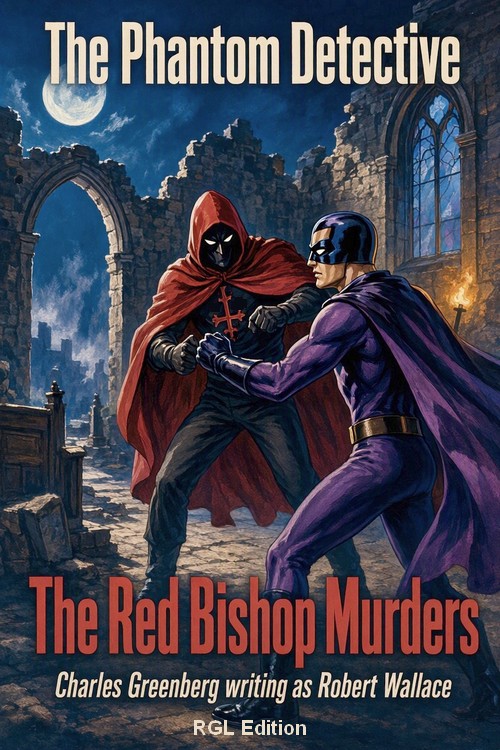
RGL e-Book Cover
Based on an image created with Microsoft Bing software
Roy Glashan's Library
Non sibi sed omnibus
Go to Home Page
This work is out of copyright in countries with a copyright
period of 70 years or less, after the year of the author's death.
If it is under copyright in your country of residence,
do not download or redistribute this file.
Original content added by RGL (e.g., introductions, notes,
RGL covers) is proprietary and protected by copyright.
RGL e-Book Cover
Based on an image created with Microsoft Bing software

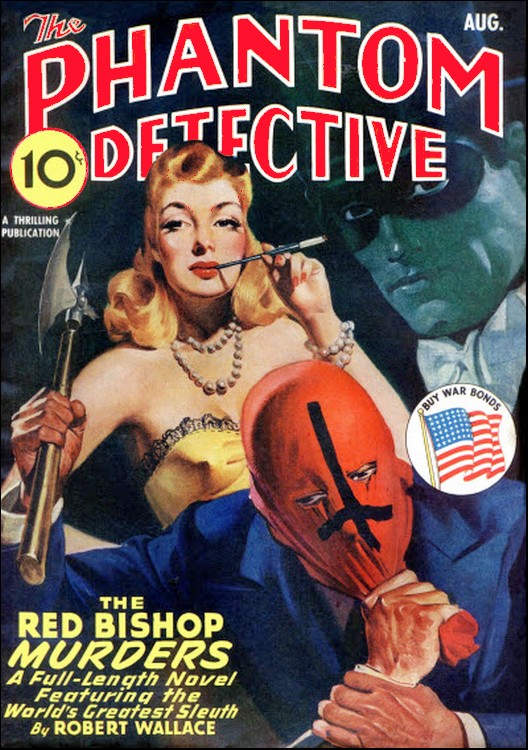
The Phantom Detective, August 1943, with
"The Red Bishop Murders"
The Phantom Detective takes the trail of an infamous masked menace who directs an evil crew dedicated to destruction of America's bastions of war production! A modern master of murder imitates the grisly crime pattern of the Middle Ages!
THE big sedan slithered to an abrupt halt, and the driver, a tall, foppishly dressed Spaniard, wrenched open the door on his side and got out. There was something feline and cruel in his olive-tinted face, and a mocking devil lived in his black eyes. "We're here, folks," he said.
He watched as a tall, shapely blond girl with a beautiful, but coldly expressionless face, like that of a mannequin, got haughtily from the car. As she dropped a black veil, completely covering her face, the Spaniard masked his own dark countenance with a silk handkerchief, and pulled his hat-brim over his eyes.
Another man who alighted from the car, coming up behind them, was a sinister figure. A tall man, completely in black, except for his scarlet, silken hood. With diamond-shaped slits for the eyes, it entirely concealed his face. A painted black line on the scarlet silk bisected the hood vertically, and another made a cross-bar where the mouth should be. A cross—sinverted!
For a moment, the girl stared at him. Then she said slowly:
"Maybe it wasn't just a macabre whim on your part to borrow the name of the infamous Black Bishop of Toulon, servant of the Prince of Darkness. I am almost beginning to believe in something else now, Bishop."
"And what is that, Anita?" the "Bishop" drawled.
"Reincarnation," she whispered softly, and he laughed.
It was a bleak, gray November afternoon. Dreary weather, and dreary, deserted countryside, with no sign of human habitation. And the only sound was the sobbing of the wind in the gaunt trees.
"How far is Matt Tasker's place from here, Ramon?" the hooded man asked the Spaniard.
"A quarter of a mile. That way." Ramon pointed to a weed-choked path which cut into the red clay banks.
"Chances are fifty-fifty, Anita, that our greeting will be a tommy-gun burst," the Bishop said. "Molloy's nerves should be in bad shape by now. Wait in the car, if you like."
"Of course, I'm coming with you," she said, with a note of annoyance.
THE hooded man walked to the car and lifted out a portable phonograph. At the same time Ramon grabbed the ankles of a body slumped on the floor-boards, and dragged out a small, thin man with a pinched white face and a bald head. It lolled hideously as the Spaniard walked toward the path with the unconscious man over his shoulders.
The small procession followed the path in silence, rustling dry weeds and grass, moving through thick underbrush, until at last they emerged abruptly into a clearing. A prosperous farm had once been here. Now all the buildings were dilapidated, and no plow had touched that soil in many seasons.
But someone lived here. Smoke lifted from a chimney, and as the visitors approached a man flung open a door and stepped out onto the porch, watching them silently.
"Death is close now and watching us, Ramon," the hooded man said softly. "Come on!"
The old man on the porch, whom they knew to be Matt Tasker, was gaunt, leathery-faced, with unkempt gray hair. Peering from beneath bushy eyebrows, he looked at the Spaniard with the body slung over his shoulders, at the tall blonde with the frozen white face, at the scarlet-hooded man in black. He still said nothing. It was the Bishop who spoke.
"Andy Molloy," he said. "I want to talk to him."
Matt Tasker slowly shook his head.
"Ain't nobody here by that name. I live alone."
The Bishop raised his voice, a guttural voice, with a Teutonic accent.
"Andy Molloy!" he called loudly. "I have no connection with the police! I believe you hear me, Molloy, are watching us. I know you are here—from Chick O'Keefe. Chick is with us now. I must talk to you, Molloy. You have nothing to lose by listening, and much to gain."
Silence again in the-deserted countryside. The listening group waited like figures of stone. Then a thin, wailing, flutelike sound came from some undetermined source. As it died away, the old man said shortly:
"Come on."
He stepped off the porch and led them past the well to the tumble-down barn. Inside its sagging doors, they waited. Presently there came a rustling sound from one of the dirty stalls, and a trapdoor beneath the old hay was pushed up. A man's head and shoulders showed above the opening; broad shoulders, and a massive, brutal head.
Years in the ring had given Andy Molloy a broken nose, cauliflowered ears, and one deeply-scarred cheek. But he was no punch-drunk ex-pug. His eyes were shrewd and hard and coldly intelligent, and his body powerful. He held a submachine-gun covering the group as he climbed out with catlike grace.
Three men followed him—a hard-eyed, hard-mouthed youth, a squat, hairy, gorillalike man, and a big blond fellow who was handsome in spite of dissipation signs in his face. Each man was armed with an automatic.
In the tense silence a soft, moaning sound came from the man slung over the Spaniard's shoulder.
"Put him down, Ramon," the Bishop said. "Chick seems to be coming to just in time."
"Start talkin', pal," Molloy said to the hooded man, his voice menacingly slow. "So you have to talk to me, eh?"
"Sure, Molloy," the Bishop said. "And I'm handing it to you straight, because you're no fool. Ten days ago you and your boys stuck up a bank in Trenton, after a huge defense plant payroll. But things sort of went wrong, eh, Molloy?"
"Sort of," the gunman muttered.
"A guard went for his gun. You shot him, but not before he ripped off your handkerchief mask. Thirty people saw you, Molloy, before you and your men blasted your way out and got out of Trenton—leaving six bodies behind you. All of which makes Andy Molloy and his boys about the hottest bunch of guys in America. There is a terrific manhunt out for you—and this is one rap you can't beat, Molloy!"
A SHADOW passed over Molloy's brutal face.
"Now tell me somethin' I don't know," he growled.
"I can tell you that one of the men on that job with you was Chick O'Keefe. He didn't want to come to this hideout with you, because he couldn't get any cocaine here. So you let him go on with the getaway car. You liked the idea better, anyhow, of having the car found abandoned sixty miles or so away from where you actually were. So—"
The bald-headed little man on the floor moaned again, and his eyelids began to flutter.
"You still haven't told me anything I don't know, pal," Molloy menacingly growled again.
The hooded figure came a step closer. "I will now. A tire blew out on the getaway car when Chick was twenty miles from Philadelphia. He got out to fix it, leaving his overcoat and the five grand you had given him in the car. A police car came shooting up, and Chick had to make a break for it, without the coat. Now he had no money. And he had to have cocaine. So he came to Ramon, my friend here, whom he used to know on the West Coast, with a proposition."
The little man was sitting up now, and terror was beginning to replace the bewilderment in his eyes. His heavy, panting breathing was the only sound as the masked man raised the cover of the portable phonograph, and started the machine playing a record that was on the disk.
"I'm goin' nuts, Ramon!" came a high-pitched, hysterical voice. "I got to have some snow—and you can get it for me. Curse it, I'm puttin' tefl grand in your pocket! That's the reward the bank is offerin' for Molloy's capture, dead or alive! All you gotta do is tip off the cops that Molloy and the mob is bein' hidden out at Matt Tasker's farm near Kent, Pennsylvania, and Get me some snow! Or I'll go off my noodle, you hear me? I tell you—"
The Bishop lifted the needle off the record.
"Plain enough, isn't it, Molloy?" he murmured.
Chick O'Keefe's face was livid with terror.
"Andy!" he screamed. "I was goin' nuts for a snifter! I didn't know what I was doin'! Andy, gimme a break!"
Molloy made a signal to the gorilla man.
"You handle this, Oscar," he said. "I don't want to risk somebody hearin' a shot."
"Andy!" Chick O'Keefe screamed again, as Oscar's arm came from beneath his coat, holding a murderous-looking knife.
He threw it with a peculiar wrist snap. Chick O'Keefe's scream became a gurgling, choking sound as the knife buried itself in his throat. Molloy looked down at the little man's body in an ever-widening pool of blood—once—and turned back to the hooded man.
"There's still unfinished business," he said. "This Ramon could have told the cops where me and the boys were hidin'. Instead, he came here with Chick, with that girl there, with you. Why?"
"Because I told him to," the guttural voice replied. "Chick came along just when we were looking for a mob to pull off a few jobs. I've got some big plans, Molloy, but I need men like you and your boys. So you go to work for me, and in return, I'll destroy your worst enemies—your faces! They are your tickets to the chair! But with a changed appearance that the police cannot recognize You get it, Molloy? Free to go anywhere! That's what I'm offering you."
MOLLOY'S nostrils began to dilate. "You one of them plastic surgeons?" he demanded.
"No. But I can bring one to you tonight—and I never make idle promises." He swung to the big blond gunman. "You used to be a physician, didn't you?"
"I did." The man smiled crookedly. "Park Avenue—the works."
"Then you can see to it that the surgeon I'll bring doesn't play any tricks on you. All I want in return, Molloy, is unquestioned obedience from you and your men for a couple of days. Is it a deal?"
"Who are you?" Molloy asked softly. "Why are you masked?"
"You may call me—the Bishop," the guttural voice said coldly. "The reason we're masked should be obvious. The most carefully laid plans may go wrong. Anyway, after the plastic surgeon gets through with you, I won't know what you look like, either. So we'll be even."
"It's a deal," Molloy said. "Now how about givin' us an idea of what you want us to do for you."
"All right. There's a factory not far from here, with four guards watching it at night. Some time between now and morning, those guards will be killed and the factory blown up."
Johnny Kane, the tough kid with the bitter eyes, broke in savagely:
"That tips off who he is all right! He's one of them Nazi rats—a saboteur! Andy, we'll be takin' orders from Berlin!"
"So what do you care?" snarled Molloy. "If takin' orders from Berlin gets you a new face and a chance to scram out of this hole—"
The eyes peering through the slits of the hood appraised Johnny Kane for a few seconds.
"All right, Molloy," the man declared then. "I'll be back in a few hours with the eminent surgeon I promised. Then—we'll go to work. And ten thousand will be small change to what we'll be out to get!"
DR. JOHN GERRY, noted physician and surgeon, famed for his plastic surgery work which gave life back to those for whom war had destroyed hope, sat at a desk in a small Village apartment, busy with a manuscript which lay before him.
Stiffly formal in evening clothes, an elderly man with thinning gray hair, and with the austerity of a scholar and an intellectual, he seemed to have little in common with that room. It was gay with pennants and relics of college days, and the doctor would have appeared more at home in his Park Avenue apartment or his pretentious Westchester home.
But there was a reason he preferred the little Washington Square walk-up to his own oak-paneled and hook-lined libraries. For here Tommy Gerry, his only son, had lived and laughed and worked while a student at the university, on the Square. Tommy-had, donned a uniform after bombs had crashed upon Pearl Harbor, and now flew a fighter plane at some far Pacific base.
Dr. Gerry had kept the little apartment, and somehow felt when he was here that his son was near him. And only here was he able to concentrate as he should on the erudite treatise he was writing.
As he continued his work with slow deliberation, occasionally pausing to consult notes or thumb through index cards, suddenly he was startled by the peremptory summons of the buzzer over the door. That could hardly be Margaret, his wife, he thought, as he got up to press the button which would open the downstairs door. She was not supposed to stop by for him to go to Frank Havens' reception until nine. More likely it was some friend of Tommy's who had forgotten he was in the Army.
He heard footsteps in the corridor, and waited for a knock, knowing that the door was unlocked. But they came in without knocking—two masked men and a heavily-veiled woman. And Dr. Gerry, who had steady nerves, stared with incredulity.
One man was dressed completely in black, except for a scarlet hood dropped over his face, a hood on which, painted in black, was an inverted cross. As he advanced into the room he was a sinister figure.
The woman behind him was slim and smartly dressed. Her black veil completely covered her face. And the other man's face was masked with a silk handkerchief.
Dr. Gerry's stunned surprise was only momentary. Then he regained his customary cold composure.
"I don't find this intrusion amusing," he said sharply. "I've no fondness for practical jokes. Though you must realize by now that you are in the wrong apartment."
The hooded man sauntered leisurely toward the desk and waved a gloved band.
"No," he assured, "we're in the right apartment, Dr. Gerry. And we will at once get down to business. You're taking a trip with us, Doctor."
The scarlet-hooded man seemed perfectly at ease. The handkerchief-masked man at the door laughed softly. The girl had lifted her veil a bit and placed a long amber cigarette holder between her lips. She was now touching a lighter flame to the cigarette.
It was all casual—but it was suddenly hammered home to Dr. Gerry that this was no practical joke.
"I don't understand," he said slowly. "I am to go along with you? Where? Why?"
"Where, I don't mind telling you, is a rather dull little place called Kent, Pennsylvania," the hooded man said in somewhat guttural, Teutonic, accents. "Why? We'll discuss that later. Now you will please make a copy in your own handwriting of this message."
HE reached into a pocket and drew out a sheet of paper which he slid across the desk to Dr. Gerry. It was a typewritten letter, and read:
Dear Margaret:
I am sorry to take this way of announcing my decision, but it may be easiest for us both. I must disappear for a few weeks, where I can be undisturbed and completely alone, with the opportunity to finish my book. Do not think too harshly of me, for there is no need for you to worry. Be patient and understanding. I shall be back in a few weeks.
Love,
Jack.
He looked up, and saw the mockery in the eyes peering through the slits of the hood.
"Do you approve my literary composition, Doctor?" the masked man said. "Your wife, due here at nine, will find that note—in your handwriting—wedged in the mail slit above the downstairs bell. It will save her unnecessary worry and—what is more important—it will prevent her going to the police when you are missing."
Dr. Gerry shook his head. "Surely you don't think she will accept such a note? Of course, she will assume that I was forced to write it! Most certainly she will go to the police."
Soft laughter came from beneath the hood.
"My dear Dr. Gerry, isn't it obvious that before I could have written such a note that I must have learned quite a bit about your private life? I know, for instance, that your wife calls you 'Jack,' not 'John.' And that you have become such a near recluse since your son joined the Air Force that your wife will not find too abnormal your sudden decision to disappear for a few weeks," And a small voice within Dr. Gerry was whispering:
"That masked devil is right. Margaret will believe it. In heaven's name what is all this about?"
"Mind telling me how you happen to know so much about my private life?" he asked acidly.
The man in the hood merely shrugged, and the girl with the veil laughed huskily.
"Please start copying that note, Doctor," the hooded man ordered sharply.
Dr. Gerry made no move. He was not frightened. He was coldly angry.
"The next step, I suppose," he said evenly, "is physical violence and the threat of death. Go right ahead. I certainly will not copy that note."
More mocking laughter came from beneath the red hood.
"That won't be necessary, Doctor. We won't do anything so crude. But I—er—understand your wife is in rather delicate health, so we have been thoughtful of her. But since my object is to eliminate the danger of her notifying the police, it will be necessary for us to take your wife with us when she arrives here—unless that note is written. It might be particularly terrifying for her to lie under a blanket in the rear of a car for hours, bound and gagged, and later to be forced into the company of men who harbor no gallantry for womanhood. And your wife is a beautiful woman You understand, Doctor?"
Dr. Gerry's logical scientist's mind told him that this masked devil was not bluffing. Whatever the man's plans were, Margaret, Tommy's mother, must not be the brute's victim.
He must copy that letter. But was there any possible way in which he could warn Margaret that he was in trouble and that she should notify the police? Ordinary methods seemed impossible, for he was not dealing with a fool.
No, it had to be something subtle tricky. And as much as he loved Margaret he could not consider her especially observant or brilliant. It seemed impossible to do anything. Unless...
With scientific detachment, he began mulling over an idea which had suddenly struck him. Yes, there was something he could try, something that would tip off what had happened. But would Margaret notice it? Would anyone notice it? Yet it was worth trying.
He reached for a blank piece of paper and, writing with his usual slow deliberation, copied the note, word for word. He signed it and handed it to the masked man.
"Now," he said, "I've one other question. Are you aware that I am not a wealthy man? I am assuming, of course, that I am to be held for ransom."
"Your assumption is incorrect, Doctor," the hooded man said shortly. "But enough of that—for now. We are wasting time."
He had reached into his overcoat pocket as he spoke, and now a short, brown blackjack hissed viciously through the air. It caught Dr. Gerry behind his left ear. He made a soft, sighing sound, and his body slumped forward against the desk.
"We're off, Anita!" the hooded man said exultantly, and as he flung up his arm he-looked like a creature materialized straight from Dante's Inferno.
SMALL reception was in progress at the home of Frank Havens, millionaire publisher of the New York Clarion and a chain of other coast-to-coast newspapers. Interesting people were present, for Havens' guests were always those who had gained recognition in some specific field, celebrities because of accomplishment.
All distinguished, with one exception—a tall handsome young man who lounged in a deep chair near the portable bar. For Richard Curtis Van Loan's only claim to distinction, if it could be so called, was the fact, that he was an outstanding figure in café society life and that, as he would have admitted, with his amicable grin, he was an excellent judge of French brandy.
It was a known fact that the reason he was on such friendly, intimate terms with the publisher was because Havens and Dick Van Loan's father, now dead, had been lifelong friends. There could be no other reason, for there could surely be nothing in common between the two, since the life Havens led and that which apparently appealed to Dick Van Loan were a million miles apart.
Van Loan was a millionaire playboy, blithe and carefree, a young man who seemed to have no other object in life than the pursuit of pleasure. A playboy—and he looked it as he sat there, handsome, faultlessly groomed, a vague boredom on his face as he twirled the stem of a brandy glass while he talked with some of Frank Havens' guests.
Only the publisher himself knew the dramatic truth about this young Van Loan, one that would have electrified this room—and the outside world, as well. Of all the men in the world only Frank Havens knew that the supposed playboy was by far the greatest celebrity in this company of distinguished people. For Richard Curtis Van Loan, the millionaire playboy, was in actuality that grim and mysterious personality known as the Phantom!
The Phantom—conceded by police all over the world as one of the greatest sleuths who ever lived. The Phantom—dreaded and hated by the underworld like the plague. The exploits of the Man of a Thousand Faces, as he was often called, were fabulous and legendary, for time and again he had single-handedly attacked and smashed vicious criminal organizations.
The fact that no one except Frank Havens knew the Phantom's real identity was one of his most potent weapons. Since he was a master of disguise, always wearing a different disguise when on a case, criminals could not be on the look-out for him. Nor could there be retribution from friends of the human rats whom the Phantom had driven behind bars and into death cells.
That was why Van had deliberately and carefully kept up the pretense of being a playboy. It was an effective screen to disguise his activity as the Phantom, and anyone who wished to reach him could always do so through Frank Havens, the Phantom's only contact.
It was Havens who was responsible for Van entering the field of crime detection. After Van's parents had died, leaving him a great fortune, he had not known what to do with his life. The existence of rich man-about-town had soon palled, for Nature had demanded an outlet for his keen intelligence, his dynamic energy.
Havens had suggested that Van take a crack at solving a sensational murder which had been baffling the police. Van had taken the rather idle suggestion seriously. And three days later he had, anonymously, been able to hand over the killer to the surprised police. From that moment on, newspapermen who had been unable to get a line on the mysterious, but successful sleuth, had dubbed him the Phantom Detective.
Van had accepted that name and had gone seriously into the grim business of being a man-hunter. He had studied books on criminology and methods employed by noted detectives everywhere. He had perfected to a fine art his skill at various disguises, and had built a secret laboratory where he learned to use all the latest scientific equipment that could play a vital part in catching a murderer. He also spoke many languages, and as many dialects, as well as being an expert ventriloquist.
Knowing that he was in a deadly dangerous business, he kept his body in superb shape, mastering a grim efficiency in the use of lethal weapons, as well as his fists, and a proficiency in jujitsu. The underworld attributed supernatural powers to him, but his success was simply the result of study and hard work.
But it took nerve and will-power to maintain the playboy affectation, especially with his country at war. But he could not share with the disapproving, what one of America's leaders, sitting in his office in Washington, had told Van after war had been declared:
"You are doing a magnificent job, Phantom. For you to join the armed forces would be an error. To fight criminal rats on the home front, while the nation is at war, is more vitally important than ever. In disguise as you are, naturally I don't know you. But when you are called up, let me know immediately. Until then, forget your pride and let it be thought that you are not physically fit. For the Phantom must continue to function!"
Frank Havens, a stocky, gray-haired man with a kindly, ruddy face, had approached Van and was passing a word or two with the young fellow when the publisher's eyes lighted as a new guest—a slender, aristocratic, titian-haired woman—entered.
"Margaret Gerry," Havens said, in answer to Van's unspoken query. "Dr. John Gerry's wife. Beautiful, isn't she?"
"Beautiful, yes," Van said, watching her narrowly. "And under some terrific tension she is almost desperately trying not to betray."
Ha veils stared at him, startled, then hurried to Mrs. Gerry. She reached both hands out to him in an impulsive gesture. They moved away from the crowd, and she spoke swiftly for a moment. Then Havens came back to the bar.
"Have some brandy sent into the library, Judson," he told the bartender. Then he added in a low voice to Van: "You were right. She is upset—wants to talk to me, alone. I've a hunch you'd better listen in. Go into my study."
Van strolled away, moved idly into the hall, and to Havens' study. He had turned out the light and was in the darkness beside the partially-opened door which connected with the library when Havens and Margaret Gerry entered the library.
They sat down before the tire on the hearth, and when the man who served them with brandy had gone, Havens prompted gently:
"Now what is it, Margaret? What's bothering you?"
Her lips trembled as she said:
"Frank, you always have been one of our closest friends—Jack's and mine. So I want your advice. Jack—he's left me. Just for a few weeks, but Here's the note I found when I called for him at Tommy's little apartment. He's been writing his book there."
Havens read the note she took from her evening bag, and slowly shook his head.
"I'm mighty sorry, Margaret."
She leaned toward him.
"You know, Frank, that I have never been a jealous and demanding wife. I love Jack, and I know he loves me. But he's been acting so strangely recently—doesn't want to go anywhere or see anyone. And now he's gone—somewhere."
"John usually means precisely what he says," Havens tried to soothe her. "If he says he'll be back in a few weeks, he will. He may have war nerves—and he wouldn't be the only one."
"That's what worries me," she said quietly. "It just isn't like him, Frank, to leave such a note. If he wanted to get away for a few weeks he might have told me. Oh, Frank, I don't know what to think!"
She stood up and tried to smile. And Van knew that she was whistling in the dark as she said with forced lightness: "Oh, I'm going to be an optimist, and hope for the best. And I mustn't keep you from your guests. Let's rejoin them."
Van slipped into the library as the door closed behind them. He found the note that Havens had deliberately wedged between the cushions of the upholstered chair, read it, and shrugged. It seemed an anti-climax when he had anticipated something serious.
He was about to replace the note and return to the living room when something about it suddenly caught his attention. His eyes narrowed.
"Well, I'll be darned!" he muttered softly. "This is interesting!"
He was pacing the library when Havens returned to it ten minutes later.
"Well, Van," the publisher said, grinning, "I guess it was a false alarm. John Gerry just got fed up with social obligations and took himself off somewhere for a few weeks. I believe Margaret is persuaded of that, too, and no longer unhappy over it."
"Take a look at this note again," Van said, a trifle grimly. "The handwriting is steady, firm, but—"
"What about it?"
"Now notice that Dr. Gerry went over certain letters, tracing them twice," Van went on. "Any graphologist will tell you that denotes hesitancy and nervousness. And someone with such characteristics would not write as evenly and precisely as Dr. Gerry has."
Havens stared at him. "Say, are you inferring that Dr. Gerry deliberately emphasized certain letters?"
"Yes. Now look. His opening words are, 'I am sorry to take this—' He emphasized three letters by going over them again, blurring them just a bit. The letters 'SOS' Get it, Mr. Havens? SOS—the internationally accepted distress signal."
"You're right!" exclaimed Havens. "What other letters—"
"After several lines, the letter 'k' in the word 'book.' See it? And five other letters on the closing line, spelling, 'K-E-N-T-P-A.' That could only mean—Kent, Pennsylvania."
Havens stared at him incredulously. "Good heavens, Van, what are we to deduce from that?"
"That Dr. Gerry was forced to write that note," Van said grimly. "A clever man, he took that way of telling us that he's in trouble, and that it has something to do with Kent, Pennsylvania."
"Margaret and I got nothing out of that note," Havens said. "Dr. Gerry is lucky because you're here tonight."
"Dr. Gerry's good luck, as you put it, will not amount to much, unless we do something about it," Van said. "Tell me something about him."
"Well, John and I were roommates at the university, belonged to the same fraternity. He was a brilliant student, and after graduation soon began making a name for himself as a surgeon. After the last war, when he saw what horrors some of the wounded men were when they returned, he took up plastic surgery. Today he is considered one of the greatest plastic surgeons in American, though he gives most of his time, free of charge, to those who need help, and cannot afford to pay.
"A plastic surgeon, eh?" Van repeated sharply. "That's probably the reason for his abduction."
Van was narrowed-eyed as he paced the room, no longer the languid and mildly bored young man of fifteen minutes ago.
"Dr. John Gerry is a great man," Havens said quietly. "The world needs him. Van, we've got to do something."
"We will," Van clipped. "Only the name of a town isn't much to go on. We've got to have more information. Perhaps the doctor's wife can supply it. Ask her to stay after your other guests leave. I'll be back at midnight—in disguise, as the Phantom. Say you discovered the secret message in that note, and called me. I'll have had time, by then, to pay a visit to the apartment where the doctor wrote the note. Maybe I'll pick up some clue there. Have the address ready for me when I call you."
"I will, Van."
"Another thing. Call Steve Huston. Tell him to check through the Clarion files for anything at all tied up with Kent, Pennsylvania. Have him here at midnight. I may find use for him."
He paused, then added slowly:
"The abduction of a plastic surgeon implies still another criminal scheme that someone is concocting. There's something ugly brewing somewhere, Mr. Havens, and I've a hunch I'll be on the spot when it boils over."
IT was only a few minutes' walk from Frank Havens' home to the Park Avenue apartment building where Dick Van Loan had his penthouse. He passed the main entrance, turned the corner and walked up the side-street block, pausing before a private entrance door.
Unlocking the door, he entered a small hall. Another key opened the bronze door of a private service elevator.
There was nothing Van appreciated more than he did the exclusive use of that private entrance. For without it he could not possibly have functioned as the Phantom from the place he made his home. A Bowery derelict—he had been so disguised on a recent case—could not have left the millionaire playboy's penthouse without a scene from the amazed elevator operators and doormen.
But no uniformed lackeys knew who came and went by way of the private elevator which serviced but one stop—Van's own penthouse floor. Reaching his home now, he went straight through the palatial quarters to his bedroom.
Quickly he removed his evening clothes, then crossed the room and opened a huge closet. It contained the usual assortment of a well-dressed man of wealth. But this cedar closet also held a secret which would have startled anyone who knew Dick Van Loan.
Sliding aside the suits on the central rack, Van touched a hidden button. Noiselessly the back of the closet slid to one side. An overhead light went on automatically in the secret inner closet now exposed.
Fine modern weapons filled one entire wall-racks holding rifles, shotguns, various calibered revolvers and automatics. A deadly little Thompson submachine-gun was cradled in a suspended canvas bag. And in pigeon-holes were proper cartridges for each gun.
Shelves on the opposite wall were piled high with disguise accessories—toupees and wigs, ties, caps, hats, shoes and socks. Even underwear suitable to all types of men, for all occasions.
The clothing hanging horn the central bar between the two walls, ranged from a sailor's uniform to a priest's somber robe, a Broadway gambler's flashy garments, a train conductor's uniform, or the nondescript garb that might just have come off the back of a derelict who had slept in some gutter. Other clothes were just cheap and shabby, while still others might have borne a Bond Street label.
From this closet the Phantom drew the disguises for the Man of a Thousand Faces.
In the present instance there was no need for any specific disguise, for he had merely to alter his appearance. He selected a cheap, dark suit, a black hat, and a soiled trench-coat. He found a blue shirt and tie and a pair of thick-soled, cheap shoes. He backed out of the closet, to deposit the clothes on the bed.
Returning to the closet, he selected a .45 automatic, made sure that it was loaded and in perfect working condition, and slid it into a shoulder holster. Finally, from a small drawer he took three objects the Phantom always carried with him—a black felt mask he used on occasion, a small badge in the form of a glittering little mask of platinum and precious stones—the Phantom's insignia—and his portable makeup kit.
Closing the secret door, he sat down before his triple-mirrored dressing table, unlocking a drawer which disclosed rows and rows of bottles and jars containing every variety of make-up materials. Snapping on the side light, he studied his face in the mirrors, and his fingers deftly got busy.
A bit of paste from one tube, rubbed into his skin, promptly gave it a Mediterranean swarthiness. With a shading pencil he lowered his hair line and thickened his eyebrows. A clever little rubber gadget, made to fit under his lower lip over the gum, gave a pugnacious cast to his underjaw. And tiny pellets within his nostrils flattened and broadened his nose.
THE face of the tough, swarthy man now reflected in the mirrors bore utterly no resemblance to Dick Van Loan.
Swiftly donning the clothes he had selected, he strapped the shoulder holster over his vest and placed make-up kit, badge and mask in the especially constructed pockets with which all his disguise suits were equipped. And when he gave the final adjusting touch to his black hat and drew up the collar of his trench-coat, it was the Phantom, grim nemesis of crime, who descended in the little private elevator.
A drizzle was dampening the streets as Van headed for the nearest drug store to call Havens' home.
Frank Havens, waiting for the call, gave him the address of Tommy Gerry's Washington Square apartment.
"And, Phantom," Havens said then, "I've had a talk with Margaret. Kent, Pennsylvania, means absolutely nothing to her. She's never even heard of it. Nor has Steve Huston. He's checking the files now. They'll both be here when you come."
"Thanks, Mr. Havens," said Van, and made a wry face as he hung up.
A thin clue to begin with, the fact that the Pennsylvania town meant nothing to Mrs. Gerry made it even more vague. Dr. Gerry's abductors might have mentioned the town in reference to something that had no bearing on the case, and Dr. Gerry had pounced on it as the only clue he had.
Van flagged a cruising taxi and drove to Tommy Gerry's little walk-up apartment. The outer door was locked, but he brought out an oddly-curved, flexible strip of steel which he always carried in his make-up kit. There were few locks made which he could not quickly pick with that little gadget. In moments this lock clicked, and he pushed the door inward.
He walked up to the second floor. Apartment 2B that he wanted was in the rear. He tried the knob, and the door yielded before the pressure of his hand. That surprised him a bit, until he realized that there had been no need for Dr. Gerry's abductors to lock the door when they left, and Margaret Gerry probably had not gone upstairs at all.
It was pitch-black in the apartment as Van entered, the door swinging shut behind him. He began fumbling in his pocket for a match, to look for the light switch. And the lights suddenly flashed on! Glaring overhead lights, snapped on by a man who stood flattened against the wall six feet from Van.
He looked to be a foreigner—a tall, thin man wearing a fur-collared overcoat and a Horn burg hat. He wore a neat little brownish Vandyke, and cold blue eyes watched Van through horn-rimmed glasses. His right hand held an ineffective-looking .22 automatic.
Diagonally across the room stood another man, a burly giant with a beefy red face. His big hairy paw brandished a heavy revolver.
The unexpected shock of it was like an abrupt plunge into cold water. Van controlled his nerves, and checked the impulse to go for his own gun. That would be suicide, though he might take one of these men with him. He was in the hopeless position of being covered from two sides.
"It pays to be cautious," the bearded man said, in a steady, cold voice. "We had put out the lights and were ready to leave when we heard you in the corridor. It was possible someone was coming here. So now we'll have a chat, eh?"
VAN had to think fast—and straight. Simulating nervousness, he blurted: "Say, what is this? What did I bang into?"
"Maybe it'll all come out as we sort of keep chatting," the bearded man said. "Who are you?"
"Why, I—I'm the upholsterer," Van said shakily.
The man stared at him.
"You're what?"
"Sure. Dr. Gerry—the guy who lives here—wants those two chairs and the couch covered. I took the order, but didn't have a chance to take the measurements. He told me he won't be home tonight but he'll leave the door open and I could come right in. That's why I didn't knock. Look, what's this all about? I got six bucks in my pocket. If you guys want that—"
"You don't look like no upholsterer to me," the giant said.
"I don't? Well, what does an upholsterer supposed to look like?"
Van was trying to make up his mind with which of the two he stood a better chance if he tackled him in the face of a ready gun. He decided on the giant. There was a calm assurance about the bearded man that seemed more dangerous than the other's brutish hulk. Only he would have to maneuver himself somehow into a position where he would have a reasonable chance. One false move—
"Look," he went on nervously, to the giant, "if you doubt that I'm an upholsterer, I can prove it to you. I marked down some figures in chalk on the bottom of the seat cushion of that chair in front of you. Here, I'll show you. Only go easy with that gun, will you? Guns gimme the willies!"
He moved before the giant could reply, looking and acting like a badly frightened man as he edged hesitantly toward the chair.
"Maybe he's telling the truth, after all, Finnegan," the other man said coldly.
"Sure, I am," Van said eagerly. "Here, let me show you—"
He began lifting the cushion. Only a few inches away was the thick wrist behind that heavy revolver. Now! And in that breathless split-instant before swinging into action, Van knew that he was about to rub shoulders with death!
VAN'S hand shot out, steel fingers catching the wrist of the giant. He yanked it toward him, straightening the arm, holding it away from him. Then in the same fluid, continuous motion his right hand slapped upward to grip the big man's arm just beneath the jutting elbow.
It was a trick of ju-jitsu—leverage against and beneath a stiffly outstretched arm. Had Van wanted to, he might now have flung Finnegan, big as he was, completely over his shoulder. But that would have made him a target for the other man. He merely swung the giant around, so that his big hulk was between himself and the bearded man.
The man who had been called Finnegan cursed and rammed his free elbow into Van's solar plexus. It was a lucky, rather than a deliberate, blow. Van felt himself doubling up, choking for breath. He heard quick, running footsteps, heard the door open and slam shut. With a kind of incredulity, he realized that the bearded man had run out on his companion without making the least effort to help him.
He slid his right hand forward, until both his hands were on Finnegan's gun wrist. Then he jerked each in the opposite direction. A hoarse cry burst from Finnegan. He dropped the revolver. "Now, you big ox!" Van panted.
He swung the big man around. Once, twice, three times his fists found Finnegan's face. The giant went reeling back into the wall and crashed to the floor.
"All right, I'm through," he gasped. "You—curse you, you broke my wrist!" Van kicked the revolver across the room.
"Now isn't that just too bad!" he said coldly. "Your friend certainly wasted no time trying to give you a hand."
"Why should he? I don't mean nothin' to him."
"No? Now it's my turn to ask questions. Who are you?"
"You heard my name—Finnegan," the giant growled. "The rest of it is Mike. I'm a private dick. Who in thunder are you?"
"Also a private dick—of a sort. I'm the Phantom."
Finnegan sat up, one hand supporting his injured wrist, and stared at Van as if seeing an apparition.
"The Phantom?" he echoed, and groaned. "And of all the guys to tangle up with, I got to get myself in a brawl with the Phantom. Why didn't I pick Joe Louis?"
"Let's see your credentials," Van interrupted curtly.
Finnegan reached into his pocket, drew out a wallet, and handed it to Van.
A card under the cellophane bore the name of Michael Finnegan, licensed private investigator. Van threw the wallet back to him.
"Who was the man with you?" he asked.
"Said his name was Berger. He called me up. Told me he picked my name at random out of the classified directory. I sleep in my office. That tips you off how good business is. Anyway, he asked me to meet him in a bar. I did. Then he told me that he's married and he thinks that his wife ain't doin' him right. So he wants me to check on it with him. There's nothing new about that."
"Go on," Van prompted impatiently. "Okay, Phantom. He told me that a couple of hours ago his wife was supposed to have gone to see her sister up in the Bronx. She took a taxi, and because he was suspicious he remembered the license number of the cab. When the hackie came back to the stand, he asked him where he took his wife. The hackie said he brought her to this address, and this ain't the Bronx, see?
"He wanted me to come along with him and try to find out who she visited here. He acted kind of scared to come alone. So we came here. There's only six apartments in this buildin', and only one has a man's name on the bell—Thomas Gerry. So we figgered that must be it."
HE paused, wincing, as he rubbed his wrist.
"Go on!" Van prompted again. "What happened after you got here?"
"Nothing much. We rang Gerry's bell. No answer. So we rang another apartment to let ourselves into the buildin'. We went upstairs and tried that outside door. It was unlocked—on the level, Phantom. The guy looked through some of those papers on the desk and kind of generally snooped around."
"Did he take anything?"
"No. But I didn't like the set-up. So I told him we'd better get out. He said okay—and then we heard your footsteps outside. He pulled out a gat. I didn't know what was comin' next, so I thought I'd better have my Roscoe handy, too—just in case. He put out the lights and—well, you know the rest." Van watched the giant sprawled on the floor.
"I think you're telling the truth," he said slowly. "I don't have to remind you that it isn't smart to lie to me."
"No, it isn't. Finnegan affirmed positively. " I told you the truth, but I'm mighty sure the guy with me handed me a line. There must have been some good reason why he was scared to come here alone."
"You say that all you know about him is that his name was Berger?" asked Van.
Finnegan hesitated, his eyes thoughtful.
"Phantom, I ain't in such a good spot now maybe, so far as my license is concerned. So I'm goin' to play ball with you. Maybe I can tip you off to somethin' else about that guy. Like I told you, we met in a booth in a bar. We talked a while, then he remembered that he had to make a phone call. He left his overcoat when he went to make the call. I had a feelin' the guy was a phony. So I—I kind of dipped into his overcoat pockets. I found this!"
Again he stifled a groan as he reached into his pocket. He dragged out a telegram, handed it to Van. It was addressed to Norman Parrish, Hotel Winterset, New York City, and the message read:
LATHROP CALLING WHAT SECRETARY DESCRIBED AS VITALLY IMPORTANT MEETING AT 2:30 AM WHEN HE RETURNS FROM WASHINGTON STOP MEETING TO BE HELD IN STUDIO BEHIND LATHROP'S HOME STOP SUSPECT TROUBLE IS BREWING PARTICULARLY SINCE HUGH MARKHAM WILL ALSO BE PRESENT STOP DON'T FAIL TO ATTEND
DAN BOYLEN
Swift excitement narrowed Van's eyes. The message had been sent from Kent, Pennsylvania! The wire had reached New York an hour ago, therefore the mysterious meeting was due to come off in a couple of hours from now. Had it some bearing on whatever deviltry had made Dr. Gerry a kidnap victim?
He crossed to the telephone stand, quickly looked up a number, and dialed it.
"Hotel Winterset," a man's voice answered.
"Connect me with Mr. Norman Parrish, please," Van said.
"Sorry, sir, but Mr. Parrish has checked out."
"That's impossible," Van said curtly. "He's supposed to await my call. Perhaps I've the wrong hotel, and by sheer coincidence you've had another man who has the same name. Did your Mr. Parrish wear a small Vandyke and horn-rimmed glasses, and register from Kent, Pennsylvania?"
"That's the man, all right," the clerk replied promptly. "But he checked out a couple of hours ago."
"Thanks." Van hung up.
NOW the initial vagueness of the clue to the Pennsylvania town was being dispelled. He had something definite from which to springboard an Investigation. A man who looked like Parrish shouldn't be difficult to locate in a small town. And there were those other three names—Lathrop, Hugh Markham, Dan Boylen.
"It's a break, all right—wherever it leads," he thought, and began prowling about the room, his keen, experienced eyes darting here and there.
A single cigarette butt had been ground out in an ash-stand near another chair. There were no ash-trays on the desk, making it obvious that Dr. John Gerry did not smoke.
Van picked up the butt. The cigarette was of a popular brand, smoked by millions. There were no discolorations on the paper, and the tip was slightly puckered, obviously from having been wedged into a cigarette holder. A slight clue in itself, perhaps. Men seldom used cigarette holders. Women did, frequently. Had a woman accompanied Dr. Gerry's abductors?
The desk showed nothing of significance, and Parrish had meddled with it. Van peered into the neat little bedroom, into the kitchen, into the yellow-tiled bathroom.
Some smudges on the gleaming white porcelain of the tub were noticeable because the rest of the bathroom was so immaculate. Van drew aside the shower curtain and saw that the smudges at the bottom of the tub were footprints. And one print was of a woman's high heel!
There was no great mystery why people wearing shoes had stood in the tub. A window was beyond it. As Van himself stepped into the tub and raised the sash, he saw the fire-escape outside—the only window in the apartment looking onto a fire-escape.
A narrow black alley was below. That was how the abductors had left with Dr. Gerry. And a woman had been with them! A woman who used a holder when she smoked cigarettes.
Slowly, Van lowered the window, and his eyes were narrowed and thoughtful as he left the bathroom. The trip to this little apartment had paid unexpected dividends. He had a lead, something to work on.
Mike Finnegan was on his feet now, wincing as he rubbed his injured wrist.
"Would you mind if I left now, Phantom?" he asked miserably. "I wanna have a doctor look at my wrist. It's beginning to give me fits."
Van picked up the giant's revolver, handed it to him.
"Yes, you should have it attended to," he said. "It isn't broken; just badly sprained. But before you go—listen to this! I doubt if the man who called himself Berger but whose right name seems to have been Parrish will try to contact you again. Yet he may, to find out who I was. If he does, tell him nothing over the phone. Make an appointment with him, and let me know about it, through Frank Havens."
The giant nodded.
"I'll do that, Phantom."
Van waved toward the door, and Finnegan lost no time leaving. In a few minutes Van followed him out into the rainy street. He flagged a taxi, and as he started for Frank Havens' home, the publisher's words were ringing in his ears: "Dr. Gerry is a great man. The world needs him. We've got to do something."
"Yes, we've got to do something," he muttered grimly. "And—we will!"
THE storm which manifested itself only in a dreary drizzle in Manhattan was a torrent of rain and howling wind seventy miles away near the town of Kent, Pennsylvania.
Johnny Kane, the kid killer of Andy Molloy's mob, stumbled along in the wind-and rain-lashed blackness. He could not see where he was going. Again and again, some obstruction would trip him and he would go crashing to the ground.
Sometimes he would lay there, panting like a spent animal, the savage downpour pounding at him. Then he would get up, and keep going! He could not see six feet ahead of him. But he was sure that so long as he kept going downhill, he was bound to emerge onto a highway. And there, somewhere, he would find a telephone. If it was the last thing he did upon the face of this earth, Johnny Kane was determined to get to a phone and contact one certain man.
Johnny Kane, a kid brought up in the reform school, whose tool of trade later became the gun—Johnny Kane, society's outcast, wanted for murder, a tough, bitter kid who had made a career of crime and in whom every finer sensibility had been blunted and beaten—Johnny Kane had a hole, a soft spot, in his armor of cultivated hardness and callousness.
He had not dreamed that there was any crime at which he would balk. But he had discovered there was—when he thought he was being asked to help a Nazi saboteur! Johnny Kane, whom police were instructed to shoot on sight, would not be a traitor to his country!
He had brooded about it for hours, after that masked guy had talked about blowing up a factory. And at last it had been borne in on his atrophied soul that there was more to America than cops and rackets and suckers and blondes and what you could do with dough in your pocket. Sure!
And there was his old lady. She used to get him nervous, always trying to make him get a job and stuff, but she was pretty swell, too. His old man was okay, too. If he came home now, they'd hide him out and take care of him. Was he going to help guys who were liable to drop a bomb on their home? His brother Joe was one of those dumb honest mugs, but he was all right too, and Joe was in the Navy. Was he going to help guys Joe was fighting? Not on your life, you Nazi rat!
Johnny Kane had held off doing anything about it for a long time because Andy Molloy was no dope, and Molloy was already suspicious. Then, fifteen minutes ago, he had yawned and told Molloy that he wanted to go up and get some air. And now he was breaking his neck trying to reach a phone. If he could get in touch with one certain guy—no G-men or local cops for him—if he could just tell a certain guy—
The wind howled and the rain pounded—both allies and menaces to Johnny Kane, although he did not know it. Allies, because the two men on his trail, also fighting the wind and the rain, had lost him in the blackness. Menaces, because if the night had been still he might have heard death pursuing him and, forewarned, might have done something about it.
Andy Molloy had suspected that Johnny was up to something. With big, blond Ferguson he had trailed him out of the hide-out. He had seen the direction in which Johnny was heading before he had disappeared in the darkness. Downhill—and they had followed...
THE butler who opened the door of Frank Havens' home looked dubiously at the swarthy, tough-looking man who had rung the bell.
"My name is Gray," Van told him. "Mr. Havens is expecting me."
The butler's attitude changed swiftly. "Yes, sir. Will you follow me, please?"
There were no longer any guests in the great living room which Van crossed as he trailed the butler. The party had broken up. The butler ushered him into Havens' study, announced him and left, closing the door behind him.
Margaret Gerry was with the publisher. She looked pale but calm, and certainly less tense than the other person present, a young man with a thatch of red hair and a freckled, pug-nosed Irish face. Excitement glittered in his eyes, for Steve Huston, an ace reporter for the New York Clarion was always eager when there seemed a chance to work with the Phantom. He often did, for Van not only liked Huston but respected his courage, initiative and intelligence.
Van smiled at him. "How are you, Steve?"
"Swell. And on my toes, if I'm to be on a case with you. Or am I?"
"I think so," Van said.
"This is the Phantom, Margaret," Havens was saying to Mrs. Gerry. "I've told him about our problem over the phone. He'll be sure to find John for you."
"Thank you," Mrs. Gerry said, her voice low but steady. "And thank you, Phantom, for offering your help. It was clever of Mr. Havens to have noticed the secret message incorporated within that note, wasn't it?"
Havens coughed, and Van said:
"You are sure that the town of Kent, Pennsylvania, does not suggest any association in your mind, Mrs. Gerry?"
"Absolutely none."
Van turned to Huston.
"How about you, Steve? Were you able to dig anything up?"
"Well, I found one clipping—just a stick or two that ran in the Clarion several days ago," Huston replied. "But I can't think of any possible connection it could have with Dr. Gerry's abduction."
"What was it, Steve?" asked the Phantom.
"A Kent concern, manufacturers of cameras and optical equipment, received a huge order to make cameras and binoculars and so on for the War Department. Just a story in the business section. The manufacturer's name is Jonathan Lathrop."
Van started. Lathrop! The name mentioned in that telegraphed message!
"Here's the only other thing I dug up about Kent, Pennsylvania," Huston said. "It can't have anything to do with Dr, Gerry, either. Kent isn't far from Trenton, New Jersey, and it's within the area where Andy Molloy and his mob are supposed to be hiding out—if they didn't somehow manage to break through the police dragnet. If you ask me, they did. Molloy's smart."
"Who is he?"
"Well, he used to run a lot of rackets in Philly, and a lot of the politicians there, too. A tough hombre who can think as fast and as straight as he can use his gun. No mug, by a long shot! G-men and local police have for years tried to pin something on Molloy—and never could. But he stuck his neck out too far when he and his killers tried a stick-up in a bank in Trenton."
VAN nodded thoughtfully.
"I remember now," he said. "A guard, shot by Molloy, jerked off a handkerchief which had masked his face."
"And plenty of people saw Molloy's face and can identify him—so it's one rap he can't beat! It's the hot seat now for Molloy and his prize crew of killers, if they're taken alive. After the stick-up they just vanished into the thin air. And for over a week now Pennsylvania and Jersey have had the biggest manhunt in their history. So far, they haven't been able to pick up even a single clue where that gang of killers might have gone."
Van glanced at Margaret Gerry, and saw the haunting terror in her eyes.
"Phantom," she said breathlessly, "you—you don't think—those murderers kidnapped my husband?"
"We've no reason to think so," Van replied. "This Molloy and his mob may be hundreds of miles now from where the police have an idea they are hiding." But deep down in his heart he wondered! Who could have greater reason to kidnap a plastic surgeon than a man in the desperate position of Andy Molloy?
"Besides," Huston added, "Molloy and his mob wouldn't dare leave their hide out to come here to kidnap Dr. Gerry. All entrances into Manhattan are still being watched. They couldn't possibly make it."
And again Van wondered! A big shot like Andy Molloy had friends. Dr. Gerry might have been brought to his hideout—in Kent, Pennsylvania.
MUDDY, and drenched to the skin, the scarecrow that was Johnny Kane finally slid down the embankment paralleling the highway. The storm had lost some of its savage fury and the howling of the wind had died down to a sobbing sound. Johnny Kane crouched at the edge of the highway, trying to get his bearings.
Distant pin-pricks of light were visible through the thinning rain—outskirts of the town of Kent, Pennsylvania. Closer was a barely distinguishable black mass with several lights strung across its front. That, Johnny knew, was a big factory. The masked man had said "a factory near here," so that must be the one he meant.
"And it ain't goin' to be blown up tonight!" he muttered. "Not if I get that call through."
As he began trotting toward the town, the headlights of an approaching car appeared, blurred and misty in the rain. Like a wary animal, Johnny darted to the side of the highway and sneaked behind a billboard, crouching there until the car sloshed past. Then he trotted on along the wet, black highway.
Not far behind him, two other soaked and muddy scarecrows waited until that car passed before they slid down the embankment.
"Now what, Andy?" Ferguson panted. "This is still looking for a needle in a haystack. Assuming that Johnny has reached the highway by now, we don't know in which direction he would proceed from there."
Molloy jerked an arm toward the lights which marked the town.
"He'd go there. If he wants to take it on the lam from us—if that's all he's got in mind—then he'd try to hop a freight out of there. But if he went Boy Scout all the way, as I think he did, the town is where the cops are, too. Or the nearest telephone, anyway."
"So?"
"So," Molloy said savagely, "let's make a run for it. Maybe we'll overtake him if he's on his way to town. Anyway, we've got to, curse it! We can't sit down in the hide-out knowing that Johnny may be telling the cops all about it. Come on!"
THEY plunged on up the highway toward town.
Johnny Kane—was gasping for breath when he reached the first building—a service station with gasoline pumps standing before it like sentinels. His shoes made a sloshing sound as he trotted up to the door of the locked and darkened place. With his gun he smashed out a pane of glass in the door. He froze instinctively at the crashing tinkle of broken glass, then thrust his arm inside, found the inner knob of the Yale lock, twisted it.
With the door open, he glanced up and down the highway. No cars coming, no sign of life anywhere; only rain-splattered blackness. He glided inside, closed the door behind him. There should be a phone here. But where? It was pitch-black in the place. He reached in his pocket for matches, and made a wry face when he felt the soft, wet pulp that had been the match box.
He began groping around and his hand brushed a light switch on the wall. One moment of indecision, then he turned the switch and a glaring light went on overhead. In the instant before he switched it off, he spotted a desk on which was a telephone and a small, gooseneck reading lamp.
Johnny crossed to the desk. He removed his wet cap, gathered it around the globular shade and tilted the lamp on its gooseneck so that the bulb was close to the desk-top. Now when he snapped on the lamp, little light escaped. It would not be noticeable from the highway, and yet it dispersed the gloom sufficiently to enable him to look for a Manhattan telephone directory. He did not see one, however. He shrugged, turned to the telephone. His mouth was a thin straight line as he lifted the receiver and jangled the hook.
When the operator answered, he said in a cold, clipped voice:
"I wanna make a long distance call to New York City. This is government business, so snap into it! The man I want is Frank Havens, publisher of the New York Clarion. I don't know his home number, but it's listed in the phone book."
"Is this a person-to-person call?"
"Get me his home," Johnny clipped. "If he's out now, maybe I could find out where I could reach him. And make it quick, Operator! This is important!"
"Do you want to hold the wire or should I call you back when I put through the call?"
Neither of them knew then what tremendous import hinged upon that harmless question. Normally, Johnny Kane would have hung on to the receiver. But when the operator suggested that she could ring him, he replied:
"Okay. Call me back."
It would give him a chance to see if there was a cigarette around here, a chance to take out of his shoe a pebble that was driving him crazy. Certainly he could not guess that his answer would cost him his life—as well as the lives of several other men now ignorant that death would soon reach for them.
Outside, on the highway, Ferguson, running next to Molloy, said:
"Say, what was that?"
"What?" Molloy said, slowing his stride.
"A light went on and off up the road there a ways."
"I didn't see it."
Then they were given something else to think about when they saw approaching headlights. There was no convenient billboard nearby, and both were cursing under their breaths as they crawled into some bushes at the edge of the highway. It was a truck and it came rolling by slowly. They waited until it passed, then burrowed their way out and they continued running along the wet black highway.
"I think that's where the light flashing on and off came from," Ferguson panted, indicating the dark, deserted gasoline station they were about to pass. "Nuts, there's nobody there," Molloy said irritably. "Save your—"
He stopped short as the ringing of a telephone faintly reached them above the splatter of the rain. Then he caught Ferguson's arm. Someone had answered the phone in the filling station supposedly closed for the night!
"I think this is it, Doc!" Molloy said in a sibilant whisper. "Come on!"
And death which might have gone right by had found its quarry!
FRANK HAVENS' British butler had answered the phone. In reply to his query, a curt voice said:
"Never mind who this is. I gotta talk to Havens—quick, see? This is important, so don't ask any more dumb questions!"
"Hold the wire, please."
His nose quivering haughty disapproval, the butler knocked on the door of the study, entered at Havens' command.
"There is a—er—rather odd person on the telephone, sir," he announced. "He wishes to speak to you, but he would not tell me his name. It is a long distance call—from Kent, Pennsylvania."
The reaction startled the butler more than had the tough jargon of the man telephoning. Havens half rose.
"Kent, Pennsylvania?" he echoed tersely.
HE snatched up the telephone on the desk. Another telephone extension stood on a smaller desk the publisher's secretary used. Van was at that desk, snatching up the receiver, by the time Havens barked:
"Hello. Havens speaking."
"Hello, Mr. Havens," Johnny Kane said. "Look, I ain't got time to answer a lotta questions. Just take my word that this ain't no dopey gag. At least four guys I know of is gonna be bumped off between now and mornin'—and plenty else is gonna cut loose, unless I get hold of the Phantom. I gotta tip him off to somethin'. Where can I get hold of him on the phone? Or maybe you can get him to call me at—"
"He happens to be right here with me," Havens interrupted. "Just a moment."
One who lives by the gun, as Johnny Kane did, has sharper perceptions than a normal person. Johnny swiveled his eyes to the door. He thought he heard a sound out there that was not caused by the rain and the wind.
"Phantom speaking," Van said. "What do you want to tell me?"
Still staring at the door, Johnny Kane said:
"Hello, Phantom. You bein' where you are is one lucky break. I'm crossin' to your side of the fence now—though I won't last there long. Listen!"
And then Johnny himself paused—to listen! He was a wild animal, startled, frozen, as suspicion swiftly became certainty. Suddenly he knew someone was lurking in the darkness outside that door!
A wild animal doesn't pause to deliberate. Nor did Johnny Kane. The instinct of self-preservation swept his right hand for the big automatic in his overcoat pocket.
"I'll call you back," he snapped into the mouthpiece.
He hung up and swung around to turn off the shaded little reading lamp. Then, back to the wall, he crouched there with the automatic. And Andy Molloy's cool, unhurried voice said: "It's the end of the line, Johnny." The door opened. Johnny Kano fired at the flashlight beam which lanced across and pinned him at the wall. Or, rather, he went through the mechanics of twice squeezing the trigger. No shots followed. He stared stupidly at the useless automatic.
"You left your rod in your coat pocket when I sent you to get some matches from Tasker," Andy Molloy said, entering the service station. "Remember? I didn't need matches, Johnny. But I was worried about you. I thought maybe you had things on your mind. So I emptied your gun. And now you're not Johnny Kane anymore."
They stood just inside the doorway, two big men with guns, the flashlight beam still pinning Johnny against the wall. And death had come in with them. Johnny straightened. His white face was set and defiant. His bitter eyes were free from fear.
"So it's the end of the line," he said. "But I'm still Johnny Kane."
Molloy shook his head, his brutal face barely visible behind the flashlight.
"No. You're Johnny Kane when there's a loaded rod in your fist. You've got something then. You're my size then. But now, Johnny, you're just a skinny kid holding a hunk of metal."
MOLLOY edged to the desk. He sat on it, dangling one leg.
"What a difference little things make, eh, Johnny?" his lazy voice went on. "Like you being with or without a gat you know so well how to use. Like me before and after that guard pulled the handkerchief off my face. Like Chick O'Keefe getting a flat and leaving in the car the dough I gave him. Like that phone ringing just when Doc and I were going by."
"And like me not havin' another minute to talk to the Phantom before I heard you outside that door," Johnny Kane said softly. "I should have kept talkin' anyway. I could've blurted out enough—"
"No, you couldn't. I was all set to let you have it at the next word you said. I heard what you told him, but even the Phantom will have nothing to go on. If he gets the local police to trace the call the cops will find that somebody broke in here to use a phone—nothing else."
"It ain't like you to talk so much, Andy," Johnny said. "You waitin' for somethin'?"
Molloy kept dangling his leg, watching Johnny.
"Maybe I'm waiting for you to tell me that you feel like a dope now. I always liked you. And here you put me in a spot where I got to bump you off. I—not the cops! It don't make sense. Don't you feel like a dope now, Johnny?" There was a distant expression now in Johnny's bitter eyes He was looking far beyond the killer facing him. And he was seeing many things in that moment.
"No, I don't feel like a dope, Andy," he replied, his voice slow and detached. "I feel pretty good. Yeah, pretty good—even with your gat pointin' at my belly. I like myself now, see?"
"You like yourself, eh?"
"Yeah," said Johnny Kane. "Me, I'm an American. That part of me ain't for sale. If Nazi and Jap rats wanna come over here and muscle in on America, they ain't got a pal in me. All right, so I didn't make it. But I tried, see? That makes me like myself. Now laugh your fool head off! I still wouldn't change places with you!"
Molloy shook his head again.
"By the eternal, Andy," big blond Ferguson said softly, "Hitler should hear this. It ought to give him a bigger case of the jitters than he has already. Johnny Kane, American—even though his America has an electric chair reserved for him, if he survives police bullets."
Molloy's big body swung off the desk. His left hand grabbed Johnny's coat, bunching it at the throat, jerking Johnny's thin body toward him. Then his right hand, holding the big automatic by the barrel now, slashed around. With a crunch-thudding sound, the heavy butt smashed into Johnny's right temple. Johnny's knees buckled under him. He crumpled to the floor.
Ferguson turned the body over. Johnny Kane's eyes were open, staring blankly into the beam of Molloy's flashlight. There was an ugly discoloration on his temple, and a thin trickle of blood traced a crimson rivulet across his white face.
"OUR patriot has gone to Valhalla," Ferguson murmured, straightening. "That what you wanted, Andy?"
"That's what I wanted," Molloy replied conversationally. "And I didn't want the cops to find blood or bullet marks here."
He put away his automatic and picked up Johnny's gun. His flashlight poked around the little room, pausing finally on the telephone and Johnny's cap which still hooded the reading lamp's shade. He removed the cap and with it carefully wiped off all possible fingerprints on the telephone, and everything else Johnny's hand might have touched.
"The crack you made about not wanting the cops to find blood or bullet marks here—I don't get it, Andy," Ferguson said. "Such evidence wouldn't mean a thing if we lugged the body away with us."
"It might get the Phantom too interested—once he gets the idea that the guy who phoned him got knocked off here. He might come snooping around this neck of the woods. And, Doc, that's something we don't want!"
"You're not kidding!" Ferguson said grimly. "What do we do with the patriot's corpse?"
Molloy rubbed his brutal underjaw.
"That's the big problem now, Doc. The police aren't so sure now we're still hiding out in this part of the country. But Johnny's body would be a sure tip—off that would turn the heat on all over again. So we've got to make sure it won't be found in a hurry."
"How about taking it back to the hide-out with us?" Ferguson suggested.
Molloy shrugged.
"We might have to. All right, let's scram."
He lifted the body by the wrist of one limp arm. Ferguson opened the door. Callously, as if handling a sack of potatoes, Molloy dragged the body to the wet concrete outside the station. Ferguson closed the door. In a final checkup, Molloy played his flashlight on the station. His hand paused as the beam of light brushed the window.
"Wait, Doc!" he said softly. "I think maybe I got an idea."
He dropped Johnny's arm and trotted around the station, the circle of light gliding on ahead of him. Ferguson remained there, tense and crouched over the body, his eyes raking the highway for headlights. He had begun to mutter under his breath when Molloy returned, a triumphant grin on his brutal face.
"I've got it, Doc!" he said. "I don't care new if the Phantom does snoop around here. It'll be one long, long time before this body is found!"
EXPECTANT silence hung over Frank Havens' study. Van, pacing the room, was glad that Dr. Gerry's wife had gone home before the mysterious phone call.
Four men scheduled to be killed between now and morning! Was Dr. Gerry to be one of the victims? What was the deviltry planned in that little Pennsylvania town?
Havens' brow was knitted as he watched the phone which, as tense moment after moment passed, did not ring again.
"Now why the sudden decision to call you back?" he finally said. "If your mystery caller started to tell you something, why didn't he go through with it?"
"There could be a number of reasons," Van said soberly. "Someone might have come in, and he didn't dare use the phone any longer. But I won't just twiddle my thumbs here—and wait."
He picked up the phone and spun the dial for long distance.
"Get me Police Headquarters, Kent, Pennsylvania," he told her when she answered. And presently he was saying, "Hello. This is the Phantom calling. Who is in charge there now?"
The man's voice that had answered lost its curtness as it said swiftly: "The Phantom? Just a moment. I think the chief is still around."
A brief pause, then another voice: "Hello, Phantom. This is Chief Gilbert. What can I do for you?"
"Trace a call that someone made from Kent a few minutes ago to Frank Havens' home here in Manhattan."
"Right. And then?"
"Then," said Van, "gear your investigation to these facts: The man who telephoned and asked for me was about to tip me off to some crime scheduled for tonight. Before he could give me the details, something frightened him. He said he'd call again, and hung up. Maybe he will call again, in which case an open police raid on the source of that call might be a bad error."
"You want me, then," said Chief Gilbert, "to find out where the call came from, and quietly investigate just what may be going on there?"
"That's it. Call me back here at Frank Havens' home. And thank you, Chief Gilbert."
Van hung up, and shook his head as he saw the questioning looks in the eyes of Havens and Huston.
"I won't start guessing—if you're waiting for me to begin expounding theories. We'll just relax and wait until we hear what that police chief has to report."
It was not many more minutes of tense, silent waiting before the phone rang, and Chief Gilbert reported:
"The call came from a service station a couple of miles outside of town. Someone broke in—apparently just to use the phone. Several men, judging by the muddy footprints on the floor. No other evidence, though I carefully went over the place. Nothing seems to have been taken."
"Fingerprints on the phone?"
"No—and that may be the one significant clue left. A thorough wiping job had been done on the phone and everything else there."
"Who owns the station?" asked Van. "An old man by the name of Sam Dickson. I've known Dickson and his son, who is in the Army now, for years. He's beyond suspicion. Listen, did the man who telephoned you give you an idea of what the crime scheduled for tonight is? Will it take place in Kent? I mean, just what am I supposed to be on guard for now?"
"I'd give a great deal to be able to answer these questions, Chief," Van said grimly. "Unfortunately, I can't! Not yet, anyway. Here's a question for you, Chief. Do you happen to know a man named Norman Parrish?"
There was an incredulous note in the police chief's voice as he replied:
"Sure, I know Parrish. He's the publisher of the Kent Gazette. What about him?"
Instead of answering that, Van asked:
"How about these two names—Dan Boylen and Hugh Markham? Do they mean anything to you?"
"Yes. Dan Boylen is the local sports promoter. He has bowling alleys and runs a big private gymnasium. Hugh Markham used to live in Kent when he was in partnership with Jonathan Lathrop. When he broke up the partnership, he opened his own plant—also manufacturing cameras and optical equipment—in Hurley, sixteen miles from Kent. May I ask why you're interested in these people?"
"You may—when I see you in Kent. Just' one more question. Is Lathrop's home in Kent?"
"Yes. It's an estate just outside of the town limits on Route Seventeen going west."
"And it has a studio somewhere on the grounds?"
The police chief began to sound bewildered.
"Yes, it has—behind the main house. There are two buildings there, in fact—one is his studio, the other is his laboratory. Look, has all this any connection with the call you had me trace?"
"That's what I propose to find out," Van said. "And you'll get the full explanation just as soon as I see you in Kent—probably tonight. Thanks again, Chief."
When Van hung up both Havens and Huston began talking at the same time, then paused simultaneously. Finally Havens blurted:
"Those names—where did you get them? What's all that about homes and studios? Where did you—"
Van smiled crookedly. "Here's your explanation," he said, and told them briefly what had happened at Tommy Gerry's apartment.
THEN he read the telegram which Finnegan had sneaked out of Parrish's overcoat pocket.
"Now let's see what it all adds up to," he went on quietly. "We know that Dr. Gerry was kidnapped. We don't know why. We were supplied the one slim clue—Kent, Pennsylvania. And someone telephoning from Kent, someone who broke into a roadside service station to make the call, tried to reach the Phantom with the tip-off of a crime scheduled for tonight in which four men would be murdered!"
"What do you think happened to the man who tried to reach you?" Huston asked.
"He was interrupted—and he hung up quickly, because perhaps he thought he could bluff it through. I don't believe he succeeded. For it isn't likely, Steve, that he would remove his fingerprints from the telephone he used. That must have been done by someone who anticipated that when I failed to hear from that man, I would trace the call and attempt to find out just who tried to call me."
"So the would-be informer," Huston said slowly, "was marched out at the point of a gun and is now held prisoner somewhere or is dead."
"Exactly. For the time being, I'll accept Chief Gilbert's word that there were no other clues at the service station. And whether the crime that the man had spoken of is tied up with Dr. Gerry's kidnapping—well, that's something that we don't know yet either."
"The same town—Kent—"
"Isn't proof," said Van. "Let's stick to what we know to be positive fact. We do know that Norman Parrish, publisher of the Kent Gazette, came to the apartment from which Dr. Gerry was kidnapped. And we know, from the telegram, that Norman Parrish will attend some mysterious meeting at two-thirty this morning. So what's our next move, Steve?"
"My car is outside, and I'll get you to Kent within an hour," the reporter said promptly, a grin on his freckled face.
Van grinned back at him.
"Take another few minutes and get me there with a whole neck. All right, let's go!"
Not much more than the hour later that Steve Huston had promised, two men stealthily approached the huge stone griffins which guarded the entrance to Jonathan Lathrop's estate.
"It's two o'clock, on the dot!" Huston whispered. "You're here and with a whole neck."
"Now start watching out for your own neck," Van said, peering into the grounds. "We won't use our flashlights, unless it's absolutely necessary."
It was a black night. The storm had blown itself out and it was no longer raining. But the clouds still hung low and there was a raw dampness in the air. Vaguely, Van could see the outlines of the main house. Only one shaded window showed a yellowish oblong of light. It emphasized the brooding darkness of the big stone house, and jarred with the suggested invitation of the wide open gate at the end of the driveway.
Wet gravel made a faint crunching sound beneath Van's shoes as he slipped through the gate. He proceeded up the driveway, moving close to the shrubbery which bordered it. Huston stuck close behind him, and their footsteps were the only sounds in the dead stillness of the night.
VAN increased his caution when he neared the house. Here the driveway split into a fork, one section of it curving directly to the main house, the other leading to the blurs of two buildings behind the house. According to what Chief Gilbert had said, one of them was the studio where the meeting would take place.
Van easily saw which was the studio—the larger structure that was built of unpeeled heavy logs to achieve a rustic, frontier cabin effect. It had a porch, and a kind of shed adjoined it in the rear.
One enormous, slanted window was fitted into the north wall to supply the proper light.
The other structure—the laboratory—was just a utilitarian, squat little brick building.
"We're early, Steve," Van said. "Now we've got to find a vantage point from which we can see and hear whatever mysterious business is supposed to—"
He broke off and pressed a cautioning hand on Huston's arm. There was a rustling sound somewhere near the other building. It was repeated—low, furtive, sinister in the darkness. Then Van felt the muscles on Huston's arm tighten as an eerie sound lifted from the blackness.
It began as a moan, swiftly strengthened into a sound a crying infant might make, kept rising until it became a spine-chilling howl, prolonged and savage and hideous.
"Good grief!" Huston exclaimed.
Abandoning caution, Van shot a flashlight beam into the direction of the sound. The howling ceased as the light pinned a yellow mongrel dog near the door, squatted on its haunches. For an instant, the dog's eyes reflected the light.
Then it bounded away, disappearing wraithlike.
Van removed his finger from the flashlight button. Dead stillness and blackness again.
"A dog!" Huston muttered. "Just a dog howling. But J never heard one make a sound quite like that!"
Van felt a tightness at his throat. Instinctively, his right hand crossed his chest so that it was close to the automatic in his shoulder holster.
"Dogs don't make such sounds—normally," he said softly. "They howl that way only when their masters are dead! Steve, there's death beyond that door!"
LINGERING across his chest, Van's fingers moved until they gripped the butt of the automatic. He eased it out, pushed down the safety and waited, listening. Then he sneaked across the driveway to the door before which the dog had howled.
He turned the knob and the door gave before the pressure of his hand. With a swift gesture, he threw the door open and directed a beam of light inside as he crouched with the automatic. And then he saw!
Yes, death had called here, and had left a grisly memento of the visit. It was a long, white-washed room, crowded with complicated-looking machines. But the most complex machine of all which had functioned here—the human mechanism—was wrecked beyond repair. The skull of the fat man in a blue smock who lay sprawled near one wall had been split with a hatchet or an ax.
Van stepped inside. Huston trailed him. The reporter grabbed Van's arm.
"Look, Phantom!"
Huston was pointing with his other hand, holding a flashlight to something on the wall opposite the corpse. Some symbol had been drawn with black and red chalk on the clean white surface—something that looked like a red hood, with diamond-shaped slits for the eyes. Across the hood an inverted cross had been drawn in black chalk. Beneath the hood had been printed, in bold black letters:
TOULON, FRANCE—1523.
A macabre sort of fascination held Van's eyes to that symbol.
"Does that mean anything to you, Steve?" he asked.
Huston shook his head.
"Well," said Van, "I suppose it wouldn't, unless you had made a study of criminology. But no records of crime in medieval days are complete without the spine-chilling account of the fiend who called himself the Red Bishop of Toulon. He operated in and around that French town in Fifteen-twenty-three—the infamous Dr. Jekyll-Mr. Hyde of medieval France. During the day, a nobleman popular with his friends and the people; at night, a creature of terror, wearing a scarlet hood with the inverted cross, skulking with a hatchet through the streets of Toulon. Scores of men, women and children were the victims of that first so-called hatchet murderer!"
"But why the inverted cross and the title of the Red Bishop?" demanded Huston.
"He openly admitted at his trial, when he was finally caught, that he served Satan, the Prince of Darkness, whose symbol is the inverted cross. The murders were human sacrifices he offered."
"What finally happened to him?"
"He was burned at the stake," Van said.
He paused inquiringly as he saw the excitement in Steve Huston's eyes.
"And there," said Huston, elated, "is your explanation of Dr. Gerry's kidnapping. Some homicidal maniac begins to believe he is the reincarnation of the Red Bishop of Toulon. But he isn't satisfied with just being imbued with the spirit of the Red Bishop. The mad devil also wants to look like him—exactly as the records describe him. So he kidnaps a famous plastic surgeon to force him to—"
VAN shrugged.
"Better put a check-rein on that fertile imagination of yours," he said dryly. "Dr. Gerry's kidnapping was too perfectly planned and executed to be the work of some homicidal madman. There's a far more practical reason behind that move."
"How would you explain that, then?" Huston indicated the symbol on the wall.
"A macabre whim, perhaps—since the Red Bishop was the first hatchet killer. Or the murderer may want the police to believe a madman responsible for this killing. Many people are likely to recall the story of the Red Bishop of Toulon from the clue of that symbol."
He paused, his eyes narrowing.
"Say, could this victim be Lathrop? Returned earlier from Washington than he was expected?"
He swung to the body, but with the hideous mask of gore covering the face it was difficult to tell what the man had looked like. A big, fat man, heavy-jowled, thick-necked. The hatchet or ax had done its gruesome work well, too, for death had been practically instantaneous.
Gently he lifted an arm of the corpse. It was still limber. The man had not been dead long. Thirty minutes, perhaps.
He knelt and wedged his hand beneath the blue smock to the dead man's hip pocket and eased out a wallet. There he found evidence that the fat man was not Jonathan Lathrop. Various identification papers in the wallet established the man as Henry Bevins, an engineer, forty-three years old, home address, Kent, Pennsylvania.
"Probably Lathrop's assistant," Van said. "And robbery, obviously, did not motivate his murder. There are several hundred dollars in this wallet."
He replaced the wallet and got to his feet.
"Couldn't Nazi saboteurs be behind this killing?" Huston suggested. "If the guy was Lathrop's assistant, and Lathrop has just got contracts from the War Department running into millions, and if he was contracted to manufacture some secret equipment, some secret weapon—"
"Maybe," Van conceded, the clipped, grim note in his voice matching the expression in his eyes. "But guessing won't give us the answer. Let's find out first what this mysterious meeting is all about. Lathrop wouldn't have called it at this hour, immediately upon his arrival from Washington, if it wasn't something of such great importance it could not wait until morning. Perhaps it may somehow tie in with this murder, with Parrish's visit to that New York apartment, and with Dr. Gerry's kidnapping. But we're going to tread softly, Steve. I'm a great believer in learning what cards other people are holding before I expose my own. Let's take a look at that studio."
The grounds still seemed deserted as they walked out of the laboratory. Through the darkness, Van appraised the blurry outlines of the studio fifty feet away. He edged to the shed-like adjunction behind it. A flimsy little rear door was set into it, one with a simple latch. Van expected it to be bolted on the inside, but the door creaked open on rusty hinges when he tried the latch.
Entering, with Huston close on his heels, Van snapped on his flash. The shed was a kind of storage room, with logs and kindling wood piled on one side, and the other littered with old magazines, picture frames, and other things which usually found oblivion in an attic. An inner door obviously communicated with the studio.
THAT communicating door was ajar a few inches. Approaching it, Van threw a beam into the blackness beyond. It exposed a huge, lofty ceilinged room. The great casement window filled one entire side of it. Facing the window was a massive fireplace, with a pair of muskets crossed above it, and bookcases on either side. The furniture was simple, yet comfortable, and Navajo rugs and hangings lent color to the place. That it was actually used as a studio was borne out by two easels and art material near the window.
"Well, luck's with us, so far, Steve," Van murmured. "We couldn't ask for a more perfect set-up for some eavesdropping. We'll just take it easy until—"
He jerked forward, listening. Then he snapped off the flashlight and quickly pulled the door to within an inch of closing. Faint footsteps had sounded out on the grounds somewhere. They became louder, more distinct as they crossed the wooden porch fronting the main entrance. There was the creak of a door opening, then a glaring overhead light flashed on.
The man who entered was a mousy, stoop-shouldered little fellow with thick-lensed glasses. In a fussy, old-maidish sort of way he began wandering about the room, turning on softer side lamps and flicking off the overhead light, straightening a rug here and a chair there. Obviously he was Lathrop's secretary or valet, tidying the place up for the meeting.
He turned to the door as there came the sound of a car approaching on the driveway. Headlights swept past the huge casement window. The car stopped and Van heard the slamming of a door. Once again footsteps echoed across the floorboards of the porch. A man sauntered into the studio.
Bitter mockery and a kind of savage defiance characterized the man's dark, handsome face. Dissipation had left heavy pouches beneath his eyes. He wore excellent clothes with a certain careless grace.
Pausing just inside the doorway, his white teeth showed as he grinned at the secretary.
"Hello, Weimar," he said lazily.
"Hello, Mr. Markham," the little man called Weimar replied in a squeaky voice.
Markham kept smiling.
"You know," he said, "I've often thought about you, Weimar. There's a bond between us. I really believe that your hatred of Jonathan Lathrop is as whole-hearted and intense as the one I bear for him."
Weimar looked frightened for a moment.
"W-why should I hate Mr. Lathrop?" he stammered.
"You used to be a human being when you went to work as his secretary twenty years ago," Markham said. "But Lathrop succeeded in bullying and browbeating all spirit out of you. Now you're just a gray little ghost. Aren't you aware of it sometimes?"
"I don't know what you're talking about," Weimar squeaked.
Markham laughed.
"No, of course, you don't!"
He sat down, crossed his legs. His head went back and he closed his eyes. And he seemed to go to sleep, with smoke still curling from his lighted cigarette.
Van watched the dark, bitter face.
A vicious devil lived within Hugh Markham, Johnathan Lathrop's ex-partner. The telegram forebodingly had stated—"Suspect trouble is brewing particularly since Hugh Markham will also be present."
There had been deadly sincerity underlying the mockery of Markham's voice when he had declared he hated Lathrop.
Van felt that fresh deviltry was piling up, destined to explode when that mysterious meeting finally took place!
SILENCE settled down. Markham remained motionless in the chair. Mouselike Weimar continued a halfhearted tidying-up prowl about the studio. Then came the sound of another car approaching along the driveway. Again Van saw headlights splash past the window. The car stopped. Faint voices reached Van. Then footsteps—crunching the gravel of the driveway, crossing the planks of the porch. A group of five men came in, all pausing when they saw Markham. The man in the chair gave them the mocking smile with which he had greeted Weimar.
"Would it be a bright guess to assume you boys held a jittery little get-together prior to showing up here?" his lazy voice drawled.
A thin, bony-faced, cold-eyed man who somehow seemed vaguely familiar to Van, said quietly:
"Yes, we held a jittery little get-together, as you put it. And we missed you. Don't you think a bit of cooperation might be intelligent—before Lathrop arrives?"
"Intelligent, maybe, but not nearly as amusing, Parrish," Markham replied. "I'll enjoy the spectacle of you boys squirming in anticipation of the grand surprise!"
Van knew now why that thin man's bony face had been familiar. Parrish! He was Norman Parrish, the man who had been disguised as a bearded foreigner when Van had surprised him in Tommy Gerry's apartment! Parrish, whom Van now knew to be the publisher of the Kent Gazette.
A husky, bald-headed man took a quick step past Parrish. His truculent little eyes glared at the mocking devil in the chair.
"For years," he said thickly, his face contorted, "I wanted to bash your face in, Markham! And now, by the eternal—"
"Take it easy, Boylen!" a third man cut in.
He stepped out of the group, a big man in tweeds who suggested the healthy, red-cheeked, bluff and sports-loving British country squire. But Van sensed hardness under his affability.
"Markham still might turn out to be the goose with the golden eggs," the man was saying.
"Yeah, Haley," Markham murmured. "I'm just playing hard to get."
Haley slowly shook his head.
"You're putting up a good front, Markham. But you'll crack, pal!"
"And that," another man spoke up, "should be a pretty thing to watch!"
He had a hesitant, sibilant manner of speaking, the tall, pale man standing next to Parrish. There was something sly and furtive in the way he peered at Markham over his shoulder, a smile on his loose, thick lips. His hands were white and soft, and abnormally large, and he rubbed them together as he spoke. It suddenly occurred to Van that there was no form of treachery before which this man would hesitate.
Markham seemed utterly unperturbed by the comment.
"You remind me of a fat, soft worm, Morley," he drawled. "Someday someone will step on you."
That brought a low chuckle from the man who had not yet spoken—a gaunt, untidy, leathery-faced man, with shrewd little eyes and a thin trap of a mouth.
"The reference to being stepped on is certainly prophetic—for you, Markham. Don't you realize that's precisely why Lathrop wants to see you here now?"
THEY all whirled as a heavy, booming voice said from the doorway: "You've hit it on the nose, Flynn—though it applies to all of you, treacherous vermin that you are! Yes, you're going to be stepped on, all right!"
He made an impressive figure, the big, burly man who stood in the doorway. He had a shock of gray hair and bushy gray eyebrows, and a face which a sculptor would have liked as a model—a rugged, high-cheekboned, Slavic face with a heavy underjaw and a broad wedge of a nose. There was power in his face, and strength in his beamed shoulders and huge hands, and in the massive bulk of his body. But cold hostility was in his eyes as he appraised the group.
"A nice, pleasant greeting, Lathrop," Haley, the pink-cheeked man in tweeds, said with his affected geniality. "Nothing like starting things off on an amiable note."
Lathrop made a gesture with his hand which suggested the brushing away of an annoying fly.
"We'll dispense with what you palm off as humor, Haley," his deep voice rumbled. "I've got something to say—and I want to get it off my chest just as quickly as I can."
He stepped inside, kicked the door shut and leaned back against it.
"Perhaps a bit of a summary might be a good introduction," he said. "Twelve years ago, I broke up my partnership with Markham. I had finally perfected my automatic lens grinder—the only machine of its type in the world—and with it I was prepared to manufacture fine cameras and optical equipment comparable to the best German products, the lenses of which are ground by hand. Markham had no faith in my machine. He wanted to continue manufacturing cheap cameras and other third-rate products. And he did—opening his own plant in Hurley."
"After your dramatic entrance," Markham drawled, "the slow build-up, eh?"
Lathrop ignored the comment.
"After buying Markham out," he continued, "I was a bit squeezed financially. So I offered the five of you—Parish, Haley, Flynn, Morley and Boylen—an opportunity to invest in my business. Each of you put up ten thousand dollars. I guaranteed you the full legal rate of interest, plus a certain percentage of the profits. You haven't done badly. In the years since then each of you has more than quadrupled his original investment. I've always played straight with you. Will you concede that?"
"Conceded," Norman Parrish's cold voice said. "Go on!"
"All right! When America entered the war, business slowed up and finally came to a standstill. My business —and Markham's. Priorities on metals and other materials just about crippled us. Markham had to shut down his plant. I functioned a little while longer, then I had to close down. Our one hope was Government orders. But at first all the emphasis was placed on guns and planes and tanks and ships. It took Washington some time to wake up to the shortage—and importance—of cameras and binoculars and similar equipment needed."
HE drew a cigar from his pocket, bit off its end. Without lighting it, he went on in a savage undertone:
"A few days ago, I finally lauded huge Government contracts. I won over all competitive bids because with my automatic lends grinder, capable of duplicating much more quickly the finest hand work, I can manufacture an excellent product on a mass production scale. I called you in and told you about it. I also told you that my figures to the Government were based on Markham's plant operating in conjunction with mine. I told you that Markham owed a hundred and sixty thousand dollars to the local bank, having given his plant as collateral for the loan; that the bank, of which I am one of the directors, intended to foreclose this Saturday—three days from now. I gave you all that information, little dreaming that I was exposing myself to a treacherous stab in the back!"
"You ought to be on the stage, Lathrop." Markham grinned. "A bit on the corny side, but not bad."
Pale, furtive Morley chuckled and rubbed his soft white hands together.
"Shut up!" thick-necked, bald-headed Dan Boylen said savagely. "Go ahead, Lathrop. What stab in the back you talking about?"
Disgust was on Lathrop's massive face.
"Maybe I'm just wasting my breath, but—all right. I went to see Markham. We dislike each other, but I still wanted to give him a break. I told him that I knew he could not meet the bank loan, that he would lose his plant. I offered him thirty thousand dollars in cash, and a fifteen-thousand-a-year job managing the plant, if he assigned its ownership to me—ownership which I could have got anyway, through the bank. And what happened? Markham laughed in my face."
"And was delighted to do that!" Markham's lazy voice said. "I am still laughing in your face, Lathrop. You never dreamed, you vulture, that the body on which you were all set to feast was not really dead!"
Van watched Lathrop try to control his welling fury. The huge hands clenched—relaxed. The purplish tint drained from the broad face.
"Markham told me," he went on, "that I was a fool to think that he would accept my offer. He knew all about those Government contracts which hadn't been made public yet! He knew the precise figures, knew exactly how much I depended upon his plant and equipment to fill the orders I had promised the Government I could fill. With a sneer, he informed me that he had found silent partners who had given him money to pay off the loan due Saturday. He would still work with me—sure. But only on a partnership basis!"
He paused, glaring at them, and thickness crept into his voice when he continued:
"Now who could have given Markham that information? There could be no leak from Washington. I know that. It leaves only you five men. I trusted you, told you something that no one else knew. Then you sneaked around my back to Markham. You gave him the money to pay off his loan, becoming his silent partners in return. Your greedy little souls quivered with delight at the thought of the share in profits that would flow from the sub-contracts that I would be forced to pass over to Markham. That's why I addressed you before as treacherous vermin! And that's why you're about to be stepped on—hard!"
FASCINATED, Van kept watching Lathrop. A meaningful pause had come. Several of the other men seemed about to speak—then changed their minds. It was Lathrop himself who broke the tense, momentary silence.
"And here's how I start cracking the whip," the big man rumbled on. "Under our original agreement, I had my choice, at the end of ten years, to refund your investment and drop you from the share in the profits. You were with me from the beginning, plenty of money was being earned, and I had no objection to your sharing the profits. It was plain generosity—to which I could not have been forced. Well, that ends right now! Each of you will be mailed my check for ten thousand dollars—and you no longer have any connection whatsoever with my business!"
"Now hold on a moment!" Parrish said sharply. "You speak of fairness. It is true that the five of us held certain information. But it doesn't necessarily mean that we, as a group, pulled the deal with Markham. Perhaps only one of us was guilty of that treacherous move. Why should the rest of us—the innocent men—suffer by it?"
"I'll ask you for the last time, Markham," Lathrop said. "Who gave you the money to repay your loan at the bank?"
"I don't mind telling you," Markham drawled. "It was a little old man wearing whiskers and a red cap who came down the chimney. I was so surprised!" Lathrop shrugged.
"All right, I'll answer your question now, Parrish. I've two reasons why I'm breaking things off with all of you. First, because I know darn well that no one of you can raise the sum of one hundred and sixty thousand dollars. You all must have pooled your resources. And my second reason: I haven't given you men much thought during the past few years. You seemed to be pretty decent citizens when I originally allowed you to invest in my business. You couldn't be called that now—as I realized when I really thought about you after this slimy business happened."
"And just what do you mean by that?" Parrish snapped.
"All right, you asked for it!" Lathrop clipped back. "You, Parrish, have turned the Gazette into a scandal sheet. I've heard rumors that blackmail is the club that you are holding over most of your big advertisers."
"That's a lie!" Parrish shouted. Lathrop ignored him. His eyes bored into the next man.
"You, Harvey Flynn, former district attorney, were kicked out of office on proved bribery and collusion charges, missing jail gates by a hair's-breadth. You can't deny that."
The gaunt, leathery-faced Flynn glared at Lathrop with his beady little eyes, but made no comment.
"Will you deny, Dan Boylen," Lathrop went on, "that you are running a gambling house in addition to your legitimate business? You also book bets on horses, and perhaps have other underworld connections. Don't try it, Boylen! I'll toss you through that window!"
THE tough-looking bald-headed man had a murderous expression in his eyes as he advanced toward Lathrop, then paused as if his body had struck a steel wire. He contented himself with savagely muttering something under his breath.
"And you, Ed Haley!" There was a lashing quality in Lathrop's voice now. "The good-natured, easy-going extrovert! The good fellow who likes everybody! How about those real estate swindles of yours—just a shade within the law—in which so many poor devils lost their shirts? Deals in which you were helped by the soft white sneak standing next to you—Philip Morley!"
A shadow passed over Haley's face, and for a moment the devil peered out of his eyes. Yet his voice was still easy and genial as he said:
"You've got the wrong idea about me, Lathrop. I'm sorry!"
Morley, looking obliquely at Lathrop in his furtive way, laughed again. In that moment, he looked a moron—but Van knew that he was not!
"Don't leave me out of it, please!" Markham drawled. "What evil can you tell the folks about me?"
Lathrop shook his head as he stared coldly at the bitter, mocking man.
"There's no deviltry of which you can't be capable," he said slowly. "Yet I still somehow respect you—as a man. Which is more than I can say for the others. You could be a dangerous enemy. But you won't get the chance, Markham. You, and the men who double-crossed me, are through!"
"Meaning what, precisely?"
"Meaning," said Lathrop, "that I've rearranged my production schedule. That's why I went to Washington. Your heavy equipment is similar to mine, but it is no longer imperative to fill my contracts immediately. I can begin production in my own plant, and sub-contract elsewhere later. Do you get that, Markham? I no longer need your plant—and there is nothing you can do with it. And I am withdrawing the generous offer I made you before. So, whose turn is it to laugh now?"
Silence again in the studio—silence in which swirled something ugly and savage and vicious. They hated Lathrop, those six men who ringed him. The burly man standing there alone reminded Van of a proud old bull caribou contemptuously holding half a dozen wolves with slavering jaws at bay.
"All right, this terminates our little get-together," Lathrop said harshly. "I've nothing else to say to you. Except—get out!"
Crouching outside the connecting door, Van knew he had to make a swift choice. Should he enter the scene now, or wait until the others, Parrish included, were gone. No, perhaps it would be better to surprise them now. With the tension, other explosive evidence was apt to bob up.
He opened the door and walked in, Huston trailing him.
"Just a moment, gentlemen," he said quietly.
Startled faces swung in his direction. " Now what the devil!" Lathrop said. "Who are you?"
And there was a second period of startled silence as Van opened his clenched left hand and exposed a glittering little object on his palm—a tiny mask made of platinum and precious stones, the Phantom's insignia.
Out of the corner of his eyes, Van watched Parrish. When Van had stepped into the room the man had looked as if someone suddenly had slapped him hard across the face. He looked dazed now. Van was positive that Parrish recognized him as the "upholsterer" who had surprised him in Tommy Gerry's apartment!
"WELL!" Markham said, no mockery now in his voice. "The Phantom! Is this something else out of your bag of tricks, Lathrop? Have you had the Phantom eavesdropping on us?"
"Don't be an idiot!" Lathrop snapped. "Didn't you just hear me ask him who he was?" He faced Van, his eyes puzzled, curious. "Phantom, I hope you'll forgive my curiosity, but what are you doing here? I am Jonathan Lathrop, owner of this estate."
"I know," Van replied, "and I'll explain to you later why I'm here. Something else unexpectedly interests me at the moment. One of your guests seems—er—familiar to me."
He turned to Parrish, who was lighting a cigarette, his bony face coldly expressionless.
"Have you a brother who looks much like you, except that he wears a Vandyke and horn-rimmed glasses?" Van asked casually.
Parrish shook his head, now in full control of himself.
"No, I haven't."
Van went through, the pretense of studying the man, feigning to be unsure. And there was no apprehension in the way Parrish faced the appraisal. The man had steady nerves.
"You remind me strangely of someone I met several hours ago in New York," Van said slowly. "You are sure you've never seen me before? I'm wearing the same disguise I was then."
"No, you're a total stranger to me," Parrish said coldly. "Who is the person of whom I seem to remind you?"
Parrish was subtly fishing for information.
"Oh, someone I encountered for a couple of minutes in the apartment of Dr. John Gerry's son."
Parrish only shook his head.
"I haven't been in New York in weeks"—there was cold finality in the denial—"and I know no one by the name of Dr. Gerry."
Parrish bluffed well, and Van knew that he was not the kind of man who could be easily bullied or trapped into a confession. Dan Boylen, who had sent Parrish the telegram, who certainly knew that Parrish was lying, stood by saying nothing, his beefy face set and frozen.
Again Van had to make a swift decision. It seemed to him that it was smarter to let Parrish think for the time being, that he had succeeded bluffing it through. Van could always confront him again later—and Boylen, too—with perhaps more evidence in his possession.
"Well, it's just one of those peculiar coincidences, I guess," he said, shrugging. "Sorry."
"Look, Phantom," Lathrop said, a helpless note in his voice, "what is this all about? Have you come to see me—or have you been trailing one of those men here?"
"I'll explain, when we're alone," Van said.
"Oh! All right. Well gentlemen—"
Lathrop stepped to one side and waved to the door.
NOT another word was said as the men walked out of the studio. The mouselike little secretary, completely forgotten by Van in his interest, closed the door behind them.
Van heard one car pull out of the driveway. A few seconds later, another followed it. Lathrop lighted his cigar, quietly puffing on it, waiting for Van to speak.
"Who is Henry Bevins?" Van finally asked.
Lathrop looked surprised at that opening question.
"Bevins? Oh, he's an engineer I employ. He should be working now in the building you may have noticed across the driveway. I can't understand why he isn't there now." Lathrop frowned a little as he glanced toward the darkened place.
"How do you know he isn't there?" Van asked.
"If he were the place would not be dark, would it?" Lathrop's eyes flicked to his secretary. "Did Bevins tell you where he was going, Weimar? He's supposed to be working all night."
"Working on what?" Van asked, before the secretary could answer.
"Oh, I am combining some of my machines, and making changes in the assembly line, to be prepared to swing into production next Monday. Bevins is supposed to be drawing up blueprints and a new floor plan for the changes."
"You wouldn't say, then, that he was working on something important?"
Lathrop stared at him.
"No, of course not. I mean—it's relatively unimportant. Routine stuff. Why are you so interested in Bevins and what he does for me?"
"You'd better see for yourself—in the laboratory," Van said quietly.
Lathrop's eyes narrowed and swift apprehension shadowed his face. Without a word, he whirled, swung open the door and darted outside. Van followed him, with Huston close behind him. They caught up with Lathrop when the big manufacturer opened the laboratory door and groped around for the light switch. A moment later, light flooded—the scene of murder!
A choking sound came from Lathrop. He fell back, lurching into Van behind him.
A low, fervent curse spilled from his lips.
Slowly then, as if wading chest high in water, he entered the laboratory. He stopped, shook his head, and turned incredulous, horrified eyes to Van.
"I—I can't believe it," he said softly. "Bevins was one of the sweetest, gentlest men I've ever met. Everyone loved him. I can't conceive of any reason why someone should want to kill him. It's—"
His voice broke off on another choking note. He was staring past Van now, and the expression on his face was that of someone who had just been kicked in the stomach. Van spun about. Lathrop seemed to be staring at only a blank wall. An empty work-bench rested against it. Nothing, surely, to warrant that violent emotional reaction.
He turned back to Lathrop and saw that the big man's face was still stricken, grayish, his lower lip caught between his teeth.
"WHAT'S the matter with you?" he asked sharply.
"A working model of my automatic lens grinder!" Lathrop panted. "It was on that bench. And now it's gone!"
"You mean," said Van, "you've made only one model of the machine which is so vitally important to your business. Surely, you couldn't have been so foolish. If it broke down—"
"Oh, I have two models, of course!" Lathrop said. "The other is at my plant. For the very reason you mentioned—in case something broke down on the machine at the plant, I could substitute the one I had here. And now I can no longer do that!"
"What's to stop you from building another machine?" Huston demanded.
"Young man," Lathrop said harshly, "that lens grinder has literally hundreds of complicated and delicate parts—all of which would have to be made by hand. In several months, working day and night, I could duplicate those parts—if I had the necessary metals and alloys and other material. Unfortunately, because of the war, those materials are no longer available in America. Do you understand? It's absolutely impossible to get them now! For the duration of the war, anyway, I cannot build another model of my machine. You may be skeptical, but it happens to be the bitter truth!"
"Now wait a moment!" Van said. "Let me get this straight. Bevins was killed because someone wanted that lens-grinding machine. Since you hold patents on it, since—even more important—a murder has been committed during its theft, no one can commercially utilize that machine. Therefore, it must have been stolen solely to keep you from replacing the machine at the factory now, if something happened to that other grinder!"
Lathrop's big body tautened, then he relaxed a bit. Drawing a handkerchief from a pocket, he mopped his face.
"The machine at the plant is safe enough, Phantom," he assured. "I suspected that Markham or those other rats might, out of pure vengeance, try some dirty business at the plant. So I have four armed guards watching the place. Anybody who comes prowling around there is going to get a warm reception."
Van stared at Lathrop, and for a breath he did not realize what prompted the sudden tension within him, the feeling of ominous warning. What should he remember that was eluding him for the moment? Then he asked tersely: "Did you say four guards, Lathrop? Four men watching the plant?"
Lathrop nodded.
"That's right. Why?"
Van was hearing again in his mind the voice of the man who had called Havens' home—"At least four guys I know of is gonna be bumped between now and morning—" Was it simply a coincidence that four men were on guard at Lathrop's plant? Or were they the four men scheduled to be murdered? If the model at the laboratory here had been stolen and the only other one was at the plant—
An ugly premonition stabbed at Van. "Lathrop," he snapped, "let's get over to the plant. And fast!"
The big man did not pause to ask questions. He understood enough from the expression in Van's eyes.
"My car is at the gates, Phantom!" he said promptly. "Come on!"
They charged out and pounded along the driveway, past the main house, and through the gates guarded over by the stone griffins. A heavy sedan was parked there. Lathrop wrenched open the door and slid behind the wheel. Van joined him on the front seat and Huston piled into the rear.
The big car roared along the deserted highway at seventy miles an hour, with Lathrop at the wheel, grim-faced.
"I know that nothing could happen to the other machine, with the guards on duty there," he growled. "But I'll feel better if I take it home with me tonight, and never let it out of my sight, from now on. Without that machine, I'm just about all washed up!"
VAN made no comment. The ugly premonition still lingered with him, like some cold, leaden weight in the pit of his stomach. The viciousness he had seen pile up at the meeting in that studio, the hatred swirling there, the criminal potentialities every one of those men possessed—it implied trouble in the making. Already it was building up; already it had made itself known in Dr. Gerry's kidnapping; in Henry Bevins' murder; in the theft of the lens grinder.
And even that, Van felt, was only the preliminary rumbling of the volcano, with the main eruption still to come!
And Van's intuition—the uncanny sixth sense which the Phantom had developed over years of contact with danger—was correct enough as he sat there crouched forward tensely in Lathrop's sedan. For the big car hurtling through Kent's silent, deserted streets was racing death to the Lathrop plant.
It had a few minutes' start on the Phantom, that small black delivery truck, ascending from the opposite direction the hill on which stood Jonathan Lathrop's factory. The hairy, apelike near-human called Oscar was driving. Big, blond Ferguson sat next to him. There was an automatic in his fist, and another gun lay on the seat.
"That's close enough, Oscar," Andy Molloy's voice said from the rear of the truck. "Stop just before you go around that next bend."
Seconds later, Oscar jammed on the brakes. The rear doors opened. Andy Molloy jumped out, landing catlike on the road. A tommy gun was cradled in the crook of his right arm.
"Okay, go ahead!" he called softly.
Slowly, in low gear, the truck rounded the final curve to the factory. Molloy trotted behind it, his crouched body close to the shadows cast by the underbrush fringing the road.
Jonathan Lathrop's plant was not large. The products he manufactured—cameras, binoculars, similar equipment—did not necessitate heavy machinery and much floor space. It was a neat modern brick building. Trailing ivy decorated its walls, and the grounds around it were as carefully landscaped as those on Lathrop's estate.
The four guards at the plant had been hired from a big New York agency—experienced, efficient men. They worked in pairs, in one-hour shifts. Two of them now were patrolling the grounds, slowly circling with flashlights. Each wore a revolver at his waist. The other pair were inside the immaculate plant, their heads close together over a checkerboard.
The men outside converged quickly as they heard and saw the truck come around the bend.
"Now who could that be?" one of them muttered.
The pair inside straightened from the checker-board, listening. The truck stopped, backed, and made a U-turn so that it faced the direction from which it had come.
"Okay, here's your generator," Ferguson yelled cheerfully to the two guards. "But we'll have to rig up a chain-hoist to get it out. The thing weighs over a ton."
"Generator?" one of the guards repeated, approaching the truck. "We weren't told nothin' about no generator delivered tonight."
"All right, so you weren't told about it," Ferguson said. "Lathrop said to bring it over as soon as we got through with it. It's a rush job. What's the matter with you guys?"
SOME instinct must have warned the guard. He paused and his hand dropped to the butt of his gun. Two men inside, curious, opened the front door and looked out. They stood framed in the glare thrown by the light behind them now. And Andy Molloy, sneaking up along a hedge, said with soft contempt: "So I figgered you'd do that, you dopes!"
He lifted the tommy. Unhurriedly, his finger depressed the trigger. The vicious hammering of the submachine-gun ripped the silence. For an instant, the two guards in the doorway became a pair of dolls attached to a string that was jerked to make them perform some grotesque dance. Then they crumpled.
The guard speaking to Ferguson had gone as far as drawing his guns when two bullets from Ferguson's automatic caught him in the chest. He staggered back, his hands making pawing motions. And he was screaming as he fell to the ground. The fourth man tried a desperate dash to get around the wall angle of the factory. Grinning, his gun trained on the running man's back, Ferguson played a sadistic cat-and-mouse game, waiting until the last moment. But it was Molloy who dropped the man, practically cutting him in two with another short burst from the tommy.
Ferguson shrugged, put away his automatic and got out of the truck. Oscar followed him as he circled to the rear doors. Molloy came sauntering over.
"An efficient gadget, the tommy," he murmured. "All right, let's get that box inside. Some dopey farmer may be on the telephone now, reporting those shots."
They lifted a wooden packing case out of the truck, one which seemed heavy even for men like Oscar and Ferguson, and carried it inside the factory, stepping over the bodies in the doorway.
"Park it about halfway," Molloy directed. "Just about where you are now."
They lowered the case, and Molloy stripped off the lightly-nailed planks across the top of it. The case held perhaps a dozen packages, each roughly the size and shape of a cigar box, and each resting atop a coiled cable to which it was attached. Lifting one, the attached cable trailing after it, Molloy carried it to one of the larger, tarpaulin-covered machines. He slid it beneath the machine, leaving it there. Ferguson and Oscar placed similar packages under other machinery.
They repeated the procedure several times, until the box looked like the body of an octopus, with a dozen long, black tentacles, each attached to a brown package, each tentacle reaching to various parts of the plant.
"All set!" Molloy clipped. "Remember, we've got only twenty seconds after I press that lever. Better get out there now, Oscar, and have that truck ready to roll!"
The hairy man ran outside, cursing as he slipped and almost fell on the blood in the doorway. Molloy stooped over the case. The only thing in it now was a square black metal box, with the radiating cables attached to it, and a lever on one slue.
Molloy pressed down on the lever. Immediately there was a faint clicking sound. The lever slowly began to rise, like the control gadget on an automatic toaster.
The truck's horn blared outside, thrice repeating a strident warning. Molloy swept up his tommy gun, rushed outside with Ferguson. The truck was moving slowly as Oscar yelled for them to hurry.
Immediately they spotted the reason for his alarm. The headlights of a car were rushing along the gently sloping straightaway that led to the factory, coming in the opposite direction from which the gunmen had. Along that stretch a car was approaching at high speed.
Molloy and Ferguson scrambled aboard the slowly-moving truck. Oscar jammed down the accelerator and the truck shot away, open rear doors flapping wildly.
JONATHAN LATHROP shouted above the roar of the motor as the sedan in which he and the Phantom and Steve Huston were racing to the factory: "A car just pulled away from there, Phantom! You see it?"
"Yes!" Van yelled back, drawing his gun. "And I don't like it! Keep after it. Something's wrong!"
And then Hades broke loose, stunning Van, even though he was prepared for some deviltry. He saw the red eye of a tail-light disappear around a bend. The sedan's powerful headlights swept the factory, now some hundred yards away. At one moment, it was a graceful, ivy-draped brick building. And in the next, just a heartbeat later, it became a mounting geyser of flames!
There was an instant when Van, his brain numbed by the crashing roar of the explosion, watched the terrifying—and savagely beautiful—fiery bombardment bursting upward and outward. The sedan lurched wildly to the right, as if recoiling from the red destruction. It left the road, plunging through a row of hedges and smashed head-on into a tree.
The crash of the impact seemed trivial after the explosion. Van unconsciously rolled his eyes upward as unseen objects thudded on the roof. Debris was dropping all around the car.
And then Van was suddenly aware of silence, of an incredible stillness. He stirred, and felt the bruise on his shoulder where it had struck the windshield frame. His mind began functioning again, like that, of a man snapped out of a hypnotic trance.
His first concern was Huston and Lathrop. He flicked on the ceiling light. Huston's white face gaped at him from the rear of the car. The same dazed expression was on Lathrop's broad face. Blood flowed from a minute cut on his forehead. Otherwise, both men seemed unhurt.
He wrenched at the door handle, got out of the car. The sedan was wrecked and steam hissing from the telescoped radiator. He turned and ran through the break in the hedge where the car had plowed through. And he stopped stock-still, cursing under his breath.
It seemed incredible that such havoc could be wrought in but a few seconds. Black smoke lifted from the shell which had been Lathrop's plant. Flames hissed and leaped, visible through the paneless windows, through the sections where the walls had been blown out. Their glare showed twisted junk of what had once been modern machinery.
But what of the four men who had been guarding the place?
Van had his answer when he circled swiftly to the front of the wrecked building. One man lay on his back just around the angle of the wall. The explosion had not killed him. There was a devil's stitch of a tommy gun burst across his chest. Another man sprawled a dozen feet away—also shot.
In moments Van spotted—the other two men, lying within the rectangular opening where the entrance door had been. There was gruesome irony in the fact that, although the door itself had been blown off, and a section of the wall had collapsed only a few feet away, there was no debris on or around those two bodies. Had they been merely lying there, they would not have been harmed by the explosion. But the two men hadn't been just lying there. A machine-gun had finished both.
Van's fists clenched as a savage fury welled up within him. Four men—murdered! A plant about to produce equipment needed for America's fighting men—destroyed!
"I'll get you, you rats!" he gritted. "I'll get you!"
VAN glanced over his shoulder as Lathrop and Huston came around the corner of the building. The big man's eyes were bloodshot and there was a grayish tinge, in his face. It looked as if it were carved of granite.
"That's cellulose for films and excelsior I used in packing that's burning now," he said tonelessly. "Highly inflammable stuff. Wouldn't you say, Phantom, this is a most efficient job of destruction?"
"I would," Van said grimly.
"I think I could do an efficient job of destruction, too," Lathrop went on in the same toneless voice. "With these!" He extended his big hands. "With these—on Hugh Markham's throat! With these—on the throats of the five rats who shifted over to Markham's camp! It is their handiwork that we are watching now!"
"If it is," Van said quietly, "they'll pay for it—in the electric chair."
Lathrop took a quick step forward and lifted a piece of fused metal off the ground. He stared at it, shaking his massive head. When he swung to Van, there was a maniacal glare in his bloodshot eyes.
"This is a part of the lens grinder I had in the plant. Now just a chunk of useless metal." His voice thickened. "Phantom, I never dreamed I could be capable of committing murder. I realize now that I can—and perhaps will! So help me, I'll kill Markham for what he did tonight. And before he dies, when my hands are on his throat, he'll tell me who's in on it with him."
"You'll do nothing of the sort," Van said sharply. "Leave vengeance in my hands, and in those of the police."
And as if to accent what he said, a distant wailing sound suddenly became audible above the snarling hiss and crackle of the flames. Where the straight section of the road led toward town, the headlights of two cars were rushing toward them, the moan of the siren swiftly becoming louder. Police!
A big touring car preceded an official police radio coupé. Both came to a slithering stop within a dozen feet of Van, Lathrop and Huston. Men with drawn guns, some in plainclothes, others in uniform, piled out of the two cars. They stopped sharply, in stunned incredulity.
There wasn't a single startled exclamation, a word of comment. The police officers simply stood there, staring at the murdered bodies of the four guards, gaping at the blackened, burning shell of what had once been Lathrop's factory.
A tall, gaunt, leathery-faced man was the first move. He approached Lathrop.
"I've heard the saying before—'where speech fails you,' " he said softly. "I know what it means now. Anyway, this is an F.B.I. case, obviously."
"Why do you say that, Chief?" Lathrop rumbled.
"Sabotage. Nazi or Jap rats. You've Government orders, and this was to be a defense plant. So—"
"Sabotage, no!" Lathrop snarled. "We know who did that!"
The police chief spun toward him. "You do!" he shouted. "Who? Say, this must be the crime about which the Phantom had an anonymous tip-off!" Lathrop checked what he was about to say.
His savage, bloodshot eyes swung to Van.
"What's that? You knew that this devilish business was planned for tonight, Phantom? And you, too, Chief Gilbert? And yet both of you got here too late! Curse it!" he yelled, swinging his clenched fists. "Why wasn't I told about it? I might have stopped it!"
"Hold on there, Lathrop!" the police chief cut in curtly. "If the Phantom could have stopped it, he'd have done it! I know you're upset, but try using your head. The Phantom has a reputation that speaks for itself. And I'm no fool, either. Someone heard shots and telephoned Headquarters. That was my first and only tip that anything was flaring up here."
LATHROP tried to control himself. "My apologies, gentlemen," he said chokily. "I am upset, and I did speak hastily. But I wish you'd explain, Phantom. You still haven't told me why you—and the chap with you—suddenly appeared in the studio."
"Lack of opportunity was the only reason I haven't," Van said. "I'll explain while we're en route to pick up Norman Parrish. That's our next move, Chief."
"Okay. We try his home?"
"As the first stop, yes."
Chief Gilbert gave clipped instructions to his men. One of them slid behind the wheel of the touring car as Van and the chief, followed by Lathrop and Steve Huston piled inside and the police chief snapped:
"Norman Parrish's home, Hennessy." The big touring car lurched away from the wrecked and smoking factory.
"Your explanation, Phantom?" Lathrop prompted. "Now?"
Van nodded. As briefly as he could, he sketched the clue to Dr. Gerry's disappearance, giving Havens credit for its discovery. He told of the subsequent scene with Finnegan and the bearded man at the apartment, and of the telegram clue as well as the mysterious, unfinished phone call. He detailed his discovery of Bevins' body at the laboratory and to what the symbol of the scarlet hood and the inverted cross referred.
For the dual purpose of clarifying it in his own mind, as well as telling the police chief about it, he gave a quick resume of what had happened at the meeting in the studio. And he concluded with Lathrop's discovery of the theft of the lens grinder and the tenuous little clue which had sent them racing to the factory.
Chief Gilbert, who began muttering under his breath when he heard about Bevins' murder, said slowly:
"Sure, Hugh Markham is a devil, if one ever lived. And those other five men—Parrish, Flynn, Haley, Boylen, Morley—they're a smart and nervy bunch of crooks. If they weren't smart, they'd all be in jail now. To get revenge on Lathrop, who slapped them down pretty hard, they stole one lens grinder and blew up the factory where Lathrop had the other. Okay! But I still don't see where and how Dr. Gerry's kidnapping ties in with this dirty business."
Van was quiet a while, his eyes slitted and thoughtful.
"It ties in all right," he said then, "and I think I'm beginning to see just where and how. Incidentally, forget the vengeance theory. Far more subtle reasons than pure vengeance were behind the destruction of Lathrop's plant. Anyway, Chief, granting that Markham and those men are capable of murder, if the stakes were high enough, they are not professional killers. I can see one of them sneaking up on Henry Bevins and splitting his skull with a hatchet. But killing four armed guards—that's a much trickier bit of business. The efficient manner in which it was done—the tommy-gun stuff—smacks of gangland to me. Professional killers pulled that job, Chief."
"Yes, that's true," the police chief admitted. "They might have imported professional gunmen—"
"Imported?" Van interrupted softly. "No, I've an idea the answer is far more dramatic, Chief—and it's the only answer that ties in with Dr. Gerry's kidnapping."
"What the devil are you getting at, Phantom?"
"You'll find out, when you hear me question Mr. Norman Parrish. He thinks he bluffed his way out of a tight spot. Well, Mr. Parrish is due for a rude awakening!"
The car swung to the curb.
"Well, it won't be long now, Phantom," Chief Gilbert said. "Parrish is home. That's his car in the driveway there."
PARRISH'S home, set back a bit from the street, was a comfortable-looking place. Light showed beyond the frosted glass of the entrance door, and it also made a yellow rectangle of one of the windows upstairs. A heavy sedan was parked in the driveway on the left. Van was halfway to the front door when he suddenly left the group, cut across the lawn and approached the car. He touched the hood. It was warm. Not many minutes since the engine had been shut off.
He joined the others, awaiting at the entrance door, for though the button had been pressed, so far there had been no response. Chief Gilbert tried it again, his finger lingering on the button. Still there was unbroken silence.
"He's home, all right," Lathrop growled. "Playing 'possum!"
Vague alarm began to stir within Van. Suddenly he reached out a hand to try the door. The handle yielded. Frowning, he pushed the door open—and froze, his hand still on the knob.
He was facing a hall where a staircase curved upward. A body was sprawled on the hall rug between the door and the staircase. The man lay on his face, one arm twisted under him, the other extended as if still reaching for something. He had a little bald spot and a thick neck, and a heavy, burly body. It was not Parrish.
Van darted inside. He stooped and turned the body over. The man was alive, for a moan escaped him. But the beefy, blue-jowled face was strange to Van. Blood smeared the fellow's forehead where some blunt instrument had struck him.
"That's Bill Jamison, Farrish's stooge, chauffeur and bodyguard," Chief Gilbert growled behind Van. "Phantom, are you thinking what I am thinking?"
"Yes," Van forced through his teeth, sibilantly. "Yes, Chief, I think—"
He leaped to his feet and, with the others trailing him, raced up the stairs, gun out and ready. As he reached the second-story landing, he was recalling that lighted upstairs window. It must be the room ahead, at the end of the corridor. He ran to the closed door and swung it open. The gun sagged in his hand and he slowly shook his head.
"It looks as if again we're just a few minutes too late, Chief," he said softly.
Norman Parrish would never talk. His body slumped in a deep leather armchair behind a desk, and death had glazed the eyes which stared back at Van. His skull had been split with a hatchet—as Henry Bevins' had been. The head must have been tilted to one side as the death blow was struck, for blood from the hideous wound soaked his hair and right shoulder and arm, leaving his face unmarked. Even—in death, it still recorded groveling terror.
A kind of savage frustration began gnawing at Van. Chief Gilbert's voice, low and hard, summarized what Van himself was thinking.
"Somebody else at that meeting realized that you had Parrish spotted," the police chief said. "And anticipated that you would crack down on him again. He got to Parrish first—with the hatchet!"
"That's it exactly," Van agreed. "Let's see what Jamison downstairs can tell us. He isn't badly hurt."
Van felt a kind of lynch mood in the atmosphere as he led the group of grim, silent men down the stairs. He himself found it difficult not to succumb to savage reaction which craved an outlet in counter-violence.
BILL JAMISON was conscious now, in a sitting position, dazedly shaking his head. "Cops!" he mumbled. "So it wasn't all a bad dream?"
"What happened to you?" Van asked. Jamison's bleary eyes focused on him. "Something that nobody will believe. Say, who're you?"
"He's the Phantom," Chief Gilbert said harshly. "Answer his question, and be quick about it!"
Jamison seemed abruptly to forget his throbbing head.
"The Phantom! Well! Okay, here's my story. It's short and sweet—and crazy. I don't expect you to believe it. Mr. Parrish came home and went upstairs. I was all set to get to bed when someone rang the bell. I opened the door and—" He hesitated. "Look, I know you'll think I'm nuts, Phantom, but—"
"Go on!" Van said impatiently.
"All right, I open the door and—and I get scared stiff. There's a guy standing out there who's got a red hood over his face, with holes cut in for the eyes. And there's a black cross on the red hood, sort of upside-down—I mean, if you took a cross Phantom, I told you I don't expect you to believe me."
"I believe you," Van said. "What happened next?"
"While I was staring at him, kind of hypnotized like, his right hand came up from behind him. It held a—a hatchet! So help me, it's the truth! He swung it at me, and the flat side of it smacked me on the head. And—and that's all I remember until I came to and saw you people—"
His voice trailed away, and in the sudden silence Steve Huston said with soft incredulity:
"The Red Bishop of Toulon! Phantom, perhaps we are dealing with a madman!"
"For the love of Mike," Jamison said, "what's this all about? Where is Mr. Parrish?"
"Mr. Parrish," Van replied, watching the man, "is upstairs—murdered!" Jamison's eyes widened and he pushed back against the wall.
"Murdered?" he whispered. "My sainted—"
"Can you think of anyone who might have reason to kill him?"
Jamison made a helpless gesture.
"No. He was what you might call a—a secretive guy. If he got into a mess with somebody, I don't know anything about it."
"Why did he make a trip to New York?"
Jamison shook his head.
"New York? I didn't know he had been out of town. I've been in Philly the past three days, visiting my sister who got married. You can check on that easy. I got back late tonight."
"Parrish tell you anything when he came home?"
"Not a word. When I opened the door for him he kind of nodded to me and went upstairs."
Van shrugged. He swung to Chief Gilbert.
"Well, Chief, we may as well face it. There's nothing further to be gained here. So we'll call on someone else now—in a hurry."
The police chief motioned to the patrolman who had driven the touring car.
"Stay here, Hennessy Okay, Phantom, let's go."
They ran back to the touring car. The police chief, sliding behind the wheel, threw a questioning look over his shoulder.
"Where do we go?"
"To have a chat with one man who knew that Parrish had gone to New York. The man who sent him the telegram. The man who heard Parrish lie to me, and stood by with a dead pan. I am referring to Dan Boylen, Chief. And let's not," Van added savagely, "be a few minutes too late this time!"
THE way Chief Gilbert drove the big touring car made Van regret his last admonition. The police chief, grim and savage at the wheel, seemed to think he was piloting a tank which could just as easily go through things as around them.
In a few minutes, they came to a screeching, tire-locked stop before Kent Arms, the town's leading hotel.
"Dan Boylen has a suite here," Chief Gilbert said, getting out. "Owns an interest in the hotel."
They crossed the sidewalk, with Van wishing now that Lathrop and Huston were not trailing with them. They entered the ornate, modernistic lobby and before either of them had a chance to say a word, a pale-faced, skinny little night clerk came charging around the counter.
"Mr. Lathrop!" he chattered. "Is—is it true that your factory was blown up?"
Lathrop made a motion as if to brush him away, then he swung around and his big hands caught the clerk's shoulders.
"How do you know that?" he demanded. "How do you know that my factory has been blown up?"
The clerk looked frightened.
"Why, I—I heard what sounded like an explosion somewhere. Mr. Markham was talking to me then. He said it was probably your factory—blown up."
"Markham here?" Lathrop panted. "He's here now!"
"Yes, he's here now," Markham's lazy voice said.
He sauntered out from a little side lounge, that handsome, saturnine-faced man, with a highball glass in one hand. Leaning against the wall, he took a sip of his highball, and grinned mockingly at Lathrop. Then following him out of the lounge, strolled a tall, smartly dressed blonde, with a frozen, expressionless, but beautiful white face. She reminded Van of a lovely icicle.
"You're tight, Hugh!" she said quietly. "Don't make a fool of yourself."
"Upon the contrary, Anita, my dear," Markham said, "I am quite sober—for me. Yes, Lathrop, and gentlemen, I told Jerry, the clerk, here, that it was your factory when we heard the explosion. Of course, I couldn't possibly know. It was wishful thinking. I was hoping it was your factory being—er—scattered to the four winds. Was I right, Lathrop?" The big man's face became a purplish blue, as if he were on the verge of an apoplectic stroke. Veins stood out, thick and corded, in his throat. He made a strangling sound—and both he and Van moved in the same instant. Lathrop, his arms wide apart, his fingers stiff and hooked talonlike, advanced toward Markham. And Van swiftly cut across the lobby to intercept him.
For murder walked with Lathrop. It was in his eyes, on his twisted face, in his dilating nostrils, in his animal-like, panting breathing.
Van shot a glance at Markham. The man's right hand was unhurriedly reaching into his pocket. It emerged, holding a snub-nosed automatic. And there was murder in Markham's black eyes, also, as he waited for Lathrop to reach him.
BEFORE anyone had a chance to say a word, or move, Van knew instantly that Markham's gun was not going to check Lathrop. Only one thing could stop that giant who was advancing with murder in his heart—and Van did it. As he reached Lathrop, his right fist slashed around, starting at the hip for an uppercut behind which were a hundred and eighty pounds of bone and muscle. It caught Lathrop full on the point of the jaw, snapping back his massive head. Lathrop's rigid arms dropped to his sides. He tottered like some great tree undercut by a woodsman's ax, then crashed to the floor of the lobby.
Van saw the blonde watching him with her greenish eyes. All through this brief but vicious little flare-up, on her face had been that same frozen, detached expression. It was as if she were watching a stage melodrama that bored her.
"Whoever you are, thanks very much," she said to Van coolly. "My husband is tight!"
"Which I'll again deny, my dear," Markham murmured. "Incidentally, Anita, the gentleman is the Phantom, the famous super-sleuth." His eyes shifted to Van as he pocketed the automatic. "If anyone should thank you," he said casually, "it's Lathrop, of course. You saved his life."
"And I do offer thanks and apologies, Phantom," Lathrop's deep voice said. He was up on one arm, bleak defeat replacing the insanity which had been in his eyes. "I'll curb my temper, from now on. I promise you."
"Okay, Lathrop," Van said. He swung to Markham. "You might have mentioned that I also saved you a murder charge."
"A murder charge?" Markham repeated, smiling. "Now really, Phantom. When someone who obviously belongs in a padded cell comes after me with homicidal intentions, haven't I the right to protect my life? Why, you yourself and Chief Gilbert would have been my best witnesses."
Van lifted a hand as he saw that Chief Gilbert was about to cut in with something explosive.
"Speaking of witnesses and alibis, Markham," Van said quietly, "it might be interpreted that since you were in the hotel here, speaking to the clerk at the moment when the factory was blown up, that the clerk to whom you were speaking could testify that you personally had nothing to do with it." Markham nodded.
"Yes, Phantom," he drawled, "it could be. Naturally, I couldn't be blowing up Lathrop's factory while I was here in the hotel. There could also be the simpler reason for my being here—to meet my wife and have a drink before driving sixteen miles to my home in Hurley."
"Pretty sure of yourself, aren't you, Markham?"
The black eyes mocked Van. "Perfectly. My wife will tell you, Phantom, that I never lose my temper, am never rattled—and almost always know precisely what I am doing."
"Almost always, Hugh," the blonde said tonelessly. "You might slip, one of these days."
"Or you might be tripped," Van said. "You're clever, Markham. Perhaps your most vulnerable point is your conviction that you are super-clever. Lathrop's factory was blown up. It was to be a defense plant—remember that, Markham. Four guards were murdered there. The fiend responsible for that outrage has also killed Henry Bevins and Norman Parrish. Markham, if you are innocent and don't want to be tangled up with this vicious business, here is your chance to prove it. I want the answer to one question."
MARKHAM'S hand was steady as he lifted his highball glass and drained it. There was a film now over his black eyes, and the bitter lines on his handsome face were more sharply etched. But he only said calmly:
"What is your question?"
Van's eyes bored into those black ones.
"Who gave you the money—or promised it to you—to pay off the bank loan against your plant?"
Markham studied the highball glass, twirling it slowly in his hand. When he glanced up the mocking defiance was again in his eyes.
"I took a walk down Broadway a couple of weeks ago, Phantom," he said easily. "I stopped off at a bar. Several strangers there asked me if I wanted to play poker with them. I did—and won two hundred thousand dollars." Watching that mocking devil, Van felt some of the emotion that must have impelled Lathrop to make his murderous outburst.
"So that's your story—and you'll stick to it, eh?"
"That's my story, Phantom—and I'll stick to it," Markham repeated. "I can't give you a line about the other murders, but you might be interested if you check the known fact that it was Norman Parrish's newspaper which exposed Flynn and Morley, wrecking Flynn's career as district attorney, and ruining Morley. Parrish handed them a beautiful double-cross."
"Trying to shove guilt on somebody else—that's being super-clever, eh?" Chief Gilbert growled.
MARKHAM grinned at him. That brought strained lines to the police chief's mouth.
"If you've no objections, Chief—and you, Phantom—I'll drive my wife home now. It's getting rather late."
Chief Gilbert was like a dog straining at the leash as his eyes lingered on Van.
The blonde waited idly, giving the impression that what was happening around her was completely outside of her world.
She intrigued Van, and he meant to bear her in mind, never forgetting that a woman had accompanied Dr. Gerry's kidnappers.
"Okay, Markham," Van said quietly. "You'll trip yet—and I'll be right there when it happens. You may go!" Some expression in Van's eyes checked what Markham was about to say. He ceased smiling and in a dead silence walked out of the hotel with his wife.
"You let him go." Chief Gilbert muttered. "He's guilty, and you let him—"
"I let him go home," Van said coldly. "But don't forget, Chief, there are such things as proof and evidence. Right now, we haven't a thing on Markham. We've got to keep digging." He swung to the clerk. "Has Dan Boylen returned?"
The frightened little clerk somehow looked trapped by the abrupt shift of attention.
"Yes, sir," he stammered. "He came in about fifteen minutes ago. And—and a visitor went up to see him just before you came."
"A visitor?" Van repeated. "Who?"
"Mr. Haley."
"Is it possible," Van said tersely, "that while we're barking up the wrong tree. You stay down here with Lathrop, Steve. Come on, Chief, let's call on Boylen!"
THE clerk took them up in an elevator, and pointed out Boylen's suite.
"The last door beyond the angle of the corridor there."
Van and Chief Gilbert traversed the silent, carpeted corridor, rounded the elbow turn. Light showed through the open transom above the last door. And voices now reached them. A voice which Van instantly recognized as Ed Haley's said curtly:
"I don't want to bicker with you any more, Boylen. Either you tell me what I want to know, or I'll pick up that phone and will try to reach the Phantom. Lathrop should know where he is. Now which will it be? When the Phantom is working on a case, I intend to keep my nose clean."
"You asked for it," Boylen's clipped, thick voice snarled back, "and now you're getting it, curse you!"
Van began running toward that door as he heard, the scraping of feet, a smothered curse, then the thud of a body crashing to the floor.
Van's gun was in his fist, thumb pushing down the safety, as he flung open the door. Dan Boylen, feet wide apart, stood in the middle of the room, his beefy face dark with rage. Bronzed, handsome Ed Haley lay on the floor, a thin trickle of blood flowing down one corner of his mouth. And no longer was he the genial country squire. His face looked ugly, and storm smoldered in his blue eyes.
The eyes of both men went to the door as Van and the chief burst in. And Van noticed that both instantly tried to mask what they felt when they saw who confronted them.
"All right, Haley," Van told the man on the floor, "you don't have to pick up the phone to reach the Phantom. Here I am. And I'll start with you. What were you going to tell me if Boylen refused to answer your question?"
"I no longer refuse to answer it, Phantom," Boylen panted. "It's just that it was none of Haley's cursed business—"
"I'm speaking to Haley now," Van snapped. "You'll have your chance." The bronzed man picked himself up off the floor. And Van thought that there could be something treacherous in the man whose face, coldly murderous a moment before, could so swiftly become genial and pleasant. He was a good actor—too good, perhaps!
"You asked Parrish some peculiar questions at the studio," Haley said. "I didn't know what it was all about, of course, but I was intrigued. More so, shortly afterward, when I overheard a little interchange between Parrish and Boylen here."
"What sort of interchange?" asked Van.
"We left in a group, as you'll remember. Parrish and Boylen walked on ahead. They seemed to be discussing something, as I sort of caught up behind them in the dark driveway. I heard Parrish tell Boylen—I'll quote it: 'Thanks again for keeping your mouth shut, Dan. You behaved like a good friend.' "
"Go on," Van prompted.
Haley shrugged. "That's all I heard, because they spotted me behind them. They shut up. But I don't happen to be a fool, Phantom. I knew that Parrish must have been referring to the questions you asked him. Boylen knew that Parrish was lying to you, and he covered it by saying nothing. That's how it added up to me."
"Why didn't you come to me with that information, instead of contacting Boylen?"
"I'll answer that, Phantom," Boylen said savagely. "The opportunistic sneak thought he'd come around and maybe blackmail his way into chiseling in on something. That's why I lost my temper and took a poke at him."
VAN turned swiftly to the big sporty promoter.
"Okay, you can have the floor now," he said. "Did Parrish say to you what Haley claimed he overheard him say?"
"Yes. I'm in a corner now, and I'll tell you the truth, Phantom. Yes, I knew that Parrish went to New York this morning—or yesterday morning, rather."
"Did you know why?"
Boylen shook his bald head.
"No. He merely telephoned me and told me he was going to New York for a day or two. He didn't explain why."
"Then why did he take the trouble to telephone you?"
"Because he thought something new might bob up on the Lathrop-Markham business while he was gone. If so, he wanted me to wire him at the Hotel Winterset, Manhattan. I did wire him when Lathrop's secretary told me that a meeting—"
"I know that," Van interrupted. "Your wire is in my pocket now. So it wouldn't have been bright of you to have lied to me. But why did he ask you to contact him rather than his secretary or someone on the staff of his newspaper?"
Van knew the answer to that, but he wanted Boylen to tell him.
Sweat began glistening on Boylen's beefy face.
"I don't know how much you overheard when Lathrop talked to us at the studio there. But—oh, I may as well admit it. The five of us did secretly contact Markham behind Lathrop's back and tried to chisel in on his plant, capitalizing on the information Lathrop had given us."
"What do you mean, tried?" Van asked sharply.
Boylen hesitated, then went on in a low voice:
"Markham was willing at first. But the next day, he turned us down cold. In his mocking way, he thanked us for the information and politely threw us out, explaining that he had been able to raise the money elsewhere. So in that respect, Lathrop was wrong—so far as I'm concerned, anyway."
"Meaning," said Van, "that some one of you double-crossed the others and quietly contacted Markham again, offering him the money on better terms than those you had given him as a group?"
"Meaning that, exactly," Boylen said. "For where else could Markham have raised a hundred and sixty grand?
"And of the five of us," Ed Haley cut in swiftly, "you, Boylen, with your underground connections, with big-shot gamblers from Philly having poker sessions in your gambling house here—you are the only one who could raise that much money. Sure, you hit the nail on the head, but you were pointing at yourself!"
"You want another poke in the jaw, Haley?" Boylen snarled.
"Never mind that!" Van said coldly. "You've given me some interesting information—which I suspected anyway—but we haven't come to the point yet. You admitted that you knew that Parrish was lying to me when he denied having been in New York. Why didn't you say something about it?"
"Because Parrish is a friend of mine," Boylan snapped. "I wanted to give him a chance first to tell me why he was covering up."
"And he told you?"
"Yes. But he said he stalled you off only because someone was present in the studio he did not want to tip off about him being in New York and what he had done there. He didn't tell me any more than just that. But he did say that he was quietly going to get in touch with you before the night was over and tell you all about it. So Phantom, if you think I'm lying to you, just pick up that phone and call Parrish!"
"That's no longer possible—unfortunately," Van replied slowly. "Parrish has been murdered!"
BOYLEN plopped heavily into a chair behind him. He opened his mouth to say something, closed it without uttering a sound, and stared at Van, slowly shaking his head.
Ed Haley muttered something under his breath and stunned incredulity was in his blue eyes.
If they were acting, both made an excellent job of it. And again savage frustration began gnawing at Van. This angle of investigation was rapidly bringing him to a blank wall.
"Did Parrish drive home alone?" he asked Haley.
"Yes. The five of us met in his office at the Gazette. We left our cars there and he drove us to Lathrop's place. After the meeting, he drove us back to the Gazette. We all transferred to our own cars and went home."
"Not all of you," Van corrected grimly. "One of you did not go home. He followed Parrish, and killed him. Boylen, did Parrish drop some hint, some clue, regarding the identity of the man at the studio whose presence had checked him from telling me the truth?"
"No, Phantom."
"I can give you a clue maybe—which is really common knowledge," Haley said. "Flynn and Morley had sworn to get Parrish someday. He ruined both of them—and they're men whose hatred should not be taken casually. I suggest you ask that pair a few questions."
"No, I believe I've asked enough questions, for the time being," Van said curtly. "No, I've other work to do. Good night, gentlemen."
WITH the police chief, Van descended to the lobby. Steve Huston and Lathrop were waiting, and all four went out and entered the police car at the curb. There, in a low voice, Chief Gilbert briefly outlined to Lathrop and Huston what had happened up in Boylen's suite.
"Markham is the killer," Lathrop declared positively. "How can there be any question about it?"
"Markham might be the killer," Van corrected irritably. "So might be Dan Boylen, who kept his mouth shut at the studio, who suspected that I would crack down on Parrish again—and who murdered him before I had that opportunity. The killer also might be Ed Haley, who murdered to keep Parrish's mouth shut, then went to pump Boylen to find out how much he knew. And there's the hatred that Flynn and Morley bear for Parrish."
"So what's your answer?" Chief Gilbert asked helplessly.
"We have no answer—yet. It's all 'if' and 'maybe' and 'perhaps.' Whoever that murderous fiend is, he's in the clear so far. So we've got to make some moves of our own, and I don't mean chasing around asking questions. Our first move is to take Lathrop home." Chief Gilbert stared at him.
"Do you consider that a move?"
Van nodded.
"Definitely. I've specific reason for wanting Lathrop to spend the rest of the night at home. But don't ask me why now."
The police chief shrugged.
"Okay. And what do we do next?"
"Next," Van replied slowly, "we're going to dig into the factor in this bloody business which is still unknown—but which I have never forgotten. Dr. Gerry's kidnapping, Chief. The clue in the note leading to the town of Kent, the fact that I saw Parrish in Dr. Gerry's apartment, the fact that he was murdered because he could tell me why he was there—all that definitely links the two crimes as part of the killer's scheme."
"And I still don't see how it can possibly tie in," Chief Gilbert said. "You tried to tie it up before with the fact that professional killers pulled the job at the factory, machine-gunning those four guards. I'll grant you that the—that mysterious Red Bishop guy imported gunmen to pull that job. Yet what has that got to do with Dr. Gerry's kidnapping?"
"Nothing," Van said. "If gunmen were imported to Kent. But isn't there a vicious mob of killers supposed to be still hiding near here somewhere?"
The police chief started, astonished. "You mean Andy Molloy and his murderous crew?"
"Yes. It may be a long guess, but it seems the only possible answer. The Red Bishop—let's continue calling him that for convenience—employed professional gunmen and kidnapped a famous plastic surgeon. Andy Molloy and his men are trapped and desperate. Even though they've evaded capture, so far, they're bound to be caught, sooner or later. Unless a plastic surgeon so alters their faces that they cannot be identified by the police! I believe that's the reward that the Red Bishop offered them in return for their help."
"It seems reasonable," Chief Gilbert confessed reluctantly. "But it's still just a theory. All efforts to find the hide-out of those rats have ended in dismal failure. Even if what you suspect is true, what can you do about it? In other words, what's your next move?"
"After dropping Lathrop off at home, take me to that gasoline station where someone tried to give me a tip about the devastation scheduled to come off at the factory. If I can find out who that man was, and what happened to him—"
"But I've already been there," the police chief interrupted. "I've gone over the place carefully. There's nothing. No clues—"
"I may be luckier," Van said grimly. "Let's get rolling, Chief!"
THE gasoline station was a few minutes' drive from where they dropped off Lathrop. Chief Gilbert parked at the pumps. He led Van and Steve Huston to the front door, coldly pointed out the smashed pane.
"I phoned old man Dickson about it," he said, "but he didn't bother fixing it until morning. Said there was nothing—in the place that was much worth stealing. Now you can take a look inside." The police chief opened the door, entered and turned on the light. Chief Gilbert considered this double-checking a slur on his efficiency, and he resented it.
"Here are the muddy footprints I told you about," he pointed out. "There's the phone—wiped clean of prints."
Van nodded. He knelt and studied the footprints. It was a lore in which he had the skill of an Indian.
"This tough reddish clay that was on their shoes—where does it come from, Chief?" he asked.
"The hills hereabouts."
"So the men walked up to this station after tramping across country," Van said, his darting eyes tracing the clearly defined muddy footprints. "No car. Three men, I would say. I figure one got here first. Then the other two came. He heard them coming, and hung up. He backed to the wall there See it, Chief? The footsteps, retreating? Shoes considerably smaller than those worn by the other two. Pointed toes."
"I see it," the police chief said, fascinated despite himself.
"Something happened to him at the wall," Van went on. "Those shoes with pointed toes never returned to the door. That man—"
He straightened, took three quick steps to the wall, stooped again.
"Blood-stains, Chief," he said tersely. "See them on the floor here? Now don't look so chagrined"—he had seen the expression on the chief's face as he glanced over his shoulder—"because they're just a few minute stains, and you had no reason to go over the place as thoroughly as I am doing now. He must have been slugged here. Then the other two wiped off his prints on the phone—which implies that he had a police record. They carried him out of here and no, they didn't carry him!"
"What do you mean, they didn't carry him?" the police chief put in. "How else could they get him out of here? If he didn't walk and they didn't carry him—"
"They dragged the body across the floor," Van said. "See how the fragments of glass from the smashed pane are pushed up against the inner edge of: the door jamb, as if they'd been swept there? In a way, they were swept—by the body dragged over them."
He followed the imaginary trail outside.
"Now what?" Chief Gilbert asked. "Now," Van replied, poking about with a flashlight, "try to imagine yourself with a body you want to get rid of somewhere where it won't easily be found. You walked here. You haven't a car. Where would you take it, Chief?" Chief Gilbert shrugged.
"I'd bury it somewhere up in the hills. That's a sparsely settled section. Only an occasional farm here and there."
"If you saw a sign like that one," Van said, his flashlight lingering on the window, "would it perhaps give you an idea?"
A NEATLY lettered sign which Van had just happened to notice read:
TO MY FRIENDS AND CUSTOMERS:
I AM CLOSING THE GARAGE FOR THE DURATION WHILE I PUT ON A UNIFORM FOR UNCLE SAM. POP WILL CONTINUE RUNNING THE SERVICE STATION. THANKS FOR YOUR PAST BUSINESS AND HOPE TO SEE YOU AGAIN WHEN WE CLEAN OUT THE JAPS AND THE NAZIS.I AM CLOSING THE GARAGE FOR THE DURATION WHILE I PUT ON A UNIFORM FOR UNCLE SAM. POP WILL CONTINUE RUNNING THE ZZ STATION. THANKS FOR YOUR PAST BUSINESS AND HOPE TO SEE YOU AGAIN WHEN WE CLEAN OUT THE JAPS AND THE NAZIS.
BILL DICKSON.
"There's the garage in the back there," the police chief said. "You mean, the tip-off that it'll be closed for the duration might have given them the idea to dump the body there?"
"Exactly, Chief. It gave me that idea. Why not them, too? And this," he added tersely, "seems to prove that we're on the right track."
He indicated a minute fragment of glass some dozen feet to the left of the door. It was close to the driveway which ran past the corner of the wall to the garage in the rear.
"The door jamb apparently didn't catch all the glass the body dragged with it. When they continued dragging the body to the left there, that bit of glass which was under it finally caught in the crack of the cement."
He began trotting long the rutted little driveway toward the weather-beaten garage doors, with the police chief and Steve Huston behind him. A simple hasp, with a clothes-pin thrust through to hold the flap in place, secured those doors.
"A trusting soul, young Dickson," Van commented.
He slid out the clothes-pin, threw over the flap of the hasp and one of the double doors creaked on rusty hinges as he swung it open. Three flashlights threw beams into the neat little garage. Its owner apparently had put away or got rid of most of his tools and equipment. There wasn't much left here.
"False alarm," Chief Gilbert said, and Van thought he detected a faint note of triumph in the voice. "If they had come in here, we'd see muddy footprints. That floor is clean."
"They might have had the foresight to remove their shoes before entering," Van suggested.
"That's rather stretching a point, isn't it?" the police chief said shortly. "Anyway, you don't see a body lying around, do you?"
And then excitement began pounding Van's heart. His flashlight was resting on a large barrel—a hogshead—two-thirds full of some black viscous liquid.
"You're wrong. Chief," he said quietly. "The body is here. It's in that barrel!"
The police chief frowned.
"Now look, Phantom," he said coldly. "I've the proper respect for your reputation and all that. But aren't you putting it on a bit too heavily? Bill Dickson kept his used crank-case oil in that barrel. It stopped up his drains once, he told me, so he began dumping it into the barrel. Now I'll concede that the body of a small man could be in that oil, out of sight below the surface. It's possible. But even you couldn't be certain just by looking at that barrel!"
A thin smile hovered on Van's lips.
"Sorry, Chief, but you're wrong again. Take a good look at that barrel. It's two-thirds full—yes. But notice the wet oil slick on the inner walls above the present level. It reaches almost to the top. What conclusion would you draw from that?"
Chief Gilbert stared at the barrel. "Why," he said hesitantly, "it does look as if it had been full just a little while ago, and that eighteen inches or so were taken out."
"With the bucket you see on the right there," Van said. "See the oil slick in the bucket. One deduction—someone was here recently and removed a couple of bucketloads of old crank-case oil from that barrel which had been full to the top. But instead of oil being taken out, what would be a more reasonable deduction, Chief?"
THE police chief merely gaped at him, and Van went on evenly: "The more reasonable deduction, Chief, is that some large object was placed into the barrel, raising the oil level almost to the top. But wouldn't that instantly arouse the curiosity of someone who knew how much oil had been in that barrel? So oil was taken out to reduce it to its original level. The slick on the walls of the barrel, made by the rise and fall of the oil level, hasn't had a chance to dry up yet."
"I had it coming to me," Chief Gilbert said quietly. "Thanks for slapping me down. I'll know better next time."
Van picked up a rusty old rake propped against the wall near the barrel. He thrust the prongs into the heavy black fluid. They met something solid just below the surface. He tilted the rake handle and pushed upward on the resistance he felt against the prongs.
Like some macabre jack-in-the-box, the oil-dripping head and shoulders of a man rose out of the barrel. Van lifted the body completely out. The barrel rocked and there was a sloshing sound as the body dropped to the floor.
Chief Gilbert stooped over it with some rags he hastily picked up. Quickly he wiped off the oil smearing the face. He uttered a surprised ejaculation, rose and reached in his pocket.
"Take a look at this, Phantom," he said tersely, extending a folded sheet of paper.
UNFOLDING the paper he took from Chief Gilbert, Van saw that it was a reward notice. It offered ten thousand dollars for information leading to the capture of Andy Molloy and his gang. The photographs of five men were beneath the grim "Dead or Alive" caption—brutal-faced Andy Molloy, a handsome man called "Doc" Ferguson, an apelike creature named Oscar (the Ape) Weimar, a bald-headed, wizened little man—Chick O'Keefe, and a hard-faced youth called Johnny Kane.
Van glanced down at the grimy face of the corpse he had just lifted out of the barrel. It was that of the gunman on the last photograph of the reward notice. Johnny Kane!
"So Molloy's gang is operating with the Red Bishop, Chief," Van said slowly. "One member of it—Johnny Kane—balked at the instructions to blow up what was to be a defense plant. He came to the station here, broke in to use the phone. Just about had the chance to contact me when the others caught up with him."
"And that," Steve Huston said, "was the end of Johnny Kane. But why did they take the trouble of removing Kane's fingerprints, of hiding the body? Why not just kill him and let it go at that? If he was dead—"
"His dead body would still be a tip—off that Molloy and his gang are hiding out near here somewhere. It would narrow the locale in which to search for their hideout. Kane, leaving the hideout, would obviously try to reach the nearest phone. Neither he, nor the men who caught up with him, had a car. The red clay on their shoes—"
"Wait a moment, Phantom!" Chief Gilbert cut in sharply. "Going back from the highway here into the red clay country—of which there isn't much, incidentally—would bring you to Matt Tasker's farm. He lives alone there, a slimy old coot who served a penitentiary term during Prohibition for running a still. He's the only man in the rural section who could possibly be suspected of harboring killers like Molloy and his mob. And, believe me, we've checked his place with a fine-toothed comb."
"You raided Tasker's farm?"
"Of course. It was the first place I thought of. I did find a secret passageway between the barn and the well, but no sign of Molloy and his men. Of course," he added with a wry smile, "I also didn't find anything here, either."
"Let's take another look at that farm, Chief," Van said. "But there's one thing I want to impress on both of you. We will approach stealthily, and you'll let me do all the snooping around."
"Sure," said Huston. "But why?"
"Because if Molloy and his killers are there somewhere, they'll have nervous fingers on tommy-gun triggers," Van said grimly. "You saw what they did to those guards. I can take care of myself, but I don't want you two blasted apart. So if I spot some clue proving that they are there, I don't intend to let them know about it—then. I'll get them in my own way. All right, let's go!"
Ten minutes later, the police chief stopped the sedan in a wild-looking, rutted side road.
"Now we hike—up the trail there," he informed.
Silently, each man using a flashlight, they tramped the black, desolate countryside, following an old trail. Presently Chief Gilbert said in a low voice: "Almost there, Phantom. The farm is just beyond that ridge ahead."
THEY topped the rise. Van saw the blurs of several buildings on a clearing that stretched before them. And he realized then that a stealthy approach would have been difficult. For a dog began barking savagely near one of the buildings. A light went on inside, and another flooded the porch. As they approached closer, a gaunt old man stepped out of the front door.
"Hello, Matt," Chief Gilbert said. The old man shook his head.
"Now what?" he said plaintively. "This is a heck of an hour to wake a man up."
"These two men are out-of-town detectives," Chief Gilbert said. "They want to look around here."
"They can snoop all they want, but I'm goin' back to bed."
Van grinned at him and the old man glared. Without a word, he turned and went back into the house. Van's eyes missed nothing as he followed Tasker through the kitchen and into a filthy living room. Tasker stretched himself on a couch and drew about him the folds of a ragged quilt.
"What's in the other rooms, and upstairs?" Van asked casually.
"Dust," growled Matt Tasker. "Cobwebs. Go look for yourself!"
Van did, and found that Tasker had told the truth. Barren, long-unused rooms. Wall paper peeling from the walls. Dust and cobwebs. Nothing else. When he returned, Tasker lay with his face to the wall. Van ignored him, went outside, and shrugged in answer to the query in Chief Gilbert's eyes.
"Nothing, so far. Where is that secret passageway?"
"In the barn there. Just a little tunnel between the barn and the well. I'll show you."
Leading Van into the barn, the police chief brushed away the ancient hay in one of the stalls and raised a trap-door it exposed. A short ladder descended into a dank tunnel. Van lowered himself into it. A rat scurried on ahead of him as, stooping, he traced the little tunnel to its termination. It was a well, all right, dank with the stench of stagnant water. And the tunnel was like some huge sewer emptying into it.
A rusty iron ladder was fastened to the wall of the well. Van could see the circular and lidless well-opening a half dozen rungs above the tunnel-opening. The same distance below his flashlight reflected on greenish, slimy-looking water.
It was obvious why the tunnel had been built. It was a hiding place and a way of escape through the well. And that was all there was to it! Certainly there was no place here where the killer could hide. He was about to retrace his steps, when he suddenly noticed two small objects floating in the water. Cigarette butts.
He stared at them. In half an hour those cigarette butts would have fallen apart, the soggy paper and tobacco sinking. These were still afloat. So they must have been thrown down there recently. Thrown from the passageway here, or from the top of the well. He stepped onto the rungs of the ladder, climbed up and crawled out of the well.
High weeds made a thick growth here. They did not seem to be trampled. The more Van looked around with the flashlight, the more he became positive that no one had been near the well. So how had those cigarette butts found their way into the well? From the passageway—that was the only answer.
Yet could Tasker have any reason to go down for a smoke in that dank passageway, throwing cigarette butts into the well when he was through with them? It seemed ridiculous, and Tasker had claimed that he was asleep when they came. But hang it all, what was the mystery of the two little cigarette butts afloat in the stagnant water at the bottom of the well?
Frowning, Van rejoined Chief Gilbert and Huston.
"I think maybe I've got something, if I can figure it out, Chief," he said slowly. "Which, for the time being, justifies the trip we made out here. Now let's get back to town."
FOUR metallic strokes sounded from the old clock in the main hallway of Jonathan Lathrop's home. Lathrop shifted his weight and wearily passed his fingers through his hair. Why was he sitting here, like someone atop a bomb—waiting, waiting? What could the Phantom have meant when he said that he had a specific reason why he wanted him, Lathrop, to spend the night at home?
In savage exasperation, he lifted a huge fists, about to crash it on the desk. And it froze in mid-air, as someone rang the front door-bell. He leaped to his feet, crashing over his chair as he charged for the connecting door which led from his study to the hallway. In the stillness of the night, he could hear a car engine racing outside, and the whine of a car shooting away in low gear.
He reached the front door, slipped aside the bolt, flung the door open. There was no one there. No one in the driveway which curved to the gates. And the car which had been at the gates was only a fading sound in the night.
What did it mean? Who had rung his bell, and fled?
Then he noticed the package lying just outside the door. He picked it up, stared at it, turning it over and over in his big hands. It was a square flat box, wrapped in heavy brown paper, neatly bound with twine. Forgetting the open door, he returned to his study. And there was fascination on his broad face as he undid the wrapping and lifted up the cover of a white box.
His eyes widened and he remained frozen for seconds as he stared at the contents of the box. Then he whirled and his hand shot out for the telephone. He dialed a number.
"Let me speak to Chief Gilbert," he yelled as a voice answered. "This is Jonathan Lathrop He's out now? Then flash a radio call to him with this message. I must see the Phantom, in my home, immediately. It's important. You get that? Important!"
Not far away, Van in the police car that was racing back to town, swung around at the sudden crackling from the radio receiver:
"Calling Chief Gilbert—calling Chief Gilbert!" The police announcer's voice went on in a monotone: "Jonathan Lathrop wants to see the Phantom at his home, immediately. Says it's important."
"Let's get over there!" Van said tersely.
The car lurched as the gas-pedal hit the floor-boards. Five minutes later it screeched to a stop in the driveway before the huge stone house. Before they had a chance to get out, Lathrop darted toward them.
"I think I'd better see you alone, Phantom," Lathrop panted. "My apologies to you, Chief, and all that, but that's how it is!"
"I'll phone you at Headquarters, Chief," Van said, getting out. "You'd better go along, Steve."
The police chief made no comment, but showed how he felt about it in the savage manner in which he backed out of the driveway.
Alone with Lathrop, Van said:
"Was it a note or a telephone call?" Lathrop stared at him.
"I don't understand."
"I expected you to get a communication from the Red Bishop. Isn't that why you tried to reach me?"
Van's cold, efficient manner steadied Lathrop.
"You were right, Phantom, although it was neither a note nor a telephone call. Someone rang my bell and fled, leaving me the parting gift of—a phonograph record!"
Van nodded.
"Okay. Let's see what cards that murderous fiend is prepared to slap down now."
GRIMLY Van followed Lathrop into the study, looked as grimly at the contents of the package. It was a phonograph record to which shreds of fresh wax still clung. In the center disk was drawn the outline of a crimson hood bisected by an inverted black cross!
Lathrop raised the lid of his fine radio-phonograph. He took the record from Van, fitted it over the turn-table, flicked the switch. The needle scraped over the revolving disk, then a guttural, Teutonic voice came through the speaker:
"This is the Red Bishop, Lathrop. If my self-imposed title doesn't appeal to your sense of humor, at least you will know, by comparing the symbol on the record with the one I left on the garage wall after killing Bevins, that I am the man who now has the one remaining model of your automatic lens grinder. Now just relax—and listen carefully to what I'm about to tell you."
Glancing at Lathrop, Van saw that the big man, shoulders hunched and crouching near the phonograph, was about as relaxed as a wild animal being prodded in its cage.
"First of all," the voice on the record went on, "believe it or not, but Hugh Markham had nothing to do with the destruction of your factory. That was all my own bright idea. And my motive, Lathrop, is to wrest from you something that I want rather badly. I am referring to the magnificent jewels that the late Mrs. Lathrop owned, and which are still in your possession—jewels worth a quarter of a million dollars. To put it simply and bluntly, you can ransom your precious lens grinder with those jewels!"
"I'll see you hanged first!" Lathrop growled thickly. "Why you murderous rat—"
Van checked him with a curt gesture. The guttural voice was going on:
"By blowing up your factory, Lathrop, I have forced a rather peculiar set-up. Hugh Markham's plant and equipment is identical to yours, and it is the finest plant of its type in the country. But he still can't fill those Government orders without the automatic lens grinder. You, on the other hand—if you agree to my terms and get your grinder back—cannot function without a plant and associated heavy equipment. So you need Markham fully as much as he needs you. Once you get your machine back, you can start production, as you planned, using Markham's factory.
"Why am I telling you that, Lathrop? I am emphasizing the fact that you could still go to work making those cameras and optical equipment so badly needed by the Army and the Navy. Of course, you would do that at the cost of splitting profits with Markham—and losing the jewels. Normally, if just the loss of the jewels were involved, if you thought that Nazi saboteurs blew up your factory, you would not hesitate. Your course as an American would be clear. The needs of your country at war come first. But you may refuse my offer, being convinced that I am Markham, disguising my voice.
"If so, Lathrop—remember this. You have no evidence, only an emotional conviction, that Markham is guilty. The great Phantom, one of the world's greatest detectives—who, I am sure, is listening to this now—will ferret out the truth, sooner or later! If Markham is guilty, the Phantom will catch him. In the meanwhile, don't let the Army and the Navy down. Give me those jewels, get your machine back, and swing into production!"
THERE was a glint in Van's eyes as he watched the spinning record that boded no good to the anonymous speaker. That was a deliberate taunt, a challenge, and a contemptuous slap across the face. "The great Phantom will ferret out the truth, sooner or later!" There had been mockery in that remark. That clever devil was completely and utterly sure of himself.
"Well, Lathrop, I've said all I intended to say," the guttural voice announced. "Here are your instructions. Put the jewels in a small valise. Drive out to the Mill Pond Road where it branches off the main highway. Proceed from there at the speed of fifteen miles per hour until you see a flashlight beam somewhere along that thirty-mile stretch. Then throw out the valise—and keep going! Remember, Lathrop—I am saying this to you, too. Phantom—I have laid my plans carefully. Any attempt at a double-cross will not succeed! The transaction must be completed before dawn, and you will get other instructions where and how you are to pick up the lens grinder. That's all, Lathrop!"
The voice ended, and Lathrop flicked off the switch. There was a grayish tint in the big man's face as he swung to Van. "I'll do anything you advise me, Phantom," he said quietly. "Personally, my attitude is this: I'll compromise with a murderer, I'll part with those jewels, if it means getting the needed equipment to our Army and Navy. Whether Markham or one of those other men is the killer, I know you'll catch him! In the meanwhile, let him win the first round—and get the jewels."
Van hesitated, then slapped a fist into his palm.
"No!" he said grimly. "We're not quitting without a scrap. Lathrop, I'm going to stick my neck 'way out, and ask you to have enough faith in me to allow me to risk the complete loss of the jewels, as well as your chances of getting the machine back. Will you do it? Remember, I'm only human. I can make mistakes."
Some color crept back into Lathrop's cheeks.
"Anything you want to do is okay with me. What's your plan?"
"I could probably trap whoever picks up the jewels. But I am positive it would not be the Red Bishop. He'd send some henchmen. So I'm going to try trailing the man who picks up the bag. Now get the jewels."
Lathrop left the room. He returned, holding a small valise in one hand and a leather case in the other. As Lathrop opened the case, Van found himself staring at jewels that would have delighted the eye of any connoisseur of gems. A single emerald pendant finely cut and of beautiful coloration, could easily have graced a regal throat. And he knew what must be passing through Lathrop's mind as he gazed at the magnificent collection for what might be the last time.
"We'd better get started," Van said.
Lathrop nodded, closed the box and led the way toward the rear door to leave the house for the garage. One of Lathrop's cars had been wrecked that night, but he owned two others. One was a sleek, powerful roadster, the other an antiquated black sedan.
"We'll use the sedan," Van said. "The wide running-board on it will make it easier for me to lie flat along the side of the car. When you see the flashlight beam, throw out the valise; I'll drop off at the side of the road."
LATHROP drove off with no further comment, and a few minutes later the black sedan stopped before a dirt road that branched off from the main highway.
"Is this the Old Mill Road?" Van asked tersely.
"Yes," Lathrop replied. "Why does that surprise you?"
"Chief Gilbert swung into that road when we went out to Matt Tasker's farm." He shrugged. "Okay, let's get set."
He got out, closed the door and stretched out with his chest on the fender and the lower part of his body on the running-board. A hood clamp gave him something to hang on to.
"Good enough," he called softly. "Let's go! And keep to the edge of the road."
The car moved ahead and swung into the side road. The headlights, fanning out, showed rutted shoulders, choked with underbrush. Tall weeds resembled garish and startling dream figures in the strong glare. They whipped at Van's face as Lathrop kept close to the side of the road, to prevent the Phantom, recumbent on the running-board, from being seen. Though he made only a black blotch. But he was not overlooking the chance that watchers might be posted in the underbrush.
A yellow moon rose and hung low on the horizon. Elongated shadows grew out of the silver landscape. Fortunately, Van was lying on the darker side of the car.
Then his body tensed as a beam of light streaked for an instant through the blackness. The flashlight signal! Almost at once he heard the thud of the valise as it struck the roadway. He let go the hood clamp, rolled over. There was practically no sound as his body dropped into a weed-choked, shallow ditch along the edge of the road.
The sedan's tail-light finally blinked out in the distance. Van raised his head and peered cautiously through the screen of tall grasses that concealed him from the bright probing fingers of moonlight between the shadows thrown by two trees.
But the place seemed deserted. Not a thing moved on the moonlit ground. And yet Van could have sworn that the source of the flashlight beam had been the very spot on which his eyes now rested—a spot that was only a bare patch of earth between two trees!
A scraping sound startled him. The rustling weeds flicked his face as he peered ahead. And still he saw nothing. Yet that sound distinctly had not been a sound of the night. Something had stirred out there!
Van dared not move. The slightest motion might betray him. He heard it again, that elusive sound, sourceless and menacing. And suddenly a dark form dropped from the branches of a tree. It edged onto the roadway, emerged into the moonlight.
Van's fingers tightened on the butt of his gun as he recognized the handsome, dissipated face of the ex-doctor, Ferguson, one of Molloy's gang of killers!
Ferguson picked up the valise. Turning, he entered a narrow, dirt-packed trail that wound into the woods. Van waited a few seconds, then got to his feet. With the skill of an Indian, he stalked his quarry, careful to maintain the distance that separated them.
The path twisted snakelike among the trees. Patches of pale moonlight filtered through the overarching branches. Ferguson disappeared beyond the hump of a hill, then Van spotted him again, descending the other side. At this point, the path veered in a hairpin turn. Again Van lost his quarry around the bend, Van cursed the winding path as he edged on. Then he caught a glimpse of a moving shadow in the trees on the left. The path had erratically doubled back. Vague alarm filtered through Van's mind. Ferguson might have seen him.
And in that moment, the footsteps he had been hearing all along were abruptly silenced.
CROUCHING in the shadow of a tree trunk, Van listened. Seconds slipped by. Still no sound. Then it was that Van sensed danger lurking in the shadows. Yes, Ferguson must have discovered that he was being trailed!
There was a clump of bushes on the left. The blurred mass behind it might be Ferguson. It might, and yet—
Abandoning caution, Van made a leap for the cover of the next tree. Instantly, a vicious spurt of orange lanced from the bush. Flying bark whipped Van's face. His own gun spoke. The two reports blended into one crashing roar, then silence again.
Grim lines drew down the corners of Van's mouth. It had been close, and he was sorry that he had fired back. For there was no longer any hope of trailing Ferguson to the hideout. His only remaining chance was to try to take the killer alive, and force him to talk.
He glanced upward. A thick limb extended from the tree which sheltered him over the bush clump where Ferguson crouched. It might work! Slowly, cautiously, he began to climb. He was safe enough so long as the tree trunk was between him and Ferguson, but once he climbed out on the limb—
Blood pounded through his taut veins as he reached the limb and inched out on it like some great jungle cat. His heart leaped as he suddenly made out the darker blob in the shadows behind the clump of bush. Ferguson! Another foot, still another—and his body plummeted downward.
Van struck yielding flesh. A gun exploded in his face. Flame flared before his eyes, blinding him. Burned powder seared his cheek. His fist lashed out—a short, vicious uppercut to the grayish blob that was Ferguson's face. The gunman was trying to rise, and the blow sent him hurtling back into a huge boulder. He dropped his revolver, and Van's left hand swept up the weapon.
"Okay, Ferguson," Van panted, getting up. "We'll relax now."
The gunman was sagging back against the boulder, his legs out in front of him, his hands crossed on his stomach. There was mocking defiance on his face, and the suggestion of a smile hovered on his lips.
"All right, so we'll relax," he said in a hoarse whisper. "I'd heard the Phantom's been nosing around. You, I suppose?"
"Yes, I'm the Phantom."
The killer shrugged.
"All right, so you made it. Or did you?" He smiled. "Quite a problem to figure out who gained what on this deal. You've got the jewels back, sure. But what does it get you, as far as landing your killer is concerned? You're back where you started, aren't you?"
"Maybe not," Van said. "Maybe you'll still tell me something I want to know." Ferguson shook his head.
"You're no fool, Phantom," he said in that low, hoarse whisper. "What could I gain, by spilling information to you? And if you're crazy enough to think you can force me to talk—"
"I won't use force," Van interrupted quietly. "It won't work with a man like you. I'll just tell you this, Ferguson. You know my reputation for always keeping my word. All right! Between now and daybreak there ought to be a fast freight leaving the junction not far from here. I'll let you help that freight—if you play ball with me. What do you say?"
Ferguson shook his head.
"No go, pal!" His hands slipped from his stomach, and Van saw an ugly dark stain spreading across the killer's shirt. "You shoot too straight, Phantom. You queered your own game."
A low exclamation escaped Van. He dropped to his knees. The .45 slug had made a mess, all right.
"No use," Ferguson whispered. "I'm going to die, Phantom. I know it because I'm a doctor, see?" He tried to laugh. "Sure, Hugh Ferguson, M.D., Park Avenue. Lots of rich women used to come to me. And I fixed them fine—with cocaine. So they were always coming back. Yeah, everything was swell, until one of them jumped from a twenty-story window. The dirt came out at the autopsy. And so—and so—"
A shudder convulsed him. His head slumped forward on his chest. He was dead.
Van rose and stared bitterly at the black bag a few feet away. He had failed. Yes, he had the jewels. But now Lathrop would not get back the lens grinder upon which so much depended. Standing there, Van had to face the sickening realization that it would have been far better if he hadn't interfered with the delivery of the ransom!
Where could that hideout be? Ferguson had been heading in the general direction of Tasker's farm. Still, that proved nothing. The Phantom could not trap any admission from Tasker. Unless—
A daring idea suggested itself to Van. Maybe it wasn't completely hopeless! He took another look at the body. Same height, same general build—it might work! If he went to the farm disguised as Ferguson, Tasker's attitude would be a sure tip-off, one way or the other.
He drew his little portable make-up kit, quickly removed his current disguise. Then he carefully studied Ferguson's face, etching the details on his mind as on a photographic plate. Satisfied, he took from the kit a small jar containing a creamy substance which he rubbed into his hair. In a matter of seconds, Van was transformed into a yellow-haired man. A comb fixed his hair in the manner that the killer wore his. The contents of a tiny tube gave him Ferguson's sallow complexion.
Taking from the make-up kit a rubber and porcelain gadget, he twisted it to a certain shape and inserted it over his lower gum, thus broadening his jaw bone. Ferguson's nose was shaped similarly to his. A reddish pencil etched a faint scar on his left cheek.
Now there was a striking, twin-brother resemblance between the face reflected in the mirror and that of the dead gunman. Unless he betrayed himself in some other way—and Van knew he would be balancing on a deadly tight rope during every moment of the impersonation—he would probably get away with it.
There remained the matter of changing clothes. Although blood soaked Ferguson's shirt, his lumber jacket and trousers had only a few small stains on them. They would go unnoticed. Quickly Van stripped to his shirt and underwear.
Next the gruesome task of undressing the body.
As he removed the killer's trousers and lumber jacket, he noticed that both were wet, far more so than might be attributed to the dew. He puzzled over that as he got into the wet clothes. Then his attention was diverted by something bulging in one of his pockets. He reached in and found a rubber glove, its opening tied with a piece of twine. Inside the glove were matches and cigarettes. Evidently Ferguson had expected to get wet.
HE concealed Ferguson's body in the underbrush, covering it with dead leaves. Then he set out in the direction of the farm. Streaks of gray were beginning to cross the eastern sky. As he strode along the trail, Van still wondered about the glove and the wet clothes. If the hideout was on the farm, how had Ferguson got so wet? The well seemed to be the only answer.
The well—where the cigarette butts had been floating in the water. Could they have been washed up from somewhere below? Perhaps from a sewer outlet beneath the surface of the water?
Excitement began to pound within him. Why, of course! What else could account for the wet clothes, the rubber glove? There must be another secret passageway at the bottom of that well!
"That's it, all right!" he told himself. "I'll stake my life on it."
And just then, as he breasted the rise beyond which lay Tasker's farm, it suddenly occurred to him that he was doing precisely that—staking his life!
Moonlight lay in a silver sheet across the roof of the farmhouse as Van approached it. Then the savage barking of the dog broke the stillness. Almost immediately, the front door creaked open. Matt Tasker stepped out on the porch, an electric lantern in one hand and a Shotgun in the other.
In another moment now, Van would know! Outwardly calm, he moved toward the old farmer. And his face regained calm as Tasker lifted the lantern and shone the light full on him.
"Get the stuff?" Tasker asked.
Van lifted the bag in mute acknowledgement. Exultation pounded within him. So far, he had reasoned correctly. The farmer nodded and extended the lantern to Van.
"Here, you'll need this. When you get down there, tell Molloy I'll take him to the quarry whenever he's ready."
His manner casual and matter-of-fact, Van took the lantern. He still seemed to be on the right track. He would need the lantern in the pitch blackness of the tunnel. And the reference to "down there" implied a descent into the well. Nevertheless, if he made a mistake, and Tasker was standing there with a shotgun, watching him—
Van's back felt as broad as the barn door as he walked quickly through the barn. And he breathed a sigh of relief when he finally lifted the trap door and descended to the secret passageway. Quickly he traversed it to the well. Placid water reflected the beam of the lantern. It seemed incredible that the entrance to the hideout could be beneath the surface somewhere.
Van swung out onto the rusty iron ladder. Down, down, down he went. The icy water touched his ankles, crept to his knees, mounted to his waist. Then, as his foot groped for the next rung, miraculously the tip of his shoe contacted—emptiness! He had found the opening!
A MOMENT later, Van found that he could stand on the bottom of the well, in about three feet of water. He took a deep breath, dropped to his knees and crawled into what seemed to be a steeply ascending passageway in the wall of the well just below the surface of the water.
Almost immediately, it seemed to him, holding his breath, his head emerged from the water into light and air. He advanced another foot, then he was completely out of the water, kneeling in a narrow, boxlike chamber hollowed out of the earth. A gasoline pressure lamp hissed softly. The place exuded dampness, and a rank smell filled the air.
Van recognized the men there before him from their photographs on the reward notice he had seen. Oscar the Ape, squatting on his hams near one wall, flicking a long-bladed knife into the earthen floor. Behind him, a body lay twisted in death. At the far wall, with his wrists roped to an imbedded iron ring, was Dr. Gerry, pale-faced, his cold eyes glittering defiance.
But it was the big, brutal-faced thug standing near Dr. Gerry who held Van's interest. Andy Molloy! Now for the first real test of Van's impersonation, with death as the swift penalty for one false move!
Molloy's bloodshot eyes watched as Van rose to his feet.
"You sure nobody followed you, Doc?"
"Positive," Van replied, in exact imitation of Ferguson's voice, though he had heard the man speak only a few words. "Here's the stuff."
"Hold on to it. We'll wait a few minutes, to make sure that the coast is clear, then we'll scram out to the quarry. And the Bishop had better have those medical supplies there."
Dr. Gerry laughed. Molloy swung toward him.
"What's the big joke?"
Truculence smoldered in Dr. Gerry's cold blue eyes.
"Do you take me for as big a fool as all that? What makes you think I'll do a plastic surgery job on your faces—when I know you'll kill me after it's all over?" Molloy took a step toward him.
"I'll tell you why, Doc. Because I will let you go, see? And I'll be safe doing it. You won't squeal. You've got a family. The minute the cops get on our tail, we'll add up that it came from the only guy who knew what we looked like. Even the Bishop won't know, but you will, for our faces will be your work. And your family will take the rap for it if you even open your trap. Get it?" Dr. Gerry closed his eyes. He made no further comment. Molloy began pacing, measuring the little room with quick, tigerish steps. His big fists kept clenching and unclenching, and ugly tension lived in his eyes. Something worried the gunman. He paused abruptly, swung to Van and said savagely:
"Maybe I outsmarted myself, Doc. Maybe I was a sap to lift up the Bishop's hood when we swiped the machine from the lab. He laughed it off—sure. But I had a pretty little chopper under my arm then!"
So that was it! Molloy had seen the Red Bishop's face, and now he regretted that move, fearing some ugly reprisal from the hooded man!
"Oh, take it easy, Andy," Van said. "So you obeyed an impulse—and why should the Bishop care a hoot about it? He knows you won't be foolish enough to squeal on him to the cops."
A shadow passed over Molloy's face. His eyes narrowed with suspicion. And Van knew that, somehow, he had made a slip.
"So I obeyed an impulse, eh?" Molloy said slowly. "Maybe so. What's your idea now about that little beard of his? You still think it was phony?"
A queasy feeling settled at the pit of Van's stomach. His five suspects were all clean shaven. Molloy's question was a deliberate trap.
"What's the gag, Andy?" he said, feigning astonishment. "You know that the guy didn't have a beard."
The tight menacing line of Molloy's mouth relaxed.
"Yeah, it was just a gag, Doc," he replied shortly. "But you said I obeyed an impulse lifting up his hood, when it was your idea for me to do it. But skip it! My blasted nerves—"
RESTLESSLY Molloy resumed his pacing, and Van knew that he would have to put a double-watch on his step from now on. He had succeeded in lulling the killer's suspicions, but the seed was planted. If Molloy should get the idea again that there was something strange about Ferguson—"All right, let's get over to that quarry," Molloy said. "Get the machine, Oscar."
The apelike thug ambled to a hogshead which stood near the entrance tunnel, with a heavy hand pump lying on the ground next to it. From behind the hogshead, Oscar lifted a canvas-covered box about three feet long and a foot square. That, thought Van, must be Lathrop's automatic lens grinder.
For a moment, the hogshead and the pump baffled Van. Then as their ingenious import dawned on him, he realized how cleverly the hideout had been arranged. The hogshead contained water which, in case of a raid, would be poured into the opening to raise the water level in the well and conceal the entrance to the inner chamber. Those two cigarette butts had washed up from the floor of the chamber when the water had been dumped into the well when he, Van, had been there with Chief Gilbert.
"Do we have to get a bath, Andy?" Oscar growled. "Can't we pump the water out of the well first?"
"No, you dope!" Molloy snapped back. "The Phantom told the cops he'd be back here to snoop around some more. Didn't you hear the Bishop warn us about that? Get going!"
Molloy's words echoed in Van's mind as he followed Oscar through the icy water and up the ladder. What did that mean? He hadn't told the police that he'd be back for another investigation of Tasker's place. The Bishop had lied, deliberately.
Evidently, he wanted, Molloy to keep the water in the well. Why? There was no need to warn Molloy to be cautious. There must be some other reason.
When they came up through the trapdoor, Matt Tasker awaited them at the barn doors.
"You all set?" he asked. "The quarry is just a little ways up over the hill there."
"Let's go!" Molloy clipped.
A gray, murky dawn was greeting the rising fog from the damp earth. The countryside was partially obscured, trees and fences looming ghostlike through the mist. They tramped over the shoulder of a hill, then Van saw the quarry-gray stones making wraithlike figures in the half-light. A small stream gurgled downward among the rocks.
They approached closer—then each stopped in his tracks, as if obeying some unspoken command. The mouth of a cave yawned from the wall on the ledge which they were traversing. A man stepped out of it—a tall man, masked with a handkerchief. A tommy gun was under his arm. But he was not the Red Bishop. Just a lookout.
"Okay, Molloy, go inside," the man said.
Molloy, who also held a Thompson submachine-gun, said curtly:
"First put that chopper on your shoulder, like you'd hold a rifle. And keep it there—that way!"
The lookout obeyed and preceded Molloy into the cave. In a moment, a light sheen framed the oval opening. Trailing with the others, Van found himself in a small natural chamber in the solid rock. A heavy electric lantern, suspended from one of the walls, illuminated the place.
TOWARD the rear, a deep pool of water, fed by a tiny rivulet which ran down from the rocks above, reflected the light. Beyond the pool was a low opening, leading apparently to another cave. And it was from this second opening that the hooded man suddenly emerged. He nimbly leaped the pool and joined the awaiting group.
The Red Bishop! The sinister fiend who had blazed a trail of murder and destruction!
Van suppressed the cold fury that possessed him. Only a few feet separated him from the man he had sworn to get, and only one thing held him back now. The odds were five to one. But if he could lay his hands on one of those tommy guns—
"We kept our part of the bargain, Bishop," Molloy said. "How about you?" The Bishop stepped back a pace and reached his hand into a fissure in the wall. He drew forth a large black suitcase.
"The medical supplies are in here, and you'll find everything you need," his guttural voice said.
Molloy swung to Van.
"Give him the jewels. Doc. Then check this stuff."
The Bishop's gloved hand took the valise from Van, and Molloy passed back the black suitcase. Again Van found himself thinking about the Bishop's lie to Molloy, and the hooded man's evident desire to keep the water in that well. Some diabolical plot was brewing. Was it somehow based on the fact that the suitcase would have to pass through water before reaching the hideout?
He opened the suitcase and quickly checked its contents. Some of the articles were obvious—scalpels, bandages, hypodermic needles, various neatly labeled bottles, jars and tubes of drugs. A large and carefully protected object, cocooned in cloth with an outside husk of straw, baffled identification until Van removed the protective wrappers. He saw that it was only a quart bottle, sealed and labeled "Distilled Water."
Merely distilled water! Yet why was it so carefully protected? Of course, glass might break, and there would be no way for Molloy to get the distilled water necessary for the operations. But wouldn't boiled water be sufficiently sterile?
He frowned at the idea of wasting time unnecessarily, building up a mystery. Yet if his earlier reasoning was correct, there should be some trick about that suitcase. Under the pretense of having trouble closing it, Van examined its exterior. Black Morocco leather—a new suitcase—waterproof, surely, at least for the few seconds it would take to pass through the well.
There was just one thing—a little thing which might have some significance. Two of the four metal casters protecting the bottom of the bag seemed to have been tampered with, as if they had been removed and replaced again. Marks of pliers' jaws had been left in the varnish.
Annoyed, he decided that could mean nothing.
"No," he thought, "the next move will be motivated by the tommy gun the Bishop's companion left tilted against the wall when the hooded man tells him to take the machine from Oscar and carry it outside the cave."
For once Van grabbed that submachine-gun, the show would be over!
He restored the various objects into the bag and snapped it shut.
"It seems okay, Andy," he casually told Molloy. "We can check it more carefully at the hideout."
He lowered the suitcase, with only one thing drumming in his mind now. Two steps to the left—and that gleaming, deadly looking tommy gun!
Molloy made no reply. There was a frozen expression on his face that Van could not understand. And for the third time, he impatiently shrugged away what seemed only an irritant which meant nothing. The devil with what Molloy was thinking. That chopper— now!
But Van never had a chance to snatch up the weapon which would force the show-down. The submachine-gun which Molloy held suddenly swept around. And it was at the Phantom's stomach that the ugly little snout was pointing!
Stunned silence, then Molloy's voice, low, tense:
"Doc, you're giving me the willies. There's ice sliding down my spine. Yeah, Doc, because I can't figure you out. And I don't like things I don't understand. There's something screwy around here!"
Van stared at him, feigning bewilderment, while a clammy paw seemed to have closed on his heart. At the last moment, something had gone terribly wrong. What? How had he betrayed himself?
"What's the matter, Andy?" he demanded sharply. "You gone nuts?"
The gunman's little eyes held a strange mixture of fear and savage fascination.
"Maybe I've gone nuts, yeah. And maybe I haven't. You made a queer crack back at the hideout. Now you've made another one. The plan was to check that bag—carefully—here, and not at the hideout, where it might be too late. We discussed that, remember?"
"Sure, I remember," Van said. "So what? I only meant—"
"We won't argue about it," Molloy interrupted. "There's one way we can settle this quick. Doc, what was the name of that little hoofer you used to mess around with in Atlantic City?"
The clammy paw on Van's heart tightened, tightened. Yes, this was it! This was the pay-off, and Molloy was not on the receiving end. Nor was that hooded devil, a figure of stone as he watched the scene.
No, the pay-off was the Phantom facing a tommy gun six feet from his stomach. By the time he could reach for a weapon, a stream of hot dead would rip him apart. Death—certain, inevitable! "You can't think of her name, eh?"
Molloy said softly. "Doc wouldn't have forgotten it."
"What in all thunder is this, Andy?" Oscar asked querulously. "You mean that ain't Doc you're talkin' to now?"
"That's what I mean," Molloy said. "Oscar, you're watching the Phantom—now stopping a bellyful of lead!"
In cold desperation, guided by instinct, and determined at least to go down fighting, Van made a tigerish leap to the left. The hammering of the machine-gun was deafening within the confines of the cave. Bullets chipped the wall where Van had been standing a heart-beat earlier.
His lunge carried him to Oscar, who still stood frozen with stupefaction. He swung behind Oscar's brutish hulk. His shoulder went back to the wall, braced against it. Then his right foot lashed out. His shoe caught Oscar in the small of his back, terrific driving force behind him.
Oscar went hurtling across the cave, a human catapult when he smashed into Molloy. Both were cursing savagely, growling like battle-entangled beasts, as they slithered along the wall and crashed to the rocky floor of the cave. That gave Van his first chance to draw his gun. He jerked it out—and in that moment the Bishop hurled a short-handled hatchet.
WHETHER by accident or design, the triangular steel head cracked across the top of the automatic. Van felt it torn out of his hand, heard a splash as it fell into the pool. And he realized that it was as effective as if it had split his skull. For, at the exit from the cave, the other masked man was now lunging for the submachine-gun at the wall. And Tasker was swinging around with his shotgun. A matter of a moment or two before death blazed!
The trapped animal instinct guided Van. The opening into the other cave—a hole in which to flee! One leap carried him across the pool. And he literally dived into the other cave as the shotgun blasted behind him. The pellets passed over him and made a vicious drumming sound on the rock. He hit the floor of the other cave, rolled over so that he was to one side of the opening.
"He's trapped in there!" the Bishop shouted. "No other exit out of there."
"Swell!" Malloy yelled. "We'll smoke him out! Watch out, Oscar—he might have another gat."
YES, that hooded devil was right. There was no other exit! Unbroken rocky walls, with only one small opening leading into the other cave. But Van did have another gun! Ferguson's revolver, which he had thrust into his belt. He yanked it out—a heavy, blue-barreled .38. He broke it open, looked into the cylinder. And a bitter smile passed over his lips.
There was only one unexploded cartridge left behind the firing pin! One shot—with five killers getting set to come after him! Yes, this was the end, all right. But if he could make use of that one bullet, if he could send it through the black heart of that hooded fiend—
He crept closer to the opening. None of the men were in sight now, obviously hugging the communicating wall between the two caves.
"We'll get him in crisscross fire from two choppers," Molloy's voice was saying. "He's bound to stop lead, wherever he is!"
Van's eyes veered to the black suitcase, where he had left it on the incline leading to the pool in the center of the other cave. That blasted suitcase—now was the time to start puzzling over it again! And yet Molloy had feared the Bishop might pull some trick with it. Plant a bomb in it, maybe. A bomb?
Van's mind began to race. The Bishop wanted Molloy to keep water in the well, wanted that suitcase to pass through water. Pie couldn't have concealed a bomb in it. Even a casual check-up by Ferguson would have instantly spotted any bomb large enough to blow them all np. But that bottle supposedly holding—distilled water—it could be nitroglycerine! It was carefully protected—yes, so that a jar wouldn't set it off. That was for the Bishop's protection, too. He would have to bring the suitcase, be around it when it was checked. But a tiny bit of explosive could be concealed in the lining at the bottom of the suitcase, with a miniature battery wired to those two metal casters which seemed to have been tampered with. And water was a conductor of electricity. An explosion when the suitcase was immersed—a minor one, yet enough to set off a quart of nitro—
A kind of shiver passed through Van. He saw that the edge of the suitcase rested on a loose rock. If he shot the rock out from under it, the suitcase would slide down the incline into the pool. And if his reasoning was correct, and he lived through all that must follow—
Van dared not think any more. He sighted the .38, gently squeezed the trigger. The rock holding the suitcase on the incline flew from under it. It tilted to one side and began sliding toward the edge of the pool. There was a wild shout from someone, and Van caught a glimpse of the Bishop darting out of the cave.
The suitcase fell into the pool—and all Hades broke loose!
The pool of water suddenly became the crater of a volcano in eruption. There was a crashing, brain-numbing roar. Flame rose in a solid, awesome pillar. The terrific inrush of air was like a cyclone which lifted Van and tossed him a dozen feet from where he had been crouched. The world rocked and burst apart and became a mad nightmare of falling rocks and choking dust and lung-tearing black smoke.
Van felt a weight strike and pile up and grip the lower part of his body. He struggled instinctively, but it held him in a viselike anchor, rocks piling up on his legs, pinning him down to the ground. Something warm and wet bathed his face. In a dazed sort of way, he realized that it was blood, his own blood.
THE smoke and the swirling dust began to clear. And it slowly brought into focus a scene that might have found its conception in the crazed brain of a drug addict. It was a scene of carnage.
A few feet away lay a torn body which he only vaguely recognized as that of Matt Tasker. Andy Molloy sprawled near the still-smoking crater which had once been that placid pool. He had practically been decapitated, and Van quickly shifted his eyes from the gruesome horror.
A hairy hand sticking up through a pile of loose rocks, fingers hooked talon-like, was all that was visible of Oscar the Ape. Near the mouth of the outer cave which had become several times its original size, with great fissures in the rocks, lay the twisted body of the other masked man. A huge boulder rested across his back.
There was a touch of irony in the fact that a tommy gun now lay near Van, tossed there by the explosion. It was available to him now when they were all dead! He jerked up his head.
All dead? No! Footsteps sounded on the ledge leading the cave, then the Red Bishop's sinister figure stood framed in the opening!
Van's right hand groped for the submachine-gun, lying with its muzzle facing him. His fingers came within an inch or two of touching it, and could reach no further. The devilish rocks piled up on his legs held him fast!
The hooded man had recoiled when first he saw Van's intention. Now he relaxed, and soft laughter came from beneath the hood.
"To voice a platitude," he said, " 'so near and yet so far.' Too bad you can't quite make it, Phantom."
He entered the cave, the valise holding the jewels swinging from one hand.
"You wouldn't have caught me anyway, Phantom," the mocking guttural voice went on. "If anything, you've aided my plans. You tipped me off that Parrish held certain information that might have made trouble for me if I hadn't learned about it. You destroyed Molloy and his gang, which was precisely as I had planned to do, anyway. I feel rather grateful to you, Phantom. But it still may be wiser to—er—liquidate you, while I have the opportunity. So here and now, my dear Phantom, your spectacular career comes to an end!"
He stooped and Van thought that he was reaching for the automatic which lay near Molloy's body. But the Bishop ignored the weapon and picked up a heavy rock lying next to it. Apparently the sadistic fiend preferred this more brutal way of finishing him.
Frantically Van again tried to reach the muzzle of the tommy gun. He fought toward it, sweat on his face, his breath coming in harsh gasps. Just out of reach—and then he somehow gapped the tiny space and his fingernails caught the sights on the barrel. He slid the weapon toward him.
The Bishop, approaching with the rock lifted in his hand, stopped in his tracks. He hurled the rock. It caught Van on the side of the head. A red glare began to dance before his eyes. There was a roaring sound in his ears. He felt the nausea of unconsciousness sweep up to engulf him.
He fought it desperately. With awkward hands which did not seem to belong to him, he began reversing the weapon. He thought he saw a blur of the Bishop fleeing from the cave. He squeezed the trigger, and the submachine-gun vibrated in his hands, spewing lead. But he felt that he was too late. The hooded devil had got out in time.
Van had no clear idea of what happened next. He knew that he kept fighting unconsciousness, clinging to that tommy gun, and that it went on for an eternity. It seemed to fuse into a dream in which Chief Gilbert and Steve Huston appeared and he was talking to them, telling them what had happened, instructing them where and how to pick up Dr. Gerry. That, too, went on and on, getting more and more blurry and incoherent and vague. And at some point, blackness finally won out, obliterating all thought...
WHEN Van regained consciousness, he could not believe that he was no longer dreaming. He was undressed, lying on his back on a bed. Clean sheets and a soft mattress and an immaculate white room, and a pretty girl in a nurse's uniform, gently pushing him back as he tried to sit up.
"Now, now," she was saying, "you must rest."
Van sank back on the pillow. His body felt bruised and stiff. He moved his arms, his legs. No broken bones. His head was bandaged, and he had a throbbing headache, but—
"Say, I'm all right," he said, sitting up. "How did I get here?"
Before the nurse had a chance to answer, the outside door opened. Chief Gilbert and Steve Huston tiptoed in.
"You can walk naturally, for heaven's sake!" Van said. "I'm all right. How did I get here?"
They stared at him.
"Can't you figure that out?" Huston asked.
"Give me a sensible answer, will you? Why should I be able to figure it out?"
"Look, Phantom," Chief Gilbert said, "don't you remember us arriving at the quarry? A farmer phoned Headquarters and reported an explosion there. You seemed dazed, and there was blood all over your face, and we almost plugged you thinking you were Ferguson. But you talked all right. You explained why you were disguised as Ferguson, told us what had happened, told us where to pick up Dr. Gerry. Then you passed out. We rushed you to our infirmary at Police Headquarters."
"I vaguely remember it now—yes," Van said. "How is Dr. Gerry?"
"Well enough. We picked up Lathrop's automatic lens grinder, also. It hadn't been damaged by the explosion. And we identified the masked man who was killed with the other. He was an ex-convict, Ramon Gonzales, and he ran a clip joint roadhouse in Hurley where, just to remind you, Hugh Markham lives. Gonzales was indirectly responsible for the Red Bishop getting in touch with Molloy and his mob."
"How do you know that?"
"From Dr. Gerry, who heard them discuss it. There was a little cokie in the mob—Chick O'Keefe. You saw his body in the hideout, didn't you?"
"I did, and wondered about it," Van said.
"After the hold-up, Chick went on in the getaway car, dropping the others near Tasker's 'place, because he was a hophead and would've gone nuts there without snow. Things went wrong with Chick and he had to beat it, leaving his money in his coat in the car. Chick got frantic. He heard about the ten-grand reward, so he contacted Gonzales, whom he knew, telling him where the hideout was because he wanted Gonzales to get him some cocaine. And Gonzales was in with the Red Bishop and—"
"I can surmise the rest of it," Van interrupted. "Did Dr. Gerry find out why Johnny Kane tried to reach me?"
"Yes, and it's a funny one, Phantom. Johnny thought the Red Bishop was a Nazi saboteur. He'd have no part of it."
"Good for Johnny," Van said. "Well, that cleans up a lot of loose ends, but leaves the big job still undone. The Red Bishop got away!"
"Did you get any idea who he might be?" Huston asked.
Van shook his head.
"No, Steve, unfortunately. Unless Now wait a moment!"
HE sat there, frowning, his eyes slitted and thoughtful. Was it really sadism which had impelled the Red Bishop to pick up a rock, when he had the choice of a gun? Or had there been some other reason?
"Maybe," he said slowly, "the Red Bishop did leave a clue, Steve! An important clue." He sat up straighter. "Chief, will you round up all the men who attended the meeting in Lathrop's studio and bring them to Headquarters?"
"Okay. But what's it all about? What are you going to do?"
"I'm going to discover the identity of the murderous rat who calls himself the Red Bishop," Van replied softly. "No explanations now, Chief. Just round up those men!"
Van was dressed and back in his original disguise when, thirty minutes later, Chief Gilbert and Huston entered the infirmary.
"I've got them all in an office across the hall. Phantom," the chief said.
"Now let me borrow your gun, Chief," Van clipped.
The police chief looked startled as he handed Van his automatic.
"Well!" he said tersely. "You expect gunplay?"
Van smiled at him.
"Of a peculiar nature, yes."
He further astonished the two men by drawing a file from his make-up kit and with it tracing four unevenly-spaced notches on the butt of the automatic. He held the gun in his fist as he walked out and entered the office across the hall.
They were all there, harassed-looking, jittery, curious. Five men—one of whom was a ruthless, cold-blooded murderer!
"Sorry to disturb you, gentlemen, but there's something I must find out," Van said. "It concerns this gun."
All eyes centered on the automatic which Van extended on his palm.
"As you will notice," Van continued, "there are certain strange markings on its butt. I want each of you to examine them carefully and tell me if they hold any significance for you."
Dan Boylen, standing closest to Van, shrugged and reached out his hand. "May as well start with me."
He took the gun, stared at the markings, shook his head and passed it back. "Means nothing to me, Phantom." Morley was next to inspect the weapon. He repeated what Boylen had done. And in swift succession Flynn, Haley and Markham followed the same procedure, each stating that the markings meant nothing to them.
"All this still seems pretty ridiculous to me," Markham commented as he returned the automatic. "Why on earth—" The roar of a shot drowned Markham's words as Van's finger furtively squeezed the trigger. There was a splintering of glass as the slug crashed through the window. An exclamation from the police chief joined the chorus of startled cries. Then incredulous eyes stared at the smoking gun in Van's hand.
Feigning embarrassment, Van said: "Sorry, gentlemen. It isn't often that I forget to notice the safety catch. Please accept my apologies—and thanks for your cooperation. That'll be all for now."
THE five men looked dazed as they walked out.
"All right," Huston said to Van, "I know it was a test of some sort. Guns don't accidentally go off in your hand, Phantom. Well, what was the idea? What did you gain by it?"
"Steve," Van replied grimly, "I know now who masquerades behind the scarlet hood of the Red Bishop!"
"Who?" Chief Gilbert shouted.
Van shook his head.
"I won't expose him until I've proof that'll send him to the chair. And I think I know how to get it, by making a certain phone call."
The police chief indicated a telephone on a desk nearby.
"Use that one."
"No, Chief. When I make the call, I want to be within a few minutes of Hugh Markham's home in Hurley. That's where we're going now—and we've got to get there fast!"
HANGING up the telephone in her living room, fear haunted Anita Markham's eyes. And the frozen expression had left her face. It was as if ice had been broken, exposing black and turbulent waters racing beneath it. She wore a long, scarlet, form-fitting dressing gown, and her blond hair fell loose to her shoulders.
There was the suggestion of a tigress, restless in her cage, in the way she began pacing the room. Back and forth, back and forth. Suddenly she froze like a startled animal. Was it her imagination, her strained nerves, or had she heard some furtive sound in a house where she believed herself to be alone? It seemed to have come from below somewhere—the basement.
Swiftly, she made her way to the cellar door. Opening it, she stood there, listening. There was not a sound. She shook her head with savage annoyance. It must have been her imagination. She returned to the living room.
Van, crouching with Huston and the police chief beneath the cellar stairs, released the breath he had been holding. Then softly, carefully, trying each step before trusting his weight on it, he sneaked up the stairs.
She had left the door ajar a few inches. Van crouched there and waited, with Huston and the police chief on the step behind him.
Minutes slowly succeeded each other, then a car pulled into the driveway outside. The girl darted out into the hall, and Van watched her make an effort to control herself. She did not go to the door, but waited in the hall.
Hugh Markham came in. He hung up his hat, began removing his gloves.
"Why the spectacular stance, my dear?" he asked in his lazy voice. "You've something on your mind?"
She came closer to him and there was a panting note in her voice as she said: "You know what's on my mind. Hugh, were you serious? Or have you gone mad?"
"Two separate questions, eh? Do they necessitate a direct answer?"
"Cut out the comedy!" she said furiously. "I phoned him and repeated to him what you told me. He's on his way over here, will arrive any minute now. You want him to kill you, Hugh?"
There was an opaque expression now in Markham's eyes.
"Who's on his way over here now?" he murmured.
She came closer to him and as she raised her hand Van thought that she was going to slap him.
"The Bishop!" she panted. "I wouldn't give you an answer when you phoned me, but I'll let you have it right now. Yes, I'm in on this business with him. And I'm in it up to my neck! Parrish was killed because he suspected that it was I who was in contact with someone who would give you the money to pay off the bank loan. He trailed me around. In disguise, he took the train with me to New York. I spotted him, but I thought I ducked him at Grand Central. Somehow he traced me to Dr. Gerry's apartment. That's why he was killed. You want your turn to be next? And are you forgetting the letter you signed?"
THE lines were deeper now in Markham's bitter face.
"My dear," he said slowly, "you fascinate men. No, I am not forgetting the letter you made me sign. But that was only admitting foreknowledge that Lathrop's factory was going to be blown up. You, and whoever your mysterious friend is, said nothing about murdering Henry Bevins, killing Parrish, massacring those four guards. Bevins left a wife and three small children. And you, my dear, are in with that killer, whoever he is."
"Why do you say 'whoever he is?' You named him when you phoned me."
"Oh, I did, eh?"
"Listen, Hugh," she said in a strained, low voice. "I won't stand for any more of that! When you telephoned me you told me that the—Phantom pulled a psychological trick with a gun. You told me the Phantom was fooled, but that you weren't! You named the man—and you hit the truth. You asked me to confess to you whether or not I was an accomplice of his, before you turned your information over to the Phantom. I told you I wouldn't discuss it over the telephone, and asked you to come home immediately. Hugh, it was you with whom I spoke, wasn't it?"
Perhaps it was pity that now twisted Markham's face.
"No, my dear," he said calmly. "I did not telephone you."
She stared at him, and her cold white face now was a dirty gray.
"You're lying, Hugh!"
Markham shook his head.
"Sorry, Anita. It's the truth. But I hear your friend arriving. And I've a feeling, dear Anita, that both of you are through. I'll include myself, too. The Phantom is living up to his reputation." He turned to the door as someone rang the bell. Without any show of nervousness, he opened the door. And the hooded man entered the hall! Van eased out an automatic he had borrowed from the police chief, and grim exultation pounded within him. The final showdown!
"Good morning," Markham said calmly, closing the door. So you still thought it advisable to come masked?"
"Yes," the guttural voice of the Bishop replied. "You've a theory, Markham. A clever one, but it's wrong, of course. I came disguised because you still don't know who I am. And I came because, even though you made a mistake, you seemed to show a willingness to betray me if you should discover who I am. So I want to warn you, Markham. Your wife was with me when I killed Parrish. That was just before she went to meet you at the hotel. If I should be caught, she'll get the chair with me!"
"A correction," Van said, opening the door and stepping out into the hall. "You can take the 'if' out of that last crack of yours. You ore caught, and you will get the chair! And now you can remove that hood—Ed Haley!"
The hooded man fell back against the wall, his arms flung outward. He looked as if he had been pinned there by a spear driven through his body. Then Chief Gilbert brushed past Van and pounded the length of the hall. He ripped off the scarlet hood, and if death ever showed itself on the face of a living man, it was imprinted on the sweating, distorted features of Ed Haley!
He tried to speak and couldn't, his throat muscles convulsing.
"How—curse you—how did you spot me?" he croaked then.
"Worry about it in the death cell," Van clipped.
"Phantom," the police chief pleaded, "I'll go nuts if you don't—"
VAN shrugged.
"Okay. He used a hatchet to murder Bevins and Parrish. Those were cowardly murders of unarmed, unsuspecting men. A hatchet was adequate as a weapon—then. But Molloy and his men—there was something else altogether! Haley went to keep a rendezvous with those killers, went there planning to doublecross them with the nitro in the suitcase, knowing that something might go wrong and his life would be in danger—and still the hatchet was the only weapon he carried! A hatchet, against guns!"
His eyes swung to the cringing, sweating animal that was Haley now.
"When I made a break for it in the cave, you might have shot me," he said to the man. "If you could draw the hatchet, you might just as easily have drawn a gun. You didn't! Why? Because you did not carry a gun. Later, when you returned after the explosion, when you were all set to kill me, you might have picked up the gun on the ground, but instead, you picked up a rock lying next to the gun. An awkward weapon like a rock, when a gun was available! It doesn't seem to make any sense, does it, Haley? That's what I kept thinking about."
"And what is the answer?" Chief Gilbert shouted.
"Haley has a psychological fear of guns," Van explained. "It is not an unusual psychosis. As a child, he may have been terrified by the firing of a gun, and never got over that fear. A famous play once was written on that theme. There are such people—terrified of guns, yet normally courageous in every other respect. I realized that the Red Bishop was one of them. That was why I called in those five suspects and made that psychological gun test."
"Maybe I'm crazy," Huston said. "I figured it was some kind of a test or a trick. I watched every one of them. No one became a blabbering idiot when you fired that automatic."
Van shook his head.
"I didn't expect the guilty man to show a violent reaction when I fired the automatic. In fact, I was looking for a lack of reaction. Steve, four of those men had a perfectly normal attitude toward the gun. Just an automatic which they were asked to examine. They were more curious as to why I asked them to look at it than in the gun itself. Each promptly forgot the weapon when he returned it. It meant nothing to them.
"But because of the psychological twist in Haley's brain so far as guns were concerned, that automatic to him was not just cold metal. It was a gun—firing—firing—firing. He was hearing it in his mind. His nervous system was attuned to it. That's why he feared guns, don't you see? The others betrayed a normal reaction when I fired—recoiling, making startled exclamations. Haley alone remained dead still. He didn't move a muscle, he didn't utter a sound. The shot did not shock and startle him as it did the others. That's how he betrayed himself to me."
STEVE HUSTON was still curious. "Then what did you do? What was that phone call you made?"
"Spotting Haley as the Red Bishop eliminated Markham. I felt pretty certain that Markham did not know the Red Bishop's identity. Yet I realized that there must be some link, some tie-up between Markham and the devil behind all that scheming. I reasoned that there must be some go-between—and I remembered that a woman had accompanied the Bishop when Dr. Gerry was kidnapped. The finger seemed to point to Markham's wife whom I had instinctively suspected and distrusted.
"I telephoned her, posing as Markham and faking his voice. I said I had overheard why the Phantom had pulled the trick with the gun—because he suspected that the Red Bishop feared guns. Then I told her that although the Phantom had missed the point, and that his little experiment had been a failure that I had figured it out. And I named Ed Haley as the Red Bishop, explaining pretty much the way I told it to you how I arrived at that deduction.
"She was beginning to crack then, because I was hitting the truth. She asked me what I intended to do about it. I said that the reason I telephoned was to find out how deeply she was mixed up with the Red Bishop. Before I took my information to the Phantom. She said she wouldn't discuss it over the telephone, and would I please come home immediately? I expected her to say that. And I also expected that her next move would be to contact Haley, who would come tearing out here. Which, gentlemen, was precisely what happened!"
There was a pause. Haley kept breathing like a spent animal, crouched against the wall. The frozen look had returned to Anita Markham's face, but she could not keep out the hideous terror in her eyes.
"A bright scheme, Anita," Hugh Markham said softly, bitterly. "So Haley was the supposed old friend of yours who did not want his name known but who would advance me the money, and whose underworld pals would blow up Lathrop's factory. That's all that was supposed to have happened! But actually, it was you and Haley. And you know that a calcium growth is slowly choking off my spinal cord, that I've maybe only another year to live. Nice going, Haley! In a year, you would have had Anita all to yourself!"
"And a modern plant booming with millions in war contracts," Van added grimly. "And it wouldn't have cost you anything. Lathrop's jewels, which I'm sure we'll find when we search your home, would have paid off Markham's bank loan. You had Molloy and his killers do all the dangerous work for you. Sure, it was a bright scheme, Haley."
"All right, now gloat over this, Phantom!" said Anita Markham in a clear voice.
She whipped out a tiny pearl-handled automatic from the pocket of her dressing gown. But another gun spoke first—a gun fired right through the pocket of Markham's overcoat. Once, twice, three times, and Van saw the triple jerk of the girl's body as each slug found its mark. She made a soft sighing sound, and her red manicured fingernails scraped along the wall as her knees buckled under her.
Then there were two more shots, muffled. Markham had turned the gun on himself, sending two bullets into his body. He swayed there, smoke pouring from the shredded pocket. The old mockery was back in his black eyes.
"A vindictive wench, that Anita of mine," he whispered. "I want to keep—a date with her—without cops—interfering—"
He collapsed. Ed Haley leaped over his body. He darted toward the door.
And he was clawing frantically at the lock when Van caught up with him. Haley snarled something unintelligible as Van gripped his shoulder and swung him around. Then Van's fist smashed into the killer's sweating, bestial face. Chief Gilbert caught Haley as he recoiled from the blow. There was a metallic click as handcuffs snapped.
"And that, Chief, is the end of the trail," Van said grimly.
He walked out with Huston. It was a fresh and lovely morning and Van breathed in deeply the clean, cool air. Another vicious case lay behind him. And the quiet satisfaction that filled his heart was the only reward that the Phantom had ever asked for—or wanted.
Roy Glashan's Library
Non sibi sed omnibus
Go to Home Page
This work is out of copyright in countries with a copyright
period of 70 years or less, after the year of the author's death.
If it is under copyright in your country of residence,
do not download or redistribute this file.
Original content added by RGL (e.g., introductions, notes,
RGL covers) is proprietary and protected by copyright.