RGL e-Book Cover
Based on an image created with Microsoft Bing software
Roy Glashan's Library
Non sibi sed omnibus
Go to Home Page
This work is out of copyright in countries with a copyright
period of 70 years or less, after the year of the author's death.
If it is under copyright in your country of residence,
do not download or redistribute this file.
Original content added by RGL (e.g., introductions, notes,
RGL covers) is proprietary and protected by copyright.
RGL e-Book Cover
Based on an image created with Microsoft Bing software

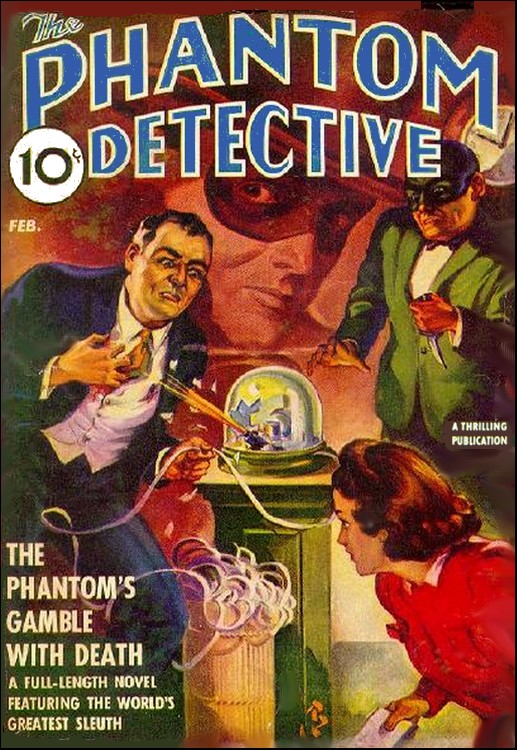
The Phantom Detective, February 1940, with "The Phantom's Gamble With Death"
The Flame King strikes—and doom's flickering fingers sear innocent victims! The Phantom pursues a fiend whose grim crimes are committed on schedule!
GLIDDEN, the butler, trod fearfully and furtively in through the paneled corridors of Beardsley Hall. Bottles and glasses rattled tunefully on the massive silver tray he supported with pudgy, unsteady hands. Underneath his neat black livery his whole roly-poly body was shivering with apprehension.
All the long way from pantry to drawing room he kept his watery little eyes straight ahead, pretending not to see the stalwart men who lounged, sitting or standing, beside every door and at every sharp turning of the passages. His prim mouth was pursed in severe disapproval.
Detectives! Private detectives and armed guards in Beardsley Hall! A dozen within the spacious walls of the house itself, and a score more scattered throughout the broad terraced grounds, made this drizzly night hideous with floodlights and searchlights.
A more trustful man than Glidden might have taken comfort from the presence of such an army of defenders at a time when, quite obviously, some dire and mysterious peril threatened the master of this pretentious modern-day Long Island castle. Glidden counted their intrusion but one more annoying factor in a situation that was already fraught with nerve-stretching potentialities.
Entering the arched and pennant-hung main hall, reminiscent of ancient days of feudalism, Glidden sucked in his breath sharply and faltered in his mincing stride. He gazed open-mouthed at the small, ugly piece of mechanism in the hands of a tall man who peered through one of the narrow windows beside the iron-studded door. It was the first submachine gun Glidden had ever seen near at hand.
The tall man looked at him and grinned.
"Nervous, Jeeves?" he asked. "You needn't be. It's things like this'll save your life and your boss' if anybody tries to start anything around this dump tonight."
Glidden resented the "Jeeves" and the "dump." He moved toward the double doors at one side of the hall. Resting an edge of the tray precariously against the elbow of a standing suit of armor, he knocked discreetly, as he had been instructed to do.
One of the double doors opened six inches to disclose a thin, incredibly wrinkled face topped by sparse wisps of snow-white hair. Diamond-sharp eyes behind steel-rimmed spectacles appraised the butler and his burden.
"It's the whiskey and soda the master ordered, Mr. Cartier," explained Glidden, knowing the face to belong to the aged and crotchety personal secretary of Coleman Graves, chairman of the board of Monitor Munitions, Incorporated, who was a guest in the house.
JAMES CARTIER grinned like a weather-worn gargoyle.
"Old Amos looks like he needs a drink," he cackled. "Not that it'll do him any good, Glidden. One evil never offset another evil in this world, as I've always maintained, and both of the fine gentlemen who made their millions out of wars and killing will get their just desserts whether they drink or not."
He opened the door farther, revealing the splendid interior of the raftered drawing room, where, besides himself, four men and a girl sat or stood in attitudes that betrayed the nervous strain under which they labored.
Glidden entered the room, his patent-leather shoes sinking noiselessly into the fabric of the ten-thousand-dollar carpet. He proceeded past velvet-draped windows of stained glass, past priceless bronze and marble statuary and rested his tray upon a great carved table in the center of the room.
Two gruesome articles that lay upon the table held the butler's eyes. They were dark wooden boxes, scarcely six inches in length, shaped like coffins and bearing upon their lids the carved and gilded symbol of a scepter and crown.
Lettered neatly across the bottom of either coffin lid, in flamelike letters, was the cryptic legend:
H.M.
THE FLAME KING
Glidden seemed unable to tear his gaze from them.
A GAUNT, elderly man ceased his restive striding up and down the room and approached the table. His gray hair was a thick tangle and his faded blue eyes blazed feverishly under shaggy brows. His features were rough-hewn, dominated by an arrogant nose that showed purplish veins, and there were furrows of worry in his forehead.
Amos Beardsley, master of Beardsley Hall, president of the Allegiance Arms Corporation and a millionaire many times over, glowered at his butler.
"What's wrong now?" he inquired, his voice harsh and authoritative. "You aren't letting yourself be scared by a couple of toy coffins, are you?" Glidden licked his tongue over dry lips.
"Oh, n-no, sir," he stammered.
Beardsley chuckled without humor.
"You're a liar. You're practically ready to faint. Get busy and pour some drinks. The Flame King is coming for us at eight o'clock, so he promised, and that only gives us ten minutes more to enjoy ourselves. We're going to do the best we can."
"Y-yes, sir," Glidden whispered, hardly audible.
The butler glanced inquiringly at the girl. She was strikingly beautiful in an exotic manner, with blue-black hair, midnight eyes shadowed by long, curving lashes and a mouth like a bleeding wound.
"Highball," she drawled lazily. "Lots of soda."
Glidden tipped decanter over a tall glass with a shaking hand. When he had mixed the drink he placed the glass on a smaller tray and carried it ceremoniously to Bernice Walters, who was Amos Beardsley's nineteen-year-old ward.
John Graves, the son of old Coleman, spoke sulkily from the chair in which he sat near Bernice.
"Make mine straight, Glidden, and make it a big one. This thing was funny for a while, but now it's beginning to give me the jitters, too."
Young Graves ran a slender hand through his dark hair. His pale cheeks were sunken and his mouth drooped unhappily. When the butler brought his drink he gulped it immediately and handed back the empty glass, avoiding Bernice's mocking gaze.
Two men stood by the curtained windows, talking together in low tones. Both of them shook their heads as Glidden approached.
"I never touch alcohol," quavered Coleman Graves. His face was comically like the old cartoons of Foxy Grandpa, with thick tufts of white hair at his temples and a barren ridge of scalp running the length of his head between them.
"There's a time to drink and a time to abstain," Frank Havens said. "I'm on the water wagon tonight."
A tinge of special respect marked Glidden's manner as he bowed to Havens. He knew the stocky, gray-haired man to be the distinguished owner and publisher of the nationwide chain of influential newspapers of which the New York Clarion was the leader.
Glidden was aware, moreover, that Frank Havens was the one man on earth who knew the identity of the Phantom, dreaded Nemesis of the underworld, whose daring exploits in the unceasing war against crime were common knowledge in every home in America. Havens was the one man who could contact the Phantom when that famed sleuth's almost superhuman powers were needed to cope with criminals too clever to be combatted by ordinary police methods.
And that, Glidden understood, was why Havens was a guest at Beardsley Hall this night. As he mixed a highball for Amos Beardsley, who had resumed his nervous pacing, Glidden heard Havens say to Graves: "Even if the Flame King turns out to be a hoax, you did right in calling me. I have no notion of the Phantom's present whereabouts but I have taken steps to get in touch with him and expect to hear from him at any minute. If the threats made against you and Beardsley are genuine, they are threats against the safety of the nation."
LEAVING his highball on the table and picking up one of the tiny coffins, Beardsley approached Graves and Havens. Beardsley's fingers were toying with the lid of the macabre object, sliding it back, revealing a small opening in which lay a square of parchment smaller than a playing card.
Looking down at the parchment, Frank Havens read, not for the first time:
Amos Beardsley:
You will be struck dead by lightning, and your factories wiped from the face of the earth, at eight o'clock tonight—unless you reconsider your refusal to sell the controlling stock in your munitions firm at the price quoted to you last week.
One last opportunity to change your mind will be given you before the sentence of death and destruction is carried out. Wherever you may be hiding—however well you may be guarded—you will be called upon to give a final answer. Agree to cooperate, and you shall live to enjoy your riches; persist in your refusal, and you shall die instantly and horribly.
"Preposterous!" Beardsley muttered. "And yet I wish eight o'clock would come and go, so we could be sure."
"You haven't long to wait," Havens told him, nodding toward the French clock on the mantel, whose beautifully wrought hands pointed to seven-fifty-five.
Beardsley swept drapes back from one of the windows. He said. "Look!" and pointed to landscaped grounds that seemed brighter than day in the radiance of floodlamps. Far down at the wire fence that bounded the estate—a fence that was charged with a deadly current of electricity—guards could be seen pacing slowly in the rain.
"Nearly fifty guards in all, inside and out," Beardsley said. "The minute I saw there might be real danger, I conceived the notion of fortifying this place and asking Graves to stick it out with me. Even if there is such a person as the Flame King, we ought to be safe. That's what I've been trying to tell Graves all day, but it doesn't seem to cheer him up."
Havens stepped back from the window.
"If there is a real plot to destroy or take control of your munitions business and Graves', I doubt if a thousand guards could protect you adequately. Clever criminals seldom strike openly, but always in the dark, in ways the victim would not be likely to suspect."
He paused, then continued.
"In a matter like this, which you gentlemen seem to think is too delicate for the police because of the scope of your dealings, and not quite for the Federals because of the investigation the Senate committee is conducting into alleged irregularities in connection with arms shipments, I would rely personally on only one man."
"The Phantom!" Graves exclaimed. "I thought of him right away, as soon as I received the coffin containing the threat at my office and learned that Beardsley had received one, also. Knowing you from the clubs to which we both belong, Havens, I took the liberty of calling you immediately."
Havens nodded.
"If all goes well we should hear from the Phantom soon. I have set certain machinery in motion to get in touch with him."
"Meanwhile," Beardsley rumbled, half in jest, "what if we're all struck dead at eight o'clock?"
"That's a risk we'll have to take," Havens answered quietly. "Personally I doubt if anything so drastic will happen. You see, I'm willing to take the chance myself, simply because I can sense something that may be really important beneath these threats."
GRAVES was mumbling, "Enemies! That's all I've made in the arms business—enemies abroad and enemies at home. When I appear as a witness before the Senate committee next week I'm going to make a clean breast of any irregularities Monitor Munitions may have been guilty of, even though it may mean a fine or a prison term. I'm going to turn my business over to my associates and spend my last few years with a clear conscience."
"What enemies do you fear most?" Havens asked him.
Graves made a helpless gesture. "All of them are dangerous. I have had threats from agents of governments whose foes we have armed, from crackpot pacifists who keep threatening to put me out of business by unpacifistic means, from extortionists of the type that prey on all rich men. And last week a man named Claude Weldon—apparently a capitalist, but one I never heard of—had the nerve to hint that I'd have trouble unless I sold him my controlling stock in Monitor Munitions at a fraction of its real value."
"Weldon," Beardsley growled, "is the man who tried to buy me out for a dime on the dollar. I got private detectives after him, to find out who he was, but he closed his office and dropped out of sight as soon as I refused. If you ask me, he's the man behind this."
He frowned for a moment, then swept up his glass and held it aloft, crying with feigned cheerfulness: "Two minutes more! Then we will know whether our enemy is a lunatic or the real thing. In the meantime, I drink the health of all of us!"
Coleman Graves was mildly shocked.
"Sometimes lately I don't know what to make of Amos," he whispered to Havens. "One minute he seems to be a nervous wreck from fright, and the next you'd think he hadn't a care in the world. He isn't like the old iron-nerved, self-righteous Beardsley I used to know before he went through that terrible illness—"
"Illness?" Havens inquired.
"Surely you must remember. He was expected to die, and all those doctors were here, and the papers had the story. It was only three or four months ago. Then he recovered, to everybody's surprise—kicked out the doctors and nurses, and was all right except for brief lapses of memory." Havens nodded.
"Yes, I do remember something about it."
THE master of Beardsley Hall took command of the people in the room like a general marshaling his forces. Standing imperiously beside the table, he commanded:
"You, Glidden—don't leave the room. Stand in front of the doors. All of the rest of you take seats and keep your eyes open."
Beardsley watched to see that his directions were carried out. Then he seated himself in a carved oak chair near the door to his study, whose book-lined walls were visible from the drawing room. He had taken an automatic pistol from his pocket and balanced it on his knee.
"All right," he snapped grimly. "Now we'll see what's what."
The only human sound that broke the stillness was Coleman Graves' asthmatic breathing as he huddled in his big gray chair by the fireplace, his hands gripping its polished arms. Glidden was like a grotesque statue at the door, his alarmed eyes rolled heavenward, his face a splotchy gray. Cartier grinned openly, watching him.
Swiftly and silently tension built up in the raftered room, setting the nerves of all of them on edge. Even Frank Havens felt the strain, and hunched forward in his chair, his narrow-lidded eyes alert.
The seconds ticked by ominously... The gentle chimes of the clock brought a smothered gasp from Bernice. Silvery notes shivered on the air, making a brief little tune. Inside the ornate case of the timepiece the gong began to count the hour—Bong-bong-bong-bong —
At the fourth stroke a hideous voice roared out, seeming to come from floor, walls and ceiling all at the same time. It was a muffled, booming voice, unlike anything human. Hearing it, Beardsley dropped his pistol and went rigid with surprise. Graves clasped his blue-veined hands as though in prayer, and Cartier's seamed face lost its defiant sneer and became filled with awe.
The voice thundered:
"His Majesty the Flame King has kept his word. You were fools to think that guns and walls could prevail against him! It is time for you to give your answer, gentlemen. Will you choose death or my service?"
In the brief pause Beardsley stooped, reaching with a palsied hand for the pistol he had dropped.
"You, Graves!" demanded the voice. "Which will you choose?"
The bent old man struggled erect in his chair, staring about in bewilderment. His fragile body stiffened and his rheumy eyes gleamed defiance.
"It's a trick!" he cried. "I won't be bluffed by this hocus pocus. His Majesty the Flame King can go to blazes—"
Graves would have said more. His mouth was still working and there were words, apparently, on the tip of his tongue, when doom struck, all in an instant.
His scrawny figure became blurred in a flash of blue-white flame, blinding in its intensity. Its aura seemed to surround him and the chair in which he sat. His body and clothing smoked and the crackling of intense heat was audible.
And then, as suddenly as it had started, it was all over. There was no flame, no crackling. There was only an ugly odor of scorched flesh and clothing and, curled up strangely in the gray chair, the charred and blackened corpse of a man.
BERNICE WALTERS screamed shrilly. John Graves leaped to his feet and sprang, not toward the shriveled thing that had been his father, but to the girl's side. He grasped her shoulders, shook them with a queer mixture of roughness and tenderness.
"I'll take care of you!" he said wildly. "No one will hurt you without killing me first!"
Glidden had collapsed silently at the first flash of the blue-white flame. He lay in a motionless heap in front of the doors, safe for the time being from the horror that had been too much for him.
James Cartier's face wore a curiously triumphant look.
"Just as I predicted!" the old secretary muttered. "The evil he has done has been returned to him! But he wouldn't listen to me!"
Havens was on his feet, too, shocked and incredulous. He found it hard to believe that which his eyes had seen. While he stood there, uncertain what to do, the mighty voice boomed again from the air about him:
"And you, Beardsley?" cried the Flame King. "Will you also taste hell-fire before your time?"
But Beardsley's arrogance had vanished.
He groveled on his knees, pleading brokenly.
"I am convinced. Spare me, whoever you are—spare my life—and I'll obey all your commands, whatever they may be—"
The great voice drowned out his pleading.
"Very well, Beardsley. I will give you a chance to earn your life. Go alone to Wall and South Streets at exactly noon tomorrow. Two of my servants will meet you and take you to my secret headquarters for further instructions. Let me warn you—if you are followed, you will be killed and all your works wiped from the face of the earth, as Coleman Graves' works are being erased in flame even now. Beware of trying to trick me—it is impossible!"
And that was all. The only sound in the room for half a minute was Beardsley's sobbing as he dragged himself back into his chair and sat with his face in his hands, an utterly unnerved man, frightened and ashamed.
Then the doors flew open and detectives rushed in. A tall young man, who seemed to be in charge of the guards, caught sight of the seared corpse of Coleman Graves. He halted, awed.
"Nobody could have got in," he mumbled foolishly. "Every man was on his toes..."
Kneeling beside the butler, Frank Havens had already ascertained that the man still lived, and had only fainted. He instructed two of the private detectives to carry him to a sofa.
Havens approached the body of Graves. With the thought of gleaning clues that the Phantom might find valuable, he searched the vicinity of the gray chair with his keen eyes. He saw nothing that seemed significant.
He moved the chair slightly, enough to make certain that no wires that could have carried a lethal current of electricity were attached to it. He examined its glossy upholstery and was astonished to find that, while Graves' body was little more than a cinder, the fabric of the chair was not even singed! It was almost as though a lightning bolt had been summoned from the heavens to strike the munitions maker.
Havens wondered where the Phantom could be. He crossed to one of the windows near where John Graves perched on the chaise longue beside Bernice Walters. The publisher drew back the drapes and peered into the wet night.
Beardsley Hall sat atop a low hill overlooking Long Island Sound. From the window Havens could see, in the distance, a cluster of pin-point lights marking the towers of Manhattan. Among them one tiny red beacon in the midtown sector blinked on and off in an irregular rhythm.
Young Graves had arisen to stand beside the older man. He saw the beacon, too, sending out its long and short flashes like dashes and dots.
"It might almost be some kind of a code," he murmured.
THE scarlet beacon was flashing out a code—a private code that only one man out of all the teeming millions of New York and its crowded environs could read. At the peak of one of the tallest towers of Manhattan, the imposing Clarion building, it had been sending out its secret message ever since darkness stole over the city.
That message was:
Phantom—you're needed... Phantom—you're needed... Phantom—you're needed...
Over and over, endlessly, it was repeated high above the streaming rooftops of the metropolitan district.
And at fifteen-minute intervals the Clarion's high-powered radio station was broadcasting another call over the ether waves, giving an additional thrill to countless men and women tuned to programs of news and entertainment.
Is the Phantom listening in? The Phantom is needed. Will the Phantom report if he is listening in?
People everywhere, hearing that spine-tingling call, were buzzing excitedly. What great crime had been committed, they wondered, or was threatening? What vast villainy was afoot, requiring the personal attentions of the legendary Phantom, whose very name caused criminals to shake in terror—whose true identity only one man on earth knew?
That man, Frank Havens, turned to John Graves.
"I'll have to notify the police," he said. "Your father has been murdered. We'll all have to stay here until the authorities have taken statements."
Graves shrugged.
"I suppose you're right, Mr. Havens. It's funny I don't feel worse than I do about it. Dad and I never got along, and it has been years since any love was lost between us. Just the same, I'd rather have seen him die in bed." He smiled faintly. "Anyway, I'm not responsible for his legal troubles with the government—and now I guess I'm rich enough to do as I please."
Frowning, Havens started toward the door of the study, where a telephone rested upon the desk. On the way he passed James Cartier, who was rubbing his gnarled hands together as though he were highly pleased about something.
"You know," said Cartier, "Mr. Graves was responsible for the death of thousands of people, Mr. Havens. He'd been letting his officials smuggle arms abroad for wars and revolutions for the last five years. He deserved what he got.
"And Amos Beardsley had better look to his health, too. What if he is so honest and upright he sent his own brother to prison fifteen years ago for forgery? He's in a business that's tainted with blood, just the same, and sooner or later the hour of his doom will strike."
"They're both hypocrites," Bernice Walters said bitterly.
Havens felt a stirring of pity for the dead man. Graves had doubtless committed many crimes against humanity during his life, but lately he had repented. And yet the only emotion those closest to him felt, now that he was dead, was satisfaction—his sullen son because he had inherited millions, his sanctimonious secretary because he considered his employer a sinful man, Bernice Walters because she thought Graves' repentance was hypocrisy.
In the study Havens stretched out his hand for the telephone, and even as he did so it rang. He lifted the instrument from its cradle and said. "Hello."
His rugged face broke into a relieved smile as he listened to the excited words of Steve Huston, the reporter he had left at his own Westchester County home to receive any call that might come from the Phantom.
"Thank God!" he exclaimed, when the reporter had finished speaking. "Tell him to make it fast, will you, Steve? Coleman Graves has already been killed."
He turned back into the drawing room. Amos Beardsley had arisen from his chair and was standing with slumped shoulders, like a man robbed of all that made life worth living.
"The Phantom is coming," Havens announced. "Now we'll get somewhere."
Everyone in the drawing room was impressed except Beardsley. He shambled toward the study Havens had just quitted.
"What can the Phantom do?" he muttered. "The Flame King is more than human, Havens. I'm still alive, but I'm as helpless as poor old Graves was. How can I fight against a thing like that?"
He sank dispiritedly into the armchair at his teakwood desk and rested his head in his hands.
AT very nearly that same moment the rats which infested a certain moldy cellar under a dingy building in downtown Manhattan were scurrying into sewer vents as silent men slunk into that unhealthy rendezvous. They were men who might have been called rats, themselves, in more respectable quarters—rats of the underworld, ruthless and greedy, dangerous beasts of prey by night and skulking cowards in sunlight.
They came singly, their coat collars turned high and hat brims pulled low against the misty rain. They edged into a black passage from the street and entered the building through a side door which stood ajar. They descended worn concrete steps into a musty basement and groped their way to an iron door in one wall.
They knocked seven times, and the door slid back on oiled wheels to admit them to still another passage, far underground, where arches of ancient masonry sweated cold moisture.
Eventually they came into a low room, its vaulted ceiling reminiscent of a burial crypt. The room contained only a long wooden table flanked with high-backed chairs, thinly upholstered with a silvery fabric. At either end of the table a candle guttered eerily, causing bat-winged shadows to dance on the walls.
A wooden-faced man, with features so flat they appeared to have been hammered back into the structure of his face, sat stolidly at the head of the table. As the men filed in, at intervals of half a minute or so, he pronounced their names tonelessly.
"Bolton... Gear... Doonan... Williams... Kosta... Sardin... Moreno..."
They took chairs along the sides of the table. Some of them were well dressed and some were shabby enough to mingle unnoticed with the derelicts of the Bowery, but all of them had one thing in common—their faces were brutal and depraved, their eyes were bright not so much with intelligence as animal cunning, their mouths were cruel and avaricious.
With one accord they stared toward the end of the room where a polished ebony plank, six feet long, was set upright in the concrete wall. The plank was cut to resemble the lid of a coffin, and, except that there was no lettering upon it, it was exactly like the covers of the miniature coffins sent to Amos Beardsley and the ill-fated Graves.
A gilded scepter was fastened diagonally across it, and near the top a gilded crown formed a grated window, through which a man might conceivably look upon those seated at the table while remaining effectively hidden.
At least seven of the eight men assembled in the subterranean vault looked upon the ghastly symbol with a respect that was compounded of fear and superstition.
The wooden-faced one spoke as soon as the seventh and last newcomer had seated himself.
"We are all here, Your Majesty—all except Comrade Rader, who is engaged upon a secret mission. We are ready for your orders."
Through the grating issued a muffled voice, hollow and mocking. It was a voice that one might expect to hear coming from a tomb, if the dead could speak.
"Greetings, comrades. Tonight the Flame King brings you news of a great victory. A man who dared to defy us has died the death of the blue flame, and a powerful industrialist has joined our cause. Somewhat reluctantly, to be sure, but nevertheless in such a manner that he will not hesitate to do our bidding.
"That enemy was Coleman Graves. Because he did not believe in the power of the Flame King he has passed into flaming oblivion, and in the same instant his factories and all that made him great were blasted from the face of the earth. Doubtless you will read about it in the newspapers tomorrow, and will realize something of the irresistible forces with which you have associated yourselves."
THE voice paused. When it came again it was harsh and marked by an undertone of savagery.
"But a real danger faces our plan to gain power and riches. The Phantom has been enlisted on the side of our foes. Ordinary men we can afford to laugh at, but this one man, who operates behind a thousand disguises and strikes where others would flee, must be stopped immediately.
"He is expected at Beardsley Hall tonight, probably within an hour or two. And so, as soon as this council is closed, two of you will start for there. You, Williams, and you, Bolton, will have the honor of the assignment. Whatever car approaches the single gate that leads to Beardsley Hall must be waylaid and its occupant—or occupants—killed.
"Failure to carry out this order will bring upon you the death of the blue flame. Do you understand?"
Two men near the head of the table nodded slowly and muttered a fearful assent.
The Flame King chuckled horribly.
"It is too bad none of you were in Connecticut a few minutes ago, near the Westchester line, in the vicinity of the factory of Monitor Munitions, Incorporated. It was a sight worth seeing, a sound worth hearing, when it went up in flame and smoke.
"That is an accomplishment for which Comrade Rader will receive an extra bonus. Because he obeyed orders and did not lose courage, the plant is now spread over more than two square miles of beautiful countryside, together with the scraps of the few watchmen who were in it when the Flame King's thunderbolt struck."
The inhuman chuckle sounded again, and the eight men at the table shuddered.
"And that is all," said the voice on a note of finality. "In tomorrow morning's mail there will be an envelope with money for each of you—a small portion of the riches that are coming if you remain faithful—and if the Phantom is dead there will be a large bonus for two of you. If not—"
The silence was eloquent.
"Do not forget the meeting tomorrow noon at the crypt in Queens County," finished the Flame King. "Our newest recruit, the industrialist of whom I spoke, will join us there. You have all heard of him, I am sure—Amos Beardsley, the head of Allegiance Arms Corporation. He is our first important convert, but there will be others, as big and bigger, until eventually we will constitute the most powerful group on earth and the Flame King will reign supreme!"
For a full minute, after the awful voice had ceased, the eight men sat without moving, as though held in some evil spell. Then, one by one, they arose and crept out of the underground chamber. The men called Bolton and Williams, whose task was the elimination of the Phantom, went away together, leaving the wooden-faced man sitting alone at the head of the table.
When they were out in the street again, Bolton lit a cigarette with trembling fingers.
"Cripes!" he blurted. "The Phantom! A hundred torpedoes have tried to bump him, Williams, and every one of 'em's dead today. But the Phantom is still alive and kickin'. For two cents I'd take a run-out powder!"
"Cut the beefin', stupid!" Williams hissed. "Whether we like it or not, we got the job. You can't run out on the Flame King. Either the Phantom gets rubbed out tonight or we get rubbed out tomorrow, and I don't like it any better'n you, but I know when I'm licked. If the Flame King was human—"
"That's just it," Bolton mourned. "He ain't human. He's the devil himself, Williams, and we ain't got a Chinaman's chance of successfully crossin' him!"
RICHARD CURTIS VAN LOAN slipped quietly out of the crowded ballroom and sought refuge in a dim corner of the conservatory, where lush tropical plants helped conceal his tall, broad-shouldered figure. He was bored, to put it mildly—far more bored even than he had been two days ago, when a stifling sense of ennui drove him to accept a pressing invitation to this swank house party which took place on the Connecticut shore, close to the Westchester County boundary.
The hundred-odd guests in the house would have been astonished at his mood. These tail-coated men and exquisitely gowned women, skimmed from the creamy top of New York society, would have been shocked by the very suggestion that young Van Loan, with his charming ways and his tremendous fortune, was anything more than he appeared to be when he was among them—a light-hearted idler, squandering his life in pursuit of pleasure, without a serious thought in his handsome head.
There was no more sought-after man than he in all the higher social strata. Mothers with marriageable daughters pursued him relentlessly, looking upon him as perhaps the most eligible bachelor in the country. Men of affairs enjoyed his gay company, and welcomed him wherever he moved.
But the role of wealthy playboy, for which his birth had cast him, was never to Dick Van Loan's liking. He had cast about desperately in search of perilous adventure. He had gone finally with his problem to Frank Havens, the publisher, who had been his godfather and in a sense his father, too, since his real father had died when Dick Van Loan was still a small boy.
Frank Havens had been the one to suggest the role which, although it was an artificial one at first, had come to claim all the resources of Van's life, and had provided him with a serious and unselfish purpose for existing.
The role of the Phantom...
Staring out through the rain-spotted glass of the conservatory, Van Loan thought fleetingly and somewhat pridefully of the breathless adventures which had been his lot since first, at Havens' invitation, he had tried his hand at solving a minor problem of crime which had baffled the police.
Excitement was all he had asked of his new career at the beginning, and it had provided excitement in strong doses. But gradually he had come to see a deeper, nobler meaning in his deadly battles against crime, and had realized that he must train himself for an enormous and continuous task before which everything else must shrink into insignificance.
The training was rigorous and thorough. A natural linguist, Van mastered more than a dozen languages and as many dialects. He developed his splendid body until he could have ranked, had he chosen fame of that sort, with the greatest athletes of all time. He made himself a crack shot with every modern type of gun. He became expert at all forms of defense.
He traveled over the world to study police methods of all nations and supplemented what he learned with observations of his own.
Ventriloquism and hypnotism were part of his stock in trade. A natural actor, adept at mimicry, he had made an intensive study of the art of makeup, until he surpassed any thespian who ever trod the boards in his ability to imitate nearly any man he chose. This was his crowning accomplishment, and—so great a part did it play in his single-handed campaigns against the underworld that it had earned him the appellation of the Man of a Thousand Faces.
Through all these arduous achievements, however, Van Loan had guarded his assumed character so carefully that, apart from Havens, not even his most intimate friends ever suspected that he was the famed, feared Phantom Detective. They would have laughed uproariously had anyone suggested it.
DESPITE the caution with which he had crept out of the ballroom while the orchestra was playing a moonlight waltz in semi-darkness, one pair of bright eyes had detected Dick Van Loan's flight. They sought him now in the gloom of the conservatory and finally found him.
"Why, Dick!" exclaimed the owner of the eyes, a golden-haired debutante, "I never saw you look so serious before. You look almost like—why, almost like one of those men who does things!"
Startled out of his grimmer thoughts, Van Loan turned, laughing, once again the elegant idler.
"A man who does things!" he bantered. "Perish the thought! What on earth could I do, Glenda?"
"You could be nice to me," she pouted. "You could ask me to dance instead of sneaking away like this." She went close to him and took his arm, and a little cloud of delicate perfume enveloped him. "You could at least pretend to be romantic."
Van Loan might have told her that ordinary forms of romance were hardly in order for a man who flirted continually with death in a thousand guises. Instead he smiled.
"All right," he conceded gallantly. "We'll dance as many times as—" His words were chopped off abruptly as the whole sky to the south sprang into crimson brilliance. He pressed closer to the streaming glass, staring, while his pulse leaped. He saw streaks of flame shoot high into the air, saw puff after puff of lurid color spread over the cloudy heavens.
Seconds later the roar of explosions reached his ears, heavy jarring sounds that bespoke tremendous blasts, even though they were muffled by distance. There was a rolling series of them, like a barrage of artillery fire.
His swift brain provided the answer instantly. This was no explosion of oil drums or gas storage tanks. This was the ripping detonation of cordite and guncotton. And the only source of such explosives in that vicinity, he knew, was the factory of Monitor Munitions.
Van Loan looked at his wrist-watch and saw that it was three minutes past eight.
"Our dance will have to wait a little while, Glenda," he said, managing to keep the excitement out of his voice. "Run along like a good girl and I'll try to join you later. I've just thought of something I have to do."
He urged her toward the door of the ballroom as he spoke, and almost before she realized it Glenda de Puyster was standing alone.
Meanwhile Dick Van Loan had hurried back through the conservatory and out a side door. He strode rapidly across the wet lawn, making for the big garage at the rear where he had left his sports roadster.
He was driven by an inner conviction, a sixth sense, that told him there was work and danger ahead of him—that it was time for the carefree Dick Van Loan to vanish from sight and for the Phantom to emerge, ready for another hazardous tussle with crime.
He was in the roadster and had started the powerful motor when a shining figure raced into the garage.
"No, you don't!" Glenda cried. "You're not going to run away from me this time, Dick. If you want to take a look at that fire, wherever it is, I want to, too. I love fires!"
SHE climbed into the seat beside him, and Van grinned to conceal his displeasure.
"I thought you wanted to dance," he murmured, as he sent the long, low car sliding into the rainy darkness.
The tires whirred against asphalt as Van drove swiftly toward old Greenwich, finding little traffic along the way. Two miles, and then he swung sharply into another highway leading to a manufacturing district.
He snapped on the car's radio, tuned to the Clarion's station, hoping to hear a news bulletin that would apprise him of the extent of the disaster.
Already he could see yellow flames dancing over a heap of ruins that had been a large brick building, set back by itself in a wide field.
Glenda cried, "Look!" She grasped Van Loan's arm, pointing to the twisted wreckage of an automobile that had skidded into the concrete guard rail of a bridge. Beside the car stood a man, waving frantically. One side of his face was streaked with blood.
Van braked the speeding car expertly, bringing it to a stop beside the man without skidding an inch.
"Can I help?" he called out.
The man opened the door. His face, where it was not covered with blood from a cut in his temple, was hard and cruel and his eyes glinted venomously.
"Sure, you can help, son," he snarled. "You can turn this heap around and head back for New York as fast as you can go. Or would you rather I'd blow hell out of you and drive myself?"
He held a .45 automatic in his fist and kept its blue barrel trained on Van's chest.
VAN swore silently. His reflexes urged many things the Phantom might have done. But these were not the kind of desperate chances Richard Curtis Van Loan could take.
In the first place they might seriously endanger Glenda de Puyster, which was unthinkable, and in the second place they would surely betray the fact that Van Loan was not the easy-going fellow he pretended to be. Van Loan shrugged.
"I guess you've got me," he said. "There doesn't seem anything else I can do. Get in."
The man climbed in beside Glenda, who was pale and speechless. The automatic never wavered.
"At the first sign of any funny business," the man said, "I'll drill you through the heart, and then I'll drill the dame. And don't think you can wreck this car, just because I wrecked mine. I'll shoot at the first sign of a skid."
Van wheeled the roadster around and headed back the way he had come. His mind was seething. Beyond question this man had something to do with the explosion that had destroyed one of the country's largest munitions plants. Possibly he was the saboteur responsible for the disaster, and had acted as the agent of some criminal organization or foreign government. If only he were now in the role of the Phantom...
The Clarion radio station was broadcasting a swing orchestra. The tangled rhythm of a jitterbug tune ended and there was the regular quarter-hour pause for station identification.
Suddenly the announcer's voice rang out:
Is the Phantom Detective listening in? The Phantom is needed. Will the Phantom report if he is listening in?
Van's face betrayed nothing, but every nerve and muscle in his body tensed. His hunch, his sixth sense, had not been wrong, then. There was work ahead of him—work and danger. The summons thrilled him to the core, and at the same time reminded him that he must dispose in some way of his unwelcome passenger. Van planned his actions.
That passenger was decidedly not thrilled.
"The Phantom!" he snorted, and cursed fluently. "That tinhorn hero will get into trouble one of these days. Shut that radio off!"
Dick Van Loan reached for the ivory knob on the instrument panel that controlled the radio. The move brought his knuckles within six inches of the fist that pointed the pistol at him. He hesitated a split-second, weighing chances, and then he acted.
His hand moved with the speed of a snake striking. He made no effort to grasp the threatening automatic. He merely struck his knuckles sharply against a part of the man's wrist where he knew certain nerve centers lay close to the surface. It was a jiu-jitsu blow, and it was invariably more than effective when delivered properly.
IT was effective now. The muscles of the gunman's hand were already tightening around the trigger and grip of the automatic when he felt the strength drain out of them. To his amazement his whole hand was completely paralyzed. He moved his arm convulsively and the pistol thumped to the floor of the car.
Snarling viciously, the gunman jerked open the door of the car with his left hand and plunged into the night. Bringing the roadster to a stop, Van looked back and saw him roll on the pavement, then pick himself up and flee across a ditch into the darkness of a field.
He suppressed the temptation to race after the fugitive. Not only would such an act reveal to Glenda that Dick Van Loan possessed unsuspected reserves of courage, but it would delay his getting in touch with Frank Havens and answering the frantic summons broadcast for the Phantom.
At any rate, he had a good description of the fellow, as well as his pistol, which would probably reveal fingerprints. It was more than likely the police would be able to pick him up with the aid of those clues.
"Dick!" Glenda gasped. "Whatever did you do to make that man drop his gun and run? Why, I never would have guessed you had the nerve—"
"What did I do?" Van laughed nervously. "I didn't do a thing, Glenda. My hand slipped and I guess I accidentally knocked the gun out of his grasp and scared him. But he wasn't any more scared than I was!"
VAN drove the roadster into the first gasoline station they came to. Glenda supposed he intended to report the incident of the gunman to the police, but instead he called the private number of Frank Havens' country home in Westchester.
Van recognized the answering tones of Steve Huston, the tough little reporter who had helped the Phantom in more than one difficult case, and for whom he felt a warm affection.
"Steve," he said, disguising his voice—for Huston knew the Phantom and he knew Van Loan, but had no faintest notion that there was any connection between the two—"let me talk to Mr. Havens right away."
"He's not here," Huston replied. "This is the Phantom, isn't it? Say, it looks as if there's something big in the wind, Phantom! The chief says for you to pick me up and for both of us to hurry out to Long Island to the home of Amos Beardsley, the arms manufacturer."
Arms manufacturer! Van's spine tingled.
"I'll be half an hour," he said. "Stay where you are. I'll bring my own car."
He hung up, and then he phoned to Old Greenwich for a taxi.
Returning to the roadster, he told the waiting debutante:
"That fellow was a tough hombre, Glenda. The police are all excited about what happened. Your family wouldn't appreciate having you written up in the tabloids, so if you'll just drive the roadster back to the party, I'll—"
Her eyes sparkled with excitement. "I'd rather go with you, Dick. I think it would be fun to be written up!"
"No." Van was firm. "I don't want you getting mixed up in it. I've ordered a taxi and I'll go into town alone. You go back and make excuses for me and say that I'll send for the car and my luggage if I don't manage to get back."
She pouted prettily.
"If you say so—But do try to get back."
"I'll do my best," he assured her.
Glenda slid under the wheel and geared the roadster into motion. She waved as she swung into the highway.
The taxi was less than five minutes in arriving. Van gave the driver a New Rochelle address and settled back in a corner of the seat.
Already his demeanor had undergone a striking change. He was no longer the gay playboy whom Glenda de Puyster had found so entertaining. His jaw jutted and his lean face was grim and dangerous. The light of battle shone in his eyes. His former boredom had vanished and he was alive and eager from head to toe.
THE address at which the taxi stopped in New Rochelle ten minutes later was that of a big apartment building. Van Loan gave the driver a bill and got out. He did not enter the apartment, however, but strode rapidly to the corner and into a side street. He walked three blocks more, then, glancing about to be sure he was unobserved, Van turned quickly into the doorway of a two-story brick building beside the dark entrance to an alley. He unlocked the front door with an ordinary key, shut himself in a tiny vestibule and switched on a light. Before him was a steel door equipped with a strange lock.
Taking a queer-shaped key from a pocket in the waistband of his trousers, Van inserted it in the lock. He turned it to the right, then to the left, then back again. Multiple bolts slid back soundlessly and the door swung open, disclosing a flight of stairs.
At the head of the stairway, a third door, also of steel, appeared to have no lock or knob whatever. A cleverly concealed button in the door frame opened it, and Van stepped into a large room which occupied the whole upper floor of the building. He flicked a light switch and the room was filled with a clear, mellow light that was almost exactly like sunlight.
This was the Phantom's secret laboratory. It was equipped with practically every device that could aid him in his role as the world's greatest manhunter.
A bench and shelves along one wall contained a complete chemical laboratory and workshop, where the most delicate analytical work could be carried out. There were super-powered microscopes, lightning-fast cameras, paraphernalia for ultra-violet ray photography. There was an outfit for the detection of all toxic substances, including the rarest and most insidious poisons.
Against the opposite wall stood a large dressing table surmounted by mirrors tilted to reflect a person standing before them from a dozen different angles at once. At the end of the room were steel doors closing off two closets.
Van proceeded first to one of the steel doors. When he had opened it by pressing a concealed button more than a score of complete outfits of clothing were revealed, as various as the types of men that fill a great city. There were garments that would have shamed a semi-respectable hobo, and garments that would have lent sartorial distinction to any wearer.
He selected a dark, neat suit. It was but the work of a minute to strip off his sodden evening dress and don the new garments, after which he transferred from various hidden pockets in the dress suit a variety of objects. There was a thin metal box, scarcely larger than a cigarette case, which contained a full makeup outfit in tiny phials and containers. There were odd keys, intricately made, capable of operating locks of every description.
Last and most important, there was a small plate of the purest platinum set with diamonds in the shape of a domino mask, which he slipped into a pocket in the leather belt he wore. This was the Phantom's badge of identity, known to the police of every city on the American continent and every capital of Europe, the quick display of which in one cupped hand was enough to gain him entry into the most official quarters.
Van selected a long raincoat and a dark, slouch hat from the wardrobe. Then he moved to the other closet.
Here, when he had thrown back the steel door, was revealed a small arsenal of the world's deadliest weapons. Colts, Webleys, Lugers and side-arms from many different nations hung in racks, with boxes of ammunition piled on shelves above them.
Van contented himself with a .38 caliber Colt automatic, which fitted snugly into a special holster sewn into his vest beneath his left armpit.
THE Phantom was equipped for action, but there still remained the necessity for disguise. At the moment there was no need to adopt any particular personality, but there was need to obliterate the well-known features of Richard Curtis Van Loan.
This was accomplished in a few moments in front of the dressing table. He rubbed a silvery paste into his hair, graying it at the temples. He slipped thin pieces of cartilage into his nostrils, altering the shape of his nose. Celluloid structures clamped to his wisdom teeth filled out his cheeks and a special powder, rubbed into the skin of his face, deadened the healthy tan.
A pair of gold-rimmed spectacles completed the transformation. The mirrors now showed the face of a pale, rather anemic man of middle age, somewhat careworn and decidedly unlike the healthy, engaging Van Loan.
Donning the raincoat, turning the collar up around his face and pulling the brim of the slouch hat over his eyes, the Phantom descended a flight of circular steps to the lower floor of the building. Three cars stood there on the concrete floor—shabby, dilapidated models, none less than five years old. But, as with so many things connected with the Phantom, appearances were deceptive in this case, also.
Underneath each dented hood reposed a sleek, powerful engine, perfectly tuned, capable of hurtling the weight of the car over the highways at close to a hundred miles an hour. And the weight of the car was a matter of some moment, for each was armored from stem to stern with bullet-resistant steel, and even the plate glass of windshields and windows was made to withstand the impact of powder-driven lead.
Van climbed into a small coupé. He toed the starter until the engine throbbed. When he switched on the headlamps, photo-electric cells started machinery that rolled back a metal door in one wall—a door that shut again of its own accord as soon as the car had passed through.
Twenty-five minutes had elapsed since Van had talked to Steve Huston. He guided the coupé through glistening streets, stepping it up to better than sixty miles an hour on straight stretches, hurrying to Havens' home.
He swung off the highway into a poplar-lined drive, winding snakily toward a great house set on a wooded rise of land. A slight figure ran down the steps from the porch as the coupé came to a halt in the driveway. Steve Huston approached the car, opened the door, and looked uncertainly at its occupant.
"Looking for someone?" he asked.
Van nodded.
"This is where Mr. Havens lives, isn't it? I heard he was a hard man to see at his office, so I thought if I came out here to see him about a job—"
Huston made a grimace. "You've wasted your time, Mister. The man you want isn't here, and he probably wouldn't have time to see you if he was. Why don't you talk to Adams, the city editor down at the Clarion?"
The Phantom laughed.
"Get in, Steve," he said. "I just wanted to test out my disguise. You've seen twenty or thirty of my faces, but never this one, and I wondered if it was sufficiently original."
"I should have known it," Huston growled, climbing into the coupé. "You've pulled the same stunt on me often enough. You know where this Beardsley's place is, Phantom?"
Van nodded. "It's been pointed out to me. My name, by the way, is Felix Tomlinson. What's up?"
"Something big. I talked to the chief after you called and he said Coleman Graves was dead. Then there was a radio bulletin about an explosion at the factory of Monitor Munitions. Half a dozen watchmen were believed killed."
Van's foot pressed the accelerator pedal toward the floor.
"If they were in the building, they were killed, all right," he muttered. "I saw the ruins, Steve. It was a complete job."
Steve Huston leaned back and lighted a cigarette. His eyes sparkled in the reflection of the street lamps. The resourceful little newspaperman was never happier than when he had the opportunity of working with the Phantom.
SPEEDILY, the coupé fled through the Hendrik Hudson Parkway to the West Side Highway, then darted across the Triboro Bridge, pausing once at the toll gate. It emerged in the crowded community of Astoria, and proceeded through a broad boulevard to one of the great parkways that span the length and breadth of Long Island.
The speedometer needle touched sixty—seventy—eighty. The superb motor beneath the battered hood sang joyously. Mile after mile unrolled beneath the racing wheels, and all at once a splotch of brightness sprang up at the right, where Beardsley Hall still basked in the brilliance of the floodlamps that had been lighted in vain. Van slowed the coupé, intending to guide it between the stone gateposts that loomed just ahead. He squinted to avoid the blinding rays of the headlights of an automobile that was approaching at a moderate rate of speed from the opposite direction.
"Look out, Phantom!" Huston screamed suddenly.
Van had already seen the object that prompted the cry—the stubby snout of a tommy gun thrust out of one of the windows of the approaching sedan.
Flame spat from the muzzle of the murderous weapon. A rain of steel-jacketed slugs hammered against the windshield of the coupé, gouging chunks from the glass without breaking through. The windshield turned white with a spidery network of cracks, so that it was impossible to see through it. The hellish roar was deafening.
Split-second action was characteristic of the Phantom. He shoved the gear lever into first speed, thrust down on the accelerator and spun the steering wheel toward the oncoming sedan. The coupé leaped like a live thing straight for the death car.
There was a bone-shaking jolt, a sound of rending and tearing metal as the lighter body of the sedan was crushed before the armor-plate battering ram of the Phantom's car. The sedan lurched into the shallow ditch beside the road, its radiator shell crumpling against the bank. A man shrieked in agony.
From within the sedan someone was blasting at the coupé with a pistol. Bullets flattened against the window beside Van. He cranked the window down an inch or two, yanked the automatic from the holster inside his vest and sent two slugs bellowing toward a squirming figure, dimly seen inside the sedan.
Again a man shrieked. Then the door on the far side of the sedan flew open and a dark figure sprang out, vaulted over the low bank and plunged into a thick woods that bordered the road. It moved so swiftly, spurred on by terror, that Van had only time to snap one ill-aimed shot after it before it vanished in the underbrush.
"Bolton! Don't leave me, Bolton!" the man inside the wrecked car screamed.
HOLDING his pistol in readiness, Van got out of the coupé. Peering through one of the smashed windows of the sedan he saw a shabby, skinny man whose leg was crushed in a trap formed when the metal frame of the front seat had been twisted out of shape. It was the man who had fired the tommy gun and the pistol, but he would fire no more. There were dark stains on his chest where both of Van's bullets had found lodging.
"What was the idea?" Van demanded. "Who are you and whom did you think you were trying to kill?" The man's last scream had taken nearly all his strength. He returned Van's stare with glazing eyes.
"Flame King!" he muttered incoherently. "Kill—Phantom. Or else—blue flame—"
A gush of crimson came from his lips. The man died, choking horribly.
Unable to open the door of the coupé, Van reached through the window and felt the man's pockets. They contained nothing of any great importance—a roll of bills, a handful of silver, a clasp knife with a gleaming five-inch blade, cigarettes and matches and a single envelope, addressed simply to "Dave Williams, Room 414," containing a bill for room rent and telephone calls submitted by the Chatterton Hotel, a third-rate lodging house in lower Manhattan.
Van handed the envelope to Huston.
"You might check on this tomorrow if you've got time," he suggested. "Dave Williams' connections might give us a lead that will help us."
MEN came running from the driveway. The state police had already been summoned to the scene of the Flame King's triumph and were supplanting the private detectives as guards. A trooper whose sleeve displayed a sergeant's chevrons neared Van with a drawn revolver.
"Reach!" the sergeant commanded. "I love to shoot hoodlums!"
Van raised his hands shoulder-high, dropping the pistol. His left hand, however, paused briefly at his belt on the way up, and in its palm lay the diamond-and-platinum badge.
The diamonds glittered in the rays of an electric torch held by another officer. The sergeant saw them, and immediately his truculent manner changed. He thrust the revolver back into his holster.
"Well, I'll be hanged!" he exclaimed. "The Phantom! I've always hoped I'd meet you some day."
His eyes were wide with respect, but they showed disappointment, too, as they took in the mild appearance of the disguised Van Loan.
The Phantom retrieved his pistol. "Someone else apparently recognized the Phantom without needing to see a badge," he said tersely. "I haven't any idea who they are, but the dead man looks like a cheap crook, and maybe his fingerprints will tell you more about him. I'll leave it in your hands, because I want to get up to the house as soon as possible."
The sergeant barked sharp orders. A trooper escorted Van and Huston to the gate and held the door of an official car for them. He drove them the quarter-mile over the winding gravel drive to the front entrance to Beardsley Hall, where other police cars were drawn up.
The front door was ajar and Van walked into the main hall without knocking. Frank Havens appeared in the drawing room doorway. Recognizing Steve Huston, who had followed Van into the hall, he knew immediately that Steve's bespectacled companion could be none other than the Phantom.
Van grinned, gripping Havens' hand warmly. There was an affection between these two that had no need of words. Without wasting time on greetings, Havens gave Van a brief and complete report of all that had taken place that evening.
"The medical examiner only knows that Graves was burned to death," he informed Van. "It might have been a tremendous current of electricity, except that there isn't a trace of any wiring that could have carried such a current. It might just possibly have been some explosive chemical, such as magnesium, taken internally, except that Graves ate or drank nothing, as far as any of us are aware. There'll be an autopsy, of course."
"What about the voice?" Van asked.
Havens hunched his shoulders. "The police have sounded the walls, the floors and the ceiling. There isn't a sign of any loudspeaker or similar device. The house has been searched from top to bottom."
Van's jaw tightened. "This," he predicted, "is going to be interesting."
THEY walked into the drawing room together, Havens tugged Van's sleeve.
"There's an angle worth considering," he whispered.
The publisher nodded toward the corner of the room where Bernice Walters sat on a sofa close beside a pallid, sleek, dark-eyed man whose mannerisms were definitely Latin. The pair were talking with considerable animation.
"Love triangle?" the Phantom inquired.
"Looks like it. Young John Graves is crazy about Miss Walters, but she seems to be infatuated with this fellow, who hails from somewhere in Spain, or maybe South America, and calls himself Count Elmo de Esteban. She phoned him right after the old man was killed, and he arrived a few minutes ago, and Graves immediately started to drink heavily."
They neared the couple, and Havens presented Van to them, using the name of "Mr. Tomlinson." Esteban shook hands languidly.
"Are you one of those police chaps, Mr. Tomlinson?" he asked, with obvious condescension.
Van shook his head. "Merely a friend of Mr. Havens."
"Not the Phantom, surely!" Esteban's velvety eyes glittered. Then he shook his head. "No, you wouldn't be the Phantom—he would be an entirely different type."
"From what I've heard of him," Van offered, "he can be pretty nearly any type he chooses."
The self-styled count managed a well-bred laugh.
"In your country you dramatize everything and everyone of importance," he declared. "I have heard wild tales of your Phantom, too, but I take them with a grain of salt. I have no doubt he is a very nice detective, but an ordinary man, for all that."
"You're destroying my illusions?" Bernice protested playfully. "The Phantom is one of my heroes, Elmo. I always picture him as tall, dashing, fearless, fascinating. If I ever meet him, I'm going to forget all about you and try to vamp him."
Esteban sighed in mock dolor. "Now," he breathed, "the Phantom is my enemy. If ever I meet him, I shall feel constrained to insult him as an excuse to invite him to a duel!"
Van and Havens left them. They walked toward the chair in which Coleman Graves had died. The body had been removed following the medical examiner's arrival, but charred scraps of clothing were still to be seen on the cushion of the chair and the floor.
Van felt the glossy fabric of the elegant piece of furniture, lifted it to judge its weight, examined the bare floor around it. His eyes were dubious when he straightened, a moment later.
"One thing is sure," he stated. "The Flame King is not only ambitious and ruthless—he is also more clever than the general run of crooks. He has done an excellent job of covering up his methods."
Van's eyes narrowed.
"There wasn't a single suspicious happening beyond the voice and the blue flame," Havens told him. "None of us saw anything else that was extraordinary."
"How about Glidden? Did he make a statement to the police? He was the only one who fainted. Possibly he saw something even more horrible than the rest of you, from where he was standing."
Havens bit his lip.
"Now, there's a strange thing, and it has us all worried. Glidden regained consciousness in about five minutes. He complained about having a bad heart and left the room, saying he was going to get some medicine for it. He didn't come back and the police have been unable to find him."
"No one talked to him at all?"
"Not about what happened. Bernice gave him a drink of whiskey when he started coming to. Beardsley told him to lie down in his own room and stay there, and to turn over his duties to the second butler."
"But Glidden didn't stay in his room?"
"He'd been there, apparently. Someone had been lying on the bed. But he wasn't there when the police went to look for him."
THE door to Beardsley's study was closed. Havens knocked on it. "Who's there?" a nervous voice demanded.
Havens called out his own name, and there was the sound of a lock being turned. Van looked narrowly at the multi-millionaire as the door opened.
Beardsley had changed tremendously in the last hour or two. He seemed to have grown twenty years older. His shoulders, which had been erect, were stooped with worry, and his hands shook.
"Mr. Beardsley, this is the Phantom," Havens said quietly.
For an instant Beardsley's eyes lighted. Then despondency came over him again. He waved them to chairs and seated himself at his desk, where he had been writing.
"I doubt if even the Phantom can help now," he said. "I've been writing a letter to the directors and chief stockholders, besides myself, of the Alliance Arms Corporation. I can't help but feel that I'll die, sooner or later, as Graves died, whether or not I accept the domination of the person calling himself the Flame King. I want to leave my affairs in good shape."
Van glanced about the room. It was an unusual study, semi-circular in shape, its walls lined from floor to ceiling with shelves of beautifully bound books.
"You're giving up too easily," Van comforted. "You're a big man and you've got a lot to live for. Why don't you fight?"
Beardsley stared at him.
"Young man," he said, "I've fought all my life. I fought tonight. I took steps to make this house the most secure place on earth, and I was sure nothing could harm Graves or myself as long as we stayed here." He breathed deeply. "But look what happened. A voice out of nowhere—a flame out of nowhere—and Graves and his properties were destroyed. How can I fight a thing like that? It's like trying to fight the devil himself."
"Not quite. You can be fairly sure a human being is behind the character of the Flame King—a devilishly clever human, perhaps, but one that can be defeated. I've been up against clever killers before, and the fact that I'm still alive is proof that I've never failed."
"He's right, Beardsley," Havens put in. "If you play the game with him, he'll show you how right he is."
Beardsley's smile was tragic.
"I'll play any game you say. I have nothing to lose any more—I've lost everything to the Flame King already."
"If you can keep under cover for about two or three days—" Van began.
"Not me," Beardsley protested. "The Flame King came here tonight, and he can do the same tomorrow. He will, if I don't keep my appointment with his men at Wall and South Streets. I'm going to be there, Phantom, because I know my life won't be worth a plugged nickel if I'm not."
"You'll be there," Van said softly.
"You bet I'll be there!"
"What I meant to say," Van explained, "was that I'll be there in your place. The Flame King men will think it's you."
"Don't be foolish! Why, my picture has been in all the newspapers. We don't look the least bit alike."
"I see," the Phantom said, "that I'll have to convince you. If you'll excuse me for a minute or two, and push that desk lamp just a little closer—"
Van reached beneath his coat and drew from a hidden pocket the small auxiliary makeup kit that never left his person. He opened it, using the mirror inside its hinged top for reference, and worked swiftly, glancing from time to time at Beardsley's face.
The contents of a tiny phial, rubbed in the palms of Van's hands and then into his hair, produced the exact shade of streaky gray that was desired. Wads of cotton and fine slivers of wax, skillfully applied, changed the shape of his nose, and a thin pencil added the purplish lines of veins.
Celluloid springs clamped to his lower teeth made the jaw-line bolder, and delicate shading, applied with a camel's hair brush, gave the upper cheeks a sunken appearance.
WHEN he was satisfied that his face was practically a replica of that of the arms manufacturer, Van arose. He stood with his shoulders slumped forward, the picture of dejection.
"What do you think now, Mr. Beardsley?" he said.
Beardsley gasped, for the voice that came forth from the Phantom's lips was exactly like his own.
"Marvelous!" stammered the old man. "I wouldn't have believed it possible. Why, except for the suit of clothes you are wearing, I could mistake you for my reflection in a mirror!"
"You can lend me one of your suits. We're close enough to the same size for that. I don't think there's any question but what I'll be able to take your place tomorrow at the Flame King's hideout—"
Van whirled as the door, which Beardsley had not locked after admitting them, was flung open. James Cartier stood there, his wrinkled face flushed with excitement. Speech was trembling on his lips, but it died when he saw the two men, exactly alike, facing each other.
"Mr. Beardsley!" he gasped. "Which one of you—what—"
Past him Van could see into the drawing room. Count Elmo de Esteban and Bernice Walters were staring into the study, also, their faces blank with surprise. John Graves was just entering the drawing room. He halted, and his jaw sagged comically.
The Phantom strode to the door and shut it, although the damage had been done. He had not intended that anyone besides Havens and Beardsley should know of this impersonation.
"Can you trust these people not to talk?" he asked Beardsley.
The industrialist looked doubtful. "Cartier, here, had the confidence of Coleman Graves for thirty years, and never violated it so far as I know. I can't speak for Graves' son, although I don't think he could have had any hand in his father's death, even though it meant the inheritance of a fortune. Bernice will never tell, if I ask her not to. But that blackguard, Esteban—"
"Blackguard, Mr. Beardsley?"
"Blackguard. All that I know about him is that he's an impostor. Bernice is infatuated with him, and I can't seem to put a stop to it. I had private detectives investigate Esteban, and although they could learn nothing about his true identity or his business, they did discover that he isn't the Spanish count he pretends to be. Personally, I suspect him of being a spy in the pay of some South American country."
Van was grave.
"I'll carry through my plan of impersonating you tomorrow," he said. "It's the surest way of making a direct contact with the Flame King. But I'll have to take precautions now. I'll have the police keep everyone in this house under surveillance until I come back from the meeting —if I come back. You don't object to having your telephone line tapped, Mr. Beardsley?"
"Certainly not. If you think it will help—"
Cartier had recovered somewhat from his surprise. He could contain his news no longer.
"I've found the butler, Glidden," he blurted. "He's dead—murdered!"
Beardsley's face went chalk-white.
"Murdered!" he repeated.
The ancient secretary twitched with excitement.
"Stabbed in the back! And before I found him, your ward and that South American gigolo found him, and said nothing about it!"
"Sit down," Van directed. "Quit jumping around and tell us about it coherently."
CARTIER dropped into a chair. "I was keeping an eye on Esteban," he said. "I was suspicious of him. I followed him and Bernice out to the side porch. I saw them stumble over something in the shadows, look at it and then hurry back into the house as though they were scared. The first chance I had, I went to see what they had found. It was Glidden."
"Show me," Van said brusquely.
With Havens at his side, Van followed Cartier through the drawing room, conscious of the intent manner in which Bernice and Esteban watched them. John Graves had disappeared. Van stepped upon the broad veranda and at once saw the dark shape of the body stretched out there.
Van's pocket torch sprayed the figure with light, and it was instantly apparent that the pudgy butler was dead. He lay on his face, and from between his shoulder blades protruded the haft of a bone-handled hunting knife.
Van kneeled beside the dead man, feeling for a trace of warmth in his cheek and examining the head and the handle of the knife, then he stood up.
"Glidden was killed about an hour ago," the Phantom declared. "He was dead before the knife was stuck into him. The wound hardly bled at all. There's a bruise on the back of his head that might have knocked him unconscious, but could not have fractured the skull. My guess is that he was slugged, and the shock of it stopped his heart. The killer knifed him, not realizing he had died already."
Havens wiped his forehead with a handkerchief.
"But he had gone to his room on the third floor. Someone would have seen him if he had come down through the house. How in the world—"
"There are back stairs," Beardsley broke in. "Servants' stairs. He could have sneaked down them or been carried down. The servants were all under guard in the kitchen when Graves was killed and for half an hour or so after. And when news of the blue flame got around the guards were called from most of the doors to the drawing room."
STEVE HUSTON met them when they went back into the house, leaving the corpse of the butler to the attention of the baffled troopers. Steve was bubbling with information, too. He contrived to separate Havens and the Phantom from Beardsley.
"The count," Steve told them, "is up to no good around here. I happened to slip into the drawing room while you were on the porch and saw him rummaging through the drawers of Beardsley's desk. He apparently didn't find what he was looking for, because he took nothing. I hid behind a chair, and pretty soon Bernice, who'd gone out of the room for a few minutes, came back and they went out together and got in a car and drove away."
"They what?" Havens asked.
"I think they're eloping," Steve said. "It would make a peach of a yarn for the Clarion, wouldn't it? Heiress to munitions millions runs away with South American fortune hunter—"
"We're printing nothing except the Graves story," Havens said, "until we find out more about what's behind this case. But, Phantom—if they've gone, how are you going to arrange to have them kept under surveillance?"
"I don't know, Frank, unless the police can locate them."
"Surely you won't carry through this mad plan of meeting the Flame King tomorrow, since others know about it!"
"I may not carry it through," Van said soberly, "but at least I'll start it. I can't accomplish anything till I get some idea of who or where the enemy is. One thing you can be sure of. If the Flame King lays a trap for me, he'll find me prepared."
"But if you get killed—"
"That," said Van grimly, "is a chance the Phantom has had to take before and probably will have to take a good many times again. The minute I start being afraid to take that chance, Frank, my usefulness will be ended."
NOON-HOUR crowds poured out of the skyscraper buildings of New York's financial district, choking the twisted lanes that passed for streets. Restaurants and cafeterias and bars became jammed with men and women taking their brief luncheon recess from Wall Street's stock tickers, counters, filing drawers and typewriters.
Five minutes before the twelve o'clock chimes sounded over Trinity churchyard, a gaunt and elderly man arose from his desk in the substantial offices of the Allegiance Arms Corporation on the forty-eighth floor of the International Trust Building. He clapped a hard straw hat over his thatch of gray hair and walked briskly through the outer offices.
"We'll have that scrap iron order straightened out this afternoon, Mr. Beardsley," a blond secretary said.
Amos Beardsley's thin lips smiled, but behind them Dick Van Loan's brain considered graver matters. A sleepless night and a busy morning, spent largely at Police Headquarters in Center Street, had been productive only of sufficient information to convince him that the Flame King had enlisted some of the most desperate criminals on record in his campaign of terrorism.
Descending to the marble lobby and making his way through the jostling throngs, Van thought about those desperadoes. Dave Williams, the man who had died in the sedan after triggering a tommy gun in an attempt to kill the Phantom, was by no means the worst of them. He was only an underworld torpedo with half a dozen suspected murders to his credit, a man to be feared when he had a gun and darkness in which to use it, but a crook without imagination, a servant of more dangerous men.
And so with Bill Bolton, the man whose name Williams had called when he was dying. The cards at the police record bureau named Bolton as a killer, wanted by the law for the slaying of a big gang leader.
But when the fingerprint experts had established the identity of the man who had pointed a pistol at Van and Glenda de Puyster near the wreck of the Monitor Munitions factory, they found themselves dealing with a quite different personality. His name, when he was not using one of many aliases, was Roy Rader.
He was an extortionist of the worst order, a terrorist who had used dynamite on at least two occasions to destroy men who had refused his demands.
Such a man might easily be the Flame King, himself...
At the lower end of Wall Street, where South Street sweeps along the dock-studded rim of Manhattan, Van paused just as the clocks began to strike the hour. The crowds were less dense here. Van halted on the corner and looked about uncertainly, rubbing a hand over his chin a gesture of nervousness, as Amos Beardsley might have done.
TWO men approached him, studied his features coldly, stood at either side of him.
"Beardsley?" one of them asked, speaking out of the side of his mouth. Van shook with pretended fright. "You—you are the gentlemen I was supposed to meet?" he quavered.
One of the men nodded. The other laughed, not humorously. "Gentlemen!" the other exclaimed. They walked along South Street, three abreast, with Van in the middle. The strangers kept glancing over their shoulders, evidently suspicious of being followed. They walked two blocks and paused beside a big sedan waiting at the curb.
One of the men was short and broad, with heavy features and the cauliflower ears of a ham prize fighter. The other was as tall as Van, lean and rangy, and his emaciated features were scarred by a knife slash that ran from his right cheekbone to the point of his chin.
"Get in the back," ordered the tall man. "Sit still and keep your mouth shut, or I'll have to plug you." His right hand was in his coat pocket and he moved it suggestively.
Van did as he was ordered. The broad man climbed behind the wheel and started the motor. The sedan swung in a circle and started north, keeping pace with the traffic stream.
"Got a gun?" asked the tall man. He patted Van's pockets expertly.
Van had brought no gun, knowing that one would have been taken from him at the very beginning. He had, however, other weapons concealed about his person—tiny devices in concealed pockets, whose use his guards would not have understood even had they found them.
They turned into Second Avenue, beneath the elevated tracks, still going north. As they swerved into the approach to the Queensboro Bridge, the tall man took a pair of goggles from his pocket and handed them to Van.
"Put 'em on," he ordered. "From now on you're flying blind, and at the first sign of peeking I'll have to slap your brains out."
The glass of the goggles was tinted. At a casual inspection they appeared to be ordinary sun glasses with shields that fitted snugly against the face, not unlike those worn by many people on bright summer days.
When Van placed them over his eyes, however, he discovered that the lenses were coated inside with paint, and they shut off all vision as effectively as a blindfold would have. He leaned back, sightless, and after the sedan had left the bridge and made four or five sharp turns he discovered that he had no notion of the general direction in which they were traveling.
The car gathered speed, rolling along a smooth road that might have been Queens Boulevard or one of the parkways. Van sat silently in his corner and tried to guess at the time and distance of their trip. He judged they had been riding half an hour, and had covered nearly twenty miles, when they turned off the concrete into a gravel road, and then into a bumpy dirt road. As the car jolted to a stop he leaned forward, every nerve and muscle alert and ready.
"Come on," rasped the tall man. He grasped Van's arm and helped him from the car. The stocky man got out and took Van's other arm. Between them Van stumbled up a short flight of wooden steps into a house with uncarpeted floors and a musty smell of desertion.
MORE steps within the house led downward into a cellar, cool and damp and odorous. Then there was an earthen tunnel, its roof so low that Van had to stoop to keep from bumping his head.
They halted eventually in what seemed to be an underground room. After a moment the stocky man grunted, "Take 'em off, Beardsley. You can look all you want to now."
Van removed the goggles and blinked in semi-darkness. He saw two candles casting a ghastly, flickering glow over a long wooden table in the center of the room. The dim forms of six men were seated around the table, and there were a few empty chairs.
A wooden-faced, flat-featured man who sat at the head of the table, seeming to preside over the others, stared expressionlessly at Van and pointed to one of the empty chairs.
"Sit down, Beardsley," he directed, his voice toneless.
Van took the chair indicated, and his two escorts sat at either side of him. As his eyes became accustomed to the feeble illumination he looked at the sullen faces of the men seated near him.
His pulse jumped as he recognized the gunman who had fled from the scene of the Monitor Munitions blast, sitting directly opposite. This was the extortionist, the dynamiter, Roy Rader, one of the most dangerous criminals known to the New York police. His venomous eyes, meeting Van's, showed no sign, and it was plain that he did not connect this seemingly elderly man with the person who had paralyzed his pistol hand with a simple rap of the knuckles.
Other faces were familiar to Van from his study of the photos at Headquarters. There was Benny Doonan, the bank robber who had escaped from Sing Sing a year ago; and Peter Sardin, the expert safe cracker; and Bill Bolton, who had fled into the woods after his failure to assassinate the Phantom, and whose plump face was pasty now with some terrible fear.
Not until he had seen them all and imprinted their features indelibly on his memory did Van turn his eyes toward the end of the room, where the others looked oftenest. His skin prickled when he saw the polished coffin lid set in the wall, decorated with the gilt scepter and crown, as the small coffins sent to Graves and Beardsley had been decorated.
At the same time, seeing how the design of the crown formed a grated window near the top of the coffin lid, Van's heart sank. He realized that it was extremely unlikely that he would be permitted a glimpse of the Flame King, for it was obvious that the curiously shaped plank was placed there for the purpose of shielding a speaker.
The wooden-faced man addressed the gilded crown at the end of the room.
"It is the time you set, Your Majesty. We are all here excepting Comrade Williams, who was killed last night by the Phantom, as you know. Amos Beardsley, of whom you spoke, is with us."
There was silence for a breathless second. Then came the inhuman voice, filling the room, beating back from the walls against the eardrums.
"Greetings, Comrades. Greetings especially to you, Comrade Rader. The Flame King appreciates your skill and loyalty, as you probably know from the bonus you received today. A few more master-strokes of that sort, planned by the Flame King and executed by men as fearless and able as you, and we will have attained our objective."
ROY RADER smiled fiercely and stared around at his companions with considerable hauteur.
The Flame King's voice continued, no longer pleasant.
"Comrade Bolton, I charged you last night with the task of eliminating the Phantom. You failed, notwithstanding the fact that I promised you the death of the blue flame for failure. Have you anything to say before I keep my word?"
Bolton cringed in his chair. His cruel, unhandsome face was almost pitiful in its terror.
"I done my best!" he cried. "You know I always done my best, Your Majesty. But how was Williams and me to know the Phantom rode around in an armored car? We sprayed him with tommy gun slugs, the way we always do, and anybody else'd been killed right away. But the Phantom is poison, Boss! He wrecked our car. He put half a dozen slugs in Williams and he'd a done the same to me if I hadn't scrammed!"
"Excuses are not wanted, Bolton. You failed. We cannot tolerate failure for any cause in this group."
"Have a heart, Your Majesty! Gimme another chance at the Phantom and I'll do a better job. Don't burn me, Boss—"
The mighty voice was heavy with mockery.
"Have a heart, you say? That is exactly what none of us must have, if we are to achieve our goal. Your pleading is wasted, Bolton. I call down the blue flame upon you!"
"For God's sake, Boss—"
The terrible scream of the doomed man was cut across by a horrid crackling, blotted out in a blaze of blue-white fire. His cringing body stiffened and quivered and ruffled sheets of flame scurried over his clothing and flesh. The smell was unspeakably offensive.
The men who sat at either side of Bolton leaned far away from him, their faces convulsed with horror at the sight.
Van, remembering his role in this grim drama, did as Amos Beardsley would have done. He covered his face with his hands and mumbled words that might have been prayerful.
The blue flame filled the underground chamber with a hellish glare for about twenty seconds, and then it vanished. The thing that had been a man lay slumped in the chair, shriveled and blackened, with spirals of smoke still ascending from it.
The men around the table sat stiffly—their tense faces a uniform fish-belly white.
"Let that be an object lesson for all of you," said the Flame King. "Perform your work well, as you are commanded, and your reward will be generous. Fail, and your reward will be swift and merciless."
A hollow laugh, hideous in its implications, sent a shudder around the table.
"A rare evening this," the Flame King said. "There is yet another execution to come. You, Tony Moreno, and you, Henry Gear, might almost be candidates for the blue flame—"
THE two men who had brought Van to this place of terror jerked upright, their eyes bulging.
"But your failure was not because of foolishness or cowardice, but through following directions. You were shown a picture of Amos Beardsley and given a description of him, and you delivered the man who resembled that picture and answered that description. Have you any idea who he is?"
Gear, the scar-faced man, looked at Van and then at the coffin lid. "Why, Your Majesty—isn't he Beardsley?"
The laughter echoed again.
"Beardsley? Ah, no, comrades—Beardsley has ignored my warning and sent another in his place, and so Beardsley and all he owns shall suffer the same fate as befell Graves and his properties.
"But the man you see before you is fuel for the blue flame—perhaps the most distinguished fuel that flame has ever fed on. Let him answer your question before the fire destroys him... You with the grease paint disguise—what is your true identity?"
This was the moment Frank Havens had feared, the moment Van had anticipated. Death confronted him now, grisly and merciless, and the odds against escape were incalculable. Never in his perilous life had the Phantom found himself in a more desperate situation.
The thought of surrender did not once enter his mind. He had undertaken this mission with the intention of gambling against whatever odds might pile up, and he was prepared to play the hand out.
He gathered his strength.
"I see you know me, Flame King, even if your paid killers don't. You are quite right. I am not Amos Beardsley. I am the Phantom!"
VAN LOAN was on his feet, fighting, almost before the final words were out of his mouth. As he had expected, that abrupt revelation of himself as the dreaded Phantom had shocked the five men about the Flame King's council table into momentary paralysis. They stared, open-mouthed, and stark fear was mingled with their astonishment at his presence there.
Leaping clear of the table, Van smashed a pile-driving punch into the jaw of Henry Gear, the tall man with the scar and that individual promptly collapsed over the arm of his chair, out cold. Another whipped a knife from his pocket and hurled it with amazing speed and accurate aim. The Phantom barely managed to dodge the hissing streak of silver. As he straightened, his fist whistled up beneath the short man's chin, lifting him an inch or two in the air and leaving him, like his companion, out of the fighting for the time being.
Then they were all on their feet, shouting and cursing, leaping for him with a savagery that was increased tenfold by their terror. A pistol fired and a bullet whispered hotly past Van's ear. A knife blade ripped his sleeve.
Strong and agile and skilled as he was, Van realized that his plight was nearly hopeless. The five men who still opposed him were trained by hard experience in the ungentle art of rough-and-tumble fighting, and they were battling for their very lives.
The Flame King's voice thundered forth, louder than the cries and oaths that filled the air.
"Either the Phantom dies or you die, comrades! Remember that, and show him no mercy!"
A booted foot caught Van in the groin. The leather casing of a blackjack grazed his skull. The pistol roared again.
Calling on all the tricks of the cleverest fighters of all lands and ages, which he had learned with so much care, Van fought silently and grimly. A hand clutching a knife came into his view; he grasped the wrist and twisted, and someone howled in agony and the knife dropped and a body flew through the air, striking one of the walls. A man with a beaked nose aimed a pistol for a third shot; Van's fist drove straight from his shoulder, and the nose was mashed to a flat, bloody pulp, and the gun dropped to the floor.
Van stooped for the pistol, meanwhile hurling over his head a man who had sprung upon his back. His fingers touched the steel—and then the blackjack struck again, thudding squarely upon his skull, numbing him. He sagged to his knees.
The blackjack rose and fell again and again. A man kicked Van in the face and another booted him in the ribs. He slumped forward on his face, clinging frantically to the glimmer of consciousness that remained in him.
He waited, knowing that it would be suicide to struggle further.
The toneless voice of the wooden-faced man sounded faint and far away as he addressed the Flame King.
"We've got him, Your Majesty. Shall we shoot him or knife him where he lies, or must he die by the blue flame?"
There was jubilation in the accents that replied.
"This is our greatest triumph to date. The Phantom was the one man who could have hindered our plans. With him out of the way, nothing can stop us! Slit his throat immediately and bury him in the passage. When we are through with this meeting place we can dynamite the passage and hide his grave forever!"
Van gathered his last remaining strength for a final struggle as a man stepped close to him, bending low, and bright steel shone in the candle light.
"Wait!" ordered the Flame King. "Why show mercy to our worst enemy? I would like to have him know that at last he had met his match—that out of all the brilliant minds he has dared oppose, one has finally proved to be too much for him. I would like to have him taste the slow agony of dying and know that he has the Flame King to thank for it!"
The Flame King laughed grimly.
"Bring one of the coffins from the storeroom. Nail him in it securely. Then bury him and let him suffocate slowly, so that he knows how it feels to be a corpse while the breath of life is still in his body!"
THE tough fibers of manila rope bit into the flesh of Van's wrists and ankles. Expert fingers lashed his hands securely behind his back. He lay relaxed and silent as the men rolled him over, and even when one of them kicked him viciously in the stomach.
Two men brought the coffin into the council chamber. Van's eyes were closed, but he could smell fresh pine planking, and when he was lifted and placed within it he discovered that it was unlined.
The lid was fitted over the coffin and nails were driven into place. The noise of the pounding was deafening and its duration indicated to the Phantom that the job was thorough. It would take more than brute strength to force a way out.
Van opened his eyes. Not a ray of light penetrated to the interior of the box. There were no open cracks between the boards, which meant that no fresh air could possibly get in, whether the grave in which he were placed was tightly sealed or not.
How long could he keep alive on what oxygen was already within the coffin? An hour, perhaps—possibly a few minutes longer.
He could hear the Flame King's voice, muffled by the wood.
"He is ready? Quickly, then—into the grave with him! You, Gear, if you have recovered from the Phantom's knockout blow, will remain on guard. Keep a pistol handy, and if by any mad chance the Phantom happens to escape from his tomb, shoot him down.
"The rest of you clear out as soon as you can. Comrade Rader, you have a ship to sink tonight. Comrade Sardin, you have your instructions regarding the Monitor Company. Go there and execute them thoroughly. The rest of you have your appointed tasks. There is the matter of the Fairfield Arms and Munitions Company, which is next on our list—"
Van made a mental note of the name of the third munitions firm. The Flame King's criminal program, then, did not stop with the affairs of Graves and Beardsley.
Even before the coffin was moved, the Phantom went to work. He could operate only with difficulty, and such movements as he made were slow and stealthy, for he did not want the Flame King's henchmen to know that he was conscious.
Cleverly sewn pockets about the bottom of his coat yielded tiny articles he had secreted there. As he found that he could reach them, despite the bonds that restricted the movements of his hands and fingers, Van smiled grimly.
The Flame King would have been wiser to follow his first inclination, he reflected. If he had known the Phantom better, he would not have recalled that first order to cut the prisoner's throat while he lay defenseless at the feet of the band of killers.
The coffin jolted and slanted as strong men lifted it. A few seconds later it was lowered again, below the level of the floor, and allowed to drop with a thud into a shallow grave.
Then clods of earth thumped upon the coffin and there was the noise of pounding and tamping as the ground was smoothed over the surface of the tomb. The Phantom's fate was sealed. And it would be sealed forever unless he acted swiftly.
Van was already busy with a slender bit of steel he had extracted from one of those secret pockets. It was a tiny tool, part saw and part file, whetted to razor sharpness. Wrought of the hardest metal science could produce, it could cut through any substance. Given time, the Phantom could have ridded himself of the most modern handcuffs with its aid. Awkward as his position was, he managed to slice through the ropes that bound his wrists in less than a minute. This was fortunate, for already the air in the buried coffin was becoming stale and heavy and a feeling of drowsiness was stealing over Van.
HIS hands were free at last. His body nearly filled the coffin, so that any movement was difficult, but nevertheless he managed to bring his arms from beneath his body and into a position where they could reach the top of the coffin.
There was no possibility of freeing his ankles from the ropes at this time, but they could wait until something had been done about the more pressing matter of ventilation.
The nails that sealed the coffin were long and numerous. All the strength of Van's arms and shoulders exerted against them, served only to leave him gasping, his lungs burning the precious little oxygen that remained in the box.
Feverishly, yet with an inner coolness that made his motions efficient and purposeful, Van drew from the lapel of his coat a slightly curved bar of steel, longer than a pencil, flattened and pointed at one end. This was a miniature jimmy, strong as a crowbar in spite of its smallness.
Carefully, he forced the pointed end of the instrument between the lid and one wall of the coffin. He drew the curved end downward. The steel crunched into the soft wood, losing much of its leverage that way, yet it loosened one of the nails, which creaked loudly as it pulled upward in its socket.
His lungs ached.
Again and again Van repeated the performance, prying the lid of the box upward a fraction of an inch all around his head and as far downward as his arms could reach.
He was weak and dizzy when the operation was finished. He relaxed a moment, filling his lungs with the foul air, and then thrust up against the planks with all his might.
Nails groaned and shrieked, pulling free of the wood. The coffin opened two or three inches, compressing the earth that lay between the planking and the concrete barrier. Dirt sifted in upon Van's body and with it came a scant, but welcome, breath of fresher air.
Van turned his body so that he lay upon his face. There was room now for him to draw up his knees a few inches and make a rigid arch of his body. The strength of his arms alone would be insufficient to displace the weight of earth that bore down from above.
And if he finally freed himself, he knew, he might only be rising out of the earth to meet death in another form. He had no way of being sure whether the Flame King's hirelings had left the subterranean meeting place, leaving only the tall man, Gear on guard.
EVEN if Gear was alone, the Phantom's chances of survival were only a little brighter. A single shot from Gear's pistol, well-aimed, would have as disastrous a result as a fusillade. Many criminals against whom the Phantom had pitted his brains and courage had come to believe that he bore a charmed life and achieved results with the aid of supernatural gifts, but none knew better than Van how false that supposition was.
He had no choice, however, but to take the risk. He braced his hands and knees as well as he could in the narrow space and lifted mightily with his shoulders.
The planks raised with his body. They slanted upward, and as one end went higher the staggering weight of the earth shifted. A rush of fresh air struck Van's face and he gulped it greedily, drawing it into his aching lungs. He fumbled for the cutting tool he had dropped and slashed the ropes at his ankles.
Exultantly he rose to his knees and then to his feet, hurling the coffin lid backward. After the darkness of the tomb the tunnel seemed almost bright with the feeble reflection of the candles from the council room, ten feet in front of him.
In that room Henry Gear, the Flame King's sentinel, arose from the silvery chair in which he had been sitting. The crook's face was a study in incredulous surprise and terror. His loose mouth sagged open and his colorless eyes seemed to bulge from their sockets.
But Gear's right hand was swift and steady enough, sweeping out of his coat pocket and aiming a pistol at the resurrected Phantom.
Van quickly lunged sideward as flame spat from the pistol's nose and the roar of powder reverberated in the tunnel. The slug plucked at his sleeve before it plodded into one of the walls.
Vaulting from the grave, which was barely four feet deep, Van raced for the larger room. He crouched low, flinging his body from side to side of the tunnel.
Twice more the pistol barked and bullets sang wildly.
Then, with a low flying tackle, Van launched himself at the gunman and seized him about the hips, throwing him heavily to the floor.
Gear lay motionless where he had fallen. Van took the pistol from his limp fingers and stood up cautiously, thinking at first the man was only stunned by his fall. It took only a second, however, to see that Gear was dead. His head had struck with terrific force against a leg of one of the chairs about the table, and Van noticed that the frame of the chair was made of steel strips, embedded in concrete. The would-be killer's skull had been crushed.
Hurriedly Van investigated the fittings of the underground room. He found that the coffin lid against the wall was hinged, like a door, and pried it open. Behind it was a niche, large enough for a man to stand upright while addressing other men in the chamber through the grated window formed by the crown.
THE Phantom returned to the table and its array of chairs. All were anchored to the cement floor. Puzzled, he searched until he discovered, beneath the surface of the table at the end where the wooden-faced man was sitting, an array of a dozen push-buttons that might have been signaling devices. From the buttons fine wires ran beneath the table-top.
The mystery of the wires interested him, but there was no time to trace them now. Later, perhaps, if he found a chance to return to this place. Meanwhile, the forces of the murderous arch-criminal were at work, and if the Phantom moved swiftly he might yet catch up with the scattered members of the band.
Rader had a ship to sink, but there was no telling where that ship might be berthed. The errands of the others had not been described by the voice speaking from the wall. But Peter Sardin's destination was known—the headquarters of Monitor Munitions.
Possibly the Phantom could intercept Sardin...
Smiling grimly, Van turned his attention to the dead man. He brought out his auxiliary makeup kit, and obliterated Amos Beardsley's likeness from his own features. Then, with deft, sure strokes, he began to make himself up as Henry Gear. He rubbed the silvery paste from his hair with a handkerchief, painting delicate shadows to give his cheeks the proper appearance of thinness and applying a colorless substance that had the appearance of scar tissue. Finally, he slipped a curved device beneath his lower lip to alter the shape of his chin.
In one minute his mirror assured him that he was the living image of the dead crook.
Then, working from memory, Van set about disguising the corpse. He grayed its hair, changed the color of its cheeks, strengthened the sagging jaw line, thickened the eyebrows. When he had finished, the dead man was a double for Beardsley. Last of all, Van exchanged his coat for that of Gear.
If any of the criminals should return now, Van knew, they would be convinced that the Phantom, even though he had accomplished the amazing feat of escaping from the sealed tomb, had done so only to be killed by a clumsy fall!
Conscious of his new disguise, aping the movements and gestures of Gear in case any of the Flame King's men should be near, Van went through the tunnel and the cellar of the farmhouse and up the stairs. The house was empty. Through a window he could see the tops of Manhattan's skyscrapers dimly, and realized that he was far out in Queens County, beyond Flushing.
He walked along a dirt road until he came to a highway. A truck driver gave him a lift as far as Jamaica. There he took a taxi for Manhattan.
FRANK HAVENS' confidential secretary looked up in alarm as a rough-appearing individual with a knife-scarred face stepped off the private elevator that ran to the publisher's offices in the tower of the Clarion Building.
"You can't come up here!" cried the secretary, rising from his chair. "No one is allowed here without an appointment. I say—"
He sputtered helplessly as the tall stranger crossed the outer room with swift strides and threw open the door to Havens' private sanctum.
Within that sanctum, Havens and Steve Huston turned astonishedly in their chairs to face the intruder who had burst in upon them.
Van raised his left hand and tugged at the lobe of his ear, a gesture that at once made him known to the publisher, whose startled look changed to a smile of relief.
"Phantom," Huston said smilingly, "some day before I die I want to guess right just once when you show up in disguise. You've caught me napping a hundred times. The chief will be firing me one of these days and hiring himself a reporter who stays awake."
"That will be a long time from now," declared Havens. "You're still the best newshawk in town, Steve.
What happened, Phantom? Did your impersonation of Beardsley go over?"
Van shook his head. "No. You were right. The Flame King had been tipped off by someone." Briefly, he told Havens all that had happened.
"Thank God you came through it!" Havens said when he had finished. "I've been worrying. Things have been popping around here!"
Van's eyes narrowed. "What do you mean, Frank?"
THE newspaper publisher drew a deep breath.
"I don't know if it's connected with the Flame King—but a devilish thing happened several hours ago, about at the same time you walked out of Beardsley's place. Cartier's assistant was murdered in his office at the Monitor Company. And a diabolical murder it was, too!"
The Phantom tensed. "Go on, Frank," he said. "What happened?"
"I haven't got a complete report yet," he continued. "The only witness to the murder was Miss Walters, a stenographer. She was frantic at first, too excited to talk. But she did tell the police that Cartier's assistant, Laurelton, was busy at the ticker-tape when it happened. As Laurelton was examining the tape a gunshot suddenly stabbed out—from within the ticker instrument! Someone—someone as clever as our Flame King seems to be—had arranged a cunning murder device. A gun had been concealed within the instrument, its trigger attached to the tape. When Laurelton pulled on the tape, to study the current stock quotations, the sensitive trigger was released. And Laurelton fell in his tracks!"
"Sounds clever—and up to the par of our Flame King," commented Van. "But why kill Laurelton?"
"I don't know, Van," Havens declared puzzledly. "There's another thing Miss Walters told the police. Just before Laurelton was killed, she saw a masked man enter the office, a knife in his hand. When the gun went off he turned tail and beat it. What do you make of it, Van? Do you think it ties in with the murder of Graves?"
The Phantom nodded. "I have a hunch this does fit in, Frank," he said grimly. He was thinking of Peter Sardin's mission at Monitor Munitions. That was something worth investigating!
"To come back to your Beardsley impersonation," reminded Havens, "do you suspect anyone in particular of betraying you?"
"It might have been any of them. Cartier, Esteban, young Graves—perhaps even Beardsley himself."
Havens shook his head and sat down again.
"Any of the first three might have used a phone to call someone connected with the Flame King. They all left Beardsley Hall last night or early this morning. But Beardsley didn't leave the house. State troopers watched him constantly because he was afraid an attempt would be made on his life. When he was in his study working a trooper sat just outside the door, which is the only entrance. All phone calls to and from the estate were checked, in case the Flame King tried to communicate that way." Huston lighted a cigarette and hunched forward in his chair.
"My guess would be Esteban," he stated. "That phony nobleman has dropped out of sight. I managed to get a line on him today—he's a former bootlegger who made a fortune running whiskey between Cuba and the United States back in prohibition days. He owns a yacht, the Flame Queen and last night he put out from a yacht harbor up the Hudson and headed for sea. He had a girl with him—Bernice Walters, from the description I got."
Van nodded.
"That's something to think about. There's a similarity in names—the Flame Queen and the Flame King. And it isn't such a long step from booze smuggling to arms smuggling."
"Or sabotage," said Huston. "The Flame King destroyed Monitor Munitions, remember. I think Esteban is a spy, working for some European power either directly or through some South American country that is friendly to the war-makers overseas."
Van nodded again.
"That's possible. The Flame King has promised to destroy Beardsley's factory, too, as well as Beardsley himself. The authorities will have to be warned. And apparently a third firm is being drawn into the picture—Fairfield Arms and Munitions. Know anything about it, Frank?"
"I know the man who owns most of it and operates all of it," Havens told him. "His name is August Strafer. The factory is on the Jersey shore, not far from Beardsley's plant, but Strafer's office is downtown."
"Phone him," Van suggested. "See if you can get him to come up here. Perhaps he can tell us something."
A FEW minutes later Havens put down the telephone.
"Strafer will come up," he reported. "He didn't want to, but I assured him it was more important than any other business he might have at the moment. He sounded scared." He paused a moment.
"Phantom," he continued, "have you worked out any theory that can explain what has happened and is likely to happen in this case?"
"Several, Frank. Some are farfetched and some are pretty obvious. I imagine the obvious ones, at least, have suggested themselves to you."
"One or two of them, maybe. I'd rather hear what you've been thinking, though."
"Well, in the first place, it's quite possible the master criminal is a foreign agent bent on sabotage, as Huston believes. His demands on Graves and Beardsley were so exorbitant that he could hardly have expected them to be taken up—he may have planned all along to destroy the factories so there would be no possibility of them ever arming his government's enemies. But, if that is the case, why was Graves killed, and why has Beardsley been sentenced to die? Without their factories, they'd be harmless enough for the time being."
Huston thrust out his jaw.
"Esteban wouldn't be above doing a couple of murders just for amusement," he mumbled.
"There's another possibility, somewhat similar. Perhaps the criminal is an insane pacifist turned violent. A person of that type, working either from the inside or the outside, may have concocted this scheme simply to destroy as many munitions plants as possible, believing that he was thereby serving his fellow men."
Havens frowned thoughtfully.
"James Cartier might be such a person," he said. "For years he's been telling people that his employer and Beardsley were sinful men who would some day be punished for making guns and bullets. He's a little touched, if not completely crazy. And then, there's the murder of his assistant..."
"Then we have the theory of an ambitious opportunist," Van continued, "an unscrupulous crook who knows that the Senate investigation is making some of the arms merchants nervous and has picked the psychological moment to muscle in on a profitable business. He wouldn't hesitate to blow up factories and kill men who wouldn't play ball with him. That would be the logical way of scaring others into allowing themselves to be victimized."
"There was a fellow trying to force Graves and Beardsley to sell out for a ridiculously low price," Havens recalled. "His name was Claude Weldon, I think."
"Never heard of him," said Van. "Will you try to find out what you can about him, Steve? It's likely he is playing an important hand in this game. He may even be the dealer."
"Those theories seem to cover all the ground we can see so far," Huston commented.
"Not quite, Steve. Remember, Graves as yet is the only one who has been harmed. If nothing else happens—although I'll be very much surprised if it turns out to be that simple—it will be worthwhile to try to find out whether Graves wasn't killed just for his money. Maybe all the rest of the show—the threats against Beardsley and the talk about controlling the world—was camouflage."
"That's right!" Havens said. "John Graves has the reputation of being a wild youngster, and he wasn't heartbroken at his father's death. He'll inherit a huge fortune."
"That's the least likely of our theories," Van explained. "If John Graves had wanted to murder his father, he could have picked easier ways of doing it. Safer ways, too. But just the same, it's a possibility we shouldn't lose sight of."
"WHAT about Beardsley?" asked Havens. "You say the Flame King has promised to kill him and wreck his plant. We'll have to take some steps to prevent a repetition of what happened last night."
"I have an idea," Van said. "I doubt if Beardsley could be safer anywhere than he is at Beardsley Hall, in spite of what happened. Supposing we pretend to hide him, but actually leave him right there, with troopers guarding him?"
"How can we pretend to hide him?"
"Have the Clarion carry an item this afternoon to the effect that it is understood the state police have smuggled Beardsley from his home and have hidden him in an unknown place. Police cars must have been entering and leaving the grounds of the estate all day. As long as Beardsley stays within the house, out of sight, people will believe the report. I think it's a ruse that will fool even the Flame King."
"I'll see that the story makes the paper." Havens made a note on a desk pad.
The confidential secretary opened the door.
"Mr. Strafer is here," he announced.
"We'll see him right away," Havens directed.
A middle-aged man, fat and red-faced, came uncertainly into the room. His eyes were pale and small and his hair was mouse-colored. He inclined his head jerkily to Havens and stared at Van with undisguised surprise.
"Mr. Havens," he grated harshly, "you told me this was highly important, or I shouldn't have come. I am a very busy man. Can we make it brief?"
Havens waved him to a chair.
"We'll be as brief as possible. You can trust these two gentlemen as you would myself. This one is Steve Huston, the Clarion's best reporter, and the other gentleman prefers not to be named, although I can vouch for him. The matter we wish to discuss is a delicate one."
"I am not in the habit of discussing delicate matters in the presence of strangers," August Strafer said pompously. "However, we have met several times, Mr. Havens, and of course I know your reputation for fair dealing and honesty, so perhaps I can make an exception. What was it you wanted to see me about?"
"The death of Coleman Graves," Havens said. "The threat the Flame King has made against Amos Beardsley's person and business. The potential danger the whole munitions industry is facing."
Van was watching Strafer narrowly. He saw the fat man's face grow suddenly pallid, saw a gleam of fear in his little eyes.
"What—what have I to do with Graves and Beardsley?" Strafer demanded finally. "My business is not connected with theirs. I am an independent operator."
"Nevertheless, you are in the munitions business, and a threat to that business is a threat against you. Haven't you had any warnings of trouble to come?"
STRAFER shook his head. The color was beating back into his puffy cheeks and he looked sullen and angry.
"None whatever."
Van leaned forward.
"I have reason to believe that you're lying," he declared. "I have reason to suspect that the Flame King sent you a threat contained in a miniature coffin. Unless you do as you are commanded to do, you will die of a blue flame and your factories will be destroyed."
The red died out again in the man's face. For a moment Van thought he was on the point of having a stroke. It was difficult to tell whether Strafer was white and trembling with rage or fear.
"How dare you tell me I lie!" he shouted. "Where did you get the information that made you think I had been threatened? Who are you, anyway?"
Van's face was grim.
"I got my information at a meeting of the Flame King's men," he replied. "As to who I am—just at present I am calling myself Henry Gear."
"Gear!" Strafer was impressed. "Yes, I believe you now. I saw you once. Yes, you could have been at the Flame King's headquarters. All right, then—I received the threat. What of it?"
Havens joined the conversation again.
"Mr. Strafer, we want to protect you against what happened to Graves. Not so much for any personal reason, but because your arms and munitions company might be of great value to the United States under certain circumstances."
"And if I refuse to accept protection?"
The publisher's eyebrows lifted in surprise. "I don't suppose we can force it on you. But surely, after what happened to Coleman Graves—"
"I don't want protection. I am quite capable of handling my own affairs."
"That," Van interjected, "has a suspicious sound, if you don't mind my saying so."
"You are at liberty to suspect whatever you wish."
"Are you to appear before the Senate committee next week?"
"I am." Strafer seemed normal and composed again. "That is a matter of common knowledge. It was published in all the newspapers. But Fairfield Arms has nothing to conceal. We have never stooped to smuggling. All our activities have been legal and honorable."
Van was searching his memory. "Haven't I read somewhere, in the financial pages, of large South American orders your firm had received?"
"Very likely. We have been doing a large business. There is no embargo on any South American country."
"And still you aren't afraid of having your factory blown up?"
AUGUST STRAFER stood up and thrust his thick hands into his pockets.
"Whether or not I am afraid, it is my own business," he said. "If that seems suspicious to you gentlemen, may I point out that perhaps I am suspicious of you, too? Mr. Havens, how does it happen that I find you with one of the Flame King's men?" Havens' gray eyes glinted.
"I hope you aren't accusing me of having any hand in this affair, Mr. Strafer."
"No. As a matter of fact, I suspect that this man is seemingly in league with the criminals only for the purpose of obtaining information. Very likely he is that famous detective of which we hear so much in these unsettled days—the Phantom. But it so happens that I saw a man who looked exactly like him in the automobile in which the Flame King's threat was delivered to me, and heard his companion call him by the name of Gear. So I am not sure."
"You could be sure of a guard of state troopers around your factory, though. Wouldn't you feel safer—"
"I would not. If any police or private guards, apart from the ones on my own payroll, come upon my property I shall protest to the governor. And now, gentlemen, I bid you good day. I am very busy."
Strafer strutted through the door, without a backward glance, and pressed the button that controlled the private elevator.
When he had gone, Steve Huston mopped his brow with a handkerchief.
"What a guy!" he breathed. "One minute he's scared stiff and the next he's cocky as a dictator. Phantom, he'll take some watching!"
"Yes," Havens agreed, "I didn't like his reactions at all, Phantom. Why should he refuse to take sides against the Flame King? The only answer I can think of is that perhaps, like Beardsley, he has yielded to the Flame King's threat."
Van's mouth was a thin, hard line.
"If that threat made against Beardsley is carried out," he said tersely, "perhaps Herr Strafer is the Flame King!"
LEAVING Havens and Huston, Van descended to the subway station in the basement of the Clarion Building. Still wearing the disguise in which he had made his escape from the tomb, he headed for the executive offices of Monitor Munitions which were in a Broad Street building.
It was late, he knew, but old James Cartier would be there, intent upon setting his affairs in order. And Peter Sardin was due there, sometime this afternoon or evening.
The corridor outside the Monitor offices was gloomy and no light showed through the corrugated glass door. Van listened, and his sharp ears detected a soft sound inside, however. He tried the knob of the door cautiously, but it would not turn all the way.
He produced a small leather case of adjustable skeleton keys—complicated instruments with thin steel leaves that could be fitted together or stripped apart to meet the requirements of any type of lock. In less than a minute he had let himself into the reception room without a sound.
In the doorway of an inner office he saw a man's form sprawled on the floor, face downward, in a spreading pool of blood.
WHIPPING Gear's automatic from inside his coat, Van took a careful step into the office. He felt a breath of air and realized, too late, that the opening of the door had created a draft. Even as he turned to grasp the door, it slammed shut with a reverberant thud.
Instantly a man sprang into view behind the prostrate body and the muzzle of a revolver yawned at Van. The man's trigger finger moved.
Then the man relaxed and his face showed surprise and relief. "Gear!" he gasped hoarsely. "Gosh, pal, I almost pumped you full o' slugs. What are you doin' here?"
The man was Peter Sardin, the hunchbacked little thug who had attended the Flame King's meeting, at which the Phantom's fate was supposedly sealed.
"The big guy sent me, Pete," mumbled Van, mimicking Henry Gear's manner of speaking. "I got a special order out o' that coffin thing after I bumped the Phantom."
"After you—what?
"I bumped him, buddy. Believe it or not, he come out o' that concrete grave like a one-man army and dodged three slugs I slung at him. He grabbed me around the knees and I had to slap his brains out with the butt o' my gun."
"You—killed—the Phantom!" Sardin looked at him with awe and respect. "Gear, you'll be the hero of the underworld from this time on. Pal, put 'er there!"
He thrust out a skinny hand, and Van suppressed a shudder of distaste and grasped it.
"They don't come too big for me," he bragged. "By the way, looks like you been doin' some business, yourself." Van glanced at the form on the floor and made sure that it was the corpse of James Cartier. "Did he put up a scrap?"
"Naw," Sardin said. "Rader told me he knew too much, and I'd better ease him out of the picture, so I just came in quiet and stuck a knife in his back. The King ought to give me a bonus for this! Everything was set for this guy to be bumped this afternoon, but things went wrong and Laurelton, his assistant, got it instead."
"What went wrong?" Van asked casually.
"Well, the King was trying out a new little gadget. He had a gun-trap all set to pump lead the minute Cartier pulled the ticker tape. But Laurelton went over to the ticker—and he got it, instead. One of the boys told me about it. He was there to make it a knife job if the gadget didn't work. But when it went off and killed the wrong guy he had to beat it!"
Van's fingers curled and stiffened. So that accounted for the mysterious murder of Laurelton. They had tried to get Cartier!
Staring at the gaunt figure of the old man, with his white hair tousled and the horrid mess where blood had spouted from between his shoulder blades, the Phantom knew both pity and anger. It had been a cowardly, needless, brutal murder.
His hands itched to grab the merciless killer and turn him over to the police, who would make sure that he would burn in the electric chair for his crime. But he reminded himself that the stakes for which the Phantom was playing were bigger than the arrest of a single minor criminal—that, unless the Flame King was captured or wiped out, many more murders than this would take place.
"The big boss sent me," Van said, "to make sure you got all the papers. I guess he thought maybe there'd be so many you couldn't go through them all alone."
SARDIN seemed satisfied.
"It's okay with me," he grunted. "There's sure plenty of papers in the safe. There's ten grand, too, and if you don't say anything to Rader I'll split it with you. Munitions orders is what the boss wants, Gear—and any letters that have anything to do with shipments to other countries."
Together, they knelt for nearly an hour in front of the safe which Sardin's expert fingers had opened. They sorted through folders of letters and record sheets while the corpse of James Cartier grew chill and the blood upon the floor darkened and thickened. Some of the papers Sardin discarded, others he stuffed into a brief-case.
Van made mental notes of large munitions shipments made to South American ports and orders for other shipments that had not yet been made. He came upon one paper that listed the cargo of a vessel named the Veldamere, which, according to the information given, was to sail that night.
Sardin's thin lips drew back in a wolfish smile when he saw that sheet.
"That's where the fun's gonna be tonight," he snickered. "I gotta meet Rader with this sheet at the Veldamere's dock on South Street at ten and help him load somethin' aboard. Then I'm gonna beat it down to the Battery and watch for the fireworks."
"Fireworks?" Van queried.
"Sure. You heard the Flame King say a ship was gonna be blowed up? That's the one, pal. It'll prob'ly let loose before it gets outa the harbor. I wouldn't miss that sight for worlds."
Again Van felt hot anger course through his veins. The Flame King had picked his men well, if the quality he wanted to predominate in them was unmitigated cruelty. Mass murder, apparently, was nothing to any of them—the death of the watchmen in the Monitor factory, the executions of their own comrades who incurred the Flame King's displeasure, the destruction of the crew of this doomed freighter.
And if that was the caliber of the hirelings of the gang, the leader must be many times worse. To allow him to continue with his hellish plot was unthinkable.
"I got to see Rader, too," said Van. "I got orders to meet him at the Veldamere. But the message I got for him is important, and if I could find him somewhere this afternoon—"
"You can't," Sardin interrupted. "I happen to know he's busy in Jersey. My guess is that he's got business at one o' the arms factories over there, but damned if I know which one. You'd never find him, though."
"Well, tonight will be soon enough, I guess. S'pose I meet you somewhere and we go down together?"
"Suits me, pal. Meet me at the Hawser Saloon at Market Slip and we'll have a snort to celebrate the blow-up."
With Sardin carrying the bulging brief-case, they went out of the office together and closed the door, leaving the stiffened corpse in undisputed possession of the place. Each of them had five thousand dollars in crisp bills wadded into a trousers pocket.
"This Flame King is the queerest boss I ever had," Van muttered, as they left the lobby of the building and walked down Broad Street. "What do you make of him, Pete?"
The safecracker shrugged and his face was frightened.
"I try not to think too much about him. Sometimes I get the idea he's a big business man or scientist turned crook, and sometimes it seems he's just what he pretends to be—somethin' that ain't human. He pays plenty and says he'll pay more before he's through, and that's enough for me."
At Wall Street they separated, Sardin to board a subway train and Van presumably to kill time in a saloon. Instead, Van sought out the nearest telephone.
FRANK HAVENS was horrified when Van told him of Cartier's murder. His voice over the wire was tense and strained.
"That's one suspect exonerated by death," he said. "What a bloodthirsty bunch they are! I'll notify the police, if you think it won't hamper your investigation."
"It won't, as long as you don't name either Sardin or me. Did Steve manage to find out anything about Claude Weldon since I saw him?"
"Yes and no. Steve called in ten minutes ago. Weldon had an office in Wall Street at Woodring Building, but he hasn't been near it for a week and the place is closed and locked. Nobody seems to know anything about him—where he came from when he rented the place a month ago, or where he's gone now. He never had an office staff and you can bet he didn't leave anything in the place that would help you."
"He must be an advance scout for the Flame King," Van decided. "I have a date with Roy Rader tonight. By the way, he's supposed to be in New Jersey this afternoon on some business that has to do with munitions. Did you arrange to have Beardsley's plant watched?"
"It's all fixed. Colonel Ritchie of the State Police is sending troopers to stand guard. I talked with Beardsley and that story you mentioned is all set for the paper. Anything else?"
"I'd like to have all the dope I can get on the three munitions companies involved in this case—Graves' and Beardsley's and Strafer's—and all available personal information on the men themselves."
"I'll get as much as I can."
"You'll hear from me sometime tonight. Meanwhile, if you want me for anything, you can start the beacon flashing."
"You'll be careful, won't you?" Havens' voice was anxious. "The chances you take give me nightmares, Phantom."
"Quit worrying, Frank. I'm no more anxious to get killed than you are to have me."
Van hung up, smiling a little at Havens' fears. He walked rapidly to the Woodring Building and took an elevator to the thirteenth floor. Claude Weldon's office was locked. The corridor was empty, however, and Van's skeleton keys soon gained him admission.
The interior of the office was disappointing. The reception room was empty. The only other room contained a bare metal desk, on which stood a telephone, and two plain chairs. The desk drawers were empty and the surface was covered with a thin coating of dust.
There was one flimsy clue, however, that might conceivably identify the man who had occupied the office. It was at the bottom of a metal waste-basket which had been used as a fireplace for the burning of papers. Among the charred and powdered fragments were three or four scraps of paper which had escaped the flames, and on one of these was the delicate tracery of a perfect thumbprint. Van placed the bit of evidence in an envelope.
Leaving the building, he strolled toward the East River and walked through the odorous fish markets, past piers where tramp steamers loafed at the ends of taut cables. Not far above the Manhattan Bridge he found the Veldamere, a rusted tramp, with a faint haze of smoke already drifting from her single stack.
The vessel had finished taking on cargo and there were no signs of activity aboard. She was ready to sail with the night tide. There was not the slightest doubt in Van's mind that her cargo was guns and ammunition and that it was contraband—for if it had been legitimate, the Veldamere would have loaded close to the Monitor plant on the Connecticut shore, instead of having weighty packing cases trucked way down to South Street.
THOSE cases, most likely, would be labeled "machinery." They would be billed to some South American warehouse. They would be unloaded without difficulty—and then they would disappear mysteriously, their contents going perhaps into the hands of revolutionists, or perhaps being reshipped to the war-torn fields of Europe.
If the activities of Rader were successful, however, such arms as the Veldamere carried would never be used in warfare, but would find a permanent resting place in the bottom of the sea beside the bones of the unsuspecting sailors who convoyed them. But Van hoped to prevent that eventuality.
A seaman lounged against a piling near the vessel, puffing a cigarette. Van approached him casually.
"Your ship?" he asked.
The fellow glared.
"Yeah, worse luck! She's unsafe and the food is rotten and the skipper's a heel. If there wasn't extra pay for this voyage I'd stay on the beach."
"What's the extra dough for? Dangerous cargo?"
The seaman snapped away the butt of a cigarette and spat viciously.
"That ain't my business and it ain't yours," he said. "You look old enough to know better than to ask questions.
"I was wondering if I could get a job aboard."
"You can't even get aboard, fella. That's why I'm standin' here—to see that nobody sets foot on the gangplank. I happen to know we got a full crew, so you might as well move on."
Van shrugged. To create suspicion might defeat his purpose.
"Have it your own way," he growled, shuffling past.
Van bought a newspaper on the corner. The front page streamer shrieked:
MYSTERIOUS FLAME KILLS ARMS MAGNATE
The news story contained no mention of the Phantom. The authorities, it seemed, were not giving much information to the reporters, having so little information themselves to go on.
One smaller item caught Van's eye, however, and seemed more significant than the main story. Its headline was:
SON OF MUNITIONS MAN WILL FIGHT FOR PEACE
The story beneath the headline stated that John Graves had announced his intention of devoting a part of his inherited fortune to a foundation that would study international disputes with a view toward finding peaceable ways to settle them, thereby making war unnecessary.
"I never approved of my father making millions out of war," John Graves was quoted as saying. "I am going to try to make up for his mistakes—"
At best it was a foolish thing for the youth to say. The fact that Graves disapproved of his father would interest the police immediately. It almost gave the young man a motive for murder.
Still one other item in the newspaper proved interesting. It was tucked away in the financial section and it told of the unexpected rise of the stock of Fairfield Arms & Munitions Company from the previous day's high of 29 to a new high of 37.
"This striking improvement in the value of the shares," commented the writer, "was thought to be due partly to the costly new equipment just installed by the Fairfield concern and partly to the unfortunate destruction of Monitor Munitions."
Remembering August Strafer's unwillingness to discuss the episode of Graves' death, and his absolute refusal to permit anyone to interfere with the Fairfield set-up, even for the sake of safeguarding it, Van's eyes narrowed.
As soon as he finished with the Veldamere and learned what he could in his role as a qualified citizen of the underworld, Van promised himself to look deeper into Strafer's private affairs.
He picked out one of the more respectable looking restaurants in the neighborhood and ordered a steak. When he had finished it, dusk was settling over the city and lights were beginning to twinkle on street corners.
Van walked past saloons crowded with boisterous sailors. He came finally to the Hawser Saloon near Market Slip, across from the ornate facade of the Seamen's Church Institute. He looked for Peter Sardin, but the safe-cracking murderer had not yet arrived.
Making room for himself at the crowded bar, Van ordered a drink, which he did not want, and waited.
PETER SARDIN came hobbling into the Hawser Bar at nine-thirty. Van saw him and waved, and Sardin came over and ordered a drink from the heavy-jowled bartender.
"Make it a double one," Sardin said. "This is gonna be a big night."
The killer's thin face was alight with diabolical glee. His hunched figure was gnomelike beside his broad-shouldered companion.
"To the—fireworks," Sardin chuckled, lifting his glass and swallowing the raw whiskey with relish.
Van did not drink the toast.
"We'd better hurry," he said. "Rader is waiting."
They went out after Sardin took another drink and walked to the pier where the Veldamere lay. Another sailor leaned against the piling near the gangplank, keeping watch, and three or four figures were dimly visible on deck. There was no sign of Rader.
"We'll wait," Sardin decided. "I'll have time to take a touch of the weed before we get down to business."
As they paced up and down the sidewalk across the street from the pier, Sardin produced a box from his pocket and selected a stubby cigarette, crimped at either end. He held it loosely between his lips, struck a match and inhaled deeply. The cigarette burned fast and a peculiar acrid odor reached Van's nostrils.
The cigarette, Van knew, was a "reefer"—a drugged smoke made of the dried and crushed leaves of the marijuana plant, which is akin to hasheesh. Marijuana smokers were madmen when under the influence of the drug, fearless and merciless and cruel. It helped explain why Sardin had been able to murder James Cartier so coolly.
A taxi jounced over the rough brick pavement toward them. It slowed with a squealing of brakes and circled to a halt at the pier. A stocky man of medium height got out and stood looking toward them. Van recognized Rader.
"Let's go," Sardin grunted, throwing away the cigarette. "Not a word about the reefer, pal, or Rader'll bust my neck for usin' the stuff when I'm supposed to be workin'."
They crossed the street. Rader watched them with his venomous eyes. He growled something to the sailor who kept guard at the gangplank, and the sailor boarded the ship.
As soon as Sardin was within reach, Rader stretched out an arm and snatched the brief-case from him. He opened it and pawed through the papers, holding them in front of the taxi's headlamps, until he found the one relating to the Veldamere's cargo. He grunted with satisfaction.
"Okay?" Sardin inquired. "That what you wanted, boss?"
Rader nodded with ill-concealed contempt.
The sailor came down the gangplank, followed by a grizzled man in a blue uniform cap and jacket with tarnished gold stripes on the sleeves. The grizzled man looked at Rader suspiciously.
"I'm the captain," he growled. "What do you want?"
Rader showed him the paper. The captain examined it closely.
"There's a trunk in the taxi," Rader said. "It goes aboard and gets unloaded with the rest of the cargo. They'll know about it at the other end."
Bringing a thick roll of bills from his pocket, Rader counted off half a dozen of them and gave them to the captain, who grinned as he accepted.
"I don't mind risky voyages when they pay this well," he said.
THE captain turned to the sailor. "Get somebody to help you lug the trunk aboard," he snapped. "Find a place for it in the hold and stow it carefully."
The sailor saluted grudgingly and returned to the ship.
"That's all," Rader said. "You're sailing any minute, skipper. You can go back aboard if you want to."
"You and your friends wouldn't come to my cabin for a drink before we slip our cables, would you?"
"I don't drink," Rader told him. He watched the skipper as he moved away. He continued, so softly that only Van and Sardin could hear, "But I'd want to be drunk, believe me, if I was going to get what you're going to get tonight!"
The sailor came back with one of his mates. They opened the door of the taxi and lifted out a small, flat trunk, steel bound and secured with heavy padlocks. They grunted at its weight.
Rader watched them narrowly as he paid off the cab driver.
"Go easy with that thing," he warned. "There's stuff inside that will go all to pieces if it gets dropped."
He turned to Van and Sardin, smiling savagely.
"And I mean all to pieces!" he murmured. "There's enough dynamite there to wreck the tub all by itself. But when the time fuse sets it off, it'll set off plenty of powder and high explosives in the hold."
"What time is it set for?" Van asked.
Rader glanced at him curiously, as though noticing him for the first time.
"Eleven-thirty, Gear," he replied. "If she pulls out right away, she should be close to the Narrows when it lets go."
"What a sight!" Sardin breathed. "I sure ain't gonna miss it!"
Inwardly, the Phantom shuddered. He would have to work fast if he were to save the crew. He would have to find a way to warn the seamen aboard the ship and block this particular move of the Flame King.
A man came toward them from across the street. He peered at Van in passing and then stopped.
"It's the guy who was snoopin' around two hours ago!" he said to no one in particular. "Did you satisfy your curiosity, matey? Did you find yourself a berth aboard?"
Van saw that it was the sailor he had accosted earlier. He swore beneath his breath, trying to think of something to say that would keep Rader from becoming suspicious. But the damage had already been done.
Rader's eyes glittered with more venom than usual, staring accusingly at Van.
"What were you snooping for?" he demanded. "What the devil are you doing here, anyway? Sardin was supposed to come alone to meet me. By God, if this is a doublecross, Gear—"
"Don't get excited," Van told him. "I'm here under orders."
"The last orders I heard you get were to stay out in Queens and make sure the Phantom took root where he was planted. What's the idea of not sticking there?"
PETER SARDIN chuckled.
"Didn't you hear, boss? The Phantom is dead. This guy slapped his brains out. He oughta get a medal."
Rader's eyes narrowed.
"Tell me about it, Gear."
"He got loose," Van said. "He got rid of the ropes some way and broke out of the coffin and pushed his way through the concrete. I tossed a lot of slugs at him without any luck, but when he tackled me I hit him with my rod. He went down and broke his head against the iron leg of one of those chairs."
Rader's expression was one of disbelief. His hands were thrust into his coat pockets and one of the pockets bulged with an angular object that could not very well be anything except a pistol.
"What brought you down here?" Rader asked evenly.
Again it was Sardin who volunteered information.
"It was on orders from the top guy himself," he said in awed tones. "Gear said the King told him to give you a message."
One swift movement brought Rader's hand out of his pocket, holding the pistol. The blue steel barrel was aimed straight at Van's chest. "I'll take the message now."
Van knew that further pretense was hopeless. Nevertheless, he made one more effort to convince the gunman.
"Cripes, Boss, you're fidgety tonight! The message was to get in touch with him, personally, before the Veldamere sails. If you have to hold up the ship to do it, fix that bomb so it won't let go. It's important. And that's all."
"You're a dirty liar!" Rader snarled. "You're bluffing, and it's a poor bluff because you don't know the inside. You're not Gear at all. By God, I believe you're the Phantom!"
Eying the pistol, Van was weighing the chances of getting to his own gun before life was blasted from his body.
"You're kidding, Boss!" he said, stalling for time.
"Like hell I am!" Rader's lips were drawn back from pointed teeth and his eyes were gloating.
"You're the Phantom, all right. Gear would have been on his hands and knees begging for his life if I looked cross at him. I thought it was a screwy stunt, burying you before you were dead. I don't know how you got out or how you managed Gear, but I do know you're all washed up now. Sardin, where's that knife of yours?"
"I got it," Sardin said. Silvery steel flashed in the faint radiance of the street lamps. "You want him to have a taste of it, Boss?"
"Yeah, Sardin. A gun's too noisy. We can't take a chance on messing up this sailing. When the Veldamere goes, it'll finish Monitor Munitions once and for all. It'll spoil their biggest contract, and the directors'll never be able to save the business."
Van looked Rader straight in the eye. "So all you're out for is to wreck the munitions industry, eh?"
Rader refused to give the Phantom the satisfaction of a confirmation.
"What're you waiting for?" he snarled at Sardin. "We got to get moving. Get behind him and feed him that steel!"
Smirking happily, Sardin turned. He held the knife dagger-wise in his right fist and he would have stepped behind the Phantom and driven the weapon to the hilt in his back. But, with no warning, Van galvanized suddenly into whirlwind action.
His left hand slammed out in a wheeling blow that caught the side of Sardin's jaw and hurled him heavily against Rader. While the two crooks jockeyed, trying to keep their balance, he waded into them, smashing rights and lefts into their faces.
Sardin crumpled like a wet dish-rag. Rader swung up the pistol, but Van knocked it from his grasp and lifted the dynamiter from his feet with a whistling uppercut to the chin. Rader sat down groggily.
The sailor, who had lingered nearby, was game to try his luck. He came leaping toward Van, brass knuckles gleaming as his fists lashed out. But the Phantom was built of material that would have made a great heavyweight champion, and he dodged the murderous blows with ease. He loosed two pistonlike punches, and the sailor collapsed.
MEN were yelling on the deck of the Veldamere. The captain's ragged voice could be heard bawling, "Get that man! Don't let him get away!"
Van faced them, tugging at his pistol, counting on its threat to hold the crew at bay until he could tell them about the trunkful of death they had stowed in the hold. They came pouring down the gangplank, as rough and lawless a crew as ever sailed on blue water.
"Listen, you poor fools—" he shouted.
A heavy, solid object that might have been half a paving brick struck his temple. He reeled, stunned by the impact. Before he could recover, the horde was upon him. He went down, fighting, beneath half a dozen powerful men. The pistol was wrested from his grip when he tried to use it as a club. Fists and feet thudded against his head and body, clouding his brain, pounding the breath out of his lungs, wrapping him in a sheet of agony.
Lying on the ground, Van heard the captain of the ship arguing with Rader.
"No, by God! Not for any amount of money. I'll shanghai a man, but I won't see murder done. If you want me to take him down to South America—keep him in irons and make out he's a stowaway I caught—"
"All right," Rader agreed. "Do that. But keep an eye on him. He's dangerous. He'll have us all in hot water with the Federals if he gets away. Tie him up and gag him and lock him in the brig."
Somebody hauled the massed weight of fighting sailors off Van's chest. As he gasped for air, an oily cloth was thrust into his mouth and bound in place. He tried to yank it out, tried to fight the gag long enough to cry out his warning, but they pinned his arms to his sides and a seaman's belt was buckled around them.
He was carried up the gangplank and lowered down flights of steep iron stairs. In a tiny steel cubbyhole below the waterline, where the heat of the boilers could be felt plainly, he was dumped on a bare metal bunk. His wrists were strapped to the bunk at either side of his body and his feet were bound.
His captors left him. The steel door slammed and there was the rattle of a bolt operated from the outside.
The cubbyhole was utterly dark.
VAN'S experimental struggle with the leather straps that held him to the bunk was brief. All his strength was not enough to produce the slightest sign of yielding in them. Lashed close to the steel frame as they were, his hands could not reach any of the secret pockets in which were instruments that might have aided him. Barring a miracle, he saw no possible way of escaping and warning the sailors who had treated him so brutally.
He wondered what Havens would think when the Phantom failed to return. He wondered what luck the authorities would have trying to outguess the Flame King. Would Beardsley die as Graves had died, and the factories of the Allegiance Arms Corporation be scattered over the New Jersey meadows? Would Strafer die, too?
And how about Claude Weldon? Was he the elusive, terrifying figure far behind the scenes, directing all this bloodshed and destruction?
There was a creaking of winches and a rumble of machinery up above. The Veldamere shuddered as her engine began to turn over slowly. The whistle bellowed and the snort of a tugboat answered, and there was a slight shock as a tug nosed against the freighter, swinging her stern into the channel as she slid backward out of her slip.
After awhile the engine settled down to a steady pulsing and the vessel rose and fell gently, heading down into the harbor and out toward the Narrows—
And disaster.
VAN, by twisting his head, could just manage to glimpse the dial of his wrist-watch, which had survived the battle on the pier without damage. The hands pointed to ten-thirty-five. That left fifty-five minutes before the Veldamere went down as a shattered hulk to Davy Jones' locker, taking its human cargo with it.
He was trying to measure the distance the ship had gone from her pier by the time that had elapsed, knowing how slowly large vessels are required by navigation laws to proceed through the bay. He judged they had passed the Statue of Liberty and were well out toward Staten Island when he heard sounds of disturbance between decks.
A man shouted hoarsely, and suddenly the shout thinned to a scream. Many feet pounded on the steel plates overhead, running and scuffling. There were the sharp reports of three or four shots and more shouts and screams.
For perhaps ten minutes the sounds of fighting continued, and then an ominous quiet settled down. Van was beginning to wonder if the ship had been boarded by pirates or whether the crew had mutinied when he heard feet descending the steel stairs near his cell.
He drew up his knees and lifted his bound feet, then straightened them forcibly. The soles of his shoes just reached the metal plate at the foot of the bunk and thumped against it, making a reverberant gong-like noise. Again and again he repeated the act, hoping against hope to attract the attention of someone outside.
If the Veldamere were still in the possession of the crew which had beaten and shanghaied him, the effort would gain him nothing. If, however, she had been captured either by outsiders or by a mutinous group of her own seamen, he might be freed.
After he had kicked against the plate until the soles of his feet were stinging and his body ached afresh from the punishment he had taken on the pier, he heard the bolt at the door rattle. He lay quietly, waiting.
The door opened and the blue snout of a revolver poked around its edge. The weapon was gripped in a hairy hand and was followed by a hairy face, swarthy and cruel, set with glittering black eyes. The man stared at Van in stupid surprise for a minute, then turned and called something in Portuguese. Another man joined him, and this time it was Van's turn to be surprised—for this newcomer was none other than Elmo de Esteban, the self-styled nobleman who had vanished with Bernice Walters.
Still speaking Portuguese, which Van understood perfectly, Esteban addressed the man with the revolver.
"Probably he is a spy or an officer of the law. If our friends, from whom we have captured this ship with its precious cargo, were so afraid of him they tied him in this manner, we want nothing to do with him, either. Kill him, Jules."
Jules nodded approvingly. His forefinger squeezed the trigger. The revolver was aimed squarely at Van's head, and Van closed his eyes, wondering whether there would be any feeling at all when first the bullet mushroomed inside his brain.
Then, exactly as the Flame King had done earlier, Esteban changed his mind.
"Wait!" he commanded. "Possibly this man knows something which will be of value to us. Instead of killing him instantly, keep him bound and put him aboard my yacht. I want to question him. We can shoot him later."
JULES looked disappointed, but he shifted his revolver to his left hand and went to Van's side and began to fumble with the buckle of the strap that tied Van's right wrist to the bunk. He loosened that strap, and then the other one, holding the gun aimed at Van all the time.
When Van raised his hand to his mouth, intending to rid himself of the gag, Jules slapped the hand down again with the barrel of the gun and threatened to club the prisoner over the head. Esteban had drawn a pistol and aimed it at Van.
"Never mind the gag," Esteban snapped in English. "I haven't time to listen to you now. I'll hear what you have to say later."
There was nothing to do about it. Scowling, Van let Jules roll him over and fasten his arms together behind him with one of the belts. There was no way by which he could communicate to these two impatient men, to tell them that death was only minutes away from them.
Jules thrust the revolver into his belt. Van weighed something over a hundred and eighty pounds, but Jules lifted him as though he had been a sack of potatoes and slung him over his shoulder. He marched steadily out of the brig and up steep iron stairs to the deck.
Nowhere did Van see the faces of any of the sailors with whom he had fought. On the deck were twenty or thirty men, some of them with bloody knives thrust into their belts, nearly all of them swarthy and foreign-looking. On the forward part of the deck he caught a horrifying glimpse of a dozen or more bodies piled neatly, face downward, like cordwood, and everywhere he saw puddles and splashes of gore.
It had been piracy, then—piracy and merciless massacre. If any of the ship's crew had escaped, they had done so by hiding below decks or leaping into the harbor. Now, if the ship exploded on schedule and destroyed these murderers, there would at least be an element of justice in it.
Here and there about the rail Van saw hooked ladders hanging. The strategy of the attackers, apparently, had been to approach and circle the Veldamere in small, fast boats and attach the ladders, and send armed men swarming up to the deck from a dozen angles. No wonder the crew members, who would be for the most part unarmed, had been overcome so easily!
Just as Jules swung a leg over the rail, preparing to attempt the difficult feat of descending one of the ladders with Van upon his shoulder, Van glanced toward the lights of Manhattan, four or five miles astern, and saw something which filled him with excitement and anxiety. It was a tiny pin-point of light, blood-red, flashing on and off high over the city.
The Clarion beacon was signaling the Phantom again! Some startling new development or some new catastrophe had occurred ashore, and the Phantom was needed!
And the Phantom was helpless to answer!
At the foot of the ladder a small, beautiful yacht—a rakish fifty-foot cabin vessel—lay by the side of the freighter. A life preserver lashed to the top of her flying bridge bore her name, the Flame Queen. She rode gently beside the Veldamere, and in the doorway of her after cabin stood a dark, exotic, beautiful girl whom Van knew instantly to be Bernice Walters.
Jules went down the ladder a step at a time, clinging to its rungs with his free hand. He stepped into the after cockpit and dumped Van unceremoniously on the floor.
"Don't move!" he warned in English.
VAN glanced toward the girl, but she averted her eyes from his. Her face was sullen and her eyes showed that she had been crying.
Squirming unobtrusively, Van braced his shoulders against the side of the cockpit and sat up. His arms were held so tightly by the strap that he had even less freedom with his hands than he had found in the Flame King's coffin, but after a half dozen false tries he managed to reach the tiny cutting tool which he had slipped inside the lining of Henry Gear's coat.
He had cut his way half through the leather straps when Esteban came down the ladder, his face flushed with triumph and pushed past Bernice and entered the cabin.
Rapid orders were issued by the spurious nobleman, and Jules and the man who had watched Bernice cast off the lines from the side of the Veldamere. The Flame Queen's diesels purred softly as her sharp prow sliced through the water, going for the Narrows.
"This night's work will insure our success, Perez," Esteban jubilantly boasted. "I have just checked up on the bills of lading. There are rifles, bayonets, machine guns, pistols and hundreds of cases of ammunition—as many, I think, as we will need. We will put out to sea and head south immediately!"
The man who had been addressed as Perez showed white teeth in a flashing smile.
"And then you and I will rule absolutely, eh, Esteban? We will be the masters, and our enemies will die!"
Bernice turned to Esteban beseechingly.
"Please put me ashore," she begged. "I don't want to go where you're going. I've seen enough bloodshed and cruelty to last for the rest of my life. I didn't understand, Elmo—when you told me about your ambitions I didn't realize all the things they involved."
"You are a weakling," Esteban sneered. "A pretty weakling, but not a fit mate for a man of destiny. I may send you home sometime, if I can convince your guardian—or your friends, if he should die—that you are worth a large enough ransom." He grinned crookedly. "Meanwhile it will be good sport, having you around."
The girl began to sob.
"I hate you!" she cried. "I hate you!"
Esteban was not offended. "A lot of people hate me. Our tough-looking friend with the gag in his mouth will have cause to hate me, because very soon he will cease to live. The authorities would call me a pirate if they caught me, and piracy is a hanging offense even in this soft-hearted country. It would never do to leave witnesses around."
The cutting tool sliced through the last fibers of the leather that held Van's wrists. A surge of relief went through him. At least he was free to fight, and the odds against him were no greater than he had defeated many times before.
THERE were three men in the cabin and the cockpit—Esteban, Perez and Jules. A fourth man stood on the bridge forward steering the Flame Queen. Esteban came near him, stooped forward and jerked the gag from Van's mouth, not suspecting for a moment that the prisoner was in condition to fight.
"Who are you?" he demanded. "What were you doing aboard the freighter? Why did they put you in the brig?"
Van ignored the staccato fire of questions. They could wait, as could his own battle for liberty, until something had been done about the Veldamere.
"Signal the freighter," he told Esteban. "Tell them there's a bomb aboard and the whole shebang will go sky-high any minute. There's no time to find the bomb and get rid of it. They'll have to desert ship immediately."
Esteban looked startled. He scrutinized Van's face for a second or two.
"That's a smart angle," he said angrily, "but it won't work. You think you can scare me into giving up the ship, just after I've captured it, by telling a silly story like that. But you're wrong."
"Take a chance," Van suggested. "Signal them and get them overboard and stop the engines and wait half an hour. If nothing happens, they can get aboard again."
"And meanwhile have the harbor police snoop around, wondering why a ship is drifting with lifeboats all around it?" Esteban's black eyes narrowed and he drew a revolver from the waistband of his trousers. "Enough of this nonsense! I'm not even curious any more about who you are or where you came from. I'll put a slug in your brain and take you out to sea and drop you."
The revolver pointed steadily at Van's forehead. The sleek-haired killer's hand tightened around the butt and his trigger finger twitched—
A shrill scream came from Bernice.
"Don't do it, Elmo!" she cried. "I can't bear it! There's been too much murder ever since I met you!" Esteban's lips curved cruelly, but his hand relaxed and the revolver swung to one side. He turned his head, sure that Van was still safely tied up, and started to say:
"You can put your hands over your eyes if—"
He never finished the sentence. The instant Esteban's glance swerved, Van brought the edge of the cutting tool against the straps at his ankles and severed them with a single stroke. With the same motion he hurled himself upward and forward toward his would-be executioner.
His fists lashed out, left and right, and cracked with the sound of pistol shots against Esteban's jaw. Esteban took three unsteady steps backward and fell—and as his fingers relaxed in unconsciousness Van snatched the revolver from them.
Jules fired three times in rapid succession. He stood less than four feet from Van, but the suddenness of the attack had unnerved him and his aim was bad. One bullet punched a hole in Van's left sleeve and burned the skin of his arm in passing, while the others went wild.
VAN triggered once. The man Jules sagged, sharing the fate of many another foolhardy criminal who had attempted to shoot it out with the Phantom. As he struck the deck a thin stream of blood oozed out of a round hole between his bushy eyebrows.
The third man, Perez, was without firearms, but he had drawn a knife. He leaped at Van from the side, lithe and swift as a puma, and the blade flashed in the night. There was no time to aim and fire. Van swung the revolver in a deadly arc instead, pivoting his body out of the way of the hissing steel.
The barrel of the gun struck Perez' temple with stunning force and literally changed the course of the fellow's leap. Instead of landing where Van had stood, Perez stumbled over the cockpit combing and the narrow deck into the dark water.
When he came up, Perez was swimming feebly. He did not attempt to return to the Flame Queen, but struck out for the Veldamere, a black hulk half a mile astern, which might not have been visible at all except for her emerald and ruby riding lights and the pale lantern at the tip of her stubby mainmast.
"He's heading out of the frying pan into the fire," Van said grimly. But he did not call after the swimmer or fire at him.
Bernice stumbled toward Van.
"You've saved me," she gasped. "I'm so grateful! My guardian will reward you—"
A gun barked up forward. A singing piece of lead zipped between Bernice and Van, clipping a stray lock of hair from the girl's temple.
Van pushed her back toward the door of the cabin. His right hand aimed the revolver toward the flying bridge, where a vague figure was preparing to shoot again. Both weapons spoke simultaneously, but one of them wasted its breath. The slug that hummed past Van's ear was the last the helmsman would ever fire.
There was a scuffling behind Van. He whirled, expecting an attack from Esteban, but that gentleman was all through fighting. He leaped into the water and began to swim after Perez, and Van let him go.
Climbing over the cabin roof, Van seized the wheel the dead man had relinquished. He guided the Flame Queen in a fast half-circle and headed her back toward the Veldamere. His hand jerked the throttle lever to its limit and the speedy yacht lifted her nose and settled at the stern and raced like a greyhound through the choppy waves.
Bernice climbed to the bridge and stood beside Van, keeping her eyes carefully from the dead man at her feet.
"Who are you?" she asked.
HE smiled. "I'm the man you visualized as tall, dashing, fearless, fascinating. I'm one of your heroes. If ever you met me, you were going to forget all about Esteban—"
"The Phantom!" she gasped. She looked curiously at his knife-scarred face—the face of an underworld rat—and showed her disappointment. "Of course, you'd look different in ordinary life.... Are we headed for shore?"
"We're headed for the Veldamere," Van said through clenched teeth. He glanced at his watch, which showed eleven-twenty-seven. "I don't think there's a chance of saving any of them—"
It happened then, drowning out his words. The dark hulk of the Veldamere split asunder and a pillar of scarlet flame arose toward the heavens. Red and gold and blue streaks, like rockets, sailed in every direction, and the terrific thunder of the principal blast was punctuated with scores of lesser explosions.
The blunt nose of the freighter tilted upward as her stern and middle dissolved, and disappeared beneath the waves with incredible swiftness. Two minutes after the mighty detonation burst upon the harbor there was nothing to be seen of the vessel or her crew except scattered bits of wreckage and half a dozen feebly struggling survivors.
THE beacon atop the Clarion Building was still flashing. Van could see it plainly as the Flame Queen swung in toward the Statue of Liberty and he had a view of the midtown skyline of Manhattan under a ruddy sky.
"Aren't you going to pick up any of those men in the water?" Bernice asked.
For answer Van pointed to green lights coming closer from the direction of the Battery.
"Police launches," he said. "They're fast. They'll get to the survivors almost as fast as we could. Those who can't swim have drowned already, and the others can keep afloat indefinitely by clinging to pieces of wreckage. If we took a gang of armed pirates aboard we'd be pushing our luck too far."
He kept the Flame Queen's bow pointing toward the old frame structure to the west of the Aquarium at the Battery, headquarters of the Marine Division of the Police Department. He was eager to get ashore and phone Frank Havens and discover why the beacon was sending out its flaming message to the Phantom again.
Ten minutes later he piloted the small yacht expertly into the little concrete bay at the side of the police station, reversed the motors and flung bow and stern lines to men in uniform who stood waiting. A grizzled veteran whose tunic displayed the gold-and-enamel badge of a lieutenant helped Bernice from the craft and looked at Van suspiciously.
"What did you have to do with that explosion?" he demanded.
Dick Van Loan shook his head slightly. His fingers fumbled at his belt, bringing forth the diamond and platinum insignia of the Phantom. It glittered in the reflection of the electric bulbs that lighted the scene.
The officer's attitude changed instantly. "Great Scott!" he exclaimed. "So you've been seeing action, Phantom!"
"I want a telephone," Van said tersely. "I'll arrange to give you such details as I know as soon as possible. Meanwhile I may have to see plenty more action."
"Right this way, Phantom." The lieutenant started for the door of the station. "The place is yours, and the boys'll be proud to help you." Entering the station, with Bernice at his heels, Van was startled to see John Graves standing at a window, staring over the bay, Graves whirled. He spared Van barely a glance, but his face lit up when he saw the girl.
"Bernice!" he cried—"Darling, I've been moving heaven and earth to find you! I asked the police to hunt for Esteban's boat. I told them I thought he was kidnapping you!"
The girl gave a little cry, then flew into young John Graves' arms.
Leaving them, Van followed the lieutenant into the latter's private office. He picked up the phone and dialed Havens' private number at the Clarion first of all, not knowing whether the publisher would still be there or would have returned to Westchester.
Havens' voice answered instantly.
"It's me, Frank," Van said softly. "What's up?"
"Thank heavens!" came the publisher's voice. "I just heard what happened to that munitions ship and was afraid you might have been aboard. Phantom, I've been talking to Beardsley. He's had word from the Flame King. A voice in his study told him his factories would be destroyed at one o'clock this morning in spite of the troopers on guard there. I've phoned to have all the watchmen removed from the buildings, just in case."
"There'll be a human agency behind the explosion, if it happens, Frank," Van muttered. "Probably its name will be Rader. I'd better go over there."
"There's another thing," Havens continued. "Beardsley says John Graves was out there this evening and dropped a note indicating that Graves is going to meet with the Flame King's men at some lonely place near Roslyn, Long Island, at three a.m. He has an idea Graves isthe Flame King. He said that if you could be at Beardsley Hall before three—or me, if I couldn't get in touch with you—he could lead either of us to the place and we could probably find out who is really behind it all."
VAN considered for a moment. "There's quite a distance between the New Jersey factory and Beardsley Hall. The time is short—"
"I thought of that, Phantom. Steve Huston is at the seaplane base at the foot of Wall Street. I've had the Clarion's amphibian put in the water, all ready to go. If you want to use it, you can make time. It will be dangerous at night if you don't land at any of the regulation fields, but—"
"Just the thing," Van said. He paused, mapping a plan of campaign. "Listen, Frank—if Beardsley phones again, tell him you haven't been able to get in touch with me, but that you'll meet him sometime between two and two-thirty. Only don't do it, unless you hear from me meanwhile. It's just possible the Phantom can steal a march on the Flame King before sunrise."
"I hope so, Phantom. Good luck to you—"
Hanging up the receiver, Van told the lieutenant, "You can find out as much from the survivors of the Veldamere as you can from me. Especially from Esteban, if you happen to pick him up. I've got work to do, but I'll make a report to Headquarters tomorrow."
The officer nodded.
"Just as you say. The routine check-up will take us the rest of the night, anyway. Smooth sailing, Phantom."
John Graves and Bernice were sitting together in a corner, talking, when Van emerged from the office into the main room of the station. Van scrutinized Graves' strained face closely. Could the youth be at the bottom of all this killing and blasting and terrorism, he wondered? Could he have been at the waterfront because he knew "fireworks" were scheduled for this evening—because he wanted to see the "fun," like Peter Sardin?
If all went well, the truth would soon be known.
A police car carried Van to the foot of Wall Street, its siren wailing. At the end of the seaplane float a red amphibian monoplane sat in the water, its propeller idling. Beside it stood a man in flying togs and a slim figure which Van recognized as Huston. Evidently Havens had phoned them to expect the Phantom.
Huston turned as Van approached.
"What, no new disguise?" he asked banteringly. "Phantom, it looks like an exciting night. Have you found out anything? Do you feel you're getting close to the Flame King?"
"I've found out plenty," Van declared. "I think we'll be pretty close to the man we want before very long. How about you, Steve?"
"I helped the chief get the dope on those munitions plants. All of them seem to have been doing all right. Monitor Munitions just got in some expensive new equipment, expecting to fill war orders, and it looks as though the explosion ruined the firm for good. It would take a lot of time and new capital besides insurance money to replace the buildings and machinery that were destroyed.
"Allegiance Arms, Beardsley's outfit, is planning to expand. Its board of directors appropriated five million dollars for new equipment to replace stuff that was obsolete. The order has been held up, though, until they find out how heavy a rap they'll take when the Senate is through with its investigation into smuggling. It looks as though Beardsley might have broken some laws and is scared of getting caught."
"How about Strafer's company, Fairfield Arms and Munitions?"
"Strafer seems to be sitting prettier than any of them. The factories and everything in them are practically brand-new. The stock has taken a big jump in the last twenty-four hours, as you may have noticed. Somebody's making a fortune out of Graves' trouble, and probably will make a bigger one if the Beardsley outfit is wrecked, too. Strafer seems to be the biggest man in the organization; besides being its president, he owns more than fifty per cent of the stock." Huston frowned. "Or he did own it. Lee, the financial editor, says there were rumors in the Street a while back that someone was buying in, but they were never confirmed."
"And what about the men personally?"
HUSTON grinned.
"If they haven't been angels, they've been mighty careful. All of them contribute to charities and religious activities. None of them have ever eloped with chorus girls or gone to jail for non-payment of alimony. Graves supported a temperance society. Strafer has spent most of the last twenty years traveling in Europe. Beardsley is so sanctimonious he sent his own brother, Richard, who lived with him at Beardsley Hall, to prison fifteen years ago for forging his name to fifty thousand dollars' worth of checks."
"What happened to Richard Beardsley?"
"He got out of prison eight or ten years ago and disappeared. There was talk about his brother sending him to the South Seas and paying him to stay out of the country, but I don't know how true it is. Richard is probably dead by now."
"Didn't Amos pretty nearly die a while ago, too?"
Huston nodded. "He was so sick they thought he was going to pass out, but he came back all of a sudden. Said the doctors didn't know their business, and threw them all out. They were afraid at first his mind was going, because he couldn't seem to remember things, but I guess that was temporary."
"All right," Van said. "You've been a big help, Steve." He faced the crack pilot who flew the Clarion'splane on important picture and story assignments. "Ready to hop off, Russel?"
The pilot had flown the Phantom before. His eyes sparkled.
"Then you're going to let me go along? Swell! I was afraid you might want to fly yourself."
"No. I'll be leaving the plane somewhere on Long Island, I expect, and I'll want Steve to hurry back here to run an errand for me. We're not likely to run into any trouble right away. This will be just a sightseeing expedition."
He gave Russel directions for finding the plant of the Allegiance Arms Corporation, and the three of them climbed into the roomy cabin.
The motor roared and the amphibian began to slide over the water, its pontoons leaving twin trains of phosphorescence astern. The speed increased, the floats bounced over the gentle waves of the East River, and all at once the fleet craft was in the air, climbing rapidly.
New York, with its environs, was a jeweled carpet spread out on the edge of the dark ocean. The Battery dropped behind and Jersey City lay smooth and glittering beneath them, with the lights of Newark ahead. The plane followed the coast line, flying at an altitude of about fifteen hundred feet.
"There it is!" Huston announced. His forefinger pointed down through the cabin window, indicating a tiny area that was made bright by flood-lamps. Several low, red buildings were huddled together in the radiance.
Van saw by his wrist-watch that it was eighteen minutes to one. A minute later, the monoplane made a perfect three-point landing.
VAN leaped out.
"Wait," he ordered the pilot. "Steve, you can come along if you want. We'll have to hurry."
They ran across the field toward the highway. Van could see cars parked along the far side of the road and troopers in broad-brimmed hats standing around. The Allegiance Arms buildings and the ground about them were as brightly lighted as Beardsley's estate had been last night. No man could possibly cross that brilliant area without being seen.
A big sedan was cruising slowly past the scene, its occupants staring at the spectacle with interest. Van gave them a casual glance, and suddenly his eyes sharpened.
Roy Rader was driving the sedan, and at his side sat the president of Fairfield Arms and Munitions. Beardsley's rival—August Strafer!
Halting, Van whipped from his shoulder holster the revolver he had taken from the dead Jules aboard the Flame Queen. His intention was to blast one of the sedan's tires and force it to stop.
Strafer turned at that moment, however, and saw the movement. He said something to Rader. The sedan leaped ahead just as Van triggered. Its big engine hurled it forward, accelerating swiftly toward a curve in the road.
The shot brought guns out of the troopers' holsters. They ran up on the highway, not knowing whether to shoot at Van or the fleeing car.
"After them!" Van shouted, pointing. "They're the ones we're looking for!"
Official guns ringed him. A glowering captain pushed his way toward Van.
"Drop that gun," he commanded. "Who the devil are you and what's the idea of shooting?"
Van did not drop the gun. He did not have to, because he had the Phantom's badge of identification already in his hand. The captain's expression underwent a remarkable change as he glanced at it.
"Sorry," he said. He roared at his men, "Put up those guns, you idiots! This is the Phantom! Get a couple of cars moving and catch that sedan! Make it snappy!"
Half a dozen men leaped into two big touring cars. They turned in the highway and sped away.
But the sedan had vanished. It would be nearly a mile ahead of pursuit, Van realized, and the chances of overtaking it were slim indeed.
"Has anything suspicious happened?" Van asked the captain.
That individual shook his head. "Not till now. It's just about one o'clock, though, and that's the time it's supposed to happen, as I understand it. We've got all the watchmen out of the buildings and it's a hundred yards from here to them, so I guess no lives will be lost even if the place goes up. I don't think it will, though. It's too fantastic."
THE earth shuddered beneath their feet. A rush of air, moving like a solid wall, struck them and hurled them bodily to the concrete highway. Van was looking toward Huston. He saw the reporter's mouth open, as though he were yelling, but he could hear no sound.
Such sound as there was stunned the brain and paralyzed the nerves of hearing, so that it was practically inaudible. It was a powerful force they felt shaking the ground and vibrating through the air.
The floodlights surrounding the munitions plants were lost in a flash of lightning a hundred times more brilliant than they—a flash that was pure, dazzling white at the core and had all the colors of the rainbow in its fringes.
The walls of the red brick buildings flew outward and upward in fragments. It was a hundred yards to the place where the blast occurred, but chunks of debris fell about Van and the troopers gathered on the road, thick as shrapnel on a battlefield.
Something blown with tremendous force from one of the buildings—a projectile, perhaps, made to be fired from a big gun—struck one of the troopers in the belly and tore him completely in half. Van felt something sting his own shoulder, and looked and saw blood seeping from a superficial wound.
With the impossible noise of the first blast out of the way, Van's shocked ears could now hear the pound of lesser explosions. Stores of explosives let go one after the other; shells were detonated.
Here and there in the ruins, fire flickered, where wooden floors and interior walls had been splintered.
The captain of the troopers was shielding his head with his hands. He shouted at Van as loudly as he could, but his voice seemed scarcely more than a whisper.
"Good God, Phantom—it's happened! The Flame King has made fools of us again! Lucky we got the men out in time. I'd give everything I own to get my hands on that fiend!"
Van crawled to his feet and gave Huston a hand, relieved to find that the reporter was unharmed.
"Nothing we can do," he cried, surprised at how faint his own voice sounded. "Come on, Steve—we'll get back to the plane and see what we can do on Long Island!"
They sprinted across the field to the waiting amphibian. Russel, the pilot, stood by the plane watching the scene of carnage with awed eyes.
"Damn!" Russel exclaimed. "I went through the war. Phantom, but I never saw anything like that! I wouldn't have missed it for a million dollars—and I wouldn't go through a scare like that again for a billion!"
WHEN they were in the air again, heading back the way they had come, Van drew from his pocket the envelope containing the scrap of paper bearing the thumbprint he had found in Claude Weldon's office.
"I'll leave you with Russel when we land," he told Steve. "I have to carry out this next step alone. I wish you'd get back to town and go to Headquarters and check this with their fingerprint files. I have a pretty good idea whose print it is, but I have to be sure.
"Then, as soon as you can, phone Havens. Tell him—"
Van proceeded painstakingly to outline a plan so audacious that Huston's eyes grew round with wonder and admiration.
"Phantom," the tough little reporter said when he had finished, "I'd bet a year's pay the Flame King's number comes up tonight. If it doesn't, your number will. It's going to be a showdown, and I wish I could be sure who would be fighting against you."
"I'd like to be sure, too," Van muttered. "It may make all the difference in the world."
He ran over in his mind all the information he had managed to collect. He saw outlined there the whole scope of the criminal plot that had been hatched. The one thing he could not prove with certainty was the fearsome figure at the center of the plot—the master mind.
"You'll find out," Huston said confidently.
"Sure," Van returned. "I'll find out eventually. If only I don't run into a bullet or the blue flame before I can pass on the information!"
CROUCHING in the cabin of the plane, with Huston holding a flashlight over him, Van found use once more for his little auxiliary makeup kit. He worked from memory, referring often to the mirror in the lid of the small box, recreating on the base of his own face features that had been familiar to him for years, but which he had never assumed before.
Delicately he brushed in new lines about his mouth and forehead, so that his face took on a firm but kindly look. He altered the breadth and sweep of his eyebrows. He scraped off the streak that resembled a knife-scar along his cheek. He grayed his hair and, with special care, gummed a crisp gray mustache to his upper lip.
"Will I pass?" he asked Huston a few minutes later.
The reporter's admiration was limitless.
"Will you pass! I have to keep remembering who is really under that makeup to keep from asking you for a raise. Every time I start to call you 'Phantom' it seems to me like I should say 'Chief' instead."
Van smiled, and it was the pleasant, open smile of Frank Havens. When he spoke it was in Frank Havens' voice.
"If I can make that much impression on you, I can fool the men I'll see tonight. We'll spend most of the time in the dark, anyway, if my guesses are right."
The plane followed the north shore of Long Island past Sands Point to a spot that was within a quarter-mile of the Beardsley estate. It was two o'clock when the pontoons kicked up white spray and the craft skidded up beside a dock.
"Sure you don't want me to go with you?" Huston asked the Phantom hopefully.
"You'll be more valuable working on the outside," Van assured him. "Get in touch with Havens as soon as you can and be sure you carry out every detail of the instructions I gave you. If anything goes wrong it may not only mean my life—it may mean that the Flame King will become the most powerful and dangerous man in the Western Hemisphere."
"Nothing will go wrong," Huston promised. "Not if I can possibly make it go right."
Van opened the steel door of the cabin, leaped to the dock and waved. As the plane swung out, its motor bursting into a roar again, he walked to the end of the dock past unlighted cottages, whose inhabitants were asleep.
A few yards beyond the cottages was a road, and two hundred yards along the road was the gateway to Beardsley Hall.
The gate was locked and a state trooper was on guard.
"I'm Mr. Havens," Van announced. "Mr. Beardsley is expecting me. My car broke down a mile back and I walked."
"Okay, Mr. Havens," the trooper mumbled, recognizing the face of the publisher. "I'll drive you up to the house."
A SLEEPY butler, evidently pressed into service to replace the murdered Glidden, opened the door. His weariness did not conceal the fear that was within him.
"You'll find Mr. Beardsley in his study, sir," he said, stepping aside to allow the visitor to enter. "The door may be locked, but if you knock Mr. Beardsley will admit you. He's expecting you, sir."
The butler vanished toward the rear of the great house and Van walked through the long drawing room to the closed door of the study. He knocked softly. When there was no answer he knocked louder. Then he tried the knob and found that it would not turn.
He suppressed a feeling of uneasiness. Probably Beardsley had gone upstairs or to some other part of the house for a minute, he thought, and would return soon. He could afford to wait a little while.
He wandered about the drawing room, staring again at the chair in which Coleman Graves had died of the mysterious blue flame. He took a pencil flash from his pocket and switched its beam into the dark corners about it. He frowned impatiently, laid the flashlight upon the table and thumbed carelessly through the pages of a scientific book that lay there.
When three or four minutes had passed he began to wander through the lower floor of the house, thinking he might run across Beardsley. He came to the doorway that gave upon the veranda at the side of the house and strolled through it.
A murmur of voices brought him to an abrupt halt. He could see two heads above the back of a suspended porch swing. When he had heard a sentence or two he realized that the voices and the heads belonged to John Graves and Bernice Walters.
"But I want to go with you!" Bernice was saying. "Sitting here, not knowing what's going to happen, is a thousand times worse than taking chances."
Graves' tones were sullen.
"You can't go, Bernice. That's all there is to it. I brought you here because I thought it would be safer than anywhere else, and I want you to stay. It's too dangerous a game for a girl like you to be in."
"The way you say that, John, you almost make me think you have something to hide. You aren't—mixed up in anything—are you?"
"Mixed up!" the youth cried harshly. He laughed, and there was bitterness in the laughter. "With the police sniffing at my heels and old Beardsley getting suspicious of me, nobody could be more mixed up than I am! But I'm going to see it through, and I'm not going to let you get involved."
Graves got to his feet. Unwilling to be seen, Van backed silently out through the doorway and returned to the drawing room.
Amos Beardsley stood there, close to the door of the study, which was open now. He was rubbing his eyes.
"Havens!" he said. "I've been expecting you. Did you knock a minute ago? It seems to me I heard someone—or else I was dreaming I did."
"Were you sleeping?"
Beardsley inclined his head.
"I've been going to bed early for years. It's not easy to stay awake half the night. Come into the study where we can talk."
THE industrialist sat behind his desk, his face drawn with worry, and Van seated himself opposite him. It was easy to see that Beardsley was at the breaking point. Fear and uncertainty seemed to have added years to his already considerable age.
"I suppose you heard what happened over in Jersey?" Van asked.
"I heard half an hour ago." Amos Beardsley ran a gaunt hand through his tousled hair. "My life's work has been shot to pieces, Havens. I have nothing left to live for. The factory is gone, and I suppose it's only a question of time until the Flame King wipes me off the face of the earth, too. I'd like to live long enough to see him caught, though."
"Maybe you can. If what you told me about Graves' appointment is true, I may be able to learn something by following him to that house near Roslyn."
"We may be able to find out something, you mean. I'm going with you."
"But it may be dangerous. The Flame King is supposed to be gunning for you. On the other hand, I have a reason for going. Being in contact with the Phantom, I can probably turn over to him any information I get almost immediately."
"I suppose there's no possibility of the Phantom having been killed?"
Van shook his head.
"None at all. I talked with him a little over an hour ago. He'd been buried alive, imprisoned on a ship that was dynamited and sunk, shot at any number of times—but he was still on the job. Sometimes I don't think he can be killed."
Beardsley's eyes gleamed.
"If only I was younger!" he murmured. "I used to have nerve like that, myself... Just the same, Havens, I'm going with you. I know where the house is; it's an old landmark on that part of the island. If I happen to get killed, it won't matter so much. I'll probably be as safe as I would in my own home, even though your paper tried to cover up the fact that I was staying here."
IT was a quarter to two. The door that led off the side porch closed with a bang. Beardsley peered from a window.
"Young Graves is going out now," he whispered. "He's going toward his car in the driveway. One of my cars is just behind it. We'll give him time to get through the gate, and then we'll follow him."
A motor whirred outside. Transmission gears meshed. The twin tail lights of a roadster dwindled down the drive and disappeared around a curve.
Van and Beardsley went out. A coupé was waiting near the porch. Beardsley got behind the wheel.
"Wait a minute," Van said. "I left a flashlight on your table. We may need it."
He went back into the house. When he returned, five minutes later, Beardsley was fuming at the delay.
"We hadn't ought to let him get there too far ahead of us," he complained. "We might miss exactly the clue we need."
For an old man, Beardsley drove fast and recklessly through the gate and along the highway.
"I don't see how young Graves can be guilty," Van said, watching the dark countryside flow dizzily past the window. "It's a lot of masquerade for a fellow to put on, simply to get his father out of the way and inherit a fortune."
Beardsley glared straight ahead through the windshield.
"You don't understand, Havens. He had a double motive. The boy is wild and he's in love with my ward, Bernice, and he wants to have enough ready cash to impress her. He'd quarreled with his father and his allowance was very small, so he wanted desperately to inherit the family fortune as soon as possible.
"But that was only one part of his motivation. The other part might be described as a mixture of hatred and ambition. Because he hated his father, he professed to hate the business his father was in, too—but that was only a pose. I've heard rumors that he was selling secrets of his father's business to a rival of Coleman Graves' and mine, and that he had an interest in that rival's firm."
"Fairfield Arms and Munitions?" Van inquired.
Beardsley looked surprised.
"How did you guess? Yes, that's the outfit. A fellow named Strafer is head of it. For that matter, I've sometimes thought Strafer may be the Flame King and Graves only a minor cog in the machine. That's one thing I hope to find out tonight."
"How did you discover that Graves was going to meet with the Flame King's men tonight? What exactly was in that note he dropped?"
"Read it for yourself." Beardsley took a folded slip of paper from his vest pocket and handed it to Van. Holding it in the glow from the dials on the instrument panel, Van saw crude printing spelling out the directions:
Next meeting called by F.K. will be 8 A.M. at old Halpern mansion near Roslyn. Go to side door and down steps into cellar. Important.
VAN'S spine tingled. Whether the note were genuine or counterfeit, he felt sure that something significant would happen tonight in the cellar of the old Halpern mansion.
"If only the Phantom were with us!" Beardsley sighed. "We might be able to clear up this case once and for all."
"You have a brother, Richard, haven't you, Mr. Beardsley?" Van asked abruptly. "Didn't he get into trouble of some kind?"
Beardsley started.
"I had a brother Richard," he corrected. "He was no good. After he went to prison I washed my hands of him. He died five years ago in the South Seas, and I've tried to forget him."
"Then he couldn't possibly be mixed up in this, could he?"
Beardsley shook his head emphatically.
"Not possibly."
They drove in silence for several miles along the north shore. At length Beardsley slowed the coupé and turned into a narrow dirt road that soon grew rutted and bumpy. The lights showed the marks of tires of other cars that had preceded them.
The coupé crawled along in utter darkness until the vague shape of another car, stopped in the road, showed ahead. It was the roadster in which young Graves had left Beardsley Hall. Amos Beardsley stopped his car behind it and motioned to Van to get out.
They moved cautiously forward, side by side. Beardsley tripped over a stone and stumbled and cursed under his breath. Van caught his arm to steady him and, as he did so, felt a heavy square object in Beardsley's inner pocket. At first he thought it was a pistol, but a moment later he knew it wasn't.
Behind them were sounds of another car coming along the lane. It stopped and footsteps hurried on.
"Get down!" Van urged, pushing Beardsley toward the side of the road. "Get back of those bushes until he passes!"
They crouched together in the shelter of the underbrush, hardly breathing. The man neared them, drew even with them, went past.
Van's fists clenched. He had recognized the stooped form of Peter Sardin, the man who had murdered James Cartier and had thought it great sport to watch the Veldamere'sdestruction.
They crept along behind Sardin, as silently as possible. Other cars were parked beside the unused road. Van guessed, from their number, that there would be ten or a dozen men at least at the secret gathering.
THE shadowy mass of a big house loomed through trunks of trees covering a knoll. Not a glimmer of light showed through any of its shuttered windows. The hunched shadow of Peter Sardin moved along its side, however, and disappeared suddenly into a doorway.
"We'll try the cellar windows first," the Phantom breathed. "If we can see and hear what goes on inside that way, so much the better."
As he rounded the corner of the house, Van glimpsed leaning stone shafts in a fenced plot off to one side. It was an old family burying ground, long since forsaken and grown melancholy with neglect.
All in all, Van thought, it was an appropriate setting for the Flame King and his minions of murder!
Crawling on their hands and knees, Van and Beardsley paused beside a cellar window. It was closed tightly and boarded on the inside, but from somewhere about his clothing Van produced a thin, flat bit of steel sharpened at one end. He thrust this between the frame of the window and the sash and pried carefully, and soon the window swung free on its hinges.
Van pushed the frame inward and peered beneath it. He looked into a pitch-black void. It seemed to be a coal bin or a vegetable cellar. At the far side a door was ajar, and the faintest glimmer of wavering candle light came through the crack.
Van's wrist-watch said two minutes of two. There was no sound to be heard, nothing to be seen by the men at the window.
"Stay where you are," Van whispered. "I'm going to slip inside and see what's going on. No one is apt to see you out here. You ought to be safe."
Beardsley's voice quivered with strain.
"You can't do that, Havens! It's too risky. You're too old for things of that kind. The Phantom might get away with it, but—"
"Too old!" Van snorted, as Frank Havens might have done. "Beardsley, a man is never too old to risk his life for the good of the world. If I want to gather first-hand information for the Phantom, I've got to be sure of my facts. If John Graves is there I want to see him. If the Flame King is making plans for any further destruction and killing, I want to hear those plans."
Beardsley protested no further.
"If I was younger," he quavered, "I'd go with you. Good luck to you, Havens. You—you're sure you don't want to trust me with the identity of the Phantom, so that if anything happens to you I can get in touch with him and let him know?"
Van shook his head, hiding a smile. "No, thanks. If anything happens to me, the Phantom will be the first to know it."
He thrust the flashlight through the window, flicked it briefly to make sure the earthen floor below was free of litter and slid feet first through the opening.
HIS feet struck damp earth in the cellar, thudding softly. He drew the revolver from its holster and leaned against the wall, waiting, making sure his invasion of the Flame King's temporary headquarters had not become known to the killers in the cellar through the sound.
Van could hear Beardsley's labored breathing outside the open window, and that was all.
He took three or four steps forward through the blackness, not daring to trust the flashlight. The eerie candle light through the crack in the door was his only guide.
His foot kicked a small box, or some like object, that lay in the room. A hollow noise echoed sharply, and Van froze again, his eyes and ears alert, his finger curled around the trigger of the gun.
In that instant the Flame King spoke, somewhere ahead of him. The unearthly voice came dull and muffled through the walls that separated this room from whatever others there might be in the cellar. It seemed to shake the whole ancient house with its harsh reverberations.
"Comrades," it said, "we are gathered again to hear reports of progress, to bestow rewards where they are due—and to dispense punishment to those who have failed us!"
A space of utter silence ensued. Van moved cautiously toward the door that was ajar, intent upon seeing as well as hearing what took place beyond it.
"We have had almost complete success in all our plans to date," the voice continued, somewhat boastfully. "The industrial magnates whom we shall make subservient to our will—and particularly those magnates whose business is the fabulously profitable one of manufacturing munitions for a war-crazed world—are shivering in their shoes!"
Van kept moving as the awful accents echoed about him. He was at the door, peering through the crack, when the Flame King went on, after another impressive pause.
"Coleman Graves defied us. The blue flame descended upon him and left only a blackened cinder to remind people that a fool had lived. Graves' great factory, operated by the directing stockholders, might still have been a threat to our plans—but that same night it entered into a flaming oblivion, as you all are well aware—"
The view beyond the door was keenly disappointing to Van. It showed him another room, somewhat better lighted by a pale illumination that came through an arched doorway. The Flame King's cohorts were gathered beyond that second doorway, apparently, and if he wished to look upon them Van would have very little concealment.
The Flame King's horrid chuckle rang in his ears. It was almost as though the monstrous criminal knew of Van's predicament and was enjoying it hugely.
"Another enemy tried to pull the wool over our eyes," recited the Flame King. "That was Amos Beardsley, against whom our decree of death still stands. According to the newspapers, Beardsley has fled in terror to some unnamed place, where no doubt he thinks he will be safe. But he is a fool, to think there is any safety for our enemies. When the time is ripe, the Flame King will find him and the blue flame will eat away his flesh and scorch his very soul!
"Already we have ruined Beardsley by destroying the Allegiance Arms factory, where his millions were invested. He is a broken man now, unable to oppose us, even if he dared. That is why we can afford to take our time about killing him."
VAN slipped across the dimly lighted room with stealthy steps. He pressed his body against the wall beside the archway and moved his head carefully until he could just see into the council chamber in which the Flame King was holding forth over the meeting.
It was very like the room in which Van, disguised as Beardsley, had faced the underworld conspirators the previous day. It was low-ceilinged, floored and walled with concrete, odorous with age and disuse. It was one of several secret rendezvous the criminals must have prepared in advance, scattered in convenient places about New York City, Van thought.
There was the bare table, long and narrow, with the chairs arranged in exact rows at either side. The wooden-faced man sat at the head of the table, his features devoid of any expression, his hands folded loosely on his lap.
Roy Rader sat near him, his hawklike face alive with cruelty and hatred. Opposite Rader sat Sardin, his loose lips curved in a stupid grin, and beside Sardin was Benny Doonan, the escaped bank robber. There were seven other men, but none of them were known to Van. Their faces bore the unmistakable stamp of the underworld, vicious and depraved. Van judged them to be new recruits.
The Flame King spoke suddenly on a note of savage grimness from behind the gilded crown upon the familiar coffin lid, fitted against the wall at the foot of the table.
"So much for our accomplishments. We come now to the matter of decreeing rewards and punishments. Justice in the Flame King's domain, as some of you already know, is swift and certain."
The men sat more stiffly in their chairs, waiting fearfully.
"Once more a reward for success goes to Comrade Rader. His is an example you would all do well to follow. He has followed the Flame King's orders in every detail, never failing. So, to Comrade Rader, still another and larger bonus, which he will find in his mail in the morning."
Rader's cynical lips twitched upward at the corners and his eyes ceased being venomous for an instant, being glutted with greed.
"Another of you," the Flame King declared angrily, "has earned a quite different reward. His crimes against our organization have been stupidity and using drugs while on duty. As a result, he allowed himself to be deceived by the Phantom. He went so far as to lead the Phantom to Comrade Rader and, had not Comrade Rader been especially alert, the Veldamere might have been spared from destruction. For this useless person, the Flame King decrees—"
"Don't say it, Your Majesty!" Peter Sardin cried piteously. "You don't understand. How could I know the Phantom had fixed himself to look like Gear? How was I gonna know it wasn't on the up and up—"
"Silence!" thundered the terrible voice. "We except no excuses. Sardin, we shall watch you burn with pleasure!"
The wooden-faced man leaned forward in his chair. Sardin screamed like a woman, piercingly, but only for a moment. His hunched body became incandescent as jagged blue flames hissed and crackled over him. The stench of burning flesh and clothing was borne to the Phantom's nostrils through the arched doorway.
Horror-stricken as he was, Van could not find it in his heart to feel sorry for the victim of the Flame King's wrath. This man Sardin—this warped, fiendish, bestial creature in human form—was better dead than living, and the world was a better place without him. Now, in a measure, crazy old James Cartier was avenged, and the souls of the pirates who lost their lives on the Veldamere could laugh at Sardin's soul in hell, as he had laughed at their dying.
The blue flame lasted only two or three seconds. Then it vanished, leaving a foul-smelling, charred thing lying in the gray chair.
THE violence of the episode was too much for one of the recruits to the secret band. His heavy-jowled face was twisted as much with anger as with awe. He glared defiantly at the gilded crown upon the coffin lid and at his companions around the table.
"I guess you guys can count me out," he said hoarsely. "I wasn't told I was steppin' into this kind of a bug-house. Guns and knives are all right, but when a crazy guy has a trick of burnin' his pals, just because they don't measure up, I quit!"
Two or three of the other strangers, encouraged by this rebellion, muttered assent.
The Flame King's voice was silky. "Do I understand that you wish to withdraw from our organization? You are willing to forego the power and riches that will go to the faithful?"
The man nodded.
"You got the idea. I'm scared I might slip up sometime and never live to see the power and riches. Maybe that's how you keep the split from gettin' too big, Flame King. Anyhow, you can count me out of your schemes from now on."
He placed his hands on the table, preparatory to rising.
"Very well," the voice from the coffin assented. "Anyone who wishes may withdraw from the organization. There is only one stipulation—he must leave us as Peter Sardin has just left us, by way of the blue flame!"
The man's heavy-jowled face grew pasty. His eyes bulged.
"Oh, now, Flame King—if it comes to that—hell, I don't want to get scorched that way! If I should change my mind—"
"It is too late," the voice said. "You have already chosen. Your doom is upon you even now!"
The flame sprang forth from the unfortunate crook's clothing while the voice was still speaking. The shocking destruction of human flesh and bone, the crackling of heat and the stench of burning, was repeated. When it was over, another dead man lay in another chair, a blackened horror.
"What of the rest of you?" the deadly voice inquired. "Is there another who wishes to criticize our methods? Would anyone else like to withdraw from this venture to seize control of the world?"
The eight men who remained alive in the room were utterly silent. Their faces answered more plainly than words could have done, however—the faces of all excepting Rader and the wooden-featured man. There was no longer any question but that they would be loyal to the Flame King, for each and every one of them was fully convinced that the price of disloyalty would be his own precious skin.
"It seems we are agreed," intoned the Flame King. "That is well, because each of you will be called upon to bear a heavy burden of responsibility, and we cannot tolerate failure. There is no need of any further preaching. You have seen our way of dealing with failures and with traitors. You will be careful to work for rewards and bonuses, not for annihilation.
"The largest bonus yet offered by us is still waiting to be earned. That will be paid to the man who rids us of the Phantom. Thus far the Phantom has been unable to stop us, although he has embarrassed us many times. We thought we had him safely buried once, but he escaped through some freakish prank of fate, killed one of our guards and came near preventing our destroying the Veldamere. It is likely he knows our objectives, since that fool Sardin permitted him to discover what papers he was after in the offices of Monitor Munitions. It is possible he is near at hand even now, preparing some childish trap for us!"
Several of the men at the table shivered and glanced over their shoulders apprehensively, forcing Van to withdraw his head before he could be seen.
"It is also possible that the Phantom was blown to pieces with the freighter that was sunk. Let us all hope that is the case. But he seems to bear a charmed life, and so, in the event that he is still living, our first concern shall be to kill him.
"This is a worthy task to which I assign every one of you. You must be always armed, always ready to kill at the first suspicious sign. There is no way of recognizing the Phantom, as you know—he may come to you disguised as your best friend. The only way is to shoot at the first sign of treachery or cunning, or strike or stab. Better to kill a dozen innocent men than to let the Phantom trick you once—"
VAN moved back in the dim-lighted room. There was nothing to be learned from watching the men around the table or listening to the mad raving of the Flame King. On the other hand, there was a doorway at the side of the room, leading to regions as yet unexplored, and it was in his mind that perhaps he could find a way to get behind the wall in which the coffin lid was set.
John Graves was somewhere in the cellar or the house above it, he was certain, and Van wanted to discover exactly where he was and what he was doing. Van suspected also that August Strafer, the munitions manufacturer who had driven past the Allegiance Arms plant with Roy Rader, was somewhere near.
The Phantom was quite sure of the identity of the Flame King now. But there remained the difficult task of trapping the fiend and proving his guilt, of rounding up his bloodstained crew and saving the lives of fresh victims, whose fate had already been decreed.
Pushing back at the door at the side of the room, Van slid past it. No sound reached his ears above the booming of the Flame King's voice, still haranguing his criminal followers. After a second he brought forth the flashlight and sent its pencil beam knifing through the blackness toward the mouth of a tunnel.
It was an unfortunate gesture.
Without warning a man leaped upon him, knocking the torch to the floor, where it blinked out. He was swinging a pistol like a blackjack toward Van's head. A brief, confused glance of his assailant was all that Van had before the butt of the pistol grazed his scalp harmlessly and darkness enveloped them.
Van twisted, and the hurtling form went past him and fell to the floor. There was a scuffle of feet which warned that the other was up again. A stifled panting filled the room, and as Van realized that his opponent was as chary as himself of making any sound that would be heard in the council chamber, he reversed the revolver and gripped it by the barrel.
Unable to see in the darkness, Van crouched. His fingertips explored the floor, which was of hard-packed earth. He felt the thin tube of the flashlight, tried the switch without result and found that the bulb at the tip was broken. He tossed it three or four feet to one side of where he stood.
Immediately the other man rushed. Van thrust out his leg and the man tripped over it and went sprawling. Before he could recover, Van was upon him, trying for a hammerlock.
The man beneath squirmed and writhed like a jungle beast. He freed one arm and hammered toward Van's head with the pistol again. Van caught the blow on his shoulder.
Van's right hand touched his assailant's face. He doubled it into a fist, drew it back twelve inches and struck with all his might. His knuckles pounded against the point of a chin and the man underneath stiffened for a second and then went limp.
Van knelt over the unconscious battler, feeling in his pockets for matches. It was important that he discover whether the man were a spy, like himself, intent upon discovering the Flame King's secret either for his own ends or for the sake of society, or some guard posted by the super-criminal to guard against prowlers.
That discovery was delayed indefinitely, however, by a sharp cry from the direction of the window through which Van had entered the cellar. Beardsley uttered the cry, and there was a note of fear in it that tensed Van's muscles and hurled him to his feet.
"Don't kill me!" Beardsley pleaded. "Please don't kill me! I can explain everything!" And then the cry swelled into a scream. "Help, Havens! Help—"
From the council chamber came a storm of shouts and curses. Feet drummed against floors of concrete and floors of packed earth. Leaving the senseless man who had fought with him, Van sprang for the door.
He plunged straight into a snarl of terror-crazed ruffians.
SEEING Van, Roy Rader recognized Frank Havens' features instantly.
"Take him alive!" he bawled. "He's the Phantom's friend! Bring him before the Flame King!"
With the words, Rader lunged at Van, his arms open, intent upon grasping him and pinioning his arms to his sides.
Rader had a surprise coming. He had thought he was tackling an elderly man, still hale and hearty, but nevertheless not able to fight with the zest of a youngster.
The dynamiter was totally unprepared for the blurred fist that came whistling through the air, straight from the shoulder, and connected with the hinge of his jaw, jarring him to his heels. A light and wiry man, Rader was lifted completely off his feet and hurled backward against the man behind him, who happened to be Doonan, the burly bank robber.
Both of them fell in a heap. Doonan arose again, swearing luridly, but Rader remained where he had fallen, oblivious to all that was going on.
Doonan rejoined him a second later—to stay. Doonan was coming in with a blackjack uplifted in his fat fist, bent on slugging this gray-haired battler into submission. The blackjack whizzed downward toward Van's skull.
Van pivoted skillfully. The blackjack missed. But the revolver Van still held whacked against the side of Doonan's skull, and the robber dropped like a felled tree.
These, however, were only preliminary skirmishes in the fight. Behind those first two luckless gladiators came the other six members of the Flame King's muscle brigade, seasoned brawlers all. They used their fists and feet, brass knuckles and saps. They swarmed over Van all at once, so thickly that he could not strike a direct blow.
A blackjack numbed the Phantom's wrist and made him lose his grip on his pistol. A heavy shoe drove into his stomach, sending a wave of agony through him. Brass knuckles tore through the flesh at his jaw and lit pinwheels and skyrockets within his brain.
Beaten to his knees, Van fought on. The wooden-faced man came within reach, and Van doubled him up like a jackknife with a blow to the stomach. But the odds were too great and the punishment Van was taking was too severe to be endured long.
He saw Beardsley cringing in a corner, safely out of the area of conflict, with a giant towering over him. Beardsley was talking fast, evidently pleading for his life.
Van wondered about the other man in the next room—the man who had leaped on him, and who must still be lying there. And then he stopped wondering, stopped thinking, as a sap caught him on the temple with sledge-hammer force. He relaxed and plunged dizzily into oblivion...
THE Flame King, calling him by Frank Havens' name, awoke Van from his daze.
"Frank Havens—are you able to listen to reason?" the Flame King was saying. "Frank Havens—do you want to die by the blue flame?"
It seemed like a troubled nightmare at first, but after a second or two the illusion of unreality vanished. Van remembered Beardsley's cry for help, the fight, the clubbing that had defeated him. His head throbbed horribly and his whole body ached.
He opened his aching eyes to ghastly candle light. He looked at the grim faces of the men about the table in the council chamber—at Rader, whose jaw was swelling rapidly, and at Doonan, whose eye was already a discolored mess. Those things gave him a certain satisfaction.
Van was seated at the table among the men. The wooden-faced one was at his left and the shriveled corpse of Sardin was at his right. When he tried to sit up straighter, Van discovered that his arms were bound firmly with ropes to the arms of the chair.
So he was helpless! If the Flame King so decreed, he was in a position to become the next sacrifice to the blue flame, with no chance this time of fighting against it!
And yet, remembering that no one in that room suspected that he was actually the Phantom, he reflected that the game might not be lost altogether.
Van drew a deep breath.
"I am able to listen," he said, not forgetting to mimic Havens' voice. "Whether I will listen to reason, of course, depends on you."
The Flame King's voice, booming through the gilt crown set in the coffin lid, was stern.
"You have not answered our second question. Frank Havens, do you want to die by the blue flame?"
"No," Van replied honestly. "I'm afraid I don't."
"It is barely possible," the voice rumbled, "that we can come to an agreement. Let it be understood at the beginning that we have no especial fondness for you. Had it not been for you, the Phantom would never have been set against us. Under ordinary circumstances, that would be sufficient reason for our killing you without further delay. But, having done us that disservice, perhaps you can make up for it by doing us a service."
Van frowned.
"Even if my life depends upon it, Mr. Flame King, I can't think of any grounds we could agree on, or any service I could permit myself to render you."
"There is no need for you to think. You need only answer 'yes' or 'no' to a proposition I shall make. If it is 'yes', you may leave unharmed. If it is 'no', you shall die as Coleman Graves and Sardin and certain others have died."
"How about Beardsley?" Van asked. "He was here a little while ago. Has Beardsley been killed by your gang?"
"It is not your place to ask questions. Beardsley has not been killed, however. Not yet. It depends largely upon himself whether he will live or not."
"All right, Flame King. What's your proposition?"
"You will hear it in good time. First of all, you are very influential with this foolhardy dabbler in criminology who calls himself the Phantom, are you not?"
"Very," Van said, repressing a smile. "I may say without boasting that he follows my advice and my decisions implicitly."
"Quite so." The voice became husky with anger. "Who is he in ordinary life, when he is not masquerading as someone else?"
VAN'S eyes hardened.
"That," he declared, "is a secret I will never reveal, even if it costs me my life to keep it."
"There are many forms of torture, Havens."
"There is none that would make me change my mind."
The Flame King was becoming impatient.
"Very well, very well. I know your type. You can't be driven by force. But, next to learning who the Phantom is, so that we may dispose of him altogether, our first concern is to free ourselves from his attentions. I suppose you could prevail upon him to drop this particular case and direct his activities elsewhere?"
"I might be able to do that," Van admitted.
"Do it and you shall live. I know your reputation and am prepared to accept your promise, given even under these circumstances. Give us your word that you will keep the Phantom from annoying us further and you will not have to fear the blue flame."
Van thought swiftly. An outright refusal, he was convinced, would mean instant annihilation in the ghastly fire. On the other hand, the Phantom was not prepared to make a solemn promise, even to a criminal like the Flame King, with no intention of keeping it.
"The Phantom is working tonight, I believe," he said. "He was in New Jersey two or three hours ago. It might be difficult to get in touch with him."
"An hour or two will not matter. If you will promise to stop him before daylight—"
"I promise," Van said.
"I presume you know that if you break your word we will move heaven and earth to kill you? You will not be safe anywhere, any time."
"I assure you I have no intention of breaking my word."
"We accept your assurance. In a little while you will be allowed to leave. Meanwhile, we have things to discuss with your friend Beardsley, who is not as honest as you." The voice became peremptory, addressing the others at the table. "Bring the other prisoner in."
Rader and the wooden-faced man arose and left the room. A few minutes later the wooden-faced man returned with Beardsley to the council chamber. He guided the gaunt munitions man to the chair Rader had occupied.
"What are you going to do?" Beardsley babbled, shaking as he lowered himself gingerly into the chair. "You aren't going to kill me with that—that flame that got Graves? You've wrecked my factory—isn't that enough?"
"Shut up!" the wooden-faced man snapped.
"Silence!" the booming accents of the Flame King echoed.
THE Phantom sensed, or imagined he sensed, a difference in the tones of the voice that came from behind the coffin lid. It sounded even less human than it had before. It spat out words viciously, as a snake might spit out venom.
"You were warned from the very beginning not to attempt to fool the Flame King, Amos Beardsley. You chose deliberately to ignore that warning. You have already been notified that death is in store for you. Have you anything to say before the flame is lit?"
Shivering, half-weeping, Beardsley tried three times to force speech through his pallid lips. Finally words came, halting and despairing.
"I—I didn't realize how strong you were, Your Majesty. I thought it was just another attempt at extortion—such an attempt as has often been made on me. If I had realized the scope of your activities—if I had imagined you were able to carry out your threats—I should never have resisted."
"You were a fool, Beardsley! Are you convinced now?"
"I am completely convinced, Your Majesty. If only—if only I could have another chance! After all, what would you gain by killing me?"
The old man's scrawny hands writhed together. Van watched this display of cowardice closely, so unlike Beardsley's usual arrogance.
"We have decided upon your death, Beardsley, and we are not used to changing our decisions," the Flame King stated. "No amount of begging has ever saved the life of one we have condemned. However, to set aside the question of what we would gain by killing you—what service could you do us if we permitted you to remain alive?"
"Your Majesty seems to be interested in the arms business. I know that business intimately. I have the confidence of many of the men at the head of it and I know some of their secrets. That knowledge should be of value to you."
"Possibly. It is not our custom to be lenient, but tonight we have heard some very good news. Mr. Havens has promised to recall the Phantom from our trail. With the Phantom engaged in other matters, we shall have nothing to fear. We will be able to move much more swiftly toward our goal. Yes, Beardsley, it is barely possible we will give you one more chance."
"If you only would! I swear—"
"We are not interested in your vows. You have broken them before. We are interested in performance. If you try to trick us again, you will die even more horribly than Graves died. You must know by this time that our power is superhuman. We might give you twelve hours to prove that you are willing to cooperate."
"I am! Tell me what to do—"
"One of my servants will call upon you tomorrow to ask certain questions. If the information you give him is correct, you will have no cause for fear. Meanwhile, this place will be vacated as soon as you leave, so that it will do no good to send the police here—and no harm, either. You are a lucky man, Beardsley. You are the first man I have ever doomed to death and then spared."
FOR a moment, the voice paused. The Flame King might have been meditating. Finally, however, the welcome order issued from the golden crown:
"Comrades, release the prisoners! Escort them outside the house and make sure they leave the vicinity. Then prepare to leave the premises as soon as possible, obliterating all traces that might put detectives on our trail!"
The wooden-faced man drew a penknife from his pocket, opened it and cut the ropes that held Van's arms to the chair. Van stood up, a rush of relief flooding him as he realized that he was in no immediate danger of the blue flame.
It meant more than the mere sparing of his life. It meant that the Flame King, deceived by Van's disguise, had spoken his own death sentence in freeing the Phantom.
Beardsley arose, too. Roy Rader came in from the other room and took Beardsley's arm and the wooden-faced man ranged himself beside Van. Together, they went through a passage to a stairway and ascended into the house.
Rader carried a flashlight. Its beam showed high-ceilinged rooms, bare of furniture, with ancient wallpaper scaling from the plaster. They crossed floors that creaked beneath their tread, and rats scurried out of their path.
A louder scurrying behind them made Van glance over his shoulder. The reflection of the flashlight beam cast a ghostly lumination about the rooms and penetrated a dark doorway. A human form was silhouetted there for the fraction of a second. It shrank back into invisibility, but not until Van had assured himself that the figure was that of Elmo de Esteban, who, with his bloodthirsty followers, had pirated the Veldamereand slain its sailors.
Van was puzzled. The main features of the Flame King's plot and the identity of the Flame King himself stood out in his mind quite clearly now, but there were many details that still needed explaining. If his theory was correct, what was Esteban doing, prowling like a thief in this old house?
Had Esteban been the man who attacked Van in the darkness of the cellar? And if so, where was John Graves, whose car waited down the road? Where was August Strafer, who had been with Rader such a short time before?
These questions hammered at his brain and filled him with the eager curiosity which was so characteristic of the Phantom. In the next three or four hours he had to know the answers to all of them, and he could not afford to guess wrong.
They came to a side door that opened upon a small porch. Rader opened it.
"We'll watch from here," he said. "We're armed. If you go straight down the road to wherever you left your car, you'll be all right. Otherwise we'll have to shoot you."
"We'll go straight," Van said.
HE took Beardsley's arm and piloted him through the darkness. The old man was still nervous. He stumbled over the uneven ground. "I suppose you think I'm yellow, Havens," he muttered finally. "Every time I get in a jam I try to get out of it by promising whatever comes to my mind. But it's better than dying."
"Sometimes anything is better than dying," Van admitted, "and sometimes not. A man has to make up his mind about those things."
"Of course, I won't help the Flame King victimize any other munitions men. That was only a stall. I'll go into hiding somewhere until the case is all cleared up. And, of course, you won't interfere with the Phantom's investigation, either, will you?"
"I've given my word," Van told him. "The Phantom will retire from the investigation before the sun rises."
"But, my God, Havens—"
"That won't be for three hours or so, Beardsley. A lot can be done in that time."
Van's sharp eyes, stabbing the darkness ahead, picked out the shape of the roadster Graves had driven. Behind it was the coupé in which he and Beardsley had followed Graves, and behind that was the car in which the unlucky Sardin had arrived.
But what caused his eyes to gleam suddenly was a glimpse of still other cars farther along the road, blocking the rutted way so that no one could drive out.
They were big, fast cars and a dozen men stood around them.
Two men approached them, one carrying a submachine gun and the other a heavy caliber pistol.
"Put up your hands," said the man with the pistol, his voice clipped. "Come ahead slowly and identify yourselves. At the first sign of any funny business we'll shoot."
Beardsley's gaunt arms stretched skyward. His words were forced out of his throat by despair and fury.
"We've been tricked!" he exclaimed. "Damn it, Havens—somebody has double-crossed us!"
A GRAY-HAIRED, stocky, gray-mustached man detached himself from the group around the big cars and approached Van. He was smiling in friendliness and in relief.
Van lowered his right hand, which he had raised shoulder-high, to grip the hand Frank Havens extended, while the man with the pistol gaped in astonishment at these two with features exactly alike.
"I don't know how you do it!" Havens declared. "It's almost as remarkable as the way you go around giving murderers the opportunity to practice on you, and yet keep on living!"
The man with the pistol was rubbing his eyes and muttering. Havens turned to him.
"This is the Phantom," Havens said. "His friend is Amos Beardsley. You can put your gun back in its holster."
The look of surprise on Beardsley's face was ludicrous.
"The Phantom!" he said in injured tones. "I'll be damned! Why couldn't you have let me in on the secret? Didn't you trust me?"
"A disguise has to fool everybody, or else it doesn't necessarily fool anybody," Van said. He relinquished Havens' hand and stretched forth his arm to shake hands with Steve Huston.
"Here's an envelope they gave me at Headquarters to deliver to you, Phantom," Huston greeted him. "I didn't look, but I understand it's the information you wanted. Was the hunting good?"
"The hunting starts now," Van said, eagerly accepting the envelope, tearing it open and glancing at its contents. "So far I've only been scouting. Who's in charge of these policemen, Frank?"
A big-shouldered man came up to them.
"This is Lieutenant Hotchkiss," Havens informed Van. "Lieutenant, meet the Phantom. These men are all state troopers in plain clothes, Phantom, and Hotchkiss is their boss." Van nodded.
"How many fighting men have you, Lieutenant? Eight, counting yourself? That ought to be enough unless they spot us before we get close to the house and start blasting at us from windows. Even so, the darkness will help. There are eight or ten gunmen in there, but some of them are bound to be yellow."
"What will we do, Phantom? Rush the place immediately?"
"No. Spread your men out in pairs to cover all sides of the house and wait. I'll go ahead. You'll have to loan me a pistol. One or two men in that house are innocent—as far as the Flame King's crimes go, anyway—and I'd like to give them a chance to get out with a whole skin."
"If you mean young Graves," Beardsley growled, "I wouldn't bet on his innocence—"
"Stay here with Havens," Van commanded the munitions maker. "Frank, see that he keeps out of the fighting, will you? He's had enough excitement for one night." He turned to Hotchkiss. "Lieutenant, will you have your men rush the place as soon as any shooting starts or you hear me call for help?" he asked.
Hotchkiss thrust out his jaw.
"We'll be on hand. It can't happen a minute too soon to suit us. We're all anxious to get a shot at those killers."
Van turned back the way he had come. A new gleam shone in his eyes since he had seen the contents of the envelope from Police Headquarters—a gleam that had something of triumph in it.
He had taken fewer than a dozen steps when a shrill scream came from the house, freighted with horror and agony.
The Phantom began to run, slipping the safety catch of the pistol he had borrowed. That scream might portend the very thing he hoped to prevent. He raced up the steps to the side porch and tried the knob of the door. It was locked, but he backed away and hurled his weight against it and the panel splintered inward. A cry of warning sounded as he stepped in the room and was echoed by other cries, faint and muffled, in the cellar.
Out of the blackness ahead a gun belched flaming lead. Van flattened his body against a wall and triggered twice in the direction from which the shot had come. A man coughed thickly and thudded to the floor.
Behind him Hotchkiss' voice rang out.
"Let's go, men! The shooting has started! Don't let any of 'em get away!"
Van's good memory was keen enough to guide him through the rooms to the steps to the cellar, even though the darkness was impenetrable. He plunged downward, guided by the pale glimmer of candle light and the sounds of excitement.
WHEN he reached the doorway he saw a man sprawled beside the table, twitching with pain. Blood dripped from three or four knife wounds in his body. The bank robber, Doonan, was crouching over him, lifting a crimson-bladed knife for the death thrust.
Van swung up the pistol and fired without consciously taking aim. The burly figure of Doonan went rigid, the knife dropped from his agonized fingers and he toppled slowly over the form of his victim. The Phantom's slug had entered behind his ear and burned through to the core of his brain.
There were five or six other men in the room. Rader took one look at Van and screamed, "He's back! He probably called the cops! Get him!"
As he screamed, Rader leaped for the table. He swept the candles from their holders plunging the room into darkness so suddenly that Van had no time to send a bullet his way.
Streaks of flame interlaced the air. The roar of guns was deafening. Van leaped aside as a bullet singed the calf of his leg. He held the pistol ready and fired at the next gun-flash, heard a yell of surprised pain, and leaped aside again.
Twice more the Phantom fired at powder flashes, and twice more the cries of hard-hit hoodlums informed him that his aim had been good.
Then there was a pounding of feet overhead and on the cellar stairs. There was a burst of light from electric torches, then the shots of other guns. The troopers burst into the room, with Hotchkiss at their head, and the fighting was over almost as soon as they arrived.
Not counting the crisp corpses of the two who had succumbed to the blue flame, six of the men who had sat around the council table were still in the room. Five of them were dead and the other was whimpering and staring down at his shattered thigh.
Beneath the body of Doonan lay John Graves, still bleeding, still alive, but unconscious.
Hotchkiss stared at the gruesome scene with satisfaction.
"Is this the lot, Phantom?" he asked.
Van was frowning. He missed two brutal faces—those of Roy Rader and the wooden-featured man, who seemed to have been closer than all the others to the Flame King. They could hardly have run out of the house, with the troopers converging from four directions and covering all exits.
He remembered the mouth of the tunnel he had seen briefly in the next room, just before that mysterious person had attacked him.
"Wait for me!" he said, and sprinted for that next room.
The tunnel was low and narrow and twisting. Without a light—for he was aware that a torch would have been of more advantage to the men he was pursuing than to him—Van blundered against earthen walls.
A GLOW of light came around a curve in front of him. Van slowed his steps and moved more cautiously. He saw the wooden-faced man and Rader crouched over a small box between them, staring at it in the light of a small flash. Just beyond them the tunnel ended in a wooded plot at the base of the knoll on which the house stood.
The toneless voice of the wooden-faced man reached Van's ears.
"Of all the buttons an' switches I've pushed for the Flame King, killin' people, this is gonna be the most fun!" he said. "One move, Rader, an' the dynamite you spread through the house will blow up an' a dozen coppers will pass out without knowin' what hit 'em! If the Phantom is with 'em—an' I'd bet a nickel he is—it'll be perfect!"
"Don't talk so much," Rader grunted. "Shove that plunger. We got to beat it out of here quick."
The wooden-faced man grasped the handle of the plunger that protruded from the switch-box. Cold sweat stood out on Van's forehead. In a split-second, unless he was swifter and perfectly accurate, the old mansion would be blown to bits and not only the unsuspecting troopers, but Frank Havens and Steve Huston and whatever evidence was there to prove the Flame King's identity, would be lost forever.
Van sighted along the barrel of the pistol hastily. He squeezed the trigger with a marksman's caution. He felt the gun jump in his hand and leaned forward tensely to see the effect of the shot.
The wooden-faced man got the bullet just over his left eyebrow. He sagged forward, and for a dreadful instant it appeared that he would fall upon the plunger and, in death, accomplish what he had set out to do in life.
Then one of his knees buckled and he slumped sideward and dropped in a still heap.
Rader shrieked a curse and sent a gun-slug blasting toward Van. It was a freak shot. It struck the barrel of Van's pistol and tore the weapon from Van's grip, then ricocheted around the curve in the tunnel, whining.
The flashlight beam centered upon Van.
"Now I got you!" he gloated. He fired again, and lead scraped Van's ribs.
Putting caution aside, Van sprang straight toward the light. Rader fired two or three times more before Van reached him, but Van paid no attention to the shots and was not sure whether they had missed him or not. He struck the killer like an all-American tackle bringing down a runner. His arms circled the killer's waist and hurled him to the floor. Rader's gun flew from his grasp.
"W-who are y-you?" Rader panted, gasping partly from breathlessness and partly from terror. "Y-you're not H-havens. You m-must be—"
"I'm the Phantom!" Van snarled. "I've been hoping especially to get my hands on you, Rader. It's the little green room at Sing Sing for you!"
"Like hell!" Rader cried. "Damn you, Phantom, you've met your match this time! I'll kill you with the greatest of pleasure!"
He twisted suddenly beneath Van. His hand darted to his belt. Van felt him drawing a weapon, and pressed his weight heavily against the hand.
Rader screamed thinly. His face twisted and all at once he went limp. He opened his mouth to speak, but blood gushed from his lips.
RISING, Van looked down at the prostrate man in some surprise. The glancing rays of the flashlight, still burning on the floor, showed the haft of a dagger protruding from Rader's stomach.
The knife with which he had intended to murder the Phantom had taken his own life in the kind of accident that was so fitting it might almost have been ordained by a greater than human power!
Van turned back Rader's coat and took from his inner pocket a square black box from which dangled thin wires. He detached a metal disc from the under side of Rader's necktie. He put these objects in his coat pocket and nodded to himself, as though a theory he had formed had been borne out by fact.
Ripping wires from the switch-box, he made his way wearily back into the cellar where he had left Hotchkiss and his troopers. He was thinking that only one further test awaited him—that of proving the identity of the Flame King—and then, with the dawn, he could rest.
A familiar mocking voice stopped him short and wiped all personal considerations from his mind, however, just as he was about to turn into the arched doorway of the chamber in which the Flame King had met with his followers.
The voice was Elmo de Esteban's. It came from somewhere ahead of Van, and evidently it was addressing the troopers he had left in charge of the cellar room.
"One slight pressure of my finger on the trigger," Esteban was saying cheerfully, "and this place will be quite full of corpses. Then there will be no one to testify against me at all. I can carry out my original plans as though nothing had interfered. There will be no charge of piracy against me after I have contrived to dispose of your charming ward, Mr. Beardsley, who is the only living witness to my night's activities. Would you gentlemen like to say your prayers—briefly?"
Van peered carefully around the edge of the door. He saw Esteban, as suave and sleek as ever, swinging the stubby barrel of a submachine gun back and forth to cover the men he had forced to line up against the opposite wall—Hotchkiss and his troopers, Havens, Huston and Amos Beardsley. Esteban's velvety eyes were alight with cruel pleasure and his tongue was licking his too-red lips in contemplation of the mass murder he planned.
"No prayers?" he asked his silent victims. "Very well. It will be daylight soon, and I have no time to waste."
His finger curled around the trigger.
VAN was weaponless. The only thing he could do was launch himself in such a flying tackle as had brought down Rader, and he did so, covering the dozen feet that separated him from Esteban in a single lunge. The tommy gun began to chatter before Van's arms closed around the phony nobleman's knees, but its stream of murderous lead drilled patterns in the wall and ceiling as Esteban, aware of a new enemy at his back, tried to turn.
They rolled together on the floor. Esteban got on his back and kicked upward with his feet, striving meanwhile to swing the machine gun to bear upon Van. But this time Van was not fighting alone. Steve Huston had seen the beginning of the Phantom's lunge and was ready. He sprang in, wrenching the weapon from Esteban's grasp. He drove the bolt of the gun against Esteban's skull.
The South American sprawled limply, too stunned to offer further resistance. Hotchkiss hurried forward with handcuffs.
"Looks as though you could have done about as well without us," Hotchkiss told Van. "You'd practically finished up this bunch before we got here and now you have to turn around and save our skins. What was that shooting down the tunnel, by the way?"
"Two of the biggest members of the gang were making a getaway," Van said. "They were going to blow up this place on the way out. They're dead."
"Oh." Hotchkiss' eyes glinted. "Was either of them the Flame King?"
"No. The Flame King, as Beardsley can tell you, never showed himself. He talked through that coffin lid you see fastened to the wall."
"What's behind it?" Havens asked curiously.
"That," Van said, "is what I intend to find out. Perhaps nothing. Judging by the timbre of the Flame King's voice, he spoke through a microphone and his tones were amplified. Possibly we'll find nothing but a loudspeaker there, or a radio receiving set."
He went to the grisly object, with its gilt scepter and crown, and felt around its edges until he could get a firm grip. He pulled, and the piece of wood swung outward like a door.
A coffin-sized niche behind it was revealed, and the figure of a man sagging within the niche burst upon their startled eyes. The man was blackened with flame; his clothes were charred remnants; his scorched right hand held a tiny microphone near his scorched lips. He was quite dead.
DESPITE the searing mutilation of the flame that had killed him—exactly such a flame as had ended the lives of Peter Sardin and the recruit who had rebelled against the Flame King—the rotund face was still recognizable.
"August Strafer!" Huston cried, staring at the wolfish grin on the dead man's face.
"So he was the Flame King!" muttered Frank Havens. "I had my suspicions. We should have watched him more closely."
Beardsley leaned weakly against the wall, averting his eyes from the unpleasant spectacle.
"Of course," he said faintly. "Of course it must have been Strafer. He wanted all the arms business for his own factory. He saw a chance to make millions with the world going to war again. That's why he destroyed my plant and Graves', and would have destroyed others."
Van waited calmly until the exclamations had died down. His face reflected new confidence now. The presence of Strafer's corpse explained the last puzzle of the case. He was sure of himself, and the satisfaction he felt repaid him for all the things he had suffered in the last two days.
"I'm afraid you people are thinking exactly as the Flame King planned to make you think," he said. "I'll admit it's a temptation to believe that Strafer was the ringleader of this band, and that he either killed himself with his blue flame when he saw he was cornered, or died as the result of an accident, or was murdered by his own men when they saw that he had led them into danger.
"But that isn't the case, I'm sorry to say. The Flame King is still alive and greedy for riches and power. Strafer was only one of his many victims, chosen as a scapegoat because it would be easy to figure out how he could have had the motive and the opportunity to play the part!"
SHOCKED silence followed Van's pronouncement. Hotchkiss seemed skeptical.
"Aren't you trying to make this case more complicated than it really is, Phantom?" he asked. "The evidence before us may be circumstantial, but it's convincing, just the same."
Steve Huston, however, was more than ready to believe the Phantom, both out of loyalty and out of a private conviction of his own.
"Esteban is the Flame King, isn't he, Phantom? I had my eye on him from the beginning."
The Phantom smiled slightly, looking at Elmo de Esteban, who was sitting up and rubbing his forehead dazedly.
"I'm afraid Elmo de Esteban is nothing but a common robber—a pirate and hi-jacker," Van said. "He wanted arms for his own purposes, and not having enough money to buy them, he hit upon the idea of capturing ships that carried them. What was back of it, Esteban? A revolution down in South America?"
Hatred blazed from Esteban's eyes, but he answered readily enough.
"Since I will be executed in this country for piracy and murder, there isn't any reason why I shouldn't tell you," he muttered. "If you had left me alone, Phantom, I would have been the ruler of my own country in another month or two. Yes, we planned a revolution. We had to kill the oppressors who ruled us, and we needed arms. We needed money, too, which is why I intended kidnapping Miss Walters, after I made her acquaintance in the first place in the hope of getting her to find out about arms shipments from her guardian."
Van nodded.
"He's telling the truth," he assured the others. "Esteban was an independent operator who had the bad luck to get caught between the Flame King's machinations and the activities of the law against the Flame King. He's a murderer, and so he'll be executed—but he isn't the man we want."
"Then who is?" Havens inquired. "John Graves? Was Beardsley right about him?"
A TROOPER was kneeling beside young Graves, applying first aid to his wounds. The youth showed signs of returning consciousness.
Van shook his head.
"Graves was trying to find out who the Flame King was on his own hook, because he realized some people thought he might have killed his father, and he wanted to clear himself. He was getting close to guessing the truth, although he had no proof, and he was directed here tonight simply so that he could be killed."
"This is all tomfoolery!" Beardsley burst out. "You've done a fine job, Phantom, but you're letting your imagination get the better of you. I think Strafer was the Flame King and Graves was working with him."
Van's smile broadened.
"Maybe we'd better look at all the facts, gentlemen. The dead man behind the coffin lid has been dead an hour or two, at least. He isn't pleasant to handle, but if you'll touch him you'll find he's quite cold. He didn't speak through that grated opening that forms the crown, even though he seems to be holding a microphone.
"If you will look closer, you will see a small radio receiving set and loudspeaker behind him—a bit of paraphernalia the Flame King's men didn't have time to remove. Using a specially designed transmitting set, small enough to be carried in the inside pocket of a coat, and a tiny microphone that could be concealed beneath a necktie, the Flame King could address his men from the next room or from a point miles away."
"By George!" Hotchkiss exclaimed, peering into the niche and gingerly touching the corpse wedged there. "You're right, Phantom!"
Van took from his pocket the square black box and the metal disc he had brought from the tunnel.
"These were in Rader's possession."
"Then Rader was—"
The Phantom held up his hand. "Let me finish. Rader enacted the role of the Flame King, but only briefly, while the real Flame King pretended to be a prisoner pleading for his life. I felt this box, before I ever entered this room, in the pocket of the man who accompanied me here—who led me here, thinking he was establishing an unbreakable alibi for himself!"
Beardsley's eyes gleamed wickedly and a dull flush crept into his arrogant face.
"That's a damned lie!" he roared. "I'll sue you for that, Phantom! I'll make you eat your words!"
"Save your energy," Van advised him dryly. "I've got all the facts I need to back up my statement."
"No facts could prove such a dastardly libel! Why, do you expect these men to believe that I destroyed my own factories?"
"If they had been your own factories—or, to put it another way, if you had been the real owner of the factories, the story might have been different. As it was, you might have tried to keep them in operation, except that their equipment was obsolete and would cost millions to replace. It was simpler to destroy Allegiance Arms as you destroyed the Monitor plant, collect the insurance and seize control of a modern well-equipped company—Fairfield Arms and Munitions!"
"No man has ever dared to talk that way to Amos Beardsley!"
"You can quit acting now. You aren't Amos Beardsley, although you put up a clever pretense. You aren't Claude Weldon, either, although you used that name for a time to confuse things. I have fingerprints here to prove that you are—"
"It's a lie—a damned cowardly lie! I have friends—"
"Wait a minute!" Lieutenant Hotchkiss stepped into the center of the room. "We might as well get the whole story with as few interruptions as possible. Phantom, suppose you give us the full benefit of your knowledge. I'm beginning to think there may be something in what you say."
Van fixed the apoplectic Beardsley with a frosty eye.
"You," he said, accusing the wrathful man directly, "are Richard Beardsley! Richard Beardsley, the larcenous member of your family, who went to prison for forgery. You hated your brother because he could have saved you from prison and didn't, and because he was rolling in luxury when you came out of prison and you were too poor and too old to start over.
"When suspicious circumstances pointed to Amos Beardsley as the probable head of this crime syndicate, I couldn't reconcile that idea with his character, as vouched for by everybody who knew him. Amos was too rich to stoop to murder for additional money, and too honest to consider it even if he had been penniless. It seemed possible for a time that his illness may have affected his mind, but even so, how could he have got in touch with all those rats of the underworld who ran errands for the Flame King?
"But when I began to think of Amos' crooked brother, everything fitted into place. There was Amos' illness, which lasted so long it might have been expected his features would undergo some slight alteration, as sick people's features often do. His condition was widely publicized, and you would have heard of it, wherever you were. You conceived the idea of killing him and taking his place.
"The swiftness of the recovery and the trick of getting rid of the doctors, who had known Amos quite well, strengthened my theory. So did those memory lapses; when you met someone Amos had known, but you hadn't—or when you came up against any situation with which you weren't familiar—you simply pretended you couldn't remember.
"With an accomplice at Beardsley Hall—Glidden, the butler, for instance, whom you must have known before you went to prison—it was fairly simple to kill Amos, hide his body and take his place in bed. You would be in a position not only to destroy all that he stood for, which you hated, but to enrich yourself—"
"It's a tissue of lies!" Beardsley yelled. "You have no tangible proof!"
"I spoke of fingerprints. I found your thumbprint—Claude Weldon's thumbprint—in that Wall Street office. I had Huston take it to Headquarters. It was found to be identical with Richard Beardsley's thumbprint. We can make a test right now, if you wish."
FOR an instant it appeared that Beardsley would leap at Van. But when Hotchkiss grasped his shoulder, he only stood where he was and glared, unable to speak.
"Why did this fellow wreck those factories, Phantom?" asked Hotchkiss. "It looked like a foreign sabotage plot—"
"It was," Van said, "just as we suspected from the beginning—but with a slight difference. Through men he had known in prison Richard Beardsley got in touch with Rader, a big-time crook, who happened to be sizing up the smuggling possibilities in view of the war situation, not caring whether he endangered his own country, as long as he got rich.
"During the last three months Rader and Beardsley formed an underworld group which was promised huge sums by a certain European power not only to sabotage American munitions firms that dealt with the enemies of that power, but also to arrange for huge arms shipments to that power. They could do this by securing a virtual monopoly of the munitions export business and sending their cargoes to supposedly neutral South American ports, where they would be reshipped to Europe.
"With its own business, and that which it could steal from Monitor and Allegiance and other firms, the Fairfield outfit would be by far the biggest munitions company in the world. Its trade would run into millions and it could go far toward deciding which European powers would hold the balance of power.
"August Strafer, when they approached him, was greedy enough, but fearful. By threats, which were the more effective because of the newspaper accounts of what had happened to Graves and his company, Strafer was induced to sell his control in Fairfield to Rader and Richard Beardsley. After that, Strafer was their henchman, obeying them blindly."
Van hastened to complete his indictment, noting that Beardsley was nearing the breaking point.
"You thought up the Flame King rigmarole partly to impress the superstitious underworld thugs you and Rader recruited, and partly to cloak your personality in a mass of impenetrable trappings. You reproduced the Flame King's voice in your own house that first night by hooking up a phonograph record to the air-conditioning system in the drawing room. You had discussed the Flame King's threats with Coleman Graves—you knew what his answer to the voice would be—and all you had to do was allow a couple of intervals in the record for his reply and your own."
"How did you find that out—" Beardsley began.
Van raced on, not noticing the interruption.
"Tonight, when you thought I was Havens, you intended that I should be captured. You wanted me to see the set-up, to be convinced that whoever the Flame King might be, he couldn't possibly be you. When I entered the house you stayed outside and talked into the microphone, certain that I would think the voice from the coffin was the voice of a man concealed behind it. You gave the alarm that led to my capture while I was struggling with young Graves, who was here because you had tipped him off where the meeting would be held.
"As the Flame King you made that bargain with me to have the Phantom called off your trail. But you didn't really care whether I kept my word or not, since you had already had Rader bring Strafer here from his home in New Jersey, close to the Allegiance factory, and murder him because Strafer was losing enthusiasm for the conspiracy. We were supposed to find Strafer's body and think that he was the arch-conspirator.
"Later, when it was necessary for you to appear before the Flame King, you gave Rader your pocket transmitter and left him in the next room to do the talking. Rader wasn't such a good orator. I noticed the difference in the voice—"
"Damn you!" Beardsley shrieked, wrenching free of Hotchkiss' grasp. "You've been smarter than I gave you credit for being. What if I did murder my brother and bury him in the basement? He deserved it for the way he had treated me. But it's the last case you'll solve, Phantom! I'll take great pleasure in killing you!"
His gnarled hand swept out of his pocket, gripping a pistol, aiming and firing it with a single motion.
Van had been watching for just such a move. His own hand moved with Beardsley's, out toward the trooper who stood nearest, snatching a heavy service revolver from the trooper's fist. Van shot from the hip, and the thunder of the two guns merged.
BEARDSLEY sagged and collapsed on his face. For a brief space, before his features were hidden by the concrete floor, the startled men in the room could see the black bullet hole yawning where the bridge of his aristocratic nose had been.
Van nodded grimly, then, ignoring Richard Beardsley's corpse, he bent to examine the underside of the table. Thin wires there ran from the row of push buttons where the wooden-faced man had sat toward the individual chairs with the metal legs set in concrete. He traced the wires, not minding the pain of his wound especially, and when he straightened, his mouth was grim.
"What the papers called a mysterious flame," he said, "was nothing but straight electricity, similar to what they use in the electric chairs at Sing Sing. The victim had to be seated in one of these silvery upholstered chairs for it to work. I suspected as much when the Flame King ordered the blue flame for me that first time, but when I jumped up and started fighting he decided to have me buried alive instead.
"It would have been impractical to put me back in the chair to be executed, because it would have demonstrated to all those hoodlums that they were made to sit in electric chairs at their meetings, and any one of them could be burned in a jiffy if the wooden-faced man chose to push one of those buttons.
"The metal chair legs are connected to a high tension wire somewhere outside. The upholstery is of that new glass fabric, interwoven with fine silver wires—soft and pretty, but perfectly insulated, so that the chairs would not be scorched and it would appear that the flame had come from some other source."
Hotchkiss drove with Van and Havens and the wounded Graves back to Beardsley Hall, having sent word for the doctor to meet them there. Huston stayed behind to finish covering the biggest news story of the season for the Clarion and the other troopers remained in the charnel house for routine mopping-up.
"There are still things that aren't clear to me," Havens said, as the car stopped outside the main door to Beardsley Hall. "I can see how they could tap high tension wires to get current for those chairs, but there weren't any wires attached to the chair Coleman Graves sat in."
"I'll show you," Van said. He led the way into the house and the drawing room. He moved the glossy chair. Where its metal casters had rested were two small circles—two spots that appeared to be oak pegs, such as were set in the old-fashioned floorboards all over the room.
"These two particular pegs are of copper, painted to resemble oak," Van pointed out. "If you look beneath the floor I am sure you will find wires that run to the high tension wire that furnished power for the floodlamps and the charged fence that night. There will be steel rods inside the legs of the chair, and probably a button concealed beneath the rug near the chair in which Beardsley sat. He would merely have to step on the button when he was ready for Graves to die. First, of course, he had to direct Graves to that particular chair."
HOTCHKISS had followed them. He verified, point by point, Van's suggestions.
"This apparatus is so cleverly concealed," he said, "it might have gone undiscovered forever!"
"It's easy to see things when you know just what you're looking for," Van said. "Once you've decided on the only practical way it could have been worked, verifying your ideas isn't hard. I verified some of my suspicions while Beardsley was waiting for me outside in the coupé tonight. Come into his study and I'll show you."
He went into the semi-circular, windowless room and opened a desk drawer. He lifted out papers and raised a false bottom to disclose radio apparatus, packed compactly.
"Complete two-way transmission and reception," he said. "It wasn't necessary for Beardsley to attend meetings of his followers in person. He could lock himself in here and pretend to be writing. Rader or someone would give him his cues, and he would do the talking here, in a voice too low to be heard through the door. The voice would be amplified at the other end, of course."
"What of the butler, Glidden?" Hotchkiss asked. "Did Richard Beardsley kill him, too? I understand he was in here when that happened."
"It was simple," Van remarked. "I thought it was strange that a man should design his private den with only one entrance or exit. When I came in last night Beardsley was supposed to be at his desk, but he didn't answer my knock. A minute or two later, though, he opened the door and strode out.
"So, when I came back into the house alone, having conveniently forgotten my flashlight, I looked for a secret door." He pressed a bit of carving on one of the bookcases and a three-foot-wide section moved out, showing a flight of stairs going up inside the wall. "Beardsley went up this way to murder Glidden while he was supposed to be locked in his study. He carried Glidden's body down the servants' stairs.
"Richard Beardsley needed inside help to get rid of his brother, and Glidden must have been the helper. I suppose the butler got the nurse out of the way long enough for the transfer, and buried the murdered man. Richard would need very little makeup to look like Amos, lying there in bed. The doctors would be out of the way and no one else could possibly have any grounds for suspicion.
"But Glidden was chicken-hearted. He fainted when he saw Graves murdered. Richard Beardsley must have decided the safest course was to kill him, too, before he had a chance to talk."
"And that clears it all up," Havens murmured admiringly.
"Practically. It should be a simple matter to find Amos' body in the cellar. Cartier was killed, of course, because he knew all the details of Graves' business and might have embarrassed the criminals in taking over what they wanted of it. Beardsley needed to get John Graves out of the way because the youngster was suspicious of him. He thought it would be easy to make it seem that young Graves was involved in the plot, considering the young fellow's quarrel with his father and his wildness—"
AN indignant feminine voice broke in on them. Bernice Walters stood in the doorway, her dark eyes flashing, her cheeks pink.
"He isn't wild!" she asserted vehemently. "He may have been, a year or two ago, but all that changed when he fell in love with me. The only differences he had with his father were because he disapproved of his father's business and wanted him to get out of it. And the doctor says he isn't hurt badly and will be as good as new in a week or so. As soon as he's up and around we're going to be married!"
Van sank into a deep leather chair. His eyelids closed all the way this time, but the smile on his lips broadened.
Dick Van Loan knew that soon enough the call for the Phantom would be sounded again, and he would have to match wits and brawn and gun-skill with some newly-risen criminal of that predatory breed which always menaces society. But for the present he was tired, and the first glimmerings of dawn were showing through the skylight, and the Phantom had promised that when dawn came he would retire from the case.
"It's a great day for the forces of law and order," he said to Havens.
"Best wishes... lots of happiness... both of you..." he said to Bernice Walters.
Roy Glashan's Library
Non sibi sed omnibus
Go to Home Page
This work is out of copyright in countries with a copyright
period of 70 years or less, after the year of the author's death.
If it is under copyright in your country of residence,
do not download or redistribute this file.
Original content added by RGL (e.g., introductions, notes,
RGL covers) is proprietary and protected by copyright.