RGL e-Book Cover
Based on an image created with Microsoft Bing software
Roy Glashan's Library
Non sibi sed omnibus
Go to Home Page
This work is out of copyright in countries with a copyright
period of 70 years or less, after the year of the author's death.
If it is under copyright in your country of residence,
do not download or redistribute this file.
Original content added by RGL (e.g., introductions, notes,
RGL covers) is proprietary and protected by copyright.
RGL e-Book Cover
Based on an image created with Microsoft Bing software

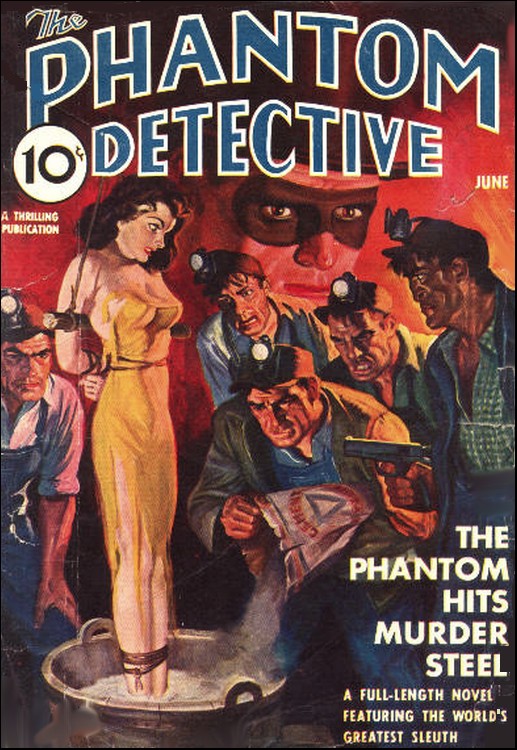
The Phantom Detective, June 1940, with "The Phantom Hits Murder Steel"
Death, destruction and sabotage in the great invincible steel mills follow in the wake of a fiendish murder mob! A steel-making secret of vast importance is the hub of a baffling murder mystery!
ANY intelligent citizen would have distrusted the even dozen men who had taken shelter from the storm in the old hillside shack. They were well enough dressed, and their faces bore none of the slant-mouthed, hard-eyed expression customarily attributed to mobsters. Yet there was a sinister implication.
All were alert, quick in their movements, slow in speaking. It might have been that which so definitely marked them. They moved a trifle too quickly, a bit too furtively. They spoke too slowly, were too reluctant to say anything.
It was as if each was somewhat uncertain of the other, or mistrustful of the purpose that had brought them to this hillside below the immense private sanitarium for mental cases.
Most of the men huddled around a rusty iron stove in which a broken packing box had been lighted for warmth. This warmth was augmented by the contents of a quart bottle that was passed around, and quickly emptied.
Although it was early afternoon, a storm wind that howled weirdly driving the fine, sleety snow created a white invisibility that made it almost as dark as early evening. Two powerfully motored sedans close to the shack were almost snow-sheeted and nearly hidden where they had been parked off the winding, private roadway leading up to the sanitarium.
"It's past two, Walker," one of the men said presently. "I understood we were to wait until dark, but with this damn blizzard hidin' everything an' likely to snow in the roads, what are we waiting for?"
The man addressed as Walker was broad of shoulder. When he spoke, his face showed deep lines, but when he was silent they seemed strangely to vanish. He appeared to have some unusual control over his facial muscles, as if he could convey as much meaning with a gesture as with words.
"You're right, Joler," he said. "Probably when I make this contact we won't have to wait if everything is set. It's a break for us, this storm, if it doesn't block us."
The man called Joler was undersized. His evil features all ran to points, from narrow ears to narrow chin. He was cuddling a light case in the crook of his left arm. It could have contained some stringed musical instrument, but Joler's manner of holding it hinted that the only tune that would ever come out of that case would be death.
A rock or a club struck the light wall of the shack with a solid thump. Every man whipped around, as hands went instinctively toward coat pockets. Then a shrill whistle rose above the eerie sound of the wind.
"That's him," said Walker, pulling his coat around his neck. "None of you are to come outside. It's healthier for those who don't know too much. I'll see if we can shove the time ahead."
Walker picked up a little leather satchel from a rough table and fought the sagging door open. Wind blasted into the shack as Walker vanished.
Outside, a man, shadowy in the snow, and plastered with it, was standing beside a big tree. With his pulled-down hat and the pulled-up collar of his big coat, little of his face could be seen except his mouth.
"You brought it?" demanded the man beside the tree, hoarsely.
"It's all here," said Walker, extending the satchel. "You get it if you have the setup all ready."
"It's all set," rasped the hoarse voice. "This storm's a break, but it hurried everything. He is expecting visitors at three o'clock. It was intended to wait until after visiting hours, at six, but it will be better to have the surprise ready for the visitors—especially one."
"Yes?" Walker's voice smooth and oily. "You mean the special visitor is the Phantom, don't you?"
"I didn't say so," was the quick answer, and there was a note of fear in the man's tone.
"You don't have to say it." Walker laughed curtly. "We know the arrival of the Phantom is part of the setup. The money's all here, and we'll give you time to get back before we move."
The man beside the tree took the satchel with a quick movement, thrust it under his coat and started to turn away.
"It's understood there'll be no shooting, no killing inside," he said over his shoulder, and again that note of fear was in his voice.
"That's understood," agreed Walker, "but things happen. I can only make sure that the Phantom isn't armed. That's my biggest job."
"And I wish to all hell the Phantom angle had been left out of it!" snapped the other man, then he was gone into the white denseness of the blizzard.
The increasing wind literally pushed Walker back through the door of the shack.
"We move now!" was his terse, quick order. "Joler, take your car back down to the main highway! You know your orders—you know the bus to watch for! Under no circumstances arouse any suspicion of others in cars."
"Okay, Chief!" said Joler. "It'll be a pleasure!"
"And get this, Joler!" snapped Walker. "Don't let yourselves be seen, so that you can be identified later. And under no circumstances let anything happen to the girl and the old man!"
JOLER nodded curtly as he and the man left the shack. One of the snow-mounded cars got under way, moved almost silently down the hillside road. The other car took the road up the hill...
It was visitors' day at the private mental hospital. In half an hour—at three o'clock—callers would be admitted. But with the rising fury of the blizzard, the driving maelstrom of fine snow and sleet, it might as well have been midnight of any calm night. On the main state highway in the river valley far below, car drivers had their lights on and fairly crept through the storm at a slow pace.
One of those cars—a big one—had a ceiling light on inside.
The gold initials on its door were "J.S." The ceiling light revealed three persons. One, a willowy girl with blue-black curling hair, and clear blue eyes, would have been marked anywhere, either here on this stormy state highway or in the swankiest of night clubs. Her picture had often adorned the society pages, with about the same caption:
Kay Brickley, Granddaughter of Jason Sterne, the
Ironmaster, Head of Invincible Steel, Who Will Inherit
His Great Valley Mills When He Retires at Seventy-five
Sometimes it would be mentioned that Jason Sterne was at present in a private sanitarium for mental cases, where he had been sent to squash prosecution for an attempted shooting of one of his own directors.
Seated beside Kay Brickley was a thin little old man with a scarred face like dried parchment. He was totally bald and his skull, now bare of a hat, bore deep scars. He was Luke Smiley, who had come up with Jason Sterne from the first days of Invincible Steel. He had been the ironmaster's personal secretary and adviser.
The ornate limousine was making uncertain headway toward the hillside sanitarium where Jason Sterne was being held, for Kay Brickley had never missed a monthly visiting day.
Luke Smiley's faded blue eyes lighted every time that Kay Brickley spoke. But they clouded each time they turned upon the car's third occupant, the driver. He was Larry Colter, Kay's stepbrother, and old Jason Sterne's grandson. Plainly Luke Smiley did not like Larry Colter, his driving, or anything about him.
Young Colter was driving in spurts, sometimes slowly, sometimes recklessly. He drove about the same way he lived, and just now his breath reeked of hangover medicine.
Apparently he was on his way to make this monthly visit because it was a duty he could not avoid.
"There's no damn sense trying to go on!" he exclaimed suddenly, as the limousine bucked a snowdrift. "The old boy's all right. He always is, and cranky as hell. Let's go back, Kay, before we're snowed in. What do you say?"
Kay put her hand on her stepbrother's arm.
"Today's extra important, Larry," she said earnestly. "Grandy Jason is to have some other visitors this time. Larch, Stevens and Krantz are to be there. They have Charles Thurman and Homer Catts with them. They want to find out Grandy Jason's condition before they decide upon letting some contracts. He still has a say, you know."
"They would pick out a day like this," Colter grunted.
John Larch, Curtis Stevens and Fritz Krantz, as Larry Colter well knew, were directors on the board of Invincible Steel. Charles Thurman was the head of Modern Steel, with rival mills in the same valley, while Homer Catts was head of Valley Iron Products, another group of mills close to Invincible Steel.
As Kay Brickley had said, this visiting day was important.
Old Jason Sterne had patented a process for the finest armor plate ever produced. Invincible Steel owned this patent outright, and had been given a huge Government order. The order was beyond the present capacity of Invincible Steel to fill, so Thurman and Catts were seeking a part of the big order. It was up to the directors of Invincible Steel to give the order to either of them, or to divide it between them. They were keen business rivals, and the Invincible Steel armor contracts would be great enough to bolster up the recently depressed business of either, or both.
Those sub-contracts were of great interest to Kay, though Larry Colter cared little about them. Although he was Jason Sterne's grandson, he took but little interest in the big mills at all. It was Kay who watched details, and it was Kay Brickley who would inherit the Invincible Steel mills and fortune, although she was in fact no kin to old Jason at all, except that the old man had considered her his granddaughter, after her father's marriage to Larry Colter's mother, the ironmaster's daughter.
Kay had no idea of whether the rival steel magnates, and the Invincible Steel directors were stormbound or not, but she was taking no chances. She considered it vitally important to be present at any interview with her grandfather, to look after both his interests and her own.
Kay had insisted that Larry Colter be present. For, in event of anything happening to her, Colter had been named as second choice in Jason Sterne's strange retirement will.
Since young Colter had made his complaining protest the blizzard had increased to blinding proportions.
"It can't be far to the turnoff into the sanitarium driveway," said Luke Smiley, scraping frost off the window beside him.
At that moment another car slewed out of the storm ahead. With a grinding of fenders the two cars jolted to a stop.
"Hold everything!" rapped a hard voice. A slim steel muzzle was poked suddenly through the open window, touching Larry Colter's shoulder. "You, Colter! Open that door nice an' easy! You're changin' cars here!"
"No! Larry, no!" exclaimed Kay Brickley, starting up.
The machine gun muzzle swung slightly, taking in the rear seat.
"Take it easy, sister!" growled the hard voice. "We'd feel bad if we have to leave you nursin' a corpse! Come on, Colter!"
"What—I won't—you—" Larry Colter sputtered.
The car door snapped open. The machine gun muzzle jerked sideward just enough to slap Colter's head above his ear. Two men, whose faces would not have been distinguishable in the storm, if they had not been masked, yanked the young man from his seat.
Luke Smiley was swearing steadily, his thin body thrust protectively in front of the girl. She tried to shove him to one side.
"Larry! Larry!" she cried, helpless to act.
The motor of the other car roared suddenly. Its doors banged shut. A little skid, then it was swallowed up in the white dimness.
The wind whistled through the open car door. Luke Smiley slid his thin body under the wheel.
"I guess there's nothin' we can do until we get to the sanitarium, Miss Kay," he said.
EACH of the men in the old men's ward of the big sanitarium—except one—had the pathetic eyes of not too bright young children.
A few of them retained some dignity of bearing, but more were frankly doddering.
All except the one man who was the exception were engaged in odd occupations, or they told the same stories over and over again. In the old men's ward none was regarded as dangerous or with a possibility of becoming violent. Not even the old man who sat apart.
He was Jason Sterne, long known as "the Ironmaster."
Sterne was giving no attention to those about him. His eyes were fixed straight ahead, when he was not writing meaningless words with a pencil upon a piece of paper. His eyes were a hard, glittering gray, with none of the vacancy that was in the eyes of the other old men. Their hard directness might have been the result of long-nurtured hatred, but occasionally a thoughtful smile softened the square, rugged features.
"Something has happened to old Sterne," remarked a ward attendant to one of his fellows. "I'd keep an eye upon him, Blanton. He's been sitting frozen up like that for three days now, as if he's waiting for something he expects to happen. He's been watching the windows too much to suit me."
"The old man's okay," said the attendant called Blanton. "Sometimes he doesn't seem crazy at all. He just sits there amusing himself by doing a lot of writing, but sometimes the words don't make sense. He's sent out some letters, too, though the super said he didn't know whether to pass them or not."
Blanton walked over to the old ironmaster.
"How're you feelin', Mr. Sterne?" he asked.
"Fine—fine," said the old man, his voice like the vibration of a bass cello string. "It's comin' on to snow hard, I see. It'll be a bad night for the sand in the casting shed. If the snow blows in and wets the sand, there'll be hell to pay when the heat is run."
"That's right, Mr. Sterne." Blanton nodded, although he had not the slightest idea what the man was talking about. "It's a regular blizzard, such as we rarely get in Pennsylvania. It's swell to be in where it's warm and dry."
THE old ironmaster clicked hard teeth together grimly.
"It's damnable," he said without emphasis. "I'd like to be out there, wet an' cold, doing things. Who wants to be dry, anyway, when half the world's cold and hungry, and at war? It's those that are comfortable, and safe, who are making it hell for others. I need some more writing paper, please."
"He doesn't seem so sane today," Blanton thought. "Not so good, if his usual visitors drive up here in this storm. I hope they make it, too, for the super says this Phantom detective that's coming is supposed to have a talk with the old man about something he's been writing. I'd sure like to have a look at the famous Phantom."
In that wish the asylum attendant was only expressing the desire of many thousands.
To get the paper Sterne wanted, Blanton stepped across the ward to the locked door of a supply room. Hard sleet was rattling upon the glass of the windows, freezing there, as the blizzard beat upon the sanitarium.
BLANTON unlocked the supply room door, pushed it open. A blinding flare of fire blasted into his face. An explosion that seemed to have been touched off by the opening of the door struck him with an impact that caved his ribs. His head was smashed far back upon his cracking spine.
All that was left of Blanton was hurled halfway across the big room. He would never hear the sudden, whimpering of many scared old men as their chairs were overturned. Then, when the dazzling blaze of the explosion died out, the long room was suddenly plunged into opaque darkness as the bewildered, frightened old men struggled in the momentary darkness toward the exits.
Jason Sterne alone made no outcry and no hasty, blundering movement though he had seen it all, for his bleak, gray eyes had followed the attendant when he had unlocked the supply room door. He could hear the driving beat of hail and snow against the windows. He arose, pulling his light coat together, as if he were about to face the chill of the storm.
"Maybe it's a chance, Kay," he muttered cryptically. "A lot of wrongs can be righted by a free man. They let the sand get wet this time. They should have waited before they run the heat. Now there'll be hell to pay."
He moved straight toward a window, guided by the rattle of the sleet. An instant more, though, and it was no longer dark, when forked tongues of fire started leaping through the blasted doorway of the supply room. Other doors crashed open, and frightened, or authoritative voices were crying out, swearing.
"What the hell's happened?" said a commanding voice. "Every damn light's gone on the blink! Hurry up! Get all of the old guys out of here! Blanton! Where are you?"
The flames in the supply room were mounting. The fiery tongues became one belching wave that rolled across the long room. The old men were swept back, fleeing before the heat instinctively. The rescuing attendants suddenly had their hands full.
They were making a good job of the rescue work, getting all of the old men safely through the exits when abruptly there came a splintering crash of glass. One attendant, close to a big window, drew in a sharp breath of amazement before he shouted an alarm.
He saw the big window break inward. Three of the iron bars on the outside had been filed through at the top, apparently. For they bent outward and downward, as if they had been so much cheese.
The attendant could not see the slender, steel cable that was pulling the bars from place. He did see two masked faces outside, red-lighted by the blaze inside.
"It's a break!" he shouted. "Over here, fellows! The west windows!"
He was clawing for his pistol, but as he lifted it, a bulky, square-shouldered figure lifted squarely between him and the window. He saw the massive head of Jason Sterne, a leonine head, crowned by thick iron-gray hair.
It was the attendant's duty to prevent an escape, but that did not include shooting an inmate in the back. He lunged for the old ironmaster's shoulder.
"Sterne! Sterne!" he yelled. "Come back! You don't know what you're doing!"
Sterne turned his head.
"You bet I know what I'm doing!" he said crisply. "I'm going to make some wrongs right!"
"Damn that guard!" snarled one of the masked men outside. "Get him out of the way!"
EVEN as the attendant snapped up his pistol the thought shot into his mind—were the kin or friends of Jason Sterne engineering this escape? Or had he plotted it himself? He had plenty of millions to pay for it. Maybe—
A gun exploded in the attendant's eyes. A slug split his forehead and he fell upon his face.
The big ward outside the blazing room where the old men had been was nearly cleared when a strange little procession marched through one of the doorways. The man in the lead was Malcolm, the hospital superintendent, a tall man, thin to the point of emaciation, and whose Adam's apple was doing acrobatics. Three men who wore black masks were at his heels. A machine gun prodded his back.
"You'll never get away with this!" he croaked, his eyes searching wildly for an attendant. "Somebody sound the alarm! Don't let these devils get out of the grounds!"
It was an heroic effort for a man with a gun at his back, but it only brought harsh laughter.
"Yes, sound the alarm!" a smooth, oily voice jibed. "Then you can pick up this wise guy's remains in pieces! Burke, have a look around, an' see if everything went off okay!"
One of the masked men moved swiftly into the burning ward, shielding his eyes from the fierce heat. A cold burst of snow and sleet hit his face through the broken window. He saw the dead attendant under it, and the bars bent outward. There was no one alive inside the long room.
"Looks like everything's jake, Chief!" he called.
"All right, Super!" commanded the man with the machine gun. "You'll be taking a little ride with us until we're in the clear! Get moving!"
"Somebody stop 'em!" Malcolm yelled again, "Sound the alarm!"
"Go ahead, somebody, try it!" jeered the gunman. "Come on, Super!"
With the gun prodding him, Malcolm was forced around. The little procession marched out, went back out the way it had entered, through the superintendent's office, and to the outer door. The storm lashed them furiously as they reached the gallery.
The masked men were halfway down the gallery steps, marching Malcolm ahead of them, when the blurred headlights of an automobile showed in the driveway, coming into the big gate set into the wall surrounding the sanitarium.
The masked gunman gave Malcolm a sudden shove with his gun muzzle, toppling him forward. The superintendent plunged head foremost into piled snow.
"It's a visiting car!" shouted the gunman. "Lam for our own bus! We're in the clear outside!"
Thin, old Luke Smiley, with Kay Brickley beside him, stopped the car with the blurred lights inside the big gateway. At that instant there was a whooming burst of flame from some of the hospital windows on the lower floor.
"Luke!" cried Kay. "There's a fire! Look! At those men running! They've got black faces! No, they're masked, like the men who grabbed Larry! Oh, Luke, something's happened to Grandy Jason!"
"That doesn't follow," Smiley said grimly, but his voice held doubt. "But those men are masked. And that looks like Superintendent Malcolm getting up out of the snow."
KAY BRICKLEY'S blue eyes were dark with anxiety.
"Luke! Do you suppose taking Larry was a part of this? And I don't see any other car here. The directors and the two other steel men don't seem to have arrived yet! They ought to be here by this time. I hoped John Larch and Fritz Krantz could advise me what to do. Curtis Stevens never seems to be decided about anything."
Superintendent Malcolm was staggering back up the hospital steps, shouting, waving his hands.
"Sound the alarm!"
Two attendants came rushing to him, just as Kay Brickley and Luke Smiley reached the bottom of the steps.
"Blanton was killed, Mr. Malcolm!" one guard shouted. "Jason Sterne is gone! Must have climbed out a window! Bars cut—pulled loose! They're getting the fire under control. It started inside the supply room!"
"Jason Sterne gone?" shouted Malcolm. "The fire started inside? That means the killers had help! I want every guard searched! Check every man! Go through all the rooms! Get men into the outside grounds! Sterne couldn't get far, unless those killers picked him up!"
"Luke, he's gone!" anxiously cried Kay. "I'm going to hunt for him!"
She was starting blindly away toward the big gate, fighting the screaming wind that swayed her slender body when old Smiley caught her arm, pulling her around.
"Don't be a fool, Kay!" he said sharply. "You'd only run into those masked men yourself! Keep your head, Kay. Someone close to Invincible Steel has a hand in this! I never have liked the idea of Thurman and Catts being brought up here by our directors!"
Superintendent Malcolm held out a hand to the girl, as a siren wailed.
"Please come on inside, Miss Brickley," he said.
STORM wind shrieked through the tortuous valley of the river that wound its way into the steel state of Pennsylvania. The river had its origin far up in the coal-veined foothills and mountains of West Virginia, the western slope of the famous Blue Ridge.
The fury of the blizzard drove pellets of sleet with noisy impact against the windshield of a battered old coupé that was ascending the twisting hill road. Packed snow on the windshield made it necessary for the driver to thrust his head out into the storm to follow the precarious roadway.
The wide shoulders of the driver filled all of the side window space. His coat strained over the bulge of his muscular back. He was undoubtedly a man of tremendous strength and athletic prowess, though judging by his quiet business suit and his mild, round face he might have been some road salesman.
If he had been asked, he would have given the name of "Mr. Garth." He might not have mentioned his business, for at the moment it was a visit to the mental hospital for the criminally insane, perched somewhere in the smother of the storm high on the hill above him.
The coupé bucked and skidded. Its motor roared and fed power to its chain-wrapped wheels. At times it seemed as if the whistling storm would overcome the forward momentum of the machine.
"Wouldn't be so good if I had to get out and hike it," muttered the driver softly. "Now what's that?"
The weird whistling of the wind through leafless trees hedging the crooked grade road was broken by faint snappings that could only be gunshots. At that moment the coupé plowed around a sharp turn into a man-high drift. The wheels spun. The motor choked and stopped.
Mr. Garth was out of the car almost before the wheels quit spewing snow. He stood motionless for a breath, rigid against the push of the storm, feeling its sting upon his face. Because of the wind's continuous howling, it was almost impossible to fix the direction of the gunshots accurately.
But no one could mistake the faint glow that first merely lightened the blowing snow, then turned the drift of the blizzard to a ruddy hue not so far above. Mr. Garth turned from his stalled car and started up the hill toward that ominous light.
His round features were suddenly fixed in grim lines, scarcely to be expected on so mild a face as the vast power of the legs drove him upward through the impeding snow seemingly without conscious effort.
As his clothes swiftly whitened, he merged with the white invisibility until he seemed some ghost of the storm itself, a phantom of the snow floating up the hill. And "Mr. Garth" was exactly what this illusion implied. For he was the Phantom!
The world famous Phantom was on his way for a visit with Jason Sterne, the old ironmaster, but it went without saying that his was an important mission. For only the most unusual and compelling circumstances could account for this Nemesis of the criminal world being here now.
Always the Phantom's cases were only those that pitted him against the brainiest of crooks, the most sinister forces that threatened the widest range of evil. He was the one man in the world most feared by those who had turned superior intelligence to nefarious enterprise, to exploiting injustice for personal ends and gain.
Because of this, the Phantom was respected by all minions of law and order in every nation of the earth—wherever men were called on to combat the powers of evil.
YET, in his present character of Mr. Garth, the Phantom appeared merely to be a somewhat overweight citizen, viewed close up, with graying hair above the roundish face. The lithe swing of his athletic body and the quick decision of his movements however, contradicted the mildness of his features.
As he plunged through waist-high drifts, the Phantom's lips moved. Whispered words expressed his thoughts.
"Shooting? A fire? That means trouble at the private sanitarium. Possibly a break. It could be coincidence that it should happen now, just when I am about to meet a man who says he must talk to me so that he can avoid committing a murder. But coincidence in crime is nearly always directed by human brains."
The ruddy glow had increased now to a sizable blaze. The Phantom could hear faint cries of fear borne on the storm wind. It was the mental hospital that was burning all right. His lips tightened grimly.
"Wonder if that shooting could have been timed for my arrival," he thought. "Others knew of course that Jason Sterne has been writing to Frank Havens—may know why. My coming would be expected. Havens arranged the visit with the hospital authorities, but there's little chance that news wouldn't get around, though Havens asked for secrecy."
Fighting his way up the hill, the Phantom recalled the letters he had seen, those letters sent by Jason Sterne to Frank Havens, nationally famous publisher of the New York _Clarion ^and a nation-wide chain of other newspapers.
Sterne had repeatedly appealed to have the Phantom sent to him. He had written again and again:
Only the Phantom can prevent me from escaping and committing murder, perhaps several murders. Unless the Phantom can be persuaded to act, a great industry will be destroyed or thrown into ruthless hands. Innocent persons now are menaced by the same forces that sent me to this place.
"And Havens is convinced that Jason Sterne is sincere, and that he may be sane," the Phantom was thinking. "Even if other parts of his letters were rambling."
Some parts of the letters had seemed to be the fantasy of the old ironmaster's brain. For instance, when he had written:
There are those who would kill my iron babies. Already they are being destroyed a little at a time. They want my formula, these killers, the formula that will revolutionize the whole industry of steel, and one other of the greatest industries. I almost had it, and I had to try to kill the one who wanted to take it from me.
The Phantom had gone over that with Frank Havens. Jason Sterne had been committed to the private sanitarium because of an attempt to shoot one of his own directors, John Larch. With Larch's consent the ironmaster had been sent to the sanitarium instead of being prosecuted. There seemed little doubt that Sterne had been a serious mental case.
He had refused to open his grim mouth in defense of himself, or to explain his act—if he had an explanation. For nearly a year now he had been a silent inmate of the hospital. Only in recent weeks had he appeared to break, at least to the extent of writing those letters.
WITH them had come a note from Malcolm, superintendent of the mental hospital. He had written:
These letters are being mailed after due consideration. There may be little or nothing of the truth in what Jason Sterne may write, but again, there may be enough to warrant investigation by the Phantom, in whom Sterne appears to put implicit faith. At times, Sterne does have intervals of sanity. It is also true, as Sterne says, that several serious "accidents" have occurred in the mills of Invincible Steel, which have a hint of sabotage. It is possible that this situation may affect huge orders for a new armor steel to be delivered to the Government. I leave it to your judgment, Mr. Havens, as to whether the Phantom should visit Mr. Sterne.
All of this was in the mind of the Phantom as he battled his way through the storm. He had been in many extraordinary circumstances in his hectic career, but never before had his aid been sought by a man who wished to be prevented from committing murders.
Even so, the Phantom might not have answered such a call which so easily could have been the imagining of a diseased brain had it not been for other angles. Frank Havens had verified facts concerning "accidents" in Invincible Steel Mills, which had been of such a character as to warrant the suspicion they might have been caused for some sinister purpose. A menace that would affect government deliveries at a time when the Nation had been awakened to the necessity for preparedness against war, was a clarion call to the Phantom whose whole life was dedicated to such purposes—had been ever since the Phantom had come into existence, to cause terror to quail the hearts of criminals of high or low degree.
Havens, the publisher, was responsible for the Phantom, as he alone was aware of the famous sleuth's real identity.
For the Phantom was, in everyday life, none other than Richard Curtis Van Loan, gay, sardonic, spendthrift playboy of Park Avenue and a dozen other spots where society disported itself. He never combated crime under his true identity, however. His closest friends did not suspect him to be one of the greatest detectives of all times, and they would have scoffed the idea, firmly convinced that Dick Van Loan had never had a more serious thought than playing polo, hunting big game or evading designing mothers of eligible daughters.
One of the Phantom's most valuable assets was his ability to assume almost any character. He had undergone long, laborious training to perfect himself in that art, until now he had no peer in the art of makeup, deserving the title of "the man of a thousand faces" by which he was widely known.
Now he had invented the role of Mr. Garth, and it was in that effective disguise that he had received his permit to visit Jason Sterne.
Tomorrow, he might find it to his advantage to appear as some tough mobster, as a workingman, or in some other guise. In whatever role he was called upon to assume, however, he could apply the most advanced scientific methods for the detection and the defeat of the smartest criminals.
He was trained, mentally and physically, beyond any other man in the world who followed his calling. Just as he was a thorough playboy and spender, an apparent wastrel beloved by his many friends, so he was a thorough master of the craft of detection.
SOME years before, Havens, shrewd and kindly, had discovered that Dick Van Loan, orphan son of the publisher's closest friend, was bored with life, chiefly because of being forced to waste his vast energy and his keen mind upon frivolous pursuits. Havens had talked young Van Loan into attempting the solution of a puzzling crime case. That had started it. At once Dick Van Loan had applied himself diligently to the study of every angle of crime detection. He trained himself in all of the arts of fighting. Boxing, ju jitsu, wrestling and other forms were mastered. He had reached the point in such things that now he could remove an enemy swiftly by the merest nerve pressure.
As the busy years had passed swiftly, he had become known widely as the Phantom, but never was the super sleuth associated with the playboy, Richard Curtis Van Loan. He had now even established his own laboratory of crime detection, advanced in many respects over that of the Federal Bureau of Investigation. His library contained every volume ever written that dealt with crime and criminals.
The Phantom was advanced in the arts of ventriloquism, lip reading, mimicry of voices and mannerisms of any variety whatsoever, and in the art of makeup to a point where he could speedily assume the character and appearance of other men in a manner to defy detection.
So widespread was the Phantom's fame that his domino mask and his diamond-studded platinum domino badge were recognized by law officials throughout America and upon every other continent—an open sesame wherever he went.
Beyond all else, it was the Phantom's instant grasp of circumstances that betrayed motives to him—things which had eluded other police officials and other investigators that had won him his immense prestige. And the undaunted courage with which he immediately went into action. So now, with a mountain blizzard swirling around him, an asylum fire raging ahead, and gunshots to make certain that some break must be under way, the Phantom's astute brain was adding up all angles of this queer call on his powers for aid.
There was that implied menace mentioned in the letters of Jason Sterne, the supposedly insane old ironmaster. Sterne was the father of Invincible Steel, one of the greatest independent producers of a material for which a world at war was clamoring. Invincible mills were the oldest in the great steel region of the Pennsylvania valleys.
THE ironmaster had made the first steel in one of the biggest valleys. He had set up the first crude blast furnaces. Now Invincible Steel was more than just an industry. It was a tradition.
Sterne's earliest blast furnaces still ran pig iron into sand, the original method that had been used. He had more modern furnaces, but the ironmaster had never abandoned his first "babies."
Invincible Steel was now reputed to be ready to produce the most advanced armor plate steel. This was the product of the old ironmaster's own brain. Perhaps that miraculous brain had been overtaxed by his great effort. Perhaps Sterne had only imagined that rival steel makers had attempted to steal the Invincible armor plate formula. Why else should he have suspected one of his own executive directors—even tried to kill him?
"There has been inside trouble at Invincible Steel, Dick," Frank Havens had warned. "Foreign observers are watching the first tests of the new armor plate. Huge orders already have been placed by the United States Government. Other steel makers are fighting for a share of those contracts."
This of itself was enough to compel the Phantom's deepest interest, but there was another item that had impressed him—the peculiar arrangement by which the great mills were to pass into the fragile hands of Kay Brickley during the old man's lifetime, when he should be seventy-five, which would be soon. Jason Sterne considered the girl his granddaughter, and to that girl, known as a society playgirl, would fall this monumental task of running the famous steel mill.
Fighting his way through the blizzard, off the winding road, the Phantom abruptly came to an unscalable wall.
He was forced to flounder back to the motor drive. The going here was little better. Then a car loomed up suddenly, boring down the steep grade through the drifts. With its snow-encrusted headlights almost useless, the car was like some black monster rushing upon Van. He threw himself into a drift beside the road to escape being crushed by the oncoming car.
The car rushed past, its skid chains plastering snow into Van's eyes. He struggled up, and was getting back into the road when the chattering of a machine gun came from the speeding car.
The dark figure of a tall man hurtled from a rear door and landed in the snow. The man was alive, for he rolled over and got to his feet, starting to stagger blindly away through the driving blizzard.
Before Van could cry out to him above the storm wind, a pistol cracked out from the nearby trees. The tall man threw up his hands, plunged full length, and lay still.
THE Phantom's instinctive movement brought an automatic .45 into a cold, numbed hand. But there had been but a single flash of gunfire from that clump of trees. The bullet had found its mark. The shooting of the tall man from the fleeing car had been as perfect as if the whole thing had been timed.
It was impossible to move fast through the snow. Van bent double, fighting toward the point of ambush. The eerie howling of the wind through leafless branches mocked him when he reached the trees. Because of the swirling fall, it was impossible to find tracks.
It was equally impossible to detect by sound the direction the gunman might have taken. A perfect setup for a planned killing. No use to start a lone hunt for the gunmen now. Van turned back to the fallen man near the road. He might not be dead—might need help. Turning the tall man over, he saw a craggy face, straw-colored hair and light blue eyes, wide open in pain.
Blood was soaking through the man's coat where the slug had entered close to his heart. He was still breathing, but the bullet had pierced a vital spot.
"Krantz," Van said, gently lifting the man's head. "You're Fritz Krantz, a director of Invincible Steel, aren't you? I recognize you from a photograph I saw in New York. You'll have to talk fast, man. Have you any idea who shot you? I am the Phantom."
Blood was seeping from Krantz' lips. His head nodded wearily.
"I know—the Phantom," he whispered hoarsely. "I wanted to talk to you—but you're too—too late. It's happened."
"What's happened?" Van asked quickly. "Who shot you?"
Blood choked Fritz Krantz, but he got out a few more words.
"Find Catts—Homer Catts—Valley Iron. He—Jason—it was—too late, Phantom. Find Jason—Sterne!"
Krantz' chin hit his breast as if someone had pushed his head forward. The shudder of death passed through his long body. Fritz Krantz was dead.
If Van had not already familiarized himself thoroughly with the affairs of Jason Sterne, and Invincible Steel, the dying words of Fritz Krantz would have been wholly confusing. But Van was aware that Homer Catts was head of mills known as the Valley Iron Products, and that Catts was one of two mill owners seeking part of a huge government contract with Invincible Steel.
Had the dead Krantz, by any chance, opposed Catts, and his dying words been meant as an accusation of the man?
But Krantz also had mentioned Jason Sterne. Had he meant to imply that either Catts or Sterne had fired the murder bullet?
The Phantom came to his feet, listening intently. The only sound was the roar of wind. Van could only conjecture that Krantz had been on his way to or from a visit with Jason Sterne at the asylum. But with the man's murder, to Van here was startling confirmation of the warning in Jason Sterne's amazing letters to Frank Havens. Was Sterne beginning to carry out his murder threats—the murders from which he had pleaded to be saved?
It might be possible, but it could be only conjecture at this moment.
THE ruddy glow of the fire on the hill was lessening, though it had been but three or four minutes in all since Fritz Krantz had jumped or had been thrown from the speeding car, and then shot. A sudden thought came to Van and, with a tight grip on the automatic in his side pocket, he started back down the asylum driveway.
"Unless they had a big break of luck, or the driver had telescope eyes, that car's piled up," he muttered.
The black car would not be likely to miss his own stalled coupé in the drifts on that sharp hairpin curve. The storm wind could have drowned out any sound of a crash, but the Phantom was betting on one.
Nearing the curve, Van first saw a single beam of a headlight that still burned. The beam was striking upon the snowy trunk of a nearby tree. The light was the only sign of life about the car, for the big sedan had crashed into Van's coupé with such force that the hoods of the two cars seemed melted together.
The sedan lay partly on its side. But there had been a machine gun in that car, so Van moved warily. If he had been seen as the sedan passed him, the gunman might be lying in wait for him. Or others might be hidden nearby.
The gunman was lying in the snow. He was not waiting for Van. He was not waiting for anything, except Judgment Day. The machine gun still gripped in his cold hands had accidentally exploded as the cars had crashed.
The gunman had no face, and had been left all alone. The men who had been with him had disappeared. But because of the rapidly drifting snow, it was impossible to tell which way they had headed. More than likely, though, they would strike out for the highway.
The dead gunman's clothes revealed nothing, except that the automatic in one side pocket stamped him as a mobster. The Phantom climbed into the overturned car.
"Funny," he muttered a few seconds later. "Krantz' departed friends may or may not have been in on an asylum break, but they had something else pretty interesting in mind."
The partly unrolled round of binding tape that lay in the car spoke for itself, as did four other rolls of tape in a car pocket. If the car had been used in an attempted escape at the hospital, there must have been some idea of a kidnapping in connection with it.
"Could that be what Fritz Krantz meant when he named Catts and Sterne?" mused Van. "This whole affair is beginning to assume some queer proportions. Though it might be that someone who knew of Sterne's appeal for my aid wants to get him out of the way."
Snow had been dislodged from the headlight, and it now burned brightly. Its beam was steadily upon the black bole of the tree less than twenty-five yards away. And Van's eyes, following the beam, while he was climbing from the wrecked car, saw a man's figure abruptly outlined beside the tree. The auto's beam showed a rugged face, topped by a thick mop of hair, which at that distance seemed as white as snow. The leonine head was unmistakable.
"Jason Sterne!" ejaculated Van, springing forward.
He was wholly unprepared for what happened. The white-haired man by the tree whipped up one hand. White fire spurted from the glinting weapon in it. Most of the slugs struck in the snow, but one bullet almost stung Van's face.
HIS own automatic whipped up instinctively, but he refrained from pressing the trigger. Whether or not Jason Sterne meant to kill him, whether this were a case of mistaken identity or otherwise, Van could not shoot an insane man.
He threw himself into the deep snow.
"Sterne!" he called. "I'm the Phantom! I came to see you!"
Lead struck so close to Van's head that snow particles hit his eyes.
"The Phantom?" cried the ironmaster's deep, vibrating voice. "You're a killer of iron babies!"
Van heard a metallic click. The menacing automatic had been emptied. As Van came to his feet, a mocking, low-pitched laugh reached him. The figure had vanished from beside the tree.
Van plunged toward the spot. He went down into a snow-filled ditch and lost time climbing out. When he reached the tree, the surrounding brush had the appearance of silent, white ghosts. He might as well have been in a graveyard for all the movement that he could detect.
There was neither sight nor sound of Jason Sterne, who had openly attempted to kill him.
Van was becoming critical now of all his previously formed opinions of the old ironmaster, and of Frank Havens' belief that he might be sane. It seemed indisputable that Jason Sterne was violently insane, and that he was possessed of a persecution mania that included a murder phobia against imaginary enemies.
"And that was what Fritz Krantz must have been trying to convey," Van's thoughts concluded.
Although the storm had lessened, there was more visibility and less wind, it was still impossible to find the trail of Sterne or anyone else. Van did see a flickering light appear off to one side, but it vanished quickly, as if its bearer had dropped into some gully.
There was no longer a ruddy glow from the fire at the sanitarium. Shouts of men in the woods were borne on the dying wind. Searchers for Jason Sterne, possibly for other escaped inmates, were combing the wilderness hillside.
Moving toward the sounds, the Phantom almost bumped into the wall of a small shack before he saw the sagging, little cabin. The snow had shifted across the doorway, but there were no tracks in it.
Van pushed open the creaky door. His pencil light revealed footprints where a man had recently walked in out of the snow, then walked out again. A rough table was in the middle of the shack. A rusty stove at one side still gave forth heat.
Van's light picked out an irregular sheet of wrapping paper held to the table top with a rusty nail. Scrawled words were on the paper, written in a rust-colored fluid that still was damp and shining. The fluid used was not ink. Half a dozen drops were on the paper and the table close to it. Van bent close to examine them.
The message had been written in blood!
A soggy splinter of dirty wood was lying there, indicating it had been used as a pen. Van saw quickly that the words were only names, except for the one word, "First."
There were five names. And the name "Fritz Krantz" was at the top. The next name was that of "August Manton." The other names were, "Charles Thurman, John Larch, Curtis Stevens."
"Fritz Krantz?" muttered Van, his brows furrowed. "And this has just been written, so the writer could have been sure of the first name on his list."
VAN took a paper from a pocket—one of Jason Sterne's letters to Havens. The names written in blood were in the crudest letters, but there were one or two twists that indicated the handwriting was the same. But before he was through with his examination, shouts of searchers sounded close to the shack. Then Van glimpsed a scrap of paper blown into a corner. He scooped it up. He gave it but one glance, then whistled softly, thrusting the scrap, the blood message and Sterne's letter inside his coat.
A crisp exclamation came from Van's lips as he heard the men outside crunching through frozen snow toward the shack door.
"August Manton is the executive chairman of Invincible Steel," was spinning through his brain. "Thurman is the head of Modern Steel, and his mills are in the same valley as the Sterne mills. Krantz mentioned both Sterne and Homer Catts, of Valley Iron Products. And Catts' name is not on the list!"
The next instant Van was facing Homer Catts himself, as three men burst into the shack. He recognized the man instantly, from having seen his photograph among others shown him by Frank Havens in New York as being connected with the present affairs of Invincible Steel and Jason Sterne.
Two asylum guards were with Catts. The guards covered Van with shotguns.
"Don't move!" rasped one of the guards. "Get your hands up! I'd just as soon blow the hell outa any damn killer as not!"
Van saw no reason now for concealment. It was already apparent that the time of his visit to Jason Sterne had been known to many others, or else the laws of sinister coincidence had been working overtime.
"I am the Phantom," he said quietly, palming his diamond-studded domino badge for the guards to see. "There have been two killings outside, near here. One of the dead men was a gunman, who probably was aiding in an escape. The other is Fritz Krantz, of Invincible Steel."
HOMER CATTS, head of Valley Iron Products, had a bulldog chin. He had big-veined hands that were clenched now. He was, in appearance, all that a fighting steel magnate might be expected to be. For years he had battled for his mills against Charles Thurman, of Modern Steel, and against Invincible Steel itself.
The Phantom was in possession of many facts concerning the different steel men in any way associated with Jason Sterne, but he had not been informed that a group of them had been planning a visit to the ironmaster today, nor had he known that Catts had meant to _ ^come with the directors of Invincible, planning an interview with the ironmaster concerning contracting for part of the governmental contracts held by Invincible.
On the other hand, Catts had been informed that the Phantom was expected to put in an appearance, so Van's words had not come as a shock or surprise to him. On the steel man's face, though, was frank disbelief as he studied the man facing him in the shack—the wild, roundish face of Van's "Mr. Garth" role.
"You don't look a hell of a lot like any Phantom to me!" growled Catts. "You're quick enough to tell us about Krantz being killed, too. How do we know you ain't fixin' up a yarn for your own getaway?"
Van smiled a little at the belligerent steel man.
"Your suspicion is natural," he said easily. "By the way, Mr. Catts, have you been with these guards all the time?"
"So you know my name, huh?" bellowed Catts. "Don't you see how you would even if you should be the Phantom? I never met the Phantom. No, I just ran into these guards half a minute ago! The car in which some other men and I were driving to the sanitarium went into the ditch, and I got separated from the others while we were trying to get up the hill through the storm! I'd been lost until the guards came along!"
"Then you and I are on an even footing, so far as suspicion goes," Van said softly. "Krantz lived long enough after he was shot to name two men. You happen to be one of them. Any reason you know why he should have done that?"
One of the guards whipped around upon Catts.
"This man's the Phantom, all right," he said. "There's only one badge like that of his in the world. And you didn't say anything about hearing shooting down here when you met us, Mr. Catts. You said you didn't have a gun. Maybe you did and ditched it, huh?"
Van smiled faintly. He had seen an involuntary movement of Catts' hand.
"Mr. Catts probably has a gun under his left arm," he drawled, "and he isn't accustomed to having it there. It might be well to check up, and see if it has been fired recently."
"I don't let any damn' man lay hands on me!" roared Catts.
He was mistaken about that. One of the Phantom's hands shot out with such suddenness that it was only a blur. A bellow of pain came from Catts, as his body stiffened and his big arms dropped limply.
One of Van's hands was inside Catts' coat. With the other he was holding the raging steel magnate with fingers in a pouchy cheek and a thumb prodded deeply under the jaw. He could have put him completely out with that paralyzing nerve hold.
VAN pulled an automatic .38 from Catts' armpit and extended it quickly to one of the guards. But not so quickly that his keen sense of smell missed the lingering odor of freshly burned powder.
"The gun has been fired within the past few minutes, you'll find," said Van.
The guard rapped out an oath as he broke the magazine out. It had only one unexploded cartridge, and that was in the firing chamber. Catts was looking as if he would explode from the rush of angry blood to his red face.
"What if I did shoot that gun?" he demanded belligerently. "I was lost in the storm! I thought I saw old Jason Sterne with a gun in his hand! I shot to scare him, not to hit him, for I was afraid he might try to kill me!"
"Nuts!" snapped a guard. "That don't go, Catts! Not after what the Phantom says Krantz told him! Besides, how in hell would old Sterne get a gun? He sure didn't have any gun when he broke out—and you say he was alone. Anyway, you told us you hadn't seen him!"
Van released his hold on Catts and stepped back.
"Maybe I wanted him to get away!" snapped Catts. "That's my business! But I didn't see Krantz after we left the car and got separated!"
The guards were moving toward the steel man when Van intervened.
"I don't know why Mr. Catts would desire the escape of Jason Sterne," he said. "But he is telling the truth about one thing. I saw Jason Sterne, and he did have a gun."
Van was forming his own conclusions concerning Catts. He was not convinced that Catts had not killed Krantz. Catts had been the first name the dying Krantz had uttered. But for the time he wanted to keep his thoughts to himself.
"If it's a thirty-eight bullet in Krantz' body, it'll just about put you in a bad position, anyway, Catts," growled one of the guards.
"That will be a bit hard to determine for some time," Van said. "The slug that killed Krantz went through his body. It may be found in the snow, or it may not be found until after it thaws. Sterne also was armed with a thirty-eight automatic."
He did not mention that he had been compelled to dodge a few slugs from that .38.
"I would suggest," he went on, "that every effort be made to round up Jason Sterne before he does some injury to himself or some other person."
Catts gave him a hard, straight look.
"Yes, you're the Phantom, all right," he grunted.
"You guards look for Sterne," Van said, as if he had not heard the steel man's capitulation. "Mr. Catts and I will go on up to the sanitarium and see what has happened."
The guards started out reluctantly in the tag end of the dying storm. The Phantom and Catts took the driveway up the hill. Catts was silent for the most part, but he replied to Van's inquiry concerning the men who had been with him.
"KRANTZ, of course," he said. "Charles Thurman, of Modern Steel, and two other directors of Invincible Steel—Curtis Stevens and John Larch. Reed, the driver, started out to look for help after we slid into the ditch, but he was gone so long we decided to walk. Then it was blowing so hard that I got separated from the others, so I don't know what happened to them. Except, of course, what you say about Krantz."
"What brought you rival steel men together?" probed Van.
"That has been something of a secret," said Catts. "But it will have to come out now. Thurman and I were hoping to handle some of the Invincible's armor steel contract. It's too much for Invincible's capacity, and with Jason Sterne practically out of it, the directors aren't wanting to take the authority to expand."
"Any opposition to the split in the contract, Catts?"
"Well, yes," admitted Catts slowly. "This girl, Kay Brickley, who soon will have full charge of Invincible—as soon as old Jason Sterne is seventy-five—is all for expanding and keeping the big contract, but she won't have the say-so for a while yet. And"—Catts hesitated—"well, Fritz Krantz didn't want to split the contract, either."
"And with the recent depressed business, your mills and those of Thurman have been pretty hard pushed, haven't they?" said Van quickly.
"In a way, yes," admitted Catts, and said nothing else before the two men came in sight of the sanitarium.
Only the smashed windows showed where the fire had burned part of one hospital wing, as Van and Catts reached the rambling structure, though the smell of smoke still lingered.
But the Phantom was thinking of something far more deadly than fire as he climbed the gallery steps to the big front door. He knew intuitively that he had come among men whose distrust for each other amounted almost to open hate. As he entered the sanitarium office with Homer Catts, of Valley Iron Products, another man, with a bulldog chin that matched that of Catts, was first to confront them.
"Just where in all hell did you disappear to with Fritz Krantz?" this man demanded of Catts. "Thought you'd sneak off, and maybe talk Krantz into thinking you ought to have all of that Invincible contract, huh? And you know something about Jason Sterne being gone, too, don't you?"
Van said nothing, made no move, as Homer Catts clenched one red-veined fist, as if about to swing on the other man. But he did not strike the blow.
"It happens that Fritz Krantz won't have any vote on either your contract or mine, Thurman!" he said tightly. "He's been murdered! Are you sure _you ^don't know something about his death? He was against letting either of us have the contracts, remember!"
So this was Charles Thurman, head of Modern Steel, was Val's thought. And Thurman was fully as belligerent as Catts as the two men stood eye to eye, two bulldog chins thrust out, fists clenched, as if one were waiting only for the other to make the first swing.
"Gentlemen!" said a timid, hesitating voice. "Y-y-you d-don't want to m-m-make matters worse. Wh-what was that—about Krantz?"
From his previous check-up, Van knew the speaker to be John Larch, an Invincible Steel director. Larch was diminutive in every sense—little mustache, little hands and little feet. He stuttered badly; apparently the result of an inferiority complex. His voice held fear and unbelief as he inquired about Krantz.
BESIDE Larch stood another man—one of average size, with close-set, light eyes in a face that seemed to have no distinguishing characteristics. Once Kay Brickley had remarked that Curtis Stevens, one of the Invincible directors, never seemed to be decided about anything, and in so saying had effectually sized up the man. And now Van instantly estimated the colorless man as an individual of that type.
Stevens had been talking with Malcolm, the sanitarium superintendent. He turned toward the others, listening, but saying nothing.
"I was told Krantz has been murdered!" Homer Catts said shortly, in reply to John Larch's stammered question. "I got separated from him, and ran into some guards who were looking for Jason Sterne. That's how I happened to find the Phantom."
"The Phantom?" chorused Thurman, Larch and Superintendent Malcolm, all staring at Van.
He nodded. "It would seem my visit must have been expected by others besides Jason Sterne, on whose account I am here," he said dryly.
He was weighing the men before him. Homer Catts and Charles Thurman, rival steel magnates, were plainly enough at each other's throats over the contracts they evidently hoped to obtain from Invincible Steel. Alike in appearance and character, Van judged that neither would hesitate at anything to further his own interests. In Thurman's eyes was his belief that Catts might have killed Fritz Krantz, if the Invincible director had opposed his wishes.
As for John Larch and Curtis Stevens, both appeared to be men who needed stronger wills than their own to bring them to any decision.
Then Thurman spoke again.
"Anyway, you're the only one who had a chance at Krantz," he said to Catts accusingly. "Larch and Stevens and I were never separated in the storm. We arrived here together, to learn that Jason Sterne had escaped." He hesitated, then said shortly: "Also that Larry Colter was kidnapped from Miss Brickley's car on the state highway!"
AT Thurman's final words, the Phantom turned instinctively to the slender, willowy girl who had been standing beside a thin, bald-headed man with a dead-skinned face. She had said nothing, and even as the shocking news of the murder of Krantz had been divulged her lips had only tightened, and her small hands had clenched.
Van did not have to be informed that this girl was Kay Brickley. As a matter of fact, as Richard Curtis Van Loan, he had met the well publicized steel heiress in New York and at Southampton on several occasions, a fact which would have shocked her from her stoical calm could she have guessed it.
Kay Brickley's blue eyes were reddened some, although she had not been crying. They were the tears she had suppressed that showed in her blue eyes. She moved forward and put one hand impulsively upon the Phantom's arm.
"Yes, my stepbrother, Larry Colter, has been kidnapped, Phantom," she said. "And Grandy Jason is gone! What can it mean? And now Mr. Krantz has been killed—just when we had such important business about a big steel contract. But none of that matters now—none! Phantom, I want Grandy Jason found!"
"I'm afraid, Miss Brickley, that I'm at a loss at this moment to say what any of what seem to be three associated crimes may mean," said Van. "Though I have personally come in close contact with one of them. It was while I was on my way here to see Jason Sterne that I saw Krantz killed."
KAY BRICKLEY'S lips were a white line, but she held firmly to her composure while the Phantom, as briefly as possible, told about the shooting of Fritz Krantz. He had not seen who had killed the steel firm director, he said, but when he told about later seeing the girl's grandfather who had shot at him, he left a plain implication.
Kay shook her head emphatically, declaring she did not believe Jason Sterne would have killed Fritz Krantz or anyone else.
"I know Grandy Jason was trying to reach you," she said. "I am not his real granddaughter, of course, but he has called me that ever since my father married his daughter. He has loved me as much as if I _were ^his blood kin—and I love him! We've always been very close."
"It would seem that way, considering the arrangements he made about his steel mill in your favor," said Van, as he studied the girl's oval features. "Of course I quite understand that that bequest was made before Mr. Sterne was committed to this asylum—when he was legally sane. Still, if there should be a question raised, should the next of kin care to contest—" There was no need for him to complete that sentence. Instead he asked: "Your stepbrother, who was seized on the highway, is Jason Sterne's grandson by blood, is he not?"
"Yes," Kay said hesitatingly, as a slow flush touched her face.
"But the ironmaster apparently believes you are more to be trusted with the management of his mills. I judge his grandson, Larry Colter, has not always pleased him."
"I would prefer not to talk about that," the girl said coolly. "I want Larry found, and if he has been kidnapped for ransom, I'll pay whatever is asked."
"I wouldn't advertise that," Van said dryly.
WHILE he had been talking, it had not escaped the Phantom how worried Superintendent Malcolm appeared to be, watching—and listening. Then John Larch put in a stuttering comment.
"Y-y-you s-s-should be t-t-told, Phantom," he said, "that K-K-Krantz and C-C-Catts had words over c-c-con-tracts on the way here before we went into the ditch."
Larch's face was pale. Plainly he was more upset than the others over Krantz' violent death.
"Are you trying to make a direct accusation against me?" demanded Homer Catts angrily.
"N-n-no," stammered Larch. "I j-j-just want the Phantom to g-g-get it all straight."
"From what I've seen of the Phantom, he'll get everything he wants to get without much help!" snapped Catts.
The Phantom asked some brief, but pointed, questions of Superintendent Malcolm and from the answers he received, he was quickly convinced that someone inside the hospital was responsible for the explosion end of the break.
"You said in a letter to Frank Havens that you believed Jason Sterne was sane part of the time," he said to Malcolm suddenly. "Do you think he could have arranged for outside help through some of his visitors? Apparently he was the only person in the hospital those masked men intended to help get away."
"He might have arranged it," said Malcolm slowly, his long hands rubbing nervously together. "But I have reason to believe that when he did get out that he didn't leave here with those men who helped him, because he has his own plans."
Van's keen eyes studied Malcolm. He shot another question quickly.
"Inmates often write notes to the management," he said. "Did Jason Sterne ever send you such a note? Something that would give you a hint of what was in his mind?"
Malcolm's Adam's apple jumped up and down twice before the man could reply—a dead give-away to the Phantom.
"No," Malcolm denied. "Sterne never addressed anything to me directly. All I ever saw were the letters he sent out. I made especial note of those written to Frank Havens, in which he said he was afraid if he got out he might commit murder."
Van nodded. "If someone inside the sanitarium helped him, and it seems that had to be the case, it must have been worth a good sum of money. I would suggest, Mr. Malcolm, that when the state police make it up here through the drifts, they go over every inch of this hospital. Perhaps the bribe money is hidden here."
Van turned back to Kay Brickley. Apparently not noticing, he saw Malcolm slip quietly from the room. The others were scattered now, and some had stepped outside, watching for the first state police cars.
Van excused himself quickly. He went along the hallway Malcolm had taken, the one along which attachés of the sanitarium had their sleeping quarters. He was some time in selecting the particular door he was seeking, but after several minutes, tried a door. It was locked. He was only seconds opening it with a slender steel tool he always carried for such emergencies.
HE had found the right door, he knew the instant it swung open. Malcolm was in that room. Icy wind blew in through an open window that opened onto a porch. A faint trace of powder was in the air. Malcolm was lying across the bed. There was a hole in the back of his neck, as if he had been bending over and a slug had ranged upward into his skull.
Van stepped quickly to the window. It was growing so dark now that there would be little chance of tracing footprints in the snow that was already much trampled by searching guards.
The Phantom went back to Malcolm. The dead man's right hand was tightly clenched. Van pried it open. Half of a torn hundred dollar bill was in the hand.
"Someone didn't want that money found in Malcolm's room, figuring Malcolm would talk if he was cornered," Van mused. "Or someone in on the break with a doublecross idea in mind came back for it and ran into Malcolm."
Van stepped out into the hallway, closing the door. And he saw the bulky figure of Homer Catts slipping quietly out of the hall.
A hard grin was on the Phantom's mouth.
"A silenced gun must have been used," he muttered softly. "That window could have been opened as a blind."
The Phantom headed straight for Superintendent Malcolm's private office, closed the door, and called Frank Havens. Even so, he spoke in a code of their own that only Havens could understand.
When Van told of the message written in blood, and that August Manton was one of the men apparently threatened by death, Havens gave a startled exclamation, though he had said little when Van told him of the Krantz and Malcolm murders.
"I still stick to it that Jason Sterne is sane," Havens said firmly. "No insane man could have plotted such an asylum break, and it seems that Sterne did. What's more, Van—something you don't know—Sterne has eluded all your searchers and reached the little town of Republic, above his mills, within the past hour."
"How do you know?"
"August Manton just called me," said Havens. "He told me that Sterne is in Republic and that he, Manton, has had warning that he will be the next to die—within forty-eight hours. He says he isn't scared, but wants to take precaution, and was trying to reach you, Dick."
"He was sure it was Jason Sterne, Frank?"
"Manton says there is no doubt of it. Too many have seen Sterne who know him well. Sterne is boasting he will get Manton at his home, so Manton is planning to stay in the mills where it is practically impossible for Sterne or anyone else to enter without being seen by special policemen. But that's not the only reason Manton wants to get in touch with you. He also wants you to investigate trouble in the mills that he says is threatening to tie up a big government order for armor plate. But he sounded to me as if he would rather have Jason Sterne caught than to have suspected sabotage investigated."
"What about the Larry Colter kidnapping, Frank?"
"No word, except from state police who said they had been called in by Kay Brickley. But to my mind the kidnapping and the asylum break undoubtedly have some tie-up, Dick."
"Possibly more than you imagine," Van said grimly, for he was considering one startling theory in that connection.
HE was thinking of Larry Colter, and Kay Brickley, and that odd arrangement Jason Sterne had made for the girl to inherit his mill and his millions while he was still alive. But the Phantom decided to say nothing of this to Havens until he had tested the theory he had in mind.
"Anyway, Dick," said Havens, "Manton is playing safe by moving right into the Invincible mill. He says that if you decide to investigate, to make contact with him there as soon as possible."
"I'll contact Manton in the mills soon," Van said. "And listen, Frank! Have Chip Dorlan fly to Pittsburgh on the next plane, then take a bus to Republic. I'll meet him there in the morning. Tell August Manton that a steel laborer will apply for a job tomorrow. His name will be Pete Stanowicz."
"Chip is right here, now," said Havens, "waiting to get word from you."
Chip Dorlan, young, and loyally devoted to the Phantom, had become his protege during the solution of a Chinese tong war in San Francisco a year before. Now the lad's greatest joy was to aid the Phantom in any details of the great detective's cases where the keen-minded boy, brought up the hard way, might be helpful.
Chip Dorlan had learned many of the Phantom's tricks, in his eagerness to emulate his hero. His greatest hope was that he would some day become invaluable to his famous sponsor. And now the tensely waiting, hoping Chip was called into action again!
IN a reasonable time, two cars filled with state police arrived at the sanitarium.
And before they were through with their questioning and investigating the Phantom had to admit that he was as deeply puzzled as the official law, for no more was learned than was already known by those upon the scene.
The Phantom paid little heed to the police as he planned the next moves to make himself. Right from the start he discounted any theory that the queer combination of crimes—the kidnapping, the Krantz murder and the asylum break—had been engineered by any group of criminals who had no direct interest in the tangled affairs of Invincible Steel.
So one fact stood out—someone had employed those mobsters—if the masked men were that, in fact—to bring about the sanitarium break.
Who would that be? Van methodically considered all of those with whom he had been thrown into contact, aligning them in his mind as on a tote sheet.
Homer Catts, head of Valley Iron Products, could have had good reason to get rid of Fritz Krantz, if it were true that Krantz had opposed giving his mills a part of the armor contract. And Catts had been out in the storm and had even admitted he had fired a gun.
Charles Thurman, head of Modern Steel, was to all appearances in every way as ruthless as Catts. These men hated each other. If, by any chance, they did not, they were making a good job of pretending.
What was more, either Catts or Thurman would have an object in getting Jason Sterne out of the way, if they believed he would oppose contracts being given them.
John Larch, the small, stuttering chap who was a director of Invincible Steel, had been more than anxious to have the Phantom suspect Catts. Van could only guess that Larch, or possibly Curtis Stevens, the other director present, might have an object in bringing about Jason Sterne's escape. That, too, could be linked with the kidnapping of Larry Colter, for with Colter out of the way, and Jason Sterne an insane fugitive, bent on murder, as his letters had threatened, could it be that either Directors Larch and Stevens, or both, might be figuring upon getting control of Invincible Steel, in the near future, through the girl, Kay Brickley?
Van admitted that neither Larch nor Stevens appeared to have any great initiative. But the Phantom was well aware that sometimes men of that type suddenly commit amazing crimes.
Superintendent Malcolm had certainly been paid for his part in the sanitarium break. It was possible that he had been the victim of one of the more avaricious mobsters, but the Phantom was more of the opinion that someone in the sanitarium had become aware that the Phantom was tricking Malcolm, and that Malcolm had been killed because the sanitarium official would talk too much if cornered.
And Larry Colter. His kidnapping had proved most timely for the grandson who was about to be virtually disinherited by Jason Sterne's will. Perhaps it had been too timely, for with Jason Sterne definitely an insane fugitive, if Colter should have been considering a contest of his grandfather's gift of the bulk of his property to the Brickley girl, it might be far easier to prove that Jason Sterne had been insane even when the papers had been signed before his commitment to the sanitarium, and under "undue influence." Though there was little question that Kay's "influence" had been her devotion to Jason Sterne—which had won his favor and his fortune.
"But women have been known to do many inexplicable things where money is involved," the Phantom thought dryly.
AS a result of his intensive thought, the Phantom reached the conclusion that only a closer investigation of the affairs of Invincible Steel could supply a more definite lead.
The state police were still nonplussed when they had obtained all the available information on the puzzling case.
"Looks like the whole break was engineered just to get Jason Sterne away," said Sergeant Rumpel, in charge. "Seems funny that this grandson, Colter, should have been snatched at the same time, though. Maybe he was snatched, and maybe he thought it a good idea to just be somewhere else when things were breaking here at the sanitarium. It's suspicious."
Sergeant Rumpel might have something there, Van thought. It was hardly likely that Larry Colter took kindly to the Invincible mills being given into Kay's control. The kidnapping could be the old red herring trick. And Colter could turn up later, with some plausible story of how he had "escaped."
"As far as the bumping off of Superintendent Malcolm is concerned," again ventured Sergeant Rumpel, "looks to me like some of the mugs in on the break came back to rob the little safe the super had in his room, ran plunk into Malcolm and had to kill him."
Van nodded, but kept to himself what he believed was the real reason for Malcolm's murder. There were several angles Van wished to prove before imparting his own discoveries and theories to the police.
Kay Brickley and Luke Smiley were preparing to leave. Reed, the youthful driver who had gone into the ditch with the car that had been bringing Homer Catts, Thurman, Larch, Stevens and Fritz Krantz to the sanitarium, volunteered to drive Kay's limousine.
The Phantom came to a sudden decision. If Colter's kidnapping should be an outright abduction for ransom, some contact would soon be made with Kay Brickley.
"It would be a favor if you would give me a ride down as far as Republic," he said to the girl. He smiled. "One stop, though. I have some packages I wish to remove from my own wrecked coupé down the road."
"Of course, Phantom," Kay said quickly. "But don't forget I'm depending on you to find Grandy Jason."
When they stopped down the road they discovered that Van's coupé had been shoved aside by the state police. The police also had removed the black car of the masked men, and the body of the gunman lying beside it. Van was but a few minutes taking some mysterious packages from secret compartments of his useless machine.
Seated with Kay Brickley and Luke Smiley again, the Phantom said:
"I would like to be informed of the first word you receive concerning Colter, and if ransom is demanded."
The girl was pale and her curved mouth was tightly held.
"I'll tell only what I think will be for his safety," she said frankly. "If a ransom demand is made, I shall try to pay it without letting the police know. I'm afraid if I tell even you, Phantom, it would endanger Larry too much."
"I am thinking only of your grandfather," stated Van. "It would seem the same forces may be involved in the break and the abduction. The kidnapping may afford one direct means of getting at those responsible, and perhaps be an opportunity to apprehend Jason Sterne before he gets into even more serious trouble."
"You really believe he killed Fritz Krantz, don't you, Phantom?" said the girl miserably. "But I don't. I won't believe Grandy Jason ever meant to kill anyone, not even John Larch. He was out of his mind when he tried to do that."
VAN smiled a little. "But he did make a good try at shooting me, you know. Only my good luck or his poor marksmanship saved me."
"Phantom," Kay said, her voice vibrant, "if Grandy Jason had wanted to kill you, he wouldn't have needed to shoot more than once. He could hit a dime with a pistol at twenty paces. He taught me to shoot, too, when I was a little girl."
The Phantom looked at her keenly. This was interesting information.
"Fritz Krantz was shot through the heart with a single bullet," he remarked dryly. "Then an automatic was emptied toward me at short range, and not one slug touched me."
But he was thinking: "And Jason Sterne could hit a dime at twenty paces. And there could be no reason for him wanting to kill plain Mr. Garth, a complete stranger to him."
Young Reed was forced to drive carefully over the snow-clogged highway. The plows had only started to clear the road, and traffic was almost at a standstill. Only one or two cars had been passed.
Intently watchful, believing it possible that an effort might be made to contact Kay Brickley at any time, the Phantom had an eye cocked upon the rear window.
Lights of a car came into view. The beams from the headlights veered and jumped in a manner that proved the driver to be taking a chance on fast driving through the drifts. Whoever was in that car intended to overtake or pass the limousine. It might be a state police car, but nevertheless Van slipped his heavy automatic .45 into his coat pocket where it would be handy as the car rapidly drew closer. Only its lights showed, though, for the night was unusually dark, a frosty mist having formed under the clouds.
"If anyone in that car following us orders us to stop, I would obey," Van said quietly. "And it may be as well for it not to be known that the Phantom is with you. Whoever is in the car may have seen me at the sanitarium. Perhaps I can slip out unseen when the car crowds you, as I believe it will."
Young Reed was white-faced. He had been ditched once before today. One of his passengers had later been murdered.
"Whatever you say, Phantom," he agreed. "But I wish I had a gun. I wouldn't let anybody stop me. I'm not afraid of any yellow killers."
"Sometimes it takes more courage to keep your head than to start fighting," Van said, and smiled grimly. "You have to remember Miss Brickley."
The trailing car skidded in a drift behind the limousine at that moment. Its swing made contact with a rear bumper, and the limousine headed for the ditch. Young Reed managed to stop his car just in time to prevent it turning over.
Four men, two to each side, sprang out beside the limousine. A slim-nozzled death weapon was thrust through the driver's window. The face of the man holding it was covered with a black mask.
"This isn't a holdup, so keep sweet!" commanded a smooth voice. "It's a new kind of special delivery!"
With the machine gun touching young Reed's throat, Van kept his own hands where the masked man could see them. The hand that pushed a note through the window was gloved.
"A little note for Miss Brickley," a calm voice said. "We regret to hear that your grandfather has escaped, Miss Brickley. We wouldn't want you to have more to worry about, say a death in the family. The note tells you about it."
"Why, you damn' impudent rat!" old Luke Smiley snapped. "I'll just see what you look like!"
LUKE SMILEY'S bony hand reached for the window, but the Phantom caught it.
"Too bad, old man!" taunted the man who had delivered the note.
Smiley groaned, writhing angrily, but the other car was already on the move.
Disregarding the machine gun held upon him, young Reed had the limousine in reverse, and released the brake, stepping on the gas. The big car backed up, suddenly. Bumpers and fenders came together with a grinding of metal.
Van expected to see young Reed's head blown off. But the man with the machine gun jerked it away and struck Reed a stunning blow across the face. Then he was running through the snow, climbing into the holdup car with three other masked men.
The rear of the limousine sank down suddenly as its wheels left the shoulder of the road. Pushing the stunned Reed out of his way, Van heaved himself into the front seat and cut off the ignition.
The bandit car had cleared its smashed fenders and was moving away as Luke Smiley still swore and groaned ineffectually.
VAN watched the kidnappers' car going away, bitter because of his helplessness. It had been impossible to attempt a battle without endangering Kay, and no chance of beating a carload of killers armed with at least one machine gun, with a single automatic.
Seldom did the Phantom yield to odds, but in this case, he believed it to be the best strategy. Those kidnappers were not to be fooled with, though clearly they were not any lower order of mobsters. Their voices indicated that.
Too frozen with fright, Kay had not picked up the note from the car floor. The Phantom retrieved it, gave her a quick glance, and at her nod, read it aloud. It said:
To Kay Brickley:
Your brother will be in no danger before four o'clock tomorrow morning, by which hour you will have had time to deliver to us fifty thousand dollars in cash which we know you have in your library safe. It must be delivered by a single messenger, unaccompanied. He will bring the money to the side lane gate of the old burying ground at the top of the hill above Invincible Steel, at exactly four o'clock. If the money is not delivered or if the police are informed, you will receive the body of Larry Colter in the best possible condition for burial. If the money is received as directed, your brother will return home within a few hours. In the meantime he is unharmed.
The note was unsigned.
Tears were swimming in Kay Brickley's eyes as Van studied the note, turning it over in the car's light.
"Please, Phantom, you won't interfere?" she begged. "I want to do exactly as directed. I'll gladly pay the ransom! Anything!"
Van studied her for a moment.
"Did your stepbrother know that you happened to have that fifty thousand on hand?" he asked slowly.
"What do you mean, Phantom?" she demanded sharply.
"Nothing—except that he may have told his kidnappers about it, in order to expedite matters." But Van was thinking deeper than that.
As he turned the ransom note over he noticed that the tips of his fingers were blackened. It was as if a copy of the note had been made, and the carbon paper accidentally reversed.
The Phantom said nothing of this, however, for he quickly decided the smudge had not been made by carbon paper. That ransom note, he was convinced, had been written upon bituminous coal!
That narrowed down the places where Larry Colter might be held prisoner. There were many coal mines, active and abandoned, in this region. Another idea was also sizzling in the Phantom's brain now—had been ever since those masked men had driven away. They _knew ^he was the Phantom, or at least had recognized him as the great detective in his Mr. Garth role. But they had given no indication of that, had deliberately ignored him.
Why? There could be but one answer to that.
Someone had reasons for wanting the Phantom in this case!
"You will arrange the payment then, Miss Brickley?" Van asked, even as those thoughts sped through his mind.
"Yes, oh yes!" the girl exclaimed. "Please don't interfere now, Phantom!"
"I'll not interfere with the payment," promised Van. "I will leave you when we reach Republic."
A car carrying Homer Catts, Thurman, Larch and Stevens came along, and with their help the girl's limousine was pulled from the ditch. They drove on to the small mining town without further incident.
The Phantom rented a small car in Republic within five minutes after Kay Brickley's limousine had vanished down the valley, the sedan carrying Homer Catts and the other steel men close behind it.
With the mysterious packages taken from the wrecked coupé stowed in his hired car, Van drove swiftly after the other machines. He meant to keep his promise to Kay not to interfere with the contact that might bring Larry Colter back alive, but he meant to be on hand when that contact was made.
It was only a little after midnight when Van concealed his small car in a side road not far from the old burying ground he had passed on the ridge highway. To the side lane that had been described in the ransom note. Here the night's darkness was strangely broken by a sky that glowed with a ruddy red. Although the illumination was not like a northern Aurora Borealis, it had about the same effect as the phenomenon of the Arctic in affording light. The snow-crusted gravestones of the old burying ground, some upright and others leaning like drunken figures, loomed up with ghostly effect.
Accompanying the ruddy glow in the sky, long rolls of booming thunder like the continuous explosions of big guns echoed from the valley below. Both lurid illumination and thunder came from the Invincible Steel mills. Van had the sensation of being upon some war front though he knew the sounds of bombardment to be water pouring upon hot iron, white-hot bars feeding into mighty rolls that flattened them to plates, and the running burst of melted iron and steel from the open hearth and the blast furnaces. For the Phantom was standing above one of America's mightiest industrial empires. It was like being close to some inferno, though, and the air was heavy and dead because of the chemical fumes that constantly hung over through the valley of steel.
Van had seen no cars, but he moved with infinite caution, keeping near the rail fence at the side of the lane, to leave no trace of his passage in the untraveled, snow-drifted road.
"If those kidnappers did know I was the Phantom," he was thinking, "they will be expecting me here. So likely somebody will be sent ahead to keep a lookout for me."
However, he reached the gate of the old cemetery without detecting any sign of life about. He passed into the grounds, watching and listening. Nothing moved in the sacred plot of the dead.
Van took up a position very close to a leaning gravestone. His watch showed only one o'clock. Three hours before the time set for the ransom contact. Nearly any other man would have looked forward to this long wait with weary disgust, but the Phantom was schooled in relieving his fatigue and renewing his energy in odd situations. His remarkable physical powers steeled himself against cold to a great extent. Within only a few minutes he was neither asleep nor fully awake. He was completely relaxed as, snow-covered, he seemed to have become a part of the leaning gravestone. His physical powers were being refreshed, but his keener senses were still active.
"Larry Colter may be a victim or he may not be," his consciousness was telling him. "With a reputation like his he could be a party to a kidnapping frame-up. And he knew Kay had that money available. On the other hand, he may really be a victim and was being used in some way."
A few moments more he relaxed into that semi-conscious state, but his slitted eyes were watchful. Then his thoughts were clicking again.
"And if Colter is useful to someone, it isn't the ransom money that is wanted, as much as something else," he muttered softly. "It could be that old Jason Sterne might imagine that Colter has tried to rob him, just as he believes some of those who have been closest to him are trying to steal his ideas. But that could be no reason for having his grandson kidnapped, and the ironmaster certainly would not be in on demanding ransom."
That gave the Phantom another thought. Anyone hiring criminal killers undoubtedly would create opportunities for the hired mobsters to profit in other ways than that intended. Somebody had murdered Malcolm for the money that had been paid him for his part in the asylum break. Now, fifty thousand dollars ransom was being demanded. This, too, might be simply an opportune side issue.
Van's mind went to other angles. Homer Catts and Charles Thurman had an opportunity to get part of a big contract for their mills. Kay Brickley had opposed this, being anxious for Invincible Steel to expand and take care of all of them.
Catts and Thurman thus had good reasons for wanting to have a hold over the girl. Her devotion to the old ironmaster put a deadly weapon in the hands of anyone who might want to control her. Even Larry Colter who, hated by his grandfather, and about to see Kay step into virtual ownership of Invincible Steel instead of himself, might have wanted to do something to stop that, and in what better way could it be done than by making her believe that old Jason's safety lay in how she acted herself?
Others knew Kay's soft spot, too. The directors of Invincible Steel, for instance. Some of them were a little too ambitious. And there was Luke Smiley, with his intimate knowledge of Jason Sterne's affairs, and his evident devotion to the girl.
"As far as I can see," whispered Van, "it all sums up that there are plenty who would be far better satisfied if Jason Sterne was no longer alive—or Kay Brickley either! That girl is in danger of death! From whoever has already caused several murders and, unless I miss my guess, is planning more!"
DESPITE his physical fitness, the cold was beginning to numb Van somewhat. He half dozed, motionless. Two or three cars went by on the highway, but if glances were cast at the old burying ground, ghostly under the continuous play of lurid light from the booming iron of the mills in the valley, only drunkenly leaning gravestones were seen.
None could have guessed that the Phantom, world famous detective, was a part of one of those snow-covered markers.
At last the Phantom heard a car turn into the side lane, then have its motor shut off. His senses responded as if to a spark, although he remained as motionless as he had been.
Three dark figures showed in the reddish light against the snow. A crisp voice gave a command.
"Get over among the tombstones an' cover me! Maybe the dame will come herself! If she does, be ready to grab her and the dough! I don't see why the hell the chief didn't make sure she'd come and have that part of it over with."
"You're forgettin' the Phantom was expected to be with her, and the chief don't want him too close to what's happening!" came a growled reply.
So Kay Brickley was in danger! She was to be seized if she appeared with the money. And Van already knew enough of Kay's character to fear she might bring the ransom money herself.
Two men came in among the gravestones, walking cautiously and peering around. Both had machine guns cradled in their arms. The third man remained in the side lane. The two gunmen separated just as car headlights appeared on the highway, then turned, slicing straight into the side lane. The car was stopped and a shadowy figure got out and started walking into the lane. The mobster who had been stationed there walked slowly forward to meet Kay's messenger.
"You brought it?" the mobster growled. "And you are alone in that car?"
"Yes, I brought it, you damn rat!" snapped a voice that Van instantly identified as that of young Reed who had driven Kay Brickley's limousine. "An' sure I'm alone!" he barked, extending something that Van could not see.
"Sore, huh?" said the mobster, his voice suddenly smooth. "That's too bad! Okay, boys!"
What happened then was unexpected, and was over so quickly that Van had no time to spring from his place or use his own heavy gun soon enough to avert it. Both guns in the hands of the concealed men in the burying ground chattered viciously.
Young Reed gave one, short, choking scream. His upper body bent crazily, as if it had been suddenly separated from his legs. He fell then, and did not move again.
Van's .45 had whipped into his hand. His first shot got the gunman nearest to him, though he tried to wound the killer only. The man sprawled on his face as the other killer ducked quickly behind a gravestone.
Van whirled then, aiming at the murderer who had given the death signal, but the man had thrown himself flat and was merged with a snowdrift. Van stepped from his rigid position beside the tombstone, in an attempt to find the other killer as a target, but the mobster let loose a burst with his machine gun that fanned snow off of the gravestone and forced Van to drop behind it.
THE gunman with the chopper was crawling away as he triggered the weapon. But hidden in the darkness, he was no longer a target for the Phantom who knew the uselessness of blazing away at machine gun flashes.
And it was at that instant that Van saw another man coming from the car on the highway. He was shouting and sending bullets from a cracking .38 automatic directly into Van's hiding place. And the man was the bulky, stubborn-chinned Homer Catts! The Phantom could easily have shot Catts down, and for a moment was uncertain whether to believe Catts' shooting was a mistake or not. Catts seemed to have made several mistakes since the Phantom had met him—like being seen leaving the hallway after the Phantom had found Malcolm murdered, for instance.
"Hold it, Catts!" Van called. "I'm the Phantom!"
His warning was a split-second too late. A slug from Catts' pistol ricocheted off the gravestone, brought a searing jolt across Van's skull, sending his hat flying. Van lost interest in the entire proceeding for the next few moments, but somewhere it was stamped in his memory that the last voice he had heard before he lost consciousness was that of the mobster in the side lane calling:
"Don't shoot! It's Catts!"
When Van finally tried to open his eyes, he at first believed someone must be holding a cold, wet cloth over his forehead. He tried to push it away, only to discover that his arms would not move. The next breath he found that his whole body was rigidly held, though not bound. He was buried alive!
Homer Catts had shot him, whether by mistake or intentional he did not know, but whether he had been believed dead or alive, no time had been wasted in burying him.
Because of the grinding pain in his head, Van was a minute or two understanding the peculiar phenomenon of being buried, and still be able to breathe regularly.
PUZZLED, the Phantom sniffed in moisture that brought a strangling sensation. Then all of a sudden he realized how it could be that he was buried alive and still could breathe. He was buried in snow—heavy, wet, clinging. It was a contradictory situation, at that. His assailants may have believed he was dead and wished to dispose of his body the quickest way possible; or somebody had deliberately covered him with snow, knowing he would survive. But why that should be he had no way of guessing—yet. That was just another of the curious, unexplained angles of the whole affair.
Van judged he had not been buried long, for he was still able to flex his arm and leg muscles easily. Slowly he managed to loosen the packed snow.
When he stood on his feet at last, a little groggy, he discovered he had been placed in a remote corner of the old graveyard. If he had been dead when he had been buried, it would have been a long time before his body—or perhaps his skeleton—would have been found.
Van's hands went swiftly over his clothing. His guns had been removed, but his diamond-studded domino badge was in its secret place.
The gunman he had shot was dead. Van found where his body had been lightly buried in the snow. But the slug-riddled body of young Reed lay where it had fallen in the side lane. He had been almost cut in two by the bullets from the two choppers.
The car in which Reed and Homer Catts had come to meet the kidnappers was gone. And Catts, head of Valley Iron Products, had departed after one of his bullets had struck down the Phantom. Either he had been permitted to go by the kidnappers or he had escaped from them.
"Which makes Mr. Catts even more of a mystery," muttered Van. "But with his gun roaring, he could have failed to hear me call out."
Plowing through the snow, Van reached his rented car in the side road. He had seen no one, and was about to switch on the lights when he heard another car come slowly along the main highway and stop. Lithely Van leaped from the car and hopped over snow drifts into the roadside bushes.
He saw four men get out of the halted car which was turned to make ready to return the way it had come. One of the four men, a thick-set fellow, had a voice with an unctuous, rolling note. One sleeve of his coat was empty. Van saw a white bandage on the arm under the coat.
"You can get going, Colter," Van heard the wounded man say. "And don't get plastered and talk too much. Mm—too bad that young fellow who brought the ransom money was accidentally killed."
Larry Colter loomed against the snow, swaying.
"You killed him!" he flamed angrily. "They'll get you for that! It was cold-blooded murder! I heard it being planned when you—"
The palm of the wounded man's good hand smacked Colter's face, staggering him.
"Yes?" he snarled. "If anything happens about that we'll cut you in on it!"
A little mobster was standing full in the headlight beam. In that light, against that snowy night background he looked like some Mephisto with his pointed chin, pointed nose, and pointed ears.
"Let's don't hang around here arguin', Walker," he said impatiently. "We can pin the rap on him if we have to, so what?"
"Okay, Joler," said the wounded man and swung his head back to the kidnapped young playboy. "Colter, the girl will be coming along any time now. We phoned her to start in an hour. We don't want to meet her again just now."
ALL of which added up to the Phantom that Larry Colter apparently had framed his own kidnapping. If that were true, as it seemed to be, the law would hold him as responsible for the murder of young Reed as those who had shot him. It gave Colter's kidnappers a direct hold on him.
"How am I going to tell her about the murder?" whined Colter.
"You might show her the body in the lane by that old graveyard," said Walker, as Van got a good look at his face—a lined face, but oddly the lines seemed to be ironed out as he spoke.
Then Colter's speech was drowned out abruptly by the roar of the motor of the car that had brought him to the graveyard. The killers piled in, and Walker's voice rang out as the car started moving.
"Don't forget, Colter, we'll be around for another collection if the Brickley girl meets with an accident! We could have cleaned up tonight, but the Phantom has been too damn close to us. And the chief has use for him if he doesn't push us too close!"
Larry Colter stood for a moment, motionless in the highway, as the car sped from sight through the drifts.
"So Kay is expected to meet with an accident," Van mumbled softly. "And Colter is being used in some way—he's not just a snatch victim. Might be as well if he doesn't meet the girl right away."
But an even more important question was in Van's mind. What use had the "chief," whoever he might be, have for the Phantom?
As Colter started to walk through the heavy snow, not far from the burying ground it was apparent that he was touched by fear for he edged over on the highway shoulder as far as possible.
Van himself crossed the intervening drifts with all the speed of a flitting shadow, keeping out of sight. If he could persuade Colter to talk he might obtain some interesting information.
"And it doesn't make much difference what it takes to make him talk, either," the Phantom was thinking grimly. "Anyway, I've an idea that if Colter disappears, it might be the best thing for Kay Brickley."
Colter heard feet crunch in the snow just the instant before the Phantom lunged upon him over the last concealing drift. With a hoarse cry of fear, the ironmaster's grandson whirled.
Van had intended merely to take Colter prisoner, compel him to accompany him to the car on the side road. But as he sprang toward Colter, the lights of a car jumped into view, coming from the direction of the Invincible mills.
Kay Brickley probably would be driving that car. She might be alone, or old Luke Smiley might be with her. Jason Sterne's former secretary and adviser, seemed to be the girl's protective shadow. Or might he have another motive in keeping her in sight.
However, Van did not want to do any explaining now, so even as the frightened Colter's hands flew up, and he opened his mouth to yell, the Phantom's single right-hand punch landed solidly on Colter's weak chin. The youth dropped ten feet over the shoulder of the road and flattened out, motionless.
VAN started briskly down the road to meet the oncoming car.
Kay Brickley's anxious blue eyes stared at the Phantom. She was driving, but Luke Smiley was beside her.
"Phantom?" Kay exclaimed. "You promised you would not interfere. What has happened? Have you seen Larry?"
Van decided it a good time to skirt around the edges of the truth.
"I intended to keep my promise," he said, "and the ransom was paid. You have been instructed to pick up your stepbrother?"
"Yes! But I was called on the phone, and told not to drive out here for an hour. Where is Larry, or did you see him?"
"He is safe," Van said truthfully. "You may not see him for some time, but I give my word he will be all right. You can trust me for that."
The girl's breath came with a relieved sob.
"But Reed didn't come back," she said fearfully.
"Reed will not be coming back, I'm afraid," Van said gently. "I have to advise you to leave that part of it to the police."
"I knew it!" broke in Smiley's high pitched voice, and his thin mouth was tight. "That's what comes of your interfering in something that doesn't concern you, Phantom! If Reed is dead, Larry Colter's life isn't worth it!"
Van nodded. He agreed with that.
"My interference had nothing to do with Reed's death," he said. "It was because of it that I did interfere, only to be knocked out myself."
Van did not mention Homer Catts, or give any other details. Kay was taking the news gamely. Her face was white, but she held herself stiff and straight.
"I won't rest until Reed's murderers are brought to justice," she cried. "Larry will have to help me do that."
"I imagine he will," Van said grimly. "In the meantime, I would advise you to return home at once. Wait there for a message from me. Tell anyone interested that Larry Colter has been freed, but that he has gone into hiding and you have given your promise not to tell where he is."
Smiley's bright, sunken eyes were probing the Phantom's.
"I don't know why you advise that, Phantom," he said, "or what you're up to, but Kay will do as you direct. I'll stick with her."
"A good idea," said Van. "I wouldn't leave home alone at any time in the next few hours, Miss Brickley."
When the car's red lights had disappeared, Van went to where the limp Larry Colter lay. Colter's face was smudged with black, and there was more of it on Colter's hands. It was the same stuff that had appeared to be carbon on the back of the ransom note delivered to Kay Brickley.
"That fixes Walker's probable operating hideout," thought Van as his hands slipped into Colter's pockets.
THE pockets revealed nothing, but paper crackled under Colter's shirt. Van drew out a package fastened with rubber bands. It was money in old bills. Riffling it swiftly, he counted twenty-five thousand dollars.
"Thought so," he muttered. "Half the ransom money. So that's why Colter could be made to face the rap for Reed's murder."
Studying Larry Colter, the Phantom could regard him as nothing more than a pawn in all of this dangerous game of murder. Colter's weakness suggested that he was only being used.
"But sometimes a weak character, if sufficiently inflamed, will start a crime that plays into the hands of others," Van thought. "Colter surely did not intend it to be this way, but it's sure now that there is a direct intent to use him as a tool in some way. Otherwise, he wouldn't have been freed with that twenty-five thousand upon him. That's a big stake for even a mob to gamble."
Three minutes later, Van opened the rumble seat of his rented car and dumped in the inert body of Larry Colter.
"I hope Chip makes that Pittsburgh plane," he thought anxiously, "and takes the early morning bus to Republic. Kay Brickley and several other persons, possibly Jason Sterne himself, are in deadly danger."
CHIP DORLAN was a thin-faced youth with a slight body, but he was all rawhide muscles. Reared in San Francisco slums, Chip had once valiantly attempted to kill the Phantom when he had believed him to be a crooked judge.
When the Phantom had saved Chip's brother, wrongfully sentenced to the gallows at San Quentin, Chip had done a swift about-face to make the Phantom his hero. It had followed logically for the Phantom to take upon himself responsibility for the future of the loyal, tough, quickwitted Chip. And since then, Chip had proved himself valuable to his generous sponsor in some dangerous cases.
Chip Dorlan sat beside the Phantom now, in the Phantom's rented car that was halted on the hill above the Invincible Steel mills. Under the closed rumble seat, Larry Colter was still an unconscious prisoner.
Because he desired no clash with the state police, and sought to avoid any explanations, Van had administered an anaesthetic that would keep Colter asleep for many hours. A little later, when he had found the proper place where Colter might be securely concealed, Van intended to learn all that he believed Colter might be able to divulge.
Even in the grayish light of morning, a lurid mass of clouds still hung above the roaring mills. Booming sounds, like the crackling roll of artillery arose from the river valley. The river itself, one of the wide streams which flowed down to form the Ohio River at Pittsburgh, was a deceptive, sparkling blue against the grayness of the winter day.
It looked like a beautiful, fish-filled stream, that river. But it was, however, a poisoned river that contained no life. Acids from mills and mines made it dead, polluted.
The great steel valley was hedged by sloping hills that once had been forested, but much of the plant life of the hills had also been sacrificed to America's second great industry, the production of materials that kept many other industries alive. From where the Phantom viewed it, the valley had the appearance of a vast, bowl-like inferno, with that reflection of the many fires of furnaces, and of molten iron and steel tinting the clouds.
"I'd be scared to work in a place like that, with all of the explosions that sound like guns," remarked Chip Dorlan.
Van grinned over the idea of Chip being afraid of anything. Chip never had seemed frightened when it had come to facing guns in the hands of criminal killers.
"Well, you may be working down there before we break this case," Van said, smiling. "For the present, though, I have another assignment for you, and it's likely to be ticklish. You'll have to forget all your carefully learned English, and pretend you've become so hoarse with a cold you can only whisper. You'll also have to pretend you're used to having lots of money."
Chip grinned. "It'll be tough playin' I've got money, when I've never had more than a few bucks at one time in my whole life."
"You'll have to do your best, and I wouldn't be surprised if you find yourself in the hands of mobsters before long. They'll believe you're Larry Colter, and they don't want any harm to come to him. They need him badly, or I'm making a big mistake."
For a few moments the Phantom talked briskly, briefly outlining to Chip what he meant for him to do. Not a half hour later, Van was driving up in front of Police Headquarters where he parked and went inside.
The steel town's police chief eyed the Phantom and Chip Dorlan with suspicion. Too many things had been happening to citizens of the town within the past twenty-four hours, to suit the police official, including the kidnapping of Larry Colter and his reported release. Old Jason Sterne's escape and so far eluding all searchers was also on the police chief's mind who had been informed of the ironmaster's threat to return to his mills, with murder in his mind.
"I would like to find for immediate rental, a single, small furnished house," said the Phantom. "One with a tight basement. I want to move in right away."
"Got a job here?" demanded the chief.
"Yes, and a tough one so far," Van said quietly, his hand extended, palm upward.
THE police chief looked from the hand to Van's face.
"Well, I'll be damned!" he exploded. "I'd been told to expect you, Phantom, but I didn't think you'd look like you do!"
He still had his eyes on that platinum badge that so long had been a mark of authority, respected, and welcome by officers of the law, as he went on:
"I know just the house you'll want, one where you won't be disturbed. Wait until I get my car, and follow me."
The house was small, and its basement was built solidly into the side of a hill. Its one small outside door was of oak planking and was heavily barred.
"This will serve my purpose," stated the Phantom.
"Looks as if you were planning to start up a rival jail," observed the police chief. "If you need any help, I wish that you would call on me."
"I may need some cooperation, thanks," said Van. "In the meantime, it might be well for your men to keep an eye out for strangers, and watch Kay Brickley. I fear she may be in grave danger."
"Why, the old ironmaster is the only maniac at large, Phantom!" exclaimed the chief. "And he wouldn't harm a hair of her head. Never knew him to ever quarrel with her even—except over one thing. And that wasn't much, only it was funny."
"What was that?" inquired Van.
"Oh, just one of the ironmaster's queer ideas," said the chief. "He started these mills before there were many telephones anywhere. When he did have his first phone put in his office, it indirectly caused the deaths of six of his men."
"Caused their deaths?"
"Yup!" The chief was enjoying being able to interest the noted Phantom. "Jason had one old furnace that was bad. It was ready for a cast one day. The furnace boss phoned Jason and said the heat was ready. Well, Jason, proud of his new phone, used it ordering him to go ahead with the cast, instead of going to see about things personally, as he usually did."
"And something happened?"
"Yes. The whole damn side of the furnace blew out, and six men were caught. Jason always said that if he had seen the furnace, he would have stopped that cast. Swore he'd never touch a phone again. He never has, and it's that him and the girl quarreled about."
"So he did show evidence of some mental twist before the time he tried to shoot John Larch?" said Van.
"Well, some," admitted the chief reluctantly. "Everybody set it down to his being absent-minded, always workin' out some new formula for better steel. Luke Smiley says he was workin' on something even more important than the armor plate that's so big, when he was sent away."
The Phantom swiftly filed this information in a brain cell.
"Thanks, Chief," he said. "You've given me a new angle to consider. I suppose Luke Smiley would know more about the new formula the ironmaster was working on?"
"Sure. You ought to talk to him about it, Phantom."
As soon as the chief of police was gone the Phantom unbarred the thick door of the musty basement, made sure he was unobserved and transferred the unconscious Larry Colter from his car to the tight-walled space under the little house.
Chip Dorlan was staring at the thin, dissipated face of the prisoner. His lips curled with disgust.
" 'Course I'll do anything you say, Phantom, but I won't feel so good looking like him," Chip said. "I never minded it when I looked tough, but that guy looks like he'd run from his shadow."
"He probably would, Chip," Van said, grinning. "And that's just the feeling I want you to pretend you have, especially if you happen to be captured by someone I imagine may want to have Larry Colter out of my reach."
Van had out his make-up case almost as soon as he had Larry Colter settled. Chip watched interestedly. He would never lose awe over the Phantom's ability to create the thousand faces for which he was famous. Van studied the face and figure of Larry Colter. Colter was clad in an expensive suit, and wore hand-made shoes. Van stripped them off quickly. They fitted Chip's slight figure almost perfectly.
"I never had as much money as I'm wearin' right now," declared Chip.
Van's facile fingers moved swiftly. Wax moulages were inserted in Chip's nostrils as Van studied Colter's features. He applied shading pencils and employed a waterproof dyeing dust to alter the color of Chip's hair. Chip's own square, belligerent chin seemed to recede as his whole face changed. Then finally he looked in the little mirror of the make-up case, he was the image of the sleeping youth.
"How does it feel to be a rich playboy?" asked Van. "And don't forget to speak in a hoarse whisper."
Van could make Chip look like Colter, but couldn't change Chip's voice.
"It feels rotten to have a face like this," snorted Chip.
"The Jason Sterne house is the biggest one on the hill," Van explained when he had finished with the make-up. "I've told you enough about Larry Colter for you to pass for him if you don't talk too much. And don't forget that's real money you've got under your shirt. Twenty-five thousand."
"Twenty-five grand?" gulped Chip. "I don't have to act scared now. I am scared."
Fully instructed in the role of Larry Colter, Chip slipped from the basement. Before he made a change in his own appearance, Van went out and found a telephone. He rang Kay Brickley.
He informed her of Chip Dorlan's probable appearance at her home within the next few minutes.
"You'll have to trust me in this, Miss Brickley," he told her. "It may be the only direct means of discovering who is really responsible for Jason Sterne's escape. But for the present, please do as I told you—say to all who inquire that Larry Colter has gone into hiding and you have pledged yourself to keep his secret."
VAN returned to the basement of his rented house and again went quickly to work with his make-up case. Wax moulage gave him high cheekbones and broadened his nose enormously. What appeared to be dusting powder changed his hair from a grayish hue to a dead and lusterless black. The face of Mr. Garth vanished. This new face was slightly Slavic. Even Van's lips seemed to have thickened.
From one of the packages he had retrieved from his wrecked coupé came the rough garb of a laborer. When he had donned this, Van had all the appearance of a foreign workman newly arrived in the country. Insertion of black eye-shells gave his eyes a dull and beaten look.
"Now to introduce Pete Stanowicz to August Manton," he murmured. "I imagine he is becoming impatient at the Phantom's non-arrival, especially with the threat of death hanging over him. But he isn't the only one who has reason to be apprehensive."
Before he left Van did one other thing. He believed Larry Colter would remain unconscious for many hours, but he made certain of him by binding him securely.
MANTON'S face was huge and red. Broken blue veins made a crisscross pattern across pendulous cheeks that evidenced past dissipation.
Furnace heat seemed to have burned color into his skin permanently.
August Manton was a big man physically and in the steel industry. He had graduated from the furnace pits years before. By dint of studying law, he had made himself a place among the higher-ups. His connection with Invincible Steel, however, had been made after Jason Sterne had been sent away. He had then become executive director of the board. Manton's booming voice was in keeping with his bulky body. He never seemed to speak a quiet word. His tone conveyed constant belligerency, as though he demanded that his size and importance be recognized by others. Even now, with the threat of death hovering over him, he did not seem in the least perturbed.
"Damn!" he rolled out, the word lashing above the clang of metal and the booming explosions where water was constantly pouring upon red hot iron. "I guess I ought to be scared! I guess any other man would be scared if he were in my shoes! Maybe it is getting on my nerves! I don't know! I never had any!"
A flat-nosed, heavily built laborer on the casting sand lifted his head, that no man would have guessed was the Phantom's, but his dull black eyes showed little interest when he looked at August Manton.
Director John Larch was there, too. Beside the giant Manton, he looked a mite of a man. In size and apprehensive jumpiness, he was a living example of the popular cartoon known as Mr. Timid Soul. He had a little mustache, little eyes, and little hands and feet. He wore gold eye-glasses on a black cord.
He was everything that August Manton was not. His stuttering voice made him even less impressive.
"Y-y-you wouldn't b-b-be scared, August," he squeaked. "B-but you didn't see the d-d-dead men, Krantz and Malcolm, at the hospital, and I d-d-did. What d-d-do you suppose has got into Jason's sick m-mind now? An' where is he?"
"How would I know that?" boomed Manton. "I didn't put so much stock in the warning I got until I heard that Sterne had shot Krantz! And that he'd tried to kill the Phantom!"
Stubborn-chinned Homer Catts was standing at one side with Charles Thurman. With the rival steel men was Curtis Stevens who was colorless and spoke but seldom.
The Phantom had been watching Homer Catts. It had been all too apparent that Catts had not reported the murder of young Reed, or given any sign that he had accompanied Reed when he had carried the ransom money. No one seemed to know that Catts had been at the old burying ground, not even Kay Brickley. It was Luke Smiley who had first informed the state police of the Reed murder.
"So you think Larch has changed his mind about letting Thurman and me have part of the armor steel contract?" the Phantom heard Catts say to Curtis Stevens.
VAN had to read Stevens' lips to catch his low reply.
"Well, Larch was saying we ought to hold up the contracts until they find the ironmaster, Catts," said Stevens.
Catts shot a malevolent glance at the diminutive John Larch.
Manton's big pale eyes were watching a score of men, bared to the waist, who were working with board tools on flat sand under a long shed of corrugated iron.
"I guess Jason Sterne must have it in for me because I was put in to operate the mills for him," Manton said. "I'm his friend, but I guess when a man's looney, he's liable to hate anybody."
Kay Brickley was near Manton and Larch, with the thin Luke Smiley hovering like a shadow beside her.
"It isn't fair to talk that way about Grandy Jason!" Kay flamed angrily. "I've always thought it was a terrible mistake, and that he never was insane. After all that has happened, with Larry being kidnapped, then having to hide because he is afraid, I think Grandy Jason has been kidnapped, too!"
The Phantom kept his smoothing board moving across the casting sand. He was inclined to believe that the girl might be guessing at something near the truth. Making sure that the ironmaster was out of the way just at this time might be a big advantage for several persons, for sane or insane, the old man still had a very important say about the affairs of Invincible.
Jason Sterne probably would oppose Catts and Thurman being given part of the government contract. Larry Colter was not the type to see Kay Brickley gain control of the mills without putting up a fight, and his idea would be a dirty fight. Any or all of the surviving directors also—Larch, Stevens and Manton—now surviving—might have much to gain by continuing in control and apportioning part of that big contract to others. But now John Larch was about to put himself outside of that suspicion, or he was playing a clever role.
Kay Brickley was still talking.
"I know Grandy Jason tried to shoot you, John Larch, but he thought you were trying to steal a formula to sell to Modern Steel or Valley Iron Products. Even then I don't believe he wanted to kill you, or he would not have missed—not a crack shot like he is."
Right then John Larch proved that, while he might be small, he was every inch man-size. He nodded his head.
"Now K-K-Kay," he stammered. "I don't hold it against Jason for shooting. It was all my fault, for I was t-t-taking a c-copy of the formula away to study. And you c-c-can't make me b-believe that Jason killed Krantz or that he intends to kill anyone else. And that isn't all! I'm fighting to hold off any c-c-contract to other people until the ironmaster is found! I was for the c-c-contract, but it c-c-can't go over without my vote now, with Krantz dead!"
Kay's eyes were warm as she looked at Larch. Even grouchy Luke Smiley nodded, a pleased smile on his thin lips.
"Good for you, Larch!" he exclaimed. "By hokey, the ironmaster never was a man to kill! I've always said so! Now if it was Larry Colter—"
"Luke!" Kay Brickley said quickly. "Please!"
"Well, there's some damn funny things goin' on, and I'm aimin' to know more about 'em!" insisted Smiley.
Against the grimy background of the big mills, Kay Brickley looked as slender and pliant as a whip. With her blue-black hair that lay in soft waves against her well poised head and her blue eyes she essentially fitted her role of playgirl, but glancing at her surreptitiously, the Phantom thought she was hardly fitted to take control of these roaring mills.
WHILE the glow of running iron hung continuously in the sky, down here there seemed to be a perpetual cloud of smoky steam. It was a thick white fog that kept the vicinity of the big blast furnaces in the semi-darkness a clear night outside.
The Phantom, watching August Manton a moment, smiled grimly. It hardly required the keen, trained observation of the Phantom to see that for all his boastfulness the big man was extremely ill at ease. His big-head moved somewhat like that of a polar bear's in a zoo, restlessly, with furtive glances into the steamy darkness that so contrasted with the glowing brilliance of lights inside the casting shed.
"Like all men unaccustomed to being threatened with death, he imagines he's safest with people around him, and lots of light," thought Van. "And he's a perfect target for any skulker out there in the big yard."
The long shed before which the party were grouped belonged to one of the original blast furnaces built years before by the old ironmaster. Four of these high-domed masses reared above the ends of their sheds.
Here it was that Jason Sterne had first become known as the ironmaster. In the days before the many varieties of modern steel had been little more than a nebulous dream with such hardy spirits as Jason Sterne himself, he had erected the first furnaces that fused the ore from the lake region and the lime rock from the nearer hills. That had produced the first pig-iron.
Chief Callahan, of the mills' special police, was sticking close beside Manton. Four other special policemen were at other points, a short distance away, though it seemed impossible for anyone to enter the acres of yards through the double enforced, high barbed wire.
Police posts were set each hundred yards along the tight fence. Searchlights played along its length. Only over by the slag dump, guarded by the river, was the fence missing, but police guards were strung along the river shore.
"I'm having the boys keep a special lookout for the ironmaster," said Chief Callahan.
"Has everybody been informed that if he should happen to appear no harm must come to him?" inquired Manton in his stentorian voice. "Even if he should be armed and puts up a fight?"
"Right as rain, Chief," said Callahan. "Wouldn't one of the boys think of touching him, anyway."
The entire group were standing at the end of the casting shed farthest from the towering furnace. When tapped at its base, the huge cupola would spill tons of molten iron. The red river would run through troughs in the sand, branching out into short fingers where the sand was grooved to receive it.
Each finger of iron would become one of the "pigs." In the first of the iron-making era, it was this that gave the crude product the name of pig-iron. The long troughs were the sow mothers. When partly cooled, the iron was broken apart with long bars into the "pigs" that could be loaded by hand into cars.
The Phantom heard Charles Thurman, of Modern Steel, complaining to Curtis Stevens, the Invincible director standing with him and Catts.
"So John Larch has gone sentimental," growled Thurman, his heavy chin thrust out. "Catts, are we going to quit, after going this far?"
"We've put in too much time studying the new armor steel to quit now," said Catts firmly. "If that damn fool girl gets her lily hands on the mills, we're sunk unless the contracts are signed before she gets the mills."
The Phantom read Luke Smiley's lips as they moved.
"The damn' hogs!" Smiley was muttering. "Either Catts or Thurman wouldn't stop short of murder themselves to make sure of these contracts!"
The Phantom, working hard as Pete Stanowicz, the huge alien laborer, missed no movement or word uttered. To his finely trained perception it appeared that something ominous was pervading the group, or that sinister figures were moving in the steam beyond the area of light. It was something other than the threat of death hanging over August Manton. He moved closer to Manton, keeping a sharp eye on all of the men with him.
"You said you wanted a close-up of the furnace tapping, Kay," said Manton. "Smiley will go with you up to the other end. I'll stick down here where Callahan can keep an eye on the main gate. They are about ready for the heat, so run along or you'll miss it."
Van saw John Larch glance furtively around. Plainly he did not care to stay too close to big August Manton, who had been threatened with death within forty-eight hours. And now it lacked but an hour or so before that time of grace would be over.
"I'll g-g-go with you, K-K-Kay, an' have a look at the heat being tapped," said Larch.
The Phantom had a feeling that he should do something—then—but what it should be he could not guess, any more than he could analyze the reason for such a feeling. All he knew was that his infallible sixth sense was warning him that death was near for someone, but he could not single out who that might be.
KAY BRICKLEY with Luke Smiley preceding her and John Larch following, walked along a workmen's pathway bordering the casting sand. Canvas had been swung up to keep out blowing snow or other dampness. It had been of this that the old ironmaster had spoken to an attendant in the mental hospital before the bloody break, for sand dampened by snow, rain or fog was dangerous when molten hot iron came in contact with it. Suddenly formed steam would send red, watery iron high in the air, showering it down like a rain of hell upon any luckless workmen who happened to be in the way.
The Phantom's dulled black eyes studied the party left with Manton. Catts, Thurman and Stevens appeared to be watching the girl and John Larch intently. August Manton looked toward the Phantom, nodding his big head a little now and then, for Manton alone knew that the Phantom was there in the person of Pete Stanowicz. Manton might not be "scared," as he had declared, but nevertheless the Phantom saw that the big man was keeping a watchful eye on everyone who came into view.
At that tense moment it may have been that only Van's finely tuned ears picked up the crackling sound of shots. It was difficult to separate them from the clanging and roaring of the mills, but it sounded as if someone were shooting over in the direction of the slag dump along the river.
Van dropped his sand smoothing board and headed for the side of the shed. The Phantom was there to protect Manton, but in this instant his first thought was of the slender, lovely heiress. He was remembering Larry Colter's kidnappers, and the man called Walker who had voiced the threat to Kay's safety. And it thundered in the Phantom's ears that she now was in far more danger than was August Manton.
As he hurried away Van cocked an eye back toward Manton. He saw Chief Callahan say something, then start hurriedly into the darkness, heading toward the slag dump. The police chief must have heard the shooting, too!
Hurrying after Kay and her companions, the Phantom saw the girl pause as a workman glanced up at her. Luke Smiley likewise halted, waiting.
"I want to speak to Tony," Kay said. "Go on ahead, John."
John Larch nodded and went on toward the furnace. The swarthy face of the workman near Kay split into a wide grin.
"How are your wife and little Tony today?" Kay asked. "I intended to see them, but I've been too busy. I'll get around tomorrow. Tell your wife to be sure to keep those packs on little Tony's chest."
Big Tony pulled at a lock of greasy hair.
"Little Tony is laughing to me when I leave for shift, Miss Kay," he said. "The missus is smiling, too, but we are sad for what has happen to the ironmaster. Little Tony he want to get up an' go look for him."
"Thanks, Tony," said the girl. "I'm sure Grandy Jason will come home."
THE clanging of sledges upon an iron tapping bar drowned out further words. Two brawny workmen were driving the bar into the clay core at the base of the great cupola. When the bricklike clay came out, tons of molten iron would flow. It would spark and roar, and run like miniature rivers through the sand.
John Larch had halted, looking back at Kay and Luke Smiley. He was standing, close to a barrel of water into which overheated workers dipped their arms occasionally. After the iron hardened in the sand troughs it would be cooled by the hose attached to a faucet beside the barrel.
"I think I'll have a closer look myself!" Van heard August Manton call out in his booming voice. "This cupola may need relining after tonight's heat is run! The iron's showing too much slag!"
Manton strode toward Kay and Smiley. And at that moment Van saw the sledged iron bar break through the clay core. The two tappers sprang back as the bright red iron began to sputter through the hole they had made. The first liquid shot out into the main trough.
A scream whipped the Phantom's gaze to John Larch. Larch screamed again. He whirled and tried to jump, but fell headlong.
"Look out, everybody!" bellowed Manton. "Get back! For God's sake, get back!"
Concealed by the draped canvas near it, an unseen hand seemed to have tipped the water barrel, upsetting it. Suddenly the cooling hose was twisting and darting like a live thing as it snaked out into the dry sand. A stream of water spouted from the nozzle. A running wave of liquid red iron met the water. Another wave poured into the wet sand where the barrel had overturned. All hell broke loose with a thunderous explosion!
Instinctively the Phantom jumped toward the fallen John Larch. Blistering heat seared his face, cut off his breath, started his clothes smoking. Geysers of liquid iron went high into the air on the exploding steam, and started cascading down.
Van was compelled to pivot and spring away. Sand workers ran, fell, and rolled past Van.
"John! John Larch!" Kay Brickley screamed.
Agony racked men's throats until their shouts were like animal cries.
Horror gripped Van, accustomed as he long had been to violence and death. The two workmen who had tapped the furnace attempted to run, but red iron fell upon them like rain. They dropped, writhing and screaming.
John Larch had quickly ceased screaming. He had been closest to the explosion. Where he had fallen was now but a congealing lump of red iron from which a little smoke arose. The wealthy director of Invincible Steel, the man whom Jason Sterne had once tried to kill, had become fused with the shapeless iron. There were not even ashes—only a lump of iron that would fill John Larches grave. As other workers in steel mills were so often buried.
A wave of sick horror flooded the Phantom. He saw Manton holding Kay, pulling her back from the still flowing stream of the cast. Manton's pale eyes were standing out as if the fear inside his brain was pushing them.
Splashing, burning iron struck the hanging canvas. The curtain smoked, burned and dissolved. In the steamy gloom of the big yard behind the canvas, Van saw a figure, grotesquely magnified by the reflection of the streaming iron upon the whitish vapor.
SOMEONE was running away with a ludicrous, hopping movement. A white face showed, turned back over one shoulder, twisted so that the fleeing man could see the murder horror that he undoubtedly had wrought.
Van leaped over running rivulets of iron, his heavy automatic in his hand, as he sprang into the steamy darkness outside the casting shed. Men were shouting behind him. He heard the voice of Special Chief Callahan.
"Get him! It's Sterne! I saw his face! He's making for the river! He got away from my boys!"
"Don't shoot him!" came August Manton's bull-like roar. "It's Sterne, Phantom!"
Even in the stress of the moment, Van hoped Manton's slip would be missed in the excitement. He was gaining on the fleeing man now—and he was the old ironmaster! No mistaking that leonine head, topped with its shock of white hair.
The fugitive halted just long enough to snap back a fast shot from a gun in his hand. The slug came so close it whined past Van's ear. If it were true that Jason Sterne was a dead shot, thought Van grimly, then that bullet was meant as a warning not to come too close.
Jagged edges of upturned gray slag showed at the edge of the big dump along the river. Van saw his quarry jump for the protection of a huge slab. He whipped up his gun, though he did not mean to kill. Once before he had passed up the opportunity of shooting Jason Sterne, but now he felt compelled to wound the man, do his best to terminate what certainly looked like a murder complex cropping out in the ironmaster. But as he lifted the gun, he heard Manton close behind him, shouting.
"Don't shoot him! He doesn't know what he's doing!"
A special policeman sprang into view, coming along the edge of the slag dump. Apparently he had a good view of Sterne at that moment. He whipped up the short, sawed-off riot gun he was carrying. But the shot that rang out came from behind the slab behind which Sterne was crouched. And this time the bullet went straight to its mark.
The policeman dropped his shotgun, clawing at his breast as he went down. He did not move after he fell. The slug must have pierced his heart.
Manton came puffing and wheezing alongside the Phantom, gripping Van's arm with heavy, thick fingers. Both were clear targets, for the glowing light of the death heat was behind them, outlining them. It struck Van that Manton had more nerve than he had imagined. For Manton, under a threat of death within forty-eight hours, which was now shortened to much less than the same number of minutes, was taking surprising chances.
"Get down, Manton, or you may be next!" Van snapped. "Quick! I have to take a chance on wounding him!"
Manton was very big, but Van's hand on the steel man's shoulder had the strength of a steel bar. It pushed Manton to his knees. The gun cracked from behind the slag. Again and again. Van felt Manton's huge body jerk and shiver, as if he had been hit.
But a vicious, whining second bullet nipped off the ground within inches of Manton's body. Van fired, although no part of Jason Sterne's body was visible. Van's slugs chipped at the slag near the other flaming weapon.
Two more slugs furrowed the ground, one so close it was between Manton and Van. That emptied the fugitive's gun. Manton was trying to get to his feet.
"You hit, Manton?" said Van.
"I don't think so," said Manton. "His gun's empty, so don't kill him."
Chief Callahan, some of his men and some workers were shouting and racing toward the slag dump from different points. The man behind the slag sprang into view briefly, his hands reaching for a hold to climb over the jagged dump. He was making toward the river, when Van saw something that confirmed a growing belief.
"That man isn't Jason Sterne!" he snapped to Manton.
"What?" shouted Manton. "You're crazy, Phantom! I saw him plainly! Anyhow, no other man would know a way to elude the police and get into the mill yards!"
NOW the Phantom was plunging toward the slag dump.
"Come back, Phantom!" Manton was shouting. "He'll get you in there!"
Special policemen were scattering around the big dump. Chief Callahan loomed against the light of the slowly cooling iron as the chief went to the body of the slain policeman.
That killer could shoot right to the mark when he really wanted to kill, was grimly in Van's mind.
He had shot Fritz Krantz through the heart. Then had come bullets that had been too evidently meant only to hold off the Phantom during the asylum break. This policeman had also been shot through the heart, and then four bullets at pointblank range had fanned about August Manton, in spite of Manton having been threatened with death.
But for still another reason the Phantom had suddenly decided that the killer was not Jason Sterne. He had been given a clear view of the man for a few seconds, enough to see that his left arm was bandaged in white.
"The fellow leading Larry Colter's abductors had his arm in a bandage," Van gritted, slipping silently between high-piled slabs of iron slag where for years Invincible Steel had been building up hills of residue from the mills that now covered several acres.
Convinced that the man he was after was not Jason Sterne, but the kidnappers' leader he had heard called Walker, the man who had ordered the cold-blooded murder of young Reed, Van moved warily. He could hear Callahan's policemen prowling about, shouting to each other at a distance.
Down here near the river, the foggy steam cut vision to but a few yards. Van went ahead, directly toward the river, figuring that the fugitive killer, with his automatic empty, was intent only upon making a getaway. Probably he had a boat, with some of his men waiting for him.
Van found a narrow pathway between the piled slabs, and took it on the run, eager for a chance to shoot now that he was certain he would not be shooting at the insane Jason Sterne.
Looking ahead, his automatic held ready, Van was unprepared for the attack that came. In that few seconds start he had been given, the man had shown quick wit. He had climbed high on the slag, and now his weight came crashing down upon Van's shoulders and back, hurling him to the rough slag.
Trained to instant action in defense, Van turned like an eel as he fell. The side of his head pounded hard and dizzied him, but he brought up the flat side of his gun and felt it crunch against his attacker's face.
"Damn you!" rasped the man. "That settles it!"
A knee crushed into Van's ribs, constricting his lungs. Powerful fingers gripped his throat, jerking up and down, trying to beat out his senses. Van's gun dropped and his hand shot to his assailant's neck.
As his finger ends dug into flesh, Van felt warm blood pouring from the man's face over his own hand and arm. But the blow with his gun seemed to have had little effect. The man was fighting viciously, his knee boring deeper into Van's ribs, cutting off his breath.
VAN'S thumb went deep into flesh and the brutal attacker eased off his weight. The fellow's bandaged left arm slapped across Van's chin. The man grunted with pain, as if the blow with the bandaged arm had hurt him badly. He sagged limply, painful breaths hissing from thick lips. That wounded arm was a serious matter, apparently, for all the fight was gone from Van's attacker.
Van took in the thick shock of white hair, at the rugged face—the features of the old ironmaster, all right. And there was the same breadth of shoulders. More than that, the man's clothing was one of the standardized suits worn by the inmates of the mental hospital.
The man's eyes were closed, but he was groaning. Then a startling idea came to Van as he looked at the thick bandage on the man's arm. Swiftly he took out his pocket-knife to slit the bandage. He wanted to see that wound. If his suddenly formed new theory was correct, the arm might tell an interesting story.
Slag grated upon slag above him.
He jerked his eyes upward, tried to get to his feet. A slab that must have weighed several hundred pounds crashed downward.
Only Van's trained agility carried him forward far enough to miss being crushed. But he did not escape altogether. The heavy slag trapped one leg, pinning him down. It felt as if the bones and muscles had been pulverized.
Excruciating agony traveled like a wave of fire along Van's spine to his brain. Nevertheless, he twisted, bringing his gun up.
"I can just as easy finish you off and bury you where you are, Phantom," said a calm, slow voice. "If you don't drop the rod, I'll have to do it."
The speaker was standing on the slag above Van, the slim snout of a machine gun pointed downward.
Van saw a pointed chin, a pointed nose and pointed ears. The gunman was small, and his sharply contoured face made him look like some killer weasel. Van had seen him with Walker and the other kidnappers when Larry Colter was released, and had heard him called Joler.
The voice of Joler had too much bloody relish in it to inspire the taking of any chance at a snap shot. Van let his automatic clink loosely from his hand. Then the man with the bandaged arm opened his eyes and spoke.
"The jig's up, Joler," he said. "But we've got our orders. Get the Phantom out of here until we hear from the chief. Damn him! He run me too close, and now we'll have to keep him shut up until we get the word to make it permanent!"
Two other men came down from the slag with Joler. The Phantom could still hear Chief Callahan and his men searching the dump not far away, but he was fervently hoping the special policemen would not run onto him and these killers now, for if it came to a pinch Walker and Joler would make certain that he did not live to talk. The men were levering the slag off of his pinned leg. There was no sensation in his leg, and Van did not know whether or not it had been broken.
"Carry him out, and make it snappy!" ordered Walker, and Van could see the moving muscles of his face undergo a swift change from the rugged features of old Jason Sterne. Walker's face beneath the shock of white hair seemed as elastic and pliable as rubber. Lines came and went around his eyes and mouth, apparently as he willed them.
PLAINLY this Walker was more than an expert at make-up. His voice had the smooth, flowing quality that could come only from stage training. He thus had an asset possessed by few leaders of criminals, though just why he was appearing in this role of Jason Sterne was something the Phantom had yet to learn.
The Phantom found now that he could wiggle his toes and judged his leg was unbroken. But he groaned, and permitted the leg to dangle limply. The ratty Joler laughed.
"Well, the great Phantom won't be running away from us on his own power," he said. "With that smashed leg, he'll stick around until we get the word to rub him out."
Van was lifted and carried to one side. He discovered then why the killers had been able to elude the special policemen. The men entered a small shed that had been a tool shed and blacksmith shop, but as the slag clump had surrounded it, the place had been abandoned. There was an old forge at one side. The back of the old forge opened and Van's carriers stepped inside.
A passageway, slanted downward and from the dampness of the air, Van knew they were going toward the river through a well concealed tunnel. A flashlight in Walker's hand showed that once there had been a small track in the tunnel, small, rotting ties were still in place. That indicated a long-abandoned shaft to a drift coal mine extending under the slag dump and the mill yards. Without doubt it would wind up under the hill above the mills and the town.
The men replaced a huge slab after they had entered this tunnel, as Van continued to simulate great pain, although the agony was leaving his leg that swung limply. He hoped Walker and Joler would not examine it for a fracture. And as he continued to groan they did not. They seemed rather to enjoy his suffering. They had no idea of giving him first aid.
The tunnel emerged under the high bank of the river outside the guarded mill yards. A tumble-down, decaying houseboat was before them.
But a few minutes later, Van was lying on a soggy floor in a little room in the houseboat. He grunted as if with pain when he was dropped there.
"Well, he'll keep," Joler said. "Can you raise the chief now, Walker?"
"No, we'll have to wait," came Walker's smooth voice. "He will be coming along soon enough, now that this has happened. When the Phantom doesn't show up, he'll know we must have got him. He will have new orders about Kay Brickley, too, now that Larry Colter has disappeared."
When the door closed behind the two, the Phantom, lips grim because of what the men had said about Kay, flexed the bruised leg. It was far from being all right, but it would have to do. He could move much more easily and much faster than his captors imagined, when the time came. And at least he would be around when the mysterious chief came along...
KAY Brickley was almost speechless with all her grief and horror.
Her eyes were dulled with pain as she left the casting shed, with Lake Smiley trotting along beside her. She kept her eyes averted from that awful lump of cooling pig-iron by the overturned water barrel.
Charles Thurman and Homer Catts were saying little. The two blunt-chinned, hard-eyed steel makers who were fighting for a contract might have concluded that the terrible fate overtaking John Larch was a good break for them. Larch had come out as opposed to their getting the contracts.
August Manton issued a few curt orders concerning the dead workmen, and the iron that contained the body of John Larch. Then he came over to Kay.
"You should go home at once, Kay," he said gently. "Try not to think too much about this."
"I've been trying to get her to go home," said Luke Smiley. "I'll go along with you now, Kay."
"Kay can get home all right," said Manton. "I want to have a talk with you, Luke. Have Stevens, Thurman and Catts come over to the office. With Krantz and Larch gone, we need your advice about these contracts, Luke. Regardless of the terrible things that have happened, we must decide one way or the other. The government needs that armor steel, and it can't wait."
SMILEY cocked his small head sideward, birdlike.
"I believe you're scared at last, Manton," he said.
"I am, plenty!" boomed Manton. "Jason Sterne just tried his best to kill me, but luckily missed." He lowered his voice. "And just between us, Luke, the Phantom has gone after him. I had him working here in the shed. And he said something funny. Although quite a few of us actually saw and recognized Sterne, the Phantom doesn't believe the killer is Sterne. I hope he is right."
"If the Phantom doesn't believe it's Jason, I know damn well he's right," said Smiley flatly. "I agree, too, that we have to do something about the armor steel contracts—unless Invincible wants to lose the biggest order it has ever had."
YOUNG Chip Dorlan was probably one of the few men in the world who would have felt as he did about that twenty-five grand inside the most expensive clothing that had ever covered him. He was uncomfortable, and the Larry Colter ransom money felt as if it were burning him. He had been stopped only three times on his way to the big house of Jason Sterne on the hill. Many persons stared at him on the town's single Main Street, but did not speak. Colter was none too popular with the men who worked in the mills.
Each time he was stopped, Chip replied to inquiries in a hoarse whisper, saying he was all right but that he had "caught a devil of a cold." The inquiries were not pushed. Colter had no intimates in the steel town, his closest friends being in the night clubs in Pittsburgh.
The Sterne residence was blazing with lights when Chip reached it and walked past it in the darkness, keeping away from the street lights. He could see servants moving about inside. Three or four times he swallowed hard and started toward the wide front door. Each time he nearly choked, and went on past.
A liveried butler opened the door once, came out and picked up the evening newspaper. The impressiveness of the butler's gaudy uniform was too much for Chip.
"I'll betcha even the Phantom wouldn't want to put on the kind of a stuffed shirt he'd have to wear in there," muttered Chip. "Well, I guess maybe I've been seen by enough people to have it get around I'm back. So maybe I'd better go into hiding myself, like Kay Brickley is supposed to tell people Colter has."
A limousine came up the hill, turned into the Sterne driveway, and a uniformed chauffeur held the car door open. Chip saw Kay as she came from the limousine, unaware that he himself was standing under a bright street lamp at the moment.
The Phantom had told Chip that he might expect to encounter some people who would be interested in Larry Colter. But for all of his close watchfulness, he had not up to now seen anyone who seemed especially attracted to him.
The girl started up the steps of the broad Colonial porch. The chauffeur turned, and it seemed to Chip the fellow must be signaling to him for some unexplained reason, for he waved his right hand twice above his head. Then abruptly the snow-covered shrubbery around the porch appeared to erupt human figures. The girl halted and turned in bewilderment.
There was a scuffling sound behind Chip. He was quick to pivot, but not quick enough to escape a sharply descending sapper that sent him to his hands and knees. Chip's last conscious thought was of all that money concealed in his shirt. He did not see what happened to Kay Brickley...
Kay Brickley's chauffeur was a new man on the job. He had come to her with good recommendations, and Luke Smiley had carefully examined the references for her himself. Smiley had hired the chauffeur after he had phoned Curtis Stevens, one of their own company directors, who had spoken a good word for the chauffeur.
Nevertheless, that same chauffeur was now slowly backing the limousine out of the driveway as the struggling girl, a rough hand clamped over her mouth, was hustled into the rear seat. Before the car was started ahead in the street, a hand rose and fell in the front seat of the machine. The chauffeur who had apparently signaled for all of this to happen slumped over. Another man slipped into his place under the wheel.
THE big limousine purred down the hill, and turned into the state highway, climbing onto the ridge above the big mills. As the car disappeared, two men came quickly back to the fallen Chip.
"Get him out of the light," said one. "I've got an idea that may pay off bigger than any split we'll get from Walker and Joler. Wait a minute!"
Up on the Colonial porch the liveried butler ran out, then dashed back into the house. He had heard the limousine driven in, then driven out. So swiftly had Kay Brickley been abducted that the butler and other servants had missed it, but the butler saw the limousine disappearing down the hill.
"Here it is, Mark!" exclaimed the man who had an idea of bigger profit off Chip, believing him to be Larry Colter. He was holding up the package that contained twenty-five thousand.
"It's a pushover, Jap," said the man called Mark. "An' what do we do with Colter? With that twenty-five grand, we'll be smart to take it on the lam."
"Nuts, Mark!" snapped the squat fellow called Jap. "This Colter is what's known as a bird in hand, as long as Walker and Joler believes the dame is hiding him out. We can play a little of that hide-out game our selves, an' somebody will pay off big in the end."
"You—mean Colter?" asked Mark. "Hell, I hadn't thought of that!"
"Which is all the difference between us and Walker, or the chief, whoever he is," said Jap. "We ain't been thinkin' enough. I know an empty house with a tight basement. We'll tape Colter up and dump him in there for awhile. Walker's idea is to work the girl over until she tells where Colter's hiding. Maybe we can see that she's worked over permanent and that'll put Colter where he'll be damn glad to pay off to us. See?"
Jap's flatfish face and his slanting eyes were lighted with enthusiasm for his idea. Mark's low forehead was wrinkled, and he might not have been following Jap's devious thinking all the way, but they already had twenty-five grand, and what Jap said sounded good.
Inside the Sterne residence, the butler was phoning the office at the mills, inquiring if Miss Kay had returned there. When Luke Smiley told him she had not, the butler told of the mysterious arrival and departure of her limousine.
August Manton was at the moment talking with Thurman, of Modern Steel, and Catts, of Valley Iron Products. Stevens, the only other surviving director of Invincible Steel, was saying little.
"It's difficult to decide what to do in the face of the tragedy that has overtaken us," Manton said heavily. "We stand to lose big money if we don't let you have part of the armor contract, but Miss Kay ought to have a right to vote on this now, seeing it will be only a short time before she is to take control of Invincible. I would suggest, also, that Luke Smiley have a vote, seeing he has been so close to Jason Sterne and the girl."
AS a usual thing, the red-faced Curtis Stevens rarely showed any other qualifications than those of a "yes man." But now he suddenly proved to be unexpectedly of his own opinion.
"Under any circumstances, I'm voting for the contracts to Thurman and Catts," he said emphatically. "It's clear that we'll never be bothered with Jason Sterne when he is found. The new murders he has committed will put him out of the way for life, and Miss Kay doesn't know much about the business." But Stevens' eyes were darting from one face to the other, as if he were afraid he had said too much.
"Stevens has sized it up exactly," said Homer Catts, wagging his stubborn chin.
"Right," agreed Charles Thurman.
"Well, I'm not so sure," said Manton, hesitatingly. "It puts me on the spot, as chairman of the board. But I hope to keep the job, so I naturally want to follow Miss Kay's wishes—"
"Yes, and they will be followed!" cracked out the thin voice of Luke Smiley. "But gentlemen, something may have happened to Kay! The butler just phoned she came to the house, then the limousine backed out and went right away again!"
"What?" boomed Manton, then stopped short. "Say! She's been pretty mysterious about Larry's return! Maybe she's gone somewhere to see him on the quiet!"
Smiley shook his head slowly. He was the only one in whom the girl had confided the truth about the Phantom's instructions. But he would not divulge that. And in the next moment all doubt that something had happened to Kay Brickley was removed.
The phone rang, and Manton answered it.
"What's that?" he roared, after listening a moment. "In the old quarry? Joselyn is all right, you say, but was knocked out and doesn't know what happened? We'll be right with you, Chief!"
Manton's huge face was a picture of anxiety as he turned to the others.
"Great God, gentlemen!" he exclaimed. "Miss Kay's car was heard to crash in the old quarry pit on the ridge highway! Joselyn, her new chauffeur, was found beside the road, knocked out! That was Chief of Police Kramer, uptown, and he says—"
Manton choked and he spread his big hands helplessly.
"He says what, Manton?" Luke Smiley almost screamed. "That Miss Kay is—is dead or badly hurt?"
Manton shook his head. "No—no! But most of the car is under water at the bottom of the quarry, and they haven't been able to get inside it yet."
Luke Smiley already was dashing toward the door. Manton lumbered after him.
Charles Thurman and Homer Catts were staring at each other. Bitter rivals in the industry as they had been, any close observer would have said that each man was suspecting the other of having some hand in this latest disaster, and perhaps in the earlier murders.
Curtis Stevens got up to follow Smiley and Manton.
"I'll take my own car," said Stevens. "You want to come along, you two?"
"No!" snapped Catts. "I'll take my car! We can't do anything to help, and I'm waiting to watch a run of the new armor steel from the open hearth!"
"I'll go in my own car, too," said Thurman.
OUTSIDE, Smiley and Manton were already speeding out of the gate in Manton's car. Smiley's face was drawn, and he was twisting his long, bony hands.
"If anything has happened to Kay—"
He could say no more. Deepest misery was in his eyes as Manton's car hit high speed going up the grade onto the ridge highway. They could see a black cluster of cars and people above the high lip over the quarry.
Smiley hopped along beside Manton when they got out of the car. A fat, foreign woman was weeping loudly at the edge of a cliff. She was sheltering a little boy under a big red shawl.
"Don't cry so, Tony," she begged. "Miss Kay will come see you soon." But the mother was crying harder than the boy.
Manton and Smiley met Police Chief Kramer coming up a path. The chief shook his head, had some trouble speaking, and Luke Smiley caught his arm and shook it.
"Miss Kay ain't in the car," said the chief. "We used irons to drag every inch of the waterhole. Her chauffeur don't remember what happened, only that he was knocked out, he says, as he was letting her out of the car at home. So she must have been snatched. I'm sending out the alarm."
Luke Smiley gulped and tears rolled from his tired eyes.
"That's better—better—but not much," he muttered.
"I'll get back to town and stir up all the mill hands!" boomed Manton. "Comin', Smiley?"
"No, I'm stayin' here until I've made sure," said Smiley. "Maybe Miss Kay wasn't taken far away or they wouldn't have wrecked the limousine in the quarry."
A policeman hurried up and spoke to Chief Kramer.
"We've found the tracks of a car that must have been parked and waiting, Chief," he said. "So they switched cars."
Manton was hurrying to his car, leaving Luke Smiley alone.
"So Jason Sterne is two men, according to the Phantom," Smiley whispered, "and after releasing that damn no-good Larry Colter, they grab Kay. I want to find Colter, that's all."
DICK VAN LOAN was supposed to be helpless with a crushed leg, but instead he was snatching some needed rest. The Phantom's ability to do this often carried him through many days and nights with a seemingly inexhaustible energy. He had taught himself to relax in the most critical situations.
Nearly two hours must have passed since he had been carried aboard the houseboat. The voices of Walker and Joler had murmured for awhile, then died away. Other men were now talking in low tones. There was an air of waiting, of expectancy, on the other side of the thin wall.
Van flexed his bruised leg occasionally, and it was all right except for a slight ache. The belief of his captors that he was seriously disabled might become useful.
Van had been searched, but his Phantom badge was still hidden. Also, folded with the badge, was the murder message in blood and the scrap of note paper he had found in the shack near the sanitarium. The note was a communication from Jason Sterne to Superintendent Malcolm. And the more he considered that note, the stronger grew the Phantom's idea that Jason Sterne might not have written that menacing message in blood.
"I hope I hear the voice of the chief of this murder mob when he arrives," the Phantom thought wryly. "It's some satisfaction to know who is going to condemn a man to die."
Wood scraped on wood on the river side of the houseboat. The Phantom was suddenly alert.
"That's him now," Van heard Walker say. "All of you know the orders. I am the only man who sees the chief or knows his identity. It will be damn bad luck for anyone who gets any other ideas."
Van strained his ears, seeking to catch the tone of voices outside the boat a moment later. Apparently the mysterious chief had arrived in a rowboat. He was talking in low tones with Walker. Van could not pick up their words.
Then he heard Walker say loudly, calling after the rowboat as it was moving away:
"We'll take care of him so there won't be any more corpse than there was with Larch. There won't even be a chunk of iron to bury with the Phantom in it. They'll never know he was fed into the furnace."
Walker banged a door and came back inside.
"Everything's smooth as silk now," he said, his voice exultant. "They've got the damn girl, an' it's our job to make her talk. We've got to find this Colter guy. It was a mistake to turn him loose. We'll grab off this Luke Smiley and if the girl doesn't spill what she knows, we'll put Smiley in one bad spot. She thinks a helluva lot of that dried up old runt."
"And the Phantom?" rasped Joler.
"Too bad we have to carry him again," said Walker. "But this will be his last trip—sort of a funeral procession. Joler, you go on ahead. I have an idea they're so stirred up over the girl being snatched that they've quit hunting for Jason Sterne, but make sure there's no special cops prowling around the scrap iron stock."
Then Walker came in, and stood over the Phantom.
"Anything you want to say, any word to Frank Havens maybe, Phantom, before you sign off for keeps?" Walker asked softly.
THE thought in Van's mind was not for himself at this moment. He was thinking of Kay Brickley and Luke Smiley. Worse than death appeared to be menacing both. The real leader of this band of clever criminals must be working for a tremendous stake, one that involved the ownership of the great Invincible Steel mills. Perhaps his ultimate goal was even more than that, otherwise the shrewd attempt to pin an orgy of murder upon Jason Sterne would not have been made. But just now it was apparent that this brainy leader of cold-blooded killers was mostly concerned with finding Larry Colter. Well, the Phantom could prevent Kay Brickley being tortured, and probably save Luke Smiley. He could direct these men straight to Larry Colter, or so he believed. He did not know then of a strange happening in the walled basement where he had imprisoned the grandson of the old ironmaster.
"I never talk with rats who have only enough brains to be hired by others who are smart," the Phantom taunted Walker. "I can only say that if I am removed, you'll never find Larry Colter. Torturing Kay Brickley will get you nowhere."
He had considered this statement well. If they found Colter now, with Kay Brickley in their hands, she might escape torture, but Van believed it unlikely that she would ever reappear, alive. He was convinced that the certain way to seal her fate would be to have Colter again put in their hands.
"An old trick, Phantom," sneered Walker. "You signed your own death warrant when you found out too much. Until that time, you were useful alive, and would have survived okay. In fact, you aren't as smart as you believe. You wouldn't imagine it was the chief himself who had you go to the hospital to see Jason Sterne?"
"Yes, I surmised that some time ago," Van said quietly.
Walker swore, and kicked him brutally. Van groaned and rolled, as if trying to arise, but permitted his bruised leg to double helplessly, and he sank down again.
"You've talked too much, Phantom!" snarled Walker. "And just to be sure you don't make too much noise at the wrong time, I'm sealing your mouth for keeps!"
Two minutes later, the Phantom's mouth was taped tightly shut. Long tape was wound around his arms, binding them to his ribs. Then he got the break he had been counting upon. The binding of his legs was passed up because of his feigned helplessness.
As he was lifted and carried out, Van marked that he was being taken along the way they had come to the houseboat. Again he was in the long disused loading passage of an old coal mine. And Van had not forgotten the black carbon marks on the reverse of the note demanding ransom for Larry Colter. The marks had been made by soft coal, bituminous coal. And traces of contact with coal had been on Colter's hands and face. Colter had been imprisoned in some abandoned coal mine, the Phantom believed. Since establishing the fact that Walker was impersonating Jason Sterne, he also was sure that the old ironmaster was a prisoner—and that he would know where to look for him, if he had the chance.
IT was darker now in the gloomy mill yards. The Phantom's captors skirted the slag dump, carrying Van along a lane that was walled in by high-piled scrap iron, thousands of tons of it.
Van could hear a deep whirring, the grinding of oiled gears. And then, outlined by the glare of furnace fires beyond it, a big, flat disc came swinging along under a motor car supported by steel beams wide apart. Walker halted the Phantom's carriers.
"Make sure where they're picking up their loads of scrap-iron," said Walker. "Phantom, you're about to be the first man ever picked up by an electro-magnet in the Invincible Mills."
The motor car of the huge crane stopped. The electro-magnet swung, down not many yards away. Three or four tons of scrap-iron seemed to jump at the huge disc as it was lowered on a swinging arm. The disc was retracted and the tons of scrap swung high in the air.
The crane slid away on its wide tracks. In a moment there was a crash as the "juice" was cut off from the electro-magnet disc. The tons of scrap crashed into the open top of the glaring furnace where the scrap would quickly be reduced to a molten state.
"You get the general idea, Phantom?" mocked Walker's smooth voice. "All right, Joler, you brought plenty of tape? Find where they'll grab the next load and fasten him to a nice, big chunk of iron."
"I've found something a lot better than a chunk of iron, Boss," gloated Joler. "There's a nice sawed-off tank about ready to go, and the Phantom will fit in fine!"
Then, almost in the space of a breath, the Phantom was in the tightest spot of his adventurous career, in more ways than one. His bulky shoulders were squeezed into the cylinder of a small tank from which an end had been sawed off. The Walker mobsters employed considerable force to push his body in, until only his legs below the knees protruded.
"That way, he'll not attract the attention of the crane operator," he heard Walker say. "Roll the tank down to where it'll be taken with the next load or two. Okay! That disposes of the great Phantom and we've got some real fun on hand. The chief is having Luke Smiley picked up, and before we've finished the girl will talk plenty about Larry Colter."
Even if his mouth had not been taped, the Phantom realized he never could have made himself heard, due to the clanging of iron, the grinding of the big electric crane and the roar of the plate rolls not far away.
Van's shoulders were wedged so tightly it would take some time to free himself, if he could manage that at all, since only his swinging legs were free. Walker had not bothered with them, supposing one of the Phantom's legs was crushed beyond use.
The crane dropped its electrically charged disc nearby. Iron banged and rattled as another load was lifted. And Van knew that his tormentors had been right about one thing—there would be no evidence whatever of his death, because there would be no body.
He strained with all his strength, but could obtain no leverage against the smooth inside of the tank. He tried kicking his legs, but his prison was too heavy to be moved that way. Suddenly the tank moved as if pushed by an invisible hand. Loose scrap-iron banged its sides. The moment had arrived when there remained no hope for escape. The tank yielded to the power of the magnet. It was lifted with other iron and swung into the air.
VAN could feel the tank swaying as the electro-magnet moved toward the top of the huge melting furnace. Many times the Phantom had tried to envision how he might die eventually. By the law of averages, he had always judged that death must ultimately come violently, in spite of all his highly trained powers, his uncanny cleverness in devising means of escape.
He had always pictured himself as probably dying quickly. But never had he imagined a fate as horrible as this threatened to be when the tank that enclosed him should be dropped into the immense fires.
Suffering could not be too long, but there would be the torturing seconds as the metal tank heated before it dissolved. His whole body would be cooked before the metal would disintegrate and the flesh and bones would disappear.
Van was kicking violently, but the tank seemed as firmly held as if bound with chains. His movement caused it to roll a little against the pull of the electro-magnet, but not much. His feet struck sharp ends of other scrap-iron also lifted by the great magnet.
He tried swinging his legs from side to side. But the tank still held. Heat came up suddenly and warmed his legs. No use to swing his legs now, for the whole mass of scrap, including the tank was hanging out over the furnace.
Van was familiar enough with the mills to know that the big scrap melting furnace had a sliding cover. When it was to be charged with a new load of scrap-iron from the electro-magnet, a signal was given to the crane operator and the furnace cover would slide to one side.
The magnet stopped. Van's tank prison hung motionless. Perhaps it would be a few minutes, perhaps _only ^ a few seconds before the signal would be given. Then the furnace would open and the scrap-iron would be dropped.
Even if he could escape the tank now, it would be but to drop helplessly upon the super-heated slide cover of the molten iron. And with the giving of the signal, the fiery inferno would snuff out his life in a flash.
WHEN young Chip Dorlan's body was thumped upon a hard-packed dirt floor, painful consciousness came. He heard voices near him. He could feel the cool dampness of either a damp cellar or a musty basement.
Two men were talking in low voices.
"We'll leave him here, Mark," one said, "until we gas up the bus and get ready to lam. We want to make it all the way into Pittsburgh without having to stop at a filling station. I wouldn't like stopping with a guy in the back seat all taped up."
"Maybe you ought to stick here with the dope, Jap, while I fill up the tank," said the other man. "I'll be right back. No, wait a minute. Let's split up that twenty-five grand first, Jap."
The man who had been designated as Mark had a mop of hair that fell down on a low brow. The fellow called Jap had a flat face, and slanted, beady eyes.
"Our big payoff will be when we convince this Larry Colter we mean business, and that if he's going to cash in on all that's happening, he'll have to come across," said Jap. "So we'll just stick together, Mark, and get that gas. He'll keep in here all right."
Chip had not been brought up the hard way for nothing. He had learned the ways of the underworld in the back streets of San Francisco, and he knew now that with twenty-five grand between them, and the chance of more, that either one of these men would remove the other on the slightest pretext. That was the way of the double-cross, as Chip had learned it. Jap and Mark were taking no chances on each other.
As they moved away together Chip heard a heavy door close and a padlock grated. But all he could think about was how he had failed the Phantom. He had lacked the nerve to enter the Jason Sterne home and attempt to enact the role of Larry Colter.
He was trying to recall what had happened just before he had been knocked out. Yes, he remembered some of it. That beautiful girl had left her limousine and had been going up the steps, then her chauffeur had seemed to be signaling to someone, then Chip had been sapped into unconsciousness.
"I'll bet she never got inside the house," Chip muttered. "And now what do these guys mean I'm going to pay off, bigger than that twenty-five grand I've lost for the Phantom."
Chip was goaded to desperate effort. But his arms and legs were securely taped, as was his mouth.
"It's always some little thing that the other fellow doesn't think about that may mean the difference between life and death," the Phantom had always told him.
But how could there be any little thing in his favor here in a locked basement, so tightly taped he had difficulty in breathing. Then he was listening intently. He heard a slight, steady tapping, as if something hitting the hard ground. He soon made out that it was water dripping from a leaky faucet not far away.
Chip promptly rolled toward the dripping faucet. Water had puddled in the dirt under it, so Chip twisted until his taped arms were in the water and mud. He started moving his arms all he could. If his captors would only remain away long enough, he might have a chance. Chip worked with feverish, almost frantic haste as the soaked tape began to loosen. It must have been only minutes, but it seemed like hours before a final burst of strength tore one hand loose.
Chip ripped the tape from his legs, then from his mouth, with little regard for torn skin. As he stood up shakily one foot struck something soft that tripped him. As he went to his knees, his hands went out.
A chill went along Chip's spine. His hand had encountered a human face. He thought with sick emptiness that he had stumbled upon a corpse until he heard deep, regular breathing.
Chip felt his way around the wall until he found a light switch. As the glare struck the face of the body on the floor, Chip gasped unbelievingly. He was looking at the taped figure of the real Larry Colter.
"And the Phantom doesn't believe in coincidence," gulped Chip, "Them mugs put me in the basement of the house we rented. I'll bet—"
But Jap and Mark could not know that the real Larry Colter was here. They thought Chip was Larry Colter.
"So they just dropped me inside the door," said Chip. "And that's where they'll expect to find me. I could get away before they get back, maybe... Nope! I've got another idea."
Chip had no time to figure out how it happened he had been placed in the same basement with Larry Colter. It really was not much of a coincidence, but this small house with its tight basement was the only vacant residence with such a basement in the mill town. As such, it had been marked by Walker and Joler as a possible base of operation for some of their men. It had not been necessary to use the house as yet, so the Phantom had been the first to rent it.
Just as he deposited Larry Colter's bound figure close to the outside door, Chip heard a car stop. The padlock rattled as Chip crept toward the door with a small piece of short pipe in his hand. He crouched close to the wall in the darkness as the door opened suddenly.
Chip saw Jap's flat face, and Mark's low brow, as Jap clicked on a flashlight. The beam played over Larry Colter's face.
Jap's laugh was short, hard.
"So the stake the big chief is playing for is too big a chunk for us small fry to get more than little dough out of it, huh?" he said. "And we was expected to stick out our necks pullin' sabotage stuff in the Thurman and Catts mills as soon as they have the contracts signed up, yeah? Well, we've got our own big game now, right here on the floor."
Chip meant to remember these remarks. They might be valuable to the Phantom. Also the Phantom might like to know about Kay Brickley's chauffeur being crooked. Chip grinned in the darkness.
"I might make up for my dumbness if I play smart from here on," was his thought.
THEN the slow-thinking Mark had a rare thought that added to Chip's idea.
"Listen, Jap," said Mark. "Hadn't we better split that twenty-five grand now? Somethin' might happen, and we'd get separated."
"Yeah?" snarled Jap, his slanted eyes glittering. "An' you wouldn't have an idea of maybe takin' half that dough and lammin', huh? You never did have too much guts, Mark."
Mark growled an oath, but said nothing more.
"All right, grab onto Colter's shoulders while I open the door," ordered Jap. "Let's get movin'. I want to be in Pittsburgh long before midnight. I've get a dump where we can keep Colter."
Jap flicked out his flashlight. Chip heard Mark grunt. Jap was stepping toward the door in the darkness when Chip moved with the agility of a cat flashing upon a mouse, making no sound.
Chip struck with the short iron pipe. It missed Jap's bullet head, but hit his shoulder. Chip darted to one side, as lightly as a toe dancer, as Jap let out a roaring oath.
"Why, you damn double-crossin' rat!" he yelled.
Chip heard Jap's feet scuffle as he evidently swung and hit nothing in the darkness.
"What's bitin' you?" demanded Mark in a surprised voice.
Jap was quick with his rod. So quick that he must have whipped out the gun and shot at the sound of Mark's voice.
"Jap!" Mark cried. "Don't! So you figure on grabbin' all the dough!" Jap fired again and Chip heard Mark groan. Mark must have rolled, getting his own rod out. Jap's gun cracked again, and this time Mark's rod replied to it with a blue stab of fire.
Jap gurgled an oath that was his last. Chip heard his hulking body thump to the floor, wondering how badly Mark had been hit. Half a dozen sighing breaths answered that. Chip listened then for fully a minute, and it was so quiet he could hear Larry Colter's regular breathing.
But Chip was cautious. He went to the floor, crawled carefully toward the fallen mobster. On the floor he found a rod. The next instant he was on his feet and had snapped on the light in the ceiling, the rod pointed. He was safe enough without it. Jap and Mark lay in grotesque positions. Chip shivered at touching them, but he found the twenty-five grand inside Jap's bloody shirt and took it.
He debated a moment as to what he should do, his young mouth hardened by a grim smile.
"Anyway, I didn't kill 'em," he whispered. "But I guess it won't be so hot for me to be seen as Larry Colter again, so I guess I'll wait right here for the Phantom. Won't he be surprised?"
Chip removed the wax moulages and the pencilling that had made him the image of Larry Colter. Once he had restored his own pinched face, he felt better. He looked down at Colter's haggard, dissipated features, his weak chin.
"One face like that in the world is plenty," he said.
He saw to it that the basement door was tightly closed then he turned out the light and sat down against the wall to wait. The Phantom would be coming back before long, he believed. It was as well for his own peace of mind that he could not see the Phantom at that moment.
BLISTERING heat of the molten mass of scrap iron in the reducing furnace was a hot breath of hell around the Phantom's swinging legs.
Its scorching breath permeated the tank and hampered his breathing greatly.
Somewhere outside there was possible human help, but that surmise gave him no assurance. The charging of the furnace with scrap-iron was as nearly a mechanical and automatic task as could be conceived, and it was hardly likely that anyone would have an eye on the scrap-iron. High in the little cage of the crane, far enough up to escape the fierce blast of heat from the furnace when its cover would slide back, the electromagnet operator would have his hand upon the lever that would cut off the electricity in the magnet. A shrill whistle would be sounded by a furnace stoker off to one side.
The red-hot cover would slide back and give a momentary opening into the seething liquid iron under it. The operator would move his lever and the tons of scrap held by the magnet would go plunging into the fiery bath.
With the scrap would go the tank, now firmly magnetized to an assorted collection of scrap-iron. It would become a coffin that would be destroyed with the Phantom's corpse.
Van wished fervently that he had confided more of his discoveries to Frank Havens. If he plunged to death now all of his vital conclusions concerning the Jason Sterne escape, the murders and the Colter kidnapping would be lost. The police could not possibly have the leads that the Phantom had collected.
The Phantom's thoughts were instantaneous, but they covered a wide scope. And even with death only moments away his agony was not for his own passing, but that the brutal killers should escape justice. Right now the finger of suspicion pointed strongly toward August Manton as chief of the killer gang. Manton had feared that the Phantom would shoot Walker. And Walker had fired at Manton four times—and missed.
It had seemed to be August Manton who had caused little John Larch to walk to his iron bath of death. If her kindly spirit had not halted Kay Brickley to speak with a workman about a sick child, she would have been killed with Larch. And Luke Smiley, the closest confidante of the old ironmaster would have been the third victim.
With these three gone, there would have remained only Larry Colter and the missing Jason Sterne himself between August Manton and probable full control of the destinies of Invincible Steel.
Too late now though to impart all of this to Frank Havens, or even to Chip Dorlan. Though he himself was hovering over an inferno, Van wondered what the tough-grained youth would do without the Phantom.
Suddenly a sharp point of scrap-iron seemed to bite into one of Van's swinging legs. His flesh crawled as his ears strained to hear that shrill whistle which could bring only death. He reached with one foot, feeling about until he managed to hook his toe into some of the scrap-iron outside the tank. And if ever he had been thankful for having adopted a ruse that had not seemed to gain him anything, it was then. He was using the leg that he had pretended had been put out of commission. The scrap-iron held firmly under his hooking toe.
VAN put all of his strength into his leg muscles as he pulled. He contracted his shoulder muscles, emptying his lungs until his ribs were as nearly collapsed as it was possible for them to be. His other foot hooked into scrap-iron and he pitted the tense power of both legs against the grip of the tank upon his upper body.
The Phantom felt his shoulders slip. He redoubled his effort, until the joints of his knees and hips appeared to be cracking under the strain. One toe reached farther and secured a new hold among the scrap-iron that was rigidly held by the magnetic pull.
Van's body was moving. With his arms tightly taped to his sides, he was performing what appeared to be an impossible feat, extracting himself slowly but surely from the swinging tank that had been meant for his coffin, which still might be.
Still no signal for the charging of the furnace. Van was bathed with sweat. In spite of the heat here over the furnace, the perspiration was like ice water, but his body was more than halfway out of the tank.
Van made another reach, feeling about for one more projecting part of the scrap-iron outside. His foot moved about for seconds in empty space and Van's stomach felt as if it had flattened against his spine.
His shoulders were still inside the tank, with two-thirds of his body outside. One leg was hooked over some kind of a bar of scrap-iron, but it was too close to the tank to give him more leverage.
The tons of scrap-iron upheld with the tank comprised many varieties of broken metal. There were the scrapped and broken chassis of automobiles. A house radiator, bars that had once been part of a prison door and miscellaneous iron made up the mass.
Van was still too far in the tank to see where his groping foot might find a toe-hold, the final hold that might pull him all the way out. Then like a sharp knife of sound slicing into his acute senses, a shrill whistle sounded.
The signal, which apparently made all of his grim fight useless, caused Van to use all of his weight to surge sideward. His prison tank moved a little, but strangely the operator of the crane gave no heed to the whistle. The Phantom could not know, of course, that the shrill sound had come from the whistle of a yard donkey engine pulling a car of slag past the furnace. He only knew that he was still alive, and that the swinging of the tank had given his free foot a new hold.
One tremendous heave, and the Phantom's body came from the tank. He was suspended dizzily, head downward, arms compressed to his expanding ribs. His position was no better than it had been inside the tank.
Van could see the red-hot slide cover over the reduction fires about thirty feet below him. To have freed his legs then, and plunged downward would have been like falling upon an immense griddle enclosed by circular walls. The heat from the glowing furnace cover would have overcome him, pulled him down to fry upon the griddle's surface. Even thirty feet above it, the waves of heat were almost overpowering.
Van looked about vainly, seeking some human figure. He could vaguely see men moving about beyond the furnace, but up here he was in darkness, among the tons of scrap iron. Even if he could have cried out, the sound of his voice could not have been heard above the terrific clanging of iron and steel.
A GLANCE upward showed only scrap-iron between him and the operator's cage. The scrap clung to the wide disc of the electro-magnet, and this was between Van and the man whose touch could at any second now send all of the mass hurtling into the furnace below. The Phantom's one and only solace was in knowing that when the mass dropped, he probably would be crushed so quickly he would not feel the consuming heat of the furnace.
Surrounded by all of the mill clangor, the hammering, ear-splitting sound of iron life, the Phantom was as alone up here as if he had been stranded in some wilderness. Then it was that he realized that to climb was his only chance. And he must climb without the use of his arms. He had only his legs free, and that only because he had feigned serious injury.
Reaching up with one leg, Van hung his weight upon the crook of his other knee. He groped about until he had his free leg over a broken bar a little higher up. He cleared his other leg and lifted himself.
Grim exultation fought against grimmer despair. There seemed but little chance that he would have the time to save himself. But he determinedly moved with care, fighting back the fierce urge to hurry. To miss a hold would be to fall to his death.
Seconds then became ages of time to the Phantom. He could lift himself but a few inches at a time. And of all the feats of strength and endurance ever performed by the Phantom in many adventures, none had ever surpassed this.
Again and again he felt about with his straining legs for holds in the iron, and was forced to drop back and move to one side in order to attain a new climbing purchase. Could he possibly reach the magnetic disc in time! And what would happen if he did achieve the goal of the big magnet? He could see men, gnomelike beside the furnace, shadowy in the light of it. They were using long iron bars, though the Phantom could not know that it was the use of these bars that was delaying the charging signal. A mass of iron had choked a gutter and was being sledged out.
Finally, even Van's trained muscles became slow in movement, and his legs and body were so numbed that when his foot first touched the flat edge of the electro-magnet it seemed no different from the feel of the rough iron through which he had been climbing with his legs. His clothing was stripped off from knees to ankles and his flesh was rasped raw and bleeding.
But at last one leg went up over the rim of the magnetic disc, but with a sinking heart he realized that his superhuman effort might be balked at the very last. For, weakened as he had become, he had no strength left in his legs to hold his weight to the big disc when the scrap iron should be released.
Then he saw the big cable, one of the three that suspended the magnetic disc and its load under the operator cage. He felt as if an eternity passed while he was reaching this, keeping one leg over part of the scrap-iron and moving along the disc's edge with the other.
After eons his leg touched the cable. He bent his knee around it, then brought his other leg into position. His ankles touched, and he pressed the toes of his shoes together like a vise.
HAD his hands been free, Van could have climbed upon the disc and possibly have attracted the attention of the crane operator. But bound as he was, he could only hang suspended, almost inert, in a position much like that of a sloth that sleeps upside down.
In the seconds or minutes or hours—Van could not be sure which—that followed, he retained barely consciousness and strength enough to hold his hard-won place. He heard a whistle shrill. A great blast of fire opened below him and whipped life into his almost numbed body.
The mass of scrap iron crashed into the flames below. With it went the tank that had been intended for the Phantom's coffin. Van felt the disc moving. Cooler air surrounded him like a breath of new life.
When the electro-magnet again dropped in the darkness to the edge of the scrap iron pile Van released his cramped legs and rolled free. He was shielded from view as he lay on the ground, although the furnace light illuminated all of that section of the mill yard and the high-piled scrap-iron.
Van found it simple enough to saw the bindings of his arms against rough edges of scrap. He had climbed to his feet and was about to start away when a man loomed up on a pile of slag directly in the furnace light.
The light flickered over the characterless features of Curtis Stevens, the usually silent director of Invincible Steel. Stevens was peering about, looking over toward the scrap reduction furnace.
"I didn't think he had the initiative," muttered Van. "But he may be hoping to find Jason Sterne. Or is it possible he would know about that old coal mine shaft entrance through the abandoned tool shed?"
Whatever Stevens' reason for being here, the Phantom determined that other business was more pressing for him.
"It's more important that I get a line on where Kay Brickley is," he murmured softly. "If Walker and his men are where I think they are that girl may be facing torture right now."
Van moved silently. Then he halted abruptly as he saw the huge figure of August Manton come into view near the end of the slag dump.
FOR a certainty August Manton was moving as if he had a definite goal. It came to the Phantom that the bellicose, boisterous chairman of Invincible Steel was headed toward the old tool and blacksmith shed that gave entrance to the coal mine tunnel to the river.
The Phantom's suspicion of Manton became keener. Manton had been pretty solicitous concerning "Jason Sterne." He had twice cautioned the Phantom not to shoot.
Had Manton's insistence to Frank Havens that his life had been threatened by Jason Sterne been a deliberate throw-off, a red herring?
Manton halted suddenly, drew back behind a mound of slag. He, too, had seen Curtis Stevens, but whether Stevens had seen Manton, Van could not determine. As Stevens slipped from view abruptly, Manton started forward again, peering from side to side, and Van guessed he was watching every dark recess. Why was Manton not out searching for Kay Brickley—or at least making a pretense of it?
Both men were for the moment lost to Van's view. They were in darkness now, shadowed from the light of the glowing furnaces.
"Might as well make it a real game of hide-and-seek," said Van, and started into the darkness after them.
A shot cracked out. It could not have come from Manton, for he must still be too close. Van scrambled up the side of a slag pile. He saw August Manton standing below him, peering about uncertainly, as if seeking the origin of the shot.
The most confounding thing of all happened then. With thick, white hair topping his rugged face, and his stocky body appearing as solid as a chunk of the iron slag itself, Jason Sterne appeared. He was on a ridge of slag, his figure and face highlighted.
Manton, too, was directly in the light. Van saw Jason Sterne's right hand whip up, saw the glitter of metal. Instinct told him that Manton was the ironmaster's target and that this time the bullet would not miss.
To call out a warning would be useless, so Van acted on swift decision. He catapulted himself down upon Manton, his fist swinging as he struck the giant chairman of Invincible Steel.
Manton weighed well over two hundred, but Van's fist had pile-driver power behind it. Manton was fairly lifted from his feet as the gun that was trained on him cracked twice in rapid succession. One bullet undoubtedly would have done for Manton if Van's socking knuckles had been a split-second slower. As it was, a slug scored across Van's wrist and thudded into Manton's shoulder. Manton grunted and dropped from the combined blow and bullet. His big head thumped hard slag and he rolled over in an inert heap.
When Van shot a glance upward, Jason Sterne had vanished. Or had it been Walker? That question made the murder attempt all the more mysterious.
Had Jason Sterne, the crazed old ironmaster, now at large been threatening Manton, as Manton had claimed?
Manton was unconscious, but Van saw that his wound was in his shoulder where it would not prove too serious. Feet pounded through the slag and Curtis Stevens appeared suddenly.
"I told him to be careful, but he wouldn't listen!" panted Stevens, breathless from running. "When I first heard Jason Sterne had phoned him and threatened his life, I advised him to go away until Sterne was caught!"
VAN was still working over Manton's wound when Charles Thurman and Homer Catts appeared together, hurrying from the direction of the mill offices.
"Damn it!" exclaimed Thurman. "I was afraid something would happen to Manton! I told you, Catts, that he would be trying to find the Phantom! That's why I wanted to follow him."
Homer Catts was glaring at the Phantom.
"I didn't know you as a laborer in the casting shed," he said sharply, "and only learned your identity when Manton divulged it. Well, I'll say I'm damned glad you're alive, although you won't stay that way long if you keep on nosing around."
"You should be glad I'm alive, Catts," said the Phantom, thinking of the bullets that Catts had poured at him up in the old burying grounds. "Perhaps you feared you might face a murder rap yourself, so you said nothing about being present when young Reed was killed on the hill."
Catts did not appear greatly disturbed as Thurman and Stevens stared at him. He surprised Van a little by nodding and mustering the first grin Van had ever seen on his face.
"You're a good guesser, Phantom," he said. "That's exactly why I kept buttoned up on my presence there. I heard you yell out who you were just a little too late, and I wasn't sure I hadn't killed you until you showed up down here."
"Anyway," said Stevens, "Manton came close to going out just now. Tried to make it appear he wasn't afraid of Sterne's warning, though he recognized the ironmaster's voice on the phone."
Van studied Stevens for a minute. "Would you be afraid, Stevens," he asked slowly, "if you found out you are one named by Jason Sterne to be murdered?"
Stevens pale gray-blue eyes barely flickered.
"Yes, I would be, Phantom," he admitted. "But Manton says you don't believe it's Jason Sterne doing the killing?"
"That's right, Stevens," Van said flatly. "Except that I'm not so sure Sterne didn't do this shooting."
Special Chief Callahan and several of the mill policemen had come running into the slag dump, attracted by the shooting, so the Phantom left the immediate care of August Manton to them. He was puzzled, for some of the theories he had begun to form were upset by this attempt to kill Manton.
"It's getting to be hell all around," growled Chief Callahan. "I've just learned that old Luke Smiley may have been snatched, too. They haven't found any trace of Miss Kay, but some of the state coppers did run onto Luke's greasy old hat in the woods above that quarry where the car was wrecked. It had blood on it, but they haven't found any body."
Van heard this much as he was moving away. He would have made a try at entering the old coal mine tunnel at once had not the special police been prowling through the slag dump. As it was he decided to test out one theory he had formed while he had the chance. Also he wanted to get in touch with Chip Dorlan.
"Chip has been left out on a limb, with Kay Brickley kidnapped," he thought. "And I wouldn't want Walker's men to pick him up now. If they do, it might mean the finish for the girl before they find out Chip isn't Larry Colter."
THE Phantom let himself into the little house he had rented, some five minutes after leaving the mills. He was pondering deeply over one remark that had been made after Manton was shot.
"So Manton said he was sure he recognized Jason Sterne's voice, was he?" he mused. "And this last shooting seems to have come as a rather sudden decision to kill Manton. Still, Walker and Joler wouldn't be too slow about wanting to doublecross even the man who hired them, if they got a better offer from someone else. Even from Jason Sterne?"
Van was slipping out of the role of Pete Stanowicz now, and within five minutes he was again the roundish featured Mr. Garth. He suddenly whipped around, hand darting to his pocket.
A door had opened softly in an adjacent room. Van flicked out the light, catfooted across the floor and jerked open the intervening door.
"It's only me, Phantom," came the thin voice of Chip Dorlan. "Chee, I'm glad you're here. I've got goose pimples looking at them corpses."
"Corpses?"
"Sure, Phantom." There was a hint of pride in Chip's tone. "Coupla mobsters grabbed me, an' brought me back here. I didn't want to have their blood on my hands, so I had 'em bump off each other."
"You did what?"
"Like I said, Phantom. They was all lathered up over that twenty-five grand they took off me, so I had 'em shoot each other over it, an' here it is," Chip held out the money. "I don't ever want that much dough on me again. And to think I've always wanted to be a rich guy."
"Riches have their drawbacks, Chip," said Van, following him into the basement.
Chip related briefly how Jap and Mark had rubbed each other out and told the Phantom what had been said about sabotage at the Thurman and Catts mills if the contracts were signed.
"That was smart, Chip," approved Van. "But if I had one of these two men alive, I might get a line on what has happened to Kay Brickley."
"I knew I'd ball things up," said Chip, but then he brightened. "I do know something though, Phantom. I saw Miss Brickley's driver signal to someone, and then I was knocked out. I didn't see what happened after that."
"Good boy, Chip," said Van. "You stick right here awhile. As for your dead friends, I'm afraid you'll have to put up with their company for awhile. Keep an eye on Larry Colter, if he happens to wake up..."
JURKINS, the Sterne butler, was a pompous little man with a round chin. However, for all of his stiff dignity, his eyes were bloodshot. If he had been any less personage, the Phantom would have believed he had been crying.
Accompanied by Kramer, the town chief of police, the Phantom identified himself when he reached the Jason Sterne home.
"I would like to talk with Miss Brickley's chauffeur," he said. "But perhaps it would be just as well not to let him know who wants him. Where is he?"
"In the room over the garage," said Jurkins stiffly. "He had one of the kitchen help bring him some cracked ice for his head. He received a tremendous wallop, I am informed. I'll go summon him."
In less than a minute, Jurkins, minus all of his dignity, puffed his way back into the room.
"Sorry, sir!" he panted. "But he's gone, sir! Took all his clothes, he did!"
"I suspected it might be that way," said Van quietly. "How long has he been Miss Brickley's driver?"
"Only a few days, sir."
"Came with good references, of course?"
"Quite satisfactory, I understood. Mr. Smiley himself examined the man's letters, and Mr. Stevens put in a good word for him when Mr. Smiley called on the phone."
Going down the hill, Police Chief Kramer said:
"This is a terrible thing, Phantom. The state police seem completely bewildered. Would you happen to have any ideas about where Miss Brickley might have been taken?"
Van nodded. "Possibly. But if I knew beyond doubt, I would not inform the police at this time. It probably would mean certain death for the girl, for Luke Smiley, and probably for Jason Sterne."
"Then you don't believe that Jason Sterne has been committing these murders?"
Van frowned a little. "I can't be too sure of one attempt," he admitted, referring to the shooting of August Manton. "Perhaps I'll know more tomorrow—much more."
The police chief had to be satisfied with that.
ONCE again in the furnished house, the Phantom quickly produced his portable laboratory. After preparing a chemical that would make dried blood soluble, he carefully scraped a rusty coating from the coat sleeve he had worn as Pete Stanowicz.
Then Van produced the murder threat note and cut off one of the names from that—the name of John Larch.
When the blood had been resolved into a watery solution, Van applied other chemicals, those used to bring out corpuscle and hemoglobin content. The prepared specimens were placed at last under a powerful microscope as Chip watched the experiment with interest.
The Phantom looked up with a strange crease across his forehead.
"Never be certain of anything until after it is proved, Chip," he said. "One sample of this blood came from the veins of Walker who was impersonating Jason Sterne in the mill yards. His arm was sore and bandaged. It gave me a theory, but this proves it to be wrong."
Chip looked dubious. He firmly believed the Phantom's ideas were always correct.
"I believed that Walker had used his own blood to write that list of names in the murder threat note," said Van. "I imagined that the dirty splinter he used caused an infection. By luck I got a sample of Walker's blood on my coat sleeve."
"And what's wrong with the theory, Phantom?" asked Chip.
"The blood on the note is known as Type D, and that from Walker's face happens to be Type B. So Walker could not have impersonated Jason Sterne in writing those names."
The Phantom was puzzled, though. Sterne's own blood could have been used, if the old ironmaster was a prisoner at the time. But the Phantom believed otherwise.
He busied himself making swift preparations. Chief among the objects he assembled were two pencil flashlights. He armed himself with both a small automatic and his .45, then produced half a dozen tiny metal cylinders about the size of cigarettes. These tiny cylinders he concealed almost as carefully as his platinum and diamond domino badge was hidden.
"You will remain here, Chip, and watch Larry Colter," he directed. "I hope you won't collect any more dead men before I return. But if I'm not here within twelve hours, go directly to Police Chief Kramer and report these corpses. You might at the same time spike the biggest gun of the killers we are fighting by turning Colter over to Kramer."
"But how could I do that, Phantom?"
"Suggest to Chief Kramer that he mention to Larry Colter he is to be accused as an accessory to the murder of young Reed who delivered the ransom money. Unless I am mistaken, Colter will do a lot of talking if he believes that's going to happen."
"But where are you going, Phantom?" asked the worried Chip.
"I hope I'm going to Kay Brickley, Luke Smiley and Jason Sterne."
SPECIAL POLICE CHIEF CALLAHAN stared at the Phantom's diamond-studded domino badge, then at the mild, roundish face of "Mr. Garth." In apparent size and features, a greater contrast to the burly foreign workman, Pete Stanowicz, could not have been presented.
"Hellamighty!" exploded Callahan. "I can understand, Phantom, why you're called the man of a thousand faces. Mr. Manton and the others are in Manton's office. His shoulder is patched up, and he decided on staying. It's something about those armor contracts."
"Thanks, Callahan," said Van. "I'll go _ ^over there alone."
Van had not intended going to the offices. He had meant to make straight for the hidden entrance to that old coal mine tunnel. But now he made for the lighted window of August Manton's office.
In spite of the roaring of the mills, the Phantom had one means of hearing through glass. He did not care to be delayed too long now or to be put in a position to explain why he was here, so he brought that method into use. Taking a round disc with attached, almost invisible, wires from a pocket—a disc surrounded by rubber to form a vacuum—he affixed this to the dirty window pane through which he could see Manton, Stevens, Thurman and Catts. They had papers before them upon a table.
Small earplugs were fastened to the wires attached to the little vacuum cup. This contained a tiny microphone of the Phantom's own devising. He called it his vibraphone. With it, he could hear the lowest conversation through windows, doors and some walls.
August Manton's huge red face showed both creases of pain and worry as he looked at the papers doubtfully. He picked up one of the papers and his voice boomed out.
"I'm agreeing to this only because of the desperate situation that has been created," he said. "With Miss Kay gone, two directors dead, and the time limit for first delivery almost up, I don't want either to lose the contract or the prestige of Invincible Steel."
Catts nodded, in his cold eyes a hostile look as he glanced at Thurman.
"It wouldn't have been necessary to have divided this contract," he said. "Valley Iron could have taken care of it all."
"Always did want to go whole hog, didn't you, Catts?" sneered Thurman. "Well, I don't like to be partners with you even on this kind of a deal."
"What's the use in hashing it over?" demanded Manton heavily. "I'm not so sure that Stevens and I have the authority, but I'm taking a chance. If Stevens hadn't insisted I wouldn't have done this."
"I only insisted," said Stevens, "because I wanted to protect Miss Kay. And Jason Sterne still has his rights even if he is insane. Moreover, I don't believe that only one mill could handle these contracts. I'm ready to sign."
He pulled the papers to him and affixed his name to them hastily. Manton affixed his signature and passed the papers to Thurman and Catts.
Van was thinking of what Chip Dorlan had told him. The mobsters now dead and guarded by Chip, had hinted at sabotage to follow the letting of the contracts in the Thurman and Catts mills. Either Thurman or Catts might be concerned in that, each hoping to delay the other, and get more work for his own plant.
ANYWAY, whether it would stand up or not, Manton and Stevens had concluded the making of outside contracts for Jason Sterne's Invincible Steel armor plate.
Manton arose stiffly, favoring his wounded shoulder.
"And now, gentlemen," he said, "all of my time will be devoted to finding Miss Kay, Luke Smiley and Jason Sterne, as long as there is any hope of their being alive. It is fairly clear that the seizure of Miss Kay is something more than a ransom kidnapping, or we would have heard something."
"I have an idea of my own that I shall follow," stated Stevens.
Thurman and Catts quickly excused themselves, now that their business was completed.
"And if my theory is correct, I'll be _ ^meeting one of those four within a short time," Van muttered softly, dropping back into the mill yard shadows...
The Phantom made sure of his weapons as he slipped into the old coal mine tunnel. He especially touched the metallic cylinders that were no larger than cigarettes.
In the tunnel, he used a pencil flashlight along the rotting ties of the old coal track. The roof of the tunnel under the mill yards was supported by timbers. These did not appear to be any too substantial, for, like the ties, they also had rotted considerably. Van was alert for any sound or movement. He was thinking that he would have first investigated the old houseboat, but did not wish to waste the time. Anyhow, the Walker and Joler crowd probably would have no reason now to remain on the river.
The thudding of mill machinery and the jolting of the timbered tunnel let him know as long as he was still under the mill yard. Then the roof of the bore lowered abruptly to a point where Van was compelled to bend his broad shoulders to pass through.
Flashing his light ahead, he saw several small iron cars that had once been used to transport coal along the track to the river. They were small but heavy cars, and must once have been pulled by dogs, because of the shallowness of the coal vein.
Watchful, Van halted suddenly, listening. A small but steady point of light showed directly ahead, a hundred yards or so farther under the hill. Van hurried forward on silent feet. The light grew brighter, but no larger, remaining just a single point.
The first sound that halted Van to more intent listening was that of a woman's voice crying out. It had all the chilling quality of a scream, only it was extremely faint, as if uttered by someone who had been buried. Even in its muffled faintness, though the cry conveyed a message of pain to Van's keen senses.
He cleared his heavy automatic, produced one of his small metal cylinders and started forward swiftly, stooped over to clear the roof, but running on his toes. As he did he became aware of pounding feet behind him, the feet of men who were evidently making no effort to conceal their presence.
Hard voices muttered to the accompaniment of the running feet. It sounded as if there must be at least half a dozen of these men and Van believed they must have come from the river.
"Possibly their chief is with them," thought Van hopefully. "If he was one of the four in Manton's office, he would have had about time to join them."
VAN crouched, and his flashlight flicked off. If he could have been sure he was correct about the chief this would be the place to confront him by surprise.
Again came the plaintive, agonized cry as if from some woman who had been buried in a shallow grave. Van knew he must find out more about that before he took the chance of an encounter in which he might be put out. He turned, springing toward the point of light in the darkness.
A protruding tie struck one knee and threw him from his feet. He struck with a force that caused a loose and rusty rail to smash loudly against the hard coal at the side. Behind him there was an instant's cessation of sound, then he heard a voice he could not identify.
"I told you some mug came into the tunnel! Bring that chopper up here and get ready to spray hell out of this place!"
Van dropped to one side, partly sheltering his body in a groove in the coal. He waited, listening to the mobsters as they began to come ahead cautiously. Van moved again, this time making sure of noiseless progress.
The point of light was right beside him now. He sent an exploring hand along what seemed to be a wall, found a heavy, blocking door that was solidly constructed of new timbers. But it had no bar, latch or means of opening it in a natural way.
He could hear the muttering of voices from behind the door, the sound filtering through the small crack through which the light was coming. The men back in the tunnel had halted again, and they were talking low.
"I'm for burnin' him out!" snarled one voice. "If you ask me, the Phantom pulled some kind of a miracle and escaped from that scrap furnace!"
"Yeah?" replied another. "But it might be the chief himself. He was to be in on the finish and he wouldn't want us to see him either."
That settled it that Walker and Joler were not with Van's stalkers.
"It wouldn't be the chief," objected another hoarse voice. "He would know it takes three guys to open that door."
Van's hands touched several of the heavy iron coal cars. He got down among them, waiting to see if the men would come on. Quickly removing the shells he was wearing over his eyes, he as quickly substituted another pair.
The mobsters were moving again. They must be within twenty yards of Van now. In the darkness a hard grin was on his face as he drew back the metallic cylinder in his hand, flicked a button at one end of it and sent it hurtling along the passageway with a direct, low throw.
LITTLE moans of pain which she could not repress had been coming from Kay Brickley's red, curved lips. She was seated on a wooden bench. Her arms were behind her and her body was bound stiffly upright to a timber that supported the roof of a large room where tons of coal had been removed.
Walker, with the lines coming and going in his mobile face, was standing a few feet from the girl. Fox-faced Joler stood beside Walker. A dozen or more of their men were ringed back of them, avid eyes upon the girl. She had ceased screaming now, and her lips were locked so tightly that her mouth was a tight, white line. But her slim body was convulsed every few seconds, as if she were making an effort to keep her feet and legs moving.
Walker and his men watched her with satisfaction, then Walker spoke. "You don't have long to make up your mind, Miss Brickley." His tone was as smooth and courteous as if he were asking her to have a cup of tea. "And when you can't move your feet any more, the only way you can be freed will be to amputate your legs at the knees. They're nice legs, too."
The girl's blue eyes were almost black with her suffering. For her feet were in a small coal-blackened tub. A white, syrupy liquid filled the tub almost to her knees. The liquid was cement. It was fast losing its syrupy consistency, becoming thicker. In a little while, it would harden until the girl could no longer move her feet. Then no human agency could remove the stone cement so that Kay Brickley could again have the use of her legs...
"But before the cement gets too hard, Miss Brickley," went on Walker, "and before you pass out on us, perhaps it might be well for you to see something else that is happening. You think a great deal of old Luke Smiley, don't you, Miss Brickley?"
"Luke?" the girl gasped. "Luke is here? Oh, no! No!"
"Yes, Miss Brickley," Walker said softly. "Right over here. Swing the lights, Joler."
"With pleasure, Boss," said the saturnine Joler, and swung a beam of one of the reflector lamps that lighted the glistening black walls of the vaulted room into a dark corner. "Guess we better remove his gag, too, so the dame won't miss any of the fun."
The scene the lights disclosed might have been taken direct from the Inferno, but this was one devised by killer minds.
"Luke!" Kay screamed.
Skinny old Luke Smiley was lying on his back between the rusty rails of an old coal track that had a sharp, downward slant. A little car, heavily loaded with coal, stood on the track. The car was blocked from moving with a piece of an old tie.
Luke Smiley's thin arms were stretched above his head, his wrists tied to an upright roof timber. His ankles were secured to the coal car. When that blocking tie would be removed, the weight of the car would slowly but irresistibly pull upon his ankles, putting nearly half a ton of body-racking pressure upon the ropes at Luke Smiley's wrists and ankles.
A MOBSTER reached down and ruthlessly tore tape from Smiley's tight lips. The instant the tape came away, Smiley cried out.
"Don't talk, Miss Kay! Don't tell them anything! I'm too old to matter! Don't let them bluff you!"
"Luke!" again screamed the girl. "I would talk, but I don't know where Larry is! You know I don't! The Phantom has him!"
"Rot!" snapped Walker, exasperation flattening his voice. "You were telling everyone that Colter came back and went into hiding! You know damn' well where he is! If you don't spill quick, we'll—"
Walker spread his hands significantly as the girl's slim body writhed with her effort to pull her feet free from the slowly hardening cement.
"Unless you change your mind in another five minutes, you may live but you'll never be a playgirl again. Playgirls are expected to dance, and you can't dance without feet."
"You inhuman rat!" shouted Luke Smiley. "She's telling you the truth! The Phantom hid Larry Colter! And I think you're a damn' liar, anyway! If Larry Colter isn't back of all this himself, it's only because the swine didn't think of it!"
"So, that's the way it is?" said Walker, his voice again smooth and sinister. "Well, that might be true, but this is too good to waste. Joler, we'll have to let the old man in on this. It's time something jolted the stubbornness out of that screwy brain of his..."
In another hollowed-out room with walls of glistening coal, Jason Sterne sat stonily, his rugged face as fixed and inscrutable as a bronze mask. His shock of white hair was rumpled, his gray eyes roved from one mobster to another of the two mobsters guarding him. Both of them were heavily armed.
"The crazy old coot!" muttered one mobster. "I wish that damn mysterious chief of ours would finish up this job. I'm fed up with playing nursemaid to a crazy man."
"You an' me both," assented the other. "But it's easy dough. The old guy ain't done any mixin' of his stuff today. Him bein' crazy, how in hell does the chief figure he could know what he's doing?"
Little fires glowed under many pots ranged along a table where the old ironmaster sat. There were chemical retorts, containers of acid and a multitude of mixers and other equipment that might have been in one of the biggest steel laboratories.
The room was shut off by one wide door. Suddenly the bar outside the door rasped loudly and it was pushed slowly open. Joler poked his head inside.
"Bring the old man over here, and keep a grip on him," directed Joler. "Don't let him come through the door and don't give him a chance to make a break. The chief don't want him hurt, and he may put up a fight when we let him lamp what's out here."
The bulky Walker shoved into the room.
"Hold it a minute!" he ordered. "All right, Sterne! Understand me?"
The old ironmaster stared at him bleakly, but nodded.
"I always understand vermin like you," he said. "The devil sent you to plague the earth."
Walker smiled a little, and shrugged.
"You understand that John Larch has been killed, and that others in your mills are dying and in danger. If you can't remember the rest of that formula soon you won't have any mills."
"I know John Larch is dead," said the ironmaster, his voice vibrating strangely. "Every man who has sold his soul to the devil has to die. I'll always have my mills, though. Luke Smiley and little Kay will look after them."
IT had been that way ever since Jason Sterne had been made a prisoner in the small room hidden away in the coal mine. Whatever it was the plotter behind his imprisonment wanted, the ironmaster had either been too stubborn to grant or his mind had seemed too warped for him to remember.
"I don't believe he understands anything he's been told, Boss," said Joler. "So how could he mix up something for steel that would be worth anything?"
The ironmaster laughed harshly.
"I'll revolutionize the iron industry in my own good time," he said. "I'll make steel take the place of rubber when I find that one element the devil took away from me. Maybe I've found it, but I won't put it together unless I can be back in my own office at the mills."
If the ironmaster had understood the stories he had been told about the murders of Fritz Krantz and John Larch, and the "accidents" in his mills, nothing seemed to have been accomplished. His lack of reaction seemed to prove that his mind was permanently gone. Yet any psychiatrist would have noticed the occasional directness of his eyes. And if Walker could have read them at this moment, he would have known there was cold death in the ironmaster's eyes.
But Walker could see only an old man who was both insane and stubborn. Perhaps shock would accomplish what other forms of mental torture had failed to do.
"Maybe we'll put you back in your own mill office, if you prove you know what the mixture should be," said Walker. "You have asked for many chemicals and other stuff, but you've not even pretended to be putting them together."
"Go back to the devil who sent you and tell him I know, but I'm not giving away any secrets to help make more devils rich!" said the ironmaster stolidly. "Soon Kay will have the mills and she'll stop all of this."
"That's what you think, you fool!" interrupted Walker angrily. "We'll show you how your little Kay will have the mills! Bring him through the door, and hang onto him when he becomes violent!"
The guards obeyed, shoving the old man through the door.
"Grandy Jason!" cried Kay, her body straining against the cords holding her to the roof timber. "Oh, what have they been doing—"
Walker sprang forward. He slapped his knuckles across her mouth, bruising her lips until the blood started.
"Slap some tape over her mouth, Joler!" he ordered. "And start that car down the track!"
The old ironmaster stared at Kay, but the only sign he gave that he saw her was the silent movement of his lips, and again that cold death deep in his eyes. The heavily laden coal car attached to Luke Smiley's ankles suddenly grated on the track and its weight surged forward.
"Grandy! Don't look! Don't—"
The girl had jerked her face to one side as Joler attempted to slap the tape over her mouth. Then Joler sprang back, cursing and holding one hand. Kay had snapped her white teeth upon his fingers.
A CHILLING groan came from Luke Smiley. His thin body was whipped from the ground by the loaded coal car and snapped taut against the ropes holding his wrists. His bones could almost be heard snapping as his body became as tight as a bowstring.
"Chunk it now!" ordered Walker. "Hold him there! Maybe he'll loosen up and tell us where to find Larry Colter!"
Kay Brickley made a pitiful mumbling sound against the tape that Joler had finally whipped over her lips.
"Give her a last chance to talk," said Walker. "You see, Sterne, your little Kay is having a nice foot bath in cement. In another few minutes it will be a permanent bath. Maybe we'll leave her that way and let her friends chop off her legs to get her out, or maybe we'll just run her down and dump her into the river. Unless..."
"I don't know!" wailed Kay. "God, I don't know where the Phantom took Larry! If I did, I'd tell you! He could have the mills! I never wanted them, except to help Grandy Jason!"
"Maybe she's telling the truth, Boss," said Joler reluctantly.
"All right, then," said Walker. "Sterne, it's your turn, and also your last chance to save your little Kay and Luke Smiley. Will you complete that formula and guarantee it will be what you started before they sent you away?"
The old ironmaster stared at Luke Smiley, the old fellow who had come up with him through the years, who had been his devoted employee and companion, who had looked after Kay as if the girl had been his own. Blood was dripping from the corners of Smiley's mouth and his body was held so that his tensed muscles were slowly yielding to the tremendous pull upon his wrists and ankles. When the heavy car would be unblocked again, some part of that emaciated figure must give way. Already his arms were cracking in their sockets.
The ironmaster darted a glance at the guns in the hands of the mobsters. It is said that insanity produces cunning, and perhaps it was that impelling the ironmaster as he spoke.
"So the devil got both of you?" he said, and the deep vibration of his voice showed no change.
If his old heart was being squeezed and his soul was being tortured as he looked at the two persons he probably loved best in the world, he did not betray it by the slightest quiver. Kay could only stare at him, as her lovely face became whiter with the torture being inflicted upon her.
The horror of what happened next was indescribable. There was a tearing, crackling sound where Luke Smiley was racked between the roof timber and the loaded car. The car was moving again.
The crazed ironmaster appeared to break at last, even though he had proved himself to have an iron soul.
"Wait! Wait!" His voice vibrated, as his stocky arms cast the mobsters from his side. "Damn you all! You come from the devil, but I'll complete the formula! Yes, I'll finish it for you!"
IT seemed to be too late for old Luke Smiley, for something had snapped, and the laden coal car was moving away, down the grade, faster and faster. The mobsters drove the ironmaster back into the strange laboratory room. The door closed.
Kay Brickley screamed and screamed again, her slim legs pulling desperately to free her feet from the mass of cement.
Then, from somewhere in the darkness, a voice spoke.
"Walker, you will have him complete the formula! Then you will bring Jason Sterne to me at the old burying ground—where young Reed died! We have one more kill for Jason Sterne to make, then he shall go free! August Manton will be at the burying ground with the money for the Brickley girl's ransom! I will wait for you there in my car! Be there in half an hour!"
"Okay, Chief!" said Walker. "And the girl?"
"It would appear to be too late to do anything more about her and Smiley," said the voice in the darkness. "If the cement has set, perhaps the river is best for the heiress to Invincible Steel!"
"Yes, Chief," agreed Walker. "That will be best. Joler, see that the old man finishes his work. Be sure of that, for he is to be released after this final murder."
Kay Brickley's lovely head was bowed. Her screams had ceased and she was mercifully unconscious.
UNERRINGLY flying from the Phantom's hand, the metal projectile, no larger than a cigarette, made a little clinking as it struck coal. There was a squashy explosion and a passing glow, but not as bright as powder fire might have been.
Van whipped around, fixing his eye to the lighted crack beside the door. He saw the old ironmaster, his white hair like a snowy crown, held in a doorway by a pair of mobsters. He saw and heard Kay Brickley, and saw the terrific torture being inflicted upon Luke Smiley.
Van also could hear the stilled groans of the mobsters who had been creeping upon him.
"Turn loose the chopper, for Gawd's sake!" he heard one of his pursuers say. "My eyes are being burned out! I'm blind!"
"Hell!" snarled another voice.
"Which way is up the tunnel? Can't see to aim this damn thing, and I was spottin' that lighted crack in the door!"
Van fully expected the tunnel to be scoured by death lead in another five seconds. He dropped among the piled coal cars. But no shots came. Van was thinking desperately. He had to find out how that heavy door could be opened! One mobster had said that it took three men to open it. Could he find a way—
For some time it had been in the Phantom's mind who the chief of this murder mob must be. He had the chance of testing it out now, but if the test failed it would mean his sure death.
Suddenly the Phantom kicked around among the cars, as if two men were struggling.
"Don't shoot this way!" he cried in a voice different from his own. "The Phantom has me cornered! You'll kill both of us!"
"Shut up!" shouted the Phantom in his own voice, though knowing that Kay's screams inside the room would drown any voices outside. "If your men start shooting or make a single move in this direction, I'll let you have it! Tell them to go back to the river, or I'll drill you!"
"Yes! Oh, yes!" came the alternate voice agonized. "Go back, as the Phantom says!"
Taking a long chance that he had guessed right and that at least some of the mobsters must also know the voice, Van waited, crouching.
"Okay, Chief!" called out a mobster. "The damn' Phantom has blinded us with some kind of gas!"
Van used the other man's voice again instantly.
"Yes, yes! I know it! I'm blinded, too, and so is the Phantom! That's why he'll have to kill me if you try to get him now!"
Van could hear the blinded mobsters moving back along the tunnel. He heard Kay Brickley's tearing, heart-chilling screams then. And abruptly he heard the voice of the chief from beyond the door.
Van's pencil flashlight showed him how the huge door was held. At its bottom were three slots. Deep Vs in the door were set into these, so that the door was held from sliding back by all three indentations. In each of the Vs was set a long steel bar.
Three men had to be there to work those bars. Just another trick of criminals who did not trust each other. No one or two men could open the door, without the third.
Van heard the terse order given for the murder of August Manton when the steel man should appear at the graveyard with the ransom money for Kay. And each fleeting moment he grew more desperate, for he had seen and heard enough to give him a fair idea of what was happening beyond that thick door. It might even now be too late to save Kay Brickley from a fate that none but a fiendish, hating mind could have conceived.
Van feared that Luke Smiley had already died, horribly. His glimpse of Jason Sterne and what he had heard confirmed much of what he had previously determined in his own mind. Now this order for the final murder, the removal of August Manton, was but additional proof of an astounding plot that involved vastly more than the mere seizure of control in Invincible Steel. Moreover, it was a plot that was destined to be successful, unless the great door could be opened.
Van ran his pencil light along the base of the slotted door. He took in the projecting bars, each of which would require the strength of one man to lift the door from that slot, and only when the other bars were similarly moved. He glanced at the small, heavy coal cars—and an instant later he was performing a miracle of physical strength in that restricted tunnel. He was forcing one of the heavy cars silently to the door, using his own strength as leverage.
He hooked the car over one of the bars. Panting, he repeated the prodigious feat, and another car was hung on another bar. Then with all but one of his small metallic containers of blinding gas in the loose pockets of his coat, the Phantom threw his weight upon the third iron bar. The big door creaked and, aided by the weight of the small coal cars, it lifted from the V slots and slid slowly open.
With lightning speed the Phantom sprang into the room where the reflector lights had so gruesomely illuminated the torture stage. Heavy automatic in one hand, and the tiny metal blinding bomb in the other, he centered upon Walker who stood beside Kay Brickley. The girl's head had drooped, for she was now unconscious. Luke Smiley's body lay in the track where the weighted coal car had been converted into a torture rack, as effective as any ever used during the Spanish Inquisition.
"The game's up, Walker!" snapped Van. "Get your men back, and release the girl before I—"
Watching Walker, ready to burn him down, Van failed to see the swift movement of a mobster at one side and a little behind him. The blasting of a gun and the breezing lead through his hair was his first intimation of the mobster's advantage.
Van dropped, but his automatic cracked as he fell. The bulky Walker swayed. A bandaged arm was thrust out as if to break his fall, but the arm crumpled and Walker did not move after he dropped.
Van permitted his arms and his whole body to go limp, as if one of the slugs fanning his skull had been effective. But one of his hands slipped into his pocket.
"GOT him!" exulted Joler. "The Phantom himself, and he went out like a light! But he got the boss! Okay, boys! That leaves the rest of the job up to us, and I take over! But first make sure of the Phantom! Give me that chopper!"
He reached for a machine gun in the hands of another man, his pointed features picturing his relish for what he was about to do. He grasped the chopper, started to swing around. The Phantom did not appear to move. But one hand flicked with a snap from the wrist.
There was a squashy explosion. A slightly glowing smoke rolled up at Joler's feet, obscuring him. Joler still was able to lift the machine gun and start it spraying viciously toward where he had last seen the Phantom.
Slugs ripped along the floor exactly where Van had been lying. But he was rolling, both hands in his coat pockets. Minor, mushy explosions burst out and glowing smoke billowed around him.
Mobsters yelled and cursed. The torture room became a bedlam of screaming men and cracking automatics. In some of the screams was the agony of death. Within two seconds the room was filled with the blinding gas, confined by the walls and the low roof.
"Stop it!" cried Joler. "You damn fools! You're shooting each other! Wait! The Phantom has blinded himself, too! Block the exit to the highway mine shaft!"
That was Joler's sad mistake. The Phantom could see clearly, the only person there who could, because of the special eye-shells he wore. So Joler gave no more orders, for Van removed him with a straight punching fist.
The dozen or more cursing mobsters were milling around, bumping into each other. Some had been shot down. It was impossible for the others to find the exit, for they had lost all sense of direction.
Van darted straight to Kay. He felt a little sick as he slashed the girl's bindings and slowly lifted her feet from cement that had become a hardening, sticky mass. In but a few more minutes, the girl's feet and legs could not have been saved.
Kay was unconscious, inert as, with her in his arms, Van eluded the groping men and reached the big door behind which Jason Sterne had again been shut to make good his promise of completing a formula wanted by the chief. Two mobsters had been locked in with him.
Van lifted the heavy bar, pushed the door open and sprang inside. He shut the door so quickly that the gas was nearly all excluded.
The two surprised mobsters saw him, but Van's automatic talked first and one tumbled into a quivering heap. The other man's gun was whipping up.
It seemed incredible that so old a man as Jason Sterne could have moved with such agility, and with such decision. A metal container in the ironmaster's knotted hands was lifted. It came down with a chunking sound upon the mobster's skull. Van sprang toward the ironmaster.
"I'M the Phantom, Sterne!" he said, on guard against the ironmaster being insane and resisting. "If you understand me, let me protect your eyes before we open the door!"
"I know you're the Phantom," said the ironmaster calmly. "Of course I understand you. I understand everything. What's happened to little Kay?"
Van recognized sanity in a man who spoke like that.
"She'll be all right, but we have to get her out of the mine before the gas evaporates too much. And we have one more job to accomplish."
Van was affixing eye-shells over the ironmaster's steady, gray eyes. He could see a liquid mass bubbling in a big iron pot. The fumes it gave off told that it contained acid.
"Wait, Phantom, a moment," the ironmaster said. "I want to destroy a secret before we leave."
He picked up a small container of thick lead. It was securely sealed. He dropped it into the bubbling pot of heated acid.
"When the lead melts, that's one secret will be safe," he said grimly. "I'm ready, Phantom."
The ironmaster's rugged face had the convincing set of a man who is thoroughly sane and normal. There was a slow, hard grin on his firm lips. His knotted hands were clenched slightly.
"They believed I was insane, Phantom," he said. "So I had to play the part or be killed. Not only would I have been murdered, but little Kay and perhaps others would have died before they got all that they wanted. At the sanitarium I tricked them into thinking I was still insane by sending you the murder letters I did through Frank Havens."
"I guessed that much," said Van, as they moved toward the big door.
There was a sudden creaking, a heavy slam. The door went shut. Van hurled himself upon it, but as his shoulder hit the thick panels, he heard the dropping of the bar into the slots outside.
"I got the Phantom locked in!" a voice came through thinly. A blinded mobster had been lucky enough to stumble upon the open door and the bar.
"All hell!" shouted the ironmaster. "We're done for, Phantom! When that lead melts we'll be blown to bits! All of us! You and I! Little Kay, and the rest of them!"
So that was the revenge that the old ironmaster had plotted! When convinced he could no longer save Kay Brickley from a terrible fate, he had cunningly tricked his captors by pretending to complete a formula. They had known nothing of the properties of the acids he had ordered and now that melting lead container held one acid that only had to be united with the acid bubbling in the pot to create a deadly high explosive.
VAN sprang over to the heated pot. The lead container had disappeared in the bubbling heated mass. The ironmaster leaped forward and fastened heavy fingers upon his arm.
"God, Phantom! Don't touch it! The slightest disturbance will likely send it off now! We've got to get out or—"
"Jason—Jason! This way!"
The hoarse words were scarcely more than a whisper. Van whirled. The thin figure of old Luke Smiley was collapsing in the doorway. The heavy bar was dropping from his hands. He fell and lay still, but the door was opened.
Van's automatic cracked until it was empty, as he cleared the space outside the doorway of four mobsters who attempted to rush it. The ironmaster surged along beside him.
Luke Smiley was unconscious. His face and his mouth were bloody, but he had lived. When the weight of the coal car had been thrown upon him the second time, the rope binding his ankles had snapped.
The old ironmaster lifted Smiley into his arms as Van slipped through the blinded mobsters who again were battling with each other.
QUICKLY Van threaded his way through the confused blind men, carrying Kay Brickley's light figure.
The old ironmaster strode behind him, bringing Luke Smiley as easily and tenderly as he might have carried a child.
Van selected the river tunnel door, rather than wait to look for the other mine exit, the shaft that he was sure would lead to a highway opening. Outside the sliding door, he placed Kay on the floor and applied his massive shoulder to the thick barrier.
The great door slid easily, dropping into its three trick slots. As the door was closing, Van called out:
"All of you! Get out the other exit! The place is about to be blown up!"
It was the, best he could do. Although the speedy death of every mobster in the mine was merited because of the murders and the torture in which they had participated, Van could not permit even rats such as they were to die like that without some warning. Even as he shouted his warning though, the hills seemed to split asunder. The ironmaster's formula had been completed, a formula for wholesale death in which he had meant to include himself.
The big door held though. Then the thunder of the explosion died out.
"How far would that explosion be heard outside?" Van asked quickly.
"Probably not at all," said the ironmaster. "This place is deep under the hill and at least a mile from the state highway. At this end there is the roar of the mills, and it would be taken for a blast in some of the steel works."
"Can we place Miss Brickley and Smiley somewhere safely, before we appear at the mills?" asked Van.
"I know who can be trusted, Phantom," said the ironmaster. "I can go there with you and Kay and Luke, and only a few need to know I am at liberty."
THE outlines of a car showed vaguely among the bushes near the old burying ground on the hill. It was lighted only by the continuous glow of the mills against the dark, sultry sky.
The old ironmaster walked steadily toward the concealed car. Behind came the Phantom, but his appearance had brought grunts of amazement from the ironmaster.
"You live up to your reputation, Phantom," the ironmaster had said. "Even your smooth voice is Walker's. He was with those who made me a prisoner when I tried to get away from the sanitarium. I was in the car that was wrecked after my captors pushed Fritz Krantz out to be killed by Walker, who was made up to look like me. I heard them say Walker was formerly an actor."
As their dark figures appeared against the snow, a lone man seated in the car called out softly through the open window.
"Dammit, Walker, you're late! Manton might have come along at any time, but fortunately he hasn't! If we only had Larry Colter—"
The Phantom flicked on a flashlight briefly. It played over the sturdy figure of the ironmaster, lighted his own face briefly.
"We've got Colter, Chief," said Van. "Two of my men have him locked up in town. So that end of it is all right."
HIS smooth, rolling voice was convincing. His flash showed that he was holding an automatic against Jason Sterne's ribs. The light, however, did not show the thin wire attached to the Phantom's waist and trailing behind him. The other part of that wire was being unreeled nearly half a mile away in rocks close to the state highway.
"You got Colter? Good!" The man in the car was exultant. "And you think the formula is what Sterne claims it to be?"
"It will put steel upon automobiles instead of rubber!" broke in the ironmaster, excitedly. "It will produce the only elastic steel ever made, and I have given it to you fellows sent by the devil. Now where have you put little Kay?"
The outburst had every evidence of insanity.
"I want to be turned loose so I can find Kay, before the devil takes her away again!" mouthed the ironmaster.
"Sure, sure," Van said smoothly. "We'll let you go in a little while. How much dough is Manton bringing, Chief?"
"A hundred grand," said the man in the car. "The loud-mouthed bully thinks a lot of Miss Kay. I guess he figured he would be the whole thing after she took over the mills. But it will be different when Colter gets them. After we framed him on his own kidnapping, he'll never dare to squeal at anything we do." There was a triumphant note in his voice as he added: " _I'll ^be Invincible Steel!"
"How about the armor plate contracts, Chief?" said Van.
"Signed!" said the man in the car. "Manton felt he was forced into doing that to protect Kay Brickley's business! And with the mortgage on the mills as a surety for the steel being made on time, I'll have control of every mill in the valley inside of three months! And with that formula—"
The man in the car licked his lips appreciatively.
"Chief," Van said slowly, "I'm not too sure about old Sterne here. Suppose he doesn't get picked up right away?"
"What's that? What's that?" shouted the old ironmaster, "What has the devil put you fellows up to now? I'm to go free! You said you would let me go!"
The ironmaster was raging and Van seized his arm roughly.
"Quiet down, you fool!" he snapped.
"Let him rave, Walker," said the man in the car. "All he needs to do is begin pulling that crazy stuff about the devil sending us, and he'll go back to the crazy house for life after all of these murders. But we have to have Manton out of the way. What do you suppose happened to the Phantom, Walker?"
"I forgot to tell you, Chief, but the boys got him back in the houseboat, and we'll sink him this time, along with Kay Brickley and her foot-bath of cement."
"Great!" ejaculated the questioner. "Look! There's a car coming along slow! It's Manton! Take Sterne with you! I made sure Manton would be alone, but he's armed and dangerous! Get him first, Walker, then rub your prints off the gun and—"
"And put it in my pocket, huh?" said the ironmaster abruptly. "We've heard about enough, haven't we, Phantom?"
"What—what the hell?" the man in the car yelled, as his eyes bulged.
His hand went to his side coat pocket, but Van's steel fingers darted into the window, fastening upon the man's arm and freezing it there as the man cried out with pain.
"I was sure your arm was pretty sore when I saw you signing those contracts, Curtis Stevens!" Van said. "That's the wound you made so you could use your own blood to write a crazy murder note the night of the sanitarium break. Now stand still before I knock you cold."
A GUN came from the ironmaster's pocket. Curtis Stevens, a director of Invincible Steel, the most colorless of all the steel men involved, cried out:
"No! Don't kill me, Sterne! Don't! It's all a mistake! Don't shoot!"
"I haven't the slightest desire to have your yellow blood on my hands," said the old ironmaster calmly. "For your information, Stevens, the one big thing you were killing for, my formula that you had been convinced would take the place of rubber, is all a big joke. It was, even to me, for that kind of steel never will be produced. At least not in our time."
The ironmaster lifted his gun and discharged it into the air. The lights of the car on the highway were turning into the lane near the old graveyard. From a greater distance up the highway a gun exploded in reply to the ironmaster's signal.
"It may interest you to know, Stevens," said Van, "that all you have been saying in the past few minutes has been picked up by Chief of Police Kramer, a state police captain, and a dozen other officers. They have been listening in over this."
Van produced a microphone from the front of his shirt. It was attached to the thin wire that trailed back half a mile.
"BUT Phantom," August Manton's great voice boomed out, "how did you first suspect Stevens?"
"You had the honor of being suspected first, Manton," said Van calmly. "But did you ever tell Stevens you had identified Jason Sterne's voice when he phoned you and told you that you were to die?"
"No, certainly not," replied Manton. "The ironmaster never would use the telephone. I thought everyone knew that. It was someone else who telephoned me and told of the threat that had been made."
"That's right," said Van. "But Stevens said you had been called by the ironmaster, and that you had told him so. Then I saw, when Stevens signed the contracts that he believed would soon give him control of the Modern Steel and Valley Iron Products mills, that he had a sore arm. I identified him more definitely by his voice when I heard him give his order tonight to have you murdered.
"You see, Stevens had been deluded by the ironmaster into believing he was still insane. So Stevens figured that Sterne would be raving when he was turned loose, and no matter what he might say after he was picked up, it would not be believed."
"But Larry Colter, Phantom?" questioned Manton.
"I have him safe enough," said Police Chief Kramer. "He isn't saying much. Claims he was kidnapped and framed as the murderer of that fellow Reed, but that he had nothing to do with it. We'll send him over."
Kay Brickley was seated in the mill office with the others, as they discussed the affair.
"No," she said gently. "I think he has had his lesson. He needed money badly and got himself mixed up in that kidnapping. I will see that he has sufficient to go away on a long trip."
LUKE SMILEY glanced at her, his thin lips working.
"Be sure and make it enough to keep him away the rest of his worthless life," he said.
"Stevens was paying Malcolm, the superintendent at the mental hospital," Van went on with his explaining, "when the ironmaster thought of a scheme to get me to talk to him. Malcolm put the letters through because he thought they would make it appear more than ever that the ironmaster was still insane, and was a homicidal case.
"From that, and the blackmailing hold Stevens meant to get on Larry Colter, he figured the whole daring plan. Sterne was to be given a chance to escape, then taken prisoner, and forced to go on with his experiments in which Stevens had implicit faith, and believed would make him, Stevens, rich beyond the dreams of avarice. He believed that Larch had been trying to steal that formula, and that Sterne had not been insane at the time he had shot at Larch—which he was—but truthful in declaring Larch had tried to get the formula.
"After Sterne was made a prisoner, then it was planned for Walker to impersonate the ironmaster, and he did a good job of it. With Walker disguised as the ironmaster, Sterne would be charged with the murders and other crimes that Stevens' gang committed. Once Stevens had the ironmaster's formula, he would have sent Sterne back to the mental hospital for life. Then he'd have a free hand.
"At first, Stevens and Walker really wanted me in the case because it was thought I could be fooled into believing Jason Sterne had become a murderer and my reputation would make the case against him all the stronger. But after I spotted Malcolm, and they had to kill him, they were afraid I might get too close to the truth. They were sure of it when it was learned I had told Manton that the killer was not the ironmaster. So from there on, they wanted to be rid of me."
"Many have tried that, haven't they, Phantom?" said the old ironmaster.
The Phantom nodded and smiled, but stuck to his subject.
"It is my idea that the ironmaster will have little trouble being permanently freed by the state board," he said. "And from his activities, I'm sure he has not become too old to operate his mills."
The leonine head shook with decision.
"Kay will have the mills in a short time," he said. "I'd like to fool around with some formulas. Maybe, after all, I might find an elastic steel."
The Phantom looked at Chip Dorlan, who had been present, but saying nothing.
"You did well, Chip," he said. Chip smiled grimly, but still said nothing. He had fully decided that he never wanted to be the keeper of a morgue. The hours he had spent with two corpses in a basement had seemed like days.
Roy Glashan's Library
Non sibi sed omnibus
Go to Home Page
This work is out of copyright in countries with a copyright
period of 70 years or less, after the year of the author's death.
If it is under copyright in your country of residence,
do not download or redistribute this file.
Original content added by RGL (e.g., introductions, notes,
RGL covers) is proprietary and protected by copyright.