RGL e-Book Cover
Based on an image created with Microsoft Bing software
Roy Glashan's Library
Non sibi sed omnibus
Go to Home Page
This work is out of copyright in countries with a copyright
period of 70 years or less, after the year of the author's death.
If it is under copyright in your country of residence,
do not download or redistribute this file.
Original content added by RGL (e.g., introductions, notes,
RGL covers) is proprietary and protected by copyright.
RGL e-Book Cover
Based on an image created with Microsoft Bing software

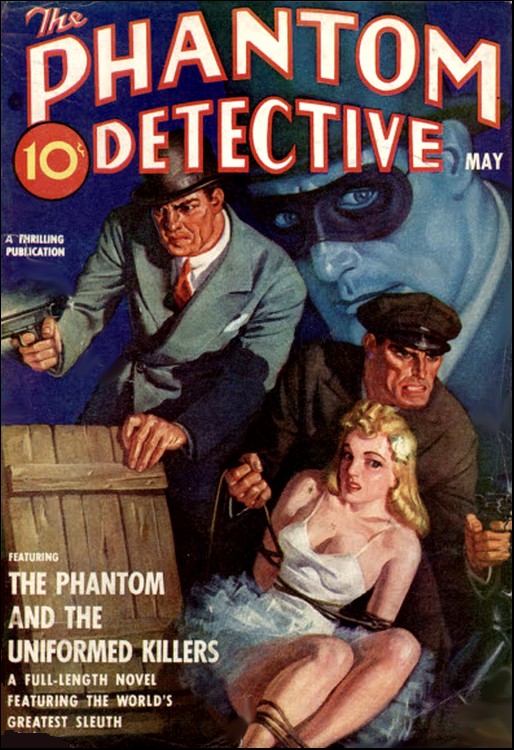
The Phantom Detective, May 1940, with
"The Phantom and the Uniformed Killers"
The World's greatest sleuth flies to the Mexican border to stem a torrent of crime! Innocent lives are the pawns of a grim killer who seeks power and plunder!
BORDER sunlight lay hot and glaring upon the downtown streets of El Paso. Flags of two nations festooned every lamppost on the International Bridge and along the parade route to the great Plaza which was bedecked in festive array for an event of international importance. The red, white, and blue of the United States spread companionably in the breeze with the screaming eagle of the Mexican Republic.
For hours San Antonio Street had been roped off and sidewalks were lined with a jostling, happy crowd, colorful Mexican costumes mingling with the more sober garb of the Americans as Mexicans and Americans alike bulged the ropes and strained their eyes toward the Sante Fe Bridge from whence a Mexican dignitary of high office would enter the United States on a peace mission.
An impressive welcoming array awaited the arrival of the guest of honor at the American end of the bridge connecting El Paso with Juarez across the Rio Grande. El Paso's chief of police sat on a prancing horse, as honorary drum major of the military band from Fort Bliss which was drawn up in close formation behind him; and behind the khaki-clad band with their gleaming instruments awaited a guard of honor composed of uniformed policemen who stood ready to escort the Mexican dignitary when he crossed the river to American soil.
Nothing had been left undone to make an impressive demonstration. Today was to mark the solid cementing of American-Mexican friendship and mutual respect. Every American citizen of the Border city rallied to a civic and national duty to convince their sister Republic that a new era of neighborly good-will was actually beginning.
The southern bank of the winding river was lined with a horde of gaping peons who had come to be impressed by this hands-across-the-Border gesture. Normally suspicious of the gringoes, today their brown faces glowed with happiness and pride as they viewed the elaborate preparations made to receive an emissary of their government.
AN atmosphere of tense expectancy pervaded the milling, waiting throngs. A blare of trumpets shrilled through the hot afternoon air. The ropes bulged, necks craned, and a ripple of excited comment went down the line of watchers as a slow procession moved up historic Juarez Avenue toward the Mexican side of the bridge.
"Viva los Estados Unidos!" a heavy Mexican voice shouted.
"Hurrah for Mexico!" someone responded from the American side.
"To hell with Mexico!" was roared back at them like a resounding echo hurled through a megaphone.
An instant of thick silence followed, then the crowd hummed and muttered and laughed, eyes strained toward the direction from which the deep-voiced roar had come.
At the center of the bridge, on the exact line separating the two countries, an official welcoming committee, led by the top-hatted mayor of El Paso, stepped to the side of an open limousine and formally greeted Señor Alfredo Romez who sat alone in the tonneau of the open machine.
Señor Romez was a tall, distinguished-looking Mexican with piercing black eyes and strong, white teeth which flashed in a smile of pleasure as he bowed his acknowledgment of the honor shown him. By prearrangement, Mayor Thurston and a high official of the State Department in Washington got into the tonneau on either side of the distinguished guest. The limousine rolled on slowly to take its place in the procession.
Deafening applause rolled up from the onlookers, partially drowning out the blare of band instruments striking up the sprightly Mexican marching song, La Cucaracha.
The steed of the band's drum major, Police Chief Grainger, pranced forward and the band fell into rhythmic step behind him. Motorcycle exhausts sputtered, and four uniformed cops spread out fanwise directly ahead of the limousine. Two motorcycle cops flanked the hood of the car, and another pair of stalwart defenders of the peace guarded the rear seat of the limousine.
Behind them, four more motorcycle cops fanned out across the street to guard the rear.
Moving slowly enough to accommodate the marching feet of the band, the procession followed the route toward the Plaza where grandstands and speaking platforms had been erected, and public welcoming ceremonies were scheduled to be held.
Cheering was a continuous deafening roar along the route. At least half of the onlookers were Mexican, or of Mexican extraction, and they vented their pleasure and excitement in vociferous approval.
Many of them had come to scoff and to jeer when announcement of the public welcome had been made, but they were overwhelmed by the sight of the truly royal greeting bestowed upon this man of their own race, sitting erect between the mayor and Under-Secretary of State Marvin Hyslop.
In front, behind, and on either side of the moving limousine rode a dozen grim-eyed and watchful men, armed, and alert for any gesture of violence from the milling throng that might turn the occasion from one of happy rejoicing into swift tragedy. For there had been rumors that an attempt might be made by a dissatisfied element to make a demonstration against the signing of the new and all-important trade pact between the two countries.
KNOWING the volatile and suspicious temperament of the Mexican people, the American officials were determined to prevent this at all costs. One little incident of any sort might be enough to mar the friendly relations between the two countries. To prevent that, extraordinary precautions had been taken.
Every available officer had been called to duty in the parade area. Detectives in plain clothes moved along the sidewalks through the crowds alert for any manifestation of the lurking evil they had reason to believe might be present.
As the parade neared the Plaza, it appeared that the official precautions had borne fruit, for not one voice or hand had been raised against the smiling visitor from across the Border.
The grandstands of the Plaza were packed solidly with tier upon tier of spectators. And a mighty roar arose from hundreds of throats when the vanguard of the parade came into sight.
Moving slowly and with clockwork precision, the procession moved onward while the Mexican population of El Paso stood in their seats and cheered wildly, straining their eyes for a glimpse of their distinguished fellow-countryman occupying the place of honor in the limousine.
Death came swiftly and in full view of that immense throng of partisan spectators.
The four motorcycles were wheeling in formation toward the Plaza. The Mexican driver of the limousine was turning slowly behind them.
The motorcycle policeman at the right rear of the limousine darted a quick glance across at his partner at the left. The other burly uniformed man darted a searching glance about, then gave a brief nod of his visored cap.
Simultaneously, right hands dropped to open holsters supported by shining Sam Browne belts. There was the gleam of hot sunlight on the leveled muzzles of blued-steel, then both .45s crashed out in a murderous blast that echoed loudly back from the buildings on either side—a death blast that was destined to echo across a continent before nightfall.
Soft-nosed leaden slugs went screaming through the sunlit afternoon with unerring aim, striking Señor Alfredo Romez directly behind and above each ear, crunching through bone with terrific impact, lifting the top of his head as though it had been sliced off neatly with a mighty knife, spattering blood and horrible fragments of the dead man's brain like crawling gray worms upon the mayor and State official who rode with him.
One shattering moment of awed silence followed those two echoing blasts. Then a low exhalation of surprise and of fright, of terror and of anger arose from the massed throats of the multitude.
Taken utterly by surprise, the reflexes of the other policemen were slow to coordinate into positive action. But the two assassins were moving swiftly, with a methodical precision that showed how carefully the coup had been planned down to the last ultimate detail.
Holstering their still smoking death weapons, a hand of each darted inside his uniform blouse and each came out with a small round object which was tossed into the air. Then the two stepped on their gas pedals.
THE smoke bombs exploded while still in air. Dense clouds of black smoke billowed out, settled over the scene in an evil pall.
A few vagrant shots were snapped in the direction of the murderers as they leaned over handlebars and darted away. But each touched a small lever on his motorcycle, and exhausts roared out a sickening mixture of tear gas fumes and black smoke which rose like a heavy blanket behind them.
The turmoil and confusion around the Plaza were indescribable. Women were screaming in horror-stricken panic. Men were cursing and shouting, surging toward the spot where death had struck with such ghastly swiftness.
One section of the grandstand gave way beneath the weight of surging humanity, carrying hundreds of men, women and children to the ground where the weaker were crushed beneath the feet of the stronger. Screams of anguish and suffering arose unheeded in the panicky bedlam as the fumes of tear gas and noxious smoke billowed over the entire Plaza, bringing added terror and a paroxysm of coughing and retching in its wake.
Half a block from the Plaza, the two uniformed killers reached down and shut off the valves letting the gas into their exhausts. Grim-faced and gimlet-eyed, they gunned their heavy police machines down the middle of the street, opening screaming sirens to make a way for them through traffic that knew nothing about what had occurred at the Plaza, cutting back sharply toward the river.
Drivers of automobiles pulled aside to let them pass. Traffic police made way before their sirens at busy intersections. It was the perfect getaway for a pair of cold-blooded murderers, ironically pressing into service the arm of the law to aid them in escaping from pursuit.
Racing down a narrow street through the Mexican quarter of the city, again as though at a definitely prearranged moment, both snapped off their sirens and let off on the gas so their movements would not be so marked henceforth.
One of them, a heavy man with his nose flattened down above thick, brutish lips, straightened in his seat and grinned at his companion.
"Right on schedule, eh, Bink? Take it slow around the corner here—"
"Look out!" the man called "Bink" yelled hoarsely. "That woman an' kids are comin' across!"
His companion glanced ahead toward the intersection where a Mexican woman and two toddling children were starting across in front of the slowing police cycles.
"Damn Mexes!" he grunted, a vicious light gleaming in his eyes.
Deliberately he trod on the gas and swerved the heavy machine toward the trio, laughing aloud when the woman screamed and tried to drag the frightened tots from the path of destruction.
Behind him, Bink pulled out of the way and watched, cold-eyed and remorseless, as his partner crashed into one of the children and the mother. Then the heavy-faced killer sped on, without a backward glance at the child lying sprawled on the pavement with its skull crushed, or at the mangled body of the mother thrown ten feet to the curb by the impact.
TIRES screamed as the demon killers lunged around the corner onto a side street, slithered on the pavement when brakes were applied. They leaped off and hit the ground running before the police motorcycles had completely stopped, letting them roll on into the gutter. They ran into the back door of a dilapidated garage building and snatched down suits of grimy coveralls from hooks on the wall.
In two minutes their uniforms were effectually concealed beneath ordinary workmen's coveralls and they were pulling out in a battered car by a side entrance of the garage into the street on the other side of the block. Spectators of the brutal murder of mother and child were congregating about the abandoned motorcycles at the moment the murderers rolled away with Bink at the wheel and his ruthless companion leaning back comfortably to light a cigar.
With pursuit effectively cut off, Bink drove a leisurely course toward the Rio Grande and along the bank to a section of deserted and tumbledown warehouses on the bank of the stream where small boats were tied up or bobbed at anchor outside the shallows.
Not more than an hour after the double report of their guns had echoed in the Plaza, they were in a long, luxuriously furnished room on the Mexican side of the river, standing stiffly at attention in front of a fat-cheeked individual with the faintly slanting eyes characteristic of the Oriental, and saying in unison:
"Bink and Heavy reporting to Number One. Order PQ successfully completed."
"It is well," Number One told them. "The boss will be pleased. Get rid of your uniforms and go up by the back stairway, singly, to the rooms. You may then mingle with the others in the barroom, but stay sober and watch for the signal light which may call you to duty again tonight."
The fat man spoke in a monotone and watched them with low-lidded eyes that glowed like those of a greedy jungle cat as they nodded and turned away. He then swung about and gave his attention to a short wave receiving set to which he had been listening when they entered.
WITH stunning celerity two further acts of unprovoked aggression by uniformed Americans followed on the heels of the assassination of Señor Alfredo Romez in El Paso.
While telegraph wires were still humming with the news and while the citizens of two nations were receiving the news with horrified disbelief, a small detachment of cavalry from Fort Bliss was making a routine patrol along the river southeast of the city.
Wearing khaki uniforms and with full campaign equipment, the column of twos proceeded at a smart trot along a wagon road through the mesquite thickets on the northern bank of the river. Led by a man wearing the stripes of a sergeant, the dozen soldiers rode grimly erect in their McClellan saddles with none of the slouching ease of posture that comes to veterans after riding many uneventful patrols.
At a clearing in the mesquite, the road forked sharply, the right-hand fork leading down to the water's edge, across a shallow ford and up a sloping rocky bank on the Mexican side. Sunlight lay hot upon the ford and upon a group of happy Mexican women doing their washing on the opposite bank. Brown-skinned children played in the sand and waded in the shallow water while their mothers pounded out clothing on the smooth rocks and gossiped among themselves about village affairs.
The cavalry patrol clattered to a halt at a sharp command from their leader. The Mexican women looked up at the not unusual sight, nodding and waving to the uniformed riders. The children shouted native greetings as they had often shouted to friendly patrols in the past.
The sergeant in command of the detachment turned and spoke grimly: "All right, men! Let 'em have it!" Utterly without warning and in deliberate cold blood, the muzzles of thirteen U.S. Army automatics spewed death across the river. A scattered volley, first, that struck down a dozen innocent women, followed by a sustained bombardment that sent leaden messengers of death screaming across the Border to cut down those who tried to flee, those who knelt imploringly in the sand and begged for mercy with uplifted hands.
Wholesale, conscienceless slaughter of innocent mothers and their babes! Angry streams of red blood flowed into the Rio Grande while children screamed and mothers prayed.
On the northern side of the river, a sharp command rang out above the shooting.
"Hold it, you fools! Let some of them get away to carry the news. Holster your guns and follow me."
The leader put spurs to his horse and wheeled back toward El Paso. Breaking ranks, the dozen uniformed men followed him at a thundering gallop. The silence of death settled upon the sunlit scene where all had been happiness and serenity a few minutes before.
Scarcely had the thunderous echoes of those murderous shots died away when the Mexican citizens of the small village of Toluca, a hundred miles in from the Border, were aroused by the loud drone of a high-powered airplane approaching swiftly and at a low altitude. Situated on none of the commercial air routes, a plane was a distinct novelty to the peons of the district. Little groups of people quickly gathered in the street, pointing in the air and jabbering excitedly as the sky ship approached.
SHE was indeed a beautiful sight with sunlight glinting from her wings—a tri-motored bomber, one of the newest and speediest of American fighting ships, with the military insignia of the United States plainly marked on the under surface.
Mouths gaped open and eyes bulged as the huge ship soared low directly over the unsuspecting village. Men pulled off their sombreros to wave them in friendly greeting and the aprons of housewives fluttered in the air.
Death came from the sky as suddenly as it had struck twice before on that fateful afternoon. Soaring smoothly above the tiny village, bomb releases were tripped by the uniformed crew. Great projectiles of destruction came hurtling downward, crashing with terrific detonations that shook the countryside, reducing the village to smoking ruins—a funeral pyre for the mangled bodies of simple, friendly people who for years had been gradually outgrowing their innate distrust of their American neighbors.
Leaving the horrible scene of death and destruction behind, the huge bomber climbed easily, circled and sped back toward the Border, its mission completed.
THE atmosphere in the conference room was stifling. Overhead fans sluggishly moved the humid air but could not dispel the stagnant atmosphere of gloom resting heavily upon the men huddled about the conference table.
From an open window sounds of rioting from the streets of El Paso drifted in. As yet, there had been no outbreaks of actual violence, but as yet the crowds in the streets had not heard the reports of the two latest atrocities committed against innocent Mexican civilians by uniformed Americans.
"When they get those reports, I don't know what they'll do," Chief of Police Grainger stated bluntly. "I've already got every cop on duty. I may have to call on you, General Arthur."
The worried police chief mopped sweat from his florid face and glanced down the table at an erect military figure. The commanding officer of Fort Bliss shook his head. "Good God!" he expostulated. "I can't turn Federal troops against those excited Mexicans! It would mean slaughter."
"Quite in line with other events of this afternoon," put in another conferee, a tall man with dark, thin features and glossy black hair that grew in a low vee on his forehead.
General Arthur bristled at the tone of the tall, dark man.
"I deny the implication, Mr. Zardoff!" he blustered. "Those ruthless killers in uniform couldn't possibly have been soldiers from Fort Bliss."
"Of course not," said the chief of police wearily. "No more than those motorcycle cops could have been cops."
"All this is beside the point," put in Under-Secretary of State Marvin Hyslop suavely. "We're here to consider what is to be done in this horrible emergency. Eh, Havens?"
Frank Havens, publisher of the El Paso Clarion and a string of newspapers of the same name from coast to coast, nodded his gray head thoughtfully.
"That's the all-important thing," he agreed. "If we don't act quickly, anything may happen. Even—war with Mexico, gentlemen."
THE only Mexican among the group gathered about the table was General Miguel Martino who had accompanied the murdered Mexican emissary from Mexico City. A gaunt, stern-visaged man in full uniform, he nodded.
"Even that, Señores," he said in perfect English. "My people, they are of an excitable nature. It will be difficult to explain to them that what has happened is not what it seems. If, indeed, it is not."
"What do you imply?" Mayor Thurston put in darkly. "That these ruthless killings have actually been perpetrated by policemen and soldiers of this country?"
General Martino shrugged and spread out his hands.
"Do you have proof that they were not?"
"There you are!" The American general pounded the table with his fist. "We have no proof! We simply know there's something terribly wrong—some band of super-criminals masquerading in American uniforms to turn public opinion in Mexico against us."
"And on the very eve of the signing of the new trade agreement with Mexico," another conferee, George Crowley, spoke up angrily. As owner of one of the largest importing businesses in the United States, with branch houses in every important city, Crowley was a member of this conference by good right. Importing a large volume of goods from Mexico, he was intensely interested in the lowering of trade barriers between the two countries. He was a tall, well-preserved man of fifty, with a strong, pleasant face and fearless eyes.
"I'm afraid that's off for the present," Hyslop put in sharply. "Years of diplomatic maneuvering gone to naught before the guns of madmen."
"Madmen?" Crowley murmured. "I doubt that."
His direct gaze went down the table to the faces of Emanuel Zardoff and an American oil man, Leroy Pearson, who, as a middleman, made extensive purchases of oil in Mexico.
"I see it as a deliberate plan to smash the treaty which meant so much to my business," Crowley said grimly. "On the part of a foreign power, perhaps, hoping to gain a foothold in Mexico. Or by business interests threatened by the signing of the trade pact."
"That's just guessing and doesn't get us anywhere," boomed General Arthur. "Hysteria will grip the Mexican population of El Paso when news of the bombing of Toluca and the shooting of women and children by men in American uniform is announced. Unless the guilty parties are brought to justice—and quickly—I agree with Mr. Havens that we can fear—war! "
"I admit I don't know the answer," the El Paso police chief muttered. "When two of my picked men turn traitor and assassinate a man they are guarding"—he spread his hands—"I feel utterly helpless."
"We're up against something tremendous," Marvin Hyslop stated solemnly, grim-lipped as was every man about that conference table. "Something so fiendish and horrible that the minds of ordinary men like ourselves cannot understand; a menace with which we cannot hope to cope. When we consider that more than a hundred innocent victims have been sacrificed this afternoon, only then do we begin to realize the sinister nature of the situation with which we are faced. Gentlemen, I say to you in all solemnity, that I know of only one man on the face of this earth to whom we can turn for aid in this terrible hour!"
IN the tense silence following his words, Hyslop's gaze sought out the face of his old friend, Frank Havens.
Every eye was upon the publisher and men scarcely breathed as they awaited the publisher's reply. Every man present knew to whom the Under-Secretary of State referred. Every man present knew that Frank Havens was the only contact for that man known only as the Phantom, the greatest detective the world had ever known, the Nemesis of evil-doers, and the fervent champion of lost causes.
In all the world, only Frank Havens knew the real identity of the Phantom. He, alone, could make the decision that would bring hope to the hearts of these men who admitted themselves helpless before a threat that menaced the peace of two friendly nations—one that had put millions of lives in the balance.
Frank Havens arose slowly, his face set in lines of decision.
"I will contact the Phantom at once, gentlemen. I think—yes, I can promise you he will arrive in El Paso within a few hours."
Bowing to them, Havens hurried from the conference room.
Behind him the silence was broken by a chorus of "Thank Gods," and strong men unashamedly cleared their throats in the reaction of relief that came to them with Frank Havens' promise to put their plight before the Phantom and attempt to procure his aid.
ON one of the most exclusive and beautiful golf courses in the world, a young man was preparing to drive off the eighteenth tee while the other members of his foursome were grouped behind him, making bantering remarks. Not according to the best golf etiquette, of course, but they were a carefree group.
Overhead was the brilliant blue of the Miami sky and the rolling course was a carpet of perfect green turf. To the right and a little beyond the eighteenth hole the clubhouse nestled in its setting of luxuriant tropical shrubbery. Behind them the course was dotted with brilliant splotches of color, the vivid sports outfits of women and girls vying with masculine white flannels.
The man waggling the driver over the little white ball had an athletic body and broad shoulders. His strong, pleasant features were covered with a deep tan acquired during weeks of healthy outdoor relaxation beneath the Florida sun, and white teeth flashed in a smile at a laughing remark from one of the girls behind him.
"Watch Dick and see how it's done, Peter," she urged the man beside her. "He never tops or hooks or slices."
Peter Greenwald snorted enviously. "I wouldn't either if I had all the money in the world and nothing to do except keep in practice. These two weeks down here are the first golf I've had all spring. When Van Loan wants a game all he has to do is to jump in his private plane or yacht or something and fly or sail to where the sun is shining."
Richard Curtis Van Loan's smile did not change. One of the wealthiest and most eligible bachelors in the world, he was often pictured in the Sunday rotogravures at one of the sports in which he excelled. And he was accustomed to such bantering.
He glanced down the fairway and set himself with a firm stance. Smooth muscles rippled deceptively beneath the silken polo shirt as the heavy driver came back. His downward swing was a symphony of coordinated power and the head of the club struck the ball with a clean sharp spat. It arced down the fairway, swift, low, and true to the edge of the green where a perfect back-spin took hold and held it a foot from the hole.
One of the girls, a lovely blonde with piquant features and languorous blue eyes, laid her hand on Dick Van Loan's arm.
"You're marvelous, Dick!" she enthused. "You simply must give me some lessons."
"Sure," Peter Greenwald grunted. "If the Van Loan millions run out, Dick can turn pro to earn his living."
Van Loan joined their laughter and waited for the other girl in the foursome to drive. By not the slightest change of expression did he indicate that he was anything but a young millionaire idler, society playboy, and bon vivant, with nothing more important on his mind than having a good time.
Only one man in all the world knew Richard Curtis Van Loan's secret—that he was the Phantom, acknowledged master of scientific crime detection, a name that struck terror to the hearts of criminals anywhere in the world.
It had been Frank Havens who had urged Van Loan to take up the enthralling study after the death of the young man's father. The publisher had been an intimate friend of the elder Van Loan and a friend of the younger man since Richard's boyhood. He had glimpsed in the young blueblood those superb mental and physical qualities which were to make him the most noted detective of his age. And young Van Loan had proved Havens' acumen right a hundred times.
NOW, as he stood quietly on the eighteenth tee of the exclusive golf course in Miami, Dick Van Loan's eyes narrowed when he spied a uniformed messenger boy approaching hurriedly.
Always, Van Loan held himself in instant readiness for a call to duty from his old friend. Havens was never without knowledge of his whereabouts, day or night, and Dick never knew when the grim summons would come that would plunge him into another maelstrom of crime and violence with the odds a thousand to one against his emerging alive. In New York, the call usually came via a flashing red light atop the New York Clarion Building; in other places, as now, every messenger boy was a potential call for the Phantom's aid.
The others were ready to go on but Van Loan hesitated, motioning toward the messenger boy.
"Looks as though he might have a telegram for one of us," he said. "Let's wait and see."
Peter Greenwald grinned, with a sly glance at the blonde who for a week had been trying to ensnare the young millionaire with her charms.
"Expecting a wire from the girl friend?" he drawled.
"Perhaps." Van Loan smiled with exasperating calm. None of his companions could possibly know that the message might be of more serious import.
The boy came up to the group, touching his cap smartly.
"Mr. Van Loan?"
"Here," Van said, and took the envelope. With a muttered excuse to his companions, he tore it open and read a single code word which he instantly translated to mean "Come at once. Urgent." The message was signed by a name that was also a code between Frank Havens and his protege. It came from the Paso Del Norte Hotel in El Paso where Havens had been for some time now, giving his attention to his El Paso property.
Van Loan made a swift mental calculation as he stood there. It was approximately eighteen hundred miles to El Paso. In a hangar of the private landing field connected with the famous resort hotel at which he was staying, one of the fastest land planes in the United States waited for him to get behind the controls and go. He should be able to make it by midnight, with a small leeway for unexpected delays.
His expression hardened and he scribbled two words on the bottom of the sheet and handed it back to the boy with a bill.
"Get that off at once," he directed crisply.
The reply said:
ARRIVING MIDNIGHT
As the boy hurried away, Van Loan turned to his caddy. "We'll have to forego the pleasure of this last hole," he said.
"I say," Greenwald protested. "You're not running out on us, Dick?" The blonde caught his arm and pouted.
"Don't forget we have a date for dinner tonight," she reminded.
"I'm afraid that's off."
Van put her hand off his arm gently. A queer change had come over him. There was a new, zestful light in his eyes, and he seemed almost unaware of his companions. He nodded to them absently and strode away toward the clubhouse.
BEHIND him, the blonde stared after his tall figure unbelievingly.
"Just like that!" she exclaimed pettishly. "Do you suppose it's something dreadfully important?"
Peter Greenwald laughed with sardonic indulgence. "Important?" he echoed. "That shows you don't know Dick very well. The only important things in his life are a pretty face and whether the champagne is exactly the right temperature." He glanced at his own dark-haired companion. "It's your shot, Dolly."
Getting a cab at the clubhouse, Van Loan rushed to the huge resort hotel, wondering what could be the cause of Havens' sudden summons. That it was some matter of vital importance, he had no doubt. The Phantom was never called in unless ordinary police methods had reached a dead end.
He knew the reason for the publisher's presence in El Paso at this time, knew Frank Havens had accompanied the official party from Washington for the signing of the new and important trade pact with Mexico and to take the opportunity, at the same time, to give his paper his semi-yearly personal supervision. Vaguely, he wondered if the coded telegram could have any bearing on the trade pact.
Leaping out of the taxi at the hotel entrance, he paid the driver and hurried into the ornate lobby. Passing a newsstand, his eye was attracted by an afternoon "Extra" with screaming headlines. He bought one and read it as an elevator lifted him to his floor.
His eyes narrowed and jaw muscles bunched when he read:
MEXICO ENVOY ASSASSINATED IN EL PASO
BY AMERICAN POLICEMEN GONE BERSERK
CITY IN TURMOIL
TRADE PACT THREATENED
MEXICO SEETHES WITH ANGER
Because he had been away from radios all day, he had no idea, as yet, of what other news had reached Miami, and himself knew nothing of the other atrocities. But the headlines were enough for Van Loan. Undoubtedly, this was reason for Havens' urgent message—though for the life of Van Loan he could not see what the Phantom could hope to do about the situation.
It was never his custom to cross bridges before he reached them, however. In his luxurious suite, he immediately phoned the hangar to have his plane in instant readiness for a take-off, then called the manager to announce his departure and request that his bill be made ready.
His further preparations were simple. Changing to a tweed business suit, he got out a single pigskin bag and packed it carefully. Into it went half a dozen suits to fit the various disguises the Phantom used while working on a case, with a compact makeup kit containing everything he needed to change his appearance to anything he desired.
Into the capacious bag also went a shoulder holster and a .45 automatic with a dozen extra clips of cartridges, together with an assortment of varied objects which might prove useful. In the remaining space he packed a toilet kit and articles of personal apparel that he might need for a protracted stay.
THE trunks and bags and paraphernalia that accompanied him as a wealthy young idler could be packed by the hotel valet and shipped back to New York after he left.
He called for a boy to come for his bag, then went to a trunk and from a locked case within drew out a tiny platinum badge set with dazzling diamonds formed in the shape of a mask. It was the one positive identification the Phantom always carried, an insignia known to the police bureaus of the world and one which would gain him instant cooperation from any official to whom it was shown. With this badge snugly placed in a secret pocket in his clothing, the Phantom's preparations were complete.
Ten minutes later he was at the hotel's private landing field and an attendant was stowing his bag in the enclosed cabin of the low-winged silver ship. The propeller was idling in the bright sunlight and the speedy racing plane vibrated gently as though eager to take the air.
Waving to the field officials, Van Loan stepped into the cockpit and settled himself behind the controls. Chocks were removed from the wheels, and he gunned the motor. There was a mighty roar of impatient power, and the plane glided forward along the runway, then lifted smoothly into the air, climbing in a great circle and leveling off at five thousand feet.
Grimly, Dick Van Loan headed the ship almost due west, across the treacherous Everglade swamps toward the Gulf of Mexico on a course that would carry him across the water on a direct route to El Paso.
Another man would have considered this a foolish risk to take in a land plane. By following the safer land route up the peninsula and then westward, he would have lost only a little time and would not have faced the danger of a forced landing in the sea. But it was this absolute disregard of personal danger that lifted the Phantom above the ruck of ordinary mortals. It was this trait which enabled him to win his battles against tremendous odds which no other man would have dared tackle.
In every situation, Van Loan made a habit of making a swift calculation of the risks involved and the advantage to be gained by taking a risk. If the second overbalanced the first, he did not hesitate.
Which should not indicate that he was a foolhardy young man. He would never have lasted long as the Phantom if he took foolish risks.
This plane was the finest creation that engineering brains could construct. Equipped with every imaginable safety device and piloted by a man whom those in the know acknowledged to be one of the most skillful pilots in the country, the danger of a forced landing was negligible. The saving of a few minutes by taking this direct route might be of incalculable value in the case he had been called upon.
He zoomed swiftly over the western shore-line of Florida, then out over the choppy waters of the gulf. Settling back on the soft cushions, Van Loan watched the crimson and violet of sunset streak the sky ahead. Darkness closed in gently and he switched on his flying lights, holding the ship true on her calculated compass course, plunging through the night toward the Border city where death stalked the streets and the danger of a race riot grew hourly more imminent.
THE electrical storm came up with startling and devastating swiftness, one of those violent and unpredictable storms which lurk just inland from the Gulf.
It was shortly after nine o'clock and Van Loan was congratulating himself on a speedy and uneventful trip. He calculated he was somewhere over lower Louisiana, and would reach El Paso easily by the appointed hour.
The storm broke without warning and he was in the midst of it before he had a chance to circle the danger zone. Violent wind currents struck the heavy ship savagely, tossing it about like a feather, and a furious downpour lashed at the cabin windows. Lightning zigzagged angrily as though the storm gods were hurling fiery lances at him. And there was nothing for it except to grimly fight the stick and try to ride it out!
With superb confidence in his ship and his own piloting ability, Van Loan knew he would make it through unless lightning accidentally struck. That was the only real danger, one that could not be averted by skillful piloting.
It came while he was tilted on one wing, fighting to reach an even keel. A blinding flash that seemed to explode all over the metal surface of the silver ship, then complete laxness in the controls.
It was the end! High in the black clouds, trapped in a hulk of scorched metal plunging swiftly earthward!
PERHAPS the Phantom was facing the most desperate emergency in his risk-filled career, yet he reacted with characteristic calmness.
A glance at his altimeter showed he had seven thousand feet of altitude. Without panic, he released the safety belt, took time to assure himself the parachute pack was firmly attached, got hold of the rip-cord in one hand and reached down for his precious pigskin bag with the other.
The ship was in a screaming, twisting dive when he wrenched the door open and plummeted out into the void. The wind tore at him with greedy fingers and rain slashed at his unprotected face.
With his jaw grimly set, Van Loan carefully counted off the seconds until he would be clear of the ship diving down upon him, then his fingers jerked the rip-cord. There ensued that awful moment in every parachute jump when the jumper wonders if the silken fabric will behave properly and death will be cheated.
With the best of equipment, regularly inspected, Van Loan's parachute functioned perfectly. Body straps jerked tight, almost stunning him, then he was suddenly floating easily in the black night, descending out of the storm area and able to distinguish pinpoints of lights below.
He made a perfect landing in some low brush near a highway not more than a mile from the lights of a village. Cutting off the straps, he hurried to the macadam, rain-drenched and disheveled, with only one thought pounding in his brain—to get another ship and hurry on to keep his appointment with Frank Havens.
He jerked a flashlight from his pocket and signaled frantically as a car approached. It slowed, pulled up beside him. A bearded farmer of the region stared suspiciously at the traveling bag in his hand.
"What's going on? How come—"
"There's no time for questions," Dick Van Loan said crisply. "Ten dollars if you'll take me to that town—to the airport if there is one."
He threw his bag in the back of the rickety sedan and got in the front seat, taking out his wallet. The farmer's suspicions were allayed by a ten-dollar bill and he drove on through the rain that now was turning into a drizzle.
"There's a landing field not far ahead," he suggested. "Sure you want to go there?"
"Quite sure. I've got another ten if you'll make it fast."
The farmer made it as fast as his rickety car would negotiate the wet road. Ten minutes later he stopped in front of a small building with lights streaming out the window, and Van Loan jumped out.
Inside, a lanky, sandy-haired youth stared at him in astonishment when he snapped:
"Can you fly me to El Paso?"
"Not in this weather." The young man shook his head. "These storms are bad. It's not safe to take a ship out."
"I'll charter one," Van offered. "I'm a licensed pilot."
The young man shrugged. "Not one of my ships. I don't care how good a pilot you are."
"Have you got one you'll sell me?" Van Loan demanded. "Don't stand there gawking. I'm due in El Paso at midnight."
The lanky youth threw back his head and laughed, his gaze taking in Dick Van Loan's unprepossessing appearance.
"What would you use for money, Mister?"
Restraining his impatience as best he could, Van Loan drew a wallet from his pocket.
"How much?" he asked crisply. Thinking to put the shabby stranger in his place, the young man drawled.
"I've got a sweet little Monocoupe in the hangar. She cost me six thousand, stranger. If you want to spend that much money—"
VAN LOAN gave one swift thought of regret for his own eighty-thousand-dollar ship that now lay behind him, a worthless pile of twisted metal.
"Six thousand will be all right," he said quietly, "if the ship will take me to El Paso."
He drew out six one-thousand dollar bills which he offered to the stupefied young man.
Gulping back his astonishment and stammering excuses, the youth led him to a frame hangar and showed him a speedy Monocoupe that appeared in first-class condition. Though not half as fast as the ship that had just crashed, Van Loan calculated she would put him in El Paso in time. The deal was completed before the owner had wholly recovered from his astonishment.
Ten minutes later the Phantom was again in the air, grimly winging his way toward El Paso to keep his word that had never yet been broken...
At midnight the same group of men who had been in conference that afternoon were gathered in Frank Havens' suite in the Paso Del Norte Hotel.
The long hours of strain were beginning to tell on some of them. Though there had been no actual bloodshed yet reported in the city, the local situation was exceedingly ominous. American citizens had been warned to stay off the streets lest a flare-up occur which would light the powder keg.
Too, disquieting reports were filtering in from the Border provinces of Mexico. With feeling against the United States running high, it was said that armed bodies of peons were gathering, swearing they would have revenge for the deaths of their countrymen.
Under these trying conditions, the police chief's normally florid face was an ashen color. His lips twitched as he stared at a watch in his hand.
"It's almost midnight," he informed the gathering.
General Arthur got up and paced up and down the deep rug, casting a glance at Frank Havens now and then. General Miguel Martino sat quietly by Hyslop's side. Both of them smoked cigars and kept their eyes nervously on Havens.
In a group a little removed from the others, Zardoff, Pearson and Crowley were in low-toned conversation, obviously trying to pass the time until midnight arrived.
Of all the men in the room, Frank Havens seemed the only one who was wholly unperturbed. Quietly smoking his perfecto, he waited for the time the Phantom had said he would arrive.
Police Chief Grainger snapped his watch shut and stood up.
"Midnight," he announced shakily, "and no Phantom."
As though his words were the signal, the telephone buzzed.
Havens swept it up and listened a moment.
"Send him up," he said.
Every man was tense, watching him. He replaced the receiver, flicked ashes from his cigar.
"The Phantom has arrived," he announced quietly.
Almost at the same moment there was a rap on the door. Havens went to open it while every eye was turned to catch a glimpse of the man they had heard so much about.
HIS appearance was disappointingly unimpressive. For Havens was shaking the hand of a man who looked no more like Richard Curtis Van Loan than did the publisher. A few moments at the airport rest room with his makeup kit had changed Dick Van Loan to a slightly stooped man whose hair was tinged with gray. His mouth appeared weak and there were wrinkles in his cheeks. Even Havens would not have recognized him in his disguise had he not announced himself by a name he often used while in the character of the Phantom.
"Come in, Mr. Mercer," the publisher said cordially, then turned and noted with twinkling eyes the disappointed reaction of the men waiting to receive the noted sleuth. "The Phantom, gentlemen," he introduced Van Loan gravely, mentioning the names of the various men and briefly stating the reason why each was present.
No explanation was necessary, of course, for the presence of Chief Grainger, General Arthur, Marvin Hyslop or General Martino.
Approaching the last group of three who stood to receive them, Havens explained:
"Mr. Crowley heads one of the largest importing businesses in this country. A personal friend of Hyslop's, he has long urged this trade pact with Mexico that will permit a heavier flow of trade across the Border. And these two gentlemen,"—he waved a hand in introduction—"Mr. Zardoff and Mr. Pearson, have large interests in Mexico. Mr. Pearson is a middleman for wealthy American oil buyers of the petroleum properties expropriated by the Mexican government, and Mr. Zardoff is owner of a large ship line operating mostly between Mexico and the Orient. They were members of the official party that accompanied Señor Romez, and were invited here to see that their business interests were protected."
The Phantom studied each face as he shook hands, making a keen mental note of each name and the business of each man. When the introductions were finished, he faced the assemblage gravely.
"Since arriving in El Paso," he said, "I have heard a full account of the dreadful events of today. I realize that anti-American sentiment is running high in this city, and I presume the same reaction is gripping the entire country of Mexico. I can understand your dismay and apprehension, but I fail to see what you expect me to do. No man can undo what your two policemen did today, Chief Grainger—nor what your troops have done, General Arthur." Grainger jumped up angrily. "Those men weren't cops! I swear they weren't! Clever masqueraders. Those two cops—Phelan and Pitts, they were supposed to be—have disappeared. Phelan and Pitts left home to come on duty this morning as usual—and haven't been seen since."
The Phantom nodded slowly, his mind active.
"I see what you mean. Such a switch might not have been impossible. Uniforms do have a way of making all men look alike. And a bit of skillful disguise does wonders. As I happen to know." He turned abruptly to General Arthur. "How about you, General? Are you of the opinion the cavalry patrol and the crew of the bomber were members of your command?"
"Positively not!" the general exploded furiously. "Such a thing is impossible! American soldiers—to thus desecrate their uniforms? Unthinkable!"
"H-m-m. But a patrol was sent downriver this morning?" the Phantom guessed shrewdly.
"Yes. A routine patrol. I've checked the records of every man and they've all had long and honorable service. It's my opinion they were ambushed after leaving the fort and their uniforms assumed by men with some diabolical purpose of their own."
"And the bomber?"
THE general shook his head.
"That's more difficult to explain, but I can vouch for every man in the crew. The ship left on a scheduled flight to San Antonio this morning. We received a radio report that they were making a forced landing in the open country in the Big Bend to effect minor mechanical repairs. We received no further report—until the ship was used for that hellish purpose this afternoon."
"It's mad," the Phantom muttered. "Inconceivable. Think of the organization that would be required for the triple coup. The careful planning and timing. The exact knowledge of the movements of your troops, General. A study of local police movements. Every minute detail carried out to exactitude."
"Mad or not," exclaimed Marvin Hyslop excitedly, "it's so! It has happened, Phantom. Months of diplomacy ruined. Unless the killers can be unmasked at once and the Mexican people can be shown that those acts were not those of official American aggression, even war may result!" The Phantom glanced at the Mexican general. "Do you concur, sir?"
"I do." General Martino nodded stiffly. "My personal conviction is that my friends here are correct in their deductions. But my people, Señor Phantom, will require proof."
"But why?" the Phantom demanded. "Why would anyone do such a dastardly thing? Such an organization would require tremendous financial backing, with a super-criminal at the head of a group of utterly ruthless killers."
"We live in troubled times," Crowley reminded him. "There are foreign powers that have long cast envious eyes toward Mexico's rich natural resources. The signing of the pact today would have been a death warrant to their hopes of weaning Mexico away from the United States."
"I believe the treaty also contained a clause relating to the return of expropriated oil properties," the Phantom said to Hyslop, watching Pearson keenly.
The oil man spoke up before the diplomat could reply.
"That's true. I opposed the pact because it was against my personal interests. But I opposed it openly. Zardoff, here, stood to lose more by losing the shipping contract of oil to the Orient."
"So?" Zardoff leaped to his feet excitedly. "Is that an accusation, Mr. Pearson?"
"Wait," the Phantom pleaded. "Unfounded accusations aren't going to get us anywhere. I'll have to study the situation, and—"
He was interrupted by the telephone. Havens answered it and turned to Chief Grainger.
"It's Headquarters. Important, I imagine."
EVERYONE tensed, wondering what next, as the burly chief took the phone and spoke to Headquarters.
He hung up after a brief conversation, shaking his head.
"I left orders for them to report anything big to me here," he rumbled. "I don't think this has anything to do with the subject under discussion, but it might interest you, Mr. Crowley. A young lady has been kidnapped from the La Vita apartments. Miss Margaret Mathews. They say she's private secretary to the manager of your local branch."
"Miss Mathews?" Crowley exclaimed, paling. "Why, yes. She's been with Jerrold, my local manager, for some years. Kidnapped? That's horrible!" He hesitated, glancing at Leroy Pearson. "She's... You've been quite friendly with her, haven't you, Leroy?"
"Yes," the oil man conceded readily. "She's been kind enough to go around with me some these last few days. You introduced me to her that morning when we were in Jerrold's office. A nice girl. Kidnapped!" He shook his head, frowning.
"By a couple of particularly vicious ruffians," the chief put in. "On their way out with the girl, they murdered the clerk and the elevator boy with no provocation whatsoever. Shot them down in cold blood." He took a deep, hard breath. "But that's purely a local police problem. No use worrying the Phantom about it."
The Phantom had listened with keen interest, but he kept his own counsel as always. In his own mind he was not so sure that the chief was right in dismissing the kidnapping as having no connection with the case he was in El Paso to investigate.
THERE was one curious similarity between the kidnapping of Margaret Mathews and the horrors of the day just past which suggested itself at once to the Phantom—the ruthless and unnecessary murder of the clerk and elevator operator at the La Vita apartments. Most kidnappers refrain from violence if possible, yet these men had apparently killed for the sheer love of slaughter. And the one striking feature of the crimes of the previous day was their wanton brutality.
A slender thread on which to theorize that there was a connection between the two, but it was one which the Phantom tucked away in the recesses of his mind for future reference. He rose to his feet slowly.
"I believe I have all the salient points, gentlemen," he said. "I'll see what I can do, though I confess I've never confronted a more diabolical riddle."
He turned toward the door with Frank Havens, then hesitated at the heavy pound of feet in the corridor outside. The door was thrown open violently, and they were confronted by a tall dark-featured man, bareheaded and panting. His piercing black eyes darted past the Phantom and the publisher to rest on Chief Grainger.
"They told me I'd find you here, Chief," he ejaculated hoarsely, impatiently pushing past Van and Havens. "I'm David Wells, Chief Grainger. I've just come from the La Vita apartments where your dumb cops wouldn't let me in. Peggy Mathews is in some horrible danger! Why aren't you out looking for the hoodlums that snatched her instead of sitting around here twiddling your thumbs?"
George Crowley pushed forward and laid a hand on Wells' shoulder.
"You're Miss Mathews' fiancé aren't you?" he asked. "An aviator, didn't I understand her to say?" David Wells glanced at the wealthy importer and nodded ungraciously.
"I remember you. Met you in Jerrold's office once when I called for Peggy." He turned to face Chief Grainger again, his face darkly flushed and angry. "I tell you there's something monstrous at the bottom of this, Chief. Peggy—Miss Mathews—called me on the phone not more than half an hour ago. She was in deathly fear about something and asked me to come to her apartment at once. We—well, we haven't been seeing each other for several days but she knew she could depend on me. She wouldn't tell me what it was about, but from what she did say I gathered it had something to do with those cops and soldiers going berserk and killing the Mexicans this afternoon. By the time I reached her apartment I found it guarded by cops and all they'd tell me was that she had been kidnapped! Why don't you do something?"
"We'll do what we can," the chief pacified him. He glanced at the Phantom uncertainly, then back to Wells. "If your suspicion of the motive for your fiancée's kidnapping is correct, I'm sure the Phantom will be interested."
"The—Phantom?"
David Wells choked over the words, the dark flush receding from his thin cheeks while his gaze roved wonderingly over the faces of the men in the room, seeking one that would fill his idea of the appearance of that Nemesis of evil-doers. Van Loan stepped forward with an apologetic smile on the mild features his makeup kit had given him.
"I am the Phantom," he murmured. "I wish you'd repeat exactly what your fiancée said to you over the telephone."
SWALLOWING his astonishment at the Phantom's appearance, Wells told him.
"I'm afraid I can't repeat her exact words," he said hurriedly. "She was almost incoherent and we—well, we've been on the outs for several days because I got sore when she went out with another man."
He paused long enough to throw an angry glance across the room at Leroy Pearson.
"Mr. Pearson knows about that," he said bitterly. "As I say, there was a sense of strain between us and she didn't come right out and say things as clearly as she would have if we hadn't quarreled recently, but she hinted that she had some important information in her possession and that it had something to do with the murders this afternoon. She said I was the only man she could fully trust and begged me to come to her at once."
He cast a glance of angry triumph at Crowley and Pearson as he finished.
"That's your version of it," Pearson broke in, stepping forward. "What proof have you—"
Wells' fists knotted menacingly. "My word is proof enough," he snarled. "If you don't—"
"Gentlemen, gentlemen! This is no time for private arguments." Chief Grainger got between the two men who were glaring at each other.
"You're right." Wells' anger subsided quickly. "We've got to think about Peggy. She must be in terrible danger! But the police have no right to keep me out of her apartment, Chief. She may have left a message, some clue to the identity of her attackers."
"That's a police matter," the chief reminded him. "I'm sure my detectives are quite capable of finding any clue and following it better than you."
"I'm not so sure of that," Wells defied him. "How do I know some of your men didn't do it themselves? It would be in line with what happened this afternoon. I don't trust any man in uniform after today."
The chief flushed at this gratuitous insult but said patiently:
"Everything possible will be done to insure Miss Mathews' safety, I promise you."
"Do you mean you refuse me an authorization to enter her apartment to look around for myself?" David Wells demanded.
"I do."
Wells started an angry remonstrance, then checked himself, then whirled about and strode from the room, slamming the door behind him. There was a momentary silence following his departure, then Pearson spoke.
"That looked like an act to me," he said angrily. "I don't believe Miss Mathews would have turned to him if she had been in trouble." In his voice was the bland assurance of a middle-aged Lothario egotistically sure of his way with young women.
Van shrugged his shoulders and turned to the door with Frank Havens.
"Things are beginning to shape up a little, Frank," he said when they were out of earshot. "I wish you'd dig up all the information you can on Zardoff, Pearson and Crowley. The others, I believe I already have docketed. I'll contact you as soon as I can."
Frank Havens nodded and gripped his hand, spoke in a voice deep with emotion.
"Take care of yourself, Van. I'm afraid you're up against a more fiendish opponent than even the Phantom has ever encountered."
"I know," Van Loan agreed gravely.
He hurried away, down through the lobby and out to the curb where he signaled a taxi.
"The La Vita Apartments," he ordered and sank back against the cushion in a brown study as the taxi lurched away.
THE La Vita was a four-story structure on a quiet side street not far from the downtown section. A cordon of police was thrown around the entrance, barring excited spectators. The taxi driver pulled up at the edge of the throng and looked back at his fare inquiringly.
"There you are, Mister. It don't look like the police are letting anybody inside, though. Sure you want to stop here?"
The Phantom nodded and got out, confident in the knowledge that his tiny domino badge would pass him through any police line. Paying the meter charge, he strolled forward unobtrusively, listening to the excited comment about him, and was roughly halted by a sergeant whose patience had grown thin.
"Stand back there, you! Where do you think you're going?"
The crowd snickered behind the Phantom, unable to see the tiny platinum and diamond badge which he was palming under the sergeant's gaze. But the sergeant saw. Glancing downward as he started to push the man back, the sergeant's eyes bulged. His rough voice changed to an apologetic stammer.
"Good Lord, sir. I didn't know you were—"
"Precisely," Van Loan snapped, sliding the insignia back in its secret pocket. "I'd like to go in."
He went on pleasantly, as the burly officer nodded and followed, not yet quite recovered from his surprise at finding himself face to face with the famous detective.
"You bet," he mumbled. "Yes, sir. Right this way." He led him forward to the entrance, stuck his head inside and bellowed, "Hey, Lieutenant!" to a tall dapper man standing with a group of white-coated men surrounding two still figures on the floor.
As the lieutenant came forward with a frown of disapproval, the sergeant leaned forward and spoke one word into his ear. The police officer's frown disappeared and his eyes widened as they took in Van's far from impressive appearance. His manner was respectful but deprecatory as the Phantom stepped inside.
"This is an honor, of course," he murmured, "but I don't see how this case could possibly interest you. Couple of kidnappers got panicky and started shooting when they were making their getaway."
The Phantom moved forward by the lieutenant's side and stared down at the corpses of the elevator boy and the clerk. One glance proved to his keen mind that they had not been killed by panicky shots as the lieutenant supposed. Each had been shot precisely through the center of the forehead with heavy soft-nosed slugs which had torn away the backs of their heads—precisely as Romez had been assassinated.
The Phantom had seen enough to convince him his hunch had been correct—that David Wells' story about the telephone conversation had not been as fantastic as it had previously sounded.
"I'd like to look over the girl's apartment, Lieutenant," he said. "Alone."
"Sure. Anything you say. But we've already been over it with a fine-tooth comb."
Van Loan smiled grimly to himself as the officer led him to a stairway, recalling numerous instances in the past when the keen eyes of the Phantom had picked up some minute clue overlooked by the police in their routine investigation. Too, he was looking for something definite to tie up the kidnapping with the mass murders of the day just past—which was something the police did not as yet suspect.
"NOBODY to run the elevator," the police lieutenant explained as they climbed the stairs to the kidnapped girl's apartment.
He turned down a hall at the top of the stairs and issued a gruff order to the uniformed man lounging against a closed door.
"Let this gentlemen into the apartment, Grady. He's not to be disturbed while he's inside."
Van Loan thanked him and entered the living room of a modest though comfortably furnished three-room apartment. Closing the outer door firmly, he stood in the center of the room looking about searchingly at the furniture.
There was no evidence of a struggle in the neat room. Everything was in order, as though the occupant of the room had merely walked out for a stroll. Everything was in its orderly place except for a pair of blue bedroom slippers which had been kicked aside carelessly, near the door leading into the bedroom.
He studied the position of the slippers, then his gaze roamed over the room again. The slippers took on particular significance when viewed in relation to the otherwise meticulous orderliness of the room. Here was every evidence that Miss Margaret Mathews believed in a place for everything and everything in its place. Yet she had just kicked her slippers off there, and left them where they fell.
To the Phantom's keenly analytical mind this was evidence that she had discarded them hurriedly—or had intentionally left them in that position as a sort of signal.
He frowned, trying to visualize the circumstances of the kidnapping. Almost midnight, and she was expecting a visit from her fiancé. It was altogether probable that a girl would be attired in slippers instead of shoes at that late hour.
The bell rings and she goes unsuspectingly to answer it. Instead of David, she is confronted by two armed killers who gruffly order her to come with them. Desperately, she indicates her slippers, begs for time to don a pair of shoes. Not wishing to attract attention by taking a partially clad girl out on the street, it would be natural for her captors to agree.
She hurries to the bedroom, kicking off her slippers and leaving them lying in a conspicuous place.
Van Loan nodded with satisfaction. It was logical to presume the slippers had been left there for a clue. He stepped forward to the bedroom door, switched on the light and again was confronted by the same definite signs of orderliness encountered in the outer room.
The bed was neatly made; cosmetics and toilet articles were arranged in precise order on the vanity dresser. In the corner above the vanity, next to a door leading into a clothes closet, was an old-fashioned what-not shelf loaded with an array of small inexpensive figures of dogs and elephants and monkeys such as one picks up as souvenirs from curio shops.
The closet door stood open and a row of shoes on the floor was disarranged. A folded copy of an afternoon newspaper lay on the small bench in front of the vanity, black headlines screaming:
MEXICAN DIPLOMAT MURDERED!
Van's eyes narrowed as he saw a small brassy object lying on top of the folded newspaper. He stepped closer and stared down at an inch-high replica of a bull, molded from metal and gilded to look like gold.
GLANCING at the what-not shelf, he saw a small empty place in front where it appeared likely the small bull might have normally rested. Again, he was struck with the significance of one object being peculiarly out of place in an otherwise neat room. The little bull lying on top of the newspaper that screamed the news of the death of Romez!
Could it have been placed there by the desperate girl while she put on her shoes under the watchful eyes of her captors?
It was possible! The what-not shelf was within reach as she entered the closet. She might have picked the bull up and laid it on the newspaper when she sat on the bench to put on her shoes. But what did it mean?
Van picked the heavy little figurine up and turned it over in his hand.
On both sides of the tiny bull were engraved the words:
El Toro Chico welcomes you.
He frowned over the inscription, translating the three Spanish words into "the Little Bull." It looked like a souvenir that might have been given out at a night club or restaurant. From across the Border in Juarez, probably.
A faint sound from the outer room caught his attention while he stood there with the little bull in his hand. It was the sound of a back door being opened cautiously.
He tensed at the sound, then put the bull back on the newspaper with lightning speed, stepped soundlessly to the closet and squeezed in behind the row of dresses hanging from a brass rod running the length of it.
CAUTIOUS, furtive footsteps were crossing the living room floor toward the open bedroom door. Van made a place between two dresses where he could see a narrow slit of the bedroom, and slid his hand up to the butt of his automatic in its shoulder holster.
With bated breath he waited for the intruder to show himself.
The steps hesitated in the doorway of the bedroom. Then there was a faint creak in the absolute stillness and the intruder entered boldly, evidently satisfied that the apartment was empty, and that the lights had merely been left on carelessly by the police when they completed their investigation.
He stopped directly in front of the open closet door, and from his place of concealment the Phantom was looking directly at the face of David Wells.
There was a grim look of desperate resolution on the aviator's dark, thin features. His lips were tightly compressed, and his eyes glinted as his gaze lit upon the tiny bull which Van had carefully replaced where the girl had left it.
Wells stooped and picked it up just as Van had done, examined it carefully, then nodded his head as though satisfied, and slipped it into his coat pocket.
Van Loan thrust the curtains aside and stepped out, drawing his .45 in one swift movement.
Wells whirled and dropped into a crouch at the sound, his right hand streaking into his coat pocket—but he was staring into the black muzzle of the Phantom's automatic. His hand slowly relaxed and came out of his pocket.
"Take it easy," Van commanded easily. "Put your right hand on top of your head, then hand over what you just put in the other pocket."
Sullenly, David Wells placed his right hand on top of his head, but made no move to bring the bull out of his coat pocket.
"How did you get here, and what are you doing hiding in Peggy's closet?" he snarled.
"It's my job to get around," Van said casually. "And I hid in the closet to see what you were going to do with the clue your fiancée left behind. Turn around and face the wall."
Wells obeyed slowly. Van stepped up behind him and lifted a stubby .32 from the young aviator's right coat pocket, then reached in the other and the drew out the metal figure of the bull. Then he holstered his gun and sat down on the bed.
"You can relax now and do some explaining of your own," he said quietly.
Wells whirled about angrily, pointing to the gilded object in Van's hand.
"I had an idea Peggy would try to leave something like that for a clue!" he declared. "I said so up in the hotel."
"So you did," Van agreed dryly. "And when the police wouldn't let you in, you sneaked up the back way."
WELLS nodded. He was breathing hard, his thin face twitching.
"The kitchen door leads onto the fire escape," he explained. "Peggy always left the key hidden outside. Why shouldn't I have come? The dumb cops wouldn't recognize a clue if it bit them. Anyone who knew Peggy would know there was some significance to the newspaper held down with the bull."
Van nodded. " El Toro Chico—the little bull," he said softly. "What does it mean to you?"
"Well—it must mean something. That's a souvenir they give away over at Mendoza's cabaret in Juarez. We were there for dinner a couple of weeks ago and Peggy mentioned the sinister type of habitués of the place. It must mean... well, that there's some tie-up between her abductors and the cantina of that name."
"Guessing the significance of the clue, you were going to keep it from the police," Van charged. "Why didn't you call them as soon as you saw it, instead of grabbing it up and putting it in your pocket?"
David Wells scowled darkly. "Why should I bother with the police? They'd laugh at me. And they have no authority across the Border. I'll go over there myself and smoke out those rats—find Peggy!"
Van nodded. The aviator spoke with vehemence, but that was natural if he were in love with the kidnapped girl. On the other hand, Van could not rid himself of the thought that Peggy Mathews had been attacked by killers immediately after phoning Wells that she had important information about the murder of Romez. Had he betrayed her trust—perhaps sent the men to silence her—then hurried to the police with his story to clear himself if she had confided in someone else?
"This sort of thing is out of your line, Wells," the Phantom said. "You'd better duck out the same way you came in. I'll investigate El Toro Chico."
"Will you?" A quick look of relief, perhaps of triumph, came into Wells' face. It was instantly suppressed, but noticed by Van.
"I'll go with you!" he offered eagerly. "I know my way around over there."
Van shook his head decisively. "I always work alone," he declared, and went on deliberately: "Besides I don't fully trust you, Wells. Your explanations are altogether too glib. I'm not at all certain you didn't sneak up here to find this clue and destroy it before I had time to get around."
"Damn you!" Wells' face was livid with anger. "Are you insinuating I don't want Peggy trailed?"
"I'm not insinuating anything." Van stood up, unloading Wells' .32 and handing it over to him. "I'm warning you to stay out of my way," he went on coldly. "If you're honestly interested in Miss Mathews' welfare, and not just putting on an act, you can help most by leaving the investigation in the hands of duly constituted authorities."
"I don't know what gives you the idea that I'm not on the square about Peggy!" Wells interposed hotly. "Good heavens! Don't you realize that we're engaged?"
Van did not bother to remind him that he knew David and his fiancée had quarreled about Leroy Pearson's attentions to her. He merely told him good-by quietly and waited until he had gone out of the back. Then he let himself out the front door of the apartment, hurried down through the lobby and out through the police line to a taxi.
"Can you take me to a place where I could buy some second-hand clothing at this time of the night?" he asked the taxi-man.
REPRESSING his astonishment at the strange request, the driver took him to a shabby store in a poorer district of the city. The proprietor slept in the back room and was not averse to being aroused at any hour to make a sale.
Prolonged ringing of the shop bell brought a sleepy-eyed storekeeper to the door. Van was admitted after explaining what he wanted, and sending the taxi away.
Half an hour later he emerged with his former clothing done up in a neat bundle under his arm. He wore a large cowboy hat tipped back on his head, and his muscular frame was clothed in a checkered flannel shirt open at the throat, whipcord riding breeches and laced leather boots.
Cheerily whistling a cowboy tune and attracting no attention in that Border city, he strode toward the business section until he found a lighted bus depot. He checked his bundle of clothing, then went into the deserted rest room, latching the door behind him.
Laying out his compact little makeup kit, he swiftly went to work obliterating the identity of "Mr. Mercer." In "Mr. Mercer's" place he created a man of thirty with a rugged, devil-may-care countenance; a man who looked as though he had led a rough, hard life of lawless danger, a man who could take care of himself in the tough turbulence of the Border community.
It was an amazing demonstration of the Phantom's technique which was unequaled by any makeup artist in the world.
With a fine comb dipped in a special preparation of his own from a small jar, he swiftly erased the flecks of gray from his hair that had been part of the previous makeup. A greaseless cream rubbed into his bronzed cheeks gave them a heavier tan, hinting of exposure to tropical suns.
A bit of wax and a cunningly shaped strip of cartilage widened and flattened his nostrils. A dark substance changed the brilliant white of his teeth to a tobaccoish brown, and skillful application of a shading pencil gave the illusion of gauntness to his clean-cut lower jaw. The entire effect was one of black magic when he paused to study his reflection in the mirror.
Any other man on earth would have been satisfied, intensely proud of the transformation. But to the Phantom there was something lacking in the countenance that looked back at him from the glass. One of those subtle touches that no man except the Phantom would have considered important.
The face in the glass was too straightforward and honest! To perfectly match the character he intended to assume it was necessary to give it a well defined hint of criminality.
This was deftly and surely accomplished by a dab of puttylike substance applied to the lower corner of his left eye that gave him a faint squint that was somehow evil in its implication.
A second inspection satisfied even the Phantom down to the last meticulous detail. Repacking his compact makeup kit, he slid it into his pocket and strolled out through the bus depot.
Women looked twice at his tall figure with a hint of open admiration in their eyes, but the Phantom was bent on more serious business. Hailing a taxi, he ordered the driver to take him to Juarez, across the Rio Grande.
"I can't do it, Mister. Not this time of night. No one allowed to cross the Border after midnight."
"Drive to the bridge anyway," Van directed him, for he knew that in the watch pocket of his whipcords reposed a tiny badge that would insure him passage denied other men.
The driver shrugged, but took him to the end of the bridge where he pointed out armed men patrolling the crossing.
"Just like I said," he grumbled. "They won't let nobody past."
Van Loan got out and approached the patrolling figures on foot. Had the driver lingered to watch, he would have been amazed to witness the celerity with which the Phantom was courteously accorded permission to cross to the dark and furtive streets of the Mexican city.
As he left the bridge behind him, Van Loan knew he was utterly on his own. The Phantom was embarked on the most perilous mission of his spectacular career, facing the most ruthless and conscienceless gang of killers he had ever sought to track down, if he could trust his instinct which told him the murderers of innocent Mexican women and children could not be American policemen and soldiers, even though they were uniformed as such.
GLEANING his information from the Mexican border officials, Van Loan knew the location of the cantina named El Toro Chico and run by one Juliano Mendoza. It was a place of unsavory reputation according to the officials. They warned him, too, that it might not be safe for a lone American to be about in Juarez after the events of the past day, but the Phantom merely laughed at the warning.
In his new character of bullying Border roisterer, he planned to be tougher and meaner than any of the other Border toughs he might encounter.
With nothing more than a vague clue to lead him to El Toro Chico, he was determined to push himself boldly to the forefront in the turbulent night life of the Mexican town, to draw as much attention to himself as possible as a bullying gringo. If this cantina should be the headquarters of a lawless gang, he believed they would recognize him as one of their ilk and might let something slip that they would not say before another type of American.
There were few Mexicans on the streets at this hour, for it was past midnight. Cafés and cantinas and native shops along the way were shuttered and dark, with here and there a gleam of light furtively showing past drawn curtains.
Those who did pass him on the streets were bent upon business of their own and paid the tall gringo no heed. For the most part they were sombreroed men with serapes about their shoulders, or bent and wizened old crones searching for scraps of refuse and begging for alms in a cracked sing-song.
As he left the more modern section of the city behind him and penetrated the darker byways leading down toward the river, following the directions he had received at the bridge, the atmosphere of evil grew more distinct. Faces peered at him from shrouded doorways, and many of the habitués of the evil section called out bold invitations.
Shrubbery grew rampant and untended here. The street lights ended abruptly, and lurking shadows glided before him as he pressed on into the heart of the unpoliced district where unimaginable iniquity was offered to those who sought it out.
Directly ahead, bright lights pierced the gloom. Approaching at a swinging pace, Van Loan made out the letters of a bright sign over the doorway of a low adobe building isolated from all others and set well back from the street.
A tingle of expectation traveled up his spine as he read the sign:
EL TORO CHICO
He lurched into the gravel path leading up to the swinging doors, simulating drunkenness, and no actor on Broadway or in Hollywood could have played the role better than he at the moment.
A reek of hot, stale air smote him in the face when he pushed into the barroom. From a back room came the jarring rhythm of a tango played in the native manner.
A row of Mexicans lined the bar, but a swift glance at the tables back against the wall showed Van Loan they were occupied mostly by Americans who were attending strictly to their own business and paying no heed to the heated denunciations of their race being voiced by the Mexicans at the bar.
Pushing forward against a swarthy native at the end of the bar, Van Loan growled loudly:
"Tequila —and to hell with Mexico."
SILENCE fell like a pall over the bar. Mexicans craned their necks to see what sort of man issued the challenge, and Van Loan could hear an uneasy scraping of chairs on the floor behind him.
The Mexican by his side stepped back.
"So?" he snarled fiercely. "You are one tough gringo , no?"
"Plenty tough."
Van Loan's voice was harsh, in keeping with the character he had assumed. A growl of anger rippled down the bar. The Mexicans had taken much from Americans that day. Here was one bold fellow on whom they could vent their aroused emotions. They surged forward and knives glinted wickedly in the smoke-filled air.
Van Loan took a quick step forward and smashed his fist into the face of the nearest Mexican. The man went down as though clubbed with an ax. Van caught him by shoulder and thigh, heaved his limp body high in the air and slammed him into the midst of those who surged forward.
They drew back with angry shouts, and a glittering blade lanced from among them at Van Loan's head. A quick sideward jerk let it slither by to stick quivering in the wall. Van Loan jerked it out by the handle, turned and spun it back with a jeering laugh.
It pinned the sleeve of another attacker against the bar and there was an awed gasp from native throats at this evidence of knife-throwing prowess greater than their own.
They gave way when Van Loan swaggered forward. He had created the impression he sought and every eye in the barroom was upon him. He turned and laughed into the frightened faces of the Americans sitting at tables along the wall.
"That's the way to handle these birds," he asserted triumphantly to his countrymen.
He strode on to the doorway leading to the cabaret in the back, and stood lounging in the doorway looking over the scene with piercing eyes. Outwardly, there was nothing to distinguish the scene from that of any other like cabaret on the Border.
Yet, looking for something out of the ordinary, Van Loan did see one important difference. The tables were crowded with hard-faced Americans, gimlet-eyed men with the stamp of brutality indelibly on their faces. All had drinks before them, yet none appeared to be drunk. Nor was there any atmosphere of mirth or gayety in the back room; rather, it seemed to Van Loan's quickened perceptions the majority of the customers there were simply killing time, grimly waiting for some expected summons or event.
A waiter in a soiled white jacket approached Van Loan. His nose had been broken and had healed crooked. One ear was cauliflowered, and thick lips looked as though they might have been smashed to a pulp in the prize ring.
"There ain't no tables," he wheezed. "Beat it!"
Looking past him, Van could see half a dozen unoccupied tables. He smiled with terrifying calm down at the waiter, then reached forward and tweaked the man's nose.
"Get out of my way!" he bellowed angrily.
The waiter stepped back and fell into a fighter's stance, but he was facing a man who could have been heavyweight champion of the world had he cared to enter the professional ring. Without even setting himself, Van slammed a right uppercut to the waiter's jaw, then stepped over his prostrate body toward one of the empty tables.
THERE was a moment's intense silence, then the string orchestra frantically started a dance tune.
Sitting three tables removed from Van Loan, two men regarded his brawny figure with awed admiration. One of them was a heavy man with a flattened nose.
"There's a guy the boss could use, Bink," he growled.
Bink nodded, his eyes low-lidded. "We ought to get him out of here, Heavy, but the boss don't like for us to start no trouble."
"Let him be," the man called "Heavy" said comfortably. "He's half drunk and just wandered in by accident. He'll pass out after a few drinks."
"Look at Tanya giving him the eye." Bink nudged his companion. "She's always on the lookout for a new man."
"And she likes 'em big and mean and tough." Heavy chuckled crudely. "It's a good thing Number One is busy, and ain't likely to drop in. The last two men Tanya gave the eye to just naturally disappeared. He's plenty jealous."
The woman they were discussing in guarded tones sat alone at a table not far beyond Van Loan. She was resting her cheek in one palm and was regarding him favorably with tawny eyes that had a faintly Oriental slant. Her cheeks were softly rounded and had a rich olive tint that bespoke hot blood close beneath the surface. Heavily rouged lips were full and invitingly pouted. Her evening gown, cut daringly low, revealed creamy shoulders and an alluring throat.
Van Loan had already noticed her. He eyed her boldly and with open approval, in the manner of a man such as he appeared to be. In the meantime, he was appraising her with keen interest.
He realized at once that she was a most unusual woman; strikingly beautiful, yet with something evil about her beauty. Her slanted tawny eyes had a feline quality while they had the rich promise and allure of full-blooded womanhood. She was not old, he judged; yet certainly she was not young.
Her wide forehead spoke of intelligence, while a well-formed mouth and jaw were evidence of a ruthless strength of character. A mixture of exotic Oriental and tempestuous Latin temperament, he decided; and doubly dangerous in possessing the strongest attributes of both.
As though a signal had been passed between them, she arose slowly and moved toward his table with panther-like grace. He repressed his normal impulse to arise; instead waving his hand toward the chair directly opposite him.
"Set down, Beautiful," he invited. "I'll buy a drink."
She sank into the chair with sinuous grace. An almost indefinable perfume drifted across the table to Van Loan's nostrils, curiously mingled with the sweetish scent of hashish.
He was instantly on his guard against her, realizing that if there was anything in the clue of the little bull in Margaret Mathews' apartment that the exotically beautiful woman who had approached him was exactly the ruthless type to be mixed up in kidnapping and murder.
"I WITNESSED the scene you created in the barroom," she told him musically. "Do you always assert your strength in that offensive manner?"
"Offensive?" He grinned across the table at her. "You didn't seem to think so or yuh wouldn't come over to get acquainted."
She smiled in return, not in the least abashed. "That is so," she acknowledged. "I like men who know their own strength and are not afraid to display it."
"They wasn't much to go up against out there," said Van contemptuously, the drawl in his voice so "Western" he might have been accustomed to it all his life. "A bunch of Mexes that needed to be put in their places. It's time we Americans woke up and pulled a few more stunts like that stuff the cops and soldiers done yesterday." He paused, waiting alertly to see if this feeler would bring any results, wondering if he was on the right track or was just wasting time.
"S-o-o?" She was studying him from beneath enigmatically lowered eyelashes. "You approve of the shooting of Mexicans?"
"Teach 'em a lesson," he growled.
"But most Americans are angry about the killings because it has spoiled the friendship between the two countries," Tanya purred.
A pulse of excitation throbbed deep inside Van Loan's breast. He was on the track of something, all right. She was watching him as carefully as he was watching her, trying to draw him out exactly as he was drawing her out.
He pretended a drunken laugh, then said with reckless abandon:
"I don't mind tellin' yuh, Beautiful, that I don't shore enough think cops and soldiers done that shootin'. I've been around, savvy? I'm got a hunch it was somebody plenty smart that fixed it up thataway. Somebody with an ax of their own to grind. Somebody that mebbe don't want to see Mexico and the United States get too friendly." He paused a moment, then said with confidential carelessness: "I done a hitch in the Japanese air force not long ago and I happen to know they could use Mexico's oil and wouldn't mind seein' something happen that would keep these two countries apart."
A glint of intense interest showed in Tanya's eyes. "You are an airplane pilot?"
"One of the damn best in the world," he assured her gloatingly. "I ain't always been a cow nurse. Not enough excitement. But I right away found out that a soldier of fortune, like I set out to be, don't get right far these days unless he can handle a plane. Same thing goes for smugglin'—and I've done my share of both." She nodded slowly as though making up her mind on some point.
"My name is Tanya."
"Mine's Steve Russell. Let's have that drink I promised I'd buy yuh." He looked around and a waiter came hurrying. After they had both ordered, she leaned intimately close.
"This is interesting—what you have said," she murmured. "You are a man whose services are for sale?"
"At a price." He looked directly into the depths of her tawny eyes and added deliberately: "Or for a kiss from a pair of lips like yores."
SHE laughed, not displeased. The waiter brought their drinks and Van took a tiny sip from his, waiting for her to go on with the conversation, being careful not to show too much eagerness lest she suspect him of trying to worm his way into her confidence.
She worried a full underlip with sharp teeth while he waited for her to take the lead.
"My kisses go to men who prove themselves worthy of receiving them," she said at last. "Many men make loud boasts, but few carry them out."
"Gimme a chance to show yuh I ain't jest boastin'," Van suggested confidently. "Make it somethin' tough—the hardest thing yuh can think of."
"Very well." She emptied her glass deliberately and turned the full seductive power of her remarkable eyes on his. "I know a man who might use the services of one as brave as you say you are. He has an enemy in El Paso—one of the most dangerous men on earth. The man who removes this enemy could demand anything in payment for his services."
"Who is the feller whose scalp's wanted?" Van demanded. "Put me on his trail if yuh want to get rid of him."
"Not so fast, my friend," she demurred. "When you hear his name you will doubtless be like other men. Your courage will ooze away and your red blood turn to water."
"Is that so?" Van blustered. "I'm tellin' yuh I ain't afraid of no man on earth."
"Some say this man is not human," Tanya whispered. "More like a fiend incarnate. I mean—the Phantom!" Van drew in his breath sharply. Here was definite assurance that Tanya had some secret connection with the few who knew the Phantom had been called in on the case.
"The Phantom?" he blustered, pretending incredulity. "In El Paso? I hope yuh're right. I gotta score of my own to settle with that feller. He broke up a smugglin' deal of mine a couple of years ago."
"He calls himself Mr. Mercer," Tanya purred. "I can describe the disguise he is using on this journey." As she went on to describe "Mr. Mercer," Van Loan's keenly analytical mind seized upon another definite clue in the maze of improbabilities in which the case was already shrouded. Tanya's description of the Phantom could only come from some person present at that conference in Frank Havens' hotel suite or from David Wells, avowed lover of the kidnapped girl!
Those were her only two possible sources of information, disregarding the remote possibility that one of the policemen at the apartment to whom he had also revealed his identity was connected with the gang, and they did not know the Mercer name.
His thoughts flashed back to the scene in Margaret's apartment, to David Wells' quick recognition of the souvenir from El Toro Chico, to his manner of openly explaining what it meant when he realized the Phantom had already seen it and recognized it as a clue.
COULD it have been a trap? Was the whole thing a plant to get the Phantom across the river into the clutches of the gang? They had underestimated their opponent if they expected him to walk into it without changing his disguise, Van Loan thought grimly. He waited for Tanya to finish describing "Mr. Mercer."
"I've been layin' for this chance for a long time!" he broke in excitedly. "Tell—er—whoever is interested, to quit worryin' about the Phantom. I'll find him and put him outa the way!"
Tanya's eyes glowed with fanatical zeal as she leaned closer. "If you can do that," she purred, "if you can prove yourself that way—return here and I promise you shall have everything you ask."
Playing the part of drunken and swaggering Border ruffian, Van Loan let his admiring gaze travel over her sinuous body with greedy approval.
"I'll be back to hold yuh to that promise—with the Phantom's corpse all tied up with pink ribbon," he assured her, with a meaning she could not misunderstand.
He reached out and pinched her cheek, then got up and strode out, reeling a little as he went.
Tanya made an imperious motion to Bink and Heavy behind his back. They hurried to her table.
"Follow that braggart," she ordered sibilantly. "He boasts that he will find the Phantom and kill him. If he does—well and good. But if he doesn't, we'll take care of this boasting Americano."
A DRUNKEN peon lurched out through the swinging doors directly in front of Van Loan. Shrewdly suspecting that Tanya planned to have him trailed from the cantina, Van took a quick step forward and grabbed the peon's tattered straw sombrero from his head.
The Mexican turned with a loud oath but Van Loan grinned at him reassuringly and suggested in voluble Spanish that they should trade hats, proffering his own expensive felt headgear in exchange for the cheap straw hat. The peon agreed with drunken gravity, clapped Van Loan's broad-brimmed Stetson on the back of his head and went lurching toward the street.
Fading unobtrusively into the shadows, Van watched with a grim smile as Heavy and Bink hurried out of the cantina. They paused in the doorway for a moment, and Bink pointed to the Mexican.
"That's him, there," he announced in his husky voice. "With the big Stetson. We'll just foller along behind like Tanya said."
They moved down the path behind the reeling peon. Van cautiously withdrew around the corner of the cantina, leaning against the wall in the deep shadow and thoughtfully considered his position.
It was evident that El Toro Chico was a meeting place for the ruffians who had abducted Margaret Mathews, and that the Mathews girl had known that when she had placed the miniature bull conspicuously on the open newspaper in her apartment.
But suppose El Toro Chico was a tough gang hangout? What had that to do with the ruthless acts of violence in El Paso and across the Rio yesterday? According to David Wells, Margaret had told him over the telephone that she was in possession of some vital information concerning those bloody murders. Immediately afterward, she had been attacked in her apartment and spirited away—plainly indicating, of course, that the perpetrator of the foul deeds had learned of her intention to turn her information over to Wells and had intervened to prevent it.
If this was true, then here at El Toro Chico was the key to the sinister riddle. That theory was completely borne out by things Tanya had just told the Phantom in the cantina.
But how did it all add up? What was the meaning behind it all? Why had those seemingly meaningless killings been perpetrated?
The Phantom had already learned enough to be ready to discard the original premise that the murderers had actually been American policemen and soldiers. Incredible and impossible as it had first appeared, he was thoroughly convinced that a super-criminal organization had utilized the uniforms to disguise themselves and commit the wanton murders in a way to disrupt friendly relations between Mexico and the United States for some secret purpose not yet apparent.
His own belief was, of course, not enough to prevent more bloodshed. The simple peons of Mexico were a credulous people and it would take positive proof of the diabolical conspiracy to convince them that the frightful acts had not been committed with the sanction of American military and police authorities.
ALREADY, a desperate and daring plan for getting into the confidence of the leaders of the murderous gang had formed in Van Loan's mind, but he was not yet ready to put it into execution.
His plan, if successful, would be one of the most ingenious coups the Phantom had engineered in his long career in combatting crime. Briefly, Van Loan was determined to fulfill his promise to Tanya—to bring the dead body of the Phantom to the cantina as proof that he was a man to be relied upon.
In his tiny compact makeup kit he had everything necessary to transform any set of features into an exact duplicate of "Mr. Mercer's" countenance in a few minutes. This was what he was determined to do as soon as it was possible to secure a corpse that could be palmed off as that of the Phantom.
That would, of course, have to wait until another day. He would need the cooperation of the El Paso police department to carry out his plan successfully, and also he had to let enough time lapse so that Tanya would believe he had been able to contact and conquer the one enemy she feared.
Rather regretfully, he decided that the dramatic delivery of the Phantom's corpse would have to wait until later. In the meantime he might as well utilize this opportunity of getting better acquainted with the cantina which appeared to be headquarters for the group of terrorists who assumed American uniforms to commit their cold-blooded outrages that threatened to disrupt friendly international relations between two countries.
He moved forward cautiously along the side of the building, stooping low to avoid windows through which light showed.
There was no moon, and vagrant stars peeped down from between masses of black clouds obscuring the sky. The cantina was isolated from other buildings, set near the bank of the Rio Grande, and surrounded by a rampant growth of mesquite and catclaw bushes which shielded Van Loan's crouching figure from the street.
The building was much larger than it appeared from the front or the inside. Well over a hundred feet in length it was, and the rear windows were dark and silent.
A tingle crept down Van's spine as he considered what that might mean. It appeared that the cantina in front was just a blind to mask the real purpose of the building—a sort of barracks, possibly, to house members of the band while they were not shooting down innocent Mexican women and children in the disguise of American soldiers and policemen.
Van Loan paused at the rear corner of the building, peering around cautiously at a wide, cleared space in the back where half a dozen trucks were parked.
The bank of the river was just beyond, and there was the reflected gleam of starlight on sluggish water. Northward, the American side was dark and silent at this past-midnight hour. He knew there were Border patrols on each side keeping ceaseless vigilance to prevent smuggling, but there was no indication of such activity at the moment.
Keeping in the cover of low shrubbery, Van moved to the edge of the clearing, then turned to survey the situation. The sound of music and of laughter drifted back faintly from the front, a sort of gruesome danse macabre in celebration of the fiendish triumphs of the day just past.
HE tensed and his hand darted inside his coat to the butt of a holstered .45 when a faint scratching sound attracted his attention. He listened attentively and heard it repeated, but could not tell whence it came.
It was so faint that ears less keen than the Phantom's would not have distinguished it from the music and laughter. But Van Loan's sensitive perceptions were rigorously trained, so that he never disregarded the faintest indication of anything out of the ordinary.
He crouched low, pressing his body deeper into the shadow of a stunted cedar, his piercing gaze roaming back and forth over the cleared area behind the cantina.
The sound continued, as of metal upon metal, yet curiously muffled and indistinct. It had an eerie unearthly quality, seeming to arise from the very ground itself.
It changed from a scratching to a grating as of rusty hinges, and became more pronounced. There was faintly perceptible movement in the black shadow beneath one of the trucks ten feet in front of Van Loan.
Soundlessly he drew his automatic and leveled it in that direction, tensed and ready for anything, but not yet able to distinguish what was taking place before his eyes. It looked as if a portion of the ground were heaving upward, as though something was pushing up from below. But the black shadow was so heavy it was impossible for Van to tell what was causing the phenomenon.
Suddenly there was the whitish blur of a human face in the blackness beneath the truck. Van's finger was lightly against the trigger and the safety was thumbed off, but he held his fire while the outline of a man's body gradually took form, crawled out into the dim starlight.
He knew his own body was fairly well concealed, and hoped he would not be forced to shoot. He had no desire to reveal his own presence or to bring the native police to the scene. That could only serve to warn the occupants of the cantina, frighten them into hiding.
The man who had emerged from the bowels of the earth in such a mysterious manner was crouching low, looking all about him carefully. He moved a few cautious steps forward in a furtive manner—and Van Loan suddenly relaxed into the shadows.
The man was David Wells! Fiancé of the kidnapped Margaret Mathews.
He did not see the Phantom whose body was pressed back into the shrubbery, merged with the dark shadows. He seemed undecided as he stood erect, glancing all about apprehensively, turning as though to go back toward the hole out of which he had just emerged, then hesitating and dropping swiftly into a crouch as the light sound of footsteps sounded around the side of the cantina.
Watching from his place of concealment, the Phantom saw starlight gleam on the metal of a pistol in David Wells' hand. The aviator moved back in a tense crouch toward the shadow beneath the truck, pistol leveled toward the corner of the cantina.
The figure of a big man materialized suddenly around the corner. Bareheaded, starlight glinted on a shock of pale gold hair surmounting a bulbous countenance that looked peculiarly childish in contrast to the wide sweep of heavy shoulders and the thick body of the man.
STEPPING lightly and with infinite caution, the big fellow passed Van Loan, hidden in the shrubbery, and moved directly toward David Wells. The Phantom heard a smothered gasp from the aviator's lips, and the big man stopped in mid-stride. Then Wells called out a name Van Loan had heard in Frank Havens' hotel room:
"Jerrold! What in the name of heaven are you doing over here?"
"Eh? Who's that? Where—"
"Here. Under the truck. It's David Wells. You know—I called earlier tonight."
"Wells?" The big golden-haired man relaxed and moved forward to squat down close to David. "You're the young man that's sweet on Peggy Mathews, aren't you? This is a strange place to find you."
"You took the words right out of my mouth." Wells' voice was harshly strained. "What are you doing here?"
"Put your gun away." Jerrold laughed good-naturedly. "I suppose I'm here for the same reason you are—to see if that little bull you told me Miss Mathews left behind had any bearing on her abduction. Mr. Pearson dropped in after you hung up. He was pretty much cut up about the whole thing, of course, but we both agreed she might possibly have left the trinket lying on the newspaper as a message."
"You laughed at me over the phone when I mentioned the possibility," Wells reminded him savagely.
"It did sound preposterous at first. But Pearson seemed to regard it as important when I discussed it with him, so I decided to come over and snoop around. Peggy Mathews was more than just a devilishly competent secretary, Wells. I thought a great deal of that young lady. If I can get my hands on the beasts that kidnapped her—" His voice trailed off in a throaty growl of menace.
"There's something queer about this place, all right," Wells admitted. "I see you are looking at that round hole behind me. There's one just like it about ten feet nearer the building. They're both fitted with round iron lids like manhole covers and there's a hidden spring catch that opens and closes them. I went down the other one to hide when I almost got caught and the top automatically closed behind me. There seems to be an underground passage between them and after I blundered around in the dark I stumbled onto the ladder leading up to this one. Do you suppose—they've got Peggy imprisoned down there in an underground cell or room of some kind that they keep covered with those manhole covers?"
"Underground cells, eh? It looks to me as though we have stumbled onto something, Wells. But why? What's the answer? Why would a gang of Juarez cutthroats kidnap Miss Mathews? Pearson told me about your hints that she had some important information about the murders yesterday. That sounds utterly preposterous. What could she know? How could she learn anything?"
"I know it sounds wacky," David Wells admitted wearily. "I'm—afraid to think. If she is here—in the clutches of a murderous gang—dare we attempt to rescue her ourselves? Because of the added danger to her, of course I mean."
"We're treading on mighty thin ice," said Jerrold soberly. "If she's mixed up with that gang we know they won't hesitate to kill. The slightest hint that we're onto their secret would certainly mean instant death to her."
"Just what I was thinking," Wells agreed.
"Perhaps we'd both better quit trying to play detective and duck out of here while we're all in one piece," Jerrold suggested. "The police are the men to handle this."
"No! In heavens name, no!" David Wells' voice broke. "Promise you won't say a word to the police. You know what they'd do. They'd pull a raid and that would be the same as signing Peggy's death warrant—if she—if she isn't—"
"I suppose you're right. But what can we do? If you actually think Miss Mathews is here—"
"It was foolish for both of us to come over here and horn in on something we don't know how to handle. We'd best clear out and trust the Phantom to handle it. No doubt he'll follow up the same clue."
"No doubt," Jerrold agreed. "He has a reputation for never neglecting the slightest detail when he's working on a case."
HEARING their words clearly, Van Loan could not repress an inward chuckle. He sardonically supposed the rules of politeness required him to stand up and take a bow for the compliments, but he remained motionless, hidden from their gaze.
He was not at all sure he could trust either of them, and on a case the Phantom had long ago learned that the fewer men he trusted the less likely he was to be betrayed. He had only scratched the surface of the sinister mystery thus far and he was not ready to show his hand to anyone until he had learned a great deal more.
In the meantime, Jerrold and Wells were stealing quietly away along the bank of the river through the brushy area, away from the cantina.
Van Loan remained silent and let them go, his brow furrowed in thought. One important question was troubling him to the exclusion of all others. How had both men managed to cross the closely guarded Border into Juarez after the bridge had been closed to traffic at midnight?
By his own experience he had seen how closely the rule was enforced. Yet here were two men whom he knew had been on the other side of the river after midnight.
With no plausible answer to the question, he filed it away with other things in his retentive mind for future reference. One thing, he was determined to do before he left—thoroughly explore those mysterious entrances and exits into the ground behind the cantina of the Little Bull. He had a feeling that if there were secret cells or rooms underground that here was at least a partial key to the puzzle. Nor would he be satisfied until he had learned everything possible about the Juarez rendezvous.
Van Loan moved as soundlessly and swiftly across the area of starlighted ground as the shadow of a soaring hawk crosses a patch of sunlit ground. Dropping on his knees beneath the truck from which he had watched David Wells emerge he found a round iron lid set snugly in a concrete foundation flush with the top of the ground.
He squatted back on his heels and carefully felt around the edge with sensitive fingertips, seeking the concealed spring catch he had heard Wells mention to Jerrold.
A complete circuit of the outer edge brought no results, and his fingers moved out to the concrete foundation, pressing and probing. At last he felt a small iron nubbin give slightly beneath pressure, and as if by magic the lid tipped downward smoothly, on a well oiled hinge.
An acrid odor drifted up out of the circular hole and burned his nostrils. He jerked his head back to avoid the unpleasant smell, then forced himself to take a deep sniff of the pungent exudation. At once his sensitive olfactory system identified the strange odor as coming from raw marijuana, a weedlike plant possessing powerful narcotic properties and which grows luxuriantly in the Mexican climate and soil.
Although marijuana has long been cultivated and used in tropical countries as a drug, it has only recently been imported into the United States in any quantities. Rolled into cigarettes that are called "reefers" by the initiate, it is a powerful and cheap substitute for the better-known drugs which are becoming increasingly difficult for addicts to obtain, due to the energetic enforcement activities of Federal officers.
VAN LOAN drew back for a moment to let the accumulated odor escape before venturing down. It was quite evident that great quantities of the raw weed was or had recently been stored underground here just south of the Rio Grande.
To his trained mind this suggested the Mexican depot of a smuggling ring operating between El Paso and Juarez, and it explained to a great extent the furtive actions of the inmates of the cantina. But he still could not see any plausible hook-up between the smuggling of marijuana and the wholesale murder of Mexican citizens by killers disguised in United States' uniforms.
Never one to waste time theorizing when an avenue of action presented itself, Van waited until the acrid stench had cleared away enough so he could stand it, then slid his legs over the edge and felt around with his toes for the top rung of the ladder which Wells had mentioned as leading to the surface. He climbed down silently into the black pit, leaving the iron lid standing open as a possible means of escape if he should be discovered below and have to retreat.
About ten feet below the surface the toe of his boot encountered solid concrete. The smell of marijuana was stronger, but he was becoming inured to it and it no longer stung his nostrils.
Standing flat-footed at the bottom of the hole, he was enveloped in Stygian blackness and absolute silence. He risked a slender beam of light from his fountain pen flashlight, found himself standing in a large square chamber with concrete walls and ceiling. In one corner were several wooden boxes stenciled "crackers" and from them emanated the odor of the noxious weed.
About ten feet away another iron ladder led upward to the surface. He moved to it and sent his tiny beam of light upward to play upon another circular opening and iron lid similar to the one by which he had entered.
That checked with the story he had heard Wells tell Jerrold. Either the aviator had told the truth about stumbling onto the entrance and exit, or he had given his story the semblance of truth by relating details familiar to him.
A narrow passageway led to the right from where the Phantom stood, and another one angled off to the left. He switched off his light and chose the one to the right because his instinct told him it led in the direction of the cantina.
Feeling his way along rough concrete walls and—walking soundlessly on rubber heels, he counted nineteen paces before his progress was abruptly halted by a heavy wooden barrier, a makeshift door of rough two-by-sixes.
Light gleamed faintly through tiny cracks between the boards. He pressed his ear against one of the cracks and listened intently, but could hear no sound from the other side of the barrier. Risking a brief flash of his light, he found the door held shut by a crude wooden bar moving in and out of a slot in the concrete wall so it could be opened from either side.
He drew the bar back gently and pushed the door inward an inch—two inches. Faint light streamed through the crack but no sound of alarm came. He paused to draw his .45 and hold it in readiness, then boldly pushed the wooden door open enough to walk through the opening.
HE stood inside another long room where a sort of ramp sloped upward at a steep angle—leading to the cantina, he supposed. Small bulbs in the arched ceiling gave off enough illumination to see dimly for a distance of not more than twenty feet. The end of the room sloped downward, also, and at its end was a closed door. It was fastened with a bar and padlock—probably led to the dungeon rooms or cells, Van had heard Jerrold and Wells surmising about. No time to investigate what lay behind it now, though. His interest was in the cantina.
Suddenly Van froze to stiff attention. His right arm angled across his chest with forefinger tight on the trigger of his automatic when he espied a man sitting on the concrete floor not more than ten feet away. The man's shoulders were propped against an iron grating and his head hung forward laxly, a greasy felt hat was crushed down over his eyes to shut out the light.
A regulation U.S. Army webbed pistol belt encircled his waist and the leather flap of an army holster was buttoned down over the butt of a Colt .45 automatic.
While Van waited tensely to see if he was going to be aroused, a low rumbling snore came from the sitting man. Breath wheezed in through his lips, then was again expelled in a low snore.
The U.S. Army belt around the sleeping man's belly was another proof of some link between the smugglers' hideaway in Juarez and yesterday's murders. What that link was, the Phantom could not yet even conjecture. Until he knew who and what was back of the unholy acts it would be worse than useless to take any action.
Glancing to the right again, Van saw that the ramp leveled off through a curtained archway at a distance of not more than thirty feet. Determined to gather all the information possible about the nefarious crew frequenting El Toro Chico and to find and try to rescue Margaret Mathews, he began sidling up the slope, his gun drawn, and keeping a keen watch behind him on the sleeping man. But the sleeping man did not move.
The sloping ramp terminated in a small richly carpeted anteroom with a stairway leading down into it from the right. Strong light shone through the brocade curtains closing the archway, and the low murmur of voices could be heard.
Moving noiselessly across the thick rug, Van Loan stopped at the edge of the archway, cautiously drawing an edge of the heavy portiere aside to get a glimpse inside and to hear what was being said more clearly.
A wave of heated, incense-laden air came out the crack. He could see only one corner of a luxuriously furnished chamber but he could hear Tanya's purring voice distinctly.
"I THINK you lie to me about the white-faced girl," she was saying. "Why did you not slit her soft throat when Bink and Heavy first brought her? Is my master's love fading or does he think I will become one of a harem?"
A low wearied monotone responded to Tanya's complaint.
"I have told you it is as the boss wills. The fools drugged her so heavily she may not speak for twelve hours more."
"Why should it be desirable that she should speak?" Tanya demanded fretfully. "I thought it was necessary to shut her mouth lest she say too much."
"That is so, Tanya." The man who spoke was being very patient with his exotic companion. "But the boss fears she may have already told someone some hint of her knowledge of his plans. Until she can be questioned, it is his order that she shall remain closely guarded in the tunnel dungeon but unharmed. I think it is perhaps so"—the slurring monotone had a thoughtful implication—"that the boss has another reason he has not disclosed to me. I have seen a light in his eyes when he spoke of her. We must not judge him harshly, my Tanya, for he has not your perfumed lips for his solace, as I have. Can you understand that?"
His voice broke off and there was a silken rustle from beyond the curtains, a faint sigh slowly escaped from Tanya.
But Van Loan had heard enough—more than he had dared hope he might learn by this daring exploration. The Mathews girl was alive—drugged too heavily, by mistake, so that it was impossible for her to be questioned to discover whether she had shared any of her knowledge with another. And Margaret Mathews was here! Guarded in some one of these underground dungeon rooms!
He glanced behind him instinctively, toward the slouched figure of the man keeping guard before a grated door in the tunnel wall. That man felt safe, secure now to relax his guarding vigilance.
But Margaret Mathews would remain safe only as long as the effects of the drug administered by her captors kept her mind so numbed she could not be questioned. Another twelve hours, the voice of the man to whom the Phantom had just been listening had suggested as a maximum.
VAN let the edge of the curtain drop back to close the tiny crack he had made. He had started to turn away when he heard the warning creak of a door opening onto the stairway landing above and behind him.
He was caught eavesdropping at the curtained archway with no possible means of retreat without being seen!
He might have escaped the way he had come had he been willing to leave the kidnapped girl behind, but he was determined to rescue her from her underground prison before it was too late. She had information desperately needed, and her life was at stake.
He made his decision instantly, while the door was still being opened. Cautiously gathering up several folds of the thick brocade curtain, he pressed his body tight against the wall and drew the loose curtain in front of him, shielding his figure from the eyes of the man descending the stairs.
Heavy footsteps reached the bottom and thudded into the thick carpet while Van waited tensely to see if he was going to be discovered. The footsteps approached directly toward him and he held his breath and trigger-finger tight. Then a man lurched past him and into the inner chamber.
The Phantom dropped the curtain while it was still swaying from the man's entrance into the room beyond, and sped away across the carpet and onto the slanting concrete. He slowed his steps as he approached the guard still sitting in the same posture of slumber. Peering over the man's head through the iron grating he was able to make out the lax figure of a slender girl lying huddled on the floor of a tiny cell cut into the side of the tunnel wall.
A strong odor of stale sotol came up from the heavily breathing guard. That explained the fellow's stupor, for the rank fermented juice of the cactus has a soporific as well as an alcoholic effect upon those who imbibe of it too freely.
The fellow stirred while Van Loan looked down on him, blinked red-rimmed eyes open and started to yawn. His yawn broke off in the middle as he realized he was looking up into the face of a stranger.
Lurching to his feet he opened his mouth to give out a warning bellow but Van stepped aside nimbly and struck him a crushing blow on the head with the heavy barrel of his automatic. The bellow turned into a wheeze and the guard's knees tried to buckle under him. But he shook his hard head doggedly and lunged forward, wrapping his arms about the Phantom in a bear hug and sending him crashing back against the concrete wall by his weight and momentum.
No novice in a rough and tumble, Van let every muscle relax as he struck the wall. Then he ducked his head under his opponent's chin and brought it up hard, jarring loose the guard's hugging grip about him and sending him staggering back with a surly curse. With a panther-like spring the Phantom followed up his advantage. This was no time for gunplay, for if the girl was to be rescued it would have to be done quietly and quickly.
LEAPING in, he drove a left uppercut to the guard's jaw, following it with a vicious swing of the gun-barrel that completed what the uppercut had begun. The guard reeled backward, then fell soddenly to the floor.
Van leaped over him toward the iron door, holstering his gun and darting a glance up the ramp from gleaming eyes. No one appeared in the curtained doorway. The short, fierce struggle had attracted no attention.
The door of the cell was fastened shut with a common iron hasp, and it creaked loudly on rusty hinges as Van swung it open and leaped inside.
He stooped over the drugged girl for a hasty examination, found her pulse strong though slow. Scooping up her limp body he darted out of the cell, heard a hoarse shout from the head of the ramp that told him the daring rescue had been discovered.
Lead sang off the concrete wall in front of him as he dashed for the wooden door that led to the open air and freedom. Thunderous reports echoed and reechoed in the narrow passageway and bullets tugged at his clothing. Two of them seared his left side and thigh as he leaped into the auxiliary passage, shielding his unconscious burden from the deadly hail with his own body.
There was momentary respite while he was out of range of pursuing bullets, and in a few leaps he reached the foot of the iron ladder. There he shifted the body of Margaret Mathews over his shoulder before the gunman could sprint to the wooden gate and send more slugs after him.
He swarmed up the iron-runged ladder like a monkey, without ever clearly knowing how he managed it with one hand and burdened with the girl. He popped out through the circular opening behind the cantina unscathed but into a bedlam of confused shouts and excited orders. They gave way to the crackle of gunfire when men pouring out the back door of the cantina saw him turn and dive for the bank of the river still carrying Margaret Mathews over his shoulder.
One or more sub-machine guns chattered a death song behind him. The only thing that saved him from annihilation was the very number and ferocity of those who sought to halt him. Jostling each other and getting in each other's way, the bullets miraculously slashed the air all about him, but he crashed over the bank and into the river wholly untouched except for the two flesh wounds suffered underground.
All that remained between the Phantom and a successful rescue of the kidnapped girl was the simple little task of swimming the Rio Grande with a drugged girl in his arms and with tommy guns and pistols spitting death, lined up on the bank behind him.
Bullets spanged into the water, ricocheted off into the night air harmlessly. For there was only a spreading swirl of turgid water to mark the spot where the Phantom and his unconscious victim had plunged beneath the surface.
The wild and ineffective shooting from the bank slackened, then stopped altogether while the gunmen waited for Van's head to pop up above the surface and give them a target. But the smoothly glistening surface of the river gave no clue to the position of the man who had dared to invade their underground sanctuary and snatch their girl victim from their clutches.
SECONDS passed—then minutes—and fingers slowly relaxed on triggers. Men shook their heads doubtfully at one another and parties were hastily dispatched up and down the bank of the river to see if the Phantom had miraculously doubled back under water to regain safety on the Mexican side.
When those parties returned and reported no evidence of either man or girl it was decided that their bodies must have been so heavily weighted with lead in their dash to the river that they had sunk straight to the bottom and must now lie in the soft mud, as effectually disposed of as though buried in their graves.
Reaching this conclusion, the men who had answered the alarm from the cantina were hastily herded back into the rear room barracks. When Juarez police arrived a few minutes later to investigate the shooting they were blandly informed by the proprietor that a drunken peon had discharged his pistol into the air in a burst of over-exuberance—and that was all there was to it.
Though the local police were quite sure a single drunken peon had not fired the hundreds of shots that had been distinctly heard, they were willing enough to let the investigation rest there. They had slight desire to disturb the status quo of the cantina which was known to be a hangout of hoodlums and desperadoes.
While this was going on, Richard Curtis Van Loan, the Phantom, was completing one of the most extraordinary feats of underwater swimming ever attempted by even a champion at that sport.
Even as he plunged into the water he was aware that his only chance of reaching the opposite bank in safety was to swim at least half the distance beneath the surface without daring to show himself once by coming up for air until he had gone far enough so that he was merged with the black river and the night shadows beneath the moonless sky.
He had luckily escaped being hit in that first short dash while the gunmen were excited and shooting wildly. But he knew he would be too good a target to miss after they'd had time to collect their wits and take aim.
Therefore, in that last second while he plummeted from the bank into the water he had taken the precaution to draw a tremendous breath of air into a lung reservoir that had been expanded into far more than normal capacity by deep-breathing exercises extending over a number of years.
Letting himself sink far beneath the surface at once, Van shifted his hold on Margaret to get a firm grip on her nose and mouth so she couldn't unconsciously breathe in water. Then grimly he drove toward the opposite bank with a single arm and double-kick stroke that propelled him as speedily as most ordinary swimmers could cover the same distance on the surface and unhampered.
Letting air dribble from his lips in tiny bubbles and carefully conserving his supply, until he came up well past the middle of the river, Van Loan easily accomplished the seemingly impossible feat with no great discomfort. Finally he emerged on the American side in the shadow of a gnarled cottonwood overhanging the water.
HE stood erect cautiously and lifted the girl in his arms. He had already relaxed his hold on her nose and mouth, holding them above water for the final half of the desperate swim for life. Now he noted with satisfaction that she was again breathing normally. Carrying Margaret up the sloping bank he propped her up gently against a tree trunk where the shadow was blackest and most concealing.
He felt her pulse and caught the reassuring strong beat of her heart, arranged her in a comfortable position, then sank down gratefully to gather his strength so that he could again shoulder the unconscious girl and slip away with her through the concealing shadows.
While he sat there, shivering from the chill early morning air upon wet clothing, he heard the tread of heavy feet on the bank directly above him. They stopped in front of the cottonwood.
"I don't see nothin' out of the way, Jim," he heard in a Texas drawl. "The shootin' sounded like it come from right yonder across the river but I guess that's up to the Mex police to handle."
"Yeah. There ain't no more excitement in this customs' job. We ain't caught nary a smuggler for a long time past."
"Scared 'em all off from these parts, I reckon," the first speaker replied. "Well, we might's well mosey back."
"I reckon."
The second customs' officer paused to spit into the river over the Phantom's head, then followed his companion back upriver.
Van Loan waited until the sounds of their footsteps had died away before he deemed it safe to venture out of the shadow and up the bank with the rescued girl. She still hung limp in his arms, her wet clothing clinging to the supple curves of her lissome young figure, her face waxen-white and expressionless in the pale starlight. She was completely under the influence of whatever drug her abductors had administered to keep her quiet while they carried her away, and only her labored breathing betrayed the fact that she still lived.
SANDY water sloshed in the Phantom's leather boots when he climbed the bank and found himself in an isolated section of dark warehouses and tumble-down shacks. The first streaks of dawn were red in the east. He found a paved street and hurried along it toward the pale glimmer of lights outside an all-night filling station, unpleasantly conscious of the appearance he presented and of the drugged girl in his arms. He was eager to get her under a doctor's care and himself to his hotel room before daylight made him an object of curiosity.
At the filling station he aroused the sleepy attendant and curtly explained that there had been an accident and the girl was hurt. He had a police ambulance summoned, and a taxi for himself.
A flash of the Phantom's tiny badge to the police surgeon on the ambulance was enough to get that official's promise of strict secrecy and the best medical attention for Margaret Mathews. A twenty-dollar bill overcame the taxi-driver's aversion to carrying such a water-soaked fare in his cab.
It was full daylight when Van Loan stepped out of the cab in front of the bus depot where he had checked his clothing and changed his makeup last night.
He retrieved the bundle and went into the washroom where he latched the door and hastily changed back to dry clothes. Then he made a quick job of changing his features into those of Mr. Mercer again.
He strolled out into the bus station without being noticed, hurried to his hotel and was carried up in the elevator to a luxurious suite. There he blissfully soaked in a tub of hot water, slipping as naturally back into this environment as he had assumed the character of a drunken roisterer who had terrorized the clientele of El Toro Chico.
Sunlight was streaking the windows of his hotel sitting room when he came from the bathroom wearing a belted dressing robe of black satin, his makeup as Mercer carefully reapplied. Crossing the thick rug to the telephone, he called Frank Havens' room number and smiled while he listened to the continued ringing that ensued before the publisher's sleepy voice came over the wire.
"This is Mercer," he said crisply. "How about coming to my room and having breakfast with me?"
"Breakfast? Good heavens, it's scarcely daylight."
"Is that so?" Van Loan said dryly. "I really hadn't noticed. It's a grand time for breakfast anyway. I'll order while you're coming down."
He hung up on Havens' loud-voiced protestations, then asked the switchboard operator for Room Service and ordered a huge double breakfast served in his suite.
He was lolling back indolently with a cigarette between his lips and hands clasped behind his head when Frank Havens arrived sometime later. The gray-haired publisher had evidently dressed in a hurry and his manner was agitated as he entered the room after Van had called "Come" in response to his knock.
HE stopped just over the threshold, staring reproachfully at the indolent appearance of his friend who looked as fresh and clear-eyed as though he had just arisen from bed after a good night's sleep.
"So this is the way you work on a case," he greeted Van sarcastically. "I couldn't sleep for worrying about what sort of mess you'd gotten into." But he added anxiously: "Don't tell me you've decided to give it up as an impossible job."
"No chance of that, Frank," Van Loan reassured him. "You were the one who taught me to never let a case drop until it was solved. No, the Phantom has had a very interesting night. As soon as I get some food inside of me I'll be ready to go again—and I'm beginning to see where I'm going."
He leaned back and puffed on his cigarette, then proceeded to relate the salient events of the night which he had described to Frank Havens as "interesting." He stopped only long enough for the waiter to enter with breakfast, and when he finished his recital half an hour later, the wheeled service table between them held only the remnants of a hearty breakfast.
"And that's the way it stands, Frank," Van Loan ended, as he selected an after breakfast cigarette.
"You've accomplished marvels, Van," Frank Havens told him heartily. "You've practically proved the existence of this gang—and you've located their headquarters across the river."
"I've proved it to my own satisfaction," Van shook his head. "But that doesn't count, Frank. To successfully thwart this coup and bring the relations between the two countries back to an even keel, we face the task of convincing the Mexican public that yesterday's murders were not committed by American soldiers and policemen as it appeared on the surface, but by ruthless killers disguised in American uniforms for the express purpose of causing ill-will between the two countries. That's going to require a complete baring of the awful conspiracy in all its ramifications. And the reasons for its existence—who will benefit."
He paused thoughtfully, then said slowly:
"We know this, definitely. There were seven men in that conference room last night, besides ourselves. Those seven and young Wells are the only ones who saw me as Mr. Mercer. One of those men sent my description over to the cantina . I wish you'd refresh my memory on those seven, Frank."
"Well, there was Chief of Police Grainger, of course, and General Arthur from Fort Bliss; Marvin Hyslop, our Under-Secretary of State, and the Mexican military attache, General Miguel Martino. All of them surely must be absolutely above suspicion, Dick. And George Crowley, also. His importing business makes that trade treaty a matter of vital importance to him. He, certainly, would do nothing to endanger the signing of it."
"Which is exactly what yesterday's crimes accomplished, if nothing else," Van Loan mused. "No, Frank. I'm positive in my own mind that the paramount motive behind those crimes was to ruin the new treaty and keep duties high on imported goods. That leaves us those two other gentlemen—"
"Leroy Pearson and Emanuel Zardoff," Havens supplied. "I don't know either one well, but their reputations are unblemished. Both, however, have consistently opposed the new treaty and the plan for the settlement of the expropriated oil problem which would have the effect of nullifying the huge contract they have arranged for Zardoff to carry the oil Pearson handles to the Orient in his tankers."
"Giving us only two reasonable suspects with a possible motive for causing ill-will between the two countries," Van Loan mused grimly.
AGAIN he paused for a moment of deep thought, then went on: "There is one other plausible angle. You say that the disruption of the new trade treaty would be a severe blow to George Crowley's importing business. Perhaps someone is deliberately out to ruin him."
"But who?" Havens protested. "A competitor? You've narrowed your suspects down to a small group. None of them would gain by ruining Crowley."
"How about Jerrold, his local manager? Miss Mathews was his private secretary and her source of information about the plot seems likely to have been her employer. She must know something important to have caused them to go to the risk of kidnapping her."
"I don't know Jerrold," Havens admitted. "But I would say he hasn't the means to finance such an extensive operation as this."
Van Loan shook his head. "The financing might have been arranged by a foreign power anxious to keep the United States and Mexico from becoming too friendly. I tell you, Frank, I've only scratched the surface thus far."
"You've done wonders," Havens argued warmly. "Rescuing that girl may well prove to be the breaking point of the whole case. As soon as she recovers from the effect of the drug she may be able to clear it all up."
"When she recovers sufficiently to talk. Twelve hours, perhaps. What may happen in the meantime? I don't like inaction, as you are well aware." He paused, wrinkling his brow, and the publisher respected his mood of concentration by remaining silent. After a time Van shook his head and thumped his fist down viciously on the table.
"The thing remains just as puzzling and impossible as before. It's inconceivable that two cops, thirteen hard-bitten cavalrymen, and the entire crew of a United States bomber could disappear from the face of the earth without leaving a trace behind them."
"But that's just what has happened," Havens reminded him mournfully.
"I know. Accepting that as a starting fact, let's devise a theory to fit it. Starting with the bomber. General Arthur told us it left yesterday morning on a routine flight to San Antonio and radioed that it was making a forced landing in the rugged Big Bend district near the Border. It hasn't reported since. Let's see if we can reconstruct what might have happened:
"There must have been a trained crew waiting on the spot to take over the controls after it landed and the army fliers were captured or killed. That would require exact foreknowledge of where and when the forced landing would be made. Which means it could not have been accidental, but was planned and premeditated. Well, I suppose that's not impossible. One traitor in the crew—a clever mechanic—could take care of that. The plane is probably now cached in a secret hangar in Mexico, perhaps undergoing alterations that will make it impossible to identify. Perhaps it has already been destroyed. In either case it would be a long and difficult job to trace it down, and we must work swiftly."
ONCE more Van Loan paused, and again his old friend remained silent, knowing from experience that this thinking aloud about an important case clarified the issues for the Phantom and was likely to lead to a characteristically brilliant deduction.
"Seizing the two motorcycle policemen and replacing them with two impostors disguised to look like the cops would also present no insuperable difficulties," Van mused aloud. "Chief Grainger stated they had left home for duty as usual yesterday morning, so the switch must have occurred before they reported to the station. I believe the chief mentioned the missing policemen's names as Phelan and Pitts. I'd better check their home addresses, the time they left their houses—"
He broke off again, rubbing his chin. "But the cavalry patrol is something else, Frank," he went on irritably. "If you were planning such a coup how the devil would you go about seizing an entire mounted patrol, armed with pistols, rifles and sabers. The general told us the patrol was made up of old-timers, too; men with long and honorable military service behind them.
"An ambush seems inconceivable. Men of that type wouldn't throw up their hands and surrender without firing a shot. There would certainly be some repercussions, some report filtering in about the terrific and bloody struggle that would follow the ambushing of a group like that who by training and tradition would go down fighting to the last breath."
"No such report has come in," Havens reminded him. "Some time, somehow, after leaving Fort Bliss, the patrol was overpowered and the uniforms and horses and equipment of the soldiers taken by thirteen murderers who then rode on calmly to keep their grisly tryst with death at the ford downriver."
Van Loan nodded gloomily. "It smacks of Black Magic. Mass hypnotism. But that's preposterous!" He broke off angrily. "No! There has to be a simple answer within the realm of physical possibility!"
He arose and began pacing up and down the luxurious hotel living room, muttering disjointedly.
"Now, if I were faced with the problem of capturing an armed cavalry patrol without noise or fuss, keeping mounts and equipment intact—what would I do?"
He stopped in the center of a stride, pounding a fist into his open palm.
"I've got it, Frank! The only possible answer. Accounts of the death of Romez mentioned the two smoke bombs tossed in the air by the uniformed killers to cover their escape—and the later use of a trick mechanism on the motorcycles that sent tear gas billowing out of the exhausts to discourage pursuit. Is that correct?"
"Why yes. I was present, of course, and witnessed the whole horrible affair. But I don't see..."
"You will," Van Loan promised. "No ordinary man would think of smoke bombs and tear gas fumes in the exhaust pipes. The criminal mind is peculiar in that the most brilliant mentality is likely to follow a single train of thought. A criminal who hits upon one successful method of accomplishing a certain purpose is extremely unlikely to experiment with any other method thereafter. In my library I have a thick volume by that brilliant psychologist, Professor Samuel Pettigrew, in which he traces this one-idea fixation throughout the careers of a score of the most ruthless killers in history."
"I still don't see how that helps," Havens began weakly, but fell silent when he saw Van Loan was not listening.
THE young man strode to the telephone and snapped it up, asked for Police Headquarters. He quickly got Chief Grainger on the wire.
"The Phantom talking, Chief," he said briskly. "I wish you'd do me a small favor." He paused for an answer, then went on:
"Get a large map of El Paso and mark on it the location of the home addresses of Phelan and Pitts. Then interview all their close friends—their wives, anyone who might know, and determine whether either or both had any set routes by which they customarily came to work in the mornings.
"Trace any such routes on the map and have it ready for me when I call for it. I have another important request to make, but it had better not be discussed over the telephone. Thank you, Chief. I think I can safely say that things are beginning to shape up nicely."
He dropped the phone on its prongs and whirled about, his brown eyes flashing with excitement. His older friend viewed him with amused tolerance.
"Perhaps you know what this is all about," Havens drawled, "but I'll be blessed if I do."
"I may be wrong, of course," Van admitted. He paused on his way to the bathroom, then shook his head decidedly. "No, it has to be that way. If I'm lucky, within an hour I will definitely have proved a suspicion that has just come to me, and with enough proof to justify closing in on the gang. I wish you would call a boy to come and get those damp clothes and send them out to be cleaned." He pointed to the cowboy outfit in a bundle near the door. "In the meantime I'll be dressing for my interview with Chief Grainger."
FRANK HAVENS was hanging up the phone after calling for a boy when Van reentered the room to finish his dressing in his company. He was standing before the mirror over the ornamental fireplace knotting his tie when a light tap sounded on the door.
"That'll be the boy for your clothes," the publisher said, getting up. "I'll give them to him."
"Wait!" Van had whirled about, his voice containing a sibilant whisper of warning.
Havens stopped in mid-stride toward the door. He turned to ask a question, but Van motioned him to be silent. He darted to a bag and lifted out a clumsy-looking pistol, then he crept toward the door, light-footed and agile as a cat.
"I'm rather expecting a business call from across the river," he whispered as he passed Havens. "This may be it."
"All right," he called loudly. "I'm coming."
He made his footsteps loud as he approached the door.
"What is it?" he asked with his hand on the knob.
"Telegram for Mr. Mercer," a gruff voice told him.
Van Loan's face twitched with grim amusement. The reply was such an obvious hoax. No one could possibly be sending a telegram to Mr. Mercer at the Paso Del Norte in El Paso.
Watching in utter amazement Frank Havens saw the Phantom crouch and put the muzzle of the curiously shaped pistol against the crack under the door.
Receiving no response, the gruff voice outside called irritably:
"Are you gonna open up for this telegram?"
Van Loan did not reply. He was crouched low, manipulating a lever on the side of the pistol.
There was silence outside, then a dull thud. A startled gasp was followed by another thud as of a heavy body falling to the floor. Van Loan stood erect and smiled reassuringly at the publisher.
"This is a handy little invention of my own," he said, tapping the curiously shaped pistol. "It doesn't shoot anything as deadly as bullets, but releases a colorless and odorless gas which instantly numbs the nervous system of anyone breathing it. It has the property of expanding rapidly in the open air, quickly becoming diluted so it is safe to breathe the mixture."
He calmly opened the door and nodded down at two recumbent figures in the corridor outside. A pistol was gripped in the hand of one, a tommy gun had fallen beneath the other as he fell unconscious.
"There are my telegraph messengers—quite harmless now. They'll come around in a few hours with only a bad headache as a consequence of their ill-advised attempt upon my life."
"But how—what made you think it wasn't the boy for your clothes?" Havens ejaculated, staring down wonderingly at the would-be assassins.
"It stood to reason that such an attempt was next on the program," Van commented. "The gang knows my name and where I'm staying. They were smart enough to wait until morning so I wouldn't suspect a knock and the telegram hoax." He nodded casually as a bell-hop hurried down the corridor, his eyes bulging at sight of the two gunmen. "There's the boy now."
HE gave the lad the clothes and asked to have them returned with all speed, then asked Havens to call the police to come for the two men as soon as he left. Havens agreed, then stopped him as he was about to leave the room.
"By the way, I haven't been able to get much of that information you requested last night. I'll start digging at once. But I did turn up one item that may interest you. Pearson and Crowley are old friends. They were buddies in the American Escadrille in the World War."
Van Loan nodded absently. "Get everything you can." He gripped his friend's hand and hurried out, down to Police Headquarters where he was immediately taken to the chief's office...
Deep lines of worry trenched the chief's florid cheeks and his eyes were bloodshot.
"I hope," he greeted Van vehemently, "you can report more progress than I've been able to make."
Van took a chair across the desk from him, smiling easily.
"It's a difficult case for straight police work," he soothed. "I admit I've been rather fortunate in stumbling onto some clues. There's one thing you can tell me, Chief Grainger. What of the smuggling situation in El Paso?"
"Smuggling?" The chief seemed pleased to have a question he could answer without apologizing for the inadequacy of his force. "We've stamped it out completely during the past few months, Phantom. Cooperating with the U.S. Customs men, we made it so hot for smugglers that we haven't caught one trying to bring anything across for at least two months."
Van Loan nodded gravely. "A fine record. There's one more thing. Marijuana! Do you have much of that here?"
Grainger frowned as he heard the name of the noxious weed. He pursed his lips and stared at "Mr. Mercer" with new respect in his eyes.
"Why do you ask?"
The Phantom shrugged his stooped shoulders.
"I have a hunch there's a great deal of it being distributed in El Paso. It's probably being shipped from here to Eastern parts of the country. Am I correct?"
"You are, sir. Though I'm damned if I know how you got onto it. There has been nothing made public, but we know that the city is being flooded with the stuff. At first we thought it was being secretly raised on this side of the Border, but we've made a thorough investigation and have been unable to discover any evidence."
"It isn't being raised here," Van Loan told him flatly. "It's being smuggled in from Mexico." He went on swiftly: "I can't tell you how I know nor any more about it, but I can assure you that situation will be cleaned up at the same time that we catch the fiend who has brought public disgrace on your police force by making it appear that two of your men murdered the man they were assigned to guard."
"Thank God that you're sure it wasn't Phelan and Pitts," the chief muttered. "I admit I have been ready to believe almost anything."
"No, it wasn't Phelan or Pitts. Any more than the men dressed as soldiers were really soldiers. Do you have that map I asked for?"
"Right here."
THE chief spread a large map of the city out on his desk. The Phantom leaned forward as he pointed to two small inked crosses close together in the extreme southeast part of the city.
"There's where Phelan and Pitts lived. They were close friends and had recently built bungalows side by side in this new subdivision. There are many routes they could follow coming into the city to report for duty, but by talking to their closest friends I've found they generally came due south from their homes on this street, then turned at the river and angled in to the city."
His big finger traced an inked line on the map as he spoke. Van Loan nodded, his eyes fixed on the map but with a far-away look in them, as though he was not actually seeing the map but was looking in his mind's eye at the places indicated by the lines and symbols.
"I suppose they rode their cycles home at night?" he asked.
"Yes. They were trusted men. Two of the finest on the force, Phantom." Van nodded, still leaning forward and studying the map with intense interest.
"That's Fort Bliss—almost due north of where Phelan and Pitts lived," he murmured. "I suppose you wouldn't have any idea what route a cavalry detachment would be likely to follow leaving their barracks to make a mounted patrol of the Border?"
"No. But General Arthur could give you that information I imagine."
"I'm sure he can," Van Loan agreed. He reached forward and carefully folded the map, placing it in his inside coat pocket. Then he leaned back and said composedly: "Over the phone I mentioned one other small favor I was going to ask, Chief Grainger. It is this: Do you think you could put a nice fresh corpse at my disposal for a few hours this afternoon?"
The chief jumped inches out of his seat when the full impact of the Phantom's casual request struck him.
"A corpse!" he stammered. "Did you say a nice fresh corpse?"
"Exactly. Preferably one of about my build. Haven't you a dead crook in the morgue whose body is lying there unclaimed? Don't look at me as though you think I'm crazy, Chief Grainger. I assure you I am not."
The chief smiled weakly. "It's—an unusual request," he muttered. "Highly unorthodox. Could you—er—tell me what you intend to do with it?"
"I'm afraid not." Van smilingly shook his head. "As a matter of fact, Chief, the less you know about my plan the better, for it would be impossible for you to approve officially. But I can assure you it's extremely important. Not a mere ghoulish whim."
"I—I suppose it might be arranged," the chief mumbled. "There was a poor derelict who committed suicide last night. He has no living kin. He's about your size and age."
"Fine." Van Loan arose briskly. "We'll consider that settled, Chief. Make arrangements for me to pick him up at the morgue around noon. I'll try to return him unharmed to occupy a grave in Potter's Field, though I can't guarantee to do so." He turned and hurried out before the chief could change his mind. Outside he hailed a taxi and got in. "Fort Bliss, driver," he said crisply. "And don't stop to pick daisies on the way."
MILITARY red tape at G.H.Q. in Fort Bliss was speedily cut when "Mr. Mercer" sent his name in by an orderly. He was immediately ushered into the presence of General Arthur, commanding the army troops assembled in that area.
The general was as erect and military as he had been at the midnight conference, but the strain of the last eighteen hours showed clearly in his eyes and in the tiny lines newly-formed about his mouth.
Not only was the general under tremendous pressure to explain the fantastic conduct of troops under his command in seemingly going berserk and attacking foreign civilians, but there rested on his shoulders the added responsibility of maintaining order on the Border. Already, isolated riots had broken out and there had been some firing across the river.
But thus far he had kept the situation firmly in hand. Every soldier on patrol duty had strict orders to refrain from returning hostile fire, no matter what the provocation.
"But I can't guarantee how long I'll be able to maintain order without spilling blood," General Arthur explained sadly to the Phantom. "Although my men are restless, they are soldiers and will obey orders. The real danger is, of course, the increasing boldness of guerrilla bands of Mexicans when they discover our troops do not defend themselves. It is an intolerable situation, Phantom, and growing worse hourly. I can't stand by and let my men be slaughtered."
He lit a cigarette shakily, his eyes burning into Van Loan's in mute inquiry.
"I fully appreciate the seriousness of the situation," Van told him sympathetically. "And I assure you it isn't as hopeless as it seems. With your cooperation, I hope to be able to report tangible progress very soon."
"Thank heaven for that, Phantom! What can I do to help? Anything!"
"It's really simple, but maybe it will prove the key to the entire case." Van drew the folded map of the city from his inner pocket and unfolded it on the general's desk. "All I want is for you to take a pencil and trace on this map, if possible, the exact route your ill-fated patrol took yesterday morning from the time they left the fort until the ford was reached where fire was opened on the Mexican women and children."
General Arthur nodded, studying the map keenly. "That won't be difficult." He picked up a pencil and placed the lead point on the map. "Our patrols leave the military zone at this point and ride down this unpaved street until they reach the river. They then turn southeast and follow a circuitous route, staying as close to the river bank as is possible." Excitement gleamed in Van Loan's brown eyes as the general drew a pencil line down a street just one block west of the ink line marking the course followed by the two policemen from their homes.
At the most southerly point, the patrol must have turned east on the same street over which the policemen had turned west toward the city. For exactly one block, the pencil line coincided with the inked line!
And that block, as nearly as Van could judge from the map of a city with which he was unfamiliar, was somewhere in the vicinity of the spot where he had climbed out of the river last night—directly across from El Toro Chico!
"I don't see what good this can possibly do you," the general was saying hopelessly. "We have, of course, sent out numerous scouting patrols along the entire line of march and none of them have found a trace of the missing patrol. I'm afraid that's a dead-end."
"On the contrary," Van told him quietly. "I'm quite sure I shall soon be able to reconstruct exactly what happened."
He put his finger on the map at the point where the policemen and the cavalry patrol had covered the same ground.
"What sort of section of the city is this, General Arthur?" he asked. "Do you happen to be familiar with it?"
"Only in a general way. It's somewhat deserted and desolate as I recall. There are some dilapidated warehouses on the bank of the river, some tumbledown shacks scattered up and down the street."
"One more question, General. Exactly what time did the patrol ride away from the fort?"
"About half an hour before dawn. It was what we call the dawn patrol and they were scheduled to reach the river by the break of day."
Van Loan nodded his entire satisfaction, picking up the map and refolding it as though it was an exceedingly precious document.
"That's all for now, General Arthur," he said crisply. "I sincerely trust I will have some good news for you before many hours."
He wrung the general's extended hand firmly, then hurried out to his waiting cab and directed the driver to take him to that particular block on the map which had aroused his interest.
The driver looked somewhat amazed.
"Sure you ain't got the wrong address, Cap?" he grunted. "There's nothing there except some old shanties that ain't been lived in for years."
"I'm very sure it's the right address," Van told him. He mentioned the name of the street down which the two police officers customarily rode, and directed: "Drive down that street to the first street this side of the river, then turn to the right."
The driver shrugged in a manner that eloquently indicated he didn't care where they went so long as he got paid for it, and they sped away.
Van Loan sank back against the cushion and lit a cigarette, closing his eyes and going over and over every fact in his possession. It must be as he had analyzed it. That was the only logical answer—and the Phantom had sternly schooled himself always to seek a logical answer for even the seemingly impossible.
He sat erect as they neared the river, and when they approached the turn he leaned forward.
"Take it slow along this block," he ordered, "but don't stop. And don't look around as though you are particularly interested in anything. Just drive straight ahead."
The driver nodded and swung slowly around the corner where Phelan and Pitts must have turned on their police machines the morning before. The strip of land between the street and the bank of the river was a deserted weed-grown area with only a single building in the entire block on that side. On the other side were two or three crumbling adobe houses, none of them large enough to be what Van Loan was looking for.
AS the taxi rolled forward slowly on the rutted pavement, Van studied the dilapidated building on his left with intense interest. It looked as if it were about to fall down, as if it had not been in use for decades. The paint had long since worn off the walls and the roof was composed of rusty sheet metal curling up at the corners.
Yet there was one curious and significant aspect to this appearance of desertion which Van noticed at once. The street had once been paved with a thin coating of macadam which was now in bad shape, rutted and broken. Yet for a distance of some twenty feet, directly in front of the old warehouse, the pavement was new and smooth, evidently having been relaid sometime within the last two or three months.
Van Loan's eyes glinted as he observed this significant bit of evidence. He was quite certain he had now solved the mystery of the missing cavalry patrol and the two motorcycle patrolmen. A gnarled cottonwood leaned over the river bank behind the warehouse, and through a mass of foliage on the opposite bank of the river he could dimly make out the outlines of El Toro Chico cantina.
That proved his theory without a doubt—the theory that had come to him when he had suddenly recalled that closed door in the underground room from which he had escaped with Margaret Mathews. If only he had had time to open that door then, and see what lay behind it! But he was sure now! It was a door to a tunnel that had been dug under the Rio Grande where smugglers—and others—could come and go at will from America to Mexico. And here before him, was the American terminal of the tunnel beneath the river! This old warehouse!
Yet, with definite proof of this in his hands he was unable to take any action on mere surmise, no matter how positive he was in his own mind. The identity of the man behind the murder and smuggling ring was shrouded in mystery, and a raid to gather in underlings would do no good.
And what was more, as yet he had no reason for yesterday's ruthless slayings.
Reaching the end of the block, Van leaned forward and directed the driver to take him to the Paso Del Norte.
Hurrying through the lobby a few minutes later, he spied David Wells waiting for an elevator. The aviator scowled and shook his head when Van casually asked what he was doing.
"I can't stand this waiting any longer!" he burst out. "I'm going to do something about Peggy."
Van did not tell him that the girl was safe in an El Paso hospital. He was not positive that Wells did not know she had been rescued and was just trying to see how he would react. Van got out of the elevator on Havens' floor. He found George Crowley and Emanuel Zardoff with the publisher. Zardoff scowled at him cynically.
"THE great Phantom doesn't seem to be accomplishing much," he jeered. "Do you realize that war is imminent, that my shipping business will be ruined if this affair is not cleared up speedily?"
"I realize that a lot of things besides your shipping business will be ruined," Van told him dryly.
"I'm sure the Phantom is doing everything humanly possible, Zardoff," Crowley put in. "We can't expect more."
"That's a very decent attitude to take, Crowley," Havens acknowledged. "Particularly when your importing business, above all others, will suffer by the breaking down of trade relations with Mexico."
"And I understood last night that you objected to this new treaty," Van said to Zardoff. "Wasn't something said about the loss of a huge oil contract with the Orient if a settlement was reached on the oil expropriations?"
"True enough," the shipping magnate retorted. "I opposed the treaty. But this madness of war—" He flung out his hands. "It will ruin all commerce!"
"Then you're glad the treaty is doomed, but you'd like to get things patched up now?" Van suggested mildly.
"Why you—you! Do you insinuate—" Emanuel Zardoff choked over the words, stepping forward with clenched fists, his face purpling with wrath.
Van Loan stood his ground facing him, his eyes steely.
"In my search for motives behind these extraordinarily ruthless mass murders I am merely exploring every avenue that presents itself," he said coldly. "It occurred to me that the oil contract might be of more importance than the normal profits involved. No offense, of course."
He bowed easily to the enraged shipping line owner who stood before him with balled fists. Then he turned to Havens.
"Did you look up those back files this morning?" he asked.
The publisher nodded gloomily. "I learned a great deal about the parties in question, but nothing pertinent."
Van Loan drew Havens aside to a small table and drew out his folded map. With their backs turned to the other two men in the room, he pointed out the location of the warehouse.
"I ran onto something important," he said in a low tone. "There's an old building on the bank of the river right here. I want to know who it belongs to, and—"
"What is that? A building there you say?" Zardoff had come up as noiselessly as a cat and was peering over Havens' shoulder at the map. "There was once a warehouse there that belonged to Pearson."
He seemed to have entirely recovered from his flare of anger at the Phantom. He turned to George Crowley who stood some feet away.
"Would you not know, Crowley?" he asked. "Did Pearson not once say you were thinking of leasing it?" Crowley came up to the table with a frown on his bluff countenance.
"Pearson's warehouse?" he repeated, and glanced down at the indicated place on the map. "I believe it was some place about there. I did think of leasing it some years ago, but it was in such a terrible state, ready to fall down, that I didn't consider it worth repairing."
"Pearson, eh?" Havens muttered.
HE darted a doubtful glance at Van Loan, but the Phantom's face was expressionless. He refolded his map and put it in his pocket.
"Perhaps we'd better go to my room to discuss this further," he said quietly to Havens. "I meant to show you this map privately, but it didn't work out that way."
"If you wish that we should go," exclaimed Zardoff haughtily, "we shall be only too glad."
"I'm quite sure that's what he means, Zardoff." Crowley laughed genially and strolled toward the door with a wave of his hand to Frank Havens. "See you later, Frank—when you're not so busy detecting."
"Yes," said Zardoff stiffly, following him. "When we may talk to you without being insulted, Havens."
Van Loan grinned at Havens' reproachful expression as the two men went out.
"I'm sorry I had to insult your friends, Frank, but this thing is much more important than wounded feelings. We've got to get hold of Pearson"—he spoke tensely—"at once! Do you know where he can be found?"
"I'm not sure," Havens said doubtfully. "I rather think he has a room here at the Del Norte. I've met him going in and out of the lobby several times."
Going to the telephone, Van explained crisply:
"Owning that warehouse looks bad for Pearson."
He waited impatiently as several minutes passed before he got the room clerk on the wire. He was informed that Mr. Leroy Pearson was a guest of the hotel, and was given his room number. He thanked the clerk and hung up.
"It's two floors up," he said to the publisher. "Let's pay him a visit."
Havens agreed, though his face wore a bewildered expression.
"You might tell me what it's all about," he said fretfully as he followed Van out to the elevators.
"I'm not too sure myself—but it may be the end of the trail, Frank. We'll know soon enough."
He stepped out of the cage two floors above and led the way down a corridor and around a corner, stopping abruptly in front of an open door.
Coming up behind him, Frank Havens saw his hand dart under his coat and come out with his .45. Peering past him into the hotel room, Havens' eyes bulged at the sight of a man inside the door leaning over the lax body of Leroy Pearson who lay outstretched on the floor with blood flowing from his crushed head.
The man stood erect and turned as Van Loan stepped forward with leveled pistol. They saw the strained white face of Marvin Hyslop, Undersecretary of State, standing over the body of a man who obviously had been murdered only a few minutes previously.
"I—I'M afraid he's dead," Marvin Hyslop faltered.
He took a backward step, shuddering. His complexion was greenish, pinched with fright.
Van nodded and holstered his automatic, then strode forward and dropped to his knees beside Pearson, made a quick examination of the body. The Phantom shook his head disgustedly.
The diplomat stared in horrified fascination at the expression on Havens' face.
"You don't think that I... Good heavens, you don't think I had anything to do with it, do you?"
Van arose from his examination, shaking his head.
"He died instantly from the effect of one terrific blow." He pointed toward a blood-stained metal statuette about a foot in height and weighing at least ten pounds, which lay on the rug a short distance from the lifeless body of Leroy Pearson. "That's the death weapon without a doubt."
Disregarding Marvin Hyslop utterly, he stepped to the telephone and called Chief Grainger, briefly explaining what had happened. Hanging up, he faced the two men grimly.
"The police will be here shortly. This is their job, not mine. Do you have anything you particularly wish to say to me before they arrive, Mr. Hyslop?"
The diplomat had regained his composure somewhat. He faced the Phantom erectly and with dignity.
"You and Mr. Havens deserve an explanation. I realize, now, what you must have thought when you came and found me like this, but I assure you I can explain my presence here."
Van Loan frowned. Hyslop spoke with the assurance that seemed to indicate lack of a guilty conscience.
"Suppose you tell us just what happened," he suggested. "Why, for instance, did you come to Mr. Pearson's room?"
"At his request," Hyslop snapped. "He telephoned me a few minutes ago in great agitation and asked me to come up. He said there was a young man here making the most extraordinary accusations against him, and he desired a third party present to hear the full affair. He intimated that it had some connection with yesterday's dreadful events and naturally I hurried up here. The door was open and he was lying like that when I entered the room. My first impulse was to see if he was beyond aid, and I was bending over him when you gentlemen arrived."
"Did he mention the name of the young man who was with him when he called you?" Van Loan asked tensely.
Hyslop frowned in deep thought. "I—believe he did. Though the name was unfamiliar to me. It was—ah—Dave—"
"David Wells?" Van Loan supplied softly.
Hyslop brightened. "Yes. The young man who broke into the conference last night."
Frowningly silent, Van Loan bent over and scrutinized the death weapon carefully.
"There are fingerprints on this," he said grimly, then straightened up as Chief Grainger and a squad of detectives poured into the room. They had made quick time from Headquarters just around the block.
Van held up his hand to stem a torrent of questions.
"I'm in a great hurry and I'd like to ask you to attend to one thing before you begin a routine investigation," he said. "There are fingerprints on this statuette. I'd like to know if they belong to David Wells, a licensed pilot."
The chief nodded. "His prints will be on record. I can have a set up here in a few minutes, and we'll make a quick comparison."
HE issued a terse order to one of his men, then Van Loan, Havens, and Hyslop related their stories of the finding of the body. By the time their testimony had been taken down, a set of David Wells' fingerprints had reached the hotel room. The police expert had dusted the murder weapon in the interim, and he made a swift comparison with a magnifying glass.
"He's your man, all right," he announced gravely.
"Pick him up right away," Van advised Grainger briskly. He paused by the door. "Is everything set for me at the morgue?"
Chief Grainger looked bewildered for a moment, then nodded.
"Oh, that? Yes. Ask for Jenkins." Van thanked him and hurried out with Frank Havens at his heels. The publisher remained discreetly silent while they went down in the elevator to Van's rooms and there found the clothing that had been sent to the cleaners, back and ready for use.
But when Van silently began to take off "Mr. Mercer's" clothing and don the boots and rough attire he had worn across the Border before, Havens could hold in his questions no longer.
"Don't be such a sphinx!" he exploded. "What's this all about? How does Pearson's murder tie in? Is Pearson the man we're after?"
"I don't know," Van admitted. "If I did I wouldn't be preparing to murder Mr. Mercer."
"What on earth," snapped Havens, "do you mean by talking about your own death?"
"Not my own," Van said cheerily. "Mr. Mercer's."
He laid suit, shoes, shirt and tie carefully aside and slipped into whipcord pants, then sat down and began pulling on the heavy leather boots.
"I promised a lady—though that is probably the wrong word to use in describing her—to deliver the body of the Phantom to her headquarters this afternoon to prove my sincerity and fitness to enter the organization of which she is a member. I intend to do just that."
"Good heavens!" exclaimed Havens. "Are you deliberately going to put yourself in the power of that deadly gang?"
Van shrugged his powerful shoulders and leaned over to start lacing the second boot.
"You taught me not to consider personal danger while working on a case," he reminded. "Besides, my life doesn't count for much against the hundreds of thousands of innocent victims who will suffer if I fail."
"But if Pearson is the man you're after—" began Havens hesitantly.
"The best way to prove that is to get on the inside and be at headquarters when news of his death arrives," Van explained composedly.
He finished lacing the boots and strode into the bathroom where he went to work with makeup kit to reproduce the features and personality of the man he had been last night.
"Either Pearson or Pearson's murderer is our man. I'm quite sure of that." He spoke jerkily out through the open bathroom door. "Pearson's ownership of that warehouse on the river makes it look pretty black for him."
HAVENS was getting rather exasperated, for him.
"What about that warehouse? What part does it play in the scheme of things? You haven't told me anything."
"It plays a mighty important part unless I'm badly mistaken," came Van's muffled voice. "And that's something you can do for me, Frank. Take that map from my pocket and show it to the chief of police. Ask him to make arrangements to have it surrounded immediately by a heavy guard, keeping well concealed. Let anyone enter who wants to, but follow and capture any who leave. And have the chief arrange with the Mexican authorities in Juarez to do exactly the same with El Toro Chico directly across the river. Those are the two focal points on both sides.
"If I haven't got in touch with you by sundown, have both places raided simultaneously. And if the chief closes in on the warehouse, warn him to have his men avoid that stretch of new paving in front. I'm positive it is underlaid with pipes which can be made to emit a powerful gas that will instantly stun men and horses. That's the only way the cavalry patrol could possibly have been captured without causing notice. And it was a handy trap for the motor cops, too."
He emerged from the bathroom with a broad grin on the devil-may-care countenance into which he had transformed his own handsome features.
"How do I look, pard?" he asked in a booming voice. "Tough enough to bring the Phantom in all tied up with a pink ribbon?"
Despite his anxiety over the terrible risk his friend was going into, Havens could not repress a smile of admiration at the perfect mimicry of the Phantom.
"I don't blame them for offering you a place in their murderous organization, Dick. You look as sinister and swaggering as a pirate on the quarterdeck sailing under the skull and crossbones. Or maybe I'm mixed in my metaphors. Perhaps I mean a sidewinding rustler."
Van was making "Mr. Mercer's" clothing up in a compact bundle to take with him to the morgue. He went to his bag and took out a couple of extra loaded clips for his automatic, then paused as though he suddenly had remembered something important.
With a sly grin he stooped and rummaged in the bottom of the bag, lifted out a wide belt of webbing with a heavy metal buckle in front and with a flat packet some four inches square attached to the middle.
Havens watched him with amused tolerance as he pulled up the tail of his flannel shirt and strapped the wide belt of strong webbing about his waist above the top of his whipcords.
"What's that?" he chuckled. "Another of those infernal gadgets you're always inventing in that laboratory of yours?"
Tucking his shirt down into his pants to conceal the belt, Van Loan asked:
"What would your guess be?"
"It's probably a container of concentrated food for your use if you should happen to get stranded on a desert island before you return," Havens hazarded, with twinkling eyes. "There's one thing about the Phantom—he's always foresighted."
VAN LOAN smiled widely at this reference to his habit of always trying to prepare himself in advance against any possible contingency which might arise.
"You'd be surprised," he chuckled. "As a matter of fact, it is one of my own inventions. With it, I almost dare to hope that I may be able to accomplish what the learned Leonardo da Vinci dreamed of doing in the Fifteenth Century. Perhaps I won't get a chance today, but one never knows."
With this cryptic utterance he pressed Havens' hand firmly and hurried out with the bundle of clothing under his arm.
He stopped down the street and went into a U-Drive-It agency. A few minutes later he drove out behind the wheel of an inconspicuous little coupé with a large luggage space in back. He drove immediately to the morgue.
Parking the coupé in front of the building, he entered the front office and inquired for Jenkins. A mousy little man came bustling out in response to the attendant's ring. Van explained that he had been sent by Chief Grainger to claim the body of the suicide victim.
Jenkins nodded knowingly. "Back this way, Mr. Mercer."
He led Van through a spotless tiled corridor to a small anteroom where a sheet-covered body lay on a wheeled table. Then he pulled the sheet back from the naked corpse with impersonal cheerfulness.
"There you are, sir. We haven't done anything with him as you can see. He's just as they brought him in after he blew the top of his head off. Without even the blood washed off."
Van stepped to the side of the corpse and looked down calculatingly at the ghastly features of a man of about forty years of age. The top of his head had literally been blown away and his cheeks were streaked with dried blood.
Rigor mortis had, of course, set in long ago, and Van knew full well that he faced the most difficult job of makeup he had ever attempted. Heretofore, he had always worked with pliable living flesh, and here was a problem to test even the Phantom's almost superhuman skill.
The man was about his own size, he noted approvingly, which meant that "Mr. Mercer's" clothing would fit him well enough.
"What I am going to do will require some little time and absolute privacy," he said to Jenkins. "Will you please go out and give orders that I am not to be disturbed under any circumstances."
"Very good, sir," Jenkins said, a puzzled look on his face.
Though Jenkins was consumed with curiosity to know what the stranger was going to do that would require time and privacy, he had his orders from Chief Grainger and he went out soundlessly, closing the door behind him.
As soon as he was alone with the corpse, Van Loan got out his makeup kit and set to work with the deft certainty of a sculptor working with cold and unresponsive marble.
Fortunately the general contours of the dead man's face were much like those which Van had built up for "Mr. Mercer" or his task would have been impossible. And fortunately, too, the corpse would have to pass the inspection only of those who had heard "Mr. Mercer" described but had not seen him—unless he was finally ushered into the presence of the leader, and even he had seen the Phantom only a few times in that disguise. Thus, a perfect job of alteration was not absolutely necessary, though Richard Van Loan was too much the artist not to do his best to approach perfection.
FIRST, there was the dead-white complexion to be gone over with a greaseless cream which imparted to the cold cheeks a deathly semblance of "Mr. Mercer" in life.
The teeth of the dead man were stained and decayed with two upper front ones missing. Van skillfully built those two missing teeth up with a puttylike substance which hardened almost instantly, then spread over them all a thin layer of a white preparation of his own invention which dried into the glistening semblance of well kept porcelain.
The chin was too pointed, so he remedied that by placing bits of moulage on either side and with skillful shading which miraculously changed that feature to a blunt firm jaw.
He stepped back to survey the result of his handiwork critically, his photographic memory holding before him the features of "Mr. Mercer" for comparison. Frowning, he lightened the color of the cheeks an almost infinitesimal degree, then flecked the bloody hair lightly with a special whitish powder.
A second inspection satisfied even the Phantom. He quickly turned to the difficult task of dressing the stiff body in the clothes he had brought along, then spread the sheet back over the body.
He went to the door and spied Jenkins loitering in the hall outside and called him.
"My coupé is parked out in front," he explained concisely. "We have to get this body into the luggage space somehow, and without bringing the riot squad down on us for corpse lifting. How can we manage it?"
Jenkins gulped back his astonishment as best he could.
"It's highly irregular," he quavered. "But the chief said anything you did was all right. Drive around to the rear and I'll wheel him out and we can load him without anyone seeing."
Van thanked him, and three minutes later he had the coupé backed up at the rear door with the luggage space open. Jenkins was waiting with the shrouded corpse. Coming around to help him load it, Van Loan snatched the sheet away.
"I don't want that anymore," he said.
Jenkins took one look at the fully clothed and completely transformed corpse and let out a shuddering gasp of dismay.
"Come on," Van ordered. "Help me stow him away in the luggage space."
Jenkins obeyed, his eyes bulging and hands shaking so badly he was not much help.
It was a difficult task to force the stiff body into the small space and both men were sweating profusely when Van finally lowered the metal lid and locked it.
"It'll mean your job if a word of this gets out," he warned Jenkins, then got in and drove away toward Juarez—to deliver his own lifeless body into the hands of Tanya and her unholy crew.
LEANING back at his ease in a softly upholstered chair, a fat-cheeked man blinked long effeminate eyelashes down over eyes that had an Oriental slant. He lifted a long yellow cigarette from a jade tray on a lacquer stand beside him and drew in a contemplative puff of perfumed smoke.
"I understand," he remarked, when he had taken his time. "You have done well to report this incident to me."
Standing stiffly at uneasy attention before him were Heavy and Bink.
"We thought we had ought to tell you about it, Number One," Heavy said. "Bink and me try to do our duty toward the boss."
"We couldn't hear what Tanya said to him," Bink put in. "We figure she told him to duck us and then sent us out to follow him just to get us out of the way, knowing we're the only ones upstairs that really keep our eyes open. More'n likely he slipped back after we mistook the Mex for him and followed him all over Juarez."
"It is well," said Number One sibilantly. "You two have been faithful to our cause and the boss shall hear of it."
He paused to blow smoke lazily through puffed lips toward silken draperies drawn over the basement windows to exclude the harsh light of day from the luxurious underground room.
"This man, he is handsome, you say?" he queried gently.
"I wouldn't call him exactly handsome," Heavy put in quickly. "He's big and plenty tough. The kind Tanya goes for sometimes."
"Tanya," said Number One, "is a fool. You may go upstairs now."
He sat there as silent and as contemplative as a Buddha statue carved from ivory while the pair saluted and turned away. Then a greenish glow began to emanate from his low-lidded elongated eyes, and he leaned forward to pull a silken bell rope.
He settled back with long, thin fingers clasped across his paunch and did not even raise his eyelids as draperies rustled behind him and Tanya glided in. Today, she wore cerise lounging pajamas of diaphanous material which clung to her supple limbs. She sank to her knees on a soft cushion before him.
"Did not my master call?" she murmured.
Number One took a last puff on his long yellow cigarette and mashed it out in the tray beside him. When he lifted his long lashes to look at Tanya it was extraordinarily as though shutters had been lifted from windows behind which greenish flames flickered evilly.
"The two men, Heavy and Bink, have just left my presence," he said.
"Those two?" Tanya's full lips twisted scornfully. "They failed miserably in an appointed task last night."
"So? And what was this task?"
"I bade them follow a rash fellow who spoke loudly of ridding us of our enemy, the Phantom. He was drunk and should have been an easy one to follow, but they lost him in the shadows and spent many hours trailing a peon who wore a hat somewhat like the one the gringo wore."
"And this gringo?" Number One questioned softly. "He was one you could give your heart to, perhaps?"
"My heart belongs to my master," she told him submissively.
"Sometimes I am not certain, Tanya. What was this man's name?"
"Steve Russell."
"And you gave away our boss' secrets to a drunken stranger?" Number One's voice lashed like a whip.
TANYA winced, but answered strongly.
"I gave away no secrets! He was a shrewd and daring soldier of fortune wishing to join our cause of which he had heard rumors. An expert pilot and without fear, he would be welcome to our ranks. And should he carry out his boast to deliver the dead body of the Phantom to us, he would prove himself worthy without question."
"Bah! That you should hope such a one might cope with the Phantom who is known to have met and defeated the greatest criminal organizations in the world! It is a part of the madness that grips you when your lovely eyes fall upon a hulking brute of a man you might love for a moment and then toss aside. If he dares to return to the cantina I will prepare the White Death for him."
Tanya shrugged smooth, white shoulders beneath the filmy material, but her own tawny eyes were beginning to glow with feline anger.
"The words you utter are those of less than perfect wisdom, oh Master. I tell you this Russell is one whom we need. There is yet work for strong men to do, and we have few enough of those." Her last words were spoken contemptuously.
Not a flicker of expression showed on Number One's puffy cheeks.
"You are beautiful in anger, Tanya," he said. "It is thus I love you best. But you will do well not to interfere with the work of men. If this man has the temerity to venture back to El Toro Chico, he shall be sent to me at once."
"It shall be as you order it, Master." Tanya rocked forward on the cushion, touching her forehead to his knees.
The low sound of delicate chimes echoed through the sumptuous underground room. Number One leaned sideward to grasp a fragile French telephone and lift it to his ear.
"Number One reporting, Boss," he purred into the mouthpiece of the private telephone.
A voice jangled over the wire with the mechanical intonation of all telephone voices.
"There's hell to pay on this side, Number One. The Phantom is closing in. Haven't we any men capable of dealing with him? I feel sure it was he who grabbed the girl last night. Since he escaped across the river under fire it is probable the girl is also safe. He is a menace to us as long as he lives!"
"The two that went to his hotel this morning failed miserably," Number One admitted. "But I have more than a dozen working on that angle and I hope—"
"Hopes aren't doing us any good with the Phantom snooping around," the voice jangled wrathfully. "If his investigations aren't halted at once we may be forced to put Order X into effect and ruin everything we've worked so hard to attain."
"Not that!" exclaimed Number One in a choked voice. "Not Order X. That will mean—total destruction to our cause."
"Better that," the boss snarled, "than to be caught like rats in our holes. Have everything in readiness to carry it out as planned if I give the word. As soon as the Phantom arrived last night I realized we must prepare ourselves for the worst. You recall each step of the operation as I outlined it to you this morning?"
"I recall the details, yes. There will be a plane waiting at the designated spot for those few—"
"The few who will escape the cataclysm," the boss finished for him grimly. "Yes. I am making the arrangements now. You had best have the crew of the bomber standing by in readiness—waiting for you to take the controls if I flash the order to you. The Phantom is a devil from hell, Number One."
"I understand," said Number One softly into the mouthpiece. "I trust Order X will not be necessary, but I will have the crew at their posts as you direct."
HE replaced the receiver with a queer expression of puzzled doubt on his moonlike face and Tanya, who had heard only his replies to the boss, leaned forward and shook his arm.
"What is it?" she cried fearfully. "You look so strange. Is there bad news? This Order X you spoke of—what does it mean?"
"That is not for you to know," Number One snarled. "Not for anyone to know except a picked few." He paused and emitted a deep sigh, tapering fingers reaching for another of the yellow perfumed cigarettes.
Tanya had not heard what the boss said over the telephone. She had no idea what thoughts were racing through Number One's mind as he sat there. She started to rise, then turned as a Mexican servant girl entered silently and bowed submissively before she spoke.
"Pardon, Señor and Señora, but there ees one gringo at ze back w'at ask to see Mees Tanya. He ees say for tell her he ees breeng ze present wrapped in pink ribbon w'at he promise her last night."
"It is that Steve Russell!" Tanya exclaimed joyfully to Number One. "Is it possible he has brought the corpse of the Phantom as he promised me?"
"I think you will discover he has not," Number One told her in a voice like thin silk.
He spoke to the Mexican girl.
"Bring the man down here at once, with whatever present he has brought my Tanya."
The girl bowed and departed. Tanya stood aside with her eyes on the entrance, waiting tensely for Steve Russell to keep his promise.
RICHARD VAN LOAN was prepared to flash his Phantom's badge in crossing the International Bridge if either the American or Mexican authorities insisted that he open the luggage space of his coupé for inspection. But the officers of both nationalities simply glanced at him and the coupé and waved him on, sparing him the embarrassing necessity of explaining the corpse in his car.
The narrow streets of Juarez seethed with natives today although the growing national anger against Americans had not yet broken into open flame. By heroic efforts, the Juarez policemen were succeeding in keeping their countrymen disarmed as they paraded the streets. Thus far the demonstrations in the city had been confined to vocal insults whenever a citizen of their sister Republic appeared in public.
Van received his share of such angry insults as he drove slowly through the crowded streets. People turned to point at him, and jeers and taunts went up on every side as he drove with his eyes straight ahead. At one corner a group of small boys pelted the back of his rented coupé with rocks but this action was quickly halted by a policeman. The Phantom was soon through the densely populated part of the city, turning east along the river toward his destination.
Daylight did not touch this section with kindly fingers. In the darkness of night there had been a subtle fascination in the furtive gleams of light from shuttered windows. The implications of depravity and evil along the route had been almost inviting because they were cloaked in darkness.
Beneath the stark reality of hot sunlight, there was only squalor and ugliness along the way. Disreputable adobe houses and the slatternly figures of their female occupants were stripped of all possible glamor by daylight. They gazed apathetically at Van with dull, listless eyes as he drove by. He was glad when he saw he was approaching El Toro Chico cantina.
This was the final test of his plan and he was tensed to meet it coolly. Anything might happen. He had no way of knowing what fiendishly ingenious methods the gang might have for obtaining information.
He found a driveway leading in through the brush around the side of the cantina and he turned into it boldly. It led around the back to the cleared area where the trucks had been parked last night, but there were no trucks standing there this morning.
He stopped the coupé near the back door and swung out lithely, his keen gaze studying the surface of the ground where he knew two steel manholes led beneath. There was no outward sign of them in the daylight. The entire space had been freshly raked and loose dirt had evidently been used to camouflage the openings.
Without hesitation, he strode to the back door and knocked. The door opened and kitchen smells came out, the odor of chili con carne and of fresh crisp frijoles.
A fat Mexican woman looked out at him with black shoe-button eyes. She asked him what he wanted in Mexican, and he replied in the same language, explaining that Tanya expected him and that he had brought her the promised present tied up with a pink ribbon.
THE Mexican woman ungraciously told him that Tanya would be informed of his presence, and closed the door in his face.
Whistling cheerily, Van strode back to the coupé and unlocked the luggage space, then gravely took a pink ribbon from his pocket and tied it around the bloody head of the corpse in a huge bowknot. The door opened while he was thus engaged, and a Mexican servant girl stepped out, looking at him with wide, wondering eyes.
"You can come in, Señor. Weeth your gift for Tanya."
Van nodded and unconcernedly reached in and dragged out the body. The Mexican girl watched him curiously while he hoisted it up on his shoulder, but Van noted that she betrayed no particular surprise or alarm at seeing the unusual present Tanya was receiving. It was quite evident that corpses were no novelty around El Toro Chico.
The Mexican girl glided into a narrow hallway past the kitchen ahead of him, led him down an uncarpeted corridor past closed doors to a narrow staircase leading downward.
The faint odor of exotic incense drifted upward to Van's nostrils as he began the steep descent behind the maid. It grew stronger as they went down, and mingled with it was the sweetish scent of hashish that he had smelled on Tanya's breath last night.
At the foot of the stairs he stepped off onto a thick carpet and saw that he stood in the same luxurious anteroom where he had done his eavesdropping last night.
He followed the maid silently to the portières and she drew them open for him, stood aside for him to enter. Just inside he stopped, blinking in the unearthly glow that came from concealed tubes along the walls, almost suffocated by the heavy odor in the underground room.
Then he saw Tanya moving toward him and he grinned at her, slumping his shoulder to let his burden drop on the floor at her naked feet.
"There yuh are, Tanya," he exclaimed boastfully. "The Phantom don't look so dangerous now."
Not yet accustomed to the bright light and with his gaze held by Tanya's alluring form which might as well have been nude for all the protection given her by the filmy pajamas, Van did not see the other occupant of the chamber.
Tanya stooped over to the cold body and studied the man's features searchingly, then straightened and turned glistening eyes on Number One.
"Come and see for yourself, my master, whether I erred in sending this man upon his mission! Here is the Phantom in the cold flesh, filling the description we received perfectly."
For the first time, Van Loan was conscious of another presence in the room. He followed Tanya's gaze as she spoke and saw Number One sitting in his cushioned chair, regarding him malignantly through slitted eyes.
He met the venomous gaze with open bravado, though he could feel the short hairs bristling at the back of his neck in warning that the silent figure spelled danger.
"So," purred Number One, "you have succeeded where others have failed throughout the years. You have my sincere congratulations, Mr. Steve Russell."
THE last words were spoken with a sneer and Van uneasily wondered how much the fat man knew. But he maintained his blustering pose and laughed boastfully at Number One's veiled accusations.
"It wasn't so hard. The Phantom died as easy as any other man when I drilled him with a forty-five slug. It jest happens I wasn't scared of him, that's all."
Number One's fat body appeared to flow out of his chair. He moved forward with a grace that was peculiar in one who looked as though he would have to waddle instead of walk. He stood beside Tanya looking down at the corpse with intense interest and, Van thought, some puzzlement.
"We have only the description to prove this is our arch enemy," he reminded Tanya gently. "I would feel easier in my own mind if this corpse could be identified by—one who has seen and talked with him in this disguise."
"The boss—" Tanya began eagerly, but Number One silenced her with a gesture. His lids came back fully from his eyes and he looked at Van with bland approval.
"If this is indeed the Phantom you have done well. If it should prove a piece of trickery we have a way to deal with those who attempt to insinuate themselves into our midst by such means."
Van met his gaze coolly. "It's the Phantom, all right. Why do yuh think I'd try to trick yuh? I'm hoping to get in on a good thing, and it certainly looks like there must be plenty of money in this business, judging from the looks of this hideout." He shot an envious glance around the luxurious room.
"There is, indeed, enough money and to spare for each of us if the menace of the Phantom is actually removed," Number One told him in his monotone.
"If you want to prove it, why don't yuh have his body taken across the river to El Paso and left where he'll be found at once?" Van suggested. "Let the police over there identify him for yuh. Yuh can hold me a prisoner here if yuh want while yuh satisfy yoreself." He gave a careless shrug.
A flicker of puzzlement showed momentarily on the Oriental's impassive face. It was evident to Van that the man whom Tanya called "Master" had some reason to be suspicious of him but was finding it difficult to hold to his suspicions in the face of Van's absolute self-assurance.
"I think that would be well," Number One said finally. "I will arrange it at once."
He turned his back on Van and clapped his soft palms together sharply. A panel slid back in the seemingly solid wall in front of him and two bearded ruffians stepped forward. Number One nudged the cold body on the floor with his toe.
"Take this carrion across through the tunnel and have it deposited in a conspicuous place in El Paso where it cannot fail to be discovered immediately," he ordered.
The bearded men stooped and picked up the body Van had delivered. As they moved toward the portières with their burden, Number One followed them. Tanya seized the opportunity to move close to the Phantom.
She placed warm tapering fingers on his arm and swayed closer to him. Her voice was a hot whisper.
"You have done well, my Steve Russell. You shall have the reward I promised you as soon as we can be alone."
Turning back toward them as the curtains fell shut behind the two men bearing their gruesome burden, Number One looked at the little tableau with unfathomable eyes.
"It is good of you, Tanya, to welcome new members with such warmth," he said.
He moved slowly back to his chair and settled himself as before, while Tanya drew away from Van quickly.
"You may go now, Tanya. I would speak to Mr. Steve Russell in private." He waved his hand negligently and she went away silently.
"Sit here beside me," Number One purred, pointing to a low bench. "I judge you have led an adventurous life and have many capabilities that might be of service to the boss. Tell me things of interest concerning yourself."
Van slouched over to the bench and took out a pack of cigarettes, refusing one of the yellow perfumed ones offered to him.
"There's a plumb plenty to tell," he said easily. "I've been around, all right. Revolutions in the Tropics, some gun runnin', flyin' a plane for the Japs—that kinda business."
"You are an expert pilot, eh?"
"The best in the world," Van boastfully assured him. "I kinda gathered from somethin' Tanya said last night that you folks was right interested in a good pilot." He added carelessly, "Bombin' planes is my specialty."
"So? You think perhaps you could pilot the American bomber that laid eggs in Mexico yesterday?"
Van's pulse leaped, but the expression on his face did not change.
" 'Course. A ship like that would be my meat. I'll give yuh a demonstration any time yuh want."
"Perhaps it can be arranged," Number One said placidly.
HE leaned sideward and turned the switch of a cabinet radio, turned the dial until soft music from an El Paso station filled the air.
"Tell me more of your adventures," he urged. "I may decide you are worthy to meet the boss himself if you convince me you are all you say."
Van sat back easily and began a casual account of imaginary episodes that must have happened to the sort of man he was pretending to be. Because of his wide knowledge of foreign places and of the criminal elements in strange cities where his detective work had taken him in the past, he was an interesting and convincing talker.
The radio music came to an abrupt stop while he was in the midst of spinning a yarn about bombing a Chinese fortress while in the service of Japan. Van stopped as an announcer's voice excitedly broke into the music.
"LADIES and gentlemen, we interrupt our regular program to bring you a news flash of the utmost importance. From Police Headquarters we have just received word that the slain body of the foremost detective of modern times has just been discovered on one of our main streets. Friends, the Phantom is dead!
"Foully murdered while in pursuit of his self-imposed task of ridding the world of those vicious elements that prey upon civilized communities.
"At this early moment, little is known about how the Phantom died, but Chief Grainger has authorized us to announce that only last night he unselfishly hurried to our city at the request of authorities in an effort to solve the hideous series of murders perpetrated against innocent citizens of Mexico by killers masquerading in American uniforms—a series of crimes which have shocked the entire world.
"While nothing can possibly mitigate our sorrow at the demise of the most glamorous defender of law and order the world has ever known, we are proud to give voice to Chief Grainger's announcement that even in death the Phantom did not fail to fulfill his sacred duty.
"Before death claimed him, he had largely succeeded in solving his last and most difficult case. While we are not permitted by the police to divulge any details, it is believed that the Phantom may have uncovered important information which is expected to lead to early arrests. We now return you to the program already in progress."
As the music faded in again, Number One reached out and flipped the switch.
"There yuh are!" said Van exultantly. "Yuh wanted proof. Yuh've got it. I guess that shows yuh I've got what it takes."
There was a worried frown on Number One's moonlike face.
"Perhaps you were too late," he mused. "The radio announcer spoke of early arrests. Is it possible the Phantom stumbled onto something before you removed him?"
"That's jest bunk," Van snapped. "A police trick to keep the public from knowin' how little they know."
"I—am not so sure," Number One demurred.
He arose with that curiously effortless glide which Van had remarked before, and went to a corner where he seated himself before a powerful short wave receiving set and began fiddling with the dials. Van leaned forward tensely and listened as the monotonous voice of the police announcer came on.
"—a wreck at Piedras and Altura. That is all."
A brief and pregnant silence ensued, then the same voice crackled out in excited contrast to the blasé monotone habitual with police broadcasters.
"Calling all cars! Calling all men! All reserves! Calling every member of the department that can leave active duty! Report to your precinct stations at once armed for duty. Every police officer in the city report to your precinct stations at once. All sheriff deputies and other peace officers are requested to cooperate. Attention, every police officer in the El Paso district! Report to your immediate superiors at once. Death of the Phantom makes change in previous plans imperative. Calling every man for immediate duty. Calling every peace officer!"
Number One flipped off the switch and arose. His fat cheeks were ashen and his lower lip trembled uncontrollably.
"It sounds like mebbe I did get the Phantom too late," Van said soberly. "What yuh goin' to do?"
Number One brushed past him to the fragile French telephone. He lifted it in a shaking hand.
"Get me the boss!" he said. "Quick!"
DICK VAN LOAN stood near, straining his ears to hear the voice of the mysterious boss coming over the wire, and hoping against hope that he might hear a tone he would recognize that would give him a clue to the super-criminal's identity.
But Number One kept the receiver pressed tightly to his ear so not a sound came forth.
"Hello, Number One?" was what the boss said. "What's up?"
"A lot and all of it is bad, Boss. Did you just hear the news flash about the death of the Phantom?"
"Yes. Wonderful news—for us. You must be crazy to call it bad. Which one of your men gets credit for doing the Phantom in?"
"None of our regular men, Boss. A newcomer. He stands beside me as I talk. Single-handed, he delivered the Phantom's body to our door and I sent the corpse through the tunnel to be thrown out on the street to see if it would be positively identified by the police."
"H-m-m. A new man, eh? We must see that he is suitably rewarded, Number One."
"There will be time to discuss that later. First, have you not heard the short wave police broadcast?"
"I haven't had it turned on this morning. Why?"
"That Phantom," Number One told his superior, "is indeed a fiend from hell. Despite all our precautions, it appears that before he died he turned evidence over to the police that will lead them to our secret places of hiding. Just a minute ago there went out a radio call for every armed man in the area to prepare for action against us. It would seem they have some definite knowledge—"
The boss interrupted him with a bitter curse. "That's what I was afraid of when I warned you a short time ago to be prepared to put Order X into effect. I talked with the Phantom not long before noon and I fear he is in possession of vital information. If it was he who rescued the girl last night and got her away safely, all of our plans are in danger of discovery. Suspecting what she does, she will tell all she knows about the tunnel and smuggling. That means raids may be made simultaneously at both ends. Number One, Order X is the only recourse left to us."
"I agree with you, Boss. There are more important things than the smuggling. My country's interests are at stake. We dare not trust these dogs of ours to hold their tongues if they are captured and subjected to the police third degrees."
"You understand every detail you are to carry out?"
"They are indelibly engraved upon my memory as you outlined them to me this morning. The plane will be waiting after I have completed my task?"
"It will be waiting. Everything will be in readiness. Move cautiously, Number One, so none will suspect your true purpose and make a last-minute desperate attempt to escape."
"You can trust me to keep them in blind ignorance of what is coming," Number One assured him blandly. "Will you pilot the plane that waits to receive us?"
"Yes," the boss snapped. "Have no fear. I will be at the appointed place."
NUMBER ONE hung up and turned to survey Van Loan with an odd gleam in his eyes.
"Because of your service to us, I select you to be one of a fortunate few. Who knows? An extra pilot might come in handy should anything happen to me."
He turned toward an inner chamber, indicating that Van should wait for him. Alone in the underground room, Van Loan hesitated. From the one-sided conversation he had just overheard he deduced that some desperate plan for destroying the underlings in the organization while the key figures escaped was in the offing.
Though he believed likely the Juarez police already had the cantina guarded so none could escape, in conformity with his instructions to Frank Havens, it was possible they had some secret underground outlet that was not being watched.
For this reason it might be better for him to pretend eagerness to go along with Number One in the hope of thwarting their last desperate effort to escape the tightening coils, rather than make any abortive attempt now to get out of the cantina and lead the police to the underground hideout.
One line spoken by Number One over the phone to the boss kept recurring to Van while he waited: "Will you pilot the plane that waits to receive us?"
The boss, then, was an experienced pilot! That was the most important clue the Phantom had yet received to the identity of the one man whom he wanted to come to grips with above all others.
The hurried reentrance of Number One interrupted his cogitations. The short heavy figure was incongruously clad in leather flying togs, with helmet straps flapping down on his round cheeks.
Tanya came floating into the room at the same time. She stopped with a start of surprise when she saw how Number One was clothed.
"Are you flying this afternoon?" she asked in agitation. "I didn't know—"
"No one must know. No one must leave the cantina until I return."
Number One spoke in a soothing voice which made a shudder run up and down Van's spine because he was inwardly certain that the girl was being left behind to meet her death with the others. Yet this was no time for sympathy. Tanya deserved none, he knew. She was one of the ringleaders of the unholy crew which considered murder an unimportant sideline in their business.
Still, because she was a woman, and beautiful, Van turned his head away when Number One approached her and planted a reassuring kiss upon her forehead. The kiss of Judas, he thought bitterly. It was a dirty business when rats began scrambling to save their own lives with no concern for those who were left behind.
Then Number One stepped up silently behind him and laid long slender fingers on his arm.
"Come with me," he said. "An important duty awaits us this afternoon."
He led Van to a huge tapestry covering half of the rear wall. He reached up and unhooked one corner, drew it back to reveal a narrow doorway in the wall.
IT swung inward at a light pressure from one fingertip upon a concealed spring, and a straight low underground passage stretched out in front of them. Electric bulbs strung along the ceiling at intervals gave off a faint illumination.
"You will proceed before me," Number One instructed, and Van had to duck his head to enter the tunnel.
From his knowledge of the layout of the underground chamber he realized this tunnel led directly away from the river and could not possibly be the one leading to the Pearson warehouse.
Instead, it was as he had suspected, a secret means of egress from the cantina which would probably bring them to the surface far in the rear of the police lines which must now be forming about the building and its luckless occupants. Known only to Number One and possibly one or two other higher-ups, he supposed. Which meant that all those left behind were caught securely in the clutching tentacles of the police dragnet.
He walked swiftly ahead of his host, with head bowed to avoid striking the boarded ceiling. Estimating their time of travel within a minute or two, Van mentally calculated they had covered more than a quarter of a mile underground when the tunnel abruptly terminated in wooden stairs leading upward into the interior of a large building where half a dozen automobiles of various makes and body designs were parked on the concrete floor.
There appeared to be no one in attendance at the automobile storage depot, and Number One quickly got behind the wheel of a powerful twin-six sedan. Van slid into the front seat beside him.
The sedan was pointed toward closed sliding doors, and Van leaned over to ask his companion if he should get out and open them while Number One started the motor. The Oriental smiled faintly and shook his head.
He started the motor and rolled to within a foot of the doors, then stopped confidently. They slid open on well oiled mechanism and Van realized they must have broken the circuit of an electric eye which operated them automatically.
A country lane stretched out in front of them, leading away from Juarez into the rolling hills of Mexico.
Van craned his neck curiously as the heavy sedan leaped forward under Number One's skillful guidance, and saw the heavy doors sliding shut. Set inconspicuously in a thick grove of trees, the large garage was almost perfectly camouflaged and Van Loan was once more impressed with the vast ramifications of the criminal organization he was pitted against, marveling anew at the scientific ingenuity and perfection of every cog in the vast machinery of crime.
The road was smooth and straight with only isolated farms along on either side. Number One let the powerful motor hum up to sixty miles an hour. He held that pace for twenty miles during which they penetrated a rougher terrain, with no habitations at all in sight.
He slowed the sedan suddenly and lurched off onto a side road leading directly down into the bottom of a narrow wooded ravine, which in turn debouched into a flat meadow wholly surrounded by low hills and utterly inaccessible except by the one route which had brought them into it.
THOUGH he had prepared himself for some such sight, Richard Van Loan's eyes bulged when he saw the huge army bomber housed under a cleverly concealed hangar beneath spreading trees at one end of the hidden landing field. Her propellers were turning lazily in the afternoon sunlight, and another sedan was parked close to the side of the hangar.
Half a dozen lounging men sprang to their feet and saluted Number One as they rolled up. They looked at Van with some curiosity but said nothing when their superior leaped out and announced:
"We will take off at once. Mr. Russell will accompany us as co-pilot. Is everything in readiness?"
"Everything shipshape, sir. She's revving nicely and is warmed for the take-off."
"Very good. To your stations! The bomb racks are loaded and ready?"
"Everything in shape, sir."
Moving toward the huge ship, Number One spoke to Van over his shoulder.
"Come to the pilot's compartment with me. Perhaps I will try you at the controls when we gain altitude."
Van followed him into the pilot's compartment thankfully while the other members of the crew scrambled in behind them. It was beginning to look as if luck were playing into his hands at last. If he could disable Number One in the air and no one else could pilot the plane, he would have the rest of the crew at his mercy until he brought the big ship down safely.
He settled down before the instrument board with its amazing number of dials and gadgets, all of which were familiar to him. He watched with interest while Number One horsed the motors, then swept out over the tiny landing field and up over the encircling hills in a perfect take-off.
The man was an excellent pilot. He handled the controls smoothly and surely, climbing in a long, lazy circle until the landing field below looked no bigger than a pocket handkerchief. He leveled off at five thousand, and Van was sitting relaxed beside him, waiting to see what the next move would be in this strange game of life and death.
He felt the heavy man give a sudden convulsive start as though someone had stuck a pin in his fat anatomy, and glanced aside curiously to see Number One regarding him with a look of bewildered doubt, with slowly dawning horror.
"What's the matter?" Van asked lightly. "Yuh look as though yuh had jest remembered yuh went off and let the gas on under the roast. Anythin' wrong?"
Number One forced the ghastly semblance of a smile to his lips.
"You will excuse me. It is an attack that sometimes comes over me at this altitude. You will kindly take over while I step back and recuperate."
Nothing loath to get the feel of the unfamiliar ship before seizing control by force, Van nodded and took the controls when Number One got up and went back into the inner cabin.
Flying smoothly at five thousand, the Rio Grande was a ribbon of silver gleaming faintly far beneath. Van tested the controls out cautiously, finding the huge ship beautifully responsive to the slightest touch. He would have no difficulty handling her under any conditions.
He heard a footstep on the catwalk behind him and started to turn his head.
His bronzed cheek encountered a cold cylinder of steel, and his heart stopped beating for a second when he heard Number One's voice speaking in tones chillier than the pistol muzzle against his cheek.
"Sit quietly, Phantom. This time I think you will not escape."
NUMBER ONE slid into the other pilot's seat and seized the controls, while other men who were crowding in behind Van Loan grabbed his shoulders and held him helpless.
His automatic was quickly snatched from its shoulder holster, and at Number One's order his wrists were bound tightly and cruelly behind him with pliable copper wire which he knew from experience was the one material from which no escape artist could possibly extricate himself. For the thin strands would not give a particle, but would merely cut into the flesh if the prisoner fought against them.
Van Loan maintained a dogged silence while this was going on. Outnumbered seven to one and disarmed, resistance could only result in immediate death.
He did not in the least understand what had happened to bring this about. He was morally certain Number One had not suspected him when they left the cantina and drove out to the landing field, nor while they were taking off.
Earlier, he recalled, there had been a strong hint of suspicion in his attitude. But that had entirely disappeared after El Paso police had found the corpse and identified it as that of the Phantom by public announcement.
"Push him closer where I can look upon his face while I continue to handle this ship," Number One ordered his crew when Van was securely bound.
"So," he said softly, when Van was shoved forward where he could look up at him, "once more the Phantom has tried one of those famous bits of legerdemain which have served him so well in the past. Who was the poor fellow you killed and made up to resemble you in the disguise you wore when you arrived last night?"
Van Loan smiled down at him contemptuously. "I don't know what yuh're talkin' about. It sounds crazy to me. Good Gawd, the El Paso police accepted the body as the Phantom's their own selves."
"The police are fools," Number One grunted.
Van's eyes were steely, drilling down into his.
"There ain't much I can say if yuh're not goin' to tell me what reason yuh got for makin' this plumb foolish mistake."
"I was foolish only when I did not see the truth when it was so clear for me to grasp. I can thank God for coming to my senses in time. It is even better this way." There was evil exultation in his voice. "You shall ride with me on the bomber's last trip, Phantom. You, of all men, will appreciate the so beautiful simplicity of the plan by which your police will surround both ends of the tunnel and keep the persons no longer important to our plans cooped up while I fly overhead and seal their lips and the secret of the tunnel forevermore with bombs neatly placed."
"You devil!" Van Loan exclaimed hoarsely as the full meaning of the maneuver swept over him, and for the first time he dropped his Western drawl. "You plan to destroy the warehouse and cantina with bombs while your own followers wait within feeling perfectly secure? Tanya too?"
Number One laughed. "So you would worry about Tanya? She signed her own death warrant when she looked on your broad shoulders with favor last night, Phantom."
HE was negligently turning the bomber in a huge circle as he spoke, thundering back toward El Paso at a hundred and fifty miles an hour to put the infamous Order X into effect.
"You seem very positive that I am the Phantom," said Van slowly. "I'm much interested to know what caused you to change your mind about me so suddenly."
"I will tell you, because you have not long to live and it may make your final moments of life less endurable to meditate upon the slip of fate which ruined your careful plan. It was something the boss said to me when I spoke to him over the telephone when you were at my elbow seeking so desperately to hear his voice. Fool that I was, its significance escaped me until a few minutes ago when memory of the boss' words returned to me like a bolt of lightning."
"U-m-m. That was when you pretended to be sick and turned the controls over to me?" Van nodded and sighed. "I should have suspected you then. But I was waiting to get more definite information about where the boss planned to wait for you in his airplane." He spoke calmly, and shrugged. "Go on. I'd like to know where I slipped up so I can be more careful next time."
"For you, Phantom, there will be no next time—unless you devise a means to fall ten thousand feet in a bomber that is in flames and out of control. Which I think will be a fitting death for you. During that last few moments when the earth is rushing up to meet you, you can wish bitterly and unavailingly that the boss had not mentioned to me that he talked to you in El Paso just before noon.
"The corpse you palmed off on me as yourself had been dead many hours longer than that, Phantom. As soon as I realized the significance of the fact that the boss had seen you alive such a short time before, I knew the corpse must be an impostor."
NUMBER ONE glanced at the crew congregated behind Van. "Now, drag him back out of the way, men," he said sharply. "Then all of you return here to receive our boss' final instructions in the greatest coup he has engineered."
Rough hands seized Van Loan and dragged him back out of the pilots' compartment. He lay on the floor, testing his enormous strength against the wires encircling his arms, though knowing the effort was useless. The half dozen men gathered in front of him to listen to Number One's precise emotionless voice giving the orders that doomed every member of the gang except themselves to destruction.
"You few have been chosen from among all our number to survive the police trap set by that helpless creature cowering on the floor behind you. To secure ourselves against the possibility of any weaklings falling into the hands of the police and divulging any information that might endanger us in the future, the boss places upon our shoulders the responsibility of seeing to it that not one of our number survives to be captured by the police who are even now closing in on them!
"A steady and pitiless hand at the bomb releases is all that is required. Two bombs must be released upon the warehouse as I dive low. Direct hits are essential. Two more eggs must be carefully laid upon the cantina, completing the first operation. That will leave two bombs in the racks as traveling companions for the Phantom when we fire the ship at a designated spot over Mexico and leave him to enjoy the downward journey alone. Is that clear?"
"Sure," said one of the men admiringly. "It's clear and plenty smart. But what about us? How are we going to get clear like you promised?"
"That is arranged," Number One assured him calmly. "After destroying our twin objectives we are to fly above a point where the boss is waiting to pick us up in another swift plane. We will bail out—after firing the ship with gasoline. Parachutes will carry us safely to be picked up by the boss. Every scrap of evidence will be destroyed behind us. With trade relations ruined, we will continue as before, with larger profits."
"But you've forgotten something," another member of the crew put in agitatedly. "There aren't any parachutes. The army fliers used up all but one when I pretended to put the ship out of commission over the Big Bend yesterday. And I left mine behind after we took off from there after getting her down safely where you were waiting."
"The boss does not forget such details," Number One said suavely.
"Early this morning he brought seven new parachutes in preparation for just this contingency. They are stowed in a rear compartment. Get them and each strap yourself into one to be in readiness. Bring one to me while I gain altitude and into position to dive on the warehouse."
The men came scampering back past Van who lay on the floor quietly. They opened the compartment and got out the carefully packed parachutes, strapping the contraptions on their backs and taking one to the pilot who was climbing steadily.
There was nothing Van Loan could do except lie on the floor and watch this fearful thing happen. For once in his life the Phantom was resigned to the futility of struggle. The wires binding his wrists had already cut deep into the flesh and each slight movement he made was piercing agony.
He could do absolutely nothing to prevent the cataclysm of death that would soon be rained down from the skies upon unsuspecting people. Yet he sternly reminded himself that each of those doomed to die were members of the gang with blood guilt staining their hands. He was too much of a materialist to waste sympathy upon them. Destroying the hideouts with bombs would save the police the necessity of attacking and would probably prevent the death of men doing their duty.
No, the Phantom was no weak-kneed sentimentalist when it came to the ruthless destruction of criminals who deserved to die. In that sense, he was grateful to the boss for taking the matter directly out of his hands.
NOR was Van Loan afraid of death for himself. He had long realized that he could not survive the dangers of his chosen profession forever. He had been blessed by many miraculous escapes in the past, but he did not attempt to blind himself to the fact that he was now in the most perilous position in his career.
The one thought that gnawed unceasingly at his vitals was that he had failed miserably in his greatest assignment.
The boss was smarter than he. He had been one step ahead of him all the time. Though the gang would be broken up and destroyed, their clever smuggling scheme smashed, the main purpose had been accomplished; the friendly relationship between the two countries was smashed and the arch-criminal was free to gather together another gang to profit from the death of hundreds of innocent victims.
And the only man who even remotely suspected the boss' true identity was trapped helpless aboard a bombing plane high in the heavens, destined to soon be turned into a blazing inferno of death. For the Phantom knew! He knew the identity of that man who masked his criminal activities beneath a front of pseudo respectability.
The supreme irony of it was that the Phantom had learned the truth too late to communicate it to anyone. Soon his lips would be sealed by death and the boss would be safe to carry on as before.
The men of the crew were scattering to their posts at the bomb release levers. Tense and grim they crouched there, staring downward through the telescopic sights at their objective as the huge plane tilted slowly into diving position.
Lying on the floor, bound and helpless, Van Loan was able to visualize the scene with startling clarity.
They were diving now, not too swiftly for perfect aim, with the powerful ship under perfect control. Wind screamed through the braces and struts outside, ceaseless vibration shook the floor upon which Van rested.
There was the sudden crush of inertia as Number One skillfully leveled out of the dive, and at that precise instant two of the men tripped their bomb releases.
The pilot was slamming the nose upward, gunning the motors desperately when booming explosions sounded simultaneously beneath them. The men shouted exultantly, patting each other on the back, and Van Loan knew they had scored direct hits on their first target.
The ship was climbing swiftly, then dipping the right wing and circling for position with consummate skill.
Again there ensued that tense period of waiting, the screaming dive, much shorter in duration this time; again the flattening out and the simultaneous jerk of bomb releases. Then they were away, leaving the booming explosions behind them, and Van could envision the indescribable chaos following in their wake.
The crew was at ease, now, laughing and joking over their success, lighting cigarettes and testing their parachute straps for the getaway.
The plane was winging southeastward into Mexico, climbing swiftly for enough altitude for easy parachute jumping.
NUMBER ONE'S voice crackled back from the pilots' compartment.
"Spill a couple of five gallon cans of gasoline back there and prepare to bail out. Two at a time when I give the word. We're almost over the boss' plane."
Swiftly they rolled out two cans of gasoline and sloshed the volatile fluid over the interior of the plane, jeering at Van as some of the liquid soaked into his clothing, assuring him it was no harder to die by fire than in the crash that would result when the bomb-laden plane struck the ground from this altitude.
Then Number One set her nose downward and left the controls.
"Over the side," he panted, trotting back. "First pair count twenty, the next, fifteen, and the next pair count ten before pulling the ripcords."
He bent over Van's prostrate body with malignantly glowing eyes as the men began bailing out in pairs.
"I'm sorry it must all be so sudden, Phantom. But life is very sweet to me and I cannot delay my departure."
The last of the crew had plunged out of open doors, and he turned from Van Loan, stood poised on the threshold for a moment, then dropped a lighted match behind him and followed the men into thin air.
Gasoline flames blazed high behind him, fanned by the fierce draft through open doors. Gritting his teeth, Van struggled to his feet and lurched to the other door, looking down upon the seven escaping men hurtling downward.
As he watched, the first pair pulled their rip-cords and a mushroom growth of cloth blossomed up behind them. But only for an instant, then the parachutes seemed to rip asunder and the men plunged on, their progress scarcely checked.
Watching in horrified fascination, Van Loan saw the same drama repeated by the second pair, the third—then by Number One himself. Each parachute split as soon as it opened and the seven helpless bodies went crashing downward to their death.
He understood, now. In this final test the boss had proved himself utterly ruthless and resourceful. Even as the gasoline flames licked at his clothing, enveloped him, Van Loan was recalling those fateful words of Number One reassuring the crew: "Early this morning he brought seven new parachutes...
Yes, the boss had taken care of every possible contingency. He had left nothing to chance. With diabolical cleverness he had furnished the trusting seven with ripped parachutes which would send them to their deaths when they believed they were joining him in escape.
Now, there was only one man in all the world left alive who could possibly spoil the boss' plans. And that man was the Phantom, trapped in a ship that was a blazing inferno of fire, twisting downward in a terrific dive and loaded with two bombs that would explode when it struck.
EARTH rushed upward in dizzying circles as the huge bomber careened downward, hopelessly out of control, blazing a crimson trail of fire through the sky.
Flames seared the Phantom's back as he hung there in the open doorway, staring downward. His own gasoline-soaked clothing was afire and with his hands bound behind him he was powerless to beat the flames back.
For a split-second that was like an eternity he hesitated, then with his face set in a grim mask of desperation he plunged out from the flaming ship into space. His bound hands fumbled at the wide leather belt as he catapulted clear. Desperately, his fingers burrowed under the tail of his flannel shirt, jerked it out so it whipped high in the wind made by his descent which was so swift that the flames licking at his clothing were immediately whisked out. Had his speed been any less great the flames would only have been whipped to more furious fire.
Twisting and turning in space thousands of feet in the air, the breath was jerked from his lungs and blood pounded in his head but he clung grimly to the last remnants of consciousness while his fingers fumbled with the small flat packet attached to the webbed belt beneath his shirt.
A tiny metal ring protruded from one end. A desperate jerk ripped the packet open, and the wind caught and whipped out the tight folds of a parachute made of the thinnest oiled silk, a fabric of tremendous strength, but so gauzelike that a full-size parachute could be folded into the tiny packet fastened to his belt.
As it bellied out above Van Loan's head like a tremendous umbrella his descent was abruptly checked by the wide webbed belt, crushing him for a moment so that it felt as though he would be cut in two by the pressure. Then, suddenly, he was drifting easily, floating downward as safely as any parachute jumper ever descended beneath an ordinary bulky 'chute.
Beneath him, he heard the terrific detonation of the falling plane and its cargo of bombs exploding as it struck, and fervently gave thanks for the long hours spent in his Bronx laboratory perfecting the tiny parachute against just such a time as this. And he smiled to himself as he recalled Frank Havens' sarcastic allusions to his penchant for preparedness. Once more, it had paid dividends, by saving the Phantom's life.
NEGOTIATING the 'chute as an experienced parachute jumper does to make a spot landing, he drifted downward, eddied by wind currents, his eyes searching the terrain beneath and seeing a tremendous crater some sixty feet in diameter where the bomb-laden plane had struck.
Dotting the hillside behind this point were seven tiny specks which finally resolved themselves into the crushed bodies of the ill-fated gang members who had trusted their lives to parachutes sabotaged by their leader. And not more than a quarter of a mile away, hot afternoon sunlight glinted on the spread wings of the airplane which had decoyed them to their death.
As Van Loan maneuvered himself toward the ground near the seven dead bodies he kept wondering why the pilot of the other plane did not hurry and take off now that his purpose was accomplished.
NUMBER ONE had expressly stated that the boss would be piloting the ship himself. Didn't the man see the Phantom drifting down safely? Didn't he realize his plan had gone awry and the greatest menace to his safety was descending inexorably?
Evidently not, for the airplane did not move, and no one came hurrying from it to intercept Van Loan as he landed near one of the crumpled bodies.
Exultation surged through Van Loan as he unsnapped the collapsed parachute from his belt and stumbled across to the crushed body of one of the mechanics. The man had a pair of wire-cutting pliers in his hip pocket and it was but the work of moments to get hold of them and manage to snip the wires binding his wrists behind him.
He straightened up, flexing the numbed fingers of his hands, darted a glance over his shoulder at the plane. It remained unmoving but he could now see the figure of a man climbing down from the cockpit and hurrying around to the engine.
Motor trouble, he thought swiftly. This was the sort of break that is bound to come once in every case if one perseveres and believes strongly enough in the rightness of one's cause.
But Van was still unarmed, in no condition to attack a desperate criminal single-handed.
He sprinted up the hillside to the obese body of Number One, knelt and found his own automatic in the dead man's hip pocket, then trotted swiftly toward the plane with the weapon held purposefully ready.
As he neared the plane he saw clearly that the pilot was leaning over the engine, working desperately at something that seemed to be wrong. The man seemed unaware of his presence, working with his back turned until Van stopped close behind him with leveled pistol.
"The jig is up, Boss," he called softly.
The man's head jerked around and Van Loan was looking into the haggard white face of David Wells. His hair was disheveled and his face, streaked with sweat and grease, was showing complete and utter amazement when he saw Van Loan holding a gun on him.
"Who—who are you?" he stammered. "How did you—get up in that bomber? How—how did you get down? I saw the others falling—"
"They fell all right," Van said grimly. "I would have too if it hadn't been for a hint I received that I might be called upon to pilot a plane. But that's of no importance. What are you doing here? I happen to know you, whether you know me or not."
WELLS shook his head and appeared to be bewildered.
"I don't know. I—I just seemed to suddenly come to and I found myself sitting there in the cockpit of my plane." He ended plaintively. "Do you have to point that gun at me?"
"Back up here toward me while I search you," Van ordered. "I'm not taking any chances—not with men who go to sleep and wake up sitting in a plane in Mexico under these circumstances."
"I'm not armed," David Wells assured him. He backed up to Van and submitted to a thorough search. "And I didn't say I just went to sleep and woke up here. I—I think I got a blow on the head somehow. It aches terrifically. Things are—all sort of hazy and unreal since I went to see a man named Pearson at his hotel."
"I think perhaps I'll be able to clear them all up for you," Van Loan promised him grimly after he satisfied himself the aviator was not armed. "And if you must know who I am, they call me the Phantom." Wells almost dropped. "But—but," he stammered. "You can't be the Phantom. He—Mr. Mercer—the Phantom, he doesn't look like you!"
"Never mind that now!" snapped Van. "I'm the Phantom, believe it or not, and there are many things I know that would surprise you. The first thing now, though, is to get back to El Paso. Will that plane fly?"
He holstered his gun and stepped toward the squatty monoplane.
"It's just a clogged gas line," Wells told him with chattering teeth. He leaned over the motor nervously. "I had just discovered the trouble when you sneaked up and poked that pistol in my ribs. It was quite a shock."
"I don't doubt that," Van agreed dryly. He went toward the cockpit. "If you've got any bandages I'll apply a little first aid to my wrists."
"There's a kit in the tool compartment." Wells seemed to be regaining his composure as he worked busily. "I'm certainly anxious to have you tell me what's been going on, Phantom. It's hellish to lose a couple of hours out of your life and not know what's happened."
Van agreed that it must be quite a strain. Both were silent while he dabbed salve on his cut wrists and then wound bandages around them.
Wells came around as he was finishing. He flushed when he saw Van's fingers creep up near the butt of his pistol.
"I don't blame you," he said hastily. "I know things must look bad to you but you can't possibly have any real evidence against me."
Van realized that the man's assurance could spring from either innocence or from the knowledge that he had done his work well and that not a single living person remained who could testify against him.
"Get in," Van said gruffly. "I'll fly this ship back to El Paso. And don't get the idea I can't handle the controls and shoot at the same time."
David Wells slid in beside him nimbly, and the repaired motor started at once. Van did not waste any time with fancy flying. He lifted the ship in a screeching arc and leveled off at five hundred feet, flew a direct route to the Rio Grande and then followed a winding course above the river toward El Paso.
A pall of smoke hung low in the afternoon air as they neared the city. Dropping lower and leaning over the side, Van could clearly make out the smoking ruins of what had once been a huge American warehouse and a Mexican cantina. Fire apparatus was at each scene of ruin, and workmen were busily searching through the debris for possible survivors.
Swooping upward out of the smoke, Van heard a gasp from his companion's lips. "I don't—understand," Wells faltered.
Van Loan did not reply. His face was set in an expressionless mask.
He turned over the city, curtly asking Wells for directions to his flying field, and five minutes later was setting the monoplane down in a three-point landing on a small isolated field on the outskirts of El Paso.
"Is that your car?" Van pointed to a small sedan parked by the hangar as they got out.
"No," Wells denied. Then, petulantly: "I've told you I don't know how I got out here from the hotel, nor how I got over into Mexico in my plane. Someone must have—taken me."
"They were kind enough to leave their keys in their car," Van said as he looked at the ignition lock. "Hop in and we'll take a ride to Police Headquarters. Convenient loss of memory," he added slowly, "is apt to be looked upon with suspicion by judges and juries. If someone doesn't substantiate your story I'm afraid you're going to find yourself in the middle of a very tough spot."
David Wells relaxed glumly as Van drove in to the city. He darted a frightened glance at Van's grim face from time to time, but said nothing.
Van stopped at Police Headquarters and got out briskly. He took a firm grip on Wells' arm and led him in to Chief Grainger's private office, pushing the door open without knocking. The chief was bellowing into a telephone, red-faced and perspiring. He dropped the phone and glowered at the two intruders.
"Get out! What do you mean by coming in without knocking? Can't you see I'm busy?"
Another phone brrred and he snatched it up, still glaring and making offensive noises. Van smiled and reached into his watch-pocket. When he held his open palm under the chief's nose, a tiny platinum and diamond badge in the form of a domino mask blinked up into the astonished chief's eyes.
He swallowed what he was saying in a gurgle of astonishment.
"What is this?" he roared. "You—you can't be the Phantom. Man alive, he's dead! I saw him with my own eyes. I—I—"
"Nonetheless," stated Van Loan affably, "I am the Phantom, though I've been much closer to death since I talked with you here this morning than you will ever know. The man you think is the Phantom is a hoax, pure and simple. I should know for I worked hard enough making that corpse up to look like me."
"Good God! That corpse. I'd forgotten about—"
"Never mind that," said Van briskly. He nodded toward David Wells. "I want this man detained—put under medical care. He's suffering from shock and loss of memory."
The chief looked closely at Wells for the first time since the Phantom had entered with him. He gave a start. "But that's—isn't that the young man who came to the hotel last night?" he exclaimed. "Wells? The one who—"
"It's David Wells, all right," Van Loan put in swiftly before Chief Grainger could mention the fingerprints and Pearson's murder. "I'll tell you about it after he's taken away," he said significantly.
The chief nodded and pressed buttons. Men came and led Wells away. When they were alone, Chief Grainger groaned:
"This is a horrible business, Phantom. That infernal bomber—right in broad daylight! It looks as though you were right about the warehouse and the Mexican cantina. But what have we got left? Not a shred of evidence. Every particle of evidence destroyed!"
Van Loan nodded, his eyes bright. "The man behind it all has been fiendishly clever," he admitted. "But you're forgetting Miss Mathews whom I rescued last night. Has she recovered from her drugged stupor?"
"Not yet. I had a bulletin on her condition a few minutes ago. She's showing signs of recovery. Another hour will do it, the doctors think."
"I'm sure she'll have important information. But even without her, I believe I can point out your man, Chief. There's no use waiting for Miss Mathews. She can only verify what I already know. I wish you'd gather up all the persons who were in Mr. Havens' suite when I arrived last night. We'll have to do without Leroy Pearson, but bring David Wells, and pick up a man named Jerrold. He's resident manager for Crowley, and was Miss Mathews' immediate superior. I'll meet with all of you in Havens' hotel suite in half an hour if it's convenient."
The chief agreed to his suggestion with a nod. "It's your party, Phantom. I confess I'm wholly at sea to understand what was behind it all."
Van Loan got up. "Give me half an hour, Chief. There's one other thing I have to check at Miss Mathews' apartment before I can be absolutely sure I'm right."
JUST as they had once before, the same group of men—except for one missing—were gathered in Frank Havens' hotel suite to meet with the Phantom. Chief Grainger and General Arthur, heads of the police and military forces of the area; Under-Secretary of State Marvin Hyslop and General Miguel Martino, American and Mexican diplomatic representatives; and George Crowley and Emanuel Zardoff, importer and ship-owner, representing big business at the conference.
Of the group who had been gathered to meet the Phantom eighteen hours previously, only Leroy Pearson's seat was vacant and his absence was doubly made up for by the presence of David Wells and Jerrold.
The tension that had been so noticeable the previous midnight was lacking. It had been succeeded by an attitude of grimness, a deep atmosphere of solemnity which held the gathering in hushed silence as the Phantom arose to address them, still wearing the rough Western garb and disguise of Steve Russell.
"I'm sure you all know why you have been called here this afternoon," Van Loan began quietly. "Last night you men entrusted to me a certain job which I have not yet satisfactorily completed. I believe I can promise you the desired result before we leave this room, if you will kindly bear with me.
"First, I wish to state bluntly that I am convinced that one man in this room is the foulest criminal unhung. A murderous monster in whose warped mind was conceived one of the most amazing coups of modern times. A man who not only cold-bloodedly ordered the deaths of hundreds of innocent victims, but who also did not hesitate to pronounce the death sentence upon his own loyal followers to save his own life. That man sits among us, and it is my intention to unmask him this afternoon."
He paused dispassionately while each man darted furtive glances of distrust at his neighbor.
"This man," Van Loan continued, "was known to the rank and file of his band only as the 'Boss.' He remained in the background and paid others to carry out his plans. Those who died this afternoon were merely pawns in his game.
"I'm going to take time to recapitulate a bit. I hope to be able to build up a theory of guilt which will fit only one among you, which will fit that one so perfectly that there will be no doubt in any man's mind as to his identity. I admit my accusation will be based merely on my own deductions and circumstantial evidence. However, there is one living witness who will be able either to prove or disprove my theory as soon as she is able to tell her story. I mean Miss Mathews, of course."
David Wells was sitting directly in front of Van, by the side of Chief Grainger. He started nervously and his eyes burned up into Van's at mention of his fiancée's name.
"Miss Mathews," the Phantom went on, "was kidnapped from her apartment because she had inadvertently come into possession of information dangerous to the boss. She was prepared to divulge that information when she was seized and spirited away to an underground chamber. She pluckily seized her chance to leave a clue to the identity of her abductors behind her. I was lucky enough to realize what it meant and make use of it."
Van Loan paused. From the expressions on the faces before him it was plain to see that they knew it had not been mere luck that led him to the clue and caused him to grasp the significance of it at once.
"When I analyzed the situation confronting me last night, I realized at once that the new trade treaty between the United States and Mexico must be the crux of the affair. Everything pointed to a man who was desperately determined that the treaty should not go through. There was no other logical motivation for the horrible events of yesterday afternoon.
"On the other hand, the very nature of the crimes indicated not only the most careful planning beforehand, but also the existence of a super-organization of desperate criminals, smoothly coordinated and backed by almost unlimited finances. It was not a hurriedly conceived plan, and could not possibly have been successfully put into operation by men selected in haste and at random.
"All of this gave me reason to believe such a gang must have been in operation here for some time, with each member drilled to do his duty with military precision and with unquestioning obedience to orders."
General Arthur bristled under the impact of the Phantom's concise summing up of the situation. He started to protest, but Van Loan stopped him.
"From the lips of a man who was betrayed to his death this afternoon by the boss whom he foolishly trusted, I learned the secret dual purpose of this plot. The man of whom I speak was known only as Number One by his associates, agent of a foreign power that has long been anxious to obtain trade concessions with Mexico and cause a rift between our two friendly governments.
"From a Juarez cantina which served as a mask for his operations, he plotted the coup with a man who had a personal profit motive of his own. Working together toward the same end, they pooled their interests and brought about the horrible results of yesterday which the whole world knows.
"This Number One," went on Van Loan strongly, "was merely a dupe for the boss. Today, faced with the knowledge that the Phantom was closing in, fearful that Miss Mathews had been removed to a place of safety and would soon recover from her drugged condition to reveal everything, the boss cold-bloodedly arranged to massacre every follower—including Number One himself.
"Duped into believing he and a few chosen members of the gang were to be saved, Number One did the boss' dirty work for him, destroying every particle of evidence of their operations so there would be no proof to back up the girl's story if she recovered to tell it."
Van Loan paused, with every man in the room hanging on to his words.
"I soon discovered further evidence that such an organization existed, the reason for its existence, and the source of huge illegal profits which financed the operation against the lowering, of trade barriers which would have had the effect of cutting those profits to the bone. Smuggling was the answer, of course."
Van darted a keen look at Chief Grainger, whose normally florid face took on a deeper hue of red.
"The chief will tell you, as he told me this morning, that smuggling has apparently ceased during the past few months. Yet, he admitted the unexplained presence of huge quantities of marijuana in El Paso. That meant that smuggling had not ceased at all, but that those engaged in the business had merely discovered a new and perfect device for getting contraband across the Border and had deserted the normal channels which the police were accustomed to watch.
"The answer to the puzzle is, of course, a tunnel underneath the river, terminating in Mexico at the innocent-appearing El Toro Chico cantina, and on our soil at an old deserted and apparently dilapidated warehouse on the bank of the river."
There was a gasp of surprise and awe from his listeners, for he had revealed to none except Chief Grainger the secret of the tunnel. Giving them no time to recover from their surprise at this revelation, Van Loan went on.
"It was a warehouse that belonged to a man who was with us last night but who is absent today. Leroy Pearson was murdered at noon today in his room two floors above us, because the boss knew I was getting suspicious about the whole set-up and he was afraid I would get to Pearson and find out the truth about his warehouse. There were fingerprints left on the weapon that killed Pearson—fingerprints that are identical with yours, David Wells."
Wells' face went ashen.
"I—I'm beginning to remember things better," he burst out. "After seeing you in the elevator I went up to Pearson's room and charged him with knowing something about Peggy's whereabouts. I remembered that he had taken her to El Toro Chico for dinner several times lately. We had—quite a violent argument, and he telephoned someone to come up to be a witness to my accusations. Then, while we waited—" David's voice faltered and he shook his head dazedly. "Things just went blank," he confessed weakly. "I don't remember anything clearly until—until I found myself in Mexico in my plane and the bomber came crashing down."
"A likely story," Chief Grainger sneered. "If you can't think of a better one I'm going to arrest you here and now for the murder of Leroy Pearson."
David Wells shrank back as the chief approached purposefully with handcuffs, then stuck out his hands defiantly and let the irons be slipped on his wrists.
Van Loan sighed, but made no move to halt the arrest.
"Better have one of your men hold him in the hall outside," he suggested. "Ah—you've ordered Miss Mathews brought directly here if she recovers enough to tell her story, haven't you?" The chief said he had and ordered a man to lead Wells out. Van stopped them a moment.
"There's one other question I've been wanting to ask you, Wells. How did you get across the Border last night?"
David Wells stared at him out of lack-lustre eyes.
"Last night? Why, I flew my plane over and landed it in a private field near Juarez. It's a trip I often make after the Border is officially closed at night. Parties from El Paso who get caught in Juarez by the closing of the bridge pay me a good price to fly them back. There's nothing really wrong about the practice." He looked at the Phantom defiantly. "I've never carried any contraband."
"I understand. That clears up a point that has been worrying me." Van Loan turned away slowly and paced across the floor to Jerrold who was slumped in a chair near the window by the side of Emanuel Zardoff.
"How about you, Jerrold?" The Phantom's voice was incisive, each word striking with the impact of a straight-arm blow. "How did you get across the Border last night?"
"Why, I drove across the bridge, of course. The way any honest citizen does."
"No, you didn't. The Border was closed for the night. No one was allowed to cross."
Some of the color fled from Jerrold's cheeks, but he glared back at Van angrily.
"I crossed before it closed, of course. Before midnight."
"No, you didn't. I didn't arrive in El Paso until midnight. David Wells called you at your home and talked to you after we were at Miss Mathews' apartment. Pearson dropped in after hearing about her kidnapping shortly after midnight. But you had a convenient method of crossing the Border any time you wished whether the bridge was closed for the night or not. You came through the tunnel, Jerrold. Don't deny it."
"I do deny it!" Jerrold spluttered. "I didn't! I didn't know anything about any tunnel."
But Van Loan had turned his back and was not listening. He moved to the center of the room and every eye was on him as he waited for quiet.
"As I mentioned when I started talking, from the beginning I have known the man behind all this was one who stood to lose most by the lowering of customs duties on goods imported from Mexico. Let each of you ask yourself this question: Does David Wells, struggling young aviator, and owner of a small aviation school, fit that bill? Did he stand to lose millions if the trade barriers were lowered? No. You know he didn't. What man in this room did stand to lose millions of dollars a year by that treaty?"
He turned, faced George Crowley. "It seems to me, Crowley, you are the one man who had the strongest motive for smashing that treaty." Crowley lurched to his feet angrily while a look of incredulity spread over the other faces. Before the wealthy importer could speak, Marvin Hyslop intervened hurriedly:
"I'm sure you must be mistaken, Phantom. Of all the men I know, Crowley stood to gain most by the treaty. A large volume of his business flows across the Border. He even worked with me, helped me to arrange the treaty."
"Of course." Crowley was scowling angrily. "The man must be mad."
"I'm sorry to contradict you, Mr. Hyslop," Van Loan said to the American diplomat courteously, "but I fear you have made a very natural mistake. Ostensibly, I'm sure that Mr. Crowley pretended to favor the treaty. He could not well do otherwise in his guise as an honest businessman. If he had been compelled to pay duty on the stuff he imported from Mexico, I agree that the treaty would help him.
"But when you consider that he had built a tunnel under the river at enormous expense just to avoid paying high duties and was thus enabled to undersell his legitimate competitors and still show a large profit—you can easily see that any lowering of the trade barriers would take that advantage away from him by allowing the legitimate dealers to get their goods almost as cheaply as he could smuggle his in."
"Preposterous! Utterly insane," George Crowley was raving. "Are you gentlemen going to listen to any such infamous libels—"
"Yes." Van Loan's voice rang out strongly. "They're going to listen, and so are you. The boss is a skilled airplane pilot. You were a member of that famous flying unit, the American Escadrille, in the World War. The boss was one of the men who saw me in my disguise as Mr. Mercer last night. You were one of those men. The boss talked to me just before noon today. You talked to me just before noon today. I learned that from your Number One man—the man you killed, because you could go on just as well, or better, without him. You had established contacts with his country for your goods smuggled out of America, and with him dead all the profits would be yours."
"Any other man here will fit your description just as well," Crowley said sarcastically. "I suppose you think I killed Pearson, too?"
"Certainly you did. You hurried out of this very room to kill him when you found out I had spotted the warehouse. Zardoff told us you had once contemplated leasing the warehouse from Pearson. Your own records show you did lease it from him some time ago—for uses which I am sure Pearson did not suspect. You could not allow us to question him and learn that pertinent fact.
"Your room is just across the hall from his. You hurried upstairs and found David Wells in the midst of a violent argument with Pearson. You snatched up that statuette and knocked David unconscious from behind, then killed Pearson with one blow. You wiped your own fingerprints from the weapon, pressed David's onto it, then carried his unconscious body across the hall to your room before Mr. Hyslop arrived in response to Pearson's call.
"You saw a chance to make David the goat for everything by sneaking him downstairs and out to his own airport where you loaded his still unconscious body into his plane and flew it over to Mexico, landing at a spot where you knew the bomber was destined to crash, knowing his story of loss of memory and not knowing how he got there would be disbelieved if the authorities found him on the spot when they went to investigate the crash of the bomber."
The Phantom leveled an accusing finger.
"It has to be you, Crowley. Jerrold is the manager of your local branch house, and must have been mixed up in the smuggling with you. Miss Mathews, as confidential secretary to Jerrold, must have been aware of your smuggling operations. Loyalty to her employer would have kept her quiet on that count—until yesterday's murders and her realization that they were tied up with the smuggling.
"Shocked by this knowledge and her guilty feeling of complicity because she had not gone to the authorities sooner, Miss Mathews turned to her fiancé for advice last night, calling him on the telephone and hinting at what she knew.
"But you had foreseen just that reaction from a decent girl, Crowley, and you had guarded against it. I have just come from her apartment where I found her telephone wire had been tapped."
Van Loan digressed for the benefit of the others.
"That is a point that bothered me all along. I couldn't understand how the kidnapping had followed so swiftly on the heels of her call to David unless he had engineered it. The tapped telephone is the answer, of course."
"This is utterly preposterous—insane!" Crowley was mopping sweat from his face. He glanced at Jerrold. "Do you know what this fool is talking about?" he mumbled.
Jerrold's bulbous face was working queerly. He lifted his big body from his chair and ran nervous fingers through his mop of golden hair.
"I know all right." His voice crackled harshly. "I tried to get you to lay off. We had the world by the tail, but you weren't satisfied until you played around with Mendoza and sold the United States out! You're crazy if you think I'm going to take the rap for—"
A bellow of rage came from Crowley's lips and he lunged forward toward his accomplice.
A gun flashed in Jerrold's hand, but Van threw himself forward to spoil his aim. General Arthur and Chief Grainger joined in the melee, and patrolmen streamed in the door to subdue both Crowley and his tool, Jerrold, both of whom were struggling and cursing the Phantom.
Behind the patrolmen, a disheveled but beautiful young girl came flying in, dragging her manacled sweetheart by the arm and passionately demanding that he be released at once, trying to make herself heard above the uproar to tell her story that clinched the Phantom's case against Crowley in every particular.
The handcuffs were quickly taken from the dazed young man's wrists, and Van Loan edged forward to grip his hand. Then he stepped aside smilingly as David Wells encircled his Peggy in a happy embrace.
Quite certain that he was not needed any longer, the Phantom slipped out quietly, totally unnoticed, not waiting for congratulations.
For that was the Phantom's way. He had his reward in the sight of the reunited lovers, in the knowledge that he had, single-handed, smashed one of the foulest conspiracies of all time, that henceforth the citizens of neighbor Republics on either side of the Rio Grande would dwell together in unity and understanding.
With this knowledge in his heart, the Phantom was content.
Roy Glashan's Library
Non sibi sed omnibus
Go to Home Page
This work is out of copyright in countries with a copyright
period of 70 years or less, after the year of the author's death.
If it is under copyright in your country of residence,
do not download or redistribute this file.
Original content added by RGL (e.g., introductions, notes,
RGL covers) is proprietary and protected by copyright.