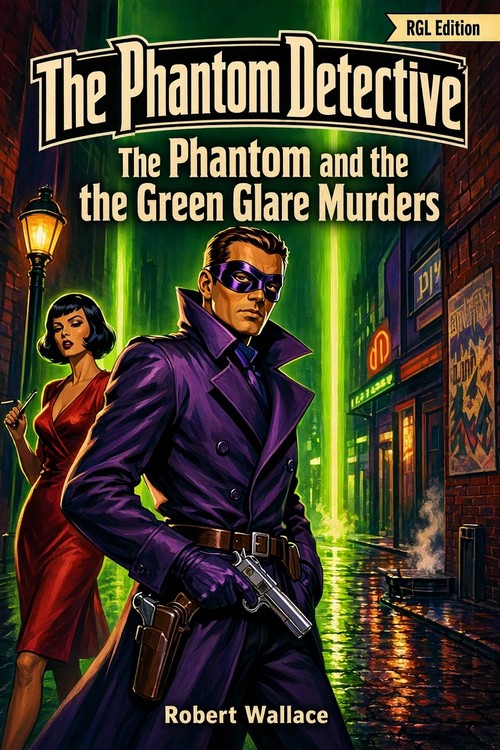
RGL e-Book Cover
Based on an image created with Microsoft Bing software
Roy Glashan's Library
Non sibi sed omnibus
Go to Home Page
This work is out of copyright in countries with a copyright
period of 70 years or less, after the year of the author's death.
If it is under copyright in your country of residence,
do not download or redistribute this file.
Original content added by RGL (e.g., introductions, notes,
RGL covers) is proprietary and protected by copyright.
RGL e-Book Cover
Based on an image created with Microsoft Bing software
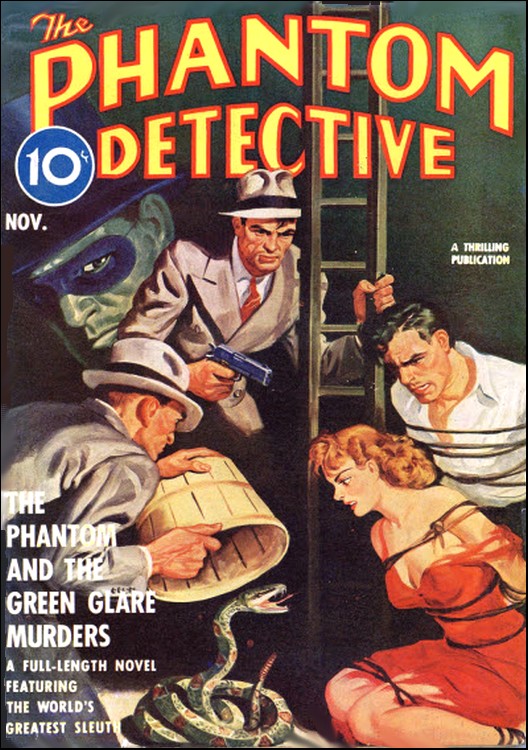
The Phantom Detective, November 1940, with
"The Phantom And The Green Glare Murders"
The relentless scourge of the underworld battles with grim desperation to forestall a hideous holocaust of crime! A sinister Green God strikes terror in the heart of a great nation's capital!
THE towering cathedrals of industry in Manhattan were beginning to light their thousands of tapers to the Great God Mammon when Richard Curtis Van Loan expertly guided his low, sleek convertible coupé through the cluttered traffic of Times Square.
Beyond the Jersey shore of the Hudson, the dying sun was trying valiantly to pierce the clouds that had hung lowering over New York all day. A break in the cloud bank let through a single amber shaft of light. It touched the undersides of the murk with a coating of gilt before the clouds closed in again.
The approaching night brought with it a keen tang. Richard Curtis Van Loan sniffed the air. Through the stench of gas fumes, he almost could smell the scent of burning leaves, that age-old perfume of October. To the young multi-millionaire who sat at the wheel of the long, gleaming car, this was the best season of the year. Stifling summer had relinquished the field to brisk, invigorating autumn, with its football games, its gloriously flame-painted scenery, its crackling log fires at the end of the day.
A red light blinked and a traffic whistle shrilled. Van Loan's foot pressed the brake, bringing the car to an easy stop. He took advantage of the halt to reach into his topcoat for a cigarette.
He inhaled the first draught deeply, wondering idly what he would do with the evening ahead.
There were plenty of invitations. There were bound to be when one was perhaps the most eligible bachelor in Greater New York. Even now, Dick Van Loan could have been at one of half a dozen cocktail parties to which he had been invited.
Tonight, he could—but wouldn't—attend one of the first debutante balls of the season. Or he could see the current Broadway hit, drive up to his New England hunting lodge to see if the woodcock were flying, or he could sit in his Park Avenue duplex penthouse and reinvestigate the word wizardry of Tolstoi or Spinoza.
He exhaled a thin stream of smoke at the windshield and shook his head in a negative gesture.
"I need something else," he mused. "This weather calls for action."
The light changed. The whistle blew. He moved the steering wheel lever into low gear. The car started to move—then stopped with a jar as Van Loan jammed on the brakes.
A thin scream pierced his ears, growing louder, shriller in intensity. The scream was joined by another and another—until a roar was sweeping over Times Square. The roar of horror grew to a wail as men and women stopped in their tracks, looked upward with blanched faces. They cringed unconsciously at what they saw.
VAN LOAN was half out of his car, looking upward. Abruptly he saw the hand of the traffic policeman at the corner, frantically gesturing at him to get back into his auto. He ducked back inside his car. There was a terrific crash, the grinding screech of crumpling metal, and something smashed through the hood of his convertible.
He heard a horrid, soft-yet-hard noise. Suddenly the windshield of Van Loan's car was blotted out by a red flood that seemed to spring out of the ruined hood. The crimson stuff splattered in all directions, bathing the side of a cab which had halted beside Van Loan's machine.
With the blood there were particles of gray matter, splintered bones, shreds of cloth. One shoe arced through the air and landed in the street, twenty feet from Van Loan's coupé.
"Good Lord!" the young millionaire said. "A suicide!"
He was out of his car just before the crowd broke free of its paralysis and rushed toward the place where the body had landed. Police struggled through the crowd, shoving back the morbidly curious. The red-faced officer who had been directing traffic at the corner was the first to reach Van Loan.
"You hurt?" he asked. "I thought he was comin' right through the top of your car!"
Van shook his head.
"Missed me," he said, drawing smoothly on his cigarette. "Looks as if he made a wreck out of that motor, though."
He looked up thoughtfully, his eyes narrowing.
"Suicide, was he?" he muttered skeptically. "Then where did he jump from? This car is in the middle of a wide street. He couldn't possibly have jumped from a window or a roof and landed this far away from the building."
He stared all around at the sky, which was not too clear because of its slate-gray clouds. No sign of a plane there, nor was the sound of an airplane motor audible over the babbling confusion of Times Square. Van Loan's brow wrinkled.
"That's funny," he murmured. "Damned funny!"
Another patrolman pushed his way through the crowd, with one hand he was holding the elbow of a pale-faced young girl. With the other, he grasped the arm of a middle-aged man whose agitation showed plainly on his ashen features.
"Here's two people that saw him fall," the officer announced. "There are plenty of witnesses, but these were the first two I heard screaming."
"It was awful—terrible!" the girl faltered. "I happened to look up—the sun broke through the clouds just then—and I saw him when he wasn't any more than a speck in the sky. Turning over and over, falling like—like a stone!"
SHE shuddered and covered her face with her hands. The man at the policeman's other side nodded vigorously.
"That's the way it was," he quavered. "I heard the young lady yell and I looked up. He—he was about a hundred feet over the tops of the buildings then, I guess, and falling fast. Limp, like a sack of flour."
"Over the tops of the buildings!" the policeman blurted. "You're nuts! He must have fallen or jumped off one of those buildings."
The startled man shook his head doggedly.
"You can find a hundred people," he said, "who'll tell you what I'm telling you. He came from the sky, all the way up! Ask anybody."
At the whine of an ambulance siren, the police redoubled their efforts to clear the jammed square. People and cars were hopelessly tangled. Behind the crowd around the death scene, motorists banged frantically on their horn buttons, and trolley motormen jumped up and down on their gongs.
"Clear the way!" yelled a policeman. "Do I have to run you in before—"
He never completed that sentence. The blowing of auto horns and the clang of trolley bells was throttled abruptly. Even the wail of the siren stopped as the thousands jamming Times Squares breathed a single, huge gasp.
High above, hundreds of feet over the tallest building on Times Square, burst forth a dazzling green glare.
It seemed to come from nowhere, yet it was blinding in its brilliance, bathing the whole scene with its ghastly light.
People looked upward, then jerked their heads away as the glare seemed to burn their eyeballs.
"It's the end of the world!" some hysterical woman screamed.
Van shaded his eyes, trying to stare upward at the light. The glare was too intense. He dropped his gaze and surveyed the eerie surroundings. All other lights seemed lemon-yellow against the flood of green illumination. It was unreal, a grotesque picture.
"What in hell do you think that is?" muttered the policeman standing beside Van.
Dick Van Loan shook his head in honest bewilderment.
"I don't know," he admitted. "But I'll bet it's connected somehow with this body that fell out of the sky."
The words hardly were out of his mouth when the green light abruptly winked out.
The crowds massed in the streets blinked as vision returned to their eyes.
Then came the murmuring, swelling rustle of incipient panic. Police whistles shrilled amid the howl of sirens as emergency squads rushed to the "Crossroads of the World."
CRACK bluecoats, trained in handling unruly mobs, went to work with quiet efficiency. Police horses plunged and reared. Their riders used all the tricks at their command to break up the frightened mob that seemed intent on going berserk.
Gradually the temper of the crowd grew calmer. The police found themselves able to start the masses moving again, sending the thousands on their way home, where they would tell the family and friends the wonder of the light over Times Square.
In the vortex of the twisting mass of humanity, Dick Van Loan stood beside the coupé. He shook his head sadly at the crushed hood and the grisly remains of something that once had been a man. He looked around for the girl and the middle-aged man who had told the police that they had seen the body falling from high up in the sky, above the building tops. They had been swirled away in the whirlpool of terrified people around the car and the body.
Van Loan swore softly when he discovered that the two people had disappeared. There was much he would have liked to have asked them, if it could have been arranged without exciting police interest. As it was, he decided, his best bet was to get through the routine police questioning as soon as possible. Then he would get away, to pursue this mystery on his own—if the puzzle deserved pursuing.
A MEDICAL examiner stooped beside the body, after it had been removed from the front of Dick's car. Rapidly he was going through the pockets of the crushed corpse. Few of the papers and notebooks pulled from the body were legible. They were soaked with bloodstains. But miraculously the man's wallet was intact.
The medical examiner straightened with an exclamation. He held up a slip of paper that Van took to be a driver's license.
"This is serious," the examiner said. "This man's wallet shows him to be U.S. Senator Horace McGrady!"
Van Loan started at mention of the slain man's name. Horace McGrady was the "Wild Bull of the Senate," as the papers affectionately labeled him, chairman of the famous McGrady Senate Committee, investigating "isms" in the United States. Foremost Senate advocate of unceasing vigilance against foreign encroachment in the affairs of this country. Sworn enemy of the vested interests, friend of the man on the street, oft-mentioned Presidential possibility!
Horace McGrady—if this pitiful bundle of shattered flesh and bone was the senator—had fallen to his death from nowhere. His death, moreover had been followed by a mysterious green flare that had bloomed out of that same nowhere, to bathe Times Square with its ghostly light.
Van Loan's trained memory immediately brought forth everything he knew about Senator McGrady. But something was missing. In what capacity had the senator's name been mentioned in the newspapers recently? Of course he was up for re-election, with victory practically assured. But there was something else.
Reporters were now crowding around Van Loan's damaged car and the tarpaulin-covered body of Senator McGrady, throwing questions in rapid-fire order. The police waved away all interrogators. They loaded the body into the waiting ambulance and sent it on its way to the morgue.
"McGrady?" Van Loan heard one of the reporters say to another. "Say, if that's McGrady, the fellow who threatened him sure made good on his threat!"
That was it! Van Loan remembered a political speech made recently by the "Wild Bull of the Senate," in which McGrady had said—What was it exactly? The words came back to Van Loan in a torrent then, just as they had been spoken by the senator.
"I say now that any personal threats which might be made against me will be made in vain. No person, no group however powerful, nor any foreign nation, can make me swerve from my chosen path. And, above all, I do not believe in the supernatural. I would not be frightened by any spooks that might be called up by my enemies."
What had those words meant? At the time, Van Loan had put them down to political expediency—the old dodge of hinting possible martyrdom to recruit new support. McGrady himself had refused to comment on that strange statement when he was interviewed later. And now—
VAN looked up at the sky. It was darkening rapidly, now that the sun had gone down behind the Palisades across the river. He stared at the sky, seeking some answer to this strange death of a prominent American. Suddenly his eye caught a winking blot of red, pulsing on and off from one of the highest towers on the Manhattan skyline.
Van Loan felt a thrill course through his veins. A few minutes ago, he had been wishing for some excitement to liven the chill October evening before him. He certainly had it now!
That winking red light was atop the tower of the slim Clarion Building. It was a signal light, known only to two men. One was Frank Havens, publisher of the New York Clarion and owner of a string of crusading papers from coast to coast.
It was Havens' thumb that had pressed the button, setting the signal light to winking. That light meant Havens was anxious to get in touch immediately with the world's greatest detective—the Phantom!
And Richard Curtis Van Loan, standing in Times Square, unrecognized by the thousands who milled about him, saw that light. He knew it was a call to him—for he was the Phantom!
Van quickly concluded his business with the police, and put his wrecked car in charge of a tow truck. Then he made his way through the crowd to a drug store at the nearest corner. Entering a telephone booth, he dialed a number. He was rewarded by an immediate answer at the other end of the line.
"Frank?" asked Van cautiously. "I got your call. I'll be with you in ten minutes."
"Thank heavens," Frank Havens breathed. "This—Well, I'll tell you when I see you."
"I know part of it," Van Loan said. "I was there when it happened. In fact, it happened only a few ghastly inches away from me. I'll tell you when I see you. Herman Andrews is going to call on you in about ten minutes. Tell your receptionist that it's all right to admit him."
"I'll do that."
In this manner did Van Loan prepare his friend, Frank Havens, for the disguise he had decided to adopt "Herman Andrews" was one the innumerable characters the detective assumed at various times when calling on Havens. Even the publisher's own aides and intimates never suspected that the innocuous Herman Andrews was the man whose name alone chilled the bones of the nation's worst gang leaders.
Ten seconds after Frank Havens hung up, Van Loan reached into an inside pocket, extracting a flat, thin, compact make-up case. He turned his back to the glass doorway of the phone booth, shielding his operations. Opening the packet, he revealed an assortment which he called his "vest pocket laboratory." Among the implements laid on the small counter of the phone booth were disguise applications second to none in the world.
There were strips of cartilage for changing the contours of the nose, putty for facial remodeling, wigs, mustaches. Vials of liquid, when applied, instantly changed the color of his skin. Sets of false teeth fitted over Van Loan's perfect white teeth with a single adjustment. Shading pencils and tiny camel hair brushes, when expertly wielded, could add old-age wrinkles to Van Loan's lean face in a twinkling.
HIS long fingers moved rapidly but without wasteful haste. Van went about changing his face, to make himself a person nobody would recognize as the lackadaisical playboy, Richard Curtis Van Loan. For the Phantom—as somebody once described him—was "the man of a thousand faces, and none of them his own." Only Frank Havens knew that the languid Dick Van Loan and the crime-smashing Phantom were the same man.
Less than three minutes after he had finished his conversation with Frank Havens, Van pulled a tiny mirror from the same hidden pocket that had yielded the disguise kit. He snapped on a midget lamp affixed to the glass and bent over to stare at himself. He looked at the face of a rotund, florid-faced man, with hair just beginning to show a sprinkling of gray.
Minutely the Phantom surveyed his handiwork. This disguise apparently would undergo no deeper scrutiny than the passing glance of Frank Havens' reception clerk. But the Phantom had learned through bitter experience that never could he don a disguise that was less than absolutely perfect.
Satisfied at last, Van Loan replaced his disguise kit and mirror and stepped out of the phone booth.
Ten minutes later, almost to the second, "Herman Andrews" stepped into Frank Havens' private office in the tower of the Clarion Building.
His entrance was the signal for Havens to set in motion a concealed electric device. If any dictographs had been planted in the place, it would have hopelessly distorted them with a flood of static. The two men took this precaution every time they conversed in Havens' office. Guarded and inaccessible as the place was, neither Havens nor Van Loan took the slightest chance that the Phantom's identity would be discovered.
Handsome and distinguished, Havens grasped Van Loan's hand in a hearty greeting, as soon as the two men were alone.
"I'm certainly glad I reached you so soon, Dick," the publisher said. "This is—Well, tell me what you know about Senator McGrady's death. I presume, from what you said over the phone, that you know something about it."
"It was McGrady, then?" the Phantom asked.
Havens nodded, his face grave.
"Little doubt about it. Our Washington office tells us McGrady disappeared shortly before noon. He told his secretary he was going to his club—the Gavel—for lunch. The steward of the Gavel Club says the senator never showed up there, although he ordered lunch for four early that day. McGrady seems to have dropped out of sight as soon as he left his offices.
"He had several important meetings scheduled for the afternoon and missed them. Of course Congress isn't in session, but the senator worked hard at his committee job the year round. Yes, we know it was McGrady who was—who seemed to fall out of the sky."
THE publisher's brow wrinkled in a worried frown as he hesitated a moment before continuing.
"You can imagine the shock to the country, Dick. The news of McGrady's death will sweep the nation like prairie fire. I'm afraid to admit that it won't do the country any good. You know how unstable everything is now. With the people as jittery as they are, this terrible tragedy might have serious consequences. They might claim that McGrady's murder was aimed at the Government, rather than against McGrady personally." He heaved a sigh and shook his head dolefully.
The Phantom recounted his own experience in Times Square, relating how the body from the sky crashed down on the hood of his car. He told of the panic that followed, and of the green light which shone dazzlingly over the city immediately after the tragedy.
When he was through, Havens nodded thoughtfully.
"That's the story my men have gathered everywhere," he said. "All witnesses say that they first saw the body when it was above the skyline. That definitely rules out the suicide or accident theory. Nobody saw a plane, nor heard an airplane engine." He heaved a deep sigh as he spread his hands in appeal.
"There's a mystery, Dick, if there ever was one! Besides, this country has lost a man it can hardly afford to lose. The killers—I insist it must have been murder—must be caught, Dick. I admit there's a personal angle in this case. McGrady and I saw eye to eye on most issues, and he helped me as I pride myself that I helped him on occasion. But there's also something else. Something mighty important, Dick—and dangerous."
He paused to open a drawer at his side. He extracted a set of earphones, attached to a cable that ran to a small recording device lodged in the desk drawer.
Van was familiar with the apparatus. He knew that when Frank Havens received an important call, he could throw a switch which would record the entire conversation.
That machine often had done yeoman's service for Van Loan in other cases. Those cases might have been doubly hard to solve if it had not been for the impressions on the wax disks recorded by Frank Havens. The publisher handed the earphones to Van Loan.
"This is a telephone conversation I had this morning, hours before Senator McGrady was murdered. Listen to it, and you'll understand why I'm afraid, Dick. I'm afraid that some of the biggest men in Congress are marked for death!"
WHILE the Phantom adjusted the earphones, Frank Havens glanced across the desk at the young man in whom he took such justifiable pride.
Frank Havens was the man who had seen in Richard Curtis Van Loan, heir to countless millions, amazing qualities. Since then they had been developed to make the Phantom the figure most revered by the honest, and most feared by the underworld in crime detection.
That had been several years ago. Van Loan, just out of college, had been drifting discontentedly around in the social circles that carried him to Newport, to the Riviera, to West Palm Beach, to Pinehurst, to the Colony Club, and back to Newport again.
Then it was that Havens, a friend of the boy's dead father, broached the subject of crime detection. He described the country's need for a man who would make his career the suppression of crime, the crushing of gangs, and bringing to justice the underworld's ruthless fiends.
The suggestion had struck an answering spark in young Richard Curtis Van Loan. With the enthusiasm he applied to everything he did, he had plunged into the field of crime detection, absorbing every known fact about that fascinating subject. He had been quick to learn, but even quicker to strike out on his own. He developed and improved old methods, invented new apparatus, discovered new scientific facts to be used as weapons against the army of darkness.
These discoveries Van Loan shared freely with the police of the world. Their gratitude was shown by the honors they heaped on this mysterious figure, the Phantom. They showered them upon him without ever having seen his face.
For the Phantom worked alone. Cloaking his identity with disguises that never had been penetrated, he used his fortune to finance his own laboratories, his own expeditions against the underworld. On many occasions, he had called on the police for assistance. More times than not, he handed all credit to the organized law agencies.
But alone he labored in his laboratories or set out against the enemy. And it was alone that he solved the most puzzling tangles and brought about the downfall of clever, coldblooded killers who had thought themselves safe.
Only Frank Havens knew Dick Van Loan was the Phantom, and no torture ever devised could drag the secret from the publisher.
These thoughts raced through Havens' mind as he watched the Phantom adjust the earphones. Van Loan heard the faint scratching of the needle as it moved from an unrecorded section to the grooves of the platter.
"Repeat that, please," Havens' voice said abruptly. "I didn't quite get the name."
"This is Representative Louis Albright," a strange voice replied. "I am calling from Washington. Is this Mr. Havens?"
"Right."
"Mr. Havens, it's most important that I get in touch with the Phantom at once. It's a matter of life and death to me!"
Beneath the metallic sound of the recorded speech, the Phantom could detect a note of strain in Albright's voice. Van had heard hundreds of voices under the stress of every emotion, so he had no trouble in identifying Albright's feelings. The man, he knew, was panic-stricken.
APPARENTLY, Havens had noted that same terror in the congressman's voice, for he said:
"That's not always easy to do. What is it that you want with the Phantom?"
Albright's voice heightened almost to a frenzy.
"I know you're the only man who can put me in touch with the Phantom! And I know the Phantom's the only one who can do me any good in—in the jam I'm in."
"What kind of jam is it?" Havens asked sympathetically.
"My life's been threatened," burst out the other voice. "They mean it! They'll get me, along with the others. McGrady"—Van Loan stiffened in his chair—"Furman..."
He stopped short, then began talking again, more guardedly.
"I can't tell you anything over the phone. I've got to talk to the Phantom, face to face. I—I wouldn't waste the Phantom's time, Havens. I tell you, this is important."
"Have you any idea who is threatening you?" Havens urged.
A second's silence followed his question.
"I—I know, but I can't tell you now. Not over the telephone. It's—it's unbelievable. You wouldn't take me seriously, Havens, unless I could explain everything to the Phantom. He'd know I was telling the truth."
"I'm afraid," Havens voice said, "I'll have to have something more to go on than—"
"All right!" Albright half screamed. "It's the Green God, if you must know! He'll kill me, unless the Phantom stops him! He'll kill McGrady, too, and Furman and the others."
"What others?"
"In the name of humanity," Albright implored, "get in touch with the Phantom and send him to me in Washington. I'll tell him everything!"
There was a click and then Havens' voice began calling "Hello." There was no answer. Finally, the needle scratched out of the groove. The Phantom detached the earphones.
"That was all?" he asked Frank Havens.
The publisher nodded.
"I—I didn't call back," he faltered. "I had an idea that the whole thing was some kind of a hoax. It was all so sudden, and Albright hung up on me."
His head dropped and his face grew sad.
"Then Senator McGrady, one of the best men who ever was under the Capitol dome, falls to his death out of the sky. And there's a green glare in the sky just after his murder! Perhaps, if I'd taken Albright's message more seriously at once—"
His voice died away. Van Loan gripped him by the shoulder.
"I doubt that I could have helped in so short a time," he said firmly. "You mustn't blame yourself, Frank."
As he remembered the voice on the record, his brow wrinkled.
"Albright, majority leader of the House. McGrady, one of the Senate's biggest men. Albright mentioned Furman, before he seemed to remember something that shut him up sharply. Furman's the chairman of the Senate Rules Committee, almost as big a man as McGrady."
He turned and started for the door.
"Come on, Frank," he stated decisively. "You and I are going to Washington. Call the airport and tell them to get your plane ready. We've got to get to the Capital in time to stop this Green God—whoever or whatever it is—from murdering somebody else!"
CONGRESSMAN LOUIS ALBRIGHT lowered himself to a chair behind his desk in Washington, a shaken man. On the desk before him lay an extra. Still damp after having been rushed off the presses in the Capital, it screamed to Washington of the strange death of Senator McGrady.
Albright's hand shook as he pulled forth a handkerchief to mop his brow, bedewed by perspiration despite the coolness of the office. He glanced at the lurid headlines and then at a letter which lay face up beside the newspaper.
The congressman looked at the date on the newspaper. It was growing close to Election Day. By custom, he should be back in his home state, campaigning for reelection. But his political lieutenants had promised him that his return to Washington was assured by a landslide vote.
With certain other Congressional key men, Albright had chosen to stay in the Capital to continue their work regardless of the campaign at hand. World affairs and the domestic situation demanded their presence close to the White House these days.
Now Albright wished fervently that he were home, stumping about the state, shaking countless hands, kissing countless babies, handing out cigars and making speeches. Anything—even the grind of a political campaign—was better than this!
His chair squeaked as he leaned forward to pick up the letter that lay beside the newspaper. Although he knew the contents of the note by heart, he reread the missive. Again he felt the clamp of chill fingers around his soul as he read:
Albright, this is to warn you that you have been marked by the all-powerful Green God!
You know too much, Albright—much too much! Such knowledge is dangerous to any man, and especially to one in your position of authority.
It might be that you would die instantly, cruelly and inescapably. But the Green God is a merciful god, so an alternative is offered you.
You know too much, but you do not know all. If you can find the missing pieces of the puzzle to which you have a clue, and supply those missing pieces to the Green God, your life will be spared. Otherwise, you must die.
If you are ready to serve the Green God in this matter, you must so pronounce within four days from receipt of this warning. You must make this pronouncement public by including in one of your public addresses, the sentence:
"I pledge myself to work unceasingly for the public good, though I may take strange byways to reach my goal."
This sentence must be repeated exactly, word for word. If you so announce, the Green God will give you further orders. If you do not include these words, or if you in any way show your intention of defying the Green God, you will die.
THAT was all. Yet it was enough to bring the sweat to Albright's face, and to make his hand tremble as he replaced the letter on the desk.
More than four days had passed since he had received the note. Harried, not knowing where to turn, he had watched the hours speed by with agonizing swiftness. The morning's mail had brought a second letter, which said only:
Like you, McGrady believes he can defy the Green God. He dies today. Your turn is next!
That note had struck the icy spike of terror deep into Albright's heart. McGrady, one of the biggest men in the Senate, the country—The Green God wouldn't dare! Yet there was something in the brief note which told Albright that the Green God would dare.
On the brink of panic, Albright had telephoned Senator McGrady. The senator admitted receiving a letter almost identical with the one that Albright had been sent. McGrady, though, was scornful of the note.
"I told this Green God in my radio speech the other night that I wasn't afraid of him," McGrady reminded Albright.
"But—but what about the puzzle?" Albright had stuttered. "The missing pieces. Do you think—"
McGrady's voice cut him off sharply.
"Rubbish," he snorted. "Nobody knows about that. Nobody will, if you and the others keep their mouths shut. No, this is some cheap, political trick. You're up for reelection, same as I. If you do something silly, like answering this Green God the way he's ordered, somebody might use it to show how you'd sell out your office because of a crank letter."
"Uh—the others," asked Albright in a half whisper. "Did they—Were they warned by the Green God as we were?"
"What others?" McGrady had demanded furiously. "Damn it, Albright, you talk too much! Take a sedative and don't worry."
But Albright had worried. He had been close to panic when he phoned Frank Havens in New York, pleading for the Phantom's aid. McGrady, he knew, would be angry if he learned of the call. The others—Furman, Wilkes, Clayborne—would think he was a coward.
Well, let them call him a coward if they wanted to. The Phantom was the only one who might be able to cope with the hidden menace that called itself the Green God. He'd tell the Phantom everything, and the others could go hang.
Then Senator McGrady had dropped out of sight!
FIRST indication of the senator's disappearance had come with the convening of his powerful committee to consider new evidence charging formation of a widespread terrorist-fascist organization in the Midwest. The committee session had been set for one o'clock. When the punctilious McGrady had not appeared by two, calls had been made to his office and his Chevy Chase home. Later, other calls were made—to his club, to the home of friends, and finally to the police.
The alarm spread as anxiety mounted. Then had come the shocking news from New York. Senator McGrady's body had hurtled out of the sky to a shattering death on the pavements of New York's Times' Square, hundreds of miles from Washington! A green glare had filled the skies over Manhattan as the senator's body lay broken.
Small wonder that Albright's panic had heightened ten-fold, in time with the horror that was sweeping the country. Small wonder that perspiration dotted his forehead now, despite the chill at his heart, and his hands were palsied.
The congressman sought to reassure himself with the news that had come over the telephone a few hours previous. Frank Havens had called back, telling him that he and the Phantom were immediately boarding a plane for Washington.
"Hurry!" Albright had implored. "I've been warned that I'm to be the next victim of the Green God. You must hurry before I go stark, raving mad!"
"Sit tight," Havens had advised. "Once the Phantom is on the job, he'll expose this threat."
Albright looked at his watch. It was nearing the time when the Phantom should be reaching the airport. Havens had promised that, the great detective would come straight to the congressman's office. Albright prayed for time to pass speedily, for the hands of his watch to move swiftly around the dial so the Phantom would be at his side.
The phone on Albright's desk shrilled loudly. The congressman started in his chair. For a moment he debated whether to leave it unanswered. Then he was struck by the thought that it might be Havens and the Phantom, calling from the airport.
"Yes?" he said, in response to the voice at the other end of the line. He listened a moment. "But—er—I can't, right now. I'm tied up and—what?"
He listened again, then glanced at his wrist-watch.
"Well," he said reluctantly, "if you're sure it won't take longer than a few minutes. I've got an appointment that I must keep in about half an hour."
The voice at the other end of the line was insistent, demanding.
"All right," Albright said. "I'll be over. But I've only got a few minutes."
He hung up the phone, shrugged into a topcoat and started out of the office. At the door he hesitated, turned slowly and went back to his desk. He pulled open the top desk drawer, took out a heavy, blue-black automatic and shoved it into a pocket of his topcoat.
Then he left the office to answer the summons that had come over the telephone.
TWENTY minutes after Congressman Louis Albright walked out of his office, Frank Havens and the Phantom left the swift cabin plane that had flown them south. They walked through the waiting room of the airport on the outskirts of Washington.
"Enemies?" Van Loan was saying to his friend and confidant, in reply to a question. "McGrady had many enemies, just as he had countless friends. A man who fought so hard for the legislation he felt was right couldn't help making enemies. Take Denniven Greetson, for instance." Havens gave an exclamation of disgust.
"Greetson?" he snapped. "That would-be Hitler? I can't understand a man of Greetson's family and upbringing—Choate and Dartmouth—developing into the loud-mouthed rabble-rouser he has turned out to be. He has millions. His holdings are as safe as Government bonds. Yet he is perpetually harping on the danger of Communism, or some other ism.
"He's always demanding that the Government take firm steps. If Greetson had his way, he'd have a soldier billeted in the home of every man who admitted that there might be something worthwhile in liberalism." Van nodded agreement as the two men headed toward the taxi stand outside the waiting room. The Phantom still wore his disguise as "Herman Andrews." He looked exactly like a typical traveler, perhaps a salesman who had landed in Washington with high hopes of selling a good bill of furniture.
"Greetson," mused Van Loan. "He was up before the McGrady Committee a couple of weeks ago, as I remember. He made quite a fuss about it, too."
Havens snorted in derision.
"Made a disgusting scene, if that's what you mean," he said. "The committee grilled him about his connection with some bunch known as the Bloody Shirts, or Tan Shirts, or some other shirt organization that was spreading in the Midwest. A rotten crowd of hoodlums, it turned out to be.
"Their idea of Americanism was to smash the store windows of merchants the leaders of the gang didn't like. The bunch was financed by somebody in the money. It looked pretty much as though it was Greetson who was behind the whole thing."
"He didn't admit it, though, did he?" asked the Phantom.
Havens shook his head and shrugged.
"Why should he? Naturally he admitted nothing. Instead, he made a speech about the future of America under some strong leader—dictator is what he really meant. When the committee sat on him, he seemed to go absolutely mad. He raved about how his 'persecutors' couldn't stop him. All he had to do was give the word, and a million men were ready to wipe everybody who opposed him off the face of the earth."
"Ah!" said the Phantom quietly. Havens looked up into the face of Van Loan.
"Good Lord!" he said. "You don't think Greetson—"
The Phantom made a gesture to compel silence as the two men stepped into a cab.
VAN tarried only long enough to buy a paper from the urchin who thrust an extra in his face. Havens gave the cab driver the address of Albright's office. The taxi began humming over the road as Van Loan scanned the lurid headlines which told of the death of Senator McGrady.
The newspaper account told little that he did not already know, and the Phantom soon turned to the other news on the front page. Havens made no attempt to interrupt his friend's silence. He knew from experience that often when Van Loan seemed wasting time, reading a paper or fingering the keyboard of a piano, he actually was untangling some puzzling question in his mind. Several minutes passed before the Phantom spoke.
"Hsang Mei Liang," he said at last. "I've heard that name before." Havens glanced up in surprise. "What in the world?" he asked inarticulately.
Van pointed to a small item on the front page. It was a brief article, dwarfed by the headlines and pictures that featured the story of Senator McGrady. Havens bent to peer at the article, finding it hard to keep his eyes on the lines when the cab bounced.
"A Chinese," he read, "identified as Hsang Mei Liang, about fifty, died today after he collapsed on Pennsylvania Avenue, near the Capitol, shortly before noon. Identification was made by friends, who said that Hsang had been in Washington for several weeks. He had been working in some extra-official capacity for the Chiang Kai-Shek government, particularly in the field of refugee relief. Death apparently was due to heart disease."
Havens looked up from the paper with a puzzled frown.
"What in the world," he asked, "could the death of a Chinese refugee relief worker have to do with the Green God?"
Van Loan hunched his shoulders and let them fall.
"Not a thing, probably," he confessed. "But you know that I've got a funny kind of memory, Frank. It's sort of like a card index system. Once a name is recorded in that freak memory of mine, it takes all hell and high water to make me forget it."
Havens nodded. There had been many occasions on which the publisher had marveled at the accuracy, the absolute infallibility of the Phantom's memory. A face once glimpsed by Van Loan never was forgotten. A name, a fact mentioned to the Phantom, was automatically stored away in Van Loan's "card index" memory.
"This man, Hsang Mei Liang," the Phantom said. "I may be wrong, of course, but it seems to me that he came to Washington from San Francisco. He landed there from the Far East about three months ago. The reason I remember him is that he was given quite a reception by the Chinese leaders in this country—dinners, receptions, all that. Hsang evidently was a big shot in his native country."
HE paused, frowning as he held his lower lip between his thumb and forefinger.
"I remember something else," he said slowly. "Probably a coincidence, but—I'd better have this checked in your files—Hsang Mei Liang was quite friendly with Senator McGrady."
"McGrady!" gasped Havens.
Van Loan nodded.
"You know what the senator thought of the Chinese war," he said. "There was no doubt where his sympathies lay. It seems to me that he had Hsang Mei Liang as a house guest at his Chevy Chase place for several days, at least."
He leaned back in the upholstered taxi seat and stared at the roof of the cab.
"Probably a coincidence," he mused. "Probably entirely unrelated. But Senator McGrady plunges to a mysterious death in New York. On the same day, a Chinese named Hsang Mei Liang, who knew McGrady, dies on a Washington sidewalk. Curious, to say the least."
"But the paper says this man Hsang died of heart trouble," Havens protested. "And McGrady—"
He jerked forward as the taxi driver jammed on the brakes with a squeal of protesting tires.
"Hey!" yelled the cabbie. "What the hell is that?"
Van Loan and Havens bent forward to peer through the cab's windshield. They saw a greenish tinge lighting the sky ahead of them. The glow swiftly grew in intensity until it was a blinding glare. Eerily the dark fronts of Washington's F Street stores reflected the unholy light. The faces of the people on the sidewalks were tinged with the hue of putrefaction.
Van Loan wrenched down the door handle of the cab.
"Come on, Frank!" he snapped. "There's a big crowd in the middle of the street, right ahead of us. A crowd of people, milling around and yelling. And there's the green glare!"
He threw the driver a bill as Frank Havens scrambled out of the cab behind him. By that time, the glare had grown brighter, was unbearably brilliant. The murmuring rumble of the crowd was rapidly growing to a roar of panic...
POLICE were vainly trying to control the crowd when the Phantom and Havens reached the pressing, shouting throng. Expertly the broad-shouldered Van Loan shoved his way toward the center of the gathering, where a small cleared space showed that something lay on the street. Havens followed the Phantom as quickly as he could.
At length, Van Loan reached the center of the press, with the publisher at his heels. When the Phantom looked down, he made a soft exclamation. As Havens looked, too, he paled and gasped.
"He came right down out of the sky, mister," a man beside them volunteered. "Just like he fell out of an airplane or something. He landed with a splash right in the middle of the street. I seen the whole thing."
Van turned a carefully shocked expression to the man.
"See any lights of a plane?" he blurted. "Hear any motor?"
The man shook his head definitely. "No, sir," he insisted. "First thing I thought of was that somebody had fell out of one of them airliners. I looked up right away, but there weren't no lights. I didn't hear no motor, neither."
A policeman, his face grotesque under the green light, began shoving people back from the body.
"All right, now," he kept chanting. "On your way! On your way!"
Van reached with invisible speed into a secret pocket and pulled forth a small shield, which he held cupped in his hand. The shield was of platinum and across its face was a tiny mask, made of diamonds. As the officer looked down at the shield, his eyes suddenly widened. It was the sign of the Phantom, known to police the world over. The bluecoat's hand snapped up in an awed salute.
"Yes, sir!" he said promptly. "Patrolman Fagin, sir."
Van looked down at the crumpled heap at their feet.
"Do you know who this was?" he asked.
"There were a couple of letters, sir," the patrolman said. "They were pretty messed up, but we were able to make out a couple of them. It's a shock, sir, coming right after the senator's death. This man was—"
The Phantom held up a restraining hand as he interrupted.
"I think I know," he said in a low voice. "This was Congressman Louis Albright—the Green God's second victim."
ON the morning after the murder of Congressman Louis Albright—while the Capital still rocked with the stunning blows of the deaths of two leading Congressional members—the Phantom left his hotel and hailed a cab. He was still disguised as "Herman Andrews." Van was bound for the exclusive Gavel Club, where he had an appointment with Senator Hewett Furman.
His mind busily went over the events of the day before. But it was not too busy for him to notice something startling, yet apparently insignificant. Abruptly he leaned forward, rapped on the glass for the cabbie to stop.
As the taxi drew to the curb, Van Loan peered up at the front of the large building before which it had stopped. Over the ornate front door of the building flapped a large red flag with a white sun on a blue field. It was the flag of the Chinese Republic.
"Did you want the embassy?" the cab driver asked. "This here's the Chinese—"
"I know," Van Loan broke in, with an impatient wave of his hand. "I just wanted to look at that flag."
The cabbie craned to look up at the flapping pennant. When he turned to his passenger, it was a bewildered stare.
"Looks all right to me," he said. "What's wrong with the flag?"
"It's at full mast," Van Loan mused, half aloud. "It should be at half mast and it's—"
He caught himself and ordered the driver to go on. During the rest of the drive, Van concentrated on that wind-rippled pennant over the door of the Chinese Embassy.
"If I had more time," he murmured, "I'd find out about that. But right now I've got to talk things over with Senator Furman. That's the man Albright mentioned when he called Frank Havens and asked for me."
He strode into the luxurious lounge of the Gavel Club, to which he was directed by a bellboy. Awaiting him was the portly figure of Senator Hewett Furman, chairman of the Senate Rules Committee and dependable White House whip.
Ordinarily the senator was an impressive man, with his cutaway, the blue ascot tie that had become his political trademark, his sweeping mustaches curving down across his florid face. A politician of the old school, "By Gad" Furman, as impudent press gallery veterans called him, still was an able, conscientious statesman.
Administrations might come and go, but Senator Hewett Furman, like the Washington Monument, stayed on. His return to Congress was assured at each election by an electorate that had sworn by him for more than a quarter of a century.
At the moment, however, Senator Furman was not his usual ruddy booming self. His jowls hung slack, and his face was the color of wet cardboard. His eyes shifted uneasily as his fingers played nervously along the arms of his massive easy chair. When he stirred his bulk, there was the faint crackle of paper coming from an inner pocket.
Each time he heard the crackle, Senator Furman winced. He dreaded the reminder that stalking him was a murderous entity called the Green God. It had sent two of Senator Furman's colleagues to a horrible death, and now it was threatening Furman himself.
FURMAN rose, puffing ponderously as Van strode to his chair in the lounge and held cupped the badge of the Phantom.
"A pleasure, sir," the senator said earnestly. "I was glad to get Frank Havens' call. Terrible thing, McGrady and then young Albright. Two of the finest men in Congress, sir. And now"—he snapped his fingers—"they're gone like that."
Van Loan took a chair so heavy that it required two hands to shift it close to the senator's side.
"Albright," he said in a low tone, "mentioned your name when he called Havens yesterday. I take it that you have been warned by the Green God."
Furman's hand reached for a vest pocket. It played with some trinket that was concealed there.
"I have," he admitted. "I was given four days to announce publicly—er—certain things. That was two days ago. Counting today, I have forty-eight hours left in which to meet the Green God's demands."
"You have the letter?"
Furman nodded, shifted the hand that had toyed in the vest pocket to reach inside his coat. He brought out a folded slip and handed it to the Phantom.
"There it is," he said unenthusiastically. "This Green God, whoever he is, demands that I solve some kind of damned puzzle and publicly announce that I pledge allegiance to him."
Splotches of red rage appeared on the senator's cheeks.
"By gad!" he exploded. "That rascal wants me to kowtow to his orders! This rubbish about a puzzle is just a blind. It's some rascal in a colored shirt, like Denniven Greetson who wants to get control over us by threatening us, the key men of Congress. These miserable dictator-worshipers are hiding behind this nonsensical stuff about some puzzle. Puzzle? What would I have to do with any puzzle? When I became a man, I put away my childish things."
Van Loan looked down at the note that Furman had handed him. It was essentially the same as the letter Albright had read before leaving his office to go to his death, but it was the first one Van had seen. Albright's office had been searched by police, after his body had crashed to its death on F Street. No letter, no evidence that might provide a clue of any kind, had been found.
"If you can find the missing pieces of the puzzle to which you have a clue, and supply those missing pieces to the Green God, your life will be spared," the Phantom read aloud.
"Forget that infernal nonsense!" Senator Furman growled. "The next bit is what's really important—that part about my being ready to serve this Green God. That's what the beggars really want! That's why they killed McGrady and Albright so spectacularly—to scare the rest of us. This Green God is just another name for some subversive group. They want to scare the leaders of Congress who are up for reelection into quitting the race or knuckling under to save their lives."
Van folded the paper and placed it in his pocket.
Furman's eyes, behind the puffy lids, watched him carefully.
"Then you have no knowledge at all about any puzzle?" Van Loan asked. "You don't know what this Green God means by that?"
THE senator's fingers toyed in his vest pocket again.
"I certainly do not!" he said emphatically.
The Phantom gnawed his lower lip. In his career he had met many expert liars, and his years of experience had trained him to detect a lie as quickly as he could spot a red flag. He was equipped with a kind of mental lie detector that subconsciously marked the quickening of the pulse, the shortening of the breath, that came inevitably when someone told a lie. He knew now that Senator Hewett Furman was lying. The Phantom tried a new tack.
"You and Senator McGrady were good friends, weren't you?" he asked. "Weren't you also pretty close to Louis Albright?"
Furman nodded slowly, with ponderous sorrow.
"McGrady, of course, was a better friend of mine than Albright," he replied. "We had already served in the upper chamber a good many years, while Albright was a comparative newcomer."
The Phantom leaned forward earnestly.
"Senator," he said, "I'm trying to find some reason why the Green God should attack you three—McGrady, Albright and you. Aside from being members of Congress, what link was there between the three of you?" Furman sank back in his chair and appeared to search for an answer to the question. Reluctantly he shook his head.
"I don't know," he said heavily. "I'm sure I don't know."
Van Loan chalked up another lie against Senator Hewett Furman. He shrugged regretfully.
"That handicaps me," he stated significantly. "If you're to be protected against this murderous Green God, I'd be able to work better if I could find some link or connection that would give me a clue. Otherwise—"
He hunched his shoulders, watching Furman narrowly. He saw the senator hesitate. For a moment, he thought the portly man was going to retract his lies and tell what he knew. He held his breath, but the spell was broken with the entrance of a Gavel Club page into the lounge.
"Beg pardon, Senator," he said. "Mr. Wright wanted to know if you still had a luncheon engagement with him."
Furman started in his chair.
"I forgot about that," he admitted. He turned to the Phantom. "Will you join us?"
Van Loan shook his head as he arose from his chair.
"I've got other things to do," he said evenly. "I'll probably get in touch with you later in the day. In the meantime, try to think of something connected with the puzzle that the Green God mentioned. Try to remember some link between you, McGrady and Albright. I need—"
He stopped short suddenly, sensing the presence of a third person in the lounge.
VAN turned to meet the smile of a heavy-set, well-dressed man of more than middle age. He was approaching Furman and the Phantom.
Van recognized the man immediately. It was James Wright, head of the far-flung Wright Industries. A humanitarian, Wright personally had outfitted several ambulance trains to work in war-torn countries, though he was also a sportsman, a lavish spender, a modern Croesus.
"Sorry I interrupted you, Senator," Wright said heartily. "I wanted to find out about our date. I'm anxious to talk over that ambulance unit matter with you as soon as possible." Furman heaved himself out of his chair so ponderously that he collided with the Phantom. Van Loan grasped the Senator's shoulder steadyingly, waved away his apology.
"Wright," said Furman, "meet—er—Mr. Andrews. Friend of mine. Great fellow." The pompous senator chuckled. "Don't recognize him, do you? Never saw him before, eh?" Wright shook hands with the Phantom. He gazed into Van Loan's face searchingly, while the Phantom cursed Furman's jovial indiscretion.
As he held the millionaire's hand, Van Loan glanced down at the strong blunt fingers that held his. A fleeting frown crossed the Phantom detective's face for a moment, and then it vanished.
Wright reached behind him and grasped one of the heavy carved chairs of the lounge room with his left hand. Effortlessly he swung it clear of the floor and set it down beside him.
"You from Furman's state, Mr. Andrews?" he asked.
"Yes, indeed," said the senator, before Van Loan could reply. "Valued constituent of mine. Why, Jim, this Mr. Andrews—"
"I'm sorry," the Phantom cut in. He flashed a warning glance at Senator Furman, but he knew his effort to stop the other's ready tongue was futile. "I'll have to be running along now, I believe. Glad to have met you, Wright."
"Hold on," said the industrialist hospitably. "Haven't you time for a pre-lunch cocktail in my rooms? You know, I live here at the Gavel when I'm in Washington. It'll take only a second."
Senator Furman heaved a reminiscent sigh.
"You're missing something if you pass up one of Jim's cocktails," he warned lightly. "I remember them from the old days, before my doctor, damn his eyes, forbade me to touch a drink. But even so, Jim can make me up a non-alcoholic cocktail that you'd swear was spiked with three fingers of good liquor."
Van Loan smiled regretfully as he shook his head.
"I'm overdue now for an appointment," he prevaricated. "Some other time, perhaps."
He made his farewells, left the lounge and the club. As he walked down the steps of the quiet, chastely facaded building, his right hand was clenched. He held a small object that, a moment before, had rested in the vest pocket of Senator Hewett Furman.
Van Loan had noticed that the senator reached instinctively for his vest pocket each time he was confronted with a question that he had not elected to answer. That thing in the pocket, the Phantom had decided, was connected with the senator's reluctance to tell everything he knew. It must be connected with the Green God.
It had been an easy matter for Van Loan to lift the object from Furman's pocket. He had deliberately stepped back to collide with the senator at Wright's entrance. Sleight-of-hand was one of the Phantom's cleverest accomplishments, an achievement that had stood him in good stead on many occasions.
He had no scruples against picking the senator's pocket. Furman had withheld important information, even though his life obviously was in danger. For the man's own protection, it had been necessary for Van to dip into his vest pocket, in search of something which might give him a tangible clue.
He hailed a cab at the curb and gave his hotel address. As he sank back on the seat, he pulled out the object he had taken from Senator Furman.
His eyes narrowed when he looked at it.
It was a piece of exquisitely carved jade, translucently green and roughly the size of a half dollar. The Phantom examined the curio carefully. One face of the medallion—if it were a medallion—was flat and smooth. The other was crisscrossed with the marks of a knife that had been wielded by some sculptor of ancient times. The edges of the piece were curiously uneven, totally lacking the symmetry and artisanship of the carved face.
Van Loan nodded grimly.
"It's as though this piece were made to fit into another, like part of a jig-saw puzzle," Van Loan told himself. Then he started. "Part of a puzzle? The Green God demands that some puzzle be solved!"
He stared more intently at the jade.
"Obviously Chinese," he murmured. "That brings us back to a remarkable coincidence. Hsang Mei Liang died suddenly on the day that Senator McGrady, and later Congressman Albright, were killed. It also recalls the flag at the Chinese Embassy."
He leaned forward and gave instructions to the taxi driver.
"Never mind the hotel. I want to go to Union Station."
At the railroad terminal, he called Frank Havens.
"I'm bound for Baltimore," he explained swiftly. "I managed to get hold of something that may give us an important lead, or may not. But it has to be investigated. I have a good friend in Baltimore—one Kung Li Meng—who might help me out."
THE Phantom's taxi drove up in front of a small cluttered shop on narrow Mulberry Street, in the heart of Baltimore's diminutive Chinatown.
The shop bore a sign printed in English.
KUNG LI MENG
SPICES, TEAS, ART OBJECTS
Pasted on the sides of the narrow doorway were strips of paper. Covered with Chinese characters, they flapped in the sharp October wind.
The Phantom paused for a moment, scanning the Chinese announcements casually. Most of the ink-marked sheets gave news of the Sino-Japanese Struggle, recounting victories in the Nanchang sector. Others were notices that certain tongs, or village clans, had donated certain amounts to the Chinese refugee relief.
Van Loan read the announcements expertly. He knew Chinese in all its dialects, just as he knew every major language and a score or more of lesser known tongues. They ranged from the monosyllabic Navajo to the florid, many worded speech of the hill Malays, of Borneo, the Muruts.
Van seemed to be searching for some particular announcement among the scores of paper slips about the doorway of Kung Li Meng's shop. When he did not find it, he turned and entered the gloomy store. Its atmosphere was redolent with the tangy scent of spices, sharp with the taste-tempting odor of fine teas.
A Chinese, incredibly old, came into view from the rear of the store and bowed decorously.
"Yes?" the old man lisped. "Tea? A vase? We have things in ivory, very fine."
Van Loan smiled and answered in Chinese.
"How is it," he asked, "that the years make others old as they pass, yet serve only to make Kung Li Meng a young man again? Many years have passed since we met last, in San Francisco. You still are as strong as the dragon, as agile as the antelope." The ancient Chinese showed no surprise. As his almond eyes surveyed the Phantom inscrutably, the ghost of a smile came to his pale, sunken, wrinkle-webbed lips.
"Are you then the Phantom?" he asked calmly. "It has been a long time. Welcome, son of wisdom, slayer of the serpent."
He turned and gestured to an office at the back of his shop.
"I know you have business with me," the old man continued, "and you will not want to be disturbed. My grandson can care for this poor place while we talk."
He clapped his hands and rattled a string of orders to the young man who appeared. Then he stepped aside and bowed as he gestured Van Loan to the office.
Inside the tiny cubicle, their cigarettes burning, Van scrupulously obeyed the vital amenities. At last he was able to veer the conversation around to the channel he had charted.
"I come," he said, "to offer my condolences for the untimely death of Hsang Mei Liang. I read of his death last night. It is a blow to China, and to all the civilized world. He was a great man who did much good for the sufferers in your great country."
HE seemed to look at the glowing end of his cigarette, but actually his eyes were fixed on the face of Kung Li Meng. It was an inscrutable face, yet the Phantom marked some change in the old man's eyes. He saw a spark that flared for an instant and glowed fiercely before it winked out.
"Death," said Kung Li Meng, "is a dragon which no sword can pierce. Eventually we are all consumed in its flame."
Van Loan nodded with wise understanding.
"I wondered," he said slowly, "at certain things. I have been in Washington."
"Ah," Kung Li Meng breathed.
"I have been in Washington," Van Loan repeated. "I passed the beautiful embassy of your great country not more than a few hours ago. I saw the flag of the Chinese Republic and it was at full mast, as always. Is it not the custom of your countrymen to lower the flag to half mast when a great man dies?"
Kung Li Meng dragged at his cigarette and expelled a long plume of smoke.
"It may be," he admitted. "Our Chiang Kai-shek, as you know, is a modern leader, turning away from many of the ancient customs. It may be that our flags are lowered to half mast on occasion, as is the custom of the Western people."
Van Loan nodded.
"I noticed another thing," he said casually. "Before I entered your store, which is filled with beautiful and princely objects, I read the announcements pasted to your door." Kung Li Meng stubbed out his cigarette.
"I saw no mention, no word of sorrow, regarding the passing of Hsang Mei Liang," Van Loan finished.
"Perhaps it was an oversight," the old Chinese said imperturbably. "I leave much to my grandson now. You know the young are in a great hurry to grow old. They pass through youth as a man rides through a storm, without seeing what is about them." He leaned back in his chair and folded his hands within the loose sleeves of his cloak. His glance, as he looked at Van, was fatherly.
"You aided me once, when I was in need of help," he said deliberately. "You saved me from death, and worse—disgrace. I am in your debt. It is not fitting that a man should remain in debt to another when he has the chance to repay. I do not know why you ask the questions you do, but I will tell you a story of something that happened long ago.
"Many years ago, during the Sung Dynasty—that would be in the Tenth Century, according to your calendars—there was one Ch'in Kuei. He was a trusted member of the court, and he held high position with the emperor's armies. Yet he longed for more riches than he possessed. He longed to be emperor himself, and to that end he sold his soul. He betrayed his emperor and his own land to the Mongol savages."
The old Chinese leaned back in his chair and gazed at the ceiling as he continued.
"That was ten centuries ago," he said. "Yet today there is no man in China who will pass one of the iron statues of Ch'in Kuei without spitting upon it."
He looked at the Phantom again, his eyes glowing weirdly.
"That is an old story, and perhaps an uninteresting one to you. But it proves that he who is trusted, and betrays his trust when his own country and the welfare of his own countrymen are at stake cannot hope for sorrow at his passing."
THE small office was silent for a moment. Then the Phantom spoke softly, with sympathetic understanding.
"Life is bound up in small things, at times. A thorn in one's foot, a cinder in one's eye—these may lead to death. So might a small piece of jade, no larger than a coin."
The shot told. Kung Li Meng stiffened in his chair as his Oriental mask of inscrutability was pierced. His long-nailed hands clenched over the arms of his chair and his eyes began to flame.
"Phantom," he said, "you are a great man. More than that, you are a good man. You have befriended my country, and me, and for that I am grateful. But there are things greater than the love I have for you. You are strong and powerful but, after all, a man is but one man and not a million men. Beware of all things connected with small bits of jade.
"If harm should come to you because of such things, I would lose face because I did not warn you forcibly enough. Yet I cannot warn you more, without telling what I may not reveal. Believe me, Phantom, your work does not lie in the direction pointed by the bits of jade."
Van Loan extinguished his own cigarette and rose from his chair.
"You would die for your countrymen, Kung Li Meng," he said. "I would die to protect the great men of my country from this monster that calls itself the Green God. I believe it is connected in some way with a bit of jade. You are my friend, Kung Li Meng. But my loyalty, like yours, transcends all friendships between mere men. I warn you that if any of your countrymen are connected with the Green God, they are in the wrong. They will lose face."
The Phantom's face softened as he leaned over to grasp the aged Chinese merchant's hand.
"Tell your leaders," he concluded, "that because Hsang Mei Liang betrayed his trust, other great and good men need not die. China needs this country now, as you needed the Phantom once. Tell the heads of your tongs that the days of the hatchet men are passed. Ask them to trust and help me."
The old man had resumed his inscrutable mask. With a few uncharacteristically clipped words of farewell, he escorted the Phantom to the door of the shop. There was pain in his eyes as he watched Van Loan enter the waiting taxi. Then he wiped clear all expression from his face and turned toward the building that housed the headquarters of his own tong.
Kung Li Meng loved the Phantom, but he loved China more. He was honor-bound to report to the tong leaders so they might report to others, that the Phantom knew Hsang Mei Liang had not died of heart failure. He must report that a man might die because of a bit of green jade, no larger than a coin.
When the Phantom disembarked from the Baltimore train at Union Station in Washington that evening, he no longer was "Herman Andrews." He had changed his disguise for two reasons.
Bluff old Senator Furman, he knew, had made no attempt to keep the Phantom's identity secret, after the interview in the morning. He also knew that Kung Li Meng would lose no time in describing the Phantom to those old Chinese who believed they should know what the famous detective looked like.
Van had no illusions about Kung's probable moves. Greatly as the old merchant admired and respected the Phantom, there was a greater loyalty due from Kung Li Meng—his loyalty to China.
"Hsang Mei Liang," Van Loan mused, during the hour-long trip from Baltimore to Washington, "betrayed his country somehow. His betrayal had something to do with the bit of jade I took from Furman's pocket, which I mentioned to Kung Li Meng. Because he betrayed his country, Hsang died. How? That will be something to prove. And on the same day that Hsang died, McGrady and Albright were killed by the Green God.
"McGrady, at least, was friendly with Hsang. Furman was close to McGrady, and he carried a bit of jade. At the same time, he's marked for death by the Green God. The death threat mentions a puzzle, and the piece of jade I lifted from Furman might well be a piece of a jig-saw puzzle. Kung Li Meng was struck a hard blow by mention of the jade. It virtually proves that Hsang's treachery was connected with the jade."
He sighed and shook his head.
"But one piece of jade gives me nothing," he admitted silently. "Maybe this is a single piece of the puzzle the Green God mentioned. But who has the other pieces, and what does the puzzle mean? Did McGrady and Albright have the missing pieces? Did the Green God get them, before he killed those two men?"
His head was filled with questions as he glanced out of the car window and saw that the train was approaching Washington. Leaving his chair, he walked through several cars until he came to the men's washroom, several cars from his own. He entered the small room and locked the door behind him.
With the aid of his make-up kit, he transformed himself into a youngish man with olive skin, black, curly hair and a brief mustache. Then he doffed the conservative business suit that "Herman Andrews" had worn, and swiftly turned it inside out.
The garment had been cleverly constructed to make two separate suits. The second suit was of light cloth, figured by a noticeable check. It clung to the Phantom's powerful frame sleekly, without a wrinkle, and with no trace of the suit on its reverse side.
His quick change completed, Van Loan left the washroom and slipped into a vacant chair near the vestibule. If anyone were waiting at Union Station for "Herman Andrews," he would give only a passing glance to this man who could have been "Andrews' " son.
Van was one of the first off the train at Washington. He strode rapidly through the train shed into the high-domed waiting room of the Capital's massive station. He stopped at a magazine stand to buy the evening papers. Purposely he gave the stand proprietor a bill of a large denomination, for he wanted time to look around.
AS he glanced over the top of his paper, he smiled ruefully. Kung Li Meng had done his work well. Placed at various points about the station were unobtrusive figures of obviously Oriental cast. They lounged beside the giant pillars of the waiting room. They loitered near the exits of the station. They sauntered on the sidewalk outside, near the taxi stand. Their bright eyes searched ceaselessly for the man who had been described to them by their countryman in Baltimore.
Van pocketed his change and headed for the line of telephone booths near an entrance. He called Frank Havens, asking for the latest developments.
"Furman's under guard, as you suggested when you told me you were going to Baltimore," Havens said. "Nothing else has happened. How was the Baltimore trip?"
"Productive," Van said briefly. "Right now I'm going to see Senator McGrady's widow, as well as Albright's. There may be something they can tell me. Then I'm going to see Furman again. He knows more than he's telling. He's the man I really must crack."
As he left the telephone booth, one of the diminutive, yellow-skinned figures that dotted the station was standing near the door of the booth. Van Loan frowned irritably. It was impossible that the man could have overheard his conversation with Havens—or was it? The Phantom detective cursed himself for having called from the station. He should have spoken to Havens in the code language the two used when there was any danger of being overheard.
He stared after the Oriental, fighting the impulse to chase after the man, confront him, and somehow wring the secret of the Green God from him. But Van Loan was versed in the ways of the Far East. He knew that such a course would be worse than useless. It would identify him beyond mistake as the man they were seeking. There was a good chance that the watcher had not overheard his conversation with Havens. He shrugged and turned toward the station door.
At the curb, he was awaiting a cab that rolled toward him when it happened.
A bright green glare broke out in the blackness of the night sky. Swiftly it flared and grew more brilliant, directly over the dome of the Capitol!
Van Loan stared an instant before he sprang into action. Impatiently he waved away the cab which had drawn up in front of him. Turning toward the Capitol, he sprinted across the station plaza.
Dodging in and out of traffic with the nimbleness of an antelope, the Phantom Detective dashed through a rapidly forming crowd of people. Each face was upturned, hideously cast in that now familiar green pallor. Terror was reflected in the expressions of all who gazed upward at the dazzling glare.
The Phantom felt the chill of the same dread clamp itself on his heart as he ran toward the Capitol. Did the green glare mean that another congressman had been made the victim of the Green God?
Police and Capitol guards were already throwing a phalanx around the building that was the heart of this country's government. Van had just stepped on the Capitol grounds when he was challenged by a shout. His cupped hand, showing the platinum shield with its mask of diamonds, sent him on his way. Through the police lines he went, and up the sweeping drive to the south portico of the great building.
A small army of guards and police was in position there. They held submachine guns in the crooks of their arms, or kept their hands near the unbuttoned flaps of their revolver holsters. The Phantom flashed his shield to the officer in charge and was immediately admitted to the building.
"Haven't found a thing, sir," said the guard captain. "As soon as that damned glare began shining, we barred all the doors and began a search of the rooms."
He trotted at Van Loan's side as the Phantom paced down the main corridor toward the rotunda.
"All the tourists were cleared out of here hours ago," the captain panted. "You know, of course, that Congress isn't in session. The place should be empty, except for the guards."
The two men were entering the rotunda when a shout rang through the halls.
"The House!" somebody yelled in horror. "Look what's in the chair of the Speaker of the House!"
DICK VAN LOAN and the captain of the guards ran down a corridor. They burst through a pair of swinging doors, into the high-ceilinged room that is familiar to every schoolboy as the House of Representatives. Standing on the rostrum in front of the room were three Capitol guards. Their faces were chalk-white as they stared at something in the speaker's chair—something that was hidden by the desk in front.
"What is it?" yelled the captain of the guards as he and Van Loan hurried toward the rostrum.
The guards made no attempt to reply, but pointed dumbly at the chair. The Phantom sprang up the steps of the rostrum, looked down at the thing that occupied the speaker's chair.
It was a body, horribly mutilated, its features crushed beyond recognition. The Phantom leaned over, examining the battered, mud-stained cadaver. A swift inspection convinced him that virtually every bone in the man's body had been broken. He examined the bruises minutely, while the captain shouted hoarse instructions to the guards. The body was dotted with small bruised splotches, where the capillaries under the skin had been ruptured.
"Well!" the Phantom mused. "This man, at least, didn't fall from the sky as the others did. Those bruises prove he was hammered with some instrument almost all over his body. It looks as if he had been tortured systematically, in an effort to make him tell something he knew."
He looked at one of the dead man's hands, clenched around a scrap of paper.
Swiftly he bent, removed the piece of paper and unfolded it.
This is what is left of Representative Danforth Wilkes. He thought he could safely refuse the Green God's demands. This proves he was helpless, as is every man who has been given orders by the all-powerful, the inevitably successful Green God. Be warned!
"Wilkes!" gasped the captain of the Capitol guards, over Van Loan's shoulder. "Chairman of the House Naval Affairs Committee! Congressman Albright's best friend! Poor devil, he was up for reelection in a couple of weeks. Everybody knew he was going to win easily. And now—Well, it looks as if death has cast the deciding ballot against him. Death, in the person of the Green God!"
The Phantom nodded absently. He looked speculatively from the scrap of paper to the dead, clenched hand. Then he knelt. With a penknife, he scraped something from beneath the nails of the slain man's fingers. He moved to the desk to place the small piece of matter on the blade of the knife to a sheet of paper.
Reaching into his pocket, he extracted a small magnifying glass, which he fitted to his eye. He bent over the glass, squinting for a moment, and then straightened up. A peculiar expression crossed his face.
"If the Green God is an Oriental deity," he murmured, "at least he employs light-haired men to do his work."
HE looked down at the body again and turned to the captain of the Capitol guards.
"Has the main heating plant of the Capitol been put into commission yet?" he snapped.
The guard captain shook his head. "It won't be until Congress convenes. There's an auxiliary heating unit that takes care of the rooms that are open all year. The main plant isn't put in service until colder weather."
Van Loan pointed a lean, strong finger.
"That man," he stated, "has dust covering his shoes and lower legs. Apparently he was dragged through some dusty place. What better hidden entrance is there to this room than a heating pipe? Where's the main ventilator?"
It required only a few minutes to prove his theory. The killers of Congressman Danforth Wilkes had gained entrance to the House of Representatives through the huge pipes that led from the Capitol's furnace room to the chambers above. A confusion of footprints in the dust of the furnace room floor showed that the killers—for it appeared that there had been several—had forced the lock on a half hidden coal chute in the rear of the Capitol Building.
Then they had managed to wriggle down into the furnace room and crawl through the pipes—each one at least four feet in diameter—to the House of Representatives. There they had deposited their grisly burden between the rounds of the guards, and had escaped the way they came.
"That body," the Phantom explained, "was huddled low in the chair so it wouldn't be noticed by a guard making a casual inspection. It was only after a detailed search was made that the body was found. And the search started when the green glare broke over the dome. In other words, the Green God had that body discovered just when he wanted it to be discovered."
His voice grew grim as he continued his inexorably logical reconstruction of the crime.
"The Green God wanted to establish an iron-clad alibi. He wanted to be far away from the Capitol when that glare started the search."
He turned as a District of Columbia policeman approached and saluted.
"I have a message for you, sir. Mr. Havens called Headquarters, asking us to get in touch with you immediately. It seems that several more men—prominent men, every one of them—have received warnings from the Green God!"
AS Van Loan hastily left the Capitol Building, his brow was wrinkled in thought, and his spirits were at a low ebb. He barely noticed the craning, peering crowd which had thronged the Capitol grounds, attracted by the phenomenon of the green glare. His eye flickered rapidly over the throng, and suddenly sharpened. Standing inconspicuously in among the others was the slant-eyed man who had been outside the booth when the Phantom had telephoned Frank Havens at Union Station.
The Oriental was eying him intently, yet impassively. There was only one barely perceptible quickening of his interest. That was when a policeman—the man who had brought Frank Havens' message—approached and saluted, in full view of the crowds on the sidewalk.
Van silently cursed the officer's thoughtfulness. That salute had made his disguise useless, if anybody in that throng had been on the lookout for the Phantom. Van Loan had a strong hunch that one man, at least, knew by the salute that youngish, dark-haired man was the Phantom he was seeking.
"Mr. Havens," said the policeman, "told me to tell you he'd wait in his hotel for your call."
Van dismissed the bluecoat with a curt, annoyed nod. Then he turned and made his way down the drive, away from the crowd that stood staring at the Capitol Building.
His apparent carelessness was deliberate. There was a link between Hsang Mei Liang and the Green God, and the Chinese knew what it was. Old Kung Li Meng never would have revealed it. That was the reason Van Loan had not pressed the old man further during his talk with the Baltimore Chinese. But a younger man, such as the Oriental youth who watched him from the crowd, might let fall something that would give him a lead.
To shout an order for the arrest of the young Oriental would have accomplished nothing. Van Loan had to gain this man's confidence, and the confidence of his superiors, if he hoped to get from them the secret of the Green God, the death of Hsang Mei Liang and the fatal piece of jade.
He walked along the dark avenue, his keen ears attuned to the soft footsteps that pattered behind him. There was only one set of sounds, which meant that the watcher was alone. Van glanced up and down the street, finding himself in a deserted section. This place, he decided, would serve as well as any.
He stooped as though to tie a shoelace, and heard the footsteps behind him cease. Straightening, he turned and spoke softly in Cantonese.
"Who lurks in the darkness, like a jackal stalking a tiger?"
There was a moment's silence. Then the short slant-eyed man he had seen in front of the Capitol Building stepped out of a shadow.
"I am James Kung," he said, "cousin of Kung Li Meng. I have been looking for you, Phantom."
"What do you seek?" asked Van Loan in English, noting the other's hesitation over the Chinese words. The young man came close.
"I have been sent for the purpose of asking you to come to a certain place. There are questions certain people would ask you, concerning the Green God and a piece of jade. You will not be harmed—if you conduct yourself properly."
The Phantom, lapsed back into Chinese, but in another dialect.
"Where is it you would have me go?"
The young man answered readily.
"It is not far," he replied in the same dialect. "My uncle told me to assure you that you would go in safety."
The Phantom drew back a step.
"You lie, whatever your name is," he said coldly. "You're not a nephew of Kung Li Meng, or any other Canton Chinese. You stumble at Cantonese, yet you know North China dialect perfectly."
"I—" began the young man hesitantly.
"The Rising Sun is your emblem, not the Dragon!" the Phantom snapped. "You're a renegade Chinese, a traitor who has sold out to the invaders!"
The young Oriental inhaled his breath with a hissing noise. When he leaped, a short knife gleamed in the light from a nearby street lamp. The Phantom stepped aside adroitly and brought up his fist. His knuckles crunched into the jaw of the young Oriental, who pinwheeled backward to land with a jarring thud on the ground. The Phantom bent over him and grasped the lapels of his coat.
"What do you know about the Green God and the piece of jade?" he demanded. "Tell me or—"
He never completed his threat. There was a crashing blow on the back of his head, and lights exploded before his eyes. He struggled to catch his balance as he stumbled forward, but a second blow hammered him to the ground.
Rolling over on his back with the agility of a cat, the Phantom doubled his knees and kicked upward savagely. He felt both feet land, heard his assailant gasp with pain. There were more footsteps in the darkness. Another crashing blow landed on the Phantom's head and then—depthless blackness...
IT seemed hours later that Van struggled back to the world of reality. His head throbbed with splitting pain. His eyes were coals of fire when he opened them. The room in which he lay gagged and bound was dimly lit, and there was a mustiness in the close air of the place.
Gradually the Phantom made out his surroundings. The place was windowless, or if there were windows, they were hidden by the heavy drapes that hung on the walls.
The room was sparsely furnished, with only two chairs, a rickety table, and the couch on which the Phantom lay. A dim light came from a shaded lamp on the table. No sounds penetrated the room. The place held an unearthly quiet.
Van pondered his dilemma as his head cleared, responding to the Phantom's amazing powers of recuperation. The average man would have required a week of hospitalization to recover from the blows that had been dealt him. But half an hour after he regained consciousness, Van was clear-headed. Naturally his cramped muscles were protesting bitterly, but he was still able to think with his customary rapidity and far-sightedness.
He was confident that he had been correct in naming the young man who had approached him near the Capitol grounds a fraud after he had represented himself as Kung Li Meng's nephew. The trick of changing Chinese dialects had proved the man an impostor. Kung's family, Van Loan knew, were Cantonese, yet the young man had stumbled while answering in the Cantonese dialect.
Van Loan first had put that down to the youngster's American schooling. Many young Chinese were finding it difficult to remember their mother tongue these days. But the switch to North China dialect, and the young man's ready reply in the same dialect, had given Van Loan his answer.
"So," the Phantom Detective told himself, "the little brown men of Nippon are interested in this, too. That raises the possibility that Hsang Mei Liang sold out to Tokio. But what could he have sold? Information? And if it was information, where do McGrady, Albright and Wilkes fit into the picture?"
He shook his head, unable to answer his own questioning thoughts. "It's not possible that the Chinese, the Japanese or any other nation would work as openly in the United States as the Green God is doing. That is, they wouldn't go to the point of killing their victims. It might possibly be a terrorist organization, sponsored by Chinese or Japanese in this country, with the tacit approval of the Chinese or Japanese governments."
He shook his head again.
"There's something else," he told himself. "There's something behind all this that isn't primarily mixed up with the Sino-Japanese war. Something that links McGrady, Albright, Furman, and Wilkes—and the others that Havens sent word about—with the Green God."
His thoughts were broken off by the creaky opening of a door. A draft set the draperies on the wall to rustling. Footsteps came from a point somewhere behind him. Suddenly a cloth was thrown over his eyes.
ROUGH hands hoisted the Phantom to a sitting position and knotted the blindfold tightly. The men who worked on the Phantom spoke not a word, although Van Loan's ear was keyed for the faintest whisper which might give him a hint of his captor's nationality.
The blindfold was fastened and the ropes at the Phantom's wrists tested to make certain they were secure. Then Van Loan was hoisted from the couch and set on his feet. Somebody knelt in front of him, fumbling with the fastenings at his ankles, and he felt the bonds there go slack. When he took an experimental step, he found that his ankles were unbound.
No words were spoken, but he felt the painful jab of a gun muzzle stabbed into the small of his back. His hands bound together in front of him, his mouth wrapped by a choking gag, and his eyes blinded by the cloth, Van Loan moved forward at a commanding prod of his captor's gun.
He walked until a hand on his arm brought him to a halt. There was the faint grating of hinges as some heavy door was thrown open. Then he was pushed forward again. He felt waves of hot air strike his face. Although he was rendered sightless by the blindfold, he could notice a lightening through the cloth that bound his eyes. That meant he was facing some strong light, which also threw forth an intense heat.
Stumbling forward, the Phantom suddenly was dragged to a halt. By that time, the heat had grown almost unbearable. The fingers of his guards fumbled at the knot of his blindfold. The cloth loosened, then fell away. The gag followed.
The Phantom was staring into a green glare that blinded him with its intensity. It was so bright that he was forced to close his eyes again against the shock of the glare.
He heard the footsteps of his captors retreating, then the faint squeaking of the heavy door's hinges as it closed. All was silent when he opened his eyes again.
As he squinted into the glare, he heard a voice, apparently coming from the very center of the green glare. It was a tinny voice, unreal. Van Loan knew what that meant. He had encountered the same thing before, when a man determined to keep his identity hidden had used some speaking device to distort his natural voice. With the light in his eyes and the voice made harsh by a loud speaker, Van Loan had little hope of identifying the Green God—if this really was the Green God.
"Phantom," said the voice, "you have proved yourself cleverer than most men. You have had a long and distinguished career. You have rid the world of many men who deserved their fate. I wish circumstances were otherwise, that we could be friends. We could accomplish much together."
The Phantom maintained his silence. Any reply he might make would be nothing but idle words to this menace.
"You doubtless hold me a villain," the harsh voice continued, "a conscienceless murderer. I am not what you think, but we will not waste time in argument."
The harsh, tinny, sibilant voice gained intensity as the hidden speaker continued.
"It is regrettable that you became mixed up with the affairs of the Green God. But you did become mixed up in it, and now I am afraid you will have to be—eliminated. You are too clever, too dangerous to be released with a warning. You must be eradicated at once!"
Van shrugged and forced himself to return a cool, even smile into the glare of the green light. He spoke for the first time since he had been brought into the room.
"If you were going to kill me at once," he said, "you would have done that some time ago. No, you want me alive, for awhile at least. You want to find out how much I know. Isn't that it?"
There was a brief silence, and then the hoarse rasp of a chuckle came through the loudspeaker.
"You're as shrewd as they say you are," the Green God applauded. "Yes, I want to know what you know and I'll make a bargain with you. Tell me what you know, and you go free. Refuse, and you die one of the most horrible deaths imaginable."
The Phantom arched his eyebrows.
"You mean, I'm to drop from the sky like the others? Or be beaten to death like Wilkes? Or perhaps you're going to give me the heart disease treatment that Hsang Mei Liang was given."
There was a grating snarl from the loudspeaker.
"What do you know of Hsang Mei Liang?" asked the Green God. "Speak quickly—and hold nothing back!"
"And die as soon as I've told you?" retorted the Phantom. "No, thanks."
The Green God's voice dropped to a deadly, sinister monotone.
"Tell me what you know of Hsang," he repeated ominously. "Tell me what Albright told Havens over the telephone. Tell me what Furman said when you spoke to him this morning!"
The Phantom hazarded a shot in the dark.
"There was something about a piece of jade—" he began.
"Ah!" breathed the loudspeaker. "So they told you about that. Fools! They might have known that would mean death to them—and the others. What did they tell you about the jade?"
The Phantom shook his head firmly. "That's as far as I go," he stated. "You'll have to guess the rest."
"One more chance!" grated the Green God. "Otherwise it's the rattlesnake pit for you!"
The Phantom shrugged indifferently. There was the tap of a gong and before he could move, hands gripped his bound wrists. The blindfold was replaced. The Green God's voice thundered now.
"Have you ever seen a man die of rattlesnake venom?" he whispered sibilantly. "Sometimes it's not fatal, but I can assure you that it will be in your case—fatal, slow and excruciatingly painful! Your arms and legs will swell up. The pain will travel with the poison, inch by inch, toward your heart. Your tongue will choke you, and you'll scream for water. Your eyes will bulge. Your brain will seem to burst. You'll tear at your own flesh with your teeth and pray for death. But it will be slow in coming, Phantom!"
VAN LOAN did not flinch as he spoke.
"I make no deals with murderers. You're wasting your time with your histrionics."
A vile curse crashed through the loudspeaker behind the blinding glare.
"Take him away! Leave his wrists tied but don't bind his ankles. Let him try to run far enough to escape our reptilian executioner."
The Phantom was seized by his elbows, savagely turned around, and pushed out of the green-lighted room by his two guards. The muzzle of the gun remained pressed against his backbone. The two men, whom Van Loan had not yet seen, remained as silent as they had been before.
They turned several corners and began walking along a stone-paved corridor. Judging by its dampness, it was apparently underground. The journey seemed endless.
After a long, dreary while, one of his guards left him. The other pulled him to a halt, still keeping the gun pressed against his back. Van Loan was startled by a hoarse whisper that sounded in his ear.
"Listen. Why don't you make a break for it so's I can burn you down with this gun? You don't want any part of that rattlesnake stuff!"
Van Loan half smiled. The Green God's henchmen, at least, spoke typical gangster lingo. He shook his head as footsteps warned the return of the second guard. They continued along the stone corridor.
"I've got to think!" Van Loan muttered decisively. "There must be a way out. There always has been. I've got to look for a break and be ready to take advantage of it!"
They turned a corner and the blindfold was stripped from the Phantom's eyes. He turned his head slightly, to see that both his guards were masked by green dominoes that covered them from scalp to chin. He looked down at their hands, noting the texture of their skin. Then he looked up to see the place to which they had brought him.
It was a widened space in the hallway he had just traversed. In the center of the passage was a flat trapdoor, crisscrossed by closely set bars. A large ring served as a handle for the trap-door.
One of Van Loan's masked guards moved ahead, bent to seize the ring. He gave a heave and raised the trapdoor.
A foul, sluggish odor oozed up out of the pit. The masked man stepped back and looked over the edge of the opening fearfully. The second guard placed his hand against the small of Van Loan's back.
"So long, sucker," he sneered. "There ain't going to be any next time. But if there was, you'd know better than to get on the wrong side of the boss."
He gave a quick, hard shove. Van Loan staggered forward. He teetered precariously for an instant on the edge of the pit fighting to regain his balance. But he toppled—and plunged downward into the blackness...
LANDING with a sickening jar, the Phantom was dazed for a moment. Overhead, he heard the trapdoor slam shut. A voice called down through the bars.
"See you in hell, Phantom!"
Van lay motionless, waiting for something to guide his actions. Light filtered down from the dimly lit hallway above. The bars in the trap-door permitted enough to come through for him just to make out the confines of the pit into which he had been thrown.
It was a small, high-walled place, which apparently had been hewn out of solid rock. He had carefully noted the planking of the floor in the first room in which he had awakened after his blow on the head. It had told Van Loan that the Green God's hideout probably was some abandoned farmhouse, far from Washington. If it was, this pit might have served once as a hiding place for the "Underground Railway" which had been used by slaves trying to get North through Virginia and Maryland.
While he lay there, one exultant thought was predominant in the Phantom's mind.
"The Green God didn't have me searched! That piece of jade I took from Senator Furman is still on me." He turned over on his side, his wrists straining at the bonds that lashed them. But he groaned inwardly, for he realized that it would require hours for him to work his hands free. Those hours would not be his if the Green God's threat proved true.
His eyes roved the narrow confines of his prison. Gradually, as his eyes became accustomed to the gloom, he made out something in one corner of the place. The sight froze his blood in his veins, although he had been warned to expect it.
The dark heap in the corner moved slowly, sinuously. A flat head, as large as an exceptionally broad hand, raised itself from the shining, twisting coils. Two eyes glowed strangely in the dimness as they fixed themselves on the Phantom.
Despite himself, Van Loan gasped when he saw the size of the snake. He had seen rattlers before, but none that could compare in size with this monster. Certainly the snake was no native of this region. He would be a monster even in a region where rattlers grew to enormous proportions.
Desperately the Phantom tugged at the bonds on his wrists. His abrupt movement aroused the rattlesnake. There was a rasping buzz that rose shriller and shriller as the flat head sank back on its coils, poised and ready to strike!
Van did not let terror overcome his wits. He knew that the rattlesnake was always a gentleman. It would make no move to attack him—if only he could get out of range of the reptilian giant.
But the confines of the cell prohibited this. Even if the Phantom crouched against the most distant wall, he still would be too near the snake to avert an attack. There would be the blinding strike, the painful stab of deep-sunken fangs and—after hours of agony—a hideous, convulsive death.
THE Phantom remained half crouched on his knees, his eyes fixed on the huge rattler. From the center of the thick coils rose the reptile's tail. A full score of rattles whirring angrily, the bright, unwinking eyes glittered at the Phantom's face.
The Phantom waited, scarcely breathing. Though he was motionless, his mind was furiously active. Instinctively his brain swung into action, totaling all the knowledge Van Loan had gathered about rattlers. They did not attack unless goaded. But his very proximity to the snake would act as a goad. They could strike only from a coiled position, and could lash out the full length of their body, but no farther. They—Van Loan nearly shouted as a reminder brought a sudden thrill of hope coursing through him.
There was a chance! It was so meager that it was almost non-existent, he admitted. But still it was a chance! Grimly the Phantom clenched his teeth.
"I've been in tight fixes before," he muttered, "but never one that demanded so much action in so short a time. One split-second mistake and it's curtains for the Phantom!"
Patiently he waited, unmoving, while the snake's glittering eyes remained fixed on him. The buzzing rattle grew more shrill, warning this human invader that he had little time to get out of the way before sudden death hurled itself at him.
The Phantom watched the snake's head flatten, puffing out at the jaws. It was the one sure sign that the rattler was about to launch itself at him. The reptile's venom sacs, he knew, were draining into the fangs. Those hollow, curved, natural hypodermics must certainly be dripping poison by now...
The head moved back a fraction of an inch. The rattling grew to an angry whine.
Van's tongue moved in his mouth, draining at his own saliva glands, filling his mouth with water. His hands, below the circulation-stopping bonds, were clenched tight with the tension of the moment.
The snake struck! Nine feet of reptilian fury lashed out with the speed of light!
At the same moment, the Phantom spat at the ground, six inches to the right of where he crouched!
That was the reminder which had brought him so much hope at the last minute. He had suddenly remembered that rattlesnakes often can be swerved from their target while hurtling through the air. Some diverting motion, some abrupt movement, can make them strike at that instead of their real target.
The Phantom had seen it done in the swamps of Florida. Dwellers of the backwoods regions, to whom rattlers were a commonplace occurrence, had demonstrated it to him. They could approach within striking distance of a diamondback and goad it to strike. At the second the snake lashed forward, they would wave a stick to the right or left of the intended victim's body. Invariably the snake veered in its course, leaving itself vulnerable for the smashing blow with the club carried in the snake hunter's other hand.
Thus, Van Loan had been waiting for the snake's strike before spitting to one side of his body. For an awful split-second, the snake seemed to ignore the intended decoy. Then its flat head swung in mid-air. The fangs struck the floor of the cell!
VAN got into action at once. He could not let the rattler recoil into striking position, and he knew the snake would move with blinding speed after its first miss. He hurled himself forward. His bound hands grasping for the thick body, he managed to clutch the snake just behind the jaws.
Instantly the detective was wrapped in the lashing coils of the big rattler as it tried to fight itself free. It wrapped itself around Van Loan's middle in its panicky fight. For an instant, it threatened to squeeze the breath from the Phantom's lungs.
Van Loan's powerful hands closed with inexorable pressure. Cords stood out on the Phantom Detective's forehead as he squeezed. Perspiration trickled down his lean face and his teeth were bared under the strain of his desperate effort. The enormous snake fought more wildly, buffeting Van Loan from one side of the cell to the other as it struggled, rattling furiously and yawning wide its gaping, lethal jaws.
To lose his grip on the snake, to permit those deadly fangs to close on a hand, to let that flat head twist around to his body would mean death for the Phantom. It was no wonder that his muscles, as strong as steel bands under ordinary circumstances, grew superhumanly powerful now!
For five minutes—ten—the grim battle went on. Back and forth raged the two enemies, man and reptile. The rattler seemed as strong and fresh as when the fight began.
Van Loan's heart sank for a moment as he wondered despairingly whether he had attempted the impossible. Perhaps snakes were invulnerable against strangulation...
Sweat dripped in his eyes, and his lungs ached as he fought on doggedly.
"There's too much depending on my getting out of here alive," he gritted between his clenched teeth. "The fate of those other men marked by the Green God—perhaps the fate of the nation. I've got to win!"
Abruptly, just as he knew he could not continue, the snake sagged in the Phantom's hands. Its lashings grew weaker, and came at less frequent intervals. Then they ceased altogether.
But Van knew better than to relax his strangling pressure. He squeezed until the ache in his arms and shoulders grew to agony, and the ropes at his wrists drew blood. For a full five minutes longer, he shook the snake, maintaining his lethal grip. Cautiously he bent to lower the flat head to the floor.
He placed a heel on the reptile's head, then stamped down with all his strength. Again and again, he brought the-heel down on the snake's head with crushing force, still holding the thick body tight in his hands. At last a kick with his powerful leg sent the heel crashing through the rattler's skull. The snake gave a convulsive twist, but Van Loan knew now that it was mere muscular reaction. The rattler was past harming him now.
The Phantom relinquished his grasp on the snake and straightened up, drawing his shackled hands across his sweat-soaked forehead. For the first time since the macabre struggle in the pit had begun, he drew a full breath. Then he whispered a prayer of thanks. He looked up, eying the cross-barred opening in the trap-door above.
"Now," he muttered resolutely, "it's up to me to get out of here!"
He had no more than completed that thought when he froze in a listening attitude. His alert ears had picked up the sound of footsteps in the corridor above the underground prison in which he stood. Someone was coming, probably to make sure he had died in agony.
SWIFTLY the Phantom moved, with the singleness of purpose that marked everything he did. He knelt and dragged the body of the snake, still twisting spasmodically though it was dead, to a far corner of the cell. As the trap-door of the pit creaked up on its hinges, he flung himself face downward on the floor, against an opposite wall.
The trap-door thudded back and a strong green light was flashed down into the cell. Van held his breath, hoping fervently that those above would not notice the crushed head of the rattler. Apparently the movement of the snake in the far corner was enough to convince the Green God's henchmen that their plan had worked. The light turned and focused on the Phantom's motionless body.
"Huh!" grunted a voice. "Didn't take long for that damn snake to polish off this guy."
"That snake," said a second voice, "don't take long to polish off anybody or anything. It gives me the creeps, just thinking about that thing here in the house with us. Suppose it got out some night! Suppose—"
"Aw, quit the supposin'," snapped the first gangster. "We got work to do. Hand me that hook while I hoist this lug out of there. The big boss wants to give him the works—the way he always does."
"Listen, Curley," said the second voice. "Do you know how he does it? I mean, having their bodies come out of the sky that way. Course we know about that guy they found right in the House of Representatives, layin' in the Speaker's chair. We handled him ourselves, after the boss got what he was after. But that green light in the sky business. I wonder how he does it."
"Search me," said Curley. "I guess he can do about anything he wants to. He's a big shot, all right. He's got piles of dough, they told us, and he never shows us his face, not even when he hired us. I bet if we ever could get a look at him, we'd find out he was somebody in Washington, all right, or maybe some foreign high muckamuck. Sometimes I'd like to jump him and get behind that light, just to see who he is."
"Not me!" denied the second man, his voice shaking. "I don't want to mess around with him, not after seeing the way he dishes it out to the guys he don't like. I'll just collect my dough every week and let it go at that. It's better than half starving, like we were."
"Come on," growled Curley. "The big boss is waiting. Get busy with that hook!"
Van heard the grating of steel against stone. Then he felt the prod of a metal hook at the cloth of his coat.
Apparently the Green God's gangsters used an instrument like a boathook to lift their victims from the snake den, after the rattler had finished its work.
The hook caught in the collar of his coat and was twisted from above. A tug on the haft, and Van Loan felt himself being raised slowly, jerkily, from the floor of the cell.
IT required the combined efforts of Curley and the second gangster to raise the Phantom through the trap-door. Van Loan nearly was choked in the process. But at length, after considerable puffing—and straining from above, the detective was hauled out on the stone floor of the passageway.
He heard the two men step back, panting.
"He sure is heavy!" grunted Curley. "There's plenty of solid meat to that guy."
"I guess he's pretty full of snake poison by now," the second man said, chuckling. "Hurry up and close that trap-door."
The bang of the door slamming down was the signal for Van Loan to go into action.
He kicked out viciously with both feet, felt one of them land with bone-snapping force against the leg of a gangster. A scream was his reward. Curling himself into a ball, Van Loan twisted, grabbed the hopping, cursing gangster by an ankle with both his tied hands.
He gave a heave, bringing the man down in a heap. When he felt the ankle snap, the killer gave another screech of pain.
Van Loan scrambled to his feet, his hands still clenched on the gangster's ankle. He was deafened by the boom of a shot. The hungry whine of a slug sounded in his ear. Then he hauled at the yelling man whose ankle he had broken. He lifted the killer from the floor. With a twist of his powerful shoulders, Van hurled the screaming man full into Curley's face!
Both men went to the floor. The broken-ankled killer was squealing inhumanly with the pain of his fracture. The other man was mouthing curses. As Curley's gun clattered to the stone floor, the Phantom dived with blinding speed for the automatic before it slid to the edge of the pit.
He clutched the gun just as Curley untangled himself from his crippled companion and jumped savagely at him.
The Phantom rolled over on his back, squeezing the trigger at the same instant. Curley's foot crashed down on his hand and the shot was deflected. It smashed into the ceiling of the passageway and went wailing down the hall.
Curley drew his foot back again. There was flaming pain in Van Loan's ribs as the gangster's shoe streaked out in a vicious kick. The Phantom rolled with the blow and came up, his gun held straight at Curley's middle.
"Quiet!" he panted. "I've got the drop on you, Curley!"
He saw Curley glance involuntarily beyond him, toward the place where the second gangster lay. Instinctively Van Loan flung himself to one side. There was the crash of a shot and Van Loan saw a bright red dot appear in Curley's forehead.
The gangster sucked in a groaning breath as his companion's bullet found the wrong mark. He staggered back three steps and then folded gently to the floor. Three times he twitched in rapid succession, and flattened as though he were a deflating toy balloon.
VAN LOAN whirled. The second gangster was leveling his gun for another shot, his eyes venomous behind the green mask that covered his face. But the killer's finger never tightened on the trigger. The automatic in Van Loan's hand jumped as his weapon thundered out its message of death. Another henchman of the Green God writhed briefly and lay still.
The Phantom leaped to the side of the second slain killer. Nimbly his fingers went through the dead man's pockets. He breathed a sigh of satisfaction as he found a large jack-knife among all the useless junk.
Snapping it open, he held it between his teeth while he sawed at the ropes around his wrists. In a few seconds, the gleaming blade cut through the tough strands. The Phantom was free!
Pausing only to rub his aching wrists to restore circulation, Van stripped the masks from the faces of the two fallen gangsters. Both men were fair-skinned, with light hair. A quick, careful search of their clothing disclosed no item of identification. The Green God, whoever he was, apparently took care that none of his men bore any information that could lead to the disclosure of his identity.
Turning, Van strode cautiously down the corridor along which he had been led by his two late guards. Curley and the other thug had said that the "big boss" was waiting. The Phantom hoped to find him waiting in his office, behind the blinding green glare.
Without difficulty, he remembered the turns he had made while blindfolded. The Phantom found his way to a heavy door, set in the wall of the corridor. There was no knob and the door did not yield to his tentative push.
The Phantom hesitated, frowning. Beyond that door, he was certain, the Green God waited. Curley and the second thug must have known some signal which would cause the heavy door to open. But Van Loan did not. There was little hope that the Phantom could enter the Green God's lair without being challenged, but it was a chance that had to be taken.
Under his breath, he rehearsed the voices of the two men who had been killed in the corridor. When he spoke, his voice was an exact duplicate of Curley's.
"Okay," he growled. "Dump him here till I see if the big boss is ready for us."
Switching his voice to that of the second thug, Van Loan answered himself.
"Right. That damn snake sure made a mess of this lug."
The Phantom poised his knuckles hesitantly. He didn't know the signal, yet something had to be done. He rapped loudly on the thick door.
"It's us, Boss!" he called, using Curley's voice. "We got this guy's body out of the pit."
There was a moment's silent, then Van Loan saw a panel of the heavy door move. A small slot appeared in the barrier. The muzzle of a gun shoved through the door, pointing directly at Van Loan!
The detective had only the briefest fraction of a second to hurl himself flat against the door, under the slot. The gun spat flame and the slot banged shut.
FROM behind the door, the Phantom heard the harsh voice of the Green God, greatly amplified.
"So you have escaped, Phantom!" it grated harshly. "You are clever—even cleverer than they say you are. But this is only a temporary setback for the Green God. You see, I am clever, too. Your using the voices of Curley and Mike didn't fool me. Your attempt to get into this room by merely knocking at the door was a mistake."—There was a mocking laugh, hoarse, unreal, hellish. The Phantom pressed the muzzle of his gun against the door and fired once, twice, three times. The laugh sounded again.
"Quite useless, Phantom!" taunted the Green God. "As they say in the movies, this is good-by. You have no chance now!"
There was the sound of a door slamming, somewhere beyond the one against which Van Loan was pressed. The Phantom set his massive shoulder against the barrier and shoved, trying to break it in. But the door had been designed for just such attacks. He risked leaving the protection of the door to draw back within range of the slot. Then he prepared to throw himself at the barrier.
He stopped, already poised, when his nostrils began twitching. From a crack under the door came a wisp of black smoke. The Phantom's keen nose identified the rank smell of burning gunpowder!
Van Loan did not hesitate. He whirled and raced down the corridor until he reached a steep stairway. Scrambling up the steps, he found himself on the first floor of what appeared to be a ramshackle, deserted farmhouse.
He lunged for the sagging front door. He was barely at the threshold when he was violently thrown forward by a blast of air that struck him with the force of a club.
There was an ear-shattering explosion behind him. The entire house he had just left seemed to rise in the air. Splintered timbers, bricks and chunks of rocks were heaved high by the force of the blast.
Van Loan huddled on the front path, where he had been thrown. Shielding his head with his arm, he tried to protect himself from the bits of debris that rained about him.
The hunch that had sent him flying out of the house had served to keep him alive. The Green God had scattered a trail of gunpowder to some hidden ammunition dump. He had set fire to the trail and managed, to escape—doubtless through some subterranean passageway—before the fire had reached the powder kegs that had wrecked the house.
The last high-flung pieces of wreckage fell back to the ground. Van Loan cautiously stood upright and looked back at what had been the old house. All that remained was a heap of rubble through which hungry flames were racing, their crackling growing in intensity by the second. The snake pit, the room in which the Green God had held his devilish court—everything was gone, blown to wreckage, the junk of destruction.
But the Green God, the Phantom knew, was still free to carry on his demoniacal work.
Van Loan faded like a wraith into the thick underbrush that bordered the narrow path. If the Green God had not seen him, the Phantom's greatest advantage lay in the fiend's believing that he had perished in the explosion.
As he made his way through the woods, though, hunting for a road, he was tormented by a gnawing conviction. The Green God knew he had escaped the blast, and even now must be planning some other way to kill the one man who threatened to upset his diabolical plans.
NO more than two hours later, the Phantom slipped into his hotel room and reached for a telephone. During those two hours, however, the Phantom had discovered a number of important things.
The Green God's hideout was located in Prince George's County, Maryland. The farmhouse beneath which the killer maintained his hideout had been thought abandoned for years. The owner of the place, a Baltimore business man, had no knowledge of the underground headquarters beneath the ramshackle house. The Phantom had also found there was no possible clue in the wreckage that might lead him to the Green God.
These things he had discovered with the aid of Maryland State Police, after he made his way to a telephone and got in touch with the authorities. His return to the smoking ruins of the farmhouse revealed only one fact of importance. The Green God had made his escape through a tunnel which led from where the killer's office had been to a hillside almost a mile away.
The other entrance to the tunnel was hidden by a boulder. It was so large that it required the strength of two policemen to move it aside. As Van Loan watched the two officers strain and shove at the massive rock, his gaze grew thoughtful. He added another mental note to the store of information he had painfully collected in this case.
The Maryland police had searched fruitlessly for some trace of the Green God, concentrating on the exit of the tunnel. But Van Loan kept his eyes on the ground and paced slowly up and down the hillside. Once he stooped to pick up a tiny splinter of wood. He examined the sliver carefully, then placed it in his pocket.
Farther down the hillside, he followed a faint path that led through a briar thicket. He paused suddenly, bent to look at an almost invisible small strand of yarn that had caught on a thorn. With the most minute care, he detached the tiny fragment and placed it in the pocket that already held the piece of jade and the splinter of wood.
Just as he took his hand out, a lieutenant in charge of the State Police detail approached and saluted.
"We found where he had his car, sir," the lieutenant said. "There's a wood road down at the bottom of the hill, with a cleared space off the road. It was nicely screened by cut branches that had been piled there. We're making a cast of the tire marks, but I'm afraid it isn't going to help us much. They're a popular make. There must be thousands of them in use around here."
Van Loan nodded absently as he made his way to the place where the Green God had parked his car. The lieutenant's gloomy prediction had proved true. The tire marks showed only that the killer had used a small car of popular make, outfitted with a brand of tires that were turned out by the millions each year.
With a thread of cloth, a small sliver of wood and the all-important piece of jade, Van Loan had left the Maryland hideout used by the Green God and had returned to Washington.
THE Phantom's first call was to Frank Havens. From the publisher, the Phantom learned the names of the men who had recently been warned by the Green God. The list totaled seven men, and an imposing list it was. It included five prominent members of the House of Representatives, a leading aircraft manufacturer who lived in Washington, and James Wright, the multi-millionaire whom Van Loan had met at the Gavel Club.
"Listen, Frank," the Phantom said, when Havens had finished reading the list. "This is absolutely vital. You must get all these men together at your hotel suite tonight, if it is at all possible. Get Senator Furman, too, because we know he's been threatened by the Green God. I don't care what you say to make them come to your hotel, as long as you get them."
"I'll do my best," Havens promised. "I don't think it will be such a hard job. Every one of them has frantically appealed to me for your protection."
"Fine," said Van Loan heartily. "I'll be at your hotel in about half an hour. Try to have them all there by then."
When he walked into Frank Havens' hotel suite, he was still disguised as the young, black-haired man. Van Loan found all seven men awaiting him.
There were Congressmen Aaron Lacey, Charles Clayborne, Homer Briggs, Wright, the aircraft manufacturer, Thomas Tinsdale, Representative Lawrence Flagg, and the snowy-haired veteran Congressman, Sam Jarvis.
The Phantom shook hands with the seven men and looked around the room. His brows rose inquiringly.
"Couldn't you locate Senator Furman?" he asked Havens.
The publisher shook his head doubtfully.
"Furman's quite ill," he answered. "He said he'd try to be here, but we need not wait for him."
Van Loan nodded and turned to the others.
"Gentlemen," he said, "there's no need to waste time with any preliminary remarks. All of you have been threatened by the Green God and you want—you need—protection. I hope I can give it to you. I believe I can, under one condition. You must give me your fullest cooperation."
"Anything you ask!" Wright declared emphatically. He dabbed at his forehead with a handkerchief. "I don't mind admitting that this has been a terrible blow to me."
The Phantom looked gravely at Wright.
"It's been a blow to all of us," he said. "It might be a great danger to the country. McGrady, Albright and Wilkes were men this nation could ill afford to lose. We all have to work together to make certain that the Green God is caught and punished."
Representative Homer Briggs spoke from the depths of a deep armchair.
"What do you suggest?" he asked quietly. "How can we fight this Green God?"
Van Loan pounded the palm of one hand with his other fist.
"First," he said, "we must uncover the Green God's motivation, his reason for killing his victims. What does he want? How does he profit through the death of those he has killed?"
He glanced around the circle of faces that stared with white eagerness at him.
"We've got to find some connection between you gentlemen, the men who were killed, and the Green God," he continued. "Why were you picked out as his victims?"
SILENCE was the only answer to the Phantom's question.
"There is one possibility, of course," he said, undaunted. "You men all are quite important figures here in Washington. Your death, like the death of Wilkes, McGrady and Albright, would terrorize the country. It would leave gaps in the political and business structure of the United States which would be extremely hard to fill. Election is close at hand.
"All you Congressmen are up for reelection. You're key men in the lower chamber, and I take it that your reelection is practically assured. McGrady's, Albright's and Wilkes' were assured just as Senator Furman's is unquestioned. Your enemies might reason that since you cannot be removed from the Washington scene by ballot, you should be erased from the picture by more drastic means."
"But, good Lord, man!" Congressman Clayborne burst out. "You don't mean to imply that our political opponents would resort to murder to get us out of office!"
Van Loan shook his head decisively. "No," he said. "I don't mean that. But some major force, perhaps a subversive group, might want to see you removed."
"Greetson!" Congressman Sam Jarvis exclaimed. "Of course! That mad fool, with his fascist ideas, would be the only man I could think of who might do such a thing."
The Phantom held up his hand to dam the rush of words.
"This is too early to accuse anybody," he stated. "In the first place, everything I have been telling you is the vaguest sort of theorizing. It leaves no room for an explanation as to why Mr. Wright and Mr. Tinsdale have also been threatened by the Green God. And there's another reason why the anti-Government theory doesn't fit in with the meager information I have been able to gather." He paused and scrutinized the circle of white faces.
"Let me ask you a question," he said. "Does the mention of a piece of jade strike an answering spark in any of you?"
As his eyes swept them swiftly, he felt a surge of elation leap within him. At the word "jade," he saw the betraying starts of surprise of three men in the room. Congressman Briggs, Representative Clayborne and Congressman Lacey all reacted the way the Phantom had hoped somebody in this room would.
He compressed his lips as all the men, including those three, shook their heads. His gimlet stare bored into the eyes of Lacey, Briggs and Clayborne as he received their answers. He was rewarded by a dull flush on the face of Briggs. It was as though the congressman knew he had been caught in a lie.
Van Loan waited a moment. When none of the three made an effort to retract his denial, he shrugged his shoulders with an air of indifference.
"I can see, gentlemen," he said bitingly, "that some of you don't put much trust in me. I told you at the start that I'd need your full cooperation if I could hope to protect you from the Green God. This conference is barely half an hour old, and already at least three of you are holding out on me!"
Briggs fumbled in his pocket and brought forth a cigarette case. His hands trembled as he put a cigarette between his lips, then reached for matches. Van Loan leaned forward intently, watching the congressman strike a light and take his first puff.
The Phantom sprang across the floor with three long strides. He thrust his hand out to Briggs. The congressman gaped at him in astonishment.
"Those matches!", snapped Van Loan urgently. "They're quite unusual. May I see them?"
Briggs relaxed, smiled, and passed over the matches. They were of the type that ignite when pulled from their container, a cardboard booklet with holes which hold the matches. The matches themselves were mere slivers of wood.
"Oh, those," said Briggs. "I must have picked them up at the club. That's the kind they have in the smoking room there, and I'm always filling my pockets with them. I like them better than the ordinary matches."
VAN LOAN pulled one of the matches from the holder and looked down at the spurt of flame. He blew out the match, placed the bit of wood in his pocket. The wooden sliver came to rest beside an identical splinter of wood—the matchstick he had picked up at the entrance to the tunnel by which the Green God had escaped from his Maryland hideout.
The Phantom shoved his hands in his pockets and walked to the window of the hotel room.
Stopping there, he turned and looked back at the men who watched his every motion.
"All right," he said quietly. "It's about time we had a showdown. How did you get the pieces of jade from Hsang Mei Liang? What do they mean?"
CALCULATINGLY the Phantom had spoken, hoping his words would prove a bombshell to at least three men in the room. They did just that. Lacey, Briggs and Clayborne all paled, started perceptibly. The others stared at the Phantom curiously, their expressions ranging from mild wonder to blank astonishment.
But it was on the three congressmen that Van Loan focused his attention. Briggs bit his lip in vexation. Clayborne smoothed back his hair with a trembling hand. Lacey stared at the floor, his face a dead white.
"Jade?" asked Wright in bewilderment. "What's all this nonsense about jade and—what name did you mention?"
"A Chinese gentleman called Hsang Mei Liang," Van Loan said evenly. But he kept his eyes on the three congressmen most visibly affected by his words. "Hsang Mei Liang was quite a prominent man in Chinese refugee relief. He—er—died on the same day that Senator McGrady and Congressman Albright were killed. That was the day before Wilkes was found dead in the chair of the Speaker of the House of Representatives."
"I remember reading something about a Chinese dropping dead," murmured Congressman Flagg. "But what has that got to do with the Green God?"
"A great deal, I believe," Van Loan replied calmly. "My opinion is that Hsang Mei Liang in some way betrayed the trust of his country. That trust had some connection with this piece of jade."
He reached into his pocket and brought out the uneven piece of jade with the curious carving. Holding it between his thumb and forefinger, he raised it high for all to see.
"The Green God," he said, "mentioned a puzzle in his threat to Senator Furman. I want you to observe that this piece of jade is cut somewhat like a piece of jig-saw puzzle. I took this little bauble from Senator Furman—er—without the senator's knowledge. This is part of the puzzle that the Green God demanded."
"You mean, then," asked Wright, "that this Green God is some Chinese killer?"
VAN LOAN shrugged his broad shoulders.
"Maybe," he said. "But I don't believe so. I think the Green God, whoever he is, is as American as you are, Mr. Wright. I have encountered the Green God. Judging purely by his voice, I believe he is very much an Anglo-Saxon. I know most languages, besides knowing Chinese and Japanese quite well, gentlemen. The Green God's voice did not have one particle of an accent that could be traced to a foreign tongue."
"You—you talked with the Green God?" Wright asked incredulously as the others gaped in astonishment. "You saw him?"
Van Loan shook his head ruefully. "I talked to him, but I didn't see him," he explained. "He hid behind a dazzling green glare. Besides, he distorted his voice so it would be impossible to recognize it, even if I had heard it before."
"What did he tell you?" Briggs blurted.
Van Loan smiled and shrugged off the question.
"It's a long story that I might tell you some other time," he said lightly. "Right now, I'm more interested in asking you a couple of questions, Mr. Briggs—you, Lacey and Clayborne. How did you get the jade from Hsang Mei Liang?"
Clayborne hesitated to speak for a long moment. When he finally spoke up, his face reflected a desperate appeal.
"I'll tell you, Phantom," he said, "but I want to ask one thing. Could the three of us—Lacey, Briggs and I—tell you alone? To talk in front of the others would be breaking a solemn promise we've all made. I'm sure the others won't mind."
Tinsdale got to his feet.
"I, for one, won't mind," the airplane manufacturer said. "It's asking mighty little, if it will help the Phantom find the Green God and crush him."
The others, Wright, Jarvis and Flagg, also stood up and headed toward the door of the hotel room. Van Loan ushered them out of the suite.
"I'll keep in touch with you," he promised. "In the meantime, have guards posted at your homes and offices. Let me know if the Green God makes any more threats."
He returned quickly to Clayborne, Lacey and Briggs, who were waiting for him in the hotel living room.
"Now," he said, "what's this all about?"
Clayborne acted as spokesman for the group. Haltingly he began to talk.
"About two months ago, Senator McGrady called me on the phone and invited me out to his home in Chevy Chase. When I got there, I found McGrady, Furman, Albright, Lacey, Briggs, Wilkes and this Chinese, Hsang Mei Liang."
"Hsang," Van Loan prompted, "had been McGrady's house guest, hadn't he?"
Clayborne nodded swift agreement. "He'd been staying with McGrady since he arrived in Washington," he said. "You know how interested McGrady was in Chinese war relief."
"Naturally," the Phantom answered. "Go ahead."
"This Hsang," said Clayborne, "told us a strange story. It seems he had been sent to the United States from China to raise money for the Chiang Kai-shek government. He was trying to borrow a great deal of money, which would be used for Chinese purchases in this country. As collateral, he offered us a map to the place where a huge store of China's gold and silver had been buried, to keep it from the invaders."
Van Loan gave a start of surprise. "But I thought that China's gold and silver was deposited in the British banks in the Tientsin international settlement!" he protested.
Then he leaned back and his face cleared.
"So," he said softly, "that's why the British have been so stubborn about not giving the money to Japan! The money actually isn't at Tientsin, after all!"
"No," Clayborne said. "The money was removed secretly from Tientsin just before the Japanese took the city. The British played ball with China to the point of making it appear that the gold and silver were still there. They defied the Japanese in spite of all the atrocities, the indignities which Tokio carried out in an effort to force the money out of the British banks."
"Then," said Van Loan, "the Chinese still have their gold and silver hoard?"
HE was surprised when Congressman Clayborne shook his head. "Not exactly. The treasure was buried in the Nanchang area—just where, it was impossible to learn without the map that Hsang offered as collateral. But before it could be removed and re-hidden, the Japanese drive swept over Nanchang. That left the treasure hidden within Japanese-occupied territory.
"Now, the Japanese heard rumors of the buried treasure, but they could never locate the hiding place. They have kept harassing the British at Tientsin, trying to force the secret, but it's doubtful that the British themselves know where it is."
"And China," put in Briggs, "desperately needed money. They knew America wanted to help, so they sent Hsang to this country to offer the map as collateral. Pro-Chinese investors were asked to lend money on the hope that the Nanchang territory would be retaken from the Japanese and the gold and silver recovered."
"And the map," Van Loan asked, "was carved on a piece of jade?" Clayborne nodded with obvious unhappiness.
"Originally the map was carved on a single large piece of jade. Then, when Hsang brought it to this country, it was cut up into seven pieces, which fit together to make the whole map. The idea was to interest seven pro-Chinese investors, borrowing money on each fragment of the map. McGrady got interested in Hsang's proposition and rounded up the other six of us."
He stopped to take a big draw on his cigarette.
"You see," he told the Phantom, "the six of us were perhaps the most ardent anti-Japanese, and at the same time the richest men in Congress. That's why McGrady chose us. Then, too, we were all members of the Gavel Club and knew each other quite well."
"But why was this deal kept so quiet?" Van Loan asked.
"First," Clayborne explained, "we were warned to keep it all quiet. The Chinese were afraid the Japanese would learn of the deal and get positive proof that the money wasn't at Tientsin. We all wanted China to regain her own money, naturally, and we swore a pledge to keep this transaction secret.
"More important," the congressman added, "was the fact that Hsang Mei Liang betrayed his trust. After he borrowed the money on the seven pieces of jade—of course we each kept our own piece—he lost the money. It seems impossible, but he did. He came to us a few days ago and confessed everything.
"It seems Hsang was a reformed opium addict. Chiang Kai-shek's drive to rid China of the curse brought the cure to Hsang. He rose high in Chinese political circles. Then, when he had the money, he met somebody who supposedly was a countryman of his. Actually this man must have been in the employ of the Japanese.
"Anyway, this 'friend' got Hsang back on the pipe. As you know, opium absolutely strips an addict of all moral responsibility. Hsang himself wasn't clear what happened to the money, but when he came to himself, it was gone."
"What!" Van Loan burst out. "No wonder that—"
THE Phantom stopped short, realizing now the significance of old Kung Li Hong's words, of the full-masted flag at the Chinese Embassy.
"Go ahead," he ordered Clayborne. "I'm sorry I broke in."
"Hsang," said Clayborne, "pleaded with us to return the pieces of jade. We were reluctant, of course. We knew Hsang wasn't trustworthy, and frankly we felt we couldn't afford to lose all that money. McGrady urged us to return the pieces of the map to the Chinese Embassy, but we hadn't fully decided to."
"Then," Briggs interrupted again, "Hsang died on the street. McGrady was murdered, then Albright, then Wilkes. We've been threatened. Unless we turn over our pieces of jade to the Green God, we're liable to suffer the same fate that was handed out to the others!"
He fell silent and, with the other congressmen, stared at the Phantom. Van Loan walked across the room and chose a chair by the windows. He frowned in concentration as he toyed with the small dark mustache which was part of his present disguise.
"So," he mused, "the Green God actually might be the figurehead of a Chinese tong, intent on getting the map back. It might be a Japanese agency, determined to get hold of the map which that secret agent who caused Hsang's downfall might have learned about."
He shook his head doubtfully. "There are several, things that don't fit," he continued pondering. "Wilkes, for instance, was killed by a Nordic, which was proved by the scraps of skin and hair found under his fingernails. If the Chinese or the Japanese were behind this, they wouldn't hire Nordics to do their killings for them. They'd work alone. Then the voice of the Green God was not that of an Oriental, no matter how well educated.
"Curley and the other thug were Americans. We'll have to check more thoroughly on their records. Then there was the stone at the end of the secret passageway leading from the Green God's hideout. And the match, which is the same as Briggs used."
He broke off his reverie and turned to the three men. They were waiting impatiently for him to speak.
"We'd better get in touch with Senator Furman," he said. "He told Havens he'd try to get here if he could. I'll call him."
Havens had remained silent throughout this lengthy interview. Now he merely supplied the Phantom with Furman's telephone number. Van Loan put through the call. When there was an answer, he asked for the senator. He listened while the person at the other end of the wire spoke briefly.
"I see," he said gravely. "I'm sorry to have disturbed you."
He hung up the receiver and turned slowly to the others in the room.
"Senator Furman," he announced, "has just been found—dead."
"Good Lord!" shouted Congressman Clayborne. "The Green God!"
Van Loan shook his head.
"Apparently not," he replied quietly. "It seems he died after a heart attack he suffered early this afternoon, just after he reached home."
JUST one hour after Van Loan had received the news of Senator Furman's death, the Phantom rang a night bell. He was standing before the door of a physician in Alexandria, Virginia, across the Potomac from the Capital. He had been directed to the doctor's house by friends of the dead senator. They revealed that Furman had been receiving treatment for months from this physician, a Dr. Kirby.
Kirby proved to be a young, open-faced man. When Van Loan cupped the badge of the Phantom in his hand, the doctor waved aside his apologies for the lateness of the hour. Hospitably he led Van into a large living room, where a log fire still smoldered in the fireplace.
While the Phantom explained his mission, Kirby rebuilt the fire, poured two drinks, and settled himself in a deep armchair.
"I heard you were in Washington, Phantom, investigating this Green God business," the doctor admitted. "Well, in this case you can take my word for it that there's no connection between Furman's death and the Green God."
"Then it was an entirely natural death?" the Phantom asked.
Kirby nodded emphatically.
"There can't be the slightest doubt of it. The senator had been suffering from a cardiac condition for several years. He was released from Walter Reed Hospital after a particularly bad spell only a few months ago. He was seventy-two, you know, and he never took special care of his diet until recently. We all warned him that he had to be careful, but I don't know what good the warnings did."
"I see," Van Loan said slowly. For a moment there was silence, as he pondered this new information. "Isn't there any possibility that Furman's death could have been hastened by a sudden shock—or a paralyzing fear?"
Kirby put down the glass from which he had been drinking.
"I understand what you mean," he said. "You think he had been threatened by the Green God, and it brought on his collapse, eh? Well, a bad shock of any sort certainly wouldn't do him any good, nor a prolonged state of nervous tension. But in this case—Well, a doctor's silence is usually sacred, Phantom. I know your reputation, though. I think I can tell you everything."
"By all means, Doctor," urged Van Loan.
"Well, Furman went out on a pretty big bender today," Dr. Kirby said. "Oh, I don't mean he was drunk, or even spiffed. But he drank what was a fatal amount for him. He'd been kept entirely off all kinds of liquor for years. Today, he went off the wagon, had a couple of cocktails and"—he snapped his fingers—"it finished him."
"You were, with him when he died?" Van Loan asked.
Kirby nodded.
"I tried everything, including adrenalin," he said. His brow wrinkled. "Funny thing, too. The old man seemed rational right up to the end, and then he began babbling just before he died. I'd given him nothing that should have produced hysteria, yet Furman went off his head completely. He began raving about some buried treasure and a map. It was pathetic, considering what a great mind Furman had, and still it was entirely disorganized at the end."
The Phantom drained his highball. As he rose to go, he shook hands with the young doctor and thanked him for his information.
"Indirectly, I suppose," Kirby said in parting, "the Green God can be blamed for Senator Furman's death. He must have worried a lot over McGrady's death and the others'. Coupled with the possibility that he, too, had been approached by this devil, it must have made him start drinking again. But I'll stake my reputation that there was no poison, nor any other means of murder, employed in his case."
The Phantom paused outside the front door of the doctor's home, his brow wrinkled in thought.
"One more question," he said. "You can be certain that your confidence will be respected. During Furman's last minutes, did he tell you with whom he had been drinking?"
Kirby pulled at his lip thoughtfully.
"I think I know what you're trying to discover," he said quietly. "You think one of the senator's enemies, knowing that alcohol would prove fatal, induced him to have a couple of drinks. Well, I can't help you there. The senator denied having had any alcohol at all, as a matter of fact. He was quite stubborn about it, but then he always was a difficult patient."
"It couldn't possibly have been suicide, could it?" the Phantom asked.
Dr. Kirby shook his head decisively.
"Not the senator," he stated firmly. "He was a fine old gentleman, but frankly he thought he was above reproach. His years of prominence in Washington had given him the king-can-do-no-wrong complex. I can't imagine him reproaching himself for anything to a degree that would bring the thought of suicide to his mind.
"He was financially unworried. His position in the Senate was unassailable. His health was none too good, but surely he had adjusted himself to that. No, I can't imagine suicide, Phantom. I'm afraid it was just a case of the senator's will power slipping enough to let him take a couple of drinks."
Van Loan thanked the doctor again and returned to the hired car he had parked at the curb. Before he pressed the starter, the detective looked straight ahead through the windshield. A faraway look unfocused his eyes.
"I have found a suspect," he announced to the empty car. "Things fit—Furman's sudden death, the rock, the match, even the voice of the Green God. Possibly."
He shook his head regretfully.
"The only trouble," he concluded, "is that there's not the slightest hookup between my suspect and the treasure in Nanchang!"
VAN'S first call, the next morning was on the widow of Senator Horace McGrady. He talked briefly with the bereaved woman and learned next to nothing of importance.
Hsang had been a house guest at the McGrady estate. The conference between Hsang and the seven congressmen had taken place, as Clayborne had told it. At least, Mrs. McGrady had seen the men assemble, go into a room, and close the door. She did not know what had transpired in that conference, nor had the senator ever mentioned the treasure of Nanchang to her.
"Did the senator's effects," asked Van Loan, "include anything like this small piece of jade?"
Mrs. McGrady had examined the stone and had shaken her head. In answer to another of Van Loan's questions, she said falteringly:
"The senator seemed a bit worried when he received the morning mail the day before—before he was killed. He tried to get Hsang on the telephone, his secretary has told me, but he failed. Later, he seemed to brighten up. He never told me, but it must have been a warning from the Green God which worried him that morning. He—he never took me into his confidence much."
Van Loan's next call had been on the young widow of Louis Albright, the second of the Green God's victims. The pretty, dark-haired woman had been little more than a bride. She was almost prostrate with grief, although the first shock of her husband's murder had grown less unbearable with the passage of time.
Mrs. Albright, too, denied any knowledge of a piece of jade, nor had her husband told her anything of any buried treasure.
"Louis seemed worried," the widow admitted. "But I thought that was about that stock deal, and I—"
"What stock deal?" Van Loan asked quickly. When Mrs. Albright hesitated, he added earnestly: "Mrs. Albright, please confide in me. Any secrets you tell me are safe. Please believe me, it will help so much in running down your husband's murderer!"
"It—it's nothing, really," Mrs. Albright quavered.
"Let me be judge of that, please," Van Loan said firmly. "Tell me about this stock deal."
"Well, Louis invested quite heavily in some stocks—nickel, I believe it was—in anticipation of a market rise due to the war. Something happened, though, and the market went down. Louis' holdings were on margin, and for awhile he was afraid he was going to be sold out."
"But he wasn't?" Van Loan asked.
The young widow smiled forlornly.
"No. At the last moment, Louis managed to swing something and protect his account. The market went up far enough for him to sell out, with only a slight loss. I thought the strain of all that worry was what was making him so silent, so morose, those last few days. He never mentioned the Green God's name to me."
"He didn't tell you how he swung the deal that saved his account from being sold out?" Van Loan pursued.
The young woman shook her head.
"He never told me much about his business affairs," she confessed unhappily.
THE Phantom left the Albright home, cursing husbands who refused to take their wives into their confidences in business matters. That stock deal, the Phantom suspected, might have a lot to do with the case.
He made a call at the home of Danforth Wilkes. It brought no more tangible results than the first two visits had.
Then the Phantom drove to the Washington office of one of the country's biggest stock brokers—Fennell and Pease. With the aid of letters of authority furnished him by the District of Columbia police and the Justice Department, he was able to gain access to the trading account of Congressman Louis Albright.
He traced the slain congressman's deal in nickel, and saw that Albright had been close indeed to a complete washout. But the brokerage house's accounts showed that Albright had been able to throw in more than five thousand shares of gilt-edge utilities issue to protect his nickel holdings. The stop-gap had saved the day for him. He had been able to sell out his nickel with little more than a nominal loss.
Van hesitated over the pages of the account for an instant. Then he asked to be shown the account of another valued customer of Fennell and Pease. He checked one account against the other. When he had finished, he rose from the desk with a satisfied smile.
The Phantom had learned how Congressman Louis Albright swung the deal that had kept him from being wiped out. What he had discovered might possibly contain the answer to the mystery of the Green God.
"But," the Phantom muttered grimly, "there's still a lot to be done—even more than before!"
He was on his way to the Gavel Club when he remembered his previous request to the Maryland police. He had asked them to check on the records of the two gangsters who had been slain in the Green God's dynamited hideout. The corpses of the two had been recovered, badly burned, but in sufficiently good shape to take fingerprints.
Van whipped his car around a corner and made his way to the District of Columbia Police Headquarters. There, after he had identified himself, he examined the records forwarded to Washington by the Maryland police.
Both men, he learned, were mid-westerners who had piled up a lurid and distasteful record for themselves in Illinois, Iowa and Minnesota. Both had recently been released on parole, and both had settled in the same town, Carsdale, in the center of a mid-western state.
The name struck an answering spark in the Phantom immediately.
"Carsdale!" he exclaimed silently. "Let's see, the name of that town was in the news just recently. It was—Why, it was mentioned at the Congressional hearing into Denniven Greetson and that terrorist-fascist group he was accused of leading—the Green Shirts!"
GREETSON'S name had popped into conversation regarding the Green God case time and again. Frank Havens had considered Greetson as a possible suspect in Senator McGrady's death when the case was only an hour old. Furman had blamed the Green God threats on some egomaniac like Denniven Greetson who wants to get control of the country. Congressman Sam Jarvis had named Greetson as "a mad fool with fascist ideals who would be the first man I could think of who might do such a thing."
And now the finger pointed toward Greetson again. When two of the Green God's henchmen had been traced, they proved to have come from Carsdale. All evidence pointed toward the fact that Denniven Greetson's Green Shirts maintained a secret headquarters there.
Van Loan thrust the two records of the slain gangsters in his pockets and strode out of the Washington Police Headquarters.
"It's about time," he told himself grimly, "that I paid a call on Mr. Denniven Greetson."
An hour later, the Phantom was being shown into the lavishly appointed office that the fascist-minded multi-millionaire, Greetson, maintained in the heart of Washington's business district. To all intents and purposes, Van Loan was the publisher, Frank Havens. His disguise kit had quickly changed him into an identical likeness of his own best friend. Havens had been told of the disguise and was staying out of sight.
Van Loan knew that Greetson would not be able to deny an interview with one of the country's most powerful publishers. Greetson might have entertained the wild dreams of gaining Havens' support, for with that support, Greetson's ambitions might easily be realized. A telephone call to Greetson's office had procured the appointment with only a minimum of hesitation.
A haughty secretary led Van Loan into the office. Greetson sat behind a desk, his back to a wide window, ostentatiously dictating to a stenographer. The man was exactly what the Phantom had expected—a person so bound up with his own importance as to border on delusions of grandeur.
Greetson had been born to millions. Apparently he had added to his inherited fortune with the aid of an admittedly agile brain. That was before he awoke one morning to proclaim himself the self-appointed savior of the United States. In his own opinion, he was the man best fitted to rule the country through a dictatorship.
The nation first had been startled by this transformation of an elderly, respected and able business man to a soap-box performer of the worst sort.
The second reaction to Greetson's metamorphosis had been a gale of laughter which had swept the country. Cartoonists, columnists and editorial writers had enjoyed a Roman holiday in dealing with Greetson's "crusade" to rid the country of all radicals. The radicals, of course were those people who did not agree that Denniven Greetson was a modern, male Joan of Arc.
The laughter had died as Greetson became more venomous in his attacks on high personages in the National and State Governments. He became such a master of invective that his rantings sounded almost insane. Radio chains were forced to close their networks to him because of the vileness of his speech.
Greetson promptly opened an outlaw station, just over the Mexican border, and grew to be a greater annoyance. He flooded the mails with pamphlets carrying charges that made normal persons shudder. But they appealed, it seemed, to a portion of the "lunatic fringe." Through the free-handed expenditure of money, Greetson had built up a following of bigots and hoodlums who saw a chance to cash in on bigotry under the guise of patriotism.
SHAGGY-BROWED, gaunt of face and with the lipless mouth of an insanely fanatical witch-burner, Greetson finished the letter he was dictating to his secretary. Then he turned to the Phantom.
"Ah, Havens!" he said sardonically. "I might admit I'm surprised at your visiting me in my office. From the tone of your papers, I don't imagine you think highly of me, or have you finally seen the light?"
The Phantom shook his head. "Afraid not, Greetson," he said, using Havens' voice. "I'm afraid that light you speak of is out of focus for me.
Greetson smiled a mirthless grin.
"Heard bad things about me, eh? Well, most of them are lies and the others are profound truths. You and the rest of you publishers will be glad to acknowledge those truths some day—when you are faced with the choice of acknowledging them, or—"
Significantly he drew a lean finger across his throat. The Phantom smiled evenly.
"A certain person you no doubt would call a hero," he said, "once led an abortive beer hall putsch. When the police interfered, this hero fell down in the street, covered his head with his hands, and yelled for mercy. I thought you'd be interested in the technique."
"Huh!" snorted Greetson, "I know who you mean. But you're forgetting that this gentleman eventually got exactly what he wanted, didn't he?"
"I hope," said Van Loan fervently, "that he gets exactly what he deserves."
Greetson scowled, and his thin lips tightened to invisibility.
"We're wasting time," he snapped. "What do you want with me?"
Uninvited, the Phantom pulled a chair close to Greetson's desk and sat down casually.
"I thought you'd like to know," he said, "that the Havens papers will be carrying the story soon that your Green Shirts are fewer by two members."
He brought forth the police folders on the two slain gangsters.
"I'm afraid," Van Loan added seriously, "that you'll collect no more dues from Curley Adams, alias Charles Agstrom, alias a couple of dozen other names; or Mike Chase, alias too many names to bother remembering."
He watched Greetson closely as he talked. The elderly man's face paled slightly and his gaze grew more intense. Otherwise he seemed to keep tight control over himself.
"I don't know what you're talking about!" he retorted.
"No?" asked Van Loan. "Perhaps I can refresh your memory. There was a place in Prince George's County, Maryland, that looked like an abandoned farmhouse. There were a series of underground rooms beneath that old, tumble-down house. In particular, there was a snake pit and an office, fitted out with bright green flares."
GREETSON watched him with the intensity of a leopard waiting for the moment to leap.
"The Phantom was thrown into that snake pit," Van Loan continued, "but he managed to escape. He couldn't quite get hold of the man behind the green flares—a man who calls himself the Green God. The Green God escaped, incidentally blowing the house up after him. But he left behind the bodies of two of his hired thugs who had been—er—eradicated. Those two men turned out to be Curley Adams and Mike Chase, two staunch Green Shirts who thought Denniven Greetson was the finest leader in the world!"
His voice was sharply bitter as he continued.
"Rabble-rousing is one thing, Greetson. Murder is another! You had Horace McGrady killed because he was on the verge of exposing your idiotic Green Shirt organization. You had Albright killed, and Wilkes murdered, because they knew you had murdered McGrady. You tried to kill the Phantom and you failed. You wanted Senator Furman out of the way, so you engineered his death. You're a multiple murderer, Greetson, and you're going to the electric chair for it!"
He had watched the old, scrawny millionaire intently as he spilled forth his stream of words, waiting for Greetson's reaction.
The Phantom knew that what he had said was untrue or, at best, half true. But he hoped in that way to crack the hard-bitten veneer of this old man. If he could arouse him to a rush of rage, it might make Greetson babble some important fact that would link him to the Green God. For Van Loan was convinced that Greetson was not the Green God—although the old man might know who the Green God was.
"The electric chair!" Van Loan repeated grimly. "All your millions won't save you, Greetson. The Phantom has all the proof he needs. That's a glamorous way for a man who hoped to rule this country to end, isn't it, Greetson? Instead of marching into Washington at the head of your mob, you'll shuffle into a small, stone-walled room, with only a few prison guards and a clergyman as your retinue. Then the straps—the mumble of a prayer—the click of the switch. The switch, Greetson!"
The millionaire moistened his lips nervously.
"Ever see a man die in the electric chair, Greetson?" the Phantom pursued. "Ever see a man hang? Neither of them is a pleasant way to die. It's harder on an old man like you, Greetson. A young man can stand a lot of pain, but an old man—"
"Stop!" yelled Greetson hoarsely. "It's not true!"
"You know it's true," Van Loan stated. "Or if it isn't, how can you prove I'm wrong? You're the Green God, Greetson, and now you're going to pay for it!"
The old man flung up a bony hand in wild appeal.
"I'm not, I tell you! I have my Green Shirts, yes. Chase and Adams might have been in my organization, but they weren't taking my orders. I didn't know anything about what happened to McGrady or Albright or the Phantom!"
"You know who did!" Van Loan accused sharply, pounding the desk with his fist. "If you're not guilty, you know who is."
BUT Greetson fell silent, compressing his lips even more tightly. "You're being made the goat, Greetson," the Phantom pursued ruthlessly. "If you're working for somebody else, he's putting you behind the eight-ball. If you want to save your own neck, start talking now. Another minute might be too late."
"I—" croaked Greetson. His voice failed and he raised a shaking hand to wipe his streaming forehead. "I—I can't tell you. I can't!"
"You've got to," Van Loan said grimly. "You've got to, or admit that you're the murderer. Silence will prove you're the Green God!" Greetson collapsed. His head sank forward on his arms and his thin body was wrenched by rending sobs.
"All right," he cried. "I'll tell! I wanted to talk before, but I was afraid. I didn't mean murder when I agreed to go into this. I didn't think he'd kill!"
"Who?" demanded the Phantom. Greetson raised his haggard face. It was the last voluntary movement he made.
There was the clattering crash of glass and the window directly behind Greetson burst inward with a roar. Hardly had the sound of the smashing glass died away before the faint report of a shot came to the Phantom's ears.
He looked past Greetson's shoulder toward the top of a building half a block away. Silhouetted against the sky were the head and shoulders of a man—a man who peered down the barrel of a rifle. His green-masked face was pressed to the stock of the gun. As Van Loan stared, the man shifted the muzzle of the rifle slightly.
The Phantom immediately threw himself sideward, out of the chair. His lunge was not a second too soon. A slug shrieked through the broken pane and smacked into the wall immediately behind where Van Loan had been sitting. He heard the delayed sound of a second shot.
The Phantom's gun was in his hand as he raced in a crouch to the window, the muzzle of his stubby weapon spitting fire. He saw a plume of mortar dust rise into the air, just beside the silhouetted figure on the distant rooftop. Instantly the head and shoulders dropped out of sight.
The Phantom turned to look at Greetson. The man who dreamed insanely of overturning American democracy had fallen forward. His face lay flat on the green desk blotter, his hands flung out on either side of his head.
In the back of his skull, just at the base of the brain, there was a gaping hole that oozed crimson blood. Van Loan felt the man's pulse, but he knew it was an empty gesture. Denniven Greetson would do no more rabble-rousing in this world.
UNTIL Greetson's body had been taken in charge by the police, and a search of his office had revealed nothing that might lead to the identity of the Green God, the Phantom remained at the scene of the latest murder. Then he walked up the street half a block. He entered the building from the roof of which the green-masked man had fired his shot.
The place was proved to be an antiquated office building, a veritable eyesore among the fine structures which shouldered it on either side. The directory in the gloomy lobby of the place proved it was almost untenanted, with only a few office-holders occupying rooms on the lower floors. A five-story building, the top three floors were vacant.
A wheezy elevator took Van Loan to the top floor. Accompanied by two policemen, he mounted to the roof through a trap-door from which descended a rickety ladder. Before he mounted the frail ladder, the Phantom looked at the rungs. They bore footprints, clearly outlined in the dust on the flat steps.
On the roof, the Phantom cast around for some real clue that the masked rifleman might have left. His keen eyes fell immediately on a copper cylinder. It was the spent shell of the bullet that had killed Greetson.
The gunman, when he snapped his second shot at the Phantom, had ejected the first shell. The Phantom's return attack had forced the man to scurry to cover without stopping to pick it up when it rolled on the roof.
Van Loan wrapped the shell in a handkerchief before picking it up. It was a .30-.30 bullet, and one of popular make.
"That might come in handy, on a ballistics check," the Phantom said, handing the shell to one of the policemen. "That is, if we ever find the gun."
Standing at the parapet of the antiquated building, the Phantom was able to pick out the window of Greetson's office, where the elderly multimillionaire had been killed. He examined the chip in the bricks made by the impact of his own revolver bullet. He saw where the gravel of the composition roof had been scuffed as the killer had whirled and scurried for the trap-door.
Searching further, the Phantom crossed the roof, his eyes searching at his feet, until he reached the opposite side. There he looked up, gazed straight at the dome of the Capitol Building, beautiful in the bright sunlight. When the Phantom looked down again, he grew tense. Along the inner side of the parapet, at its nearest approach to the unobstructed view to the Capitol dome, was a streak of black soot.
Van Loan rubbed a bit of the soot free and sniffed at the black powder. He looked up, smiling grimly. His nostrils had told him that the soot, in reality, was burned powder.
"So that's solved," the Phantom said. "The Green God was on this roof when he fired that rocket flare. It was timed to burst directly over the Capitol dome, just before Danforth Wilkes' body was found. The body was planted there, maybe hours before, and the killer waited for a certain length of time. He must have waited until I got back from Baltimore and my visit with Kung Li Meng before setting off the parachute flare.
"I'll bet my whole fortune that he made it his business to be seen, somewhere around here, just before and just after the green light burst out over the Capitol. He made sure he would be able to provide an iron-bound alibi in case any suspicion was directed at him."
VAN recrossed the roof and studied the buildings around the old place where he now stood. Three roofs away, he saw what appeared to be a solarium and the net of a volleyball court.
"The Gavel Club," he murmured. "This case always leads back to the Gavel Club. The men who bought in on that map deal with Hsang Mei Liang were all members of the Gavel Club. Senator McGrady was supposed to have turned up at the Gavel Club for lunch the day he disappeared. Senator Furman lunched at the Gavel Club the day he was stricken with his heart attack.
"And now the Green God uses a roof only a few doors from the Gavel Club to shoot down Denniven Greetson. And he had previously used that same roof to set off the rocket that announced Danforth Wilkes' death."
He resumed his search of the roof. Satisfied at last that the place contained no more clues, he headed for the trap-door again. Descending the ladder, he examined the hallway of the deserted top floor of the building. Suddenly he stooped swiftly and examined the floor.
"I thought," he said softly, "that our quarry would leave a spoor."
Van Loan had noticed something that never would have been glimpsed, by the average searcher. The masked rifleman, when he had whirled from the parapet on the roof to escape the Phantom's answering fire, had scuffed up a place on the tar-and-gravel composition roof. The day was warm for late October, and a bright sun had softened the tar somewhat. It had grown sufficiently soft to let the scuffing foot scrape up a tiny smear of tar.
Now this mark appeared again on the floor of the hallway, near the ladder leading to the roof. Like a bloodhound following a trail, the Phantom cast about the hall until he came to a second minute black smear, then another. The trail led to a rear stairway, down to the fourth floor, the third and, finally, to the second floor. There—and the trail was getting desperately faint—the telltale smears led to an office doorway.
The frosted glass window of the door bore only the words:
A.B.C. IMPORTING CO.
Van Loan summoned the superintendent of the building and asked him about the occupants of the office. The superintendent, a tall, lanky individual, scratched his head dubiously.
"Funny you should ask me about them," he replied. "The rent's always been paid prompt enough, but I never recalled seeing anybody use that place. 'Course, this building ain't so busy. A lot of these offices are just places where people have the mail sent that they don't want to get at home—they can't fool me about that. But this place? I don't think I ever seen a body go in or out of that place except maybe once or twice."
"Could you describe the man you saw?" asked Van Loan eagerly.
THE lanky superintendent thought mightily, scrubbing his bristly chin with a calloused hand.
His brow wrinkled and he scowled fiercely in concentration before he answered.
"Well, now," he said at length. "I'd say this party was over seventy. Tall, thin, dressed well. He never spoke to me but I passed him in the hall one night. Mighty unpleasant lookin' feller, I'd call him."
Van Loan's shoulders drooped with disappointment.
The man the superintendent was describing could be no other than Denniven Greetson.
"You have a night watchman, haven't you?" Van Loan asked.
The superintendent shook his head in embarrassment.
"Used to. The new owners fired him. This place ain't what you'd call a gold mine. With the few tenants we got, I don't see how they can even afford to pay me my salary, and it ain't as much as a movie star gets, Mister."
"I know," the Phantom said. "How about opening up this office?"
The superintendent demurred for a time, but two policemen with the Phantom overruled him. Grumbling, the lanky individual produced a master key and fitted it to the keyhole. He turned the key—with no results. He tried again and again.
"Doggone," he gritted finally. "They must've changed locks on me." Van Loan pulled out his own bunch of skeleton keys and skillfully went to work. Within a few seconds, the door swung inward. As the others looked past him, they gasped in astonishment.
The room was a miniature arsenal! Dozens of sub-machine guns were stacked against the walls. There were heavy caliber rifles, sawed-off shotguns, crates of hand-grenades, revolvers by the score, and box after box of ammunition.
Jammed into the tiny office of the A.B.C. Importing Co. were enough arms to outfit a force of at least five hundred men.
"Gosh almighty!" breathed the superintendent. "All this was right in the building, and I didn't even know it! Looks like somebody was going to have one of them there Blitzkriegs I been reading about."
"That was the general idea," the Phantom agreed grimly. "But I don't think they'll go through with it now." He turned to the policemen.
"This was Denniven Greetson's secret headquarters, apparently. Now we can see that he really did have some mad plan of overthrowing the Government with an attack on the very heart of the nation. He was insane of course, but sinisterly shrewd." He began poking about the office with his usual thoroughness. In one corner of the room, he found a pair of earphones, attached together by a headset. He quickly clamped it over his head.
Voices came to his ears.
"Better take another picture from this angle, Joe. Might show the trajectory of that bullet better. Get the desk where the old guy sat, and this chair where the Phantom was—" Van Loan listened no longer. The voices were those of the police in Denniven Greetson's office!
THE Green God, whoever he was, had listened to Greetson's conversation with the Phantom. A dictograph wire was stretched between Greetson's lavish office and the tiny hidden room where Greetson's arsenal was secreted! He had heard Greetson start to crack, under the Phantom's merciless pounding. He had run to the roof in time to send the bullet crashing through Greetson's brain—just as the old man was about to name the Green God!
"He had to kill Greetson first," the Phantom mused, "even before trying to kill me. Otherwise, Greetson might have got away. And then, knowing that he was marked for death, he surely would have told everything he knew."
He remembered what Greetson had said before he died—something inarticulate about not knowing that the Green God was out to murder, when he had gone into "this thing." That could have only one meaning. Greetson and his Green Shirts had joined forces with the man who called himself the Green God.
But why? Greetson was a millionaire. He needed no money to carry on his mad campaign.
Or did he? Could it be possible that Greetson was broke? Had he joined forces of the Green God, accepting the Green God's financial support in return for the loan of his Green Shirt killers? That might have happened. If the two had joined forces, the Green God would have access to this arsenal.
He could have installed the dictograph to make certain that Greetson would not doublecross him.
Van Loan turned and headed for the doorway.
"Take charge," he ordered the policemen. "I've got some mighty important work to do."
The Phantom went directly to the financial center of Washington. There he called and was joined by two men high in the circles of National and District of Columbia law enforcement. Then Van Loan interviewed the heads of several leading banks and brokerage houses. This task required several hours.
It was followed by a brief call at the Chinese Embassy. From that visit, Van Loan emerged with his face wreathed in smiles. The day, he believed, had given him a better outlook than he had enjoyed at any time since the case of the Green God had begun.
He phoned Frank Havens again, after returning to his hotel room.
"Frank, I want you to get in touch with all the men who have been threatened by the Green God. Tell them to meet me in the lounge of the Gavel Club. I'll be wearing the disguise I wore when I talked to them in your suite, and my name will be George Archer. I believe—I'm not sure—but I think I have the answer to the mystery of the Green God."
"You mean you know who he is?" Havens blurted eagerly.
"I've got a pretty good idea," Van said. "I've had a strong suspicion right along, but I think I have definite proof now. We'll see."
CUTTING off the publisher's torrent of questions, the Phantom hung up the receiver and threw himself wearily across the bed. His eyes did not close, but his brain was utterly relaxed.
Within an hour, he made up all the sleep he had lost since he had started on the case.
It was a feat, and a valuable one at times, that Van depended upon when he could not spare the time for regular hours of sleep. It was in this manner that he was able to carry on for days at a time, seemingly without a moment's rest. His ability to keep going at top speed for such long stretches, his physical strength and his mental powers all combined to give the Phantom the reputation of a superman among the members of the underworld.
"That damn guy!" one killer had said, being brought to justice by the Phantom. "He can't be licked. No matter how smart a guy is, he's got to sleep, and he's got to eat, and he's got to take a rest once in awhile. But the Phantom? Huh! He never sleeps. Just when the guy he's after lets down just a little— bang! The Phantom has him!"
RESTED, the Phantom showered, shaved, donned a fresh suit, and the disguise of the young, dark-haired man with the brief mustache. Then he left his hotel room and descended to the street. He paused for a moment outside the front entrance to the hotel and ostensively busied himself by lighting a cigarette.
"I just want to make sure," he murmured, "that the Green God knows who I am."
Van hailed a cab. His voice heightened as he ordered the driver to take him to the Gavel Club. He settled back in the cushions and permitted himself a glance out of the corner of his eye. He smiled when he saw that somebody else, directly behind him, had called a cab and apparently had set out in pursuit.
"Not long now," mused the Phantom. "The fox is getting worried. He thinks I'm too close to his den."
At the Gavel Club, the Phantom paid his cab driver. He sauntered into the place and strolled to the reading room. Seating himself in an easy chair, he unfolded an evening paper and waited.
He had been there no more than five minutes when a Gavel Club bellboy entered the room.
"Call for Mr. Archer!" chanted the boy. "Message for Mr. Archer!" Van Loan summoned the youngster to his chair.
"Beg pardon, sir," the boy answered in reply to Van Loan's question. "Congressman Briggs just phoned down to the desk and asked if you'd have a cocktail with him before the meeting began."
Van Loan folded his paper and arose, smiling strangely.
"I certainly would like to," he declared. "I didn't know Briggs lived here at the Gavel."
"Yes, sir," said the boy. "He's lived here for several years—as long as I've been here."
"Where's his room, son?" asked Van Loan, pressing a coin into the boy's hand.
"Third floor, sir. I'd be glad to direct you if—"
"Never mind," said the Phantom. "I can find it."
"It's Room Three-fourteen, sir. The elevator's this way."
The Phantom ascended to the third floor and paced down the heavily carpeted hallway until he reached Room 314. When he knocked, he heard a distant, muffled invitation to come in. The Phantom tried the door and found it unlocked. He stepped inside the room.
The place was pitch-black. Instinctively the Phantom recoiled. It was one of the few times in his life that he moved too late.
Something crashed down on his head. He felt the vague sensation of falling a great distance, and then the jar of his body as it struck the floor. His last conscious thought was that he was being lifted by hands that were unbelievably strong. He was being borne bodily across the room, toward the windows. Dimly he heard his captor stumble against pieces of furniture.
THE Phantom was not unconscious long, but it must have been long enough for his captor. On awakening, he found that his wrists, his ankles and his mouth were bound securely.
He was lying on a fire escape, he discovered. Standing over him was a figure clad in a robe that covered it from head to foot. Two eyes gleamed evilly through slits in the hood. The man seemed gloating over the trussed-up Phantom.
"So he's coming around, is he?" growled the hooded figure as Van Loan's eyelids flickered. "He's coming to so he can be wide awake for his own end. That's good!"
The robed figure stooped. Again those inhumanly strong arms hoisted the Phantom aloft, tossing Van's big body over his shoulder like a sack of meal. The hooded figure climbed up a fire-escape ladder with the agility of a cat. It mounted another flight and, at length, reached the roof.
There the Green God unceremoniously dumped the Phantom to the roof and straightened, panting for breath. Van was not surprised that the Green God was tired. It was a wonder to him that the robed man had been able to carry him up even one flight of the fire escape. The Phantom had been using an old trick he had learned from a Hindu fakir he had once befriended.
This trick was a combination of muscle control and breathing. With it, the Phantom could make his body almost twice as heavy as it really was. The stunt was not uncommon, for it long had been a favorite of vaudeville performers. But there were few men who could employ it as successfully as the Phantom.
The Green God, therefore, had carried a dead weight of approximately three hundred and fifty pounds up the steep fire-escape ladders. When he had reached the roof, he had been puffing only slightly. Despite his loathing for everything the killer stood for, Van Loan felt a twinge of admiration for his strength.
The Green God did not tarry long on the roof of the Gavel Club. Stooping, he flung Van Loan up and across his shoulder again.
After that came as eerie a journey as the Phantom had ever experienced. The Green God leaped a low parapet and dropped about six feet to the adjacent roof. He crossed the roof to a small ventilator pipe. From it he extricated a cleverly hidden coil of rope while he still held the bound and helpless Phantom with the other hand.
The coil turned out to be a rope ladder, with hooks at one end. Depositing the Phantom on the roof, the Green God flung the rope ladder upward until the hooks caught on the cornice of the taller building adjoining.
Lifting Van Loan again, the Green God scrambled up the ladder like a monkey, then dragged the rope up after him. He carried Van across the third roof. Again the ladder served to haul them to the higher roof of the fourth building. This place, Van Loan knew, was the ramshackle office building where, earlier in the day, he had uncovered the hidden arsenal of Denniven Greetson's Green Shirts.
For a moment Van hoped that the Green God was bound for the office on the second floor. The Phantom knew that place must be swarming with police now. Instead, the Green God dropped through the trap-door in the roof. But he turned toward the back stairs of the old building, keeping on past the stairwell to the shaft of an old freight elevator.
Van Loan again was dropped to the floor while the robed, masked man slid open the wide door of the freight elevator shaft. The car was not at the landing, but the hooded figure did not seem to be dismayed. He raised the gate, propped it open. Then he bent down to tuck Van Loan under one arm. Gauging his distance carefully in the gloom, the Green God hesitated. It was only an instant before he leaped straight out into the yawning shaft!
VAN held his breath in suspense. He knew what the other man proposed to do. Van had done it himself on occasion. The Green God meant to grab the cable, which dangled in the middle of the elevator shaft, and slide down to the ground.
It was a hard task for a man with two free hands. It would be almost impossible for a man with only one hand free. Van Loan knew that if the Green God made the slightest slip, both of them were finished. The killer might miss the cable completely, and both of them would crash to their deaths in the pit. Or the Green God would drop him to clutch at the cable with his other hand.
Miraculously the robed man caught the cable with one hand. It was no less a miracle when he wound his feet around the cable and, clinging with his one hand, began to slide rapidly downward. The descent was swift and noiseless. The Phantom groaned, realizing that they were passing within inches of the corridors which must be filled with police by this time.
The drop ended when the Green God's feet struck the cross-bar over the open freight elevator. The robed man dropped lightly to the floor of the car. He listened, straining for any noise which might mean that his daring descent from the roof had been detected. Hearing none, the Green God chuckled hoarsely and raised the gate which let him into the cellar of the old office building.
A door yielded readily to the Green God's push. The killer carried his burden out into an alleyway, where a small delivery truck was parked just beside the door. Van Loan was hurled inside. The rear door was closed and there was the snap of a lock.
The Phantom sat up as the truck began lurching over the uneven cobblestones of the alley. Holding his shackled hands together, he rubbed his head ruefully. The pain throbbing through his skull was like waves pounding on a shore.
"I walked right in!" Van mused bitterly. "I walked right in like the fly coming into the spider's parlor. I deserve this for my overconfidence."
Had all his theories been wrong? Was the proof that he had established in his own mind false? The attack that had greeted him when he entered Briggs' room pointed toward that disheartening possibility. And yet something that had happened while he was being carried to the windows convinced the Phantom that, after all, he had been right.
THE truck's jolting subsided. Van knew that it had left the alley and was rolling along some paved thoroughfare. At times the truck stopped for a red light. The Phantom reasoned that the Green God had doffed his weird mask and robe to become a truck driver who would attract no attention from those who saw him.
The trip through the city lasted twenty minutes. During that time, the Phantom lay on the floor, recuperating from the blow that had been dealt him. Then the truck picked up speed while the red-light stops came farther and farther apart.
"We're on the outskirts now," said the Phantom. "Probably heading north into Maryland again. This Green God apparently has more than one hideout. He wouldn't dare go back to the ruins of the old one with police on the lookout for him."
Another fifteen minutes passed as the truck rolled along steadily. Then there was a sharp turn, and the truck began jouncing over an uneven road.
"Some country lane," the Phantom reasoned. "This Green God is a good one for picking lonely spots to do his dirty work in."
Hardly had the thought passed through Van Loan's brain when the truck came to a stop. When the engine died abruptly, the Phantom could hear his captor moving around outside the truck, muttering to himself.
The rear door of the truck was opened and Van was dragged out of the truck by his feet. The muttering movement the Phantom had heard previously must have been the killer re-donning his robes and mask. The man was completely covered when he hauled forth his helpless victim.
"This fellow," Van told himself, "isn't taking a single chance. Even though he figures I'll be a corpse in a few minutes, he keeps his face covered."
Thrown to the ground, the Phantom felt the Green God examine and test the shackles at his wrists and ankles. Apparently the ankle ties did not seem tight enough for the killer, although they cut cruelly into Van Loan's flesh. The Green God reinforced the ropes at both the ankles and the feet with wire bonds, which he twisted expertly. Then the incredibly ruthless monster straightened with another inhuman chuckle.
"That," grunted the killer, "is to make sure you don't get any ideas about breaking loose."
He left the Phantom lying on the ground as he stalked away. The Phantom's eyes quickly became accustomed to the darkness. They made out the bulk of a large shed which stood at the edge of a nearby field.
He saw the Green God disappear inside the shed, after opening its creaking doors. There was the hammering sound of metal on metal, as though somebody were banging a pipe with a wrench. This continued for some time, while Van Loan listened.
"The Green God," he decided, "is tinkering around with a motor. I think I know what that means!"
When the hammering ceased, there came a grinding noise, as of some giant automobile starter. Then came a popping that grew to a spluttering roar, and evened into a steady drumming.
"I was right," Van Loan said anxiously. "Our friend has a plane. Unless I'm greatly mistaken, I'm elected to take a one-way ride in it!"
EVEN before the plane rolled out of the barn, the Phantom recognized it as a biplane of ancient vintage. Its age was proved by the antiquated undercarriage, with its two V-supports between the wheels and the fuselage, and a bar running between the wheels. Though it was of the same general design as the old JN-4 of World War days, this ship was more modern than the extinct "Jennies."
As it paused at the edge of the cleared field, the roar of its motor died away to a throb, while the propeller turned idly. The moon broke through the low-hanging clouds. For an instant, Van Loan could see the plane in all its details.
It was small, yet with an extraordinarily wide wingspread. Obviously it had not been built for speed. It looked more like a glorified glider, capable of drifting at extremely low speeds.
"So that's it!" the Phantom said. "That explains a lot. With a plane like that, the Green God could get plenty of altitude and rise above the clouds on the outskirts of a city. Then he could cut his motor and glide over the spot he wanted to hit with his human bombs. He could drop his victim, continue gliding until he was on the opposite side of the city, and then cut in his motor again.
"That way, nobody would see a plane, nor hear the roar of a plane motor. There'd be just the body plummeting out of the sky, and then the green flare."
The Green God was climbing down from the rear cockpit of the open two-seater and walking across the field toward the Phantom. The detective eyed his captor steadily as the killer approached.
"This is the end of you, Phantom," grated the Green God. "I haven't much time to spare on you. I'll have to dump you the first place I get, though I'll make sure you'll be seen on the way down!"
He picked up Van Loan. Using that effortless swing, he threw the Phantom over his shoulder and carried him to the plane. He shoved the detective's inert body over the side of the cockpit, into the forward seat. The Phantom was jammed in the cockpit, his wrists bound immovably, his ankles tied tightly together.
He heard the sound of the Green God climbing into the rear cockpit. The idling motor burst into life and the plane began bumping over the ground. The Green God ran his ship the length of the short field, then turned into the wind.
The motor raced again, while the plane began speeding, jolting as it seemed to take long leaps over the ground. Van felt the lift of the wheels from the ground when the plane began to rise, turning sharply as it winged over.
Despite his predicament, Van was forced to admire the skill of the man at the controls. This Green God, whoever he was, certainly knew how to handle a ship like a veteran.
Steadily the plane gained altitude. As the ship rose, Van Loan turned the entire power of his mind to the position he was in.
How did the Green God drop his victims? Did he reach over into the front cockpit and haul them out? That would be awkward, a hazardous undertaking for a man in a gliding plane. With the motor dead, a steady hand would be needed at the controls. The Phantom looked at the floor of the cockpit and received his answer.
The floor was hinged. Judging from the position of the hinges, Van reasoned that the entire bottom of the cockpit opened downward at the release of some catch, undoubtedly worked from the rear cockpit. Moreover, the seat on which he was sprawled had hinges at its back. The Phantom's careful inspection proved that the seat actually flattened out, probably when the floor dropped out. There would be no chance to cling to any part of the cockpit, once the floor of that trap-door fell.
THE motor roared steadily as the Green God maneuvered the plane higher and higher. Flying without any riding lights, he was taking advantage of every wind current to gain altitude. The pilot was traveling in a wide circle, obviously staying out of earshot of the Capital. But when he was high enough, Van knew he would begin the glide that—if the Green God's plans worked—would end in the death of the Phantom.
Fifteen minutes passed, while the Phantom thought desperately, trying to find a way of escape. As far as he could see, there was none. The outlook seemed hopeless...
Huddled half on the floor of the cockpit and half on the seat, the Phantom could not see over the side of the plane to get his bearings. The ship's circling maneuvers had prevented the Phantom from following its course. But the Green God had stated that he had little time to waste on the Phantom. That made Van Loan confident that the ship would not be flown far from Washington.
The Green God cut his motors, and the plane drifted in an abrupt silence that seemed deafening after the steady roar of the engine. Then the motors started up again. Three times this procedure took place before the Phantom guessed the reason for it.
"He's gauging the wind," he reasoned. "Wants to be sure he drifts in the right direction and at the right speed to land me in a centrally located spot."
After the third pause in the motor's roar, the Green God ended his circling. He headed in a straight line for some distant goal. The motors were roaring at full speed when suddenly the plane lurched drunkenly. The motion of the ship rolled the Phantom's head back. He was able to see, through slitlike eyes, the actions of the masked man in the rear cockpit.
The Green God stood upright in the cockpit. He was holding a strange object in one hand. It resembled a tiny packed parachute, to which was attached a cylindrical device that was about the size of a large lard can. Dangling from the cylinder was a long stringlike attachment.
The Green God grasped the string and held it down under the cowling of the cockpit. There was a splutter of sparks. Immediately the flier tossed the parachute with its cylindrical burden and spluttering fuse over the side. After peering over the side for a long moment, he turned back to the controls.
"I get it now," Van mused silently. "That's the green flare which follows all of his kills. He gauges the wind, figuring out how long it will take to drift that parachute flare over the place he's going to drop me. Then he lets the flare go—with a long fuse lit—at the right time, before he drops the body. The body lands. A few minutes later, the flare bursts into light."
The engine thrummed steadily now as the Green God picked up speed. Some distance from the first spot, the pilot cut the motors and glided soundlessly. Van Loan could see him peering over the side. He saw him reach forward for what must have been some sort of lever.
"Here," said Van Loan grimly, "is where I'm supposed to get off!"
As if in answer to the Phantom's thoughts, the floor of the cockpit, and the seat on which Van Loan half reclined tilted sharply. The Phantom slid downward, into chill, empty space—with the hard earth to stop his fall!
AT the instant the Phantom began his downward plunge, he flung out his bound hands. His fingers were crooked as he reached for the narrow ledge of metal molding that ran along the side of the bottomless cockpit.
His powerful fingers caught at the molding for one precious second. Every muscle in Van Loan's enormously strong arms, coordinating with the precision of long and conscientious training, went into action.
His grip was on a ledge that was so narrow as to be useless to the average man. He had only the space of time required by the winking of an eye in which to act. But the Phantom caught the ledge of molding and flung his body sideward as he cleared the bottom of the cockpit.
Hurling himself through the air, under the plane, he twisted and flew forward. His knees crooked as he drew up his legs.
Time stood still while the Phantom seemed to hang in mid-air, thousands of feet above the city of Washington. Then there was a jar as the back of his knees struck something solid! The Phantom kicked his feet downward, clamping the underside of his knees on the bar which ran between the two wheels of the odd-fashioned plane.
His body swung pendulumlike for a moment as he dangled like a trapeze "catch man." Then he gathered his body into a ball and reached up to grasp the bar with his tied hands. For a precarious second he balanced there. Then he managed to settle himself on the bar, his knees clutching the spreader and his bound hands clutching the V-support of the undercarriage.
The plane was still drifting silently through the night. The jar of the Phantom's leap to the undercarriage apparently had escaped the Green God's notice. Perhaps he had ascribed the jolt to some part of the Phantom's falling body striking some part of the plane. The darkness of the night would have prevented the pilot from seeing the actual fall, even if Van Loan had taken the plunge intended for him. Confident that the Phantom had perished, the Green God glided toward his unknown destination.
Far below the clouds that hid the Green God's plane from the people on the streets of Washington, there burst forth a hideous green glare that seemed to hang in the heavens. Even at that great distance from the plane, and with the clouds intervening, the light was piercingly brilliant. To those below, Van Loan knew, the glare was blinding—as it had been when McGrady, Albright and Wilkes had died!
Slowly and with an expert hand nursing the controls, the plane glided on its way, farther and farther from the green glare. Not until the light winked out, and the ship was losing altitude rapidly, did the Green God turn on his motor. Confidently he swung the plane in a wide circle.
Below, as the aged plane came down out of the cloud bank, Van Loan could see the scattered lights of a sparsely inhabited countryside. As the ship quickly picked up speed, the wind tore at the Phantom, flooding his vision with tears.
He tightened his grip on the V-support, struggling heroically to keep his balance on that insecure perch. A sudden move of the plane, and he would almost certainly be dislodged from the spreader bar. Then he would plunge to the death that the Green God was so sure he already had met...
The plane took a course as straight as a crow's flight. Van Loan began to see exactly how the Green God had operated. He had circled above the clouds until he had found a position on the side of the Capital opposite the place where his secret hangar was situated. When the wind conditions were just right, the Green God had cut his motors to glide high over the Capital in the direction of the home course. Then, after apparently dropping his burden, the Green God had continued straight ahead. Now he was bound for the isolated shed where he kept his plane.
"I'm out of the worst briar patch," the Phantom muttered thoughtfully. "But I certainly am not out of the woods yet. I can't stay on this undercarriage until he makes a landing. He'll be sure to see me. His gun will easily polish me off, bound as I am, hand and foot. I've got to get away before he brings this plane down!"
He pondered his predicament as the Green God brought the plane lower and lower. While the ship seemed to be skimming just over the tops of the trees, the moon broke through again for one of its brief appearances on that cloudy night.
When Van Loan looked down, his heart leaped. The plane was less than a hundred feet up. The reflection of the moon beneath revealed the fact that they were directly over water! The ripple of waves proved to the Phantom that this was no foot-deep marsh sending back the moonbeams. There was a possibility that it would solve his desperate problem. But equally strong was the possibility of his missing the body of water entirely, or hitting it wrong.
"It's a chance," Van Loan gritted between his teeth. "Any chance, no matter how small, is better than staying here. I don't want to take what that fiend will dish out if he finds I'm still alive!"
He muttered a prayer as he took a deep breath. Deliberately he flung himself off his perch on the undercarriage.
Down, down, down—he flashed toward the water below.
HE hit the water with a crash that knocked the breath from his lungs. The drop from that great height, plus the fact that the plane had been traveling at close to seventy miles an hour, meant a terrific impact when his plummeting body had struck the surface of the body of water.
Landing flat would have meant a broken back, at least. But the Phantom, a second before he struck the surface, had straightened his body with a convulsive twist. Expertly he had knifed straight downward. At the last instant, he knew he was risking serious injury. If the water were shallow, he would hit bottom with enormous momentum. That was better, though, than drowning helplessly with a broken spine.
The water was cold—ice-cold—and the Phantom was chilled to the bone as he went slicing downward toward the bottom. Under the surface, when the first numbing shock had passed, Van Loan flattened his body to break his fall. His momentum was too great.
He struck bottom with a jar that threatened, for an anxious moment, to hurl him into unconsciousness. Then the Phantom's superhuman vitality asserted itself and his head cleared. Doubling his legs under him, he pushed upward and shot to the surface.
When his head broke water, he gulped deep breaths of the delicious air. Slowly he raised himself far enough above the waves to listen for the sound of the Green God's motor. The drone of the engine came faintly to his ears. He knew the killer was as unaware of Van's drop from the undercarriage of the plane as he had been of the Phantom's escape from the plunge to destruction that had been planned for him.
Using his bound wrists in a kind of two-handed dog-paddle, and kicking out with his shackled feet, the Phantom struck out for shore. It was a vague, dark line some distance to his left.
In the hard going, Van Loan swallowed many a mouthful of brackish water as he churned awkwardly through the waves. A stiff breeze had sprung up, making the trip more difficult. The wind-driven ripples were breaking over Van Loan's head again and again, blinding and choking him.
It seemed hours—though actually it was no more than fifteen minutes—before the Phantom felt his feet strike the gravel bottom. A minute later, he dragged himself up onto the shore and lay there panting. His lungs were flaming as they inhaled great draughts of revivifying air. His muscles were screaming their protest against the agonizing duty they had performed.
Gradually the strength flowed back into Van Loan's body with the speed and entirety which only the Phantom could command. Dismissed from his mind were the horrors he had endured during the past few hours. Already the Phantom was looking ahead, thinking of the work that still had to be done and the way it would be accomplished.
The first task at hand was to free himself from the wire bonds which held his ankles and wrists. The ankle ties proved to be fairly simple to remove, the Phantom's strong fingers untwisting the intricate knot which the Green God had made with a few hefty tugs. The wrist shackles, however, proved another matter.
VAN LOAN used his teeth to unwind the braided wire which locked his wrists together. It was a tedious, painful job. When the Phantom had finished, his mouth was cut and bleeding, his teeth aching, his tongue sore and swollen. All these discomforts, however, went for naught in Van Loan's estimation when he felt the last strand of wire loose its hold and his wrists fall free.
The Phantom stood upright, flexing his cramped leg and shoulder muscles as he looked around. Far away, across the lake into which he had just plunged from the Green God's plane, a light showed dimly. Behind him there loomed the blackness of a thick forest.
The Phantom pondered the situation. Time was at a premium, and to search for a road in the woods behind him might take hours. To skirt the lake, heading toward that distant light, would take more time than he wanted to spend. That left only one possible course. He eyed the inky, chill water, then took a deep breath.
"Rather late for night bathing," he murmured wryly, "but there's no other choice."
Without hesitation, the Phantom waded back into the lake and struck out for the opposite shore with long, powerful strokes.
It was only a few minutes later that he pulled himself up on the rocky shore. He squeezed the water from his sodden trousers and coat, and headed for the yellow glow of the lighted window ahead of him.
He had no fears that his disguise had been damaged. The Phantom's disguises were all made to withstand the most rigid tests. Neither water, intense heat nor anything but Van Loan's own secret formula, could mar the perfection of the plastic mask which covered his face.
Scrambling through briars, climbing fences and walking over ploughed fields, the Phantom neared the cottage that had been his beacon. A dog barked warning and made a savage rush through the darkness at him.
THE Phantom stooped and met the farm dog's attack with an outstretched hand and a soft word. The vicious beast stopped immediately, sniffed the hand offered him. After a second, he licked Van Loan's fingers. The dog had become the Phantom's friend, as every dog did, no matter how vicious it was where other strangers were concerned.
With his new ally trotting at his side, the Phantom approached the small cottage. When he knocked, a tall man, obviously a farmer, opened the door a crack. He peered out suspiciously.
"I've had an accident," the Phantom said. "I'd like to use your phone, if you have one."
The farmer nodded and threw open the door. Van Loan entered the small, neat living room. He realized that he was an unattractive sight, water—soaked, mud-stained, and his mouth was still trickling blood from the wire scratches.
"The phone's over there," the farmer said hospitably, pointing toward the wall. "You're welcome to use it."
With a word of thanks, the Phantom strode to the wall phone and called the Gavel Club at Washington. When he was quickly connected, he asked for Frank Havens.
"Thank heavens!" burst out the publisher as soon as he heard Van's voice. "You were late for this meeting and I was afraid something had happened to you. Where are you?"
Van Loan questioned the farmer about directions and then explained to Havens.
"I'm on the Wellsbach Road, near Sandy Springs, Maryland. Look for a post box by the name of Carter, about two miles out of Sandy Springs. I want you to call for me right away."
"There was a green light!" Havens exploded in panic. "Right over the city. They haven't found the body yet."
"They won't," the Phantom said grimly. "That body was supposed to have been mine. I'll explain it later. Meanwhile, here's what I want you to do. Don't let on that I'm the one who's calling you. Tell them that I've disappeared and can't be found. Act as if you're afraid I've been grabbed by the Green God. Tell them the meeting has been postponed until later—say, about midnight."
"All right," said Havens readily. "Are they all there now?" Van Loan asked.
"All present and accounted for," the publisher answered. "Of course, the confusion of the green light made some of them late. But they all got here finally."
"Tell them all to be back by midnight," Van Loan said. "I'll talk to them then."
While the Phantom awaited Frank Havens' arrival, he sipped the hot coffee that had been prepared by the hospitable farmer. At the same time, he warded off the other's questions adroitly as he sat near the stove. He was finishing his third cup of coffee, his damp clothes steaming, when Frank Havens drove up in front of the cottage.
The Phantom paused only long enough to press something into the farmer's hand. What he had given him made the Good Samaritan's eyes bulge and brought a protest to his lips. But the Phantom grinned off the argument that it was too much for a phone call and a little coffee.
Then Van Loan was in Havens' car, heading back toward Washington and—the Phantom fervently hoped—the swift unmasking of the Green God.
"If everything works as it should, Frank," he said, "the Green God should be headed for the hangman's noose or the electric chair before morning."
"Then you know who he is?" blurted the publisher.
The Phantom nodded, a grim, distant look on his lean face.
"I'm positive I have uncovered his identity. I'm pretty sure I can provide enough proof to satisfy any court that he is the Green God, even if I don't get a confession from him."
"But who—" began Havens eagerly.
"Let's wait and see how things work out," the Phantom sighed wearily. "First, I want to get to my hotel for a change of clothes. Then I'm going to rest a while, until it's time to go back to the Gavel Club and talk to the men who were warned by the Green God. I'm quite tired."
"But in the meantime, Dick," protested Havens, "won't the Green God be making his getaway?"
Van Loan shook his head decisively. "He won't make a break for it. He thinks he got rid of me. Now he'll lie low for a couple of days before finishing up the work he's cut out for himself. He's basking in a beautiful false security right now. I'm going to enjoy seeing his face when I walk in on him tonight."
"You're going to see him tonight?" asked the startled publisher.
The Phantom gave his friend an astonished glance.
"Of course!" he said. "You knew it was one of the seven men who'll be at that conference at midnight, didn't you?"
THE seven men who had received the Green God's death threat waited for Frank Havens' arrival at midnight with seven different attitudes. There was Congressman Clayborne, pale and nervous. Representative Briggs was now calm and slow speaking. Lacey looked irritable and fidgety. Wright was still quietly affable. Jarvis, the veteran Congressman, Tinsdale, the airplane manufacturer, and Flagg, the rising young member of the House of Representatives, roamed around aimlessly.
"Damn nuisance," grumbled Congressman Lacey, "making us meet here at midnight. Why couldn't this wait until morning?"
"I'm willing to meet anywhere at anytime," Wright said cheerfully. "All I ask is protection against the Green God."
Tinsdale, Briggs and Flagg agreed much too loudly and violently. Clayborne, his hands moving restlessly, asked a bitter question.
"What has this Phantom done to protect any of us? He certainly didn't seem able to protect Greetson. Why, he was right in Greetson's office when the old man was killed!"
"Humph!" grunted Tinsdale. "I, for one, am sort of glad that Greetson wasn't protected too carefully. The country's well rid of him."
"Oh, come now," Briggs countered. "I don't know that he was that bad. He had a lot of crazy ideas, of course, but that doesn't make his murder something to cheer about."
"Don't let your constituents hear you defending Greetson," Jarvis put in. "It would lose you a lot of votes." The talk was cut short by the abrupt appearance of Frank Havens. By prearrangement with Van Loan, the publisher entered the room alone, a worried frown on his face. Van Loan had stopped at the lobby desk to ask for a floor plan of the clubhouse. Now he stood outside the door to the lounge in which the seven had met. Unseen by them he was able to see everything that took place in the room, every nuance of expression.
"Where's the Phantom?" Wright asked. "You said he would be here by midnight."
Havens bit his lips and spoke reluctantly.
"Gentlemen, I'm afraid I have bad news for you."
There was a brief, deep silence. Then Briggs cried out hoarsely:
"The Phantom—the Green God's got the Phantom! Then we're helpless. Only God can help us now!"
"Nonsense!" Wright sharply retorted. "The Green God couldn't get the Phantom. I mean, he's too smart. He's too clever!"
"That green light we saw," Lacey asked. "That wasn't the signal of the Phantom's death, was it?"
At exactly that moment, Van Loan stepped into the room. All heads swung startledly toward him as he advanced, smiling. There was the hissing intake of breath as the group stared at him. But whether that inhalation meant relief or brain-stunning amazement, only the Phantom's trained ears could tell.
"That green light," said Van Loan quietly, "was meant to signal my death, but there was a slip-up at the last moment. As you can see, the Green God is not as infallible as he might think himself."
"You—you know who the Green God is?" Briggs faltered.
Van Loan nodded. All seven men looked shocked, eager, scared...
MOTIONING the men to their chairs, the Phantom, chose one and sat down.
"This won't take long, gentlemen," he said. "But I know all of you want to hear my little narrative."
He turned toward Wright, Tinsdale, Flagg and Jarvis.
"You men left the room last night, while Clayborne, Briggs and Lacey told their story of the jade and the hidden treasure of Nanchang. Maybe you've heard the story from other sources. Briefly, it was this:
"These three men, together with McGrady, Albright, Furman, and Wilkes, lent a great deal of money to China, through an emissary named Hsang Mei Liang. For collateral, China offered seven parts of a map that was inscribed on jade. It directed the way to the hiding place of Chinese gold and silver that was supposedly banked with the British in Tientsin's international settlement. The hiding place of the treasure unfortunately was in territory that was later overrun by Japan.
"The Chinese, Hsang, proved unworthy. He lost the money he should have turned over to his government. He tried to get back the parts of the map. Before he could—and I believe he might have succeeded eventually, so ardent were the pro-Chinese sympathies of the seven congressmen—Hsang died or was killed.
"McGrady was murdered. Albright was eliminated. Wilkes was found dead in the House of Representatives. And Furman died of an old chronic ailment. The Green God was obviously connected with the deaths of McGrady, Albright and Wilkes. Quite possibly, he killed Hsang, too."
He paused and reached into his pocket for a cigarette. Taking a book of matches from a smoking table near his elbow, he pulled the match, setting it aflame. He looked at the blazing match with a quirked smile for a moment. Then he lit his cigarette.
"I found out that the Green God was connected with the jade treasure map on which Hsang had borrowed money. That meant the Green God could be a vengeful Chinese, determined to get the map back for his country. Or he could be an agent of the Japanese, who might have smelled a rat in the British refusal to give up the Tientsin deposits, which the British don't have. Or"—he paused—"it could be one of the holders of the pieces of jade!"
"What do you mean?" Lacey burst out.
"That's nothing unusual," Van Loan said, calmly. "There are seven men who hold parts of that map. Each piece is worthless in itself. With the other six, though, it is priceless—especially since the Chinese have retaken the Nanchang district, where the treasure is hidden!"
"What?" gasped Briggs.
VAN LOAN nodded emphatically. "The European war has crowded the Sino-Japanese struggle off the front pages. So much so, in fact, that news of the Chinese counteroffensives—victorious, every one of them—has been more or less submerged. Nanchang and the surrounding territory has been in Chinese hands for weeks. That treasure is accessible again—to the man who holds the seven pieces of the map!"
"But—but—" Lacey spluttered. "You're as much as accusing Briggs, Clayborne or myself of the murders! You imply that one of us got greedy and killed off the others to get their fragments of jade."
The Phantom held up a hand and smiled coolly.
"Don't think you haven't been suspected," he said. "Fortunately for you, the words spoken by a young widow put me on the right track. They led me to the real killer, the real Green God."
He swung in his chair and pointed suddenly across the room.
"The real fiend responsible for all these rotten things is James Wright!"
THE effect of the Phantom's accusation was electric. Stifled ejaculations, gasps of wonderment, half voiced protests filled the room. Wright himself got back in his chair, blank amazement making his broad face slump.
"Why, you're insane!" he blurted finally. "You're mad, Phantom!" Van Loan shook his head grimly. His eyes glinted coldly.
"I'm not at all mad, Wright. But I suspect that you must be. I have all the proof I need to convince me that you're the killer."
Wright scowled with murderous fury.
"You'd better be sure," he grated. "That's a damn vicious accusation to make, you know."
"I know that, Wright," Van Loan replied. "So I'm ready to back it up. You see, I couldn't link you with the jade and the Nanchang treasure. That had me stumped. I'd suspected you for quite awhile. My suspicions went back to the first time I met you, when I shook hands with you after Senator Furman introduced us. Why should you, a multi-millionaire, have engine grease in the lines of your fingers?"
"I—I like to work on my car," Wright managed, glancing in shock at his hands. "It's a sort of hobby with me."
"Maybe," the Phantom retorted in a clipped voice. "But I don't think so. I think that grease got there when you tuned up your own plane for those drifting flights in which you dropped your victims. You had to work on your own plane because you couldn't afford to trust anybody to do it for you."
"Rubbish!" Wright snorted. "You are talking nonsense—criminal slander."
"And the first time I met you, I saw you swing a heavy chair off the floor and place it where you wanted it," the Phantom pursued relentlessly. "You usually keep that superhuman strength of yours pretty well concealed, Wright. But you forget sometimes, don't you?"
"All right," blustered the millionaire. "Maybe I am a little stronger than the average man. What does that prove?"
"Remember the rock at the end of the tunnel leading out of your Maryland hideout—the one you blew up? That was a huge boulder, Wright, and you made sure it was plenty heavy so it wouldn't accidentally be dislodged. It took two policemen to shove the rock aside, yet the Green God had done it alone. Of all the suspects, you were the only one strong enough to do that. Greetson was a scrawny old man. Lacey, Briggs and Clayborne have only the average strength."
"You're slipping, Phantom," Wright sneered. "That's mighty feeble evidence."
"That match I found at the entrance to the tunnel pointed to the Gavel Club, I learned later," the Phantom stated, unheeding. "Of course, there was that customary one chance in a million. The killer might have had matches identical with the Gavel Club brand, which he got somewhere else, but the chance was too slim.
"That little stick of wood spelled Gavel Club to me, so I was able to narrow down my suspects. I could eliminate Greetson because they wouldn't let him in this place. And no Chinese or Japanese ever was a member of this club.
"I could narrow my suspects down to Clayborne, Briggs, Lacey and—you! You fit best. I found a strand of yarn outside that tunnel door. That yarn's been checked and found to be a piece of extraordinarily expensive tweed. And you are an extraordinarily wealthy man."
"But what possible connection have I got with this foolishness about buried treasure?" Wright asked. "You just said that seven other men were in on that—I wasn't one of the seven this Hsang sold the jade to."
Van Loan leaned back in his chair. "Ah, I was expecting that! That was your trump card, wasn't it? I was fooled by it, too, until I talked to Mrs. Albright."
"Mrs. Albright!" Wright almost shouted. "You mean she told you—"
HE stopped hastily, the color draining from his face. Van Loan's smile grew broader.
"Almost betrayed something then, didn't you, Wright? No, Mrs. Albright didn't tell me about you. She just said that her husband was caught short in a big stock deal and nearly was wiped out. He managed to cover up with the aid of a whopping big loan of utility shares. I investigated that myself."
Wright wet his lips nervously as the Phantom inexorably closed off every path of escape.
"Other people have utilities shares to lend," he pointed out. "I'm not the only one."
Van Loan arched his eyebrows in mock pain.
"Figure it out for yourself, Wright. Albright had gone into the treasure deal just before the market sagged and caught him short. He got a load of utilities stock to cover his margin. How? Did he borrow it, or did he assign his share of the Chinese loan in return for that stock?"
"I—" Wright began to stammer.
"And was this just coincidence, Wright," pursued Van Loan, leaning closer to the multi-millionaire, "that your account was cut by exactly that many shares of the same utilities, the day that Albright's account was saved?"
The Phantom leaned back, shaking his head.
"No, it wasn't coincidence. You bought Albright's share in the treasure for those utilities. Then you set out to get the shares of the others. You knew that Nanchang had been recaptured, or was about to be retaken by the Chinese."
"But how?" Lacey demanded furiously.
"The first day I met Wright," Van Loan explained, "he had an appointment with Furman. He said something then about wanting to talk over an ambulance unit proposition. I remembered that. Then I found out about the Nanchang treasure. The first question that struck me was how anybody, even with a map, was going to get that treasure out of there. I remembered Wright's humanitarianism in supplying ambulance units to China, to the Spanish Loyalists, to war-torn countries.
"What better way was there of getting to Nanchang and removing the treasure than by ambulances? They have unquestioned right of way, and immunity from bombing attacks. Humanitarianism? No! Treachery of the worst sort. The Spanish Loyalist government complained of the disappearance of certain art treasures—from regions served by Wright's ambulances, staffed by his own hirelings!"
Wright's face went gray.
"So," Van Loan continued, "you had one part of the map, and you needed the other six. You had to establish the Green God myth first. So you killed McGrady spectacularly, in a way that would make it seem as if the Green God were some subversive force striking at the very roots of our government. That first murder was over New York, but the others were all in and around Washington. I knew then that the Green God was no nation-wide force, but somebody or something here in the Capital.
"My theory was strengthened by the murders of Albright—with which you sealed your secret of the purchased piece of jade—and Wilkes, because he was Albright's best friend. Albright might have told Wilkes he had sold his part of the map. Then Furman—"
"Furman died of heart failure," Wright protested weakly. "You can't pin that on me."
"I certainly can!" retorted the Phantom. "That day I met you—the day Furman died—the senator said something revealing. He claimed you were able to mix up a non-alcoholic cocktail that tasted as if it had three fingers of liquor in it. That day, you really did spike his drink, didn't you? And you knew it would kill him! You spiked his drink. When he was befuddled, you went through his pockets for his jade piece. He did not have it, so you sent him home to die."
The Phantom's voice was cold and sharp as steel as he drove home point after point.
"God knows what you intended to do in the end. You needed a gang to help you carry out this Green God legend, so you made a deal with Greetson. You were to use his men in return for financial support. Greetson wasn't the millionaire everybody thought he was. I investigated that, too. I found he was nearly broke, except for certain sums that were given him each month. Those sums that were traced to matching withdrawals from your account, Wright!"
The Phantom paused a moment, staring grimly at his quarry.
"I found that out today, Wright," he said slowly, "just before I went to the Chinese Embassy. When I went there, I found you'd made arrangements to have this new ambulance unit you're getting together sent to the Nanchang area."
Silently Wright gaped down at his hands, which were folded in his lap.
"You started in this thing," Van Loan said, "with only the idea of the treasure for yourself. But your insensate greed for money must have turned to a blind greed for power. You saw, as you thought, how easy it was to get away with murder. You must have become inoculated with some of Denniven Greetson's madness. For you sent warnings to Flagg, Jarvis and Tinsdale, along with that cover-up warning to yourself.
"You wanted your own warning to serve as an invitation to any conferences with me, didn't you? You wanted to be considered one of the victims, so you would know what was going on. Maybe you wanted to use Flagg, Jarvis and Tinsdale to steer attention away from the fact that all the Green God's victims were members of the Gavel Club.
"Those three aren't members, of course. Maybe you really meant to go through with it. You might have meant to murder key men in Congress and the country's leading supplier of Army and Navy planes. You could have intended to back Greetson in his insane plan to overthrow the country, as Thyssen backed Hitler. Which was it?"
QUIETLY Wright was staring at the floor, his shoulders sunk in the utmost dejection that Van Loan ever had looked upon. The Phantom continued inexorably.
"It's laughable, in a way. Do you realize that nearly every precaution you took to protect your identity turned out to be a clue? That rock proved you were the only suspect strong enough to be the Green God. That loud-speaker apparatus you used in your underground hideout also gave you away. You see, you were a rotten radio speaker. You hissed all your sibilants. Nearly every other suspect, with Tinsdale's exception, was a politician who had learned how to talk over the radio.
"You worked on the plane alone, and the grease stains gave you away. You used Briggs' room—the one directly over yours, and easily accessible by the fire escape—to lure me to what you hoped would be my death. At the same time, you meant to throw suspicion toward Briggs. But when you carried me to the window, you stumbled over pieces of furniture. The man who lived in those rooms would know how to dodge them!
"I knew it wasn't Briggs who had slugged me. Your suite was the most accessible to Briggs. I learned that by glancing at a floor plan of the clubhouse just now, and checking your room number with the plan."
The silence was heavy with dread until suddenly Frank Havens yelled a warning. James Wright was on his feet, making a break for the door!
Van Loan's gun flashed from its holster. He drew swift aim on the fleeing killer. But one of the other men came between him and his target.
A door slammed. The Phantom jumped for the exit. Wright hesitated only long enough to turn the lock on the door. Then he pounded down the corridor toward the back steps of the club.
Van Loan's shoulder battered down the locked barrier. He was after Wright in a flash, his gun in his hand. Wright dodged around a corner. A heavy fire door crashed shut behind him as the killer darted into a service stairway. The Phantom followed instantly, hearing Wright's feet clatter on the cement steps. The unmasked murderer proved as fleet as he was strong. As he raced up the stairs, he widened the distance.
Reaching the fifth floor, the Phantom found a flight of iron steps. They led to the door which opened on the roof solarium and volleyball court. The door was jammed shut. Wright had hauled up something to make another barrier.
Van Loan's broad shoulder struck the door with a surge. He heard the sound of some heavy object yielding slightly on the other side of the barrier. Again the Phantom launched himself at the door. This time it swung open, pushing back a massive section of the volleyball court flooring, which Wright had leaned against the door.
Wedging himself through the half-opened exit, the Phantom made out the dark shape of Wright. Scuttling across the adjoining roof, he was heading for the building three roofs away. It would give him an avenue of escape, via the freight elevator and the waiting truck.
"Halt!" shouted Van Loan. "Halt or I'll shoot!"
Wright paid no heed to the Phantom's warning. The rope ladder shot upward toward the cornice of the higher loft building. The Green God scrambled up the ladder, poised on the ledge of the building.
Van Loan's gun spat orange flame. There was a booming report—another!
Wright seemed to stand dead still for three seconds. Then he staggered, bent to clutch the leg through which the Phantom had sent two crippling slugs. Wright swayed, staggered another step.
"Look out!" warned the Phantom. "The ledge! You're—"
There was a thin wail as the Green God toppled backward. His body slipped over the side of the building.
It plunged downward—as the bodies of two of his victims had plunged—to the pavement that waited below.
"SO that," Frank Havens said, an hour later, "is the end of the case of the Green God. Fortunately Wright lived long enough to sign that full confession. Otherwise, even I would have found it hard to believe that a man in his position, with everything he wanted, would murder for a hidden treasure. Now we know it was really the power he dreamed of getting through Greetson and his mob that he wanted."
"What happens to the treasure?" Van Loan asked.
Havens smiled and shoved his hands in his pockets.
"Lacey, Briggs and Claybourne all have agreed to turn back the parts of the map to the Chinese government. So have the estates of the other men the Green God killed. The loans they made to the Chinese government will be orthodox ones—regular interest, maturing at the end of the war."
"I wish," said Van Loan softly, "that I could arrange to have a friend of mine, an old man named Kung Li Meng, make the presentation to the Chinese Embassy. It would make him remarkably proud."
Havens nodded, a gentle look softening his stern eyes.
"That will be easy to arrange," he said. "Of course, the true significance of the pieces of jade will have to be kept secret. Let the Japanese find out for themselves how they were fooled at Tientsin. With the map, the treasure will be removed again and put elsewhere. And there, I hope, the Nipponese never will set foot, except in peace."
"That's one toast I'll drink to," said Richard Curtis Van Loan.
Havens went to the cellarette. As he mixed two highballs, he heard a deep sigh behind him. He turned, started to protest. He smiled understandingly.
The Phantom, scourge of the underworld, had finished the case of the Green God. His mind was free—until the time came to strike again for liberty and justice.
Meanwhile, there was nothing to disturb his slumber.
Roy Glashan's Library
Non sibi sed omnibus
Go to Home Page
This work is out of copyright in countries with a copyright
period of 70 years or less, after the year of the author's death.
If it is under copyright in your country of residence,
do not download or redistribute this file.
Original content added by RGL (e.g., introductions, notes,
RGL covers) is proprietary and protected by copyright.