RGL e-Book Cover
Based on an image created with Microsoft Bing software
Roy Glashan's Library
Non sibi sed omnibus
Go to Home Page
This work is out of copyright in countries with a copyright
period of 70 years or less, after the year of the author's death.
If it is under copyright in your country of residence,
do not download or redistribute this file.
Original content added by RGL (e.g., introductions, notes,
RGL covers) is proprietary and protected by copyright.
RGL e-Book Cover
Based on an image created with Microsoft Bing software

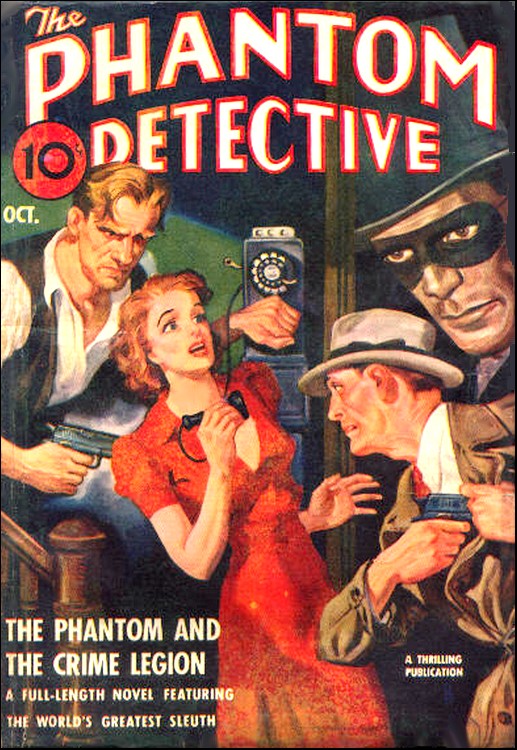
The Phantom Detective, October 1940, with
"The Phantom and the Crime Legion"
Like a brutal devastating army, vicious thugs swoop down on America—and it's up to the Phantom to smash the sinister crime conspiracy and expose its ruthless, power-greedy leader!
THE night was calm and benignly peaceful. A full moon glowed serenely from the star-studded sky, and the air was clear, balmy.
Certainly this was no night for criminals who would move stealthily, and unseen. Thieves, with greedy fingers itching to grasp illegal loot, or killers, with murder in their ruthless hearts, would surely prefer a night when clouds were heavy and an opaque blanket of fog would conceal the shadowy marauder.
Against the moonlit sky, the huge warehouse which rose on the New Jersey side of the Hudson River was etched into bold relief. A massive building of fireproof brick, with steel-shuttered windows, it had an aspect of impregnable security. Within its strong walls, in vaults of steel, were hundreds of thousands dollars worth of furs entrusted to its care.
Those furs were protected by every modern device. Burglar alarms literally made the entire building alive with nerves. Let those nerves be disturbed and they would flash instant warning to the alert police and private protective agents.
A grizzled watchman, almost a superfluity with all the mechanical protection present, was doing the rounds inside the warehouse, checking each vault, stabbing shadowy corners with the beam of a flashlight. Secure in his vast, protected citadel, he could not imagine that even now, out of the clear peaceful night, menace was closing in!
From one of the main highways to the west a huge truck, bearing the name of a transcontinental express company, was turning into a branch road. From a shore road above the Palisades, a second large van was also taking a turn. And from still a third direction came another vehicle—a powerful-motored coupé, its windows closed, its interior dark save for the faintest glow from the dashboard.
As if drawn by a magnet, trucks and coupé were converging from their separate routes—and so well timed were their speeds that all met simultaneously on a dim street less than half a block from the big warehouse.
The trucks parked at discreet distances from one another. The coupé slowed with engine turning over, some distance behind. For a moment all three vehicles remained there, immobile in the clear starry night. Then the headlamps of the coupé dimmed, brightened, dimmed—like two evil eyes flashing a command. And the response was prompt.
Men leaped from the two trucks, a score of them, in low-pulled hats or caps. Moonlight etched hard faces, glittered from blue-steel barrels of pistols and sub-machine guns, and from other metal implements.
With one accord these men ran toward the warehouse. None of them spoke a word. They moved like some well disciplined army in mufti, an army, in open attack, a modern Blitzkrieg that relied on boldness and speed, even as real armies were doing in war-torn Europe.
BRICK walls and shuttered windows did not faze them. A short ladder was hoisted to the nearest window at one side of the warehouse. One man climbed. Hands passed up to him a blow-torch which hissed into livid flame. The flame spewed against the steel shutter.
Other implements went to work, and in seconds a hole was cut in the steel. The blow-torch operator gave way to another man wearing rubber gloves. Using pliers with a deftness that was extraordinary, he cut the nerves that protected that window.
In less than three minutes, the shutter was open, the glass was cut away neatly and handed down in one piece. Silently, the men were climbing through the window.
So swiftly had they worked that only now did the watchman in the building detect a sound. Instinctively he snatched out the .38 from his holster, moving toward the nearest alarm-button.
He never reached it. Across the dim-lit floor came the swarming, silent gang. Blue-steel muzzles raised.
"Wait!" the watchman cried, trying to throw up his hands. He wanted to live. "Wait!"
The hard faces of the speechless men showed no response. It was as if they had not heard. Then two automatics spat almost simultaneously. The reports echoed through the warehouse. The watchman gave one gagged, choking cry—in that final instant seeing his family, his wife and children, bereft—and then slumped to the floor, his eyes glazing.
The men who had so ruthlessly slain him did not even take a second glance at his corpse. Again they moved like an army, climbing stairs, moving to vaults. More implements were wielded by expert hands. Obviously here was no gang of ordinary burglars. Those tough vaults yielded to them like tin cans, and equally astonishing was their continued speed. In seconds they were hauling tagged bundles from the broken vaults. Priceless furs—chinchillas, minks, sables and ermines. In minutes they had stripped the vaults and were leaving with their booty through the window that had given them access.
The loot was loaded into the two idling trucks and the silent gang climbed in. And from the powerful coupé still on the scene, a pair of eyes peered through the windshield with greedy triumph. A dim figure hunched over the wheel, was speaking to himself, as if he must give voice to his thoughts.
"It's just as I knew—they are perfect!" he mused triumphantly. "With a gang like this, I can become a dictator of crime throughout the nation! I can make millions—millions!"
He laughed gloatingly in the gloom of his little vehicular domain. Then his fingers jiggled the coupe's light switch. Again the headlamps flared and dimmed. The trucks ahead started to roll their different ways. The coupé sped in a third direction.
Save for that broken-out window the warehouse seemed as secure and impregnable as ever. But within, vaults were twisted out of shape, doors bent, wires cut, and the corpse of the hapless watchman stretched cold and stiffening in the pools of his own blood...
SHORTLY past noon, on the following day, one of the largest banks in midtown Manhattan was bustling with activity. Depositors waited in lines before the busy tellers' cages. Other customers moved down to the safe-deposit vaults. A bank guard in uniform stood on duty, his revolver in its holster.
Suddenly, without warning, the bank's revolving doors propelled hard-faced men into the place. Men who moved with the precision of an army, gripping leveled revolvers and sub-machine guns. This time one of them spoke, but only a few words:
"Stick 'em up! Move, and you get plugged!"
There was something almost mechanical about the menacing speech. It might have come from a phonograph. Though the words were clearly enunciated they seemed to lack human expression.
From that moment on, the devilish work was carried on by gestures alone. Tellers were forced out from behind cages, to be lined up with bank officials, the bank guard, and the frightened depositors. One teller evidently had some wild idea of pressing an alarm-button. A gun promptly blazed. The teller fell, as cold-bloodedly murdered as had been the warehouse watchman.
Greedy hands reached for currency, for money bags. Other men went to the open vault, herding a bank official before them. Again there was the amazing dispatch, the precise, timing. In minutes the gang rushed out with the loot, heading for two long black sedans, behind which a coupé was unobtrusively parked—a powerful gray coupé whose closed windows were fogged, obscuring the driver.
Inside the bank, the infuriated guard moved even before the last gangster was through the revolving doors. Gripping the gun they had not bothered to wrest from him, he barged onto the street, as the gang were climbing into the sedans. The bank-guard began to fire-pumping shots. Desperation gave him aim at that moment. One of the gang suddenly cried out in mortal pain, pitching to the pavement.
From the window of one of the sedans came the sudden staccato of a sub-machine gun, sounding like a Gargantuan typewriter in the roar of city traffic. Flame danced and leaped from its snout. The bank guard went down, riddled.
Pandemonium reigned in the street. But the wail of police sirens was rising now, and the next instant the first prowl car came hurling around a corner, just as the two sedans were starting their getaway!
The bluecoats, realizing the men in the sedan must be the men who had held up the bank—the alarm was still sounding—raced to intercept them. And in that moment the gray coupé which had been idling at the curb suddenly let out its powerful engine. That coupé leaped head-on toward the side of the prowl car as it sped past.
From the midst of the pandemonium came the sound of crashing steel of heavy metal ripping into more yielding metal! The police car was suddenly on its side, its whole body battered in where the heavy coupé had rammed it! Perhaps neither of the bluecoats riding in it knew what hit them. One was killed outright in that terrific crash; the other was mortally wounded.
The sleek coupé which had done that murder ramming had amazingly escaped damage. It was gone now. Like some watchful hawk it had protected its brood, enabled the two sedans to get safely away before other prowl cars reached the scene.
Others were arriving now, bluecoats leaping from them. They found the wrecked prowl car with a brother officer dead, and one wounded. They heard the dying bank guard gasp: "Wounded one of the gang—on the sidewalk there!"
The patrolmen followed his wavering arm before it dropped lifelessly. Rushing across the pavement to the gang-member who lay stretched out, the police stared down, incredulous, horrified.
"My God!" a husky sergeant choked. "What in the name of—"
The member of the strange gang who had fallen no longer even looked like a man. He was dead. And his entire body seemed to be burning, smoldering! Clothes and flesh, before the very eyes of the police, were being eaten away by invisible, flameless fire! There were strange, bubbling stains on the sidewalk. The fire seemed to be burning there, too.
"Don't touch him!" the sergeant commanded. "No telling what caused this!" He shook his head. "Fat chance of identifying this mug now—he hasn't even a face left!"
TWO major robberies in twenty-four hours! And that was only the beginning.
In short order another bank was robbed, a jewelry store in Trenton was broken into and stripped of priceless gems, wealthy homes were burglarized, safes reputedly burglar-proof were opened like cheese boxes. Through it all ran a certain grim similarity in the precision and skill of the modus operandi which, together with the testimony of those who had sometimes actually seen the gang, linked all the crimes.
The alarm spread from New York and nearby states, over a continent. Teletype wires buzzed and hummed. Circulars came from pounding police presses. From local to state authorities, and to the mighty F.B.I. in the nation's capital, went the alarm that a new kind of gang was striking ruthlessly, swiftly, over a wide range.
And the American public, intent on following war events abroad, now became aware of a menace within its own shores—the Crime Legion!
The Crime Legion! Thus had the newspapers dubbed the silent, mysterious gang. A legion of brazen thieves and killers! Who were they, these men who had created an unprecedented and rampant crime-wave?
The police and the F.B.I. sent all available officers into action. Every clue, from the infinitesimal to the obvious, was sifted and analyzed. The skill exhibited by the gang indicated that among them were men highly experienced in various trades. Yet files revealed no known criminals who used identical methods. Fingerprints believed to be those of gang members failed to check with any prints on file at the F.B.I. Cars and trucks known to have been used by the gang were found abandoned. They proved to be stolen cars and trucks.
The police, more and more on the alert managed to down more of the Crime Legion as they swiftly answered alarms. But always, before the gangsters could be identified, their clothes and flesh were burned away by a mysterious, flameless fire!
Who were the men of the Crime Legion? Who was their leader? These questions were taken up by the entire public and a vigorous press. Newspapers the country over printed all known facts about the Legion so that any reader who might gleam some clue from everyday life might aid the gigantic manhunt. And there was one mighty newspaper whose accounts were always the most accurate and informative—the New York Clarion!
In the building that housed the great journal, red and green lights winked on the immense switchboard, where girls in headphones sat answering calls from far and wide.
"New York Clarion... Sorry, Mr. Frank Havens is busy on another wire just now. One moment." A jack was plugged into place. "Mr. Havens, will you take a call from Trenton—the State Police?"
"New York Clarion," another girl was saying. "You'll have to hold the wire. Mr. Havens is on another line." The girl leaned back, shaking blond locks.
"We've never had so many calls—and all from the police! Seems they all decided to call Mr. Havens at the same time."
"It's this terrible Crime Legion," another put in, nervously. "Guess they expect Mr. Havens to do something about it."
"Maybe he knows how to get someone who can!" the other operator suggested mysteriously.
HIGH in the tower of this immense, modern Clarion building, a gray-haired man sat at a mahogany desk, weary from the incessant calls. His answers were monotonously the same, for all he usually said was:
"I can't promise. I'll see."
Now he was listening to a high officer of the F.B.I., calling from Washington.
"I tell you this is the most baffling crime outbreak we've ever faced," the man was saying. "We've all agreed there's just one man who might cope with this devilish Crime Legion efficiently. Mr. Havens, we want you to contact—the Phantom!" Even the F.B.I. official spoke the name of crime's most dreaded Nemesis with respect.
"Put the Phantom on this case, and we'll cooperate with him fully—so will all local police units. We've got to smash this Crime Legion, whoever or whatever they are! They're making a laughing stock of law and order!"
"I'll see if I can get the Phantom." The reply of Frank Havens, owner of the Clarion and a string of other equally powerful papers throughout the continent, was guarded.
He hung up, leaned back, the lines in his rugged face etched deep. Idly his hands ruffled through the four o'clock editions of newspapers still wet from the presses downstairs, papers with bold, glaring headlines. Frank Havens shook his head.
"The world seems almost to have gone mad!" he sighed.
In Europe armies were at bay as a war engulfed nation after nation, spreading in a conflagration whose final result no one dared predict. And now in peace-loving America, a criminal gang was on an unparalleled rampage—threatening the country's security and order. In the light of the Crime Legion's activities, all other local news was insignificant.
Havens glanced at a story relegated to the bottom of the second page. It read:
SHIP LINE OFFICIAL MYSTERIOUSLY SHOT
POLICE FAVOR SUICIDE THEORY
John B. Powell, a vice-president of the Green Circle Ship Lines which, before the present war, operated luxury liners across the Atlantic, was found dead in the study of his New York home last night, a bullet from a heavy-calibered revolver in his head. The police could discover no motive for murder. Intimates and business associates of Powell declared that of late he had been morose because of the curtailment of the company's passenger service, due to war conditions...
Havens's lips tightened. That would have been front page news before the Crime Legion had shoved the war itself over to sub-heads on the front page. A big shipping magnate shot!
And to Havens that news struck a more intimate, personal blow than the stupendous news of gang activities. He had known John B. Powell, had often seen him in the company of another vice-president of the Green Circle Lines, Clinton Hathaway, who was one of Havens' oldest and closest friends. They belonged to the same clubs.
"Hathaway took it hard all right." Havens was recalling the haggard, grief-stricken face of Powell's associate and his own friend when he had seen him at their favorite club this afternoon. "He acted queerly, too, as if it meant more to him than he wished to convey. Frightened of something..."
HE closed the paper with a heavy sigh. Yes, one suicide—or murder even—was insignificant compared to the rampant activities of the Crime Legion! And local and Federal authorities had beseeched Frank Havens to put the Phantom on that case!
They had known that the Phantom, the scourge of crime, the world's greatest detective, could be contacted only through the good offices of Frank Havens, publisher. For only Frank Havens knew the true identity of the Phantom! To others the Phantom was a human enigma of a thousand faces, an almost legendary figure whose anonymous soubriquet was feared by the entire underworld as the swooping hawk is feared by the robber sparrow.
Even now Havens was considering ways and means of summoning the Phantom. The publisher strode out through French doors to a terrace just under the high spire of the Clarion's tower. Below, the city churned with toylike life. Atop the tower was a great beacon which at Havens' command could flash a powerful red light, in coded signal. Often had that red light summoned the Phantom from some corner of Manhattan or its environs. But it could not summon him now. For, as Havens well knew, the Phantom was beyond the range even of that powerful light.
Moreover, he could not be reached by telephone, telegraph, or even radio!
RICHARD CURTIS VAN LOAN, debonair even in faded slacks and a polo shirt, raised languid eyes from the porch of the Adirondack hunting lodge.
"Hello, boys and gals," he drawled. "Back so soon? And from your empty hands and sad faces, not much luck, eh?"
A group of young men and women in hunting clothes, carrying rifles, trooped up the steps of the rustic building in the dusk.
"Nary a stag," sighed a blonde from last year's deb crop, whose photographs regularly adorned the rotogravure sections. "But you shouldn't talk, Dick. You were too lazy even to come along with us."
"Guns," Van Loan said sadly, "frighten me. They might go off and hurt somebody."
The young man whose father owned this pleasant, isolated spot on a mountain top, grinned.
"Honest, Dick, I wonder how you got up energy to accept my invitation and come up for this vacation—much less stay! All you've done is sit around—"
"I've eaten," Van amended. "Your cook is excellent. But I do think you overdo this rustic stuff. Here we are stranded—no telephones, radios. We might be barbarians living in the caveman era."
A bright-eyed, socially registered brunette laughed.
"Dick, I do think you'd make the cutest caveman!"
Van Loan chuckled. As a matter of fact, indolent though it was, the rippling muscles beneath the polo shirt that clothed his athletic young body might well have been the envy of the more active young men. To them the lithe, perfect body of this idler and bon vivant who seemed to live only to spend the fortune his father had grubbed for, was a mystery and a paradox. They gathered around Van, looking at him with tolerant amusement. The girls not forgetting, however, that he was by far the wealthiest of all bachelors in their set.
"So you long for civilization again, Dick," his host said. "Wonder how you'd feel if you were really roughing it. Here we have servants, supplies, electricity, comfortable beds, steam baths. As for the lack of communications, that's deliberate. Some of us have worries back there in town—and we really want to forget them. You wouldn't appreciate that, eh? For me, it's a relief not even to see stock market reports."
"And not to hear about the ghastly war," one of the girls put in.
"Not to mention the latest murder or robbery," said another man.
"You might have something there, at that," Van Loan grudgingly admitted, lighting a cigarette.
In the dusk the flaring match briefly etched his handsome face, and there was something in it the others did not see. Laughing, they filed into the lodge to prepare for dinner. Alone on the porch in the gathering twilight, Richard Curtis Van Loan still sat indolent and relaxed. He believed that this rest, this surcease from the very thing that had last been mentioned, had really done his nerves and muscles good. Yes, he had needed it, though now he felt he had taken more time than he should have. His handsome features went grim in the gloom. What crimes might not have been breaking while he had been up here "away from it all?"
The very idea that Dick Van Loan should have more than a casual interest in crime would have seemed absurd to his friends. Little did they dream that the man who seemed to spend all his time lazing and playing, was in reality the most fearless crime-fighter ever to pit skill and strength against nefarious and cunning criminals—that Van Loan was the dread Nemesis of crime known as the Phantom!
FRANK HAVENS alone knew that secret, for Havens, who had become a second father to Richard Curtis Van Loan when the young man's parents had died, had been partly responsible for the Phantom's creation. When Van, wearied of idling, longing to use his brain and strength to some purpose, had at Havens' behest tackled and solved a crime case baffling to the police, he had found a new meaning to a life hitherto empty.
The identity of Van Loan, playboy, had remained what it had always been—a mere shell covering the true man, covering now the fearless crimefighting Phantom. The Phantom! How Van had labored to fit himself for that arduous role! The midnight oil he had burned mastering every phase of criminology, every allied science that might better equip him to thwart criminals! Also he had learned every art of defense. His mastery of disguise and mimicry excelled that of any actor of stage or screen.
The Phantom's last hazardous triumph over crime had been followed by Havens' insistence that he go away for a complete rest, so now here he was among friends who thought him lazy and useless. A wry smile twisted his lips. Yes, and those girls who looked at him so hopefully, little knew that he could never enjoy the normal life of other men—marriage, home, children. For the Phantom could have no ties, no interests outside of the perilous work to which he was dedicated, heart and soul.
"Oh, Dick!" one of the girls called, from within the lodge. "Better come in! We eat!"
"Coming," Van drawled, crushing out his cigarette and rising.
The drone of the airmail plane which regularly passed overhead at the hour drifted from the darkening sky. Van, seeing the wing-tip lights of the craft, thought again how shut-in this place was from all news, even from mail. Twice he had considered going down to the nearest village and contacting Havens—or at least hearing current news. But he remembered Havens' words:
"You stay there, get crime out of your mind, so you'll be fresh for your next case. If anything comes up, I'll find some safe way to contact the Phantom."
As Van moved across the porch to the screen door, he noted that the roar of the mail plane's motors seemed unusually loud. The ship was flying low. That was odd, because visibility was good, and the plane usually flew much higher to make certain of clearing mountain-tops. It was sweeping overhead now, a great winged shape in the dusk, its red and green wing-tip lights...
Van's lithe body stiffened suddenly, eyes widening. The red wing-tip light on that plane was flashing! It was winking on and off, in short dots and dashes—a code that was not Morse, but one which Van knew well!
The big mail plane wheeled in its course, flying low and noisily overhead, so noisily that Van's host suddenly peered out of the opening screen door.
"Say, is something the matter with the mail plane tonight?" he asked.
"Guess he's just correcting his route," Van drawled indifferently.
But he realized now that even had he been in the house, that plane would have attracted his notice. Its red light continued to wink. It circled once more before it zoomed sharply into the darkening sky.
BUT Van had read its flashed message in the code known only to Frank Havens and himself. "Phantom! Come at once!"
That had been the terse signal, repeated over and over.
How Havens had contrived to have the mail plane flash that secret code, Van did not know. But he did know that some major crime must have broken—that no time must be lost!
For months afterward, the story of Richard Curtis Van Loan's unforgivable behavior at the lodge this twilight was repeated over society's grapevine.
"Why, my dear, you wouldn't believe it," the feminine version ran. "Dick, always a perfect gentleman, suddenly became a beastly cad! He told us he was fed up with rustic life, sick of the sight of us, and he was clearing out, just like that!"
And the masculine version: "I felt like taking a sock at him, only there's something about that fellow that just makes you steer clear."
At any rate, Van rode away from the lodge, down the mountain to a small private aviation field he had previously chartered for the high-winged monoplane which had flown him to the Adirondacks. At his prior command, it was serviced and ready for use.
Van was soon lifting the little ship into the night sky, and flying speedily toward New York...
Frank Havens, his coat collar turned up, a Homburg hat jammed over his gray head, paced the concrete walk of LaGuardia Airport. The night had deepened, another night of clear stars and a full moon. The huge beacon on the airport's rotunda swept in its funneled arc. Planes arrived and departed—big transcontinental passenger ships, mail planes, a few private craft.
From his office at the Clarion, Frank Havens had pulled the strings that had sent his message to the Phantom—via airmail! This he had done through the Federal authorities, and even the few high officials contacted did not know that the purpose of the device was to summon the Phantom. The aviators were told to flash the wing-light in a certain given rhythm, but were unaware of its meaning.
The Phantom, Havens knew, would report directly to the Clarion office—if he got that message! But Havens was too impatient to wait, and had headed for LaGuardia Field. Richard Van Loan rented a hangar here, and should logically fly here from the Adirondacks.
The publisher raised his eyes at the sound of a new rising drone in the starry sky. A moment later, a fleet-winged monoplane was gliding in for a landing. Havens was certain it was the private plane belonging to young Richard Curtis Van Loan.
The publisher saw it land across the field, even glimpsed Van Loan climbing from it. But Havens did not go out to meet him. Such a meeting might be too risky, if anyone suspected that Havens had called the Phantom, for his meeting with Van Loan might somehow be linked to the Nemesis of Crime!
In fact, Havens had come merely because he was anxious to see if Van had got that message. Now the publisher turned, pushed through the waiting crowds, a tight grin on his lips. He meant to try to beat Van back to the Clarion office. He strode smartly back to the sleek, small coupé he had left in the airport's parking space—a coupé which was privileged to bear a police shield on its front. He opened the door—and stepped back with a startled gasp.
A STRANGER was sitting in the car, a sharp-faced, hatless, red-haired man.
The man looked at him, insolently, Havens thought.
"It's okay, Mr. Havens," he said in a nervous, quick voice. "I thought this was your car."
"Who—" Havens stammered. He had never before seen this man in his life.
"I'm Martin, of the Buffalo Call —your rag, Mr. Havens. They sent me to report to you for a Manhattan job."
"I don't recall anyone named—" Havens began, and stopped.
He had all he could do to conceal his amazed and warm surprise, as unobtrusively the man in the coupé lifted one hand to tug fleetingly at the lobe of an ear. A little signal that was known only to himself and one other man in the world.
"Very well, Martin, we'll drive to my office," Havens said, without changing his own tone.
He climbed in behind the wheel of the coupé, and started toward Manhattan, with the red-headed "Martin" at his side. From the dashboard a radio, tuned in on the short-wave used for police broadcasts, was switched on—a habit Havens had developed since the outbreak of rampant crime.
ONLY when the airport was left behind did the publisher show his true feelings. He turned and looked with affectionate warmth at the man beside him.
"Van!" he said. "How on earth did you manage this? Will you always fool even me with your amazing disguises?"
Van Loan chuckled.
"Your own ingenuity in sending me that summons, Frank, calls for much more praise," he said in his natural voice. "I figured something big must be up, even had a hunch you might have come to the airport. As soon as I landed, I slipped off and spotted your car. You took some minutes to reach it, but I had made a bee-line for it. I even had time to put on this hasty disguise and rub red dye in my hair. Your coupé furnished enough privacy."
Frank Havens' surprise had turned to relief. Due to the Phantom's forethought, precious time could be saved. Now Havens could rush the Phantom straight down to Police Headquarters where Inspector Thomas Gregg was to act on behalf of other authorities as well as the New York Police and cooperate fully with the Phantom.
The publisher was speeding the car across the Triboro Bridge. Van looked at him sharply.
"Well, Frank, what is it this time?"
"You mean you have no idea? But that's right, you said this young friend of yours excluded radio and newspapers on that vacation. Van, the most diabolical crime-wave this country's ever had, has broken loose. And you'll have to enter this case without a single decent lead! The Crime Legion leaves no evidence!"
"The Crime Legion?" Van repeated curiously. "Who and what are the Crime Legion?"
Havens gave a bitter laugh. "That's the maddening question the police and F.B.I. expect you to answer, Van!" As he drove into Manhattan, turning downtown, the publisher tersely gave Van all the facts known about the mysterious gang. Silent and attentive, the Phantom listened, leaning back with half-closed eyes. Before Havens had concluded, Van realized that never in his career had he been called on a more sensational and baffling case. When he opened his eyes, they were grim. He had come out of his temporary retirement to find a hellish force of crime at work!
"And you say even fingerprints supposedly left by members of this gang check with no known criminals? Yet obviously"—the Phantom was thinking aloud—"the gang must have seasoned hands in it. It sounds incredible, Frank."
"It is incredible," Havens amended grimly. "And you're going to need every ounce of skill and strength to fight this menace, Van! As soon as Inspector Gregg can give you the few more facts—"
He stopped. The short-wave radio was bringing the voice of the police announcer, in its clear monotone.
"Signal Thirty-two... All cars... Signal Thirty-two."
"That's a hold-up signal," Van said quickly.
"All cars," came the announcer's verification. "Gay-Way Club, West Fifty-first Street... Gay-Way Club, West Fifty-first... Hold-up in progress."
"The Gay-Way!" Richard Curtis Van Loan, socialite, was speaking now. "That's one of the swankiest night spots—"
"Hurry, all cars." And then the announcer's voice seemed to lose its unemotional official tone, became almost shrill with excitement. "It's the Crime Legion!"
STARTLED, Havens almost forgot to steer the rolling coupé. But Van Loan became suddenly cool as ice.
"Here, Frank, let me take the wheel. You have a police siren on this car, haven't you? Just slide over."
As he spoke he himself squeezed past the shifting publisher, who had slowed the car for this change of positions.
A moment later the coupé, with its police siren screaming for the right of way, was hurtling through the night at a speed which would have been recklessly dangerous in any hands less firm than the Phantom's! For in this moment Van Loan had truly become the Phantom! His eyes, in his disguised features, were slits. The Crime Legion was striking! If only he were quick enough, perhaps he could at once come to grips with this murderous outfit!
As they neared the night-club district, other sirens joined their own. Speeding prowl cars were converging on the club, as the police, fiercely anxious to get the jump on the elusive Legion, were heading there hell-bent.
Less than three minutes from the time they had caught the signal, the Phantom and Havens reached the scene.
A groan of frustration broke promptly from Havens then, mingled with something of sheer horror. Across the street, where prowl cars were skidding to stops, flashed the neon sign of the Gay-Way. Before the awning of the swank club was a scene of pandemonium. A crowd of well dressed men and women—evidently the robbed patrons of the club—stood gesturing confusedly.
On the same pavement sprawled the bloody corpse of a uniformed doorman. There was also another inert heap there. Van, slowing the coupé, caught a glimpse of it under the garish neon light. A smoldering corpse—clothes and flesh already eaten away, still going.
"One of the Legion! That's what happens when any fall by the wayside!" Havens spoke with horror as he started to open the coupe's door. "It's clear they've already made their get-away—"
Again the dashboard radio interrupted.
"Attention, all cars! Report received two Cadillac sedans heading west, last seen at Sixty-first and Eighth Avenue. Give pursuit. Keep tuned for further reports."
Van pulled Havens back into the seat and stepped on the gas. The coupé literally catapulted forward. Other police cars were also hurtling from the night-club scene. The radio kept giving guidance, based on reports from alert-eyed police who again and again spotted the two escaping sedans.
"This time it looks as if the Legion men didn't get away fast enough," the Phantom said hopefully. "The police are on the job!"
But Havens' tense voice held no such hope.
"They've been this close before—but the gang always got away!"
The publisher's prophecy seemed fulfilled just minutes later. The chase had led to West Street, under the new vehicular ramp highway along the rippling Hudson. Here was a whole congregation of police cars, their combined headlamps making a circle of light. Havens and Van alighted and threaded their way through bluecoats. Havens' position and influence gave him open sesame.
In the center of the clustered prowl cars were two Cadillac sedans—abandoned!
"Stolen cars, of course," a weary, heavy voice was saying. "And not a sign of the gangsters who used 'em!"
"Hello,
Inspector Gregg," Havens said. "So they got clean away again—after leaving one dead but burned beyond recognition."
INSPECTOR GREGG, who had managed to get in the very forefront of the furious chase, nodded.
Van's keen eyes had been taking in the surroundings. Across the cobblestones was a vacant space between docks, and below it was the river.
"Inspector," the Phantom said. "With the river right there, don't you think possibly—"
"Sure," Gregg answered impatiently, without noticing who had asked the question. "We've thought of that. Other chases, on the Jersey side, have also led to the river. Right now Harbor Police are on the lookout. Some speed-launches have been seen going downstream, toward the bay. But if they're the gang, they won't get past the police boats... Say, who the hell are you?" He looked at Van for the first time.
Havens was about to introduce Van as Martin, out-of-town reporter. But Van's eyes were purposeful slits now, as he himself spoke crisply.
"Inspector, get some of your men to commandeer a speed-boat for me. I want to go downstream myself. There's a yacht club near here where you can get such a boat."
"A speed-boat, eh? How about an ambulance to Bellevue—"
The inspector stopped abruptly. Casually, Van extended his right palm beneath the detective chief's eyes. Headlight beams caught the iridescent sparkle of tiny flawless diamonds, set in a platinum badge, forming the design of a tiny domino mask!
The inspector's eyes lightened with comprehension. Throughout the world that sparkling emblem was known to all officers of law and order!
"The Phantom!" Gregg breathed. "Damn it, I'm glad you're in this business! But what makes you think you can do anything with a speedboat, when the Harbor Police—"
Nevertheless, the inspector wasted no time in heeding the Phantom's request. It was only a matter of minutes before he had commandeered a high-powered little launch from the nearby yacht club. Tense and worried, Frank Havens watched Van climb into it alone, as Gregg repeated for the last time:
"You sure you don't want me or some of my men to—"
"I think I'd better try this alone," said the Phantom, decisively. "It's just a gamble, but alone I might spot something—if the gang are on the river."
He cast off, opened the throttle, and sent the launch hurtling down the Hudson. Spray swept up at his grim, thoughtful face. The police had been on the very tail of those sedans, yet their occupants had escaped. The river seemed the logical answer. A change from car to boat had been made by gangsters many times. It was an old trick to cover tracks. Not much time had been lost, and if Van's hunch was correct the Legion men should still be somewhere on the river—with their latest plunder!
Van had switched on the red and green port and starboard lights, but otherwise his borrowed speed-boat was dark as it cut the waters, going down-river. Then, hard ahead, he saw several sweeping searchlights, weaving back and forth like groping tentacles. Behind them were the dark silhouettes of harbor patrol launches.
With that barrier across the river, no craft could pass without being seen and challenged.
The police, burning to come to grips with the Crime Legion that was making a joke of the law, were sparing no efforts!
THE Phantom calculated swiftly, keenly. If the Legion had used launches—and his hunch still insisted that this was the most logical answer to their get-away—they could not have got past this part of the river before the harbor boats, swiftly summoned, had reached here. Then, somewhere between where they had started and those harbor boats waiting ahead, the Legion...
The Phantom turned his speed-boat while still some distance from the Harbor Police barrier. He commenced a grim and thorough reconnoiter—first on the New Jersey side, then on the Manhattan. He was looking for some place where launches had landed, might be hiding even now, waiting for police alarms to die down.
After several minutes of fruitless search, the Phantom peered with awakening interest at a seemingly deserted dock building extending from the Manhattan shore. He tensed. Did he see dark shadows that might be boats, at one side of the pier? Even as he looked those shadows vanished, seemed to blend with the dark dock.
The Phantom cut even his riding lights now. He sped up his motor, then decreased throttle, letting the momentum send his boat drifting toward that dock. On both sides of it were other piers, lighted—one housing a ferry slip, another with a Havana steamer in it.
Van slid his boat alongside the piles of the seemingly deserted pier. A ladder of warped wood came into view in the starlit gloom. The Phantom, silent as a cat, got his craft alongside it by pulling with his hands on the ladder. He secured a make-shift line, then stood up in the swaying boat, and scrambled up the ladder. The wood creaked under his weight, but he hoisted himself to the dark dock. From his pocket he drew his automatic, gripped it, ready.
There was an opening in the side of the rusted iron-and-wood dock building. The Phantom slipped through it soundlessly. Dim light from flashlights, weirdly illumined the decaying interior of the building. In that light were the figures of men—moving in silence! With grappling hooks and ropes they were hoisting launches up through a huge trapdoor. In the hands of other men, Van caught the sparkle of precious gems.
The Phantom's heart pounded. The Crime Legion—with the Gay-Way swag! Through his swiftness, prodded by his hunch, Van had found them—in this strange hiding place amid thriving steamship docks! There were not more than a dozen men, and according to Havens the gang was much larger than this. But if these could be trapped, captured—
In the dangerous mode of life he had chosen, the Phantom's own continued existence was largely due to the fact that, though utterly dauntless he was never foolhardy. He had already decided to slip out, get the Harbor Police here, city bluecoats, too, and surround these members of the Crime Legion.
He began to steal back toward the door. He was certain he made no sound. But before he reached that door, he knew he had been spotted! Evilly alert eyes must have seen him silhouetted in the moonlight when he had entered the door!
NO outcry of alarm came, but as one every flashlight in the pier building went out. The gloom was as opaque as if sudden blindness had come to the Phantom's steel-keen eyes. Instinctively he leaped aside from the door, gun gripped, his eyes straining. He saw nothing. But he could sense movement in that gloom—movement from all directions. The silent, murderous Legion men were closing in on him, groping for him in the darkness! Though they could not know he was the dreaded Phantom, they knew he was an intruder who had entered their hideout. That was enough.
Richard Curtis Van Loan had been in many perilous predicaments, in many hazardous battles against odds. But it is doubtful if he had ever faced a more nerve-harrowing moment than this. A moment when killers of a mystery gang that terrorized a country were stealthily closing in on him in the darkness, silently creeping up on him!
Yet he remained icily controlled and calm, his mind as calculating as ever. Why had they not opened fire on him when they had first spotted him? Why were they trying to get him so silently, soundlessly?
The answer to that question came to Van with a swift-formed inspiration. He, too, was moving now on soundless feet, hurriedly, before the shrinking circle of Legion men he knew had him surrounded would close in. He groped, found a thick iron pillar which helped support the warped roof of the pier building. From behind it, though he could not see the band slowly but steadily closing in, the Phantom thrust out his automatic, the snout of his Colt into the darkness, and with a gritted oath, pulled the trigger.
The flame from the gun was blinding as it sent a futile bullet into that darkness.
The response was prompt. Once the roar of Van's gun had broken the terrible silence, the unseen Legion men opened fire! Stabs of flame came from the gloom as shots spat and cracked. From two sides a singing storm of lead whizzed in the direction from which the Phantom's own flame-stab had come.
But the Phantom was shielded behind the iron pillar. He fired again, in the direction of those other spitting guns. They answered promptly, and bullets ricocheted from the pillar, slithering past the Phantom's lithe frame. The whole building roared and reverberated with gunfire now, as the Phantom, with his lone automatic, tried to hold the Legion men at bay. Then he could hear them separating, some of them were trying to edge around him from the other side of the pillar. In minutes they would have him hopelessly trapped. But as he heard the continuing wanton roar of guns he did not give up hope.
He fired again at one of the flame-tongues. This time, beneath the din, he heard a scream of pain, the thud of a body falling. He had dropped one of those unknown thugs! But as he sought to fire again, his automatic clicked dully. Empty! He had another clip of ammunition ready, but he knew he would not be able to use it.
He heard a sound now, like a concerted growl of rage. He heard rushing feet. The Crime Legion was charging him—and he had no time to reload and defend himself!
THEN, to his grim relief, that charge ceased midway! He heard the confusion of the Legion men. From the river came the wail of Harbor Police boats—and from the shore came the scream of radio cars. His grim stratagem had worked! By cleverly taunting the Legion to open fire on him, to forget caution, he had created enough din to attract attention of the police! And the knowledge that a gun-battle was going on, so close on the heels of the Legion's disappearance, was enough to bring all alert police units!
The feet of the Crime Legion men began to thud away from the Phantom. Light from street-lamps suddenly illuminated the interior of the pier, and then Van saw the gangsters piling out through a door. And he knew that these brazen thugs, reputed to be like murderous automatons, could also know panic, for they were leaving behind much of their swag.
They were also leaving behind one of their number Van had dropped—a man who was groaning on the floor, alive! The police would clash with the rest outside. If the Phantom could capture that one legionnaire...
He was darting across the floor as he started putting a new clip in his automatic. By the light from the door he spotted the wounded thug, a big chunky figure wounded in the leg. The Phantom elated, would reach him the next instant. He would see one of these mysterious gangsters at close range!
Sheer instinct alone made him duck then. Before he could lift his automatic to fire, he glimpsed a shadowy Legion member who had tarried behind the others—a burly, capped man who gripped what looked like an enormous pistol!
There came a peculiar, sibilant hiss! From the strange weapon spewed a liquid stream. It arced through the air, apparently propelled by a terrific pressure which gave it all the accuracy of a bullet. In the next instant the Phantom realized how lucky it was he had ducked. The stream just missed him as, with deadly aim, it struck and sprayed all over the wounded thug on the floor.
The man's scream was horrible. Before the Phantom's eyes he turned into a writhing thing over whom invisible flames seemed to play—and devour! The lethal liquid from that strange gun seemed to spread partially of its own accord, so that the quantity shot was enough to envelop the thug's entire body.
It was eating through the man's clothes and flesh already. Even as the Phantom snaked a futile shot at the now fleeing Legion member who had fired the deadly stream, the man on the floor was burning away.
The Crime legionnaire who had killed his comrade had joined the rest, was being flanked and protected by their guns as they rushed out into the night. From West Street came sounds of the clash between police and the fleeing Legion. And Van knew now that even if some were caught, they would be burned alive before they were taken prisoner. For here before him was the one he had hoped to capture, burning slowly but surely away.
From his pocket he yanked out a pair of special fireproof gloves which had served him well on many occasions. Stooping over the horrible, burning man, his gloved hands began to search those smoldering clothes with fierce haste, hoping to find some identifying clue before all was gone.
HIS gloves, fireproof though they were, were not proof against the consuming stuff on that body, for they began to sear at once. He had extracted a charred packet of cigarettes, but even coins had melted like wax.
Then, as the Phantom's gloves were beginning to go, and he could feel a searing heat through them, he pulled out a charged piece of paper. Part of it was gone, and the lethal stuff that had consumed it was spreading even now over the rest. Hastily, Van shook off one of his burning gauntlets, and held the unmarred portion of the paper in his naked hand. With the other gloved hand, he tore off the burning part. Just in time the Phantom shook off the second glove then. It dropped with its companion, both shriveling to ragged tatters. He shoved the salvaged bit of paper into his pocket.
"Here, you! Stand still! Get your hands up!"
The shouted command made the Phantom whirl. A ring of bluecoats and detectives, some of them Harbor Police from hasty-landed launches, were closing in on him with guns and flashlights. Their eyes were grim. They thought him one of the gang, and they had no love for that gang!
The Phantom obediently raised his hands. He was about to identify himself, to tell them where they could find his famous platinum-diamond domino badge—a badge he seldom liked to display, especially twice in one night—when he saw it would not be necessary now.
Into the pier building with other police came the heavy figure of Inspector Gregg. At his side was Frank Havens. In the light of flashes, Havens at once recognized the disguised Phantom. Gregg's quick command called off the police guns.
Minutes later, the three men stood together in the pier building, which was now bustling with police. And the first thing the Phantom learned, to his chagrin, was that the remaining Legion men had escaped despite the quick arrival of the police! Evidently they had been prepared for such an escape. Outside, on West Street, they had all climbed into a speedy, balloon-tired truck.
"The worst of it," Inspector Gregg said, and swore, "is that our prowl cars were succeeding in blocking the get-away of that truck when some fool driver in a car that happened to be passing, confusedly got in the way, and the truck got away. The damndest luck!" He swore again. "It was found abandoned further downtown, on the waterfront. And now the Legion has vanished as if by magic. With the harbor and land police right on the job, any car or boat would have been spotted!"
The inspector looked admiringly at the Phantom. "At least you found this hideout," he said, "and it seems to have been an important one. And you enabled us to recover most of the Gay-Way swag, plus some other loot." He nodded at the police who were gathering together glittering jewelry that had been brought here in launches which had slipped under the dock and been hoisted up through a trap-door. With such elaborate arrangements, the hideout must have been important and already Inspector Gregg had men checking up to learn who had leased this pier.
"YES, you've done a lot already—though you've just started," Gregg commended. "I might have known you'd get results, Phantom." He said that word low, so even his own officers would not yet learn the Nemesis of Crime was on the case. "You've given the Legion something to worry about!"
The Phantom nodded, though he felt that not yet did he deserve the inspector's unreserved praise. He was not satisfied himself. The Legion members had got away scot-free, doubtless to join the rest of the nefarious gang at some bigger hideout. Their trail had been lost. When they abandoned the truck, where had they gone? As the inspector had said, boats would have been spotted by the Harbor Police; cars by pursuing prowl cars.
"This driver you say accidentally got in the way when the truck was escaping, Inspector," he asked casually. "Was he stopped, identified?"
"No," the inspector said, impatiently. "He got scared and drove off after the police yelled at him to get out of the way. Just some jittery bystander driving a big coupé—" He broke off with a sudden exclamation. "Lord! A coupé! Why didn't I think of it right away?"
IT was Van's turn to be surprised. For Frank Havens had not had a chance to give him all the details known about the Crime Legion. It had just been his own thorough habit of checking even trivial happenings that had made him ask the question about the driver, whose apparently accidental confusion had enabled that truck to get away.
"Think of what, Inspector?" he asked quickly.
The inspector had whirled to bark orders at some of the police to have an alarm out for that unidentified car and driver. Gregg turned back to the Phantom.
"At one of the Legion's bank robberies," he explained, "a coupé rammed into a prowl car, got away. Of course there may be no connection. What happened tonight certainly looked accidental." He cursed. "If only someone had identified that car!" He knew that it was too late now even to hope it would be found.
The Phantom had listened grimly. So somewhere in the background a coupé had figured—a coupé which had cunningly aided the Legion in their work! Certainly this nefarious gang must have a leader—a crafty, diabolical brain to guide this gang which worked with the precision of an army! Perhaps the driver of that coupé—
"Didn't you say you found something on the burning Legion man in here?" Frank Havens asked anxiously, at the Phantom's side.
Morgue attendants were taking away what was left of that Legion man. The lethal stuff had at last burned itself out, and though it now was safe to touch the corpse, it was reduced almost to a charred skeleton.
The Phantom took out the torn paper he had recovered from that corpse.
"I'd hoped this might be a clue," he said ruefully. "But—well, see what you two can make of it." He had already glanced at the paper himself.
Gregg took the paper gingerly, and Havens looked on silently. Both stared at writing, in a faint, pinkish ink. The writing was extremely legible, however—a sort of bold, perfect penmanship which looked rather artificial. There was a column of words and phrases, and they made out:
Lam
Okay
Reach
A slug in the guts
Stick 'em up
Flatfoot
The list ended abruptly, though apparently there had been more on the burned part of the paper.
"Code?" Gregg demanded, puzzled. "Lam—well, they did that anyway. But as for the rest, what do you think, Phantom?"
But the Phantom's seeming miracles in crime-detection were never the result of snap judgments. They were the result of infinite pains and sober research. "All I can say at present," he said, "is that what is on this paper seems to have been run off from a hectograph. The original writing was made with hectograph ink, transferred to gelatin, and from that copies were run off like the menus you find in some restaurants. This is one of the copies. But as yet I can make no guess as to the meaning of the words. I'll keep the paper for future reference. Meanwhile, Inspector, I want you to provide me with all the available facts on this devilish gang. I also want autopsy reports on the burned members, as well as samples of charred clothing remnants, or any other clues. That stuff that does that burning, of course, is some highly concentrated acid."
"The medical men have been unable to ascertain what it is," Gregg said. "I'll see that all your requests are promptly fulfilled, Phantom. My orders are to put my force at your disposal, and to tell you that other police throughout the country, as well as the F.B.I., are ready to cooperate."
THE Phantom nodded, though he was wondering what his next move should be. But he knew however, that he would not rest until he smashed the Crime Legion. Even the thought of them, free, filled him with a desire to come again to grips with them. Somehow, he must find the trail that seemed hopelessly lost.
As these thoughts swept through the Phantom's mind, a police captain hurried into the dock building and saluted Gregg.
"We've checked on this pier, Inspector," he announced. "It belongs to the Green Circle Ship Lines, a big luxury passenger line until this European war. From what we gather the pier has been long out of use."
"The Green Circle Lines," Gregg echoed, as if somewhere in his memory the name stirred a vague response. "Well, we'll have to find out how in Hades they came to leave this pier so totally neglected that a gang could use it."
The Phantom's keen eyes had been drawn to his friend, Frank Havens. He had seen the publisher start, and a light of wonderment come over his rugged features. Sensing that Havens had something urgent to tell him, the Phantom drew the publisher to another part of the hideout pier, where the two could converse alone.
"Well, Frank?" Van's voice was low enough for just Havens to hear. "What's on your mind? That news that this pier belongs to the Green Circle Lines seemed to hit you hard."
"It did," Havens confessed. "I didn't want to remind Gregg of the possible connection until I spoke to you. It might be a red herring."
He then told Van how last night John B. Powell, one of the Green Circle's vice-presidents, had been found mysteriously shot, believed a suicide because of depression over the curtailment of the line's passenger service, due to the war. Havens went on to explain how this news, which would have been sensational at any other time, had been only a small item in the Clarion owing to the exploits of the Crime Legion.
"Clinton Hathaway, another vice-president of the line, is one of my closest friends," Havens added, and Van nodded, remembering he had seen the dignified shipping magnate at Havens' club. "Through him I'd met Powell too. After Powell's death I noticed Hathaway acting peculiarly—something more than grief seemed to be preying on him. I was even thinking that if it weren't for this Legion business I might have asked the Phantom to look into Powell's death. And now—"
The Phantom's eyes gleamed. "I see. As you say, there may be no connection, yet there may be a link. Since we've lost the Legion trail, I think this other lead's worth following. This Clinton Hathaway—he's quite an important official of the line, I take it?"
"Yes. Though he's only a vice-president he owns a great deal of the controlling stock—as much, I believe, as the president of the lines Benjamin Thorne."
"Do you know the details of Powell's death, Frank?"
"No. Steve Huston covered it, but I have been too busy with this Legion affair to check with Steve."
"Maybe Steve Huston has some angles on it."
As Van spoke a warm look came into his eyes. Steve Huston, the Clarion's star crime reporter, had more than once pluckily aided the Phantom, though he did not know the Phantom's identity.
"Would you like to speak to him?" Havens asked.
"No, Frank. It's not yet midnight, and I think my wisest move would be a visit, to your friend, Clinton Hathaway. Though he did not confide in you, his close friend, about whatever was troubling him, he may speak to the Phantom, provided he is honest and upright. Where can I find him?"
"At his home, most likely—in Pelham."
"I'll go there at once—if I can borrow your car, Frank. Get in touch with Steve Huston and send him to Hathaway's to meet me. Perhaps whatever knowledge he has of the Powell death can furnish me with more ammunition for the interview."
MINUTES later, the Phantom was leaving the pier where he had clashed with the Crime Legion. He knew this next move might be useless; but as always he would leave no stone unturned in his grim, unflagging pursuit of criminals. While police in the city and its environs still sought the vanished Legion members, and the alarms still spread, the Phantom, in Havens' own police-shield-bearing car, sped toward Pelham.
It was just a little after midnight when he stopped the car below the private driveway of one of Pelham's most luxurious residences. And when he emerged from the car, the Phantom's features were subtly changed once more. He had been seen by the Crime Legion as a red-haired, sharp-nosed man. To play safe, he had changed his hair back to brown, his features were now blunt and squinty—still utterly unlike the true features of Richard Curtis Van Loan.
As he walked up the driveway the mansion loomed before him, and he saw that lights glowed from the French windows on one side of the ground floor. Evidently Hathaway was still up and about.
The Phantom rang the door-bell, heard it peel within the house.
A minute passed, dragged into two. The bell remained unanswered. Van's nerves were tautening then. There was a strange silence about this house despite its glowing ground-floor lights. A sense of emptiness.
The Phantom moved to the lighted French windows. They were securely fastened, and drapes hung on their inner side. But there was enough uncovered glass for Van's keen eyes to peer into what was evidently the library, a spacious, walnut-paneled room brightly lit.
A man was sitting in an easy chair with his back to the window. Van could just make out a gray head, and a hand on the arm of the chair. The man was unmoving. Asleep? That bell should have roused any sleeper.
The Phantom pulled out a pliable bit of tempered steel wire he always carried as part of his equipment. Inserting it deftly in the crack of the French window, he caught the catch on the other side, lifted it. Still the man inside did not stir.
Entering the room, Van walked around to the front of the easy chair—and he stood grim, his eyes chilled, as their gaze was met by a pair of eyes staring milkily and sightlessly at nothingness!
They were the eyes of a stiffening corpse!
QUICKLY, Van Loan had recognized the features as those of Clinton Hathaway, mighty ship-line mogul, even though now those features were contorted in a horrible, frozen grimace. Zigzagging down them was a trail of clotting blood which had begun at an ugly, gaping hole in Hathaway's temple.
Grimly, the Phantom looked at that ugly death wound. It had been made, he estimated, by a .45. There was no gun in evidence. Also there were no powder marks on the man's flesh. A gun fired by Hathaway himself would have left powder marks. The gun that killed Hathaway must then have been fired from a greater range than his own arm-reach.
In those first swift seconds, one fact became certain to the keen Phantom. Clinton Hathaway was no suicide, as the police had believe his colleague, John B. Powell, to have been.
Clinton Hathaway had been murdered!
Tense-nerved, the Phantom stood, glancing around the bright-lit library. Had no servant been alarmed by the shot that had killed Hathaway? The mansion seemed utterly still, as if hushed with the silence of death that had overtaken its owner. Were the servants all out?
These thoughts raced through Van's brain as he stood over the corpse, realizing that this was going to be a blow for Frank Havens, all the more so because if Hathaway had known anything pertaining to the Crime Legion, which had used the Green Circle Lines pier, his lips were now forever sealed.
Sealed—yet the Phantom had come here without confiding to anyone but Havens his intent of coming. And from the brief appraisal he made of the body, Van estimated that Hathaway must have died hours ago, possibly even before the Phantom had reached New York. The first signs of rigor mortis were already setting in. Long since, the murderer of Hathaway must have got away, and—
Even with the thought the Phantom's body went suddenly rigid.
Someone else was in this house! Someone moving furtively. Steps, soft yet rapid, were coming toward the library.
Van's lithe body moved with the speed of a fleeting shadow. In an instant, he had slid behind one of the heavy window drapes, where he could peer out unseen. The library door, already ajar, began to move soundlessly, opening. Van's hand gripped his automatic.
Then surprise came to his eyes. Into the library stepped a girl—a slim young girl in a gray coat, and with a small gray hat over dark hair. The bright light revealed her oval face, attractive despite lines of tension. Who was she, Van wondered. Not a servant. And Hathaway, he knew, was a bachelor, reputed to have little interest in women.
The Phantom's eyes went narrower. Light glinted from the blue-steel of a gun the girl held in a gray-gloved hand! It was no lady's weapon, but a full-sized .38. Gripping it, the girl crossed the room to the chair where Clinton Hathaway sat so stiff and immobile. The Phantom heard the girl's quick intake of breath, but from the oblique view he had of her face, he saw no evidence of surprise or shock.
Instead, that face seemed set in hard, decisive lines. She shoved her gun into a pocket of her gray coat, then touched the corpse with a gloved hand. At her touch the body moved, horribly! Stiffly, it keeled forward, until it lolled half to the floor, the head hideously askew. But though the girl gasped, she did not cry out.
Her dark eyes, furtive, yet keen, swept the library. Again she moved across the floor. Pausing at one wall, her gloved hands shifted a framed painting. A circular wall-safe was revealed. The girl began, to manipulate the dial.
THE Phantom, behind the drapes, was curious, wondering what the girl wanted from that safe. She was having difficulties. Evidently, she did not know the combination, for though she worked for long minutes, now and then glancing about furtively, she could not open that safe. At last a look of frustration shadowed her pretty face. She swung the picture back over the safe, turned and started for the door.
"Just a moment," said the Phantom, stepping from behind the drapes.
The girl in gray whirled. Though she had faced a corpse unflinchingly, she gave a cry of fright at the sight of the strange live man who had appeared like a phantom. Then, as quickly, she recovered. Her hand began to snake toward her coat pocket. Van realized, with a sort of grudging admiration, that this girl was quick with a gun. But he froze her move by thrusting his own automatic into sight.
"I wouldn't advise you to try a draw," he said crisply. As she stood, dark eyes hostile, he stepped forward, relieved her of the .38, pocketed it.
"And now perhaps you'll tell me who you are," he said grimly, "and how you came into this house."
"Perhaps I could ask you the same question," she said sharply. "Who are you?"
Her voice was low, her enunciation clear.
The Phantom had no intention of revealing his identity. The tight look on her face told him this girl was not going to be talkative, either. It was as they stood looking at each other in silence that the door-bell suddenly peeled.
There were two long rings, one short. Van's tension instantly relaxed. He knew at once, from that signal, who was at the door. Steve Huston! Havens would have sent the young Clarion reporter speeding here, as Van had instructed. The time Van had already consumed would have been long enough for Huston to have made the trip.
The bell repeated the signal. Then the girl moved, desperately. Suddenly, her slim figure darted past Van. The Phantom could easily have stopped her, but he didn't. He let her go, then followed, in time to see her darting through a hall, and out a back door.
The Phantom sprinted to the front door of the mansion, got it open, and came face to face with the wiry young man who stood there with a fedora pushed back on his head.
"Quick!" Van rapped. "There's work for you!"
Steve Huston found himself being literally rushed around the outside of the mansion, toward the rear.
"Say, what's the big idea?" he protested angrily. "Who the hell are you, shovin' me—"
He broke off as he caught a fleeting glimpse of a platinum, diamond-studded badge, only briefly displayed.
"The Phantom!" he breathed, hero-worship supplanting his momentary suspicion. "Gosh, Mr. Havens said I was to meet another reporter here. I never dreamed—"
"Hush!" Van whispered, realizing how well Havens had covered even this part of the Phantom's trail.
He was pulling the young reporter to the vine-covered wall of the house. In the darkness, running toward the curving private drive, was the unknown girl, her slim legs flying. The Phantom pointed her out to Huston.
"I want you to trail that girl, Steve," he whispered. "Try to find out where she goes, who she is, and report back to Havens. You can give me the dope on the Powell death—that's why I wanted Havens to send you here—some other time."
"Here's that dope, all written out," Steve said hastily.
He thrust papers into the Phantom's hand. Then, responding with the eager promptness which had so often made him an invaluable aid to Van, he sped off into the gloom, to tail the girl. Both disappeared from the Phantom's view.
NOT without reason had the Phantom chosen to remain here. He could rely on Huston to trail the girl whose gun, a gun of smaller caliber than the one that must have killed Hathaway, Van himself had taken. Now in the Phantom's mind was a burning question he thought it might be vital to answer at once—before even the police were summoned. He reentered the house. Back in the bright-lit library where the corpse of Hathaway sprawled stiffly, Van moved to that wall safe.
With a tiny nail file, he sensitized his fingertips. They touched the safe-dial, as he bent close. The legendary Jimmy Valentine might have taken lessons from the Phantom then, as the Phantom's keen ears listened for tumbler clicks, his sensitive fingers working the dial.
In just minutes the door of the safe that had defied the girl yielded to the Phantom. Within he found no valuables. There were papers—maps, some of them, and folders. They had to do with the business of the Green Circle Ship Lines.
Then he came upon something else. It was a square of paper. Written in black ink, in a handwriting that was brazen and flawless was this grim, unsigned message:
Clinton Hathaway:
Your friend Powell got what was coming to him. So will you, and the rest of the big shots of the Green Circle Lines! Talk to anyone about this, and you only get it quicker—the slug I've kept waiting for you!
Less than twenty minutes later the mansion of Hathaway swarmed with police and detectives who had been summoned by a mysterious phone call. The gruesome corpse of Clinton Hathaway became the chief, though silent actor in a drama of flashlights, cameras, fingerprint powders. Alone in the mansion that corpse had greeted the arriving police. Later, servants who had all been given a night off by their own master, turned up—with iron-clad alibis.
Down in the Clarion Building, the worried Frank Havens had also received a phone call—from a "Martin," who called himself one of Havens' reporters. It had informed him of Hathaway's death, which had shocked him deeply. It had told him Steve Huston, now on a mission, would report to Havens; and finally, that Havens was to rush any evidence gathered on the Legion by Gregg to an uptown branch office of the Clarion, where Martin would call for it.
Police were still hunting the vanished Crime Legion. Prowl cars ran double patrols. State Troopers thundered along highways on motorcycles. F.B.I. men watched railroad stations and airports. The mighty man-hunt went on night and day.
While this hectic activity went on, the Phantom seemed to have vanished with the celerity that the wraith whose name he used could dissolve. In fact, the Phantom was as out of touch with all such feverish bustle as Richard Curtis Van Loan had been in an Adirondack mountain retreat.
In the lower East Bronx stood a ramshackle old loft building which a landlord had been all to glad to sell to an eccentric scientist named Dr. Paul Bendix. From time to time, Dr. Bendix's stooped figure could be seen visiting this property that he seemed to have bought to satisfy a foolish whim.
Little did those who sometimes saw the doddering doctor suspect the secret known only to Frank Havens—that Dr. Bendix was just another role built up and superbly played by the Phantom! Nor could anyone have dreamed that this ramshackle building converted into the Phantom's mighty crime laboratory, a domain of science as fully equipped as any of the best in the world.
Having admitted himself with a special key that operated the secret multiple lock, the Phantom spent the remainder of this night. Around him were rows of retorts, of test-tubes, high-powered microscopes, ballistics instruments, even a spectroscope for the testing of blood colloids.
At the moment, a big retort on one table was hissing and bubbling with the chemicals that had been poured into it. At another table stood the Phantom, in a faded smock and rubber gloves. Nowhere, probably, did his skill come more into play than here, where he coldly and scientifically sifted the clues which his daring and unflagging energy enabled him to collect.
Spread before the Phantom were two papers. The first was the charred paper with the hectographed writing that he had wrested from the burning Legion member. He was studying the strange list of words—"Lam, Okay," and the rest.
Next to it, the Phantom had placed the message he had found in the safe of the murdered Clinton Hathaway.
At first glance there would have seemed to be no connection between these two papers. One was still an enigma to the Phantom; the other was a threat against Hathaway's life—a threat which apparently had been carried out. The papers were of different make, though both were a common brand obtainable everywhere.
Through a powerful magnifying glass, the Phantom examined the handwriting on both papers. The penmanship used in each looked highly artificial—flawless, bold, every letter carefully formed.
Van opened a heavy, thumbed book which he had taken from the shelves containing his great crime library that had been gathered from every country in the world. It was a treatise by an American named Osborn, considered the most eminent authority on handwriting. The Phantom consulted a few paragraphs, then resumed his examination of the writing through a powerful magnifying glass. He noticed how the T's were crossed, the forming of S's and E's.
His eyes gleamed as suspicion became certainty.
"The man who wrote the original from which that one paper was hectographed was the same man who wrote the threat note to Clinton Hathaway!" he said aloud. He had formed a habit of speaking his thoughts aloud in this utterly secluded laboratory.
For though both handwritings were artificial—probably so unlike the genuine hand of their writer that they would be impossible to trace—they were enough alike in their artificiality to prove that the same hand had written them!
So, while police were hunting far and wide, the Phantom, remaining in one secluded place, had found what he considered to be a most vital clue. Definitely, now was there a link between the Crime Legion and the Green Circle Lines, whose officials were threatened with death.
Why? And who was the writer? The leader of the Legion? If only Van could fathom that strange list of words on the hectographed paper, perhaps he would know. They might be orders—coded orders supplied by the leader to his Legion gang!
And how about the girl who had tried vainly to open Hathaway's safe, and after whom Van had sent Steve Huston? He hoped that by this time Huston had a line on her. Had she wanted to wrest the threat note from the safe—fearing it would leave a clue? Or had she been after something else?
CAREFULLY, the Phantom went through the other papers he had found in Clinton Hathaway's safe. They were reports on the Green Circle Lines business, mostly. They told him what he already knew—that since the outbreak of war, luxury passenger trips to Europe had been curtailed. The line was in a bad way.
Another paper, which Van looked at with interest, was a blueprint of a ship. Writing on it explained that it was the plan of an experiment to convert certain of the passenger ships to partial freighters, by some rebuilding. Evidently, some such building had already been done, though the idea had not yet been put in use.
Still another paper was a map of the seacoast of South America, on which certain ports were marked. The Phantom gathered that it concerned some idea for running both passenger and freight service to South America.
There was nothing in all this that seemed unusual. A steamship line faced with ruin was trying to find ways and means to survive. Nevertheless the Phantom studied the whole array of material thoroughly, before putting it aside.
Then he moved across the floor to the bubbling retort. The liquid was becoming clear and less disturbed. He placed a bit of metal on the stone-topped table. Then, carefully, he lifted the retort, spilled a few drops of its content on the piece of metal. There was a hiss. The metal began to discolor—and shrink! It was as if a powerful, invisible fire were eating it away.
The Phantom nodded. Again his scientific knowledge had helped him. Having consulted the medical reports gathered by Gregg, he had been able to manufacture this magic lethal stuff by which the Crime Legionnaires thwarted identification of their members who fell by the wayside.
He jotted down a note, in a special book he used to record his chemical findings. He had discovered that the mysterious liquid that brought such immediate burning death was a form of aqua regia, the acid that can dissolve gold—compounded from nitric and sulphuric acids. With it was another obscure chemical, making a compound that most research chemists would have been a long time in discovering.
Next, the Phantom consulted the sheaf of evidence Gregg had supplied on the Crime Legion's activities—the robberies they had pulled, their swift get-aways. Here, another fact interested Van. As yet the only loot that had turned up was what had been retrieved on the dock. Was it all being cached? Or was it being fenced somewhere? Meanwhile, the Legion had also stolen plenty of currency—cold cash!
Another question in Van's mind was how many members did the Legion actually have? They must be numerous, to be able to keep striking, though many of their number had fallen in battles with the police. Did they get more recruits from time to time? Which brought back the big, brain-baffling question—who were the men of the Legion?
Finding himself against a dead wall, Van gave his attention to something else. Steve Huston had given him the report on Powell's death. The gun which had killed Powell, a .38, had been found in his hand. A paraffin test had been made to determine if that hand had fired the gun. No tiny powder smudges a gun sends flying into the skin-pores of a man firing it had been brought out by the paraffin test.
BUT this, as the police pointed out, did not prove Powell had not fired the gun. The paraffin test had been known to fail in cases where suicide was unquestionable. Huston, however, seemed to think differently. And added to the threat note Van now possessed, which admitted the murder of Powell, the evidence seemed conclusive. Both shipping men had been murdered, and Hathaway's murder had not even been dressed up to look like a suicide!
The Phantom's work in his lonely laboratory had been to great profit, he felt, and he was now ready to try to plunge to the core of this devilish mystery. Dawn was gray outside the windows. He must get some food, perhaps snatch a little rest, then contact Havens.
Already, he was planning on the next disguise he would assume. In an alcove here at the laboratory was an array of costumes, and make-up of every variety. Had he so desired, the Phantom could have become a full-dressed naval officer, a foreign attache, a robed mandarin, even a scant-clothed Dacoit.
He smiled grimly. For his purpose, something far more conventional was called for, but it must be a disguise that would hide his features well. For he had decided that his best move now was to appear as—the Phantom!
"The Phantom!"
An awed chorus of voices whispered that famed soubriquet almost in unison.
It was ten o'clock the following morning. The scene was a sumptuously furnished office of the Green Circle Ship Lines. Its windows overlooked New York Harbor where the upraised arm of the Goddess of Liberty caught the glint of the morning sun—a reminding symbol that in these days of conflict and oppression America was still a land of freedom and peace.
"Yes, gentlemen, I am the Phantom," Van said suavely. "As Mr. Havens has already informed you, I have come to discuss a matter that should be of vital interest to all of you."
Five pairs of eyes looked questioningly at the speaker who had revealed himself as the Nemesis of Crime. He appeared to be a man of dignified middle age, as he stood beside Frank Havens. Van Loan had decided on the guise of a well-to-do business man.
The five men he was facing were all controlling officers, with varied degrees of power, in the Green Circle Lines. Their president, Benjamin Thorne, had not yet arrived. But there were two vice-presidents here. Two other vice-presidents had died. The two living ones were Bernard Kane, a big man growing to corpulence, with a heavy-jowled face and deep-pocketed, troubled dark eyes; and George Dawson, stocky, of medium height, keen and dignified, though his gray eyes showed worry.
Seated at a desk was Arthur Willett, secretary of the lines, a scrawny, undersized man with a pronounced Adam's apple and a fidgety, almost rabbitlike manner. Near him stood lean Paul Vaughn, treasurer, over six feet of height, whose long hands toyed with pince-nez.
Puffing at a cigarette, was Sam Bancroft, youngest of the lot. He was built like a football husky, big-boned, with blue eyes and a jutting chin that revealed him as an aggressive, high-pressure type. He was manager of the passenger service, a sort of glorified salesman for the luxury line.
IT was Bancroft who spoke now, impatiently, crushing out his cigarette.
"Look here, Phantom," he said, "why wait for Thorne? He's been ailing for some time, and may not be able to show up. And surely we don't have to wait for Captain Derek, do we?"
Arthur Willett, the rabbity secretary, spoke timidly, his Adam's apple bobbing.
"Mr. Thorne said he was coming. And Derek has a voice. Remember he owns stock."
He wagged a finger, looked abashed at having spoken, and relapsed like a turtle into a shell.
Captain Derek, the Phantom had gathered, was the master of the company's flagship, the Giganta.
"Very well, gentlemen," the Phantom said. "Mr. Bancroft is right. We can begin this discussion at once. Perhaps you can guess the purpose of my visit?"
His keen eyes were appraising the five men, sizing them up, trying to judge their character as he stood beside Frank Havens who seemed worried, somewhat confused. The publisher did not know the strong motive that had prompted Van to call this conclave. Havens was also worried about Steve Huston—as was the Phantom himself. No word had been heard from the young reporter since he had gone out the night before after the girl in gray.
The five men looked at one another—but theirs were not the looks of men sharing a secret. Each seemed furtive, distrustful and—yes, afraid.
Bernard Kane, the vice-president, bit off the end of a cigar nervously.
"Well, now," the heavy-jowled man said in a troubled bass, "there's Powell dead, and Hathaway murdered. Is that what you're here about, Phantom? Or is it that pier business the police were asking us about?"
"We settled that with the police!" Sam Bancroft, the aggressive passenger manager, almost snapped. "We've been waiting for our lease on the pier to run out. We have no use for the place, and have kept it padlocked. Certainly, we didn't know this Crime Legion, as they're called, were using it."
The others nodded their agreement. George Dawson, the other vice-president, held up a firm, square hand in a plea for silence.
"Suppose we let the Phantom himself tell us just why he is here," he suggested. His troubled gray eyes went to Van.
The Phantom was silent a moment. He had no intention of telling these men that in his own mind both things that had been mentioned were strongly linked—that he was here because of both of them! Again Van looked at them appraisingly. They seemed afraid, yet each was secretive, still Why?
"Gentlemen," the Phantom said clearly, with a ringing intonation, "suppose you tell me how many of you have received notes threatening your lives!"
That question was even more of a bombshell than he had expected. And every one of those five men tensed strangely. Again each was looking suspiciously at his neighbor. Each seemed about to say something, but clamped his lips shut.
"Well?" the Phantom demanded. The door at one end of the office opened then, and eyes swiveled in its direction. Into the room hobbled a man who, though he would have been tall if he stood to his full height, was made short by his stooped, hunched gait. Beneath a shock of gray hair his face was like wrinkled parchment, gray as his hair. He leaned heavily on a cane.
"Here!" came his querulous voice. "What's all this fuss about? And what's this about threat notes."
PAUL VAUGHN, the lean, dignified treasurer, spoke then for the first time.
"This man is the Phantom, Mr. Thorne," he said quietly. "Phantom and Mr. Havens—this is Benjamin Thorne, our president."
Thorne's eyes went a little wide as he looked at Van. Then, leaning on his cane, the stooped, wasted-looking man gave a harsh laugh.
"Our president!" he mimicked. "President—in name! Since this damned heart trouble, I've had little to say about running this line—this line my great-grandfather started when that harbor out there was just a few ramshackle docks, and ships were fine beauties with sails."
His cane rose, pointed out the window to indicate the now mighty port of New York. Pride gave some life to his voice.
"That's where the Green Circle ships first sailed from and returned—and ever since, storm or balmy weather, war or peace, they've kept sailing! Until a Thorne got too sick to keep them going—and other lily-livered weaklings let a war stop 'em." He shook his cane at the silent assemblage, and again he turned to the Phantom.
"I heard talk of threat notes. Do you mean —this?" And with an angry, trembling gesture, Benjamin Thorne produced a square of paper from his pocket, handed it to the Phantom. "This came in my morning mail."
Grimly, the Phantom looked at the bold writing he knew well. The unsigned message read:
Benjamin Thorne:
They say your heart is bad, but I'm not counting on it to kill you. I'll do that little job myself in due time, just as I did for Powell and Hathaway, and will do for the rest of the Green Circle's big shots. Talk about this and you'll go quicker.
The five other ship men had come forward to look at the note. All seemed genuinely surprised. It seemed that when they next moved it was with one accord. Each produced an almost identical note, addressed to himself!
"I—I didn't know anyone else besides me got one," Willett, the rabbity secretary, stammered.
The others said the same thing. "Look here, Phantom," Sam Bancroft, the aggressive passenger manager, demanded, "did Powell and Hathaway—"
"I don't know about Powell," the Phantom said. "But Hathaway got one of those notes, yes."
He did not tell them how he had linked that note with the Crime Legion, however!
The ship owners were looking at one another now. And it was Paul Vaughn, the tall lean treasurer, who broke the silence.
"Gentlemen," he announced, and gestured with his pince-nez glasses, "since now we know all of us received threats, don't you realize who the murderer must be? Of course you do." He spoke with quiet but firm conviction. "We all know who he is!"
AT Vaughn's words, every man tensed, faces went pale. "You mean—" Bernard Kane blurted then.
For answer Vaughn turned to the Phantom.
"You must have heard of a certain public enemy who once terrorized the whole port of New York with a protection racket. His name was Vince Brummer."
Then Frank Havens spoke for the first time.
"Brummer! Why, he was headline news only recently!"
The Phantom, who had also recognized the name, nodded for Paul Vaughn to continue.
"Four years ago Vince Brummer and his protection and labor rackets had the whole shipping industry in a turmoil," Vaughn said. "The Green Circle Lines, then the biggest company on the waterfront, held a meeting. We decided to use everything at our command to put an end to this racketeer. We were instrumental in having him indicted on a Federal charge, and sent to Alcatraz. We paid a pretty penny for private investigators to dig up evidence on Brummer.
"During his trial Brummer swore to avenge himself on all of us. Said he'd break out of Alcatraz, where he'd drawn a life sentence, and hunt us up. And—"
"Three months ago," scrawny little Willett blurted out, "he did break out of Alcatraz, as impossible as that seems."
Havens nodded. That was the news he remembered.
"He swam for it," the publisher remarked, "and authorities were convinced he was drowned in the heavy currents."
Bernard Kane's deep bass came shakily.
"Tell the Phantom the rest, Vaughn! How we got word from underworld characters who had been our informants four years ago that Brummer is still alive! That he's been to a plastic surgeon, had his fingertips altered even!" Fear raised the vice-president's bass almost to a treble. "Don't you see that Vaughn's right? It's Brummer! He killed Powell and Hathaway! He means to kill us all!"
"Nonsense!"
All eyes went to President Benjamin Thorne who, leaning on his cane, voiced scornful denial.
"I put no stock in this Brummer story. Changing face and fingerprints—piffle. If there has been murder, I say look somewhere else, right here! This war won't last forever. Maybe somebody would like to have control of the line when it's over!" His eyes scanned the tense men accusingly, nor could Van dismiss his words. A friend or associate could easily have shot Hathaway.
"That's what I say!" Thorne iterated, waving his cane. A look of sudden pain came over his parchment face then. "But I'm not staying here. My heart, damn it, is kicking up again. A rest, that's what I need. My doctor says I ought to go down to my estate in Florida. But I've got to see those reports for improvement first... Dawson, I want those estimates you made during your trip to the Coast to see about a Pacific route for our ships. Bancroft, your new passenger estimates—if we use the new freight service and still carry passengers."
Angrily, the ailing President hobbled out.
"Guess we ought to humor him," Sam Bancroft said almost callously. "He hasn't been himself since he came back from his own last trip South. You'd never believe he was the same old vigorous Thorne! I'll get him those reports."
HE left, and soon afterward Dawson took his departure. The Phantom did not try to stop them. But he and Havens now remained with the tall Vaughn, the scrawny, frightened Willett, and the heavy-jowled vice-president, Bernard Kane.
"I'd like to hear more about this Vince Brummer," the Phantom said. "You seem to think Brummer wrote those threat notes?"
Vaughn nodded.
"Of course he would have disguised his writing so the notes won't be traced to him," Willett put in.
"Willett's made quite a hobby of graphology," Vaughn put in.
Van looked at the scrawny secretary with new interest. So Willett was a student of handwriting! Again the Phantom thought of the threat note and the hectographed Legion paper in his possession.
THE outer door opened again at that moment.
"Better late than never, eh?" a jovial voice said, and a stocky man of middle height walked into the room with the slightest suggestion of a sea swagger. He had a full crop of dark hair under a master's cap, clear gray eyes and his merchant marine uniform fitted him trimly.
"Hello, Derek," Bernard Kane said heavily. "We were hoping you'd come sooner. Meet the Phantom."
"The Phantom?" Captain Derek looked at Van, surprised. "Say, what brings you here?"
Paul Vaughn raised his pince-nez impatiently.
"Derek, we've just discovered that all of us have received threatening notes. Did you?"
"A threatening note?" Derek shook his head. "Why no, I—"
"That proves it, Phantom!" Kane broke in. "Derek wasn't with us when we brought Brummer to justice four years ago. That was after Derek's retirement."
"Retirement?" Van echoed. "But I understood Captain Derek is still active, as master of your flagship, the Giganta."
The captain chuckled. "That's right, Phantom." He waved a wide, firm hand. "Seven years ago, I did retire. But do you think the Green Circle Lines let me stay retired? When war broke out, they asked me to come back and sail the Giganta. A month ago I brought her safely home from Europe, where our other ship, the Marintha, has only now been allowed to sail under another master."
"Derek was the man to bring a ship through war waters," Bernard Kane explained. "He was in the navy in the last war, commanding a destroyer."
"I'm always willing to sail, war or no war," the jovial captain avowed. "Guess I'd have come back even if they hadn't enticed me with a bit of stock in the company, and made me feel like a capitalist! I can still handle a ship, though I'll bet you'd never guess I was sixty years old."
Vigorous as he was, with his hair still untouched by gray, the captain looked forty-five at most.
The Phantom glanced at Havens. He had learned all he could at present. Captain Derek evidently was not involved in the intrigue pertaining to Vince Brummer. Van took his departure with Havens.
The publisher drove as they headed for the Clarion Building where Van hoped there would be some word from Steve Huston. They had gone only a short distance when the Phantom gave a sharp ejaculation.
"Look out, Frank!"
The sudden warning cry startled Havens. The next instant, seemingly without reason the Phantom snatched at the steering wheel in the publisher's hands—jerked it, hard.
The coupé veered crazily curbward, where luckily no other cars were in the way. But on the left, where it had caromed out of traffic, another coupé loomed like a juggernaut! A coupé twice the size of Havens'—a heavy gray coupé whose windows were so dirty and fogged that its occupant could not be seen.
The Phantom's always keen eyes had sensed the ominous import of that big coupé! But though he had veered Havens' car, he was not swift enough. There was a sudden, jarring impact, as the corner of a fender that must have been solid steel ripped into Havens' coupé as if it were so much tin!
The Phantom's strong-muscled arms grabbed Havens, shielding him. The car settled on its side, half on the pavement. Shatterproof windows became spiderwebs. Metal twisted and groaned. Dazed, shaken, Havens felt himself being pulled out. The Phantom helped him to his feet.
A crowd was gathering. The nearest traffic cop was pounding across the street. But the gray coupé was gone! A radio prowl car pulled up and Van, with some idea of still trying pursuit, flashed his domino badge to avoid delay. Even as he was talking to the bluecoats, the radio in the prowl car interrupted with a sudden, urgent call. Van instantly boarded the prowl car to squeeze between its two police occupants. Havens was left behind.
The prowl car shrieked uptown to Forty-eighth Street and Eighth Avenue. But like other police cars that had sped here, it was too late!
The Crime Legion had struck again!
sANOTHER large bank had been robbed. Two tellers had been killed. One burning Legion member had been left behind. With loot running to nearly a hundred thousand the rest had made their get-away! With police the country over searching for them vainly, that gang had reappeared only a few hours after their last depredation to pull another brazen job!
Some witnesses were certain they had seen a big gray coupé speed to the scene just after the robbery was pulled. The coupé had helped clear a path for the getaway!
Less than half an hour later a face, evilly intelligent, wearing a look of sneering contempt for all law and order, stared out of the photograph the Phantom held in his hands. It was the Rogue's Gallery picture of Vince Brummer, one-time public enemy.
The Phantom, closeted in the Clarion office with Frank Havens and Inspector Gregg, was wasting no time preparing his next move. Steve Huston had still failed to report, and other things that had happened made immediate action imperative.
That the attack of that coupé was meant to eliminate the Phantom, Van was sure. But who knew that the Phantom was on the case? Who knew the role he had chosen to play when announcing his entry? The men of the Green Circle Lines knew. Again things seemed to link that company with the Crime Legion. Already Van had told Havens how the threat notes and the hectographed Legion paper had linked, too.
On the other hand, most of the Green Circle men had insisted that Vince Brummer was the writer of the threatening notes and the killer. That was why the Phantom now was hurriedly looking into all the available data on Vince Brummer.
There seemed to be a fairly well authenticated rumor Brummer had made good his reckless escape, had found some marvelous doctor to alter his face and fingertips. It was even said he had reorganized his old gang, pulled off some jobs with them.
Four years before, Brummer's mob had been spectacular. Not only had they run protection rackets in the ship industry, but they had preyed on the fur, jewel, and silk industries as well. Brummer's "protection" contacts had enabled him to "case" warehouses, and it was said that when he went to Alcatraz his criminal brain teemed with plans for still bigger robberies.
"By hell, Phantom," Inspector Gregg declared sharply in anger, "some of the robberies pulled by the Legion click with these places Brummer used to work on. Suppose"—a strange light came into his haggard eyes—"suppose he really has had his fingertips and face altered. Suppose even that he has a gang, all with altered prints and faces. Suppose—" His excitement ebbed to a look of foolishness. "Guess I'm going nuts on this damned case."
The Phantom made no comment, for his own attention had now been drawn to another report. Brummer had had a gun-moll, a girl named Alice Bayes, who cooperated with him closely. She disappeared after his arrest.
Van wondered—was the girl in gray perhaps that moll? Had she been trying to get from Hathaway's safe the threat note that would help convict her sweetheart? The thought of having innocently sent Steve Huston after her goaded the Phantom to action.
His eyes now focused on a checkup of known Brummer gangsters. One of them, a man named Lenny Franks, who had been an indispensable cog in the mob, was even now on the verge of getting a parole from Sing Sing prison, where he had done a stretch.
The Phantom straightened, plans already fully formulated in his keen brain.
"Inspector," he said to Gregg, "I have work to do. While you keep trying to track down the Legion try to find out how they dispose of stolen goods, I've a hunch that knowledge may prove a valuable lead."
Van also had instructions for Havens. The publisher was to check, through his own newspaper files and other sources, the pasts of all the Green Circle officials involved in the case.
When, minutes later, Havens saw the Phantom depart, the worried publisher knew that Van was going out to fresh, perilous adventure. And the Phantom was still thinking of Steve Huston. What had happened to the nervy little reporter?
STEVE HUSTON, hard-boiled Clarion crime reporter, had made a wry remark to himself when, leaving the Phantom at Hathaway's mansion, he had chased after the girl in gray.
"Just imagine sending me to tail a skirt!"
The girl was running down the graveled private road, and Huston had no trouble keeping her in view, yet, he managed to keep her from seeing him. She was just a vague figure, but Steve gathered the impression that she was young and good-looking. He had no idea why the Phantom had sent him after her.
Another moment and he saw her climbing into a small, modest roadster. Its starter whirred, and the little car moved down the main road.
Steve's own car, a battered Ford sedan none the worse for wear, was soon rolling after it.
"She's a good driver anyway," he observed.
A very good driver, he was soon to amend. For though he didn't think she had spotted him tailing her, evidently she wanted to make sure there was no pursuit. Her roadster began to lead Steve a merry chase.
It proved to be a long chase. This girl was certainly not going back to Manhattan. She was going north.
"To the North Pole maybe," the hard-boiled reporter gritted to himself. "But the Phantom told me to stick to her, and by hell, I will!"
The trouble was that she was taking unfamiliar roads, and a devious route. Somehow Huston managed to keep a general sense of direction, but that was all. He could not estimate the mileage traveled, for the girl continued to take turns, often retracing her route. The night began to wane.
The road the girl had taken now was bumpy, leading through trees. Dawn touched their tops, and mist met both cars—mist in which there was a chill dampness. Through the trees, Huston caught glimpses of water—a great expanse of it. The ocean? He couldn't tell. The mist prevented a good view of it. Now the road narrowed twistingly, full of growth, little used. In order not to be spotted, Huston allowed more distance to be put between himself and the roadster, for his Ford was jouncing and rattling loudly in the dawn.
He was tired. He had spent most of the night driving, and it had been a lucky break that he had had a full gas tank. Maybe trailing a skirt wasn't such a snap after all. Where in hell had she led him?
Her roadster went out of sight around a curve in the misty, tree-shrouded road. A moment later Huston's Ford took the curve—and he cursed. The girl's car had vanished in the mist!
"Did she see me—manage to give me the slip?" Huston asked himself.
But how? The road stretched into mist, but he could see far enough to realize her car couldn't have gone even that far, and at top speed, to have disappeared from view.
ABRUPTLY he stopped his Ford, shut off the motor. If the girl's car was anywhere near, Steve knew he should be able to hear its purring engine in the quiet.
But he didn't! The silence was broken only by the sound of nearby lapping waters, the chirp of birds. It seemed strangely ominous, that silence. Steve suddenly did not like these desolate surroundings. He did not like a car disappearing in thin air.
"What a sap I am!" he chided himself. "It can't have gone far. I don't hear it, so it's stopped somewhere nearby."
No girl was going to make a fool of him! He started going again, and when he believed he had gone far enough to be out of sight of the girl who must have stopped between the curve and where he was, he got out of the Ford and moved back on foot, still listening for that other motor.
The Phantom would have considered Steve a most apt pupil. For as the reporter stealthily moved back along the road he found tire tracks leading off the road between the trees. Following them he came upon the stalled roadster, cached here in the woods. It was empty. But in the hard earth the prints of high heels led away from the car. Steve followed them, rapidly but silently.
The next instant he was sure he saw her, through the trees, running now. But even as he hurried after her, she disappeared again, the foliage and mist obscuring her. Cursing, Steve barged on. He must not lose her—must not!
It happened then. As if by magic, the woods came to life! Out of the trees came men—silent, hard-faced men with glinting guns. Steve Huston saw them looming in the mist. He had read enough in his own paper, had seen enough to know who they were, instantly.
The Crime Legion!
In that terrible instant Steve could see where they got their reputation, why the very name of their band was now a name of terror to the whole country. They were closing in on him, surrounding him. The little reporter had a gun, an automatic such as his idol, the Phantom, carried. He was trying to drag that gun out now. But he never had a chance.
The silent men of the Crime Legion suddenly sprang like a pack of silent but bloodthirsty wolves. Steve saw their hard faces loom, then the blow of a blackjack smashed down through his soft fedora. His skull exploded. Blackness claimed him.
He had a vague sense of being carried into a house. The next thing he knew, he was opening his eyes to such blinding light that he could see nothing else. But he could hear. A voice, coming from somewhere out of that light, was roaring in his very ears.
An evil, rasping voice, filled with malice.
"So you're a reporter from the Clarion!" the voice roared. "Well, you're a bungling fool! But perhaps you can answer something. Frank Havens, of the Clarion, is the man who contacts the Phantom!" Hate threaded the voice. "Has he yet called the Phantom about our little band?"
HUSTON could not see the speaker, did not know where all the light came from. It struck him, ironically, that this was something like a police third-degree—bright lights on the suspect, the unseen police barking questions. Only it was diabolically reversed now.
"Answer!"
"Go to hell!" Steve Huston gritted.
Immediately a rain of blows fell on him, cruel kicks landed with such force that pain was excruciating. Legion men were still holding him in the blinding light. And the unseen voice spoke again.
"Stubborn, are you? Very well. There will be time to deal with you later!"
With his senses only half-working, Steve thought he heard a rasped order. There were some words in it that he could not catch. Then again he was lifted roughly, borne out of that hellish glare. The next thing he knew he landed on a floor. He heard a heavy door slammed, and a bolt shot into place.
The place where he had been left was cramped and dark. When he tried to move, his head bumped a wall. Some sort of closet, he thought, but found when he tried vainly to force the locked door which proved solid, unyielding, was in reality a cell. He yelled but his yells only echoed in his ears.
He remembered the Phantom's oft-repeated advice: "When you can't do anything, don't waste futile energy. Think."
But Steve, his body aching, could only think in a panicky way now. Why, he told himself, this place must be the main hideout of the Legion that could vanish so readily. This was where they had come after last night's Gay-Way robbery and their escape from the pier.
And that girl had led Steve here! Perhaps she had known all along that he was following her. Damn her, she had led him into a neat trap!
And the roaring voice he had heard—maybe that was the big shot of the Legion, the unknown leader! Steve Huston's teeth gritted. He had to get out of here. The Phantom would have found some way out, he told himself. But Steve Huston was not the Phantom. He could not get out. His only bit of luck was that they had not yet killed him.
He could hear sounds—motors, tires, and a heavier sound, as of unmuffled motors. His ears told him the Legion was setting forth. Were they going out on another crime rampage?
Not all the legionnaires had left, Huston was sure. He could hear some moving about the house—guards most likely. He wondered whether the girl was here, too.
Time passed. Minutes dragged into hours. Then, when Huston estimated it was well into the afternoon, there were sounds of motors again. The house shook with the entry of returning feet. The Crime Legion must be back from its latest exploit!
Some time after that light again met his eyes when his door was opened. Guns were thrust in at him. Rough hands yanked him out, and now he saw death in those hard faces. Again he was dragged, lifted. Then again those blinding lights were in his face.
"You will talk now, damn you!" the voice he had heard before roared. There was the fury as of frustration in the voice. "I have learned that the Phantom is on this case! He is far more clever than you, Huston. He escaped death with his friend Havens from a little collision this morning." The speaker seemed not to hesitate to speak so freely, and Huston took in every word. "How long has the Phantom been on this case? You work for Havens—you ought to know!"
Huston did not know. What he did know, and it might be vital to the criminals, was that he had met the Phantom at Hathaway's house the night before.
"You can still go to hell," he gritted.
THE voice seemed like an evil Niagara then.
"You will regret your foolish stubbornness! You might have died a swift, merciful death! Now you'll die a thousand deaths before the real one comes! You'll be glad to tell everything you know—you'll scream for mercy!"
Again blows cuffed most of the remaining consciousness out of Huston, and dazedly he felt himself carried like a helpless sack. He glimpsed a window, saw that night was falling.
Almost twenty-four hours had passed since the Phantom had sent him after that girl. And now Huston knew he was being taken to some horrible, delayed death. But even as they dragged him through the house to whatever hell awaited, Steve thought of the Phantom. Maybe—somehow that fleeting hope persisted—maybe the Phantom would reach him, for he must be seeking the Legion.
But whether the Phantom reached him or not, Steve Huston knew one thing. He himself would not tell what little he knew, no matter how slowly or horribly they killed him!
In the afternoon of that day that threatened to mark the doom of little Steve Huston, the principal keeper of Sing Sing prison, that famed penitentiary whose gray walls overlooked the Hudson, opened one of the cells in the new block.
"Come on, feller," he ordered. "Warden's sent for you."
Convict 11576, otherwise known as Lenny Franks, a former member of the terrible Vince Brummer mob, rolled off his cot, came to the door in his drab Sing Sing uniform. He was a well built man, with a strong-featured face marred by a zigzag scar running from chin to cheek. He looked worried.
"What is it?" he demanded, in a slightly nasal voice. "Say, it ain't somethin' about me not gettin' my parole? I been behavin'..."
But the P.K., though kindly, volunteered no information. He led Lenny Franks down the corridor, past cells with their staring convicts, across the big yard, and into the Administration Building, where he opened the warden's door.
"Go on in, feller," he commanded.
The worried convict entered the spacious office, with its arched, barred window overlooking the grounds. He moved respectfully to the warden's desk.
"Look here, Warden," he asked hesitantly. "It ain't somethin' about my parole, is it? Because I—"
He stopped short, with a surprised cry, staring at the man who sat behind the desk. The man was a broad-shouldered fellow, on whose face was also a domino mask of black silk, from which his two eyes peered keenly.
This was the man Franks found in the warden's office—alone.
"Who—" he choked. Somewhere he had heard tales of a man who wore a domino mask, tales that boded ill for wrong-doers.
THE lips beneath the mask moved then, as if the man were reading the convict's thoughts.
"Yes, Lenny Franks," he said, "I'm the Phantom."
"The—the Phantom!" Franks echoed, and began to quiver, his zigzag scar blending with the ashen hue of his face. "Look, Phantom," he pleaded, "I done my time—I been on good behavior—"
"You have nothing to fear from me, Lenny Franks—as long as you do go straight," said the Phantom. "You've paid for your crime. I have looked into your record here. The warden and the parole board have turned your case over to me."
This was true. The Phantom had worked fast in his haste to follow the lead he hoped might bring him to grips with the Crime Legion. The leader, he believed was the man who had been head of the Brummer mob, said to be reorganized, rumored to have escaped from Alcatraz.
When Van had learned that Lenny Franks, one of the formerly indispensable Brummer mobsters, was due for parole any day, he had reached his decision. He had sped to Ossining by fast car, entered the grim walls which imprisoned many wrong-doers he had sent here—all this in utmost secrecy. Only the most trustworthy officials, the famous warden himself, and now Lenny Franks knew that the Phantom was in Sing Sing!
Now his eyes peered through his domino mask—the mask so well known to the underworld.
"Franks," the masked man asked, "what do you plan to do when you get out of here?"
"Why—get a job," Franks said. "Go straight. Honest, I—"
Again the Phantom stopped him. "There's a rumor, Franks, that the Brummer gang has been reorganized."
"I wouldn't know, Phantom. How would I know, bein' here?"
But the Phantom had seen the flicker of furtive hesitation, and the Phantom knew that prison grapevines, despite vigilant watching, brought outside news to convicts. It was on this knowledge, and the fact that Franks had been important to the gang, that he banked.
"The truth, Lenny Franks, is going to help you more than hurt you. On your telling it will depend your release. Suppose you could get out today—"
"Today!" Franks' eyes lighted. "Look, Phantom, I swear I'll go straight if—"
"What about the Brummer gang?" Van demanded.
The convict gave a sob then. "All right, Phantom, I'll tell you." He glanced around apprehensively as if he feared these safe walls might have ears. "Look! Whitey Williams—he was Brummer's lootenant—he got a message to me through a guy just come in. They say they want me back in the gang—got a job where they need me. I'm the best lock-picker goin' an'—" He stopped his boast before involuntary pride in his work should run away with him. "Honest, Phantom, I don't want to go back. Here in prison, I kinda thought things over, and I figured it just don't pay bein' a crook."
The Phantom, keen judge of character that he was, felt the sincerity in those words. They spoke well for the famous warden who had sent so many of his charges away completely reformed.
"So you don't want to go back, Lenny. Were you—threatened?"
Again the convict looked about apprehensively.
"Yes... They're watchin' this prison every day. As soon as I get out they say they'll meet me, and I'll go back with 'em, or else."
"You know where the gang has its headquarters?" Van Loan demanded, tensely. "And whether Brummer is really still the leader?"
The convict gave a negative to both questions.
"All right, Franks, I believe you," the Phantom said. "I'm going to help you—so you can go straight."
MINUTES later, in this same office, Lenny Franks sat with light from the window falling on his scarred face. The Phantom had disappeared behind a screen. Franks had no idea what the Phantom was doing, but inasmuch as Van kept him engaged in talk, the convict had had no time to ask questions.
Actually, Lenny Franks was sitting for his portrait—a portrait reproduced on the face of Richard Curtis Van Loan!
Behind that screen, unseen by Franks, but able to see him clearly through eye-holes, worked the Phantom. On a table before him was a leather kit, open, its mirror turned upward. The Phantom's deft fingers lifted jars, powders, bits of nose-putty, all of which he applied to his face, already covered with a strong cream-base which only his special chemicals could remove.
Grim metamorphosis! The Phantom's art of make-up was now being put once more to the test. A bit of rubber cartilage, under his lips now, gave his mouth the proper protuberance. Lastly came the scar, painted on with a whitish hardening material. Van looked out at the convict. He looked at his own mirror, and saw that face, similar in every minute respect.
He called to Franks, told the convict to go out of the office, to the waiting warden and the P.K. Franks did so.
A moment later the warden entered the office—and stopped dead in his tracks at the sight of the man who met him.
"Hello, Warden," came the nasal voice of Lenny Franks. "Say, how about my parole!"
"It's impossible!" the warden exclaimed. "I saw Franks go away with the P.K.—yet you're Franks!"
"Thanks, Warden," the Phantom said in a more natural voice. "That's one of the best compliments I've had yet."
Soon after that, for Van was wasting no time in his desire to play this lead through, the real Lenny Franks was secretly taken out of Sing Sing. His face was concealed by bandages, and his appearance was that of a sick man when a private ambulance called for him.
That ambulance was manned by trusted men of Inspector Gregg's who took Franks to a hotel in New York by a devious route. Havens, notified, had engaged a room and here the convict would be kept under cover, with the promise of a job on the Clarion when this business was over.
Still later that afternoon, Lenny Franks whom many prisoners saw taken from his cell, was ostentatiously released. That was after the final edition of the Clarion had come out, with this item crowded onto its front page teeming with Crime Legion and war news:
NOTORIOUS CONVICT PAROLED
Lenny Franks,
Former Brummer Mobster,
Freed from Sing Sing
The Phantom went through all the moves Lenny Franks would have made when freed. Dressed in a suit the prison had given him, supplied with the customary five dollars, he walked out of the opening gates of the grim-walled prison, showing all the joy of a convict stepping into air that was free.
He walked at a leisurely pace to the Ossining railroad station to buy a ticket for Manhattan.
"Say, Lenny, you don't need no ticket," a voice said in his ear. "Save your five bucks."
Van turned from the window, feigning surprise. A thick-set, big-nosed man in a cap had edged up to him, and the man's hands were in his pockets, one of which bulged with something more than a hand.
"Pete!" breathed the Phantom, in the voice of Lenny Franks.
"Yeah, the same old Pete. Come along, Lenny."
VAN fell into step beside the big-nosed fellow. They walked to a waiting sedan.
"Here he is, boys," said Pete. "I guess you remember Louie and Max, eh, Lenny, just like you remembered me?"
"Sure," said Van, nodding at the driver and the other men in the car. "Hello, fellers."
"You ride in back with Max and me," Pete said.
Obediently Van climbed in, sat between the two. The sedan rolled up the hill to the Albany Post Road, headed for Manhattan.
"Where we goin', boys?" asked Van, conversationally.
"You'll find out," Pete said. "Our orders are to do no talkin'."
Van sat back, his disguised, scarred face concealing more than the true features underneath, for they concealed the thoughts racing through his brain. So far, he thought, so good. The real Franks had described most of the gang members of the old Brummer outfit for him, which was how he had been able to recognize Pete and these others.
But could they be of the Crime Legion? Legion men had never been recognized, had left prints which were not on file. Certainly these men's prints must be on file.
The sedan made good time, but it obeyed traffic lights. For the roads, all roads these days, were well-patrolled by troopers looking for signs of the Crime Legion.
At last the sedan was rolling into New York City. But that was not the end of the journey. The car was driven downtown, then across the Queensboro Bridge, heading through a lonely district of Long Island City. Twilight had come when the sedan finally swung into a ramshackle brick garage, isolated, and with a look of desertion. Louie, the driver squeezed this sedan among other cars in the garage, brought it to a stop.
"Okay, Lenny, here we are."
Van climbed out with the three men who had brought him here from Ossining. They moved to the rear of the garage, opened a door, and entered a room where bright lights burned.
And some dozen men tensed, hands reaching toward weapons.
"Okay, okay," Pete said quickly. "Gosh, what you guys all so jumpy about anyhow?"
A big, heavy-set man with blond hair almost white stepped forward.
"You should knock the signal, Pete. Coppers are nosing all around these days." His eyes swiveled to Van. "Hello, Lenny."
"Hello, Whitey," the Phantom said promptly.
"Whitey" Williams, lieutenant of the Brummer gang, grinned.
"We didn't expect you out so soon—though the boys were waiting for you. We was surprised when we seen the papers today. We got a job lined up, and need you. But maybe you don't want to join us again, eh?" His voice was a purr, and the other men moved a little closer.
"Who says I don't?" the Phantom quickly answered, in Lenny's voice. "Maybe I wasn't admitting it up to Sing Sing, to the screws, but if there's dough in it—"
Whitey nodded. "You see, guys, he's okay. Ease up and give him a gat. But maybe first I better tell him the set-up." The big blond man hoisted himself upon a table, lit a cigarette. "Lenny, the way things are now, I'm givin' orders here. I'm the boss, see?"
VAN felt a sense of frustration.
Then Brummer was not alive, though the real Franks had believed he was.
"Look," Van chanced protesting. "I thought the boss—"
"Let me tell you." Whitey spat out some shreds of cigarette tobacco. "Vince made that break from the Rock all right. He got in touch with me by phone. I ain't seen him, don't know whether his face is changed like they're sayin' or not. He keeps promisin' to show up—meanwhile cases jobs for us which we pull. We was waitin' for you for one of the best ones. But we've decided that if Vince ain't taking his chances with us, we shift for ourselves. I told him the same over the phone."
The Phantom listened with growing puzzlement. What were the jobs this gang had pulled, jobs planned by the shrewd Brummer? And where was Brummer?
"So," Whitey said, "we want you to pick a lock for a good jewel job. What you say, Lenny?"
The Phantom considered. To all appearances, these members of the old Brummer gang seemed unlinked to the Crime Legion. But the Phantom still could not be sure. Perhaps if he saw how they worked—.
He grinned from his scarred Lenny Franks face.
"Okay, Whitey. When do we pull this job?"
"Tonight," said Whitey, his eyes gleaming with avaricious anticipation.
If the job did not lead him to the mystery he sought, Van was thinking, he would not be losing much time, at any rate...
Night. And this time a dark, cloudy night, when criminals could move furtively and stealthily. Even so Whitey had taken no chances. At a quarter to midnight his gang, arriving individually, with Pete and Louie bringing up cars to wait, were gathering outside a dark jewelry store off Madison Avenue, Manhattan. The store had been "cased," the timing arranged. The bluecoat on the beat had passed on his rounds, was safely distant.
Furtive as shadows, the Brummer gang moved to the store.
"Okay, Lenny," Whitey whispered over the Phantom's shoulder. "Do your stuff."
The Phantom did not hesitate. He had to play his role until he at least found out more about this Brummer business. A strange irony, though, that he was the one supposed to pick the lock!
The real Lenny had told him how he used to pick locks. The Phantom, a past master at that art, had little difficulty with the piece of wire supplied by the gang. With others watching for the beat-cop, the Phantom deftly inserted the wire in the door.
He worked it, twisted it, caught notches of the lock.
Inside of three minutes he had the lock open. Another gangster got to work, and Van held his breath as the man clumsily put the burglar alarm out of commission. It was an old-fashioned type.
Indeed, from every standpoint, the job was simple.
The gangsters filed into the store. Twice, ironically enough, the Phantom had to warn them to be careful of burglar alarms. If they brought the police, that might mean shooting, and these men were killers. But not the machinelike killers the Legion men were.
Now they were opening cases under the light of flashes. Another applied "soup" to an old-fashioned safe. It was blanketed and an explosion shook the store but was muffled enough to escape notice from the deserted street.
GLITTERING jewelry was thrust into bags. Perhaps this jewelry would be lost, but the Phantom meant to see that the insurance company was reimbursed if he failed to recover the loot for them. Often, from the fortune of Richard Curtis Van Loan, such expenses were paid, when the Phantom considered a risk like this worth it.
"Okay, guys," Whitey finally whispered. "Let's lam!"
As they climbed into the two waiting sedans, the beat-cop appeared around a corner. Van spied him first, for the Phantom had been grimly watching for that bluecoat.
"Step on it!" he whispered. "I'll be ready to plug that copper if he sees—" Pete stepped on it.
Both sedans pulled away, before the cop came abreast of either of them.
They rolled back to the Queensboro Bridge, back to that garage. The Phantom felt a sense of disappointment. He was sure now that he had not been working with members of the Crime Legion. These furtive gangsters did not operate like a lightning-fast, precise army.
They had rolled open the garage doors, and the cars pulled into the isolated hideout. The men, with their loot, got out.
"Stick 'em up—Stick 'em up!" snarled a voice.
It was loud enough to fill the garage. Yet, though obviously it came from a human throat, that voice had a strange, almost toneless sound. The Phantom felt his heart miss a beat; even as other Brummer mobsters cried out.
From the shadowy corners of the garage, from all sides, men had appeared. Grim, hard-faced men, moving like an army in mufti! In their hands weapons glinted—automatics and machine guns.
"Stick 'em up, or you get a slug, see!"
Another monotonous voice spoke then, and Van's eyes located the speaker, a chunky, swart man. At the same time the Phantom noticed another of the hard-faced mob, a man in a cap, who held a .45, but who carried a strange-looking pistol in a belt.
Recognition came to Van. That night on the pier... Here was the man who had sprayed acid at a thug Van himself had wounded!
These men who were sticking up the Brummer gang were the Crime Legion!
JUST for an instant, as the grim, silent ambushers advanced, the Brummer gang stood frozen. Then Williams cursed.
"You damn hijackers, you won't—"
With a livid oath he whipped out his automatic. Before he could raise it, a gun barked from the hand of a Legion man, the sharp report filling the garage. Whitey's voice became a scream as he pitched forward. Other Brummer mobsters, as if fearful of getting killed no matter what they did, managed to draw weapons. Some leaped to cover. They were trying to make a fight of it!
A one-sided fight though. The Legion guns blazed swiftly and with accuracy, as the lawless gang began to mow down the law-breakers of the Brummer mob! Van, caught in the midst of it, ducked wildly as the air grew thick with flying, screaming lead. One of the cars offered him momentary cover. He slipped behind it. The front door of the garage was already blocked by Legion men, so the Phantom made a dash for the rear office of the garage.
Even as he reached it, unseen in the thickening smoke of gunfire in this strange battle, the living members of the Brummer gang were capitulating, raising their hands. Others, including Whitey and the big-nosed Pete, lay sprawled in their own blood on the stone flagging.
Van slipped into the office. There was another door he had seen on his first visit to this garage, which should give egress. In his mind was only one thought—to get out, get help, capture the Legion men.
He was moving across the floor when his sixth sense warned him of the office door opening again. He ducked with fierce haste as a gun roared, and a slug whined past his face. Whirling, he had out his own automatic—the gun furnished him by the Brummer mob. But before he could bring it to bear, he saw the man who had discovered him, leaping toward him. It was one of the Legion men who had spoken in that grim monotone.
The Phantom met his charge, found that the man, having missed with a gun, had decided to finish the battle with physical strength. The Legion man wrestled like a professional. He was tying up Van's arms. For the first time the Phantom was actually at physical grips with one of the Legion—a formidable antagonist, whose panting breath he could feel on his face!
But the Phantom was no novice at such fighting. Though the gun had been forced from his hand, and had dropped to the floor, he still had his skill and strength. His hand pushed against a stubble face, in a ju-jutsu move which snapped back the head of his antagonist. But the latter, evidently a man of iron, promptly recovered, closed in with a crushing grip. Out in the garage the noises of battle were beginning to die down. The Phantom sought desperately to best this Legion man—capture him and get him out of here before any acid gun could do its work.
Now he was wriggling his left fist free. He doubled it, braced against the crushing grip of the Legion man. Then he hurled the fist with all his strength in a terrific uppercut to the thug's jaw.
As the shattering impact struck home, the Phantom felt those gripping arms relax. The thug flew backward, his legs doubling like closing jackknife blades. He fell backward to the stone floor. There was an awful, cracking sound as his head hit that floor.
He shuddered and went still.
The Phantom moved to the inert man then, bent hard-eyed. The Legion member was dead. That fall had cracked his skull! And Van had hoped to take him alive. He looked down at the corpse curiously. Chestnut hair, a flat-nosed face...
Van slipped to the door, peered into the garage. A gruesome scene met his eyes. The remnants of the Brummer mob were lined up, and Legion thugs were busily tying them with stout cords. Others were gathering the loot from the jewel robbery, also loot from other robberies of this Brummer gang. As yet none were moving toward this rear office, evidently having been in it before the return of the Brummer gang they had been here to ambush.
Van's mind calculated with lightning speed. Dare he try the hazardous scheme that had come to him now? Would there be time? Perhaps, because the Legion out there had not yet missed this one of their number. They were taking their time, making sure they got all the loot they had come to hijack. The garage, isolated, closed, had kept the sounds of the gun-battle from being heard outside. No police had been waiting nearby as they had been at the time of that gun-battle at the pier.
Changed now was the Phantom's plan to get help. He had gone to a great deal of trouble to affect a perfect disguise, but only indirectly had his role of Lenny Franks brought him to the Crime Legion. Now—
From a cleverly concealed place in the suit he had been given in prison, a place prepared before his departure from Sing Sing, the Phantom extracted his flat make-up kit. Like the platinum-studded badge concealed in still another secret pocket, the kit always accompanied him on his hazardous exploits.
Never before had he worked with such lightning speed, or been called upon to do a swifter, or more thorough job. At any moment, the Legion might finish their work in the garage, and then it would be too late.
First—an eradicating cream, to remove the make-up of Lenny Franks. Under it was the firmer base over the features of Richard Curtis Van Loan which must always be hidden as long as he was on a case. Then out came jars, creams, cartilage. His nose began to broaden under his rapid fingers as he applied special, puttylike rubber. His lips thickened under a moisture-proof lipstick. One minute... two... three... The Phantom continued putting on himself the anonymous unknown face of the dead Legionnaire on the floor.
A mirror told him he was getting it. Then that face stared back at him, evil, menacing. Stripping off the man's suit and cap, he put them on, making them fit though they were a trifle big. In pockets he found cigarettes, a Swiss-make watch, currency and—yes, a hectographed paper! The same kind of paper he had taken from the burning gangster at the pier—the same list of slangy words, only more of them now.
Again he moved to the door. The Legion had the living members of the Brummer mob tied up now, writhing on the floor. They had the hijacked loot. They were looking around, the man with the acid-gun prominent among the searchers. They had missed one of their band.
Hastily, Van patted last details of disguise on his face, while his eyes searched the room. A closet, half-filled with refuse, caught his gaze. Hurriedly, the Phantom stooped, picked up the dead man on the floor, dragged him to the closet. He shoved the corpse behind refuse, covered it, hoping it would not be found in this inconspicuous, unused spot.
HOLSTERING the automatic he had taken from the dead legionnaire, Van hurried to the door. He opened it as the Crime Legion men were coming in his direction, their eyes keen, hard. The Phantom breathed a prayer. This time he had had no opportunity to test out his disguise—the test now was a matter of life or death. Relief filled him as the man with the acid-gun gestured, telling the others with the gesture that the missing member was found. For they had all become speechless again.
They moved to the doors of the garage. And in their midst moved the Phantom. He had gone through a devious circuit to get to this role, the strangest role he had ever played, the role of a unknown member of the terrible Crime Legion sought by the police the country over.
But tonight they were making no brazen escape from police. There were no police to face. With their hijacked loot they strode out of the garage, the eyes of the bound Brummer men staring after them in sullen rage, and the eyes of those dead peering sightlessly from the blood-stained floor.
Outside, down the deserted block, a big truck waited. It bore the name of a legitimate express service. Rear doors were opened, and into it climbed the Legionnaires and the Phantom. In the dark, he leaned against the wall with the others. The truck began to move through the night. No one spoke. Strange how even among themselves these Legion men were silent, yet Van had heard the one he had killed speak—and he was prepared to imitate that monotone of a clipped voice.
Small windows in the rear door gave Van an idea of the course the truck took. It crossed the East River into Manhattan, rolled uptown. More than once a police car passed. Van, by a shout, could have summoned it. But even if he could have done so, and lived, he had no desire to call the police now. Perhaps these Legionnaires would lead the Phantom to the rest of the brazen gang!
He was remembering now that whenever the police had followed a getaway truck or car and caught up with it, the Crime Legion had still escaped. By what means? And how had they come to hijack Brummer's mob? That seemed strange.
The truck crossed the Harlem River, rolled through the Bronx—truly a Trojan horse with its hidden men who were being sought everywhere. Through and past Yonkers, into Westchester, then across the state line into Connecticut... Another road, and as the truck turned, Van could glimpse waters he decided were Long Island Sound. The truck was following a bumpy road. Trees thickened—a desolate wood of them. Then at last the truck stopped.
The rear doors were opened. As silently as they had ridden, Van's grim companions climbed out. Again he followed them.
In the gloom, he saw a huge mansion, its windows boarded up, as if the place were unoccupied. Heavy trees surrounded it. The Sound made an inlet on one side, and Van saw a sight that narrowed his eyes in his disguised face.
Winged shapes—three of them floating from buoys. Big seaplanes, or perhaps amphibians, all capable of carrying many men. Suddenly, the mode by which the Legion made miraculous escapes became clear to the Phantom. This crime outfit had borrowed a leaf from the Nazis in war-torn Europe, were using planes as well as fast cars for their lightning movements! One of those seaplanes could have quickly soared into the sky while police were bound to earth in their search!
THE Phantom moved toward the house with his Legion companions. His heart was pounding. This looked like the real hideout of the deadly Crime Legion. Perhaps now he would learn the mystery of this gang he could not yet fathom even though he was masked as one of them. He must try to find a way to trap them!
The burly man with the acid gun opened a door on the side of the house. All filed up short steps, into a dim-lit room with a closed door facing them, a door, Van saw curiously, made of solid steel. The Crime Legion men were lining up in front of it. Van silently joined that line. In the dim light he was trying to study their hard faces for future reference.
Suddenly, above the door, a tiny bulb flashed. The Legionnaire at the front of the line opened the door. He seemed a little timorous now as he crossed the threshold, closing the door behind him. A few minutes passed. The door opened again, the man came out.
Again the flashing light, and another Legion thug entered, to be gone a few minutes. The Phantom, awaiting his turn, felt a chill tingling up his spine. To what rendezvous was each man going on the other side of the steel door?
Hope mingled with his apprehension, though. Perhaps now he would learn...
The light was flashing again and now it was his turn! He braced his nerves, opened the door, and crossed a threshold into blinding light!
His eyes blinked in a glare from powerful floodlamps that seemed to hit him like a solid blow from several directions. And though the Phantom seldom knew fear, he knew it now. That light was falling on his make-up, showing every line of his disguised face.
"All right, Twenty-seven, you may halt!"
The commanding voice, rasping, evil, seemed to come from several directions too, as the walls of this chamber evidently gave it an echo. Obediently, the Phantom halted. Somewhere behind those blinding lights was the speaker, but where?
The Phantom had no doubt he was in the actual presence of the Crime Legion's leader—the brains behind the strange gang that spread pillage and terror. Doubtless, to safeguard his identity even from his own men, this leader hid behind a wall of lights in a room that would subtly dissipate the true source of his voice. There would be no chance to attack or shoot at him.
"Twenty-seven, I understand you took important part in the business of tonight," came that voice. "You are learning, with the others, to function as I wish my organization to function. Are you glad now that you became one of us?"
The Phantom hesitated. Thus far he had been getting away with it. His disguise, hastily but thoroughly put on, had passed even the rigid test of lights. The leader thought he was truly Twenty-seven. Twenty-seven! Even here the Legion men seemed to retain their anonymity. They had numbers, not names.
"Answer me, Twenty-seven."
"Sure I'm glad—it's okay by me," the Phantom said then, for luckily Twenty-seven had been one of the men he had heard speak in the garage. It was easy to simulate the monotonous voice, and speak underworld slang.
There was an evil chuckle. "Excellent," the sourceless voice commended. "Well, Twenty-seven—soon, as I promised, we will go for even bigger hauls! As soon as we can further augment our numbers. Our scale of operations will rise to new heights. If we've struck terror before, now we will be the dread of this whole continent!"
THE voice rose with gloating triumph, swept away by egoistic fanaticism and greed. Van listened to it, trying to find its true tone in the echoing undertones the walls gave it. He felt a searing rage against the devilish leader, wished he could come to grips with him. If he could have ferreted him out behind those blinding lights he might have risked death for that encounter.
"This is a day of dictators!" the voice went on. "Then why not a dictator of crime? That is what I shall be! And you, Twenty-seven, and the others, shall help me, shall gain undreamed riches! Nothing can stop us! The police, the F.B.I.—not even the Phantom!" He snarled the soubriquet. Then, as if he had said more than he had intended, the unknown snapped: "All right, Twenty-seven. You may relax and speak to me freely. Tell me again how you like your work."
Van ventured a grin. "It's okay all right. This is a good mob to be in."
"Go on," the unknown encouraged.
"Well, ain't that enough? I ain't got no beef."
"You're clever," commended the unknown. "But"—suddenly the voice whipped out like a lash—"not clever enough, you damn spy!"
FOR once in his career, the Phantom was taken completely by surprise; stunned. In that frozen instant his mind was asking how had he betrayed himself? His disguise had passed, his simulation of Twenty-seven's voice must have passed, also, for the leader had talked freely. Yet betrayal had come without warning!
Had the body of Twenty-seven been found, and this unseen man have some method of communication that had advised him of that?
Even with these flashing thoughts, Van would have tried to snatch out his gun, would have made an effort to find the leader of the Crime Legion with a bullet, but before he could move, rough hands were seizing him! Evidently summoned by some signal from the leader, Crime Legion men had rushed into the brightly lit room.
They piled upon the Phantom, cuffed at him, snatched away his gun. He fought desperately, his own fists lashing out, bringing grunts of pain as they landed. But there were far too many for him, and he had been taken so completely unaware that he had no chance.
Another moment, and he went down under that terrible onslaught. Down under the silent men who were now like silent wolves, battering him, and though his remarkable physique refused to give way even under that punishment, he was unable to resist as finally he was dragged to his feet, held up under the bright lights. He felt something swabbing at his face, realized that it was a rag, wet with alcohol. They were removing his disguise. They were smearing off the features of Twenty-seven!
Van realized then that they must have concluded that he was the Phantom. Once knowing him to be an impostor by some means Van could not yet guess, the leader had doubtless figured that only the Phantom could have succeeded in making up to look so much like another man. And now that make-up was smearing. The rag swabbed at it viciously, relentlessly—and if the true face beneath that disguise, the face of Richard Curtis Van Loan, were seen, the Phantom's career was finished even if he lived. With his identity known he could no longer function as the unknown Nemesis of Crime.
Then, in the next instant, with the disguise of Twenty-seven gone, he breathed a sigh of relief. For he still could feel a concealing covering over his true face. That base he had put on at Sing Sing could be eradicated only by a special chemical not even in his portable make-up kit. They found that make-up kit, but they failed to find his cleverly concealed platinum badge.
He could almost feel the eyes of the unseen leader looking at his face, thinking it the true face of the Phantom, though the base made it entirely different from the features of Van Loan.
"I suppose it is useless to question you on what you know of our affairs!" roared the voice now, paying grudging tribute to the Phantom's well known courage.
The voice rapped out a sharp order then. Some of the Legion men seemed not to have heard it, until others moved. Then they were dragging the Phantom out of the room of bright lights to steps, down them—and a strange, pungent odor began to reach his nostrils. Below spread a large, dim-lit cellar. The Crime Legion men dragged the captive Phantom across its stone floor, and now his eyes, peering between the surrounding thug bodies, took in a shocking, chilling sight.
In the center of the cellar floor was a square declivity lined with some protective material, and filled with a yellowish liquid—a big pool of it. It was from that liquid that the sharp odor came, and the Phantom had already recognized that odor.
And, suspended over that pool, hung by his wrists from a rope on a peculiarly intricate pulley, was a dangling figure. A figure disheveled, bloody, scarcely conscious. But the Phantom recognized him at once.
Steve Huston, crime-reporter of the Clarion!
Van had found him at last—found him here, at the Legion hideout, in this hideous predicament! Even as Van's heart tightened at the sight, he felt stout cords being bound about his own wrists. He heard the creak of a pulley as his silent, grim captors tugged at the end of the rope.
The cords on Van's wrist stretched taut, his arms were yanked over his head with a force that threatened to tear them from their pits. Relentlessly, he was hoisted off the stone flooring—up, his body swinging, pendulumlike, until it was hanging like Huston's over that yellowish, evil pool!
The Phantom quickly relaxed his muscles, hung passive. For he had seen now the hellish operation of this device that might have been contrived by Torquemada, of the Spanish Inquisition, himself! Whenever Huston or Van moved or tried to struggle, the movement caused their rope to give out in a jerk of several inches from its pulley! Each move meant being dropped a little closer to that pool below—the pool which Van knew contained the deadly aqua regia acid used to burn Legionnaires in danger of being caught!
A small quantity of it sprayed from a gun could consume a man—and here was a whole pool!
Steve Huston was just about two feet above the pool, though he seemed to be making a game effort to hold still. His wrists were red, bloody where the ropes gripped them. How long had the nervy reporter been subjected to this horror?
The Legion men were swarming out of the cellar now, going back up the stairs. The Phantom, his wrists already aching horribly, moved his head and saw that he and Steve were alone in the cellar. Then, in a low voice that would carry only across the brief space that separated them, he said:
"Steve...
A groaned oath came from the tortured Huston and as he involuntarily moved his body jerked down inches lower.
"Go to hell... won't talk..." he gasped, stubbornly.
Van knew that the devils must have been trying to get information out of Huston. Having failed, they were letting him die this way, as they were letting the Phantom die. Dazed, scarcely conscious, Huston didn't realize that another prisoner hung here with him.
"Steve..." Van tried to penetrate that daze. "I'm the Phantom, Steve..."
That magic name had its effect. Huston's head turned. Into his white face came dazed relief, gladness, only to give way to horror as he saw that the Phantom was in his own predicament!
"Phantom—I—"
"Don't try to talk now, Steve. Just try to hold as still as you can."
For, hopeless though the situation appeared, the Phantom was already trying to figure some way to save the reporter and himself. Steve Huston must have got into this trap by following the trail of that girl in gray, a mission on which Van had sent him. Again the Phantom thought of Vince Brummer, and of that gun-moll, Alice Bayes. Was Vince Brummer the Legion leader, double-crossing his old gang with this new one? And had his gun-moll been the girl who had led Huston here?
The Phantom, hanging as limp and still as he could, broke off from these conjectures as he heard sounds above. Motors starting—car motors, and airplane motors. Was the Legion and its leader setting forth on another hellish exploit? It sounded, almost as if all were leaving the hideout, leaving the two men here to die in agony.
VAN must find some way! Again his keen brain considered, schemed. Again he saw Huston's racked body move involuntarily, drop still lower.
"Hold on, Steve," he called. "Watch, and tell me if any they've left behind here are coming down. I'm going to get us out of this!"
For a long moment, the Phantom hung limp, passive—gathering strength for the reckless gamble on which his mind had finally decided. Then his lithe body came to life, every rippling muscle brought into play.
As if he were some acrobat on a trapeze, he swung his feet before him, arcing them upward. The strain on his wrists was excruciating. And the jerky motion began to make the notched pulley give out more rope—lowering the Phantom still farther toward the waiting pool!
Steve Huston, trying to obey the injunction to hold tight, watched in dazed amazement. Twice the Phantom swung his feet upward. The third time his legs closed around the rope above, managed to get a grip on that rope. He was upside down now.
Out of his clothing fell some of Twenty-seven's possessions they had not taken from him—cigarettes, coins, a handkerchief. They fell into the pool below. There came a hissing as every one of those objects was dissolved to nothingness! Yet grimly, now, the Phantom was managing to hang by his legs, and his wrists, though still bound together, had play.
He tried to work at the wrist knots with his teeth. This, he saw, was futile. The knots were too tight. There was only one other thing to do, and he must do it fast, for despite his efforts to hold still, Huston was almost directly above the surface of the acid pool, already drawing up his legs as if fearing they would be engulfed in seconds.
Head down, the Phantom was higher from the pool than he would have been in his former position. He tightened the grip on the rope with his feet. Then, deliberately, he began to jerk with his body. The pulley squeaked. The rope with the Phantom on it began to descend rapidly. Down, down, with that acid pool looming below. A slip now and his feet would plummet down so that, hung again by his wrists right-side up, he would be at least waist-deep in the acid! Yet so confident was the Phantom of his own co-ordinated muscles that he had no fear he would slip.
His legs held firmly. His head, with blood filling it, jerked lower—the acid was so close it filled his nostrils. Timing his every movement, he lowered his bound wrists, holding them so that the little slack of looped rope he had created by hoisting himself upward by his powerful legs, dipped into the liquid pool.
Hiss! Instantly, that loop was dissolved, cut apart where it touched the acid. The Phantom's wrists were still bound by the end of the severed rope that remained around them and he dared not try to bring his bound flesh to the acid; but he was no longer bound to the pulley-rope.
A gasped cry came from Huston as steps sounded on the cellar stairs. The Phantom, still holding onto that rope with his legs, saw a burly Legion thug, evidently a guard who had remained to see that the two victims perished, rushing down into the cellar. Seeing the Phantom hanging by his legs, with the severed cord dangling from his wrists, the Legionnaire instantly drew his automatic.
THE Phantom swung with all his strength then, like some circus acrobat. Head down, he swung on the pulley-rope, arcing out over the pool, over the thug who was trying to take aim. And then, as the rope was swinging him back again, the Phantom released his leg-grip! With both wrists still bound, his body catapulted. The thug's body stopped and cushioned his plunge.
Van sprawled safely to the stone flooring. But the thug who had been struck reeled across the floor, reeled to the edge of that acid pool, struggled vainly for balance, and then fell—screaming. His scream was cut off as the hissing aqua regia engulfed and devoured him. The splash luckily missed Huston on the other side of the pool.
But even as Van saw the legionnaire's body horribly dissolved, he saw that Steve Huston was almost in the stuff too. The Phantom lurched to his feet, dashed to the end of the rope which hung from the pulley. He had enough play with his bound hands to seize that rope, tug on it, raise Huston high again. And then Van, able at last to free his own wrists, called to Huston:
"Swing toward me, Steve! You can manage it!"
Huston obeyed despite his sapped strength. His body arced over the pool. Van grabbed the reporter's legs with one powerful arm, as he stood near the pulley. He had found a release on it, and as he operated it Steve came sprawling down into his rescuing grip.
A moment later both men stood free and alive, thanks to the Phantom's skill and daring. The acid pool still hissed as the hapless Crime legionnaire burned within it. To save Steve and himself, Van had been forced to send a Legion man to that burning death when hitherto he had tried so hard to capture these thugs alive.
Supporting Huston, who could hardly stand, the Phantom stood listening. The building seemed utterly silent, confirming Van's belief that the rest of the Legion and their wily leader were gone. Perhaps if help could be summoned secretly, the gang of killers could be surprised on their return.
But when Van and Huston slipped upstairs, the Phantom cursed with frustration. Plainly, the Legion had cleared out for good! The place was a shambles. The steel door Van had entered was open, but all wiring and lights had been removed. There was no sign of loot. And when he and Steve went out into the night, they saw the seaplanes and trucks were all gone, too.
Why had they cleared out, when as far as they knew, there would be no one alive to report this place?
The Phantom, guiding the weak Huston toward the nearest road, intending to find a phone and call Havens, felt a sense of defeat.
Another hide out abandoned. Where now would the grim Legion move its headquarters?
"YES, gentlemen, I've called you together again!"
The Phantom's tone was grim as, the next morning, he stood once more with Frank Havens in the spacious offices of the Green Circle Lines, wearing a befitting disguise.
Only two of the men he had met at the original meeting were absent. They were President Benjamin Thorne, who had reported that he was ailing at his home and unable to come, and Captain Derek, jovial, vigorous skipper whom the others had not called because he had not received a threat note.
That left the same five men who had first greeted the Phantom—the two vice-presidents, big, heavy-jowled Bernard Kane, and stocky, gray-haired George Dawson; the rabbity scrawny secretary, Arthur Willett; the tall, lean Paul Vaughn, treasurer, who had told the Phantom about Vince Brummer; and the aggressive, broad-shouldered Sam Bancroft, passenger manager.
Now all of them were asking the Phantom the reason for this second meeting, insisting they had already told him all they knew. But the Phantom had good reasons for calling them, having spent hours in a long conference with Frank Havens.
Steve Huston had been sent off to a well earned rest to recover from his hurts. But the Phantom, though he had snatched some brief respite, had to carry on—as always. He could not rest with the Legion still loose, with its leader having boasted of greater crime to come, of the gang being augmented by more members.
One of the first things Van had done was to send the police to the hideout garage of the Brummer gang. The gangsters had succeeded in extricating themselves from their bonds, but they had all been rounded up anyway, from Van's descriptions. And the real Lenny Franks was now a free man, working for Havens in the Clarion's stock room.
The body of the real Twenty-seven whom Van had impersonated, had been found by the police where the Phantom had hidden it in that closet. This proved Van's betrayal was not due to the Legion having found their dead man. That body was now in a secret part of the morgue. Photos of it had been taken, fingerprints made, sent throughout the U.S.A. to every bureau. Van was awaiting word on them now, hoping an identification could be made.
Police had visited the abandoned Legion hideout in the country. They found nothing there, but had learned that the mansion had been bought some years ago by a wealthy man named "Smith." Descriptions of Smith tallied with descriptions of Vince Brummer, who at that time would have been in his heyday of successful crime. Since his incarceration, that place had not been occupied, further evidencing that Brummer could have been its owner. The fact that the girl had led Huston there indicated she might be Brummer's gun-moll.
Brummer, if he were alive, certainly seemed involved, but perhaps there were other possibilities. Steve Huston had told the story of his ordeal at that hideout. With grim interest the Phantom had heard how the Legion's leader had told Huston that he knew the Phantom was on the case, even mentioning the "collision" attempt on Van's life. And again facing the ship-owners in this office, Van was asking himself who but these men knew he was on the case at that time?
Nor was that all. Police Inspector Gregg had tried to check up on every fence. He had learned that none of the goods stolen by the Crime Legion had turned up anywhere, even though some of it would have been recognized as soon as it reappeared. This meant either the loot was all being cached somewhere, or being smuggled out of the country. And where might it be smuggled?
With these thoughts in his mind, the Phantom spoke to the gathering in the Green Circle office.
"Gentlemen, the other day there was talk of your sailing a freight line to South America—a matter on which there seemed some discord. Tell me—have you sailed any ships to South America?"
"Not yet, Phantom," Sam Bancroft told him. "We've been wrangling about it, as Thorne—who's for it—told you. I'm for it myself, provided they use the lines for passengers as well as freight. Poor Powell was for it, too, but Hathaway was dead against it."
THE Phantom nodded. "What about you others, gentlemen?"
Stocky George Dawson shrugged. "I'm willing to follow Thorne's judgment in such matters. Sick though he is, he's of a long line that's kept this company on its feet."
"I think I'd favor anything that would help the line continue," Arthur Willett said timidly. He stopped short, in his characteristic, abashed way.
Vaughn and Bernard Kane were both against the South American venture. The treasurer thought it would require too much capital to launch, and Kane felt it would be unable to compete with already established lines.
No one could say what Captain Derek thought, but as a ship-master he would probably be in favor of any move which kept the ships sailing.
"The majority of you seem to be in favor of it," the Phantom commented. "All but two of you—"
"But those two," Sam Bancroft snapped with sudden bitterness, "control enough votes to prevent the other big holders and us smaller fry from swinging the thing."
Both Kane and Vaughn shifted uncomfortably, but the Phantom already knew the lean, dignified treasurer owned a great bulk of the stock. Indeed, the Phantom knew plenty about all the officials, for Havens had delved into their backgrounds. Benjamin Thorne, the president, had inherited controlling ownership of the line but had been forced because of illness to divide control with others. The other absent member, Captain Derek, now owning a small interest, had become a master on the lines shortly after the World War, in which he'd commanded a navy destroyer and won a decoration for sinking a submarine. As he had said, he had retired seven years ago, to be recalled to sail the Giganta, flagship, in war-endangered waters.
The Phantom's eyes appraised each of the five men present now. He looked first at the heavy-jowled Bernard Kane. Kane, who had been a ship builder, owned a tremendous interest in the company and had been with it some twelve years.
Van's eyes went to George Dawson, the other stocky vice-president. He had been a speculator on Wall Street, had apparently accumulated a fortune and had bought his large interest in the Green Circle Company six years ago. Lately, he had traveled to the West Coast, to look into possible shipping business there.
PAUL VAUGHN, the treasurer, had truly pulled himself up by his own bootstraps, starting as an office boy in the company, saving and slowly accumulating his now enormous stock. Willett had also been with the lines a long time, though he had a much smaller interest. Sam Bancroft had breezed out of college and football eleven years ago and, as a passenger agent in Europe, had so proved his worth that he, too, had become a controlling power.
The two murdered men, Powell and Hathaway, had both been wealthy investors, also buying their way in. Powell had owned less stock than Hathaway.
"Mr. Thorne seemed to disagree that Vince Brummer is the killer who's threatened you," the Phantom said now. "He indicated at that last meeting that one of your own number might be after control!"
"But that would mean killing us all!" Bernard Kane's jowls shivered at the thought. "Even the smallest stockholders can act as a check, have a voice. And if someone killed us all—well, wouldn't the very fact that he survived prove him guilty?"
"Of course!" Bancroft snapped. "That idea's ridiculous! It's—"
"Wait!"
All eyes turned in surprise as the exclamation came from scrawny little Arthur Willett. Of a sudden, the secretary was excited enough to forget his timidity.
"That—that's it!" he cried.
There was a startled look on his pinched face, a gleam in his eyes.
"What is it, Willett?" Vaughn demanded. "What are you talking about?"
"I—I've been thinking—" The little man's Adam's apple bobbed excitedly. "There's something I've noticed... Wait, Phantom, I'll show you—it's in my office—I won't say anything until you've seen for yourself."
Excitedly, he moved across the room. But the Phantom had no intention of letting him walk out like this. Nodding to Havens to remain here with the others, he followed Willett across the floor. The secretary opened a door to a smaller office, hurriedly entered and went to the filing cabinets.
Willett was trembling now, as if full of the things on his mind.
"Phantom, I'm sure of it—though I still can hardly believe it!" He spoke almost incoherently in his excitement. "I think I can prove—"
There was a sudden outcry from the big main office. The voices of several men, among them Havens' voice! Pandemonium seemed to have broken loose in there. The Phantom and Willett both whirled, and simultaneously the Phantom smelled smoke! He saw it then, filling the other room, a whole black cloud of it! He heard the confused coughing cries of the men in there. His eyes went hard as steel as he moved toward the door, drawing his automatic.
"Keep calm, all of you!" he shouted. "Hold your breaths—don't go into a panic!"
Smoke already obscured them from his view. His nerves were taut, as if already he divined—
Crack! A shot rang out behind him! The Phantom whirled with an oath, and in that instant realized why he hadn't been prepared for a move from that direction. He had not seen the other door which now had been opened from a hall. And through that doorway was poked the snout of a blue-steel automatic, held by a hand concealed in a handkerchief.
Even as Van swiveled around with his automatic ready, he saw the smoke from the shot still curling from that other gun. And the echo of the report had not yet died when Van snaked out a shot himself. But the gun, and the handkerchief used to hold it, had already been dropped. The hand had withdrawn.
ARTHUR WILLETT, with a strangled, gurgling cry, was falling—falling with blood spewing crimson from his chest, at which his thin fingers clutched. He sprawled in a heap, shuddered, and lay still, a look as of abashed surprise on his timid, death-frozen face. Like some helpless little rabbit indeed, he had been ruthlessly shot down!
Red rage goaded the Phantom then. A man had been murdered before his eyes. Probably Van himself would have been killed had he not acted so swiftly. He leaped through the door, into the hall, gun gripped. But the hall was empty, it was filling with smoke, for another door, further down, connected the corridor with the main office!
The whole building was echoing with cries. Someone was yelling "Fire!" hysterically.
Van dashed into the smoky main office. It was almost opaque. Men were stumbling, coughing, choking. Van held his breath and rushed to windows, flung them open. The acrid black smoke curled out through them. The original occupants of the room came into view, as well as some of the office staff. Already Van's sharp eyes had located something on the floor. It looked like a large fountain pen. Smoke was still curling from it.
The Phantom's anxious eyes went to Havens, saw with relief that the elderly publisher, though coughing, was unhurt. Vaughn was on his feet, wiping his eyes with a handkerchief. Bernard Kane was swaying groggily. George Dawson was reaching for a chair. Sam Bancroft alone seemed little affected by the smoke. The passenger manager was standing in the middle of it all, cursing.
The Phantom's eyes were slitted as he looked at them. Any one of them might have gone out into the hall, after dropping that fountain pen thing.
"Who—who—" Kane was choking. "Someone must have come in and thrown that smoke-bomb or whatever it is."
Van picked up the fountain pen thing. It was full of black, burned powder. A clever, concentrated smoke bomb which a man could easily carry concealed—for emergencies. And the gun, the murder gun, had been dropped, having been held with a handkerchief so that no fingerprints would be left.
Men were moving to the door of the adjoining little office, looking in.
"Good God—Willett!" Kane burst out. "He's gone—just like Powell and Hathaway!"
"It's Brummer, I tell you!" Vaughn insisted, his lean frame shaking. "He's making good his vendetta—killing us for having brought him to justice!"
"Stand back!" Van clipped, his voice a whip-lash which sent them all back in a wave. "Don't touch that body!"
He was wondering even then if one of these men was surprised to see Arthur Willett dead.
Frank Havens was telling him then that he had not seen who dropped the smoke-bomb, nor in the smoke had he seen anyone leave the main office, or return. An outsider who knew his way around here might have done it. Such a person could have used the service stairs, and already, as Van got telephone messages out, police were searching the neighborhood.
PRESENTLY, the Homicide Squad arrived. And the medical examiner and his assistants, with their black bags. With them came Inspector Gregg, his haggard eyes steeled already to this new crime.
The four ship-owners who had been present were all detained here for questioning. And Gregg at once dispatched a man to the home of Benjamin Thorne, to notify him of what had happened.
Flashlight bulbs were popping in the little room where little Willett had met sudden death, dealt so swiftly, so ruthlessly.
"I think Willett was intending to show me some papers," Van was saying, grimly. "But there's only one thing to do. Attach all the files here, have them sent to me for examination. They may contain a vital clue, though Willett gave no explanation. Inspector"—he whirled to Gregg—"what about that dead Legion man, from the garage? Any word?"
The inspector shook his head.
"No use, Phantom. That man has no record in any local police bureau or at the F.B.I. Though he must be a seasoned criminal—and they don't sprout up without first being amateurs who get booked—we can't identify him."
The Phantom's eyes were incredulous. The anger which had swept over him with Willett's murder mounted. But this whole business seemed like a stone wall which, with all his skill, he had not been able to smash. Certainly he had never encountered a more baffling, devilish case.
A detective hurried in, saluting Gregg. "The officer you sent to Thorne's home just called, Inspector," he informed. "Thorne wasn't in when he got there, then he showed up in a cab. Said he felt a little better, had gone for a ride."
The Phantom's eyes were narrower. So Benjamin Thorne, the invalid, was well enough to go out. Had he perhaps come down here, sneaked in, and—
The Phantom faced the four tense ship-owners.
"For the last time, gentlemen, is there anything else you can tell me that might help get to the bottom of this mystery?"
Heads shook. Sam Bancroft, aggressive once more, rapped:
"I'm willing to believe it must be Vince Brummer. He's loose—mad—after us all. Why don't the police or F.B.I., or you, Phantom, ferret him out—catch him? Damn it, a man can't so alter himself so that he's totally unrecognizable!"
Van shrugged. He did not answer Bancroft's angry statement, though he could have told him that there was a nation-wide alarm out for Brummer now, because of his possible link with the dread Crime Legion. In fact, Van said nothing either of Brummer or the Legion until half an hour later, when he was in Havens' private office in the Clarion Building.
"I've got to find out just what that gang is, Frank," he said then. "The answer to that will probably clear up the rest of this—the Brummer part and all. Confound it, I feel that the answer has been close to me—yet it eludes me. It seems to link up with my being betrayed at the hideout of the Legion, despite my disguise and voice mimicry."
As he spoke, he took out the hectographed paper he had taken with Legionnaire 27's clothes—a full copy of the same charred paper he had taken from the burning Legion thug at the pier. Again he read the strange column of words:
Lam
Okay
Reach
A slug in the guts
Stick 'em up Flatfoot
Move and you get it
Muscle in
Swag
THE Phantom paced the floor while Havens, silent and sympathetic to his moods, waited patiently. And the publisher saw a slow gleam come into the Phantom's eyes then.
"Where's that photo of the dead Twenty-seven, Frank?" Van asked abruptly.
Havens, who had taken both the photo and fingerprints from the inspector, handed them over. Van studied the picture, shook his head almost angrily.
"Can't tell from this," he said dubiously, and turned his attention to the hectographed list. "Just the same... Frank, you have a wireless station here. And you have equipment for sending pictures by Bartlane wireless process, haven't you?"
"Yes." The publisher seemed surprised at the question. "We've sent and received them. We get the latest European war pictures the day they're taken."
"Let's get to that radio room!" the Phantom impatiently interrupted. The gleam was bright in his eyes now. "I have an idea..."
Up in the wireless room of the Clarion's tower, shortly, a tense, feverish scene was being enacted. The photograph of Crime Legionnaire 27 and a facsimile of his fingerprints were now on a metal roll containing perforations, through which light would be changed into sounds, dots and dashes. The powerful transmitters hummed, worked by trusted operators, while the disguised Phantom stood by with the somewhat bewildered Havens.
A phone buzzed, and Havens picked it up.
"I have Paris on the Transatlantic telephone now, Mr. Havens," one of the Clarion's switchboard girls said.
The publisher promptly handed the phone to the Phantom—the phone that was now connected, by radio waves, to telephones across five thousand miles of sea that separated peaceful America from the war-torn continent of Europe.
"Bon jour, Paris," the Phantom said in flawless French. "Connect me with the chief of the Sûreté. This is the Phantom, calling from America." He could almost hear the French operator catch a surprised breath. There was no delay. Almost the next instant a crisp, incisive masculine voice said in French:
"Bon jour, Phantom! You wished to speak with me?"
The police the world over, even in countries gripped by war, were always ready to listen to the world-famous Phantom.
"One of your stations is about to receive photographs and fingerprints we are sending from here," the Phantom said. "I urge you, Monsieur, to check them with your own criminal files and respond immediately. I know you are busy with a war but in a way this country is also!"
The Phantom had to suspend that call, for another call he had previously put in had now contacted with London!
"I wanted London more than the Sûreté—though I still can't be certain," Van said to Havens, as he took the phone.
A moment later, he was talking to the chief inspector of Scotland Yard, that famed British bureau of criminal investigation.
"Bartlane photos?" the chief inspector asked crisply. "By all means, Phantom. Transmit them at once and you shall have full cooperation."
The Bartlane instrument was next set working. Into the ether, changed into sound waves, went the picture of an unknown thug now lying dead in New York's morgue. With it went the fingerprints.
The Phantom lit a cigarette, paced restlessly as he waited with a look of new animation in his eyes.
PARIS replied first. Eagerly, the Phantom took the telephone.
"No, Phantom," came the Sûreté chief's voice, "I do not believe we have this one on our files. You might send Bertillon bone measurements though. We can use those more than fingerprints alone. And have you, perhaps, any other information?" Before the Phantom could reply the chief added, "Confidentially, your request has caused us much conjecture. It may link up with a matter in which we have an interest. We are going to try to communicate with an agent of the Sûreté who is in your country, working sub rosa we must confess, with the hope of helping your government as well as ours. If you hear from one K-Twelve, you will know it is the agent of whom I speak."
Van was puzzled by this as he hung up. Then came the answer from London.
"Your photo and prints received, Phantom!" came the crisp voice of the Scotland Yard inspector, and Van could detect excitement beneath the British phlegm. "That's a man we've been trying to locate! He's a well known burglar known as Limehouse Ben. We want him for army desertion, to say the least. Have you got him?"
"Yes, but he's dead," the Phantom replied, his own voice tense with excitement.
A few minutes later, back in Havens' private office, Van was facing the amazed publisher.
"So we've at last identified one of the Crime Legion, Frank!"
"But Van, how ever did you suspect—"
"I betrayed myself, Frank, when I spoke American criminal slang," the Phantom said. "I know that now—since I now know the reason for the hectographed list. Suppose a foreigner, even if he spoke English, had to pose as an American gangster. His accent would give him away. But given a list of American underworld words he might need for his work, taught how to pronounce them, even if he pronounced them mechanically—well, you get the idea. I assumed Twenty-seven was English, because if he was a foreigner, he looked more like an Englishman than anything else. When the leader said to me, 'You can be natural now,' he meant I should use the natural, probably cockney accents of Limehouse Ben. I called the Sûreté, too, just to be thorough. You see a light now, Frank?"
Havens' eyes were wide.
"If I'm thinking of the same thing you are, Van, it's staggering—terrifying!" he ejaculated.
"The police have some other dope on the Legion—more fingerprints, vague descriptions. We're going to flash all of them to those European bureaus, Frank! This still may be a hunch on my part, but I think we're getting on the right track. If only we had more information!"
While the evidence on hand was being gathered, to be flashed to the foreign bureaus, the Phantom turned his attention to the murder of Arthur Willett. Those files Willett had been about to open had been duly delivered to Havens' office. Van and the publisher delved into them.
"Nothing here we don't know about," the publisher insisted. "Various deeds. Derek's contract, returning him to the job of master. Various plans of the company—all of which we know."
The Phantom grimly agreed. "No, I don't see anything here yet. But Willett wanted to tell me, or show me something—and it must have been important!"
FOR the remainder of the day the Phantom remained at work, and lunched with Havens right in the office. The scant number of prints from other legionnaires arrived, to be put on the Bartlane transmitter.
"If we only had more," the Phantom sighed. "I've got to get to the core of this thing soon, Frank, before the Legion strikes again."
He broke off as a trim woman secretary entered the room.
"Mr. Havens," she said, "this just came. Someone left it on the reception desk. We didn't see who brought it."
It was a letter, addressed to Frank Havens. Dismissing the secretary, the publisher opened it.
"Van!" he cried excitedly. "Look at this!"
The Phantom took the letter. It was written in a neat hand, and read:
Mr. Havens:
If you can contact the Phantom, instruct him to come at 10 P.M. tonight to Number 5000 Bethune Street, where, in accordance with my instructions, I shall be ready to cooperate with him.
K-12.
Van's eyes gleamed brilliantly.
"They work fast, the Sûreté. Must have wirelessed this agent. I'm most anxious to meet K-Twelve and hope he can give me some dope!"
EERIE darkness and mist from the nearby Hudson River swept up narrow Bethune Street. The Phantom, who had added a few changes to his disguise in order to play safe, parked a small, unobtrusive car some blocks away. He walked down the street to the scheduled rendezvous with K-12, agent of the Sûreté.
It was a deserted old brick house of three stories, its windows cracked and dark. To all appearances it was tenantless. Still, perhaps K-12 had deliberately chosen such a house for this meeting.
Nevertheless, the Phantom's right hand was in his pocket, gripping his automatic, as he ascended the cracked stoop of the old house. He tried the door. It creaked on its hinges, opening. Musty gloom met him, as he peered into a hall. Open doors gave onto dark, apparently vacant rooms. The luminous dial of Van's wrist-watch told him it was just ten. K-12 should be here. Where was the Sûreté man? Where...
A shot rang out deafeningly!
It seemed to split the very darkness of the house, though the Phantom did not see the flash of it, and it did not seem to send a slug close enough to endanger him. But as, galvanized, he whipped up his automatic, he saw danger truly enough! Out of the door down the hall barged shadowy figures. In the gloom he could just distinguish them well enough to know them for what they were—the Crime Legion!
Flattened against the wall, the Phantom was ready for them this time. His gun began to spit the hate he felt for this gang whose secret he felt he was beginning at last to fathom. How they had managed to ambush him here he did not know, but he was shooting as fast as his automatic could fire. He heard a thug scream, falling, heard another dragging the wounded man off into the darkness.
As the Phantom crouched against the wall, firing, he caught another movement behind him. A figure went by. He scented a wisp of faint perfume, saw in the gloom the outlines of a lighter gray. The girl in gray! The girl who had led Steve Huston into one ambush.
Had she managed another ambush now? Had the message from K-12 somehow been faked?
For shelter, the Phantom had dodged inside a doorway, from which he now peered out. A grimly familiar sight met his eyes. One legionnaire was on the dark hall floor—burning! The acid-gun had again done its work! The other legionnaires—there did not seem to be so many of them here—were withdrawing. Had they changed their minds about facing the Phantom's surprisingly ready gun?
Then Van saw that they had a prisoner! They were dragging a choking, struggling man with them, heading for a back door at the end of the hall. K-12?
The Phantom catapulted from his shelter, leaped down the gloomy hall. They halted with their prisoner, guns swiveling. The Phantom's automatic, newly loaded, cracked out, aimed with skill so as not to menace the prisoner. Two more Legion men went down.
The three Legion thugs left tried to drag away the prisoner, firing at the Phantom as they went. But the prisoner was fighting too, giving them trouble.
"Look out!" the Phantom yelled, as he heard a sudden, familiar hiss.
The prisoner leaped back, as the acid gun sprayed its death over two dead thugs, and its wielder tried also to reach the escaping man.
The Phantom fired anew, heard a cry as his bullet hit another legionnaire. There came the shrill of a police whistle outside. The officer on the beat had heard the shots, was coming on the run.
THE three Legion thugs, one of them wounded but apparently able to keep his feet and thus avoid the acid-death by staying with the others, abandoned their prisoner and fled out the rear door. Van barged after them, past the dazed man who had been their prisoner.
When the Phantom reached the door the Legion men were gone—down a dark empty alley that stretched out into the next block. Van's keen ears detected the sound of a car, and a hastily accelerated motor. He swore fervidly. His efforts to rescue the prisoner had delayed him from sticking to fleeing Legion men, and they had made their get-away.
The blue-coated officer on beat was pounding into the hall of the ramshackle house. Van whirled to meet him.
"Spread an alarm!" he shouted. "Legion men and a girl!"
The bluecoat, his gun pointed, started gruffly: "Who the hell are you—" But when in the gloom he caught the glint of the Phantom's diamond-studded badge, "By Gawd!" he gasped, and was promptly barging off to obey the Phantom's order.
Van turned to the gasping, panting man he had rescued from the Legion, who was standing dazed, silent. The Phantom had out his own pocket-flash. He swept its beam upon the man—and gave an astonished exclamation.
"Sam Bancroft!"
"Yes, Phantom," the aggressive young passenger manager of the Green Circle Lines groaned. He had seen Van identify himself to the blue-coat, evidently. "I—I thought you were a Sûreté agent called K-Twelve."
"Do you know this agent?" Van asked sharply.
"No." There was little aggressiveness in Bancroft now. His voice was shaky. "I'm inclined to think it was a hoax—K-Twelve's supposedly contacting me, asking me to come here. Someone else sent the message—to get me here and murder me! You saved my life, Phantom."
"Just a moment," Van clipped. He must get to the bottom of this. "You say you were supposedly contacted by K-Twelve?"
"I received a note, yes. You see, Phantom, when I was a passenger agent for the lines in France, ten years ago, I cooperated with the Sûreté to help stop jewel smuggling. They believed that some gang was smuggling untold amounts of gems out of France. I helped check up on our own ships, and if there had been any smuggling done on them, my vigilance put a stop to it. The Sûreté trusted me. Now I get a note, telling me to come to this address, that a Sûreté agent called K-Twelve had important things to tell me."
"May I see the note?" asked the Phantom.
"I—I destroyed it," Bancroft said. "It said to destroy it."
In the gloom Van was eyeing the man sharply. Bancroft had been in that office when the smoke-bomb went off, and Willett had been shot. Was the man telling the truth? Suppose he were really in league with the Legion. If he were a clever criminal, he might have had himself apparently taken prisoner to look innocent, realizing that the Phantom was escaping the trap that had been set.
"I had to slip away from police who were watching my apartment to get here, Phantom," Bancroft added. "But when I phoned Thorne to ask his advice, he told me to come—that it might be important."
Van was silent. How many people knew of this rendezvous? And what had happened to K-12? Had he fled in time to escape the ambush, or was he—
A WAIL of arriving prowl car sirens interrupted the Phantom's thoughts. Police came hurrying in.
"Phantom, are you here?" a lieutenant's voice called. "We were told by the patrolman on duty—"
"I'm the Phantom," Van clipped, and it was unnecessary again to flash his badge.
He learned that though an alarm had been spread, no trace had been found of Legion men or the girl Van had previously described to the police. Again the Legion tracks were covered!
Grimly, Van left Bancroft, who was identifying himself to the police. Flashlight in hand, the Phantom went through the house, room by room. And at the end of this hall he found one room that showed some signs of recent occupancy, as if a vagrant had squatted here. Burlap was spread over a part of the floor. There was no furniture, but Van now spied a square valise, opened it, and drew a breath of surprise. It was a portable short-wave wireless receiving set.
K-12 would logically have had such a set. Convinced now that K-12 had occupied this room, had either been nabbed by the Legion or had escaped. Van felt that the Sûreté agent, who must have had the training in crimefighting that had made the French bureau famous, would have cleverly contrived to leave some clue for the Phantom.
Van went over the whole room, inch by inch. At last, when he reached a crumbling fireplace, and reached up into the sooty chimney, his hand came out with a leather portfolio which had been crammed there!
Leaving hastily, the Phantom hurried back to the Clarion Building to meet Havens.
"Here we are, Frank!" he announced. "K-Twelve is good, whoever he is—or was!"
The Phantom dumped the contents of the portfolio on Havens' desk. The publisher stared at a sheaf of papers written in French, and as Havens had some difficulty with the language, Van translated aloud. The opening paragraphs read:
I do not know yet what these men are up to. But here are descriptions and rough Bertillon estimates. Perhaps some will be identified by the Sûreté.
Descriptions of men followed, given according to the Bertillon system which pointed out bone structures, shapes of head and hands, other characteristics which, no matter how a human being could change, in appearance, remained unalterable and could be used as positive means of identification.
"I've seen some of these men, Frank—recognize the Bertillon descriptions!" Van said. "They are members of the Crime Legion! Somehow K-Twelve must have seen them at close range. Perhaps he was even one of their number, a masquerader. But I fear they caught up with him at that Bethune Street place. I've got to finish the work he started!"
Working with Havens, the Phantom collected the evidence K-12 had found, together with fingerprints of Legion men found by police. He also filed away in his mind all he could remember of the men he had seen when posing as a legionnaire himself.
Then again he set the ether humming with wireless impulses carrying fingerprint facsimiles. Nor were they all. Having studied and mastered the whole Bertillon system in his exhaustive study of all crime-detecting methods, the Phantom built sketches of Legion men, from the rough measurements of K-12 and his own memory. The drawings he made in divided squares, of men who were more like designs than humans in appearance—designs which showed bone-structures, shapes of heads, level of eyes.
These pictures were also turned into sound, sent across the Atlantic where the sound-impulses would be turned back to images.
IT was now almost dawn. Word came from Inspector Gregg that the police had been keeping a casual eye on the Green Circle men. Bancroft had returned home. Dawson, the vice-president, had by permission driven to Atlantic City where the line had a branch office in which were reports wanted by Thorne.
The ailing president himself was back in bed, but speaking of going South, to an estate he owned in Florida, hoping for full recuperation. Bernard Kane, fearing for his life, hugged his own threshold with three detectives guarding him. Captain Derek came and went from the seamen's hotel where he still resided. Vaughn, the treasurer with large controlling power, was also at home.
The Crime Legion had not been located, nor had it struck again save for that brief foray in small numbers in Bethune Street. Nor had the nation-wide alarm out for Vince Brummer ferreted out that evil mob leader. If Brummer were living, he must indeed have a changed appearance, for his photos were posted and distributed everywhere now, and no one had seen him.
The girl in gray had not yet been found again either.
All of which made the Phantom feel that he was working against time—time when the Legion would strike again as their gloating leader had promised.
As the transmitters atop the Clarion Building whirred and hummed, the Phantom got in touch with custom's officials, asked them if there had been an epidemic of gem smuggling from Europe ten years ago.
"Yes," an official replied. "We were quite sure of it, because smuggled gems would turn up here. But we could never find the gang behind it."
Then Bancroft had not lied about that, when the passenger agent had said that he had cooperated with the Sûreté in trying to thwart the smuggling.
And then the answers pertaining to the Crime Legion began to come in from warring Europe, across the sea!
LONG into the next day, as well as throughout the rest of the night, Van and Havens sat glued to Transatlantic telephones, getting message upon message.
"Mais oui! These two have been identified. One is an Apache cutthroat named Murat. And one, Fernand Latise, is suspected of murder, though we have not enough to make the charge." Thus the Gallic voice of the Sûreté of France.
"Phantom! Those fingerprints are the prints of an infamous criminal named Stevens who'd kill his own mother for sixpence!" Thus the British voice of Scotland Yard.
Again and again came word like this. And the nameless Crime Legion were beginning at last to take on names! Later Inspector Gregg came in, called to this tense exchange of messages between a nation at peace and two nations at war against a common enemy. But all three nations would be forever at war against crime. Their law enforcement bureaus would forever fight to stamp out criminals.
All the descriptions Van had sent, the Bertillon sketches he had made from K-12's specifications, the fingerprints, checked with French or British criminal files!
"Good Lord!" The Scotland Yard chief had lost his placidity. "We knew all these criminals were missing, but thought they were hiding out, to escape conscription. The idea of them all going to America—how could we conceive of that? And to think we laughed at one of our men who did think of this theory..."
"We never thought of such a theory either," Inspector Thomas Gregg, who had listened on an extension phone put in. "A whole gang composed of foreigners—coming here? Everything pointed to an American gang. Why, they even used American crime slang."
The Phantom, who had explained that part of it, was busy on another phone, talking to the Sûreté again.
"Monsieur, please send us all your other files on any missing French criminals. I'm requesting Scotland Yard to do the same thing."
"Mais oui! Preoccupied with war though we are, it is our wish to help you track down this menace which seems to derive partly from France! From what you say, we fear our agent K-Twelve has fallen afoul of trouble. We shall try to make contact still however. Until we are certain the agent is dead, we had best withhold K-Twelve's identity lest any wrongdoer is tuned in to our conversation."
Van could appreciate that, knowing how well he had to safeguard the Phantom's identity!
Scotland Yard also promised full cooperation.
"It is our concern as well as America's," said the chief inspector grimly.
When the transmitters and receivers were at last at rest, for the time being, the three men who had learned all this news sat facing one another—the elderly publisher, the policeman in charge of New York's detectives, and the Nemesis of Crime. Only the Phantom's disguised face failed to show the expression that was on the faces of Havens and Inspector Gregg. They looked truly like men who had seen the sweep of some hellish tidal wave.
"Yes, that's the Crime Legion," the Phantom said, in the stunned silence. "That's why they've eluded us, have burned their fallen members. That's why their modus operandi haven't checked any more than their fingerprints with our own national criminal files.
"It's clear now what has happened. Europe is at war. And just as America has been getting Europe's unfortunate fleeing refugees, its valued treasures for safe-keeping, so we have been getting something else—its riff-raff! The war, obviously, would have curtailed criminal activities over there. Also, these criminals would have wanted to shirk fighting. They feel no allegiance to their flags, are actuated only by their own greed and avarice. So they have come to a country at peace, to continue their plundering. They"—a fierce light was in the Phantom's eyes—"are the Crime Legion!"
HIS words made vivid to Havens and Gregg the hideous reality of this brazen gang. From the slums of the Limehouse district in London, from the Apache dens of dark Parisian alleys, had come this terrible band which now terrorized the United States! All of them, who had been identified had proved to be the most seasoned, cunning and treacherous of British and French criminals—men who had worked alone over there. That was another reason the authorities had never thought of them in one combine.
"But how were they ever organized?" Inspector Gregg demanded heavily. "How were they brought here?"
"Someone," Van said with grim conviction, "has organized them, brought them here, is perhaps still bringing them." For he remembered the leader's gloating words that the gang was to be further augmented.
"Brummer?" Havens suggested. "Obviously their leader would be an American who knows his way about. And don't forget that Brummer's former protection rackets gave him knowledge of many of the warehouses and other places which have been robbed by the Legion."
The Phantom nodded, though just now his mind was on his next move.
He would have to wait before he could make it. Meanwhile, he could only hope that before that time the Legion would not strike on the big scale its gloating leader had promised. Where was that leader now? That man with a brain more devilish than any Van had ever tried to match was scheming somewhere—with that brain that had already conceived the epic idea of bringing to America the riff-raff of warring Europe for an invasion of plunder in this land of peace!
THIRTY knots out of New York, the S.S. Marintha, sister of the flagship Giganta of the Green Circle Lines, was making its belated return to America, perhaps its last Atlantic voyage for some time to come. The big luxury liner, once proud and gleaming, was now painted a dull gray, but clear across her topsides and on her broadsides were painted the bright Stars and Stripes, which had warned all belligerents that she was a neutral.
She carried a full crew, but few passengers, a few belated returning Americans and some refugees.
Through the sun-gleaming waters, with land in sight, she moved majestically, despite her gaunt grayness.
And up in the morning sky above, a winged shape came flitting from America's shores to arrive overhead. A high-powered, heavy-service seaplane, behind whose roaring motor sat—the Phantom!
His plan, as yet, was not definitely formed. He merely meant to watch the Marintha reach port. Now, well enough overhead not to have attracted notice, his seaplane wheeled in a lazy circle above the ship.
Suddenly, when he had been watching for some time, the Phantom's eyes narrowed behind his goggles. He leaned from the cockpit.
It was only due to the sharpness of his vision that he saw it at all—that tiny, yet gesticulating shape plummeting from the starboard side of the ship into the sea! And evidently aboard the ship there was no alarm of "Man overboard!" For the Marintha sailed right on, leaving a mere bobbing speck on the waters behind and to one side of its long wake.
The Phantom's eyes were slits. It might be a suicide, of course, and even if it had no bearing on the puzzle he was seeking to solve, the Phantom could not idly watch a human being drown! The Marintha could easily be overtaken again.
THE seaplane dipped, its motor dying as Van glided down. The bobbing shape in the water loomed, grew into clarity—he saw a man, saw threshing arms, a weakly bobbing head. In the next instant the seaplane pontoons hit the water. The Phantom, skilled in flying as he was in all other pursuits necessary to his tracking of criminals, settled the ship neatly on the rolling sea. He maneuvered until he was alongside the drowning man, one wing sweeping over him, as the port pontoon came within the man's reach.
"Hold on!" Van shouted.
The man at first seemed too far gone to heed. But then his arms instinctively caught the pontoon, he was clinging to it, though he seemed unable to climb upon it. Van stopped the motor, let the seaplane rock and drift.
His agile body slid from the pit, he climbed down to the pontoon and even as the man's weak hold seemed to be loosening, the Phantom, maintaining his own balance on the rocking pontoon, reached down and was hoisting, pulling the man out of the water, onto the pontoon. His eyes went hard as he looked at the dripping figure. Water alone had not done this work! In the man's chest was a gaping, ugly wound from which crimson blood oozed out over his wet, disheveled clothes. That he had lived at all with such a wound, obviously a knife wound, gave evidence that he must be a man of stamina.
As it was, he was scarce breathing now. Squatting on the rocking pontoon, with the Marintha's stern still in sight, Van looked down at a face which looked strong-featured and courageous even in its pallor. The eyelids were fluttering.
"Try to talk," Van urged, his voice almost harsh in his effort to penetrate the man's ebbing consciousness. "Tell me who you are—who stabbed you?"
Now blue eyes, already starting to go dull, were looking up at the disguised, goggled Phantom. Instantly those eyes went hostile, suspicious.
"You can trust me," Van said quickly. "I'm the Phantom." And as the eyes were still dull, he repeated like a gun-shot: "The Phantom Detective!"
That was when a light came into the eyes. And the lips of the man moved, formed choked words in an unmistakably British accent.
"Hello, Phantom..." The lips twisted in the travesty of a smile. Then, even as the light was fading from the man's eyes, his voice gathered strength from desperation.
"Phantom—must stop them! The bloody blackguards! Mob of them—Marintha—No one believed my theory—but I was right. I followed—stowed away—"
"Yes?" Van urged. "On the Marintha? How?" His mind had already caught up to the facts in the scarcely coherent speech. "Are they passengers—crew?"
But the eyes had gone dull now. A spasm shook his blood-stained, wet figure. In a last gesture he fumbled within his clothes, reached out his hand, opened it. Just as the Phantom sometimes displayed a shield, so this man had shown one. As he shuddered and lay still, his hand remained open.
Van looked down at the little silver shield, saw the initials on it: C.I.D. Criminal Investigation Department.
The shield of Scotland Yard!
Now Van recalled how the Yard's chief had told him they had laughed at one of their men who had some theory about the missing criminals. This was the man. He must have followed up his theory.
VAN lifted the body into the pit of the seaplane, his lips grim. He took off from the waters, and soon he passed the Marintha, although he had no intent of leaving it long from his sight, after the vital information he had gained. He flew to New York harbor, landed next to a police launch that his keen eyes had spotted. Here, after Van had identified himself, the body of the Scotland Yard man was moved from the seaplane to the launch.
Once more Van flew, to keep eyes on the Marintha. The big liner was nearing the Narrows. Her Quarantine flag, which was a sign that she had no plague or sickness aboard, was already up. Soon she would have to stop briefly to pick up immigration officials.
That thought brought decision to the Phantom. Once more he swung his plane away from the coursing ship below. And when, less than an hour later, launches took immigration officials to the big liner, the Phantom also boarded her, disguised as one of those officials. For even immigration authorities would readily cooperate with the Nemesis of Crime. From an officer in command on shore, he had borrowed the proper credentials, done another quick job of disguise, and now he was aboard the luxury liner with the immigration men.
The Marintha's captain, gray-haired, with the honest, tanned face of a sea-faring man was showing his papers in the main lounge where the first-class passengers were gathered. He explained how the Marintha had been held up a whole month, was actually to have sailed at the same time as the Giganta, already returned. The captain also said he carried no cargo.
Neither the captain nor others of the crew seemed aware that a man, knifed, had gone overboard, for no mention was made of what honest men certainly would have reported at once. The Phantom was appraising all people he saw aboard—crew, American and refugee passengers. Somehow none of them struck him as the types he was looking for. The Scotland Yard man had been a stowaway, apparently unknown to the crew. Could there be a whole mob of stowaways?
Unobtrusively, the Phantom left other immigration officers, to make a tour of his own. His role gave him access to all parts of the ship, and he went patiently through the liner, looking in empty staterooms, checking every possible quarter. He even looked in lifeboats. He found no sign.
Then his mind clicked, remembering what the captain had said about carrying no cargo. Previously Van had learned that both the Giganta and the Marintha had already had some secret compartments built for the possible carrying of freight. Naturally, any plans for such compartments must have been filed with the authorities—but perhaps the authorities did not yet know that some of the alterations had already taken place.
Van had seen blueprints for the new compartments in the papers he had taken from the dead Hathaway's safe. Now his keen, retentive memory, which forgot no details, recalled those blueprints.
The Phantom went down ladders, through hatches. Aft of the engine room, he came upon the housing for the gigantic steam-controlled steering gear of the ship's huge rudder. But further aft, he came to a chained off door bearing the sign:
AUXILIARY STEERING HOUSE
The Marintha, mighty super-liner that it was, had been equipped with this extra steering engine for possible emergency use. Since it was never used, even the crew did not enter this part of the ship.
THE Phantom, however, determinedly slid open the steel door which led into the housing. A dim passageway, full of vents and piping, came into sight. In its walls should logically be encased the auxiliary steering gear. But Van had seen those blueprints, and where anyone else who peered in here might dismiss the place as innocent, the Phantom's eyes and ears were alert.
He moved down the passage until he came to the steel door that should lead to that steering machinery housed behind the wall. Van tried that door, cautiously. It did not yield. The steering room was locked off.
The Phantom put his ear to the door, listened. His nerves tautened. He heard muffled voices, some of them foreign—French! Should he call for help—try to make a capture? Or...
Quickly the Phantom ducked aside, flattened against the wall, as he heard the sound of a key in a lock. That steel door was being opened, ever so furtively. First to a crack, then more fully. A head peered from it into this outer passage. Van, flattened at the wall, saw a dark, Gallic face, a shaggy mop of hair—an evil-bladed knife!
The man turned back through the door.
"C'est bien!" he said. "No one, it seems, is spying."
A cockney voice rose from within. "I don't understand the blighter's words, blimey, but tell him to look good. We cawn't take chawnces!"
"Pierre, allez!" another voice ordered. "Go out, look. Remember—we are to kill anyone who finds out!"
The swarthy-faced Frenchman emerged from the door, knife in hand, eyes darting about as he moved through the dim passage. He had not seen the Phantom, whose lithe frame blended with the shadows against the wall. And Van, with lightning decision, formulated his plan!
Even as the Frenchman was passing him, the Phantom moved. His automatic was raised, and in one coordinated, instantaneous motion he leaped toward the Frenchman and brought the butt of that weapon down on the man's skull. It made a dull but telling impact. Van's arms caught the man whose unconscious form would otherwise have crashed loudly to the floor.
"Pierre?" a voice called from the door. "Is anyone out there?"
Van, standing out of sight of the door, holding the unconscious Pierre, promptly replied, speaking French in imitation of Pierre's voice.
"C'est tres bien! No one seems to be here. But I shall search more thoroughly. An intruder may be hiding."
"Oui—but careful, Pierre," came the warning. "Stay within this housing. Even for one of us to go out that far is risky!"
"Mais oui," said the Phantom. Having by quick-thinking and his ability at mimicry given himself time, Van quietly carried the unconscious Pierre to a far corner of this passage, screened off by metal brace-work and ventilating pipes. The Phantom examined his unconscious captive, saw that Pierre would probably be out a long time.
Once again then, Van's flat makeup kit came out, a tiny bulb illumining its fine-polished mirror.
Little more than ten minutes later, when he knew the men behind that door must surely be starting to worry the Phantom walked back down the passage. He had left the unconscious Pierre bound and gagged, and wearing Van's own discarded immigration official's clothes.
He had done a good job of that binding, was confident Pierre would not be able to get free. Probably he would not be found until the Phantom wanted him to be. It was going to be tough on Pierre, but it probably would be tougher when the authorities finally captured the French thug.
REACHING the inner wall door, the Phantom called low:
"C'est Pierre! Open, amis!"
The door was opened. And the Phantom stepped into the spacious section where the auxiliary steering mechanism should, according to the known specifications of the ship, be housed. But that steering machinery had been removed! In the space it had occupied, under naked electric bulbs, the most vicious motley of assorted humans Van had ever seen together looked at him with hard, appraising eyes. There must have been fully thirty of them staring at him.
"You were gone long, Pierre," grumbled a man who was rolling a cigarette. An Apache, Van decided, noting his high cheekbones. "Did you see anyone?"
"No," Van replied, inwardly breathing relief. Again his art of disguise, his art of mimicry, had triumphed. For these men did not suspect. The Phantom, in his borrowed clothes, and gripping Pierre's knife, was to them the real Pierre!
"No, I did not see anyone. I looked all around the housing to make sure."
The Apache promptly translated Van's French for the others. Already Van had deduced that Pierre spoke only French.
A wiry cockney, with twisted features, nodded. "Right-o!" he affirmed. "Wot with that Scotland Yard bloke who come after Gentleman Harry, we can take no chawnces."
At this another man, with a cold expressionless face that gave him a sort of satanic dignity, smiled.
"My good man," he said suavely, "he wasn't just after me. It just happened to be me he spotted boarding this ship, but he must have been watching for any missing British criminals. As a rule I do not favor a knife for killing, but when he found this place was not what it should be—"
"Aw, come off your 'igh 'orse, Gentleman 'Arry," another pug-faced Britisher sneered. "We all knows as 'ow you killed your own three wives like this 'ere Bluebeard to get their fortunes—as if you didn't get enough breaking into shops and the like!"
Settled among this riff-raff, Van could tell from the Marintha's pulsing that the big liner was still heading up the harbor. He did not have to take much part in the conversation, since he supposedly spoke only French, but listening to both languages, Van learned many things. This motley crew had with them plenty of food, in cans, even were equipped with portable alcohol stoves. They had fixed bunks for themselves in this hideout.
"An' now we'll soon be in America," the wiry cockney was saying. "I wonder what this 'ere Big Shot—that's American—will be like. 'E better see we get a fair split of the booty."
"Why fear?" a Frenchman put in, in accented English. "Deed not our friend, the American who arrange the sailing, keep his word? He says we can sail on thees sheep like the ones on the other. And he see we get safe aboard a whole month ago."
"I 'opes 'e keeps his promise to meet us and take us to the big shot!"
Van absorbed all this. Putting things together, he began to realize who this American who had arranged all this, who apparently only worked for the "Big Shot," was. His undercover work was already bringing him nearer and nearer to the solution he sought!
The talk of these men was evil, alarming talk. Talk of how they had dodged the war of their own nations, how they looked on peaceful America as a "land of opportunity"—for crime!
AND with that evil assemblage hidden aboard, the S.S. Marintha was even now sailing past the Statue of Liberty, that symbol these thugs would never understand! Tugs came to meet and nudge the big liner up the Hudson. Soon she was docking at a big, modern pier. Passengers were disembarking. Customs men, armed with specifications that accounted for every cubic foot of the ship, made their usual search for any contraband.
But they did not look into the doorway marked "Auxiliary Steering Gear," for their papers told them this space, save for a pipe-crowded passage, was fully taken up by the huge steering machinery. They did not find the bound, unconscious Pierre in the passage, much less the stowaways.
With the ship at dock, the stowaways spoke only in low voices. They waited as hours passed, as the day waned, and night came over the Hudson. Most of the crew of the Marintha had gone ashore. Those few on board were in bed.
That was when a soft knock came on the steel door. Every man, including "Pierre," tensed. Gentleman Harry went to the door, holding an ugly knife in his hand. Others held knives, guns, and one carried a heavy sap.
"Open, men!" the voice outside the door called, low. It repeated the command with American-accented French. "Open! You know who I am—the man who promised to meet you."
GENTLEMAN HARRY opened the door. Van could not yet see the man who entered, for the motley crowd was screening him from view—but the Phantom was pretty certain who he would turn out to be. Who had been in Europe when both the Giganta and the Marintha were to sail? Who would also have known all about the new freight compartments, made by secret removal of the auxiliary steering gear? Who but—The next instant, as he pushed through the crowd, Van saw that he was correct. The man who came into the chamber was the stocky, vigorous Captain Derek!
"Hello, Captain," Gentleman Harry greeted. "You send us now to the Big Shot you told us about, I presume?"
"That's right," said Derek. He was as jovial as ever, but in this setting, there was evil in his joviality. "Had a nice trip, men?"
They told him about the Scotland Yard man, and his keen gray eyes clouded.
"You handled that right," he commended. "And the Big Shot handled things at this end. When the Marintha was held up in Europe, one of the big men who own it wanted to radio to have this hold used to carry some freight! The Big Shot fixed him so he couldn't radio!"
Van's eyes slitted in his disguised face. That victim must have been John B. Powell. He had been the one nagging the others to use the freight hold. Here was the motive for his murder. But what about Hathaway, Willett—and the threat notes to the others?
Captain Derek was raising his wide, square hand for silence.
"All right now men—get this! I'll say it in both English and French. I've used my authority to clear the way. We go right off this ship onto a tug which is waiting. We slip aboard her quietly. Come with me. And don't talk!"
He repeated that in French, then led the way. And Van moved on with the gang. There was plenty more he was anxious to find out about. Captain Derek seemed to be only a lieutenant. Who was the Big Shot? The mysterious, elusive Vince Brummer? Or one of the other Green Circle Lines men who had hired Derek to come back?
With the imported thugs from war-torn Europe, the Phantom followed Captain Derek up ladders, to the next deck. All of them moved quietly. They were criminals who knew how to be furtive. And the Phantom knew how to be furtive, too!
The tug alongside was manned by men of the Crime Legion, all of them armed, silent. And though one of the arriving Frenchman called "Henri!" to a man on the tug's deck, a veteran Crime legionnaire he must have known in France, the legionnaire made no response.
In the deep stern of the tug, crowded together, the new recruits faced Captain Derek. Again he had raised his square hand. "This is where I leave you," he said. "My job is done. The rest is up to the Big Shot!" He hunched up one shoulder. "Good luck! Bonne fortune!" And he disembarked, this jovial captain who had smuggled vicious criminals to America for his Big Shot!
The tug slid away from the dock. And though the Hudson was now well patrolled, why should any police suspect a tug moving from a dock where an ocean liner had just put in?
An old, seemingly abandoned wharf on the New Jersey side was the tug's destination. Here the new recruits, the Phantom among them, disembarked, to be led by the silent veteran Legion men to two waiting trucks.
The trucks rolled slowly through the night, through Newark, and on through Elizabeth. Presently, with the night already waning, the trucks turned off the highway, entered rough countryside. Houses became few. Then the trucks reached a clearing amid concealing trees and shrubbery. Here they stopped, the doors were opened, and the new recruits emerged.
Van's keen eyes took in the scene. There were other vehicles on this clearing. And there were three large amphibian planes. Also, there were Legion men Van had seen at that Connecticut hideout! The Phantom concluded this isolated clearing was a make-shift camp, used for the time being, after the mansion hideout had been abandoned so mysteriously.
The new recruits, Van with them, gathered into a group, apart from the seasoned, silent Legion men.
"Rather queer, those chappies, eh?" Gentleman Harry remarked. "Not a sound out of them. Funny."
It was at that moment that a large coupé, with headlamps dim, came rolling onto the clearing. And once more Van's eyes became slits, his hand moved instinctively to his automatic which he had hidden on himself, as well as wearing Pierre's knife. That coupé wore a slightly different look, but though it might have fooled police looking for the gray coupé originally described, it did not fool Van. He doubted that any other such heavy, formidable vehicle existed.
It came to a stop. Veteran Legion men were half-gesturing, half-pushing the new arrivals into some sort of line, almost like the sloppy ranks of army recruits. The seasoned legionnaires themselves formed precise, straight ranks.
The coupé was turned so that it faced them—a wheeled Juggernaut whose power Van knew. Its headlights flared up, became blinding. An evil, rasping voice spoke through the partly opened windshield.
"I greet you, men!" And in French: " Bon soir, amis!"
The headlamps were blinding, as had been the floodlights in a room Van would never forget. Again the Phantom, standing there in the glare, tried vainly to pierce it and see the man in the coupé who could, if he desired, roll down the whole gang.
"You are the Big Shot?" Gentleman Harry asked.
"Yes," came the voice. "And here is something for you and all the others to keep in mind. Silence is our watchword. You speak only when I speak to you. It is for your own protection, lest your accents betray you. In jobs where some speaking is necessary you will repeat certain words I will give you and train you to say, so that the police will think you all American gangsters."
Then, Van thought with triumph, the Big Shot did not yet know that the Phantom had, with the aid of Scotland Yard and the Sûreté, uncovered that secret!
"As I now call your names, step forward in turn." Again the order was repeated in French. "First—Apache Laroque."
The man called "Apache" Laroque stepped forward.
"This, Monsieur, I do not like," he protested. "I have come here to avoid the army and fighting. This seems like an army."
"You are a fool, Laroque!" came the menacing voice. "You know the pay of a soldier, and the risks he takes! Here you will get a fortune such as you never dreamed of! Will you not accept a little discipline for that?" The voice became a purr. "I presume you will. You are alien, a conscription dodger—a criminal. Best to trust yourself to my care, lest you wind up on your own country's guillotine. From now on you will be Number Forty-eight."
He called the next name. In turn each stepped forward, was interviewed briefly, given a number in lieu of his name.
"Pierre!"
And stepping forward, the Phantom, for the second time, stood before the Crime Legion's leader, masquerading as one of his men.
As the Phantom stood in the headlamp glare, he was confident. This time he was armed with knowledge that would enable him not to betray himself.
"Pierre, have you any objections to obeying orders?"
"No, Monsieur. I am content to obey you."
"Bien! Your number will be Cinquante-trois. In English Fifty-three. Say it."
"Feefty-three."
"Bien. You will do well. Step back, Pierre."
Van stepped back. He had passed muster this time. The roll-call was finished.
"And now, men," said the voice from the coupé, "I shall make good my friend Derek's promise to you. You will all make fortunes. Our organization will reap a harvest no criminals ever dreamed of. Already we have done well. Now we are ready to strike far and wide! Our new base of operations is ready. It will never be discovered. But first, from here, we will at once pull one job. A new big haul awaits us.
"I am going to let you new men get your baptism of fire. You will go along as reserves. If there is a clash with the police, the veterans will signal you to fight! And something else. We cannot afford to have any man taken, even dead, by the police! If one is identified it might mean the beginning of our downfall. One was so taken in the past"—Van knew he referred to Twenty-seven now, whose body had gone to the morgue after the Phantom had impersonated him—"but luckily the police could not identify that one. But we cannot have that happen again. Look!"
He barked a command. Seasoned legionnaires entered one of the trucks that evidently served as quarters. They emerged with—a corpse! As that corpse was brought under the coupe's glaring headlamps, Van knew the man had been one of the thugs who had attacked him in Bethune Street when he had gone to that thwarted rendezvous with K-12. He had wounded one Legion man there, but the man had managed to keep going. Evidently that wound had proved fatal though.
Again a command was rasped from the man in the coupé. A Crime legionnaire stepped forward, gripping one of those fat acid pistols! It sprayed its lethal, arcing stream. The recruits gasped in horror as the acid fell on the corpse, spreading, burning away clothes and body.
"We must do this for our own protection!" roared the leader. "If one is taken, the rest might suffer." He explained this in French, too. "I want no protests. Certain trusted men are given the sole duty of—destroying the evidence. That is all. Now be ready to take part, and do not get caught! Remember what you have just seen!"
And the coupé backed away, turned, and was rolling off.
The Phantom stood tense-nerved, though in the role of Pierre, he did not show his emotions.
Should he make a break for it—try to get help to surround the gang, even without the leader? But already the seasoned Legion men were preparing to leave. Truck motors on the field were starting, and the veterans were watching all the recruits. Van would doubtless be shot down before he could get far.
The Legion was about to strike again—before going to a new, permanent hideout. The Phantom must accompany them, try to thwart them once and for all!
DAWN. A wide macadam Federal highway, which cut all the way across the continent. And on it, moving in a procession through Pennsylvania, three huge, streamlined trucks that had come all the way from the West Coast, from San Francisco.
Silk trucks. In their interiors were bales of raw silk valued at thousands and thousands of dollars.
The crew of each truck was armed. The modern trucks, capable of high speed, were taking a road well patrolled by troopers.
The driver of the lead truck suddenly slammed home his air-brakes. Ahead on the road, a big express van was apparently stalled. The lead silk truck was forced to stop, its horn blaring. Behind it the two other silk trucks also stopped.
From the stalled van on the road came silent men, who moved with the precision of an army in mufti. Men with automatics and sub-machine guns. More of them came from one side of the road, out from between trees. And from the advancing mob came harsh voices in monotones:
"Stick 'em up!"
"Don't move or you get a slug in the guts!"
"Reach!"
The silk truck crews, in spite of being armed, were paralyzed with sheer terror. Against any other attack they would have moved bravely. But they had heard enough, read enough to know. The Crime Legion! The legion of killers who struck like lightning, and against whom resistance meant death!
The legionnaires were rushing to surround the silk trucks.
Then, from around the stalled Legion truck came another big truck. It was going hell-bent—crazily, as if out of control. And then it was like a Juggernaut, threatening to run down the legionnaires on the road. The Legion men whirled in confusion, scampering to get out of the path of that mad truck. In their panic they broke their silence, shouted, some of them screaming French oaths.
FOR the first time their precision had been disrupted, and no wonder they were confused. That truck contained their recruits, kept in reserve. How had it suddenly turned traitor—gone crazy...
When the Legion had set forth from the temporary hideout, two trucks containing the recruits followed the two filled with the veterans. In the first of the recruit trucks rode the Phantom, as Pierre, or Number 53 now. Like the rest he had been supplied with an automatic, though he also had his own hidden gun.
The Phantom was determined he was not going to let the Legion pull off whatever haul they had in mind. He had had no opportunity to get help. All he could do was wait, and watch.
With the dawn, the two trucks of the veteran Legion men well ahead slowed on the Pennsylvania highway. One stalled in the road, the other turned off out of sight. Behind, the trucks carrying the reserves also halted, pulling up to the side of the highway.
In the cab of the truck in which the Phantom stood, the driver and another legionnaire sat tense, eyes ahead. The recruits shifted, feeling their weapons, waiting indeed like evil soldiers for this baptism of fire. Though these men were experienced in crime, they were now to get their first lesson in spectacular mass crime.
The glass window separating the cab from the truck's rear interior was open, so the legionnaire driver and his companion could watch the recruits. Peering past those two men, the Phantom saw the oncoming silk trucks. He did not know they were silk trucks but, realizing they must be the quarry, knew they must carry valuable cargo.
He saw the stalled truck on the road become a Trojan horse, disgorging legionnaires. He saw the other legionnaires coming from the side of the road where the other truck had parked.
He realized also that the silk-truck men were paralyzed with fright. This robbery threatened to come off with all the usual speed and dispatch of the Crime Legion. He could not let that happen.
He had let the recruits be smuggled out of that ship, hoping thereby to learn who their leader was. He had learned that Captain Derek had a big hand in the business. But now, though there was much more to learn, a big robbery was about to come off, and—
Even with these racing thoughts, the Phantom had eased to the front of the truck in which he rode. No one was watching him—all were watching the holdup. Not until Van's gun smashed down on the head of the driver, and the other Legion man in the cab shouted, did pandemonium break loose.
The driver collapsed over the wheel with a groan. The other man in the front seat whirled, but too late. Van's left fist, ready, caught him on the point of the jaw.
"Pierre has gone mad!" Gentleman Harry cried.
They seemed to think fear had turned Pierre traitor. Nevertheless, none hesitated to raise a gun toward "Pierre." Van could not hope to face them all—he seemed doomed. Even if he got a few of them, others must surely shoot him down!
But the Phantom was not one to have wantonly flung away his life, a life so important to law and order. Again—before anyone could fire—he moved. He snatched from the inert driver's companion the fat pistol all the recruits had seen unforgettably.
"Get out of this truck!" he rapped out, repeating it in French. "I'm going to fire this gun! I'll count three—"
The sight of that acid gun froze every man in the truck. In their mind's eye they were seeing what had happened to a corpse at that hideout.
"One! Two—"
But already they were jumping out of the truck, not daring to fire, lest that acid-gun spray them.
The Phantom leaped into the cab, pushed both unconscious legionnaires off the vehicle, sent them sprawling to the road. Then the Phantom was driving his captured truck hell-bent. Driving down on the seasoned Crime Legion men who were sticking up the silk trucks, disrupting their ranks, making them scamper confusedly.
The recruits came yelling, forgetful of instructions, shouting that Pierre had turned traitor. Submachine guns were opening up then, as the Legion turned their fury on the driver of the crazy truck. Slugs pelted at the cab in which Van sat, guiding the big wheel of the roaring vehicle.
But now the silk-truck men, seeing that they had a chance, also got busy. They pressed buttons, and from each of their streamlined vehicles came a scream that could be heard for miles. The scream of special modern burglar sirens with which those trucks were equipped.
AT the same time the silk-truck men were firing their automatics. In the dawn a battle raged along the macadam road. The Phantom, ducking in his cab, fired with his own automatic. The acid gun was useless at this range and speed.
A roaring rose over the crash of guns as a whole squadron of State Troopers, having heard the screaming alarms, came speeding to the scene on their motorcycles, guns drawn!
The Legion attack was completely disorganized. They were not even shooting at the Phantom any longer, though now police guns were menacing him.
Van veered the big truck, stalled it, leaped into a ditch for cover. He saw that the troopers had the whip-hand, were holding it.
The recruits were surrendering in large numbers. The veterans of the Legion were still fighting, but the police were taking a heavy toll of them. Somewhere, in the thick of the smoke which made a great cloud over the white road, Van heard the hiss of an acid gun doing its terrible work!
Seasoned legionnaires who had rushed, under cover of their own fire, to their truck, were trying to start it. The troopers, joined now by highway patrol cars were trying to block that truck off.
That was when Van swore fervently. For he saw one of the highway patrol cars sent rolling on its side like a toy as a heavy coupé, appearing from the opposite direction, smashed into that law car.
Again the coupé was helping the get-away of the truck with the remaining legionnaires—and itself getting away.
The police pursued them, by motorcycle and car. The coupé eluded them, but the police overhauled the truck about a mile further up the road—in time to see that its occupants were running and climbing into two large amphibians squatting on a field adjacent to the road. Both planes roared off the ground before they could be stopped, shrank into the blue.
Meanwhile, the Phantom had slipped under cover himself at the scene of the thwarted holdup. The road was strewn with Legion men, only a few of them burned away by the acid this time, due to the quick arrival of the police. Many had been captured alive. The great bales of silk in the trucks were intact. The Phantom had dealt a terrific blow to the Crime Legion, a crippling blow.
"But it's not enough," he gritted. "There are still plenty of them left, going to some new hideout. I still haven't got their leader—and there are millions of dollars of loot, as well as murders, to be accounted for!"
BENJAMIN THORNE was seated in a wheel-chair in his Riverside Drive mansion. He raised his cane with a shaking hand.
"Preposterous!" the president of the Green Circle Lines cried. "You cannot know what you are saying, Phantom!"
Four other members of the Green Circle's controlling board also expressed stunned unbelief. The big, heavy-jowled Bernard Kane, the lean Paul Vaughn, the stocky, gray-eyed George Dawson, and Sam Bancroft, the passenger agent Van had rescued at the Bethune Street rendezvous.
They had met at Thorne's house where Thorne was resting to gather strength for an airplane trip to his Florida estate where the doctor had ordered him to go for a prolonged rest.
"Preposterous, I say," Thorne repeated. "You have only to look at the unimpeachable record of the Green Circle Lines. Phantom, I tell you this cannot be so!"
The Phantom, once more standing beside Frank Havens, and wearing the disguise in which he had hitherto appeared before the ship men, shrugged. On his other side stood grim-jawed Inspector Gregg.
"Just the same, Mr. Thorne, those foreign thugs were smuggled in on your ships," the inspector declared. "We captured one the Phantom left tied up for us on the Marintha. If we can only lay our hands on this Captain Derek—"
He swore. For Derek, whose arrest the Phantom had immediately ordered, had vanished without a trace! Like the rest of the Legion he had disappeared. Like Vince Brummer and the girl in gray he was being sought in vain.
"Derek smuggled in the men all right," the Phantom said. "But in his position and with his resources, he couldn't have swung this thing alone."
"Just what do you mean, Phantom?" Bernard Kane demanded indignantly. "Are you insinuating that any of the rest of us have had any part in this ghastly affair?"
Van answered the question by asking another.
"Just who suggested that Derek be re-hired after his retirement?" He eyed each one carefully.
The men shifted uncertainly. George Dawson lifted a shoulder in a brief shrug.
"I think it more or less came out of a general discussion."
"It was natural to think of rehiring Derek to sail our ships through the war zone," Vaughn concurred. "How were we to suspect that he... I still can't believe it."
The Phantom's eyes were appraising the ship owners, as if he found some new interest in them.
"Gentlemen," he said, "I assure you I intend to get to the bottom of this. You realize that the fact that your ships were used, that you hired Derek, involves you all deeply. But, until subpoenaed for a general investigation of the whole line, you are all free to do as you please. You can go to Florida, Mr. Thorne. If any of you feel your lives endangered, you can still have police protection." He turned to Havens and Gregg. "That is all I have to say here now. I have other work to do."
Later that day Frank Havens, tensely waiting in his Clarion office, was joined, by the Phantom.
"Van, where have you been?" the publisher demanded. "Do you know what's happened? Thorne left for Florida—but Dawson, Vaughn, and Bernard Kane have all seemingly disappeared, too! Sam Bancroft is the only one who is still in New York."
THE Phantom's eyes were uncompromising.
"I should have expected that—though I've already learned part of it for myself. Frank, I haven't much time now. I just want to check up, then I'm going places fast! You have all the stuff from those files of Arthur Willett, the murdered secretary?"
Havens got out those papers, which both men had already perused. The Phantom again went through them, hurriedly, as if every minute counted. He came upon the contract given Captain Derek and looked at the signatures on it. His eyes gleamed. He whipped out a magnifying glass, to take a hurried look through it.
"That clinches it! Frank—examine all these signatures. Do you notice anything?"
Havens took the magnifying glass and peered at the names. He shook his head.
"If you mean do any of them remotely resemble the artificial handwriting on the threat notes and the hectograph papers—no."
"Well, it's unimportant now. I just wanted to see why Willett seemed to know what it's taken me so long to discover! Poor Willett! I'd almost forgotten that he made a hobby of graphology, claimed to be quite a handwriting expert. It's clear now—thanks to the Bertillon system. I'm ready to break the case, Frank—but I've got to move fast and in secrecy, or else I'm afraid there are going to be more murders!"
"But where are you going Van?" Havens blurted. "What—"
"I'm going," Van replied, with gripping decision, "after the leader of the Crime Legion, and what's left of his no-longer-mysterious band! I might send you a tip-off in a coded telegram, so you can come in for the finish, Frank. Until then—good-by!"
There was a determined note in the Phantom's tone, a note which frightened as well as encouraged Havens. This time it was to be the final duel—the Phantom against the chief, brainy criminal!
One must lose!
Minutes later, the Phantom was speeding to LaGuardia Field. Here he took a private amphibian which he had chartered, a fleet craft built for speed. As night fell, the Phantom was winging south, following the Atlantic coastline. Somewhere along the route he knew he had passed a big transport plane bound for Miami.
Late in a night of tropical breezes, the disguised Phantom landed, stood unobtrusive at the Miami Airport. He saw the transport land, watched passengers disembark. And one of them he tailed.
By dawn, despite his ability to shadow, he had lost the man who had gone off in a motor-launch, headed out for the Florida Keys. The Phantom, doing some checking up, could only go by guess work now.
Once again he flew his amphibian, this time its wheels drawn up under its pontoons. Out over the blue waters he coursed, then glided down to a perfect landing by a small, triangular island.
A cove offered anchorage of the amphibian, which the Phantom left there. Furtively he set foot on the island. Tropical birds squawked in the dawn air, as he pushed through mangrove and palmettos. The island seemed deserted. There was not a building on it.
Still the Phantom moved very cautiously, his hand in his pocket closed around the cold butt of his automatic. And then, suddenly, he stopped. He had come to a large stone with some peculiar white markings on it—and something else. Scratched on the stone, made apparently by some pointed instrument, were scarce visible words which eyes less keen than the Phantom's never would have seen.
He read:
K-12. The Sûreté agent he had never contacted, who now, Van realized, must have been taken prisoner, yet managed to scratch this out somehow. The Phantom had come to the right place.
The stone still held his attention. He pushed at it and found that it moved on a sort of pivot. As it swung to one side a gaping opening was exposed, with a ladder leading into its depths.
The Phantom hesitated. He ought to have help. Then he remembered all the prior escapes of the Legion. He thought, too, of K-12, perhaps still alive, and there were other thoughts in his mind.
Gun in one hand, he climbed silently down the ladder, pulling the stone overhead back into place. The ladder led into a passage lined with concrete and dim-lit by bulbs—an intricate man-made labyrinth under the ground of this island.
Somewhere within it Van heard sounds, movements. He slipped along dim-lit passages.
A faint moan halted him. It seemed to come from darkness on one side of the passage. The Phantom moved there, gun ready. A small cubicle, like a bin, opened out on one side, only dimly revealed by the faint light down here.
But the Phantom saw the bound, gagged figure there, saw a white oval face, dark disheveled hair tumbling to shoulder length.
The girl in gray! The girl who had been missing since Van had last seen her at the Bethune Street hideout.
Van moved close to her. He whispered to her even as his quick fingers were releasing her gag.
"You must be Agent K-Twelve, of the Sûreté!" he said with quick comprehension. "It took me a long time to realize that agent might be a woman!"
The girl, drawing breath as the gag was released, looked up with dark eyes whose frightened hostility changed quickly as they caught the iridescent sparkle of Van's platinum, diamond-studded badge.
"Phantom!" she whispered. "Somehow I knew you would come. Yes, I am K-Twelve."
The cords with which she had been tied were stout. The Phantom's deft fingers had to work at them for several minutes, during which time the girl hurriedly told her story. The Sûreté had put her on the trail of a wanted Apache criminal in France, feeling that a woman detective would be least suspected by that alert criminal.
K-12 had seen her man slip aboard the Giganta, first of the Green Circle Line's two big liners to sail from the war zone, under Derek. K-12 had booked passage on the ship, following a trail similar which had been taken by the Scotland Yard man who had stowed away aboard the Marintha. But K-12 had not located her criminal on board. In America, however, she had seen him and others slip off the boat, to get into a truck, for at that time the Legion had not needed to cover its moves surreptitiously.
A MODEST car had been awaiting her outside the dock, arranged for by a previous secret wireless message to the New York French consulate. She had managed to follow the truck of smuggled men to the Connecticut hideout. There she had tried to spy upon the gang her wanted Frenchman now belonged to. Her portable wireless set had enabled the Sûreté to keep in contact with her, though she could not send messages. Her intent was to gather evidence, making descriptions of all the men, get to the bottom of the thing.
Since the men had been smuggled on a Green Circle ship, K-12 had also spied on the ship owners, had been looking through a window of Hathaway's house when he put certain papers in his wall safe. The next time she had come to spy on Hathaway she had found him murdered. She had tried to get those papers to see if they contained any clue, and when the Phantom had surprised her, she had thought he might be one of the criminals.
She had then driven back to Connecticut to resume her spying at the hideout. Huston, following her, had been trapped merely because he had not ducked the Legion watchers as quickly as she had. Later, receiving word from the Sûreté that the Phantom was on the case, she had arranged the rendezvous at Bethune Street, her own hideout. She had asked Sam Bancroft to come because she wanted to confront at least one of the ship owners with what she knew.
"Bancroft," she explained, "was the only one of them the Sûreté knew. He had cooperated with us ten years back in fighting jewel smuggling."
As Van listened, he was filling in gaps. The Legion must have suspected a spy was at the Connecticut hideout. That was why they had cleared out of there so suddenly. At Bethune Street they had surprised the girl as well as Bancroft whom she was about to meet.
She had fired the shot that had warned the Phantom when he had entered. Somehow, the Legion knew of that rendezvous. And this time the girl had not escaped. She had believed she was getting away, but would not leave the Phantom in that house to his fate. She had darted into a nearby house—a rooming house, she supposed. The door had been open, and she had thought it luck—for a minute—when she had seen a phone on the wall in the hall.
She had jerked off her hat to make it seem she lived there, and had just dialed the Clarion number to tell Frank Havens what had happened, when two men had burst into the hall with guns. Frightful-looking men, one with a peculiar appearing foreign hat. One had stuck a gun in her back, clapping his hand over the mouthpiece of the phone, so she could not scream into it, and... Well, they had caught her, brought here to this Florida island by plane, were keeping her alive, evidently with the idea of torturing her to find out who and what she was.
"More and more of them have arrived here," she whispered. "I believe their leader, whom I have never seen, is here, too." She was breathing hard as her dark eyes glowed at the Phantom. "We must get help!"
HASTILY, Van asked the girl a question.
"Can you fly a plane, K-Twelve?"
She nodded at once.
"In the east side cove you'll find my amphibian," he whispered. "Fly to the mainland, contact the police. I've already arranged for them, as well as the F.B.I. and Coast Guard to be in readiness, though they don't know about this island yet."
"I'll go," said the French girl. "But what about you, Phantom?"
"I must try to stay here, under cover. There may be other prisoners—"
He broke off, and both of them whirled. In the dim passage were fully half a dozen grim-faced men of the Crime Legion! Their guns were whipping out even as the Phantom leaped from the girl. "Run!" he rapped at her. "You know what to do!" And his automatic began to blaze. A Legion man screamed and pitched to the floor of the subterranean corridor. The rest came charging on. The Phantom's gun spat again, as he heard the girl running down the passage behind him. Could she get out? Even with the thought he heard more sounds of alarm from the direction she had taken. His heart chilled. Had they stopped her?
He smashed his gun-butt at the naked overhead light bulbs. As the bulbs exploded, the gloom gave Van momentary hiding. But more Legion men were coming now, from still another passage. The underground corridor resounded with their running feet, their crashing guns.
The Phantom ran out of the dark spot that had hidden him. He found a cross-passage, took it. From all around now he heard men hunting him. He felt like an animal in a labyrinth.
He must get out, he told himself. K-12, he feared, had been stopped. He barged into another passage, hope lighting his eyes. Its far end ascended and he could see daylight there. He started rushing through the passage. Then, somewhere from the center of this underground maze, he heard a voice roaring:
"Stay out of the passage, men! We've got him! He's probably the Phantom!"
The voice repeated the command in French!
Van catapulted forward, every instinct telling him that unless he got right out now—
And then before he could even reach the ascending part of the passage, there was a Niagara of roaring sound. This lower section of the passage was filling with water pouring in from many openings! In an instant that water was engulfing the Phantom, rising over his head, to the ceiling. In a headlong thundering current, it was threatening to smash him as well as drown him!
The Phantom did the only thing he could as the flow surged around him. He held his breath in his powerful lungs, and with all his coordinated strength and skill struggled to swim through the raging current, trying to reach the upper, unflooded part of the passage that still offered egress.
His arms made powerful, underwater strokes, his legs kicked. Waterlogged, his own clothes tried to drag him down. In black waters he was struggling to live, wondering now if this was indeed the end of the Phantom!
But the grim thought of leaving the Legion and its leader uncaptured goaded him to supreme effort. Another agonized struggle, his lungs almost bursting now, and he realized he had succeeded in getting to the rising portion of the passage, where the water no longer came to the ceiling, where he could soon find footing. Then he was barging through the ever-shallower water to the opening.
EVEN as he reached it, his heart sank, and he realized that this was the end! A whole crowd of hard-faced Legion killers had rushed out of some other passage, were waiting to see if the Phantom, who seemed to have so many lives, could miraculously escape the flood. Their weapons were leveled, ready. Van's own waterlogged gun was useless.
And then, as he was ready to duck back and face the ordeal by water again rather than their sure gunfire, he saw them whirl away and start to run madly. Dazedly, he scrambled out of the opening, onto the island. At the north side, onto which this opening gave, he saw Legion amphibians, launches—all in a cove where they had just been taken out of hiding, apparently. He saw legionnaires trying frantically to make for the craft.
And he saw why. On the opposite shore, the shore which faced the mainland, police speed launches and Coast Guard boats were disgorging men! The Phantom rushed to meet them. In their forefront was the dark-haired K-12! She had made it, got his amphibian despite pursuit, managed to get the help that the Phantom had already arranged for on the mainland.
K-12 must have told the landing party that the disheveled dripping figure running toward them was the Phantom. Coast Guardsmen, police and F.B.I. agents were soon following the running Phantom to the north beach where the Legion was trying to escape.
The little island became the scene of a siege then—literally a war against the British and French riff-raff who constituted the remainder of the Crime Legion. This time the gang was trapped, for Coast Guardsmen and G-Men caught them before they could get into their craft, and before the acid guns could be brought into play. But where was their leader?
As the sullen imported gangmen were rounded up, the Phantom was being asked that question by the officials who stood beside him.
"He must still be underground," the Phantom said fiercely. "You men stopped every single person who could have been making an escape. We must hurry! Unless I'm wrong the leader has some prisoners—"
F.B.I. and Coast Guardsmen rushed with him to the nearest opening to the subterranean passage.
"It's no use hiding down there!" a G-Man divisional commander shouted down. "Come out with your hands up, or we'll come and get you!"
Then, from the depths of the subterranean hideout, came an answering malicious roar.
"You'd better not come in! Listen! I have three prisoners down here. I'll kill them all if anyone comes to stop me! Entirely at my mercy are Bernard Kane, George Dawson, and Paul Vaughn!"
The authorities, recognizing the names of the big shipping magnates, were incredulous.
"We're coming in!" the F.B.I. commander repeated.
"You don't believe me?" roared the voice underground. "Listen!" He shouted evidently to persons below. "Talk to them, you three! Save your own hides!"
Another harassed voice rose from below then.
"The devil's right! I'm Kane!"
"Dawson..." a second croaked.
"Vaughn—I'm here too!"
Three of the surviving members of the company, leaving only three more unaccounted for—Thorne, Bancroft, and the vanished Derek!
"Stall him off!" the Phantom rapped at the F.B.I. commander. "Meanwhile—" Van quickly picked out a group of G-Men who looked as if they had what it was going to take. "We've got to get to that devil," he whispered to them. "He means to murder those three men whether we go in or not!"
And as the F.B.I. commander stalled at one opening, Van led the picked group of G-Men into the secret entrance under the rock on which K-12 had managed to scratch her message.
SILENTLY, they climbed down the ladder. The G-Men, trained for their work for Uncle Sam, emulated the Phantom's own catlike moves. They moved after him through the passages, guns ready.
Their stealthy search brought them suddenly upon a vast underground room. An amazing room. On its floor, piled high, were furs, silks, glittering gems—a king's ransom of treasure! The Legion loot, which had never turned up again!
Standing by it, gripping a tommy gun, was a cloaked figure. He whirled and tried to do two things at once—bring up the tommy gun, and raise the cowl of the cloak over his head, to conceal—
"Drop that gun, Captain Derek!" the Phantom snapped.
The gray eyes of the stocky, dark-haired skipper glared with mad hate and fear at the Phantom and the G-Men. And then, with a rasping cry: "You won't take me!" he suddenly leaped to a dark opening at one side of the room. There came the sound of a splash, followed by a ghastly hissing!
And when the Phantom and the G-Men reached the aperture a gruesome sight halted them in their tracks. They were standing on a ledge. Below it was a pool of the deadly aqua regia acid. The body which had fallen into it was already burned beyond recognition. It was being consumed even as it floated horribly.
The rest of the G-Men and Coast Guardsmen swarmed into the place. But by that time, the Phantom and his group had at last located three dazed, terrified men, each in a separate wall cubicle.
Bernard Kane and George Dawson had succeeded in loosening their bonds, but Vaughn was still bound as tightly as a mummy. Released, the three men all were talking at once. Each, it seemed, had received a phone call from Benjamin Thorne just before the ailing president left for Florida. He had urged them to follow and join him, had told them he knew something which would enable them to clear the blackened steamship line of complicity in the man-smuggling accusations.
In Florida, going to a rendezvous named by Thorne, they had been kidnapped by the Crime Legion, brought here.
"A cloaked man with his face covered, the man you now say was Derek, meant to kill us," George Dawson said, shaking his gray head.
It was at this point that Frank Havens and Inspector Gregg appeared. For the publisher had received Van's promised coded telegram, telling him to fly here for the finish. Gregg had been determined to come with him. Arriving, they learned that the police had already come to this island, and had followed.
"So it was Derek!" Gregg was saying. "He was the leader, not just a lieutenant, and he committed suicide in that acid pool! That closes the case."
"Not quite," said the Phantom calmly. "There are a few questions to be answered, Inspector, before you can form your positive conclusions. If Derek was the leader, who was it who took such pains to hide his identity even before his own men? Why, as a supposed lieutenant, did he appear openly before those same men at other times?
"Also, presuming the leader committed the murders, how did Derek kill Arthur Willett at the Green Circle offices? He was not there, and someone right on the scene dropped a smoke-bomb. Again, could a man in Derek's comparatively humble position have had the money and power to swing all the things needed for this venture—the secret freight compartments and all?"
GREGG'S eyes showed his bewilderment. "But you found Derek here! If he wasn't the leader, who was? Why, what you say, Phantom, would eliminate Vince Brummer, too!"
"Correct," said the Phantom. "And I'm convinced Vince Brummer never made good his escape from Alcatraz. He drowned, as the authorities believed. Brummer, or his reputation, has been a scapegoat, yet he was important. For Brummer's own gang was used. They thought he had contacted them by telephone—"
"You mean someone else wrote the threat notes we all thought must be from Brummer?" Bernard Kane croaked.
"But that's impossible!" Vaughn cried, as Dawson also shook his head. "What you're saying would mean one of our own company—" He broke off, eyes suddenly lighting as another man entered the chamber. A pale, aging man, hobbling on a cane.
"I heard the Legion was rounded up," President Benjamin Thorne croaked. "Sick as I am, I want to see this finish."
"Thorne!" Vaughn shouted. "You're the one who lured us to Florida, where we got kidnapped! You—"
Bernard Kane and Dawson added their accusations.
"You're crazy!" Thorne snapped. "I didn't phone any one of you. If you were called, somebody else did it."
The Phantom held up his hand for silence.
"Before accusations are hurled, let's go back to Derek. I said several things seemed to indicate he was not the leader. But other things indicated, contradictorily, that he was! Our finding him here—cloaked, using the voice of the villain. The fact that he was a Navy destroyer commander, which would have possibly given him the idea of using a coupé to ram other vehicles. I'm afraid, Inspector, that after all I must agree with you that Derek was the leader."
Gregg swore, as Havens looked his astonishment. "But you've just been telling us that was impossible," the inspector protested. "You said someone else must have killed Willett, yet the leader did it. You said—"
"I say now," the Phantom said crisply, "that Captain Derek is not dead! That the body in the pool is probably that of one of the dead legionnaires, flung there by Derek to divert us... No, don't start rushing around looking for Derek. Just consider all the things I've told you—the contradictions. How can they be answered?"
As eyes only grew more baffled, the Phantom went on: "You do not know? Well, think of Derek again now—think of him the way Bertillon measurements would consider him. A stocky man. Gray eyes. Middle height. Peculiarly square-shaped hands. And an unbreakable habit of shrugging his right shoulder just—" the Phantom whirled, his voice lashing out like a whip—"just as you are doing, George Dawson!"
And as quickly Van added:
"Cover him, men! He's the most dangerous criminal I've ever encountered!"
UNERRINGLY, despite their surprise, the guns of the officers swiveled upon the Green Circle's vice-president. And stocky, gray-eyed, square-handed George Dawson who, except for these characteristics looked totally unlike the younger, dark-haired Derek, smiled coldly, contemptuously.
"This is utterly absurd! How could I be—"
"You've been clever, Derek, or Dawson," the Phantom rapped. "Clever with your lightning moves, your quick changes—but now your own too great cleverness betrays you. I know your whole career, and I can prove every word I am about to say."
Again he faced the assemblage, while guns covered Dawson.
"Seven years ago Captain Derek retired from the Green Circle Lines. A year later, a speculator who was said to have cleaned up a fortune in Wall Street, bought into the company as a vice-president. The new man was George Dawson—but I say he is also Derek! But where could Derek have got the money to buy his way into a company? If he had come by it honestly, would he have to adopt a new identity? The answer: Derek, as captain on the Green Circle Lines, smuggled gems from France! He made a fortune! Until Sam Bancroft's vigilance put a stop to the smuggling. Captain Derek, retiring with his wealth, decided that he could further advance his fortune by being a big shot on the Green Circle's control board."
He paused, then continued:
"In a year's time he was able to change his appearance appreciably—probably here we have some real plastic surgery. The other men of the Green Circle didn't recognize Dawson as Derek, as he sat among his former employers as one of them! And in that position he made enough money to be content with honesty—until the war curtailed the profits! That was when Derek decided to go criminal again!
"His mind," the Phantom went on, "conceived of the diabolical scheme of bringing French and English criminals here to form a gang which would never be traced! Moreover, he knew where to get loot, for as Dawson he and the other Green Circle men had gathered all the data which convicted Vince Brummer—data which showed all of Brummer's plans for robbing warehouses and the like. I'm convinced Brummer's attempted escape from Alcatraz helped Derek form his plan. He was sure Brummer was dead, but it helped his purpose to spread the rumor that Brummer was alive.
"But how smuggle over the European criminals? To do this, Dawson figured, he must bring back Captain Derek! As Derek, he had naturally had contacts with the European underworld. As Dawson, he must have subtly suggested the idea of recalling Derek.
"And now this wily criminal began a dual role unparalleled in the annals of crime.
"With disguise, and a dark wig to conceal his own natural gray hair, he resurrected the living image of Derek he had once discarded! His knowledge of the use of disguise was indicated when at the Connecticut hideout, he had his men use alcohol to remove some make-up I wore."
All eyes showed amazement.
"But wait!" Havens demanded. "How could he possibly be two men at once?"
"He wasn't. When Dawson appeared, Derek was always absent. At the first meeting I had with the company, Derek showed up late—after Dawson had left! When Derek went to Europe aboard the Giganta, Dawson presumably went on a trip to the Coast. As Derek, he organized the Crime Legion. His telling them there was a Big Shot, a 'higher-up' was a cover-up, of course. Here he virtually created a third anonymous role."
THE Phantom paused and looked around.
"And now we come to the murders. I didn't figure out the motive for them, and the motive for others which now have been prevented, until I learned that Powell had been killed because he was about to order the freight compartment of the Marintha used—in other words, solely to keep him from interfering with the criminal's plans.
"I already knew why Willett had been killed, but Hathaway's murder, the threats to the others, puzzled me until I divorced them in motive from Powell's murder. At the time he killed Powell, Derek probably had no other murders in mind, so tried to make Powell look like a suicide. But the very next day he knew it would be necessary to kill Hathaway, Kane, and Vaughn! Because these men stood in the way of establishing a freight line to South America! Derek needed that line—to fence his swag! He couldn't dispose of the stolen goods in this country, and he knew it!
"Now here is where Willett's murder comes in. Willett's hobby was graphology. He had found a resemblance between the signature of Derek and that of Dawson which I later found myself. In writing the threat notes, and orders to the Legion, Derek used a totally artificial hand. But he had to make both his Derek and his Dawson signatures look natural—and left clues which a handwriting expert could detect.
"The suspicion that Derek and Dawson were the same gave Willett the idea—an erroneous one as I know now—that Derek or Dawson wanted control of the Green Circle Lines. And to get it Dawson would not have to kill all the men, because he would have his own stock to vote with, and Derek's stock. He would only have to kill men in high positions—Thorne, Kane, Vaughn, and Hathaway. But Derek was not interested in control. He just wanted a route to South America. He had to kill Willett before Willett told of his duality though, and of course, as Dawson, he was present to drop that smoke-bomb!
"Meanwhile he was establishing the red-herring of the dead Brummer. He himself spread through the underworld the report that Brummer was alive, with altered face and fingertips. He contacted the Brummer gang by phone, got them to pull some minor jobs, then hijacked them for the swag. Brummer, he hoped, would be blamed for all this robbery—and the Crime Legion, never found out, be thought a Brummer mob.
"But if worst came to worst, this devilish criminal was ready to sacrifice 'Derek', turn into the innocent Dawson. I'm sure that in the coupé he rode as Derek. We found him as Derek here, where, realizing things were closing in on him, the secret of his gang exposed, he pulled his last desperate stunt.
"He had brought Kane and Vaughn here to murder them, pretending as Dawson, to be a prisoner himself. They could not see him when he called to us as Dawson—when in reality he was standing here by his loot, as Derek. He deliberately let us see he was Derek, then flung another body into the pool, took off the cloak beneath which he wore Dawson's clothes and probably some bonds, removed his Derek make-up—and let us rescue him!"
ALL eyes were looking at George Dawson, whose smile was a little less confident now.
"A likely story!" he blurted. "You have no proof—"
"There are the signatures on the contracts Willett discovered," said the Phantom.
"They wouldn't stand in any court!" Dawson cried.
"Perhaps not. But there's something that will!" The Phantom turned to some of the G-Men who, at his previous order, had been busy. "Derek was holding a tommy gun when we found him, and he left fingerprints on it. Have those prints been brought out?"
The G-Men nodded. They brought the weapon over to Van—the weapon on which a whitish powder of chalk and mercury had brought into bold relief the whorls and loops of Derek's fingertips.
"George Dawson," Van clipped, "these men are now going to take your fingerprints!"
With a move so unexpected that even the Phantom did not see it coming, George Dawson, uttering a wild cry, leaped toward the G-Man carrying the tommy gun. He snatched the weapon.
"All right, Phantom!" he screamed. "Everything you've said is true! But I'm not through yet!"
Viciously, he swung the weapon. Crack! The Phantom's automatic, borrowed from one of the G-Men, made a clean sharp report as Van sent a slug through the heart of George Dawson. And Dawson pitched down to the floor and lay still.
In the silence, Van stepped forward, picked up the tommy gun. He dusted it with fingerprint powder. The prints of George Dawson who had just gripped that gun came out alongside of and superimposed upon the prints of Captain Derek. They were identical!
"And so," the Phantom concluded, "this criminal who defied us with fingerprints of gangsters we couldn't identify is proved guilty by his own prints. The Crime Legion is finished! K-Twelve"—he turned to the dark-eyed Sûreté girl operative—"your aid has been invaluable in rounding up this riff-raff." Then he added tightly: "And there was a Scotland Yard man who helped, too."
Then, wearily, the Phantom joined Frank Havens, and the two men were walking out of the chamber together. Only Havens knew that the Phantom would again go out into the world as Richard Curtis Van Loan, social idler and bon vivant—until such a time as some new, diabolical crime broke out!
Roy Glashan's Library
Non sibi sed omnibus
Go to Home Page
This work is out of copyright in countries with a copyright
period of 70 years or less, after the year of the author's death.
If it is under copyright in your country of residence,
do not download or redistribute this file.
Original content added by RGL (e.g., introductions, notes,
RGL covers) is proprietary and protected by copyright.