RGL e-Book Cover
Based on an image created with Microsoft Bing software
Roy Glashan's Library
Non sibi sed omnibus
Go to Home Page
This work is out of copyright in countries with a copyright
period of 70 years or less, after the year of the author's death.
If it is under copyright in your country of residence,
do not download or redistribute this file.
Original content added by RGL (e.g., introductions, notes,
RGL covers) is proprietary and protected by copyright.
RGL e-Book Cover
Based on an image created with Microsoft Bing software

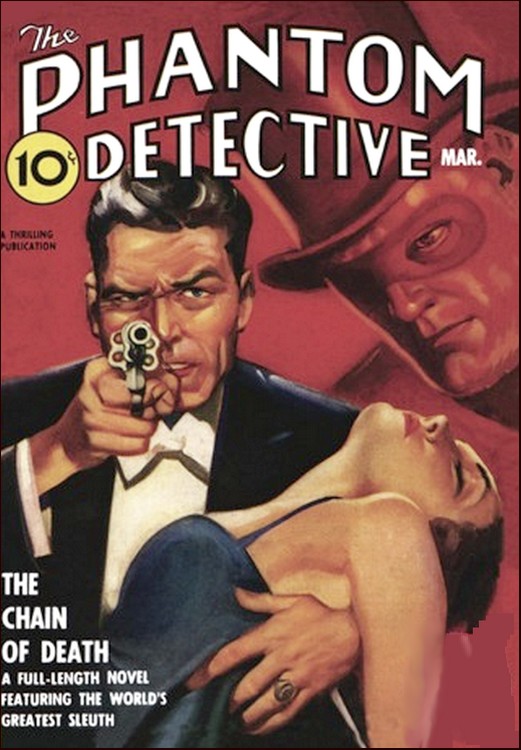
The Phantom Detective, March 1939, with "The Chain Of Death"
The world's greatest sleuth plunges into a foul swamp of mystery to rip out the fangs of crime! A hurricane brewed in a fiend's heart strikes a nation's winter playground! The King of the Everglades challenges the Law's might in a holocaust of murder!
DEATH caught up with Joe Moffat in a roadside service station eight miles above Palm Beach, Florida.
Moffat might have had a chance if terror hadn't smothered his heart and played with clammy fingers in his bowels. To fight it, he constantly tilted a quart of whiskey as he hurtled his roadster along the dark highway toward Palm Beach. The alcohol helped quite a bit, but Joe Moffat had made two tragic and terrible errors. He had ignored the headlights of another car trailing him, ever reflected in his mirror. And he had not believed that pursuit was possible so quickly.
He piled out, a thin, well-dressed man whose swarthy face twitched with fear, and snarled to the attendant who came out to meet him:
"Fill 'er up. Put some oil in, too, and check water and tires. I'm takin' a long trip. How about usin' your phone?"
The attendant blinked at the twisted face glaring at him.
"Yes, sir," he replied nervously. "You'll find the phone inside."
Even as Moffat ran to the entrance of the station, the heavy black sedan which had trailed his roadster was slowing up a couple of hundred yards away, its headlights veering inward for the turn-off.
Moffat slammed the door shut behind him and crouched over the telephone.
"I'm calling Palm Beach," he told the operator, and gave the number. The black sedan coasted in silently behind Moffat's roadster. Four men got out, the fifth remaining at the wheel. The freckled, Irish attendant sucked in his breath, remained chalk-faced and frozen, holding up the nozzle of the gasoline hose. He was staring goggle-eyed at one of the men of that quartet.
The man was dressed in what resembled, of all things, a frontiersman's buckskin costume. Leather moccasins and leggings and gauntlets. A long leather jacket with a high collar concealing his throat and the lower part of his face. The one modern note was a kind of flyer's helmet with huge goggles, hiding the upper part of his face.
But, adding grotesqueness to incongruity, the entire costume was painted with blotches of yellow and green. The man looked like some spotted monster walking erect on hind legs.
There was worse. Added to grotesqueness and oddity was an item of horror that congealed the garage man's blood. A triangular head protruded through a slit in the jacket near the man's right shoulder.
It was the head of a water moccasin, one of the most vicious and deadly reptiles upon the face of the earth!
The ugly head swayed there gently, close to the man's cheek. The attendant's gaping eyes now noticed rounded bulges beneath the leather jacket. The huge snake had coiled itself around the man's chest and stomach.
One of the man's gauntleted hands lazily motioned the attendant to proceed toward the office of the station. A hissing voice which might have come from the snake itself said:
"Quickly, please."
The attendant backed, trance-like. Inside, crouching low over the phone, Joe Moffat was saying: "Don't ask any questions, kid. We're drivin' North... Yeah. Now, damn it! Never mind packin'. I'll buy you a new outfit. This is a matter of life and death, honey. Be ready when you hear me blow the horn... Okay, good-by."
His trembling hand was about to replace the receiver when a hissing voice behind him said:
"So you're driving North, eh, Moffat? How very interesting."
A cry broke from Moffat. He spun around and recoiled, cringing against the wall. The helmeted, leather-clad man with the snake stood three feet away from him. The other three men, all normally dressed, with hard, criminal faces, covered him with big automatics. One of them slammed the telephone receiver back on the hook.
"So you thought you could run out on me, eh, Moffat?" the hissing voice went on. "You treacherous rat!"
"I got a right not to go into somethin' I don't like, ain't I?" Moffat whimpered. "I promised my girl I'd go straight—"
He screamed as the snake, its forked tongue darting viciously, began gliding out through the slit of the leather jacket.
"No, Cleo, my pretty one!" the hissing voice said. "Not this time." The goggled face glanced up to Moffat again. "All right, you fool, you'll join the others who have tried to betray the King of the Everglades. Consider yourself fortunate that I haven't the time to order a more amusing and prolonged execution for you."
He glided to one side.
"Let him have it, boys!"
THREE guns spoke in a crashing roar. Joe Moffat jerked, clamped his hands to his body, tottered an instant. He crashed to the floor. The horror-frozen attendant covered his eyes with his hands. An involuntary gesture, and yet perhaps it was best that he did so. For he did not see the gauntleted hand now jerk in his direction.
"I don't like witnesses," the hissing voice said.
And again three guns spoke, belching flame, smoke and hot lead. The attendant went sprawling. The top of his head was gory horror when he struck the floor.
"Let's go," the grotesquely garbed leader ordered. "The smell of blood upsets Cleo."
He strolled out, a sinister figure, trailed by the others. There was the grinding of gears as the sedan backed away, the roar of an engine, swiftly diminishing. Silence settled down. It reigned for a few seconds, then a moan disturbed it.
Joe Moffat was still alive. Spilling blood like a punctured wine case, racked with indescribable agony, he somehow managed to pull himself up to his feet. He hung onto the edge of the desk, fighting for consciousness, for strength. A force stronger than his agony aided him. He wanted to see Lottie before he died. And he wanted—vengeance!
He fell once before he reached the office door. He fell twice in the twenty foot trip to his roadster. But he managed to get up and stagger on, leaving a crimson trail behind him. Clutching the steering wheel finally, he sobbed:
"It's only six miles. I've got to make it. I've got to!"
Habit and instinct safeguarded him as the roadster zigzagged crazily down the black, deserted road. He screamed with the pain of his wounds, and the involuntary screaming had a share in making it possible for him to bear them without losing consciousness. But his vision was swiftly blurring.
Then he spotted the white house on the left of the road. It took every bit of strength he had left to jam on the brakes. He pressed the horn button, and slumped over the wheel.
Vaguely, some time later, he heard a woman's high heels on the asphalt. Heard the roadster's other door swing open. Heard a sharp intake of breath and a strangled scream.
"Joe!"
He tried to grin. His pain crazed eyes focused on the pretty blonde girl now sharing the seat with him.
"Yeah, they got me, Lottie," he panted.
"Joe! Let me take you to a doctor. How—how bad is it?"
"Curtains, kid," he said. "I'm gonna croak. But before I do—listen!"
"Don't talk, Joe," she implored. "Not now. I'm going to take you to a doctor. There's one right around the corner—"
"Forget it!" he gasped savagely. "No doctor can do anythin' for me any more. An' don't interrupt me again. Lemme get it all out in one breath. There ain't much time. Listen! Some holy hell is bein' planned for South Florida here that's gonna make the worst hurricane we ever had sound like a bedtime story. Some devil who calls himself the King of the Everglades is gonna run amuck, an' there'll be bloody hell to pay. He—oh, God, it hurts!"
"Joe!" she sobbed.
"No, you listen to me. I'll tell you all I know, but I've got no idea how long I'll able to talk. So first I want you to get straight what you're supposed to do with the information I give you.
"Don't—for God's sake—go to the cops. He'll find out about it, and he'll kill you. Besides, he's smart enough to laugh at the cops, anyway. Only one man can stop him—an' that's somebody who calls himself the Phantom... You still here, honey? I can't see you no more."
"I'm—I'm still here!"
"The Phantom can be reached through Frank Havens, publisher of the New York Clarion. You send him a wire, honey, tellin' him that you'll meet him at any place he cares to name. Tell him it's a matter of life and death. When you see him, unload to him the information I'll give you now. Can you hear me?"
"Yes, darling, I can hear you."
A SPASM of pain doubled Moffat. He gritted his teeth. He talked, steadily, grimly, fighting desperately for seconds while death was drawing him closer and closer to its bony breast.
The grayish pallor in Moffat's face had now also crept into that of the girl as she listened. Her eyes became wide with incredulous horror.
"Okay," Moffat concluded in a hoarse whisper. "You have enough now for the Phantom to smash the King of the Everglades before he begins his murderous work. I just thought of somethin' else. You see a bottle of whiskey on the seat here?"
TREMBLING, tears streaming down her face, she handed him the bottle. He tilted it to his lips and held it there until it was empty.
"I still have a couple of minutes, I think," he said, his voice stronger now. "Get out! It's just hit me that I mustn't be found dead in front of your house. It'll make trouble for you. I can—still go—a little bit—more."
He fumbled for the gear handle, found it, raced the motor.
"Get out, Lottie!" he ordered.
"Joe I—"
"Get out, I said!"
She obeyed, hands at her throat, looking as if she were being strangled. Moffat threw the clutch into first, and the roadster lurched away. And in that moment, headlights of an on-coming heavy black sedan flooded them. The sedan flashed by, and then came to a slithering stop. A moment later, it made a wild U-turn.
The girl ran toward the house. The black sedan passed her like some pursuing monster.
Moffat's roadster ahead was now also going at a terrific rate of speed. Its hand throttle was wide open. That was the last gesture Joe Moffat had made. A corpse now sat lurching against the steering wheel.
A turn in the road—with no human intelligence to heed it. The roadster left the highway. It hurtled the soft shoulder. There was a splintering of wood and a crumpling of metal as it catapulted through a road sign. It rolled over—once, twice, three times. Then it burst into flames. Eager, avid flames—a funeral pyre for Joe Moffat.
In the black sedan now parked at the turn there, the hissing voice said:
"No sense getting out. He's plenty dead now. But—that girl. Do you know her, Duke?"
"Yeah. She used to work in a cabaret in Palm Beach. Lives with her old lady back there."
"He might have—told her things."
"Well, that's easy enough to take care of," the Duke said grimly.
The helmeted man caressed with his cheek the triangular head of the snake.
"Yes," he said. "Yes, it's easy enough. Let us pay the young lady a social call."
Meanwhile Lottie La Mar was jangling the bar of her telephone.
"Let me have Western Union," she said, choking hysteria in her voice.
Her thoughts raced. Those men in the black sedan who had turned their car and gone in pursuit of Joe—were they the killers? If so, they must have seen her—must have guessed Joe had been talking to her—
"Hurry, operator," she urged frantically. "For God's sake... Hello, Western Union? Take a message, please. It is addressed to: the Phantom, care of Frank Havens, the New York Clarion, New York City. The message—"
As she spoke, giving the hurriedly composed message, her eyes roved about her like those of a terrified animal. Was that a car she heard outside now? And she was alone in the house, her aunt having gone visiting for a week in Tampa. Alone!
She completed the message, hung up, reached for a cigarette on an ash stand. Her hand froze there. A huge clammy paw seemed to have caught and held her heart.
They must have jimmied the rear door, entering the house so. And there they stood, grinning at her. But she was aware of one man only. A man dressed in a spotted green and yellow leather costume. A man whose helmeted head was rubbing that of a snake.
"The King of the Everglades!" she gasped involuntarily.
"So Joe did have a chat with you, eh?" the hissing voice said. "Yet now I am very glad that he had. You have impressed a point upon me that is of great importance." He laughed—a horrible throaty sound. "Yes, my dear, I am immensely pleased. You shall be most useful to me!"
The girl dropped in a dead faint.
KEY WEST, Florida. A unique little island town, marking the last coral key in the one hundred and seventy mile chain from the tip of Florida. A little town noted, among other things for being one of the best sport fishing centers in the world.
It was in this last feature of Key West that the two men, approaching the private dock of a swanky hotel in a launch, were obviously most interested. Evidence of a day's successful sport lay in the bottom of the boat. There were half a dozen evil looking barracudas, the vicious wolves of the sea with their ugly slanted teeth. There were several beautiful silver tarpon, and streamlined amber jacks, and a couple of enormous, big-mouthed spotted groupers.
The old captain at the wheel of the launch remarked condescendingly to his two passengers:
"I reckon you city folks ain't had so much excitement for many a day, eh? Especially you, Mr. Van Loan, when that thirty-five pound barracuda gave you a scrap."
Richard Curtis Van Loan, the younger of the two men, grinned back amiably. He wore only bathing trunks, and his tanned body had the lithe grace and power of a jungle cat.
"Yes, Captain," he said, "I guess you're right. We city folk don't get much excitement."
The other passenger—stocky, gray-haired Frank Havens, owner of the New York Clarion and a national chain of other newspapers—coughed and turned his head away to conceal his amusement.
He alone could appreciate the humor of that remark. To the rest of the world, the old captain's dictum would have seemed applicable enough to Richard Curtis Van Loan. No one, apparently, led a safer, more carefree, easy-going, useless life, than the millionaire Park Avenue playboy.
Only Havens knew the grim contrasting truth. Only Havens knew that the most vicious barracuda of the seven seas was a gentle pet in comparison to some of the human wolves with whom Van had battled. Havens alone knew that this happy-go-lucky society playboy had lived a good third of his life in breathtaking danger and under the shadow of death.
For Havens was the one man on the face of the earth who knew that Dick Van Loan was actually the grim Nemesis of crime who called himself the Phantom!
The Phantom—that elusive, mysterious, dramatic personality who waged a merciless crusade against crime, whose reputation had reached the four corners of the earth, whose success in his chosen work was spectacular and unparalleled.
THE very fact that no one else knew who the Phantom really was, accounted to a major extent for his spectacular success. Master of the art of disguise, which he had carried to the ultimate peak of perfection, criminal rats had no forewarning of what direction or source The Man of a Thousand Faces might strike from. Thus, terror and impotent hatred stalked the underworld at the very mention of his name.
And this man, who had fought hundreds of battles with the most vicious human scum, whose life had time and again hung on a hair—this was the man for whom the old captain smugly thought he had provided some excitement. Havens still chuckled as they walked up the dock toward the hotel.
"What's so amusing?" Van asked curiously.
"Oh, nothing. How do you like Key West?"
"First rate. A marvelous idea of yours to fly down here for a month's fishing. I certainly need the vacation."
"No one knows that better than I," Havens said grimly, glancing at the freshly healed bullet scar on one of Van's arms.
There were other scars on Van's powerful torso, scars by knife and gun, sober reminders of the dangerous game he played. Yet he never regretted one instant of his excitement-crammed life. Instead he regretted the years before that, when he had been in fact the playboy he now was in name only—years of idleness and boredom which had brought him to the stage where he saw no particular object in living. It was then that Frank Havens, sensing his black mood and seeing that something had to be done to give him a healthy interest in life, had launched him on his amazing career of crime detection by bringing him a case.
Up in their suite, they dressed for dinner. They were just about to go out when knuckles rapped on their door. Havens opened it. It was a bellhop with a telegram. The freckled youngster was pale with excitement.
"Boy," he said, "I wish I could really deliver it!"
"What do you mean by that?" Van asked, half curious, half laughing. "Aren't you really delivering it?"
"No." The boy was stuttering with excitement. "You see, it's addressed to the Phantom, care of Mr. Havens. Gosh, I'd give my right arm to meet the Phantom!"
Van's smiling expression did not alter, but he exchanged glances with Havens. A direct telegram to the Phantom, rather than someone contacting Havens, was an unusual occurrence.
"Okay, thanks," said Havens.
He tossed the boy a coin, closed the door carefully, then handed Van the message. Tearing it open, Van read:
C/O FRANK HAVENS
NEW YORK CLARION
NEW YORK NY
YOU MUST CONTACT ME IMMEDIATELY TO ARRANGE A RENDEZVOUS ON A MATTER OF LIFE AND DEATH STOP PLEASE TELEPHONE ME FROM WHEREVER YOU MIGHT BE AND REVERSE THE CHARGES STOP I CANNOT FIND WORDS TO EMPHASIZE SUFFICIENTLY THE TERRIBLE URGENCY OF YOU MAKING THIS CONTACT IMMEDIATELY STOP MY PHONE NUMBER IS PALM BEACH 8439 STOP MY ADDRESS IS 137 NORTH PALMETTO DRIVE PALM BEACH STOP MOST ANXIOUSLY
LOTTIE LA MAR
Checking back, Van saw that the message had been sent at two o'clock yesterday morning. Havens' private secretary had relayed it to Key West, where it had come after they had already gone out for the day in the fishing boat.
Van frowned, and allowed Havens to read the message.
"So?" the publisher drawled, looking up.
"So nothing," Van replied shortly. "Confound it, Frank, I've been here only one day! What's the matter with the Palm Beach police? Like as not, this La Mar person, like so many others that send these messages, doesn't really need me."
Havens shrugged.
"Okay, Van, if that's how you feel about it. But it might be something serious, you know. And the Phantom has never yet ignored a distress call."
VAN sighed and resignedly ground out his cigarette.
"True—true enough," he murmured. "Okay. I won't telephone from Key West here, however. The fact that both of us are here now might make the link a little bit too obvious. I may as well fly over to Palm Beach, and make my call there."
Havens, half smiling because he knew this would have been Van's decision anyway, said:
"Okay, Van. I do hope it isn't anything serious, and I'll try not to grab all the fish out of the ocean by the time you return."
They shook hands, and Van strolled out. Twenty minutes later, he lifted his silver monoplane off the runway at the airport. He banked and sent it roaring north toward Miami. Soon he was over the Overseas Highway—that marvel of unique road engineering. For one hundred and thirty miles, bridges of dazzling white stone linked one key to another to form a continuous highway to its ocean terminal point at Key West. Some of the bridges were seven miles long, delicate and beautiful viewed from the air.
The ribbon of highway below was finally terminated. Soon Van roared over the impressive hotels of Miami and Miami Beach. Other smaller Florida towns skimmed by below. Then—Palm Beach, swankiest winter resort in America.
Landing at the airport, Van registered the plane. Then he strolled into one of the washrooms that contained private cubicles. It was deserted then, and Van needed only a few seconds for what he had to do. He removed his goggled flyer's helmet—his clothes were regular street attire.
Then from an especially constructed inside pocket, he drew forth a small black box. It was his portable makeup kit which he always carried with him. He opened it, and went to work with deft, experienced fingers. A greaseless substance from a tiny jar darkened his skin. Swift dabs with an especially treated powder puff grayed his temples. A minute rubber gadget fitted beneath his upper lip instantly transformed the shape of his mouth and jaw.
When he put the case away, no one could possibly have associated the middle aged, dark-skinned, heavy jawed man in that washroom with Richard Curtis Van Loan. Van's last grim gesture was to pat the slight bulge over his vest where he had slipped an automatic before leaving the plane.
He walked out, no one paying the least attention to him at the busy airport, and entered one of the public phone booths. He called the number stated in the telegram. A girl's voice said:
"Hello?"
Van jerked closer to the mouthpiece. Though she had only said one word, he sensed the fear in it.
"Hello," he said. "This is the man to whom you sent a wire yesterday morning. I just flew down from New York. Why do you want me?" The pause before she spoke again was so long that he thought the connection was broken. Then her voice again, the terror in it unmistakable now:
"I can't explain over the telephone. For God's sake, please believe that I can't. And please believe that what I have to tell you is no trivial matter. You can avert something that will affect thousands of innocent people. You must come to see me. You must!"
The last two words sounded choked, forced out of her. Van was on the verge of asking other questions. He checked the impulse and said quietly:
"Okay, I'll be over within a half hour."
"All right."
Just those two words from her, and then the line went dead. Van hung up and frowned at the mouthpiece. She might at least have thanked him. There was something very peculiar about the way she spoke—even granting the fact that she was terrified.
Van walked out of the booth and entered one of the awaiting taxis.
"137 N. Palmetto Drive," he told the driver grimly.
IT was twilight when he got out of the cab at a white house on the outskirts of the town. He slipped the driver a bill, and walked up the porch steps. Every shade on the windows was carefully drawn, and the house itself seemed silent and deserted. Van rang the bell. He heard it jangle inside, but, as he waited, no one came to answer it.
A premonition that something ugly had happened here began to tug at Van. Had the girl been so terrified because she feared an attempt on her life? And had it already happened?
He tried the doorknob. It yielded. The door was open. Van entered cautiously. Then he jerked to a stop. There was just enough light to make out that he stood in a small inner porch. Double doors led from here into what appeared to be the living room.
An odor drifted to him from that room. An odor that was sinister and unmistakable. The odor of burnt cordite. A gun had been fired here—recently!
Van slid out his automatic. He glided toward the living room doors. Here he paused, his eyes trying to pierce the gloom, his ears straining for some sound. There was only silence and darkness. Not even the ticking of a clock. A tomb-like silence.
On the left, just inside the door, there was a small rectangular patch on the wall. It looked like a light switch—and Van found it to be so when he groped for it with his left hand. He pushed down the lever. Bright overhead lights flooded the room. And then Van cursed softly.
The girl lay on the couch. She had been shot through the head, and the blond loveliness of her hair, where it was free from blood, emphasized and made all the more hideous the gaping wound.
NARROW-EYED, his lower jaw set in grim, hard lines, Van slowly approached the couch. He was about to reach for the purse near the murdered girl's hand, when a hissing voice said behind him:
"Drop your gun, please. Now!"
Van froze. His muscles involuntarily tightened, but he curbed the impulse to whirl with the automatic. Death, swift and certain, was in that hissing command.
He tossed the automatic on the foot of the couch and turned very slowly.
Yes, he could not have made it. Three men from as many different directions covered him with heavy automatics—hard-eyed, impassive-faced men who looked like the professional killers they were. But it was the fourth man—apparently unarmed—who focused and held Van's attention.
A weird looking monstrosity wearing a painted leather costume, he stood inside the doorway leading to one of the other rooms. Van was not sure which was more sinister and ugly—the painted helmeted head with opaque goggles, or the triangular head of the water moccasin which swayed near it, its beady unblinking little eyes watching Van with peculiar intelligence.
"So," the helmeted man said in his hissing voice. "So you are the Phantom. A pleasure to meet you, sir. I have long been a student as well as an admirer of your extraordinarily effective methods."
Van smiled thinly.
"Thanks. And what is the significance of this meeting? I judge that the bit of deviltry on the couch here is your handiwork?"
"Oh, that? Yes, I have been forced to kill her. A regrettable necessity, for she was a very pretty girl."
The helmeted head touched in a caress that of the snake.
"She has been of incalculable assistance to me, however—since she was responsible for bringing us together. Frankly, you were the one potential and unpredictable force which had somewhat worried me."
"Really?" Van drawled.
"Yes. Sooner or later, terrified citizens of this fair State of Florida would have sent for you. To be perfectly frank, I would not relish the thought of you being on my trail. Not that you would have succeeded, but you could, perhaps, have made things uncomfortable for me. Therefore it is much more intelligent to eliminate you first—before I make my initial move."
Van, principally playing for time, his keen brain searching for some trick to escape the deadly menace of those three guns, asked casually: "Who are you—if you will concede to my curiosity?"
The man waved a gauntleted hand.
"Certainly," he said. "There is no particular hurry, and a chat with the great Phantom is a rare privilege. I am the King of the Everglades—a self-assumed title, yet perfectly applicable. I hold undisputed rule and sway over hundreds of square miles of swamp and treacherous wilderness upon which the foot of man had never trod before I came.
"If circumstances weren't what they are, I would have enjoyed showing you my retreat in the heart of the Everglades. I would have enjoyed showing you an organization which I believe is unparalleled in the annals of crime. I have planned my moves for ten years now, and I am finally prepared to strike. I expect rich plunder—very rich plunder. Plunder which would pale into insignificance the most lucrative haul than any pirate ever made."
HE laughed, a hideous cackling sound, and in spite of himself, Van felt his blood chilling. A madman—perhaps a monster—but there was evil intelligence in that helmeted head.
"I do regret, Phantom," the hissing voice went on, "that you cannot be witness to the several crimes I have planned for tonight. Nor will you be able to attend the convention of the Associated Chamber of Commerce of South Florida at the great Oceanview Hotel at Palm Beach here. Most dramatically then I intend to introduce myself to those gentlemen. I am sure that they will be delighted to meet—the King of the Everglades!"
Again that hideous laughter. The snake, apparently excited by it, slithered out a few inches.
"Rich, indeed, are the pickings, in South Florida here. Millions upon millions have been invested in real estate, in amusement, in business establishments. Gold flows here in season—untold millions, gayly spent. A good portion of that golden flow will find its way to the heart of the Everglades."
He raised his gauntleted arms. "Oh, I will make them pay—and pay—and pay! Oh, the tribute that they will pay—to the King of the Everglades!"
He began laughing again, this monstrosity in painted leather; and it was the shrill, spine-tingling cackle of a triumphant madman. In spite of himself Van was magnetized, fascinated by the evil power that seemed to emanate from the man with the snake. But equally so, he realized abruptly, were the three gunmen.
In those few seconds, while the helmeted man was laughing, brandishing his gauntleted arms, the snake, excited, darting its forked tongue near his cheek—in those few seconds, the gunmen could no more help staring at their leader than they could help breathing.
And it gave Van a slim, desperate chance for life.
There was a window at the foot of the couch where the murdered girl lay. Four feet separated Van from it, and from the very first moment that he had been trapped there, he was sharply aware of that window. For it was his only out.
He whirled now, took one running stride and hurled himself forward, shielding his face with one arm. There was a mad crash of glass and splintering wood. He felt something bite his left arm. And he was still in the air, now on the downward arc beyond the window, when heavy automatics began crashing behind him.
There was a soft bed of flowers below the window. Van created a havoc in it as he struck it with one shoulder and rolled over. With practically one continuous motion, he was on his feet, now running close to the wall of the house.
An automobile engine raced out in the street. An instant later, powerful headlights swept in as a black sedan slithered into the driveway which Van was traversing. The driver must have instantly realized the significance of smashing glass and the gunshots which followed, and he now swerved into the driveway to head Van off.
Caught full in the glare of those headlights, Van realized that he was as conspicuous as a fly on a sheet of white paper. An easy target for those murderous guns. He glanced around desperately. The sedan blocked him ahead, the driver's door even now opening. Hot lead would blast from there any moment now. And behind him, one of the gunmen was already leaning out of the smashed window.
It left only the tall row of hedges on the right, separating that house from the one adjoining it. Like a rabbit seeking the sanctuary of thick underbrush, Van dove into the hedge. And again lead trailed him. It whipped up little chunks of earth as he fought wildly through the thick hedge. It snapped off twigs, and whined past his face.
HE tore his way through to the opposite side. It was a miracle, he realized, that he hadn't been hit yet. But he knew it was courting suicide to test his luck much longer. He heard shouts behind him, pounding feet. Those murderous rats would be trailing him through the hedge soon enough.
A cold fury possessed him now. It was stronger than the impulse to escape, for ever in the back of his mind was the memory of that murdered girl. And the sinister threats of the fiend in painted leather. To hell with running like a scared rabbit, he told himself savagely; if those rats wanted a scrap, they would damn well get one.
A hundred feet away was the next house. Its grounds, where Van stood now, were neglected. Tall grass, thick underbrush, a number of huge trees—it suited perfectly the dangerous game Van now meant to play.
He darted to the left, moving his big body with the stealthy, shadowy silence of a stalking Apache. He heard bodies crashing through the hedge. Footsteps pounded on the sidewalk—they were obviously planning to cut him off from that direction. Van grinned thinly. The murderous devils were due for a surprise.
He paused in the blackness beneath a huge tree. Above him he could just about vaguely make out a low, thick limb. He leaped up, caught the branch. The practiced ease with which he swung his body over it would have done credit to a crack gymnast.
He lay on his stomach on the thick limb as searchlights began criss-crossing on the grounds below. One shadowy figure, two, three—the glint of blue steel as a flashlight beam touched one of the guns. The shadows separated, combing the grounds with unhurried thoroughness.
One man was gradually working his way closer and closer to the tree where Van was hidden. Unless the gunman changed the direction of his search, he would soon pass directly below. And this was precisely what Van was awaiting.
Closer, closer, came that poking, searching flashlight. It hadn't occurred to the gunman to examine the tree limbs overhead. Advancing in a half crouch, he devoted his attention to the thick patches of underbrush and low bushes which dotted the grounds.
Like a bobcat waiting for its prey to pass below, Van tensed himself on that limb. One second, two, three—the gunman passed below the limb.
Van hurled himself downward.
A startled cry burst from the gunman as Van's full weight struck his back. Both men crashed to the ground.
The gunman's automatic spat an angry orange jet into the darkness. But steel fingers had already gripped his wrist, deflecting the shot. And then the man screamed as these fingers savagely twisted his wrist downward and to the left. A devilish jui-jutsu trick, it broke his wrist as if it were a dry twig.
Van scooped up the gun the other's nerveless fingers had dropped.
Bright steel glinted in the moonlight—the gunman had drawn a knife with his free hand. Van checked the impulse to blow the man's brains out. He sidestepped as the other lunged inward viciously, and the murderous eight-inch blade skimmed past, him harmlessly. Then he stepped in and smashed the barrel of the automatic across the gunman's skull.
The man dropped.
PERHAPS ten seconds could have timed this violent bit of action, but it was long enough to bring the other gunmen charging toward the tree. Two men—and the one on the right, close enough now to see that Van wasn't his pal, opened fire. The heavy slugs began whining past Van's head.
It was splendid shooting in the darkness, but now it was Van's turn. He centered the automatic on the blur of the man's figure. He jerked the trigger—and then cursed under his breath. For nothing had happened. The automatic had jammed!
Van tossed the useless gun away from him, and dropped flat on his stomach as the second man also opened fire. And then he realized that the automatic's jamming had actually saved his life. For in the split instant that he had thrown himself to the ground—which he would not have done had he been able to return the shots—the night became alive with the devilish hammering of a tommy gun!
Steel claws seemed to gouge huge chunks of bark from the tree trunk which Van's body had blocked an instant ago. There was savage fury in the slap and thud of the leaden death spewed from the flaming muzzle of the submachine gun.
Van knew it was suicide if he remained there another moment. The machine gunner must have a pretty good general idea where he had dropped. And so Van rolled twice to the left in the thick grass. He was not an instant too soon. Bullets from the now deflected tommy began tearing up the sod where he had just lain. And searchlights were already trying to seek out his hiding place.
SNAKE-LIKE, Van began crawling on his belly. His spine crawled as he momentarily expected the burning impact of machine gun lead tearing through his flesh. Sooner or later, one of these searchlights must find him. The blazing tommy gun would swiftly do the rest.
Another huge tree blocked Van's way. It had heavy, gnarled roots, the thickness of a man's thigh, protruding above the ground. Van crept over and around them and lay, panting, in the temporary protection of the thick trunk.
A thin wailing sound suddenly filled a lull which followed the cessation of machine gun fire. It strengthened swiftly.
A siren!
"The cops!" one of the gunmen cried. "We'd better get the hell outa here."
And then the evil hissing voice which Van had already grown to hate came from the darkness somewhere:
"Yes, we'd better leave... I believe you're still alive, Phantom. A deplorable fact, but I give you my oath: we shall meet again soon. I will make you regret the fact that you have escaped death tonight. The King of the Everglades always keeps his promises. Good-by, Phantom—till we meet again."
Peering over one of the roots, Van saw the man he'd knocked out being picked up by the others. There was a crashing sound as they recrossed the hedge again, and there was a grinding of gears and a roar of an automobile engine. Through the hedge, Van could see the black sedan's headlights careening into the street.
The wail of the police siren was close now—coming from the opposite direction that the black sedan had taken. But Van knew that the police would arrive here just a little bit too late.
Van stood up, knowing that he was alive by the skin of his teeth. Knowing, too, that he was launched upon what promised to be the most desperate case of his career. And while he hadn't exactly taken the first trick, the "King of the Everglades" had definitely lost it. He had banked on rubbing the Phantom out. He had failed.
The Phantom knew deep thankfulness. Something malignant and evil threatened to prey on society. One life had already been shuffled out by the devil who called himself the King of the Everglades. Lottie La Mar's lips were permanently sealed. But those death grayed lips still mutely screamed for vengeance. The job was Van's—a tough, ugly job.
He brushed off his clothes and walked, grim faced, to the street. The man who called himself the King of the Everglades had already shown his teeth. Soon it would be the Phantom's turn.
The Phantom grimly welcomed the challenge.
A POLICE roadster slithered wildly to the curb as Van stepped out on the sidewalk. Two cops, their guns drawn, hopped out. Spotting Van, one of them said harshly: "In your tracks, brother!" Van stood quietly as the patrolman approached him.
"Know anythin' about the shootin' reported here?"
"Yes," Van replied calmly. "They were shooting at me."
"What?" The patrolman stared at him. "Who? Why?"
"It's too long a story," said Van.
"Oh, yeah?" The cop turned to his buddy. "Go inside, Steve, and see if there's anythin' wrong in that house. I'll keep this wise guy covered."
"You'll find a murdered girl inside," Van said. "But before we waste any more time, mind taking a look at this?"
His clenched fist extended to the patrolman, then it opened slowly. The headlights of the radio car reflected on the glittering little object now exposed on his palm. It was a tiny mask made of platinum and precious stones.
The Phantom's insignia—and known as such to the police all over the world.
The young patrolman's reaction was characteristic. His attitude changed swiftly to one of awed deference.
"The Phantom!" he gasped, lowering the gun. "I—gosh, I'm certainly glad to meet you, sir. My name's McCarthy. I—"
"Let's go inside," whispered Van to McCarthy.
A minute later, he stood again at the couch where the murdered girl lay. He shook his head slightly.
"Who's Chief of Police at Palm Beach here?"
"Sam Allen."
"A political appointee?"
"No, sir. He came up from the ranks."
"Good," said Van. "Get him over here immediately."
"Yes, sir," the patrolman snapped.
For the second time that evening, Van reached for the girl's purse on the couch. He carried it to a table, opened it, emptied its contents. There were the usual feminine articles—compact, lipstick tube, and so forth. A thin platinum cigarette case attracted Van's attention because it was obviously very expensive. Opening it, he saw inscribed inside: "To Lottie from Joe—with all my love." Van lowered the case and turned his attention next to some letters.
Three letters, well thumb marked, bore the return address of Joseph Moffat, Palm Beach. They had been sent to Lottie La Mar in Tampa and Miami Beach. Van saw that they were impassioned, if somewhat illiterate, love letters.
There was a passage in one letter, however, that was particularly interesting.
Keep this under your hat, darling, because it's supposed to be a secret, but Roger Bailey offered me a job as his bodyguard at a hundred a week. I don't know if I'll take it, because I think Bailey is up to something. Why in hell should a guy like him need a bodyguard? He wouldn't tell me, when I asked him, what he's scared of. And I still didn't forget my promise to you to go straight. I'll find out tonight what Jeff Donahue wants; the boys tell me he's been looking for me. Donahue is poison—I know that; but I may as well find out what he wants.
The rest of the letter was inconsequential. The date on it showed it to be just one week old. Van reread it, and paused at the phrase where Moffat assured his girl that he did not forget his promise to go straight. It implied that he must have been of the underworld.
"The name Moffat—Joe Moffat," he asked the patrolmen. "Does that mean anything to you fellows?"
"Does it?" one of them replied grimly. "He was one of the old Clancy gang, the toughest bunch of killers that ever came down to this part of the country. Somebody knocked him off last night."
"What!" Van controlled his excitement. "Tell me about it," he added, lowering his voice.
"Well, they plugged him in a gasoline station about six miles up the road from here. We think he got it there, because the attendant had been bumped too. There was a trail of blood from the office of the service station to where he must have had his car parked."
"He was found in his car?" Van asked sharply.
"Yes, but not there. He drove about eight miles in this direction. I guess he was tryin' to get to a doctor. He passed here and smashed up a couple of miles ahead when his car went off the road. The car he was in caught fire, but he was thrown clear of it. Somebody had put three slugs in him."
Van nodded curtly, slipped the letter which had interested him in his pocket, and began pacing the room. Certain things were beginning to clarify in his mind now. Moffat may not have been racing with death to get a doctor. He may have come this way because he wanted to see his girl. And it was from Moffat she must have obtained the information which had induced her to send that wire to the Phantom.
THE pattern enlarged itself. The killers had found out that Moffat had contacted his girl after they had abandoned him for dead. So the murderous devils called on her, forced out of her the fact that she'd sent a wire to the Phantom, forced her, further, to answer the telephone and lure Van there when he had called. Then they murdered her and set the trap for the Phantom.
All of which made Moffat's letter to Lottie La Mar of vital importance.
A police siren moaned outside. "That must be the chief," one of the patrolmen said.
The eerie wail of the siren grew louder. Van heard a car stop outside. A door slammed and heavy footsteps pounded on the porch. A fat, red faced man, with shrewd little gray eyes, tramped into the room. Several other men trailed him.
He paused, glanced at the murdered girl, made a soundless whistle and looked at Van.
"I'm Chief Allen," he said. "Are you—the Phantom?"
Van nodded. They shook hands, and Allen said:
"It'd be superfluous to say that I am delighted to meet you. So they got the La Mar girl, eh?"
"Do you know her?" asked Van.
"I was giving orders to bring her in for questioning when the call came that you wanted to see me here."
"Why did you want to question her?"
"I found out she was the sweetheart of someone who'd been murdered last night—a gunman by the name of Moffat. I thought she might have an idea who killed him—and why."
"She had," Van said grimly. "That's why they sent her on the same road that Joe Moffat had taken."
There was a brief pause, then Allen said hesitantly:
"May I ask what is your connection with this case?"
Van handed him the telegram the girl had sent. Allen read it, looked up.
"You telephoned her?"
"Yes. She answered. But I found her murdered when I arrived—with a pretty little trap set for me."
Van told his story.
"If it didn't come from you," Allen said slowly, "I'd say it's a pipe dream. King of the Everglades—a toll of millions from South Florida—hell, it sounds screwy!"
"It may sound so but it isn't," Van said. "Moffat's murder, the girl's telegram, her murder, the most efficient way in which they tried to get me. Such things aren't done for fun."
Allen's face was sober.
"What do you propose we do? I'm perfectly willing to take orders from you."
"Is there a convention tonight at the Oceanview Hotel of the South Florida Associated Chamber of Commerce?"
"Yes. The grand ball begins at nine o'clock. Later, there will be speakers and all that."
"Nine o'clock, eh?" Van repeated. He glanced at his watch. "That gives us two hours to take all the precautionary measures possible. The devil who calls himself the King of the Everglades implied that he will pull something at that convention tonight. How many plainclothes men can you spare?"
"About twenty, I guess."
"I want a man stationed at every entrance—and, outside every entrance, a police car conveniently parked. I want a man at the foot of every staircase. I want a detective on everyone of the elevators—and that includes the service elevators too. And I want those men to have their hands close to their guns and to be ready for trouble."
THERE was respect now in Allen's eyes.
"You certainly believe in being thorough, don't you? It'll take more than twenty men, but I'll get them, and your orders will be carried out implicitly. Is there anything else?"
"Not for the present. Meet me in the manager's office at the Oceanview Hotel at about eight. Now I'd appreciate it if you could drive me to the nearest place where I could transfer to a taxi."
"You have my car at your disposal," Allen offered.
Van smiled grimly. "No, thanks. I like to move without any fanfare."
Allen motioned to the two radio patrolmen.
"Drop the Phantom off wherever he wishes."
Van scooped up the automatic he'd been forced to drop earlier. He slipped it in his pocket and walked out, trailed by the two patrolmen. In ten minutes, the radio car brought him into Palm Beach proper. Van got out.
His first stop was in a men's clothing store. He bought a conservative gray suit to replace the one he was wearing now, which was filthy and torn from his encounter with the killers in Lottie La Mar's home. He changed in the store, ordered the old suit to be sent to a nonexistent address, and strolled next into the washroom of a huge cafeteria. Here his little portable makeup kit again came into play. Just a few deft touches of a shading pencil, tiny pellets to widen his nostrils, another little rubber gadget to give his lower lip a drooping effect and the removal of the one he had before—and Chief Allen would never have recognized him as the man to whom he had spoken minutes ago.
Nor could the King of the Everglades and his devil's crew have recognized him—which was of greater importance. Out in the street again, the Phantom summoned a taxi.
"The Oceanview Hotel," he said.
THE luxurious twenty-two story hotel—one of Palm Beach's best, and thus one of the finest upon the face of the earth—hummed with activity this evening. Taxi after taxi, limousines and town cars, discharged bejeweled women and men in evening dress. It was the first pre-season gala event, for the big shot business men of South Florida.
They were guests tonight of the Oceanview Hotel—the men who would soon play hosts themselves in their own great hotels, their theaters, their amusement centers and restaurants, to the thousands upon thousands of wealthy people from all parts of the country who came to frolic away the winter months in the sunshine of Florida.
The Phantom, lounging in the lobby, watched this gay throng pouring in, and his mind still echoed the savage hissing chant of the fiend with the snake:
"They will pay—and pay—and pay—and pay—"
How did the King of the Everglades plan to execute the gigantic extortion scheme he had implied? What had he meant when he said that he would let himself be known at the convention in this hotel tonight? And what deviltry had he planned?
Van's tension mounted. He saw Chief Allen's fat bulk, trailed by several men, enter the lobby. Allen led the men to the four elevators. He held a brief huddle with them. Two of the men entered elevators that were down at the lobby level then, each stationing himself behind the operator. Two other men awaited the elevators in use.
Van's orders were being carried out.
Allen walked away. He returned in a couple minutes with another small group of plainclothes men. Brief instructions again, and—the detectives sauntered off in various directions. Van saw one open the door marked "stairs." Two men paused and remained unobtrusively near the lobby entrances.
Now Allen strolled to the desk. He skirted it and entered a door labelled "Manager."
Van waited a few minutes, then made a quiet tour of inspection. The great hotel which occupied an entire city block had a dozen exits. Near each one, a man lounged unobtrusively, appraising everyone who came in or out.
Going out through one of the less used exists, Van spotted a police car parked across the street.
He nodded grimly, came in again. Another door marked "stairs."
Van swung it open. A sharp-eyed man standing in the little vestibule there appraised him suspiciously. Van faked the harassed attitude of searching for someone, and retreated back into the lobby.
Chief Allen had followed instructions faithfully enough. Van walked on to the manager's office. He entered without knocking, and found the huge room crowded.
A tall, dandified man whom Van judged to be the manager, said coldly:
"Yes, what can I do for you?"
For the second time that evening, Van exhibited a glittering little object of platinum and precious stones on his open palm—the Phantom's emblem.
Chief Allen stepped forward. "But," he said, very incredulously, "you're—you're not the same man—"
"The same man—who only looks different," Van said.
"Uncanny," said Allen. "Anyway, I'd like you to meet the executive council of the South Florida Associated Chamber of Commerce. They—as well as the manager of this hotel—naturally noticed the number of detectives I have assigned here, and they demanded an explanation. So—I told them."
"You told us," a burly, bald headed man cut in sharply, "what sounds like utter nonsense."
"And you have my assurance," Van said, his voice as sharp, "that it isn't nonsense."
There was a pause.
"Sorry," the bald headed man said finally. "Perhaps I spoke hastily. I am Walter Cameron, president of this executive council. This is my business partner, Mr. Smiley."
He indicated a gaunt, thin lipped man with swarthy, parchment-like skin. Then he continued the introductions. Gerard—who looked like a Tammany Hall politician with his heavy jowls and black cigar. Winslow—one of the most important bankers of the South, a hatchet-faced cold-eyed man. Roger Bailey—the youngest of them all, a handsome blond chap.
TWO facts startled Van when Cameron introduced Roger Bailey. First, the terrific tension that lurked in Bailey's eyes, belying his smiling lips and the easy casualness of his voice. The hand he gave Van was icy cold. Moffat, the murdered gunman, had mentioned in the letter that a Roger Bailey had offered him a job as a bodyguard. Had it really been as—bodyguard?
Walter Cameron's voice droned on:
"We five complete the executive council. This gentleman is Mr. Walker, a New York financier who's down here to rook us ignorant crackers."
The smiling man who now shook hands with Van had bright little pink cheeks and blue eyes that were absurdly magnified by thick-lensed glasses. His pudgy little hand was moist and clammy.
"Don't let them kid you," he said in a squeaky voice. "I'd like to see anyone try to rook these lads."
Van inwardly agreed with him. They looked like a shrewd, level headed gang, this quintet of the executive council.
"At any rate," Winslow, the cold-eyed banker, said jokingly, "we're accustomed to sit steady nerved on a powder barrel. Hurricanes have taught us that. But I still share Mr. Cameron's opinion that this supposed menace by the King of the Everglades is somewhat of a fairy tale."
Van shrugged and said, "I hope you are right."
A stocky gray-haired man whom Van hadn't met yet spoke up quietly:
"I'm Todd, the house detective here. If I can be of any assistance to you—"
"I think you can," Van Loan said heartily. "Will you come with me, please?"
He nodded to the other men and walked out, trailed by the house dick. Pausing at the desk in the lobby, Van lighted a cigarette and asked softly:
"Is there anyone registered in the hotel now whose looks you don't particularly care for? Strangers, especially, who checked in today or yesterday?"
Todd shrugged.
"The racing season has opened, you know. That usually draws a flock of wise boys. I noticed a few, but they have been here a week or so now."
"Do you know someone by the name of Donahue—Jeff Donahue?"
"Sure," was the prompt reply. "He has a suite up on the fourteenth floor here."
"What does Donahue do?"
"Oh, he owns a dog track and several cabarets, two here, and one at Miami Beach. These are his legitimate businesses. What else he might be tied up with—" Todd shrugged significantly.
Van appraised the house detective. Todd's eyes looked honest.
"Can you find out," he asked softly, "without openly consulting the clerk, if there is a vacancy adjoining Donahue's suite or across the corridor from it?"
Todd nodded briefly and strolled behind the desk. He returned in a couple minutes.
"Room 1407, which is directly across Donahue's suite, is vacant."
"Good," Van said. "Are there transoms over those doors?"
"Yes."
"Okay. Suppose you park yourself at the transom of 1407. I want to know who enters or leaves Donahue's suite during the next four hours."
"You want me to go up there now?"
"Yes."
Todd merely nodded again and walked toward the elevators. Van turned, and in that moment he heard a sound that was like the snapping of a rubber band. Something whizzed past his eyes. An instant later, he saw a bright steel needle quivering in the woodwork of the desk partition. If he hadn't turned just then, the needle would have been imbedded in his cheek.
He whirled. A woman, startled by his sudden motion, gaped at him. A group of men and women, all strangers to Van, were chattering gayly a few feet away. Baldheaded Cameron was crossing the lobby a bit further away. Roger Bailey sat speaking with a lovely blond girl on one of the lobby couches. And there were literally scores of other people, either moving, or standing about, chatting.
Where had that needle come from?
With grim deliberation, Van drew a handkerchief from his pocket, placed it over the needle and jerked it out from its lodging place in the woodwork. He saw that it was an ordinary small sewing needle. But what gave it sinister distinction was a black, gummy substance in which the point and lower third of the needle itself had been dipped.
It was a poison needle—and it meant that someone had just by a hair's breadth failed in a murder!
THE minutes ticked away. Van stood there, grim-faced, motionless. The murder attempt in itself was grim enough, but even more shocking was its staggering implication. He had changed his disguise. Only the men in the manager's office, to whom Allen had introduced him, knew that he was the Phantom!
If the author of this murder attempt was the devil who called himself the King of the Everglades, then he must be me of those men! Or—another possibility—one of those men was in his employ!
A voice behind him said: "I beg your pardon, sir."
Van turned. One of the desk clerks, holding up a white envelope, stood staring at him there.
"You seem to be the only man in a gray suit near the desk," he said.
It was Van's turn to stare.
"What about it?"
"Well, this is rather peculiar. I just had a phone call. A man asked me to get the envelope which was under the blotter of the register book and hand it to a man in a gray suit standing near the desk. I looked under the blotter—and, sure enough, an envelope had been slipped there."
Without a word, Van reached for the envelope. It was blank, and of the regular hotel stationery. Tearing it open, Van found a message, neatly printed in pencil:
My dear Phantom:
Most certainly you seem to lead a charmed life. Had that needle pricked you, you would have died within five seconds. You must concede that the simple law of averages should assure me a success on the third attempt. If life is dear to you, you will drop this case and get out of Florida just as quickly as you possibly can. The precautionary measures you have taken are amusing and totally ineffective. Nothing can check my plans. Get out—now—while you are still alive. I shall not repeat this warning.
King of the Everglades.
Below the signature which would have been farcical if Van hadn't known the sinister personality it stood for, was a crudely drawn head of a snake.
Very slowly, Van refolded the note and placed it back into the envelope. He glanced up at the curious clerk still standing there.
"Listen," he said quietly. "Has any of these men paused at the desk here within the past five minutes? Mr. Roger Bailey? Mr. Winslow? Mr. Gerard? Mr. Cameron? Mr. Smiley? Mr. Walker?"
The clerk kept shaking his head as Van roll-called the names.
"I know everyone of those men, but so many people are constantly stopping at the desk—especially tonight—that—" The clerk paused suddenly. "Yes, Mr. Winslow stopped at the desk here a couple minutes ago. I think he did glance into his pigeonhole to see if there was any message for him. But if he slipped the envelope under the blotter then, I didn't see him do it. I suppose it's a practical joke, eh?"
The Phantom joined in the clerk's smile, but something about his eyes abruptly frightened the hotel employee.
The Phantom's blood seethed. The murderous devil was mocking him. Had sidled up to the desk after the murder attempt had failed—while Van was looking the other way—and laughed at him while he'd slipped that envelope under the blotter.
And now he expected him to run like a frightened cur!
Van's jaws tightened. His enemy, in feeding his own ego, committed an error. Van was certain now that he could throw a half dozen men into a room—and know that one of them was either the killer himself or his close henchman.
Only—which one? And where—how—would the murderous rat strike at the hotel here tonight?
THE hands of Van's wrist-watch kept creeping along. Nine o'clock came and rolled by. He stood in an inconspicuous spot at one end of the ballroom.
The music pulsed and pounded, played by a world famous dance band. Huge as the ballroom was, it was jammed nevertheless, ever fed by new arrivals. Every man of any importance in South Florida was in attendance here tonight with his wife or sweetheart.
On the small speaker's platform especially erected for the occasion, a score of chairs were now being occupied. Van saw the five members of the executive council there. He saw the bespectacled Walker. A white haired man whom Van recognized as the Mayor of Palm Beach stood near a microphone which radio technical men were now adjusting.
Behind him, conversing with Cameron, was the Governor of Florida. On that platform Van also recognized ex-Senator McHugh, one of the South's fighting political leaders. Would the King of the Everglades really dare to attempt something before such a distinguished assembly?
Ten o'clock. The dance band concluded its number. From a small balcony high above one wall of the ballroom, a spotlight lanced downward. It settled on the silvery haired Mayor of Palm Beach, who now stood before the microphone. Other lights in the ballroom were dimmed. The hum of conversation quieted down.
"Ladies and gentlemen," the Mayor began in a deeply resonant voice. "I have the privilege this evening to welcome in Palm Beach a most distinguished—"
HE broke off as the spotlight abruptly shifted away from him, leaving him and the men on the platform in semi-darkness. Instinctively, Van dropped into a half crouch, his hand jerking to the butt of his gun.
The circle of glaring light was now centered on a white wall. The wave of surprised exclamations was abruptly silenced by sheer amazement as a gigantic shadowy figure now shimmered on that wall. Greatly magnified, it was the figure that Van had seen before—the figure of the helmeted, gauntleted, leather clad man with the snake!
The snake was clearly visible in that shadowy outline, its ugly triangular head swaying near the goggled face.
And then the hissing voice came through the amplifying system with which every part of this modern hotel was equipped.
"Your Honor, ladies and gentlemen," it mocked. "You must forgive this interruption. I think it is of paramount importance that you meet first someone who will affect South Florida to a more startling extent than even the distinguished gentlemen who have been scheduled to speak here tonight. I am the King of the Everglades. Remember this title, ladies and gentlemen, because each of you, directly or indirectly, will have to pay tribute to me.
"My opening campaign begins on a rather crude note. There is this necessarily melodramatic introduction of myself. At this very moment, too, my men will just about complete raiding the Palmer Jewelry store—the Tiffany's of the South as it is sometimes called. I have done it principally to test the effectiveness of my organization—and to insure the fact that the King of the Everglades will be taken seriously from now on.
"Your executive council will hear from me at midnight tomorrow—when I shall make my real demands known. Now any of you who have weak hearts or unsteady nerves had better not look up to the source of this spotlight."
The voice broke off with mad laughter. It was drowned out in a pandemonium of sound which a single hysterical woman's scream had initiated.
Up on the balcony from which the spotlight lanced downward, a man's body hung over the railing. It was limp, lifeless, and the slightly greater balance of weight on the outer side was causing it to tilt over more and more.
It fell suddenly, grotesquely turning over and over—and blind, mad panic swept the ballroom.
Van plowed his way to a side exit from the ballroom. He knew that no single man could stop the mad panic now. He collared a gaping bellhop.
"Where is the control room of the amplifying system?"
The terrified boy merely gaped at him.
"What do you do if you want to page someone?" Van tried again. "Come on, son, this is important, and I'm not going to hurt you."
"Why," the boy stammered, "the desk telephones to where Mr. Riley sits—"
Van grabbed the boy's arm and dragged him to one of the elevators. The operator stood halfway out of the cage, pop-eyed, chalk-faced.
Van pushed the operator inside, swung the boy in after him—and found himself confronting an equally paralyzed plainclothes man.
"I'm the Phantom," Van told the latter tersely. "You stick with me." He whirled to the bellhop. "What floor is this place where Mr. Riley sits?"
"Fourth," the boy gasped.
The jittery operator was useless. Van slammed shut the door and ran the elevator up himself. Dragging out the bellhop with him when they reached the fourth floor, Van asked, trying to keep his voice calm:
"Okay, son, where is it?"
The boy pointed down the long carpeted corridor.
"Last door on the left."
Van raced toward it, trailed by the detective. Even up here, the pandemonium in the ballroom was still clearly audible. The last door on the left—Van flung it inward.
He found himself in a small control room. Double doors on the right opened on the tiny balcony where two powerful spotlights were stationed, one with a ring of colored slides around it. That spotlight was dark, but the other was still on. Clamped in front of it was a small black slide. It still reproduced on the wall below the shadowy figure of the helmeted man with the snake.
Van's first gesture was to tear it out. He knew that sinister figure on the wall contributed greatly to the pandemonium still raging in the ballroom below. Now he looked around the little room. At one wall he saw a switchboard, with a mouthpiece in the center of it. Below the mouthpiece, supported on the backs of two chairs, was a cheap portable phonograph. The record on it was still spinning around.
Below the one lighted bulb on the switchboard was printed the word, "ballroom."
THUS, by manipulating switches on the board, an operator from here was able to page someone over the amplifying system in any part of the huge hotel.
"If the spotlights are operated from here," Van shouted to the plainclothes men, "there ought to be an auxiliary switch for the ballroom lights. We've got to give them—ah!" He leaped to the left and threw in a copper switch he noticed there. Instantly the ballroom lights went on in a score of places, and there was a sharply noticeable drop in the screaming bedlam below. Now Van jerked to the mouthpiece of the amplifying switchboard.
"Ladies and gentlemen," he said, speaking slowly, quietly, steadily. "There is no danger, and there is absolutely no necessity for anyone of you to try to fight his or her way out of the ballroom. Please pause just where you are right now, and try to behave like sane human beings. Quiet everyone, please. There is no danger."
He heard his own voice amplified in the ballroom, and he continued speaking in the same quiet, steady tone, repeating again and again what he had just said. It was effective. The screams and shouts quieted down.
Chief Allen burst in, panting, wild-eyed.
"My God, what a mess!" he gasped.
"Now is no time to moan about it," Van said. "Did you check on the Palmer holdup?"
"Not yet. I haven't had a chance."
"Do it now. There's a phone on that desk."
Allen ran to the telephone, and Van began pacing tigerishly up and down. The King of the Everglades had done it! The murderous devil had written in that note that the precautionary measures Van had taken were amusing and totally ineffective.
And so they were—now!
He turned to Allen as the latter said tersely into the telephone:
"Yes, yes—go on!"
Allen listened a while, his clenched fist softly pounding the desk, then he said:
"Okay, Captain, I'll run out there just as soon as I can."
He hung up, and his eyes were bleak as he stared up at Van.
"There were five men," he said quietly. "They came in just as the store was closing, the window blinds already down as the Palmer people have a habit of doing. Old man Palmer was a bit slow about opening the main vault where the expensive stones were; a knife was buried in his throat. His son went berserk—they knifed him. A girl bookkeeper began screaming hysterically—a gun butt bashed in her skull." He paused and passed his hand over his eyes.
"Go on," Van prompted softly.
"The manager of the store opened the main vault. They leisurely collected four hundred thousand dollars' worth of precious stones. Then one of them approached the three people they murdered—Palmer, his son, the girl bookkeeper. He—"
Again Allen paused, his face savagely distorted.
"Go on," Van said even more softly.
"He carved with the knife point the head of a snake on the forehead of each of those murdered people. You'll find that the same gruesome thing had been done to the man whose body had plunged off that balcony. He was Riley, the man in charge here, a sweet old Irishman whom I've personally known thirty years. He'd been knifed, too.
"To get back to the other case, those devils calmly walked out with the loot, the many people strolling that street not having the faintest idea that there had been a holdup. Got away in a black sedan. There's a state-wide alarm out for them now."
VAN spoke slowly:
"Do you think you'll get a night's sleep while a single one of these devils is free and loose?"
"No," said Allen.
"Then we understand each other. Now I've an idea—basing it on the fact that we are dealing with an extremely clever fiend. This portable phonograph over which his voice was reproduced had to be brought here, and one cannot carry such a bulky object in his hip pocket. His henchmen had to get it in here, knife the operator, adjust the slide and the record, and make their getaway. It seems to me that this self-styled King of the Everglades would plan this move most carefully."
"What're you getting at?" Allen asked curiously.
"Let's go down to the desk," Van said. "If my hunch is correct—" Down at the desk, Van summoned the three clerks.
"What's the latest report from the mess in the ballroom?"
"Well, it isn't as bad as we feared," one replied. "Five women and two men have been hurt, but none seriously. The house physician is treating them now."
Van Loan leaned further over the counter.
"Okay, now you listen to me, you three. What I am going to ask you now is of vital importance, so think before you answer. Did anyone come in here today, yesterday or at any time during the week, who wanted some certain specific room in this hotel?"
"Well," one of the clerks said, "lots of people ask for a room with a Southern exposure or an ocean view or high up—"
"I don't mean that," Van interrupted. "Did anyone ask for some one particular room, giving you some logical reason for wanting it?"
"Yes," one of the other clerks spoke up abruptly. "Two women checked in yesterday. They asked for Room 422, if it was available. The younger woman said she was a widow, and that she'd spent her honeymoon in that room five years ago. She wanted it again for that reason. It was vacant, so I let them have it."
Van tried to control his mounting excitement.
"How close is Room 422 to the amplifier control room?"
"Why, it's practically next door. There's only one other room between them."
"Can you look up in your records who had Room 422 at about this time five years ago?"
"Certainly."
"How long would it take?"
"Oh, only a few minutes."
"Do that," Van said tersely.
They waited in silence until the clerk returned.
"She must have been lying," the clerk reported excitedly. "Our records show that two men—both well known newspaper men in town here—habitually occupied that room for six months out of the year. The rest of the year it was vacant."
"Come on," Van snapped to Allen. He ran to the elevators, the fat police chief lumbering behind him. Soon they stood before Room 422. Van drew his gun. He rapped his knuckles on the door. High heeled shoes clicked inside. A woman's voice said:
"Yes, who is it?"
"Telegram, Miss," Van said, trying the old, trite, yet usually effective gag.
The door began opening—and it was accelerated by a heave of Van's shoulder. A dark, Spanish looking girl, whose flaming beauty even in that moment Van could not help noticing, gasped and flattened against the wall of the small vestibule.
Two tigerish strides carried Van past her, into the room itself. Here a grotesque figure sat in a chair, reading a newspaper. It was a man wearing a woman's clothes. Lipstick and rouge were still on his dark, cruel face. A wig rested on an end table near his chair. A heavy automatic lay next to it.
There was a frozen moment while they stared at each other. The man's right hand became a claw, poised trembling halfway to the automatic. And Van said savagely:
"Try it, rat! Try it!"
THE killer who was in woman's clothes remained frozen, cowered by the savage threat in Van's voice. Van took a step closer to him—and then some sort of action flared up behind him. "Why, you damn hell-cat!" he heard Chief Allen yell.
The lights went out abruptly. Thick blackness, alive with furtive action. High heels clicked somewhere. Chief Allen was still cursing incoherently. And ahead, where the man sat, there was a creaking, rustling sound. An intuitive hunch made Van sidestep quickly to the right. In that precise instant, a gun blazed dead ahead.
The three shots were fired just as quickly as the gunman could squeeze the trigger, blending into one continuous roar of sound. Van heard the bullets thud into the wall, heard the shower of crumpling plaster. It took all of his will power to refrain from throwing lead toward the orange jets which indicated the other's position. This was one witness—one member of the devilish crew—whom he wanted alive.
He began circling warily, trying to feel the other's presence in the darkness, trying to get close enough to grapple with the murderous rat. Grim and ugly business—when there was a .45 in the killer's fist.
A door slammed on the right somewhere. There was a metallic click of a lock turned. Sweat flooded Van's pores. The killer had slipped by him in the darkness? Then he realized it was impossible. He would have heard him. The girl must have slammed that door. Had locked herself in the bathroom, probably. But what could she have hoped to gain by that? Suicide—when believing herself hopelessly trapped?
Then all thoughts were driven from Van's mind. He felt the gunman near him. Felt without the faintest shadow of doubt that the man stood a bit to the left—and within three feet. As he froze there, leaning forward, every nerve, every muscle of his body tense and alert, he was certain that the gap between them was lessening. The man was edging toward him. Van, holding in his own breath, now even heard the other breathing.
Something very lightly brushed Van's left elbow. He leaped in, a savage lunge that was as instantaneous as the reaction of the electric current. His shoulder struck a body, sent it sprawling back. A gun went off again, fired so close to Van's face that he felt the heat of the exploding cordite, smelled its sharp, acrid stench.
His left hand darted to where the flash had betrayed the gun's position. It brushed warm steel, felt the wrist behind it, clamped on it. Twisted the wrist as once again flame vomited from the snout of the automatic.
A hard fist found Van's face, pounded his body. He ignored these blows, grimly triumphant now, sure of his capture. He tripped the writhing body in his grasp. Both went crashing to the floor, Van's left hand still clinging to the killer's wrist.
Now Van pinned the gunman's wrist down with his knee. It freed his left hand. He brought both his hands to the man's throat, allowed his fingers to rest lightly there, and said quietly:
"Freeze, rat!"
The quiet command was more ominous than a savage threat. The body below Van's became stiffly rigid. Lights went on then. Glancing over his shoulder, he saw Allen standing near the light switch immediately off the vestibule. Tears were streaming down the fat police chief's face.
"She blew pepper in my eyes," Allen panted. "Did it quick as a snake, too. But I'm sure she didn't get past me."
"Can you see well enough to pump a slug into this rat if he moves?" Van asked.
Allen nodded grimly and centered his big revolver on the gunman still below Van.
"I always did think, Moreno," he told him, "that it'd be nice to blow some daylight through your dirty carcass some day."
THE gunman, his face gray and twitching now, made no reply. Van got to his feet. His eyes jerked around the room. The bathroom door on the right—that was the one he must have heard slam in the darkness. He darted toward it, tried the handle. Locked!
Van wasted no time on that door. He stepped back, brought up his foot and smashed the heel of his shoe below the lock. The panel splintered. A second kick forced the door inward. Van leaped into the bathroom. A single glance showed it to be empty. It showed, also, the reason why the girl had darted in here.
It was a communicating bathroom, shared by two rooms. They had taken the precaution of forcing open the lock which barred the entrance through the door leading into the adjoining room. That door was open now, and the room beyond it was obviously unoccupied. The girl had made her getaway that way—a swift and clever piece of work.
That her getaway was completely successful Van realized when he ran into the corridor. The four elevators were only a few feet from here. She must have grabbed one, descended, and it was hopeless now to make any moves to try to intercept her downstairs.
He returned to the killer.
"You know the rat, Allen?" he asked curtly.
"Sure. It's Nick Moreno, one of the most treacherous and deadly human snakes in South Florida here."
"What about the girl—did you happen to recognize her?"
"Well, no!" Allen replied slowly, reluctantly. "I hadn't the chance to take a good look at her. She had her head sort of cringed behind her shoulder. A second later, she blew the pepper in my eyes, blinding me. Then she snapped off the lights."
Van swung to the gunman. "Moreno," he said softly, "is going to tell us who she is. Moreno is going to tell us lots of things, Allen. He's going to talk his head off."
The gunman drew back his lips, showing broken black teeth.
"The hell I will," he snarled.
Allen took a threatening step toward him. Van checked him by raising his hand.
"Not now," he said. "I'm staging a special scene for the occasion."
Allen said flatly: "Okay, Phantom, you're running this show."
Moreno jerked himself up on one elbow. Terror glittered in his beady eyes.
"The Phantom!" he then moaned. "Gripes, if I knew that you was messin' with this thing—"
Van stooped over him. In a leather sheath suspended behind the killer's faked, padded bosom, Van's exploring fingers found what they sought. It was a small dagger, its blade triangular, like that of a French pin bayonet. It had been hastily wiped, but blood still crimsoned the blue metal near the hilt of the dagger.
"Riley's blood," Van said, showing it to Allen. "A blade like this would make a characteristic wound. It's the important Exhibit A that will send this rat on his way to the electric chair."
He glanced down at the cowering gunman. "Get up!"
"Going to take him to Headquarters?" Allen asked eagerly.
"No," said Van. "We're going down to the manager's office. I want the same men to be there when I question him who were present when I was there before."
They walked out, each holding on to Moreno's wrist, half dragging the terrified gunman. Out in the corridor, Allen said viciously:
"Just try to make a break for it, Moreno. I'm crazy for an excuse to go to town on you!"
The killer shuddered, but his eyes in terrified fascination were always on the Phantom's grim face. People gaped at them in the lobby a minute later. Tension still lurked here. Though Van could hear now the band playing in the ballroom, the gayety scheduled for this evening was permanently destroyed.
THEY strode into the manager's office. Three times as many men were there now than on Van's last visit. They packed the large room, and the general atmosphere was one of an emergency meeting against an impending catastrophe.
All voices were silenced upon their entrance. All eyes gaped at them. In the dramatic silence, Van glanced around the room. He saw the five members of the executive council of South Florida Associated Chamber of Commerce. He saw the distinguished looking Governor Dwight of Florida, and the silvery haired Mayor Justin of Palm Beach. Walker, the bespectacled Northern financier, stood near Mayor Justin.
Of the dozen other men here, one was the manager of the hotel, another was Todd, the house dick, several were obviously Allen's detectives; the rest Van did not know.
Governor Dwight first recovered his voice.
"What is the meaning of this, Chief Allen?"
Allen's reply was a dramatic bombshell for the men assembled here.
"We've got the man who knifed Riley and staged the deviltry upstairs, Your Excellency," he said. "This gentleman responsible for his capture is the Phantom!"
Dwight took a quick step forward and extended his hand.
"It's a privilege to meet you, sir," he told Van. "What happened here tonight—and at the Palmer store—is unprecedented for sheer hellishness. It is an ugly stain on the State of Florida, an incredible defiance—"
The Phantom didn't think speech-making was in order.
"If you'll pardon me, Governor Dwight," he interrupted, "everything you say is true, but it can be checked and crushed in this room right now. This murderous rat is only one of the tentacles of the octopus I am hunting. But he must know something about his fiendish master—if not his actual identity, some detail which would lead us to him."
"You're right, of course," said Governor Dwight. "Let us question him, without any further delay."
"No," Van said, "there is something I wish done first. Will all people aside from the five members of the executive council, Mr. Walker, Chief Allen, Detective Todd, the Governor and Mayor Justin kindly leave the room?"
Again they stared at him.
"Why do you wish this done?" the Governor asked.
"I've my own reasons, sir—which I'll explain later."
He stood there, tall, stern-eyed, somehow exacting obedience. Men began filing out. One of them, a foppish, lanky man with a predatory face, lingered as he came abreast of Van.
"My name is Jeff Donahue," he said, his voice a lazy, casual drawl. "I happen to know a few facts about Moreno, your prisoner. It might be to your interest if I were present at the questioning."
Van gave him a sharp, appraising glance. Jeff Donahue—the man who'd been looking for the murdered Moffat, as the latter's letter to his girl had stated. The man whose suite Van had asked Todd, the house dick, to watch. A man who might well know plenty about the murderous activity initiated at the hotel here tonight.
"Okay," Van said briefly.
He waited until all the others unwanted had left, then curtly motioned the trembling Moreno to sit down in one of the chairs. When the latter had done so, Van, towering over him, asked softly:
"Well, what's it going to be? Will you talk?"
sMORENO suddenly acquired the courage of a trapped and cornered rat.
"I don't know nothin'," he snarled. "An' what's more, you can't prove nothin', either. You can't prove I stabbed that guy Riley. An' it ain't breakin' the law if I feel like puttin' on a woman's clothes—"
"Wait a minute!" Van's voice was low. "It isn't a question whether we can prove it or not. I know that you knifed Riley. So does Chief Allen. You'll go to the electric chair. You'll burn, you rat, just as sure as you are breathing now. So—what do you say, Moreno? A certain electric chair—or will you talk?"
Beads of sweat stood out on Moreno's twitching face. His eyes rolled with terror.
"If I talk," he moaned—"what do you promise me?"
Van whirled to the governor. "Your Excellency, we've no time now to split hairs. Although even the electric chair is too good for Moreno, I'm going to ask you to promise him that you will commute his death sentence."
"You've my word of honor that I shall do that, Moreno," Governor Dwight said promptly.
Van said: "Chief Allen, will you please draw your gun and stand closer to the door?"
A few seconds of incredulous silence. Allen obeyed without a word of comment. Van swung back to Moreno. He half crouched over the gunman and said evenly:
"Moreno, point out the man who is your master, the man whose orders and instructions you followed when you entered the control room tonight!"
More of that spine tingling silence. Moreno was wetting his lips. His little eyes were darting around the room. He was still a trapped rat seeking a hole to escape in.
"Point him out!" Van repeated savagely.
"I—I don't know what he looks like," the gunman choked out.
"All right," said Van, "maybe you don't. I don't think he would trust a rat like you to know his identity. But you do know where his hideout is located, don't you? Come on, let's have it!"
A faint plop followed his command—a sound that was like that of a rubber band lightly snapped against a wooden panel. A sound which Van had heard earlier—when he had stood at the lobby desk. Moreno's hand jerked to his left ankle. It looked like the unconscious reflex gesture of a man who'd just been stung by a mosquito.
A red glare of mad fury shimmered for an instant before Van's eyes. He saw the little needle which Moreno's hand had just brushed away. It was an ordinary sewing needle the lower third of which had been dipped into some black gum. And because Moreno had brushed it off, it was impossible to tell from which direction it had come.
The gunman stiffened suddenly, surprise now on his face. Surprise that was swiftly followed by a convulsive expression of agony. He suddenly bolted up out of his chair.
"Sit down!" Chief Allen's voice warned.
Van wanted to laugh madly. The fat police chief still did not know that anything out of the ordinary had happened. Nor did any of the others—except one man and Moreno!
"Sit down, I said!" Allen repeated.
Moreno's body jackknifed. A short, hoarse scream bubbled from his lips. He fell crab-like to one side, rolled over and lay still.
"Why—" And Governor Dwight stooped over the gunman in horror—"why, the man is dead. The man is dead, gentlemen!"
"Yes," Van echoed, his face hard. "Yes, the man is dead!"
ALL of them became so many figures of stone, staring fearfully, blankly at each other.
"But," the Governor burst out, "what killed him?"
"A needle," said Van. "A needle dipped into some terrifically powerful poison. A needle fired from— this."
He drew a handkerchief, stooped and picked up a small wooden tube near the chair in which Moreno had been sitting. There was a plunger inside of it, operated on a minute steel spring.
"Fired from this gadget—which can easily be concealed in the palm of one's hand," Van Loan continued grimly. "Then the killer, justly fearing that I would order a search, tossed it to the floor."
"Are you trying to tell me," the Governor said incredulously, "that Moreno did not commit suicide by having that little gadget in his hand? Are you intimating that—that one of us killed him?"
"Exactly," said Van. "I'll exclude from suspicion yourself, Mayor Justin, Chief Allen and the hotel detective. One of these other gentlemen murdered Moreno. The devil who calls himself the King of the Everglades is right here in this room!"
"Preposterous," Winslow, the banker, declared angrily. "You're crazy!"
"Phantom," the Governor said quietly, "I respect your opinion, of course. But what you are saying now—the accusation you have just made —is rather preposterous. These gentlemen, all of whom I know personally, are important Florida business men. They are literally men who make Florida, who have millions invested in their respected businesses. May I ask your reason for believing that one of them is—the King of the Everglades?"
Van let his eyes rove around the room. Big, baldheaded Walter Cameron; Smiley, his gaunt, parchment-skinned partner; heavy jowled Roger Bailey; cold-eyed, hatchet-faced Winslow, the banker; Walker, the bespectacled, pink cheeked Wall-Street man, and the gaunt, predatory looking Jeff Donahue.
Seven men. Which one was the killer? Which one?
"Would you answer my question, please?" the governor insisted.
"Haven't you just witnessed Moreno's murder?" Van Loan countered sharply.
"I still say it might have been a suicide. You asked Moreno to point out his master, supposedly in this room. Which means that you must have had some prior reason."
"I did—and still have," Van said. "But, if you'll excuse me, I don't think it advisable to divulge it. It's bad enough that my chief and only witness was murdered under my very eyes. The girl with him escaped—and I hadn't been able to catch a glimpse of her face."
This last was a deliberate lie, but Van did not want the girl murdered before he could, perhaps, get to her. Deliberately faked, also, was his pessimism as he went on:
"All my sources of investigation, all my leads, have been blocked. I've nothing to do now until the King of the Everglades—a man who is listening to me now, and laughing inwardly—makes his next devilish move. And yet the blood of the innocent people murdered during the past twelve hours is still crying for vengeance."
He paused, shrugged—and then whirled abruptly to the right.
"Mr. Bailey," he jerked out, "why have you asked a gunman called Moffat to act as your bodyguard?"
BAILEY, as Van had planned, was caught completely off guard. His handsome face paled.
"How—how do you know that I've done that?" he gasped.
And Chief Allen, unable to restrain himself, yelled:
"You mean the Moffat who was shot in that gasoline station?"
"Right," Van snapped, still watching Bailey's pale face. "Why did you need a bodyguard, Mr. Bailey? Or was the job a blind for some other work that you had for Moffat? Work that he turned down—and for turning down was murdered?"
Bailey controlled himself. His eyes narrowed. He said steadily:
"My life was in danger, and I did suggest to Moffat that he should act as my bodyguard. I do not know what you mean by your other insinuations."
"Your life in danger, Bailey?" Governor Dwight echoed. "From whom? Why?"
"Perhaps," was Roger Bailey's next startling comment, "Mr. Cameron there—or that sly, treacherous fox, his partner—could explain that."
Cameron jerked toward him. "What the hell do you mean?"
"You know damn well what I mean," Bailey said grimly. "But anything I say now I can't prove—yet. Maybe I will in the very near future. It'd be delightful to see you and Smiley on the chain gang—or in death cells."
Cameron's face went purple with fury.
His right fist slashed out, catching Bailey on the side of the jaw. The blond man went down. He remained on the floor, grinning coolly, contemptuously, up at Cameron. A thin trickle of blood trickled down the side of his chin.
"I could lick you," he said. "I could get up and beat the living hell out of you, if no one would stop me. But I've too much respect for Governor Dwight and Mayor Justin to continue a brawl in their presence. You're running up a heavy score, Cameron; we'll settle it some day."
"Damn you," Cameron fumed on, "will you voice aloud what you have against me—instead of making these meaningless insinuations?"
"Yes," Van rejoined coldly, "will you please do that, Mr. Bailey?"
Bailey, still smiling, shook his head.
"It is my method too, Phantom, not to expose what I know until I am ready to back it with facts that will stand up in court. And that I will—in the very near future."
"A glib way to avoid an explanation that might be awkward," said Van. "Mr. Donahue, what were the facts that you claimed you knew about Moreno?"
The gaunt man shrugged.
"Oh, merely that he'd worked at one of my tracks once several years ago, and that I know that he's a drug addict. I was going to suggest that merely depriving him of his stimulant probably would have forced a confession from him. Of course, it's too late now—"
"Moreno was not a drug addict," Van said sharply. "I have made a study of the sometimes subtle yet unmistakable characteristics that an addict acquires. Moreno was not one, and so what you are telling me now is a deliberate lie. You have merely used it as an excuse to be present at the questioning. You probably know much more about Moreno that you care to confess."
Donahue opened his mouth for an angry comment—and checked it at the expression in Van's eyes. Van approached Chief Allen and gave him the dagger and the handkerchief-sheathed little tube from which the poison needle had been fired.
"See what your fingerprint expert can do with this little tube," he told Allen—"though I'm highly skeptical whether he'll find any prints." Then he turned to the Governor. "Well, Your Excellency," he continued acridly, "these are the gentlemen whom you have considered above suspicion."
HE laughed harshly and, without awaiting for a comment from the Governor, walked out of the office. Boiling inside, he strode swiftly across the lobby. He wanted to go to some quiet place where he could think, plan some point of attack. His defeatist attitude earlier had been only a pose. The Phantom never sat around waiting for things to happen; he motivated action.
Quick footsteps pounded the tile of the lobby behind him. Glancing over his shoulder, Van saw Todd, the house dick, half trotting to catch up with him.
"Come outside with me, sir," the house dick panted. His fleshy face was pale with excitement. "I've got something that's—terrific!"
He walked on ahead, obviously reluctant to part with his information here in the crowded lobby. Van followed, his eyes slitted with curiosity. His hunch to order Todd to watch Donahue's suite seemed to have brought startling results. He did not think the steady, phlegmatic house detective could have got as excited as he apparently was.
They passed out through one of the side exits. In the darkness of the street, Todd whirled and grabbed Van's arm.
"I've got it," he said thickly. "I've got the answer you tried to find in the office a few minutes ago. It's Winslow. Phantom, Winslow is the King of the Everglades!"
"Take it easy," Van snapped. "Why do you think so?"
Todd's fingers tightened on Van's arm.
"Because I heard Winslow and Donahue give instructions to a couple of roddies to take Walker, that rich guy from the North, for a ride. They're supposed to bump him. After they do that—and these are Winslow's orders—they're supposed to carve a snake's head on Walker's forehead. I tell you I heard Winslow himself say—"
Van jerked Todd a bit further away from the lobby exit. He pushed him into a window recess there, kept both hands on his shoulders and said tersely:
"Don't talk a while. Get those nerves of yours down. I want details—and I want them straight. This is one thing that we're not going to muff!"
Todd stood silent a few seconds, then he said, his voice much steadier:
"I'm okay now, sir. It's just that I almost went nuts waiting to get this over to you—without Winslow or Donahue getting wise to it. And to find suddenly that Winslow, the big shot banker, was really the guy we want, sort of knocked me for a loop."
"Let's start from the beginning," Van said. "You were watching Donahue's suite through the transom of the one across the hall—right?"
"Yes sir. I saw Winslow go in there. That was right after the mess in the ballroom, I figger. Winslow looked like all hell was choking inside of him. I wanted to overhear somehow what was going on in that suite, and then I suddenly remembered the ledge."
"What ledge?"
"There's an indentation in the building at the fourteenth floor, and it makes quite a broad ledge below all the windows there. As soon as I thought of it, I ducked across the corridor to another empty suite, crawled out on the ledge and crept along it until I was outside Donahue's windows."
"Good man," Van complimented. "Go on."
"I heard Donahue's voice," Todd continued. "He was saying: 'Now Walker's limousine is at the hotel parking lot now, and his chauffeur has already been fixed, only the mug thinks it's all going to be only a practical joke to scare that rich Northerner. When Walker gets in, the chauffeur will drive him past the little Trumbul Street right off the Beach Road. He'll blow his horn three times when he passes it, so that you guys, who'll be parked in that street, will know it's the car you want. Overtake the limousine, get in with Walker and give him the works when you get out of town. Knock off the chauffeur, too.' Those were almost his exact words, Phantom."
"Go on," Van said.
"Then I heard Winslow say, 'Don't forget to carve a snake's head on their foreheads with a knife before you leave them.' I didn't stay to listen to any more, because I wanted to get a hold of you just as quickly as I could."
"Lead the way to that parking lot," Van said swiftly. "And let's pray Walker hasn't already gone on his death ride!"
THE huge parking lot was at the service rear of the hotel. Scores of glittering cars were arranged in neat rows here, many with uniformed chauffeurs either lounging nearby or nodding behind the wheels. A rectangular board had been placed on the wall of the hotel which faced the parking lot. Lighted numbers would occasionally flash on it, indicating to the various chauffeurs that their cars were wanted at the entrance of the hotel.
Todd, panting from the pace Van's long legs had set up, collared the attendant near the entrance into the lot.
"Listen, Steve! There's a guy by the name of Walker, a rich Northerner who's a friend of Roger Bailey—his limousine is supposed to be here now. Do you know which one it is?"
The attendant scratched his head, maddeningly unhurried.
"Well, there's Harrigan. I think he's chauffeurin' around some Northerner who rented a limousine from the company where Harrigan works. It's that big cream job—see it way over on the left there?"
"Keep mum about this, Steve," Todd said, and lumbered after Van who already was running toward the huge cream-colored limousine the attendant had indicated.
A young, broad-shouldered chauffeur slouched behind the steering wheel, reading a newspaper.
"You drive for a man called Walker?" Van snapped at him.
"I do," said Harrigan. "So what's it to you?"
"Don't get smart," Van said. "There's no time to waste. What did they pay you to be an accomplice in a supposedly practical joke they're going to play on Walker?"
HARRIGAN dropped his newspaper, and his face was pale as he stared now at Van.
"I needed the hundred, but I had an idea it'd get me in a jam," he said. "If you report it to the people I work for, I'll be out of a job. They were only goin' to scare the guy, they said—"
"They were going to murder him," Van said curtly. "And you too. Move over so I can get behind that wheel."
The chauffeur continued gaping at Van.
"Who—who are you?" he stammered.
"It's the Phantom, mug," Todd said.
"What!"
Harrigan moved over fast. "Walker is liable to call for the car any second now," he said crisply. "What's your number on the board?"
"Seventy-six."
"Watch for that number, Todd," Van told the house dick. "Let me know the second it shows up."
He slid behind the wheel, and snatched off Harrigan's cap. He pulled it low over his eyes. Walker wasn't likely to pay much attention to his chauffeur—especially after all the excitement at the hotel. The killers, themselves hired to get Walker, apparently had never seen Harrigan. Disguising himself as the chauffeur was superfluous, Van thought, and would take too much precious time.
"Now you listen to me, Harrigan," Van said tersely. "If you value your life, you sneak home right now—and use some side exit where you won't be noticed leaving. Don't breathe a word to anyone about this, and stay home. Better give me your address now."
Harrigan obeyed dazedly, promised to follow instructions. Thirty seconds later, Van sat behind the wheel of the limousine, his eyes on the call board.
Todd, still hovering nearby, whispered hesitantly:
"Phantom, I know you've a rep for taking terrific chances, but—is it really necessary in this case? Couldn't Allen and some of his men trail you? Or just me, at least? I've my own little car on this lot. You don't know how many of them there'll be, and their orders are to knock off the chauffeur too, you know."
"Yes, I know," Van replied. "I trust you, Todd, because I believe you're honest. But I don't dare let another soul know about it. The fact that we're wise to their little scheme might leak out, and they'll abandon it. Your unsupported testimony of what you've overheard means nothing. I've got to capture those killers redhanded and force them to testify before I can bring any charges against a man as important as Winslow."
The hotel dick nodded somberly. "You're right, of course. Only—" He broke off and stepped back as running footsteps approached rapidly from the right. Roger Bailey, hatless, a wild look on his face, crossed in front of the limousine. He entered a low-slung sport roadster a bit further down the line of cars.
Todd, edging back, said out of the corner of his mouth:
"Bailey seems to be in one hell of a hurry."
"Right," Van snapped back. "And that's your next assignment! Trail him! I'll register in the hotel later as a Mr. Grey. Try telephoning and asking for that name if you've anything important to report."
"Okay."
Todd darted away to where his car was parked. Bailey, on the left, now sent his roadster roaring out of the line of cars. And in that moment, number 76 flashed on the call board!
Van started the limousine and swung it into the driveway. Ahead, he saw Bailey's yellow roadster swing wildly left upon leaving the parking lot. A smaller car trailed it a few seconds later. Van turned right toward the main entrance of the hotel.
The pink-cheeked, bespectacled Walker stood with the hotel starter near the curb. Van swung in, the uniformed hotel employee opened the door for Walker, and then the big limousine purred on past the hotel.
"To my apartment," Van heard Walker's voice through the open glass partition behind him. "I won't need you any more after that. And I won't have any further use for the limousine after tonight."
"Yes, sir," Van mumbled, raising a hand to the peak of his hat.
His lips twisted in a grim smile. If it weren't for Van's foresight in having Todd watch Donahue's suite, Walker wouldn't have any further use for anything after tonight! Even as it was, neither of them were good insurance bets.
Nearing the Beach Road, which Van knew from a previous stay at Palm Beach, he quietly drew his automatic and placed it between his thighs, where he could reach for it instantly. It occurred to him now that perhaps he shouldn't be risking Walker's life—perhaps he should warn the unsuspecting man in the rear seat—and then he set his jaw. It wouldn't do to change the set-up the killers expected—it might put them on their guard.
On and on the big limousine purred, nearing the grim showdown. At the broad and lonely Beach Road, Van turned left. He watched the signs of the streets radiating off on the left, and his heart gave an involuntary leap when he saw "Trumbul Street." He touched thrice his horn button.
Walker's voice came instantly from the rear:
"Why did you do that, Harrigan?"
AND a second later Walker had his question dramatically answered. Like some monster charging out of ambush for its prey, a long-hooded touring car roared out from the side street. In a flash it overtook the limousine, cut in sharply in front of it, giving Van the choice of either stopping or smashing head-on into it.
Van jammed on the brakes. The two men in the touring car, both brandishing guns, now charged the limousine. They wrenched open the left rear door and scrambled inside. Van, looking into the windshield mirror he'd just tilted downward, saw Walker cringing in one corner of the tonneau. The two gunmen were grinning at him.
"Surprised, sweetheart?" a scarfaced, pockmarked man asked mockingly.
"Is this a stickup?" Walker inquired, his voice steady enough.
"Now, pal," said the other gunman, who had a cherubic round face, "you got us all wrong. We just wanna get a couple tips on high finance. How do you smart boys up North make all your millions, anyway?"
"So you know me?" said Walker.
"Sure we do, pal."
The pockmarked man said:
"What do you say we do it right here, Nickie? It's a lonely enough spot."
The other made a lazy gesture with his gun.
"Oh, what's the hurry, Chris?"
"Well, you're high as a kite. I ain't. That's the difference. I say get it over with right here."
"Bright Eyes at the wheel there is takin' it all in, I notice. 'Course, it's all supposed to be a great big joke—eh, Bright Eyes?"
Van reached slowly between his thighs. His fingers closed on the butt of his automatic. He said nothing, still looking into the mirror. Walker said:
"I don't know how much you boys have been offered for this little job, but—how would ten grand look to you?"
"You got all that dough with you?" the pock-faced man asked quickly.
"No, but I can get it to you within twenty minutes."
"No good, pal. A dozen cops might come with it."
"Twenty thousand," said Walker, his voice still perfectly steady. "And I can arrange it so that you two run absolutely no risk."
"What do you say, Nickie?" the pock-faced man drawled. "The man has some nice ideas."
"So have I," said Nickie. "And I still think he'd look real pretty with a snake's head carved in his forehead. That's the little detail I'm goin' to handle."
"Now, Nickie?"
"No," said Van, turning in the seat, "not just yet."
His automatic swayed gently, covering the two men. One second—two—three: then both men twisted into action. Murderous rats though they were, they had courage. Gun snouts jerked toward Van. And the interior of the limousine went mad with the crashing thunder of shots.
The glass partition near Van splintered into a million fragments. Van's own gun was jerking, vomiting flame. The pock-faced man doubled up, and fell headlong off the seat. The man called Nickie screamed hoarsely. The hand which had held his gun was a bloody blur now, torn by the heavy slug.
"All right," Van said grimly, "so there'll be just one of you rats left to talk. It's sufficient. We'll all have a good laugh over this practical joke—at Headquarters. Maybe Donahue and Winslow will come along too to share the fun."
Nickie glared at him, pain and hatred in his eyes. Walker said tersely: "Donahue and Winslow? You mean they're behind this thing."
"That's it, exactly. Pick up one of those guns, Mr. Walker, and keep Nickie covered until I get in the back seat. It might be safer if you drive."
WALKER nodded and picked up the automatic the pock-faced man had dropped. Its former owner was threshing on the floor like a snake with a broken back. And Nickie, moaning and cursing, was staring at his mutilated hand.
Van opened the door on his side, backed out. He was just descending from the running board, about to turn to the still open rear door, when a gun began crashing there. Nickie's body came hurtling out of the limousine. It brushed past Van, a practically headless torso, the killer's face almost literally blown apart by the heavy slug fired at short range.
Van jerked back into the front seat. He saw Walker, his eyes tightly closed, his shoulders hunched and body cringed, huddled in his corner. He was still blazing away, at no target now, merely emptying the automatic.
The crashing roar of the gun ceased abruptly. The thickness and stench of gunsmoke was blown out by the strong breeze from the sea. The pock-faced man was now a still, wet thing, a pool of blood forming beneath him. Then Walker's voice quavered in the ugly silence:
"Oh, God! He tried to pull another gun on me—with his good hand!"
But all Van knew—all he was aware of as he glared at Walker—was that death had ironically checkmated him again! The killer upon whose capture, upon whose testimony, he had placed so much importance, would never talk now!
WALKER was still staring at him, his face and eyes terrified. He suddenly dropped the gun he held as if it were hot, and half-moaned:
"I never thought that some day I would be really forced to kill a man."
Van did not trust himself to speak then. For the second time, he got out of the limousine. The lonely road fringing the beach was still deserted. Van stooped over Nickie's body. He rolled it over on its back. Yes, the gunman had another automatic in a holster under his left armpit.
Van straightened, glanced sharply at the cringing Walker, then approached the other body on the floor of the limousine. He did not need more than a glance to determine that the pock-faced man was dead.
"You—you are not my chauffeur," Walker quavered. He stared at Van more closely. "Why, you're—you're the Phantom," he cried.
"Yes, I'm the Phantom," said Van. "Since there is nothing, really, we can do immediately, let's have a little chat, Mr. Walker."
With trembling fingers, Walker removed his glasses and polished them nervously.
"Certainly, if you like," he said.
"You're from New York, I understand."
"That's right. I am president of the Viking Loan Company. Our offices are on Wall Street."
"You're in Florida here on business?"
"Yes."
"Specifically, what do you plan to do here?"
Walker shrugged slightly.
"I haven't decided yet. We've considerable surplus capital now that should be invested. I thought that South Florida would offer splendid opportunities for doing that."
"Listen," Van said grimly. "You're not telling me the complete truth. There is something very specific and definite that you are thinking of venturing into. That's why orders have been given to murder you. Now what is it?"
Walker shook his head.
"Sorry," he said, "but I cannot discuss that with you."
"Your attitude is stupid, Walker," Van snapped. "I am trying to crack down on the men who ordered your murder. These men are Donahue and Winslow. Yet with these two gunmen now dead, with merely one man's unsupported testimony left—which certainly would be denied by them, I cannot prove anything now. You could at least supply me the motive. How would Winslow and Donahue benefit by your death?"
"Sorry, but I cannot tell you that."
"Why?" Van asked quietly. "If you're going to stay on here, they'll try to kill you again."
"I shall take adequate precautions in the future," Walker said calmly. "And I will fight those men my own way, now that I know how far they dare to go."
Van wanted to grab him and shake the truth out of him. Men who either would not talk or whose lips had been sealed by death—at every turn of this hellish case Van was confronted with this phenomenon. And the King of the Everglades—whether he was Winslow or Donahue, or whoever he was—still had some devilish card up his sleeve that he had promised to slap down at midnight tomorrow!
What was the bombshell he would explode then? Another mocking advance notice of some vicious crime perpetrated? Other innocent men murdered in cold blood to further his fiendish schemes?
Van shook his head, realizing that simply standing there eyeing Walker would not give him the answers. And yet what else could he do? Grabbing Donahue or Winslow by the throat would not yield anything. They were smart, steady-nerved. The law demanded evidence and proof before one could make an accusation stick. Even the Phantom had to abide by law.
"Perhaps another—and more successful—attempt," he grimly told Walker, "will convince you that you might have been smarter telling me all you know."
Walker remained silent. Van did not insist any further. He performed the gruesome task of transferring Nickie's body back into the limousine. Then he slid behind the wheel again. He drove to Police Headquarters, swinging in front of it just as a big squad car slid to the curb from the opposite direction.
Chief Allen's bulky frame emerged from it. The fat police chief glanced at the limousine, then sauntered over to it as Van waved his hand.
"Got two corpses in the back that I thought you might be interested in, Chief," Van drawled.
Allen peered closer at Van.
"The Phantom," he said incredulously.
"Right," said Van. "Take a look—see in the back."
He got out as Allen wrenched open the rear door. An oath escaped the police chief's lips.
"If this keeps up much longer, Phantom, we'll have to build a new morgue in this town. Who are they?"
"Let's go into your office, and I'll explain. I also would like you to see if you can identify them."
Allen gestured to the detectives who'd lingered on near the squad cars.
"There're a couple stiffs here that I want you to bring inside, boys. Take their prints and see if you can check them with our local files. Otherwise, shoot 'em off to Washington. I'll be in my office, and let me know as soon as you get some results."
SITTING atop Allen's desk a minute later, Van related briefly what had happened.
"Winslow and Donahue, eh?" Allen repeated when Van concluded. "Well, I'll be damned! And the fact that Winslow wanted the head of a snake carved on the foreheads proves that he must be the King of the Everglades. What has Winslow against you, Mr. Walker?"
The bespectacled Northerner, who so far, hadn't uttered a word, shook his head.
"I'm sure I don't know, Chief Allen."
"And I'm equally sure," Van cut in sharply, "that you do. You are still determined not to talk?"
"Yes, if you choose to put it that way," Walker replied calmly. "Now I am tired, gentlemen, and I have had what is undoubtedly the ugliest experience of my life. May I have your permission to go home?"
Allen glanced at Van, who nodded briefly.
"All right, Mr. Walker, you may leave, if you like."
When the door closed behind him, Van said softly:
"Mr. Walker is certainly going to occupy my thoughts. He's supposed to be a friend of Roger Bailey, isn't he?"
"Yes, so I understand. I believe he came to Florida upon Bailey's invitation. He's leased an apartment of his own, however, at Palm Beach here."
"Tell me about Bailey."
"Oh, he's sort of the black sheep of a very fine family. The only son, and has inherited, when his father died, seven hotels and huge apartment houses in town here. Drinks like a fool, messes around with all kinds of women, has a rep for throwing wild and terrifically expensive parties—and it is believed that he is now very much pressed for money."
"That," said Van, "might be the reason why he'd asked Walker to come down. Do you know if he owes Winslow any money against his property?"
"I couldn't tell you that." Chief Allen leaned across his desk. "What about Winslow and Donahue? Don't you want them brought in?"
Van grinned crookedly.
"What'll we gain by doing that? They'll certainly deny knowing any thing about the attempt on Walker's life. They'll say that Todd is a liar. They'll get highly indignant and scream for their attorneys. And where'll you be then? What specific evidence have you against them?"
"But," Allen objected, "what Todd had overheard did actually happen?"
"Have you ever heard of people yelling that they are being framed?" Van said harshly. "That's precisely the tune that those two lads will sing. And how will you prove that they are lying? If either of those two gunman were alive and forced to talk, then you'd have something. As it is—no, Allen."
THE police chief nodded gloomily.
"Yes, you're right, of course. But what should we do? Just let them run loose?"
"Right. Until they trip and give us another opening. We're in a peculiar spot, Allen. We can't expose our hand, we can't make known a single move, because we know that the murderer is always near us, safe in his anonymity.
"Winslow and Donahue, in plotting Walker's death, might simply have intended to have the King of the Everglades blamed for a murder that might have been laid at their doorstep. We've no direct evidence that either of those two is actually he. I still distrust Bailey. I distrust Cameron and his partner. I distrust Walker himself. One of them is the head of that murderous organization. I'll find out which one it is—or I'll take the trail that his other victims have already taken!"
Knuckles rapped on the door at the conclusion of Van's savage oath. "Come in," said Allen.
A gold-braided, uniformed captain entered the office.
"We've checked the fingerprints, sir," he told Allen, "and we found corresponding cards in our files. The two men were Nick Tulio and Chris Forman. Each has a half dozen aliases, of course, but these are the names under which they were generally known. Both were members of a tough Jacksonville mob, and both have recently been released from a Federal penitentiary."
"Has Moreno ever been in that Jacksonville mob?" Van asked.
"No," the captain replied. "Moreno is from a Miami mob."
"What about Moffat?"
"He's also from that same Miami mob, I think."
"Yes, he was," Allen confirmed. "All right, Captain, that'll be all."
"So," said Van, "you couldn't really say, then, that Tulio and Forman are Donahue's men?"
Allen shook his head. Van remained sitting on the desk a while, drumming his fingers on the polished surface. Then he stood up jerkily.
"Chief Allen," he said, "I'll be registered under the name of Grey at the Oceanview Hotel. Get in touch with me there if something breaks. I've got to keep moving."
He nodded and strode out of the office. The huge cream-colored limousine still stood at the curb. Van scowled at it, passed it and flagged a taxi.
"The Oceanview Hotel," he said.
That was where the initial ugly action had started. That was where Donahue had his suite. That was where, Van was convinced, the King of the Everglades would make his next contact. He wanted to be on the scene when it happened.
REGISTERED as William Grey of Chicago, Van seated himself with a telegraph pad at a desk in his room. In a simple yet tricky code which only Frank Havens knew, he composed a telegram to the publisher. Decoded, it would read:
HAVE YOUR FINANCIAL EDITOR NEW YORK WIRE WILLIAM GREY OCEANVIEW HOTEL PALM BEACH REPORT ON CONCERN KNOWN AS VIKING LOAN COMPANY STOP PROMPTNESS URGENT
VAN
He picked up the phone and asked for a messenger boy to be sent up. The boy who came up a few minutes later had just left with the message, when the phone rang. Van jerked to the instrument. It could only be Chief Allen or Todd, the house dick who was supposed to be trailing Roger Bailey.
Van picked up the receiver. "Hello."
"Hello. Is this Mr. Grey?" The voice was Todd's.
"Yes," Van said tersely. "What's the news?"
"The man we are interested in is sitting parked near Walter Cameron's home. He's been there twenty minutes now, his lights out. Apparently he is watching the house. I took a chance on dodging off for a minute to make a call from a corner drug store here."
"Where's your car parked?"
"On Sherman Street, between Dooley and Westminster. It's in the middle of the block, abreast of a Chinese laundry."
"I'm coming right down," Van snapped. "Keep your eyes open."
"Yes, sir."
The line went dead and Van banged down his own receiver. A minute later, he stepped into a taxi.
"Drop me off on the corner of Sherman and Westminster," he told the cabbie. "And I'm in a hurry, brother."
It was just a five minute run. Van got out, slipped the driver a bill. The residential district was dark and deserted at this hour. The taxi lumbered away and Van swung the corner into Sherman Street. There were a few small shops on this block. He saw immediately the sign of a Chinese laundry a bit further down. A small blue coupé was parked abreast of it.
Keeping close to shadows off the building, Van sneaked toward it. The coupé was parked there without any lights, but Van's keen eyes noticed the blur of a man's figure at the steering wheel. Van glided across and opened the door. Todd, startled, swung around.
"It's okay," Van said, getting in. "I'm Mr. Grey. Where is Bailey?" Todd turned to peer through the windshield again.
"His roadster is in the driveway of that dilapidated looking house on the left there," he said. "See it now? And do you see the glow of Bailey's cigarette? He's been smoking continuously; that's how I was able to tell that he was still in the car."
"Which is Cameron's house?"
"The big one with a lot of ground around it on the next corner. At first I thought Bailey had an appointment there with someone. Then, remembering the brawl he had with Cameron over at the hotel, it suddenly hit me that it was Cameron's house on that corner, and that Bailey must be watching it."
Lights made yellow rectangles of the windows on the second story of Cameron's home. Van watched those lights a while, then his eyes shifted to the little red glow which betrayed Bailey in his half hidden roadster. He said abruptly:
"I'm going to play the hunch that Bailey is planning to sneak into Cameron's home when those second story lights go out. Because we are facing the side of Cameron's house now. If Bailey had simply wanted to check on who enters or leaves Cameron's place, he would certainly be on the next corner where the entrance is."
"Yes," Todd admitted, "that sounds logical. It hadn't occurred to me, though. What are you going to do?"
"Sneak over there," said Van. "Hide on the grounds and keep a tab on Bailey from there. Easier than trying to shadow him from here later."
HE got out of the coupé and stole around the back of it. Once he did that, he knew he was out of Bailey's line of vision, even if the latter should pay any attention to the nondescript coupé a half block behind him.
Swiftly, Van strode back to the corner where the cab had discharged him. He turned right here and went completely around the block, soon reaching the beginning of the grounds around Cameron's home.
All the windows in front of the house here were dark. A driveway to a separate garage made a break in the row of hedges. Van glided into it. Swiftly and silently, dodging ghost-like from one tree trunk to another, taking clever advantage of every bit of cover he could get, Van worked his way to the side of the house where the lighted windows were.
A low wooden fence substituted for the hedges here. Some hundred yards beyond it, Van saw Todd's little coupé. Bailey's roadster, invisible from this point, was half way to it, on the opposite side of the street.
Minutes dragged as Van crouched waiting in the blackness cast from a small clump of palmettos. Not a sound emanated from Cameron's home. Only those lights on the second floor indicated that someone was still awake in the big house. Shades were carefully drawn on those lighted windows.
Then, quite abruptly, the lights went out. Van jerked around to Bailey's place of concealment. He did not have long to wait. The moving blur of a man's figure edged out from the driveway down the block. In the dead, hushed silence Van heard those furtive approaching footsteps.
They came closer, closer. Now the blur of the man's figure paused at the fence. It became a grotesque, spiderish shape as Bailey slowly, cautiously climbed the fence. He was only a dozen feet from Van now, and the moon at that moment peered from beneath the cloud which had concealed it.
Van saw Bailey's white, savagely distorted face. The blond man held a gun in one hand and a flashlight in the other. Perhaps realizing how easily visible he was in the abrupt moonlight and against the white background of the fence, he now darted toward the shadows near the wall of the house.
Van waited until that furtive, sinister figure skirted the angle of the wall. Then he left his place of concealment and glided in swift, silent pursuit. The turn of the wall—Van peered around it cautiously. He instantly spotted Bailey, crouching before one of the cellar windows.
A faint scraping sound now reached Van's ears. Bailey apparently was trying to jimmy the catch on the window. It occurred to Van for a moment that he might pounce on Bailey right now. Then he promptly dismissed the thought. He did not want lies or a stubborn silence. Bailey was up to some deviltry. Van wanted Bailey himself to show him precisely what it was.
The small square basement window swung inward, Bailey succeeding in forcing the catch. Van watched Bailey turn and lower himself, feet first, into the basement. He did it cleverly enough; there wasn't a sound as he disappeared into the blackness there.
CAREFULLY, testing what was beneath his foot before he trusted his weight to take a step, Van edged to that window. He dropped on his knees before it, peered through the glass. A disk of light—Bailey's flash—was skimming the cement floor of the huge, clean basement. It paused when it found the steps on the left and lingered on them as the moving shadow of Bailey's body crossed the basement. Then the circle of light, with the body behind it, began traveling upward. It disappeared in a few seconds.
Van swung out the open window and deftly lowered himself to the floor of the basement. The darkness here was thick, intense, and Van hadn't the benefit of a flashlight. But the location of the steps was fixed in his mind, and he remembered that there were no obstacles between them and the window.
He moved to the steps. His groping, outstretched hands felt them in a few seconds. Softly, he ascended, his ears straining to catch some sound from Bailey ahead somewhere. He heard nothing until he reached the top of the steps and entered the ground floor of the house through an open door. Then he heard a rustling sound on the right, and an instant later he spotted Bailey's flashlight again.
The blond man was in the adjoining room.
Van glided after him. There was more light here, making chairs and tables vaguely discernible. Van saw that he was crossing what seemed to be a huge dining room. The living room was on the left, noticeable because street lights came through the huge French windows. And the room where Bailey was appeared to be a library study; the flashlight which Van could always see skimmed rich leather bindings of books and heavy library furniture.
A small black vestibule separated the library-study from the dining room. It gave Van a perfect vantage point from which to watch what Bailey was doing.
Now the blond man was paused with his flashlight near a desk. He laid his gun on the desk, and began searching the latter with swift, thorough efficiency.
Everyone of the numerous pigeonholes received the careful investigation of the flashlight. He swept papers out, sheaths of neatly rubber-banded envelopes. Apparently he was looking for something very specific and easily recognizable, because he did not investigate the papers nor go through the envelopes.
Seemingly satisfied that what he sought was not on top of the desk, Bailey now stepped back and began opening the lower drawers. And then Van's heart leaped as he heard soft footsteps from the part of the house that was at the opposite end of the study. Wary, stealthy footsteps of which Bailey, engrossed in his search, was still ignorant.
Van's lips parted from his teeth. Some new startling development, which had no part in Bailey's plans, was about to crack across now. Van flattened himself closer to the vestibule wall, only one eye and part of his face peering around the doorway into the library study.
Bright overhead lights flashed on abruptly. Bailey whirled like a trapped animal. His right hand was about to jerk to the gun he'd left on the desk top, and a voice said curtly:
"No! Unless you want to stop some lead right now!"
Big, bald-headed Cameron, wearing a dressing gown, stood grim-faced at the far end of the library study. There was a small, nickel plated revolver in his right hand, its barrel pointing steadily at Bailey.
"Well," he said, his voice lazy and mocking now, "it's Mr. Bailey himself. Now that is a surprise." He raised his voice:
"Come down here, Bill. A very dear friend of ours has paid us a social call."
Other footsteps now came on the run. Smiley, Cameron's thin-lipped, parchment-skinned partner, burst into the room. He paused when he saw Bailey, and an ugly smile twisted his thin lips.
"Ah," he said. "Yes, this is charming."
BAILEY'S face was ashen, but his voice was steady enough as he said contemptuously:
"It certainly isn't hard to guess what you two rats are thinking about now."
"Suppose you tell us, Bailey."
"Sure. You came down into your library because you heard someone down here. And there was someone here whom you couldn't identify in the darkness. You told the man to stop, the burglar tried to run—and so you shot him. And then you realized, to your horrified amazement when you turned the lights on, that you'd shot Roger Bailey."
Smiley said, out of the corner of his thin-lipped mouth:
"Stupidity has never been one of Bailey's faults, Walter. It was just stubbornness. And a genius for squandering money. And, further, carelessness about how he borrowed other money to keep going."
Cameron nodded slowly.
"So you think, Bailey," he said, "that I will murder you, now that I've this marvelous opportunity."
Bailey shrugged.
"I don't merely think so. I know you will. You tried once before, didn't you? You ran a much greater risk then, and it didn't deter you. Why should you pause now?"
"Are you referring," Cameron said lazily, "to the occasion when someone fired a couple shots at you while you were putting away your car?"
"Exactly," Bailey snapped back. "I recognized you, Cameron. I recognized your car when you escaped. I hadn't been hit, as I led you to believe, and you were a bit too leisurely in making your getaway."
Cameron shook his head.
"The man is insane, Bill," he told his partner.
And Smiley, with his evil grin, returned:
"He has the persecution complex, don't you know? He actually thinks that we've designs on those hotels and apartment houses of his. How perfectly absurd!"
"Oh, sure," Bailey said bitterly. "You two don't face ruin if I acquired outside capital to pay off my notes with Winslow and then went out to break you! You are not afraid of my competition, are you? You two know absolutely nothing about that devilish King of the Everglades business—which, damn your dirty hides, is nothing more than a vicious attempt to frighten Walker away, to convince him that investment of capital in South Florida isn't a good bet! The loot of the Palmer store isn't going to help you get on your financial feet, is it?"
Grimly fascinated as Van was by Bailey's speech, he also sensed that there was another underlying motive in it. Almost imperceptibly, Bailey was edging closer and closer to the gun he'd left on the desk top. Another few seconds, and murder would stalk in that library!
It was time to break it up. But even as Van reached for the automatic in his shoulder holster, an interruption came from a new source. A body pounced on him from behind. It was a savage, vicious onslaught, catapulting Van into the library. An enormous muscular arm had hooked itself around his throat, tightening, shutting off his windpipe. A black bearded face, its eyes gleaming with a madman's glitter, peered over Van's shoulder.
Even in those first few mad seconds Van was aware of the bearded giant's terrible strength. He heard Cameron's mocking voice:
"So you had a little helpmate out there, eh, Bailey?... Boris, you may perform the little specialty at which you are so adept. You've my permission to break his neck!"
CRUEL, merciless pressure kept tightening, tightening on Van's throat. Already there was a roaring sound in his ears, a red glare before his eyes. He felt the bearded man's hot breath on his cheek and he knew that loss of consciousness and death were only seconds away.
It was characteristic of the Phantom that he tried nothing panicky then. Did not try to draw his gun—which would have been hopeless. Did not try to struggle—which would only have helped the murderous pressure already on his throat. He thought out his move in a flash, and then executed it with swift, effective savagery.
First both his hands shot up. They fastened like the claws of a bat into the coarse black wool of the giant's hair. It gave a grotesque anchorage, against which he now jackknifed his body. His heels came together for an instant, and he paused another second, rolling his bloodshot eyes downward.
Then his heels lashed down and back. Each cracked viciously just below the giant's kneecaps. A brown skinned little devil of the Korean Secret police had taught Van that trick. It had the instantaneous effect similar to hamstringing an animal, deadly if properly executed.
The giant's legs instantly buckled from under him. Both went crashing to the floor, and with a savage jerk Van slipped his head beneath the strangling arm. An animal like sound rumbled from the giant as he lunged enormous hands for Van's throat. But now the struggle was between a clumsy bear and a panther.
Van easily evaded the huge, hook-fingered paws. His fist crashed between them, completing a hard uppercut to that ugly bearded black face. Then he threw himself backward. His eyes, trained to observe intimate details at a moment's glance, noticed Bailey gaping near the desk, apparently forgetting his gun. He saw Cameron, crouching, also bulging-eyed, his gun hand lowered now.
Lowered now because Cameron was fascinated by this brief, savage action, but Van knew it would not be so for long. The bearded devil was Cameron's tool, and that gun would come into play quickly enough once Cameron saw his henchman being licked.
So Van simulated fear as he scrambled to his feet. And another man would have had ample justification for it. Now Van had his first good look at the bearded man. The fellow was a monster, thick-bodied, heavy-limbed, weighing perhaps all of three hundred pounds. Maniacal rage twisting his bearded face, he was also on his feet now. With an apelike, crouching swagger he began approaching Van, arms wide apart, the personification of a mad brute on a rampage.
VAN retreated, apparently in terror at the bearded man's approach, actually getting closer and closer to Cameron. He whirled suddenly. Before Cameron knew what was happening, his loosely held gun was slapped out of his fingers.
Van had no time to scoop it up—nor to draw his own gun. For the giant was now upon him. Van kicked at the gun, sending it slithering across the room. He ducked the giant's attempt at a hug-like embrace, and his hard fists began pounding. Tearing easily through the giant's clumsy attempt to guard himself, finding with punishing hard knuckles the bearded face, the thick body.
An uppercut which began at the hip, and into which Van threw every ounce of his weight, ended it. It crashed to the point of the big man's jaw, and the giant sat down abruptly, the room trembling at the impact of his huge bulk. He began shaking his head dazedly.
Only then Van drew his automatic.
"Good evening, gentlemen," he said casually. "I'm joining the party."
"So will I, if I may, Phantom," a quiet voice said.
Steady-eyed, gray-haired Todd entered the library off the vestibule.
"Maybe I decided to trail you a little bit too late," he grinned. "But you seem to have things under control now."
"Well, that still remains to be seen," Van drawled. "I'm hoping for a nice friendly chat, with certain questions I plan to ask cheerfully and have truthfully answered. Todd, will you please retrieve the gun near Mr. Bailey on the desk there. I don't want Mr. Bailey to get ideas about it—as he had a couple of minutes ago."
Cameron finally found his voice. "Will you please tell me what in hell do you mean breaking into my home?"
"Are you asking me or Bailey that question?"
"Both of you. All of you. Even you, Phantom, have no right to—"
"That'll be enough of that," Van interrupted sharply. "You may bring charges against me later, if you like, but I'm running the works now. I checked murder here, anyway. So it justifies my presence. Bailey was about to go for his gun when that bearded devil of yours attacked me. Somebody would certainly have been killed."
He swung to Bailey.
"Why have you come here tonight? What were you looking for in that desk? I warn you, Bailey, you'd better answer questions, or you'll find yourself in a damn tough spot."
"I'll tell you why I came here," Bailey replied steadily. "It's no great mystery. Cameron tried to murder me two nights ago. Fired two shots and escaped. I recovered, in the presence of a half dozen witnesses, the two bullets. They are now over at the D.A.'s office. Yet I could not prove anything on Cameron unless I got hold of his gun, and those bullets would be checked as having been fired from it. Then I could take action to have him indicted."
"You came here, then, to try to find—and steal—Cameron's gun?"
"Yes. The ballistics man at Headquarters informed me that those bullets had been fired from a short-barreled twenty-five automatic. That's the gun I was hoping I'd find."
"Phantom," Cameron cut in, "he's lying. Besides, you can see my gun on the rug there. It's a thirty-two and not a twenty-five."
"Please let's not be childish about it," Van said curtly. "It's perfectly possible for a man to own half a dozen different guns. I'm interested in something much more important. Bailey, what motives have Cameron and Smiley for wishing your death? You hinted at them before; I want to hear them again, in more details."
BAILEY hesitated.
"Okay," he said, "I'll tell you. I own some very valuable property in Palm Beach here. It comprises four hotels and three very large apartment houses, and the combined assessed value is close to four million dollars. Cameron and Smiley also own hotels and apartment houses in the same ultra fashionable district. But since my hotels and apartments are newer, more modern, better equipped, I have been getting the more desirable business."
"You mean," Cameron said, "because you, being a money squandering, reckless fool, have been slashing down your prices, ignoring the necessary return as effected by the amount of original investment and the short-term season."
"No, Cameron," Bailey replied, shaking his head. "You may as well accept the regrettable fact that I am offering a greater value in my places. You must spend a half million dollars—or more—entirely to renovate and modernize your buildings before you can hope to compete with me. Money which you two haven't got."
Now Bailey swung toward Van. He savagely smashed his fist on the desk top.
"Phantom, in what I have just said is the kernel to what you are trying to track down. I have been squandering money—that's true; I ran through quite a fortune. Last year, I borrowed four hundred thousand dollars from Winslow, president of the local bank here. You've met him earlier in the evening."
"Yes," Van said grimly, "I've met him. Go on!"
"As collateral against the loan, I have put up my seven buildings, worth ten times that cash amount. It wasn't necessary to do that, but in my careless, easy going fashion I drifted into the deal without actually realizing what I was doing. I didn't pause to realize that the notes have been dated to fall due this week—which is only the beginning of the short season from which we draw most of our revenue. And it hadn't occurred to me in what a terrible spot I would be if Winslow should refuse to grant me an extension on the notes."
"And he has refused?" Van asked tersely.
"Yes. He told me flatly that he would not do it when I suggested it a week ago. He's double-crossed me, and has gone over to join forces with those two vultures. Bill Gerard, who owns a smaller bank at Palm Beach here, hasn't the capital to take over the notes from Winslow. So I wired Clyde Walker up in New York."
"How do you happen to know Walker?"
"He was a friend of my father's. I asked Walker to come down here and take over those notes. Also to invest an additional million in my real estate holdings. It was supposed to have been a very closely guarded secret between us, but, somehow, these two learned of it. Then things started happening!"
Thin lipped Smiley said lazily: "Bailey, I can see that I never realized what a clever lad you are. That candid confession of yours—the innocent young man taken over by a gang of scoundrels—is really a masterpiece. But maybe you are underestimating ourselves and the Phantom—and are thus putting your neck into the noose!"
Van checked with a little gesture Bailey's angry retort.
"What did you mean by that?" he asked Smiley.
The other shrugged.
"Who is the man who has taken numerous hunting trips into the Everglades and has quite a reputation for doing that sort of thing? Roger Bailey! Who is the man who desperately needs money? Roger Bailey! Even if Walker does take over his notes with Winslow, it will cost Bailey plenty—and he'll eventually be edged out of his holdings altogether.
"Phantom, if you are correct in your assertion that the master killer was one of the men on the scene of Moreno's death, then Roger Bailey is that man!"
In the dramatic hush that followed the accusation a phone rang abruptly.
"Answer it," Van told Cameron. "I'll take the liberty of listening in on the extension there."
The baldheaded man grinned crookedly.
"To say that you are a bit high handed in my own home here—" He shrugged, and without concluding the sentence strolled to the telephone on the desk. Van moved to the one on the library table. It might be interesting to ascertain who wished to telephone Cameron at one-thirty in the morning—
Van picked up the headpiece of the French phone at the same time that Cameron lifted the instrument on the desk.
"Hello," Cameron said.
An excited voice returned over the wires:
"Hello, is this Mr. Cameron?"
"Yes, yes, what is it?"
"This is Warner, the manager of the Oceanview Hotel. We have just received a message from the King of the Everglades! Part of the instructions were for the members of executive committee of South Florida Associated Chamber of Commerce to be in my office at two o'clock.
"At two this morning?"
"Yes, sir."
"Okay, Warner—thanks."
CAMERON hung up slowly. Smiley clipped:
"What is it, Walter?"
"Maybe Bailey could give us some advance information on it," Cameron said curtly, "but—there's a message at the Oceanview Hotel from the King of the Everglades. He wants us to be in Warner's office at two o'clock. I'm going to get dressed—if it's okay with the Phantom."
He glared at Van, who replied coldly:
"Just see to it, Cameron, that I don't have to direct your moves to the electric chair. I think you had better leave with us, Bailey—before hell starts flaring here again. Come on, Todd!"
The Phantom felt, when he walked out, precisely as he'd felt once when watching hurricane warnings being posted. Unseen destruction roaring toward peaceful communities! Only this was a man-made hurricane of evil. Where would it strike? And—could the Phantom check it, crush it, destroy it?
ONCE more the hotel manager's office was vibrant with tension when Van, followed by Todd, entered. Governor Dwight and Chief Allen were firing questions at a frightened Western Union boy. Winslow and Donahue lounged nearby, and burly, cigar-chewing Gerard was whispering something to Warner, the hotel manager.
"Ah, the Phantom!" Allen said, obvious relief in his voice. "Am I glad to see you! We received—"
"Yes, I know," Van interrupted. "How did the message get here?"
Allen jerked his thumb toward the messenger boy.
"This kid here brought it. Someone telephoned his office and asked for a messenger boy to be sent to the Atlas Storage Co., on Simon Street. This lad went. He found a man waiting for him outside the entrance. The place was dark and closed at that hour, of course. The man gave him a dollar and asked him to deliver to the hotel manager here a package and an envelope."
"Have you tried to trace the phone call to the telegraph office?" Van asked.
"Yes. It came from a public pay booth."
"Did you at least get the man's description?"
"No," Governor Dwight now cut in angrily. "Either this little devil has been bribed to keep his mouth shut or—"
"I ain't been bribed," the boy interrupted tearfully, all the freckles vivid on his frightened white face. "It was just that I was thinkin' about somethin' else, an' I didn't take a good look at him. He was just a man that said somethin', and give me a dollar, and them things to deliver. Maybe he was a big dark man, with a sort of a scar—"
"Okay, son," Van said gently. "Never mind trying to coin a face out of your imagination."
He turned to Allen. "Mind letting me see that message?"
The fat police chief handed him a folded sheet of paper. Unfolding it, Van read:
Gentlemen:
I am addressing this specifically to the executive committee of the South Florida Associated Chambers of Commerce. I do so because you gentlemen represent the business men of South Florida.
In the package which I am sending with this is a phonograph record. Play it—when the five of you are assembled in Warner's office at 2 a.m.
The neatly printed note was signed: "The King of the Everglades."
Van nodded grimly, returned the note to Allen. The police chief now pointed to a shiny black phonograph record on the manager's desk.
"That's it, Phantom. I've already gone over it and the note for fingerprints. None, absolutely."
"To be expected," said Van. "We're dealing with a clever man." He turned as the door opened. Roger Bailey came in. Trailing him was the bespectacled, pink cheeked Clyde Walker, the Northern financier. Van did not miss the reactions of Winslow and Donahue. That they were startled by Walker's appearance was obvious. Winslow's eyes first widened, then slitted, and he glared for an instant at Donahue. Donahue instantly assumed a poker-face.
Then Van Loan noticed that Chief Allen was also staring at the two. Allen glanced significantly at Van.
Bailey was telling Governor Dwight:
"I learned about the new message from the King of the Everglades when Warner telephoned Cameron. I thought it only fair to stop in for Mr. Walker on my way here. As a man who may invest a great deal of money in South Florida, he has a right to know what's going on."
"Which," a mocking voice cut in, "you might have told him even before you came here, Bailey."
It was bald-headed Cameron who'd spoken, just entering the office with Smiley. Bailey looked at him contemptuously but made no reply. Van said sharply:
"You're crying 'wolf' a bit too often, Cameron. How about putting on that record now, Chief Allen?" Allen nodded. In the hush that now fell over the office, his heels were loud and sharp as he crossed the desk. A portable phonograph stood near the record. Allen wound it mechanically, placed the record on the central pivot, released the spring.
There was a scraping sound for a little while, then Van's heart leaped at the familiar evil hissing voice which now came from the phonograph.
"GENTLEMEN," it said, "I'm going to try to keep my message short and blunt. I've my own reasons for contacting you again this morning rather than at midnight tomorrow, as I'd planned. The text of my message will still be the same.
"Newspapers from the Atlantic coast to the Pacific will carry in the morning, front page stories of what I have done in Palm Beach here tonight. It will make ugly publicity for South Florida and for the thousands of business men who are depending upon the great tourist inflow when the winter season formally opens this week.
"I can empty the beaches of South Florida until they will have the desolation of the Sahara desert. I can make so many ghost towns of the great South Florida resorts. I can pack the northbound trains, and empty the ones which cross, southbound, the Florida State line.
"You wonder how I can do that? It is very simple. I can make public announcements in newspapers—which the press wires would carry through the nation—that, starting tomorrow afternoon, someone—some stranger, some visitor to Florida— will be knifed at each of our popular beaches!
"Do you think you can check this, Allen? Can you appoint a personal bodyguard to everyone of the thousands who will be bathing at your lovely beaches? And is it very difficult for one of my men, dressed in a bathing suit with a knife concealed on him, to stab someone under water—especially if it doesn't matter particularly who that someone is?"
CHIEF ALLEN'S lips were now drawn from his teeth, and there was a glare in his eyes. Governor Dwight's usually ruddy face was as white as his hair. Van listened intently. The hissing voice continued: "Picture to yourself, gentlemen, the effect of my public announcement upon the tourists who have been planning to frolic away the winter months in South Florida. Picture its effect upon the tourists who have already come here. Do you think they will ignore my warning—after having read what happened at the Palmer store?
"There is little else I need say, gentlemen. You know that I will carry through my threat—if my demands aren't met. You know further the millions upon millions of dollars that the stifling of the tourist trade will cost you. You know that you will personally be ruined, as well as thousands of other Florida business men.
"My demands, gentlemen—and I shall not repeat them again. I want two hundred thousand dollars—in ten and twenty dollar bills—placed into a suitcase. You, Winslow, undoubtedly have that much money in your vaults now. You aren't using time locks in your bank, so that you may get the money between now and dawn.
"You, Gerard, are supposed to be a crack flyer. Have the suitcase in your plane, and take off at exactly five-thirty. Fly to the Tamiami Trail which cuts through the Everglades. Follow, flying low, the trail for about eighty miles. You will then see a broad white line freshly painted across it. Land your plane—which, I have ascertained, has pontoon attachments—on the lake you'll see to the left of that line. Wait there until you are contacted by me.
"In conclusion, gentlemen... If these instructions aren't promptly complied with—if there is any attempt at marking or recording the money—if you allow the Phantom to persuade you into trying some sort of trick on me—if you are foolish enough to do that, all negotiations will cease. At noon tomorrow, warnings of what I propose to do will be sent to two hundred newspapers throughout the nation. And late in the same afternoon, stabbings will start at every popular beach from Daytona to Key West. That is all, gentlemen."
THE voice stopped, and now there was just the scratching of the needle on the record. Automatically, Chief Allen raised it, and snapped the stop lever. Silence settled down, complete, absolute.
Governor Dwight spoke quietly: "Gentlemen, I am not a coward. But I fear he can—and will—carry out his threats. I can call out the State Militia and the National Guard, but—" He shrugged. "Can you conceive anyone using our beaches if there are a score of militiamen guarding each, and—" His voice broke off helplessly.
Again for long seconds, silence reigned in that office. Van watched those tense faces—and said nothing. One of these men was the author of that speech, but the Phantom was powerless and impotent until he knew which one it was! It was maddening.
The silence became unbearable. "Well," Walter Cameron burst out savagely, "what shall we do? Do we pay?"
"Don't be a fool, Cameron," Winslow snapped back. "Two hundred thousand dollars—and how do we know that he won't make a further demand three days hence."
"We know what he'll do if we don't meet his demands," Gerard pointed out coldly. "What he threatens will mean complete financial disaster for us and thousands of others. Florida is ruined once the tourist trade is cut off."
"Isn't it rather peculiar," Smiley drawled, "that you, Gerard, should be picked to carry the money?"
Gerard half turned to face him. "Why do you think it's so peculiar?" he asked softly. "You heard the explanation—I happen to own a plane."
"You also happen," Smiley said, his voice abruptly savage, "to be scared to death of the next visit the bank examiner pays you. I know almost to the penny how much you are short—fraudulently. That two hundred thousand dollars would cover the hole very nicely."
"You're a liar," Gerard said without passion.
"The hell I am!" Smiley snarled. "Walter," he added to Cameron, "I'm inclined to believe that we made a mistake with Bailey."
"Oh, well," the bespectacled Walker spoke up unexpectedly, "we all make mistakes. Don't we, Mr. Winslow?"
"What do you mean?" the banker asked out of the corner of his mouth.
Walker merely smiled, took off his glasses and began polishing them. And Van, who saw Allen, purple-faced, suddenly walk threateningly toward Winslow, said quickly:
"No, Chief Allen, not now. Gentlemen," he continued acridly, "I can see by these cross accusations you are nearing the solution of your problem. So I propose you gentlemen figure out the snag you are up against without my assistance."
The Phantom turned and walked out of the office.
"A TELEGRAM for you, Mr. Grey."
A clerk had checked Van before he passed the desk.
Van took the message, walked on, opening it and reading it. It was from Sam Littel, financial editor of Havens' New York Clarion, in response to Van's inquiry about the Viking Loan Company.
According to it, the company was a financially reputable one, and although it had had some financial reverses resulting from unwise speculation, its stability apparently had not been affected. Clyde Walker was its president, and had the reputation of being a first rate man of business as well as a chance-taker in the matter of investments. He was also active socially and had numerous hobbies—stamp collecting, numismatics, amateur photography, and bookbinding among them.
The Phantom grinned—Sam Littel was as garrulous in his telegrams as in his speech.
The Phantom went up to his room and seated himself at the desk. He drew out pad and pencil and began to write:
"Walker—" He jotted down the information contained in the telegram.
"Winslow: unquestionably plotted with Donahue, Clyde Walker's murder. Wants Bailey's property, on which he is holding notes. Nervy and unscrupulous. Might well be K. of E.
"Cameron and Smiley: Bailey's claim that Cameron tried to shoot him probably correct. Believe both capable of murder—or series of murders. Need the money to fight Walker if latter does take over Bailey's notes and puts an additional million into Bailey's holding. Would mean their ruin, then. May be desperate enough to have conceived the 'King of the Everglades' scheme.
"Bailey: openly desperate for money. Believes perhaps that Walker will back out. Or else doesn't want Walker. Is supposed to be intimate with Everglades. May have conceived that scheme to pull his own fat out of the fire without Walker's help.
"Gerard: must check somehow if Smiley's accusation is true. If Gerard is K. of the E., self appointment as money emissary gives him perfect and safe opportunity to pocket two hundred thousand dollars. That is, if they agree to pay—which I think they will. The innocent men among them will lose millions if K. of the E. goes through with his threat. My next move must be here somewhere.
"Donahue: Guilty if Winslow is guilty—in the capacity of henchman."
Van lowered his pencil and for long minutes studied what he had jotted down. Then he turned off the lights and sat in darkness, reviewing it again and again, his keen brain searching, analyzing, seeking some loophole through which he could smash through to more damning information.
There was a knock on the door. Van turned on the light, loosened the automatic in his shoulder holster and kept his fingers close to it as he went to open the door. It was Chief Allen, alone, his beefy face harassed and sweaty.
"I was hoping I'd find you in," he said, entering. He waited until Van closed the door, then he blurted out: "They've decided to pay. Finally became panicky, all of them."
"Not all of them," Van corrected grimly. "One of them was mighty happy about the whole business."
ALLEN nodded gloomily.
"Yes. And I'm certain it's Winslow. Phantom—good God, man, we've got to do something."
"We will," said Van. "Only I didn't want to suggest any plans—there. For obvious reasons. But we're certainly going to do something."
Allen looked more cheerful. "What?" he said eagerly.
"When is Winslow going to prepare the money?"
"In the next hour or two. The way they've arranged it, Winslow is floating a two hundred thousand dollar loan to the South Florida Associated Chambers of Commerce. They're still terrified that this demand is only the first of a long chain of others, but they don't dare to defy that devil."
"Can't blame them much," Van said grimly. "There will be a change in plans, however. Gerard won't fly that money to the Everglades."
Allen stared at him.
"No? Who will, then?"
"I will," said Van.
Allen began to sweat again.
"But Phantom—you heard what he swore he'd do if there was any attempt at a double-cross. Surely you can't take those men into your confidence, knowing that one of them is—"
"I don't intend to take them into my confidence," Van interrupted. "Only you, I, Todd—whom I trust completely—and perhaps two of your picked men, will be in on this scheme."
"But Gerard himself—"
"Will be kidnapped," Van concluded tersely. "By yourself, Chief Allen. You will keep him, ex-communicado, in some safe place where news of his captivity will not leak out."
Allen dropped weakly in one of the chairs and began mopping the sweat on his face.
"There's a law against kidnapping," he said slowly. "Even if it's done by the Chief of Police. Gerard is a powerful man in Florida. Not only will he have my official scalp when I'm forced to release him, but he'll probably—"
"Are you going to turn yellow on me at the last moment, Allen?" Van interrupted softly. "I thought Riley, the murdered old Irishman in the control room, was a friend of yours. You've seen dead Lottie La Mar. You've heard what happened at the Palmer store. I must impersonate Gerard, and I don't trust him enough to do it with his consent and knowledge. You've got to take the risk with me, and I assure you that mine will be greater than yours."
Allen abruptly extended his hand. "I'll do it," he clipped.
"Thanks," said Van, gripping the other's hand. "Both of us will be through if I fail: I'll lose my life, you'll lose your job and probably face a prison sentence. But we must risk it—to save other innocent lives, and avenge those which have already been taken. Now let's plan this thing. Do you know where Gerard keeps his plane? At the public airport here?"
"No. He has his private hangar and landing field on the grounds of his big estate a couple miles beyond the town limits."
"Good. Now here's what you do. Go down to the manager's office again—they're all still there probably—and make sure that you go along when Winslow takes a trip to the bank to prepare the money. Then offer Gerard your personal police protection when he's ready to take the money to his plane."
"Suppose some of the others want to come along too?"
"Discourage it," said Van. "Tell them that some newspaper men have already smelled something out, and that the wisest thing the rest of them can do is to go to their homes and barricade themselves there. I am pretty sure that they'll fall for it."
"Yes, I guess they will. What do I do when I have Gerard—and the two hundred grand—in my car?"
VAN began pacing the room.
"I must have a safe rendezvous where you can stop for me with Gerard, and where I can have an uninterrupted ten minutes or so to complete the impersonation. Can you think of one?"
"Yes," Allen replied promptly. "My brother, who is a bachelor and lives alone, has a small orange grove not far from Gerard's place. He can absolutely be trusted, and it's an excellent place to keep Gerard a prisoner."
"Good," said Van. "Pick three men whom you are sure you can trust, and who will follow orders without question. Have one of them call for me here with Todd—preferably someone who is acquainted with your brother."
"Well, Todd and he are old pals."
"That solves it. Todd has a car, too. We'll go out there immediately, and we'll wait for you to show up there with Gerard. In the meantime, issue discreet orders to have the homes of those other men watched—also by your picked detectives. Got it all straight now?"
"Right."
Again they clasped hands. Allen walked out, and Van strode swiftly into the bathroom. He brought forth his makeup kit and altered his disguise. The men who'd been in the manager's office—one of whom was the killer—were familiar now with the identity Van had assumed. So Van's deft, clever fingers changed it.
He had just finished when there was a knock on his door again. Van opened it. Todd stood there with another man.
"Why—" he began, astonished.
"It's all right," said Van.
"This is Detective-sergeant Bill Andrews," Todd said, poker-faced.
Van nodded to the shrewd-eyed, powerfully built man with the house dick.
"Allen told you what you're supposed to do?"
"Yes," Todd replied.
"Okay. Now you two walk on ahead of me. You're not supposed to be with me until we're outside the hotel."
"Yes, sir."
Two minutes later, Van squeezed next to Andrews in Todd's little coupé. The hotel dick slid below the wheel. It was a silent ride, Van having no desire to talk, and the other two respecting this obvious wish.
Abreast of a shabby little orange grove, Todd swung into the driveway of a dilapidated old house set some distance away from the road. Van nodded with grim satisfaction when he observed the loneliness of the spot.
A man lolling on the porch when they drove up, now strolled down the steps to meet them. He was thin, lanky, with merry blue eyes which contrasted startlingly with his sun-blackened skin.
"Hello, Chris, you old son-of-a gun," he greeted Todd.
"Hello, Pat," the hotel dick grinned back. "This is Detective-sergeant Bill Andrews. And this—is the Phantom."
Allen's merry grin faded.
"The Phantom?" he echoed excitedly. "Gee, this is somethin', ain't it? Come on in, folks."
They entered the humble yet scrupulously clean living room, and Pat Allen brought forth a bottle of fiery Southern corn liquor and some glasses. Van downed his drink, then he leaned forward and said quietly: "Listen, Pat, it is only fair that you know about this before it happens. Because it might get you into a great deal of trouble."
And, as simply as he could, he explained what he proposed to do. When he finished, Allen merely grinned.
"Phantom," he said, "if that fat brother of mine is willing to take a chance, why shouldn't I? And did you ever hear of a good Irishman trying to dodge trouble?"
"Being a good Irishman also," said Todd, "that's how I feel about it."
"Count me in," said Andrews.
The brief spurt of gayety did not last. Tenseness settled down like an invisible cloak. Van was pleased to see that both Todd and Andrews shook their heads when offered a third drink. Good men. Pat Allen drank on, apparently totally unaffected by the fiery stuff. And minutes slowly succeeded each other, lengthening into hours.
It was a quarter to five by Allen's battered alarm clock, and dawn was beginning to gray the Eastern windows, when they were all electrified by the sound of a car swinging into the driveway. Van darted to the open window. It was then that he heard Gerard's voice, ugly with suspicion:
"Why have you turned in here, Chief? What is this, anyway?"
Van's lips twisted grimly. It was the first step in the move that offered two climatic alternatives: the Phantom's death—or the crushing of the human snake who called himself the King of the Everglades!
GERARD, each of his arms held by a burly detective, was going berserk at the foot of the porch steps when Van walked down.
"All right, take it easy," Van told him coldly. "You won't gain anything by doing that."
Gerard, quieting down, glared at Van.
"So even the cops go in for highjacking nowadays, eh?" he snarled. "Who in hell are you?"
"The Phantom," said Van. "Bring him inside," he instructed the detectives, "and you may shove him around a bit if he persists in being nasty."
The coldly authoritative attitude—and the Phantom's name—had the desired effect. Sullenly, yet without struggling any more, Gerard permitted himself to be led up the steps and inside. Van curtly motioned him to drop into a chair. When the man obeyed, Van brought a bridge lamp closer to his chair and adjusted the shade so that the light was full on Gerard's face. Then he swung over another chair and seated himself directly in front of Gerard.
"I know it's an eerie experience for you to have me staring at you this way," Van said. "But I am merely studying your face."
"May I ask in a nice way just what are you up to?"
"I'll tell you," Van said calmly. "I'm going to impersonate you delivering those two hundred thousand dollars. I am taking this extra-legal course because I don't trust you—just as I don't trust any of the others. It is the only plan that promises to give me an opportunity to catch the King of the Everglades."
"But," Gerard asked incredulously, "do you think you can get away with it? Suppose the men to whom you deliver the money know what I look like?"
"That," said Van, "doesn't worry me so much. You will remain prisoner here until my mission proves to be success or failure. Then you will be released, and you may file kidnapping charges or do anything you wish."
"Succeed!" Gerard said passionately. "Catch that devil! There will be no question about me making any charges. But if you fail—well, you know what he's sworn to do if there is an attempt to double-cross him. On your head, Phantom. On your head!"
"You mean, on my memory," Van corrected, smiling grimly. "Because I shall most certainly be dead."
Now he brought forth his little portable makeup kit. He snapped up the lid, on the back of which was a mirror.
All this time—all through their dialogue—Van had been studying Gerard's face. Studying as a sculptor or a painter might have done before attempting a reproduction. Only instead of canvas and paints, or a marble block, Van would use his own face as a base.
The general shape of the face first. Gerard's was quite heavy-jowled. Ingenious gadgets made of rubber, slid far back along Van's lower jaw, gave it that effect; a clever manipulation of a shading pencil completed it. Gerard's nose was high-bridged, and his nostrils distended slightly. A bit of cartilage and two tiny balls of wax promptly made Van's nose an exact counterpart.
Silence hung over the room as Van worked on. A certain unconscious terror began to show on the faces of the other men. For what they watched was akin to black magic. They were seeing subtly, yet unmistakably, one man assume a perfect physical resemblance to another. When Van was through, even Gerard's eyes were bulging. He might have been looking at a mirrored reflection of his own face.
"Do you think it'll pass, Chief Allen?" Van asked.
THE fat police chief jumped, and involuntarily glanced at Gerard. For, though he had seen Van speak, the voice was Gerard's slurry, gruff. Without any previous practice, Van perfectly imitated Gerard's voice.
"It's—it's absolutely incredible," said Allen. "If I hadn't seen it done with my own eyes, I never would have believed it was possible."
Van said: "Mr. Gerard, I would like your cooperation to the extent of answering a few questions. What make is your plane?"
"Wessley Special Monoplane Cabin, Model III."
"Good," said Van. "I'm familiar with that model. Is it properly fueled, oiled and checked for immediate take-off."
"Yes, I had it gone over yesterday."
"And you've aerial maps of southern and central Florida?"
"You'll find them pinned on the cabin wall to the left of the pilot's seat."
Van glanced at Pat Allen's alarm clock. It showed twelve minutes after five. He stood up and said tersely:
"Okay, Chief, let's get over there."
It was less than a ten minute run in the big police car to Gerard's huge, rambling estate. Daylight now, the upper edge of a crimson sun peered over the rim of the earth to the east. Swinging into the beautiful broad driveway, Allen pointed to one of the buildings which was unmistakably a plane hangar.
"That's it," he said.
"That's it," Van repeated tonelessly.
There was no sign of life in the great house nor on the grounds as the police car swerved to the hangar. Van opened the huge double doors. He saw hanging on the wall a leather flying jacket and a helmet with attached goggles. He put both on, then stared with admiration at the crimson cabin monoplane. It was one of the finest planes that money could buy. Pontoon attachments over the wheels made it an amphibian when so desired.
They wheeled it out, swung it windward. Then Van climbed inside. Allen handed up the black satchel with the money. Glancing at the clock on the control board, Van saw that it was 5:28.
"Good luck," Allen said.
Van merely touched his helmeted head. He slammed shut the door, turned the bolt and took the pilot's seat. A minute later, the plane's powerful twin engines roared a defiance to the early morning stillness. It lumbered across the field, awkwardly at first, then gathering grace and speed as Van worked the throttle. Then it lifted, banked and winged northeast toward the Tamiami Trail and the Everglades.
It was relatively quiet in the enclosed cabin job, the roar of the motors subdued, and Van was studying the map on his left, when a woman's voice said behind him:
"Hello, darling!"
It was a stunning surprise, and even Van's steady nerves betrayed him. He jerked in the seat as if he'd been stabbed. And the surprise hadn't ended there. A girl stood there, holding on to the seat on either side of her. Black-haired, red-mouthed, she had exotic Spanish beauty that Van still remembered.
She was the girl who had escaped when he had caught Moreno up in that hotel room. The girl who'd thrown pepper into Chief Allen's face. A girl who without the faintest shadow of doubt was in the employ of the King of the Everglades!
VAN tried to steady his quivering nerves. The wrong word would give him away. She must do all the talking—supply all the leads—"Surprised to see your Dolores bob up here, Bill?"
She spoke with just a tinge of an accent, and Van thought he saw terror in her limpid black eyes.
"Well, what do you think?" he countered.
"Oh," she laughed, "it was really very simple. I hid behind the last seat and covered myself over with an old piece of canvas. Now, Bill, darling, are you angry that I have taken this liberty?"
So she wasn't supposed to have come along with Gerard!
"Just a moment," he said in Gerard's voice. "I want to consult this map here to get my directions."
It was just a stall to give her a chance to talk some more. And she did speak, as Van ostensibly studied the map:
"I found out where you were supposed to go this morning—and I thought it might be dangerous, and—and I wanted to be with you. Please say that you don't mind, Bill."
"Well, I don't know," Van ventured. "You know I always enjoy being with you."
"Even after our last quarrel?"
"You're not the sort of girl that one forgets easily," Van gambled again.
"Oh, Bill!"
She impulsively grabbed his arm, squeezed it with both hands, then dropped into the chair immediately behind him. The plane kept roaring north and west at close to two hundred miles an hour, and Van was still tinglish from the startlingly unexpected development of the girl bobbing up here.
He knew now that it was not an arranged thing with Gerard, and that she had been a sweetheart of Gerard's before they had quarreled.
"How," he asked, glancing back, "did you find out what I was supposed to do this morning?"
He saw her hesitate an instant.
"Oh," she replied, "Warner, the manager at Oceanview, told me about it. He's an old flame of mine, you know."
Instinctively, Van felt that she was lying. He said nothing, and again there was a long pause. That something was terrifically on her mind was obvious enough. Yet Van couldn't anticipate what it could possibly be. He just knew that she was jittery to the point of hysteria.
And always in the back of his mind was the grim knowledge that she was in the employ of the King of the Everglades!
His heart pounded with exultation as he realized that he no longer needed to do anything desperate when handing over the money. This girl knew all the answers, knew who the King of the Everglades was—and could be forced to talk. The witness that Van had been so desperately anxious to lay his hands on!
Again he felt her hand clutch his arm. Her face, as he glanced back, was chalk white now, the mouth a crimson gash against the pallor.
"Bill," she asked tersely, "do you still love me—in spite of everything?"
"Perhaps," Van temporized, afraid to commit himself definitely.
"Then listen. Bill! Turn the plane. Head it across the Gulf. Land somewhere in Central America or South America. We'll have two hundred thousand dollars—and we could try to be happy again."
Again surprise jerked at Van's nerves. She was suggesting a double-cross to the fiend Van knew she served, and for whom the money was intended!
"I can't do that, Dolores," he said. "You know this money isn't mine. And you know what will threaten the others if I reneged on this thing."
"Oh, why do you worry about the others?" she cried. "Why don't you think about yourself? I know that you're in a jam, Bill. And somebody is holding it over your head. But if you think that somebody will help you with your bank, you're crazy! He'll take over your bank!"
"Why do you say that?"
SHE glared at him, tragically and defiantly beautiful, then she made an angry gesture with her slim white hands.
"You're a fool," she said, "and you always will be a fool, and there is nothing that I nor anyone else can do about it now. All right, forget what I said."
And then she lapsed into moody silence. Van did not dare to question her now. Later, after he turned over the money and sheathed the claws of the King of the Everglades for a while—later he could take her over the coals. She knew enough to crack this case wide open—and she would be made to talk!
He banked abruptly, turning due west now, when he saw the ribbon of the Tamiami Trail branch left off the main highway. Then he began slowly losing altitude, still hurtling through space at better than three miles per minute. Eighty miles, that note had said.
The Everglades were on either side below him now. The Everglades, those hundreds upon hundreds of miles of utterly useless land. Trackless, impenetrable, much of it still never invaded by the foot of man because of the impassable, treacherous swamps. It looked green and pretty—from the air.
But Van knew that its green slime was the home of myriads of mosquitos, the lair of the alligator and the water moccasin, the haven of other repulsive creatures who live and breed in muck.
It was also the hideout of the human snake whom Van had sworn to get.
As minutes went on, the girl still utterly silent behind him, Van glided down still lower and reduced further his speed. An occasional truck or car would creep by below. Otherwise the desolation was haunting.
Then he saw it ahead—a dazzling white line painted across the road. It reflected the early morning sunlight. And on the left glimmered the blue of the lake mentioned in the instructions.
Van banked into the wind, glided down, down, down, then banked again. Water swirled and churned beneath the pontoons as they touched the placid surface of the lake. The silence rose up to embrace them when Van shut off the engines—a silence that was complete, absolute: the terrible abandoned loneliness of the Everglades.
WRENCHING open the cabin door, Van told the girl over his shoulder: "You'd better stay out of sight. The instructions were that I come alone." She ignored him, and her face was ghastly as she walked up to stand with him in the doorway. Van did not try to check her again. He had the instinctive feeling that all hell was about to pop loose. The impulse to draw and crouch with his gun was almost overpowering.
His eyes, roving the evergreen desolation on the fringes of the small lake, saw no sign of a human being—nor any indication that anyone had ever been here before. But the fact that the line had been painted across the road was grim evidence to the contrary.
He sensed that the girl next to him made a gesture. Glancing out of the corner of his eyes, he saw her pass her hand through her sleek shiny black hair. He was certain it was a signal to someone. Because she was looking with peculiar concentration at a clump of tall rushes on the left.
Now these rushes moved. The nose of a primitive dug-out canoe suddenly protruded from them. Then its lone occupant became visible, swaying his torso as he sought to avoid the rushes.
He was a wild-looking creature. Dressed in rags, his gray-bearded face matted with encrusted dirt. Furtive animal eyes beneath shaggy gray eyebrows appraised Van and the girl. Those eyes roved a while longer. Then he raised two fingers to his lips and whistled shrilly.
Almost instantly there was the echo of an outboard motor being started back in the rushes somewhere. The rapid put-put sound swiftly became louder, nearer. Again the prow of a boat emerged from the rushes. This was a good-sized skiff. Five men crouched in it. The one in the prow held a submachine gun across his lap. Two others held rifles.
A villainous looking crew, they approached quickly. The man in the stern cut the engine when the skiff swung in abreast Van.
"Take off your helmet and goggles," he commanded curtly.
Van obeyed without comment.
"Yes, it's Gerard, all right, all right," the scarred, hard-faced man in the stern commented. "Surprised to see me around these parts, big boy?"
Van still said nothing. Apparently Gerard was supposed to have known that thug.
"What's the matter—can't you talk nowadays?"
Van said, in Gerard's flat, slurring voice:
"You know why I'm here now. Suppose we get it over with."
"A fresh guy, eh? Okay, toss over that satchel."
VAN turned to reach for the suitcase behind him, and his line of vision crossed the girl's face a moment. She looked as if she were choking. Her chest heaved violently and her nostrils dilated. But the fact that none of the gunmen had made any comments about her indicated again that she was supposed to have come in the plane.
Van turned and leisurely tossed the suitcase into the skiff. The scarfaced man in the stern said:
"That's swell. Now you step aboard too."
And then the girl screamed hysterically:
"No, Bill! No, for God's sake! The plans are to kill you later."
She jerked herself far forward to reach for the inner knob of the door. Her obvious intention was to slam it shut. The man in the stern yelled:
"Why, you double-crossin'—"
Grabbing at her skirt—a lightning-like gesture—he sent her careening into the skiff. At the next instant Van saw those gun barrels begin to swing upward. And then he made his move, equally lightning—like, the instantaneous reaction of perfectly trained muscles.
He hurled himself in a long dive, outstretched hands directed for the gunwale of the skiff. They hit it, clutched, Van's one hundred and eighty pounds bearing downward behind them. The skiff overturned with greased sleekness. And in the madness of flaying arms and legs, of wild yells and curses, the whole lot of them plunged into the water.
Now Van's hands touched the slimy bottom, only three feet or so beneath the surface. He jackknifed over, came up in a partly erect position, his feet ankle deep in the slime of the bottom. An ugly face reared up in front of him. Van smashed a fist into it. It vanished out of sight.
Then he felt rather than actually saw the rifle barrel slashing toward him from the right. By a hair's breadth he evaded the blow which would have crushed his skull. Then he lunged for the barrel, caught it as the gunman tried to swing it up again. A vicious jerk—and now the rifle was in Van's possession.
He smashed out with it, using the iron-shod butt in an outthrust. There was nothing human in the bloody horror which it transformed out of the face it had caught pointblank. Only now Van permitted himself a second to glance around for the girl.
He saw her on the left, floundering, and he scooped up her slim body with one arm. The scar-faced man was cursing viciously as he kept pressing the trigger of the revolver water and mud had made useless.
Supporting the girl with one arm, Van began spinning the heavy rifle over his head like some giant club. He backed slowly to the open door of the plane, the muck sucking at his feet. The three remaining men tried to close in like famished wolves, but the murderous arc of the revolving heavy rifle butt kept them at bay.
From the rushes where the first boat had come Van now heard the roar of another outboard motor roaring into activity. Reinforcement for those rats—with dry guns, this time!
Panting, Van finally felt the plane's fuselage touch his back. He jerked the couple of feet to the open door, literally threw the girl inside, then scrambled in after her.
And he was reaching for the handle to slam the steel door shut, when bright steel whizzed by him. A knife just thrown by the scar-faced man. It missed Van, but he heard a sighing gasp from the girl. And a red madness clouded his eyes when he saw it buried to the hilt in her breast.
Van controlled the maniacal impulse to go after the killer. He slammed the steel door shut, turned the handle, then dropped on his knees alongside the girl. She was still alive, her eyes, already becoming glassy, staring up at his face.
"Dolores!" he panted. "Dolores, who is the King of the Everglades? Quick, Dolores—name him!"
She did not appear to have heard him, but her graying lips did begin to move. Stooping closer to catch the faint whisper, Van heard:
"I love you, Bill. I have always loved you. If only we hadn't—quarreled. And he offered—so much—money—so much, Bill—darling—"
"Who? Who offered it? Name him, Dolores!"
Her head slumped, and the last lingering spark of life fled from her eyes. Dead!
As if they had only awaited this, guns began to crash outside the plane. The nervous crack of a high-powered rifle; the duller booming sound of heavy automatics. Van jerked for his own gun. The zippered leather jacket was waterproof. The gun, as he yanked it out, seemed dry enough.
EVEN in that moment, he wondered why none of the half dozen shots seemed to have struck any of the windows or the fuselage itself. He had the answer when he glanced fore through the pilot's slanted cowl window. One blade of the propeller was hopelessly splintered. The cool headed devils had first made sure that he could not take off!
Edging to one of the windows, Van peered out cautiously. He instantly saw the second skiff, also crowded with armed men. One member of the first crew was now wading toward it holding aloft the money satchel. And abreast of the rushes which fringed the lake and concealed an ingoing stream, Van saw the scar-faced man who'd thrown the knife. The killer apparently was trying to make for solid ground there.
With two savage blows of his gun butt, Van smashed out a chunk of the heavy plate glass window. He sighted the automatic through it and jerked the trigger—one, twice. The scar-faced man looked as if some underwater monster had suddenly pulled him down. He floundered for an instant and disappeared below the surface.
And then Van jerked away from the window at the terrific burst of return fire. Bullets drummed like driven hail against the steel fuselage. They could not penetrate it, but the windows disintegrated before them.
Van waited grimly until the firing died down a bit, the magazines emptied, then he again slithered over to the rectangular hole which now marked where the window had been. Again two shots, fired so quickly that the twin reports blended into one, and the man in the stern of the second skiff threw up his arms and fell overside.
Then Van jerked back, and once again bullets whined through the window opening. Van dropped to his knees and fumbled beneath the jacket for the two extra clips of cartridges he always carried with him.
He wasn't worried yet. He was safe enough in the steel fort the plane made, and he had enough ammunition to give them a scrap. No, he wasn't through yet!
HE was about to sneak to the corner of the window again when something cold and clammy seemed to touch his heart. His nostrils detected smoke! A hot engine, a stray bullet piercing one of the gas feed lines—fire! And it meant a certain and horrible death within two minutes.
With steady fingers, Van injected a fresh clip into the automatic. Death with which the Phantom had flirted so often had at last caught up with him. The only thing left to do now was to open that door, jump out with a blazing gun—and try to take as many of those rats with him as he possibly could before steel-jacketed rifle bullets tore through his body.
Already he felt the blast of heat from up fore. Heard the hiss and sigh of the flames. It wouldn't take long before the plane was a roaring inferno. Then the final explosion of the gasoline tanks!
Steady-eyed, with his revolver out-thrust ahead of him, Van edged to the door. The firing outside ceased abruptly, and he heard exultant shouts. The killers now saw the flames, and were waiting for him to pop out like a smoked squirrel. All right, damn them—
Van's left hand jerked to a stop inches from the door handle. What was he forgetting? What was the thought that was trying to beat its way into his consciousness? He seemed to be forgetting—overlooking—something—
Frantically, his eyes roved about the cabin. They paused for an instant on the girl's body. Use her body as a shield when he opened the door? No. There was something else he'd noticed earlier, that had impressed itself into his subconscious.
And then his eyes focused on the oblong observation glass in the floor of the cabin. It was hinged, operated like a trapdoor for the occasion when it became necessary to drop something out of the plane—
Van's heart began hammering madly. Once drawn up, the trapdoor would permit the passage of his body. And though it was still six inches or so above the surface of the water, the pontoons on either side would conceal him from view when he lowered himself through the opening.
And then? Van shrugged. The rest was in the laps of the gods. But he did have—he did have a slim, desperate chance for life!
SWIFTLY, Van stripped himself to his shorts. Smoke was now pouring thick and black into the cabin. And there was always the threatening horror of those exploding tanks. Removing the belt from his trousers, he strapped with it to his body his little makeup kit. It was the one thing he did not want to leave behind him.
Approaching the observation glass, Van hooked his finger about the little ring at one end of it and tugged upward. The glass came up easily enough on the hinges. And Van was about to lower himself into the opening, when he suddenly recalled the knife in a hunting sheath hanging near the control board.
He had no idea why Gerard had placed it there, but it might come in handy. So he forced himself to fight down the fear of the exploding gasoline tanks and groped his way forward through the choking smoke. He found the knife, removed it from the sheath and placed it pirate fashion between his teeth. It was a keen-edged, ugly weapon. A few seconds later, his long legs sank into the tepid water.
Taking a deep breath, Van turned, jackknifed downward until his hands touched the slimy bottom, then he began swimming along it with slow, powerful strokes. He was swimming in the opposite direction from which the cabin door and the skiffs were. And he gambled that this side of the plane, all the windows of which were too small to permit the passage of a man's body, would be left unwatched.
Stroke after stroke, until his lungs began to feel the crush of the retained, used-up air, until there was a roaring sound in his ears, and his arms and legs began to feel heavy and leaden.
But even when he felt that he absolutely could not go any further, he grimly resolved to do another twenty strokes. And sheer, merciless, driving will forced his body to do it. His brain reeling, he counted the strokes. Suddenly his outstretched hand banged into something that felt like moss covered concrete.
He realized instantly the only thing it could be—one of the pillars supporting the Tamiami Trail where it bridged the lake. And there was no interference that Van could have welcomed more. With the last remaining ounce of effort that he could summon, he swam around the pillar, so that it would be between him and the plane when he came to surface.
Now he let his aching legs drop and stood up in the shallow water. He sucked fresh air into his tortured lungs, removing the knife from between his teeth. When his heart ceased pounding a bit, he peered cautiously around the pillar.
With grim amazement, he realized that he'd swum under water well over a hundred yards. The plane was now an islet of fire and smoke. Above the roaring of the fire, he heard a faint shout:
"Hey, guys, we'd better get outa here before them tanks go. This whole damn lake is gonna be on fire then. Gerard oughta be plenty cooked by now."
Another voice yelled: "Anybody see what become o' Duke?"
"Aw, he musta hoofed it back. Come on, let's get goin', guys."
The outboard engine spluttered again, burst into a roar. A couple of seconds later, to the right of the plane, Van saw the two skiffs. They had righted the one he had overturned, and one towed the other through the places in the rushes whence they had originally come.
"Well, I made it," Van whispered.
He touched his hot head to the cold stone of the pillar. An explosion made him jerk up his head again. The tanks went finally, spilling flaming gasoline in a hellish circle around the charred, sinking fuselage.
The blazing pool did not widen much, and the flames soon began to diminish. Van thought of the girl's body consumed there, and he was glad that he had Riley's memory to link with it. She'd helped murder the old Irishman in the control room, she had sold out to the murderous fiend who called himself the King of the Everglades.
The thought of the King of the Everglades tightened Van's mouth again, reminding him that he still had a job to finish. And again Van was prepared to court death in his merciless pursuit of that human monster. For the plan which narrowed his eyes as he stared beyond the blazing pool toward the fringe of the lake was equally desperate. And yet—it might do the trick.
If the scar-faced man he'd brought down in those rushes was still there...
He waited full thirty minutes at that pillar. The last lingering flicker of flame had gone out. The charred metal fuselage and wings sank. The incredible silence of the Everglades ruled on undisturbed now.
Leisurely, half swimming, half wading, Van worked his way across the lake to the spot where he thought he'd seen the gunman fall. He saw no body there. Yet the rushes in the shallow water here seemed to have been trampled down, forming a distinct trail. It looked as if the body had been dragged away from here.
Dragged! It did not seem reasonable that the gunman's pals had done that. Curious, Van followed the trail warily. It led him to a thicker clump, where the water seemed a bit deeper. And then he saw the gunman, lying face upward a couple inches below the surface. A partly submerged log was to the left of him.
THERE was something vaguely horrible about the body. For a few seconds Van couldn't realize what it was. Suddenly he noticed that the gunman had no left arm. It was gone at the shoulder! And as Van stared at it, gruesomely aware that no bullet could have done that, equally aware that the gunman had had two arms, what he had thought was a partly submerged log became violently active!
Like some misshapen torpedo, it plowed toward him. Only now Van realized that it was a huge alligator. The scaled, armored monster had its huge jaws agape. Van saw the murderous twin threat of those enormous pointed teeth. Saw, in that nightmarish flash, the gleaming, wicked little eyes!
Horrible death slithered toward him with gaping jaws—and Van knew he could never outdistance it to the shoreline. He acted instinctively, his paralysis breaking when those jaws were about to snap on his legs.
He leaped forward, over that hideous triangular head. Distinctly he heard the click of the huge teeth as they missed their target of flesh and bone. The scaly body literally slithered by below Van as he was in the air. He turned, even as the alligator was beginning to curve its body. And with abandoned desperation, Van threw himself on the monster's scaly back.
His left arm hooked underneath the great head, just below the lower jaw. His legs entwined the armored slippery body. There were a few seconds of madness as the monster lashed its powerful tail. Water churned and boiled. The clawed legs tried to get at Van's flesh. And Van's encircling left arm could not check those great jaws from opening.
Van hung on desperately to the monster's back. His right hand began stabbing with the knife—once, twice, three times. Each time the blade slipped on that tough, armored hide, unable to penetrate it. And it was only a question of seconds before the monster would shake off the puny human clamped leech-like to its back.
Panic began to touch Van with its slimy fingers. Was this the Phantom's wind-up, in the swamp of the Everglades, serving as a meal to a scaly monster? Was it for this that he had just made the desperate escape from the plane?
He gave up the useless, impotent stabbing at that impenetrable hide. He must find some vulnerable spot. Some—
Just above his own face where it was lying against the back of the monster's elongated head he saw one of those evil little eyes. Grimly aware that it would probably be his last gesture, Van drove the knife into the monster's eye.
The eight-inch blade went in to the very hilt. In the next instant, Van was tossed a dozen feet by the mad convulsion of that huge body. Frantically, expecting pursuit, Van scrambled to his feet. A miniature tornado was in progress where the alligator madly lashed the water.
The monster was wounded—perhaps already dead—but its great body was still like a gigantic whip. Fascinated in spite of himself, Van watched the primeval refusal of the alligator to die.
It did not last long. The enormous lashing tail began weakening its blows. Van could see now the hilt of the knife still protruding like some grotesque jeweler's glass out of the monster's eye. And he could see the blackish blood that ever gushed from beneath it. Two minutes later, the body made its last convulsive twitch. The giant alligator was dead.
Half sick with the reaction, Van waded to the dead monster. He jerked out the knife, the long, keen blade of which had saved his life.
Twenty feet to the right, a water-moccasin whose body was the thickness of Van's arm and perhaps a dozen feet long, slithered over a gnarled root and disappeared in the rushes.
DEATH—death everywhere. Little wonder that man shunned the Everglades.
Fearful that the blood might attract other alligators, Van splashed frantically to where the dead gunman lay. He grabbed the one arm still left on the torso, and dragged the body to firm ground a dozen feet away. He held his knife in readiness, his eyes ever darting around him, his ears ever alert for strange rustling sounds.
The things which killed in the swamps of the Everglades seldom gave any warning.
He breathed easier when his feet were finally out of the muck and on solid ground. Now he squatted on his haunches and studied the dead gunman's face. It was heavy-jowled, massive—pretty much like Gerard's, whose disguise Van now wore. Only there was that hideous white scar, a knife gash obviously, running from the corner of the eye, clear over to the mouth.
In sudden alarm, Van slapped his stomach. Yes, his little makeup kit was still there, held securely by the belt. It was waterproof, so Van knew that its contents hadn't been injured. He loosened the belt, slipped out the kit and opened it. Rummaging through it, he brought forth an oilskin packet.
It held a score of small strips of rubber. Raised rubber, each was a gruesomely true to life reproduction of a certain type of scar. Some were crescent shaped, some deeply triangular; some quite wide, others thin and snaky. A famous vaudeville make up artist had first conceived of making elastic artificial rubber scars. Van had heard about it, and improved the other's idea in his own laboratory.
Sorting through them, Van picked out one which in depth and width looked pretty much like the one bisecting the dead gunman's face. He painted a bit of glue on the inside of the rubber, and attached one end close to his left eye where the gunman's scar began. Then he stretched the rest of it across his cheek to the corner of his mouth.
The glued rubber adhered instantly. It lifted slightly the corner of his mouth when he moved his facial muscles, and the entire expression of his face became startlingly like that of the dead man when Van had seen him alive.
The contents of the little jar disguised the edges of the rubber, blending it with the skin. An application of mud, deliberately dirtying his face, also helped.
VAN knew one great truth about impersonation. Anyone having some outstanding physical defect will be primarily noticed by that alone. That terrible scar identified the dead gunman to his pals. Not much further alteration of disguise was necessary; but Van, with his customary thoroughness, did a careful job. He reshaped a bit the contour of his nose, faked the deep cleft the gunman had above it, made his eyebrows thicker.
The dead killer was hatless. Van ripped off the shirt sleeve on the other's remaining arm. Revulsion gorged him as he touched the wet, dirty rag to the stump of the arm. It left a crimson stain on the rag. Now Van tied it in the form of a rough bandage around his forehead. It helped considerably with the disguise, and it gave Van an excuse for staggering into the lair of the killers—if he found it.
For that was his final desperate plan to force a showdown with the King of the Everglades.
The next gruesome task was to undress the gunman and change to his wet, bloodstained clothing. An ugly job, yet—it had to be done. The clothes fit, fortunately, even to the water soaked shoes. And Van was a villainous looking character when he finally crouched over the gunman's now nude body.
His torn shirt was sleeveless now, of course, but the dead killer, as Van had carefully ascertained, had no tattooing or any birth marks on his arms.
Now Van rolled the body to the water edge where it sank in the deep weeds. He straightened, turned and appraised the desolation around him. One of the gunmen had yelled something to the effect that Duke—referring apparently to the scarred man—"musta hoofed it back."
It meant that the hideaway must be close by somewhere, and possible to be reached by land. And the skiffs seemed to have disappeared obliquely to the left there. Holding a tight grip on his knife, Van moved in that direction.
He had an intuitive hunch that this was his final move, the showdown, at last; a one-way trek which would end either in his death or in the capture of those human snakes. And especially that master snake who called himself the King of the Everglades!
IT was a nerve-racking business to pick one's way through the green lushness of that near-swamp. Every few steps Van would hit a spot where black ooze was forced upward around his shoes. Slimy, furtive things—each of which might well be swift and terrible death—rustled here and there.
Twice Van noticed a deadly water moccasin slither away at his approach. A bloated tarantula reared itself to a striking position as he was about to step on it. Van crushed it with a long knobbed stick he had picked up.
Constant streams crossed his path. There was no way of telling whether their bottoms might not be treacherous quicksand or whether other scaled monsters like the one he'd just killed might not be lurking in the rushes.
And always Van's keen eyes roved about him for some clue of human habitation. Then he was electrified by the faint sound of distant voices. Approaching, were they? Yes, for the voices were becoming louder. Several men were coming in his direction.
He slipped his knife under his shirt. Simulating a stagger, he walked on to meet them. A man's figure appeared abruptly from a clump of bushes. Three other men followed. Van recognized them instantly as some of the killers in the skiffs.
They all stopped when they spotted him. And Van, aware of their staring eyes, said in the curt, hard voice he'd heard the dead gunman use:
"Well, what the hell are you guys gaping at? Sorry to see that I ain't been croaked?"
One of the men laughed.
"Now, take it easy, Duke. If we didn't give a damn if you croaked or not, would we bother goin' out lookin' for you? We found you wasn't at the hideaway, so we thought we'd better come out and take a look-see what become o' you."
"Yeah, my pals," Van said with ill grace. "A bullet crease from Gerard. It's a holy wonder that I didn't drown or one of them alligators didn't get me. What become o' Gerard, anyway? I didn't see the plane when I came to."
"Oh, it caught on fire—an' he cooked in it. So did Dolores."
"Well, I sank a knife in that double-crossin' dame."
"Yeah, I seen you do it, Duke. You're pretty nifty with the shiv. We'd better be gettin' back, 'cause the Boss is supposed to show up soon."
Van nodded.
"That's right, ain't it? Well, I hope I can make it. Boy, I feel like hell."
"You look it," one of the gunmen laughed. "Wanna hold on to my arm?"
"Naw, just lead the way—an' tell me if I'm gonna step in a hole or somethin'. I'm damn near blind."
"Okay, Duke."
Van hoped that the exultation pounding through him did not show in his eyes. His nervy little trick had worked out perfectly. These killers had without question accepted him as a member of the gang. He was being led to the hideaway—which in this treacherous country he might have found it impossible to find himself. And their vicious leader was due to show up there soon. Perfect!
On and on they plodded through that trackless desolation. Soon they came to a place where the ground was much soggier, water in places halfway up to the knee.
"Cripes, what a set-up!" one of the men ahead said, grinning over his shoulder. "You leave no tracks. Even dogs can't follow your scent here. Pretty nifty, eh, Duke?"
"Keep walkin', mug," Van said, his attitude still surly. "I won't be able to stay on my feet much longer."
"Well, it's just a little ways now. An' Slim has a bottle of booze that'll fix you up."
Another hundred yards through that submerged bog. Still another. They came to a place where a huge cypress tree had somehow incredibly managed to find footing for its huge gnarled roots. Beyond it was a patch of oozy black muck, and several other huge incongruously rooted cypress trees.
Almost in the dead center of that treacherous looking field of muck, a clefted rock stood out like a snag tooth. The men in the lead waded to the roots of the first cypress tree. Van saw one man cautiously extend his foot into the black muck itself, feeling around for something.
Then he walked out on it, taking a certain bee-line for the rock. And now Van noticed that the weeds to the right of him as he walked only ankle deep in the muck, made a surprisingly straight line.
"Maybe you'd better go next, Duke," one of the men suggested to Van. "That damn bridge is only supposed to take the weight of one guy at the time. Think you can make it?"
"I guess so," Van muttered.
"You'd better. An' stay close to them weeds. Ain't nothin' on God's earth will help you if you step off in that muck. It'll swallow you up."
"Hell," Van growled, "why don't you tell me somethin' I don't know."
He walked out to the cypress root as he'd seen the other man do, and felt with his toe close to the edge of the weeds. Instantly, just an inch or two below the surface, he found solid footing. He walked out on it, the mud sucking at his shoes as he proceeded to the cliff.
In all his experience, Van had never seen a hideaway so protected, so devilishly ingenious. The rock literally made an island in the sea of deadly quagmire. Soft mud, God knows how many feet deep, which would absorb anything which entrusted its weight on it. Nothing that walked could approach that rock.
The bridge linking it with the cypress root seemed to be merely a couple of cables, with small cross logs placed over it. Hidden below the black surface of the muck, it absolutely defied discovery. Unless someone knew its secret, the hideaway was absolutely safe.
It was perhaps fifty feet to the cliff. Always cautious to be near the marking line of the trimmed weeds, Van traversed it finally. He entered the cleft in the rock, and saw a tunnel-like opening descending downward. The first man had already disappeared into it. Van followed.
A FEW seconds later, he found himself in a huge subterranean cave. That rock had a peculiar formation—only a fraction of its bulk showing above the surface of the black muck. Enough light penetrated down here for Van to make out a half dozen men lounging about.
Squatting on his lean shanks some distance apart from the others, was the filthy gray-bearded madman Van had first seen when he came down in the plane.
A baldheaded man with a vicious pockmarked face waved and said: "So they found you, eh, Duke?"
"You mean, I found them," Van growled back. "This little boy don't need no searchin' parties."
A man who'd next followed Van into the cave drawled:
"The Duke is in a bad mood, boys. Better leave him alone."
Which was precisely what Van wanted, realizing that the wrong answer to some question would mean his instant betrayal.
"Hell," he said roughly, "you'd be in a bad mood too. Cripes, lemme sit down somewhere."
He found a place, sat down, and leaned his back against the damp, black rock. And though apparently his eyes were closed, actually they were roving about the cave. He noticed a pit on his left and his nerves tingled with memories as he saw a half dozen huge alligators lying motionless in the shallow water at the bottom.
THEN he saw something else which startled him. A very old, fat fox terrier cowered on a tiny ledge protruding from the wall immediately above the pit. Its eyes rolled with terror. A rope extended from a noose around the dog's neck. Its opposite end was held by a man who sat calmly smoking near the edge of the pit.
What was the significance of this? Some weird, cruel rite? The old dog to be yanked off the ledge to feed the scaly monsters below as part of a certain ceremony?
Something induced Van to glance at the old bearded madman now. The other's eyes were fixed on the dog, and they were wide with horror.
Van opened his eyes normally when he felt footsteps approaching him. It was the pock-faced man, and he held a bottle of liquor.
"You look like you could stand a shot, Duke? Better grab one now, before the Boss shows up. You know he don't like us to booze unless he's around himself. An' he'll be here any minute now, I guess."
"Thanks," said Van, who really needed a drink.
He took the bottle, tilted it to his lips. And then he was suddenly aware of abruptly silenced voices. An instant later, a shot cracked out. The bottle disintegrated in Van's hand. Whiskey drenched him, but luckily none of the flying fragments of glass had found his face.
The sinister helmeted figure in painted leather stood at the exit of the tunnel. His gauntleted hand—one finger now showing white against the leather of the gauntlet—held a smoking revolver. And the head of the water moccasin, excited by the shot, reared angrily, its forked tongue darting, near his cheek.
"My next shot," said the deadly hissing voice, "ought to direct a bullet through your heart, Slim. You're supposed to be in charge here, and you know what my instructions were. I've no objections to drinking, but I don't want the lot of you drunk if I've some job that must be pulled immediately."
Slim's pockmarked face was now the color of cold ashes.
"It's only that the Duke got hurt in the gun-fight we had with Gerard," he babbled. "I give him a drink like it was medicine."
The helmeted figure remained silent and motionless a little while. Only the ugly head of the snake kept swaying. Other men now descended the tunnel behind him. Two were obviously straight out, underworld killers—hard-faced men of the same vicious breed who were in the cave. The third, however, was a neatly dressed, bland little Chinese.
"Tell me what happened when Gerard landed," the hissing voice demanded finally. "I see no reason why there should have been a gun-fight."
"Oh, the dame welched at the last second," Slim replied, whiningly eager now that he had weathered the ugly little crisis.
He went on to relate what had happened.
"So both of them," he concluded, "cooked in that plane."
Van glanced longingly at the submachine gun lying near one of the killers. If he lunged for it—He controlled the impulse. Patience—awaiting an opportunity that would assure victory with the minimum of risk—was now far better strategy.
AGAIN the hissing voice: "I feared that she might double-cross me, sooner or later." He spoke apparently more to himself than to Slim. "Well, her usefulness expired anyway. You've got the money?"
"Yeah, we fished it out in time." Slim darted to the side of the cave, and returned a couple seconds later with the money satchel Van had brought down.
"I opened it to see if them bills got soaked," he reported, "but they wasn't. An' there's two hundred grand here, all right, all right."
"Good. Seal it, Lin."
The little Chinaman who was with him nodded. He approached the satchel. Drawing a tube of sealing wax, he melted it with a lighter flame and smeared the soft crimson wax across the two locks of the satchel. Then he pressed a shiny silver object into the wax. When he drew his hand away, Van saw stamped into the wax a crudely shaped head of a snake.
"Your life will answer for it, Slim," the hissing voice warned, "if I find that those seals have been tampered with."
"Yes, Boss," Slim said nervously. "Only—well, the boys have been kinda sayin' somethin' about when they gonna get their split."
He concluded in a half whisper and there was fear again in his eyes as he looked at the helmeted man.
"Yes, it is only fair enough that they know it," the sinister leader agreed. "So far, you men have served me faithfully and well, and you are entitled to your reward. Until I find out definitely whether or not the serial numbers of the money in that satchel have been registered with the police, I'm going to keep that money intact. You men must realize that this is the smartest move at this stage of our campaign. Then, there's the Palmer loot. Bring it here, Slim."
Again the pock-faced killer went off to a niche in the wall. Now he returned with a square green metal strong box. The name "A.A Palmer & Son, Jewelers" was lettered across one side of it. Strips of red sealing wax, each with the stamp of the snake's head, had been placed over the line where the hinged top touched the main lower section of the strong box.
"Our first split," the leader went on, "will come from the four hundred thousand dollars' worth of uncut stones that this box contains. I will keep one-third as my share. The rest will be equally distributed between the ten of you. It means that each of you will get approximately twenty-five thousand dollars' worth of uncut stones. It is almost impossible to record and trace uncut stones, and they are easily disposable. Now is that fair enough?"
A roar of approval answered his question. Van looked at those criminal faces, at the eyes shining with greed, and he thought of the blood spilled in Palmer's during the acquisition of this loot. That innocent blood would yet be avenged!
"Here is the key, Slim," the hissing voice continued when the uproar died down. One gauntleted hand deposited a key into Slim's eager, dirty paw. "I should like to be present when the division takes place—to see to it that there is no dissension and that everyone gets an equal split. So I will try to return here in two hours. If I cannot make it, however, you have my permission, Slim, to open the box then, and divide the stones among the men to the best of your ability. Any man who feels that he's been cheated will appeal to me personally. I want no brawls here."
"I'll do my best, Boss," Slim said.
"All right. Now I want to impress upon all of you that no one is to leave here until further instructions from me. When Gerard doesn't return, there will be a searching party out for him. They'll try to fight back then, and we'll have a dozen planes droning about here. There'll be a thousand men combing this section of the Everglades. They cannot conceivably find this cave, unless one of you should foolishly be caught outside of it.
"You have plenty of food stored here, and you've fresh water. If necessary, you can stay here for days—until they give up the search. Then we'll strike again, and again, and again! By the time you're through with me, men, you'll have a half-million each!"
Again there was a throaty roar of approval. And once more Van had the overpowering impulse to scoop up the tommy gun six feet away from him. Grab it and blast into oblivion that evil thing and the devil's crew who served him!
The bearded old madman now suddenly leaped to his feet. He darted to where that sinister figure stood and dropped on his knees before it.
"Please!" he moaned, clasping his gnarled hands. "Please don't let them keep Beppo there any longer. Poor little Beppo—he is so frightened. And Beppo is an old man like me. He should not be frightened so. He has a bad heart. Another shock, and I know that little Beppo will die."
"Your dog," the hissing voice said, "shall be unharmed on that ledge over the alligators just so long as you behave yourself. But if you try to sneak away, Beppo will be yanked over to feed the alligators. I explained all that to you yesterday."
"When Beppo fell out of a car and I nursed him back to life," the old man quavered, "he was but a little puppy. And for many years he stayed with me, a true and loyal friend. But when I found you half dead and brought you here because I felt pity, evil came to me. I am a wicked man because many years ago I took the life of another and I had to hide, but I am not as wicked as these men. I am not as wicked as you—"
THE helmeted man kicked out viciously with a moccasined foot. It caught the other full in the face, and he collapsed with a moan. Blood gushed from his nose and bruised lips. A couple of the men laughed sadistically.
Van glanced toward the little dog on the ledge. The animal was on its feet now, fangs bared, ready with the loyalty of its breed to come to the aid of its master. But, even aside from the rope around its throat, the pit was too wide for it to leap. And so it tottered there on its little legs, torn between terror and desire.
The leader, paying no further attention to the whimpering old madman, said:
"I'll be going now. It's quite likely that I'll be back in two hours. If I don't, then you've my instructions how to split the Palmer loot. And remember what I have just cautioned you against... Come on, Lin!"
He turned, and the little Chinaman trailed him as he disappeared up the sloped opening. The two men who'd come with him remained in the cave. Slim, laughing, kissed the little key to the strong box.
"In two hours, each of us will be carryin' around somethin' worth twenty-five grand. Hot damn, boy! I told you mugs when I got this mob together that you all would be up in the chips pretty quick."
"I still wish," one of the men growled, "you'd tip us off just who the hell we're workin' for. That costume o' his—an' the snake—gives me the willies."
Slim said viciously:
"Now listen, mug. I thought I told you that you ain't supposed to know that. If you don't like it—"
"All right, take it easy. How about openin' the box an' lettin' us just look at the stuff. There ain't no harm doin' that, is there?"
"I'm followin' orders," Slim snapped back. "The Boss said two hours, an' I'll do just that. What've you two guys been doin'?" he added to the gunman who'd returned with the helmeted man.
"We're followin' orders too," one drawled. "Same orders was to keep our lips buttoned up. Why don't you ask the Boss when he gets back?"
"Okay, okay," Slim said hurriedly. "But look, guys. How about indulgin' in a little poker for them rocks? It'll kinda pass the time away while we're waitin'."
He reached in his pocket and brandished a greasy deck of cards.
Only Van and the old man refrained from joining in the unanimous and enthusiastic approval the suggestion brought. A circle was instantly formed on the floor. Slim, noticing that Van hadn't moved, said: "What's the matter with you, Duke? First time I ever seen you pass up a poker game."
Van pointed grimly to the bloody bandage around his forehead.
"There's a boiler factory blastin' inside there. Maybe I'll join in if I feel a little better later."
The explanation satisfied Slim, and Van was forgotten in the wrangling that started now about what they should use for chips. Van leaned back against the damp wall, his brain racing as he tried to figure out his next move.
IF he could sneak out of the cave, simply cutting the submerged cable bridge once he crossed it to the cypress root, he would helplessly and permanently trap the killers in the cave. But he saw no way of doing that without arousing instant suspicion. The leader's instructions about remaining in the cave had been specific enough. Someone in the gang gambling near the tunnel exit was bound to spot him trying to sneak away.
So Van dismissed the hopeless idea of a stealthy exit. Now he toyed with the idea of grabbing a tommy gun and backing out with it, holding that murderous crew at bay. The bridge across that field of muck would be the discouraging snag then. Even when concentrating all of one's faculties on crossing over that mud-slippery link, it was still dangerous and ticklish business.
Terrible death in the muck would follow a single misstep. Van couldn't see himself crossing it backward, holding the killers at bay with the tommy gun, and yet at the same time watch the line of weeds which marked the edge of the bridge. The Phantom was used to suicidal chances, but his skin crawled at the thought of that one. He didn't think the trick could be done.
Minutes slowly succeeded each other, lengthening into an hour. Creeping toward the second hour—when the self-styled King of the Everglades might return, when they were supposed to split the loot of the Palmer holdup. And still, though he constantly racked his brains, Van was no closer to a decision.
SOMETHING else began to occupy his mind now, insidiously yet persistently. The helmeted leader had mentioned the probable fact that a searching party would be here soon because Gerard would not return. He'd warned the men against leaving the cave. And yet he'd said that he might be back in two hours.
How dared he even think of returning—if he anticipated a searching party? It seemed like a deliberate stall to Van. The leader had heard the Phantom state several times his conviction that one of those five men was the killer. He was smart enough to realize that Allen would have each suspect watched. Perhaps he was able to slip through Allen's men once, but could he hope to do it again? Wouldn't his primary concern be from now on to establish an alibi for never having left town?
A deliberate stall—yes! And why? Why entrust these rats with splitting the Palmer loot themselves? Why take the chance of leaving the money here? Two hundred thousand dollars—plenty enough to tempt them for a double-cross on their own leader. And could they be trusted, if a searching party swarmed about the section, to remain day after day in the cave?
The sinister devil knew that the Phantom was grimly and persistently on his trail. Was he really, childish enough to believe that the Phantom would abandon the search for the hideout after a few days?
No, there was something wrong. The thought began to growl at Van that things weren't as the helmeted man had outlined them to his henchmen. Some sly, furtive, devilish move was about to crack across soon!
The conviction about this kept strengthening within Van as minutes kept passing. It tightened his nerves. It made sitting quietly there against the wall a maddening torture. Only one-third of the Palmer loot to himself, and two-thirds to these vermin! This seemed phony too. Far too generous.
The poker game had by now reached a feverish pitch. The killers were absorbed in it, forgetting all else. But Van was still terribly skeptical of ever getting past that ring near the tunnel opening without being noticed.
"Well," he heard Slim say exultantly, "that puts me about twenty grand ahead—and cuts you out o' the split, Barney. You too, Mac."
"You're too damn lucky," one of the men growled sullenly. "Say, ain't it time to split the stuff up yet?"
Slim glanced at his watch.
"Gettin' close. Only five minutes longer to make up the two hours. Deal 'em out, Dusty, an' deal 'em good. Boy, I'm hot today."
Five minutes more. Van felt his skin begin to crawl. A bomb in there? No, it would blow the two hundred thousand dollars in the satchel to disintegration. Certainly that masked devil wouldn't want that to happen. Couldn't be a bomb, then. And yet—and yet, damn it—
Four minutes!
"I've got to get out of here," Van told himself tersely. "Somehow!"
A strange trapped feeling possessed him.
Van's eyes began roving about the cave. They lingered on the old madman, huddled pitiably at the opposite wall, his bearded face supported on his hands.
Poor mad devil—what a hellish trick to use his old dog as absolute assurance that he obeyed their murderous wishes!
Van glanced left at the equally pitiable spectacle of the terrified little animal cowering on the ledge above the scaly monsters in the alligator pit.
The rope was still extended from its neck, but the man who was supposed to hold the opposite end, sadistically and continuously terrifying the old man, had gone to join the poker game.
Van watched the old dog, motionless on the tiny ledge, and then his eyes widened involuntarily. The fat little animal's lips were drawn back over its teeth. Its eyes were blank and glassy. And there was a rigidity about its body which made certain the ugly truth.
The little dog, torn by the desire to help its master, must have decided to try leaping the pit anyway. And gathering itself for the impossible effort, the weak old heart which the old man had mentioned had finally failed it.
It was dead!
Now Van jerked his eyes back to the old man. Apparently he did not know yet that the dog was dead. Van's eyes lingered on that huddled, filthy figure.
Cracked, that old man. Undoubtedly; yet madmen were sometimes capable of considerable intelligence and cunning.
A clever little scheme was beginning to take shape in the Phantom's brain.
"Maybe," he said to himself. "Maybe!"
NEAR the old man stood a large earthenware jug. Several of the men had drunk from it during the past couple of hours. Van stood up, strolled toward it. He lifted the jug, drank, then he plopped himself down near the old man.
"Look up," he said guardedly. "I've something to tell you."
The old man jerked up his head. "Leave me alone," he snarled, his crazed reddish eyes bitterly malevolent. "I don't want to talk to you."
"You're making a mistake," Van whispered. "I'm a friend. I want to escape this place with you. And I want to help you avenge—Beppo's death."
"Beppo's—"
Terror leaped into the other's eyes. He jerked his head toward the little fat body on the ledge. And Van went on in a swift whisper: "You must have seen many animals die here in the Everglades. And so you know that Beppo is dead. But don't betray that you know it to those other men. Because then they will tie you up and they will watch you. They will be afraid that you will run away—now that you know that nothing more can happen to Beppo."
Would this penetrate the madman's mind? Or would a wild shriek of anguish now burst from him?
The terror in the old man's eyes was replaced by hatred and fury. But cunning also lurked there.
"Yes," he said, "Beppo is dead. And they will tie me up, as you say. You say you will help me avenge Beppo?"
"Yes," said Van, "if you trust me, and obey my instructions."
For long seconds, the madman's eyes were interlocked with Van's.
"You have not eyes like those other men," he said. "Your eyes are not wicked. I trust you. What do you want me to do?"
"Say, guys," a derisive voice called out from the gambling ring, "look at the Duke's new boy friend!"
Van grinned and drawled lazily: "Oh, I'm tryin' to find out if he has a sweetheart around here somewhere. If she looks like him, I'll try to fix her up with Slim."
There was a roar of laughter. Slim said:
"You're a pal, Duke... Come on, deal 'em out, mug. This is the last round, then we'll split up all them pretty little stones."
Cards began being slapped out again, absorbing their attention.
"I was only kidding, to get them off guard," Van told the old man.
"Yes, I understand. What do you want me to do?"
"Okay, listen! Wait until they knock off the game and are about to open that green steel box. Then you make a break for it. Run through the tunnel, and get across that bridge just as quickly as you can."
"But they will follow—with guns—"
"I'll see to it that I'm the first to follow you. I'll slow up in the tunnel anyone who might be behind me. I'll try to give you enough time to get across. Then I'll run out, and I'll fire at you. I'll miss, but you fake it as if you're hit. Try to fall near that big cypress tree where there's firm ground. I'll go across the bridge to retrieve your body. No one will stop me, because I'll have a logical excuse: they won't dare to risk a searching party finding your body there. And no one will come with me, because they don't think the bridge will hold the weight of more than one person."
The old man's eyes glittered.
"I understand. What do we do then?"
"I'll get behind the tree and blast at anyone on the ledge. And you cut the edge of the bridge which is attached to the roots there. I'll slip you a knife. Then we'll have them trapped."
"We can do it," the old man said. "With a sharp knife, I know just where to cut. I built that bridge. I know just where—"
"Easy," Van cautioned, for the old man, in his excitement, was raising his voice. "And we'd better not talk any more. Just remember what I told you to do."
"I'll remember."
VAN stood up, yawned and strolled to where the men were gambling. "Even you mugs," he drawled, "is better company than that crazy old coot. Can I sit in now?"
"Not now," Slim replied. "We'll divvy up the ice first. Come on, guys, an' keep your hands off the stuff. I'm the only guy that's handlin' it, see?"
He brought forth the key the leader had given him, led the excited, greedy-eyed mob to where the strong box lay in the center of the cave. Van spotted again where the tommy gun was, and reluctantly let his eyes pass over it. A miss by a submachine gun at short range is almost impossible to fake, and Van was taking no chances.
He saw Slim cut with a penknife the seals on the box. Then he caught the old man looking at him, and he nodded imperceptibly. At the same time he edged closer to one of the modern repeating rifles propped up against the wall.
It was then that the old man made a break for it. Like a frightened rabbit, his agility amazing for a man his age, he streaked toward the tunnel exit. One of the men at the strong box yelled. Another, cursing, scooped up the tommy gun.
But Van, grabbing the rifle, was the first to give pursuit in the passageway.
The tunnel was narrow, permitting, with comfort, the passage of only one body at the time. Half way along it, Van heard the old man, a dozen feet ahead trip and fall, heard the pounding footsteps coming up behind him. Deliberately to slow up meant inviting suicidal suspicion. Van faked a stumble himself, dropping to one knee, giving the old man a chance to scramble to his feet and continue through the passage.
A body crashed into his. Both of them went down to the sloping rocky floor. Someone cursed viciously. Van replied in the same language, and, apparently by accident, skillfully tripped the man with his rifle butt as both of them tried to get up. Several more precious seconds were thus gained.
"Damn it, Duke," the man panted, "are you drunk or nuts?"
And in that instant, another man plowed his way past between Van and the wall. He did it with the skill and speed of a crack ball carrier dodging through a hole in the enemy's line. Impossible to stop him now without betraying himself. Van caught a flash of a broad back ahead of him, of a murderous looking heavy automatic.
His heart chilling, Van scrambled to his feet. He pounded in pursuit, emerging through the cleft in the rock perhaps two seconds behind the other. He saw the old man half way across the bridge, traversing it with swift recklessness. And he saw the gunman swing up his automatic.
It was impossible that the killer could miss at twenty feet. Van slashed out with the rifle barrel, but he was a split instant too late. The automatic thundered. And the old man abruptly sagged to his knees.
The killer with the automatic hadn't even the chance to see the result of his shot. There was a sickening crunch of bones crushed inward as the barrel caught him on the back of his skull. The killer crumpled, falling to the right. And in that same instant the old man's body toppled off the invisible bridge. Geysers of mud shot up where the bodies struck. Then, as if some many-armed monster dwelt beneath the surface, both were sucked below the black, oily surface.
There was a gasp behind Van. With one continuous motion, he swung around, driving backward the heavy iron-shod rifle butt. It caught the gunman crouching there below the chin. Again bones smashed horribly.
Only fingerprints, perhaps, could now identify the gore-masked torso which collapsed at Van's feet.
No one else seemed to be coming up the passageway at the moment. Van jerked up the rifle barrel and fired two quick shots skyward. Then he yelled—exultantly, though he was sick at heart—down into the passageway:
"Okay, guys, you don't hafta hoof it up here. Got the old coot through the back of his head, an' he's sinkin' to China now in that damn muck." Slim's voice drifted up:
"Good stuff, Duke! The old nut was givin' me the jitters anyway. Come on down. I'm openin' the box now."
Another voice said: "Open it, for cripes' sake—an' stop just talkin' about it."
"Okay, okay."
Van breathed a panting sigh of relief. He picked up the automatic at his feet, and edged out on the submerged bridge. He knew he had enough time now. The cupidity of the murderous crew down there, their indifference to the old man's fate, and their confidence in the vicious devil that the Duke must have been, assured that an investigation would not follow for several minutes anyway.
Yet Van felt no joy in his temporary victory as he kept moving to the great cypress tree. Madman though the old man was, and a fugitive from justice, he was still another innocent life swallowed up in this hellish case.
Bleak-eyed, Van reached the tree. He stepped around the trunk—and in that instant his blood froze at screams which now came from the rock. Several men were screaming—screams of indescribable agony and horror. And then Van saw what seemed to be very thin white smoke drift out of the cleft in the rock.
Slim appeared a moment later. His face was blue-black, his mouth was open. He was literally tearing at his chest with hooked fingers—tearing at his shirt, tearing at the skin beneath it. Another man staggered out behind him, also black-faced, open-mouthed.
Both fell, and Slim's body rolled off the ledge to be swallowed up by the mud.
THE white smoke was still drifting out gently, but no sound now came from the cave. Silence, sinister and terrible; a silence that was more eloquent, perhaps, than the screams a few seconds ago: the silence which follows in the wake of death!
Van knew now what the white smoke was. Poison gas—a tube of highly compressed poison gas slipped into the strong box. Slim opened the lid, released the contents of the tube—and death stalked! No, their leader hadn't meant to share anything with his henchmen.
Self-preservation shook Van out of his paralysis of horror. The gas was spreading, and there was no telling how far its terrific potency might carry. He turned and scrambled instinctively to the higher ground on the left. Climbing a small hillock there, he was about to glance back at the rock when something else caught his attention.
Three buzzards were circling lower and lower to a spot some one hundred yards away. A shiny object reflected the morning sun there. Van instantly recognized it as the metal propeller of a plane. Through the green of the underbrush, he could even make out part of the fuselage and one wing.
The buzzards ascended reluctantly as Van ran to the plane. He plowed through the final clump of underbrush, and found himself on a huge, level clearing. A battered, cabin-type plane stood here, its door ajar.
Lying on his back near the door, the painted green and yellow leather suit blending perfectly with the terrain, lay the man Van had seen as the King of the Everglades. Near him was a water moccasin. The snake's head was completely twisted around. Its back had been broken there.
Grim-faced, Van approached, and dropped on his knees at the body. There was a horrible goiter-like swelling where the loose helmet of very fine thin leather fell over the man's neck. Van saw the twin perforations in it where the snake's fangs had entered.
Van glanced at the head of the dead snake only inches away from where he knelt. Then, with a sudden quick gesture, he pulled up the hood-like helmet.
George Winslow's terror-twisted face was beneath it!
HALF an hour later the planes came. There were four of them, and the roaring motors ripped apart the treacherous peace of the Everglades. Van, who all this time was leaning motionless on his rifle, his face dark with concentrated thought, did not have to signal to attract attention.
The huge clearing was the nearest place to the mark in the road where planes unequipped with pontoons might make a safe landing. And the plane already here was sufficient magnet in itself.
A plane with the markings of the U.S. Dept, of Conservation landed first. Then a Coast Guard ship. And then two large cabin passenger planes. Men with rifles and submachine guns poured from the four ships, converging on Van. Grim-faced, hard-eyed men, who froze into silence, their questions checked, when they saw the leather clad body and the dead snake at Van's feet.
Chief Allen led a group from one of the passenger planes. In it, aside from Allen's detectives, were Governor Dwight, Cameron, Smiley, Walker and—Gerard. It was Allen who stooped and threw up the thin leather helmet to expose Winslow's face—as Van had done a half hour ago.
"Winslow!" Allen's voice was strained and loud in the dead silence.
He jerked up his head to Van. "You're Duke Henley, a killer wanted for murder in three States, including this one."
Reaching up to his cheek, the Phantom tore off the artificial scar.
Allen gasped. "The man who impersonated Gerard," he cried to Governor Dwight, fierce triumph now in his voice. "Was I correct in my unwavering faith in the Phantom?"
"The evidence at his feet is sufficient proof of it," the Governor replied.
The Phantom said nothing.
"I had to expose the impersonation," Allen went on apologetically, "after a car, passing the road there, reported gunfire and a burning plane. At about the same time, I found out that one of my detectives, stationed to watch the rear of Winslow's home, had been knifed to death. He must have surprised Winslow trying to sneak out. Sure as I was that Winslow was the killer, nevertheless I thought it smarter to bring the other suspects with me when we organized a searching party—just to make sure that I had my eyes on them."
"A most intelligent thought," Van murmured. "But you must realize, Chief, that anyone who's been Duke Henley a while, in direct employ of the master devil, should bump across other startling information." His voice hardened abruptly as he snapped: "Don't you think so, Mr. Walker!"
The Northerner's face grayed. He moved his lips several times before he could speak.
"Why," he stammered—"why do you ask me that?"
Van took two swift steps toward him.
"Walker," he said, "your game's up. Let me make that plain to you! You know that I, as Gerard, was in the plane with Dolores. You heard Slim report to you that she double-crossed you at the last moment!
"Suppose that she confessed things to me, Walker. Suppose that the two men who helped you kidnap Winslow talked. Or the old man whose hideaway you've been using. And suppose that gas bomb you set didn't go off, after all.
"How could I be here now if it had? Suppose those men are still alive, prisoners in the cave. Do you think Slim would hesitate exposing his treacherous leader, knowing what you tried to do to him and his men? You have a brain, Walker! What does it tell you now?" In that aghast group, Walker's face was now the shade of dirty paper, the shade of a corpse. Only his eyes seemed alive, eyes a-glitter with mad hatred.
That hate now rushed from him in speed.
"Damn you, you'll never have the satisfaction of seeing me go to the chair."
Van lunged at him, a pantherish movement which carried Walker to the ground. He patted the other's body, his eyes narrowing with suspicion when he received absolutely no resistance. Getting up, he stepped back with the revolver he found in the side pocket—and saw the other laughing at him sardonically.
"It's my tie pin," Walker said. "I just pricked my finger on it—and it is dipped in the same stuff which killed Moreno. No electric chair for me—and I still have the last laugh on you, Phantom."
Agony, the incredibly swift effect of the poison, was already beginning to twist Walker's face.
"No," Van said quietly, shaking his head, "the last laugh is still on you. No one you trusted double-crossed you and talked. I merely said, 'suppose they did'."
Walker struggled up on one elbow. "You—you—"
He died with the curse uncompleted, thwarted even of that last satisfaction.
Van was aware of the eyes gaping at him, of the unspoken questions with which the still air was pregnant. Governor Dwight first found his voice.
"But," he said incredulously—"but if no one had named Walker to you, how did you know he was the killer? What cleared Winslow in your mind?"
As tersely as he could, Van related the hellish chain of events following the landing of Gerard's plane.
"Then," he continued, "I found Winslow lying here, the dead snake next to him. Walker made a bad error here. It didn't take me long to notice that this snake did not kill Winslow."
Again eyes gaped at Van.
"Why do you say that?" Allen asked.
"Kneel down here with me," Van said. "Do you see piercing the thin leather helmet there twin perforations of a snake's fangs. Take a good look at those two tiny holes. And now look at the fangs of the dead snake. Can you see that they are about a third of an inch wider? A snake's fangs grow just as the length of its body does. A younger water moccasin, whose fangs are closer together, killed Winslow. It wasn't an accident. It was deliberate man-engineered murder, using a snake as the instrument of death."
"Yes," Allen said slowly, "you are right."
Van stood up.
"I asked myself who had motive to murder Winslow and make it appear he was the King of the Everglades," Van went on. "And then I recalled the ugly little scene in which Walker and I had been the star actors. I am referring to the scene when a murder attempt had been made on Walker, instigated by Winslow and Donahue.
"Winslow, who was an unscrupulous devil and perhaps deserved his fate, wanted Walker out of the way. He thought he saw a way out to murder Walker, and make it appear as if the King of the Everglades had done it—not having the faintest idea that Walker actually was the King of the Everglades.
"I broke up that murder attempt, but was forced to kill one of the men. I told Walker that it was Winslow's work, and I asked him to hold, covered, the remaining gunman. The next swift development was Walker shooting that man when I was transferring to the back seat—and his excuse was that the killer had tried to pull a gun on him.
"That was a lie—although I wasn't certain of it at the time, for I couldn't conceive Walker's motive. The killer who was supposed to have pulled a gun on Walker had his right hand mutilated by a bullet from me. He could not have used it. The extra gun he had was under his left armpit. He could not have reached it with his left hand, without at least first unbuttoning his coat. Even then, at best, it would have been an awkward, clumsy attempt—suicidal in the face of the pointed gun that Walker held.
"At the time, however, I believed that he might have made some other gesture—not going for his gun at all—and Walker, jittery with fear, had misinterpreted it. It dawned on me later that Walker wanted Chief Allen and myself to believe that Winslow was the King of the Everglades, but he did not want enough evidence on Winslow for the police to charge him—yet! Walker had a couple of other moves to pull yet, and he had his own ideas how he wanted Winslow to be found as—the King of the Everglades."
"But—why?" Governor Dwight burst out. "What was his motive?"
"I'll explain in a moment," Van said. "Let me ask Mr. Gerard there a question. Isn't it true that at just about midnight yesterday—which was soon after the shooting—Walker came to you and suggested that he lend your bank financial support in return for a partnership? Isn't it true, further, that Walker knew about the two hundred thousand dollar deficit on your books which would have got you in a bad jam with the bank examiner?"
"It's true," Gerard replied quietly. "Though how you know it is beyond me. I accepted his offer, and gave him in return a half controlling interest in the bank. We signed papers and so on that very night. He was supposed to have brought cash into the bank this morning."
"This morning," Van said, "you would have been dead, and Walker would have owned your bank. Who is Dolores?"
A LOOK of pain crossed Gerard's face.
"Dolores Costa," he replied almost in a whisper. "Beautiful and—money mad. Luxury mad. At one time we were very much in love. But—I couldn't afford her wild extravagances. We quarreled. Do you mind, Phantom, if we keep her out of this?"
"All right," Van agreed. "She is beyond any prosecution anyway. Walker bought her over, so that he might have a spy in your executive council. He knew she could always win you back, and find out from you every counter-move which might have been planned against him. The reason she was told to go along in the plane with you was to make sure that there wasn't some hidden trap that I might have arranged with you. Walker took no chances." He paused, then went on grimly: "Gentlemen, to sum it up, this was the most audacious attempt at power and money that I have ever heard of. And it was relatively simple, too, and pretty safe.
"Walker was an amateur photographer. We'll check on it later, but I am convinced that he has been to the Everglades here to take pictures. He had an accident, became lost, almost died. A poor old madman, a hermit here because of some crime he had committed, found him. He nursed him back to life, and Walker discovered that the old man had a most ingenious and untraceable hideaway.
"It put the thought of crime into Walker's mind. The company he owned in New York had met with reverses. It was sound only on the surface. Walker was probably broke—and then he received a message from Bailey. He came here. He saw Bailey's real estate holdings, valued at four million dollars, and he coveted them. He knew he was shrewder than Bailey, he knew that sooner or later he could edge Bailey out altogether. And this was only part of his ambition.
"But he needed money which he didn't have. So he contacted a couple of underworld mob leaders—I believe only Slim and Duke Henley knew his real identity, aside from Dolores and his Chinese servant—and he built up a mob of killers. Knowing a perfect hideaway, he conceived that terrorist scheme. All he had to do was to engineer one terribly vicious crime, and to project with terrifying impetus the sinister King of the Everglades personality.
"He did the former with the holdup at Palmer's, and the latter with the dramatic deviltry at the Oceanview Hotel. He knew he could get away with one crime, at least, after which his henchmen fled to the Everglades hideaway. Four hundred thousand dollars in easily disposable uncut stones was the result of that holdup, and clever, cautious Walker wasn't going to risk any others. He planned to wipe out every killer in his employ after they'd served their purpose.
"Then the two hundred thousand dollar demand, with a stabbing threat at the beaches if it wasn't met. Following close on the horror at the Palmer's store, Walker knew that this first demand, anyway, would be met. The club of terror he wielded was irresistible. In the meanwhile he'd gone into secret partnership with Gerard; and he'd planned Winslow's kidnapping.
"Gerard was supposed to have been killed. All the henchmen—including Slim, the leader who knew the King of the Everglades' identity—would have been killed by poison gas. And Winslow, already deeply suspected by Chief Allen and myself, would be found here supposedly killed by his own snake. In one hour, Walker, in another plane, could fly back to Palm Beach.
"IF I hadn't learned a few things to the contrary, what would have been the result, gentlemen? The case would jubilantly come to a close, with Winslow proclaimed as the King of the Everglades. Winslow's bank would immediately have had a terrible run of horrified and frightened depositors. And so Winslow's bank would crash.
"Who would get the business? Gerard's bank, now owned and controlled by Walker, with Gerard mourned as victim of that devil Winslow. At his leisure, Walker would come to the cave hideaway, which no one else could ever stumble over, and he would take possession of four hundred thousand dollars worth of uncut stones and two hundred thousand in cash. A pretty little haul in itself.
"And so you soon would have Mr. Walker as an important and respected South Florida banker. Within a year, I am certain, he would have completely owned Bailey's immense real estate holdings, being shrewd enough to victimize Bailey. Yes, gentlemen, from that spilt blood would have arisen an eminently successful citizen."
"If we hadn't been fortunate enough to have the Phantom take his trail," Governor Dwight said solemnly. "You've the gratitude of the State of Florida. If there is any way that we can possibly reward you—"
Van slowly shook his head.
"There is my reward," he said quietly.
And he pointed to Clyde Walker's twisted body. Another criminal fiend who sought to prey on society lay crushed there, by virtue of the Phantom's efforts. Greater reward than this the Phantom never asked.
Roy Glashan's Library
Non sibi sed omnibus
Go to Home Page
This work is out of copyright in countries with a copyright
period of 70 years or less, after the year of the author's death.
If it is under copyright in your country of residence,
do not download or redistribute this file.
Original content added by RGL (e.g., introductions, notes,
RGL covers) is proprietary and protected by copyright.