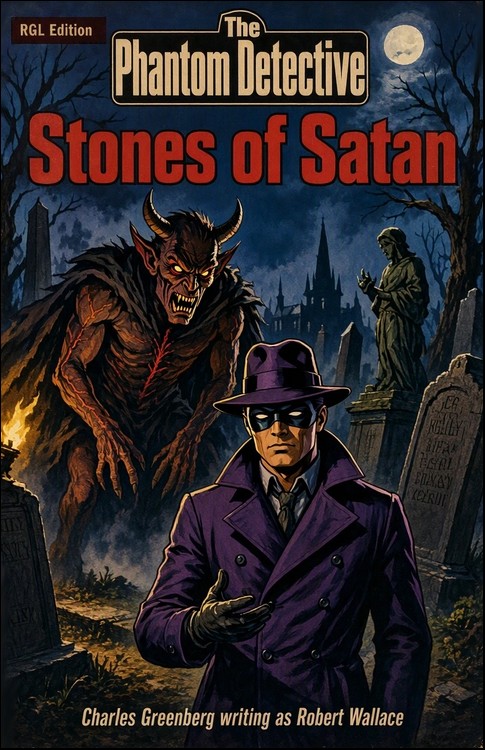
RGL e-Book Cover
Based on an image created with Microsoft Bing software
Roy Glashan's Library
Non sibi sed omnibus
Go to Home Page
This work is out of copyright in countries with a copyright
period of 70 years or less, after the year of the author's death.
If it is under copyright in your country of residence,
do not download or redistribute this file.
Original content added by RGL (e.g., introductions, notes,
RGL covers) is proprietary and protected by copyright.
RGL e-Book Cover
Based on an image created with Microsoft Bing software

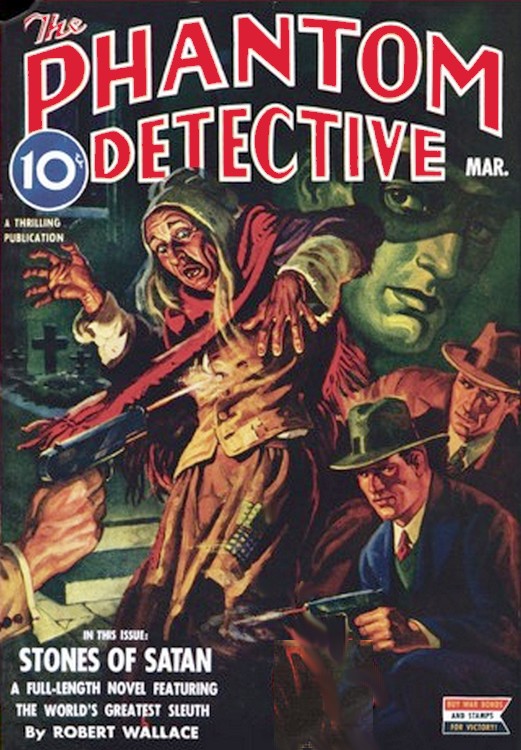
The Phantom Detective, March 1943, with
"Stones Of Satan"
The wings of death brush past the Phantom Detective as he pits brains and brawn against the sinister cunning of a diabolical criminal's fiendish brand of deviltry! The world's greatest sleuth battles to halt a murderer's grim plot of doom!
KARL SCHILLER would have been respected as an "honest burgher" in his native Holland, a man of character and worth, a solid citizen.
Through generations the Schillers had been proud craftsmen. It takes skill and patience and years of painstaking training to be a first-class diamond cutter, and Karl Schiller was one of the best. The quietly proud awareness of it was responsible for the ponderous dignity with which Schiller conducted his life.
Yet that gray November afternoon, with a bitter wind prowling like a hungry wolf through Manhattan's canyons, Karl Schiller was startlingly out of character. It is almost impossible for a fat man with a billowing paunch and a derby to slink along like some furtive underworld creature. Schiller made a kind of burlesque of it, plodding along close to the building, peering fearfully over his shoulder.
His blue eyes were wide with fear. For Karl Schiller felt that death was skulking behind him, reluctantly maintaining its distance only because of pedestrians and traffic cops.
There was that black sedan. It had come slashing toward him as he had tried to cross the street. Only a wild backward leap had saved him from being run down. And it was no accident!
He knew that by the way it had happened, and the glimpse, he had caught of vicious criminal faces in the sedan. He knew it because he was conscious that he carried something in his left coat pocket which would dramatically expose a criminal scheme involving millions of dollars.
It burned like a live coal there in his pocket, that hard little object. If he had not noticed what he had he might have been safely at work now, without terror sliding slimy fingers up and down his spine. He might have ignored it. But Karl Schiller was an honest man. He could not keep his mouth shut when he suspected a gigantic criminal scheme.
HE saw the neon sign of the Empire Bar and Grill and breathed a sigh of relief. The rendezvous he had furtively arranged was there. Entering, he glanced at the half-dozen men at the bar. The person he was to meet had not arrived yet.
He walked to the bar, lowered his huge bulk onto a stool and ordered a beer. It was a pleasant, dignified place. The murmur of conversation, the clinking of glasses, the well-dressed people—it was all reassuring. Surely nothing ugly could happen here!
He picked up the glass of beer placed before him, sipped it, made a wry face. And then a quiet voice murmured on his left:
"Yes, American beer has its shortcomings, hasn't it? Most certainly it isn't like the Munich beer, or the excellent Dutch beer."
Fear again stabbed at Schiller as he jerked toward the speaker. A moment later, he felt foolish. There was nothing sinister about the quiet-faced, well-dressed man who stood there. He looked the typical business executive who had dropped in for a mid-afternoon drink.
"Yes, the Dutch beer is very fine," Schiller said in his guttural accent. "I should know. I am a Hollander."
The man nodded pleasantly.
"Really? Well, the Dutch are fine people—and will be free people again. My theory on beer, however, applies to other things, too. Imported things, I mean. Take cigars, for instance. Though a patriotic American, I still prefer those especially made for me by a Cuban concern. Won't you try one?"
Smiling affably, he extended a thick, gold-banded cigar.
"I'll be glad to try it," Schiller said, warming to the man's cordiality. "Won't you have a drink?"
The man shook his head.
"A bit later, perhaps—thank you. I must make a phone call now. Try the cigar and tell me what you think about it when I return."
As he walked away from the bar Schiller sniffed appreciably at the cigar, reached in his pocket for a match.
The pleasant-faced stranger who had strolled to the phone booths knew what viciousness was about to break loose. So did the five hard-faced men who sat in a parked car down the block. It was a big black sedan which Karl Schiller would have recognized.
"If it works," one of them said, "I sure hate to miss it, Lippy. Anythin' The Satan pulls is usually a honey. That fat Dutchman—"
A big, sleepy-eyed, sad-faced man in the front seat scowled.
"Button it, mugso!" he said in a hard, flat voice. "And don't ever again yap about The Satan. What he does is none of your business. You're taking orders from me—Lippy Gilman. Get that through your thick skull!"
"Okay, Lippy. Sorry."
They waited.
A NEW little coupé swung to the curb. It had the placard "Press" in its windshield. Red-headed, freckled Steve Huston, who got out of the coupé was an ace reporter for the New York Clarion. He entered the Empire Bar for a sandwich and a glass of beer just as Karl Schiller was raising a lighted match to the cigar given him by the cordial stranger.
In that moment, a long-hooded limousine, chauffeur-driven, swung around the corner. Thomas Eldridge, the man on the rear seat, leaned forward to speak to the chauffeur. He was gray-haired elderly, aristocratic looking, with shrewd black eyes and thin, finely chiseled features.
"The Empire Bar on the left there, Hilton," Eldridge said, and the chauffeur swung the limousine behind the black sedan.
The girl with Eldridge crossed, her legs with languid deliberation. Flo Jarbeau's long, tapering, silken legs were among her assets as a show-girl, as was her magnificent body, her platinum blond hair, her deliberate huskiness of voice. So were the expressions she could get into her greenish eyes and in the curl of her full, red lips. In her own way, Flo Jarbeau—whose birth certificate read "Florence Jarbonski"—was an artist of considerable merit.
"Darling," she drawled, "don't you think you should wipe the lipstick off your mouth? It's not nice to flaunt that kind of thing at your age!"
Eldridge's fine black eyes became bleak.
"Quite often, Flo, you make me despise myself," he said quietly. "You're a curse which had clawed its way under my skin. I wish I knew a cure for it."
She laughed.
"Oh, I can tell you that. You'll be cured when I get tired of those pretty little checks that you sign for me. But so long as I still like them, and furs, and diamonds—"
She laughed again, and Eldridge savagely wrenched open the door and got out of the limousine. Rubbing a handkerchief over his lips, he walked toward the entrance of the Empire Bar and Grill.
Karl Schiller, still at the bar, had now lighted the cigar. He took several puffs on it. A puzzled expression appeared on his round, heavy-jowled face. He removed the cigar from his lips and stared at it curiously. It did not taste like any cigar that he had ever smoked. The flavor of tobacco seemed to be blended with some sort of chemical—
And then the cigar exploded! The smoldering brown cylinder suddenly became the source of a blinding flash expansion.
Steve Huston, within a few feet of Schiller, felt as if the fire doors of some gigantic furnace had abruptly been flung open before him. He was conscious of incredible, searing heat.
Then Karl Schiller screamed, a high-pitched, horrible, prolonged scream that might have come from the throat of a woman. And Steve Huston had a moment of brain-numbing horror when he realized that the man was aflame!
The devilish chemicals of the incendiary pencil within the cigar had splashed Schiller, and it had the effect of a flame touching off gasoline-soaked clothes. Flames—and the stench of chemicals, of burning cloth! A human torch, plunging in screaming, blind panic to the street door!
"Don't run!" Huston shouted.
THE advice was useless. Huston was a few steps behind Schiller when the fat man darted outside. An elderly, distinguished-looking man, about to enter, recoiled with horror. Huston heard him yell hoarsely: "Schiller! Schiller, for God's sake—"
Three women into whom Schiller almost collided, scattered with bloodcurdling screams. A taxi's brakes screeched, and there was the crash of another car piling into it as the human torch ran blindly out into the traffic. The taxi knocked Schiller down.
Steve reached him before he could get back to his feet. He stripped off his overcoat, dropped it over the writhing, howling man in the street. Then he half pounced on top of it, trying to stifle the flames.
"Get back!" a voice shouted. "Quick!"
Huston looked up. A radio car had skidded to a stop abreast of Schiller's body. One of the patrolmen inside was leaning through the open door. He was holding a brass fire extinguisher.
Huston threw himself backward, as a hissing jet of chemically treated fluid shot out from the extinguisher. The patrolman played it over the body. The acrid stench intensified. And the body was no longer writhing. The fat man was either dead or unconscious.
The extinguisher was soon empty. On hands and knees, Huston came closer to the body. Then he suddenly felt a sharp pain at his left knee. He glanced down involuntarily, saw that he had brought his knee down upon a pebble.
Yet it wasn't really a pebble. It was a quartzlike object, roughly and peculiarly shaped. And it seemed to Huston that he remembered seeing it roll away from the fat man's body when the taxi knocked him down.
Obeying a reporter's instinct, Huston scooped it up and dropped it in his pocket. An animallike moaning made him jerk to the body again. Karl Schiller, his face blackened and no longer recognizable, was trying to lift himself up on one elbow. The moaning became a strangled shriek torn out of his throat.
"Take it easy, brother," the patrolman, now out of the radio car, admonished gently. "An ambulance will be here in a few minutes." The cop's eyes rolled to Huston. "What happened? What set him on fire?"
"A cigar," Huston replied automatically. "I saw it."
The cop stared.
"A cigar? How in all creation could a cigar—"
"A trick cigar," Huston interrupted, his voice angry. "An incendiary pencil concealed inside. Went off when he lighted the thing ... Wait!"
Karl Schiller's puffed, blackened lips were moving. They tried to form words, but couldn't, at first. Then he gasped:
"He—he warned me. Telephoned and said he—he knew—what I—I planned to do. Warned me—not to. Said he would—kill me—"
Freckles stood out vividly on Steve Huston's blanched face. "Who warned you?" he asked tersely. "Who was he?"
The fat man's eyes rolled within the singed lashes.
"Oh!" he moaned. "It hurts! Everywhere! I'm still—on fire!"
"You'll be all right!" Huston said, kneeling near the man's head. "You're severely burned, but you'll be all right. We'll get the devil who did it—if you tell us his name. Who threatened you with death?"
"Don't—know his real name," Schiller whispered. "He calls himself—The Satan! I'm not delirious. That's what he said—The Satan! He, somehow, knew that—that I—"
A fresh and horrible spasm of pain made Schiller roll his eyes until only the whites showed. He opened his mouth to scream, then his body went limp as, mercifully, he fainted.
Steve Huston found himself staring at the cop.
"The Satan!" he repeated with soft incredulity. "The Satan!"
HUSTON got to his feet, automatically brushed his clothes, reached for his soaked overcoat covering the fat man—and changed his mind about picking it up.
"Maybe it's one of them crazy religious cults," the patrolman said. "I heard somewhere that some nuts worship the devil."
Huston shook his head.
"No. He would have spoken differently, if that were it. This is underworld stuff. He had some information—and was warned against exposing it. He didn't heed the warning, so, somehow, he was slipped that devilish cigar. It didn't quite do the trick, though—he's still alive. He'll tell all he knows at the hospital."
"Yeah, he'll talk, all right," the cop agreed. "Say, your face is familiar to me."
Huston grinned faintly.
"Lots of cops know me. I'm Steve Huston, reporter on the Clarion. I—" He broke off and his eyes narrowed as he saw a man leave the fringe of the crowd around the body—the aristocratic-looking elderly man who had met the screaming human torch at the entrance into the bar. He had yelled the fat man's name. What was it again? Yes, Schiller!
Huston's first impulse was to trail the man, who was now entering a shiny limousine. Instead, he merely noted the limousine's license number. It seemed more intelligent to stick with the fat man, be at the hospital when he was identified, be present when he revived.
The red-headed reporter felt that the incendiary pencil bomb exploding within that cigar launched a sinister case that would make front-page headlines. Instinct warned him that viciousness was brewing somewhere—and perhaps he also had a subconscious warning that eyes in the crowd were watching him. They were—and ugly menace slitted those eyes. And ugly thoughts were passing through the mind of the "cordial stranger" who had given Karl Schiller the cigar.
That man elbowed his way out of the crowd and strolled down the block. As he approached the black sedan, he drew a handkerchief out of his pocket and went through the pretense of wiping his face. The gesture effectively concealed most of his face when he passed the sedan and swung into an arcade. He paused there, waiting.
"Lippy" Gilman, in the front seat of the sedan, said curtly:
"Wait here, you guys!"
He got out, a loose-limbed giant of a man. Walking with a peculiar, shuffling, flat-footed slouch, like some dreamy-brained Alabama Negro, he approached the arcade and swung into it.
"It's bad, Lippy," the man waiting there said. "It's very bad. But not irreparable."
"That's a good word," Gilman said. "You mean, it ain't too late yet?"
"That's what I mean. Schiller is alive. That cop got to him too quickly with the extinguisher. Schiller will talk to the police. That mustn't happen, understand?"
Gilman's bony, elongated face became longer and sadder.
"It's tough to try to bump him now. Cops standing by. Cops will be waiting outside his hospital room until he's ready to sing." He shook his head. "It's too tough."
"I hired you because you're good at tough jobs," the other man said. "There's another five grand in it for you. It's got to be done!"
GILMAN stared at his fingernails. "Cops around him now. Cops in the hospital. Dough ain't no good to a guy that's got police slugs in him. You can't use dough when you hang around in a death cell, either. How could I do it?"
"I heard one of the cops phone for, an ambulance from the St. Agnes Hospital. It won't be so tough at the hospital. Get there first. Spot the emergency ward, where the ambulances pull in. Spot a place from where you can cut loose with a tommy-gun. It's getting dark now. When they take Schiller out on the stretcher, let him have it!"
"That sounds better," Gilman said. "Though it won't be a pipe cinch. There'll still be cops trailing the ambulance. But okay, we'll pull it!"
"Good! When you're through, get in touch with me in the usual way. I've got another job that's got to be done right away—and it's just as important."
"What's that?"
"You noticed the blue coupé parked in front of the sedan?"
"Sure."
"You remember the fellow who got out of it? He was the one who chased Schiller out of the bar and threw his overcoat over him."
"Yeah, I saw him."
"Now get this! He's Steve Huston, reporter for the Clarion. He picked up the stone. The stone, understand? It fell out of one of Schiller's burned pockets. I saw that reporter pick it up. Of course, he has no idea what it is, but he'll find out if we let him. We've got to get him before he has a chance to do any snooping."
Gilman rubbed the stubble of beard on his craggy chin.
"Look, Boss," he said slowly, "you're not hinting that I bump off that reporter?"
"Reporters have been bumped before."
"I know. But this one is different. He's Frank Havens' fair-haired boy. I don't give a hoot about the power of the press, and all that boloney. But I do about the fact that Frank Havens is the Phantom's only known contact. If we bumped Huston, Frank Havens is sure to sic the Phantom on us.
"You know I ain't yellow. But I'll tell you right now that I'd have the creeps if I knew that the Phantom was after me. That's one guy I'm plenty scared of—and I ain't the only one who feels that way. To tangle up with the Phantom is murder!"
Big as he was, Gilman winced at the grip of the slender hand which caught his arm. The eyes of the man looking at him flamed. And the same viciousness was in his voice as he said softly:
"Don't you think I've thought of the Phantom, you fool! There are millions in what I am doing. It's probably the most ingenious scheme in criminal history. When it explodes—as it must, sooner or later—it'll set the Phantom on my trail, anyway. I know his reputation as well as you do. I know he is a clever and dangerous man. But I'll destroy him as a potential menace. I'll get him because I'll do what no one has ever tried before!"
A GLINT of excitement crept into Gilman's yellowish eyes.
"What'll you do?"
"I shall emulate certain foreign powers which have most spectacularly demonstrated the advantages of warning they would attack. I won't wait until the Phantom has reason to get on my trail. I shall strike first, while he knows nothing, suspects nothing, isn't on his guard."
"But how can you get to him?" Gilman asked. "Nobody knows who the Phantom is or what he looks like." The vicious, snake-glittering eyes bored into Gilman.
"I'll do it through Steve Huston. I'll set a trap. When its jaws clamp shut, the Phantom will cease to exist. But we've talked too long. That ambulance ought to be here any minute now. Get to the hospital and blast Schiller when he's brought in. Then I'll tell you my other plans."
Gilman felt a chill in his spine as he left the man and strode back to the sedan.
"The Satan!" he muttered. "Boy, that name fits him, all right!"
Lippy Gilman, himself a hardened killer and far from being a fool, did not find it hard to play around with the thought that the man who called himself The Satan really had been spawned from the inferno.
In the limousine which Gilman passed on his way to the sedan Flo Jarbeau was telling Thomas Eldridge:
"This is going to keep me up nights. I'm on the brandy diet from now on, pal. I'm going for places where there's lots of noise and drunken mugsos. I—I can't forget—how he screamed! I still hear it!"
There was panting hysteria in her voice. Lipstick showed plainly on lips drained of natural color. Her greenish eyes were wide and staring. Leaning forward, her shoulders hunched, Flo seemed to expect that any moment some brutal weight would crush her.
Eldridge patted her shoulder. "Don't take it so violently, dear. I know it was horrible—"
"Tell me this," she interrupted. "That fat man—was he the man you were supposed to meet in that bar?"
Eldridge's eyes slowly became fiercely aglow, like dying coals fanned to life by bellows. He grabbed her wrist, yanked downward violently until her face was inches from his.
"How did you know that?" he whispered.
She tried to free her wrists, and couldn't.
"You fool!" she panted. "I didn't know! I guessed it. Why else should you want to drop into that bar for a few minutes, without me? It isn't the kind of place you usually patronize. I figured you must have a date with someone. Since you brought me along, it wouldn't be a woman. Now let go my wrists!"
Eldridge released her and she pushed to the far corner of the seat.
"You're a smart girl, Flo," he said slowly. "If I were positive about what I now can only suspect, I think I'd kill you! Surprises you, doesn't it—coming from me?"
SHE glared at him, angry, half-crouched like a cat ready to claw. "I'll tell you something that'll surprise you, coming from me!" she flung at him. "I've had enough of you. I'm leaving you—now and for good. And I'm leaving you without asking you to sign one of those pretty little checks for me. I need"—hysteria shrilled her voice—"I need a change of scenery!"
Eldridge's face became gray. He was an old man in that moment.
"No, Flo!" he said hoarsely. "Please don't! I need you! I'll do anything Flo!"
She wrenched open the door, got out of the limousine. Her high heels beat an angry tattoo on the pavement as she half-ran down the street.
The banshee wail of an approaching ambulance's siren sounded in the distance. It diverted Steve Huston's attention from the fur-swathed, long-legged and spectacular looking blonde whom he had noticed leaving the limousine as if she were escaping from it. He glanced over his shoulder at the approaching ambulance, then his eyes shifted to the fat man's still body.
"All right, here we go!" he said under his breath. "There's trouble in the air! I feel it. I know it!"
THE merry group in Frank Haven's home might have heard the warning howl of that same ambulance as it had raced by that snooty section of Park Avenue. Havens, millionaire publisher of the New York Clarion and a chain of other Coast-to-Coast newspapers, was throwing another of his select cocktail parties.
It was an honor to be a guest at one of these parties. Achievement, not mere wealth and social standing, was with Havens the measuring stick for meriting an invitation. With one exception, every person here now was distinguished in his own field or profession.
A brilliantly successful novelist lighted the cigarette of a world renowned women's clothes stylist. A great criminal attorney maintained a friendly argument with a famous archeologist. Listening with amused interest were a Metropolitan Opera star, a tennis champion, a distinguished Viennese psychiatrist.
In the music room, a pale-faced man created magic with supple fingers on piano keys. Concert halls the world over had rocked in applause to his artistry.
Distinguished people, these men and women; people who had contributed something to the world; people whose names meant something. With one exception! That was the tall, broad-shouldered, handsome young man who sat on a couch chatting with Havens' daughter, Muriel.
Had Havens' guests paused to think about it, each would have drawn the same obvious conclusion: Frank Havens invited Richard Curtis Van Loan to his parties simply out of affectionate memory of the young man's father, who had been Havens' best friend. Surely there could be no other reason.
For Richard Van Loan's sole occupation, apparently, was showing his charming self in Manhattan's snootier night spots. Having inherited a great fortune when his parents died, he seemed to prefer to drift along as a society playboy, an eligible bachelor who always grinned his way out of emotional entanglements. He was an excellent filler-in when an extra man was needed, and regularly made the rotogravure sections. To put it bluntly, he seemed to lead a most inane and useless life.
Yet Frank Havens might have exploded a dramatic bombshell that would have stunned his guests. He might have pointed to this languid society playboy—and introduced him as the Phantom!
The Phantom—scourge of the underworld, a bitter foe whenever and wherever crime on a big scale raised its hydra head. A legendary man of mystery, hated and feared like the plague by underworld rats, respected by police officials throughout the world. A super-sleuth, grim and deadly efficient, who never sought reward and acclaim, who always remained anonymous.
The underworld called him the Man of a Thousand Faces. And it cursed with impotent, savage rage the fact that there could be no vengeance against the dreaded Phantom. Not only were the criminal rats in complete darkness of what the Phantom, master of disguise that he was, really looked like, but they also had not the faintest idea of who he was, where he lived.
Only Frank Havens knew that. And the publisher would have sacrificed his life before betraying that secret.
HAVENS had launched Van upon his career of combatting crime. He knew that Van was restless and bored, that the life of a playboy nauseated him. He had to find some outlet for his keen intelligence and tremendous energy. Havens suggested that Van try solving a case which had been baffling the police.
Van did that—anonymously, in disguise. He spectacularly cracked the case. But because he refused to take any credit for his efforts, to make himself known, he was dubbed the Phantom Detective. Van accepted that name—and made it famous!
Deliberately, nevertheless, to ward off any possible suspicion, he kept up the affectation of being a playboy. But no one knew that most of the drinks he ordered in night-clubs deftly found their way under the table. No one dreamed that he led a Spartan life, maintaining his body in splendid shape, spending long hours daily reading, studying, experimenting in his laboratory, keeping abreast of progress in crime detection.
Muriel Havens had no way of knowing that Van had come to her father's party after poring for eight consecutive hours over test tubes and retorts, experimenting upon a new and revolutionary method of extracting latent fingerprints. She mistook his fatigue for simple bored languor.
"Listen, Van," she said earnestly, "I've known you quite some time. I am fond of you, as you must know. I hope you won't take offense at what I'm about to tell you."
She was charming, Frank Havens' daughter—dark-haired, dark-eyed and intelligent, with a piquant face, with gentle, sensitive lips. Van liked her tremendously—and because he did, he dreaded to hear what he suspected he was about to say.
"You look adorable when you get that serious expression on your pretty face," he said, grinning. "All right, what do you want to tell me?"
"Just this, Van. There is a war going on. Everyone is doing something. Can't you find something to do which has some meaning and significance? Aren't you a bit ashamed to go on chasing around night-clubs, leading a completely vacuous sort of life? Really, Van—"
"Ah, but you're wrong, Muriel," he interrupted with faked gaiety. "You can't say that I'm not doing my bit for Britain, at least."
"You do?" she said, startled. "What?"
"Well, think of the Scotch I consume! Each time I take a drink—"
"I'm sorry, Van!"
She got up and walked away.
Van's eyes were bleak as they followed her. It was cruel to hurt her, to force her to believe that she was fond of an utter idiot. Yet he had to maintain the pretense. He didn't dare to trust even Muriel with the secret which her father alone knew. And it would be even more cruel if he permitted her to fall in love with him.
AT any moment, desperate men might request the Phantom's help. That was the way that Van served society—and it was a self-imposed obligation that he never meant to shirk. And in the dangerous, lone wolf game he played, there was always the possibility of fatally stopping a bullet or some killer's knife.
Sitting there on the couch, a driving restlessness began to pound within Van. He regretted coming to Havens' party, hated the act that he was putting on. And he wished with all his heart that something would put him on the trail of murderous vermin.
That was the moment when the ambulance swerved over to Karl Schiller's body. A white-coated young intern got out, waved to Huston, whom he knew, and knelt over the body. He looked up, his eyes incredulous.
"How did he ever get burned that way?"
"A trick incendiary bomb, Pete," Huston replied. "Somebody tried to knock him off. Which makes it police business. He'll live, don't you think?"
"Well, his pulse seems all right. But he'll need lots of new skin. Okay, Jerry, hand down the stretcher."
Karl Schiller mercifully remained unconscious as his huge bulk was loaded into the ambulance. Huston ran to where he had parked his coupé. He trailed the ambulance, and the radio car swung in behind him.
Ten minutes later, the ambulance made a slashing U-turn, swinging toward the ancient gray walls of the St. Agnes Hospital. The emergency ward and the drive-in for ambulances was a dark, tunnel-like opening.
The ambulance shot toward it—and suddenly shuddered to a stop. Huston jammed on his brakes, coming within a hair's-breadth of plowing into its rear. And he heard the squeal of the radio car's brakes behind him.
Leaning out of the side window, he saw what had checked the ambulance driver. A bottle had been smashed just within the entrance into the driveway, the jagged pieces of glass reflecting the glare of the headlights.
The burly, thick-shouldered driver got out.
"I'd like to lay my hands on the dope who did that!" he said angrily. "How's about carryin' the guy from here, Doc? It's only a little ways. I'll sweep up that glass. To drive over it now means a sure flat."
The intern nodded.
"Okay, Jerry."
Huston backed up so that they might open the rear doors of the ambulance. The radio car behind him did likewise, swinging back to the curb.
"Okay, Red, start moving," Lippy Gilman, in the black sedan parked near the corner, said softly. "Slowly. But give 'er the gun—fast—when I let go with the tommy!"
Long-hooded and slinky, the sedan came like a foraging shark gliding toward its unsuspecting prey. Closer, closer—and it was abreast of the ambulance when they slid out Karl Schiller's body. Gilman's finger, curled on the trigger of the submachine-gun, tightened with unhurried pressure.
Steve Huston was watching the body on the stretcher. He was unaware of the car which had sneaked up to them, until the tommy went off.
The comparative silence was shredded, viciously ripped apart by the savage hammering of the tommy. Angry little spurts of orange jabbed from a window in the sedan.
The ambulance driver yelled hoarsely as he dropped his end of the stretcher. For an instant, the body was on a forty-five degree angle, full in the glare of Huston's headlights. With horrible clarity, he saw the devil's stitch of bullets had ripped across the fat man's chest. Then like something dumped out of a wheelbarrow, Schiller's body sagged out of the stretcher, one end of which was still held by the paralyzed intern.
The sedan shot forward. Tires screeched in protest as, on two wheels, it slashed around the next corner. Huston jerked around to the radio car behind him. It was leaving the curb, whip-lashing around Huston's coupé, catapulting toward the corner.
Huston had his car in motion before he saw the rear red light of the radio car whip around the corner. He wrenched the wheel, almost overturning the coupé as he sent it careening in pursuit of the police car.
He saw it halfway up the block. And in that same moment, he heard again the spine-tingling hammering of the submachine-gun. Like a wounded, frightened-thing, the police car shied violently to the left. It jumped the curb, hurtled across the pavement. There was a mad sound of splintering glass as it plowed into a shop window!
Gritting a curse through his teeth, Huston jammed on the brakes as he came abreast of the wrecked shop window. The murder car was out of sight now, having turned another corner. And the radio car was backing, trying to extricate itself from the wreckage of the window. It came clear, limping and battered as it backed across the sidewalk. The front left tire was flat.
The police car painfully maneuvered itself off the sidewalk and against the curb. Steam hissed and curled from its smashed radiator. Huston ran toward it, wrenched open the driver's door.
"You fellows hurt?" he asked breathlessly.
One of the cops was gently fingering a bruise on his forehead. The other seemed all right. Both were giving vent to boiling language.
"The dirty devils put a tommy gun burst in a front tire. Leaping Lena here got out of control. You'd better stay with this mess, Pat. I'll shoot back to the hospital and phone in from there. You noticed their license number?"
The other cop shook his head.
"No, they had it covered over with grease or something."
"Grab a lift in my bus back to the hospital," Huston volunteered.
"Thanks."
THE patrolman growled at the curious mob beginning to gather around the police car. Entering Huston's coupé, he said grimly:
"The Satan! I take back now about it maybe bein' one of them nutty religious cults. Like you said, this is underworld stuff—and it's big-time. Ordinary punks don't play around with tommy guns."
"It's big-time, all right," Huston agreed quietly. "And we won't get any information now from that fat man. They sealed his lips—permanently."
He had proof of this when he parked behind the ambulance again. The body hadn't been moved from where it had fallen off the stretcher. The intern was kneeling over it. He lifted a pale and twitching face.
"It's a job for the undertaker now—and Homicide. Those bullets pretty near cut him in two."
The patrolman again cursed with intensity.
"All right," he said then, "let's get him inside and try to identify him. I've got to use a phone, too."
BULLET-HOLES, Huston noticed, perforated the canvas of the stretcher. His eyes grim, he watched the fat man being placed on it again. The patrolman brought up the rear as the driver and the intern slowly moved around the ambulance toward the emergency ward entrance of the hospital.
Huston was about to trail after them when a hand suddenly clutched his arm. He jerked around. An old hag stood facing him. She showed her toothless gums in a travesty of a smile, a rags-swathed, filthy, crafty-eyed creature, whose hand on Huston's arm was like the hard, scaly claw of a bird.
Huston freed his arm and automatically reached in his pocket for a coin. And then the hag said, in a cackling, somehow malicious voice: "You're a reporter, ain't you? I see a press card on your car. Lots of people won't believe that Loony Mary can read and write. But she can. Loony Mary can do a lot that'd surprise people."
"Yes, I'm a reporter for the Clarion, " Huston said impatiently. "What do you want?"
"A thousand dollars," she said. "Maybe more. Maybe two thousand dollars. Somebody can get a wonderful funeral for that much money. I saw a funeral once with—"
Huston placed a twenty-five-cent piece in the hag's claw. He felt repugnance as his fingers touched the cold, scaly, bony hand.
"That's the down payment on the two grand," he said. "Now I've got things to do."
He turned to leave her—and again her hand caught his arm.
"You want to find out who the man killed was, don't you?" she whispered. "Well, his name is Karl Schiller and he's a diamond cutter and he works for a company called Davenport and Hardy. He was killed by somebody who calls himself The Satan. I know who The Satan is. I know why he murdered Schiller." She cackled hideously. "You still in a hurry to leave me, young man?"
Steve Huston stared at the creature, half believing that this was some sort of crazy hallucination.
"What are you telling me?" he asked tersely. "You know why and by whom that man was murdered? You know who The Satan is?"
The crafty eyes peered animal-like up at him through the screen of matted gray hair.
"That's what I'm telling you. Old Loony Mary, she knows lots of things. People say I'm crazy. But I ain't. I only let 'em think I am. No, young man, old Loony Mary ain't crazy."
Huston jerked a thumb toward his coupé.
"Let's sit in the car and talk, eh?"
"Now that's real considerate of you," she cackled.
He helped her into the car, again feeling his flesh crawl as he touched her. Sliding in next to her, he smelled the musty, decaying odor that emanated from her.
"All right," he said, "how do you happen to know the fat man's name? Who is The Satan? Why did The Satan murder him?"
She shook her head. There was something horrible in what was meant as a coquettish gesture.
"If I tell you something young man, I want to make sure I get paid for it. Newspapers buy stories, don't they? You think your newspaper will pay a thousand dollars for maybe the biggest story that it ever printed?"
"It may—if the story is worth it."
SHE leaned closer to him, and he retreated as far as he could.
"Oh, it's worth it, young man. It's about a human devil who already has killed three times, though you seen him do it only once. But he'll kill many more if somebody don't stop him. I saw the other two murders. He killed the other two men slow-like, and they screamed and screamed."
"Who were they?"
"Not so fast, young man! There's the thousand dollars, and there's my grandson Jimmy, and there's me who wants a fine funeral but who don't want to be murdered."
Huston tried to be patient. "What's your grandson Jimmy got to do with it?"
"He's working for The Satan. He's just a silly kid who didn't know what he was getting into. Now he don't dare quit. Because they'll kill him, see? Before I make a deal with you, I want to make sure that things will go easy with Jimmy when the rest of those devils are caught."
"That's easy," Huston said eagerly. "I can make arrangements with the police—"
"I don't trust cops," she said, with abrupt and startling viciousness. "I hate cops! Besides, if they handle this thing, they'll gum it up somehow. The Satan will outsmart 'em. And that'll mean that Jimmy and me will get our throats slit. I want a fine funeral—yes. But I ain't ready to die yet."
Huston stared at her.
"I don't follow you. If we keep the cops out of it, who'll catch The Satan and his killers?"
For the third time, her clawlike hand fastened itself onto Huston's arm.
"There's one man who can do more than all the cops put together," she whispered hoarsely. "He's a man who ain't out for glory or money, and who's got a reputation for keeping his word. That man I'll trust—and nobody else. Who am I thinking about, young man? Can you guess?"
"You're referring to the Phantom?" Huston replied tersely.
The skeletal fingers tightened on Huston's arm.
"Yes," she panted. "Yes! Get the Phantom. Bring him to a certain place. I'll have Jimmy there, too. If I get the Phantom's promise that I'll get a thousand dollars and that me and Jimmy will be protected, I'll tell the Phantom all about The Satan and his murderers. Can you do it?"
Huston jerked free his arm. "Where'll you be an hour from now?"
"Where I always am—the Woodward Cemetery."
"A cemetery?" Huston repeated, startled. "Can't you think of a more cheerful rendezvous?"
"If you're scared of ghosts, young man," she cackled, "you needn't come. I don't think a cemetery at night would frighten the Phantom. Can you get hold of him?"
"I'll try."
"Good! Come to the side gate in the wall which faces the railroad tracks. It's always open. Wave a flashlight. I'll be there."
AS she wrenched open the door to get out, Huston asked:
"You say you're always in the cemetery there? Why?"
She peered through the matted gray of her hair, a macabre creature who again touched horror with an attempt at coquettishness.
"I've got a home there. A peaceful home made of stone. It keeps me dry and comfortable. And I fool the Angel. The Angel would never look for anybody in a cemetery. That's why I've lived as long as I have."
"The Angel?" Huston echoed. "What Angel?"
"The Angel of Death, of course. He goes up and down the world, gathering people whose time it is to die. But he don't come to cemeteries. Because he thinks only the dead are there. That's how I fool him. I live with the dead. But I must get back now, real quick, or the Angel might spot me. I'll be waiting for you and the Phantom, young man."
She smiled with her toothless gums, got out of the coupé. Walking with a peculiar, crablike gait, she shuffled up the street, disappearing in the darkness.
Huston lighted a cigarette, dragged the smoke deep into his lungs. The creature was mad. Her final prattling about fooling the Angel of Death proved that. Should he try to get the Phantom, to have him contact a madwoman?
Yet she seemed pretty rational in much that she had said. She knew about The Satan. She claimed she knew the name and occupation of the murdered man. If she knew that much—
He leaned out of the window and waved to the patrolman who was coming out of the hospital.
"Did you identify the guy who was bumped?" he asked.
"Yeah. His name is Karl Schiller."
"And he works as a diamond cutter for Davenport and Hardy?"
The patrolman stared at him. "That's right. But how did you find that out? I thought the guy was a stranger to you."
"He was," Huston said. "And it's my turn now to grab a phone."
He piled out of the coupé and ran toward the entrance of the hospital.
Back in Frank Havens' home, Dick Van Loan was trying to think of some excuse that might justify his departure. The party was in full swing, and his restlessness made him feel alien. The occasional reproachful look that Muriel gave him did not improve his mood.
He watched Havens approach him as he sat alone on the couch. A guarded tenseness in the publisher's attitude, the purely mechanical smile with which he replied to a comment from someone whom he passed, suddenly intrigued Van. What was up?
Havens paused before him.
"Bored, Van?" he asked casually.
"Not at all, Mr. Havens. This is a swell party."
"At least, you can lie gracefully." Havens smiled.
"Which is something you can't do." Van grinned back. "Your casual attitude doesn't fool me one bit. There's something on your mind. What is it?"
"Come into my study," Havens said.
Leisurely, attracting no attention, they crossed the magnificent living room to Havens' study. The publisher dropped his pretense when he closed the door.
"Get on that extension phone. Van," he said. "Steve Huston is on the wire. He's dug up something really important."
VAN'S manner changed instantly, now that he no longer had to be on guard. His studied boredom vanished as he lifted an extension to the phone on Havens' desk.
"Hello, Steve?" He heard Havens say. "You mind repeating what you told me? I didn't quite get it."
Steve Huston's voice, shrill with excitement, came over the wires.
"A murder was committed a few minutes ago, Mr. Havens. I've good reasons to believe it part of a vicious and extensive criminal scheme. Someone is willing to sell us facts, for a thousand dollars, that would clear up the mystery, and bring the killer to justice. That means, of course, that the Clarion will have a beat on something that may be of national importance."
"It's entirely up to your own judgment and discretion, Steve," Havens said promptly. "If you think the story is worth a thousand dollars, the Clarion will pay it."
"Thank you, Mr. Havens. There's a catch to that set-up, however. The woman who has the information—and she's convinced me that she does know something—is frightened. She fears retribution from the criminal and doesn't trust the police. And she wants assurance of immunity for her grandson who, according to her, got involved with those killers before he realized what he was doing. She insists that she won't make a deal with anyone except the Phantom. He is the only man she feels she can trust."
"Are you positive that the case is big enough to interest the Phantom?" Havens asked.
"Yes, I am," Huston replied quietly. "You know I don't get excited over trivialities, Mr. Havens, but I've learned to trust my intuition."
Havens glanced at Van, who nodded.
"When and where do you want to meet the Phantom, Steve?" the publisher asked.
"At the Empire Bar and Grill on West Fifty-first Street. This deviltry spring-boarded from there. I'd like to meet him there within an hour, if possible."
Again Van nodded in response to a questioning look from the publisher.
"Very well, Steve," Havens said. "I feel certain I can arrange it. The Phantom will meet you there within an hour."
"Thanks, Mr. Havens."
The publisher hung up.
"Of course, Van," he said, smiling, "I regret that you are leaving my party, but—"
Van grinned. "You'll please offer my apologies to your guests, if anyone notices I'm no longer around. Which I rather doubt! Now I'll get under way—to answer the call of duty."
"Duty?" Havens repeated sarcastically. "Or is it that you aren't happy until you're risking that fool neck of yours?"
"Both," said Van.
A SHORT walk brought Van Loan to the Park Avenue apartment building on the roof of which he had his penthouse and his own private street entrance. A self-service elevator to which he had a key lifted him to the roof.
There were no servants in the hushed luxury of the beautifully appointed penthouse. Van had them come in only when he found it convenient.
He went to a huge wardrobe closet in his bedroom, removed the expensively tailored clothes he had worn to Havens' party, hung them up. Then he touched a secret button, and the entire back section of the closet noiselessly slid to one side.
Neither the maids who cleaned the penthouse, nor the architect who designed it, knew about that secret inner closet. Van had had it especially built for him.
Offhand, its contents looked like those of a theatrical costumer's wardrobe. A policeman's uniform hung next to that of a sailor, a clergyman's black cloth was the neighbor of a loud and checkered atrocity that only a Broadway petty gambler might dare to wear. There were a score of other suits.
The startling touch was supplied by weapons along one wall, gleaming with sinister efficiency as they reflected the light. There were automatics and Lugers and revolvers, ranging from heavy calibers to palm-sized but lethal toys. A submachine-gun lay cradled in a canvas bag on the floor, and a rifle rack on the opposite wall supported rifles and shotguns of the latest modern design, where was no need for Van now to wear any specific disguise. He removed a cheap dark suit from a hanger. Another hanger supplied a trench-coat, and he brought down a black slouch hat from one of the shelves.
Changing to the dark suit, he strapped with practiced ease a shoulder holster over his vest. It held a .45 automatic, a weapon in which Van had most faith.
A special pocket in the waistband of the trousers received his world-famous Phantom badge—a tiny mask made of platinum and precious stones. Into another pocket went the mask of black felt which he frequently used when he did not wish even his current disguise to be known.
The final step was to bring down his clever little portable make-up kit which, when venturing out as—the Phantom, he always carried.
When, after another slight pressure on the secret button the false back of the closet slid into place again Van was still the Richard Curtis Van Loan his friends knew, though he was no longer faultlessly groomed. The really startling transformation took place when Van stood with his makeup kit before the three-way mirror over his dressing table.
The contents of a jar taken from a drawer he unlocked transformed his healthy tan to swarthiness. A curved, hard-rubber gadget which fitted over his lower gum, lent a pugnacious, bulldog-like cast to his under jaw. Two pellets within his nostrils flattened and entirely transformed the shape of his nose. Thickening his eyebrows was the final touch.
The face of a tough-looking swarthy man was now reflected in the mirror. No one could possibly have associated him with Richard Curtis Van Loan. When Van descended in the elevator and came out into the street, he had no identity. He was as anonymous as if he had just dropped from the moon. Which was exactly what the Phantom wanted.
He hailed a cruising taxi.
"The Empire Bar and Grill, West Fifty-third Street," he told the hackie.
STEVE HUSTON, sitting alone in a booth, looked up startled, as a swarthy, tough-looking man sat down opposite him.
"Take it easy, Steve." Van smiled. "You're expecting someone, aren't you?"
Huston half-rose, his blue eyes glittering with excitement.
"Are you—"
Van tugged at the lobe of his left ear, a gesture which, by previous arrangement, would identify him as the Phantom to the reporter. Huston impulsively gripped Van's hand.
"As often as I've worked with you," he said breathlessly, "I can't get over the thrill I always feel when meeting you. I'd rather be on a case with you than own the Clarion!"
Van smiled again.
"That's very flattering, Steve, though, a bit impractical. Now suppose you tell me just what's up?"
Tersely, Huston outlined the devilish business with the trick cigar, the subsequent machine-gun murder to complete the job which the incendiary bomb failed to accomplish, and the dialogue he had had with the old hag.
"I spoke with the bartender here," he said. "He'd never seen the fat man, Schiller, before. And the bartender thought—thought, mind you, for he wasn't sure—that he'd noticed someone give Schiller a cigar. He'd paid so little attention he couldn't remember what that man looked like."
"A novel way to try to murder someone," Van commented grimly. "You say Schiller told you, before the ambulance took him on his last ride, that he'd been threatened with death by someone who calls himself The Satan?"
"That's right. The warning came over the telephone, Schiller said, and he didn't know who the man speaking was. But that old witch, Loony Mary, also mentioned The Satan. She told me she had seen The Satan murder two other people. She knew Schiller's name and where he worked, so it couldn't all be a madwoman's imagination. She also hinted darkly that more murders were planned by The Satan."
"Well, there's one way to find out if she knows what she's talking about," Van said, rising. "Let's go keep our date at the gay rendezvous in Woodward Cemetery!"
It had begun to rain when they left the bar. The gray drizzle added to the bleakness of dimmed-out Manhattan. And it was dismally lonely in the outskirts of the Bronx where the all but forgotten Woodward Cemetery was reminiscent of an era long since gone.
"She said there's a side gate open where the railroad goes by," Huston said, unconsciously speaking in a whisper.
He drove slowly along the rusty iron fence of the cemetery. Vacant lots flanked them on the left. Turning with the fence, they saw a railroad embankment. Huston stopped the coupé.
They got out and Van threw up the collar of his trench-coat. The rain felt like some clammy paw caressing the back of his neck.
They edged along the fence, their soft footfalls the only sound in the dead stillness. Tombstones, many of them aged-tilted, stood out as pale blurs in the darkness.
A VAGUE apprehension began bothering Van. It had nothing to do with the mere fact that near him was the final resting place of the dead, for Van was not superstitious. But he could not stifle the feeling that there was menace in the air, something sinister and ugly.
"Here's our gate, Steve," he said curtly, annoyed with himself.
Rusty hinges groaned in protest as he pushed the gate inward. They entered, stepping carefully on the broken flagged walk.
"I'm to signal her with a flashlight," Huston said.
He fumbled in his overcoat pocket, then a beam of light lanced from his hand. He swung it in an arc, highlighting the ancient gray stones.
And then she was there suddenly, the old hag in her voluminous rags. She was there like some ghoul trapped by the light, crouching between two tombstones, her crazed eyes peering through the gray mat of her hair. She grinned at them with her toothless gums.
"So you've come, young man! And you brought—"
"This is the Phantom, Mary," Huston said.
Van felt the old woman studying him. There was something baleful and sadistic in her reddish eyes.
"So you're the great Phantom, eh?" she cackled. "I'll take the young man's word for it. I know that you ain't no cop, anyway. Because I can smell a cop, see? Old Loony Mary can do lots of things that nobody else can. Now you follow me, eh? We'll talk in my private boudoir."
Her laugh curiously reminded Van of a chicken being strangled. He followed her as she moved between the tombstones. Huston's flashlight, behind him, lighted the way, although the old hag did not seem to need it. She finally paused before a once pretentious mausoleum. The iron entrance door was ajar.
"My home." She grinned at Van. "Maybe it ain't got all the modern, conveniences, but it suits old Loony Mary. Come on in!" And she added, as Van hesitated, " 'Course, you ain't scared of ghosts, are you?"
Van inwardly cursed the old witch as he followed her inside. On each side of the mausoleum were three stone crypts, with greenish brass placards on each describing the person whose last remains were within the crypts.
A stub of a candle eerily lighted the little stone room. Some rugs were piled in one corner. Two filthy blankets and a pillow lay near the far wall.
"You mean you actually live here, Mary?" Huston asked with horrified incredulity.
She leered at him.
"Why not? It's quiet and peaceful. Rain can't get in. Lots of other things can't, either. The dead are good company. And like I told you, I fool the Angel. He won't look for old Loony Mary here!"
Van thought he heard a furtive sound outside. Attributing it to his imagination, and annoyed with himself, he said coldly:
"Let's forget the Angel for the moment, Mary. I am more interested in the flesh-and-blood killer who calls himself The Satan. What do you know about him?"
"Oh, I'll let Jimmy, my grandson, tell you all about him," she replied, a curious panting quality now in her voice. "He's hiding out there, waiting for me to call him."
In that moment, the heavy iron door slammed shut. Whirling, Van heard the metallic clang of the heavy outside bolts driven home. And then, from some unknown source, soft, devilish laughter reached him.
"So you want to know all about The Satan, eh, Phantom?" a sibilant voice said. "This is The Satan speaking. Won't it be sufficient if I merely tell you that The Satan is someone who is about to kill you? You have come, my dear Phantom, to your own mausoleum!"
VAN'S hand darted across his chest, snaked out the automatic cradled in the shoulder holster. Steve Huston stood frozen, the freckles vivid little blotches on his face. And the old woman began to whimper, like a kicked cur which didn't dare to howl.
Have you some curiosity about how I propose to kill you, Phantom?" the mocking voice spoke again.
Van's eyes roved about the candle-lighted mausoleum. There were no windows—merely four walls and roof of thick stone, a heavy iron door which it would take hours to batter down, if it could be done at all. He was trapped, all right. Yet where did the voice come from? It was clear. And why did the candle flame continue to flicker, now that the door was closed?
He glanced upward, and had the answer to both questions. There was a small, perforated air vent at the top of the rear wall where it made the angle with the ceiling.
The speaker's voice came through it as he lay on the flat roof of the mausoleum.
"You don't care to answer, Phantom?" the voice taunted. "Is it credible that the famous Phantom is so scared that he can't speak?"
"Yes, that's it," Van murmured. "I'm just petrified with terror. Mind telling me why you wish to kill me—just as a point of information?"
"A mere precautionary measure. In a little while some jittery fools, fearing that they'll be murdered, will, I suspect, scream for the Phantom's help. You're a formidable enemy—or were, rather! My respect for your ability, coupled with the fact that I will go through with my quaint little murder scheme, convinced me that it would be an intelligent move to eliminate you first! It's pleasant to know that in a minute or two the Phantom will be dead."
"What you going to do?" the old hag screeched. "I'm down here, too! I did everything you told me. I got the Phantom here. I—I—"
"You talk too much, Mary," The Satan said. "And maybe you've lived too long. It's not decent for anyone to be as old as you are."
"What you going to do?" she shrieked.
"The gas is called hydro-cyanic. Some of our more 'humane' states, which do not believe in the electric chair, use it in their execution chambers. Perhaps you've seen someone executed in a gas chamber, Phantom. If so, you know how swiftly hydrocyanic gas kills. I'm holding a sealed test tube of it. I'm going to drop it through this air vent. The tube breaks, the gas escapes—how long do you think it'll take before it kills the three of you?"
"Wait!" Van yelled, feigning horror. "I'll make a deal with you. Listen—"
He saw shock in Steve Huston's face. The Phantom, whining! Grinning faintly, Van snatched the flashlight out of the reporter's hand. He unscrewed its head, removed the circular reflector glass and placed it between his teeth.
The look he gave Huston said "Watch me, Steve!"
"So there's a yellow streak in you, eh, Phantom?" came contemptuously from above. "I am amused—very. What deal do you wish to make with me?"
MOVING catlike, Van had swept up one of the filthy blankets the old woman used. He glided to a spot beneath the air vent, spread out two ends of the blanket and violently motioned to Huston. The reporter got the idea—fast!
He darted over and picked up the other two ends.
"I've got money!" Van said, his voice muffled because of the disk of glass in his mouth. Terror might have inspired that thickness of voice. "I'll give you thousands—many thousands—"
"You fool!" the voice above him snarled. "I see that taking the trouble to kill you isn't worth it. I never dreamed you were so overrated! You offer me thousands! Why, there are millions of dollars in what I'm going to do! I'll be... But I've wasted enough time on you. Good-by, Phantom—and you, my snoopy-nosed reporter—and you, Mary, you old wretch!"
An animal-like sound burst from the old hag. She plunged toward the door. One of her flailing arms swept off the candle, putting it out. And in the darkness, Van heard her fists pounding the iron of the door.
"Let me out! Let me outa here!" But Van was listening for another sound—upon the nature of which their lives depended. Huston and he held the outspread blanket beneath the air vent. If the test tube landed on it with a soft thud, unbroken they had a chance. But if the tube filled with the deadly gas smashed on the stone floor, swift and certain death would follow!
He waited, feeling sweat gathering on his palms. The old woman was no longer screaming, panting near the door there like a spent animal. Spine-tingling silence—for three seconds, five, ten. Something dropped on the blanket! The instant Van heard it, he spat out the glass disk in his mouth. It made a tinkling crash on the stone floor.
"That's it, Phantom!" exulted the voice above. "That's your ticket—to death!"
A metallic sound followed. Van guessed that it must be a protective shutter over the air vent which the killer had just closed.
"We've made it, Steve!" he whispered. "Lower your end of the blanket to the floor slowly. I'll do likewise. Careful—it's curtains for us if that test tube rolls off!"
Carefully, they lowered the blanket. Van lighted a match. His mouth tightened when he saw how perilously close to the edge lay the long, slender, cloudy test tube. He picked it up, put it away in the flower niche in one of the crypts.
Then he scooped up the automatic he had dropped when lunging for the blanket.
"Now what?" Steve Huston whispered.
"Now," Van said grimly, "we'll wait until the rats open the door to make sure we're dead. Then The Satan will get the surprise of his life! And I won't hand it to him gently!"
"I—I can't believe we ain't dead now!" the old woman's voice panted. "Double-crossing rat that he is! He killed two men in here. I watched 'em die—and him laughing!" Her voice lifted. "He'll kill us yet! He's a real devil, I tell you!"
"He will kill us, if you don't keep quiet!" Van interrupted in a low, swift voice. "Because he'll know we're still alive if he hears talking. He'll reason that something has gone wrong. And as long as that door is shut, we're trapped and at his mercy. So I want silence—from now on!"
HE got it—black silence in that stone home of the dead. As seconds slowly succeeded each other, Van felt the horror of one who finds himself entombed, left to die—via the route of madness—from starvation and thirst!
What if the murderous fiend never meant to open that door? Had gone now, believing them dead? A heavy iron door set in stone, secured on the outside by thick bars. It had no lock that he might shoot away. It could defy their efforts to batter it down. And there was probably no caretaker at this old cemetery. No one ever came here, no one lived in the lonely neighborhood. If shots went unheard, if their shouts for help reached no one—
He drove that ugly possibility out of his mind, yet it kept returning in the black, dank silence.
"I—I can't stand this no more!" the old hag moaned. "I—"
"Quiet!" Van whispered savagely. Another long pause, then a faint sound intruded.
A sound which might be footsteps outside!
Van's fingers tightened on the butt of the automatic, and sweat flooded his pores as something metallic grated outside the door.
They were sliding the bolts. The showdown— now!
Crouching with the automatic, he glided closer to the door. It was swinging open.
"Hold your breath, and you'll be all right, Chick," someone said outside. "The Satan wouldn't send you in if he thought it'd croak you. And it'll take you only a couple seconds to get that stone out of the reporter's pocket."
"I notice The Satan didn't want to do it himself," was the growling reply. "And you ain't so anxious to fiddle around near that poison gas. Why should I be the guinea pig? I don't like it. And I don't like the idea of scramming from here in that reporter's coupé. Why couldn't he wait ten minutes?"
"He's got other things to do. Go ahead, get it over with!"
"Always the sucker—that's me. Okay, okay!"
The rusty hinges groaned as the door swung open. Van's eyes, accustomed to darkness, spotted the blur of a man's body, standing outside. He glided forward again—but it was the old hag who precipitated what followed!
Like a trapped and terrified animal suddenly seeing a hole through which to escape, she darted down the three steps leading to the door. A startled cry escaped the gunman standing there.
And Van expected what followed—a stab of orange flame and the vicious crack of a gunshot!
He heard the bullet slap the wall behind him, heard the instantaneous follow-up of the whine, and another slap as the slug ricocheted. For an instant, he thought that the gunman had missed. But the old woman looked as if her body had struck some invisible wire stretched across the doorway. Then a bubbling, ever-rising scream burst from her lips. She fell forward through the doorway.
"Slam that door shut, Chick!" one of the men yelled. "Quick, while you still—"
THE gunman never lived to try it. Van squeezed the trigger of his automatic, firing so quickly that twin reports blended into one crashing roar. The man's body outside instantly became a beastlike thing on hands and knees. It sagged over and lay still.
"Drop, Steve!" Van said. "On your face!"
As he spoke he threw himself forward, diving down the three steps leading to the doorway. His headlong plunge cleared the steps and carried him through to the stones of the flagged walk leading to the mausoleum. Another man would have broken bones from the smashing impact, but Van had long ago mastered the acrobat's agility to fall properly.
His body was relaxed as he struck the walk near where the old woman lay. And much of the jar was eliminated by Van's trick of continuing to roll, making a complete somersault with one shoulder as the pivot. It carried him off the narrow flagged walk.
A gun had fired three times, pouring bullets into the mausoleum. It was anticipation of that which had prompted Van to tell Huston to drop. And why he had taken the chance of diving through the doorway.
There were only two men outside, one of them now either dead or badly wounded. Had Van remained inside the mausoleum, it would have meant a prolonged gun battle with the other killer. And the man would have an easy opportunity to escape, whenever he thought he had had enough.
Van wanted to catch him alive!
INSTINCT prompted Van to roll over again, and he heard the slap-thud of two bullets burying themselves into the ground where his body had just been.
He wriggled around a massive tombstone. Another bullet ricocheted from it, driving sharp little particles of stone into his right cheek. But he was safe for the moment, protected by the tombstone.
Now it was just the grim job of circling and stalking the killer until Van had the drop on him—something at which the Phantom was as deadly efficient as an Apache warrior.
Cautiously, Van raised his head until he could look over the tombstone. The rainy darkness was tribute to the fact that the killer was an excellent shot. He was out of sight now, hiding behind some headstone. Until he fired again, with the flash of his gun betraying his position, Van had no idea where even to look for him. And the gunman had the advantage of knowing precisely where Van was.
Van lay there patiently, confident that sooner or later the gunman's nerves would crack. He hadn't long to wait. A moving shadow detached itself from one of the headstones. Crouching, it darted to the protection of another. Van instantly realized that the man was trying to get closer to the gate of the cemetery.
A grim smile twisted Van's lips. That simplified things. All he had to do was to sneak to the gate first, without the gunman being aware of it. Then Van could crack down on him. Wriggling snakelike, Van moved to another tombstone. He waited for the killer to parallel the move.
Once again Van saw the swiftly moving blur as the killer changed his position. But this time there was an unexpected interruption. A gun cracked from the door of the mausoleum. It fired a second time, a third. The killer never reached the next tombstone behind which he had planned temporary refuge. He stumbled, fell. Van watched him pick himself up, take two staggering steps. Then he fell again, and remained a motionless black blotch on the ground.
"Phantom!" Steve Huston's voice yelled from the mausoleum. "Are you all right?"
"I'm okay, Steve," Van said grimly, getting to his feet.
He ran to the fallen man, stooped over him, snapped on a lighter flame. He found himself looking at a ferretlike, vicious criminal face. Bloody froth flecked the man's lips. His eyes were open, unwinking, glazed. He was dead!
Huston, joining Van, panted:
"I—I saw him fire at you. You did not reply. I—I thought he killed you! How that made me feel! Then I remembered this little twenty-five automatic I'd picked up while waiting for you before. Is he dead?"
Van masked his disappointment. He hadn't the heart to criticize the reporter.
"He's dead, Steve, and good riddance. Let's see how the other rat is."
They approached the other gunman. One of Van's bullets had smashed into the man's mouth, creating bloody horror of his face and head. And a third corpse awaited Van when he stooped with a lighter flame over "Loony Mary." She had finally kept the rendezvous with the Angel of Death she thought she had been eluding!
"ALL three dead!" Steve Huston whispered. "But the murderous rat who calls himself The Satan—he's still alive! And we haven't learned a thing by coming out here."
"Oh, but we did, Steve," Van corrected softly. "I know now that there is an ugly criminal force in motion, building up to some murderous climax. There is a vicious creature who calls himself The Satan. I know that he has an organized mob of killers. I know I'm up against something big, so I won't be careless again. It's grim war between us now. And I won't rest until I get The Satan, or"—he shrugged—"he gets me. There can't be any compromise, Steve."
Van spoke quietly, meaning every word. It was impressive, and the hero worship in Huston's eyes testified to it.
"I'll stake my life that you'll get him, Phantom."
"Perhaps you're doing precisely that," Van said dryly. "Because you're in it now, up to your neck, I fear. But to get back to what you brought up before. We have obtained specific information, too. Before I go into that, I've a question to ask you—and I'm rather surprised that you haven't anticipated it."
"What is it?"
"Those two gunmen had orders from The Satan to go into the mausoleum, after we were supposed to be dead, for the specific purpose of taking from you a certain 'stone'. That's what they talked about just before completely opening the door. Now what stone were they referring to? You've said nothing about one."
"I ought to get my head examined!" Huston declared. "Gee, I'm a dope! But in all the excitement I forgot about it. I picked up what looks like a piece of quartz near Schiller's body when the taxi knocked him down. I did it only because I thought it had fallen out of one of his pockets when the cloth had burned through. Here it is!"
He handed over the rough putty-colored stone. Van examined it over the lighter flame. He felt excitement begin to mount.
"Why, this isn't just a stone, Steve. It's a rough, uncut diamond! I am positive, because I've made quite a study of precious stones."
"You mean Schiller was murdered because The Satan wanted that diamond?" demanded Huston.
Van snapped off the lighter.
"He wanted this diamond, yes," he said slowly. "But surely not because of its actual value. Cleaved and cut, this stone might produce a diamond of perhaps five or six carats. Worth maybe a couple of thousand dollars, depending upon color and purity of the finished product. Hardly enough to justify the pains The Satan took to lay his hands on it. No, there must be something unique about this particular stone. I'll use your flashlight inside to take another look at it. A lighter flame isn't exactly efficient for illuminating purposes."
He entered the mausoleum, used the lighter to find the parts of Huston's flashlight from which he had removed the glass. Quickly, he screwed it together again. The unshielded bulb still gave adequate light. He directed it on the stone as he slowly twirled it between his fingers.
HE saw nothing at first, and began wondering what he could expect to find on this rough diamond. Then his moving fingers paused and he jerked the stone closer to the light.
Four tiny holes, barely noticeable, had been drilled into one side of the stone. They were irregularly spaced and in a jagged line, like a copy pattern of a constellation, a fixed group of four stars. Yet Van could not recall any four-star constellation which looked like that.
"Does this make any sense to you, Steve?" he asked, indicating the four tiny little holes.
Huston looked at them, his face blank.
"No. Unless Schiller had begun working on the stone, and drilling those little holes like that is one of the preliminaries in diamond cutting."
"Absolutely not," Van said emphatically. "One little hole might have been drilled prior to a tap cleavage, but not four. Yet it was done, deliberately. It must have some significance. Though I'm blessed if I can think of any explanation. Some secret code, perhaps—"
He shook his head.
"No use guessing, Steve. This is what we do know. Karl Schiller was a diamond cutter, employed by Davenport and Hardy. He was murdered because he had discovered something that The Satan did not want him to expose. In Schiller's pocket was this mysteriously marked diamond. It seems reasonable to suppose that whatever Schiller discovered—and which cost him his life—had something to do with this marked diamond. This is supported by the fact that The Satan badly wanted to lay his hands on this stone. He must have seen you pick it up. See what I'm getting at, Steve?"
"I've no idea," Huston replied frankly.
"Think of The Satan's explanation of why he had lured me, through you and Loony Mary, into this death trap. He anticipated that a group of terrified people, threatened with death, will ask me to help them. He intends to murder them, one by one. He admitted that his is a murder scheme which involves millions of dollars, and I believe he told the truth. He wanted me out of the way before I had a chance to help those people and perhaps wreck his plans."
"I still don't get it," Huston said slowly. "He mentioned no names, said nothing specific. Until these terrified people call on you to help them—and they may not do that—you can't know what this planned deviltry is. And I can't think of how you can get any more information."
"I can," Van clipped. "We've agreed that the motivation for Karl Schiller's murder has something to do with The Satan's scheme and this marked diamond. Now Schiller was not a dealer in precious stones. Where, then, did he get this rough diamond to which The Satan attaches so much importance?"
"Davenport and Hardy, where he was employed?"
"Exactly. Davenport and Hardy, one of the world's largest concerns in its own field, wholesale dealers in precious stones, America's leading lapidaries. This rough diamond, curiously marked, must have come to Schiller's work-bench from the firm's supply of uncut stones. It's from this focal point that I intend to springboard my investigation, Steve. The Satan's murder scheme must have diamonds as its basis! And the extremely wealthy firm of Davenport and Hardy is tied up in it somehow. Which gives us our next move. What are you staring at?"
"You've been gesturing with the flashlight," Huston said. "You flicked the light for an instant in the corner there where those rags are. It seemed that... Try it again, will you?"
VAN directed the flashlight beam on the pile of rags. Then he took three quick steps toward them. What they had assumed to be some of the old hag's rags actually was men's clothing! Shoes, trousers, jackets, piled in a heap, each article filthy and encrusted with dried mud.
"It looks like this stuff has been buried, and dug up again," Huston said.
"It was," Van agreed grimly. "Only bodies were in them at the time they were buried! You forgetting Loony Mary telling us that she had seen two men murdered by The Satan right here in this mausoleum?"
Huston stared at him, aghast.
"You mean—"
"I mean that their bodies were buried out in the cemetery somewhere. That old she-ghoul dug them up—for their clothes. Once she cleaned these things a bit, she could get a few dollars for them in some shabby second-hand clothing store. Undoubtedly, that was her object."
NUDGING the pile of clothing with his toe, Van kicked it apart. Then he stooped swiftly. When he straightened, he held a ship's officer's gold-braided cap. Then he noticed that one of the coats was of heavy blue cloth and had brass buttons.
"One of these murdered men was a ship's officer, Steve," he said softly. "Merchant Marine, because there's no Navy insignia on the cap nor on the emblems on the brass buttons."
With the flashlight he examined the sweat band of the cap. There was an oval trade-mark of its manufacturer, but so faded that Van could not make it out. He turned the band inside-out—and made a sibilant sound through his teeth. Printed in ink on the leather was:
EMIL KROFT —S.S. Daniel Clyden
Huston, peering over Van's shoulder, said quickly:
"Say, that name and that ship—they mean something to me. Wait! I can swear—sure, that's it! Kroft was a Dutchman, though a British subject, and he was master of the British freighter, the Daniel Clyden. He walked ashore when the ship docked in Manhattan, and has never been seen or heard of again."
"How long ago did that happen?"
"About a month ago—which checks with Loony Mary's dating of the two murders committed here. The British Consulate made quite a fuss about it, and big-wigs in Washington got on the police commissioner's neck. He took it out on the boys at the Missing Persons Bureau, driving them nuts. Finally he assigned special detectives to trace the missing captain. They had no luck. The guy just—disappeared!"
"How about the other man? Was anyone else connected with Kroft's disappearance?"
"That's what I'm trying to recall. Yes, there was—a passenger on the Daniel Clyden. I think his name was Donovan, but I don't remember anything else about him. He accompanied Kroft ashore. The police weren't able to locate Donovan, either, though that doesn't mean he had anything to do with Kroft's disappearance. No one reported Donovan missing. The guy might have merely left town, and have no idea that New York cops are looking for him."
"Judging by the fact that another man had been murdered with Kroft," Van pointed out grimly, "I don't think Donovan left town. Let's see what that gray tweed coat down there may tell us."
He picked up the muddy coat, looked at its lining, then at the label over the inside pocket.
"Here's something, Steve! This suit had been made by Benton Brothers, Capetown, U.S.A."
HUSTON stared at him.
"What about it? And is there a Capetown in the United States? It must be some little burg—"
"The abbreviation 'U.S.A.'." Van interrupted quietly, "officially can stand for three things. First, of course, the United States of America. Second, the United States Army. And third, Union of South Africa. The man who wore this suit, murdered here with Emil Kroft, bought it in Capetown, capital of the British self-governing dominion known as the Union of South Africa. It includes the provinces of Natal and Transvaal—the world's principal source of diamonds!"
"I get it now," Huston whispered. "Sure! It backs your theory—diamonds are behind The Satan's murder plans!"
"Right! Johannesburg and Capetown—the bulk of the world's uncut diamonds are shipped from those two South African cities. The man murdered with Kroft came from Capetown. Kroft himself was the skipper of a British freighter. Karl Schiller, a diamond cutter, is murdered, and a curiously marked rough diamond had a bearing on his murder as well as on The Satan's plans. Steve, we're beginning to claw our way closer to something!"
"Yeah. What's your next move?"
"A chat with the owner-partners of the great firm of Davenport and Hardy."
"What about the bodies out there?"
"We'll leave them, for the time being. No one will disturb them in this cemetery. And I've neither time nor inclination now to go into long-winded explanations with our Police Department. I'll phone the commissioner later. My principal interest now is to make a certain adjustment."
"What's that?"
A dangerous glint crept into Van's eyes. He said softly:
"The murderous rat who chooses to call himself The Satan should take that title to where it really belongs—Hades! That's where I intend to send him—via the electric chair!"
They left the cemetery. Getting into the coupé with Huston, the Phantom said:
"Drop me off at the first place where there's a pay booth, Steve."
ONLY minutes later, Van squeezed into a drug store's phone booth. He dialed Frank Haven's home.
"Please inform Mr. Havens that Mr. Gray from Denver would like to speak to him," he told the butler who answered the phone.
A "Mr. Gray from Denver" was a pre-arranged thing between Van and Havens, one way for the publisher to know instantly that the Phantom was calling him.
"Hello, Gray," Havens voice came over the wire. "What can I do for you?"
"Has anyone tried to contact me—since the other call?" Van asked.
"No. Why? Did you expect a call?"
"There might have been one—yes. Look, what do you know about the firm of Davenport and Hardy? I know, of course, that they are leading wholesale jewelers and lapidaries. But have you ever had any personal dealings with the owners?"
"Yes, I have," Havens said. "Both are members of one of the business clubs to which I belong. What do you want to know about them?"
"A thumbnail description of each."
"Well, they are wealthy men and, as you said, are leaders in their own field. Lionel Davenport is a cold-eyed, lanky Englishman, a bit on the supercilious side. George Hardy is aggressive, short-tempered. Looks and acts like a thug. A smart businessman, but rather ruthless in his methods. Lots of people dislike him. That's about all I can tell you."
"They both live in Manhattan?"
"I don't know."
"Okay, thanks a lot. I'll get in touch with you again later."
Pronging the phone, Van stepped outside and turned the pages of a telephone directory. He quickly found both names listed.
He first telephoned Davenport's number first.
"Sorry," a woman's voice said, "but Mr. Davenport isn't in now. Who's this calling, please?"
"I'm from the Jewelers' Protective Association," Van lied glibly. "This is important. Do you know where I could reach him?"
"No, I don't. This is his daughter speaking." She hesitated, then went on, "He received a message about an hour ago—delivered at the door by an odd-looking man. It seemed to have upset him considerably. He went into his study and made a phone call, but I could not hear what he said. Then he rushed out of the house. Can you tell me what's wrong—if anything? I'm a bit worried."
"No, I can't tell you anything, Miss Davenport," Van said. "Sorry."
He hung up and frowned at the phone. Davenport received a message which had upset him. Then he made a secretive phone call and rushed out of the house. Was The Satan opening his campaign of murderous deviltry?
Narrow-eyed, he tried to think of some way in which he might ferret out where Davenport had gone. The phone call Davenport had made might have been to his partner, Hardy. Yet merely asking there wasn't likely to yield much information. Unless Van played a trick—
Van dialed Hardy's number.
"George Hardy's residence," a pompous voice answered.
Leaning closer to the mouthpiece, Van said with excitement in his voice:
"This is the Jewelers' Protective Association. Has Mr. Hardy already left to join Mr. Davenport?"
"Why, yes, sir, he has."
"Good!" Van clipped. "Then they'll meet the ship in time!"
"The ship, sir?" the butler said. "Why, I thought they were to meet in their offices. I mean—that is—"
Van grinned, and hung up.
It had been stabbing in the dark, on the assumption that butlers had big ears, and human curiosity. And it had worked! Davenport had telephoned Hardy after receiving that mysterious message, and he had made an appointment with his partner in their offices.
Glancing at his wrist-watch, Van saw that it was twenty-five minutes of eleven. Hardly the proper hour to go to one's office, unless it was a matter of vital importance! He paused only long enough to look up the address of Davenport and Hardy. Then he ran back to Huston's coupé.
"The Maiden Lane section, Steve," he snapped, piling in. "Eighteen Weber Street. And let's see how quickly you can get me there."
Huston tried, with enthusiasm which made Van wince a few times when only a seeming miracle saved them from a smash-up. Fifteen minutes later, Huston said proudly, swinging to the curb:
"Well, here we are! And I'll bet Barney Oldsfield couldn't do much better."
"Nor," said Van, "could a guy with a suicidal complex. This won't please you, Steve, but you're not coming in with me. Something is up in those offices of Davenport and Hardy, and nothing I know of makes people shut their mouths quicker than the presence of a newspaperman. So you wait for me here!"
"Okay," Huston said, though reluctantly.
VAN crossed the sidewalk to the ancient building which housed the firm of Davenport and Hardy. Lights outlined the bars of the Venetian blinds at one group of second-floor windows. Light also framed the frosted glass of the double entrance doors downstairs. Van tried the handle. The door yielded and he found himself in what might have been the lobby of a small, old-fashioned hotel.
An elderly man, wearing a watchman's uniform and a holstered gun, sat in a tilted chair near an ancient, gilded elevator. A sleepy-looking, pimply youth tried to keep awake behind a telephone switchboard. Both stared at Van.
"I'm Kelly, from the Jewelers' Protective Association," Van said with clipped authority. "They're expecting me. Are they all here now?"
"I told you it was a robbery, Harrigan," the youth at the switchboard yelped. "Somebody musta lifted some o' them diamonds that were comin' in, and—"
"Learn to keep your mouth shut!" Van snapped at the youth. "You'll get further. If it's a robbery—and I'm not admitting it was—we don't want it advertised. Or you'll be looking for another job."
It silenced and cowed the youth. And the watchman was galvanized to respectful attention when Van glared at him and said curtly:
"I asked you a question. Are they all up there now?"
"I—I guess so. I don't know who's all supposed to come. You want me to take you up?"
"What do you think?"
His manner of curt authority achieved the effect he wanted. The youth at the switchboard said nothing about announcing him upstairs—which he should have done. And the watchman, without another word, took him up in the slow, wheezy elevator.
Thirty seconds later, Van stood alone in the corridor, watching the glass paneled, lighted door which terminated it, and listening to the elevator descending.
WALKING softly, Van approached the lighted door, stood listening before it. Voices reached him, but they were too muffled for him to make out what was being said. Gently, Van twisted the handle. The door swung inward. He found himself facing an empty ante-office. It had a communicating door, ajar a few inches, and it was from the room beyond it that a man's voice shouted: "I won't be hypocritical with you, Brennan! I hate you—and you know it!"
"I'd like to wring that skinny neck of yours, Thayer," another voice cut in. "I'll do it one of these days!"
Swiftly yet silently, Van crossed the ante-office. He peered through the space between the door edge and the jamb. There were eight men in that richly paneled room. Six were seated around a long conference table. The other two were on their feet, glaring at each other.
One stood near the head of the table, a handsome, ruddy-faced, well-built man. They was cold contempt in his eyes as he watched another man crouching near the wall. That man, gaunt and raw-boned, in ill-fitting clothes looked like a farmer. He had a skeleton-thin, weatherbeaten face and a wattled, turkey-like neck. And his slitted eyes were murderous with hatred!
"Sure, you'd like to wring my neck, Brennan!" he flung at the man facing him. "That would make things convenient for you, wouldn't it? But you'd better start worrying about your neck! Because you'll be dead—dead—before you—"
His voice broke off, and a veil of caution clouded the mad glitter of his eyes.
"Finish it!" Brennan snapped. "Is that a threat?"
"You'll find out," the gaunt man promised grimly.
"You are tiresome, Thayer," a bored, British-accented voice drawled as one of the men at the table spoke. "I'm sorry—intensely sorry—that we ever included you into our partnership."
"And I'm equally sorry that I ever went into it, profitable though it is," Thayer said. "What a devil's crew you all are, behind your masks of respectability! I've known you a long time—and how I hate you all!"
Van crouched at the door, absorbed, fascinated. Thayer's vicious comments were like a whip plied amongst those men. They moved restlessly, and their faces paled or became red with anger. Several leaped to their feet. A savage thing began swirling in that room. And the gaunt man, at the wall, looked like something at bay and snarling.
"Horace Thayer," the British-accented voice said coldly, "you're a vicious and disgusting animal! Are you the author of the note signed 'The Satan'? Are you 'The Satan' who is to address us here at eleven o'clock? If that was your stupid trick to get us all together here so that you might insult us, then you are stark, raving mad!"
Van felt as if he had just been slapped hard across the face. The killer who called himself The Satan had promised to address these men here at eleven o'clock! Van glanced at his wrist-watch. It lacked three minutes of eleven: In three minutes—what?" Would The Satan barge in here with his murderous entourage? Or was The Satan that gaunt man crouching at the wall?
"I DID not send that note, Davenport," Thayer panted. "And I'm not mad. And you know, Jackson Brennan, why someone has reason to kill you. You don't believe it'll happen. You're wrong, Brennan!"
Thick-shouldered, ruddy-faced Brennan grinned crookedly.
"Now I'm amused," he drawled. "I don't frighten easily. But you know you're fighting a lost cause. You know it won't do you one bit of good. Why, you can always look in the mirror, you silly old fool, and find the answer staring right back at you!"
Thayer's jaw twisted. His face contorted horribly. He tried to speak—and couldn't. Then he screamed: "I won't wait! I'll kill you now! Now, curse you!"
Van saw his right hand stab toward his pocket. Bluish metal gleamed in the light. And murder blazed from Horace Thayer's hatred-filled eyes!
Van flung open the door. Three leaps brought him to Thayer. And even as he lunged for the wrist which held the stubby automatic, Van knew that he could not have checked murder here. For the only one thing that saved Brennan's life was the fact that, in his maniacal fury, Thayer had forgotten that the safety catch was on!
The gaunt man realized what was wrong. His thumb jerked upward to the tiny lever. But it was too late then! Van's fingers had caught his wrist. He gave it a sharp, effective wrench, at the same time tugging downward. Thayer could no more have helped dropping the automatic than he could have helped breathing. The weapon thudded on the floor and Van kicked it to one side.
"Enough of that!" he snapped.
Vainly the gaunt man tried to struggle against the steely grip of Van's hands, now on his shoulders. The other men—including Brennan—were so many figures of stone, paralyzed by Thayer's scream and the drawing of the gun. And further stunned by Van's abrupt appearance!
Thayer ceased struggling. He began to shiver, like someone in high fever. Then sanity replaced the madness in his eyes.
"I'm all right now," he mumbled. "You may let me go."
Van released him. As if slowly coming out from hypnotic trances, still unsure of themselves, the other men began to stir.
"Why, you murderous snake!" Brennan said shakily. He added, looking at Van: "If it hadn't been for you, he would have... Say, who are you?"
"I'll echo that question," said the man who spoke with the British accent.
He stepped closer to Van, tall, lanky, a man with an austere, bony, elongated face. He wore rimless glasses, and gave the impression that laughter and gaiety were utterly unknown to him.
"I am Lionel Davenport," he announced. "I feel ridiculous asking this, but—are you The Satan?"
"I'm known as the Phantom, Mr. Davenport," Van said coolly. "Perhaps you've heard about me."
Davenport stared at him.
"Perhaps I've heard about Abraham Lincoln, too," he said dryly. "You're rather well known—to put it mildly. I feel honored by this opportunity of meeting you. But why have you come here, may I ask? We hadn't sent for you."
VAN glanced at the ornate, chromium clock on the wall.
"Is it true that in one minute from now you're supposed to be addressed here by someone who calls himself The Satan?"
Davenport nodded.
"Yes. A mysterious note I received an hour ago was so signed."
"Mind showing me that note?"
"Why? No crime has been committed."
"Are you forgetting Karl Schiller's murder?" Van asked quietly.
His tenseness began to show in Davenport's eyes.
"Yes, I heard he'd been killed. But what has that got to do with me or my business associates?"
"Simply this," Van said. "The man who is due here now murdered Karl Schiller. He murdered two other men that I know of. He is a vicious killer who is planning still other murders—perhaps yours or those of your associates. Don't you think it would be intelligent of you, because of what I've just said, to confide in me and accept my assistance?"
With a curious jerky motion, Davenport handed a sheet of paper to Van. The note, neatly printed with a pencilpencil, read:
Davenport:
You will gather in the conference room at your offices, tonight, the other five owners of the Sandra Mine. Have present, too, Thomas Eldridge and Jackson Brennan's nephew, Ralph Foley. I should like the pleasure of addressing you all, as a group. You shall find the speech I intend to make most fascinating!
Should you be stupid enough to ignore this request, I will kill you before the night is over. This is putting it straight, Davenport. You had better do as I tell you.
You may expect me to address you at precisely eleven o'clock. I sign with the quaint nom de plume it pleases me to adopt—
The Satan.
Van glanced at the clock again. It was exactly eleven o'clock! The others, with a kind of macabre fascination, were also watching the clock. Seconds began dragging, in a tense silence. Then faintly came the clanging sound of an elevator gate sliding aside.
"Here he comes!" someone whispered.
Van drew his gun. Swiftly he passed into the outer office. His fingers tightened on the gun butt, and grim excitement began pounding his heart as he heard slow, measured footsteps in the corridor. He watched the door handle turn, saw the door swing toward him. Now!
A man stepped across the threshold—and fell back with a startled cry when he saw Van's crouched figure, saw the gun he held. It was the elderly watchman whom Van had seen downstairs!
Van's eyes raked the corridor behind the old man. It was empty.
"You sure scared the devil outa me!" the watchman gasped. "What's goin' on here?"
Van stared at the flat, square package under the watchman's left arm. His mouth tightened as he guessed what was in it.
"Some one just handed you that?" he asked, pointing to the package.
"Yeah. Told me to take it up to Mr. Davenport right away."
The Phantom snatched the package from beneath the watchman's arm. It held something thin and hard, and circular, as Van determined by pressing the corners.
"A bomb?" Lionel Davenport asked from the communicating door.
"A phonograph record," Van replied grimly. "That's how he'll address you. Definitely, this is an anticlimax." Swinging to the watchman, he asked: "The man who delivered it—what did he look like?"
"A gunman, if I ever saw one!" the old man promptly replied. "I used to be on the Force—I know! He was a pock-faced, mean-looking gorilla—"
"Yes, that fits," Van said.
RETURNING to the conference room, Van walked through the silent curious group at the door that parted to let him pass. Ripping the cord and peeling off the brown paper, Van saw that he had guessed correctly. The package had held a twelve-inch record.
The smaller inner disk, where the description of a record is usually printed, was blank. Only the numeral "1" was scribbled on it with a red crayon. The opposite side was marked with the number "2".
"Whoever sent it," Davenport said, "apparently knew that we've a combination radio-victrola set here."
He indicated a large and expensive console-type instrument in one corner of the conference room. Van glanced at it, then his eyes returned to the printed note he had left on the table. He looked at gaunt Horace Thayer, now slumped and brooding in a chair, seemingly indifferent to what was going on.
"Yes," Van said quietly, "The Satan appears to have considerable information. Before I put on the record, would you mind introducing these gentlemen to me?"
"Certainly." Davenport nodded. "This is George Hardy, my partner."
A burly, hard-mouthed, cold-eyed man, who had a white scar bisecting his bulldog jaw, nodded. He looked more like some tough labor union official than a partner in a great jewelry concern.
"The two men next to him on that side of the table," Davenport went on, "are Oscar Hammet, owner of the famous Hammet Galleries, and Edmund Chaney, publisher of the Jeweler's Glass, the leading trade publication in our field."
Hammet, a stout man who sported a pointed little black beard and wore European-cut clothes, looked like one of the affected—and frequently phony-art dealers. He achieved ponderous dignity as he rose and bowed. Van had visited the Hammet Galleries, although he had never met the owner. It was a snooty and expensive Fifth Avenue establishment which specialized in crown and court jewelry, and other objects of art that once had belonged to deposed monarchs.
Edmund Chaney was slender, boyish, sleekly handsome. His rather sensitive face had a curious, marble-like pallor, which contrasted sharply with his jet-black eyes and hair and little pencil mustache. He was smoking a cigarette in a long amber holder, and his acknowledgment to the introduction was merely a languid gesture with the holder.
"The violent gentleman whom you checked from being indicted for murder," Davenport said, a sharp note in his voice, "is Horace Thayer. He conducts a jewelry store on Madison Avenue. And—the man he almost murdered is Jackson Brennan, president of Empire Costume Jewelry Corporation... Say, what became of the gun?"
Thayer looked up. Sweat sheened his bony face, but it seemed relaxed now. And his voice was low and steady as he said:
"It's back in my pocket. You needn't be alarmed—I won't try it again. I owe you gentlemen, and the Phantom, an apology. My nerves are in a bad state."
"Perhaps you also owe us an explanation," Van said coldly. "Why did you try to kill Brennan? And what did you mean by the innuendos you made earlier?"
Thayer shook his head.
"Sorry. This is a private matter between us. I won't discuss it."
"Will you, Brennan?" Van asked, swinging to the other man.
ATHLETIC, ruddy-faced Jackson Brennan hesitated, a cold hatred in his eyes as he glanced at the gaunt man. Then he faced Van and said coolly:
"No, I won't discuss it, either. It is, as Thayer says, strictly private business between us."
Van shrugged.
"All right." He swung to Davenport again. "I gather that you and your partner, Hardy, and the four men you've introduced to me, jointly own a mine."
"Yes. It's a diamond mine in Arkansas. We equally share between us the controlling stock."
"A diamond mine, eh?" Van repeated softly. "Interesting! And what connection with the Sandra mine have the two gentlemen to whom you have not yet introduced me? I assume they are Thomas Eldridge and Brennan's nephew, Ralph Foley, whose presence The Satan requested at this meeting."
"I can make a guess at it," an elderly, distinguished-looking man spoke up before Davenport had a chance to answer. "I am Thomas Eldridge. Perhaps The Satan is somehow interested in the fact that I should like to purchase that mine, now that I've been forced to abandon my investments in the Far East. My offer has not been accepted. Therefore you might say that my connection with the Sandra Mine is certainly remote."
The young man sitting next to him, whose swarthy face might have been movie-star handsome if dissipation had not marred it, said with a note of annoyance.
"Mine isn't even remote. It's nonexistent! I'm Ralph Foley, and the only connection that I have with anyone or anything here is the fact that I happen to be Jackson Brennan's nephew. So why should my presence here be requested by whoever wrote that note?"
"We'll try to find out—by playing this record!" Van said grimly.
There was a deathly stillness in the room as Van placed the record on the turn-disk and flipped over the knob which started it into operation. He lowered the needle over the first groove. There was a scratching sound, then:
"Greetings, gentlemen! This is The Satan addressing you, and you are listening to the most important speech of your lives. And your lives are completely dependent upon your reaction to this speech. I won't be long-winded. I will simply say this—you will either do what I tell you, or I will murder you, one after another, until the last one of you is dead!"
Van felt his fists clenching. It was the same mockingly sibilant voice which had taunted him from the roof of the mausoleum.
"Now a word of explanation, before I go into details," the voice went on. "Perhaps because I've a macabre sense of humor, I choose to call myself The Satan. Actually, I am a relative of—and someone who dearly loved—Pat Shelby, the sweet old man from whom, three years ago, you acquired the Sandra Mine.
"You paid him thirty thousand dollars for a mine worth millions. You cheated a naive old man who did not know vultures like you. When he discovered that he'd been cheated, in helpless resentment he began drinking heavily. Within a month, it killed him! But I brand you as Pat Shelby's murderers! You killed him!"
"That's a lie!" George Hardy growled savagely. "That old coot always was a rum-head. And the mine, then, wasn't worth more than—"
VAN checked him with a curt gesture.
"I am Pat Shelby's only heir," the sibilant voice continued. "When he was found dead there were only a few crumpled bills in his pocket. No one knew what had become of the thirty thousand dollars you gave him. But that money doesn't interest me. My rightful inheritance should have been the Sandra Mine. I intend to collect what that mine is worth. Do you understand?
"I have asked for your presence, Thomas Eldridge, because you have offered three million dollars for the Sandra Mine. I have nothing against you. Should you acquire the mine, you shall have no interference from me. So far, your three-million-dollar offer has been rejected.
"You've also told the six thieves who jointly own ninety per cent of the Sandra Mine stock that you are prepared to pay half a million dollars to any one of them who will sell his one-sixth share. That offer, too, has been haughtily rejected. It is my intention to change the situation, and I suspect, Eldridge, that you want the mine badly enough to close your eyes to certain—er—unorthodox methods that I shall put into effect. Any negotiations that you make will be absolutely legitimate."
"That's consoling," Eldridge murmured dryly.
"Now that I've set the stage," the sibilant voice went on, "we'll get down to business. I realize that I shall have to kill one or two of you in order to convince you that I mean what I say. I wrote down your names on separate slips of paper, mixed them in a bowl and pulled out one. It bore the name of Jackson Brennan. Therefore it is with you, Brennan, that I shall begin. You will be the first to be given the choice of obedience—or death!"
The record stopped automatically, as that side of it was finished. Van lifted the record off the turn-disk.
"So I'm the first, eh?" Brennan said, his voice low and savage. "Well, he picked the wrong man, if he thinks he can frighten me! Or maybe instead of saying 'he,' I should say 'you.' I should say you, Thayer! Is this your crazy idea of lifting suspicion from yourself should I be found dead?"
The gaunt man grinned, something sadistic and horrible in his expression.
"I prefer keeping you guessing, Brennan. Maybe I did do that! Can you prove it? I see death hovering over you now, reaching for you. Oh, how happy I am now that I didn't shoot you! I want to be a free man when I watch you lowered into the grave!"
His fists clenched, Brennan stepped closer to Thayer. And Thayer laughed in his face.
"Sure, attack me!" he taunted. "Go on, strike me! Give me grounds for shooting you in self-defense!"
Watching the vicious hatred which exuded from the man, Van wondered if he really were insane!
Brennan turned on his heels and walked over to Van.
"Get it over with, please," he said thickly. "What's on the other side of that fool record?"
WITHOUT a word, Van reversed the record and lowered the needle over it. Once again the sibilant voice came.
"Yes, you're the first, Brennan, I promise you that, at exactly eleven-fifteen, I will kill you—unless you agree to my demands. Your share of the cut stones now in the safes of Davenport and Hardy—stones which all came from the Sandra Mine—amounts to the value of one hundred thousand dollars. I want those diamonds, Brennan. I also want you to transfer to Thomas Eldridge your sixth share of the Sandra Mine stock. He will pay you half a million dollars for it.
"Until you agree to do both, I need not go into details of how you should deliver the diamonds and the money to me. And you indicate your agreement simply by raising the Venetian blinds over the central of the three windows which open onto the street from the conference room. I shall be watching that window. If I do not see that signal by eleven-fifteen, I shall kill you right there in that conference room! No precautions that you can possibly take will save you from the death that I have planned for you!
"Think fast, Brennan! Your nephew is there with you. He is the only living relative you have. Once you're dead, he will inherit the mine stock and the diamonds. Then he will be asked what I've demanded from you. When he sees you murdered, I doubt if he'll dare defy me. That's why I asked to have him present.
"This concludes my first address to you, gentlemen. I shall communicate with you again, Davenport—at noon tomorrow. By then I will have pulled another slip out of the bowl. And I will tell you which one of you is next to be given the choice which Jackson Brennan has now. Are you thinking, Brennan? I give you my final warning! At eleven-fifteen you'll be a corpse—unless you agree to my demands!"
The voice stopped and there was only the scratching sound of the needle, before Van lifted it off the record. Everyone there was under the evil spell of that sibilant voice. Then Horace Thayer bolted out of his chair.
"What're you going to do, Brennan?" he demanded shrilly. "You've six minutes to make up your mind. You'll pay no attention to that mad gibberish, will you?"
Van watched Thayer's malignant, contorted face. Was he The Satan? Would it do any good to grab that skeletal frame and shake it until the bones rattled?
"Keep away from me, Thayer!" Brennan snarled. "Another word from you and I'll tell everyone here why you hate me!"
"You do that," Thayer said with soft and terrible intensity, "and I'll kill you, if I have to pay for it in the electric chair!"
"That'll be enough!" Van said curtly. "Brennan, why does Thayer hate you?"
The big man shook his head.
"I can't tell you—and not because I'm afraid of him. Anyway, it has nothing to do with the crazy raving we heard from that record. The man who recorded it is either a lunatic or playing a stupid practical joke. Of course, I won't agree to his demands! And if some murderous madman should tear in here and tried to kill me—well, I have you to protect me. I can't think of a more formidable bodyguard than the Phantom."
EVEN as Brennan spoke, his eyes furtively darted about the room. Deep down in his heart, Jackson Brennan was frightened.
"I'll disagree with you—on three points," said Van slowly. "The man who calls himself The Satan is not a harmless lunatic. Nor is he addicted to practical jokes. He's a killer, and dangerous. And I don't believe his plan of murdering you is as simple as barging in here with a gun."
"How else could he do it?"
"I don't know," Van snapped back. "But I certainly will take every conceivable precaution. Empty your pockets. Place on the table every single thing that you are carrying with you. That includes your wrist-watch. Do it now!"
Van's next move was to scoop up the telephone which stood on the table near Davenport. It was promptly answered by the youth at the switchboard downstairs.
"Listen to these instructions," Van said tersely. "No one—no one, understand—is to be permitted to come up here without you first announcing him. You've got that?"
"Yes, sir."
"Keep the connection open between the switchboard and here. If anything strange happens—anything at all—say something into the mouthpiece. Someone will always be listening up here."
He handed the headpiece to Davenport.
"To listen on the phone is your job," he said grimly. "A gun might be shoved into the kid's face. He'll say something, and we'll be tipped off. Is there any way of getting up here without crossing the lobby?"
"No."
"Is there a fire-escape in the rear of the building?"
"No," Davenport repeated.
Now Van swung to Brennan, who was still fishing things out of his pockets.
"Have you attended other conferences here in this room?"
"Yes, of course," Brennan said. "Many times. Why?"
"Is there any particular chair that you generally use?"
"Why, yes. I always sit in that second chair from Davenport, facing Hardy."
"Keep out of that chair!"
"That's a bit absurd, isn't it?" drawled the chalk-faced Edmund Chaney. "Do you suppose there's a time bomb in the springs of that chair?"
"I'm making allowances for every conceivable possibility," Van clipped back.
In his swiftly efficient manner, he moved around the room. The Venetian blinds were tilted, making it impossible for some hidden marksman in another building to see into the conference room which held no furniture other than the long table and the chairs, the clock on the wall and the console radio-victrola.
A gun might have been concealed either in the clock or the radio, arranged so that it would fire at 11:15 at the chair in which Jackson Brennan always sat. Since that chair was empty now, the trick would fail, if that was what The Satan planned.
It seemed to Van that there could not possibly be anything he had overlooked. There was no way to get upstairs except through the lobby, and Van had taken adequate precautions there. If The Satan hadn't deliberately warned Brennan that he would kill him, specifying the exact time, he might have sent something deadly for Brennan to open or merely touch. But nothing like that could get past Van now.
So how could the murderous rat execute his threat?
GLANCING at the clock, Van saw that it still lacked four minutes of 11:15. The tension in the room was like a spring being wound tighter and tighter. With the exception of Brennan, everyone was seated, silent, waiting. And the air of impending doom began to get under Van's skin. Had he overlooked anything?
"You sure you've taken everything out of your pockets, Brennan?" he asked.
"That's the lot there," Brennan replied, indicating a small heap on the table.
His voice was calm, yet a haunted look was in his eyes. He was scared, all right! Van approached the table, rummaged through the items piled there—wallet, key case, cigarettes, lighter, a gold pen-knife, a handful of change, wrist-watch.
He examined the expensive gold watch, then used Brennan's pen-knife to pry open the back plate. There was no devilish mechanism inside which might have been timed to drive a poisoned needle into Brennan's wrist.
Van shook his head as he lowered the watch.
"I agree with you, Phantom," Lionel Davenport's cold voice said. "After the painstaking precautions you've taken, I don't see how it could possibly be done now."
"Yet if he still pulls it somehow," Robert Foley, Brennan's nephew said, "I certainly won't put up any arguments if he asks me to do something!"
"No, you won't," Horace Thayer murmured. "None of us will. Which doesn't make me unhappy! On whose side do you think I'm rooting, Brennan?"
"You're going to answer some questions, if anything happens to Brennan," Van coldly told the gaunt man. "You'd better think about that!"
"I've a single-track mind," Thayer replied maliciously, and without fear. "I'm a record which can play only one tune. I am sitting here hoping that Brennan will be sent where he belongs. That's what I'll think about!"
Brennan glared at him, then ripped loose his shirt collar and tie. His breathing became heavy and labored as he lifted his eyes to the clock. Van's eyes automatically did likewise. The minute hand had crept closer to the quarter hour mark. Only a couple minutes longer—
A kind of execution chamber silence, thick, morbidly expectant, settled down over the room. A slight tapping sound made Van whirl about. It was only Edmund Chaney tapping the table with his cigarette holder. He ceased doing that when he saw Van looking at him, and he made a casual gesture of apology.
Hard-faced, scarred George Hardy sat as motionless as a figure of stone. So did Thomas Eldridge and Robert Foley. Bearded, pompous Oscar Hammet licking his lips as his eyes darted between the clock and Brennan's half-crouched figure. Davenport's bony face remained coldly expressionless. And Horace Thayer sat hunched far forward in his chair, sweat sheening on his ugly face.
"One minute to go!" he whispered. "How do you feel, Brennan? Maybe a slow poison is already working in you, without you knowing it. Poison timed to kill you!"
DAVENPORT'S British accented voice interrupted, speaking into the phone.
"What's that, Eddie? To whom? Just a minute!" His eyes lifted to Van. "A call just came, for Brennan."
"For me?" Brennan echoed.
He began circling the table when Van's voice checked him.
"Keep away from that phone. It might be some trick. I'll answer it." Van snatched the phone from Davenport.
"Okay, Eddie, put the call through... Hello?"
"Hello, is this Brennan?" a rough clipped voice asked.
"Speaking," Van said. "Who's this?"
"Hold on a second. Somebody wants to talk to you."
There was a brief pause. Van heard a scratching sound, then the now familiar sibilant voice said: "Hello, Brennan. The Satan speaking. You still might save your life—and you've seconds now in which to make up your mind. Will you raise the Venetian blind, signifying your willingness to agree to my demands? Or must I kill you?"
Brennan, who had edged close to Van and overheard in the dead stillness what had come over the wires, shouted thickly:
"You go to the devil! That's my answer to you!"
No further comment came from the phone. Van jerked his eyes to the clock. It was precisely 11:15! He shoved the phone back to Davenport, stepped away from the table, found his fists clenching as his breathing quickened. It should happen now!
It did! There was a muffled whirring sound. Van whirled, to see a panel fly open below the speaker of the radio. Like a steel coil released, something yellowish flashed from the exposed cavity. It streaked across the floor, a thin, whiplike thing, five feet long, smaller in body circumference than an average specie of a snake. A viper!
It slithered past Brennan, then some malevolent intelligence seemed to check it. It whiplashed around. And although Davenport was much closer to it, the viper streaked directly for Brennan. Before the stunned man could make a move, it was fastened leach-like onto his left trousers leg as it buried its fangs into his flesh!
A blood-curdling scream burst from Brennan. He fell back, upsetting a chair. More chairs crashed as the other men leaped wildly to their feet and scrambled out of the way.
The vicious little thing let go. Moving almost quicker than the eye could follow, it shot under the table.
Van reached for his automatic. He saw the ochre tubing of the viper's body reach the wall cornice. He snapped a shot at it, missed, watched the viper slither along the cornice. Van waited until it reached the next wall angle, then again the .45 clap-thundered into the room.
The viper stopped as if a spike suddenly had pinned it to the floor. It writhed there, practically cut in two, its back broken.
"My God!" Ralph Foley yelled. "Look at him!"
Jackson Brennan was hanging onto the edge of the table. His ruddy face was turning a horrible bluish-black. His eyes bulged. And his tongue protruded from his open mouth, as if some invisible hands were throttling the life out of him.
He sagged along the table edge and crumpled to the floor.
JUST a second later Van reached Jackson Brennan. He rolled the man on his back, and became aware of a faint, musk-like odor which emanated from him. The bluish face was swelling so rapidly that Van could almost see it expand. Bloodshot eyes, glazed and unwinking, stared up like those of a boiled fish.
"We should apply a tourniquet!" George Hardy shouted. "Call a doctor, somebody! Don't just sit there, Davenport!"
"No," Van said grimly, "he's beyond aid. He's dead!"
"Dead!" Horace Thayer shrieked. He flung his skinny arms aloft, as if in evil benediction. "At last—at last!"
Thick-set George Hardy sent him crashing into the wall with a sideswipe of a powerful arm.
"Shut your mouth!" he snarled. Swinging to Van, he said: "You say he's dead? So quickly? How could that be possible?"
Rising, Van strode to where the viper lay. The thin, whiplike thing was still writhing. A circular piece of wire was imbedded deeply into its flesh near the tail. Apparently it had once anchored the viper to some fixed point. And there were scars, old ones and fresh ones, all along the ochre-colored skin. Van stared at them, puzzled. Only a deliberate and systematic beating could have inflicted those scars.
The ugly head, a forked tongue darting from it, tried to reach Van. He crushed it with the butt of his automatic, and the writhing body became limp and still.
"I'd like to repeat Hardy's question," Edmund Chaney drawled. "How could a snake kill so quickly?"
"If you insist on a lecture—all right," Van said, his eyes bleak. "An average poisonous snake—a rattlesnake or a copperhead, for instance—could not kill in seconds. But that vicious little thing can, and did. I've made a study of reptiles, and I know that one. You notice those pitlike indentations in the head below the nostrils?"
"What about them?"
"That's the surest way of identifying the African pit viper, sometimes known also as a gaboon viper or bitis gabonica, to be technical. It is one of the most vicious and deadliest reptiles known to man. It will attack a man unprovoked, deliberately. Its venom is so powerful that once it is injected into the blood stream, and the first trace of it reaches the heart, death is almost instantaneous."
Chaney kept staring, incredulity in his black eyes.
"Okay," he said, gesturing with his long cigarette holder. "I'll take your word for the—er—zoological data. Brennan being dead is proof what you say is true. But that viper might have bitten any one of us! How could The Satan have anticipated that it would pick Brennan, the man he threatened to kill?"
Before Van had a chance to reply, the telephone jangled on the conference table. Davenport answered it, then glanced up at Van.
"Police in a cruising radio car heard the shots up here. So did a Clarion reporter, who also happened to have been near the building. They're in the lobby."
"Send them up, Eddie," Davenport snapped into the mouthpiece.
"Yes, it's murder, all right," Chaney murmured. "Yet how could The Satan have planned it for Jackson Brennan? Had he merely said that he would kill one of us I could understand it. Was it just a coincidence? Yet he was so specific—"
THAT pounded at Van, too. How could The Satan have known that the viper would bite Brennan? How could he? The incredible mystery of that overshadowed for the moment the bitterness which Van felt. Despite all of the Phantom's precautions and alertness, despite the blunt forewarning, the murderous rat who called himself The Satan had done exactly as he had threatened!
If the Phantom had taken the first round by escaping the murder trap in the cemetery, The Satan certainly could claim the second.
"All right, you rat," Van said to himself, "we'll battle it out!"
He strode to the open panel in the radio behind which the viper had been concealed. It was a compartment made to hold records. Bracketed to the top was a small alarm clock and a steel spring gadget.
Anyone who was clever mechanically might have easily rigged up that contrivance. It worked on the principle of the wind key automatically turning back when the alarm went off. The turning of the key had released the steel spring which, in turn, sent the compartment door flying open. That part of it was simple enough.
The elevator door clanged open in the corridor. Heavy footsteps pounded out there. Then a leathery-faced, gray-haired man passed through the communicating door. Two uniformed patrolmen trailed him, and Steve Huston brought up the rear.
"Hello, Inspector," Van said, smiling crookedly. "Now you've piled up still another mystery. How do you happen to show up here?"
Inspector Gregg, of the Homicide Squad, looked suspiciously at Van from beneath bushy gray eyebrows. His eyes shifted to Brennan's corpse, returned—with more truculence—to Van.
"I don't seem to recognize you," he said coldly. "What the devil's happened here? What killed that man?"
"A snake," Van said. "A pit-viper, to be specific. You can see it in the corner there. And although you don't recognize me, Inspector, we've been through some warm times on various cases."
"He's the Phantom!" Huston cried, no longer able to restrain himself.
Gregg's truculence vanished. He stepped forward eagerly, with an outstretched hand which Van gripped.
"The Phantom! Well, I'm certainly glad to run into you again. I was getting a lift home in a radio car when we thought we heard a couple of shots when we passed this building. You say a snake—a viper—killed that man?"
"Yes. It's a longish story, Inspector. Read the note on the table there. Then flip over the record on the victrola. Run off both sides of it. You'll get the general idea then. Right now, I want to try to claw some sense out of something that baffles me."
Gregg picked up The Satan's note, began reading it as Van approached Jackson Brennan's body. As he knelt over it, his nostrils again caught the faint, musk-like scent. The viper's venom which had killed Brennan could not have caused that odor. No, the scent must have been on his body or clothes before that happened. Either it was some medication which Brennan had used, or it had deliberately been placed on Brennan's clothes as part of the murder scheme!
WORKING on the latter theory, which fitted in with what Van's clever brain already was beginning to suspect, he examined the trousers leg through which the viper had sunk its deadly fangs. He saw the minute blood spots where the fangs had gone through and entered the flesh. Yet those blood spots were over another, lighter discoloration in the cloth, a patch the size of a man's palm. Bringing his face closer to the patch, Van got a much stronger odor of musk. Without doubt, that scent came from there!
His eyes were narrowed and thoughtful as he squatted near Brennan's corpse. Inspector Gregg was running off the record now, and once again the evil, sibilant voice was the only sound in the room. When Gregg, muttering under his breath, changed the record to hear what was on the other side, Van stood up and crossed to the dead snake.
His eyes lingered again on the loop of wire imbedded in the snake's body near the tail. Those scars on the yellowish skin—only a deliberate beating, repeated for days, for weeks, perhaps, could have inflicted them. A beating with a thin steel rod or water-soaked thong, applied systematically, mercilessly.
In his mind he saw that five-foot length of deadly viciousness secured by the wire around its tail to some fixed point. He saw it striking with savage impotence, again and again, at someone who stood a safe distance away and kept lashing it, torturing the thing deliberately. Why?
And then, quite suddenly, Van had the answer. He knew now why The Satan could depend upon the slithering little killer to pick Jackson Brennan as its victim!
Inspector Gregg stopped the record as The Satan's speech came to an end. The men who heard it for the second time, with Brennan's corpse to remind them that The Satan was deadly in earnest, looked as if they had just come from the steam room of a Turkish bath. Only Horace Thayer seemed unperturbed. Malignant satisfaction was in his bony face.
"Well, I'll be hanged!" Gregg said softly. "In my twenty years of police work, I've never... And he pulled it, after all, eh? Where did that snake come from?"
Van pointed to the panel compartment at the bottom of the console radio.
"Hidden there, Inspector. With a time-spring gadget to release it at eleven-fifteen. I know you're about to ask what assurance had The Satan that the viper would go after Brennan, rather than anyone else who happened in its way—is that it?"
"Yes."
"As a matter of fact," Davenport's cold voice said, "at one point it was much closer to me than to Brennan. I can swear I saw it turn and deliberately go after Brennan!"
"You did see that," Van said. "So did I. And there is a definite reason why the viper chose to vent its hatred on Brennan. Amongst all of us, he alone represented to it pent-up hate—frustration resultant from torture."
"Does that make sense, Phantom?" Gregg asked slowly.
"You'll find that it does, when I explain. There is a stain on Brennan's trousers leg which has a peculiar musk-like scent. That's what the viper hated, and that's why it went straight for Brennan, rather than anyone else here, burying its fangs in the center of the patch of cloth from which it emanated. As The Satan knew it would!"
"Knew? How, in all creation? Why should the thing—"
VAN checked him with an impatient gesture.
"Come over here and take a look, Inspector. Do you notice the loop of wire imbedded in that reptile's flesh near the tail? You can see where a kind of wire leash extended from it, nipped close to the loop. Why do you think that was done? Snakes aren't chained. They're kept in a box or a fine mesh cage. Yet that deadly little snake had been imprisoned, anchored by a wire attached to its tail."
"You're right," Gregg said. "Go on!"
"Now notice the scars—some old, some quite fresh—crisscrossing its skin. That viper had been beaten, deliberately tortured over a long period of time. The object was, as proved tonight, to make a murder weapon out of it. A weapon, furthermore, which could be directed against one specific person. Which brings us to the queer musk scent on Jackson Brennan's trousers leg."
He paused, and Gregg again prompted:
"Go on!"
"The Satan had the musk odor either on the whip which beat the snake, or on his clothes, each time he did it. He taught it an association between repeated torture and the musk scent which always accompanied it. And he taught it to an African pit-viper, the meanest and deadliest reptile known—a reptile which will attack a man without provocation.
"Normally, that viper, maddened by torture and confinement and probably hunger, would, when released, have sunk its fangs into whoever stood nearest to it. The Satan's phone call, timed a minute or less before the snake was to be released, did not have final warning as its object.
"By answering the phone at the head of the table there, Brennan would be maneuvered into standing close to the radio. And he was a marked man to begin with—by the liquid containing the musk odor which had been spilled on his trousers leg. The scent which the viper had been taught to hate! Naturally, it beelined for Brennan—as The Satan knew it would!"
SILENCE held the tense group for a while. They watched Van as if he were a magician who had pulled something out of a hat. Finally Inspector Gregg removed his own hat and passed his fingers through his wiry gray hair.
"It's a new one on me, all right. The whole vicious set-up, with millions involved, is sure something! Say, how was The Satan able to get the musk-scented liquid on Brennan's trousers leg, without him knowing it?"
"How did The Satan have certain inside information, which that note implied?" Van replied quietly. "How did he know the value of diamonds in the safes here taken out from the Sandra Mine? How did he know about Eldridge's offers? How was he able to get in here and plant the viper into the radio?"
Davenport took a quick step closer to Van.
"Precisely at what are you hinting?" he snapped.
His truculence subsided before a certain expression in Van's eyes.
"I'll put the answer this way," Van said. "One of the simplest ways of getting that musk-scented liquid on Brennan's trousers leg without him knowing it is to reach under the table with a small vial to where Brennan's legs were. The implication from this is clear enough, isn't it?"
"But surely you don't think that one of us is The Satan!" Davenport blustered. "Besides, he telephoned here. Isn't that irrefutable proof in itself?"
"Not to me," Van said grimly.
"I've got an idea!" Gregg spoke up. "You say one of these men might have reached under the table and spilled a little musk-scented liquid on Brennan's trousers leg. If so, then he must have put the container back into his pocket. Because I don't see it on the floor anywhere! Gentlemen, I'm afraid that I'll have to subject you to a search."
"I think that'll be rather a waste of effort, Inspector," Edmund Chaney drawled. "I've an idea that you'll find fragments of that vial or bottle down in the street beneath the extreme left of those three windows." Gregg stared at him.
"Oh, yeah? And how do you know that?"
Chaney's black eyes began to glow in the marble pallor of his face.
"I had no great love for Jackson Brennan," he said in his unhurried voice, "and, normally, I would have let justice take its course without my cooperation. I'm a great believer in keeping my nose out of—er—unpleasant things. But this grim business is now beginning to border on the need for pure self-preservation."
"How about telling us just what you're driving at?" Van said sharply.
"Very well! In the excitement following the pit-viper's attack on Brennan, someone here approached the extreme left window. He pulled one edge of the Venetian blind toward him. It exposed the window, raised several inches from the bottom. He threw something out of the window, and I think I heard glass smash on the pavement below. I saw him do it—and that man was Horace Thayer!"
"Yes!" George Hardy shouted with a curse. "I also remember Thayer standing at the window there."
The gaunt man leaped to his feet. "I did stand there," he snapped, his face purpling with anger. "And I did pull aside the edge of the blind—to look down into the street. The Satan had said he'd be watching for a signal from Brennan—the raising of the Venetian blind on the center window. I was curious to see if I could spot anyone down there. But if Chaney says he saw me throw something out of the window, then he's a liar!"
VAN swiftly approached the window and tugged at the edge of the blind. Yes, the window was raised a few inches.
"Inspector," he said, "do you mind if I send one of your men to check if there is broken glass on the pavement below that window? If so, I want him to gather up the fragments and bring them up here."
Gregg gestured to one of the patrolmen.
"Do that, Haggerty!"
"I warned you, Thayer, that you'll be due for a grilling if anything happened to Brennan," Van went on coldly. "Even before we heard The Satan's message, you raved that death was hovering over Brennan. You admitted that there was a private feud between you and him. You made no effort to disguise your vicious hatred of him. When you pulled the gun on him, you screamed that you'd kill him right there and then. Suppose you start explaining—now!"
"I'll explain nothing!" Thayer snarled. "You can question me until you're blue in the face, and I won't tell you a blasted thing. Sure, I hated Brennan, and I'm glad to see him lying dead. But I had nothing to do with his murder. I defy you to try to pin it on me!"
"I've been defied before—and the State executioner still earned his fee," Van clipped back.
The jangling of the telephone supplied an interruption. Davenport answered it.
"Who? All right, just a moment." He looked up. "Someone wants to speak to you, Phantom."
Van stared at the phone which Davenport extended to him. Who could know that he was in the offices of Davenport and Hardy? He took the phone.
"Hello."
"Phantom?"
"Yes."
"This is Frank Havens speaking," the publisher said superfluously, since Van instantly recognized his voice. "I've been going crazy trying to think where I might reach you. You asked me about Davenport and Hardy, so I thought I'd try their offices when I couldn't reach them in their homes. Drop whatever you're doing and come to my home immediately! You know that I wouldn't ask you to do that if it weren't—vital!"
"Okay," Van said. "But what's up?"
"I'll explain when you get here. Please!"
"I'll be there within ten minutes."
Apprehension narrowed Van's eyes as he hung up. Frank Havens had brains and courage. He was not a man who could be easily upset, or excited over a triviality. But there had been a pleading, desperate note in the publisher's voice. Desperation and fear—panting fear!
"You'll have to carry on without me, Inspector," he told Gregg. "I must leave right away. I'll get in touch with you later."
"Sure. But what's happened?"
Van did not even pause to answer. He ran out of the office. Pursuing footsteps echoed in the corridor when he rang the elevator bell. It was Steve Huston, breathless with excitement.
"PLEASE don't tell me that I can't come with you!" he pleaded. "Besides, I've something to tell you that might be important."
Van hesitated.
"All right. I may have trouble finding a taxi around here at this hour. But don't you think you might miss some excitement back there in the conference room?"
"Excitement is where you are, so far as I'm concerned." Huston grinned. "But tell me this—who was the gray-haired, elderly man wearing a gray tweed suit? A sort of distinguished-looking man."
"You must mean Thomas Eldridge. What about him?"
The elevator door swung open then, and Huston said guardedly:
"I'll tell you when we get outside."
They descended in the wheezing old elevator, and found the patrolman who had been sent to check on the glass, awaiting the cage in the lobby. He held an envelope.
"So you found glass, eh?" Van asked tersely.
"Yes, sir. It was a little brown bottle, smashed to smithereens when it hit the pavement. I gathered up as much of it as I could. Here it is, if you wanna look at it."
Van took the envelope, peered inside. It held minute, brownish fragments of glass. Raising them to his nostrils, he instantly detected the odor of musk.
"Yes, that's it!" he said, returning the envelope. "All right, come on, Steve. We're in a hurry!"
On the run, Van led the way out of the building to where Huston's coupé awaited at the curb.
"Havens' home, Steve," he said when they got inside. "And step on it!"
"Anything wrong there? Is Mr. Havens ill or something?"
"He wouldn't explain over the phone. But he's scared. And he's not the sort of man who gets frightened easily. I'm worried, Steve."
Huston raced the coupé through rain-glistening, deserted streets of the financial district. Van trying to get his mind off Havens for the time being, asked:
"What were you going to tell me about Eldridge, Steve?"
"Oh, yes! I saw Eldridge outside of the bar and grill where the first attempt was made to kill Karl Schiller. He met Schiller as the fat man ran out, a flaming human torch. And I distinctly heard him calling out Schiller's name."
"That's interesting, Steve," Van said slowly. "Maybe they had an appointment in that bar. Though it hardly seems like the sort of place a man like Eldridge would normally patronize. What did he do after he called out Schiller's name?"
"I kind of lost track of him in the excitement, but I saw him again later, in the crowd near the body. He walked away and got into a limousine parked down the street. That's about all—except that a girl was in the limousine with him. I saw her come darting out of it—a nifty-looking blonde, draped in silver foxes which must have cost somebody quite a few cookies."
"Why do you say darting out of the limousine?"
"Well, that's the way she came out. And she almost ran down the street. I couldn't make out whether she was sore or scared."
THE Phantom found that he could not concentrate, his thoughts always returning to the question to which, as yet, he had no answer. What had frightened Frank Havens? What might he expect when he got to Havens' home?
He breathed a sigh of relief when Huston finally swung the coupé to the curb.
The publisher himself opened the front door when Van rang the bell. Havens seemed to have aged ten years since Van had seen him earlier in the evening. His ruddy face had a grayish tint. His eyes were haggard, bloodshot, desperate.
"Wait in the vestibule here, Steve," Van said, in a low voice. He added to Havens: "Where'll we talk?"
Without a word, Havens led the way to his study. He admitted Van, followed, closed the door behind him. Still saying nothing, he extended a folded sheet of paper.
Van took it, unfolded it. The note was printed in pencil with the same neat, slightly slanted printing that had characterized the note Davenport had received. This one read:
My Dear Mr. Havens:
First, an assurance that I mean no harm to your daughter. She is merely to be my guest, for a week or so. It will take me that period of time to complete my plans. Then she will be returned to you, none the worse for her experience.
The above, of course, hinges upon certain conditions. Should these conditions be disregarded, the happy reunion I have mentioned will not take place. Your daughter will be dead! You will see her again—alive—only if:
1. You tell only the Phantom—no one else—about your daughter's kidnapping and this message.
2. You induce the Phantom to concentrate his brilliant efforts upon some case other than the one now occupying him. The moment he makes a move against The Satan, the moment he tries to trace your daughter's whereabouts, I will slit her pretty white throat!
If he wishes to continue to fight me, that is his privilege. But it shall be at the cost of your daughter's life. I feel confident of my ability to outwit the police who will soon be yelping after me because of murders already committed and others that I've planned for the near future. But I do not so underrate the Phantom!
You will hear from your daughter each morning, a reassuring message in her own handwriting on the dated masthead of the Clarion. That will daily convince you that she's alive and unharmed. Whether she remains so, or is found a corpse somewhere, rests completely and entirely upon what the Phantom chooses to do!
Most sincerely yours,
The Satan.
"Here's something else—from Muriel herself," Havens said thickly, when Van looked up. "It came with the other."
He handed Van another, smaller piece of paper. The message on it, in an unusually delicate, feminine handwriting, read:
Dear Dad:
I am about to be taken to some unknown destination and was told to write you a few lines. Hastily, then, I say that the people who abducted me have not been unkind and did not try to harm me, and I am not frightened. I've utter faith in everything turning out all right. Please don't worry too much about me, darling.
Love,
Muriel.
KIND of a stilted formality was in Van's manner as he returned both notes to Havens. There was actual pain through his whole body as he fought not to succumb to the murderous rage that was beginning to choke him.
He knew how much Muriel meant to Havens—knew only too well what she meant to himself, Dick Van Loan. Gentle, charming Muriel, a girl who had had little contact with the seamy, sordid side of life except in those times when she had eagerly volunteered to aid the Phantom—a girl who had never done anyone any harm. Lovely Muriel—prisoner of that murderous fiend!
"How did it happen, Frank?" Van asked.
Havens made a tremendous effort to pull himself together. His voice was low and almost calm as he replied:
"Shortly after my guests left, Robert, my butler, told Muriel that a young lady wanted to speak to her out in the vestibule. The strange girl did not give her name. She merely said that she had an important personal message for Miss Havens. I knew nothing about this, but I did notice Muriel speaking with a girl when I passed on the way to the library. I paid no attention to it, of course. Later, when I casually asked Robert where Muriel was, he told me that she had gone out with that strange girl."
"How long ago was that?"
"Less than an hour. About twenty minutes ago, someone rang the bell and shoved those two notes under the door. I phoned your penthouse—no answer. Then I remembered you questioning me about Davenport and Hardy. I tried their offices and—" He wavered, and again desperately tried to pull himself together. "Van, who is this—this Satan?"
"I won't lie to a man I respect," Van replied quietly. "The Satan is someone who has picked a fitting name for himself. He is a human fiend. I am handing it to you straight, Mr. Havens. It may be cruel, but I prefer that you know the truth."
Havens' face was like something carved of grayish granite. Only his eyes seemed alive. But his voice was still low and calm as he said:
"All right, Van. I prefer to know the truth. Of course, I needn't remind you that Muriel is the most precious thing in my life. And I know how fond of her you are. What do we do, Van? I've complete faith in your judgment. Whatever your decision is, I'm with you—all the way."
"It's tough, Mr. Havens," Van said simply. "It's very tough. Let me think!"
Like a restless caged animal, he began pacing the floor. It was a problem which seemed to have no solution. The Satan had not minced words. He made it clear that any effort by the Phantom to try to find and rescue Muriel, any move that the Phantom made to catch the arch-criminal, would result in Muriel's murder.
It shackled Van. So long as his own life might pay the penalty of a slip-up, of a single false move, Van never hesitated. But he dared not gamble with Muriel's life. He dared not apparently quit the case and still, quietly, continue the investigation in some disguise. The Satan might get wise to it somehow, for no human being is infallible. And Muriel would be murdered!
ON the other hand, could The Satan be trusted to return Muriel, unharmed, after the week had elapsed? She was bound to pick up bits of information that would be dangerous to him. Cold-blooded, ruthless killer that he was, it seemed much more likely that he would take the safer and easier way out—and kill her! And yet while there was a slim chance that the killer might keep his word—
Conscious that Havens was watching him, Van tried not to betray his own savage helplessness and frustration. What to do? What to do? How to break those shackles without jeopardizing the slim chance for life that Muriel had? Wouldn't he go mad if he just sat around a week, knowing that The Satan was putting into execution his vicious plans, knowing that men were being murdered, men whose lives he might have saved, and knowing that Muriel might be murdered, after all?
If he could only think of some way—in which he could carry on the investigation without The Satan possibly being able to guess that it was actually the Phantom doing it! No, it was impossible! No outsider—a supposed stranger—could now enter the case without The Satan instantly guessing the truth.
He stopped short. An idea flashed through his mind, and he clutched at it like a drowning man grabbing a life preserver which had bobbed up when there seemed no hope left.
"I've got it, Mr. Havens!" he clipped, slapping a fist into his palm.
"Sure! I can still go on fighting him, as the Phantom, and The Satan, curse his black heart, will never suspect it! It's the one way out, the only card I can play. And though I'll be rubbing shoulders with death every moment of the way, I can swing it. The answer, Mr. Havens, is—Steve Huston!"
The wild hope which had flared in Havens' eyes died out by the time Van finished.
"Steve Huston?" he repeated dully. "You mean, you'll give him instructions to act for you? I respect Steve's intelligence, but can he cope with that murderous fiend? And have we the moral right to ask him to risk his life?"
"He won't be risking his life," Van said impatiently. "Ask him to come in here. Steve can be trusted to be told about Muriel's kidnapping."
"Yes, I'm sure of that. Okay, Van." He went to the study door, opened it, called Huston's name. When the reporter came in, Van said:
"Let him read The Satan's note, Mr. Havens."
Huston was aghast as he finished the note.
"It can't be!" he whispered.
"Yes," Van said softly. "It ties my hands. I don't dare make another move now, as the Phantom. Luckily, you were in on it from the beginning. You saw Karl Schiller murdered. You picked up the mysteriously marked rough diamond which The Satan is anxious to get—and didn't. You came close to being murdered with me in the mausoleum death trap. You know the deviltry that took place in that conference room where Brennan was murdered. And The Satan knows who you are!"
"Yes, he does. But—what're you getting at?"
"Just this, Steve. Since The Satan knows that you are already tied up in this case, he would not be surprised and suspicious if you did a little sleuthing on your own hook—especially when the Phantom, for some mysterious reason, abruptly dropped the case. It's normal enough, isn't it?"
"I get it now," Huston said eagerly. "You can't move as the Phantom, but I could do the sleuthing for you, and The Satan will think that I am carrying out my own bright ideas. Swell! Just tell me what you want me to do."
Van shook his head.
"No, you don't get it, Steve. If I let you loose now, you'd probably be murdered before the night's over. No, Steve, I'll only ask you to lend me something."
"What's that?"
"Your identity," Van said quietly.
Both Havens and the reporter gaped at him.
"I—I don't understand," Huston stammered.
"You will, in a few minutes. It's a break that we're both about the same height and general build, though my shoulders are a bit broader, than yours. That won't be noticeable, however. Park yourself in that chair there so I can throw this reading light on your face."
Huston looked dazed as he sank into the chair Van had indicated. A gooseneck lamp stood on the desk near that chair. Van switched it on and twisted the shade so that the light was full on the reporter's face.
Then he studied Huston's face as a portrait painter about to begin his initial sketch might do. He isolated and recorded in his mind each feature—the definitely tilted Irish nose, the protruding upper lip, the elongated jaw line, the tiny brown blobs of freckles over a pinkish complexion, the flaming red hair. He nodded slowly and turned to Havens.
"You've a bathroom off this study, haven't you?"
Havens indicated a door. Van strode toward it, turned on the lights in the bathroom, shut the door behind him. Planting himself before an inbuilt medicine cabinet mirror, he drew his little portable make-up kit.
His first step was to remove his current disguise—the swarthy complexion, the pellets which flattened his nose, the hard-rubber gadget over his lower gum which lent a pugnacious cast to his underjaw, the thick shading of the eyebrows. Richard Curtis Van Loan's handsome face was now reflected in the mirror.
And then, magically, that face again began to change. Something which looked like powdered rust, diluted with a tablespoon of water and rubbed into his hair, in a matter of seconds made a redhead out of Van. He used some of it on his eyebrows, too, and combed his hair the way Huston did. An orange paste from a tiny jar gave his face Huston's pinkish complexion. And a fine-pointed brush, dipped into a vial containing some fluid, dotted heavy, brownish freckles over his nose and cheekbones.
Next out of the make-up kit came a pair of what looked like tiny clamps. They were rubber-tipped and cleverly made to lock at any angle. He adjusted them to a certain width and thrust them into his nostrils. They were invisible, and what a moment ago had been a straight nose now was the exact counterpart of Huston's.
The final move was to wedge a little rubber gadget under his upper lip to give it a protruding effect. He closed the make-up kit, walked out of the bathroom—and found himself facing two incredulous men.
"This is black magic!" Havens exclaimed. "Why, you might pass as Steve's identical twin brother."
"Not black magic," Van corrected—and both men jumped at the change in his voice, for he spoke exactly as Huston did. "It's simply the result of years of study and practice. We needn't change clothes, Steve, since we are wearing fairly similar trench-coats and dark suits. I will borrow that silly little rah-rah college-boy hat of yours, however."
He substituted Huston's round hat for his black, slouch-type Fedora.
"That does it," Havens said. "I could swear you were Steve, if he also weren't here now."
"Yes. It might lead to grim complications—the two of us looking alike," Van murmured. "I think I'd better do something about it."
CALMLY Van approached with the make-up kit to where Huston still sat in the chair. Only minutes later, there was another startling transformation. Now Huston had black hair, thick eyebrows and a Latin's swarthy complexion. It made an incredible change in his appearance.
"We're both safer, the way you look now," Van said grimly. "Now I want permission to use your apartment, Steve, until you hear from me. You'd better check into a hotel, under a phony name, of course."
"Okay, Phantom. You know the address of my apartment on East Ninth Street, and the key to it is with the car keys which I left in the ignition lock of the coupé. I guess, since you are now me—that sure sounds weird—you'd better use the coupé, too."
"Thanks, Steve. And another thing. Is your address listed in the telephone directory? I'd like to know if—er—certain people could look you up and pay you a social call. It's part of a cute little scheme I've got in the back of my mind."
"I think I can guess what it is," Huston said shrewdly. "Isn't that sticking your neck out for the axe to fall?"
Van smiled crookedly.
"I'm hoping that I'll pull my neck out of the way in time when that axe starts falling, Steve." He turned to Havens. "While I'm gone, I'd like you to check something for me, Mr. Havens. In the files of the Clarion there must be back clippings on Emil Kroft, skipper of a British freighter, who mysteriously disappeared. With him also disappeared a passenger who arrived on that freighter. Steve thinks his name was Donovan. Check on that. Then put through a long distance call to Capetown, Union of South Africa."
"Capetown?" Havens echoed, startled.
"Yes. I know that there was telephone service between New York and Capetown. It may have been discontinued because of the war—or, more likely, restricted to official business. If the latter is the case, use your connections in Washington to try to put the call through. And if that's also impossible, send a cable, preferably also through an official source. It would save hours of delay by the censors. You've got that?"
"Sure. But whom do I telephone or cable?"
"Capetown's Police Headquarters. Your object is to try to find out if Kroft and Donovan have police records in South Africa, and any other information about them that you can possibly get. Donovan, anyway, purchased a suit in Capetown. I assume from that that he must have lived there. The tailors from whom he bought it are Benton Brothers. If you're unable to learn anything from the police chief, take the long chance on telephoning or cabling the tailoring establishment. You might dig up some information there about Donovan."
"All right, I'll do that. It'll be good to keep busy for—for the long, long night I've ahead of me!"
Van's mouth twisted. He extended his hand.
"So long, Mr. Havens. Keep your chin up—and have faith!"
Their hands gripped and lingered that way a few seconds.
"So long," Havens said softly. "Good luck!"
"Good luck, Phantom," Steve Huston echoed.
Thirty seconds later Van slid in behind the wheel of Steve's coupé with the press card in the windshield. The bleakness he had tried not to show Havens was now bitter in his eyes, in the twist of his mouth, in the lines of his disguised face. Yes, Frank Havens would have a long, long night ahead of him. He would sit there, thinking of his only daughter. He would sit there with cold fear like lead in his heart, hoping, praying that the Phantom might succeed!
And Van was starting out against an ugly adversary with one hand tied behind his back and two strikes already called on him. He no longer had the Phantom's most potent weapon—that of being anonymous, with the ability to appear from nowhere, unknown, and strike! He could no longer even act like the Phantom, grim and relentless when he took the trail, making obvious his strength and energy and brilliant deductive ability, capitalizing upon the psychological effect of his reputation.
Now, as Steve Huston, who was only a smart reporter, Van would have to under-play, lest he betray the impersonation. What the Phantom was capable of would be impossible to Steve Huston. And although Van did not know who The Satan was, that murderous rat had the advantage of knowing Huston.
Already he must realize that the reporter, who escaped the death trap with the Phantom, knew too much. Already orders might have been issued to murder Huston!
And if that had not been done yet, Van meant to force The Satan into issuing such orders! That, in essence, was Van's desperate plan!
He shook his head and grimly forced his mind to remain blank as he drove off in the coupé. Fifteen minutes later, he entered for the second time the downstairs lobby of the firm of Davenport and Hardy. The pimpled youth at the switchboard no longer looked sleepy. And there was weary truculence in the watchman's manner as he asked Van what he wanted.
"The Press!" Van replied haughtily. "I'm expected."
Before the watchman knew what was happening, Van slipped past him into the elevator, clanged shut the gate and pulled down the operating lever. The cage was already lifting when the watchman finally found his voice. He yelled and tugged at his gun holster. Then he disappeared from view. Van could still hear him yelling as he got off at the second floor.
Traversing the corridor, Van entered and passed through the ante-office.
"Take it easy!" Inspector Gregg's bull-like voice boomed from the conference room. "Now let's have it again. Who swiped the elevator and is on his way up? A guy called Depress? Said he was expected?"
"It's two words, Inspector," Van said, entering the conference room. "The—Press! Not a name. The Fourth Estate. Saying that I was expected might be stretching a point, perhaps. And I love to run elevators! Besides, if the moron down there had announced me, you might have told him that you did not want any reporters up here. And that would have been sad!"
His voice was a perfect imitation of Huston's clipped, wise-cracking manner of speaking.
Gregg looked disgusted.
"So it's you, eh?" Then he snapped into the phone: "Everything is all right! Stop screaming!"
LOOKING around, Van saw that Gregg and his two patrolmen had been augmented by a half dozen other police officials. A bald-headed little man in plainclothes was a medical examiner whom Van had met once before.
All of the original men who had come to the meeting were still here. Horace Thayer sat hunched in a chair, his bony face sweaty and haggard, his eyes saying that he hated everyone here, and the world, in general. The other men also looked tense and grim and irritable.
"How's the investigation getting along, Inspector?" Van asked blithely. "The killer confessed yet?"
Gregg glared at him, his manner making it obvious that he had not been doing very well.
"My interviews with the Press—two words—take place every Saturday morning, out on my front lawn," he replied caustically. "You say you love to ride elevators, eh? All right, take down the one you brought up here. Go on, scram!"
Van shrugged.
"Okay. I told the Phantom, whom I gave a lift in my car, that I thought you had a mean disposition. I've proof now that I was right."
Gregg took a quick step closer to him.
"You gave the Phantom a lift? That's right you did follow him out. Did he say anything to you? Did he tell you if he was coming back here?"
"I'll make a swap with you, Inspector," Van said. "You tell me what I want to know, then I'll tell you what you are panting to find out. Good old' cooperation, eh? How about it?" Gregg began glaring again.
"Curse it, sometimes I feel I'd enjoy wringing the neck of every fresh newshound in this town. It so happens I've nothing to tell you. I've asked a lot of questions and received a lot of glib answers, which may or may not have been the truth. The Phantom himself admitted that The Satan had telephoned here. All the rest of them agree to that. So the murderer could not have telephoned from outside somewhere and also been in the room here. You satisfied?"
"What about Thayer over there? Chaney said he saw Thayer throw the bottle out of the window. Fragments of glass, musk-scented, were found on the pavement below the window. Doesn't that mean anything?"
"It means only one man's word against another. But I don't see why I'm arguing this with you. Just because Chaney says so doesn't prove that Thayer did it. And though Thayer admits he hated Brennan that doesn't mean he's guilty of his murder."
Van shrewdly suspected that what Gregg was saying was more for Thayer's benefit than for anyone else. Otherwise, he would not have bothered airing theories with a reporter who annoyed him. Gregg was deliberately trying to get the gaunt man off-guard, to assure him that he was no longer suspected, and give him a chance to trap himself. It was an old trick, and often effective!
"If you feel that way about it," Davenport's cold voice said, "why in heaven's name don't you let us go home?"
"I will, shortly," Gregg promised. Turning to Van again, he said: "All right, where did you take the Phantom? What did he tell you?"
"Two questions, eh?" Van drawled. "Answer to first is, to Frank Havens' home. Answer to second, the Phantom, after asking me to wait, came out and said that he had decided to drop this case!"
IT was a dramatically unexpected announcement, and every man there reacted accordingly. Watching Thayer out of the corner of his eyes, Van saw relief—intense and profound—in that sweat-sheening, bony face.
"Blast it!" Gregg said furiously. "Is this another example of your cockeyed humor?"
"No, Inspector. I swear to you it's precisely what he told me. It stunned me, at first. But then I figured it out."
"Oh, yeah? Figured out what?"
"Oh, he just wanted to get rid of me. That's why he said it. I guess I was sort of making a pest of myself, asking him for permission to trail along with him. Now I'm kind of working on this case myself—if that doesn't make you laugh, Inspector."
"It does!" Gregg growled.
Van stepped closer to him.
"So you think I'm all hot air, eh?"
"Get out of here!"
"Please!" Van pleaded. "Just one question. Give me a break!"
Sheer curiosity, more than anything else, wrested a reluctant permission from Gregg.
"All right, go ahead!"
Van drew out of his pocket the rough diamond which had fallen out of Karl Schiller's pocket. He held it aloft between a thumb and forefinger.
"All you men are in the jewelry business, therefore, you'll recognize this immediately as a rough diamond. Am I right?"
Burly, brutal-faced George Hardy, seated quite close to Van, stood up abruptly.
"It's a rough diamond, all right," he said, frowning, "and I'll be hanged if it doesn't look like that Sandra Mine stone which is missing from the several I gave Schiller to work on. Where did you get it?"
"I won't discuss that now," Van said curtly. "If the stone belongs to your firm—and you can prove it—you can always find me. My address and phone number are in the directory. This is what I would like to ask you gentlemen. Four irregularly spaced tiny holes have been drilled into one side of this stone. They seem to serve no purpose, have no meaning, and for this reason they intrigue me. Someone who used to be a diamond cutter assured me that they have nothing to do with the technical processes involved in making a finished product out of a rough diamond. He was as mystified about the reason for those four little holes as I am myself. Could any of you tell me why someone should take the trouble of drilling them into the side of this stone?"
"It stops me," Hardy muttered.
No one else volunteered an answer. Van shrugged and dropped the diamond back into his pocket.
"I guess it'll have to remain a mystery a little while longer. I'll make the rounds of the leading gemologists tomorrow morning. If I still don't get the answer, we'll run a photograph of it in the Clarion, and put that question to several million readers. Some one of them should be able to give the answer."
"What has that rough diamond got to do with this case?" Gregg asked. "Why do you attach so much significance to those little holes? Where did you get that stone, anyway?"
"My interviews with the police," Van replied sweetly, "are few and far between. I think I will ride that elevator again."
Without awaiting the explosion he saw rising in Gregg, Van grinned and walked out. He half-expected Gregg to dispatch a couple of cops after him, but no one followed him to the elevator.
He descended to the lobby, ignored the watchman who stood braced for a bitter argument. His long legs carried him to the coupé, and there was a tight smile on his lips as he slid behind the wheel.
UNQUESTIONABLY, Van was sure, he had achieved the twin objectives which had motivated his return to the conference room. If The Satan was one of those men—and Van was almost positive of that—then the killer believed now that the Phantom had dropped the case.
Van had explained why the Phantom had told Huston that. The clever and convincing touch about the Phantom merely saying it to get rid of a pest who annoyed him must have lulled any suspicion lingering in The Satan's mind—if he were there.
And Van was also grimly aware of what the scene with the rough diamond, questioning the gem experts about those mysterious markings, actually amounted to. It had been a deliberate invitation to murder!
The Satan wanted that stone. The fact that he had assigned two of his henchmen to reenter the mausoleum for the sole purpose of getting it, proved that beyond doubt. Those four tiny holes, in a rough diamond taken out of the Sandra Mine, did mean something which The Satan did not dare to have exposed.
Yes, the snoopy, wise guy of a reporter who had the stone and meant to check on it in the morning—Steve Huston must now be on The Satan's death list! Some time between now and morning, death would come calling at Huston's apartment.
Van's entire slim structure of hope was based on his ability to divert the murder which he had deliberately invited, to twist it into a weapon of his own. It was the one desperate chance he had left to rescue Muriel Havens and catch the murderous rat who called himself The Satan!
Now that Van had a definite move planned and arranged, some of the tension began to drain from him. For the first time, since the stunning news of Muriel's kidnapping, his brain was able to function outside of the brackets which directly concerned the danger to Muriel's life.
He felt now that there was something which he had overlooked, or hadn't bothered checking before; some detail which had faded into insignificance before the major catastrophe of the threat to Muriel. He tried to trace back and recall what it was. Then he remembered it! The "strange girl" who had lured Muriel out of the house. Could she have been the blonde whom Huston had seen leaving Eldridge's limousine?
Van did not put too much faith in it, simply playing a long shot, when a few minutes later he parked the coupé outside of a drug store and telephoned Havens. The publisher himself answered the phone, his voice thick with suspense.
"This is Huston, Mr. Havens," Van said, taking the safest way of identifying himself. "Please describe to me the strange girl you'd noticed speaking in the vestibule with Muriel."
"Oh, she was quite tall, a handsome blonde swathed in silver foxes. She looked hard, if you know what I mean. Rather like a show-girl, too."
"Is our young friend still with you?" Van interrupted.
"Yes."
"Compare notes with him about the girl you saw and the blonde he saw leaving a certain limousine. I want to know if it's the same girl."
There was a pause, then:
"Hello, Huston. Yes, it's the same girl. Our descriptions tally, and we both recall the crescent-shaped silver pin ornament she wore on her turban. Should I ask questions?"
"No," Van said quietly. "Thanks a lot."
HE hung up. Excitement glittered in his eyes. This was a lead! Thomas Eldridge knew the girl who had lured Muriel out of the house! And the question which now pounded at Van was—dared he make a cautious investigatory move to pursue that lead?
He got out of the booth, looked up Eldridge in the directory, frowned, undecided, at the telephone number. Reentering the booth, he dropped in another nickel and called that number.
"Hello," a woman's voice answered.
"Hello, lemme speak to Nick," Van said in the best mug New York accent. "This is his brudder-in-law."
"Sorry, you've got the wrong number."
"Nuts to that, sister!" Van blustered. "Me, I never make mistakes when dialin'. 'Cause I'm careful, see? I don't—"
"Nuts right back to you, you dope!" the voice snapped. "There's nobody here by that name."
She hung up with a bang. Slowly, Van replaced the receiver. He had achieved his preliminary object. There was a woman in Eldridge's home. And the slang into which Van had goaded her was significant. A mere housekeeper would not have answered that way. The blonde?
He sat there a little while longer, then whispered:
"I'll take the chance. I must!"
IT made quite a sound, in the stillness of the living room of Thomas Eldridge's East 38th Street home, the way Flo Jarbeau smashed down the telephone receiver on its supporting bar.
"You're maybe a little nervous, honey?" drawled the man standing near her.
He was tall and loose-jointed, and he had a face which looked as if it had once been crushed between two steel plates. As he spoke, he lazily experimented with a toothpick.
"It's wonderful to be a stupid cluck—like you," Flo Jarbeau told him. "I envy you, Eddie."
"Oh, yeah?"
"Sure. You take your snifter of snow, and you're Hitler, you're any old big-shot. Nothing worries you. Me, I know I'm a part of a vaudeville team now. We're jugglers, my partner and I. He passes sticks of dynamite to me. I throw them back. It's a cute act—unless one of the sticks drops. Then we both go up in the air, in little pieces!"
"Don't you trust The Satan?"
"It isn't trust," she said viciously. "I happen to be in love with the guy, fool that I am! Otherwise, I'd have taken that train for Miami. I did go as far as buying a ticket, but old Flo, the sap! Hard, look-out-for-herself Flo, who always figures her angles, who never sticks her neck out too far—she sure did it this time! Do you trust The Satan?"
The man removed the toothpick and appraised it a moment. Then he looked up.
"Me? I don't have to trust nobody. They call me Eddie the Cat. That's because I walk real soft, see? If I don't want people to see me, they don't. But when I jump, I do it quick—and I land on my feet. And always I got with me Nellie, my sweetheart. You ever seen Nellie?"
He reached toward his tie, and suddenly there was a long, thin stiletto in his right hand.
"That's my Nellie. Guns make a noise. They leave bullets that the cops can check. They might miss. But Nellie here, she never misses. She's quiet and she does the job good. Don't try again takin' a powder, sister. I was behind you when you bought the ticket for Miami. If you took that train, you woulda met Nellie before the night was over. The Satan, trusts me, see?"
SHE stared at him and, slowly, blood began to drain from her face.
"Put that thing away!" she panted. "And don't talk that way any more! You're supposed to be taking orders from me."
He grinned, that flat-faced killer. His right hand made a fluttering motion. Magically, the stiletto disappeared.
"Sure," he said. "I was only kiddin' you. Sure, I'm supposed to take orders from you."
Like a wild thing, caged, she began pacing the room. The terror which clung to Flo Jarbeau was a leech which she no longer even tried to shake off. Minutes dragged on and on, with the girl's heels on the floor the only sound. Back and forth, heels clicking a restless tattoo.
And that was the first sound which Van heard as he forced open one of the cellar windows.
Behind him was the back yard and the rear alley through which he had sneaked. Ahead was the trap-doorlike window, built there to receive a coal chute for the bin. Van had swung it inward, forcing the catch. Crouching there, in the dead stillness he heard the footsteps overhead, intermittently nearing and retreating.
Cautiously Van lowered his body through the window. His feet made a slight sound as they dropped on the cement floor of the coal bin. He froze, but there was reassurance in the continuation of the pacing footsteps overhead. A single small electric bulb dimly illuminated the huge basement. He saw the wooden stairs below it.
The light worried him a bit. Why was it on? Had someone just come down? Or was about to?
His eyes raked the pools of shadows which dotted the basement. There seemed to be no one here. He sneaked forward, past the huge cold furnace, gliding silently toward the stairs. Then he saw that the door above, at the head of the stairs, was ajar.
Again he paused, his eyes narrowed and wary. He didn't like it. The light, the open door—the cellar was being used.
His mouth tightened as he decided to take a chance. Slowly, careful the way he put down his feet, he crept up the stairs. He peered through the open door.
Directly ahead, beyond a huge archway, was a small yet beautifully furnished living room. Books lined one entire wall of it. Oil paintings hung on the other walls. The atmosphere was one of culture and refinement, and it clashed with the man and the girl for whom it now supplied the background.
That flat-faced killer looked the underworld thug that he was. And Flo Jarbeau, who had no interest in acting before Eddie the Cat, had dropped the mask she usually showed the world. And although fear was obvious in her eyes, in the way she kept chewing at her lower lip, equally apparent was the girl's hard ruthlessness.
"Stop chewing that toothpick!" she said abruptly, near hysteria in her voice. "Curse you, stop it!"
The man removed the toothpick and carefully broke it in two.
"You're jittery, all right, sister," he murmured. "The Satan wouldn't trust you far if he saw you now. How come? You didn't used to be jittery when you was Lippy Gilman's girl. But now that you're workin' for The Satan, now that you're his sweetie, you ain't so happy, eh?"
"Shut your mouth!" she said viciously.
THE gunman shrugged and Van felt grim exultation begin to pound within him. The blonde was The Satan's girl, and both she and the flat-faced man worked for that murderous fiend! It was information of tremendous value. He could always get the girl. And that flat-faced killer who must know where the hideout was could perhaps be forced to talk if Van trapped him alone somewhere and put on the right sort of pressure.
The telephone rang and the girl pounced on it. She answered in a honeyed voice which belied the expression in her eyes. Then she hung up and told the killer watching her:
"Okay, Eldridge is on his way over here. Therefore, it gives me great pleasure to tell you—scram! I don't need you around any more. Didn't need you in the first place, as a matter of fact. Go on, beat it! Leave the way you came, through the rear cellar door."
The killer grinned, and walked straight for the door behind which Van was crouching. There was an instant when Van had a trapped feeling. Then he whirled and, moving as quickly as he dared, slipped down the stairs. Some of the steps creaked faintly.
Van was just rounding the bottom of the stairs, slipping into the shadows beneath them, when the door above opened all the way.
Had the killer spotted him? No, Eddie the Cat was walking down leisurely, humming softly under his breath. Van relaxed. This was his big chance. He would trail the killer, shadow him perhaps to the hide-away where Muriel was being kept!
The Cat came to the bottom step. He paused and, still humming, reached toward his tie. Then he spun about and lunged with his stiletto toward where Van crouched.
The Cat had spotted Van!
ONLY for an instant Van heard the Cat's sharp intake of breath that told his intentions. He saw the blur of the man's body, saw even in that split instant light reflecting evilly on the blue steel of the dagger. Had he tried to retreat from it, the stiletto would have found its mark. But Van had learned long ago the quicker efficiency of a forward motion.
He threw himself against the Cat, as if he were deliberately trying to impale himself on the sharp point of the dagger. Yet before his body reached it, he twisted to one side. The weapon passed over his hip, ripping his trench-coat.
At the same time, Van's right hand slapped downward. It caught the Cat's wrist.
The killer lived up to his nickname then. Just as a feline thing would, his free hand clawed at Van's eyes. Van felt a burning sensation of fingernails ripping his skin. He jerked back, and the Cat sank his teeth into Van's wrist which imprisoned his own. His knee came up viciously, trying to catch Van in the groin.
All this in complete silence. Neither Van nor the Cat had yet uttered a sound. Van took the knee jab on his hip. He felt the warmth of blood on the wrist in which the killer's teeth were buried. Savagely Van smashed his fist at that leach-like head.
There was the crack of bone striking bone. The Cat's head was torn loose from his teeth-grip on Van's wrist. Then Van hit him again, a coldly deliberate and measured uppercut to the point of the jaw. As he struck, he let go the killer's knife wrist, certain that there would be no fight left in him after that clip to the jaw.
The blow literally lifted Eddie the Cat off the floor. As if he had been roped and thrown by being lassoed from horseback, he fell six feet away. A lawnmower which stood at the wall crashed over. Van winced at the loud clattering. Instinctively, he swept his eyes upward.
The pacing footsteps he kept hearing ceased now. There was a brief pause, then those footsteps ran the length of the room overhead. Van glanced to where the killer had fallen. Eddie the Cat lay still, but Van had no way of knowing then that he was dead, killed when his temple smashed into one of the heavy iron wheels of the lawnmower.
He whirled to the stairs as the girl's furious voice came.
"You still hanging around, Eddie? I told you to scram, didn't I?"
"Okay, okay, I'm leavin' now," Van said in a muffled voice.
Would she come down to investigate?
"Beat it!" she repeated viciously, out of sight beyond the upper door. Glancing over his shoulder, Van saw the cellar door behind him. He darted toward it, slipped aside the catch, opened the door, then slammed it shut. Another question came up now. Would she come down to lock the door after the killer's supposed departure?
She didn't! And there was sweat on Van's palms as he heard her resume her pacing overhead. He sneaked to where the killer lay, stooped over him with a lighter flame. And then he had to accept the grim truth—the man was dead!
Disappointment tightened Van's mouth as he straightened from the body. Looking around, he saw a pile of empty burlap bags in one corner of the coal bin. He lifted the body, carried it into the bin, covered it over with the bags.
Again he sneaked up the steps. The killer had partly closed the door behind him when he had come down, but there was a three-inch space between the door edge and the jamb. The entrance door into the house and the vestibule were on his right. Ahead, in the living room, the girl was again pacing the floor.
Several minutes dragged by, with Van peering through the door, and the girl continuing her restless pacing. Then there was the sound of a key in the lock of the front door.
Thomas Eldridge walked in. He froze as the girl ran to meet him.
"Flo!" he said, in a choking voice. "Flo!"
She was smiling and gay now, an utterly different personality. She threw her arms around Eldridge's neck and kissed him. He did not raise his own arms.
"You silly darling!" She laughed. "You didn't think I really meant it when I said I was leaving you."
"I was hoping you did," Eldridge said quietly.
She released him and stepped back.
"How am I to take that crack?" she asked, her voice hard and clipped.
Eldridge made a weary gesture.
"Not now, Flo, please. We'll talk about it later. I'm tired."
He brushed past her, entered the living room, removed his hat and coat. He approached the book-lined wall, stood in front of it a little while, then reached for a certain volume and brought it down. He carried it to a chair and began ruffling the pages. The girl stood watching him with silent hatred.
Eldridge paused on a certain page, read it, turned to the next. Van saw him sit forward.
"That's it!" he said shortly. "Sure!"
"I guess it must be something real interesting, eh?" the girl said, with soft maliciousness.
He looked up, and savage, mocking humor lurked in his black eyes.
"Interesting?" he drawled. "No, 'fascinating' is the word, Flo. This book is a detailed study made by two Germans of the Kaffirs in South Africa. They are interesting tribes and they do lots of peculiar things. Like prospecting for diamonds, for example. Did you ever know that many diamonds which come out of South Africa are the result of private prospecting done by these natives?"
"That's supposed to be fascinating, eh?" she sneered.
"Oh, but it is," Eldridge said. "Very: Diamond companies have agents who go visiting those tribes, prepared to buy rough diamonds found by the natives. The natives, in turn, have some one of them to whom they bring the stones and who does the haggling for them with the white men.
"But each man knows which is his own diamond by putting his brand on it, so to speak. He does it by drilling several tiny holes in the side of the stone, using a communal diamond drill. The spacing between the holes, their number and the manner in which they deviate from the straight line constitutes each man's private brand and proves his ownership of the stone. Does this bore you, my dear?"
"Yes!" she snapped.
IT did not bore Van, however. It brought a glint into his eyes and set his heart pounding with excitement. What Eldridge had just said supplied the answer to many things—and traced a vicious pattern that finally made sense to Van!
"Look here!" the girl said coldly. "I don't understand your attitude. Maybe we ought to talk things over—now."
"Not now, Flo."
"You're not as tired as all that!"
"No, I've another reason," Eldridge said. "Lionel Davenport and several other men are due here any moment. Please go upstairs for an hour or so."
She swept out angrily. The stairs leading to the upper floors curved from the hallway. Van, watching her out of the corner of an eye, saw that she did not go directly to the stairs. She paused at a little side table, and the furtive manner in which she glanced over her shoulder focused Van's attention on her.
Drawing a little black notebook from her purse, she scribbled something in it. She tore out the page and slid it beneath the strip of tapestry which covered the table. Then she walked past the table and disappeared out of sight as she ascended the stairs.
Van shifted his eyes to the living room. Thomas Eldridge replaced the book where it originally had been. He lighted a cigar, puffed on it, his handsome face set and grim. He turned and walked through another door which opened from the living room.
Van felt like a convict making a break for it as he pushed open the door behind which he had been crouching. Noiselessly he traversed the dozen feet to the little side table. He slid his hand under the tapestry, quickly found the little sheet of paper, looked at it. Flo Jarbeau had scribbled:
The girl is safe aboard. No trouble. Everything went off slick. Eldridge is behaving queer. Better check it. Must see you—soon.
Flo.
His eyes narrowed and cold, Van slid the note back under the tapestry strip. The message, obviously, was for The Satan who, Flo knew, was due here. And, of course, Muriel was the girl to whom the note referred!
With bitter disappointment, Van had to discard the wild hope he had been harboring—that Thomas Eldridge was The Satan and that Muriel was held prisoner somewhere in this house. The girl's note proved that neither was true!
The front doorbell rang. Like a sprinter who had been awaiting the starter's gun, Van darted back to his place of concealment behind the cellar door. He glided through it, pulled it within an inch of closing, peered through the space.
It was a close shave! Thomas Eldridge was already crossing the living room. Had Van hesitated a few seconds he would have been caught by Eldridge.
Eldridge opened the door—and stepped back at the violence with which Lionel Davenport burst inside. The Englishman's elongated face was tense and strained. He kicked the door shut behind him.
"Are you alone?" he snapped.
"Yes," Eldridge replied. "My servants are off for the night."
"All right, listen! Hammet, Chaney and Hardy followed me in another taxi. They'll be here any moment. Brennan's murder frightened them badly. They don't want to wait until The Satan picks his next victim, who might be any one of the remaining mine owners. They decided that the wisest thing to do—I, supposedly, agreeing with them—is to take The Satan's warning seriously and sell you their shares of the Sandra Mine, getting out from the whole mess. That's why they're coming here."
"Go on!"
"They don't know, of course, that I am the one who wants full control of the mine, that your offers for it came from me. You'll maintain that illusion. You'll give each your check for a half million dollars—"
"But I've only a few thousand in the bank."
"I know it!" Davenport interrupted savagely. "But they don't. They don't know that your great fortune had been wiped out by the war. Give them your checks, anyway. They won't know what to do with them until The Satan gets in touch with me at noon tomorrow. By that time, I shall see to it that your bank has the cash to meet those checks. You'll continue acting as the supposed owner of the Sandra Mine—at a salary of fifty thousand a year from me. That's clear, isn't it?"
"Perfectly," Eldridge said softly. "Of course, you are The Satan, aren't you, Davenport?"
The Englishman's face twisted. "Never say that again!" he snarled. "Never, you hear me? I am not The Satan."
Eldridge shrugged.
"My financial position is desperate," he went on quietly. "I've no longer any choice. I'll kid myself that Thayer is The Satan. His hatred of Brennan his innuendoes—"
"Mean nothing—once the police learn the truth!" Davenport clipped. "And they'll have no trouble ferreting that out. Blast it, we all know that Brennan was making love to Thayer's wife, although the poor fool doesn't realize that it's rather common knowledge. Mad with jealousy, he—"
The ringing of the front doorbell interrupted Davenport.
"Here they come," he said sibilantly. "Put on a good act!"
DAVENPORT stepped aside, permitting Eldridge to open the door. Chaney, Hammet and Hardy trouped into the vestibule. There were strained greetings as they all paused in a group near the little table beneath the tapestry cover of which was Flo's note.
"You seemed in an awful hurry, Davenport," Chaney drawled. "Why didn't you wait for the rest of us?"
"I wanted a few minutes to think it over a bit more—alone," Davenport replied coldly.
"And your final decision?"
"That I place a higher value on my life than my share of the Sandra Mine."
"You've told Eldridge that we are willing to sell our shares, if he still wants to buy them?" hard-mouthed, cold-eyed George Hardy said.
"Mr. Davenport has told me that, yes," Eldridge cut in quietly. "I am still prepared to go through with my offer. Won't you come in into the living room, please?"
They followed him, and now Van had clear vision of the little table. The tapestry cover on it was flipped over to one side. One of those men had stealthily sneaked out the note he expected to find there.
It might have been any one of them, since they stood near it. But Van no longer needed that positive betrayal by the killer. He knew now the true identity of the murderous rat who called himself The Satan! If only Muriel's life weren't in danger, still tying his hands—
He stiffened, and his hand instinctively darted toward the gun in his shoulder holster as he saw Eldridge suddenly veer toward the cellar door. It was too late now to try to dart down the stairs. But all Eldridge did was to slam shut the partly open door, a purely automatic and unthinking gesture from a man who liked tidiness.
Van sighed with relief. He realized, however, that he could no longer eavesdrop on what was going on in the living room. Opening the door again would certainly arouse Eldridge's suspicions, and bring on an investigation. And Van had no interest in lingering there any longer.
He had in his possession now everything he wanted to know, but it was useless to him so long as Muriel Havens was in the clutches of that murderous fiend. She must be rescued first!
The desperate move he had planned in Steve Huston's apartment must be the next step. And though Van knew that it meant flirting with death, it was a chance that he had to take!
Softly, he descended the stairs, took a grim final look at the mound which Eddie the Cat's body made beneath the burlap bags. He left through the open cellar door, crossed the back yard, traversed the narrow alley which brought him out into the parallel street. Here Huston's coupé awaited him.
In a short time he parked the coupé before a modest little walk-up apartment house. Taking the key case with him, he got out and crossed to it. Steve Huston's name was above one of the six brass mail-boxes. Van used a small key in the case to open the mail-box. He deposited the rough diamond in it and locked the box.
Another key admitted him into the building, and a third unlocked the apartment door on the third floor. There was a tight expression on Van's mouth as he pushed open the door and entered the dark apartment. If the killers had already arrived, were awaiting him now in the darkness, his scheme was doomed.
HE felt along the wall for a light switch, snapped it on. There was no one in the living room. He kicked the door shut behind him and waited a few seconds. No one came from the open doors on either side of the living room.
Releasing the breath he had been holding, Van explored the rest of the apartment. One door led to the bathroom, another opened into a small bedroom. There were two clothes closets and kitchenette. The apartment was only casually tidy, characteristic of a bachelor.
With swift efficiency, Van went to work. Stripping off his trench-coat and jacket, he removed his shoulder holster. A brief search of the medicine closet in the bathroom yielded a roll of adhesive tape. Van pulled his automatic out of the holster. He emptied it, shoved in a fresh clip of cartridges, and worked the lever which sent a cartridge into the firing chamber. Then he raised his left trousers leg and taped the automatic just below the curve of his calf.
Taking a few experimental steps, he assured himself that it made no noticeable bulge. Nor did his flat little make-up kit, which he taped to his right leg. He gathered up the few cartridges he had ejected from the automatic, returned to where he left his shoulder holster and dropped the lot into a wastepaper basket, covering it with an old newspaper.
Approaching Huston's desk, he slid toward him a sheet of paper, picked up a pencil. He thought a moment, then, deliberately disguising his normal handwriting, he scribbled:
Dear Steve:
Couldn't reach you at the Clarion, and you weren't home when I called. So I thought I'd better leave this under your bell. Hope you notice it when you come in.
I took the rough diamond you gave me to my Uncle Otto. He knew right away what those little holes meant. If somebody told you that this is a domestic diamond, the guy was lying.
I must rush off on an assignment now which'll take me three-four hours. If you want the diamond back before morning, and the information you asked me to trace for you, phone me at the press bureau at six or so. I'll be through for the night then, and I'll get together with you any place you like.
Ken Brady.
A wry smile twisted Van's lips as he read the scribbled note. He folded and refolded it until it made an inch square, then he wrote "Steve" over it, as someone would who intended leaving it under a bell. The next step was to unfold the note, creased with crossing lines. He placed it on a coffee table near the couch.
He approached the telephone and dialed Frank Havens' number. When the publisher answered, he said crisply:
"Listen carefully to this, Mr. Havens. I'm in Huston's apartment and I expect visitors soon. I'll keep the line open between you and me. The moment I know they are coming, I'll hang up. That'll be the signal for you to call me back in five minutes."
"Yes, go on!"
"You're supposed to be one of a couple of F.B.I. men who are pals of mine and whom I've put up in the apartment here. You phoned me to apologize because you had to leave before I came home. Make it clear, in the way you talk, that you're a G-man. And you are returning to the apartment in a few minutes. That's the general idea, and a lot depends upon you putting it over convincingly. I'll cue you along on my end of the wire."
"I'll do my best," Havens promised.
VAN relaxed a bit. The stage was set! Now it was just a matter of waiting! It shouldn't be long. The Satan, if he hadn't yet issued the murder instructions, would certainly do so when he left Eldridge's home. Or perhaps The Satan's killers already had him spotted, had been hiding in the street somewhere until they saw Huston's coupé come up, and were merely giving him a few minutes before going after him.
He watched the street from the nearby window. A big car was parked across the street. Several men left it and headed toward Huston's house. This was probably it, the Phantom thought.
And as if in direct answer to that thought, a buzzer sounded in the apartment!
"Here they come, Mr. Havens!" Van clipped into the mouthpiece. "In five minutes make that call!"
He hung up, saw the push button on the wall which would open the electrically controlled lock of the downstairs door. With grim deliberation, he walked toward it, reached for it with a steady hand, pressed the button.
"Keep praying Mr. Havens," he said softly. "I'll need it!"
There were four of them, in a compact group, watching him lazily as he opened the outside door. No guns, but deadly menace was in their cool self-assurance.
"Yes, what is it?" Van asked, feigning nervousness.
The tall, sleepy-eyed man who stood in front of the group drawled: "Better ask us to come in, pal. It ain't polite to stare that way. Where's your manners?"
"Who are you? What do you want?"
The tall man shook his head. "Such manners! Awful!"
His fist slashed upward. Van saw that uppercut coming. He might have evaded it, but he took it, on the side of his jaw, recoiling from the blow into the apartment. The vicious-looking quartet entered.
"Did I smack you?" the tall man murmured, as Van stood there rubbing his jaw. "I'm sorry! But bad manners just wake up the beast in me. You asked two questions before. My name is Lippy Gilman. And I want the rough diamond that's in your pocket. Come on, hand it over!"
"I—I haven't got it," Van stammered. "Honest, I haven't."
"So we'll have trouble," Gilman said. "A little bit of trouble. Your line is bad. You should've said 'what diamond'? Frisk him, Slim. It might be quickest that way."
One of the gunman approached Van. He slapped his pockets, then gave Van a vicious back-handed crack over the mouth.
"I'll do all the strong-arm stuff, Slim," Gilman said. "Try his jacket and coat over on that chair there."
The man did as he was told. Shook his head. "Not there, either, Lippy."
"Okay." Gilman nodded, and swung his sleepy eyes toward Van. "So you want to play games maybe, eh? All right! But I play rough, pal. I warn you! Produce that diamond!"
"I told you," Van said, faking a note of desperation, "I haven't got it."
"Where did you get those scratches on your cheek?"
A bit startled, Van felt the clawed mementos on his cheek which he had received in the fight with the killer in that basement.
"Some crazy woman thought... Say, I'm in trouble, huh?"
"You are," Gilman agreed coolly. "You see this? It's a gat. It has sights on it. They're sharp and they can open your face to the bone. It won't make you look pretty and it's going to hurt. You want me to start matching those scratches on your other cheek? Where's that diamond?"
"Listen!" Van said desperately. "I'm not a hero nor am I a dope. I know when I'm on a spot. I don't want that diamond as badly as all that. If I had it, I'd give it to you. But I haven't got it, see?"
"Here's the program," said Gilman. "First, I'll give you a taste—and it won't be one of them quick ones—then you'll get a ticket to the hot place via a forty-five slug. Change your mind and remember where that diamond is—and do it quick!"
"Wait!" Van cried, feigning terror, as Gilman took a step toward him. "I swear I'm not lying to you. I gave that diamond to somebody. Read the note that's on the coffee table there. It—it'll prove to you that I'm telling the truth. Blast it all, my life means more to me than that diamond!"
GILMAN'S sleepy eyes shifted to the note on the coffee table. They returned to Van, lingered a few seconds on his face. He lowered the menacing automatic, walked to the coffee table and picked up the note. He read it—and cursed.
"What is it, Lippy?" one of the others asked.
Gilman handed over the note for the other three to read.
"I don't like you, Steve," he said softly. "Why the devil did you want to complicate things?"
Van made a frightened and helpless gesture.
"How—how was I to know?" he stammered. "Give me a break. Ken will be back in a couple of hours. Then I'll call him. I'll ask him to come over and he'll bring the diamond."
"Who is this Ken?"
"A friend of mine who is a reporter for one of the press bureaus. I banged into him, and I remembered that his uncle used to work for a diamond company in South Africa. So I gave him the stone and asked him—"
"Shut up!" Gilman said. "You talk too much, with all your other faults. I'm pretty sure I don't like you, Steve. In fact, I dislike you so much—"
He took a quick step toward Van. "Would that be smart, Lippy?" one of the other killers murmured. "He's got to be in condition to telephone the other mugso in a couple hours."
"Yes," said Gilman, checking whatever vicious thing he had in mind. "But I kind of hate the idea of sitting here, and have another guy to mess with. The other guy, by the way, has got the right answer, all right—in the crack about it not being a domestic diamond. So it's no phony. All right, we'll hang around!"
He lighted a cigarette, began pacing the room. And it was then that the phone rang.
"Who would that be?" Gilman snapped, swinging to Van.
Van shrugged.
"The city desk, probably, with an assignment for me. I told them I'd be here, if anything came up."
"You did, eh?" Gilman said savagely. "Okay, answer it. And give them some alibi. I'll be listening with you. Do it right, pal!"
With Gilman standing close to him. Van slowly lifted the receiver. He placed it between his ear and Gilman's, felt the jab of a gun into his side.
"Hello," he said.
"Hello, Steve," Havens' voice said. "This is Bill. I'm out with Charley. We followed up an anonymous tip to the Washington Bureau of the dear old F.B.I., but it petered out. So the chief will be sort of disappointed. Anyway, we're sorry we couldn't wait until you came home. We'll be back in the apartment in maybe ten minutes."
"Okay, Bill," Van said.
Van hung up, and there was silence for a little while. He felt death swirling in the room as if it were tangible.
"Maybe I didn't get it right," Gilman murmured. "Tell me about Bill and Charley, Steve."
"I'm not going to lie to you," Van panted. "They're a couple of G-men. I've known them for years. They came down from Washington, checking on sabotage reported along the waterfront. I don't use the apartment much, and they are buddies of mine, so I talked them into staying here. That—that's about all!"
"Oh, so that's about all, eh? And they'll be back here in ten minutes!"
"Lippy," one of the other gunmen said sharply, "I don't like it. Knocking off a couple of G-men is bad medicine. Why can't we take Huston to the hideout? Can't he phone his pal with the diamond from there? I mean from the village?"
"You're a nuisance, Steve," Gilman said, a softly vicious note in his voice. "You're a pain... All right, get your duds on, and be quick about it! You're going places with us. We'll even supply you a cute brunette to hold hands with. Move, curse you!"
THERE was grim rejoicing in Van's heart as, still feigning terror, he reached for his hat and coat. He had put it over on them—the first step of his plan. He was about to be taken to where Muriel Havens was being held prisoner!
They left the apartment, Gilman making the final grim admonition:
"You know what'll happen to you if you try anything funny, don't you, pal?"
"I know," Van said.
He also wondered what would happen if two perfectly innocent young men should have the misfortune to enter the building just then. But no one met them on the stairs, and the rain-drenched street was deserted as Gilman led the way to the big black sedan.
A few seconds later, sandwiched between Gilman and another gunman on the rear seat, Van had the satisfaction of being under way as the sedan swerved away from the curb. Gilman's elbow nudged him. The sleepy-eyed killer was holding a scarf.
"This is going around your eyes, pal. Sorry you'll miss the scenery, and maybe this is a waste of effort, but I'm a cautious guy."
Van submitted quietly to being blindfolded. He felt grimly content with the way things were turning out. He was armed—which those murderous rats did not know. He was being taken to the hideout, and Muriel!
It should not be difficult, when the proper time came, to blast his way out with her. The tide was turning—definitely. Soon it would be the Phantom's turn to dish out some inferno of his own.
The big sedan raced through the night. Presently, it slowed and halted. Van felt his head pushed down to his knees while a gun-barrel jabbed into his side. There was a metallic click outside somewhere, and the car moved on. Van realized that they had just paid the toll to cross one of Manhattan's pay bridges.
The gun-barrel's pressure was eased and he was permitted to sit up. No one spoke any more, and minutes continued to drag as the sedan raced on.
Once Van heard the mournful whistle of a train nearing a crossing. Then the sedan began to lurch and sway, traveling on some rough country road now. The dank odor of a swamp reeked in Van's nostrils. Mingled with it was the smell of the sea. He guessed that he was being taken through the salty marshes which fringed Long Island.
The road finally became so rough that the sedan just barely crept along in low gear, the sound of mud beneath its tires. Then the car stopped, and Van felt excitement quickening his heart as Gilman's voice said:
"Okay, here we are! Hang on to our newspaper pal, Slim."
The blindfold scarf was torn off Van's head. In the same moment, the gunman on Van's right jerked his hand under Van's trench-coat, hooking his fingers within the trousers belt. Gilman held a pencil-type flashlight, a thin beam of it lancing out of the car as he wrenched open the door. There was a gun in his other hand.
Gilman got out first. A shove from Slim all but sent Van sprawling through the open door. Then the five of them were standing out on the muddy ground. The car showed no lights. It was only black, barely distinguishable bulk looming there. Nor were there any other lights that Van could see, when Gilman snapped off his little flashlight.
FROGS croaked somewhere, a sound indescribably desolate. They stood there, silent, in the rainy blackness. There was just the salty smell of the marshes, the feeling that open water was nearby, and the sense of complete and chilling loneliness. It was, Van found himself thinking, a swell spot for murder!
A finger of light lanced again from Gilman's pencil flash. It made a circular motion, blinked out. And then far out from the blackness ahead, out over a stretch which Van could now vaguely make out as open water, came a reply. It was also done with a flashlight, the beam creating a circle. Then the light disappeared.
Again there was silence and blackness. Van had the feeling that the men were straining their ears for some sound they expected. And then he heard it—the creak of oar-locks and a soft, rhythmic splashing. A rowboat was coming toward them, quite near now.
Gilman's flashlight stabbed out. Directed downward, it brushed reeds partly submerged at the water edge, and showed the bow of a dory, then making a swishing sound as it plowed into the reeds.
"Lippy?" a voice called cautiously.
"Yeah, Pete," Gilman answered. "There's an extra passenger with us. Can we all make it in one trip?"
"Sure. Wait till I swing her around."
The man rowing maneuvered with one oar, bringing the dory broadside to the reed-fringed bank. Slim, whose hand still clutched Van's belt, got into the stern with Van, Gilman and the others distributed themselves elsewhere in the dory.
The heavily-laden boat scraped the mud as the man rowing pushed with an oar, then it rode free. The darker patch which marked the shore began to recede.
For several minutes there was just the creaking sound of oar locks, the faint swish of water, the oarsman's heavy breathing.
"Try a light, Lippy," the man rowing panted then. "We oughta be near it now."
Gilman sent out a beam of light. Instantly, there was a reply to it with another flashlight, some fifty yards away. The light lingered as the oarsman drove the dory to it. And now Van saw the outlines of a black, powerful-looking cabin cruiser. It rode at anchor there.
The dory swung to a rope ladder dangling from the rear cockpit. At a vicious nudge from "Slim," Van caught the ladder and climbed aboard. The others followed him. Two men awaited in the cockpit. One held a tommy-gun in his arms.
"Who's the guest?" he asked Gilman.
"I'll give you a written report as soon as my secretary comes in," Gilman drawled caustically. "Turn that light off! We're supposed to have a blackout along the coast, thanks to the ex-paperhanger in Berlin. It'll be just too bad if some Coast Guard patrol decides to investigate. How's our cute little brunette?"
"She ain't happy, but she's all right."
"Okay. You mugs stay up here. The Satan will be along pretty soon. You come with me, Steve. I've got a little surprise for you."
LAUGHING softly, the killer led the way down a companionway ladder. An oblong of light showed as he flung open a door.
Van followed him into a compact and neat little cabin. A hairy brute in shirt sleeves, a gun in a shoulder holster strapped over his chest, sprawling on one bunk. Muriel Havens sat on the edge of another bunk, her piquant face pale, yet also calm and unafraid. She stood up jerkily when she saw Van.
"Steve!" she gasped.
"I thought you might know each other," Gilman murmured.
Before Van had a chance to answer, another man opened the door and stuck his head inside.
"Say, Lippy, The Satan musta been right behind you. He just signaled for the rowboat."
"Good!" Gilman snapped. "Keep an eye on our newspaper pal, Lefty." He ran up the companionway ladder, slamming the door shut behind him. The hairy brute in the other bunk sat up. Drawing his gun, he placed it on his lap. Then, yawning, he began to roll a cigarette.
"Steve," Muriel said softly, "why are you here? Are you supposed to—to take me back?"
Van shook his head. She bit her lower lip. Some intuition—perhaps because she feared learning the truth—checked her from asking other questions. And there was bleakness now in Van's heart.
The set-up was much tougher than he had anticipated. It was desperate! Had Muriel been held in some hideaway ashore, he might have drawn his gun and gained a drop on those killers as he and Muriel tried to escape. There would have been the allies of darkness, of places of concealment, of a car maybe to make the getaway, of possible police help. It still would have been dangerous, yet they would have had a chance!
As the case was now, the cruiser rode at anchor some quarter of a mile from shore. Seven armed men were aboard—and The Satan himself would join them in a few minutes.
These were terrible odds! Even if Van succeeded in jumping overboard with Muriel before they were shot down, even disregarding the quarter mile of icy water, searchlights would quickly find them. A burst from a tommy-gun would do the rest!
FOR a moment Van stood there, his face giving no hint of the defeat and desperation that he felt. Of course, he could send a bullet through The Satan's black heart when he arrived.
But would that return Muriel to the anguished father who was now going through torture in his home?
There was mute pleading in Muriel's eyes. Van walked toward her, seated himself next to her on the bunk and placed her soft little hand within his own.
"Very touchin'," yawned their hairy guard. "Real sweet, I calls it!"
Van kept his temper. A cool head—above all, he must remain calm. He might get a break! And so they sat there, saying nothing. The hairy man finished his cigarette. He rolled another. Now he found it a pleasant occupation to leer at Muriel's legs.
The cabin door was flung open. Van heard a gasp from Muriel, and her fingers tightened convulsively on his hand. Indeed, it might have been a creature spawned from Hades, that sinister figure which now entered the cabin. A black hood, with only small diamond-shaped slits for the eyes, completely covered the head. Flowing downward from the hood was a huge cape. As he moved his arms, he looked like some giant bat!
One of his black-gloved hands carried a small suit-case. It was obviously quite heavy, judging from the strained way he moved as he carried it to one corner of the cabin. A kind of harness, had been made around the suit-case with a steel chain, two solid-looking locks holding the ends of the chain where they met. The purpose was plain. The suit-case could not be opened without either breaking the locks or the chain.
The Satan carefully lowered the suit-case. Again there was the effect of a giant bat as he turned to face Van and Muriel. And now Van saw that the other gloved hand held the two phony notes which Van had written in Huston's apartment. Flo, the tall blonde, who had followed him into the cabin, stood with Gilman near the door.
There was silence for a little while, and Van felt the viciousness which emanated from that sinister figure. Then the sibilant voice came from beneath the hood:
"I hadn't meant to extend you my hospitality, Mr. Huston. In fact, if it weren't for these unexpected complications"—he waved the two notes—"your troubles would have been over now."
"What're you going to do with me?" Van asked nervously, in character with the role he was playing. The black gloved hand gestured carelessly.
"It isn't important now, Mr. Huston. I've completed my plans and attained my objectives. It's practically all over, so to speak. Now there's only, as they say in the underworld, the pay-off!"
Gilman stepped forward eagerly. "You mean, you're paying us off tonight."
"That's what I mean. I'm settling up—with you, Gilman, and your charming crew of cutthroats—with you, my faithful Flo—with the snoopy reporter there and the charming Miss Havens."
He reached under his cloak and drew out a simple silver cigarette case.
"What are your plans for me?" Muriel asked softly.
HE approached leisurely, extended the open cigarette case. "Won't you have one, Miss Havens?"
She shook her head.
"I asked you a question, please."
He stood there a while, vicious mockery in his attitude.
"Gilman will tell you. I'll give him certain instructions. You will be included in the pay-off, at two o'clock." The hooded head turned to a clock over a small desk at one wall of the cabin. "That's fourteen minutes from now. Surely, you can wait that long! Everyone gets paid off then. You won't be forgotten."
"You sound like somebody in a padded cell!" blond Flo said shortly. "What's all that crazy talk? Why two o'clock? What does it mean?"
"Always, my dear, you are so inquisitive!" the sibilant voice said. "I changed from my usual clothes to this disguise so that Gilman's men won't maybe get blackmail ideas from knowing The Satan's identity. When I did that, I left the coat to my suit in the car, and I forgot the money envelope in the inside pocket. It'll take Gilman until two o'clock to row me ashore, pick up the envelope and return here." He laughed softly. "I like to mystify people!"
Still laughing, he approached the desk. Unlocking a drawer in it, he began rummaging through some papers in it, pulling out several and stuffing them in a pocket beneath the cloak. Gilman and Flo watched him with a kind of macabre fascination.
Van took this opportunity to do something which surprised Muriel. He lifted her right hand and touched the forefinger to her lips. The tip became crimson with lipstick. Then he lowered her hand and brought the same fingertip into contact with some grease he had picked up on the side of his right shoe.
She stared at him as if he had gone mad when he brought his lips closer to her ear and whispered:
"Ask him for a cigarette. When you take it, try to press your forefinger against the inner side of the case."
He moved his head away, and Flo, who had turned just then, asked suspiciously:
"What are you two whispering to each other?"
"Whispering?" The Satan repeated, swinging away from the desk.
"I only asked him," Muriel said wearily, "if he'd seen my father after I disappeared. He said 'no!' Does your offer of a cigarette still hold good?"
It was splendid acting, and Van felt intense admiration for the girl. But would it work?
"A cigarette?" The Satan drawled. "But, of course, Miss Havens. And with the same gesture, I shall bid you good-by!"
He approached the bunk again, extended the silver case. Van saw Muriel reach for one. And if he hadn't been looking for it, he never would have noticed the way the tip of her forefinger pressed for a split instant against the inner side of the case as she lifted the cigarette.
"Come on, Gilman!" The Satan said. "You stay here, Flo. I'll be back in a few hours."
The batlike figure passed through the cabin door, with Gilman trailing it. And Van fought not to show the excitement that was choking him. He and Muriel now had a slim chance. And if they made it, The Satan was doomed!
LEFTY, the hairy brute of a guard, pointed at the suit-case. "What's in there?"
Flo shook her head.
"I don't know," she replied irritably.
But Van thought he did, and he meant to stake his own life and Muriel's on the conviction that his reasoning was sound.
It was true that The Satan had achieved his goal. With the exception of Thayer, all the owner-partners of the Sandra Mine were willing to meet his demands. Therefore he no longer needed his organization of killers, no longer needed Flo. He was forced, then, with the choice of either paying them off, or destroying them! And the latter surely was much the safer and more convenient way out, if it could be managed!
That was the premise upon which Van had built his reasoning. And the specific object which furthered that theory was the suit-case in the corner there. It was heavy. Its contents were safeguarded from inquisitive eyes by those steel chains which encircled it. The Satan had not ordered one of those killers to carry it in for him when he came aboard, the normal thing to do. He had been careful in the way he had handled it.
Why had The Satan taken all that trouble? Why had he lugged the thing aboard the cruiser? What could be inside of it?
Van could think of only one answer—explosives! Ruthless and nervy devil that The Satan was, fond of melodrama, he had as much as told them that he intended blowing them all up at two o'clock, and then had covered it with a glib explanation which Van did not believe.
A bomb, set to go off at two o'clock, was in that suit-case! So Van believed, and upon that he based his next desperate move. If wrong, his life and Muriel's would pay the price of that error!
He watched the clock on the desk. Flo was pacing the small cabin, some premonition worrying her. "Lefty" the hairy guard, continued rolling cigarettes, but he had transferred his leering now to Flo's slinky figure. And Muriel sat there like someone in a hypnotic trance, all hope seemingly crushed out of her.
Minutes passed, agonizing in their slowness. Several times Van thought, with a wave of panic, that the clock had stopped. But the minute hand moved—ten minutes of two—eight—six—four!
Van was watching the communicating door to the fore cabin. It must have a ventilating hatch in the roof, leading onto the raised upper deck.
"Can you swim far, Muriel?" he asked quietly.
"Of course," she replied automatically.
Two minutes of two! Now! He lifted the left trousers leg, tugged at the butt of the automatic, felt a sharp, stinging pain as the adhesive tape tore loose from his skin. He pushed down the safety catch.
"Come on, Muriel," he said calmly. "It's our time to go!"
It was only when he stood up with the gun that Flo and Lefty realized what was happening. Both froze, paralyzed with surprise.
"One sound out of either of you," Van said, his voice calm and unhurried, "and it'll be the last you'll ever make... Muriel, you must trust me, and do exactly as I tell you. I'm the Phantom, disguised to look like Steve Huston. We've a chance to escape, but we've got to move quickly. See if the communicating door to the other cabin is unlocked."
IT was the word "Phantom," more than anything else, which swayed Flo and Lefty. If they planned any treachery, it was slapped out of their minds. And Muriel did not pause to ask questions. She darted to the communicating door, turned the knob.
"It's open," Van heard her whisper behind him.
"Follow me," Van told Flo and Lefty. "And remember my warning." Like puppets operated by the same control string, the pair slowly followed Van as he backed into the other cabin. Van glanced up. Yes, the hatch was there, all right, and it was within the reach of his hands.
"Listen, Muriel, and listen carefully," he said quickly. "I'm going to throw open that hatch. Then I'll lift you through it onto the deck. Throw yourself overboard instantly. On the port side. Swim away from the boat as fast as you can. I'll be with you in a little while."
"All right," she panted.
"You'll both be blasted out of the water, thirty seconds after you hit it," Flo said, careful not to raise her voice.
"Our chances are better than yours," Van said grimly. "Think about that!"
He reached up with his left hand and struck sharply at the hatch. It flipped completely over, making a clattering sound on the deck. He stooped swiftly, caught Muriel by the waist, lifted her head and shoulders through the square opening overhead. Then he literally hurtled her up on deck. The seconds he took, listening for the splash that would indicate Muriel's plunged overboard came within a hair's-breath of costing him his life!
Footsteps pounded toward him. Glancing down, he saw Lefty, a human projectile behind a spear-point of a knife! Van's left hand was still on the hatch rim. Lifting himself, both feet lashed at the oncoming killer's face. There was a sickening crunching sound, and Lefty's face was bloody horror as he smashed into one of the bunk uprights.
Then Van heard the splash—Muriel diving into the icy Sound!
He chinned himself up, pulled his body through the hatch, sprawled there an instant on the damp upper deck.
"Somebody just went overboard, Slim!" a voice yelled from the cockpit. "Throw that spot—port side. Quick!"
A powerful beam from a swiveled spotlight shot out over the water. It picked up Muriel's bobbing head. She began swimming with trapped desperation when the light caught her.
"It's the dame! Blast her, Tony!"
Van's automatic spoke first. The crashing roar of it was synchronized with splintering of glass as the spotlight disintegrated. And then all Hades broke loose. Several guns went off simultaneously, stabbing avid red tongues into the darkness.
Like angry hornets, bullets began whining past the Phantom. He fired back at the flashes, throwing lead just as quickly as he could pull the trigger.
"The tommy!" someone screamed. "Get that tommy going!"
Van did not wait for the certain death of a tommy-gun's lethal spray. He flung himself down the slanted side of the cruiser's upper deck. The shock of the icy water was paralyzing, brain-numbing. He came to the surface, gasping, and his first thought was Muriel.
Now he thanked the spotlight which had found her. He had a general idea where she was in the relation to the cruiser, and he forced his numb muscles to function, driving himself through the water. A splashing sound made him veer to the right, and then he literally banged into her, his arm striking her shoulder.
In that moment, a flashlight beam caught them within its treacherous circle.
"There they are!" he heard Flo scream. "Turn the tommy on 'em!"
Van grabbed Muriel's hair. He had a moment's glimpse of her wet, white face, of her staring eyes. Then he pulled her down with him. Down, down, while she fought him in blind panic, clawing at his face, kicking at him. Down and to the left, ignoring the choking in his lungs, forcing his chill-cramped muscles to move on and on.
When he realized that unconsciousness would be the next stage, he kicked himself to the surface, Muriel still struggling weakly as he kept clinging to her hair. His head broke water just after a searching flashlight beam had passed over that spot!
MURIEL'S breathing was a sobbing sound. She was still conscious. But that searching circle of the flashlight beam was returning now. It meant that again Van had to dive with her.
He was dragging air into his lungs, prepared to do that—when a stunning thing happened!
The source of the flashlight beam, the black hull of the anchored cruiser seventy-five yards away, suddenly became the crater of an erupting volcano. The roar of the explosion paled into insignificance the preceding gunshots. A fiery geyser listed itself out of the water, mushrooming at the top.
It was both terrible, and beautiful. And then it disintegrated! For several seconds longer, objects made splashing sounds as they fell back into the water. Then incredible stillness! And nothing remained where that cruiser had been!
"I am dreaming," Muriel Havens sobbed, her teeth chattering. "This is all some horrible nightmare!"
"It was," Van said.
The sky had cleared, and moonlight now made pale beauty of the still water. Van saw that the shore was not as far as he had thought. Only a couple hundred yards. He could even see the bulk of the black sedan parked at the water edge there.
"Come on, Muriel," he said. "We're going ashore. We'll make it. I've still a job to finish."
She tried to smile.
"We'll make it."
She was still conscious, clinging to Van, as he finally staggered up on dry land.
The dory rocked gently in the reeds at the water's edge. And Lippy Gilman did not make a pretty spectacle as he lay in the bottom of it, a knife hilt protruding like a great wart out of his back!
Van kept Muriel's head turned away as he carried her to the sedan. Fifteen minutes later, a sleepy-eyed doctor in a small town gaped at the dripping man, supporting a girl in his arms, who had rung his bell.
"We've had an accident, Doctor," Van clipped. "Please examine her."
The doctor motioned Van to carry Muriel into his consultation room. Van left him there with her and waited outside. Presently, the kindly-faced old physician came out. He was smiling.
"She's all right. My wife can do more for her now than I. But you don't look so good."
"I'll feel fine, after I've made a phone call," Van replied. "To New York. I'll pay for the call, of course."
"Go ahead!"
And Van did feel swell when Frank Havens answered the phone and he told Muriel's father:
"I've got her, Mr. Havens. She's all right. Do you understand? She's all right!"
He spoke with Havens a while longer, hung up.
"Listen," the doctor said, "you'd better get those wet clothes off you."
"Oh, no!" Van said softly. "I've still a job to finish. Everything else can wait. I'm going to make another call."
This time he told the operator: "Get me Police Headquarters, New York City." And when the call was put through, he clipped: "This is the Phantom. I want to speak to Inspector Gregg."
THEY were angry, the men who, one after another, were brought by detectives into the conference room of Davenport & Hardy.
"I want you to understand," pompous Oscar Hammet spluttered to Inspector Gregg, "that I happen to be acquainted with the commissioner and I've other influential friends."
"So have I," Davenport snapped. "It's an outrage to drag a man out of bed in the middle of the night. I thought you'd concluded your investigation, so far as we were concerned. So why have you made us come here again?"
"At least you might have waited until morning!" George Hardy said. "What's so blasted urgent about it?"
As red-faced, harassed Inspector Gregg tried to sandwich an answer, Edmund Chaney murmured, a sneer on his chalk-like face:
"Quite obviously, gentlemen, the inspector has had a brainstorm. Or he remembered a Hollywood thriller that he'd seen. Therefore he gathered all his suspects again, on the scene of the crime, and he'll fire psychological questions at us... Are you worried, Thayer?"
"You go to the devil!" the gaunt man snarled. "I'm not afraid of questions."
"No questions will be asked, gentlemen," a quiet voice intruded. "It was at my request that the inspector had all of you brought here."
They all stared at the tall masked man who entered the conference room. Van had simply slipped his black felt mask over the Steve Huston disguise. His eyes surveyed the room. Yes, they were all here, including the murderous rat who called himself The Satan!
"I suppose you're the Phantom?" Davenport said unpleasantly.
"A correct supposition, yes."
"And you've no questions to ask us?"
Van approached the table around which they were seated.
"No, I've no questions, Davenport. I've a lot of answers, which I'll give you presently. I'll tell you a fascinating little tale. And, when I'm through, one of you will be launched on the way to the electric chair!"
He paused, not for dramatic effect, but simply to marshal his thoughts.
"I'll begin this way, gentlemen. Frank Havens, upon contacting Capetown, Union of South Africa, discovered that two men had been questioned there in connection with the theft of close to a million dollars' worth of rough diamonds. These diamonds had been held in Capetown because of the inability to ship them to Dutch and Belgian lapidaries. They were never recovered. And although the police suspected that a sea captain, Emil Kroft, and an American, George Donovan, were mixed up in that gigantic theft, they could not get any evidence. The men were released. Does this interest you?"
"It might, if you tell us what it's got to do with us and the Sandra Mine?" Davenport said coldly.
VAN nodded peremptorily.
"That's precisely what I'm about to do," he clipped. "Kroft and Donovan did steal those stones. They brought them to America. And now a tricky problem faced them. They had a million dollars' worth of rough diamonds which were useless to them until the stones were cleaved and cut and made into a finished product. They could not sell the rough stones to dealers, because that would instantly involve unpleasant questions, and they knew that they were already held in suspicion by the Capetown police.
"Nor could one find an expert diamond cutter in some poolroom. They had to dig up some way in which the origin of the stones would not be questioned, and they could procure the services of skilled workers who would cut the stones. Quite a problem, wasn't it?"
"Go on, please," Davenport prompted tersely.
"All right! They discovered that there was a mine in Arkansas—the Sandra Mine—from which quite a number of diamonds have been dug up. That gave them a bright idea. Their problem would be solved if their diamonds were planted in the Sandra Mine workings. Then the original source of the stones would not be questioned, of course. With that idea in mind, they approached one of the owners of the Sandra Mine. Does this answer your question, Davenport?" Sweat now sheened the Englishman's face, and there was no longer truculence in his voice as he repeated:
"Go on, please."
"The mine owner whom they contacted was quite a devil. He saw immediately that the thing could be worked. The diamonds could be planted in the Sandra Mine. When they were supposedly found, they could be cut by Davenport and Hardy. The stones would have a legitimate history and could openly be sold at full market value.
"This mine owner, through a girl called Flo, was able to get the services of a mob of killers headed by Lippy Gilman. He began functioning—in his more sinister identity of The Satan. He entered the deal with Kroft and Donovan. But he had no intentions of telling his partners anything about it. Sandra Mine was salted, as the expression goes, with those African diamonds. And The Satan committed his first double murder, killing Kroft and Donovan!"
"Why didn't he just take the rough diamonds then, instead of planting them in the mine?" Gregg asked.
"Because, Inspector, he would have been faced with the same problem which Kroft and Donovan had—how to explain those diamonds, where to have them cut and cleaved? No, it was a smarter plan to make the Sandra Mine seem tremendously valuable by the apparent 'discovery' of the diamonds it was capable of producing.
"Eldridge's offer of three million dollars was the natural result of it. We all know how The Satan planned to lay his murderous hands on those millions—and he would have succeeded, if I weren't here now to start him on his way to the electric chair!"
"How about Karl Schiller?" Davenport asked thickly. "Why was he killed?"
"Schiller was given a rough diamond to work on, a diamond supposedly found in the Sandra Mine. He spotted the four tiny holes drilled into the face of it, and knew what they meant. Kaffirs in South Africa thus mark the stones which they find. It is their proof of ownership, their brand, so to speak. And Schiller realized that the stone could not possibly have come from Arkansas. It was an African diamond!
"Knowing that Thomas Eldridge was negotiating to buy the mine, and suspecting fraud, Schiller behaved like an honest man. He called Eldridge, made an appointment with him at that bar. But Flo, the spy planted by The Satan in Eldridge's home, tipped off the killer. Schiller was murdered. The tragedy of it is that Schiller actually had contacted the wrong man. Eldridge was only a stooge for someone else who wanted complete control of the mine—Lionel Davenport."
A CHAIR crashed as Davenport leaped to his feet.
"That's a lie!"
Van slowly shook his head.
"It's no use, Davenport. I was in Eldridge's home, and I overheard what you told him before Hardy, Hammet and Chaney had arrived."
"All right, which one of them is The Satan?" Inspector Gregg shouted.
"I am getting to it," Van said coldly. "Flo, the girl spy in Eldridge's home, left a note for The Satan under a strip of tapestry covering a table in the vestibule. I read the note.
I know, beyond all doubt, that it was addressed to The Satan. It was picked up when Hardy, Hammet and Chaney came in. One of those men did that, when they paused in a group near the table. Eldridge didn't, of course. The girl did not need that method of communication with him. Nor did Davenport, who would have ended up as The Satan's biggest victim. That leaves Hardy, Hammet and Chaney."
"One out of three, eh?"
"I'll reduce it still further—to one, Inspector!" Van said grimly. "The bottle containing the musk-scented liquid was tossed out of the window in the confusion after the viper killed Brennan. The outside call from The Satan doesn't mean a thing. I heard the scratching of the needle when the voice spoke. It was another record, put on by one of The Satan's henchmen. The Satan, I repeat, was right here in this room. He spilled some of the liquid on Brennan's trousers leg and he later tossed the bottle out of the window. Horace Thayer did not do that. He was not one of the men who'd picked up Flo's note."
"What're you getting at, Phantom!"
"By trying to frame Thayer, the killer gave himself away," Van clipped. "Unless he were The Satan, he would have no interest in shifting the finger of guilt to Thayer. He could not have known that the little bottle was tossed out of the window. That's how The Satan betrayed himself. But I've even more conclusive evidence proving his guilt!
"One of you men here carries a silver cigarette case. It is an ordinary sort of case which thousands of men might own. But it has a fingerprint on the inner surface of it, a fingerprint put there by Muriel Havens when The Satan, who kidnapped her, gave her a cigarette. And it isn't merely a fingerprint, which he might try to lie away by claiming acquaintance with Havens' daughter.
"A laboratory analysis will prove that there's a mixture of grease and lipstick on that fingerprint. That's something else that I told Muriel to do, and which she will repeat on the stand when The Satan goes on trial for murder. Do you think you could squirm out of that, Edmund Chaney?"
Chaney rose to his feet. A grayish tint had crept into the chalkiness of his face. He looked as if some invisible hands were at his throat, slowly throttling the life out of him.
"The accusation," he said thickly, "is absurd!"
"Do you carry a cigarette case?" Inspector Gregg asked ominously. "I'll have you searched anyway, so you may as well produce it."
"I've a cigarette case, of course," Chaney said, bringing it out of his pocket. It made a clattering sound as he dropped it on the table. "But the Phantom may be even more interested in seeing— this!"
THE calm white face dropped its mask. It convulsed, became bestial. His right hand flashed across his chest.
Gregg yelled something as a stubby automatic in Chaney's fist reflected the light.
"I'll take you with me!" the killer screamed. "So help me—"
Van lunged, to one side as the automatic cracked viciously. The bullet passed so close to his left cheek that he felt the air it had displaced. Van might have drawn his own gun, might have smashed a bullet through the vicious man snarling there. But a certain savage recklessness made him check the hand which had darted to his shoulder holster. He had made an oath—he meant to keep it!
The automatic cracked again as Van flung himself across the table.
And then Van's steel fingers caught the killer's wrist, diverting it as for the third time Chaney squeezed the trigger. There was a splintering of glass as the bullet found the window.
Van twisted the wrist. A scream burst from Chaney. Van had a glimpse of the contorted white face.
And then all the pent-up hatred stored in Van during the past several hours found release in the way he smashed his fist against Chaney's jaw. The killer crumpled as if a bullet had just plowed through his heart.
"Your prisoner, Inspector," Van said quietly. "I promised him the chair—and I always keep my word!"
A few minutes later, Van walked up the silent, deserted street. He was desperately weary, yet there was peace in his heart. He had followed another case to its bitter end and smashed it, crushed another criminal fiend.
And now the Phantom went on his lonely way, caring neither for words of gratitude nor material reward, society's grim Knight of Vengeance whenever and wherever organized crime lifted its hydra head! Soon he might return to his real identity of Richard Curtis Van Loan. But when a call for help came he would be ready.
Thus the Phantom served his fellow men—and the mere privilege of doing it was the only reward he ever wanted!
Roy Glashan's Library
Non sibi sed omnibus
Go to Home Page
This work is out of copyright in countries with a copyright
period of 70 years or less, after the year of the author's death.
If it is under copyright in your country of residence,
do not download or redistribute this file.
Original content added by RGL (e.g., introductions, notes,
RGL covers) is proprietary and protected by copyright.