RGL e-Book Cover
Based on an image created with Microsoft Bing software
Roy Glashan's Library
Non sibi sed omnibus
Go to Home Page
This work is out of copyright in countries with a copyright
period of 70 years or less, after the year of the author's death.
If it is under copyright in your country of residence,
do not download or redistribute this file.
Original content added by RGL (e.g., introductions, notes,
RGL covers) is proprietary and protected by copyright.
RGL e-Book Cover
Based on an image created with Microsoft Bing software

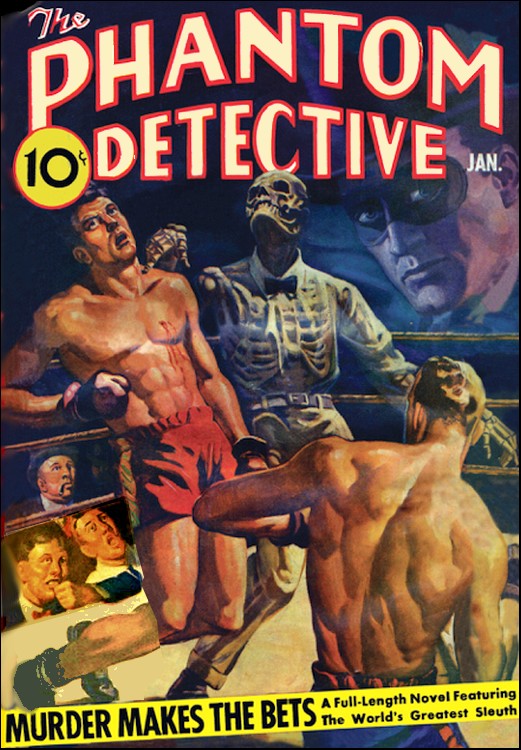
The Phantom Detective, January 1943, with
"Murder Makes The Bets"
Death is the payoff when a diabolical master of crime turns to the sport world for his field of operations and hurls a bold challenge at the world's greatest sleuth! The Phantom Detective pits himself against a grim million-dollar racket!
THE three men came in without knocking, and Dean Powell, lowering his newspaper, said quietly:
"That's a bad habit I've got, Trigger. I'll have to cut it out."
The burly, thick-necked man he addressed removed a frayed cigar stump from the corner of his mouth.
"Meaning what, Dean?"
"Leaving my door open," Powell said. "Should I ask you and your pals to make yourself comfortable? I mean, are we all going to be nice to each other?"
"You're a funny duck," the man addressed said without smiling. "What makes you think we might not be—nice?"
Powell grinned crookedly. He was a little fellow, with a thin white face and shrewd eyes.
"What makes me think so? Well, now, you're Trigger Lawton, and though I'll confess that I never actually saw you bump anybody, rumor sort of has it that you've done it a few times in your life. The two pals you brought along with you are also artisans who function with the cute tools of gun, blackjack and brass knuckles. You barged into my apartment here—without invitation. If I were the nervous type, I'd sort of start worrying a little bit."
"Nice speech, Dean," Lawton said. "It's like your column in the Clarion . Straight-from-the-shoulder stuff nicely gagged up. I used to be nuts about your column, Dean. But not any more."
Powell fished a cigarette out of a crumpled pack. As he lighted it, he said casually:
"Not any more, eh? Well, I always welcome criticism, Trigger. What do you find wrong with my column nowadays?"
"Trigger" Lawton took a step closer to him, and though his brutal mouth was twisted in a grin, his eyes were cold and menacing.
"It seems that you had a bad dream one night, Dean," he said slowly. "You dreamt of somebody who calls himself the Dealer. It's supposed to be some guy who is muscling in on all sports, pulling a lot of crooked stuff. Now instead of letting it go as a bad dream, you actually became screwy enough to believe it. And you keep yapping about it in your column. The boys asked me to drop around and tell you that they don't like it. They think it'll be lots healthier for you if you cut it out—from now on."
He dropped his voice to a whisper out of the corner of his mouth. "When I say lots healthier, you get the idea, don't you, Dean?"
"I get the idea, all right," Powell drawled. "Who were the boys who sent you here, Trigger?"
THE gunman slowly shook his head. "No dice there, Dean. I'll just tell you that they're some big shots in the sporting world. When you yap about crookedness in sports, it doesn't help to get customers lined up before cashier windows. Nor does it help boys who want to lay bets. That's why you are now being asked, through me, to cut it out! They don't like it, see?"
"You mean the Dealer doesn't like it, eh, Trigger?"
Lawton jerked forward and his hand clamped on Powell's shoulder. His other hand, clenched, paused within inches of the newspaperman's thin white face. Then Lawton straightened and stepped back.
"Okay, Dean," he said tonelessly. "I gave you a straight tip. Be stubborn—and one of your newspaper buddies will have the job of writing your obituary... Come on, boys!" He strode out, trailed by the two gunmen. And there was cold, contemptuous defiance in Dean Powell's eyes as he stared at the door they slammed shut behind them.
"I'll give you a straight tip, too, you murderous rat!" he said softly. "I don't scare easy... So the Dealer doesn't like what I've been saying in my column, eh?"
His mouth hardened. For weeks now, something ugly and poisonous had been functioning in the sports world. Crooked races, crooked fights, men beaten, bribed or intimidated—with someone called the "Dealer" as the scheming brain behind those outrages. No one seemed to know who the Dealer actually was. Usually, it was just a voice over the telephone, or ugly instructions through some killer like Trigger Lawton.
Powell was positive that Lawton himself was not the Dealer. The gunman lacked the intellect—the imagination, cunning and brilliant execution which characterized the Dealer's moves. No, it was someone else, someone who was probably an important figure in the sporting world. So far, Powell had not been able to trace the man's identity.
As he sat there, scowling, his eyes fell on a headline in the paper he had been reading. It called attention to the heavyweight championship bout at the Madison Square Garden for the benefit of the Navy Relief Fund. Half a dozen hours from now, Joe Nutley, the champion, would defend his title against "Tex" Martin, the giant ex-cowboy.
Powell had no doubt what the outcome would be. Martin, though a good fighter, was no match for the champion. Unless there was some crazy set-back—
He straightened in his chair. A set-back? Some deviltry that the Dealer might pull?
He relaxed, smiling at his own tenseness. Not only did he know both fighters well, but their managers also. They were straight men with perfect records for scrupulous honesty. Ed Kelly, the veteran referee, was incorruptible. So were the judges. No, it was impossible to frame anything in that fight. Even a fiendishly clever snake like the Dealer...
The ringing of the telephone interrupted his thoughts. He answered it.
"Hello, Dean," a terse voice came over the wires. "That Texan just came in and he's shooting off his mouth. He's waiting for Rocky."
"Thanks, pal," Powell snapped back. "I'll be right over."
He slid into his top-coat, pulled a hat over his eyes.
His apartment was a walk-up, off Ninth Avenue in the Fifties. It was only a few minutes' walk from there to "Rocky" Brett's place.
ROCKY'S establishment occupied two tremendous floors within as many blocks from Madison Square Garden. It held fifty thousand dollars' worth of bowling alleys. If one wanted to push a billiard cue, sixty tables were available. At the great horseshoe bar, champions, past and present, in all fields of sport, looked down from photographs inscribed with pretty sentiments to their pal, Rocky Brett. And a number of them usually were there in flesh.
The men who patronized Rocky's place had the world of sports in their hearts and blood and souls. They ranged from cauliflowered plug-uglies to wizened little jockeys, from cigar-chewing promoters to hard-faced gamblers and blasé sports writers. For them a sporting event did not begin with the starter's gun, nor did it end when the crowds poured out of the track or the arena.
It really began and ended in Rocky's. In prophesies how it would turn out, and analyses when it was over. In bets placed and paid off. In contracts renewed or broken. In previous boasting and subsequent humiliation. In the first public notice of a career made, or smashed. In jubilant slaps on the back or the cold-blooded, cruel turn-away from another champ who had fallen by the wayside.
The huge bar was crowded when Powell came in, yet immediately he spotted the man he wanted. He was a mountain of a man, theatrically Texan from the big-brimmed Stetson to the high-heeled, ornamental boots which showed beneath his trousers. Even if he had kept his mouth shut, he would have stood out dramatically in the crowd. But he was talking in a deep, booming voice, addressing the crowd in general:
"Martin is a Texan, folks, and they shore make 'em men in that part of the country. I come two thousand miles to see a Texas boy become champ. An' he's a-goin' to be champ, too. I gotta big, fat roll in my pocket that's plumb willin' to talk to them that doubts that Martin is goin' to be the new champ tonight." A lanky, hatchet-faced gambler whom Powell knew as "Big Money" Harper said with a jeering note in his voice:
"How fat is your roll, pal? Sometimes we talk in big numbers here in New York."
"We can talk big numbers down Texas way, too, pardner," the Texan snapped back. "Like I told Rocky Brett, the boss man here, a hundred thousand dollars ain't gonna scare me. Just leave yore money with Rocky—I'll cover it."
Powell frowned. That was just about the way he had heard the Texan talk yesterday afternoon at the bar here. The big man had sneered at the current champion. He was blatantly convinced that the Texan boy would win. And he challenged anyone who cared to bet on the champion to leave his money with Rocky Brett, promising to return this afternoon and cover all bets.
At first, Powell had thought that the Texan was merely shooting off his mouth. But, apparently, he really meant it. Probably he was some millionaire oil man who could afford to take a licking to the tune of a hundred grand. And a licking he would take—that Powell knew, as well as most people at the bar here knew it. The champion, in his usual deadly efficient manner, would make short work of Tex Martin.
"When yuh tangle up with a Texan, folks," the big fellow was booming on, "yuh shore have a fight on yore hands. That's what the champion is gonna find out tonight. 'Cause down in Texas—"
"I'm from Joisey," a thick-shouldered, ring-battered heavyweight interrupted disgustedly. "How long you think it'd take me to make a Texas hamboiger outa you, big as you are?"
"Okay, Hoppy, take it easy," a clipped voice cut in.
THE speaker was Rocky Brett, who had just entered. He was a powerfully built, bald-headed man with a craggy face and cold blue eyes. Approaching the big Texan, he added: "If you still mean business, brother, I've a pool of a hundred grand. That's a hundred thousand dollars, in the way we talk around here. Can you cover it?"
The Texan grinned and slapped one of his pockets.
"Right here with me. And I mean business, all right."
"Swell," said Brett. "Come into my office and I'll give you a receipt for your money."
The Texan, still grinning, followed Brett away from the bar. A sudden impulse prompted Dean Powell to trail after them. As they came out into a hallway, abreast of a row of telephone booths, the big man stopped abruptly.
"Say, I've got to make a phone call. It plumb slipped my mind."
"Use the phone in my office," Rocky Brett suggested.
The Texan winked.
"Oh, no, pardner. This is one of them private conversations—to some little chick I know. I ain't hankerin' for an audience."
Veiled suspicion flickered for an instant in Brett's eyes.
"All right," he said. "My office is at the base of those steps there. Come in after you make your call."
He walked away as the Texan approached the phone booths. There were four of them, and now Powell noticed that all were occupied. As the Texan hesitated, one of the booth doors swung inward. Big Money Harper came out and strolled across the passageway to the bar. Then the Texan squeezed his huge bulk into the booth that the gambler had just vacated.
The big man had left the door ajar a bit, and Dean Powell plainly heard the metallic sound of the coin dropped into the slot. He heard the dial begin its erratic clicking. Then there was a brief pause and the Texan shut the door of the booth.
Dean Powell stood there, now tense with the feeling that something was wrong. He couldn't put his finger on it, couldn't understand it. But it seemed to him that his ear had caught something irregular, abnormal, in the way the Texan had dialed for his number. He lingered there, irritated at himself, when another startling thing happened.
The three other occupied booths almost simultaneously disgorged the men who had been in them. They were Trigger Lawton and his two gunmen!
"Well!" Powell drawled. "So we bang into each other again. The three of you had to make a phone call at the same time, Trigger?"
Lawton's piggish little eyes were slitted and savage.
"Will you need the hard way to learn to mind your own business, Dean?"
Without awaiting an answer, the gunman strode past him and entered the bar, his two companions trailing him. And Dean Powell found himself muttering softly:
"There's something phony here. But what the devil can it be?"
The Texan came out of the booth, wadding something bulky into his overcoat pocket as he moved. He walked to Rocky Brett's office and entered.
Powell glanced back at the booth. A large white envelope, ripped at one side, lay on the floor there. Powell was almost positive that it had not been there when the Texan had squeezed into the booth.
HE walked over and examined the envelope. There was absolutely nothing on it. Simply an extra-large, unaddressed white envelope which had been sealed and later torn open again. All of which added up to—what?
Powell shook his head. And there was still a puzzled frown on his face when, some ten minutes later, he let himself into his apartment.
It stretched credulity that Trigger Lawton and his two gunmen would simultaneously have to make a phone call. Yet they had been in those booths. Simply sitting in them? Why?
Big Money Harper had come out just as the Texan had approached to telephone. Had Lawton and his men been deliberately planted in the other three booths so that the Texan would be forced to use the booth which Harper had vacated? Yet what could be the motive behind that?
The Texan's next move had been to take a hundred thousand dollars into Rocky Brett's office. There had been the torn white envelope on the floor of the booth—and the fact that the Texan had been stuffing something into his pocket when he had left the booth. The hundred grand—left there by Harper?
That thought rocked Dean Powell as if it were a physical blow. A big-time gambler like Harper could not bet a hundred thousand dollars against the champion without immediately arousing suspicion and conjecture. Hence the perfect stooge of the loud-mouthed Texan. Harper would not let a hundred grand out of his possession until the last moment—hence the gag of the Texan claiming to make a phone call.
Harper had left the money in that booth, with the other three booths deliberately occupied so that Rocky's suspicions would not be aroused by the Texan using the booth Harper had vacated when there had been other booths available.
And what was it that he had thought peculiar about the way the Texan had dialed? Suddenly, Dean Powell had the answer. To telephone any number in New York required seven spins of the dial: three for the exchange, four for the number itself. The Texan had spun the dial fewer times—five or six, perhaps—and Powell's ear automatically caught the discrepancy.
Of course, the Texan had not called anyone. He had just aimlessly spun the dial a few times for appearances sake, while he had sought the money he had known would be left there.
Sweat beaded on Powell's face as he reached hastily for his telephone. He called Rocky's place and asked for Bill Kruger, Rocky's right-hand man. He had done Kruger a favor once which Kruger had never forgotten. It had been Kruger who had telephoned earlier with the tip-off that the Texan had returned.
"Look, Bill," Powell asked tersely when Kruger had been paged to the phone, "do you know who made the pool of the hundred grand to cover that big-mouthed Texan?"
"Sure. Rocky himself is in for twenty grand. Then there is—"
"Has Big Money Harper any part of it?"
"No. I kind of wondered about that. It's not like Harper to pass up what's so near being a sure thing. But he told Rocky that he was superstitious about the fight tonight. Said he wouldn't lay any bets."
"Thanks," Powell said.
THOUGHTFULLY, he hung up. Sure Big Money Harper wouldn't lay any bets—against himself. Because he had a hundred grand on Tex Martin. A hundred grand on the man conceded by all experts not to stand a chance with the champion!
It added up to some deviltry planned at the Garden tonight. And if Trigger Lawton was in on it, then the Dealer's murderous hands were mixed up in it somehow!
A wild look crept into Dean Powell's eyes. He stood there, helplessly twisting his fingers. What to do about it? How to stop it? He had pieced together a vicious pattern, yet it was nothing that one could take to the police or the boxing commission. He had no inkling of what the Dealer planned. There was little he could prove—now. Yet something had to be done about it.
He pounced on his telephone again, now dialing the number of the New York Clarion.
"Get me Mr. Havens," he snapped. "Quickly!"
A dozen feet behind Dean Powell was a bathroom door, partly open. Several men crouched in the semidarkness there. One of these men nudged Trigger Lawton. Trigger nodded and softly drew his gun.
DUSK was beginning to darken Frank Havens' luxuriously furnished private office. The millionaire publisher of the New York Clarion and a chain of other coast-to-coast newspapers sat behind his huge desk. He was a stocky man with grayish hair and ruddy complexion. There was warm affection in his eyes as he watched his visitor, the tall, rangy-bodied young man who lolled in another chair.
"We'll have dinner together, then we'll go to the fights, eh, Van?" he said. "Martin Brawley, the big sporting goods man, asked me to be his guest. General Phillips, head of the boxing commission, and several other important men in the boxing world will be in our party. It ought to amuse you to watch someone else using his fists for a change."
The young man grinned. Then he lifted a cautioning finger as a pert blond secretary entered the office. She deposited some papers on Havens' desk, and there was more than just casual interest in the glance she gave the young man visiting the publisher. She knew he was one of society's most eligible bachelors, a playboy called Richard Curtis Van Loan. Rich, gay, charming, he led a merry—if rather useless—life in the snooty world of swank night-clubs and Park Avenue cocktail parties.
But the blonde would have been stunned had she guessed that Richard Curtis Van Loan's playboy activity was a deliberate affectation. It masked a dramatic and mysterious personality, internationally-famous. And Frank Havens was the only person upon the face of the earth who knew that this supposed playboy was actually the grim Nemesis of crime who called himself the Phantom.
Therein lay one of the principal reasons for the Phantom's spectacular success. A master of disguises, with fearless and incorruptible Frank Havens as his only contact man, Van always had the initial grim advantage of being able to strike unheralded and unknown.
Vengeful or terrified hoods could not seek him out, since as the Phantom he had no known address or recognizable identity. They were only aware of a contact with him when the Phantom cared to make himself known—and it was always a contact that spelled disaster for criminal rats. Because they swiftly learned that this Man of a Thousand Faces also had a brilliant deductive mind, a courageous heart, and a superbly trained body skilled in the use of all weapons.
The yawn which Van had politely stifled when the blonde went out was not an affectation. Much as he liked Frank Havens, he did not look forward with too great an enthusiasm to the scheduled dinner party and the prize-fights which were to follow. He had been inactive for the past several weeks, dutifully pursuing his sham as a playboy, and the terrific energy he possessed was beginning to clamor for an outlet.
This very same energy had worried Frank Havens years ago. He had seen that it had been driving Van mad with restlessness and boredom. He had then suggested that Van try his hand at solving a crime that currently had been baffling the police.
Van had tried it—with brilliant success. And it had been then that the Phantom was born. In the thrill of pursuit, in treading where danger lurked, in pitting his mind and body against criminal vermin, Van now had an outlet for his energy. And because he knew he was doing a service to humanity, he found peace in his soul. Greater reward than that the Phantom never asked.
HE yawned again as the phone rang on Havens' desk. The publisher answered it, listened a few seconds. His eyes widened with surprise, and there was sharp tenseness in his voice as he said:
"One moment, Dean."
Van, now alert and sitting up, saw Havens jab an index finger toward an extension phone on another desk. It was obviously a request to listen in on the conversation. Van nodded, crossed to the other phone, gently lifted the headpiece.
"Now please repeat what you've just told me, Dean," Havens said. "I want to make sure I heard you correctly."
Dean Powell's voice came over his telephone:
"All right, Mr. Havens. I'll try to be as brief and clear as I can. I've dug up something which is sinister and dangerous. It concerns the championship bout tonight. I am positive that some deviltry will be pulled there, causing the champion to lose his title. I've no idea how they plan to work it. I've nothing, actually, that I can place before the boxing commission. I've no proof, no specific evidence. Yet I know that some vicious scheme has been planned."
"Planned by whom?" Havens asked.
"Some sinister underworld figure who calls himself the Dealer. I don't know his identity. He's been pulling one dirty stunt after another, capitalizing on crookedness in sports. So far, they have been relatively minor things. Now, I think, he's branching out into big time. If I sound a bit incoherent, Mr. Havens, I'll ask you please to remember that you've known me a number of years now. I don't get upset by trivialities and I generally know what I'm talking about."
"I most certainly respect your judgment, Dean," Havens said. "But what do you want me to do about it? Just why have you phoned me to tell me what you have done?"
There was tremendous earnestness in Dean Powell's expressive voice as he replied:
"This growing and vicious thing in the world of sports must be crushed, Mr. Havens. I can think of one man who can do it. I am referring to—the Phantom. It is known that he can be contacted only through you. Is he in town now? Are you able to get in touch with him? If you can, for heaven's sake do so—and quickly. I want to tell him what I've discovered. Please believe me that this thing is big enough to justify the Phantom's interest."
Havens glanced at Van who nodded quickly, an eager bright gleam now in his eyes.
"Where are you, Dean?"
"In my apartment."
Havens' eyes questioned Van, then he said:
"You may expect the Phantom there within an hour."
Van nodded again.
"The Phantom here within an hour!" Dean Powell said jubilantly. "Swell! I certainly look forward to the thrill of meeting him. Thanks again, Mr. Havens."
As Havens hung up, no second sight could aid him to know what was happening in Powell's apartment as, grinning with relief the columnist hurried from the phone. Then the grin froze on his lips. He felt as if some huge clammy hand had suddenly clamped itself on his heart. Men with guns were stepping out of the bathroom. Trigger Lawton and his two gorillas.
AND Powell saw a fourth man. A man of average height and build, wearing a black hat and a belted trench-coat. A man whose face was concealed by a cheap cardboard "funny face" mask of the sort which could be bought in any toy store for a dime.
"Hello, Dean," Lawton said, making a careless gesture with the .45 in his fist. "So it's the third time we meet today. In your case, it's like playing baseball. Three strikes—and you're out! This is the pay-off, kid." There was a grayish tint in Dean Powell's face, but his voice was steady enough as he said:
"Okay, so it's the pay-off, Trigger. Yours will be more public—in the hot-seat. Who's the masked marvel?"
"I shall be very happy to introduce myself," the masked man said. The mockery in the man's voice matched that in the eyes peering through the slits of the mask. "I am the person you flattered by various comments in your column. I am the subject of the conversation you have just had with Mr. Havens. In other words, I am the Dealer, Mr. Powell. And I am not lying to you when I say that I am most delighted to be present here now."
Soft laughter came from beneath the mask.
"I must confess," he went on, "that there have been times when I disliked you intensely. But that's been wiped out by what you've just done. Paradoxically enough, Mr. Powell, although I will kill you before I leave your apartment, I no longer bear you malice. Upon the contrary, I am extremely grateful to you. With all sincerity, I say—thanks an awful lot, Mr. Powell."
Powell stared at him.
"I'm supposed to have a fairly elastic sense of humor," he said. "But I don't understand yours. Mind telling me what the gag is?"
"With pleasure," the Dealer murmured. "You told Mr. Havens the truth when you said that I intended to branch out into big-time. There are golden millions in the world of sports. I propose to tap that luscious stream and divert it to my own pockets. I've a splendid organization. I've some interesting plans and ideas. I've utter faith in my ability to put them into execution. But there was one thing that had been troubling me a bit. Can you guess what that was?"
"All right, I'll stooge for you," Powell said, fascinated despite himself. "What was it?"
THE masked man took a step closer to him.
"The existence of someone who calls himself the Phantom, Mr. Powell. I fear no one, yet my intelligence forces me to concede the Phantom's extraordinary ability. He is a dangerous adversary. I had anticipated that when my activities should become more—er—widespread and prominent that the Phantom would probably get on my trail. That would have been a real danger which I knew that I had to eliminate.
"I had spent a great deal of my time brooding about how I might be able to lure the Phantom into a deathtrap. Naturally, I wanted to move against him before he knew that he had an enemy in me. But the fact that his identity is unknown, coupled with the fact that he is a clever and extremely dangerous man, made it quite a difficult problem. Now you can appreciate my delight, Mr. Powell, when I unexpectedly discover that you've solved that problem for me. I repeat once again—I am intensely grateful."
POWELL found himself maniacally clenching his fists as once again soft laughter came from beneath the mask.
"It was considerate of you, Mr. Powell, to repeat Mr. Havens' promise to you that the Phantom will be here within an hour. It transforms the relatively unimportant detail of getting rid of you—our original purpose in coming here—into unexpected major triumph. You told Mr. Havens you looked forward to the thrill of meeting the Phantom. Your thrill certainly cannot be as great as mine—when I empty my automatic into his stomach!"
Dean Powell's eyes became those of a trapped and desperate animal. He knew that his own life was forfeit. But what felt like acid eating through him was the realization that, unwittingly, he had been responsible for the Phantom entering a death-trap.
They were deadly efficient, these four waiting armed killers. And the Phantom would be off his guard, not suspecting any treachery. He would be blasted down, without even a fighting chance for his life!
Powell ripped open his shirt collar and tie. He felt as if he were being strangled. And then hot tears blurred his eyes.
He would meet the Phantom—to see him shot down in cold blood. And there was nothing—nothing that he could do about it!
IRONICALLY enough, Frank Havens was saying at that very moment:
"You can trust Powell—completely, Van. He was one of my star reporters before he was shifted over to conduct a daily sports column. I've always admired him for his spunk and intelligence and scrupulous honesty. Will you get in touch with me later?"
"Just as soon as I can," Van promised. "I'll probably see you at the fights."
It was Richard Curtis Van Loan, handsome, debonair, faultlessly dressed, who left Havens, followed by admiring glances from the girls in the outer offices. It was Van Loan, the playboy, who, fifteen minutes later, got out of a taxi before a Park Avenue apartment building. A private entrance, then a private self-service elevator took him up to his penthouse. And here, within a few minutes, a remarkable transformation took place.
Swift, deft touches before a mirror startlingly altered his appearance. The contents of a small jar gave his face the swarthy complexion of a Latin. Two tiny pellets within his nostrils changed the shape of his nose. Shading with a make-up pencil accentuated his lower jaw and made it seem heavier. Soon a swarthy, tough-looking man, an utter stranger to anyone who knew Richard Curtis Van Loan, stared back at Van from the mirror.
From a special wardrobe closet, Van selected a cheap dark suit, a topcoat, a worn felt hat. As he changed to these clothes, he strapped a shoulder holster, containing an automatic, over his vest.
Then he removed from a secret drawer the world-famous Phantom's badge—a tiny mask-shaped emblem made of platinum and precious stones. It found a place in an especially constructed secret pocket in the waist-band of the trousers. Another pocket received his ingenious portable make-up kit and his black mask.
Richard Curtis Van Loan now ceased to exist, so far as the world was concerned. The person who walked out through the private entrance of that smart Park Avenue building was the man of mystery who called himself the Phantom.
Hailing a taxi, Van gave the driver Dean Powell's address. Ten minutes later, he pressed the bell-button below the reporter's name, in the vestibule of the building.
Four stories above, the sound of the buzzer galvanized the waiting killer into action.
"Here he comes!" the masked man whispered. "You, Slim, will fling open the door when he rings the bell up here. Throw it wide open and step aside as you do. I'll be in the closet in the hallway—which commands the door. I'll blast the Phantom just as soon as Slim opens the door.
"You had better stick with me, Trigger, in case my automatic jams, or something like that. I'm taking no chances with the Phantom. You, Chick, stay back here with Powell. If he tries, to open his mouth, let him have it with your gun barrel... Okay, Powell, where's the push-button for the door downstairs?"
Dean Powell's eyes had the moist glitter of someone in high fever. His lips were bloodless. Directly behind him at the wall was the push-button which would open the vestibule door downstairs. When he pushed that button, admitting the Phantom into the building, the underworld Nemesis would be started on his march toward death.
Trigger Lawton's fist smashed into Powell's face, driving him against the wall.
"Come on, Dean! Where's the button that opens the downstairs door? We don't want to start looking for it."
Powell checked the snarl of defiance he felt rising in his throat. An idea flashed through his mind. He clutched at it like a drowning man desperately grabbing at a piece of driftwood.
"All right, curse you!" he said. "We may as well get it over with."
He turned to the wall and, with a prayer in his heart, he began pressing the button which his body had hitherto concealed.
Downstairs, Van heard the buzz in the electrically controlled lock mechanism, indicating that the door was open. He pushed on the handle, stepped inside—then froze in his tracks.
He still heard the buzzing as the button was operated above, but it was not simply a meaningless sound. There was a definite rhythm to it, repeated several times—three shorts, three longs, three shorts. In the international Morse code, it was an SOS.
Van stood there, his eyes narrowed and puzzled. An SOS—the distress signal, the call for help. Why had Powell done that? As a prank, it was silly. But a call for help might also be interpreted as a warning of danger. Havens had said that Dean Powell was intelligent. Was this his way of warning the Phantom that danger awaited in the apartment above?
A gnarled old man in overalls came up from the steps which led down into the basement. Obviously, he was the janitor. "Which is Dean Powell's apartment?" Van asked him.
"Fourth floor—rear," the janitor replied.
"Any other rear apartments there?"
"Naw. There's only two to a floor in this building—front and rear."
Van nodded and stepped aside as the old man shuffled past him to go out into the street. There were no apartments on the ground floor here, because the store which fronted on the street took up most of the space.
The door which Van could see at the far end of the passageway seemed to be the rear exit from the building.
He walked toward it and tried the knob. The door was unlocked and Van found himself facing a junk-littered backyard. Above him, an ancient fire-escape made an ugly lattice. Making a pyramid of a few empty boxes, Van mounted it and caught the suspended lowest ladder. He pulled it down, the weights and pulleys setting up a creaking complaint. Then, swiftly, he went up the fire-escape. Nearing the fourth floor windows, he drew his gun.
Only one window opened onto the fire-escape. It was smaller than the others, the glass frosted, indicating that a bathroom was behind it. But what brought Van up short was the neat round hole, the size of a man's fist, in the lower pane. A moment later, he saw the missing circle of glass on the fire-escape. It was attached to a small tool called a "plumber's helper"—a stick with a rubber suction vacuum cup at the end of it.
Burglars, Van knew, often used this simple method of breaking into a place. The rubber suction cup was pressed against a window pane, holding a circle of it in place while the burglar cut around it with a glass cutter. Then a light tap would force the glass inward, detaching it from the rest of the pane. The next step was to draw out the detached section, leaving a hole through which the burglar could reach in and unhook the catch inside the window.
Obviously, Dean Powell had had recent visitors who had preferred a burglar-like means of entrance. It lent sinister support to the SOS warning with the buzzer!
Van pushed down the safety on his automatic. He used the barrel of the gun against the top of the circular cut to raise the window a bit off the sill. Then, cautiously, he lifted it all the way. It made no sound.
The bathroom door facing him was dark, but light showed behind the partly open door. There was a tomblike stillness in the apartment, yet Van sensed the presence of men beyond that bathroom door. Men, waiting—in silence!
His long legs straddled the sill. Then he was inside, gliding noiselessly across the bathroom. He peered through the door. A grim, frozen tableau met his eyes. At the wall directly across crouched a slim young man with a pinched, white face. Blood trickled out of one corner of his mouth. Van guessed he must be Dean Powell.
A man holding an automatic stood near Powell. He had a vicious, ferretlike face. His lips, parted in sadistic anticipation, showed broken, blackened teeth. The thick-necked, brutal-mouthed third man, standing with his legs far apart and a gun ready at Powell's stomach, Van recognized as Trigger Lawton, a well-known underworld mobster.
They were all staring toward a passageway which angled off to the left from where Van stood. Apparently it led to the front door, and Van shrewdly suspected that other men were in the passageway, at the door itself. That was the reason he did not want to make his presence known right there and then. He preferred them being all together when he confronted them.
SECONDS slowly succeeded each other. A smile hovered on Van's lips. In a way, the situation held a grim amusement for him. They were awaiting his arrival—while he watched them. And they were due for the surprise of their lives!
"Hey, he's had plenty of time by now to climb four flights of stairs, Dealer," Trigger Lawton said softly. "Maybe it's a false alarm."
"The bell did ring here," the other hood said.
"It needn't have been the Phantom," Lawton snapped back. "Someone else might have rung Powell's bell because he forgot his own key. Meter readers and people like that sometimes ring a bell at random just to get into a building."
Van's eyes narrowed. So they knew the Phantom was due to visit Dean Powell? Who had tipped them off?
"Yes, you're right, Trigger," a voice from the passageway said. "It's a false alarm, all right."
Two men now rejoined the others in the living room. Van stared at the cheap mask over the face of the man wearing the trench-coat. So that must be the sinister and mysterious criminal leader who called himself the Dealer. Well, the masquerade was over!
"Do you find the suspense too much for you, Mr. Powell?" the masked man jeered. "You must be patient. Speaking for myself, I certainly don't mind waiting for a quarry as important as the Phantom. It will be such a pleasure to blast him!"
"Here comes the big surprise, rat," Van grimly told himself. "Now!"
He reached for the knob of the bathroom door, intending to fling it open all the way. And in that moment a voice snarled behind him: "Put up your hands! Quick—or I'll plug you!"
Van glanced over his shoulder. A blue-coated patrolman was climbing through the bathroom window. He held a big service revolver, and there was little doubt that he meant exactly what he said.
Which left the Phantom the ugly choice of either being shot by the police or by killers in the next room!
THERE was no time to explain. Startled oaths from the men in the living room had already reached Van. It was a matter of seconds before they would be in the bathroom. Then they would blast down both him and the patrolman.
"Drop that gun!" the officer snapped.
Van knew that the bluecoat would fire the next moment. Desperately, he hurled himself into a kind of long flying tackle, his flesh crawling with the anticipation of hot lead tearing through his body.
A streak of orange stabbed from the patrolman's .38. The crashing roar of the report was deafening within the confines of the little room. It was echoed by the mad splintering of glass as the bullet found the mirror.
Van's shoulder slammed into the police officer's hip. Hard. It drove the man left against the edge of the bathtub. As Van had hoped, the policeman tripped over and went sprawling backward into the tub.
Van's sole interest now was the gun in the officer's hand. Miraculously, the first shot had missed its mark—although the policeman had practically fired point-blank into Van's face. But miracles, Van knew, generally don't happen twice.
Wildly scrambling to his feet, Van saw the police officer's shoulders bounce back from the wall behind the tub. Perhaps he had banged his head, which dazed him for a moment. He hadn't swung the gun around.
That single precious second gave Van a chance for one tigerish leap. His fingers caught the officer's wrist, diverted the gun barrel even as it was swinging around for the second shot. Then he crashed the barrel of his automatic across the patrolman's skull.
The writhing blue-coated body within the tub sagged suddenly. Van felt the normal repugnance of having been forced to slug an officer of the law, yet he knew that he was actually trying to save the man's life. For the killers in the other room should by now—
A foot sent the bathroom door flying open. Van saw the ferret-faced gunman who had been standing near Dean Powell. He saw the man only a split instant before the fellow's automatic began spewing flame, smoke and hot lead. Bits of plaster went flying out of the wall inches from Van's head, sharp little particles of it spraying his cheek.
He squeezed the trigger of his own gun—once, twice. The gunman in the doorway looked as if some invisible force had lifted him and thrown him back into the living room. He spun about and fell to the floor. Van could see him clawing at the rug. And in the momentary silence between the roars of gunfire he could hear the wounded man screaming.
The sudden sight of Dean Powell's white face determined Van's next move. He realized that even if he frightened away the other killers, certainly they would murder the reporter before they fled.
He directed his automatic at a wall-plug he saw at the floor cornice in the other room. A bridge lamp was connected to it. He hoped that, if he hit it, the bullet would bring the wires together, creating a short and putting out the lights. Darkness might give Dean Powell a chance for his life.
HE fired. The black wall plug at the end of the cord disintegrated as the bullet struck it. There was a brief bluish flash there, then all lights went out. Van began edging toward the bathroom door.
"Get Powell, Slim!" he heard Trigger Lawton yell. "Plug that little runt!"
"Where the devil is he? You think I'm a cat?"
And then the smooth, suave face of the masked man came from the darkness:
"No, let's get out of here. I hear a police siren. Let's beat it, before we're trapped downstairs... You can hear me, Phantom. It's war between us, from now on. You took the first round. I'll have my turn. You're on your last case. This isn't boasting; it's a prophecy. I'll get you yet!"
Then feet pounded in the darkness. Van heard a door open, and slam shut again. He plunged out into the living room. A man was groaning somewhere—softly, horribly. Then it became a sound that was not new to Van; a sound which, once heard, one could never forget—the death rattle.
"Are you all right, Powell?" Van asked tersely.
"Yes," a voice answered. "To my own profound amazement!"
Van took a chance on snapping a lighter flame. The opening and slamming of the front door might be a trick. But there was no response in gunshots which he had half-expected.
He saw Powell's white face, rising from behind an upholstered chair where he had taken refuge. The gunman Van had shot was a blurred, still mass on the floor.
He darted to the corridor, traversed it, flung open the outside door. He heard excited voices, shouts, and the pounding of feet below somewhere. Taking the steps three at the time, he tore down them. Frightened, open-mouthed people in the doors of their apartments, watched him pass.
The street level finally, with no one in the passageway here. Van ran to the outside door, threw it open. It brought a yelp of terror from a man cowering in the outside vestibule.
"Don't shoot!" he babbled. "Don't hurt me!"
It was the gnarled old janitor who had earlier told him where Powell's apartment was. He seemed petrified with terror. In that moment a radio car slashed over to the curb. Two patrolmen with drawn guns pounded across the pavement toward Van.
"That's the burglar!" the janitor screeched, pointing to Van. "I seen him go up the fire-escape. I sent a cop up after him and—"
Van knew that a nervous policeman was as apt to shoot an armed thug, and ask questions afterward. That was a sound enough policy in many cases. He dropped his automatic.
"Take it easy, boys," he said quickly, as both cops covered him with their guns. "I want to show you something."
His hand slipped under his coat to the waist-band of his trousers. A tiny object glittered on his outstretched palm—the miniature mask made of platinum and precious stones, known the world over as the Phantom's insignia.
The service revolvers sagged in the hands of the radio cops. So did their mouths. Then eager respect swiftly replaced the truculence in their eyes.
"Why, it's the Phantom, Bill!" one of them gasped. "Well, for Pete's sake! What happened here, sir?"
VAN scooped up his automatic and whirled to the janitor.
"Have you seen several men brush past you here just before I came? One of them might have worn a mask?"
The dumbfounded janitor could only shake his head. Van remembered the rear exit from the building. He darted toward it, flung open that door. There was no one in the untidy backyard, but a gate set in the wooden fence on the left hung crazily from one hinge. They had kicked it open and had made their escape that way, through the alley which led to the parallel street. It was hopeless to try to pursue them now.
Van slid the automatic back into its holster. His eyes were grim as he led the two radio cops upstairs to Powell's apartment. The reporter had lighted two candles he had on the mantelpiece. As Van came in, he was helping a cop who looked cockeyed to weave across the room to the couch.
"What I wanna know," the policeman demanded thickly, "is who slugged me? I blame near plugged the rat."
"You blame near," Powell corrected coldly, "plugged the Phantom." The policeman jerked away from Powell's supporting arm.
"What!"
"It was a misunderstanding, at an awkward moment," Van said, smiling faintly. "You were only performing your duty, believing I was a burglar. And I knew that there were four killers in this room who would have murdered both of us had I dropped my automatic and tried to identify myself. There was just no time to explain. You'll forgive me, won't you?"
"Forgive you?" the policeman echoed. "Think how I would have felt if I had shot the Phantom. Holy smokes!"
"You would have been a dearly loved brother, and cause for a terrific celebration by every rat in the underworld," Powell said dryly.
One of the radio police officers, kneeling over the gunman Van had shot, said:
"This is Chick Foley, a well-known hood. He's plenty dead. Look, what did happen here?"
The patrolman addressed the question to Powell. The columnist glanced at Van.
"A few rats discovered that I was coming over to see Powell," Van explained. "So they thought they'd have a reception committee awaiting me. I fooled them by arriving in the less orthodox manner than through the front door—via the fire-escape and the bathroom window. I'll get the others, in my own way. Now it's important that I leave with Powell, now. If this gets you into any difficulties with your superior officers, let me know and I'll straighten it out with the commissioner."
"Anything you say, Phantom," the bluecoat replied. "I guess you've earned the right to sidestep technicalities."
"Thanks," Van said. He jerked his head to Powell. "Come on, Dean."
They did not speak until they were seated in a booth of a quiet little bar around the corner from Powell's apartment. The columnist ordered a brandy. Van merely shook his head at the waiter.
"That was a clever little trick you pulled, Dean," he told Powell. "I mean the SOS with the buzzer button. It saved my life."
"And mine, too," Powell said grimly. "I was desperate, Phantom. They were hiding in the apartment when I phoned Mr. Havens. That's how they found out that you were due there. I don't know much of the Morse code, but most people are familiar with the symbols for an SOS. If I hadn't thought of it—" He shuddered.
"Tell me just what prompted you to telephone Havens and ask him to send me over to see you."
POWELL leaned eagerly across the table. Briefly he related the details of Trigger Lawton's first visit. Then he explained what had aroused his suspicions about the big Texan in Rocky Brett's place. Van listened with his eyes half closed, his keen mind absorbing each point of information as Powell gave it out.
"So you see, Phantom," Powell concluded, "it's obvious now that the Texan was only a stooge for the Dealer. And I could stake my life on the conviction that Big Money Harper is someone else who only works for the Dealer. Especially after what happened a little while ago."
"What do you mean?"
"I've known Harper a long time now. He's a treacherous and unscrupulous devil, but he is a coward, too. And he is none too bright. I just can't see him as the scheming, cold-blooded killer that the Dealer has proven himself tonight."
"What sort of man is Rocky Brett?"
"Another type altogether. Rocky is tough, hard, shrewd. He enjoys the reputation of being a straight guy—but don't rub him the wrong way. Most people are afraid of Rocky."
"Which means, then," Van said slowly, "that Rocky would not pay off the hundred grand if something obviously crooked happened at the championship bout tonight."
Powell stared at him.
"I—I hadn't thought of that. You're right. Rocky would not pay off. That's positive. And it's something that the Dealer must be much aware of. So—hang it, Phantom, what could the Dealer be up to?"
"Do you know the champ's manager?"
"Very well. He's Jeff Kelly, and an honest man if one ever lived. I've known and liked him for ten years. I am positive that he cannot be scared or bribed. And Joe Nutley, the champ, has no thoughts of his own. He does what Kelly advises him—to the letter."
"How about Tex Martin and his manager?"
"Old Lem Jarret is Martin's manager. Lem's been handling fighters for a quarter of a century, and his record is clean. He's a sweet old fellow. I both respect and trust him. Tex Martin is a husky Westerner who is perhaps better known for his ability to take it, for his fighting heart, than for any exceptional boxing talent. He has a terrific right—which the champ knows. Meaning that Martin will never be able to land it where it would do some real damage. All in all, he's a clean, sincere fighter, popular with the fans."
Van thought this over a little while, his fingers drumming the table. He looked up.
"Listen, Dean. See if you can get Kelly on the phone. Pump him about his boy. Try to find out what his attitude is. I mean whether he's nervous or unusually cagy, or something like that. I think you're smart enough to sense a wrong note in the way he talks to you—if there is one. Do the same thing with Tex Martin's manager."
Powell nodded and sidled out of the booth. He returned a few minutes later, and shook his head as he seated himself again across from Van.
"NOTHING suspicious, in Kelly's attitude," he reported. "He was his usual friendly, wise-cracking self. Said the champ was in tip-top shape. Told me that the fight wouldn't go longer than half a dozen rounds, and thought I was kidding when I said I was skeptical about that. Old Lem Jarret was also cordial. I wisecracked with him a while without sensing anything out of the ordinary."
Van shrugged.
"Well, that's that, Dean. If we sum it up, here's how the picture looks. Heavy money is wagered by a vicious outfit on a man normally expected to lose. The two managers and their fighters seem to be on the level. We've agreed that Rocky would not pay off the hundred grand if there is crooked work at the Garden tonight."
"I am sure of that, Phantom. Rocky is a hard man to cross."
"Which the Dealer must know, as you yourself have pointed out," Van said. "Whatever devilish scheme he has in mind, we are helpless to combat it now, because we haven't the faintest idea how he plans to pull it. It is useless to confront Harper. Certainly the gambler would deny all connections with that big Texan. And we can't really prove that he is lying. In fact, we can't prove a blamed thing now, Dean."
"So?" Powell prompted soberly.
"So we've no choice but to wait until the fights come off—although I intend to experiment with an idea or two in the meanwhile. But here's something, Dean. They've got you spotted, and you are slated to be murdered. Don't you think a trip somewhere now might be the smart thing for you to do?"
Powell flushed and half-rose from his seat.
"No!" he clipped. "I've started this fight, and I'm going to stay in it right to the bitter end. They can't scare me, Phantom. If I could be of any use to you—"
Van grinned and slapped the newspaperman on the back.
"You're okay, Dean. No one should never run from such rats. I respect your choice. Don't return to your apartment, though. Live a while in some quiet little hotel, telling no one your address. And watch your step. I'll see you at the Garden in a couple of hours. I'll get a couple of ringside seats, so that we can be together. You'd better wait for me at the cashier windows. You won't recognize me, but I'll make myself known to you."
"Okay, Phantom—and thanks."
Van stood up. They gripped hands.
"In a way, I am glad you had those visitors at your apartment tonight," Van said grimly. "It proved to me that there is a vicious devil who calls himself the Dealer. He said that it was war between us, from now on. He told the truth. The Dealer will get precisely what he is looking for!"
NIGHT came to Broadway, awakening that world's most famous hostess for those who sought gaiety and diversion. She prettied herself up in her glittering jewels of thousands of lights and neon signs, and made ready to entertain her guests.
But Broadway's oldest friends and customers—thousands upon thousands of them—would ignore her for a while tonight. For, at Madison Square Garden, the cashier windows had already opened. The vanguard of the thousands who would make the old rafters of the Garden tremble tonight were already crowding eagerly for their tickets.
Yes, for several hours, at least, Broadway would have to bow to the top event in sports. The heavyweight boxing champion of the world would once again defend his title.
From Coast to Coast, the length and breadth of America, millions had dates with their radios that nothing would have induced them to break. Millions were discussing it—in a hamburger joint and in a millionaire's mansion, in Army camps and on battleships. Would Tex Martin be able to land his famous right? Or would the champion cut him down in his usual, deadly efficient manner?
Rocky Brett's place boiled, as it always did on the eve of a big sporting event. Men stood three feet deep at the huge bar. A score of loudmouthed "experts" gave as many versions of what the outcome would be. The loudest, the most blatant of these was the red-faced giant wearing Texan hat and boots.
"There ain't nobody that can lick a Texan when he gits a-rippin'," his voice boomed. "That's what you-all are goin' to find out mighty soon. Tex Martin is goin' to be the new champ. An' this here Texan a-talkin' to yuh now is goin' to be richer by one hundred thousand dollars of smart New York money."
He laughed and added to the bald-headed, hard-faced man standing next to him:
"Hope yuh ain't got too much invested in them hundred thousand, Rocky. Yuh look kinda worried."
The man merely glanced up a moment out of the corner of his eyes. Then he shook his head, as if saying to himself that to reply would be a sheer waste of breath. He reached for his drink.
Another man watched this interchange from the entrance into the rear. He looked like someone who belonged here, though neither Rocky Brett nor Dean Powell would have recognized him. He was a tall, flashily overdressed man, with a sallow face and rings of dissipation under his eyes. A big diamond glittered from his tie pin, and he wore a diamond ring.
Powell would have unhesitantly branded him as some out-of-town gambler. Actually, the man was Van in another of his marvelous disguises.
He knew that the Dealer and his henchmen might have lurked near Powell's apartment house to spot who would come out with the sports writer. If they thought they now knew what the Phantom looked like, Van wanted them to harbor that pretty little illusion—until he cracked down on them again.
Van turned and went through the side exit from the bar. In the hallway stood the four telephone booths where Dean Powell had had his suspicions aroused about the big Texan. Van glanced into the booth at the extreme left and noticed the number of the telephone there. He dialed that number from the booth at the opposite end.
HE heard the telephone begin to ring three booths back. Sooner or later, he knew that someone working here would answer it. Peering through the glass in the door of the booth, Van presently saw someone who looked like one of Rocky's bouncers come out from the bar. The man marched straight for the booth where the phone was ringing.
"Hello," his voice said.
Speaking quietly but distinctly, his lips close to the mouthpiece, Van said:
"I want to speak to Rocky Brett. Would you mind calling him? Tell him it's his pal, Jimmy."
"Jimmy who?"
"Just say 'Jimmy'. He'll know who it is."
"Okay. Hold the wire."
Van waited until the man returned to the bar, then he hung up and stepped out of the booth. Rocky Brett, with a puzzled frown on his face, came through the side exit. As he approached the booths, Van said coolly:
"I'm it. The Jimmy. It was just a trick to get you to come out here."
Brett studied him with his cold blue eyes.
"Nobody is gunning for me nowadays," he said. "You couldn't be dopy enough to try to pull off a stick-up here. So what's the gag? Who are you?"
Van unclenched his left fist and showed the glittering little mask of platinum and precious stones.
"I'm known as the Phantom. Perhaps you've heard of me, Mr. Brett. I'd like to talk to you."
Brett's eyes widened, and lost their hostility.
"Perhaps I've heard of you?" he said dryly. "Who hasn't? Call me Rocky. And come into my office. It'll be a pleasure."
Van followed him to a large and beautifully appointed modern office. He shook his head as Brett pointed to a flagon of brandy, and once again as Brett extended a box of cigars.
"What are your plans for tonight, Rocky?" he asked bluntly.
"Like those of most guys out there—the fights."
"You've a hundred grand bet with that Texan?"
"That's right. Twenty of my own dough. Ten other guys covered the rest."
"What are the arrangements for the pay-off in case you lose?"
"The Texan is coming to the fights with me. If Martin loses, I tell him where he can go. If Martin wins, I hand him the dough—and still tell him where to go. His big mouth is giving me the willies."
"You'll carry two hundred grand with you?"
Brett grinned.
"I'll have a few of my boys with me. They're tough. I'm tough. It's safe. Mind if I ask what all this is leading to?"
"Supposing," said Van, "Martin wins. You pay off. Then you discover that something crooked was pulled which nobody spotted at the time, but which came out later. Then what?"
"The boys are out a hundred grand. Somebody starts looking for the Texan, if they catch him, the State of Texas gets its population decreased by one."
"And if they don't catch him?"
"I told you. The boys and me will be out a hundred grand."
VAN smiled at Rocky.
"That," he said, "is just what I want to prevent. And if something crooked is pulled at the fights tonight, I want to catch the rat responsible for it—who won't be the Texan. I need your cooperation, Rocky."
"You've got it," Brett replied simply. "I'm a cagey guy who likes to ask a lot of questions. I'll skip that when dealing with the Phantom. Tell me what you like. Tell me nothing. But you've got my cooperation. What do you want me to do?"
"Don't go to the Garden tonight. Give some alibi about it to the Texan. Stay right here in your office and get the fight over the radio on the desk there. If Martin loses—well, you keep the money and the thing ends right there.
"But if Martin wins—get this straight, Rocky!—I want you to stall the Texan in your office here until I give you further instructions. My idea, briefly, is to trail him when he leaves here with the money. And I may not be able to do that, having something else to check maybe, as soon as the fights are over. That's why I want you to stall him in your office here."
"It won't be easy to stall him," Brett said thoughtfully. "If Martin wins, the Texan will naturally be right here on my neck for his dough. From the way he's been shooting off his mouth, nearly everybody in Manhattan knows he has a hundred grand bet with me. He'll come here for his dough, and he'll shriek bloody murder if he doesn't get it, which is going to get a lot of people awful curious. I've never welched on a bet yet, and I've got a rep for that. What kind of a stall could I give him?"
Van thought a moment.
"Where's the money now?" he asked.
"In the safe there."
"All right, here's your play then. Tell him that you've got a time-lock on your safe. Explain to him that the mechanism is so arranged that the safe can be opened only—well, say, only during the last five minutes of every hour. Tell him he'll just have to wait. Arrange the time gag so that you won't have to keep him here longer than twenty minutes. I mean, you could say that it's every hour on the half hour. It's going to sound screwy to him—I'll grant you that. But he'll have no choice but to take your word for it."
Brett nodded.
"Okay, Phantom, I'll play it that way, if the champ loses. You don't want to tell me just what kind of devilment is being cooked up?"
"I can't tell you," Van replied grimly, "because I don't know myself. It's only a smell now. A bad one. Thanks a lot. Rocky."
"I've a hunch that I'm the one who ought to thank you, Phantom," Brett drawled.
They shook hands. Thirty seconds later, Van was out in the street, walking swiftly to the Garden, only a couple blocks away. The stage was set now. If treachery lurked in the ring tonight when the champ defended his title, treachery of such subtlety that its nature would not be apparent for a while, Van at least held one card.
The Dealer certainly would not let his Texan stooge run around long or get far with two hundred thousand dollars of his money. They would make a contact somewhere, somehow—and Van meant to be right there when it happened.
PEOPLE were milling like ants around the Garden, potential customers, curious onlookers crowding around taxicabs which disgorged celebrities, fight fans who lacked the price of admission but fought for the privilege of being there just to get a glimpse of the champion and the contestant when they arrived. Perspiring, red-faced police vainly tried to make some order out of the boiling confusion.
Van paid a small fortune for two ringside seats—which he did not mind doing, well able to afford it, and knowing that most of the gate receipts were going to the heroic American Navy. He looked around for Dean Powell. Finally spotting him, he approached the columnist.
"Okay, Dean, here's your date."
Powell looked at him blankly.
"You're mistaken," he said. "I'm not meeting anyone here."
"Good boy!" Van grinned. "My last words to you were: 'The Dealer will get precisely what he is looking for.' "
"All right, Phantom," Powell said softly. "Your complete change of appearance is remarkable. I never would have recognized you. Do we go inside now?"
"Separately," Van replied. "Here's your ticket. It's a seat adjoining mine. You'd better go in first."
Powell nodded. He became lost in the stream of humanity flowing into the great arena. Van followed in a couple of minutes. His tickets were for second row, ringside, and he was a bit startled to see Frank Havens and a group of men seated in the first row, diagonally across the ring.
"There's your boss, Dean," Van murmured, seating himself next to Powell.
They could speak freely because the seats on either side of them were not yet occupied.
"Yes, I noticed him," Powell said. "The men with him are big shots in the sporting world."
He identified them for Van. The gray-haired, lantern-jawed General William Phillips, head of the N.Y. Boxing Commission. Jolly-faced Martin Brawley, president of a great chain of sporting goods stores. Foppish Henry Drake, head of a radio corporation which specialized in broadcasting sporting events. Tanned, handsome Fred Torrence, owner of a famous racing stable and the great horse "Silverheels". Dissipated-looking Norwood Palmer, a millionaire who also owned a string of thoroughbreds, and the only horse reputedly able to match Silverheels, a big stallion called "Glory King." Burly, cigar-chewing Calvin Trent, novelist-sportsman, famous for his yachting exploits.
Some of those men Van had met socially in his rightful role of Richard Curtis Van Loan. He looked around for the big Texan, but he could not locate him.
The great arena filled swiftly, a swaying sea of faces rising from ringside seats to the topmost tier of the bleachers, right under the rafters. The place dimmed, and powerful lights cascaded down upon the ring. There was a roar from the crowd as the first of the fighters in the preliminaries climbed through the ropes.
Van was too concerned with the main bout to pay much attention to the preliminaries. A Filipino flyweight gave a marvelous exhibition of fast and clever boxing. Two welterweights put on a bloodier spectacle.
There was the usual ebb and flow of the roar of the crowd, the usual wisecracks and insults. Men who had never touched a boxing glove in their lives screamed expert advice to professionals.
THE semi-final bout ended in a first-round knockout, booed and jeered by the crowd. Then a kind of hush settled down over the great arena. It was like the prelude of expectant silence which precedes the storm.
Then the storm broke, like the first clap of thunder. Thousands strained their vocal chords to greet the champion, who came striding down the aisle with his entourage.
The champion climbed through the ropes. He sat on the stool, huddled in his bathrobe—a colored boy who had battled his way to the top, who had not retired on his laurels when he had reached the top, who defended his title more often than any heavyweight champion in boxing history. Joe Nutley's skin was brown, and his ancestors might have been slaves brought over from Africa, but he was an American, too, and his country was at war. And Joe Nutley was doing his bit for his country by turning over every penny he earned tonight to benefit the boys who manned American warships. Tex Martin, an American from the Lone Star State, was doing the same thing. There was another roar from the crowd as Tex made his appearance, a beam-shouldered, red-headed giant, with a surprisingly boyish, freckled face. He entered his corner.
A uniformed figure climbed into the ring, a white-haired, leather-faced admiral of the United States Navy. He motioned the two fighters to approach. Take their bandage-wrapped hands, he said into a microphone extended to him:
"As you know, ladies and gentlemen, the proceeds of this championship bout is to go to the Navy Relief Fund. Joe Nutley and Tex Martin, and their respective managers, wanted it so. The Navy is grateful. The Navy salutes—and the Nation applauds—these fine Americans!"
The Garden rocked with sound. The admiral tried to say something else, gave it up, smiled, and left the ring. Gloves were slipped over the bandaged hands of the fighters. Seconds and attendants were cleared from the ring.
The champion's brown body had the smooth roundness of a Polynesian. He sat sleepy-eyed on his stool, his face completely impassive, by far the calmest man in this great arena.
Tex Martin had heavy bulging muscles. He seemed by far the more powerful man of the two. His freckled face was tense and set.
Bull-voiced old Ed Kelley went through the superfluous ritual of:
"In-tro-du-u-u-cing—in this corner—"
Only a few of his words could be heard. There was the second ritual in the middle of the ring, when the referee gave the instructions each man knew by heart. Then—the bell. The fight was on!
The champion glided out as always, smoothly, unhurriedly, deadly sure of himself. Martin charged, fierce and eager. He had a low, weaving style of fighting. And he had perhaps a deceptive recklessness which chiefly accounted for his popularity with the fans.
Gloves began pounding flesh—hard. There were none of the usual preliminaries of sparring, of sizing up the opponent. Tex Martin wanted to fight, and he was doing it. Rights and lefts, a vicious slashing hook which drove the champion against the ropes. A roar from the crowd, subsiding as the champion easily extricated himself. Then he crashed a hard right which left a red mark on Tex Martin's body.
THE first round ran its course, with continuous slugging which is the fan's delight. When the bell rang, Van glanced questioningly at Powell. The sports writer shrugged.
"So far, it's normal enough. I feel that the champ might have dished out more than he did, had he wanted to. But that's his way of fighting. He rides along a few rounds, sometimes seemingly getting the worst of it. Then he suddenly opens up and—it's curtains for somebody. But I still feel," he added significantly, "that I am sitting on a bomb that will go off any moment now."
"I know what you mean, all right," Van said.
"Another thing I've been thinking about," Powell went on. "Tex Martin has a right cross that is murder itself. But he always telegraphs it, isn't fast enough to put it over. That's why he hasn't tried it, so far. It leaves him wide open if he should miss, and the champ would knock him silly. If I were the Dealer—you get the idea?"
"I get it." Van nodded. "If you were the Dealer, you'd spend a lot of time thinking what you could do to give Martin that one chance he has, with the champion off his guard for a second or two. Some trick, some... Oh, darn it, there's no use guessing. There goes the bell!"
The second round was pretty much like the first—both men fighting hard, with Martin ever the aggressor. Subtly, almost imperceptibly, the champion awaited his chance for the one savage onslaught that would end the fight.
In the third round, the crowd went mad as Martin, in a series of savage rights and lefts, knocked Joe Nutley down. But the champion was up without taking a count. He didn't seem hurt. Van's eyeballs ached from the intensity with which he watched every move of the two fighters.
There came the fourth round. Again Martin rushed out, taking the offensive, pounding away, with the champion against the ropes. Then Van suddenly jerked forward in his seat. It seemed to him that for a split instant he had seen some minute object detach itself from Martin's left glove.
His eyes dropped to the brightly lighted canvas. There was nothing on it. The tiny object had either fallen outside the ring, near Martin's corner there, or it had not existed at all, being merely the product of some optical illusion.
And then Van's attention was caught by one of Martin's seconds, who, instead of watching the fight, was edging around the post. The man stooped, picked something up off the ground and slipped it into the side pocket of his windbreaker jacket.
Ugly premonition stabbed at Van's heart. He jerked his eyes upward to the ring again. Joe Nutley and Martin were swapping punches, hard inbody fighting. The champion stumbled suddenly. He tried to go into a clinch, which Martin sidestepped.
Clearly, in that moment, Van saw surprise on the big Texan's freckled face. Martin's right glove went far back. Then his body pivoted and drove forward as he smashed over a right cross. It found its mark—the point of Joe Nutley's jaw.
The champion's knees buckled from under him. He crumpled to the canvas.
Indescribable bedlam raged, rocking the old Garden, as the referee waved Martin to a neutral corner. The referee's hand began rising and falling. But from the way Joe Nutley lay there, Van knew he would never get up at the count of ten.
The champion had been knocked out!
VAN grabbed Dean Powell and pulled him closer.
"What do you think about it?" he shouted, trying to make himself heard above the roar of the crowd.
Powell looked dazed and incredulous.
"Why," he shouted back, "you saw it. It—it was on the level. Martin hurt him, with a kidney punch, probably. And it—gave him his one-in-a-hundred chance to smash over that right cross. I can't believe my own eyes, but it's true. Martin won—by a legitimate knockout!"
"If you believe so," Van said savagely, "then it's fooled everyone else, too. Rocky, now listening to commentators who broadcasted this fight, sees no reason why he should not turn over the hundred grand to the Texan. The Dealer got away with it—almost. But I think I know how I can throw a monkey wrench, wrecking the whole works!"
And as Powell stared at him, open-mouthed, Van stood up and pushed his way to the aisle. Hundreds of people had left their seats, converging in wild excitement onto the ring. Van elbowed through them. His objective was one of Martin's seconds, the man who had lifted something off the floor thirty seconds before the knockout.
The man was standing at the post, looking up at the ring. Van lurched into him. A tough-looking plug ugly, he was driven against the ring post. He turned.
"Watch where ya goin', mugso!" he snarled.
"Sorry," Van said. "Somebody pushed me."
He edged away. When some dozen feet separated them, he opened his left fist and looked at the small object on his palm, the object he had neatly picked out of the man's pocket. It was a tiny rubber vacuum cup, light brown, the exact color of the leather in boxing gloves. A fine needle, with a blackish, gum-like substance on its tip, protruded from the cup.
Van knew now how Tex Martin had been able to knock out the champion.
VAN wrapped a handkerchief about the sinister little gadget. He dropped it into his pocket.
The Garden still roared with sound, like breakers continuously crashing against some defiant rock. Joe Nutley had been dragged into his corner. He slumped on the stool, his seconds working over him frantically. He was beginning to show signs of returning consciousness.
Tex Martin stood in the middle of the ring, a happy grin splitting his face. He was asked to approach a mike held up over the ropes.
"Just a few words, Tex," the perspiring sports commentator pleaded. "Come on over here. Tell the folks down in Texas, and the rest of the country, how it feels to be the new heavyweight champ."
"Okay." Martin grinned. "Hello, folks. It feels great. I sort of can't believe it, to tell you the truth. But I want to say what you all know—Joe Nutley is a great fighter and a real champion. I've got the title now, and I don't know how long I'll be able to hang on to it, but I'm going to try my best to live up to the clean record set up by the man I fought tonight."
"Thanks, Tex," the commentator clipped. "Well said—and it's a swell attitude."
And Van, narrowly watching the big Texan, agreed with the radio commentator. Martin spoke with a sincerity that could not be doubted. His blue eyes were honest.
Van was willing to swear that the Texan knew nothing about the tiny suction cup and the poison needle that had been furtively attached to his glove. And Van had not forgotten the surprise on the Texan's face when the champion had suddenly stumbled and lowered his guard, thus permitting the knockout blow.
Joe Nutley was conscious now, dazedly shaking his head. His brown face remained impassive, but Van saw bleak incredulity in his eyes as he watched the Texan. Then the nervous little terrier of a man with the mike bobbed up over there.
"How about a few words, Joe?"
Nutley nodded and twisted on the stool.
"I thank Tex Martin—for the nice things—he said about me," Nutley spoke in a low, halting voice. "He's a great fighter, too. I wish him the best o' luck."
Van found himself grimly thinking that if there was any faint spark of doubt in Rocky Brett's mind, hearing what Nutley had just said would certainly stifle it out. And there must be jubilee now in the Dealer's black heart.
But the final curtain had not dropped yet, as the Dealer believed. The Phantom had written, and was about to stage, the smashing finale that would stun the sporting world and change to poison the jubilee in the Dealer's heart!
He glanced at his wrist-watch. It was twenty-five of eleven. The big Texan would probably reach Rocky's office within ten minutes. That left Rocky fifteen minutes or so in which to stall the Texan, playing the gag of the time-lock on the safe. In those fifteen minutes, Van had dramatic plans of his own.
Men were milling all over the arena, wildly excited, reluctant to leave. Husky cops cleared the way for Joe Nutley and Tex Martin as, with their seconds, trainers and managers, they proceeded from the ring to their respective dressing rooms. Joe Nutley staggered a bit, his left arm on the shoulder of his colored trainer.
DEAN POWELL edged over to Van.
"Look," he said, his voice shrill with excitement. "I know you weren't kidding before, but what did you mean by—"
"There's a man walking behind Tex Martin now," Van interrupted. "One of his seconds who is wearing a wind-breaker. You know him, Dean?"
"Sure. It's Paddy Burke. He used to be a good heavyweight until booze got him down. I saw you lurch into him before—which wasn't an accident, I know. Why did you do that?"
"I'll show you in a little while," Van said. "Let's see if we can get to see Nutley."
They elbowed through the crowd. A policeman stood on guard at the entrance into Nutley's dressing room. He knew Powell, however, and made no objection to them entering.
Joe Nutley was stretched out on the rub-down table. Jeff Kelly, his manager, a white-haired, red-faced Irishman, was pacing the room. A little group of trainers and seconds stood by in gloomy silence.
"Hello, Dean." Kelly waved as they entered. "You notice nobody is trying to break that door down to get in here, which they usually do." He grinned crookedly. "That's what happens when you're bucked out of the saddle. But we'll climb back into it. Won't we, Joe?"
"Sure thing, Jeff," the fighter answered listlessly.
"Just what happened, Jeff?" Powell asked. "I saw it, but—well, you know what I mean."
"You tell him, Joe," the manager said.
Nutley lifted himself up to one elbow. The bleakly incredulous look had returned to his eyes.
"It's my heart, I guess," he said slowly. "I felt like something stabbed me there. It came sudden-like and I kinda got dizzy for a second. Before I could cover up, he let me have it with that right cross. I seen it comin', but I couldn't do nothin' about it. I feel okay now. I never knew that there was somethin' wrong with my ticker."
"Nuts!" Jeff Kelly said with abrupt fierceness. "There's nothing wrong with your heart. It was a freak, or maybe I over-trained you, got you to too fine an edge. Doc Harmond will check you over. I'll get a return bout with Martin, and you'll slap him silly. You'll be champ again, Joe."
"Yes, you'll be champ again," Van put in quietly. "And sooner than you realize... Come on, Dean."
They walked out and Dean Powell caught Van's sleeve.
"Look," Powell said tersely. "Mine isn't just the curiosity of a newspaperman who senses a terrific story. You spotted something—something crooked—during that fight. I'm going nuts trying to figure out what it could have been. Won't you give me a hint at least about it?"
"I'll give you the whole works—in Tex Martin's dressing room," Van replied grimly, reaching for his black mask. "That's where we're going now."
There were two policemen on guard at the entrance of the Texan's dressing room. Both gaped at the masked man who approached them with Dean Powell. Van flashed his glittering little badge.
"I'm the Phantom," he clipped. "Please let no one in or out of this dressing room until I give you further instructions."
VAN held an honorary police captain's commission, bestowed upon the Phantom by a grateful mayor. All police knew that, although it was a privilege of which the Phantom, always playing a lone hand, seldom took advantage.
The two patrolmen saluted.
"Yes, sir. No one gets in, no one gets out."
The officer who had acknowledged the order threw open the door. Trailed by Powell, Van stepped inside. Perhaps a dozen men crowded the dressing room. Van saw Frank Havens and his party of six, which included General Phillips, head of the state boxing commission.
The others, aside from the group with Havens, were Tex Martin, whose bandages were being removed; Lem Jarret, Martin's wizened little manager; and several trainers and seconds. Among the latter Van instantly spotted Paddy Burke's ugly, ring-battered face.
The gay air of celebration was cut short by Van's dramatic appearance. They all stared at him.
"What is this?" Jarret spluttered. "Who the devil are you?"
Once again Van showed his tiny emblem of platinum and precious stones.
"I am the Phantom, Mr. Jarret." The manager kept staring at him, bewildered, uncertain.
"Well!" he said. "It's an honor and privilege. We're glad to have you. You came in to congratulate my boy?"
"No," Van replied quietly. "I'm here to straighten out something in the interest of justice and fair play."
"What do you mean?"
"Your fighter did not win legitimately tonight, Mr. Jarret," Van declared in the same quiet tone of voice. "Therefore he has no right to the title."
Tex Martin leaped to his feet. The freckles stood out vividly on his anger-blanched face.
"It's a lie!" he said thickly. "I know your reputation, Phantom. But this is one time you're wrong. I never fought a crooked fight in my life."
"And I never managed a crooked fighter," Jarret snapped.
Lantern-jawed General Phillips stepped closer to Van.
"The accusation does seem absurd, Phantom. All of us closely watched the fight. Joe Nutley never claimed a foul, or anything like that. The fight certainly was on the level. It isn't," he added coldly, "your idea of some practical joke, is it?"
"I'm not in the habit of joking," Van replied. "I can prove what I've just said."
Out of the corner of his eyes, he saw a shadow of apprehension flicker over Paddy Burke's ugly, ring-battered face. The ex-pug sneaked his hand into the pocket of his wind-breaker. Van saw his burly body stiffen. Paddy Burke had made the startling discovery that the little rubber suction cup with the needle was no longer in his possession!
"If you can prove it, then do," Jarret said angrily. "It is only the fact that you're the Phantom that's checking me from having you thrown out of here." His voice lifted. "Go on, prove it!"
Van swung to Tex Martin.
"In that fourth round, Tex, just before the knockout, did you think that something queer had happened to the champ? You know you didn't hurt him enough to make him stumble the way he did and drop his guard. It surprised you, didn't it, Tex?"
THE red-headed giant shifted his feet.
"Yeah, it did—a little bit," he confessed reluctantly. "I must have hurt him without realizin' it. But what of it? I fought clean, like always. I had a chance to knock him out, and I did. Did you expect me to stop and ask him if somethin' was the matter with him?"
"No, I didn't expect you to do that," Van said. "But something was the matter with Joe Nutley then. He thinks he had a brief heart attack. He did, though not from any normal cause that a physician might explain. Your glove did it, Tex—the left one."
"I don't get it," Jarret cut in. "A punch couldn't give somebody like Joe Nutley a heart attack. But even if it did, even if Tex smashed him hard over the heart and caused an attack, is there anything crooked about that?"
"There is," Van said grimly, "when this is attached to the glove!"
A dead stillness hung over the dressing room as Van reached into his pocket. He unwrapped the handkerchief and held aloft the rubber suction cup with the needle protruding from the center of it.
"This dropped from Tex Martin's left glove a few seconds after the opening of the fourth round. You can all see how easily the little vacuum cup may be attached to the glove. It being the exact color of the glove itself, and with everyone in the arena wildly excited, it would not be noticed. At the first interchange of blows, it would be brushed off. Brushed off, gentlemen, after the drug-dipped point of the needle had pricked Joe Nutley's flesh.
"In the heat of the fight, the champion could hardly be expected to be conscious of a pin-prick. But it was the poison at the tip of that needle that gave him his brief heart attack, enabling Tex Martin to knock him out!"
Again there were seconds of stunned silence, everyone staring, fascinated, at the tiny disk in Van's hand. Perspiration, Van noticed, began to bead on Paddy Burke's face.
Wizened little Lem Jarret was first to find his voice.
"If you weren't the Phantom," he spluttered, "I'd say it's some kind of a stupid frame. I know nothing about that blasted thing. Nor does Tex, I'm sure."
"I don't," Martin echoed, the amazed expression on his face clearly mirroring his innocence. "I swear it, Phantom."
"Can you prove it?" General Phillips clipped to the Phantom. "Can you prove that this was attached to Martin's glove?"
"Yes," Van said evenly. "An analysis of the drug or poison at the tip of the needle will determine its nature, and traces of it, I am sure, will be found in the test analysis of Joe Nutley's blood. I am prepared to go on record to swear that I saw it drop from Martin's left glove. And, finally, I can produce the man who put it there. I am quite sure that the police and I will be able to sweat the truth out of him."
"You can produce him?" Jarret screeched. "You know who did it?"
VAN noticed that Paddy Burke was furtively eyeing the open window at his left. And Van's muscles were tensing, ready for action, as he replied:
"Yes, I know. No one, as yet, asked me how I laid my hands on this little gadget. I saw it drop from Martin's glove, true. It fell outside the ring. Then a man sneaked around and furtively picked it up. A minute later, that man was the victim of a pickpocket.
"I was the pickpocket, gentleman. The man who had secreted the poison needle in his pocket, a man who had easy opportunity to attach it to Tex Martin's glove, is now present in this room... How about it, Paddy Burke?"
BURKE'S eyes became those of a cornered and terrified rat. Van knew that the open ground floor window was the ex-pug's objective. He was ready to nip him there. But Burke fooled him—by jerking right, away from the window.
There was a click of a light switch. The room was plunged into darkness. And then inferno broke loose!
Van knew that Burke would try to make the window anyway. He plunged toward it, and crashed into someone who crossed his path. The naked, muscular torso identified the man as Tex Martin, who had been wearing only his trunks. Van swung around him.
It was then that the bomb went off. Van saw the expanding orange flare of the explosion, heard a scream. Thick, throat-rasping fumes instantly began to fill the room.
Tear gas! It brought about a mad bedlam as panicky, choking men began fighting through the darkness, trying to find the exit.
The pale blur of Burke's dirty white wind-breaker betrayed the ex-pug to Van. He made a grab at him. A fist smashed into his face. A knee jabbed viciously into his groin. Van felt as if red-hot steel claws were ripping upward through him. Desperately he hung on to the burly, writhing figure within his arms.
They swayed in the gas-filled, choking blackness as Burke tried to fight himself loose. The best Van could do, while that pain was racking him, was simply to hang on. And then, somehow, both tripped over the low sill of the open window. They went plunging outward into the black alley upon which the window faced.
Van was on the bottom when they hit the cement. The brutal impact of the other man's weight knocked out what little breath he had left. He lay there, panting and helpless, dazed, a roaring sound in his ears. Other men had by now found the window and had plunged through it to escape the gas fumes. Dazed as he was, Van was only vaguely aware of hearing them drop near him, hearing their screams, shouts, curses.
Two realizations were suddenly hammered home to him, penetrating the red fog that shrouded his brain. Paddy Burke, still lying on top of him, was a dead limp weight. Why hadn't he tried to escape? With Van's body cushioning his fall, surely the ex-pug could not have been knocked out. And why did Van's left hand feel warmer than the other? Some liquid—warm liquid—
His head began to clear. He squirmed from beneath the body pinning him down, rolled it over on its side. Lights were flashed on again in the room above. He glanced up and saw Dean Powell, sharing the yellow rectangle of the open window with a blue-coated patrolman.
"You all right, Phantom?" Powell shouted. "We couldn't—" His voice broke off suddenly, horror widened his eyes, and a sharp exclamation burst from his lips.
Van realized that Powell was looking past him, toward Burke. He jerked his head. Now he had the explanation for the warm liquid he had felt on his hand. It was blood! The handle of a knife protruded like a great wart from Paddy Burke's thick neck. The open, glazed eyes staring at Van told the grim truth. Paddy Burke's lips were sealed—permanently!
Van picked himself up.
"I suppose you had to do it, eh?" Powell said in a horrified whisper. "In self-defense?"
"Nonsense!" Van snapped back. "I never use the knife." Thinking of Havens, he added: "Anyone hurt up there?"
"No." Powell's thin white face looked ill. "But—but if you didn't kill him, who did?"
"He probably had an accomplice awaiting him in the alley here," a cold voice broke in. "An accomplice who was listening to what you told us, and who murdered Burke to protect his own neck."
THE speaker was tanned, broad-shouldered Fred Torrence, the wealthy racing man and owner of Silverheels. Van gave him a long appraising look, which the man met unflinchingly.
"Possible," Van admitted curtly.
"Possible?" snapped General Phillips, who was also out in the alley. "It must be so. You don't think any of us could have been the murderer, do you?"
"I'm sure he doesn't," the moonfaced Martin Brawley, the sporting goods magnate declared, his usually merry eyes now hostile. "Or do you?"
"If you'll excuse me," Van said sharply, "I don't want to think of anything, until my head clears a bit." He climbed back through the window, Powell giving him a hand. And then he froze there, in that room still reeking of tear-gas. His sharp eyes spotted a drop of blood on the floor beneath the window sill. It must be Paddy Burke's blood. And that meant that Burke had been stabbed right here in this room!
Excitement began to pound Van's heart. The obvious implication of the blood-spot was of startling and vital significance. Van checked on it, to make sure that there could be no doubt about it.
He asked the men who were out in the alley to return to the dressing room. The others, who had found the door, escaping that way, also came back. Looking around, Van saw that every one of the people originally here, excluding Paddy Burke, were back in the room. They all watched him in tense, jittery silence.
"What's over there?" Van asked Jarret, pointing to another door.
"The lavatory and showers," Jarret replied. "I can swear that no one was hiding there."
"How do you know that?"
"Because I was in there a couple of minutes before you came in. The shower is only a stall, without a curtain. There's absolutely no place where a man could have hidden."
"We're back to the other absurd hypothesis," General Phillips said angrily. "Of course Burke was stabbed by someone out in the alley. None of us here are murderers."
"I've made no such accusation," Van said. "Was anyone cut by a fragment of the tear gas bomb, or in the struggle to get out of here?"
They looked at each other. No one replied in the affirmative. It stamped final proof on Van's conviction. The blood on the floor was caused by the knife driven into Paddy Burke's throat. It was impossible for someone standing out in the alley to have done it. The killer would have had to be at least eight feet tall to be able to do that.
No, someone in this room, now feigning shocked innocence, had murdered Burke!
Tex Martin, dressed only in fighter's trunks, could not have had a knife and a tear gas bomb secreted on him. Van eliminated Lem Jarret. That sweet-faced old man certainly was not a killer, and Dean Powell had spoken highly of him.
Of the remaining two men working for Jarret, one was a rheumy-eyed old Irishman, the other a stupid-looking ox of an ex-pug. Van was positive that neither man could have faked the stunned amazement which still was registered on their faces.
DEAN POWELL and Frank Havens were, of course, above suspicion. That left the six men who had come in with Havens. Each a big shot in the sporting world, not one of them was the type to serve as someone's henchman. Burke had been killed because he had been trapped and might have exposed the Dealer.
It left Van facing the grim and irrefutable fact—one of those six men had murdered Paddy Burke. One of those six men was the sinister devil who called himself the Dealer!
He moved his right foot, stepping on the blood-spot. No one had noticed it as yet. He ground it into the floor, thus deliberately effacing the evidence that Paddy Burke had been murdered in this room. To expose it would only mean putting the killer on his guard.
The mere possession of six suspects, and the knowledge that one was the killer, determined nothing until Van found out which one it was. Then—the showdown! And Van expected to crack down with it before the night was over.
"I will admit," General Phillips said, "that Burke's attitude, and his murder, is proof of his guilt in the accusation you have made, Phantom. But I feel that I cannot officially reverse decision on the match until an analysis is made of the substance at the tip of that needle—and evidence of a similar drug or poison is found in Joe Nutley's bloodstream. If medical authorities assure me that they have found presence of a drug in Nutley's system, and it is a drug which could have knocked him out for a few seconds, then I will make the official pronouncement."
"Isn't that rather splitting hairs, General?" Frank Havens asked.
"Not at all," Phillips replied. "I want to be fair to Tex Martin here. We've proof that the needle was attached to his glove. But we've no definite evidence as yet that the drug worked. Tex Martin might have knocked Nutley out legitimately. I must have the positive backing of medical authorities before I startle the nation by reversing decision on that match."
"Very subtle and clever, General," Van thought. "If you are the Dealer, the stalling around gives you the chance to collect the money from Rocky. If you are not the Dealer, then someone else here is delighted by what you have just said. It so happens that I am pleased by it, too. It fits into my plans."
"I appreciate your position, General," he said, handing the little gadget to Phillips, "and I agree with your point of view. I am sure that you'll have no trouble getting the evidence that you feel you must have."
Dean Powell, who for some time had been trying to say something, blurted out:
"What about the corpse out there? Do you think that someone lurking out in the alley murdered Burke?"
"Yes, I do, Dean," Van replied glibly. "My theory is that the man from whom Burke took orders noticed General Phillips come into Tex Martin's dressing room here. It got him a bit apprehensive, since he couldn't be certain that General Phillips came here merely to congratulate Martin.
"So he sneakd around the alley to the window, to eavesdrop on what was going on. He realized that Burke was on the spot. When Burke and I went plunging through that window, he saw the chance to shut Burke's mouth. He drove a knife into Burke's throat, and escaped."
IT made a reasonable enough pattern, and Van saw the relief that everyone felt. The innocent men here were spared the jittery experience of being branded as murder suspects. And the actual killer could relax—which was what Van wanted.
"I don't see what further purpose I can serve by lingering here," Van went on. "Nor"—glancing at the two policemen—"is it necessary to detain you gentleman if you also wish to leave. I may as well pass through the alley. There's a slim chance that the killer dropped some clue. Good night, gentlemen."
They chorused a reply.
"I'd like to come along with you, Phantom," Dean Powell said eagerly. "I—I've a pencil flashlight that'll help you look around."
Van smiled faintly.
"Okay, Dean."
They climbed through the window. Van made a pretense of hunting for clues around Burke's body. He kept it up as they traversed the narrow black alley toward the side street on which it emerged. Here Van paused.
"Okay, we may as well drop the farce now, Dean," he said tersely. "No one was lurking in the alley here. Burke was murdered by one of the men in Havens' party. That man is the Dealer. I want you to know this—just in case something unpleasant happens to me tonight. Now I want you to describe Big Money Harper to me."
Powell looked as if someone had just violently punched him in the stomach.
"Why," he gasped, "he—he's thin, average height. Wears flashy clothes. Has a face that looks as if it had been crushed between two steel plates. Lipless mouth. Tiny gimlet eyes—like the eyes of a snake. Has a white scar on his chin and—"
"That's good enough," Van interrupted. "Now you run along, and no questions, please. You'll hear from me again. I'll phone you at the Clarion."
Powell nodded like someone in a hypnotic trance. He took two steps toward the street, turned, said pleadingly over his shoulder:
"You wouldn't care to give me a hint about what you propose to do tonight?"
"Sure," Van clipped. "I propose to catch the murderous rat who calls himself the Dealer! By killing Paddy Burke, he made himself a candidate for the electric chair. I'm going to send him to the hot-seat—or else!"
FOR an instant Dean Powell betrayed an eagerness to talk about it some more, but a gesture from Van sent him reluctantly on his way.
Van removed the loud checkered topcoat he was wearing. It was a trick coat from Van's especially made disguise wardrobe. It was literally two coats in one, sewn against each other. By turning it inside out, instead of exposing the lining, Van had a completely finished garment, this one made of conservative black material.
He peeled off the lavender-colored spats. He ripped off the gay feathered band around his hat and substituted for it a more conservative one which had been secreted within the inner sweat band. He twisted the hat itself to another shape. The contents of a tiny jar in the make-up kit which he always carried promptly changed his sallow skin to the ruddy complexion of an out-of-doors man.
The entire procedure took less than two minutes, yet neither Rocky Brett nor Dean Powell would ever dream now of associating this healthy looking, conservatively dressed man with the flashy gambler whom they had met as the Phantom.
Emerging into the street, Van glanced at his wrist-watch. It was six minutes of eleven. From where he stood, he could see the neon signs of Rocky Brett's place, on the next block.
He crossed the street to a cigar-store and squeezed into a phone booth. He sat there a few seconds, thinking, planning his moves. Then he dialed the number he had originally used to have Rocky Brett paged to the phone booths.
Some one answered the pay booth in the row near Brett's office.
"Get Rocky, please," Van said with curt authority. "Tell him this is Jimmy again."
"Rocky is in his office," the man said. "Why don't you ring him there? I'll give the number."
"Don't argue with me!" Van snapped. "This is a special arrangement between me and Rocky. If you don't want him sore at you, you'd better do what I tell you! And another thing—if there's somebody in the office with him now, don't go yelling all over the place that there is a phone call for him in the booth. Tell it to him when you get him outside, alone. Now snap into it!"
"Okay, hang on!"
There was a brief pause, then another voice:
"Hello? Rocky Brett speaking. Are you the Jimmy who told me something about a safe?"
"A time-lock as a stall was the general idea," Van said.
"Okay, Phantom. What goes now?"
"Where's the Texan?"
"In my office, driving me nuts. I can't blame the guy, though. He wants to get paid off, and he thinks I'm trying to pull a phony on him. I heard the fight. It was on the level, all right. So what's the sense stalling the guy?"
"How will you turn the money over to him?" Van asked. "I mean, will it be in a package or a large envelope?"
"No, he brought a leather briefcase with him. I'll just count it out to him and he'll take it away in the briefcase."
"What time does your watch say? I want to be sure that it is synchronized with mine."
There was a pause for a moment. "Mine says five minutes of eleven."
"Okay, Rocky, you wind up your end of it when you pay him off at eleven. Thanks a lot."
"You still don't want to tell me anything?"
"No," said Van. "But I may have a pleasant surprise for you soon."
"All right, Phantom. Whatever I have is always on the house, when you come in."
"Thanks, Rocky. I'm hanging up."
LEAVING the cigar-store, Van walked to the corner. A taxi was parked here. Van paused and appraised the driver who, with bored languor, was picking his teeth. He was a tough, blue-jowled, thick-necked palooka, and he looked as if he could be pretty efficient.
Van opened the rear door, stepped inside and said as the hackie galvanized into alertness:
"This is just talk now. How would you like to make a hundred bucks?"
"How would Hitler like to knock off Stalin?" The hackie grinned. "How would I like a date with Dorothy Lamour? Sure, I could use a hundred bucks. What's up?"
"You see the entrance to Rocky Brett's place on the next block there?"
"Sure."
"Some guy is walking out of there in a few minutes. He's a great big fellow and he's dressed up as a Texan. You know—a big Western hat, boots. He's also wearing a yellow raincoat and he'll be carrying a leather briefcase. You can't miss him."
"All right. What about him? Do I sort of run him down—for a hundred bucks?"
"You'll keep your eyes on him. He might have his own car among those parked there. He might take a taxi. Or he'll walk, though I doubt that. If he wants a taxi, he won't take yours, because there are two cabs parked over there now. Whichever he gets himself into, private car or taxi, your job is to trail him."
"Something tells me that I've got to do more than that, for a hundred bucks," the hackie commented shrewdly.
"You do," Van nodded. "I've an idea that he'll suspect that he's being followed. He'll be on his guard. He'll know pretty soon that you're on his tail. So he'll try to lose you. After he tries hard enough, you'll let him get away with it.
"You'll pick a place where you'll jump the curb, as if you had a blowout. Or maybe you'll scrape a fender against an elevated pillar and fake as if you cracked up there. I'll leave it up to you just how you work it. But you've got to make it convincing."
"Oh, that part of it ain't hard. But it sounds kinda batty to me. I trail the guy. He tries to lose me. I pull a phony and let him think he shook me off. Okay! What do I do next?"
"Nothing. You'll be through. You go start spending your hundred bucks."
The hackie stared at him.
"Look, you're not a little nuts, are you? What's the gag?"
"You see that old coupé parked across the street from Rocky Brett's place?"
"Yeah."
"That's my car. When you trail the big Texan, I will be trailing you. The guy expects to be followed from Brett's place. He'll see a taxi on his tail. He'll try to lose that taxi. When you pull the phony, he'll think he succeeded shaking you off. He'll feel safe. It'll be a cinch, then, for me to keep trailing him. You get the idea now?"
"I do," the hackie said enthusiastically, "and it's a smart trick. How long do I trail him before I pull the phony?"
"You'll do it when you hear three blasts of my horn," Van replied. "I'll be behind you."
"If he starts speeding it up, how will you keep up with us in that old tin can of yours?"
Van smiled.
"Don't worry about that. I'll manage it. Here's your money."
The man's big hairy paw closed avidly on two fifty-dollar bills.
"Okay, pal. I'll pull it slick. Me, I'm a guy that's got imagination. Us O'Brien's is famous for that."
"I believe it," Van said, getting out of the cab.
HIS wrist-watch showed two minutes of eleven when he entered Rocky Brett's place. He skirted the bar and once again stood in the corridor where the phone booths were. None of these were occupied now, and from each one could be had a clear vision of the entrance to Rocky Brett's office.
He entered one of the booths, left the door ajar a bit so that the overhead light did not go on. He waited, a dangerous glint in his eyes as he watched the office door.
Van knew that he dared not fail in what he planned to do tonight. It was not only the fact that his life would be the penalty for a false move or a slip-up of some sort. The Phantom had toyed with death too frequently in his spectacular career to be much concerned about danger. But of greater importance to Van was the fact that the Texan stooge of the Dealer would be leaving Rocky Brett's office with the small fortune of two-hundred thousand dollars.
One-half of that amount had been put up by Rocky and ten other men. Van could walk into that office and tell Rocky that he need not pay off, that Tex Martin had not won legitimately. But by doing so, Van would destroy the one link he had to be led to the Deader. For, without doubt, the Texan's immediate next task would be to transfer the money to the Dealer.
If Van failed, if they were able to trick him somehow, Rocky and those ten men would be out a hundred thousand dollars, and the vicious being who was the Dealer would be that much richer, accomplishing what he had set out to do. Playing the long shot for greater stakes, trying to get the Dealer himself, when Van could thwart him by stopping Rocky from handing over the money, would, if it went wrong; alter the temporary victory which Van now enjoyed into complete, dismal failure. At the very least, Van would be jeopardizing a hundred thousand dollars of Rocky's and other people's money.
On top of that was the grim fact that the Dealer was surely forewarned, that he would know that an effort would be made to trail the Texan. Van did not underestimate the Dealer's shrewdness and intelligence. Dared he take that long chance with the hundred thousand dollars?
His jaw hardened. He would take that chance. Manhattan might be able to absorb millions of souls, but there was not enough room in it now for both the Phantom and the Dealer. One had to destroy the other. It was inevitable, and Van meant to force the issue.
He felt his body stiffening as the office door was flung open. The big Texan came out, a briefcase swinging from his right hand. He told Rocky something over his shoulder, then walked straight toward the phone booths. There was sweat on his beefy face and a nervous twitch around his mouth. Most certainly he did not look like the jubilant winner of a hundred-thousand-dollar bet.
Van pushed the door shut with his knee and lifted the receiver. When the Texan reached the booths, Van was merely someone busily engaged in a telephone conversation. Out of the corner of his eyes, he saw the Texan squeeze his huge bulk into another booth.
Van strained his ears, hoping to overhear some of the conversation. But, three booths away and with a crowded bar nearby, it was impossible.
A COUPLE of minutes later, the Texan stepped out of the booth. He was sweating more than ever now. Van waited until he walked past, then he replaced the dead receiver. When he came out of the booth, he saw the Texan's broad back beyond the glass of the outside door.
Gliding over to the booth that the Big man had just used, Van gave it a swift glance of appraisal. Nothing had been left there. He strode to the outside door. The Texan stood on the pavement, his right hand raised aloft. He was hailing a cab. A taxi slid over to the curb and he got inside.
Unhurriedly Van crossed the street to the shabby, battered little coupé parked there. He slid behind the wheel, started the motor purring. The Texan's cab had gone to the next corner and was now held up by a red light. Glancing over his shoulder, Van saw that O'Brien, the hackie he had hired, was on the job all right.
He had swung out his cab closer to the intersection, also awaiting the traffic signal.
The light changed. The Texan's cab forged ahead and turned right at the corner. O'Brien's cab slashed past, the hackie waving to Van as he passed the coupé. He made the turn after the other taxi. And then Van got his little coupé rolling.
He smiled faintly as he recalled O'Brien's skepticism as to whether the old coupé could keep up with the two taxis if they speeded up. It was the Phantom's own car, registered in Albany under a name which could never be traced. And like its owner, it held some stunning surprises.
Below that battered, dirty hood was a superb engine especially geared for race-track speed. Special weights in the rear enabled Van to make hairpin turns at high speed which would be suicidal in a regular car. The glass was not merely shatter-proof; it was bullet-proof, and the finest product available.
By pushing a button, Van had access to a secret compartment where a miniature arsenal was stored, including hand grenades and a submachine-gun. The battered exterior of the coupé was a deliberate affectation. And it being a cheap, popular model of which there were thousands on the streets, no one would ever give it a second glance—which was precisely what Van wanted.
The two taxis ahead were bowling along at normal speed. O'Brien cruised a hundred yards or so behind the Texan's cab. Van maintained a similar distance.
It soon became obvious to him that the Texan made no effort to hurry his driver in an attempt to shake off the trailing taxi. That puzzled Van, and worried him. The Dealer must have carefully planned this vital business of the money transfer, anticipating a trap. What trick had he up his sleeve?
Minutes dragged on. They approached Penn Station. Van saw the Texan's cab swing to the curb at the entrance to the station. O'Brien promptly took advantage of parking space near the corner. That left just enough room to nose in the coupé.
Getting out, Van saw that the Texan was paying off the driver. He drew out a pack of cigarettes, walked up until he was abreast of O'Brien's taxi, and paused supposedly to light a cigarette.
"It looks like the gag fell flat and you made yourself an easy hundred bucks," he said swiftly out of the corner of his mouth. "Trains, not cars, seem to be in the picture. Wait here twenty minutes or so, anyway. If he comes out by then, and I give you the high sign, start trailing him again. You got that?"
"I got it, pal," O'Brien replied, but Van little expected to see the hackie again as he trailed the Texan up the steps of the station.
Apparently, the money transfer was scheduled to take place there, or on a train. Van was certain that some clever trick was about to be pulled on him. Would he spot it in time?
"I've got to!" he told himself savagely. "This thing mustn't go wrong!"
GREAT place of concentration; the main lobby of the station was crowded with people buying tickets, asking information or awaiting trains. Van kept the Texan in sight as the big man cut diagonally across the station. He skirted the information desk, strode on, and finally paused before a long row of dime storage lockers. Van took this opportunity to cut down the distance which separated them.
Fishing a coin out of his pocket, the Texan opened one of the lockers. He shoved the briefcase inside, slammed shut the door, twisted and removed the key. With apparent relief, he drew a handkerchief from his pocket and mopped the perspiration on his face. He replaced the handkerchief, but his left hand lingered in the coat pocket, searching for something. It came out holding a package of cigarettes. He drew one out of the package, then emptied the rest onto his palm and dropped them loose into his pocket.
Van's eyes narrowed as he followed what the Texan was doing. What was the gag? Some men, heavy smokers, preferred carrying cigarettes loose in their pockets. But why hadn't the Texan done that when he had bought the cigarettes? It was right now, Van decided grimly, that he was beginning his match of wits with the Dealer!
He watched the Texan crumple the empty pack in his left hand. Then the big man tossed the wad to the floor and leisurely strolled away. Another man approached the spot where the Texan had just been standing. He was a flashily dressed man, with a narrow face, lipless mouth and closely-set little eyes. A white scar bisected his chin. Recalling Powell's description, Van instantly identified him as Big Money Harper!
The gambler paused, stooped. With a swift motion, he scooped up the crumpled empty pack that the Texan had tossed away. Then he kept going, in the opposite direction to that taken by the Texan.
Hard, tense lines appeared at the corners of Van's mouth. He knew that this was the first crucial point, and that he had to think swiftly and straight. An error in judgment now meant victory for the Dealer.
His first approach was trying to think as the Dealer must have been thinking when he had planned this.
The Dealer had anticipated that the Phantom would trail the Texan, would see him empty the cigarettes, crumple the package, and toss it to the floor. He would expect the Phantom to be puzzled by it, all the more so when he would see Big Money Harper pick up the empty package.
"What does he expect me to deduce from that?" Van asked himself. "He knows I'm no fool. He'd expect me to... Sure! The idea is that I would figure out that the key to the locker holding the money was in that cigarette package, slipped there by the Texan before he tossed it to the floor. It's a lure to drop the Texan's trail and pick up Harper's. The Dealer knows I always play a lone hand. And the obvious manner in which they went in opposite directions clenches it. Oh, no, rat, that won't work!" He fixed the position of the locker in his mind—second row, third from the left. Then he swung in the direction taken by the Texan. The man's huge bulk, topped by the big Stetson, was easy enough to spot in the crowd. He was retracing his steps to the station entrance.
Glancing over his shoulder, Van saw Big Money Harper disappearing into one of the waiting rooms. A brief moment of doubt assailed Van. He crushed it and trailed after the Texan.
OUTSIDE, Van paused at the steps and watched the Texan risk being knocked down by crossing the street in the heavy traffic. About to set after him, Van checked himself when he saw the big man enter a taxi.
Once again, Van's eyes narrowed with swift suspicion. Why take the trouble of going to that particular taxi? There were available cabs on this side of the street! And even as the explanation flashed through his mind that the man might have been in a hurry and preferred grabbing a taxi which faced in the direction he wanted to go, he saw the nose of the cab swing out and stop. Obviously the driver was awaiting for the traffic to thin so that he might make a U-turn!
Van had no time to puzzle over it then. Running down the steps, he approached O'Brien's cab.
"You saw him?" he clipped.
"Yep. He's in the cab across the street."
"Right. You'll still have to earn your century. Get on his tail, until you hear the three blasts from my horn. Then pull that phony crack-up."
"Okay, pal."
The Texan's taxi made the U-turn as Van slid behind the wheel of his coupé. The taxi passed close to him, enabling him to notice that the big man was alone. Van backed the coupé, giving O'Brien a chance to do likewise, then both eased into the traffic, trailing the first cab.
A nasty gray drizzle was dampening the streets. As the Texan's cab crossed the avenue, heading east toward the river, the streets swiftly emptied of both traffic and pedestrians. West of Tenth Avenue, a desolate loneliness hung over that fringe of Manhattan. It forced Van to widen the distance between himself and O'Brien, lest the Texan noticed that two cars were trailing him.
And then Van suddenly realized that the Texan was aware of being followed. For the first taxi was speeding up. Deliberately it flashed past a red light at a lonely spot where no police were likely to be around. O'Brien promptly followed, deliberately tipping off that he was on the leading taxi's trail.
Two blocks behind, Van noticed that the first taxi had slashed around a corner before he came to the light. It gave him a chance to pass it, too, without the Texan being suspiciously aware of it. He shot toward the intersection—and came within a hair's-breath of an ugly smash-up.
The enormous truck, which had the green light right-of-way, loomed out of the mist like some monster enemy tank. Only the terrific speed of the coupe's engine saved Van. He jammed down the accelerator and swung wide the wheel. Like a frightened jack-rabbit, the coupé streaked around the nose of the truck, missing it by inches. And Van grinned tightly as he imagined the language that the truck driver must be giving vent to.
The red light of O'Brien's cab was disappearing around a corner. The coupe's tires screeched in protest as Van went on at fifty miles an hour. He did not see the first cab. It had ducked into another side street. Brake lights showed on O'Brien's taxi as he made a skidding turn after it.
IT became a grim, mad race now. O'Brien was earning his hundred dollars. Both cabs were taking suicidal chances, slashing around corners at breakneck speed, tearing across dangerous intersections.
Van seldom saw the first cab. He followed O'Brien's rear red light, usually swinging a corner just in time to see it disappear as the taxi would make still another turn in pursuit of the Texan's cab. Both hackies were superb drivers.
Exultation as well as apprehension rode with Van. The fact that the Texan was desperately trying to shake off O'Brien proved that Van had done the correct thing in trailing him instead of Big Money Harper. Otherwise, there would have been little reason for the Texan's fear of pursuit.
Yet Van knew that they could not keep this up much longer. Any police car they encountered would swiftly halt this mad careening around corners. Or, even uglier, a bullet from the Texan might cause a real crack-up instead of the one O'Brien was supposed to fake.
Van pressed down the accelerator, and the little coupé leaped ahead like a thoroughbred feeling the jockey's whip.
Swiftly he closed the gap between himself and O'Brien. Still another slithering turn brought them onto the avenue which ran along the river front. As Van made that turn, he snapped off his headlights.
Iron pillars studded the avenue, supporting the elevated auto highway overhead. Both cabs were threading in and out of those pillars, and the three cars were each about a block apart. Van touched his horn button three times. And then he had justification for his faith in O'Brien's efficiency.
The Irishman's cab suddenly shied to the left, like some frightened and wounded thing. With one of the steel pillars at its front bumper, it skidded wide around and came to a dead stop. It was an amazingly realistic portrayal of a car suddenly crippled by a tire blow-out.
Van jammed on his brakes, stopping within a hundred yards of O'Brien's cab. His eyes gleamed as he noticed that the other cab had also come to an abrupt stop. The Texan, whose eyes must have been glued on the trailing taxi, had ordered a pause so that he might gloat over what he thought had happened. Then the warning brake light winked off and the taxi continued along the deserted thoroughfare.
Ghostlike, running without lights, and with the sound of his engine only a smooth low purr, Van took up the trail alone. The black, drizzly night was both a friend and foe.
Van knew that the Texan could not possibly notice that moving blur in the night that was Van's car two blocks back. On the other hand, it was suicidally dangerous to hit a fifty-mile-an-hour pace without lights through the blackness between those steel pillars supporting the auto highway overhead.
He sat hunched far over the wheel, peering through the darkness, his eyeballs aching with strain. Always, ahead, there was the winking lure of the cab's rear red light. It was the only sign of life on the deserted waterfront. And the only sound that Van could hear, aside from the purr of the coupe's engine and swish of tires, was an occasional mournful hoot from some craft on the river.
He breathed a sigh of relief when, with the termination of the elevated highway, he no longer had to fear sideswiping one of the steel supporting pillars. Then tension returned as he saw the red rear light of the cab ahead suddenly become brighter and closer. The brake warning light flashed on. The taxi was stopping. Here, apparently, was the pay-off!
THE taxi stopped at the river side of the waterfront. Van flicked the wheel, and the coupé coasted to the opposite side. He parked it in the shadow of an abandoned warehouse. Getting out, he swiftly appraised the bleak loneliness which characterized this section of the waterfront. No lights, no signs of human life. In its utter stillness, it seemed incredible that this was part of teeming Manhattan.
The cab he had followed was parked some hundred yards away, and such was the dead stillness that Van could hear the throb of the taxi's idling engine. Why had it been parked there? Why did the Texan remain inside the cab? A rendezvous was to take place here?
And even as he wondered about it, the stillness was raucously shattered by a short-long-short-long signal blast of the cab's horn. Van drew his automatic and slipped it into his coat pocket. He glided forward along the the wall, approaching the awaiting taxi. So far, nothing had happened in response to the horn signal.
He was abreast of the cab, moving with the practiced stealth of an Apache, when the cab's rear door swung open. The Texan got out and trotted across the street. Van thought he was coming straight for him. Drawing his gun, he flattened himself against the wall. But the Texan veered off before reaching Van and still trotting, proceeded up the street.
Van could hear the big fellow's jerky, panting breathing. Fear, rather than exertion, seemed the cause of it. Noiselessly, still hugging the wall, Van edged after the huge, lumbering figure. The gray drizzle had intensified, and fog was beginning to extend ghastly tendrils from the river. It was a fitting night for any form of deviltry.
Van continued gliding after the Texan. Fifty yards. Fifty more. The footsteps ahead ceased abruptly. Van could see the blur of the other man's body. Then he heard a door creak on rusty hinges. The big man's bulk disappeared from view.
Van moved forward again, carefully, silently. He passed the brick wall of what looked like an abandoned factory, and saw a battered door, yawning open. He peered through it, just as light suddenly flared up inside. The light of a match touching a candle. Above it was the Texan's beefy face, bulging-eyed, sweaty. The hand which held the match trembled like that of someone in high fever. He was scared, badly.
It was the man's obvious terror that determined Van's next move. He stepped inside, edged away from the doorway.
"Heist 'em, brother!" he clipped. "Quick!"
EERIE in that shadowed place, a kind of strangled moan escaped the man's lips as he swung away from the candle. His hands jerked shoulder high. His eyes rolled like those of a terrified ox.
"Sure," he babbled. "Sure! Don't shoot!"
Van strode toward him. Expertly, he slapped the big fellow's pockets and brushed a hand across his chest. The man carried no weapons.
Stooping, Van blew out the candle. Then he jammed the snout of his automatic into the small of the Texan's back. It was, he knew, a psychological persuader effective even with more courageous men than the coward which the big fellow seemed to be.
"You're going to talk," Van said, a low, ugly menace underlying his words. "You'll talk quick—and straight."
"All right," the other moaned. "But for Pete's sake, the gun—"
"Can smash a big slug through your spine," Van said. "And it'll hurt. And you'll die! You'll die with a smashed back."
"I'll talk!" the man half-screamed. "What do you want to know?"
"For one thing, what became of your Western accent?"
"I—I'm not a Westerner. My name's Lambert and I was born and raised in Brooklyn. I'm an actor. They hired me—to pull a gag, they said, with bets on Tex Martin."
"Who hired you?"
"A man called Harper. A gambler. Must you press that gun into my back?"
"Where's the money you got from Rocky?"
The man hesitated, and Van viciously jabbed again with the snout of the automatic. He felt Lambert's body recoil with horror.
"It's in a locker," the big man panted. "Dime locker. Pennsylvania Station. I checked it there. Harper has the key. I put it in an empty cigarette package, threw it away. Harper picked it up. They told me to do that."
"You're lying!" Van clipped.
"No. So help me."
"When you say, 'they,' who do you mean? From whom is Harper taking orders?"
"I—I don't know."
"You're lying again. You want that slug through your spine?"
"No!" Lambert babbled. "There—there's a man who wears a mask. I never saw his face. Don't know who he is. He told me to take a cab here from the station. Showed me the place before. It's one of their hideouts."
"What's supposed to happen here?"
"He's to pay me five thousand dollars, and give me further instructions."
"What did the signal with the horn mean?"
"That the coast is clear. They're waiting in a car nearby. The driver is to repeat the signal, when I wave a flashlight beam to him from here. They—they're taking no chances. At the second signal, they'll come."
"Who's driving the taxi?"
"Just an ordinary hack driver. He doesn't know what this is all about."
"Why were you so scared, even before I stepped into the scene?"
"Because I—I'm not a criminal. They are. I—I'm afraid of them. I don't like this business. But I need money."
INSTINCTIVELY, Van did not trust the jittery wretch. He had a hunch that Lambert's answers were a sly combination of truth and lies. "They told you to light the candle?"
"Yes."
Van touched a lighter flame to the wick of the candle.
"Okay," he said coldly. "But you'd better remember one thing—and this is handing it to you straight. Try any treachery, and you'll stop a forty-five slug! Now go to the door and give the hackie the flashlight signal."
He moved with Lambert to the open door. He stepped to one side of it, hugging the wall, the big automatic grimly ready at his hip. Lambert passed his tongue over his lips, his face gray with fear.
"Go on!" Van prompted softly. "And don't move again from where you are standing."
Reluctantly, Lambert drew a small pocket flashlight. He directed it toward the taxi a block away and made a circular motion with the beam. There was the prompt response of the long-short-long-short of the taxi's horn, harsh and raucous in the stillness.
Silence again for long seconds, then Van's keen ears detected the hum of an approaching car. The sound swiftly became louder, closer. More sweat began streaming down the actor's twitching face as he stood there blocking the doorway.
Then brakes squealed outside. A big black car had just swung to the curb there.
"Careful!" Van whispered. "Remember what I told you!"
Lambert wetted his lips again. A voice came from the street, and Van felt his muscles tensing as he recognized the malignant, obviously affected drawl of the man who called himself the Dealer!
"You look very pretty waiting for us there, Lambert," the Dealer was saying. "Everything came off all right?"
"I did what you told me," Lambert croaked.
Van awaited the sound of footsteps crossing the sidewalk. None came—yet.
"Yes, you're a good man, Lambert," the mocking voice went on. "Your efforts are greatly appreciated. Now you want to be paid off, eh?"
"Yes," Lambert croaked again.
"Of course. How would you like to be paid—in bank-notes or in gold? But one isn't permitted to have gold nowadays, is one? Our President doesn't approve of it. So how about another metal, Lambert? How about lead? I may be a bit out of practice after some twenty-odd years, but—"
Lambert screamed, and the sound was drowned out by the chatter of a submachine-gun. Lambert looked as if some invisible battering ram had smashed him in the chest. His hulking body jerked backward before the terrific impact. He fell with a curious side-sliding motion, and in one brief moment of horror, Van saw the blood gushing out of his mouth.
The vicious brutality of the unexpected murder held Van stunned for a few seconds. Then, cursing, he leaped over Lambert's body. He heard the whining of gears outside. And he reached the door just in time to see a black sedan swerve out of sight around the corner.
VAN lowered his automatic. The poison of defeat ate at him as, bleak-eyed, he watched the bullet-riddled body on the floor. A corpse—a man murdered under his very eyes was all he could show for the brave plans he had made and the pains he had taken. It was a bitter pill to swallow!
He turned from the body and his eyes rested on the fog-blurred headlights of the waiting taxi a block away. It seemed to have some bearing, that lonely, waiting taxi, upon the discrepancies he had sensed in Lambert's story. Would the Dealer, expecting Lambert to be followed, really instruct him to check the briefcase with the money in that dime locker?
IT would be a stupid move. The Dealer had no positive assurance that the Phantom might not have an assistant when trailing Lambert. If so, then the Phantom merely had to appoint someone to watch the locker, and grab whoever tried to get the money out.
No, Van decided, checking the briefcase was a phony. The two hundred thousand dollars was not, could not have been in it. It was there when Lambert had left Rocky's office, but he had removed it. He might have done that when he supposedly made the phone call. Or he could have done it in the cab going to the station.
The money obviously was not in Lambert's pockets now, for the Dealer would have paused to pick it up. What, then, had Lambert done with those two hundred thousand dollars? He had not left the money in the phone booth. There remained only two taxis—the one which originally had taken him to the station, and the one now waiting in the fog.
Excitement began to pound Van's heart. He recalled Lambert's crossing in heavy traffic to take that specific taxi when others had been more easily available. It must have been a planted taxi operated by one of the Dealer's henchmen. What clinched the argument in Van's mind was the fact that the taxi was still parked there. The driver had heard the tommy gun hammer away where his fare had gone. The average hackie would either have investigated promptly, or got out of there fast. He wouldn't simply wait!
Van knew now why that taxi was parked where it was. There was triumph in his eyes as he darted back along the protective shadows of the walls. The battle wasn't over yet!
The fog was rolling in heavier, feeling like a clammy paw on the back of Van's neck. He ran swiftly on his rubber-soled shoes, certain that he could not be spotted in the murk. When he got below the taxi, he crossed the street and circled back to it.
The driver had no inkling of Van's approach until he swung open the rear door. Then the man jerked around, and Van found himself looking at a vicious, pock-marked face that he well remembered. It was the face of the man called "Slim," one of Trigger Lawton's two rod-men, and a member of the unsuccessful rubbing-out party for the Phantom in Powell's apartment.
"Scram!" the man snarled. "This cab's taken."
"And this gun is loaded!" Van replied, lifting the automatic. "If you don't want that ugly map of yours blown apart, you'd better sit still."
He got inside, slammed shut the door. He saw Slim's right shoulder begin to hunch.
"Oh, no, rat!" he said. "Don't try it!"
A certain note in Van's voice froze the gunman. Van reached over the seat, snaked a hand under Slim's coat and yanked out the gun in the man's shoulder holster.
"Now we can relax a little bit," he said. "Where's the money?"
"You go to the devil!" the man snapped. "Who are you, anyway?"
"You waited for me in Powell's apartment—remember? Where did Lambert leave the money? With you? Hidden in this cab somewhere? Come on, rat. I haven't time to argue with you!"
THE gunman was made of tougher fiber than Lambert. He looked at Van with the eyes of an angry and impotent snake.
"I told you to go to the devil once. I'll say it again."
Van faintly regretted that he could not resort to brutality. He glanced out of the cab's windows. There was no sign of life anywhere—as yet. He thought of places where Lambert might have secreted the money in the rear of the cab, for the Dealer to pick up. The simplest place seemed to be under the seat.
Van lifted himself a bit, raised the seat, pawed under it with his free hand. He felt his fingers brush a package. They closed on it eagerly, brought it out. It was an elongated, thick brown manila envelope.
"Don't get restless," he casually warned Slim. "People say the Phantom has eyes in the back of his head. And he shoots straight."
Slim froze again. Van ripped open the flap of the envelope. He struck a lighter flame and found himself looking at a thick sheath of thousand-dollars bills. It did not seem to him, however, that two hundred of them were there. He searched beneath the seat again, and found another similar envelope. It also contained thousand-dollar bills. That was the lot, all right.
Smiling grimly, Van loosened his shirt collar. He shoved the two envelopes inside the shirt, wedging them under the vest.
"Another smart little stunt, eh, Slim?" he murmured. "Lambert, his usefulness expired, is safer dead than alive—and there's the matter of getting out of keeping a five-grand promise. But it's never smart to hang around when you open a tommy gun on a guy. You can never tell if a police car might be cruising nearby. Isn't that so, Slim?"
The gunman's reptile eyes wordlessly told Van how much he hated him.
"Anyway, Slim, Lambert is told to leave the dough in the taxi here. The Dealer knocks Lambert off, beats it in the murder car. In a few minutes, he sneaks back onto the scene. He isn't burdened by two hundred grand that he might find embarrassing to explain. He's simply an honest citizen who has a passion for the waterfront, out on a midnight stroll. If he sees that everything is safe and peaceful, he gets into the taxi waiting for him here and he's quietly driven home—with the two hundred grand. Very nice, eh, Slim?"
"I'd like to cut your throat—slow—with a blunt razor," the gunman said thickly.
Van grinned.
"Such intensity of emotion," he said, "will be matched by the Dealer—when he finds that this cab is not unoccupied. When he hears the Phantom greeting him. And when he realizes that he is being launched on the one-way trek to the electric chair! This is the pay-off, all right!"
SILENCE held the two men in the taxi for a while. Van's eyes kept probing the surrounding murk. His ears strained for the first sound of an approaching car or furtive footsteps.
And always he let the gunman at the wheel be grimly aware that he was being watched, with swift death as the price of an incautious move. Sooner or later, the Dealer would show up here. That would mark the end of the trail!
Struck by a sudden thought, Van said:
"You don't hit me as being a coward, Slim. Like Lambert. But you must be!"
"You mean," the gunman snarled, "trying to make a break for it, when a guy's holding a gat six inches from your head? And that guy happens to be the Phantom?"
"I mean," Van said, "you not having the nerve to double-cross the Dealer. You knew two hundred grand was in this cab. What stopped you from taking it on the lam with the dough?"
"All right, wise guy, if you must know, I've got a kid. A little girl. I'm nuts about her. He's holding her, just to make sure I don't pull that little trick. My kid alive is worth more to me than two hundred grand. That gives you a laugh, don't it? You don't think a guy like me... Oh, go to blazes, will you?"
"It doesn't give me a laugh, Slim," Van said softly. "Though I doubt if you'll enjoy the form in which my added respect for you will now manifest itself."
As he spoke, he unloosened his belt and drew it free of the trousers. He made a loop through the buckle. Before the gunman knew what was happening to him, a noose settled over his head. Van drew on the free end, pinning Slim's head back to the top of the seat.
"I want you anchored," he clipped. "There's a car coming!" He had caught a glimpse of approaching headlights in the windshield mirror.
He slipped down to his knees on the floor of the cab, one hand holding taut the noose that was half-strangling the gunman, the other tight on the butt of his .45. If that was the murder car, returning and bringing the Dealer, Van was taking no chances on anything being bungled at the crucial moment!
He peered through the rear window. He saw the fog-diffused headlights of a car, perhaps two blocks back, but they remained static. The car had paused there. Van expected that. The Dealer would make the rest of the trip on foot, taking no chances on possible police awaiting the murder car.
Slow seconds dragged. There was no sound other than Slim's heavy, labored breathing. Fog rolled in with its clammy smell and feel through the lowered side windows.
Straining his ears, Van thought he heard footsteps. In a little while, he was positive. Someone was furtively approaching the taxi.
Then Van spotted a moving blur in the murk. In the same moment, he heard a faint and curious squeaking sound. He could not identify it, but it seemed to come from the taxi itself. The footsteps halted abruptly. The squeaking sound continued. And Van held his breath. Then the blurred figure receded into the fog. The footsteps Van heard were becoming swiftly fainter.
Whoever had tried to approach the taxi had changed his mind. Why? What had warned him? And what was that squeak he could still hear?
A possible explanation occurred to him. He jerked around and peered over the front seat. Slim's foot was pressing the brake pedal, rapidly moving it up and down. That was what had made the squeak. And each time the pedal went in, a warning brake light showed at the rear of the cab.
A BRAKE-LIGHT, winking on and off—something that Slim would not do merely for his own amusement. It had tipped the Dealer off that danger awaited in the cab!
Van controlled an overpowering impulse to bash in Slim's skull.
"You can stop exercising your leg now," he clipped. "It did the trick." There was mockery in the gunman's little eyes as he stared up at Van.
"I guess you'll plug me now," he said coolly. "But if you don't squeeze that trigger, I'll tell you somethin' that'll save your life. Is it a deal?"
"Go on!"
"The trick with the brake light is the Dealer's idea. The way I did it, he knows that there ain't a gang of cops waitin' here. He knows it's only the Phantom. You're plenty tough, but you're just one guy. So instead of takin' it on the lam, they'll be rippin' down here any second now. Six guys are in that car. They have two tommy guns as well as gats. I know the Phantom is plenty hot in a brawl, but even you can't buck them odds—and live! So beat it quick, while you still can! I'll point the wrong way when they ask me which way you went. I'll keep that promise, Phantom."
"Get this taxi rolling!" Van snapped.
"Don't be a sap!" Slim shouted. "I wasn't lyin' to you. They've got General Phillips' car, and it's geared for high speed, him bein' an old racetrack man. We ain't got a chance with this hack."
General Phillips' car! The words echoed through Van's mind as he said savagely:
"Get going! Try to hit lights, or a place where there might be a police car. Your neck is involved in this now, too, mug! Because when tommy guns start making a sieve of this cab, they won't be particular which one of us they hit. If you want to see that kid of yours again, beat those tommy guns!"
Sweat began to sheen on Slim's pock-marked face. He jerked forward, grabbed the wheel. A brief whine of the starter, a motor's roar of response. The cab slashed away.
"You're nuts!" Slim yelled. "You're outa your head!"
"Maybe," Van shouted back. "But I don't run from rats. They're after us now. The tommies! Roll that cab, mug!"
Yes, they were moving behind them, those fog-blurred headlights. They were like some avid rushing monster pursuing its prey. Van leaned over and smashed out the rear window with the barrel of his automatic. The gun he had taken from Slim was on the seat beside him. And he did not have to worry now about Slim trying to leap out of the taxi. At the speed they were moving that would be as certain death as stopping a blast from a tommy gun.
Van knew that with the bait of the two hundred thousand dollars the Dealer would take long chances to get the taxi. Would maintain the pursuit into a populated, police-patrolled section. There Van had a chance! And still dinning in his mind was the admission Slim had made. The killers were using General Phillips' car! The Dealer—and General Phillips!
THE taxi's motor, let out to its utmost, had a savage, throaty roar of power. At eighty miles an hour, it kept stabbing into the fog, tunneling through it. But the pursuing headlights were gaining, slowly, inexorably.
Van jerked up the automatic. He fired twice through the smashed window. In that moment, Slim twisted the wheel. The taxi lurched, sickeningly, throwing Van to one side. For an instant, he was certain they were about to turn over. Above the screeching of the tires, he heard a submachine-gun begin its hammering.
None of the bullets found its mark, nor did the car overturn. At the last moment, it righted itself, careening wildly to a side street leading away from the waterfront.
And then Van heard Slim cursing shrilly. A huge truck blocked the mouth of the side street. Parked on an angle, it was impossible to slash past it. And it seemed equally impossible that Slim would be able to avoid a head-on collision.
Van saw him fight with the wheel. Once again the taxi felt as if a hurricane had lifted it off the ground. On two wheels, it swerved around the truck, its bumper barely grazing it.
The momentum of the wide arc at terrific speed hurled it back diagonally across the waterfront street. And it was then that the monster behind the pursuing headlights finally caught up with them.
Because of the taxi's position, the pinning glare of the headlights came through a side window. Van jerked toward it with his .45. At the same moment, two submachine-guns set up their chattering refrain. Like a million angry little fiends, bullets pounded the side of the careening taxi.
Van saw bloody horror where Slim's head had been an instant before. The gunman slumped over the wheel. In his last convulsive dying motion, he jammed his foot down on the accelerator. The taxi, out of control, plunged onward. Onward across the street. Onward toward an open slip—and the black, oily surface of the river!
Van hurled himself forward, trying to grab the wheel. It was a futile gesture. Like a naval plane catapulted from an aircraft carrier, the taxi plunged out into space. It's nose dipped.
For one mad instant, Van saw the taxi's headlights reflecting from the surface of the river. Then the black, oily water seemed to rise up to meet him. Still unconsciously hanging onto the wheel, Van was received into the river's icy, fluid embrace.
There was a tremendous splash, and he felt himself going down, down with the cab into clammy blackness. Water poured through the windows. Its icy chill numbed his brain, paralyzed his body. Down, down—and then a jar, incredibly gentle, as the taxi settled on its side in the mud of the river's bottom.
The instinct of self-preservation, rather than consciousness of what he was doing, motivated Van then. He scrambled to his feet, standing on one door of the taxi, meeting the weight and impact of water that was still cascading through the window of the door on top. In a moment, it seemed, the dank underwater tomb of the taxi's interior was completely flooded.
WILDLY, Van grabbed at the door handle, twisted, forced the door open against the water pressure. A powerful scissors kick sent him upward through the wedge opening. Up, up, his lungs already aching, his chilled body responding reluctantly, fighting the weight of his clothes.
He kept his eyes open, looking up as he struggled to reach the surface. A diffused light suddenly made a pale blur in the murk overhead. During the day, it might have been sunlight. Now it could only be a searchlight on the water. And it meant that death still awaited him up there, that a tommy gun would blast him apart when he bobbed up to the surface.
Van ignored the command of his tortured lungs, fought down the blind instinct to chance it anyway. He forced himself to swim underwater, away from the light overhead. His left hand struck a slimy, barnacled obstruction. He guessed it was one of the pilings which supported the piers on either side of the slip. He got behind it, and his hands continued brushing the slimy surface of the piling as he wearily kicked himself upward.
His head broke water, in pitch blackness. Gratefully he drew fresh air into his lungs. He was beneath the pier, where there was only a foot of space between the water surface and the ancient timber. And he was shielded by the huge square support piling. He hung onto it.
A voice suddenly reached him, startlingly close. It was Trigger Lawton's voice.
"If they haven't come up by now, they'll never come up, alive," Lawton was saying. "Too bad about Slim, but at least, we'll never be bothered by the Phantom again. That's something!"
The Dealer's drawl, barely recognizable with the mad fury that thickened it, replied viciously.
"We'll never see those two hundred grand, either. And that's something, too! I wish the Phantom were alive, so that I could have the satisfaction of tearing his heart out with my bare hands. Everything I've tried, he has smashed! That wily slick brain of his... And even when I sent him to his death, as I promised I would, he forced me to pay two hundred thousand dollars for the privilege of doing it!"
"Rave, you rat," Van thought grimly. "You'll have more reason to hate me before we're through!"
"Couldn't we salvage the money that's in the cab?" Lawton asked.
"It's more likely to be in the Phantom's pockets," the Dealer snarled back. "And, no, we can't salvage it, you fool! Don't you remember the watchman at the next pier who ran out when we opened up with the tommies, who saw the cab go over the edge here. He's on the phone now, calling police. They'll do the salvaging. They'll find the money. Can you think of any way that we could claim it, without getting a murder rap slapped on us?"
"Yeah, we can kiss the dough good-by," Trigger Lawton admitted glumly. "But you'll make it up tomorrow afternoon. Silver won't flash in the sun, if you know what I'm getting at."
"I know what you're getting at," the Dealer said. "And you're darn right that silver won't flash in the sun tomorrow! And hallelujahs won't be popular with lots of people, either! That's our next job. We're taking care of it tonight—and the cops will have a couple more bodies to worry about. Which reminds me. Let's get out of here before police cars come screaming over!"
FOOTSTEPS, trailing away quickly. Then the sound of a car, soon fading in the distance. A dead stillness again. And grim lines, not entirely caused by fatigue, were etched on Van's face as he clung to the piling. What was the significance of the cryptic statements he had just overheard? What fresh deviltry was the Dealer planning?
"We're taking care of it tonight—and the cops will have a couple more bodies to worry about."
That meant murder! Where? Whose?
"Imitating a barnacle at the piling here won't give me the answer," Van thought. "All right, you murderous rat, I'll get in your hair again. And this time I'll hang on!"
CAUTIOUSLY paddling around the piling, the Phantom saw an ancient, rickety ladder dropping down at the edge of the pier. The river pulled at him, as if reluctant to give up a victim, as he forced his numbed muscles to drag him up the rungs of the ladder. He made it finally, animal-like on hands and knees, with water dripping from him, too weary for a moment to try to get to his feet.
A siren moaned in the distance, swiftly gaining volume. That must be the first of the police cars.
The two radio cars plunging toward the riverfront from opposite directions, their headlights converging on Van. Patrolmen piled out with drawn guns, staring at the dripping figure awaiting them on the pier.
"What happened here? Who are you?"
Once again the Phantom's little badge swiftly changed suspicious truculence to respect. But Van had neither the time nor the inclination to go into details now.
"I was in a taxi," he said. "Somebody in another car opened fire with a submachine-gun. The driver was shot. He lost control of the cab and it plunged over the edge there. I was able to get out, unhurt. The driver is in the river with the cab. That's about all."
"Do you know whose car it was that the shots came from?"
"No," Van lied. He added: "You might do me a favor. I've a car parked further up the waterfront. Mind driving me to it? These wet clothes are an engraved invitation to pneumonia."
"We'll be glad to. Hop in!"
Within five minutes, Van had reached his little coupé, and was waving thanks to the two cops who brought him. He deliberately told them nothing about Lambert's body in the abandoned factory, a block away. That would have necessitated a long explanation, and would have eaten up time that Van could not spare now.
The radio car left. Van climbed inside the coupé. His first move was to examine the two envelopes he had stuffed next to his skin, under the shirt. They were wet, of course, but the sturdy, thick manila envelopes were almost waterproof. The thousand-dollar bills inside were only a bit damp.
He placed them on the seat, and touched a button behind the dashboard. Magically, an entire half section of the back of the seat smoothly hinged forward. A light went on automatically in the secret compartment that was exposed. It was carefully and intelligently stocked with whatever Van might need in an emergency, especially when he had no time to make a trip to his secret laboratory in the Bronx or his Park Avenue penthouse.
He took several swallows of brandy from a leather flask. It warmed his blood and sent it coursing again through his chilly numbed muscles. A submachine-gun strapped to one side of the compartment held his eyes for a moment. He certainly had had occasion to use it a little while ago!
He went to work removing his wet clothes, a contortionist's trick within the coupé. And he repeated it when he made a complete change, finding other shoes, socks and linens and taking down one of several suits which hung from an ingeniously constructed rack. Studying his face in the mirror of his make-up kit, he saw that water had not disturbed his disguise. There was no reason to change it now.
HE touched the button which closed the secret compartment. A few seconds later, he was rolling the coupé up the deserted waterfront. He drove automatically, other matters occupying his mind.
"Silver won't flash in the sun tomorrow!... And hallelujahs won't be popular with lots of people, either!" What could those two cryptic sentences mean? There was no doubt that they held some ugly significance. Yet what? And who among New York's teeming millions was scheduled to be murdered by the Dealer tonight? A couple bodies. A double murder!
Van shook his head, and stepped on the accelerator. Fifteen minutes later, the shabby little coupé seemed out of place as it swung into the swankiest section of Park Avenue. Van parked it behind a glittering limousine, and trotted up the steps of Frank Havens' home. As he rang the bell, he noticed with some astonishment that it was not quite midnight yet. Things had moved fast during the past hour.
A stiff-faced butler opened the door.
"Kindly inform Mr. Havens that Mr. Gray from Denver is here to see him," Van said. "He's expecting me."
"Won't you come in, please?"
Van lingered in the vestibule as the butler went off to speak to Havens. "Mr. Gray from Denver" would promptly tip Havens off who his caller really was. It was a prearranged thing between them.
Havens came out, and Van grinned when he saw the effort that the publisher put in trying to be casual.
"Hello, Gray. Glad to see you. Come into my study, eh?"
WHEN the door of the luxurious study closed behind them, Havens dropped the pretense and eagerly gripped Van's hand.
"I am certainly glad to see you, Van. Now just sit down there and tell me all about—"
"I'll do nothing of the sort," Van interrupted, smiling. "I am still very much on the job, and I am pressed for time. And don't get that hang-dog, disappointed look! I want you to do something for me."
"Sure, Van. Anything you say."
"First, I'm going to entrust into your care two hundred thousand dollars. One half of that money goes into your safe. It's supposed to be returned to Rocky Brett, when I tell you to do so. The other hundred thousand is a contribution to the Army-Navy Relief Fund."
Havens watched, pop-eyed, as the slightly damp thousand-dollar bills were slapped onto the mahogany of his desk.
"That's some contribution!" he exclaimed. "Who is it from?"
"A murderer," Van clipped. "A vicious rat whom I have sworn to drive to the chair. But so far as you and the world are concerned, this money came in a package to the Clarion. With it was a note. Here, I'll jot it down for you."
He lifted a pen from the desk, slid a scratch pad toward him, thought a moment. Then he wrote swiftly:
A patriot has convinced the sender that it is unhealthy to emulate in America the European fascist Dealer of death and treachery. Remorsefully, therefore, the sender, who does not wish his name to be known, herewith submits this contribution to the Army-Navy Relief Fund.
TEARING off the sheet, Van handed it to Havens. The publisher read it, looked up, read it again.
"You want the word 'Dealer' capitalized?" he asked shrewdly.
"Yes. And I want the story and the reprinted note prominent on the front page of the first morning edition of the Clarion. It'll put someone into a most unpleasant mood!"
"It'll be there," Havens promised. "Anything else I can do for you?"
"Yes. Where does General Phillips live?"
"Three doors away, in that huge corner apartment building. He has a penthouse there."
"You know anyone else who lives there?"
"Yes, I do. Tierney, my advertising manager."
"All right, try ringing Tierney now. If he's in, tell him that you're sending a Mr. Gray up, who has an interesting promotion idea."
Havens nodded, but he asked no further questions. He dialed a number, spoke a few moments, and hung up.
"Tierney, somewhat bewildered," he said dryly, "is dutifully expecting a Mr. Gray with an interesting promotion idea."
"He'll be more bewildered," Van said, "when Mr. Gray never shows up." He grinned. "Now don't start getting red in the face, Frank. It's bad for your digestion. So long."
Two minutes later, Van strode into the ornate lobby of the apartment building. As he had expected, there were plenty of uniformed lackeys about. With just enough haughtiness so as not to be openly offensive, the pompous doorman demanded whom Van wanted to see.
"Mr. Tierney," Van said. "My name is Gray."
The doorman phoned Tierney's apartment.
"You may go up." He nodded magnanimously. "It's Apartment Nineteen F."
Van got out of the elevator at the nineteenth floor, hoping that Tierney would not be sticking his nose outside of his door. The exit to the stairs was what he really wanted. He saw it at the end of the carpeted corridor. He strode toward it, passed through and inwardly blessed Mr. Tierney's preference for height in his choice of apartments. General Phillips' penthouse should be a story or two above.
He trudged up the stairs. At the next landing, he saw a red "P" over the service door. That was it! He traversed that door, crossed a short corridor and paused before the entrance to the penthouse. He listened a moment, but no sound passed through the thick, modernistic door.
Drawing his make-up kit, he slid from it a thin, flexible strip of steel. One end of it was oddly curved. He inserted the curved tip into the lock, fumbled with it a few seconds, then gave it a sharp little twist. There was a faint metallic click, and the door yielded before his pressure on the knob.
A long, carpeted hallway faced him. He slid inside, closed the door behind him, paused again, listening. There was a murmur of voices somewhere at the rear of the penthouse.
Softly Van traversed the length of the corridor. He came out into the great, shadowy living room. The voices were louder now, and they seemed to be coming from the left.
VAN glided in that direction. Cautiously he swung open a door, and he faced a huge, modernistic bedroom. French doors opened from it, leading onto the terrace. The voices came from there, and they were loud and angry. He identified the rasping tones of General Phillips.
"You've colossal nerve, Brawley!" Phillips was snarling. "When a man makes a definite promise, he should be certain that he can keep it. I didn't expect you to show up here with alibis!"
Van reached in his pocket and brought forth his famous black mask. He adjusted it over his face. Then, noiselessly, he crossed the bedroom to the French doors. Now he saw the men. There were three of them, sitting at a table on the terrace, each wearing a hat and coat. Apparently they had just come in.
Lantern-jawed, dour General Phillips was glaring at round-faced Martin Brawley. The third man, tapping out his pipe, was tough-looking, hard-mouthed Calvin Trent, the novelist-sportsman. Rain pattered softly on the gay awning above them, and the wind swayed the suspended brass ship's lantern which illuminated the terrace.
Brawley slowly rose from his chair. His eyes blazed with anger.
"Your attitude is insulting, General," he snapped. "Good heavens, don't you think I am good for the money?"
"That's not the point," Phillips rasped. "Three days ago, you borrowed thirty thousand dollars from me. Trent loaned you a similar amount. You gave us a definite promise that you would repay those loans tonight. Now you come around with a long tale about how you lost the money gambling."
"It isn't a tale, blast it!" Brawley shouted. "It's the truth! So what? I've over half a million dollars worth of merchandise in my New York stores alone. Merchandise that has already been paid for. Taking a small loss, I can always return any part of it to factories or wholesalers, and I'll get my money back. So you've nothing to worry about. I promise to pay you in a few days—and I mean it!"
"For my part," Calvin Trent murmured, "I don't mind waiting."
"I do mind," Phillips said, his voice surly. "It so happens that I need money, badly. But I guess there's nothing that I can do about it. Very well, gentlemen, we may as well call it a night!"
"Not just yet, please," Van drawled, stepping onto the terrace.
Like puppets operated by the same control string, the trio jerked toward him. They froze, staring.
"Who are you?" Phillips blurted.
"You met me earlier in the evening, General. I am the Phantom."
As he spoke, Van narrowly watched the three men. Martin Brawley's face became pinched and white with surprise. Trent betrayed little emotion. And Phillips' dour face darkened with anger.
"How did you get in here?" he asked curtly. "They announce visitors in this building. And I remember locking my door when I came in."
"I fooled the doorman," Van murmured. "And I picked the lock on the door. You don't really mind, do you. General?"
"The devil I don't!" Phillips snapped, rising to his feet. "Will you kindly explain what gives you the right to break into a man's apartment? What do you want, anyway?"
IT was then that Van got the feeling that someone was watching him furtively, from the shadows on the terrace somewhere.
"I'll ask you a question, General," Van said. "Where is your car now?"
"Why should that concern you?" The spine-tingling feeling of being furtively watched intensified within Van. He glanced left, where a huge potted shrub stood. The blurry mass behind it might be a man's figure.
Van suddenly sensed danger, ugly and sinister, lurking on the terrace here. He lifted his right hand, supposedly fumbling with his tie, but actually bringing his fingers close to the butt of the automatic in his shoulder holster.
When he shifted his eyes, he found Calvin Trent staring at him. And then Trent's eyes flicked toward the shrub.
"I repeat, why should that concern you?" Phillips rasped.
Van faced him.
"Because your car featured in some vicious deviltry on the waterfront a little while ago," he clipped. "Would you prefer explaining to me or to the police?"
He expected the blunt announcement to unnerve Phillips, but he was disappointed.
The general's dour face did not change expression.
"If you'll check with the police," he replied coldly, "you'll find that, an hour ago, I reported my car stolen. What the thieves chose to do with it certainly is not my responsibility."
Van masked the disappointment he felt. If Phillips was telling the truth, the spotlight of guilt shifted from him.
"I see," he said. "I didn't know that. You'll excuse my—"
A gun cracked viciously—once, twice. Van spun about, jerking out his automatic. He saw Calvin Trent, crouching, in his fist a revolver from which smoke still curled. His eyes were slitted, and his craggy face was granite-hard. He was facing the big shrub.
From behind that shrub, a man was taking mincing little steps across the terrace. He held one hand clapped over his stomach. An automatic drooped from the other hand.
The narrow, lipless face, hideously twisted with pain, was that of Big Money Harper. He took two more of those curious, mincing little steps. Then his knees buckled from under him and he crumpled to the floor of the terrace.
"It is very likely," Calvin Trent said in his emotionless voice, "that I saved your life, Phantom!"
MARTIN BRAWLEY darted to the gambler's body. He knelt over it, lifted Harper's wrist. Sweat sheened on his moonlike face as he looked over his shoulder.
"No pulse," he whispered hoarsely. "He—he's dead."
"Yes," Calvin Trent murmured, "I'm a pretty good shot. Did a great deal of hunting, you know."
"Why did you shoot him?" Van asked quietly.
"I noticed you watching that shrub. It aroused my curiosity. Then I spotted a man hiding there. I kept watching him, out of the corner of my eyes. When you spoke to Phillips, he sneaked out a bit and trained his automatic on you. Fortunately, I fired first. I'm afraid there wasn't time for warning!"
Trent's eyes, interlocked with Van's, were as cool and steady as his voice. Van glanced at General Phillips, and saw a badly frightened man. Phillips' eyes rolled, his mouth twitched, and a grayish tint had crept into his skin.
"What was that man doing here, General?" Van asked softly.
"I—I don't know," Phillips panted. "Never saw him before."
"You yourself told me that no one can come here without being announced from the lobby, and that your door was locked. How did he get in here?"
Phillips' hands trembled as he lighted a cigarette. He was desperately trying to pull himself together.
"All right. It would be stupid of me to lie to you now. Because you will easily ferret out the truth. The doorman in the lobby must still have the note that I gave Harper, and I had told the doorman earlier that a man would be showing up there with a note. So I can't claim a forgery."
"What was in that note?"
"Simply to admit Harper with a pass-key into the penthouse here."
"Why did you want Harper here?" Phillips hesitated, then he angrily flung the cigarette away from him.
"All right, if you must have it! I wanted to slap down what Brawley owes me on the races tomorrow. Brawley phoned me and told me that he could not pay me for another couple of days. I told him to come at midnight, anyway. I asked Trent to come over, too.
"In the meanwhile, I looked up Harper. He has connections with big-shot bookies. I asked him if he would put down a thirty-thousand-dollar bet for me, if I proved to him that Brawley owed me that amount. He said he would. I thought the simplest way of proving it to him was to have him hide on the terrace here before we came in, and to overhear our conversation. So there you have it! I've no idea why he suddenly tried to kill you."
He stepped closer to Van, and there was a pleading note in his voice as he added:
"I've told you the truth. But, for obvious reasons, I would not like it publicized. Would you do me a great favor, Phantom, and cover it up? You won't be obstructing justice. Couldn't we say that Harper was here, that you came unexpectedly, and that he feared that you had something on him, and tried to shoot you?"
"And then you shot him," Trent put in. "I also would not relish the publicity of having killed someone—even though I did it to save a man's life. The police won't doubt anything the Phantom tells them... You'll co-operate, won't you, Brawley?"
"Why not?" Brawley shrugged.
VAN slowly appraised the three men. Sweating Martin Brawley, Jittery General Phillips. Cool, nerveless Calvin Trent. Each now had an ugly brand of suspicion on him, which Van meant to mull over later. In the meanwhile, he saw no reason why he should not comply with their request.
A telephone jangled in the bedroom. Phillips passed through the French doors to answer it.
"Yes," Van heard him say heavily. "Yes... All right, thanks."
Phillips was mopping his face as he returned to the terrace.
"Someone reported hearing shots here. Police are on their way up to investigate. Phantom, will you do what we asked you?"
"I'll do it," Van said.
Phillips breathed a long sigh of relief.
"Maybe it's best that it happened, after all," Phillips said. "Silverheels, the horse on which I planned to place that bet, might lose to Glory King. I don't—"
"What was that?" Van cut in tersely. "Silverheels and Glory King are racing tomorrow?"
"Yes. At the Rosemont Track. It promises to be the turf sensation of the year."
Van's eyes narrowed, hardened. He had the answer now to the Dealer's two cryptic remarks. And if he guessed correctly, there was no time to lose!
A buzzer rang at the front door of the penthouse. Van ran toward it. He admitted the two patrolmen, flashed his Phantom's badge. When they looked the place over, and began their questions, Van told them that he had shot Harper, and that he had done it in self-defense. The other men, he said, had nothing to do with it.
As Trent had pointed out, his story was believed, promptly and implicitly. The police were still taking down the statements of the other men when the Phantom ran to the elevators.
Downstairs a minute later, he entered a phone booth and called the Clarion.
"Is Dean Powell around?" he asked.
"One moment, please."
A brief pause, then the sports writer's voice.
"Powell speaking."
"This is the Phantom, Dean," Van said swiftly. "Grab a taxi and meet me at the bar near your apartment where we were before the fights."
"I'm on my way!"
Powell was waiting in a booth when Van entered the tavern a short time later.
"Don't look so blank," Van said, sliding to the opposite side of the table. "I'm in another disguise. Now I'm going to talk a while. You sit there and listen!"
Tersely, he related to Powell what had happened to him since they had separated in the alley behind the Garden. Powell listened with the open-mouthed marveling of a child hearing some absorbing fairy tale.
"So that's what the set-up is now," Van concluded curtly. "General Phillips might have been lying in his explanation of Harper's presence at his penthouse. Calvin Trent might have deliberately murdered Harper because he realized that I had spotted him behind that shrub, and would ask him about the Dealer. Martin Brawley expected to pay the other two off tonight—and couldn't. Is that because the Dealer lost those two hundred thousand dollars that he planned to get from Rocky? Maybe."
Powell nodded.
"I see what you mean, all right. But what did the Dealer mean by those two cracks he made. 'Silver won't flash in the sun tomorrow! And hallelujahs won't be popular with lots of people, either!' What could that mean?"
"General Phillips gave me that answer when he told me that Silverheels and Glory King are racing against each other at Rosemont tomorrow. Silverheels and Glory King! Silver—Silverheels. An obvious tie-up there. 'Hallelujah' is a religious exclamation of praise. It is also in a popular hymn in which there are the words 'Glory to Our King.'
"Glory King! The Dealer meant that hallelujahs will remind people of the horse, Glory King. And they won't be popular with people betting on that horse—because Glory King will lose. You get it now, Dean?"
"Sure," Powell agreed. "Sure! He expects both of these heavy favorites, on which most of the money will be bet, to be knocked out of the race tomorrow. Scratched, drugged—there are all kinds of dirty little stunts that could be pulled."
"Exactly. But the Dealer spoke of murder! Fred Torrence owns Silverheels, doesn't he?"
"Yes."
"What sort of man is he?"
Powell shrugged.
"There are shady spots in his past. A scandal or two. But he has not had to be crooked during the past year or two. He has a great horse in Silverheels. So he can win races legitimately."
"Torrence is one of my suspects as the Dealer," Van said slowly. "He cannot be positive that Silverheels will defeat Glory King, another great horse. But one thing he can be certain about. Many, many thousands will bet on Silverheels. Many other thousands will go on Glory King's nose, the other heavy favorite. Some will be bet at the track. Much more will be placed with big-shot bookies. You follow me, Dean?"
"Sure," Powell said, and his eyes glittered. "The Dealer has a number of bookmakers working as his stooges. They take a fortune in bets on Silverheels or Glory King. But they won't have to pay off. Because, if Torrence is the Dealer he can simply see to it that the horse is out of condition. It's his own animal.
"Then he pulls something which cripples Glory King. Result—people betting on those two horses are left holding the bag. And the Dealer cleans up!"
"That's the general idea." Van nodded. "I suspect Fred Torrence rather than Norwood Palmer, owner of Glory King—who might pull the same trick—because I know that Palmer comes from a distinguished old family and is a millionaire. I can't see purely financial gain motivating him."
"Yes, that's true," Powell said. "All right, what are you going to do about it?"
"We'll make a social call," Van said grimly. "Now! We're calling on Mr. Fred Torrence."
Powell jerked forward.
"We?" he exclaimed. "You'll let me come along with you?"
"Yes. I'll have some pointed questions to ask Torrence. You've got a finger on the pulse of the sporting world. I want you around to weigh Torrence's replies. Come on!"
ONCE again in minutes more, the little coupé was in motion, racing them toward the Bronx River Parkway near which Torrence had his suburban home. They were silent, each occupied with his own thoughts. Then Van noticed a pinched frown on Powell's face.
"What's bothering you now, Dean?" he asked.
"Oh, I've the feeling that I'm forgetting something," Powell replied slowly. "Something that I should tell you, and meant to before. The excitement of being able to trail along with the Phantom seems to have driven it out of my mind. But I'll think of it in a little while... You take the next side road to the left, incidentally. Torrence's home is the second on the right. I was invited to a cocktail party there once."
Van swung into the side road. He passed one impressive looking estate, then switched off the headlights and glided on silently toward the lighted house some two hundred yards further up the road. One of Van's policies was never to advertise his arrival. And if Fred Torrence should be the Dealer, that policy might determine the difference between life and death!
As the darkened coupé swept ghostlike past the driveway which wound toward the house, Van saw that a car was parked there, its headlights dimmed. Something swiftly reminiscent about that car made him jam on his brakes. He stared at it, then realized what it was. If that black sedan was not the one which had pursued the taxi that had gone into the river then it was a car exactly like it!
"I've changed my mind about you coming in with me, Dean," Van told Powell. "I'll play it alone. Take the coupé a bit further up the road and wait for me there."
Powell nodded, his face showing his disappointment. Getting out, Van sneaked to the low, neat hedge-row which bordered the grounds. If that black sedan was the murder car, then he had found the hornets' nest. And he did not want to risk Powell's life if something went wrong. The Phantom always functioned better alone!
He heard the coupé go on up the road as he squeezed his way through a thin spot in the hedge. He faced the side of the house now, although he still had the sedan in sight. The wet grass made no sound under his feet as he began edging closer to the house. Then he darted to the right and swung behind a tree trunk.
A side door of the house had just been flung open. The room beyond it was not lighted. In the drizzly murk, Van could see only the moving blurs of several men who descended the short flight of stairs. They seemed to be carrying some shapeless bundle between them, taking it to the car.
Van watched them disappear into the sedan, heard the doors slam shut. His ears anticipated the sound of a motor starting, but nothing happened. Apparently, they were awaiting someone who was still in the house.
The side door, which they had left wide open, was a temptation that Van could not resist. He decided to chance it, and darted across the thirty feet of lawn between the door and the tree trunk. The final running stride carried him to the top of the stairs. He glided inside and froze, looking back at the car.
NO sound came from there. Evidently he had not been spotted. He looked around the room that faced him. He saw porcelain blurring white in the darkness. This was the kitchen, obviously. A pencil streak of light showed beneath the edge of a door on the left. He approached it, gently turned the knob, pressed against it until the door swung inward an inch.
Peering through the opening, Van saw that there was no one in the dimly lighted serving pantry. But he could hear voices now, through another door which stood ajar on the right.
He passed through, took three steps toward the other door—and felt his throat tightening as he heard the now familiar heavy voice of Trigger Lawton.
"Everything is going to work out hotsy-totsy!" Lawton was saying. "You haven't a thing to worry about."
There was an ugly twist to Van's mouth as he drew his gun. He expected the Dealer's malignant drawl to answer Trigger, but the voice which spoke was not familiar to him. It was a cold, steady voice.
"I'm not the worrying type," it was saying. "Just the same, I doubt if I'll get much sleep tonight."
Van peered around the edge of the open door. He saw an elongated dining room. Trigger Lawton rested, swinging a leg, on the edge of the table. A brutal-faced gunman stood near him. The third man, now touching a lighter flame to his cigar, was Fred Torrence!
JUST as a curt command was rising to Van's lips, another voice spoke first. A voice behind him, saying harshly:
"Up with 'em, mug! Quick!"
Van literally moved before his brain was aware of what he was doing. A light switch was near the door at which he stood. With a kind of reflex action, like a man slapping at a mosquito which had just stung him, Van slashed his palm down across the lever switch. And in the instant that the room blackened out, he hurled himself backward.
There was brutal hatred in the two shots that thundered in the room. Van heard the bullets slapping the wall. Something made of glass crashed to the floor. He whirled, saw the blurry mass of a figure blocking the communicating door to the kitchen. A vicious spurt of orange lanced from it, and eardrums ached at the third report from a heavy-calibered gun.
The bullet passed so close to Van's left cheek that he actually felt the air it had displaced. He jerked the trigger of his own gun. The blurred figure in the doorway changed shape. It became an animal-like thing, down on its hands and knees. And there was nothing human in the hoarse scream that burst from it.
Lights went off in the room where Trigger Lawton and Torrence were.
"What's going on there?" Trigger Lawton's voice roared. "Answer, one of you guys!"
The animal-like thing on the floor stopped screaming and collapsed.
"Some guy sneaked in," another man yelled from the kitchen. "We seen him from the car. He just plugged Murphy. We got him cut off at this end!"
"He ain't gettin' by here, either," Lawton bawled savagely. "Get a tommy! That'll smoke him out!"
"Okay, Trigger!"
Desperation tightened Van's heart. He was trapped between two fires. Lawton, Torrence and another gunman were in the dining room. He had seen four men go out to the car. One was now threshing on the floor like a snake with a broken back. But that still left three killers cutting him off at the side door. And one of those was now fetching a submachine-gun. When a tommy gun cut loose in that little room, it would be murder!
He took a deep breath, placed two fingers in his mouth and blew a shrill whistle.
"Close in, men!" he yelled. "Blast 'em down!"
"It's a phony!" Lawton roared. "Pay no attention to it. Get that tommy gun spittin'!"
And then to Van's utter amazement, an answering whistle came faintly from the grounds somewhere.
"Okay, Inspector!" a voice shouted. "Come on, men!"
A gun began cracking viciously out on the grounds. Van was stunned, unable to accept the evidence of his own ears.
"It's really the cops, Trigger!" somebody yelled in the living room. "Let's get out of here!"
Lawton cursed. His voice lifted. "Blast your way to the car, guys! Then keep feeding 'em lead while we make a break for it through the front door. It's our only chance!"
Abandoning caution, Van plunged through the dining room door. Pitch blackness reigned here, and though he heard feet pounding in the darkness, he had no idea where the exit door was. Where had Torrence been standing?
He veered to the left wall, felt his shoulder strike it. Like a football back hitting the line with the ball, Van charged along the wall.
His body struck another man, and the impact brought them both crashing to the floor. Van was on top, and he half expected a gun to explode into his face as he savagely jabbed the snout of his .45 into the man's stomach.
"Freeze—or I pull the trigger!"
An abrupt paralysis seized the writhing body beneath Van.
"Don't shoot!" Torrence's voice panted. "I'm unarmed."
More gunfire crackled outside. There was no longer any sound in the dining room. Trigger Lawton and the other gunman must have left the house by now.
Then Van heard the sound of a car's engine racing. Gears whined as the sound swiftly receded into the distance. There was dead stillness for a few seconds, finally broken by Fred Torrence's calm voice.
"May I suggest that we get up and turn on the lights?" he said.
"An excellent suggestion," Van murmured.
He reached in his pocket, found a cigarette lighter, struck the tiny flame. It showed Torrence's handsome, gray-templed face, and blue eyes which were bleak and bitter and haunted. Lying there, with Van's lighter flame making a cameo of his face, he looked as if all demons of the inferno were racking his soul.
Van moved away from him, and got to his feet.
"You'll find the light switch about three feet behind you," Torrence said. "You know, it would be sort of nice if you told me who you were."
"I've no objection," Van replied, backing along the wall. His groping left hand found the light switch, snapped it on. "I'm the Phantom. Surprised to see me, Mr. Torrence?"
"Yes," Torrence replied simply.
He got up off the floor, brushed off his trousers, sleeked his hair back along the temples. Watching him, Van could not help feeling reluctant admiration for the man. Though his eyes betrayed the torture now going on inside him, his face and voice and general attitude were those of utter composure. As a piece of acting, it was marvelous!
Cautious footsteps approaching the room made Van swing about with his gun. He flattened against the wall, waiting, and relaxed when Dean Powell entered the room. The sports writer looked wild-eyed and jittery. He brandished a revolver.
"So you were my mythical police reinforcements, eh?" Van said, smiling thinly.
Powell nodded.
"Yes. I heard shots. Guessed you were in trouble. I—I had the foresight to secure a gun earlier. So I thought maybe I could help you. I ran toward the house, squeezed through the hedge. Then I heard a whistle, and your voice yelling for men to close in. I figured it was a trick, and—and I sort of helped it along."
"You did fine, Dean," Van said. "I was in a tight spot, all right."
"But for heaven's sake what happened here?"
Van, who kept watching Torrence out of the corners of his eyes, said coldly:
"We'll have Mr. Torrence explain that to us." Fully facing the man now, he added: "Or would you prefer me addressing you as—the Dealer, Mr. Torrence?"
A GRAYISH tint began to show through the bronze of Torrence's tanned face. And the trapped, haunted look still lingered in his eyes.
"Why should you address me as the Dealer?" he countered.
"Trigger Lawton and the gunmen who just left here are the Dealer's henchmen," Van replied. "I've surprised them in your home, overheard Lawton pursuing a pleasant little chat with you. Is that a good enough answer?"
Torrence stepped closer to Van. Both the man's hands were clenched so tightly that white showed in the knuckles.
"How much of my conversation with Lawton did you overhear?" he asked in a low voice.
"Enough," Van snapped back. "Enough to convince me that you're the man I'm after."
Torrence shook his head.
"You're not telling the truth, Phantom. Because if you had overheard what Lawton and I spoke about, you would know that I am not the Dealer."
"I anticipate a wild explanation about to be handed to me," Van said coldly. "Go ahead, Torrence. I am curious about just how you will try to lie your way out of this."
Torrence's face flushed. Savage anger blazed for a moment in his eyes. But his voice remained low and steady as he replied:
"I won't be lying. Lawton and his gunmen came here a few minutes before you showed up. Lawton told me that he worked for someone called the Dealer. And he was quick to explain his reason for the social call. Briefly, it amounts to this. The Dealer will have me murdered if Silverheels wins tomorrow afternoon. That was the gist of what you described as a 'pleasant chat' between Lawton and me. Had you heard all of it, you would not be accusing me now of being the Dealer."
"You're lying, Torrence!" Van clipped.
Torrence shrugged.
"All right, have it your way. But I've told the truth."
Van watched the other's face, the ugly fear which lurked in his eyes. Yes, Torrence was lying!
"What did Lawton mean when he assured you that everything will be 'hotsy totsy,' that you have nothing to worry about?"
"I had pointed out to him just before that that the judges at the track would spot it if my jockey held Silverheels back, that it would get me into an ugly scandal. It was then that he assured me not to worry about it."
"Very glib," Van snapped. "Torrence, do you really expect me to believe that?"
Torrence shrugged again. "You may believe anything you like."
"Are you going to see to it that Silverheels loses tomorrow?"
There was a pause. Torrence's mouth hardened and truculence now showed in his eyes.
"What I choose to do with Silverheels tomorrow is strictly my own business," he replied curtly.
"Don't kid yourself," Van said, an ugly note in his own voice. "I'll make it my business, too. And I'm usually pretty efficient when it comes to breaking things up! I saw Lawton's men carry something to their car. What was it?"
THERE was no mistaking the swift and ugly fear that flickered through Torrence's eyes.
"I—I don't know," he panted.
"You're lying, Torrence!"
"If I'm lying, prove it!" Torrence shouted, his control wavering. "I say that I've told you the truth! All right. What are you going to do about it?"
Van glanced to Powell.
"I shot one of those rats out in the pantry there, Dean. See if the man is alive."
Powell nodded, moved to the other room, turned on the light there. Van kept his eyes on Torrence.
"I've prove it, all right," he assured him grimly. "You may depend upon that!"
Torrence said nothing. Powell returned to the dining room.
"The mug out there will never talk again, Phantom. He's dead!"
Van saw intense, panting relief bring a sweat sheen to Torrence's face. Van controlled the impulse to put his hands on Torrence's throat and choke the truth out of him.
"All right, Torrence," he said, "I'll admit frankly that I haven't enough evidence now to warrant your arrest. But I'll get it. And when I do, I'll crack down on you again. You won't be able to lie your way out of it then! "Come on, Dean!"
WITH Powell trailing him, Van strode out of the room. He found the open front door, passed through it. Their footsteps were loud and lonely on the deserted road as they walked up to the coupé.
"Hang it," Van said savagely, "it makes you want to tear something apart when you know that some rat is lying, and you can't prove it. Torrence is in it, all right. In it up to his neck. And, at the moment, there's nothing that I can do about it."
"Yes, that's true," Powell said. "I guess we'll just have to wait to see what happens at the track tomorrow. I don't—"
His voice broke off suddenly. He paused and grabbed Van's sleeve.
"I've got it! It just came to me what it was I tried to remember before. Torrence's remark about the judges noticing his jockey hold back Silverheels sort of brought it back to my mind."
"What is it, Dean?"
"It's Jimmy Doyle and Norton Palmer's Glory King. Glory King is a big stallion. He's nervous, as most thoroughbreds are, but he also has a mean and vicious streak in him. Jimmy Doyle is the only human being the big stallion will obey. Doyle has been with him since the horse was a colt.
"Doyle is the only jockey who can handle Glory King—the only jockey, in fact, who has ever ridden the big brute. This is pretty well known in the racing circles. It's the truth, for I took the trouble once to check on it. They don't have to do anything to Glory King to make his chances hopeless of winning the race tomorrow. You get what I'm driving at, Phantom?"
"You haven't tried to be subtle," Van replied tersely. "If Jimmy Doyle cannot ride Glory King tomorrow, Glory King will not finish in the money."
"Precisely. Substituting another jockey won't work with that big brute. He'll be uncontrollable, and I'll stake my life that he won't take the race."
"Do you know where Doyle is now? Does he live in New York?"
"I think so."
"That doesn't help," Van snapped.
"Well, I know that he uses Hurley's gym facilities to sweat down excess weight a day or two before he's scheduled to ride. I'm friendly with most people who work there. If you get me to a phone—"
"I'll get to one, in a hurry! Hop in!"
Van slashed the coupé around in a tire-screeching U-turn. He jammed down the accelerator. Like a projectile released from a catapult, the coupé streaked down the road. Van careened onto the main highway, raced along it a while, then almost hurled Powell out of the open window as he made a slithering, brake-held turn to the right. Neon signs of an all-night gasoline station glowed there.
Gravel flew beneath the tires as Van skidded to a stop before the station. Powell darted inside to use the telephone. He ran out a minute later, his white, thin face twitching with excitement.
"Doyle is in town, all right," he panted. "He used the sweat box at Hurley's until midnight. Then he left, saying he was going home to get some sleep. They gave me his address. He lives on Columbus Avenue."
"Let's get over there—quick!"
IN twenty minutes, the coupé swung into the dingy Columbus Avenue block where Doyle lived. Van's eyes raked the block for signs of the black sedan. There was none.
"I guess they haven't shown up yet," Powell said.
"Or they've been here and left," Van corrected grimly. "They also might have parked the car on one of the side streets. Come on, Dean—and caution is the high sign!"
He had parked the coupé across the street from the tenement building in which Doyle lived. Crossing to it, Van saw that the battered, dingy vestibule door was open. The rusty mail-boxes to the left of it were marked with the names and apartment numbers of the tenants. Doyle's was Apartment 2D—just one flight of stairs.
They climbed the ill-smelling staircase. 2D was one of the rear apartments. Van paused at a door so marked, and frowned when he saw Powell nervously draw his revolver. Then he forgot it as, unmistakably, he heard voices inside. Jimmy Doyle was supposed to be sleeping.
Van glanced left to the door of the neighboring apartment. It was ajar. A paint-spattered ladder and cans of paint stood beside the wall near it. Apparently this adjoining apartment was vacant, and was being repainted.
Motioning Powell to follow him, Van sneaked through the door, snapped on a lighter flame. The place, reeking of fresh paint, was empty.
Quickly Van traversed several rooms, finally halting in the kitchen. As he expected, a fire-escape ran behind the kitchen windows. He lifted one of the windows and climbed out on the wet, rusty iron of the fire-escape. Seconds later, he crouched with Powell before the kitchen windows of Jimmy Doyle's apartment.
One of the windows was raised several inches above the sill. Van lifted it all the way, froze a moment as he heard voices beyond the kitchen somewhere, then he straddled the sill and climbed inside. He did not like the idea of Powell following him, but he hadn't the heart to stop him now.
It was the "railroad" type of a tenement flat, the cubicles of rooms stringing after each other in a kind of sausage link. From where he stood in the kitchen, Van could see lights at the other extreme end of the flat. The voices came from there.
Cautiously, he traversed two black cubicles of bedrooms. Then he jerked for his gun as he heard Trigger Lawton's voice saying:
"Don't look so scared, shrimp! We won't rub you out. You'll just be our guest for a day or two, out in the country."
The door toward which Van glided was ajar a few inches, admitting a vertical oblong of light. Van peered through the opening. Trigger Lawton and another gunman stood over a chair in which cringed a wizened-faced little man who looked like an overgrown midget. He had red hair which stood straight up like a bristle brush and blue eyes, now moist and shiny with fear.
"Thanks for telling me that, anyway," he said in a squeaky voice.
"What's the next move, Trigger?" the gunman with Lawton asked.
"I'm going to pick up the Dealer. You stay here with Doyle, Red. I'll be back or I'll give you a ring here in half an hour or so. Don't let him pull anything on you."
"Red," a thick-shouldered, powerful bruiser, grinned as he glanced at the jockey.
"If the little runt tries somethin', I'll squash him! Okay, Trigger."
"Right. I'll be seein' you."
Lawton moved out of Van's line of vision. A door opened, and then slammed shut. Van waited another minute, conscious of Dean Powell's heavy breathing behind him. The gunman sprawled in another chair, lazily picking his teeth. A gun rested on his lap. His back was to the door.
Gently Van tugged at the door edge, swinging it toward him. Then he slipped through into the room. Two steps, three, four. Now he towered above the still unsuspecting gunman.
It was Doyle who really betrayed him. The jockey looked up, and gave a startled exclamation as he saw Van.
Red jerked around, just in time to see the barrel of Van's automatic slashing downward toward his skull. There was a thud as metal struck bone. A deep sighing sound escaped the gunman's lips. His body went limp and he toppled forward out of the chair.
"Step One," Van calmly told Powell, who now entered the room. "He might have tried to use that gun of his, and gunfire to bring police here is the last thing I want."
Powell's Adam apple bobbed crazily.
"You might have stopped Trigger Lawton," he said shrilly. "Why did you let him go?"
"I've better plans. Start taking this fellow's clothes off while I undress too."
Powell stared, open-mouthed.
"Take his clothes off?"
"Yes," Van said, slipping out of his coat. "I'm going to masquerade as Red before those rats."
"But your face!" Powell yelled. "You don't look like Red?"
"You're due for a little surprise, Dean," Van said, smiling.
He turned to Jimmy Doyle, who stared at them both with the expression of a man who was losing his mind, and knew it.
"I'm the Phantom, Jimmy. How's your nerves?"
The jockey blinked, swallowed.
"I'm jittery as all get-out. Don't I look it? Why do you ask that?"
"Because I need your cooperation. You are free now. But I want you to agree to be taken away by those killers, anyway. Lawton told you—and there's no reason why he should have lied—that they don't mean to harm you. I'll be with you, as Red. And I am positive that I'll find a way to release you from the gang before the race goes on tomorrow. This is a swell opportunity for me to be led to their hideout and be able to trap the whole lot of them! Will you do it?"
The jockey still looked as if he were losing his mind.
"I'll do anything you say, Phantom. But—but I don't get it. Maybe I'm nuts or something. Won't they know you're not Red the second that they look at you? How can you hope to get away with it?"
"I'll show you."
Three minutes later, Van was dressed in the gunman's turtle-neck sweater, greasy suit and black hat. They were about the same height and build. Now he lifted the almost nude, unconscious man and seated him so that his head lolled back over the top of an upholstered chair. He brought a bridge lamp closer and directed the light full on the gunman's face.
He studied that face precisely as an artist would study the face of someone sitting for a portrait. Then he set about reproducing it—only his own face served as the canvas.
HE drew from his make-up kit a pliable, curved gadget which looked like a reddish base used for gums in making artificial teeth. He studied the construction of the gunman's lower jaw, then his supple, strong fingers twisted and bent into a certain shape the thing he had taken from the kit.
He slid it into his mouth, fitting it over his lower gum. Miraculously, his jaw had the heavy, bulldog appearance which characterized Red's.
There was a reddish stubble on the gunman's face. Van achieved the same effect on his own face with a special type of shading pencil. Red's nose was broad and a bit flattened. By molding two pellets out of tough clay and inserting them into his nostrils, Van's nose became the exact counterpart of Red's.
The gunman's eyebrows were thick and reddish. It took Van perhaps thirty seconds with the shading pencil to make his own eyebrows look that way. He removed the hat, picked out a minute jar from half a dozen others, rubbed its contents into his hair. Now he was a red-headed man.
"It—it's uncanny!" Powell whispered, his eyes popping. "If I hadn't seen it done, I never would have believed it was possible. You're his twin brother now!"
"If the little runt tries anythin', I'll squash him!" Van rasped. "Okay, Trigger!"
Powell and Doyle jerked as if they had been struck. It was Red's voice which had just spoken to them! A great actor was lost to the world when Van decided upon the career of crime detection.
"I take back what I told you before," Jimmy Doyle said. "You'll get away with it, all right. Unless some accident happens that'll betray you."
"That's the chance I've got to take," Van said grimly. "Where's your bathroom?"
Doyle indicated a door. Van went into the bathroom, switched on the light and approached the medicine chest over the sink. Opening it, he saw that it was jammed with various drugs and toilet articles. His eyes paused on an empty little medicine bottle which still had a cork in its neck. He brought it down, uncorked it. Then he reached for an eye-dropper he saw on one of the shelves.
Placing both on the sink, he again studied the contents of the medicine closet. In rapid succession, he lifted from it an iodine bottle, another marked mercurochrome, a third labeled eye-wash and a fourth that held a shaving lotion.
Powell and Doyle, watching from the bathroom door, became pop-eyed again as they saw Van fill the eyedropper with each of those four fluids, transferring them, one after another, into the medicine bottle.
"Now what!" Powell exclaimed. "What kind of devil's brew are you concocting?"
Van corked the bottle and thrust it into his pocket.
"This devil's brew, as you call it, is strong medicine, Dean," Van replied quietly. "I am hoping that it will have the magic quality of making some rat keep a date with the electric chair!"
QUESTIONS were rising to Powell's lips. Van checked them with a curt gesture.
"I've no time to explain, Dean. Trigger Lawton might show up any moment now. First, we've got to take care of our unconscious pal over there. Have you got any rope around, Jimmy?"
"Yes, I've a clothes line in the kitchen."
"Get it!"
Doyle brought the clothes line. With swift efficiency, Van lashed Red's wrists and ankles together. Then he forced the gunman's jaws apart and improvised a gag out of a towel. The final move was to drag the body into one of the other rooms, where Van rolled it under the bed.
"He'll stay safe that way a while. You'd better join him there, Dean, when you hear Trigger coming in. You, Jimmy, stay with me, of course. And don't forget that I am Red!"
"Looking at you, I'll find it harder to remember that you are not," Doyle said grimly.
In that moment, the phone rang. Van approached it, lifted the receiver.
"Yeah?" he said guardedly in Red's rasping voice.
"This is Trigger, Red. There's a change in plans. The Dealer decided that there's no use fiddling with Doyle. Give him the works—with a shiv—and make sure you croak him! We'll pick you up, downstairs, in five minutes."
"Okay, Trigger."
Hanging up, Van said tersely: "You're getting a break, Jimmy. New orders are for Red to leave you here—murdered. They won't check on it. Red must be a dependable and efficient rat for that sort of thing. Give me ten minutes' start, then go with Powell to Frank Havens' home. And stay there until you hear from me. You got that straight?"
Doyle nodded, and shuddered as he watched Van draw Red's knife out of his pocket. It was a spring knife. By touching the lever, Van released the murderous looking eight-inch blade. Entering the bathroom again, Van spilled mercurochrome on the shiny steel. Then he picked up a washcloth lying over the edge of the tub. He wrapped the washcloth around the mercurochrome-stained blade.
He came out, waved good-by to Powell and Doyle and left the tenement. Running down the dark, ill-smelling steps, he held the cloth-swathed knife in his right hand.
The street was deserted. Lonely footsteps startled Van for a moment, but it was only a broken-down derelict shuffling past.
A minute dragged by, another. Then a big black sedan swerved around the corner. It stopped in front of the tenement. As Van darted toward it across the sidewalk, the front door swung open. And Van had to fight for a moment to remember the role he was playing. For the Dealer's hateful masked face was looking up at him from the seat of the car!
"You did it, Red?" came that vicious drawl from beneath the mask. "Doyle is dead?"
Van unwrapped the washcloth around the knife-blade, held it up for a moment. The mercurochrome stains showed red and sinister on the cloth.
"Exhibit One, like the mouthpieces say," he said, and laughed. He wiped the blade, threw the cloth away. "I croaked him, all right! But he screamed some. Maybe we oughta beat it, quick, in case some snoop-nose called the cops."
VAN felt the Dealer's eyes on him. Then the masked man slid closer to the driver.
"Okay, get in!"
Grim exultation pounded at Van as he sidled in next to the Dealer. He had weathered the initial ugly moments when the Dealer might have spotted a flaw in his disguise, or might have sent Lawton up to check on Doyle's supposed murder.
Now the thing was smoothly in motion, with Van holding all the trumps. He was accepted as a member of the gang, unwatched, unsuspected. They were going to their hideout now. All Van had to do, once he knew the location of the hideout, was to sneak a contact with the police. Then he would crack down on them, catching the master rat as well as the small fry.
Trigger Lawton's voice came from the rear of the sedan.
"Jimmy Doyle must now be complaining to St. Peter that I'm an awful liar. I told him we wouldn't hurt him—which was the original plan."
"Have you any idea why I changed plans?" the Dealer asked, a vicious note in his voice. "I'll tell you, and it's going to twist your stomach around! I didn't dare take even the slim chance of Doyle being rescued in time to ride Glory King. And now I'll give it to you. Get set! The Phantom is alive!"
"How could he be alive?" Lawton shouted. "He was in that taxi that went into the river. We watched for him to come up. He never—"
"Skip it! That's what I thought, too. So you might well imagine how I felt when I saw him again—alive! Very much alive, curse him! Oh, for the privilege of plunging a knife in his—" He broke off, cursing incoherently.
Van did not miss the significance of what he had just overheard. The Dealer had seen the Phantom alive after the deviltry at the waterfront. Beyond doubt, it established what Van already suspected. The Dealer was one of four men—General Phillips, Martin Brawley, Calvin Trent or Fred Torrence! Only those four men among Van's suspects had had physical contact with the Phantom after the waterfront scene!
He sat quietly, tracing the sedan's swift progress. For minutes, it bowled along the new Hudson River Drive. Then it swerved left into a dark side road. It was rough, badly paved. The big sedan lurched and bounced, throwing them against each other. And it gave Van the opportunity he awaited!
He sneaked the little medicine bottle out of his pocket, furtively removed the cork. The next time that the swaying of the car threw him against the Dealer, he tipped the little bottle, spilling a few drops of its contents on the masked man's trousers' cuff and the side of his shoe.
He held his breath, half expecting some comment, but the Dealer had noticed nothing. Relaxing, Van corked the little bottle again, replaced it in his pocket. Grim satisfaction now lived in his heart. Even if something unforeseen should happen, and the Dealer escape the trap which Van meant to set soon, he was doomed anyway.
For the killer now wore the brand of Cain!
The sedan lurched again as it made a swift turn. Gravel created a hissing sound beneath the tires. Peering ahead, Van saw that they had swung into a driveway. Trees lined it on either side, and a big house loomed ahead. It seemed like a rich man's country estate. No lights showed in any of the windows.
THE car swerved past the front entrance and half-circled the house. It came to a stop before a side door, which immediately brought to Van's mind a memory of the brief but ugly action at Torrence's home.
"You asleep, Red?" the Dealer said in Van's ear. "Get out!"
Van twisted the door handle. He stepped out of the car, the masked man trailing him. The other killers were piling out of the rear of the car, but they were dragging something out with them. And now the shapeless bundle Van had seen carried out of Torrence's home held sinister significance. It was obviously a body wrapped mummylike in blankets!
Trigger Lawton and another gunman started to carry the bundle toward the door. Then Lawton stumbled in the darkness, almost dropping his end. That brought a snarl from the Dealer.
"Careful! I don't want Gerry a corpse yet!"
Van trailed after them, his eyes slitted, angry. Yes, it was a body, all right! Some poor devil who had been kidnapped by those murderous rats. Gerry—the name did not suggest anyone to him.
Another gunman opened the door. They all trouped inside. A short passageway brought them into a huge, brightly lighted room.
Van saw immediately why the lights did not show outside. All the window panes had been painted black. It was a room which showed evidence of former splendor, but now was in a disreputable state. There were cigarette burns in the massive furniture and the rugs. Empty bottles, newspapers and other trash littered the floor.
Several men who had been sprawled about all rose when the Dealer entered. Each was an obvious criminal type, but particularly repulsive was the man who approached the Dealer.
He was a squat, baboon-like creature, almost as broad as he was tall. Long, hairy arms of an ape showed beneath his rolled-up sleeves. He had neither neck nor forehead. Uncombed black hair hung down the sloping upper ridge of his skull. Bright little animal eyes peered crazily through it.
Fawning doglike at the Dealer, he said in a guttural voice:
"Just had Philly on the phone. Our bookie stooges there already picked up twenty-seven grand. Chicago is good for twice that much. Up in Boston, we can be sure of twenty grand, at least. New York is easy good for a hundred grand, though the boys are jittery because Harper was knocked off."
"We'd all be lots more jittery, Hugo, if the Phantom, who had Harper spotted, had grabbed him up in the penthouse," the Dealer said. "Anyway, everything is set now. Silverheels will be fed something for breakfast tomorrow that'll make a milk wagon nag out of him. Jimmy Doyle is dead, and we all know what chance any other jockey has with Glory King. The suckers who are slapping down bets on Silverheels and Glory King will be a surprised and sad bunch of dopes tomorrow."
The apelike Hugo rumbled laughter in his thick throat.
"And you'll clean up a quarter of a million or so, with us boys coming in for a slice of that heavy sugar... How about a cheer for the Dealer, guys?"
"Never mind that!" the Dealer snapped.
His masked face glanced to the blanket-swathed body that had been placed on the couch.
"Take Gerry downstairs, one of you mugs!" he ordered.
HE pointed to an open door. Stairs, leading downward, were beyond it. Van grasped what he thought was a golden opportunity to find out who the drugged or unconscious prisoner was. He stepped forward.
"I'll lug the guy down there," he said easily.
The masked man nodded, then he swung sharply to Van.
"What did you say?"
Still suspecting nothing, Van said: "You asked somebody to lug the guy downstairs. I said I'll do it."
It seemed to Van that everything suddenly became hushed in that big room. Everyone was staring at him. And Van felt a sinister tension, like some poison gas, begin to seep into the room. He still could not understand it. What had he done that was wrong?
"You carry Gerry downstairs, Trigger," the Dealer said tightly. "I think we all had better go down there too."
Now Van knew! Something was wrong. Terribly wrong. But what? How had he betrayed himself? His face showed none of the trapped feeling tightening his heart as he said in Red's rasping voice:
"Doyle had some whiskey up in his place. I polished it off. I guess I feel kinda dopey. Guzzled it down too fast."
"Yeah, that must be it, Red," Trigger Lawton said, his face clearing. "Because you know—"
"I told you to carry Gerry downstairs!" the Dealer snapped. "I like my orders obeyed—promptly!"
"Sorry, Boss!" Trigger muttered.
He lifted the body into his arms. Van fought down the temptation to jerk out his automatic and try blasting his way out. There were eight men here, excluding the Dealer. Each, undoubtedly, was armed. The odds were hopeless. And there still was a chance that he might be able to bluff it out. But in the name of all that was mysterious, what had gone wrong?
Trigger Lawton moved toward the open door and the stairs leading to the basement. The Dealer waved for the others to follow, and Van knew that he specifically meant him. With the others he trudged down a single flight of wooden stairs. There was another door downstairs, reinforced with heavy bars of iron. Old-fashioned prisons had such doors.
When someone switched on the lights, Van saw that the elongated, long-ceilinged basement did have the air of a prison cell. It was dank, barren. Heavy bars set in concrete guarded the windows. It increased the feeling within him that he was trapped—hopelessly trapped!
"LAY Gerry down near the wall there," the Dealer ordered.
Lawton did as he was told. The masked man strolled toward the mummylike body. He nudged it with his toe, then he swung abruptly toward Van.
"Who is inside those blankets, Red?"
"Some guy called Gerry," Van replied.
"Tell me more about Gerry, Red," the Dealer went on in a voice which had dropped to a whisper. "What does Gerry look like?"
"Blast him!" Van thought desperately, and told himself: "Grab your gun and shoot the rat! You're through anyway. You're finished!" Yet a kind of fascination to see this thing through, to find out just where he had made his blunder, checked him for a moment.
"What does he look like?" he stalled. "Lemme think. Like I told you, I'm still groggy from the booze I guzzled down in Doyle's joint. Am I supposed to know what he looks like?"
"You are!" the Dealer drawled viciously. "And take your time. Think hard. While you are thinking about Gerry, I'll be thinking about someone, else whose insides I hate. Someone who is capable of performing the most amazing near-miracles. Someone who, I think, almost got away with a near-miracle tonight. While you are thinking of Gerry, Red, I'll be thinking of—the Phantom!"
Van saw several men automatically jerk their hands to where their weapons were secreted. Four of them stood between him and the door leading out of the basement.
"Now!" the voice of desperation urged him. "Do it now!"
"But maybe I should show you what Gerry looks like, Red," the Dealer went on. "Maybe Gerry's appearance is difficult to remember. Maybe I am foolish firing these questions at you, Red."
He drew a knife out of his pocket, stooped with it, swiftly slashed the cords holding the blanket around the body. Grabbing hold of one end of the blanket, he gave it a viciously violent tug upward. The body inside spun several times, and was suddenly free of the blanket. And for a few seconds Van forgot his own ugly predicament.
A girl's body had been inside that blanket roll! She was young and slim and lovely, with shiny, coppery curls and a piquant, oval face. A charming looking girl, whose long eyelashes were fluttering a bit as she showed signs of returning consciousness.
"Red clapped the chloroform pad to her mouth and nose while she was asleep in her own bed," the Dealer drawled menacingly. "Yet Red volunteers to take the 'guy' down. Red forgets that it is a girl. Gerry—it sounds like a man's name, doesn't it? Geraldine Torrence, better known in the debutante circles by her nickname of Gerry. Called so by her own father. But you couldn't have known that—could you, Phantom?"
With the speed of a snake striking, Van's hand darted for his automatic. But the masked man also moved in that same split instant. He jerked downward and scooped the girl up in his arms. Her body shielded his as Van's gun left its holster.
So great was the cold fury possessing Van that he came within a hair's breath of firing automatically. It would have smashed a .45 slug through the girl's body before it reached the Dealer's. He checked the shot even as his finger was tightening on the trigger. And that moment's hesitation gave someone else a chance.
A BODY hurled itself on his gun arm. It was apelike Hugo. Like the beast he looked to be, he seemed to attack with his teeth. Huge yellow fangs buried themselves into Van's forearm. Hairy hands caught Van's wrist in a steel-like grip. The man-ape hung there, hung with his teeth and his wrist just behind the gun, his brutal weight immobilizing Van's arm, forcing it downward.
"Alive!" Van heard the Dealer scream. "I want him alive!"
And then vicious bedlam broke loose. Like a pack of wolves pouncing upon a stray caribou, the gunmen charged at Van. With fists and gun-butts, with blackjacks and pounding feet. There were eight of them—eight against one. Eight men fighting for the privilege of maiming and hurting the one man the underworld most feared and hated. Eight sadistic brutes wild to get a crack at the hated Phantom!
It was a mad avalanche of pain that crashed down on Van. And he had only one hand with which to defend himself. The other was still anchored, weighed down by Hugo's brutish hulk.
Van ducked a swishing blackjack blow. Then he spread his legs wider apart, gritted his teeth, tensed his powerful back. He pivoted, swinging Hugo bodily off the floor.
He spun the gross creature hanging leech-like onto his arm in a slashing arc. Hugo was a grotesque weapon in himself, with his flying body clearing a ring around the Phantom. Van did it once again, this time stepping closer to the wall. Then he smashed that bloated monstrosity against the cement.
An animal-like grunt came from Hugo. The side of his face, where it had crashed the wall, swiftly became a hideous mask of gore. He dropped like some unclean thing shaken off. But the savage impact also made Van lose his automatic. He saw where it fell, lunged for it. Hugo, on the floor, slapped it slithering a dozen feet or so.
A muscular arm, from behind was hooked around Van's neck. It forced his head back, back. He caught a glimpse of Trigger Lawton's red, tension-strained face. He gave back a bit, twisted, then jerked forward, flexing his legs. The ju-jitsu trick hurled Lawton completely over Van's head.
A moment of freedom again. He saw a vicious criminal face, and smashed a fist into it. A gun-butt came slashing toward his head. He ducked it, and the killer who wielded it had few sound teeth left when Van smashed a fist into his mouth. Suddenly Hugo again became a human leech. This time, advancing snakelike across the floor, he threw his hairy arms around Van's legs.
A fist from behind found Van's skull. It drove him forward, from the knees. Hugo hung on. And Van knew it was the end when he felt himself falling.
They really went to work on him then. The world became a mad, red blur of pain. Somehow, Van managed to tear his legs loose from Hugo's embrace. Somehow, he fought his way up to his feet. Only his courageous heart kept him going now. Because it was hopeless!
Once again he found himself on the floor, fists and feet pounding, pounding, pounding at him. There was a red glare before his eyes, a roaring sound in his ears. Then there was an abrupt lull, an incredible cessation of pain and action.
Through the red haze, he saw the masked man standing over him. He saw the man's foot drawing back. Somehow in that moment he even noticed the stain on the trousers' cuff and the side of the shoe. The stain which he had put there. The stain that was supposed to be the final, conclusive evidence which would have sent the Dealer to the electric chair. Evidence that now would never be given to the world!
The mockery of that awareness was matched by the mockery in the eyes peering down at Van through the eye-slits of the mask. Van watched the Dealer's shoe drive forward. It was going straight for his face—and there was nothing that Van could do about it.
The toe of the shoe smashed viciously into his jaw. Suddenly the red glare thickened. The roaring sound became louder, louder. Then a black, bottomless pit seemed to have opened beneath Van. A pit into which he was falling, falling, falling...
PAIN was the last thing Van remembered before merciful oblivion. And pain slowly, inexorably, yanked him out of subconsciousness. A hand was buried in his hair. Another hand was slapping his face, back and forth, now with the palm, now with the back, repeating it again and again and again.
He opened his eyes. He saw the moving blur that was inflicting pain, passing back and forth. Then, like binoculars being adjusted to focus, the blur became clearer, sharper, taking the identifiable shape of a gloved hand. The Dealer crouched above him, no longer slapping him, but sadistic gloating was in the eyes peering through the diamond-shaped holes in the mask.
"It's nice to have you back with us again, Phantom," he drawled. "In what mood do we find you now? Rather subdued, eh?"
The taunt required no answer. Van made none.
He was in a sitting position, supported from some source of pain overhead. He rolled his eyes upward, tracing his uplifted left arm. The steel bracelet of handcuffs was around his wrist. The other bracelet terminated at a ring bolt in the wall. He actually was half-hanging by his wrist.
Instinctively, Van tried to move his hips back closer to the wall, to ease the pain-pressure on his wrist. Then he made his second startling discovery.
He could not move his torso or the lower part of his body. A rope extended from his ankles. It was stretched taut across the basement. Its other end was lashed around the pretty ankles of Gerry Torrence. The girl, in a reclining position, also partly hung by one wrist attached by means of handcuffs to the wall. Any move that either of them made would increase the torture on the wrists from which they were suspended!
The girl was conscious now. Her wide, unblinking, horror-distended eyes looked like those of someone in a hypnotic trance. Her face was bloodless, marble-like, accentuated by her long, dark eyelashes. She did not seem to be breathing, almost literally paralyzed with terror.
Around her, leering, stood that vicious crew of killers. Apelike Hugo, hating with the animal eyes glittering through the hair. The side of his face was hideously puffed and bluish, and blood still smeared his cheek. One of Trigger Lawton's eyes was puffed out, almost completely closed. Most of the other men also showed gory evidence of the bitter fight Van had put up.
In dead stillness that reigned now, in that cell-like dank basement, with the masked man heading that vicious group, with the horror-frozen girl suspended from the handcuff, it was a scene which might have found conception in the perverted, crazed imagination of a drug addict!
The Dealer's malignant voice finally broke the silence.
"Surprised to find yourself alive, Phantom? Curious a bit why I don't finish you now?"
"Not especially," Van said steadily. "It'll probably amuse you to see me suffer a little first. I've an idea you'll be pretty ingenious when it comes to concocting some slow and revolting form of torture."
The criminal leader shook his head. "You're wrong. I hate your very breath, Phantom, true. But I also cannot help admiring your courage, ability and intelligence. I hate you, yet I respect you, too, understand? Therefore, I won't torture you. I'll simply send a bullet through your heart, and let it go at that!"
"You mean," Van said, "that you've postponed the execution merely to make that noble-sounding speech?"
ONCE again the masked man shook his head.
"No. I am no fool, Phantom, and dramatics have little appeal for me. I wear this mask simply because I feel it is safer if my true identity is known only to very few people. I have spared you so far because there is something I want from you, something that I must have. Can you guess what it is?"
"No."
"I'll explain, then. Your incredible impersonation of Red means, of course, that Jimmy Doyle is alive now. You must have sent him to some hiding place. I want to know where it is. I must get Doyle—tonight. Because if he is able to ride Glory King tomorrow, all my plans are shot! Now—where can we lay our hands on Jimmy Doyle?"
"I guess you're a fool, after all," Van said, with cold contempt. "You'd better start thinking up torture ideas."
"No! Torture won't get the answer out of a man like you, Phantom. I told you I have profound respect for you."
"What's your selling point, then? Surely, you don't think I'd believe you if you promised me my life?"
The Dealer made a curtly impatient gesture.
"Your life has nothing to do with this. I'll kill you, whatever happens. You're through, finished! No, there's my selling point!" His gloved hand waved to the girl. "It's Gerry Torrence. A lovely girl, twenty years old, charming, intelligent, wealthy, with everything on earth to live for. Jimmy Doyle is just another stupid jockey. There are millions of Jimmy Doyles. But there aren't many Gerry Torrences!"
He took a swift step closer to Van, and his voice dropped, loaded with venom as he added:
"I don't offer you your life. I don't propose the futility of torturing you, physically. This is the pressure that I'll put on you: I'll tell Hugo to go to work on Gerry Torrence. Hugo is an artist at that sort of thing. Maybe he'll begin by cutting off one of her pretty little ears. Maybe he'll do something much more imaginative. But he'll keep her screaming and conscious and alive—and in untold agony!
"There will be hour after hour of it, one horror after another. She'll take a long time to die! Do you have to listen to her scream a while before you tell me where Jimmy Doyle is? What's your answer, Phantom?"
UNSPEAKABLE hideousness was in store for that poor kid hanging to the cellar wall. Van felt as if some huge clammy hand had suddenly clutched his heart. He could not help jerking his body, and it forced a moan of pain from the girl to whom he was linked. Her eyes were enormous now, the pupils dilated like those of someone drugged.
Hugo drew a knife. Light reflected on the shiny steel. With horrible eagerness, his animal eyes began darting between Van and the girl.
"What's your answer, Phantom?" the Dealer repeated.
Sweat flooded Van's body. He felt the slimy fingers of horror begin to twist his stomach. That masked human fiend meant what he said. Yet telling them where Doyle was meant also a life brutally shuffled out.
And Doyle had gone with Dean Powell to Havens' home. When that murderous crew barged in that place, there would probably be a wholesale massacre. Havens had courage. He would put up a scrap. The three of them would be murdered!
What to do? It was a prayer wrenched from his soul. What to do? Stalling, telling the Dealer some lie, would not work. It would only prolong the agony.
"I am trying to will myself to die!" the girl whispered. "Perhaps I can!"
"You'll find that rather difficult, Gerry," the Dealer sneered, and turned back to Van. "Perhaps I should give you some time, Phantom, to think it over. There's no great hurry. I'll leave you alone here with Gerry. Keep looking at her. Keep thinking of what Hugo can do to her. Keep imagining that soft white body of hers, under expert flicks of the knife.
"I'll give you ten minutes to brood about it. Then I'll ask for your answer again. I think I'll get it, the way I want it!... Come on, men! I don't want them distracted from the pretty thoughts they'll be mulling over."
He led the way to the door. It clanged shut behind them, and Van heard heavy bolts driven home. Desperately, he tried to force himself not to succumb to a panic.
He glanced up at the handcuff linking his wrist to the wall. He had made a study of handcuffs, and recognized it as the simple, regulation type used by police.
He patted the inside pocket of his jacket. The slight bulge there was his make-up kit. They had not bothered to take it from him. In it was secreted his curiously curved, flexible strip of steel. With it, he knew he could pick the lock of the handcuffs.
But then what? He could not batter down that door, to say nothing of overcoming the killers who would be charging downstairs the moment he tried it.
He could not break the heavy bars on the windows. He was unarmed, still facing the odds of eight armed killers. They would overpower him again. It would simply be a repetition of what had happened before.
He felt a jerking at his legs. Looking across, he saw that the girl was fighting the bracelet of the handcuffs which imprisoned her wrist.
"No use trying that, Gerry," he said quietly. "Your hand won't slip through, and you can't break them."
"I know that," she panted. "I—I'm trying to cut my wrist! Sever one of the arteries. I don't want to be alive when they—they come down again!"
"No, wait a while!"
THE Phantom hooked his unmanacled hand under his jacket, fished out the make-up kit, touched the spring which sent the lid flying open. Jerking out the strip of steel, he reached with it toward the handcuff. Sweat poured down his face as he had trouble, in his awkward position, to insert the pliable curved tip into the tiny lock of the handcuff.
He made it finally, and his fingers had the delicate sensitivity of a blind man's fingers on Braille. He adjusted the steel tip just so, then gave it a sharp little twist. His wrists slipped free of the imprisoning steel band.
He felt a stab at his heart when, glancing at the girl, he saw incredulity, then wild hope, light up her eyes. Only false hope, was it? Merely postponing the inevitable?
He bent to the ropes around his ankles, clawed at the knots. Thirty seconds later, he stood up. It was only then that he realized how hurt and groggy he was.
He staggered toward the girl, stooped with the strip of steel over her handcuff. A soft exclamation escaped her when he released her. He untied the rope lashing her ankles. She scrambled to her feet, a freed wild thing, still terrified, ready to run. And there was nowhere to run! They were still in prison!
Desperately, Van looked around. His eyes paused on the huge old hot-air heating unit. He was hoping that a poker might be near it, anything to give him a weapon. There was none. Obviously, the furnace had not been used for a long time.
His eyes shifted to a lead pipe which ran along the wall near the furnace. If he wrenched off a section of it—
His eyes narrowed. An old-fashioned gas outlet protruded from the end of the pipe. He walked toward it, turned the plug. Instantly he smelled gas. Gas—and a hot-air heating system!
He whirled to the furnace. It was topped by an elongated cast-iron hood which went clear up to the low ceiling. It's function had been to store the hot air as it was created by the furnace before the release valve sent it upward through the house.
Van saw the valve at the top of the hood. It had a rusty indicator, now pointing to "off". If he turned that valve on, twisted the gas pipe so that it entered the hood, shot gas upward to where the killers were—
He shook his head. No, that would not work. They would smell the gas, would promptly come down to investigate. But there was something else he might try.
"We've one long, desperate chance, Gerry," he said, swinging to the girl. "It might kill us. It might give us our freedom."
"Don't tell me about it!" she said quickly. "Take that chance!"
Van examined the cast iron hood again. There was a valve at the bottom, also marked "off". That meant that the whole thing was a kind of shut-off tank now.
At the side of it which faced the wall was a thermometer. Van had no trouble unscrewing it, and taking it out of the tank. It left a round hole just about the size of the gas pipe outlet. Now if he could bring the two together without breaking the pipe—
SLOWLY he tugged at the pipe, pulling it away from the wall. He thought he would have to bend it, but he did not. It swung around in the joint knuckle overhead. Then, as if it had been intended for that purpose, the gas outlet gadget came up to the hole in the tank left by the removed thermometer.
"Our luck is changing, Gerry!" he exultantly told the girl. "Bring me the make-up kit I left there."
She flew to obey. From the kit Van drew a wad of tough putty he often used in his disguises. Quickly he molded a rim of it between the gas outlet and the hole in the tank. He turned the plug, brought his nose closer to it. Gas, though now pouring into the tank, was not escaping at the juncture. Nor could he smell any from the disturbed knuckle connection overhead.
He darted to the long section of rope which had linked him to the girl. Grabbing it up, he lashed one end of it around the pipe. The next step was to suspend his lighter just below where the gas pipe joined the tank, by a short piece of wire.
He walked back, playing out the rope. It was long enough for him to retreat clear to the other end of the cellar. And the old furnace was within a dozen feet of the door!
Van motioned the girl to join him.
"I want you to lie down on the floor, Gerry. All the way in the corner there. Do it now!"
"What're you up to?" she panted.
"You'll see soon enough," Van promised grimly. "Do what I tell you."
She obeyed. Van lowered the free end of the rope he had been holding. He approached the furnace again. Faintly, he could hear the hiss of gas. The tank was filling.
A minute dragged by, another, a third. Then Van tensed as he heard footsteps descending the stairs. He reached for the suspended lighter, snapped it on. It hung there, the tiny flame burning bravely in a kind of miniature torch.
Van darted back to the other end of the rope. He lifted it, tightened the slack. He heard the bolts of the door driven back, saw the massive rectangle of it swing outward. Trigger Lawton and several gunmen strode into the cellar.
And in that moment, Van pulled gently at the rope. It broke the putty insulation, edged the gas outlet away from the tank. A gas-filled tank, with gas escaping from the pipe and, beneath, the torch of the lighter!
The explosion was deafening, brain-numbing. A solid, angry sheet of flame geysered upward where the furnace had been a heart-beat earlier. Van felt himself hurled backward as if lifted by a tornado. He crashed into the wall. And then he felt as if the world was coming down on top of him.
Actually, it was around the furnace where those huge chunks of plaster and splintered timbers came crashing from the ceiling. The lights had gone out, but other illumination substituted for it. Fire! In half a dozen places, avid little tongues of fire were writhing upward, swiftly gathering strength and intensity.
A man was screaming somewhere near the furnace.
"Gerry!" Van was yelling. "Are you all right?"
"Yes," a choked voice replied. "Yes, I'm all right."
Lunging to his feet, the Phantom ran toward the door. His foot descended upon something soft and yielding. He looked down. It was Trigger Lawton, almost decapitated by the chunk of iron that had buried itself into his neck.
Van jerked a hand under the dead killer's coat, found the automatic in the shoulder holster, and yanked it out. As he looked around, carnage met his gaze. The immediate vicinity of the mushroomed furnace, lighted by the flames, was a charnel house. Five bodies were sprawled there, all horribly mutilated by the fragments of the tank which had exploded within a few feet of them. But none of the bodies wore the Dealer's yellow trench-coat. The master devil of them all must still be alive somewhere!
A shot crashed from the doorway. Hugo's brutish hulk blocked it. Van fired twice from the hip. The apelike monstrosity suddenly had no face. It mushroomed as a .45 slug at short range caught Hugo at the bridge of his nose. He sagged in his tracks.
That left only the Dealer. Where was he? Van leaped over Hugo's body and plunged up the steps. The explosion had left a gaping hole in the floor of the room above and Van came within a hair's-breath of falling through it. He skirted it, paused a moment, watching, listening.
The lights were out, but the fire below sent a reddish, shimmering glow through the jagged opening in the floor. The only sound was the crackling of flames in the basement. Then Van cursed as he suddenly heard the whine of a starter outside.
He darted to what he thought was the exit door, cursed again as he found himself facing a closet. A motor came to life outside. Van tried another door. It was the door he wanted, but he reached it a moment too late! The big sedan careened out of sight around a turn. The Dealer had made his getaway!
"Just for the time being!" Van promised savagely. "You'll be dead or in a cell by morning, you rat!"
He whirled as quick footsteps sounded behind him. But it was only Gerry Torrence, advancing with her hands at her throat.
"It's all over now," Van told her gently. "You're safe, and I'll get you back to your father just as soon as I can. Now I understand the reason for his attitude when I last spoke to him. Fearing they might kill you, he did not want to tell me the truth about what had happened... Let me check if the telephone there is still functioning. There's a chance it might be."
It was, and under the circumstances the politely impersonal voice of the operator was grotesque. She snapped out of it a bit, however, when Van curtly asked for the police. In a moment a man's gruff voice answered.
"This is the Phantom speaking," Van said swiftly. "Trace where this call is coming from, then send a couple cars out here—quickly."
He broke the connection and asked the operator to connect him with Frank Havens' home.
"This is Mr. Gray from Denver again," he told the sleepy-voiced butler.
Frank Havens' voice was not sleepy when he got on the wire.
"Yes, Gray?" he asked tersely. "What's up?"
"I want you to ask the six men who attended the prize-fights at Madison Square Garden with you to be in your office at the Clarion in an hour. Emphasize to them that it concerns something of vital importance that they don't dare miss. Yes, I know it's late, but a man of your importance can put it over. Will you do that?"
"Of course. Shall I tell them who gave the instructions for the meeting?"
"Only after they get there. Have Dean Powell there, too. He's earned the right to be present."
"What'll happen there?" Havens asked. "I mean, do you want to give me a hint?"
"A certain human rat will reach Judgment Day!" Van grimly replied.
HAVANS' huge private office was a center of activity as the men he had summoned began to arrive—puzzled, intrigued men.
Dean Powell was still on the telephone, calling all over town, trying to contact the men who were not at home. He reached Norton Palmer in one of the swank night-clubs, and motioned Havens to pick up the extension. The publisher repeated to Palmer what he had said to the others.
"Come to my office right away, please, Norton. It is about a matter of vital importance which I cannot discuss with you over the telephone." Like the others, Palmer expressed astonishment. But his reply was typical of what the other men had said.
"Such summons from a man like you, Frank, could be neither a practical joke or some ado over a triviality. It must be something serious. I'll grab a taxi right away."
And now they were coming in, one after another—General Phillips and pipe-smoking Calvin Trent, Fred Torrence, Martin Brawley, and Harry Drake.
Finally, dissipated-looking Norton Palmer arrived. Frank Havens breathed a sigh of relief when Palmer entered. That completed the list.
"Now really, Frank," General Phillips said in his rasping voice, "may we dispense now with this theatrical secrecy? Why have you asked us all to gather here?"
"I've been carrying out the orders of someone else, gentlemen," Havens replied. "The Phantom asked me to do that. He'll be here himself shortly."
"The Phantom?" several voices ejaculated simultaneously.
"Yes, gentlemen. He will explain the purpose of this meeting when he arrives."
They stared at each other, at Havens.
"Speaking for myself," Fred Torrence said with soft intensity, "there's nothing on this, earth that I wouldn't do for the Phantom. I owe him a debt of gratitude I can never repay."
"You?" Calvin Trent said. "What do you mean, Fred?"
"I'll explain, if Torrence doesn't mind," another voice cut in quietly.
They all spun around to the entrance of the office. A tall, untidily dressed man stood there, his face covered by a black mask. Van had not had time to change from Red's clothes, and it was not necessary. As he stood there, his eyes slowly passing from man to man, he knew that this was the end of the trail.
"Torrence owes me a debt of gratitude, gentlemen," Van went on, his voice clear and sharp in the dead stillness, "because I have just released his daughter from the clutches of a human fiend who has been calling himself the Dealer. Torrence's daughter was kidnapped to force him to see to it that Silverheels loses tomorrow." He paused and the silence lingered a while.
"That's true," Torrence said harshly. "But my daughter is back with me now, and Silverheels runs tomorrow—to win."
"I beg your pardon, Phantom," Norton Palmer said, "but do I gather an implication that I had anything to do with that kidnapping, since Silverheels is the only major threat to my Glory King?"
"No. The plot included you, too, Palmer. A few hours ago Johnny Doyle, the only jockey who can handle Glory King, came within a hair's-breadth of being murdered by the man who calls himself the Dealer. I saved Doyle's life and he's now in Havens' home."
NORTON stared at him.
"Well, I'll be blessed!" he said softly. "Yes, if something happened to Doyle, Glory King wouldn't stand a chance tomorrow. No one else can handle that big black brute. But I still don't understand it. Why did this Dealer want to knock out the two favorites?"
"Through his bookie stooges in various big cities," Van explained, "he planned to take in hundreds of thousands in bets on those two favorites. If neither horse won—well, need I say more?
"I smashed that dirty scheme by rescuing Gerry Torrence and Doyle. Even as I broke up the fiendishly clever treachery at the prize-fights which you witnessed together, when the Dealer almost cleaned up a hundred thousand dollars in betting on Tex Martin.
"I've wrecked the Dealer's plans, yes! But there's still one other thing coming to him that I'll settle soon. That, gentlemen, is—retribution!" Again there were seconds of spine-tingling silence. General Phillips' rasping voice finally broke it.
"But why have you brought us together to tell us that?" he asked.
"Because," Van replied grimly, "one of you men is the Dealer!"
"That's absurd!" Phillips shouted. "We're all well-known men, respected by—"
"One of you," Van repeated, an ugly note in his voice, "is the Dealer! He is facing me now, and fear must be tightening his black heart. Paddy Burke was not murdered by someone lurking in the alley. One of you men stabbed him, when I had him trapped.
"There were six suspects. I can now eliminate Torrence and Palmer. My suspects actually are now reduced to three men—you, General Phillips, you, Calvin Trent, and you, Martin Brawley. One of you three is the Dealer!"
Phillips sagged back in his chair and sat there, glaring. Martin Brawley's moonlike face was moist with perspiration. Calvin Trent's face looked as if it were hewn from stone.
"Though I didn't catch it at the time," Van went on, "that man betrayed himself in the scene at the penthouse when Big Money Harper was shot."
"Will you tell me now that I lied about shooting Harper in order to save your life?" Calvin Trent clipped.
"Or will you," Phillips shouted, leaping to his feet again, "tell me that I lied in my explanation of Harper's presence there?"
"I'll do neither," Van said. "I'm going to point to Martin Brawley, and say, 'Brawley, you are the murderous rat who's been calling himself the Dealer!' "
Brawley glared at him. He made a motion as if to brush off something hanging onto his throat, but his voice was coldly angry, and free from fear, as he said:
"Have you gone mad? Does the mere fact that I didn't have the money to pay off Phillips and Trent make me the Dealer? If you had overheard more of our conversation, you would have known that I have paid for merchandise in my sporting goods stores—"
"That is a lie!" Van snapped. "I did a bit of checking before I came here. You bank with the Andover Trust Company. I routed the president of that bank out of bed. When I identified myself as the Phantom, he was willing to answer my questions, about you.
"You owe the bank two hundred thousand dollars. You owe factories and wholesalers. You are in terrible financial shape. Unless you meet the bank loan note on the first of the month, you'll be bankrupt, ruined.
"Bankers have ways of digging, up these facts. You fooled the bank about your true financial status, and that might mean the penitentiary. Have I told the truth, Brawley?"
"All right, curse you, you've told the truth," Brawley said harshly. "But that doesn't make me a murderer. How, may I ask, did I betray myself as the Dealer, in Phillips' penthouse?"
VAN stared at the man hard, before he asked abruptly:
"Did you know Big Money Harper, the man Trent shot?"
"No!"
"That's a lie, because he was your henchman! If you didn't know him, why did you dart over to his body the instant he was shot, to find out if he was dead? Why should you care whether or not Trent killed Harper? Was it not because you were terrified Harper might be alive, and might name you as the Dealer?"
Once again, Brawley made a motion of brushing something away from his throat. A grayish tint was creeping into his face. Automatically he retreated to one of the huge casement windows as Van took three quick steps closer to him.
"You're just talking, Phantom," he said hoarsely. "You are building up a hypothetical case against me. But you can't prove a blasted thing!"
"Oh, can't I?" Van said grimly. "Where did you get the stain on the left cuff of your trousers? There's another on the side of your shoe. You are not wearing your yellow trenchcoat, but you saw no reason, when Havens' call came, to change the rest of your clothes."
Brawley looked down at the brownish stain.
"I must have picked it up somewhere," he growled. "What about it? What does it prove?"
Van slowly shook his head.
"You did not pick that stain up somewhere, Brawley. I put it there when I was in the sedan with you impersonating Red. And it is a stain that no one on earth could possibly pick up accidentally."
He reached in his pocket and brought forth the little medicine bottle.
"The fluid in this bottle made that stain, Brawley. It is composed of equal parts of iodine, mercurochrome, boric acid solution and a shaving lotion. A laboratory analysis will easily determine that those four substances make up the stain on your trousers' cuff. Do you think you could explain that, you rat?"
Brawley was breathing heavily through his nose. His face was livid.
"Explain it?" he choked. "Of course, I can. I also have in my pocket a bottle which contains that combination of fluids. I'll show it to you!"
His right hand dipped into his overcoat pocket. It flashed out—holding a hand grenade! Van saw the left hand rip out the pin, and the man's voice, as he spoke, was the screaming voice of a maniac.
"We'll all die! You caught me, but you won't live to tell—"
Like a projectile released from a catapult, Van hurled his body through the air. Death was here now, imminent, horrible. And he had the desperate plan of somehow grabbing the grenade, of tossing it through the open casement window behind Brawley. Yet deep down in his heart, he knew he couldn't make it. Brawley merely had to toss the thing away from him—
Even in that split instant, Van saw Brawley take a quick step backward. The hand with the grenade shot upward, ready to toss it.
And then a stunning thing happened. Not even Van realized how close Brawley was to the open casement window. A sharp-edged, foot-high sill ran from the floor to the lower edge of the window rectangle. And that bit of obstruction circumvented a massacre!
In his hasty backward step, Brawley was brought up sharply against it. It tripped him. As Van crashed to the floor, he saw Brawley wildly flaying his arms, trying to regain his balance. Then he went plunging backward out of the window!
Van heard a thin scream, incredibly prolonged. His heart seemed to stand still as he waited. And then, from the street twenty-odd stories below, there came the dull sound of an explosion. The grenade, still clutched by the murderer, finally went off where it could do no harm at that hour of the night.
The human fiend who had called himself the Dealer would now meet fitting company in the place of retribution with the other criminal rats who had tried matching wits with the Phantom!
And the grim satisfaction now in Van's heart was the only reward that the Phantom ever wanted! He could leave now, and he did, unnoticed in the shocked silence while those men still stared at the window. He could go back to his playboy role as Richard Curtis Van Loan.
That might last for a long, or a short time. But inevitably it would become boring, and Dick Van Loan would again welcome the call to arms against criminality—as he always did. Once again the Phantom would emerge from his lair of mystery, to do battle with fiends who preyed on humanity.
Roy Glashan's Library
Non sibi sed omnibus
Go to Home Page
This work is out of copyright in countries with a copyright
period of 70 years or less, after the year of the author's death.
If it is under copyright in your country of residence,
do not download or redistribute this file.
Original content added by RGL (e.g., introductions, notes,
RGL covers) is proprietary and protected by copyright.