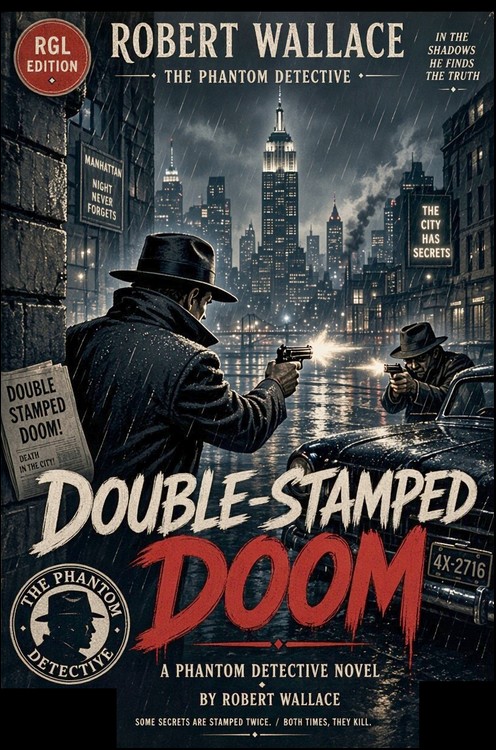
RGL e-Book Cover
Based on an image created with Microsoft Bing software
Roy Glashan's Library
Non sibi sed omnibus
Go to Home Page
This work is out of copyright in countries with a copyright
period of 70 years or less, after the year of the author's death.
If it is under copyright in your country of residence,
do not download or redistribute this file.
Original content added by RGL (e.g., introductions, notes,
RGL covers) is proprietary and protected by copyright.
RGL e-Book Cover
Based on an image created with Microsoft Bing software

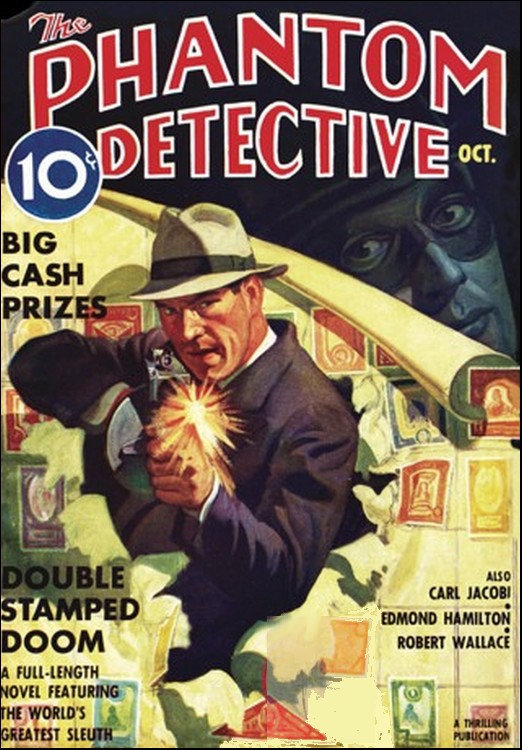
The Phantom Detective, October 1937, with "Double-Stamped Doom"
Cloaked in impenetrable mystery, masked marauders strike—and leave a blood trail!
FOG, dank and stifling, completely blotted out the late afternoon sun and mushed down like cotton soup into the highways and byways of London, England. In the course of fifteen minutes all traffic was at a helpless standstill. A few more daring bus, cab and pleasure car drivers tried to crawl forward through the chalky murk at a snail's pace.
But no sooner did they try it than they bumped into other invisible and immovable objects. Even the pedestrians were at a complete loss as to direction. Children became separated from their parents, and their frightened cries added to the awful din of blaring motor horns, frantic police whistles, and what not.
In short it was the worst fog London had seen in the memory of its oldest inhabitant. A metropolis of over six million was hopelessly paralyzed until Nature saw fit to remove the cloying blight. However, to four masked men, pressed against one of the rear doors of the British Museum, on the fringe of Trafalgar Square, the fog was a blessing sent by his satanic majesty, himself.
Three of the men wore plain black masks, but the fourth wore one that was checkered. And it was he who slipped a key into the well-oiled lock, twisted, and slowly eased the door open.
"The fourth door on the left," he whispered. "The glass case is directly in front of the door. Tear the top off, and don't stop for anything. I'll take care of all those who are fools enough to bother us. All right, in we go."
With no more sound than four cats walking upon velvet the men stole inside and down the marble corridor to the fourth door on the left. Even as they reached it, two uniformed guards suddenly appeared at the door opposite. For a split second they gazed open-mouthed at the four men, then as one they reached for their guns. But their hands never touched the butts.
The movements of the man in the checkered mask were faster than lightning. As though by magic a derringer-type gun appeared in his black-gloved hand. Yet when he pulled the trigger, no flame nor barking sound spouted from the muzzle. Instead there was nothing but a sibilant hiss, and then another. Instantly both guards clutched wildly at their throats.
Strangled cries came from their twisted lips. They staggered, reeled against each other like men struck by invisible bolts from the blue. And then without a sound they fell to the floor. Once, twice, their bodies twitched convulsively. Then they became stiff and rigid as posts, and they lay there with horrible glassy looks in their wide staring eyes.
Already the three plain-masked men had entered through the door on the left. The fourth remained a second or two, staring down through the slits in his mask at the dead men on the floor. The mask moved slightly as the lips behind it expelled air slowly.
"That will teach them," came the soft words. "And any others who get in my way."
With a nod for emphasis he wheeled in his tracks and darted into the high domed room. His three companions were quickly but quietly ripping off the heavy glass cover of a huge show-case. Like misers delving into a bag of gold they dipped their gloved hands into the case and lifted out object after object. Finally the case was completely empty.
"That's all, Boss," one said heavily. "We'd better hurry."
The man with the checkered mask nodded.
"It was perfect," he said. "The others will be easy, too. We'll—"
He stopped short, whirled like a cat. Another museum guard was racing into the room, one hand tugging at his holstered pistol. It was the last move in his life. Once again the strange derringer appeared and gave forth its peculiar hissing sound. The guard might well have been one of those out in the corridor, his movements and actions were so similar. In no time his rigid body was on the floor, and his horribly glazed eyes were staring sightlessly upward.
Without giving him a second glance the four masked men raced out of the room, and down the corridor to the door through which they had entered. Hardly checking their pace they yanked it open and disappeared into the blanketing fog.
RAIN, driving, slashing, was turning the streets of Paris into a flood fury. Since six o'clock in the evening the very heavens had remained split apart while countless tons of water poured down through the openings. It was now past ten o'clock and hardly a dozen people were on the streets from one end of the gay city to the other.
Warm and dry inside the Francois Museum, Pierre Caballe pressed his wrinkled face against the window and peered out into the drenching flood. With a muttered curse he stepped back and looked at his watch in the dim light of the single bulb on the wall. He frowned and shook his head impatiently.
"Even if it does stop before I go off duty," he murmured, "I shall never be able to reach home. There must be a foot of water in the street. But perhaps I should try it. They might say that I, Captain Caballe of the Francois Guards, am afraid of a little water. Yes, I know they think I am too old for this job."
He clipped off the last, turned and peered across the room toward the door on the far side. One corner of his mouth twitched.
"Who is that?" he demanded. "Speak up! Is that you Paul?"
His voice echoed about for a moment, then was lost in the drumming beat of the rain against the window panes. A curse on his lips, he took his flashlight in one hand, and rested the other hand on his gun. Then he walked down the aisle, between two rows of show-cases, toward the door.
"Is that you, Paul?" he demanded again. "I'll have your hide if you think it's a joke. Pierre Caballe does not scare, you young fool. Paul, come—"
The last died in his throat, and his heels smacked the floor as he stopped short. As though springs had been pressed, four figures shot up in front of him. Three wore plain black masks, but the fourth's was checkered.
"Who—"
That was Caballe's last word in this world. There was a hissing sound. Perhaps he heard, and then again perhaps he didn't. At any rate he didn't hear anything else, for the hand of death smote him down in his tracks; smote him to the hard floor where he remained stiff, with unseeing glassy eyes fixed rigidly on the leg of a show-case less than six inches from his nose.
Silent as the silence of the death that was Pierre Caballe's, the four masked men went to a long show-case and pried up the heavy cover. Each man in turn reached inside, took out something and stuffed it quickly under his flowing coat. And when the show-case was empty they let the cover drop back into place.
"Perfect again," came a voice from in back of the checkered mask. "Like taking candy from children. Nothing can stop us, my friends. No, and nothing ever will."
"Let us be off!" one of the others croaked.
A soft chuckle greeted the demand.
"But of course. Did you think I planned to spend the night here? Spend the night with those five who will never see tomorrow? No. Of course, let us be off."
Without a word the four turned and went through the door as softly and as silently as the air through which they moved. A few moments later only Captain of the Guards Pierre Caballe remained in that room with all its public treasure.
CHIEF-INSPECTOR HARDY of Scotland Yard pressed his clenched fists together and swept the group of grim faced men, seated about the table, with eyes that glittered determination. "I have asked you gentlemen to come to London," he said quietly, "in order that we might discuss the series of daring robberies that have taken place in European capitals during the last few months. We—"
A short gentleman seated at the opposite end of the table stood up, and twitched his mustache in a gesture of fuming irritation. He was head of the French Sûreté, and well known for his flaming bursts of anger when baffled by a crime of major import.
"It is more than robbery, Inspector!" he cried in a high pitched voice. "It is also wholesale murder. Millions of francs in rare stamps stolen, yes. But we may get them back. But we can never bring back the guards who were murdered. And how did they die, and who killed them? There is not a clue, nothing. I tell you it is a devil from another world who is committing these crimes."
INSPECTOR HARDY smiled politely.
"Perhaps," he said, "but for the present we must deal with facts. These are what we have to date. Four months ago the famous Tapling collection, that included the early shilling, crown and pound values of Great Britain and Colonies, and valued at $60,000 alone, was stolen from the British Museum, here in London.
"Three months ago the 19th Century collection of United States stamps, that included the well known used block of eight five-cent stamps of 1867, and loaned by the late Sir George Walters, was stolen from the Francois Galleries in Paris. The value of the block of eight fives is $35,000 in itself."
The head of Scotland Yard paused a moment for emphasis. Presently he continued.
"Two months ago the Lapham collection being exhibited at the Milan Library, that included two of the famous Mauritius Post Office stamps, valued at over four thousand pounds each, were also stolen. And not over three weeks ago the Armitage collection of U.S. stamps, including one of the two-cent blue Hawaiian stamps, of 1851, was stolen from the Berlin Museum.
"In short, gentlemen, the motive of the crimes was of course the theft of rare stamp collections either government or privately owned. However, the method of committing the crimes is something that none of us know as yet. The criminals are clever beyond words. To use the old, old term, their leader is truly a master mind. He—"
The Frenchman was on his feet again.
"He is a devil, sir!" he shouted. "A fiend out of hell. Not a clue as to how all those guards were killed. There are no bullet marks, no knife wounds, or even signs of poisoning. Nothing but a slight discoloration of the skin. But autopsies were a waste of time. The finest chemists and toxicologists in Europe could discover nothing to explain the cause of death. We found the bodies—they were dead. But how in the name of the dear God did they die?
The man answered his own question by throwing up his hands in a typical gesture of his race. The others nodded their heads in grim agreement. All save Inspector Hardy. His eyes hardened all the more.
"Four of the most famous rare stamp collections in Europe have been stolen," he said. "Their value is almost incalculable. Over twenty men have been murdered. The greatest mystery of the age confronts us. But, gentlemen, let me remind you—we are not without something. Infinitesimal as it may appear, it is a clue. I refer to the watch of each guard who was murdered. In every case, the watch was fifteen minutes slow. That is beyond the realm of coincidence. It is something for us to work on.
"It is of course logical that the criminals stole those stamps for profit reasons. To make anything out of their thefts, they would have to sell them here in Europe or across the water. Therefore it is up to us to throw every man available into the task of tracing down those stamps here and in every foreign country.
"And in doing so we should never forget that one clue we know to be a fact—the way each dead man's watch was fifteen minutes slow. I cannot help but believe that that single clue will eventually lay these mysterious murderers by their heels, and bring them to justice."
The head of Scotland Yard stopped. Not a single representative of Europe's finest police brains, seated about the table, spoke a word, or made any attempt to speak one. In every mind was the cold fact that priceless treasures had been stolen by murderers who had left little behind but baffling mystery. They wanted to believe that justice would triumph, yes. But where was the beginning and where was the end? In their hearts they did not believe that either would ever be found.
STEPHEN LE ROY, head of the Wall Street firm that bore his name, was frightened. He was more than that. He was well nigh paralyzed with fear. Sunk down deep in a chair in the bedroom of his spacious Adirondack hunting lodge, he continually stared fitfully about him, eyes large, hands twisting at each other, and his front teeth sunk into his lower lip.
It was dark outside, and he had drawn down the window curtains in order to shut out that darkness; a darkness that made him imagine that ghostly shadows pressed against the window panes. His eyes pictured menacing images to his fear-tortured brain. He saw guns pointed at him, knives uplifted, and fingers reaching for his throat.
With a quavering moan he forced another sleeping tablet into his mouth, washed it down with a gurgling gulp from the glass of water at his side, and ran sweaty fingers over his face. Instantly he drew his fingers away and choked out a sob. They had touched the livid bruises and welts that marked his face. Vivid memories of a mysterious and terrible experience that had come to him just forty-eight hours before. Two masked strangers had attacked him and beaten him within an inch of his life.
In a fear-crazed sort of way, he now wished that they had finished the job, actually killed him. Within the next twenty-four hours a new terror had struck at him. Kernan, his secretary, had been mysteriously murdered in his office. That had been the last straw, and he'd fled to this mountain retreat to escape the sinister finger that seemed to be pointing at him. He had to escape and recuperate from the terrible beating that he had received.
Escape? Thought of the word made a harsh laugh rattle in his throat. In the hellish silence of the woods he was more terrified than ever, and regretted it with all his heart and soul that he had come. True, he was not alone. Ed Duncan, his best friend, and two private detectives from the best agency in the city were there to keep him company and act as guards. But little did that help his state of mind. If he could only sleep! If he could only drive the torturing thoughts from his brain, and gain even one hour of peace and rest.
"I can't stand it, I can't! I'm going mad. Mad—stark, raving mad. I can feel it!"
The words burst from his lips as he flung himself out of the chair, and reeled to the door of his room. He missed twice before he could get his hand on the knob to twist it and yank the door open.
"Duncan!" he cried as he thrust his head out in the hall.
Instantly doors opened down the upper hallway. Footsteps pounded toward him. A light-haired, good-looking man of thirty-five or so, ran up to him and took him by the arm.
"What's the matter, Steve? Easy, old fellow."
Le Roy slumped against the speaker, shivered.
"I can't stand it, Ed!" he groaned. "I'm going out of my mind. You're sure everything is all right? You've searched the place, searched all around? Ed, I tell you I can feel death. Yes, I can feel it—reaching for me."
Duncan patted his arm and gently led him back into the room. The two detectives, guns in hand, waited patiently at the open door.
"You're just imagining things, Steve," Duncan said gently and helped Le Roy into the bed. "You're all in, fellow, and you need rest. Now don't be silly, you're as safe as can be. Barker and Harrison have gone over every foot of ground outside. So have I. And we've searched the place from top to bottom. There isn't another single soul, here, but us. And if anyone comes we'll handle them, don't worry. Try to sleep, Steve."
WITH a sigh Le Roy relaxed slightly under the bed covers. He even forced a smile to his battered lips.
"I know, Ed, I know," he mumbled. "I shouldn't be this way, of course, but—Oh God, I can't help it. I haven't got your strength, Ed, though you should be in bed, too. You took a lot of punishment, the same as I did."
Duncan touched a black and blue bump on his forehead, and a strip of surgeon's plaster that ran along the edge of his jaw. Then he grinned.
"Sure, but I can take it," he said. "Now, go to sleep, Steve. Barker and Harrison and I will be within call every second of the night. Just yell for us if you see or hear anything. But you won't. You're as safe as though you were in a castle. Good night Steve. See you in the morning."
With a friendly pat on the shoulder for Le Roy, Duncan walked out of the room and closed the door. For a second Le Roy was tempted to rush after them, but with an effort he restrained himself and lay there in the bed staring wide-eyed at the ceiling.
An hour passed, and body fatigue became too much for his tortured, weary brain. Sleep started to drag down his eyelids. Unconsciously, from force of habit, he reached out and snapped off the light. His eyes were already closed so his brain did not register the change. He was sound asleep before his hand fell limp on the covers.
Presently Stephen Le Roy returned to consciousness. It was as though something had warned him of sinister and impending danger. Wide awake, his first impulse was to cry out at the top of his lungs. But somehow his tongue was too thick to form any sound. It was really clinging to the roof of his mouth in fear.
He acted upon the second impulse that swirled over him. He reached out and snapped on the light. Once, twice, he blinked stupidly. Then his eyes flew wide and stayed that way. Five feet from him were two men. They were dressed in dark clothes, and each wore a black mask over his face. One of them held a small derringer-type of gun in his hand, and the muzzle was pointed straight at Le Roy.
The broker looked down the mouth of that gun and saw grim, certain death. Every muscle of his body quivered, and sweat oozed from every pore. Then with an almost superhuman effort he opened his mouth and started a wild, piercing scream that came from the very depths of his lungs.
It lasted less than a split second, however. The gun in the masked man's hand made a hissing sound. Gurgling, gasping, Le Roy clutched at his chest, tried to throw himself from the bed. But the effort was useless. He fell back on the pillow—stiff as a statue, his glassy eyes turned upward to the ceiling.
Without a word the man with the strange gun snapped off the light and plunged the room into darkness. Almost at the same time a fist banged on the outside of the door, and the voice of Duncan cried out.
"Steve! Unlock the door! It's me, Ed Duncan. Did you call out? Steve! Steve!"
Other fists banged on the door. Then bodies were hurled against it. But the door was of stout stuff, and it resisted all efforts to break it in. Finally, a gun was fired three times in rapid succession, and jacketed bullets chewed into the lock. Even then the stout door continued to hold, and it was almost fifteen minutes before it gave way and Duncan and the two private detectives barged headlong into the room.
IN three long steps Duncan reached the wall switch, snapped it on. As light drove the darkness to cover all three stopped in their tracks, and gaped at the stiff corpse. Then with a grunt Detective Barker stepped close, felt for the heart and the pulse.
"Dead," he said. And without turning his head, "Harrison, get outside on the jump. The killer went through that window. See if there are any tracks. Snap it up."
As the other dashed out, Duncan moved forward. His face was drawn, and he laid a trembling hand on Detective Barker's shoulder.
"But it's impossible!" he mumbled. "None of us heard a sound."
Barker stood up shrugged.
"Most night killers don't make sounds," he said. "But he's dead just the same. Now how the hell? Must have died of fright. I can't find a knife mark on him, and that noise was his scream—not a shot. He—Wait a minute."
Barker stooped over and reached into the pajama pocket. Something in it caused the pocket to sag heavily. He grinned sheepishly as he pulled out a thin gold case watch.
"Thought it might be something," he grunted, and hefted the watch in his hand. "Let's see, ten forty-five. He must have passed out about ten thirty, I guess. What a sweet mess. Well, I'll go get on the phone. Have to notify the local sheriff, of course. What's his name?"
Duncan didn't answer for a moment. With eyes brimming with sorrow he stared down at his dead friend. Then he shook himself.
"Sheriff Hogan, I think," he said. "The phone's off the hall downstairs. I'll show you."
Together they went down to the first floor. As they reached the phone, Detective Harrison came in through the front door. Failure was stamped all over his ruddy face.
"Two birds," he said. "Found two sets of footprints under the window, and an old ladder they must have used. Lots of footprints, even in the moonlight. What did it, Barker?"
"Don't know. Hell of a mess. I'm calling the local sheriff. If he—Say, this is damn queer."
Harrison pressed forward.
"What is?" he grunted.
Barker held up the watch he had taken from Le Roy's pajama pocket.
"This," he said and frowned. "This is the one he stopped for at the jewelers before we left New York. Had it cleaned and set. Take a look at the time, and then look at your watch."
Harrison did so. He even compared his watch with Barker's and Duncan's. All three were the same to the minute. Le Roy's watch was fifteen minutes slow.
"A punk watch repairer is what I say," Harrison grunted.
Barker's eyes narrowed for a second, then he reached for the phone.
"Yeah, maybe," he said.
FRANK HAVENS, jovial, white-haired owner of a string of newspapers that were read from coast to coast, sat in his private office in the New York Clarion Building, and absently drummed his fingers on the top of the huge desk. At intervals he stared meditatively at a score or more of autographed photographs of internationally famous personages that adorned the panel walls of the office. But he did not see them.
His thoughts were elsewhere. To be exact, they were upon a man in a Park Avenue penthouse. A man whom he had phoned not half an hour before and begged to come down to see him as fast as taxi or subway could bring him.
Presently the door opened, and a tall, well built man of uncertain years entered. He had the unmistakable pallor of those who have spent more time than is good for them, bent over the night city desks of metropolitan newspapers. An expectant smile on Havens' face faded as he half rose from his chair, and dropped back.
"This is a private office, sir," he said. "Whom did you wish to see? Perhaps I can direct you."
The stranger pursed his lips, then with slow deliberation he looked about the room. When his eyes finally came back to Havens there was a faint twinkle in their depths.
"I understood it was you who wanted to see me, Frank," he smiled. "You really did call, didn't you?"
Havens' jaw dropped. It was a second before he could find his tongue.
"Van, my boy!" he exclaimed. "Why I wouldn't have recognized you in a thousand years."
The newcomer walked forward and perched himself on a corner of the desk.
"Then nobody else would in two thousand," he said. "And that was my idea of the disguise, naturally. Well, what is it all about this time?"
The newspaper owner didn't reply. He simply sat there looking with paternal pride at the tall man. Richard Van Loan was no relation of his whatsoever. But he might just as well have been his son. Van Loan's father had been his closest friend, and when he had died Havens had endeavored to act as both father and friend to young Van Loan.
In this he had succeeded. In fact it had been Havens who had gone to Van Loan in his greatest hour of need and offered the advice and suggestion that had resulted in a distinct benefit to society in general.
Born with a gold spoon in his mouth, Richard Van Loan had been reared in a melting pot of money, and all that went with it. Since the day he was old enough to realize things for himself he bitterly resented the gold chains that held him prisoner and kept him from the real life that his spirit craved.
It was then that Frank Havens had come to him. Come to him with a suggestion that he pit his intelligence against the army of crime, the underworld. The idea clicked with Van Loan instantly, but he didn't jump in with both feet. Instead he took a year or so to prepare himself for his everlasting and unending task. A task that he would and must tackle alone, and unknown to all save Havens. A master of languages, he improved this talent. The mysteries of police chemistry became an open book. Travel abroad acquainted him with the various police methods of detection and solution the world over. He even mastered the art of acting any character, at any place, and at any time—acting a part even better than the original would do. But most important of all he completely conquered the art and mysteries of disguise. Not only conquered them but developed a technique of quick change from one character to another that was truly remarkable in its performance.
THEN came the day when he was ready to take his part in the war against crime. On that day a new identity was born. The Phantom, a man of mystery, of daring, and of unbelievable ability, who pitted himself against the countless followers of crime, and won through every time.
In the space of months the very mention of the name, Phantom, struck terror into the hearts of crooks from Hong Kong to Frisco. And any honest man or woman who was being attacked by crime's tentacles knew that he or she had only to appeal his case to Frank Havens, and Havens would see that it reached the ear of the Phantom.
"Come, come, Frank," Van Loan broke into Havens' thoughts. "You did get me down here for something important, didn't you?"
The publisher shook himself, pulled open a section of the desk and took a bottle of brandy from the small bar built inside. He maintained his silence until he had poured drinks for them both.
"Yes, Van," he said, "I did get you down here for something important. Naturally, I didn't say a word on the phone. But we got the police flash about five minutes before I called you. Van, Stephen Le Roy, the Wall Street broker, was murdered an hour ago at his Adirondack hunting lodge!"
The Phantom sipped at his brandy, lighted a cigarette, and sighed.
"That is too bad," he said. "I believe I met him once. A rather weak face, but he seemed a good enough sort of chap. Well?"
"Kernan was murdered two days ago," Havens said. "He was Le Roy's secretary. You read of that murder?"
A faint tightening was visible around Van Loan's eyes.
"Yes, I read about that," he nodded. "The police have yet to discover how he died. They are completely at loss as to motive."
Havens leaned forward.
"And it seems to be the same with Le Roy. He, his friend Ed Duncan, and two detectives were up there alone. Le Roy took them up there for protection. He was scared after the beating up he'd received, and then Kernan's murder. They—"
"Beating?" the Phantom stopped him.
"Yes, Van. Three nights ago, Le Roy and Duncan were being driven out to Westchester by Olsen, Le Roy's chauffeur. They were stopped by two masked men, and all three were severely beaten up. Olsen rather badly. He's in the Johnson Hospital now. A slight concussion of the brain, but he'll pull through."
"It seems he tore the mask off one of the men, and the police hope he can identify the man. They've rounded up a lot of known crooks, some of whom tried to leave the city after the Kernan murder. They want Olsen to attend the line-up just as soon as he's able."
"And now, Le Roy has been murdered," Van Loan murmured thoughtfully. "That, my dear Havens, may make Olsen more important than ever. He—"
"Don't worry," Havens nodded. "The police guessed that, too. Inspector Farragut has placed a guard over his room."
Van Loan nodded his approval.
"But what about Le Roy's murder?" he asked.
"Le Roy had been put to bed," Havens said. "Duncan and the two private detectives were in their rooms down the hall. They thought they heard a scream, and rushed to Le Roy's room. The door was locked and bolted on the inside. It was quite a while before they were able to break it in. They found Le Roy dead on the bed.
"They couldn't figure how he died. No bullet nor knife wounds. But there was one thing in the police flash I spotted. It struck a familiar note—something big I just can't place. It was this. Le Roy's watch, which was in his pajama coat pocket, was fifteen minutes slow. But he'd just received it from the watch repairer's a day or so before."
NOT a single muscle of the Phantom's face moved, but his eyes took on an interested glint.
"Was Le Roy's skin slightly discolored?" he asked.
Havens started.
"How did you know that?" he gasped. "Yes, it was. Why?"
"Two years ago," Van Loan said, "there was a mysterious series of crimes in Europe. Some of the most priceless rare stamp collections in the world were stolen. They have never been recovered. The one and only clue the police had to go on was that the watch of each museum and library guard was fifteen minutes slow, and his skin was slightly discolored.
"By jove, that's so!" Havens cried. "That's the connection. Then you mean—?"
He stopped and looked questioningly at the Phantom. Van Loan was squinting at his cigarette.
"It must mean," he said, "that there is a connection between the murder of Le Roy, and those rare stamp robberies in Europe. It means that the same gang is operating in this country, now. Tell me, did Le Roy collect stamps?" Havens shrugged.
"I don't know," he said. "I didn't know him that well. But admitting there is a connection, why was Le Roy flogged, and then killed?"
"I don't know, yet," the Phantom said. "I'm not even trying to guess. However, it is fairly evident that the stamp stealers put another one over on the European police. They've brought almost two million in rare stamps into this country—to sell them obviously. One of our first jobs is to find out whether Le Roy and Kernan were philatelists by hobby or trade. Is Steve Huston around?"
"Downstairs in the City Room," Havens nodded. "Just a minute." The publisher jabbed the interoffice phone button, and asked the paper's star reporter to report to him at once. Then he looked at Van Loan.
"What do you want with Huston?" he asked.
The Phantom lighted another cigarette before answering.
"Partly for disguise," he said. "Huston is known to the other reporters and the police. I want to be in on that interview with Olsen. As a leg-man for Huston I can work it better. Also, Olsen may know of his boss's hobbies."
Havens looked dubious.
"The D.A. says that the press has got to stay put until the police have finished," he said.
"Perhaps they'll be finished when Huston and I get there," Van Loan grunted.
At that moment the door opened, and Steve Huston strode into the room. He gave Van Loan a passing glance and went directly to Havens' desk.
"You sent for me, sir?"
The publisher nodded at Van Loan.
"He did," he said. "The Phantom wants you to lend a hand on another case. The Olsen case."
The reporter whirled, mouth open in amazement.
"The Phantom?" he gulped in unbelief.
Van Loan smiled.
"Hello, Huston. Right now I'm Joe Burns, a leg-man working with you on the Olsen flogging story. We're going to the hospital to see what we can learn—to get a press interview. Meet me in your car two blocks down. Remember, I'm Joe Burns, learning the ropes. See you in five minutes."
With a nod to them both the Phantom turned on his heel and walked out the door. Havens looked after Van Loan and shook his head.
HIS disguise slightly altered so that no chance observer could connect the man who met Steve Huston two blocks from the Clarion Building with the man who had entered Frank Havens' private office, the Phantom followed the reporter out of the car as it came to a stop in front of the Johnson Hospital. They went quickly up the steps.
Once inside it was not difficult to locate Olsen's room in the private ward. It was simply a matter of following the string of reporters and cameramen that extended from one end of the hospital to the other.
However, once the door of Olsen's room was reached progress was stopped abruptly. A pot-bellied cop raised a detaining hand, and flashed an angry eye as Huston and the Phantom started to push by.
"Hold it, you! Now just where do you think you're going? Back with the others. I got my orders. No one goes inside, see?"
Huston being a died-in-the-wool reporter started to give the cop an argument, knowing full well, of course, that it was a waste of breath. The Phantom, however, said nothing. Stepping back a pace, and assuming the attitude of a cub who knows enough to let a veteran do all the talking, he ran sharp eyes over the group lounging in the corridor. In one sweeping glance his eyes took in every face, and automatically photographed it on the screen of his brain for future reference if necessary.
No face, however, quickened his pulse. The group was made up of reporters and cameramen only. There was even a sob sister, well known for her flowery articles in a local sheet.
"Do you want me to throw you out?" Van heard the cop bellow at Huston. "I tell you the D.A. has forbidden Olsen to make any statement to the press. And that sticks, as far as I'm concerned. I don't care who your boss is. Now get back, and stay back if you want to stay here!"
For a moment the Phantom was tempted to make use of his one sure means of gaining entrance into the sick room. In a secret pocket he always carried an article of identification that was known to the police forces of the world. It was a platinum shield studded with a cluster of diamonds that shaped a mask. He need only flash it and the cop would know who he was and open the sickroom door in an instant.
But that was the very reason he hesitated to make use of his secret shield. The cop, even though he was a cop, would know that the mysterious Phantom was working on the case. And as experience had taught him many times in the past, the fewer the number of persons who knew he was working on a case the better were his chances of tracking down and bringing the guilty ones to justice.
Only when it was absolutely essential did he make use of his shield. And it did not seem that important at the moment. As a matter of fact he had overheard one of the group say that the District Attorney was expected within the hour. At least he could wait that long before resorting to sure methods.
So he leaned carelessly against the wall and stared off into space as though his thoughts were a thousand miles away. However his ears were tuned for every word spoken around him. There was no telling but what he might catch a chance word from the mouth of a glib reporter working on the case that would dovetail with the few meager facts that he already knew.
As the result of his ears being keenly tuned he was the first to hear the ambulance come clanging down the street outside. A moment later he joined the others as they moved to the corridor windows and peered curiously out into the lighted street. At practically the same time an interne came hurrying down the hall pushing a stretcher table before him.
"One side, please!" he snapped at those who got in his way.
"Taking that to the guy outside, Doc?" somebody asked. "What's happened?"
"Not big enough for your paper," the interne rapped over his shoulder. "Just another lad who tried to drive through an El post."
A couple of minutes later those at the window saw the interne and the ambulance driver carry a bandaged man out of the ambulance and place him gently on the stretcher table. A moment or so after that the interne returned, pushing the table down the hall. Blankets covered the body of the man on the table. Only his face was visible. And very little of that. His head was swathed in bandages through which considerable blood had seeped.
SUDDENLY, as the stretcher came abreast of the door of Olsen's room a bit of whirlwind, lightning-like action took place. In a flash the bandaged man hurled the blankets to one side and leaped from the table. Somebody yelled. It was the cop. He threw up both hands and lunged for the man. But he didn't have a chance. A snub-nosed automatic clutched in the bandaged man's hand spat flame and sound. The cop slumped to the floor, a small blue hole square in the middle of his forehead.
Without so much as checking his mad pace for a single instant the killer leaped over the cop's body and hurled himself through the door. Pinned against the wall by the crowd of terror stricken reporters, the Phantom fought furiously to wrench himself free and plunge in after the man before it was too late. But the crowd hemmed him in, and in the next second he cursed bitterly.
Within the room three shots rang out sharply. There was a gurgled cry, and the sound of something falling heavily to the floor. Then with gun blazing wildly the killer came tearing out into the corridor, a section of his bloody bandage trailing out in the breeze his movements created.
"Out of the way!" Van Loan roared. "Get back you fools! Get back!"
A shot echoed the last, and through eyes burning with rage, the Phantom saw the sob sister clutch at her breast and fall forward on her face. She had been directly in the path of the charging killer, so he had deliberately shot her out of his way. Pivoting he started down the hall. As he did so, a reporter with plenty of guts made a flying tackle and half caught him about the knees. But he was unable to hang on. A gun barrel chopped down savagely on his head and he went limp.
Exerting every ounce of his strength to smash through the terrified group that pressed him back, the Phantom raised his gun and took quick aim between the heads of two reporters. For a split second he had the killer in his sights. But in that same split second the white face of a running reporter bobbed up before him. So instead he jerked the barrel toward the ceiling and pulled the trigger.
The roar of his gun did what all of his strength had failed to do. It struck new terror into the hearts of those about him, and they fell back wildly. His path cleared at last, he leaped forward. At that exact instant a gun blasted in his face, and a white hot coal ripped across the top of his shoulder and half turned him around. Catching himself he pivoted back, pulled his own trigger.
BUT it was too late. His bullet knocked plaster from the corner around which the killer had dashed a split second before. Checking his fire the Phantom raced for that corner and charged around it and through the main door at top speed. From outside more guns barked and unseen death whined past his head. He ducked low and kept right on going.
In a single leap that would have done credit to any Olympic broad jump champion, the killer went in through the rear opening of the ambulance as it lurched away from the curb. The Phantom drilled four shots through that opening, and thought he heard a cry of pain. But he wasn't sure. All other sound was drowned out by the roar of the ambulance's engine as it went rocketing down the street, spun around the next corner on two wheels, and became lost to view.
A snap glance to the left and right proved to Van that there was not another car available to give chase. Huston's car was there, but the reporter had taken the ignition keys into the hospital with him. Smoldering rage burning through him, the Phantom swung around and went back into the hospital. Bedlam had broken lose in the corridor. Reporters and hospital attendants were rushing about in circles. Four men, including the cop, and one woman, the sob sister, lay cold in death on the floor.
A hundred questions were yelled at the Phantom as he strode down the corridor. He ignored them all and went into the sick room. There he paused, eyes glittering. A nurse in white was sprawled in a chair, blood pouring from a gaping wound under her left breast. In the bed lay a heavy-set blond-haired man of middle years. His face was spattered with blood. The parts that were not spattered were the dull white of death.
One look was all the Phantom needed. Wheeling he went outside, took hold of Huston's arm and led him rapidly down the hall. The reporter was beside himself with rage over the cold slaughter of the sob sister. Curses poured from his lips and he clenched and unclenched his fists in helpless desperation.
Out the hospital door the Phantom led him down the street to the nearest drug store. A crowd had collected in front of the hospital, but the Phantom barged his way through, looking neither to the left nor right. Once in the drug store he shoved Huston into a booth.
"Get hold of yourself!" he snapped. "Phone in your story, and then sit there. I'm making a call, too."
Sliding into another booth Van called Police Headquarters. In a few seconds he had Inspector Farragut on the wire.
"The Phantom, Farragut," he clipped out. "Your star witness, Olsen, has just been murdered. I—"
"What's that?" the harsh voice in the receiver cut in on him. "Olsen murdered? Were you there Phantom? I didn't know you were working on the case."
"You know it now," Van shot back at him. "Listen, you have a mess of criminals in the Tombs you wanted Olsen to see. Well, Olsen won't ever see them now. But I want you to hold them. I want to have a look at them. I've got to go off on a little trip, but—"
"I can't hold them indefinitely, Phantom," the police inspector cut in. "I've had them almost thirty-six hours, now. There'll be a flock of lawyers down here tomorrow with writs of habeas corpus. I'll have to let them go, unless something turns up."
"I'll be there tomorrow," the Phantom said. "Do anything to hold them until then. Another thing, it will save time. Look through your files for any stolen stamp cases. Rare stamps, no matter how small the case."
The noise at the other end of the phone was like an explosion.
"Rare stamps? What the devil have rare stamps got to do with the case."
"Perhaps everything," Van Loan answered. "Men have robbed and killed for far less. See you tomorrow."
Hanging up, the Phantom stepped out of the booth. Huston had finished his call and was waiting, face beety with rage. Van took him by the arm.
"We're taking a taxi to North Island Airport," he said. "I have a plane there. We're flying up to Stephen Le Roy's lodge."
The reporter nodded and made no comment. At the curb they hailed a cab. Van Loan leaned back against the cushions and stared unseeing at the driver's head. The thrill of the hunt was stirring his blood. Murder, and stamps worth a fortune. Murder he was quite familiar with. And also with rare stamps.
Himself a philatelist by hobby, he had a valuable collection and knew the history of the world's most famous stamps. To set out on the trail of some that had seemingly disappeared from the face of the earth, to smash through and solve the mystery that had taken Europe by the throat, and now seemed to be invading the United States was a case completely to his liking. Unquestionably there was a tie-up somewhere, and he'd find and interpret it.
BENT forward over the dep-wheel of his small but speedy cabin seaplane, the Phantom fixed narrowed eyes on the wild, rugged, and moonlight-flooded terrain below. At intervals he took his eyes from the ground to consult the strip map fastened to the panel on the instrument dash. Presently he gave a little grunt, and nodded his head in grim satisfaction.
"Hit it on the nose," he said. "I was lucky. There's the lake, ahead and to the left."
Huston, in the adjoining seat, leaned forward and squinted through the windshield.
"Hope you're right," he muttered. "I can't see a damn thing but the peaks."
The Phantom smiled thinly, cut the throttle and nosed the plane down. Hand rock-hard on the wheel he guided the craft through the mountain air currents, and straight down toward a small lake snuggled in a shallow valley. As he approached the surface of the lake he saw the twinkling lights of a building on the far side. Risking the wind direction he headed as close to that shore as possible. Then he flattened out, eased all the way back on the throttle and waited for the pontoons to mush heavily into the water.
They did so with hardly a bump and the plane coasted forward. Goosing the engine the Phantom taxied until the pontoons' noses were up on the muddy sand. Then he cut the switch and nodded to Huston.
"We're here," he smiled. "Out you go. Walk along the pontoon and jump to shore."
They had just about reached dry land when a figure carrying a lantern came down the slight slope from the lodge and confronted them. A sheriff's shield glistened brightly in the light of the lamp and the moon.
"Who are you, and what do you want?" he demanded. Then as though he'd forgotten something, "I'm Sheriff Hogan."
"Glad to meet you, Sheriff," Van said pleasantly. "We're here on the Le Roy murder. Look."
As he spoke Van extended his right hand. The sheriff took one look at the diamond incrusted shield and almost dropped the lantern.
"Holy mackerel!" he gulped. "The Phantom! Say, this is something. Come along, sir. They're all up in the lodge."
Van didn't move.
"They, Sheriff?" he echoed. "Anyone else besides Mr. Duncan and the two private detectives?"
"Yeah," the other nodded. "Two men. Business partners of Le Roy, I think. Eric Martin and Courtney Burke are the names. They drove up here to see Le Roy. But they stopped across the lake at the Inn as the road around ain't so good. Course when the news got around they come over. Fact is, they didn't get here until half an hour or so ago. This is some case, Phantom. Damndest killing I ever heard tell of. None of us ain't got an idea in the world of how it could have been done, 'less it was heart failure, or something."
THE Phantom raised a finger and pointed seventy-five yards or so along the shore and another twenty-five out into the water. A small seaplane was riding motionlessly at a buoy. It was painted a plain dull color which made it almost blend in with the moonlight-tinted water.
"Who owns that plane, Sheriff?"
"Huh? Gosh, first time I've seen the thing. Guess maybe Le Roy owns it. I mean, did own it. Say, is this other gentleman your assistant, sir?"
"You can call him that," the Phantom replied and started up the slope. "He is also a newspaper man. Huston is the name."
"A reporter!" the sheriff grunted and there was a world of meaning in his words.
However he made no further comment, and the trio moved up to the lodge in silence. The sheriff, bubbling with the excitement of the occasion, burst through the door first.
"The Phantom's here!" he cried. Five men in the room instantly stopped whatever they were doing and stared wide-eyed at Van as he stepped inside. Though his face was disguised he had slipped on a plain black silk mask during the flight up and it now covered the top half of his face. There might be occasion to use the same disguise in the immediate future, so he had thought it best to let none in the lodge get a good look at him. As a result every eye was glued to the mask.
Then Duncan moved forward, hand outstretched.
"I'm glad you're here, Phantom," he said with a grateful smile. "I'm Ed Duncan. Le Roy was my best friend. This is Mr. Eric Martin. And this is Mr. Courtney Burke. And these two gentlemen—"
The Phantom didn't listen as Duncan introduced Barker and Harrison. He studied Martin and Burke closely. The former was slightly heavy set, with a peculiar droop to his grey-green eyes. Otherwise he was perfectly ordinary looking. Burke was thin and tall. He had jet black hair, sleeked down. The features of his face were sharp and outstanding. But both held a faint glint of nervousness in their eyes as the Phantom nodded politely.
"Of course, you're here to take charge, Phantom," he heard Duncan say at his elbow. "What would you like to know first? Do you want to—to see Le Roy. On the advice of Detective Barker, the body has not been removed."
"I'll take a look at Le Roy later," Van said quietly. "First I'd like to ask some questions. Beginning with you, Duncan. You were with Le Roy when he was beaten up?"
Anger flooded the other's eyes.
"I certainly was!" he said. "You can see the results on my face."
"Tell me about it."
"There isn't much to tell. Olsen, Le Roy's chauffeur, was driving up to the Westchester Biltmore. That was three nights ago. Another car drew alongside and forced us off the road. Two thugs leaped out and set upon us with blackjacks. They wore masks. The attack was so sudden we had little chance to protect ourselves. The highway patrol found the three of us unconscious on the roadside.
"Olsen was hurt the worst. He's in the hospital now. He managed to tear the mask from one of the men. I believe the police hope he'll be able to identify the thug from some criminals they've rounded up."
"Had Le Roy planned to come up here before the attack?" Van asked.
"I don't understand your question."
"I'll put it this way. Did he have any reason to expect an attack? Did he tell you of any threats?"
Duncan shook his head.
"None that I know of," he said. "He didn't tell me of any threats."
"Was Le Roy a philatelist?" Van Loan asked casually.
"A what? Duncan echoed. Then brightened. "Oh, you mean a collector of stamps? Why, yes, I believe he had some sort of a collection. I never saw it, though. Never was interested enough to ask him to show it to me. Burke, you collect those things, don't you?"
Le Roy's partner seemed to start slightly. Then he shook his head.
"Not any more," he said. "I couldn't be bothered keeping up with all the new issues, and stuff. I gave what I had to Steve. The whole lot wasn't worth ten dollars."
THE Phantom appeared as if he had only half heard and turned to Duncan again.
"Just why did Le Roy come up here?" he asked.
"Because I suggested that he do it," the other replied. "He was going to pieces in the city. I thought this place would do him good, help him get hold of himself. I said I'd come with him, and bring Barker and Harrison along to keep us company."
"Who knew he was coming up?" was the Phantom's next question.
"I couldn't say for sure," Duncan replied. "Nada, his wife, of course. And Martin and Burke here, I suppose. I don't know whether he told anybody else."
Van suddenly turned to Burke.
"Did he expect you tonight?"
"No," the man said sullenly, with a tightening of his eyes. "It was an unexpected business matter that came up. We wanted to see him personally about it."
"But it might have waited until morning, so you didn't chance the road around the lake," Van said.
Burke and Martin nodded in unison.
"That's right," Martin said.
"Who owns that seaplane on the lake?" the Phantom asked. "Is it Le Roy's?"
"No, that's Burke's," Duncan told him. "He keeps it up here during the summer months."
Van started to put another question but changed his mind. He nodded to Huston and Detective Barker.
"I'll take a look at Le Roy now," he said.
The detective led the way upstairs to the murder room. Hands sunk in his pockets the Phantom took in every detail in sharp scrutiny, and finally worked his way around the room to the bed. Bending over the corpse he studied it intently for a moment, then asked Barker for the watch. The detective handed it over without a word. Van compared it with his own, saw that it still lacked fifteen minutes of the right time, and handed it back.
"Can you add anything to the police flash, Barker?" he asked.
"Guess not, sir. We found some footprints, two sets, under that half-opened window over there, but lost them in the pine needles. There's a ladder, too, but I haven't checked it for fingerprints."
VAN nodded and walked over to two grips on the floor by the dresser. As he started to open them the detective interrupted him.
"Just some dirty clothes, Phantom," he said. "Harrison and I've been over the place with a fine tooth comb. Was there something special you were looking for?"
"I was wondering," the Phantom murmured, as he opened the bags, "whether Le Roy happened to bring his stamp collection along."
"Stamp collection?" Barker asked. "You spoke of that downstairs. I didn't get it. What's the angle? I've been hearing plenty about stamps lately."
Van Loan gave him a sharp look. "Just what do you mean by that?" Barker gestured.
"My kid," he said. "Got the yen a few weeks ago. His room is full of catalogues and stuff. He eats the things up. Why only the other night he was trying to tell me that some British Guiana stamp was worth fifty thousand bucks or something. Why of all the crazy—"
"Your son was right, Barker," Van nodded.
"Fifty thousand bucks?" the detective scoffed. "How could a single stamp be worth all that dough to anybody?"
"Because it's the only one of its kind in existence." The Phantom talked as he started opening the drawers of the dresser. "It is a one-cent British Guiana stamp issued in Eighteen fifty-six, and considered by philatelists as the rarest in the world. It was printed in the office of a newspaper known as the Official Gazette of British Guiana. You see, the postmaster was waiting for a shipment of stamps from England but they did not arrive before his supply ran out.
"Therefore he decided to print some himself and made up his own design. He put a picture of a sailboat model in his office on the stamp and initialed the plate, to make sure the stamps could only pass through his office. There is only one of that home-made issue left in the world. It was in the collection of the late Arthur Hind, the Utica millionaire. Hind willed it to his wife at his death. In fact, Barker, that stamp is worth considerably more than fifty thousand today. Mr. Hind's whole collection was valued at two hundred and fifty thousand dollars."
The detective scratched his head, whistled softly.
"I guess my kid ain't so dumb at that," he grunted. "I wouldn't mind owning a few of them things, myself. But—"
Barker stopped as the roar of an airplane engine came from out of the stillness of the night.
"Now who's that arriving?" he growled.
The Phantom had turned and was starting toward the door.
"That's a plane leaving, not arriving," he snapped. "Come on!"
The last was unnecessary. Both Barker and Huston were right at the Phantom's heels as he leaped through the door and went down the stairs to the ground floor. Duncan, Burke, Martin, Sheriff Hogan, and Harrison were already out on the front veranda.
Van Loan went by them without stopping. Once out in the moonlight he saw the plane moving slowly out into the center of the lake. It was the seaplane that had been tied up to the buoy—Courtney Burke's plane. Legs working like piston rods, the Phantom went down the slope toward his own plane. Reaching the nose of the pontoon he hurled his body against it and leaped onto the pontoon as the craft floated out well clear of the shore.
Seconds later he had climbed up the pontoon struts and dived inside the cabin. The warm engine caught instantly as he snapped on the switches and jabbed the starter. Working the fuselage rudder, and the pontoon rudders he skidded the plane around, missed the shore by inches in making the turn, and then headed out across the lake.
Three quarters of the way across, Burke's plane was just clearing the water, the exhaust pipes of its over-revving engine belching ribbons of flame backward. Face hard, savage determination glowing in his eyes, Van rammed his own throttle wide open, then shoved the dep-wheel forward and got the pontoons up on their steps. A run of a hundred yards and he pulled the plane clear and nosed upward.
Less than half a mile ahead the other plane was banking around to the south. Instantly the Phantom slammed on rudder, "cut the corner" and gained both air and altitude. The other pilot saw his maneuver and cut back to his original take-off direction. But he had lost previous air, and he knew it.
A minute or so later the unknown pilot of the other plane knew that he had no ham aviator chasing him. In a whirlwind maneuver the Phantom tore in under the other craft and shot up like a rocket right in front of its spinning prop. The other pilot, scared stiff at the thought that a midair crash was inevitable cut his throttle and hurled his plane off into a wire-screaming left wingover.
In a flash the Phantom had pivoted and was streaking down on him, driving him relentlessly closer and closer to the waters of the lake. A dozen times the unknown pilot tried to pull some trick that would send him skidding out into the clear and away from the crazy man who was practically chopping at the trailing edges of his elevators with his whirling prop. But it was a hopeless effort. Van Loan, the Phantom; and Van Loan the steel-winged eagle were driving him down and down.
But suddenly, as Van slammed around in a dime turn that took him right down over the cockpit of the other plane, a tremor ran through his ship, and the dep-wheel went "mushy" in his grasp. Veteran of the air that he was, he had only to slap the wheel from side to side to learn the truth. His elevator wires had parted, and he was hurtling helplessly downward toward the moonlit waters of the lake less than a thousand feet below.
DARTING out his free hand, the Phantom jerked back the throttle. The engine died down with a whining sigh, and the plane began to ease off a shade in its wild rush downward. Still clinging to the wheel with one hand, Van grabbed the adjustable tail plane lever with the other. Then bracing both feet on the rudder pedals to hold the plane on a straight course he pulled back slowly on the lever.
The ship bucked and fought to keep in its off-power dive. But the nose did come up a little, and a faint sigh of relief whistled out through Van's clenched teeth. His low altitude was the one thing against him. The tilted tail plane would not pull the nose up as fast as the elevators. It would be a question of feet, maybe inches, as to whether or not he could flatten out in time and stall down to a landing.
Continuing to ease the tail plane lever back he twisted his head and glanced out the cabin window and up. The muscles of his jaw tightened, and a soft curse left his lips as he saw the exhaust flames of the other plane growing fainter and fainter off to the south. Snapping his head forward he concentrated all of his attention on the movement of his plane.
The lake, like a huge silver disc with jagged edges, was rushing up toward him. The ripples caused by the double take-off had long since disappeared and the surface looked like a great silver-backed mirror.
"And twice as hard, too," Van muttered grimly as the thought flashed through his brain. "But we've got to make it."
The last he knew was a lie, even as the words left his lips. In a land plane the stabilizer would pull the nose up in no time. But with the heavy pontoons of his seaplane he was fighting against great odds. In fact odds too great for any human to overcome.
Yet, the Phantom battled to the very end. And the end came soon—just five seconds too soon. Another five seconds and the tips of the pontoons, virtually skimming across the surface of the water, would start upward to level keel. But they didn't, and with a sickening crunch they snubbed in the lake water. Fortunately momentum carried the plane forward and up for a short ways. But not enough. The ship stalled over on one wing, "crabbed" badly. In the last moment allowed, the Phantom applied opposite aileron, cut the ignition, and then buried his head in his arms and let his body go limp.
Like five ton of brick the crippled plane smashed into the water, where unseen hands seemed to spin it around like a top. Then suddenly it shot forward again, stopped abruptly for a split second, and teetered straight up on its nose. There it swayed like a blade of grass, before turning on its back.
Head ringing, the safety belt cutting into his middle as he hung upside down in the cabin, the Phantom forced air into his aching lungs. Then hoisting himself upward by grasping the bottom of the seat with one hand, he got his weight off the safety belt, unsnapped it and let himself drop on all fours to the ceiling of the cabin.
"We'll get you out, Phantom. Take it easy. You're right up on the shore."
VAN grinned stiffly as he heard Huston's excited voice. Then he worked his way over to the door and forced it open. Huston, Duncan, and the others were standing on the shore grabbing hold of the tail of the craft that overhung the edge and endeavoring to pull the plane up on the beach. Before they had begun to pull, the Phantom was out of the cabin and crawling along its belly to the shore. He jumped off into Huston's waiting arms, landed lightly.
"That was close, Phantom!" the reporter breathed excitedly. "What happened? The ship suddenly went screwy."
"That's what I'm going to find out, now," Van replied grimly. "Barker, give me your flashlight." The detective handed over his light without a word. Van took it and played the beam on the tail of the ship. Then he unlaced the inspection patch and peered inside. What he saw brought a grim grunt to his lips. He gave the flash back to Barker.
"Both elevator wires were filed almost all the way through," he answered the unspoken question. "A wonder they held as long as they did."
As Van spoke he let his eyes wander over to where Martin and Burke stood. They met his gaze and looked away instantly.
"And to think them killers have been hanging around here all the time!" Sheriff Hogan broke the silence. "Darned if I shouldn't have covered these parts with men. But I thought they'd be well on their way when I got here. I'm right sorry, Phantom. Guess you could call it my fault."
THE Phantom was still looking at Burke. And threads of thought were weaving through his brain. Two men had beaten up Le Roy. Why? Was there a tie-up there with the mysterious stamp crimes in Europe? If so, why had Le Roy been beaten up, and later killed? Had the beating been deliberate or accidental? It seemed obvious that the fact that Olsen and Duncan were with Le Roy at the time was incidental. But why had Kernan been killed in Le Roy's office the night after the beating? Why had he not been beaten up also?
As a thought came to the Phantom, he turned to Burke.
"You knew Le Roy's secretary, of course," he said. "Was he interested in stamps? Did he help Le Roy with his collection?"
Burke looked both puzzled and frightened.
"Kernan?" he echoed. "I haven't the faintest idea whether he collected stamps or not."
The Phantom let it go at that. His brain was spinning over in thought again. The main thought tightened his jaw. His unknown enemies had struck first. They knew he was on the case. Two men! That single thought was like a gleaming light. Two men had beaten up Le Roy. Two men had killed Le Roy. Two men must have known that Le Roy was coming up to the lodge. Yet, Olsen's death more or less proved that one of the two who had beaten up Le Roy must be in the hands of the police.
Van turned to the sheriff.
"I'm borrowing your car, Sheriff," he said. "If I can't make a train at Saranac, I'll drive straight through to New York."
The local arm of the law looked at his watch.
"You can make one, if we hurry," he said. "I'll drive you over. I know a short cut."
"Good," Van nodded, and turned to Huston. "You're staying to get your story. I'll see you again sometime."
The reporter blinked stupidly, then nodded as he caught the look in the Phantom's eye. That look said, "Stick, and nose around. Report to me through Havens anything you dig up."
Just one hour later the Phantom was stepping off the train some thirty miles south of Saranac. A ten mile drive in a hired car took him to a local flying field. There he rented a plane, and was in his Park Avenue penthouse apartment in another hour and a half. With lightninglike movements he removed his disguise, and changed to one of an aged night watchman. Slipping down to the street in his private elevator he made his way to the southern end of Manhattan. He was headed for the Le Roy brokerage building on Wall Street.
With the aid of perfect skeleton pass keys he entered the building by a rear basement door, and went up the fire exit stairs seven flights to the elaborate offices of the company. Getting into the offices was child's play for the Phantom. He paused inside for a moment, and slipped his mask over his face. Then he chanced one quick flash of his light about the place. He let it rest for a moment on a door marked:
STEPHEN LE ROY
Private
With no more sound than that made by a moving shadow he went over to the door, and through it into a spacious office. It was expensively furnished, and on the side wall behind a heavy drape he found a small wall-safe. Holding his light close he studied the safe intently. It was one with which he was quite familiar. Flexing his fingers a moment he bent close and went to work on the dial knobs. In ten minutes he pulled back the cylinder shaped door and flashed his light inside.
THERE were two insurance policies and a parcel of bonds. That was all. Breathing a faint sigh of defeat, he started to replace the policies and bonds when suddenly he stiffened. His keen eyes caught sight of a tiny bit of paper. It was like the minute, torn off corner, of a blue piece of paper. It was the texture of the paper that caught his eye. Carefully he picked it up and held it directly under the light. A moment later he sucked in his breath slowly. He was willing to bet all the tea in China that it was the torn corner of a stamp. What kind of a stamp he'd be able to tell later when he had time for expert examination.
Slipping the tiny scrap into an envelope, and putting the envelope into his pocket, he moved over to the huge desk. The drawers were open, and they contained nothing of importance. He stood by the desk frowning a moment then grunted softly and passed through a door into another office. Ordinary business letters on the desk proved it to be the office of Eric Martin.
He went through them quickly, put them back, and shot out a hand for an object on the side of the desk that caught his eye. It was a Scott stamp bulletin. He thumbed through it, stopped abruptly when he came to an article that had been checked with red pencil. The illustration was that of the famous "Post Office" stamp of the British island of Mauritius, off the east coast of Madagascar. Quickly he read through the short article, the details of which were quite familiar to him. It read:
MAURITIUS "POST OFFICE" GAINS IN VALUE
Since the theft of the Lapham collection at the Milan Library over two years ago the Mauritius "Post Office" stamps still in existence have practically doubled in value. They now are worth over forty thousand dollars apiece.
To those not familiar with the "Post Office," and the reason why philatelists have placed such a high value on its ownership, the stamp was the result of an engraver's mistake. The words "Post Office" were substituted on the plate in the place of the words, "Post Paid." Five hundred copies of the penny and two-penny stamps were made before the mistake was discovered. Including those stolen from the Milan Library there are only twenty-two or -three in existence. At the time of the robbery the stamps were valued at $20,000 apiece. In other words, another item that increases the value of stamps, is the theft of some of those in existence.
"So you are interested in stamps, Phantom?"
The words were like chunks of ice striking against Van Loan's brain. Bent over the bulletin, both hands holding it flat, he made no effort to straighten up. Instead he slowly turned his head to the right in the direction from whence the voice had come.
Standing some ten feet from him, close to the half opened door of the office, stood a man in black. Everything he wore, save one thing, was the color of night. The one thing that wasn't completely black was a black and white checkered mask that covered his face.
In one flash glance, the Phantom took in those details, then his eyes fastened on a small thick-barreled derringer pistol cuddled in the black gloved hand of the man. Inwardly he cursed, but he made his voice casual.
"Very much so," he said. "And you are, too, of course?"
He didn't care what kind of an answer he received, just so long as he received one. For that he had two very definite reasons. One was to stall for time. And the other was to get the masked man to talk some more. His keen ears had detected right at the start that the masked man was disguising his voice. But under it was a certain tone that struck a familiar chord in Van Loan's mind. He wanted the man to talk some more so that he might have a chance to place the disguised voice.
"Naturally, I am," the man said, and laughed softly. "However, your interest in stamps is going to cease abruptly, my dear Phantom. You are blundering into my way. I do not like that. All those who get in my way must be removed."
"Like Kernan and Le Roy were removed?" the Phantom asked, and moved his right thumb a bare quarter of an inch.
"Precisely," came the reply. "They got in my way, too. There was nothing else to do."
"Did you kill Olsen?" Van asked slowly.
There was a moment of silence. Then the single word.
"No."
"But you ordered him to be killed?" Van persisted.
The same soft laugh greeted the question.
"What good will it do you to know the answers, Phantom? Self satisfaction before you die, I suppose? That's a waste of time. You have met your master, Phantom. At last you blunder stupidly to your death. Oh, yes, there are many things I could tell you that would surprise you very much, but why bother? I don't want you to know, even in death."
The back of Van Loan's neck crawled, and little fingers of ice began to curl about his heart. He knew that the man had tired of talking; that the moment of his intended death was perilously near. Yet with all that, a single thought flashed through his mind. A thought that tightened his jaw. Had the masked man beaten him to Le Roy's safe, and by oversight left the tiny corner of one stamp behind?
"And now, Phantom—"
THE last was never finished. At that instant Van Loan twitched his right thumb and snapped off the beam of his light laying on the desk. In a continuance at the same movement he flung his hand to the right, let go of the flashlight and hurled himself over backward in a lightninglike back flip that would have done credit to any acrobatic artist.
A curse cut the darkness, and right on top of it came a sibilant hissing sound. Catching his balance as he lit lightly on his feet, the Phantom jerked his gun and drilled two quick shots in the general direction of the door. His bullets crashed through glass as he leaped to the right and dropped on all fours to the floor. An instant later though he was up and plunging through the darkness. Footsteps in the outer offices were beating a hasty retreat.
He crashed against the door jamb but his momentum spun him through it. In the darkness ahead, a harsh laugh broke the silence. A rasping voice spoke.
"There will be another time, Phantom! You are doomed to death!"
Van Loan didn't bother answering. In his mind's eye he pictured the light switch by the outer door. He headed straight for it, snapped the offices into a blaze of light, and crouched low, glance darting about. Slowly he straightened up, eyes hard. He was alone. The man in the checkered mask has escaped.
"And he did it too fast for a stranger," Van Loan muttered softly. "Which means he is very familiar with the arrangement of the offices."
The wild clang of a burglar alarm punctuated his last word. The Phantom smiled grimly in spite of his disappointment at the moment. His unknown adversary knew full well that a burglar alarm sounded in Wall Street would bring half the New York police on the dead run. And if he were caught there he'd have to do a lot of explaining, regardless of who he was.
Even as Van Loan snapped off the switch, and darted out through the main doors of the firm there came the eerie wail of a police siren down the street. Turning right in the hall, he sprinted toward the fire exit stairs, and raced up them to the top of the building. Once on the roof he ran over to the edge and grimly gauged the thirteen or fourteen feet gap between it and the next building.
No one but the Phantom would take that risk in the darkness. But take it he did. For a split second his body seemed to hang in the air some fourteen stories above the street, then he landed on the roof coping of the adjoining building, swayed forward and jumped lightly to the main roof.
Half an hour later he came out the rear of the building on the basement floor, slipped off his mask and made his way around to the street. It was filled with patrol cars and cops, and nighthawks. He edged over to a cop, plucked him on the arm.
"What's happening officer?" he mumbled.
The cop gave him a glare and a shove.
"Beat it! Keep back!"
Van shrugged, mumbled something under his breath, and shuffled through the sea of cops to Broadway. Five minutes later he was ten blocks away, and riding a subway train uptown, slumped down in the seat in the attitude of a night watchman off duty on his way home to the Bronx or elsewhere. However, he was thinking very hard about a man in a checkered mask, the torn corner of a blue stamp, and a marked stamp bulletin on Eric Martin's desk.
AT eight-thirty that morning the Phantom strode past a saluting cop at New York Police Headquarters, and pushed his way into Inspector Farragut's office.
"Those men still in the Tombs, Farragut?" he asked without ceremony.
The police official nodded.
"Yes, but we'll have to let them go after the line-up."
"All I want is a look at them," Van said. "What about those files I asked you to look up?"
Farragut turned both thumbs down.
"Not a thing," he said. "We've no such cases. But why stamps?"
"They are the basis of this whole case," the Phantom said. "Unless I'm dead wrong, and I know I'm not, those two million dollars worth of rare stamps stolen by that gang in Europe two years ago, are being sold in this country. And part of the price seems to be death."
"Good God, you don't mean it?" Farragut gasped. Then as though he realized how foolish his words sounded, "You've got proof on that?"
"Enough to convince me for the moment," Van replied. "Those stamps are the reason why Le Roy and Kernan were murdered. And, Olsen, too, I think."
"There's a point," Farragut frowned. "Olsen. Do you know the man you're looking for? Think you can pick him out?"
"I don't know who he is or what he looks like," Van said. "I'm simply positive he must be among them. If not, why was Olsen killed before you fellows could get him down to the line-up?"
The police official shrugged.
"I'm not good at riddles this morning," he growled. "Let's go upstairs."
THE daily line-up of persons arrested during the previous day and night in New York is held in the police gymnasium at Centre Street Headquarters. Three or four hundred plain-back chairs are set in rows behind the mounted chair of the detective inspector detailed to do the questioning for the day. The chairs are for members of the detective force, the arresting officers, and any visiting officials and civilians.
Some twenty feet in front of the questioning officer's chair is an oblong platform backed by a brightly lighted wall upon which are marked feet and inch graduations. A mike hangs suspended from the front center of the platform. When a man is on the platform it is difficult for him to look out to the rows of seats, but to those in the seats, every detail of the man's face and figure is brought out in clear relief.
The persons to be put through the line-up are brought in vans from the Tombs nearby, and they wait under guard of officers on the right side of the room. Oddly enough, in order for them to watch each other on the platform they have to look over the heads of the high officials seated in a separate row of chairs set at an angle to the right front of the main rows of chairs.
As each man is put on the platform, a police attendant calls out his name, and the name of the arresting officer. Supplied with a complete record of the man, his past police record if he has one, the examining inspector of detectives commences the routine questions.
Seated with Farragut and the others in the single row of chairs, the Phantom keenly studied each man as he was led up on the platform. Though his face was set in grim determination there was bitter dread in his heart. Man after man filed across the platform, any one of whom might be the one that had taken part in the Le Roy flogging. As each stepped down and was led away to be sprung by a clever lawyer, the Phantom's sense of utter hopelessness and failure deepened. With every passing second it seemed more and more of an impossible task to pick out the unknown he was searching for.
Suddenly though, as a heavy-set truck-driver type of man shuffled to the center of the platform and faced the examining officer with a surly bearing, Van's heartbeat quickened. The man had shuffled, but to the Phantom's sharp eyes there was considerable stiffness in his movements.
Skilled himself in the art of masking a physical defect or injury, the Phantom spotted what no other man in the room noticed. A shuffle that was not the result of laziness or shiftlessness. Rather it was caused by stiffened thigh muscles. Thigh muscles that had been made stiff by extra strenuous effort—such as a rough and tumble fight.
Turning to Farragut at his side Van reached out and took the duplicate copy of the line-up's quota for the day. The police official gave him a sharp look as he relinquished the sheet, but he said nothing. He wouldn't have been answered if he had. Van was intently reading the criminal life history of the man on the platform. His name was Henry Quarl. Age 28. Address, none. Charge, suspicion in Kernan murder. Past record, 30 days, petty larceny, 1930. 90 days, disorderly conduct, 1930. 16 months Sing Sing, petty larceny, 1934. One year, petty larceny, 1935.
Returning the list, Van looked at the man on the stand. He was stating in no uncertain terms that he had had nothing to do with the murder of Kernan. He had never met Kernan. Never even heard of him, in fact. He could prove where he was the night Kernan got his, and so forth, and so forth. After a while the examining officer, not a little fed up with his boring job, waved the man off the platform.
Van touched Farragut's arm.
"That man who just left," he said. "About how soon before he'll walk out of the Tombs, free?"
"A little after ten," the other replied. "They're taking him back now, to give him his things. Why?"
"I think I'll have a talk with him," Van murmured. "After he gets out, of course. Just a hunch that I'll see through. Thanks for your help, Farragut. I'll get in touch with you later."
Pushing up from his chair the Phantom walked past the row of scowling dignitaries and out the door. On the way down to the street he stopped off in the men's lounge. When he emerged presently the look of newspapers and roaring presses had disappeared. There was nothing distinctive about him now. He was as ordinary and unimpressive looking as every third, fifth, and seventh man on the street. The change had been made in almost no time. He always carried a little make-up kit tied tight under his left armpit, conveniently placed to get at on a split second's notice.
Quitting the Centre Street Headquarters he walked slowly southward in the direction of the Tombs. His watch said fifteen minutes of ten. Plenty of time in which to reach the ancient prison. Where the trail would lead from there he had not the faintest idea. In fact, as he considered his next move a frown wrinkled his brow.
It was thought of Quarl's record that really caused the frown. Petty criminals seldom have the nerve or the ability to commit murder. Would the pawn, if he was a pawn, lead to bigger game, or to another brick wall?
CIGARETTE dangling from his lips, and a slouchy gait to his walk the Phantom moved slowly along East 14th Street. Half a block ahead, Henry Quarl was making his way toward the East River section of the town. The petty crook had taken the subway north, with Van close behind, and had gotten off at Fourteenth. Though right fresh out of the Tombs the man didn't double back once, or go through any of the precautionary measures to learn whether he was being tailed or not. As a result, the Phantom was able to make a simple job of keeping the man in sight, while keeping under cover himself.
Presently Quarl turned south off Fourteenth and went down two blocks, then turned into a bypass between streets. Hastening his stride Van hurried to the corner, started to slip down the murky bypass when a shot from across the street rang out, and an unseen messenger of death ripped through the air less than a foot from his face.
In a flash he pivoted and fell on his face, jerking his gun free as he fell. But he had no opportunity to shoot. An ash truck rolled by and blotted out his view of the other side of the street. When it had gone by there was not a soul to be seen. Not even a face in any of the windows of the four story red brick tenement house he stared at.
Scowling, he slowly straightened up, pocketed his gun and faded down into the bypass. In the dim light he could see no running figure ahead. He felt sure that Quarl must have heard the shot and taken to his heels. Anger biting at him he broke into a run and raced the full length of the bypass. It brought him out onto Clark Street, and as he glanced south he saw the familiar figure of Quarl ahead of him. The ex-con was walking along as though he didn't have a care in the world.
Taking advantage of traffic the Phantom weaved across the street to the other side, and started to make up ground between himself and Quarl. As he walked along, his eyes never leaving Quarl for an instant, he thought of that shot and cursed under his breath.
"Was that meant for Quarl, or for me?" he muttered to himself.
The possibility that it had been for him stiffened him inwardly. It could mean but one thing. He was known in his present identity. He had been followed while he was following Quarl. Yet how? How the devil could anyone know who he was? Impossible!
THE thought irked him as it added just one more bit to the mysterious muddle into which he had thrown himself. And then it fled his mind for the present. Half a block up the street on the other side, Quarl was mounting the steps of a five story grey front house of recent construction. Van watched him go inside and close the door as he continued on down the street. Then he crossed over himself and came back on the other side.
There were only three steps to the door, and he could see the pen scrawled name cards stuck in the brass clips on the wooden panel at the side. The name, H. Quarl, was one of five that formed the top row. Van didn't have to mount the steps to look at the number under the name. It was obvious that Quarl roomed on the top floor.
Walking up the street until he reached the first alley, he slid down it and gradually made his way around to the rear until he was directly in back of Quarl's building. There luck gave him a break. The building came under the law that required outside fire-escapes. Leaping lightly upward Van caught hold of the lower rung of the drop ladder and pulled himself upward.
On the third floor he went through a hallway window and continued the rest of the way up the stairs. He wanted to check up on his quarry; to see whether or not Quarl had stopped just inside the front door. Quarl might have peered out from behind the cheap curtains to see if he had been followed. Had that been the case, Van would have felt better about that shot. It would have meant that Quarl believed he was the target, and that he'd raced through that bypass.
But there was no Quarl in the lower hall, and with mixed emotions surging through him the Phantom went up to the top floor. Quarl's room was on the right at the front of the hall. Van moved to it with cat's tread, listened intently. In a matter of seconds he was rewarded. He heard the slap of a hand against bare flesh, and a muttered curse that was more of a groan.
Hesitating a second he raised his left hand and knocked. His right was buried in his coat pocket and it held his gun.
"Yeah?" came the growl from inside. "Who's there?"
Van put East-side into his voice.
"It's me, Quarl. Joe. I seen you coming down the street. Where you been, pal?"
"Huh? Who?"
Van didn't have to answer. Feet walked across the floor beyond the door, a bolt was shot back and the door was pulled open. In the next split second the Phantom saw several things, and his heart leaped with triumph. First he saw Quarl. Then he saw that Quarl was stripped to the waist. There were ugly bruises on Quarl's body. And the latter were telltale evidence that the man had been in a rough and tumble free-for-all.
"Say, what—"
The Phantom cut off the rest with action. Lunging forward he flung the door wide before Quarl could slam it shut. Jerking his gun free he rammed it deep into Quarl's stomach and sent the man reeling backward, gasping and choking for breath. Keeping him covered, Van closed the door, slid the bolt with his free hand, and leaned against it, waiting. In half a minute or so Quarl had his breath back. He also had considerable of the anger he had started to let go.
"Who are you?"
Van bored him with his eyes.
"They call me the Phantom, Quarl," he said. "I saw you in the line-up today. I want to talk to you."
Quarl's face paled. He impulsively put up both hands as though he expected his visitor to smash him with the gun barrel.
"The—the Phantom?" he finally gagged out. "What do you want? Why did you come here? I—Hey, I told them the truth today. I didn't have anything to do with that Kernan rub-out. So help me, I never heard of the guy until I read it in the papers."
"You were dragged in by the police for trying to beat it out of town, Quarl," Van told him coldly.
Sweat was now glistening faintly on the man's forehead.
"That was a mistake," he said. "I was just going down to Philly to see some friends. That's the truth."
Van snapped his eyes off the man for a moment to look at a bottle on the table to the right. He could read the label from where he stood. It was a bottle of a well known liniment. Almost instantly his eyes were back on Quarl. He motioned at the man with his gun, clipped the words from his mouth.
"Where did you get those bruises, Quarl?"
"Huh?" the other gulped. Then automatically looking down at himself. "Oh, them? Why—why I was up to Pete Grogan's gym the other night, wrestling with some of the boys. One of the lads got sort of rough with me. Guess he was sore. You know how it is."
"Not yet I don't, Quarl. But I do know you're a liar. It wasn't a gym, and it wasn't wrestling. It was on the road to Westchester, and it was three men, Le Roy, Duncan, and Olsen. That's the truth, isn't it?"
Sweat dripped from Quarl's chin.
"Huh, huh?" he gulped. "What are you talking about? I don't know any guys by them names. No fooling, Phantom, you've got me wrong."
VAN'S eyes hardened. He took a single step forward. Quarl gasped hoarsely, and shot his eyes about the room like a rat seeking a possible escape from an approaching cat.
"I haven't got you wrong," the Phantom said. "I've got you right. You were shot at and missed once today. If I shoot, I won't miss."
He stopped short and watched the change of expression that came over the ex-convict's face. It was a change from cringing fear to stupid wonder.
"Huh, shot at and missed? What do you mean? Who shot at me?"
Van's thoughts raced back to Le Roy's lodge. He grimaced faintly.
"I don't know, Quarl," he said. "It was just as you ducked down that bypass into Clark Street. So you didn't hear the shot, eh?"
The other had started trembling violently.
"No, no!" he husked. "You're kidding me, that's all. What's the idea? You can't pin any murder on me, even if you are the Phantom. I never killed a guy in my life."
Van took one more step forward. Quarl backed his big frame against the wall and stayed there, literally pinned fast by the Phantom's cold, relentless gaze.
"Let this sink in, Quarl. Olsen, the chauffeur of that car, you and your pal forced to the curb, died early last night! And Stephen Le Roy died late last night. And the police have caught your pal. No, I'm not kidding you. I'll admit that your pal hasn't talked. But he doesn't know about Olsen and Le Roy either."
QUARL'S face and bare torso glistened with sweat. His lower lip quivered, and a thin trickle of spittle ran out of one corner of his mouth. His eyes kept darting from the gun to the Phantom's face, as though he were battling with himself as to which he feared the most, the gun, or the words spoken.
"They're dead?" he finally said in husky awe. "They're—"
Van leaped forward quick as a cat. His powerful fingers clutched Quarl by the throat, pivoted the man before he could raise a hand, and hurled him into a nearby chair. Then the Phantom bent over him and held his gun less than an inch from the man's nose.
"I knew you lied, Quarl!" he snapped. "You've just admitted it. All right, speak up! You were one of those who beat up Le Roy, weren't you? Why?"
The last came from Van's lips like a pistol shot. Quarl struggled to tear his eyes from the gun and shake his head. But fear was grinding him down into the very depths of hell itself. He suddenly let out a low moan.
"Yes, yes, I was one of them that beat him up, and those two other guys!" he finally croaked. "But I don't know nothing about any killings. That's God's truth. And they couldn't have died from the beatings."
"They didn't, Quarl," the Phantom said evenly. "Olsen and Le Roy were murdered."
"Murdered? But what was the idea? Our orders were only to muss them up some."
"Whose orders, Quarl?"
Silence greeted the Phantom's question. He repeated it twice. Then he slapped Quarl across the temple with the barrel of the gun.
"Whose orders? Speak up quickly if you want to save yourself a lot of pain!"
"Don't hit me!" the man choked. "It was Lody. Gus Lody. He told us to tail Le Roy and beat him up. That's the truth, Phantom, I swear it."
VAN'S memory raced back over the years until the name Lody, touched a familiar chord. Yes, of course, Gus Lody. He had been one of the last to quit the liquor running racket after Repeal. From liquor he had stepped into the poultry racket, and risen to a high post among the overlords of crime in the city. Then something had happened within the organization, and for the last year Lody had been nothing more than a ruthless gang leader. His present whereabouts were unknown to Van at the moment.
He jabbed Quarl with the gun.
"Why did Lody want Le Roy beaten up?" he demanded.
"I don't know. Honest to God I don't. I just got my orders. You can kill me dead if I'm lying."
"There's plenty of time for that," the Phantom gritted at him. "How much work have you done for Lody?"
"What do you mean?"
"How long have you been working for him? And what kind of jobs does he give you to pull?"
Quarl squirmed for a moment in the chair, but Van's movement of the gun parted his lips.
"About a year," he babbled out hastily. "Mostly strong-arm jobs. I'm not one of his rod men, if that's what you're getting at."
"Just a hanger-on, eh?" Van murmured and eyed the man intently. "Then just why did Lody have Olsen killed so that he couldn't possibly identify you in the line-up?
Quarl blinked and shrugged nervously.
"How should I know?" he said with a faint show of bravado. "Lody has his own reasons for all the things he does. And that ain't my saying that Lody rubbed out this guy Olsen, either."
Van scowled at the man for no other reason than that the threads of the crazy mystery seemed to become more tangled with each new development. Why should Lody commit daring murder to save a good-for-nothing yellow rat like Quarl? He'd find the answer eventually. The job at hand was to find Lody. He jabbed Quarl with the gun.
"Get on your clothes," he ordered. "We're going to Lody's place. Where is it?"
A fear, momentarily greater than that which the Phantom had instilled in the man, swept over Quarl's face. He shook his head savagely.
"I'm not telling," he croaked. "And I'm not going there! You can go to hell, see?"
Revolting at the idea of browbeating one so woefully weak and inferior, Van nevertheless swiped him with the gun barrel again. Quarl was a key that would open a new door. And he was pressed for time. Quick progress was essential to his plans. As Quarl howled and clutched both hands to his head the Phantom gun-whipped him again.
"Get on your clothes!" he barked. "And do it quickly. This won't be half as tough on you as facing a murder jury for the killing of Kernan. The police would just love to get their hands on you. You know how the public howls for a conviction, Quarl. Get on your clothes!"
Whimpering like a beaten dog, Quarl staggered over to the bed and started pulling on his clothes hurriedly.
"I'll take you to Lody's place," he moaned. "But I didn't have anything to do with any murders. You can't pin anything like that on me."
The Phantom made no reply. He held his eyes and his gun on the trembling ex-convict, and his brain rushed forward to speculate on developments to come. With a fierce sense of satisfaction he knew that he had something tangible this time.
COVERING Quarl with the gun in his pocket the Phantom followed the man into a taxi and settled himself on the seat. The driver meshed gears and the cab rolled north toward the Grand Central district.
"It won't be so pleasant for you," Van murmured, "if this proves to be just a taxi ride, Quarl. You understand that, don't you?"
"We're going to Lody's place," the other growled. "I'm nobody's fool!"
"Let's hope not, just in case," the Phantom echoed.
Then followed some twenty minutes of silence as the cab rolled northward, passed through the Grand Central district, cut over to Madison Avenue, and finally turned back into an eastbound street in the upper Sixties. It stopped in the middle of the block nearest the river.
Van motioned Quarl out, paid the fare and dismissed the cab.
"Now what?" he demanded.
Quarl jerked his thumb up the front of a big apartment building.
"On the roof," he grunted. "Lody's got a penthouse."
"Inside then," Van nodded. "I'm right behind you."
The man muttered something under his breath and led the way into the lobby. The elevator man hardly gave them a second look when Quarl requested the penthouse level. The action caused Van's eyes to grow serious. Neither he nor Quarl wore clothes that went with the building they were in.
It meant that the elevator operators were used to seeing all types go up to the roof. It also indicated that it must be a building well tenanted with persons who made their livings through methods outside the law. A note of cautious warning sounded in the Phantom. He set his chin and took a firmer grip on the gun in his pocket.
Presently the car slid to a silent stop and the ornate doors rolled open. Van waited for Quarl to step out, then followed him. Quarl turned to the left and walked along a corridor, stopped before a door at the end. Van, half a step behind, tapped him on the shoulder.
"Just a minute, Quarl," he said softly but with firm tone, "We're going in as friends. Brooks is the name. You met me in the Tombs. I heard what you said in the lineup. I also heard some dope about the Kernan killing that the police don't know. I'm here to tell Lody about it, in case he's interested. Got it?"
"Yeah. I get it."
"Then get this, too!" Van whispered. "One foolish move by you—even an attempt to leave me—and you'll be a dead man. Is that clear? I warn you, if there's trouble I'll get out, but you won't—alive, anyway."
The man shivered and bobbed his head up and down.
"Sure, sure, I understand," he croaked. "I'll do just as you say. I'll—"
Quarl said more, but the Phantom didn't hear it. At that exact moment a bolt of lightning struck him on the back of his head. He fell heavily to the floor. As he went down he saw, through a swirling haze, the uniformed figure of the elevator operator. The man held a blackjack in his hand, and there was the cool, unblinking glint of the professional killer in his eyes.
Van cursed automatically. Cursed at himself. Quarl, the weak rat, had led him into a trap. In some way, by some signal, he had informed the elevator operator that the Phantom shouldn't be up there. And, of course, the elevator man had done his job. Probably he'd done that very same thing many times before. Caught off guard, caught flatfooted by a rat of Quarl's ilk!
It was that single burning realization that made it possible to fight off the black ocean of oblivion as Van hit the floor. With superhuman effort he twisted over and lashed up with one foot and tugged his gun from his pocket. His booted foot struck Quarl in the middle, as the man was in the act of hurling himself upon him. Like a catapulted plane Quarl's feet left the floor and he went sailing backward, weird gurgling sounds gushing from between his stiff parted lips.
IN the same instant the Phantom swung his gun and jerked the trigger. But it was a split second too late. The blackjack swung down against his wrist, and paralyzed his arm clear to the shoulder. His gun barked but he saw his bullet chew into the ceiling. Right after that his gun went skidding along the red carpet that ran the full length of the corridor.
Half conscious, after a second blow on his head, he fought with the fury of a trapped tiger to get to his feet and lock with the elevator man at close quarters. But he had no chance to do that. The blast of his single shot jerked open the penthouse door as though by magic, and two men with guns came charging out.
"The Phantom! He's the Phantom!"
Dimly Van heard Quarl's croaking voice. And then a dozen men seemed to fall upon him and smash their gun barrels against every square inch of his body. Finally the roof fell down on top of his head, and he went sailing off into flashing space, his body seeming to spin wildly end over end.
The sound of voices eventually penetrated the fog of unconsciousness that engulfed him. His entire body felt mashed to a pulp, and an ax seemed to be buried in the top of his skull. Yet, with all that, his ever working brain stopped him from opening his eyes, and from making a single move. The voices seemed to come from another room. He knew that he was sitting in a chair; also that his aching wrists were lashed tightly to the chair in back of him.
Presently he slowly opened his eyes to slit width and studied what he saw. He was in an expensive but not tastily furnished apartment room. Sunlight streamed through windows on two sides. He swiveled his eyes to the right and found himself looking out over the tops of adjacent apartment buildings. So they had carried him into Lody's penthouse? That was something. He was where he wanted to be, though not in the best condition.
A grunt to his left stiffened him inwardly. He swiveled his eyes that way and saw a nattily dressed young man lounging in a chair. A black automatic rested on the table beside the fellow. There was also a bottle of rye and a half-empty glass. The man was thumbing through the pages of a news weekly. Van recognized him as one of those who had come bursting out into the corridor to lend a hand in his capture.
He closed his eyes again, and tried hard to think. A sudden thought didn't help his peace of mind. Was this Lody's place after all? Had Quarl tricked him right from the beginning? He remembered that Lody had lost his high place in the world of crime. His present prison, so to speak, was considerably more than an ordinary gang leader rated. On impulse he opened his eyes, and groaned like a man returning to consciousness.
Instantly the nattily dressed man dropped his magazine and picked up the black automatic. The muzzle yawned at Van, and the eyes behind the gun were hard as granite.
"Snapped out of it at last?" the man said in a flat tone. "You're what they've told me about you, Phantom. A tough lad to crack down. A break for you we didn't shoot you and let you go at that. Why the visit? Quarl says you want to talk with Lody. About what?"
VAN LOAN breathed an inward sigh of relief. Quarl had not lied entirely. This was Lody's apartment.
"About several things," he said to the man. "Maybe murder, for one. And how did Lody get back up the ladder? Or is he the same Lody who lost his grip a couple of years ago?"
The nattily dressed man laughed softly.
"There are new ways to make dough popping up every day."
"Such as rare stamps," the Phantom murmured.
"Such as what?" the other blinked, and looked puzzled.
Van shrugged.
"Not important. Of course Lody wouldn't let you in on everything. By the way, where is he now?"
"Oh, he'll be around soon," the other answered. Then with a leering smile, "Know something? You're not so hot, Phantom. Me, I think you're a dope. You must have a swell publicity man to rate the rep you have."
Van Loan didn't listen as the man talked on. In his mind he was reviewing events from the beginning, striving to get the tie-up of each character in the murder drama. When he had finished there were a lot of threads that did not seem to lead anywhere.
"Yeah, you're not very smart," the nattily dressed man's voice broke in on his thoughts. "Why just one slug from this gun, and—"
The man finished by snapping his fingers. Van shrugged, but he had by no means missed the true meaning behind the man's words. He didn't need two guesses to realize that his chances of leaving the place alive were very much against him. That bothered him little at the moment.
"What part did you play in the Kernan and Le Roy killings?" he suddenly asked.
The other just looked at him for a moment. Then he reached out and slapped Van's face with the gun. Van's head rang, and it was with an effort that he fought back the groan that rose in his throat.
"Quarl's a louse, and scares easily," the man said. "That's why he's Quarl. But I don't. Better button your lip on that sort of thing."
The Phantom hesitated.
"Did you know that the police have learned who shot Olsen?" he asked.
"Have they?" the other echoed lightly. "Well that's no skin off my nose either."
"It may be," Van said grimly.
For his words he received a second slap with the gun. Strangely enough it helped him, but not as far as his ringing head was concerned. Seeing the blow coming he lurched to one side to avoid the full force if possible.
He didn't, but the lurch of his body put extra strain on the ropes that bound his wrists behind him. A thrill shot through him as he felt the ropes give slightly. Straightening up he closed his eyes and went through the motions of a half groggy man trying to come back. Nor was that difficult to do either. It was most certainly a part that required little, if any, acting.
Sounds of other voices finally pried open his eyes. Quarl and a thin, wolfish-looking youth had come into the room. Quarl's heavy face flamed with triumphant revenge. He started forward, a big ham fist clenched. Inwardly the Phantom braced himself, but it wasn't necessary. The nattily dressed man's voice cut the air like a whip.
"Hold it, you! Lody may want to talk to this guy!"
Quarl relaxed, but not in expression. His eyes spat hate at the Phantom.
"I could give you plenty!" he snarled. "And love it. But I can wait. So you tried to tell me my pal was nabbed by the cops, huh? Take a look at him. See any stripes on him?"
Quarl laughed harshly as he jerked a thumb toward the wolf faced man. Van looked at him closely, saw the dull blue bruise that was on the right side of the man's jaw. At that moment there was the sound of a door opening in another room, the shuffle of feet. Instinctively the Phantom looked at his guard. The nattily dressed man grinned at him, and nodded.
"It won't be long, now," he said. "That's Lody."
Van said nothing, but springs seemed to coil tight within him.
GUS LODY was a type that one would think twice about associating with the underworld. A casual glance would place him as a lawyer, or a banker, or a prosperous business man. He was of average height, dark haired, and smooth shaven. The features of his face were neither good looking nor repulsive. He wore somber clothes, well tailored and obviously of the best material. A single diamond ring on the third finger of his right hand was the only piece of jewelry. He entered the room ahead of three men of varying descriptions. Van gave them but a single glance, then fixed his eyes on their leader.
Lody stopped a few feet from him, and returned his stare. Presently one corner of his mouth tugged in a half grin, but Van saw the faintly puzzled look in his brown eyes.
"So you're the Phantom?" the man said. "Well, it looks like you've stuck your nose in the wrong corner this time."
"Why did you have Le Roy beaten up?" Van asked.
"That's none of your business," Lody snapped. "You're in a fine position to ask questions."
The Phantom shrugged.
"I'm still asking them," he said evenly. "Why did you have Le Roy beaten up, and then murdered?"
Lody's eyes tightened.
"Who says I had him rubbed out?"
"I'm asking you," the Phantom said.
"Fair enough," Lody replied suddenly. "I don't mind telling you, Phantom. I didn't have Le Roy killed. I didn't take any part in that. So what?"
"I think you're lying," Van said flatly. "You had Le Roy beaten up. Then his secretary, Kernan, was murdered. And then Olsen, the chauffeur was shot, so that he wouldn't identify Quarl. And then Le Roy, himself, was murdered. By the way, who's your airplane pilot? He needs practice."
Lody didn't reply. He stood staring fixedly as though he were trying to read the thoughts in the Phantom's mind. Suddenly he laughed softly. The laugh echoed in Van's brain, for it was not one of mirth.
"I haven't got a thing against you personally, Phantom," he said. "But you've butted your head into a spot. There's nothing else to do. See what I mean?"
VAN LOAN did, but it was not the meaning that made him start inwardly. It was the words. Last night the man in the checkered mask had said, in reference to Le Roy and Kernan, "There was nothing else to do." He stared hard at Lody, his brain clicking over. Could it be that a two cent gangster leader like Lody was—
"Tell me, Lody," he said suddenly, "did you beat up Le Roy because of his Hawaiian Blue?"
Lody stared at him as though he were crazy.
"His what?" he grunted. "What's that, some kind of a song?"
The Phantom didn't take his eyes off the man for a split second.
"No," he said. "A Hawaiian Blue is a two cent stamp issued in Eighteen fifty-one. It was printed on blue paper, and is included among the rare stamps of the world because the post office, which contained the entire issue was burned down shortly after the stamp was put on sale. A Hawaiian Blue is worth about twelve thousand dollars on the open market today. Sounds familiar, doesn't it? Le Roy had one. I've got a corner of it, you see."
A cagey, yet puzzled look crept into Lody's eyes. There was also another look; the look of a man being backed against the wall.
"It sounds like screwy talk to me, Phantom," Lody suddenly snapped. Turning his gaze toward where Quarl stood over by the far wall, he continued, "Yeah, there's been several screwy things happening around here lately. Quarl, you don't know how to keep your lip buttoned. I'll have to show you how."
The petty crook tried to speak, but the words refused to come. Lody turned his eyes back to the Phantom.
"And you, too," he grated. "Nothing personal, see? Just a precaution. It wouldn't be healthy to have you hanging around. Pete, Hank! Get the express elevator up here, and take them down that way. Somewhere out on the Island would be okay. Take your time, and don't be stupid."
Two of the men who had entered with Lody retreated from the room. The Phantom kept his face a blank, but his heart was beginning to pound. A one way ride was in the immediate offing. Lody was scared. Why? Because of Le Roy's Hawaiian Blue? Van Loan doubted that.
He didn't believe Lody knew what he was talking about. He was certain that Lody was not the brains in the checkered mask. Not exactly certain. But he didn't believe so. He placed Lody as the head of the strong arm department of the gang. On the other hand, why had Lody admitted the flogging, while denying any part in the killing? Particularly when he was sealing the Phantom's doom in his own mind.
The crazy twist of events surged about in Van Loan's head. But all the time he was twisting his fingers this way and that. Curling them up until they ached in an effort to pluck at the ropes that bound his wrists. As he did, his eyes wandered to the black automatic the nattily dressed man dangled between his fingers. If he could get his hands free, one lightninglike dive would be all he'd need. It was his only hope. He looked at Lody, tried to stall for time.
"You'll be sending yourself to the chair, Lody," he said. "The police know all about those stamps. You're a fool to take the blame for your boss."
The gang leader leaned forward, eyes cobra-like.
"One more crack and I'll stamp on your face!" he snarled.
Van Loan shrugged as a means of concealing the savage twist he gave to his bound wrists in back of him. A split second later, wild hopes surged through him. His hands were free! He was holding the rope so that it would not drop to the floor and give him away. Slowly he sucked in his breath, and braced himself for a dive toward the automatic.
BUT in that split second there was a crash as the front door slammed open. With it came the chattering yammer of gunfire. A man standing beside Lody screamed and doubled over backwards onto the floor. In the next split second the entire apartment was in an uproar. At that same moment, however, the Phantom lunged to the side, hands outstretched. The nattily dressed man, half rising from his chair saw him coming and tried to pull his automatic around. But he was an instant too late. The Phantom grabbed the gun, twisted it floorward and then dived headlong into the man.
Contact sent them both spinning over the back of the chair. Even while in midair the Phantom wrenched the gun free, and crashed his other fist hard against the fellow's jawbone. Landing on all fours Van Loan paid no further attention to the groaning man. His eyes were darting about the room. Four masked men, armed with automatics and submachine-guns were riddling the place and everything in it. On the far side, crouched behind an overturned table, Lody and his men were returning the fire.
For one split second the Phantom hesitated. It was a situation that seemed a complete backfire. Who were the masked men? Why were they shooting up Lody's place? Part of Lody's gang getting revenge for a doublecross, or what? One of the masked men came directly in line with the Phantom's gun. He could have nailed him easily, but he didn't. One death meant nothing as far as he was concerned. Besides, every man in the room was really an enemy of his.
The masked men had not seen him, and Lody and the others were too occupied to think of him. Rather than join in a fight he couldn't understand at the moment, it was his job to await the outcome, and take up the trail from that point.
Even as that decision flashed through his mind he was flat on the floor and snaking behind a divan toward a clothes closet. Bullets hammered into the wall above his head, but he paid no attention. Screened by a big chair he made the closet and slipped in, leaving the door half open as he had found it. Twisting around the corner he kept himself hidden, and waited, gun in hand.
Suddenly the firing ceased, but the moans and cries of wounded men continued. Then a husky voice with a foreign accent issued commands.
"Take them out, and down the back way. The car's waiting. If they let out a yip, rap them hard. Cleave those two there. The police can have them. Hurry it up."
There followed grunts and curses of men exerting considerable effort. A groan or two was cut short by the dull thud of a gun butt smashing down on a skull. Holding his breath for fear that the victors would search the clothes closet, Van braced himself, and tightened his finger on the trigger of his automatic. Seconds passed, then there was silence as the outer door of the apartment slammed shut.
LIKE a shot the Phantom was out of the closet, finger ready to jerk the trigger. But there was no need for that. He was alone with two dead men. The dead men were Quarl and Lody's lieutenant. In long strides Van started for the door, but stopped short as the phone on the small stand rang shrilly. In a single movement he scooped it up.
"Yes?" he growled.
A low voice tinged with excitement spoke at the other end.
"This is S. Is that you, Lody?" Van Loan thought of the tone of Lody's voice, put his lips to the mouthpiece.
"Yes, S. What do you want?"
A click of the line going dead was the Phantom's reply. He grimaced and jiggled the receiver, got the chief operator.
"Official police business!" he barked. "Inspector Farragut talking. A call just came through to River two, six-nine-four-five. Trace it at once."
He had to wait only twenty seconds for the information.
"The call came from the home of Mr. Ronald Starbuck, Chester Avenue, Pelham Manor, Inspector."
The Phantom hung up, eyes bright with surprise. Ronald Starbuck! The crazy riddle was getting more complicated than ever. Starbuck was a retired banker, and came from one of the wealthiest and oldest families in the state. What did a man of Starbuck's standing have to do with Lody and his gang of criminals?
He didn't bother trying to answer the question. Leaping to his feet he started toward the door again. Almost immediately he stopped again and stooped over. Half hidden under one corner of the crumpled rug was a small metal cylinder, a half inch through, and about two and a half inches long. He gave it one puzzled glance, stuck it in his pocket and got going again.
Out in the hall the runner rug was streaked with bloodstains, and two of Lody's men lay still in death. The Phantom didn't bother to look at them. He dashed toward the passenger elevator bank, grunted as he saw the indicator needle swinging up to the penthouse number. The shooting had been heard below, and people were on their way up to investigate.
Flattening himself against the wall he waited. Seconds later the doors rolled open and the hard-faced elevator man and two others bounded out. Van Loan shot out one foot. The first man went flat, and the other two went sprawling over him. By the time they hit the floor the Phantom was in the elevator and had the doors shut. Grabbing the handle he ran the car down to the ground level, stepped out and walked swiftly through the lobby to the street.
Even as he came out onto the curb, a huge moving van rolled out of the side alley and turned east toward the river. The man at the wheel was slumped in the seat and had his cap pulled low over his eyes. Turning west the Phantom ran to the first cab in the line, and climbed in back.
"Police business," he said to the driver and pointed a finger. "Follow that green van up ahead."
"Oke," came the grunt, and gears were meshed.
The trail lead north across the Harlem River, then up the Post Road and over toward the Sound. Finally the van turned up a narrow lane close to the Classon Point Ferry slip. As it rolled out of view the Phantom stopped the cab, paid his fare and dismissed it. Waiting until the cab had turned around and rolled away he started toward the narrow lane on foot. The section was familiar to him, so he knew there was no other outlet to the lane. Somewhere along it he would find the van.
He did find it a mile up the lane, pulled around in back of a deserted house. Keeping himself well screened by the wild growth of the place he slowly crept forward, peered at the van. The rear doors were open, and the van was empty. Stains of blood marked the floor boards of the truck.
ONE look and the Phantom returned his attention to the house. All of its windows were barred, and the place itself looked as though it was ready to fall down at almost any moment. Still hugging the bushes the Phantom slowly circled around to the opposite side. There he stopped dead, and nodded in satisfaction. A cellar window was only partly boarded up and the boards were rotted with age. That window was his best bet if he hoped to gain entrance to the house. There was another thread of the mystery to be untangled in that house. Perhaps more than one.
Hesitating, he peered intently at the upper windows. Were eyes behind those board cracks peering out? There was an open space of perhaps twenty feet between the bushes behind which he crouched and the cellar. To be seen would spoil everything. Slowly he twisted around, and studied the rest of the house. Suddenly he grunted softly. To his right was a tree heavy with foliage. Through it to a blank corner of the house ran two electric light wires. They entered the house about fifteen feet from the ground. The wires could not be seen from any of the windows. Their angle of approach was in the blind spot of the windows on the side and rear.
Slipping swiftly over to the tree the Phantom caught hold of a low branch and pulled himself up. Limb by limb he snaked upward until he reached the wires. Grasping hold of them he tested their strength. It was a fifty-fifty chance that they would hold his weight.
Bracing himself he grabbed hold of them firmly, and let his body swing down. Then hand over hand, monkey style, he started toward the house. Halfway there one of the wires gave an inch or so, and sweat beads dotted Van's forehead. But the wire held, and after years that were really seconds, he was no more than a foot or two from the house. Relaxing his grip he dropped to the ground, knees bent so that he'd land on his toes. Checking part of the shock with his hands, he waited, breath clamped in his lungs, and ears keyed for any sounds from within.
None came, however, and a moment later, hugging the foundation of the building, he crawled swiftly around the corner and down the side to the cellar window.
JUST inside the window he stopped, closed his eyes a moment to accustom them to the darkness, then pressed an eye to a crack between two boards and peered in. There was nothing but a dirt floor cellar with an ancient and battered furnace in one corner. Over by the far wall, however, the Phantom's keen eyes spotted fresh earth that had been packed down hard.
Moving back he tested the lower board with his hands. The nails on one end pulled through the wood as though it were cheese. In no time he had the board off and an opening large enough to slide through. Careful to make no sound he lowered himself inside, reached back up and jammed the rotted board into place. Then he turned and moved swiftly over to the packed-down, fresh earth. A few yards away was a shovel, still bearing traces of moist loam. Close examination made him start. Near the top of the metal shovel was a little lump of whitish stuff. He sniffed it, frowned, then put a tiny speck of it to his tongue. Instantly he wiped it off and nodded his head slowly.
His first guess had been right. The spot on the shovel was chloride of lime. The freshly patted down dirt could mean but one thing. Something had been buried in chloride of lime. And that something was probably human bodies. Human bodies would be eaten by the stuff and lose all identity to the world forever.
The sudden sound of a muffled footstep over his head straightened the Phantom instantly. A flight of stairs led up to his left. He went over to them and ascended as silently as a cat. The door at the head of the stairs was locked, and the key was in the lock. Slipping his hand to the tiny kit he always carried under his armpit he took out a minute oil gun and a thin tapering pair of pliers.
Holding the oil gun to the keyhole he drenched the locked mechanism with lubricant. Then inserting the ends of the pliers he grasped the end of the key and turned slowly and softly. Putting the instruments back in his kit he slowly eased the door open an inch. In the dim light he saw a dust-covered hallway. Less than three feet ahead standing with his back to Van was the driver of the van. Van Loan recognized him from the set of his shoulders and the cap he wore. The man was smoking a cigarette and reading a paper that was yellow with age.
Taking his gun out Van Loan started to sneak through the opening when suddenly there were footsteps on the stairs above him. They stopped and a voice spoke. It was a voice that caused the Phantom to start violently, for it was the voice he had heard from behind the checkered mask.
"I'll go over it again," the voice said. "You all know the room, Three-fifteen. The stamps are in the case to the left as you enter from the Fifth Avenue side. One hundred and sixty thousand dollars worth. They'll be ours in three hours. We can't miss."
The voice paused and the Phantom's brain clicked over at lightning speed. Stamps in Room 315 to the left as you enter from Fifth Avenue? That would be the famous collection of B.K. Miller, presented to the New York Fifth Avenue Library in 1926. It contained many of the issues, copies of which were in the famous Tapling collection stolen from the British Museum over two years ago. And it was to be stolen within three hours—in broad daylight.
The voice cut in on the Phantom's whirling thoughts.
"The plan is simple. They expect the return of some reading-room carpets that have been sent out for repairs. I've got a set just like them. You'll carry them on your heads, and that will hide your masks but you can see the floor and know where you're going.
"I'll be there at five sharp to meet you. No slips, now. This will be a job that will send them crazy. We grab the stamps, and shoot our way out. The boobs will be so scared we'll be able to get away clean. You know where the cars will be parked. Each of you take one. We'll meet later at headquarters. Any questions?"
"How about doing it at night, Boss?" asked a husky voice.
"Even we couldn't get into that place at night, you fool!" was the snarling reply. "In daylight it will be easy, and better. We won't have so much trouble getting away. All right, I'll meet you later."
THE Phantom tensed himself, ready to leap on the masked man as he came the rest of the way down to the ground floor. But his feet pounded away into silence, and there was the slam of a door. Van Loan cursed under his breath. The stairs obviously went two ways from a halfway landing. His prey had gone down and out the other way. It was too late to give chase now. Besides four masked men were coming down the stairs that passed the cellar door where he crouched. Swallowing his momentary defeat he softly closed the door and waited.
He didn't have to wait long. The husky voice spoke, obviously to the truck driver.
"Get the van ready to go, you. And wait for us. We'll be with you in a few minutes. Move along."
The van driver made some comment but the Phantom didn't wait to hear. A plan had leaped into his brain. It required lightninglike action. Streaking softly back down the stairs he retreated across the cellar floor and out the window again. Circling the house he made a dash for the bushes at the rear, then circled around to the far side of the van. He had just reached it when a door slammed and footsteps came across the hard ground.
A moment later the van driver came around the front end of the van. As he saw the Phantom his eyes became saucers and his mouth started to open. Not a sound came out of it, however. The Phantom's hand shot out like a flash, closed about his neck and jerked him behind the truck and over into the bushes.
Showing no pity, Van Loan knocked the man unconscious with a single blow, then stripped his clothes from his body. In thirty seconds he had them on himself. Then rolling the man over, face up, he stared at the dirt-streaked face intently, placing every detail in his mind. Then he pulled out his make-up kit, and propped the tiny steel mirror in it between forked twigs on the bushes. For the next few moments his fingers flew like mad. A grease pencil gave his eyes a cruel droop. Dye changed his hair to dirty chestnut. Pads in the mouth gave a sullen drop to the corners.
A secret oil and powder put creases in his cheeks. Then a handful of dirt gave his skin the grimy tinge of the unconscious man. Taking five seconds to inspect his work he crammed the cap down low over his forehead, pulled the unconscious man further back into the bushes, and then stepped over and climbed into the van. As he did so he shot a glance in back, grunted.
The killer in the checkered mask had come prepared. There were four rolled carpets in the van.
The Phantom had just about seated himself behind the wheel, and kicked the starter when the four masked men came out. Three of them climbed in back. The fourth stopped at the cab and regarded the Phantom through the slits of his mask.
"You know where to park," he growled. "Right at the bus stop at the Fifth Avenue entrance. Drive carefully. Get us stopped by the police and you'll never drive again. You understand my friend?"
The Phantom nodded.
"Oke," he rumbled in his throat.
"Then get started!" was the command, and the man ran around back and leaped in.
SHIFTING gears, Van Loan backed the truck this way and that until he got it around facing the way it had come. A slight sound behind caused him to turn his head. A slit peephole in back had been opened. He turned his head front and smiled grimly. The man in the checkered mask, and his four masked men, were the real gang, obviously. They might hire criminal help when the occasion warranted, but they trusted no one.
Rolling down the lane to its end the Phantom swung left and over toward the Post Road. At every turn of the wheel he made new plans for the crisis to come. For awhile he regretted that he had not slipped out of the house and made his way back into town at top speed, and arranged for the third floor of the Library to be policed by a squad of plainclothes men, who would be armed to rush the robbers the instant they entered. But he discarded that idea. The masked leader of these desperate criminals was clever. As part of his planning he would gain a fair idea of just how many persons to expect near the exhibit at that hour. And to have more than the usual number would arouse his suspicions. In some way he'd communicate a warning to his men.
True, the Phantom had the four chief blackguards in the back of the van now. He could take a chance and drive them straight to a police station, or even wreck the van and fight it out. But neither idea was worth the risk. He couldn't see, but he could almost feel the gun he knew was pointing at him from behind the slit. More important than that, the one he wanted would be the man in the checkered mask who was to meet the four at the arranged time. No, he had to go through with it all unaided, and nail the brains behind the murderous mystery.
Careful to obey every traffic rule he made his way down the Post Road to the Grand Concourse Bridge at Fordham. Then down Eighth Avenue to the Harlem Bridge. There he cut over east and worked his way south to below Forty-second Street. Then, nerves held tight he cut west, did a U turn right on Fifth Avenue and rolled to a stop directly in front of the Library.
Even as he put on the brakes the four men were out of the van, their heads and masks completely hidden under the folded carpets they carried on their heads.
"Get going!" the order was snapped at Van Loan. "You know where to meet us."
A BLARING bus horn blotted out the last. Van Loan shifted gears and started the van down Fifth Avenue. At Thirty-ninth Street he braked it to a stop, leaped out, and before the startled glances of pedestrians he darted back up the sidewalk to Fortieth, and cut west to the Fortieth Street delivery entrance of the Library. Not bothering with the elevators he ran up the side stairs to the third floor, and tore down the corridor toward Room 315.
Several persons, eight or nine in all, were walking along the corridor. He shot keen glances at each, saw not a single checkered mask. Nor did he expect to. On the contrary he was searching for a familiar face. However, he drew a blank there, too.
Then an elevator door opened and four men struggled out with rugs on their hands. Suddenly they started running toward Room 315. A woman in the way was bowled over like a ten pin. Racing from the far end of the corridor the Phantom pulled his gun as a man in a checkered mask suddenly leaped out from the gloom of a corner niche in the wall. He had been standing there facing the corner, as though reading. But now he streaked for Room 315. There was a gun in his hand, and although it made no sound a man and a woman screamed and fell in a faint to the floor.
Cursing, the Phantom, unable to take direct aim, fired two shots toward the ceiling of the corridor. Then he cut over sharply toward the man in the checkered mask. In that instant the corridor became a place of mad death. Guns roared, and men and women screamed. Charging in like so much light Van Loan completely hurdled an aged man and flung himself at the checkered masked killer as the man leaped into Room 315.
For one fleeting instant Van Loan had his fingers on the other's coat, but it was torn free. At that instant more guns rang out and a hot coal nicked the Phantom's left elbow. As he spilled to the floor he saw two hard-faced gunmen in Room 315 blazing away. More hired help!
From a position flat on the floor the Phantom jerked the trigger twice. Each gunman suddenly looked silly, then fell forward on his face. Dashing up, Van Loan spun into the room. On the far side of the room the masked man was just slipping through a closing door. Escape was his only thought now. The B.K. Miller stamp collection in its case just to the left of the door had not been touched.
Spinning around in his tracks the Phantom retraced his steps and went out into the corridor just in time to see the elevator door slam shut on the four masked men. The elevator shot down even before he could take another step. Twisting free of hands that clutched at him he raced for the staircase, and went down the stairs four at a time. On the ground floor he found the elevator door open, and the four masked men nowhere to be seen. An army of policemen were crowding through the Fifth Avenue entrance. A lieutenant saw him, and charged over, service gun out.
"Drop that gun or I'll shoot!" he roared.
"I'm the Phantom!" Van Loan barked. "Surround the place. Five masked men just tried to rob the Miller stamp collection. We may still be able to catch them. Snap it up!"
As the Phantom spoke he flashed his secret badge. He didn't have to speak again. The police lieutenant took one look and began barking orders at machine-gun rate. Running across the lobby of the ground floor the Phantom cut around to the back, then let himself out of a rear door. He had given orders but he didn't wait to see if they would bring results. In his heart he knew they wouldn't.
The killers had slipped through his trap. He blamed only himself. It was small consolation that he had killed two of the hired thugs, and even stopped the theft of the famous collection. The one bitter thought that consumed him, as he slipped away from the near riot that was taking place about the library, was that the man in the checkered mask had escaped. He had proved he was a good match for the Phantom and would not be captured easily, nor without a grimly bitter fight to the death.
That thought was still with the Phantom as he turned east on an uptown street some time later, went down half a block, and let himself into a five story building. On the top floor he entered a room, closed and locked the door, and switched on the light. A thousand lights were reflected back to the main one in the ceiling. They were lights from shelves of bottles, test tubes, burners, condensers, air purifiers, and hundreds of other articles of equipment that go to make up the most modern of chemical laboratories.
Peeling off his coat he took the small metal cylinder from the pocket, and went over to a highly polished steel bench. There he worked for almost an hour. Then finally he straightened up, sighed, and his eyes lighted with grim satisfaction.
"So that's how it's done!" he murmured. "This day isn't a dead loss by any means."
MORNING sunlight streamed through the tall French windows of Van Loan's Park Avenue penthouse. The Phantom stood in front of them gazing out over the manmade peaks of Manhattan. As the doorbell rang he turned away from the window, answered it. Frank Havens was at the threshold. Van Loan led him inside and to a seat.
"What's the report from Huston?" he asked abruptly.
"Just the answers to questions, eh?" Havens smiled. "No information about yesterday at the library?"
"Nothing to say about that," the Phantom replied. "Most of the story was in the papers."
The publisher sighed, but he knew the Phantom too well to press him at a time like this.
"Well," he began, "Huston said that Burke and Martin drove away right after you. Duncan left almost immediately, too. Huston waited for the sheriff to return, and hunted about with the two detectives in the meantime. They found nothing. The sheriff brought a man back with him to take charge of the body. Then he drove Huston and the others to Saranac."
The Phantom stared at the rug, brows puckered.
"So Burke and Martin left right after I did?" he echoed aloud. "And Duncan shortly after them. That's interesting. Burke's a pilot, too."
"Meaning, Van?"
"Nothing at the moment, Frank. Tell me, what do you know about Ronald Starbuck? Is he a philatelist?"
"Starbuck? Ronald Starbuck? Good Lord, don't tell me—er, sorry Van. Why, I'm not sure, but I rather believe Starbuck collects stamps. Yes, I think he does. He's got the money for the hobby. I only know him slightly. A retired broker, lives quietly out Westchester way, and comes from one of the best families. But you probably know that much. Where is he in this thing?"
The Phantom shook his head.
"I don't know, yet. I'll tell you this much, and what happened at the library yesterday proves what I say. Those European killers are working their trade in this country—selling their loot, and trying to steal more. But there is one angle I haven't worked out yet. There is not just one gang, but two, Frank. Yesterday one gang wiped out the other. I'll have to find out why. But first I'm going to learn whether Starbuck had any dealings with Le Roy. There's a tie-up there. But thanks for dropping in. Maybe I can tell you more, later."
The publisher sighed, and made no effort to linger.
As the door closed on him, Van Loan ran into his bedroom and seated himself before his dresser. From an array of make-up paraphernalia in the top drawer he went to work on his face at top speed. A special cream took the freshness from his skin. A certain liquid added years to his eyes, and dulled their brightness, making them almost watery.
Small rubber cups placed in his mouth sucked in his cheeks and gave them that hollow look. Nostril plugs lent an appearance of stomach ailments from carelessness in eating. A skin tight wig blocked out his own thick hair, and made him more than a little bald. To top it off, a pair of thick rimmed glasses gave him that squinty, testy look of a man very sorry for himself, and completely disgusted with the world.
SELECTING clothes from a vast wardrobe to go with his looks, the Phantom gave himself a last final scrutiny in the mirror. He tucked a small automatic into a close-fitting shoulder holster, and then slipped out the rear of his apartment and went down a secret elevator to the street. Five blocks south he hailed a cab, and gave the address of the Le Roy firm. Half an hour later he was confronting a pretty and most efficient receptionist in the outer office.
"I'd like to see either Mr. Burke or Mr. Martin," he said in a cracking voice. "Both of them, if they're in."
"Your name, please, sir?"
"Closs, Roger Closs. I'm a distant relative of Stephen Le Roy." The girl's eyes widened a bit, but she smiled politely.
"Just a minute, sir," she said and took up the phone on her desk.
She spoke into it for a moment, then smiled again.
"This way, please."
The Phantom followed her through the heavy oak door of the outer office and down a long corridor to a door marked "private" on the glazed glass. There she knocked lightly and then pushed the door open, nodding to Van with the invitation to enter.
He gave her a grunt and a half nod in keeping with his character and strode into a huge office that seemed to shout money from every corner. Burke was standing before the center of three windows, hands clasped behind him. Martin was in back of a mile-wide desk. Both stared quizzically, and not a little nervously at the Phantom as he entered. Then Martin smiled thinly and rose from behind the desk.
"How do you do, Mr. Closs," he said. "I'm Martin, and this is Mr. Burke. I don't believe either of us ever heard poor Stephen speak of you. Er—you know, of course?"
The Phantom nodded and seated himself without being asked. Resting both arms on the side of the chair, he deliberately let a few seconds of silence pass and then exploded his bombshell.
"What sort of dealings did Ronald Starbuck have with Le Roy?" he asked suddenly.
HAD it been a real bombshell instead of a verbal one, it could not have created a more pronounced effect upon the two partners. Martin's eyes flew open, and he went back a step against the desk. Burke gasped aloud and clutched absently for the window jamb. He found his tongue first.
"What, what?" he got out.
The Phantom looked at him.
"You heard what I said, Burke. The disguise was to save time getting in to see you. Also, the name."
"Good lord, you're—you're the Phantom?" Martin burst out, eyes like saucers.
"Correct," Van nodded. "Now answer my question. What dealings did Starbuck have with Le Roy?"
"Why, why," Burke stumbled, "Starbuck hasn't had any dealings with this firm in years. He's been out of the investment field for a long time."
"That's right, that's right," Martin echoed. "Let's see, Ronald Starbuck closed out his account with us in Twenty-eight, I think it was. But, pardon me, why do you ask such a question?"
"I have my reasons," the Phantom said shortly. "Perhaps you'll tell me why my question frightened—you both?"
Burke laughed, but it was a poor attempt.
"Why that's absurd, sir," he said. "Naturally we were surprised. We hardly expected, er—well, for you to burst in upon us this way. But frightened? Ridiculous."
"Certainly not!" Martin echoed again. "What is there for us to be frightened about?"
The Phantom shrugged, and rose to his feet.
"Perhaps there is nothing at all," he said. "Good day, gentlemen." Before either of them could move he went out the door, and through the offices to the elevator corridor. The jab he gave the "down" button reflected his mood. Eric Martin and Courtney Burke were two very poor liars. They hadn't even come close to convincing him of their sincerity. For that very reason he hadn't spoken of rare stamps.
He grimaced and jabbed the button again. There was another way, perhaps, of securing the answer to his question. Nada Le Roy, the wife of the dead man. He could reach the Le Roy home in Bronxville in his car in less than an hour. The doors of the elevator slid open as emphasis to his nod. He stepped in, but as he did he shot a quick glance back over his shoulder. He wasn't sure, but he thought he saw the main door of the Le Roy firm offices close quickly.
NADA LE ROY was the kind of a woman that artists and magazine illustrators dream about, but seldom find. An inch or so over five feet she had the figure of a goddess, and the face and hair of a siren. Brilliant red hair put twinkling shadows in her silver flecked blue eyes. And the curve of her mouth was an invitation that many a strong man would not resist.
She curved those lips now and played those eyes upon Van Loan as the maid ushered him into the sun-room. As she moved forward, one hand languidly extended, the satiny black of her mourning gown clung tighter than ever to her body.
"I am so glad you came to see me, Phantom," she said in a soft, throaty voice. "Ever since Mr. Duncan told me that you were helping the police to capture the murderers of my dear darling I have wanted to meet you, and thank you personally for the aid you are giving us all in our hour of need."
Van bent over the fingers in salute, smiled.
"It is to you I come for aid, Mrs. Le Roy," he said.
"To me? But what can I do for you? I have told everything I know to the police a dozen times over. And all of it was of no consequence. Oh, if only my poor darling had not gone rushing up to that horrible lodge!"
As she dabbed at her lips with a filmy handkerchief she motioned the Phantom to a chair with the other. He sat down, and studied her keenly for a few seconds without appearing to do so. She was far from the type that appealed to him, but he could well understand a man like Le Roy being captivated by her glamorous charm.
"And why do you come to me for aid, Phantom?"
"To ask you a question," Van smiled. "Perhaps important, though it may be unimportant. Do you know whether your late husband had any recent dealings with a Mr. Ronald Starbuck?"
Van asked the question politely but his eyes bored into hers. Instantly he detected a slight stiffening of her beautiful body. The lights went out of her eyes for a split second, as a curtain of fright was drawn down over the pupils.
The handkerchief she held in her lap moved, as she suddenly tightened her fingers. All of the little things the Phantom's keen eyes noticed happened in a flash. Almost in the same instant Nada Le Roy was puckering her brows and shaking her head.
"I'm afraid I can't help you. I know of no dealings that Stephen ever had with Mr. Starbuck. However, if it is really important, it's quite possible that Edward Duncan would know. He was Stephen's closest friend. But do you suspect dealings, and what kind of dealings? Stephen knew Mr. Starbuck quite well. We've had him here to dinner once or twice. Perhaps if you could explain, I might recall some little point. A bit of table conversation, or the like?"
Van gave a sigh and a little shake of his head.
"I'm afraid I can't," he smiled. "But you think Duncan would know?"
"He might," she said. "Edward and Stephen often talked about the stock market together. And, of course, about things in general."
Van Loan smiled politely.
"Your husband was interested in stamps, was he not?" he asked.
For a split second the question seemed to catch the woman off guard. Or perhaps it was just a cloud passing over the sun and casting a shadow over the room for a moment. "Why, yes, he was," came the answer eventually. "I mean, he took it up as a hobby for awhile. But I don't think he'd done anything with it for months."
The Phantom hesitated for a moment, then chanced the question.
"Is his album here, and would you show it to me? I'm quite interested in that sort of thing myself." What happened next surprised Van Loan. Nada Le Roy smiled condescendingly, and rose from her chair.
"Why certainly," she said. "It's in the library. I'll get it for you." With all the grace of a black panther the woman swept from the room, leaving the Phantom to puzzle not a little over her instant acquiescence to his request. She was back in less than a minute and handed him a leather bound album with the owner's name stamped in gilt on the cover.
"There's only one of any value," she said. "Stephen was fortunate enough to procure one of the issue of those airmail stamps where the airplane was printed upside down. He got it from the late Colonel Green who purchased an entire sheet, as you probably know."
"Yes, I do," Van Loan admitted. "I bought one from Colonel Green myself when he broke up the sheet."
With the polite interest of a philatelist on his face, and the hair trigger alertness of the hunter in his brain, the Phantom thumbed through the pages of the album, pausing here and there to scrutinize some particular stamp. But when he had finished he was filled with a keen sense of disappointment. Stephen Le Roy had been a stamp collector of amateur standing, as it were.
Not only were the stamps mounted incorrectly, and many of them in the wrong places, but the entire collection was not worth over thirty-five hundred dollars. And that amount included the upside-down airmail stamp which was worth about three thousand dollars. One thing in particular Van Loan had searched for, and not found. That was the tell-tale evidence of stamps having been removed from the album.
With a thank-you smile he laid the album to one side.
"Did you ever hear your husband and Mr. Starbuck discuss stamps?" he asked.
"Not that I recall," she replied. "Perhaps they did. Is Mr. Starbuck interested in that sort of thing?"
"Why yes," Van nodded. "He's a philatelist, I believe. Your husband and Mr. Duncan being such close friends, I suppose they worked on this album together? Frankly they made a lot of mistakes."
The Phantom wasn't sure whether relief flooded her face or not. She laughed softly.
"Yes, they worked on it a few times," she said. "Edward used to save all stamps he got on letters from abroad and give them to Stephen."
A SPARK flickered in Van Loan's brain. Duncan had said that he'd never been interested enough to ask to see Le Roy's collection. Was that a slip of the tongue, or a direct lie for some reason. Van stood up.
"Thank you so much Mrs. Le Roy," he said. "You say, Mr. Duncan might know of any dealings your husband had with Mr. Starbuck? I think I'll drop in at Mr. Duncan's office. Good—"
"Oh, you don't have to do that," the woman broke in. "Edward lives quite close by. About this time he usually goes to the golf club. I'll try and catch him on the phone. Excuse me a moment."
Again she swept out of the room leaving the Phantom no opportunity to detain her, had he wanted to. But he had no such desire. It would save time in getting an answer to his question if he could see Duncan in the Le Roy home.
Three persons so far—Burke, Martin and Nada Le Roy—had exhibited hidden fear at the mention of the name Starbuck. The retired banker was most certainly in the picture somewhere. But where? He wondered what Duncan's reaction would be to the mention of that name. At that moment Nada Le Roy returned, smiling her success.
"I got him just as he was leaving. I told him you were here and wanted to talk with him. That was all right, wasn't it? He'll be here in a moment. But tell me, and I suppose you won't—have either you or the police discovered anything? What one reads in the papers isn't worth anything. After all I want my husband's murderers caught and made to pay in full for the terrible thing they did."
The Phantom smiled his sympathy, and studied the woman's face intently, wondering what thoughts were behind her eyes.
"You'll have to be patient," he fenced her direct question. "I assure you though, we are doing everything possible to bring the guilty ones to justice. It won't be long, I hope."
The woman sighed her disappointment, and played with her handkerchief. During the silence that followed, Van Loan studied one or two of the pictures hung on the wall. His expert eye told him that Le Roy had spent a considerable sum for them. Imitation did not go to make up any part of the luxurious Le Roy home. But as he looked at the paintings he was conscious of Nada shooting covert glances at him. It might be because of her natural curiosity, or it might be because of the nature of the information he had come to learn. He wasn't sure which.
Before he could make up his mind the maid ushered Duncan into the room. The light haired man was dressed for the golf course, and his sports garb added to his good looks. He greeted Nada cordially first, then turned and smiled at the Phantom. His eyes were wide with frank curiosity.
"There is certainly no resemblance to the Phantom I met the other night, sir," he said. "Nevertheless I am glad to meet you again. I suppose it's hopeless to ask how the case has progressed? The police can tell me nothing."
"Nor I. Sorry," Van smiled. "At present anyway. Tell me Duncan, did Ronald Starbuck have any dealings with Stephen Le Roy?"
"Ronald Starbuck?" Duncan echoed. Then nodded his head, "Why yes. I'm sorry but I don't know just what they were. But Steve mentioned Starbuck's name two or three times in the last few weeks."
"To you?" Van asked.
"No. Merely in my presence. I mean, when I was at his office. It seemed to be in relation to some business deal that was pending. But Martin, or Burke would be able to tell you all about it, whatever it was. It was to them Steve was talking."
The Phantom frowned and pursed his lips.
"I've just come from their office," he said. "Both Martin and Burke said they hadn't had dealings with Starbuck in years."
Duncan looked as though he couldn't believe his ears. Anger flashed in his eyes.
"But that's not so!" he cried. "I heard Steve talking about some Starbuck deal with them. I can't understand why they should deny it to you."
On impulse Duncan turned to Mrs. Le Roy. She was sitting stiff in her chair, and making an effort to smile pleasantly.
"Did Steve mention anything to you, Nada?" he asked in a perplexed tone.
She shook her head.
"Not a thing I can recall, Ed," she replied. "And that's just what I told the Phantom a few moments ago."
Duncan gave a little puzzled shake of his head and turned back to the Phantom. There was helpless anger in his voice as he spoke.
"I haven't been able to make head nor tail of this terrible mess since the beginning," he said. "Of course I'm no detective, but this is one part of it I do know—Martin and Burke must have lied to you, if they denied knowledge as you say. But what about Starbuck? Has he done something? I know him fairly well. He lives just over in Pelham Manor."
The Phantom shrugged.
"If I knew what dealings he had with Le Roy's firm," he said, "I'd perhaps know what part he's playing in this—if any."
Duncan suddenly grunted, looked at Van.
"Would it help any if I went with you to Martin and Burke, and reminded them of what I know?" he asked.
THE Phantom started to nod his agreement to the idea, but changed his mind and shook his head.
"May I use the phone?" he asked Mrs. Le Roy.
She nodded consent and showed him where it was in the library. He had the switchboard operator of the Le Roy firm on the wire in the matter of a few seconds.
"This is the Detective Division of the Police Department calling, Miss," he said, gruffness in his tone.
"Yes, sir?" came the respectful reply.
"We're trying to find out whether a Mr. Ronald Starbuck made any calls to your firm within the last few weeks," the Phantom said. "Do you keep a record of incoming calls?"
There was a slight pause. Then: "Yes, sir," the girl answered. "I'd have to look it up to give you the exact dates, but I remember taking several calls from Mr. Starbuck. Do you—"
"Who did he want to speak to?" Van asked, his heart looping in his chest. "Mr. Le Roy?"
"No, sir. He called Mr. Burke for an interview."
"It was granted?"
"Yes, sir, I believe so. Do you want the dates of the calls, sir?"
"No," the Phantom said. "Thank you very much."
SLOWLY he pronged the receiver and stared for a moment at the instrument. His mouth tightened slightly. He was making progress. So Burke and Martin had lied? One more tiny piece of the weird puzzle was dropping into place. He turned away from the phone and returned to the sun-room. Duncan looked at him inquiringly, but politely refrained from asking questions. Van appeased his obvious interest with a smile.
"They did lie to me, Duncan," he said. "I've just found out that Starbuck called Burke several times recently."
Out of the corner of his eye Van saw Nada Le Roy's lips tighten. Duncan had the look of an angry man all at sea.
"Then dammit, let's go to them!" he exploded. "If there's anything I can do for Steve, I want to. And this is something. I'll tell Burke to his face that—"
He stopped, looked dejected.
"But what good would that do?" he mumbled. "You've got the proof you need. But isn't there some other way I can help, Phantom? Or—Wait a minute!"
Duncan's face lightened up with an idea. Van smiled inwardly at an amateur's efforts to delve into mystery.
"Well?" he murmured.
"This is another way," Duncan said excitedly. "Starbuck. He's a friend of mine. Perhaps he'll talk to me. Why not go to him and confront him with the statement that we know he had some dealings with the Le Roy firm?"
The Phantom nodded shortly.
"You are helping, Duncan," he said. "That's just what we'll do now. Yes, that's much better than confronting Burke with the proof that he lied."
Bowing to Mrs. Le Roy, Van lead the way out to his car, and slid behind the wheel. Duncan slid in beside him, and the Phantom got the car under way. Heading across country toward the Hutchinson River Parkway Van drove in silence, his eyes fixed meditatively upon the road. Inwardly, though, the thrill of the chase was tingling through his body. Starbuck was the key to another door that would soon be opened. What he found beyond he felt sure would be the most important factor in the case thus far. In fact he toyed with the idea, the slim possibility, that it would lead him straight to the heart of the whole mystery; straight to the climax of the case.
Impulsively he shoved the gas pedal closer to the floorboards. The powerful roadster leaped forward and fairly flew over the road. Suddenly, as Van spun around a curve, a small black sedan shot out of a lead-off road and swung toward him. The driver of the other car fought his wheel for a terrified second or so, and managed to haul his car onto his own side of the road. At the same time Van cursed him for a fool driver and swung wide to the right.
In that instant it happened!
Thunderous gunfire roared from the back seat of the other car. Van heard the sharp explosion of his bursting tires. Duncan yelled with alarm and grabbed frantically for support as the roadster heeled over on its left rims, and careened crazily across the road. Fighting the runaway car with every ounce of his strength, Van had no time to pull his gun. The car went leaping up over the edge of the road and plowed nose first into some bushes.
"Jump!" Van roared at Duncan.
Even before his feet touched the ground he had his gun out and was blazing away at the rear of the other car. But the distance was too great; the machine hurtled around the curve and was lost to view. Van grimly pocketed his gun.
"You hurt, Duncan?"
"No, no," Duncan managed. "I'm all right. God!"
The Phantom smiled by way of helping the other collect himself after the narrow escape, then his jaw squared, and his "doctored" eyes went grim.
"We're still going to Starbuck's place," he said. "I've got enough spares to carry us there."
IT was over two hours later when the Phantom drove his car up the long driveway leading to the palatial residence of Ronald Starbuck, and braked to a stop before the main entrance. A butler answered his ring, bowed his recognition to Duncan.
"Good day, sir. You wish to see the Master?"
Duncan smiled at the man.
"Yes, Hawker. On an urgent matter. Take us to him at once please."
"Yes, sir," replied the butler and stood to one side for them to enter.
As they walked into the hall, a slim, pale-faced man with gold rimmed spectacles was just coming off the broad staircase leading to the second floor. As he saw Duncan he smiled and came forward.
"How do you do, Mr. Duncan," he greeted. "I believe Mr. Starbuck is in his study, if he's the one you wish to see?"
The man gave Van a glance and a polite smile.
"Yes, Jackson," Duncan said. "Would you mind leading the way?"
"Not at all. This way."
The man lead them through the main part of the house and out into a wing. There he stopped before a door, knocked politely. There was no reply, and he knocked again. Still no reply.
"Perhaps he isn't in his study," the man said. "We'll see."
Twisting the door knob he pushed the door open, stepped into the room. Instantly a startled cry burst from his lips. He reeled back a step, one hand to his mouth. In a single leap the Phantom bounded past him and into the room.
The walls were lined with book cases. Heavy furniture, including a massive desk, seemed to virtually fill every available inch of floor space. The Phantom's eyes barely noticed those details as he ran to the right side of the desk. Stretched out flat on the floor, his sightless eyes staring glassily at the ceiling, was Ronald Starbuck. He was dead. The Phantom didn't even bother to feel for the pulse. Save for the fact that it was a different man, the appearance of death was identical with the Le Roy case. Automatically Van took the watch from the dead man's vest pocket, compared it with his own. Starbuck's watch lacked fifteen minutes of the correct time.
Straightening up, the Phantom looked about the room. A small wall-safe was open. He went over, glanced inside just long enough to see that the safe was empty. He turned back, looked at the man with the spectacles.
"And you are—" he began.
"I'm—I'm Mr. Starbuck's secretary," the man replied in a daze. "Oh, good God, is—is he really dead?"
Van ignored the question.
"Go get the butler, Duncan," he snapped. "Bring him here. If you see a phone, call the police and report this."
As Duncan darted out of the room Van returned his gaze to Jackson. He pointed behind him at the safe.
"Do you know what he kept in there?" he asked.
The secretary shook his head.
"No. It was his private safe. I don't know what he kept in it. He only permitted me the combination of the main safe, over there."
The secretary pointed toward the far corner. A fair sized safe, looking more like a heavy ornate piece of furniture, formed a corner table in the angle of the flanking book cases. The door was shut. Van studied it a moment, suddenly turned to the secretary.
"What's in it?" he demanded.
The secretary started to speak, suddenly snapped his lips shut. "May I ask—"
"I'm the Phantom, Jackson. Duncan will tell you that. What's in that safe?"
THE surprise of his interrogator's identity was almost equal to that of Jackson's surprise and shock at his employer's death. He blinked several times before he could get control of his tongue.
"The Phantom!" he gasped. "Why-er-there's nothing there but some private papers and his stamp collection. He was quite a philatelist."
"Let me see the collection," Van Loan ordered. "Open it."
The secretary hesitated, then went to the safe, and bent over the dial. He had it open in a moment. He took out an expensively bound book and handed it to Van Loan. As the Phantom turned the pages the secretary pointed at various stamps and talked with the bubbling enthusiasm of a dyed-in-the-wool collector.
"A very fine collection, sir," he said. "See there? That is one of the Postmaster Provisionals of Boscawen, New Hampshire, issued by local authorities in Eighteen-forty-six. It was a very limited issue, and the stamp was auctioned for twelve thousand dollars in Nineteen-thirty-three. And this one is one of the Postmaster Provisionals issued at Millbury, Massachusetts, in Eighteen-forty-seven. It's one of the rare George Washington stamps printed on blue paper. Mr. Starbuck bought it at the Hind auction sale for six thousand dollars."
The man talked on but Van Loan didn't listen. Knowing considerably more about stamps than this man, every one in the album was familiar to him. And it was that very fact that gave him his second disappointment in as many hours. Starbuck had a very valuable and complete collection, but not a single stamp was one for which the police of the world were searching. It seemed as though rare stamps, or at least their absence, were checkmating him at every turn.
"How long have you been his secretary?" Van Loan asked.
"Twelve years, sir."
"One more question. Can you remember when you last saw your employer alive?"
THE reply came instantly, but in a hushed tone, as though realization of the presence of death had suddenly returned to Jackson.
"At breakfast, sir," he said. "I went out for a walk. Mr. Starbuck usually spends a good part of the morning alone in his study. In here. I had just returned when you arrived with Mr. Duncan."
Van didn't ask any more questions, Duncan returned with a white-faced and very much frightened butler.
"Did anybody call to see Mr. Starbuck this morning?" the Phantom shot at him.
"No, sir. No one."
"You would have seen anyone that came to the door?"
"Oh, yes, sir, I would. I've been on duty since early morning. But no one came, sir."
The Phantom glanced at the two French windows. They were less than three feet from the ground outside. One half of one was open. He nodded at the butler.
"That's all. You can return to your duties."
"Yes, sir. Thank you, sir."
As the butler left the room, Van walked thoughtfully over to the desk, and dropped into the chair. For several moments he stared straight ahead of him. Like a hound dog first getting the scent, he knew inwardly that he was on the track of important developments. Yet the presence of the stamp collection rose up like a brick wall in the face of his deductions. Theft of the stamp collection was not the motive for this particular murder. There was another motive that had brought the killer in through that French window. What? What had been in the empty wall-safe? Why did the intruder resort to murder to get it?
Van shrugged away the questions momentarily and nodded at Jackson. Reaction had begun to set in and the man was shaking like a leaf. Duncan, not a little pale himself, led Jackson to a chair and seated him.
"Tell me all you can about your employer, Jackson," Van requested.
With an effort the man collected himself and spoke of his dead employer for several minutes. The sum and substance of it all was that Starbuck was a wealthy widower, whose one passion was collecting rare stamps. His wealth made this possible to the nth degree. The price of a stamp was no object if he could possibly obtain it.
"What about him lately?" Van asked as the man paused.
"You mean his actions, sir?"
Van's eyes narrowed at the tone of the man's voice.
"Yes," he said quickly. "What about them?"
The secretary screwed his head around a bit, and looked puzzled.
"Well, frankly," he began slowly, "he hasn't been quite his usual self. He's appeared quite excited. Three or four times he's gone out at night alone without indicating his destination. Naturally I never inquired."
"When did you first notice the change?" Van asked.
The secretary thought for a moment, lips pursed.
"Why, I should say about two weeks ago, sir. Around the fifteenth of the month, I guess."
"And you have no idea of what it was all about?"
"None, sir."
Van leaned forward suddenly and stared at the corpse on the floor.
"Nor of what he might have kept in that wall-safe?" he murmured. The reply was tinged with anger. "No sir! I have not the slightest idea."
Van said nothing for a moment. He kept peering at the body on the floor. Then he straightened up.
"Thank you, Jackson," he smiled. "Now, if you two will wait out front for the police, I'll join you directly. If the police arrive in the meantime, show them in at once, of course."
Without a word, Jackson and Duncan got up and started toward the door. As they reached it Duncan hesitated, and looked back at the Phantom appealingly. Van smiled, and shook his head. Duncan closed the door behind him.
The instant it clicked shut Van was on his knees beside the dead man. Intently he studied the left side of the tip of the middle finger of the right hand. It was stained with green ink. Getting up he stepped to the desk and plucked the pen from its desk-set holder. He ran the tip across his thumb nail.
The pen contained blue-black ink. Frowning, he stuck the pen back. Dropping into the chair, he started to try the drawers of the desk. There were six all told, and all were unlocked. A hasty search through their contents revealed nothing of interest.
He was closing the last one, when suddenly he stiffened, and fixed his keen probing eyes on a section of the desk between the rows of drawers. A faint green smudge caught his eye. He bent closer and whistled softly through his teeth. A moment later he had slid a section of the face wood to the side, and was eyeing the keyhole of a secret drawer constructed into the center framework of the desk.
Taking a bunch of keys from his pocket, he selected one and tried it. No good. Another, and still no good. He tried a fourth key and the lock tumbler clicked softly. Quickly he pulled open the drawer. A small leather bound book and a fountain pen were all that were inside. One glance told the Phantom it was a diary. He took it out and began to riffle through the pages, reading portions of the green ink entries here and there. Nothing interested him until he reached the page for the 15th day of the current month. The entry read:
What V.E. told me at the club today is profoundly shocking. It can't be true!
FROWNING, Van turned to the next page. It's entry read:
V.E. showed me his private album. He wasn't boasting. I see it all now. I've been a terrible fool.
The entry on the next day, the seventeenth of the month brought Van up straight. It read:
I can't appeal to the law, and I don't intend to tell V.E. what I've discovered. He might do something that would bring publicity and disgrace upon us both. I think I have a way of handling this thing.
The entries that followed were of no special interest to the Phantom at the moment. With more time to study them he might make some sense out of them. But he heard the police cars wailing up the street, and on impulse he put the diary in his pocket and pushed the secret drawer back into place, sliding the disguise panel over it.
Pushing back from the desk he left the room and went out into the hall. The butler was ushering a horde of police officials toward him. Duncan and Jackson were among them. One of the officials hastened his stride and fixed Van with curious eyes flecked with not a little awe.
"I'm Chief Henderson," he announced himself. "Mr. Duncan says you're the Phantom. What can you tell us, sir?"
Van smiled, gestured with his hands.
"Very little, Henderson. The facts are all in there for you to see for yourself. The motive seems to be robbery of the wall-safe. Of what, I don't know. That's all the help I can be now."
Giving the official a disarming smile Van walked past him, and directed Duncan and Jackson to follow with a faint nod. They did so while the cops went barging into the murder room. Once he was on the front porch Van turned to Jackson.
"Did Starbuck have a close friend he called V.E.?" he asked. The secretary nodded at once. "His closest friend," he said. "Mr. Frederick von Elm. He's an enthusiastic philatelist, too, sir. He comes here often. They both belong to the same clubs, and all that."
"What does he do for a living?" the Phantom asked.
"Why nothing, sir," Jackson replied. "I mean, he was in the brokerage business, but he retired about the same time Mr. Starbuck did. His home is in Portchester."
"Thanks, Jackson," Van nodded, and turned to Duncan. "I'm through here. Come along, I'll drop you off on the way back to town." Duncan glanced apprehensively at the Phantom's car, then grinned sheepishly.
"Thank you," he said. Then with a forced laugh, "I guess the same thing won't happen to the same person twice in a day."
The Phantom glanced back at the house, then grinned reassuringly at Duncan.
"No," he said, "I don't think it will. Come along."
WHEN the Phantom returned to his Park Avenue penthouse apartment in the middle of the afternoon he found Frank Havens comfortably seated, and sipping a brandy and soda. The publisher got to his feet as Van Loan entered.
"You had me worried, Van," he said. "After your phone call from Bronxville I hustled about to get what you requested. I thought it was urgent. I've been waiting two hours at least."
Van slid out of his hat and coat, poured himself a drink and sank into a chair.
"I've been driving around thinking things over," he said. Then as though dismissing the subject of his thoughts, "You got it for me?" Havens pulled a sheet of paper from his pocket handed it over.
"Thanks to Steve Huston, yes," he said. "Huston went around to Burke's office for an interview. Had some trouble getting in, but he did. That's a specimen of Burke's handwriting. What do you want it for?" The Phantom stared at the pen scrawled words on the sheet of paper. They were the beginning of a rough draft of an ordinary business letter. He looked over at Havens.
"What do you know about Frederick von Elm, of Portchester?"
Haven's jaw dropped.
"Fred von Elm?" he echoed. "Is he in this, too?"
"For the present, very much so," the Phantom replied in a flat voice. "Anything special you know about him?"
"No, nothing," was the disappointing reply. "The same as Starbuck. Wealthy, retired, good family, and so forth. He and Starbuck are friends, I believe."
"Were, you mean," Van grunted. Havens caught his breath.
"Yes, of course, I'd forgotten. But you gave me only the barest details on the phone Van. What's the connection between von Elm and Starbuck's death?"
"Stamps, rare stamps," the Phantom replied.
"Eh?"
"Rare stamps," Van repeated. "Von Elm has a collection of valuable rare stamps. But there's a secret connected with it that I don't understand yet. That's why I'm not going to his house and ask him to let me see his album. If there is any secret about it, he most certainly wouldn't show it willingly."
"Then what are you going to do?" Havens asked.
"Be a second-story worker for the night," the Phantom nodded. "It's a risk, but it's the only way. And, now, Frank, if you'll excuse me, I've got something to do. Thanks for this sheet of Burke's writing. Thanks to Huston, too."
HAVENS got up instantly, slipped into his hat and coat. Just before he opened the door to leave he turned and looked steadily at the Phantom.
"When will it be, Van?" he asked. "The end, I mean."
The Phantom snapped a thumb nail against the sheet of paper, shrugged faintly.
"That depends on several things," he replied. "Perhaps tomorrow morning. Good-by Frank."
Once the door had closed on Frank Havens the Phantom peeled down to his shirt sleeves, and went into his private laboratory that contained an assortment of criminal detection equipment that would have been the pride of any metropolitan police department.
When he finally came out again the sun had sunk low behind the man-made peaks of Manhattan. For a moment he stood at the high French windows, staring out across the city with eyes that didn't take in a thing, for his thoughts were elsewhere. Presently he sighed and went into his bedroom and removed the disguise he'd worn all day.
One hour later a shifty-eyed prowler of the night had taken the place of the testy, bald-headed gentleman. Ill-fitting clothes, badly in need of pressing, clung to the Phantom's limbs. The open shirt at the neck showed a throat that could do with a washing. The hands and the face were the same way. An old snap brim, pulled down low, cast three-quarters of the face into shadow.
Taking time to give every minute detail of his appearance a last thorough check, the Phantom slipped a thin leather case of burglar tools into one pocket, and a flat automatic into the other. Then he went down his private elevator to the street, and across town to a section befitting his new character.
For two or three hours or so, during which time he had something to eat in an unsavory restaurant, he steeped himself in the atmosphere of the section, and then made his way north by subway to one of the many garages where he kept cars ready for instant use.
Close to midnight he ran the car off the road and behind some bushes in a field about half a mile from Frederick von Elm's sumptuous country estate on the fringes of Portchester. Keeping well off the road he slowly made his way across lots to the main house. There was a light or two gleaming in what he judged to be the servants' quarters, but the rest of the house was in darkness. That fact brought a faint smile of grim satisfaction to his lips. He had half feared that von Elm might be entertaining, thus making the task ahead of him just that much more difficult.
Like a shadow in the night he crept stealthily forward toward a window that his keen judgment told him, looked into the library. Experience had taught him that a safe of any large size was usually to be found in the downstairs library or study of a house. Once he reached the window he stood still for a few seconds, then chanced one quick flash of the light fitted to the palm of his left hand.
THE one flickering shaft of light was enough for him to detect the elaborate wiring of the burglar alarm system. Twenty seconds later he had the system disconnected and was swiftly and silently jimmying the window. It gave way finally under his efforts and slid noiselessly upward. Catlike he went up over the sill and into the pitch dark room. Closing the window he crouched there in the darkness, his ears tuned for the slightest sound. None came, however.
Jabbing the light button, he swept it about the lower half of the room in one continuous movement, brought it to a halt on the door of a safe, built cupboard-fashion into the heavy paneling. Careful to avoid the furniture he glided across the room and crouched down in front of the safe. For a moment he played the light full on the dial. A grunt of annoyance slid from his lips. The safe was of modern design. A type that completely baffled the average cracksman, and was almost foolproof to the experts. To open it required fingertips and ears sensitive beyond words as well as a world of patience. But it could be done.
Slipping out his case of burglar tools the Phantom selected a strip of fine emery paper. With it he began to gently paper the tips of his right fingers until little pin points of blood oozed through the skin. Gritting his teeth he hunched forward, pressed one ear flat against the face of the safe, and took hold of the dial knob with his burning fingers. Breath held fast in his lungs, he began to slowly move the knob this way and that. Suddenly, his keen ears detected the almost indistinguishable thump of one of the lock tumblers dropping. Letting out his breath he flashed the light just long enough to note the dial reading. Then he returned to his task again.
Forty-five minutes of hellish suspense dragged by before he leaned back, sweat pouring from his brow. He expelled the air from his lungs. But only for a minute did he rest. Playing the shielded light on the dial, he twisted the knob to the various readings that were burned in his memory. Then he grasped the safe handle, twisted sharply and pulled. The heavy door moved open without a sound.
Playing the light inside he saw an assortment of papers and account books, but on a felt-lined shelf at the top was the object of his search. It was an expensively bound stamp album. Lifting it out he started slowly through its pages. A quarter of the way through the book, a newspaper clipping caught his eye. He read it, and as he did the missing pieces of the mystery puzzle began dropping into place.
The clipping read:
London; Aug. 6; AP. A reward of £50 has been offered for information leading to the recovery of the two Cape of Good Hope Triangle stamps stolen from the Tapling exhibition at the British Museum ten days ago. These two stamps, a red four-pence and a blue penny stamp are among the more valuable stamps in the world. The one penny blue sells currently for £250 and the four-pence red sells for the same price used, and for £1,000 in mint condition.
The stamps were issued in 1861 and their value is due to an error in printing. These triangles were issued in two denominations and were printed by Saul Solomon & Company. They were printed in sheets from so-called "wood blocks." The plates were locally made and were composed of stereotypes mounted on wood. The errors were caused when a stereotype of each value was mounted in the plate of the other value. This meant that in each sheet of red penny stamps there was one red four-pence stamp. And in each sheet of blue four-pence stamps there was one blue penny stamp.
The article went on to tell of the robbery in detail, but the Phantom didn't bother to read it through. His interest focused on the two stamps mounted on the facing page. Eyes narrowed as he peered at them, then continued thumbing through the book. Before he reached the end he had found seven or eight more newspaper clippings, each telling of a valuable stamp stolen abroad, its price and its description. And each of the stamps in question was expertly mounted in von Elm's album. A bit of rapid calculation showed a total of over a quarter of a million dollars in stolen stamps owned by von Elm.
Eyes bright, thoughts clicking through his brain, the Phantom started through the album once more, when suddenly that sixth sense, often termed premonition, warned him of danger. In a flash he put the album back in the safe. The lights clicked on and a voice barked harshly.
"Throw up your hands, or I'll shoot. Up with them!"
THE voice came from back of the Phantom, and he cursed softly under his breath. He'd be a fool to go for his gun, and whirl. It was obvious that there was some type of secret electric alarm fitted to the safe, and he had overlooked it in his haste to open the strongbox. His slip made rage surge through him. But it was too late to do anything about it now. He could almost feel the gun pointed squarely at the small of his back. With a faint sigh he raised both hands over his head.
"Now get up slowly, and turn around!" the voice in back of him ordered.
The Phantom obeyed and found himself looking into the florid face of Frederick von Elm, whom he recognized instantly from newspaper pictures. The retired broker was in pajamas and bathrobe, and he clutched a pistol in his right hand. The manner in which he held it, and the cold look on his face told the Phantom's experienced eye that von Elm was used to handling firearms, and was fully capable of using them to best advantage. He forced a half frightened, half appealing tone into his voice.
"Guess you got me, Boss. What are you going to do? Give me a break, will you? This is—"
"Shut up! Stand still. I warn you, I won't hesitate to shoot, if you make one foolish move.
"You've got me, Boss," the Phantom whined, and watched von Elm keenly.
The man approached him from the side, frisked and took his gun away with practiced ease. Then he backed off and stood regarding his prisoner, a total absence of mercy in his eyes.
"You're no ordinary crook!" he suddenly snapped. "Who are you? How were you able to open that safe? Speak up! I'm giving you a chance to talk before I call the police."
Van let his knees shake, and made as though to lick dry lips with his tongue.
"Don't call the cops, Boss," he whined, stalling for time. "I'm a fourth offender and I'll get the works. I don't like being a crook, but geez—"
"Shut up! Answer my question! How were you able to open that safe? Who sent you here?"
The pistol came out an inch or so in a menacing gesture. It was one of the tiny breaks the Phantom had been waiting for. He reeled back a step or so in fear.
"Don't, don't shoot!" he gasped, and choked as his back bumped against the side wall. "I'll tell you the works, honest. Sure I was sent here. I—God, let me put my hands down. Look at them fingers. They're killing me. You got my gun ain'tcha?"
Indecision glowed in von Elm's eyes. He finally nodded.
"All right!" he snapped. "Sit on that couch right behind you. But keep your hands in your lap, and your eyes on this gun."
"Thanks, Boss," the Phantom mumbled and lowered his hands, making a grimace of pain as he did so.
But under his brows, as he started to sit down, his eyes were riveted on the gun in von Elm's hand. For the infinitesimal part of a second he saw the muscles of the gun hand relax. In that fleeting moment he galvanized himself into wild, lightninglike action. His right hand caught a leather pillow on the couch. Even as his fingers touched it, he snapped his arm and sent it flying straight for von Elm's face. The broker saw it and instinctively ducked. In doing so he automatically tilted the barrel of his gun ceilingward.
A single leap and the Phantom's body went through the air, one thought burning in his brain. He had to get von Elm's gun before the man could pull the trigger. A single shot would bring down the entire household. And above all he didn't want that. He wanted von Elm. Von Elm alone and willing to talk. Perhaps the broker would open the last door of the mystery. At any rate it was proof positive that he was an important link in the mystery chain. And so, as the Phantom dived forward, his eyes were glued to the hammer of the gun.
EVERY muscle and fiber of his entire body straining to the effort the Phantom lunged one hand out for the weapon. His hand touched it, and seemed to slide along the barrel. Though the movement was swift, the barrel of the gun seemed to level down toward him with tantalizing slowness. For one terrible split second of time he feared that his action would be to no avail. Through a haze he saw von Elm's finger start to tighten on the trigger as the barrel came in direct line with his charging body.
Then, in a final movement, his thumb and forefinger locked down over the top of the gun, and the web between the two fingers jammed down in between the hammer and the firing pin. A stab of pain streaked clear up to his shoulder as the pin gouged cruelly into the web of his hand. But the flesh, skin and cartilage held the firing pin back, and no crashing report echoed throughout the room.
With a savage twist the Phantom wrenched the gun free from the clenching fingers as the force of his crashing body knocked von Elm off balance and sent him smashing down onto the floor. As though contact with the floor had released a hidden spring of strength in the retired broker, the man began to fight with the fury of a dozen tigers gone berserk. A thunderbolt crashed against the Phantom's head, causing bells to ring loudly. Steel claws grabbed the hand that held the gun and tore at it in a devil's fury.
Unable to pry the hammer loose the Phantom could only use that hand for a club. But he did that to good effect. A downward chopping blow made von Elm's teeth rattle. A terrific right cross knocked the broker's head back so that it hit the floor with a sickening thud. A dozen other men would have gone limp and cold from the blow, but von Elm, despite his years, hurled himself back into the fight with renewed fury. However, the skill of the Phantom's rough-and-tumble fighting was soon too much for the man. The glaze of defeat came into his eyes, and he opened his mouth as though to cry out for help.
His mouth opened, but not a sound came from it. In a whirlwind movement that left the web between his thumb and forefinger bleeding, the Phantom pried the gun loose, twisted over and stuck the barrel into von Elm's mouth.
"One yell and you're a dead man, von Elm!" he hissed.
THE broker gasped, that was all. Terror made his eyes go bleak. It also seemed to make every last bit of strength go out of his body. He lay limp and motionless as the Phantom tore off the bathrobe cord and lashed his arms behind his back. Then he hoisted the broker up to a sitting position and leaned him back against a chair. Tossing the broker's gun onto the couch he retrieved his own, and stood studying his prisoner for a moment.
The silence was too much for von Elm. He made gurgling sounds in his throat.
"Your voice," he husked. "It's different. You're no common thief. Who are you?"
Van fixed him with cold, relentless eyes.
"This is our first meeting, von Elm," he said. "I'm the Phantom."
Von Elm caught his breath sharply.
"The Phantom? But—but what are you doing here in my house?"
Van didn't answer directly. Keeping an eye on the man, he moved backwards to the safe, put his free hand back and lifted out the stamp album. He held it out for von Elm to see.
"I came to look at this von Elm," he said in a steely tone. "I did. And you know what I learned." The broker swallowed hard, shook his head.
"I don't understand," he gasped. "What do you mean?"
"You know what I mean!" the Phantom cracked at him. "You've got enough stolen goods here to put you in prison for the rest of your life."
"No. No! No!"
The broker's voice would have continued on up the scale to a piercing scream had not the Phantom taken one threatening step toward him.
"Keep your voice down, von Elm. And stop lying. This album contains almost three hundred thousand dollars worth of stolen rare stamps. The police forces of the world have been searching for the thief who stole them."
The man shook with terror. His eyes were wide and glassy. It was with difficulty that he managed to get the words out through his chattering teeth.
"I didn't steal them, I swear it! I bought them. I paid for them with my own money."
"But you knew they were stolen didn't you?"
"Yes. Yes, that's true."
"Yet you bought stolen goods?"
"Yes, I did. I knew they were stolen but I wanted them for my collection. You could not understand. You are not a philatelist. But I had to have them. No one might ever know it. But I would!
I could look at them in secret, and know what they really were, and that they were mine—all mine!"
The man finished with a quavering moan. The Phantom stared down at him, eyes cold, but with a certain understanding of the man. Some men gave their all for gold, some for diamonds and rare stones, and some, like von Elm, for rare stamps. It was like a passion that would send them willingly beyond the borders of the law to satisfy it. True, no one but themselves might know of the existence of their treasure. But they would, and to them that was all that mattered. It was sufficient unto the deed to be able to gloat over them in secret.
"But I didn't steal them!" von Elm found his voice again. "That is God's truth. I swear. I bought them, paid for them."
VAN tapped the album with the forefinger of his other hand. "You showed this album to Ronald Starbuck, didn't you?" he demanded.
The other nodded his head violently.
"Yes," he gulped. "Yes I did. He is an old friend, a philatelist like myself. I knew that I could trust him to tell no one. I—Good God, did Starbuck tell you?"
The Phantom shook his head.
"Haven't you read today's papers, von Elm?" he asked.
"I never read the papers," the other replied. "At least, only the Sunday paper. I get all I want from that."
Van looked at him grimly.
"You'd have got something of interest from today's paper," he said evenly. "Your friend, Ronald Starbuck was murdered this morning, in his home."
Von Elm went backward as though the Phantom had struck him between the eyes. It was a moment or so before he could even begin to regain control of himself.
"Ronald—Ronald Starbuck murdered?" he finally gasped. "But—but why? Who did it? Has he been caught?"
Van shook his head.
"Not yet," he said flatly. "That's another reason why I came here tonight."
He stopped abruptly, said no more on purpose. Slowly the significance of the words penetrated von Elm's brain. Forgetting that his arms were bound he started to get up, fell back choking.
"You—Good God, you are not accusing me of murdering Ronald are you? I haven't seen him for two days. See here, I—"
The Phantom stopped him with a quick gesture, leaned forward, eyes boring.
"Where did you get these stolen stamps, von Elm?" he asked in a soft deadly tone.
The broker shut his lips tight. Stubbornness spread over his face, but there was fear lurking right behind it. Van bent closer, spoke slowly.
"Ronald Starbuck was murdered today, and the wall-safe in his study robbed. Where did you get these stolen stamps, von Elm?"
The broker started to shake his head, but something seemed to crack inside of him. A heavy sob welled up out of his throat, and fell off his trembling lips.
"God help me," he moaned, "I bought every one of them from Stephen Le Roy. On my oath, that is the truth, Phantom."
Van straightened up. The crazy circle of crime was right back at the beginning—Stephen Le Roy! He believed von Elm. He believed that Le Roy had sold the stamps to von Elm, but where had Le Roy got them? He left the question hanging in midair.
"Did anybody else sell you any stolen stamps?" he asked. Then before the broker could answer, "Did any one else ever attempt to sell you stolen stamps?"
"No. No one but Le Roy."
"How did he come to sell them to you? You knew that he had them?"
Von Elm shook his head.
"No. I've been a stock and bond client of his since I retired from the Street. He knew that I was interested in collecting rare stamps. He knew that I was more than interested. One day, it was a few months ago, he said he had something he wanted to show me. It was those stamps. I'm an expert, and knew what they were. We made a deal and I bought them. That is the truth."
The Phantom nodded but said nothing. A parade of thoughts was marching through his brain. What von Elm had told him had been a surprise in a way. But it had added considerable to the mysterious puzzle he had knitted together piece by piece. He felt sure that at last he saw the clear picture of the whole sinister plot.
Perhaps. But in the next instant the Phantom saw stars. So engrossed had he been with von Elm's words, and his own train of thought, that he had not heard the four masked men steal like wolves through the door in back of him. And when he did, it was too late. They were upon him in hell-hound fury, smashing him to the floor with the butts of their guns.
Head singing furiously, going up a key with each new blow, Van struggled with every ounce of strength to free his pinned arms and get at his gun. He did get one hand free, and he crashed it into a masked face. The body of the masked man was off the floor a foot as he went backwards across the couch.
Before Van could smash out again, steel hands gripped his arm and twisted it around in back of him. Quickly he moved his body that way, doubled both his knees and shot out his feet. He caught a second masked man square in the middle and propelled him clear across the room and halfway through the window. The crash of glass was like the roar of cannon fire.
Twisting back, the Phantom saw von Elm rolling across the floor, out from under the scrambling feet of the masked men. Once out of harm's way, the broker lurched up on his feet and ran from the room. Not one of the masked men made any effort to go after him. The ease with which von Elm escaped stunned the Phantom for the moment. For a second or so he made no effort to fight back. And in that split second the butt of an automatic crashed straight down on top of his head. His night prowler's cap had long since been torn off, so there was nothing but his own hair to soften the blow.
It was not enough. The ceiling, and the four walls seemed to close in on top of him. Crazy lights, and weird images floated before his eyes. Then an unseen hand drew a curtain across in front of the lights, and inky darkness engulfed him.
KEEN breaths of air against his sweat drenched face dragged the Phantom back to consciousness. That and the rough jouncing of his body. As he opened his eyes he saw nothing but hazy darkness at first. Then objects leaped into clearness. He was out in front of the von Elm house.
Two masked men, one at his head and the other at his feet, were running down the gravel walk with him. A few steps ahead, the two other masked men were leading the way to a powerful looking car at the curb. Behind, in the house there seemed to be nothing but silence.
Head seeming to split wide open with every jounce, the Phantom closed his eyes again and tried to whip strength back into his aching body. His wrists were tied in front of him, and his ankles were bound together. That he was going for a car ride was obvious. But why his captors had not killed him on the spot, and where they intended to take him, were two questions that had no answers at the time. Nor did he try to guess the answer.
A third question, and perhaps an even more puzzling one, possessed his mind as he was carted down the gravel walk and dumped into the rear of the car on the floor. Why had they left von Elm behind? In fact, why had they allowed von Elm to escape from the room so easily? Could it be that von Elm was the—
THE pain of a heel being gouged into his cheek cut off the rest of the question for the Phantom. One of the two men on the rear seat leaned over him, and rapped a gun barrel on his nose.
"One little sound, my friend," said a heavy voice behind the mask, "and you will dig a little grave for yourself. All right, let's go!"
The last was obviously meant for the man behind the wheel. Gears meshed softly and the car slid away from the curb without seeming to make a sound. In no time it picked up speed until it was virtually flying down the street. Realizing that his captors knew that consciousness had returned to him, Van squirmed a bit to ease a burning pain in his shoulder. Then he slowly twisted his head so that he could look upward.
It was his intention to determine, if possible, the direction the car was taking. At a slanting angle through the side window he could see patches of night sky and stars. He was able to make out the Big Dipper, and follow the "pointers" of the Dipper over to the North Star. From its change in position he judged that they were traveling west. In other words he was being driven back toward New York City.
Suddenly, though, as the car rolled past some lighted store fronts and the glow spread into the car, Van gave a start in spite of himself. The two men lounging on the rear seat, his body being a foot rest for them, were no longer masked. They had taken them off and the store front lights lit up their faces in bold relief. A good look at their faces did not go toward boosting the Phantom's spirits. The features reflected a cunning viciousness that knew no limits. Either man was capable of killing at the slightest provocation, and thinking nothing of it.
But it was not that fact that interested the Phantom most. Rather it was the general appearance of the men. Familiar with spotting types at a glance he knew that neither was an American criminal. On the contrary, both were from the underworld dens of European countries. That realization furrowed his brows and started his brain clicking over at top speed. As the car sped toward New York, he slowly and painstakingly placed one or two more of the puzzle pieces into place.
Through it all, though he tried to force it from his mind for the moment, was one chilling thought. Had his captors not wanted him to see their faces they, naturally would not have removed their masks. The fact that they did could mean only one thing. He was not going to live to be able to identify them at some future date.
For awhile he was tempted to stake his chances on escaping. However, the toughness of the ropes that bound him, and the fact that he had not been killed on the spot deterred him from doing anything but lying still. He had been captured for a reason, and he was being taken back to New York for a reason, neither one of which he could guess. Only a fool would hasten death under such conditions. In a tight corner such as this the Phantom was neither reckless nor a fool.
Presently the tang of water in the air and the peculiar hum of the tires, as well as lights continuously flickering past the car windows told the Phantom that they had swung off Riverside Drive and were crossing over the George Washington Bridge to New Jersey. He didn't see the cop at the Jersey side of the bridge collect the fifty cent toll, for the very simple reason that one of the men on the rear seat carelessly tossed an auto robe over him as the car approached the toll booth.
Shortly after the car rolled off the bridge it turned to the left, the movement signifying to the Phantom that they were following the river toward Jersey City and Hoboken. Presently, though, it began to twist this way and that until Van had no idea whatsoever of the direction the driver was taking. From the dank smell in the air he realized that they were not far from the water front. To substantiate that truth he heard the muffled blare of a fog horn every now and then.
Finally the car came to a full stop and the robe was torn off him. Both of the men got out. One of them turned and flashed a light in his eyes. The voice behind the light spoke with leering softness.
"We carry you no more, my friend. See, with this knife I cut your legs free. You will walk. Run, and the knife will be in your back. So! Get yourself out of the car."
With a savage yank on his feet by one of the men, Van was able to twist and turn out of the car, and push himself up onto his feet by bracing his back against the side. Sucking sea air into his lungs he deliberately looked about him. His four captors watched him with sneering interest.
His exact location he couldn't determine. He was somewhere close to the Jersey Flats, for he could just barely see the lights of Manhattan far off to his left. Straight ahead was one of the many inlets that poke into the flats. Between it and where he stood was an old brick building, two stories high.
A ROUGH guess placed it as some sort of storehouse that had long since been abandoned as highly impractical. There wasn't a full pane of glass in any window. A small dock that ran a few feet out into the waters of the inlet had been rotted to mush pulp by the tides.
"You have looked enough, my friend, the Phantom," said a voice, followed by a jab into Van's back. "It is time for us to go inside. Walk forward toward the building."
There was nothing else for the Phantom to do but obey. His legs stiff from being tied fast for so long, he stumbled forward toward the house. His captors led him inside, and one of them flashed a light about the interior. Rats scurried for cover, and the dust of years seemed to murmur in protest against the disturbance, causing the Phantom to cough hoarsely.
In the far corner of the room there was a trapdoor, fitted with ring bolt and padlock. One of the men unlocked it, and pulled it up. The grin he flashed Van, as he pointed downward, was one of vicious amusement.
"You first, my friend," he chuckled. "Not so nice as the one we just left. But we will be comfortable while we wait."
A shove from behind sent the Phantom rocketing forward. But he hardly noticed it. The last few words that the man had spoken set his heart to thumping. "While we wait." While we wait for what? It was another of the countless questions of the last few hours that were still to be answered.
Bracing himself to keep his balance and not pitch helplessly forward, Van made his way down the steep stairs, and came to a stop on a dust covered cement floor. The four men piled down after him. One of them snapped on a wall switch and flooded the room with light, after first closing the trapdoor. Van saw that he was in a windowless basement.
The place consisted of two rooms. One of good size that contained four beds, some chairs, and a table. Shelves along the wall were stocked with provisions. Off to the left was a small room that contained a water basin with a tap. The tap was dripping. Under the basin were a couple of bags of charcoal, and just inside the main room was a small charcoal cook stove, one or two dirty pans on top of it.
Obviously the place was a hideout for the four man gang between crimes. Van had no time for further minute inspection at the moment. Two of the men grabbed hold of him and hurled him bodily into the small room. He tripped over the bags of charcoal and came within an ace of smashing his skull against the heavy basin. Only by some vigorous acrobatics was he able to partially save himself and slump heavily to the floor. All four of the men laughed at him. One of them clapped his hands.
"Bravo!" he cried. "I have not seen as good in the circus. I am beginning to feel sorry for you."
The Phantom wouldn't have made a comment had there been one on his lips. The last twenty-four hours had sapped much of his strength. The dull booming of bells in his head seemed to echo clear down to his feet. Every time he drew breath it felt like a knife cutting through his lungs. However, he paid no attention to his present physical condition. There were too many other things to think of, the most important of which was, what the four men were waiting for, and why had they gone to all this trouble instead of killing him?
SLOWLY shifting himself to a comfortable position he tested the ropes that bound his wrists, and stared out through the opening into the main room. The men had shed their hats and coats and were seating themselves about the table. One of them produced a bottle of wine and four glasses. He splashed wine into the glasses, and picked one up. The others followed suit. In the attitude of a toastmaster the first man held his glass up in front of him on a level with his eyes.
"To a speedy departure from these shores," he cried. "We all tire of this country."
The man spoken not in English, but in French. Suddenly one of the others answered in German.
"It is our own thoughts you speak!" he shouted. "There are still many of those pretty little stamps waiting for our fingers. That is the kind of sport I like best."
They all laughed boisterously, and blended their voices in appropriate comment. The Phantom didn't bother to listen intently. A guess he had made yesterday had been proved true. His captors were the clever criminals who had stolen hundreds of thousands of dollars worth of rare stamps from the museums of the capitals of Europe!
Even as that realization crashed home to his brain, another question was answered by one of the men.
"Let us suggest it to the Big Boss when he arrives," he said. "We will tell him that we want more of the old excitement. The fools here in America are too dull. It is child's play."
SO they were waiting for someone called, the Big Boss? The clever ruthless brains of the gang, of course. The man in the checkered mask! The man who had engineered the killing of Le Roy, Olsen, Starbuck. But for what reason? Van smiled grimly as the question flashed through his brain. He thought he knew, now. The countless incidents that had happened since the beginning were dove-tailing neatly into place in his brain. Like a roller map the composite picture of the whole puzzle was spreading out before his mind's eye.
They were waiting for the Big Boss. Why? That was easy to answer. The Big Boss obviously wanted to talk to him. He had ordered his men to make the capture so that he could talk to his Nemesis. That was the reason he had not been killed. Why should this Big Boss want to talk to him?
Van's face tightened. He was sure he could guess the answer to that. The Big Boss wanted to crow over his enemy. Wanted to strut his stuff, as it were. And when he was through doing that, to deal the death blow himself, perhaps, just as he had vowed that night in Le Roy's office.
Death, unquestionably would be Van's only reward. The realization fired his brain and put new strength into his body. Forcing a drawn and haggard look to his face, which was not difficult of accomplishment, the Phantom studied his immediate surroundings through slitted eyes.
Hidden behind their lids they lighted up faintly as he saw the broken metal clamp fastened to the tap pipe as it ran down into the floor of the basement. At sometime there had been an old fashioned radio in the basement and the clamp that fastened the ground wire of the set to the water pipe had not been removed. It was rusty as were sections of the pipe itself, but its twisted edges were sharp.
Letting his eyes flutter, the Phantom groaned aloud, made as though to sit up straighter, but in reality forced his body to fall over to the side. As though to check his fall he flung out his bound wrists weakly. His movements caused the four men to shoot keen looks his way. They misunderstood the true meaning of his movements, however, and laughed derisively.
"Go to sleep, my friend," one of them jeered. "We will wake you up when it is time."
Watching them through slitted lids the Phantom waited until they returned to their wine and chattering conversation. Then slowly he inched his bound wrists against the rusty clamp on the pipe. Teeth clenched he began to saw the stout ropes up and down on the jagged edges.
His cramped position prevented him from obtaining the purchase he desired, and as a result each time he drew his bound wrist down the sharp edge the twisted tip of the clamp end cut cruelly into the flesh of his hands. There was no way to avoid that, however, and as his own blood seeped down to soak the ropes he steeled himself and continued sawing.
One rope had been parted, and a second was ready to part, when suddenly the Phantom checked his movements abruptly. The four men had kicked back their chairs and risen from the table. Pleasant expectancy was stamped on their cruel faces.
"There he is, now!" one of them cried. "That's the Big Boss!"
As the man's voice died away to an echo, Van heard the purr of a car engine outside, and the faint grind of brakes being applied. His heart looped over in his chest, and the blood pounded against his temples. The Big Boss! The brains of the ruthless gang was arriving. At last he'd be face to face with the man he had been hunting since that night in Frank Havens' office. Face to face! The end of the trail. Yes, the end of the trail for the Phantom, too, if he wasn't lucky.
Smoldering bitterness flooded through the Phantom. The entire mystery might never be solved now. He would never have the chance to complete the solution. He would not live that long. But at least he would see the face of the Big Boss. He would at least be able to prove to himself what he suspected. Or would he? Would he even live to see that face?
Cold rage surging through him, the Phantom threw all caution to the four winds, and savagely sawed his bound wrists on the jagged edges of the water pipe clamp. As long as there was a spark of life left in him, he would fight to the very end.
OVER the Phantom's head, on the first floor, there came the sound of a door opening and shutting. Then footsteps walked across the floor toward the trapdoor. They stopped as they reached it, and for a moment there was silence. Suddenly there was a heavy metallic click at the trapdoor. Then the footsteps started to retreat the way they had come.
Van's hands were free but he didn't move. The four men began to shout and leaped toward the stairs. One of them raced up and tried to force the trapdoor up. It was then they realized the truth that had come to the Phantom seconds before. The trapdoor was locked! The Big Boss had double-crossed them. He had locked them in with their prisoner.
"Boss, Boss!" the man at the top of the stairs roared. "Boss, come back. We're down here. Pierre, Fritz—Boss, come back."
The man's voice rose to a scream and he beat clenched fists against the door until the skin of his hands split, and blood sprayed over his clothes at each blow. The others echoed his shouts, and fought to get up on a level with him and add their thumping fists to his.
A sudden calmness seeping through the Phantom, he made no effort to join the others. Like pictures on parade the truths flashed across the screen of his brain.
Kismet! The Big Boss had cunningly used him as bait to bring about the death of the stamp-stealing killers. The deaths of the pawns he had used in his hellish game of murder. And this, his final play of the game, was to be his coup de grâce. Wholesale murder that would not only wipe out those who had served him, but also the relentless enemy who had been fast closing in on him.
It was a clever and hellish move. Telling his followers to capture the Phantom and bring him here, would quell any suspicions they might have. Thus he would be able to cut them down, and the profits of his trade in stolen rare stamps and death would be his alone.
But what was to be the medium of their death? Starvation? Impossible. The shelves were lined with provisions. Nor would the five of them be forced to remain locked up in the basement. They would eventually be able to smash open the trapdoor and gain their freedom. What then, would be the final touch of the merciless killer above?
The four men had now gone berserk with rage and fear. Their screaming curses echoed and reechoed about the basement. Then, suddenly, there came a strange hissing sound from the far side of the cellar. Instantly it stilled the voices of the screaming men. They stood in wide-eyed awe for a moment, then broke out in even more frenzied screaming.
"Look!" one of them shrilled. " Nom de Dieu, look there. That pipe!"
The words were not necessary. Everyone in the cellar, including the Phantom, was already staring at a thin whitish vapor that was seeping out of tiny holes in a pipe that ran along the full length of one end of the room. One swift glance and the Phantom was on his feet, eyes darting about.
His captors didn't even notice that his hands were free. Every bit of their attention was riveted upon the pipe. One of them bellowed crazily at the top of his lungs, tumbled down off the stairs and rushed across the cellar. Tearing his shirt from his back he tried to bind it about the pipe, and check the increasing cloud of whitish vapor. But almost before he had started, a horrible scream burst from his lips. He clutched frantically at his throat, and staggered backward, mouth parted wide and gasping for air.
He covered a few steps, and then his legs seemed to turn into rubber. They folded under him and he fell to the floor, writhing in Hell's own agony. Seconds later his body quivered for the last time, and he lay still.
Faces frozen with terror, the three remaining killers stared at their dead comrade. Then like an invisible magnet their glazed eyes were drawn to the cloud of whitish vapor slowly creeping across the cellar.
"We must get out! Pierre, smash open the door. He means to kill us, kill us all. Fritz, the crowbar there in the corner. Name of God, get it, get it!"
The one named Fritz reeled down off the stairs and dashed madly to the corner and scooped up a heavy crowbar. A bit of the whitish vapor enveloped him as he reeled back toward the stairs. His steps faltered, horrible sounds came from his throat, and the crowbar dropped heavily to the floor.
ONE of the other men leaped down and retrieved the bar, then with the light of berserk madness in his eyes, he virtually threw himself up the stairs, and smashed the end of the crowbar against the underside of the trapdoor.
Pressed back in the corner of the small room that had served as his prison, the Phantom stared sharply at the approaching cloud of whitish vapor. Then, as a faint almond-scented tang burned his nostrils, he held his breath and crouched down. He knew the answer in that moment. The medium of death was the deadly vapor of hydrocyanic acid that the killer above had released through the holes in the pipe.
Even as the Phantom tore open one of the bags of charcoal, the deadly fumes were sending his head spinning. His lungs were ready to burst from the air he held desperately clamped in them. Seconds, split seconds were all that remained if he failed to escape. It was the tightest corner of his entire career as a lone wolf hunter of murderers and criminals. There was but one chance, one tiny chance that was his, because he had kept his head and had not gone haywire like the others.
Ripping out his handkerchief with one hand he crammed a handful of hardwood charcoal into it with the other. With a terrible effort he managed to force himself to his feet, and turn on the water tap in the basin. Drenching the handkerchief with water, he folded one half of it over the charcoal, forming a triangular pad. Then he clapped it over his mouth and nose and bound it in place with pieces of the rope that had fastened his wrists together.
BY now the objects in the cellar were beginning to swim dizzily around in front of his glazed eyes. The white cloud of death had crept along the ceiling and oozed up into the stair recess under the trapdoor. The two surviving members of the killer's gang, toppled backward like ten pins and fell headlong down the stairs, their strangled death cries blending in with the sounds of their falling bodies. Hardly had they hit the floor than the Grim Reaper stretched them out stiff and motionless.
Stumbling over their bodies, the Phantom picked up the crowbar. It seemed to weigh a ton. Sweat oozing from every pore in his body he gritted his teeth and forced himself up the stairs by the very determination of his driving willpower. Every inch of the way, unseen hands seemed to claw at him and strive to drag him back down into the pit of death.
The trapdoor nothing but a moving blur before his upraised eyes, the Phantom rammed the flattened end of the crowbar into the splintered crack already made by the others. Summoning his fast draining strength he hauled downward on the other end of the crowbar. The bar gave an inch or so, and the sharp crack of wood struck against his eardrums like the report of a pistol shot. But the heavy lock on the trapdoor held fast.
Weak from the faintest touch of the deadly fumes in his lungs, his strength draining off like sand through the neck of an hour glass, the Phantom was unable to hang on to the crowbar as the end slipped out of the splintered crack. It spun down past him to hit on the cellar floor below.
Cursing weakly through the improvised gas mask over his face he half fell and half stumbled down the stairs, fumbled in the sea of hissing whiteness and managed to grasp the crowbar again. Back up the stairs he went, the trapdoor seemingly a thousand feet above each step he mounted. The sweat was now pouring down into his eyes, and adding to the stinging blindness of the white fumes.
Somehow he managed to hurl the spade end of the crowbar deep into the splintered crack. And then he staked everything, life or death, upon one last effort. Up he pried the crowbar, then down he pulled it, every ounce of his fading strength in the movement.
For one hellish second the crowbar stuck fast, refused to come down. Then with a loud report the trapdoor lock let go. The door itself flew open as though by magic and crashed over back on the floor of the storage room. Instantly the whitish fumes in the cellar below were sucked upward, fountain style, by the change of atmospheric pressure. Like weaving shadows of death they surged up around the Phantom as he hauled himself up the last step and threw himself rolling across the ground room floor.
Once clear of the gushing fumes he reeled to his feet, and almost fell to the floor as his rubbery legs refused to hold his weight. He made himself stay upright by force of will and went lurching crazily toward the outside door. It seemed a thousand years before his groping, fumbling fingers were able to grasp the knob and jerk the door open.
Cooling sea air, feeling more like driving snow, hit him in the face, and instantly began to lave the burning haze from his body. He started down the few steps to the ground, underestimated his strength and pitched forward headlong to hit heavily. By that time he had torn the charcoal mask from his face, and was sucking in great lungfuls of blessed reviving night air.
It cleared his head slightly, made him conscious of the roar of a motor car nearby. Struggling to his feet, he stood there for a second swaying like a drunken man. Then his burning eyes focused and he saw the double tail light of a car speeding away from him across the flats toward a main highway. The racing car was less than fifty yards away.
INSTINCTIVELY his hand shot upward to his shoulder holster, but he pulled it away instantly as he remembered that his captors had taken his gun. Leaping forward he started to run toward the car in which he had been a helpless passenger. It was parked around the corner of the old storehouse. At the same time he kept his eyes glued on the car speeding away. It had reached the main highway, and was turning right in the direction of the Hudson River and New York beyond.
For an infinitesimal period of time, as it streaked under the glow of a street light, the Phantom got a snap glance at the figure hunched forward over the wheel. He was unable to see the face for a checkered mask covered it from the hat line to the chin. Then the car was away from the light and the darkness blotted out the figure at the wheel.
Putting every ounce of speed into his stride, the Phantom tore over to the other car, yanked open the door and hurled himself in behind the wheel. In virtually a continuation of the same movement he flipped over the ignition key and thumped his foot down on the starter.
At that moment the gods of Fate laughed in his face. There was not a single sound, not even a whine, from the starter. Again the Phantom smashed his foot down on the knob. But the engine remained dead. Leaping from the car he flung up the engine hood, took one look inside and groaned through clenched teeth. Every wire had been ripped off, and a heavy blow had splintered the composition cap of the distributor into a thousand pieces.
Straightening up, the Phantom shook with the rage of defeat, and clenched and unclenched his blood smeared fists helplessly. Then a harsh curse ripped off his lips.
"Still one card to play!" he grated. "My trump card. I have a chance to play it!"
As he spoke he glanced at his wrist-watch. The hands showed close to four o'clock in the morning. Already the first faint glow of a new day was seeping upward behind the towering peaks of Manhattan. Time! Time was the essence of all things. Time would mean the difference between life and death, between success or failure for the Phantom.
Spinning around, the Phantom dug his toes into the ground and went racing madly across the flats toward the main road. His aching body wracked by the effects of the deadly fumes virtually screamed out in protest against the added exertion. But the Phantom's brain, literally on fire with savage determination and purpose, drove his body onward faster, and faster.
IT was exactly eight-thirty o'clock when a tall, jet haired, and sharp featured man dismissed a taxicab in front of the home of Mrs. Nada Le Roy, mounted the steps and pushed a stiff forefinger against the bell button. A moment or so and the door was opened. The trim and neat maid who opened the door smiled pleasantly.
"Good morning, Mr. Burke," she greeted. "The Madam is expecting you. This way, please."
The tall man grunted something under his breath and followed the maid down the hall and to the left into an expensively furnished parlor. Heavy drapes had been pulled across the windows to shut out a good portion of the morning sunlight. The maid curtsied to Nada Le Roy reclining languidly on an ornate divan.
"Mr. Courtney Burke, Madam," she said.
The glamorous widow dismissed the maid with a wave of her hand, sat up straight and focused her luminous eyes on the tall man.
"Be seated, Courtney," she smiled. "I received your Special Delivery not over half an hour ago. You say that you have discovered something about my darling departed Stephen, you think the police should know? You frighten me. What is it? What have you found out?"
The woman's eyes became veiled, and she plucked nervously at the folds of her filmy morning gown. The tall man seated himself in a chair that backed into a corner of the room. For a moment he drummed his fingertips on his knees, and shot his eyes about the room. For a fleeting second they seemed to stop and rest on the heavy drapes drawn across the French windows to his right. But almost instantly they returned to Nada Le Roy's face. He smiled and there was sorrow in his smile.
"I didn't know what to do, Nada," he said. "Perhaps I shouldn't have come to you this way, but—"
He hesitated and gave a little sigh of helplessness.
"If it's anything about Stephen that I should know," Mrs. Le Roy said, "of course you should come to me. What is it, Courtney?"
The tall man hesitated again, then squared his chin and shoulders.
"You were Steve's wife, Nada," he said. "You have a right to know. Steve was engaged in a business other than the brokerage business. Nada, he was selling rare stamps—rare stamps that had been stolen from the museums of Europe. I have found that out. I have proof. But what is more, I have found out where Steve got those stamps. Oh, no, he didn't actually steal them. It was—"
The tall man cut his words off short. Like so much light he was on his feet, and a gun was in his hand. His voice cracked the momentary silence of the room.
"You, behind that curtain. Come out or you're a dead man!"
"Oh my God, you're not Courtney Burke!"
Nada Le Roy's words were little less than a scream of terror. The Phantom didn't even glance her way. His eyes were fixed on the curtains drawn across the French windows. Suddenly they moved and he flung himself to the side, jerking the trigger of his gun as he fell.
Two shots from behind the curtain blended in with his, and bullets snicked into the back of the chair where he had been sitting. Then a masked man darted out from behind the curtains and sped across the room toward the hall door.
The Phantom's gun was up and he was squinting down the sights but he was unable to pull the trigger. Nada Le Roy, female tigress that she was, had thrown herself upon him and was clawing at his face with one hand while she beat him with a small pearl handled revolver held in the other, not thinking, in her frenzied state, to pull the trigger.
TWISTING sharply, the Phantom clamped his free hand down on the gun, wrenched it free, and hurled it through the window. Then he grabbed her and threw her roughly to one side. In a single leap he was on his feet, vaulting over the divan and plunging out of the room into the hall. A gun cracked at the head of the staircase and an unseen messenger of death whispered through the sleeve of his coat.
Rapping two quick shots upward as he ran. Van dived toward the stairs and charged after them. Half way up he heard a window slam up. At the top of the landing he saw the opened window down the hall. The foot of the masked man was just disappearing from view. At that instant there came a roaring command from the grounds outside.
"Halt, or we'll shoot!"
The Phantom recognized the voice of Inspector Farragut. A second later the chatter of gunfire blasted from outside. Tearing down the hall the Phantom fairly dived through the window and landed lightly on the sloping roof outside. Twisting around even as he touched he saw the masked figure, blood dripping from one arm, lurching up to the crown of the top roof. Before Van could take aim and fire the figure had disappeared behind a chimney.
A snap glance showed the Phantom that the crown of the roof led straight to a rear wing, and because of the pitch of the roof, Farragut and his policemen rushing across the grounds toward the house were unable to see the direction the man was taking.
Van paused long enough to rap two shots into thin air. The reports snapped up the scowling face of Farragut. The Phantom waved his gun.
"The rear, Farragut!" he roared. "Block the rear, and send somebody inside for Mrs. Le Roy!"
A wave of his own hand was the police official's only reply. Faintly the Phantom heard Farragut barking orders, then he raced along the sloping roof, and cut diagonally up toward the crown. A gun barked from behind the chimney, and a bullet ripped Van's hat from his head. Had he not been bending low, in order to present as small a target as possible, the bullet would have smashed into his chest.
"Surrender!" he bellowed. "The house is surrounded. You can't escape!"
Silence greeted his order. Then he leaped into action as he caught a flash glimpse of the top of the head of the masked man disappearing from view behind the flat crown of the roof. Racing to the top, Van shot his eyes down the other side just in time to see the masked man leap across a well in the roof and land heavily on the top of the rear wing. In no time he had ducked out of sight around an ell of the roof.
Hesitating the fraction of a second the Phantom studied the roof formation, saw that by descending a perilously steep pitch he would be able to cut off the masked man as he circled back to the low side of the rear wing, and jump the ten or twelve feet to the ground. Unless Van cut him off, the man would be on the ground and racing into the thick woods behind the house before Farragut and his men knew where he had gone.
One slip on the steep roof and the Phantom would go hurtling to the ground. But he didn't even pause to consider that chance. Once the plan of action flashed through his brain, he shot his body forward, then cut off the flat roof onto the steep one, and fairly flew down its side, his feet hardly seeming to touch the surface.
He was traveling like the wind when he reached the yawning corner well that separated the steep section of the main roof from the more gently sloping roof of the rear wing. Coiling his muscles he waited until the last split second and then leaped through the air. For an eternity a thirty foot drop to a cement walk yawned under him. Then his flying body crashed down onto the rear wing roof, and he had to struggle furiously to stop himself from rolling head over heels off its lip to the ground.
HIS momentum stopped somewhat, and his balance partially regained, he raced up the roof to the left toward a box-shaped turret, somewhat in appearance like the pilot house of a ship. As he skirted the corner a crazy laugh smashed against his ear drums. Dead ahead of him, crouching low near the far corner of the turret, was the masked man. There was a small, derringer-type of pistol in his hand, and its extra thick barrel was pointed straight at the Phantom.
"Death! Death to you, Phantom!"
The words were like the scream of a jungle beast. There was no time for Van to stick his gun out and pull the trigger. It would be a snap shot at best, and the masked man had a perfect bead on him with the deadly liquid oxygen gun. All that and more flashed through his brain as his foot touched the roof. He saw death yawning at him, and then he had shot his body straight upward and forward.
At that same instant the masked man pulled the trigger of his deadly weapon. There was a sharp hissing sound and—a faint white spray struck against the Phantom's chest as he sailed through the air. A wild scream of rage burst from the masked man as the Phantom sailed completely over him and landed on all fours on the roof. Like a cat the masked man lurched to his feet, just as Van Loan straightened up. Again the gun made hissing sound, and again the white spray spewed against the Phantom's chest.
"It will do you no good!" Van roared and leaped forward.
A wild yell bursting from his lips, the masked man spun on his heel and raced madly up the roof and down the other side toward the well that separated the rear wing from the main portion of the house. Racing after him Van Loan fired a shot over his head.
"Stop!" he barked. "Stop or I hit you with the next shot!"
The masked man did not so much as glance back over his shoulder. Berserk, frenzied fear had him in its grasp. The police on the ground were spraying bullets up over the running man's head. He kept on running. The Phantom didn't challenge again. He jerked the trigger of his gun twice.
The running man suddenly lurched to one side as his right leg gave way from under him. A wild cry burst out from behind the mask, and the man clutched frantically at thin air as he fell over sideward.
"Look out! Look out!"
Unconsciously the words ripped out from between the Phantom's parted lips. He lunged to his feet and started to race forward. But his savage burst of speed was to no avail. The masked man hit the roof hard, rolled over and over toward the lip. Screams of terror came from him as he tried to dig his gloved fingers into the smooth slate of the roof. It was no use. With one last blood-chilling scream, the masked man went spinning off the lip of the roof and straight down the thirty feet to the cement walk below.
CHECKING his own mad rush, the Phantom pivoted, retraced his steps and went down the wing roof to its lowest edge. Jumping lightly to the ground he raced around the wing and down the cement walk to the crumpled, motionless body. By then Farragut, his policemen, Havens, and Steve Huston were at the Phantom's heels. They all reached the broken form of the masked man in a body.
As though he had waited for their arrival the man on the walk moaned feebly and rolled over on his back. But his movements were like those of so much jelly. Practically every bone in his body had been snapped, and the base of his skull was a mass of blood. It was Inspector Farragut who bent over and pulled off the checkered mask. All, save the Phantom, gasped in amazement. Farragut's words emphasized the gasp.
"Good God, Duncan!"
The police official stared in utter bewilderment at the Phantom. Van paid no attention. He bent down close to the dying man. Terrible pain was reflected in his twisted face, but savage hatred burned in his half opened eyes.
"Damn your soul!" he said through bloody lips. "You were too clever, too damn clever. I should have killed you long ago."
"You're dying, Duncan," Van said evenly. "The game's finished for you. So you might as well admit the truth. I know most of it, now. When you and Le Roy were beaten up, that gave you the idea to kill Le Roy, didn't it?"
For a moment it seemed as though the dying man was going to refuse to answer. Then the husked words came.
"Yes. He deserved it, too. He was a weakling. But for him, everything would be all right, now. Curse his soul."
"The men you killed last night, Duncan, in that basement," Van pressed him. "You met them awhile back when you were abroad spending that inheritance left by your uncle? They gave you the stamp stealing idea, or was it yours?"
Pride flickered in the fast glazing eyes.
"It was mine!" came the faint words. "And it was perfect. Almost perfect, but for that swine weakling, Le Roy."
"And Lody's men, Duncan," the Phantom said, putting his lips close to the man's ear. "Your men wiped them out and hid the bodies, so that the police would never know. That's right?"
There was a sneer in Duncan's tone.
"Of course!" he said. "And but for you—"
He was unable to continue. Blood clogged in his throat, and he made a horrible, gurgling sound. The Phantom leaned even closer.
"The stamps, Duncan!" he said sharply. "And the equipment. Where are they? Hidden in your house? Tell me, Duncan! It may save Nada Le Roy, your accomplice, several years of her sentence. I'll see that she is credited with leading us to them. She could be charged with conspiracy to murder, you know."
"No, no!" the dying man choked. "Nada—she had nothing to do with the murders, I swear it. The stamps—in my home-safe. The other things—in the cellar. Oh—Nada—"
The last was hardly a whisper. Duncan's body shivered as though struck by an icy blast. It was the icy blast of death. He lay still in the firm, unrelaxing grasp of the Grim Reaper.
INSPECTOR FARRAGUT leaned over the corpse for a moment, then gave Van Loan a piercing stare.
"What did you mean by equipment?" he demanded. "What equipment?"
"Counterfeiting equipment," the Phantom replied. "This was a case of counterfeit rare stamps, not real rare stamps as I first believed."
"What?" Farragut shouted. "Counterfeits? But you said—"
"I know," the Phantom nodded. "I said those stolen stamps were being sold in this country. Some of them were actually sold. But others looked like good prospects for counterfeiting, and Duncan saw a way to more than double his possible profits. He managed to round up men from the French, German and American government engraving offices, and, intimating that the stamps were merely facsimiles, he was able to bilk them into working with him.
"Some stamps are practically impossible to counterfeit, because of the fact that watermarked paper is used, hidden engraver's marks are employed, and because all of the inks have a tendency to fade after a lapse of years. In the case of stamps like the Mauritius "Post Office," the Hawaiian Blues, Cape of Good Hope Triangles, etc., they had stamps that were both unwatermarked and imperforate. The Cape of Good Hope stamps were printed on laid paper, but Duncan's men were able to duplicate this with fair accuracy, and even etched in the secret marks of the Saul Solomon Company, original printers of the stamps.
"The Hawaiian stamps were on pelure paper, and here again a little cleverness was necessary. Duncan and his men were smart enough to counterfeit stamps that were known to exist in quantity even though those quantities might have been only twenty or thirty stamps. No collector could be entirely certain that his stamp was not one of this group, unless he happened to be an advanced specialist.
"Duncan found his market through the wealthy clientele of Stephen Le Roy, his closest friend, essentially a weakling, and a man with an extravagant wife to support. It was a perfect setup for the counterfeiter's plan."
Inspector Farragut's mouth had dropped open. "But how did they fade the inks to the proper shades, and give the paper the quality of age that would be necessary to fool even an average collector?"
"Chemicals," replied the Phantom laconically, "much the same as phony art dealers give oil paintings and miniatures an air of hoary splendor."
"I can see that," broke in Havens, "but the crimes themselves—How about them? Did Duncan have Le Roy beaten up for some reason?"
"No," the Phantom replied. "That beating up proved to Duncan that Le Roy was slipping, becoming too scared to follow his orders. So he started his murder plan to cover himself up. He killed Olsen, and he wiped out Lody's gang so that the police would think that the ones who had beaten up Le Roy were the ones who had killed Kernan and Le Roy.
"The police, finally following the trail to Lody's apartment, would find Quarl there and Lody's lieutenant, both dead. It would look like a spoils fight within the gang—and the police trail for the murderers of Le Roy, Kernan and Olsen would come to an abrupt end."
"But why was Le Roy beaten up?" Farragut demanded.
The Phantom smiled, glanced at the corpse for a second.
"Because something happened that Duncan had not counted on," he said. "He sold the counterfeit stamps through Le Roy to rich men who would pay anything to satisfy their desire for valuable postal paper. It mattered not to them that they were stolen goods. They wouldn't show them publicly, of course. It was sufficient for them to gloat over them in private and know that they were all theirs.
"But one day von Elm showed his friend Starbuck his album, pointing out one particular stamp that was a gem of the Tapling collection, and the only one of its kind in that collection. He admitted having purchased it from Le Roy. Starbuck had the same stamp, also presumed to be from the Tapling collection, and saw that they had both been cheated. With this discovery other duplications were noted in the two collections. Enraged at being swindled, he hired Lody to have Le Roy beaten up.
AFTER the beating he threatened him with more violence if Le Roy didn't return his money. By accident Duncan was present at the flogging. He realized that Le Roy would probably go to pieces. So he had to work fast. He went to Le Roy's office that night to get the stamps from the safe. He met Kernan and killed him. Later he returned and got the stamps. That was the night I met him. But he left a torn corner behind—a part of a Hawaiian Blue, and it was enough of a clue for me. Duncan had flown back from the lodge for the safe ransacking, just as I had done.
"To move back a bit, however—He had Le Roy go to the lodge where his men could kill him," Havens put in. "And they escaped in Burke's plane."
"Right," Van Loan said. "He made his first slip that night by denying any special interest in stamps, and admitting that he had suggested the trip. It was natural that he believed Burke and Martin would follow Le Roy up there. He knew that Burke's plane was there."
"What about Burke and Martin?" Farragut asked. "After you called this morning to tell me to have men surrounding this house, you said that you were going to make a visit to clear up the last item. Was the visit to them?"
"Yes. I wanted to check on what I believed to be their part in the thing. I was right. Through Starbuck they learned what their senior partner was doing. They were too terrified to do anything openly for fear of ruining the firm's reputation. They went to the lodge that night to demand that Le Roy make restitution to Starbuck. Their fear for the company was the reason why they lied to me."
"What about that crack up of yours?" Huston put in. "Do you believe Duncan filed that wire?"
"I don't believe so," the Phantom said slowly. "I think that Duncan probably slipped out when we went upstairs and told his killers who I was. But maybe he didn't have to. Our friend, the Sheriff practically broadcast it to the whole countryside."
"But how did you find out that Starbuck had hired Lody's gang to beat up Le Roy," Havens asked.
"A break just before I left Lody's apartment," Van Loan said. "A phone call came through for Lody that I took instead. It spoiled Duncan's plan to give the police the wrong impression. And it gave me the one lead I needed. Perhaps, more important in a way, it threw Duncan into a state of panic. He was afraid I might learn the true motive for the murders and find stolen stamps in Starbuck's wall-safe. Nada Le Roy, when she phoned him to come over and speak to me, told him that I knew of Starbuck's position somewhere in the case, and that I was trying to find out whether Starbuck had had dealings with Le Roy's firm.
"DUNCAN was clever enough to admit it, thus throwing my suspicions back on Burke and Martin who had vigorously denied such a thing. Then he even suggested that the two of us go visit Starbuck. He had already communicated with his gang and ordered them to kill Starbuck. That was his biggest mistake thus far. Having part of his gang shoot the tires of my car, thus delaying us and giving his other men time to get to Starbuck and kill him, Duncan reasoned that I would think that Martin and Burke had done it.
"Both of them knew that I was investigating Starbuck. However Duncan's slip rested in the fact that he didn't stop to think that neither Martin nor Burke knew what car to shoot up. There was no possible way they could know. The killers recognized the car because they saw Duncan in it with me. Incidentally, I found out later that Martin and Burke had left the office right after I visited them, and so had not learned of my call to the switchboard operator. A careful check proved that Nada Le Roy had made no calls after Duncan and I left.
"Duncan's next slip was to try and remove his gang and myself together. He heard me ask Jackson about von Elm. Having sold von Elm stamps he put two and two together and realized that I would go see von Elm. So he had his gang capture me. Then he tried, and almost succeeded in wiping us all out. His last mistake was in coming here this morning."
"How?" Havens asked. "You expected him to be here, of course?"
"I did," Van nodded. "I expected it even before I went to see von Elm last night. That's why I wanted that sample of Burke's handwriting, Havens. I wrote a letter to Mrs. Le Roy saying I had something important about her husband I felt the police should know.
"I signed Burke's name and sent it Special Delivery so that she would get it this morning just in time to let Duncan know before I arrived. Naturally Duncan would come prepared to do away with Burke, whom he believed had discovered the secret. He did come, and you know the rest."
"No, not all," Farragut said. "How did Le Roy and the others die?"
The Phantom stooped over and pulled out the thick barreled derringer under Duncan's body.
"With this," he said. "I discovered the method the other night when I found a cylinder of liquid oxygen in Lody's apartment. It had been lost by one of Duncan's men."
"Liquid oxygen?" Inspector Farragut asked.
"Yes," Van Loan nodded. "This is a spring gun that shoots liquid oxygen. A cylinder of it is the cartridge of the gun. There is a vacuum space between this outer barrel and the inner barrel, or storage chamber, to act as a thermal insulator. It is highly volatile and becomes even colder as soon as it strikes the victim's clothing and begins to evaporate.
"It hits the victim in the chest and literally freezes him to death in a minute or so by stopping his heart beats. The stuff evaporates quickly, and blends with the oxygen in the air leaving not the slightest trace. The victim's body thaws out very shortly and there is no apparent cause of death."
"But that watch clue?" Farragut persisted.
"Obvious," Van Loan smiled. "The oil of the watch, carried in the man's vest pocket, thickens with the cold. That slows the watch down, or stops it, until the oil warms up to room temperature and thins again. Le Roy's watch was in his pajamas pocket, but Kernan didn't wear a watch the night he was killed. That was the only difference in the two murders."
"But he shot that thing at you twice, on the roof! Why—"
"Why didn't I die?" the Phantom smiled. "Because once I learned how he killed, I devised a means of protecting myself when next we met. I made a vest of asbestos and cold resisting material. It will resist things much colder than Duncan's weapon of death. I've worn it ever since. And now, Farragut, I leave the clean-up detail to you. As for myself, sleep is in order."
Flashing them all a tired smile, the Phantom turned on his heel and walked away alone. Alone—just as the Phantom must always walk so long as the dragon of crime and death preys upon honest men and women.
Roy Glashan's Library
Non sibi sed omnibus
Go to Home Page
This work is out of copyright in countries with a copyright
period of 70 years or less, after the year of the author's death.
If it is under copyright in your country of residence,
do not download or redistribute this file.
Original content added by RGL (e.g., introductions, notes,
RGL covers) is proprietary and protected by copyright.