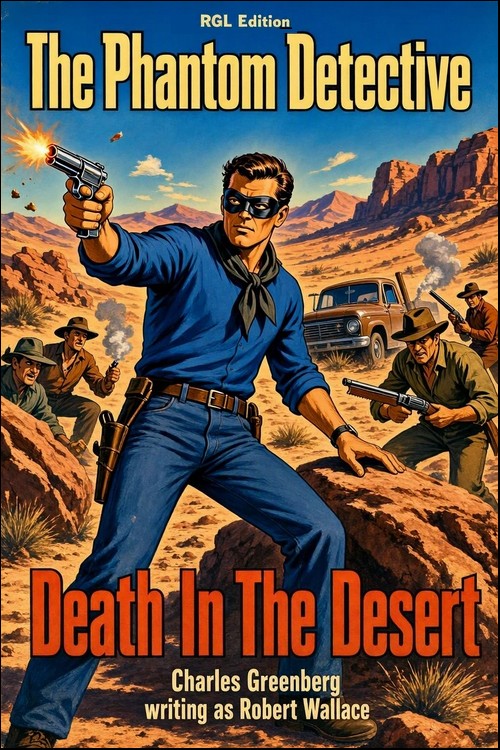
RGL e-Book Cover
Based on an image created with Microsoft Bing software
Roy Glashan's Library
Non sibi sed omnibus
Go to Home Page
This work is out of copyright in countries with a copyright
period of 70 years or less, after the year of the author's death.
If it is under copyright in your country of residence,
do not download or redistribute this file.
Original content added by RGL (e.g., introductions, notes,
RGL covers) is proprietary and protected by copyright.
RGL e-Book Cover
Based on an image created with Microsoft Bing software

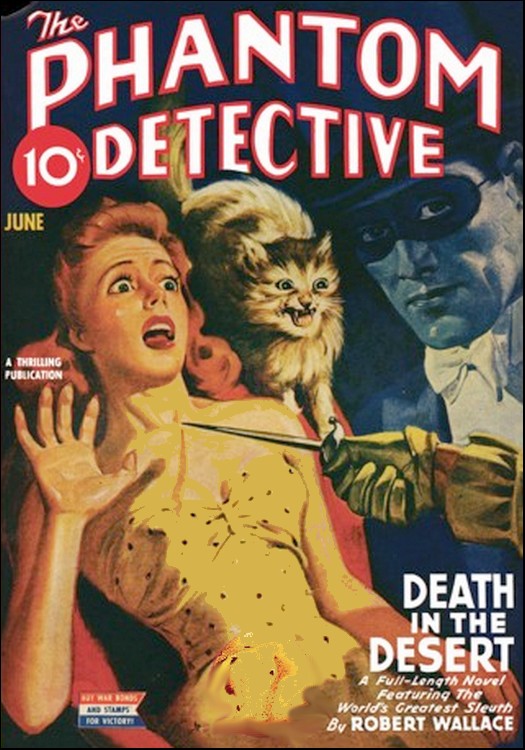
The Phantom Detective, June 1943, with
"Death In The Desert"
The Phantom scours wastelands of the West in a daring and perilous manhunt! Glamour and greed blend in a brew of crime spiked with mysterious murder!
TWO specks moved across the vast, heat-shimmering floor of the desert—an old man and a droopy-eared, pack-laden donkey. The sun, a merciless ball of fire, seemed trying, by its very intensity, to destroy the man and beast who dared to defy it.
Heat which almost seared the skin rose from the baked rocks and the scorched, powdery soil of ravines, and gullies criss-crossed it in a continuous labyrinth. Curious rock formations stood like monstrous sentinels. And always there was the fine alkaline dust that caked the sweat on the man's face and clothing.
Heat and dust and sun-glare—and deathly stillness! And the old man leading the donkey across the desolate land that God seemed to have forgotten.
He was tall and gaunt, a scarecrow whose face, washed, would have been the color of old mahogany. Now, with the dust and sweat, it was the gray-white of a death mask. His eyes, deep and sunken beneath—bushy gray eyebrows, had a savage glint.
Although he was old and had been on the trail since daybreak, he showed no fatigue in his deceptively slow, long-paced walk. The vicious heat and dust of the trackless country presented no hardship to Tim Hardy, better known as "Pay-Strike" Hardy. A so-called "desert rat", a man who adapted himself to the desert, it held no terror for Tim Hardy. It was his friend.
When man and beast reached the edge of the Bad Lands, a vast plain dotted with cacti faced them. And a sign of human habitation appeared in the distance—a sprawling adobe building with corrals and irrigated fields.
A dog barked when the old man approached with the donkey. A fat, unshaven man ran out and paused, blinking.
"You're driving me into Yuma, Chris," Hardy said.
Chris fingered the deep scar on a cheek.
"Ain't you even gonna wash up or—"
"Get the car!" the old man interrupted, glaring.
As Chris ran toward a shed Hardy lifted his canteen, unscrewed the cap, had a sparing drink, then rolled himself a brown paper cigarette.
A ROLLS ROYCE limousine, cream-colored and with red wheels, glided out of the shed. The fat man got out and ran into the adobe building as Tim Hardy approached the donkey. He loosened the straps of the pack and lifted out an expensive cowhide suitcase. Carrying it to the car, he climbed into the rear and settled back on the rich upholstery.
The fat man returned, panting. He now wore a chauffeur's brass-buttoned uniform and natty cap but his round, scarred face was still unshaven. He got behind the wheel and a millionaire's limousine lurched across open desert, bearing a scarecrow of an old man with savage, bitter eyes!
The ranch disappeared. Empty, flat stretch of desert then, until abruptly they reached a ribbon of concrete highway.
Chris swung into it, and they were within a dozen miles of Yuma, Arizona, when Tim Hardy ordered:
"Stop when we reach the cut-off to Kirby."
The fat man's shoulders hunched, and in a few minutes, the big limousine swung to the side of the highway and came to a stop. Tim Hardy got out. A side road here led to a cluster of gray buildings a quarter of a mile away. A high wall surrounded them.
Bleak and naked desert—and those gray buildings, baking under the pitiless sun. Kirby Penitentiary, housing Arizona's incorrigibles, human wolves who had proved to society that they were beyond hope of redemption. Bandits and murderers, human scum held at bay on the desert by steel bars and concrete, by tommy guns and clubs.
"The toughest pen in America," Chris muttered. "When I think of the guys in murderer's row there—Big Jake Hollander and some of the others—killers with hatred chokin' 'em until they get like animals thirstin' for blood—"
Hardy looked at him with his sunken, savage eyes.
"You ought to know, eh, Chris? You spent a few years at Kirby. And I can still send you there for many more. You're not forgetting that, are you, Chris?"
"No," Chris mumbled, "I ain't forgettin' it." But the old man could not see the vicious hatred in his eyes.
Hardy lingered there several minutes longer, brooding and thoughtful as he watched the prison buildings. He dapped his thigh abruptly and ordered harshly:
"On to Yuma, Chris! The Peerless Hotel."
Six huge trailers took up the entire flock across from Yuma's leading hotel. 'The Apollo Productions" was inscribed in each. And citizens gaping at this invasion from Hollywood had something else to stare at when the cream-colored Rolls Royce swung over to the hotel. Tim Hardy glared at the trailers. He muttered something and wrenched open the car door.
Hollywood people crowding the hotel lobby—technicians, bit players and extras—seemed simultaneously struck by silence when the desert rat apparition strode inside. The uniformed chauffeur trailing with the suitcase seemed an added touch of incongruity. Yet visiting royalty could not have been more fawningly received.
"I'll personally take care of Mr. Hardy," the manager told the clerk, beaming at the old man. "How have you been, Mr. Hardy? To have you with us again so soon is—"
"A room and bath, please," Hardy interrupted shortly.
"Yes, sir. Mr. Baxter has taken reservations for the entire hotel—his headquarters for the desert picture he'll film—but I'll be delighted to let you have my own suite."
"Good of you, Warner," the old man said, his tone more caustic than grateful. "When is Baxter due here?"
"Early tomorrow morning. He's flying from New York with the author and the director and some of the leading actors.
"I see," the old man said softly. "Very well! Send a barber to my suite. And I'll want some money."
"How much do you need, Mr. Hardy?" the manager said.
"Call the bank and tell Harkness to send over ten thousand. And put a long distance call for me to Miss Eva Correl in New York. Her telephone number is listed in the Manhattan directory."
"You mean Eva Correl, the famous dancer?"
THE manager regretted his curiosity when Hardy glared.
"You can put it that way. You could also say Eva Koroski, whose ma ran a boarding house in Tulsa and was a danged fine woman."
The old man got the New York call when he came from his bath.
"Tim, you old darling!" a woman's throaty voice said. "How nice of you to telephone!"
"Never mind that, Eva," Hardy said curtly. "You know why I'm telephoning you. Baxter is about to start production of 'Arizona Flo.' There's a flock of movie people already in Yuma."
There was a pause, then she said:
"I'm sorry, Tim. A hundred thousand dollars looks good to me, and maybe I'll swing it yet. But if Baxter insists on going through with it—and he can't easily be frightened—"
"How much are you interested in Baxter, Eva? Once you were engaged to him. What's the set-up now?—"
"Oh," she said slowly, "Baxter has another romantic interest. But I think I can change his mind."
"Don't try it, Eva," Hardy said. "Baxter's a bad bet for you now. Sink your claws in another millionaire." And he hung up.
The movie people in the lobby had a surprise they would never forget when Tim Hardy returned to the lobby. Now he was a character out of Bret Harte, a figure out of an era long past.
He wore'a Frontier gambler's long frock coat, black Stetson and tight trousers tucked into ornate, tooled-leather boots. In his silk shirt, below the black string tie, glowed three blue-white diamonds the size of a thumb nail. A pair of enormous black pearls were his cuff links. A wide gun-belt encircled his lean waist, and the bulge beneath one of the tails of the coat was a huge, silver-mounted Colt .44.
Hawklike and arrogant, a fierce and proud old man no longer ludicrous, he strode to the desk. His ten thousand dollars awaited him. He was told that a private dining room had been reserved for him, nodded curtly, and headed for the dining room.
And the Hollywood people were chattering:
"That's Pay-Strike Hardy... Millionaire hermit... Built a fabulous castle in the desert... Rich as Croesus... Used to be a notorious lady killer... Really killed several men too."
In the dining room, Hardy seated himself behind a table set for him with an elaborate silver service. He gave his order—six scrambled eggs, ham and black coffee, then drew from his pocket a clipping from a syndicated Hollywood column. It read:
Barton Baxter, millionaire sportsman, inventor and aviator, who has proved that an amateur can muscle in on the film industry and come out financially ahead of the game may do it again in producing Warren Taylor's desert epic, "Arizona Flo." Taylor himself has adapted his splendid novel for the screen. It will be filmed on the desert, using the "ghost town" of Hammond, Arizona—a town which hasn't a single inhabitant left—except for some minor scenes that are being filmed at the Long Island studios of Apollo Productions.
Martha Marshall, now said to fill the niche in Baxter's heart once occupied by the glamorous Eva Correl, has been cast in the dramatic role of Arizona Flo, with Floyd Stewart as her leading man. The supporting cast includes such stars as Roy Montague, Kay Bronson and Hugo Chenery. Claude Withering will direct the desert epic.
An ugly expression twisted the old man's face. His clawed hand dropped to his gun. Then slowly he shook his head and put away the clipping. He sat, stiff as a ramrod, behind that table. And the waitress who came in with his order stopped short, terrified at the savage expression in his sunken eyes.
CELEBRITY hounds and autograph hunters would have had a field day outside of Barton Baxter's Fifth Avenue home that blustering December afternoon. At two o'clock, taxicabs and limousines began discharging distinguished stars of stage and screen. A great director. One of America's leading novelists. A famous woman sculptor and an internationally known pianist. Others who had gained world recognition in their own fields.
A wooden-faced butler admitted and led them into the drawing room, gravely informing each that "Mr. Baxter will be down in a few minutes."
Cocktail trays were passed. There was a pleasant hum of conversation. Those people knew the automatic niceties of behavior without betraying their thoughts. But there was an undercurrent of curiosity and tension.
Most aware of it, perhaps, was the one man least expected in this distinguished gathering to have much sensitivity—a tall, handsome young man who arrived with Frank Havens, millionaire publisher of the New York Clarion and a chain of other coast-to-coast newspapers. Apparently he paid little attention to what went on around him, well-bred boredom on his tanned face.
But Richard Curtis Van Loan was the one exception here, so far as personal achievement was concerned. Van, as his intimates called him, would have frankly admitted that he had little interest in "a productive life." He would be the first to acknowledge that his own life, as that of a Park Avenue playboy, contributed nothing to society and had little purpose and meaning, though he would have assured anyone who was interested that such an existence suited him perfectly.
Only one man could have given the lie to that—the stocky, gray-haired Frank Havens. He alone knew that the young man with him was a much greater celebrity than Barton Baxter or any of his distinguished guests. For Havens alone knew that the supposed Park Avenue playboy was actually the grim Nemesis of crime known as the Phantom!
Van had tried being a playboy once, when his parents had died and left him a great fortune, but such an existence was not for a man of his sharp intelligence, splendidly trained body, and dynamic energy. He was desperately seeking something more satisfying when Havens, an old friend of the family, suggested that Van try his hand at solving a crime which was baffling the police.
Van did that, anonymously. He solved the case brilliantly—and disappeared from public attention. Newspapers set up a clamor regarding the identity of "the Phantom Detective," as he had been dubbed, because no one knew who he was. But though Van wanted no plaudits he had found his avocation, his career—to serve society by combating big-scale criminals. Realizing that he could function best if his identity remained a mystery and he accepted the title of the Phantom.
By constant study and practice, he perfected make-up and disguise into a fine art. His laboratory was unequaled by any private experimenter, he delved into abstruse studies of criminology, learned ventriloquism and anything else that would aid him in his chosen profession. But as the Phantom cracked one vicious case after another, it became known that only Frank Havens could contact him when needed. Just who the Phantom was, what he looked like, where he lived, was a secret which no one else had penetrated. His anonymity was, in a way, one of the Phantom's most potent weapons, since criminal rats could neither be on guard for him nor could they seek him out and kill him.
AND it was because that secret now seemed threatened that suspense and worry gnawed at Van as he sat there in the drawing room of Barton Baxter's home.
Baxter had telephoned Havens, asking him to drop in at two on a matter of considerable importance which he could not discuss over the telephone! And he had asked Havens to bring Dick Van Loan, said he hadn't been able to reach him at his Park Avenue penthouse.
There seemed no conceivable reason why Baxter should have considered Dick Van Loan's presence important, no reason why he should have taken so much trouble. Van had met Baxter socially, and knew that Baxter regarded him contemptuously because of his useless playboy existence. Why, then, the insistence that Havens bring him here?
Baxter had sounded tense and worried, Havens had said. Was the reason he asked the publisher to bring Dick Van Loan because he had learned that Van was the Phantom? And he had some reason for not asking for the Phantom openly? What other reason could Baxter have to want in his home someone he disliked and had never had any dealings with?
The presence of other guests, perhaps twenty men and women, added to the mystery. Hollywood stars like lovely Martha Marshall, with her famous falling lock of blond hair; statuesque, beautiful Kay Bronson; Floyd Stewart, the "singing cowboy" hero; Hugo Chenery, gaunt, cadaverous-faced "super-villain"; Andy Shaw, roly-poly comedian; Roy Montague, the great character actor; and Claude Withering, the famous director.
Noticing Warren Taylor, a leading novelist, Igor Kroft, the pianist, and Hugh Fontaine, the sculptor then, an idea narrowed Van's eyes. Tabulating others present, he nudged Frank Havens who sat next to him.
"Do you notice that the people assembled here now are precisely the same people who were at Eva Correl's party last week, Mr. Havens?" he asked in a low voice.
Havens looked around the room.
"Van, you're right! Which means—what?"
Van shrugged. Eva Correl, the famous dancer, was an old friend of Frank Havens. She had thrown that party for Baxter, to which Havens had been invited and had urged Van to come along. Nothing out of the ordinary had happened. It had been just another gay party.
Why, then, had Baxter, a week later, asked Eva's guests to his home on a "matter of considerable importance?" Why wasn't Baxter downstairs to greet his guests?
Three floors above, Barton Baxter paced his study. He was a big, blond young man who, inheriting a great fortune, had broken all traditions by piling on a sizable addition to it due to his own efforts. He had broken speed records in planes of his own design, created a new type of marine engine, and produced motion pictures which, despite jeering Hollywood, turned out to be financial as well as artistic successes.
He looked more like a pleasant-faced big college boy of whom no greater accomplishments might be expected than a good football record than he did a genius. He had been a football star—and a brilliant student, but found it convenient to give the illusion of being easygoing and rather slow-witted, instead of hard and shrewd and efficient as he was.
He had the "mask" off now, an unpleasant expression in his narrowed eyes. His mouth was tight and set, and his big hands clenched and unclenched.
A hard-faced man, sitting on the edge of the desk, said in a curious whispering voice:
It ain't none of my business, Mr. Baxter, but guys who take it easy get further lotsa times."
Baxter gave him a long, appraising look. "You always take it easy, don't you, Scotty?"
"I never get excited," Scotty said. "That's why I'm a good bodyguard. I'm good at other things, too."
Baxter kept looking at him.
"Yes, you've possibilities, Scotty," he said slowly. "That's one of the reasons why I hired you. What do I know about you, Scotty?"
The man reached under his coat and drew an automatic.
"Some mug stuck this in your ribs a few days ago. I happened to be walkin' by. I took the gat away from him and you liked the way I did it. So you offered me fifty bucks a week to hang around you—just in case."
"I asked," Baxter repeated, "what do I know about you?"
"That my name is Scotty," the man whispered. "You never asked me nothin' else. What do you wanna know?"
"You wouldn't lie to me, would you, Scotty? Were you ever in jail?"
"No."
"No?" Baxter murmured. "You served five years at Auburn—a few years after you got out of the Hansen Reform School, where you went for knifing a pal of yours. After Auburn, you were indicted for murder in Philly. You beat that rap. You beat a murder rap in Indianapolis. You had tougher luck in Little Rock. How long were you at the Arkansas State Penitentiary?"
Slowly, Scotty lowered the automatic to the desk.
"Mind tellin' me how you found that out?" he asked in his sibilant voice.
"I sent your fingerprints to Washington."
Scotty nodded.
"You're a smart guy, Mr. Baxter. Am I fired?"
"No," said Baxter. "I like you around. We may get along okay—so long as you don't get any bright ideas other than being my bodyguard."
"Okay, Mr. Baxter. And—thanks."
A bespectacled little secretary came fluttering into the room.
"They—they're all here now, Mr. Baxter," he stammered.
Barton Baxter squared his big shoulders.
"Here we go!" he said. "And I hope it works. It had better work!"
He drew a handkerchief out of his pocket and wiped the sweat sheen from his face. He began practicing a friendly grin as, followed by his bodyguard, he descended the stairs.
FROM the couch on which Van sat, he could see the stairs beyond the double doors of the drawing room. As two men came down his sharp eyes swiftly took in Baxter's companion—a thick-shouldered, hard-faced, steady-eyed man whose grayish complexion might be prison pallor. In his cheap new black suit and yellow shoes the man looked like an underworld thug. What was he doing here?
Baxter did not bring him inside when he entered the drawing room. The abruptness with which all conversation ceased seemed to unnerve Barton Baxter for a moment, and his grin became uncertain.
In dead silence, he walked to the fireplace, turned with his back to the mantel.
"Good afternoon, ladies and gentlemen," he said in a low, quiet voice. "I suppose you're all intrigued why I asked you to come here."
"Yes, there's a delightful element of mystery about it, darling," Martha Marshall said, with a gayety that was not quite true.
"Please excuse me, Martha," Baxter interrupted. "I find this a bit of an ordeal, and I am anxious to get it over with. You may have noticed that you were all guests at Eva Correl's party last week. That's why I asked you to come here today."
He paused, tensely, then went on: "Eva missed a certain object when her party was over. She had it before her guests came; it was gone when you people had left. It was—taken from her bedroom."
"What was it?" Withering, the director, asked in an incredulous voice.
"That doesn't matter," Baxter replied. "I'll continue to refer to it as—an object. I realize that you are all people who are above suspicion. A number of you are intimate friends of mine. To accuse people like you is absurd! But the fact still remains that the object has been stolen."
The stunned silence lingered until again he spoke.
"There shall be no police prowling and asking questions. All I wish to say is this. It is ten minutes after two now. I will be waiting at my telephone at two-thirty. If one of you has the object which Eva Correl had missed, please phone me. I will pay that person—at any place he or she cares to designate, in any manner whatsoever—fifty thousand dollars for the return of what was stolen from Eva Correl!
"I want it clearly understood that I am not interested in prosecution. The person who has what I want need not expose his or her identity. Such things can be easily and safely arranged, but I shall withdraw my fifty-thousand-dollar offer after two-thirty and will never repeat it."
They all stared at him, incredulous. "I won't prolong this scene," Baxter said. "It's too embarrassing. Those of you who feel that I owe an apology for daring to suspect them, I offer that apology most sincerely. Good afternoon, and thanks awfully for dropping in."
The same stunned silence trailed him as he walked out of the room. Then an excited buzz of conversation broke out. What could have been stolen from Eva Correl for the return of which Barton Baxter was prepared to pay fifty thousand dollars? And who could be guilty of the theft?
IN the excitement Frank Havens and Van slipped away.
"Well, Van," the publisher said as his limousine purred up Fifth Avenue, "are you going to telephone Baxter and collect fifty grand in return for what you swiped from Eva?"
Van made a wry face. "It's an odd mix-up, isn't it? What would you say is the most extraordinary angle about it all?"
"The fact that Baxter himself is so concerned."
"Right. Now go on from there!"
"What do you mean?"
"Listen! Something was stolen from Eva Correl that wasn't jewelry or furs. Anyway she must have her valuables insured. And even if she hasn't, the loss of something with a mere financial value wouldn't upset a millionaire like Baxter like that. No, it must be something to which he is personally and definitely linked. Like his letters to her, for instance, which might have something in them that's material for a scandal."
Havens nodded.
"Now why," Van went on slowly, "did Baxter, deliberately and publicly stick his neck out, linking himself with the stolen object? Why couldn't Eva Correl make the speech that he did—and secretly use his money if he was willing to pay fifty thousand dollars for the thing's return? Wouldn't it have been more logical for that scene to have been played out in her apartment? She was the one who suffered the theft! And why wasn't she even present? That puzzles me, Mr. Havens. Barton Baxter plainly did not enjoy his role. Why did he take it—when Eva Correl might have done it without involving all the conjecture and gossip and complication?"
Havens shook his head.
"I can't think of any answer, Van."
Van was silent a while, his eyes slitted and thoughtful. Even he could not think of any answer that would fit the puzzle.
"Tell me about Eva Correl," he said finally.
"You've met her," Havens said. "She is beautiful, charming, intelligent. A great dancer. Had an Italian husband who was killed in a plane crash. Was engaged to Barton Baxter once, but though it was broken they have remained close friends. They flew back from Lisbon together on the Clipper a couple of weeks ago. Oh, here's interesting information. Her education and training under the finest European teachers were financed by Pay Strike Tim Hardy, the wealthy old eccentric who reputedly built a castle over his gold mine in the middle of a desert."
"Pay Strike Hardy?" Van echoed. "Financed Eva Correl? And now Barton Baxter is about to produce his most ambitious effort—the filming of Warren Taylor's 'Arizona Flo', on the desert. Arizona Flo was a real person. Her life, the ghost town where most of the scenes will be shot, that part of the desert—all have a definite and personal connection with Tim Hardy. Is it possible that there's some tie-up between that eccentric old man, the desert picture about to start and the mysterious deviltry which involves Barton Baxter and Eva Correl?"
"It seems rather far-fetched," Havens said.
There was a grim expression on Van's face.
"Perhaps," he said quietly. "But I'm intuitive, Mr. Havens. I feel as if there were something vicious in the air—somewhere!" He shrugged. "Drop me off here. I'll walk the rest of the way home."
BARTON BAXTER sat hunched over his desk with the immobility of a figure of stone. He was watching the desk clock—which now showed two-thirty! The only sound was the ticking of the clock.
It was a quarter to three when Baxter straightened, slowly, as if a great weight were attached to his back which he had to lift, his blue eyes were bloodshot and savage as his hand swung the telephone to him. He dialed a number, then he said tersely:
"Hello, Eva. Barton. I've just tried an experiment. It didn't work. I still believe you lied to me. Eva, you realize that two million dollars and literally scores of lives are in jeopardy? I... Don't say anything, Eva! Just listen." His voice thickened. "I'd go to great lengths—to great lengths—to defend such stakes. For the last time, have you told me the truth?"
Her reply was an hysterical outburst, affirming that she had told the truth. He swore and hung up in the midst of it...
Eva Correl lived with a Chinese servant and nine cats atop an old downtown loft building. The former owner of that building, riding the dizzy crest of the pre-'29 prosperity, had built that lovely penthouse as a whim in the days when expensive whims were justified by stock market quotations. When the crash came, he had leaped fourteen stories to the street below. And the penthouse had passed on to Eva Correl.
Until six o'clock, men and women sweated on the factory floors below it. Then the building emptied and Eva Correl had almost an island privacy atop that building. The wildest parties could not disturb anyone. Her nine cats could prowl the landscaped roof without encountering their alley kin.
It had a private elevator with a special street entrance. When a bell rung down there, the Chinese servant could descend in the elevator, interview visitors through a "peephole," then telephone up to inquire if Miss Correl cared to receive that particular guest.
And unless the Chinese opened the elevator door, there was no way of getting up to the roof. The beautiful dancer who owned many jewels, rich furs, and objects of art, was well protected even in that neighborhood so desolate after dark.
Eva Correl was a big, lithe woman, with shoulder-length black hair and slanted greenish eyes. Women instinctively disliked her; men were fascinated by her. She had the grace of carriage and walk, the ability to move effortlessly in a smooth glide of a panther.
Now she was like a panther which had smelled fire, a panther going mad with terror! Baxter had just hung up and she was hysterical. She whirled from the phone, her long black hair flying, her greenish eyes shiny with fear, her breath coming in panting gasps.
On chairs and couches, magnificent cats—Siamese and Persian—watched her as she began pacing the luxuriously furnished room.
"What have I started?" she moaned. "How will I get out of it now?"
An ageless, wizened little Chinese, watching her from one corner of the room, moved on slippered feet to a brandy decanter. Pouring a stiff drink, he brought it to her. She tossed it down. Her breathing became easier.
"Always," she said, "you do the right thing, Lin."
LIN made no reply, his black eyes wise and shrewd—and expressionless. She often thought aloud by talking to this yellow man who served her with marvelous efficiency, but never expressed his thoughts.
"I may be murdered for something I've done, Lin," she said. "I'm terrified. I don't want to die. Yet no man must ever defeat me. Barton Baxter will not defeat me!"
She began pacing the room again, and presently he brought her another drink of brandy.
"If I only knew what to do, Lin," she said. "I mustn't just—wait. It'll be awaiting death. I know it! I don't dare to go to the police. I must think—" Her voice broke off, then she said softly: "Of course! Of course!"
She glided to the telephone. Snatching up the directory, she quickly found a number and dialed it.
"Good afternoon—the New York Clarion," someone answered.
"I wish to speak to Mr. Havens, please," she said, her voice now sharply imperious. "This is Eva Correl calling."
He answered swiftly because ever since he had returned to his office he had been thinking about her, and what had transpired in Barton Baxter's home.
"Hello, Frank," she said swiftly. "I must contact the Phantom immediately! Frank, I cannot emphasize too strongly its importance. Is it possible for you to reach him?"
"I'll try," Havens said. "If I can, he'll telephone you within ten minutes or so." She hung up and Havens called—a private number. He reached Van at his Park Avenue penthouse, and told him: "I've just heard from our dancer friend whom we discussed recently. She is anxious to contact Mr. Gray. Would like him to call her at her home just as soon as he can."
Van smiled crookedly. "Thanks for telling me about it, Mr. Havens. I'll get in touch with you later."
Van hung up, nodded grimly. His hunch that something was going to break soon was correct! Eva Correl had sent a plea for the Phantom!
In his bedroom he opened the door of a huge clothes closet. He pushed aside his regular wardrobe and touched a spot behind his score or so of suits. Noiselessly the closet's rear cedar wall opened. A light went on automatically in a secret compartment.
Its contents would have surprised friends of Dick Van Loan, Park Avenue playboy. Weapons gleamed in racks along one side wall—automatics, rifles, even a murderous-looking submachine-gun. And the clothes sandwiched between the two walls looked as if they belonged in a theatrical costumer's stock. Mariner's clothing, a clergyman's somber garb; a policeman's uniform next to an atrociously loud, checkered garment that a cheap gambler might sport. There was even a suit deliberately made dirty and greasy, as if it had come from the back of a Bowery derelict.
For his present purpose, Van had no need for any specific disguise. He selected a cheap dark suit, a cheap shirt, a loud tie. A black slouch hat and an overcoat followed, then he took a shoulder holster off the rack, carefully examined the .45 automatic it held, making sure it was loaded and in perfect working order. A box of cartridges provided him with an extra clip.
REACHING into a special built-in drawer, he collected the three articles the Phantom always carried. One was the world-renowned Phantom's badge—a tiny mask of platinum and precious stones. The second was a flat, black leather case—his portable makeup kit. The third was a black felt mask he often used when necessary.
Closing the secret panel, he walked out of the closet and tossed his collection on the bed. Turning then to a dressing table with a triple mirror he sat down and unlocked a drawer. In it was a bewildering array of jars, bottles, wigs, and the other paraphernalia of a professional make-up man.
Making his selection, the contents of a tube, rubbed into his face, instantly changed his complexion to the swarthiness of a Latin. Minute pellets, thrust into his nostrils, thickened and broadened his nose. A shading pencil darkened his eyebrows and lashes, and a pliable rubber gadget, slid over his lower gum, completely changed the shape of his mouth and jaw.
There was no resemblance whatever in the face of the tough-looking, swarthy man now reflected in the mirrors to that of Dick Van Loan.
Quickly changing into the clothes he had taken from the closet, adding the shoulder holster, and slipping the makeup kit and glittering little badge into especially constructed pockets, he walked out of the penthouse. A private self-service elevator lowered him to street level in the rear of the building. There were no uniformed lackeys here as elsewhere in the building.
No one saw him leave. And no one knew the swarthy man who strode swiftly up the street to find a telephone pay booth. As the Phantom took the trail, without knowing that he was racing Death who had a rendezvous with Eva Correl, he was a man who might have dropped down from another planet.
A TAXICAB discharged two passengers at the loft building atop which was Eva Correl's penthouse. The man wearing a belted yellow trench-coat led the way past the main lobby entrance, turned into a side street and paused before a heavy door. It might have been taken for a fire exit had the ornate brass initials "E.C." gone unnoticed.
The two men entered a small vestibule. A brass grille barred a narrow elevator shaft on the left. As the man wearing the trench-coat pushed the button, he said over his shoulder to his companion:
"I don't want the Chinese to see you before he opens the elevator door, Scotty. When he does, step in and let him have it."
Scotty backed against the wall, drew a heavy automatic from his pocket and reversed it, holding it by the barrel. The nostrils of the man in the trench-coat dilated and there was a twitch at his left eyelid.
Fourteen stories above, Eva Correl dropped her glass when the buzzer sounded.
"Don't answer it, Lin!" she panted. "No, go down and see who it is. Don't open the door if it's someone you don't know. Ring me and I'll tell you what to say."
The Chinese bowed and glided out. He entered the fancy, chromium-decorated little elevator, and there was a humming sound as it descended. Reaching the ground floor, the door remained closed as Lin slid open the peephole in the door and peered out.
"Come on, open up, Lin, you old heathen!" the man standing outside said gaily.
"Good afternoon," Lin said tonelessly, as he slid open the door. "Miss Correl isn't feeling well. Please excuse while I call up to see if—"
He never completed the sentence. Scotty leaped into the elevator, his reversed gun held high—and then the Chinese realized that he had admitted Death! He pushed back against the wall—and the automatic slashed toward his head. There was an ugly thud as the heavy butt smashed into his temple. Lin's knees buckled and he slumped to the floor of the car.
"Finish him!" the man in the trench-coat said indifferently. "And don't make any mistakes, or it'll mean the chair for both of us!"
Scotty stooped over the body. Lin's black eyes were still open, staring blankly out of the wizened, yellow face. Scotty felt for a pulse, but there was none.
"He's done for," he replied in a curious whispering voice.
The other man had fastened a silk handkerchief, with slits cut for the eyes, over his face. Scotty had already tied one over his own face before he had killed the Chinese.
"I don't like to knock off dames, though," Scotty grumbled. "Bad luck comes to a guy who knocks off a dame."
"That's foolishness," the man in the trench-coat said shortly. "Okay. Let's get up there."
He entered the elevator and started the car upward. At the penthouse level, the door slid open automatically. And just as they stepped out of the car, the phone rang. Cautiously they sneaked toward the penthouse door which was ajar a few inches.
In the living room Eva Correl snatched up the telephone.
"This is the Phantom, Miss Correl," a casual voice said. "Mr. Havens told me you wanted me to phone you."
"Phantom!" she said. "Oh, I'm so glad! I can't explain over the telephone why I want to see you, but it's in reference to something of great importance. Won't you please come over?" She listened. "Ten minutes—fine. Tell my servant you're a friend of Mr. Havens. And thanks ever so much!"
She hung up, turned—and froze as the masked man in the yellow trench-coat, trailed by his companion, stepped into the room.
"Good evening, Miss Correl," he said, his voice sounding guttural, Teutonic. "You wouldn't want to disappoint the Phantom by being a corpse when he arrives, would you?"
She slowly lifted her hands to her throat as if something were strangling her. She opened her mouth, but the man interrupted.
"Please—nothing so trite as 'Who are you?' or 'What do you want?' Since I am masked, I obviously don't want you to know who I am. And I'll tell you what I want. But first I want you to go to the elevator for a moment. Come, Miss Correl!"
SHE moved like someone in a hypnotic trance, eyes wide and unblinking as she crossed the room and walked into the corridor. The elevator door was open and she could see the body of the Chinese slumped on the floor of the cage, his face a gory horror.
"He's dead," the man behind her said pleasantly. "That should assure you that I am not bluffing when I say I will kill you if you refuse to do what I say."
Her lips moved stiffly as she whispered:
"Lin wouldn't—have opened the elevator door if he—he hadn't known you—as a friend of mine. You've changed your voice—deliberately!"
"Come back into the room, Miss Correl," the man said.
She reentered the room, still as if moving mechanically.
"Now sit down in that chair there," said the man in the trench-coat.
Slowly she let herself sink into the chair he indicated. A big Persian cat sprang to the back of the chair but leaped away as the man in the yellow trench-coat walked so close to the chair that his knees almost touched the woman's.
His gloved right hand disappeared under the coat for a moment. It came out holding a thin-bladed stiletto. She would have screamed if he hadn't lightly touched the stiletto's point to her white throat, but then sheer horror paralyzed her vocal cords.
"Miss Correl," he said grimly, "the Phantom phoned you he'd be here in ten minutes. Two of the ten have already passed. He is a dangerous man—so I've no time to waste, Miss Correl? I want that letter. You know what letter. I want it now—or I'm going to drive this dagger into your throat. Do I get the letter —now?"
HER throat muscles began writhing, her eyes rolled back until only the whites showed. She wanted to speak—and literally couldn't! Then a hoarse, croaking sound came from her.
"My—bookcase. Last book—right—bottom shelf. The letter—under leather binding—"
Savage triumph glittered in the eyes peering through the slits of the mask.
"All right, Scotty," he said. "You heard her."
Scotty crossed swiftly to the huge bookcase, reached for the indicated book, a heavy volume bound in leather. He flipped it open, riffled the pages. "There's no letter in this book."
"Rip off the cover!"
Scotty hooked his fingers between the pages and the cover. There was a ripping sound as he tore the cover free. He wedged his fingers in the space between the cardboard and the leather.
"Here it is!" he whispered. He held aloft a thin, grayish envelope.
The man in the trench-coat removed the grisly stiletto point from Eva Correl's throat. She began to breathe heavily. He motioned Scotty to bring over the envelope. It was sealed. He slit it open with the dagger, removed the folded sheet of paper inside, glanced at it.
"Yes, that's it!" he said exultantly. "A claim ticket to a tremendous fortune. Thank you, Eva. Thank you several million dollars' worth—which is what that piece of paper means to me."
"Go away!" she panted. "You've got what you wanted. Now go away!"
"Yes"—the man nodded—"I got what I wanted, Eva. But you made a bad error, my dear. So long as I didn't know where the letter was, it would have been pointless to have killed you. But now that I have it—"
He reached up and tore off the silk handkerchief which had masked his face. She stared, then she hurled herself forward, hands gripping the arms of the chair.
"You!" she screamed. "You—"
"Yes, Eva," the man said, speaking in his normal voice. "Once I longed to possess your heart. Now I'll—"
He drove forward with the stiletto. Ten inches of thin, murderous steel pierced Eva Correl's heart. Her body arched away from the chair, and bloody froth bubbled on her lips. Then her body sagged back. Her head rolled over lifelessly, to rest on her right shoulder. And her magnificent black hair, falling over her face, seemed to serve as a veil of mourning.
The man in the yellow trench-coat slowly withdrew the stiletto, wiped the crimson blade on the chair's upholstery.
"She was a strange and fascinating woman, Scotty," he said softly.
"Maybe we oughta start thinkin' about the strange and fascinatin' guy who'll be showin' up here in maybe five minutes." Scotty said sourly. "You ain't forgettin' the Phantom, are you?"
"No, Scotty, I'm not forgetting him. The possibility of him getting on our tail was something that occurred to me before—and it had a certain nightmarish effect, I'll frankly confess. But we've been lucky, Scotty. And our good luck—is the Phantom's bad luck!"
Scotty ripped the handkerchief off his face. His eyes began to glitter. "Yeah?" he prompted.
"Eva Correl was an old friend of Frank Havens', the Phantom's contact. The Phantom has no reason to suspect a trap here. He will enter the elevator—"
"And I take him up," Scotty whispered sibilantly. " I'll be the guy who finally knocked off the Phantom!"
"Take it easy, Scotty." The other man laughed.
"I'll take it easy, all right. But that's one job I want to pull solo!"
For a moment the other man's eyes lingered on Scotty's pasty, frozen face.
"Okay, Scotty," he said then. "You won't fumble it. Take me downstairs!" They dragged the servant's body out of the elevator, descended to the ground level. The man in the yellow trench-coat left the building. Scotty took the elevator upstairs again. The Phantom would ring for Death when he pressed that black signal button below.
VAN dismissed his cab a couple of blocks from his destination. He walked the dreary, deserted canyons that the loft section always was on Sundays. A bitter December wind swept the lonely streets. There was a threat of snow.
Since Van had been a guest at Eva Correl's party last week, he knew precisely where to go. He opened the side street door which bore the dancer's initials, rang the elevator bell. There was almost an immediate response in the hum of an elevator in motion.
The car reached street level. The humming sound ceased. A shutter slid aside in the peep-hole and an inquiring eye appraised Van through the minute circular opening.
"I'm a friend of Mr. Havens'," Van announced.
The heavy door noiselessly slid to one side.
"Miss Correl is expectin' you," said the curious whispering voice of the man at the control buttons.
Van managed not to betray his surprise. For this thick-shouldered, hard-faced man was the man he had seen descend the stairs with Barton Baxter in Baxter's home. Something must have happened to his right arm, for a wide woolen scarf supported both forearm and hand.
Eva Correl's servant, was he? This hard-faced customer who looked like an underworld thug? What had become of the little Chinese who had served her guests last week, and who obviously was her regular servant?
Van shrugged as he entered the car. No sense in building a mystery about that. The man had some connection with Baxter, and Baxter and Eva Correl were mutually involved in some mysterious business. That could be the explanation.
The car ascended. Presently the door slid open, but Van did not get out. An eerie, spine-chilling sound had reached him—a sound something like infants squalling and wailing, and yet there was something not human in the sound. There was something savage in it, something primitive and animal-like.
"What the devil is that?" he asked involuntarily.
"Cat," the man in the car said. "Dogs howl when somebody's dead. So do cats. Creepy, ain't it?"
The whispering voice, the infernal concerto of the crying cats, the ugly implication of what the man had just said—all of it suddenly had the effect of something cold and slimy descending down Van's spine.
"Who is dead?" he demanded.
"So far, the dame who lived here and the Chink who worked for her," said the whispering man with the immobile pasty face and the expressionless eyes, standing quietly at the control panel. He spoke as if what he said were a trivial bit of information. Van had a swift impulse to go for his gun, but instead asked quietly:
"So far? What do you mean?"
The man lifted his left hand to the back of his neck, fumbling with the knot of the scarf which served as the sling.
"You're next to croak," he said. "That's what I mean, Phantom."
The scarf dropped to the floor of the car, and in the supposedly injured hand was a stubby little automatic, leveled on Van's stomach. And Van had poignant awareness of a terrible loss—the loss of that second or two when he might have gone for his own gun, might have smashed into that man before he exposed his hand.
"Looks like a toy, don't it?" the man whispered. "But you might have spotted my regular gat in the sling."
THE macabre, whispering voice, the utter absence of any emotion in it, in the man's face, his eyes. This was no hophead with a blood lust, no rat with a gun, talking to keep up his courage. Here was a professional killer—cold, emotionless, deadly efficient. It was Death, whispering at him.
"You work for Barton Baxter, don't you?" Van asked desperately stalling for time.
A vague suggestion of a smile flitted over the killer's lips.
"You might say I'm his bodyguard. That's good enough. You thinkin' of makin' a break for it, Phantom? Maybe takin' a kick at me, or somethin'?"
Van felt sweat begin to moisten his palms. Death, whispering.
"Yes," he admitted calmly, "I'm thinking about it."
"Okay, you can try it. But you'll live a little while longer if you do what I tell you. Raise your hands—slow-like, see?"
Van lifted his hands shoulder high.
"Now cross your hands and put 'em on your shoulders."
Again Van did as he was told. To attempt to resist now meant swift and certain death. Perhaps he might get a break—
"You'll stop a slug if your hands move from your shoulders," the man said matter-of-factly. "Turn around and take three steps outa that door. Then stop."
Van felt like a puppet being manipulated by control strings. He took three unhurried steps into the corridor. It brought him within a few feet of a door, partly ajar. Beyond that door the cats were wailing. And in the corridor the body of the Chinese lay on its back, arms and legs spread-eagled, as if staked out there. The slanted black eyes seemed to be contemplating some spot on the ceiling. Drying blood formed a hideous mask of gore on the face.
Van had seen many corpses, but he stared with a peculiar sort of fascination at the dead Chinese. Soon he would be a corpse. Soon he would look that way. For Death, standing behind him, was merely awaiting the summons of the whispering man's trigger finger.
"Steady," he told himself with grim desperation. "Keep your head!"
He glanced over his shoulder. The killer was dropping the little pearl-handled "toy" of an automatic into a coat pocket. In his hand now was a heavy .45, and he was pushing down the safety.
"I got more faith in this baby," the man whispered. "I call him Pete. Old Pete sure is gonna be famous when he takes care o' you. Go through that door there, Phantom. Jeepers! Listen to them cats!"
Van took two steps to the door, flung it open, and looked on a macabre scene. A semi circle of a dozen cats surrounded the chair in which Eva Correl slumped. A long bare, beautifully molded white arm dangled over the side of the chair. A breeze from the open French doors leading onto the roof billowed her black hair. She might have been asleep had it not been for the ugly clue of the saucer-sized patch of crimson staining the yellow bodice of her dress.
"Keep walkin' Phantom," the whispering voice ordered. "We're goin' out on the roof. Just take it easy, see?"
EACH cat humped its back as Van entered the room, his crossed hands still resting on his shoulders. The eerie chorus ceased. And as Van kept advancing the cats dispersed, flying in all directions. He paused when he reached the chair. He saw then that Eva Corral had been stabbed.
"She was a swell-lookin' dame," the man behind him said. "I sorta hated to watch her bein' croaked. Dames don't go for me, though I scare 'em. Maybe that's because o' the way I talk. But I can't help that. Some crazy copper once hit me across the throat with a blackjack."
Again just as a desperate stall for time—for precious seconds in which to think of something, plan out some sort of action—Van turned, said casually: "So you didn't kill her, eh?"
"No. The guy I work for did that. I'm superstitious about knockin' off a dame. It's bad luck. I stayed back to take care o' you, and Phantom, we're wastin' time. Keep goin' out on that roof."
Ten feet away, the killer with the big automatic steady in his fist. Finger curled around the trigger. A mere touch of the trigger, and death would belch from the snout of the gun! The odds appeared unbeatable. There was nothing Van could do—no possible trick he could pull—that would balance the fact that the other man merely had to squeeze that trigger.
Slowly he walked to the French doors. "It had to happen, sooner or later," he thought. "And this is the play I lose."
The cold wind chilled the sweat on his face when he stepped out on the huge, landscaped roof.
"Keep goin'—to the edge!" the man behind him said.
"Walk-the-plank idea—is that it?" Van asked steadily.
"Yeah, I guess that's the idea," the man whispered back. "I'm going to force you to make a break for it—try to grab your gun maybe, do something! Or step off the edge of the roof. It's fourteen stories down to the street. But maybe you'll think it's better than feeling slugs tearin' through you. Me, I'm a guy with imagination. The idea kinda appeals to me, see?"
It was then that Van saw the cat. Some dozen feet ahead was a kind of arched passageway built of widely-spaced, flimsy bamboo. Apparently it had been built only recently, probably with the intention of training vines around the bamboo to make an arbor.
A huge Persian was perched in a big furry ball ten feet up in the air on a length of bamboo the thickness of two fingers. In the direction Van was going, he would pass through the bamboo framework to reach the edge of the roof. The killer, following, would walk directly beneath the bamboo strip on which the cat perched. If that huge, heavy Persian could only be angered someway enough for it to fling itself downward on Scotty's head with savage claws ripping, distracting the killer for only the few seconds that Van so desperately needed—if Van could only somehow force the cat to do that—
Hope, wild and fierce, surged within the Phantom. He had one slim, desperate chance—and he pounced on it like a drowning man clutching at a piece of driftwood. About to enter the bamboo arbor, on the first cross-bar of which the cat perched, he turned slowly.
"You gonna make a break for it now?" his captor whispered.
"No," Van replied coolly, backing into the passageway. "Say, could we make a deal? Probably not, but there's no harm asking. I'll pay a lot for my life."
THE gunman kept advancing as Van continued to retreat.
"No, there ain't no harm askin'," the fellow said. "But you don't get the idea, Phantom. Every guy has got an ambition. The guy I'm workin' for is out for millions—money and power. My ambition has always been to get the Phantom."
Van moved more and more slowly. When he stopped, this man would, too.
"In every stir I've ever been in," went on the whispering voice, "in every place where mobsters hang out, I've heard guys curse the Phantom. I've talked with guys you sent up for long stretches. I've talked to pals o' the guys you sent to the hot-seat and the guys you blasted down. And I made up my mind that some day—some day, so help me!—I was gonna get you in the spot that I got you now. That's my big idea, see? I want to be the guy who knocked off the Phantom!"
The gunman was now within a few feet of the entrance into the bamboo arbor.
"I like to think that the ghosts of all the guys you sent to the hot-seat or bumped off are watchin' me on this roof now," his sibilant voice continued. "I like to think that I—I didn't tell you my name's Scotty, but I don't mind now—did what so many other guys tried, and couldn't! That makes me a big shot, see? And it's a swell feeling, pal. It's worth more than anything you or anybody else could offer me."
Van stopped his retreat. As he expected, Scotty automatically did likewise. And just above him, nervous was that big Persian perched on the thin section of bamboo.
It was now or never! And Van knew that his life depended on what happened in the next three seconds.
"Okay, Scotty," he said, his voice casual despite the pounding of his heart, "I see the score now."
Careful not to move the hands he still held on his shoulders, and as if he had merely turned clumsily, he rammed his hip hard into the flimsy bamboo structure. And like an apple shaken off a tree, the big Persian came hurtling down upon Scotty's head!
A BLURRED eternity of swift action was crowded in the next few seconds. As the clawed and furry mass struck Scotty's head a startled cry burst from the gunman. He recoiled involuntarily and his left hand slapped out in a wild, fending-off gesture.
Van's hand streaked for his gun, desperate fingers clawing at the butt of his .45. The cat's body now shot away from the gunman and the automatic, which Scotty had lowered for a breath was jerked up again.
Van threw himself to one side, the bamboo structure rocking as his shoulder struck it. It rocked again as a slug from Scotty's gun smashed one of the bamboo posts. But now Van's own gun supplied a savage echo to Scotty's shot.
He'd had no time to take aim. He merely drew and fired in one continuous motion. Scotty literally seemed to be lifted in the air by the terrific impact of a .45 slug that caught him in the chest at a dozen feet range. He dropped his automatic and fell on his face. His body twitched once, then was still on the black tiles of the roof.
Van felt as someone who had been too long in a steam room and had abruptly emerged into cool, fresh air might have felt. Slowly he put away his automatic and stood there, quietly glorying in the miracle of being alive!
GRIMLY he shook his head then and approached Scotty's body. Rolling it over, he saw the gunman was dead. If the ghosts of the criminals Van had been forced to kill were present on this roof now, as Scotty had hoped, then Scotty's spirit had joined them, the latest in the long and grim procession of killers who had tried to get the Phantom.
Kneeling, Van swiftly searched the body. A roll of bills amounting to several hundred dollars, cigarettes and matches, a soiled handkerchief, the small pearl-handled automatic—that was all. No knife. That bore out the killer's story that someone else who had been here with him had murdered the dancer.
The phone rang in the penthouse, the sound loud and startling in the dead stillness. Van's first impulse was to ignore it. Then it occurred to him that it might possibly be for Scotty, from Eva Correl's murderer, calling to check how Scotty had made out.
Van reentered the penthouse through the French doors. The cats, prowling restlessly, dispersed to hiding places beneath chairs and couches.
Van spotted the ivory-colored phone. He lifted the receiver, said in Scotty's whispering voice:
"Hello."
"Scotty?" a swift, low, guarded voice said.
"Yeah," Van whispered sibilantly.
"Everything okay?"
"Sure. He's a dead pigeon. What's the next move?"
"Go back to the house. You're flying to Arizona in an hour, you know. You'll get further instructions later. So long."
Van slowly replaced the receiver. It was difficult to identify that guarded voice. It might have been Barton Baxter's. He lifted the phone again and dialed Police Headquarters. When the switchboard operator answered, Van clipped:
"Connect me with Inspector Gregg of Homicide. Tell him Mr. Gray of Denver is calling."
Only Frank Havens and some of the highest police officials knew that "Mr. Gray from Denver" was the Phantom. The name was a password to let them know the Phantom was telephoning.
"Hello, Gray," a gruff voice came over the wire. "Gregg speaking. What's up?"
"Someone just telephoned Worth Three-eight-five-hundred," Van said tersely. "That's the phone number in the home of Eva Correl, the dancer. See if you can trace where that call came from, Inspector. Then ring me back at that number."
"Right," Inspector Gregg promised. "You'll hear from me in a few minutes."
HANGING up, Van's eyes slowly swept the room. They paused on a table near the huge bookcase. A heavy volume lay there, its leather-bound cover ripped off, lying apart from the book. He approached the table, examined the cover.
Instantly he noticed that someone had forcibly pried loose the leather over the back cover, exposing a kind of secret pocket in the space between the leather and the cardboard base.
Something had been hidden in that book! A letter, a paper—secreted in the secret pocket! And impatient hands had ripped the cover completely off in order to get to it.
Van's narrowed eyes shifted to the beautiful woman slumped, murdered, in the chair. A rough pattern of what had happened here was obvious now. Shortly after Van had spoken to the dancer, the killer arrived with Scotty. He had forced Eva Correl to reveal the hiding place of some mysterious letter or paper—which was that book—then had murdered her!
There was no doubt in Van's mind that the "paper" also must be the "object" for the return of which Barton Baxter had offered fifty thousand dollars. An object supposedly stolen from Eva Correl—but in her possession all the time. Holding out on someone had resulted in her murder. Was that someone Barton Baxter? Eva Correl's servant would not admit anyone whom he did not know. And of course the Chinese knew Barton Baxter!
The phone rang again. It was Inspector Gregg. "I traced that call, Gray," he said, "though it won't be of much help to you. It was made from a public pay-booth in the Grand Street Subway station. Say, what's it all about?"
"You'll find out if you get yourself over here, right away," Van said. "To Eva Correl's penthouse atop the loft building at Three-eighty Harland Street. There's a private side entrance on Trevor Street. You'll see her initials on the door. And Inspector?"
"Yes, Gray?"
"Make your visit unofficial, will you? Come alone, without the fanfare of sirens and so on. Walk to the building. Ring the elevator bell and I'll come down for you."
"It sounds like mysterious business," Gregg commented.
"It's precisely that," Van said grimly.
Van hung up, his thoughts speeding. There was one simple check-up that he could make immediately. If Barton Baxter had made the call to Scotty from the Grand Street subway station no more than five minutes ago he could not possibly be in his upper Fifth Avenue home by now. So if Baxter was home now to answer his telephone—
Van quickly found Baxter's number, dialed it. The butler's British-accented voice answered:
"Barton Baxter's residence."
"This is Mr. Van Loan calling," Van said easily. "Is Mr. Baxter in?"
"I am sorry, sir, but he's out now. I expect him back shortly. Will there be any message, please?"
"No, I'll call him again. I am arranging a cocktail party to which I thought he might like to come."
"If I may say so, I do not think Mr. Baxter will be able to come. He's flying to Arizona in an hour or so."
"Oh, yes, I'd forgotten that," Van said. "All right, thank you."
Van's lips were grim as he slowly cradled the phone. Barton Baxter was not home. And he was flying to Arizona in an hour.
IT looked now as if Eva Correl's murder would not remain long unavenged, that the noose was waiting for Barton Baxter's handsome blond head. Still there remained the problem of proving that Baxter was the murderer. Van walked to the French doors leading out on the roof where his own would-be killer lay sprawled dead. And Van was confident that it was only a matter of time before he grabbed the other.
Approaching Scotty's body he dragged it across the roof to the penthouse and into the living room. There he deposited the body in a low, deep chair. He snapped on a bridge lamp near it and tilted the shade so that the light was focused on the chair. Then Van stared at the pasty face, studying it as an artist might study a subject before attempting to reproduce it on canvas or in clay.
"I can do it," he finally muttered. "Yes, I'm sure I can."
The buzzer sounded then. Van strode out to the elevator. He lowered the car to the street level, touched the button which opened the door. Gaunt, dour-faced, gray-haired Inspector Gregg of the Homicide Squad, with whom Van had gone through assorted Hades before now, stood there.
"Gray?" Gregg asked, uncertainly.
The inspector could never quite get used to the complete and radical changes in Van's disguises, always trying to link the Phantom's current disguise with the one in which he had last seen him.
"Inspector," Van said, "you won't find the least resemblance to the redheaded Westerner I was the last time we were together. And I still think the fishbowl joke you told me then is putrid!"
The faint trace of suspicion left Gregg. He grinned and reached out his hand.
"Glad to see you again, Phantom. You courting that beautiful dancer?"
"I am courting her murderer," Van said quietly.
Gregg stopped smiling. He made a low whistling sound.
"Eva Correl—murdered?" he repeated sharply. "Boy, won't the newspaper boys go to town on that!"
"They'll go to town even more if her murderer is the man I think he is," Van said. "Come, Inspector. We've little time to waste."
Van took the elevator up to the penthouse level. Getting out, Gregg stopped short at the sight of the dead Chinese sprawled in the corridor.
"Her servant," Van, said shortly. "And Exhibit One. Exhibits Two and Three are inside."
In the living room, he watched Gregg approach the chair in which the murdered woman slumped. The police official studied her death wound, then gently lifted and let drop the arm which hung over the side of the chair.
"She hasn't been dead long," he said tonelessly.
"Less than twenty minutes," Van replied. "I spoke to her then."
Gregg eyes shifted to Scotty's body. "Who's he?"
"Companion of the killer who stabbed Eva Correl and this one lingered to liquidate me when I showed up—and almost succeeded!"
"How did they know you were coming here?" Gregg asked.
"They either overheard Eva Correl speak to me over the telephone, or she told them I was on my way here."
GREGG brought a cigar out of his pocket, bit off the end.
"I'll make an original crack," he said. "Suppose you start at the beginning?"
"Then I'll begin with a certain peculiar scene that took place in Barton Baxter's home not much more than an hour ago," Van said.
"You mean Barton Baxter, the millionaire flier and motion picture producer?" Gregg, demanded, startled.
"Yes. Frank Havens was one of the people there in response to a rather mysterious sort of invitation. Here's what happened."
Tersely Van told what Baxter had said to the people he had asked to his home. When he concluded, Gregg slowly shook his head.
"Peculiar is perhaps an understatement," he said.
"And here's another important bit of information I got from Havens, Inspector," Van went on. "Baxter had kept his guests waiting in the drawing room before he came down and when he did Havens happened to be sitting where he could see the stairs. A man came down those stairs with Baxter, but didn't accompany him into the drawing room. Havens described that man to me, Inspector."
"And?" Gregg prompted.
Van pointed to Scotty's body, that's the man, Inspector—the man who came here with Eva Correl's murderer."
Gregg's eyes studied Scotty's body, then swung back to Van.
"I've two questions, Phantom," he said quietly. "How can you be so positive, merely from Frank Havens' description, that it's the same man? And what leads you to believe that someone else who came here with him, stabbed the dancer?"
Van fumed inwardly at this waste of time, but he could not explain that he, as Richard Curtis Van Loan, had seen Scotty come down the stairs with Baxter.
"I'll first tell you what happened when I showed up here," he said. "Eva Correl told Havens that it was desperately urgent for him to contact me and have me telephone her. I did, but she gave me no information over the phone. Merely asked me to come over, right away. I walked into trouble—plenty."
Without attempting to dramatize it, Van explained what had happened upon his arrival and how he had cheated the death which awaited him.
"Now to answer your question, Inspector," he went on. "When Scotty had the drop on me, I stalled, making conversation while I tried to think of some trick I might pull on him. He looked like the man Havens had described, and I asked him if he worked for Barton Baxter and he admitted he was Baxter's bodyguard. And he told me later that he did not stab the woman. His words, exactly, were: 'No, the guy I work for did that. I'm superstitious about knockin' off a dame. It's bad luck. I stayed back to take care of you!'"
"He had no object to lie to you then," Gregg slowly admitted.
"None whatsoever," Van agreed. "Then after he was dead a phone call came. I answered it, imitating his whispering voice. The man who called wanted to know if everything was okay. Then he told me, believing I was Scotty to go back to the house, and reminded me that I was supposed to be flying to Arizona in an hour."
Van paused, then added quietly:
"Barton Baxter wasn't home when I called shortly afterward—which would have given him an alibi. And Baxter is flying to Hollywood in an hour! It look as if Baxter is our man, Inspector."
Gregg blew out a cloud of cigar smoke, stood silent a little while.
"How do you tie up the speech Baxter had made, offering fifty grand for the return of something stolen from this Correl woman, then coming here a little later to murder her?"
VAN walked to the table and picked up the thick book and the torn cover. "This is probably your tie-up," he said. "The dancer had hidden something beneath the leather binding of this book. She was forced to expose the hiding place of the thing the killer wanted, then killed. And whatever was hidden in that book must be the stolen object for the return of which Baxter offered fifty thousand dollars. The truth must be that Eva Correl lied when she reported the supposed theft. What her motives were, I've no idea. But Baxter realized she had lied when there was no response to his fifty-thousand-dollar lure. So he came here, forced the truth out of her—and killed her!"
"It makes sense," Gregg admitted. "But it's still just a theory. This man you call Scotty is dead. We can't pin a killing on Baxter just because Scotty was his bodyguard. We can't establish motive, since we've no idea what it's all about. We have no proof that Baxter came here with Scotty."
"I know," Van nodded.
"And Barton Baxter is a millionaire," Gregg went on. "Nationally known. He's a personal friend of the governor and has relatives in the United States Senate. Barton Baxter is an important man and—"
"And that's why I asked you to come here unofficially," Van interrupted. "I am fully aware that Barton Baxter is an important man. He is also smart and cool-headed and shrewd. But if he murdered Eva Correl, I know how I can swiftly establish his guilt—and in such manner that he can't squirm out of it."
He drew out his flat portable make-up kit, opened it. In one corner of it lay something the size of a deck of playing cards. A tiny knoblike protuberance extended from its center.
"A Swiss genius spent five years building this especially for me," Van said. "It's a combination sound and motion picture camera, reduced to amazing compactness. I can place it under my vest, with this little knob which will appear to be an ordinary button, thrust through one of the buttonholes. Yet merely by twisting the knob, I'll start watchlike machinery in motion which will record photographically as well as in sound everything it faces. My plan is to have this little recording device face Barton Baxter. If he's guilty, it'll send him to the electric chair."
"Look, Phantom," Inspector Gregg said. "Maybe I'm getting stupid in my old age. What makes you think Baxter will admit his guilt to you? And even if he should, why would you need the camera?"
"If Scotty had succeeded in killing me," Van said quietly, "and returned to Baxter's home—and if Baxter had known anything about what's happened here, isn't it reasonable, Inspector, that Baxter would make some comment about the triple murder?"
"Sure. But what's the use of speculating about something that can't happen now. Scotty is dead, isn't he?"
"But Baxter doesn't know that. And if Baxter is innocent, if someone else came here with Scotty, whoever that is doesn't know either that Scotty is dead. Scotty is the bait with which I'll troll for Eva Correl's killer, Inspector."
Gregg's face became purplish.
"How in thunder can you use a dead man?" he shouted.
"By borrowing his identity!" Van replied.
THE scene which took place now in that penthouse living room might have been some devilish rite of Black Magic. The dead woman slumped in a chair, the nervous, restless, prowling cats. A man's corpse in another chair, his head full in the pitiless glare of a bridge lamp focused on it. And two men standing over the corpse, one supporting the head, the other now reaching for an open black case which lay on a table near the chair.
Cold cream swiftly removed the swarthiness of Van's present disguise, though he did not at once remove the gadgets that had so changed the contours of Dick Van Loan's face. The contents of a tiny jar, rubbed into his skin, gave him Scotty's pasty complexion. The dead man's nose was broad at the base, with flaring nostrils.
Van, for a moment turning his back on Gregg, removed the pellets in his own nose and swiftly substituted minute strips of cartilage which had rubberized bases at each end. When he turned around he had a different nose. The cartilage strips had widened his nostrils and changed his nose to a counterpart of Scotty's.
The gunman's jaw was longer and leaner. With a hand covering his mouth, Van slid off the curved rubber gadget which had fitted over his lower gum, replacing it with another, shaped differently, which gave his own jaw a long, lean appearance. He rubbed something over his teeth which made them look tobacco-stained—as were Scotty's.
"How am I doing?" he casually asked Gregg.
The police official's eyes were unbelieving.
"It's uncanny!" he announced.
Van grinned and his swift, deft fingers continued flying between his face and the make-up kit. Scotty's hair was black and greasy-looking, combed straight back from his forehead. Within thirty seconds, Van's hair looked exactly like that of the corpse. There was a black mole under the gunman's ear; Van quickly painted one on his own face.
"I guess that'll be good enough," he said.
"Good enough?" Gregg exclaimed. "Heck! You look like his twin brother!"
There was no need for Van to change clothes with the dead killer. They wore similarly styled cheap dark suits and overcoats. He did remove Scotty's loud, polka-dot tie and substituted it for the one he had been wearing. Then he picked up Scotty's hat and pulled it down low over his eyes—the way Scotty had worn it.
Now remained one final step. Gregg muttered something as he saw Van start on the corpse's face. He rubbed some brownish paste into the skin, giving it the dark skin of a Mexican. Swiftly, he reshaped Scotty's nose with pellets inserted into the nostrils. With a shading pencil he thickened the dead gunman's eyebrows and lashes to give the illusion of pouches under the eyes.
"What's the idea?" Gregg burst out.
Van snapped shut his make-up kit, slid it into his pocket.
"There may be complications," he said. "I may have to function as Scotty longer than I anticipate. And I've heard of bodies falling fourteen stories or so to the street, where the face was not damaged beyond recognition."
"You mean we're going to throw his body off the roof?" Gregg asked incredulously.
Van nodded. "That'll give you the excuse of officially opening the case. Some passerby or a cruising radio car will certainly spot the body within a few minutes. Since there's no one elsewhere in the building, the penthouse will be the first logical place to investigate. Otherwise, how would you explain your discovery of Eva Correl's murder?"
"Okay!" Gregg said slowly. "Who will Scotty be, then, when he's discovered?"
"Simply an unidentified man, shot and thrown off this roof. When you check on his prints, keep that information from the news hounds. I know, Inspector, that this is a most unorthodox procedure. But I've cooperated with the police to the extent of acquainting you with the facts. And it's the surest way we have of swiftly cracking this case."
INSPECTOR GREGG did not look happy, but he nodded again.
"All right, Phantom. Though I wouldn't stick my neck out this way for anybody else upon the face of this earth!"
They carried the body out onto the roof, and in a moment more a coldblooded killer's body had plunged to the street fourteen stories below!
"Now let's get out of here, Inspector!" Van clipped.
Thirty seconds later, they were out in the street. The section was still silent and deserted. But on the next block, both knew, the gunman's body sprawled on the pavement. Before long, it would springboard a dramatic story that would make the front pages of every newspaper in America—Eva Correl's murder!
"Good luck, Phantom," Gregg said tersely. "I hope to hear from you—soon. I'll be either at Headquarters or up in her penthouse."
They gripped hands and parted, going in the opposite directions. A few blocks away, Van found a cruising taxi to take him to Barton Baxter's home. Settling back on the cushions, he recalled Scotty's words: "You might say I'm his bodyguard. That's good enough." In saying that had Scotty meant to infer that he was a paid killer rather than a bodyguard? Or had something more significant and subtle been behind that remark?
He shrugged. There was no use guessing. It would not be long before he had the answer to whether or not Barton Baxter had murdered Eva Correl.
When the taxi swung before Baxter's pretentious Fifth Avenue home Van got out, unhurriedly mounted the steps and rang the bell. Baxter himself, and not the butler, opened the door—which surprised Van. But the terrific tension in Baxter, his bloodshot eyes, the frozen immobility of his face, the tightness of his mouth did not surprise him. That was how Baxter should look, if he had just committed murder!
"Hello, Scotty," Baxter said. "Come upstairs with me. I want to talk to you." Before Van had a chance to answer, Baxter headed for the stairs. Van, following, loosened his coat so that there was no obstruction to the little knob of the camera protruding through the buttonhole in his vest. So far, Baxter's attitude verified all of Van's suspicions and a talk was made to order for what Van wanted.
On the third floor, Baxter turned into a room furnished like an office. He crossed to the desk, seated himself behind it, curtly waved to another chair.
Van seated himself as the big, powerful blond man lighted a cigarette. He took a deep drag on it, then leaned forward.
"You're no fool, Scotty," he said quietly. "There's a sound mind functioning behind that dead pan of yours."
"What suddenly brought that on, Mr. Baxter?" Van said, in Scotty's whispering voice.
Baxter removed his cigarette from his lips, grounded it out in an ashtray.
"I want to show you something, Scotty."
His right hand dropped to a drawer behind the desk. It came up again—holding a big blued revolver! And the long barrel of the gun centered on Van's chest.
"I've sent my servants out on various errands," Baxter went on in a low voice. "You and I are alone here. You are a criminal with a long police record. I'm a rather important man, in my own way. If I should say that I shot you in self-defense when you tried to rob me, no one would doubt me. I can kill you—and get away with it easily!"
The first stunning shock of seeing the gun cover him began to leave Van. So Baxter planned to get rid of the henchman for whom he had no further use! And if Van revealed that he was not Scotty, would Baxter let the Phantom live to send him to the electric chair? It was a brutally ugly development, and as Van looked at the gun steady in Baxter's fist, he realized that again Death was reaching for him. Miracles didn't happen twice in a row! This time—
"All right, so you can get away with it," he whispered, again desperately stalling for time. "Now tell me why you wanna knock me off."
"I don't want to kill you," Baxter said. "I've just pointed out to you that I can—without running any risk. Whether or not I squeeze this trigger will be entirely up to you."
Van stared. There was something in the wind that he didn't understand. "What do you mean?" he whispered. Baxter leaned further over the desk, his narrowed eyes savage and ugly.
"Several nights ago a man with a handkerchief masking his face stepped out of a doorway and shoved a gun in my ribs. A stick-up! Then you bobbed up from nowhere, and took the man's weapon away. He escaped in the scuffle. When I thanked you, you asked me for a job. I gave you one, as my bodyguard. But why do you think I hired you?"
"You've got the answer, so there ain't no use me sayin' it," Van replied in Scotty's whispering voice.
"You're blamed right I've got the answer!" Baxter snarled. "That stick-up was a phony! Staged deliberately. Somebody wanted you near me as a spy to report to him my moves. I suspected that when you asked me for a job. I knew it when I found out about your criminal record. A killer like you doesn't work as somebody's bodyguard for fifty a week."
"Maybe I got tired of dodgin' cops," Van said. "Maybe fifty a week looked good to me. And maybe you thinkin' that stick-up was a phony is just your imagination. Is that all the proof you got I'm a stool pigeon?"
Baxter shook his head.
"I wouldn't have shown my hand, if I hadn't more proof. That's why I let you hang around me. I wanted to be sure. And I'm sure now, Scotty. That's why I'll have no compunction about putting a bullet in you if you don't tell me what I want to know."
"I don't know what you're talkin' about," Van said—truthfully.
Baxter leaped to his feet. A vicious kick sent his chair crashing into the wall. He tried to control the murderous rage that was beginning to possess him. But Van knew that an utterly unexpected explosion was due!
Baxter glared at him with his savage, bloodshot eyes.
"Listen, rat!" he snarled. "You watched me wait at that telephone for someone to accept the fifty thousand dollars that I offered for the return of something. No one took me up on that offer. You next heard me telephone Eva Correl. You heard me tell her that I thought she had lied. You heard me threaten her. Then I told you to scram for half an hour, that I wanted to be alone.
"I told you that because I wanted to give you an opportunity to contact the man who is paying you to be a spy here. I let you overhear what you would think important. And I planned to follow you. You went downstairs. I was watching you when you stopped at a little side table, furtively reached beneath the tapestry cover and sneaked out a piece of paper. You remember what you did with it, don't you?"
VAN looked calmly at the big man towering over him with the gun. "You're tellin' the story," he whispered. "You might as well spill all of it."
"All right! You slipped the piece of paper into your pocket and walked out. I saw you cross the street. You took the piece of paper out of your pocket, read it, then crumpled it and threw it away. You flagged a taxi. When your taxi turned the corner, I had my hands on that piece of paper. And here it is!"
BAXTER thrust his left hand under the desk blotter and slid out a piece of paper. He pushed it across the desk toward Van. Van stood up to read it. It was a pink sheet from an ordinary small scratch pad, and on it was a single sentence, printed with pencil:
I will be waiting in the arcade of the Rogers Building on Madison Avenue.
Van looked up. Baxter had retreated against the wall, the heavy automatic close to his hip.
"You recognize it now, eh, Scotty?" he said in a low, thick voice. "My car was in front of the house, but I thought it would be foolish to trail you since I knew where you were going. I thought I'd be smarter and get there first. Unfortunately, I was too anxious. I side-swiped a delivery truck and smashed into another car. Luckily, no one was hurt. But there were police, and questions, a delay I could not help. When I finally got to the arcade, you and the one you had gone to meet were not there!"
"What I wanna know," Van said, fishing for information, "is why you're so upset?"
Baxter's mouth twisted savagely.
"Raise the blotter!" he snarled. "You'll find another note there."
Van did that, sliding toward him the other piece of paper. Also a pink sheet from a scratch pad. The same slanted, rather delicate printing on it. This note read:
Dear Baxter:
You will be wise to abandon your plans for filming Taylor's "Arizona Flo." Should you persist, a certain letter which you gave Eva Correl will reach the proper authorities. And if that doesn't deter you, you will find it most unhealthy out on the desert. Many bones are bleaching there now.
The Oracle.
A metallic click made Van jerk up his head. Barton Baxter had drawn back the hammer, was cocking the big revolver. And murder was in the eyes in his stony, set face.
"The same man wrote both notes, Scotty," he said slowly. "You met that man a little while ago. You know who he is. Now I'll say just one thing more. You heard me phone Eva Correl that she is jeopardizing two million dollars and literally scores of lives. You heard me tell her that I would go to great lengths to defend those stakes. That happens to be the truth. Most certainly I'll go as far as putting a bullet through your heart!"
He steadied the big revolver.
"I'll ask you just once, Scotty—and you have five seconds in which to answer. Who did you go to meet when you left me? I think I can make Eva Correl tell me. But you'll be a corpse then, Scotty. Well? Who was that man?"
"Easy with that gun, Baxter," Van said in his normal voice. "Pulling the trigger now will be an error you'll much regret."
The change of voice from that ghastly whisper jarred Baxter.
"I am about to reach for something," Van added. "It won't be a weapon and I'll move my hand slowly. Just watch that trigger, please. A cocked revolver is sometimes a temperamental thing."
His hand disappeared beneath his coat, and when he withdrew it Baxter stared at a glittering little mask made of platinum and precious stones on Van's palm.
"The Phantom!" he whispered. "I—I can't believe it! Why, I took your fingerprints, sent them to Washington—"
"Not my fingerprints," Van corrected. "You've never seen me before—as Scotty."
HE withdrew from his mouth the curbed rubber gadget which elongated his lower jaw. Much of the resemblance to Scotty promptly disappeared though he still in nowise looked like Dick Van Loan.
"You cannot threaten to make Scotty a corpse, Baxter," he said calmly, "because he happens to be one! You cannot get information from Eva Correl—because she's been murdered! And if I knew who Scotty went to meet, I'd be only too happy to tell you—and to have you accompany me when I arrested him for Eva Cornel's murder."
Baxter still looked dazed, but one fact suddenly seemed to penetrate his bewilderment. A gray tint crept into his face.
"Great heaven above, man", did you say that Eva Correl had been murdered?"
Van nodded, then tersely related the details of the swift tragedy in the penthouse after the dancer had begged the Phantom to come there.
"And since Scotty boasted that he worked for you," he went on quietly, "I concluded that you were his companion, the man who had murdered Eva Correl. I came here, disguised as Scotty, hoping to trap you into admitting it. I see now that you're innocent of her murder. But you can tell me a great deal that would clarify the mystery surrounding it."
"I know nothing about it," Baxter said, avoiding Van's eyes and reaching for a cigarette.
"That's the wrong attitude," Van said. "The note you showed me mentioned a certain letter you'd given Eva Correl. It implied that you have reason to fear it being sent to what the writer described as 'proper authorities'. Tell me about that letter."
"I'm sorry, Phantom," Baxter said in a low voice, "but I can't do it. The contents of that letter is like a sacred trust. I cannot tell anyone about it. Besides, it probably has nothing to do with her murder."
"Upon the contrary," Van said sharply, "it has a great deal to do with it. For that letter, supposedly stolen from her, you were willing to pay fifty thousand dollars. If she told you it had been stolen from her, she lied. She had it hidden beneath the leather binding of one of her books. Her murderer forced her to turn it over to him. Then he killed her. So, Baxter, that letter motivated her murder. What made it so valuable—to you, to her, to the murderer?"
Baxter faced Van squarely, his blond head erect. Grim determination was in his blue eyes.
"Phantom, I am an honest man," he said steadily. "I am not merely shielding myself when I refuse to answer. That letter involves something bigger than I am. Catch the murderer, get the letter from him—and you'll know what's in it. I won't be able to control then whatever you might want to do about it. But so long as I have the choice, I will not tell you!"
Van shrugged. Further questioning Baxter on that point was useless. The man meant what he said. "Two million dollars and literally scores of lives are jeopardized"—that was what Barton Baxter was shielding.
"All right, Baxter," Van said shortly. "We'll let that go, for the time being. Did Eva Correl have any reason to want to force you to drop production of 'Arizona Flo'?"
BAXTER'S face hardened.
"Yes," he snapped. "I didn't know that she seriously expected me to marry her. She was wildly jealous when I fell in love with Martha Marshall. I bought the screen rights to 'Arizona Flo' principally to star Martha in it. Frankly; she has slipped badly in her last few pictures. Her heart is set to play the lead in 'Arizona Flo' and make a comeback. Eva knew that if I abandoned the production it would cause a serious rift between Martha and myself."
"Eva told you that the mysterious letter had been stolen from her penthouse during her party?"
"That's right. I didn't believe her. But, knowing Eva, I felt certain that she wouldn't have the nerve to pull a stunt like that alone. Some man was in on it with her. I suspected Warren Taylor, Claude Withering, or Floyd Stewart."
"Why?"
"Taylor has much to gain if I abandon production. I bought the screen rights to his book before it suddenly skyrocketed. Paid him ten thousand for it—which isn't much for a best-seller. In my contract with him is a clause that I must produce the picture within six months, or the screen rights will revert to him. Now that the book has swept the country, Taylor can easily get ten times what I paid him—or more—for screen rights from any producer. He can more or less dictate his own terms."
"What about Withering and Stewart?"
"Both hate Martha Marshall. Stewart is her male lead only because he's under contract with me and has no choice. He's in love with Kay Bronson and he wanted her to play 'Arizona Flo.' Withering, also under contract with me, has a grudge against Martha because he believes her responsible for the dismal flops he directed last year."
Van was pacing the office, thoughtful.
"What did you hope to accomplish by offering the fifty-thousand-dollar reward?" he asked.
Baxter shrugged. "It was an idea based on my conviction that money rules Hollywood," he replied slowly. "Eva had reason to be purely vindictive. But I had a theory that any of the men I suspected would betray her for fifty thousand dollars."
"He betrayed her, all right," Van said, grimly. "By driving a knife into her heart! And now he has the letter! Will you proceed with the filming of 'Arizona Flo'?"
"Yes, I will!" Baxter said curtly. "I was hoping to get the truth out of Scotty—and Eva Correl is dead. She, as I said, was the only one who had reason to be purely vindictive. The killer who now has the letter will gain nothing from it personally. He must have some other plans. And the possibility of my bones bleaching on the desert doesn't worry me... Say, here's something that might tie in!"
He pulled open a drawer, reached into it, and handed Van a telegram. Dated a week ago, and from Yuma, Arizona, it read:
WISH TO PURCHASE FILM RIGHTS TO ARIZONA FLO STOP YOU MAY NAME YOUR OWN PRICE STOP WIRE REPLY PEERLESS HOTEL YUMA
PAY-STRIKE TIM HARDY
"I suppose you've heard of that famous eccentric who has a castle in the middle of the desert and is supposed to be fabulously rich?" Baxter asked.
"Yes," Van said thoughtfully. "I've also heard that he financed Eva Correl's early education and her training as a dancer. This is curious! Did you reply to it?"
"Yes. I said—nothing doing!"
"Any answer?"
"No. But a couple of days later that note was left under my door some time during the night."
VAN shook his head. This amazing mystery was ceasing to make sense. Why should the old desert rat want to buy film rights to "Arizona Flo"?
"Anyway," he said irritably, "Pay-Strike Hardy did not kill Eva Correl, because her murderer had to be one of the men who attended the two o'clock meeting you called here. On his way out, he hid the note for Scotty."
"That doesn't help much, since there were perhaps thirty men here," Baxter said. "Five of them are flying back to Arizona with me—Warren Taylor, Claude Withering, the director, Floyd Stewart whom, of course, the whole world knows as the 'singing cowboy', Hugo Chenery, the super-villain, and Roy Montague, character actor."
"How many of those men would Eva Correl's Chinese servant know from having frequently visited the dancer?"
"Everyone of them," Baxter said promptly, "And Withering, Taylor and Chenery were, at different times, in love with her. She knew Stewart and Montague quite well also."
"When is the plane leaving?"
Baxter glanced at his wrist-watch. "There isn't much time left. We're all to meet at the airport. My luggage is already there. We're taking the Los Angeles air-liner, getting off at Las Vegas, Nevada. My own plane and pilot will await us there."
"Baxter," Van said tersely, "are you willing to cooperate with me to catch the man who murdered Eva Correl and who now has that letter?"
Baxter's reply was prompt and impassioned.
"Yes! To the fullest extent! I'll do anything and everything I possibly can."
"Then let's go!" Van clipped. "The killer knows that Scotty was supposed to accompany you to Arizona. He said that he'll have further instructions for Scotty later. We'll give him that opportunity, Baxter. We're off to Yuma!"
WHEN a taxi discharged Van and Baxter at the airport the great airliner was due to leave in a few minutes. Baxter, now more composed, waved two tickets to the checkers. Then they joined the waiting group.
The Hollywood people were huddled together, indifferent to the curious stares of the other passengers. Even without her fifty-thousand-dollar chinchilla fur coat, the lovely little platinum blonde who was Martha Marshall, famous screen star, still would have drawn attention. So would the statuesque, exotic-looking Kay Bronson—in sables.
"Hello, darling!" Martha Marshall gaily waved to Baxter. "I was beginning to get a bit worried. Afraid you'd missed the plane."
"And I was almost certain that you wouldn't be going back with us," Roy Montague murmured.
Montague, the great character actor, was a middle-aged man with sardonic eyes and a dark, brooding, bitter face. Something about his eyes and the occasional twitch of his face suddenly made Van think that the man might be a drug addict.
"What gave you that idea, Roy?" Baxter asked shortly.
Montague shrugged, his eyes mocking.
"Oh, you seemed so busy with mysterious thefts and fifty-thousand-dollar rewards that I thought you'd postpone your trip."
Van had an idea of what was passing through Baxter's mind. Was Montague making a subtle reference to the threatening note which Baxter had received, warning him to drop production of "Arizona Flo"?
"It would help if what you said also made sense, Montague," Baxter said, with an attempt to be jocular.
Warren Taylor, the novelist, a thin-lipped, pale man with sleepy, heavy-lidded eyes, drawled:
"You and Montague have one thing in common now, anyway. He's brought his valet along." He lazily indicated a neat, wooden-faced little man, wearing a derby too large for him, who stood behind Montague. "You also seem to have brought an—appendage. Who is the pale-faced gent?"
"He's my bodyguard." Baxter grinned. "It gives a man a certain amount of distinction to go around with a bodyguard, don't you think? Besides, Scotty is quite a character."
Van felt Taylor's sleepy eyes appraise him lazily.
"Ever kill anybody, Scotty?" Taylor said.
"No," Van whispered.
"No?" Taylor smiled and, still smiling, sauntered away from the group.
Van saw Baxter glance in his direction. Yes, there could be grim significance in that smiling "No?" For if Taylor was Eva Correl's murderer, then he would believe that Scotty had killed two men within the past hour!
Claude Withering, hatless, bald-headed, had the build of a truck driver and the eyes of a card sharp.
"I must say, Barton," he said with a thinly disguised taunt: "that your Scotty lacks the charm of your usual traveling companion—glamorous Eva Correl. How is it that dear Eva hasn't come down to see you off?"
"Need you have brought that up?" Baxter asked savagely.
Martha Marshall placed a placating hand on his arm.
"Oh, I don't mind, darling."
Gauntly handsome, brown-faced Floyd Stewart, sporting even in Manhattan a cowboy's cream-colored Stetson and high-heeled Texan boots, cut in, his voice deliberately jeering.
"Sure, Martha doesn't care, Barton. Just so long as you star her—and you've got enough money to make a few flops if it means keeping her happy—Martha ain't gonna be critical of what you do."
THE actress whirled toward him.
"And just what do you mean by that?" she asked in a low, furious voice.
The lanky cowboy star glared at her.
"I mean that you're takin' the role that Kay Bronson shoulda had. You're a punk actress. You're washed up. You're gettin' a break 'cause Baxter is nuts about you. If I wasn't tied up with a contract to him, I wouldn't share lead with you for—"
The fury smoldering within Barton Baxter suddenly exploded. His right fist smashed out and Stewart went sprawling to the ground. He lifted himself up to one elbow and hatred, white-hot and livid, flamed in his eyes.
"You'll pay for this, Baxter!" he said thickly. "I'll ruin that picture. I'll be so rotten in it—"
"Then you're a fool!" Baxter snapped. "You'll only be ruining yourself. And I won't have you talk that way to Martha!"
There was silence for a few seconds. Then soft, devilish laughter came from a gaunt, hollow-eyed, cadaverous man—
Hugh Chenery, whose macabre, Frankenstein roles had for years chilled movie-goers.
"Oh, there are ways of ruining a picture before it's released," he murmured. "Maybe that's what Stewart meant. It'll be wild and lonely out on the desert. All kinds of things might happen."
A harassed-looking airport official approached them.
"The plane is ready to leave," he said. "Won't you take your seats, please?"
Chenery got up off the ground. And no one said another word as they filed into the huge airliner. Van's seat was toward the tail of the plane, behind Baxter's. He watched the others proceed to their seats. There was subdued drama, hidden cross-currents, in his introduction to each of his five suspects. And he knew with grim certainty that he could not eliminate any one of them as incapable of murder!
Sardonic, bitter-faced Roy Montague, with his innuendos. Sleepy-eyed Taylor's apparent amusement at Van's reply that he'd never killed anyone! Brutal-faced Withering's taunt about why Eva Correl hadn't come to see Baxter off—as if he knew, and took macabre delight in knowing that Eva Correl lay dead in her penthouse! The murderous hatred in Floyd Stewart's eyes! Ghoul-like Hugo Chenery's inference about what might flare on the desert, and his devilish laughter!
Yet Van still held the trump cards. One of those men—if one of them had killed Eva Correl—thought he had a secret ally in Scotty. Sooner or later, he would try some furtive contact with his supposed henchman. Then the trap would snap!
The steel door was bolted shut. The idling motors began roaring a song of power. The plane moved forward, began skimming faster and faster, then lifted from the ground. They were on their way!
The buzz of conversation simmered down after a while. People made themselves comfortable, some reading, others looking out of the windows, still others dozing.
And the big silver airliner roared westward as the gray December afternoon faded into darkness. Over the Alleghenies and a dip to Cleveland on Lake Erie. A brief pause—and on to Chicago.
A longer pause here. Van got out with the others to stretch his legs. Then, remembering Gregg and Havens, he went into the administration building and made a brief long distance call to each.
AN icy wind from Lake Michigan soon drove most of the passengers back into the plane. Van was one of the last to return. He lifted the magazine he had left on his seat—and beneath it lay a folded piece of pink paper!
He sat down, opened the magazine, made a pretense at reading. The plane took off again. Van waited a few minutes, then got up and went into the tiny lavatory. Locking the door, he unfolded the paper. The now familiar slanted printing read:
Think Baxter suspects you. Don't like the way his eyes kept shifting to you before the plane left New York. May be false alarm, but we must take no chances now that really big things are ahead. Do not contact me in any way whatsoever. You will hear from me after we arrive in Arizona.
Van thrust the note in his pocket. He returned to his seat, again made a pretense at reading, while his clever mind digested the significance of that note. It proved beyond all doubt that he was on the right track. One of those five men was the murderer!
The killer's deduction that Baxter "suspected" Scotty was clever, even though a misconception. For each time any of the men had said something that might be subtly significant, Baxter had involuntarily glanced at Van, to see if the Phantom had also got the possible hidden significance. Baxter had not been obvious about it, yet the killer had noticed it and had arrived at the conclusion that Baxter, suspecting that Scotty was a spy, wanted to trap some reaction on the supposed gunman's face.
If Van had had any doubts that he was dealing with a clever and dangerous man, he discarded them. "Now that really big things are ahead!" What deviltry did that imply?
Van forced himself to relax. The killer would contact Scotty after they arrived in Yuma. Then...
The big airliner roared on westward, the width of America swiftly sliding beneath it. A stop at Omaha. A jump to Denver. Crossing distances in a few hours that had taken pioneers weary, heart-breaking months to cover.
"How about trying to get some news on the radio. Stewardess," Warren Taylor's lazy voice asked.
"I'll try, sir," the trim, pretty girl agreed.
She turned off the soft music, made a smiling grimace as an announcer's voice said:
"And this, ladies and gentlemen, concludes our news broadcast. To repeat the news highlights for those who tuned in late: No important developments in the war situation, according to latest news bulletins... New tension is reported in the Pacific... A triple murder confronts New York police. Eva Correl, the famous dancer, was found murdered in her Manhattan penthouse. Also killed with her were her Chinese servant and an as yet unidentified man... For further details, read your local newspapers."
Every one of those twenty-odd passengers was snapped out of bored languor. Eva Correl was a famous name. She was more than a name to the Hollywood people who knew her. She was even more than that to Van and Baxter—and to the man who had murdered her, now hearing public announcement of his crime!
The stunned silence was broken from an unexpected source. Roy Montague's valet stood up. The expression on the little man's face, his popping eyes, his sagging mouth froze comments.
"Eva Correl—murdered?" he said hoarsely. "She was, blimey!"
HE looked around as if he could not believe himself, as if waiting for someone to tell him it couldn't be true.
"What's the matter with you, Hobson?" Warren Taylor asked sharply. "Have you gone crazy?"
Then Barton Baxter was lunging across the aisle to the little man with the frozen horror on his face. His big hands grabbed Hobson's shoulders, swung him around.
"No, you're not crazy!" Baxter panted. "You've remembered something, you've linked it with something else—and you know who killed her! Who, Hobson? Who killed Eva Correl?"
Van writhed inwardly because he could not question the valet himself.
"I—I don't know," the little man chattered. "It just—just seemed so horrible—suddenly to hear that. I served dinner to her in Mr. Taylor's home only a few days ago. I—I was—so shocked—suddenly to hear—"
"You're not telling the truth!" Baxter snarled. "What did shock you, Hobson?"
"Baxter, you've no right to handle him that way," Montague shouted. "He happens to be my servant. Take your hands off him!"
Baxter began shaking the little man. "Come on—out with it! What do you know about her murder?"
"All right, I'll tell you!" Hobson screamed. He lowered his voice as Baxter released the savage grip on his shoulders. "I—I had a dream that—that I saw her dead. Murdered! It sort of preyed on my mind—such a horrible dream. And then when I heard—over the radio—that it really had happened—"
Baxter glared at him.
"Why didn't you say that right away—before you had a chance to think?"
"I—I—it was just that it seemed like such an incredible thing—a dream which came true—" Hobson whimpered.
Baxter released him, and the shivering little man sagged back into his seat. He sat there, his eyes popping with terror.
"A dream!" Baxter said heavily. "I don't believe it."
"Instead of playin' amateur detective," Wayne Stewart said, "maybe you oughta start thinkin' of the questions you'll have to answer to the cops."
"Stewart," Baxter said savagely, "if I sock you again, you won't be in pictures for a long while. You'll be playing the lead to a plaster cast on a hospital bed."
"Yet Stewart made a point," Warren Taylor said in his cool, casual manner. "The police will be interested in that remarkable little speech you made in your home. And there's also the possibility that Eva might have had some ingenious way of messing up your pretty little romance with Martha."
Fists clenched, Baxter lurched toward Taylor. Van shot up. It would be near-murder if Baxter ever started manhandling Taylor.
"Don't, Barton!" Martha Marshall screamed.
The scream and another thing froze Baxter when he reached the novelist. That was the wicked-looking little automatic which Taylor jerked out of his pocket.
"Relax, you big ox!" he said calmly.
Baxter began to shiver, and Van knew that in the next moment Baxter would lunge himself at Taylor, gun or no gun. He caught Baxter's arm in a steely grip.
"I guess this comes under my job as bodyguard," he said in Scotty's whispering voice. "You don't wanna stop a slug, Mr. Baxter. Maybe you oughta relax, like he says."
BAXTER nodded, sanity returning to his bloodshot eyes. Without a word, he brushed past Van and went back to his seat. And there was mocking amusement in Warren Taylor's eyes as he murmured:
"Nice work, Scotty."
"Thanks," Van whispered. "So Hollywood big-shots carry gats too, eh?"
He was hoping that it would prompt Taylor to make some subtle reference to a knife, a stiletto. But the novelist merely smiled and put away his automatic.
"We're about to land at Salt Lake City," the stewardess' tremulous voice announced. "Please—fasten your safety-belts."
RETURNING to his seat, Van knew that if he had to guess now which one of those men was the killer, he would pick Warren Taylor! He glanced across at Hobson, still huddled in his seat with horror in his eyes. Had he told the truth? The amazing coincidence of a dream which materialized into fact was a psychic phenomenon which had precedent, yet it still failed to convince Van.
It was more likely that the little valet harbored a secret "crush" on the beautiful dancer, and was shocked out of his wits by her murder. Or he did know something about her murder and was terrified to divulge it, once he betrayed himself!
The plane landed and the jittery stewardess said:
"We have fifteen minutes here, ladies and gentlemen."
She opened the steel door. Airport attendants rolled portable steps to the door of the plane. Subdued, silent people, still stunned by what they'd just heard and seen, began filing out of the plane. Van descended behind Baxter. The first pale tinge of dawn was beginning to light up the Eastern sky.
Baxter turned to Van. There was no one near them at the moment.
"Phantom," he asked in a low voice, "what chance is there of New York police wanting me for questioning in reference to Eva Correl's murder? Is it likely that I'll have a reception party awaiting me when we land at Las Vegas or Yuma?"
Van shook his head.
"No. From Chicago I telephoned the Homicide inspector in charge of the case. I told him that you had nothing to do with her murder, that I took personal responsibility for you."
"Thanks. Which one of them do you suspect now?"
"All," Van replied shortly. "Let's break this up, Baxter. It isn't smart for us to be seen in a huddle this way. Besides, something else interests me."
Van sauntered away from Baxter. What had interested him was catching a glimpse of little Hobson furtively sneaking around the corner of one of the airport buildings. The rest rooms were inside. Why was he sneaking around that corner?
And it seemed to Van—though he wasn't sure—that a moving shadow had glided after Hobson. Casually Van strolled in that direction.
Horace Hobson was now a terrified animal seeking a hole in which to hide. His breath made a whistling sound, and he shivered like someone in high fever. He knew a terrible secret, and he wanted to hide in some dark hole while he decided just what to do about it. Above all, he wanted to miss that plane!
At a door set in the adobe wall of the building he paused, tried the handle. The door yielded. A dusty small electric bulb illuminated what seemed the supply room for the restaurant serving the airport. There were cases of soft drinks, empty bottles, canned foods.
He glided inside, closed the door behind him, stood panting with his back to it. Was he safe here? No, they might make a search for him when he failed to return to the plane and someone might look in here. He saw a door that looked as if it might be a closet door. A smaller hole in which to hide.
He darted to that door, opened it. It was a closet, the dirty linen used in the restaurant piled up in it. He had just pulled the door shut on himself when, he heard the creak of the outside door opening. Hobson tried to rationalize away his terror. It was probably only some restaurant employee, coming in to pick up something.
THE footsteps halted, then Hobson heard them approach the closet in which he was hiding.
"What excuse will I give?" he thought wildly. "What'll I say?"
Horace Hobson never said anything. Sheer stark horror paralyzed his vocal cords. The man who opened the door held a vicious-looking, long, thin stiletto in his hand.
"So you overheard something, eh, Hobson?" the man murmured. "This should teach you that eavesdropping is—a bad habit!" And he drove the stiletto into the little man's heart.
A soft sighing sound escaped Hobson's lips. His knees buckled and he crumpled to the floor of the closet. The killer picked up a soiled napkin and calmly wiped off the crimsoned blade. He slid it back into a sheath beneath his coat. Then he closed the closet door, walked to the light switch, snapped it off, plunging the room into pitch blackness.
And that was the moment when Van, edging along the wall, reached for the knob of the door outside. He thought he had heard a door creak when he rounded the corner of the building. That one seemed to be the only door near. He turned the knob, cautiously pushed the door inward. Silence and blackness! No one here, apparently.
He pushed the door open all the way and crossed the threshold. And the killer, flattened against the wall to the left of the door, a knife in one hand and a large, empty ginger ale bottle in another, smashed down with the bottle at the blur which was Van's head!
Van felt a swift, black moment of nausea. He heard the tingling crash of breaking glass. His legs became wobbly. He lurched forward and went sprawling to his hands and knees. The door slammed shut. And Van remained on his hands and knees in the pitch-black little room, fighting desperately not to succumb to unconsciousness.
The giddy whirlpool which sought to engulf him finally eased its pull. The floor which had seemed like the deck of a ship tossed by angry waves slowly steadied. Fiendish little hammers now pounded inside his skull but he was conscious, able to get up.
He swayed drunkenly as he reached for his lighter, snapped it on. The tiny flame showed him the light switch. He staggered toward it, pressed down, and a small electric bulb went on overhead. He knew it was useless now to try to pursue the man who had struck him. If it had been Hobson, then Van could always get him.
And if it had not been Hobson, then whoever it had been was by now mingling with the passengers and the airport attendants, perfectly safe, since Van hadn't the faintest idea of who he was or what he looked like.
Wincing at the headache still pounding at him, Van looked around the little room. Restaurant supplies. Fragments of the broken ginger ale bottle which had smashed across his skull. Then his eyes paused on the door of the closet. He strode toward it, flung it open—and made a hissing sound through his teeth.
His eyes were bitter as he watched little Hobson's body slumped there on the dirty linen. Popping eyes, still recording horror though death had glazed them. Knifed through the heart—as Eva Correl had been. Killed because he had known something about her murder!
Fear had made him cover up in the plane, knowing that the murderer was right there in the plane with him! Terror had driven him here, probably to hide until the plane had left.
BUT the murderer had known the little valet was on the right track, had guessed his intentions. And the killer followed—with a knife!
Van clenched his fists in a kind of impotent rage. Another victim of that murderous devil—and it was too early to make accusations, to force the issue. Van hadn't seen the killer in the darkness, but the fellow could not have identified Van as Scotty. He would not have attacked Scotty.
The murdered man was Roy Montague's valet. But he had said he had served dinner to Eva Correl in Warren Taylor's home. Taylor was a New Yorker. Montague and Hobson—probably the others, too—must have stayed in Taylor's home while they were in New York.
The mere fact that Hobson had been Montague's valet did not necessarily mean that his knowledge of Eva Correl's murder must stem from his association with his employer. And to report the murder now, to hold the plane and start a police investigation, would destroy Van's chance of continuing his impersonation of Scotty.
He stood there brooding. Then reluctantly he shook his head. No, it was still smartest to hang on to the best card he had. Sooner or later, the killer would contact Scotty.
Van closed the closet door, snapped off the lights and walked out. He circled the building and returned from the other side to where the big airliner stood.
Bags of mail were being lifted out of the big ship. Passengers strolled about. Roy Montague was wandering about with his hands in his pockets and a cigarette dangling from his lips. Warren Taylor, puffing a pipe, seemed to be absorbed in a study of one of the plane's propellers. Claude Withering paced a short distance away from him. Hugh Chenery was helping himself from a pocket flask. Floyd Stewart watched the dawn rising in the east.
One of those men had just committed another murder!
"All right, you rat!" Van muttered. "You'll pay for it."
Van filed into the plane with the others.
Soon all the seats were occupied—with one exception.
"There's one person still missing," the stewardess said nervously.
"My valet," Montague snapped.
The girl walked out and in a little while, the announcer's voice blared Hobson's name through the loud-speaker system. An airport official finally thrust his head through the door.
"We don't seem to be able to locate your valet, Mr. Montague. And we cannot hold the plane any longer. I'm sorry!"
Montague nodded, and sweat now beaded his face, while tension in the plane was like something tangible.
"Very well," Montague said.
The stewardess slammed shut the steel door. The motors roared as the plane began to taxi across the field.
"I've a feeling," Warren Taylor murmured, "that something unpleasant has happened to your valet, Roy."
MONTAGUE twisted in his chair to glance at the novelist.
"I've the feeling," he replied, "that Hobson and I—as well, perhaps, as Withering, Stewart and Chenery—might have been wiser to have gone to a hotel than to have accepted your kind hospitality."
Warren Taylor smiled but made no comment. Nor did anyone else as the plane roared westward. Van felt intuitively that things were piling up to some infernal climax. Viciousness brewing would soon boil over unless he checked it in time!
That one grim sentence in the killer's note to "Scotty"—"We must take no chances now that really big things are ahead!" If Eva Correl's murder was only the beginning, then plans must be made for some truly gigantic criminal scheme! Baxter admitted that the letter now in the murderer's possession involved two million dollars and scores of lives!
On to Yuma! A plane bearing a killer with satanic plans. And bearing, too, a man who was coldly and implacably determined to trap that murderous fiend!
IT was daylight when the airliner glided down to the airport in Las Vegas. It seemed to Van that there was relief on the face of the pretty stewardess as she said good-by to the Hollywood group. And the other passengers watched them with a macabre sort of fascination. They had a story that they would tell for a long time. And it was a story, Van thought grimly, that would soon tie in with coast-to-coast headlines.
A silvery, wide-winged monoplane stood elsewhere on the flying field.
"That's my plane there," Baxter said shortly. "We'll transfer to it now."
"I would like to phone Salt Lake City to see if Hobson turned up," Montague said.
"Phone from Yuma. We'll be there soon."
"Besides," Taylor drawled, "you may not come back. These mysterious disappearances might be contagious."
"Let's not strain nerves any further, please," Baxter cut in sharply. "We don't any of us feel funny right now."
And they didn't. Nor did they look it. The men looked haggard and tense. And in the hard light of morning the two actresses did not look as glamorous as they had when they boarded the plane in New York.
With Martha Marshall hanging onto his arm, Baxter led the group to his plane. A freckled, smiling young Irishman in pilot's togs greeted Baxter.
"Hello, Hanley," Baxter said. Motioning toward Van he added: "This is Scotty, my bodyguard. Scotty, meet Bill Hanley, a swell pilot and a nice guy."
There was faint reluctance in the way Hanley extended his hand to Van. Obviously, he did not like what he saw. And Van didn't blame him.
"Glad to meetcha," he whispered.
In a few minutes, the transfer of baggage was completed. The party climbed into the smaller plane. It taxied across the field and took off, heading south.
No one commented on the dramatic beauty of Grand Canyon at sunrise. It was a silent trip until finally the Gila River sparkled beneath the plane. Yuma lay beyond it!
A shiny new station wagon from the hotel met the plane. Swiftly, they were transported through the streets still deserted because of the early hour. But the hotel manager himself greeted the distinguished guests.
"We're tired," Baxter said, cutting short the manager's fawning chatter. "Will you have us shown to our rooms, please? This man"—indicating Van—"will share my suite."
The manager looked at Van and his smile became uncertain. But he said quickly:
"Yes, of course, Mr. Baxter."
Swiftly he galvanized the bell-hops into action.
"Please come to my suite for a few minutes after your rooms are shown to you," Baxter said to the group. "I've something to say to you."
In a short time they were all gathered in Baxter's suite.
"Now listen to me," the big blond man said evenly. "This friction between us must stop. Eva Correl's murder, Hobson's disappearance—it has put us into a 'mood.' We're in Yuma to make a motion picture. It'll take hard work and it'll take cooperation. 'Arizona Flo' should be a smash hit. Each of you, individually, will benefit."
"Just a good old pep talk!" Taylor said.
BAXTER'S face darkened.
"Taylor, I'm paying you a thousand a week to act as assistant director to Withering. But if you—"
Taylor raised a hand.
"Take it easy, Barton," he drawled. "I meant nothing."
"All right then," Baxter clipped. "It's six A.M. now. Take eight hours to rest up. At two o'clock, I want you all to be back here. I'll have the individual scripts ready, and we'll hold a final conference before—"
He paused, frowning, as knuckles rapped sharply on the door.
"See who it is, Scotty!" he said to Van, irritably.
Van opened the door. A hawk-featured, leathery-faced old man dressed in the garb of a Frontier town gambler stood there. His eyes, sunken beneath bushy gray eyebrows, looked at Van as if he were a piece of furniture.
"Don't stand there in my way!" he rasped. "I wish to see Mr. Baxter."
Amused, Van stepped to one side. Baxter strode to the door, but obviously he was not amused.
"I am not casting here," he said curtly. "Anyhow, I've all the extras and bit players I need. And this is hardly the proper hour or occasion to—"
"I would let you finish, Mr. Baxter," the old man interrupted, "if you weren't talking such nonsense! I'm not looking for a part in your picture. I'm Tim Hardy!"
A ripple of excitement swept through the others. Van felt it too. The legendary millionaire desert hermit!
Baxter's eyes widened with surprise, then they became opaque and wary.
"Oh," he said. "Won't you come in, please?"
The fierce old man entered the suite. "I'll stay only a few minutes," he said in his harsh, rasping voice. "There are two things I would like to talk to you about. First, would you reconsider and permit me to make you an offer for the film right to 'Arizona Flo'? As I wired you, you may name your own price."
"And as I answered, I'm not interested," Baxter replied shortly. "Why do you want the film rights to Taylor's book?"
Hardy was silent a few seconds, and Van watched the old man's eyes.
"I thought it would be interesting if I produced that picture myself," Hardy said. "I knew Arizona Flo and the other characters in that story. I know that particular period because I was part of it. And I know the desert. But if you refuse to sell the film rights, there is no use talking about it, is there?"
"No," Baxter said, "there isn't!"
"Very well," the old man went on. "Here's the other thing that I wanted to speak to you about. I would like you—and anyone you might care to bring with you—to visit my desert home. I don't often extend such invitations, Mr. Baxter. In fact, no white man or woman has been inside of my home in thirty-three years."
That Baxter was fascinated by the idea showed in his eyes.
"I appreciate the privilege," he said slowly. "But may I ask just why you are extending me this invitation?"
A brooding glow came into Hardy's sunken eyes.
"I told you that I knew Arizona Flo," he replied. "And the others tied up with her life story you are about to film. I've many souvenirs of her and those others that I think will interest you. And I believe that I could tell you a few things concerning Flo that you should incorporate into the picture. I believe, Mr. Baxter, that you will find it a most instructive visit. And my desert home is—well, unusual."
IT seemed to Van that Hardy was a living ghost, physically yanking the past out of the dust and ashes and sheer memories it had become.
"I think," Baxter—said, his voice strained, "I should be very glad to accept your invitation."
The old man nodded.
"I've charted a plane to take me back to the desert, and I'm leaving this morning," he said briskly. "I understand that you are an excellent flyer, Mr. Baxter. There is a salt flat a mile from my home—only about thirty minutes from Yuma—which can serve as an excellent landing field. I can meet you there with horses. If you want any further directions—"
"I don't," Baxter said. "I flew over your home when I made a reconnaissance flight for the desert scenes. Your place is within a few miles of the ghost town where the major part of the action will be filmed. I did notice the salt flat that you mentioned."
"So it was your plane which, flying quite low, circled my home," the old man said. "It annoyed me. If I'd had a rifle nearby, I would have taken a shot at you."
Baxter obviously was uncertain whether to take that seriously or as a joke.
"I'm sorry," he said.
Hardy carelessly waved a gnarled hand.
"Oh, it doesn't matter. The only unfortunate result of your—shall I say, inquisitiveness, Mr. Baxter—was that your plane terrified a pony which one of my Apache guards had been riding. The pony shied so violently it lost its footing and slid into a ravine. Nothing happened to the Indian, but the horse broke its leg. Laughing Wolf had to shoot it."
"I'm sorry," Baxter repeated. "I'll be glad to—recompense Laughing Wolf for the loss of his pony."
"You may suggest it to him, although my Apaches have little use for money," Hardy said. "Laughing Wolf loved that pony. But that, also, doesn't matter. I am extending this invitation to the rest of you ladies and gentlemen, and I shall try to make your visit pleasant. I've still a few bottles of brandy it's impossible to buy any more. Good day, ladies and gentlemen."
He walked out, and in the dead stillness, Van could hear the click of his high Texan boots as he strode on down the corridor.
"He was real, wasn't he, Barton?" Martha Marshall asked, as if incredulous. "I mean, it all wasn't just—just some sort of hallucination?"
Baxter smiled at her. "I'm not too sure, dear. But I guess he's real, all right."
"You aren't serious about accepting that invitation?" Claude Withering said sharply.
"Why shouldn't I accept it?" Baxter countered.
"Oh. I don't know," Withering said. "It might be my imagination, but I thought there was something menacing and evil about that old man. And, anyway, why should you waste the time?"
"Because it's a rare opportunity," Baxter said. "For years I've been intrigued by that old fellow with his weird castle out in the heart of the desert. It must be worth visiting. Perhaps I could even induce him to use his castle in the picture, with himself as commentator, maybe. He'd be marvelous, and the publicity would be terrific! Oh, I'm going, all right!"
"Your enthusiasm is contagious, Barton," Taylor drawled. "I'd like to come along, too."
"So would I," Montague chimed in.
THE others also expressed an eagerness to go and Van felt a relaxing in the grim tension which held them, but it still was beneath the surface.
"We'll all meet in the lobby at three o'clock," Baxter said. "I'll fly you out there. Now I suggest that you'd better grab some rest."
They went out. Baxter paced the room for some time, then whirled to Van. He was about to say something when Van checked him by raising his finger to his lips. Walking to the door, Van swung it open. Claude Withering stood in the corridor, biting off an end of a cigar. The open transom was just above him. He would have heard anything that Baxter might have said.
His cold pale eyes glanced at Van without embarrassment or even interest. He touched a lighter flame to the cigar and walked on down the corridor. Van closed the door and pushed up the transom.
"Do you think Withering deliberately lingered to spy on us?" Baxter asked tersely.
Van shrugged.
"He might have. We must be careful. There's death edging right along with us. One of those five men contacted me on the plane."
He showed Baxter the note which had been slipped under the magazine.
" 'Now that really big things are ahead!' " Baxter quoted softly. His harassed eyes sought Van's face. "Where will he strike? How? Who'll be his next victim?"
"I'll tell you who his last victim was," Van said grimly. "Hobson! And I'm telling you to impress upon you the kind of man that we are dealing with."
He told Baxter what had happened in the little restaurant supply room at the airport. Baxter turned pale and his hands clenched into huge fists.
"What could Hobson have known?" he demanded. "And who killed him?"
"There's no use guessing," Van interrupted.
"Do you think Hardy's invitation is part of the killer's plans?" Baxter asked in a low voice. "That's what I've been mulling over in my mind. Perhaps Withering was right when he said that there was something ugly and sinister about that old desert rat. Have I been hasty in accepting his invitation?"
Van shook his head.
"No. If there's something sinister behind it, we'll be wiser to force it out into the open. That young pilot of yours looks efficient. Bring him along. And remember that the killer thinks he has an ally in me. Now you go lie down and try to get some rest."
"I'll try," Baxter muttered.
He went into the bedroom and Van heard the springs creak as, without undressing, Baxter threw his big body on the bed. Van stretched out on the couch. When he wanted to, he could will himself to relax and sleep—the sleep of a wary animal which the slightest suspicious sound would have instantly awakened.
Now he stared at the ceiling. What would be the killer's next move? Where would he strike? How? The invitation to Tim Hardy's desert castle—was it from there that fresh deviltry would springboard?
Restlessness began to torment Van. Usually, on a murder case, the Phantom always took the initiative, forced moves which led to the climax. In this case, he was shackled by his impersonation of Scotty.
But he still knew that it was the best card he held. And he felt that the impersonation would not last much longer. The crisis, the climax, was nearing swiftly. Then the Phantom would slash into action!
SIX hours later the silvery monoplane, with the young Irishman at the controls, skimmed over the floor of the desert. Its big black shadow raced beneath it, touching desolate desert wilderness.
With the exception of Van, they had all changed to light summer sport clothes, the two girls wearing slacks. Baxter had offered clothes to Van who refused them. Scotty would not have gone in for flannels and Hollywood sport shirts.
An anticipatory excitement held them all. Baxter had removed a section of the floor-boards in the cabin. Heavy plate glass was beneath them, giving a clear view of the desert country sliding past below.
"We'll hit the ghost town in a couple of minutes," he said, above the roar of the engine. "I told Hanley to circle it a couple of times to let you get a good look at it. Our trailers can get through to it, but it's a devilish trip. They'll be there tonight—if they don't break down."
"Why haven't we spotted them from the air?" Montague asked.
"They are circling from the north where there is some semblance of a road," Baxter replied. "Nothing on wheels could possibly get through the rough country we're crossing now in the direct as-the-crow-flies approach."
Watching the criss-crossing maze of ridges, gullies and canyons below, Van could easily believe that. Outlaw hideaway country, where posses would always turn back defeated once the bandits reached it.
The plane hedge-hopped over a miniature mountain range. And there below, forgotten and desolate, lay the ghost town of Harmond, Arizona. A long, crooked main street, several cross streets. Hundreds of houses, seemingly in perfect shape—abandoned!
Forty years ago it had been a roaring gold-rush boom town. Booted miners had reeled in and out of the saloons bordering the wooden sidewalk. Gamblers and gunmen; businessmen who knew that they could command fabulous prices for merchandise they hauled across the desert; painted women of the dance-halls, greedy for the miners' gold.
One of those false-front buildings on the main street was the gambling house and saloon where "Arizona Flo" nightly had driven men mad. That famous woman of Frontier days had supplied the material for Taylor's novel which Barton Baxter was about to record on the silver screen.
Yes, life had roared there once, raw and violent and colorful. Then gold had petered out at the claims. And the water supply had given out. And the town—died! Every human being in it left to seek fortune elsewhere. And now only the desert wind stirred the dust of the streets of Harmond. And its buildings sheltered only the slithering creatures which lived on the desert.
Thrice, the pilot circled the ghost town, then Martha Marshall said:
"Tell him to go on, Barton. It—it gives me the creeps!"
"You don't think so, do you, Kay?" Floyd Stewart drawled. "You could be Arizona Flo! You feel what went on down there once!"
Kay Bronson made no reply, but Van saw hatred in the beautiful dark eyes which flicked over to Martha.
Baxter spoke to the pilot. The monoplane nosed upward for altitude. The ghost town soon became a speck in the grayish white desolation.
"There it is!" Baxter said tersely. "On the right there!"
AT first it looked like another of the huge rocks which dotted the floor of the desert. Then, as the plane came closer, it took shape and, startlingly, became a square, grayish-white structure, with a squat tower at each corner. It looked like a cross between a French Foreign Legion desert fort outpost and a medieval castle.
It stood there, lonely and isolated, with no relieving patch of green near, no sign that human beings lived there. Van wondered what mad whim could have induced anyone to go to the tremendous expense of dragging building material here through miles of burning desert to construct that castle. And he also couldn't help thinking it an optical illusion, a mirage that would melt into thin air as they came closer to it.
On Baxter's instructions, the pilot dipped one wing of the plane. It veered to what looked like a raggedy-edged white sheet spread out to dry under the sun. That must be the salt flat the old man had mentioned, the only level stretch—aside from the one on which the desert castle stood—in that whole rough country.
The monoplane glided downward to the salt flat. It banked, lost speed as it came into the wind, then the wheels struck the hard smooth surface of the salt flat and the plane taxied to a stop. The pilot cut the engine. Stillness now, the oppressive, incredible, majestic stillness of the desert. Utter stillness. The stillness of death.
Baxter opened the door, and the furnace out there breathed searing heat into the plane. They got out under the pitiless, savage afternoon sun. And they stood there, hemmed in by the silence of the desert.
"Maybe he hasn't returned from Yuma yet," Martha Marshall said nervously.
Baxter indicated a tri-laned furrow in the salt flat.
"His plane landed here—recently," he said. "And you can see where it took off again after it dropped him off here. He'll show up. He must have heard our plane."
The castle was invisible from here, a huge sand dune between it and where they stood. Looking around, Van's keen eyes spotted what looked like a wooden sign attached to a stake driven into the sand at the edge of the salt flat. He sauntered toward it, the others trailing.
It was a sign, the letters burned deeply with hot iron into a thick square plank. It read:
WARNING!
LAND EAST OF THIS SALT FLAT TO BUZZARD RIDGE IS
PRIVATE PROPERTY BOUGHT BY ME FROM THE STATE OF
ARIZONA. I HAVE THE LEGAL RIGHT TO SHOOT ANYONE
TRESPASSING ON MY PROPERTY. I WILL EXERCISE THAT RIGHT.
KEEP OFF!
PAY-STRIKE TIM HARDY.
"Sociable-like, ain't he?" Floyd Stewart murmured. "I sure would hate to—"
His voice trailed away as a sound broke the desert stillness. Grayish sand joined the edge of the salt flat. Several hundred yards away, the sand swept upward to form a huge dune which lay there like some dead gray whale. And beyond that dune, somewhere dogs began to bay. The sound swiftly came closer, became louder. Something savage and hideously menacing was in the baying of those dogs.
THE group from the plane were too startled to move or think. Then a dust cloud rose at the top of the dune. Enormous Great Danes, perhaps ten of them, charged through that cloud as if it were a smoke screen. Savage, snarling hatred rose from their throats when they saw the men and women. With open, slavering jaws, they charged down the incline from the ridge of the dune. Both girls screamed.
"Back to the plane!" Baxter roared. "Quick!"
He hooked a big arm around Martha, lifted her off her feet, yanked a gun out of his pocket. Van, snaking out his own automatic, knew that Baxter would never make the plane. The vicious brutes were coming with the speed of an express train.
He pushed down the safety. In another moment, he would have put a bullet into the great black beast which led the pack. Then a shrill whistle sounded beyond the dune. The dogs came to a stop, raising another cloud of dust. They turned and loped back up to the ridge, then out of sight.
Glancing over his shoulder, Van saw that only Withering had remained near him at the sign post. The others, strung out in the direction of the plane, paused, in their flight to it when the whistle abruptly recalled the dogs.
Hoof beats now sounded beyond the ridge, alternatively padded in the sand, sharp and hard when they struck rock. Another dust cloud rose, then quite a cavalcade swept over the ridge. Tim Hardy rode in the lead, the pack of Great Danes loping silently in front and on both sides of him. He was trailed by five mounted men, each leading an extra saddled horse.
They were a villainous-looking crew, Van thought, the five Apaches who rode behind Hardy. Apaches—fierce and cruel devils who remained savages because civilization never reached their desert haunts. They all looked alike with their high-cheekboned, gaunt faces, long black hair, aquiline noses and thin, cruel mouths. Each had a rifle slung over his shoulder and carried a long knife in a fringed leather sheath at his belt.
Tim Hardy himself was a sinister figure as he reined in. He had discarded his finery and was back in sweat-soaked old clothes.
"I'm glad you came, Mr. Baxter," he said. "I hope my Danes didn't frighten you. They ran on further ahead than I realized."
"I'm not holding this revolver because I thought I'd try some target shooting," Baxter said curtly. "Yes, the brutes frightened me."
Van saw the suggestion of a smile hover for an instant on the old man's thin gash of a mouth.
"I'm sorry," Hardy said. "But now that they know you're accepted, they won't hurt you. I see that there are ten in your party. I've exactly that number of extra horses. The Indians will walk. Shall we get started?"
Baxter looked dubious as he nodded. So did the two girls, eyeing the half-wild little Indian ponies uncertainly.
"I'd rather walk, too," Martha Marshall said.
"If you like," Hardy shrugged. "Only there are many snakes where we have to cross—"
The girls promptly mounted the horses. The others followed, leaving the five Apaches afoot. Van swung his horse alongside of Baxter's. Feeling a strange rider, it reared up and tried to buck. Van brought it under control with swift efficiency.
"One doesn't learn horsemanship in a poolroom, Scotty," Warren Taylor commented, in his mocking drawl. "Where did you pick up that accomplishment?"
VAN said nothing. But he wondered if Scotty could have told the unknown killer he had served that he had never ridden a horse. Could that have prompted that crack from Taylor?
"Which of your men is Laughing Wolf, Mr. Hardy?" Baxter asked.
The Apache who held the bridle of Martha Marshall's pony spoke up gutturally:
"I—Laughing Wolf."
Baxter leaned toward him in the saddle.
"I was told you had an accident with your pony for which my plane was responsible," Baxter said. "You buy another horse—pick out the best you can find I'll pay for it. Understand?"
The Apache let go the bridle. He came around beside Baxter.
"Yes, I understand. I understand you man with big machine bird. You scare my horse so she break leg. Laughing Wolf is happy you tell him that."
His hand darted to his belt. A long Apache knife flashed in the sun. He lunged with it toward Baxter, and murder glittered in his black eyes.
LIKE a hidden mine exploding without warning came the swift melee that flared. Barton Baxter, stunned, would have had his stomach ripped open by that murderous blade, if Van had moved a heartbeat later than he did. He drove his foot into the belly of Baxter's horse. The animal, only partly broken and already nervous because a strange rider was astride it, shied violently and lashed out with its rear hooves. The knife missed Baxter, and the big blond man went flying over the horse's head.
The Apache lunged toward him, a killer momentary thwarted but still viciously determined. Then Van's lithe body left the saddle. He literally hurled himself after the Apache—again a split instant before the Indian could bury his knife in Baxter's broad back. Van's outstretched hands caught the Apache's shoulders. And the momentum of his lunge sent them both sprawling to the ground.
Atop the Indian, pinning him down, he saw the knife blade twist inward as the Apache's sinewy wrist tried for a back slash into the body above him. Van caught the wrist, and held it. Held it as the Indian writhed and fought beneath him.
Then a throaty snarling sound came behind Van. He glanced over his shoulder. The huge, pure black Dane which led the pack was hurtling toward him, its bone-crushing jaws agape, the inch—long white tusks bared and vicious.
In that one glance Van seemed to embrace the entire incredible scene. Tim Hardy, the Apaches, the dogs—so many figures of stone. The two petrified girls. Claude Withering, yanking a big automatic from beneath his sport coat. Taylor tugging at his own gun. The others—staring. And that black beast lunging with those gaping, murderous jaws!
To let go the Apache's wrist and grab his automatic meant getting the knife in his body. To make no move meant having his throat ripped out by that vicious brute. Death, either way!
A shot cracked in the stillness. The Great Dane looked as if his charging body had struck some invisible barrier. He rolled completely over in a kind of somersault. His body twitched once, then the huge dog lay still, a black patch on the glistening white of the salt flat.
Baxter had fired that shot! And Baxter, on his knees now, a smoking revolver in his fist, was saying thickly: "I've got you covered, Hardy. And I'm a good shot, as you just saw. If you, your Apaches or any other of your dogs make one single move, you'll stop a bullet!" Without removing his savage eyes from Hardy he asked: "Can you handle him, Scotty?"
Van felt the sweat-slippery wrist begin to turn within his grip. He brought over his free left hand, caught the knuckles which held the knife hilt. Now both his hands were just above and below the Apache's wrist. He twisted sharply, jerking each hand in the opposite direction. A grunt came from the Indian. The knife slipped from his fingers. It would be a long time before Laughing Wolf would use his right hand again. The wrist was broken!
Getting up, Van said in Scotty's whispering voice:
"He's handled, Mr. Baxter."
He drew his .45 and circled the Apache to join Baxter, who was on his feet now. Hardy swung out of saddle. Seemingly indifferent to the gun Baxter held on him, the old man walked to where the dog lay. He shook his head and went on to the Apache lying on the ground. He stooped and removed the rifle which hung in the sling behind the Indian's back.
"You no longer work for me, Laughing Wolf," he said. "If you ever come back, you will be shot. You know I always keep my word. Now go!"
THE Indian picked himself up. He threw a last murderous look at Van and Baxter. With his left hand supporting his broken wrist, he walked away across the salt flat.
"And just of what is that supposed to convince me?" Baxter said.
"I like straight talk," the old man rasped. "Will you tell me what is now passing through your mind, Mr. Baxter?"
"Gladly!" Baxter clipped. "You told me about that Apache's pony. You suggested that I try to recompense him for his loss. But you also knew that once he learned that I was responsible for what happened to his horse, that he would put a knife in me. That's why you asked me to come out here. The Apache would hang for murder—if caught. But you would be in the clear, wouldn't you? Then, perhaps, you could get the film rights to 'Arizona Flo'. That's what your pretty little plan was!"
Hardy shook his head.
"Mr. Baxter," he said slowly, "I don't employ murder subterfuge to further my plans. The Indian's attack upon you was as much a surprise to me as it was to you. I had no idea that such would be his reaction. I was opening my mouth to call back the dog when you shot it. Which was a pity, because Bruno would have obeyed. Sincerely, I am sorry it happened. Has it changed your desire to visit my home?"
Van sensed a sneering taunt in Hardy's last few words. Baxter turned to his pilot.
"Have you a gun, Hanley?"
"There's one in the plane," the Irishman replied.
"Stay in the plane and have that gun near you," Baxter snapped. "If we're not back in an hour, fly back to Yuma and notify authorities."
The pilot dismounted and returned to the plane. Van and Baxter swung into saddle again.
"Now you're using good judgment, Mr. Baxter," Hardy said. "Follow me, please."
He wheeled his horse and spurred it up the incline to the ridge of the sand dune. His huge dogs passed him and ran on ahead. Martha Marshall and Kay Bronson followed, two Apaches trotting next to their ponies with hands on the bridles. Stewart, Montague and Chenery went up next, three abreast. Van and Baxter brought up the rear.
At the top of the dune they had a brief glimpse of the castle's towers, then they plunged into a stifling steam bath that was the drop on the other side. The smooth sand ended as they entered a deep gully.
Choking dust soon filled the gully as they rode through it in single file. It was like moving through a smoke-filled tunnel. Bright-hued lizards skittered here and there, and they heard the angry whirr of disturbed rattlesnakes. Then, abruptly, they were out of the gully, on the flat stretch before Hardy's desert castle.
The old man rode straight to the thick, iron-studded door which made the only break in the otherwise smooth wall. He dismounted, motioned the others to do likewise. An enormously fat Indian woman swung open the door. Hardy made a gesture to the dogs. They skulked away.
"Will you go in, please?" Hardy said, making a stiff, formal little bow.
They traversed an arched tunnel, emerging in a court yard. A canvas, suspended overhead like a circus tent top, shaded it from the burning sun. There was a circular fountain on the left, the water gurgling merrily as it played over a reclining marble nude. The flagstones were of different colors, pleasantly harmonious. Desert flowers bloomed gorgeously in carefully-tended beds. Shrubs were spotted here and there. The effect was charming.
BUT what held Van's eyes—as it did the eyes of everyone else—was a structure of heavy timbers in the dead center of the courtyard. It looked a bit like a subway kiosk, and was actually the mouth of a sloping tunnel descending into the earth.
"My mine," Tim Hardy explained. "That's where I struck it rich! I took out three million dollars' worth of gold in the first two years. Then I worked it with modern machinery, and hit natural caverns and passageways, thousands of years old. They would pale the Roman catacombs or the caves in Kentucky into insignificance. Even I haven't explored them all yet."
"Are you still getting gold out of it?" Montague asked.
"That's one question I never answer," Hardy said curtly. "But come along, ladies and gentlemen. I've much to show you."
Van felt like a member of a tourist party being taken around by a guide as he followed with the others across the courtyard to a screened door. The old man opened it, stepped aside so that they could enter. It was a room as barren as a monk's cell. A bed, a chair and table, a shelf of books. Stone floors unrelieved by a mat or carpet. A small loop-holed window. Nothing else.
"Humble, isn't it?" Hardy said. "Here is where I spend most of my time. I shall undoubtedly die one day on that bed. Now I'll show you where I intended to live."
Van saw that a shiver of excitement was possessing the old man. He led them out into the courtyard again and paused before a massive door. He inserted a huge key into its lock, and rusty hinges made a groaning complaint as he pushed the door open.
"Go in, please," he invited.
They filed into an enormous room, the size of some great baronial hall. Rich oak paneled the walls. The high Gothic windows were paned with priceless, hand-decorated old stained glass.
Huge skylights were in the lofty ceiling. But they admitted gray light through thick dust. The dust lay everywhere. On the massive furniture. On the rugs. On the magnificent central hanging chandelier. On the numerous oil paintings. Dust that was an accumulation of years.
"Furniture from a castle in Italy," Hardy said, his voice hollow in the great room. "Rugs from Persia and China. Chandelier that hung in an emperor's palace. Oil paintings for which the art galleries of Europe were scoured. That grand piano—built especially for me. Yet no finger ever struck a single note on it after it reached here. In thirty-four years, no foot has disturbed the dust on those rugs. But come—I'll show you more!"
Van was enthralled as he followed with the others across the great room. The old man was panting heavily, as if he had been running. He threw open another door.
Another skylight in the ceiling showed this to be a magnificent bedroom. The carved and canopied bed, the other furniture were priceless antiques. And the dust lay thick here, too!
"The King of Spain slept in that bed," Hardy said. "Yet no one has used it since it was set up here. There are other rooms that I needn't bother showing to you. I can describe them. There is a bathroom lined with mirrors from Venice. It has fixtures of solid gold. But no one has ever bathed there. I've a library containing five thousand volumes—bought from a millionaire who was supposed to be a connoisseur of rare and expensive books. Not one of those books has ever been lifted down and looked at since they came here—thirty-four years ago!"
"Mr. Hardy," Baxter said quietly, "I am a rich man and I know the value of these things. I realize that what you've shown us represents a fortune. I appreciate the tremendous difficulties entailed in building this home and bringing these things here to the heart of the desert. It's impressive. But you seem to make a special point of the fact that you've never used any of the things on which you've spent a fortune. Why did you build this place, furnish and equip it as you have—only to live in that monk-like cell?"
SWEAT glistened on Hardy's gaunt leathery face.
"I built this home, furnished it the way you see it, for a bride who—changed her mind!" Hardy said. "That bride, Mr. Baxter, was Arizona Flo! She told me she wanted to spend the rest of her days on the desert here with me. I spent several million dollars and two years of my life building and furnishing this place. Then she came here. She looked at it. She yawned. She thought she didn't want it, after all! You see, she'd met another man who wanted her to run a gambling house in San Francisco."
He began to shiver.
"I should have killed her. But I was too stunned. I let her go. I closed these rooms. That outside door has remained closed thirty-four years—until this afternoon. I remained stunned. All I wanted was to drive her out of my mind. But she came back to me—here."
"Yes?" Baxter prompted involuntarily, as the old man paused, his eyes clouded, his thoughts distant.
"She came back to me—for one hour, two years later. She rode across the desert and she had a girl infant in her arms. Her child. The name of the father? She didn't think that was important. But she didn't want the child. Would I sort of—take it? Again I should have killed her, Mr. Baxter. I didn't. I took the child. I paid a woman in Tulsa to bring her up as her own. That child, Arizona Flo's daughter, became famous. You all knew her—as Eva Correl!"
"What!" Baxter shouted.
"I've told you the truth. And I heard over the radio that someone killed her in New York. It neither shocked nor surprised me. She was Arizona Flo's daughter. She looked like her mother; she thought and lived like her mother. She had to end the way she did! A jealous sailor stabbed Arizona Flo to death one night on the San Francisco waterfront." As he paused again, a mad light began to glow in his sunken eyes.
"That's the kind of woman Arizona Flo was! But that's not the way Taylor characterized her, not the way you will portray her on the screen. She was beautiful, true; but Taylor gave her a heart. She had no heart! He gave her honor. She had no honor! He had her end up finally meeting her true love. She would have been the first to sneer at that! She loved herself—only!"
"I used the stories I collected about her as the basis for my book," Taylor said, for once without mockery in his voice. "I believed them to be true."
"I told you the truth!" the old man snarled. "When she wound up in a pauper's grave in San Francisco, her memory was cursed and hated by anyone who had ever come in contact with her! That's the truth! But that's not the way you will portray her on the screen—is it, Mr. Baxter?"
"No," Baxter said quietly. "But why should that matter? She's been dead many years."
Van saw the veins stand out on Hardy's thin, leathery neck.
"I think you people had better go now," the old man said thickly. "I'll have something else to say to you—outside, Mr. Baxter!"
Walking stiff-leggedly, his gnarled fists clenched, he led them out into the courtyard and through the passageway. He whistled, and one of the Apaches came running.
"Bring the horses," he ordered. "My guests are leaving. You are taking them back to their plane."
He did not speak again until they were all mounted.
"NOW, Mr. Baxter!" he said, his voice thick again. "My code does not permit to harm a guest. And I believe in giving a man fair warning. You said that the true facts about Arizona Flo's life no longer matter. They matter terribly—to me. I will not have her memory revived, glamorized, falsely interpreted on the screen for millions of Americans to admire! I want her to remain forgotten, in a pauper's grave in San Francisco! If you think I'm a madman, remember that a madman can be dangerous! I will be dangerous, Mr. Baxter, if you go on with the production! This is final warning!"
He whirled and disappeared into the passageway.
And Baxter said, his voice tense: "Production on 'Arizona Flo' begins bright and early tomorrow morning!" He wheeled his horse toward the gully. In silence, they traversed its choking, dusty heat. They remained silent as the plane roared them back to Yuma.
EXCITEDLY the plump little hotel manager called out Montague's name the moment they entered the hotel.
"Salt Lake City police have been trying to reach you, sir. They're on the phone again now."
The actor ran across the lobby, the others trailed him. And Van knew that they all had a grim foreboding of what that phone call was about.
He noticed that people in the lobby were staring at him, then realized why. After the return through the heat of the gully, he had removed his coat, which had begun to feel like a fur parka. He still carried it over his arm, and people were staring at his shoulder holster, with the automatic cradled in it.
As he slipped into his coat, another thought struck him. In the plane he had carelessly tossed the coat on one of the rear vacant seats. It had offered an easy and safe opportunity for the killer to slip a note into the pocket of the coat—if he were ready with further instructions for Scotty.
Van fished a pack of cigarettes out of his trousers' pocket, placed one in his mouth, tried the coat pockets as if looking for a match. And in the right side pocket he felt a folded piece of paper which had not been there before.
"Of course, I don't!" Montague was saying tersely in the phone. "Not the slightest... Have you any idea who killed him? Oh! I see... All right, I'll keep in touch with you."
He hung up, turned slowly, like someone under a hypnotic spell.
"Hobson is dead," he said tonelessly. "Murdered. At the airport in Salt Lake City. His body had been found an hour ago in a closet in the restaurant's supply room. He seemed to have been hiding there when he was killed. The police can't figure it out. It wasn't robbery. It wasn't—" He made a helpless gesture.
"Maybe they'll get some glimmering of an idea when that red-headed stewardess reports what happened before the plane landed at Salt Lake City," Taylor drawled. "It doesn't puzzle me much."
"At least," Floyd Stewart said, "you can't blame Tim Hardy for that murder."
"For what murder could you blame Hardy?" Baxter asked sharply.
The cowboy actor gave him a malevolent look.
"By the eternal," Withering said, "I'm going to take myself to some nice, quiet bar and get plastered. I've had about all I can stand for a while."
"That idea hits me right, too," Stewart said and trailed after Withering.
The girls had already fled to their rooms and Van, with a final glance at stony-faced Montague, standing there with his hand on the telephone receiver, crossed the lobby and went up to Baxter's suite. He closed the door and took from his pocket another folded pink sheet from a scratch pad. The same delicate, slanted printing read:
Fake good excuse to Baxter to take evening off. At nine o'clock walk into Mike's Place, a saloon on Croyden Street. Wait at the bar.
A joyous feeling swept through Van. Action—at last! Opportunity to utilize, then perhaps terminate the impersonation of Scotty which had irked him these past long, weary hours! A chance, soon, to shift to the grim, deadly efficient personality of the Phantom!
Baxter walked in, his eyes worried.
"Martha is on the verge of hysteria," he said. "Seems to have a conviction that something terrible will happen—soon."
"Something will happen soon," Van corroborated grimly. "And I'll probably share her state—waiting for nine o'clock."
VAN handed Baxter the latest note from the killer. Baxter read it, looked up.
"That's swell! Who do you think will meet you there?"
Van shook his head.
"I won't start guessing, though I do suspect one of them now more than I do the others. I think he subtly gave himself away out on the desert."
"Who?" Baxter asked quickly.
"I won't discuss it now," Van replied shortly.
"Tell me this, then," Baxter said. "Just how much do you think I've to fear from Tim Hardy? And what is his role in this whole vicious set-up?"
"As I see it, there are two sinister forces in motion," Van replied. "One is Tim Hardy and his mad obsession to prevent the filming of 'Arizona Flo'. The other is the man who murdered Eva Correl and Hobson. What Hardy wants is no mystery. But what Eva Correl's murderer wants is a mystery—and therefore more dangerous. Perhaps both forces are working together, though for different ends. Or they are functioning independently, with the only link between them the fact that both knew Eva Correl. I would know more if you told me the contents of that mysterious letter taken from Eva Correl."
"And I cannot do that," Baxter said quietly.
Van impatiently paced the room while the late afternoon faded and twilight gently heralded the oncoming night. Baxter grimly kept busy at the desk, marking script, checking expense sheets, making notes. They ate a silent dinner that Baxter ordered sent up. Finally Van headed for the door.
"I'm on my way," he said tersely.
"Good luck, Phantom!"
Their hands gripped.
It was exactly nine o'clock when Van walked into a shabby little bar in the Mexican quarter of Yuma. Its toughness was mirrored in the shifty eyes of the fat man behind the bar. It was in the sharp, appraising looks Van received from the men present. And from overpainted women with hard, predatory eyes. Yes, underworlds rats hung out here.
Van sauntered over to a gap in the bar. He threw a coin on it, ordered beer. Apparently his own tough appearance satisfied the human scum there. They paid him no more attention. He slowly drank his beer—and waited.
At ten minutes after nine, the outside door opened again. In the dirty bar mirror, Van saw the reflections of the three men who entered. Instinctively he felt that it was with those men that he had his rendezvous. But all three were strangers to him.
One was a burly, sunburned man, with a beefy, brutal face—obviously a Westerner. The other two were smartly dressed. One was tall and gaunt. His face looked as if it had once been crushed between two plates. He had black, unwinking eyes of a snake. The other was shorter, stockier, with the battered face of an ex-pug. Both conveyed the air of calm, dangerous self-assurance which characterized gunmen who were not punks.
THEY paused just inside the doorway, then Van saw their eyes focus on him. They came over, the gaunt man stopping on one side of him, the stocky one on the other.
"Hello, Scotty," the shorter man said. Van unhurriedly finished his beer.
"Hello, kid," he replied in Scotty's whispering voice. "You're late."
"Sorry. Lefty and Mike Brennan here got to chewin' the fat, and you know Lefty when he gets his tongue waggin'!"
So the names of the other two were Lefty and Brennan, and Lefty, at least, Scotty was supposed to have known well! Van was treading mighty thin ice now. One wrong word, one false move—"Is the back room empty?" the shorter man asked the bartender.
"Sure, Jeff. Go right in, if you like."
"We may as well, eh, Scotty?" Jeff said. "We gotta half hour to kill, and it's safer to talk in there."
Van nodded. "Yeah, I guess so."
Jeff led the way to a curtained doorway near the end of the bar, and they all passed through into the rear room, a slovenly cubicle with a leather divan, a table and four chairs. Another door led out into what Van thought must be an alley.
The bartender brought in glasses and a bottle of whiskey. Jeff poured three drinks.
"This is one time I remembered that you never touch the stuff, Scotty," he said, with a laugh.
Van began to feel sweat moistening his palms. If Jeff hadn't remembered, and Van had taken a drink, when Scotty was supposed never to touch liquor Yes, thin ice, all right!
Jeff lifted his glass.
"To success of our little expedition tonight!" he toasted.
They tossed down their drinks.
"You're runnin' this show, Scotty," Jeff said. "So whenever you think we oughta scram, just say the word."
"We got plenty o' time yet," Van whispered.
The ice was getting thinner every second! He was supposed to be leading them somewhere, supposed to direct some job they were to pull. And he hadn't the faintest notion of what it was! He could not keep up the deception much longer, unless he found out what it was all about. But it would be fatal to start fishing for information. These gunmen were no fools!
The big sunburned man reached for the bottle and poured himself half a tumblerful of straight whiskey. Van decided to take a chance. He caught the big man's wrist as he was about to raise the glass.
"Go easy with that booze," he said. "I wanna be sure that you'll know what you're doin'."
"Oh, Brennan can hold it, all right," Jeff said. "It's Lefty gets silly after a few shots."
"And Lefty," the gaunt man said, "ain't takin' any more shots. But Brennan—he'll be okay, Scotty."
Van shrugged and released the big man's wrist, who grinned as the other two defended his drinking prowess. He tossed down the whiskey as if it were water.
"Sure, I'll be all right, Scotty," he said. "And I'll know what I'm doin'. Simple enough, ain't it? We'll spring them hombres all right. In one way, Kirby is the toughest pen in America to crash out from. Tougher than Alcatraz. Nobody even tried it in the ten years that I was there. But the way we'll put it tonight it'll be a pipe cinch—just because o' the kind of set-up they have at Kirby."
NOW Van had part of the answer, anyway. They planned to free someone out of Kirby Penitentiary in the desert!
"Tougher than Alcatraz?" Lefty said skeptically. "You're nuts!"
"Says you!" Brennan sneered. "Look! The cons are never let outside them fifty-foot walls. Durin' the day, there's guards roostin' up on the walls with tommy guns. There's only one outside gate, and it's electrically controlled by another guard who's sittin' in the booth with a tommy gun on his lap. So what can you do? All right, comes night. At eight o'clock, all the mugs are locked in. There's a wooden cell block that looks like a tower in each corner of the yard. We call 'em Cell Blocks A, B, C and D.
"Now a guard is locked in for two hours in each cell block. In case of any trouble, he can push a button and set off an alarm. Even supposin' they reach through the bars and grab the guy, take his keys from him—which he ain't never supposed to carry with him when he makes the rounds. Supposin' they get the keys and let themselves out of their cells. They still can't get out of the cell block. Because, like I told you, the guard is locked in there! And when the next guard comes to relieve him, he ain't gonna open the door from the outside until he makes plumb sure that every thin' is okay inside. That's why they don't need no guards on the walls at night. There'll be only one guy in the yard—the night man at the controls of the gate. Now ain't this a tougher set-up than Alcatraz?"
"Never mind which is the tougher setup!" Van whispered. "What's more important, now that we still have some time left, is to go over just how we gonna pull it. I wanna make sure we ain't forgettin' nothin'. These things that look so simple sometimes have got a hole in 'em that guys spot too late. Many a guy squatted down in the hot seat just because he forgot some little thing!"
Even that, Van knew, was sticking his neck out dangerously. But he had to find out where, when and how the killer he wanted would show up in the picture!
MIKE BRENNAN laughed.
"There ain't no hole in this," he said with enthusiasm which another half tumblerful of whiskey had fueled. "It's simple and it's beautiful. I come up to the gate and toot the horn. Old Duffy—he looks out through a slit in the gate. He knows my sedan. He knows my voice. He knows I'm a guard comin' in to relieve Herman. Most of us guards stay in town when off duty.
"You guys are crouchin' down in the car so Duffy can't see you when he opens the gate, and I drive in. I park. Duffy closes the gate, then walks over to my car to give me the key to the cell block, like he always does. Lefty rears up and sticks his gat with a silencer screwed on it through the window and puts a bullet through Duffy's thick skull. Anythin' wrong, so far?"
"Go on," Van prompted.
"All right. The change of guards is staggered, one each hour, so I'll be the only guard relievin' another one at ten o'clock. I go with the key to Cell Block D. I go through the business of seein' that everythin' is okay inside. I unlock the door. Herman steps out. He's glad to get out in the fresh air, so he ain't wastin' no time. He gets a slug between his eyes. That's simple enough, too, ain't it?"
"Go on," Van repeated.
"We go in the cell block. Jeff's brother is ready and waitin'. We unlock his cell. We get a couple more guys out. I push the button which'll open the gate. We all get in my car and scram. We don't even have to hurry. We get to where the Big Shot is supposed to meet us—and I get me paid off five grand. My story, of course, is that you guys forced me at the point of a gun. Then you took me with you, and I escaped. And—that's that!"
"Yeah," Van said slowly, "I guess it is—fool-proof!"
His plans to capture the killer he wanted had received a body blow. The killer was to join them somewhere after the deviltry at Kirby was completed. And Van could not change those definite plans without arousing immediate suspicion.
There seemed nothing left now except to capture that trio and try to force out of them the identity of the man they served and what his plans were. It was a bitter pill to swallow—after Van's high hopes.
"Look, Scotty," Jeff said, "I'm thinkin' o' somethin' that maybe ain't so foolproof. This here Big Shot made us lots o' big promises. He's payin Brennan for helpin' me get my brother outa Kirby. But we're workin' for a guy we don't know—a guy we only see masked and whose orders we take blind."
He leaned across the table and went on in a low voice:
"I ain't so happy about that, Scotty. I like to know who to come back to, in case I'm maybe handed a doublecross. Okay, I'm doin' it because you know the Big Shot and we trust you. So if somethin' happens that don't smell right, you'll get the finger, see? I ain't meanin' no offense, Scotty. I want you to sorta—understand, see?"
Van understood, all right. That was the second body blow to his plans. These men didn't know the killer's identity. He'd get to the killer only if he went through with the jail break. And that was unthinkable—if for no other reason than that two men were scheduled to be murdered in the releasing of those convicts.
IF he could get around that, would it be worth it? Would it be worth giving temporary liberty to three convicts if it meant getting the villain who, Van knew, had further vicious plans? Dared Van take that chance?
His mouth tightened. He had to take that chance! And yet how was he to get around the scheduled murder of those guards without arousing suspicion?
"You seem to be thinkin' a long time about what Jeff said," Lefty murmured, staring at Van with his unwinking, snake-like eyes.
Van made an impatient gesture.
"Aw, I wasn't thinkin' about that. What Jeff said made sense and I ain't got no argument with it. I'm thinkin' about what we gonna pull soon at Kirby. There is a hole in it. And that's knockin' off them two guards. I don't like it!"
They stared at him, and Van knew that their curiosity was just a shade short of suspicion.
"That ain't like you, Scotty," Jeff said slowly. "What do you care about two guards bein' knocked off?"
"I don't," Van said. "But it's gonna get Brennan caught. Look, we don't hesitate about bumpin' them two guards. We just let 'em have it, straight and quick. Then why do we bother takin' Brennan with us, who is just another guard, to us? You get it? That's what is gonna tip 'em off that Brennan was in on it, with us."
"That makes sense," Brennan said. "Sure, it does. But if we sort of take it easy, if we just maybe hit them guards over the head instead o' bumpin' 'em, then it looks reasonable when we don't rub Brennan out. It makes his story hold up more."
"He's right, Jeff," Lefty clipped.
"Another thing," Van went on. "When they discover what's happened, there's gonna be sheriff's men, posses, state police. They'll be after us. They gonna try lots harder if we leave two dead guards. The whole blamed countryside is gonna be up in arms. Why stir it up any more than we have to?"
"You're a smart guy, Scotty," Jeff said. "How'll we handle the guards, then?"
Van relaxed a bit. He had won the initial point, anyway.
"You carry a sap?"
"Lefty does."
"Let me have it, Lefty."
The flat-faced gunman handed Van a short, vicious-looking blackjack.
"They'll be handled with this," Van said. "And I'll do it! I know just how to hit 'em so's they'll go out like a light—and won't have busted heads when they come to. Ain't that a smarter move?"
The three nodded.
"If we're to get there in time, maybe we oughta get started," Brennan said.
Van stood up.
"Let's go!" he said in Scotty's hissing, whispering voice.
A big old sedan stood at the curb outside the saloon. Van and the other two got into the rear as Brennan slid behind the wheel. They knelt on the floorboards, their heads below the level of the windows. In a few minutes they were out of city limits, the sedan now humming along a highway which slashed through the desert toward Kirby Penitentiary, a dozen miles away.
THEY got up from the kneeling position and Van forced himself to relax on the rear seat. The Phantom about to participate in a jail break—something new even in his spectacular career!
The sedan raced along the deserted black highway, then Brennan began slowing up.
"Here we go!" Lefty muttered.
The car lurched and swayed as Brennan swung it into the dirt cut-off leading to the penitentiary. Then Van saw the grim gray walls of Kirby. Even moonlight failed to soften the ugly outlines of that desert prison filled with human scum, criminals for whom there was no hope of redemption.
"Okay," Van said, "let's squat down again."
He slid to a kneeling position and drew the blackjack out of his pocket. And he knew that he had a terrible responsibility. If anything went wrong, gunplay was certain to follow—and he would not be able to control it without betraying himself.
Brennan stopped the car before the great steel gate, and tooted his horn three times. A steel shutter was drawn aside.
"Brennan, Duffy," the burly man said. "Come on, open up!"
The thick steel barrier, operated by a motor and electric controls, swung inward. Brennan drove into the courtyard, parking the car beside one of the fortress-like walls. Van heard the gate slam shut, then footsteps echoed on stone as the guard walked to the car.
"You didn't maybe bring back a drink with you?" a surly voice asked. "For twenty years I've hated this job, but it's gettin' worse every night. Pretty soon I'm gonna get like one o' them cons. We must be nuts to work in this hole."
Crouching just behind Brennan, Van heard the footsteps pass close to the car as Duffy approached the driver, still behind the wheel. Van saw his shoulder and thick neck, and the profile of his brutal, scowling face. He reared up, thrust the hand with the blackjack through the lowered window. The leaded weapon caught the guard above and slightly behind his right ear. He crumpled to the stones of the yard, but Van knew that he would come to with no worse aftermath than a headache and a lump on his skull.
"Nice goin', Scotty," Jeff said.
Van wrenched open the door and got out, the others quickly following him. Brennan stooped over the guard. He straightened with a key attached to a steel ring.
"Come on!" he said tersely.
Van followed Brennan as he darted to one of the huge towers that stood in each corner of the yard. Another thick steel door was set into the timber, with a sliding round shutter on the outside. A bull's-eye of light lanced out as Brennan edged it to one side. He looked in.
"Everything okay, Herman."
"Okay," a muffled voice replied beyond the door.
Van lifted the blackjack and flattened himself against the wall at one side of the door. Brennan inserted the key. He turned it, swung the door toward him. Van's first impression was that of indescribable odor released. A man who was nude to the waist, his wiry body soaked with sweat, stepped out of the cell block. He opened his mouth to say something—and never had a chance to utter a word.
The blackjack slashed through the air. The guard crumpled as if he had received a bullet through his heart. Brennan ran inside the cell block, Van close behind him and the two gunmen bringing up the rear.
A CIRCULAR staircase spiraled to four tiers of cells, on three sides the square tower—antiquated cells, with bars set into each door. There was practically no ventilation, and the stench was suffocating. Yet Van could hear men snoring and mumbling in their sleep. Somehow, incredibly, they had learned to sleep even under such conditions.
But three men, on the lowest tier of cells, were not asleep. Van saw their hands, eager and trembling as they clutched the bars. He saw their bearded faces and glittering eyes. Removing a key from a nail on the wall, Brennan quickly unlocked one of the cells. A redheaded giant of a man leaped out of that cell like an uncaged wild beast.
"Hello, Jeff!" he whispered. "Gimme a gat—quick! I won't feel right until there's a gat in my fist."
Jeff handed him a big blue automatic. The giant grabbed it like a miser pouncing at gold.
"Thanks, kid," he panted. "Now I'm a man again!"
Two men came from the second cell which Brennan unlocked. One was a dwarf, with tremendous shoulders, arms which reached below his knees and the bright little eyes of a chimpanzee. The other was tall and skeleton-thin, with a gray, bony face which looked like a death mask. Here was the most vicious trio of killers that Van had ever encountered!
"Let's go, before somebody wakes up and starts yellin' to be taken along," Brennan whispered to Van. "Then there will be the devil to pay!"
They ran out into the prison yard. Brennan darted over to the booth and touched the control button which swung the gate open. The rest of them piled into the sedan. Brennan slid behind the wheel, started the car. They were on their way—to keep the rendezvous with the killer the Phantom had sworn to get!
"NOW breathe deep, guys!" the red-headed giant roared in the rear seat when the walls of Kirby lay behind them. "We're on the outside! Did I say thanks yet?"
"Don't thank me, Jake," Jeff said. He was sandwiched between Van and Brennan on the front seat. "Thank Scotty here. Thank the Big Shot. You gonna meet him soon. His dough is payin' Brennan for helpin' us spring you." To Van, he said: "Scotty, that's my brother, Big Jake Hollander. You musta heard o' him. The guy next to him is Oscar the Ape. He likes to be called that."
"Sure, why not?" the dwarf said in a curious falsetto voice.
"And the guy that kinda needs fattenin' up," Jeff went on, "is Denver Charley Mannix, the only guy I ever knew that got reprieved four times out of the death cell. They are right guys—if they are your pals!"
"And we're your pals, all right, Scotty." "Big Jake" Hollander boomed. "We was all servin' life at Kirby, and it means just that when you're put away in that hole. So anybody that sprung us outa there is our pal! But what's the racket, Jeff? Why was we sprung? It ain't because somebody suddenly wanted to do a kind deed."
"No," Jeff said. "There's a bumpin' off party the Big Shot wants pulled. A big one. So he came to experts—and you know that it must be somethin' real big if Lefty and me can't handle it alone. Maybe Scotty can tell you more."
"Not now," Van said.
Hollander threw back his shaggy red head. "We're sort of in the right mood for a job like that, see? We spent ten years in Kirby. The guys on the outside kept us in there. It'll take a lot of blood to make up for that. Your Big Shot sure came to the right guys!"
The dwarf tittered, and Charley made claws of his bony fingers. His eyes began to glow in the gray death mask of his face.
"I like a knife," he whispered. "And I like to take my time."
Even Jeff looked vaguely frightened, and Van thought that not even amongst beasts of the jungle could there be found sadistic killers like those now riding in the back seat of the sedan!
Brennan slowed the sedan as they approached a boarded-up roadside refreshment stand with an ancient "For Sale" sign on it. Brennan swung around it into what seemed to be a private road back-cutting into the desert. Buildings loomed black in the distance. There were no lights, but a kind of light sheen showed beyond one of the buildings.
Van realized what caused that light sheen. A car was parked there, its headlights spilling light beyond the rear wall of the building. The "Big Shot" was there, waiting! The killer!
As the sedan came closer, the buildings were identifiable as once having been a fairly prosperous desert ranch. Now they were in a dilapidated condition, apparently having been abandoned years ago. Brennan drove past the main building, turned sharply to the right and slammed on the brakes. The two cars now faced each other, their fusing headlights throwing a harsh glare on a scene Van would never forget.
A deep gully made almost a sheer drop to the right of the cars. On the left was the rotted rear porch of the ranchhouse. In the space between the gully, the porch and the two cars, stood a hooded man supporting a girl's body on his outstretched arms.
HE wore a robe and hood similar in design to those worn by the Klan's night riders. It was made of gray silk and covered him from head to toe. Diamond-shaped slits for the eyes were cut into the hood.
A silk scarf concealed the girl's face and hair. But her shapely body, her soft white throat, rounded arms and pretty, slim legs showed that she was young. She was unconscious but alive. Van could see her breathing.
Another man stood near the hooded figure, holding a large suitcase. He was fat, greasy-looking, with beady black eyes and a semi-circular scar cut deeply into his left cheek. It looked like a deliberate brand with hot iron that someone had inflicted upon him.
Watching that evil hooded figure, motionless as it supported the girl's limp body, Van's flesh began to crawl. It was as if he had stumbled onto some unholy ceremony out here on the desert, a human sacrifice to be made in some unspeakable, evil rite—an offering in the flesh and blood of that girl to the Altar of the Prince of Darkness!
"Scotty!"
A guttural, obviously disguised voice came from beneath the hood. It broke the spell and grimly reminded Van of the role he was playing here. He wrenched open the door, got out, curtly motioned the others to join him.
"There they are!" he said to the hooded man, in Scotty's whispering voice, indicating the three convicts. "Kirby has got three boarders less now."
The dwarf suddenly stepped forward. He reached out and brushed a finger along the girl's white throat. Then he laughed, a horrible sound that was something else Van wouldn't soon forget.
"Get back, Oscar!" Van ordered sharply.
The dwarf retreated, still laughing. The hooded man's eyes behind the slits of the hood slowly shifted from the dwarf to the human skeleton who was "Denver Charley," to the red-headed giant whose glittering eyes lingered on the girl.
"Scotty has said what I was about to say," the hooded man declared in the disguised, guttural voice. "Only I'll go further. Anybody who lays his hands on her will be shot!"
He carried the girl to Brennan's sedan, deposited her body on the back seat. The flowing silk robe made it impossible for Van to tell whether the man was thin or heavy. Even his height was deceptive. He might be any one of Van's five suspects. Turning, he told Van: "The owner of the car I drove out here probably has reported it stolen by now. We'll use Brennan's car. Now let's go inside for a few minutes. Bring the suitcase, Chris."
The fat man lifted the suitcase, took one step—and almost collapsed. He cursed viciously.
"That ankle of mine—it's gettin' worse. I can't hardly walk."
"You've got to walk—tonight!" the hooded man snarled. "Curse you, you'll have to! Maybe that liniment will help. But you'll have to walk, see? Take the suitcase, Scotty."
Van lifted the suitcase, and was startled by its dragging weight. With the fat man hobbling next to him, and the others bringing up the rear, he trailed the hooded figure across the rotted, broken porch. Inside the leader struck a match with gloved hands and lighted a kerosene lamp on a wooden table. The yellow light illuminated a large, practically barren room which obviously had not been lived in for years.
"I'LL take over now," the fat man said, reaching for the suitcase.
"Say, I know you," Halloran, the redheaded giant, said abruptly. "You're Chris Mitchell. You served a stretch at Kirby, didn't you?"
"I did," Mitchell said, "and it don't make me happy to be reminded of it."
He opened the suitcase, disclosing a gleaming tommy gun, apart now in two sections so that it would fit into the suitcase. The fat man lifted them out and placed them on the floor.
"Scotty will handle the chopper," he said. "This is for you guys."
He passed out three automatics and boxes of cartridges, three hunting knives with twelve-inch blades, blue denim shirts and trousers to replace their convict clothes. It emptied the suitcase, except for a bulky package, wrapped in brown paper, and with blood showing along the edges.
"What's that?" Jeff asked. "A hunk of corpse?"
"It's a hunk of cow—with a special kinda seasonin'." Mitchell replied. He grinned, showing broken black teeth.
The convicts pounced on the clothes, on the guns and knives. Preparations for murderous plans—which must not come off!
Van had achieved his object, pulling a trick of which only the Phantom was capable. He was with the killer he wanted, an accepted member of the gang, trusted, unsuspected. It was only a matter of time now before he cracked down on them.
That machine-gun that he was to manipulate would return that vicious trio to Kirby, with the others to keep them company. And it would launch that hooded devil on his way to the electric chair!
The only thing that tempered his grim exultation was concern over the unconscious girl on the back seat of Brennan's sedan. Who was she? Was she merely stunned, drugged—or was she badly hurt? Well, he'd have the answer to that soon, too. As soon as he had his hands on that tommy gun the trap would snap!
"Scotty!" the guttural voice called.
For an instant, Van thought that some expression on his face had betrayed him. He faced the hooded killer.
"It was you I conked at the Salt Lake City Airport, wasn't it?" the killer asked.
Van nodded. "Yeah. I figgered we just didn't see each other in the dark, but you wrote in that note not to contact you, so I kept my mouth shut."
"But why did you follow me when I trailed after Hobson?"
"I didn't know you was followin' him," Van replied. "All I saw was Hobson sneakin' around the buildin' in a kinda funny way. I thought he was up to somethin'. So I trailed after him—" He shrugged. "Was Hobson really wise to you knockin' off that dame?"
As he asked the question, Van unobtrusively twisted the little knob of the camera under his vest. It was recording now, in sound as well as film.
"Yes, Hobson suspected me," the guttural voice replied. "I phoned her, believing myself to be alone in the house. At that time, I just tried to scare her when I said she's liable to have a lovely funeral if she fooled around with me. Hobson must have overhead that. I discovered later that he hadn't gone out."
It was that phone call, Van guessed, plus Baxter's threats, which had terrified the dancer to the point of trying to contact the Phantom.
"HAVE you gone through Baxter's luggage, as I instructed you?" the hooded man asked.
Van shook his head.
"No. I just didn't have a chance to do that."
"You probably wouldn't have found it anyway," the killer said slowly. "Baxter is smart enough to find a clever hiding place. That letter—and the fifty-grand reward—proves that she didn't simply tell me a fabulous tale. It's a fact, all right, and he wouldn't dare leave the stuff in a safety deposit box. No, he'd hang on close to something worth two million dollars. He's got it with him. I'm sure of it!"
There it was again—a physical "something" worth two million dollars! Something which "jeopardized literally scores of lives"! What could it be? Van was tempted to ask other questions, but grimly checked the impulse. He'd get the answer soon!
The three convicts had changed clothes and were gloating over their weapons. The other two gunmen watched them with a kind of fascinated wariness. Mitchell was pouring liniment over his swollen ankle, grimacing and cursing softly.
Brennan, who seemed to be wrestling with some disturbing problem, swaggered over to the hooded leader.
"Look," he said, the fear in his eyes belying the bravado in his voice. "I've been standin' around waitin' for somethin' you promised me—remember? Somethin' that kinda goes to the tune of ten grand?"
"Oh, yes," the guttural voice said. "I'll pay you off now."
Brennan grinned as the hooded man stuck his hand through a slit in his gray silk robe. And then the grin froze on Brennan's face. A big blue automatic came up from beneath the robe. Smoke, flame and hot lead came from its ugly snout—two shots, fired so quickly that the twin reports blended into one.
Brennan's knees buckled. The kerosene lamp danced, and dust rose, as his body crashed to the floor.
DEAD silence succeeded the roar of the shots. Every man there became a figure of stone. Then Jeff, the stocky gunman who looked like an ex-pug, said tonelessly:
"Well, Brennan was no buddy o' mine, and you save ten grand. But it's kinda interestin' to know how you pay off."
The hooded killer put away his automatic. His hand emerged, holding a thick roll of bills. He approached a table and quickly distributed hundred-dollar bills into seven equal piles. The two bills which were left over he put atop the first pile.
"That one is yours, Scotty," he said. "The rest of you come up and get your cuts. It's the ten grand that you thought I was trying to save."
They came to the table, the three convicts eager and greedy, the other gunmen less demonstrative. Van picked up his share and slipped the bills into his pocket.
"All right," Jeff said, "so maybe it ain't none of my business. But why did you bump Brennan?"
"For the common protection of all of us," the guttural voice replied. "Even if Brennan got away with his story—which I doubt—he'd be watched. It wouldn't be long before he began spending the ten grand. Then they'd hop on him and pound the truth out of him. Brennan would have put the finger on you and Lefty and Scotty. He would tell about Chris Mitchel there. And none of you would be any good to me in jail! Any more questions?"
"None from me," Jeff said. "I get the idea, all right."
"I have a question," Halloran, the red-headed giant, spoke up. "I see why you bumped Brennan—and it was a smart move. But I wanna know about myself now. You had me, Charlie and Oscar sprung out of Kirby. Why?"
"It's simple," the hooded man said. "I want to get rid of certain people—the hard way. Lefty, Jeff, Scotty and Chris were too small a force to attack the group I want—massacred! I increased my forces by the addition of you three. Do what I tell you, and I'll provide you with a safe hide-away and enough money to make a break for it when the hue and cry dies down. Right now, trying it alone, you couldn't make it. They'd catch up with you within twenty-four hours. I offer you—"
He paused as a low and distant moaning sound, like some giant groaning with pain, drifted in through the paneless windows.
"The siren at Kirby!" Mitchell said. "Everybody knows now that some cons crashed out!"
"Which means," the hooded man snapped, "that these roads will be choked with police cars soon. We've no time to lose!"
"And the first copper I spot is gonna choke with his own blood!" Halloran snarled. "Who are the people you want us to bump for you?"
"Tell them, Scotty!" the hooded man said, swinging to Van. "Give them the general idea. Quickly!"
There it was—the showdown! And there was no dodging it! Since Scotty was supposed to lead that murderous crew, it was not strange that the hooded man ordered him to outline what they were to do.
The showdown—with those three escaped convicts brandishing guns, with four other armed men, including the hooded killer. They would shoot it out. Most certainly the vicious trio from Kirby would blaze away the instant that Van showed his hand. He might get two or three of them, but the odds were unbeatable!
ALL that flashed through his mind. And with it stood out one fact—the hooded killer was the man he wanted! The capture of the others could wait. It was inevitable anyway, if they were left to shift for themselves.
About to speak, Van paused—as if a sudden thought had struck him. He stared at the red-headed giant, then his eyes shifted to Jeff.
"Say, are you two guys brothers?" he asked in Scotty's whispering voice.
Jeff nodded. "Sure. Why?"
Van turned to the hooded man. "Step outside with me for a second, will you? I got somethin' important to tell you."
"Now what?" Halloran said.
Van walked to the rear door. The hooded man was motionless a moment, then he also moved to the door. Van lured him out on the back porch, and there was ugly suspicion in the killer's voice as he said:
"What's the matter with you, Scotty? What's up?"
"Listen, you know how the Phantom can make himself up to look like other people?" Van whispered.
The hooded figure stiffened.
"But the Phantom is dead. What about it?"
"Come over to the car there and I'll show you somethin'."
Van had cleverly hit upon the only thing that could sufficiently intrigue the killer. He followed Van to Brennan's sedan. Van led him to the gully side, so that they could not be seen from the ranchhouse.
"Come on, out with it!" the hooded man snapped. "What's up!"
Van's hand streaked across his chest, and the hooded figure recoiled before the snout of the big .45.
"I'm the Phantom," Van said, speaking normally now. "And the game is up! You'll take orders from me—do precisely what I say, or I'll kill you as I would a mad dog!"
"You—the Phantom!" the killer gasped. "You—"
"We'll have a chat later!" Van clipped. "You're driving that car. Remember—one funny move, and I'll pump a bullet through your heart. I won't warn you again! Now get behind that wheel!"
It was a moment of grim triumph. The killer had the choice of obedience, or a .45 slug! And the way Van felt now, after just witnessing Brennan's cold-blooded murder, after remembering Hobson's pitiful body and Eva Correl slumped in that chair, he didn't care what the murderer's choice would be.
"Quick!" he snapped. "Get in that car!"
The hooded man took a swift step backward. His right hand dropped to the slit in his robe. And Van, his lips parting from his teeth, felt precisely as if a mad dog were confronting him. He touched the trigger. At six-foot range, he drove a .45 slug into the killer's chest.
The hooded man lurched against the car, twisted over and slumped to the ground. Shouts came from within the house. Van had to get out of here—and fast. He didn't bother looking at the body sprawled there like some monstrous gray bat. He had shot to kill—as he had warned he would.
He leaped to the door of the sedan. Brennan had left the engine running. It would take only a few seconds to back out and roar out onto the highway. There, with perhaps police reinforcements, he could await the other gunmen. They had to get back to the highway.
HIS hand was reaching for the door handle when the man he thought dead reared up to his knees. He held a gun, and flame lanced from it into the darkness. Van felt as if some invisible mailed fist had smashed him on the side of the head. He stumbled back, slipped, and then ground was no longer beneath him. He had stepped off the edge of the gully.
He felt himself falling, and there was a sickening thud as his body struck a little ledge. He rolled off, continued rolling down the steep incline, bringing down with him an avalanche of sand and small stones. Rolling down and down, over and over, a madness of gyrating motion, of choking dust, of pain repeated again and again and again.
The final thud—and abrupt cessation of motion, although loose sand still slithered down upon him. Far above somewhere, he heard the guttural voice shout:
"It's the Phantom! Scotty is the Phantom! Get flashlights—quick! Set up the tommy, Chris!"
Instinct, the will to live, drove Van now. A red glare was in his eyes, in his brain. A roaring sound deafened his ears. But some fierce voice kept hammering at him: "Get out of the way before the lights find you, before the tommy rips you apart! Move—you must move—"
And like a wounded animal, Van crawled away in the blackness at the bottom of the gully. Crawled with no destination in mind, crawled simply to edge away from death that would soon look for him from above. He crawled, over rocks and around them, falling flat and rearing up to gain another foot and another and another. Crawling blind, his consciousness fading. Crawling when he no longer knew what he was doing, driven by the indomitable will to live.
And then the roaring became louder and the blackness more intense. That blackness entered his brain. He collapsed and lay still.
Van traveled dark, dank tunnels of some netherworld. He pursued robed devils in gray. He emptied his gun into them, and their mocking laughter echoed the shots. He kept pursuing them, madly and desperately, and sometimes he would see their faces. They were Montague and Stewart, Withering and Taylor and Chenery.
They kept just out of reach, mocking him with their cackling laughter as he pumped bullets into them. Sometimes one would carry an unconscious girl in his arms as he ran. At other times she was conscious, extending her arms to the Phantom, screaming for help. And her screams would be drowned out by the mocking laughter.
Then the dream changed. Van seemed to be sitting before his mirror. The left side of his face was paralyzed. Desperately he was trying to twitch those nerveless muscles. Then that dream faded, too. His eyes were open and he could feel a rock jabbing into his hip and the grit of sand beneath his cheek. He could feel pain throbbing in a dozen places on his body.
He was conscious and alive, lying beneath an overhanging rocky shelf. This Van realized first. Then, swiftly, memory returned. A bullet fired into the heart of the killer who still had somehow managed to reply with a shot. He was even yelling a few seconds later, and he did not sound like a wounded man.
"Why, he wore a bullet-proof vest!" he thought bitterly. "That's why he went for his weapon when he knew that I could put a bullet into him first!"
Were they still looking for him? No, the stillness was absolute. He slid up his coat sleeve, and made a gasping sound as radium-treated hands of the wrist-watch, miraculously unbroken, showed ten minutes to one. He had been unconscious almost three hours!
VAN fought down a kind of panic. They had had three hours—the hooded killer and his vicious crew. A massacre had been planned—and there was that unknown girl at the mercy of those sadistic brutes! He thought, too, that he had an excellent idea who the captured girl was.
"I've got to get moving!" he told himself savagely.
But was he able to walk? Dared he hope that he had escaped broken bones in that mad plunge down the side of the gully?
There was a throbbing pain in his forehead. He lifted an exploring hand to it, and realized that the entire side of his face was caked with blood. It felt like a plaster cast. That explained the nightmare of sitting before a mirror trying to break a paralysis which had struck the left side of his face.
The wound, however, seemed to be only a scalp gash from a bullet. He flexed his fingers and moved his arms. He moved his legs. They felt bruised and stiff, but no bones were broken. And he did not feel the stabbing pain in his torso that would indicate broken ribs.
He crawled out and realized how weak and giddy he still was when he pulled himself to his feet. He seemed to be viewing the gorgeous desert sky from the bottom of some deep well. He looked at the steep sides of the gully and shook his head.
Luck had favored the killer—because Van had not guessed he was wearing a bullet-proof vest. But Luck was on the Phantom's side, too, since the killer's bullet had only creased his skull, and he had hurtled to the bottom of this gully without breaking any bones. It was more luck that they hadn't been able to spot him from above, and that he'd had the strength and the instinctive wisdom to crawl away to where he had finally collapsed behind that overhanging rock.
He knew that they had not dared linger there long. Gunshots would carry far in the desert stillness, and they could expect the first of the police cars scouring the highway in search of the escaped convicts at any moment. So they had left—hoping he was dead.
"But I am alive, rats!" he muttered. "We'll battle it out to another showdown. And there won't be any freak accidents then!"
QUICKLY Van drew a fountain-pen-type flashlight. It was made of steel tubing and hadn't been broken. The flashlight showed him a barely discernible trail in the sand where he had crawled, which told him from which direction he had come. He followed it, marveling that he could have crawled so far, and that rattlesnakes hadn't sunk their fangs into him when he had crept over some of those rocks.
Presently he did not stagger any more, nor did he have to stop for rest every few steps. His splendid body was recovering swiftly. Metal suddenly reflected the flashlight beam and he saw his automatic, wedged between two rocks. Near it lay his hat. This must be where he had fallen, and he had crawled fully a hundred yards before losing consciousness.
He picked up the hat and the gun. He knew that in his weakened condition he could not scale the gully's wall at this point, so went on further, pausing again when he reached a cleft in the wall, running clear up to the top. Bracing his back against one wall of the cleft and finding toe and finger holds in the opposite wall, Van laboriously inched his way upward.
Panting, he finally clambered over the side of the gully. He was but a short distance from the ranchhouse and he saw the small stolen sedan still parked behind it, its lights now turned off.
Entering the rear room of the ranch-house, he saw Brennan's body still sprawled on the rotted floor. Near it were the convict clothes and the bottle of liniment that the fat man had used. Van picked up the bottle and slipped it into his pocket. A vague idea was taking shape in his brain, but he shelved it for the time being.
He walked out, got into the car and swung it toward the highway. Shortly he was racing on smooth asphalt, heading back toward Yuma. Reaching a large gasoline service station, closed for the night, he parked and walked quickly to the rest rooms. They were locked, but with an oddly shaped, thin strip of steel which Van always carried in his makeup kit, he swung back the bolt of the Yale lock.
Switching on the lights, Van took a look at himself in the mirror. With the entire side of his face caked with blood, his appearance was ghastly, horrible. His suit was filthy, but, amazingly, there was only one small rip in it along the sleeve. He took off his coat and brushed it and his trousers as well as he could. Pulling down a wad of paper towels, he wet them and quickly softened and washed off the blood on his face.
The wound above his temple was just a skin break, relatively insignificant. He placed over it a small bandage held by adhesive tape from the miniature first-aid case he carried in his make-up kit. When he got through, he looked fairly presentable—if Scotty ever could. And Van did not want to change his disguise then. First, he wanted an interview with Baxter.
Thirty minutes later, Van parked the sedan a block from the hotel. If its theft had been discovered, no police car had spotted it. He walked into the hotel—and stopped short when he saw three men lounging in the otherwise deserted lobby. One was Inspector Gregg of the New York Homicide Squad. The two burly and efficient men with him were a couple of his detectives.
NOT by the slightest sign did the shrewd old inspector betray that he knew who Van was. Van, to whom the impersonation of Scotty was useless now, walked straight toward him.
"What brings you here to Yuma, Inspector?" he asked bluntly.
Gregg smiled. "What brings me here, Phantom? Pressure that's driving the whole Department nuts. Eva Correl had some darn influential friends. They want her murderer caught—and they don't mean maybe. I thought perhaps you'd be kind enough to turn him over to me. So I came to Yuma. He's wanted in New York, you know."
"He'll also be wanted in Salt Lake City, when the truth comes out," Van said. "He pulled a murder at the airport there. And the Arizona police will be interested in him. For murder, for organizing a jail break, and for kidnapping!"
"New York must have him first," Gregg bellowed.
"I must have him first," Van snapped. "And I haven't got him—yet!"
He turned on his heels and strode to the desk, Gregg and the two detectives trailing him.
"Is Mr. Baxter in now?" he asked the night clerk.
"Yes, sir, he's up in his suite."
"How about Miss Marshall?"
"She's out."
Van's mouth tightened.
"When did she get out? And did she leave alone?"
The clerk bridled at the brusque questioning, but Van's authoritative manner, and a certain expression in his eyes, checked him.
"Well, she had a phone call at a little after nine. Then she walked out. I was on the desk then. I saw her."
"And she hasn't returned, eh?"
"No, sir."
"Has Mr. Baxter received any phone calls since she left?"
"No. But he had a message at about eleven. A little Mexican kid brought a letter, addressed to Mr. Baxter—said that someone gave it to him to deliver. I sent it up to Mr. Baxter. He rushed down and asked for the kid, but he'd already left. Then Mr. Baxter went up to his room and stayed there."
Narrow-eyed, Van lifted the house phone.
"Connect me with Baxter's suite."
The clerk moved to the switchboard and manipulated a plug.
"Hello," Baxter's voice answered.
"Hello," Van said, speaking normally but slurring his voice.
"This is just another assurance that she's safe and unharmed—for the time being. Have you decided what you're going to do about it?"
"I'm willing to meet your terms," Baxter's voice said, low and strained. "But how can I be sure I can trust you."
"You'll have that assurance from someone who's on his way up to see you now," Van said, and hung up.
"You don't mean that Martha Marshall was—" Gregg's voice was incredulous.
"Yes," Van clipped. "You and your men may as well go up with me. I'm going to get the truth out of Baxter—or else!"
When they reached Baxter's door, Van flung it open without knocking. He surprised Baxter in the act of shoving a revolver under the cushion of an upholstered chair.
"Never mind that," Van said. "It was I who just called you. This is Inspector Gregg of the New York Homicide Squad. These other two are a couple of his detectives."
BAXTER'S face was a granite mask in which a madman's eyes glittered.
"I thought someone was trying to pull a joke on me," he said. "Of course, I hadn't the faintest idea of what you were talking about."
"Look, Baxter," Van said. "I'm going to put my cards on the table. Martha Marshall has been kidnapped. I'd already suspected that, and from the way you spoke, I had proof of it. Two hours ago, you received a ransom note. You did nothing about it, because you were told that she'd be murdered if there was a single investigatory move. You're in love with her and you are scared out of your wits. So you are willing to submit!"
"I don't know what you're talking about!" Baxter snarled.
"There's a line often used in old-fashioned tear-jerkers," Van went on quietly. "The line is: 'A fate worse than death.' In Martha Marshall's case it's—applicable. She is held by the most vicious human scum I've ever encountered. Deals are impossible with such fiends. We've got to rescue her—and quickly. And you must cooperate with me. Show me the ransom note. And tell me what you have in your possession that is worth two million dollars. This thing has reached a crisis, and I must have the truth!"
"I still say I don't know what you're talking about!" Baxter repeated thickly.
Van approached closer to him.
"Perhaps you don't," he said casually. "And perhaps—"
His right fist slashed out. It was a swift blow, and without warning. There was the crack of bone striking bone as Van's fist smashed to the point of Baxter's jaw. Baxter collapsed, unconscious when he struck the floor of the suite.
"Why?" Gregg asked mildly.
"The ransom note should be in his pocket. And I expect to find something else, too."
Thirty seconds later, Van was staring at a piece of paper he had found in an inside pocket of Baxter's coat. It was a regular sheet of typewriting paper. But the neat, slanted printing was familiar. And the note read:
Dear Mr. Baxter:
Martha Marshall is my prisoner. Also in my possession, as you may have guessed, is the letter you gave Eva Correl. Miss Marshall will be returned, unharmed, if you turn over to me those jewels. Otherwise, she will join Eva Correl.
If you drop production of "Arizona Flo," the letter in my possession will not be forwarded to the proper authorities. Continue with the production, and that shall be my next move.
I shall give you instructions where and how the jewels are to be delivered. I am convinced you have them with you in Yuma.
If you reveal to anyone—to anyone, Mr. Baxter—that Miss Marshall has been kidnapped, all negotiations will automatically stop. She will die and the letter in my possession will be forwarded to what I shall call again as proper authorities.
The Oracle.
Van handed Gregg the note.
Jewels! He felt beneath Baxter's shirt and nodded grimly when his fingers touched leather strapped around Baxter's body next to the skin. He unbuckled the belt, swiftly slid it from beneath the shirt. It felt heavy and bulky, a two-foot-long pouch with a zipper.
VAN pulled the zipper and spilled out the contents of the pouch. A glorious cascade of precious stones came flowing out of its drab prison of brown leather. Van had seen gorgeous jewels before, but never a collection of such stunning magnificence. Enormous diamonds, great glowing sapphires and rubies, huge iridescent black pearls.
Van could well believe that a fortune of two million dollars was represented by that glittering heap on the floor of a Yuma hotel room.
Where had Barton Baxter got these jewels? A millionaire who loved precious stones might have spent a lifetime trying to accumulate a collection like that. It would not be possible just to go to a jeweler and buy such stones. They were rare, remarkable; magnificent stones that an expert would instantly identify and call by name and know their owner. Surely, in the entire world there could not be more than two or three black pearl necklaces like the enormous, perfectly matched black pearls in that heap.
How had these jewels come into Barton Baxter's hands?
"PLEASE try to revive him!" Van snapped to the staring detectives with Gregg. "I want to run downstairs and speak to the clerk."
Approaching the desk in the lobby, Van tersely told the clerk:
"Listen—I am the Phantom. I want you to help me."
"The—the Phantom!" the clerk said excitedly. "Sure! What can I do?"
"Five men checked in here with Mr. Baxter. Are any of them in their rooms now?"
The clerk turned to the pigeonholes where the keys were kept.
"They are all out yet," he reported.
"All right," Van said. "Here's what I want you to do. Telephone the sheriff and the police chief. Tell them that I want to see them—just them, alone—in Baxter's suite right away. Is there any way to get up to the suite without crossing the lobby?"
"There are service stairs."
"Tell them to use those."
The clerk darted to the switchboard and Van returned to the suite. The two detectives were working over Baxter with soaked towels. The big blond man groaned, stirred, and opened his eyes. He looked at them blankly, then sat up with abrupt violence as he remembered what had happened. His eyes lingered on the ransom note which Gregg held. Then they shifted to the glittering heap of precious stones.
His eyes were bitter and hopeless and defeated. He got up, ignoring the helping hand of one of the detectives, sat down and lighted a cigarette.
"You win, Phantom," he said quietly. "Once you start checking on those jewels—"
"We haven't time to start checking," Van interrupted. "I want you to tell me. Where did you get them?"
"They are heirlooms of a dozen aristocratic Dutch families," Baxter said in a low voice. "As you may know, my sister married the only son of one of Holland's oldest and most distinguished families. She stuck to her husband's side—as was her duty—when the Germans crashed into Holland, when they destroyed defenseless Rotterdam, when they perpetrated one outrage after another upon the once proud and rich country. She's there yet, with her husband in Nazi-controlled Holland." He took a deep drag on his cigarette, went on:
"The Dutch were beaten down to their knees, but they weren't crushed. They were determined to keep up the fight against the hated Nazi aggressors. They could not do it within their own borders, except by sabotage and underground movements. But they could form a Free Dutch Legion elsewhere. One of such places was, of course, the United States. That, however, required capital. Since the Germans controlled all Dutch banks, their money was of little value. But these heirlooms—can you guess now what I'm leading up to, Phantom?"
"Go on," Van said.
"I made a picture in England recently, and I made plans to return on the Clipper from Lisbon. A man contacted me, a man I know and trust implicitly. The jewels had been entrusted to him by those Holland families. He wanted me to lend a Dutch representative in New York two million dollars with which to carry on a fight against the Nazis. As collateral, I would hold these precious stones—worth considerably more than the sum I was to advance. That was how it started, Phantom."
VAN sat stock-still.
"Go on," he repeated.
"The Germans knew, of course, of the existence of those famous stones. They had been told that the jewels had been destroyed or looted in the bombings. The Nazis were skeptical, but they could not prove it wasn't the truth. However, if I declared those stones at the American customs, German agents were certain to find out about it.
"They would guess why those jewels had been brought to America. And terrible reprisals would be taken on the families to whom the jewels belonged. And one of these people was my own sister who owned the world-famous string of black pearls that you may have noticed."
"I noticed them," Van said.
"Very well. I wanted to help the Dutch in their fight against the Nazis. But I had to find some way of smuggling those stones into the United States. It was unlawful—but it had to be done!"
"And Eva Correl helped you get them in?"
"Yes. She was very well known by the customs men because of her frequent European engagements. She had a dance costume, a Hindu jacket studded with huge artificial stones she used in an Oriental dance. The customs men had seen that jacket many times. With a little oil on the stones to cut some of their brilliance, the real stones replacing the artificial ones—that was how I smuggled in those jewels."
"I understand now," Van said. "And it was clever. Now what about the letter you gave Eva Correl?"
"She feared she might be caught. It would have been a serious charge. She insisted that I give her a letter, assuming responsibility, explaining exactly whose jewels they were and why I was bringing them into this country. It still, of course, made her an accomplice in a smuggling charge, but she felt safer since she would not have to shoulder the total burden if she were caught."
He rose from his chair and emotion thickened his voice as he went on:
"I trusted Eva. She could have no reason to wish to bring ruin to those helpless people in Holland. She herself hated the Nazis. But someone else has that letter now. A letter in which those people are named, in which it is told why they turned those jewels over to me. Do you realize what would happen to those people if that letter should reach the Nazis?"
The mad glitter had returned to his bloodshot eyes.
"It would mean," he shouted, "concentration camp and torture and the firing squad! For my own sister, too! And the killer is holding captive the other person who means everything in the world to me—Martha Marshall! Don't you see that I've got to do precisely as he ordered in that ransom note? My hands are shackled! We dare not—we must not—take chances with those innocent lives at stake!"
They were silent a while, then—Van said slowly:
"I shall shoulder what is undoubtedly the gravest responsibility of my entire life. Baxter, we'll fight that murderous fiend! We'll rescue Martha. We'll get the letter. We'll cling to hope—and we'll fight! And if I fail—well, the Phantom's life is at stake now, too."
SOME color began to return to Baxter's gray cheeks. Then knuckles rapped on the door of the suite. Van strode to the door and flung it open. Two men stood in the corridor. One was tall, raw-boned, leathery faced. He wore a sheriff's star pinned to his vest and a huge, old-fashioned Colt .44 swung in his hip holster. The other man was burly and powerful, with the body of a wrestler. His kindly, blue-eyed face compensated for his hulk.
"I'm Sheriff McVane," the tall man said in a lazy Western drawl. "This here is Chief Bill Lambert of Yuma Police. I was in Bill's office when the clerk telephoned. We came high-tailin' over. Are you the Phantom?"
"Yes," Van said. "Come in, please."
The two men entered. Van closed the door and made brief introductions.
"Make yourself comfortable while I tell you a story that you won't soon forget," he said then.
Van knew the trick of boiling down to a few words what would take some a long time to tell. Quickly, he sketched what had happened at Eva Correl's penthouse, explained his reasons for impersonating Scotty, traced what had happened in the plane, at Tim Hardy's desert castle—and the subsequent diabolical scenes that followed the rendezvous at the saloon.
Both Westerners were on their feet by the time he finished.
"That girl held by hombres like Halloran and Oscar the Ape and Denver Charlie—madre de Dios!" the sheriff said. "And I know the fat man, Chris Mitchell. He's a no-good skunk who served time at Kirby. A distant relative of Tim Hardy's. The old man had him paroled—taking personal responsibility for him. Mitchell works for Tim."
Van whirled to the sheriff.
"Mitchell works for Hardy, eh?" he echoed.
"That's your answer, Phantom!" Baxter shouted. "Tim Hardy is working with one of your suspects! And the massacre—he plans to murder the people who have already gone out in the trailers to the ghost town—carpenters and technicians I sent out! We ought to get out there—quickly!"
Van shook his head.
"No. I think you're on the wrong track. We'll get out—quickly, in a plane. But not to the ghost town. To the salt flat near Hardy's castle."
"They'll hear the plane," Baxter said desperately. "And those huge dogs! We'll have to kill them before we can get to the place. In the meanwhile, they'll murder Martha, hide those convicts—and what proof will we have then on Hardy?"
"Besides," Chief Lambert said, "how do you know they've gone there? And Mr. Baxter is right. With those Apaches and dogs, it's impossible to sneak up on them."
"I've a theory," Van said slowly. "It's based among other things, on the fact that the hooded man told Mitchell, who had a sprained ankle, that he would have to walk. He repeated it several times. And there was that huge slab of meat in the suit-case—a hunk of a cow with "a special kinda seasonin'," Mitchell called it. And the fat man works for Tim Hardy. I am staking my own life and Martha Marshall's and the lives of those people in Holland that my deductions are correct! If they are, then we'll get that murderous fiend and his vicious crew!"
"What're your plans?" Gregg and Baxter cried simultaneously.
"I won't discuss them now," Van replied. "I need a trained dog that can follow a scent."
"I've got a little mongrel that's right wonderful that way," Sheriff McVane said promptly. "Just let her know what you want her to track, and she'll follow the scent to perdition and back."
"But you don't need a dog to lead you to Hardy's castle," Baxter said helplessly. "And they'll still hear the plane descend and—"
"I'll bail out in a parachute," Van said. "You people will land fifteen minutes later. And you'll follow a trail that I'll blaze for you. By the time you catch up with me, I hope to have the situation under control! Now let's get busy!"
ONCE again the silvery monoplane soared over the desert. But with its engines shut off, it glided like some monstrous silent bat, gradually losing altitude from a great height. Van stood at the open door, a parachute strapped to his back. A bag hung from his neck, and a small animal struggled and whined inside of it. Also suspended from Van's neck was a tommy-gun.
Inspector Gregg and his two detectives, Sheriff McVane and Chief Lambert, and several deputies with shotguns crouched elsewhere in the plane. Baxter was giving quiet orders to his young Irish pilot.
"Left a bit, Bill... Steady... Bank her again—the wind seems to be shifting... Keep her that way... Ready, Phantom?"
"Ready," Van said.
"I see the salt flat. Get set!... Now!"
Van stepped out into space. Down, down, down—plummeting to the moonlit desert, rushing upward. Van pulled the cord. The wrenching jerk forced the breath out of his lungs. He swung in a great pendulum below the huge white umbrella.
The wild pendulum motion ceased and he drifted downward to the glistening white salt flat. Faintly he heard the plane's motor start again. The sound faded swiftly. The absolute desert stillness now was disturbed only by the frightened whimpering of the dog in the bag.
Looking downward, he saw there were additional furrows now cut in the smooth white surface of the salt flat. Another plane had landed here recently. And taken off again! That was precisely what he had expected.
He landed, the white folds of the parachute billowing to the ground behind him. Quickly, he removed the harness. Then he released the little mongrel dog it held. The little animal, delighted to be free, began racing mad circles on the salt flat.
Van looked at his wrist-watch. It was nine minutes after two. At 2:24 the monoplane would return and land here. He had fifteen minutes to conclude the "advance operations" on which Martha Marshall's life depended. If his reasoning was correct.
He carefully checked his automatic, and another loaded gun in his pocket. Alone, he meant to invade a nest of armed killers.
His keen eyes surveyed the immediate vicinity. At the foot of the sand dune he saw many footprints leading up to the ridge. Reaching into his pocket then he drew out a leather leash, the fat man's bottle of liniment, and a heavy piece of orange chalk.
"Come here, Bess," he called softly.
The little dog came trotting over, wagging its tail, looking up at him with its intelligent bright little eyes. Van hooked one end of the leash to her collar, then let her smell the liniment.
"Pick up that scent, Bess," he said. "Go find it! Come on, Bess."
His urgent, insistent low voice with the note of excitement in it, transmuted itself to the little dog. Bess began to whine softly. Van led her to the footprints in the sand. Again he let the dog smell the liniment bottle.
"Find it, Bess! Find it!"
The dog turned away from it and began sniffing about in the footprints, nose and belly close to the sand. Then the leash tightened. Again whining softly, Bess tugged at the leash, leading Van up the incline.
THE dog had picked up the trail—not merely the footprints which Van himself could easily follow on the sand, but Bess was specifically trailing Chris Mitchell's footsteps. And soon Van should know if his deductions made sense!
They reached the top of the ridge. On the left was the gully which led to the castle. The little dog turned into it, and Van's heart began to sink! Perhaps he was wrong! His eyes slitted, his mouth in a straight, hard line, he descended with the little animal into the gully, where footprints were no longer visible here on the rocky bed.
Van made a mark with the orange chalk-arrow on a rock showing that he had gone into the gully. Every dozen feet or so, as he followed the tugging pull of the dog, he left another chalk mark.
But so far, the others would not need to follow the trail he was blazing. He was taking the direct, known approach to Tim Hardy's desert home. And that meant that those huge Danes would soon break loose with a savage chorus. It meant—defeat!
The little dog passed an overhanging rocky ledge, then the tension on the leash relaxed abruptly. The dog turned back, for the first time unsure. Then with an eager little yelp she darted beneath the ledge. Van dropped to his knees and threw a flashlight beam beneath the overhanging rock.
"Good girl, Bess!" he whispered. "Good girl!"
There was a hole beneath the ledge, visible only when one knelt and looked under it. A hole just large enough for a man's body to crawl through. That was where the killers must have gone, since the little dog was tugging at the leash again. And the sick, defeated feeling left Van. He was right!
He traced a big thick arrow with the chalk on the face of the ledge, pointing downward, clearly indicating that he had gone under it. Then he crawled after the dog into the black hole. The flashlight beam showed it to be a rocky tunnel, widening and gaining height as he crept further into it. He paused, listening, restraining the dog. Not a sound.
"All right, Bess!" he whispered. "Let's go!"
The tunnel soon funneled out sufficiently to enable Van to walk, crouching low. It angled sharply left, and Van found himself entering a huge domed cave. A natural cavern, created thousands of years ago when the face of the world was changing, when a great inland sea had probably covered the Western desert. And water had eaten away the soft limestone, forming these passageways and caves.
Perhaps a dozen openings in the walls of this huge cave marked other branching-off tunnels. It was impossible to tell into which one of them the killers had gone. But the little dog did not hesitate. She led Van straight into one of the openings, Van holding back for a moment to leave a big orange chalk mark showing where he was going.
Dark, silent tunnels, a bewildering labyrinth of them, branching here, sharply cutting off there. But the scent on Chris Mitchell's shoe blazed a trail for the dog. And with the orange chalk, Van blazed a trail for the men who would soon follow him.
Suddenly Bess lifted her head—and howled. Van caught her muzzle just as she began making the mournful sound. He removed his finger from the flashlight button, crouched there in total blackness, listening for some sign that the howl of the dog had been heard. But the tomblike silence lingered.
HE felt the little animal shivering in his arms. What had frightened her so? It couldn't be because they were getting closer to that murderous crew. Bess had no reason to fear them. Trailing those footsteps was a lark for her, a game. No, something—something near here—had definitely frightened her.
He risked a flashlight beam. The dog had faltered and started to howl at the wall on the left there. It had cracks in it, as most of these tunnel walls had. But now Van noticed that in the wall at this particular point was a deep triangular crack, narrow at the bottom near the base, and widening at eye level. Van approached it, and the little dog began struggling in his arms. "What is it, Bess?" he whispered. "What's the mystery?"
He touched the wall. Then, as an idea struck him, he put his weight against it. The triangular stone turned so easily on its narrow base that Van almost fell into the opening exposed. It was a huge rock, perfectly and delicately balanced—a secret opening it would have been impossible to spot. He threw a light into the narrow passageway—and made a sound through his teeth.
A cave was beyond that passageway, and it served now as kind of gruesome charnel house. There were the great Danes, stiff in death, piled at one side of it. No wounds on them, and by the stiffness of their outthrust hind legs Van easily recognized the symptoms of strychnine poisoning.
A different death had been served the four Apaches lying nearby. Bullets had blasted them. And the Apaches had died fighting! That cavern was also the tomb of Lefty and Jeff and the skeletal horror who had been Denver Charlie. Van could well understand now why the hooded killer thought he would need the reinforcements of the trio from Kirby.
The fat Indian squaw who had served Tim Hardy lay a few feet from these bodies. Seven men and a woman and ten great dogs—the massacre which the hooded man had meant!
They had not died here. These bodies had been dragged to this underground tomb. Van also saw piles of bloody rags with which the evidence of the ferocious battle had been mopped up. There was even a pile of empty cartridges which had been carefully gathered up and brought here. And then, incongruous in this gruesome horror, Van saw a pile of canned goods, boxes of biscuits, a five-gallon tin which probably held water.
The cave had no other opening that Van could see. Slowly shaking his head he backed out in the tunnel, carried the shivering dog a few feet past it, lowered it to the ground.
"Never mind, Bess," he whispered. "Where did they go from here?"
The little dog began sniffing again, then tugged further along the tunnel. Van left an arrow showing that he had passed that cave of horror. He and the dog continued on along those still, black corridors. They entered one which angled sharply to the right at its far end. And from beyond that turn came a sound which made Van grab the little dog and freeze with it. It was the falsetto laugh of the monstrosity called Oscar the Ape. And it marked the end of the trail!
Van knelt quickly and lowered the flashlight. Holding the dog between his knees, he drew from his pocket a small bottle of chloroform and a gauze pad. There was a sickish odor as he spilled some chloroform on the pad, and firmly pressed it against Bess' muzzle. She struggled a little, then became limp.
Bess had served Van well, but he did not dare risk a yelp or a bark from her. And she would recover presently, none the worse for the chloroform dose. He drew his automatic, pushed down the safety, picked up the flashlight.
"Now, rats!" he muttered softly.
CAUTIOUSLY he sneaked along the tunnel. He could hear Chris Mitchell's voice now, saying in an amused drawl:
"It was a cinch, Jake. I call her up and tell her that I got some important information concernin' Barton Baxter. She asks who I am, and I say I'm a cop. I tell her if she cares anything about Baxter then she'd better come quick, and tell nobody about it. So the dumb bunny comes flyin' out of the hotel. I'm sittin' in a dark room in a dark side street where I told her I'd meet her. She opens the door and I conk 'er one. She goes out like a light. Then the Big Shot comes over—"
"Shut up!" the guttural voice of the hooded man interrupted. "Can't you keep that big yap of yours closed for a little while?"
Van glanced at his wrist-watch. It was 2:21. In three minutes, the monoplane would land on the salt flat. He took two steps forward and peered around the angle of the wall. The elbow-turn here was like a miniature vestibule, and another huge cave opened from it. A pressure gasoline lamp lighted it.
Martha Marshall, her hands lashed behind her, a bandage over her eyes and a gag in her mouth, was sitting against one wall. Similarly treated, but lying motionless on his side, was gray-haired, leathery-faced Tim Hardy. Big Jake Halloran leaned against the wall watching the girl. The viciousness on his brutal face tempted Van to wipe it off with a .45 slug.
Chris Mitchell and the dwarf were seated on a little ledge at the opposite wall. And, pacing restlessly between them, the silk of his robe billowing as he walked, was the hooded killer. Yes, the end of the trail!
GRIMLY Van checked his impulse to barge into the cave room with a gun. The girl might be hurt in the gun fight that was certain to follow. These rats would not be taken alive. And there was no hurry—now! The Phantom had them!
"It would be nice, sort of, if you changed your plans a little bit," the redheaded giant drawled. "If you didn't take the jane with you when Ferguson called for you here with the plane at three. Leave her here with us. We'll take good care of her, won't we, Oscar?"
The dwarf laughed and slid off the ledge.
"She's going back on the plane with me," the hooded man said shortly.
"And there's Ferguson now," Mitchell said, leaping to his feet. "I hear a plane!"
"That's not Ferguson!" the masked leader snarled. "He's supposed to circle the place twice, so that I know it's he! You sure you heard a plane?"
Van's ears also caught the faint drone of a plane's engine. It would be the monoplane, landing at the salt flat. Baxter must have used the engine as little as possible.
"Well, I thought I heard one," Mitchell muttered. "Maybe I kinda imagined it."
"We'll be sure—if anybody tries the gate or attempts to scale the walls," the guttural voice said. "You sure the alarm system will work so that we hear it down here, Chris?"
"Positive," the fat man said.
"All right, you all know what you're supposed to do when you hear the alarm," the masked man said. "We'll go to the hideout in that secret cave. They'll never find us there—and we'll have a back door to sneak out of when we're ready. I think it's a false alarm, but you'd all better go to the cave anyway, after I leave with Ferguson. Lay low until I come back. If you want to amuse yourself, Jake, there's Hardy. He must have gold hoarded here. Find out where it is. Find out if his mine is still any good."
"He'll tell me," Halloran said. "But the old coot is awful quiet for a long time. He must be kinda thinkin' things over. I'll bet he ain't happy, either."
They were quiet after this, as slow minutes dragged on. Van realized now what a tragic error it would have been to have openly attacked the castle. The alarm would have warned them—and Martha Marshall's life would have had a horrible end in the tomb of that secret cave.
He glanced at his wrist-watch again. The minute hand had crept past 2:30. The men in the monoplane were drawing closer now, following a blazed trail in those black passageways. In a few minutes now—
"I've been kinda thinkin'." Big Jake Halloran broke the silence to say, "There's dough in my pocket and there's dough in Oscar's pocket. And there's that swell-lookin' little jane. And a plane is gonna be here soon. So I'm just kinda thinkin', see?"
"Meaning just what, Jake?" the guttural voice snapped.
And then the dwarf moved—moved with the quickness of the monkey he resembled. He darted in, from the rear, and one long arm hooked around the hooded man's neck. It jerked him down to his knees. The other long arm, brandishing a knife, swung upward.
"That's the nice thing about Oscar," Halloran said, drawing his gun. "He can read my mind... Don't move, Chris! Finish it, Oscar!"
A SPURT of fire lanced from Van's automatic, the crash of the shot thunderous in this underground cave. And the dwarf's ugly face became a greater horror when the heavy slug caught him between the eyes. His squat, deformed body collapsed atop the hooded man.
The red-headed killer whirled, and again Van thumbed the trigger. He had shot to kill once and had been fooled by a bullet-proof vest. But Big Jake Halloran did not wear one. His big body crashed to the floor of the cave.
Chris Mitchell was pulling his gun, in his beady eyes the desperation of a cornered rat. Twice again, Van's gun roared. The fat man rolled off the ledge and lay still. And now men were pounding along the passageway—Baxter and Gregg, Sheriff McVane and Chief Morris, other armed men on their heels.
Van, well inside the cave now, legs astride and crouching with the smoking automatic, said in a low, savage voice:
"It's all over, folks! An accomplice called Ferguson is due in a plane at three. He'll be the last one we've still to grab! Get on your feet, Claude Withering! I saved you for the chair—but you can still ask for a quicker way to see Satan!"
In dead stillness, the hooded man lifted himself to his feet. Van watched his gloved hands—hands that were now trembling.
"How? How did you know about the secret passageway?" Inspector Gregg demanded. "How did you know that the plan was to capture Hardy and massacre his Apaches? How"—his voice lifted—"did you know it was Withering?"
"One question at a time," Van said, his big chest heaving. "Had Hardy planned to kill the movie people now at the ghost town—pointless as that move would be—he and his Apaches alone could have done the trick easily enough. The same line of reasoning convinced me that this masked fiend would not need three additional killers from Kirby to murder those people. And there would be no point to that.
"Yet I knew that he did plan a massacre. And I knew that he intended to attack people who were armed and who were dangerous. I immediately thought of Hardy and his Apaches. Then there was that huge chunk of meat in the suitcase. 'Special kinda seasoning', Mitchell had said. That meant that the meat was poisoned—to kill the dogs. Mitchell, who worked for Hardy, could easily sneak up to them without raising an alarm.
"And the final point that convinced me—the hooded killer had repeatedly emphasized that it was vital that Mitchell should be able to walk. Apparently, he was to lead them somewhere, on foot. Now Hardy did not have to lead them to the castle. There was an open approach to it, but it was a fortress with thick walls and a heavy steel gate, defended by Hardy and those fierce Apache devils of his.
"There must be some secret way of getting inside those walls, and that was why it was so vitally necessary for Mitchell to lead them. Mitchell worked for the old man and Hardy himself had told us that he had found a maze of natural caverns and passageways beneath his castle. Mitchell would naturally be familiar with those underground passageways."
"Why did he want possession of the castle?" Gregg asked.
VAN'S lips twisted a little.
"That's obvious, Inspector. Hardy has millions of dollars' worth of treasures here. And the killer also believed that Hardy hoarded gold here, that his fabulous mine might still yield untold wealth.
"That was one part of the killer's plans. The other was Eva Correl, the letter in her possession, and the jewels which Baxter had brought from Europe. In his mad obsession to prevent the filming of the life of the woman who had spurned him after he had built an altar to her here, Hardy contacted Eva Correl. He must have offered her a great deal of money if she could stop Baxter from making the picture.
"She allied herself with Withering, told him about the letter. She was jealous of Martha Marshall, who had replaced her in Baxter's heart. She also undoubtedly stood to collect a good bit of money from Hardy—if she succeeded.
"But the thing got out of her control. Withering had greater ambitions. He killed her to get the letter, which was proof that she had told the truth. By kidnapping Martha Marshall, he knew he would get the two million dollars' worth of jewels from Baxter—the greatest ransom in the history of crime.
"The letter would force Baxter to abandon production. Then Withering, released from his task of directing the picture, already richer by two million dollars' worth of jewels, could go about at his leisure to loot this place and to find whatever other fortune Hardy might reveal under torture.
"Miss Marshall did not know who kidnapped her. Baxter would not say anything, fearful for the people in Holland whom that letter would ruin. The clamor over the unsolved murder of Eva Correl and the escape of three convicts at Kirby finally would die out. And Withering would have attained what he had set out to get. It's one of the most devilish schemes I've ever encountered!"
"And he would have got away with it if it hadn't been for you," Gregg said grimly. "But how did you know it was Withering?"
"For one thing, I knew he had been here before. Perhaps the old man had sent for him—at Eva Correl's recommendation. Perhaps Hardy seriously intended filming 'Arizona Flo' as he wished the woman depicted. But I knew when those Great Danes charged us near the plane that Withering had been here before—when, of course he met Mitchell. Everyone except Withering ran for the plane. But Withering stood his ground. I wasn't sure whether it was courage or stupidity, but I was impressed by it.
"Shortly afterward, the Apache tried to kill Baxter. I intervened. One dog rushed me. If it had reached me, the Apache would have killed Baxter. Not until then did Withering draw a gun. He did not reach for a weapon when those dogs charged, though I did and I'm not easily frightened. Why didn't he? Because Withering had met those dogs, played with them perhaps, became friendly with them. But Baxter's death from that Apache's knife would have terminated any chance of getting the jewels, of ever utilizing that letter. Isn't that so—you murderous rat?"
A strangled scream burst from beneath the hood. A hand streaked under the gray robe. And Van knew that what the man wanted was a swift, merciful bullet—now—to save him from the horror of the electric chair. But that did not fit Van's plans.
THE Phantom's lithe body shot forward. He tackled the hooded figure, and both went crashing to the stone floor of the cave. Van caught the glint of blue steel. He grabbed the wrist, and all the hatred he bore for the vicious creature went into the way he wrenched that wrist.
Another scream came from beneath the hood. The squirming body relaxed, and the gun dropped from the limp fingers. With a quick, savage gesture, Van ripped off the hood. Claude Withering stared up at Van.
"That letter—where is it?" Van demanded. "Quick!" His hand slid down to Withering's thick throat.
"Inside—pocket of my coat!" the killer screamed.
Van ripped the silk of the robe, reached into the coat pocket and drew out an envelope. Inside it was a typed paper which bore Barton Baxter's signature at the bottom.
He got to his feet, walked over to Baxter who held Martha Marshall in his arms. The big blond man looked at the letter and nodded.
"That's it, Phantom."
Drawing his lighter, Van touched the flame to the corner of the paper.
"Say, Tim Hardy is dead," Inspector Gregg said, in an awed voice. "It looks like his old heart gave out."
And that was the final chapter of—death in the desert! Another vicious case smashed, terminated! And the gratitude, deep and reverent in the eyes of Barton Baxter and lovely Martha Marshall, two people who could start life anew, with horror behind them, thanks to him—that was sufficient reward for the Phantom!
Roy Glashan's Library
Non sibi sed omnibus
Go to Home Page
This work is out of copyright in countries with a copyright
period of 70 years or less, after the year of the author's death.
If it is under copyright in your country of residence,
do not download or redistribute this file.
Original content added by RGL (e.g., introductions, notes,
RGL covers) is proprietary and protected by copyright.