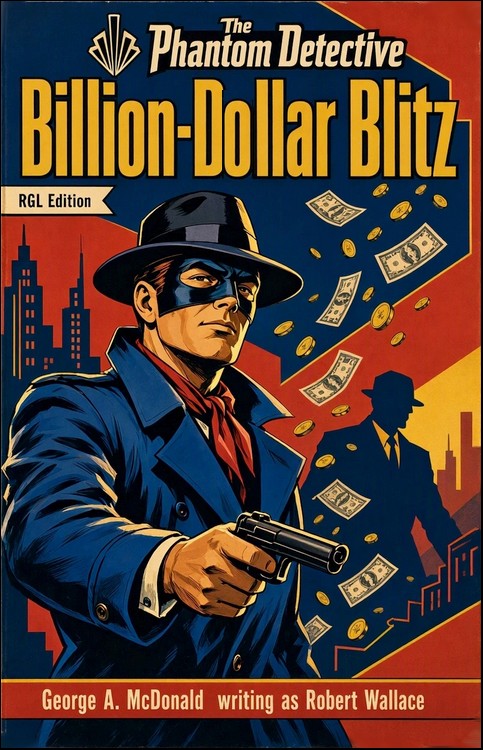
RGL e-Book Cover
Based on an image created with Microsoft Bing software
Roy Glashan's Library
Non sibi sed omnibus
Go to Home Page
This work is out of copyright in countries with a copyright
period of 70 years or less, after the year of the author's death.
If it is under copyright in your country of residence,
do not download or redistribute this file.
Original content added by RGL (e.g., introductions, notes,
RGL covers) is proprietary and protected by copyright.
RGL e-Book Cover
Based on an image created with Microsoft Bing software

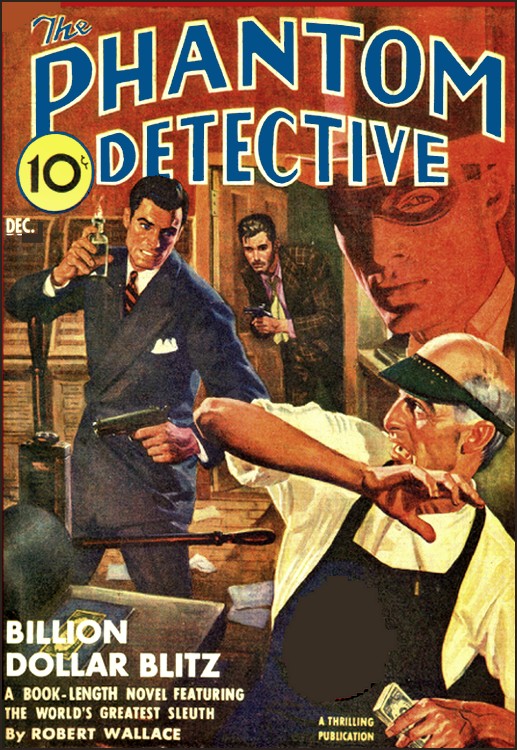
The Phantom Detective, December 1942, with
"Billion-Dollar Blitz"
Murder and extortion go hand in hand as a gigantic crime conspiracy unfolds! While vicious gangster war rages, the Phantom goes into lighting action to halt the greatest fraud that has ever been perpetrated upon the public!
THE hush of early morning had fallen on Times Square. Lights were blinking out in night-clubs and restaurants, and only a few straggling merrymakers walked the Great White Way, now dusty and littered with the night's debris. Broadway was quieting down for a few hours' fitful sleep before the rush and bustle of another day.
Patrolman Thomas Keeney strolled off Broadway and down a darkened side street, trying the doors of shops and restaurants. Everything looked shipshape. It had been a quiet night. In a short while he would be off duty and on the way to his comfortable apartment in Brooklyn.
The sound of a creaking front door across the street caught his attention. Then low voices. A car with running motor and open doors was standing in front of Tester's Restaurant, which had been closed for several hours.
Keeney's interest sharpened and he stepped into the shadow of a doorway. Only a night light burned in the restaurant, over the cashier's desk. He remembered that the well-known restauranteur Frank Testor sometimes remained after closing, to go over his books. Had he perhaps opened up to speak to a friend?
Three short blasts on the car's horn brought Keeney to attention. A face was peering out the back window of the car, had apparently spotted him. It was a warning to those inside.
Keeney's fingers gripped his service revolver. You never knew. It all might be perfectly okay, or it might be a stick-up. He broke cover to slip along the store fronts for a better view.
A muffled whoosh sounded from somewhere.
Keeney's jaw clenched grimly. A shot from a silenced gun! It was followed by a loud wrench of metal—something being pried open. Now he could see two dark figures bent over the cash register. On the floor was the twisted form of a man. He looked to be dead.
Keeney realized it would be four or five to one—a hopeless capture. He grabbed his whistle, blew a shrill blast, then took aim at the car's tires.
FLAME spurted from the car and a shot echoed hollowly in the canyon-like street. Keeney fell, clutching his chest, sinking motionless on the sidewalk.
Again the horn blasted. The two men who loomed in the restaurant door paused a split second to scan the vacant sidewalk. Then they raced toward the open car door.
Keeney was shamming. The shot had missed him, but he knew a second one at that range probably would not. He came up on one elbow. His gun belched lead at the flying legs of the two men. The one in front stumbled to the sidewalk, cursing, but rolled over to fire his silenced gun at Keeney.
Lead spanged against the sidewalk an inch from the police officer's nose. Then a shot crashed into his left arm. He kept firing, and at his next shot the gunman slumped silently to his back and lay still, as his partner reached the waiting car safely.
People were running from Broadway now. As the car screeched into motion, Keeney got to his feet with an effort. He memorized the license number, then took aim at the tires again and began to empty his gun.
He heard a tingle of broken glass. The ugly snout of a submachine-gun was pushed through the rear car window. Keeney dropped flat as the deadly clatter filled the street.
He felt a stab of pain in the right shoulder. Another bit off part of his ear. Then darkness came crashing down around Tom Keeney. A slug had plunged through his skull and he was dead,...
The killing of Frank Tester and Officer Keeney seemed an oddly brutal and useless crime. It developed that only thirty dollars, change for the next day, had apparently been taken from the jimmied cash register.
The dead gangster was identified as a minor hoodlum, known as "Dingo" Mack. There seemed nothing spectacular about the case, and so New York newspapers relegated it to inside pages in favor of urgent war news.
Steve Huston, ace reporter for the Clarion, who had covered the story, sat moodily in the office of the paper's veteran publisher, Frank Havens, a week later. His hat was tilted at a rakish angle on his curly red hair, a habit that always showed his perturbation.
"Sure, I know the Tester case looks like a routine stick-up, Mr. Havens," he argued. "But I keep telling you it isn't. There's something behind it—a mysterious racket being operated under the very nose of the police. Look at this for proof!"
He slapped down on the desk news clippings of four recent cash register hold-ups—two restaurants, a movie house and an amusement arcade. All had happened after hours, and in each case the proprietor had been killed and only a few dollars taken.
The gray-haired publisher spoke gently.
"Steve, I've devoted my life to fighting rackets. But frankly I think you're making too much of those clippings. There are several thousand homicides a year in New York County, many of them murders committed by young criminals in holdups for a few dollars. These cases, tragic as they may be, are routine police business."
"But how about that warning note I turned up among Testor's papers?" Huston demanded.
This note, which had been printed crudely in fountain pen, was brief and to the point. Havens remembered that it had read:
Tester, this is your last warning. Come in with us tonight or you know what.
It had been signed only "A."
HAVENS frowned thoughtfully. "Yes," he admitted, "that note bolsters your racket theory—but it was undated and may have been written by some crank year's ago. No sane crook would attempt a protection racket on Broadway nowadays. I still favor the hold-up idea."
"You're forgetting," Huston said heatedly, "that the police found skeleton keys in the dead mobster's pocket to fit half the cash registers in New York—including Testor's. Why did they smash the register instead of unlocking it? It's all screwy. But my point is they weren't after the thirty dollars. They were trying to cram some racket down Testor's throat and he balked. So they bumped him. They smashed the register to make it look like a stick-up, and the same thing happened in these other four cases. And what's more—"
Havens held up his hand.
"That's enough—plenty," he said, and laughed. "I've got other things to do today, Steve. If you're so dead sure you're right, go ahead and track down the story. But don't come back to me until you've got some real evidence."
Fuming, Huston strode out of the private office and into the city room. The other newspapers, the police, now even Frank Havens, refused to get steamed up about Tester's death. Yet Huston was dead certain that there was something big behind it. For instance, Dingo Mack, the dead hoodlum, had had nearly nine hundred dollars in his wallet.
And Dingo had been only a smalltime crook!
"If I only knew how to contact the Phantom," Steve muttered, "he wouldn't think I was nuts."
A BELL jangled.
"Your phone, Huston," someone called.
He picked it up.
"Huston?" a voice said in a husky whisper. "Is this Huston?"
"Talking," Steve Huston said.
"Let me get this straight," the voice went on. "I've got a Clarion here. There's a signed story headed, 'Mysterious Mr. A—When Will He Strike Again?' Signed by Steve Huston. Are you that guy?"
"Yeah, and what about it?" Huston flared. He was sick of getting kidded about that story.
"Listen, kid," the voice rasped, "I ain't got much time, so get this. I got a scoop for you—I phoned the cops—they think I'm batty. I want to spill the story to you—on a billion-dollar racket! A billion dollars, see? This is Billy Brophy, the theatrical booker."
Huston had heard the name, but he also wondered if Brophy was batty. There was never any such thing as a billion-dollar racket.
"Get this," Brophy went on, talking faster. "This guy Mr. A that had Testor bumped—it's his racket, see. Nobody knows who he is. I've been working with his outfit. Well, they've made it too hot for me and I've got to take it on the lam. Now I want to put the finger on this guy Mr. A. Get over here to my office right away and I'll—"
The voice broke off sharply. Then the receiver clattered down.
Steve Huston jumped to his feet excitedly. He looked up Brophy's address in the phone book and dashed out of the office.
Traffic was tangled in the six o'clock rush hour, and he ran most of the way to Times Square. Brophy's office was in the narrow old ten-story Bernhardt Building, sandwiched between two modern skyscrapers. A small movie house occupied the first floor, while the next five stories were covered by a huge vertical signboard advertising a popular brand of cigars to the throngs along Broadway. Live steam, simulating smoke, issued from the tip of the cigar.
"Billy Brophy?" said the boy who ran the wheezy elevator. "Tenth floor. Sign the book, please."
HUSTON scrawled his name in the night book at the back of the elevator. As they groaned and creaked upward, he saw that the floors behind the big signboard were piled to the ceiling with stage scenery and props. Warehouse space.
He stepped into a darkened reception room and knocked on a glass door inscribed, "Mr. Brophy." There was a light inside.
"Come in," a voice called.
He entered a large well-furnished office hung with hundreds of theatrical photographs. Against one wall was a huge old-fashioned safe. The man behind the desk was gray-haired, but youthfully handsome, carelessly dressed in expensive clothes. In his deep-set blue eyes was an alert, crafty gleam.
"You're Mr. Brophy, aren't you?" Steve said. "I'm Huston."
"All right, what about it?" Brophy's face was immobile.
"But you just phoned me."
"I phoned you? You're nuts. I don't even know you."
Huston's jaw dropped. "You mean it wasn't you that phoned?"
Brophy shook his head. Huston hesitated. Then his face flushed with anger.
"It was you, Brophy. It was the same voice. Well, what about that scoop?"
Not a muscle moved in Brophy's body but his lips.
"I don't know what you're talking about. If you're from the press, I got nothing for you today. Now beat it!"
Steve Huston's Irish temper suddenly flared.
"Listen, Mr. Brophy, I'm going to bust somebody in the nose before long. You said you'd give me the inside story on a billion-dollar racket run by Mr.—"
A new look in Brophy's face halted Huston in mid-sentence. Deep, hollow-eyed terror!
The booker jerked a deliberate hand toward the inter-office communicator on his desk.
"Get out of here!" he roared. "Do you understand? Get out!"
Huston turned and went out. Somebody had been listening from another room—that was what Brophy was trying to tell him. He had been forced to say what he had. That hunted look in his eyes—
Steve Huston went back to the lobby.
He waited, thinking. Abruptly the elevator door clanged open on another trip down. A man came out and walked rapidly to the front door. It was Brophy.
Huston pushed out after him, and ran along Broadway until he caught up.
"Keep going, Mr. Brophy," he said. "I'll follow."
"Keep away from me!" Brophy's voice was an angry snarl.
He did not turn. His face was gray with suppressed panic.
Huston fell back a dozen paces, but continued to follow.
Brophy turned at a corner and headed across Broadway against the lights, slipping through between passing cars. Halfway across, an odd thing happened.
He stumbled and fell on his face and lay still.
A taxi stopped on a dime to keep from running over him. A woman screamed.
The bluecoat on the corner bleated his whistle to stop traffic and came running.
Steve Huston gritted his teeth and plunged through the crowd to Brophy's side.
"Stand back, you!" bawled the policeman.
"Heart attack," the Clarion reporter said glibly. "I'm his son. Just left him at the corner."
"Okay, then, stay with him, son," the officer said and headed for the call-box to phone the emergency squad.
HUSTON turned Brophy onto his back, pillowed his head and felt his pulse.
He was not dead.
"Brophy," he said gently, "it's Huston. What happened?"
The booker's eyes rolled open. Huston could see he was dying.
"Try to talk," he insisted. "Who is this Mr. A? What's his racket?"
Brophy's lids drooped. "A billion—a billion dollars," he muttered. "Mr. A—was in my office—shot me—"
"But who is he?" Steve snapped. "His name!"
Brophy's lips moved, but no sound came out. His head slumped.
Steve Huston put a hand in the man's shirt front. His heart had stopped beating. The wail of the ambulance siren sounded.
Suddenly Huston realized that his hand beneath the booker's back was wet. His fingers were touching a warm soggy hole between the shoulders. A bullet-hole. Brophy had been shot to death in the middle of Broadway!
TWO white-coated orderlies bearing a stretcher pushed through to the body. Newly arrived police were holding back the spectators who were beginning to thin out because a sudden shower had just come up. Steve Huston watched his chance, then plunged through the crowd and raced down the street in the pelting rain to the Bernhardt Building. He found a phone booth, dialed the Clarion and spoke rapidly to Frank Havens for several minutes, then hung up.
The elevator boy in the Bernhardt Building, sitting in his car with a magazine, was apparently unaware of the excitement a block away. Huston slipped a five-dollar bill into the boy's hand.
"This is important, buddy," he said. "I want you to think, and think straight. Is there any other entrance to this building?"
"The service entrance," the boy said. "But that's kept locked up tight when it ain't being used."
"Have you brought anybody down since you brought Mr. Brophy?"
"Nope," the boy said. "Ain't taken anybody up, either."
Huston looked at the night register. Beside his own name and Brophy's there were three other names recorded as checking in after hours, and he jotted them into his notebook. The names were:
Dave Delancey, 8A—6:15. Leonard Barton, 8A—6:15. S.J. Manning, 7B—6:35.
"When do you start keeping this night book?" Huston demanded.
"When I come on at six."
"Then I suppose there were people in the building who wouldn't be registered here."
The boy shook his head. "Only Mr. Brophy was here when I come on. Them other floors was locked. I'm sort of the watchman, too, and I check up. There's only three real tenants in this shack—Mr. Brophy, Mr. Manning and Mr. Delancey. The other floors are either storage or vacant."
"Who's Leonard Barton?" Huston said.
"Lenny Barton, the actor. He come in with Delancey. Delancey's a photographer. Got his studio up there."
"How about Manning?"
The boy smirked. "He's the baby with the dough. A backer—an angel, to you."
"Okay, let's go up," Huston said. "And that five-spot says you don't tell anybody I'm here."
There were no lights in Brophy's suite, but the door was unlocked. The newspaperman entered the reception room, paused for a moment, listening. He switched on his pocket flash, crossed to Brophy's private office and pulled down the shades. He wanted a look at the wiring of that speaker system on Brophy's desk.
Adding Brophy's dying words to the night's happenings, he figured that Mr. A must have caught Brophy phoning him, threatened him with death unless he could still throw the Clarion off the track somehow, then shot him, anyway.
But how could Brophy have walked to the middle of Broadway with a bullet in his back? Also, where could Mr. A have been listening from?
Huston shot his flash speculatively toward the heavy, old-fashioned safe.
He heard the creak of a floor-board behind him, wheeled sharply to see the shadowy figure of a man hurtling toward him. He tried to sidestep, but stumbled over a standing ashtray that fell to the floor with a crash of glass.
The flashlight clattered from his hand as the man crashed against him, pinned him to the safe. Huston's guard came up too late. He felt the sickening impact of a heavy fist full in the mouth. His head struck the iron door. He reeled, felt himself sinking to the floor.
That's all he could remember...
WHEN Steve Huston regained consciousness he was in a dark corner of the tenth floor hallway beyond the elevator. The dizzy hammering in his head brought the scene in Brophy's office flashing back to his mind. He looked at his wrist-watch. Half-past eleven.
He had been out nearly four hours.
His clothing felt sticky and uncomfortable. He noticed an odd taste in his mouth. He was conscious of an unpleasant, though familiar odor, too.
As he stood up a clatter of glass beside him confirmed his suspicions. He reeked of liquor. Someone had doused him with it, poured some in his mouth, and left the empty bottle.
The elevator door clanged. Huston drew back into the shadows. A well-dressed man and an attractive young woman came from the elevator and entered the booking office. Lights were blazing brightly inside and there was a murmur of voices.
Steve Huston brushed himself off and headed determinedly toward the office. He knew that theatrical bookers like Brophy did much of their business in the evenings, but the complete transformation that had taken place in the office was something to regard with surprise.
The reception room was bathed in a soft glow of indirect lighting and a stunning little blonde secretary sat at a desk, busily typing. Lounging in deep chairs were two black-haired girls who looked like a sister team, a trio of big-muscled men in ill-fitting clothes—they might have been a tumbling act—and an assortment of pretty red-lipped chorines with shapely legs crossed at well-calculated angles.
"Whom did you wish to see, sir?" the secretary asked in a soft voice. "Mr. Brophy won't be here any more. I suppose you've heard. But his assistant, Mr. Lugiano, will carry on the business. He'll see you if you wish. I presume you're another reporter?"
The door of the inner office swung open abruptly and Huston saw a burly familiar figure with his hand on the knob. It was Inspector Gregg of the Detective Bureau. The Clarion man and the inspector were old acquaintances.
Gregg had his back to the doorway. He was talking to a dark-complexioned man with an oddly fixed smile who had the broad shoulders and tapering waist of a dancer.
"So it's like I tell you, Inspector," the man was saying. "In this business you make enemies. Brophy, he was a square-shooter. Nobody had to be afraid of nothing from him. But when you got six hundred girls on your list, some of 'em not so good any more, you get 'em jobs the best you can—shows, night-clubs, maybe burlesque and clip joints.
"Then they start getting in jams, see? All kinds of crazy trouble. Their husbands, their boy friends, maybe their brothers—they come to see you, like it was your fault, packin' rods even. You got no idea the headaches they make a booker. So what I figure is, somebody that had it in for Billy waited out there in a car, took a potshot at him and got away in traffic."
"Thanks, Lugiano," Gregg said brusquely. "I'll check on that list of Brophy's clients. Meanwhile, don't you leave town. We'll need you—"
Steve Huston strode abruptly through the door and closed it.
"Hello, Huston," Gregg said. "You here for a story? Kind of late, aren't you?"
Lugiano regarded him silently. Huston swung on Gregg. "Excuse me, Inspector, but are you going to swallow that guy's line? Jilted boy friend, my grandmother! Brophy was shot right here in this office—by Mr. A."
Gregg gave him a puzzled look. "Brophy was shot in the street."
"Sure, he died in the street," the newspaperman said. "But Brophy himself said, 'Mr. A. was in my office—he shot me.' Those were his dying words."
"Just a minute. Do you mean you're the nut that claimed he was Brophy's son? I'm afraid that's going to get you in trouble."
"Inspector, pardon me." Lugiano's twisted smile showed even white teeth. "But this guy has been drinking. You can smell it over the whole place. When he's sober maybe he'll talk more sense."
"You keep out of this," Huston said savagely. "Look, Inspector—after I left Brophy I came back to this office and somebody conked me. Look at this goose egg." He showed his head bump.
"That bump you got in some bar," Lugiano said humorously. "When I come in at eight o'clock, the office was locked tighter than a drum. So Brophy locked it when he went out. Nobody else got a key."
Suddenly Huston remembered. "The ash-tray! I stumbled over it and the glass dish broke."
He crossed to the standing ash-tray by the desk, stared at it in chagrin.
"All right, so you had it fixed!" he gritted. "That doesn't change my story. What's more, I'll bet my shirt the guy who socked me was Mr. A, who is also the guy behind Frank Testor's death."
Inspector Gregg regarded him steadily.
"Tell you what, Steve," he said. "Why don't you and I get out of here and get some black coffee?"
Huston glared at him and started out of the office. Then he remembered the night register in the elevator.
"Inspector," he said, "you've got to believe this. Brophy said his killer was in his office! Well, I've got the names right here of the only three men who were in the building at that time. One of them must be Mr. A."
He reached confidently inside his coat for his notebook. He frowned, began slapping his pockets.
"I'll be darned," he muttered. "Mr. A must have lifted it. But when the elevator gets here you'll find their signatures right there in the night book—the first three names, Delancey, Barton and Manning."
The elevator came and Gregg and Huston stepped in. The reporter gaped at the operator.
"You're not the same boy! What happened to the boy who was here before?"
"Got sick," said the operator. "I'm the day man. He phoned me around eight o'clock and asked me to take over. He dashed out the minute I got here. I didn't even get a word with him."
Steve Huston stared at the register. The three names were no longer there. The page the Clarion man himself had signed had been ripped from the book and a new page, which already had ten or twenty names on it, had been started for that night.
"Come on, Inspector," Huston said wearily. "I think I need that cup of coffee."
When at last Gregg left, Steve Huston went back to the Bernhardt Building. He had expected his phone call to Frank Havens four hours ago to have brought certain results. So far it had not.
HUSTON was as mad as a hornet and more determined than ever to get to the bottom of this affair.
A prosperous looking heavy-set man, entering the building, bumped against him, jabbing an elbow into his ribs. That settled it for Steve Huston. He had been kicked around enough for one night.
"Watch where you're going, you big lug," he muttered.
"Oh, did I bump you?" the man said mildly. "I was looking for Mr. Brophy's office." A smile of amusement played on his face as he lowered his voice. "So you don't recognize me, Steve."
Huston peered sharply—and still nothing about the man's features struck a note of recognition. But he knew it could be only one person.
"The Phantom!" he said in an excited whisper. "So Mr. Havens did call you as I asked him over the phone."
The Phantom Detective, whose genius at disguise was one of his most powerful weapons in his longstanding secret battle against the underworld, drew the Clarion reporter aside.
"I came the moment I got the call," he said in a low voice. "But, frankly, your billion-dollar-racket story didn't convince Mr. Havens. Only the fact that you were convinced and his faith in you prompted him to summon me."
"Phantom," Huston said with a weary sigh, "let's find a place where we can talk."
IN a nearby restaurant Steve Huston related his story to the Phantom from beginning to end.
At last the Phantom said slowly:
"Well, what you say sounds reasonable, Steve. Now that I know the facts, I'm as convinced as you are that the 'A' who wrote Frank Testor a warning note is the 'Mr. A' whom Brophy accused when he was dying—and that there's some sort of racket behind it. Apparently it's a gigantic racket, too, with fabulous profits about which nobody knows anything—yet. Dying men don't lie. We've got a two-fold job, Steve—to discover the racket, then smash it."
As they left the table, the Phantom went on:
"I made a beginning on the way here to meet you. I visited the Detective Bureau and learned several curious things. Brophy's car was found parked nearby, and there was a hundred and seventy-eight thousand dollars in a secret compartment under the dashboard. He was clearly taking a run-out."
Huston whistled. "He didn't make that as a booker."
"Also, he was shot in the middle of Times Square with—of all improbable weapons—a forty-eight caliber rifle. Another thing I noticed was an odd ring on Brophy's left hand—an extremely heavy gold-plated signet ring."
"What do you make of that?"
"I'm not certain yet," the Phantom mused, "but along Broadway they tell me Brophy used to run a nightclub in Reno."
As they reached the street, he went on abruptly:
"Brophy died in the street, and you were knocked out instead of being killed—which bolsters your theory that Mr. A is closely connected with the Bernhardt Building and wanted no trouble there. What's on the floors behind that cigar sign, Steve?"
Huston told him. The Phantom frowned thoughtfully.
"That tall building next door is the Metropole Building, isn't it?" he asked. "Didn't the Clarion run a story a couple of years ago... Yes, I remember. Maurice Thorberg, the big producer, took offices there—the entire thirteenth floor. By coincidence his shows started to fail and he finally went broke. It got around that there was a jinx on that floor, and it's still vacant."
"What's that got to do with Billy Brophy?" Huston asked.
"I'm not sure until I can search Brophy's office. I'm going up there in a little while. Meanwhile I want you to watch your chance and sneak up the stairs to the fourth floor. I have a key I'm sure will open the stairway doors. Let me know what you find along the front wall of the building."
The reporter looked puzzled. "I don't quite get it, Phantom."
The Phantom led the way to the "island" in Times Square, looked up at the smoking cigar. He produced tiny binoculars and said:
"Look closely above the tip of the cigar."
Huston took the glasses. "I see it! A small metal door—probably for sign maintenance." He caught his breath, "Phantom, do you mean that Brophy was shot from that door?"
The Phantom nodded his head grimly, "Traffic noises covered the sound—the cigar smoke hid the gunsmoke. Incredible as it seems, I believe Brophy was shot neatly and accurately in the back from a distance of more than two hundred feet! Now you know—go to it, Steve."
AFTER Huston left to carry out the Phantom's orders, the Nemesis of the underworld stood scrutinizing the people who entered the Bernhardt Building. He was waiting, not for a definite person, but for a certain type of man.
The after-theater rush was on and Broadway was filled with slowly moving traffic. Some of the limousines and taxis that passed bore friends of his to night-clubs and restaurants. For in private life the Phantom had many friends. And why not—since he was the well-known Richard Curtis Van Loan, dilettante, sportsman, carefree spender of inherited millions, and one of the most popular members of New York's most exclusive society.
In the gay social whirl into which he had been born, Van Loan, or "Van" as he was known to his intimates, was considered the town's most eligible bachelor. He was young, debonair, and charming although somewhat inclined toward restlessness and unpredictability.
Often he would disappear from his usual haunts for weeks at a time and it was always assumed among his smart-set friends that he had gone off to one of his country places or perhaps on a deep-sea fishing expedition. Or perhaps he had gone off to a California track in his private plane to watch the running of some horse from his excellent stables.
In reality, on these occasions he was hunting—hunting the biggest of all game—killers, racketeers and criminals.
Not one among his friends suspected his secret avocation. Only Publisher Frank Havens, who had years before suggested his double role, knew Van Loan's real identity. And it was he who always summoned the Phantom when criminal forces with which public law enforcement authorities could not cope loomed on the horizon.
For years Van Loan had studied the science of criminology. He had equipped himself with the most modern crime-fighting equipment, rigorously trained himself physically and mentally.
In all America now there was no single man so feared and hated by the underworld.
His uncanny wizardry at make-up and impersonation enabled him to enter the very strongholds of public enemies and strike without warning. His secret workshop contained clothes and materials for a thousand disguises which aided him in becoming known as "the man with a thousand faces."
So now as the Phantom stood in Times Square, he had little fear that his presence would be noticed by his friends. He had chosen his present disguise carefully—that of a kindly, well-to-do but rather dull-minded business man—the type who annually pours millions of dollars into New York's theaters and cafes.
He kept scanning the people who entered the building. Some were theatrical people, but more appeared to be casual pleasure-seekers. Because of them he had no doubt that Brophy's agency was a front for a far more lucrative business.
The pleasure-seekers must have some way of identifying themselves upstairs, he decided—likely by membership cards. He let several people go up in the elevator before he saw a man who might serve the purpose.
"This here is the place all right, honey," he heard the man say to the girl with him. "The boys took me here when I was up to the convention last time."
Van Loan stepped forward quickly, tried to get through the door at the same time as the Southerner, colliding with him.
"So sorry," Van apologized. "You go first."
He stepped away and let the two enter, then quickly headed into a phone booth in an alcove and closed the door. In his hand was the Southerner's wallet.
HE thumbed through a collection of cards, club memberships, insurance identification, draft registration, until he drew one card out and frowned thoughtfully at it—a handsomely engraved card the center of which was inscribed simply:
LUCKY 13 CLUB
In the lower right hand corner it read:
MEMBER:
Herbert J. Walsh
The man's name appeared to have been engraved from a plate made of his signature.
Thirteen was the vacant floor of the Metropole Building. That came to Van as he studied the signature, wrote it several times on a bit of paper, then slipped the card into his pocket. He was pretty sure this was what he was looking for.
He went up in the elevator, gazing curiously at the night book. A night book provided by the management was a routine procedure in most office buildings and had no doubt been insisted on by the owners of the valuable theatrical properties stored there.
Forty or fifty names had been registered for the evening and he noticed that Walsh's name was not among them—which was as he had expected. Brophy's office could hardly expect its patrons to sign their real names. Van, too, signed the first name that came into his head.
As they reached the tenth floor, he handed the wallet to the operator and said with a faint smile:
"That last couple will be down in a moment. I found this wallet in the hall. Please return it to the gentleman."
Brophy's office was humming with activity. Van drew back into the shadows by the elevator, watching the secretary's desk through the open door. Walsh, red-faced, was searching his pockets. After a while he came out with the girl, muttering.
Van waited for several trips of the elevator. At last he entered the office and casually showed the card to the secretary.
The girl glanced at it and eyed Van with a puzzled expression.
"The man who was just here said his name was Walsh," she said.
"Well, isn't that a coincidence!" Van remarked.
She hesitated. "Well—all right, Mr. Walsh. Mr. Lugiano will see you. Just step right in."
Van strolled past the theatrical people and entered the private office. Tony Lugiano, sitting alone, looked up from his desk as Van silently held out his card.
"You are Meester Walsh? I don't know your face. You been here before?" His eyes glinted with caution.
"Last winter," Van said. "I'm from out of town, suh. Atlanta, Geo'gia—a cotton broker." He had gleaned the information from Walsh's wallet.
Lugiano's cunning gaze remained focused on his face as he produced a fountain pen and a slip of paper from his desk.
"Sign your name, Mr. Walsh," he said noncommittally.
He took the card so Van could not see it.
"But I'm a friend of Mr. Brophy's, suh," Van said, "I knew him in Reno."
"Sign your name," Lugiano repeated.
The Phantom scrawled the signature rapidly. Lugiano gazed at the two signatures a long moment, then nodded his head.
"Okay, Mr. Walsh. Come with me, please. You get your card back when you come down."
He crossed to the big old-fashioned safe which stood against the far wall, worked the combination with rapid fingers, and pulled open the heavy door. It was a gateway. The Phantom entered.
He found himself in a short, narrow corridor, leading out of the open back of the safe and through the wall. Dimly lighted, it led up a low flight of steps toward a door of shining chrome steel.
VAN heard a bell ring faintly. A face appeared at a round window in the door and it was thrown open by a uniformed boy.
One brief glance showed Van that he was in a smart gambling salon. Glittering chandeliers blazed above gaming tables that were surrounded by men and women, many of whom were in evening clothes. At one end was a long bar at which drinks were served.
The salon was lavishly decorated and appeared to be fitted with all the most modern insulation and sound-absorbing devices. From the doorway only a soft murmur of voices reached Van's ear.
Van strolled in among the tables. All the popular forms of gambling were represented—roulette, trente-et-quarante, cards, dice, baccarat. Few of the patrons appeared to be theatrical people. They were, rather, men and women of wealth and position who had dropped in for a few hours' gambling after the theater.
There were several Van knew in private life. Among them were a doctor, a well-known trial lawyer, and several Wall Street men.
Van smiled to himself. His deductions had led straight to the mark. That lodestone ring of Brophy's he had suspected was a device to break a color streak in roulette. There was a magnetized point built into the wheel and a careful operator by simply placing his hand close to the rim could control the wheel well enough to avoid too serious a loss to the casino.
The cash found on Brophy, the fact that he had been in business in Nevada, the only state where gambling was allowed, all that fitted in. Also the vacant thirteenth floor of the Metropole Building. The old Bernhardt Building next door had high ceilings so that the tenth floor was nearly on a level.
It was a beautiful set-up here on Times Square and worth hundreds of thousands a year to its owner. Perhaps Brophy had booked a few chorus girls now and then, but the office was chiefly a front.
Van went to the cashier's window. He noticed a small sign pasted beside it which read:
CHECKS CASHED HERE
He gazed at this sign thoughtfully as he bought chips. Then going to a roulette table, he placed a few bets according to one of the simpler systems, avoiding any conspicuous plays that might attract attention to himself.
BEFORE long, Van cashed in his chips at a modest profit and strolled to the bar. His eyes and ears were alert for any scrap of useful information.
In the soft amber glow he saw a familiar face. It was the face of Lenny Barton, the stage comedian. Van knew the actor was opening the following week as star of the new revue, "Heads High." His homely grinning face and unkempt dark hair were well-known to Broadway audiences.
Barton was one of the three men Steve Huston had said were in the building when Brophy was shot. Van moved near enough so he could hear Barton's conversation with a thin, nervous young man wearing a mustache, and with a short, bristly haircut.
"Manning shouldn't have depended on Brophy for his chorus," this companion of Barton's was saying. "Brophy was tied up in gambling. He paid no attention to his booking agency."
Barton shrugged. "I reckon if he wanted Brophy's girls in 'Heads High' that was his business, Delancey."
Van looked sharply at the man addressed as Delancey. This was a stroke of luck. Here, obviously, was Dave Delancey, the photographer at whose studio Barton had been earlier. It would be only natural for them to stroll up for a drink at Brophy's bar.
"I'm betting there was a secret understanding in Brophy's lease," Delancey said. "Manning owns both of these buildings. When Brophy took over the thirteenth floor, Manning agreed to let him do all the booking for his shows."
Barton cupped his hands and lit a cigarette.
"Just like when you leased your studio from him you got a contract for his publicity stills. Strikes me you don't like Manning much."
"I've got good reasons."
"One of them is Linda Drake. You saw her first, huh, Dave?"
Delancey said nothing. The muscles around his jaw tightened. The Phantom remembered that Linda Drake, versatile charming musical comedy star, was to be co-starred with Lenny Barton in "Heads High."
"Don't take it too hard, Dave," Barton went on. "She's an actress like her mother was, and a born sharper like her father. Her father and me used to be buddies. We ran a country newspaper together years back, before I organized my Wild West show. Yes, she's a smart one all right—knows enough to play up to the right people."
"If I see him hanging around her again, I—I'll break his fat neck," Delancey growled.
"Now's your chance, Dave," Barton said mildly. "They're down at the other end of the bar right now!"
The photographer jerked his head around. Van turned also, to regard the couple who had just come in. The girl was blonde, radiant-eyed, charming. Her escort was an obese-bodied man in late middle-age whose thick-lensed glasses and heavy cigar made him a favorite subject for Broadway cartoonists.
The photographer started to rise from his stool, but Barton's hand stayed him.
"Take it easy, Dave. You know show business—either you play politics or you end up behind the eight ball."
"You ought to know about politics," Delancey said angrily. "Your last three shows flopped and the critics panned the life out of you—and so Manning gave you the lead in 'Heads High,' anyhow!"
The pleasant wrinkles about Barton's eyes vanished.
"Pull your chin in and quit looking for trouble, son," he snapped. "When Manning hired me he had his reasons. If Linda Drake plays up to him, she has her reasons. Now forget it."
DELANCEY ordered another drink.
The Phantom moved unobtrusively along the crowded bar. Then he caught Manning's, deep, unpleasant voice.
"Your young Romeo down there looks like he wanted to take a poke at me."
There was a touch of indignation in the girl's tone.
"I can see no reason why I shouldn't come here with you after rehearsals if I choose to. If Dave wants to get in a huff, let him!"
"That's sensible," Manning said. "Incidentally, did you know Delancey owed dough to Billy Brophy? He used to come up here to spin the little wheel when business was dull in the studio. Paid his losses in post-dated checks. He was having a tough time covering at the bank."
Linda Drake's manner cooled. "I don't think I care to discuss that, Mr. Manning, if you don't mind."
"Okay. Don't get sore." Manning shrugged. "I just thought you'd like to know."
At that moment Lugiano appeared behind the couple, spoke a few words in a low voice, then passed on. Linda Drake gave a little gasp. Manning inclined his head and they left the bar.
Van was puzzled as he watched Lugiano. The suave, dapper gambler spoke likewise to Barton and Delancey and to several others at the bar. Then he began going from table to table and more guests began to saunter toward the door. Among them were the brokers that Van had recognized and most of the guests in evening dress.
Something was up, but what it was Van could only guess. The gambling salon was cleared of nearly half its patrons in a few minutes.
Lugiano next went to the cashier's window, spoke a few words, and the cashier produced a long white envelope which he sealed with his tongue. Lugiano took it. He picked up a telephone, spoke for several minutes, then hung up and walked rapidly toward the rear of the gambling rooms, unlocked a heavy door, and slipped through.
Van was after him in a flash. When he reached the door, he found Lugiano had already locked it from the other side. But a skeleton key from Van's pocket key-case made quick work of the lock. He found himself in a small rear hallway containing a flight of stairs and a freight elevator shaft. The elevator had already begun to move downward.
Van knew there was no other way down. A cursory examination had previously convinced him that the passenger elevator shafts at the front had been walled up at the thirteenth floor. He plunged down the rear stairs, unlocked a fire-door at the twelfth floor, which was locked strictly against fire regulations, and kept going.
He could hear faintly the whirring of the elevator mechanism. Presumably Lugiano was going all the way down.
Van went to the basement. A low night light burned above the freight elevator shaft and the doors were open. Straining his eyes in the gloom, the Phantom could see the gambler dashing across the cavernous emptiness. A faint reddish glow ahead indicated the position of the giant furnaces which heated the building.
Lugiano had reached them, the white envelope in his hand. Only one was in operation, to supply hot water to the building. The gambler grabbed for the furnace door.
THE gun from Van's sleeve holster slipped into his hand.
"You're covered, Lugiano," he rapped out. "I'll take that envelope."
But even as he spoke Van realized that his words were futile. Lugiano already had the door open, and Van saw the envelope sail into the flames.
Lugiano stood with his hands raised, smiling contemptuously as Van put his gun away. But Van was sure that if he could have seen the contents of that envelope, that he might have been saved days of painstaking investigation.
"Were you going to shoot me, Meester Walsh?" Lugiano said, that smile of satisfaction plain on his face, "That would be murder. Even the Phantom could not get away with that. I think you borrowed that admission card and forged Meester Walsh's name, no? That was very smart. He come maybe twice a year and I did not know him.
"But I kept the card and put it in a little benzine, Phantom. We got to be careful here. On each card is typewritten in invisible ink a description of its owner, and this did not check up. I've been looking for the Phantom since Brophy, like a dope, telephoned the Clarion. Everybody knows that the Clarion works with the famous Phantom."
Van smiled grimly. "All right, Lugiano. I'll admit I'm the Phantom. You've taken the first trick, and perhaps the second. After warning your more important guests to leave, you telephoned the police anonymously a few moments ago, if I'm not mistaken.
"That was clever. You knew the Clarion's first act would be to expose this little racket which you so conveniently inherited from Brophy—and you wished to set your own time for the raid. The sooner the better, because you want the police to believe that this gambling house is the racket which Brophy told Steve Huston about. Mr. A's billion-dollar racket. Which I'm quite sure it is not!"
The triumphant smile faded from Lugiano's face. Van saw his hand make a quick movement inside his coat, but he thought better of it.
"Acting for Mr. A, you have another reason for calling the police," Van went on relentlessly. "That night book which was always such a nuisance to the Lucky Thirteen Club but which the building management insisted on—it contained the names of three men who were in the Bernhardt Building at the time Brophy was shot from within the building.
"You're afraid Huston remembered those names in spite of your elaborate attempt to destroy the record—and you're right. Therefore, you wish to point out to the police that Brophy's killer was not necessarily one of the three. It could have been anyone hiding in the gambling rooms. Which only leads me to believe more strongly that it was one of the three."
The gambler's face had twisted into an angry snarl.
"So all right, you have taken that trick, my friend. I underestimated your cleverness. But now you will see what good it will do you. The police will not be so smart as you—and you cannot tell them because you will be dead, and the racket will go on. I thought we had arranged it so that that step would not be necessary, but your cleverness has signed your own death warrant."
Lugiano raised his voice abruptly.
"Pete! Lefty!"
As Van glanced sharply into the gloom, Lugiano smirked:
"They have had you covered from the darkness all the time, Phantom. Did you think I would leave this back entrance unguarded?"
TWO shadowy figures emerged from opposite directions in the gloom, with automatics grimly leveled at Van. One had the meaty body and hardened features of a gang torpedo. The other was a youth of slight build with a thin, wasted face, a nervous step and quick birdlike eyes.
"Reach, you!" snarled the youth. "Or I'll fill you so full of lead they'll set you up for a statue."
Van had no choice but to obey, and Lugiano frisked him of his guns. Van had known he would be taking risks in following Lugiano, but danger was part of the Phantom's business.
At the same moment he heard in the distance the faint wail of police sirens. Then there was the sound of pounding above, loud voices coming down the elevator shaft.
"That will be the police, breaking up my beautiful gambling rooms," Lugiano said quietly. "I think they look for me next and I wouldn't disappoint them. But I will be out on bail tomorrow. I am not the casino owner—just an employee. So I think Pete and Lefty are gonna take you for a little ride—to Staten Island, maybe. For your information they are two of the smoothest rodmen in the business. I think we ain't gonna meet again, Phantom."
"Okay, Boss," the big gangster said. "We'll take care of him."
Lugiano smiled mockingly, stepped into the freight elevator and went up. Van felt the sharp jab of a gun in his back.
"All right, wise guy, get goin'."
Van walked slowly across the gloomy cellar, estimating his adversaries. He judged they were heading him toward a service entrance of the building on a darkened side street where a car would be parked.
Lefty did not remain directly behind him but walked a few paces to one side, the aim of his gun never wavering from Van's body. These were not the usual poolroom-type lugs, but trained gunmen. The one called "Lefty" had the look of a killer. If Van tried anything with Pete he would be an easy target for the little rodman.
They passed through a door and down a dark corridor with a flight of steps at the end. At the top was a heavy door. He heard the jingle of keys in Pete's hand.
Van waited until they were halfway up the steps, then tried a dodge which had got him out of tighter spots than this—the trick of throwing his voice, at which he was a past master.
Suddenly from outside the door a muffled command seemed to come:
"Okay! You four men stick here. Nab anybody that tries to crash the door."
"Cops out there, Lefty," the thug behind Van stopped and said sharply: "What do we do?"
"Back into the basement and wait till—" Lefty broke off, and cried sharply: "Look out, Pete!"
But his warning came too late.
Van, taking advantage of Pete's momentary uncertainty, had wheeled in a flash, knocked back the gun and plunged a fist into the face of the man behind him, catapulting him backward into the other at the foot of the steps. Pete's gun went off in the air with a deafening roar.
As the lean young killer relaxed his aim for a split second, to dodge Pete's falling body, Van sprang down the stairs like a cat, clearing Pete's body, and landed on the killer. Lefty hit the floor so hard under Van's full weight that he was out like a light before he knew what had struck him.
VAN grabbed his gun, sprang back before Pete got right-side-up again. He fired one well-aimed shot, and Pete's gun spun from his hand. The hoodlum sat stupidly on the floor, nursing his bruised fingers.
Doors banged across the basement and three bluecoats, attracted by the sound of gunfire, came running out of the freight elevator and headed for Van.
"Hey, what goes down here?" bawled one. "And who the devil are you?"
Van drew from his clothing a small plate of purest platinum in the form of a domino mask set with diamonds and rubies—the secret badge of the Phantom, respected by law enforcement agencies all over the world.
The sergeant gazed at it, wide-eyed.
"You—the Phantom?" he exclaimed. "Well, I'll be—"
Van smiled faintly. "And I've got two prisoners for you. Pete Dominick and Lefty Ricci."
The sergeant eyed them with satisfaction.
"We haven't heard from these two in years," he growled. "Much obliged, Phantom."
RETURNING to the thirteenth floor, Van found that the glamor and glitter of the gambling rooms had faded. Uniformed police were herding the remaining patrons, pale and frightened, into groups of eight to be taken down in the elevator to waiting patrol wagons. Other police were seizing records and cash boxes and padlocking them for transportation to Headquarters.
New York was rid of another den of crime—but the Phantom knew that his own work had scarcely begun.
He met Steve Huston in front of the building.
"Phantom, you were right about that electric sign," Huston said. "The maintenance booth is on the third floor, but there's little door right opposite a window on the fourth floor, too—behind a lot of scenery. That's where Mr. A must have been when he shot Brophy."
Although it was past midnight, they headed for the home of Frank Havens. There was much to discuss with the publisher now, and Havens would be anxiously awaiting them. The publisher's lovely dark-haired young daughter, Muriel, admitted them. Muriel had worked with the Phantom on several cases, but although she moved in the same social circles with Richard Curtis Van Loan and had long been a secret admirer of the dashing young sportsman, Van's powers of disguise had kept her from ever recognizing him whenever he appeared in the role of the Phantom.
"Daddy's in the library," Muriel said. "He's been waiting up, hoping to hear from you on the Brophy killing. Mind if I sit in on the conference? You know I'm always interested in your work, and ready to help whenever you can use me, Phantom. Perhaps I can help you now?"
Van was more than willing to accept the offer, for Muriel had more than once proved herself a quickwitted and competent little operative.
When they were seated in the comfortable library, Frank Havens said:
"My apologies, Steve, for doubting your judgment. I'm convinced now that there's something far-flung and sinister behind all this. What do you intend to do next, Phantom?"
"So far we've no clues," Huston said.
"That's where you're wrong," Van said. "There are three clues—small ones, but they may lead somewhere. Does it strike you as odd, Frank, that a gambling casino should put up a sign: 'Checks cashed here?' "
Havens nodded. "Those places usually want hard money."
"Right," Van said. "But something else about that sign interests me even more. It was pasted to the cashier's window with tiny pieces of gummed paper. I scraped one of them off, unnoticed. Here it is."
He produced a tiny scrap of paper. Havens put on his glasses.
"It has printing on it," he observed. "So fine I can hardly make it out—'Pan-American Bank Note Company.' "
"Does that suggest anything to you?" Van asked.
"That it's the little edge from around a sheet of postage stamps. But I don't recall such a company."
"And for good reason," Van said. "It has been out of existence for fifty years. You'll notice that bit of paper is quite old. As I remember, that company held postage stamp contracts with several Central and South American governments for a time."
Havens nodded. "But why should this bit of old paper be found in a gambling house?"
"I wish I knew," the Phantom said. "I'm also puzzled about a certain umbrella. If you'll remember, a brief shower came up a little after seven-thirty tonight. In Lugiano's private office I noticed in a far corner a wet umbrella. It was ivory-handled, of expensive make and bore the gold initials, 'Q.V.' It may have no connection at all—or it may prove a valuable clue."
"So we'll sort of keep our eyes open for a wealthy man with the initials 'Q.V.,' " Huston put in. "They're unusual initials."
"A third possible clue," Van said, "is one that Steve dug up in connection with Frank Tester's death—that bunch of cash register keys found on the body of the dead gangman. That's interesting, Frank, when we remember that the register was jimmied open. The implications are obscure for the moment, but at least we have enough leads to roll up our sleeves and get down to work. I have a certain plan in mind. Listen—"
UNTIL the late hours the four sat in conference. When at last they broke up, each knew the part he or she was to play in an all-out effort to uncover and smash a billion-dollar racket.
It was late, so the Phantom announced he meant to go home and get some sleep. He had a hunch he was going to need it before this matter was over.
"If you'll take my advice, Steve," he suggested, as he said good night, "you'll go get as much shut-eye as you can, also..."
Early the next day, however, found the Phantom, his make-up removed, standing in a small, low-ceilinged room gleaming with chromium and white enamel. Along one side was a vast assortment of beakers, test-tubes and neatly arranged bottles of chemicals.
This was the secret workshop of the Phantom. The existence and location of this laboratory were as deep secrets as that of the Phantom's identity. Who would believe that a bleak old brick building in an isolated section of the Bronx housed one of the greatest criminal laboratories in the world?
A meek, stoop-shouldered research chemist who called himself Dr. Bendix had bought that building a number of years before. Dr. Bendix was, of course, one of the identities of the Phantom.
At one end, occupying shelves and cupboards from floor to ceiling were criminological instruments equal to any laboratory in the country. Several hundred thousand dollars of the Phantom's private fortune had gone into this equipment, and there were microscopes of all types with powerful Zeiss lenses.
A tank of iodine gas stood in one corner, and there were devices for bringing out latent fingerprints on various substances. Apparatus for blood analysis, as perfected by the late Dr. Zangmeister, occupied one whole alcove.
It was nine o'clock in the morning, and no one seeing the Phantom in his chemist's smock, his eye at the lens of a microscope would have suspected he had had only three hours' sleep.
With a muttered exclamation of satisfaction, he withdrew the bit of paper from the microscope and reached swiftly for his private telephone to Frank Havens' office. On the table beside him was a volume from his own stamp collection as well as a number of ponderous tomes on philately.
"Take this down, Mr. Havens," be said when the publisher had answered. "From the paper and ink used on that bit of stamp edging, my best opinion is that, surprising as it seems, it is from the Colombian province of Antioquia, from a sheet of the rare ten-centavos denomination of the Eighteen-sixty-eight issue. That Information may be of help to Muriel."
The Phantom hung up and, pushing aside the stamp books, opened a classified dilatory of New York City to the heading, "Cash Registers—Sales and Service." He went through the list with a speculative frown.
On another phone he dialed a friend who worked with a credit association, a man who had given him useful information in the past.
Van inquired for details on bankruptcies of cash register repair services in the past few years, but appeared unsatisfied with the information he received.
"What have, you got on 'Changes of Ownership'?" he wanted to know.
"Well, here's the Walker Cash Register Company, bought out in Nineteen-thirty-nine," his informant said. "Wait a minute, here's a later one—the Jiffy Cash Register Repair Service—business sold outright in January, Nineteen-forty."
"The name of the purchaser?" Van demanded.
"The purchaser? Just a moment—yes, here it is. Peter A. Dominick. And here's another change of ownership—"
"Never mind. You've given me the one I wanted. Thanks."
Van's face glowed with excitement as he hung up.
NEXT he phoned Inspector Gregg and asked for information about, Dingo Mack, the thug who had been seen in front of Testor's. He learned that Mack had been an ex-Chicago trigger man with a record, but that he had dropped out of sight out there two years before. Van got all the details about this man that Inspector Gregg could give him before he hung up.
He sat for a moment thinking, then crossed to a row of cabinets across the laboratory and opened a smoothly sliding door. Within was a selection of clothes for hundreds of disguises.
He picked out a pin-striped suit of an unobtrusive blue, cheaply and flashily tailored, black socks with white clocks, a pair of brown brogues, a white shirt with a faint purple stripe and an expensive gray necktie. All of the clothes had been worn enough to take the newness off. The trousers had a knife-blade crease and smelled convincingly of cheap cleaning fluid.
Putting these to one side for a moment, he took from a card file front and side photographs of a coarse-faced man with low brows, dark eyes and protruding jaw. He went to work rapidly to change his features to conform with those in the photographs.
Small bits of celluloid which fitted into his mouth seemed to alter the structure of his face completely. He added a bit of skillful building inside his nostrils. He had purposely omitted shaving that morning, and the faint growth of beard helped achieve the effect he desired. He went to work on his hair with clippers, changing the line about his ears and the back of his neck, then rubbed into his scalp a sticky black hair tint.
It was an artful but extremely simple disguise, therefore difficult to detect if he were in a tight spot. Van had always depended much on studied changes of posture, voice and manner to alter his real identity, more than on elaborate disguise.
Regarding the result with satisfaction, he put on the clothes he had laid out, and took from a numbered drawer suitable paraphernalia to put in his pockets. He then packed a small pigskin suitcase.
He was about to leave when suddenly he remembered something. He returned for a small white card which he placed between two taps of leather in the heel of his shoe.
At last he left the workshop. He walked for several blocks, then hailed a taxi and was driven to Manhattan.
Going to an address on lower First Avenue, he hired a room and left the suitcase there. Then he went to Grand Central station in time to meet a train from Chicago. Standing casually at the gate as the passengers emerged, he picked up a railway-ticket and Pullman stub that had been thrown down. He bought a Chicago newspaper.
His elaborate preparations complete at last, he headed for the Jiffy Cash Register Repair Service, which was on the top floor of an old loft building just off Sixth Avenue.
The furnishings were cheap and shoddy, but the place had a busy look. The girl at a small window looked up with suspicious eyes.
"I gotta see Tony Lugiano," Van said.
"Who?" the girl said.
"The big shot. Lugiano."
"Never heard of him. You got the wrong place."
She started typing again. Van leaned close to her.
"Sure I know you gotta be careful babe. But look, I'm a friend of Dingo Mack's. Just blew in from Chi. He fixed it for me to see Lugiano."
"I don't know any Lugiano," the girl said noncommittally. "If you want to see Mr. Dominick, he don't come in much, but try tomorrow."
"Okay. Thanks."
VAN turned away abruptly. Out out of the corner of his eye he had seen someone he recognized—a small-bodied man with a curiously ratlike face and quick darting eyes. He had come out of another door and was heading for the elevator. Van came alongside and stepped into the elevator with him.
"Hello, Mousy," he said.
The little man's hand twitched instinctively toward his coat pocket before his eyes met Van's. His wary look turned to guarded recognition.
"If it ain't Gunner McGlone."
"I just blew in from Chi," Van said.
"Yeah? Good to see you."
"Mousy" Bliven stepped out of the elevator reached the main floor. "The old burg must look pretty good to yuh, huh? Well, I'll be seein' ya."
"What's your hurry, Mousy?" Van caught Bliven by the arm.
"Meetin' somebody uptown. Let's get together sometime and hoist a couple. I'll give ya a ring."
Again he tried to dart away, but Van had an arm hooked under his.
"I got something to talk to you about, Mousy."
As he walked Bliven to a cheap bar and grill nearby, Van congratulated himself on his luck. Running into Mousy this way would simplify matters. But it was not entirely luck, for the character of "Gunner" McGlone was one which the Phantom had built up carefully over a period of years.
Several times in his relentless fight against the underworld he had assumed this role for a time and mingled with crooks of all sorts in search of information. In the New York underworld, Gunner McGlone was thought to be a small-time rodman working chiefly with Western stick-up gangs. No one had ever suspected that he was the dreaded Phantom.
Van bought drinks.
"So Lugiano got in a little jam," he said.
Bliven shot him a suspicious glance.
"That guy that ran the gambling joint with Eddie Brophy? Yeah, it's in all the papers."
"Who's your boss till he gets out?" Van said.
"I don't get you."
"Who's your boss? I want to see him."
Bliven turned away. "Now look, McGlone, I was in the rackets a while, y' understand, but that was a couple years ago. Now I got a job with that outfit upstairs. I make pretty good dough—not like I used to, but it's steady and—"
"Mousy, you kill me." Van laughed harshly. "I got a picture of you on the level." He lowered his voice. "Look, this is how it is. I ran into Dingo's brother Ralphy Mack, the Chicago bookie, the other day. He's an old buddy of mine and we got feelin' pretty good and he spilled what a nice racket you guys got here. So I figured to cut myself a piece of it. Ralphy wrote Dingo to take me to see this Lugiano guy."
Bliven fidgeted. "Racket? He musta been handin' you a line."
"Nuts to that." Van leaned over confidentially. "This Cash Register Service is phony. You guys bought the place up to get your mitts on a set of cash register keys. Now you're goin' around pullin' stick-ups. That's how Dingo got bumped, and now that he ain't around, you're takin' me to Lugiano."
Bliven's rodent-like eyes searched Van's face.
"You can't see Lugiano," he said in a low voice. "The cops are holdin' him without bail on account of Billy Brophy's gettin' bumped. But he didn't have nothin' to do with that. He'll be out in a coupla days."
"All right, then take me straight to Mr. A," Van said. Bliven's jaw dropped.
"Get wise to yourself, Mousy," Van snorted. "Ralphy Mack told me the whole layout. Listen, I walked out on a sweet set-up in Chicago for this, so I want action and I'm gonna get it. You're takin' me to Mr. A!"
"There ain't no Mr. A," Bliven gulped. "That's a newspaper yarn. Jeepers, I oughta know. I—"
Van's voice cut like a knife. "Quit playin' dumb, you sap. What would Mr. A say if he found you let me out of here knowin' the whole set-up like I do? You'd wake up in a hearse!"
The little gangman's eyes had regained their sharp glitter.
"So you wanta meet Mr. A, huh?" he said in a voice scarcely above a whisper. "All right, Mr. McGlone—you just wait here. I'll be back."
Van sat at a table. Four hours passed and still Bliven did not return. And then just as it was beginning to grow dark he caught sight of Mousy outside the window.
Van paid his check and sauntered out. A sedan of expensive make stood at the curb. Three big-muscled men, stone-faced and quietly dressed, were inside. Bliven smirked at Van.
"Get right in, McGlone," he said.
Van stepped in. He knew it was risky business. They could be taking him for a ride. The man on his left pulled out a length of white cloth and bound it around Van's eyes.
"Get goin', Joe," he muttered then.
QUIETLY the driver slipped the car in gear and they started up.
Van felt his pockets being searched. He made no protest as they removed his wallet and his gun. The car seemed to be heading downtown but Van, his ears tensely alert, could not tell for sure. Was he really to be taken straight to the mysterious Mr. A?
Before long the car drew to a halt. "All right, Gunner, get out!" Bliven's voice said. "I hope that story of yours was on the level."
Van stepped into the crisp evening air. Boat whistles came to his ears vaguely. He gathered from the hollow echo of footsteps that he was being led down an alley between two buildings.
They paused. An electric bell sounded somewhere, followed by the click of an automatic latch. A heavy door creaked open and Van was led up a flight of wooden steps. Another door swung open. A few more steps, then Bliven murmured:
"All right. Sit down."
It was a hard, straight chair into which the Phantom dropped. The smell of old wood, mingled with an elusive musky fragrance struck a responsive cord in his mind, but he could not quite seem to place the odor.
After a pause during which there was an indistinct mumble of voices, the blindfold was removed. Van blinked. He was looking directly into a glaring yellow light. Close about him he could see the menacing shapes of the four men who now seemed to be his four captors.
From the blackness beyond the light came a deep resonant voice.
"So Dingo Mack spilled about our set-up here and you want to cut yourself in on it. Is that right, McGlone?"
Van smiled in a confident manner.
"Listen, what is this—bright lights and all that hokum?" he said. "I gave up a good thing in Chi to come in with you guys. It ain't as though I was some dope you never heard of. Ask anybody whether Gunner McGlone is okay."
There was a tense silence and Van was acutely aware of the hard, grim faces around him.
"Well, you've got moxie, McGlone, to speak up that way with four guns on you," the voice rumbled. "All right, I'll talk to you straight. Sure we've got a sweet set-up here—and the more good men I got working for me, the more dough I make. My boys have already checked up on you. You're not such a hot-shot maybe, but a lot of people say you're handy with a rod and don't scare easy. So you're in, beginning now. You get a hundred a week. After the first couple of jobs, if I like you, then you get in on bigger dough."
"Suits me," Van said. "When do I pull my first stick-up?"
"You'll be told. You'll also be told more about these stick-ups—later on. We have our own method of making them pay off—dangerous, but profitable. As I say, your credentials are convincing, McGlone. There's only one thing which makes me suspicious of you. Dingo Mack wasn't the smartest of my men, but he was smart enough to keep his mouth shut, even to his own brother. Your coming here and giving his name would be curtains for him and he knew it."
The voice became harsh, menacing.
"So your whole story is phony. All right, McGlone, spill! Make him talk, boys!"
The four closed in on Van. The one called Joe seized his wrist and twisted his arm behind him. Three guns bored his chest.
"Talk or we'll bump you." Joe snapped. "Nobody's goin' to hear a shot here. We know McGlone is okay, but you ain't McGlone!"
Van clenched his teeth as stabs of excruciating pain shot through his body. He had been expecting something like this. The easy acceptance of his story had been to throw him off his guard.
WITH an effort he kept his voice level. "If you're Mr. A back of that light, tell these dopes to lay off. For glory's sake, who do they think I am? Santa Claus?"
"Cut that stuff. Talk!"
Joe gave Van's wrist a vicious twist. There was a long moment in which Van thought he could not bear the pain another instant. But he kept his head. He suspected they were just guessing.
"Look in the heel of my left shoe," he said steadily.
One of them bent down, found, and extracted a white card. He handed it back of the light.
There was a pause. Then the voice behind the light said:
"Why do you carry this in your shoe?"
"Suppose I'm picked up," Van said. "The cops in a coupla Illinois towns are looking for Gunner McGlone."
"Who did you work with in Chicago?" the voice snapped sharply.
"Gaffy Halloran and the Blue Island mob," Van shot back.
"Where'd you pull your last job?"
"North Aurora—that's a jerk town west of Chi. We stuck up the back last Tuesday."
"What was the take?"
"Thirteen Gs. We timed it to get a payroll. My cut was a grand and a half."
"That all checks, Boss," Mousy said. "I read about that stick-up, but nobody's wise it was Halloran's crowd pulled it."
After a pause the voice behind the light growled:
"Well, I guess he's McGlone all right. Blindfold him again and take him out. We'll start you as a rodman for Bliven, McGlone. Your first job is tonight. Be at Fifth Avenue and Fourteenth Street at ten o'clock."
With a sigh of relief Van realized that his identity was safe at last. The government, always ready to cooperate with the Phantom, had previously supplied him with a draft registration card for Gunner McGlone, dated October 16, 1940. That was what had convinced Mr. A!
On the return trip in the big car Van racked his brain to place the voice behind the light, but to no avail.
Still, it had sounded familiar.
That evening Van stood at the appointed place and at exactly ten, a car pulled to the curb beside him. Bliven was seated beside the driver, a man with a pock-marked face and turned-down green hat.
"Get in." Bliven smiled unpleasantly. When they had started up, he went on: "We're gonna make a lot of stops tonight. Your job is just to stand around while I talk to the proprietor. Look tough, but don't do nothin'. Don't let the customers get wise you got a rod. I only want the proprietor to know that, see? Probably everything will go smooth. But the thing is if it don't, you gotta get me outa there. You got that straight?"
"Sure," Van said. "But what kind of stick-up is this?"
Mousy's smile showed narrow, yellow teeth. "A streamlined stick-up, wise guy," he said. "I'll worry about that part of it. You just do like I told you."
The car drew to a stop before a big chain grocery store in a factory section of the Bronx. Bliven picked up a small satchel, a cash register repairman's tool kit.
"This is the joint," he said. "Okay, McGlone, do your stuff..."
IN the meantime, while Van had been facing almost certain death, had there been the smallest slip, his plan was beginning to work out in other quarters. His volunteer operatives were already busy. They would carry out his orders to the letter—of that the Phantom was sure.
For one thing, Muriel Havens had gone to work on the clue of the scrap of stamp paper, that morning.
According to the Phantom's instructions, she paid a visit to the closed gambling house, where a check up revealed no apparent connection between the stamp paper and any of the casino employees.
She next began to make the rounds of stamp dealers, representing herself as secretary to a wealthy Philadelphia philatelist who had suddenly acquired a passion for Colombian Provincials.
At the office of a large stamp company, she was told by a friendly official that Colombian Provincials, although their value was not always high, were extremely hard to get and that few dealers had much of a selection.
"I'm sure we have the biggest stock in town," the official told her. "If you want other stamps, I suggest you contact collectors who specialize in Colombian stamps. Someone might wish to sell, or at least have duplicates."
He gave Muriel fourteen names from his files and she began a weary round of personal calls. The trouble with this assignment was that it could so easily turn out to be a wild-goose chase. She was looking for the source of that little scrap of paper—but how was she to know when she had found it? What was the connection between stamp-collecting and gambling, anyhow?
She interviewed nine stamp collectors and felt no nearer her goal. None of them had anything to sell. Most of them treated her quite brusquely.
And then she realized with a start that someone was following her. The Phantom had taught her to be constantly on guard against this. And she realized now that the nondescript man in the gray suit could not have got into the same subway car with her three times by coincidence.
Muriel turned abruptly into an office building on Fifty-seventh Street and ducked into a phone booth just inside the door. She turned her back and pretended to be making a call, meanwhile looking over her shoulder in the mirror of her compact.
She saw the gray-suited man come in and glance rapidly about the lobby. Then he took up a post close to the elevators where he could wait for her to come down. He had not seen that she was in a phone booth.
She watched her chance and slipped out the revolving doors. That would take care of him.
At seven o'clock, as she was standing before an old brownstone house. In the Eighties, she caught sight of him again. He was in the basement entrance of a building just across the street. He dodged back out of sight.
Muriel was puzzled. She was sure she had shaken him. Her interest in the big old-fashioned house quickened.
The door was opened by a maid when Muriel rang.
Muriel gaped at the woman's sour, shrunken face. The maid looked to be in her seventies and wore an antiquated black uniform, faded and threadbare, and a white apron and cap.
"Mr. Carmichael," Muriel said. "Is he in?"
The woman regarded her suspiciously.
"What did you want to see him about?"
"Stamps," Muriel said, and gave the story about her Philadelphia employer.
"Come right in, Miss. He'll be glad to see you."
THE old creature spoke a few words into an old-fashioned speaking tube system against the wall, then led the way down a narrow dark hallway and into a room lighted by a green-globed kerosene table lamp.
"Make yourself at home, Miss," she said. "He'll be right in."
It was a more cordial reception than Muriel had met with that day, but a shiver passed over her as she gazed about the ancient high-ceilinged room. The furniture was old and ugly but neatly dusted. The patterned red wallpaper was peeling and the heavy brocaded drapes were threadbare. A huge oil painting represented a dead fish on a platter.
Muriel started at a sound on the creaking floor. The man who had just entered matched the maid and the room. Old and straight-backed, he had wasted away until he no longer filled his old-fashioned but neatly pressed suit. Muriel told her story.
"Do I want to sell any of my Colombian collection?" he said in a cracked voice. "Certainly no, young lady. But one must live. Just sit down here at this desk."
He walked with a stiff-legged shuffle to a bookcase, took down a large volume and opened it to some primitive appearing stamps, affixed to cross ruled paper. Even she could recognize them as exquisite specimens.
On one page were four rare stamps of the 1868 issue of Antioquia, while opposite was the 1879 hand-stamped block of Cauca Province, both used and unused copies in magnificent condition.
Muriel noticed that some of the sets were no longer complete, several stamps of higher value having been removed.
On the old man's face was a pathetic expression.
"I once had the best collection of Colombian varieties and errors in the world, young lady," he quavered. "In the days when I could afford to buy such things. That blank space under your finger was a two-peso orange tête-bêche pair—there are only four known copies in the world. That went to pay taxes two years ago. I was offered eight thousand dollars for it once, and I had to let it go for nine hundred. That Cundinamarca Eighteen-eighty-three over there—that went toward groceries and coal."
Muriel turned the page, really touched by the old man's grief at having to sell his treasures. Still there was something about him and the whole house that didn't quite ring true.
One jarring note was when he reached into a desk drawer for stamp tongs. She had caught a brief glimpse of a shiny new automatic in the drawer!
Muriel hesitated at the Antioquia pages.
"Ah yes, the Eighteen-sixty-eight ten-centavo violet unused—I see you have it here," she said glibly. "My employer, Mr. Martin, also has an excellent unused specimen."
This was the stamp from a sheet of which the telltale edging had been torn—the first one she had run across that day.
"It's by no means the rarest of the Colombian stamps," Carmichael said. "There must be several hundred copies about."
"Suppose a whole sheet of these stamps should suddenly turn up unused." Muriel said, watching him closely. "I'll bet it would be quite valuable."
The stamp tongs clattered from the old man's hand to the desk.
"Er—extremely valuable," he said. "But I'm afraid if such a sheet were in existence, it would have been discovered long ago."
Muriel let the matter drop, took out a fountain pen, and pretended to jot down the numbers of certain stamps in the collection.
"I am sure Mr. Martin would like to buy a good many of these," she said. "I'll let you know in a few days. May I use your phone?"
"I don't allow myself the luxury of a telephone," Carmichael said.
What, Muriel wondered, was the faint ringing sound she had heard a moment before, followed by the sound of a woman's voice answering? It seemed to have come from the basement.
Muriel kept jotting down stamp numbers. As she turned away an instant, she quickly seized a bottle of ink from the desk and slipped it into her handbag.
"Oh, dear, my pen is dry," she said. "Have you a little ink?"
"Certainly, young lady."
Carmichael fumbled about the desk, but found no ink.
"Just a moment," he said, "My housekeeper will have some."
CARMICHAEL went through a door at the rear of the room. Muriel had had her eye on that door. The modem Yale lock was out of keeping with the rest of the room.
As yet she thought he didn't suspect her. Apparently it was not uncommon for people to come to the house to buy stamps from his collection.
She tiptoed to the door after him and pushed it open silently. A staircase led downward and she followed it to the basement.
To her surprise, instead of the shabby servants' basement she had expected, a long modern room stretched before her, wood-paneled and tastefully decorated. Muriel flattened herself against the stairway wall and saw Carmichael reaching into a desk drawer, apparently for the ink.
In a deep leather chair nearby an attractive girl lounged, smoking a cigarette and looking at a magazine.
It all had the quality of a weird dream. The girl had blue-black hair and wore a white dress, full-bodiced and gaily embroidered. She looked oddly as though she had just stepped out of a Hungarian peasant dance.
"Have you got them ready for me to take to the Customs' House?" she was saying to Carmichael.
"As soon as I get through with that dumb little dame upstairs," Carmichael growled, in a voice far different from the one in which he had talked to Muriel.
"Sully just phoned in," the girl said. "He left a number for you to call right away. Says it's important."
Carmichael stepped to the telephone. Gone was the rheumatic shuffle. He dialed a number.
"Yes, Sully," he said. "From a drug store? She is? That dame is?" His tone sharpened. "Okay. I'll hang onto her till you get here."
Muriel's heartbeat speeded. They were talking about her!
She hurried silently upstairs. Behind her she heard Carmichael say savagely to the girl:
"You little fool, why didn't you call me?"
And the girl answered resentfully: "You told me not to bust in when you had clients."
As Muriel reached the top of the stairs, she heard the sound of a buzzer somewhere in the house. She fled across the room and toward the front door.
There was an abrupt movement of the curtains leading into the front parlor. The woman in the maid's outfit stepped out. She had a gun in her hand. Her toothless jaw was set in an expression of ludicrous determination.
"No you don't, you little hussy! Raise your pretty hands—up high."
Muriel raised her hands slowly. Intuition told her she had better get out of that door if she valued her life. She was standing beside a huge old coat-tree on which hung several hats and a cane. She made a quick movement of one hand toward the cane.
"Keep back!" the woman cried.
Watching Muriel's left hand, she hadn't noticed what Muriel's right foot was doing. The girl had slipped her foot out of the pump she was wearing. With a sharp kick of her leg she sent the shoe sailing squarely into the woman's face.
She lunged forward, caught the old woman's wrist, squeezed the gun from her hand.
Muriel grabbed the vestibule door, flung it open and reached for the outer door. The knob turned under her hand and she stepped back with a little cry as two hard-faced men shouldered their way in.
The one in front stuck a gun against her chest, grinning evilly.
"You ain't goin' nowhere, Miss Havens," he growled. "Let's go back in the house and have a little talk about what you're doin' here."
Muriel looked helplessly around. She was trapped at last and there was no way out. With a brave tilt of her chin she turned back into the tomblike house. The two thugs followed her...
FOLLOWING the Phantom's orders, Steve Huston had also been busy that day. He had been tracking the umbrella that had been left in the booking office on the night of Brophy's murder.
But—if Huston had known of Muriel Havens' plight at that moment, he would not at that moment have been sitting back in such a casual fashion in a lobby chair of the Hotel Conquistador.
So far Huston felt that he had been lucky. There were only five-thousand-odd names beginning with "V" in the Manhattan phone book and by good fortune only one person with the unusual initials "Q.V." This was a man named Quincy Veblen, whose address was the residential Hotel Conquistador on Madison Avenue.
At the hotel, Huston had been informed that Mr. Veblen had just gone out, and the young reporter had been waiting all day for him to return. Meanwhile he had not been idle. A five-spot to a room clerk had brought the information from the hotel files that Quincy Veblen had been in residence about two years, occupied an expensive suite, listed himself as a retired broker, and paid his hotel bills promptly.
From the doorman Steve had gleaned the information that Veblen went out nearly every day, but at uncertain times. He seldom had visitors.
"Did he have a visitor last night," Huston demanded.
"Yes, sir, come to think of it," the doorman said. "A dark-skinned fella?—kinda good looking in a funny way. A big smile, but sharp eyes. I wouldn't trust him. I remember him because he gimme half a buck."
"Was it raining then?" Huston asked quickly.
"Yes, sir, it had just started. I had trouble getting him a cab."
Steve Huston turned away with a glow of satisfaction. The doorman had described Lugiano! Lugiano had visited Veblen and borrowed his umbrella!
But why should a retired broker who lived at the swanky Conquistador be mixed up with a crook like Lugiano?
At last a subdued cough from the hotel desk caught Huston's attention. The clerk that the Clarion had tipped was looking significantly toward a man just leaving the desk with his mail, an extremely tall, forceful looking gray-haired man of about fifty. This would be Mr. Veblen.
The ex-broker was frowning at a slip of paper—probably a phone call which had come in his absence, for he turned abruptly and strode to a telephone.
Steve Huston strolled after him and entered the next booth. The booths were practically sound-proof, but Huston caught the words:
"Very well. I'll be there in half an hour."
Veblen came out, glanced at his watch, and went to the elevators. Steve Huston waited, and within five minutes the tall man was down again and heading for the front door. In his hand was a black leather briefcase.
Huston went after him. At the curb Veblen stepped into a taxi and was whisked off. The reporter sprang into the taxi next in line.
"Follow that cab," he snapped to the driver. "Ten bucks if you keep up with him. If you lose him I'll break that long neck of yours."
"You can gimme the ten any time, mister." The driver grinned and shot out into the traffic.
If Steve had not been so engrossed with Veblen, he probably would have noticed the unassuming little man in the blue serge suit and the turned-up Panama hat who rose quickly from behind a newspaper and followed him out the door. As Huston's taxi followed Veblen's uptown, another taxi was following the ace crime reporter.
Veblen's cab traversed the park and stopped before a rather old-fashioned apartment house on Central Park West. Huston stopped his driver half a block behind and paid him off. Although Steve Huston did not know it, the third taxi stopped too. The Panama-hatted man stepped out and made his way rapidly to a drug store phone booth.
It had already grown dark when Veblen entered the still-smart apartment house without looking in either direction. Huston followed, and risked stepping into the same automatic elevator with Veblen, just in time to see the ex-broker punch the fourth floor button. Huston punched the button for the top floor.
But when Veblen stepped out, the Clarion man held the automatic grating open to keep the car there.
Through the diamond-shaped window he watched Veblen ring the bell of Suite 4G. The door was promptly opened and Veblen stepped inside.
Huston sprang out of the elevator, and was in time to hear a voice behind the closed door say:
"So you're ready to do business at last, Hargraves?"
"If you're quite sure it's safe." The voice that replied was higher-pitched, nervous. "Come into my study."
Huston could hear no more. He tried the knob silently, but the door was of course locked. If only he had the Phantom's keys!
A window at one end of the corridor was open and, peering out, Huston could see the platform of a fire-escape. His spirits rose. He stepped out, closed the window, and tiptoed in the darkness to the front of the building which faced Central Park.
His luck held. The fire-escape, a relic of other days, led directly onto a stone balcony that overhung the sidewalk for the full width of the building.
Spiked wrought-iron partitions divided the balcony into sections, and he had some trouble climbing them. But at last, coming to a partially open window where lights burned, he halted. Again he could hear Veblen's voice.
At first the words were indistinguishable, but then the reporter began to catch fragments.
"If she's the only heir and lives in Florida," Veblen was saying, "how could you get in trouble?"
"She comes to New York sometimes," replied the other voice.
"But you're a reputable lawyer, Hargraves," Veblen said. "You're the legal executor and a trusted family friend. She'd have no reason to be suspicious."
Steve Huston tried to peer through the closed Venetian blinds, but he could see nothing.
"Frankly, it's your end I worry about," the man called Hargraves was saying. "Suppose you get into difficulties with the police. It would all come out and I will be ruined."
"Look, Hargraves, if you want to back out, it's all right with me," Veblen said, more brusquely. "Sure, it's a risk, but that's what you're getting paid for. Ten thousand—I've got the money with me. How about it?"
"Well—if you're sure it's safe," the other man said quickly. "You've brought cash?"
Veblen grunted affirmation and there was a pause.
"There you are—ten thousand in small bills," Veblen said then. "Want to count it?"
"No. I'll take you're word for it."
Steve Huston heard a drawer open and close.
"I'll take what's in that envelope," Veblen said.
Then Huston heard a briefcase zip shut.
"Okay, Mr. Hargraves, it's a deal." A chair scraped. Veblen laughed. "There'll be the devil to pay in Nineteen-eighty-two, won't there? When you and I are both dead."
STEVE HUSTON heard the two leaving the study and ventured to slip two fingers between the leaves of the blind, prying them open. As Hargraves turned to open the door, Huston saw that he was a lean, bald-headed man with cold, calculating eyes in a mild face.
Silently the Clarion reporter pushed up the window, hauled back the blind and slipped into the room. He tried the desk drawer, but there was a snap-lock on it.
On the desk was a long-brown envelope inscribed, "Estate of Alice Dwyer Putnam." The envelope was empty. Alongside it was a list of property holdings and securities.
Then his eye lighted on Hargraves' memo pad. He frowned thoughtfully, then ripped off the sheet for that day and crammed it in his pocket. All of a sudden he heard Hargraves returning from the hall.
He dashed for the window, stepped through just as the study door swung open—and scrambled back to the fire-escape.
He didn't wait for the elevator, but leaped down the stairs three at a time, reaching the sidewalk just behind Veblen. The ex-broker halted at the curb, looking up and down the empty street for a taxi.
None appeared and he strode off at a brisk pace. He walked diagonally through the lower corner of the park along a foot path, heading for the taxi stand on Fifty-ninth Street only a short distance away.
Huston followed close behind, since Veblen still apparently suspected nothing. The park was silent and deserted at that point. In the moonlight the reporter could make out dimly the black shape of the briefcase under the tall man's arm.
How, Huston wondered, could he get his hands on it and learn what it contained that was worth ten grand?
They were approaching a point in the dark where an automobile roadway curved near the footpath. There was little traffic at this time of the evening. Huston heard a sudden sound just behind him—the faint creak of springs. He turned sharply. A car without lights was gliding close to the curb. Inside were the dark forms of several men.
A chill shot down the reporter's spine. An ugly steel tube was sticking out of a front window. It looked like a rifle barrel.
Huston had the sense not to wait to be sure. He raced for a big tree by the path and swung behind it as a shot whined out of the night. A bullet whipped past him, ripping the tree's bark and sending a wood splinter into his arm. He grabbed out his gun, stuck it around the tree trunk and started to peer out.
Spang! Stars whirled around Steve Huston's head and his stomach started turning flip-flops. His hat was gone and there was a hairless streak over his right ear!
Another quarter inch and he would have been dead! He stayed back of the tree. Out of the corner of his eye he could see Veblen running like a crazy man away from the road.
Spang!
A gurgling yell sounded in the night. The car had drawn to a dead stop opposite Veblen a hundred feet away. A dark figure, leaning out the window put a second bullet into the body of the ex-broker.
Suddenly police whistles were blasting and Huston could see officers running toward the scene from two directions.
Beside Veblen's inert form lay the black briefcase. One of the gunmen started out of the car, heading for it, Huston took accurate aim, fired, and the fellow stumbled forward, apparently struck in the leg. Arms from within the car grabbed him just in time and dragged him back in.
A POLICEMAN opened fire from the Fifty-ninth Street direction and a bullet whanged into the car's glass. The car roared off abruptly, with a screech of rubber on asphalt and almost at once was out of sight around a bend in the road.
Steve Huston ran out and bent beside the body of Veblen, at the same time scooping up the briefcase and slipping it under his arm.
When the first policeman got there the reporter was feeling Veblen's heart.
"Guess the guy's dead all right," gritted the bluecoat. "One bullet in the back and another right through the center of the skull. Gosh, that's some shootin'! Say... what are you doin' here?"
Huston explained that he had been passing and had ducked behind a tree when the shooting started, which after all was reasonable enough. He showed his reporter's card and his gun license, and tried to talk them out of taking him to the station for questioning, but without success.
It was scarcely an hour before he was released again, but it seemed years—because all that time he had had to hold his arm over the initials Q V on the briefcase.
He headed into a lunch room and, sitting in a booth at the rear, opened up his treasure. The case contained a neat package of fifty thousand-dollar bonds of the Kingdom of the Netherlands.
STEVE HUSTON was puzzled. If these bonds were the property of the late Mrs. Alice Dwyer Putnam, how could her executor get away with selling them? Or had he perhaps been loaning them for Veblen to use as security?
They were long-term seven percent negotiable bonds, maturing in 1982. The coupons for the last two years had not been clipped, as was natural, since the Netherlands government, now in exile, was in no position to pay interest, and would not be for a good many years.
Checking up, Huston found that although these bonds had been selling at less than half their face value, there was still a lively demand for them. Wall Street believed the United Nations would win the war, and that the Dutch would eventually fulfill their obligations.
Next morning Steve kept a previously arranged rendezvous with the Phantom at a certain bench in Union Square, after making sure he was not being tailed. The reporter had seen the Phantom as Gunner McGlone before and had no difficulty recognizing him.
"Veblen was shot by a superhuman marksman—by Mr. A himself, I'm positive, Phantom," Huston said, when he had told his story. "But why? I got the idea he was working with the gang."
"I don't understand either, Steve," the Phantom admitted. "But this page you ripped from Hargraves' memo pad may give us a lead. I'd like to do a little checking up."
He slipped the paper into his pocket and then asked if Huston had had any word from Muriel Havens. The reporter shook his head.
The Phantom looked worried.
"Her father has heard nothing, either," he said. "That means she's on a hot trail and can't get near a phone or she's run into trouble. If no word comes during the morning you'd better investigate. Her trail shouldn't be hard to follow."
Van confided in Huston about his meeting with Mr. A, but shook his head in honest perplexity.
"Nothing makes much sense yet, Steve." he said. "I've been hired as a rodman to cover Bliven's getaways. We made four stops last night—at a big garage, an amusement park, a self-service grocery store and a Brooklyn billiard academy. Each time, Bliven went in with his little satchel and talked to the manager and that's all I know. The Cash Register Service is a blind too. But what for?"
Huston reflected that he had seldom seen the Phantom so puzzled, this far along in a case. After a time he took his leave of Van and threw himself into the task of phoning stamp companies to check on Muriel Havens' whereabouts.
The Phantom went to a drug store phone booth to consider the slip of paper the reporter had given him. Apparently Hargraves was a subscriber to a telephone answering service. Calls which came in during his absence were automatically taken down at a central office. Upon returning Hargraves had phoned this office and jotted down the information the girl had given him.
When he had identified himself as the Phantom, the telephone company gave Van the names of the subscribers to the phone numbers on the slip. Van started to attention at the last one. Broadway 7-9013 was the phone number of David Delancey, Photographer. The message said simply:
4:03. BR 7-9013 called re
ADP securities.
ADP must stand for Alice Dwyer Putnam, the Phantom decided. Then David Delancey knew of the Netherlands Bonds deal between Veblen and Hargraves! That would bear investigating.
BUT for the moment Van was forced to postpone action on this. He returned to his rooming house where, according to arrangement, Bliven and the driver with the pockmarked face picked him up in the car. Mousy, in a new green suit, his rodent-like countenance showing signs of a recent barber-shop massage, crowed:
"Well, Big Shot, this is Friday and we got a big day ahead. First we're headin' for a bank in Garden City, Long Island."
"For a stick-up?" Van wanted to know.
"A streamlined stick-up." Bliven said, with his smirk. "Mr. A is an up-to-date fella—progressive-like. Cracking petes with soup ain't for him."
"Yeah?" Van growled. "Then what am I here for?"
"All you do is sit there in the back seat," Bliven said. "We're gonna pick up a passenger. Keep your trap shut and look tough."
As they drove on, Van was worried. Adopting the identity of Gunner McGlone always presented serious risks. He would not harm innocent people, nor would he aid and abet criminals unless he felt that their capture was imminent.
Yet in this role he must always act the hardened criminal. If McGlone were thought yellow or a welcher the value of this identity would soon be lost—to say nothing of the risk Van would run of a bullet in the back.
"Slow down, Slinky, and keep your eyes peeled," Bliven snapped suddenly.
They were passing through an Industrial section. High brick walls of factories lined both sides of the street. Van saw that this was the Dahlberg Electric Company, a huge plant which normally employed twelve thousand men.
He recalled that the four stops they had made the previous night had also been in industrial sections. The garage had been near the Appalachian Refining Company's huge plant in Bergen, and they had passed the big Universal Petroleum Tanks in the Bronx before the stop at the supermarket.
Could this be coincidence? What had these industries to do with a gambling house on Broadway, the shooting of an ex-broker in Central Park, and a scrap of old stamp paper from Colombia? Never had Van worked on a case with such diverse and confusing clues.
"Pull over, Slinky," Bliven snapped. They were on a narrow shabby street, "You got a rod in your pocket. All right, get your hand on it. Our passenger may need some persuading."
Ahead, Van could see a small local bank, a branch of the Merchants and Manufacturers Savings Bank, according to the sign. It was past banking hours.
Mousy sat motionless as the dashboard clock marked off twenty minutes. Then a young man with a briefcase came from the direction of the bank. Bliven sat up straighter. The youth, his eyes hidden by octagonal glasses, was smooth-skinned and stoop-shouldered, and had a nervous look.
Mousy rolled down the window.
"Hello, Stahmer," he called softly. "Give you a lift home?"
The young man's step faltered. He did not look toward the car, but abruptly quickened his pace.
With ratlike swiftness, Bliven was at Stahmer's side.
Van, taking the cue, got out too. His left hand making a conspicuous bulge in his pocket, he extended his right.
"Hello, Stahmer," he said. "Good to see you again."
The blond youth tried to brush past him, first on one side and then on the other. He halted panic-stricken, and finally took Van's hand which had been following him around, to avoid attracting attention from passersby.
VAN'S grip closed like a vise, but his face showed only a smile as he propelled the unwilling Stahmer toward the car.
"I—I think I'll walk," the young man stuttered. "I've got some stops to make. Thanks, anyway."
A quick twist of Van's wrist, combined with a gentle hip shove sent the bank employee stumbling into the back seat. Bliven gave Van an approving glance for his tactics.
As the car started off, Mousy reached over and took Stahmer's briefcase.
"No use you carrying this," he said. "There's lots of room in the front seat with me."
Stahmer, his face milk-white, gazed helplessly out the car's windows as they drove past the factories to a deserted point in the road. Bliven's mouth twisted into a mocking smile.
"Thought you'd walk right past us, huh, Stahmer?"
Stahmer's face flushed. "You can't bully me," he blurted. "If I told the police all I know, they'd put you and your whole mob... Ouch!"
Stahmer broke off, a hand to his cheek as Bliven reached over and slapped him.
"You ain't got the nerve to squeal, Baby-face," Mousy sneered. "You're in the same boat with us. Why wasn't you at the usual place last night?"
The youth didn't answer. Van prodded him with his gun.
"It isn't safe any more," he blurted. "Somebody's apt to come into my cage at the wrong time and—"
Mousy gave an ugly laugh. "You should have thought of that before you come in with us, Stahmer. You're getting paid to take that risk, ain't you? In a month you make a cool grand—blame near a year's salary."
"Sure, I know," Stahmer pleaded. "But you fellows have already made a small fortune off me. Why don't we call it quits? Get somebody else to do your dirty work! Let me get a good night's sleep again."
"You'll get a good night's sleep—and wake up under six feet of dirt," Bliven said. "The Gunner knows what to do with welchers. You got your choice, Stahmer. You can go home now. Or maybe you'd rather keep riding with us till it gets a little darker."
"No, no!" Beads of perspiration stood on Stahmer's forehead. "I—I'll keep on. But only for a few more weeks—promise me that. My nerves can't stand it. I'll slip up and then we'll all be in trouble."
"Sure, just a few more weeks." Mousy grinned. "You got that briefcase ready to give back to him, Slinky?"
While Bliven was talking, the driver had been bent over in the front seat, taking something from Bliven's repair kit and putting it in the briefcase. Now he handed it back to the bank clerk.
Bliven smiled crookedly. "Stahmer, I'm glad to see you got good sense. All right, drive him home, Slinky."
Not another word was spoken as the car headed back to town and drew up before a house in the residential section. When they had let Stahmer out, Mousy rubbed his hands in satisfaction.
"That's the way to handle them young punks. Nice work you did, McGlone. I'll give Lugiano a good report on you."
"I don't see what Stahmer has got to do with this here Cash Register Service," Van said.
Bliven smirked. "Banks don't have cash registers, so we got to do it a different way. But the next place we're goin'—that's a cash register job, and a big one."
TWO hours later they were in Queens just across the East River from midtown Manhattan. Nearby was a big chemical plant. They headed along a brightly lighted street with elevated trains roaring overhead and soon Slinky pulled to the curb.
Neon signs announced that they were in front of O'Shea's Danceland which employed five hundred beautiful instructresses—a huge second-floor place. The strains of a dance band floated down.
Van was familiar with this type of place, and knew that although little attempt was often made to teach dancing, such establishments were usually honestly run. And they provided single men with pleasant, inexpensive social evenings.
"We're apt to run into trouble here," Bliven said. "This guy O'Shea, he's plenty tough. But we got orders from Lugiano to sign him up for the service, or else. Your job is to get me out quick if any of them bouncers up there get funny. Y'understand?"
Van nodded noncommittally. They went up the stairs.
"Wait here." Mousy whispered as they reached the cashier's desk, "I'm going into O'Shea's office... If I don't come out in fifteen minutes you come in after me."
Bliven skirted the edge of the crepe-paper-hung dance-hall and disappeared from sight.
Van lounged casually by the door. He noticed two broad-shouldered gentlemen nearby who were regarding him with suspicion. He glanced at his watch as though waiting for a friend to come.
Customers kept entering, bought tickets and passed into the dance-hall. Most of them were employees of the chemical factory, Van observed from their identification tags.
He noticed several of them hand something to the cashier and receive twenty or thirty dollars in change. It was Friday night and they were cashing their salary checks. This was a sensible policy on O'Shea's part—a service which brought him added business. But what a lot of money he must keep on hand!
Van watched thoughtfully. Then he produced a twenty-dollar bill and handed it to the cashier. The young man gave him a ticket and his change.
He heard an abrupt commotion across the room. Mousy Bliven was coming toward him, in the grip of the two big bruisers. Each had him by an arm and they were propelling him rapidly toward the front door.
A big moon-faced man with curly gray hair stood in the office doorway, grinning.
Mousy jerked around, bawled:
"I'll get even with you for this, O'Shea!"
Van had all he could do to keep from laughing. Mousy didn't need any help from him to get out of O'Shea's Danceland quick!
But his desire to laugh left him outside when Bliven picked himself up from the sidewalk, his face twisted in a brutal grimace.
"O'Shea's been asking for it," he snarled. "All right, we're coming back here tonight—with Lefty Ricci and his chopper. He's gonna get it!"
ON the ride back Van's ability to think rapidly in a crisis was taxed to the utmost. O'Shea had refused to play ball so he was to be bumped off as Frank Testor had been.
Somehow, Van must prevent that. But as yet he had found out little about the racket, and he was not ready to give up his impersonation if it could be avoided.
They went to the Cash Register Service on Sixth Avenue. In the upstairs office there was a surprise awaiting Van. Among the dozen men lounging about was Lugiano's stooge, Pete Dominick, the man listed as owner of the Service.
Beside him, immaculately dressed and carrying a cane, was Lugiano himself. Lefty Ricci, the little killer, was there, too. Somehow, somebody had managed to get all three of them out of jail.
Van felt a moment's uncertainty. All of these men had seen him in another disguise. Would they recognize him now?
His fears proved groundless, however, for no one gave him a second glance. Bliven went straight to Lugiano, his face still white with rage, and the two went into a back room. Van had not expected to see Lugiano, Dominick, and Ricci out so soon. But the police had no tangible evidence against them in Brophy's death, and they could not be held without bail on a gambling charge.
Watching his chance, Van sauntered out to the elevators. Reaching street level he headed for a phone booth. He dialed the Detective Bureau and after some delay was put in touch with Inspector Gregg. He spoke rapidly for several minutes, explaining the situation and the plan he had in mind.
"Okay, Phantom," Gregg said. "We'll be there. I hope your scheme works as well as you figure it should."
Van looked up O'Shea's Danceland in the Queens directory. It took him a little while to convince O'Shea over the phone that he was really the Phantom Detective. This done, the dance-hall owner was more than willing to listen.
"Remember, O'Shea," Van concluded, "one little slip and you may wake up in a coffin."
"Don't worry, Phantom," O'Shea answered in a friendly growl. "I'll play it your way. It sounds okay."
Returning to the hangout, Van was confronted by Lugiano and Bliven.
"You hadn't ought to go running off like that when we got a job to do, Gunner," Mousy said. "Boss, this is Gunner McGlone. Dingo Mack was supposed to tell you about him."
Lugiano's thin lips twisted in a smile. His stay in jail had lost him none of his bravado.
"If Mr. A hired him," he said, "he's okay with me. You got everything straight, McGlone? Bliven thinks we should wipe out this O'Shea mug. Well, I don't want there should be any slip-up in the job."
Lugiano explained that it would be a sidewalk job. Lefty Ricci would handle the chopper and Bliven and Van would cover the get-away while Slinky drove the car.
"Why don't you come along, Boss?" Mousy said.
Lugiano shook his head. "I gotta take a dame on a little excursion to Staten Island."
"Oh," Bliven said.
"If O'Shea don't wanna play ball with us, that's his business," the gang leader went on. "Only for him it ain't so good a business. It's gonna cost him his neck."
Van had been thinking rapidly.
"Yeah," he said, "and maybe it will cost me mine, too, Chief. When I come with you guys it was to pull stick-ups. That's my line, see? Don't count me in on no bump-off job."
LUGIANO'S lips spread over ever-white teeth.
"Yellow, eh, McGlone?" he said softly.
"Yellow, heck!" Van blazed. "How do I know Ricci won't bungle the job. Young punks like him get rattled too easy. I should risk the squat for a measly C-note a week. If you guys would give me a cut in the real dough, I'd bump the rat myself."
Van stood tense as Lugiano regarded his well-manicured fingernails complacently. The other gangsters were crowding around. Van knew it needed only a word from their leader to twist a knife in his back.
"Bliven said you talked big," Lugiano said at last. "All right, wise guy, now you're gonna deliver. You're lucky we can use another killer. So you're gonna handle the chopper and we'll leave Ricci home. If you do a nice clean job, from now on you get the same dough he does—half a G a week. How does that sound?"
Van relaxed, knowing that he had won that round.
"That's the kind of talk I like, Boss," he said. "There's only one other little thing—" Again Van was deliberately courting trouble. "I work better when I know what in all creations it's about. What screwy racket have you guys got? What did this lug O'Shea pull that I should feed him hot lead?"
"We got a Cash Register Service here, McGlone," Lugiano said in a half-serious tone. "Bliven and some other experts like him—they go around getting customers. We got three or four hundred of them now and it works wonderful. But once in a while somebody don't want to take our service, or wants to quit—like Frank Testor, or this guy O'Shea. They got to be taken care off. We like our other customers to know what we do with quitters. Kind of keeps 'em in line."
Lugiano's voice turned suddenly to a harsh rasp.
"Sometimes we take care of our own boys, too, if they got too blamed curious. A bullet in the back, McGlone. Remember that."
Lugiano turned on his heel and strode off.
It was nearly two o'clock when they reached Queens again. Van sat tense and rigid. If everything didn't go exactly as he had planned, O'Shea might still meet his death.
"O'Shea's place closes at two o'clock, see?" Bliven said. "Every night he goes with a couple of the boys for a sandwich and a beer downstairs. Then he heads for where he parks his car, in the back lot. That's when we get him."
Bliven fingered the edging tape on the upholstery of the back seat. A zipper was concealed beneath it and it opened up the cushion and pulled out a tommy gun.
"Here's the typewriter. Brand new one. Ain't it a honey?"
Van's hands closed around it and he lifted it experimentally as the car turned into the darkened street beneath the elevated.
Slinky slid the car to the curb in front of a Greek restaurant below the dance-hall.
"There the tank is—in there eatin'," Bliven muttered.
The street was now vacant save for a few scattered cars. "Slinky" left the motor running.
"Maybe we ought to make sure there ain't nobody in them parked cars that might spoil our run-out," he said.
There were four cars in all in the parking lot, three sedans and a convertible, of various makes and ages. All appeared empty.
"Parked for the night," Bliven pronounced. Suddenly he sat up straight, "Hey, there he comes! You ready, Gunner?"
Van could see O'Shea, honest-faced and gray-haired, rise from the table and pay his check. The bouncers Van had seen upstairs rose, too, and they strolled out together. At the door the two bouncers took their leave of O'Shea and started off.
SLINKY'S foot on the clutch was ready to dart away. Bliven waited until O'Shea was alone on the sidewalk, away from shelter. His yellowed teeth showed, ratlike.
"Let him have it, Gunner!" he snarled.
Van raised his gun to his shoulder, braced the snout on the open window sill. He glanced about him at the four parked cars.
O'Shea started away.
"Quick!" Bliven snapped. "What you waiting for?"
Van's finger squeezed the trigger. A stream of lead spurted from the chopper, sending glass from the restaurant window crashing to the sidewalk around O'Shea.
O'Shea spun around, whipped a gun from his pocket.
"You fool, you missed him!" Bliven rasped. "Again, quick!"
Van took more careful aim. Four rapid-fire slugs belched directly at O'Shea's chest. The dance-hall owner sank like a dead weight to the sidewalk and lay still.
"You got him that time, Gunner!" Bliven croaked gleefully. In a flash his gun was out. "I'll give him a couple more for good measure!"
Van dropped the chopper and his hand closed like a vise on the little gangman's wrist as he squeezed the gun out.
"Hey, what the—" began Bliven.
But at the same moment the whole street seemed magically ablaze with gunfire. The gang car settled with three flat tires. The four parked cars, two in front and two behind, leaped crosswise of the street in a split second, cutting off escape.
Grim-faced police who had been lying low in the seats appeared at the open windows, guns in hand. The abortive jerk with which Slinky started the car ended in a bumpy veering crash against the side of a police car.
Bliven's face went mud-gray.
"Holy cats, cops!" he croaked.
He burst through the door, headed diagonally across the sidewalk, tried to duck around the corner.
"Halt or we'll open fire!" sang a voice from the police car.
Bliven ducked low and kept going. A broadside of revolver shots blazed in the street. Bliven grabbed his stomach, his legs still running. Then he seemed to fold like a hairpin, tumbled over in a weird somersault and lay still. He had signed his own death warrant by trying to duck bullets that had been meant for his leg.
Meanwhile, Van streaked out of the car in another direction as though trying to escape, too. Once more police fire echoed in the street. Van fell, lay as though writhing and twisting in agony.
Slinky wisely remained in the car, and raised his hands as police came charging across the street with drawn guns. One of the police cars whisked him away.
Inspector Gregg rushed at Van's side.
"Phantom, you didn't get hit, did you?" he demanded.
Van rose smiling. "Not a scratch, Inspector. But for the gang's benefit you'd better give out that Gunner McGlone is in a police hospital for the time being. Too bad Bliven got it. He might have been made to talk. I don't know about Slinky, though."
In front of the restaurant O'Shea had risen to his feet quite unhurt. He strode over to join them, with a grin.
"I never want to go through that again, Inspector," he said to Gregg. "Good thing I knew where I could lay my hands on a bullet-proof vest like the Phantom told me over the phone to get."
The Phantom was about to turn away when far off in the distance he noticed the blinking of a red light. His body stiffened as he realized it came from across the river in Manhattan.
It was the beacon atop the Clarion Building—the Phantom's trouble signal! Rarely would Frank Havens send this signal to the Phantom in the middle of a case—only if something of great urgency had come up.
Had Frank Havens had news from Muriel, Van wondered. Bad news?
The Phantom turned resolutely to Gregg.
"Inspector, I must get back to Manhattan at once. It may be a matter of life or death."
Gregg who didn't know about the Phantom's secret signal, looked surprised.
"Something the matter, Phantom?" he said. "Okay. We'll take my car. Hop in."
WHEN Muriel Havens had been captured in her attempted escape from the weird household of John Carmichael the day before, she had been taken to the old stamp collector's basement room. She learned she had been tailed ever since the night the Phantom and Steve Huston had conferred in her father's house.
"All three of them was tailed, but the Phantom gave his man the slip," said the smaller of her two captors. "This dame is Havens' daughter, all right. She darn near ran me ragged, chasing all over town. I got wise she was workin' on a stamp angle. So when she managed to give me the slip, I hot-footed it here to wait for her."
Carmichael was completely transformed from the futile old recluse he had appeared.
"Well, what do we do with her?" he muttered. "We can't let her go back to the Clarion. The Phantom would be down here in two minutes and our game would be up."
"Yeah, that's right," said the stocky red-haired gangman reflectively. "If Lugiano was here, he'd know what to do with a nosy dame." Muriel, her mind busy with possibilities of escape, drew back sharply from the implication of the man's gaze. For the first time she was becoming worried. What a fool she had been to enter this place without letting someone know where she was going!
"Lugiano got word to us he wouldn't be out on bail until tomorrow at the earliest," Carmichael said.
"Well, I've got a place where the girl will be safe enough."
The old man led the way toward a door at the rear of the basement, unlocked it, and Muriel was thrust inside. It was a large storage closet with a single iron-barred window high on the outer wall.
"There's some stuff here I wouldn't want the Phantom to get his hands on," Carmichael said to Sully. "Am I right in figuring that this girl won't ever get back in circulation again?"
"You can bet your last nickel on that," Sully said, with a hoarse chuckle.
The door closed abruptly. A key turned in the lock. Footsteps receded and voices died away.
Muriel fought down the panic that rose within her. Suppose they left her here to starve? There was small chance of her cries attracting attention. Who would ever find her?
Hour after hour dragged by and Muriel found herself growing more and more hungry and discouraged. She found an electric light in the place, but its beam revealed no possibility of escape from the heavily barred prison. There was enough air for her to breathe but not enough to prevent the atmosphere from being maddeningly stale and hot.
Around midnight by her watch, she heard footsteps approaching.
"I got food for you, and a gun in the other hand," the old woman's voice said from outside the storeroom. "Don't try anything."
"Don't worry, I won't," Muriel assured her.
She took the plate that was handed her and the woman locked the door and disappeared without giving the girl a chance for a word with her. Ravenously Muriel ate the corned beef hash and beans, and drank the strong black coffee.
With something in her stomach she began to take a brighter view. She might as well spend her time profitably. The shelves around her would bear investigating—that old filing cabinet, for instance.
THE drawers were locked. But a little prying at the lock with a hairpin brought results, and she leafed through folder after folder of Carmichael's correspondence.
It substantiated the story he had told her, that he had been a wealthy man until the stock market crash had left him penniless, with nothing but the magnificent stamp collection he had been building up all his life. The letters made clear to her his luxury-softened, potentially vicious character. But the file stopped with the year 1931.
Muriel looked longingly at a modern heavy steel filing cabinet which stood alongside, but all her efforts to open the lock were unavailing.
She found a document box behind a row of old books on one of the shelves. This, too, was stoutly locked, but it was of old metal and she succeeded in prying up the lid.
Her eyes widened. The box contained stamps neatly arranged in pocket-cards behind cellophane. There it was—the Colombian two-peso orange tête-bêche pair that Carmichael had said he sold to pay taxes!
Beside it were two varieties from the Cundinamarca issue of 1883 missing from the collection. Carmichael had not sold these stamps but had hidden them. Then why had he told her that fantastic story? And in that case, what had he been living on since 1931?
Muriel spent most of the night grappling with the puzzling problems. What was Carmichael's connection with the gambling house, with Mr. A? What had the girl in the peasant shawl been doing in the office and what was it she had asked Carmichael if he had ready for her to take to the Customs House?
At last Muriel made herself a pillow from the coat of her tailored suit, and after tossing for several hours on the hard board floor, sank into a restless sleep.
Food was brought her again the following day. She had been hoping against hope that the Phantom, somehow, would track her down and rescue her. But as darkness began to dim her small window for the second time, her hopes began to fade. After all, how could he know where to look for her?
Suddenly, late that evening, she heard a faint creaking sound from above—the front door. An abrupt silence fell over the house.
Listening intently, Muriel could hear the cracked voice of the elderly maid.
"But I tell you Mr. Carmichael is in Bermuda for his health, young man," the woman was protesting.
There was something familiar about the voice that replied. Muriel's heart leaped with excitement. It was Steve Huston! She sprang to the door.
"Steve!" she shouted. "I'm down here—in the basement!"
She waited. The door creaked shut and she heard footsteps on the stone steps. Then a car door slammed. She sank to the floor, choking back a sob. If she could hear Huston's voice speaking at a natural level, why hadn't he heard her shout?
Her eyes widened as for the first time she noticed a little cylindrical black projection from the wall—another speaking tube like the one in the vestibule which the maid had used to call Carmichael! The house must be honeycombed with them. That was why she had heard Steve Huston's voice. Then he must have heard her, too!
FOR what seemed hours she waited hopefully. Then she heard low, rough voices outside her door. One was Carmichael's. Again her spirits sank. The door opened and five men entered the little room—the three who had thrown her in there the night before and two strangers.
"Here she is, Lugiano," Sully said.
The smartly dressed foreign-looking man smiled slowly.
"So you turned detective, Miss Havens? High society wasn't exciting enough, huh? Well, you're going to get excitement now and plenty. Where is the Phantom?"
Muriel fought to keep her voice steady. "I have no idea," she said. "Even if I had I wouldn't tell you."
"So that's the way it's going to be?" Lugiano said. He took an automatic casually from his pocket. "Maybe this will loosen your tongue."
Muriel's heart beat faster.
"You wouldn't shoot," she said. "It would be heard next door."
"Would it?" Lugiano's eyes glinted. "Then don't forget there's other things five men can do to a pretty dame. Come on, talk!"
Lugiano came so close she could feel his breath against her face.
"I don't know where the Phantom is and that's the truth!" Muriel said steadily. "But I know he won't rest until he wipes Mr. A and his racket from the face of the earth!"
"This dame has got nerve, Boss," Sully growled. "You won't get her to squeal on the Phantom. She knows we're going to bump her anyway."
Lugiano put away his gun.
"He is right, Miss Havens. We have decided to get rid of you. But indoor murder is apt to be messy—that is one of Mr. A's principles. He prefers a nice clean outdoor job that don't leave clues. Your friend Mr. Huston was just here, and since I was quite sure he was not so foolish as to leave his destination a secret to his friends, we did not dare capture him.
"I figure Carmichael's maid threw him off the track temporarily. But eventually he'll lead police to this house. Therefore, we have decided to abandon the house at once. We will take you with us. We have already made all the arrangements."
The elderly John Carmichael gave an abrupt gasp.
"Look here, Lugiano," he said, "you didn't tell me that."
"Nevertheless it has to be done," Lugiano said carelessly.
"You mean you want me to get out of this house? But I refuse! This is my house and I intend to stay here."
Lugiano smiled sardonically.
"Getting out of this house ain't all that's going to happen to you, Carmichael. I had a telephone talk with Mr. A just before I came here and we decided that you ain't so much good to us any more. You're too old. This last trick of yours, letting this spying skirt into the house was the pay-off. We're taking you and the girl out together."
The old man's jaw dropped. "You mean—you mean—"
"A nice little excursion, like we planned for Billy Brophy if he hadn't rushed us so much."
Carmichael's hands began to tremble as he looked at the grim faces of the gangmen around him.
"No, no, you mustn't do this to me," he moaned. "All right, if Mr. A wants me out—maybe I am old—but I'd keep my mouth shut!"
"We're talkin' no chances," Lugiano sneered. "All right. What are we waiting for, boys? We gotta load a lot of files and stuff onto the truck, too, and we have to take care of that old hag upstairs. Well, grab Carmichael, Sully. Who's got that chloroform rag?" He turned to Muriel with a mocking smile. "And you too, Miss Havens."
TOUGH hands seized Muriel's arms. She and Carmichael, who was still jabbering protests, were walked to a stairway leading out into a rear courtyard.
Two large steamer trunks, open and empty, stood at the foot of the stairs. A number of jagged holes had been punched in the sides of each. In the courtyard before an old coachhouse was a large tarpaulin-covered truck.
"One trunk for Carmichael and the other for you, Miss Havens," Lugiano taunted. "You wouldn't want to go on an excursion without no baggage would you?"
Muriel's eyes were pools of horror as she divined Lugiano's meaning. She was completely helpless, at the mercy of this soft-spoken satyr.
"All right, gag the two of 'em," Lugiano snapped briskly.
MEANWHILE in their flying trip in from Queens, Van had Inspector Gregg stop at a parking lot on the East Side where he kept a high-powered car constantly ready for use.
From a secret compartment under the dash-board, Van withdrew a small but complete make-up kit, and set to work at high speed, discarding the disguise of Gunner McGlone. When he rejoined Gregg in the police car, the inspector nearly failed to recognize him.
Van had adopted the disguise of a well-dressed young man of thirty, pinch-faced and bespectacled—a simple role which would merely serve to hide his real identity.
"I'd better phone the Clarion," he said. "We mustn't waste a moment." At a corner drug store, Van dialed Havens' private phone.
"Thank God you got my message!" The publisher's voice was hoarse with anxiety. "Huston has just located my daughter—a prisoner of the gang in an old house uptown! I've called the police. They're raiding the place now. I'm going right away. Please, Van, get down there! Do what you can. I rely on you—"
The Phantom ran out to the car. Siren blasting, he and Gregg roared uptown toward the address Havens had given him.
Police cars already lined the curb when they reached the place. Lights in the old brownstone house were blazing brightly. The door was open and Van could see uniformed police moving about inside.
Steve Huston met him on the steps. Van's heart sank at the reporter's grim expression.
"We're too late," Huston said simply.
"What go you mean?" Van snapped. "Quick, Steve, out with it?"
"She's gone," Huston said. "She was here half an hour ago. I heard her voice myself. But when I got back with the police the place was empty as a tomb. Honest, Phantom, we've been through it from garret to cellar and she just isn't here any more."
Van pushed his way into the house. In the basement storeroom they found Muriel's suit coat crumpled in a corner. Van's hands shot through the pocket and he examined every inch of the lining, thinking perhaps Muriel had managed to leave some message. But there was nothing.
The closet was tumbled in disarray, as though much of its contents had been removed.
"I sure wish I'd barged in here in the beginning, gang or no gang," Huston muttered.
"You did right to call the police," Van said. "That gang could have disarmed you the minute you stepped in the house."
"We've been talking to the janitor next door, Chief," a detective sergeant reported to Gregg. "He says there was a big truck standing in the courtyard behind this house. He'd never seen it before. A little after two o'clock it pulled out, he says. That must have been just a couple minutes before we got here."
"Could he describe the truck?" Gregg snapped.
"All he knows is that it was big, with a canvas top, and sort of old."
"Phantom," Gregg said, "it looks as though they got away lock, stock and barrel and took Miss Havens with them. I'll send out a general alarm and have every radio car in New York on the lookout for that truck."
The Phantom nodded. "I'll keep in touch with you. No stone must be left unturned."
VAN went out, taking Steve Huston with him. He had been rapidly turning over the possibilities in his mind and had just about decided on a visit to the Cash Register Office. Someone there might know where Muriel had been taken, might be, somehow, broken down under clever grilling.
They had crossed the street and were heading toward a taxi stand on the avenue. Huston, walking on the inside of Van, suddenly stopped dead in his tracks, an odd expression on his face. Van looked at him in surprise.
Huston held a finger to his lips and turned back silently along the row of old brownstone houses.
"Young man, I'm down here. Pretend to fix your shoelace."
The words came faintly to Van's ears in a cracked feminine whisper.
Steve Huston placed a foot on the iron railing surrounding a basement-way and fumbled with his shoe. Van, still in the dark as to what was going on, remained where he was until Huston returned.
""Keep going," the reporter whispered. "It was Carmichael's maid. She says she has something to tell us!"
They went around the corner out of sight from the house. A moment later an old woman in a freakish tan duster joined them. Van saw that she was trembling, literally on the verge of hysteria. He summoned a cab, tried to make her comfortable, told the driver to drive around.
"They've taken him away with the girl," the old woman croaked, "I think they're going to kill them both—tonight!"
"What makes you think that?" Van snapped.
"I heard them talking. The one named Lugiano was there. I had nothing to do with that gang Mr. Carmichael was mixed up with, except that I always did what he told me. I was his housekeeper, for thirty years, and I figured when he lost his money I could stand for anything he could. I don't know what's been going on in that house, but I heard what they said in the basement tonight. They were close to one of those speaking-tubes—they'd forgotten about me."
"What did they say?" Van demanded eagerly, "Where are they taking them?"
"In the truck," the woman said.
"Yes, yes, but where?"
"In some trunks that were in the truck."
"But where was the truck going?" Van fairly shouted.
"They didn't say where they were going," the woman said.
Van's heart sank like lead. The woman kept on talking, oblivious to his disappointment.
"They said they were going to kill me, too, so I ran out of the house right away."
"Why didn't you go to the police?" Huston demanded.
"I—I was afraid," she stammered. "Mr. Carmichael being a crook now and everything. I came down here and hid, wondering what to do. I guess I would have gone to the police, anyhow, except I couldn't tell them much. All this Lugiano said was they were taking Mr. Carmichael on an excursion." The woman chattered on. "And then I saw this nice young man that came this morning—I heard the girl call to him from downstairs, but I didn't say nothing. I thought maybe he would help me."
Van started suddenly to attention.
"Just a minute," he said to the maid. "Did you hear them actually say 'excursion'?"
"That's what this Lugiano said, but I don't see—"
Van cut her off with brisk directions to the driver to take the woman to the Clarion office.
"You'll be safe there while we do all in our power to save Mr. Carmichael's life," he told her.
HE and Huston got out and Van telephoned Frank Havens briefly, then he hailed another taxi and gave the address of the brownstone again.
"We'll need Gregg's help," he told the reporter.
"For what, Phantom?" Huston said. "Where are we going?"
"To rescue Muriel."
"But I thought," Huston said, "that you didn't know—"
"The maid told us without realizing it," Van said, "Earlier this evening, as Gunner McGlone, I heard Lugiano say: 'I gotta take a dame on a little excursion to Staten Island.' Staten Island, Steve. Although I didn't realize it then, he was talking about Muriel!"
In only a short time the Phantom and Steve Huston were in Gregg's car, and the banshee wail of the inspector's siren echoed in the silent streets as the police car roared downtown toward the Battery.
Another police car had been dispatched to the approaches of the Bayonne Bridge to Staten Island. But the word "excursion" suggested ferry to Van's mind.
It was exactly 4:20 by Van's watch when they pulled up to the ferry slip, The previous ferry had gone at 4:00, and the truck might possibly have made it.
Van leaped from the car. The 4:30 boat was in. Its gates were up and there were half a dozen cars already on board at the front, mostly trucks getting an early morning start.
Van scrutinized the trucks, but none had the tarpaulin cover the janitor had described. Worried, he returned to the police car where the inspector and Steve waited, scanning the streets surrounding the ferry slip.
There was nothing to do but wait. Lights were switched off and they sat in the darkness as the minutes ticked by. It was a few seconds before 4:30. A guard came out to close the gates.
Suddenly in the distance Van heard a motor start. A big tarpaulin-covered truck appeared from a side street, roaring in second gear toward the ferry. The guard held the gates until it was aboard.
"That's it, Inspector," Van said sharply. "They waited till starting time, so as to be the last car on board. Follow me!"
The ferry whistle blasted and the big propeller began churning water. Van leaped from the car and under cover of the darkness ran silently along the passenger gangway, with Gregg and the Clarion man close behind. All three jumped the rapidly widening space to the ferry safely.
The truck had not taken its regular place behind the other traffic, but remained at the rear of the boat. Any further doubt that it was the gang truck was dispelled when Van saw Lugiano himself sitting at the right of the driver.
Van led the way to the upper deck where they could look down on the truck without being seen.
"Do you really think Muriel is in that truck?" Huston asked.
"Practically positive," Van replied.
"Then what are we waiting for?" Gregg demanded. "We outnumber them, don't we? Let's make the capture and get her to safety."
"What makes you so sure we outnumber them?" Van said. "There were several of the gang in the house. Perhaps they're in the back of the truck. I think before we get far out they'll reveal their strength. Be ready for instant action."
The ferry moved rapidly out of the slip. The skyscrapers of downtown Manhattan loomed dark and massive against a drab sky. Lights still twinkled in a few windows.
The truck drivers at the front of the ferry had now drifted onto the passenger side of the boat to sit and smoke, and the dim gangway looked deserted. A single guard stood beside the gate, hands behind his back, staring absently over the water.
"Look!" the Phantom whispered.
THE canvas flap at the back of the truck was being opened. A face peered out and a man jumped lightly to the deck and began to creep stealthily toward the guard. Other figures were visible inside the rear of the truck.
Gregg grabbed for his revolver, but Van put a restraining hand on his arm. "I don't think the guard's life is in danger," he said.
Van's sharp eyes had already spotted the gangster's blackjack. Quiet as a cat the man stole behind the guard, and with a swift stroke knocked him unconscious.
The guard fell without a murmur. His assailant reached into the guard's inside pocket and withdrew a wallet. That, Van realized was to provide a ready-made motive for the attack when the guard was discovered later.
"Let her roll," the gangster muttered softly.
The man in the back of the truck passed the word along to the driver. The tarpaulin was flung all the way back. The driver backed the truck slowly until the rear was against the gates.
The back end of the upper deck came out a little beyond the gates below, so that Van could now see dimly into the truck's interior. He gritted his teeth in wordless anger. Two trunks were lying side by side. Holes had been punched in the metal.
Coffins for sea burial! Water would pour in to prevent the trunks floating, and the weight of the metal would send them to the limitless depths of New York Harbor, where the chances of their recovery were one in a million!
VAN'S blood boiled as he realized the ruthlessness of this gang. Little enough difference it would make to them whether Muriel went overboard alive or dead. No body would be found. No one would ever be convicted of her murder.
The truck's tail-board came down silently. Lugiano, in pearl-gray hat and sporty topcoat, was out on the gangway, giving orders in a hoarse whisper.
"All right, you there—Sully and Ike—grab the handles and pitch."
This was the moment. Van swung over the rail, judged the distance to the truck's tail-board.
"Be ready to follow me," he whispered. "Choose your time carefully." He stood poised a moment as the two gangmen grabbed the trunk handles, got ready to swing it over the water.
He sprang! He landed squarely on his feet in the center of the tail-board. The hoodlums dropped the trunk and gaped at him stupidly. Who was this who had come hurtling down out of the sky in the middle of New York harbor?
Van gave them no time to decide. He swung a heavy blow that caught Sully full on the mouth. The redhead's skull banged against the post at the side of the truck, and he was out like a light.
Wheeling about, Van's left hook caught the smaller man under the chin. It took him clean off his feet, and tumbled him onto the back of his neck.
Simultaneously the two other hoodlums were rushing at Van from within the truck. Lugiano, in the gangway, had whipped out a gun and was swinging it around toward Van.
Another figure came dropping out of the sky—Steve Huston. He landed on Lugiano like a bareback rider on a circus horse. The gangster's gun blazed harmlessly in the air like a sky-rocket and he fell sprawling on the deck in his fancy topcoat, with a wild howl of surprise and pain.
But the two thugs rushing from within the truck were more of a problem. Van saw that one had a fifty-pound weight advantage on him. A false move might send him flying over the back of the ferry, perhaps to be caught in the propeller suction and drowned in the inky waters.
Van picked the one on the left, pretended to try to stop him with a blow to the face, then ducked flat to the truck floor in a flash.
The lug was unable to check his momentum. Tripping over Van's legs, he went whirling into the air and disappeared over the stern of the boat.
Van's arms shot out in a football tackle for the knees of the other man, and he fell painfully off the truck onto the iron slats of the ferry gate.
Inspector Gregg had meanwhile jumped down to forestall the driver, who had been creeping toward Steve Huston with a knife while the importer was entangled with Lugiano. Gregg, with Huston's help, slipped cuffs on all five gangsters, and left them under the capable guard of the truck drivers from the front of the boat.
Van sprang to the trunks. He snapped open the catches on the nearest one. It was not locked. Inside was an elderly man, a gag bound tightly about his mouth. A faint odor of chloroform came from the gag.
There was little doubt that John Carmichael was dead.
A CLAMMY sweat stood on Van's forehead as he turned to the other trunk. Had his rash willingness to accept Muriel's help in solving this case made him responsible for her death?
He looked down at the girl's lovely limp form, and at her hair tumbled over her face. Her hands were tied and a gag bit cruelly into her lips. Her eyes were closed. The trunk reeked of chloroform.
He picked up her wrist and felt her pulse. It was beating steadily.
Muriel Havens was alive!
With a vast sigh of relief, Van set to work to revive her. As soon as the ferry-boat docked, Muriel was rushed to a hospital where it was found that her condition was not serious. She was suffering from shock, however, and the doctor thought it best for her to rest for several days.
The gag itself had contained no chloroform. A chloroform rag had simply been held to Muriel's nostrils, and that caused her to pass out. She had regained consciousness in the trunk.
The autopsy on Carmichael indicated that in his case the chloroform had not been fatal, either. He, too, had regained consciousness, and his death had been caused by heart failure induced by fright.
Van, still in the simple disguise of the bespectacled young man, was permitted to talk with Muriel a few moments the following morning. "The way it looks to me, Phantom," she said, "is that after Carmichael lost his money, he lived by some kind of a racket which Mr. A's crowd later moved in on. I thought he had been living by selling his stamp collection, until I found all the missing stamps in a tin box downstairs. Now I don't understand it at all. And what was the girl in the peasant shawl doing there? And—why did Mr. A decide to kill Carmichael?"
"I think the answer to the last question," Van said, "is that once the set-up was known to the police, Carmichael was of no further use to Mr. A—a potential danger instead, because he might be made to talk. Mr. A is utterly ruthless. He would as soon kill a trusted confederate as an enemy. The death of Quincy Veblen is another example."
"You mean you think Veblen was working with Mr. A, too?"
"I'm certain of it," Van said. "The circumstances of his death were almost identical with those of Carmichael's. As soon as Mr. A found Steve hanging around Veblen, the man was finished off. But what I'm interested in is—what happened to that tin box and the files you've been telling me about?"
Muriel said she had seen them loading them on the truck, but that was all she knew.
"They must have stopped somewhere and unloaded them," she suggested.
The conversation was ended when the nurse came in wth a sedative for Muriel, and insisted that Van leave.
Van next paid a visit to the Detective Bureau.
Inspector Gregg sat in his private office in his shirt sleeves. The phones on his desk kept ringing alternately, and he picked them up to listen or issue a brisk order.
"THIS case is sure coming to a boil, Phantom," the inspector said. "I've been getting names of members of the gang all morning from the old dame that was Carmichael's maid. Every once in a while she remembers another name she heard them mention and she's identified a couple of photographs. The boys are picking up the lugs.
"We went around to that loft building you told us about on Sixth Avenue this morning and found some of them. But as for the Cash Register Company itself, my hands are tied. They're a legitimate New York State corporation. We haven't enough evidence against them to warrant an investigation."
"How about Lugiano?" Van wanted to know.
Gregg smiled sarcastically. "He's sitting down in the clink, as cool as a cucumber. Fat chance of ever getting that clam to talk. Know who was down there with him this morning? Sam Faversham—one of the best criminal lawyers in New York."
"And one of the most unscrupulous," Van murmured.
"But we've got Lugiano dead to rights on an attempted murder charge," Gregg said. "He'll stay put this time."
Van scowled thoughtfully. "Inspector, we've made great strides in the last few days, but we're a long way from solving Mr. A's billion-dollar blitz. Our work still is only beginning. We don't even know the nature of the racket, and we haven't the remotest idea who Mr. A is."
"Yeah, I suppose you're right, Phantom." Gregg sighed. "Haven't you any ideas on those subject?"
"Only theories," Van admitted. "They still need a great deal more proof. By the way, have you questioned O'Shea, the dance-hall owner yet?"
"I'll sent for him this afternoon," Gregg said. "So much has been happening lately—"
"There's someone else we ought to talk to—a young fellow named Stahmer, cashier in a bank in Garden City."
Van told about the bank incident, of which the inspector had not yet heard.
"Right you are, Phantom," Gregg said briefly. "I'll pick him up. You'd better be here, too." He smiled. "Maybe I'd better give you a badge to wear. By the way, what's your name at the moment?"
"Easterbrook," Van grinned back. "And maybe you could make me a sergeant."
Later that afternoon the two men were brought in. Stahmer was interviewed first.
"I read about the death of this man Bliven in the papers," he said, sitting stiffly. "But I've never seen him as far as I know."
"What do you mean, as far as you know," Gregg said.
"Well, at the bank I talk with a good many people. And if you say someone saw me talking to Bliven, in all probability he came into the bank to cash a check or something."
Van, who didn't wish to reveal his identity as Gunner McGlone, said:
"Stahmer, you were seen last Friday stepping into Bliven's car. What were your dealings with this man? What did you know about him?"
Stahmer coughed on a puff of cigarette smoke.
"I was seen?" he gulped. "Oh—er—yes, I remember. That fellow who offered me a ride home. I'd waited on him at the bank several times. Do you mean that was Bliven?"
"Do you mean a bank cashier deals with people without finding out their names?" Gregg snapped.
"Sometimes." Stahmer's manner became steadier. "He must have come in after change. We give anyone change who wants it."
VAN repressed a snort of impatience. Stahmer was playing it smart. He realized Gregg had nothing definite on him. His excuse about making change for a stranger was plausible enough.
"Why does Bliven pay you a thousand dollars a month?" Van snapped abruptly.
"Why—er—" The cashier gulped. "That's perfectly ridiculous. He never gave me any money."
"That's a lie! What was that money for? What did you do for him? I want the truth!" Van's eyes bored steadily into the clerk's.
Stahmer squirmed uncomfortably. "I—I tell you I had no dealings with this Bliven at all, and you have no right to subject me to this third degree, I came here of my own free will. I know my rights as a citizen!"
"Too bad we can't give you the pleasure of a real third degree—yet," Gregg growled.
JUST as soon as Stahmer stepped out of the office, Gregg spoke into the communicator system on his desk to a secretary outside.
"That young man who's just leaving. I want him tailed right away. MacGowan and Carr are in. Put them on the job."
"Good idea," Van approved. "I'm positive he's mixed up in the racket. I have the evidence of my own eyes and ears."
"Well," Gregg said, "we'll see what MacGowan and Carr bring in on him. He sure acted uncomfortable. Meanwhile, let's see what O'Shea has got to say."
The manner of the good-natured dance-hall keeper was in sharp contrast to Stahmer's.
""Sure, Mousy Bliven was talking to me that night," he admitted on being questioned.
"What about?" Gregg snapped. O'Shea crossed his legs comfortably as he sat in the deep chair.
"Why that little punk came around with some of his mugs while I was out, and bamboozled my cashier into signing up for some screwy cash register service. They were gonna come around once a week to see that the machine was running okay—and charge us by the week for the service. "Kulak—he's my cashier—said the guy poked a rod in his face, so naturally he said okay. Then they said he wasn't to tell me anything about it, but just pay them out of the receipts himself. Well, Kulak, he figured it was a protection racket, but he has a big family and didn't want to get in no trouble, so he did like they said and didn't tell me a word. Then one day I happened to be around when these mugs came, and Bliven didn't spot me. I put a little pressure on Kulak about it later and he finally spilled."
"What happened then?" Gregg demanded, deeply interested.
"Well, so I called up this Jiffy Cash Register Service at their office," O'Shea said. "I told them the devil with that noise. I wasn't paying protection to anybody. So a couple of nights later—that was last Friday—Bliven came around and tried to high-pressure me." O'Shea grinned. "I had the boys toss him out on his ear. I guess you guys know the rest."
"Where's Kulak now?" Gregg asked.
"That's a funny thing," O'Shea said. "He didn't come to work this afternoon, and when I called his wife she said something about his going on a vacation."
Gregg began making notes on a pad.
"How much was the weekly charge for this service to be?" Van asked.
"Ten dollars," O'Shea replied.
"Ten," Van mused. "You run a big place there, O'Shea. It seems to me that for a protection racket, the charge would be higher. How often does a cash register need repairing?"
"If it's a good machine," O'Shea said, "maybe a couple of times a year."
"Then doesn't it strike you," the Phantom said, "that the whole service must have been a blind for something else?"
O'Shea shrugged. "Ten dollars a week from a couple of hundred suckers would run into quite a lot of dough."
"O'Shea, what do you really think Mousy Bliven's racket was?" Van said insistently.
O'Shea smiled patiently. "I've told you all I know."
"But you can guess, can't you?"
O'Shea fingered the place on his chest where his steel vest had stopped the bullet. The smile left his face.
"I'll give you a straight answer," he said. "Yes, I could guess. But I honestly don't know. I haven't a shred of evidence to offer you, and in that case I have nothing further to say."
GREGG and the Phantom exchanged glances, Gregg told O'Shea he could go.
"I can't say I blame him," muttered the Phantom. "He missed death by a hair's breadth once. No wonder he's reluctant to guess. Incidentally, I could guess, too—but it would serve no purpose until I get concrete evidence. If only we could get our hands on this vanished cashier of his!"
"Then you really believe O'Shea told us all he knew?" Gregg said.
"I'm just as sure of it," Van said, "as I am that Stahmer was lying from the moment he stepped in here. That boy is badly frightened, and in that state of mind he's apt to do something foolish. I think if we handle Stahmer correctly we may learn a lot from him."
A knock sounded at the door. A heavy-set man came in, flushed and breathless. Gregg looked surprised.
"I thought you were tailing Stahmer, MacGowan," he said.
"Yeah, that's right," MacGowan said. He sat down, panting. "We did tail him—as far as the subway. He started to get on a crowded train. We came along after him when—heck, all of a sudden he sank right down out of sight in the crowd. A woman screamed, and by the time we got there he was lyin' on the platform with a knife stuck in his back!"
Gregg's fists clenched.
"Is he dead?" he asked.
"Deader than a herring, Chief," MacGowan said. "They're holding the train there for us while I ran back here. But between you and me there ain't a chance of finding the guy that did it in that mob!"
New York newspapers next day gave front page space to the mysterious stabbing of the suburban bank clerk. At press time no trace had been found of the murderer.
Steve Huston, sitting at his desk, felt pretty proud of himself. The Clarion was the only paper which had hinted at a connection between this death and the other tragedies, and he was no longer worrying about being thought nuts when he kept insisting it was all a part of a mysterious billion-dollar racket.
The Phantom was on the case now, and the Phantom had never failed to smash his way through, to ultimate victory.
Huston's phone rang. He picked it up and heard the Phantom's voice.
"I want you to get me a file, Steve, of some prominent Washington, D.C, newspaper. The last four years. I'll meet you in about two hours at the usual place. Have the papers outside for me in a cab."
Huston agreed. It was a big order, but he knew he could beg, borrow or steal them somehow.
The reporter guessed that the Phantom was phoning him from his secret laboratory in the Bronx. There was a brisk ring in the Phantom's voice that convinced the reporter that the Phantom must be making rapid headway in the case.
The Phantom actually was in his Bronx laboratory, but that ring in his voice was just a device of his to keep his assistants in good spirits. In fact there were few times Van could remember when he had been more discouraged about a case.
A night of laboratory work had proved disappointing. Like O'Shea, Van had already guessed the true nature of the racket, but he, too, had chosen to remain silent until more evidence was forthcoming. The work of the past week all pointed toward one solution, and Stahmer's death had confirmed this. Yet the finest microscopes that money could buy didn't lie.
HE sighed wearily. Perhaps he would find something in the Washington newspapers to explain things. Meanwhile he must track down the few leads that remained.
He got Gregg on the phone.
"What did you find out about Alice Dwyer Putnam?" he asked.
"I'm glad you called, Phantom," Gregg said. "I just got her niece and sole heir on the wire at Saranac Lake—Mathilda Dwyer is her name, and boy was she sniffy! She said what business was it of hers if some guy she never heard of got killed in Central Park. She didn't know whether she had inherited any Netherlands bonds or not, and if she did, why should I bother her to tell her they were stolen as long as they had been recovered? She said her lawyer, Hargraves, handled all such matters and why didn't we see him?"
"Not a bad idea at that," the Phantom said. "I'll pay him a little visit today. The recovery of the bonds hasn't been made public, has it?"
Gregg said it hadn't.
"Phantom, something else has come up," he went on. "A couple of my boys were out in the park this morning still looking around and they found some ground glass there in the street where the gang car stopped—optical glass."
"Was there a whole lens?" Van said quickly. "Or enough so we could check back the prescription?"
"My face is kind of red on that, Phantom," Gregg said. "The glass was all crushed up. I think a couple of cars had run over it. I don't know how the boys came to overlook it in the first place."
Van hung up after a word or two more, spent a moment in thought, and then freshened up the disguise of a young detective-sergeant he had been wearing. He left the laboratory and drove to Manhattan, pulling up before the apartment building on Central Park West.
Matthew Hargraves received him coolly.
"You say a man named Veblen was killed in the park," Hargraves said. "No, I'm afraid I don't know him."
"He never came here to see you?" asked Van.
"No."
"We may as well not waste time, Hargraves," Van said sternly. "The truth is that Quincy Veblen was seen to enter and leave your apartment that very night."
Hargraves averted his gaze.
"Why, that's a bald-faced lie," he said. "No one came to see me at all that night."
Van smiled tightly. "You hoped when you read of his death in the papers that he might have had a chance to leave the bonds somewhere. Unfortunately for you, he didn't. They were found on his body." Van slapped a bulky envelope on the desk. "Fifty thousand dollars worth of Netherlands bonds from the estate of Alice Dwyer Putnam."
Hargraves lit a cigarette nervously as he looked down at the bonds.
"Thank heaven they've been found!" he said in a voice gone suddenly husky. "Well, it's no use my denying it any longer. I was alone that night. Suddenly I heard a sound in my study. I rushed in to see a man just leaving my desk. It must have been Veblen. I commanded him to stop, but he pulled a gun and backed away out the window onto the porch. I ran to my desk and saw he had grabbed the bonds, which I had foolishly taken from my safe earlier in the evening to examine.
"I know—I should have reported to the police at once. But think of the awful publicity it would have meant for me! Securities stolen through my own carelessness. I would have lost half my estate business! I—I thought I'd better do nothing, at least for the time being. If the bonds were never recovered, I intended to admit the theft to Miss Dwyer privately, and make good their value from my private fortune."
Van's face was still hard.
"What did Quincy Veblen pay you ten thousand dollars for?"
Hargraves seemed to look bewildered.
"I—I don't understand."
"What did David Delancey telephone you about that night?"
"I don't understand that either." Hargraves' voice steadied. "I don't even know the man, but he phoned in my absence and the answering service took the message. When I came back and called him, he insisted he had never telephoned."
VAN studied the lawyer's face. Then abruptly he rose and took his leave. The interview had crystallized in his mind one point that remained important in spite of the lawyer's efforts to explain it away. Hargraves had actually not seemed to care whether he got the bonds back or not!
Steve Huston was already at the appointed restaurant when Van arrived. With him was Muriel Havens, now completely recovered.
"I've got about fifty pounds of old newspapers ticking up five cents a minute in a cab out there," Huston said. "I practically signed my life away at the advertising office of the Washington Globe to get them."
The Phantom withdrew a wallet, took out four twenty-dollar bills and handed them to the reporter. He told Huston exactly what he wanted him to do with the money and handed the reporter a list of names and addresses.
"What are you going to do with all that junk?" Huston shook his head in bewilderment. "Well, I've never known a time when you didn't know what you were doing, so I'll get started right away."
When he had gone, Muriel Havens, who had been sitting there with an eager gleam in her blue eyes, turned to Van.
"I've got news, Phantom. Do you remember I told you about the girl in the peasant costume that came to Carmichael's place while I was there? While I was in the hospital, something she said to Carmichael came back to me. She said, 'Have you got them ready to take to the Customs House?'
"Well, that girl wasn't captured with the rest of the crowd. So I thought maybe if I'd go down to the Customs House and hang around I might catch sight of her. So I did this afternoon. Phantom, I hadn't been there half an hour before I saw her! She came in and stood just inside the door as though she were waiting for somebody. Pretty soon a man showed up—a well-dressed, prosperous-looking man. They talked for a while, and I saw her give him something and he gave her some money!"
Van's face lighted with excitement. "Could you see what she gave him?"
Muriel shook her head. "I couldn't get close enough. I tried to follow the man, but he got in a cab and I couldn't find another in time, so I lost him. When I came back the girl was gone."
"There's no use trying to keep you off this case, is there?" Van said, with a smile. "If we could only get our hands on what she sold him it might prove the first bit of concrete evidence we've had in this case! I have a feeling the girl will show up again, in the same place. Perhaps next time—"
"All right," the girl said. "Little Muriel will head back for the Customs House and stick there till she gets her woman."
They were alone in the restaurant. A waiter came over to Van and said:
"Are you Sergeant Easterbrook? There's a phone call for you, sir."
Van crossed to the booth, wondering how anyone could know where he was. Frank Haven's voice came over the wire.
"Phantom, luckily Steve Huston stopped by the office and knew where you were. I thought I ought to tell you that Gregg has been trying to get in touch with you for the last hour. He left a phone number for you to call."
The Phantom hung up and dialed the unfamiliar number that Havens had given him.
"Just a moment," a voice said. "I'll call the inspector."
Then Gregg's voice came over the wire.
"Phantom, I'm here at the Hunterdon Theater. There's a rehearsal of 'Heads High' going on, and something screwy is up. Will you get over here as quick as you can?"
A DETECTIVE let the Phantom in at the front door of the theater. Van found the stage flooded with light and a dress rehearsal in progress. It was a huge modern theater and the slipcovered seats, empty save for a handful of people at the extreme front, had a chill bleak look. Gregg appeared from a seat in a dark corner.
"Linda Drake uncovered something that looked mighty important to me, Phantom," he said. "She was at a party at the house of Sam Manning, the angel, last night. On a bookcase she noticed a silver cup. Manning got it for being the best rifle shot in his division in the last war! Well, she decided to do a little looking around, and she found a partly empty box of bullets in a desk drawer—real long ones, she says, and the box looked new.
"She got the idea that maybe they were the bullets that killed Brophy and Veblen. Anyhow, she slipped one into her handbag, figuring to check with the police and see if they were the same caliber. She phoned me today to come over and meet her at the stage door. But by the time I got here, darned if somebody, hadn't swiped the bullet out of her handbag."
"Was either David Delancey or Lenny Barton at the Manning party?" Van said quickly.
"Both of them," Gregg said.
"Is Manning here in the theater now?"
Gregg nodded. "There's something else, Phantom." He took from his pocket a slip of light cardboard. "Whoever took the bullet from the handbag left this on her dressing table."
In the dim glow from an exit light, Van could see printed crookedly in fountain pen a brief message.
Keep your mouth shut.
It was signed "A."
"The same writing as the original Tester note—no doubt about it," Gregg said. "So her spilling the whole story to me that way puts her in a bad spot if Mr. A gets wise that that's what she did. I figured I'd better stick around for awhile."
Van gazed thoughtfully down at the brightly lighted stage. A big chorus of lovely Cuban maidens was just swinging into the final kick routine, banked by a band of dusky beauties in gay striped dresses and bandannas, balancing baskets of fruit on their heads. The stage was decked in lush tropical foliage and looked out on a blue harbor where American destroyers lay at anchor.
As the number ended, Linda Drake, blonde and dazzling in a spangled bouffant skirt, smiled engagingly out at an imaginary audience, holding hands with comedian Lenny Barton in the ridiculous lumberjack outfit and skunk cap for which he was famous. The orchestra went into a rapid-fire finale, and the curtain fell.
From the group clustered in front of the stage came the director's laconic comment:
"Not bad. All right, we're gonna take some more stills."
Van's gaze was directed to a spot midway down the center aisle where a big box camera was set up. Behind it Dave Delancey was making final focus adjustments.
"Hold it," Delancey sang out.
The shutter clicked. He took three shots and then the group broke up.
"All right—second act!" called the director.
The curtain fell an instant to permit revolving the stage, and the orchestra played the final bars of the overture.
LINDA DRAKE was in at the opening of this act, in a rollicking bit played before a realistic backdrop of American bombers in formation.
"As soon as she's offstage." Gregg muttered, "we'd better go back there."
The Phantom nodded as though preoccupied.
"I'll be back in a minute," he said.
He had just seen Dave Delancey heading toward the drinking fountain in the foyer. He identified himself as Sergeant Easterbrook.
"I've been wanting to ask you a few questions about some bonds from the estate of Alice Dwyer Putnam," he said casually.
The young photographer with the Harvard haircut looked surprised.
"I don't get it," he said. "I don't know anything about any such bonds. Were they stolen?"
"They were found on the body of a murdered man—Quincy Veblen," Van said.
"Well, what the devil has that got to do with me?"
"Why did you phone Matthew Hargraves about them just before Veblen was killed?"
Delancey lighted a curve-stemmed black pipe.
"Look," he said. "I wish somebody would tell me what this is all about. A couple of days ago this fellow Hargraves phoned to inform me that I had telephoned him at four that afternoon about them. I'd never even heard of this Hargraves or his bonds, and I told him he was crazy as a loon. I didn't phone him, and if necessary I can prove it."
"All right, I'm listening," Van said.
"I don't know as I want to involve anyone else in this," Delancey said uncomfortably, "but—all right, I will, since the whole thing is obviously just a crazy mistake. I was at my apartment with Linda Drake. She came for cocktails. We're engaged to be married as soon as 'Heads High' closes. She could tell you that I telephoned no one that afternoon."
Van was aware that while Delancey was talking someone else had entered the darkened lobby and drifted toward the drinking fountain. Out of the corner of his eye he saw that person take something from his vest pocket, put his fingers to his lips and drink a glass of water.
The man wheeled abruptly, came toward them with waddling stride of his corpulent body. It was Samuel Manning. His thick-lensed glasses failed to hide the fury that burned in his face. He grabbed the photographer by the shoulder and swung him around.
"What was that crack you just made, Delancey?" he boomed. "You and Linda Drake engaged?"
Delancey's eyes blazed, but he said meekly enough:
"Why—why, it's not official. We haven't announced it and—"
"It's official enough so she could come to your apartment alone for cocktails," Manning growled. "Did you call up Walter Winchell and tell him about it?"
"Look here, Manning," Delancey said, "I've taken enough of that kind of talk from you. You don't own Linda—or me either."
"Oh, don't I own her?" Manning blazed. "I own a perfectly, legal contract on her, and that contract is breached if she becomes engaged. What do you think I'm financing here—a show or a matrimonial bureau? The yokels that'll pay their money to see 'Heads High' don't want a star that's engaged. They want to make over her and send her flowers and pretend like maybe she'll give them a tumble. I should let a squirt like you spoil her drawing power."
DELANCEY was white with fury. "It doesn't help her drawing power to be seen in shady gambling houses with a rat like you, Manning," he said.
"Why you—"
Manning plunged a huge fist in the direction of the photographer's mouth. Van stepped in just in time to knock the blow aside. The "angel" swung on Van angrily.
"What right have you butting in... Oh!"
His anger subsided as he caught sight of Van's detective badge.
"Well, what are you doing here?" he growled. "I don't remember sending for a detective."
"Why don't you two separate and cool off a bit," Van said. "Maybe we can work this thing out peaceably."
As the two went off in opposite directions, Van opened the palm of his hand. It contained a little tin box of aspirin which he had taken from Manning's vest pocket. He stood gazing at it thoughtfully.
He was brought to attention by the abrupt stopping of the orchestra inside.
"I said I wanted the whole chorus!" the stage manager was shouting. "Somebody's missing from that back row. Who is it?"
Stepping back into the darkened theater, Van could see that the principals had left the stage again in favor of a dancing act.
"Sally Sherman isn't here," one of the girls in the act said.
"She was here in the first act finale," another said.
From somewhere backstage came a scream—a girl's voice, high-pitched with terror.
Van sprang down the aisle and leaped onto the stage, Gregg following behind him. A stage hand pointed.
"It came from the dressing rooms, down those stairs."
Van ran down the narrow littered staircase. In the dressing rooms he found everything in confusion, with chorus girls running around in various stages of disarray.
Before a door marked with a star a girl had fainted and others were trying to revive her. Someone inside was screaming at the top of her lungs.
Van pushed down the crowded corridor. Through the back of his mind ran the thought that there was something curiously familiar about the odor of powder and cold cream that pervaded the dressing rooms. He had smelled that scent somewhere before, quite recently.
Then as he burst through the door, a grim picture confronted him. No wonder the girl outside had screamed and fainted!
A blonde girl was slumped at the dressing table, her head and hands sprawled out grotesquely. Van could see the blue marks about her neck.
Gregg, coming up behind Van, rasped:
"Good Lord! Linda Drake has been strangled!"
Van sprang to the girl's side, felt her pulse.
"She isn't dead," he reported. "Call a doctor, somebody, quick!" He lifted her head and arms gently. "And besides, Inspector, this isn't Linda Drake."
The girl who had been screaming rasped, "Why, no! It's Sally Sherman."
Some of the girls lifted the little chorine's limp body onto a makeup table. Then Linda Drake burst through the door. She glanced wide-eyed at the prostrate girl.
"They just told me!" she said, with a hysterical note. "Is she—"
"She'll recover all right," Van said. "What was she doing here in your dressing room?"
"She's my understudy," Linda said. "With a part in a few of the singing choruses. I was so upset about that note and everything that I asked the director if I could go home, since my big scenes are mostly over. He said sure, to let Sally stand in for me. She was down here getting into one of my costumes. We look a good deal alike and from the back someone must have thought it was me."
"And found out his mistake just in time to prevent that poor girl's being killed!" Gregg muttered.
GREGG cleared the dressing room. A doctor came and Sally Sherman was moved to a couch in the rest rooms.
"I want you to remember carefully," Van said to Linda Drake grimly. "Did you tell anyone except the inspector about the bullet you found in Manning's desk?"
"No one," she said, "except Dave—Dave Delancey. We—we're very close friends, you know."
"Where were you when you told him?"
"Out in the wings. It was before the rehearsal."
"Could anyone have heard you?"
"No, there was no one around and I whispered. I—I was frightened about the bullet, with Billy Brophy's murderer still uncaught. I knew how important a clue it might be if it proved to be from the same gun."
"You say you were in the wings," Van said. "Did you actually show Delancey the bullet?"
"Why, yes," she said. "I took it out of my handbag."
"Then someone might have been up in the flies, for instance, and seen you show it to him?"
"I suppose that's possible. Almost anyone might have been up there."
"Do you mind if I ask you a pointed question, Miss Drake?" Van said abruptly. "Why do you associate with a man like Sam Manning?"
"I don't see that that's any of your business, Sergeant Easterbrook," the girl said.
"Perhaps not," Van admitted. "Just the same, it might prove a great help if you'd tell me."
Linda Drake pursed her lips. "It has nothing whatever to do with this," she said, "and it will sound—terribly silly and sentimental. But—my mother was an actress, you see. Rosa Walden Smith. She made a modest success on Broadway and married my father. Then for some reason producers stopped giving her parts. My father was well-to-do and had a good position with the government, and so he bought a theater, the old Eureka on West Forty-second Street, and financed a play for her to make a comeback."
Linda Drake was breathing rapidly, choking back emotion.
"But my father knew nothing about such things," she hurried on. "It was a dilapidated old theater, but the only one he could get. He spent a fortune fixing it up—and then right before my mother was to open, city building inspectors condemned the theater. My father was—was ruined.
"I'd rather not go into the awful story of it. My mother died shortly after. Well, eventually Mr. Manning bought the old theater property for a song and I—I've been after him to rebuild and reopen it, now that show business is booming. I want to play in it—for my mother's sake—to win the triumph that belonged to her!"
"Thank you, Miss Drake," Van said gently. "I can understand how you must feel."
VAN and Gregg left the dressing room.
"Why did you ask her all those questions?" Gregg said. "It seems pretty clear to me that Manning tried to silence the girl after he found that she'd told me about the bullet. I'm gonna have plenty of questions to ask him."
"You mean you think Manning is our Mr. A?" Van said.
"Don't you think so, Phantom?" Gregg retorted.
"Someone might have planted those bullets in Manning's desk," Van said, "and then pretended to try to kill Linda Drake to throw suspicion on Manning—but got the wrong girl."
"Possible," Gregg admitted, "but pretty darn' complicated. My theory is Manning."
"Well, in that case," Van said, "here's something that may strengthen your theory. Sam Manning had a headache tonight. I saw him taking aspirin. He's the only one of our three original suspects who wears glasses. Just suppose he lost his glasses and had to wear an old pair. That would give him a headache."
"Sure," Gregg said. "That broken glass we found in the street! I'm going to check every optician in the city and see if Manning's having a new pair made."
At that moment the comedian, Lenny Barton, came up to them still in his crazy lumberjack outfit. On his face was a wide smile.
"I don't want to bother you fellows none," he drawled in what Van recognized as his stage voice, "but there's one little thing I'd like to point out in case you haven't run onto it in the natural course o' things. It's about Linda Drake."
"What about her?" Gregg snapped.
"Jest that if I was you I wouldn't take too much stock in what she says," Barton said. "You know how these prima donnas are. They like to act a lot—and they like publicity. She'll make the front pages tonight. You mark my word."
"Do you think she wrote that note to herself?" Gregg asked. "Then who tried to strangle Sally Sherman?"
"Well, now, I don't know," Barton said. "I jest came up from the doctor, though, and the gal ain't hurt bad, although she says she didn't see her attacker. Maybe it was a put-up job. But what I really wanted to see you fellows about was this."
He pulled a fountain pen from his pocket and handed it to Van.
"I found this on the stairs going down to the dressing rooms between acts in rehearsal. I was meaning to give it to you before."
"Thanks, Barton," Van said. "This may turn out to be important." He took the pen in a handkerchief and put it in his pocket.
When he and the inspector were outside in a cab, Gregg said:
"If there are any prints on that, I'll bet they're Barton's. He had his hands all over it."
Van had taken the warning note out of his pocket and was comparing it with the point of the pen and the color of the ink.
"Offhand, I'd say the note was written with this pen, but it will have to be given a careful analysis and even then the results will probably not be conclusive."
As he gazed at the note, a curious look came into his eyes. He held it up, staring fascinated at the lower right hand corner.
"Inspector, do you see what I see here?" he breathed.
THE note was written on a small sheet of white pasteboard which had one torn edge.
Gregg peered fixedly at the corner. He read:
Copyright, 1943
MGC Co.
"So what?" Gregg said.
"Nineteen-forty-three," Inspector," Van said. "This is still Nineteen-forty-two."
"It's peculiar, all right," Gregg-said, "but I don't see that it means anything."
"Perhaps not," Van murmured. "On the other hand it may be the most important clue that has come to us so far. I wonder if you'd have your department do a little research for me, Inspector. Find out all you can about the past records of Sam Manning, David Delancey and Lenny Barton. Oh, yes—and see if you can dig up anything about Rosa Walden Smith. That's particularly important. I'll be leaving you now..."
Arriving at the laboratory of Dr. Bendix, Van removed his disguise and threw himself into the task confronting him. He spent several hours looking through the Washington newspapers and at last under a date in August, 1939, he found an item that held his attention.
He clipped it out, made a phone call to a man in the United States District Attorney's office, then hung up with an expression of satisfaction on his face.
Next, a brief but thorough examination of the fountain pen left little doubt that it had been used to write the warning note. A careful check of the pen for fingerprints, however, proved disappointing. Van could obtain nothing but meaningless smudges.
Then he turned his attention to the paper. It was six-by-four inches oblong with one side hand-torn along a crease. The paper was heavy and expensive, a rag paper with a high linen content and machine-stippled finish. With a copyright engraved in one corner, it was obviously the back half of a greeting folder.
Consulting one of the ponderous tomes in his library, Van found that in obtaining a copyright for printed matter the Library of Congress permitted the applicant to date it ahead, so that by the time the article was offered for sale it would not seem out of date. On the other hand, the government did not permit people to sell articles before the date shown on the copyright.
Van sat speculating. Where could Mr. A have got his hands on a postdated Christmas card, unless he were himself somehow connected with an engraving plant? He remembered the handsomely engraved admission cards to the Lucky 13 Club.
He began a rapid analysis. After several hours of painstaking work, picking apart fibers, analyzing each one under a high-powered microscope, counting them, and making chemical tests to determine the content of the glue, Van thought at last he had something tangible.
With a Classified Directory in front of him, he began contacting every paper manufacturer in New York by telephone. It was a dreary, disappointing task. He soon discovered that the formula he had arrived at was a common one, used mostly for cards that were to be steel engraved.
However, he found that the paper of each manufacturer differed slightly, depending on the source and quality of his raw materials. In the card before him a rather large content of flax had been used to compensate for a deficiency in its quality.
WHEN he had gone two-thirds of the way down the alphabet list he struck pay dirt.
"That's our paper all right," said a voice over the phone. "Part of a shipment we sent out four months ago. A linen cargo we expected in got torpedoed and we had to use an inferior grade we had on hand. We charged our customers accordingly."
"Have you records of the customers who received that shipment?" Van demanded eagerly.
"Certainly," the man replied. "Just a moment."
He gave Van a list of names. Van picked out one name on the list.
"This Merit Greeting Card Company on Staten Island," he said. "Do they buy other papers from you as well?"
"They're one of our biggest greeting card customers."
"But do they buy other kinds of paper?" Van insisted.
Again there was a pause. "Sure. They must print just about everything out there," the man informed him. "They buy laid papers, wove paper, parchment—"
"Do they buy any gummed paper?" Van wanted to know.
"Yeah, here's an order for gummed paper," the man replied. "But it isn't one of our regular label papers. They had it made up for them on a special order."
As Van hung up, at last he was absolutely certain about the nature of the billion-dollar racket.
"But I still haven't proof," he muttered.
LEAPING into a fast car from among the several that stood ready in his garage, Van made a flying trip to Manhattan. Steve Huston had just returned to the Clarion office.
"Here's the junk you wanted," he told the Phantom. "A pound of coffee, a ticket to the Rialto Theater, a windshield wiper blade, and a ticket on the roller coaster at Interborough Park! Excuse me for asking, Phantom, but do you feel all right?"
Van smiled. "How about the change? I gave you eighty dollars."
"Oh, yeah," Huston said. He reached into his pocket and drew out a wad of bills and some change—Seventy-seven dollars and seventy cents. Van put the bills carefully in his pocket and started away. "Hey, you forgot your coffee and stuff," Huston said.
"That's for you." Van grinned. "A tip."
"Wait a minute," Huston said. "There's something I'm supposed to tell you. Muriel Havens called just now and wants to see you right away. It's important. She said you know where."
Van's face sobered. He darted out the door and jumped into his waiting car. Driving carefully, blowing his horn steadily, he passed every stoplight all the way to the Battery. Twice he was stopped by police, but a glance at the Phantom's jeweled badge brought forth an instant apology.
Pulling up in the only parking place, a bus stop, he walked rapidly up the steps of the great statue-lined edifice that housed the U.S. Customs Service. Standing near the doorway he saw Muriel Havens. She was studiously examining a folded newspaper, as though to find out when some merchandise she was expecting might arrive.
Van approached her as though it were a chance meeting of old acquaintances.
"She's there again," Muriel whispered. "Just inside the door."
"Alone?" Van asked.
Muriel nodded. "I think she's waiting for someone. You'd better handle it, Phantom."
Telling Muriel to wait where she was Van, still in the disguise of the detective-sergeant, but keeping his coat well buttoned over his badge sauntered in through the door. He spotted the girl at once, a dark-haired creature with a type of red-cheeked beauty peculiar to Central European peasants.
She wore dark clothes of a poor quality and a bright printed cotton scarf. She was clearly waiting for someone. Twice she raised her long sleeve to glance at a tiny platinum watch that was not at all in keeping with the rest of her costume.
Van strolled about the lobby, pretending to be looking for some particular office, but keeping a sharp eye on the girl. After ten minutes he saw two men enter the door, look about, spot the girl and approach her hesitantly.
One, a dark-faced man in a green hat and yellow kid gloves, looked much the type of the cash register specialists that Van had seen hanging around the Sixth Avenue hangout. The other was a stoop-shouldered, vacant-eyed character with gold-rimmed glasses dangling from a black ribbon.
The girl gave him an ingratiating smile.
Going close to them, Van heard the green-hatted man say:
"This is the young lady I was tellin' you about, Mr. Adler. When I run into her the other day she didn't have the price of a cup of coffee. She tried to sell me what I was tellin' you, and so right away I thought of you, and—"
HIS voice drifted off as he headed the other man and the girl into a vacant corner of the lobby. He kept glancing sharply about him as he talked.
Van started to approach, but was afraid the man might become suspicious. He withdrew behind a pillar and pretended to leaf through a notebook. Watching out of the corner of his eye, he saw the girl take a tattered leather cardcase from her old-fashioned handbag and pass it across to the older man.
Adler's face lighted up as he squinted at the contents of the cardcase through his pince-nez. They talked a moment, then he withdrew a wallet, counted out several bills and handed them to the girl.
As the two men left to mingle with the lower Broadway crowds, Van fell in a pace behind them.
"But it's an incredible piece of luck for me!" the man called Adler was saying. "I'm only afraid twelve hundred dollars wasn't enough to give the poor girl."
"Well, between you and me, Mr. Adler." the other man said, "that's more than she expected. These foreigners don't know the value of anything. Right away when she showed it to me I remembered how I met you the other day and I says to myself, 'I bet that's something Mr. Adler would be interested in.' I figured I might as well do you a good turn and the girl, too."
At the next corner, the green-hatted man boarded a Broadway bus. Adler went to the curb and signaled a taxicab. Van came up behind him. When the driver opened the rear door, both he and Adler dashed for it at the same time. Adler stumbled, grasped the door handle to keep from falling.
"Whyn'cha look who you're shovin', Mister?" Van said gruffly. "I saw the cab first." As Adler began to sputter he temporized, "Well, okay, Granpop, don't get indigestion about it. I'll find another one."
Van hurried back toward the Customs House, leaving the old man gaping after him. He met Muriel on the sidewalk.
"Phantom, do you know who that was?" she whispered excitedly. "Grover Cleveland Adler, one of the wealthiest collectors in the New York Philatelic Society! I ran into him that day I was tracking down John Carmichael. What was he doing talking to that girl?"
Glancing over his shoulder, Van saw a crowd collecting about the cab of Adler, and a policeman running toward it. He shoved Muriel into another taxi, the driver did an about-face and they headed crosstown out of harm's way.
Van pulled from his pocket the frayed leather case and opened it. Inside was a faded, weather-beaten old green stamp with a peculiar coat-of-arms and lettering in German script.
"Wurttemburg," Muriel breathed. "That sure looks like an old stamp. I'll bet it's valuable."
"That," Van said, "is the most valuable Wurttemburg variety in the catalogue. It's been years since one appeared on the market, but it's estimated value is about three thousand dollars."
Leaving Muriel, Van returned once more to his laboratory where he worked with renewed zeal until the small hours.
PROMPTLY at nine the following morning he was in the private office of Frank Havens. The veteran publisher looked up hopefully. "Good news, Dick?"
"Partly good, partly bad," Van replied slowly. "I had hopes of visiting you this morning and telling you I had solved the billion-dollar racket, that I had evidence enough to allow the police to make wholesale arrests. Well, I have some evidence, but not nearly enough."
"Do you know who Mr. A is?" Frank Havens asked quickly.
Van shook his head. "Not yet, although I have my suspicions."
"I suppose until he's captured and made to talk, we'll never know the whole truth."
"On the contrary," Van said, "I'm ready to tell you just about anything you want to know. But strictly in confidence. To expose it at this point might mean that Mr. A would slip through our fingers."
Havens' face lighted with interest.
"The Clarion won't print a word of it until you give the okay," he promised.
Van took a deep breath. "Mr. A has developed to a new peak of perfection an unspectacular and nowadays much neglected crime," he said. "Counterfeiting. He chose the psychological moment. With money being spent like water in war industries, he decided a large quantity of superbly counterfeit currency would pass unnoticed for years. My guess is that Mr. A already has a billion-dollars' worth printed up. That's why Billy Brophy insisted it was a billion-dollar racket."
"A billion dollars worth of counterfeit money!" Havens breathed. "Are you serious, Phantom? Have you some of this counterfeit currency?"
"Seventy-seven dollars of it," Van said. "But that's the rub. I know it's counterfeit, but I can't prove it—yet. The counterfeiting is so good that individual bills will pass the most rigid tests I know.
"I missed one good chance by a few seconds, the very first day when Tony Lugiano beat me to the furnace with that envelope. When he decided to let the gambling place be raided, he played safe and removed the counterfeit money they were passing out, and had the cashier pay out good money that night. In that envelope were bills he knew by the numbers to be counterfeit, handed back to him unknowingly by his own customers of the previous nights!"
"It sounds incredible," Havens said. "You mean all the payments in Billy Brophy's place were made in counterfeit money?"
"Certainly," Van replied, "and they cashed the customers' check for any amount. If the checks were bad, what did they lose? I was suspicious of that check-cashing from the beginning. The way I see it, Mr. Havens, Mr. A muscled in on the gambling house after Brophy had started it on the level, so to speak. And when Brophy got fed up with the crooked business, and decided to spill, Mr. A killed him.
"Mr. A's original racket was the cash register service—a front to permit him to send his hoodlums all over the city with their honest looking little satchels. A small monthly fee was charged, to make it look legitimate, and what happened was that these men came every week to exchange good money for counterfeit.
"He intimidated the managers, or their cashiers, or perhaps gave them a small cut. They could see it was superb counterfeit, likely to escape detection indefinitely, so they stood for it meekly. Since before their eyes was the example of men like Frank Testor who balked."
"But I should think garages and chain stores would have been pretty small stuff for a man of Mr. A's ambitions," Havens said. "They wouldn't be apt to take in so much money in a week, would they?"
VAN smiled, and shook his head. "But Mr. A was extraordinarily clever in his choice of outlets," he said. "Millions upon millions of dollars are being paid in factory wages nowadays, so he picked stores and amusement places in factory districts. Nowadays most large factories pay by check so there was no way he could get his hands on their payrolls directly.
"But big local merchants often cash these checks—thousands of dollars' worth a week—so as to have a part of them spent in their stores. In nearly every place I visited as Gunner McGlone I noticed they cashed checks. They were cashing them with counterfeit money.
"In cases where the factories did pay in cash, it was simple enough," Van went on, "Mr. A bought up a cashier in the branch bank where the factory did its payroll banking. Every week the company's paymaster took away envelopes filled with counterfeit money, while the cashier slipped the real money into his briefcase and took it to the gang."
The publisher emitted a low whistle. "One of the most elaborate swindles I've ever heard of. How was this man Veblen connected with this?"
"Mr. A wasn't satisfied with his own racket," Van said. "He kept trying to muscle in on other rackets. I did a little checking on Quincy Veblen's past. I find that he was accused several times of shady bond deals, although never actually convicted. The racket he had thought out worked like a charm. He was a hearse-chaser. When a wealthy person died, he looked up the executors, and if they proved approachable, made his proposition.
"Alice Dwyer Putnam, for instance, owned some Netherlands negotiable bonds maturing in Nineteen-eighty-two, which would have remained in the safe of her heir indefinitely, scarcely glanced at. What Veblen did was to supply the executors with carefully forged counterfeit bonds, while Veblen took the real ones to offer on the open market.
"In this case, Hargrave's fee was ten thousand dollars. No wonder he wasn't worried about the loss of the bonds. By the time they were called in and the counterfeit detected, he would be dead and buried.
"My theory is that Veblen was killed at Mr. A's orders when it became apparent that we were on his trail and he might be forced to talk and convict Mr. A."
Frank Havens scowled and said:
"Well, now about this business of the postage stamps—"
"Counterfeiting again," Van said. "That was originally John Carmichael's racket and I suspect that Mr. A muscled in. Carmichael concentrated on stamps of relatively modest value, running from a few hundred to a few thousand dollars, and printed them in sheets.
"Counterfeiting the rarest and most costly stamps is not practicable, since the number of genuine copies in existence is known and exhaustive inquiries would be made if a new copy showed up. But Carmichael had been a wealthy collector of supposed integrity, and if a medium-priced stamp was thought to come from his collection, its authenticity would not be doubted.
"He kept selling the same stamps from his collection over and over again. If two customers ever compared notes, he could always claim that he had a duplicate."
"And he had another way of disposing of spurious stamps—hiring phony refugees. That Wurttemburg stamp I picked up yesterday was an out-and-out forgery, although a clever one.
"And that, Mr. Havens, was the first piece of concrete evidence I've got my hands on so far!"
HAVENS who had been sitting comfortably, seemed hardly able to take in the details of the colossal swindle that was being unfolded to him by the Phantom. Van gave him time to absorb it all, as he explained, sitting quietly smoking.
Frank Havens finally broke out with a bewildered comment and a question.
"But Phantom!" he ejaculated. "You talk of these counterfeiters so casually! Good counterfeiting requires skill, great skill, to say nothing of costly equipment. Where were the paper and ink obtained, and where was the engraving done?"
"I have a good deal to learn about that," Van admitted. "My guess is that originally Veblen and Carmichael had cellar engraving plants, where they turned out tolerably good work, but that Mr. A took over the production himself and left them with the distribution.
"Counterfeiting bonds that are going to lie in a safe wouldn't be much of a trick. Stamps would of course present more of a problem. And counterfeiting currency of such high quality would require the services of an engraving genius, to say nothing of equipment worth a fortune."
Van briefly explained about the colossal problems involved.
"Currency which can be passed in small quantities by fly-by-night peddlers is easy to make, as you must know, Mr. Havens," he said earnestly. "But to fool the microscope requires genius. Duplicating the ink is the simplest part—a competent chemist could make the analysis and procure the ingredients. But to manufacture paper that would pass all tests is out of the question. The formula is a secret of the Bureau of Engraving, and is frequently changed. Certain ingredients defy analysis, and with others, the government purchases the entire output.
"So I knew that Mr. A must actually have got his hands on some government paper. This paper is carried from the mill in closely guarded trucks, and checking through Washington newspapers, I found that two years ago a truck broke down in transit. Leaving the garage toward nightfall without its customary escort, it vanished—presumably was stolen.
"Later, witnesses came forward who claimed that such a truck plunged off a bridge into Chesapeake Bay some distance from the city, although the truck was never recovered. I'm not through with my investigation of that angle, but it wouldn't surprise me if that's where Mr. A's paper came from."
Havens shook his head, too surprised to make immediate comment. "As to the engraving," Van went on indefatigably, "government plates are so well-guarded that they cannot conceivably be stolen from the Bureau of Engraving. Therefore, our counterfeiters made their own plates, and before that, they built the machinery to make the plates—which cost them anywhere up to a million dollars, and required intimate personal knowledge of the government machinery now in use.
"In these bills I have in my possession, the geometrical scrollwork is done without a single flaw, and could not possibly have been hand engraved. The same is true of the vignettes and the parallel lines. No photographic process has yet been able to reproduce the fine lines of the original grillework.
"On the best counterfeiting I've ever seen before there were blurred and broken lines that showed up instantly under a microscope. There are only a handful of men living, Mr. Havens, who, given the machinery, have the skill to produce a steel engraving of such perfection!"
"And I presume these men are all now working for the Bureau of Engraving," Havens finally found voice to say.
"Or else are retired and under routine Treasury Department surveillance," Van said. "The government keeps a close watch on master engravers."
HAVENS looked up quickly, a little startled. "Then you think a master engraver is working with Mr. A?"
"I'm positive of it," Van said. "Mr. A, as I see him, is a brilliant organizer and a superb and ruthless executive. But he couldn't do everything, and it is improbable that he does the engraving himself."
"I suppose we're looking for somebody like that fellow Christopher Brown—or Jones—whatever his name was," Havens said thoughtfully. "It was ten or twenty years ago and my memory is a bit foggy, but he was a Bureau of Engraving employee—something of a genius as an engraver—who decided to go into business for himself!
"He showed up one day with a hand severely acid-burned and couldn't explain it. They investigated and found etching tools and machinery he had built in his cellar and a quantity of counterfeit, and he went to jail. I guess that was before your time, Van."
"What happened to that man?"
"I wish I could remember, Van," Havens said, "but I think he died in jail. Anyhow, he died. It was years ago." He dropped that subject, to ask: "If these bills are such perfect reproductions, how do you expect to prove them counterfeit?"
"By the numbering," Van said. "They would not have risked making up numbers, because there are hidden devices in the combinations of a given bill. They would copy the numbering from genuine bills. So if we look around enough, we'll no doubt turn up several bills with the same numbers—and know that all but one is counterfeit."
Van smiled at the consternation on Havens' face.
"However," he said, "we'll not have to wait that long to catch the criminals, I hope, Mr. Havens. I know where the plant is. It's been masquerading as a legitimate engraving company—the Merit Greeting Card Company on Staten Island. I'm going there right now. And I'll need help, plenty of it."
For nearly an hour the two men sat in conference and Van outlined his proposed strategy. At last, the details completed, Van went with Steve Huston on a brief visit to the Detective Bureau.
When arrangements were finally made with Inspector Gregg to the Phantom's satisfaction, he left Huston in Gregg's office and hurried off alone. There were still a few details he wanted to attend to himself.
Less than an hour later, the Phantom once again was in his secret workshop. He stripped off his disguise and, donning a comfortable coat, telephoned Washington and had a long conversation with an official of the Treasury Department.
When he hung up, satisfied with what he had learned, he took from his pocket a small strip of celluloid which he studied intently. It contained six candid camera shots. He darkened one end of the laboratory, pulled down a silver screen and slipped the film before the lens of a powerful projector.
On the the screen before him was a photograph of the gangster, Lugiano, in the Detective Bureau lock-up, talking to Steve Huston. Van had taken the pictures while he had been at Headquarters, without Lugiano's knowledge.
In accordance with a previous suggestion of Van to Inspector Gregg, the capture of Lugiano had been withheld from the newspapers. It was this fact that the Phantom meant to have work to his advantage.
THE six shots showed a good variety of poses. He scrutinized each with infinite care. Then, snapping off the projector for the time being, he got to work.
A greaseless cream which he worked into his skin gave him the exact olive tint of Lugiano's skin. The gangster's nose was longer than Van's and less regular. A bit of wax and inserted pieces of cartilage took care of that.
Lugiano's upper lip was longer, too, and his chin of different proportions. A shading pencil used with the skill of which only the Phantom was capable seemed magically to lengthen Van's lip and transform his jaw.
He continued, changing feature for feature in imitation of Lugiano's. The gangster's hairline was considerably lower and the hair of an entirely different texture. Van decided to resort to a wig although he disliked wigs because they did not always stand up under close scrutiny. He chose one from a cabinet containing hundreds, and used a scissors discreetly to alter the cut.
Within an hour, an expert counterpart of Tony Lugiano's face looked back at Van from the mirror.
Inspector Gregg had stretched a point and appropriated a suitcase full of clothes that Lugiano had sent for.
Van donned one of the hand-tailored suits, observed the fit, then put padding about his body to simulate the tapering figure of the man he meant to represent.
He was several inches taller than Lugiano and so was forced to the monotonous task of lengthening the trousers. There was nothing further he could do about the height difficulty except guard against situations where it would be noticed.
Fortunately, Lugiano's voice, with, its soft resonance and definite accent, was not difficult to imitate. Van spoke into a dictaphone for several minutes, practicing the intonation, and when he played the record back he was satisfied with the result.
From a well-stocked rack nearby he chose an automatic—then after a moment's thought, a short-barreled nickel-plated .32 revolver which he had recently added to his collection. Ready at last, he drove downtown and took his car across on the ferry.
On Staten Island ten minutes later he drove up before a two-story red brick factory building on a road leading out of Port Richmond. Behind the factory ran a railroad spur.
Van parked far enough away so that his presence would not be noticed.
He turned up his collar, thrust his hands into his pockets, and walked rapidly toward the factory, glancing over his shoulder at intervals.
He had not the faintest idea what difficulties he would encounter within. He must rely on bravado, an overbearing manner. Lugiano was accustomed to being obeyed without question.
He headed in. He had presumed there would be a guard at the front door. There was. Van's mind was alert, cautious. This would be a supreme test of his ability at impersonation.
The burly guard rose from a stool inside the door, stared at Van wide-eyed.
"Gosh, where did you come from, Boss?" he said. "I thought—"
"Never mind that," Van snapped. "Who's here?"
"The professor and all the regular boys."
"Well, so where are they?" Van demanded boldly.
"Downstairs, naturally, Boss," the guard said. He jerked his head toward the rear of the building. "Cops ain't after you, are they?"
"Don't be foolish," Van said, in Lugiano's voice. "I gave them the slip in the ferry and hid in another truck. I been layin' low ever since. Any time I can't outwit that bunch of dopes—"
VAN strode off down the corridor. He knew that the guard's eyes would be following him and he was faced with a critical problem. For he had not the faintest idea of how to get downstairs.
He walked purposefully down the corridor, past rooms where little flatbed presses were hard at work turning out greeting cards. This was the legitimate part of the business—the cover-up.
He kept on, wondering if the guard was still watching him. There was a fountain along the hallway. He bent to drink, his eyes scrutinized the doors before him.
One was labeled:
STORAGE
The second said:
STAIRWAY
He pretended to brush some water off his coat while making up his mind. At last he turned the knob of the storage room. It was locked. For an instant he thought he had made a mistake.
He heard rapid footsteps behind him, turned.
It was the guard.
"Ain't you got your keys, Boss?" he wanted to know.
"I had to change clothes," Van snapped. "Open it."
"Sure thing," the guard took out a bunch of keys and unlocked the door. Mops, brooms and cans of sweeping compound stood inside. The guard was coming in behind Van. For a moment he held his breath. Then he heard a click—as the rear wall of the closet swung back on hinges, revealing a narrow flight of steps.
"Thanks," Van growled, and strode on down.
His pulses beat more rapidly as the door swung shut behind him. An acrid penetrating odor of chemicals and ink met his nostrils.
He found himself in a hallway from which doors led out in all directions.
Van had expected to find a large, well-run engraving plant, but he had not dreamed of anything so orderly and efficient as this.
THE room that stretched before him was bathed in a glow of fluorescent lighting. At one side sat several men in neat work jackets, hunched over engraving benches. Before him were elaborate and costly lathes and machinery for tooling steel plates, all well-polished and cared for.
Van recognized cutting machines of the Asa Spencer type and a Guilloche-type machine for geometric scrollwork. This last was an unbelievably complicated maze of whirls and rods which when operated by a master engraver could produce geometric patterns of such ingenuity and perfection that no human hand could conceivably equal them.
Farther along were great flat tables for the acid-etching of dies, and hydraulic presses generating terrific pressure for the transfer of original dies onto soft steel, from which they were transferred to the engraving plates. An enormous press which appeared to have been converted from the most modern type of documentary press, stood at the rear. There was also the usual counterfeiters' equipment for wearing and aging currency.
Van realized that he was gazing at a million dollars worth of equipment.
And, since most of it could not be purchased, it had been designed and tooled to the specifications of one man!
DOWN in a corner of the big plant Van saw a small door. He walked down the aisle with a confident swagger and headed for it. It opened on a small but excellently equipped laboratory. Inside were four men. One was Pete Dominick, Lugiano's yes-man who so far had escaped police capture, after his first release from custody. The other two were low-type thugs Van had seen hanging around the Cash Register office.
The fourth man was a complete stranger to him. He sat behind a glass-topped desk, wearing an engraver's smock—a thin-lipped, thin-faced man with hunched shoulders and a shock of snow-white hair. A cigarette dangled from the corner of his mouth, bobbing as he talked. He sprang to his feet as Van entered, while the three gangmen stood gaping at him.
"Good gosh, Boss!" Dominick exclaimed. "We thought the cops got you."
Imitating Lugiano's voice, Van said with a half smile:
"And so I find you loafing down here, eh? You think it is a nice safe place perhaps?"
"We just come to get another batch of the queer," Dominick said, "We didn't figure nothin' about it's bein' safe."
Van noted with satisfaction that his disguise was apparently being accepted without question. He kept moving about as he talked. They must not be allowed to notice his height.
"Listen, you yellow rat," he sneered. "You think this racket is washed up? They ain't started to clean us up yet, and they never will—not while Mr. A's running this show. He's too smart for any of them. So get over to the big town and keep an eye on them boys that are out makin' collections."
The eyes of the man behind the desk were fixed on him with a penetrating stare.
"Has Mr. A got rid of the Phantom yet, Lugiano?" the man asked.
"He's got plans about that," Van snapped. "You do your work here and let him worry about the Phantom. All right, scram outa here, you other three dopes."
"Okay, Boss," Dominick grumbled. They started out.
"By the way, Pete," the man at the desk called, "on your way out will you tell Tizio to get that Double-X shipment out right away?"
"What's that?" Pete said. "Oh, yeah—okay, Professor."
There was a hint of surprise in the gangster's voice that made Van glance at him sharply. But Dominick turned and went on out without another word.
Van was face to face with the mysterious gray-haired man in the engraver's smock. He sat down with elaborate carelessness.
This man, Van decided, was the head of the secret engraving plant. And he was clearly no fool. There was force and intelligence in the penetrating gaze of the pale blue eyes which had not left Van's face from the moment he entered.
"So you were not captured after all, Lugiano?" the professor said casually. "Let's have a drink on that."
The gray-haired man reached into a desk drawer. He withdrew a gun and pointed it straight at Van's heart.
"You're not Lugiano," he said in a quiet voice. "You're the Phantom. One move and I swear I'll kill you."
The Phantom sat relaxed and silent, a smile on his lips. He must have slipped up somewhere. But he had known the risks he was taking upon entering the gang's stronghold.
HE was looking intently at the scarred red hand that held the gun a few inches from his chest. Things were beginning to tumble together in his mind as he stared at that hand—a good many apparently unrelated bits out of his memory—like a movie of an explosion, run through backward.
"Well, did you hear what I said?" snapped the man before him.
"What's that?" Van's train of thought was broken. "Oh, yes, you were going to kill me. But now that I know who you are, I don't think you will. Counterfeiting is your line, not murder. Just out of curiosity, how did you know I was the Phantom?"
The pale blue eyes kept regarding Van steadily. The gun did not waver.
"Deduction," said the other. "Unknown to the police, another guard on the ferry-boat was in our employ. He reported to us definitely that Lugiano had been captured. There's only one man clever enough to disguise himself so perfectly. Therefore, I knew you must be the Phantom. What makes you so sure I won't shoot you?"
"Because," Van said, "you must realize I would not be so stupid as to enter a place like this without informing the police of my movements. If the building were surrounded and you were captured, your chances of going to the chair would be very good if I were found dead."
"But suppose," the white-haired man argued, "that I had already arranged a means of escape. As a matter of fact, I have. There is a secret tunnel which comes out in an abandoned shack across the railroad where cars are in readiness. When I told Dominick to 'get the double-X shipment out,' that was our prearranged signal for a run-out.
"Mr. A, too, has been warned. He didn't expect this racket to last indefinitely. He's always been prepared to close shop on a moment's notice and retire on his fortune."
"Even so, you wouldn't shoot me yourself. You'd have your men do it. It takes courage to shoot someone in cold blood, and your whole life has already proved that you're a coward, Christopher Smith."
A flash of hate sped across the man's face. His hand twitched. Then slowly he put down his gun.
"How did you know who I was, Phantom?" he said hoarsely.
"Your hand," Van said quietly. "Christopher Smith's counterfeiting activities were first suspected when he appeared one day with severe acid burns on his hand, although his work as an expert die-cutter at the Bureau of Engraving never brought him in contact with acid. I'm not at all surprised to find you here, Smith, because a phone talk I had with the Treasury Department this afternoon convinced me that you must be the engraver behind this racket. Since they kept a check on the movements of all living master engravers, I knew it must be someone they supposed to be dead."
Smith's expression didn't change.
"Well, I suppose there's no point in denying all that," he said. "And you're quite right, Phantom, in considering me an artist rather than a criminal. An artist doesn't readily abandon the only skill he knows. I started counterfeiting years ago—once I needed money badly for a certain theatrical venture.
"Unfortunately, I was caught, and once I had been in jail for counterfeiting I could hardly expect my job back. So when an old friend managed to hi-jack a truck load of government paper and offered me a chance to ply my old trade on such a grand scale, I could hardly refuse.
"Constructing the machinery was the greatest difficulty, but with my intimate knowledge of the machines in use in Washington and some blueprints I had previously laid my hands on, it was finally achieved. I have grown constantly more skillful under these ideal working conditions, Phantom, until, I daresay, I am now the best engraver in the country."
VAN answered that boast candidly. "I don't doubt it, Smith," he said. "You were always a brilliant craftsman—but you were also daring and unscrupulous. When Rosa Walden Smith, the actress you married, wanted a Broadway smash hit, you gambled your very soul to give it to her—and you lost. I heard the story of that from your daughter, who now goes under the name of Linda Drake—and only connected it with my Washington information when I saw your hand.
"When you got out of jail, Smith, you would have done better to ring up your daughter, rather than fake a disappearance to indulge your insane passion for counterfeiting."
"The girl doesn't suspect yet that I am alive, does she?" Smith demanded.
Van shook his head. "Your pretense at drowning yourself over failure to get a job apparently convinced her as well as the Treasury Department, although your body was never recovered. But now of course the truth will have to come out."
Smith sprang to his feet.
"No! She must never know! I would kill you first, I swear!"
He grabbed for the gun he had laid on the desk, but drew back with a start as he saw the automatic that appeared magically from Van's sleeve holster.
"I'll take that gun of yours, Smith," the Phantom said, slipping it into his pocket. "I'd like to spare your daughter the shame, but I'm afraid there's no way. This time you'll be in jail for a long time—that is, unless you're willing to testify against the real criminal genius behind you, Mr. A. Don't tell me you don't know who Mr. A is."
"Naturally I know who he is," Smith said. "I've been working with him for years."
"Then let me have his name," Van snapped. "I think you could expect more leniency from the courts if—"
"You'll never get that information from me," Smith rasped. "I know the Phantom's reputation. He might threaten, but he wouldn't shoot a man in cold blood!"
Keeping the seated man covered, Van strolled toward the chemical apparatus across the laboratory.
"It's really a shame, Smith, that a brilliant, inventive mind like yours should have been wasted," he remarked. "If something could only persuade you to cooperate with the law—"
Van spun around abruptly, in his hand an open bottle filled with a colorless liquid. "Perhaps this would persuade you!"
Smith sprang away, his face blanched with terror.
"No, not that!" he croaked.
"Hydrochloric acid." Van's face showed a fixed determination. "It burned you once and it will burn you again. Your face, Smith! Who is Mr. A?"
"Don't—don't!" Smith cried. His hands made futile wavering gestures over his head as though to ward off the deadly acid. "I—I'll tell, but put that down!"
"Quick, man, his name!" Van snapped.
"Mr. A is—" Smith began.
The door burst open.
"He's the Phantom!" Smith screamed. "Get him!"
Van spun around in the nick of time. Gangsters were crowding through the doorway. The one in front had a tommy gun. He was aiming it at Van and the look on his cruel face said he meant business.
VAN had only a split second in which to act. He hurled his automatic at the single fluorescent bulb over Smith's desk. The long glowing tube flared up, then sputtered into darkness.
In the same instant, Van dropped flat to the floor, rolling his body toward the desk as machine-gun slugs ripped the air above him.
As the firing ceased momentarily, floor boards creaked and Van knew that the gangsters were in the room now. He had seen only four—the three who had been in the office, plus the guard from upstairs. In the darkness he could barely make out their dim hulks across the desk.
He eyed the door twenty feet away, and experienced a sinking feeling as he realized that he could not possibly hope to make it.
As the light went out he had seen Smith take refuge in the far corner of the room, out of range. The four came closer.
"That desk won't stop lead!" Dominick growled. "Come out or you'll be mangled to a bloody pulp."
For a terrible instant Van saw no chance of averting the fate which awaited him from those four guns. He must steel himself to meet the death that his ingenuity and resourcefulness had warded off so long.
Then an idea leapt to his mind—a slim, chance. He had been talking to Smith for fifteen minutes and knew his voice perfectly.
"Don't shoot!" he gasped, in Smith's voice. "You've got the wrong man. The Phantom headed for that closet—across the room!"
At the moment he spoke he made a dash for the outer door.
Confused, Dominick spun around in the darkness and the machine-gun roared again, ripping the flimsy closet into splinters, while Van reached the door in safety.
Once out of the office, he raced through the now vacant printing shop. He could hear a mighty pounding coming from somewhere above. He headed upstairs, to meet Inspector Gregg, who had just burst through the outer door of the building.
"Phantom, thank heaven, you're all right!" Gregg panted, "We were waiting for that signal to close in that you were going to give us—three shots. But we heard that tommy gun instead." He swung his arm to beckon the police who were piling in. "Down this way, men!"
"No, wait!" Van stood in their path, thinking rapidly. "It's too late for that. There's an underground exit somewhere down there."
He dashed down the corridor to a rear window where he could look out over a line of freight cars that stood on a basement-level siding. Several hundred feet down the tracks on the other side he could see an old storage shed. As his eye picked it out, doors at one end were flung open. "Look!" he cried. "There they are!"
"We could never get across to them in time!" Gregg muttered.
The escape had been cleverly planned. Unless a miracle happened, the gang cars would get away before the police could get anywhere near.
Then a miracle did happen, but Van realized that it would take every ounce of his courage to make use of it. A freight train was coming along the main track, heading in the right direction to be of use to the Phantom.
"Get to the phone, Gregg!" he barked. "Send every radio car on Staten Island heading for that shed!"
YANKING a submachine-gun from the hands of a policeman, the Phantom raced away. The tops of the cars on the siding were a few feet below the window level. He swung over the sill, sprang down easily, and raced from car to car up the incline toward the main track.
The string of empties had been shunted off just far enough so as not to block the main line. There was a space of six or eight feet to the passing train.
As he ran, Van measured the distance, slowed his pace until he saw a broad, flat box-car coming, then jumped. His feet slid on the sloping roof and he fell. But, flinging himself around just in time, he caught the broad platform across the top with his free hand and pulled himself up.
The freight car drew rapidly opposite the shed. He had only a moment. A long powerful black sedan came leaping out of the shed, followed by another.
Van dropped to one knee, took careful aim at the front of the moving targets. His finger squeezed the hair trigger and with a steady rattle slugs leaped from the muzzle of the gun.
The car swerved as a front tire blew. It righted itself, attempted to continue, then spider-webs appeared on the windshield. It lurched wildly to the right and careened up the railroad embankment.
Van knew he had hit the driver. A blood-chilling yell sounded as the car turned completely over and rolled back upside-down, just in time for the following car to crash into it.
Gang guns began blazing. Van dropped flat and continued firing. One man sank motionless alongside the car. A second grabbed his stomach and pitched forward on his face. A bullet clipped through Van's coat sleeve.
The train was fast pulling out of range and the Phantom's fire was no longer effective. There was nothing to prevent the remaining men from escaping. Getting to his feet again, Van began running back along the cars, finding that he could just outrun the train. But he would be an easy target.
The rear auto had already disentangled itself and was heading away. The Phantom poured lead at it.
Then from the distance he heard the whine of police sirens. Two radio cars wheeled around the corner, head-on toward the gang. Police guns began blazing and the escaping car was halted. Van saw a third radio car heading for the scene.
He stopped running, convinced at last that he had accomplished his purpose. He sank wearily to the roof of the car, then got up abruptly, realizing that the train was still moving, carrying him away from where he wanted to be.
But as he rose he could hear brakes being applied along the cars. The engineer, far ahead, had finally got wise to what was going on.
When he finally got back to the factory where Gregg was waiting, Van felt that he had done a pretty good day's work.
But his work was by no means finished. He must still bring Mr. A to justice, or all his efforts would have been for nothing. Nor was there any time to lose. Weary as he was from his tremendous exertions, he knew that he could not take time out for rest. He had to get back to New York—at once!
THE Phantom paused in his flight back to Manhattan only long enough to telephone Steve Huston.
"Phantom, the story of the gang round-up just came over the police wire," Huston reported, enthusiastically. "Great work! But why didn't you let me in on the finish?"
"That's why I'm phoning," Van said brusquely. "I want you in on the capture of Mr. A. Can you meet me at the Holland Tunnel exit in ten minutes?"
"Be right with you," Steve Huston said eagerly.
He was waiting when Van arrived. Muriel Havens was there, too.
"She was with me when your call came," Huston explained.
"He tried to shake me, but I wouldn't let him," Muriel put in. "Don't worry about me, Phantom. I can take care of myself."
"Then you know who Mr. A is?" Huston asked.
Van shook his head grimly. "I suspect, but I don't know. What I do know is where he is. As soon as I connected Christopher Smith with Linda Drake's government-employee father who was ruined when he gambled everything on his wife's career, I knew that we were looking for the old Eureka Theater on West Forty-second Street. That's the theater Manning bought for a song when it was condemned."
"What makes you so sure?" Steve Huston wanted to know.
"The odor the night Mr. A talked to me from behind the bright light," Van said. "I couldn't quite place it at the time, but back-stage during the performance of 'Heads High' I caught the same odor—an odd mixture of face powder, cold cream and dust. That's an odor one meets nowhere but in the theater."
Van turned down the ramp off the Express Highway and headed along Forty-first Street. It was nearly nine in the evening and had already grown dark. Near Ninth Avenue he swung to the curb and peered intently at a narrow paved alley leading toward Forty-second Street between two high buildings.
"That's it!" he exclaimed. "I remember the hollow echo of footsteps."
He led the way down the alley.
"You say Manning still has this property on lease?" Huston whispered.
"The place has been abandoned for years," Van pointed out, "and it's altogether possible that someone has been using it without Manning's knowledge... Does it strike you, Steve, that aside from the sketchy idea we've been able to get of Mr. A's ruthlessness, that we know only one thing definitely about him?"
"You mean that he's a genius at organization?" Huston said.
"I mean," Van said, "that he's a remarkable shot with a rifle. We've already seen two examples of his accurate sharp-shooting."
"I'm beginning to wish I had brought a bullet-proof vest if we're going into this deserted theater," the reporter remarked ruefully.
Van tried the knob of the stage door and the door swung slowly inward.
"Unlocked," Muriel whispered. "That's odd, isn't it?"
They were in a narrow corridor. Van switched on his pocket torch. There was a door leading off to the left and a stairway ahead of them.
They stood listening intently, but there was no sound. Then Van led the way up the stairs. Again the sweet, musky smell met his nostrils. As they reached the top, a corridor with doors on either side stretched before them actors' dressing rooms. Cobwebs festooned the ceiling and a fuzzy gray dust lay on the floor.
VAN tried a door on the left. It opened, and before them stretched a long low room with built-in mirrors, with yellowed theatrical pictures pasted above them.
Once a chorus dressing room, the place had apparently been converted into a gang hang-out. For now there were tables on which were a clutter of bottles, glasses and littered ashtrays. The musky odor had here given way to a reek of stale cigarette smoke.
In an adjoining room, Van caught sight of something. Entering he found a network of heavy cables supporting a huge theatrical floodlight wired to an electric socket. It was here that Mr. A had interviewed candidates for his ever-increasing band of crooks and murderers.
Behind the light was another door opening directly at the head of the stairs, so that Mr. A could make his entrances and exits unobserved, perhaps by simply using a mask.
Van surveyed the lay-out reflectively, then shook his head.
"If this is Mr. A's secret headquarters, there should be papers, records. There must be another room somewhere. Did you look up the theater's history as I asked you, Steve?"
"It was built in Eighteen-seventy-three," the Clarion man replied promptly. "Operated for legitimate productions until Nineteen-seven, when it was purchased by the Lauderbach interests for vaudeville. But it was too far west and kept losing money until it was sold again and run as a third-rate movie house to Nineteen-thirty, when the depression closed it.
"Smith bought it a couple of years later, as we know, and he spent a fortune fixing up the inside. He should have reinforced the structure instead, because the building inspectors condemned the place."
"Operated as a movie house," Van mused.
He led the way down to the door at the foot of the stairs. It, too, was unlocked.
"Strange," Muriel said again. "Anyone could walk right in here."
"I've a feeling," Van said, "that we are expected. We'd better not show a light out here."
They were in the theater itself now, a murky airless cavern that seemed to stretch into emptiness above them. As their eyes became accustomed to the gloom, they could see rows upon rows of empty seats. Again they stopped to listen.
At last, in the dusty foyer they found a staircase, and Van led the way up. Flight after flight they climbed until they reached the top gallery and skirted along behind the seats. Van risked showing a flash for an instant, and the beam revealed a door at the rear halfway across. It also was unlocked.
"Come on," he whispered.
They could make out the dim contours of a medium-sized room with curtained windows opening above Forty-second Street. Van's light revealed a desk and comfortable-looking chairs. He sprang to the desk and began pulling out drawers.
"Look!" he exclaimed triumphantly, glancing at several typewritten sheets. "A list with nearly three hundred names on it. Tester's is on it, and the bank in Garden City and O'Shea... No, wait! O'Shea is crossed off."
There was no doubt that it was a list of Mr. A's outlets for his phony money. Each week his efficient gang had taken little satchels of spurious bills out to these places to be passed on to unsuspecting patrons.
"With this list," Steve Huston exclaimed, "a police raid will smash the gang forever!"
The Phantom thrust the paper in his pocket. His flashlight had picked out another door leading out of the office. They passed through into a small bare room. Cut in the wall at one end were several square holes.
"The old movie projection booth," Van murmured. "It hangs out into space over the balcony."
The old-fashioned booth swayed slightly under their combined weight. The projection equipment had all been removed. All that remained was a small cabinet.
Van swung open the door to reveal a stack of flat dust-covered tin cans neatly piled. He opened the top one.
"Old films," Huston whispered. "I remember now, when I was a kid, the nickelodeons always bought some movies outright. Then if a picture they were scheduled to show wasn't delivered on time they'd hang out a sign, 'Return Engagement by Popular Request.' They'd show the same old films over and over once every couple of months."
Van had already opened the top box and was looking through the film with his flashlight.
"Steve, look!" he cried suddenly.
He reeled the aged film slowly past the flashlight's beam. A Western scene was portrayed. A mounted figure was riding down the street of a Frontier town, an old six-shooter rifle at his shoulder. Little puffs of smoke appeared on the film and six ornamental knobs on a porch railing several hundred feet away were being popped off.
"Those were the days before they learned to fake such things." Van said. "And people felt cheated if they thought something was faked. That was real shooting!"
Steve Huston caught his breath.
"Do you suppose by any chance that could be Mr. A?"
Van slipped out a small pocket magnifying glass. Propping up the film, he gazed intently at the figure. It was masked. He went on unreeling the film.
"Look, Phantom!" Huston exclaimed at last. "Here he appears without his mask. If we could only recognize his features! I wonder if it could be Sam Manning. He bought the theater. I'll bet he was vain enough to keep these old films of himself!"
Van shook his head in irritation.
"There's a chance—a mere chance—that this may be Mr. A," he said. "But it's all been too easy. He wouldn't leave evidence like this lying around behind unlocked doors. Still, the face has a familiar look and—"
"Drop that flashlight!" a harsh voice came from behind them. "Reach for the sky—all of you, or I'll let you have it in the back!"
FOR once taken off guard, Van raised his hands and turned slowly. In the doorway behind the beam of an electric lantern that was suddenly switched on, stood a solitary masked figure. The lantern gleamed on the leveled gun in his hand.
"The Phantom—and his two assistants." The voice that spoke now was not harsh, but had a deadly softness. "What a stroke of luck that you should have walked into my trap. You need not pretend to be Lugiano, Phantom, as your disguise would indicate. I have already been told who you are by Staten Island."
Van stood quietly, his hands raised. It was the voice of Mr. A.
"I knew that if the Phantom should smash my racket I held the last trump, this hideaway, and that the moment you entered you would be in my power." The voice went on more slowly. "I have always been an ambitious man, Phantom, restless and eager for power, and this theater has been my headquarters ever since I decided that counterfeiting was a much neglected enterprise and saw a chance, with the help of an old friend, to reorganize it on a big scale.
"I have made some alterations here. For instance, this projection booth in which you are now standing. It is suspended out over the balcony. By standing in the office and pulling this rope-end, which you observe dangling in the doorway, I can jerk loose a vital support and send the booth crashing through three balconies into the basement, where you will all be killed. I may decide to do that."
"What is the alternative?" Van said in a level voice.
"The alternative," breathed the man in the mask, "is that you telephone the police from the live phone in this office, identify yourself, and make a report to them."
The speaker paused, maddeningly, until Van snapped:
"Well, what kind of a report?"
"Say—in your own words, of course," the voice droned on, "that you have tracked Mr. A to the old Eureka Theater, that he is David Delancey and that he has made a complete confession of his guilt. But say that he is desperate and that you may have trouble capturing him alive. You will need police help at once. When you have said that, hang up—and give me your word that you will not try to interfere with the escape I have planned."
"Are those the complete terms for our safety?" Van said quietly.
"Yes, if you do that, I will not harm you."
"And if not?"
"You and your friends will become three horribly mangled corpses."
"I see." The Phantom appeared to be deliberating. "The only trouble with that, Mr. A, is that you are not David Delancey."
There was a brief pause. "Oh! Then you did make out the masked figure in the film. I had meant to show you that after you made the call, to prove to you who I really am."
"It's hardly necessary to prove that to me," Van said with equal lack of emotion. "I already know. I've suspected for some time. You're the stage comedian, Lenny Barton!"
FOR moments there was a stricken silence, then Van went on: "You've been clever. You've made few mistakes, and left no clues that prove positively you are Mr. A. Yet when I started putting two and two together, there was little doubt. For one thing, Mr. A's ability to disguise his voice so completely suggested an actor. Then that night of the raid at Brophy's. I remember hearing you admit that you once ran a newspaper with Linda Drake's father, whom I later discovered was Christopher Smith.
"That proved to me that you knew Smith, and presumably knew his abilities. Smith himself told me that Mr. A was an old friend. Also that night I heard you say you had once organized and managed a Wild West show—quite a formidable job. As soon as I realized the complexity of Mr. A's criminal organization, I knew I was looking for an experienced organizer."
"Remarkable deduction," sneered the masked figure. "All right, I am Lenny Barton. But you haven't proved anything."
"No," Van admitted. "Neither does the fact that Samuel Manning hired you after you had flopped in several other shows. But I knew Manning was approachable to 'deals,' and I suspected you were paying him plenty to keep you a star. Which meant that you must have money, and that you had reasons to want to be kept before the public eye as a theatrical comedian. An innocent front to hide your real activities.
"But you did make one rather bad slip, you know, Barton," Van went on. "When you saw us closing in on you, you ruthlessly killed those who might implicate you, and kept trying to throw suspicion on others to divert it from yourself. For instance, getting your hands on Manning's glasses and leaving them at the place you killed Veblen.
"Then that phone call you made to the Lawyer Hargraves, giving Dave Delancey's name. Also planting those bullets in Manning's apartment and then pretending to strangle that girl who found them, as though Manning were trying to keep the finding of the bullets quiet.
"You carried it too far, though, by brazenly handing me that fountain pen in an effort to prove your innocence. Because it happened that no one but Linda Drake and the police knew about that warning note. Unless you had written the note yourself, when you found that pen you would not have known it was important. You'd have inquired for its owner among the actors, or taken it to a lost and found bureau!"
"That's all very well." Barton's voice took on a tense, savage note. "But it won't get you out of the spot you're in now, Phantom. You seem to have guessed my motives in having you make the phone call you're about to make which will convict Dave DeLancey. Since you have smashed my racket, I intend to revenge myself on you.
"Meanwhile I'll destroy the only real evidence against me—that can of film. I'll give you exactly sixty seconds to make up your mind. Make that call, or else. Incidentally, I believe I have neglected something. I believe I had better take your guns."
Barton said this as he saw that Steve Huston was edging a little behind the Phantom, watching his chance to lower a hand unobtrusively to Van's coat pocket.
There would be no chance of that now. Barton, his gun steady, his eyes grim, waved the three over to the wall. He took the gun from Huston, then the small automatic from Muriel Havens' handbag.
VAN, in an apparent spirit of cooperation, handed Barton two guns, his automatic and the shiny nickel revolver, holding each by the barrel. Barton dropped them into his pockets.
"That's fine," he said. "Well, what's your decision, Phantom?"
"I suppose," Van said, "that you intend the real Dave Delancey to be captured by the police in this theater headquarters after my phone call implicating him?"
"Certainly," Barton said.
"In that case, he must be here now."
"He is. He's my prisoner in the cellar of the theater at this moment. He will be killed—an apparent suicide on realizing his game was up. All the notorious crimes of Mr. A will be laid at his doorstep, with your cooperation, Phantom."
The Phantom stood silent, considering the possibilities offered to him.
"Let me be more explicit, Phantom," Barton went on. "If you make this phone call completely clearing me you will save the lives of yourself and your two companions. I give you my word that I will make no further attempt on your life. In return I must have your solemn oath—and I know the oath of the Phantom can be trusted—that neither you nor Huston nor Miss Muriel Havens will ever reveal my true identity.
"I will retire with the considerable fortune I have amassed, and I will have one source of never-ending satisfaction that will more than repay me for the trouble you have caused me. I will know that as long as you live it will be with the rankling knowledge that one man outwitted you and forced you to betray your trust to society to save your own skin!"
Barton stopped speaking and stood back, with apparent unconcern, and a dead silence fell over the group. Steve Huston, standing disarmed and temporarily helpless, wondered what the Phantom's decision would be.
He knew that the Phantom would never do such a thing as Barton had asked to save himself, nor would Huston expect the Phantom to save his life in such a dishonorable way.
But there was Muriel Havens to consider. Surely the Phantom would not condemn her to a certain death. Even without the Phantom, the police would find Delancey an apparent suicide in the theater and might pin Barton's guilt on him.
Barton was glancing at his watch.
"Fifteen seconds more, Phantom," he said. "Come, come—hurry up!"
The Phantom glanced at Barton's left hand, saw that he was gripping the rope. Barton would take the rope away with him after he had pulled it, and it would seem as though their deaths had been an accident.
At last Van gave a deep sigh.
"Well," he said, "it certainly looks as though you have won, doesn't it, Mr. A? Where is this telephone of yours?"
Barton retreated a step, jerked his head in the direction of the instrument on the desk. Motioning for Muriel and Steve Huston to follow, Van stepped toward it.
"Oh, no," snapped Barton. "They stay in the projection booth until you make the call. You are too well-known for your tricks, Phantom. This time there aren't going to be any."
The Phantom walked slowly toward the phone. Barton kept stepping backward so he could keep the three of them covered.
"Don't try holding down the hook," Barton snapped, "or it will be too bad for your friends."
Starting to pick up the receiver, the Phantom hesitated.
"Oh, by the way, Barton," he said, "since you made me give my word not to reveal your identity, you might answer a few questions first."
"I'll answer nothing," Barton snapped. "Pick up that phone!"
Still Van delayed.
"Commissioner Iverness probably won't be in his office this time of night," he said. "Shall I try him, or will Inspector Gregg do?"
Barton gestured with the gun.
"Call Police Headquarters! You've got one second to pick up that phone!"
Van reached slowly toward the phone once more.
Crack!
Suddenly a shot sounded out of nowhere, loud in the little room. Barton started violently, wheeled toward the open doorway behind him.
Van leaped like a panther. His body came hurtling through the air. He crashed into the unsuspecting Barton, beating him to the floor under his weight. Barton did not have time to reach for the rope. The gun in his hand exploded, the bullet plowing into the floor.
Huston's hair-trigger body was flung into action. He didn't know where the shot had come from, but he knew enough to follow the Phantom's lead in any situation.
Barton was a raving, thrashing maniac. Pinned to the floor beneath the Phantom, he was exerting all the pressure of his steel-muscled arm to bring the gun which he still held to bear on the Phantom's body—but to no avail.
Van held the gun-wrist with his left hand, while his right connected with Barton's jaw, sending him sinking at last into insensibility.
Muriel Havens leaped to the phone and began dialing the police, as Van stood up with a weary sigh.
"Well, that's finished," he said.
"Maybe I'm a dope," Huston said, "but just where did that shot come from?"
"Oh, that." The Phantom smiled. "That was my gun in Barton's pocket. I brought that gun along thinking it might come in handy. It certainly did."
Van withdrew the two guns he had handed Barton and showed Steve Huston the little revolver.
"It works like a delayed-action bomb," he said. "As I handed it to Barton, I touched the front sight, which is a secret control that starts the time mechanism. Exactly two minutes after the gun leaves my hand, it fires a blank cartridge in the pocket of whoever has had the audacity to disarm me!"
Huston grinned admiringly. "It certainly pulled the fat out of the fire this time, Phantom..."
LATER that night six people were seated around a table in a restaurant near the Clarion office. Besides the Phantom and his two assistants were Publisher Frank Havens, Dave Delancey, and Linda Drake.
"I thought it was all over with me, all right," Delancey was saying. "I didn't suspect Barton at all, and when he got me to the theater on some crazy pretext and shoved a chloroform rag in my face, I thought I was done for. He had me tied up in the cellar there until the Phantom and the police came down and cut me loose."
"I guess I have you to thank, Phantom, for saving David's life," Linda Drake said softly. "About my father—" She hesitated as all eyes were turned on her. "It's terrible, I know. I really believed he was dead, but since he had no more sense of decency than to take part in a gigantic swindle of his own free will, a crime that would have cost him the rest of his life in jail anyhow—well, perhaps it's all for the best that he was killed when that gang car overturned on Staten Island."
"Well, Phantom, it looks as though that closes the case," Frank Havens said. "The next time Steve Huston tells me about a billion-dollar racket, I'll take his word for it."
"To think," the reporter muttered, "that if I hadn't written that signed story about Frank Tester and if Brophy hadn't seen it, the whole thing might not have come to light for years." He grinned happily. "We make a good team, Phantom."
The Phantom smiled and murmured words appropriate to the occasion. He was still tired from many nights with little sleep, and was anxious to get away. He cared little for praise, and when a case was finished, he wanted to forget it entirely.
He left them after a short while, and took a taxi to the Park Avenue penthouse where Richard Curtis Van Loan made his home. He would rest for several days, perhaps.
After that—he didn't know. Wearied by the grueling chase, he longed for the gay social whirl into which he had been born. He felt that he had earned surcease from his everlasting battle with criminals.
But not for long. Soon the forces of the underworld would strike again. The Clarion beacon would flash its imperious summons—and again the Phantom would be found ready to take up his relentless fight.
Roy Glashan's Library
Non sibi sed omnibus
Go to Home Page
This work is out of copyright in countries with a copyright
period of 70 years or less, after the year of the author's death.
If it is under copyright in your country of residence,
do not download or redistribute this file.
Original content added by RGL (e.g., introductions, notes,
RGL covers) is proprietary and protected by copyright.