RGL e-Book Cover
Based on an image created with Microsoft Bing software
Roy Glashan's Library
Non sibi sed omnibus
Go to Home Page
This work is out of copyright in countries with a copyright
period of 70 years or less, after the year of the author's death.
If it is under copyright in your country of residence,
do not download or redistribute this file.
Original content added by RGL (e.g., introductions, notes,
RGL covers) is proprietary and protected by copyright.
RGL e-Book Cover
Based on an image created with Microsoft Bing software

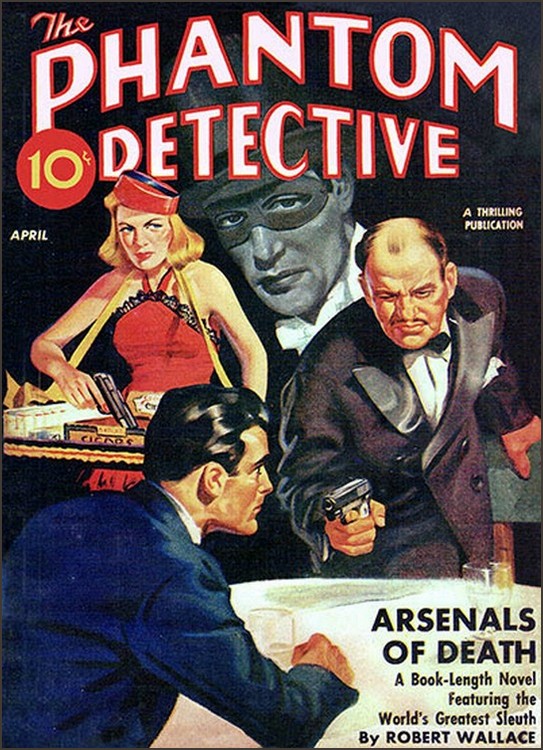
The Phantom Detective, April 1942, with
"Arsenals of Death"
The Phantom Detective battles against disruptive criminal forces that create defense bottlenecks for profit! The world's greatest sleuth takes the trail of greed-maddened saboteurs!
BLACKOUT!
Tonight was the night, and the little New England town of Adamsburg was ready!
Housewives gazed at the sky, and drew down the window shades. At nine o'clock street lamps would blink into darkness, and all traffic would cease. This was to be an example of America's answer to Europe's war-mad dictators.
In the town square, citizens had gathered to listen to a brief address by Mayor Lambert, from a flag-decked platform, before the signal for the test should be given.
"All over our fair town," he informed solemnly, at the conclusion of his speech, "bomb-removal squads, fire patrols and blackout wardens are now ready for instant action when the planes come roaring over—in twelve minutes now." He glanced at the man beside him. "Meanwhile, we'll hear a few words from our leading citizen—Simeon Stillson."
A slender, gray-haired man, with a shrewd gleam in his kindly blue eyes, rose slowly. Simeon Stillson, well-known research chemist, was president of Riverside Chemical Company, the town's biggest industry. The company now held a two-million-dollar government contract for trinitronapthalene, basic ingredient of a violent new explosive used in making shells for the U.S. Army.
As Stillson started to speak, young Cy Bisbee, town constable, square-jawed and alert, watched the manufacturer uneasily. He couldn't get away from the feeling that something was going wrong with this blackout idea.
Constable Bisbee had some basis for this hunch. It had been nagging at him ever since he had seen a New York car pull up in front of Adamsburg's only hotel that afternoon. The two men who had left the car had looked like pretty tough customers. One had been a thin, anemic youth with a short hair-cut and quick-moving eyes. The other had been an older man with heavy jowls, dark Sicilian features, and a quiet, businesslike manner.
The big man—where had Bisbee seen him before? The swarthy poker-face haunted him. But with defense work under way, Bisbee thought he would do a little checking up. When the two had driven to the chemical factory, Bisbee had followed them, had seen them admitted to Stillson's private office. They had spent only a few minutes there, and all that Bisbee had been able to learn from Stillson's secretary was that the two had come on a "business matter."
NO, there wasn't much reason for Bisbee to be suspicious and uneasy now. Perhaps he wouldn't be, he thought, if he could only remember where he'd seen that swarthy face.
Stillson was speaking now, and seemed to be laboring under intense emotion.
"—and I want to commend all our citizens for their splendid efforts in organizing this test blackout. Our town will be a model for small communities all over the country." He glanced nervously at the sky, then went on:
"When the planes come soaring over, there must be no confusion or—or—"
He stopped. His jaw clicked shut in swift decision and he banged his fist on the table.
"No! No!" he shouted hoarsely. "I won't keep quiet! They can't make me! Mayor," he commanded in a choked voice. "Phone the power station at once! There must be no blackout tonight! The factory may be—" The five shots that rapped out in rapid succession were sharp in the sudden shocked stillness.
A surprised look came over Stillson's face. He gripped the table with both hands, and blood trickled from his lips as he crumpled suddenly to the floor.
Swiftly the white-faced, paunchy mayor bent over the manufacturer.
"Stillson is—is dead!" he croaked. "Murdered!"
The silence that gripped the onlookers now was horrified. But Constable Cy Bisbee had not been caught napping. He had spotted the flash of gunfire at the far edge of the crowd. And he saw the two men who, ducking low, were streaking through bushes toward the street. In a flash he was after them, forcing his way through the huddle of dazed citizens.
And, almost as if those shots had been a signal, at that moment, as the church clock began slowly to toll the hour of nine, the street lights faded. With house windows darkened, blackness descended like a shroud over the town.
A low drone like the buzz of a hundred hornets came out of the north, grew louder. Thirty army light bombers were swooping down on Adamsburg. Searchlights crisscrossed the sky and anti-aircraft guns played a rat-a-tat-tat of harmless fire. Pursuit planes swooped up to meet the pretended invaders.
Flares came hurtling from the sky, timed to burn out before reaching the ground. In their weird, flickering glow the bombers zoomed low. One left the neat white splash of a flour bomb on the roof of the city hall. Others landed in the railroad yards and at the local airport.
Cy Bisbee, racing across the town square in the sudden darkness, had nearly overtaken the two men he was pursuing when they leaped into the car with the New York plates and roared off along the darkened street. Bisbee's gun poured lead after them, but he failed to score a telling hit.
He raced down the line of parked cars, found a driver just starting up, and lunged for the running board.
"Follow that car!" he panted. "Quick!" He pointed to the disappearing sedan. "Never mind the blackout. Put on your lights!"
"Okay, Cy."
THE driver, a farmer the constable knew, jerked his runabout into motion and headed full speed after the sedan. As it veered around a corner and headed toward Stillson's chemical factory the farmer jammed his foot to the floor-board and the runabout careened in pursuit.
Bisbee was trying his darnedest to make sense out of what Stillson had started to say. Why had he wanted to stop the blackout? Was the factory somehow in danger? The factory with its hundreds of tons of the deadly trinitronapthalene stored there awaiting shipment?
The army bombers were diving low overhead. The crackle of machine-gun fire punctuated the snarl of their motors, trebly menacing in the unaccustomed eeriness of complete darkness.
The sedan was braked to an abrupt halt in front of the big blacked-out factory building. At Bisbee's order, the farmer pulled up sharp.
A strange thing happened then. The sedan's headlights were turned on with a brilliance five times normal—apparently special lamp bulbs. A bright flood of illumination spread over the factory. A whining screech came out of the sky as one of the planes dived low over the factory, then zoomed upward again.
The big man beside the driver of the sedan twisted around toward Bisbee, automatic in hand, his face dark with rage. In the bright light Bisbee got another look at him—a good look—and something clicked. He knew him then, remembered all about him! The heavy-set, quiet-mannered man was "Big Tony" Alberto, once known as one of Brooklyn's biggest big-shot cleaning and dyeing racketeers.
Bisbee was certain. Yet it seemed incredible—for the simple reason that Alberto was supposed to be dead!
Bisbee's recognition of the gangster came in the split second it took him to raise his own gun on the far running-board of the farmer's car. He squeezed trigger, and his bullets splintered the sedan's wind-shield.
Big Tony sent a stream of lead at the constable. The farmer let out a sharp cry and grabbed his shoulder. Bisbee was still plugging away, when the sedan whirled from in front of the factory, with a squeal of tires.
Bisbee leaped from the running board to run after the sedan, still firing grimly. Suddenly the fleeing car swerved in a half-arc. It side-swiped a light pole, bounced onto the curb, and crashed into a tree.
At least he must have winged a tire—probably a front one, Bisbee thought exultantly, as he came running toward the disabled car. The two strangers sprang out, started to flee on foot, but Bisbee was gaining on them. The thin youth spun sharply, took careful, cold-blooded aim.
Bisbee dropped to the ground—but not soon enough. He felt as though somebody had given him a poke in the chest.
It didn't hurt much, but suddenly he realized that his finger would not squeeze the trigger any more. He felt weak, stumbled as he tried to get up, tripped and fell on his face along the curb. His shirt was wet.
Then happened the thing that made a shambles of the quiet law-abiding little town of Adamsburg.
As in a trance, Bisbee saw a blinding sheet of flame mushroom out of the factory. The air above him seemed to pound downward as though a giant were jumping on him. An ear-splitting concussion was followed by a hollow roar. Bricks and mortar, heavy beams, pieces of machinery that were spewed up into the air like an infernal fountain, came crashing down.
The ground rocked as though an earthquake had struck.
Then something hit Constable Cy Bisbee on the head, and that was all he knew for quite a while.
FIFTY-SEVENTH Street in New York City, where a benefit concert for British War Relief was just over in Carnegie Hall, was a soft glow of light. Gorgeously gowned debutantes, millionaire clubmen, and jeweled dowagers were waiting for their cars.
One broad-shouldered, square-jawed young man in evening clothes was outstanding in a group of young people, but he appeared to be bored. His was a face well known to the rotogravures, and the photographers who nightly snapped notables in the smart spots. For he was Richard Curtis Van Loan, scion of an aristocratic old New York family—sportsman, dilettante, one of the wealthiest bachelors in New York, and one of the most eligible young men in the country.
Van Loan's party now were discussing further plans for the evening. With a night-club decided on, they started for their cars. Richard Curtis Van Loan sighed wearily. He was getting fed up with continual rounds of night-clubs.
He reflected he could be spending his time to better advantage at one of his hunting lodges, or perhaps getting in a little pre-season skiing in the Laurentians. Or a visit to his country estate where he kept a string of championship polo ponies might be amusing.
He was starting to step into a limousine when he halted abruptly with a foot on the running-board. He stood motionless, looking down Seventh Avenue toward the towering buildings against the skyline.
"I'm sorry—" He spoke crisply to the others in the car. "I just remembered a phone call I must make—very important."
Van Loan dashed into the corner drug store, closed himself in a phone booth, and spoke for several minutes.
RETURNING to his friends he said rapidly:
"Sorry if it spoils the party, but, you'll have to count me out. Friend of mine who was in an accident—he's much worse—"
He dashed away, hailed a cab, and gave the driver his Park Avenue address.
The taxi threaded its way through the congested traffic while Van Loan sank back, his eyes shining with anticipation. What he had seen that had so swiftly changed his plans had been a red light high atop the tower of the Clarion Building, a light flashing intermittently.
For him that was a summons to a different life—a life unknown to the gay, fashionable circles into which he had been born.
It was the secret SOS of Frank Havens, the Clarion's publisher—to the Phantom!
The name of the Phantom, dread scourge of the underworld, and Nemesis of crime, was known throughout the civilized world, but only Frank Havens knew his actual identity. Only Havens knew that the man who had gained the respect and friendship of law authorities everywhere—and the fearful respect of wrongdoers—was the playboy, Richard Curtis Van Loan.
Havens, in fact, had been responsible for the Phantom. A life-time friend of young Van Loan's father, now dead, Havens had become worried about Dick Van Loan who appeared to be finding life useless. Havens had persuaded the young man to try his hand at solving a crime which had been given up by even the efficient New York police. Van had been so successful, had so astonishingly discovered his latent detective ability, that it had opened up a new life to him.
TOGETHER, Havens and Van had devised the role of the Phantom, to cover Van Loan's real identity. In that role the man who was believed to be only a wealthy playboy had gone on and on to unexpected successful heights.
Van had thrown himself heart and soul into perfecting himself for his role. He had read tomes of criminology voraciously, and was the possessor of one of the finest libraries on the subject in the country. In his secret laboratory, second only to that of the F.B.I. in Washington, he had installed every possible device to aid him in the pursuit of criminals and foes of society.
He had mastered all the branches of criminal psychology, was a super-artist at mimicry, and a master of make-up and impersonation. This uncanny ability to transform himself into the person of anyone he wished had made him the one man whom criminals in all strata of society most feared and hated.
Alighting from the taxi, Van Loan paid his bill and entered an ornate apartment building. In the elaborately furnished lobby, he stepped into an elevator which whisked him to the roof.
There he had a penthouse which was the envy of his friends, and where all New York was spread out beneath him.
One room of that penthouse, however, was never open to his friends. That was his own bedroom. Even so, there were closets there which were kept carefully locked, as were the drawers of the dressing table. For here were the requirements for changing Richard Curtis Van Loan into whoever he chose to be at the moment.
Once inside his apartment, Van became alert, anxious to be away on whatever mission it might be to which the light on the Clarion Building had called him. Opening the deep, long closet where hung clothing that could be used for every conceivable disguise, he selected a business suit to be exchanged for his evening kit.
He seated himself before the big dressing table then, and unlocked one of the drawers. In it was a bewildering array of make-up materials—little bottles of liquid to change the color of his skin, shells of false teeth, strips of imitation cartilage, wads of theatrical putty, special substances to alter the contours of his nose and cheeks; scores of other devices by which he could transform his appearance instantly.
He spent ten minutes applying facial make-up with deft, practiced fingers, then regarded himself with approval in the three-way mirror that showed him every angle of his new face.
When finally he stepped out onto the sidewalk, after leaving by his private elevator that let him out of the rear of the building, his appearance was completely changed. Richard Curtis Van Loan had ceased to exist.
He hurried to a garage where he kept one of his cars for such purposes as this, and drove to the Clarion.
When he arrived, the place was a scene of activity. An extra on the Adamsburg explosion was just being put to bed. The news room hummed, and copy boys dashed about like mad.
Sending in a name he knew Frank Havens would recognize, he was quickly admitted to the publisher's private office.
FRANK HAVENS looked up as Van entered. Havens was a heavy-set man with strength and character in his face, and wrinkles of kindliness around his keen gray eyes. He smiled indulgently at sight of the young friend who had so well proved to own ability to gauge men.
"So you're Harold Hickerson, free lance reporter, tonight, eh, Dick?" he chuckled. "A safe disguise for a visitor. But I'm darned if I see how you manage to keep your different personalities straight."
Abruptly his manner became grim.
"You've guessed why I've called you?"
Van nodded. "Adamsburg. I heard the radio while I was making my change."
"I seldom call you in on a single isolated disaster like this," Havens muttered. "But this is such a grotesque, horrible affair. Good Lord, Dick—homes were demolished for blocks. Thirty known dead, and they haven't begun to count... Dick, I'm convinced that an agent of some foreign power was in one of the planes in that mock air raid—that a real bomb was dropped! If so, other factories may be destroyed the same way."
Van nodded soberly.
"I believe you're right. Every precaution is taken at explosives factories nowadays—heavy guards posted night and day, no visitors allowed, employees searched daily, their entire life histories known. Whoever planned this explosion picked the surest possible way—direct bombing. And what better opportunity than during a mock air raid?"
"Then you believe this merits the personal attention of the Phantom?" Havens asked quickly.
"No doubt of it," Van said. "I haven't the remotest notion of who could be behind the bombing—Nazi spies perhaps, or fifth columnists, even industrial rivalry, or gang racketeering in some form. But I'm going to get at the bottom of it if it's humanly possible." He paused grimly, then said: "Is Steve Huston anywhere around?"
The publisher smiled. "He's in the city room, champing at the bit. He had a hunch I'd call you in." He spoke a few words into the phone, smiled again. "He'll be right in."
"I'm going to need some sort of official capacity in Adamsburg," Van said abruptly. "The place will be like an armed camp. I ought to go there as some kind of expert—someone well-known by Washington, whose integrity would be unquestioned. But I can't think who—"
"It's too bad Battling Bob Walling is in South America, doing some articles for the Clarion," Havens said. "He can get through anywhere. You could pose as his assistant. You remember Major Robert Sheridan Walling, World War hero? Retired now. He's been called to Washington for defense conferences a dozen times and rates high with the War Department. If he were here—"
"Wait!" Van interrupted quickly. "He doesn't need to be here. Listen, Mr. Havens! I need a late photograph of Walling—and a record of his voice."
Haven's jaw sagged. "Dick Van Loan, you don't mean, you'd impersonate Battling Bob Walling! Why, he's a national figure, a man whom thousands know. You couldn't get away with it."
"Contact Walling in South America and get his okay, so he won't denounce me as an impostor," Van said, "and leave the rest to me. Impress him with the seriousness of the situation."
"I'll do it," Havens declared, with quick decision. "I'll wire him in Clarion code to lie low. We've got plenty of photographs of him, and a couple of records of his radio talks."
"I'll take them with me now," Van said crisply. "Tell Steve to meet me at LaGuardia Field in one hour—and have a plane chartered in the name of Major Walling."
Van shook hands with Frank Havens and left the office.
THE Phantom did not return to his penthouse to transform himself into Major Walling, but drove rapidly to an isolated section of the Bronx. There he had another place he could use, with more privacy.
Drawing up before the small, unpretentious garage beside what looked to be an old warehouse, he reached under the dashboard to press a concealed button. A low-pitched horn sounded, and the heavy steel garage doors slid up. Concealed microphones, wired to a mechanism sensitive only to that particular tone of the horn, instantly opened the otherwise burglar-proof door, and slid automatically back into place when the car had entered.
Entering the ramshackle warehouse, Van stepped into a laboratory sparkling with chromium and glass, and containing research equipment that would have been the envy of any university.
The place had been originally rented by a stoop-shouldered old research chemist who had called himself Dr. Paul Bendix, who was supposed to live the life of a hermit. Passersby would occasionally glimpse the scientist, for Van frequently adopted this personality to preserve the illusion he had built up. Only Frank Havens knew that Dr. Bendix and the Phantom were the same.
The room contained one of the finest collections of crime-fighting equipment in the world. The workbench was fitted with forensic chemical apparatus of the latest type for the investigation of toxic substances, for analyzing blood-stains, and bringing out latent clues on all kinds of materials.
A closet held a small arsenal of deadly explosive weapons, and there were racks of blow-guns, and other curious death-dealing instruments from the four corners of the earth. In an alcove was a long dressing table crowded with more make-up materials like those in the Park Avenue penthouse, while in three huge steel cabinets were clothes that could be used for disguise when Van thought it inadvisable to go to his Park Avenue place.
Van seated himself at his make-up table. With the photograph of Major Walling in front of him, he studied the face of the gaunt, square-jawed major intently. Looking into multiple mirrors, he compared the lines of his own face.
Twenty minutes of painstaking work gave him the result he desired. Rubber plates fitted to his gums broadened the jaws. Bits of wax skillfully applied gave an outward thrust to his chin. A cartilaginous substance in his nose widened his nostrils, while careful work with colored liners produced realistic wrinkles in his forehead.
Walling's hair was similar in color and texture to Van's own, so with clippers and thinners he produced a nearly bald spot at his crown. False eyebrows duplicated the major's bushy brows.
Luckily the major was of average build, and though he was gaunt Van was able to posture his own athletic body, and to slouch until he also seemed gaunt. A neat, conservative business suit, tan shoes, a blue shirt and a bow tie completed his wardrobe.
Next he put Walling's broadcasts on the turntable, played them over and over, his alert ear receptive to every vocal inflection. Memorizing part of the speech, he spoke it into a dictaphone, imitating Walling's voice.
He frowned at the result. The major had a rumbling resonance hard to capture. But after persistent practice Van was at last satisfied he had mastered it.
At one o'clock a taxi roared up to La Guardia Field and Van leaped out. An airline official stepped up to him.
"My plane—is it ready?" the major's voice rumbled.
"Yes, Major Walling," the official replied. "Glad to see you back from South America. You're looking in fine health, sir. That's your plane right over there."
"Thanks," Van rumbled, and smiled to himself at the success of his disguise so far.
Steve was waiting, and a moment later they were off in the clouds...
Van had his first glimpse of the ruined Adamsburg factory as they circled for a landing. Fire-fighting apparatus was nosed in on all sides. Giant searchlights cast garish light on a vast heap of rubble. Girders stuck out at crazy angles from mounds of brick, while at a dozen places rescue squads were digging in the debris. Nearby frame houses were in ruins, and everywhere ambulances and police cars were rushing about.
"More like London than the United States," Van gritted. "Steve, whoever is behind this, I'm going to bring him to justice if it's the last thing I do!"
A member of the town council was waiting at the airport.
"The Clarion phoned about you, Major," he said briefly. "Constable Bisbee is waiting for you."
When they entered Cy Bisbee's office, the young constable lay on a cot, his head wrapped in bandages. He was talking to a state trooper.
"Glad you could come, Major," the grim-faced young constable said. "I calc'late we can use your help, right enough... Meet Captain Talbot of the State Police."
"Major," the trooper said, "the chief thing to do is get Bisbee to the hospital. My men dug him from under three feet of debris—and by rights he should be dead. But all he got was a crack on the head and a leg fracture—except for the bullet earlier, which missed his lung by a hair."
"Skip it," Bisbee snapped. "There are thirty-nine dead folks out there, and sixty-three still unaccounted for—trapped under wreckage or blown to thunderation. Good honest people, neighbors and kinfolk of mine. By heaven, I'm going to find the murdering—"
"Take it easy, son"—Talbot put a hand on the constable's shoulder—"or you'll be pushing up the daisies, too."
BISBEE relaxed.
"All right," he said. "Major, ferreting out sabotage in defense projects is your line. You've got our complete cooperation."
"What makes you sure it's sabotage, my boy?" Van rumbled in the major's voice. Bisbee's story of the explosion, and the two mysterious men with whom he had fought had already been published in detail.
"What else could it be? A factory making defense explosives. Do you think someone was taking out a personal grudge against Stillson?"
"Some of my boys are up at McKinley Field, the Army Air Corps training station seventy miles north of here," Talbot said. "They're grilling the squadron that made the test flight. We ought to know more soon." Van nodded.
"Tell me something about Mr. Stillson," he said abruptly to Bisbee.
"Well, when I've seen him lately he 'peared kind of nervous," Bisbee said. "This morning I spied this New York car and got a hankering to find out something about this big fellow I thought I'd seen before. I found out in the hotel that the two I was suspicious about had registered as John Sheldon and Alfred Sanderson so, I phoned New York to get the car's registry. It was in Sheldon's name, but they checked on the address and found it was a rooming house and he'd left no address. Sheldon's description on the application checks with the big guy."
"Bought the car under an assumed name so the license could never be traced," Talbot muttered.
"Well," Bisbee went on, "after these two visited Stillson at the factory, I tried to talk to him over the phone but couldn't reach him. I got the idea his secretary knew who they were, but he wouldn't spill a thing, though he was a friend of mine." Bisbee's lip quivered. "His body was just found in the wreckage—charred almost beyond recognition."
"In other words," Van said soberly, "you are positive in your own mind that these two men killed Stillson, but you have no proof they were responsible for the explosion, and don't know who they are."
"No. Except that I'd swear in any court that the big one was Big Tony Alberto, who dropped out of sight in Nineteen Thirty-one. The New York police always figured he was at the bottom of the East River because that's what happened to two of his buddies. But I just got pictures of Alberto by plane. He's the man."
"The car—" Van put in. "You say the man abandoned it after you shot the tire."
Bisbee nodded. "Yeah. It's still down by the factory, but there's no way of tracing it, Major."
Van heaved his gaunt length out of the chair.
"Well," he said, "it won't hurt to take a look."
"I'm driving up to McKinley Field," Captain Talbot said. "Better come along."
Van declined, but suggested that his secretary might go in his place. Steve jumped at the chance.
The Phantom set out on foot for the factory. Reporters and camera cars swarmed everywhere. Ambulances and commandeered automobiles whizzed through the streets, overhung with smoke. Private houses had been thrown open to the wounded. As Van approached the gaunt ruins he found a knot of men gathered around an overturned car that was badly smashed, but not burned. He identified himself as Major Walling to the trooper on guard over it.
"Sure, this is the car those mugs came in," the trooper said. "Been over it with a fine-tooth comb and it's clean as a whistle. It's plenty suspicious though—with special headlight bulbs, and a two-way radio built into the back of the front seat."
"Fingerprints?" Van wanted to mow.
"Sure," the trooper grinned. "On the gas tank cap we found some that are goin' to turn out to be the prints of Tom Lennox at the filling station, because the tank was full. And on the hood are some nice clean prints where Cy Bisbee looked at the engine number while the guys were in the hotel. The doors, steering wheel, gearshift lever—all clean. Those guys wore gloves."
Van walked around the car, examining it. The windows were smashed, and the car considerably damaged by flying debris. The radio, similar in construction to police car sending sets, was also badly smashed. He gazed under the mudguards and frowned. Washed clean.
"A tidy pair if I ever saw one," he commented.
"Yeah, that struck me as kind of funny, too," the trooper said. "If they'd just come from New York, why should they stop and have the mud washed off?"
At last Van found a bit of mud imbedded in a seam under the tail-light, took a small envelope from his pocket, and brushed it in. He lifted the hood on the car, found the radiator petcock, and let a little water trickle into a tiny metal flask he had brought along with him.
The trooper looked at him blankly.
"What's that for? Water is water, ain't it?" He grinned good-naturedly.
When the Phantom returned to the center of town he was irritated at the scarcity of leads, and he itched for a chance to come to grips with the monster who had planned the destruction that surrounded him. But his reputation as the world's greatest detective had not been gained by neglect of details. A good reason he did not neglect to make a visit to the hotel where the killers had stopped.
OLD Zeb Adams, proprietor of the Central Hotel, looked up over his steel-rimmed glasses as Van entered.
"You're Major Walling," he greeted hospitably. "Heard you was comin'. Powerful glad to meet ya, sir. Powerful glad."
Van asked to see the room the two New York gangsters had occupied, and was shown to a fresh, airy chamber on the second floor. A rapid search of the room failed to reveal anything of interest.
"Just finished redecoratin' yestiddy," Adams offered. "They looked right prosperous, so I give 'em this room and charged 'em a dollar extra."
"Did they receive any phone calls or messages?" Van asked.
"Not that I heard tell of. I ain't on dooty daytimes, though. Got a young feller clerks for me days. He's upstairs sleepin'."
"Get him down," Van said.
As the old man hobbled off, Van's brows furrowed in thought. From Bisbee's story, these two strangers who had visited Stillson were unquestionably the murderers of the chemical company's president. After killing him, they had by means of superpowerful headlights, illuminated the factory for the prearranged bombing. They must have made some final demand of Stillson which he had refused, and he was killed to keep him from talking at the town meeting. But what demands had the two killers made?
Van's gaze suddenly lit on a tiny crumpled scrap of paper in the bottom of the waste-basket. He picked it up and his face lighted with interest, as the door creaked open to admit the proprietor with a sleepy-eyed clerk.
Van asked the clerk whether the recent occupants of this room had received any mail or messages.
"Nope," the clerk said. "No phone calls, either. The phone's at the desk and I was there all the time."
"Are you sure they didn't receive a telegram?" Van persisted.
"No telegram. I never left the desk, even for lunch, and I'd have known." Van produced the slip of paper he had picked up. It was about three inches square and was headed, "Send Birthday Greetings"—an enclosure from the telegraph company.
The clerk's face got red.
"That must have fallen out of the telegram I brought to the last people who had this room," he stammered. "They checked out yesterday."
"This room was just decorated," Van said sharply. "Nobody had it yesterday."
"That's right," Adams chimed in. Van seized the young clerk by the shoulders.
"What did they give you to keep quiet about this telegram? Answer me!"
The clerk's bravado melted. "Five dollars," he said in a frightened voice. "I wouldn't have taken it, exceptin' from the way they acted I was scared not to. And they knew I knew what was in the telegram, because I took it over the phone first, while they were out."
"What did the message say?" Van rapped.
"It—it was screwy," the clerk chattered. "Like a code. It was from New York and said: 'H dash'—just an 'H' and the word 'dash'—'eleven grand'. And after that, 'ten a.m. Tuesday.' And it was signed 'Stopper.' "
" 'H dash eleven grand ten A.M. Tuesday, Stopper'," Van repeated. "Who was it addressed to?"
"Sheldon, the big feller."
"How did he look when he got it?" Van demanded. "Pleased? Angry? Frightened?"
"Why, he didn't look any special way at all."
Van could get nothing else of importance from the clerk, and left the hotel.
"H dash eleven," he mused. "Sounds like a foreign agent."
Was this, after all, a sabotage plot directed from abroad? Then how was Tony Alberto involved? Big Tony was an old-time racketeer and it was hard to think of him mixed up with some European power.
"Who or what," Van murmured, "is Stopper?"
The only thing that seemed likely was that it must be the pseudonym affected by some high-up gang leader.
VAN returned to Bisbee's office. "Major Walling," Bisbee said, "we just got a call from Officer Talbot up at McKinley Field. A couple of pilots saw an extra plane join the squadron just after they left the airport for the blackout test here at Adamsburg."
"I'll go up there immediately," Van said.
"Take my car." Bisbee smiled wryly. "Calc'late I won't be usin' it for a while."
When Van reached McKinley Field, guards at a high, steel-mesh fence on which was a sign reading, "U.S. Government Property", halted him. A flashlight shone abruptly in his face. But almost as quickly the guard stepped back apologetically.
"Oh—Major Walling. Sorry to have stopped you, sir."
The gates were thrown open, and Van drove through. He parked near a barracks where lights burned brightly. Entering, he saw army officers and state troopers firing a steady barrage of questions at two pilots.
Steve Huston sidled up to Van.
"So you got here, Major Walling!" He lowered his voice. "They've established that a strange plane joined the squadron just after it left the field. Only two pilots saw it. Looked like a training plane, they say, and they figured one of the flight instructors had been sent along to check up on them. After the explosion, neither of 'em saw the plane again."
Van nodded briefly. After listening to the grilling for a few moments, he turned to an officer standing beside him.
"Do any of your training planes have bomb chutes?" he asked.
"Not our present trainers," the officer replied. "It would be impossible to drop a bomb from a training ship."
Van looked thoughtful.
"But haven't we a hundred-pound bomb in present army use?"
"Yes. A hundred-pound demolition bomb. Fuses in nose and tail. A short delay-action obtainable through selection of proper detonator. The lightest bomb in regular use."
"Would such a bomb blow up a factory where explosives were stored?"
"If properly placed. But you can't bomb from anything but a bomber."
"No?" A trace of a smile touched Van's lips. "It doesn't take a very strong man to lift a hundred pounds. If these bombs have nose and tail fuses, what would prevent anyone from just tossing one over the side of a plane?"
The air officer stared. "Why—why, blast it, Major, it would work!"
THE Phantom drew Steve aside and suggested that they have a look around the grounds. When they went outside, they saw that a belated moon had put in an appearance to bathe the giant hangars in a soft, eerie glow.
Van headed for the high wire fence at the far side of the landing field. He paused beside a sentry stationed at a gate near the far end, where a road wound off into the adjoining woods.
"Where does this road lead?" Van asked casually.
"Just down to the railroad, about two miles away," the guard said. "It's a government road, used to bring provisions up to the training station. A freight stops to drop a car off, six every morning."
"Do the woods belong to the government?" Van wanted to know.
"Yes, sir. Uncle Sam bought it along with the air field site. Used to belong to a rich fellow that had a summer place in there. Flew up on week-ends."
"What's it used for now?" Van asked.
"It's not used, and nobody much goes near there. I strolled over once when I was off duty, but the little house was boarded up tight as a drum."
"Let us through the gate, please," Van said.
Van's flash cast a yellow disc of light before them as they entered the woods. Shadows from huge old oak trees jumped at them as they passed. Somewhere in the distance a night bird called.
"This is pretty spooky, here," Steve Huston said. "What gives you the idea you're on the right track looking this place over, Phantom."
"Partly hunch," Van admitted. "But our mystery pilot needed a base of operations. Probably he had accomplices. Remember the two-way radio in the killer car? Since we're assuming that the bombing was a result of Stillson's refusal to do something his murderers wanted him to do, it follows that they had to make contact with the pilot who was to do the damage after talking with Stillson. That indicates another radio and a place to set it up. What better place than an abandoned summer place, with a private landing field in a woods next to McKinley Field? Remember, the pilot had to be familiar with the air station routine, the bombing formation likely to be used in the Adamsburg test blackout, and all that. Probably he painted his plane to resemble an army trainer—"
"Look!" Steve broke in. "That house must be down this way."
They had come to a clearing through which a rutted, overgrown road led off to the left. Van nodded and doused his flash as they made their way along the abandoned driveway, and suddenly in the moonlight they could discern the dim outlines of a cottage.
"Quiet!" Van whispered.
Cracks of light were visible between heavy planks that boarded the windows.
"You win, Phantom," Steve whispered. "There's somebody here, all right."
"Look over there," Van said grimly.
The moonlight revealed a level expanse of field, clearly the original owner's landing field and still in good condition.
"But where's the plane?" Steve wanted to know.
"The pilot wouldn't have risked coming back after the explosion," Van said. "He ran the risk of being spotted in the formation. He probably put all the miles between himself and Adamsburg he could. But whoever is in that cottage likely is one of his crowd."
"Funny anybody's still here," Steve said. "But there'd have been no chance for escape by car, would there? The road runs right through the air station grounds."
Van nodded. "My hunch is that all the men involved, except the pilot, came along the railroad. And planned their getaway on the freight when it stops this morning."
The moonlight was already fading, and the grayish lights in the sky presaged down. Steve glanced at his watch.
"If you're right, Phantom, they should be checking out soon."
"Ssh!" Van warned. "Keep your voice down."
A shot barked out, followed by five more in rapid succession. Before the echo, Van dodged behind a tree, pushing Steve behind him. Bullets snarled through the bushes. In the direction from which the spurts of fire had come, a figure was crashing through the underbrush toward the cottage. Van's gun spoke three times sharply, but the shadowy figure had already burst through the door of the cottage. An instant later a second figure, carrying a heavy case, appeared.
The two passed momentarily behind a tree, and the man carrying the case dropped it. Both men streaked off into the woods.
"Must be a foot-path to the railroad," Van muttered. "A short-cut."
He broke from cover in pursuit, his gun blazing. He was answered by rapid fire from two automatics.
Steve smothered a gasp of pain, and the gun dropped from his fingers. Van wheeled sharply.
"Where did they get you?" he snapped.
"Wrist," Steve panted. "Just a scratch. Keep going!"
VAN drew Steve behind the shelter of a big tree trunk and turned his flashlight on the injured wrist. The inner side of the wrist showed an ugly bullet gouge from which blood gushed freely. Whipping out a clean handkerchief, Van made a rude but effective tourniquet.
"You could bleed to death from that kind of a 'scratch'," he muttered. "Keep this as tight as you can stand it, and wait here."
Steve sighed. "Guess I'm not up to form today, Phantom. Well, plug one for me."
The two fleeing men had stopped firing. Sounds of their footsteps were receding into the woods. Van raced toward the cottage, and as he passed the heavy case that had been dropped a brief glance showed him it was a portable radio sending set.
Crashing down the narrow path at the side of the cottage, Van pursued the men. Their hitting Steve had given them a long start. And they knew the ground while Van did not.
The footsteps in the underbrush seemed louder though. He must be gaining. But a moment later, passing through some pine woods where the needles softened his own tread, he suddenly had a swift premonition of danger.
The crack of a branch behind him gave him warning just in time. He wheeled in a flash, dropped flat to the ground—and barely missed the bullet that snarled over his head.
One of the two men had dropped behind him to get him in the back!
Van's gun sprayed lead into the clump of bushes. Shots answered and lead scattered the pine needles.
Still prone, Van took careful aim at the spot from which the flash had come, pulled the trigger. He heard a hoarse cry and a slow crackling of the bushes. Then silence. When there was no sound for moments more, he went to investigate. His flashlight beam showed a middle-aged man in a cheap business suit with a bullet through his neck. He was dead.
Van went swiftly through the dead man's pockets, found a wallet and a notebook, which he transferred to his own pocket. Rising, he sped in pursuit of the other fugitive.
Dawn was breaking as he sprinted on along the crooked footpath. He could no longer hear racing footsteps. Had he lost his man? No! For when he reached the edge of the woods he saw the man running at the far side of the adjoining field. Van raised his gun, but it was too long a shot.
Then abruptly the man seemed to disappear from view in the middle of the field—as though he had dropped into the ground. At the same moment, Van heard a train whistle in the distance.
Instantly he realized that it was here that the railroad made a sharp cut below the fields, so that the track was invisible from Van's distance. The man he had been chasing had already reached the railroad, though he was some distance from the station. And the train was approaching! It had already stopped at the station and was passing here!
Van gritted his teeth. He had to reach the railroad before that train rumbled past—with his quarry on it!
WHEN he reached the brink of the cut, the first cars of the slow freight were already passing through. His spirits sank dismally. The man he wanted was gone.
Then suddenly he saw the fugitive. The fellow had not risked sliding down the steep embankment to flip the train. Instead he had climbed out on a semaphore trestle which extended from bank to bank over the tracks. He was crouched, ready to jump to the top of a passing car. Oil tankers were passing now. The man was looking down, waiting for a box car.
"I've got you covered!" Van shouted. "If you jump I can pick you off like a pigeon in a shooting gallery!"
The man jerked his head around. Panic flooded his face and he sprang for the top of the nearest tank car. His feet slid on the oily surface. He waved his hands wildly. The movement of the train tumbled him over. Squirming like a beetle on its back, he slid down the slippery tank.
With a gurgling yell he was thrown under the car wheels. Van turned his face away as the voice was suddenly broken off.
When the train had passed, Van crawled down the embankment to find the crumpled, mangled body. He turned it over. The face was uninjured—a face with high cheekbones, a cruel mouth, and a shock of iron-gray hair.
Van had seen that face before. But where? He cudgeled his brain and at last he had it. This man was "Rubber" Rizzi, ex-Chicago beer runner, and currently big-time muscleman in the Brooklyn protection rackets.
Van was puzzled. First Big Tony Alberto, and now Rubber Rizzi. Both gang big-shots. Rizzi was reputed to have made several million in Brooklyn. What was he doing flipping freight cars in this forsaken country?
Van reached in the dead man's pockets. The coat yielded nothing. From the trousers he withdrew a fat wallet. In it were three thousand-dollar bills and several century notes. He looked under the card flap—and frowned in surprise. Of all things to find in a gangster's pocket! A small red firecracker!
Van was sober and thoughtful when he returned to McKinley Field with Steve. While an air corps physician went to work on Steve's wrist, Van took from his pocket the wallet he had taken from the gangster who had tried to shoot him in the back. It contained less money than had been in Rizzi's wallet—but it did contain another small firecracker identical with the one found on Rizzi.
When Steve Huston's right wrist was wrapped in tight bandages and the doctor had gone, Van nodded toward the two wallets.
"What do these firecrackers I found in these wallets suggest to you, Steve," he asked.
"Well," Steve remarked, "if it was the Fourth of July, I might have an answer. But since it's November... Sorry. They don't mean a thing to me."
"Would it help," Van suggested, "if I mentioned the name of Smiling Tim O'Dowd?"
Steve caught his breath.
"Firecrackers! Holy mackerel! And speaking of the Fourth of July! That massacre! But I don't quite see the connection. Tim O'Dowd—that Fourth of July massacre he was messed up in happened in Nineteen Thirty-one. A gang feud over beer territory in Brooklyn. If I remember, O'Dowd's mob busted into a beer joint and mowed an enemy mob down like rats—with tommy guns... But O'Dowd has been out of the rackets for years, Phantom."
"Let's just suppose for a minute," Van said. "Suppose you were a super-big-shot like Tim O'Dowd. You'd been out of things since prohibition and wanted to get a new gang together. Not just a bunch of hoodlums, but a first-class criminal organization. What would you do?"
"I get it!" Steve cried excitedly. "I'd pick the best men out of all the rackets and send 'em a little reminder of how tough I was in case they didn't feel like playing ball with me. I'd remind them of the Fourth of July massacre. A firecracker!" Steve shook his head. "But is O'Dowd in any condition to stage a comeback? He must be an old man now. He went to South America with his bootlegging dough, bought a cattle ranch, and made a lot more dough legitimately. The cops never got a thing on him, even though every cop in town knew he engineered that Fourth of July horror and hundreds of other killings."
"But he's not in South America any more," Van said. "He came back to this country in Nineteen Thirty-eight, bought a big estate in the Adirondacks, and retired."
"Well, then let's go there, if you think O'Dowd is behind these devilish saboteurs."
"I didn't say I thought so—I was just supposing," Van corrected him. "You're right. O'Dowd is a crippled old man now—a semi-invalid from arthritis. And besides, he's already a millionaire twenty times over. Why should he involve himself in something like this?"
"But you just implied it looked like his work," Steve said.
"It could be someone trying to pin something on O'Dowd," Van said. "Instead of chasing off to the Adirondacks, we'd better reserve judgment until I check up on a certain little matter in New York."
Steve nodded briefly. "You're the boss, Major."
Van and Steve flew back to New York, and Van made a date to meet Steve in a small restaurant near the Clarion office, later. Then he went to his Dr. Bendix place.
He telephoned Frank Havens, using their private wire, then set to work on the vial of water he had taken from the radiator of the gangsters' car in Adamsburg.
A spark of interest appeared in his eyes as he examined the faint chemical residue under a microscope after he had distilled off the water. He touched his tongue to it gingerly, then made rapid tests to prove his findings. Aside from mineral residue which might have been produced by the action of water on the radiator, the chief chemical element present was rhombic sulphur, quite a high percentage. The iron content was well above average, and there was a liberal trace of magnesium.
Then, pulverizing the bit of mud he had scraped from the gangsters' car, he examined it through the lens of a super-powerful microscope. He was struck at once by the large content of quartzite—hundreds of tiny gleaming rain-eroded crystals mingled with the rock dust and organic matter.
HE picked up his phone and put in a long distance call for the United States Geodetic Survey in Washington. When the call came through he talked quickly, then hung up. When the phone rang after a short wait, he grabbed it up eagerly and listened.
"Thanks," he said. "Yes, that's the information I wanted."
He headed back to Manhattan then. Steve Huston was waiting in the restaurant. At the table with him was a lovely slender, dark-haired girl in a smart tailored suit.
Van smiled at the bright-eyed girl, but she would never know that his heart missed a beat just looking at her. For Muriel Havens, the daughter of Dick Van Loan's oldest and best friend, was the one girl who had ever touched his heart. Often the Phantom had wished that things could be different, and he was not the Phantom, for then he could tell Muriel—
But he was the Phantom, and never must he let her have a hint of what was in his heart. His life was dedicated to wiping crime from the face of the earth, and his daily living too dangerous for him to risk breaking the heart of anyone who cared for him.
He had an idea that Muriel, knowing him as Dick Van Loan, did give him more than a passing thought, but he knew also that Muriel disapproved of Dick Van Loan's mode of life. But her admiration for the Phantom was great. But while crime marched upon the earth, Van Loan must keep silent.
It was good to have Muriel with him on his cases, though, even to know she was interested in his work. She, too, had long since tired of an idle society life, and from the first time she had been given an opportunity to take even a small part in one of the Phantom's exploits, she had thrown herself into the same work heart and soul. Van was reluctant to have her go into danger, as she often insisted on doing, but he was proud of her, too. She had proved to be an apt pupil, clever and dependable.
But Van was smiling to himself as he thought:
"What would she think if she had the slightest inkling that Dick Van Loan and the Phantom were the same?"
Steve Huston had already told Muriel of the Phantom's current disguise.
"Father said you wanted to see me, Major," she greeted him brightly. "Is it about the Adamsburg case? I hope so. I'm dying to get to work."
Van told her she had guessed right, and his manner was businesslike as he explained about the samples from the car.
"The Geodetic Survey checked my findings against detailed maps," he said. "The water was high in iron, magnesium, and particularly sulphur. The mud showed a super-abundance of quartzite. There's only one section within many miles that fits—the mineral spa at Diana Springs in the Adirondacks. And that was bought in August, Nineteen Thirty-eight by Smiling Tim O'Dowd."
"Then your hunch was right, Major!" Steve said excitedly. "O'Dowd is behind this. Those two Adamsburg killers must have come straight from his place in the Adirondacks! Let's run up there and pay a visit to Mr. Smiling Tim O'Dowd."
Van demurred. "I still can't see him at the head of a sabotage plot. But there's certainly some connection, so we'd better go up there. It's back-woods country and there's no air field within miles. We'll have to go by car."
STEVE reached in his pocket and produced a road map. "I got this in Adamsburg," he said. "Let's see just where Diana Springs is." He spread the map on the table. "We could take U.S. Nine to Albany, and then—"
Van was staring at the map. "Steve, look!" he broke in, an excited ring in his voice. "Along the edge of the map! The letters, 'A, B, C,' and so on, placed vertically—and numbers horizontally. There's an index below to help locate the towns!"
"And so what?" Steve said.
"That telegram!" Van cried. "Remember? It read: 'H dash eleven—Grand ten A.M. Tuesday Stopper.' Well, 'H dash eleven' isn't a secret agent at all! It's a place!"
"I'll be darned," Steve muttered. "But different road maps would have different markings, wouldn't they?"
Van nodded. "A certain map must have been agreed upon. The New York Automobile Club isn't far from here.
"Hop into a cab and bring back all the Eastern road maps you can find—and a directory of tourist hotels."
A quarter of an hour later, Steve returned with twenty-three maps of New England and the Eastern seaboard.
"If H dash eleven is a town," Van said, "I'll bet ten to one that 'Grand' is a hotel in that town. So what we want is a town in an H dash eleven square that has a Grand Hotel."
They searched through the maps. Van suddenly stopped at one.
"This is it!" he said. "A town in southern Maine named Henger."
"Sure," Steve said. "According to the directory it has a Grand Hotel, and it's the only town in that district that has. But—"
"Henger, Maine," Van said grimly, "is the site of extensive vanadium mines—the only vanadium to be found in any quantity east of the Rockies!"
"Vanadium!" Steve said awedly. "Why, it's a vital alloy in the making of gun-steel! You don't think that this town is in for the same kind of treatment as Adamsburg!"
"I'd bet my shirt on it." Van's voice was brittle. "Steve, a few hours ago we had no clues at all. Now we've got more than we can handle. We'll have to divide forces."
"Okay with me. Want me to go to Henger or Diana Springs?"
"I want Muriel to go to Diana Springs," Van said with quiet firmness, "and I'm going to Henger myself. Steve, you're still on the sick list. I want you to go to Brooklyn, bum around and find the joints where O'Dowd used to hang out. See if you can find any of his old gang—or any relatives. I want gossip about him, any information you can learn. Don't come back until you get some kind of a lead."
"Okay, Major." Steve grinned. "I'll get you some dope if I have to blow the lid off Brooklyn."
Steve waved to them and went out the door. Van turned back to Muriel.
"You'll be on your own in Diana Springs," he said. "In an emergency, if you can't get in touch with me, you'll have to use your own judgment. Think you're up to it?"
"Try me and see," Muriel said, smiling.
"All right then," Van said. "Now listen carefully."
He lowered his voice and they talked for a long time.
"Think you understand all right now?" Van asked when he had given Muriel complete instructions. "Of course you also understand that if you do turn up anything that's really suspicious, you call your father who will get in touch with me. I'll get there on the jump."
"I understand everything," Muriel said, her dark eyes dancing, "and I'll be on my way as soon as I've done all you've told me to do."
"Good!" said Van. "With you and Steve on the job, I'll get on to Henger with a free mind. I've an idea there'll be plenty doing there soon."
NEXT morning, shortly after Van had reached the town of Henger, preparing to look into the Henger Vanadium Mines situation, he was wondering just what his two aides were doing.
What Muriel Havens was doing, was just awakening on the bus that had taken her to the Adirondacks. Steve Huston had been on the job all night.
At seven in the morning, Steve, weary from a night of combing the bars, pool parlors and shady rooming houses, was munching hamburgers in a Brooklyn waterfront diner, and questioning a pasty-faced, cautious-eyed youth beside him, an underworld habitué who had tipped Steve off to some good yarns in the past.
"Sure, sure," Steve's odd companion said wearily, "I know—all about Smiling Tim O'Dowd and Scarface Al Capone and the Big Bad Wolf. You're nuts, Huston. O'Dowd is out of the rackets for years. He's been living clean."
"What's Big Tony Alberto doing now, Lefty?" Steve asked.
"The fishes got Alberto," Lefty snorted. "He's at the bottom of the East River."
"I hear Rubber Rizzi has got a pretty good racket," Steve said doggedly.
The gangster's face sharpened. "Sure Rizzi's got a racket—protection. But I ain't spillin' about that."
"I mean his new racket—that little out-of-town job."
"Hmmph!" said Lefty. "You are nuts."
At last Steve gave it up and returned to Manhattan. He had done all he could. He had looked up three lieutenants of O'Dowd's old mob, had talked to Tony Alberto's kid brother, and to one of O'Dowd's ex-girl friends. He had got exactly nowhere.
Well, there was still the Clarion morgue. Perhaps he might pick up the name of some old enemy of O'Dowd's who had been overlooked.
Steve spent the whole morning at the Clarion, but the only names of O'Dowd enemies he found were those of men who were dead or in Alcatraz. Then he ran onto something. O'Dowd's old lawyers, Pritchard and Croom! Why hadn't he thought of them before? Clever shysters whom O'Dowd had hired chiefly to keep him clear of income tax trouble.
He failed to find them in the Brooklyn phone book, and tried the Manhattan book. There they were—Pritchard and Croom, Corporation Attorneys, 3 Wall Street.
Steve let out a low whistle. From office space in Brooklyn to the snappiest law building in New York's financial district. How come?
Twenty minutes later he was shown into a spacious private office. Behind a carved walnut desk, sat a little man with sharp features, thick-rimmed glasses, and a bald head. He glanced up at Steve.
"Huston of the Clarion," he snapped.
"What is it, Huston? I can give you just three minutes."
"I'm writing a feature story on Smiling Tim O'Dowd," Steve said. "He said to see you."
The effect on Pritchard was ludicrous. He choked, then gave a short, unpleasant laugh.
"O'Dowd? I don't know anything about him, and I don't want to know anything. If that's all you wanted, get out."
"Smiling Tim used to be a pretty good client of yours, didn't he?" Steve asked mildly.
"So what?" Pritchard roared. "Now I don't handle clients like him. We do a strictly corporation business." He glared across the desk. "And I got no time to waste on smart young punks like you. Get out!"
STEVE grinned, and got out. But he didn't forget that look on Pritchard's face when O'Dowd's name had first been mentioned.
In the luxurious outer office he hesitated. The furniture must have cost a fortune. Who was paying for all this? Pritchard was no corporation lawyer. He had made his living protecting crooks. Croom was no better. What were they doing in twenty-thousand-dollar-a-year offices on Wall Street?
Steve's glance settled on a bookkeeper sitting behind a partition, before big bound ledgers, operating a comptometer. If only he could get a glimpse into those books!
Across from the bookkeeper's cubicle was the half-open door of a supply closet. Steve glanced around quickly, grabbed up a heavy paper-weight from a nearby desk, and slipped inside. Waiting his chance, he pushed open the door, drew back his arm and let fly at the glass water bottle beside the partition.
The jar burst with a mighty crash, and a flood of water drenched the expensive rug.
Clerks and stenographers came hurrying. The bookkeeper ran out too, and a great hubbub ensued.
Steve slid around behind them and into the bookkeeper's office.
He ran his eyes rapidly down the columns of the nearest ledger. He noticed a figure of 7,300, and across the page:
For services rendered to J. Hamilton Enders.
Farther down was a fee of $4,900, and then one of $11,000, both for services to Mr. Enders. He did not see the names of either O'Dowd, Alberto or Rizzi.
Steve spun around at the sound of a step behind him. Two men were approaching—barrel-chested men whose eyes were warily sizing him up. Steve knew the type—office detectives from one of the shadier private agencies.
They had cut off his escape and, with his injured right hand, he wouldn't have a chance.
"Mr. Pritchard wants to talk to you again, fella," one of them said. "You gonna come nice and gentle?"
"Why not?" Steve smiled disarmingly.
The small table that held the comptometer was between them. Quick as a flash Steve's good hand gripped the table, tilted it toward the men. As the heavy machine crashed the man ahead fell back, stumbling into the other.
Steve leaped. His good fist swung and caught the foremost man squarely in the mouth. He went down, spitting blood and curses. The other dived at Steve in a football tackle. But as the detective's arms closed about his waist, Steve's kick caught the big fellow in the chest.
The detective said a loud "Oof!" and went sprawling on the floor.
Steve charged through the door, scattering stenographers like frightened chickens. In the corridor an elevator door was just closing, but Steve caught the car, and a moment later was in the street.
Steve was jubilant. He was sure he had struck a fresh scent. He called a friend named Perkins on the Wall Street Gazette.
"J. Hamilton Enders?" Perkins said. "Yeah, I know him. Investment broker. One of the shrewdest traders on the street. Paid tax on a hundred-thousand-dollar income last year."
"Thanks," said Steve, and hung up.
HE called Enders' offices. But Enders had left for the day. The phone book gave Enders' home address, so Steve took a cab there.
"Mr. Enders has just left for Washington, sir," a sour-faced butler told him.
The door was just starting to close when Steve saw a rather plain-looking girl coming down the stairs. Steve took a chance and said politely:
"How do you do, Miss Enders? Good to see you again."
The girl came toward him uncertainly.
"We met last winter at the opera, don't you remember?" Steve said glibly. "You were with your father." She gazed at him hesitantly.
"I have a perfectly awful memory," she said in a soft, timid voice. "Won't you come in? You'll have to tell me your name again."
As soon as the butler was safely out of hearing, Steve confessed with a smile:
"My apologies, Miss Enders. My name is Huston, and I'm a reporter. I came to see your father."
"I see." Her smile faded, but she said, still courteously, "What did you want to see him about?"
"A story for the financial page," Steve said vaguely. "You could save his time by helping me with some of the background, Miss Enders."
She hesitated. "But I don't know a thing about his financial affairs. Incidentally, I'm no longer Valerie Enders. I'm Valerie Rouse now." Steve learned that she lived in Brooklyn now, too, and was spending the week with her father while her husband was out of town.
As Steve questioned her, it became apparent that she didn't know anything about her father's business, and the interview seemed about to die a natural death when a gray-haired elderly man, nattily dressed in expensive tweeds, strode bruskly into the room. Ignoring Steve, he said sharply.
"Valerie, what's this about your father going to Washington?"
The girl said he had not told her the reason for his trip. Turning to Steve, she said:
"Mr. Huston, this is Mr. Halburtson, an old friend of my Father's."
Steve acknowledged the introduction, quickly recognizing the man. John B. Halburtson, president of the Merchant's National Bank, one of the most powerful financial institutions in New York.
"Washington?" the banker snapped. "I've got to talk with him at once. I suppose that means I'll have to charter a plane to Washington." Without another word to the girl, he strode out of the room.
She gave Steve a bewildered look. "I don't understand why he should be so excited."
"Strange, all right," Steve said. "Well, thanks for your help, Mrs. Rouse."
He strode with deliberate casualness toward the door. But as soon as it had closed behind him he dashed down the front steps. A cab had just pulled away, and Halburtson was in it.
Another taxi was parked at the curb. Steve leaped in.
"Follow that cab!" he yelled.
He realized he was blundering ahead on the slimmest of clues. What reason had he to connect the president of the Merchants' National Bank with the Adamsburg explosion?
He came suddenly to attention as his driver turned a sharp corner into Eighty-second Street. The other taxi had gone straight ahead.
"Hey, I said follow that taxi!" he yelped.
"Sure," the driver muttered, as he sent the taxi speeding on down the side street.
Steve sprang for the door, but the cab was going too fast for him to leap out. It had been a plant! He had been a fool not to suspect a waiting taxi.
Abruptly the driver skidded to a halt behind a big parked sedan. Two men jumped out of the sedan. Steve got the taxi door open—just in time to look into the muzzle of a .45 revolver.
"Back inside, punk," snarled a thick voice.
Steve knocked the gun aside and tried to slip past. He saw the driver raise something in his hand, but he was too late to dodge. The blow seemed to split his head wide open, before consciousness left him...
Steve Huston had no idea of where he was when slowly he came awake, vaguely aware of the sound of a droning motor. His head throbbed unmercifully, and he felt sick. He opened his eyes and saw two thick red necks above broad shoulders in front of him, and saw that he was in a speeding car.
He was wedged into the back seat between two more grim-faced men. One had a sawed-off shotgun across his lap. The other was gazing out at dreary marshland.
The sun had set, and a clammy fog was rising from the swamps. But this was not what gave Steve his cold chill. He knew he was being taken for a ride.
He recognized the two in the front seat—the private detectives he had tangled with in Pritchard's office. The men on either side of him he had never seen before.
Steve knew the car was in the New Jersey swamplands. He could see tall cattails rising gauntly above a thick tangle of brown marsh grass, and recognized the old gang burying ground. Bodies tossed by feuding gangsters into this wasteland might not be found for years—or ever.
The car turned into a narrow gravel road, and stopped. On both sides heavy grass and weeds grew to the height of the car.
"We better bump him now, Pete?" The bruiser on Steve's left nonchalantly drew a gun from his shoulder holster.
"Yeah," Pete said.
"Come on, punk."
Steve was seized roughly and pushed from the car. With his head pounding like a boiler factory he tried to fight back his panic. He had perhaps thirty seconds to figure out some way to stay alive.
"Sorry we gotta do this, punk," the driver said, "but you was messin' around too much."
Held by both arms, Steve started to kick, to jab with his elbows. But it was useless. His head was flailed with a barrage of blows.
"Cut it," Pete snapped. "Let's get this over."
Steve felt himself jerked to his feet, just as one of the gangsters sang out:
"Hey, wait, Pete! There's a car over there!"
DIMLY, in the gathering dusk, Steve could see a car drawn up near the turn-off. Apparently a tire was being changed.
"If they hear the shot it won't be so good," Pete muttered. "Better put that gun away, Sammy. I got some good strong wire in the car. Get it."
Steve heaved a mighty sigh of relief. Then he bit his lips as the cruel wire was twisted about his wrists—bandaged wrist and all—unmercifully. They bound his ankles in the same way. Pete wadded an old car rag into Steve's mouth for a tight gag.
One of them tossed him over his shoulder. Deeper and deeper into the swampland they waded. Then they were waist deep in the water, moving toward a muddy little island sticking up out of the marsh.
"Okay," Pete said. "Dump him."
Steve lay there helpless as a few minutes later he heard them drive away. And he knew that for miles around in this dreary wasteland he was the only living person.
He began to squirm around to test his bonds, but quickly stopped. The mud was soft—like chocolate syrup. The slightest movement made him sink deeper. He chewed at the foul-tasting rag. There wasn't a chance of dislodging it. Even if he could call there was no one to hear.
Toward morning, he dozed fitfully. When he awoke the sun had risen. His hands were numb from the cruel pressure of the wire, his wounded wrist throbbed, and his throat was burning from thirst. He lay there in the tall grass and cattails, racking his brain for some scheme of escape. If he could attract attention from the highway—
Then he had an idea—a goofy idea, but it might work. By straining his good wrist he could just reach his hip pocket. He drew out a handkerchief. This would be his signal flag.
Picking out a tall, sturdy cattail, he hooked his knees around it to exert a gentle pressure that would bend it to where his fingers could grasp the brown spike. At last he managed to knot two corners of the handkerchief around the spike. The stiff stalk sprang upright, the white handkerchief flying from it like a flag.
For what seemed hours he watched his distress flag waving. Then he heard tires on the gravel road. There was a screech of brakes, then footsteps swished through the tall grass opposite Steve's island. He saw a man in blue overalls.
"Hey, Bill—the rest of you—over here!" the overalled man cried. "There's a man on that hummock!"
Three other men appeared. The overalled man waded out to Steve and untied him. By means of a rope tied under the arms of Steve's rescuer, who held to him tightly, the other men pulled the two over to the reedy marsh.
A flask of water was held to Steve's lips. He groaned with relief—and promptly passed out again... He came to in a police station, where he had no trouble in identifying himself.
"The thing for you to do, young fella," said the police captain, "is to get to bed and stay there, 'bout a week."
"Yeah, I guess I'd better take it easy," Steve agreed.
Bed—the idea appealed to him. But there was no time for that. If somebody was willing to risk bumping him off because he had visited the home of J. Hamilton Enders, then he must be on the right track!
BERT CUNNINGHAM, president of the Henger Vanadium Mines, leaned back in his chair and squinted his eyes to protect them from the smoke of his thick black cigar as he looked at the visitor who sat opposite him. "Adamsburg?" he said, in answer to the question the man who had just arrived in Henger had asked him.
"Sure, I know about the disaster there, but what has that to do with me, Major?"
The Phantom, in his role of Major "Battling Bob" Walling, was grim.
"Cunningham," he said, "I've a good reason to believe those same forces have singled out a new victim—you."
Cunningham listened attentively as the Phantom told about the telegram and how it had been deciphered. When he had finished, Cunningham said:
"All very interesting, Major. You're an expert on this sort of thing and I suppose you ought to know, but that telegram is pretty slim evidence of a sabotage plot against the Henger Vanadium Mines."
"You hold government vanadium contracts for three-quarters of a million dollars, don't you?" Van asked.
"And every precaution has been taken against saboteurs and Fifth Columnists," Cunningham boasted. "Only men whose records are known to me personally are employed. Armed guards stand watch day and night at the mine shafts. I have trusted agents among the miners to watch for signs of suspicious activity. What more do you want me to do?"
"I'd double the guard," Van said crisply. "I'd let no one except employees inside the gates the next few days under any circumstances."
Cunningham gave him an indulgent smile. "Major, outsiders with legitimate business are watched by detectives from the moment they are admitted. No one unknown to us is allowed in. I'm sorry, but I'm afraid I can't cooperate by any such drastic action to combat a fancied danger."
Van was looking curiously at something on the mine president's desk—a heavily constructed miners' shoe. Cunningham saw his interest, and looked annoyed.
"Manufacturer's sample," he snapped. "A new type I'm considering to decrease danger of foot injury in the mines. Anything more I can do for you, Major?"
"No thanks, Cunningham." Van arose. "But I hope you don't have reason to regret not taking my advice."
Leaving the office, Van gazed into the huge craterlike pit of the mine, which extended a good quarter of a mile below the earth's surface. At different levels, shafts led off into the bowels of the earth.
From near the bottom of the pit a narrow-gauge railway on a bed chiseled out of solid rock spiraled around the inside of the excavation, and a snorting little steam locomotive was towing a string of cars laden with precious ore up the steep incline. Van's jaws tightened as he thought what a well-placed stick of dynamite could do to that railway.
He returned to the Grand Hotel, where he had taken a room. Though he still was disguised as Major Walling, he had, however, registered under the less conspicuous name of E.J. Birney.
Van's last thought, before retiring, was of the time that had been set in that telegram. Ten A.M., it had said.
NEXT morning, somewhat before ten, he was sitting slouched down behind a newspaper where a wall mirror gave him an excellent view of the lobby. The Grand Hotel had been mentioned in the telegram. Was this place to be a rendezvous between the two murderous Adamsburg gangsters and the mysterious Stopper? It seemed unlikely that Alberto and the thin-faced youth would risk showing themselves. But they could send someone else.
Suddenly Van's gaze sharpened. A man with a sample case had just strolled in the front door. Poker-faced, big-muscled, dressed in a quiet dark suit and gray felt hat, he didn't look like a Maine native, or like a salesman either. He went over to a sofa and sat down.
Perhaps a dozen people were seated about the old-fashioned lobby, waiting for the bus, due at eleven o'clock. None of them took any notice of the new arrival.
Van, however, watched him like a hawk, mentally cataloguing his actions. At 10:08 by Van's watch, the man yawned, got up and bought a magazine. At 10:17 he took out a cigar, fumbled in his pocket, then turned to a young man in a chair next to him and asked for a match. The young man produced a paper of matches.
"Keep 'em," he said. "I've got more."
A little after eleven, a bus pulled up outside, and the people in the lobby got up. The man on the sofa went out, too. As he passed, Van noticed the gold lettering on his sample case—"New York Industrial Uniform Company." The fellow stood watching people get off the bus, then strolled off down the street.
Van decided against tailing him for the moment, but he was puzzled. If the big fellow was a member of the gang that had operated in Adamsburg, what had happened to the ten o'clock rendezvous with the Stopper? This man had just walked into the lobby and walked out again.
Van frowned thoughtfully as his gaze returned to the young man the big fellow had asked for a match. He was still seated. He had the look of a traveling salesman, wore horn-rimmed spectacles, was rather seedily dressed and smoked cigarettes in a long holder. As Van was considering him, the young man got up and wandered to the desk. He asked for his key and went upstairs.
Van went over and asked the clerk casually:
"Who was that fellow? I think I've met him somewhere."
"Him?" the clerk said. "Oh, Tom Rouse. Sells safety shoes. Gets around here three or four times a year." Van's eye went over the open register and he saw that "Thomas Rouse, N.Y.C." had registered the previous afternoon and was in Room Twenty-four.
Van strolled over to the chair Rouse had vacated and sat down idly, picking up a newspaper. He lit a cigarette and moved the ashtray closer. A number of crumpled cigarette butts were in it, and a whole cigarette with a curiously blackened look. It was straw-tipped, clearly of expensive make. In place of a brand-mark were the letters "K L" faintly visible. He slipped it into his pocket.
A moment later he saw Rouse come down the steps, leave his key at the desk, and go out the front door with his sample case. Van slipped out after him and followed at a safe distance. The salesman was heading in the direction of the mine gates, at the end of the main street.
Van came up with Rouse just in time to see him show a card to the watchman, receive a nod, and pass through.
"Still looking for Fifth Columnists?" The watchman grinned good-naturedly at Van.
"Has that salesman an appointment to see someone?" Van asked, unsmiling.
"I'll say he has," the guard replied. "Old man Cunningham himself. He's trying to sell him a couple hundred pairs of safety shoes."
VAN returned to the hotel, mounted to the second floor and found Room Twenty-four. He took from his pocket his small but remarkably complete kit of skeleton keys, chose one, and the door slid smoothly open.
An open suitcase stood near the door. Van went through it thoroughly without changing the position of a single article. He found nothing of interest to him. Toilet preparations, handkerchiefs, sox, shirts of rather shoddy quality bearing the laundry mark "TR."
He peered carefully at the metal clasp of the suitcase and, taking a flat container from his pocket, quickly dusted it with fingerprint powder. With a miniature pocket camera he photographed the result. He removed the powder and went out.
When he got downstairs, the desk clerk called him.
"Just going to send up for you," the clerk said. "Phone call for you in the booth. Long distance from New York."
Van went at once and picked up the receiver.
"Hello," he said. "Birney talking." From the other end of the wire came a soft, slow voice with a curious metallic rasp.
"Major Walling, this is the Stopper. Listen carefully. My time is limited, and if you interrupt I will be forced to hang up."
Van went tense.
"Go ahead, Stopper," he gritted. "I won't interrupt. But I warn you that if—"
"I have learned that you were called back from South America to investigate the Adamsburg blast," the voice broke in. "I do not like your meddling in my plans. Major Walling, I am much annoyed with you for killing two of my best men. You have already found out too much for my good—or yours."
Van was about to speak, but the voice went on:
"Adamsburg is only the beginning. My plans include disruption of defense work all over the country and my time table has been worked out in the most minute detail. I have arranged a foolproof device, so that you will never discover my real identity. Nothing you or anyone can do can stop me at this late date. However, I refuse to have you constantly in my way. Unless you drop your investigation and book passage for South America within twenty-four hours, I warn you, Major, that nothing can save you from death."
A sharp click sounded and the line went dead. Van shrugged. He knew the uselessness of trying to trace that call, which undoubtedly had come from a dial phone pay station.
In his career as the Phantom, Van had had many threats against his life, but always, as now, they served only to redouble his determination to break a case. That sharp metallic tone, he reflected, was apparently produced by some electrical mechanism that distorted the speaker's voice. But how had the Stopper, calling from New York, known he was in Henger using the name of Birney? Van congratulated himself that at least the Stopper had not discovered that he was the Phantom.
He got into his car and returned to the mine.
It was already beginning to grow dark. Van stood for a moment on the brink of the excavation, watched the little engine, with headlights blazing, pulling ore-laden cars up the steep spiral incline. This railroad ran twenty-four hours a day.
Present mining operations seemed to be confined to the north side of the pit, and here lights burned and the mine shaft were a hive of intense activity.
He wandered down the narrow-gauge track, heading around toward the south side where the sheds and equipment were weather-beaten and disused. Apparently the stores of precious vanadium-bearing ore had dwindled in this direction.
He halted abruptly. From an abandoned shaft marked "No. 26" he could hear faint noises. He listened intently. Somewhere drilling was going on!
With his pocket flash he examined the rails that led in from the main track. They were brown with years of rust. The boarded-up door was fastened with a heavy padlock.
Van reached for his keycase, selected a key, and quickly snapped open the padlock. He swung back the heavy door, stepped inside, and closed it softly behind him.
WITHOUT risking the use of his flashlight, the Phantom made his way through the murky, musty air, keeping close along the narrow-gauge tracks. He could perceive dimly that he was in a spacious cavern, the sides of which had been hollowed out in pursuit of erratic veins.
The sound of drilling was growing louder. Then in a narrow side-passage that seemed to go roughly parallel with the wall of the excavation he could see a faint glimmer of light.
He moved along the passage. Ahead in a pale flickering light he could see three men. One wore miner's garb. The other two were the grim-faced strangers he had seen in the hotel lobby. The miner was burrowing into the solid rock on one side of the shaft with an electric drill.
Van gripped his automatic, moved closer. The faces of the men, distorted in the weird light, seemed like the faces of devils. A heavy box stood beside them. What was written on the box sent a cold chill up Van's spine. Dynamite!
He understood instantly. A heavy charge set at that point would blow through the wall of the main excavation. It would destroy the narrow-gauge roadbed, hewn out of the solid rock. It would be months before a new bed could be blasted and chiseled out, and meanwhile not a ton of vanadium-bearing ore could be lifted out of the Henger mines!
Van turned sharply as he heard a low mutter of voices behind him. Two more men in miner's caps were coming down the shaft. They were carrying another box—more dynamite!
The Phantom tensed. That cut off his escape! He looked about for somewhere to hide but here the shaft was narrow and the walls were of solid rock. He was trapped! He dared not rush the men with the dynamite, or use his gun. If they dropped the stuff, all of them would be blown to perdition.
Suddenly one of the men carrying the murderous burden halted, spoke sharply.
"Hey, Pinky!" he called. "We got a visitor!"
The other three turned. The bright beam of a flashlight was directly shot at Van.
Men closed in from both directions.
"It's that major fellow, Pinky!" one of them cried.
"Yeah, it's him, all right." The face of the man called "Pinky" broke into a wolfish grin. "And that's just about perfect. Ain't it, boys?"
Van managed to down one of the men in front of him by swift action. But the other two hard-faced men there were swift, too, and had no such fear as Van had about shooting, since the dynamite was not in their line of fire.
As the gun of the leading man roared, Van dodged sideward and missed the slug. But he knew he was fighting a losing battle here, under such conditions, and with enemies trapping him fore and rear.
Before he could go into any further action he was seized from behind, relieved of his automatic and led to the end of the tunnel where the drilling had been going on. Stout rope was produced and he was tied hand and foot.
PINKY stood before him, thumbs in his vest pockets.
"Well, Major," he jeered, "you sure stuck your foot in it this time. Maybe you guessed—you ain't gettin' out of here alive."
The Phantom regarded the burly gangster with unruffled interest.
"So your name is Pinky," he said conversationally. "Pinky Arnst, if my guess is correct. Dynamite artist—one of the best pete men in the country until you made your pile. I used to see you in police line-ups."
Pinky's face darkened. "You know a lot, don't you?" he snarled. "But that ain't gonna help you none now. You was told to stop meddling, wasn't you, Major, by the Stopper himself?"
"I chose to disregard that warning," Van said casually.
"That wasn't such a smart choice," Pinky sneered, "because it's gonna cost you your neck. And little Pinky will be settin' pretty when the Stopper hears what a nice safe way he got rid of Major Walling. There's gonna be an explosion. This tunnel is gonna cave in—all over you."
"The blast will destroy the narrow gauge railroad, I suppose," Van said, "so as to put the vanadium mines out of commission?"
"Smart, ain't you?" Pinky taunted. "That's exactly what's gonna happen, and you ain't got a chance to stop it."
"Well," Van said, "as long as I'm going to die, you may as well tell me what this is all about. Who is the Stopper? Why all this destruction?"
A cagey smile twisted Pinky's face. "You'd like to know, huh, Major? If this was the movies I'd spill the whole story so you could croak happy. Well it ain't, and I think it'd be more fun to see you bumped off, wonderin' what it's all about."
The miners had resumed their drilling. Holes were bored into solid rock at regular intervals and properly capped upon insertion of the dynamite. One of the miners hooked up the charge to wiring in a heavy iron conduit which led up through the solid rock ceiling, apparently into another shaft.
"All set, Pinky," the miner called. "We did ya a real professional job and she'll blow sky-high."
"Got her hooked to the light wires," another explained. "With an open lead circuit thrown across the track outside—a negative and a positive taped together loose. When them ore cars come over and squash the wires together, it'll close the circuit and the whole works will go up like a kite."
Pinky looked at the capping and the conduit.
"Okay, boys," he said. "Nice work."
He turned to Van with an unpleasant smile.
"I'll answer one question if it'll make you any happier, Major. These miners are trusted employees—been here five to ten years. I'm a salesman, y' see—been gettin' in regular for months makin' a survey for my company. Today I just stayed in. I bought these guys up for a little cash, and they're goin' out West and live on Easy Street."
"We better get goin', Pinky," one of the miners said. "That ore train'll be coming down again inside of ten minutes."
Pinky glanced maliciously at Van. "Let me have that lantern you got there, Joe. It wouldn't be nice to leave the major here in the dark, would it? He wants to see the explosion."
Jeering, Pinky placed the kerosene lantern on top of an unopened box of dynamite.
"So long, Major," he said. "See you—sometime!"
He and the others went on down the passageway.
THE Phantom strained at his bonds, the muscles in his powerful wrists standing out like steel cables. But the job of tying him had been done only too well. He had less than ten minutes. But although he realized that, knew his situation was desperate, he kept his head. Systematically he examined each possibility of escape, no matter how remote.
He could see one chance and only one—a desperate gamble that would require nerves of iron.
The box of dynamite on which the lantern stood was against the wall only a few feet from where he lay tied. He rolled his trussed body toward it. He knew he must be careful, on the one chance in ten that a concussion would set off the deadly explosive.
He placed his feet against the box, gave a quick but gentle push. The lantern toppled precariously, then fell to the floor. But it did not break. It was a heavy lantern, for mining use.
Van pushed it against the wall with his feet at some distance from the dynamite box. Then, drawing up his knees, he gave a sharp thrust. The glass splintered. Kerosene trickled from the crushed lantern, ignited, formed a little pool of blue flame on the floor of the mine shaft. It spread slowly, became a substantial blaze.
Van backed up to the leaping blue flame. He held his trussed wrists in the fire, gritting his teeth as the flames seared his skin. He tugged with superhuman strength as the fire ate ever so slowly into his ropes. At any moment he might be blown to Kingdom Come.
At last he gave a quick jerk, felt one of the burnt-through cords snap. With a sigh of relief he shook off the bonds.
His numbed fingers tried to loosen the tight knots about his ankles—to no avail. Grabbing up a shovel left behind by one of the miners, he jabbed at the rope until at last the strands parted.
His ten minutes were almost up. At any moment the charge would be set off.
He tensed as a faint rumble came to his ears. The ore train was approaching!
He had only seconds left, yet he must save the mine if it were humanly possible.
He dashed over to the wiring, hoping he could disconnect it, but there were more than a dozen different wires and nothing less than a steel saw would cut them after they entered the iron conduit.
There was one remaining chance. He stumbled down the dark passage. Dimly he could see cracks of moonlight coming through the planking ahead. He prayed the gangsters had not bothered to relock the door from the outside. He flung his shoulder against it. It yielded—and he was in the open.
The ore train was clattering down the curved incline, a few hundred feet away. To find the spot where the wiring touched the rails in time was hopeless. He leaped to the middle of the track, signaling the engineer with his flashlight, shouting at the top of his lungs.
Suddenly he heard something whistle past his ear. He turned to see Arnst and the miners coming at him from the other direction. Spurts of orange flame cut the darkness. Van fired back and one of the renegade miners doubled over—with a yell. Arnst was trying to urge the others closer, but they knew the danger and hung back.
SUDDENLY the locomotive whistle blasted and brake-shoes ground against wheels. Then the brakes held fast and the wheels slid along the incline. With a sickening sensation Van realized that it was too late. The engineer had not acted quickly enough. The mine was doomed! "Come ahead!" he bellowed. "Full speed!"
As a bullet from behind whipped through his trousers, he leaped for the locomotive cab. He caught the rail with one hand, swung up, grabbed the throttle lever and pulled it open.
On the steep gradient, the engine lurched ahead. The train shot past Shaft Twenty-six.
A thunderous report sounded, followed by a hollow roar. The roadbed trembled. An air concussion struck the locomotive like a giant hammer. The rails seemed to be sinking, and the train was climbing them.
Van looked behind. One whole section of the excavation wall was slowly sinking. Massive boulders went hurtling out into space.
There was a sharp jerk, as the last dozen cars of the ore train were lopped neatly off and went tumbling downward, while the locomotive and three cars went on, now on firm ground. They had passed Arnst and the miners, who were running for their lives.
The roadbed crumbled under the feet of two of them, catapulting them to their death. A flying boulder as big as an automobile picked off a third, crushing him. The man in the lead kept on running, then he was climbing the steep slope at the far end of the excavation. That was Arnst.
The engineer applied brakes again, finally brought the careening truncated train to a halt. But Van had leaped off before it stopped moving.
MINERS were rushing toward the blast. From the distance came the wail of police sirens. The railway was a total wreck. Months of rebuilding would be required before the tons of vanadium-bearing ore mined could be brought to the surface, and meanwhile arms factories depending on this vital defense metal would remain idle.
Near Van was a wooden staircase up the side of the excavation which the blast had left intact. He headed up it three steps at a time and ran for the main gate. The guard passed him and he leaped into his car and sped along the gravel road that encircled the excavation outside the fence.
At the far end he slowed down, watching. Ahead, he saw a car with a New York license parked just off the road without lights. He leaned out of the window, gun in hand. He could see a man's figure halfway up a ladder that leaned against the inside of the wire-mesh fence. The man reached the top, swung a leg over, then saw Van. It was Arnst.
The gangster's arm whipped around and his gun blazed. Lead whanged into Van's car. Van took quick careful aim and fired once.
Pinky Arnst swayed dizzily, waved his arms, came flopping down out of the air like some strange night bird, to lie still upon the ground.
Putting away his gun, the Phantom went over to him.
Arnst was dead. Through a combination of good marksmanship and luck, Van's bullet had pierced his heart.
Throwing the gangster's body over his shoulder, Van carried it to the parked car with the New York license and dumped it into the back seat. He ran his own car into a clump of heavy bushes near the road where it might remain undiscovered for a time, then got into Arnst's car and drove away.
Van felt fairly well satisfied with what he had accomplished so far, but he realized he must find this man called Stopper who undoubtedly was at the head of the gang that might eventually tie up national defense in a snarl it would be almost impossible to untangle.
Could the Stopper be O'Dowd, after all, pulling the strings for this collection of big-shot gangsters by remote control? Van wondered what Muriel and Steve had found out in that connection—if anything.
Muriel...
Suddenly Van had an odd feeling about the publisher's daughter. What if she were needing him, had been calling him?
He stopped at the nearest place where he could find a telephone and called Frank Havens, long distance. He listened to what Havens had to say without comment, except for a monosyllable now and then, but there was a frown on his brow.
"I'll get up there, Mr. Havens," he said, "as quickly as possible. There are some things I must see about here at once, but I'll make it my business to get to Diana Springs, even if only for overnight."
Van was thoughtful when he hung up. Muriel must have found out something for her to have put in a call for him. She was a clever girl, though. He could trust her. A half smile was on his face as he thought how she must have looked when she had left New York for the Adirondacks, for he was certain she had followed his instructions to the letter.
WITH Arnst's corpse in the back seat of the gangster's own car, the Phantom drove along county highways, avoiding the main arteries.
Motorcycle police and radio cars shot past with sirens screaming. But Van was not stopped for questioning, for which he was glad, for even Major Walling might have had some difficulty explaining a dead man in the back of his car.
At a safe distance outside town, Van drew up in a sheltered country lane, to make a systematic search of Pinky Arnst's body. In Arnst's wallet he found a small firecracker, token of membership in the Stopper's gang. But there was no clue, even tenuous, to lead toward the identity of the Stopper.
Abruptly he noticed the black box built into the back of the front seat and concealed by a hanging laprobe—a compact but powerful short-wave receiver. So that was how Arnst got his instructions.
He switched it on, leaving the dial settings as they were. In a few moments voices droned over the radio, and breathlessly Van listened. But his spirits sank as he realized it was only a desultory conversation between two amateurs. Abruptly a third voice, crisp and metallic, cut in:
F-NINETEEN COUNTY SIX AND TWENTY-ONE FRIDAY THREE P.M.
"Hey," one of the amateurs complained, "there's that nut testin' on our wave-length again. That's about the tenth time tonight."
Van switched off the radio excitedly, with no further doubt as to his course of action.
Taking out his road map he quickly found the F-nineteen square, along the Maine seaboard. For a moment he was puzzled by the words, "County six and twenty-one." Was "county" the name of a hotel, and "six" and "twenty-one" room numbers?
Another glance at the map and he had the answer. A road intersection! County Highways Six and Twenty-one crossed right in the middle of the F-19 square.
He bent over the body of Arnst again with his flash, studying the face, the placement of weight on the body. He drew from his pocket the flat compact make-up kit which he always carried, and went to work. With his model before him, he took the utmost pains to reproduce the features of the dead gangster. When at last his mirror told him the facial likeness was as perfect as could be, he stripped Arnst to his underwear and donned the gangster's clothes. He hid Arnst's body in bushes and started off once more in Arnst's car.
Early in the afternoon he arrived in the town of Bosleven, the one town of any size in the F-19 square. He stopped, gazing from the top of tumbled cliffs towards the ocean. Below him was a hook of land jutting into the sea and forming a small but excellent harbor. The peninsula was covered with wooden buildings partly ancient shed-like structures, a few modern three- and four-story frame buildings.
Two signs stood out over the buildings, which were grouped at opposite ends of the peninsula. One read:
ALEXANDER MACLEISH & CO.
On the other was the lettering:
STANDARD NAUTICAL INSTRUMENT COMPANY
Van snapped to attention. In this little town were located the nation's two largest factories for making certain specialized nautical instruments. The natives were skilled workmen who had spent their lives at their trade. And this sprawling group of buildings, some of them dating from the days of the whalers, housed machinery worth millions of dollars—machinery essential to Uncle Sam's plans for a two-ocean navy!
DID the Stopper plan a repetition of Adamsburg and Henger here? Van parked and rushed to a telephone. He called Alexander MacLeish & Co. and asked to speak to the president, saying he was Major Walling.
When he got Thorson, sole owner of the business and an in-law of the original MacLeish family, he was told flatly that the possibilities of sabotage had already been considered from every angle and all reasonable precautions taken.
When Van phoned brisk, efficient President Brabb of Standard Nautical Instrument Co., that man took a different attitude.
"If you think we're headed for trouble, Major, we'll take action at once," he told Van. "What do you suggest?"
"Reexamination of all employees," Van said curtly. "Keep all outsiders, including salesmen, out of the plant. Phone for a detachment of State Police."
"Okay, Major," Brabb said. "I'll get busy."
It was still some time before the fatal hour of three mentioned in the radioed instructions Van had heard. In the character of Pinky Arnst, he ventured to check in at the town's only hotel, where he took a room and left Major Walling's clothes. When he stopped in the hotel's coffee shop for some much-needed food, he saw a familiar face at the other end of the room.
It was the salesman, Rouse.
Rouse was just getting up from the counter. Van caught his words to the counterman.
"What time does that New York train pull in?"
"Two-eleven," the counterman said.
Rouse glanced at his left wrist, put down his coffee cup to glance at his right one. His watch was on his right wrist.
"It's nearly two now," he said. "Guess I'd better be going."
He picked up a suitcase, dropped his check while paying it, then left the lunchroom.
Van frowned at the man's apparent clumsiness. He watched through the window as the salesman crossed to the station. When the train came in, he saw Rouse board it.
Van stepped to the phone booth and called long distance. He described Rouse in detail to Inspector Gregg in New York.
"Have a man get on his tail in Grand Central," he said. "Let me know where he goes and who he talks to."
The Phantom left the hotel and drove rapidly along Route Nineteen until he came to the junction of Route Six. It was a lonely place, surrounded by woods. He pulled off the road and waited.
At a few minutes before three, a car with a New York license drove up close to the crossing and stopped. Three men were in the car. The driver got out, lifted the hood, and began to fool abound with the motor.
At exactly three, another New York car pulled close by.
"Havin' any trouble?" the driver sang out.
The two men began to talk, looking at the motor. Other cars, passing, paid no attention. So this was the meeting!
Van, in Arnst's New York car, joined the other two.
"Can I help you out, Mac?" he asked.
One of the two was Big Tony Alberto. The other was a squat, thick, long-armed man with a big-lipped mouth and squinty black eyes.
Alberto regarded Van searchingly.
"Job go all right, Pinky?" he said in a low voice.
Van imitated Arnst's surly growl. "Yeah, it went all right. And I saved the Stopper some dough. My buddies got caught in the blast."
"Nice goin'," the other man said. "Well, what's up, Pinky?"
Van's pulses quickened. He had to play it careful, learn what he could.
"Waddya mean, what's up?" he said. "I got the Stopper's call on the short wave. You tell me what's up."
"Sure," Alberto said. "I thought maybe you got some new angle from him in Henger. I guess we go through with it like it's planned."
"Ain't he comin' here?" Van hazarded.
Alberto shook his head. "Too risky. He's worried about this major guy. He wants you and me and the boys to see everything goes all right. Titurka here's all set at the plant. He's got it timed to the minute." Van regarded the squat, ugly-faced man. There was something familiar about his features. Van sent out a feeler.
"I still think it's a job for dynamite," he grunted.
The face of the man who had been called Titurka grew uglier.
"I ain't sure I like that remark, you yellow-livered—" he muttered menacingly.
"Cut it, you two!" Alberto snapped. "Pinky, there's too much dough in this racket to carry a grudge. Titurka's the best arsonist in Chi and you know it. He made a million in fees from guys who wanted places burned down for insurance before the town got too hot for him. He's got that plant fixed so it'll go up like a box o' matches. You ain't heard the trick he's figured out, so—"
"Don't tell that rat!" Titurka spat. "All he's gotta do is what I tell him—when the engines start comin', smash up that crate of his against the pillar in the gateway so it's cross-ways of the road. You and those lugs you got there set off that soup under the city water main."
Van didn't know what grudge he was supposed to have against Titurka, but he took advantage of it "I still think you're nutty not to wait till later, Titurka," he said.
Livid-faced, Titurka started to lunge at him, but again Alberto interfered.
"Take it easy, Pinky," he gritted. "Titurka knows what he's doin'. Ten o'clock's the right time, when they're changin' shifts and it'll take 'em longer to get organized. Anyhow, the water pressure gets higher later on."
Van shrugged carelessly, as if all were of small moment to him. But inside him a sudden flame was leaping.
SURE that he was getting some place now, Van was congratulating himself. He had the information he needed. Fire! Ten o'clock! Titurka could be stopped from entering the plant to make contact with those inside. Every inch of ground space within could be watched. The disaster would be averted. But to do that he had to get away now.
"Well," Titurka snarled to Alberto, "tell Arnst to quit stallin' and hand over the dough."
Alberto turned to Van, held out a hand. Van felt a cold chill. What money were they talking about?
"Six Gs, you dope," Titurka jeered, "to pay off them stooges in the plant. The Stopper was gonna leave it in the regular place in your car in Henger. Don't tell me you never heard about it."
"Cough up, Pinky," Alberto snapped.
The Phantom's expression didn't change. "Dopes yourselves," he said. "The Stopper ain't payin' till he knows what he's gettin'. How does he know this job is gonna come off? They'll get their dough, all right." For a moment the Phantom waited, tense. But Alberto seemed satisfied.
"All right," he said. "Let's get goin' before some cops come cruisin' by."
Van started for his car.
"Hey, wait!" one of the lugs in Alberto's car sang out.
Van paused the barest instant as the voice of a broadcaster from the car radio drifted to his ears.
"—the body, later identified as that of a man known as Pinky Arnst was found by holly-pickers three miles east of—"
"Just a minute, you!" Alberto turned glowering eyes toward the Phantom.
Van leaped for his car—or for Arnst's car—gunned the running motor, and zoomed off. Lead whanged after him, through the rear window. Van spun around the corner onto the other highway, where traffic was passing, but not before a rattler had cut loose from Alberto's car.
His car, gaining speed, began to lurch and sway, and Van realized that both his rear tires had been caught. He held the careening car just on the edge of the ditch and ducked low, as the gang car swung past him, raining slugs at the windows.
But a truck was pulled up with tire trouble nearby, and they dared not wait to see if they had finished their job.
Both gangster cars roared off toward Bosleven.
Van sprang from his disabled car. It was his bad luck that it was nearly five minutes before another car came by and he could commandeer it in pursuit of the gangster cars. As they reached town, his driver shouted:
"Hey, look! The MacLeish plant!"
Off toward the ocean, clouds of black smoke were clearly visible. A fire engine clanged by. From out of the smoke, tongues of flame leaped high in the air.
Blind anger surged within Van. The devils had decided to go through with the job right away, and Titurka had reached the factory ahead of him.
"Stop!" Van said to the driver.
He leaped from the commandeered car, and ran out into the street. A hook and ladder was just passing and he sprinted for it, leaped to the running board.
He had to save the factories somehow. The future of the nation's naval defenses was at stake!
Sparks blew in a brisk sea breeze as the hook and ladder turned into the factory yard. Dense smoke spread out over the ocean, hiding the sunlight.
The fire had started in a flimsy two-story MacLeish structure on the water's edge and was spreading rapidly to adjoining storage sheds. The building itself was already a blazing furnace into which firemen were pouring water to no avail. Open yards separated the MacLeish plant from that of the Standard Nautical Instrument Co., and the breeze was the other way, so there was little chance of the Standard's plant catching fire.
Firemen were dashing about everywhere, bringing up lines. Pumping equipment was set in operation, extension ladders run up as a desperate fight got under way to save the MacLeish plant.
Van leaped from the hook and ladder to size things up for himself. The main factory building, housing most of the priceless machinery, was fortunately across the peninsula from where the blaze had started. Employees were streaming out of this building to aid in the fire-fighting. But the fire was spreading rapidly through sheds along the water's edge.
Van stopped an employee and demanded:
"What's in those sheds?"
"Lumber! Thousands of feet of it!"
"And that drum alongside?"
"Gasoline," was the grim reply. Van knew what was bound to happen if the flames heated the big metal drum—an explosion that would turn the whole shipyard into a blazing inferno.
Firemen, fighting with desperate purpose, seemed to be checking the flames, while water was being played on the roofs of neighboring buildings to protect them from flying sparks. The main four-story factory building had a corrugated iron roof. This building might be saved.
Three firemen were heaving and straining to haul a heavy hose line up to the gasoline drum. Other men, with axes, were demolishing an empty shed in the path of the flames. Van pitched in and helped them. Every man was needed. For nearly an hour the Phantom worked shoulder to shoulder with firemen and employees until the flames were checked and the fire seemed to be under control.
Over in the direction of the offices Van saw a limousine draw up, and a man stepped out. An employee told Van the man was Thorson, president of the plant.
Van hastened toward him, but as he was passing the main factory building, he halted suddenly, stood stockstill. The machines were quiet now, and the big wooden building apparently deserted. Yet from somewhere within came a faint crackling noise.
Van's blood chilled. For he recognized that sound. It was the crackle of rapidly spreading flames, coming from a lean-to built against the main factory—the shipping room. Smoke was trickling through the open doors. Packing materials—boxwood and excelsior—were inside.
This was the "trick" Titurka had mentioned!
Van jumped to the loading platform. Low flames rising from baled excelsior within were licking the walls experimentally. In a matter of minutes the fire would reach the main factory and be out of hand. Millions of dollars worth of precision tools would crash through to the ground, a mass of molten twisted metal.
THE plan was a master-stroke of strategy. If the blaze in the main factory had started while the employees were at their machines it would have been discovered and extinguished at once. The Stopper had had a decoy fire along the waterfront started first to draw away the workmen and attract the fire-fighting equipment.
To wind wet, tangled hose lines and bring them across the factory yard in time to save the main building was now out of the question. Van realized that, but what could he do? His eyes swept the scene searching for some means—
Suddenly he saw a chance—a big wooden tank supplying water to the main factory stood on a structural steel tower over the shipping shed. Presumably the foundations of the wooden factory building had not been strong enough to stand the weight. Plenty of water, and close by! How could it be made use of in time?
The nearest fire engine, a heavy machine twenty or thirty years old stood a hundred yards away, with hose still directed on the gasoline drums. Van dashed for it. By the time he reached it the flames were already coming out the doors of the shed and up through the ventilators.
A man on the fire truck had already noticed the new blaze and was bellowing to others. Hose lines were shut off, and the job of reeling them in began. The driver cranked the old machine and jumped to the seat.
Van lurched up beside him.
"Move over!" he shouted. "I'm going to take her!"
"Get off a here!" the fireman yelled furiously.
Van had no time to explain. His arm swung around and he gave the fireman a neat, effective clip on the point of the chin. As the man slumped to the ground, Van took the controls.
Other men sprang forward, but had no chance to reach him as the big truck gained momentum. He headed straight for the brightly blazing shed.
Flames were scorching the end of the main factory building. In a moment the brittle wood would catch fire.
The Phantom shifted into high gear and opened the hand throttle to the last notch. At forty miles an hour he drove across the yard straight for the nearest of the steel pillars that held the big water tank. Not twenty feet from the pillar he leaped from the truck, landed doubled up, and rolled like a ball.
There was a crash that rocked the ground as the heavy truck smashed head-on into the pillar. The impact squashed the hood into twisted junk and sent the engine clear under the driver's seat before the truck's momentum was checked.
The heavy steel pillar swayed like a willow wand, then snapped. The big wooden tank tottered dangerously, seemed to hang in mid-air—then came crashing down with its thousands of gallons of water on the shipping shed.
The roof crumpled like cardboard and the walls fell outward. Water from the smashed tank doused the flaming excelsior with a violent hiss, converting the roaring furnace into great clouds of dark gray smoke.
Van, picking himself up, drenched to the skin, saw with a shudder that part of the broken girder weighing tons had landed within a few feet of him.
Out of the choking smoke a few isolated bursts of flame appeared. Other engines trained their hoses on these places and the fire was quickly extinguished.
The fire down by the water's edge had also been brought under control. Van felt a great surge of relief. For once he had beaten the Stopper at his own game—and the instrument factory was saved.
EVEN Van himself would have been surprised at how Muriel Havens had looked when she had left New York, though he had planned her transformation himself.
Not long after their long talk about a restaurant, Muriel stepped out of a second-hand store on First Avenue with a big package under her arm. Following the Phantom's instructions to the letter, she went to a cheap hotel, paying a week in advance. Entering the room, she locked the door, and ripped open the package.
She took out a heavy, shapeless blue skirt and an old middy blouse with a ridiculous sailor collar, then a black straw hat with some priceless red grapes and blue forget-me-nots on it.
Slipping out of her own clothes, she dug into the box again, and brought forth a pair of black cotton stockings and some old black low-heeled strap slippers, and put them on. Then climbed into the outlandish skirt and blouse.
Standing before the mirror, she rubbed a sticky oil into her dark curls. She combed the ropey mess straight back, fastened it with a big tortoise-shell barrette.
She completed the transformation by removing her make-up and donning heavy horn-rimmed spectacles. The frumpy, priggish person who looked back at her from the mirror made her burst out laughing. She was still laughing inwardly when she boarded a bus at the midtown terminal.
Uncomfortable and weary after a night on the bus, Muriel stepped out into the chill autumn air of Diana Springs, New York, the next morning.
"How do I get to the O'Dowd house?" she asked the station agent.
The agent scratched his head. "Why, I guess as how you walk, Miss. It's only 'bout thirteen miles. Used to be a bus when there was a hotel at the springs. But now that this feller O'Dowd bought up the whole shebang, I never seed nobody as wanted to go there. I reckon I could take you up there, though, if you think it would be worth—say, two dollars."
Muriel agreed, and stepped into the decrepit old car he pointed out.
The ride through the brisk mountain air was refreshing, but when she got out before heavy wooden gates set in a high brick wall, doubts assailed her. The place had a bleak, forbidding look.
Muriel paid the driver, and the rickety car drove away. Remembering the Phantom's injunctions, she walked purposefully toward the big gates. Next to them was a small door with a window in it. A burly figure in a gray, turned-down hat stepped through.
"Somep'n you wanted, lady?" he said in a gruff voice.
"I bring a message," Muriel said solemnly. "A message of good will and fellowship."
The man screwed up his face, puzzled. "Who you lookin' for, anyway?"
"For all mankind," Muriel said. "I show them the way to freedom and power."
The bulky man snickered. "I get it. You're one of them crackpots. Well, whatever you got, we don't want any. Beat it, sister."
He started to close the door.
"But you don't understand!" Muriel took from her handbag a bundle of pamphlets entitled, "Freedom through Power," which the Phantom had given her. He had acquired them by contributing a dollar in a mission. "I'm selling nothing—nothing at all. These little books tell how to release the unseen powers that control your life! It is my duty to hand one personally to Mr. O'Dowd and to everyone in this house."
The big fellow gave a short laugh. "Well, I guess you don't mean no harm, sister. Exceptin' I got orders to admit nobody under no circumstances. So scram—quick!" He stepped inside and slammed the door in her face.
MURIEL moved away. Well, the Phantom had said she must not expect to get in easily.
Once out of sight of the gate, she darted into the bushes and made her way along the high brick wall. She halted abruptly as she heard voices behind the wall. Sentries on guard. Why, the wall was patrolled just like a fort! With old gang enemies of his still at large, O'Dowd was apparently pretty worried about his safety.
At last Muriel found a place where a tree with low-hanging branches grew close against the wall, and she heard nothing beyond it. With some difficulty, because of her long, full skirt, she swung herself up into the tree and climbed out on a branch from which she could step to the wall. She was a little surprised that a tree so close to the wall had not been cut down.
She could see the O'Dowd mansion, the old wooden structure which once had been a summer resort hotel. It had been modernized by the addition of porches and terraces and wings.
At intervals along the wall, tough-looking men stood on guard. But there was no one within several feet of Muriel, and the nearest guard was looking the other way.
Directly below her was a freshly spaded flower bed—soft and silent to jump into. Gathering her skirts about her, she jumped.
Her feet struck in the soft earth. She sank in deeply. She kept right on sinking, as a wooden trap-door concealed under the soft earth, swung open, catapulting her downward!
The door, on spring hinges, sprang back into position, and she heard the loud clanging of an alarm bell somewhere. Muriel was boiling mad. Caught like a rat in a trap! She should have suspected that flower bed.
She was in pitch darkness! She could touch dirt walls on four sides—a little pit dug to catch O'Dowd's dumber enemies! Then the trap-door was abruptly opened.
"Hey, Buttsy!" a rough voice jeered. "Look, what we caught!"
"That dizzy dame!" scoffed the gray-hatted man Muriel had seen at the gate. "I warned her to scram. Get the ladder, Tony. Guess we'd better take her to the big boss."
A few moments later Muriel stood before an old man who sat in a wheelchair in the library of the garishly over-decorated house. "Smiling Tim" O'Dowd was not smiling now. His broad frame shrunken by illness, his hair scraggly and snow-white, he appeared to be a wasted and ineffectual invalid.
Except for his eyes. Hard and bleak, they still burned relentlessly. The corners of his thin-lipped mouth were slightly lifted, an evil caricature of the confident grin that had won him his sobriquet.
"Out!" he said harshly to the men who had brought Muriel to him.
As they hurriedly left, the ex-gang chief's cold black eyes stared at Muriel, still clutching her pamphlets.
"So you're an evangelist," O'Dowd growled. "Do you usually go around jumping over ten-foot walls?"
"Neither walls nor iron bars can shut out the doctrine I teach," she said in a righteous voice.
"Sure, sure," O'Dowd said mildly. "Let me see one of those pamphlets you've got."
MURIEL handed him a folder. And suddenly a thousand needles sent their points into her wrist.
"Let go of my wrist!" she gasped, as his viselike fingers ground into her flesh.
"Spill it, sister!" O'Dowd rasped. "Who sent you to get me? Who, I say?"
"No one sent me," Muriel stammered. "I—I teach the doctrine of—of... Ouch!"
The pain from his grip became excruciating. He seized her handbag with his free hand, snapped it open and shook out the contents on the broad arm of his wheel-chair—a miserable collection of headache powders, corn plaster, safety pins, smelling salts, a large cotton handkerchief, and a few folded dollar bills.
O'Dowd gave a rattling laugh and let go of her wrist.
"Okay, sister. You're a crackpot all right. Sorry I was rough with you."
Muriel thanked her lucky stars the Phantom had told her exactly what to put in her handbag.
O'Dowd seemed to be a little amused.
"So you want to preach to my servants. Well, I'll give you an hour, then Jowett here will chase you. Might do some of 'em some good. They need it." A tall, large-boned man with the face of a hoodlum, and the unassuming manner of a butler had entered in answer to O'Dowd's ring. The, old gang chief gave some short instructions, then Muriel followed the butler toward the rear of the house. There he told her she could talk with the kitchen help and the housemaids.
Delighted at her success so far, Muriel delivered her carefully prepared speech, then took the servants aside, one by one. They were all from nearby farms and villages.
Ingeniously interspersing her remarks with veiled questions, as the Phantom had coached her, Muriel gained a good deal of information about the O'Dowd household. But not until she came to one small, dark housemaid, with a trim figure, did Muriel believe she had found the kind of girl the Phantom had told her to single out. The girl was plainly bored by Muriel's preaching, but seemed glad to talk to someone outside the household. Her name was Mary Hobbs, she told Muriel, and she had taken a maid's job hoping to meet wealthy friends of O'Dowd's who might steer her to a job in New York.
"But he hasn't got any friends," the girl complained. "This place is deader than my home town—and besides there's something queer and creepy about it. O'Dowd's a regular hermit, with twenty thugs to guard him. He doesn't want to see or talk to anybody. He's scared for his life."
"He must have some guests," Muriel said. "I noticed tennis courts near the house—and lawn furniture."
"Oh, every couple of months he lets his wife invite some people for a week-end," Mary Hobbs said. "But he locks himself up while they're here."
"So you want to go to New York?" Muriel said. "I know a wealthy man there named Major Walling who needs a maid. Would you be interested?"
"I certainly would," the girl exclaimed promptly.
"Well, I'm sure I can get you the job," Muriel said. "And if it's expenses to New York you're worrying about—" She lifted the hem of her skirt, drew from her cotton stocking a small wad of bills and showed the girl two fifties. "This would more than get you there. You can pay me back any time."
The girl stared at her suspiciously. "Say, I got a hunch you're a phony. Maybe you got reasons of your own, crashing the gate here. But that's no skin off my nose. Sure you're on the level about this job?"
"Cross my heart," Muriel said. "But you've got to do something for me."
She glanced around to be sure no one heard, then whispered what she wanted Mary Hobbs to do.
"I still don't get it," the girl said. "But I'll take a chance."
After that, Muriel was quite willing to leave the O'Dowd house when her time was up. She trudged wearily to the nearby town of Gilesville, got a room in the small hotel, and went to bed, to sleep for the afternoon and night...
At ten the next morning, Mary Hobbs arrived.
"I told Jowett I was quitting to join your movement, like you told me to," Mary reported, "and that I'd send a friend out to take my place. But if you go out there, won't he know you?"
Muriel smiled. "Leave that to me." She handed the girl the hundred dollars. "Go to the Murray Plaza Hotel in New York and register. I'll phone Major Walling and have him get in touch with you there right away."
As soon as Muriel had seen Mary Hobbs off on the bus, she called her father in New York. She asked him to phone Mary at the hotel and assure her that Major Walling was looking for a good maid but was out of town, and would get in touch with her in a few days and that he would take care of her expenses in the meantime.
Muriel smiled as she hung up the phone. The Phantom might be surprised to find out he needed a maid.
When Muriel returned to the O'Dowd estate, she was her own pretty dark-eyed, dark-haired self. And Jowett did not for a moment connect this girl with the "evangelist" who had been there the day before.
She was given a neat black and white uniform, and embarked at once on her duties as housemaid to Smiling Tim O'Dowd. But Muriel was thinking the Phantom should know that O'Dowd was a helpless invalid, shut off from the outside world. The Phantom never wasted time on false scents, and this looked like one. For how could a man like O'Dowd be connected with the Adamsburg bombings?
Muriel decided against getting in touch with the Phantom right away though. She was here—when all the odds had been against her worming her way into the O'Dowd home. Something might turn up. At least she could wait and see.
JUST two days later, Muriel did get something worthwhile to tell the Phantom. And, oddly enough, through Jowett, who was making her a little uncomfortable by his attentions. Jowett told her, confidentially, that Tim O'Dowd did have one friend from the outside with whom he communicated regularly.
That man, Jowett said, was named Latham, and when he did appear at Diana Springs it was as the ostensible guest of Mrs. O'Dowd. But Jowett said Latham really came to see the old man, and that the two held many surreptitious conversations.
One of those week-end parties was to start the next day. Latham was coming, and another guest coming was also of interest to Jowett, who appeared to be rather on the curious side.
The guest's name was Reginald Koritz, and he was supposed to have some mysterious interests in Washington.
"A lobbyist, I've heard," Jowett informed the pretty new maid. He shook his head. "You never can tell, though, about what people are doing in Washington these days."
"I suppose you would know all about all of them, though, Mr. Jowett," Muriel said demurely. "You're so clever."
He smiled at her. "None of them fool me much, my dear," he boasted. "I don't go through life with my eyes shut." His smile broadened. "And speaking of my eyes—they're not exactly shut now. What would you say to a little stroll through the moonlight tonight?"
"Oh, Mr. Jowett!" said Muriel, and sped away as though overcome by timidity.
She was not thinking so much of Jowett a little later, though, just before the moon came up, as she was thinking of the Phantom, and that it was a long walk through the dark to Gilesville where she was hurrying to phone her father. There were things to tell the Phantom now. He would know whether he wanted to investigate them or not.
Muriel never knew, though, that it was not the information she gave her father over the long-distance phone that made the Phantom frown when it was relayed to him. That frown had been caused by some words she had not been able to withhold. They had had to do with the butler, Jowett, and Muriel's unspoken anxiety to get away from him as soon as possible.
Frank Havens had not liked that. And the Phantom had not liked it at all. But Muriel had expressed her determination to hang on at the O'Dowd place.
All of which, however, had no bearing on the Phantom's own determination along a line which he had decided would bear investigation. Luck seemed to have played into his hands, too, to a certain extent. At least, after he had made a call at the Murray Plaza Hotel, he came away satisfied with his first step.
From the start, Mary Hobbs liked and trusted the good-looking young man who called on her as an emissary from "Major Walling." That he was the Phantom she could have no idea, but his words made her spirits soar to the skies. He had a job for her—not a job as maid for Major Walling, but a job that was beyond Mary's wildest dreams. She was going to be a cigarette girl in one of New York's nicest night-clubs!
After learning that, and having it corroborated in a phone talk to the proprietor of the night spot—a good friend of the Phantom—there was nothing Mary would not have told her visitor, in great detail.
"I haven't the slightest idea why you want to know all these things about that awful man," she said, when Van rose to go, "but you're welcome to know. Maybe somebody's after him, huh? Well, I always thought he was some kind of a crook or phony."
VAN did not satisfy Mary's curiosity. Instead he urged: "Remember now—you're not to say a word about either seeing me or talking to me. You understand?"
"Me tell that?" Mary laughed. "Say, do you think I want to be taken for a ride? If he's a crook..."
Next day the O'Dowd estate at Diana Springs was a beehive of activity in preparation for the week-end party. But when everything was in readiness the massive old house had far from a festive air.
Guests arrived, five men and three women, and Mrs. O'Dowd moved among them, gracious and smiling, but there was an atmosphere of fear and dread that nothing could dispel.
As Muriel was passing a second floor balcony, Smiling Tim called to her. The dark, penetrating eyes in his wasted face appraised her.
"So you're the new maid," he grumbled. "Wheel me into my bedroom. That Jowett's always missing when I want him."
Muriel did as she was told. But she was relieved to get away from him. There was something essentially evil about the man that filled her with revulsion. She wished Jowett had not been busy elsewhere.
Jowett was busy at that moment. Not with dinner for the guests, though. He had a visitor himself, was facing him in the small gatehouse to which he had been summoned by a mysterious note that contained—a firecracker!
Buttsy had brought that note which Jowett had not dared to refuse to answer, and Buttsy had returned to the gatehouse before Jowett arrived there.
But Buttsy was nowhere in sight there now. He was in the back room, sleeping peacefully, with no idea that the quick grasp the stranger with the note had taken on his throat, and the pressure of a thumb on a vital nerve had sent him into dreamland for some time to come.
So now Jowett was facing the visitor, anger and fear struggling in his hoodlum face. In his hand was the note, and the firecracker.
"Well," he growled, "I'm here. Who are you? And what do you want?" The stranger nodded at the firecracker.
"Don't you know?"
"Know what?" Jowett demanded angrily. "Say, if you think—"
"I think," said the stranger slowly, "that there may be quite a few who have not forgotten the Fourth of July massacre in Brooklyn in Nineteen Thirty-one, and the men who took part in it. Remember? Others do, and they have not forgotten, either, that there were one or two of those killers who—er—disappeared, and not by the usual death route, either. The whereabouts of those missing killers, now living in ease and obscurity may be known—"
Jowett shoved his face out threateningly.
"Listen here, you! If you think you're going to come here and blackmail me —" He burst into a string of invective, then choked down his fury, and spoke in the usual suave voice he used as a butler. "I don't know who you are, but I can assure you I had nothing to do with that deplorable matter. It must be a case of mistaken identity." But he could not hold his anger down long. "Get out of here now, you—you—" he ordered violently. "I have work to do!"
"More killing work?" said the visitor, with a sneer—and that was too much for Jowett.
WITH a roar he lunged for his taunter. But he was not quick enough. The visitor was ready for him. There was a short struggle, surprisingly short for Jowett who fancied himself as a rough-and-tumble artist. Suddenly he found himself flying over his antagonist's head.
Jowett knew nothing of ju jitsu. He knew nothing of anything the next moment as he crashed into the wall, then slid to the floor in blackness that enveloped him.
For a moment the visitor stared down at the fallen butler. Then he knelt beside the unconscious man and stared harder as his hand slid inside his coat and brought out a strange-looking flat object. As he snapped it open, he muttered:
"Quite a hefty load you'll be, my man. Swell voice you have, too. Too bad you won't have a chance to exercise it again, with the car just outside the gate..."
Some little time later Buttsy awoke and sat up groggily, wondering just what had happened to him. When he got his eyes entirely open, he got up and staggered to the door of the little outer room. Everything was just as he remembered it before he had gone to sleep. But that mysterious visitor of Jowett's, and Jowett himself—
Buttsy slipped out of the gatehouse and up to the main house. Through the lighted pantry window he saw Jowett placidly going about his duties. Buttsy sighed, and shook his head. Maybe he had dreamed it all. Maybe he shouldn't have swiped that bottle of Scotch from the case they had for the guests.
Anyway, Buttsy guessed he'd better not say anything to anybody about his dream, or that he had been knocked out by Jowett's visitor. That wouldn't look so good for Buttsy...
While the O'Dowd guests were being entertained that evening, it was Muriel's job to pass around canapés while the butler was busy supervising the culinary arrangements. She didn't feel comfortable among those guests, either, and was glad enough to get away when Mrs. O'Dowd sent her up to her room on an errand.
Muriel entered the silent room, switched on the light—then for a moment stood stockstill.
"Jowett!" she managed to whisper then, and the whisper was unbelieving.
For Jowett, with a tiny pencil flash in his hand, had been going through Mrs. O'Dowd's bureau drawers. Even as he straightened up and looked at her he was holding in his hand a faded brown photograph he had taken from the bottom drawer.
She started to back away, horror-stricken at this act of perfidy on the butler's part, and at thought of what might happen to her, catching him, when something else she saw made her stop short, her eyes wide, staring. One of Jowett's hands was touching the lobe of his ear.
"Phantom!" Muriel whispered hoarsely, for never could she have mistaken that signal which the Phantom used to identify himself to his friends.
He smiled. "No, you're not seeing things, Muriel. I am the Phantom, but your friend Jowett came in handy when I arrived a short time ago. Incidentally, he is well taken care of where he will not bother me until I am finished here—and until you are safely away. Which I hope will be soon." He tapped the picture in his hand. "And now I need your help. I have already done some work. In Jowett's little office I found a full list of the O'Dowd guests from some time back. Each will be investigated. I've also seen Latham in a huddle with old man O'Dowd. But here is something else which interests me." He held out the picture. "Do you know who this is?"
MURIEL looked at the picture. "Why—why," she said, in a low tone, "that looks like Mr. O'Dowd's young son. At least how he must have looked when he was about two years old. He's been sent to bed or you would have seen him yourself."
"How old is the O'Dowd child?" Van asked.
"About eight, I think," said Muriel. The Phantom pointed to the date on the back of the photograph. It read 1917, and indicated that the picture had been taken by a photographer in Brooklyn named Gladstone.
"Then this picture," he said, "can hardly be one of the O'Dowd boy. It couldn't have been taken years before the child was born." He slipped the picture into a pocket. "I think I'll have a run over to Brooklyn when I get back and have a little talk with Mr. Gladstone. You may think all this is a far cry from a sabotage case, Muriel—so do I—but I think it will bear looking into."
"Have you found out anything that would bring in Mr. O'Dowd, Phantom?" Muriel asked eagerly. "As sick as that man is, honestly I wouldn't put anything beyond him."
The Phantom shook his head again. "Nothing—so far," he said. "But we won't give up. With the information you phoned your father we have something to work on. We may find out something. I'm going to be pretty busy, for I must get back tonight—something most important is on. You keep an eye on Latham, and let me know if you discover anything between him and O'Dowd at all. He'll only be here over the week-end, then you can come back. We'll be finished here by then, if we don't turn up anything. And if you don't hear from me again, don't worry. You've been doing fine, so go on and use your own judgment about anything else. Now you'd better get on back downstairs before you and 'Jowett' both are missed." He laughed. "I guess it's my cue to serve dinner now."
During the whole evening Muriel was excited. She was thinking about the Phantom, wondering what he was doing, but did not dare go snooping. When she saw the man Koritz leave the party in the drawing room it was all she could do to keep from following, but she was sure the Phantom was somewhere outside and would see Koritz himself.
The Phantom was outside. He had been expecting some move on the part of Koritz who seemed to live up to Muriel's description of him—"mystery man"—and was watching to see what Koritz might do. The Phantom was hidden in the bushes when he saw the nervous, dark-complexioned Koritz steal from the house.
The night was pitch black. But in the glow from the house the Phantom saw Reginald Koritz' shadowy figure steal across the grounds and return, carrying a suitcase. He halted beside the house, looked up. From the second-story window directly above him, open a few inches, a light glowed. And the Phantom knew that Latham was still up there with the old gang leader.
Koritz took something from the suitcase. It looked like an extensible steel tube with something round at the top. It was like a microphone on a tall standard, one high enough to reach to the sill of the window.
Then Koritz was fitting something over his head—earphones. Dimly the Phantom could see him reaching into the suitcase, as though to adjust some mechanism. The man from Washington was listening to the conversation of the men in the bedroom.
FOR perhaps ten minutes Koritz remained motionless. Then Van saw a shadow cross the blind of the window upstairs and a moment later a door closed quietly. Latham had apparently left.
Koritz took the earphones from his head, put them in the case. He collapsed the microphone, snapped shut the suitcase, and stole back toward the garage with it. His car was there.
The Phantom did not follow him at once, as he felt an urge to do. He knew now that something was going on between young Latham and old man O'Dowd that this dark-faced Koritz was anxious to know, but it evidently was something that must not be guessed about. It was something to know.
Who was this Koritz who had come here prepared with this elaborate listening device? "A lobbyist from Washington" was all that anybody had said about him. In Washington, therefore, was where Van would have to get his answers about the man, and in that city the Phantom had many valuable sources of information.
For the time being, he would not try to force anything out of Koritz—not, at least, until he got a lead.
Feeling that he had done all he could do here right now. Van prepared to leave for the long drive to New York and a few hours of much needed sleep in preparation for all he had to do on the following day. For one thing, he had to check up on Steve Huston. He was getting a little worried about the silence of the redheaded Clarion reporter. That was not like Steve.
He must also get in touch with Washington, for he meant to set the wheels going about Reginald Koritz without delay. Besides, a flying trip to Brooklyn must be made, for Van's curiosity was greatly aroused as to the identity of the person who had sat for that picture he now had in his pocket.
Van was sorry he had to leave without a final word with Muriel, but she would understand. He felt all right about her now, too, inasmuch as he knew that Jowett would not be around to bother her before she was through in Diana Springs. His mouth twisted in a wry grin at thought of the excitement in the O'Dowd household in the morning, when the butler was missing. But he would not release Jowett now—not until Muriel was safely away.
When he reached his car, Van took long enough to pull down the curtains and make a quick change from his role of Jowett to that of an inconspicuous young man who would be driving from the Adirondacks to New York shortly. He was smiling grimly at thought of the discomfited Jowett and how the man had looked when he had been so quickly overcome.
Served him right, Van thought, for daring to look at Muriel.
PROMPTLY at nine o'clock the next morning, the Phantom was in the New York offices of the OPM. He was again in the role of Major Walling, and feeling much better since his talk with Havens. Havens had told him about Steve Huston's narrow escape, and that the red-headed reporter was again raring to go.
Entering the OPM offices, Van hoped that no one there was personally acquainted with Major Walling, and found to his relief that apparently no one was. His identity was not questioned for a moment.
"Major," Regional Director Hughes said to him earnestly, "I've had a lot to think about since that fire at the MacLeish plant last night. Do you realize what would have happened if it had been destroyed? There is far too much work for the two companies to handle. The Standard Company would have had to do the job single-handed. It would have delayed the completion of our two-ocean navy by months. Prices would have soared—" The director reached for a mimeographed release from Washington and slapped it in front of Van.
"Look what's happened to vanadium. The government has to get it somehow, and since Henger has been put out of commission for months to come, a huge loan has just been granted Mutual Vanadium in Minnesota for plant expansion and new machinery. Mutual has got to make money enough to pay this back. The prices they are quoting today are nearly double their original contract. Major, these saboteurs have been striking at our nation's industrial weak spots with uncanny accuracy—deliberately creating bottlenecks."
Van sat as though lost in thought. At last he said:
"Does it occur to you, Mr. Hughes, that what we're up against may not be sabotage at all."
Hughes looked up sharply. "I see what you mean. You don't think these gangsters who appear to be involved would be working for a foreign government. They'd be out for more money than foreign agents usually make. Well, maybe you're right. So what do you suggest we do?"
"Investigate the ownership of all companies producing trinitronapthalene, vanadium and nautical instruments," Van said. "Not so much the companies where destruction has been attempted as those which would profit by it."
Hughes played with a paper-weight on his desk. "That's not as easy as it sounds. We've already done that very thing as far as present laws permit us to go. Unfortunately most of the companies involved are corporations whose stock is for sale to the general public. An official government probe would have to be undertaken before we could force them to divulge the names of their stockholders."
"In other words," Van murmured, "we have no way of knowing where the control of fifty-one per cent of the stock of a company lies at the present moment—whether, for instance, that control has recently changed hands."
"Exactly," Hughes said. "You see, our hands are tied there. I begin to get your point. But such an investigation would have to be based on definite evidence of unscrupulous practice."
AFTER another thoughtful moment, Van asked Hughes to have copies of the Wall Street Gazette for the last several weeks brought in. He checked rapidly through the market quotations, jotting down figures.
"Hughes, look!" he cried excitedly. "Within the last weeks more than fifteen thousand shares of Standard Nautical Instrument stock have been sold! And look at Mutual Vanadium—nine thousand shares. And Rocky Mountain Chemical, Stillson's biggest competitor in the manufacture of trinitronaphthalene. It's a small company, and yet thirty-eight hundred shares of their stock have gone into new hands."
Van pounded his fist on the table. "Can't you see what's happening, Hughes? Some one man is gaining absolute control of these bottleneck industries. He's destroying some factories at his own whim and buying out others, with the diabolical purpose of milking the government defense effort of millions of dollars!"
Hughes stared at him, "Man, you can't be serious. Do you know how much money it would take to launch such a project? It's not that easy to buy up companies that have just received government contracts. The owners like to hang onto their stock. I'm afraid we'll be a lot closer to the truth if we stick to the theory of sabotage."
"I'll admit my theory sounds fantastic," Van said, "and that it looks impossible to prove. So I'm not going to try. I'm going to find the man who now controls the stock and force him to confess—the man who calls himself the Stopper. Hughes, that name is beginning to mean something to me now, and how! Before, it sounded to me like the name some boastful gang leader had chosen for himself. Now I see it's true meaning—it's clever double meaning. Don't you see? Bottlenecks... every bottle has a stopper... this man is also a stopper, of defense projects...
Hughes gasped. "Good lord, man! I think you've got something there. But who—"
"I haven't the faintest idea yet who he is," said Van, "but I'm not going to give up until I find out."
Hughes looked dubious. "Well, I wish you luck," he said, "but I hope you're not barking up the wrong tree."
Van rose. "We'll leave it at that," he said with a smile.
When Van left Hughes he telephoned the Clarion, hoping to get in touch with Steve Huston without delay. Steve had just come in and they arranged a meeting in a restaurant near the office.
The reporter related all that had happened to him since the two had parted. When Steve mentioned the name of Valerie Enders Rouse, Van gave him a quick glance.
"Rouse, did you say?"
"That's right. Her husband is a salesman."
"What's his first name?"
"I didn't find that out."
"Who does he work for?"
"Gee, I didn't learn that either."
Van stepped into a phone booth and looked up the Potomac Safety Shoe Company. That, he had learned, was the firm for which the Thomas Rouse he had encountered in Bosleven worked. Pretending to represent an insurance company in quest of information, he asked for the sales manager. He learned that Thomas Rouse had been with the company six years and his employers considered him a good salesman and thoroughly reliable. His home was on High Street in Brooklyn and he had been married for three years.
"Have you his wife's name?" Van wanted to know.
"Yes," was the reply. "We're to notify her in case of accident—Mrs. Valerie E. Rouse."
"Do you know where he lived before he was married?"
There was a pause. Then he received the answer.
"Eleven Holburn Road, Pilsen, Long Island."
Van hung up.
"Steve," he said eagerly, "that establishes definite connection between Rouse and this J. Hamilton Enders of yours. And from what you've just told me, Enders seems to be hooked up somehow with O'Dowd, through Pritchard and Croom. Maybe we're getting somewhere after all." Steve went on with his story.
"When I got back in circulation after those lugs tried to do me in, I phoned the airport to find if the banker, John Halburtson, had taken that chartered plane, and when I found he had, I hopped the next airliner for Washington to find out what was up. But when I checked with the Washington airport, darned if I didn't find that Enders had come in on the regular plane. But Halburtson had never gotten there. I got the bright idea that he figured somebody would tail him or be waiting for him and decided to land somewhere else. When I phoned the Baltimore airport they said he'd come in there.
"Well, I got busy and tried to locate the taxi driver who had picked up Enders at the airport, but nobody happened to remember him. I went over to Baltimore and they told me there that Halburtson had walked away from the airport alone. So what could I do? There wasn't a chance in a million, of my picking up the trail of either of those guys.
"Then, Phantom, I happened to pick up a Washington newspaper, and at the bottom of the first page I saw this little item about Enders. It seemed he had got a bad case of acute indigestion the night he arrived and had been in a hospital there ever since. He was out of danger, but it would be several days before he completely recovered.
"I dashed over to the hospital, but he refused to see anybody and I couldn't crash the gate. I gave it up and came on back." Steve grinned. "So what do you make of it, Phantom?"
Van said after a pause: "It looks to me as though we ought to take a run over to the Merchants' National Bank."
Half an hour later they were seated in John Halburtson's private office. The banker received Van, as Major Walling cordially, but kept throwing puzzled glances in Steve's direction.
"AS I understand it, Major," Halburtson said, "you think my recent trip may have been relative to some sort of defense financing. Is that it? Well, if that were the case, I'd be only too glad to go into the matter with you. But since I flew to Baltimore rather than Washington, and for purely personal reasons, I'm afraid I have nothing to say."
"You went to meet Mr. Enders, didn't you?" Van asked casually.
"No," Halburtson said. "Although I understand Enders, an old friend of mine, was in Washington at the time." He looked sharply at Steve again, then turned back to Van with a frown. "Major, this young man with you looks very much like—like a reporter I ran into not so long ago."
"He is that very same reporter," Steve said mildly, "and he distinctly remembers that you chartered a plane to Washington—to talk with J. Hamilton Enders."
"Indeed?" Halburtson arched his eyebrows. "I'm afraid you're imagining things, young man. Why should I go to Washington to see Enders when I can see him here any time I like? I'm sorry, but my business was in Baltimore."
Steve was getting hot under the collar.
"That's not true, Halburtson!" he defied. "I distinctly remember—"
"Under the circumstances, Mr. Halburtson," Van interrupted, "perhaps you'd tell us a little more about your trip to Baltimore."
Halburtson looked down at his hands. "Well, if it's necessary. I have an older brother in Baltimore less fortunate financially than I. Recently I learned that his health was continuing to fail and that he was practically penniless. I made the trip to Baltimore in a final attempt to persuade him to accept help from me. But he is proud, and refused. If you want to check my story, you are at liberty to do so."
Van took down the name and address of the brother.
"Then you are quite sure," he said, "that you didn't see Enders at all."
"Quite." Halburtson smiled suavely at Steve. "Our mutual friend here seems to be trying to scare up a sensational news story where none exists."
Van thanked Halburtson and they went out. When they had reached the car, Van looked inquiringly at Steve.
"Halburtson," Steve said doggedly, "is a plain, garden-variety liar. Sure, he might have visited his brother too, but I'll bet my last shirt he saw Enders in Washington."
Van headed the car uptown.
"What's on your mind now?" Steve wanted to know.
"Your description of Mrs. Rouse interests me," Van said. "I think we ought to go to Brooklyn. I'd like to have a talk with her."
When they had driven a few blocks, the Phantom, who had been gazing in the rear vision mirror, said sharply: "Steve, I think there's a light truck following us. Been tailing us all the way from the bank. A couple of plenty tough-looking mugs are in it." He had hardly spoken when the truck's driver swerved out from behind and speeded up to pass. Van saw something sticking out at the side of the front seat—a tommy gun.
"Duck!" he yelled. He swerved his car quickly to the curb and stopped.
With a screeching of tires, the truck skidded alongside. The tommy gun of the man on the front seat punched a neat row of holes in Van's windshield, like a conductor punching a commutation ticket.
QUICKLY Van dropped to the floor alongside Steve. Lead ripped over him and plumped into the seat cushions. Although the Phantom owned several cars with bullet-proof glass, this particular car, built for speed rather than protection, was equipped with ordinary, safety glass.
Van's hand gripped his automatic, but he didn't dare show his face against the murderous rattle.
"Get him, Spider!" a voice snarled. Van had the presence of mind to reach over and flip up the door lock. Somebody grabbed the handle, and when the door didn't turn, stuck his gun and his eyes above the edge of the window. This was a mistake, because Van's gun barked once and a bullet bored neatly between the gunman's eyebrows.
Van raised his head to look out—and ducked back just in time. The man at the wheel had stepped out onto the truck's far running board. He whipped four shots at Van and made a mess of the Phantom's hat. Van recognized the dark sulky features of Big Tony Alberto.
His gun snapped up and he winged two shots at the gangster, but they went wild. Steve was not much help. His shooting hand was still out of commission, and he couldn't shoot with his left hand in the cramped quarters for fear of hitting Van.
"Look out, Phantom!" the reporter cried suddenly. "Behind you."
Van spun around. In the open rear of the truck a third gangster was calmly rising up from the floor and was firing in rhythm with the machine-gun in the front.
For a moment the Phantom thought he was done for. He kept plugging away at Alberto and trying to keep out of range of the hoodlum in the rear. Suddenly he was aware that Steve was no longer beside him. The car door was open. Steve had ducked around to the rear fender of the car. He raised his left hand steadily, his gun blasted, and the thin-faced hoodlum standing in the rear of the truck dropped his machine-gun with a howl of pain.
Simultaneously a shot of Van's grazed Big Tony Alberto's shooting shoulder. He swayed on the running board, but managed to grab the door open and swing inside. Rubber scraped concrete as the truck lurched into motion and roared off. Although Van kept pumping lead after it, the light truck wheeled sharply around a corner and got away.
Van leaped out of his car, to find Steve at the curb with a broad grin on his face.
"Not so bad for a fellow that's supposed to be on the sick list, huh, Phantom?"
"For once, Steve," Van said, "I owe my neck to you."
People who had taken refuge in doorways now came rushing toward the disabled car. A radio car was speeding toward the scene with wailing siren.
"I think," Van said, "that we'd be better off reporting this little episode to the police sometime when we have more time."
No one got around to stopping them as they walked around a corner and hailed a taxi. The Phantom had a vague idea that he would find something rather interesting when he questioned Mrs. Valerie Rouse, and he and Steve were headed there now.
Van was quiet on the ride. He was satisfied that Muriel, back in Diana Springs was free of the annoying attentions of Jowett, the butler. But he would have been far more satisfied had he known she was safe at home. However, all she had to do was keep an eye on the man, Latham. Since she was a maid in the O'Dowd household, and so of course not even on speaking terms with Latham, no harm could come to her from that direction.
Van knew Muriel's liking for adventure, too, and how she took chances, but he was sure she would do nothing of the kind now. It was as well for his peace of mind that he did not know what Muriel was doing right then—that she had not waited for adventure to be laid in her lap, but had valiantly gone out to meet it...
IT was not long after the Phantom left the O'Dowd grounds at Diana Springs, around midnight, that the week-end guests gradually drifted upstairs to retire. Muriel, keeping an eye on Latham, according to Van's instructions, saw that Latham did not go upstairs with the others.
He strolled onto the terrace and paced slowly back and forth, smoking. Muriel decided that she could not learn much from the man by just watching him, and that it was time she went to work on him. She went out onto the terrace, idled about a moment, then walked over to Latham.
"Anything I can get you before you retire, sir?" she asked respectfully.
He wheeled about, startled. Then as he saw who it was, he smiled.
"Oh, it's only you," he said. "Sure, you can get me a nightcap, if you want to. Scotch, with a little water."
Muriel poured a stiff shot of Scotch from a decanter and brought it to him on a tray. She lingered, deliberately letting the light from the French windows play softly over her trim figure and lovely face.
He frowned at her.
"Well," he said, "what are you waiting for?"
"I thought," she said demurely, "that you might want another."
"No, thanks," he said bruskly. He paused with his glass halfway to his lips, his eyes resting on the slim curves of her youthful figure. "Maybe I do want another after all," he said in a different voice. "How would you like to join me in a drink?"
She smiled at him. "I'd like that," she said. "But if anybody saw me, I'd lose my job."
"Well," he said, "my car's in the garage. Let's go somewhere else for the drink, and perhaps a bite to eat." As she hesitated, he added, with a touch of a smile, "Don't worry. I have no wrong intentions."
Slipping away with Latham to the garage, Muriel stepped into his low, fast roadster. When they reached the gate she crouched down until she heard Buttsy say:
"Okay, Mr. Latham."
As they drove along, Latham seemed preoccupied. He spoke little as they went two or three miles along a bad mountain road, and finally drew up before a neon sign that said: "Costello's."
"Nobody at O'Dowd's knows about this place but me," Latham said to Muriel then. "You needn't worry about being seen."
A shifty-eyed man with Latin features and neatly parted black hair came out to greet Latham.
"Hello, Costello," Latham said carelessly. "Hamburger specials and drinks in the back room."
As Muriel entered the indicated room with Latham she saw that it was a small one obviously designed for the privacy of two.
"I thought you said—" she began quickly.
"And I repeat," he said, "that my intentions are quite honorable."
But after the food and drinks were served, he locked the door and put the key in his pocket. The pleasant smile was no longer on his face. His lips were thin and hard.
"All right, Miss Havens," he said shortly, "this was the set-up you wanted, wasn't it? Go ahead and pump me. What were Smiling Tim and I talking about tonight—that's what you want to know, isn't it?"
SHE stared at him in undisguised chagrin. How much did he know? Was he aware of her real reason for being here?
He smiled unpleasantly. "You really don't make a convincing maid, you know. Your hands are much too soft and white. The first time I had a good look at you I recognized you." He laughed shortly. "Nothing so strange about that. Your picture gets into the rotogravures pretty often." When she did not answer, he went on bruskly:
"I suppose you have an idea of being a newspaper woman, working for your father. Probably he had some rattle-brained idea that O'Dowd, because of his old reputation where explosions are concerned, might have had something to do with that explosion in Adamsburg recently. By now you must realize what a crazy idea that is. O'Dowd hasn't been in touch with the outside world in years."
"Well, what were you talking with him about tonight?" Muriel asked boldly.
Latham's lips twisted as he withdrew a small manila envelope from his pocket and tossed it across the table. Muriel took out a card which contained twelve U.S. postage stamps of an 1871 issue.
"O'Dowd and I have several things in common," Latham said. "One is philately. Whenever I come here we invariably go into a huddle over our stamp collections. Another thing—we've both been clever enough to pay our income taxes to the satisfaction of the government. That's how we met several years ago. I happen to have inherited several million dollars' worth of securities—mines my family owned in Montana—and I devised one or two fairly original ways of avoiding payment of excessive taxes. O'Dowd heard of that in a roundabout way, asked me to visit him and show him how I did it."
Muriel did not answer. She had failed to get anything of value for the Phantom, and all she wanted now was to get back to the O'Dowd house. She was relieved when he said:
"Well, we'd better get started. I've got to drive to New York tonight. I've already said my adieus at the house, but I'll take you back."
As he summoned Costello and paid the bill, Muriel picked up her glass of water and took a sip. When she set the glass down a tiny frown wrinkled her forehead. Surreptitiously she dipped her handkerchief into the glass, and slipped the handkerchief quickly back into her bag. The taste of that water had made her swiftly remember something the Phantom had said about the water he had tested from the killer's car at Adamsburg.
This water at Costello's had even a sharper sulphur taste than the water in O'Dowd's house. And the approaches to the place were muddy. Here was something the Phantom should know at once. For Muriel had an idea that the car that had engineered the Adamsburg explosion had come from this very roadhouse. And Latham had said he was the only one at O'Dowd's who knew about the place.
When they reached the O'Dowd home, Latham stopped the car behind some tall bushes.
"Good night, Miss Havens," he said, with a sarcastic smile. "Take my advice and go home."
"I suppose you're right," Muriel said.
He came around and opened the car door for her. He didn't notice that the moment he stepped out she jerked the car keys from the lock and dropped them quietly to the dark car floor.
She started toward the servants' entrance, but once out of sight she plunged into the darkness and doubled back until she could approach the car from behind. She could hear Latham muttering, looking for the keys.
QUIET as a cat she raised the rumble seat, stepped on the bumper, and leaped in just as she heard the whirr of the starter. The Phantom had told her to use her own judgment, and this was it. She crouched down and pulled the seat shut as Latham started for the main highway.
Muriel had acted on impulse, but as the car sped along the smooth Adirondack highway, uneasiness overtook her. She dared not open the rumble more than a few inches for air because he might notice it in the rearview mirror. And the gas fumes were making her sick.
Perhaps this was a wild goose chase, after all. Still, if she could find out anything about Latham for the Phantom—where he went, who he saw, and what he said—it might help. After several hours of rapid driving through mountain country, she could tell that they were out of the hills and proceeding along straight, level highway. Soon after, the car slowed and made a sharp turn to the right on a side road. From the slight list and gentle jouncing, she thought this must be an asphalt or macadam road in good repair; perhaps a county highway.
When they had driven a few miles more, the car turned right again. Muriel had to brace herself to keep from banging her head. They were on an abominable road, one apparently full of holes.
At last the car stopped, the door slammed, and footsteps receded. Muriel heard a house door opened, heard Latham talking to someone indistinctly, then the door closed and there was silence.
Muriel caught the faint odor of pine woods. In the distance a hoot-owl gave its eerie cry. She raised the rumble seat and peered out. Daylight was breaking, and she could see a small clearing in pine woods at the back of which stood a tidy new-looking log cabin. It looked like a hunting lodge.
Smoke rose from a stone chimney at one end and, half-hidden by the trees, was an inexpensive sedan.
The door of the lodge opened abruptly. Muriel quickly dropped the rumble seat.
Again she heard the murmur of voices. Then near the house a starter whirred, and a car rattled off down the road.
When Latham's own car was again traveling the bumpy road, soon reaching the main highway once more, Muriel was perplexed. What had been the point of that stop? It had the earmarks of a rendezvous between Latham and the man with the light sedan. She wished she could have had a good look at the fellow. And where was Latham taking her now?
Shortly, the car halted again. Muriel held her breath. Suppose he opened the rumble seat and found her?
"If the curfew were still on, you'd have to wait ten minutes for gas, Mac," a cheerful voice rang out.
"I've got a low tire," Latham called.
"We got lots of air," came the reply. "Help yourself."
The rhythmical ding-dong of an air pump rang out crystal clear on the early morning air.
Not long after they were going again, Muriel was thrown violently against the side of the car. It was as though they were on a merry-go-round for an instant. Then the car was on a straight, smooth road where there was heavy traffic.
When, after what seemed an everlasting time to Muriel, they halted again, she heard the cash register at a toll bridge or tunnel. That meant the Hudson River. In a moment she knew the car was crossing a bridge—either Bear Mountain or George Washington Bridge. Then she knew it was not Bear Mountain because this was a wide bridge, with traffic on both sides. George Washington Bridge! They were headed directly into New York City.
MURIEL heard the rumble of New York traffic all around her, then another long ride through the city before she felt Latham's car turn in some place, and heard garage doors slide smoothly into place. She heard footsteps again. Then all was silent.
Muriel pushed up the rumble seat and got out. She was in a small private garage. Every muscle in her body ached as she limped to the door and looked out at a big house on a tree-shaded city street that seemed to be in one of the suburbs—it might be Pelham or Bronxville, or Jackson Heights. And she gasped in astonishment as she saw the man approaching it from the garage. He wasn't Latham. He was a stocky man in a chauffeur's gray uniform and cap.
As he entered the house, Muriel was wondering. Why had Kirk Latham stayed at that hunting lodge and sent his chauffeur home with the car?
Muriel looked around. She could dimly see a row of license plates tacked against the wall—for the years 1938, 1939, and 1940. Lining the wall shelves were some old newspapers. Curiously Muriel looked at them, noticing the date—August 30, 1938.
What was it that was familiar about that? Then she remembered. The Phantom had said that Smiling Tim O'Dowd had returned from South America in August, 1938.
Several paper cartons on the floor were addressed to Kirk Latham. Then this was his house, all right. A curious coincidence that Latham should have come from Montana—as he had told Muriel he had—and acquired this old mansion at the exact time of O'Dowd's return.
Muriel slipped out of the garage and went quietly toward the back door the chauffeur had entered. It was locked. She tried the windows in the rear, and those on the driveway. All were locked.
The Phantom would not let a little thing like that stop him, she reflected. She had managed to hold on to her handbag through her adventures. She withdrew a small manicure scissors, picked out a basement window well-hidden by low-hanging bushes, and set to work on the putty. It was slow work, but at last she could pry out the glass, unfasten the catch, and let herself in.
All the curtains were drawn, and the whole place was dark, but she could see a flight of stairs, and headed for them. At the top she came out into a long hall, where dim light was coming through small stained glass windows.
Through an open door she saw a drawing room, richly furnished, and with several valuable antique pieces. Draperies and rugs alike were rich, and chosen with excellent taste. Kirk Latham had not been exaggerating when he had spoken of his millions.
In a smaller, more intimate room Muriel investigated, a liquor cabinet was well-filled. On a table were books, a pipe rack and a cigarette box filled with tailor-made cigarettes with the monogram, K.L. Everything gave the impression that the owner of this place was a young bachelor living a carefree existence on inherited money. And yet in some indescribable way Muriel felt that the atmosphere was not genuine. It was like a stage set.
Muriel was headed toward a desk when she heard a swift footstep behind her. The chauffeur! She had forgotten him! Before she could turn she was seized around the waist. She tried to struggle free, but the grip tightened. She smelled something sickeningly sweet and fought with new fury as she realized that a rag soaked with chloroform was being thrust into her face.
"All right, you little wildcat, take this!" a thick voice muttered.
HOLDING her breath, Muriel fought with all the strength in, her youthful body. At last her heel struck home on her captor's shin, a good hard jab.
He yelled, and she jerked free. It was the chauffeur all right. She grabbed up a small metal lamp, and brought it down hard on his head. He slumped down without a sound.
Panic leaped to Muriel's throat. Had she killed him? Hastily she felt his pulse. It was beating evenly enough. Thank heaven, she had only knocked him out.
Racing from the room, Muriel ran downstairs and let herself out the basement door.
She had a lot to tell the Phantom now. She had to find him! The first thing she meant to do was go home, get in touch with her father, then get freshened up to start out again—after the Phantom this time, wherever he was. Her father should be able to tell her that. And Muriel firmly made up her mind she wouldn't again be caught without a gun, either.
RIGHT at the particular moment Muriel Havens was wondering as to the whereabouts of the Phantom, he was, with Steve Huston, just entering the lobby of a somewhat run-down apartment house on High Street, Brooklyn. The home of Mrs. Valerie Rouse.
"But how can we question Mrs. Rouse about her husband?" Steve was asking the Phantom. "She thinks I'm writing an article about her father for the financial page."
Van, who had been pushing the bell, said:
"Perhaps we won't need to. She doesn't appear to be home."
The vestibule door was open and they walked upstairs. The Rouse apartment was at the front of the third floor, and Van found a key which unlocked the door immediately. It was a two-room layout, small but tastefully decorated. No one was there.
Steve frowned. "This doesn't look like the home of a broker's daughter." Then he remembered that when he had seen Valerie Rouse at her father's home he had been rather surprised to see that she was wearing inexpensive wedding and engagement rings. "I guess you're right. Phantom," he said. "That salesman you bumped into must be her husband, all right, and they're living on his salary. But why should a rich girl like that marry a shoe salesman?"
Van was looking through the bookcases. He withdrew a leather-bound book and paged through it.
"This may answer that question," he murmured. "Here's a year book of Huntingdon University. Romances between young people of unequal financial status often begin in college. Yes—here they both are in the graduating class."
The Phantom put away the book and stood regarding a cigarette box that stood on the table. He opened it and saw that it was filled with cigarettes of a popular brand. Beside it was a long amber cigarette holder of a novelty type.
A buzzer rang close at hand.
"Visitors," Van said. "We'd better get out."
But when they were in the corridor they could hear footsteps already coming up the stairs. Steve recognized the voice of Valerie Rouse.
"But I'm sure I saw a faint light up there from the street," she was saying. "I was positive he was already here. That's why I rang."
"It must have been a reflection in the window," a man's voice growled.
Van drew Steve back to the apartment door. He knocked sharply.
A moment later Valerie Rouse, fresh and pink-cheeked from the chill evening air, appeared from the stairway. With her was a broad-shouldered gray-haired man with a forceful manner.
The girl stopped, surprised. Then she smiled.
"It's Mr. Huston, isn't it? You're just in time. Here's my Father."
Enders shot a sharp glance at Van and Steve, said nothing until the girl had opened the door and he had deliberately laid down his hat and taken off his gloves. Then he swung on them belligerently.
"Well, who are you? Reporters to annoy my daughter? Or if I'm the one you want to question, I assure you I have done nothing that could have the slightest news value. You can go back and tell your editor he's wasting his money sending you fellows around here."
"But you don't understand, Daddy," Valerie said. "Mr. Huston wants a story for the financial page." She explained to Steve with an apologetic smile: "My Father's just returned from Washington and I met him at the station. He was taken sick there rather mysteriously, and the reporters simply wouldn't leave him alone."
Enders glowered at Van. "You're no reporter, are you? No, by Jove! You're Walling, the defense expert."
VAN admitted that, and Steve quickly explained that the major had been doing some special work for the Clarion.
Color mounted to Enders' face. "Well, what in thunder are you doing here, Major? If you want to see me, why don't you come to my office? I've got nothing to do with defense anyhow. It does nothing but lose money for my clients."
"I should think," Van said conversationally, "that it would make them money."
"Depends on what securities they hold," Enders said less bruskly. "For instance, an old client of mine bought ten thousand shares in a musical instrument company on margin two years ago. Now that the company can't get brass, the stock has gone to the devil and my client has lost his shirt. I can name you a dozen cases like that. Well, see me at my office, both of you. I can't talk with you tonight."
Van smiled apologetically. "Sorry to have bothered you, Mr. Enders. As a matter of fact, there was just one thing I was interested in from a defense standpoint—your secret meeting with John Halburtson in Washington. But we'll talk about that some other time."
Enders stared at him. "Man, you're crazy! If Halburtson was there I didn't know it. There's nothing secret about my visit to Washington. I have clients there—go there all the time."
"Then I guess my visit here was a waste of time," Van said mildly. "Good night, Mr. Enders."
Enders had been taking off his overcoat as he was speaking. As he hung it on a costumier in the hall, Van saw a small blue envelope in the pocket. He noticed, too, a quick gesture Enders made to hide the envelope.
As he went out the door, Van stumbled clumsily against the foot of the costumier.
"Sorry," he apologized. "Clumsy of me."
The movement of his hand to the pocket of Enders' overcoat was so quick and well-disguised that even Steve did not notice it.
When they reached the street Van headed for a corner where a taxi stood.
"I didn't quite get your approach back there, Phantom," Steve said. "You acted as though Enders had nothing to do with this business. Personally I think his whole trip to Washington has a phony look."
Van did not reply. They stepped into the taxi.
"Just drive down High Street and pull up along the curb when I tell you," Van said.
The car eased along slowly until Van said:
"Stop now. Switch off your lights."
They were in front of the apartment building they had just left.
"What's this for?" Steve asked.
"Didn't it strike you as a little strange," Van answered, "that Enders should get out of a sick bed in Washington only to come back to see his daughter?"
"That's right," Steve said.
Van took out the blue envelope and opened it. He turned his flash on the telegram it contained. It had been sent from New York and addressed to the hospital in Washington where Enders had been, and was unsigned. It read:
IS USU SET RETURN NY OR ELSE
"That's blunt enough," Van remarked.
"I wonder if Enders—" Steve began.
"Ssh!" Van said. A car had just pulled up before the apartment house. "Look, there's Rouse, all right."
The shoe salesman stepped out of the taxi and went into the apartment house.
"Do you think he sent that telegram?" asked Steve.
"It would be nice," Van mused, "if we had a dictaphone planted in that apartment. We might learn the answer. But as it is, I'm afraid there's nothing more we can do here."
Returning to New York, Van took leave of Steve and went by taxi to the laboratory of Dr. Bendix. He wanted to be alone where he could spend a little time in serious thought about the case.
He got in touch by telephone with Perkins, Huston's friend on the Wall Street Gazette. With a copy of that day's financial page before him, he talked a full half hour.
He made several other calls. Then, taking pencil and paper, he began to make seemingly idle jottings. He sat that way until nearly four o'clock in the morning. At last he took a hot shower and lay down for a few hours' sleep...
Next morning Van met Frank Havens in the restaurant near the Clarion office. He gave the publisher a complete report of his progress so far in the case.
"So you see, Mr. Havens," he said in conclusion, "that by buying one of two key plants and destroying the other, the Stopper puts himself in control of a temporary monopoly, and in this position he will need to double his productive capacity by expensive new equipment. The government will as a matter of fact insist on this, so that vital defense material can be produced now when it is needed. He will be able to get vast government loans for this purpose. The government has already approved a loan of a million and a half dollars to expand the plant of Mutual Vanadium, and a resultant boost in prices is a foregone conclusion."
"I begin to understand," Havens said. "Under unscrupulous management, think what could be done with a million and a half! Endless delays in new plant construction could be arranged while the company kept reaping fat profits on inflated vanadium prices. In a year or two a vast fortune could be made. And the worst that could happen if no slips were made would be for the government to take over the plant when they got fed up with delays—and pay a good price for it."
Van nodded. "That's the way I figure it. But of course I have no proof that that's what they intend doing. That's the exasperating part of it. You can't get convictions on a theory. Look at the men the Stopper gathered around him—Big Tony Alberto, Pinky Arnst and heaven knows how many others we don't know about yet. All clever racketeers and onetime big shots. I tell you, Mr. Havens, the Stopper has been waiting his chance for years, and at last he thinks he has a better racket than prohibition."
"The way you put it, he has," Havens said. "But buying up industries like that wouldn't be so easy, would it?"
VAN nodded that he was aware of that truth.
"That," he said, "is where J. Hamilton Enders comes in. He is the one man I am positive is connected with the racket. He may be the Stopper himself, although I doubt it. Enders buys up the industries. He has the reputation of being one of the shrewdest traders in the street. In some cases he may pay far over the value of the stock to get it. In cases where the owners refuse flatly to sell—well, that's where Pritchard and Croom could come in. I've done a little more checking up on them. They are not only crooked, but have some shady detective agency working with them.
"There are lots of ways to get people to do things they don't want to do—sell stock, for instance. Blackmail, trumped-up law cases, intimidation, phony automobile accidents, are only a few. The Stopper has been working on this infamous scheme of his a long time and has had the opportunity to get all these little details taken care of. Once in control of fifty-one percent of the stock, he can do what he chooses with the company, appoint new officers if the old ones won't play ball, and set about systematically to turn it into a racket.
"I've learned, for one thing, that Brabb, the Standard Nautical Instrument president, is a new man and his previous record is pretty shady. He's an appointee of the Stopper—I'm sure of it. That's why he was so anxious to get rid of me—or rather, Major Walling—that he agreed to everything proposed."
Havens nodded. "Well, what you say certainly makes sense. And as long as the Stopper can keep from being suspected of destroying factories, he's in the clear legally."
"He has specialists to handle that end of it," Van said. "Veteran racketeers who get things set ahead of time, then wait till the Stopper gives them the signal."
Havens sat thoughtfully a moment. "Where does Stillson's death enter into all this?" he wanted to know.
"I phoned Bisbee in Adamsburg last night," Van said, "and he says they've dug up the fact that Stillson fired two men a couple of weeks ago for possessing matches in strict violation of factory regulations. It seems reasonable, doesn't it, that these men were in the pay of the Stopper, and that when this plan failed the Stopper planned the bombing from the air and sent his gangsters to warn Stillson that if he interfered again it was curtains for him.
"Stillson knew that the mock air raid could easily be turned by the Stopper into the means for destroying the plant, but at first he was too frightened to do anything about it. At the last moment he tried to stop the air raid test—and the Stopper made good on his warning."
Havens smiled. "Complicated, but reasonable. I wouldn't be surprised if that was what happened. Well, Dick, you've done some great work on this case so far."
"But I'm still a long way from breaking it," Van said. "A very long way." His face was grim, his eyes steel-hard. "I've been doing some checking on the stock market again, and I'm afraid I've got bad news for you, Mr. Havens. In the last week, trading in the stock of an obscure little factory in Pennsylvania, the Thompson Uridium Company, has been extremely heavy."
THE publisher looked his astonishment.
"Uridium," he repeated. "Do you think someone is angling to gain control of that plant? But that would mean—" He checked himself open-mouthed. "Dick, you don't think—"
"I not only think so, but I would stake my reputation on it," Van said solemnly. "The great United States Uridium Corporation is doomed!"
"Is that why you're sure Enders is involved—because of that telegram he received?" Havens asked.
Van nodded. " 'IS USU SET' meant 'have you succeeded in getting fifty-one per cent of the stock of U.S. Uridium'?"
"But the Tannerville dam—" Havens said excitedly. "The Uridium Corporation plant is located on the Wamano River in New England. It's just above the dam and draws all its power from it. Do you think the Stopper would dare—"
"If the Stopper wants to cripple U.S. Uridium so that he can reap huge profits from Thompson Uridium," Van said, "his most effective way would be to destroy that dam."
"But that dam was just finished," said Havens. "A government project that cost the taxpayers three hundred million dollars and furnishes power to dozens of small communities. If that were destroyed it would be a national tragedy."
"It will be a national tragedy, unless we find some way of stopping this nefarious racket." Van's tone was savage. "And there's only one way to do that. I'm going to ferret out the Stopper and destroy him if it costs me my life!"
BROOKLYN was again one of the Phantom's important stops that morning, and the talk he had with a certain photographer named Gladstone was an eye-opener for him. He was beginning to see things that before had been a little vague and dim in his mind. Now that he knew for a certainty who had been the subject of that faded photograph he had dug up at the O'Dowd house, many other things were beginning to fall into place in this puzzle which had proved to be one of the most complicated he had ever tackled.
He was beginning to feel the first real satisfaction he had known in this case, so far, when he gathered up Steve Huston and they started out for Long Island, to the former home of the shoe salesman, Thomas Rouse. The Phantom said nothing to Steve, however, about what now was milling around in his mind. Steve was as much at sea as ever.
"I still don't see," Steve said, "why we're wasting our time on Long Island, Phantom. This fellow Rouse may be connected with the gang you're after, but why look up all his family history?"
"Because it may lead us to the Stopper," Van said.
They stepped out of the car when they finally reached their destination, and walked up a path toward a small frame house in an isolated section of the little town of Pilsen.
Van knocked on the door. After a moment it swung open and a meek little man with a bald head and a tic around his eye looked out.
"Good evening," Van said politely. "We're from the insurance company. Are you the father of Thomas Rouse?"
"Yep—my name is Daniel Rouse." The old man looked at Van doubtfully. "But I don't know anything about any insurance."
"Industrial insurance," Van said vaguely, "taken out for your son by his company."
"Routine investigation." Steve pushed his way in. "It'll only take a few minutes."
Rouse was just finishing a supper of boiled potatoes and canned beans in the old-fashioned kitchen. Pails of eggs along one wall indicated that he eked out a living keeping chickens. Van took out a notebook.
"Your son's full name," he said in a matter-of-fact voice.
"Thomas Edward Rouse," said the old man.
"Place of birth?"
"Brooklyn."
"Date?"
"Why, er—" The old man paused. "I ain't so sure."
"You don't remember your son's birthday?" A shadow of interest appeared in Van's eyes.
"I never paid much attention to dates," Daniel Rouse said. "My wife woulda known."
"Your son's mother?" Van asked casually.
Rouse's eye twitched. "Well, I guess you gotta know the truth, and it won't make any difference in his insurance, will it? My wife and me, we adopted him, kinda, when he was young."
"Adopted." Van kept making notes. "The name of the orphanage, please."
AGAIN the old man paused.
"Well, it wasn't an orphanage."
"The child of a relative, then?"
"No... Well, maybe you won't believe it, but he was left on our doorstep, you might say. My wife and I was hiring out as chauffeur and maid then. Worked for a lot of big families in Brooklyn. But it happened we was out of a job, y'see. And one day we came home and here was this baby—in a box in our front vestibule it was."
"Did you report it to the authorities?" Van asked.
"Well, no. I—I guess it's all right to tell you now. We was goin' to report it, but it wasn't a baby just born. It was a coupla years old and around its neck we found a locket and in the locket was a thousand-dollar bill."
"Was there anything else in the locket?" Van asked.
"There wasn't any note or anything," the old man said. "But it wasn't like we stole that money, because whoever left the kid left the money to take care of him with, so we took him in. Maybe we didn't say anything to anybody about the money but we didn't steal it. We needed it bad right then—and I give you my word, mister, we spent more than a thousand bringing that boy up, and nobody can say we didn't. Paid part of his way to college, even."
"I'm sure you did," Van said soothingly. "Now I'll need the names of some of your former employers."
Again the old man fidgeted. "I don't see what that's got to do with Tom's insurance. Me and my wife we worked for a lot of people—"
"As many names as you remember will do," Van said.
"Well," Rouse said, "there was a family named—"
The deafening report of a shot sounded in the room. The glass in the back door tinkled to the floor.
"Look out!" Van snapped.
He thrust his body against the old man, tipped him, chair and all, to the floor behind the kitchen table. Almost in the same moment his fist crashed into the single light bulb that dangled from the ceiling, plunging the kitchen into darkness, as a fusillade of shots followed the first.
But a soft moan from the floor told him he had not been in time. The first shot had struck Daniel Rouse, how badly, Van could not see in the dark.
"Reach for the sky, you two!" came the thick voice of Big Tony Alberto as the back door was burst open.
A flashlight shone in Van's face, reflecting the dull glint of a gun barrel.
Van's hand was on his gun, but he saw it was too late. Four guns were on him. If he hadn't stopped to push the old man to shelter, he could have drawn in time.
He raised his hands. Steve, with his gun hand useless, had been caught in the same fix, and was standing with upraised hands alongside the Phantom. The old man's groans had subsided and he lay on the floor breathing heavily and clutching his shoulder.
"The first one of you that tries anything funny gets a slug in the chest!" Alberto growled.
One of the gang came from behind the flashlight and took Van's and Steve's guns. Van heard footsteps, then a hollow metallic voice from the back porch said:
"Well, Phantom, this time I've got you."
It was the voice Van had heard over the telephone—the voice of the Stopper. So the Stopper now knew that he was not Major Walling, but the Phantom!
THE same device that had been used in speaking over the phone was now being used to disguise the speaker's real tones. Van wondered what sort of instrument it could be. Such devices were usually operated from electric current. How could the Stopper use it outdoors? But since the man was going to such lengths to disguise his voice, Van was sure the Stopper was someone whose voice the Phantom would know.
"I felt you would come here soon, Phantom," the voice went on. "So I posted men to inform me of your arrival. You may wonder how I know you are the Phantom. That's easy. Since Major Walling was so bold as to disregard my previous warning I had men check up on him. He had not booked passage from South America, which led to the inevitable conclusion that the 'Major Walling' here was an impostor. I should have suspected you were the Phantom as soon as I learned of the Clarion's interest in the case. I congratulate you on the effectiveness of your disguise, which fooled even me, but not for long!"
The voice paused, then went on in a sharper tone:
"But I am thoroughly sick of your meddling. You are now in my hands, and this time you will not slip through. I could shoot you at once, but such a death is too good for you. I have something else in mind. It's too bad you can't live to see how thoroughly I have checkmate'd all your endeavors. I have perfected a foolproof device by which you could never find and convict me even if you were to live. No matter what happens, I am protected."
"I wouldn't be too sure of that," the Phantom muttered.
"You outwitted me once," the Stopper interrupted him, "by preventing the fire at Bosleven, but I will accomplish my purpose there after your death. Meanwhile"—there was a ring of triumph in his voice—"I intend to stage another little drama which you will be powerless to prevent. The Tannerville dam will soon be blown up, completely stopping work at the U.S. Uridium Corporation for at least a year. You can't stop me, Phantom, because you will be dead. I am leaving you in the competent hands of my organization. Good-by, Phantom."
Van heard a metallic click, then footsteps receding. A moment later a motor started in the distance.
"All right, boys, get busy," Alberto's voice sounded through the momentary stillness. "We'll need a little light."
As one of the gangsters replaced a bulb in the light socket, the others were dragging in furniture, smashing it to pieces against the floor.
"Hold your mitts behind your back, you!"
One of the thugs prodded Van with the business end of a gun and Van had no choice but to obey. Eventually he would attempt a break, but not with four guns pointed at him. He submitted with clenched teeth as stout cords were wrapped tightly about his wrists and ankles. Steve was receiving the same treatment.
Van had always believed that sometime in his relentless pursuit of criminals he would be led into some situation from which escape was impossible. Had that moment arrived, he wondered.
"All right, you can sit down now."
The man who had trussed Van up gave him a push and he fell heavily to the floor. He could see now what the gang was up to. In a corner of the old kitchen was a cast-iron stove in which a coal fire burned. They were piling the smashed furniture about this stove. Alberto stood in the middle of the room giving orders, a smug smile on his ugly face.
"All right boys," he snapped. "Get the can."
From somewhere outside, a five-gallon can was produced. The gangsters were edging toward the door. Gasoline!
"Give it to me," Alberto rapped. "Get ready to scram. Pete, you do the honors."
What they intended was clear enough to Van. Alberto was placing the gasoline can on the hot stove.
He went and stood just inside the door with the others while only Pete remained behind his gun-hand raised, taking aim at the can. One bullet, spilling gasoline on the hot stove, would be all that was needed to turn the tinderbox house into a raging inferno!
"So long, Phantom," Alberto said mockingly. "See you in the morgue."
He had his hand on the doorknob. The other two gang-men were behind him, anxious to get out. Pete squinted along the sights of his revolver. Van heard the click of the safety. He braced himself. Being burned alive was not the pleasantest of death, but if it had to be, he would face it unflinchingly.
Then a shot echoed in the room. Van's eyes flashed from the gasoline can, which he saw miraculously had no hole in it, to the gangster who was shaking bleeding fingers while his gun lay on the floor.
His eyes darted across the room. In the inner doorway stood a dark-haired girl, her face ashen pale, the muscles of her jaw set with determination. The automatic in her hand, leveled at the group in the doorway, did not waver an instant as she stepped across the room toward Van.
"The first one who makes a move gets it," the girl announced. "And I'm not fooling."
Muriel! It was Muriel Havens, her dark eyes flashing defiance above the businesslike gun she held steadily.
GRIMLY watching the gunmen for any slightest move they might make, Muriel Havens reached, with her free hand, for a bread-knife on the table. Van prayed she wouldn't take her eyes off the gangsters as she came beside him to use the knife.
Muriel kept her wits about her. Not once did her aim falter.
"It's good you left word with my Father where you were going," she whispered, "and that I was so anxious to see you that I came after you right away. I've got things to report, so I came on the double-quick. I saw something was up in here, and let myself in through an open front window while they were all around back."
Van felt the heavy cord severed. He gave a quick jerk and the rope fell free. He grabbed the knife and freed his ankles.
He dived for the gangster's gun on the floor, covered the four as Muriel slashed Steve's bonds. One of those men might risk a shot at any moment. They were hardened gunmen, quick on the draw. If one got a gat to waist height with that gasoline can within range, it would be just too bad.
Steve, free of the ropes, called:
"Okay, Phantom. Shall I get their shooting irons?"
"Don't risk it," the Phantom gritted. "Get out the front door. Take Muriel."
Steve lingered. "Let me throw that gas can out the window."
"No, you fool—get out!" Van commanded.
He stood tense-muscled while Steve and Muriel got away. On Alberto's face was a bold grin. The small swarthy-faced man at the far end of the four made a quick move with his gun. Van knew it was a trap, but he couldn't avoid it. He spun sharply, his gun emptying lead at the man at the other end of the group. His bullet caught the big fellow there just as the man was about to squeeze the trigger of his gun at hip level.
As the big fellow crumpled to the floor, Van swung back, caught the small man in the arm with a bullet. But not before the swarthy little gangster's gun had blasted at the gas can.
The gas did not explode. It spurted in two streams from the punctured can onto the hot stove. The gangsters lunged through the door. Alberto spun around on the porch to empty his gun at Van and Van's gun spoke back. Then he dodged behind the overturned table just as, with a blinding white flash, the gasoline went off.
Protected by the table from the initial flare-up, Van felt walls of fire closing around him. The old man lay unconscious. He had to get him to safety.
Somehow in that raging inferno he managed to sling the helpless weight over his shoulder and dive through the flames, stumble along the hallway with tongues of fire licking his back.
At last he got through the front door. He stumbled to the ground alongside Steve and Muriel.
The wounded man was safe.
The frame house went up in a roaring blaze that lighted the sky for miles around. Fire equipment, rushed from neighboring towns, could do nothing to save it.
Van, Steve and Muriel went along in the ambulance which rushed Daniel Rouse to the hospital.
"With luck we can pull him through," said the surgeon, "but he won't be in any shape to answer questions. Not for a week at least."
As they left the hospital, Steve took the Phantom by the arm.
"Listen here," he said, "we're going to get those burns of yours at tended to and take you somewhere where you can rest. Ten seconds more in that blazing house and you'd have been done for!"
VAN smiled as he looked down at his scorched clothing.
"Did you ever pass your hand quickly through a match flame, Steve?" he asked. "Well, that's the way I went through that room. But I'll need a bit of freshening up."
They stopped off at a hotel. Van deemed it wise to continue his disguise as Major Walling for the time being, and Steve went out and purchased him new clothes. Within an hour Van seemed to have entirely recovered from the effects of an experience that would have put most men in the hospital for a week. His manner was once more brusk and efficient.
"There may not be a moment to lose," he snapped. "We've got to protect the Tannerville dam—and we may not have much time."
"I'm with you, Phantom," Steve said. "Do I phone for a plane?" Van shook his head. "No—no, I think that would be the wrong way to go about it. I'll see if I can get the governor to listen to me."
Van picked up the phone and was finally put through to the governor. He spoke rapidly for several minutes, then hung-up.
"The governor's calling out the militia," he said to Steve. "Every approach to the dam will be guarded. Our job is to track down the Stopper!"
During the ride from the hospital to the hotel, Muriel had had a chance to tell her story to the Phantom. Van's interest was immediately aroused when she gave him the handkerchief she had soaked in water.
"I thought afterwards," she said, "that maybe I should have stayed at Diana Springs to keep an eye on Reginald Koritz, since no one else was, but it seemed like such a good chance to find out something about Latham—"
"Koritz," Van murmured. "I haven't had time to find out much about him yet, except that as a lobbyist he has rather suspicious connections in Washington. There was some talk of calling him before the Dies Committee. He is said to be a frequent visitor to the home of a well-known ex-Nazi consular attache now living in Washington."
"Nazi!" Muriel whispered. "Phantom, perhaps this is a sabotage plot, after all, and Koritz might be at the head of it. You say yourself the Stopper has a microphone device to disguise his voice. Maybe that's what that thing was, you saw Koritz using in Diana Springs. He could have been talking to those two up in the room, not listening."
"That's possible," Van admitted. "But from what I saw I hardly think so. Anyway, at the moment I'm more interested in Mr. Latham. A nice piece of detective work you did on him, Muriel. Where is this hunting lodge located?"
MURIEL laughed a little wryly.
"I wish I could tell you, Phantom," she said, "but remember I was in that rumble seat—with the lid on me. At a guess I'd say that lodge is about half an hour east of the George Washington Bridge on a smooth, straight highway—four lane, I think—then a few miles north and off on a side road. That's the best I can do."
"Four-lane straight highway," Van said thoughtfully. "That sounds like Route Four from the bridge, but we can't be certain. There are so many others. Can you remember anything more definite? Unusual smells or sounds? Railroad crossings? The sound of factories along the road? Stops for traffic lights?"
Muriel shook her head slowly. "No, it was late at night and we drove fast—" She glanced up quickly. "But of course! The air pump!"
She explained excitedly about the stop they had made for air just after leaving the side road to the cabin.
"The bell on the inflating machine had such a cheerful sound," she said. "Instead of a single bell with every pound of air, there were two—ding-dong, ding-dong." Muriel whistled to show what she meant.
"Fine!" the Phantom said. "Try again—something to tell us which north-and-south highway the station is on."
Muriel thought hard.
"Well," she said hopefully, "right after a stop he made for gas, a little further on, there was that feeling I had—like a merry-go-round."
"A clover-leaf intersection!" Van said eagerly. "The big high-speed one at the junction of Route Four with Route Two going north! Come on. We're going out and find that cabin!"
After talking on the phone with Inspector Gregg, Van left his friends and got a car which he always kept in a private garage ready for emergencies such as this. It was a sixteen-cylinder car of foreign make, one of the last to be imported before the war—low-hung, broad-bodied and built for speed.
He picked up Steve and Muriel and it was not long before they had crossed the George Washington Bridge. As they sped along Route 4, Muriel kept her eyes closed.
"It feels and sounds right so far," she said.
After a time they came to the big clover-leaf intersection and headed northward on Route 2.
"Stop a minute!" Muriel said abruptly, pointing to a filling station close to the intersection. "That's where he got gas! Now if we can only find the station where he filled his low tire—"
"Why didn't he get gas when he filled the tire?" Van wanted to know.
"Phantom," Muriel said, "I'd forgotten completely, but the attendant said, 'If the curfew were still on, you'd have to wait ten minutes for gas.' So Latham came on to this station."
"The gas curfew!" Van said sharply. "It must have been ten minutes before seven a.m. Then the air station is ten minutes north of us. How fast was he driving?"
"At least sixty, I'd say."
Van started up. When they had gone eight miles by the speedometer, he said:
"We'll play safe and start looking here."
At the first station they struck, Steve jumped out and held the air hose against a valve cap. The pump gave an intermittent whistle like that on a peanut stand.
Muriel shook her head.
"The pump where we stopped had two bells," she said.
They drove on a little further and drew up before a shiny red-and-white station. Steve got out again.
Ding-dong, ding-dong, went the pump.
"That's it!" Muriel cried exultantly. "This is the station where Latham stopped last night!"
Van summoned the attendant and Muriel described Latham and the car to him.
"Yeah, I guess I remember him," the attendant said. "That fellow comes in here—oh, maybe a couple of times a month. Always has me fill up his tank and check his tires."
"Is he from around here?" Van asked.
"Don't know. We don't get much local traffic here. Mostly New York City cars."
VAN went into the gas station to make a phone call. Returning, he swung back on to the highway, heading north.
"Less than a mile," Muriel said. "A sloping meadow road... That's it—right there!"
Van turned the car into the road that wound up the side of a small hill. Muriel had her eyes closed again.
"Yes," she decided suddenly. "This is it. Go on ahead."
When they had gone two or three miles, she said, "Stop."
She turned Van's flashlight on a bumpy driveway.
"This is the place!" she breathed. The Phantom headed into the road, then turned the car among some trees where it would not be seen.
"I think we'd better walk the rest of the way," he said.
They got out, keeping under cover of the trees.
"There's the cabin."
Muriel pointed ahead. The place was completely dark. No car was parked outside.
"Nobody home," Steve commented. "That may be a break for us."
The doors and windows were locked, but one of the Phantom's passkeys made short work of the front door lock.
Van snapped on the lights in the main room. The ceiling was of rough-hewn beams. At one end stood a fireplace of native stone with ashes of a recent fire. The walls were hung with guns and target pistols, and the heads of several stuffed deer gazed morosely down at them.
Van was standing before a bookshelf, taking out books and examining them one by one.
"Mr. Latham appears to take quite an interest in defense industries," he commented. "There are books here on mining, chemical warfare, engineering, ordnance—a whole shelf full.
"Look, Phantom!" Muriel's voice rang with excitement. "This proves that the cabin belongs to Latham." She pointed to a box of cigarettes on the table. They were monogrammed KL.
"These are the same cigarettes I saw when I was in Latham's New York house."
The Phantom nodded slowly and stood regarding a secretary desk by the wall. He tried the drawers and found them locked.
"I wouldn't be a bit surprised," he ventured, "if this were the personal headquarters of the Stopper—where he does his research and plans his complicated network of crime. This is really the Stopper's Berchtesgaden."
Steve let out a low whistle. "Then Kirk Latham must be the Stopper! I guess Muriel is the real detective of this outfit. You and I haven't even met him yet."
"I didn't say I thought Latham was the Stopper," the Phantom parried. "Take a look here, for instance."
He took from the desk a square box of German silver, the kind to be found in souvenir shops. It contained cigarettes of a popular brand.
"You mean two people use this hunting lodge?" Steve asked.
"Let's have a look in the desk," Van said.
Again he brought his key case into use and unlocked the drawers one after another.
"Phantom, you're right!" Steve cried, grabbing a sheaf of mimeographed reports of the Defense Industries Board.
He dug beneath them to find an annual government labor survey, and there was a chart of the organization of America's defense boards.
"You've broken this case, all right!" he exclaimed. "What's that you've got?"
He peered over the shoulder of the Phantom, who was examining a typewritten list of names. The list read:
Arnst Pete man NYC
Rizzi Muscle Brooklyn
Titurka Firebug Chicago
Alberto Pineapples Brooklyn
Scanlon Trigger boy Detroit
Gallo Muscle NYC
Streicker Dope flier Seattle
"A list from which the Stopper got his gang together," Van said softly. "Steve, this is our lucky day. But it's too bad this doesn't contain the real name of the Stopper."
He drew from his pocket a small metal case and handed it to the reporter. "You've taken fingerprints before. Well, get busy on this desk and the doorknobs while I see what's behind those two doors over there."
HUSTON started to work with the fine white powder while Van crossed to the first of the two doors leading into a lean-to at the rear of the cabin. He entered a small but well-furnished bedroom where he opened the closet doors and gazed thoughtfully at six suits. Two were business suits, the others, sport clothes. All bore the mark of a smart New York tailor. Eight pairs of shoes stood below, and the bureau was filled with shirts and socks neatly packed away.
With Muriel following him, Van led the way toward the other door. The difference between the two bedrooms was striking. Not from the furnishings, but because of the lack of tidiness in this second bedroom, and the kind of clothing that was strewn about the chairs. The closet, too, contained only three suits, two of them shiny blue serge, the third a drab gray.
"I see what you mean." Muriel said. "Latham shared this cabin with the man who smokes the popular brand cigarettes. Maybe he's the one who owns the books."
"Phantom," Steve, at the desk in the outer room called, "this is screwy. Have you got that photograph you said you took of this salesman, Rouse's, prints in the Henger hotel? The one you showed me?"
The Phantom took it from his pocket as he reentered the living room and Steve showed him the places where white powder had been dusted. One after another they compared the fingerprints with the photograph. There was no question that the fingerprints were identical.
"But I don't get it at all," Steve said. "What was Rouse doing here? Could he be the man who shares this cabin with Latham?"
"That's the way it looks, all right," Van said.
"But Muriel says Latham was here last night," Steve objected. "I should have picked up some of his prints on the door knob. I haven't found any."
"I remember now," Muriel said. "Kirk Latham was wearing gray gloves. I think I begin to see now!" Her voice rose excitedly. "If Latham is the Stopper, that's exactly what he might do—set this place up as a headquarters and take some young salesman who liked to hunt in with him—perhaps an old college friend. The salesman wouldn't know what was going on and the place would look on the level if any stranger stumbled in. But all the time Latham was covering his own tracks, being careful about his prints and fixing it so if the law caught up with him he could blame it all on Rouse."
"Sure," Steve said. "Rouse had to visit these factories in his business. What a perfect fall guy."
Muriel, moving about restlessly, was near the door, peering out. She wheeled sharply.
"Phantom!" she said under her breath. "Put out the lights! Somebody's moving around out there!"
Van turned swiftly, his gun out. "Look out, Muriel!" he cried.
But he was too late to warn her against the shadowy figure with raised arm behind her. The arm descended swiftly, and the butt of a gun cracked down on Muriel's head. She slumped in the doorway without a sound. As she fell, Van's gun belched fire. The man outside took a jerky step, clutching at the red hole in his neck, then fell backward and lay still.
Van heard running footsteps outside the cabin. Gangsters had surrounded the place. He gritted his teeth. He had counted on a few minutes warning in which they could have escaped in the darkness.
"You carry Muriel!" he shouted to Steve. "Maybe we can blaze our way through."
HE stood in the doorway, his body protecting the two, his gun spurting lead at the crouched figures in the bushes.
He heard a quick movement behind him. Then, before he could turn, somebody had him by the arms with a knee in his back. His shot went wild. Out of the corner of his eye Van saw a second hoodlum rush at Steve, land a crushing blow to the red-headed reporter's jaw. Steve went out cold, slumped to the floor with the girl on top of him.
Thrashing savagely, Van threw off his captor, swung around and caught him full in the mouth with a heavy fist. It was Titurka, the enemy of Pinky Arnst that Van had encountered before. Blood gushed from Titurka's mouth and he went reeling back across the room, crashed over a table.
Toward the rear of the room Van saw an open trap-door that had been hidden by a rug, apparently connecting with a secret rear entrance behind the house, installed for quick getaways. Other gangsters were coming up through it. One had a tommy gun.
With escape cut off front and rear, Van considered a dash for the nearest window, but he couldn't leave Steve and Muriel.
Titurka was stumbling to his feet, blood drooling from his mouth, his face livid with hate. He was moving toward Van, crouched and spread-legged, his eyes narrow slits of murder.
From beyond the front door came a clipped command:
"Lay off, Titurka!"
But the apelike Titurka kept coming, arms extended, to spring at Van's throat.
The man with the tommy gun grabbed Titurka's shoulder.
"Cut it!" he gritted. "You dope, that was the Stopper tellin' you to lay off!"
A man walked through the front door. He wore a black overcoat and a hat turned down all around, and with a gray woolen muffler about the lower part of his face, only his eyes showed. He had no gun.
"So you're the Phantom," he said mildly. "We meet again—for the last time."
Van regarded him calmly.
"I've escaped you twice," he said. "What makes you think I won't do it again?"
"Because I intend to see to it personally," the man said with quiet intensity. "This cabin is surrounded by my men. All three of you interferers will be killed."
Van's expression did not change.
"And then you can blow up the Tannerville dam without interference, I suppose?" he asked coolly.
"All the militia in the state can't save the dam now," said the man in the muffler.
Van gazed at the hard faces on every side. More than a dozen hoodlums were packed into the lodge. He looked toward the doors and windows, wondering how to play it. He could not understand why they had not shot him in the back and had done with it. Why had he been grabbed from behind, and why had Steve and Muriel been knocked out?
"I suppose everyone must die some time," he said with a convincing sigh. "All right. If you're going to shoot me, get it over with!"
"Very well, Phantom." The mufflered man's voice took on a flat, dead tone. "This time I'm so sure you won't slip through my fingers that I'm willing to risk being dramatic. You want to know what I look like? Look!"
He pulled the muffler down off his face.
THE man who stood before Van was Thomas Rouse. The rather ordinary features behind the horn-rimmed glasses were now molded into the grim hardness of a dangerous criminal.
A slow smile crossed Van's lips. "You'd hardly expect me to be surprised, would you? Your fingerprints are all over this place."
"So you took my prints in the hotel in Henger," Rouse said. "I thought you did. But they won't do you much good where you're going now. Anything you'd like to know about my little racket before I fill you full of lead?"
"A few points," Van admitted. "Give me a cigarette first—I believe that's customary before executions.
Rouse glared at him. "I'd better take that gun first."
Van handed him the automatic and Rouse went to the desk and offered him a cigarette from the German silver box.
Van reached into his pocket. He watched the gangsters about the walls start to attention. But all he drew from his pocket was a paper of matches, from which he smilingly lit the cigarette. He sat down and blew a cloud of smoke at the ceiling.
"I don't need to ask you many questions, Rouse," he said. "I know more about you than you think—a great deal more. As a salesman for safety shoes, you were an obscure man with great ambitions, like a certain Austrian housepainter we all know. You had a keen calculating mind, a flair for organization—and vision. As far back as Munich in Nineteen Thirty-eight you foresaw the world armament race and America's defense program. You saw a way that an unscrupulous man might make millions—by creating and controlling bottlenecks.
"You needed capital, and a financial wizard to sew up the strategic plants, so you remembered your old college flame, Valerie Enders. You found a shady deal in her father's life and set out to marry her. Then you made Enders come into your scheme or else you'd break him.
"You rounded up a gang—not just pool-hall punks, but top-notchers in their fields. Alberto, ex-cleaning and dyeing king, knew more about bombs than any thug in the country. Titurka was one of the most successful insurance arsonists in history. And Arnst, czar of safe-crackers, understood more about dynamite than the people who manufacture it. They all fell for your plan.
"You organized the New York Industrial Uniform Company as a blind to send out your specialists—each to take charge of a job of destruction that was right up his alley. And they were more than a match for the local police. Your scheme worked beautifully—and you didn't have to do any of the dirty work yourself."
Van noticed that from time to time Rouse had been glancing out of the window. Abruptly his manner seemed to change from leisurely nonchalance to a somewhat nervous brusqueness.
"That's right," he said sharply. "Yes, Phantom, you're clever. But time is slipping by and I have an important appointment at Tannerville. It is time to take care of the matter of your death."
He took the submachine-gun from the mobster's hands.
"Let me borrow this, Mike. Bring that reporter and the girl. I want them all over by the wall."
"One minute," Van said. "Let me finish first. You kept in touch with your men by meeting them in out-of-the-way hotels, didn't you? Receiving information and giving orders by asking carelessly for a match, which attracted no attention at all. The message was on the inside of the match packet."
"Sorry," Rouse said shortly, "but I'll have to interrupt your speech now. Phantom. What are you doing—playing for time? For what?"
THE Phantom was thrust against the wall. Muriel Havens and Steve Huston, still unconscious, were brought in and placed beside him.
Rouse, tommy gun in hand, had been edging toward the open trapdoor. Van went on talking.
"I was very suspicious of you from the beginning, Rouse, but the Stopper phoned me from New York while you were in Henger. Then last night I had the answer in the way the Stopper kept interrupting me, out there on Long Island. You weren't there at all! Over the phone the Stopper's voice had interrupted me, too.
"Your plan to divert suspicion from yourself was clever. Instead of an electrical device to distort your voice—as I'd at first thought—you used a dictaphone rigged up with the spring mechanism of an old phonograph. No doubt you had it built into a traveling bag with a loud speaker. You had seen me in Adamsburg and suspected I had got hold of your incautious telegram sent to your men in the hotel there, so when you returned to New York that night you dictated the warning message.
"When you saw I'd followed you to Henger, you phoned a henchman in New York and he played the record into a telephone transmitter. There was no chance of the phone call being traced, because a man could take a suitcase—with a dictaphone in it—into a dial telephone booth with him anywhere, without attracting attention."
Rouse was glancing nervously toward the window.
"Shut up!" he snapped. "You're just stalling for time. All right, see how far it gets you."
Van heard the click of the safety catch, saw Rouse's trigger finger tighten.
"Drop that gun or I'll let you have it!" came a sharp command.
In the doorway stood two state troopers, sub-machine guns at their shoulders.
Rouse jumped for the trap-door and disappeared from sight, with fire from a police gun streaking over his head.
DURING the next few minutes things happened so fast that even Van could not quite keep up with them.
A gangster by the door snapped the light switch. From all sides came the crashing of glass as police guns were thrust through the windows. The room blazed with gunfire. The roar was deafening.
Van heard the rapid crack-crack of an automatic in the hand of the gangster nearest him, saw the two troopers in the doorway keel over. A barrage came from a window and with a howl of pain the gangster sank down and lay still.
Van seized the fallen man's automatic, groped for the trap-door. He found it and, ignored the ladder, leaped through onto hard earth. Simultaneously he heard a heavy door slam. He snapped on his flash. The door through which Rouse had gone was of heavy wood with no keyhole, and the escaping man had bolted it from the outside. The exit was unquestionably well-concealed, and by now Rouse had made his escape.
Van headed up the ladder, in time to hear a voice growl between bursts of gunfire:
"All right, cops! We give in."
The firing ceased and the lights were snapped on. The room was a gory shambles. Three troopers and four gangsters lay dead in a welter of their own blood. Two other hoodlums lay groaning on the floor and another, caught by a slug in the abdomen was yelling bloody murder. The others, including Titurka, stood sullenly, hands in the air.
Van darted through the doorway. He heard shots from somewhere outside. Two troopers who had been left on guard came running up. In the distance Van could hear the rapidly mounting roar of a car careening down the gravel road.
"That guy, whoever he was, got clean away!" reported the trooper. "Must have had a car hidden away in the woods. We didn't see or hear a thing till after the firing stopped, and by that time he was on the road and it was too late!"
The Phantom stared grimly into the darkness.
Steve Huston, a handkerchief held to his bleeding jaw, came over to him.
"Gosh, what a wallop that baby packed!" he mourned. "Did the Stopper get away?"
"Rouse got away," Van said in an irritable voice.
Steve looked at him quickly. "Well, Rouse is the Stopper, isn't he? The troopers outside heard him admit everything you accused him of. He figured he was going to bump you."
"Steve, you may not believe it," Van said slowly, "but we haven't got to the bottom of this case yet—not by a long way. Use your wits! The Stopper is clever. Why would he risk making those admissions when I had escaped him twice and might do it again? Why did he come here with his gang, knowing that I might have phoned for the troopers on discovering the lodge—which I did when we stopped at the gas station? Why didn't he leave guards to warn him if the police came?"
Steve looked blank. "All right, what's the answer?" he said.
"Simply that Rouse planned the whole thing the way it happened!" Van said. "The Stopper, realizing he is near the end of his rope, is putting into operation the foolproof device to avoid capture he boasted about. Believe me, Steve, our lives were in no danger just now. Rouse was making dupes of us. He wanted us to believe he was the Stopper, and to tell the police that. I deliberately played along with him. What he admitted was true enough, but it's only half of the truth—the part he wanted me to know. If I'd told him all I suspect, we would have been killed. He was looking out of the window every few minutes, waiting for the police to come and capture his own gang, while he made his escape!"
"You mean Rouse deliberately put the blame on himself and flew the coop to go into hiding?" Steve said sharply.
"To go into hiding," Van said grimly, "as one of the richest men in America."
POLICE ambulances were already arriving when they went back into the lodge.
"Well, I suppose you know what you're talking about, Phantom," Steve said. "But I'm still pretty much in the fog."
Van smiled. "You'll see—after we have thwarted the Stopper's last effort"—the Phantom's expression went grim—"the destruction of the Tannerville dam!"
Half a hour later, Van, Muriel and Steve arrived at local State Police Headquarters. Muriel's injury, from the blow on her head had been severe and it was thought best for her to remain in the police emergency ward for the time being.
The Phantom put in several long distance phone calls. When he had finished he told Steve:
"I just talked to Tannerville. Two hundred men have been on guard all night. Every square foot of the dam and the ground surrounding it has been searched for explosives, and they've been dragging the water for mines. Nothing has been found."
"How about Rouse?" Steve asked.
"He gave us the slip all right," Van said. "Every radio car in this section is on the lookout for him. But they're handicapped, not knowing what kind of a car he has. He may be heading straight for Tannerville." Van gritted his teeth. "Steve, we haven't much time."
"Can we get up there by plane?" Steve demanded.
"Yes, by plane." For a moment Van seemed preoccupied, then excited. "Yes, Steve, that's the only way. Rouse gave us a hint tonight that I don't think he meant to let slip—when he said that all the militia in the state couldn't stop him. If the dam is under complete guard and no explosives were previously planted, that leaves only one alternative. Destruction from the air."
"Like Adamsburg," Steve said. "The plane that dropped the bomb there was never found, was it? But what can we do against a plane?" Van's manner was tense. He took up the phone again and called Adamsburg.
"Constable Bisbee?" he said in a moment. "This is Major Walling talking. No time to explain. But I want you to go to McKinley Field and make arrangements to have an army pursuit plane waiting for me when I arrive, within the hour. Yes, I know it's against regulations, but it's a defense matter of the greatest importance. Use all your persuasive powers."
Van phoned the nearest air field to hire a plane. He and Steve drove there and flew to McKinley Field, a little less than a hundred miles distant.
When they reached the air training station, lights were burning in the staff offices, although it was nearly four in the morning. Bisbee, still a convalescent and bundled in heavy robes, sat alongside a state policeman in a radio car talking to an air corps officer.
"THERE'S been plenty of excitement here tonight," Bisbee said. "They were making a routine checkup in one of the supply sheds. It's crazy, Major, but somebody stole a bomb from the government—a big three-hundred-pounder. They questioned the rookie on guard and broke him down. He confessed to admitting two men through a service gate last night and looking the other way while they carried it out in a wheelbarrow! He did it for a thousand bucks, deposited in a bank in his name. But he won't describe the two men—yet. Says he'd like to make a clean breast of it, but he doesn't dare."
"Would a three-hundred-pound bomb destroy the Tannerville dam?" Van said abruptly to the air corps man.
"Yes, if the pilot made a direct hit at a vital point," the reply came. "A three-hundred-pound demolition bomb is an instrument of terrific force."
"You know the mystery plane that bombed Adamsburg," Van said. "Could such a plane drop a bomb of that type?"
The officer deliberated. "From what I understand, that wasn't a bombing plane. It would have no bomb chute. Although I suppose if the dimensions of the bomb were previously known, a make-shift chute could be rigged up. But the weight of one bomb that size would be all such a plane could stand. If the pilot could fly as low as he chose over the dam without fear of pursuit planes or anti-aircraft fire, he'd stand a mighty good chance of destroying his objective."
"Major," Bisbee said, "about that pursuit plane you wanted me to have ready for you. I spoke to Major Pickford—got him out of bed. He phoned Washington at once. He's still waiting to hear."
"But there isn't time for that!" Van snapped. "We may be too late already."
"That's what I told him," Bisbee said. "But there are strict regulations. We'll have to wait until Washington calls back."
Van's face flushed with annoyance as he strode away with Steve.
He headed for a low building off to the right of the hangars which he judged to be the supply shed from which the bomb had been stolen. The guard at the door gave him a courteous salute.
"Major Pickford wants one of the new type submachine-guns," Van said, "and some rounds of ammunition."
The guard looked surprised. "At four in the morning, sir?"
"For news photographers," Van said crisply. "Don't argue. Go and get it. I'll see that you get your requisition tomorrow."
"Yes, sir." The trainee saluted and went into the back, returning promptly with the submachine-gun.
Tucking it under his arm, Van strode off toward the private landing field. When they reached the air taxi that had brought them they found that their pilot was away. Probably he was in the mess kitchen, having coffee.
"Steve," Van asked, "can you fly a plane?"
"Not so well, Phantom, as you probably know."
Van handed him the submachine-gun. "But you can handle one of these. Your bad wrist won't matter if you rest it against the cockpit. I'll be the pilot."
Steve stared. "You mean you and I are going alone in this little wagon to save the Tannerville dam?"
"It's our only chance."
Steve stepped toward the cockpit. "Okay, Phantom. You're the pilot and I'm the gunner. Let's get going." A glance at the fuel indicator told Van that the tank was more than half full.
The night was frosty and stars shone brightly. Van knew that the dam was within eight or ten miles of the point where the Wamano met the ocean. With nothing but an automobile road map to guide him, he hit a course roughly east-southeast until the broad silvery expanse of the ocean came into view. Flying low, he crossed the mouths of two rapidly plunging rivers and, recognizing the terrain, turned inland at the third.
The U.S. Uridium plant came into view, lights brightly burning, smoke pouring from its chimneys. Then a moment later he saw what looked like a thin strip of adhesive tape across the river, separating smooth water from a raging torrent. The great Tannerville dam!
Van circled the plane. At both ends and out along the huge structure he could see armed militia. Everything appeared quiet.
A few hundred yards downstream from the dam, outside the ring of guards, a smooth grassy pasture was beside the river. Van headed for it and put the plane down easily. Then he swung around to be ready for a quick take-off.
Leaving the motor idling, he and Steve got out and went to the river bank.
"Now we wait," Van said, "and see what develops."
Steve looked at his watch. "It's nearly five o'clock. If the Stopper doesn't get here within the next half hour it will start to get light."
Van's eyes were fixed on the sky. "I think we can expect the plane any minute now. But the Stopper won't pilot it. He doesn't take unnecessary risks. That's why he collected his versatile gang."
He had barely spoken when Steve shouted:
"Phantom, there it comes!"
Off toward the east, Van could see a tiny speck, a bare glimmer of silver in the starlight—a plane coming fast, with no riding lights.
They raced for their plane at top speed. Van gunned the motor as Steve leaped into the cockpit. The plane roared along the meadow and soared into the sky.
He circled slowly, increasing altitude. He gave the little plane all the gas it would take while the altimeter climbed to five hundred feet.
The other plane was coming rapidly closer. Below Van, the dam shone gleaming white in the starlight, an excellent target which needed no further illumination.
Van continued to climb.
"I'm going to come down on him from behind!" he shouted. "Ready?"
"Ready," Steve replied grimly.
Van cut his motor, let the little ship drift slowly downward as the other plane, flying at forty or fifty feet above the water, swooped closer.
Van knew he must time his dive to the second. He estimated the distance between the two planes, the relative speed. He nosed down.
Switching on the motor, he gave it the gun, came swooping downward behind the other plane.
Twenty feet above, he leveled off. He could see two dark huddled figures in the cockpit below. One was raising something to his shoulder.
VAN dipped the plane swiftly to the left, heard the rattle of submachine-gun slugs ripping along his right wing.
The pilot of the other plane pulled sharply to the right, then shot forward with a sudden burst of speed, streaking for the dam.
Van speeded up and kept pace. He heard a sharp clatter, saw Steve leaning over the side, tommy gun at his shoulder. The clatter ceased. The plane below was undamaged, heading straight for the dam not a thousand feet away.
Again came the rattle of Steve's chopper.
The attacking plane faltered suddenly, began to sideslip. The motor coughed and died, and it nosed straight for the rocky, turbulent river. The pilot tried to pull level and gain altitude, but abruptly a wing clipped a jutting rock and was wrenched off.
The plane dived into the water, upended five hundred feet from the dam in an explosion that rocketed water and rock and twisted metal into the air like a geyser. Probably it was the man whom the Stopper had listed as "Streicker—dope flier—Seattle" at the bottom of the river, with one of the Stopper's "trigger boys."
When the echoing roar died down, Van breathed easily for the first time that night. The Tannerville dam had been saved.
EASING the plane down, Van taxied to a stop on the pasture. He and Steve cut through the fields on foot to the dam. The guards passed them, and they saw a big sedan belonging to the New York City Police Department standing in front of the neat brick office of the chief engineer.
To Steve Huston's surprise, Frank Havens, Muriel, and City Police Commissioner Iverness were waiting inside. All were profuse in their congratulations.
"Were you able to round up the three men and persuade them to come here, as I suggested to you over the phone earlier this evening?" Van asked Iverness.
There was a twinkle in Iverness' eye.
"Reginald Koritz, Kirk Latham, and John Halburtson—they're all here—although I may lose my job and be prosecuted for kidnapping on account of it. I've no jurisdiction up here. But I've never yet turned down a request of the Phantom, no matter how crazy it was."
"I'm afraid you went a little off the track this time, Phantom," Frank Havens said. "None of these three is the Stopper—because the Stopper is dead! Rouse broke into J. Hamilton Enders' house a little after midnight, shot Enders dead—a gruesome act—and left a note saying that rather than become a fugitive the rest of his life he was killing the man who tried to betray him, and was taking his own life in his own way!"
"In what way?" Van demanded sharply.
"A very dramatic way," said Iverness. "Flying out over the ocean until his gas ran out. We checked up with the private airports—and found one where he'd kept a little plane more than a year and had never used it. He bought only ten gallons of gas and took off. But I rounded up your 'suspects' for you anyhow, Phantom. They're in the anteroom."
"Then bring them out, if you please, Commissioner," Van said briskly.
The three men who were brought in were voluble in their protests at the outlandish treatment they were receiving. Van scrutinized them closely. The trim gray-haired John Halburtson reached for a cigarette, dropped it to the floor, picked it up with trembling fingers. Reginald Koritz watched the performance with a disdainful smile on his dark Latin face, but his sharp eyes missed nothing. Kirk Latham seemed quite at ease and was gazing at Van interestedly, although his fingers kept drumming his chair arm.
"Major Walling wants to ask you a few questions," the commissioner told the three men, with a note of apology in his voice.
Van's eyes fixed on the three.
"The Stopper is not dead," he said in a level voice. "He is very much alive, and is sitting here in this room! I know which of you it is. But your guilt must be proved beyond the shadow of a doubt."
There was a moment of dead silence. The Phantom gave his attention to the banker.
"Halburtson, you knew nothing of the racket, but you guessed some unscrupulous person had found out about the shady deal in Enders' past and was using it as a club. That deal concerned you. I've checked back. You and Enders once borrowed half a million on phony collateral—copper lands in northern Canada theoretically worth ten times that but completely worthless because transportation cost per ton of ore would exceed market value. When Enders got fed up with the Stopper's racket and decided to confess the whole thing to the F.B.I., you followed and put knockout drops in his coffee because you knew an investigation of his affairs would involve you."
THE banker looked down at his hands.
"Well," he said hoarsely, "it was bound to come out sooner or later. I may as well face it now."
The Phantom wheeled on Reginald Koritz.
"I've given orders for the State Police to take you in custody and hold you for the F.B.I.," he said. "You were much interested in conversations between Kirk Latham and Smiling Tim O'Dowd, and you're a known friend of a former German consul in this country. Unless I am mistaken, it will develop that you are on the secret payroll of this gentleman as an expert saboteur—that you are being paid by the Nazis for the Stopper's work. But I'll let the F.B.I. prove it."
Van had been watching Kirk Latham constantly out of the corner of his eye. At the mention of his name with O'Dowd's, Latham's eyes had grown sharp and furtive. With his ungloved right hand he was lighting a monogrammed cigarette with a pocket lighter. He put the glove back on again.
The Phantom was looking at Kirk Latham.
"Latham, you are the Stopper," he said in a mild, even voice. "You and Thomas Rouse are one person."
In the silence Latham's cigarette lighter snapped shut like the crack of a whip.
"That's the silliest thing I ever heard of," he said calmly.
"Nevertheless, it's true," Van said. "Clever, your idea of having 'Rouse' conveniently confess and commit suicide, so you could grow fat on illegal defense profits, safe from the law. Rouse's willingness to confess made me suspect a double personality. And how carefully you had it all worked out—that change-over spot in the woods, rigged up as though two men shared it. You kept your identities completely separate. You first invented Latham for the purpose of contacting your father, Smiling Tim O'Dowd—"
"Just a minute," Havens broke in. "You mean that Latham is O'Dowd's son?"
Van smiled. "Like father, like son," he said. "The way I've pieced the story together, and from what Daniel Rouse finally roused enough to tell when I sent Inspector Gregg to see him, his mother took him as a kid to the Rouses to get him away from his father's influence. But she left him a locket, with her picture. Tom Rouse made the Rouses tell who his parents were. Which suited him fine. I expect, being an O'Dowd, he'd already been having ideas about ways to make a lot of money.
"He took any old job—selling safety shoes it turned out to be—while he looked around for a good racket. He was smart enough, finally, to see the profit from bottlenecks, in national defense. He married Enders' daughter, and set up his Latham personality—away from home—pretending to have come from Montana, and to be a mine heir. As Rouse, he started wearing glasses and acting like a failure.
"The whole thing first became clear to me when I learned that O'Dowd had had an older son who would now be about Rouse's age. I learned that from the Brooklyn photographer who took a picture of the O'Dowd baby for Mrs. O'Dowd before she took the child to the Rouses. O'Dowd had always thought his child had been stolen and killed by his enemies—until the son, as Latham, turned up with proof that his mother had tried to save him from an evil life. Once that I knew, from Daniel Rouse's confession, that Thomas Rouse was O'Dowd's son, the rest—"
"I'm tired of listening to this ingenious nonsense," Latham broke in contemptuously.
IVERNESS cut him off sharply, "Shut up and let the major finish."
"As I was saying," Van went on, "the new character, Latham, told Smiling Tim who he was. The old man fell lock, stock and barrel for his son and his son's scheme, offered him all the money he wanted—and he's got millions—but he himself kept out of it because of too many old enemies. I believe that statement is close enough to the truth.
"Then there was no getting around those firecrackers—a distinctive O'Dowd touch to collect a good gang. Personally I know of how one of O'Dowd's old gang, a man name Jowett who has always remained near him, in the capacity of butler, fell for the firecracker sign. I've an idea he won't be showing up around Diana Springs again—even when he is mysteriously released from where he is now a prisoner... O'Dowd? Well, at best he has only a short time to live.
"Anyway, with Smiling Tim's money, and with Enders as the manipulator, working with Pritchard and Croom, companies were bought out in the name of Kirk Latham. No one would have known you owned the stock, Latham, with the undependable Enders out of the way, and you could have piled up millions before the government investigated. But you made a few little errors that made me suspect your dual identity, even before I proved it."
The Phantom produced a blackened cigarette with the initials K L.
"You used to smoke inexpensive cigarettes through the kind of holder that filters one cigarette through another. As Latham, you decided to smoke monogrammed cigarettes without a holder. But at the hunting lodge you accidentally picked up a Latham cigarette to use as a filter for the Rouse holder.
"Also," the Phantom went on, "as Rouse you are left-handed, which is natural for you. You thought it wise to make Latham's handwriting untraceable, so you learned to write right-handed. You'd previously worn your watch on your right wrist, as do many left-handed people, but for Latham you switched it over. Well, both your wrists show faint white spots, and you never quite know where to look for your watch."
Latham sprang to his feet.
"This is absurd!" he said to Iverness, belligerently. "I'm a respectable citizen of independent means. Why should I involve myself in such an insane project?"
Van wheeled on him savagely. "Why is there only one set of fingerprints in that cabin, Latham?"
"I didn't go there often," Latham said.
His face grew pale. He was edging toward the door. Van was watching his left hand.
"All right, prove your innocence," Van barked. "I have copies of Rouse's prints in my pocket. Take off your, gloves!"
Latham lunged for the door, spun around with a tiny revolver in his gloved left hand.
"Try to stop me, Phantom, and I'll—"
A shot rang out and Latham's gun went spinning to the floor. The Phantom stood with a smoking automatic in his hand.
It had seemed to drop magically from his sleeve-holster.
Iverness and one of the state police seized Latham.
"We won't need to embarrass him now by making him take his gloves off at all," Van said grimly. "After almost getting away with the biggest racket in years, a moment ago he made another inexcusable blunder—by removing his glove to use this! His prints will be on it."
HOLDING it by the corners, Van took the metal cigarette lighter from Latham's pocket and handed it to Iverness along with the photographs of Rouse's prints.
Latham was taken out to a waiting police car.
Steve Huston heaved a deep sigh. "That," he said, "spells finish to Bottlenecks, Incorporated. Excuse me while I phone the office!"
Frank Havens came forward and grasped Van's hand.
"Phantom," he said earnestly, "America's defense program and the struggling democracies all over the world owe you a profound debt of thanks."
The Phantom thanked him and took his leave with a smile. He wanted to return to New York alone, and to the obscurity of being Richard Curtis Van Loan. To him the satisfaction of having done a job well and averted a catastrophe of national magnitude was thanks enough.
He realized now how tired he was. He would go and rest.
After that—what? Perhaps during the next weeks he would return to the life into which he had been born, that of a gay carefree playboy.
But when again the beacon light atop the Clarion Building called him to a relentless battle against the forces of crime, the Phantom would be ready.
Roy Glashan's Library
Non sibi sed omnibus
Go to Home Page
This work is out of copyright in countries with a copyright
period of 70 years or less, after the year of the author's death.
If it is under copyright in your country of residence,
do not download or redistribute this file.
Original content added by RGL (e.g., introductions, notes,
RGL covers) is proprietary and protected by copyright.