RGL e-Book Cover©
Roy Glashan's Library
Non sibi sed omnibus
Go to Home Page
This work is out of copyright in countries with a copyright
period of 70 years or less, after the year of the author's death.
If it is under copyright in your country of residence,
do not download or redistribute this file.
Original content added by RGL (e.g., introductions, notes,
RGL covers) is proprietary and protected by copyright.
RGL e-Book Cover©
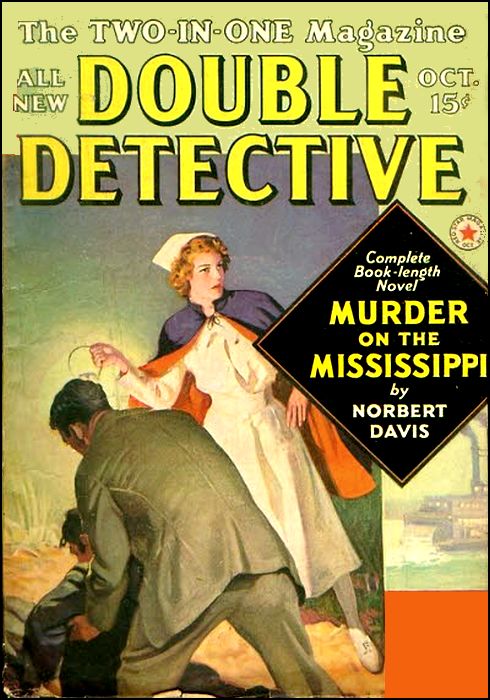
Double Detective, October 1938, with "Murder on the Mississippi"
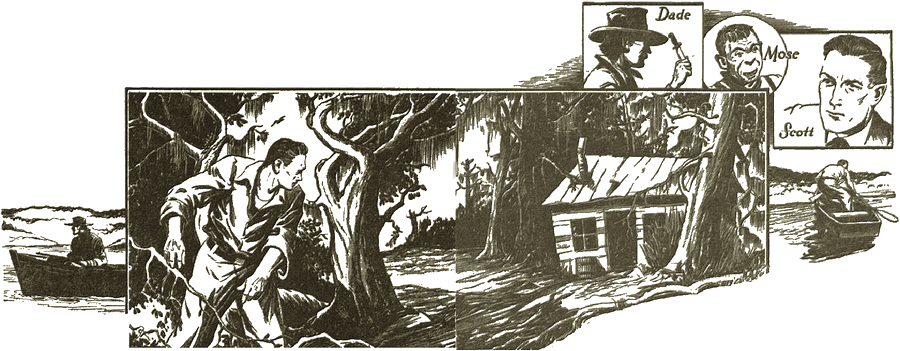
The old man's cabin appeared deserted, but
Jeffrey Scott approached it cautiously.
LASIUS' store was as cluttered and dusty as an old attic, with the fishnets on the walls looking like dirty, shredded waves of sea-foam. There was one long counter extending from the front straight back to within two feet of the back wall, its contents ranging from fishhooks, lines and sinkers at one end, down through the gamut of sporting goods and clothes to hip-high rubber boots at the other end.
Along the opposite wall, at more or less regular intervals, were a stand of oars, a stand of jointed trout-rods, and a stand of bamboo fishing-poles, the last of which looked like a wildly futuristic potted plant. Lasius' office was a desk, a couple of chairs, and a water-cooler, all appropriately shaded by the bamboo poles.
Lasius was sitting at the desk now, lounging back comfortably, with his fat hands folded over his stomach. He was so short that his feet in their blackly shining shoes didn't quite reach the floor. His eyes were round and brown and alert behind thick spectacles. His bald head gleamed in the light of the hook-necked lamp that extended out from the desk and poised over his head like a weird halo. He regarded the young man before him complacently.
"I'm broke," Jeffrey Scott said. "Six months, and I'm flat as a punctured tire, Lasius."
Lasius watched him, his head tilted slightly. "It is too bad."
Jeffrey Scott moved his wide shoulders. "It's not the being broke I mind. I've been broke lots of times. It's what being broke means, this time. It means I've failed. I've never failed before."
"It is too bad," Lasius repeated.
"I can go somewhere else," Scott said. "I can get a job and work for a while and get enough money to start again. But that isn't it." He stared moodily at the floor. "It's hard to explain. I was on one of the river excursion boats when I saw this place for the first time. I can remember it now. It was in the afternoon, and the sun was shining on the river and making it silver."
"The river," said Lasius softly. "The Mississippi, it is a very strange and wonderful thing. It is more than water flowing down to the sea a thousand miles away. It is something that you can feel and love and be a little afraid of, too, eh?"
"Yes," said Scott. "I saw the bluffs first, when we came around the bend. The bluffs were like enormous humped old men who had been sitting and staring at the river for a thousand years. And then I saw this town, laid out in terraces one above the other, like a toy village. I knew then that this was what I wanted—this country. I had been born and raised in a city, but this is what I had always wanted. I remembered, and I came back here after I got my law degree and set up an office."
"Yes," Lasius murmured.
Scott spread his hands. "And now I'm broke. Why, Lasius?"
Lasius moved in his chair, and it creaked a little under him. "It is hard to say. I think, perhaps, it is because you come from the city. You are too quick and too hard for these people to understand. You drive straight ahead after what you want. You expect people to fight or get out of your way. You leave them no other choice. You are not diplomatic, my friend, and you are not dignified or judicious enough to suit these people's idea of what a lawyer should be. And you never ask for help."
Scott smiled wryly. "I got over that a long time ago. Nobody ever gave me anything but a push in the face. I learned that the only way to get along was to push the other fellow before he had a chance at me. I sold newspapers in Chicago, down in the Loop, from the time I was big enough to carry one. I fought for my corner. I mean—fought. Once or twice a week regularly. Then I graduated to being a circulation hustler, and I had to keep right on fighting, only more often and with tougher guys. I got in the habit of it."
"You fight to win—always, to win."
"Of course," said Scott. "What other reason is there for fighting?"
Lasius shrugged. "I do not know. I am only telling you what I think. And then, you laugh too much."
"Laugh too much?" Scott repeated. "Me?"
"Well, perhaps not too much. But at other things than these people laugh at."
Scott nodded. "I guess so. I've bad to learn to take my laughs when I can. They've never come very often."
A BELL high on the wall over the desk made a single plunk, and the feeble reflection of a street light outside slid in a yellow streak across the plate glass as the front door opened. A man peeped around the door cautiously, and then edged himself inside the store in hesitant jerks. He was a small, bent man with twisted shoulders and a matted beard that was streaked with gray. He wore an incredibly patched pair of overalls and a gray shirt fastened up the front with safety pins.
"Excuse me, please," Lasius said to Scott. He tipped his chair, got his feet down on the floor, and stood up with a laborious grunt. "Is there something you want?" he asked the little man.
The man ducked his head and nodded bashfully. His eyes were shining eagerly, and he stared around at the cluttered shelves with the dazedly happy air of a child suddenly loosed in a candy store.
"One of them jackets there," he said. "One of them like in the window. Them leather ones that's all shiny."
Lasius, pushing his way along behind the counter, stopped and pulled his glasses down on his broad nose. "The price is seven dollars and a half—cash," he said, staring severely.
The little man nodded happily. "Uh-huh. And one of them shirts with the purty stripes, and a pair of them white shoes with the red bands on 'em, and—and a pair of them overalls with the brass rivets in 'em, and—"
"Wait," said Lasius. "One at a time, please." He turned around and began to fumble under the pile of leather jackets on the shelf in back of the counter. "What size would you take?"
"I dunno. Gimme it big, though."
"We will try this one, please," said Lasius, handing it over the counter.
The little man patted at the leather with stubby fingers, making appreciative murmurs to himself. He slipped into the jacket and turned around in front of the full-length mirror beside the stand of oars, regarding himself with pleased awe.
Scott watched him for a moment, amused. He recognized the man for a shanty-boat tramp, or some similar brand of river drifter. Like their better advertised brethren of the railroad, the hobo and the bindle-stiff, they shifted here and there as the impulse and the current took them, working and fishing some, loafing more. An endlessly casual existence.
Scott tipped his chair back against the wall and stared moodily at the ceiling. The light of the lamp cut his face sharply in profile, pooling the shadow under his eyes and along the blunt line of his jaw. He was tall, but he had none of the looseness most tall men have. Even relaxed he gave the impression of wiry tenseness. His hair was brown, thick and straight, and his eyes were a metallic blue, always narrowed slightly, as though he were studying whatever or whoever he was looking at with cynical distrust.
He was hard, and be was prone to act with headlong violence. To himself he admitted the truth of everything Lasius had said. But admitting it and trying to change himself were two different things. He couldn't change. His environment had taught him its lesson too well. It was part of him now.
Lasius' voice suddenly sounded loudly, thick and shaking with anger: "What? What?
"Scott tipped his chair down on the floor again and turned.
Lasius was leaning over the counter, his round face dark with rage. He held his right fist out, shoulder high, shaking it vigorously, and the end of a crumpled green bill protruded between his fingers.
The little man's purchases had been assembled in a pile on top of the counter, and now he backed away from them and from Lasius, one step at a time, timidly.
"What?" Lasius shouted. "What do you give me this for?"
"It—it's money," the little man said.
Lasius shook the bill over his head. "Money! Where do you get this kind of money?"
"I just—just found it."
"And you think you buy things here with it, eh?"
The little man nodded uneasily. "It ain't our kind of money, but it's good. You just take it to the bank—"
"Hah!" Lasius said fiercely. "So I take it to the bank, do I? But you don't—no! You try to cheat me with it!"
"I thought—thought it was good."
"You lie, you cheap bum! You try to cheat me with it! Get out!"
"But I—I—"
"Get out!"
The little man backed away another two steps. "But—but wait. I—"
Lasius had found the gate in the counter. He flung it up now and pushed through. His eyes gleamed furiously behind the thick spectacles.
"Ill show you, you bum! Waste my time and try to cheat me with no-good money!"
The little man didn't wait for him. He scuttled down the length of the counter to the door, fumbled with the knob in an agony of haste. He was staring back over one bent shoulder, his eyes scared and wide over the fuzzy yellow of his beard.
"Honest, I didn't mean—I thought—"
Lasius rushed for him, and the little man suddenly got the door open. He slid through, and his feet made a hasty, rattling echo as he ran down the block.
"What's all the excitement?" Scott asked.
LASIUS slammed the door emphatically and turned around. He was still breathing hard, and his face was flushed.
"That bum! He tried to buy things in my store with this—this!" He shook the bill over his head in disgust.
"What is it?" Scott inquired curiously.
"German marks! Ten thousand German marks! You remember those old bills they used to put in bank windows for souvenirs sometimes? Ten-thousand-mark bills—hundred-thousand-mark bills—sometimes million-mark bills. And none of them worth the paper they were printed on! You could buy a bale of them for a dollar! And now he tries to buy clothes with one!"
"He probably didn't know any better," Scott said. "He was just a river tramp. May not have even been able to read. It looked like money, so he thought it was money. Perhaps somebody gave it to him for a joke."
Lasius relaxed. "Yes, yes. You are probably right. It is foolish for me to be so mad. But he makes me wait on him and pick out all those things and then this!"
He crumpled the bill and hurled it contemptuously into the corner. The wadded bill skidded across the shadow and in the light again, spinning, and Scott stared at it thoughtfully.
"I had some friends that bought quite a few of those old mark bills when they were selling them in bales," he said. "They bought them on speculation, figuring they might some day come back and be worth something, if not what they were before. Maybe this old boy got his from somebody like that. It looks pretty new."
"A lot of them were never in circulation," Lasius stated. "They were printed and sold to foreign speculators. Well, now I got to put all this stuff back again."
Scott got up and picked up the bill. He smoothed it between his fingers, and then he stood very still, staring down at it, and his eyes were wide and surprised.
"What?" Lasius asked, watching him.
Scott looked up. "This is a Reichsmark note."
"Eh?" Lasius said blankly.
"Reichsmark," Scott repeated.
"That is what I said. A German bill. It is no good."
"It's a German bill," Scott said. "But it's good."
"Good?" Lasius echoed incredulously.
"Yes. This is a Reichsmark bill. The currency that was made good in Germany after the old marks were discarded. The Reichsmark, the unit of present German currency, has an internationally recognized value the same as the dollar."
"You—you are sure?"
"Yes."
Lasius wiped his brow. "That—is good money?"
"In Germany, yes."
"What—would it be worth?"
Scott shook his head. "It's according to the exchange. I don't know just how the Reichsmark is listed now. I'd say, off-hand, between three and four thousand of our dollars."
Lasius made a sound in his throat. "That bill? Worth three or four thousand dollars?"
"That's just a guess. I think so, though."
Lasius shook his head dazedly.
"He—I—I—" He whirled and rushed to the door, jerked it open. "Hey!" he shouted frantically. "You little man! Come back! Come back!"
There was no answer, except the hollow echo of his voice, and Lasius turned heavily from the door.
"What—what will I do now?"
"You'll have to get it back to him," Scott said. "This is worth a lot of money—a fortune to a river tramp. And you took it away from him. He could make plenty of trouble for you. Have you any idea who he was?"
Lasius shook his head. "No, no."
"Ever see him before?"
"No," said Lasius.
"He didn't mention where he was from?"
"No," Lasius repeated dully.
Scott turned the bill over slowly in his fingers. "Want me to see if I can find him?"
Lasius jerked his head up. "Yes! Would you—would you go and hunt for him?"
Scott folded the bill and put it carefully in his vest pocket. "Sure. I haven't anything else to do."
"Look," said Lasius, "if you could find him and explain and smooth him down. It was all a mistake I made, you see. You could tell him I would give him these clothes he picked out for nothing. If—if he won't make trouble for me."
"I'll fix him," Scott said, nodding. "Providing I can find him. He's a river man, and he'll probably head down that way. That is, if he hasn't gone for the police. I'll look that way first, anyway."
"Yes," said Lasius. "You go there. I'll wait for you."
Scott frowned thoughtfully, putting his fingers in his pocket to touch the note. "But what bothers me is where did that river tramp get it? This kind of a bill must be as scarce in Germany as a thousand dollar bill is here. You certainly don't see many of them. I've never seen even one. And what's more, it's illegal to take currency out of Germany. What would a river tramp be doing with a smuggled bill of this denomination?"
Lasius pushed at him impatiently. "Never mind. Never mind that, now. First you locate that little man. Then you can ask him where he got it."
THE older part of Dayton Bend stagnated on the flat next to the river. Gaunt wooden buildings, scarred and unpainted and half deserted, pushed against each other in muddled confusion, like neglected ancients crowding close for mutual support and warmth. The smell and presence of the river was always here, noiseless and dominating and incalculably strong.
Scott came along the street that had once had a name, a fanciful and optimistic one, but that had been forgotten long ago like the street itself had been forgotten and left to decay in quiet isolation. Some of the old board walks were still in place, and Scott's shoes squeaked against the loose wood. The street lights, old-fashioned and neglected, too, were far apart, and they looked like sputtering yellow balls pushing feebly against the heavy weight of the night.
At a turn in the street, Scott stopped and stared around thoughtfully. He could see no living thing, either behind him or ahead, but somewhere near was the tinkle of a mechanical piano, wheezing an out-dated popular song in a sort of frantic joy. As Scott listened, a drunkenly unsteady voice took up the verse and howled the words in discordant abandon.
Scott walked along the board walk until another turn revealed the yellow of two square windows, like giant eyes peering down the street at him. This was Little Lorry's Place, Scott knew. It was a saloon—a good old-fashioned saloon—and Dayton Bend's one bow to sin.
It was the hangout for the shanty boatmen, the sand barge workers, the shell pearl fishers and the river tramps. It was tolerated in Dayton Bend because the people of Dayton Bend were very glad to have its clientele make merry in a place where the sleep of the good citizenry wouldn't be disturbed.
Scott pushed open the green swinging doors. The long room was so full of smoke that its occupants seemed to move like wraiths. There was sawdust on the floor and a black stove squatting in one corner. A bar ran the length of the wall on one side, and on the other were scattered wire-legged tables.
There were probably a score of men in the room, and most of them were in various stages of intoxication. Scott found a place for himself near the end of the bar. His eyes were used to the smoke now, and be looked slowly around the room. The little man who had presented the German note to Lasius was not present.
"Serve you?" asked a thick voice.
Scott turned around and looked across the bar at Little Lorry. He had a pink face as round as a perfect circle. He had corn-colored hair, and one lock of it was pasted down in a spit-curl in the middle of his low forehead. His eyes were round and blue, and the pupils were tiny black dots in the middle of them. His lips were moist and red and smiling. He wore a white jacket, and his paunch bulged enormously under an apron that wasn't quite big enough to go around it.
"Serve you?" he asked again.
"Beer," said Scott. "In a bottle."
Little Lorry reached in an ice case and brought out a bottle with the moisture slick and wet on it. He uncapped it and set it on the bar.
"No glass," Scott said. He took a swallow of the beer. It tasted flat and malty and warm. He shrugged and put a fifty-cent piece down on the wet bar.
Little Lorry picked it up, rang up twenty-five cents on the cash register, flipped a quarter on the bar. Scott didn't pick it up. He looked at it thoughtfully for a moment, and then looked up at Little Lorry again. Little Lorry was smiling.
"I'm looking for a fellow," Scott told him. "A little guy with patches on his pants and a gray shirt with safety pins for buttons. He's got a yellow beard with some gray in it. You know him?"
Little Lorry turned his head to stare down the bar. He blinked his round eyes once, and his head moved in a slight, almost unnoticeable nod. He looked back at Scott again.
"No."
"He hasn't been in here tonight?"
"No," said Little Lorry.
There had been men standing on both sides of Scott at the bar, but they moved back now, and the raucous voices that had dinned against the ceiling quieted until their sound was only a dim murmur.
"Don't know anybody like that," Little Lorry said, smiling.
A man came sliding along the bar and bumped into Scott. He was a tall man, six inches taller than Scott, even, with enormously wide shoulders that he carried humped forward, and heavily corded arms that hung lax at his sides. He had a black stubble of beard and a scarred nose. His eyes were very small and close together. He wore a black felt hat, crushed and stained with sweat, overalls with one strap broken, and a black shirt.
"You pushin' me?" he said. His voice was thick and hoarse.
Scott stared sideways at him for an instant, shifted his glance back to Little Lorry.
"Now, Rafe," said Little Lorry gently. "Now, now."
"He pushed me," said Rafe.
"Now, now, Rafe," said Little Lorry, still smiling.
"You pushed me," Rafe said to Scott. "Tryin' to get smart with me, huh? You pushed me, didn't you?"
"Yes," Scott said.
Rafe's small, close-set eyes blinked at him. "Huh?"
"I pushed you," Scott said. "Make something of it."
Rafe's lips twisted, and his teeth showed yellow through the black of his beard stubble. "You wanta start something, do you? You wanta fight?"
"Yes," said Scott.
He flipped out his hand and hit Rafe squarely on the mouth with the back of his knuckles. It was a quick, snapping blow, but it had plenty of force behind it. The smack it made was plainly audible, and Rafe took a step backward,
"Come on," Scott said. "What are you waiting for—a street car?"
Rafe made a noise in his throat. His little eyes were shining, flat slits. He bent over, both his long arms spread wide in front of him, and rushed.
Scott braced his elbows on the bar. With his right foot, he kicked Rafe just below the breast bone. Rafe stopped short and doubled up with a painful gasp.
Scott came away from the bar in smooth, gliding steps, as effortless and graceful as a dancer. He hit Rafe four times in the face, none of the blows traveling more than six inches, his fists moving so fast they seemed only blurs.
Rafe's long legs twisted under him and he went down in a sprawl. He sat there, dazed, shaking his head emptily. Blood from a long cut over his eyes slid down over one cheek.
"Better go practice a while," Scott advised.
Rafe got up in one scrambling, awkward lunge. His lips were loose now, blood showing red on his yellow teeth. He put his head down and dived at Scott, reaching with his long arms.
Scott moved with the same effortless speed. He put his hand on the back of Rafe's neck, shoved down and sideways. Rafe's head hit the bar with a solid, clunking sound. He went down on the floor on his face, and this time he stayed there, unmoving.
Scott stared down at him for a second, and then a slow, drawling voice said:
"Now, now, Lorry."
Scott looked up and saw the man who had spoken sitting tipped back in a chair near the door. He was a gangling man with an expression of lifeless melancholy on his long face. He wore a battered straw hat, a blue shirt, and overalls. His tipped chair had no support in back, but it balanced on its back legs perfectly, apparently of its own accord. The gaunt man was cleaning hie fingernails with a jackknife that had a blade four inches long. Now he suddenly threw the knife with an expert flip of his wrist.
It came so fast that Scott had no chance to dodge. Whirling in a bright streak, it whispered past his face with no more than an inch to spare and struck wood behind him with a quietly sinister thud.
Scott turned around with a jerk. Little Lorry was standing back of the bar just behind him. He twisted a little, with his right hand holding a blackjack that he had half-drawn from his hip pocket. The jackknife had gone between Little Lorry's out-thrust elbow and his thick body and was stuck, quivering gently, in the back shelf of the bar.
Little Lorry stared down at it with incredulous awe. His round face had lost its pinkness.
"Always carry two," said the gaunt man, producing a duplicate jackknife from the breast pocket of his overalls. "I'm damned careless with 'em, I am. Always throwin' 'em away."
There was a man sitting on the floor, cross-legged, beside the gaunt man's tipped chair. He had a squat body and a smeared caricature of a face. His hair was thin, colorless fuzz on top of a head burned red by the sun. He giggled now, hugging himself with thick, abnormally short arms, rocking back and forth.
"Get it, Mose," said the gaunt man. The other stopped giggling and got to his feet. He stood up straight from his squatting position with no effort at all. He was barefooted, and his splayed feet padded across the sawdust floor, around the end of the bar. He put his face close to Little Lorry's pale one, winked elaborately, and giggled again.
Pulling the knife out of the wood, he held it over his head. "Watch," he said. "Watch, now. Watch me."
He threw the knife. He didn't throw it as the gaunt man had. He threw it clumsily, holding it by the handle. It sailed through the air, turning over slowly and aimlessly, and the gaunt man reached up a negligent hand and caught it.
The thick man danced up and down behind the bar, shaking with pleased glee. "See? See?" He pointed a stubbily triumphant finger at the gaunt man. "See him?"
"Shut up, Mose," said the gaunt man. "Come back here."
Mose trotted obediently around the bar again. The gaunt man closed both knives, slid them into the breast pocket of his overalls. He tipped his chair down and stood up.
"Goin'?" he asked Scott.
"In a minute," Scott answered.
He turned around. Little Lorry was still standing frozen behind the bar. He wasn't smiling now. He looked at Scott and moistened his red lips.
Scott said: "Here's one of my tricks."
He leaned over the bar, suddenly shot out both hands, and caught Little Lorry by his protruding ears. He pulled hard, stepping back. Little Lorry's face came down and cracked against the inner edge of the bar, and Scott let go of his ears.
Little Lorry staggered back, giving a strangled yell. He had both fat hands up to his nose, and blood squeezed in frothy bubbles between his fingers.
"Remember me next time," Scott told him.
He stirred Rafe's prone body casually with his toe and then walked across to the doors. None of the other men in the room moved. The gaunt man was waiting, holding the door open, and Scott nodded to him and went through it. The gaunt man and Mose followed him.
THE three of them walked silently along the board walk and around the next turn of the street.
"Thanks," Scott said to the gaunt man.
"You got the damnedest, meanest way about you when you're fightin'," said the gaunt man. "I like to see a man fight that way, I do. I like to see a man that don't waste no time about it and don't get himself all ruffled up and go pantin' and blowin' and makin' faces."
Mose took hold of Scott's right wrist with one hand and his biceps with his other. He worked Scott's wrist up and down, digging his stubby fingers into Scott's biceps and making pleased noises to himself.
"Look," he invited the gaunt man.
"Shut up," the gaunt man ordered. "My name is Dade. This here is Mose. He's crazy."
"Crazy," said Mose, pleased about it. "Crazy. Me."
"He's harmless," Dade explained. "At least, kinda harmless, I think."
"My name is Scott," Scott said.
"Uh-huh," said Dade. "You sure got a surprising way about you, you have. I like it. You sure tipped Rafe over easy. He's kinda hard to handle. He likes to throw guys and stomp 'em. That's his trick."
"I know," Scott said. "I've seen it done by experts."
"Little Lorry keeps him around because he's tough," said Dade. "He don't look so tough no more. I sure like a man that fights like you do. What do you want with Patches?"
"Who?" Scott asked.
"Patches. You was askin' Little Lorry about him when he sicked Rafe on you."
"Patches," Scott repeated. "Is that his name?"
"'Bout all the name he's got, I reckon. All I ever heard, anyway. He was sittin' near the back door at Little Lorry's when you come in. He slid out as soon as he seen you. What do you want him for?"
"I want to return something that belongs to him."
They were walking under the glow of a street light, and Dade turned around to look at Scott.
"You sure that's all you want him for?"
"Yes."
Dade nodded. "One thing about a man that fights like you—he don't never lie. He don't have to. Patches come to town with Mose and me. He's probably down to the dock by my kicker, waitin' for us. Well find him."
"Thanks," Scott said. "You've helped me out twice tonight."
"Uh-huh," said Dade lazily. "I sure do like to see a man fight like you do. When you was hittin' Rafe it sounded like somebody smackin' a catfish on the head with a hammer. It sure was a pleasure to see you do that. This way. Come on, Mose. Quit holdin' onto Mr. Scott's arm. He ain't got as much muscle as you have, only he's got more brains to use it with."
"Brains," Mose agreed amiably.
The three of them turned off the street into a crooked alley. It was dark with a rolling, moist darkness, and the smell of the river came strong and musty. Underfoot the ground was moist.
Dade was a shambling shadow. "I go for man's fightin', I do. These box fighters, they give me the pip. Puttin' a pair of feather pillows on their hands and makin' funny motions and jiggin' around like they was doin' a square dance. I like to see a man fight with what God gave him to fight with—fists, feet, and skull."
"You're pretty handy with those knives," Scott said.
"Practice," said Dade. "Just practice. I used to be a juggler in a carnival. I seen the Mississippi one time when I was goin' by, and I just unhooked from the carnival and stayed. It suits me. Suits Mose, too. Mose used to be the wild man of Borneo in the carnival."
"Woo-roo!"Mose growled ferociously. He bent his thick body over grotesquely and hopped up and down, beating his chest. "Woo-too! Me wild man! Glubble-glubble!"
"Shut up, Mose," Dade ordered automatically. "You ain't in the carnival now."
"Nope," said Mose happily.
They came out of the alley, and the river was a blue-black plaque ahead of them, rolling slowly and ponderously down to the sea, immensely strong, and immensely old. This was the narrows of the Mississippi, but the river was narrow only relatively. It was a little over three-quarters of a mile from where they stood to the opposite shore, where lights made glittering pinpricks in the soft darkness.
"This way," said Dade.
They walked in single file along boards that made sucking sounds in the mud under their weight.
"There," said Dade.
The pier was a short, flat, darker bar on the water, and a boat floated at its end, tugging in fitful jerks at the rope that tied it as the river urged it gently to come along.
Mose whimpered like a little child, and Dade stopped instantly and turned around. "What's the matter, Mose?"
"Man," said Mose.
"Where?"
Mose pointed at the foot of the pier ahead of them. Straining his eyes, Scott gradually made out a humped outline in the darkness. It wasn't moving.
Mose whimpered again. "Dead. Dead."
Dade went forward slowly with Scott a step behind him. They reached the still object and, looking down at it, Scott could see the vague white of an upturned face.
"It's Patches," Dade murmured. He looked back at Mose, who was hanging back timidly, still ten feet away. "Anybody else around here, Mose?"
"No," said Mose.
Dade struck a match on his thumbnail and knelt down, shielding the flame with his cupped hands. The little man with the fuzzy yellow beard stared back up at them with his round, childishly surprised eyes. His gray shirt was caked with blood.
"In the chest," Dade said quietly. "Stabbed him three times—see?"
Scott nodded. "Yes. I'd better get a doctor."
"No use," Dade told him. "He's dead. Mose, he can feel things like that. Look."
He moved the match flame slightly downward, and Scott could see that the pockets of the ragged trousers were all turned inside out.
Dade tossed the match into the river. "Somebody searched him. Somebody stabbed him because he thought Patches had something he wanted. How come anybody'd think Patches had anything worth murderin' him for?"
Scott touched the bill in his vest pocket again. He wondered if that was the answer to Patches' death. Someone had wanted something Patches had been carrying. Wanted it bad enough to kill to get it.
Dade was watching him. "I don't like this. You know anything about it?"
"Strike another match," Scott requested.
The flame sputtered yellow in Dade's hand, and Scott took the bill from his pocket and unfolded it.
"This is what I wanted to give Patches. It's a German note for ten thousand Reichsmarks. Patches had it, tried to pass it in a store. The proprietor didn't know it was worth anything, and he kicked Patches out. Did Patches show it to you?"
"Nope," said Dade. "Never seen one like that before. It's really good money?"
"Just as good in Germany as our money is here. This single bill here is worth several thousand of our dollars."
"Huh!" Dade said, amazed. "And Patches had it? Why, I don't figure that at all. Patches didn't have no kinfolk in Germany. He didn't have no kinfolk at all, and he never had no more than four bits cash at one time in his whole life. What'd he be doin' with that?"
"I'd like to know," Scott said.
"Didn't say nothin' about havin' it," Dade said. "But come to think, he did act funny today. He come over to our shack and wanted to know was we goin' to town. He didn't have no kicker, just a rowboat. He acted funny, though. He acted like a kid with a big secret, and he couldn't hardly set still. I didn't think much about it, because Patches, he wasn't much on brains. He was kinda like Mose. Him and Mose got along well."
Mose sobbed once. He was digging at his eyes with his knuckles, and the tears were wet and glistening on his cheeks.
"Patches—good."
"Yeah, Mose," Dade said softly. "Patches was good. He was a harmless little guy. Never would do no wrong to anybody, I don't think. I don't like this. We'll have to tell the cops, although the cops they got around here, they couldn't catch cold."
"I want to go back to the store," Scott said. "Lasius had better know something about this right away. Patches might have told someone he was going there, and Lasius ought to know he's dead if the police come around to question him."
"Yeah," Dade agreed. "I'll go phone the cops. Mose, you stay here."
Mose swallowed with a gulp. "Stay?"
Dade's voice was curiously gentle. "Yeah, Mose. You stay here with Patches. You ain't afraid of just poor Patches, are you?"
"No, Dade."
"That's a good boy. You stay here. I'll be right back."
"Yes, Dade. Mose stay."
SCOTT was hurrying, and his quick, sure footfalls made a muffled and empty rattle of echoes as he turned the corner into Hull Street and headed toward Lasius' store, half a block away. He had the feeling of a man who had stepped into a patch of quicksand unaware and now was suddenly conscious of the tenacious, dragging depth that was sinking under him with no pattern, no form that he could see or feel, with only the sense of quiet and deadly menace.
He was in front of Lasius' place before he realized with a start that the store was dark. He stopped short, staring. Lasius had said he would wait, and Scott hadn't been gone more than a half hour.
He stepped closer now, meaning to peer through the smeared glass of the front door. He touched it with his hand, and it moved. It had been standing slightly ajar.
Scott waited for a moment and then pushed it wider. Inside the store was a motionless, dark cavern, quietly still with the heat of the day that had passed.
"Lasius," Scott said.
There was no answer, and his voice fell softly in the quietness and was swallowed up without even a ripple.
"Lasius," Scott said again, louder. He went inside the store, feeling with his right hand for the length of the counter. The glass was cold and smooth under his fingers, and he went forward one, two, three shuffling steps.
Behind him, the door hinges squeaked. Scott whirled, his back against the counter. A vague black shape lunged out of the darkness at him, and he caught the thin, bright gleam of a knife blade.
The counter pinned him in, and he thrust forward desperately, trying to get inside the range of the flow. He was partially successful, and the wrist of the hand holding the knife hit him on top of the shoulder. He felt the blade rip the back of his coat, and then he had the black figure around the waist.
He heaved, trying to trip the other man, but the solid weight was too much, and they both slammed into the stand of oars. There was the sudden rattle of wood against wood, a whisper of motion in the darkness, and then the oars hit the floor with a clattering din.
The other man jerked aside, twisting against Scott's grip, and Scott stepped on one of the oar handles. The oar rolled slightly under him, and his ankle twisted. Scott's breath made a whistling gasp in his throat. He tried to haul himself up, regain his balance.
An elbow caught him in the throat with a savage thrust that cut off his breath and spread a queer numbness through all his body. He staggered back against the counter. Again he felt rather than saw the knife coming at him with its deadly speed.
He got his forearm up and felt the blade click against the buttons on his coat sleeve. The blow was deflected, not stopped, and the heavy shaft of the knife hit him squarely between the eyes.
His head jerked back, and the black closeness inside the store changed to a greenish mist that revolved in slow changing patterns. He knew he was falling, and he tried to catch the counter, or the other man, anything to support himself—but his hands closed emptily on air.
He went down, sprawling on his face. The floor wavered uncannily under him, and there was no strength in his arms to push his body up. The pain in his throat was unbearable. His lungs felt deflated, for want of air that he could not draw in through his open, straining mouth. The green mist changed to blackness.
A hand caught his shoulder and rolled him over. The motion loosened the constriction on his throat, and he gulped at the air that was like new life flowing into him and giving him feeling and strength.
Hands were tearing at his pockets. They found the lower pocket of his vest, where he had put the German note, and ripped the whole pocket away in one violent jerk.
Scott tried to catch the hands and missed. He rolled on the floor, brought up against an ankle, and grasped it desperately. Another foot kicked him hard in the face, jarring him back, and the ankle jerked out of his hands. An oar rattled as the other man stepped on it, and then the side door of the store creaked open, banged violently shut.
Scott caught the edge of the counter, pulled himself up. His legs were stiff and unwieldy, and his head felt as light as a balloon, tugging at the string that was his neck. He staggered toward the side door and groped in the dark. He found the knob at last, jerked the door open.
He went down the one cement step, missed his footing on the rough paving of the narrow alley that ran beside the store. He staggered clear across the alley, brought up abruptly against the opposite wall. He turned around blindly, trying to listen, and the beam of a flashlight came on, crawled along the wall, centered on his face.
"Steady," said a voice flatly. "Just stand right there. Keep your hands where they are."
Scott stiffened against the wall, watching the round white eye of the flash. Feet moved slowly along the pavement, approaching him.
"Police," said the same voice. "Just what the hell is going on here?"
He was close enough for Scott to see a little behind the flashlight, and he caught the bluish gleam of a gun barrel and the polished sparkle of brass buttons.
"I went in the store," Scott said. "Somebody jumped me in the dark, tried to stab me. He came out this side door."
"Nobody came out the front of this alley, mister."
"Then he went out the back," Scott said quickly. "Come on. We can catch him!"
"Oh, no," said the policeman. "I think we already caught him. Just what was you doing in that store in the dark? You don't claim to own it, do you?"
"No. I came to see Lasius."
"In the dark?"
Scott's head was clearer now, and he steadied himself with a long indrawn breath. "No. I had an—appointment with Lasius. He told me he'd wait for me."
"Does he usually wait with the lights out?"
"No. But the front door was open. I went in—to see if anything was wrong. Someone attacked me."
"Yeah? We'll take a look inside."
"But the man who attacked me—"
The blue barrel of the revolver moved commandingly. "Inside, mister. Keep ahead of me."
Scott went across the alley to the side door. He pushed it back, and he could hear the slow breathing of the policeman just behind htm. He stepped inside the store.
"Stand still," the policeman ordered. "Stand damned still, mister, while we take a look."
The round beam of the flash left Scott, slid quietly along the counter toward the front, reflected in polished streaks from the scattered oars.
"That's what made the racket I heard," the policeman said. "You trip over 'em in the dark?"
"No," said Scott.
The light left the oars, crawled back along the counter, probed into the darkness at the rear of the store. It slid around the stand of bamboo fishing poles, stopped suddenly.
"Uh!" the policeman said.
The light was centered on a foot and part of a pudgy ankle clad in a rumpled white sock. The foot and ankle were poked out from behind Lasius' desk. The foot was clad in a blackly polished shoe, and its toe pointed stiffly at the ceiling.
"Lasius!" Scott exclaimed.
"Yeah," said the policeman. "Surprised?"
Scott moved slowly closer. Lasius was crumpled in a heap behind the desk, crushed in between it and the wall, as though he had been picked up and thrown there. His face was white and still, waxy looking. Blood trickled down slowly from his nostrils, spread a red film over his parted lips. His eyes were closed, and there was a long swelling blue welt across his forehead and temple.
Scott knelt beside him, touched him. "He's alive. He's breathing. Call an ambulance!"
"Yeah," said the policeman. "I'm gonna call an ambulance and the patrol wagon, too. The ambulance is for him. Guess who the patrol wagon's for."
THE cell was like a hollow cement cube with a barred door at one end, a barred window at the other. The walls had been whitewashed not very long ago, but the ever-present dampness had faded them to an off-color gray. The air was heavy with disinfectant.
Scott lay on his back on the cot pushed against the side wall. He had his coat folded under his head, and he was staring at the ceiling with thoughtfully dull eyes.
Somewhere a door clanged metallically, and feet grated on cement. Scott stayed where he was, motionless.
The feet stopped in front of the cell. "Scott," a voice said.
Scott sat up on the cot and turned around.
Morris, the district attorney, was looking through the polished bars of the cell door at him. Morris was a tall thin man with an automatically painful smile, and false teeth that were so loose he talked with a slight sputter that he always tried earnestly to control. He had lank, lifeless hair that was dyed blue-black and plastered carefully over the top of his head. His skin was a dead grayish color.
"All right," he said.
Little Lorry stepped up beside him and peered at Scott. Little Lorry had a bandage across his nose, and above it his blue eyes were round and eager and full of vindictive glee.
"Yeah!" he said triumphantly. "That's him! That's him, all right, Mr. Morris!"
"Fine," said Morris. "Thank you."
The two of them turned away, and their feet sounded down the corridor. The door clanged again, and a single pair of feet came back. Morris stopped again in front of the cell door.
"Well?" he said inquiringly. "Well, Scott?"
"Pretty well, thanks," Scott said. "How are you?"
Morris' false teeth clicked angrily. "Listen here, Scott. I'm tired of that smart-aleck attitude of yours. I never have liked it. You think you're just a little too good for the people around this town. You've been riding for a fall, and now you've taken it."
"Have I?" Scott asked.
"Yes! You heard that witness identify you."
"Little Lorry? Sure. How much did he contribute to your campaign fund, or does he pay off by the month?"
Morris choked. "You—you—you think you're clever and superior, don't you? A real city slicker showing the hicks how it should be done! Well, you'd better trot out all your tricks. You're going to need them to get out of this!"
"So?" Scott said politely.
"Yes—so! You think you're being held on suspicion of burglary, don't you? Well, you're not! You're being held for murder!"
"Well, well," Scott said. "If you could lend me a cake of ice, maybe I can work up a shiver for you."
Morris' wrinkled neck reddened. "All right! Laugh! You'll be singing a different tune pretty soon! We've got a nice case against you, Scott. We know that you and Lasius were in Lasius' store when this man known as Patches came in. Lasius threw him out, and you went looking for him. You inquired for him in Little Lorry's saloon. Then be was found dead near the river front. And then you went back to Lasius' store and fought with him. Why did you follow Patches?"
"I wanted his autograph. I collect 'em."
Morris grasped the bars on the door and shook them. "Why did you attack Lasius?"
"We were playing blind man's bluff and bumped heads in the dark."
Morris stared at him, panting in ragged, enraged gasps. "All right! All right! You wait until the inquest tomorrow. You'll see!"
He whirled away from the door, and his feet made a rapid clatter going down the corridor. The door clanged sullenly.
Scott lay back on the cot again. He was frowning, and he rubbed absently with the fingers of his right hand at the bump the knife shaft had left between his eyes. His head ached slightly, and the bruise on his cheekbone, where the unknown attacker in Lasius' store had kicked him, throbbed with the pound of blood in his temples.
He stayed on the cot, motionless, for a long time, and then he got up and took the tin cup from the shelf against the wall. He rattled it noisily between the bars on the door. After a while he heard the grate of a key in a lock, the squeal of hinges.
A squat, lumpily fat man in a rumpled blue uniform stopped in front of his cell.
"What you want?"
"When that call came in saying there was a man murdered down on the river front, who answered it? Who went down there, do you know?"
"Yep. It was Hannigan and Morse."
"Are either one of them around here now?"
The turnkey shrugged casually. "I dunno."
"How's for looking?"
The turnkey scratched his nose. "Listen, mister, when you come in here you had two dollars and sixty-three cents in your pockets, and you had a bank book that shows a balance of a little over twenty dollars. You ain't hardly in shape to ask for any favors from me, are you?"
Scott's mouth tightened slightly. The gray in his eyes darkened until it was like smoky shadow. He didn't move at all, but the turnkey took a step backward, cautiously.
Scott's voice was low and even. "Mind telling me your name?"
"Bailey," said the turnkey.
"Bailey," Scott repeated thoughtfully. "Bailey." He examined the turnkey's face slowly, as though memorizing each feature. "All right." He turned and went back to the cot and sat down on it.
The turnkey didn't go away. He cleared his throat and squinted uneasily through the bars. Scott didn't look at him. The turnkey shifted his feet on the floor.
"Say," he murmured tentatively.
Scott ignored him.
"Hmmm," the turnkey said. "Say! I was just jokin', kind of, about that money."
Scott didn't answer.
"Jokin'," the turnkey repeated vaguely. "Sure. Just jokin'. Ah—I think Morse is over in the squad room."
Scott sat still—silent.
The turnkey shuffled his feet again. "I guess maybe I could go find him, I guess."
Scott stared at him wordlessly.
The turnkey coughed. "I—guess I will go find him. You—want to see him, huh?"
Scott didn't answer.
"Well," said the turnkey, twisting his head awkwardly, "I'll sort of tell him." He paused and swallowed. "No—hard feelings, huh, mister?"
"Get going, Scott ordered flatly.
"Sure," said the turnkey. "Sure. I—I'll send him right over. Yeah."
His feet shuffled down the corridor, and Scott smiled to himself—a slow, tight smile that made his face look thinner and harder.
Morse was a squat, thick man with a heavily tanned face and eyes that were whitish, cloudy blue. His mouth was thick-lipped, turned down sullenly at the corners. He made no sound at all coming along the corridor, and Scott didn't know he was at the cell door until he spoke. "Want to see me?"
Scott said: "Yes. You went out on that call reporting a dead man down by the river front, didn't you?"
"Hannigan and I did, yeah."
"Do you know who it was that called?"
"No. He spoke to the desk sergeant. Didn't give his name."
Scott hesitated a second. "Was there anyone near the body when you found it?"
"No."
"No one at all?"
"No."
"Where was the body?"
"At the foot of a little dock near the end of Oak Street."
That was the place where Patches' body had been lying when Scott had seen it last, and he frowned to himself, puzzled.
"Was there a boat tied to that dock?"
"No."
Scott looked up at him. "You're sure?"
"Sure. Hannigan and I looked all around."
"Were there any tracks in the mud?"
"Nope."
Scott nodded slowly. "All right. Thanks."
Morse didn't answer. He turned around and went away down the corridor as silently as he had come.
Scott rubbed his forehead gently. Dade and Mose had evidently pulled out on him, and their absence added another question to the puzzle that was already so blankly complex that it was fantastic. It had no beginning and no end, and the part he did know made no sense.
Scott wasn't worried about the possibility of actually being convicted of the murder of Patches, or of even being indicted for it. Morris' case, in spite of the man's malice, was too thin to allow him to put that over. But he did have enough evidence to warrant a coroner's jury recommending that Scott be held, and that was something Scott wanted to avoid.
The testimony of Dade and Mose would give him a complete alibi. Dade had said that Patches was in Little Lorry's place when Scott appeared, and Scott had not been out of sight of Dade and Mose from that moment on until they had discovered Patches' body. But without theirtestimony—
Scott began to hum tunelessly under his breath
FOR his inquest the coroner—Finley by name—had pre-empted a temporarily vacant room in the county courthouse. In private life Finley was an undertaker—a thin, unhappy looking little man with a wrinkled bald head that glinted with antiseptic brilliance. Inquests baffled and worried him, and he wore a harassed, nervous air now, pacing back and forth in front of the jury box, holding the top of his bald head with both hands, as though he were afraid his brain would suddenly explode.
The coroner's jury—seven in all— watched him apathetically, slouched down in their chairs. One of them, a fat man in a sweat-stained pink shirt, finally asked him:
"Hey, Jake, why don't we start?"
Finley let go of his head and spread both arms helplessly. "I'm waiting for the district attorney."
"What for?" the fat man wanted to know.
"He wants to be here."
"Well, why don't he get here on time, then?"
"How do I know?" Finley demanded, exasperated.
The fat man scratched himself. "Well, I wanta go fishin'. Why don't you send somebody after Morris?"
"I did."
"Send somebody else," the fat man advised.
Finley shrugged impatiently and continued his pacing. It was a hot day, and all the windows lining the east wall of the room were wide open. There was a little breeze coming in off the river, but it hardly stirred the moist, heavy air.
A few people sat in the spectators' seats, waving fans and straw hats in front of their faces and whispering to each other. Big bluebottle flies sailed in lazy, droning arcs, in and out of the windows, bumbling sullenly along the ceiling.
Scott was sitting just inside the wooden railing that bisected the room, Morse, the detective, was sitting beside him. Morse sat uncannily still, waiting with a dull, uncaring patience. He hadn't moved or spoken since he had brought Scott into the room. His whitish eyes had a sleepy glaze over them.
Morris came in the courtroom suddenly through one of the back doors. He strode along with an officially brisk step, clicking his heels hard on the floor, swinging a briefcase energetically at his side.
"About time," said Finley.
Morris gave him his automatically cordial smile. "Sorry, Jake. I was delayed unexpectedly. Business,"
"Yeah," said Finley, unconvinced. "I got a little business myself. I'm supposed to embalm a couple guys this morning."
"All right," said Morris cheerfully. "Let's start." He sat down at one of the counsel's tables, opened his briefcase importantly, and began to spread papers around in front of him.
Finley nodded familiarly at the jury and said: "This here is an inquiry into the causes of death of a party known so far as Patches. You've all been on my juries before, so I guess you know what you're supposed to do."
"Sure, Jake," said the fat man. "Start her off. I want to go fishin'."
Finley cleared his throat and frowned seriously. "First witness is Dr. Granley. Step forward and be sworn, Doc."
Granley's glasses kept slipping down on his short nose and had to be pushed back up again. Taking the stand, he identified himself as the county medical examiner and testified that he had examined the body of the person so far identified as Patches and had determined that death was the result of three stab wounds in the chest, one of which had pierced the deceased's heart.
"What kind of a knife would you say did it?" Finley asked him.
"A knife that had a broad blade— about six inches long. Might be some kind of a hunting knife."
Finley nodded. "Any possibility that the deceased stabbed himself?"
"No. It would be impossible for a man to stab himself three times that way. He'd lose consciousness before he could do it. And besides that, a man couldn't stab himself with that direction and that force. The knife went in to its hilt every time, hard enough for the guard to bruise the skin and tear the clothing. There's no possibility of suicide."
"I didn't think so," Finley said. "But I just wanted to have it in the record. You got any questions you'd like to ask Doc?" He turned to look inquiringly at Morris.
Morris shook his head. "No."
Finley said: "All right, Doc. That's all. Thanks."
Granley left the stand, and Finley called Hannigan, Morse's detective partner, for his next witness.
Hannigan was as broad as Morse, but much taller. He had a round, redly belligerent face, and his voice had a rasp to it. He told substantially the same story that Morse had told Scott the night before.
Hannigan had been on duty when a call came in from some unknown person saying that there was a dead man lying on a dock on the river front near Oak Street. He and Morse had gone to investigate and had found the body as described.
"Did you make any inquiries about the phone call?" Finley asked him.
Hannigan nodded ponderously. "Yes. We traced the call and found it came from Lacey's bowling alley. I made inquiries there, but there was a tournament goin' on between the Streeter Dairy and the LaDue Barbed Wire teams."
"Who won?" the fat juryman asked curiously.
"Streeter Dairy," Hannigan said. "There was a lot of people milling around in the place, watching, and nobody noticed who used the telephone about that time. Anybody could have come and used it."
"Did you find any weapon near the body?" Finley asked.
"No. We looked the ground over carefully, but there wasn't any knife or any tracks, and we didn't see anybody suspicious around the neighborhood."
Finley looked at Morris again, raising his eyebrows. Morris shook his head, and Finley said:
"That's all, then. The next witness is Alfred Lorimer."
Little Lorry took the stand and smiled down maliciously at Scott. He had a new bandage across his nose, a small one, and he wore a shiny blue-serge suit that was so tight for him that the buttons of the coat strained dangerously. His corn-colored hair was slicked down, and the inevitable spit-curl coiled precisely in the exact center of his low forehead.
He identified himself as the owner of a tavern near the waterfront.
"Did you know the deceased—a man called Patches?" Finley asked turn.
"Sure," said Little Lorry. "Knew him well. Come in my sal—my tavern lots of times."
"What was his real name?"
Little Lorry moved his fat shoulders. "I dunno. I think Patches was the only name he had. It's the only one I ever heard. He couldn't read nor write. He just made his mark when he wanted to sign something. He wouldn't have no need for more name, anyway. He was just a river bum."
Finley nodded. "I know. How long has he been around here?"
"I guess maybe about two years."
"Ever hear him say where he came from?"
"Nope. He wasn't much for talkin'."
"You never heard him mention any relatives?"
"Don't think he had none," Little Lorry said. "If he'd had he'd of tried to borrow money from 'em when he was broke now and again."
"Did he usually have much money?"
"No. Never had hardly any. He fished some and made just enough to get by."
"I see," said Finley. He hesitated a moment to give the next question emphasis. "Was he in your tavern last night?"
"Yes. He came in early in the evenin' and hung around for maybe a half hour."
"Did you notice anything unusual about him?"
"Well, yes," said Little Lorry judiciously. "He was nervous as a cat. Couldn't sit still at all. I thought maybe he had the jitters or something, so I gave him a drink. But it didn't seem to help—only made him more so."
"You said he hung around for about a half hour. He left the tavern then?"
"Yes."
"Did you see him again that evening?"
"Yes. He was gone about an hour, and then all of a sudden he come runnin' in the place lookin' like he'd seen a ghost."
"He was scared—afraid?"
Little Lorry nodded solemnly. "Oh, you bet! He was sure scared of something. He acted like he thought somebody was after him. He came in and set himself down in a corner where he was sort of half hid. He was right near the side door, and he kept watchin' the front door real nervous like. He was sure scared somebody was gonna come after him, all right."
"Did anyone come after him? Did anyone come in your place looking for him?"
Little Lorry looked at Scott again. His eyes were round and gloating, and his moist lips twisted into a vindictively sly smile.
"Yes! You bet someone came..."
His voice trailed off into a mumble. He was staring at something in back of Scott. Scott turned his head to see and felt a long, relaxing sense of relief. He drew a deep breath and let it whistle softly out between his teeth.
Dade had just come in the front door. Long and lean and awkward looking, he shambled down the aisle and sat down in the front row of the spectators' seats just behind the railing and on a direct line with Little Lorry.
"Well?" said Finley to Little Lorry.
Little Lorry started. "Huh? Oh, yeah. Yes, somebody—came looking for him."
Dade took out one of his jackknives and opened the long blade with a softly sinister snick.
"Did you know the person?" Finley asked.
Little Lorry wasn't smiling anymore. "No. I didn't know him at all."
Finley paused dramatically. "Is he in this room now?"
Dade was holding the jackknife by the blade in his right hand. He slapped the wooden handle against the palm of his left hand with a little smacking sound and stared straight at Little Lorry.
Little Lorry opened his mouth and shut it again. He was looking at Dade and the jackknife with glassily wide eyes. His plump face had paled until the red of his lips looked almost purple, and there was a mist of sweat on his cheeks.
"Well?" Finley urged.
Little Lorry swallowed. "In this room? Oh, no!"
The answer was so unexpected that it caught Finley flatfooted. He stood there with his mouth open.
Morris came to his feet with a violent jerk, scattering the carefully arranged papers in front of him.
"What?" he shouted.
"He—ain't here," said Little Lorry weakly.
Morris' teeth slipped, and he stuttered incoherently before he got them back in place again. "The man that came into your place looking for Patches is not in this room?"
Little Lorry shook his head. "Nope."
Morris glared at him, and the red began to spread across the back of his wrinkled neck in a slow flush. "You understand what you're saying?"
"You bet," said Little Lorry.
Morris pointed a rigid forefinger. "You identified the man you said you saw!"
"I wasn't under oath when I did it," Little Lorry maintained quickly. "I guess—I guess I was mistaken."
Morris whirled around and pointed at Scott. "Isn't that the man who came into your tavern looking for Patches?"
Dade maneuvered the knife blade until it caught a slanted beam of sunlight and reflected it across Little Lorry's eyes.
Little Lorry winced. "Him? Oh, no!"
"It is!" Morris bellowed.
"It ain't!" Little Lorry denied stoutly.
Morris made a strangled sound. "You—you—what did the man who was asking for Patches look like, then? Did he look like this man?"
"Not a bit," Little Lorry said quickly. "Not even a little bit."
"What did he look like?"
Little Lorry twisted uneasily. "Well, he was tall."
"How tall? Taller than I am?"
"Oh, sure. Lots taller than you. A foot taller."
"So?" said Morris malevolently. "Did you notice anything else about him?"
"Well, he had a beard, I guess."
"What color?"
"Red," Little Lorry said desperately.
Morris folded his arms. "It happens that I'm just over six feet tall. So that means this mysterious stranger who inquired for Patches was seven feet tall and had a red beard. He must have presented a rather unusual appearance."
"Come to think of it, he did," said Little Lorry.
Morris jumped at him. "You're lying!"
Little Lorry crouched back in his chair. "Me? Oh, no!"
"That man Scott was the one who inquired for Patches!"
"Oh, no!" said Little Lorry hastily. "No, sir! It wasn't him! Positively not!"
Morris picked up his briefcase and hurled it violently on the floor. "You!" he snarled at Finley. "You thick-headed, lame-brained blunderer! You're responsible for this! You and your dim-witted questions and your moron jury! You don't know any more about conducting an inquest than I do about raising ducks!"
"Oh, is that so?" said Finley angrily. "Who put me up to askin' them questions and callin' this witness? You did. And don't call my jury morons, either. They're all friends of mine."
"Damn right," said the fat juryman. "Don't take no backtalk from that loud-mouth, Jake. Toss him out. You're the guy that's runnin' this."
Morris held both clenched fists over his head. "You—you stumble bums! You realize what you've done? You've ruined my case against Scott! How can I hold him, after that kind of testimony?"
Scott got up out of his chair. "I'll answer that one for you. You can't. Thanks for the night's lodging and the entertainment, Morris."
Morris' face twisted grotesquely. "All right! Just you wait, Scott! I'm not through with you yet! There's still a couple of other charges that I can bring against you—burglary and felonious assault!"
"If you don't watch out," Scott said amiably, "you'll get yourself so all wrapped up in criminal law that you'll forget there's some civil law, too. Ever heard of false arrest and imprisonment?"
Morris yelled: "You can't—"
Hannigan, sitting in a chair opposite the jury box, interrupted in his harsh voice: "He's right, Morris. We ain't gonna have you pull us into a jam just because you don't like this guy. You ain't got a bit of evidence on the assault or the burglary, either."
"Lasius will testify!" Morris said triumphantly.
"To what?" Hannigan asked bluntly. "He's still unconscious in the hospital. How do you know what he's gonna say, if anything, when he comes around? You better drop it for now."
"It's good advice," Scott said. "Thanks again. I'll be going."
He walked over to the gate in the wooden railing. No one made any move to intercept him.
"Don't you attempt to leave town!" Morris snarled. "I'll be looking for you as soon as Lasius can talk!"
"I'll be easy to find."
He walked down the aisle toward the front door, and behind him he heard Finley say to the jury:
"That's that, boys. Bring in the usual."
"Death at the hands of person or persons unknown." the fat juryman rattled off expertly. "Hurry up, Jake. I wanta go fishin'."
SCOTT went over to the jail and retrieved his personal property from the desk sergeant. When he came out of the office, around the corner from the courthouse, he found Mose sitting on the curb, waiting. Mose was humming happily to himself and plopping his flat bare feet up and down in the moist dirt in the gutter.
"Hello, Mose," Scott said.
Mose grinned up at him. "Funny," he said, pointing back in the direction of the courthouse. "Funny men."
"Very funny," Scott agreed.
Mose wrinkled up his face until it resembled an uncannily accurate caricature of Morris. He made spluttering sounds through his teeth and waved his stumpy arms over his head.
Scott grinned, amused in spite of himself. Dade came lazily around the corner and stopped beside Scott.
"Cut that out, Mose," he ordered. "Somebody's gonna grab you and stick you in the booby-hatch if you don't quit doin' tricks like that."
"Booby-hatch," Most agreed amiably. "Nice place."
"Some of 'em ain't so nice," Dade warned.
"Free food," said Mose.
Dade shrugged. "It must be nice to be crazy," he said to Scott. "You don't seem to have no worries, then. Say, that back there was the nuttiest bit of court-lawin' I ever run into. What ails them birds? They ain't supposed to act like that, are they?"
"It was just a coroner's inquest," Scott explained. "It isn't the same as a real court. The coroner has a pretty free hand when it comes to running it. The ordinary rules of procedure and evidence don't apply, and even the verdict doesn't mean much."
"I sure hope it don't," Dade observed. "Not the way them guys went about gettin' it."
"Where did you go last night?"
Dade tipped back his battered hat. "Well, I was gonna tell you about that. I was sorry you might think we'd run out on you. But I didn't want to appear and give you an alibi, so I just throwed a scare into Little Lorry instead."
"Why didn't you want to alibi me?"
Dade scratched his nose. "Well, you see when I was jugglin' with the carnival, I used to run a little three-card monte game on the side, and one or two times some hayshakers put up a squawk on me. I got some wanteds out for me here and there, and I didn't want to go pokin' my snoot into a police station, on account they might by accident start lookin' at me too close."
"I see," Scott said. "Thanks, anyway. It worked out just as well the way you did it, although you had me worried for a while."
"I been lookin' around," Dade said slowly. "You know that bill you showed me? I can't find nobody that ever seen a bill like that before. I can't find nobody that knew Patches had anything like it, either. It's damned funny about that bill. I don't figure it out, at all."
"Neither do I," Scott admitted. "In fact, I'm worse off now than when I started. I haven't got it anymore. Somebody tackled me when I went back to Lasius' store and took it away from me."
"Who?" Dade asked quickly.
Scott shook his head. "I couldn't tell. He tackled me in the dark." He paused. "But he knew which pocket that bill was in, and he had a knife."
Dade watched him. "You thinkin' it maybe was me?"
Scott grinned. "No. I got hold of him in the dark. He was shorter than I am and a lot heavier than you are."
"Ummm," Dade said. "You know, I'm kinda anxious to find the bird that did for Patches. Patches, he was a pretty nice little guy, and Mose liked him. Now you can fool an ordinary person, but you can't fool Mose on things like that. He just don't like people that's got anything bad hid in 'em, it don't matter how nice they look on the surface. I'd like to meet the guy that stabbed Patches. I would for a fact."
"So would I," Scott said. "I want that bill back, and I want to know where Patches got it. I've got a hunch that the man who stabbed him knows. That's why he killed Patches. He wouldn't have needed to kill him just to steal the bill. He didn't want Patches telling anyone else where Patches got it"
"Sounds good," Dade agreed. "Say, I was listenin' outside the door before I come in. and I heard Little Lorry testifyin' that he gave Patches a drink."
"Yes?" Scott said. "What about it?"
Dade rubbed his nose slowly. "Well, Little Lorry never gave nobody a drink in his life."
"You think Patches paid?"
"Yeah. I know he paid for it. I'm just wonderin' what kind of money he used when he did."
Scott nodded. "That's an idea. I think I'd better have a little chat with Little Lorry."
"Want I should go along?"
"No, thanks. If Morris saw us together too much, he might accidentally get an idea."
"That's right," Dade agreed.
"You said Patches lived near you?"
"Yeah. South of us—on Two Humps Island."
"Did he live alone?"
"Yup. All alone. Ain't nobody else on that island."
"I'd like to look his place over before the district attorney's men get around to it. Will you take me down there?"
"Sure," said Dade.
"Meet me down at the dock where you were tied up last night in a couple of hours."
"Okay," said Dade. "Come on, Mose. Quit ploppin' your feet in that mud."
SEEN in the bright sunlight, the buildings in the part of town near the waterfront lost the vagueness that protected them at night. They were simply old now, harsh and ugly, crumbling with the weight of their years, and Little Lorry's place was no different from the rest, except that the swinging doors that marked its entrance were painted a brilliant green that looked a little indecent against the colorlessness of the walls around it.
Pushing the doors open, Scott noticed that one of them had a broken slat where some unknown roisterer had made a hurried exit, probably opening the door with his head on the way. Inside, the saloon was a shifting, dazzling interplay of shadow and brilliant golden sunlight, and Scott paused with his back against the doors until his eyes accustomed themselves to the dimness.
There was no one at all in the front room, and the bar stretched emptily down its length. Scott walked quietly up to it and dropped a coin on its scarred surface, making a ringing, small clatter that magnified itself in the dull quiet.
Somewhere in the back, chair legs scraped against the floor, and then footsteps came closer, and Little Lorry bustled out of the rear room, fastening an apron around his soft paunch. He saw Scott and stopped as quickly as if he had run into an invisible barrier. His right hand dropped the apron string and moved slowly toward his hip pocket.
"Leave it there," Scott advised lazily, "or I'll make you eat it."
Little Lorry swallowed hard. "You—you ain't got no cause to be mad at me. I didn't say nothing against you at the inquest. You heard me. I didn't say nothing against you."
"I'm not mad," Scott said. "Yet. Give me a beer."
Little Lorry sidled around behind the bar, took a bottle out of the ice chest. He opened it and pushed it cautiously toward Scott. Scott took a swallow. It was cold this time, and it felt refreshing against the back of his throat.
"Where's little Rafie-Wafie?" he asked. "Call him out. Maybe he'd like another sparring lesson."
"He ain't here," Little Lorry said. "You shouldn't go blamin' me for that. That there was a mistake. Rafe was mighty sorry about it afterward."
"I'll bet he was. He'll be sorrier if he tries it again, and so will you. At the inquest, you said you gave Patches a drink last night. Did you, or was that another of your cute little fibs?"
"No, sir!" Little Lorry affirmed. "I give it to him. I was mighty sorry for Patches. Nice little fella, he was. And he come in here ashakin' and aquakin', and I thought maybe he was havin' the horrors or some such. So I give him a drink. I was always mighty fond of Patches."
"What did you give him?"
"Whiskey. Just whiskey."
"How many drinks of it?"
"Two." Little Lorry shook his head, looking piously philanthropic. "He looked like he needed 'em bad, so I thought what was a couple of drinks between old friends like Patches and me, so I gave him two."
Scott took a fifty-cent piece out of his pocket and put it carefully down on the bar. "There."
"Huh?" said Little Lorry. "What's that for?"
"You. That's to pay for the two drinks that Patches had. Now give me what he pledged with you."
"Pledged?" Little Lorry said, his blue eyes very wide and innocent. "With me?"
"Yes."
Little Lorry shook his head sadly. "Patches? Why he didn't pledge anything with me, Mr. Scott. He didn't have anything worth pledging."
"Don't clown," said Scott. "Give me that bill he gave you to keep for him."
Little Lorry's plump lips jerked once. "So that's what you were after!"
"I not only was after it, I still am after it. And I'm going to get it. Where is it?"
Little Lorry's voice was ugly. "You haven't got the right—"
Scott reached over the bar and got Little Lorry by the front of his jacket. He pulled him hard against the bar and leaned against it himself from the other side, until his face was close to Little Lorry's. His eyes were narrow, cold, gray-green slits.
"Give me that bill."
Little Lorry fought and jerked vainly, trying to pull away. With his left hand, Scott picked up the beer bottle by its neck. He struck the edge of the bar with it, breaking off the bottom and releasing the contents in a foaming geyser. Still keeping his hold on Little Lorry, he drew back slightly and held up the rest of the beer bottle close to Little Lorry's face.
"Give it to me."
Little Lorry goggled at the jagged edge of glass. He made a sick sound in his throat before he could get the words out.
"In—in cash register."
"Reach around behind you and punch it."
Little Lorry fumbled clumsily behind him. The register on the shelf there went bong, and the drawer popped out. Little Lorry fumbled blindly in the small cubicles, never taking his eyes away from the end of the beer bottle. He brought his hand back in front of him clutching a wad of sweaty bills. They dribbled down on the bar.
Scott examined them carefully, then let go of Little Lorry and picked one up. It was a ten-thousand Reichsmark note. Scott dropped the remains of the beer bottle on the scattered glass on the floor, folded the bill, and put it in his pocket.
Little Lorry watched him, not saying anything, but his eyes were glaring, murderous pools.
"Thanks," said Scott.
Little Lorry's breath whistled through his nostrils. He didn't move, but his rigid stillness was more of a threat than if he had.
Scott backed slowly toward the front door. He reached behind him, found one of the swinging flaps, pushed it open. Little Lorry was still standing motionless.
"So long," Scott said.
He slid through the door and walked swiftly down the quiet, sun-drenched street, his feet rattling on the loose boards of the walk. He turned down the little alley Dade and Mose and he had used the night before, came out on the river front.
DADE'S boat was moored again at the little dock where they had found Patches. Mose was squatted astraddle the sharp prow of the boat, dabbling his feet in the brownish water. Dade was fiddling aimlessly with the engine. He looked up as Scott came out the dock. "See him?"
Scott nodded. "Yes. He had a Reichsmark note."
"Same one you had, maybe?" Dade asked shrewdly.
"No. The one I had had a little nick in the corner—a little tear. This one doesn't. Patches must have had at least two of the notes, perhaps more."
"You said they was worth maybe three-four thousand dollars. Two of them would be worth murder, mister. Plenty murder."
"Yes," Scott agreed.
"You get the one Little Lorry had?"
"Yes. I showed him the broken end of a beer bottle."
Dade grinned. "You sure got more tricks to you, I swear you have."
"This was one that Little Lorry knew something about. He found the bill in a hurry when I showed it to him."
"I bet he did," Dade chuckled. He sobered suddenly. "You watch for Little Lorry. He's bad. He ain't so much on the nerve when it comes to face-to-face fightin', but he's a slick one when it comes to sneakin' around. Don't never let him catch you when you ain't lookin'."
"I won't," Scott promised.
Dade chuckled. "I sure would've liked to see you and him playin' with that beer bottle. You ready to go now?"
"Yes."
Dade bent over the engine. "All right. Mose, get down from there. You wanta fall off and drown your fool self?"
THE engine on Dade's boat barked and spluttered. The sun was almost directly overhead, and Scott could feel the warmth of it through his shirt. The boat was strong with the smell of fish and gasoline fumes.
They were like a small chip on the broad, uncaring, slowly moving bosom of the river. The river had a personality to Scott, and he could feel it now, as he always did when he was close to it. It was old and wise and placid and immeasurably strong. Not cruel, when you understood it. Just good-naturedly contemptuous of the humans that worked and played on and near it, skittered across its surface and left no trace at all. The river could afford to be contemptuous. It had been here before men ever came, and it would be here, ambling its endless way to the sea, long after they had gone.
Men, and all their puny problems and trifling worries and grandiose schemes? The river gurgled around the bow of the boat, and Scott thought he could hear it chuckling softly deep within itself.
The hills rose green and old on either bank. To the left a stern-wheeler pushed some sand-barges, chugging along laboriously, its paddle wheel churning the water into white foam behind it, and a man walking across the barges looked like a tiny toy. Far ahead and above him a railroad bridge made a latticed shadow against the sky.
Scott hunched lower in the seat, seeking a more comfortable position. He brought his mind back to the present, jerking it away from the fascination of the river, and he wearily assembled the tangled threads of the problem that faced him. He knew a little more now, but not enough.
Patches had had two of the ten-thousand Reichsmark notes. At least two, perhaps more. He couldn't read, Little Lorry had said. Evidently he had no idea what the notes were. He probably knew enough to recognize that the printing on them wasn't English.
Little Lorry didn't know how much they were worth, either. He wouldn't have kept the note so casually in his cash register if he had. But he must have had an idea the notes might be worth something, at least to the point where he was willing to gamble a couple of drinks on the chance.
Scott could guess what must have happened. Patches had presented one of the notes to Little Lorry for his opinion. Little Lorry had given him a couple of drinks on the strength of it. Patches had been excited over the notes in the first place, according to Dade, and with that further evidence to back him up, he had gone to Lasius to buy some clothes with the other one or ones.
Lasius had thrown him out, and Patches had been terrified. He had run back to Little Lorry's place, perhaps because he was looking for Dade and Mose for protection, perhaps simply because he couldn't think of any place else to go.
Patches had seen Scott come in and judging that Scott was looking for him, had run again. But there the story stopped. The rest wasn't even guesswork. It was the wildest and most aimless speculation.
Someone else came in the puzzle. Someone who knew that Patches had the notes and knew how much they were worth. Someone who was willing to kill to get them. Willing to kill not only Patches, but Scott and Lasius and anyone else that got between him and those notes.
And still there was one great question that overlaid all the others. Where had Patches got the notes? An illiterate, penniless river tramp—and foreign currency worth a fortune. The two things had no reasonable connection.
But the murderer knew. He must have known. Otherwise he wouldn't have killed Patches until he found out where Patches got the notes, and if there were any more there like them.
Scott turned around slowly to look at Dade. Dade had been watching him, and his eyes were speculatively thoughtful. Dade smiled now and nodded. The brim of his battered hat dipped a dark shadow across his face.
"Yonder," he said.
Scott looked in the direction the boat was heading.
"That's Two Humps Island," Dade explained.
The island floated in the river like some ghostly green vessel. Vegetation covered it completely in a lush tangle, coming clear down to the edge of the water and touching it with snakelike roots and drooping branches that dragged leafy fingers on the glinting surface.
The boat curved in toward it, and the echoes of the motor came back to them redoubled. They circled the end of the island, coming in closer until the greenness seemed to reach out toward them and Scott could smell the sweetish odor of it.
Dade cut the motor, and the sudden silence was like a deadening blanket thrown over them. Scott's ears hummed. Mose had an oar, and he reached over and found muddy bottom with it. He heaved against it, thrusting the boat closer.
"Be careful, Mose," Dade warned. "Don't you bust that oar."
"Nope," said Mose.
The boat nosed into a V-shaped break in the greenish tangle. There were flat brown stepping-stones jutting from the water.
"Here we are," said Dade. "Patches had a shack up about fifty yards. You'll see the path."
"Coming with me?" Scott asked.
Dade shook his head. "Nope. I been thinkin' that maybe me and Mose'd get along better if we tended to our knittin'. I been thinkin' that this just don't start and end with Patches. This is maybe a little bigger game than I'd like to sit in."
"I think it's pretty big," said Scott.
"Yeah. Me and Mose will just watch you play your hand. You better walk a mite careful, mister. You ain't seen the other guy's card yet."
"I will before I'm through," Scott said.
"Yeah. You play your own hand like you see it. Me and Mose will just drag us out a line and see if we can't hook a mud-cat for supper. We'll be waitin'."
Scott stepped out of the boat onto one of the stones. He balanced for a second on it, hopped to another, a third, and then reached the shore with a last long leap. A willow branch brushed gently across his face, and his feet sunk a little in mud that quivered and gave slowly.
He waved his arm to Dade and Mose, ducked under some other branches, pushed aside a creeping vine. The ground rose slightly, and the path was firmer under his feet.
The branches met overhead in an intertwined mat that shut out all the sun except dappling streaks that danced with some strange rhythm of their own. It was quiet with an uncanny, dead quietness, and Scott felt alone in a strange greenish world that was alien and hostile and resented his presence.
The path twisted crazily back and forth and then around in a loop that was almost a circle. Mosquitoes made a concentrated hum around Scott's head, and he brushed at them absently.
He saw the discolored side wall of the shack first. It had been built of driftwood and stray boards fitted together haphazardly, like a poorly designed jigsaw puzzle. Bits of paper still fastened to some of the planks gave mute evidence that a broken signboard had also been used.
Scott circled with the path and found the front door. It was nothing but a sagging frame with mosquito netting tacked on it. Scott stopped in front of it, looking down at the board that formed the doorstep. The sun had found an opening somewhere in the verdure above and slanted a broad, hot beam across it.
Leaning down, Scott picked up a globule of mud that was in the center of the board. The mud was moist and cool and wet between his fingers. Scott reached down again and touched the board it had been lying on. The board was hot from the sun's rays.
Scott's breath tightened in his throat, and he swallowed hard. He dropped the mud and rubbed his fingers absently on his trousers. He felt a little chilling prickle along his spine, and he held his breath, listening and looking all around in the silence. He could feel the presence of someone as plainly as if a hand had been laid against him.
"Hello," he said. His voice was flat and small, and there was no answer and no sound.
He stepped closer to the door and looked through the mosquito netting. There was only one room in the shack, and it was motionless shadow.
Scott opened the door, pulling it back slowly toward him, feeling the thud of his pulse in his throat. The strap hinges squeaked slightly. After waiting a long moment, Scott stepped inside the shack.
He slid sideways against the wall, listening again, and then looked slowly around. The shack had never been anything much to look at. There was a cot with a few wadded quilts for a mattress, a table constructed in the same haphazard manner as the shack itself, a rocking chair with upholstery puffing through its cracked leather in yellow tufts, a broken piece of mirror, and some dishes and pans on a shelf over a rusted one-burner stove.
Someone had been here, searching. Someone had emptied the contents of the pans and dishes in a sticky mess on the table.
Scott moved slowly forward. The searcher had been quick and ruthless and thorough. Every article in the shack gave evidence of being thoroughly handled.
Scott frowned thoughtfully, staring at a plodding line of black ants that stretched across from a crack along one of the walls, down along the floor, heading straight up a leg of the table for a mound of sugar. The coffee-can that had held the sugar lay beside it. Scott stared at it absently, and then something in the mound of sugar glinted and caught his eye.
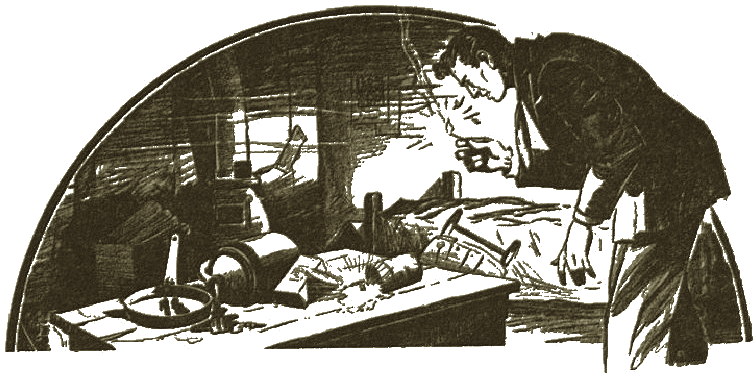
The green object in the mound of sugar caught Scott's gaze.
He reached it in two long steps, bent down, brushed the sugar and toiling ants aside. He drew in his breath, then, with a gasp and carefully picked up the glinting object.
It was a cool, soft green, incredibly beautiful. A stone about an inch long and a half inch wide, cut flat. Scott held it on his palm, and it pulsated, gathering the dim light, until it was like a live thing breathing with its own hushed magnificence.
Scott stared in awe for a long time, and the stone seemed to stare back at him. He moistened his lips and swore in a reverent whisper. And then he felt the unaccountable chill along his spine again, and he froze.
The silence around him seemed to deepen. It was thick, as the air was thick. Scott didn't move, and he could feel a trickle of sweat slide down his temple, along his cheek.
Something brushed lightly against the outside wall of the shack. It stopped and moved again and was pressed close against the wall. There was the sound of breathing, quick and short and harsh.
Scott closed his fist over the green stone. He took a long step backward, toward the door. He waited and then took another. A loose board creaked in sharp protest under his weight.
The harsh breathing cut off short. The side boards of the shack squealed with the pressure of a heavy body pushing itself back and away, and a swaying willow dragged leafy fingers across the rough tar paper of the roof.
Scott reached the sagging door in one jump, slammed it back with a straight-arm thrust, jumped out into the open, whirling aside and crouching.
There was no one in sight at the side of the shack. The brush moved a little, tentatively. Scott's pulse thudded hard in his throat, and he could feel the green stone in his palm, like a flat piece of ice, cold with his own perspiration.
He began to sidle along the path, back the way he had come. He didn't take his eyes from the brush beside the shack, didn't even blink, and his eyeballs began to burn dryly. He went one step at a time, still crouched, ready to jump instantly.
A turn in the path hid the shack and the motionless green of the brush beside it. Scott let out his breath in a long sigh and began to walk faster, still watching over his shoulder. He ducked out under the branches that shaded the little V-shaped piece of beach.
Dade and Mose were in their boat, out from the shore about twenty yards. Dade had a line out, and both he and Mose were watching it with apathetic patience.
"Hey," Scott said.
Dade began to pull the line in, and Mose found the oar and slashed the water clumsily with it, paddling the boat closer. Scott jumped out on the stepping-stones, hopped into the bow.
"Get going."
Dade didn't ask questions. He took one look at Scott's face, dropped the fishing line into a tangle on the bottom of the boat, bent over the motor. He spun it twice rapidly, and it caught with sudden chatter. The boat curved away from the island, leaving a semi-circle of muddy foam in its wake.
Scott crawled back over the seats.
"Trouble?" Dade asked.
Scott nodded. "Somebody else there. I didn't see him. He didn't give me a chance. But I didn't like the way he was acting. Have you got a gun?"
Dade shook his head. "No."
"Neither have I," said Scott slowly. He hesitated for a moment, then opened his right fist and showed Dade the green stone.
Dade blinked at it once and then again. "Whooie! Sure looks mighty pretty. What is it?"
"Emerald."
"Whooie!" Dade repeated, more reverently. "Worth a sight of money, then." He paused thoughtfully. "Makin' yourself quite a considerable profit, ain't you? That Germany money and then this here. If I was to advise you, mister, I'd say take the two of 'em and start movin' away from this neck of the woods. The fella that really owns them might want 'em back."
Scott watched him levelly. "Don't get me wrong."
Dade shook his head. "Ain't gettin' nobody wrong. You play your own hand like you see it."
"I will," said Scott. "Listen, Dade, I want to tell you something. I move around fast, when I get started, and I'm liable to get impatient with people who get in my way, but I move in straight lines. A note for ten thousand Reichmarks and a stone this big—those are things that can be traced. They leave records behind them. They don't pass from hand to hand like a dime. And the person who really owns them—if he's honest— will pay to have them returned."
"Reward," said Dade. "You know, I hadn't never thought of that at all."
"Think of it now," Scott invited. "I may be a little on the tough side, and I may not be any great shakes as a lawyer, but I still don't have to steal to eat."
Dade grinned frankly, relaxing. "You're a hard one to figure, but I sure do like your style. I reckon I'm gettin' kind of pious in my old age. You see, I got Mose to watch out for. If I was to get throwed in the jailhouse, why he wouldn't have nobody to take care of him."
"I know," said Scott.
"A little three-card monte, now," said Dade. "That ain't exactly legal. But it might as well be. It ain't doin' nothin' but provin' what everybody with good sense knows—the hand's quicker than the eye. If you want to pay money to learn, why that's your hard luck. But stealin'—that's something else again."
"Yes."
"Well, maybe I'll go to holdin' revival meetings pretty soon," said Dade. "In the meanwhile, how'd you like to hole up with us tonight? We live over yonder on Rock Point. It's kinda handy to the neighborhood if you was to want to look around a mite."
"The man who was back there at the shack saw me," Scott said warningly. "I don't think he knows I have this emerald, but he might find out."
Dade grinned again. "Me and Mose is pretty able to look after ourselves."
IT was late now, but the night still held onto the heat of the day, hoarding it between black hands, forcing it down on the smoothness of the river until it was like a moist weight that pressed against Scott's chest with each breath he drew.
He was lying under a draped mosquito netting on a cot that stretched slantwise from the door of Dade's shack across the rough plank veranda. There was no roof over the porch, and Scott lay on his back, staring up at the blackness of the sky, thinking about Patches dead and staring up at the sky just as he was doing now, only not seeing it.
Patches. Illiterate and ignorant and shiftless. Dressing in cast-off rags and living in a hut like an animal. And with an emerald worth thousands mixed in with the sugar on his table. With currency worth more thousands in his ragged pockets.
The emerald was in the watch pocket of Scott's trousers, and he reached out to where they lay folded across the foot of the cot to make sure that it was still there. He could feel its flat outline, and he relaxed again, drawing a deep breath. And then he sat up straight, hitting the mosquito net with his head and starting it moving in slow billows.
He held the net away from his eyes with one hand and stared out across the endlessly moving surface of the river. There were lights along the opposite bank, scattered pinpoints that blinked sleepily. But there was another light now, much closer.
Scott slid out from under the net and moved, noiseless on his bare feet, to the edge of the porch. Below him the river lapped gently at some piled stones, made gentle muttering noises to itself.
The light was diagonally out from the point. Scott oriented himself from the edge of the house, got the direction straight. It was as he had suspected. The light was on or close to Two Humps Island.
He watched it, his breath coming a little faster. It was a round yellow blur. Not bright enough for a searchlight. Probably a lantern. It was moving, and then it stopped moving. While Scott watched, it stayed still for several moments, and then it started moving again. Not steadily now, but in swinging jerks.
It disappeared, blinked again. Then it grew fainter, until it was only a glow reflected between close-set vegetation, and then it was gone.
Scott frowned to himself, gnawing at his lower lip. He was sure that the answer to a great many things that he wanted to know was on that island now. But he knew instinctively that he had been very lucky to get away from there the one time he had visited it, and he might not be so lucky again. The unknown who had spied on him hadn't been sure that first time. Not quite sure enough. But the next time—
Scott shrugged impatiently. He went back to the cot, silently donned his trousers and shirt. He put on his shoes and stood up, pausing for a moment and listening. Dade and Mose were both sleeping inside the house, and Scott could hear the gurgling duet of their snores. He took one step toward the door, meaning to wake them, and then shook his head.
Quietly he went down the steps and out along the little rickety dock. It swayed under his weight, and he knelt and groped along its end until he found the boat's painter. He pulled the boat toward him, stepped into it.
This was the rowboat Patches had used when he came to Dade's place and asked to be transported to Dayton Bend. Scott found the warped oars. He untied the mooring rope and began to row out into the river.
He headed along the bank, keeping in the denser shadow there, and he moved slowly and carefully, trying not to splash with the oars. The water gurgled around the prow, sliding past with its gentle, enormous strength. The dark bulk of the shore seemed to stay still, not moving past, and Scott's body swayed back and forth regularly as he pulled on the oars. There was the hiss and drip of water from the blades, the slight creak of a thole pin.
It seemed an endless time before Scott had worked the boat upstream to a point above the island. When he had, he turned out into the river at an angle, rowed to a point even with the island, and then let the boat drift quietly down.
He turned around then and watched alertly, moving the oars only enough to keep the boat pointed correctly. The island drifted toward him, as silent as a black ghost treading the surface of the water. Its shadow reached for the boat and drew it in. Wet leaves touched Scott's cheek. He caught the branch, pulled it gently, drawing the boat in until its keel slid across mud and stopped with a faint jar.
Scott stepped overside. His feet went down into a foot of water, found mud that oozed and finally grew firm enough to hold his weight. He pushed on the boat, riding it higher on the bank, under the protecting fringe of brush. The mud sucked at his feet as he drew them out, and the dense brush was like a damp mat around him, pressing him every time he moved.
He worked along the boat to the prow, and the ground was firmer. He squatted, listening. The night silence seemed to grow in his ears until it was like the booming of a symphony, but there was no human sound, and Scott could make out no trace of the light he had seen. He wondered if he had been mistaken as to the direction in which he had seen it, and he knew he had not been mistaken. That light had been on this island, and it was still here and the person who had carried it was still here.
Scott got up and began to work his way through the brush. The ground was still moist under his feet, thick with weeds that caught at his ankles and pulled with invisible fingers. He thought of snakes and shivered slightly, but he kept on going.
This was the upper point of the island, and if he had kept his directions straight on the twisting path he had followed in the afternoon, Patches' cabin was approximately in the middle of it. He worked that way slowly, hesitating a little before each step, reaching out and separating the vines and creepers ahead of him and holding them so they wouldn't rustle.
He had gone about fifty yards, and he was wondering again if he had been mistaken about the location of the hut, or if he had missed his direction in the darkness, when he saw the light. It was no more than a glow ahead, shaded by the thickness of the brush.
When he saw it, Scott stopped and listened. He stood still for a long time, but the light didn't move and there was no sound. He began to work toward it on the diagonal, going even more slowly now.
The light grew brighter. It burned steadily without a flicker, and it made the bushes and trees and weed clumps into fantastic shapes that waited and watched and did not move.
Scott dropped down on his heels again, and after a breathless pause he reached out with both hands and spread the clump of matted, waist-high grass in front of him. The lantern was sitting in the middle of a little clearing that had been tramped out of the brush. There was nothing moving near it, nothing at all.
Scott stayed where he was. He was wondering if there was someone else, hidden as he was hidden. Someone who had heard him and was now waiting for him.
His eyes grew more accustomed to the light, and he saw that the lantern was sitting on a mound of freshly dug earth. The mound was between him and the hole it had come from. He stood up straight slowly, trying to see over the top of the pile. He couldn't, and be moved quietly aside. He stopped after a few feet, peered again through a protecting mat of brush, and this time he saw the hand.
It was rigid, partially clenched, fingers digging into the soft loam at the base of the lantern, and the light reflected from the white, straining knuckles. It was like a gigantically gruesome spider, hiding there behind the lantern, ready to pounce at the moths that fluttered around the light.
It made the breath catch in Scott's throat, and he could feel the skin draw tight and hot across his forehead. He watched the hand for a long time, and it didn't move or relax its strained rigidity. Finally he stepped through into the clearing and stood there for a moment, ready to dart back into cover at the first sign of any other presence.
There was none, and he approached the pile of dirt step by step. He could see the hole now, a dark cavity scooped in the rich black earth, and there was something in it. Scott came closer and saw the leg first and then the rest of the man's body, huddled face down, pressed there like a flattened, ugly bundle.
Scott knelt beside him. He reached out and moved the lantern a little. Nausea was thick in his throat. The man's head was a dark mass. He had been struck from behind, not once, but again and again until the brutal blows had crushed his skull.
Scott took hold of a limp shoulder, pulled the body up until he could turn it. The face was unmarred, and it was the face of Rafe, Little Lorry's handy-man. He still bore the mark of his fight with Scott—a slight puffiness along the side of his brutal jaw, a half-healed cut above his close-set, small eyes that were wide now and staring at Scott with a glassy surprise.
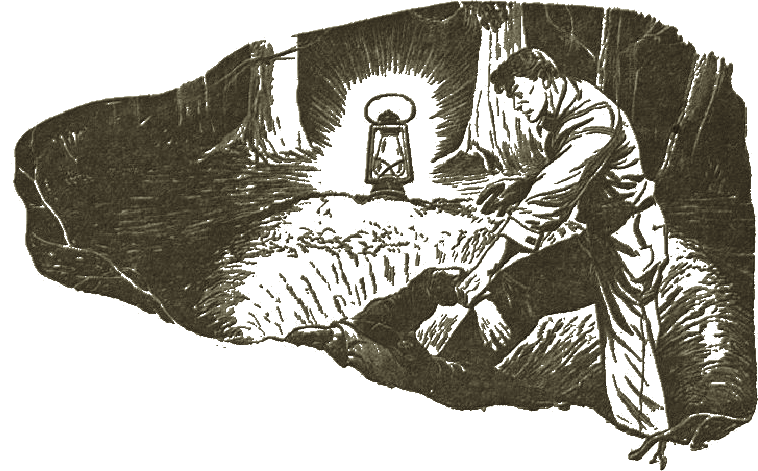
Scott pulled him up, suppressing a shudder.
Scott shivered and let go of the shoulder, and Rafe fell back into the pit with a sodden thud. Something made Scott look up with a jerk, and he stared straight across the clearing, over the top of the lantern, at the white oval of a face peering out of the brush at him, just as he had been peering out a few short moments before.
Instantly, instinctively, he reacted. His right arm shot out in a backhand blow that tumbled the lantern off the pile of dirt, sent it rolling with a clatter to puff itself out smokily among the weeds. He dived straight over the heap of dirt, landed on his hands and knees, rolled over and up again, and dived once more, this time straight at the mass of brush that concealed the peering face.
The brush snapped at him with angrily disturbed branches, and his left hand, groping blindly in the darkness, slid across the smooth, sleek wetness of a bare shoulder, caught a strap of cloth, tore it loose.
He went down on his knees, trying to get his balance, trying to keep hold of the cloth. But the cloth jerked away as the watcher whirled around. Scott felt a sharp pain jerk along his cheek. He ducked automatically, still on his knees, and then lunged ahead, arms spread, trying to catch the other's legs. His right hand caught an ankle, and he had time to be vaguely surprised at the small-boned smoothness of it, and then it slid out of his grasp.
Brush threshed in the darkness. Scott heaved to his feet, plunged ahead. Again his hand slid across smooth bare flesh, and then the other person dodged him and dodged again with a quick, light grace that was only a swirling of dim shadow, and then was gone.
Scott brought up short. Moving brush gave him the direction again, and he charged that way, bent over like a football lineman. He came so close he heard his antagonist's gasp for breath, and then his shoulder hit the solid trunk of a willow, and he spilled over sideways, rolling into dank weeds that lashed across his face.
He was up again almost instantly, but the pause was enough for the other person to get out of his reach, and he heard the quick, light thud of feet running. He ran, too, following the direction of the sound blindly and cursing in a thick whisper because he didn't have some sort of a flashlight.
The ground sloped away under him suddenly and his feet skidded in soft mud. He caught a tree branch and steadied himself with the fresh feel of the open river blowing cool across his face. He was on the bank on the west side of the island, and he jerked his head around, peering both ways.
He saw her just for an instant. She was only about ten yards away from him, knee deep in the water, poised there with a breathless, startled grace, staring back at him over the smooth whiteness of her shoulder.
Scott goggled at her stupidly, his mouth open. She was a slim, lithely white shadow reflected against the opaque sheen of the water. She was wearing a pair of dark bathing trunks and a close-fitting white bathing cap. Scott saw the flat tautness of her stomach as she breathed deeply, and then she dived away from the shore in a gleaming arc, and the water swallowed her up with a gurgle.
"Hey!" Scott shouted.
The water hid her and gave no sign of her presence. The river rolled on, slow and smooth and deep. Scott clutched the branch behind him and leaned far out, staring. He waited until he could feel the breath in his own lungs like a hot, expanding ball that clutched his throat and fought for freedom.
Then, far out in the channel, there was a sudden swirl of foam the flick of a white arm.
"Hey!" Scott yelled. "Come back!"
The arm flicked again in a mocking gesture, and then the white spot that was the bathing cap disappeared once more beneath the rolling smoothness of the surface.
Scott swore in a tightly bitter voice. He could swim passably well, but not like that. That first dive and swim under water had taken her almost fifty yards from the island, and Scott knew she would go approximately as far the next time, and he had no idea in which direction it would be. He waited, watching with painfully squinted eyes, but he didn't see the white bathing cap again.
He shrugged his shoulders at last, giving it up. He turned around, getting his directions straight, and started back through the denseness of the underbrush toward the spot where he had left Rafe's body. He felt his way slowly, pushing back vines and branches that hindered him, while his mind groped with the problem of the girl and her presence here and tried to find some reasonable explanation for her connection with Rafe and Little Lorry and Patches.
Nearing the edge of the clearing, something more than a weed caught his ankle and clung to it. Scott jumped straight backward, his breath hissing through his teeth. The thing still touched his ankle lightly, but it didn't move. It wasn't alive, and Scott relaxed and wiped cold perspiration from his forehead.
Leaning down, he disentangled the thing and found from the feel that it was a piece of wet, smooth cloth. He couldn't see it in the darkness, and he held it in his hand as he pushed through the last of the brush and came out into the little clearing again.
It was almost as dark here as it was in the matted undergrowth through which he had been traveling, and he circled around cautiously, searching for the overturned lantern. He caught a fugitive gleam of it at last, half hidden in the weeds. Picking it up, he found a match and applied flame to the wick.
The wick sputtered for a moment, and the light wavered in smoky jerks, finally steadied. Scott slid the chimney down and examined the piece of cloth he had found.
He grunted to himself, surprised. It was the top half of a woman's two-piece bathing suit. That explained why the girl had been wearing only trunks. When Scott had almost caught her in the brush, he had ripped the brassiere top loose. He squeezed the water out of the cloth, put it in his pocket.
Raising the lantern, he went to the pile of dirt in the center of the clearing. He stopped a few feet away from it and stared at it blankly. For a second his mind was unable to grasp the import of what he saw.
Rafe's body wasn't there. Scott shook his head with a sudden jerk, blinked hard, then stared again. His brain had the whirling, dizzy looseness of a motion picture film running backward too fast. The things that were happening were like a grotesque fantasy, distorted and impossible, making no sense.
He took a hesitant step closer, holding the lantern down low. The body had been there. Scott could see now the dimpled impress in the loose dirt where Rafe's clutching fingers had dug deep into it in his last agonized gesture.
Scott lowered the lantern still closer to the ground and saw other marks. Sharp little holes were punched into the soft ground all around the pile of dirt. Scott stared at them, puzzled, then knelt down and touched one with his finger experimentally. He knew then, suddenly, what they were.
They were the marks of a woman's high-heeled shoes. But then he frowned again, more puzzled than before. They hadn't been left by the girl he had chased. She didn't have any shoes on. She was barefooted. Then-—there had been another woman here. But who? And why? And where was she now?
Scott saw two parallel grooves in the ground. He caught his breath, realizing what they were. Someone had dragged Rafe's body out of the hole, and his sprawling heels had left that unmistakable trail.
Past the thought of any caution now, Scott began to follow them, leaning over with the lantern held close above the ground. They led him across the clearing toward the side opposite that from which he had entered the first time. He stopped at the edge, found a break in the underbrush, edged his way through it.
Trampled weeds and branches gave him the trail here, and he followed slowly, bent over, zigzagging as it twisted around larger obstructions. He had gone perhaps fifty yards, pushing steadily deeper into the matted growth, before the swing of the lantern light picked up Rafe's body.
Rafe was flat on his back. His head was tilted up by some hump of ground under it, and his dead eyes stared straight back at the lantern, glittering a little.
"Huh!" Scott said involuntarily. The lantern shook slightly in his hand, and he steadied himself, breathing hard.
And then there were two other eyes, moving slowly, above and in back of Rafe's. They were not dead, those other eyes. They were alive, with an expanding malignant life, and they were green.
"Huh!" Scott said again, and never realized that he had made a sound,
There was a growl, deep and beast-like. The eyes moved. They were a little above the height of Scott's waist, and a mottled white something crouched there.
Scott took a step backward, and the thing came at him. Straight over Rafe's body in one hurtling leap. It was a black-and-white streaked projectile with teeth that were white knives and a wide red mouth gaping hungrily.
Scott dodged, jerking his left arm in front of his face. The thing hit him with smashing, irresistible force and knocked him sprawling, and the lantern went up and back, flying out of his hand in a flashing, jingling arc that blotted itself out in the darkness of the brush.
The thing was on top of him, bearing him down with its muscular, threshing weight. It was growling, a low-pitched, deadly snarl of sound, and Scott could feel its breath hot against his face. He kicked up, arching his body. Fangs snapped an inch from his throat, caught the sleeve of his coat, ripped it away like tissue paper.
A blinding shaft of light shot down into his face, and a voice called sharply:
"Pepito!"
Scott felt the thing above him stiffen. Growls still rumbled in its throat.
"Pepito! Back!"
The weight was off Scott's chest suddenly, and he sat up, bracing himself on his arms, blinking against the shaft of light that sprayed against his face.
"You are hurt?" the voice asked.
"I don't know," said Scott. "If I'm not, I must have India rubber bones. Turn that light away."
"But certainly. Your pardon."
The light moved down, pooled its brilliance on the ground and showed small, immaculately white buckskin shoes, the bottoms of white flannel trousers with a pin-stripe of delicate blue in them.
Scott swallowed against the thick beat of the pulse in his throat. "Where's that thing that tackled me?"
"Pepito? Here beside me."
The light moved again, reflected greenly from the staring, malignant eyes, outlined the mottled body behind them. It was a dog, but a bigger dog than Scott had ever seen before. Its body was a spotted black and white, and its ears were pointed and laid back flat against the wedge of its head. Bared fangs the size of Scott's little finger gleamed under its lifted lip.
"Pepito," said the owner of the light. "Quiet."
The lip lowered slowly over the fangs, and the eyes lidded themselves slightly, but they watched Scott steadily.
"What is it?" Scott demanded.
"Pepito? But a Great Dane, of course. A very good one. His father was the great Chevalier, the champion of all France, and Pepito is a worthy son. I am sorry that he knocked you down and frightened you, sir. I ask your pardon."
Scott got up slowly, watching the dog. "Who are you?"
"Myself? I am Eugene Gichaud, professor of the University of Paris." The heels of the buckskin shoes clicked softly. "At your command, m'sieu."
"Let's see you," Scott said. "Turn the light around."
The light swiveled around and bathed its owner like a shower of silvery, brilliant spray. He was an incredible little man, as incredible as the girl in the bathing trunks and the body that moved and the dog as big as a yearling calf. He had a round, dark face and popping blue eyes and a white beard that curled in perfectly marcelled waves. A white panama was perched precisely on top of his head. He looked like a roly-poly Santa Claus dressed up for a trip to Palm Beach. He clicked his neatly shod heels and bowed again, waggling the light as he did so.
"At your command, m'sieu."
"HMMM," Scott said, at a loss for words for a second. "Professor of the University of Paris, you said. Do you mean Paris, France?"
"Precisely, m'sieu."
"Aren't you a little off your beat?"
"Eh? You said?"
"I said we're several thousand miles from Paris."
"Of a certainty. Your country has itself indeed a great vastness. I am on my leave sabbatical from the University and doing what you call the research privately."
"Doing private research," Scott repeated thoughtfully. "Does that include dragging dead men around through the brush?"
"I?" said Gichaud blankly. "Dead men?"
"Just one—so far," Scott told him. "He's lying over to your left." The light moved away and picked up Rafe's sprawling body on the grassy earth.
"Ah!" Gichaud gasped. "But I did not know he was there, of course!"
"Of course," Scott agreed. "But you've got some of his blood on the cuff of your sleeve."
Gichaud's face was invisible behind the light, but his voice grew softer and smoother. "M'sieu has indeed the great powers of observations, yes?"
"Yes," said Scott.
Gichaud gestured gracefully with his free hand. "M'sieu, I am filled with the embarrassment. Please forgive my so clumsy effort to deceive. I did move the body of that one."
"Why?"
"I did not wish that it be found here. You perceive?"
"No. Why didn't you want it found here?"
Gichaud lowered his voice confidentially. "M'sieu, I am doing the great piece of research. It will make me of the most famous historically. You are familiar, doubtless, with the name of my great explorer-compatriot— LaSalle?"
"Yes," Scott admitted.
"He who came exploring along this great river long, long ago when here it was nothing but a trackless wilderness, and claimed much of it for his country?"
"I've heard of him," Scott said.
"I am—how do you say—retracing his route. Step by step I have followed him down from what is now Canada, pausing where he paused so long ago, studying. And now! Now, I am close to the greatness of a discovery!"
"What?" Scott asked skeptically.
"I can trust to m'sieu's discretion?"
"Oh, absolutely."
"The great LaSalle left what you call the evidences of his claims. One of the most important has never been found. It is a lead plaque, and on it was carved most carefully his name and his purpose, claiming the whole upper reaches of this river for his country by right of discovery. It is here, m'sieu! Of that I am convinced. On this very island!"
"Yes?" said Scott. "Have you found it?"
"No. Not as yet. But I am close! I have the feeling deep inside me! I am close! And then I will be famous!"
"I'm still wondering why you moved that body."
Gichaud shrugged. "Ah, that? It is so easy to understand. I have spent months, years, on this study. I have spent a great deal of my own money traveling. One, then, does not wish to be cheated at the last moment out of a so-great discovery. M'sieu can understand that, surely?"
"Yes—that. But what about the body?"
"Consider, m'sieu. If the body was found on this island, the authorities would come poking and prying. The sightseers, the curious would come in great trampling droves. They would hinder me, delay me, destroy the evidence I so painstakingly seek. This one is dead. It can not hurt him to move him to the mainland somewhere. Science is supreme, m'sieu. His death is not important in comparison to the work I do."
"It was important to him," said Scott flatly. "It was murder."
Gichaud shrugged again. "Murder? Perhaps. But what is murder? Merely death by another name. Death comes to us all."
"Did you kill him?"
Gichaud turned the flashlight on his own face, and he was smiling in a faintly contemptuous manner. "No, m'sieu. I have things of the greater importance to do. I hear nothing, I see nothing, I know nothing about it."
"So?" said Scott. "Very handy for you. Just what were you doing here tonight?"
Gichaud held up one hand. "Pardon, m'sieu. You have the right to question? You have the authority to show me?"
Scott shook his head slowly. "No."
"I am desolated. Good evening to you. Pepito, come!"
The light swung away, and Gichaud's trim white shoes moved in its flattened, silvery pool. The big dog stood still. His head was turned, ears flattened dangerously. He growled, low and deep and menacing.
"Pepito! Come!"
The dog turned away reluctantly, padded silently after Gichaud, casting a stilt-legged, spidery shadow, moving with gliding lightness.
Gichaud's light moved away through the brush steadily, flickering through the leaves, slowly diminished to a glow with the distance.
Scott turned his own head in the direction the dog had been looking and said softly: "Dade."
"Yeah," Dade said. "Let go of my coat tail, Mose. There ain't nothin' gonna hurt you."
He came up beside Scott, an awkward shadow in the gloom, with Mose a shorter outline clinging close behind him.
"You see Rafe?" Scott asked. Dade's shadowy head moved in a nod. "Yeah. I come up when you was talkin' to Frenchy. Mose woke up a while back and seen you wasn't on your cot and started to howl. Then I hear some yellin' over here, so we come. That there is the damnedest biggest dog I ever see. I sure didn't like the way he was lookin' at me. We sneaked up quiet, but I reckon he smelled us. Who done for Rafe?"
"I don't know. Ever see Gichaud before?"
Dade said: "Mose, now you let go of me and quit your bawlin'. Rafe ain't gonna hurt you. He's dead as a doornail. You mean the Frenchy, Mr. Scott? Sure enough. I seen him around lots. He's been pokin' and pryin' and takin' notes in his book for quite some time. You think he's the one that batted Rafe?"
"I don't know, but I didn't like that story about LaSalle he was telling me. He did give me one good idea, though."
"What?" Dade asked.
"I'm getting away over my bead in this business. I think I'd better line up with some authority. They don't care much for me at the Dayton Bend side. How about the other side? Do you know the sheriff over there?"
"In a manner of speaking," Dade said. "Name's Morley."
"What's he like?"
"Well, now," Dade said thoughtfully, "there's a man that's so dumb it don't hardly seem possible. He runs a general store over on Lomas Road in his spare time."
Scott nodded to himself. "I'll go see him in the morning. Rafe can stay here tonight."
"I don't reckon he'll catch cold," Dade agreed. "All right, Mose, quit haulin' at me. We're goin' home right now. Get out that handkerchief I give you and blow your nose."
THE road surface was thick and soft under Scott's feet, and the sun was a brassy hot ball hanging motionless against the flat background of the sky. The weeds along the road carried a heavy coat of powder-like dust. Heat waves wiggled up in shimmering streaks.
Scott had a handkerchief wadded damply in his hand, and he wiped at his forehead with it occasionally as he walked along. At a turn in the road he paused and looked hopefully ahead.
A hundred yards away a square shed of a building sat desolately in the middle of a field of discouraged looking weeds. The building was unpainted, and some tin chewing-tobacco signs tacked haphazardly against its near wall were startlingly bright in comparison. It had been roofed with tarpaper that was tearing away now in shreds like battle standards of some defeated army. A sagging sign in front said, "General Store," in faded letters.
Scott sighed with relief and headed that way. He came in under the board awning, stopped to take a deep breath and wipe his forehead again with the soggy handkerchief.
The double screen doors of the store creaked dolorously, and a girl came out. She was tall, with a gracefully lithe body and square shoulders that she carried proudly erect. She wore her hair loose, in a long bob, and it was the color of a new penny. She wore a white knitted sweater and a pair of blue shorts. Her legs were long and slim.
Scott started to turn away and then jerked back quickly.
"Well! Hello, there."
The girl stared at him coldly. Her lips were full and soft, and she had a short, patrician nose with tiny freckles sprinkled across its bridge.
"I do not know you."
Her voice had the faintest tinge of an accent. It was fascinatingly low and husky.
Scott grinned. "I know you, though. Even with your clothes on. I've still got part of your bathing suit"
Her face was as expressionless as her voice. "I do not know what you mean."
"Your bathing suit. You lost the top of it last night on Two Humps Island."
"You are mistaken. I have never been on Two Humps Island. You will excuse me, please."
She had a paper bag of groceries under her arm. She walked past Scott and on down the road in the opposite direction from which he had come. Scott watched her go, frowning a little.
"Right pretty girl," said a voice behind him.
The fat man was lounging lazily in the doorway of the store. He had a walrus-like mustache, stained brown with tobacco juice. His cheeks were an unlined, plump pink, and his eyes were as round and brown as a cow's.
"Morley?" Scott asked.
"Yup."
"You the sheriff?"
"Yup."
"I'd like to talk to you." Morley squinted at him. "Sellin' something, be you?"
"No. Not today."
Morley pushed himself away from the door with a laborious grunt. "Set, then." He waddled toward an old auto seat pushed against the wall, plumped himself down in it to the accompaniment of a protesting wail from the overtaxed springs.
Scott pulled up a wooden bench. "Do you know that girl I just spoke to?"
"Yup. Her name, she says, is Navina Ross."
"Does she live near here?"
"Yup. Lives on a houseboat that she's got tied up above Rock Point a couple miles. She's by way of bein' an artist or some such." Morley paused, blinking sleepily at Scott. "Could fix it so you'd meet her all nice and polite and proper for a matter of—say— two dollars cash."
"Two dollars?" Scott repeated blankly.
"Yup. That there's my introduction fee. Used to be three dollars, but I cut it since the repression."
Scott stared at him. "The law enforcement business must be sort of slack in these parts, if the sheriff has to run a get-acquainted club on the side."
Morley grunted disgustedly. "Slack! Huh! This here is the world's lousiest job, I swear it is. Why, a man has got to go cluckin' and peckin' and scratchin' like an old hen with a litter of seventy-eight chicks to make both ends meet. It's terrible. It's got so I got to give rebates on the graft I collect."
"Why don't you resign?"
Morley shook his head sadly. "Wouldn't do a mite of good. They'd just elect me over again."
"Who would?"
"My relatives. I got the biggest, no-goodest bunch of relatives ever saddled on a poor human. They just elected me on account they figured I could support 'em better if I had the salary that went with this job."
"Why don't they go on relief?"
"Hah!" said Morley. "The government dumb, mister, but it ain't noways so dumb as to put my relatives on relief. There's limits to everything."
Scott nodded sympathetically. "I've got a proposition for you. How would you like to have a nice murder in this county? That would pep things up for you."
"Murder?" Morley said thoughtfully. "Well, it might at that. Only, I don't know so much about murders, to tell the truth, and I probably wouldn't know what to do with one if I had one."
"Don't let that bother you. I'll solve it and give you all the credit."
"Ummm," Morley murmured doubtfully. "You wouldn't be gonna do this murder yourself and solve it by confessin' to it, would you?"
Scott grinned. "No. I wouldn't go that far. Do you know Morris, the district attorney on the other side of the river?"
"Now there's a man I don't like," said Morley gloomily. "He's always hollerin' and takin' on about graft and clean government and such, and he's always makin' dirty cracks about me and my relatives. He's a man I don't like at all."
"Good. He's the one we've got to watch. He's going to solve your murder, if you aren't careful. And that isn't all. There's more than murder in this."
"More?" Morley said curiously.
"Yes." Scott took the green stone from his pocket and held it flat on his palm, where it winked and glistened until it was like thick liquid flowing in the sunlight. "There's buried treasure."
Morley's mouth made a round, greedy O below his ragged mustache "Wow! Whooie! Buried treasure! Pirates, huh?"
"Maybe," said Scott, putting the stone away. "Well, are you in with me?"
"I'll tell a man!" said Morley dazedly.
"All right. You make me a deputy, so I'll have some authority to investigate. I want to find out who committed the murder and where he hid the rest of the treasure."
Morley shook his head. "Can't noways do it. Only allowed to have two paid deputies, and I give them jobs to a couple my relatives."
"You don't have to pay me. You have the right to swear in as many unpaid deputies as you happen to need. Hurry up and swear me in now. The murder is over on Two Humps Island, and I've got an idea Morris will be hearing of it pretty soon, if he hasn't already."
THE motor on Sheriff Morley's boat thumped and burped, and the roily water on the floorboards swished monotonously around Scott's feet. There was some breeze on the water, but the sun bore down through it with heat that was like a weight on the back of Scott's neck.
He dipped his handkerchief into the muddy water thrown back from the prow, wrung it out, wiped his face. He looked back to see how Morley was taking it. The fat man was sitting in the stern, staring off vacantly into the distance. His round eyes were sleepily glazed, and his jaw moved regularly as he masticated a sizeable wad of cut plug. He looked as contented as a cow.
"Can't this boat go any faster?" Scott shouted over the motor noise.
Morley shook his head, still gazing at the distance. "Nope. Somethin' the matter with it."
"Why don't you fix it?"
"Fix it?" Morley said vaguely. "What for?"
Scott couldn't think of any good answer. He turned around again, muttering to himself, staring ahead at the moving surface of the river with squinted eyes. The brightness, the heat, the monotonous sound of the motor, the slight, regular surge of the boat as it plowed slowly along, all gave his mind the hazily deadened effect of a sleeping potion. He found himself staring vacantly and absently at nothing, as Morley was doing.
Ahead of them, Two Humps Island took slow form out of the heat haze, like the back of some prehistoric monster poked above the surface of the water. It stayed where it was a long time, and then it seemed suddenly to be closer to them, and Scott roused himself.
The boat thumped its way laboriously around the point, edged in toward the V-shaped break that had been Patches' landing. Scott straightened up with a jerk.
"Look!" he said, pointing.
There was a boat pulled up on the mud near the stepping stones.
Morley nodded casually. "Yup. Somebody else here."
"Hurry up!"
The motor mumbled in groaning protest, slowing, coughed once disgustedly, and then quit. They drifted in. Scott jumped from the prow, balanced on one of the stepping stones, slipped off and went knee-deep in warm water. He splashed up on the land, ran along the path that led to Patches' shack.
He cut around the shack without pausing, bucked his way through the clinging brush, came out suddenly into the clearing where he had found Rafe's body the night before.
Rafe's body was once more in the clearing, at the edge of it now, sprawled stiff and stark and ugly against the creeping green of the rank vegetation, and there were three men staring down at it. They whirled around like three puppets jerked by the same string when Scott broke in on them.
"You!" It was Morris, the district attorney, looking absurdly rumpled and undignified. He wore no coat, and his shirt-tail had come out in back. His thin face was shiny with sweat and sunburn. He had opened his stiff collar, and the knot of his stringy black tie was under one ear.
Hannigan, the detective, stood solidly beside him. In spite of the heat, Hannigan wore a blue serge suit, and its coat was buttoned tightly. He had a cigar in the corner of his mouth, and he shifted it slowly around in his thick lips now, watching Scott woodenly.
The third man was Little Lorry. The heat had taken the life out of his spit-curl, and it hung down between his wide eyes like a yellow exclamation point. He was still wearing a bandage across his nose.
"Him!" he said shrilly. "See! I told you! He's the one that did for poor Rafe! He fought with Rafe in my place the other night. He was layin' for him!"
"So!" said Morris vindictively. "It's you again, is it, Scott?"
"I guess it is," Scott admitted.
"What are you doing here?"
Scott said: "What are you doing here?"
Morris' thin face grew purple. "Scott, you're under arrest! And you won't find it so easy to slip out this time! You'll find that you can't flout the authority—"
Hannigan said sullenly: "Go slow. Somebody else comin'."
Morley came waddling leisurely out of the brush. "Well, I swan!" he said in a vaguely pleased voice. "Well, just look who's all here. Mr. Morris and Mr. Hannigan—and Little Lorry, too."
Little Lorry's plump face was the color of pastry dough. "I—I just come to—to identify..." He took a step away and then another. "Identify... They asked me... Rafe .. . Well, I'll wait at the boat." He ducked back into the brush, and they could hear the crackling of branches as he pushed his way through.
"I swan," said Morley. "Ain't seen Little Lorry for quite some time. Looks the same, though. Howdy, Mr. Morris. Howdy, Mr. Hannigan. Want you to meet my new deppity, Mr. Scott."
Morris' mouth dropped open loosely. "You—your—what?"
"Deppity," said Morley.
"Why, you—you—" Morris stopped and fought for coherence. "You fat, stupid fool! Do you mean to tell me you appointed this—this—"
"Careful," said Scott.
Morris tugged at his wilted collar. "You fat fool! This man is suspected of two murders! And you appoint him a deputy!"
"Yup," said Morley.
"He's under arrest, do you hear that? Hannigan, arrest that man!"
"Hannigan can't," said Scott. "And neither can you."
"Can't! Can't! I'll show you! Hannigan, did you hear—"
Scott said: "You're both out of your territory. You try to arrest me, and I'll arrest you—both of you."
Morris glared at him, "Out of my territory! What're you talking about? The boundary between these two states is the middle of the river, and any fool can see that this island is closer to my side than the other."
Scott shook his head. "You're slightly in error. The boundary between the states is the middle of the channel. The whole channel flows on your side of this island. The island is in Morley"s territory."
"He's right," Hannigan said.
"And now," Scott continued, "just what do you mean by coming in Sheriff Morley's territory and attempting to take charge of a murder investigation?"
Morris' thin body was shaking with rage. "You can't get away with this, Scott! You hear me, you can't get away with it! You've got the upper hand now, by bribing this fat crook! But you won't keep it! I've been investigating you, and I know just about what you've been up to! I know about those ten thousand mark notes that Patches had, and I know that there are more of them and that Rafe was killed because he was after the rest! And you're after them! But you won't get them, do you hear? You won't! I'll fight this through in the Federal Courts! I'll show you that you can't come in here like this and steal—"
Morley said: "G'by, Morris, G'by, Hannigan. Me and my new deppity has got to get busy and hunt us clues and stuff."
Morris pointed a trembling finger. "You wait! You think you're going to get this out from under my nose, you fat crook! But you won't! I'll get that treasure if I have to appeal to the President! I'll take it to the highest court—"
"G'by now, Morris," said Morley amiably.
Hannigan took Morris by the arm, urging him along. Morris jerked back indignantly, turning to point at Scott. "And you wait! Lasius isn't recovering! And when he dies, I'll charge you with murder and make it stick! I'll extradite you and jerk you out from behind that fake deputy's badge and—"
"G'by, Morris," Morley said.
Hannigan propelled the struggling Morris out of the clearing, and the sound of Morris' voice raving profanely came back to them dimly, gradually subsiding.
"Reminds me of a parrot I used to have," Morley said thoughtfully. "Always screechin' somethin' that didn't make very good sense. He don't seem to like you very well."
"No," Scott agreed. "He doesn't. I've defended several petty offenders who didn't have money enough to hire a lawyer. Morris hasn't forgotten some of the things I said about him during the trials. He's not very hot as a lawyer."
"Nor not neither as a district attorney," said Morley. He waddled across and looked casually down at Rafe's distorted face. "Well, Rafe, I told you that you was gonna end up dead and lookin' mighty funny one of these days if you didn't mend your manners. Looks like I was right." He scratched his nose and turned to look at Scott. "Know who might have killed him?"
"Not yet."
Morley nodded. "When you find out—tell me. We might as well haul Rafe in. No use in makin' the coroner come clear out here and fetch him. You take his legs."
Scott said: "I'm going over to Dayton Bend this afternoon and see about Lasius. I don't think Morris will be crazy enough to arrest me, even if he sees me, but he might. If he does, I'll send word by a riverman named Dade. You know him?"
"Dade? Sure. Know Dade well. Right interestin' party, Dade is. I'll be waitin' to hear from you."
THE hospital was a square concrete building on the residential outskirts of the city, and the dappled shadows of the trees that lined the sidewalk moved slowly and tantalizingly under Scott's feet as he walked toward it. His eyes were narrowed in a thoughtfully puzzled way.
There were new pieces in the puzzle now. Three of them. Professor Gichaud, Navina Ross, and the unknown woman who had left her heel-prints near Rafe's body. But the new pieces didn't clear up the puzzle any. They merely complicated a problem that was already so entangled and obscure that there was no sense to any of it.
And still the original question remained as unanswered and unanswerable as it had been in the first place: Where had Patches found those bills and the emerald? He had found them. Someone knew he had found them, and that someone killed him because he had, and killed Rafe because Rafe was looking for more like them. There must be more. There had to be. And the way to find them was not to dig aimlessly here and there, as Rafe had done, but to find the person who had killed Patches, because that person knew where they were. He wouldn't have killed Patches and taken the million-to-one chance of finding out where Patches had hidden the rest. No. He knew.
Scott turned into the walk of the hospital, and a hurried movement at the corner a half block away caught his eyes. Someone had gone around the corner and out of sight with a furtive quickness. There had been something vaguely familiar about that movement. Something that tugged at a chord of memory and reminded him of another, similar movement he had seen somewhere, not long ago.
He frowned, staring at the corner, trying to place the memory. It eluded him, and he shook his head impatiently. He took a step toward the corner and then stopped. If the person wanted to avoid him, there was no use in trying to see who it was. Rows of box hedges, thick ornamental shrubbery, offered a hundred places to hide in the near neighborhood.
Scott went on up the walk, up the high granite steps, through a plate glass door into a small, brown-walled reception room. A nurse at a desk behind a high glass partition looked up at him inquiringly.
"Is Mr. Lasius a patient here?" Scott asked.
She nodded. "Yes. But he is not allowed to have visitors."
"Then could I see the doctor who has charge of his case?"
"Yes. Dr. Fenton has been treating him. He has just finished his rounds, and I think you'll find him in his office at the end of the corridor there."
"Thanks."
Scott went down a long corridor with brown walls and cork flooring. He stopped before a door that had "Resident Physician" printed on its frosted glass panels in small, neat letters. He tapped gently.
"Yes?" a cheerful voice said. "Come in!"
Scott opened the door and went into a neat little office with brown walls and filing cases lined up evenly on both sides. There was a wide desk in the exact center.
"Dr. Fenton?" Scott asked.
The man behind the desk nodded. He was young, short and thickset and heavily tanned. He had blond curly hair that was beginning to thin on the top and he had an amiable smile.
"I'd like to inquire about a patient of yours—a man named Lasius."
"Oh, yes," Fenton said. "Sit down."
Scott seated himself in a chair with tubular metal arras and legs. "He's a friend of mine, and I heard today that he wasn't getting along very well."
Fenton moved his big shoulders. "Well, yes and no. He's not responding as rapidly as I thought he would, but that doesn't mean much. He has a bad concussion—I suppose you knew?—and concussions are funny animals."
"You think it might be—fatal?"
"Fatal?" Fenton repeated, surprised. "No! At least, I certainly hope not. There's no evidence of a fracture. It's just a simple concussion."
"There are no complications?"
"No. He was cut and bruised a bit. Minor contusions and scratches. Nothing serious. The only thing out of the ordinary is that he hasn't recovered consciousness yet."
Scott sat up. "What? Not yet?"
"No, but that isn't anything to worry about. You see, the brain's a peculiar and delicate instrument. It wasn't made to be kicked around like a football. A bad blow throws it out of kilter, shocks, and it takes some time to regain normality. How much time depends on how hard the blow was, the condition of the person receiving it—any number of other things. It's a hard thing to predict correctly."
"I see. Will Lasius be able to remember the circumstances under which he received the blow when he recovers his senses?"
"Can't tell," Fenton said frankly. "I don't think so. Not after that hard a blow. His memory will probably just skip a beat there. Why?"
"I was just—"
There was a tap of knuckles on the door, and Fenton said: "Yes? Come in."
A nurse in a white uniform opened the door. She was short and stocky, and yet she moved with a quick, quiet grace. Her hair was a shiny blue-black, drawn back tightly under the white peaked nurses' cap. Her eyes were a deep brown, almost black. She held a large stiff piece of paper in her hand.
Fenton said: "Yes, Miss Corvalli?" She extended the piece of paper. "Here is the chart."
"What chart?" Fenton asked. "Mr. Lasius' chart." Scott looked up quickly. Fenton was frowning, puzzled. "What about it?"
"You sent for it"
"I sent for it?" Fenton repeated. "Why, no. I didn't. I don't want it. I just got through looking at it."
"But the office called and said you wanted it."
Fenton shook his head. "No. There must be some mistake. I'm sorry, but I didn't send for it."
"Wait," Scott said sharply. "This is Lasius' nurse?"
"Yes," Fenton said. "His private nurse."
Scott looked at her. "Someone called you and told you Dr. Fenton wanted you here?"
She nodded slowly. "Yes. It was the office—" Her hand went slowly up to her mouth. "No! It wasn't! The voice—it was different."
Scott came out of his chair. "Where is Lasius' room? Quick! Where?"
Her mouth was twisted grotesquely. "I shouldn't have left him alone! I didn't think—" She whirled and ran into the corridor.
Scott went through the door after her. She was running down the corridor, desperately fast, and Scott, coming close behind her, could hear the frantic swish of her starched uniform skirt, hear her sobbing gasps for breath.
Fenton's voice sounded behind them: "Here! Here, wait! What—" His running footsteps sounded, too.
The three of them reached a flight of stairs, went up them with the same desperate haste. The nurse reached a door halfway down another corridor, jerked it open, and Scott looked over her shoulder at the narrow white bed with the lumpy form of Lasius lying very still in the center of it. A white bandage covered Lasius' face completely, leaving only an edge of his slack chin exposed below it. The nurse ran to the bed and stood there rigid, making a little horrified moaning noise. Scott looked at the open window on the other side of the room and saw that it gave out on a fire escape and that the screen that should have covered it was lying loose on the iron platform.
Then Fenton burst into the room.
He knocked the nurse one way and Scott the other. He bent over the bed, and jerked the bandage away from Lasius' face. Scott was conscious of the sickish sweet smell of chloroform.
He jumped for the window, then, and looked down through the crisscrossing pattern of the fire escape. He saw her running close against the side of the building, running as lithely and easily as a boy. Just at the corner, she turned and looked back and up at him. It was Navina Ross, and she was gone instantly around the corner and out of sight. Scott knew, then, that it was she he had seen near the front of the hospital when he had come in.
Fenton had the nurse by one shoulder, shaking her. "You! Did you—"
Her smooth face was twisted, her eyes almost dead-black with fear. "No! Oh, no. No, no!"
Fenton whirled back to the bed, feeling for Lasius' pulse with one hand, reaching for his stethoscope with the other.
"What?" Scott demanded. "What is it?"
"Somebody put a pad of chloroform across his mouth and nose and tied it there. Get out of my way!"
"Is he—will he die?"
"No! But it was damned close! Get out of here! You're in my way! Get out!"
The nurse stood, staring wildly, with her hand up over her mouth, her peaked cap askew on her head.
"I should never have left him! Never! Helpless..."
"Shut up!" Fenton yelled at her. "Come here! Help me! Get those bedclothes off him! Get him up so he can breathe! And, you! Get out, I told you! You're in the way! Go to my office—any place! Only, get out of here!"
Scott went out of the room. There were two other nurses running along the corridor toward the room. Scott stood aside, and they brushed past him, and then he went down the corridor and down the stairs to the main floor. His face looked darker, soberly reflective.
He went out of the hospital. On the street, he looked carefully both ways, but there was no sign of Navina Ross, as he had known there wouldn't be. He walked quickly down through the business section of the town to the river front, along it until he came to the same small, isolated dock where they had found Patches' body.
Mose and Dade were waiting there for him. Dade was sitting on the edge of the dock, casually honing one of his jackknives on the palm of his hand. Their boat was tied to the dock, and Mose was perched on the prow dabbling his feet in the water and humming some meaningless, vague song to himself.
"Hi," said Dade. "Figured you'd run across Morris, maybe. Was gettin' ready to go scoutin' the jail."
"Morris has probably cooled off by this time," Scott said. "He wouldn't arrest me unless he let his temper get away from him. But that's his trouble—he does let it get away from him. That's what makes him a bum lawyer. And then he's got a sniff of big money right now, and that always upsets a small-time thinking apparatus like he's got. Do you know where that girl Navina Ross has her houseboat tied up?"
"Yeah."
"I want to go there."
"Right," said Dade. "You got a dollar on you?"
"Just about, and that's all," Scott told him.
"Could I have the lend of it?"
Scott gave him a folded dollar bill, and Dade said:
"Mose, pull your feet out of that water and come here."
"Yes, Dade."
Dade gave him the dollar bill. "You go up to Shanty Young's store and get a quart of gin with that. Hurry up."
Mose went off at a padding, effortless dog-trot. Scott sat down on the edge of the dock beside Dade.
"Somebody just tried to murder Lasius at the hospital. Tied a pad of chloroform across his face."
"Huh!" Dade exclaimed. "They ain't satisfied with just knockin' him on the head, hey? Got to murder him proper. Know who did it?"
"I think so. That's why I'm going to see Navina Ross."
"Ummm," said Dade slowly. He snapped the jackknife shut, put it in his pocket. "Lot of funny goings-on around here. Don't seem to make good sense."
"They're beginning to." Scott was silent a moment, staring down at the moving, muddy water below him. "I've been thinking, Dade. Remember what you said when I asked you about Sheriff Morley? You said he was so dumb it didn't hardly seem possible."
Dade nodded. "Yeah."
"He almost fooled me. He did fool me until we met up with Little Lorry. Little Lorry was scared pea-green of him. And that made me think back a little, and the whole conversation I had with him was phony. He didn't ask any questions. He knew all about what had happened, and I think he was expecting me to come to him. He's actually smarter than a whip, isn't he? That dumbness gag is just a cover-up."
"Maybe. I'll tell you something. That county he's sheriff of, it's twice as big and got twice as many people in it as this one we're in now, but it ain't got a quarter as much crime. And them relatives of his he's always sayin' is no good—one of 'em is the main stockholder in that toll bridge down yonder and another owns the bank at the county seat and another owns the biggest dairy in these parts."
"So," Scott said thoughtfully.
"Yeah. And them two deputies of his ain't no more relations of his than you are. One of 'em used to be a detective in Chicago until he arrested the wrong guy once, and the other is Willie Three."
"Willie Three? That's a funny name."
"He's the ornriest, no-goodest, dumbest, ugliest little devil you ever seen, but he's got a nose better'n any hound-dog. If you was to want him to, Willie Three could trail one of yesterday's clouds across the sky right now."
Scott nodded slowly. "I see. Morley didn't say a thing to me about splitting any reward or anything else."
"He's smart enough to trust you," Dade said.
Scott looked up. "Dade, you and Mose are in for a quarter of anything I get."
Dade cleared his throat. "Thank you right kindly for thinkin' of us." He hesitated, embarrassed. "You keep whatever you come by. Me and Mose ain't helpin' for no money. We kinda like your style, me and Mose do. We talked it over. We liked you from the start."
"Thanks," Scott said, surprised that there was a little lump in his throat. He felt absurdly pleased.
"Me and Mose, we're funny," Dade said. "We're pretty happy, you see. There ain't nothin' we want for, and there ain't a man that can tell us what to do nor when. We got the right to pick our friends, and money don't make no difference to us."
Scott was silent for want of something to say, and Mose came trotting aimlessly along the shore. He had a package under his arm.
"Gimme," said Dade. He unwrapped the package, disclosing a quart bottle of gin. "That's right. How much change you get back? Spit it out, now."
Mose held his hand close to his mouth and four wetly glinting pennies dribbled out of his lips onto his palm.
"Only four?" Dade asked. "You sure you ain't got any more hid in there? Say somethin'."
"No more, Dade. Keep 'em, please?"
"They ain't mine. They're Mr. Scott's."
"Keep 'em, please, Mr. Scott?" Mose begged.
"Sure," Scott said.
Mose popped the pennies back into his mouth and gurgled with a childishly pleased air.
"Don't you go swallowin' them."
Dade said severely. He explained to Scott: "That's his savin's bank. Come on now, Mose. Get in the boat and quit your foolishness. I swear it seems to me you're gettin' crazier every day."
"Yup," said Mose happily.
THE keel of the boat grated gently, and Scott stepped out past Mose onto the smooth, small pebbles that lined the water's edge.
"The houseboat's tied up just on the other side of the point," Dade told him, pointing.
Scott nodded. "I don't think she'll be there now. If she's not, I'm going to search the boat. Pole out a little and watch, will you?" He picked up one of the round pebbles at his feet, tossed it to Dade. "Throw that at the roof of the boat if you see anyone coming."
"Sure," Dade said. Scott turned and went up a path through some thick, waist-high bramble bush, stones sliding loosely under him. At the top he paused and was looking down on the top of a houseboat tied close in against the shore. It was painted blue and white, and it glistened with a clean, new sheen in the sunlight.
Scott walked slowly down the path toward it. There was no one in sight, and he walked quietly across the plank that slanted down from the narrow deck to the shore. The curtains were drawn on the two narrow windows he could see, and the door was closed.
He rapped on it gently and said: "Hello."
His voice sounded small and empty, echoing a little on the water. There was no answering sound. He tried the catch on the door. It was locked, but it felt flimsy. He held onto it with both hands and, bracing his feet, thrust upward and inward with his shoulder against the panel. The lock ripped loose with a sudden splintering tear, and the door sagged back.
After waiting a second, listening, Scott stepped inside. The room reminded him vaguely of the inside of an automobile trailer, narrow and long, with everything fitted with a precise nicety in the smallest possible space. At the far end there was a small range with a gas cylinder beside it, a metal sink with gaily colored dishes in the shelves above it. The place was spotlessly neat as a window display.
Scott went to the closet that was built in one corner, covered with a cretonne drape. There were dresses hanging in a row, and Scott knelt down, looking under them. He found four pairs of shoes. He looked at them all. Every one had low heels, and he remembered that Navina Ross was very tall for a girl.
He stood up, looking around thoughtfully, and then went to a wooden cabinet that was built into the opposite wall. He opened the slatted doors, and a faint, indefinable odor touched his nostrils. There were bottles on the shelves, and he read their labels one after the other, frowning. One, a large round one, had no label. He took that one down, worked the cork out, smelled it. It was chloroform. It was half full.
Putting it down on the table, Scott pried into the rest of the cupboard, found some gauze and cotton bandage wrapped in a neat package. He was unwrapping it when there was a thud on the roof over his head, and in the same second he realized that there was someone in the open doorway. He whirled around tensely.
"What are you doing in my boat?"
Scott let out his breath slowly. "Well I—"
"You break in my door," Navina Ross said. She was wearing a white bathing suit now, and it emphasized the golden tan of her slimly modeled legs and arms, the lithe grace of her body. "You wish to rob me, perhaps?"
She was not afraid. Not even startled. Her low voice had a lazy little edge of mockery in it.
"No," Scott said. "I'm a deputy sheriff." He showed her the small, nickeled badge that Morley had given him and felt unaccountably foolish as he did it, because he knew that she was laughing at him.
Her eyes were contemptuously amused. "A policeman? You are frightening me very much. Shall you arrest me now?"
"No," said Scott, holding onto his temper. "But I am going to question you."
"That will be very interesting."
"I hope so," Scott told her. "Why did you try to kill Lasius today?"
She laughed, a pleasant low chuckle. "I? But I did not. I do not know this—this Lasius."
"You do. Today you were at the hospital. You called his nurse from somewhere near, told her that the doctor wanted to see Lasius' temperature chart. Then you went up the fire escape, put a pad of chloroform on Lasius' face."
"So? I did all that? Then you must arrest me at once, this very instant, no?"
"Why did you do it?" Scott asked stubbornly.
She was still amused. "Oh, but I did not do it. I have told you I did not do it."
"I saw you running away."
"But, no. You are mistaken, surely. I was not running, not this whole day. I have been walking, swimming. But never running."
Scott thrust the bandage forward. "Then what were you doing with this? And that bottle of chloroform?"
She was smiling, and her teeth were even and white. "That? I use it for my painting, surely."
"Painting!" Scott exclaimed.
"But, yes. The chloroform cleans the brushes, the bandage dries them afterward."
"That's the first time I ever heard of doing that," Scott said.
"It is, yes? Then you learn something today, eh?"
"Plenty," Scott admitted grimly. "What were you doing on Two Humps Island last night?"
"But I have told you already that I was not there. I have never been there, no."
"Who else did you see on the island?"
"But no one, of course. If I was not there, how could I see anyone?"
"Do you know Professor Gichaud?"
Her eyes narrowed and seemed to tilt a little at the outer corners. "It is such a peculiar name. No. I do not know him."
"Did you see another woman on the island last night?"
"I was not there. I saw no one."
Scott shrugged wearily. He knew that he was close to the answer to everything. For the first time, it was within his grasp. And it was still just as distant, actually, as it had ever been. There was no further use in questioning Navina Ross. She had made him look and feel foolish enough as it was.
She seemed to read his thoughts, and she stood a little aside, away from the door. "You are going now?"
Scott said: "Yes." He went out past her, feeling her closeness like a palpable force.
Her voice came after him, low and with the mocking laughter deep in it. "I am so glad that you could call. Please, the next time, do not knock on the door so hard you break it."
Scott went across the plank and up the path over the top of the point. Dade and Mose were sitting in the boat waiting for him.
"Sure sorry," said Dade. "I was watchin' the shore, but she come swimmin' upstream. I wouldn't have seen her, if Mose hadn't spotted her when she climbed on board. Sure sorry."
"It's all right," Scott said, getting in the boat. "She's too smart for me, I guess. She made me look pretty funny. She knows the answer to this, but she's not telling."
"Bad," said Mose.
Dade looked at him. "What?"
Mose pointed in the direction of the houseboat. "Bad. Her. Bad, bad."
Dade glanced at Scott with raised eyebrows.
Scott nodded. "I think he's got something there."
"Mose don't very often miss," Dade said. "I want you should go meet a friend of our'n now. Push us off, Mose, and you be careful of that oar blade."
THE lagoon was a long pocket of water that ran back into a flat on an angle from the river. It had an irridescently oily scum on it, and insects swarmed over the boat in humming hordes. Dade steered carefully, cutting the motor speed until its sound was an uneven mutter. Mose was sitting on the prow again, fending weeds away from them skillfully with the oar blade. Twilight seemed to descend slowly and noiselessly, and blue shadows crawled across from the shores that were gradually pinching them in.
The prow cut into a thick green scum, and there were thicker weed-clumps ahead, growing rank and lush. Mose looked back and shook his head at Dade.
"Huh-uh. No more, Dade."
Dade stopped the motor. "This here slew is gettin' shallower all the time. Hell of a mess. River's buildin' a bar across the mouth don't let no fresh water in. Can't use the motor. Get the other oar out, Mose."
Mose loosened the other oar and worked back in the boat dragging the two of them. Scott moved closer to the stern to make room for him and Mose sat down in the seat, placed the thole pins in the holes on either side of him. He dug into the choked water with the oars, heaved, and the boat edged forward reluctantly, riding the weeds under its keel.
"Careful of them oars, will you?" Dade demanded.
Mose rearranged the pennies in his mouth and said amiably: "Sure, Dade. Yes, Dade."
"Well, quit pullin' so hard."
"Yes, Dade." Mose didn't alter the force or the length of his stroke.
"Doggone you," said Dade. "It's lucky you're crazy, or I'd lose my temper one of these days. You know you bust two oars just last month."
"Sure, Dade," Mose said. "Mose very careful."
"You are like hell. Watch where you're going."
"Yes, Dade."
The boat edged into the weeds as Mose followed the channel of deepest water by some indefinable instinct of his own. The boat stopped with a little jar. Mose heaved on the oars, and one of them creaked complainingly.
"Quit!" Dade ordered. "It's on the bottom, you dummy. You can't row us up on the land."
"No, Dade." Mose lifted the oars, sighing, and swung them inboard.
"Go first, Mose," Dade ordered. He nodded at Scott. "You follow him. Watch where he steps. Careful. This mud here is about ten feet deep, and it don't smell so nice when you get it on you."
Mose was up in the prow again. He stepped out, picking his footing carefully, and Scott followed him closely. The water was warm, brackish and muddy, about ankle deep under the weeds. The ground quaked treacherously under Scott's weight.
"Here," said Mose.
He had found the faint trace of a path, and the ground rose with it gently. Brush folded in closely on either side of them, and Scott slapped vainly at insects that buzzed in a weird halo around his face.
Ahead of him, Mose stopped short suddenly, crouched a little. He pounced on something in the path, came up holding what looked like a thick rope. He swung it over his head twice, and there was a dull snapping sound. He hurled the thing away from him, and it splashed in the water somewhere behind them.
"Snake," Dade explained from behind Scott. "Mose always gets 'em that way. Picks 'em up by the tail and snaps 'em like a whip. It breaks their neck. I keep tellin' him he's gonna get himself bit, but he don't pay no attention. You see any more snakes, Mose?"
"No, Dade. No more here."
They came up on level ground. The shadows were so thick that the little clearing ahead of them was like a pool, and Scott could just make out the outline of a hut backed against the brush on the opposite side.
"Hey!" said Dade. "Hey, Dutch!" There was no answer, and Dade said: "Is he here. Mose?"
"Yes, Dade. Inside."
They went across to the hut, and Dade rapped on a sagging panel that served as the door. "You got company. Dutch. It's Mose and Dade." He pushed on the panel, and it gave reluctantly, scraping across the dirt floor inside.
Dade stepped through, and Scott and Mose followed him. The darkness was impenetrable, and the heat, trapped under the low tin-and-sod roof, was so intense that Scott felt himself gasping involuntarily for air, his mouth wide open. He could feel the sweat under his shirt.
Dade struck a match. The yellow flame wavered between his palms, showed the rough walls writhing in shadow, then lowered over the top of a packing box propped up by two-by-fours to serve as a table. There was a broken saucer on the box top, a stub of white candle stuck in it. Dade applied the dying match-flame to the wick, and the light grew slowly, round and unwavering in the dead air.
"Hi, Dutch," Dade said.
The man was crouched in the corner on a tumbled pile of blankets. Scott could see only his face, turned toward them, like a grotesque mask. His eyes were whitish against the mottled yellow of his cheeks. Scott thought of parchment, cracked and old, drawn tight over a skull. The man spoke, and his voice was thick, but so smooth and low and cultured that Scott couldn't believe his ears for a second, and had the hazily unreal sensation of dreaming.
"You cannot fool me, Dade. That is a real man standing between you and Mose. I am not in delirium. That is a real man. He is not a figment of my imagination. He has a physical existence."
"Sure, Dutch," said Dade. "This is Jeffrey Scott. He's a friend to me and Mose. This here is my friend, Dutch, Mr. Scott."
The yellowish face moved a little, nodding gravely. "Ah, then, you are welcome, of course. You will sit down?"
There was no place to sit except the bare dirt floor, and Scott said: "No, thanks," feeling the tightness of his throat muscles.
"Got a present for you," Dade said. He took the bottle of gin out of the hip pocket of his overalls, put it down on the table. "Compliments of Mr. Scott."
Dutch came hitching out of his corner like a gigantic, crippled bug. His clawlike, crusted hands snatched the bottle off the table top, clawed frantically at the cork. He got it out, tipped the bottle up to his mouth. His throat muscles moved in spasmodic jerks. He put the bottle down again, choking, drew a long, sputtering breath.
"Thank you, sir. You are kind."
He squatted beside the table, holding the bottle close against his chest, hoarding it like something precious. His thin body twitched in repeated tremors, and he took another long drink. They watched him in silence, and his breathing finally became more even, slower.
"Want to ask you something," Dade said. "Do you know a fella by the name of Professor Gichaud?"
Dutch's lips twisted wetly in the stubble of his beard. "Gichaud! Faugh!"
"Know him, then?" Dade persisted.
"I have spoken to him."
"Is he doin' what he says he is?"
"Faugh! That imposter! That fake! That poseur!"
Scott straightened up. "You say that Gichaud is a fake?"
"A monstrous fraud! A liar, and a pretender to honors which he does not even comprehend!"
"He is not a professor from the University of Paris?"
"That? A professor? Faugh!"
"Are you sure he isn't?" Scott asked. "How do you know?"
"I have spoken to him. A professor of history, he says! Hah! Does be know the great men in his department at the University of Paris? Does he know Hienel, Laudec. Michèle? Does he know the books and the theories for which they are famous? No! No! He knows nothing! He has never heard of them!"
"Wait," Scott commanded. "Let me understand you. These other names you mentioned—they are professors in the University of Paris?"
"Of course. They are famous—internationally famous."
"Gichaud would know them if he were a professor there?"
"Hah! He would know them if be were a professor anywhere—even in a zoo. But, no! He does not! He does not know the names or numbers of the subjects he teaches. He does not know where his classrooms are, nor what hours the classes meet. He is not only a liar and an imposter and a pretender, he is a fool and an ignorant fool!"
Scott frowned uncertainly. "Have you—any proof of this?"
Dutch put the bottle down, hitched himself back to his pile of blankets. He scrabbled around in the wadded mess of them, came back to the table with a booklet clutched in his fingers. He slapped it down on the box top, fumbled through it with eager, trembling fingers.
"This is the catalogue of the University of Paris. Here is the History Department. You see? The name of every professor is here, whether he is on sabbatical leave, as this dummkopf says he is, or not. Do you see Gichaud there? Do you?"
Scott leaned down close over the candle, scanning the names listed on the smudged page. "No. Perhaps some other department?"
"No! In none of them!"
Scott frowned. "This is a current catalogue?"
Dutch's head moved in a slow nod. "Yes. They send it to me—each session. They—they have not—forgotten." He touched the pages of the booklet with slow, stroking fingers, as though it were incalculably precious, and then be suddenly hid his face in his hands, and he was crying in gasping, tortured sobs.
Dade touched Scott's shoulder and jerked his head toward the door. The three of them went out quietly and left Dutch crouching by the table, with the bottle of gin sitting beside the candle.
Mose was crying, too, sniffling like a small boy, wiping clumsily at his eyes.
"Don't, Mose," Dade said gently. "Don't cry." He nodded at Scott and said in a low voice: "Dutch used to be a professor at the University of Paris—a long time ago."
"Was it liquor that brought him— here?"
"No," said Dade. "Liquor ain't the cause—it's the result. He caught his wife with some other guy—killed 'em both. He was tried and acquitted, but it broke him inside, I guess."
"Couldn't someone—something—"
"No," said Dade gravely. "Dutch just ain't got anything left inside him. He ain't got nothin' to fight with and nothin' to fight for."
"I see," Scott said.
"I figured he might be able to give you somethin' on Gichaud. I didn't know Gichaud claimed he was from the University of Paris until I heard he and you palaverin' the other night."
Scott said: "I think now we're getting somewhere. It's beginning to add up, little by little. I'll see Gichaud tomorrow, and this time he'll talk to me."
"Yeah," Dade agreed. "Come on now, Mose. Quit cryin'. You and me will come back tomorrow and see Dutch. We'll bring him somethin' to eat and fix him up. Don't you cry no more."
"No, Dade."
THE morning was overcast, with clouds piling up in long rolls, black and menacing, over the bluffs on the west side of the river. There was dampness in the air, and the tension that comes before a storm. The first of it, fine, invisible bits of moisture driven hard in front of the wind, felt cool against Scott's face as be followed the steepness of the path up out of the ravine.
He stopped and looked down and ahead of him at the cabin that Gichaud was living in. It was small and white and compact, a summer home with a long, screened side porch. Willows grouped around it trembled gently. A fine dribble of smoke came out of the chimney toward the front of the peaked roof, crawled heavily down over the eaves, scudded away, racing furtively ahead of the wind.
Scott went down the slope, digging his heels in the soft loam, came on the flat in back of the cabin. The ground was drier here, sandy, knee high with weeds. He tramped them down, circling the house, came out on a graveled path that led to the front door. There were two broad wooden steps leading up to it, and he stopped short with his foot raised to step on the first one, looking down at the ground in front of it.
There were two deep little marks dug out of the firm gravel. Scott knelt and touched one of them. They were the marks of a woman's high heels, identical with the ones be had seen near Rafe's body. Scott stood up again, frowning, and stared at the front door, and as he did so, it moved slightly.
Scott stiffened. "Hello," he said.
He could see nothing through the narrow opening. Far off to the west, thunder made a rolling grumble. A larger drop of water splashed against Scott's cheek, and the door moved again, silently, opening wider, then closing again.
"Hello," Scott said, in a louder voice. "Hello, Gichaud!"
Lightning whipped across the sky, made Scott jump involuntarily and blink his eyes. There was silence while the atmosphere waited with a heavy tension, and then the thunder rolled again menacingly.
Scott went up the two steps and pushed the door back cautiously. The living room was a dim cavern, curtains drawn close over the windows. Scott slid inside, blinking his eyes to accustom them to the lack of light, and he caught the odor, then, that filled the room.
His nostrils seemed to pinch shut, and his throat burned with the feel of it. He flattened himself against the closed door, staring, while little crawling icicles touched the back of his neck and he caught his breath and held it to choke down the nausea that gripped him.
Some of the smoke had blown back down the chimney, and it crawled in lingering, slow tendrils around the stone face of the fireplace in the corner. There was something draped, black and charred and horrible, across the grate. Something piled there in ugly stiffness, twisted and stark, smoldering.
Scott forced himself to breathe. He went step by step across the room, closer to the thing, while smoke swirled around it greedily. He leaned down, and he was looking into the dead, greenish eyes of Pepito, the Great Dane. The lips were twisted back over the big fangs in a soundless snarl. Smoke backed down the chimney again before the wind, and the odor of burning flesh and hair became overpowering. Scott backed away, wiping his face with his forearm.
He turned around slowly. There was one door that led to the kitchen, another near it that was half closed. Scott went silently to the second door, pushed it back. He was looking into a small bedroom.
The bed was on the far side, and the covers on it had been rumpled up into a twisted wad. Scott touched them carefully and felt the stiff rigidity under them. Slowly he drew them back and uncovered Gichaud's stark, contorted face. The white curled beard was bedraggled now, matted with blood from the purplish hole just over Gichaud's bulging right eye. Scott let his breath out slowly, and he heard the slightest rustle of movement near him.
He didn't move. There was a closed door at his right. A closet. Still bent forward, he took one step back from the bed, hesitated, and then took another. He was closer against the wall now, out of the line of vision from the keyhole under the knob on the closet door.
He reached for the knob, keeping his hand and arm above it, close to the wall. His fingers closed noiselessly over the slick coldness of the knob. He turned it suddenly, pulled the door open with a violent jerk. At the same instant, he whipped around away from the wall, struck low and hard with his clenched fist at the figure that was falling toward him.
His fist struck with a flat, clean, smacking sound. The figure went down in a sprawl, sliding on a loose rug. Scott stepped forward, put his foot down on one lax, extended wrist. He stooped over, took the automatic out of the unresisting fingers.
He stepped back, then, straightening. "Get up," he said.
Navina Ross didn't move. Her eyes were closed, and she was graceful, even lying sprawled as she was now. She was wearing white slacks and a blue sweater and beach sandals. Her soft lips were slightly parted, and if she was breathing it was imperceptible.
"Get up," Scott said.
She didn't move, and Scott leaned down and flicked her cheek with the fingers of his left hand. Her mouth twitched involuntarily. Her eyes opened, and they were greenish pools, watching him.
"Get up," Scott repeated.
She sat up slowly, groping behind her, supporting herself against the half-open door of the closet. She put her hand up and touched the red splotch below her cheekbone.
"You're lucky it didn't land lower," Scott told her. "Stand up. You're not hurt."
She got to her feet, backed against the angle of the wall behind the closet door.
Scott said mockingly, "You weren't on Two Humps Island the night Rafe was killed. You weren't at the hospital when someone attempted to do the same for Lasius. Maybe you aren't here now, either. But this is the time when you're going to have to prove it—to a jury.
"No! No, no! I did not kill him!"
"And this," Scott said, moving the small automatic. "Is this some new kind of a brush you use for your painting?"
"I did not kill him! You cannot say that! He was here—this way—when I came! He was!"
"You can prove that easily, of course?"
She was breathing in short, labored gasps. "Yes! Yes. I can! My gun, it is clean! It has not been fired! See? You cannot arrest me now! You cannot! That is the proof!"
Scott looked down at the automatic. It was a .25 caliber Mauser—a compact, deadly little gun.
"It is clean!" Navina Ross insisted. "It has not been fired. It has not been fired, ever, since I have had it!"
The safety catch was off. Scott pointed the pistol casually at the open window and fired. The bullet punched a tiny hole in the screen. The empty cartridge case made a little clatter skidding across the floor.
"It has been fired now," Scott said evenly. "And there's the empty shell to prove that it was fired in this room And you're under arrest for murder."
Her words came in an unbelieving, horrified gasp. "You—you will lie? You will say that I—I shot him?"
"Yes," Scott said calmly. He was hoping she didn't know much about ballistics.
"No! You cannot say that! No!"
"I can, and I will. I'll swear you killed Gichaud, and I'll prove it."
"You could not do that!"
"I will. I'll swear that I heard the shot and ran in here and found you standing over the body with this gun in your hand. Our law gives murderers—especially pretty ones—a better break than the Code Napoleon does, but you'd have a tough time wiggling out of a detailed set-up like that."
She put her hand across her lips, and her face was a dead white with her greenish eyes dilated enormously. "You would—do that to me?"
"Unless you talk."
"Talk?" she repeated vaguely.
"Yes. Tell me what this is all about. You know. Start at the beginning, with those ten thousand Reichsmark notes that Patches had. Where did he get them?"
"I do not know."
"Think again," Scott said, jerking his head meaningly toward the body on the bed. "Think hard."
"I swear! I do not know where he got them. But—but I do know who owned them."
"Who?" Scott demanded.
"It—is a long story."
"I've got lots of time," Scott said comfortably. "Go right ahead."
Thunder banged and rumbled, and the cabin vibrated with the sound of it. Wind made a swoop through the willows, then rain spattered spitefully on the roof.
"Talk," said Scott.
She drew her fingers across her forehead. Her face was grayish, and her voice had a dull, beaten undernote:
"Several years ago, in Europe, there was a man who called himself Diderau. He was what you call a promoter—a financier. That was when it first became evident that trouble was coming soon. Unrest and hunger and unemployment and the first rumblings of the men who became dictators."
Scott nodded. "Go on."
"You do not know that feeling here. No. Never have you had that in your country. When there are enemies all around you, everywhere. When it is something in the air, all around you, too, and yet invisible. Coming closer, closer, closer—like the marching tread of an army beating in the air, beating against your brain and your heart and your courage. Until you can feel nothing and think of nothing but fear—fear!"
"Perhaps I can understand—a little bit," Scott said.
"No! You can never understand that fear until you have felt it! Where there is nothing in life that is secure! Nothing! Only fear—ugly and stark and always there—until it becomes a nightmare that always walks behind you wherever you walk. That was what Diderau used—that fear."
"How?" Scott asked.
"He went all through Europe, operating in each capital city in turn. In each country that was torn with internal strife or threatened with enemies from the outside. He took advantage of the fear. He offered to take money and invest it securely— outside of the particular country, outside of Europe. Where no dictator, no war, no revolution could touch it."
"Invest it in what?" Scott said.
"Oh, he had that planned so beautifully! He had many, many companies that owned many properties in places far from where there could be possibly war. In all parts of the world— mines and plantations and great tracts of timber of all kinds. They were owned by his companies, and the companies were—what do you say?—connected."
"Interlocking, pyramided corporations," Scott said slowly. He was beginning to understand.
"Yes. And he would sell the stock of these companies, but it would not be stock like other stock. It would be stock that—that makes something a trust."
"So," Scott said admiringly. "Made the stockholder a beneficiary of a trust, eh? What he cooked up was a series of interlocking investment-business trusts, where the directors act as trustees."
"Yes. That was to make it so that the stock could not be transferred or stolen or seized."
"Mr. Diderau must have been a very clever fellow," Scott commented thoughtfully.
Navina Ross' breath issued through her teeth. "Oh, yes! So clever! Thousands and thousands of people trusted him! Thousands gave him their life savings, so they would be safe. So their children and families would be protected, whatever might come. Diderau had men, many men, working and selling his stocks. Men who were working on percentage—commission, you say. But you did not know that, when they talked to you. They were only interested in your welfare, they said. They could talk so smoothly and honestly and convincingly, looking you straight in the eye, persuading you that you should do this to protect your wife and your children, sheltering them from all future want and suffering."
"The old steam-'em-up gang," Scott commented. "The high-pressure boys."
"They were liars! Liars! And Diderau was a swindler! His properties were not as he represented. They were worthless. And when he had skimmed the cream of Europe, he absconded with what he had taken, leaving his victims helpless, with only their false stock to show for the money that they thought would save them!"
Scott's mouth twisted. The scheme was worse than criminal. It was diabolic. To take advantage of man's awful, aching fear for the safety of his family and dependents, to play that fear up and emphasize it and use it. And then to deliberately smash all hope and leave the victims to struggle in the morass of their own despair.
"My father invested all his life's savings," Navina Ross said in a murmur. "He killed himself when he found what he had done. I have been searching for Diderau ever since that time. My mother died when I was very young. She was English, and it is her name I am using now." She paused a second. "I loved my father more than anything in the world."
The slow quietness of her voice gave the words more emphasis than if she had screamed them.
Scott said: "And Diderau was hiding here?"
"Is hiding here," she corrected. "I do not know what he looks like. Very few people ever saw him to know him. He was careful not to appear personally. He worked through his agents."
Scott jerked his head toward the bed. "You don't think that Gichaud was Diderau?"
"I know he was not. He was one of Diderau's lieutenants. Diderau double-crossed him when be fled with the money they had swindled. Gichaud was looking for him, as I was."
"It looks like he found him," Scott said.
"I thought he would. He was close to Diderau. I have been following him for six months."
"Did you find out who Diderau is?"
"No. But he is close. The ten thousand Reichsmark notes were part of the money he had stolen. There is more—millions more—in jewels and currency of all nations. He had hidden it near here, and the man Patches found some of it."
"What were you going to do with it if you found it?"
Navina Ross said: "He stole my father's life savings. It was not a great deal in your money. Perhaps ten thousand dollars. But he swindled many more, and they have formed associations. They promise to pay a substantial percentage of all swindled money that is returned to them—as a reward."
"Ah!" Scott said. "That's what I've been looking for. The reward. Then I think you and I should join forces."
"Join—forces?"
"Yes. Because you know where to get the reward—and I know where to get Diderau."
She gasped. "You—you know who he is?"
"Yes," Scott said.
There was something under the bed, something white and indistinct, Scott had been watching it out of the corner of his eye, and he stooped over now and picked it up. It was a short, thick pad of gauze bandage. Little tapes of adhesive plaster that had been meant to hold it in place dangled from its edges.
Scott smoothed them out thoughtfully. "Yes," he repeated. "I know who Diderau is."
THE wind had stopped blowing now, and the rain fell with a gentle, steady pattering. It turned the dust in the alley into a thin coating of sticky mud, gathered itself into stagnant pools that moved and reflected the darkness of the sky overhead, made attenuated images of the buildings that grouped around them like aged and tattered conspirators.
"Stay here," Scott said, indicating a niche in one of the weathered walls.
Shadows played darkly across Navina Ross' face, made her features look taut and gray with anxiety. "You will—be careful?"
"Very careful," Scott agreed grimly.
He left her there and went on down the alley. There was a gap between two buildings closed by a shoulder-high board fence. Scott found the gate in it, pushed it back slowly. A rusty hinge groaned, and then he was through the gate and had closed it quietly behind him.
The back yard enclosed by the fence was weed-choked and littered with the refuse of years. Scott picked his way across it to a stained, weather-beaten door. He stopped there, looking around him and listening, but there was no one in sight and no sound but the drip of an eave, the low murmur of the rain.
Scott reached in his coat pocket, closed his fingers around the checked grip of the Mauser. He reached down with his left hand and turned the knob on the door quietly. The catch clicked, and in the same instant, Scott kicked the door wide open, slamming it back again the wall.
"Hi," he said thinly.
The room was small and dimly lighted, and in the far corner there was an old-fashioned desk piled high with a littered mess of papers. Little Lorry was sitting in front of it, and his chair made a sudden squeal as he jerked around.
"You! What—what—"
His fat, moist lips were open, twisted grotesquely. His nose had a red, half-healed scar on its bridge.
Scott's hand moved, and he flipped the gauze bandage on the floor at Little Lorry's feet. "You forgot that. You left it beside Gichaud's bed."
Little Lorry's eyes bulged, and he made a choking sound in his throat. He turned back in his chair, and his hands scrabbled frantically among the littered papers on the desk.
"Don't!" Scott said sharply. "Sit still!"
Little Lorry jerked back toward him, and now he held a snub-nosed shiny revolver in his pudgy hand.
"You fool!" Scott shouted. "No! Drop it!"
Little Lorry screamed, a thin, shrilling sound that was like an animal trapped. The shiny revolver jumped in his hand, and the roar of its report was thunder shaking the walls of the little room,
Scott jerked at the Mauser. Its sight caught on the lining of his pocket, and he fell aside out of the doorway, ducking. Little Lorry's bullet smacked the wall over his head, punched through the rotting wood.
"Don't!" Scott yelled.
The snub-nosed barrel of the revolver moved, centering on his chest. Scott jerked the Mauser free with a rip of tearing cloth. He shot twice, and the sound of the reports was thin and brittle after the roar of the revolver.
Little Lorry straightened up in his chair, stretching himself rigidly. His mouth opened wide, but no sound came out of it. He made a little groping gesture in front of him, as though he were trying to seize and hold the pain that wrenched his fat body. Then he twisted, and the chair went over backward with him and spilled him on the floor. He moved, making aimless crawling motions, and then the life went out of him, and his head hit the floor with a sodden thud.
Scott gasped for breath. His forehead was wet with sweat, and he felt a sick, unsteady weakness in his legs. He got up slowly, pushing against the wall for support.
"Lorry," he said. "Little Lorry."
Little Lorry didn't move. Scott went toward him, knelt and touched him. He got up, moistening his lips, and leaned over the desk.
Little Lorry had cleared a space on it, pushing the crumpled papers back in a pile, and in the space were two thick piles of bills. Scott picked them up dazedly. They were foreign bills, all of them. Reichsmark, lire, francs, pounds. All of them new, crackling, stiff. All of them in enormous denominations. Scott shook his head dizzily, unable even to estimate how much they were worth.
He suddenly wadded them up and put them in his pocket. Backing across the room, be slid through the door, closed it quietly behind him, ran across the back yard to the gate.
Navina Ross was waiting for him in the alley. She gripped his arm hard, and her fingers were trembling.
"There were—shots."
"The fool," Scott said hoarsely, looking both ways along the alley. "He wouldn't listen to me, tried to kill me. Come on. We've got to get back into our own territory. If the police pick me up here, Morris will confiscate the bills I got from Little Lorry and go after the reward himself."
They went down the alley hurriedly, turned out into the first street, turned again at the first corner, and there was more traffic here, pedestrians and shoppers. Scott relaxed slightly, catching his breath, and turned to look at Navina Ross.
"There's one more thing I don't know. What were you doing at the hospital yesterday? I know that you were following Gichaud that night on
Two Humps Island. But who were you looking for at the hospital? I know you were there. I saw you."
Her eyes were clear and steady, watching him. "I was following you."
"Me?" Scott said blankly.
"Yes. I saw you at the island. I thought perhaps you and Gichaud might be in together. I didn't know."
"I see," Scott said. "I just went to the hospital to see Lasius. And that reminds me. I'd better go now and see how he's getting along. Want to go with me?"
"Yes."
THE hospital was a gray cube with the rain misting down over it, softening the sharpness of its angles, streaking in long shadows down from its eaves and window sills. Scott and Navina Ross went up the steps and in through the plate glass doors. The waiting room was quiet, and their feet made a whispering stir crossing it. The reception nurse looked up inquiringly from behind her glass partition, but they went past her and down the hall to the stairway and up it.
Hannigan, Morris' detective, was sitting in a chair tipped back against the wall near the door of Lasius' room. When he saw Scott and Navina Ross, he tipped the chair down on its front legs, got up slowly.
Scott nodded. "Hello."
Hannigan's face was expressionless. "Howdy." He made a gesture toward Lasius' door. "Just sittin' around sort of watchin', since what happened yesterday."
"You won't need to watch anymore," Scott told him. "The case is about closed."
"Oh," said Hannigan. He nodded slowly to himself, as though the words confirmed an opinion of his. "Yeah. I told 'em you'd crack it, I told 'em you had too much of a head start on us." He hesitated. "We wasn't backin' Morris in them screwy plays of his."
"I know," Scott said.
"He's light on brains," Hannigan said. "Well, so long, then."
"So long," Scott said.
Hannigan went on down the stairs. Scott tapped on the door of Lasius' room, and Nurse Corvalli looked out at them with wide dark eyes.
"Can we see Lasius?" Scott asked.
She nodded hesitantly. "Yes. But not for long."
She opened the door wider, and Scott and Navina Ross went in the room. Lasius was sitting up in his bed. The white bandage around his head looked like a weird, top-heavy turban. He smiled at them and moved one hand slightly.
"Hello, Lasius," Scott said cheerfully. "How are you?"
"Much better, thank you," Lasius said.
Nurse Corvalli interrupted disapprovingly. "He is very weak. He is not to talk."
"He won't need to," Scott assured her. "This is a friend of mine, Lasius. Her name is Navina Ross."
Lasius nodded weakly and smiled at her.
Scott said: "You know, we started something the other night, and I've been working on it ever since. Have you heard about it?"
Lasius nodded again. "They—told me. I cannot remember—much about it—as yet."
"Sure not," Scott told him. "You got a tough rap on the head. It'll come back to you later. It was a mighty mixed-up business, anyway, but I think I've got it pretty well straightened out now. Shall I tell you about it?"
"Yes, please."
Nurse Corvalli was stirring a brownish mixture in a glass of water. She got a glass drinking tube, went to the washbasin and rinsed it. Coming back, she put it in the glass, handed it to Lasius.
"Drink this first, please."
Lasius made a wry face at Scott, raised the tube to his lips. Scott watched until he could see the brown liquid rising a little in the tube, going up toward Lasius' lips, and then he said quietly:
"Don't drink it, it's poisoned."
The glass tube rattled, spilled out of Lasius' stiff lips. The glass slipped in his hands, hit the edge of the bed, broke on the floor, scattering its contents in a widening brown splash. Lasius' eyes were horror-stricken, and he pointed a trembling finger at Nurse Corvalli.
"You—you—"
"No! No, no!"
Scott said: "No. She didn't do it. It was my little friend, here." He nodded toward Navina Ross. "She slipped it into the glass when the nurse's back was turned."
Navina Ross stood rigidly still.
"Didn't you?" Scott asked her.
She moved her slim shoulders, then, indifferently. "Yes. Do you, then, have eyes in the back of your head?"
"No," Scott said. "I'm just a good guesser."
Lasius' hands pawed at the covers. "You! But why—"
Navina Ross' eyes glowed like a cat's, staring at him.
"There will be another time."
"Oh no there won't," Scott contradicted flatly. He took the Mauser automatic out of his pocket. "You never told me that one of your names was Diderau, Lasius."
Lasius' face grimaced uncontrollably.
Scott moved the automatic. "Yes. Your name is Diderau. Navina Ross, here, won't get another chance at you, because you're going to hang. You killed Patches and Rafe and Gichaud."
Nurse Corvalli screamed. She struck Scott from behind, throwing her body hard against his, seizing the wrist that held the Mauser, wrenching at it frantically.
Scott tried to jerk away. Lasius was squirming on the bed, reaching under the covers. Then Navina Ross struck Nurse Corvalli in the face with her clenched fist. She struck her again and again, knocked her away from Scott. Nurse Corvalli stumbled over the metal-legged stand beside the bed, sent it crashing on the floor, and then she sagged against the wall.
"That's enough!" Scott said sharply. "Hold it! And you, Lasius! Bring your hands out from under those covers—slowly!" Lasius' hands moved into sight. His fingers were twitching, and his body seemed shrunken and deflated. Nurse Corvalli sank until she was sitting on the floor. Her white peaked cap had been knocked off, and her sleek hair straggled down over her face. She stared with haunted, terrorized eyes. Navina Ross watched her, breathing hard and quick.
Scott said: "You were clever, Diderau-Lasius. You had hidden your swindled money in several places, I think. Patches found some of it, by accident. He didn't know what it was—who it belonged to. But when be came into your store that night with the Reichsmark note—you did. You put up a show to fool me, got rid of me as soon as possible by sending me after Patches. And you too went after him. You killed him—got the other notes he was carrying. Then you went back to your store, turned out the lights, and waited for me. You knew I'd come back after I found Patches, and you wanted that other note I had. You attacked me, knocked me out, got the note. You ran out into the alley, around to the back door, and in again. You rammed your head against your safe and knocked yourself out."
"A lie," Lasius whispered. "Lie ..."
"No. The truth. It was very clever. Who would ever suspect Lasius of having anything to do with that night's work when he was one of the victims? Who would suspect him of Rafe's murder or Gichaud's when he was helpless in the hospital, covered by his confederate who was a nurse and could conceal his absences from his room and tell him how to fake symptoms in order to fool his doctor?
"The very next day after Patches' murder, you sneaked out to his island shack to find any of the rest of the money or jewels he may have hidden around the place. You saw me come there. You didn't dare let me see you—weren't sure enough yet of what I knew to risk tackling me. I scared you off; You—and Nurse Corvalli— came back that night. Rafe saw you, and you killed him. You had to. If he knew you were able to be around, it would spoil your alibi. And, although you didn't know it then, two other people saw you. Navina Ross and Gichaud.
"Navina Rosa saw you and knew you must be Diderau. She didn't care about the money. She wanted revenge because your swindle caused her father's suicide. She tried to kill you here at the hospital the next day, with the ether pad. You were doped, then, or she couldn't have done it. Nurse Corvalli had given you a hypodermic so you would show the proper symptoms of concussion. Gichaud came to see you too, and put the bite on you for some of your swindle loot. You gave him some, promised him more.
"Last night, you killed him. Gichaud kept that dog of his around because he was a heavy sleeper, and he was afraid. But it didn't do any good. You knew the dog, and the dog knew you. You—and Nurse Corvalli—got the dog outside and killed it, and then you shot the sleeping Gichaud. You burned whatever papers Gichaud had that would link him up with Diderau, threw the dog in the fireplace. You left some bills with Gichaud, so people would link him up with Patches' death, think he did it. But Little Lorry spoiled that frame. He had been sniffing around, after some of that money, and he had picked up Gichaud's trail some way or other. He came to the house after you had left and searched it. He found the bills you had left. But he was so frightened over Gichaud's death—because he thought he might be blamed for it—that he tried to shoot me today when I went to ask him what he had been doing out there."
"Proof," Lasius whispered weakly. "You have—no proof."
Scott took a penknife from his pocket, snapped the blade open. He stepped forward, jerked Lasius' pillows aside and uncovered a bulging hot water bottle. The penknife's blade made a sharp rip, cutting down its side, and the rubber folded back to show bills packed in it, pressed down tight.
"Proof?" Scott said. "There's some. And there'll be more;—a lot more. I'll find it—in your store, in your home, in Nurse Corvalli's apartment."
"Right lot of money," a voice said amiably.
Scott whirled around. Sheriff Morley was standing in the doorway, leaning back, his hands folded comfortably over his paunch. His eyes were blandly lazy, and he was chewing slowly and aimlessly at a cud of tobacco that bulged his cheek.
"How'd you get here?" Scott demanded.
"Me?" said Morley. "Oh, I had a man followin' you around, and he called me when the smoke started gettin' thick." He gestured toward the window.
Scott looked and saw a hat. Apparently it was just a hat and nothing else, sitting on the window sill. It was a stained black hat, wet with rain now, soggy and shapeless and so old it was greenish around the band.
"It's Willie Three," said Morley. "He's a little shy with strangers."
The hat moved slightly, and a pair of eyes peeped over the window sill at Scott. They were close-set eyes, bright and unblinking, and there was something unnerving in their motionless, steady stare.
"Watch the fella on the bed," Morley said.
The hat dipped in a shadow of a nod, and the eyes shifted to Lasius.
"You did a right smart lot of figurin' on this case," Morley commented. "Right clever."
Scott shook his head slowly. "Guessing, most of the time. I figured on it until I was dizzy, and I still couldn't see how it added up. I couldn't see how anybody that appeared in the case could or would do all the things that had been done. I finally got around to Lasius, because he was in it at first. And then, if it were he, his nurse would have to be in it, too, and that explained the high heel marks, and also she was too concerned when Navina Ross tried her little ether trick. She was too concerned before she knew what had happened. Why should she think Lasius was in immediate danger of violence? Why should she think she shouldn't have left him alone and helpless even for a moment? When I got that far, then all the pieces fitted together all of a sudden, but if I'd guessed wrong on that hot water bottle, I still wouldn't have had a bit of proof."
Morley shifted his cud and winked ponderously. "I see you met Miss Ross without no help from me. I got things under control here, if you was to want to tell her somethin'—in private."
She smiled.
Scott shook his head, sighing. "No. I guess not."
"Right pretty girl," said Morley.
"Yes. But she can look you right in the eye and lie like a trooper, and I'd always be wondering if some morning I wouldn't find a little ground glass in my porridge."
"Somethin' in that," Morley admitted. "You know, one of my paid deputies—fella by the name of Trayner—got himself a government appointment a day or so back. He's goin' to Washington to be one of them F.B.I. men. I'm needin' another deputy now. Like the job? Of course, it ain't much to start, but a smart fella like you, he could work up. He could be sheriff, pretty soon, on account I'm gettin' tired and my relatives would vote for him. And then he could go to the state assembly, maybe, and then the state senate, and then maybe get himself elected governor, or United States representative, and pretty soon get himself voted United States senator—"
Scott grinned. "Wait! Don't elect me President just yet. I'm not old enough." He chuckled. "Mr. Morley, you've hired yourself a hand. Shake on it."
Roy Glashan's Library
Non sibi sed omnibus
Go to Home Page
This work is out of copyright in countries with a copyright
period of 70 years or less, after the year of the author's death.
If it is under copyright in your country of residence,
do not download or redistribute this file.
Original content added by RGL (e.g., introductions, notes,
RGL covers) is proprietary and protected by copyright.