RGL e-Book Cover
Based on an image created with Microsoft Bing software
Roy Glashan's Library
Non sibi sed omnibus
Go to Home Page
This work is out of copyright in countries with a copyright
period of 70 years or less, after the year of the author's death.
If it is under copyright in your country of residence,
do not download or redistribute this file.
Original content added by RGL (e.g., introductions, notes,
RGL covers) is proprietary and protected by copyright.
RGL e-Book Cover
Based on an image created with Microsoft Bing software
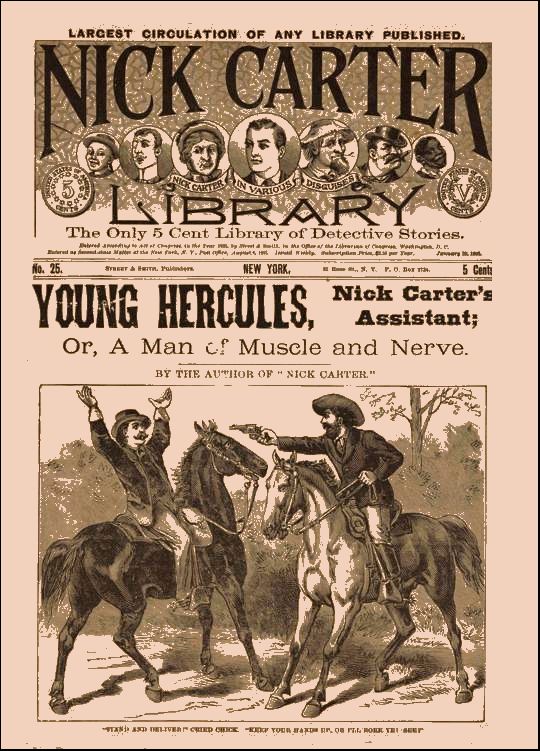
"STAND and deliver!"
"Hello! Who are you?"
"I'm a collector of tolls. Keep your hands up, or I'll make a hole for this moonlight to shine through in your carcass.
"Confound you! What d'ye hold me up for?"
"'Cos I want your boodle, stranger."
"Who are you?"
"I told you once, I'm toll-collector."
The scene described took place on a lonely road not far from the Boston Mountains, in the extreme eastern part of the Indian Territory, and most within rifle-shot of the Arkansas line.
A horseman, riding along the road, had just entered a strip of woods which fringed the river, when another horseman dashed suddenly out before him, and with a six-shooter aimed directly at his heart, gave the order to "stand and deliver."
"Well," exclaimed the man, who had been so suddenly "held up" on the road, "yer barkin' up the wrong tree, pard stranger. I ain't got no boodle."
"Ain't, eh?"
"No."
The highwayman grinned.
"Maybe I look sorter green," he said, slowly. "Any-how, I ain't got no time ter parley with you. You've got three thousand dollars in cold cash in yer clothes, an' I want it. Jest chuck it onto the ground, an' I'll pick it up when you've gone, see?"
"Curse you!"
"Thanks. Say!"
"Well, what?"
"If ye try to play any gum games like springin' yer shooter onto me when yer gittin' the boodle, I'll bore ye; see?"
The unfortunate victim uttered a volley of oaths that would have done credit to the captain of a canal boat.
"Swear away," said the highwayman, coolly; "'twon't do ye no good. Come, fork over! My finger's leanin' sorter hard like, ag'in the trigger of this gun o' mine."
Another avalanche of oaths followed, and then the man's right hand slid gently down toward the place where he carried his revolver.
"Say," said the highwayman; "d'ye wanter die?"
"No, curse you."
"Well, ye will, ef yer hand touches yer gun, 'r the place where ye carry it; see?"
"My money's in that pocket."
"Yer a liar!"
The victim's face became fairly distorted with fury, but he thoroughly realized the fact that he was utterly at the mercy of the highwayman.
"I know where ye put the money when ye got it," continued the robber, coolly, "an' I'm gittin' mighty impatient o' waitin', too. If ye don't chuck it on the ground instanter, I'll put you there; see? one, two, three—"
"Hold on! I cave."
"That's right."
"The boodle is yourn."
"Correct."
"Won't you divide, pard road-agent?"
"Divide?"
"Yes."
"What fur?"
"It's all I've got."
"Well, ye know where ter git more in the same way, don't ye?"
"Do you know where I got it?"
"Yes."
"The devil you do."
"That's wot I said."
"Where did I git it?"
"Out of an express car."
"Eh? What?"
"Bah! you heard me, didn't you?"
"Are you the devil?"
"No."
"Who are you?"
"My pards call me Dandy Dan. Now, you've talked enough. Fork over!"
"You won't divvy?"
"No—not now."
"What d'ye mean by that?"
"Nothin'; fork over!"
The victim thrust his hand in the pocket where the money was concealed, and, with an oath, threw a package upon the ground. Then he seized the bridle and started on.
"Halt!" said the highwayman, sternly.
"Well, what now?"
"I want all the boodle."
"There it is."
"Yer a liar, mister man. Ye've got two more bundles jest like that one. Shell out."
The man swore more furiously than ever.
But there was no help for it, and two more packages speedily followed the first one.
"That is right," said the highwayman; "now, ye kin light out es soon es ye like. Skip, an' don't ye dare to turn yer head 'r lower yer hands till ye reach the crossroads; see? If ye do, I'll bore ye. March!"
The man started on, still keeping his hands high in the air. But when he reached the crossroads, he wheeled and drew a revolver, intending to take a shot at the form of the highwayman, even though the distance was so great that he could not hope to reach him with a bullet.
But the man had disappeared.
Horse and rider were both gone; although the road was perfectly straight, and the nearest turn was a mile away, there was no sign of the highwayman, or of the horse that he rode.
"He's gone back into the woods," muttered the man who had been robbed. "All right, Dandy Dan, as you call yourself, I'll get even with you, as sure's my name is Dick Donovan."
He rode on then, going more rapidly than before.
Presently a grim smile relaxed his features.
"Blamed if 'tain't a joke, all but the loss of the boodle," he muttered. "After all the 'holding-up' on the road that I have done, to be held up myself is rather funny. Cussed if he didn't get my three thou., in great shape, too. But I'll get it back, Mr. Dandy Dan, or I'll quit the road and go to working for a living."
Then he started his horse into a rapid canter, and soon disappeared.
Let us return to the highwayman.
He watched the man whom he had robbed, until satisfied that he would obey the orders that he had received.
Then he leaped lightly to the ground, picked up the packages of money, and springing again into the saddle, dashed back among the trees from which he had so suddenly made his appearance, and disappeared.
He rode along through the undergrowth, following what had once been a well-defined path, until he reached a brook.
Straight into the water he guided his horse, and, turning against the current, followed up the stream for about a quarter of a mile.
His course carried him to a point where a smooth ledge of rocks inclined to the water's edge, and there he turned abruptly to the right, and proceeded a quarter of a mile farther.
Presently, he rode straight toward a precipitous ledge, until his horse's nose almost touched it.
There he dismounted.
Before him was what appeared to be the smooth face of a cliff, but he stepped forward and seized hold of an old root that projected from a crevice in the rocks, and pulled sharply upon it.
A section of the massive cliff swung out, revealing an opening which was sufficiently large to admit his horse.
He seized the bridle, led the faithful animal through, and closed the door behind him, leaving absolutely no trace of where he had gone.
The door which he had opened to admit him to the hiding-place that was so well concealed, was made of wood, but so cleverly designed in imitation of the rocks which surrounded it, that a man might have ridden back and forth before the cliff all day long without discovering the secret that was a part of it.
The space behind the door was not a cavern, but a narrow canon, much wider at the bottom than at the top, but not exceeding twenty feet in width, at its widest part.
From that, it narrowed down, so that there were places where a man could barely squeeze through.
The canon extended back into the foot-hills several hundred yards, and ended abruptly at a circular basin, twenty feet in diameter, surrounded by rocks which had been worn as smooth as polished marble by the action of the water which, ages before, had dashed into this circular hole from above, and had found, or rather worn its way out through the channel which had afforded the highwayman a means of entrance.
Looking up, the place reminded one of the inside of a shot-tower, for the distance to the top was fully sixty feet.
The water had doubtless been for centuries engaged in grinding out the softer rock and forming the remarkable basin described. Then had come a convulsion of nature, which had turned the torrent aside or caused it to cease altogether, and the strange canon was the result.*
*The writer has visited the place described. During the time when the authorities of the State of Missouri were engaged in breaking up the famous organization of bandits known as the Younger gang, the canon was used as a hiding-place for one of its members, who remained the only one not captured. For five years he alone defied the law and the officers who were sent out to capture him, although five thousand dollars reward were offered for his capture, dead or alive. He knew of this canon, and having cleverly concealed the entrance to it, as described, always retired there when too hotly pursued. At length he became tired of the life, in which he was forced to look upon everybody as his enemy, not daring to trust any man. But he had a relative in whom he placed far more confidence than in others, and he finally persuaded his Uncle John to go to Jefferson City, Mo., and say that on condition that he was pardoned, he would settle down on a farm, and become an exemplary citizen. The proposition was accepted, and Charlie Wells gave up his wild ways forever. He now lives (or did in 1887) on a farm about thirty miles due south of Kansas City, and about a hundred and twenty-five miles from the canon mentioned. When Chick found that his duties carried him to that part of the country, he applied to Wells for points, and among them was told of the canon. Let the story tell the rest.—THE AUTHOR
ON the day following the events already described, an incident that was almost exactly like its predecessor happened at the self-same spot.
A man who was riding along the road, was taken unawares by the sudden appearance of Dandy Dan, who got the drop on him before he realized that he was in any danger.
He cursed and swore very much as Dick Donovan had done; but all to no purpose.
He was relieved of his cash in the same manner, and although he did not carry as much, the highwayman was a thousand dollars better off after the encounter.
"Four thousand dollars in two days," he muttered, when he was again safely concealed in his retreat. "That would be doing fairly well, if I was in this business for keeps, or even for my own gain; but I'm not—quite.
"I wonder what Nick would say if he could see me play the highwayman, or what Superintendent Damsell of the Adams Express Company would exclaim, if he knew that I have at this moment four thousand dollars which was taken from the express car at the Glendale robbery?
"I might send it to them, but I won't until I find out that I don't have to use it in making myself solid with the gang.
"There is one more to come, and he should have between five and six thousand with him, unless my information is away off."
On the following day, at about the same hour, the strange scene was repeated.
A third man was held up and robbed at the same place, the highwayman securing five thousand five hundred dollars.
"Nine thousand five hundred dollars of the express company's money," mused Chick—for it was he who was playing the outlaw—" and all in three days. The balance will go the other way, and now will come the warm work, when they lay for me and try to get their money back again."
Every robbery had occurred just after dark, or rather after the hour of darkness, for the moon was so bright that the road was well lighted up.
Chick, whose early training in Nevada had thoroughly prepared him for the work in hand, had planned every move with extraordinary care and ability.
When he told the victim of his third assault to ride on and not to dare to turn his head, the man, whose name was Clell Dempsey, obeyed without a murmur.
He had held up enough men on the road and in other places, to know that an order like that was never idly given.
Like Donovan, when he reached the crossroads, he wheeled, revolver in hand, ready to fire.
But the highwayman was gone.
"I wonder if the other boys got through with their boodle?" he muttered.
"Maybe they'll think I've bilked 'em," he continued after riding on a ways, "but, by thunder! I'll kill the first man that says such a thing."
He meant what he said, too, for he examined his revolver, and in every way made himself ready for quick action.
Suddenly he paused.
His quick ear caught the sound made by horses galloping over the road, and he reined his own animal in at one side and waited.
Presently six horsemen came into view.
They were riding rapidly, evidently bent upon reaching a certain spot.
"Halt!" shouted Dempsey, when they were exactly abreast of him in the road.
The horsemen reined in so quickly that the animals were thrown back upon their haunches, and six revolvers were drawn and aimed at that point in the bushes from whence the command had come.
But Clell Dempsey had recognized his friends in the men whom he had so suddenly stopped on the road.
He shouted out his own name, and the revolvers were instantly lowered.
"Hello, Clell!" cried the leader of the six men. "What are you doing there?"
"Waitin' for you fellers."
"Here we are."
"Why didn't you come sooner?"
"Why?"
"You might have saved my boodle for me."
"Eh? What?"
"Heard me, didn't you?"
"Yes."
"I've been held up and robbed like a blasted tenderfoot. I didn't get a show, either. Had to fork over, like a bank-president, chuck my dust on the road and ride off with my hands touching the stars, 'r cussed near it. The galoot knew what I had with me to a dollar, too, and I couldn't fool him nohow. Maybe you fellers 'll think I've bilked you, but the first galoot that says so turns up his toes."
The men were all angry, but a smile went the round of their faces, nevertheless.
"You've met Dandy Dan," said Donovan, "and he's robbed you. Is that the story you're trying to tell?"
"Yes."
"How long ago?"
"Less than half an hour."
"We thought he'd do you up, and were on our way to see you through."
"Why didn't you wait till the day after to-morrow?"
"We thought we were in time."
"Nice lot you are. Who is Dandy Dan, anyhow?"
"He's our meat before morning, if we can find him."
"Come on. I know where he was a half-hour ago."
"So do I."
"How do you know?"
"He went through me first, Clell, and then he tackled Baldy Blake. He took three thousand from me, one from Baldy, and over five from you."
"Well, I'm blowed!"
"So am I."
"Why didn't you warn a feller?"
"We tried to."
"How?"
"Sent Sandy to put you off onto another trail. He missed you and only got back a little while ago. We started out to meet you as soon as he came."
"You'd oughter have laid for this Dandy Dan, anyhow."
"Well, we'll rob him now."
"Come on, then."
The seven horsemen started back over the road toward the place where the robberies had occurred.
When they reached it, there was not a sign of the outlaw to be seen.
Dick Donovan dismounted, and spent nearly half an hour in a close examination of the ground.
The moon was so bright that he could see perfectly well, and he had no difficulty in discovering the hoof-marks, made by the horse that the highwayman had ridden.
Presently he returned to his horse, and, leaning upon the saddle, he said:
"You were over there, Clell, when Dandy Dan was making you shell out."
"Yes."
"And his horse stood right there."
"Right."
"Why did you chuck your wad into the bushes?"
"How'd you know I did?"
"Because I'm not a fool."
"Anybody'd think you saw it all."
"I didn't, as the boys will tell you, but I know that you threw the money into the bushes over there, and that Dandy Dan picked it up when you left. A fool could tell that much by the look of the bushes and by the tracks on the ground.
"I know another thing, also."
"What's that?"
"When Dandy Dan picked up the boodle, he did not come back upon the road, but kept right on among the trees."
"Well?"
"He's got a hiding-place somewhere in these woods, but we must wait for daylight to find it."
Every man there knew that it was utterly useless to attempt to follow a trail in the woods after nightfall, no matter how bright the moonlight, and that there was nothing to be done before sunrise.
But they remained where they were, tied their horses, and made themselves as comfortable-as possible.
As soon as the sun was up, the search began.
Donovan led the way, for he was skilled in woodcraft, and he had no difficulty in keeping the trail as far as the brook.
There, it was lost.
The men divided, part of them going down the stream, and part of them in the opposite direction, eagerly searching the banks on either side, in the hope of finding the spot where Dandy Dan's horse had left the water.
At noon, they met again, both parties having gone far enough, so that they were satisfied that they had passed the spot.
But there was a surprise for them when they met.
There was a square piece of paper pinned to one of the trees by a bowie-knife.
Going close up to it, Dick Donovan read the following message:
"To Dick Donovan,
Train-robber and Express-thief:
Why do you look for me? You cannot find me unless I choose to let you. You are all chumps. I have watched you all day long. I could have killed you one by one, without danger to myself. If you come here again, I may do it. Get out! I have got your boodle, and I'm going to keep it. If you camp out here on this brook, you will never see me, although I will be within pistol-shot every day. If you want to say anything to me, write it on the back of this note, and leave it where you found this. Now skip, and unless you have been measured for a grave, don't bother.
Dandy Dan."
"What d'ye think of that, boys?" asked Donovan, when he had read the note aloud.
"I think he's a daisy," said one.
"Tell you what!" exclaimed Dempsey. "I vote that we have a fight."
"Who with?"
"With Dandy Dan."
"Find him first."
"That's easy."
They all laughed loudly.
"Dick," said Clell Dempsey, "if I find him, will you fight him for the crowd?"
"Yes, with any weapons he chooses, too."
"A duel! a duel!" cried the others.
"How is it, boys?" continued Clell; "shall we give the Dandy fair play, or do him up when we get a chance? We can lay him out cold when he comes to fight with Dick."
"Fair play, if he will fight one at a time," shouted Baldy. "If he does for Dick, I'll tackle him; if I'm laid out then you try it, Clell, an' so on, eh?"
"Agreed," they shouted.
"Who'll write the challenge?" asked Donovan.
"Nobody."
The voice seemed to come from directly over their heads, but before they could recover from their surprise sufficiently to look up, a heavy body fell through the air, and Dandy Dan, the road-agent, alighted in their midst, a cocked revolver in either hand.
"If any man tries to draw, I'll shoot," he cried. "I've taken you at your word. You said if I'd fight Dick Donovan, I'd have fair play, provided that I would fight the rest of you, one by one, until I shall have killed you all, or one of you shall have killed me. Is that right?"
"Yes," cried Donovan; "I'm chief here, and that goes."
"Good! When do you want to fight?"
"Now."
"Here?"
"Yes."
"I'm ready."
"What'll you fight with?"
"My barkers. Does that suit?"
"Yes. Back to back; walk away ten paces, wheel and fire."
"I've got a better way than that."
"What?"
"I think I can lay you all out without much trouble and I've got a proposition to make where there won't be so much killing to do."
THE train robbers laughed loudly.
"You're getting tender-hearted, ain't you asked Baldy.
"Yes, a little. You see, I hate to kill you all."
"Thanks," dryly.
"Don't mention it. Say!"
"What?"
"Do you want to hear my prop?"
"Spit er out, Dandy."
"Who's got a pack of cards?
Six packs immediately came to light, and Donovan slowly produced the seventh.
"Good!" said Chick. "There are eight of us here, and there are eight packs of cards, for I have one. Each galoot select the ace of spades, and put the rest of the cards back in his pocket."
It was done.
"Now," continued Chick, "Donovan and I will pin these cards up on that big button-wood tree yonder. The pins will be put exactly in the center of the aces. Then you fellers will take turns and each shoot at a pin. When you have got through I will shoot at mine. If any one of you beats me shooting, I am to return your money and you can kill me without resistance on my part. If I beat you all, I become the chief of your gang, with the right to kill any man who objects. How does it strike you?"
"Hooray!" they cried.
"Dandy, you are a dandy."
"You bet."
Donovan stepped forward.
"Wait!" he said, sternly. "I am chief here! I have something to say."
"Sure!" they cried.
"I object."
"Why?" asked Chick.
"Because I've got a better proposition."
"Shell it out."
"Return the load and join the gang. Let the shooting go."
"Are you afraid to shoot with me?"
"Afraid! I?"
"Yes."
"Say. Dandy, you don't know me, do you?"
"Yes, I do. You're Dick Donovan."
"Right! I'm also the best pistol-shot west of the Missouri River."
"There you're dead wrong."
"Who can beat me?"
"I can."
"Bah!"
"I can beat you, Dick Donovan."
"For how much?"
"For our lives; your life against mine. Mine against yours."
"Do you mean it?"
"Yes."
"Suppose you beat me, what then? Will you kill me?"
"I may, and I may not. Your life will belong to me, to do with as I please."
"Agreed! But there is another point."
"What is it?"
"Every man here will admit that I can beat him shooting."
"What of it?"
"Why; if you beat me, you beat them all."
He raised his voice, and turned to the others.
"Is that so, men?" he cried.
"Yes—yes," they shouted.
"Good!" said Chick. "You came into these woods to kill me, if you could. Instead of that, you and I agree to shoot at a mark, and the best shot takes all the boodle and is chief of the gang, while the man who loses, forfeits his life, if the other chooses to take it. Is that right?"
"Correct."
"Do you like the mark that I suggested?"
"Yes."
"Let's put them up."
Pins were driven firmly into the tree, through the very center of the two aces of spades.
The cards were fastened up, side by side, and then Dick Donovan and Dandy Dan walked away thirty paces.
"Who will fire first?" asked Chick.
"Let Dempsey count, 'one, two, three, fire!' You take the left-hand card, and I will take the right."
"Correct."
"Are you ready?" asked Dempsey.
"Yes."
"One, two, three, fire!"
The two revolvers went off so nearly together that the reports sounded as one.
The men rushed forward to see the result, followed more leisurely by the contestants.
"A tie!" shouted the crowd.
A tie it was.
Try as they might, the spectators could not decide a point in favor of either men.
It was wonderful shooting.
Donovan looked at Chick and smiled.
"You're a better shot than I thought," he said.
"Thanks."
"How shall we settle it now."
"I have a plan."
"What?"
"I will throw the ace of hearts in the air. It must go at least four or five feet above my head to be an eligible target; see?"
"Yes."
"You will shoot at it twice while it is sailing. After you have had your inning you will throw up a card for me—the ace of hearts from the other pack."
"Correct."
"Here is the ace. Are you ready?"
"Yes."
"Then here goes."
Chick sent the card twirling away as he spoke.
"Bang—bang!" sounded the two quick reports from Donovan's pistol.
The card fluttered to the ground, and the men leaped forward to secure it.
Both bullets had hit the pasteboard and pierced it.
One of the holes was at the point of the heart, and the other was between that and the end of the card.
"I shall beat you, Donovan," said Chick, as he glanced at it.
"Bah!"
"I will."
"Don't brag."
"One of my bullets will go where this one did, at the point of the heart, and the other will be just opposite it, both touching the spot."
"If you do that, I'll give in."
"I will do it, Dick Donovan."
"Are you ready?"
"Yes."
The card was thrown, and the revolver fired.
Then the men hastened forward to examine the strange target, and at once there went up a shout of admiration.
The bullets had pierced the card exactly where Chick had said they would. There was not the deviation of a hair's breadth.
Donovan looked crest-fallen.
He placed his hand on the butt of his revolver, and looked hard at Chick.
"Have you a three-spot there?" asked Chick, coolly, pretending not to notice the motion.
"Yes."
"Throw it up for me."
"Why?"
"I want to prove that I am the best shot."
"How?"
"By putting out all three spots."
"Do you think you can?"
"I know I can."
"I don't believe it."
"Throw up the card, then."
It was thrown up in such a way that it made as difficult a target as possible.
Chick did not fire until the instant came when the card poised in the air, at the turning point of its career.
Then, in rapid succession, so rapid, in fact, that one could scarcely count the reports, he pulled the trigger three times.
The card fell to the ground, was picked up, and the three spots upon it were found to be obliterated, a bullet-ball having pierced each one.
There was not a man present who did not consider himself an expert shot, but none of them had ever seen an exhibition of skill like this.
For a moment they forgot who the man was who had shown himself to be so wonderfully expert, and they danced around him, shouting his name, and lauding him for his skill.
But Donovan did not join in the demonstration.
Both men had hit their targets exactly in the center.
He remained moodily at one side with knitted brows and folded arms, not uttering a word.
The men liked as well as feared him and in another moment they remembered what the victory of Dandy Dan meant to their chief.
The silence that followed was as emphatic as the noise had been, though in a different way.
Then Dick Donovan stepped forward.
"You have won," he said.
"Yes."
"My life belongs to you."
"Yes."
"Take it."
"How?"
"Shoot me."
"Where?"
"Between the eyes."
The men murmured, and Donovan turned hastily to them.
"It was a square deal, boys," he said, "and I'll shoot the first man that interferes. If Dandy Dan wants my life, he can take it. Is anybody kicking?"
Nobody spoke.
"Go ahead, Dandy," continued Donovan. "I'm ready."
Chick slowly raised his revolver, until its muzzle pointed straight between the outlaw's eyes.
Donovan's face was pale, but his lips were set tightly together, and he did not flinch.
Seconds seemed like minutes, and many of them passed.
Still Chick did not fire.
Presently he began slowly to lower his weapon, until it ceased to cover the outlaw chief.
"Donovan," he said, "you're a brave man; too brave to die now. Live!"
"What, you let up?"
"Yes."
A cheer broke from the men that might have been heard a mile away.
"Donovan," said Chick, when he could be heard, "if ever the time comes when you are angry at me, remember this moment will you?"
"I will never forget it."
"All right."
"Hurrah for Dandy!" yelled Dempsey.
"You are chief now Dandy" said Donovan.
"No; I decline."
"Why?"
"I have changed my mind."
"Won't you join us?"
"Yes; but not as chief."
"How then?"
"As one of the men only."
"What about the boodle?"
"I will keep that. You stole it from the express company. and I stole it from you. It is as much mine as yours. I will keep it."
Thus did Chick, by playing highwayman, not only recover nearly ten thousand dollars of the express company's money, but become a member of the regularly organized gang of train robbers.
THE reader of this story, who has perused the preceding number, which told of the robbery of the 'Frisco night express near Glendale, Mo., already knows what purpose brought Chick into that country, as well as his reasons for playing highwayman in order to become en rapport with the band of train robbers.
Nick Carter had shown to the satisfaction of the express company officials, that the robbers who worked with dynamite bombs at Western Union Junction and at Glendale were but parts of one big gang that had been organized to menace the business of transporting money, all over the country, and Chick had been selected to join the gang, learn their secrets and betray them to justice.
An important matter, which will be fully explained in the next number of this Library, called Nick Carter to San Francisco, and it thus became necessary that Chick should be detailed upon this work.
The delicacy and danger of the undertaking can better be imagined than described, and young Hercules was thoroughly well adapted for the job.
His early life as a boy among the mining towns of Nevada, as related in the story of "One Against Twenty-one," had made him perfectly familiar with the characters he was sure to meet in his hazardous venture, and he was as confident of success as he was of anything.
There is nothing which will win the friendship and gain the respect of the western outlaw so quickly as reckless daring.
Chick's method was unique as well as fool-hardy.
It was a question of Greek meeting Greek; of dog eat dog.
With calm serenity, he held up men whose lives were devoted to robbing others, and relieved them of their money.
He made them do what they had hundreds of times compelled others to do, and he succeeded, because of the very boldness and originality of the deed.
Later, when they searched the woods to find and kill him, his boldness again won them.
After pinning the message upon the tree, he climbed up among its branches.
Nobody thought of looking overhead for him.
When the moment came in which they promised each other to give him fair play, if he would fight a duel with Dick Donovan, he dropped like a rocket from his perch over their heads, into the very midst of the outlaws.
"Now," said Chick, when they were ready to remount their horses and depart, "am I one of you?"
"All but the oath, Dandy," replied Donovan.
"What oath?"
"Have you never heard of the 'Black Oath?'"
"No."
"It is an oath that every member of our crowd is obliged to take."
"Since when?"
"Since Quantrell formed his famous band of guerrillas, in 1861."
"You don't mean to say that you fellows have come down from that crowd?"
"Yes, I do."
"How many of you?"
"There is just one man left of the old, original crowd."
"Who is that?"
"Jim Cummings."
"He's in prison, now."*
*December, 1891.
"Yes; but he'll soon be out."
"He is the only old member?"
"Yes; the only one who was in Quantrell's command."
"Then he ought to be your chief."
"No; we have a better one."
"Who?"
"Did you ever hear of Cole Younger?"
"You bet."
"Did you ever hear of Belle Starr?"
"I should smile."
"Did you know that they were married once?"
"I have heard so; but—"
"Wait. They were married. Report says that they had one child, a daughter, but report is wrong, as usual."
"It was not a girl, then?"
"Yes; but there was another."
"A boy?"
"Yes."
"But—"
"Wait, Dandy. This boy was born after Cole Younger was driven from his Cherokee home and wife. There is no certainty of his being Cole Younger's son, except that which exists in the extraordinary resemblance he bears to him."
"Does he go by the name of Younger?"
"No."
"What, then?"
"Coleman Starr."
"Ah!"
"He was named Coleman Starr Younger. His mother, when she became so famous for her skill and daring, had him well brought up, and educated. She made him drop the name of Younger, and call himself Coleman Starr."
"But he is Cole Younger's son?"
"He is."
"And Belle Starr's. He ought to be a terror."
"He is."
"And he is your chief?"
"Yes."
"Good! How old is he now?"
"Twenty four."
"Whew! a kid."
"You won't think so, Dandy, if you cross him."
"I suppose not."
"Come; are you going with us?"
"Yes."
"Where is your horse?"
"I will get him and meet you in the road."
"Let me go with you?"
"No."
"Why?"
"I have my reasons. I will meet you where we first met."
Chick turned and bounded away.
He had not gone far, however, when he realized that he was followed.
He knew that Donovan was the only one who would undertake such a job, and be resolved to play a trick upon him.
Passing a bowlder, he dodged behind it, and waited, instead of continuing on his way.
He knew that Donovan would not be long in reaching the bowlder where he had lost sight of the man he was following.
He was not mistaken.
Donovan appeared suddenly, totally unsuspicious of the fact that he had been seen.
The moment that he appeared from behind the bowlder, Chick leaped out upon him. He alighted squarely upon the outlaw's shoulders, and bore him to the ground.
"Don't yell, Donovan," he said. "If you do, I'll slit you, see?"
"What the devil do you mean?"
"Just what I say."
"Let me up."
"Not muchly."
"Then I'll get up."
"Try."
He did try. But Chick had been very well named Young Hercules. His strength was prodigious.
Powerful as were the muscles and sinews of Dick Donovan, they were as a child's when compared with Chick's. He quickly realized that he was no match for the man whom he knew as Dandy Dan.
Convinced of that, he ceased to struggle.
"Well," he muttered; "I give in."
"That's sensible, Dick."
"What are you going to do with me?"
"Tie your hand and foot, and leave you here till I return."
"Will you take my word, Dandy?"
"Yes."
"If I promise faithfully not to move away from this rock until you return?"
"Yes, only—"
"Only what?"
"I'm not coming back this way."
"By what way, then?"
"By the brook."
"I'll wait here till you call."
"Agreed, Dick. If you follow me again, I'll shoot."
"Correct. You won't have to, Dandy."
"Thanks."
"Say, Dandy."
"What?"
"I like you."
"Do you? Why?"
"You're so cussed cool."
"Am I?"
"Yes."
"I have to be."
"I've killed men before now for less than you have done.'
"All right, Dick. So long."
Chick hurried away.
He saw that Donovan made no further attempt to follow him, and was satisfied. He went at once to the canon and got his horse. Then he led him out, mounted him when he reached the brook, and rode slowly down the stream until he was opposite the point where he had left Donovan.
Then he called, and the deputy chief quickly joined him.
"Say, Dandy," he said.
"What?"
"Has that horse been in the woods all the time?"
"Yes."
"Honest?"
"Yes."
"Do you change him into a tree?"
"No; into a rock."
"Blowed if I don't think you did. We've searched every spot in these woods, and not a sign of a horse or of you could we find."
"Correct."
"I'd give something to know where you were hidden."
"I was up a tree, Dick."
"But where was your nag?"
"Perhaps he was up a tree, too."
"You won't tell me, Dandy?"
"No; never."
WHEN Chick and Donovan joined the others, they quickly regained the road.
They rode at an easy canter for nearly two hours, passing into a deep ravine in the Boston Mountains, and being challenged three times by a posted guard, as they ascended.
The canon, or ravine, was narrow and rugged.
In many places they were obliged to go very slowly to keep their horses from stumbling.
Three turns were made, and at last they reached what seemed to be the end of their route.
Before them rose a smooth wall of rock, which projected outward as it ascended, and there seemed to be no possible way of getting beyond that point.
But there was a means, and a most novel one.
Donovan took a whistle from his pocket, and blew shrilly upon it.
A moment later, several forms appeared upon the top of the cliff.
The men shouted back and forth, and then a huge beam was swung out until it projected far over the edge of the cliff.
It was nothing more or less than a derrick, very cleverly made.
Attached to the arm was a chain and a large box.
It was lowered until it rested upon the ground near them. and one of the men at once led his horse inside the box and left him there.
Then the box containing the horse was raised, the horse was taken out, and the box again lowered.
Thus the operation was repeated until every horse had been hoisted to the top of the cliff.
Then the box came down for the last time.
The men entered it, and they were raised as the horses had been, only all were taken at one trip.
Then the canon was deserted, and Chick found himself upon a level plain about fifteen acres in extent, and shut in, on every side, by precipitous mountains.
The only point by which the strange stronghold could be entered or left was the one that they had used, and there it was utterly impossible, except by the means adopted.
Away back, at the utmost extremity of the plateau, stood a house.
It was built of stone in the rough, and though but one story high, was large and roomy.
Chick was gazing at the scene in wonder, for he had never expected to be led to a place like that, when Donovan stepped up to him, and said:
"Well, what d'ye think of it?"
"Great!" was Chick's reply.
"You bet."
"What is that house?"
"Where the chief lives."
"Cole Starr?"
"Yes."
"Is he here now?"
"Yes."
"You are well entrenched here."
"You bet."
"The Government would have a hard time to get you out."
"There are not soldiers enough in the United States to do it."
"I believe you."
"I will prove it."
"Do."
"We were challenged three times on the way in here, you noticed?" asked Donovan.
"Yes."
"Those men are perched in fissures in the rocks which can be reached from here, but not from the canon. It took many pounds of powder and lots of careful work to make the paths which lead to them; but it was done.
"There never is a time, day or night, year in and year out when that pass is left unguarded and not a soul—not even a ghost, could come up the canon without being seen-and challenged.
"If a man comes into the canon and does not give the proper answer to the challenge, he is shot down where he stands to prevent him from going away and leading others here. See?"
"Yes."
"Nobody outside of the 'Independent Order of Stars' knows that this place exists, and you, having been brought here, must take the black oath in all its points—or die."
"Correct, Dick. I'm ready."
"I don't doubt it."
"Suppose a regiment should come."
"Well?"
"They might bring ladders."
"Bah! There never is a time when there are not fifteen persons in this place.
"In the fort, as we call the house, there are a hundred or more Winchester rifles and plenty of ammunition.
"On the face of the cliff that we just passed, you noticed the stone wall, provided with port-holes.
"Twenty-five men can hide behind that breastwork. Each of the twenty-five holds sixteen lives in his hands, and twice as many more in his cartridge-box. Could a regiment scale that wall?"
"No."
"Suppose there were ten regiments."
"Yes."
"A thousand men."
"Yes."
"Suppose that five of them gained the top of the cliff."
"Well?"
"They would find that we had retreated to the fort."
"Ah!"
"The roof of the fort is provided with a breastwork—the same as the top of the cliff, with the additional force provided by two field pieces with plenty of ammunition.
"If the five regiments reached the plateau and charged the house, they would be mowed down like grass, with grape and canister and rifle-balls, before they reached the walls of the house.
"Suppose, again, that there were ten regiments who reached the plateau, instead of five; suppose they stormed the house and carried it?"
"Well?"
"They would not find one of us inside the house when they got there."
"Why?"
"Simply because there are secret passages which lead from beneath the house to the cliffs and mountains yonder, where the soldiers could not follow, if they would, and would not, if they could.
"When the soldiers were well in the house, it would be blown up with dynamite, just as we blow open express cars,when we wish to get into them, and of the ten thousand men who came here to root us out, not one thousand would escape destruction."
"By Jove, I believe you're right, Dick!"
"I know I am."
"Your defense is ingenious and perfect."
"You bet it is."
"Who devised it?"
"Our chief."
"When will I see him?"
"When he sends for you."
"Here, you can defy the Government of the United States."
"We can."
"And yet, nobody knows of the existence of this place, besides your own men."
"I have already told you why?"
"Yes."
"Because every man who has hit upon the information by accident, or otherwise, has died before he could impart it to others."
"Exactly."
"With us, we have two crimes that are punishable with death."
"What are they?"
"The first is that of knowing the secret of this place without a right to the knowledge.
"No trial is necessary; the person is killed."
"The second is what?"
"Any member of the Stars who steals from, robs, or in any way deprives a poor man, or one who has been friendly to us is shot."
"Ah!"
"We are hidden away where the world cannot find us. We are bound by no laws except those that we make ourselves, and from them there is no appeal, and our chief is the law. He is as powerful as the Czar of Russia and no act of his is ever questioned or disobeyed.
"If he told me to shoot you down where you stand, I would obey him without hesitation."
"There is one thing that puzzles me."
"What?"
"You offered to make me chief of our crowd in your place."
"That was in good faith."
"How so?"
"When a party of men leave here upon an expedition, one of them is appointed chief, for that trip alone. He has the right to resign in favor of any other one who may be of the party; but the authority of either lasts only until they reach the top of the cliff yonder.
"Here, there is but one chief and he has no lieutenants."
"You must feel great confidence in him."
"We do."
"Does he ever lead you out?"
"Never."
"Do you mean to say that he never leaves this plateau?"
"He never has since he became our chief."
"How long ago was that?"
"Three years."
"I am anxious to see him."
"He will send for you when he wants you. But say, Dandy."
"What?"
"I will give you a few points."
"Good!"
"Don't try to leave the plateau unless you are sent out by the chief."
"Certainly not."
"You are as much a prisoner here, in one sense, as you would be behind the bars at Jefferson City. You joined us voluntarily, and from this time forth, you will never be permitted to be alone without the direct orders of the chief.
"That is the law, and no one breaks it. Since you held us up and got our boodle, the chief is more determined than ever to keep it rigidly in future."
"By the way, what'll he say about that same boodle?"
"Give it up, Dandy. He'll tell you himself, for there comes Luna with a summons for you."
It was a young Cherokee who presented himself to Chick, and he said, haughtily:
"You are to follow me, sir."
CHICK followed the boy at once.
He was conducted straight to the stone house, or fort, as it was called.
Presently the Indian youth opened a door which led into one of the corner rooms, and murmured in a low tone, in Spanish:
"Passe usted."
Chick entered, and the youth closed the door, remaining on the outside.
Entering from the brilliant sunlight, it was at first difficult for the detective to see anything about him.
Presently, however, his eyes became accustomed to the gloom, and he saw that he was in a room that had received every attribute of luxury and ease that would have been the portion of a salon in a city mansion.
He had scarcely accustomed himself to the surroundings, when another door opened, and he found himself face to face with a young man of extremely youthful appearance, but whose face, despite lack of years, was hard and cold.
His eyes glittered like diamonds, and his whole bearing was that of one who possesses unlimited power, and knows it.
"Who are you?" he demanded, tersely, as soon as he entered.
"I am Dandy Dan."
"Dan what?"
"My last name is Shelly."
"You wish to become a member of the Stars?"
"Yes."
"You have robbed my men of nearly ten thousand dollars."
"Yes."
"Where is it?"
"Hidden."
"Where?"
"Where nobody can find it but me."
"You must return it."
"Why?"
"Because everything here goes into a common fund."
"Oh!"
"Will you give it up "
"Not unless I am forced to do so, to save my life."
"You are bold to answer me like that."
"If I was not bold, you would not want me."
"True. Where do you belong?"
"Wherever I happen to be."
"Where did you come from?"
"Nevada."
"What part?"
"Hellion City. If you ever heard of the 'Twenty-One,' you know my pedigree."
"Were you a member of the Twenty-One?"
"Yes."
"By what name?"
"Panther."
"Have you been told our rules?"
"No."
"You have gone too far to back out now, and you must accept them, or die."
"I know that."
"You will take the oath?"
"Yes."
"During the first six months, you will never be allowed to be alone; there will always be two others with you."
"I don't object."
"For the following six, you will never be left without one companion, at least."
"I'm satisfied."
"After that, you will be alone only when sent out expressly by my orders."
"Correct."
"How old are you?"
"Just your age. Twenty-four."
"When did you first decide to join us?"
"When I sat in a tree over the boys' heads in the woods."
"Donovan tells me that you knew in every case just how much money the boys had when you held them up."
"Yes."
"How did you know that?"
"I had spied upon them."
"Where, and how?"
"I hit upon them by accident in Kansas City."
"Where?"
"In a dive in Fourth street."
"When?"
"One month ago to-night."
"How?"
"I was half-drunk. I went to the dive. I was left on a bed, supposed to be paralyzed with liquor."
"Well?"
"The bed kept swimming around with me, and I tried the floor."
"Go on."
"I must have gone to sleep again, and rolled under the bed. When I awoke, I heard voices. I kept still and listened. That was all."
"Who was in the room?"
"Dick, Baldly, and Clell."
"You heard their plans?"
"Yes."
"And laid yours to rob them?"
"Yes."
"You say it was accident?"
"Yes."
"It sounds like detective work."
Chick shrugged his shoulders, and said nothing.
"I will believe you, Dandy."
"Thanks."
"You will be taken on trial. You will have no chance to betray us, while if you undertake to do such a thing, you will be killed."
"Correct."
"An expedition starts out in a few days. You will go with it."
"Thanks."
"You may retire now."
"Whew!" muttered the detective, when he was again outside the house, "for a young fellow, he takes the cake. I don't wonder that the men are afraid of him. But he's got one recruit that isn't sure."
He was presently joined by Donovan, who showed him to his quarters.
The real manner in which Chick had discovered the fact that the men were to carry so much money to their stronghold, had been through a partial confession, made by one of the men in New Orleans, when the house in which they, with the empress, were biding their time.
Neither of the three whom he had robbed had been directly concerned in the Glendale robbery, but the money had been turned over to them for transportation to the chief.
Chick, having gained his information, and learned that the men were to meet in Kansas City, went there, spent money freely, and managed to hear what was said, by cleverly playing drunk, and concealing himself under the bed.
It was a risky thing to do.
Had he been found, he would have been murdered.
But he had to take the chances and did.
The result we know.
He often asked himself what had become of the empress, who she was, and in what way she was connected with the gang of Stars.
Nobody had mentioned her name, and yet he knew that she occupied an important position in the organization.
She was the only one of whom Chick felt any fear.
Her sharp eyes and keen perceptive powers, rendered it very probable that she would recognize him when she came among them.
It is true that Chick wore a disguise when he saw her, and that he was totally without any now. Yet, he knew that she was unusually shrewd, and that he would have his hands full to deceive her.
A week passed without incident other than his initiation with the Independent Order of Stars.
We pass over the ceremony and refrain, for obvious reasons, from giving the horrible oath to which he was forced to swear.
During the week, he did not once see the chief, but at the end of that time he was sent for.
"Dan," said the youthful ruler, "I have work for you."
"I am ready."
"Four of you are to go out upon a job, and, for the time, Dick Donovan is to have charge."
"What is it?"
"The bank in Glendale is to be robbed. I have no directions to give you—Dick has them all."
"Then why did you send for me?"
"To tell you that every move that you make will be watched, and at the least sign of treachery you will be shot."
"I knew that."
"I have learned through an agent that the bank vault will contain one hundred thousand dollars in money on the day you are to rob it. We need that money, and you must not fail."
"No fear of that."
"You may go now, and report to Dick."
Chick turned to go.
His hand was upon the knob of the door, when he was checked.
"Wait," said the chief, simply.
He paused.
"Come here."
Chick returned.
"Dan, I like you. Give me your hand," and the chief extended his.
Chick hesitated.
"Give me your hand," repeated the chief.
The young detective extended it.
He noticed that the hand of Coleman Starr was as small and soft as a girl's.
There was a strange magnetism about it, too, that thrilled him strangely.
As it clasped his, he felt that it possessed all the strength and firmness imparted by muscular force, and yet it was warm and soft and dry, almost tender, like the palm of a woman's hand.
"Dan," said the chief, slowly, "look me in the eye."
Chick obeyed.
"You have taken the black oath, Dan."
"Certainly."
"And will abide by it."
"Would I take the oath otherwise?"
"I don't know. Be that as it may, I want you to take another oath."
"Another oath!"
"Yes."
"Why?"
"Because an oath which conveys a penalty, leaves a loop-hole open for a brave man. He can break it by daring the consequences."
"That may be true."
"It is true."
"The second oath you will take to me alone."
"Do you require this of all your men?"
"No."
"Then why should I—"
"Wait. I want you to look me straight in the eyes, with our hands clasped as they now are, and swear, not by any penalty, but upon your honor—no, do not swear! Promise me, upon your honor, that you will never betray me, come what may."
"Is not my oath enough?"
"No."
"Would such a promise be more binding? If I broke one, would I not break the other?"
"No. Promise me."
"Tell me why you ask this additional promise?"
"I ask it. That is enough."
"No, it is not. You have a reason; you suspect me of something. I want to know what it is."
"Listen, Dan. Suppose I have a secret; suppose I choose to reveal it to you—a secret that is now mine alone. Will you promise to keep it forever?"
"Yes."
"Then wait here."
THE chief turned abruptly, and left the room, leaving Chick alone with his thoughts.
"Well," he mused; "that beats me."
But he was destined to be more surprised than ever.
Acute as was Chick's penetration, he was in no wise prepared for the revelation which the chief was about to make.
Fully twenty minutes passed, and then the door through which the chief had disappeared, opened again and somebody entered.
Chick stared in utter amazement.
Before him, gazing into his eyes, but speaking no word, stood a beautiful woman. Her features were the same as those of the chief, but the steely glitter of the eyes was not there, and the general hardness of visage had disappeared, or was softened by the feminine costume.
"His sister," thought Chick, and he bowed.
"Will you promise me now?" she asked, stepping forward, and extending her hand.
"Promise you!" exclaimed Chick, taken aback and doubtful if he had understood her words.
"Yes."
"But you—"
"I am the chief. I am Coleman Starr; Cole Younger the second—an outlaw, a man dreaded and feared; one who holds a horde of law-breakers in the hollow of his hand; whose slightest wish is their law. I am one who, under ordinary circumstances, would not scruple to kill you where you stand, — and yet, I am a woman."
Chick could only stare.
"Will you promise me now?"
"Yes; but first tell me why you ask it. Tell me why you have revealed yourself to me in this way—why I, a new member of this order, should be honored by your confidence above the others."
"It is a difficult question to answer, Dan."
"Why?"
"Because I do not know myself."
"Then—"
"Wait. Let us say it is because you are the only one in all the order who is near my own age. The men are all much older than I. They have been known to me since childhood and there is no sympathy between us, except the fear in which they hold me."
"There is Luna."
"True; I forgot Luna. But he is hardly a companion for me."
"You must have another reason."
"A woman's reason is always an enigma," she replied, with a smile that changed her whole face.
"There is honesty in your eyes, Dan, and there is a steadfastness in your glance that has made me fearful of you at times; I who know no fear."
"That is strange."
"It is, rather, a woman's nature asserting itself, or a woman's intuition, warning her of danger. Put it down to either that you will, it is because of that—that I claim this promise."
"Well?"
"I know you only as.a highwayman—a road-agent."
"Yes."
"You have been something better?"
"Yes, I have."
"Do you feel that you have honor left to swear by?"
"I hope so."
"Then promise me, on that honor, that you will never betray me nor my secret, let come what may."
"I promise."
"Thank you. Go now."
He turned again to leave.
"Stay!" she exclaimed.
"Well?" and he paused when near the door.
"Come here."
He went to her. For a full moment she gazed at him without speaking. Then, quickly taking one step forward, she raised her right hand and pressed the back of it against his lips.
The act was at once graceful and dignified. But it was followed by another, equally puzzling. She raised her other hand, and, with her index finger, pointed at the door.
"Go!" she said.
He bowed, and went away. Just outside he met Dick Donovan.
"The chief must have taken a liking to you, Dandy," said Donovan.
Chick started, wondering how much the outlaw knew.
"Why?" he asked.
"He never keeps the others of us so long."
"Indeed! You would remain, if he wished it, wouldn't you?"
"Sure enough."
"That is what kept me."
"Oh, another dash, eh?"
"I think so."
"Where to?"
"When you leave the chief, do you tell what has taken place while you were with him?"
"Blowed if I do."
"Neither do I. Say!"
"What?"
"I have orders to report to you."
"Good!"
"When do we leave?"
"At sundown."
"How far is it to Greenglade?"
"Two hundred miles."
"What do you take with you?"
"Guns; plenty of ammunition; a little grub; a blanket and your horse."
"I'll be ready."
"Be at the cliff at sundown."
"Correct."
It went very much against the grain for Chick to take part in the robbery, but there was no help for it.
If he declined to go, he would be killed, and the robbery would not be prevented.
If he played sick to keep out of it, another would take his place.
By going, he might save a life somewhere, for these bandits would not hesitate to shoot a man who was slow about obeying them.
To accomplish the work that he had undertaken he must win the confidence of the gang of-bandits with whom he had become associated.
There was no better way to do that than by engaging with them in some exploit of the kind, and making restitution later, when the gang should be broken up through his efforts.
After reasoning it out, he resolved to see the venture through. He believed that the influence he had already gained over the three men who were to be his companions, would tell in the consultations that would have to be held when they should reach the scene of their proposed exploit.
At sundown, he was ready, mounted upon his horse at the edge of the cliff, where the derrick arrangement soon lowered them into the ravine.
As soon as they were down, Donovan took the lead, and they galloped away toward the east, for Greenglade was in Arkansas.
It was a thriving little village, and its bank was the depositing center for quite a large area around it.
There were, perhaps, a thousand inhabitants in the place, and since the days in the seventies, when Jesse and Frank James, the Younger brothers, Clell Miller, and that crowd, occasionally swooped down upon places of the kind, its inhabitants had had no thought of such visitations.
It was the morning of the fourth day after leaving the plateau when everything was in readiness for the job. The four men were concealed in a grove about a mile out of the village.
They were leaning against their horses, smoking and arranging the final details for the descent that they were about to make.
The robbery was to be committed in the true Jesse James style.
Donovan and Clell Dempsey were to ride into the-town, go straight to the door of the bank, dismount, and enter. Then they were to present their revolvers at the heads of the bank officials, demand the money, and skip.
The other two, Baldy Blake and Dandy Dan (Chick) were to dash into the village, at full speed, at the proper moment.
They were to fire their revolvers right and left, shouting out warnings to everybody to keep in doors, or be killed. In that way, they would cover the retreat of those who had already secured the cash, and then they were to fly to the hills and woods where they could defy pursuit.
It was a bold plan, and might have worked.
But Chick, who had bided his time, had another idea which he now suggested.
"Boys," he said. "I've got another plan."
"What?" asked Donovan.
"Well, I object to killing a man except in open fight, don't you?"
"Not particularly, if he gets in my way."
"Well, I do. Listen to my plan, and if you don't like it, nobody is hurt."
"Right! Fire away."
"If you goto work as we had intended, somebody's likely to get killed, eh?"
"Yes."
"One of us, maybe."
"Yes; what of it? Are you gettin' scared, Dandy?" asked Blake.
"If you think so, Baldy," replied Chick, coolly, "all you've got to do is say fight."
"Shut up! I won't have no rows," growled Donovan. "Go on, Dandy."
"First, then, I never saw a lock that I couldn't pick."
"What o' that?"
"Second, it follows that I can pick the lock of the house where the cashier lives."
"Correct. Go on."
"If Dick will go with me, we will enter the town quietly and find out the lay of the land."
"I see."
"We'll know where the cashier lives, and all about the matter before night."
"Correct."
"Then we'll put up at the hotel and wait."
"I begin to catch on," muttered Donovan.
"At midnight, Clell and Baldy will ride into town and wait for us at the bank. Then we will go to the cashier's house and I will open the door. We will find him, bind and gag him, and take him to the bank with us."
"Good! Good!"
"We will make him open the vault and shell out. Then we'll lock him in the bank and help ourselves to whatever the town has got in the shape of good horses, and light out.
"If we work quietly, we will have four or five hours start at the least, and—"
"By thunder, Dandy, you're a corker, " exclaimed Donovan. "Your plan's adopted. Them's orders."
THERE was a town clock in the little village of Greenglade, and just as it struck the hour of the midnight following the conversation already noted, two horsemen drew rein in front of the banking house of J. B. Scoot & Co., and silently dismounted.
Five minutes later two other men, leading their horses, came forward out of a denser shadow. They passed the reins of their steed to the mounted men.
"Hold the horses, and wait where you are," ordered Donovan, in a low tone. "Dandy and I will do the first part of the job alone."
That was all that was said then.
Chick led the way and Donovan followed, and they stole silently along the street until they entered a door-yard where a graveled path led up to the most pretentious house in the village.
Silently they got upon the piazza, and Chick, whose expertness at picking locks is well known to the reader, went at once to work upon the door.
In two minutes it swung open, and the men entered.
It was strange work for Chick to be engaged upon, but the reader will presently see how thoroughly he had planned the whole thing for his great purpose.
They easily found the room in which the banker was sleeping, and thither they directed their steps.
It happened that Mr. Scoot was a widower, and although he had two sons, they slept in another part of the house, so there was no reason for disturbing any one but the man they wanted.
As silently as shadows they approached the bed, until one of them stood upon either side.
Then Donovan put out his hand and shook the sleeper roughly.
"Wake up," he demanded. "If you peep, I'll slit your wizzen for you."
The banker, startled out of a sound sleep, endeavored to leap from the bed, but Donovan thrust him roughly back again.
"Another attempt like that, and you are a dead man," he exclaimed, with an oath; "we ain't here for fun."
"What do you want?"
"We want you just now."
"Me! What for?"
"For instance. Get up and put on your clothes. Here they are."
"But—"
"No talking, curse you, or I'll kill you. If you care to live, do as I say!"
"Yes—yes—yes! I will."
"Dress, then."
Mr. Scoot complied with all the haste he could command. When he was dressed, a gag was thrust into his mouth, and he was commanded to go with them.
"If you try to holler 'r git away, your a dead man, an' don't you forgit it, either!" said Donovan, savagely.
They led him straight to the bank, and commanded him to unlock the doors.
He complied, and presently they were inside the building, and before the door of the vault, which was provided with a combination lock.
"Open that!" commanded Dick.
"Gentlemen, I can't."
"Open it, I say!"
"I don't know the combination."
"You're a liar! Open it, or by the hokey, I'll hurt you."
Dick placed his knife against the banker's throat, and pricked him a little, his eyes shining fiercely through the holes in his mask.
The banker was now thoroughly alarmed.
He no longer resisted.
Seizing the dial of the vault, he began working it, and in a very few moments the door swung open.
Then they bound and gagged him again, after which they entered the vault.
The chief had not been deceived regarding the amount of money that was there.
The haul was a phenomenal one.
The cash and gold was tumbled unceremoniously into a bag, the vault being entirely emptied of its contents.
Then, when there was nothing left that they wanted, the banker was bound even more securely than ever, and left upon the floor, until somebody should find him in the morning.
The robbers left the bank.
The next step was the stables.
One after another they were visited, the horses being examined with critical eyes, and the very best ones selected.
They were led out, and all was in readiness to depart, when suddenly Chick whispered for them to wait.
"I saw something in the last stable that we were in, that I want," he said. "Wait here for me."
He darted away, but Donovan quickly pursued.
"I can't let you go alone," he whispered; "it's against orders."
"Come on, then."
"What are you after?"
"You'll see."
"Well, I'm blowed," exclaimed Dick a few moments later, when he saw Dandy Dan pull seven pigeons, one by one, from a cage in which they were confined, and place them in a large basket which he covered with a piece of bagging. "What are you going to do with them? Eat 'em?"
"What, then?"
"I'm fond of pets."
"Oh?"
"I thought maybe the chief would like to have some pigeons around the fort."
"Maybe he would."
"It won't do any harm to try."
"No, got 'em all?"
"Yes."
"Come on, then."
They were soon in the saddle and dashing away over the country, with plenty of start to escape all possible pursuit. The robbery was not discovered until the following morning, when Mr. Scoot was found bound and gagged in his bank, and nearly dead with fright.
The gag was taken from his mouth, and he presently recovered sufficiently to tell what had happened.
"Did they take your watch?" asked one of the by-standers.
"Yes," replied the banker, putting his hand to the pocket where he usually carried his time-piece. Much to his astonishment there was a watch there.
He drew it out, and then uttered an exclamation of surprise, for the watch was not his.
He was a shrewd man, and he instantly resolved to say nothing. He thought that he had possibly found a clew to the robbers.
As soon as he was alone, he took the watch out again and examined it.
It was gold, and fully as valuable as his own.
Presently he sprang the case open, and a piece of tissue-paper, neatly folded, fluttered to the floor beside him.
He stooped and picked it up.
Then he saw that there was writing upon the paper, and he looked more closely at it.
When he had finished reading, his astonishment was so great that he could scarcely speak.
Here is the note that was before him:
"I am one of the robbers, yet I am your friend. I take your watch and leave you mine. Some day I will trade back. The greater part of the money taken to-night will be returned sometime. I have also taken some pigeons from your stable. If you know where they will go, when released, go there for a message. A carrier-pigeon will always go home. Whatever you get in this and any subsequent message, follow directions explicitly, and confide in nobody unless directed to do so. By obeying, you will recover your money; by disobeying, you may lose it all."
That was all.
It was a strange document for a man to find in his pocket after having been treated as Mr. Scoot had been. But he was shrewd and far-seeing.
He was wise enough to know that he could gain nothing by talking, and so he resolved to wait and see what developed.
The sequel will prove how wise he was.
The presence of the strange note concealed in the watch-case deserves some explanation.
It is very simple.
When Chick prevailed upon the bandits to do the work of robbery in his way, the uppermost idea in his mind was to find some means of warning the banker during the day to keep his vault empty that night.
No such opportunity occurred, although he tried hard to find one.
In the afternoon, while walking upon the street with Donovan, Chick saw a bird suddenly soar high up in the air, flying in a circle which gradually grew smaller and higher. At length the bird poised for an instant, and then, at wonderful speed, started away in a straight line, due east.
He knew that the bird was a carrier-pigeon.
He knew that somebody in the village was a pigeon-fancier who enjoyed homing birds, and careful inquiry revealed the fact that it was none other than J. B. Scoot, the banker.
At once his resolve was taken.
He would let the robbery go on as planned, and he would also steal the pigeons.
They would fly to their homes as well from the plateau in the Boston Mountains, as from Greenglade, and they might be the means that he lacked, for ultimately apprehending the entire gang of Stars.
In order to get them, without exciting suspicion of his purpose in the minds of his companions, he knew that they must visit the stable of the banker, and that they did.
None of the men knew what a carrier-pigeon was—indeed, there are few men who could tell one by sight, anyway.
Certainly, Donovan did not suspect, and so Chick carried the wonderful birds back with him to the mountain stronghold where the bandits, but for the birds, might have defied all the world.
His idea was original as well as brilliant, and how perfectly it worked, we will see.
AGAIN in the stronghold; again in the fort; again in the presence of that strange chief who was a woman, but who by wonderful skill and nerve, not only kept her followers in ignorance of her sex, but made them fear her without violence.
"I am told that you planned and executed this last affair, yourself, Dan," she said to Chick, when they were alone together.
"Yes."
"I am sorry."
"Why?"
"You were not made for a robber."
"For what, then?"
"For a noble man."
"Bah!"
"I mean it. Someday I wish to talk with you again when I am in the character that is really mine. In this one, I am your chief. Now go."
He went.
The pigeons were his especial care.
He watched over them tenderly, fed them regularly, and made them his hobby, often bragging about his pets to the bandits.
"Bah!" said Dick, one day. "They don't think any more of you than they do of me."
Chick laughed incredulously.
"Tell you what I'll do," said Dick.
"What?"
"I'll bet you a hundred that if you let one go, it will skip."
"Do you mean fly away and leave me?"
"Yes."
"I'll take your bet."
"Agreed."
"I must have one privilege."
"What one?"
"You must let me name the day when I let one go."
"Agreed."
Chick had procured tissue-paper the afternoon he was in Greenglade, and one day he prepared a note which read as follows:
'Subsequent information must be used exactly as this directs, for other messages will follow this from time to time. Forward this to Superintendent Damsel of the Adams Express Company, at St. Louis, Mo. If the source of this information is revealed, my work will be for naught. Not a soul must know how this message is delivered, or those that follow it. In acting upon future information, do exactly as my message directs, no more, no less. I am in the bandits stronghold. The army of the U. S. could not conquer it. I trust that the person who reads this first, will be discreet enough to do as I say.
"CHICK."
He folded the message, fastened it beneath the carrier pigeon's wing, and went out to find Donovan.
"Dick," he said. "I'm ready to put up that hundred."
"On the pigeon?"
"Yes."
"Baldy will hold the mon."
"Good!"
Baldy was called, and the two hundred dollars were placed in his hands.
By permission of the chief, Chick had kept his birds upon the roof of the fort.
He told Donovan and the others to stand where they could see him when he let the bird go, and then he went alone to the roof.
The chance was a great one. If the bird should fail to fly away, there was every reason to believe that the note beneath its wing would be discovered, and if that should happen, Chick knew that his life would not be worth a moment's purchase.
Again, one of the bandits, from a spirit of mischief, might try his marksmanship upon the pigeon.
If it should be killed. and should fall among them, the note would be discovered.
But there was no help for it. The risk had to be taken, and Chick took it.
He set the pigeon free.
It fluttered a moment, and then alighted, cooing upon the top of the cage that he had made for them.
Chick waited with beating heart.
Suddenly the bird started.
It began to describe the circles that they always do when getting their bearings.
Chick leaped to the edge of the roof, and looked over.
Clell Dempsey was just taking careful aim at it with his revolver.
"Hold!" shouted Chick. "I've got you covered, Clell, and if you kill the bird, I'll kill you."
"It's going to leave," replied Clell, still keeping his aim.
"That's my business and Dick's. If you shoot the bird, I'll drop you where you stand."
"Bah! You daren't."
"Try and see."
But Clell did not try.
He lowered his weapon without firing.
Up, up, up went the bird, until it was a mere speck in the sky.
Then it started away eastward, and was soon lost to view.
Where would it alight?
Chick did not know.
It might peck at the window of some beautiful girl; it might fall a prey to a hawk or an eagle; it might carry its message straight into the hands of some friend of the bandits who would warn them.
Again, it might fall into the hands of some reporter, who would publish the whole thing in the papers, and so ultimately inform against Chick and thus be the cause of his death.
But the bird was gone, and Chick rejoined his companions on the ground.
"I've won!" cried Donovan.
"Yes, Dick, the money is yours."
"Good!"
"I'll get even next time."
"How?"
"I'll pet them up a little and try another when I think I can win."
"Done. Any time you want to, Dandy."
"All right. Now, Clell, I've got something to say to you."
"What?"
"The birds are mine, aren't they?"
"Yes."
"Well, I won't have one of them shot, whether it goes or stays. Understand?"
"Yes. I didn't think you'd mind, if the thing was going away."
"Well, you know now."
Two weeks passed without incident, and then everybody's attention become centered in a grand scheme that was started by a suggestion made by Donovan.
It was for the robbery of a train on the Chicago & Alton Railroad.
During the time that Donovan was away on the preceding raid, he had gained information which led him to believe that there was a large amount of money carried upon the express car which was attached to the train that left Kansas City on the Chicago & Alton Road at 10.30 P. M.
The excitement over the Glendale robbery had, he thought, sufficiently subsided so that the time was now ripe for another venture of the same kind.
Accordingly he proposed it.
The bandits, nineteen in number, met in general council and discussed the plans.
It was decided, without a dissenting voice, that the robbery should be perpetrated.
Chick noticed that the chief's principal part in the council consisted in listening. As chief, he rarely offered a suggestion, and, if he did, it was to temper their acts, rather than to add to their severity.
Contrary to the usual custom, nine men were selected, instead of six, to do the job.
They were all men who had been for a long time confined at the plateau, with the exception of Donovan, in whom the chief placed great confidence, and who was to take charge of the expedition.
Chick was surprised to find how thoroughly they laid their plans in every detail.
A particular hour was set for leaving the plateau. A time was fixed when they would reach certain specified points along the route.
The party was to divide at the mouth of the canon, and to go in pairs or singly to the different points of meeting, at which they were again to separate, to ultimately join each other, close by the spot where the robbery was to be committed.
Their information regarding the train that was to be looted was exact in every particular; consequently the very hour, as well as the exact spot, for the work was definitely and finally agreed upon.
Chick was not of the number selected for this expedition; a fact that pleased him very much, for it afforded him an opportunity to carry out a plan that he had decided upon.
On the following day he wandered off among the cliffs, ostensibly in search of game, but really to find an opportunity to write the following note:
"On the night of Jan. 7th. the train which leaves Kansas City at 10:31, on the Chicago and Alton road, is to be held up and robbed near the old Curtis farm, about twelve miles out of Kansas City. Four men will board the train at the Union depot, two more will climb up on the blind baggage at the C. & S. F. crossing, and three will be in waiting at the scene of the robbery.
The two who climb upon the blind baggage will climb over the tender, and intimidate the engineer and fireman of the locomotive.
"When the train is brought to a standstill, the four who boarded it at the Union depot, and who will be passengers in the smoking-car, will get out, ostensibly to ascertain the difficulty, but really to engage in the robbery.
"The three who are hidden will join the others, and thus consummate the outrage.
"Observe the following directions:
"Place two barrels in the tender of the engine and bury them in the coal.
"Have them large enough so that they will each hold a man, and when this. particular train leaves Kansas City, have two men concealed in these barrels, each fully armed and prepared for the robbers when they climb over the coal for the purpose of stopping the locomotive.
"I omit details, giving only the general idea.
Several officers should be on the smoking-car in different disguises, for the purpose of catching the men who will take that means of reaching the scene of the robbery.
"Several more might go to the Curtis farm-house, twenty-four hours before the time set, to be in readiness at the proper moment.
"The men concealed upon the tender, who are to capture the first two robbers, should assume their disguises and act their parts so that the train will be brought to a standstill at the proper moment and the entire gang captured.
"Whoever receives this note, forward it without delay to Supt. Damsel, Adams Express Co., St. Louis, Mo., who will place it in the hands-of the proper officials, CHICK."
The young detective made two copies of the original, and returned with them to the fort.
On the following morning he again approached Donovan.
"Dick," he said, "I'm ready to try that bet with you again."
"Any time, Dandy," was the reply.
"I want to let three birds go, this time."
"Three?"
"Yes."
"Why?"
"I think I'll stand a better chance of winning."
"Do you bet on all three, or each one singly?"
"As you please."
"Very well, I'll go you fifty on each one."
In the early morning, as soon as it was light, Chick had fastened the notes beneath the wings of the carrier-pigeons.
Leaving the men on the ground, as before, he went to the roof of the fort and released the birds.
He sent out three, because it made him just so much surer that at least one of the messages would reach its destination, and he had but three left for future use.
As before, the birds hesitated when first released, as if undecided whether to go or remain, but they presently started away, circling higher and higher, until they discovered the proper course to take.
Then, much to Chick's astonishment, for he had expected to see them start off together, they each took a different course. One went east, another west, and the remaining one due north.
THE men departed when the proper time came, and Chick was left on the plateau with the strange chief, and nine of the bandits.
He felt every confidence that his plans would carry, ant that the nine men who had gone to rob the Chicago & Alton train, would be captured.
The next question was, how to get rid of the others.
They were as safe in the stronghold, as they would have been in another world.
Even if Chick could have led a posse of officers to the plateau, he would have hesitated before doing so, because of the promise that he had made at the time of the interview with the strange and incomprehensible woman who was the chief of the Stars.
Suddenly, a bright idea occurred to him.
"I have not been named Young Hercules for nothing," he mused, "and there is but one way out of this mess. I will do it."
In the canon where he had so successfully hidden himself away while playing the part of a highwayman, he had all the things that he needed for the plan that had so suddenly suggested itself to him, and he resolved to go there by hook or by crook at once.
He went to the castle to see the chief, and to get permission to make the short trip.
It was readily granted, for she had now perfect confidence in him, although she seldom permitted him to see or speak to her.
"Why do you wish to go?" she asked.
"To get things that I need."
"When will you return?"
"At once."
"Then go. I trust you."
"Confound her!" muttered Chick, as he rode away, "if she would lean more upon my fear of her, and less upon my honor, I'd like it better. She makes me feel like a traitor. Well, I'll stick to my word and not betray her, anyhow."
He reached the canon where Charlie Wells had once hidden away from pursuit, secured what he wanted, and returned.
It was nightfall when he again reached the plateau.
Luna, the Indian boy, was waiting at the top of the cliff to receive him.
"You are to go to the chief in an hour," he said, haughtily.
"I will be there."
The boy went rapidly away, and Chick smiled knowingly as he followed him with his eyes.
"An hour will suffice my haughty Luna," he murmured, "and then I will go to you, or rather to the chief. It is one and the same, I fancy, for unless I am greatly mistaken, Luna is the chief."
He hurried at once to the quarters where the bandits spent their evenings.
There were four of them there, a fifth below on duty at the cliff, the other four at the watches down the canon.
"Got back, eh?" cried Clell Dempsey, when he entered.
"You bet. I've brought something with me, too."
"What? Not the boodle."
"Not much."
"What then?"
"A bottle of whisky."
"Hooray!" they shouted.
"Get some glasses," cried Chick.
They were procured, and Chick divided the contents of the bottle into five drinks.
They were pretty big ones, but none too big for the appetites of the men who were to drink them.
"Here goes," cried Young Hercules, raising his own drink.
"Here's luck," hey replied, and drank.
"Be back soon," said Chick, and he left them, carrying his glass along.
Outside, he drew a small flask from his pocket and emptied the contents of the glass in it.
He had not drank a drop.
"If that isn't a sleepy crowd inside of twenty minutes, I miss my guess," he muttered, as he started for the cliff.
"Hello, Baldy!" he said, when he reached the sentinel, "are you dry?"
"DRY!!!?"
Chick laughed.
"I've been giving the rest of 'em a treat, and I brought you a swallow," he said.
"Dandy, you are a dandy."
"Thanks. Here you are."
"Here's luck."
"Drink hearty."
Chick laughed again, and hurried away.
"Another sleepy man," he mused. "The whisky is all gone now, and muscle must do the rest." He knew where he could find all the rope he wanted, and he procured it. Then he began picking his way along through the dark passages, which led to the sentinel boxes in the canon. 'He took the nearest one first.
"Hello, Pete," he called, when near enough to be heard.
"Hello yourself. What d'ye want?"
"Orders from the chief."
"Come ahead, then."
Chick advanced.
As soon as he was within reach of the sentinel, he made a sudden dash forward, and striking out with all his force, he hit the man squarely between the eyes.
Down he went, like a stricken bullock, and Chick upon him, with a rope in his hand which he quickly wound round and round the prostrate outlaw.
"What the dev—"
"Shut up, or I'll chuck you over into the canon, interrupted Chick.
The man obeyed, and was quickly bound so that he could not free himself.
"I'll come back for you later," said the detective.
Then he left him lying there, and hurried to the next box.
There he approached the second man in the same way, and, taking him unawares, speedily conquered him.
The result was the same.
The man was bound securely and left, while Chick continued on his way.
At the third box he met with an unexpected impediment.
The sentinel pointed his gun at him, and told him to stand where he was, and say what he had to say.
"Shall I go back to me chief?" asked Chick.
"Ye kin ef ye wanter.'
Chick half-turned as if to do so, but suddenly he paused, and said, quietly:
"Look out for that rattler, Barney; he's almost under your feet."
It was too much for Barney's nerves.
A rattler is always an unpleasant neighbor.
Barney lowered his gun and leaped away, and Chick made the most of the opportunity that he had so cleverly created.
He shot forward and seized the man by the throat.
Then began a struggle which lasted but a moment.
Chick's strength was prodigious, and Barney was soon bound and gagged like the others.
"One more," mused Chick, striking a match, and looking at the banker's watch. "In fifteen minutes I must be with the chief; good; I will be there."
He hurried to the fourth sentry box.
The sentinel turned on him just as No. 3 had done.
He would not even let him stand and talk, but told him plainly that he got his orders when he went on duty, and he'd keep them till he was relieved.
"Skip, now, Dandy," he said, "or Ill bore ye, sure enough."
"All right, Flag, I'll go."
Chick half-turned to obey.
As he did so, he drew one of his revolvers, leveled it and fired.
It was done so quickly and happened so unexpectedly, that the sentinel had no time to do anything in self defense.
When Chick fired, the man fell without a sound, and was, to all appearance, dead.
Chick went forward coolly.
There was a streak of blood on the side of the fallen sentinel's head, where the ball had grazed him.
Chick had not shot to kill.
He knew that the man was not injured much, and he therefore bound him as he had the others.
Then he hurried to the fort, first glancing into the room where he had dosed the men with liquor.
They were all snoring.
Two minutes later he was at the door of the room in which he had first been received by the chief.
He rapped, and a voice bade him enter.
He threw open the door, and found himself face to face with the chieftainess in her proper guise.
"Come in," she said. "I have much to say to you."
Chick dropped into a chair.
"Come nearer," she said. "I wish to ask you some questions."
He obeyed.
Then she startled him.
"I know who you are, better than you know yourself," she said.
"Indeed! Who am I?"
"You were once known as Chick, and you lived for many year's in Nevada."
"Correct," replied Chick. "Go on."
"You and I are of the same age, and what is stranger still, I am your cousin."
"My cousin!"
It was Chick's turn to be surprised.
We will not go through their conversation at length. The facts were as follows:
The chief, whose real name was Cora Chickering, was a daughter of Chick's mother's sister.
The two families had originally dwelt together in Nevada, and had been all murdered by a band of outlaws, who spared only Cora and Chick.
The former they carried away into captivity, and the latter they left at a neighboring cabin, where he was cared for by miners, and became the lad that we first knew in No. 4 of this library.
Cora ultimately learned the secret of her parentage, and she knew Chick by a tattoo mark upon his forearm, which she had discovered by forcing him to roll up his shirt sleeves during the initiation. He had told her that he was from Hellion City, Nevada, and the tattoo marks had done the rest.
But Chick had a surprise in store for her when he told her how he had captured the gang, and who he really was.
Cora, however, was tired of the life that she had led, and was glad that it was over.
Reared by outlaws, she had become one herself. When she had found that these men who were her slaves, believed her to be a son of Cole Younger and Belle Starr, she had fastened the belief.
The story is told.
Carrier-pigeons sent out by Chick, brought assistance to a spot not far distant, and there he delivered over the remnant of the gang.
The warning to the Chicago & Alton road was in time, and every man was captured, although the railroad kept very quiet about it all.
The gang was broken up, but the empress and six men who belonged to it were still at large, while Jim Cummings' time in prison was almost out.
The work, for the present, was, however, done.
The secret of the existence of the plateau was kept between Chick and Cora, at her request.
Roy Glashan's Library
Non sibi sed omnibus
Go to Home Page
This work is out of copyright in countries with a copyright
period of 70 years or less, after the year of the author's death.
If it is under copyright in your country of residence,
do not download or redistribute this file.
Original content added by RGL (e.g., introductions, notes,
RGL covers) is proprietary and protected by copyright.