
RGL e-Book Cover
Based on an image created with Microsoft Bing software
Roy Glashan's Library
Non sibi sed omnibus
Go to Home Page
This work is out of copyright in countries with a copyright
period of 70 years or less, after the year of the author's death.
If it is under copyright in your country of residence,
do not download or redistribute this file.
Original content added by RGL (e.g., introductions, notes,
RGL covers) is proprietary and protected by copyright.
RGL e-Book Cover
Based on an image created with Microsoft Bing software

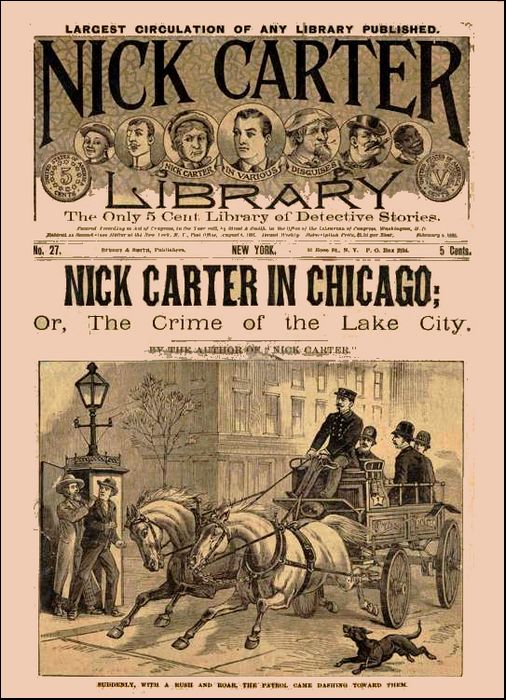

"THEN you do not know, positively, that a crime has been committed?"
"If you mean by that, that one must actually see the blow struck, in order to be positive, I do not."
The first speaker was the great detective, Nick Carter, and the second was Major Robert W. McClaughry, General Superintendent of the Chicago Police, familiarly known as Chief McClaughry.
Nick Carter, in passing through Chicago on his return from San Francisco, where he had done efficient work in unearthing crime in Chinatown, determined to make a social call upon the genial major, whose fame is almost as great as that of Inspector Byrnes.
The chief received him most cordially, and immediately followed up his greeting by mentioning a most perplexing crime, which had happened less than forty-eight hours prior to Nick's call.
But in order to thoroughly comprehend the circumstances which placed Nick in harness in the Lake City, we will recite the conversation in detail.
After the usual salutations had been exchanged the chief remarked, reflectively:
"By the way, Carter, perhaps you can make a suggestion or two regarding a matter that is puzzling me just now."
"Glad to be of service, chief, if I can," was Nick's reply.
"A matter happened the night before last, which is well-nigh incomprehensible."
"Indeed! What was it? a murder?"
"It looks like it."
"Burglary, theft, abduction, mutilation, or murder, chief?"
"The last, if any."
"What is the nature of the case?"
"I'll give you the story, as far as I know it, and you can judge for yourself."
"Very good,"
"John Weyman is a very rich man, and, when at home, he lives in one of the old-fashioned, old-time houses in Pacific avenue."
"Well?"
"He has two daughters, who are twins, and as much alike in appearance, as two peas from the same pod."
"I see."
"But there, the resemblance ends."
"How so?"
"One of the girls, Leila has always been a little bit wayward, and difficult to control. As a schoolgirl, she was decidedly hoydenish and unmanageable, and she grew worse instead of better as she got older."
"Exactly. Well?"
"The other, Grace, was her opposite in all these particulars, and always has been, is now, in fact, the acme of a fond father's hopes."
"An angel without wings, eh?"
"I do not think the picture is overdrawn, Carter. It so happens that I have known this family for a number of years, and I do not think that too much could be said in favor of Grace, or the conduct of Leila be too severely censured, considering her surroundings.
"Of course, I know more concerning her than her father, even, for my position has made me acquainted with many things that never reached his ears."
"Of course."
"Twice I remonstrated with her, and both times she had a very plausible explanation ready.
"Since the last time she has succeeded in outwitting even me, for I have reason to believe that she did not heed my advice."
"One moment. One of these girls is missing?"
"Yes."
"Which one?"
"Leila."
"Since the night before last, you say?"
"Yes."
"From what place did she disappear?"
"From her home in Pacific avenue. But wait; you anticipate me."
"Pardon me. Continue, please."
"The girls have had no mother since they were thirteen—"
"One more interruption. How old are they now?"
"Just twenty-one."
"What do you mean by 'just?'"
"Their twenty-first birthday occurs sometime this month. In about a week, I think."
"Then they are not twenty-one."
"Not quite."
"Go on, please."
"The father, John Weyman, is a very peculiar man, and has but few friends.
"However, he idolized his daughters, and with natural human perversity, seemed to prefer the one who was wayward, Leila.
"A month ago, they all went to visit friends in Detroit, where they have been ever since, until two days ago.
"Then, the daughters returned without him, he having been called to New York on business, as he was about leaving for home.
"The story that I now relate is just as I got it from Grace, yesterday.
"The girls reached Chicago at half-past eight in the evening of night before last, and were driven at once to their home in Pacific avenue."
"In a hired carriage?"
"No; their own coachman met them at the station."
"They spent an hour or more in superintending the unpacking of their trunks, and then each retired to her own room, Leila to read, and Grace to write letters."
"Where are the rooms located?"
"Leila's room was the second floor back, and Grace occupied a front room on the same floor, though on the opposite side of the hall."
"The house is a large one, then."
"Quite so. It is square, with bay-windows on either side, and stands alone. A hall-way runs through the center of the house from front to rear, on each floor, of which there are three.
"Grace finished her letters. and retired. She was fatigued, and slept, she says, with unusual soundness.
"Nevertheless she awoke early, and with a strange feeling of depression.
"She tried to compose herself to sleep again, and failed.
"At half-past seven, she arose and put on a wrapper.
"Then she went to her sister's door and rapped.
"There was no response.
"Believing that Leila was sleeping, she returned to her own room, but, at the expiration of another half-hour, she again sought her sister.
"Again she received no response to her summons and so she softly turned the knob and opened the door.
"Then she uttered a cry of alarm that brought the servants from the lower part of the house.
"Leila was not in her room, and there was every reason to believe that she had not left it willingly.
"The bed clothes were scattered promiscuously about the place, no two articles being in the same spot.
"One pillow was on the floor near the head; another was upon the hearth of the empty fire-place.
"The sheets and blankets looked as though they have been twisted and otherwise roughly handled, and one of them was nearly torn in half.
"The blankets had been subjected to the same rough treatment, and even the mattress was half-way off the bed.
"One of the sheets—the one which was so badly torn, was found in the center of the room, and it bore several blood-spots varying in size."
"You counted them?"
"Certainly."
"How many blood-spots were there?"
"Nine."
"How big was the largest one?"
"Eight inches in diameter, and nearly round."
"And the smallest?"
"About half that size."
"What was the predominating size?"
"About five to five and one-half inches. The spots were all circular, and looked as though they had been made by using the sheet to stanch the flow of blood, rather than that the blood had fallen upon it."
"I see. Where else was blood found in the room?"
"There were a few drops upon the hearth near the pillow, but none upon the pillow itself."
"Is that all?"
"Yes."
"Was anything broken?"
"A vase upon the mantel. The clock—a heavy French clock—was found lying face down upon the floor near the hearth where the drops of blood and the pillow were."
"Anything else?"
"The heel of one of Leila's slippers was found near the bed, and it looked as though it had been torn from its fastenings. The slipper itself was gone."
"Is there any further point?"
"Only one."
"What is that?"
"I began by saying that Leila went to her room to read. The book that interested her at the time was Sardou's 'Cleopatra.'"
"That was found beside an overturned chair near a table between the windows.
"It was torn and crumpled and otherwise maltreated, pages being entirely severed from the binding.
All in all; the room was in about as perfect and complete disorder, as any that I ever saw, and everything connected with it, evidenced that a violent struggle had taken place there."
"No weapon of any kind was found?"
"No."
"Nor anything, which suggested murder, besides the blood-stains?"
"Except the condition of the room—no."
"What time did the young ladies part for the night?"
"About ten o'clock."
"And Grace entered the room somewhere near half-past eight in the morning?"
"Between that and nine—yes."
"She heard nothing during the night?"
"Nothing,"
"Did the servants?"
"No."
"Where do they sleep?"
"On the top floor."
"The one above the room occupied by Leila?"
"Yes, and one of them directly over it."
"What one?"
"A girl; Nora, by name."
"She heard nothing?"
"No, and she says she was awake all night with a toothache, too."
"Humph!"
"What do you think of it, Carter?"
"Can't say, chief. It interests me, though."
"Do you mind spending a day or two here, and going into it a little?"
"Not at all."
"I wish you would do so."
"I will with pleasure."
"Thanks! Now, we'll get to work in earnest.
"BEFORE we talk this matter over any farther, chief," said Nick, "suppose we go to the scene of the affair, if you have an hour to spare."
"Willingly."
The two men took a carriage, and were soon in the room that has already been partially described.
With them was Grace Weyman, looking pale and troubled, and with a face that bore evident signs of violent weeping.
Nick "took in" the room at a single glance.
He went to the windows, and looked out upon a yard in the rear of the house.
There, he stood silent for several moments, as though intensely interested in the high board fence that surrounded it.
Suddenly he turned to Grace, whose remarkable beauty had been enhanced rather than injured by the suffering that she was undergoing.
"Was your sister fond of reading, Miss Weyman?" he asked.
"Rather, yes, sir."
"I see you have a lamp in this room, as well as gas."
"Yes."
"Do you know which light she was in the habit of using when she read?"
"The lamp, I think."
"Did she keep it upon that table?"
The detective pointed languidly to the table which stood between the windows.
"Always."
"Which was her favorite chair?"
Miss Weyman looked more and more astonished, as Nick asked the questions, and even the chief wondered what the "Little Giant" was driving at.
His face, however, betrayed nothing, and he might have been asking about the returns of the last Presidential election, for all the expression that sounded in his tones.
"Which chair was she fond of sitting in, when reading?" repeated Nick. "There are several easy-chairs here; she had a preference, had she not?"
"Yes."
"Ah! Which one?"
"That one there."
"Thanks! A sleepy hollow. Her taste and mine agree upon that point. Is this the hassock upon which she usually rested her feet?"
"I believe so"—coldly.
"Um! Thanks!"
Nick hummed a bar from a favorite opera, and went again to the window.
Two or three minutes later he turned again.
"You and your sister resemble each other very strongly, I am told," he said.
"Yes."
"In face, in figure, in height, and in the size of your garments?"
"In every particular; yes, sir."
"Did you wear the same size shoes?"
"Exactly."
"Did you also dress alike?"
"Never."
"Ah!"
"We made it a point to dress differently, even do the smallest details."
"To avoid being mistaken for each other, I suppose."
"Yes."
"Even your slippers were different, eh?"
"Yes."
"In what respect?"
"She preferred high-heeled slippers, while I do not."
"You have seen the heel of the slipper which was found here?"
"Yes."
"Did you recognize it?"
"I think so."
"Were the slippers new, or old?"
"In the sense that they had been but little worn, they were new."
"Where did she buy them?"
"At Dudley's."
"When your sister came to this room the evening before she disappeared, did you accompany her?"
"No, sir."
"Then you do not know whether she carried out her intention of reading or not?"
"No, sir."
"She may have retired at once?"
"Possibly, but I do not think so."
"Why not?"
"She said she was going to read, and I believe she did so."
"Was she in the habit of reading late?"
"Sometimes."
"You, of course, know what dress she wore when you saw her last?"
"Certainly."
"Have you looked for it?"
"Yes."
"Is it here?"
"It is."
"Is any of her clothing missing?"
"Yes."
"What?"
"Her night-dress, a heavy blanket wrapper that she sometimes wore, and her slippers."
"Is that all?"
"Yes."
"You think, then, that she had retired when she was disturbed by intruders?"
"I am convinced of it."
"You believe that she was seized while in bed, probably sleeping?"
"Yes."
"She would probably have read from her book, how long?"
"From one to two hours, I think."
"Then, according to your theory, the intruders were not here before midnight. What time did you retire, yourself?"
"About half-past ten."
"Chief," said Nick, turning suddenly to the police official, "what have you discovered relative to the manner in which the person or persons who carried off Miss Leila obtained admittance to the house?"
"Nothing."
"Is the front door kept chained at night?"
"Every door in the house that opens out of doors is provided with a chain-bolt."
"Had any of them been forgotten that night?"
"Not one."
"And none were disturbed?"
"No."
"How about the windows?"
"They were all fastened, and had not been tampered with."
"It seems, then, that not only were they not used for a means of entrance, but that nobody passed out through any of them."
"Yes. "
"Miss Weyman."
"Yes."
"Is there anything relative to your sister's habits or relations with others that would throw any light upon this affair?"
"I know of nothing, sir."
"Have you one of her photographs?"
"I have."
"Will you get it for me?"
"The likeness before you is better than a photograph," said the chief.
"I do not doubt it; nevertheless I would like to see her picture. And, by the way, Miss Weyman, I would be glad if you would bring me one of your own at the same time, if you will be so kind."
Grace bowed and left the room.
"What the devil are you getting at, Carter, with easy-chairs, hassocks, late reading, and kerosene lamps?" demanded the chief.
Nick did not answer at once.
Presently he recovered from his reverie, and, acting as though he had not heard the chief, he said:
"Was this room still in disorder when you first came here?"
"Yes."
"Was the chair to which you referred still overturned?"
"Yes."
"Which chair was it?"
"That one."
He pointed to a cane-seat rocker.
"Where was the sleepy hollow?"
"Where it is now."
"Did you notice the hassock?"
"Yes."
"Where was that?"
"Over there by the window, near the corner of the room."
"Do you notice that the sleepy hollow faces the door?"
"Yes."
"Remember that fact."
Then Nick moved hastily to the table, and, dropping upon one knee, he removed the globe and chimney of the lamp, which was of the kind known as a "student."
Presently he replaced the globe and chimney, and lifted the reservoir which held the oil.
He was again peering out of the window when Grace returned and brought the photographs. He devoted one slight glance to them, and then thrust them into his pocket.
"Thanks!" he said. "Now, will you pardon me if I become a little personal in my remarks, Miss Weyman?"
"Certainly, if it will aid you in finding Leila."
"I notice that you have a mole on the right side of your neck, just behind the ear."
"Yes."
"Did your sister have the same mark?"
"No."
"Which servant has charge of this room?"
"Nora."
"Is she in the house now?"
"Yes."
"If you will send her to me, I will not trouble you longer."
Grace bowed, brushed aside a tear, and went away.
"Is she not beautiful?" asked the chief.
"Very."
"And as good as she is beautiful. I wish I could say as much for the one who is missing."
"I wish you could. Ah! here is Nora."
The girl entered.
She was bright and smart in her appearance, and not in the least disconcerted by the fact that she was about to be questioned.
"What is your name?" asked Nick.
"Nora Conley, sir."
"You are about thirty, I take it."
"Twenty-nine, sir."
"You have charge of this room?"
"Yes, sir."
"Among other things, do you care for that lamp?"
"Yes, sir."
"When did you last fill it with oil?"
"Day before yesterday, sir."
"At what time?"
"Just before dark."
"Did you fill it full."
"Yes, sir."
"What time was it lighted?"
"About nine, sir."
"At Miss Leila's request?"
"Yes, sir."
"You had the toothache that night, I believe."
"Frightful, sir."
"What time did it begin to ache?"
"Before dark."
"Did you mention the fact to Miss Leila?"
"Yes, sir."
"To anybody else?"
"To the cook."
"Is that all?"
"Yes, sir."
"You did not hear a noise in this room all night?"
"No, sir."
"And yet you were kept awake by your tooth?"
"I don't think I slept an hour, sir; I know I didn't til near daylight."
"What time did you come home?"
"What, sir?"
"What time did you come home?"
"From where, sir?"
"From anywhere. You went out that evening, I believe."
"Yes, sir; though how—"
"Never mind that. Did you go to a dance?"
"Ye—yes, sir."
"It was after two when you got home, wasn't it?"
"No, sir; no! the clock was just at a quarter past one, when I went to my room."
"By what door did you enter the house?"
"By the back door, in the yard."
"Did you leave the chain down, when you went out?"
"No, sir."
"How, then, did you get in?"
"The chain is no good, sir."
"What is the matter with it?"
"The bolt will slide way through the slot, if you know how to do it."
"Ah! When did you discover that fact?"
"A year ago."
"How?"
"I forget, sir."
"Nora, you are telling a lie."
"No, sir; I—"
"Wait; I will prove it. Why did Miss Leila show you the fault about the bolt?"
"Because she wanted me to do an errand for her, and I had to come in when the family were all in bed."
"That is right. You see that it will not do to try to deceive me. I know too much about you for that, Nora. You don't want to get into trouble and go to prison, do you?"
"No, sir; no—no—no!"
"If you tell me the truth you will be in no danger, while if you lie to me, I will have to use these," and Nick exhibited a pair of handcuffs.
"Yes, sir."
"It does not do to deceive officers of the law."
"No, sir."
"YOU say," continued Nick, "that it was a year ago when Leila showed you the trick about the chain?"
"Yes, sir."
"And sent you upon an errand?"
"Yes, sir."
"That was the first time that she had sent you out?"
"Yes, sir."
"What did she give you for going?"
"A dress; a perfect beauty, too."
"How many times have you gone out for her in that way?"
"Only that once, sir."
"Are you sure?"
"Yes, sir."
"And since that time you have used the knowledge for your own benefit?"
"Yes, sir."
"Often?"
"Yes, sir."
"For what purpose?"
"I am fond of dances."
"Where did you go when you went on the errand for Miss Leila a year ago."
"To the waiting-room of the Alton depot, sir."
"Did you carry a written message?"
"Yes, sir."
"Did you read it?"
"No, sir."
"Who was it for?"
"A man."
"Indeed! Did he meet you there?"
"Yes, sir."
"How did you know to whom to give the message?"
"Miss Leila described him."
"Ah! What did she say?"
"She told me that I was to go to the Alton depot and deliver the note to an old man that I would find there. She said that I would know him because his hair and whiskers were white, and he carried his right arm in a sling.
"To make sure, I was to ask him if he was Mr. Aliston, and if he said yes, I was to give him the note."
"Did you find him?"
"Yes, sir."
"And give him the note?"
"Yes, sir."
"Did he give you an answer?"
"No, sir."
"What did he say?"
"He swore."
"Is that all?"
"Yes, sir; then he turned and walked away."
"Have you ever seen him since?"
"No, sir."
"Or heard of him?"
"No, sir."
"What time of night was it when you met him."
"Half-past one, sir."
"Why could not Miss Leila go to meet him herself?"
"There was company here that night."
"What kind of company?"
"A surprise party. Miss Grace got it up to surprise her sister."
"Ah! Now, Nora."
"Yes, sir."
"How often have you seen Miss Leila go out or come in by the back door, when the rest of the household did not know it?"
"Three or four times."
"Did you ever try to find out where she went?"
"No, sir."
"Does Miss Grace know about the chain-bolt on that door?"
"I don't think so, sir."
"That will do for the present, Nora."
"Yes, sir; may I ask a question?"
"Certainly."
"How did you know that I went to the ball?"
"I guessed it."
"Then Miss Grace doesn't know it?"
"I think not."
"You won't tell her, will you, sir?"
"Not if you do as I tell you in the future."
"I will, sir."
"You may go, now."
Nora left the room, and the chief and Nick were left alone together.
For a moment; both were silent.
It was the chief who spoke first.
"Carter," he said, "I have often heard that you were remarkably shrewd, but you have convinced me of it to-day. Now, tell me how in the world you managed to guess that Nora Corley had been out that night."
"By a simple process of reasoning."
"I confess that I don't see it."
"First, there was a struggle in this room, wasn't there?"
"Without doubt."
"It was evidently of sufficient violence to have been heard by a person in the room overhead, providing that person was awake."
"Yes."
"Nora insisted that she was awake all night, and yet heard nothing. I saw that she told the truth, when I questioned her. I also saw that she was holding something back."
"Exactly."
"I was already satisfied that the struggle in this room occurred before two o'clock, at the latest, and therefore I fixed that as the hour when she returned. I find that she got back at a quarter past one, and therefore it is safe to presume that the thing was over and done before one o'clock."
"You say that you were already satisfied that it happened before two."
"Yes."
"How?"
"That student lamp will burn without replenishing about five hours."
"Yes."
"It was lighted about nine, and would therefore, burn out about two."
"Yes."
"It was not put out; it burned out."
"Ah!"
"Which proves that the young lady had not retired when she was attacked.
"If she had gone to bed, she would have put out her light. I know that she did not put it out.
"Nora says the reservoir was full when she lighted it—it is now empty, and the wick is crusted as one will be after burning a while without oil to feed it.
"I think I know pretty nearly how the thing took place."
"How?"
"I fancy that the girl who has disappeared or been murdered, prepared herself for bed. It may be that she retired, and was restless. If the latter, she got up again and relighted her lamp. In either case, she put on the wrapper and slippers, and composed herself to read.
"She occupied that easy-chair, and not the one that was overturned. Her feet were upon the hassock that you found in the corner by the window.
"Do you see that bell-cord, chief?"
"Yes."
"It hangs directly over the bed."
"Yes."
"When the intruders came, she leaped for that bell-cord, kicking the hassock away as she rose, and overturning the rocker as she ran."
"Good! go on."
"Her enemies pursued her, but they did not seize her until she reached the bed."
"I see."
"It was there that the struggle took place.
"They tried to pull her from the bed, and she clung to it.
"The bed-clothes were torn from her grasp and scattered, and even the mattress was disarranged."
"Yes; I see it all now."
"She screamed, and her cries were smothered with the pillows.
"She was a girl of considerable muscular power, for she tore one of the pillows away from them, and hurled it across the room.
"But the other one was ready, and that was thrust over her mouth.
"Still she struggled, and her assailants—or rather her assailant, for although I have used the plural, I am convinced that there was only one—being fearful that she would succeed in giving an alarm, in spite of him, struck her."
"Did he use a weapon?"
"Who can say? It would seem so from the blood upon the sheet, and yet, if she had been stabbed, there would have been other evidences of the fact.
"Either he struck her, so that she bled, or in her struggle, she managed to wound him.
"The sheet may have been torn in the struggle, or he may have torn it, intending to bind up a wound made by one of them upon the other, and afterward changed his mind.
"The blood spots look more as though the sheet had been crumpled and held against a wound than anything else."
"Why do you think there was only one man here?"
"Because if there had been more than one, the struggle would not have been half so protracted or violent."
"Carter, has it occurred to you that this whole thing may be a fake?"
"Yes, if was my first idea. I thought of it when you first mentioned the incident."
"I have been convinced of it since we came here to the house."
"By what?"
"By the character of the girl who is missing, for one thing; by the seemingly studied appearance of a violent struggle; by Nora's story of the chain-bolt; by the general character of the blood-stains, and by the agglomeration of little things, which make up the whole case."
"Then you think—"
"I think that Leila Weyman wished to disappear, and she chose this way of doing so. I think that she went about the work deliberately. I believe that she furnished the blood spots, tore the sheet, disarranged the bed, overturned the chair, laid the clock-face down upon the floor, and, in short, prepared the whole scheme, and then walked quietly out of the house by the back door, and departed for a place at present unknown."
"It may be, chief; but, in that case, she had an accomplice."
"He was doubtless waiting outside for her."
"She needed one inside the house."
"Why?"
"The chain-bolt can easily be undone from the outside, but I will defy you to put it in place after the door is closed, unless you are on the inside."
"True?"
"I believed that the case was a fake, until I talked with Nora."
"And you have changed your mind?"
"Yes."
"Why?"
"Because I see signs of violence here that she would not have thought of preparing."
"What are they?"
"There is a slight abrasion on the wall at the back of the bed."
"Yes."
"It was made when she first rushed to grasp the bell-rope.
"Being seized by her assailant, her hand fell short of the rope, although it reached the wall and a finger-nail scratched the paper."
"What else?"
"Isn't that enough?"
"No. It might have been done a week or a month ago."
"True. Well, I have another."
"What is it?"
"When she left this room, she was unconscious."
"How in the world do you know that? Unless it were the unconsciousness produced by death, as the result of a wound of which the blood is, perhaps, evidence. Is that what you mean!"
"Exactly."
Nick walked to the window.
"Come here a moment," he said.
The chief complied.
"Examine the yard," said Nick, "and tell me if you see anything not likely to be found in such a place."
"No; unless you mean that can, lying against the fence."
"That is what I do mean."
"What has that got to do with it?"
"In the first place, except for that can, the yard is in perfect order."
"Yes."
"Consequently the can has not been there long."
"Perhaps not."
"Do you know what the can once contained?"
"Not at this distance."
"Chloroform."
"Ah!"
"Chloroform is put up in tin, as you know, and that is what is known as a half-pound can. It was thrown from this window, and rolled against the fence where it has remained unnoticed ever since. Come, I am through with this room for the present, and I would like to examine that can."
THEY were soon in the yard.
At the right, moving away from the street, was the stable, and Nick went toward it.
"Let us find the man who has charge of the grounds," he said.
He was found at once in the person of an honest-hearted Irishman, who said that he had worked for John Weyman fifteen years.
"Patrick," said Nick, "when did you clean up the yard last?"
"Sure I clane it as often as there's anything to clane, so I do."
"Exactly. Come with me!"
Nick led the way to the spot where he had seen the empty chloroform-can.
"How long has that been there?" he asked.
"Not long, sor, I'll be bound," was 'the reply.
Nick picked it up, and an expression of surprise dawned on his face.
"The can is full, chief," he said. "It has not been opened."
"Indeed!"
"No."
"That destroys your theory."
"On the contrary, it strengthens it."
"How so?"
"Leila being already unconscious from some other cause, the chloroform was unnecessary, and it was thrown away.
"Now, Patrick," continued Nick, "where do you sleep?"
"In the stable, sor."
"Did you sleep there night before last?"
"I did, sor."
"What time did you go to bed?"
"At nine, sor."
"Did you hear anything in the night?"
"I did not, sor."
"You have worked here fifteen years, you say?"
"I have, sor."
"Are you fond of your mistresses, Miss Grace and Miss Leila?"
"Sure, sor."
"How often have you taken Miss Leila out in the carriage when nobody else knew it?"
"Never, sor."
"But you have often taken her out an she left you to wait for her, haven't you?"
"Yes, sor."
"How many times?"
"A dozen, mebby, sor."
"Where did she make you wait?"
"Sometimes wan place, sometimes another. Sure it was shoppin', she was, 'r callin' on the sick."
"Ah, calling on the sick, eh?"
"That same, sor."
"Do you remember where you went with her, the last time that she called upon the sick."
"I do, sor."
"Where?"
"To a little house on Fowler street, not far from Wicker Park."
"Where did you go before that?"
"To the same place, sor."
"And the time before that?"
"That same."
"Her friend was very sick, I suppose."
"She was, sor."
"What was the matter?"
"Consumption."
"Did you hear her name?"
"Mrs. Mills, sor."
"A little brick house, eh?"
"Yes, sor."
"What was the number?"
"Sure, I don't know. I found it aisy, widout the number, cos it sthands back furder than the others from the sthreet."
"Exactly. Have you called there lately?"
"Just afore Miss Leila went to Detroit, sor."
"Thanks! Good-day, Patrick."
"Good-day, sor."
"Where now, Carter?" asked the chief. "You seem to be running this thing."
"Let's go to the Grand Pacific and have dinner. It's nearly dark."
"All right. What do you think of the case?"
"I'll tell you next time I see you, chief. I would do so now, only I haven't formed an opinion yet. Now, if you don't mind, let's talk politics, or anything but crime."
The chief laughed.
"You don't want me to question you, I see."
"Well, no; I do not."
"Good; I won't."
The two men returned to their carriage, and were driven to the Grand Pacific Hotel where a hearty dinner was ordered.
Not a word was said relative to the Leila Weyman case until they had lighted their cigars.
Then the chief signified his intention of going home, and Nick remarked, as though the thought had just occurred to him:
"By the way, chief, you said something about the waywardness of Leila Weyman, didn't you?"
"Yes."
"Tell me about it"
"What do you want to know?"
"You chided her once?"
"Yes."
"What about?"
"The company she was keeping."
"A man?"
"Yes."
"Who was he?"
"He is sitting at the fourth table from you at this moment. He is directly behind you and facing this way."
Nick was rather surprised; but he said, coolly:
"If he gets up, let me know. I want a look at him."
"All right."
"We will try to get up first. By the way, you havent told me who he is yet, so my next question is excusable. Do you know him?"
"Yes."
"Ever speak with him?"
"When I can't avoid him, and he never lets me do that, if he can help it."
"One of the kind that button-holes you, eh?"
"Yes; every chance he gets; because I am superintendent of police."
"If he should happen to get up first and come this way, introduce me as the chief of police of Portland, or some distant point; catch on?"
"Yes; but you're off, Carter. He has nothing to do with this case.'
"Sure?"
"Yes."
"Had him shadowed?"
"Certainly. Besides, I know where he was all night, the night before last."
"All right. I'd like to look him over just the same."
"You'll have a chance, for here he comes."
"Good! What is he?"
"A professional gambler."
"They're usually good fellows."
"This one's a bad egg, out and out."
"How are you, chief?" asked a deep voice from over Nick's shoulder, and the next instant the gambler came into view.
One glance satisfied Nick that he was a man who was not to be trifled with, as well as one who might prove an ugly customer on occasion.
Briefly described, he was a man who was a trifle above the medium height, but so broad shouldered and deep chested that at first glance one thought him to be much shorter than he really was. His eyes were dark-brown and remarkably keen; they were rather small, however, and set wide apart, while one of them had a slight cast—so slight as to be almost unnoticeable. His face was broad and rather large, the thin lips being partly shaded by a slight, black mustache.
There was a compactness about his figure, and a firmness in his tread and manner that denoted indomitable perseverance, and cool persistence far beyond the lot of ordinary men. Altogether Phil Danforth was a man whom even a casual observer would hesitate to rouse, for everything about him suggested coolness, daring, implacability, and a touch of ferocity, as well as great physical strength. The chief acknowledged the greeting and then introduced Nick, characterizing him as the chief of police of Portland, whom he was entertaining for a day or two.
"Is there any news about the mysterious disappearance in Pacific avenue?" asked Danforth, seating himself at the table with calm assurance.
"None whatever," replied the chief.
"I hope you are satisfied that you have done me an in-justice, chief," said the gambler.
"How so?"
"Please don't deny that the you have kept me shadowed for the last forty-eight hours, my dear fellow.
"I do not deny it. When there is occasion, I would shadow everybody."
"Correct. I don't blame you, major. But I hope you are satisfied so far as I am concerned."
"Perfectly, Danforth."
"Thanks!"
"I would like you to answer a few questions for me, if you will."
"Most happy to do so."
"You are so well aware a the fact that I had you shadowed, that you must also know why I did so.'
"Certainly. I don't blame you a bit."
"You have known Leila Weyman a long time."
"Yes."
"And have met her frequently."
"Formerly, yes."
"Not lately?"
"I have seen her just three times in ten months, major."
"By appointment?"
"No. I wish I had."
"Where did you see her?"
"On the street."
"All three times?'
"Yes."
"Did you speak with her?"
"Not once. I simply raised my hat and passed on. So far as her disappearance is concerned, I did not even know that she had returned from Detroit."
"How did you know that she had gone there?"
"From the society column of the Sunday Tribune."
"Now, Danforth, will you tell me what there was between you and Leila Weyman?"
"You were."
"Eh?"
The gambler smiled.
"Unless I am greatly mistaken," he said, "you talked to her like a Dutch uncle on two or three occasions, with Phil Danforth as the subject of the conversation."
"That is true."
"You told her what a villain the world thinks me, because I gamble, and otherwise prejudiced her against me, for all of which I owe you one, major."
The gambler smiled rather strangely, and then added in a light tone:
"Whatever can be said of me, I always pay my debts. However, you asked what was between us, and I answer you were."
"You know that you have purposely misconstrued my words."
"Perhaps I have."
"Will you answer my question?"
"Yes."
"Please do so."
"Major, do you believe that a man like me can love a pure, good woman?"
"Why not?"
"Thank you for that much. I loved Leila Weyman, and I love her now. But for you, she would have been my wife, and I would have been a better man. You came between us and poisoned her mind against me, and my only wonder is that I did not kill you for it.
"Sober thought, however, convinced me that you were right, and I love the girl well enough to admire, rather than hate you for protecting her, even though you were mistaken in supposing that my intentions were not honorable, or that I would suffer her to come to any harm through me.
"I will tell you one thing more, major, and then we will change the subject."
"Very well."
"I have but little faith in your detectives, while I believe that I am a fair one myself. I am searching for Leila Weyman, and some day I will find her, or whoever it is who has wronged her. I shall work in my own way, but I will never give up the chase while I live. When I am successful, I will call upon you, but; until I am, I shall never mention the subject again, to you or to others. Good-night, major; good-night, sir."
He bowed and smiled, and left them, with the same inscrutable expression upon his face that he had worn during the entire conversation.
"Well, what do you think of him?" asked the chief.
"I am glad that I met him," replied Nick, non-committal as ever.
"There is more to him than I thought."
"There is certainly a great deal to him."
"I might as well call my shadows off."
"Yes, I think so."
"This is a very mysterious affair, Carter?"
"Very."
"How many days can I depend upon you to work it up?"
"I will stay here, chief, until we know the whole story if it takes all winter."
"Good! then you shall have entire charge of it. I have not heard from the girl's father as yet, except by telegraph. He should be here to-night, or in the morning. I can promise you that he will be liberal enough, if you are successful. In the meantime, spare no expense, and draw or me for any amount you require."
"Very good."
Then they parted. The chief went home, and Nick strolled up and down the great corridor of the Grand Pacific smoking and thinking.
THERE were many points about the case upon which Nick Carter was engaged, that he found particularly perplexing, but he was one who was never hindered by perplexities, for they only rendered the hunt more fascinating.
Presently, he looked at his watch.
"I will go there to-night," he mused, "and take a look about the place, anyway.'
The "there" meant to Fowler street, where Patrick had driven his young mistress to see a sick friend.
Nick had but little faith in the sick friend, and was therefore, curious to inspect the locality where she was supposed to live.
No reference has, thus far, been made to Nick Carter's personal appearance; but those who have read the preceding numbers of this library, will remember that he lived rigorously up to the rule of always wearing some disguise.
Very few people ever saw Nick Carter in his proper person, and there were several favorite disguises to which he had accustomed certain people, so that they knew him in one particular character, and in no other.
For instance, Major McClaughry knew him as a man between forty and fifty, whose hair and mustache were just beginning to turn gray.
No man in the world had the science of disguises down so fine as Nick Carter.
Every age of the world has developed a marvel in some line.
It is thus that we have had a Raphael, a Caesar, a Shakespeare, a Beethoven, an Edison.
Nick Carter was as phenomenal in his way as the painter, the warrior, the poet, the musician, or the inventor.
He had marvelous command of the facial muscles. He could assume an expression, and keep it under all circumstances, as accurately as though it were natural to him. He could imitate a voice so perfectly that the shrewdest could not detect the cheat.
The art of disguising himself had been his chief study ever since he began his career as a detective, and he had become so perfect that he could deceive the shrewdest police officers, as well as the criminals whom he pursued.
"I sometimes deceive myself, even." he said once, in referring to the subject, "if you can understand how that is possible. I mean that when I assume a character, I cease to be Nick Carter for the time being, and become that character in fact. I think as he would think, reason a as he would reason, assisted, perhaps, by the experience that belongs to me really. It is the ability to alter the feelings, the habits, and the thoughts themselves which makes perfect disguises, and not the change in face and form. If I am representing an old man, my thoughts are contemporaneous with the character. I forget that I am really young and full of energy, and totter and falter by instinct rather than by design. If I play the part of an Irishman, I put on the brogue with the costume, and would use it as naturally in my own house, in talking with my wife, as I would in a corner saloon, where I had an object in it. That is what makes my disguise perfect when you add the result of years of study in creating the costume.
"The use of hair, in wigs and beards, is an important element, and one which is very hard to acquire. I always carry several changes, and I have a means—a discovery of my own—for fixing on and removing such things, so that it can be done quickly, effectually, and perfectly."
Nick took a Milwaukee-avenue car, and rode to Wicker Park.
There, he got down, walked through Park street, and then turned back across the park itself, keeping in the shadow as much as possible.
He made several abrupt turns, and finally, being assured that he was alone—that is, unobserved, he went directly to Fowler street, and turned toward that portion where he knew that the house at which Leila Weyman had called was located.
But, reader, if you had followed him from the Grand Pacific, and in the little park already named, you would have been convinced upon reaching Fowler street, that you had somehow lost him in the park.
The man who passed along Fowler street did not in the least resemble the one who had dined with Chief McClaughry.
Nick had made one of his quick and wonderful changes.
From an easy-going, middle-aged business man, he was transformed to a shrewd-looking young man; such a one as might be engaged to go upon an errand.
He walked rapidly along the street until he reached the little brick house, where Patrick had said that Mrs. Mills resided, and he entered the yard at once.
There was a light in the lower part of the house, and Nick drew cautiously nearer, hoping that he would be able to see or hear something which would render it unnecessary for him to ring for admittance.
There were several lilac-bushes in the yard, which secured him from view from the street, and he crept close up to the house, hoping that by some device he could gain a view of the interior.
But the curtains were closely drawn, and try as he might, he could not gain the slightest clew to what was going on inside.
He pressed his ear close to the window-sash, and then he could faintly hear the sound of voices.
There were three; two were masculine and one was feminine.
The words, however, were utterly indistinguishable, and he could get no idea of the subject of their conversation.
Then the idea occurred to him, of making use of his pick-lock and silently gaining admittance to the house.
He was only deterred by one thought.
Considerable time had elapsed since Patrick had brought Leila Weyman to that house, and the people, whom she had called upon might have gone away in the meantime.
Houses in populous cities change hands very often, and Nick had a wholesome disinclination for thrusting himself upon the privacy of some family, which had no connection with the case in hand.
He resolved to wait a little longer, and see what turned up.
A half-hour, however, brought no change, and at last he resolved to enter the house at all hazards, and learn whether he was upon the wrong scent or not.
"I don't know but that I would have done better to have kept my eye on Phil Danforth," he muttered, "for with all that fellow's consummate acting, I am satisfied that he knows more than he will admit.
"The gambler is a cool one, and he is all nerve, but I think I can match him just the same.
"Now for the house."
He went on tiptoe to the door.
In a moment he thrust his magic little pick-lock in the keyhole and turned it.
The door opened easily and noiselessly.
He passed into the house, softly closing the door behind him.
There were voices coming from the parlor, but the door was closed, and he could not hear distinctly.
Neither could he see what was going on, and he deemed that quite as important as the ability to hear.
At the end of the hall there was a little room, dark, except for a ray of light which shone into it from what he judged to be the back parlor.
He moved forward cautiously, and gained the little room without making a sound.
He was right.
The room adjoining it was the back parlor, and it was separated from the front apartment by folding-doors, which were half-open.
The arrangement could not have been better for Nick's purposes.
He crept forward, and peered past the doors into the front room.
There were two men and a woman there, none of whom he had ever seen before.
Both men were well-dressed and gentlemanly-looking, and a casual observer would never have guessed that they were crooks.
Nick knew it, however, the moment he caught the first words that were uttered after he entered.
It was the woman whose words he heard first.
"There is no crib that he can't crack, if he sets out to do it," she said, evidently continuing a conversation that had been going on for some time; "but, the trouble is, he don't set out."
"But he hasn't been consulted, Bess," said one of the men.
"No; but that's his fault; not ours."
"Better wait," continued the other man.
"Nonsense, Tom, You and Frank act like a couple of babies."
"Look here, Bess," said Frank.
"What?"
"He's bossed things for us for three years, hasn't he?"
"Yes."
"Every break we've made since he run things has been a success."
"Yes."
"Well, ain't that argument enough?"
"No."
"Why?"
"Who is he, anyway?"
"He's — well, for the present at least, he's our captain?"
"He's an interloper."
"How do you make that out?"
"Simply by remembering how it happened that he became one of us."
"Well, he did the square thing."
"I don't agree with you."
"Look here, Bess," broke in Tom; "here's the whole thing in a nutshell."
"Let's have it."
"Just say, for example, that we were all sitting in a game together."
"Yes."
"There was a big boodle in the pot, and we all held pot hands."
"Well?"
"His cards didn't count for anything—at least, we thought they didn't, but he had nerve enough to back 'em. He bluffed, and raised so high that we didn't have the nerve to call, and he swept the board.
"Yes, by threats."
"No, by good play," interrupted Frank. "We had our plans laid, and by this time we'd have had every dollar that old Weyman has got, but—"
"Exactly, but! Go on, Frank."
"He blocked the game."
"That's it. That's why I hate him."
"He stopped the racket then and there. He said he'd do the square thing by us, if we'd drop that game and play his, and he has done it."
"Bah!"
"I tell you he has."
"You're a fool, Frank, and so are you, Tom."
"Thanks, awfully!"
"Oh, you needn't thank me; I mean it. If it hadn't been for—for him, we would have had, at least, a cold hundred thousand apiece now, and a good lookout for more.'
"That's right enough; but you forget—"
"What?"
"That he said he'd blow on the whole business, and give us dead away, if we didn't consent to his terms."
"Exactly."
"He had no call not to blow on us. We were strangers in one sense. Instead of putting us all in prison for what we were up to, he let us down easy, took the management of our concern, and is now as deep in the mud as we are in the mire."
"Bah! Don't you see his game?"
"What game?"
"He's going to marry the girl."
"What of it?"
"He'll get the whole boodle himself."
"He'll divide."
"Not he."
"We'll make him."
"You can't."
"Why?"
"He's a devil with his nerve, his cunning, and his coolness. I hate him! Oh, how I hate him! hate him! hate him!"
"And fear him, too, Bess."
"Who don't? Mark you, Tom Blenheim and you, Frank Morton, I will kill him yet. I will drive a knife into his heart. I will put out his eyes. I will do something to be rid of him."
"No, you won't, Bess."
"I will I will!"
"You won't."
"Why won't I?"
"Shall I tell you?"
"Yes."
"Because you love him. You hate him only because you are jealous of this girl that you think he is going to marry.'
NICK could see that the woman who was talking was really beautiful.
In appearance she was about thirty years old.
Her hair and eyes were very black, and there were streaks of gray in the former, which rather added to her beauty.
She was furious when Tom charged her with being in love with the man of whom they were talking.
Her eyes flamed, and she bounded to her feet in a rage.
"You lie!" she cried.
"No, I don't, Bess. Now, calm yourself, and look at the thing decently."
She made a violent effort, and succeeded.
"Well?" she said.
"There are two of those girls, aren't there?"
"Yes."
"And they look just alike?"
"Yes."
"They are twins?"
"Yes."
"And the old man is equally fond of both."
"I suppose so."
"He won't give his fortune all to one of them?"
"Perhaps not."
"Certainly not. He will divide it equally between them."
"Yes, if—"
"If what?"
"If they both live."
"Bah! that part of our plan is a dead letter. I've seen those girls, but you have known them since they were babies."
"Yes."
"They're as much alike as two peas."
"They are."
"Then, if Phil is in love with one of them, he's in love with both."
"Nonsense."
"It isn't nonsense. It's a fact. He's in love with the fortune, not with either of the girls."
"I don't believe it."
"It is yourself who are a fool, Bess. Phil thinks more of your little finger than he does of both of the Weyman girls put together. I know it because I've heard him say so, though I'm a fool for telling you."
"Do you believe it?" she cried, eagerly.
"What? that I'm a fool for—"
"No—no! What you said before."
"I know it."
"Then prove it to me."
"How?"
"By making him agree to my plan."
"What, to crack the crib?"
"Yes. To rob the house where they live; to carry off everything of value that is in it."
"I don't think he will object, if you will agree to stay away."
"I won't."
"That's where the shoe pinches. A woman has no business in that kind of work."
"Didn't I always do it before he came among us?"
"Yes; but—"
"Could anybody do it better?"
"No; but—"
"Am I not as capable now as I was then?"
"Yes; but—"
"Then why—"
"Confound it, Bess, let me finish."
"Go on."
"That isn't where the shoe pinches."
"Where, then?"
"He's afraid that you will stick a knife into one or both of the girls, if you get into the house where they are."
"I will promise—"
"Bah! What is a promise worth to a jealous woman?"
"Nothing."
She became suddenly calm.
She even smiled, as she said, slowly:
"I will give up the whole idea for the present, boys. Consider it settled, at least until I have had a chance to talk it over with Phil himself."
"Now, you're talking sense, Bess."
"Thank you."
"Seeing that you've come to yourself, I don't mind giving you a bit of good news, Mrs. Mills."
"What is it?"
"You haven't been out lately, have you?"
"No."
"Nor seen the papers?"
"No. You know I've been away, and that I haven't shown my face out of doors since I came back. Neither have I had a chance to see a paper. What is the news?"
"The girl you hate is a goner."
"What!"
The woman leaped to her feet in thorough astonishment.
"What did you say?" she cried.
Tom repeated his statement.
Then she sank back into her chair again.
"Do you mean Leila, or Grace?" she asked, slowly, and with an evident effort to control herself.
"Leila."
"What has happened?"
"She has been murdered."
"Murdered!"
"Yes."
"By whom?"
"Nobody knows."
"When?"
"Night before last."
"How was she killed?"
"Nobody knows that, either."
"Eh?"
"Didn't you hear me?"
"Yes; but—"
"But what?"
"They must know whether she was shot, or stabbed, or poisoned, or choked. The body—"
"That's just the point."
"What is?"
"The body. It hasn't been found."
"Oh! Then how do they know that she was killed?"
"By the blood in the room."
"That isn't proof."
"No; but it's suggestive."
"You say it was Leila."
"Yes."
"Where was Grace?"
"In her own room, I suppose."
"Does Phil know of this?"
"Yes."
"What does he say?"
"That he will find out who did it and get hunk, if it takes a life-time."
"He will, too, if he says so."
"You bet! Well, I'm going. Good-night, Bess."
She said good-night, and a moment later they were gone, and she was alone.
The reader can imagine Nick's surprise at what he had heard, for, judging from the words that the strange trio had uttered, they knew nothing regarding the fate of Leila Weyman, although they were strangely familiar with the Weyman family.
He was arguing in his mind the question whether it would be well to walk boldly into the front room and either bribe or frighten the woman into telling him more, when he was again astonished to hear a voice that he recognized speaking to her.
"Well, Elizabeth," it said, "you are the best actress I ever knew."
"Thanks!" she replied, dryly. "I guess you can come out, Phil. Tom and Frank are both well out of the way now."
"Well, I have struck a mare's nest," thought Nick. "Bless if Phil Danforth hasn't been in the house all the time,listening like me. It's lucky for all concerned that I didn't run onto him.
"The puzzle now, is to find out what sort of game Phil and Bess are playing, and why they tried to hoodwink their pals.
"By Jove, this house is a regular gold-mine for pointers."
Much to Nick's disappointment, however, the gambler and the woman conversed only a few moments, and did not once refer to the subject that interested the detective most.
"Is everything all fixed, Lizzie?" asked Danforth.
"Yes; all that's wanted now is your consent."
"Good! Who is to get it from me? I only heard the last few sentences of your conversation, so I'm not posted."
"I am to see you, and fix it."
"When?"
"Right away."
"Good! Then say that I came here to-night after they left, and that you fixed the whole thing. Let them understood that the job has got to be worked without me, though; but you know what to say."
"Yes."
"What night will it work?"
"To-morrow night would be as good as any, except for the present state of things there."
"It makes it all the better, I think."
"Perhaps so. I'm off now, Lizzie."
"Where are you going?"
"To Tom Murphy's."
"Have you got any money for me, Phil?"
"Yes; here's a couple of hundred. What would become of you, girl, if you didn't have a brother, eh?" and he laughed good-naturedly, as he threw a roll of bills into her lap.
"Better ask what would become of you, if you didn't! have a sister."
"That's right, Lizzie. It's about a stand-off, I guess. If Walt was only with us these days, we'd give up the—"
"Don't, Phil, don't. I can't stand it."
"All right, Sis; good-night."
"Whew!" thought Nick, five minutes later, when the woman who was left alone at last, put her handkerchief to her eyes and began to sob violently. "I wonder if she's acting now?"
Her emotion did not last long, for she speedily controlled herself and brushed aside the traces of tears.
Presently she moved her chair nearer to the light, and, taking up a book, began to read.
Nick watched her several moments, and then, satisfied that he could learn nothing more there, took his departure as silently as he had come.
"I think I'll go down to Tom Murphy's for an hour or two," he said, as he again crossed Wicker Park toward Milwaukee avenue.
Tom Murphy was the proprietor of a gambling-house, which all the heaviest players in the city patronized.
It had the reputation of conducting a "square" game, and was frequently visited by men from out of town who went there to tempt fortune.
It was located on La Salle street, near the very center of business, and not far from the Board of Trade.
Nick had no difficulty in gaining admittance, having previously changed his disguise, so that he represented a dissipated youth with more money than brains.
He wore a mustache and short side whiskers, and clothes of the latest cut, for he took the precaution to go to the hotel to rig himself out for this venture, knowing that he had one of the sharpest men in Chicago to fool.
It was just midnight when he entered Murphy's place, and every table was full.
The devotees of faro, roulette, hazard, Rouge et Noir, and other games, were grouped around their favorite places, with eyes and energies fixed upon the cards or the wheel before them.
Nick's quick eyes glanced around the room in search of Phil Danforth.
He discovered him just in the act of taking his seat at a table where a poker-game was being formed.
Nick noticed that only four men were beginning the game.
He knew that five is always a favorite number, and he therefore joined the group.
"Any objection to my taking a hand, gentlemen?" he asked.
"Not in the least. Glad to have you," was the reply. They all looked at him curiously and mentally took his measure.
It is possible that they all came to the same conclusion—that is, that they had what gamblers term a "sucker" in the unknown youth.
Nick called for a hundred-dollar stock of chips, and seated himself directly opposite Danforth.
Then the play began.
The game was what is known as a "fifty-cent-ante"— that is, one dollar to draw cards, no limit to the betting.
Several hands were played without any appreciable interest, when suddenly Nick manifested the utmost interest in the cards that he had drawn.
He was sitting next to the "age," and he promptly raised the ante to five dollars.
Two dropped out, leaving the dealer and Phil Danforth in the game with Nick.
The detective bet fifteen dollars, and then showed plainly that he was trying to look unconcerned.
"I'll just call you, Mr. Scott," said Danforth, for Scott was the name by which Nick had introduced himself.
The other man laid down his hand and Nick showed up, exhibiting four five spots, which beat Danforth's flush.
NICK had played a perfectly legitimate trick upon the others, in showing by his manner that he had a good hand. He did it for a purpose, just as he knew that Danforth had called him, expecting to be beaten, but for the purpose of seeing his hand in order to know his play.
The game continued a half-hour without more than ordinary interest.
Then there was a jack-pot at two dollars ante, which went the rounds two or three times before it was opened.
Nick was the one who opened it finally, and, as he sat next to the dealer, he had no means of knowing what the other players held.
For instance, if he had been at the right of the dealer instead of at his left, he would have known had they all "passed," that it was not likely that any of them had a pair of Jacks or better.
However, he opened the pot for twenty dollars, and they all "stayed" in.
Then he drew one card, and looked very greatly disappointed when he examined it.
That disappointed look was for the benefit of Phil Danforth, who he knew was watching him closely.
Danforth also drew one card, but its character was no more observable upon the gambler's face than it would have been upon the stone front of the building.
The remaining three players, each drew three cards, and then it was Nick's turn to bet.
"Five dollars," he said, putting up the chips to represent that amount.
The next player laid down his cards.
It was Danforth's turn next.
He coolly put up the chips for five dollars, and added:
"Five hundred better, Mr. Scott."
The next two players dropped out, leaving Nick and Danforth to fight it out alone.
Nick hesitated a moment.
Then, going down into his pocket, he drew forth a roll of bills that made all the players start with surprise.
Danforth had only put a marker on the table to represent his five-hundred-dollar bet.
"Did you say five hundred?" asked Nick.
"Yes."
"Where is the money?"
"That represents it."
"Pardon me, but it does not. To your friends, perhaps, who are acquainted with you; but I am a stranger."
"Do you call it?"
"I will tell you when I see the money," replied Nick, coldly.
Danforth scowled, and then laughed.
"You couldn't give me better proof that you are a stranger, Mr. Scott; but I will satisfy you."
"Thanks!"
"William!" to the colored waiter.
"Yes, sah."
"Ask Mr. Murphy to step here."
"Yes, sah."
The darky hastened away, and presently a smooth-faced, contented-looking man of middle age came to the gaming table.
"What is it, Phil?" he asked.
"Is my credit good here?"
"A 1."
"For how much?"
"For any amount you require."
"Thanks! Are you satisfied, Mr. Scott?"
"Perfectly."
"What do you do, then?"
"I raise you one thousand."
Dead silence.
The reply was evidently a surprise to everybody, Danforth included.
He was silent a moment, and then coolly threw his hand into the pack, and said:
"The money is yours. Now, Murphy, I'll borrow a thousand, if you've got it handy."
"Certainly, Phil."
Nick raked in the pot.
It was now necessary for him to show his hand, but Danforth had nevertheless shown himself to be an unusually shrewd player, or else he had been bluffing.
Another hour passed, and again Danforth and Nick were pitted against each other over a jack-pot.
This time it was Danforth who dealt, but Nick had been rather lucky in his cards, for he had the ten, jack, queen and king of spades, and the four of diamonds.
It was almost a straight flush.
In drawing, there was a chance to fill an ordinary straight, or sequence, or a flush, or to make a straight flush, if he should be fortunate enough to get either the nine, or the ace of spades.
He drew one card, and Danforth drew two.
As the gambler had opened the pot, it was his first bet, and he threw fifty dollars upon the table.
Then Nick looked at his draw.
It was the ace of spades.
There was absolutely no hand in the pack that could beat his.
"Fifty better," he said, in reply to Danforth's bet.
"Five hundred better than you," replied the gambler.
"A thousand better than you," was the detective's cool response.
"Two thousand harder," said the gambler.
"Three better," replied Nick.
"Call!" exclaimed Danforth.
"I am glad that you dealt the cards, Mr. Danforth," Nick said, as he threw his hand down, face up, and reached out for the money and chips. "I don't think you can beat a straight flush."
"Well, no," coolly. "I've got those four five-spots. They seem to stick to you whether you hold them or not."
"So they do."
"What, are you going to leave?"
"Yes; I'm several thousand ahead. I guess it's a good time to quit."
"Which way are you going, Mr. Scott?" asked Danforth, also rising.
"To the hotel."
"The Grand Pacific?"
"Yes."
"I'll be body-guard, if you don't mind."
"Glad to have you. Come along, and we'll crack a bottle or two of Mumm."
Nick and Danforth left Tom Murphy's place together, and walked around the corner to the hotel, where they were soon sitting with a bottle of champagne between them.
Soon after they parted.
Nick left the hotel, took a walk around the block, and came back as the chief of police of Portland, in which character Danforth knew him.
But the gambler had disappeared when Nick re-entered the corridor, and so the detective retired at once.
On the following morning, at about eleven o'clock, he called upon Chief McClaughry at his office.
"I've got some news for you, chief," he said.
"About the case?"
"No."
"About what, then?"
"I happened to pick up a little information about a burglary—"
"To be committed to-night?" interrupted the chief, smiling.
"Yes."
"Weyman's house?"
"Yes; but how did you know it?"
"I was told about an hour ago, and when you referred to a burglary, it struck me that you might have lighted upon the same information."
"It's rather odd, though. Who told you?"
"I agreed to keep that a secret, of course, but you I know. It was Phil Danforth."
"The gambler?"
"Yes."
"Did he tell you how he knew of it?"
"Yes."
"What did he say?"
"That he heard it through a woman that he knows, and just thought he'd put me up to it."
"Ah! He didn't tell you that the woman is his sister, I suppose."
"No."
"Nor that he planned the burglary himself?"
"No; what are you getting at?"
"Nor that the men who are to commit it are pals of his and that they all belong to the same gang, of which Phil Danforth is the head and brains."
"What have you discovered, Nick?"
"Just what I say."
"You can't mean that Danforth is a burglar?"
"I do, though."
"Whew! What is the game, do you suppose?"
"That's what I'm going to find out. Did you tell him that you would have some men there?"
"Yes."
"To catch them in the act?"
"Yes."
"Well, I want you to let me arrest these burglars."
"Can you do it?"
"I can."
"All right, do it."
"I may conclude to let one of them go, chief."
"What for?"
"For a scent for me to follow."
"Hm! Well; run the thing as you please. You have an original way of doing things, but it seems to work."
"Thanks!"
"Have you struck a clew yet in the Leila Weyman matter?"
"I'm after one in this burglary case."
"Good!"
Nick left headquarters, and went at once to Pacific avenue, where he rang the bell of the Weyman mansion. "I wish to see Miss Weyman," he said to the servant. Grace soon made her appearance.
"What can I do for you?"
"First, has your father returned?"
"No. He is ill at the Fifth Avenue Hotel, in New York."
"La grippe, I suppose."
"I believe so."
"Miss Weyman, can you tell me the name of the nurse who cared for you and your sister when you were young girls."
Grace bit her lip as though perplexed.
Presently she said:
"There was Mary Ryan."
"Try again."
"Cora Taylor."
"Once more."
"Fanne Haight."
"Was not there another?"
"Yes, Elizabeth—er—er—Elizabeth Downing."
"When did she serve you?"
"From the time when we were babes, until we were about ten years old, I think."
"Have you ever seen her since?"
"I have not?"
"Did your sister ever see her?"
"I don't know; I think not."
"Why do you think not?"
"Because she would have told me if she had."
"Do you think she told you everything?"
"I do, yes."
"Did she tell you that she went to see a sick woman on Fowler Street?"
"Oh, yes!"
"Did she tell you the name of the sick woman was Mrs. Mills?"
"If she did I have forgotten it."
"Did she tell you the name of the malady with which Mrs. Mills was afflicted?"
"Consumption, I believe."
"Exactly. Did she tell you that Mrs. Mills was your old nurse Elizabeth?"
"No. It cannot be true."
"It is true. Did your sister ever tell you that she knew a man named Philip Danforth?"
"Yes; but I must decline to go into such matters with you, sir. They do not concern you, and can have nothing to do with the matter upon which you are engaged."
"I am the best judge of that, Miss Weyman."
"MAJOR McCLAUGHRY is an old friend of your father's, Miss Weyman," continued Nick. "He has intrusted me with this case. I come to you for information, because I believed you would prefer to have me apply to you instead of to others. Did you ever know that Danforth and Elizabeth were brother and sister?"
"No—no!"
"Was your sister in love with Danforth?"
"No, sir."
"Are you positive?"
"I am positive."
"You knew that Danforth was in love with her, did you not?"
"I—ye—yes, I believe he was."
"Have you ever seen Danforth?"
"Yes."
"To speak with him?"
"No; I would not—"
"Of course, of course. By the way, Miss Weyman, shall you be at home this evening?"
"Why, sir?"
"I thought that I might have news for you at that time, and, if not too late, I would call and bring it."
"I will see you at any time before nine."
"Very good. I think it very likely that I will call.
"So far, so good," muttered Nick, when he reached the street. "I will soon have a chance to see if my little scheme works, and, if it does, I will have good reason to suppose that my suspicions are correct."
He walked down the avenue a little way, turned a corner, and disappeared.
Fifteen minutes later an Italian street sweeper was diligently at work upon the same block where stood the mansion of John Weyman.
It was shortly before one o'clock when he began to sweep, and it was just three when he suddenly shouldered his broom and walked away.
The carriage, with Patrick on the box, had just driven out of the Weyman grounds, and turned down town.
It drove slowly, and singularly enough, the Italian took the same route that it followed.
The carriage made several turns, the horses going at a walk most of the way.
Presently the Italian darted into an alley, but he had not been gone more than a moment when another man of the same nationality came out and started in pursuit of the carriage.
The carriage continued on its way nearly a mile farther, and presently drew up before a modest house in Hastings street.
Nick halted, far enough away to remain unnoticed, and kept his eye upon the carriage.
He saw Grace Weyman get down and pause a moment or two, while she gave some orders to Patrick.
Then the latter drove away, while Grace mounted the steps of the house, and rang the bell.
Grace did not attempt to enter, but stood for several moments talking with the woman who had answered her ring.
Presently she ran down the steps again, and started rapidly away through Laffin street.
"I thought so," muttered Nick. "Now, if I am right, I know where she is going. There is only one place near here where she can get a carriage, and that is Vernon Park. I'll risk it, anyhow."
Several quick touches changed him into quite a genteel-looking personage, and he then hurried to the house where Grace Weyman had called.
The bell was quickly answered this time.
"Madam," said Nick, "I am a police officer. Can you tell me the name of the lady who just called here?"
"No, sir: I do not know her."
"What did she want?"
"She asked where Mrs. Richardson lived.
"Could you tell her?"
"I don't know any such person."
"Thanks; good-afternoon."
Nick darted away.
He soon overtook Grace, who was walking rapidly.
As he had expected, she went straight to Vernon Park.
There she signaled to a coupe, which speedily drew up before her.
Nick managed to saunter past just as she was giving directions, and he heard her say Fowler street.
He knew now where she was going.
There was a strange smile upon his face as he hurried forward, and engaged another coupe.
"I'll give you five dollars to take me to Wicker Park," he said to the driver, "and I'll double it if you get there soon enough."
The driver almost ran his horse.
Such a fee was not picked up everyday, and he meant to earn it.
Short as the time was, Nick managed to make the change that he had contemplated.
When the coupe stopped at Wicker Park, Nick got down, disguised as a woman.
The driver stared in amazement.
Nick had three five-dollar bills in his hand.
"Sure, me good man," he said, "here's tin dollars fur the man who got in, an' foive fur the woman who gits out, if ye hurry back and forgit all about it."
The driver took the money, winked one eye, whipped up his horse, and drove away.
Then Nick hurried to Fowler street.
He walked boldly to the door, and rang the bell.
Elizabeth answered the summons herself.
"Shure, ma'am," said Nick, plaintively, "have ye an hour's work that I kin do to airn an honest penny? Me childer is sick, an' divil a cent have I to buy the medicine the docther towld me to git, at all at all. I am not beggin', It's a bit av worruk I want to do, loike scrubbin', washin' windys, swapin', blackin' yer sthove, 'r anything at all, so I do, ma'am, an' God bless ye for it. I—"
"You have come just in time," replied Mrs. Mills. "I can employ you a half-hour or so, and pay you twenty-five cents for it."
"God bless ye, ma'am."
"I want my parlors swept. I was about to do it myself."
"Have you a broom?"
"Certainly."
The room had been made ready for sweeping, and the broom was there.
"I'm in luck," he muttered, as he seized it, and set to work.
Mrs. Mills watched him for a few moments and smiled approvingly.
Then, as she was turning away, the bell rang.
She hurried to the door, slamming the parlor door behind her, but so hard that the latch did not catch, and it sprang open about an inch.
Nick listened.
The outer door opened, and he heard Elizabeth exclaim:
"What! You?"
"Yes, I," replied Grace.
"Girl, this is worse than folly."
"That will do, Bess," was the cold reply. "I am, perhaps, the best judge of that. Can you find Philip?"
"Why?"
"There is a strange detective here, who is searching for—for my sister."
"Well?"
"His name is Carter. He has just been to the house. He knows all about you; knows where you live, and that you are Philip's sister."
"What is to be done?"
"See Phil at once. Tell him, and take his advice. I can't stop a minute; it was not safe for me to come."
"No—no; that detective must not come here."
"No; but if he does—"
"What, then?"
"Either you must be gone—"
"That is impossible."
"Then he must never go away again."
It was Elizabeth, not Grace, who shuddered at those words, and a grim smile played over Nick's face, as he plied the broom, taking care not to make noise enough to drown the talking at the door.
"Can't you find Phil at once?" continued Grace.
"I ought not to leave."
"Send somebody, then."
"Yes—yes; I can do that."
"I must go."
"I will warn Phil."
"Good. Let me know to-night what he decides to do."
Grace turned and hurried away.
A moment later, Elizabeth re-entered the parlor, and in ten minutes' more, the sweeping was finished.
Elizabeth handed Nick a quarter, and then extended a slip of paper and a pencil. "Write your name and address there," she said; "I may want you again.'
"Sure I can't write."
"Have you a good memory?"
"I have that."
"I want you to do an errand for me. I will give you a dollar, and you can keep the change."
"It's an angel ye are, ma'am."
"I want you to take a letter to the Grand Pacific Hotel. Ask for Mr. Philip Danforth, and give the letter only to his hands."
The letter was soon prepared, and Nick went away with it in his grasp.
On the car he read it.
"A man named Carter knows too much. Received call from Pacific. Says he is coming here. Knows me; knows you. Knows L used to come here. Must see you at once. What's to be done? Things must be hurried. Can't you come right up, or send instructions by Tom or Frank? Pacific evidently frightened.
" Lizzie."
"Good!" muttered Nick.
Not long after he handed the note to Phil Danforth, but not an atom of surprise was depicted upon the gambler's face, as he read its contents.
WHEN Danforth finished reading the letter, he dismissed the woman who brought it.
Then he went to the bar, and ordered a cocktail. Then he sat down for a moment to think.
"It must be Nick Carter that young—or old—devil from New York," he mused. "Well, I'll fix him. That's the fellow who passed for the chief of police of Portland. Good! They fooled me, but now I'll fool them."
It was ten minutes after he read the letter, when he left the hotel.
Standing upon the steps, complacently smoking a fresh lighted cigar, was the Portland chief of police.
Danforth stopped abruptly.
"The very man I wanted to see," he exclaimed. "I have just received a message from a notorious burglar who was once a decent fellow. He is dying, and sent for me. Will you go with me, chief?"
"Thanks, no!" said Nick, dryly. "If he is dying, I have no use for him."
"I hoped you would go. I wanted to talk with you."
"I shall be around here about eight this evening."
"Will you consider that an engagement?"
"Certainly."
"Thanks!"
The gambler went away, leaving Nick with a smile of great satisfaction upon his face. Nick loitered around awhile, and then went to his room.
Presently he sent a note to Chief McClaughry.
"Have four or five men in citizens' dress waiting tor me in Wicker Park from midnight till I come. Word of recognition, my name," it said.
Then he wrote another note.
It was addressed to Philip Danforth, and read:
"Sorry to be unable to keep the appointment made with you. I am compelled to run out to Pullman for a few hours. Will be back at the hotel about 4 a. m. Will see you then if you like. I leave town for good to-morrow morning."
Then Nick fixed himself up once more as Mr. Scott, the gambler from Denver.
At midnight he went out, having previously chatted with Danforth, who did not suspect his identity. He saw the gambler read the note that had been left for him, but the strong dark face was as inscrutable as ever.
It was nearly one o'clock in the morning when he reached the Weyman mansion.
He was unobserved when he entered the grounds; and he went at once to the back door.
It was a simple operation to pick the lock, and then he worked the chain-bolt, and entered the house.
As silently as a shadow, he mounted to the floor where Grace Weyman's room was situated.
He turned the knob and entered, and then tiptoed softly to the bedside.
"Too bad, but necessary," he thought, as he uncorked a vial and held it beneath the nostrils of the sleeping girl.
"Only for a moment," he mused; "only enough to make her sleep a little more soundly."
Then he turned on the light of his bull's-eye, and flashed it in the girl's face.
"Leila Weyman should not have a mole upon the left side of her neck—Grace should have one," he mused.
"Ah, the mole is there! Now, to see if it will wash off."
A small vial of alcohol emptied upon his handkerchief, and then applied to the mole, did the work.
In a moment it disappeared.
The sleeping girl was Leila and not Grace, and the mole had been painted upon her neck.
"Very clever," mused Nick.
He turned off the light and left the room.
Then he went out again into the yard, leaving the door exactly as he had found it.
He found a secure hiding-place and waited.
An hour passed, and then a woman appeared.
"Bess," he muttered. " All right. I don't want you yet."
Twenty minutes passed, and then the front door, opened.
Bess came out, closed the door softly behind her, and went away.
"So far, so good," muttered Nick. "Now for Tom and Frank."
They soon appeared, stealing softly and rapidly along.
They had about reached the foot of the steps which led up to the piazza, when Nick leaped out in front of them.
"Halt!" he cried; "you are my prisoners."
As he spoke, he struck the foremost man with his fist, knocking him senseless.
Then, before the other one could escape, he was upon him.
Nick seized him, and held him fast.
"A good. night's work," he exclaimed. "It's lucky that Phil Danforth heard you planning this thing and posted us."
"Did he give it away?"
"Yes; why?"
"Curse him."
"Certainly, if you like, Frank. Hold out your hands now."
The man obeyed, and Nick quickly handcuffed him.
Then he fastened his ankles together in the same way, and left him while he sprang to the other one, who was beginning to revive.
He raised him to his feet, and marched him away, leaving the shackled Frank to await his return.
There was a police-patrol box two blocks away, and Nick hastened toward it.
It was soon reached, and the detective rang for the patrol-wagon, while, with his disengaged hand, he held his prisoner fast.
Suddenly, with rush and roar, the patrol turned the corner and came dashing toward them.
It contained four policemen.
The horses dashed up with a run, and halted by the lamp-post.
The officers leaped down, and Nick handed Tom Blenheim over to them.
Then the patrol whirled away as quickly as it had come, and Nick hastened back to his other prisoner.
He removed the irons, and took away his weapons.
"Now," he said, "if you try to escape, I'll bore you. Danforth gave you away, and if you answer a few questions I'll let you run without trying to stop you."
"I'll answer 'em."
"You and Frank and Bess and Danforth are leagued together, aren't you?"
"Yes."
"Who's boss?"
"Danforth."
"Is Bess his sister?"
"No."
"Who is she?"
"The wife of an old pal of his, named Walt Miller. Danforth swore that he would care for her as long as he lived, and whatever his faults he has done so."
"All right. What has become of Leila Weyman?"
"She's in that house we just left, alive and well."
"Good; you're telling the truth. Where is her sister Grace?"
"I don't know."
"Who does know?"
"Danforth and Leila; an' Bess, maybe."
"What is Danforth to Leila Weyman?"
"She's Leila Danforth; he's her husband."
"Ah! since when?"
"Two years ago."
"Where were you the night that Grace Weyman disappeared?"
"In Milwaukee."
"Was Tom with you?"
"Yes."
"Did Danforth send you there?"
"Yes."
"To get you out of the way. Good! Can you run?"
"You bet!"
"Let's see how fast you can go."
"Do you mean it?"
"Yes."
"Say, you're a good fellow. If I can ever do you a favor, I won't forget it, either."
"Thanks! Sprint now; I'm in a hurry."
Frank did sprint, and he was not again seen in Chicago.
"Now, for the finale," said Nick, and he hastened in the direction of Fowler street.
At Wicker Park he met a man who was walking back and forth with his head down.
Nick approached him.
"Are you looking for Carter?" he said.
"Yes."
"Where are the others?"
"Scattered around here."
"Call them."
The men were soon grouped before Nick.
He hurriedly described the two houses in Fowler and Evergreen streets.
He sent three of the men to the house in Fowler street, and told them to remain outside and prevent any escape.
Then he took the other two with him to Evergreen street.
The house was easily entered.
It was bare and deserted.
"If there is a passage between the two houses, it must be in the cellar," he mused.
They went to the cellar, and a few moments' search revealed the fact that he was right.
The entrance to the passage was concealed by a pile of boxes and barrels, which were quickly removed.
The cellar was musty, damp, and filled with a heavy and offensive odor.
Suddenly a horrible thought occurred to the detective.
"Wait," he said to the men. "Let us make a little search here."
Ten minutes later, he found evidences which proved that a part of the foundation had been removed and replaced recently.
It was quickly dug away.
The odor grew stronger as the search progressed.
Presently they struck against a pine board.
It was uncovered, and found to be one side of a box.
Then the box was removed from the hole in the wall, and the cover pried off.
The men uttered a cry.
There lay the corpse of Grace Weyman. Decay had worked but few ravages, and the body was well preserved.
"Enough," said Nick. "Put it back where you found it. Remain here and watch this house until you are relieved."
"Are you going into the next one alone?"
"Yes."
And he went.
But the house was deserted. Not a person could be found there.
Nick left the house, gave a few orders to the men who were waiting outside, and then started for the Grand Pacific.
There he met Chief McClaughry, whom he had asked to be there at four A. M.
They entered the hotel, and Nick found a note in his box from Danforth.
"Please come right up to my room," it said, "no matter what hour you return."
Nick still wore the disguise of Scott, of Denver.
He nodded to the chief, and they walked up the stairs, for Danforth's room was on the second floor.
They reached his door and knocked.
"Come in," called the gambler.
Nick opened the door, and followed by the chief, entered.
Danforth leaped to his feet in astonishment.
"Scott!" he cried; "and the major."
"Yes."
"I was expecting—"
"The chief of police of Portland?"
"Exactly."
The gambler was cool again.
"I am the chief to whom you refer," said Nick, coldly.
"Indeed!" and the gambler stepped behind a marble-top center-table, thus placing it between the officers and himself.
"Yes."
"To what am I indebted for the honor of this distinguished call from two chiefs of police?" asked Danforth, smiling sarcastically.
"We have the honor of arresting you for the murder of Grace Weyman, whose body has been found," returned Nick.
"Ah, indeed!"
The gambler was still smiling, but, as he spoke, he seized the marble-top from the table as though it were a pebble, and hurled it with all his force at the two men.
They both leaped aside.
The act gave the gambler a chance.
He turned and leaped directly through his open window into one of the courts of the hotel.
They heard him crash through a glass skylight, and then all was still.
Nick bounded toward the window, but the chief seized him.
"Wait," he said. "He cannot escape."
*
When the Weyman mansion was visited, Leila was found in her room a corpse.
By her side was an empty vial that had once contained prussic acid.
Upon the table in the center of the room was a letter. Here is a copy of it:
To Major Mcclaughry:—
I die by my own hand, and have only a few words to say. Two years ago I married Philip Danforth. I have always been bad, and I became worse as I grew older. I loved everything connected with crime, and aspired to become a queen of criminals. We wanted my father's fortune. My sister was to get the bulk of it. I learned that by getting at his private papers once when he mistook me for Grace, as he sometimes did, for his sight is not good. Grace was in our way, and we planned to abduct her, leaving the impression that it was I. I persuaded her to change rooms with me that night. My husband came, and we went to the room together. He intended to chloroform her, but she awoke. We meant to do no bodily harm. She was to be kept a prisoner, that was all. She struggled terrifically, and in her struggle burst a blood vessel. We tried to save her life, and could not. She died. Nobody struck her a blow. I would not have her hurt. She died, but it was my fault. Oh, how I have repented, but of what avail is that?? All this will kill my father and he will die cursing me. Let it be so; I deserve it. I have no hope for the future. My sins are past forgiveness. I die.
Leila Weyman Danforth.
Chief McClaughry was wrong, for Phil Danforth was not captured until some time later, when he turned up in a new role, and again found himself face to face with Nick Carter.
The story of his ultimate fate will be found in the next number of the NICK CARTER LIBRARY.
"THE PASSENGER GOING EAST," by the author of "Nick Carter," will be published in the next number (28) of the NICK CARTER LIBRARY.
Roy Glashan's Library
Non sibi sed omnibus
Go to Home Page
This work is out of copyright in countries with a copyright
period of 70 years or less, after the year of the author's death.
If it is under copyright in your country of residence,
do not download or redistribute this file.
Original content added by RGL (e.g., introductions, notes,
RGL covers) is proprietary and protected by copyright.