RGL e-Book Cover
Based on an image created with Microsoft Bing software
Roy Glashan's Library
Non sibi sed omnibus
Go to Home Page
This work is out of copyright in countries with a copyright
period of 70 years or less, after the year of the author's death.
If it is under copyright in your country of residence,
do not download or redistribute this file.
Original content added by RGL (e.g., introductions, notes,
RGL covers) is proprietary and protected by copyright.
RGL e-Book Cover
Based on an image created with Microsoft Bing software
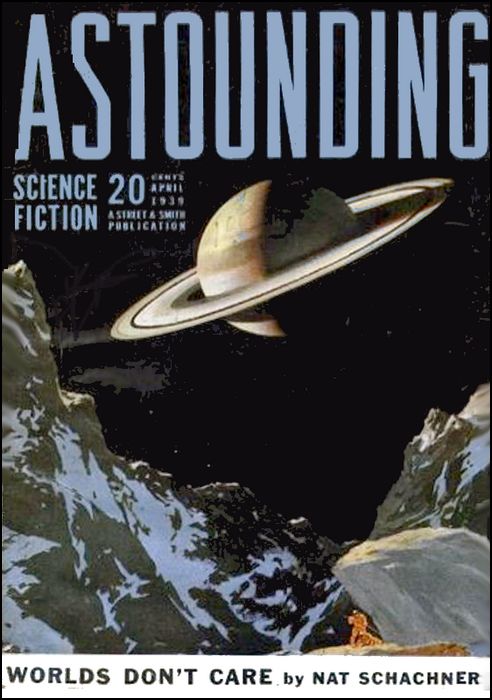
Astounding Science Fiction, April 1939, with "Worlds Don't Care"
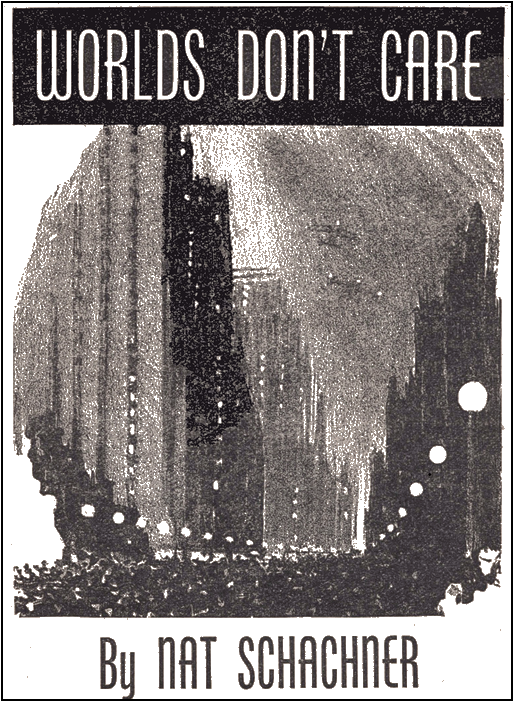
BASE NO. 1 was a hive of activity. The great spaceship rested in its cradle, its nose pointed upward to the stars. The flood lamps sprayed the ground with their blue-white glare. Within the cleared space a stumbling stream of Martian men, women and children were passing into the interior of the ship. A common apathy of despair pinched their faces into suffering masks. They seemed like cattle herded to the slaughter.
Sam White tried to blink the pity out of his eyes and remember that he was a reporter with a job to do. He lifted his pad and began to scribble. But somehow the words his shaking fingers formed didn't make sense. They were blurred at the edges, wavering, incoherent; just as those poor people were to his smarting eyes.
He shut the pad with a snap, thrust it angrily into his pocket. "Damn it, doc!" he said with an unsteady gesture to the man who stood next to him, the caduceus of the medical service glowing on his visor. "I can't stand this! I feel like a heel watching those poor scared folks being torn from everything they've known and loved all their lives, and thrown out into space like a pack of infected rats."
Dr. Aylesworth looked unhappy. "Don't think I feel any better about it than you do, White," he grimaced. "But there's no other choice. Either they go, or we all stand a chance of being wiped out. Look what's happened to Mars."
Sam scowled. "Yeah, I know!" He didn't have to tell Aylesworth what everyone knew—that he, Sam White, roving reporter for Universal, had been the only Earthman to come out alive from that unhappy planet with news of the strange plague that had made it into a shambles.
The horror of what he had seen still clung to him—that horror which he had been able to communicate only too effectively to the other peoples of the System. Even now, as he thought of it, he couldn't repress a shudder.
Ever since he had first taken to the spaceways he had loved that queer, gentle, dying race. There were not many of them, compared to Earth standards. A bare million, all told. They huddled in the long valleys where the scarce air still lingered and the brown-red vegetation with its leathery covering furnished them with food, drink and the tough, heat-inclosing textiles that made life possible.
The Martians were a tall, albino race of almost ethereal beauty—far different from the ancient concepts and imaginative writings before space travel made contact possible. The weak sunlight made pigmentation unnecessary; the slight gravitational pull gave them slender, wavering bodies of the type immortalized in the early paintings of El Greco and Arthur B. Davies, and the slighter atmosphere puffed out their chests so that expanded lungs might drink in greedily the precious oxygen.
Sam would never forget that first day in Tari-Gor, the inclosed city erected especially for the benefit of Earthmen with their weaker lungs, when the plague had struck without warning. He had seen the bright-red spots come swiftly to the fair, almost snow-white pallor of the Martian face. He had seen them stagger and run screaming through the streets, their long hands clawing at their throats. He had seen the swift putrescence of their flesh, the lightning suddenness with which they had dropped in their tracks.
They had died by the hundreds before even the first doctor could go to the rescue. But the Martian doctors themselves caught the infection, and dropped beside their patients. A handful of Earthmen, there on tours or on business, and medically trained, had taken over.
For several Martian days they worked heroically, seemingly immune to the mysterious ailment that threatened to wipe out the more delicately organized natives. They found no cure, but they managed to discover the cause. It was incredible!
Life molecules, elemental ultravirus forms, had drifted like a huge meteoric swarm into the Solar System from God knew what focal point of origin in the depths of the universe. Immune to light, heat, or the blasting effects of ray bombardments, they pervaded every nook and cranny of interplanetary space, of the worlds that composed the System. They attacked the nucleoplasm of the cells, dissociated it into gaseous, toxic compounds which swelled swiftly and burst open the cell walls. Death followed literally from numberless interior explosions.
But only the Martian nuclei, with their unpigmented basic genes, seemed affected. Neither Earthmen, nor swart Venusians, nor the green folk of Callisto, succumbed to the invading virus.
That, at least, had been the first report of the heroic Earth doctors on Mars. The Martians died by the hundreds of thousands, but the rest of the System was immune.
A FEW DAYS after the first onslaught, however, something happened. Sam White, the only nonmedical alien to remain on Mars, saw it happen. One after another, the hitherto-immune men from Earth caught the contagion, sickened, and died. The last young martyr in Tari-Gor gasped out the last frightened disclosure of his tests before he, too, turned over, shuddered convulsively, and was still.
Earth's immunity to the ultrauniverse virus extended only to its original form. But after it attacked and destroyed the Martian nuclei, the molecular structure of the virus was itself slightly modified in the process. In its new form, it proved equally virulent to Earthmen.
"In other words," whispered the dying doctor, "the Martian acts as a host. Should one of them come in contact with the people of our world, he could spread the plague so as to depopulate the entire planet. There is no cure." He tried to lift himself. "Tell them... tell them—" Then he died.
But Sam White knew what he had wanted to say. He had fled from the silent shambles of Tari-Gor in his one-man speedster, had catapulted back to Earth to spread the warning. And this was the result.
Yet now, as he watched these poor people stumble into exile, he was almost sorry for what he had done. For most of these Martians had lived all their lives on Earth. Some of them were the descendants of those who had emigrated to the more abundant planet generations before. This was their home, their world. They knew no other.
But the dying doctor had said that the presence of even a single Martian was sufficient to cause original infection, and by the modification of the disease molecule, produce secondary infection among the otherwise immune peoples of Earth.
Therefore, by the inexorable decree of the Council, every Martian residing on Earth was to he quarantined immediately and shipped by closely guarded rocket cruiser away from Earth. At first the decree had read to Mars. But this cold cruelty was too much even for the fear-maddened multitude. Accordingly, the decree was modified to include any satellite in the System that would receive the hapless exiles.
"But damn it," Sam White had exploded, "nobody will touch them with a hundred-meter wave!"
Warna Metsu, Head of the Council, shrugged. "We're leaving that part of the business to the discretion of Captain Garth," he said with a gesture of dismissal. "He is an experienced space officer. He will know what to do."
And now Johnny Garth, in the gaudy sky-blue that marked his rank, was standing a little to one side of the entrance port, watching the hunted cattle being driven into his care. He was an imposing figure of a man. Big and burly of body, his arrogant face tanned a dark red by the ultraviolet radiations of space, his eyes implacable and cold.
"Yeah, he'll know what to do, all right," Sam thought bitterly to himself. "He'll scuttle them in space with as little compunction as any pirate of the Spanish Main in the old days. A bruiser, tough as hell, and without a soul. A swell guy for a job like this!"
Obviously, Sam White did not like Captain Johnny Garth of the Interplanetary Line.
DR. AYLESWORTH had moved away. Garth had called him for a final check of the medical records. The herded unfortunates were still streaming into the hold. They presented their identification tags at arm's length as they went in. The guards at the entrance checked them against lists in their hands, but stood as far away as possible from the doomed people. Everyone was jittery. In spite of previous inspection, it was impossible to say when the dread red spots might break out suddenly on one of them. The swarm of plague virus was moving toward Earth—but its limits were vague.
Sam sighed, fished for his reportorial pad. He had a job to do, and he might as well get it over with. Millions of listeners would await his newscast of this scene. He scowled horribly. Damn 'em! They'd expect him to lay it on thick—sob stuff, personal touches, interviews with the unfortunates on how it felt to be kicked out of the System. He'd be damned if he'd pander to the multitude's flair for vicarious thrills. He'd—
A Martian was standing dejectedly at the end of the long queue that waited its turn for entrance into the exile ship. The reporter's eyes lifted as he scribbled, flitted over the crowd, fastened on the man. He stopped writing. There was something in that young Martian's expression that didn't quite fit.
He was not much more than a lad, pale and delicate as all of his race, though his chest was more nearly according to Earth standards. But there was an intensity in his eyes, a violence of despair, that shocked Sam. He seemed to have made up his mind to some desperate resolve.
A speed car came roaring over the field toward them. A minor official, no doubt, with last-minute instructions for Captain Garth. It started to slow as it came within the reserve space that surrounded the cradle.
Then it happened!
The Martian flung himself forward suddenly, directly into the path of the still-speeding car. The streamlined nose hit him with a sickening crash. His body turned crazily, fell underneath. The oversized wheels passed over him.
Something snapped in Sam as he raced forward. The great landing field swirled with commotion. The juggernauting car had braked to a halt not twenty feet beyond; a shocked-looking official sprang out. People were running.
But Sam reached the body of the suicide first. He was dead, his head crushed by the thundering wheels beyond all recognition. The reporter bent over quickly. Poor kid! He would never have to face exile now. His peaked cap had been thrown clear; so had the aluminum identification tag he had clutched tightly in his hand before the end.
Obeying a sudden instinct, Sam picked them both up from the soft earth and stuffed them into his pocket. Then a swarm of horrified spectators descended upon the scene. The minor official was crying to all who would listen:—"I couldn't help it. He deliberately threw himself in my way. You all saw it, didn't you?"
Sam saw Dr. Aylesworth rush over, accompanied by Captain Garth. An ambulance plane lit lightly on the field. The place was black with people.
Sam moved away. He felt a little sick. In a way he had been responsible for the unknown Martian's death.
If he hadn't brought that story back from Mars—
Yet he had been right in doing it; and the Council had been right in exiling these people. If one of these poor devils should catch the plague, the billions of Earth people might be wiped out in turn. Yet the Council needn't have been quite so hysterically brutal in its methods. Two days before, Sam had brought the warning; today the unsuspecting Martians were being bundled off into space, without adequate preparations, without knowledge even of where they were going. The official orders were vague. The final destination was left to the discretion of Captain Garth. Sam laughed bitterly. Everyone knew Garth's reputation; even that wretched Martian who had sought the quick way out. Once that hard-bitten space dog had cleared Earth—
Swiftly, Sam acted. He flung his dark slouch hat with its newscaster's trumpet to the ground; jammed the peaked cap he had salvaged on his head. It was a trifle large and the peak cast a shadow over his face. He yanked the identification tag out of his pocket, thrust himself into the apathetic line close to the front. Even the death of one of their own had not shaken the lethargy with which the average Martian met misfortune.
Sam knew now what he wanted to do. He'd get on board the Ellie May. The confusion attending the suicide would help him. Though the Council had strictly forbidden newscasters on the trip, he felt confident of his ability to get away with it. He knew the radio operator. Once the ship had started, he'd get human-interest stories from the outcasts, radio them back to Earth. Daily messages. Propaganda. The people of Earth, the Council itself, would cool off. Hysteria would give way to normal kindliness. More definite measures would be considered for the resettlement of the exiled Martians until the plague danger had passed. Sam himself had certain suggestions to make. He had brought trouble upon this gentle folk; he'd help them now.
Sam moved with the line abreast of the guard. The peak rested almost on the bridge of his nose. He held out his tag, straight-armed. The guard took it gingerly, compared it with his list.
"Inside, Atshir Jones," he growled. "Next!"
THE Ellie May was an old tub of a cargo boat, built for capacity rather than for speed or luxury. Its last trip had been a charter to carry actinium ore, blasted from an obscure asteroid, back to Earth; now its mission was to dump two hundred-odd unwanted Martians somewhere in space.
Its crew were tough old space rats, assembled from the dives of half a dozen planets, blacklisted by every other company whose ships traversed the space-ways. But they suited their captain. Sam remembered Johnny Garth as the commander of a spruce luxury liner to Mars. A competent navigator, without the shadow of a doubt, fanatically devoted to his profession; but a slave driver and a man without a soul.
In fact, it was Sam who had been responsible for his degradation. He had obtained the inside story of a mutiny on one of Garth's ships and dramatized it for the delectation of billions of listeners. The ensuing wave of indignation had blasted Garth into the command of a humble freighter. Naturally there was no love lost between the two.
The Ellie May took off in a rumble of infolding gases. The vibration penetrated the stout metal sheath and jarred the hapless passengers to an awareness of their position. A child began to cry.
That touched them off. The women wept, and the men swore. Helpless creatures, torn from their surroundings; carried away to an unknown destination.
Through the visor ports Earth fell beneath to gain a swift convexity. The sun side was shielded, and on the other blackness yawned, sprinkled with the glowing dust of innumerable stars.
But soon even that first ebullience of resentment died away. Once more the crowded hold relapsed into the apathy of hopeless despair. The men sat holding their heads and the women swallowed their sobs. Only the children, with the resiliency of youth, began to perk up and take notice. Tears dried, they stared curiously around them, tendered timid friendship toward each other, and began to play.
Sam thought it was time to get busy. Each individual in this mass had a story in him; it was his business to get it out. He got up and fished for his pad.
Just then the communications door that led Jo the working quarters of the ship flung open and Captain Johnny Garth, attended by two hard cases, stalked in.
In the very center of the crowded quarters, built rather for cargo than for human freight, he paused, straddled his solid legs, hooked thumbs in the belt of his trousers, and surveyed the huddled passengers with bright, bold eyes. His look was as arrogant as ever, yet Sam noted that his fingers were close to the vicious little Allertons that studded his belt, and that his guards handled their guns with significant gestures.
"Well," he demanded finally, "anyone sick yet?"
There was no pity in his tone, no realization that he had in his care a group of hapless people, pariahs through no fault of their own. Sam felt a sharp stab of indignation at his heartless brutality. He almost jerked forward in protest. Then he realized his position, and bent his head under the peaked cap. There was no sense in disclosing his identity now.
No one had answered. Instead, frightened glances sought the faces of their fellows, each searching fearfully for the telltale spots. Suspicion had been sown in their bosoms by the tactless question.
The captain's face grew heavy with anger. "I'm not talking to myself," he snapped. "Answer me! Are any of you sick?"
A tall, slender man, white-faced, his puffed chest heaving with unendurable burdens, jerked up from the narrow berth into which he had flung himself. "Go on," he screamed. "Laugh at us; mock at our misery. I wish to God I had the plague so I could give it to you and all Earthmen who are as heartless as you are. You don't care what will happen to us. You think only of yourselves. Where are we going? What are you going to do with us?"
His yells awoke his fellows from their apathy. They started up, screaming, shouting, crowding around Garth. The long fear that had held them submissive burst like the weakened wall of a dam.
Captain Garth pulled out a brace of Allertons. Their cone-shaped orifices could spread flaming death over a wide-angled area.
"Back, every one of you!" he shouted. "Or, by God, you'll never reach your destination. If I had my way, I'd dump you all in space to make sure your rotten blood doesn't infect honest people. But the Council went soft instead. Back, I say!"
THEY fell back from his threatening weapons, panting with fear and ill-suppressed hatred. Garth grinned. It was the superior grin of a tamer of animals. Sam felt a surge of hot anger. He lost his head.
"You presume too much on your authority, Captain Garth," he said sharply. "Once before you tamed a mutiny by methods of your own, and look what it got you. The command of a lousy freighter. These poor people have a right to know where you are taking them."
But even as the hot words poured from his lips, he realized that he had given himself away too soon.
Garth had swung to his voice. There was black wrath on his countenance. Sam dropped his head quickly, shading his face—but it was too late.
"Who dares speak to me like that?" Garth roared. Then he stopped. Wrath turned to bewilderment, and back again to explosive fury.
"Sam White! What the hell are you doing on my ship? There's a Council order against scum like you on this trip. Who slipped you in?"
Further concealment was useless. Sam lifted his head, stared boldly back at the enraged captain. "No one, Garth. I just walked through your guards."
Garth whirled on the man to his left. His voice was soft, yet deadly with menace. "Jellies, you watched the entrance port. Speak up, man! How did this blasted snooper get in?"
Jellies cowered. "I didn't see his face. He had a cap that covered his eyes. And he gave me his identification tag. It checked against the list. The name was Atshir Jones."
"You nincompoop!" Garth raged. "You let the lousiest damn reporter in the System into the ship. Where is this Atshir Jones?"
"You won't find him, Garth," Sam said quietly. "He's beyond your power forever. He took the easy way out. You saw him yourself, lying on the ground, his head crushed in. As for me, I don't mind if you do radio a Council patrol ship to take me off. I've got enough material already on hand to rip the hide off this rotten mess. Go ahead and put through your call."
The captain's eyes narrowed on the brash reporter. Then he smiled. There was something in that smile that made Sam's heart sink suddenly.
"So you think that I'm going to send you back to Earth, my friend?" Garth said softly. "You are very much mistaken. You have adopted an identity of your own free will. Sam White, reporter for Universal, is not on board. Here we have only Atshir Jones, Martian." His voice took on an edge. "You chose to cast your lot with these people, Jones. Very well then; I'm seeing that you go through with it. And remember, Jones, any attempt to stir up trouble on your part, and I'll shove you through an exit port—without a space suit. Understand?"
The door closed quickly behind his harsh laughter.
Sam sat down on the edge of his berth. He had to think this thing out. Around him the wave of rebellion, the curiosity evolved by his passage with the captain, had already subsided. The exiles had fallen once more into their apathy of fatalistic despair. None of the adults spoke to each other; each sat with drooping head and listless mien, immersed in the vacancy of his private thoughts. There could be no possible revolt among weaklings like these, even if the armament of the crew had not forbade all hope of such an attempt. The Martian strain was gentle, pliable, bending to suffering rather than opposing it.
Slowly, the implications of what Garth had said seeped into Sam's brain. On board the Ellie May the captain was supreme. His crew was hand-picked—blacklegs, outlaws who would take orders from Garth and from no one else. The radio room was at the other end of the ship. He could never get to it. Even if he could, the radio officer would now refuse to take a message from him. No one on Earth would ever hear of his plight. No one would ever know what had happened to him. Sam had no illusions about the probable fate of these outcasts with whom he had cast his lot on the spur of sudden emotional pity. What planet in the System would accept them, and risk the chance of the plague? Let but a single red spot appear on any one of these foreheads, and all would be callously thrust out into space.
The sweat began to bead on his forehead. Garth had waited for a chance at revenge upon the reporter who had brought about his degradation. And now he, Sam White, had deliberately given him his opportunity. Atshir Jones he was on the ship's list, and as Atshir Jones he would disappear.
He started up, choked with helpless rage. He didn't even have an Allerton or a needle gun upon him. He was trapped!
ON the fifth day out they intersected the orbit of Mars. The reddish planet, with its long, streaked valleys, was ominously silent. No messages had come from their sending stations for the past three days; no answers were returned to the deluge of inquiries from the other planets. That much Sam had been able to wheedle from a surly guard; no more.
He stared out of the view port at its fast-receding bulk. The plague had seemingly wiped it clean of life. His eyes burned. That gentle, wavering race, doomed eventually to extinction, had died en masse, in a single holocaust. Perhaps it was better so; perhaps—
Monotonously the door would open, and food be thrust into their midst. Monotonously the ship doctor would inspect them at a safe distance for signs of the dread spots. Monotonously the Ellie May fled through space to an unknown destination.
For the first few days, Sam had demanded at every opportunity that he be taken to the captain. Every time the door opened, every time a guard or the doctor appeared, he repeated his insistent request. But they only laughed at his protestations that he was Sam White, ace reporter of Universal; and they ignored, as well, both his threats and his attempts at bribes. Garth obviously had his crew well under control.
Then he turned his attention to his fellow exiles. But a few more days convinced him that the job of arousing them was hopeless. The Martian strain, even though they had lived long on Earth, dominated their mental makeup. They looked at him with lackluster eyes and returned to their passive despair. Even the children began to sink to the general level of fatalistic resignation.
Something of the constant example began to sink into Sam himself. Fantastic schemes had revolved in his active mind. He would overpower a guard when he came with food, and seize his weapon. He would storm through the ship until he found Garth; and at pistol point force him to turn the ship around. He would seize the radio room and—
But now he began to sit and mope on the edge of his berth, like the others. The guards kept warily out of reach—they always came in pairs—and Garth had never put foot in the hold since the first day out. In the privacy of his own quarters, Sam thought helplessly, Garth was mocking him; planning his revenge for that single damning newscast which had tumbled him from his arrogant estate.
Then one day, hope suddenly flared. They had left Mars long behind. They had cut through the wide belt of asteroids, and had turned sharply toward Jupiter. The huge planet, with its long, parallel streaks and mysterious Red Spot, loomed slowly to the left. It was a grand sight, majestic, awe-inspiring, the most beautiful of the inhabited universe.
Not that Jupiter itself was habitable. No one had ever dared penetrate its swirling envelope of poisonous ammonia and methane; nor dared risk the incredible storms that raged beneath. But two of its swinging satellites had been colonized. Io and Europa, the closest of the larger satellites. Both Ganymede and Callisto, though larger in size, were mere chunks of frozen ice and carbon-dioxide snow. Their densities were approximately that of water. But Io and Europa had mineral cores, and daring colonists, lured by the store of precious metals that lay close to the surface, had entered the honeycomb of caves with which they were pitted, to establish stations. There they found a curious green folk, not far removed from savagery, who had managed to seal in a sufficiency of air and water to keep life going.
The hope deepened. For the ship swung over to intersect the paths of Jupiter's moons. Through the view port Sam could see the chunky mass of Europa quite plainly now. There were hundreds of unexplored caverns crisscrossing the inhospitable satellite. This, then, was their destination.
It would be a hard life, doubly difficult for the soft-bodied exiles. Pioneering conditions of the roughest sort on the very edge of the System. Well, it would be temporary at most. As for Sam himself, a journey to the nearest colony would give him access to the radio and communication with Universal back on Earth. He would do his best to ameliorate the condition of these unfortunates; and as soon as the plague waned—
THE Ellie May sharp-angled its course. The looming satellite swung in a tight arc to the left. Jupiter rushed across the void, thrusting its great orange disk out of sight.
"Hey!" Sam shouted involuntarily. "What's that fool Garth doing?"
But no one answered him; no one responded.
Obviously, they were quitting the vicinity of the mighty planet and its moons after coming so close. But why? Why?
The question hammered in Sam's brain for hours unsatisfied. They had come to the outermost limits of human venturing in the System, to the last colonizable satellites, and now they were turning away. A sudden elation pounded in his veins. Had Garth received a message from the Council to return? Had the plague burned itself out in the three weeks of their journeying? Had Earth repented its harsh decision?
The door opened and a guard thrust in hastily their usual platters of concentrated foods. He was about to close it again when Sam called out:—"Hey there, Soule! I thought we were going to land on Europa."
Soule hesitated; then growled: "We were supposed to. But that's a tough crowd down there. They sent us a message that they wanted no part of us. Council order or no Council order, if we tried to land with this bunch, they'd blast us back into space again. And they meant it."
"How about Io?"
"Same business; only they used worse language."
Sam tried to still the beating of his heart. "Then we're returning to Earth?"
Soule looked frightened. He averted his head and started to close the door. "Naw... that is... say," he began angrily, "I ain't got no time to answer fool questions."
Sam sprang across the intervening space in a single leap, caught the startled guard unawares. His fingers gripped on the man's tunic; his other hand darted down for the swinging gun.
"By God," he exclaimed fiercely, "there's something screwy about this! You'll tell me the truth, Soule, or I'll—"
"You'll what, Mr. Jones?"
In back of the struggling guard another figure loomed suddenly. Tall, burly, his granite face sarcastic, Captain Garth stood there, a deadly little Allerton snouting in his hand.
Sam let his hands drop. Soule rubbed his shoulders, began an apology.
"Get back to quarters, scum," the captain interrupted with a roar. "I'll tend to you later." The wretch fled hastily, quaking in anticipation.
"You'd do what, Mr. Jones?" Garth repeated with deadly politeness to Sam.
The reporter faced him boldly. "I demand to know where we are going," he said in clear, even tones. "We've just swung away from the last habitable outpost of the System. Your orders were to land on one of Jupiter's moons. You've let the colonists override the Council orders. What next?"
Garth examined him with glinting eyes. "You've managed to pick up a lot of information here in the hold," he retorted. "That means Jellies and Soule must have talked more than was good for them." His eyes narrowed. "Now I'll give you some more information, White. It's information that you'll never be able to use. I had additional orders from the Council; sealed ones that none of the crew knew anything about. Io and Europa had a right to send us away. I don't blame them myself. I'd do the same thing if I were in their boots, Council or no Council."
Sam did not like the captain's smile. It boded ill. Yet he pretended not to notice. "Then, of course," he said with assumed lightness, "we're going back to Earth—or maybe Venus."
Garth shook his head. His smile broadened. "No, my fine snooping friend. We're not turning back. We're going on."
Sam started. "You're crazy," he protested. "There's nothing beyond Jupiter but glacial planets that no man has ever attempted to reach."
"There is always a first time," Garth pointed out. "We are going to combine business with pleasure. Since the known System won't take you, we'll have to find new worlds for you. At the same time, I'll have a job of exploration to my credit that will bring me a higher rank even than the one from which your damned newscast dropped me."
Sam clenched his hands. "You mean you're going on to Saturn?"
"At least that far," Garth agreed. "There's a fuel ship slanting up right now from Europa to restock our supplies." He fixed the reporter with a malignant glance. "We'll see how you like a Saturnian moon for what is left of your life, Mr. Atshir Jones."
THEN he was gone; the steel barricade slammed tight in Sam's face. Sam went back to his bunk; sat down. His fists were still clenched, and the nails dug unheeding into the palms of his hands.
So that was it. The Council, in its panic fear, had determined to rid the System thoroughly of these possible foci of infection. And Garth, in his avid desire for personal rehabilitation and further glory, welcomed the hazardous mission.
Saturn! Approximately twice the distance of Jupiter from the Earth. A planet of mystery and incredible rings. A swirling mass of noxious, frozen gases. A temperature utterly incapable of supporting life. Satellites of which practically nothing was known. Wastes that no man had ever dared venture into before. They might as well, he thought bitterly, have dumped us through the ports into the void. It was murder, one way or another.
For the thousandth time he stared speculatively around at the hapless outcasts. They sat, as always, looking vacantly ahead, crushed by their misfortunes. Speech had died progressively until it was now but an infrequent matter of monosyllables. They ate what food was given them with listless appetite; they lay in their berths and fixed their eyes on the smooth, blank ceiling. Sam had tried again and again to stir them to activity, to resentment over their fate. There was no answering spark in them. They might just as well have been sheep on their submissive way to the abattoir for slaughter. If anything was to be done, Sam would have to do it unaided.
But there was nothing he could do.
The days turned into weeks. The Ellie May did not seem to move. Yet Sam knew they were traversing the uncharted deep at a steady clip of several hundred miles per second. The rockets had kicked them into the required velocity, and now they were coasting along on momentum. Only occasionally the stern rockets blasted off to overcome the diminishing pull of the far-distant Sun.
Jupiter fell steadily away, and became once more but a star in the blackness of the void. Saturn burned with a slowly increasing luster. It was frightening—that tremendous jump into the unknown.
Even the members of the crew felt the tension. The doctor snapped irritable commands on his daily inspection of the exiles for signs of the plague. The guards, who brought their food, growled sullen monosyllables to all Sam's attempts at conversation, and withdrew with all possible haste. The tainted passengers fell into an even deeper stupor. It seemed even difficult for them to swallow the food. And Sam sat on, day after day, trying to figure out some plan of escape until his brain would ache with utter futility, and he would fling himself exhausted across his bunk to fall into uneasy, unrefreshing slumber.
Sometimes he thought of the dead lad whose identity and fate he had assumed. It had been a sudden impulse on his part; an impulse that would very probably cost him his life. At times he raged at himself for having been a blithering, romantic fool; then the sight of his fellow exiles, their tragic faces wavering before him, stirred something inside of him, and he grinned mirthlessly. He supposed he would do it all over again, if the occasion arose.
THE weeks passed, and Saturn began to assume a commanding position in the illimitable waste ahead. It grew on the sight until it became the dominating factor in the immensities. It was incredibly beautiful. Even the lackluster outcasts began to revive; to crowd around the view ports for the first time in weeks. They began to talk again. Ripples of excitement invaded their speech.
Tension mounted throughout the vessel. Those few members of the crew who came in contact with the untouchables lost their gruffness, their abrupt aloofness.
For one thing, Dr. Semmes announced joyfully that all his cultures taken from the outside of the Ellie May, as they swept through space, had been negative for the past five days. Which meant that they had passed beyond the area of the terrible subvirus molecules and there was no longer any chance of infection.
For another, the thrill of having come to a hitherto-unexplored planet, where no human being had ever ventured before, gave a feeling of camaraderie to all engaged in such an overwhelming journey.
And Saturn was a sight that hushed all human differences in the glory of its marvelous beauty. The planet was tilted to them so that the full splendor of the rings was exposed to view. Saturn itself was a pearly disk, shot through with parallel bands of delicate mauves and blues and pale reds. But the rings were a flashing, scintillating halo that whipped swiftly around the equator, shifting their colors through the entire gamut of the spectrum, blazing with an eerie iridescence that reminded the breathless reporter of the tints to be found in the depths of a magnificent fire-opal.
In the grandeur of that picture, never before seen so close or in such precious detail, he forgot his situation and the fate that awaited them all. He was a discoverer, a worshiper at the shrine of a tremendous spectacle.
He was rudely awakened, however, to a sense of the realities of the occasion. Captain Johnny Garth did the awakening. He stalked into the prison-hold, sure of himself, superior, arrogant. Three guards followed him, well-armed, wary. They no longer feared infection, and they were prepared for any possible mutiny.
Garth stared around at the astonished exiles, flicked Sam White with scornful glance.
"Get your stuff together," he growled. "We're landing within the next half dozen hours."
"Where?" Sam demanded. Inevitably he was the spokesman of these frightened people. He could feel them shrink once more within themselves; he could see the swift relapse into their former lethargic state.
"On Titan. I'm giving you all a break. It's the largest of the Saturnian satellites, solid to the core, and our electro-scanners have found evidences of pocketed depressions and black shadows in the rock that indicate the presence of caverns."
"How about air? How about water?"
"You want a hell of a lot," Garth sneered. "What did the first colonists on Europa find? Water and air indeed! You're too damn soft. You'll find plenty of ice, and plenty of oxygen-bearing rocks. You'll do what every interplanetary pioneer has done. You'll seal yourselves in, melt the ice, and crack down the sulphates, carbonates and aluminates to release a breathable air. The Council has been damn good to you. They've furnished you with complete space outfits: spacesuits, small atomic furnaces, blasting and cutting arcs, food, clothing and supplies to keep you going on your own for a year. Seeds, too, for grain to be grown in pulverized rock. If you don't make a go of it, you don't deserve to survive."
Sam slid his gaze around the hunched, delicate bodies of these compulsory colonists. What he saw sent cold shivers through him. They did not have the stuff that made pioneers. They'd just huddle and die as soon as the oxygen tanks in their spacesuits gave out.
Anger burned in his veins. Not so much for himself, as for these poor victims of a fear-psychosis. He shook his fist at the imperturbable captain. "It's murder, pure and simple," he shouted. "You know that as well as I do."
Garth shrugged his shoulders. "Bah! I could make a go of it. So could any group that has guts. Let's see what you are made of. Remember, we land in six hours." He left the room.
THEY spiraled close to the overwhelming round of Saturn to make the landing. Then they slid down to the bleak, stony face of Titan in a series of ever-narrowing circles, braking steadily with the forward rockets to slacken their tremendous momentum.
It was, Sam thought as he stared down at the dizzily turning landscape, going to be a tremendously difficult affair. Titan's surface was puckered into gigantic folds. Huge, spiked mountains tumbled in every direction intersected with deep ravines and twisting gorges. Nowhere could Sam see any level spot where the ship might level off and land in cushioning gases. Garth was an experienced and skillful navigator, Sam had to acknowledge, but this task—
Seven times the Ellie May circumnavigated the inhospitable moon before the level plateau was spotted. That is, it was level compared to the rest of the terrain. On Earth it would have been a desert intersected by gullies, ditches and dotted with mesas.
Why the devil doesn't he try another moon?—Sam thought resentfully.
There were plenty of them around, spangling the black heavens where Saturn didn't take up the picture. "Heartless brute, that's what he is," he raged. "He had determined on Titan, and Titan it would be, no matter what happened."
The Ellie May shivered with the thunder of the retarding exhausts. It slanted downward, leveled off to a lesser angle. Flame smothered the ship, obscured the view ports. They were going to land.
There was a small, popping sound. Then a sundering crash that jarred the freighter from stem to stem. Clang—boom—bam!
The next moment there was a greater crash. Sam was flung headlong across a suddenly static hold into a tangle of screaming people and flying equipment.
They had made a forced landing that might well prove disastrous.
DEATH stared them all in the face. Death for the exiles, and death for the officers and crew of the Ellie May. They huddled in the still-intact recesses of the motionless freighter, no longer untouchable to each other, bound together by the common fate that threatened them all.
Outside, the bleak and frozen terrain of a dead planet mocked them with a scenery that outpaced the eeriest fantasies of a Doré. A stony waste of incredible heights and depths, sharp-rimmed in perpetual semi-twilight. Saturn whirled over canyons and peaks like a tremendous jewel, and the Sun journeyed swiftly across a circumscribed horizon like a minor star.
For three short Titanian days the engineers had worked, without ceasing, to discover the cause of the Ellie May's sudden crash. Then Chief Engineer Green broke the tragic news. His face was grim underneath its load of grease and fatigue.
"It's the firing pin of the main stem rocket chamber, sir," he reported to Garth. "It cracked and blasted off just as we were about to land, sir." He shook his head. "I've never seen it happen before. Those pins are guaranteed for the life of the ship."
"Then put in a new pin, you idiot," Garth yelled. "What are you holding us up for?"
Green's face tightened. "Sorry, sir, but we haven't any spares. They're made of the rarest element in the System—miraculum—The only known source of supply is on little Phobos, the Martian satellite. It's more expensive than radium-superX." He grimaced. "That's why the owners thought the Ellie May didn't need a spare."
"Can't you make a new pin of some other material?"
"Nothing that would last a minute in the new fuel we're using. Those temperatures'd crack wide any other metal."
Garth stood rigid. "Then you mean," he said slowly, "we can't take off from Titan until we locate a vein of miraculum ore, and that in all the System only Phobos is known to have a supply?"
"Yes, sir."
Everyone had heard it. Everyone knew what it meant. They were marooned on Titan—exiles and crew alike. The equipment and supplies, estimated to last a year of Earth time for the outcasts, would have to take care of double the number. And Garth himself had been compelled to face the realization that Titan was not another Europa. The satellite was sheer granite—a solid block without any of the characteristic veinings and striations that disclose a mineral content; without any of the clayey deposits that could be worked up into a usable soil. Titan was utterly sterile, unfit for the hardiest or boldest of pioneers. Nor could the Ellie May's radio equipment bring help. Saturn and its rings blanketed surrounding space with a strong magnetic field which made long-distance transmission impossible. No one would ever know what happened to them.
Sam's harsh laugh rose jaggedly above the stunned silence. "Welcome, Captain Garth," he jeered, "to our little Paradise. Surely you can make a go of it. Didn't you tell us softies that not so long ago?"
Garth purpled, but he did not answer.
"All right, Green," he said to the engineer. "We'll have to find some miraculum on Titan. We'll use the two-man space boat to go scouting. You know, of course, what the ore looks like?"
Green looked sick. "No, sir. The stuff's pretty closely guarded. Very few have ever seen the ore. How about you, captain?"
The purple faded to a curious gray. "Never saw it in my life," Garth said at last. He raised his voice. "Any of you men know what miraculum ore is like?"
No one answered. A dead silence blanketed the marooned people.
Sam White was enjoying himself immensely. The irony of fate, he grinned to himself. First he had been caught in the toils; and now it was the hard-boiled Garth and his gang of tough eggs, who hadn't been at all concerned in the fate of those they had intended to dump unceremoniously on bleak Titan. Let them see how they liked it for a while.
Then his smile faded. The poor exiles would never be able to fend for themselves. Garth and his men would monopolize the supplies, and the fatalistic, physically soft outcasts would die. He stepped forward.
"I've seen miraculum ore," he said quietly.
Garth stared at him. His burly, weather-beaten face was suspicious. "You, White!" He forgot his pretense of Atshir Jones. "Where did you see it?"
"On Phobos, naturally. You don't remember, evidently. I was the reporter who sent the newscast of its discovery throughout the System."
Garth took a deep breath. He remembered it now. "All right," he growled. "Then come with me."
Sam smiled. "I'll make a deal with you, captain. If I help you find the ore, you're to take every one of us back to Earth. I'll take the responsibility with the Council."
Garth's eyes snapped. "I make no deals."
"O.K.," Sam said amiably. "No deal; no miraculum."
Garth took out an Allerton; fingered it. "That's mutiny. Under the space code I have a right to kill you."
"Go ahead. That won't get you off Titan."
Garth considered that. "No, it won't," he admitted. "But I have another idea. I'll commandeer all supplies for the benefit of the crew only. Your Martians will be the first to die."
The two men's glances clashed. Sam felt a hot flush of anger at the callousness of the man. But he had no illusions. Garth had both the will and the power to make good his threat.
Sam relaxed. "You win, Garth," he said evenly. "Let's start."
IT took two weeks of steady exploration in the small space boat to convince Sam that there was none of the precious ore on Titan. Two weeks in which the two men, enemies, hating each other's guts, were confined to the narrow limits of the tiny boat, forced upon each other's company day and night.
At the end of that period they returned to the Ellie May, compelled to confess defeat. They found on board a strange situation that had arisen in their absence.
Both crew and exiles were mingling, working together on a comradely basis. New life seemed to have been instilled into the hapless passengers; a queer selflessness into the hard-boiled crew.
Under Green's direction even the women and children had forgotten their whining and were toiling at tasks side by side with the men. The atomic motors and blasting tools had been removed from the ship. Clad in ungainly spacesuits that made them look like strange antediluvian monsters, they were engaged in hollowing out the natural crevices in the rock, enlarging them into livable dimensions, sealing them with roofs of fused granite.
"Just in case," Green explained. "Any luck, captain?"
"Ask White," growled Garth. "He's refused to describe the stuff to me."
"I'm taking no chances," Sam retorted. Then he shook his head. "Not a sign of it anywhere."
Green was taken aback. "Then what are we going to do? We've six months' supplies on tap—figuring everyone." His eyes wandered from the grim captain. His tone was apologetic. "The crew, sir, are beginning to like these people. They insist on share and share alike."
Garth's face seemed carved out of the stone planet itself. "Well?" he asked noncommittally.
"I've tested all the borings, sir. Even with the fertilizer, this pulverized stuff couldn't grow a single seed. Once the supplies are gone—" He shrugged. He didn't have to say any more. They understood.
They were stranded on a planet where no human being had ever come before; where none would come for possibly a generation more. Six Earth months between themselves and death, granting even that the oxygen could be extracted from the refractory rock!
Sam wrinkled his forehead. "I still don't like you, Garth," he said quietly. "But we haven't reached the end of our collective rope yet. There are other satellites of Saturn. The space boat can go that far, can't it?"
Garth looked at the reporter with a thoughtful air. "Only to one and back at the most," he said finally. "There's a slow leak in the hull plates. It won't last much longer."
"Hm-m-m!" Sam considered. "Then even if we find better conditions elsewhere, we can't transport our colony. They've got to stay here."
"If you find the miraculum, we could shift you over in the Ellie May," the captain pointed out.
"Still no deal about taking us back to Earth?" demanded Sam.
"Still no deal!"
THEY took off for Japetus the following day. Since the little craft would be capable of only one more trip, the choice of the satellite to be visited was a matter of careful discussion.
Japetus was chosen for several reasons. Though farther out, it was next to Titan in size, and its surface in the electro-scanners seemed more regular than any of the others. Furthermore, the high albedo indicated the presence of ice and snow. That might mean frozen water, or at the worst, carbon-dioxide snow. In either case there should be weathered rock underneath, and certainly there was more chance of finding a variety of materials than in the igneous lump that Titan had turned out to be.
The journey across the gulf was made in silence. Mere monosyllables sufficed between the two men. Speech was used only in case of necessity, and even then with considerable reluctance. It was difficult to keep the supply of air at normal density. The metal plates were defective. The precious oxygen breathed out in infinitesimal quantities, but at an inexorable rate. Yet Sam had noted that Garth had refused to take along additional oxygen tanks for replenishment of the failing supply. There was little enough for the use of the marooned colony on Titan, and once gone, it might never be replaced. Granite was a tough material from which to extract oxygen even under favorable laboratory conditions.
On the trip across, Sam asked curiously: "You're not afraid to take me along, Garth? I might knock you down and take the ship away from you."
The captain tapped his Allertons significantly. "While I'm awake I have these little babies."
"How about when you're asleep?" Garth stared at him. Finally he said: "I hate your guts, White, for what you did to me. But you're not that sort of a man."
Sam thought it over. Then he said wryly: "I'm afraid you're right. You can sleep easy. But any other time—" The exploration of Japetus was a different job from that of Titan. A thick blanket of snow and ice submerged the actual surface of the planet, so that it was impossible to cruise over the terrain and search for outcroppings of the ore. Here it would have to be by the more tedious and far more laborious method of haphazard borings in likely-looking rock formations.
They landed on a desolate plateau where the ice upheaved in minor imitation of the precipitous peaks of Titan.
"More chance to find a vein in a surface fault," Sam explained briefly. "That's the way it lies on Phobos." They got silently into their clumsy spacesuits, picked up the long, spiked rods of the toughest dural-steel. Within their hollow interiors were heating and boring units, so that the rods, placed spiked end down upon the ice, would melt sizable holes within seconds; and then, with the boring unit attached, would grind through the solid rock.
Once outside, they stood momentarily motionless on the slippery surface of the orb. They were in a ravine, and the upended crags of ice glimmered ghostly in the dim Saturnian shine. Already one of Sam's hopes had been dashed. The ice proved to be solid carbon dioxide, without the slightest admixture of water. That meant Japetus, too, would very likely be as uninhabitable as Titan.
But just now he wasn't thinking of that. It was a weird, unforgettable scene at which he gazed. The strange ice boulders, tossed into the ravine as though a race of giants had once heaved them there, the bluish smoothness of their surfaces, hard as rock and unpitted by either heat or wind—just as they had been for unending millenniums. Above, however, was the sight that caught his breath. Saturn was in full crescent, with the rings tilted upward at an angle of almost thirty degrees.
Against the black backdrop of space, against the eerie waste in which they stood, two solitary human beings who hated each other, alone in the immensities, Saturn glowed with an overwhelming effulgence. Vague thoughts stirred in Sam; emotions, he had deemed, long dead. On such a night as this, in such unfathomable surroundings, one needed a comrade, a loyal friend—
Garth's voice sounded queerly in his space phone. "It gets you, doesn't it?" Then, as though ashamed of himself, he added harshly: "We've got work to do, White. We didn't come here to moon."
Sam gritted his teeth. The spell had been broken. Yet Garth was right. There was work to do.
PAINFULLY, slowly, they moved over the slippery ground. Wherever Sam indicated, they placed their rods, and set the heating units into operation. The spiked tips glowed white-hot, and the ice sizzled into a boiling steam of carbon dioxide that froze in the subglacial void almost immediately back to a fine swirl of falling snow.
Sometimes the rods plunged deeper and deeper into endless ice; other times they hit bedrock within a short distance. Then the boring units started. The rock flew and powdered under the hard, whirling tips. Sam checked personally each sample. He had been careful not to divulge the appearance of the miraculum to Garth. If he ever found it—
But Japetus seemed as sterile of the precious ore as Titan. For three Earth days they lifted the little space craft and set it down again in haphazardly chosen gullies. It was hard, hopeless work. Sam felt his muscles cry out for rest; the air in the tiny ship was thinning out at a dangerous rate; and the oxygen tubes were running alarmingly low within the heavy spacesuits.
Yet Garth kept going, tirelessly, without a whimper of complaint. Sam set his teeth. He wouldn't let anyone, and especially not Garth, outdo him. So he, too, kept on going.
On the fourth day, however, even Garth seemed to realize that this could not go on. There was barely enough air left, with the shallowest of breathing, to take them back to Titan. His black brows were furrowed, and his lips tight, as he donned the clumsy armor. "This is the last time. White," he said. "Either we find the stuff today, or we're through."
Sam shrugged and said nothing. He was saving his breathing. Every cubic centimeter counted now.
All morning the prospecting was but a weary duplication of other days. Nothing but snow, ice and sterile rock. Nothing to show that the rare miraculum existed anywhere in the universe except in that pocket on Phobos.
They stumbled heavily into a deeper ravine than any they had yet seen. The ice lifted like mountains all around. Huge boulders of frozen carbon dioxide strewed the ground.
"Small chance of finding anything here," Garth grunted. "The ice seems a mile thick."
"Maybe," Sam said wearily in his helmet. It was getting harder and harder to breathe. His body seemed a huge, single ache. "But we'll try." His armor-inclosed hand gestured. "You try under that big boulder, Garth. It looks a bit thin there." He poked with his heating rod at a thin glaze that covered an outcropping. "And I'll work here."
About two hundred yards separated them. The space boat was out of sight, around a bend in the ravine.
He saw the dazzle of red in the gloom as Garth started work. He was digging with his tool directly under the overhang of jagged ice. Then he, too, went to work.
The fierce heat scattered the glaze as if it were the thinnest tissue. It sucked up into an invisible swirl of gas, and precipitated down upon him in a frozen drive of snow. Sam brushed it impatiently away, stared dully at the uncovered rock. More of that damned granite! Smooth, featureless, unbroken. Was the whole universe composed of that sterile rock?
He turned away with a hopeless gesture. In the dim distance, Garth was still digging. Endless ice, no doubt. No more success than here. It was no go. Might as well quit, return to Titan before the last gasp of oxygen was sucked in; and wait there for death to come within a period of months.
A fierce rage filled him; a sense of overwhelming futility. Granite! Granite! He began to hate it; even more than he hated Garth. The beginning of delirium; the air was foul within the helmet. He lifted the borer, thrust it against the damnable rock; turned on the boring unit full blast. The instrument would be useless from now on; get rid of it in one grand orgy! The rock glowed and blistered and melted away under the violence of his attack. It gave him a strange sadistic satisfaction. In his semi-delirium he personalized the granite; he felt that he was plunging a lethal weapon deep into its shuddering hardness.
The gray rock split and fell away. Deeper, deeper, bit the borer. It drove through as easily as though it were a soft, ripe cheese.
Then, suddenly, the long rod jiggled in his gloved hands; slackened its furious pace. It almost crashed out of his numbed fingers.
Sam wished he could wipe the sweat out of his eyes. His head was swimming; his brain was on fire. But even in his dazed state he felt that something was wrong. The sharp spike of specially treated steel was guaranteed to go through anything but diamond. His lips opened in a feverish grin. It would be ironic to find on this waste planet a huge diamond embedded in the rock that back on Earth would be worth an incalculable fortune; but here was just so much crystallized carbon.
Nevertheless, he edged the cutting tool through the surrounding rock that overlaid the strange, hard substance. Around and around, uncovering its roughened surface more and more. His senses were whirling; it was harder and harder to breathe. A mad whim to uncloak this mighty gem seized him.
Hot sparks showered around him. Something loosened, dropped out upon the frozen ice beneath. He blinked at it. An irregular mass, metallic gray in texture, streaked through with a curious network of fine red lines.
His first thought was one of hazy disappointment. It wasn't a diamond, after all. Strange how his semi-delirium had fixed upon that as the goal of his hopes. His second was to peer closer.
He jerked erect. His vision cleared; his sluggish heart began to pump with a mad recklessness; he forgot all his former caution; a wild whoop echoed within the confines of his helmet.
A lump of pure miraculum, such as had never been found even on Phobos! A solid nugget, from which a thousand firing pins could be fashioned!
IN his phones Captain Johnny Garth heard that whoop. He jerked his bent back erect, whirled around.
"What's the matter, White?"
Sam cursed under his breath. All along he had been steeling himself for just such an eventuality. There was a certain course he had mapped in the event he stumbled upon the precious element. Now he had spoiled everything with his damned yell.
He knew Garth too well. Garth would know what had happened; with his deadly Allertons and the will to use them, Sam wouldn't have a chance to proceed with his program.
He saw Garth peering at him through the gloom. He was leaning on his boring rod, with the unit still operating. The white-hot glow bit deeper into the ice.
"What's the matter, White?" Garth repeated, his voice edged with suspicion.
Sam grimaced hopelessly. He could pick up the infinitely valuable nugget and run for it. But an Allerton discharge could outpace his ungainly gait. And the space boat was in back of Garth.
"Speak up," rasped the captain, "or I'll—"
There was a blaze of light. The huge overhang of ice tottered—fell with ominous silence. A startled yell came from Garth. Then he disappeared in a foam of hurtling chunks of ice.
For a moment there was silence. Sam stood rooted to the spot. It had all happened with such terrifying suddenness that he was caught off balance. Garth had undermined the precariously balanced overhang. It had collapsed upon him, and buried him under tons of ice as hard and solid as any rock.
Sam took a deep breath, unmindful that his supply of oxygen was perilously low. A miracle had happened; as miraculous in its way as the discovery of the justly named miraculum. Garth, the bully, the hard, soulless commander, was dead. Back on Titan his crew were fraternizing with the unfortunate exiles. Green, the kindly chief engineer, would assume command under the rules. He, Sam White, had the space boat and the miraculum that could take them all back to Earth. He would bargain with the Council by radio. In exchange for a sensible quarantine until the plague receded, he would lead a new expedition to mine this fabulous bed of the precious metal.
He laughed happily, cradled the heavy nugget in the crook of his arm, and started toward the space boat.
Then he stopped. A low groan had whispered in his earphones. His heart missed a beat; raced again.
Good God! Was Garth alive?
The groan was repeated. "White!" the voice moaned. "My leg... it's caught... crushed!"
Sam stared through the weird Saturnian shine. It was dark and shadowy ahead. The sputter of the borer had faded. The mechanism had been smashed by the avalanche. Yet he could see the huge ice boulder thrust on its side, and underneath, a prone, sprawling mass that resembled a man.
Sam's first reaction was one of fury that Garth had not conveniently been killed. His second was that it made no difference. In fact, it was a perfect case of retribution. The captain had been callously willing to abandon several hundred men, women and children, innocent of any crime except their birth, to a collective fate more horrible in its potentialities than that to which he had now fallen victim. Let him stew in his own juice. There could be no pity for him. Alive, he meant the death of hundreds; pinned helplessly here on Japetus, he meant life, freedom and future laughter to them all.
Sam's laugh was ugly. "To hell with him!" Still holding the precious find, he started his ungainly, slippery march toward the space boat. He made a detour. He didn't want to see the pinned body, nor hear whining pleas for help. All bullies whined when their turn came.
He passed on the other side, along the frowning rampart of the upflung ice. Directly ahead, around the bend in the ravine, he could see the little craft. Once inside, a flick of the controls, and he'd be off to Titan, the bearer of glad tidings. He'd have no trouble explaining the death of Garth. He'd tell the truth, that was all. Such accidents were a most usual accompaniment of space exploration. Nor was Garth so popular that anyone would bother about it. Even if they did, by the time the Ellie May was fixed, and returned, Garth would be truly dead. The fall of ice upon him, the crushed leg, would be proof positive of the truth of Sam's story.
AT the entrance port he paused. It was funny. Since that second groan, Garth had been strangely silent. No whines, no further pleas for help. Had he died then? Or had he just fainted?
Sam placed the nugget carefully on the snow next the boat, and retraced his steps. Might as well make sure. If Garth was dead, that was the end of it. His conscience would be wholly clear.
Balancing himself on the spiked point of the borer he reached the motionless body. He bent to peer down. There was no question that Garth's leg was pinned tight under the tremendous weight of fallen ice. He could never have pulled free, even if alive. But he was—
The goggling helmet turned with infinite effort. Through the clear quartzite Sam saw Garth's eyes staring up at him. They were pools of pain, but the lips were tight and did not open.
Startled, words spilled from Sam. "Then you're alive?"
The wounded man nodded feebly. "Yes."
"But you can't move?"
"No."
Wonder flooded the reporter. "You called for help only once. You saw me go and leave you. Why didn't you beg; call me back?"
A certain grim steeliness replaced the pain in Garth's dark eyes. The words came with difficulty. "I never beg—especially not from you."
"Yet you know you'll die, unless I rescue you."
"Yes."
In spite of himself Sam felt a compelling wave of admiration for the hard-bitten, tough old space captain. He would die as he lived; showing no mercy; asking none.
"You know I won't help you, Garth. You know the lives of hundreds are endangered if I do."
"Yes."
Sam heaved a sigh. Now that he had his enemy helpless at his feet, the victory tasted of dust and ashes. "I'll tell you what I'll do," he said suddenly. "I'll make a deal with you. The one I offered you before. I'll release you if you agree."
Their eyes locked in the dim light. Garth's face was gray with suffering. His crushed leg must be hurting like hell. His strength was ebbing. But when he spoke his voice was harsh, domineering. "I make no deals, White."
A wave of anger blasted over Sam. "You damn fool," he cried. "You'll die then. I'm leaving you. This is your last chance. Will you promise?"
"No."
Sam sighed. The man was mad; an idiot. Back on Titan hundreds of innocents must die if Garth came back. He lifted his dural-steel borer. He did not recognize his own voice when he spoke.
"O.—K., you blasted idiot!" he growled. "You win. You must have known I was a soft-headed sap. Here goes."
He placed the tip carefully over the prone body, set the heat unit.
The ice sizzled and glowed into furious gas. Swinging in long, parallel arcs Sam cut the encumbering boulder swiftly away. Snow piled thickly over the motionless body. Only the helmet was free. There was a soundless split. The ice settled lower on the crushed leg. Garth's lips locked tight to strangle the cry of pain; then his eyes clouded and closed. He had fainted.
Sam worked on with feverish haste. After minutes that seemed uncounted hours the leg was free. He brushed the encumbering drift of reprecipitated snow away. The leg was badly smashed but luckily the plioid fabric of the suit had not been pierced. No air had escaped.
Cursing himself for a fool, the reporter heaved the limp body over his shoulder, staggered to the space boat. There he managed to open the safety lock, thrust the still-unconscious man inside, retrieved the lump of miraculum, and closed the slides behind him.
But before he went to work to restore Garth to life and minister to his hurts, he removed the brace of Allertons from his belt and buckled them to his own.
HALFWAY back to Titan, Sam sat grimly at the controls. Garth lay propped up on the tiny berth, his leg bandaged, his face still gray, watching.
"I've been a hundred different kinds of an idiot," Sam snarled. "I don't know why I went so soft over a lug like you. I've a good mind to kill you right now, Garth. When I think of those poor people—"
Garth shifted slightly. "It's too late now, Sam White," he said calmly.
Sam whirled. "Why is it?" he started; and stopped.
He was staring straight into the cone of a little Allerton, held with rocklike steadiness in the captain's hand. "Why, where did you get that?" he gasped.
"I always carry a spare," Garth smiled. "Inside my shirt. You missed it when you searched me."
Sam stared down at his own weapons, so near and yet so far. "All right," he groaned. "You win again. Serves me right. What are you going to do now."
A strange grin lit up the wasted face. "I'll tell you, Sam, something I hadn't intended to tell anyone yet." It was the first time he had ever called the reporter by his first name. "I didn't want to raise too high hopes until I got results. Do you remember Doc Semmes' report several weeks out from Jupiter?"
"You mean about the volume of the space plague?"
"Yes. He'd been making careful charts of its presence all the way. It seemed to him, and to me, too, that the horde of ultravirus molecules was-traveling in a definite stream through space at a definite velocity. We plotted the course. The graphs showed that within several months at the most the invasion should have passed over Earth and the System, and vanished into interstellar space again. I radioed my findings to the Council, and told them to check up on them. I gave my position, and demanded authority to bring back my cargo as soon as the danger had passed. But just then we hit into the zone of Saturn's interference; and the radio went dead."
Sam stared at him incredulously. "Why the devil didn't you say so, then?"
"I dared not raise any false hopes. My orders were specific. I'm a spaceman."
The reporter exploded. "You blithering idiot! Then why, at least, didn't you tell me, when you knew I was leaving you to die on Japetus?"
The big man lifted himself painfully in his berth. "Do you think I'd crawl and beg for my life from an enemy? I'd die first." Then a grin suddenly illumined his craggy face. He dropped his weapon to the bedclothes. "But now, Sam, we're friends. Will you fix up my blasted leg, so it'll stay comfortable? You're one hell of a nurse!"
Roy Glashan's Library
Non sibi sed omnibus
Go to Home Page
This work is out of copyright in countries with a copyright
period of 70 years or less, after the year of the author's death.
If it is under copyright in your country of residence,
do not download or redistribute this file.
Original content added by RGL (e.g., introductions, notes,
RGL covers) is proprietary and protected by copyright.