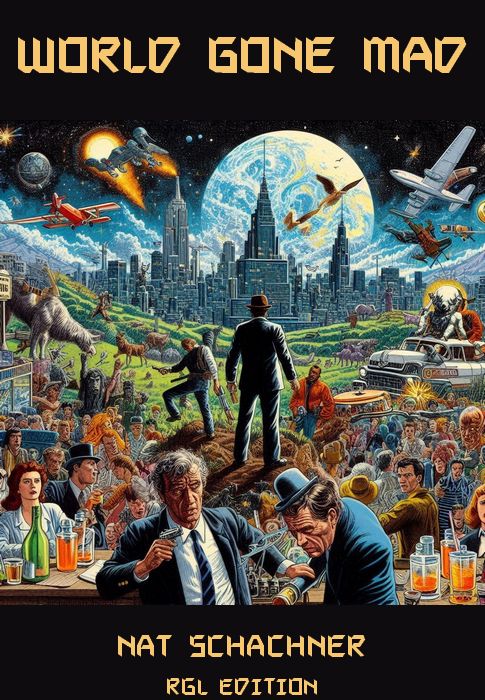
RGL e-Book Cover
Based on an image created with Microsoft Bing software
Roy Glashan's Library
Non sibi sed omnibus
Go to Home Page
This work is out of copyright in countries with a copyright
period of 70 years or less, after the year of the author's death.
If it is under copyright in your country of residence,
do not download or redistribute this file.
Original content added by RGL (e.g., introductions, notes,
RGL covers) is proprietary and protected by copyright.
RGL e-Book Cover
Based on an image created with Microsoft Bing software
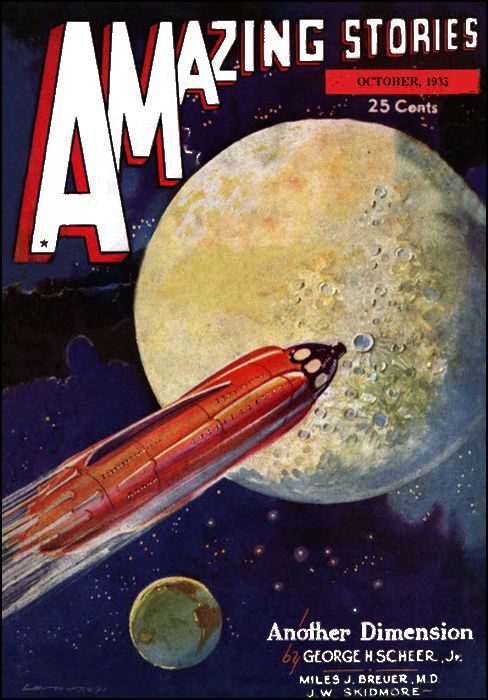
Amazing Stories, October 1935, with "World Gone Mad"
This story has a suggestive title and we are sure that many of our readers will consider that the world went mad during the World War and the madness of war is one of the stupidest performances of man and many feel that today a change for greater simplicity would be a step in the direction of terrestrial sanity.
DONALD RUSSELL sank back in his comfortable arm chair with a sigh that connoted deep content. He was in the bosom of his family, happy in its undercurrent of affectionate intimacy, his pipe was a glowing ember and drawing well, the night was mild yet tonic in its springtime fragrance, and around him spread the well-loved panorama of multi-colored New York. What more could any reasonable human being desire, he queried silently, and forbore an answer in the sense of well-being that flooded him.
He puffed quietly at his pipe, drinking in the ever-shifting beauty of the scene. There was something of the artist in Donald, even though officially he was an inspector of the finished ferro-concrete blocks used in building operations. Fortunately his work day was only four hours long, otherwise the rigid monotony of testing endless miles of blocks for resistance to stresses and strains would have driven him mad.
His soul delighted in subtle nuances of color, in the ceaseless interplay of light and shade, in the gay display of humanity against noble architectural backgrounds. That was why he had carefully chosen his home on the terraced roof of the inconspicuous Metals Building, twenty-four stories above the park-like surface of New York.
From where he sat, with the alumino-quartz sectional shutters rolled back, he could envisage the lofty towers of the metropolis, thrusting their arrogant spires thousands of feet into the air. Each glowed with an inner light, diverse in coloring, that etherialized and made translucent the solid ferro-concrete. Yet he was not too far above the green and flowers of the formal parks separating the cloud-piercing structures, to be unable to distinguish the gay charming people who sauntered, brightly hued, through the spring evening. The sounds of their careless laughter filtered up to him. Above, across the brilliant stars, flitted green and gold specks that were airplanes, cleaving the various traffic ways, each laden with its human passengers enjoying the spring night or with perhaps a cargo of freight.
Donald felt a surge of affection for his fellow-men, for all mankind, who had made possible this glorious, peaceful scene.
"That's it—it's so peaceful, so safe!" He thought aloud in his abstraction, unaware that he had spoken.
"What did you say, dear?" The gentle voice of his wife startled him out of his maze. He smiled a bit sheepishly at the uplifted steadiness of her gaze, her finger still marking the place on the thin-beaten metal page of the book she had been reading.
"I did not know I had spoken, Martha," he explained. "I was just sitting here taking in all this—" his hand described a sweeping arc over the great city, "and it came to me that what makes our life so delightful is the feeling of safety, of peace, that enfolds us all. We know that we are leaving a marvelous heritage for our children." His eye traveled fondly to the sturdy little boy of nine who was playing raptly with a tiny airplane, unheedful of his elders. "And we know that they will live to enjoy and improve upon it in security."
"Stuff and nonsense!"
Donald started at the explosive violence of the ejaculation. He had almost forgotten his father. Martha bent down to her book again to hide a little smile. She was used to old Peter's irascible interjections.
"What is, father?" Donald asked patiently, though he knew very well.
"It's all stuff and nonsense, I say," the patriarch repeated in his unexpectedly strong, bass rumble. His eyes flamed from under thick, shaggy brows. "You are all living in a fool's paradise; you and your fine civilization. The next war will bury it all so deep they'll be sending expeditions in the future from some other planet to dig it out again and philosophize over the dead ruins. Safety—peace," he snorted his contempt, "they are words; mere words. I give you twenty years—no more; and then—the end!"
HE warmed to his tirade. "Why are the nations building countless thousands of rocket planes, huge bombers, God knows what other fiendish weapons of destruction? United Europe has a concentration of fifty thousand; the Sino-Russ as many, Australasia maybe half of that; and the Americas—our own philanthropic, progressive, world-minded Americas—at last count, seventy odd thousand. What about the new radite explosives, one bomb of which could level a city; the terrific poison gases? What are all these prepared for, if not war? One little spark, and the world will go out like a flame. That's what your scientific civilization is headed for—destruction."
The old man subsided, exhausted from his effort.
Donald chided him affectionately, "Now, now, dad, you know these long speeches tire you out dreadfully. At your age you should be content to float gently on the stream of life, and not worry about viewing things with alarm. You'll find that our generation and the generations we beget are more reasonable, more scientifically minded, more civilized, than the one you were born in. War to-day is unthinkable, hideous. It is an outworn barbarism that the human race has sloughed together with many other cherished prejudices and manias."
Martha nodded her head fondly at her husband's cogent reasoning. Much as they loved old Peter, he did get tiresome at times with his endless scoffings at their present existence; with his staunch refusal to accept the progress of the world since the days when he had been a young man. There was a favorite phrase of his that especially irritated her with its illogicalities. Ah, there it came—it was inevitable.
Old Peter had burst out: "Poppycock, fine talk! Let me tell you something, son; you can't change human nature. In my day we also thought and spoke the same as you; even though every country—and there were many little ones then—was armed to the teeth. We thought it didn't mean anything; there couldn't be any war. And then—smash—it came. I was through it, I know what it was like. You can't realize the beastliness, the fury of the thing, from reading books. And, mark you, we had crude, primitive weapons, compared to what has been evolved to-day.
"That's the curse of our present science. It has brought to life mighty engines of destruction, and the nations have built them. Sooner or later some hot-headed fool, or group of fools, will itch to put them in motion—as if they were playthings. Why, I can remember—"
But Martha was no longer listening. Old Peter had been over the ground so many times. Her eyes strayed to the time signal. It flashed the hour of twenty-one.
"I wonder what's keeping Allan," she worried, "he telewrote he'd be here at twenty, and it's an hour over now."
Allan was her oldest son, in the Government Service, private secretary to the Communications Chief.
"Nothing to be alarmed about, Martha," Donald soothed, "no doubt he was detained at Washington. He'll be along any minute."
The mother sighed wistfully. "I'm looking forward to this little visit of his so much, I don't want to lose a minute of it. We see him so little."
"That's the sacrifice we must make for having a son in Government Service. There are no four-hour days for them."
The boy, Anders, had abandoned his toy, was tilting his small head back at the heavens. A green flash dissociated itself from the darting midges, hovered high overhead, and commenced a slow vertical descent.
Anders' clear childish voice rose to an excited shrilling.
"Look, mother, he's coming; big brother Allan's coming. See!" He pointed a chubby finger at the dropping helicopter.
Donald peered upward. "By George, the boy is right. That looks like Allan's plane."
Martha felt unduly relieved; she had not admitted even to herself how worried she had been. Old Peter's fierce gaze, heated by his favorite argument, sheathed itself suddenly in unwonted tenderness. The little boy was dancing around, clapping his hands. It was easy to see that Allan was a well-loved favorite in his family.
THE helicopter came gently to rest on the small landing area outside the alumino-quartz framework. A tall, rather good looking young man dismounted and was immediately overwhelmed in a blur of small legs and arms. He picked up the wildly wriggling youngster, gave him a bear hug, and deposited him on the terrace. Allan came toward his parents and grandfather, with little Anders hanging to his jacket.
Martha was enfolded in a long kiss, from which she emerged to look at him with fond pride. But mother-like, she chided him gently.
"You're late, my son."
Allan was shaking hands with his father. "I'm sorry, mother, but I didn't think I could get away at all. I just managed to make it."
"Well, you are here, and we're thankful. We've looked forward to this week with you for a long time."
Allan said nothing. Old Peter, seated in his chair a little way off, was watching him keenly. He saw the little start, the hesitant manner of his grandson as he was engulfed in the quick chatter of a reunited family, the frowning abstraction with which he limited his speech to monosyllabic answers. So unlike the genial, ready-witted youth. Old Peter knew there was something wrong. Allan was biting his lip nervously, was trying to say something against the light patter of his parents; yet didn't know how to begin.
"Allan!"
"Yes, granddad."
"What's wrong?"
The young man started. "Why—er—nothing."
"Nonsense, you can't come that over me. I'm too smart for you. You've got something on your mind and you're afraid to say it. Out with it." Old Peter was dictatorial.
Allan hesitated, his face preternaturally grave. "Well, I—I have to go back to Washington in half an hour; there's some special work I have to do."
Martha burst into an agonized: "But, Allen, your vacation; you promised—"
"I know, I know," he interposed hastily, "but something has come up. Next week I'll be able to make up for it. I'll—"
"Allan, come here." The old man looked more than ever like a patriarch out of the Bible. His grandson came obediently.
Those undimmed eagle eyes seemed to search his very soul. "Allan, you're not coming back next week."
"No granddad," the young man said miserably.
Donald took a step forward, but old Peter disregarded him. Relentlessly he continued his inquisition.
"You had better tell me; you know even as a little lad you couldn't lie to me."
Allan mopped a suddenly perspiring face; there was agony on his brow. His parents watched with anxious incomprehension; even little Anders was round-eyed; but the old man's eyes bored steadily into him.
The tortured young man gave way completely. "If you must know—it's a Government secret—but I can't, I simply can't keep it from you. We—that is, my Chief expects war in forty-eight hours."
If he thought his words would prove a radite bomb, he was disappointed.
His father and mother simultaneously echoed: "WAR?"
Then Donald laughed indulgently. He clapped his eldest on the shoulder. "My son, now I know you need a rest. You and your Chief have been scaring up bogies between you. War! Ha! Ha! In this civilized age of ours. Impossible! With whom, and for what, may I ask? Nonsense! I didn't know you had taken, as he knew it, your grandfather's talk of the world, so seriously."
Martha had smiled too through her quick alarm.
"Listen to father, dear. You know he's right. Just you come with us to the North Woods for a few days and you'll feel fine again. I'll call Washington and tell them not to expect you."
Little Anders chimed in. "War? What a funny word; what does it mean, brother Allan?"
THE young man looked dully from one to the other. He could see they did not comprehend. Neither, for that matter, he reflected bitterly, had he, until these last few days when the Cabinet of the Americas had been almost continuously in secret session.
Old Peter had risen. His massive limbs still supported his rock-hewn body.
"I knew it," he thundered, pointing a bony forefinger for the very heavens to bear witness, "I foretold it, and you laughed at me. WAR, that's what's coming! I knew that human nature was the same as when I was a boy. There has been peace and prosperity too long; the poor fools are bored with themselves; they have playthings they must use. WAR!"
His voice broke to a whisper, as if there was magic in the word. Strangely enough, a certain exaltation lit up his face as with a glow. He sank back into his chair. Memories of that earlier conflict of civilization obtruded; the World War, some sixty years ago—time-mellowed memories. There was a stirring in his ancient blood; once more he heard the fanfares of the bugles, the tramp of marching feet. He hummed beneath his breath, an old forgotten tune—Reveille! The virus was in him, flaring up again.
But Donald, his son, had never known the mass-hysteria called War.
"Allan," he said anxiously, "you are not serious, are you?"
The young man nodded. "Yes, father. Last week a mysterious explosion took place at the rocket field near Bordeaux. Over five hundred planes destroyed. Europe's Council went mad; accused us—think of it—of setting it off. We replied as befitted the dignity of our nation. The next day, at Pekin, a thousand planes detonated. The Sino-Russ Soviet frothed at the mouth; sent an insulting message. We answered with restraint, disclaiming all knowledge. The following day, as if by clockwork, Australasia reported a holocaust at Sidney, and blamed us for it. It was all so damned silly."
"We offered to appear before the League of Nations Court to prove our innocence. They all refused. Then, only yesterday, our own base at Denver detonated. Fifteen hundred rocket-craft and bombers, and ten thousand men." His voice grew harsh. "Earl Fenton, my best friend, was stationed out there."
"GOOD God, son, what are you telling us?" Donald felt his world crashing about his ears. "How is it we haven't heard a word of all this on the newscasters?"
"Each nation has established strict censorship. Nothing was allowed to leak out."
"But—but," Donald stammered, trying to orientate himself, "surely the nations of the world are too civilized, too reasonable, to blame each other for these disasters. Can't they see that it all may be only a series of coincidences; or at worst, some band of fanatics trying to stir up trouble between them? Of course they'll get together in teleradio conference, and iron the thing out amicably. Won't they, son?"
He did not realize that his tone was imploring; that he was trying to salvage his belief in the essential sanity of mankind.
Allan laughed; a hard, bitter laugh.
"Of course those foreign fools know we had nothing to do with their silly explosions. But we know who was responsible for the awful thing at Denver."
Martha asked timidly. "Who, dear?"
"United Europe and the Sino-Russ."
Now at last he had his sensation.
"Ridiculous, absurd!" Donald stormed. "How can you say such a thing. What proofs have you?"
Allan faced him calmly. "Plenty. A man who got out alive said he saw a fellow loitering near the Central Hangar just before it happened."
"What about it?"
"That fellow was a Chinaman." Allan burst out raging. "Damn his yellow soul! Lucky for him he went up in little pieces, or we'd have—" His clenched fists showed the seething torment within.
Donald looked at the boy who was his son in astonishment. Was this the smiling, gentle lad he loved and thought he knew?
"Are these all the proofs on which our country is going to precipitate a world war?" he asked in a sort of wondering awe.
"They're enough." Strange how hard Allan's voice was. "It's time we taught these foreigners a lesson."
Donald clutched at a last straw. "But the other countries surely aren't going to fight."
"Aren't they though! We've sent spies out thick as flies. They report tremendous activity in every rocket-port."
Martha said quietly: "And you, my son; you think all this is right and just, to exterminate civilization on such flimsy grounds."
"Such flimsy grounds? Mother, how can you!" Allan burst out passionately. "An outrage has been done our country; our honor has been insulted."
Old Peter sat up suddenly; an old war horse snuffing the shibboleths of old. Honor—outrage—it was sixty years since he had heard those terrible words.
"Human nature! Human nature!" he mumbled. "It hasn't changed a bit. Give them words, and the young will go out to die with a song on their lips."
A cold fear clutched at Martha's heart. She cried heart-breakingly: "Allan—Allan, you are not—not—"
For the first time the shadow of uncertainty passed over the youth's face. He carefully avoided her beseeching look.
"Yes, mother," he muttered.
"Oh God!" That was all, but it tore through the thick silence like a jagged edge.
Donald spoke decisively. "You are not going."
"I must; I've received my orders. At midnight I report to the air-base at Newport. If it weren't for the Chief, I'd have been there now, instead of slipping away to see you."
Outside, the planes gyrated as gayly as ever, the laughter of the multitudes floated up, but on the terraced roof there was a paralyzing silence. Only old Peter was humming softly—a forgotten air: "It's a long way to Tipperary; it's a long way to go-o!"
Allan felt embarrassed, constrained.
"I'd better be going," he said uneasily.
Old Peter arose. "Lad, you are going, and we are staying. But we shall never meet again, nor shall anyone ever meet again. The world is doomed—by man's madness, and the terrible machines he has invented in his arrogance."
"Nonsense," his grandson retorted confidently. "The war will be over in short order. The American rockets will bomb every city of the enemy countries into ruins on the first flight. I've seen the plans. They'll be compelled to sue for peace."
"And what do you think the enemy rockets will be doing to our cities in the meantime?" Donald queried softly.
"Our Cabinet has evolved impregnable defenses," Allan asserted positively. "The Chief has assured me so. The Enemy planes won't come within a hundred miles of our coast."
"The world moves and does not change; word for word the madness runs its course," quoth Peter.
Allan glanced hastily at the time signal.
"Good Lord," he cried in pretended astonishment. "It's twenty-three o'clock. I must get going. Good bye, everybody."
He almost ran to the helicopter.
Martha came out of her stupor, started forward.
"No, no, my son, my Allan, don't leave us!" Her voice rose to a shriek.
Allan pretended not to hear. His trembling hands fumbled at the controls. The wings unfolded, the plane shot vertically up. He was gone!
Donald stared after the lessening speck, dazed. Little Anders, forgotten in the tenseness, was crying. "Big brother, why must you go so soon? You didn't fix my airplane." Martha had slid quietly to the floor in a faint. Old Peter's eyes were glazed with the dimness of the past. A dirge-like refrain quavered in his throat—ta ta—ta—ta—ta ta ta. TAPS!
THE Russell family passed a sleepless night. Six the next morning found them dull-eyed, heavy.
"I can't believe it, Martha," Donald burst out. "Allan must have been exaggerating."
The boy, Anders, was looking down through the quartz-bottomed viewpost at the park areas below.
"Come here quick," he called. "See the funny things being pushed around in the street."
They peered through the fused quartz lens which magnified in sharp detail the crowded scene below.
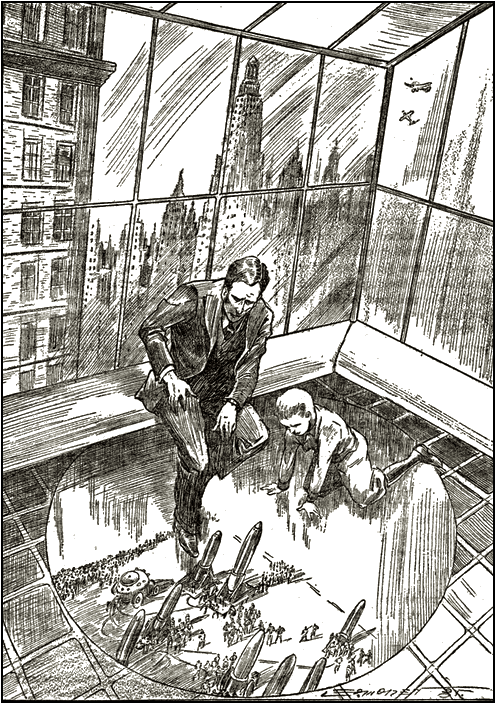
They peered through the fused quartz lens which
magnified in sharp detail the crowded scene below.
The parks were hives of activity. Great tubes, long and narrow, were pointing their wicked snouts to every angle of the heavens. Business-like dumps of shells lay next each monster—Dongan shells that exploded in inverted cones at any desired elevation, and obliterated everything within a cubic mile. Enormous directional beamcasters rested on swinging carriages, ready to blank out power waves and bring bombers crashing to the ground. Groups of grim khaki-clad men were scattered in organized disorder. And the voice of the sergeant rose raucous in the land. Although the hour was early, the parks were jammed with people; every one of the towering pylons had emptied itself of half-curious, half-frightened humanity.
Above, the drab morning sky was a maze of tiny wasp-like pursuit planes. Single-seaters they were, geared at five hundred miles an hour, carrying tracer shells that disintegrated into a thousand fragments on contact, and little tubes of thick oily poison gas that clung tenaciously to an enemy bomber, wrapping it in a choking, viscous ball from which there was no manner of escape. Hundreds and hundreds of planes wheeled and echeloned—a brave array in fine array.
Donald turned a gray, drawn face to his wife. "It's true then. The impossible is happening. War in our civilization!"
Martha rocked gently. "Allan, what will happen to our poor boy?"
Old Peter said slowly, very unlike his usual explosive self. "The same that will happen to all of us. We are doomed—the human race is doomed—irresistible forces of destruction are being unleashed."
"But you heard what Allan said," Donald expostulated. "Look around us. Surely no enemy rockets will be able to penetrate these defenses."
"POPPYCOCK," his father said contemptuously. "Wait until the rocket planes come slashing down at a thousand miles an hour, and you'll see how futile these so-called defenses are. In my day they called the forts at Liege Antwerp impregnable, and the Germans blew them wide open in hours." Martha gathered Anders into her arms with an instinctive gesture of protection.
Donald strode to the tele-radio; tuned in the newscaster. He clung desperately to the hope that this could not be; that at the last moment the nations would realize their folly.
The stereoscopic screen sprang into relief. A correctly silken-clad newscaster, helmeted air-phones clasped to his head, his ordinarily expressionless features tinged with suffused excitement, was saying:
"They are coming fast. Once more our directional vibrators have picked up the enemies' rocket fleets. Forty thousand from the Sino-Russ ports are cleaving the stratosphere at twelve hundred miles an hour. At that speed they'll hit our defenses in less than two hours. The European fleet of thirty thousand is just taking off. Australasia has ten thousand heading for the Southern Americas. All the world is against us. But there is no cause for alarm. Commanding General Merriam requests me to issue a statement. I shall read it:
"To the people of the Americas. The enemies of our glorious nation are seeking to destroy us. They have insulted our honor, out-raged our citizens, conspired insidiously against us under the mask of friendship, and are launching their fleets without even a declaration of war. Treaties, the peace of the world, mean nothing to them; they are merely so many scraps of paper. They thought to catch us napping; to find us unready.
"But they have reckoned without our brave army and rocket corps. When they come, they shall learn to their sorrow just how ready we are to meet their cowardly attack. And more. The General Staff of the Americas have acted on the principle that the best defense is a swift attack. Our mobilized rocket craft have already been launched into the stratosphere. Every city of the enemy world is marked for destruction.
"I feel that every red-blooded, patriotic American is behind the Government in meeting with a dauntless front this cowardly, unprovoked attack upon our liberties. They have commenced a war against a peace-loving people, and war they shall have—to the uttermost.
"Commanding General Merriam, Chief of all the American Forces."
Donald gestured despairingly. "The madness has seized them all. We are in the grasp of forces beyond our control."
Martha was weeping quietly. Intuitively she personalized the impending tragedy. "My poor Allan, what is happening to him?"
"No doubt he is in one of the squadrons flying the stratosphere to shower bombs and poison gas upon the inoffensive people of some great civilized city," Donald answered bitterly. "What can he do but obey orders. He is but a cog in a vast machine of destruction."
There was a light in old Peter's eyes. "Old times," he almost intoned, "old times—I never dreamt to see you again. Ah, if I were only young again." He threw back his shoulders, winced at a rheumatic twinge, and relapsed into a grumble at this sign of his mortality. "Ah well, I suppose I'll have to be a bystander. These milk-fed fellows, brought up on pap and peace, how they'll bungle this man's war!" He brooded in silence.
Martha, the ever practical Martha, came out of her tears.
"What shall we do, Donald? The newscaster said the enemy will be at New York in about two hours."
"Good Lord," groaned her husband, "I haven't thought of what we can do." He seized at straws. "Of course you heard what he said. There's absolutely nothing to worry about. They'll never get through our defenses."
"Do you believe him?"
Wifelike, Martha had placed an unerring finger upon a small doubt hidden in the back of his consciousness. Little worried lines appeared on his forehead.
"NO I don't," he finally admitted.
It hurt him to say that. Old Peter would crow at his son's sudden surrender to all he had been wont to scoff at. But the patriarch was engrossed in his own dreams.
"Then we'd better pack whatever we can, and take off for the interior. Come, little Anders, get yourself dressed in a hurry."
"I don't want to," the youngster protested vigorously. "I want to stay here and see the beautiful airplanes."
"You must, darling. Bad men are coming to kill us if we don't hurry."
"I'm not afraid of them," he boasted. "Big brother Allan will kill them first—poof—poof—just like that."
The quick tears brimmed in the mother's eyes, but she held them back unshed. She grasped her unwilling offspring by the hand, led him firmly to the dressing compartment.
Donald observed her quiet untheatrical heroism with mingled admiration and growing anxiety. What would happen to them all?
He turned to his father, shook him gently. Old Peter came out of his revery with a little start.
"You'd better get ready; we're leaving right away."
"Leaving?" Old Peter echoed bewildered. "What for? Where?"
"There'll be an attack on New York within an hour. We'll head for the safety of the interior."
Old Peter shook himself. "Yes, you had better go. You must protect Martha and little Anders."
"Get dressed then. Take your personal things and valuables. There won't be room for more in the helicopter."
Old Peter said slowly. "I'm not coming."
Donald looked at him incredulously. "Don't you understand what I've been telling you. The enemy is almost here."
"I understand you perfectly," his father replied with more than a touch of acerbity. "I'm not deaf. I'm not coming."
Donald was suddenly weary. He did not feel up to futile arguments with what seemed like senility.
"Why not?" he said.
Old Peter rose solemnly from his chair.
"I am an old man. At best I have but few years left on earth. Civilization, the world itself, is on the verge of extinction. I have long seen it coming. Why should I seek to flee, to embrace unknown perils? Even should we survive, by some miracle, it will be to a strange new world of struggle and terror, of bestial ferocity and savagery. I have lived my day and found it good. I would not seek to extend it. You are in the prime of manhood, vigorous. You have a wife and children to safeguard. I would be a hindrance. Go with my blessing, whatever that's worth. I stay to see the finish."
Donald was overwhelmed. "What nonsense you are talking," he said lamely. "It is suicide to remain."
"It is just as much suicide to go," the old man pointed out.
They were quarreling violently, ludicrously, when Martha came out, in her flying gear, leading little Anders by the hand.
"What's the matter; why aren't you both ready?" she queried in surprise.
Donald was red in the face. "Old Peter's gone crazy. Says he won't go."
"And I won't," the old man retorted defiantly. "I want to go down with your fool civilization. It'll be a great sight." They glared at each other.
"Oh you two children," Martha was exasperated. Every moment was precious now. "Hurry now and stop your nonsense. We'll all be killed."
And like scolded children, they turned sulkily to obey.
Beneath, the great city was a chaos of mad movement. The populace had awakened to its peril. The parks were a seething mass of running, shouting people. Helter-skelter, blindly they ran, milling back and forth, shoving, pushing, weaving into an inextricable tangle.
CLOUDS of helicopters took off from the roofs of the high structures, midges that soared desperately to avoid the impending enemy. Straight up they went, frantic with fear, to the traffic lanes already preempted by the monstrous bombers and pursuit planes.
Hundreds crashed into the heavier war vessels, came fluttering back to earth like wounded birds. One great bomber exploded in mid-air, flared detonatingly into oblivion.
The Russell family were clustered now in their helicopter. Donald was working frantically to get it started.
The tele-radio sprang into life behind them. It had been left open in the hurry of their departure.
"People of New York," the newscaster shouted, "take warning. Your cowardly flight is impeding the work of defending the city. Our air force has no room for maneuvering. You are required immediately to descend and remain quietly in your homes. Those who disobey this order will be fired upon."
Donald seethed with rage. He shook his fist futilely at the pictured newscaster, at the swinging aircraft. Already the tiny helicopters were throwing out their vanes, dropping back to their fate. Some there were, who, mad with fear, or more daring than the rest, sought to escape in swift flight. Little puffs came from the great bombers, and the fleeing planes disintegrated into a rain of tiny fragments before the watchers' horrified eyes.
"Old Peter was right. We are destined to remain, for whatever befalls us."
Martha's voice was steady as she climbed quietly out of the plane. But little Anders cried out at the fierceness with which she hugged him to her breast.
Because they could do nothing else, the Russell family stared miserably at the clouds of war planes—the business-like tubes below, stripped for action. If only the defenses would hold!
The newscaster gleamed on the screen. He was stammering with the importance of his message.
"The enemy rockets have divided, five hundred miles, out. Flights of them are shooting swiftly for every important city in the Americas. Two thousand are heading straight for New York. Only a half hour now, and they will strike. Our brave forces are going up to meet them. There is no doubt of the issue."
"No, there is no doubt," old Peter wagged his head. But he did not mean the same thing as the self-important announcer.
Above, five hundred pursuit planes shot suddenly aloft, rapidly diminishing as they gained altitude. At the ten-mile level, the ceiling, they hovered motionless, tiny stinging wasps. The huge bombers held their position, quiescent, five miles up.
The newscaster could be seen to cock his head, listen absorbedly to the message delivered in his airphones. Suddenly he gave vent to a most undignified whoop.
"Listen folks," he shouted, reverting unconsciously to the early patter of the air. "I've got news for you, glorious news. Our rocket flights have hit Europe, and oh boy, what they've done to it! London is a mass of wreckage, Paris is in flames, Berlin is level with the ground, and Rome, why, they tell me you wouldn't know it ever existed. Hurray!"
He snatched off his airphones, and danced crazily on the screen. In calmer moments it would have been utterly ludicrous.
"The poor, poor people." It was just like Martha to think only of that in the hour of her country's triumph.
Donald was exalted out of himself. A curious atavistic strain in this man of peace.
He turned almost savagely on his father. "There, what did I tell you. We've won! You hear me, old croaker," he almost screamed, "America has won!"
Old Peter's eyes flashed. "Aye, we've won, and lost. Look!"
His arm raised solemnly to the leaguered sky. Unwillingly their glances followed.
A thin silver pencil of light streaked athwart the sun's face in a long graceful arc. There was another, and another, until the whole eastern sky was a blaze of fiery shooting stars.
"The enemy has come!"
Fascinated, they watched the meteoric approach, unmindful of their peril. The elongated flashes grew steadily on the sight. Now they were tiny shining cigars, blazing with the unthinkable speed of their hurtling through space, swooping down through the stratosphere upon the doomed city.
The pursuit planes hung steadily on their ceiling, waiting.
The great thousand-foot rockets, now swelled to huge glittering, streamlined war engines, threw out wings; their propellers bit into resistant atmosphere with a screaming whine that shook the air with vast concussions of sound.
This was the moment that the defenders had waited for. Like the wasps they seemed, they threw themselves upon the invaders. Tiny puffs of smoke spat forth, disintegrated into thousands of little baby balls. One clung to a hurtling shape; the huge rocket shuddered, and burst open into a rain of fragments. More of the deadly puffs found their mark, and the air was dark with smashed invaders.
But the tremendous speed of the diving rockets brought the vast majority safely through the barrage, left the pursuit hopelessly behind. Down toward the five-mile level they zoomed, dreadful engines of destruction.
The motionless bombers roared into life. Tongues of flame darted in all directions, until the air level seemed one vast lake of fire. The enemy rockets dived headlong.
The horrified watchers saw tumbling masses of burning wreckage, saw rockets and bombers linked in furious death grapples. The huge tubes below joined battle. Tons of deadly radite flung high, exploded in-cyclonic cones that smashed to destruction everything within range. Friend and foe were whiffed into extinction. Radite was not discriminating.
THE sky was aflame with darting, plunging, reeling shapes. The noise was unbearable. It seemed as if human eardrums could not withstand the tremendous concussions. The little family clung to each other now, stunned, stupefied beyond suffering.
From out the terrible five mile zone zoomed huge bullet shapes. Rockets! Hundreds only where there had been thousands! They flattened their courses, shot in sweeping circles over New York. The radite tubes belched their contents, the downswooping pursuit planes took their toll, but the remnants held steadily to their course.
Donald knew what that meant. He snatched the trembling child into his arms, seized Martha's arm.
"Quick," he shouted. "Down below, or we're dead." He could hardly be heard in the inferno of sound.
Old Peter seized him violently. "You're crazy," he screamed, his white hair fluttering in the cyclonic wind. "Stay right where you are. T'hell with their bombs. It's their poison gas I'm afraid of. That'll catch every living thing below."
Martha turned her white brave face to her husband, nodded to show she agreed with his father. She could not speak against the uproar. With a groan Donald stayed.
Little round things dissociated themselves from the racing rockets, little round things that plunged to earth with breathtaking speed. A towering structure, dwarfed by the encircling vaster giants, buckled suddenly, crashed to the ground with a shattering roar. The old Empire State Building, Museum of Antiquities, was no more.
Detonation after detonation rocked the weary earth as one soaring pinnacle after another tottered on its base, disintegrated into shatterings of ferro-concrete.
Yet with half the city already in ruins, the soldiers manning the radite tubes that were still intact, held bravely to their posts; shooting with unhurried aim, picking off the enemy one by one. The parks were bloody shambles, hundreds of thousands of mangled bodies lay in distorted postures, or were buried under tons of wreckage.
Donald prayed with tortured intensity, he who had never been given to prayer. The old man's lips were working inaudibly.
The enemy rockets suddenly diverged, and as at a given signal, thousands of black pellets came dropping to the ground. Donald instinctively shuddered away from the expected earth-shattering concussion.
Nothing came. Only the normal roar of the radite shells. "Duds!" thought Donald joyfully, almost incredulously.
Then, surprisingly, the rockets turned tail, fled as if by a common impulse. Into the interior they sped, soaring up toward the stratosphere.
Old Peter's face was a mask of despair. "I knew it, I knew it," he moaned.
But Donald did not hear him. He was dancing insanely. The weight of terror had been lifted from him.
"We've won, we're saved. The enemy is defeated." He did not stop to wonder at the sudden flight. His stunned brain was unable to reason coherently.
They were gone; that was enough.
OLD PETER glowered at him with furious eyes. "Fool! Fool!" he exclaimed in a terrible voice. "Don't you understand? Come and look." He seized his astounded son's arm in a grip of iron, literally dragged him over to the viewpost. As he was being hurried along, Donald found time to wonder at the fact that their voices had been so clear, so audible. Why?
Then it was that the silence struck him with a physical blow. The vast uproar was gone; only a deathly stillness, in which the sound of their footsteps rang unpleasantly loud, and Anders' frightened whimper rose thinly. A faint dread came over him, but he had no time to analyze it. Old Peter was literally shoving his head down toward the parks below. "Look, damn it, look!" And Donald looked. The blood receded from his heart, and welled back in furious pumpings. A dizzy wave of nausea swept through him. It was true then, what his father had prophesied.
Below, where there had been soldiers and guns, thousands of frenzied people, noble parklands, there was now only a heavy greenish sea of vapor. A waveless horrible sea that obliterated everything in green, viscous folds. The silence of the grave was beneath; nothing stirred. Only the topmost branches of the trees showed like dark green islands against the lighter green of the gas.
Donald stared dully at his father. "Poison gas!" Strange how far-off his voice sounded.
"Yes."
The terrible scene drew his eyes like a powerful magnet. Good Lord—the tree tops, where were they? Gone. Only a dark menacing expanse of oily vapor.
"What is it, dear?" Martha cried in quick alarm.
Donald had not known that his face had gone white. He drew upon his last reserve of courage.
"The poison gas is rising," he said quietly.
Martha faced him bravely. "That means—"
"That we have not much more time to live. It had been a good life, Martha. Let us not repine, only—" He glanced at little Anders, whose round eyes were blurred with frightened tears.
His wife stifled a sob. "For myself I do not care, but my boys, they have just begun to face life, and now—" Her voice broke.
Old Peter shook a gnarled fist at impotent heaven.
"A lie! Man's progress—a lie! The beast was still dominant in him, and now—he is ended, self-destroyed."
Inexorably the gluttonous gas mounted, reaching for its appointed prey. The little group waited, mustering unsuspected fortitude, waiting, waiting for the inevitable.
A low-flying shape came swiftly out of the west. A lone plane in the silent immensities. A sudden hope flashed through Donald. Aid—rescue! He must attract the pilot's attention. He pulled off his tunic, ran to the edge of the landing area, waving it frantically.
The flier swerved sharply. He must have seen him. Donald redoubled his efforts, unable to hold back the blinding tears of sudden reaction. They would be saved.
The plane zoomed over the building, dropped a small black object. It missed the roof by inches, plunged into the depths below. There was a deep sudden roar, a blinding concussion of flame, the structure rocked in a dizzying arc, then the firmament fell down and hit Donald on the back of the head. The last thing he heard, or thought he heard, was a maniacal, derisive laughter from above.
Whether it was an enemy plane, mistaken in its way, that dropped the casual bomb, or an American flier, unhinged from the terrors he had been through, was never known. Unimportant too, for the result would have been exactly the same. Four silent shapes lay huddled on the terraced roof of the Metals Building; and the hideous green gas lapped ever higher against the sides of the structure.
Roy Glashan's Library
Non sibi sed omnibus
Go to Home Page
This work is out of copyright in countries with a copyright
period of 70 years or less, after the year of the author's death.
If it is under copyright in your country of residence,
do not download or redistribute this file.
Original content added by RGL (e.g., introductions, notes,
RGL covers) is proprietary and protected by copyright.