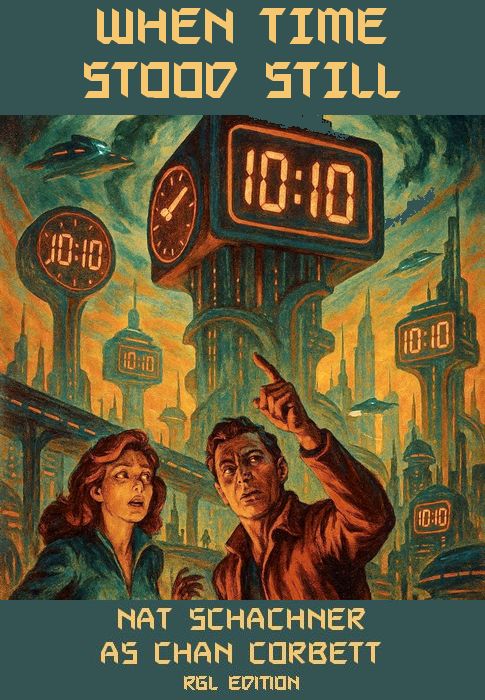
RGL e-Book Cover
Based on an image created with Microsoft Bing software
Roy Glashan's Library
Non sibi sed omnibus
Go to Home Page
This work is out of copyright in countries with a copyright
period of 70 years or less, after the year of the author's death.
If it is under copyright in your country of residence,
do not download or redistribute this file.
Original content added by RGL (e.g., introductions, notes,
RGL covers) is proprietary and protected by copyright.
RGL e-Book Cover
Based on an image created with Microsoft Bing software
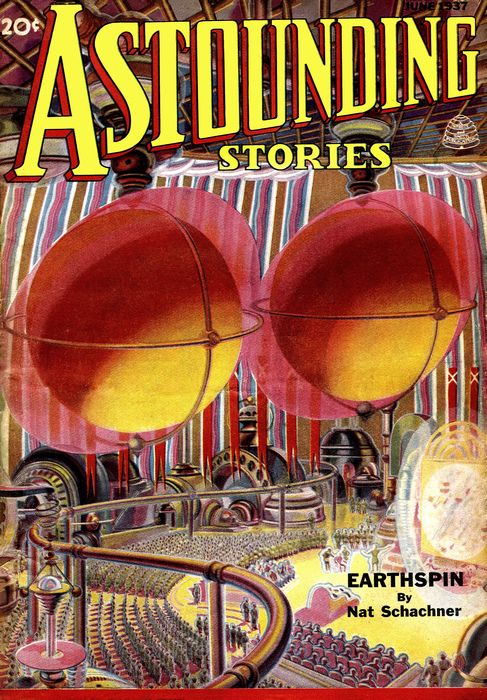
Astounding Stories, June 1937, with "When Time Stood Still"
HER lineaments were faded and tarnished with an incredible antiquity, but Jon Wayn, man of the ninety-ninth century, found them superlatively beautiful. The picture was flat, two-dimensional, crudely deposited on a glassy substance, iridescent with age and sprayed with the fine cracklings of disintegration; yet through the overlaying mists of time, in spite of the queer garments and type of headgear, Jon's blood stirred with an unfathomable emotion, so strong, so alien to the cool intellectualism of the year 9876 A.D. that he was sorely tempted to destroy at once the seductive representation and look no further.
Nevertheless, he did not. She was beautiful—this girl of a forgotten time, whose eyes stared back frankly into his own across the tremendous gulf of years, beautiful in a way that no longer inhered in the women of his own day and age. He had never felt the lack before, having no standards of comparison. Now he had—with a girl who had died under strange circumstances almost eight thousand years before, in an era of primitive races and semi-savage groping.
Hesitantly, almost reverently, he showed the picture to his friend, Dore Allyn. "What do you think of her?" he asked.
They were within the light-guarded vault of the Wayns, which none but Jon could have opened on the death of his father. The vigilant photo-electric cell scanned the features of the young heir as he presented himself within the focus of the inspection beam, swung the neutron panels open in token of satisfaction. Jon had entered, with Dore as companion, curious as to the contents of the carefully sealed chamber of which his father had spoken but once, and then only on his deathbed.
To say that he had been at first disappointed was putting it mildly. The vault, its walls glowing with eternal cold light, was tenantless except for a tiny beryllium box. Another photo-electric cell scanned his features before it yielded its treasure. This treasure was—the ancient, discolored likeness of a girl, bizarre in lineament and depiction.
Jon had given her scarcely a glance at first. For with the plate were deposited thin metal sheets, on which a crabbed, outlandish text was graved, still legible against the sweep of time. It was with difficulty that Jon deciphered the meaning. Though English in a sense, it was archaic in form and lettering, and diffusely circumlocutory to a modern world where swift compressions were the soul of wit, but Jon, with Dore's help, stumbled through.
It told an incredible, fantastic story—the story of one John Wayne.
"Why, that's an archaic variant of your own name, Jon," Dore had exclaimed, "a scientist of a remote twentieth century. He had, it seemed, been present at the vanishment of the Moon, when a nova in Messier 33 had burned through subspace and formed a pressure beam which condensed electron orbits to incalculable densities and thereby infolded the Moon in a space circuit of its own contriving."
That much had been known to Jon and Dore. The Great War of 2168 and its temporary eclipse of civilization had not completely obliterated all vestiges of former science and knowledge. The story of the silver satellite had come down through the ages. The tides now rose and fell a mere sluggish foot or two—the nights were dark with the faint pricklings of innumerable stars, and Earthly matter weighed a trifle more than theretofore—but the men of 9876, being intellectuals, did not feel the lack of that romantic glamour which in earlier and more primitive times had been inevitably associated with the lunar orb.
But the second part of John Wayne's story was new. It told of a great city called New York, which had teemed with millions of people on the shores of the Atlantic. It told, with a sudden access of authentic emotion that throbbed and delivered its message even across the centuries and through the crabbed, archaic elder speech, of a young girl whose name was Betty Middleton, with whom this ancient John Wayne had obviously been in love. She had, it seemed, for purposes unknown, gone to this elder city of New York, had there been trapped, along with ten million others, when the subspace beam from Messier 33 impinged on a thin segment of Earth's surface.
ACROSS the long gulf of years came the thrill of John Wayne's frantic dash across the continent to warn the fated people and rescue his beloved. He had failed. The stilted, curiously worded phrases of the textbook took on a certain glow as he narrated his vision of the doomed Earth segment, of towers and busy streets and girdling rivers shrinking to nothingness in a fierce green blaze, of the swift warp of space time around the dense-packed electron orbits, of their vanishment from human sight.
He, John Wayne, had been traveling with two companions in a clumsy, incredibly slow machine called an airplane. The plane had crashed to Earth. His companions had been killed, but John Wayne had survived, albeit crippled for life. He had, and the pathos still lingered in the blurred gravures, devoted his remaining years to desperate attempts to discover some principle whereby the trapped millions—and Betty Middleton—might be retrieved from the horrible doom which had enveloped them.
The years passed unavailingly; the scientists of the world added their efforts; John Wayne grew old and gray, his tortured limbs giving him no surcease, his indomitable spirit flaming through bodily ills; but nothing could be done. Without doubt, Betty Middleton, and all New York, were dead long years, for even if they had somehow survived the strange condensation, the vanished segment held neither air nor food supply, nor the wherewithal of replenishment sufficient for more than a mere month of days.
Nevertheless, John Wayne refused to relax his unremitting research. He did more. As the normal span of his own tortured life approached its end, he married—deliberately—and with full awareness on the part of his wife as to his purpose—so that the child of his loins might take up the task when perforce his lifeless hands must let it drop, and continue the long search for the key which would unlock the incredible prison in which New York was immured.
A son had been born, named as he, John Wayne. To this son, before he died, old Wayne had bequeathed this heritage—the long story, engraved on durable metal, and the picture of the girl he had loved with such passionate devotion deposited on immortal substance. For, he ended pathetically, once he had had a premonition, and it had come to pass. Now he had another: that many generations of John Waynes would live and die and bear their sons, before success would crown their efforts. Therefore, he, John Wayne, progenitor of a long posterity, laid solemn compacts upon the future that each elder son, in turn, be called John Wayne, that each, in turn, must, on receipt of this bequeathment from the past, devote his life, his science, his energies, to the unsealing of the infinitesimal, vanished tomb that once had been a mighty city.
THE story stirred Jon Wayn. Eight thousand years had passed, and still the tribe of John Wayne had remained intact through fantastic vicissitudes, and still they heeded and obeyed the injunction laid upon them by a monomaniac ancestor. For had not his father, the elder Jon, been chief of the scientific council ever since he could remember; had there not been murmurings among the elders at his strange preoccupation with secret pursuits in his remote laboratory on Phobos, tiny satellite of Mars?
Yet such had been the power of his father that the elder scientists, who ruled Earth and all its tributary planets, had murmured, it is true, at such secreted research, yet had perforce acquiesced. All, that is, except the youngest of the elders, black-bearded, glowering Belor Grame; he who, by a sort of coup d'état, had wrested leadership in old Jon Wayn's place from a reluctant council of scientists.
But if the story had moved young Jon, the faded picture had brought strange, hammering emotions. "What do you think of her?" he asked Dore Allyn.
Dore glanced indifferently at the girl. "Obviously a creature low in the scale of evolution," he answered casually. "Rather ugly, if the truth must be told. Nothing like our modern women. Take Lisa Wilse, for example. Now there is a beautiful girl. Nose of most generous size, high, bulging forehead that denotes capacity for intellectualism beneath, skull remarkably smooth and hairless; not, as in this creature, covered with unsightly hirsute locks, like an animal that requires protection against the elements."
Jon snatched at the precious plate with a savage vehemence. "Give it back to me!" he cried. His voice was queerly choked, a mist of anger veiled his eyes.
"Jon! What's the matter?" Dore's surprised voice brought him to his senses. In the world of the ninety-ninth century there was no room for such uncouth emotions as he had just displayed. He was ashamed of himself, yet filled with a strange joy. Not yet was he to know that he had fallen in love with a faded picture—a representation of a girl who had died eight millenia before, whose very elements had been ravished from the universe of space time in which he existed. Love was a forgotten ecstasy—one that had been bred out of the race several thousand years before, in favor of eugenic, coldly scientific mating.
"Sorry!" he muttered. "It's just a difference of opinion, and I shouldn't have shouted. But there is no woman living to-day, or, for that matter, has ever lived who could possibly be as beautiful in form and feature as this Betty Middleton whom my ancestor loved. Even the elements you find to be marks of ugliness to me are crowning glories. That long, wavy hair, that pert, delicate nose, that slightly retreating forehead, seem to me somehow more gracious than the pronounced features, the baldness of the women of our own times. The latter are intellectual, it is true, but beauty is something else."
"Ah!" said Dore significantly, and, being a friend, said no more.
But the tone was sufficient to bring a flush to young Jon's cheek. For Jon himself was blessed with rather more hair on his head and more regularity of countenance than was common in the ninety-ninth century. Had old John Wayne transmitted his own picture to posterity, the resemblance between the pair might have been considered remarkably striking.
Young Jon hastily replaced the plate and the graven legend within the beryllium box. A soft whir and it closed.
"A very pretty, if long-winded, story," declared Dore. "What, if anything, do you intend doing about it?"
"Do?" Jon straightened up; his lips compressed. "Why, what else is there for me to do but carry on?"
Dore stared at him curiously. "But that is ridiculous," he protested. "A profitless, arid research to discover a long-disintegrated city simply because a primitive ancestor so decided. Remember how it got your father into trouble. If the council hadn't feared his iron will they would have deposed him, have shunted him to the prison planet for irregularity of conduct long ago. Even now your future niche is being considered, and your eugenic number is in the mating machine."
JON'S brows pulled together; his jaw became square. Had Dore but known it, the resemblance to that primitive ancestor he had derided was stronger than ever. "I won't——"started Jon grimly, and stopped. For the disk on his right wrist gave warning signal. Some one was calling his specific wave length. Jon flicked contact, and a voice rose up at him.
"Jon Wayn, Eugenic Number A5369! This is Belor Grame, chief of the scientific council. You are to report to the council chamber at once for assignment to your life vocation and for betrothal to your eugenic mate, Lisa Wilse, B64012. Please be prompt!"
The voice faded and died with a little click, but Jon Wayn stared at the tiny disk as if it still reverberated with the accents of doom. Lisa Wilse! Lisa, whom Dore Allyn had just described as his ideal of beauty; Lisa, whom Jon deemed as lovely as any female could be. Now a shudder of revulsion coursed through his being. Suddenly that smoothly bald head, that protruding forehead and curving nose, erstwhile symbols of charm, had become repulsive, ugly. The lineaments of a girl, infinitely remote in time and space alike, rose in their place, filled the universe with their piquancy.
"Congratulations!" said Dore cordially, all unwitting. "I confess I had hoped the mating machine would decide on myself as the proper mate for the lovely Lisa, but I am glad for your sake, Jon. As for your life vocation, no doubt the sub-conclave of Psychoanalysts have decided on something fitting to your abilities and powers. When my turn comes——"
A strange look crept into young Jon's eyes. It hardened. "I won't do it," he said tonelessly. "I won't mate with Lisa, and I won't submit to the council's plans for my life work."
Dore gazed at him incredulously. "Have you gone mad?" he cried. "The mating machine is infallible; the conclave of psychoanalysts almost as unerring. Besides, do you realize what you are saying? You are presuming to set your puny will against the decree of the elders!"
"I know it," Jon said simply.
"But—but——" Dore spluttered.
"It's impossible. It just isn't done!" He was bewildered, alarmed. In the ninety-ninth century only a few—extremely rare products of mistaken matings by the machine—had dared rebel by word or deed against the fiats of the council. And they were even now expiating their crime on the dun ice world of the prison planet.
"It's not impossible, and there must always be a first time," Jon argued reasonably.
"But the council will send you in fetters to the prison planet."
"If they can catch me."
Dore was shocked. "Idiot!" he cried. "Where in all the universe do you expect to find shelter against the power of the council?"
"On Phobos, the laboratory of my father," Jon answered promptly. "He told me things before he died. I did not quite understand at the time. Now I do. He must have foreseen."
The signal on Jon's wrist buzzed warningly. He looked down at the disk with a grim smile. "Belor Grame is getting impatient. Obviously he has some especially attractive destiny marked out for me. In any event, there's little time to lose. If I don't get started soon——"
Precious beryllium casket under his arm, he hurried out of the vault. The cell-operated door swung impenetrably shut behind them. A two-seater monocar stood outside, capable of two hundred miles on land, five hundred miles in the air, and a hundred on water. Jon swung rapidly into the pilot's seat, started the controls. There was no engine, no motor, no noise. Its propelling power was light-beam radio energy broadcast from central atomic plants. The signal kept on buzzing.
AS the craft started away, Dore Allyn took a running jump, landed breathlessly in the seat beside Jon. His friend looked at him in surprise. "It would have been wiser," Jon said, "for you not to be seen with me. Belor Grame will ask questions when he finds me gone."
"You're a fool," Dore growled, "an idiot of a primitive, romantic type. That's why I'm going along to keep you company. You need protection."
"But you can't do that," Jon protested. "It means outlawry, cutting yourself off from everything you wanted."
Dore looked back. "It's too late now to do anything about it. I see a patrol car taking off from the roof of the hall of the scientists. Belor Grame's sending a guard of honor to escort the reluctant swain to his bride and to his duties."
Jon swore sharply, jerked his controls to the last notch. He'd barely have time to make it.
Beneath flashed the white-and-gold towers of the city of the scientists, capital of the solar system. Within their ornate precincts the scientists, a select caste, rigorously controlled on hereditary and eugenic principles, delved into the secrets of nature, ruled all the planets through their self-perpetuating council of elders. Outside their ranks, the common herd, here on Earth and colonizers on Mars, Venus and the moons of Jupiter, teemed submissively and tended the great machine cities.
The wind of their swift flight streamed past them at five hundred miles per hour. "Where are we going?" Dore demanded. Behind them, the patrol had nosed down to the entrance to old Wayn's vault. Guards, in the silver; uniforms of the council, were on the ground, trying vainly to force the neutron walls.
"To our space hangar," Jon said. "I had a premonition I might need the Comet in a hurry. She's already loaded with supplies and fuel, ready to take off. She's the fastest space craft in the system; my father didn't report everything he discovered in the Phobos laboratory."
"She'd better be fast," Dore remarked in a conversational tone. "The patrol plane has picked up our trail, is taking off after us."
"We'll show them a clean pair of rocketing tails," Jon answered confidently.
And they did. The Wayn space hangar was on the outskirts of the city. The small, compact flier, shaped like a falling teardrop, gleaming like a silvered mirror, poised on its rocket pit, nose pointed to the zenith. It was the work of seconds to trundle the two-seater to a halt before the space ship, the matter of a minute to dive from its cushions into the yawning port of the Comet, to swing it smoothly shut behind.
Jon leaped for the instrument board. There was a soft, roaring sound; and the Comet swooshed upward into space like a thoroughbred. The patrol plane, coming along fast at the thousand-foot altitude, swerved violently to avoid the rush of blazing gases, turned back disgruntled to report and raise the alarm. By that time the Comet was clear of Earth's atmosphere and picking up acceleration.
"They'll radio the space cruisers," Dore remarked cheerfully.
Jon did not even look up from the plotting board on which he was laying out their course. "Let them," he said. "There isn't a cruiser can catch us. And once on Phobos——"
THEY made the tiny satellite of Mars in six days, averaging a hundred miles per second. Fortunately Mars was then in conjunction with Earth. Far behind, hopelessly so, lumbered the council cruiser that had been ordered into space to catch the runaways.
Dore cocked an eye at the visor screen. Phobos, the inner satellite of the red planet, was a small grayish ball directly ahead. Its whole diameter is not more than twenty miles, and its surface irregular, lifeless rock. No air existed on the tiny sphere. Slightly to one side, however, Mars reared its glowing convexity to fill almost a quadrant of the heavens. From the valley city of Bilosyrtis a streak of orange red curved upward. Behind them, in the direction of Earth, the cruiser lumbered on, two days in the rear.
"The Martian patrol just took off," grunted Dore. "Where do we land?"
Jon did not reply. He was too busy at the controls. The silver Comet jockeyed down in cushioning jets of flame until it hovered over the whirling, speedy satellite. Directly beneath, turning even as they dived, was a smooth segment of shimmering web curtain stretching between two jagged crags.
Dore stared at it through the view-scope, fascinated. The web curtain of interlocked electromagnetic waves was but in its crude beginnings back on Earth. Here, however——
It seemed to dissolve as Jon pressed a button. Their craft sank slowly through it to an artificial tarmac beside a group of buildings. A deep, smooth-bored hole snouted up at them like a threatening space gun. Then they were landed. And overhead, the web curtain had swung into position again, shimmering, transparent—so that they could see the Martian cruiser hovering vainly overhead—yet so impregnable that neither atomite bombs nor blue rays nor neutron bolts could make the slightest dent in its impalpable weave.
This, then, was the secret laboratory of old Jon Wayn, late chief of the scientific council.
"You've been here before?" Dore asked.
"Yes, about six months ago. Poor father must have anticipated he was soon to die. He explained everything to me, all the new ideas he had brought to fruition in this place. But he was secretive about two things: one was the story of his ancestor and the lost city of New York; the other his reason for hiding his scientific results from his fellows. Perhaps he was afraid to place such tremendous power in the hands of the council. They were at loggerheads all through his term. He held certain ancient views on democracy and freedom of opportunity for the masses as against the closed caste of the scientists. They outvoted him on every point."
Dore shrugged his shoulders. This was too much for him. But Jon was his friend, and he was entitled to his wild talk. And he didn't care particularly for Belor Grame, the new head of the council of elders.
Overhead the space cruiser still hovered. It was signaling. First by radio, but the waves beat back from the web curtain. Then by code light beams.
Dore read them, grinned a bit anxiously. "Wants us to surrender, in the name of the council, or take the consequences."
"Bring on your consequences," Jon signaled back gayly. They had gone into the main laboratory, where the complexity of apparatus bewildered Dore, accustomed as he was to scientific tools.
THE consequences came in a hurry. Two atomite bombs blurted down. They smacked into the impalpable web curtain, detonated into a fury of roaring, flaming energy. But the shimmering wall of force held intact. The cruiser tried other weapons without success. In disgust it swung back to the gigantic loom of Mars.
"We're here, and we're safe momentarily," Dore said wryly. "But just what do you expect to accomplish?"
Jon barely took time out for words. Already he was busy, manipulating apparatus, tightening, calculating, testing. "Last time I was here, my father told me he was almost ready for some crucial experiment. On his deathbed he went further. He was ready, he declared. He had forged the final link into the long, ancestral chain. Then he died before he could explain further."
"In two Earth days," declared Dore skeptically, "we'll be ringed in by the fleets of the council."
"In two Phobos days," retorted Jon, "I'll have either restored New York or brought to countless generations an end of ceaseless toil."
Dore made a gesture of irritation. "I still say," he cried, "that it would be better to let this primitive city remain where it is. What will you find? The impalpable dust of a people who had starved and suffocated to death eight thousand years ago. It's sacrilege, in a way."
A spasm of pain crossed Jon's forehead. The thought of Betty Middleton as a handful of dust, or worse still, as a grinning skull on a distorted skeleton, was like the sear of a blue ray.
By the end of the second Phobos day—a mere total of fifteen Earth hours—Jon was as good as his word. In the great electro-scanner which Wayn, the elder, had installed, Dore could See the emissary of the council a bare three million miles out. Behind it, in a trailing stream, obedient to the puzzled call of the Martian patrol, came the mightiest battleships of the spaceways. The council, or rather Belor Grame, was putting forth all its strength to crush the young rebel who had fled from the accustomed mores. Such rebellion, if successful, might prove disastrous. Already, in the short time of Grame's ascendancy, there were mutterings, both among the younger scientists and the vast outside masses of the common folk.
But, though Dore cocked an anxious eye at the formidable approaching armament, Jon paid it no heed. He had not slept; he had barely snatched at food since he had landed on Phobos.
JON had finished. Everything was in readiness. Mighty machines hummed their song of power.
Jon looked up wearily, yet triumphantly. "I think," he said, "it will work."
Now Dore was exasperated beyond measure. Out of loyalty to his friend he had placed himself outside the pale of the solar system; he had worked harder than he had ever worked in all his life; yet he still didn't quite know what it was all about. And in another Earth day the battle fleet of the council would be upon them. "That's fine!" he retorted sarcastically. "So it works! What happens next?"
Jon grinned apologetically. "Forgive me," he answered. "There wasn't even time for explanations. Now there must be, since, whether you cared or not, you're mixed up in a matter that was none of your concern. Ever since the original John Wayne, my ancestors sensed that the one hope of piercing the veil lay in reproducing, somehow, the conditions which had existed in that ancient nova in Messier 33. Then, and then only, would they discover the means to reverse the conditions and restore the fabulous city to its original state.
"One by one, the long line of scientists added patient bits to the body of their knowledge. My father came upon the final principle. That is, he discovered a method of ripping through the ether of our space time, and unlocking the superdimensional forces of the underlying subspace. In other words, we can repeat what happened eight thousand years ago. We can compress electron and proton orbits to an unbelievable density; we can direct the subspace bolt through ordinary space at almost infinite speed."
"How about the reversal of the process?" commented Dore. "After all, that is the important phase of the investigation."
Jon's eagerness clouded. "I'm afraid," he admitted, "that is impossible. I've just checked through my father's data. He made a fundamental mistake in his calculations. Not only didn't he discover a reversal method, as he thought, but his own formulae prove conclusively that it cannot be done."
Dore stared in amazement. "Then what——" he started.
But Jon interrupted. "The problem," he said quietly, "must be attacked from a different angle. Which is, to make a breach in the inclosing space-time wall. Once such a breach is made, the pull of this-universe matter and gravitation will flatten out the lesser warp, tear the veil away. The original condensation of New York was due to the pressure of the force beams from Messier 33. That has been removed.
"Ordinarily, atomic structures are intensely unstable in a condensation state, but the warped space time in which they are unfolded prevents expansion. Release the gravitational restrictions and the electron orbits, the atoms, the molecules, will spring back to their original distances and sizes. New York City and the ravished segment of Earth will once more resume their rightful position in our universe. If nothing else," he ended wryly, "it will prove of tremendous archaeological value; the intact remains of a civilization eight millennia old."
"You still haven't answered my question," said Dore. "How will you make the necessary breach?"
For the first time Jon hesitated. He looked away from his friend. "By directing the Comet along a condensation subspace beam toward the point where New York once was," he answered.
"But that will leave us helplessly stranded here on Phobos," Dore protested. "It will be only a matter of time for Grame's fleet to penetrate your web curtain of force."
Jon placed his hand on the young man's shoulder. "We won't be on Phobos," he said.
"Where then——"
"Dore! You and I are going in the Comet."
"You're absolutely insane," Dore shouted angrily. "Not in a million years——"
THREE hours later the laboratory was deserted. Jon and Dore sat, tense and drawn, in the tiny confines of the Comet. The silver hull was dim in the semidarkness of the smooth-bore hole that extended deep into the granite interior of Phobos. Dore watched with feverish eyes the slow, inexorable creep of a thin red line toward the zero second on the chronometer.
Jon's lean fingers tightened over the button which was to establish contact with the massed apparatus within the laboratory. At the calculated second, Phobos and Earth would be in such conjunction that the Comet, a subspace bullet, would flash across the superdimensional void, and pierce those other compressed dimensions where New York reposed.
Something seemed to choke in Dore's throat. Unwillingly, his glance flung up at the outer port. The long tube of the tunnel focused his vision aloft—but toward the universe of familiar space and time, toward a certain green-tinged planet called Earth. It was bitter irony. That was their destination; yet in what incredible manner would they, if ever, achieve it!
Instinctively, his eye dropped again to the gleaming pointer. It was swinging directly over the indicated mark. "Now!" he grunted.
Simultaneously, Jon pressed his button.
"Well?" queried Dore. Nothing seemed to have happened.
In response, Jon pointed at the ports. A cry burst from his friend's lips. Outside was—nothing. Where there had been the black of inclosing tube, where there had been the heartening sight of a green-tinged planet, was now—featureless blankness, possessing no depth, yet wholly unfathomable, colorless, yet peculiarly gray.
"Where are we?" Dore gasped.
"In subspace—on our way to that other tiny universe."
"How long will it take us to get there?"
"In Earth time, a matter of days, I think. In the time of this superdimension, there is no way of telling."
Dore sat numbed, trying to figure it out. There had been no jar, no roar of departure. Yet why should there be? They had slipped immediately into subspace, where all things were different. A thought came to him—made him feel strangely queer. Already they must be shrinking to dimensions that were infinitely small.
Then another thought slashed like a lightning bolt through his brain, brought him jerking to his feet with a hoarse cry.
"What's the matter?" Jon demanded.
"We forgot the one elemental fact that spells disaster," Dore groaned.
"Which is——"
"That New York, toward which we think we're heading, was inclosed in its own gravitational space time about eight thousand years ago. Its orbit is therefore no longer ours. During that time the solar system, the Milky Way, the expanding universe of which we are a part, have shifted their positions by uncounted trillions of miles. Heaven knows in what part of the hyper-universe New York is now."
A deathly silence followed his outburst. Jon was white with realization. They were speeding through subspace toward a nonexistent entity. They were cast adrift in a featureless void!
But even as grim despair corroded his heart, there was a blinding flash within the slender hull of the Comet, a screaming and roaring of thunderous sound. Jon flung to the nearest port, caught incredible glimpses through the crackling blaze. Glimpses of an atmosphere, green-tinged—of tall structures, strange in shape and fashion, rushing up to meet them—of water, placid and smooth, beneath.
He barely had time to cry out, "You were wrong, Dore! Some connection must have inhered through the ultradimensional electron wave trains. We've reached the ancient city of New York!"
Then there was a crash, a splintering of metals, a grinding of consciousness into dust——
JON WAYN was certain that it was all a dream.
"Of course!" he told himself joyfully, and yet with a touch of queer regret. "That explains everything. I fell asleep after deciphering that nonsense, and the story induced this nightmare. Perhaps it was also something I ate. I never defied Belor Grame; I never went to Phobos; and certainly the Comet never crashed into this incredible business. It is true Dore Allyn is over there, weaving crazily to his feet, with a gash on his forehead. It is true that the Comet lies over yonder, half submerged in blackish water, a hopeless wreck, but they are both part and parcel of the dream."
Yet the remarkable vision persisted. More, it took on an extravagant aura of which even dreams are chary. For this city of New York, on whose outskirts he seemed to be, was no city of long decay and dreadful desolation. It was alive, bustling, and there were thousands of strange human beings, clad in outlandish costumes, with heads unaccountably thick with hair, who were pushing and moving around him.
But if this had been all, incredible as it seemed, there might have been a possible explanation. Perhaps the people of this immured town had found the means to manufacture fresh air and synthetic food from their limited surroundings, had lived and bred through long, weary generations until the very memory of another and vaster universe had disappeared.
Yet how account for the girl who was cradling his bloody head in her lap? She was the very image, the very representation of that ancient, faded picture which had stirred his heart to unaccountable emotions. Betty Middleton! Impossible, of course. She was either the delirium of his dream or his wounds; even, perhaps, strange as it might be, a descendant of that long-dead girl.
Yet how account for the fantastic words which tumbled from her quivering lips, words that were archaic in texture, yet melodious and understandable? "John! ! my darling! I knew you would find a way to rescue me, to rescue us all!" Her voice rose in shining pride to the pushing, eager thousands who ringed them in. "We are saved," she cried. "This is John Wayne, the man I love, astronomer of the Kelton Observatory. He knows the way back from this incredible world into which we were catapulted."
"How about those crazy clothes of his?" some one in the crowd called out sharply. "How about that queer-looking plane in which he crashed? How about that other fellow, bald as a coot and twice as funny?"
The girl looked down quickly at Jon. A momentary puzzlement sprang into her eyes; then they cleared. "Silly!" She laughed. "Of course he's John Wayne. I'd know him anywhere. Those clothes——"
Jon Wayn jerked his head out of that too-comfortable lap, rose unsteadily to his feet. "Let us understand each other," he said in harsh, strained accents that were clipped, staccato, compared to the speech of these others. "I am Jon Wayn, true enough. But you—what is your name?"
The girl looked surprised, indignant. "Why, John, is this a jest? Have you already forgotten Betty Middleton?"
He staggered at that, clutched at another straw. "You mean," he said with desperate eagerness, "that your great-great ancestor's name was Betty Middleton?"
"I am not telling of the names of my ancestors," she said coldly. "The crash must have addled your brain, John Wayne."
He clutched at his forehead. In truth he must be mad. "How long," he still insisted, "has this city of New York been cut off from Earth?"
The girl looked at him with a troubled expression. The strange concourse of stranger people muttered, tapped their heads with significant gesture. "You ought to know," she said very low. "I left you at Kelton on the evening of May 11th. The transcontinental flier brought me to New York the morning of the 12th. At about two in the afternoon this—this happened. The city has been in a panic, frantic with fear ever since. Only I felt confident"—her voice broke pathetically—"that you would extricate us somehow from this awful predicament. You came—to-day is the 13th—but—but——"
The ground was spinning around him. "What—year—is this?" he managed with difficulty.
"Year?" she echoed. "My poor boy—the shock has been too much. You need rest, quiet. A slight touch of amnesia, perhaps. Every one knows this is the year 1945."
DORE was at his side. "Steady!" he warned. "We've got to think our way out of this." He motioned Betty away with imperious gesture. She obeyed, watched them from a distance with puckered frown. "That—uh—young lady is obviously the one of the picture. And just as obviously, while almost eight thousand years rolled by in our time, only a day has elapsed in here."
"Obviously," groaned Jon. "I should have figured that out. Time is purely relative, a matter of electron speeds. Since they are here under tremendous compression, their orbits have slowed to what in our space would be almost immobility. Hence time slackened, too. A day here is a matter of millennia outside. But how can I explain to her—to all these others—that they are anachronisms, living long past their allotted period? How explain to this girl—this Betty Middleton—that I am not John Wayne, her lover, but his child, hundreds of generations removed?"
Dore Allyn stared swiftly up at the circumscribed sky. "Don't try to!" he whispered surprisingly. "Something tells me we managed to burst into this tiny inclosure which holds ancient New York, but that the gravitational puncture healed, so to speak, before the space-time pull of our own universe came into play. We're marooned here, along with these primitive folk, our remote ancestors; and we'll have to manage.
"It is enough for us to know the dreadful truth; if we should disclose it to their limited minds, they might go altogether mad. And it happens that we possess sufficient scientific knowledge to make this strange little world entirely habitable, both for this generation and for all those that may follow. Who knows"—and Dore made a wry grimace—"perhaps even some day we'll find a method of escape. Or, if not us, at least our children's children. The tables of your ancestor, John Wayne, are reversed with a vengeance."
"But the girl—Betty Middleton," Jon protested thickly. "She—she thinks I'm my own ancestor. How can I disabuse her of that, without giving the whole story away?"
Dore grinned. "Obviously you look just like your remote ancestor. I always thought you something of a throwback—with that cluster of hair on your head, your straight nose and non-bulging forehead. Take advantage of it. Be John Wayne, man of the twentieth century!" Jon drew back appalled. "It wouldn't be fair."
"Don't be a fool," his friend snapped. The crowd was getting impatient, surging toward them. "You love her. I saw that when you stared at her picture. It's a queer business, but that's your concern. Go to her; tell her you feel better now, that the past is still a bit hazy. She gave you the clue; amnesia's the word."
Jon glanced undecidedly toward the girl. His heart raced. She was beautiful—far more beautiful than the timeworn likeness. And there was that in her eyes which made him feel all queer within. Yet he still wavered. "How about you, Dore?"
The young man, bald—as that coarse primitive in the crowd had remarked—as a coot, product of the ninety-ninth century, grimaced. "I'll manage somehow," he said. "I may even, in time, simulate your atavistic emotion of love for some hirsute, sloping-browed young lady in yonder group of semi-savages."
In spite of himself, Jon grinned. Then he looked at Betty Middleton again. Anxiety, grief, something far stronger, than either, shone nakedly in the candid depths of her eyes. His own soul rushed out in response; his arms flung wide.
"Betty, my dear—my dear!" he cried. He was committing himself irrevocably.—and was wildly happy because of it.
Roy Glashan's Library
Non sibi sed omnibus
Go to Home Page
This work is out of copyright in countries with a copyright
period of 70 years or less, after the year of the author's death.
If it is under copyright in your country of residence,
do not download or redistribute this file.
Original content added by RGL (e.g., introductions, notes,
RGL covers) is proprietary and protected by copyright.