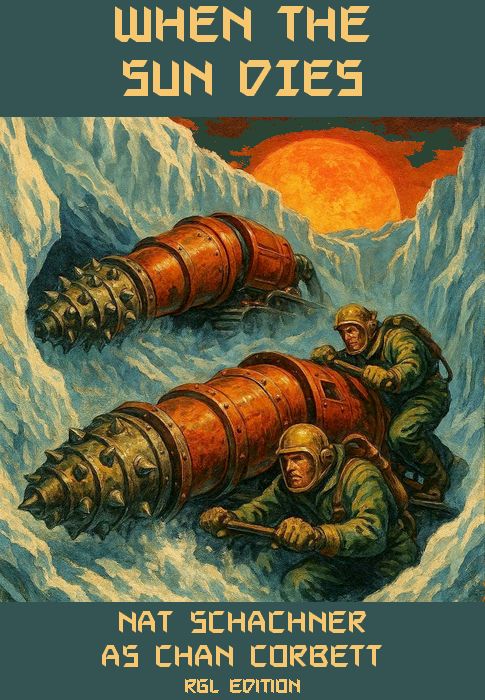
RGL e-Book Cover
Based on an image created with Microsoft Bing software
Roy Glashan's Library
Non sibi sed omnibus
Go to Home Page
This work is out of copyright in countries with a copyright
period of 70 years or less, after the year of the author's death.
If it is under copyright in your country of residence,
do not download or redistribute this file.
Original content added by RGL (e.g., introductions, notes,
RGL covers) is proprietary and protected by copyright.
RGL e-Book Cover
Based on an image created with Microsoft Bing software

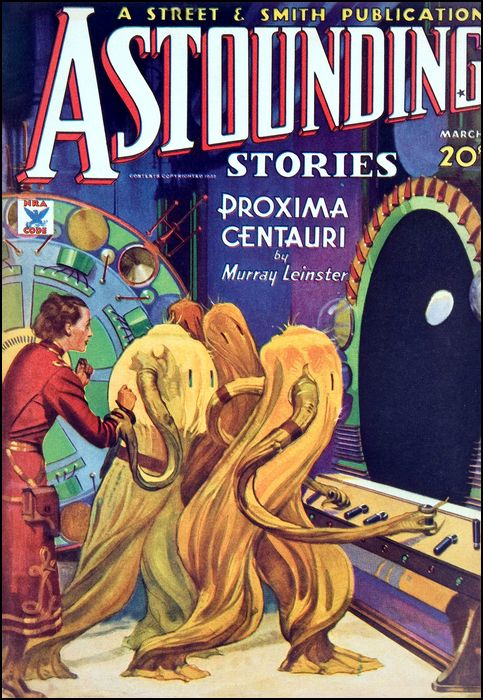
Astounding Stories, March 1935, with "When The Sun Dies"
IN the year 1981 A.D., as time was reckoned in the Pre-Catastrophe Era, the Sun entered upon its final stage of devolution. It began ordinarily enough. A few irregular shaped spots made their appearance in the usual belts, ranging from ten to thirty degrees north and south of the equator. Astronomical observatories thereupon duly set up their spectroheliographs, took innumerable photographs, and went through their regular routine of work.
Everything was perfectly normal and in accordance with rule. Every eleven years, after a period of quiescence, another Sun-spot cycle was due to begin, and the year 1981 had long been marked on solar calendars as just another of these initiatory periods.
The astronomers yawned and checked their plates, made intricate calculations. There was absolutely nothing out of the way. The spectrum of titanium oxide showed its somber lines in the absorption plates, proving the temperature of the spots to be less than six thousand degrees centigrade, but then that, too, was nothing unusual. Titanium oxide had been in the habit of making its appearance in Sun-spots ever since the first spectrum had been observed.
The world at large certainly was totally disinterested. It left those matters to the scientists, though some of the newscasters in their popular educational chats mentioned the phenomena briefly and then went on with audible relief to weightier and more engrossing matters.
For the next two years the Sun-spots increased in number and in range. There was nothing alarming about that, either. Sun-spot cycles had a habit of reaching maximums before fading completely out of the picture.
During the third year, here and there, an astronomer ventured upon certain cautious statements in the privacy of his own kind. The spots were swarming now, larger and more numerous than ever before. Some were a hundred thousand miles across, and they pressed down toward the equator, where only on rare occasions had they ever appeared.
But by the beginning of the fourth year, to wit, 1985, the indubitable phenomenon of his Majesty, King Sol, was unwillingly forced upon the attention of even the sky-polo fans. The Sun-spot areas had spread into sacrosanct territory, notably, the region of the solar poles. This in itself was unheard-of. Furthermore, they had grown so enormously in size that they obscured major portions of the Sun's surface. No longer was the lord of the planetary system a dazzling effulgence, on whose regal countenance none might look and live unblinded. Its appearance grew wan and darkly red, and the light he cast upon his subject worlds was shorn of its former wonder-working influence.
IT grew cold. The summer of 1985 was notable for its low temperatures and occasional flurries of snow. Crops grew only under the greatest of difficulties, and in the more northern regions were completely blighted by frost. For the first time in the memory of man the yields of staple foods were considerably less than sufficient to feed mankind.
A still colder winter loomed ahead. The astronomers huddled in innumerable conferences, and the sum totals of their sessions were solemn announcements that unknown internal forces had evidently blanketed the Sun's surface with a comparatively cool layer of swirling gases, which acted as an efficient absorbent for the still unimaginably hot interior.
How long this disastrous state of affairs would last the astronomers had no means of determining, but they concluded with the pious hope that it would be a purely temporary condition, not a permanent eclipse.
But John Hammond knew better. He was an engineer and physicist of note, and he had just been awarded the Nobel Prize in Physics for the discovery of a new alloy, marvelously light and marvelously strong. Even his own precision instruments had been unable to measure the limits of its tensile strength and elasticity. When, therefore, in his laboratory at General Metals, he read the latest report of the astronomers to the effect that iron had already liquefied in the area of the Sun-spots, he knew it would soon be too late.
Whereupon, with his accustomed energy, he acted at once. He communicated with a picked group of men and women, the flower of the race, famous in science, literature, the arts, and kindred fields, and explained what he intended to do. In certain cases he met with rebuffs; in some he was treated as a madman.
But the fall of 1985 was merciless. Zero weather was almost a daily occurrence; the Sun was a pallid disk that rose and set each day, yielding little light and less heat. A permanent dimness spread its mantle over the world, and the days were divided from the nights only by a reddish glow.
Gales of tremendous proportions raged over land and sea. Only the largest of the electrically driven submersible ships were able to brave the ocean's wrath, and then only by scuttling along at depths of more than a hundred feet. Hardy aviators, buffeted and torn by howling blizzards, reported that the great ice packs of the northern and southern seas were growing visibly from hour to hour; that already the polar ocean was frozen as far south as Labrador.
Food was being hoarded by a frightened populace. All the frantic efforts of the World Council were barely able to ration the scanty crops among a starving people. There were riots, and smashed storehouses, and fires in large cities that could not be controlled, because the water systems were conduits of ice. Thousands died of cold and starvation.
Already the northern climes were being evacuated. Millions of heart sick, frostbitten refugees jammed the airways and the super-tunnels that led to the equatorial areas. There they were met with bayonets and flame guns. There was not room enough for both natives and the inpouring flood, and self-preservation is the first law of existence. The refugees could not go back. There was no habitable place to which to return, and all available transportation was jammed with new floods.
Whereupon, in desperation, they threw themselves upon the glistening steel and the searing blasts of the projectors. Riots developed into battles, battles into wars, and wars gave way to an elemental savagery. Millions died for a foothold in a land where already the tropical breezes held an ominous chill, where the Sun even at high noon cast a barely perceptible shadow.
But John Hammond was furiously at work. He surrounded himself with a corps of devoted assistants. Night and day, in the electrically heated plant near Pittsburgh, he wrought out countless tons of the new Hammondite alloy. He ranged a fast-freezing world with swift fliers, buying and transporting great stores of materials and supplies to a certain territory in northern Alabama, which he had personally surveyed and prospected. Here were coal and iron deposits and oil-bearing shale in abundance. His picked one thousand men and women, now fully aware of their peril, hastened to the refuge from all over the world.
Twenty-four hours a day they toiled, fantastically clad in furs, pooling their resources and knowledge in a race against time. John Hammond was a tornado of energy, planning, building, exhorting, yet always calm, always with an eye cocked at the ever-darkening disk of the Sun. They worked in freezing rains, and they worked in arctic blizzards; they slept in their clothes and they ate in haste and sparingly. Gigantic machines thundered and roared, and made a blood-red inferno with their fiery maws and belching stacks.
Yet it speaks volumes for John Hammond that, in spite of the tremendous need for haste, he sponsored other and similar groups to his own, advised and coordinated their work, supplied them with reckless generosity of the stores of precious Hammondite that his plant, now in the midst of arctic wilderness, continued ceaselessly to turn out.
BY now the world knew it was doomed. Even if the unexampled Sun-spot cycle was but a temporary condition, there would be no one left on Earth to observe its relaxation. The last bolometer reading showed the temperature of the Sun's photosphere to be 2200 degrees centigrade; and it was falling at a daily uniform rate.
Canada, northern Europe, and Asia were completely abandoned. Only the wolves shivered and howled in the interminable wastes of snow and fed hungrily on the frozen carcasses of those who had been unable to join the mad southward migrational rush.
The oceans were a solid ice pack down to the Gulf of St. Lawrence and into the North Sea. Inasmuch as water expands on freezing by approximately one twelfth of its volume, millions of additional cubic miles of matter were crowded into ocean beds intended to accommodate that much less, with inevitable results.
The tremendous ice pack reared itself mile-high into the frozen air, precipitated itself into one vast glacier over protesting continents. Interminable icebergs ground themselves off the edges, and went toppling and turning into the southern seas. Huge tidal waves inundated the most remote shores and carried millions of people to destruction.
New York, Philadelphia, Hongkong, Rio de Janeiro, Athens, Marseilles, Cape City, all lay under fifty feet of water. The cold, storm-tossed seas surged inland as far as the Alleghenies along the eastern seaboard of the United States.
John Hammond lashed his laboring thousand on to even more furious efforts when he heard the news. He had anticipated all this. They were about to enter a new Glacial Age, the duration of which he dared not forecast. It might be the eleven years of normal Sun-spot cycle, and it might be—— He shook the thought out of his mind. That way lay madness.
Even if the temperature of the Sun's photosphere should fall no lower than 2000 degrees centigrade, the amount of heat radiated to the Earth would be so little that the Earth's surface would be not much above the absolute zero of space. Naturally, all life would cease to exist. The oceans would become one vast and solid expanse of ice. It was even within the bounds of possibility that the atmosphere itself might liquefy.
Hammond had already calculated the results. The total area of the Earth's seas approximated 140,000,000 square miles, and the mean depth was slightly over two miles. Hence, more accurately, the total volume of water covering the face of the globe was 320,000,000 cubic miles. The rest was a simple problem in arithmetic. If water on solidifying into ice expanded by one twelfth, then there would be an excess of some 26,600,000 cubic miles of ice.
This excess, from the laws of glacial flows, would tend to distribute itself fairly evenly over the face of the planet—a superficial area of some 197,000,000 square miles. In other words, a vast glacier would completely bury the Earth to a depth of about seven hundred feet. But this calculation was on the assumption that the globe is a plain. Allowing for mountain masses and high plateaus, the figures came to over a thousand-foot depth for the more level areas.
It might be questioned then whether Hammond had not made a fatal blunder in choosing the comparatively low hills of northern Alabama for his project, instead of transporting his chosen band to the high mountaintops or to the plateaus of Tibet and the Gob. There they would be above the enveloping glacier, and the construction problem would have been radically simpler.
That, of course, is true. The site he had finally adopted, after careful examination, was only some four hundred and fifty feet above sea level and would be buried under the ultimate glacier to a depth of over five hundred feet. But there were several considerations that led to this seemingly egregious error.
In the first place there were only a few spots on the face of the Earth that contained within a necessarily small circumscribed area such essentials as iron, coal, natural gas, and oxygen-bearing rock. They were all here in abundance. Furthermore, he had discovered on hand less essential, but still vitally important, deposits of lead, tin, aluminum, titanium, and beryllium. The last two were used in the manufacture of Hammondite.
In the second place, the whelming ice pack would retain its residual heat for years, and thus temper to the colony beneath the unutterable cold of outer space. Of course, if the Glacial Age were of indefinite duration, or if the Sun had permanently become a dark star, that would not matter very much. But then, in that event, Hammond would not have lifted a finger. Far better to die at once and now than to eke out for generations a miserable, underworld existence, until the inevitable exhaustion of minerals, power, so forth, would bring hideous strangling deaths to their children or children's children. He was gambling on a long chance, and he did not hesitate. It was the only way to save the human race and its civilization, such as it was, from utter extinction.
BY January of 1986 it was almost impossible to work outdoors. The ethane thermometers showed a steady temperature of fifty below zero Fahrenheit. But that was not all. The gales were ripping over an ice-blanketed Earth at velocities exceeding a hundred miles an hour. The Sun was a dim red ball, giving neither warmth nor light. The frozen stars and a cold pale Moon accompanied the dying monarch in its slow marches across the heavens.
Fortunately, however, the gigantic dome was already inclosed. Its diameter was one mile and it sprang in a great rounded arch some five hundred feet into the air. Hammond utilized all his engineering ability to buttress the soaring curve against the millions of tons pressure that he anticipated would be exerted against it. The Hammondite plates of the outer skin were ten feet thick and gleamed like a silver sheen.
A huge central shaft, five hundred feet in diameter, and hollow inside, thrust its rounded smoothness from the midpoint of the inclosure to the topmost point of the dome. Its base was solidly embedded in rock one hundred feet beneath the ground. It served a double purpose. It helped support the great arch, and within its huge interior most of the machinery necessary to run the buried city could be installed.
By February all of the supplies were moved inside, and emergency-heating equipment gave fairly adequate warmth while the work went on at accelerated speed. Already the snow had banked in solid packs against the outer walls for depths of twenty feet. There was no let-up in the blizzards that now continuously obscured the heavens. Wind velocities attained two hundred miles per hour. The temperature dropped to over eighty below.
It was late June before Hammond heaved an almost regretful sigh and indicated to his thousand that the installation was complete. A holiday was declared and tours of inspection made. No one but Hammond had been able to grasp the whole scheme entire during the course of construction.
Now for the first time they could see as a finished product the pitifully confined walls of their prison through—would it be years, centuries, or eternity? Mingled with the exclamations of awe and wonder at this supreme manifestation of the essential genius of the human spirit were sundry half-concealed wellings of tears in the eyes of the more emotional.
Even Hammond was a hit grim at the thought of the future, and more than a bit anxious at the thought that he might have overlooked something in this subglacial city. Mistakes or oversights unfortunately could never be remedied. The tiniest flaw might lead to complete disaster for the thousand—and for the chance of the human race to survive. Only the young men and women among them, bright with the irrepressible optimism of youth, looked on the whole affair as a gigantic adventure and felt privileged to be participants.
But the city, which Hammond christened "Glacida" with appropriate ceremonies, was in truth the crowning projection of thousands of years of science. The sheathing of the dome was Hammondite, ten feet thick, in two layers, between which rested a thick weave of an asbestos-like material, with an insulating efficiency of ninety-four per cent. Hammond applied what corresponded to a pressure of 10,000,000 tons to the square inch on this sheath without result. This would be far greater than the calculated mass of glacier that would bear down on the buried city, even if the atmosphere should liquefy above them.
Light was supplied by a series of gigantic floodlights that sent millions of candle power from their hyperbolic reflectors against the arch of the great dome and diffused a soft, even illumination throughout the concavity. The light was indistinguishable from the glow of normal daylight, and it was rich in those ultra-violet rays which are requisite for good health and the active functioning of the human body.
Earth time was rigidly adhered to, with its division into seconds, hours, days, years. For a period of eight hours each day the lights were cut off, except for certain necessary purposes. This was the sleep period.
Heat was radiated from the central shaft at a constant temperature of seventy-five degrees Fahrenheit. Inasmuch as the insulation of the shell was almost perfect, very little energy was required to maintain this warmth.
A breathable atmosphere, of course, was the most vital and most complicated problem. But Hammond worked it out satisfactorily. One of the reasons he had picked this particular spot was the presence of a large deposit of baryta, or barium oxide, underlying the surface. Simple heat was sufficient to release the combined oxygen. Nitrogen, as the inert element in normal atmosphere, was not much of a problem. It remained in fairly constant quantities. The artificial air was passed through finely powdered dehydrated soda lime and calcium chloride to remove the exhaled carbonic-acid gas and other products of disintegration. Furthermore, growing plants, essential for other purposes, also helped to establish a natural breathing cycle by absorbing the carbonic-add gas and emitting oxygen in its place.
WATER, the next most important item of an inclosed economy, was the simplest proposition of all. The engulfing glacier would supply that in unlimited quantities. Food required a great deal of careful planning. For the immediate present, Hammond had assembled tremendous stores of nonperishable supplies; tinned goods of every description, and frozen beef that would keep indefinitely in subterranean cellars. He had, he calculated, a sufficient supply on hand to last the thousand and their natural increase for a period of fifteen years.
But if their captivity should not end by then, if it should prove eternal—carefully as he concealed that latter possibility from his devoted band, he himself had to face it—a perpetual food source must be provided.
Accordingly, over the insulated Hammondite floor which he had laid for his city, he spread a layer of rich black humus and top soil to a depth of twenty feet. Every inch of space, not taken up by buildings and machinery, was placed under careful cultivation. The essential grains—wheat, rye, corn, and oats, were grown, as well as the garden greens—carrots, peas, beans, spinach, so forth. Fruit trees were planted—apples, peaches, plums, oranges, lemons. A small area was set aside for milch cows, pigs, and chickens, and sown with grass and clover for pasture.
Every item was planned to the last detail for an economy of some twelve hundred persons. Here, under carefully regulated conditions, there could be no question of droughts or storms or failure of crops. The natural droppings of the animals were used for fertilizer to renew the exhausted soil, and nitrogenous products were also released from a small vein of calcium nitrate that interpenetrated the coal beds.
From the mines, into which tunnels were bored and sheathed immediately with insulated Hammondite, came iron, aluminum, beryllium, and titanium, together with small amounts of tungsten, silver, lead, tin and zinc. There would be no lack of metals. For power there were extensive coal deposits and a huge pocket of natural gas. The coal was burned underground and converted into steam and electricity, and all smelting operations were likewise conducted in the depths, and the waste gases led through pipes into the outer glacier.
The by-products of coal distillation gave dyes, medicinal products, and a synthetic rubber which a committee of chemists among the refugees had managed to evolve. Even fabrics were fashioned from the coal tar, very glossy and very durable.
Geologists among them estimated that the gas and coal formations would probably suffice for all power and heating needs for at least five hundred years.
After that—well, either the colony would have discovered the secret of atomic power, or else——
The central shaft contained, as has been said, all the necessary machinery that could riot be installed within the mines. Gigantic motors purred, dynamos whined, steam turbines made small hissing sounds, and an infinitude of complicated electrical apparatus sparked continually. On the constant, unremitting functioning of these machines depended the lives of the prisoned colony, the whole future of the human race.
Laboratories were installed—chemical, physical, biological, metallurgical. Highly trained technicians pored over their problems, worked ceaselessly in the search of functional improvements. The several astronomers wandered sadly about in this plethora of scientific equipment. There was no place for them. Nor for the naturalists. It was a saddening thought that only the few domestic animals within the gates could hope to survive the cataclysm.
LIVING quarters were arranged in four tall, narrow-foundationed buildings grouped around the central shaft. Space was at a premium, and they soared longitudinally almost to the inclosing roof. Two of the buildings were for married couples and their children; one for bachelors, and one for as yet unwedded girls.
The problem of offspring was worked out with considerable detail and delicacy. The city of Glacida could accommodate comfortably about twelve hundred people, but no more. Births, therefore, had to be regulated to offset a definite mortality rate. Rigid sanitary conditions, unremitting medical attention, and germ-proofed air, made deaths from other than old age and accidental causes a rarity.
The ceremonies accompanying completion lasted a day. After that the planned routine would begin. There was considerable jollification among the younger set, and heavy, though indomitable hearts among the older and more wise. Peer as hard as they could into the future, they could not fathom their fate. The Sun had, for some strange reason as yet incomprehensible, masked its fires with layers of cool gases. Was it but a temporary cycle, from which it would sooner or later emerge, restored to its wonted plethora of life-giving radiation, or would it continue to whirl through space, a dark star, carrying along with it an entourage of tomb-like planets through all eternity?
John Hammond, fur-clad, masked against the searing winds, turned with a gesture of resignation to his companion, similarly attired. He was Peter Golas, the chemist chiefly responsible for the artificial production of rubber.
"Take a deep breath, Peter, and look around you," Hammond said. "It's your last chance."
Golas nodded. As far as the eye could pierce the perpetual gloom the Earth was a frozen, rigid mass. The cupping hills were ghostly gray in the darkness. Through some freak the moment was windless and clear. A terrible silence pervaded the wastes. The furred men seemed tiny excrescences on an otherwise motionless expanse. Behind them loomed the great hemisphere that was to be their precarious refuge. The Hammondite plates were already sheathed with a thick crust of ice.
Their heads tilted back as if at some unspoken command. The wan red ball of the Sun was near the zenith. It was high noon. Its face seemed veiled behind the black clouds of despair. The Moon, half a firmament removed, was a barely perceptible shadow. But the stars danced and glittered against the blue-black immensities of space with mocking fires. The Sun, their brother, was dying, while they were flushed with youth and eternity.
Then, out of the wastes of the north, a gale came down with furious force. Vast smoking clouds drove before the blast, and in the twinkling of an eye, the depthless heavens, the stars, the lackluster Sun, were obscured.
Hammond shivered. The biting cold pierced even the layers of fur. But it was more than a physical shiver that rippled uncontrollably over him. Was that an omen? Would he, or any of the thousand in Glacida, or any of their children's children, ever see the heavens again, ever breathe the pure untrammeled air of Earth?
With a gesture that had something of finality about it, he turned again to Golas. "Come!" he said.
Together they bent against the wind and went in through the great lock. The last gates, outlet to a world of darkness and unutterable cold, closed behind them with an irrevocable sound. Outside, the gale rose to incredible hurtlings of solid air and splintered ice over a dead world.
IT took a week for life to settle down into a measured routine. It took much, much longer, for the inhabitants of Glacida to become accustomed to their circumscribed environment. But such is the elasticity and environmental yieldings of the human mechanism that within a year it required an effort of the will to remember what life had been on a green Earth, open to the winds of heaven and to the sight of a boundless firmament.
It took about that period of time to prove that Hammond and his associates had planned carefully. Nothing went wrong. Food was abundant, though rationed; the air was breathable even if it smacked somewhat of its artificial origin; and life went on.
Each man and each woman had his and her exact duties in the economy of the organism. Some tended the crops; some mined in the frozen bowels of the earth; others tended the machines or taught the new generation the accumulated wisdom of mankind; and the laboratories hummed with ceaseless research.
At first the radio was the cynosure of all their thoughts and emotions. What, while they were immured, snug and warm and comfortable in Glacida, was happening to the rest of the world?
In August of the year 1986 they were still in communication with certain areas where life held on precariously. The temperate zones were completely denuded of life. Northern United States and all of Europe down through Germany and the British Isles were under a vast glacier. The oceans had frozen solid as far south as Cape Cod.
All the despairing millions of humankind, who had been able to jam their way southward, had congregated in a seething mass along the equator, there to catch the last semblance of warmth that still exuded from an expiring Sun. The fetid jungles of Brazil, the arid sands of the Sahara, the steaming entanglements of lower India and Malaysia, were crowded with humanity.
There was not enough food; there was not enough room. Every man's hand was against his brother. The last days of the world resounded hideously with the screams of the slaughtered, the low tortured moanings of the dying. Disease and pestilence swept with flaming swords through the depleted ranks of a maddened people. Millions died of slow starvation; millions more succumbed to the all-embracing cold.
Daily, Hammond announced to the shuddering people of Glacida the melancholy news that another radio station had broken off in mid-speech, to join the eternal silence of its fellows. Valiant spirits who stuck to their posts to the last extremity, trying desperately to establish communication with their fellow unfortunates, succumbed one by one to disease, cold, hunger, or the sudden irruption of marauding bands who had fallen lower than beasts.
Finally, the last station broke off on a sudden cry for help. The outside world was dead, a gigantic tomb. But there were still the radios of those communities which had budded like Glacida. There were some twenty of them in the world; some sheltering a thousand and some a bare five hundred. The wisest and best spirits of mankind had been incorporated in these places of refuge, and they were located wherever oil or gas, coal, iron, and essential minerals were to be found in requisite abundance. Only one was farther north than Glacida. This was the city of Dis in the foothills of Tennessee, not a hundred miles away. But as far as physical communication was concerned, it might have been established in a valley of the Moon.
Then came the glacier.
IT was late in September. For weeks the inhabitants of Glacida moved about their appointed tasks with a sort of desperate intentness. Every one strove to be bright and casual. By common consent the topic was elaborately avoided. Yet no one was deceived. Terrible anxiety clutched at every heart.
The dread of approaching mountains of ice lay like unbearable weights at the bottom of their thoughts. Would the Hammondite roofing, with its puny thickness, resist the unimaginably terrific pressure of billions of tons of solid ice? Would it crash inward like an eggshell, and in one overwhelming instant crush out the lives of the thousand within?
To their eternal credit be it noted that very few feared for their own personal safety; it was the breathless thought that the fate of the human race depended on that single arch of alloy above them. They had no illusions. If Glacida buckled, built as it was under the personal supervision of Hammond, no other refuge had a chance of survival.
Daily they passed the peepholes at which Hammond and Golas sat grimly and pretended it was pure chance or other business that brought them there.
Hammond had made these peepholes cleverly. There were a half dozen of them, ranged at strategic points along the sides and overhead. Solid sections of the Hammondite sheathing swung on axes to seal automatically with heavy-lensed telescopes. Between eyepiece and object glass was a vacuum to avoid sudden changes of temperature and consequent frosting. A powerful beam light cast its rays through the tube and out into the outer world for miles.
To the north, where the hills were lower, they saw the first advance of the glacier. It was awe-inspiring; it was terrible in its majesty. Miles high, it seemed, going up and up into the faintly red-tinged blackness of the night. The white flare of the searchlights swung along the cold white surface to the east and to the west, and found no end. From Alabama to the northern pole it stretched, engulfing the world in a tightening cap of frigid silence.
On and on it came, inexorable, slow, flowing with the relentlessness of time itself. It piled against the beetling crags of a hill that was lordlier than the rest. It shuddered, reared like a grizzly about to strike, and heaved in unimaginable confusion. There was a great rending crash, like the concussion of all Earth's artillery firing at once, and the mountaintop, millions of tons of hard granite, sheared off as if it, was a thing of papier-mâché, and went tumbling and hurling along in the terrible waves of ice.
Within Glacida, even through the soundproof insulation, the terrific detonation lashed in a blast of sound. The roar was deafening; the structure trembled under the impact of the vibrations.
Golas groaned and averted his eyes front the peephole. His face was ashen white. How could a paper thickness of metal withstand the march of the glacier when mountains were ground into powder? A moan went through the thousand, like a wind in trees. Forgotten was their casualness, forgotten the transparent pretenses that brought them from their appointed tasks to huddle in a stricken mass in back of the two scientists.
But Hammond held his gaze to the telescope. He said nothing; his broad back was firm and immovable. He pressed a button at his side. The voice of the radio man, high in the central shaft, came through impersonally.
"Gar Wade calling."
"This is Hammond," the engineer snapped. "Try to get the city of Dis. See if they answer."
"Right, sir." The voice faded and the generators sent out their whining song.
Seconds passed, fraught with eternity for Hammond. If Dis did not respond, that meant——
The voice of Wade again, still impersonal, formal: "Wish to report contact with Dis. Engels standing by."
Hammond fought hard to keep the thrilling exultation out of his tone. He had not realized how keyed up he had been. Dis, one hundred miles north, in the path of the glacier, had survived.
"My congratulations to Dis," he said quietly. "Inquire how well they withstood the shock of the glacier."
More seconds, still meaningful, but not as tense as before.
Wade spoke through the receiver: "Engels wishes to report, sir, that he does not understand. The wall of the glacier is now about five miles to the northeast, swinging around the escarpment of Black Mountain. The city is in a dreadful panic. They are sure there is no hope."
Hammond sagged for a moment. He had forgotten about the great plateau that shielded Dis to the north. The tremendous test was still to come. Then he stared along the beam of the telescope with a fierce pride in his handiwork. It must stand up.
THE firmament was blotted out. Nothing was left of Earth and sky but the upthrusting wall of ice. Tilt his beam as he might, he could not see the limits of that awful mass. Before its terrible advance was pushed the accumulated debris of plains and valleys and mountains. Uncounted millions of tons of rock and soil, grinding to powder under the pressure of the glacial giant, turning and roaring and heaving in a gigantic frozen wave.
Here and there the face of the monster was studded with embedded sections of rock, torn from the living bosom of the Earth, that Hammond incredulously estimated to be solid cubic miles of hardest gneiss and granite.
On and on it came, moving steadily forward, unhasting, unretarded by hills or valleys, sure of its might, certain of its prey. Five miles, four miles, three miles, two miles, a bare mile, closer, closer——
Wade's voice, no longer formal or impersonal, came excitedly through: "Engels is calling. He says the glacier is about to break over Dis. He says good-by to Glacida—I can hardly hear him; there is a tremendous racket coming through—here he is! He says 'It's crashed; I——' " Wade's voice was almost a shriek now. "Mr. Hammond, Mr. Hammond! Engels cut off! I can't get him any more. The radio is dead. Dis has crashed!"
Too late the engineer, grim-faced, eyes burning, switched off the babbling operator. The sound of his hysterical voice had seared through the huddled multitude like a devouring flame.
But now he had no time to think of their reactions. The triumphant glacier made a solid sky-reaching wall not a hundred yards away. The roar of its Earth-shaking progress thundered in his ears, made the puny hemisphered city toss like a cockelshell on the rushing tide. For a moment he stared in fascinated suspension at the mountainous masses that jutted like prehistoric bones from the all-engulfing ice.
Then he sprang away from the telescope and pulled frantically at a lever. One least touch of that mighty glacier against the peephole, and the last flimsy chance they had for survival would be swept away in incredible tons of ice.
The section swung on its axis, the telescope turned inward, and the solid Hammondite wedged into position.
The next instant the universe crashed on Glacida. Sun, Moon, planets, stars, nebulae, galaxies, roared with infinite concussions of sound into a single blazing, ruining mass. Hammond felt his eardrums pierced with sudden blasting pains; Glacida, with its lofting arch and central towers and prostrate dots that must be people, went whirling around and around like a pinwheel. Then the cold black waters closed over his head.
UNBEARABLE weights pressed down on Hammond, caved his skull in like an eggshell, made his ribs into splintering fragments of bone. Sharp agonies tore at his lungs, and all the waters of the world pounded in his ears. Then the waters ebbed, and he groaned.
He opened his eyes weakly, rolled his head to one side. The deathly silence was suddenly appalling. What had happened; where was he? Dim recollection filtered through his mind. Was he the only one alive, the sole survivor of a doomed city, buried under unfathomable stretches of ice?
He tried to rise. Swaying, every move was agony, he clawed his way erect. He looked around with fearful, bloodshot eyes.
Glacida was a shambles. Everything movable had been strewn over the ground. Delicate machinery had been wrecked. Motionless bodies, the bodies of the precious thousand, were deathly silent around him. Terror smote him. For the first time in his life he knew clutching fear. The fact that the shell of Hammondite was intact, that even now it was holding up frightful weights, never before measured by man, did not matter. His triumph was empty, hollow. Glacida was a tomb in which he was alone in an alien universe.
He cried out involuntarily, and the sound made mocking reverberations. Then he cried out again. For figures were stirring, here and there; feebly, it was true, but showing unmistakable life. Strength flowed into his racked body at the sight. He sobbed joyfully. He would not be alone. He ran on trembling legs for water, for stimulants, for dressings.
The damage was not as great as he had anticipated. Some fifteen only had died under the overwhelming shock. The rest recovered. For months they limped, or rested, while bones mended, and battered tissues regained their wonted resiliency. Machines had been wrecked, but none that could not be repaired or replaced. Fortunately, Hammond had prepared for all eventualities. The gas pockets had been sealed; all furnaces carefully drawn of fire. Some of the live stock had died, but enough remained for breeding purposes.
Despair gave way to optimism. They even joked about their predicament. Buried under five hundred feet, or miles, of glacier—they had no way as yet of telling—borne along on a frozen planet around a freezing Sun, these indomitable spirits—men and women both—tended their wounded, worked with furious energy to repair the damage, to make their little circumscribed world a good place in which to live.
The shattered radio was their first thought. How had the others fared? Was Glacida the sole survivor of twenty cities?
It was a breathless occasion when Ter Enso, substituting for Wade, whose body reposed in an iron-frozen crypt underground, sent the first waves hurtling through the enveloping ice. It was an occasion for frantic cheers and delirious dancing when the first faint signal came through the province of San Luis Potosia in Mexico.
Pedro Ribera, eminent biologist, in charge of the city of Quexal, reported some half of his original colony of five hundred still alive, and the Hammondite skin intact. It was cause for even more delirious whoopings when Dis, thought destroyed, reported safety and a smashed radio as an explanation for the severing of communication. By the end of the year reports had been received from seven of the buried cities. There had been flaws in the Hammondite; fatal errors in construction.
Then, one day, some three months after, Borden, the astronomer, walked into the control room where Hammond and Golas were busy over a knotty problem in physical chemistry.
Hammond, looking up, saw the preternatural gravity of the elderly astronomer's countenance. He felt the shadow of disaster sweep through the room.
"What is it, Borden?" he asked very quietly.
The astronomer's hand trembled, but his voice was steady.
"Ever since this—happened—I've been studying the reason for the Sun's inexplicable masking under cooling layers," he said.
Hammond nodded. He himself had suggested the research to Borden.
"I've found the answer."
Golas came to his feet. "What is it?" he demanded.
THE astronomer turned a haggard face toward them both. His shoulders sagged wearily.
"There are two classes of stars that predominate in the universe," he explained. "Main-sequence, or red stars, and the white dwarfs. The reason for this has been evident since the beginning of the century. Main-sequence stars are those in which the atoms are still surrounded by their K-rings of electrons while the exterior rings have been stripped away by the tremendous heat. Their internal temperatures average about 32,000,000 degrees centigrade.
"Now let this internal temperature for any reason rise substantially, and atoms no longer exist as such. There are only free electrons and stripped nuclei. Given this condition, there is a quick acceleration of the process. The star has become unstable. It proceeds rapidly to the next stable state, which we call the white dwarf. The electrons and nuclei, no longer expanded into atoms, contract into a compacted mass. For a while the temperature of the interior is actually greater. But the outer photosphere, still in a state of equilibrium, and composed of complete atoms, is suspended, so to speak, in space, and cools off rapidly."
Golas wrinkled his forehead. "Very interesting." He nodded. "But what connection has this with our own Sun?"
"I'm coming to that," Borden answered. "Our Sun was a main-sequence star. But it lay dangerously close to the border line of stability, which, Redman long ago figured, ranged between the stellar absolute magnitudes 4.88 and 3.54. The Sun's magnitude was 4.85. You see how close it was to the region of instability. Once across, the last ring of K-electrons would be stripped away.
"A reduction in the Sun's radiation of three per cent would be sufficient to bring this about. That is exactly what has happened. The normal Sun-spot cycles, with their cooling effect, brought the Sun time and again terribly close to the hair line. This time, with an abnormal number of spots, the hair line was overstepped.
"At once the Sun started its accelerating contraction. The more it contracted, the more the anomaly of increased interior temperature and outer cooling arose. The stripped atoms compacted more and more. Radiation, signifying light and heat, was compelled to struggle through more and more compact and hindering masses of matter, and when it finally emerged, most of its energy had been absorbed. After a definite period, the photosphere will finally collapse, and the Sun will then reach its next stable state—that of a white dwarf."
Hammond said slowly: "And that means——"
"That the Sun will never again regain its original flow of radiation; that it will be a small, very heavy star like the binary companion of Sirius, and that all of the encircling planets, including Earth, are doomed to an eternity of death."
For a while there was a dreadful silence in the room. Before each man arose the same terrific picture. A dead world, ice encased, atmosphere a frozen solid, holding in its lifeless depths small scattered hemispheres of metal. Never to emerge into warmth and light and spaciousness, never to see the stars flaunting their banners in blue depths, never to hear the gracious purling of brooks, the pleasant rustle of wind through branches, never to see the clouds form and reform, and feel the bright warmth of a genial Sun on their cheeks—neither they nor their children nor their children's children.
To inhabit an eternal prison; to live and breed new prisoners and then die; to know that inevitably, though hundreds of years might elapse, their descendants might gasp out their feeble lives in an airless, heatless tomb!
They shivered and looked sidewise at each other, reading the same terrible thought in each other's eyes. Better to destroy this hopeless city they had built in one swift merciful blow, than that they had envisioned.
SUDDENLY Hammond squared his shoulders, thrust his head back as though defying a malign fate itself.
"No!" he rasped harshly, answering the unspoken thoughts. "That is the way of cowards, of weaklings. In us flows the last heritage of man—that tender-fleshed, puny creature who, by sheer force of will in the face of hopeless odds, came up from the brute to be the conqueror of a hostile universe. Let it not be said by whatever gods there be, that now, in this last extremity, he succumbs without a struggle, without a vestige of his old proud defiance. We will keep on, we and our children's children, until we die. We shall go down in defeat, but it will be a defeat more glorious than any victory."
An electric wave seemed to surge through the room. In one great voice Golas and Borden cried:
"You are right, Hammond! Let us go on, fighting!"
And so, in a small chamber, hidden within a straining hemisphere of metal, buried forever under millions of tons of ice, attached irresistibly to a whirling, frozen orb, doomed to circle eternally around a small dim star through depthless space, three men, themselves infinitesimal bits of sluggish protoplasm, raised their voices in defiance of the universe itself, and by their very defiance, achieved the supreme heights to which the dead vast masses of matter that oppressed them could never aspire.
Roy Glashan's Library
Non sibi sed omnibus
Go to Home Page
This work is out of copyright in countries with a copyright
period of 70 years or less, after the year of the author's death.
If it is under copyright in your country of residence,
do not download or redistribute this file.
Original content added by RGL (e.g., introductions, notes,
RGL covers) is proprietary and protected by copyright.