
RGL e-Book Cover
Based on an image created with Microsoft Bing software
Roy Glashan's Library
Non sibi sed omnibus
Go to Home Page
This work is out of copyright in countries with a copyright
period of 70 years or less, after the year of the author's death.
If it is under copyright in your country of residence,
do not download or redistribute this file.
Original content added by RGL (e.g., introductions, notes,
RGL covers) is proprietary and protected by copyright.
RGL e-Book Cover
Based on an image created with Microsoft Bing software

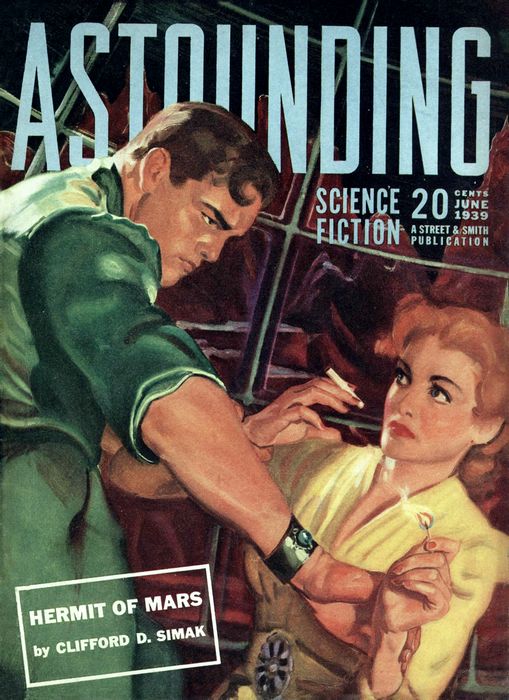
Astounding Science Fiction, June 1939, with "When The Future Dies"

The Green Globes came—and man had to go for lack of a weapon, for lack of time! But—the time machine was a weapon irresistible!
IT was in the spring of 1982 that the strange flotilla thundered down upon an unsuspecting Earth. Where it came from no one knew, nor was the exact truth ever discovered. The best opinion, however, of those who survived the first onslaught was that the invaders were not indigenous to the Solar System; that they came from one of the nearer stars.
In support of this contention it was pointed out that the spaceships were fashioned of a green-glowing metal that had no counterpart on Earth, or any of the planets; or in the fiery bosom of the Sun, for that matter. And, it was further argued, not only did the hulls shine with a green phosphorescence as they flashed across the night skies, but they held within their molecular patterns a blasting, continuous heat of such terrific intensity that would have melted into a showering flux any element, or combination of elements, in the known atomic scale.
The invaders came on a moonless night like a flock of streaking green comets. They landed on an open plain near Bordeaux, right in the heart of world-famous vineyards. There were twenty of their long, tubular spacecraft, pointed at one end, like well-sharpened metal pencils. The canny peasants, aroused by the thunder of their approach, the blast of their green-heated sheaths, fled in terror.
By the time mobilized troops and scientists from the University of Bordeaux and the Sorbonne in Paris had hurried to the scene a thin, translucent bubble, green glowing as the ships dimly wavering within, had surrounded the flotilla. Heat scorched outward from the bubble—so fierce, so incandescent that the country for a mile around was blasted clean of houses, vegetation and every form of life. The parched, brown soil was as bleak as any desert.
More troops were called upon; more scientists mobilized. They tried to signal the ships within the glowing bubble. They sent men clad in asbestos wrappings into the steaming area. They sent planes sealed against heat and cold soaring overhead.
But the unseen visitors did not answer the signals. The men in the asbestos suits were forced back by the furnace-like heat. And three of the planes, diving too close, were shriveled in the frightful bath as though they were midges falling on a red-hot stove.
After that the general in command. Marshal Perraud, a veteran of the Third World War, gave orders to fire. The new thirty-centimeter guns, using explosive shells of semi-atomic power, thundered a salvo. During the War, nothing had withstood their bombardment. Ferroconcrete fortresses, mile-deep Essinot lines, triple-reinforced stratosphere bombers, entire mountains, had been ripped wide open by the famous thirty-centimeters.
Yet now this tenuous bubble, semitransparent, hiding within its shining green distortions the wavering shapes of the pencil-shaped craft, refused to collapse under the terrific impact of the screaming shells.
The astonished observers, watching incredulously through vibro-scanners, saw queer, flowing movements within the protective shell. Movements obscured to a large extent by the greenish bubble, giving not even a hint of the strange creatures who followed those patterns. They were not human, that was obvious, nor any form of life understandable to man. For the paths, dimly seen, magnified, traced in three dimensions a complicated weave and design that had no counterpart on Earth. The shadows danced, died suddenly, reappeared elsewhere, seemed literally to twist themselves inside out. To the very end, no one solved the mystery; no one knew if those curious, flowing lines were mere distortions filtering through the bubble, or, in fact, true representations of the alien creatures who had come from outer space. No one knew; for no one ever saw the invaders face to face and lived to tell what he had seen.
AFTER forty-eight hours of continuous bombardment with every weapon and scientific device devised by man, Perraud was compelled to confess defeat. Once he had tried a bayonet charge and lost five thousand men in consequence. The closer they hurled across the waste lands the more frightful became the heat from the delicate, green phosphorescent bubble. The advance battalion, spurred on by the exhortations of its officers, died in droves with La Belle France on their blackened lips.
Perraud swore and tugged at his gray mustache. It was suicide to send more brave men against a furnace. The invaders had not retaliated; they did not even seem to realize that they were being attacked. The strange patterns gyrated their incredible dance within in ceaseless flight. Not once during all the turmoil and thunder of sound had they stopped or hesitated in their courses.
Perraud called Paris. The cabinet went into session. Martial law was declared. Perraud was displaced by Arcot. He had no greater success. Five thousand more men were lost and fifty great bombers. More cabinet sessions. The upshot was sensible. Since the invaders neither attacked nor could themselves be attacked, it was decided to adopt a policy of watchful waiting and let them alone.
Accordingly a forbidden area was declared around the glowing bubble—a sort of no man's land. It inclosed the parched and blasted section, and a two-mile radius beyond. Around the circumference of this circle troops were massed. One hundred thousand men, equipped with every known offensive and defensive weapon, installed behind asbestos shields and yards-thick ferroconcrete; while French scientists worked feverishly in laboratories in search of new methods of penetration and communication with the unseen beings within; or, in the alternative, for new weapons whereby they could be completely destroyed.
But neither one result nor the other was obtained. The bubble remained outwardly quiescent, though the military observers could follow with some difficulty the unceasing signs of activity within. Nothing seemed able to penetrate that semitransparent shell—neither messages nor arms.
For two months the mobilized forces held to their position, tensely observant, not knowing just what to expect, but ready to die, if need be, to resist any further aggression on the part of this alien invasion from space.
The tension of the nation gradually relaxed. It was evident that the bullet-nosed ships and their masters held no schemes of aggrandizement. A huge collective sigh of relief went up. The troops were gradually demobilized; a single battalion was left as a thin guard in the circumscribing trenches, more to warn off the curiously rash than to defend the country from further invasion.
Tourists came, as was to be expected, to observe the phenomenon. They brought their families and their lunches. The harassed soldiers were hard put to it to keep the unwary out of that zone of fierce, scorching heat. More scientists came, from all over the world. They spoke gravely of intra-atomic patterns, of a possible element of the atomic order of something like 112, whose instability divulged itself in fierce, continuous radiations. They tried to decipher through the most powerful vibro-scanners what curious order of life forms could give rise to those constant, weird gyrations; but without success. They tried communication by radio, by gesticulations, by heliograph, by huge geometric figures outlined in electric lights; yet no response came from within. Finally they, too, gave up in despair. The nine-day wonder was beginning to fade. Other matters distracted the fickle public eye.
Then one day, ten weeks after the sudden appearance of the spaceships, it happened. No one saw it happen, but it must have been about four in the afternoon, just as guard shift was taking place.
THE bubble suddenly expanded. It split into a hundred separate segments, each similar in shape and form to the original bubble, and each swiftly grown to a similar size. The cellular segments lifted lightly into the air. They sped with sentient purposefulness along the radii of a widening circle. They dropped to the ground at spaced intervals, outward from the parent bubble, so as to include within their spheres of influence a territory of over three hundred square miles. The most beautiful, the most fertile section of France was completely obliterated.
For, wherever the bubbles landed, the huge outpourings of heat from their shimmering green shells destroyed towns, villages, trees, houses, all life. Nothing remained but the scorched and smoking soil. Nothing remained of the two thousand troops or the half million inhabitants who were trapped by that sudden irruption. Bordeaux, in whose great public square one of the hemispherical translucencies had come to rest, was a desolate waste. The people died like gnats in the furnace blast. The buildings crumbled and crashed in glowing masses of masonry. Even the steel girders of the larger structures buckled and sagged under the tremendous temperatures.
France was swept by frenzied horror. She had been lulled into a sense of security by the quiescence of the invaders. But now they had acted; half a million people had died, and three hundred square miles of territory were destroyed beyond redemption.
The country was put on a wartime basis. Every able-bodied man was called to the colors. Munition factories worked full speed; munition laboratories at a still greater pace. These aliens were definitely inimical to human civilization and must be wiped out once and for all.
But this was easier said than done. Again vast armies were hurled against the green-glowing bubbles, protected with every weapon at the command of science against the fierce temperatures. In vain! Even those who, clad like strange antediluvian monsters in impervious asbestos, and encased in armored tanks lined with the same material, managed to approach the frail-seeming bubbles, found it impenetrable by shot, shell or old-fashioned ramming. A thousand massed bombers, flying in close formations, unloading their deadly cargoes from above, achieved no better results. Thousands more died in the attempts, and a hundred thousand found themselves erupting with sores and burns dreadfully reminiscent of second-degree radium burns of a former day.
For ten weeks more the bubbles were quiescent outwardly, neither fighting back at the desperate onslaughts of their human foes, nor showing any sign that those within were even aware that such a creature as man existed. Once more France and the expectant world relaxed, thinking that perhaps this time the worst was over.
But at the end of the ten weeks, as though ticked off by a stellar clock, the same phenomenon was repeated. Each of the hundred bubbles expanded and subdivided into a hundred similar offspring. Ten thousand newly hatched shells lifted high and sped swiftly, in spaced patterns, over the surrounding countryside. France was destroyed as far north as the gates of Paris, half of Spain and Portugal succumbed to the holocaust. The loss of life was appalling. Thousands had migrated from the surrounding territories, but millions had remained, stubborn in the belief that the first division of the invaders would be the last. They died now for their stubbornness, caught like insects in this second foray.
It was now no longer a local French problem, outwardly sympathized with, and secretly exulted at, by her neighbors. It was obvious even to the dullest that the invaders had set themselves a methodical course. The original expedition had brought a new form of life, beyond all human knowledge, to colonize the Earth. What had made them migrate in their strange spaceships from their far-distant former home was a mystery. It might have been a stellar cataclysm that swept their world to destruction; it might have been the pressure of superior enemies from whom they fled. The secret of their journey, just as the secret of their habitat and appearance, remained a mystery until the end.
THE scientists again talked learnedly: Of life forms who propagated themselves at ten-week intervals, ten offspring at a time, in fission like the amoeba or in spores like the Monocystics. Of reproduction in geometric progression. Of life that fed on mineral soil, free of vegetable or animal contagion. Of earthly elements fashioned by some strange super-science into a new element, hitherto unknown to spectroscopy, with an atomic weight of 112, and glowing with fierce, electronic energy. Of creatures as remote from protoplasmic carbon compounds as it was possible to be.
The scientists talked, but the plain man in the streets knew that the world was doomed. At such a rate of propagation the invasion must accelerate until all Earth was covered with the green-glowing bubbles and their unknown occupants. Within a year at the most—
Enemy nations forgot their nationalistic ambitions in the face of the common peril. The armies and the battle planes of the world converged. General staffs fused and subordinated to a single generalissimo. The laboratories of Earth pooled their resources. Everything else was forgotten except the onsweeping, inexorable expansion of the bubbles.
At the end of the third ten-week period half of Europe was laid waste. This time, though the destruction was infinitely greater, the loss of life was not as great in proportion. Only a million were caught in the fiery bath. The rest had emigrated.
It was the greatest hegira known in the history of the human race. Hundreds of millions partook in terror-stricken flight. They poured into the desert places of Asia; they shrieked and fought desperately for footholds on every possible means of transportation. They clung like black flies to the tops of railroad cars, they clung to the rails of transatlantic steamers, in their madness they even sought precarious perch on the wings of airplanes. A million dollars was offered for an old plane that rested in a museum, and was refused.
Thousands were crushed in stampedes; overburdened ships and aircraft went down without a trace. Famine swept away its thousands; typhus and cholera took more.
Then even Asia was no longer safe, and a new rush started to the Americas, to Africa, to far-off Australia. And always, at inexorable ten-week intervals, the existing bubbles split into new swarms that expanded outward in an ever-widening circle, and blasted everything out of their path.
The general staff gave up its futile bombardments. If Earth was to be saved, it must find its salvation in the laboratories. Hundreds of thousands of men and women scientists were working feverishly, desperately on the problem. Find some weapon, some means of offense that will break element 112 and destroy everything within its sheltering walls! That was the order issued.
"Easier said than done!" groaned Godfrey Talcott, ruffling his gray hair with a despairing gesture. "All we know about the element is what has been observed at a safe distance through telespectroscopes. We can't lay our hands on a sample to analyze or test it. And I'd say only a full, efficient use of subatomic power could touch it."
"That's our problem, then," retorted Raymond Trent, looking up from the cyclotron he was manipulating. "We've already made a start along the path. We've broken down uranium atoms with neutron bullets, and released almost ten percent of the total energy. We've harnessed that power for explosive bullets, for stratosphere planes, and the first rocket lifted last year some five hundred miles out into space before its drive gave out and it fell back."
"Of course it can be done," Talcott said impatiently. "But it takes time. Rome wasn't built in a day, nor did any great scientific discovery, immediately practicable, come fully perfected out of the laboratories—all fiction to the contrary. We have only the vaguest idea of the principles involved. Patient experimentation is required, long months and years of mathematical calculations, tentative blueprints, testings, scrappings, new blueprints, new experiments. Good Lord, man! I'd say fifty years is not too much."
"Fifty years?" Ray Trent echoed. His blue eyes squinted. "Might as well ask for eternity." He strode to the newscaster, flipped it open. The International Broadcasting Co. announcer swam into view. His hand trembled as he read the latest flash.
"Leningrad," he was shouting, all suavity forgotten, "has just radioed. Moscow is destroyed and covered by the invaders. The southwestern part of Russia is a smoking ruin. The Soviets announce they are moving the seat of their government to Irkutsk, on Lake Baikal. From Cairo comes a report—"
RAY flicked him off. He was still young, slightly under thirty. His face was twisted into a hard grimace; his eyes burned. He was a good physicist, but from college days his imaginative mind had preferred to play around with the larger philosophic conceptions of his subject—time, space, the nature of eternity, origins, endings. With an independent income at his disposal, left to him by a thoughtful father who had made his pile in manufacturing motors, he had immersed himself in a combination library, den and laboratory of his own choosing. There had pondered deeply on abstract matters and contrived curious little models which he never showed to visitors.
Since the coming of the spacemen, however, every available scientist had been impressed into the desperate effort to find some method of combatting their geometrically progressive spread. Ray Trent joined up by choice with Godfrey Talcott, his former teacher at the university. Talcott had a reputation as an authority in electronics. He was about fifty, tall, stooped, gray, and with a long, thin nose. He preferred working by himself, with a single assistant, rather than in a huge laboratory, surrounded by bewildering equipment and an obsequious group of underlings.
"They get underfoot," he complained, and took Ray off with him to his private little affair near Boston.
Ray said quietly now, without any bitterness. "You asked for fifty years? Within a year at the utmost the whole earth will be taken over, and not a human being left alive. Europe is gone; Asia and Africa are next in line. Then—" He shrugged eloquently.
Harsh lines etched themselves into the older man's face. "A miracle may happen, though I don't believe much in miracles. And only if a sufficient number of scientists work simultaneously on the problem, and without interruptions. But if we are compelled to move from place to place, always fleeing the advance, even a century wouldn't be enough."
"Right, and I have an idea. Suppose we shift our best men and the minimum of essential equipment down into Antarctica, where, from the looks of things, mankind will make its last stand."
"You're crazy, Ray," Talcott exploded.
The blond young man shook his head. "Not in the least. It's our only possible chance. There are already meteorological stations dotting the ice. They're pretty well scattered, yet close enough for plane and radio communication. Thirty or forty laboratories, working independently, yet with instant cooperation, freed for almost a year from the sickening disruption of flight from endangered areas, might find something within the limited time to save at least a remnant of the human race from total destruction."
"I still say you're crazy," insisted Talcott. "But it's the only decent suggestion I've heard since this infernal mess started. I'll get in touch with the general staff at once."
THREE weeks later the vast icecap called Antarctica hummed with unusual activity. Before there had been solitary wastes, broken only by inconspicuous stations and semiannual relief ships. Now cargo planes hurtled through snow and blizzard and furious storm to unload equipment and somewhat befuddled scientists in a last desperate stand against the ever-expanding death.
Trent and Talcott took over the station that perched precariously on the high interior plateau where the south pole made a mathematical point. The older physicist stared out at the wilderness of ice and snow, dim and spectral in the endless gloom of the south-winter night. "I still don't know why you picked on this most God-forsaken spot of all, Ray," he complained. "The storms howl down here at their worst; even the stratosphere planes may not be able to get through when we need extra equipment in a hurry. Now down on the coast—"
Trent looked at him queerly. "I wanted isolation; plenty of it," he said in a strange voice. "I didn't want anyone to know what we are trying to do."
Talcott said, startled: "What do you mean?"
"You remember back in Boston you said it would take at least fifty years to uncover the secret of destructive weapons with full atomic power?"
The older scientist made a hopeless gesture. "Of course. But we've got to keep trying. Besides, what's that got to do with our being isolated?"
Trent's answer was another question. "Suppose," he said slowly, "I could manage to span that fifty years for you—or even a hundred, if necessary—and present you with weapons already made and fashioned that could blast the invaders to pieces—without worrying about the theory involved?"
"And how, my fine young friend," demanded the other sarcastically, "will you provide me with these weapons?"
"By going into the future—that fifty or a hundred years ahead you were talking about—and bringing them back with me."
Talcott got up slowly. "I think," he said with careful intonation, "that perhaps this place has already gotten you. Suppose I send you back to one of the base—"
The younger man grinned. "My craziness is no longer a matter of mere metaphor, eh, Talcott? But I never was more sane in my life."
"And how, please, will you manage to go into the future?"
"With a time machine!"
Talcott blinked, snorted. "It can't be the heat, so it must be the cold. Whoever heard of a time-traveling device outside of fiction?"
"That's no reason to believe the problem can't be solved," Trent retorted. "Ever since I quit college I've been fooling around with the idea. You may remember that time and space, as abstract qualities, were always my obsession. I've gone through the intricate mathematical formulas involved; I was even compelled to create a new method of analysis and re-synthesis to solve my equations. That's all completed. I was on the verge of commencing the actual construction when the invasion broke."
Talcott stared incredulously. "And you think you can build a machine to take you into the future?"
"I don't know," Trent admitted. "That's why I wanted this total isolation. I didn't want the rest of the scientific world to relax their own efforts along the lines of super-atomic power. Human nature is such they might just sit back and wait for us to succeed. Our chances are slim, but theirs partakes, as you said, of the order of a miracle." He shook his head. "Only a time machine will solve the problem; nothing else."
In spite of himself, Talcott looked interested. "What's the theory?"
"An electro-magnetic warping of the space-time continuum," Trent explained. "The machine, if it works, will slide around the world line of events and reappear at any specified time and place."
The older man sighed. "I suppose you're right. It's our only chance, slim and far-fetched as that may be. How about the equipment?"
Trent grinned. "I've already arranged for that. It's all packed down here as my private baggage."
"We-e-ll!" sniffed Talcott. "I was wondering how much evening clothes you were bringing along. All right, suppose we get to work."
FOR nine months they labored. It was back-breaking, brain-stupefying, nerve-destroying toil. The long Antarctic night turned into perpetual day. Incredible blizzards roared over them and sealed them within mountainous drifts. The temperature rose and fell again. The last cargo plane came and went. Its pilots were frightened. "You're wasting your time!" they cried. "It's all over. The human race is wiped out. We're practically the last—"
But Talcott and Trent did not hear. They did not sleep; they had only snatches to eat. Day and night, the alternation of seasons, were but vague patterns to them. Only one thing mattered—the swift progression of calendar days as they flung desperately into their work.
Their minds bleared with formulas; they set up new apparatus, feverishly ripped it down to start afresh; they built strange cages and dismantled them; they impressed cosmic rays and alpha rays into service; they twisted elements with furious distortions, seeking always the warping, electro-magnetic action called for by Trent's equations. Time and again they thought they were on the proper track, only to meet with sudden blank walls. The solution showed dimly, tantalizingly ahead; but always success eluded them. And they had only weeks now.
Once a week they forced themselves, bleary-eyed, muscles jerking with supreme weariness, to listen to the radio. There were only a few announcers left, and fewer stations, and their news was increasingly tragic.
Europe was gone, Asia and Africa as well; North America baked with searing fires; Brazil lay panting under the swarming bubbles. The southern part of South America and Australia were black upheavals of refugee humanity. Hundreds of millions had died, but hundreds of millions were compressed into smaller and smaller spaces, fleeing the ever-advancing destruction.
Famine and fierce, internecine warfare took immense tolls. Civilization had reverted to savagery; a crust of bread, a foot of ground on which to stand, meant murder and sudden death. The tortured atmosphere and the more tortured sea, writhing under the insupportable burden of the blasting heat, rose in rebellion. Furnace-like siroccos swept over the still-untouched areas; a boiling sea, augmented by melting glaciers, roared in tidal floods over the hapless swarms.
At the end of the ninth month the last overwhelming news sputtered through. It came from the high continental barrier, not five hundred miles from where they listened. There was no other sending station to be heard. The newscaster spoke in a dull monotone. His capacity for emotion had long since drained away.
"The bubbles have spawned again," he said drearily. "Of what was once our earth only this desolate bit of ice and mountain is left. Australia and the South Sea Islands are gone; all South America down to the tip of Patagonia. A few people still perch precariously on Tierra del Fuego; some thousands more swarm on the bleak Grahams; fifty thousand all told have managed, by plane and by boat, to get away in time to reach the ice. There is food for perhaps three months."
Then his nerve broke. He looked out from the screen with an insane giggle. "Three months' food. More than enough. We can throw part of it away. In ten weeks time the bubbles spawn again. Do you understand?" His voice grew high-pitched. "In ten weeks' time we all die; we, the heirs of billions of years. We die, and those damned gyrations from hell take over." He glared at his unseen audience; his face seemed to be an independent mask, jerked by casual strings. "We die!" he sobbed. "I, the last announcer, tell you so. Damn them! Damn you! Damn us all!"
Still screaming, he picked up an iron bar, threw it at the silver mesh. There was a blinding flash; then dark silence.
Ray Trent lifted his head. "That's the end, Talcott," he said quietly. "His nerves couldn't stand it any more. He smashed the last sending station. We'll hear no more; we're cut off from the world."
The older man's shoulders sagged. "What does it matter? You heard what he said. In ten weeks more we're all dead—all our hopes and ambitions; our plans for the future. Wiped out, erased from the memory of the universe as though we had never been."
Ray stared at the complex of equipment. "Ten weeks more!" He seemed to be speaking to himself. "Ten weeks in which to find the secret and create a weapon to save the poor remnant of humanity." He turned suddenly on Talcott. "Can we do it?"
THE scientist shook his head. "I said in the beginning only a miracle could do the trick. For a while I thought you might be able to supply the miracle. Now that seems over." He clenched his veined fists. "God!" he choked. "If only they hadn't come for another fifty years. We wouldn't have to worry about time machines then. We are on the direct path. Subatomic power is there. It's only a matter of time; of normal, patient experimentation. Fifty years only, a half century; a mere instant in eternity—yet more than eternity to us now."
Ray Trent had been sitting, his head in his hands. Now he got up excitedly. "Look, Talcott," he said. "You gave me an idea. Suppose we contact the coast and get a picked group—not over a dozen-men and women. Suppose, in the ten weeks left us, you and they will burrow deep under the ice here, into the rocky, underlying core. We have power enough on tap to fashion a hollow chamber, stock it with supplies, arrange for constant aeration, and set up a laboratory. Down there, sealed in from heat and cold, they can live, marry, rear children, concentrate every energy on a single problem—the completion of my time machine."
"And suppose it never succeeds?"
Trent shrugged. "Then they'll have to plug away at the original problem of atomic power. That will take nearer a hundred years under the cramped and restricted surroundings. Perhaps their children's children will find the answers. With weapons so powered they'll be able to reconquer the earth."
Talcott looked doubtful. "It's a dreary gamble. However, I'll get them together at once. There's a base at Little America I can contact on our transmitter. Endersby is down there. He's a good man. I'll have him pick the dozen and fly up here with food and equipment."
Endersby, at the other end, was equally doubtful; but finally agreed to take the chance. There was nothing else for them to do.
The dozen came up in a dozen separate planes, laden to the struts with hurriedly assembled stores, taken secretly from the general supply. Picked men and women, young in years but old as time in spirit. In their eyes lurked the horrors they had seen; on their faces was set an ineradicable stamp.
They went to work at once, efficiently, swiftly, under Talcott's direction. But there was no drive, no energy to their efforts. In the time machine was their only hope. With that they could tap any age, any vast knowledge! As for the straight problem of atomic power—supposing they succeeded? Fifty to a hundred years of circumscribed living within the bowels of the earth, where they would never see the sun again, or hear the dawn wind through the trees, or watch the mountains light up with supernal glory. A century of mole-like drudgery, so that perhaps their children, or their children's children, might reconquer a blasted, useless earth. And how did they know that the invaders, once firmly established, might not also evolve new and superior weapons to batter down those they expected to invent?
They held a conference by themselves finally. Trent and Talcott were not permitted to attend. Then Endersby, as the spokesman, came to the two scientists.
"We've talked it over," he said. "We don't intend to go through with it. We'd rather die right here and now than eke out such an existence underground as you've outlined."
Talcott stared incredulously at their grim, set faces. "But you can't do that," he cried. "The race of man will die with us."
"Let it die then," Endersby said grimly. "There isn't any hope for us, anyway. Unless"—his eyes turned on Ray—"you can make that time machine of yours work."
"O.K. then," Trent agreed. "I'll make a bargain. You go ahead with the underground shelter and I'll concentrate exclusively on the machine. If by the time the invaders come, I see that the whole thing is hopeless, I'll tell you so, and we can all die decently together. If, however, I find a possibility of success within a short period—say five years at the outside—we'll hole ourselves in and finish the job."
Endersby conferred with the rebellious ones. "It's a bargain," he said. "But we expect you to be honest about it."
"I'll be honest," Trent promised.
FROM that time on Trent took no part in the communal work. The hole deepened hourly; semi-atomic diggers bit through ice and rock; Talcott drove them remorselessly. But the diggers worked only with muscles and main strength, not with their minds.
During their short sleep periods they crowded around Trent instead, watching his progress with a desperate intentness. Every time he swore viciously and tore down what he had just built, despair clamped upon their hearts; every time he grinned as something clicked in the slowly growing mechanism, their faces lightened and similar smiles twisted their lips.
As the days went on and on it was the time machine, not the underground, that absorbed all their thoughts, all their conversation. Talcott swore at them and flogged them on; they continued their work with mechanical efficiency, but the vitalizing force was gone.
One of them spoke for the others. "I tell you flatly I wouldn't spend even a year underground. Sure, I'll finish it, but I won't go down. Unless Trent's machine comes through, of course."
From open skepticism they had veered around to enthusiastic, abiding faith. The time machine! The time machine! Once it's finished, everything will be all right. We won't have to live like moles. Trent could go a thousand years ahead if necessary—ten thousand, even!
They'd show those damned invaders. A thousand, ten thousand years ahead, the human race would be far advanced; far beyond a bunch of gyrating, geometric abstractions. Trent would bring back with him weapons that would blow them back to the star from which they originally came.
But the days went on, and the weeks, and still Trent worked on desperately, doggedly, seemingly no nearer success than on the first day. The high hopes, the fanatical faith of the others, began to fade. They whispered to each other and looked askance at the thing of bars and wires and tubes.
Raymond Trent paid no attention to them. His face was hollowed out, his eyes were black from lack of sleep. Feverishly he went on—and on, driving himself beyond all human endurance.
Then suddenly, only two days before the alien bubbles were due to spawn again, he straightened-his wearied shoulders with a tremendous whoop. Talcott, grim and haggard, had just emerged from the tremendous hole they had dug. The others were deep below, two miles down, their cavern hollowed out of granitic rock, their apparatus almost completely installed. The last desperate touches were being made in a wild race with time. Within forty-eight hours the upper surface would be overwhelmed.
"I've got it!" he shouted a little insanely. "I've got it—got it! And now, by all the gods of man, we'll get those damned green globs! I don't care what they've got, or how soon they come; once I've put this gadget into that set-up I'll go forward till I find something so potent, so deadly, a hand weapon will destroy this whole damned horde!"
Talcott stared at him. "You're sure?"
"As certain as I can be without actually going," Trent nodded, more soberly.
"When?" the old scientist snapped.
"Tomorrow. Three hours to rearrange that hookup, a half hour or so to install this, and then about six hours of tuning, and another three hours of careful testing of parts. Twelve to twelve and a half hours."
Talcott smiled grimly. "It better work the first time. You'll have one day leeway."
Trent laughed with sudden release of strain. "Half an hour will be enough. I can't guess now what I'll have, but I'll go on to the farthest future, when man's power is irresistible, and bring back his deadliest defense!"
IT was a simple enough affair. Upright bars ringed in a circular platform on which there was a steel, bolted chair with straps to hold the occupant. Between the bars spread a lacework of fine wires, making an intricate geometric pattern. Small but powerful magnetons radiated from a central spoke. Dynon batteries, supercharged, furnished the power. Surmounting each bar were octahedral crystals of synthetic malachine, flashing with green fires, and sensitive to the lightest magnetic whisper. A huge dial with button inserts was fastened to the arm of the chair.
Endersby, black-haired, tense, growled skeptically. "So you expect to go into the future with that contraption, Trent?"
Now that it was time to go, Ray himself began to have uneasy doubts. "I hope to," he corrected. "If not—" He shrugged.
Ray glanced quickly at his timepiece. Precious seconds were passing. He spoke rapidly. "It's almost noon. Tomorrow at noon the bubbles are due to spawn again. When that happens, what little is left of our world will be swept away." He took a deep breath. "I'll either be back before then with an effective weapon taken out of the future, or else—"
"You'll be dead, and your machine a failure," Endersby broke in harshly.
"Exactly," Ray agreed. "That means you'll have to be prepared for every eventuality. Have most of you down in your sealed-in cavern. Let Talcott and someone else remain up here until about eleven thirty tomorrow morning. If I don't show up by then it shouldn't take more than twenty minutes for them to lower swiftly to the hide-out, place the sealing cap into position, and explode the prepared charges that will block the tunnel from view."
Endersby moved forward suddenly. "I'll stay with Talcott, and good luck, Trent!"
"Thanks!" Ray opened a barred door, stepped into the cage. Through the wire mesh they could see him check his apparatus, then seat himself into the chair and strap his body in. His long, lean hand punched buttons on the dial. In the utter silence the clicks were magnified, ominous.
"I'm setting my goal first for fifty years ahead," his voice came through, curiously muffled. "Some of you may even be alive then." He tried to sound gay. "Don't high-hat me out of your superior age and wisdom."
Ray had turned on the powerful magnetic warps. The malachine crystals dazzled with intense green-blue flame. The magnetons hummed like the droning of a million bees. The time traveler waved his hand.
Then the machine blurred. It became a curious shimmering through which the rear of the station vaguely showed. The shimmering grew more rapid. Only the faintest outlines were visible, a ghostly fantasy of man and cage. Then that died, and the dozen were staring wide-eyed at emptiness. Raymond Trent and his time-craft had disappeared.
"He's really done it," someone said in a half-hysterical voice. "He's gone into the future—the first man in the history of the world."
"And the last—I'm afraid," Talcott said tightly. He was finding difficulty in controlling his voice. He had loved the younger man.
Endersby said: "I owe him more than an apology. Let's hope he comes back. In the meantime, we'd better follow his instructions. If the impossible happens—and he succeeds—we'll have to be prepared. If he doesn't return, we'll have to be prepared just the same."
TEN of the dozen went below. Two miles down, under rock that was the backbone of the earth, in an artificial cavern about an acre in area and fifty feet high, artificially lighted, ventilated and watered. Soil for planting, a dozen chickens for eggs and meat, concentrated foods for perhaps half a century. Small-enough quarters in which to live, a dozen human beings, with love, marriage, offspring, work, research, with but a single driving thought through the years—the discovery of a weapon to blast the mysterious invaders off the outer face of the planet, and the repossession of a scorched and practically useless world.
Pale but determined, they went to work. Last-minute things, small matters overlooked in the rush of days, but vital for continued existence in the bowels of the earth.
Overhead, two miles up, two men were holding vigil, sitting with burning eyes, waiting for the return of the daring traveler. One full day of breathless waiting, staring at emptiness until their eyes ached and bleared, hoping against hope, knowing in their innermost souls that Ray Trent would never come back, that his pioneer craft had crashed somewhere in the frightening reaches of space and time.
Yet they said nothing of this to each other, but sat rigid, almost unseeing, while the minutes and the hours ticked slowly away. Outside it was the late Antarctic summer. The sun moved in a long, slow arc across the heavens, skirting the ice horizon in a vast oval, but never setting.
A blustering storm was gathering over the farther mountains, grim fore-warner that the milder weather was over. Soon it would descend in howling blasts of snow, obscuring the heavens, burying the station once more under mountainous drifts.
That would not matter any more. Within a few hours they'd have to retreat to the depths, and the space things would descend in a swarm of green-glowing bubbles to take over the last poor section of a stricken planet.
As the hours slipped away—irrevocable wraiths—the two men watched and waited, not daring even to thrust a sidelong glance at each other. They did not wish to read on another face the aching conviction that was printed on their own. Ray Trent would never come back! He was dead, smashed in some far-off reach of time and space. It was senseless waiting. Down below there was much to do; things forgotten; things to be guarded against when the things came.
Yet they sat there, rigid, silent, not looking at each other.
The outrunners of the storm moved over the grim plateau. Preliminary gusts of wind rattled the station, retreated to gather new force. The sun was a red, wavering ball of misty fire. But still the central space on which they concentrated was bare—bare of cage or human being.
At eleven the next morning urgent messages came up from below. Since Trent had not returned in twenty-three hours, it was senseless to expect him any more. Suppose the terrible bubbles came a trifle ahead of schedule. They'd be taken unawares and destroyed. It took time to seal the cavern and explode the prepared charges.
But Talcott did not stir, and Endersby growled into the little microphone: "We wait until eleven thirty."
At eleven thirty the calls became more urgent, threatening even in their fear. They'd have to seal themselves in if Endersby and Talcott didn't come down in a hurry. The future of all mankind depended on them. Strangely enough, in the actual face of destruction, they had reconsidered, wanted to live.
"Ten minutes more," snapped Endersby. "We've got to give Trent a break." Talcott still said nothing; he seemed carved out of rock.
The storm burst with a thundering howl. Outside, the world was a swirling mass of gray, thick flakes, torn into shreds by a wind of hurricane violence. Winter had set in—the last winter the world would see.
At eleven forty the receiver crackled with urgency. Endersby sighed, got up reluctantly. He averted his face. "Come on, Talcott, there's no more use."
But the scientist was staring at a little whirling ball of mist that had materialized inside the station. "Look!" he cried in a thin, cracked voice. "Look at that!"
Endersby stared. "It's the storm outside," he said. "The sudden drop in temperature condensed some moisture, Come on."
But Talcott was on his feet, quivering like a pointing setter. "It's taking form," he shouted. "It's Trent! He has returned!"
The whirling mist had coalesced; it was shimmering now. The walls behind it grew faint, and a definite shape emerged. The shape of a barred cage, of a chair within and a figure strapped in its depths.
Then it became solid with a curious rush: these in the center of the room, at exactly the place where it had taken off into the unknown almost twenty-four hours before.
The figure inside stirred. Fingers plucked stiffly at the straps. Raymond Trent shook himself as though he were slowly coming out of a daze, got up, and walked with stiff, measured tread to the door.
Talcott and Endersby flung themselves forward. Their hearts thumped like pile drivers, sobs of pure joy tore at their throats.
"He's come back," they stammered. "He found the future and he returned!"
They literally dragged the younger man through the door; they pawed his lean figure, pumped his hand with fierce vehemence. They had to make sure that he was real.
"You found the future, didn't you?" Talcott clamored.
Ray had not spoken as yet. Now he said in a flat, toneless voice: "I found the future, Talcott. Fifty years from now."
"Swell! Swell!" jittered Endersby. "Everything's swell now! Where are the weapons you brought back—the advanced weapons that will wipe the space things off the face of the earth? In fifteen minutes they're coming. Give them to—"
For the first time they both noticed the expression on Ray's face. It was hard and rigid, like a mask from which all human feeling, all emotion had been erased.
"I have no weapons," Ray said dully.
"But... but—" Talcott stammered. He grasped feverishly at a straw. "Then the principle, the theory of subatomic power, at least. Surely by that time—"
Trent's eyes were stony pebbles. "I have no theories or principles."
"But damn it, man," Endersby exploded. "If they didn't know enough fifty years from now, why didn't you go on—a hundred, five hundred years? We know the problem is not insoluble."
Trent looked at them squarely. They fell back aghast at the sudden flare in his eyes. Then that died. The mask fell back into place. "You don't understand," he said. "I went fifty, I went ten thousand years ahead. There is no future! The invaders won, of course. That's obvious, isn't it? Naturally, there aren't any men in the future."
Roy Glashan's Library
Non sibi sed omnibus
Go to Home Page
This work is out of copyright in countries with a copyright
period of 70 years or less, after the year of the author's death.
If it is under copyright in your country of residence,
do not download or redistribute this file.
Original content added by RGL (e.g., introductions, notes,
RGL covers) is proprietary and protected by copyright.