
RGL e-Book Cover
Based on an image created with Microsoft Bing software
Roy Glashan's Library
Non sibi sed omnibus
Go to Home Page
This work is out of copyright in countries with a copyright
period of 70 years or less, after the year of the author's death.
If it is under copyright in your country of residence,
do not download or redistribute this file.
Original content added by RGL (e.g., introductions, notes,
RGL covers) is proprietary and protected by copyright.
RGL e-Book Cover
Based on an image created with Microsoft Bing software

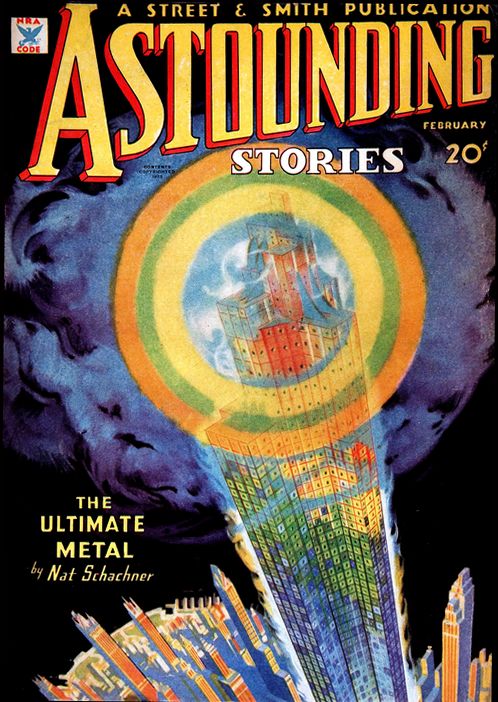
Astounding Stories, February 1935, with "The Ultimate Metal"
TWILIGHT laid its protective mantle over the roaring life of New York. For one breathless moment there was a hush, as nature had intended. Then the giant city girded its limbs defiantly and accelerated the headlong tempo of its existence.
Little lights winked into being over the massed masonry of the midtown section as lawyer, broker, and business executive whipped flagging energies to renewed effort. The streets, huddled in canyons, festooned themselves with long necklaces of radiant pearls. Broadway flared into a seething white cauldron of strange mechanical figures that shouted from the housetops the virtues of toothpaste, streamlined cars, morticians, beauticians, and ivory, apes, and peacocks. The power-house managers gazed at the mounting loads on their output indicators and should have been content.
Except for one thing—the threat implied in the Coulton Building.
This was strange. For such a structure, even though not quite completed, ought to have gladdened the hearts of power-company directors and stockholders alike. One hundred and fifty stories high, subdivided into innumerable offices and suites, expected to house a veritable city of fifty thousand people, it was comparatively easy to calculate the exact kilowatt consumption per year. Given a definite number of short, dark winter days, the average number of cloudy, storm-gloomed days, the driving compulsion that forces typewriters to clatter far into the night, the usual percentage of employers who keep pretty stenographers working overtime, the normal number of after-hours poker games, which to trusting wives masquerade under the peculiar name of important board meetings—given all these, and the rest is mathematics.
But—and there was the rub—mathematics weren't necessary. Except for the negligible amperage required for the operation of elevators, vacuum cleaners, et cetera, electricity might just as well have never been discovered. That was why the Coulton Building created such a furor in the practical as well as the scientific world. That was why rubberneck busses, filled to the brim with old ladies from Keokuk, primly excited schoolmarms from Walla Walla, bored garment buyers from Texas, and honeymooners from Heaven knows where, made special detours to Central Park South, and barkers inhaled deeply before lifting megaphones to lips.
This very evening Thomas Coulton himself stood importantly in the cleared plaza before his already world-famous structure. He towered over the respectfully insistent mob of reporters even as the Coulton Building towered over and dwarfed its neighbors. He was a big man, heavy of beam and of head, with a thunderous voice, which, combined with the knowledge that he, and his father before him, possessed millions, was sufficient to overawe any normal human being.
He did not look like the average conception of a world-famous physicist—you know the type: pale, thin, ascetic, eyes burning with the pure scientific ardor—but, then, neither did his assistant, Harley Dean, standing just now inconspicuously on the outskirts of the thrusting hurly-burly of men with pads and pencils in their hands.
Harley Dean might have passed for the third from the end in the stag line at a debutante party, and he would certainly have fitted very well into flannels and a powerful backhand stroke during a Long Island week-end. Yet Dean, in fact, was the true discoverer of evanium, No. 93 in the scale of elements. It was he also who alloyed it with other and more familiar elements so as to make possible the Coulton Building.
For one man, however, who had heard of Harley Dean, there were thousands who knew Thomas Coulton. It was his splendidly equipped laboratories and unlimited financial resources that gave Dean the chance to pursue his experiments. It was Coulton's colossal egotism and desire to be considered a scientist as well as a millionaire that made him ostensibly chief of the laboratory, whereby the world at large was given the impression that he, Thomas Coulton, was the only begetter and originator of evanium and its alloys.
Harley Dean did not mind that particularly. Such has been the fate of true genius ever since wealth took up the arts and sciences in a big way. He would smile a bit caustically at Coulton's booming periodic sentences that made such swell copy in the daily news sheets, and go on with his work.
But now he was not smiling. He was frankly worried. Vague fears assailed him; fears that loomed more and more ominously as the days went on, one by one, and the tremendous undertaking neared completion. Yet everything looked all right, and there seemed no foundation for his worried preoccupations except the overcautiousness of the true scientific investigator who has, he feels, insufficient data on hand to justify jumping at conclusions.
Coulton laughed at his expressed qualms and pushed his plans for the building as fast as he could drive engineers and architects along. His optimism was as large as his frame; Dean was a plodder with his nose buried in his work, while he, Coulton, made lightning decisions and painted with tremendous brush strokes on gigantic canvases.
"What you need, my boy," he told Dean gustily, "is vision. Yes, sir; vision with capital letters. If I listened to you, the world would stand still. Nothing would ever be done. Good Lord, man, we've tested and prodded this damned alloy for a month now. What more do you want? The millennium to come? Or maybe you own a share in the electric-light companies and the steel trust and that makes you nervous. No, sir; I'm going through with it—now!"
THE "we" of course was purely euphemistic. All that Coulton ever did was breeze into the laboratory an hour or so a day, other engagements permitting, during which time he managed to break valuable instruments, muss up important and delicate experiments, and generally get into Dean's patient way.
His familiar voice rose oratorically on the evening air. This was his element, talking in large phrases to reporters. It irritated Dean for the first time. His sense of humor seemed unable to cope with his chief to-night. Maybe it was because he was tired; perhaps because the loom of the practically finished building filled his sleep with nightmares.
"Look at it!" Coulton made a grandiloquent gesture. "The most magnificent thing the world has ever seen. All seven wonders rolled into one, and some more that the old Greeks never counted."
Obediently the reporters craned their necks. It was in truth an awe-inspiring sight. The great structure towered fifteen hundred feet straight into the air, its smooth, shining metallic flanks instinct with grace and beauty, yet giving the impression of tremendous power and thrusting strength. This in itself was an innovation—all-metal construction. But the miracle that brought gasps of wonder to thronging sight-seers and probing scientists alike was the strange luminescence of that metal.
Dusk had turned to darkness. New York was a prickle of man-made lights against a blue-black sky. But the Coulton Building scorned all adventitious aids. It glowed with innate fires; it radiated pure white softness, strong as the noonday sun, yet glareless and soothing to the eye. Within as well as without, the silver-metal walls made high noon out of conquered night.
A sky-pointing vision out of fairyland! The sound of hammering filtered down from the upper stories. The last finishing touches were being put to the gigantic structure. October the first was a week off.
"Gentlemen," Coulton boomed, "let me give you a tip. Sell electric-power stock short. Artificial lighting is as outmoded as candles and kerosene lamps. Within five years every new building in the good old U.S.A.—yes, sir, in the world—will be made of Coultonite."
"Maybe you'll let us in on the ground floor, Mr. Coulton," one daring individual piped up. "I got a couple o' hundred bucks I'd like to invest."
Coulton beamed and shook his head. "Sorry, boys, but I'm going on my own. You know," he said confidentially, "I have just a little of the filthy lucre myself." He smiled at his genial wit, and they smiled with him.
"Do you mind going over the story of your discovery again, Mr. Coulton?" a thin, sharp-nosed reporter asked.
"Not at all! Not at all!" The millionaire's voice took on added orotundity. "I had been on its track for some time. Then one day, after months of grueling toil—Eureka! Success! Before our excited eyes, carefully inclosed in a vacuum, was a dark-green, flaky solid. A new element, No. 93 in the scale, never before seen or handled by human beings. A new creation, a tribute" he coughed modestly—"to hard patient work, and, may I add, a slight touch of—er——"
"Genius!" some one suggested.
Coulton laughed heartily. "I wasn't going to use that word, but—— Anyway, we had scarcely feasted our eyes on it when, poof, it was gone, vanished. In its place was a gas. We tested this and found it to be Uranium X. Again and again, as we prepared our new element, it vanished and Uranium X gas resulted. So we named it evanium, because it was so—what do you call it—evanescent. A neat touch, eh?"
They smiled appreciatively at the great man.
Some one asked: "How long did evanium last before it changed?"
"Why—er—that is—let me see—oh by the way, Mr. Dean," he called over the heads of his auditors, "do you happen to remember the exact number of hours?"
"Thirty-five and three tenth seconds," Dean replied clearly from the outskirts. The steady glow of the building revealed a slight bitterness in his eyes that was quickly masked.
"My assistant," Coulton explained to the reporters. "A very good man for details. Well, anyway, nothing much could be done with an element that, so to speak, did not stop even for a bowing acquaintance. So we experimented. We tried combinations with other more familiar elements; we made alloys. Thus it was that we discovered Coultonite. It's an alloy of evanium with titanium and beryllium in certain definite proportions. Of course the exact proportions must remain our secret. You understand the reasons for that, don't you, boys?"
They murmured that they did. Coulton was a business man as well as a great physicist, and he was not in business for his health.
"Yes, sir," he went on and on. "I had that alloy tested for a whole month before I decided on the Coulton Building. It answered every test. Boys, there's nothing like it in the universe to-day. The ideal, the perfect metal, for every conceivable purpose. It is lighter than aluminum; its tensile strength is—uh—is——"
"One million, two hundred and thirty thousand pounds to the square inch," Dean interjected.
"Exactly! It is harder than diamonds, yet extremely malleable. It is noncorrosive; its melting point is high; and Young's Modulus of Elasticity is—now let me see——"
"Seventy-four million," Dean put in, a trifle wearily.
Coulton threw out a gesture. "So there you are, boys. Coultonite! Greatest discovery of the ages!"
THEY dispersed slowly, the reporters.
Dean waited unobtrusively until they were all gone, then he said: "Now, look here, Mr. Coulton. I can't get it out of my head that something is going to happen. We're dealing with unknown forces; with an element that never existed until we created it. More, an element that fades out right before your eyes. You should have waited until more work was done on the alloy, until it was tested by the passage of time, until——"
Coulton's brow darkened. "Going all over your fool theories again, eh?" he said angrily. "By Heaven, I'm sick and tired of your croakings! I'm paying you good money to work for me, and I don't want belly-achings."
Dean flushed. His lips tightened; his good-looking face ridged into hard lines.
The millionaire recognized the storm signals and backed down. He needed Dean. Without him the whole structure of his pretended scientific eminence would collapse.
"O.K.," he said hastily. "I didn't mean that, of course. But for Heaven's sake, you worked a whole month prying and experimenting before I decided on building, didn't you?"
"Yes, but——"
"And the alloy answered every test and was stable as a rock, wasn't it?"
"Yes, but——"
"Then why worry? It's too late now, in any event. The building is up, finished, completed."
Dean acknowledged to himself that his fears, premonitions if you will, were no doubt groundless. Nevertheless he blurted out desperately: "At least, Mr. Coulton, do this much: Let the building remain untenanted for, say, six months. If by that time everything is O.K., then we'll know that the alloy is good and stable, and you can go ahead confidently with the rest of your plans."
Coulton stared at him unbelievingly for a moment; then he threw back his head and roared. "Idle for six months!" he gasped, tears of laughter rolling down his heavy jowls. "That's the richest I've heard in years. An investment of ten millions, hard cash, eating its head off in taxes and interest, just because young Harley Dean feels overcautious about a scientific result." He wagged his head pityingly. "You may be a damn good physicist, Dean, but you're sure an awful business man. That building of mine is a sell-out, from roof to cellar, at fancy rentals starting October first, and you want me——"
And he doubled up again with mirth.
IT was a fact. Every firm it seemed in the world clamored for available space in the Coulton Building. Every professional man, every huge corporation, every fly-by-night concern peddling doubtful wares, yearned for the cachet that this world-famous address would bring. Coulton's renting agents rubbed their hands gleefully and rejected all applications that could not bear the cold light of Dun's and Bradstreet's Grade A ratings. Even at that, there was a waiting list a mile long.
On October first, the hegira began. From early morning until late at night the vans made traffic-snarled queues before the freight entrances, and furniture and shiny new equipment poured in in an unending stream. Police lines had to be established to hold back the merely curious.
The opening of the magnificent structure was attended with tremendous ceremony. Scientists and engineers mingled with bankers and high officialdom. The Governor of the State and the Mayor of the City walked arm in arm and made appropriate speeches, praising Thomas Coulton, his learning, his science, his initiative, his public-spiritedness, his broad vision, his home life, his wealth, his father and his father's father until Harley Dean, wedged in among the lesser scientific fry, grew slightly nauseated. Learned societies sent delegations and awarded medals, cameras clicked and sound tracks recorded every breathless syllable.
Only the representatives of the utility companies and the steel trust were conspicuous by their absence.
OCTOBER the first passed, as all days must. So did the months of October, November, December. Nothing happened; that is, nothing to justify Dean's Cassandra-like warnings.
The building was even more of a success than had been anticipated. Tenants were in ecstasies over the strong, even lighting that emanated from the walls. It never faded; it never succumbed to the ordinary annoyances of burned-out fuses, defective bulbs, overloaded lines; it shed its eye-resting illumination into every nook and cranny of every office, and the dull silvery metal lent itself to rich and tasteful decorative effects.
Business boomed and prosperity smiled on the tenants. To be an occupant of the Coulton Building was a hall mark of distinction, a hand-picking out of the ruck of common firms. Potential clients and customers came to the offices, primarily to see with their own eyes the well-publicized wonders, yet naturally and inevitably to leave behind them a growing trail of orders and cases.
Everybody was happy; but most of all Coulton. He walked on air; he wore his medals and the decorations presented by admiring foreign governments even on his dinner coat. In his mind's eye he saw himself the financial dictator of the world.
For in the light of the tremendous success of his first venture, letters, telephone messages, cablegrams and radiograms poured in in an unending flood from all over the Earth, clamoring for tonnage and more tonnage of the miraculous Coultonite. The steel trust capitulated and sent emissaries to devise a working arrangement; the governments of Europe made feverish inquiries; far-off Mongolia and farther-off Patagonia were equally represented in the torrent of orders.
Coulton plunged. He sold out all his investments; he transferred every stick of property—except the Building of course—into available cash. Immense factories mushroomed on the Jersey flats, scouts scoured the world getting options and leases on all known titanium and beryllium deposits, and Dean worked himself haggard devising new and more economical ways of separating these treasures from the dross. Fortunately, evanium could be synthesized by powerful neutron bombardment from quite common sulphur. And, even more fortunately, only a minute trace of the evanescent new element was required in the manufacture of the alloy. Ten thousand men worked and drew salaries at Coulton's behest.
"Well, my young croaker," Coulton said jovially to Dean for the hundredth time, "what have you to say now?"
IT was Christmas, and still everything was well. Coulton Enterprises, Incorporated, was magnificently installed on the one hundred and forty-ninth floor of the gigantic tower. The view from every porthole was overwhelming in its breath-taking sublimity.
This was another innovation that was in itself a stroke of genius. It had been Dean's idea, diffidently suggested, and taken up with his employer's characteristic enthusiasm and large genial forgetfulness of its source.
Windows perform three functions. They bring light into opaque structures; they permit the influx of air; and they furnish pleasing vistas to those habitants on whose hands time might otherwise have hung heavily.
Of these three, the first two are fundamental; the third purely aesthetic. But modern air conditioning has done away with the necessity for wide spaces to permit the ingress of sufficient breathable oxygen, and Coultonite did away with any possible lighting requirements for windows. Therefore only the incidental aesthetic use remained.
Business men, however, are eminently practical. They adore art and beauty, provided it does not interfere with their profits. And the giving over of tremendous surfaces merely so that stenographers and clerks could gaze vacantly at the far-off ocean, the more placid Sound, the other and punier battlements and spires of New York, was abhorrent to a right-thinking man of affairs like Coulton.
So windows, too, seemed doomed, until Dean had his idea. Provide small round portholes, like those on ships, he suggested. They would take up little enough space. Have good magnifying lenses inserted instead of ordinary glass. And, behold, the panorama becomes supernal! It was a marvelous publicity stunt as well as a selling point.
But to return to Coulton's question. Dean had very little to say. In the beginning he had labored his point early and often, without result.
"Perhaps you're afraid to come with me to our new offices," Coulton had sneered. "If so——"
Whereupon Dean, not being a coward, had without a word supervised the transfer of all his precious instruments to the eyrie of the Coulton Building.
Christmas passed and the New Year was ushered in with appropriate ceremony. The great structure had become a familiar landmark; its shining, ever-glowing exterior no longer excited any more than a passing glance from native New Yorkers. Nothing could possibly seem more stable, more enduring. The factories reached peak production. The first batch of Coultonite lay in neat ingots, ready for shipment. Dean went on to other researches, plunged into them with consuming ardor. His fears had abated, were practically forgotten.
THE first intimation that all might not be well came from a night watchman. It was his duty to make the rounds of the building once every night, to check against open doors, marauders, mislaid tenants, and in general to observe that peace and virtue reigned triumphant.
At ten o'clock on the morning of January 9th he marched rather sheepishly into the great man's private office, twirling his hat with embarrassed fingers. It was long past his quitting time, but he was a Scotchman with a devout sense of duty, and he felt it incumbent on himself to report direct to the big boss. Dean was in the room, too, excited over the successful termination of an important bit of work, pouring it out in eager words to a half-comprehending chief.
"Well, what is it, my man?" Coulton interrupted his assistant with a certain measure of relief. It was due to this that McDonald had penetrated the inner sanctum so easily.
"Well, it's this way, Mr. Coulton," McDonald cleared his throat apologetically. "I'm the night watchman, ye see. And I was a-making my rounds last nicht as was usual—I take my duties verra serious—and, let me see, I was on the seventy-third floor—no, it couldna been that, for I remember verra distinct I looked up after 'twas over and I saw a g-r-rand picture of a Clyde-built steamship on the wall, so it must have been——"
"Never mind what floor you were on," Coulton growled impatiently. "What happened, what brings you to me instead of the super?"
"I'm a-coming to that, sir," McDonald said with imperturbable gravity. "It's verra hard to describe. But there was I, going about my proper affairs, trying doors, everything peaceful-like, when it happened." He paused, and a slightly frightened look crept into his clear candid eyes.
"Well, get on with it," the big man boomed.
"Why, sir, the whole building seemed to give herself a shake. It was verra funny. It didna sway, you understand, like as if there was a storm, or make a g-r-reat noise. It seemed more like as if every little part were a-rearranging itself, so to speak, as if it were a-taking on new positions. 'Twas a verra peculiar sensation, I might say, sir, like"—he groped for words—"like the blooming building were a-growing, sir. That's it, Mr. Coulton. I r-remember, when I was a wee lad——"
"McDonald!" Coulton looked square into those clear blue eyes, half hidden under frosty white lashes. "You've been drinking!"
The watchman drew himself indignantly erect. "Sir-r-r!" he sputtered. "I never-r touch the stuff, except—except, of course, a wee drap now an' then on a cauld nicht."
"Exactly!" Coulton boomed with self-satisfaction. "Now go home and sleep it off. And remember, if you're caught drinking while on duty, you're fired! Do you understand?"
"Yes, sir." The watchman backed agitatedly to the door, turned and stumbled through the outer offices, shaking his head and muttering to himself. That "wee drap" now—it wasn't enough to make him hear such a most peculiar noise. Or was it?
Coulton snorted. "Nothing like scotching a story like that right at the beginning, eh, Dean?"
But Dean had not been listening. He had been engaged throughout the interruption tracing figures on the pad before him. He was full of his research.
"Now get this, Mr. Coulton," he said eagerly. "I moved the fluorescent screen to a forty-five-degree angle and inserted an additional magnet."
Which was a pity. For Dean was the only one who at that particular stage might have comprehended the full import of McDonald's story.
THE next phase was plain for all the world to see. It occurred about a week after the so-called growing pains that the night watchman had tried to describe.
Dean was in the laboratory, working late. Cathode tubes glowed, huge magnets swung on gimbals, lightning flashes darted over the glistening surface of an electrostatic ball. The Coultonite walls cast their even, white illumination over everything. The setting of the external sun had passed unheeded.
Dean grunted, ran quick fingers through unruly hair, and jotted down figures in his notebook. He did not hear Coulton's entrance. Nor was this surprising. For it was wholly unlike his usual assertive floor-shaking stride.
The big man stood a moment in silence. Then he coughed—a very apologetic little cough. It was all quite out of keeping with the man.
Dean looked up. "Hello, Mr. Coulton!" he said abstractedly and would have returned to his calculations. But something in his chief's face held his wandering attention. It was strained, a bit anxious. His eyes were wide on the walls of the spacious laboratory.
"What's the matter?" Dean asked.
Coulton passed a hand that shook slightly over his brow. "I don't know," he said. "But look at those walls."
Dean stared around in some surprise. Then he saw. The effect was faint, almost imperceptible. It would have passed unperceived had Coulton not directed his attention specifically to it.
The luminescence was no longer pure white, with that faint tinge of blue to it that made it almost an exact replica of the light of outer day. Instead, it shimmered a bit. Little fleeting dabs of color moved in rapid, swirling succession over the evanium walls. They melted into each other; they glowed and disappeared; they vanished into pure white and restarted their ceaseless drift.
Opalescence! Iridescence! Like Newton's rings on thin films of oil! It was beautiful, this glowing shift of patterned colors, but—a little disturbing.
Coulton said: "It's much more effective on the outside walls. The whole building is a play of colors. Look at the crowds."
Dean moved half consciously to the view-port that was tilted at an angle to bring into focus the panorama of the streets. His brain was racing vainly to comprehend this sudden shift of light into the spectrum.
The powerful glass brought up clearly the swarming streets below. It was past midnight, when Central Park should have been a deserted gloom of trees and deep shadows. Now it was black with thousands of dim-seen faces staring up at the great structure. Broadway was a crawling ant heap, so were Fifth and Lexington.
Dean whirled around. The interplay of colors mottled everything—very faintly. It was not enough, however, to interfere with normal vision.
"What do you make of it, Dean?" asked Coulton. He was a bit scared, more than he cared to admit.
"It's hard to tell," Dean admitted. His forehead was ridged with furrows of thought. "Normal iridescence is the result of a shift in the angle of the observer so that the thickness of the film through which the reflected light must pass in coming to him changes also. But this does not apply here. In the first place the light is not reflected; it is inherent in the material. In the second place we as observers are stationary."
"Then what?"
Dean disregarded the interruption. "Some inherent change must have occurred in the constitution of the alloy. If that is the case, then Coultonite is not stable." With relentless logic he went on, while Coulton gaped, for once unable to talk: "If our alloy is in the process of change, then this comparatively harmless play of colors may be but the prelude to more profound and far-reaching internal rearrangements."
ACROSS Coulton's mind flashed the strange story the night watchman had told. He had used that very word—rearrangements!
Dean stared strangely at the walls.
"They may end in purely harmless effects. On the other hand, they may——"
His voice trailed off. For a moment there was silence, while Coulton's head gradually cleared. The business man no longer masqueraded as a scientist. He was marshaling his forces for what he knew was coming.
Dean took a deep breath. "Coulton," he said steadily, "the building must be evacuated—at once. Until these effects can be studied in detail; until the passage of sufficient time proves that it is safe."
The millionaire snarled like an animal at bay. His face was a furious mask.
"Stop that damned nonsense, Dean!" he roared. "Have you gone crazy? Do you realize what you are saying? The Coulton Building is fully rented. The annual rental is twenty million dollars per year. The upkeep runs to sixteen million dollars. You're asking me to throw away a profit of four million dollars; pay out of my own pocket the enormous upkeep, simply because the walls of the building are changing their colors a bit, because you're afraid of—of Heaven knows what."
Dean looked at him with troubled eyes. "Yes," he said very low. "Just because I am afraid—of Heaven knows what!"
Coulton clenched his fist. "You forget also," he shouted, "the effect upon the world, upon the avalanche of orders waiting to be filled. Why, the mere shutting down of this building, no matter what the excuse, would bring a flood of cancellations. Every penny I have, every penny I could scrape, borrow, or steal, is in this venture. I'd be ruined, man, ruined! The plants would close, ten thousand men would be thrown back on the relief, banks from which I borrowed heavily would not be able to make the grade. And why? Because you, Harley Dean, without even knowing what this little business of color really means, set yourself up as a dictator over lives and fortunes. Well, you're not going to say anything, or do anything! Do you hear?"
The words echoed around the vast laboratory. His breath came in deep stertorous pants. There was nothing suave or hearty about this millionaire, at bay with his threatened millions.
Dean was not afraid of him; had never been. His job, this comfortable salary, meant nothing. Nor did the dollars and cents involved. But several things that Coulton had shouted struck responsive chords. The thought of ten thousand men thrown out of work, the thought of possible closed banks with consequent disaster to thousands of depositors, made him hesitate.
After all, on what did he base his pronostications? On a mere iridescence, a play of color. The very thing that made Coultonite fabulously successful was its glow. The tiniest shift in internal structure, the slightest rearrangement of molecules and planes of crystallization, induced possibly by normal vibration, could account for the shifting iridescence. It did not necessarily argue anything against the inherent stability of the alloy itself.
He had not paid any attention to McDonald's tale, and Coulton, ruin staring him in the face, did not see fit to recall it to his mind. If he had known of that midnight mutation—but, then, arguing about it is a most unprofitable procedure.
Dean said indecisively: "There's something in what you say, Mr. Coulton. Perhaps——"
His chief looked like a condemned criminal reprieved from the hangman's noose. "Of course, Dean," he said, laughing gustily. "I knew you'd see things in the right light. Now we'll just let things ride a bit. Nothing's going to happen. If anything does turn up that looks dangerous, I'll be the first man to give in. Human life is more important than—than——" The words somehow stuck in his throat. "There'll be plenty of time to act. No use going off half cock."
Unfortunately when it happened, there was not time. But how could a business man be expected to know that? Dean did not blame Coulton afterward; he had acted only according to his lights; but for himself he held no excuse. He should have known, should have insisted.
THE strange new iridescence meant only a fascinating display to New Yorkers. Once more the Coulton Building was the cynosure of native eyes. In truth, the shifting glow of colors, ranging the spectrum, deepening from palest yellow to darkest indigo, made the straight cloud-thrusting walls a wonderland of beauty. The world came to stare and gape and utter little "Ahs!" and "Ohs!" Not a trace of alarm, of foreboding, anywhere.
Nor did the tenants object. The pearly display did not seem to affect the normal texture of the light, and it made a gorgeous decorative texture out of what had been after all a mere blankness of illumination.
Dean, however, in spite of his yielding, remained grim and anxious. He spent days and nights in his laboratory, hardly sleeping, hardly eating, investigating the new phenomenon, working with secretive fury at certain mysterious apparatus.
Coulton, booming as heartily as ever, kept discreetly out of his way. A queer fanatic, his assistant, he reflected. He made a mental note to get rid of him as discreetly as possible whenever the opportunity arose.
THE NEXT step in the drama came about five days later. This time it occurred in broad daylight, in the full tide of human affairs, when the building was crowded with working humanity. Fifty thousand people—men of substance, heads of great corporations, lawyers, motion-picture executives, exporters, stockbrokers, financiers, clerks, bookkeepers, stenographers, office boys, elevator men, window cleaners, mechanics, visitors on business, visitors without, insurance agents, peddlers of fine smuggled cigars, necktie vendors—in short, a complete cross section of American life.
It came first as a little rumbling and shaking. Every one stopped work, looked at each other with questioning gaze and a slight uneasiness. An earthquake? Impossible! New York had never had an earthquake. Now take Los Angeles, Chile, Japan—that's where the ground shook, not in good old New York.
The rumbling and shaking grew, the walls made crystalline clatter. Ann Merriweather, good-looking and efficient secretary to Alfred Whitcomb, president of Vitex Pictures, froze with pencil poised in mid-air. Whitcomb, red-faced, well-fleshed, shrank in his chair. In the back of her mind floated an inconsequential image—that of a toy of kaleidoscope, the property of her small brother, in which the various colored segments of glass fell with just such a crystalline clatter into strange new combinations, new patterns.
The clatter increased. The walls seemed to swell and retract into position again. Strange shuddering groans issued from the tortured metal, almost human in their eerie wails. The sound of planes rubbing on planes, of molecules in anguish, stretched beyond all reasonable limits, of new elements in parturition.
The noise grew to an unbearable clamor. It rasped and shrieked in the ears of the affrighted tenants. The walls moaned with the wind of creation.
Human sounds joined those of grating metal. Screams, yells—all the confused cries of men and women afraid for their lives.
"The building is falling!" Morton Swaley shouted and ran for the door of his luxurious office.
The contract lay unheeded on his Circassian-walnut desk; the fact that he had just hooked his sucker; that the victim had pen on paper to sign his name, was forgotten. A split second start meant life—and other suckers. His particular racket might get short shrift in the Great Beyond.
The halls were filled with a dense struggling mob. Swaley, by virtue of his flashing start, led the pack to the elevators. He panted at the unwonted exertion. His sharp, weazened features were puffed with fear. Damn it, why had he taken offices on the ninety-sixth floor?
He pronged the elevator button with trembling fingers and went down, screaming and kicking, under the sudden rush of fear-crazed men.
It stopped as suddenly as it had started. One instant the walls ground and heaved on themselves; the next all was dead silence. Bland metal, quiescent, innocent of expression, shining with a light canary-yellow luster.
The human screams died less quickly. The half-crazed people looked fearfully around, saw nothing amiss. Panic ebbed slowly from them; a few even who had considered themselves cool-headed, brave, felt a bit sheepish. Nevertheless fingers pressed on elevator signals. They might have saved themselves the exertion. The elevator boys had decamped at the first sign of disaster. Nor would their presence have mattered. The juice was off.
It was Jimmy, the gamin bootblack, marooned on the fifty-eighth floor, his blacking box still clutched tight in grimy hands, who first noticed the new state of affairs.
"Say!" he shrilled. "Will ya lookit dat!"
The walls were beginning to crawl!
That was the only possible way to describe it. The solid-seeming Coultonite flowed on and over itself, faster and faster, until it was a mighty flashing river of metal, dazzling the beholder with the swiftness of its flight. Yet it did not progress or lose its binding contours. The limiting walls remained in position, and the alloy was hard as ever to the touch.
A liquid-solid, Dean was to describe the new state.
To Dean, hand on a switch that would send fifty thousand volts arching between the electrodes of a reduction furnace, the sudden birth pangs of the building came as a blinding revelation. The knife edges contacted but nothing happened, even as he had anticipated.
He sprang at once to the emergency power plant that he had rigged up during the week. There was no Coultonite in its construction. He plugged the connection with swift, sure movement. A blast of lightning seared from anode to cathode. He grunted with satisfaction. But even as he did, the roaring stream of incandescent molecules faltered, paled into a weaker red. Some outside force was combating his power, neutralizing the hurtling flow of electrons.
Even this, however, he had prepared against. Breathing hard, he raced to another machine; a curious funnel-shaped apparatus attached at the smaller end to a long Coolidge tube, which in turn connected with a lead-sheeted casket. The whole thing was mounted on a turntable, at the periphery of which were thick bar magnets, heavily coiled with copper wire. Not an ounce of Coultonite had been used in the entire construction.
Dean threw a switch and breathed a prayer to the gods of science. The noise and the howling were deafening by now, and the arc of the electric furnace flickered into a pale thin line.
The Coolidge tube glowed with faint blue, the turntable started to rotate. Dean dug his nails hard into the palms of his hands. The next few seconds would determine his fate, and possibly the fate of all the multitudinous occupants of the building.
SLOWLY, very slowly at first, the table went round and round. The pencil flame that barely forced its way before the electrodes wavered, but did not lessen. The opposing forces had almost neutralized each other. Not quite, of course. That would have been a miracle. A tiny differential either way would have tremendous consequences.
Dean waited, face rigid, for the break that meant possible life or death. The walls were beginning their peculiar circumscribed flow. The physicist groaned. That, then, was the second stage. He surmised the third. But the ultimate, the one on which everything depended, was still in the womb of events, unknown, unknowable.
Was it imagination or was the speed of the turntable increasing? Some one shouted almost in his ear. He did not turn. A heavy, trembling hand plucked at him. He shook it off impatiently.
There was no question about it now. The table was rotating more and more rapidly, the glow in the tube became an intense blue, and the arc surged into jagged lightning.
Then, and then only, Dean turned. It was Coulton—but a pallid, flaccid Coulton. All the starch, the aggressive heartiness, had gone out of him. His booming confident voice was a cracked whisper; his cheeks were drawn; his eyes terrified.
"For Heaven's sake, Dean," he implored hoarsely, "what is it; what does it mean? You'll have to do something!"
Dean viewed his chief with faint distaste. "I've done all I could. We two are safe, at least temporarily. But the others, the fifty thousand innocent victims of your greed and recklessness, I don't know about them. Perhaps, if the forces involved do not run beyond human imagination, I may be able to save them."
Coulton took a deep breath. The color moved back into his cheeks. He did not even resent Dean's biting characterization. The one thing that penetrated his fuddled brain was the fact that he was safe. Nothing else mattered.
A haze was forming in a hollow shell beyond them. It shimmered, it tinged faintly with blue, yet it did not hide the laboratory walls, still imbued with that insane fluidity.
The table whirled faster palpable emanations poured from the revolving funnel; the magnets were a blur of speed on the rim. The shell widened its radius, slowly but surely.
"But what does it all mean?" Coulton ventured.
"What I was afraid of from the beginning. Coultonite is not stable. The evanium in its composition was merely masked, not nullified. It has been working stealthily, along unknown lines, disintegrating, sending out streams of countless electrons, positrons, neutrons, photons, and Heaven knows what else. The whole alloy has been in constant ferment, imperceptible to our most delicate instrument. Then, suddenly, when the leaven had fulfilled its function, the solid, stable, eternal-seeming metal fell into a new pattern. That has happened twice now. The first was a mere color-difference. The second we are now in. I'd call it a new form of matter. A liquid-solid. There will be more."
He stopped a moment, listening. There was silence within the shell of vibrations, broken only by the ceaseless hum of the turntable. The rest of the building might have been a vast tomb, for all he knew. Yet there was nothing he could do, more than he had done.
The shell of force he had thrown around them effectually damped all sound waves, nor could it be penetrated without grave danger. The only hope for the others, even for themselves, lay in the doubtful possibility that he had sufficient power to overcome the inimical forces inherent in the Coultonite and that the shell of safety would widen its radius sufficiently to inclose the entire building.
"How far will the process go?" Coulton half whispered.
Dean shook his head. "I don't know. You may think me crazy, but it's my idea that Coultonite has become endowed with a peculiar life of its own; a metallic life, if you will."
Coulton gasped: "What?"
"It's the only explanation. After all, life need not by any strict rule of logic be limited to what we call organic compounds. Life can be defined as any unstable complex structure of which the chemical constituents are in a state of constant flux and which obeys certain laws of change, growth, and old age.
"The fact that life has never been associated with anything else but certain nitro-carbohydrates is no obstacle. Evanium is a created element; it never existed before in the universe so far as we know. It has certain life-like qualities—change, disintegration, radiant emanations. In fact it went through its life-transformations with incredible speed.
"What we did was slow it up, make it more like the slow orderly processes we know. The other elements in the alloy act also as food for nutritional processes to be ingested and built into new growth combinations."
Dean listened again. Nothing from the outside; nothing but dead vast silence. The hollow of vibration was impinging on the walls now, and as it did so, the liquidity stopped and gave way once more to smooth rigid metal.
Coulton saw it and exclaimed joyfully: "We're saved!"
"Not yet. The shell in which we are inclosed is a stream of what I've named triterons—triple hydrogen with an immense positive charge. The revolving magnets bend the stream into a hollow sphere. The triterons on contact with evanium neutralize its disintegrating qualities, combine with it to form stable, lifeless uranium. The trouble is I don't think I have enough power to force the shell outward so as to inclose the entire building."
But Coulton was content. At least he would be saved. Not that he was not sincerely sorry for the trapped tenants in the building. He was. It was simply a balancing of forces; his own safety outweighed too much consideration of others. With the thought came regained confidence. He even essayed a feeble replica of his booming laugh.
"Coultonite alive!" he chuckled. "What nonsense!"
DEAN ordinarily would not have answered. He was tired of his chief and his egoistic all-embracing selfishness. But unless he talked, his mind would be overwhelmed with the strained anguish of waiting—waiting—until the slow-receding bubble of force would reach other human lives. So he compelled his brain to calm theoretic considerations.
"Not only life," he said, "but more! Evolution! Coultonite is passing through a racial growth as well as a single life. Kaleidoscoped, compressed into short compass, accelerating in its effects. Even the processes of nitro-carbohydrate evolution have been imitated. That heralding crystalline clatter represents a mutation, a sudden rearrangement of molecules and planes into a new and different form. Perhaps we shall be privileged to witness the end-stage of metallic evolution before we know the ultimate of human maturity."
"Look!" Coulton whispered and went ashen-white.
The protecting globe of triterons seemed motionless now, without expansion. Where it had not impinged on the walls, was no longer the strange liquid-solid. In its place was something else—what Dean was afterward to term the gas-solid form of metallic being.
The wall seemed to have opened up. It swarmed with movement—the movement of particles. The straining eye could discern interstices, spaces that shifted and closed in bewildering fluxion; yet limited as before by the definite boundaries of the wall. And hard, adamant to the touch.
BEYOND their circumscribed haven on the hundred and forty-ninth floor all was madness, indescribable confusion. Only a few fortunates close to the ground had been able to escape at that first warning clatter. Almost immediately the emanations from the life-emerging Coultonite had sealed every opening, every exit, with an invisible wall of radiations against which human flesh, human weapons, rebounded with perfect elasticity.
Within the confines of the building fifty thousand trapped beings struggled and prayed and cursed and shrieked, in accordance with their individual natures. Prominent citizens trampled their way ruthlessly over the weaker bodies of their neighbors in mad, fruitless rushes to a mythical safety; others, unknown to fame, performed feats of heroic sacrifice, ministered to the dying, shielded the weaker from the mob, comforted the frightened.
OUTSIDE, New York was a shrieking bedlam. Sirens resounded, whistles screeched, horns made continuous raucous clamor. Every bit of fire apparatus within the metropolitan area, every emergency repair wagon, every ambulance, was being rushed to the scene of the disaster. The police roped off blocks around the doomed building. It was a very sensible precaution. The National Guard was being hurriedly mobilized. The troops stationed on Governor's Island clattered up in motor lorries, trench-helmeted, equipped with bayoneted guns.
All the millions of New York, it seemed, crowded against the restraining ropes, the massed lines of police and soldiery. Central Park was a seething human flood. Frantic shouts burst in huge sky-splitting sound at each new change in the fated structure. There were hundreds of thousands in that crush who had friends, relatives, loved ones, in the terrible trap of the Coulton Building.
For it was from the outside, rather than to Dean's trained eyes, that the full and incredible evolution was completely manifest.
The gas-solid stage made of the tremendous tower a tenuous, insubstantial-seeming wraith. Yet the axes of the firemen blunted against the weave of particles, battering-rams rebounded with terrific force, and huge oxyacetylene flames made not the slightest impression on the impenetrable walls. The would-be rescuers kept on working, frantically, hopelessly. Even dynamite was used. The earth geysered, the roar of the mine rose high above the welter of sound, but the building was untouched.
A sudden gasp arose in gigantic exhalation from the multitude. The gas seemed to coalesce. It whirled round and round on invisible axes until it seemed like spiral nebulae. The thrusting flanks burst into flame, into a brightness so dazzling it blinded the eyes of the beholders.
The massed people fell back in a mad scramble for safety. Even the police, the grim sweaty fighters, ebbed away in quick fear. But there was no heat from that tremendous glare. It was "cold" light, the dream of all engineers.
The mutational stages were coming thick and fast now, so much so that for years controversy raged among the more observant as to what had actually happened.
On the next, however, they were all agreed. A slow grinding sound welled from the structure. It was like the sliding of metal over metal. Then came a clashing as of brass cymbals. The strange sound rose in pitch; it became more plangent. A faint rhythmic sweep was discernible. The rhythm took on a sharply accented beat; the tones swelled in power until the entire universe seemed a diapason of harmony.
Music streamed in endless measures, pervading all things, swaying with supernal melody. It was heard in Washington, in Boston, as far off as Pittsburgh. Undreamed-of music of the spheres, yet imbued with strange metallic effects.
It was about the succeeding stages that the greatest and most rancorous disputes arose. There were those who claimed they saw curious unhuman shapes float through the dazzling structure of the building, shapes that were geometrical, angular in character, yet somehow conveying to bewildered minds the unmistakable expression of life.
Some even went so far as to maintain that these metallic forms were at first soaring, triumphant, wildly glad. Then they changed indefinably; doubt pervaded them and gave way to fear, to horror, and to wild despair. A last, writhing, tortured movement, and they were gone. This of course was before the ultimate disaster.
But thousands, also present, and equally observant, derided these claims. They had seen nothing like these purported life-forms. Their antagonists, they insinuated, were using a tragic event to bolster up special theories, to undermine the very foundations of religion, and therefore, of the home, the State, things as they are, and the unselfishness of mother-love. For it was patent to all that if these pretended visions were true, then there was life beyond human ken, instinct in metals, minerals, sheer clods of dirt. And that way lay pantheism and godless atheism.
About the climax, however, both factions were in perfect agreement. Even as they watched, the huge flanks of the Coulton Building seemed to puff out a little, and—a great cry of horror arose from the straining multitude—the Coulton Building was as if it had never been.
One, moment the soaring structure was a blaze of light, one hundred and fifty stories high, the next the air was clear, and the hitherto hidden silhouette of New York lifted its jagged edge against the sky.
Vanished, traceless, except for one thing—a gigantic bubble that fell headlong from the heavens and impinged soundlessly on the vast excavation where the foundations of the building had plunged deep into the ground.
A rushing wave passed over the city, an ethereal tidal wave that dissipated its load of free atoms, electrons, neutrons, what-not, over unimaginable areas.
The first indescribable confusion over, the first mad and understandable exodus from that terrible neighborhood ended, and rescue squads advanced cautiously toward the hole in the earth, still rubbing their eyes, expecting any moment to see the tower restored to its former position, to its old eternal solidity.
Deep down, hundreds of feet, they discerned a squirming, shrieking horde of ant-like human beings. The rescuers went to work with a will.
SOME two thousand people were saved. Among them were Coulton and Dean, badly battered, shaken, but without serious injury. Dean's apparatus, delicate enough in all conscience, had been smashed beyond repair by the impact of that tremendous drop through space. Fortunately, however, it had functioned perfectly up to that very second, and had broken the fall of the bubble of force sufficiently to save the lives of its captive humanity.
Dean, when the facts became known, was the hero of the nation. But he refused to be consoled. His sphere of protecting triterons had expanded too slowly. By the time of the final catastrophe it had inclosed only a half dozen floors. The rest, bearing with them almost fifty thousand human lives, puffed out in a stream of free particles.
The building, or rather, its metallic constituent, evolved too rapidly, Dean explained later. Its will-to-live was exhausted by the driving energy of the activating evanium. Its period of existence had been comparable to thousands of generations of nitro-carbohydrate life.
It died finally, he said, of old age—of racial age, that is—even as the human race some day will sink into desuetude. In the case of Coultonite death meant the dispersion of its component parts. Perhaps, said Dean with a sad smile, the same might be the ultimate destiny of all our hopes and fears, our knowledge and our aspirations.
Roy Glashan's Library
Non sibi sed omnibus
Go to Home Page
This work is out of copyright in countries with a copyright
period of 70 years or less, after the year of the author's death.
If it is under copyright in your country of residence,
do not download or redistribute this file.
Original content added by RGL (e.g., introductions, notes,
RGL covers) is proprietary and protected by copyright.