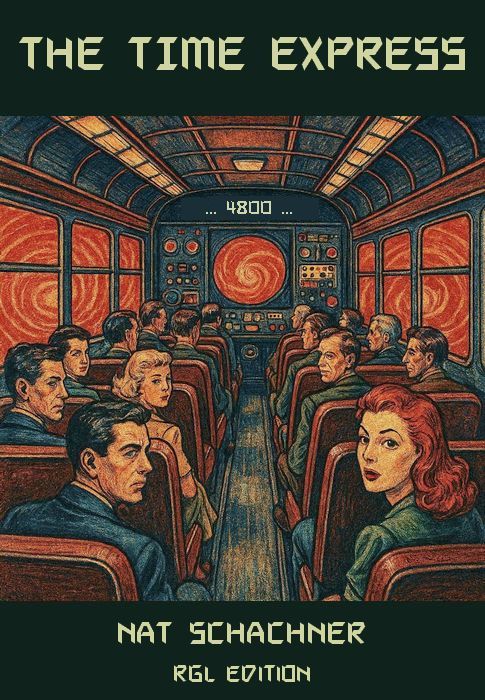
RGL e-Book Cover
Based on an image created with Microsoft Bing software
Roy Glashan's Library
Non sibi sed omnibus
Go to Home Page
This work is out of copyright in countries with a copyright
period of 70 years or less, after the year of the author's death.
If it is under copyright in your country of residence,
do not download or redistribute this file.
Original content added by RGL (e.g., introductions, notes,
RGL covers) is proprietary and protected by copyright.
RGL e-Book Cover
Based on an image created with Microsoft Bing software

Wonder Stories, December 1932, with "The Time Express"

If we accept traveling in time as at all possible, we can go a step farther and envision regular tours through time, as we today journey through space. Time travels might even become a regular business, or a means of pleasure or education.
What wonderful visions might open at that thought! We can imagine many ages linked together by regular transport; the year 3000, the year 4000, the year 5000 etc. might exchange thoughts and ideas, and even the accumulated wisdom of the ages.
But Mr. Schachner is not swept away by such flights of fancy. He tries to keep his feet on the ground and to work out logically and consistently what might happen were regular trips through time possible. He sees many limitations, many disadvantages; but above all he sees unbounded field for adventure. In this story we get one of the thrilling possibilities of the future.
DENTON KELS drifted unostentatiously off the aerobus, completely merged in a horde of chattering anticipatory tourists. A hundred heads turned to stare at the great gleaming crystal timedrome. Over the entrance to the long, semi-cylindrical building a legend flashed back into their fascinated eyes.
"HOOK'S TOURS THROUGH TIME" it screamed in red neon lights, twenty feet high, "PERSONALLY CONDUCTED ALL-EXPENSE TOURS INTO THE FUTURE. VISIT YOUR GREAT GRANDCHILDREN IN TRADITIONAL HOOK COMFORT. THE LAST WORD IN TOURS."
A pleasurable sigh exuded from the hundred, then the chattering broke out afresh. The modulated, penetrating voice of the tour leader hushed them into sudden silence.
"The Time Express starts in half an hour, ladies and gentlemen. We shall have to hurry. Kindly take your places on the passenger conveyor."
The tourists bustled on board the long-grooved ribbon belt, scrambled into the nearest seats. Denton Kels followed meekly. He was a mild looking man in the early forties, slightly bald with wisps of graying hair. His features were inconspicuous, his eyes speculative. An ideal operative for the special investigation in which he was employed by the World Council in this year of grace 2124 A.D.
The conveyor shot into swift, noiseless motion, hurled them through the great portal into the spacious convex interior, and came to a smooth stop before an ellipsoid of mirror-like metal, one hundred feet long on its principal axis. It was suspended in air some twenty feet off the ground by powerful magnets set in the curving roof overhead. A steep movable ramp led into the interior. From every side huge burnished reflectors focussed upon the express. They were quiescent now; when they blazed into activating energy, the metallic ellipsoid would vibrate upon its tremendous journey.
Kels had his tickets and identification passport carefully scrutinized by a hawk-faced individual who looked uncomfortable in the livery of Hook Tours. There were others too, in conventional civilian clothes, who stared at the tourists with probing eyes as they streamed excitedly up the ramp.
Kels smiled thinly. His papers were in order. Denton Kels was his name and he was a retired butter and egg merchant. The hawk-faced individual returned them to him without comment. By not so much as a flicker of an eyelash did he show recognition.
Kels put them back carefully into his wallet and shuffled on board in back of two giggling young girls.
The interior of the express was fashioned entirely of the peculiar mirror-like metal. Chairs, tables, beds, instruments, even table cutlery, gleamed monotonously. This metal was particularly sensitive to the activating impulses from the reflectors.
The ramp led into a small bar at which a white-coated attendant was rapidly filling metal cups with a slightly yellowish, fizzing drink.
"Every tourist must drink a cupful," he chanted.
Kels drank his portion obediently. It was lukewarm and rather nauseous to the taste. The drink was radioactive, containing in suspension colloidal particles of the mirror-like metal. Their dispersion through the body rendered one amenable to the influence of the reflectors.
The tour leader was much in evidence. He was a young man with fair hair and smooth rosy cheeks. Just now he was flushed with the exertion of herding his flock to their quarters. His name was John Bolton and he hated his job. But one must live and the pay was good.
"You will have just fifteen minutes to find your quarters, and attend to your luggage," he announced. "At the end of that period a gong will sound. You must gather immediately in the central salon, and take your seats. The Express starts ten minutes thereafter. The Company is not responsible for accidents to any tourist who fails to obey these instructions rigidly. The room numbers are on your tickets."
Kels looked at his ticket, found his room number to be 36. A uniformed attendant, in the familiar Hook blue-and-gold, directed him down a long corridor. His room was the farthest on the left.
It was small but sufficient. His luggage, a battered serviceable suitcase and a small hand bag with a peculiar lock to it, was already set neatly against the bedstead.
Kels went over and locked the door on the inside. His bright blue eyes raked the room for possible hiding places. There were none. Bare metallic walls stared back at him.
Disregarding his suit case, he knelt before the handbag; his surprisingly long fingers worked deftly at the lock. It snapped open. Kels reached in, took out a tiny, thin-barreled dynol pistol that held a magazine of fifty almost microscopic dynol pellets. On striking its target, the pellet exploded into thousands of tiny slivers of steel. The victim died almost instantaneously, no matter how superficial the original impact.
KELS hefted it speculatively, slipped it into his pocket.
Then he drew out a blue slip of paper. It was a photostatic copy of a memorandum. He read it with frowning forehead.
"The World Council of the year 4600," it ran, "has managed to send us a warning. It is in possession of information to the effect that some one in the past is attempting to smuggle plans and specifications of power machinery via the Time Express into their time of 4600. Such plans the World Council of 4600 considers contraband of the most dangerous order, the mere possession of which is punishable by death. It is believed that the smuggling attempt will be made from our time of 2124 via the Hook's Tour of July 17th.
"The World Council of 4600 notifies us that unless we prevent such smuggling, all further tours to their time will be strictly prohibited. Inasmuch as the World Councils of all periods prior to 4600 have practically persuaded that Council to permit tours to be routed through its time into future ages, it is readily seen how such a limitation would be catastrophic. Not only would the broadening aspects of travels in time on our citizens be unduly curtailed, but a gigantic industry would suffer financially."
Kels permitted himself a smile at that, and read on.
"It is therefore imperative that the smuggler be captured, and the contraband seized and destroyed. All operatives of the Secret Service are to proceed accordingly."
"Chief of the Secret Service Division,
World Council, 2124."
Attached to the photostatic memorandum was a strip of paper with a typed message.
"Attention Operative, Denton Kels.—You will take complete charge of field operations. You will be held responsible for their success."
Kels smiled wryly, took out of an inside pocket a tiny flame-inducer, flicked it into a bright hot glow. He held the memorandum against its tip, watched the paper curl into impalpable ash. Then he deliberately opened the locks on his bags and left them open. Even his luggage was not immune from careful search; every Secret Service operative proceeded on the assumption that very other operative was suspect.
Kels sat down and lit a cigarette. A bother over nothing much, he thought. He had heard something of this strange civilization of the future where machinery was anathema; where everything was done by human hands, or by tools fashioned by human hands. The course of civilization had been reversed. Kels knew vaguely the reason for this abandonment of power. Little bits of information had filtered back through time. Yet he thought the alleged reasons eminently unsatisfactory. He was sufficiently a child of the present machine civilization to be unable to conceive that it was, or ever could be, anything but an unmixed blessing.
He got up and shrugged his shoulders. After all, it was none of his business. The Council of 4600 had a right to make its own regulations, and have them adhered to without meddling from the past. His orders were definite; catch the smuggler and destroy the plans.
A gong sounded clamorously. It was the signal. Kels unlocked the door, went out into the corridor, was swept into the current of hurrying tourists. By the time he caught his breath, he found himself seated on a metal chair in the salon, discreetly in the rear of the motley array of both sexes, thrilling to the thought of a cruise into the future. A little platform reared itself at the farther end of the salon, and on it stood John Bolton, the tour leader, waiting for the hubbub to cease.
Kels nodded unobstrusively. At once various soft-shoed individuals on the outskirts of the crowd slipped silently out of the salon. They were operatives. Kels settled back comfortably into his chair, knowing that every inch of the Express, every bit of luggage belonging to the passengers and the crew, would be submitted to a painstaking search.
Bolton raised his hand for silence. All necks craned in his direction, all ears were attuned to the pearls of wisdom that were about to drop from the lecturer's lips.
"Before we commence on our tremendous venture into the future," he began in his modulated, penetrating voice, "it would be well to acquaint ourselves with something of the history of time traveling, and the principles upon which it is based."
An elderly man in rusty black with a high intellectual forehead snorted contemptuously, leaned back and closed his eyes. A professor of science, on his sabbatical, no doubt, to whom the elementary explanations of the Hook's man would appear childish.
Bolton went on earnestly. "Because of the rapid advances that have been made in the science and art of time traveling, it is sometimes forgotten that the penetration of the future was deemed an absolute impossibility only nine years ago. It was in 2116 that Levallier, of immortal fame, first invented his crude time traveling machine. He was greeted with mockery, but in front of the assembled sceptical scientists of the world, he and his machine vanished from view. Three days later, during which interval the hall in which it had been housed remained under constant supervision, the machine reappeared, and Levallier staggered out, wild eyed, incoherent.
"He spoke vaguely of great astounding civilizations of the future, in which time traveling, based on his invention, was an accomplished art. He spoke of general impressions, of marvelous advances in science, but somehow he could remember no sharp details. Nor could he give a coherent description of any machine, of any invention of the future that he had observed.
"Trained scientists went with him on further ventures into the future, with the same results. It was impossible to bring back any but the most general observations. It seemed as though nature, outraged at man's bold penetration into the mysteries of time, revenges herself by raising an impenetrable barrier against the use of future knowledge by men of the present. And that, our scientists and philosophers assure us, is philosophically correct. It would be an absurdity for us to avail ourselves of all the knowledge into which man will gradually evolve, before that knowledge even came to the race. Even I, who have accompanied this tour some thirty times, could not describe in detail any invention of the future."
A HATCHET-FACED spinster in mannish clothes said in a loud masculine voice: "Does that mean we won't be able to bring back anything from our travels?"
"Not a thing."
The spinster sniffed with explosive force. "Well, I declare! I must say, young man, your Company has imposed on us. What is the good of an expensive tour if you can't bring souvenirs back to show your friends that you have been away!"
A stout placid man with white hair and old-fashioned spectacles wagged his hand upright like a timid schoolboy. He caught the lecturer's eye, stammered and blushed. "Why don't Hook's make up tours into the past? I—I'm all-fired anxious t' see old grandpop again."
All eyes fastened on the old farmer from the hinterland.
Bolton answered courteously: "A very understandable and praiseworthy desire on your part, Mr. Hardscrabble. Unfortunately, we have not achieved traveling into the past, and our philosophers tell us we never shall. We may move forward, and return to our own time, but not for one second may we unroll the past. That is why the people of the future cannot come back to us."
A thin young man with an ascetic face and prominent nose looked up from a note book in which he was busily scribbling.
"Mr. Leader," he asked, "can you explain the theory of time traveling—scientifically, I mean? I'll get extra credits if I can hand in a good thesis on the subject to my Prof."
"I'm glad you asked," Bolton said heartily, though there was murder in his eyes. "The Company encourages students on its tours. There is nothing of great cultural value than traveling, either in space or in time. I shall try to explain the theory of time traveling as simply as possible."
The professor on his sabbatical was snoring loudly now. Another man, tall, lantern-jawed, groaned and shut his eyes ostentatiously.
"It has long been known," Bolton went on unheeding, "that the faster an object travels in space, the slower its growth processes. In other words, passengers in a rocket plane traveling at the rate of one thousand miles an hour, who according to the standard time calculations of instruments affixed to the ground, are one hour older at the end of that distance, are actually, as far as their perceptions and bodily reactions are concerned, not quite as old as that by the very small fraction of a second.
"Now multiply that speed until it approaches the speed of light, if you can conceive passengers on a rocket ship traveling that fast. At the end of one hour by normal earth standards, they would have perceived, and their bodies would have aged, only a fraction of that time. At the very speed of light, our travelers would have achieved immortality; to them all time would be condensed into a single simultaneous eternal sensation; there would be no growth, there would be no decay."
Bolton's voice was getting bored; he fell into the singsong of the professional lecturer.
"So that," he continued, "if we had rocket ships that could traverse interplanetary space, and we could build up a speed of, let us say, 180,000 miles per second, our intrepid travelers could take off today, cross the uncharted regions of space to Andromeda, half a million light years away, swing back at the same tremendous velocity, and come back to our earth as it will be one million years from now, yet themselves aged only a few terrestrial years."
Kels was listening half attentively. His faculties were fixed more on the smuggling problem in hand. His eyes roved over the motley assortment of tourists, probing, speculating. Which of these was the resourceful, unscrupulous smuggler; where had he hidden the contraband plans? All this while, he knew, his men were going over the Express with a fine tooth comb. But he had a feeling that they would not find anything. The smuggler was playing for big stakes. He stared again at the faces, some rapt on the lecturer, other blank, some drowsy or frankly asleep, others pretending interest. The two giggly girls were casting inviting glances at the earnest young student, nudging each other and going off into muted peals of laughter.
BOLTON droned on. "Now of course it is impossible for us to achieve that tremendous journey in space, but Levallier evolved a brilliant idea. Why not localize the journey? We have available in our own bodies, in every bit of matter about us, speeds approaching the required velocities. I refer to the atoms in our composition. They vibrate very rapidly. Find some way of increasing their vibrations to nearly the limiting velocity of light and the problem has been solved. We need not travel out into interstellar space. Mere direction of speed does not effect the slowing up of the time process. Accordingly if our atoms be made to vibrate more rapidly within the present range, we remain as a corporate entity stationary in space, yet we have slowed up in time while the time of the outside world flows past us.
"With that concept in mind, Levallier set to work. He experimented until he found a new metal alloy which he called vibratium. Its atoms are peculiarly susceptible to activation. The Time Express is made of that alloy; the liquid you were required to drink contained it in colloidal suspension. You will have noticed what seemed to be flood lights surrounding the Express. Actually they are emitters of powerful electrical impulses. These impulses, striking the atoms of the Express, cause them to vibrate with a speed of the order of light waves. We slow up in time, the world proceeds at its normal rate, and in what seems to us three hours, we have arrived at our first stop; the year 2850."
"Why that particular age?" some one inquired.
"Because it is especially interesting," Bolton explained. "The Messner atomic motor had been invented some ten years before, in 2840, superseding all other forms of power. You will have a chance to study a civilization in which practically all manual labor has been abolished; where the people can lead easy, effortless lives without the daily grind of making a living." He sighed and continued. "Our second stop will be in the year 3975, just after the World Council of that era destroyed the Messner atomic motor as well as every other form of power machinery in the world. The Council claimed that the peoples of the earth had deteriorated physically and mentally as a result of idleness and luxury; that only in hard manual labor, in constant striving with a difficult environment was their salvation."
His voice held scorn. "Our third and last stop will be in the year 4800. Civilization has reached heights again, but without the aid of power machinery. Mankind works hard, and claims it enjoys its labor. But the World Council of that era takes no chances; it knows there is an undercurrent of discontent. Every reference to machinery in their records and books has been deleted, the museums are denuded of all models, for fear that malcontents may be able to evolve new machines. Possession of anything relating to a machine is punishable by death."
An old lady with soulful eyes and hectic artificial red on her withered cheeks spoke up: "Why doesn't your tour extend beyond that period? It would be thrilling to see our wonderful earth millions of years ahead; when man will have divested himself of all gross impurities and approached the godlike, without distinction between male and female."
Kels wondered what a searching psychoanalysis of her unconscious would disclose.
"That is because the Council of 4800 refuses to permit any time traveling past their own era. They fear that the future beyond may have refashioned power machinery, and they are unwilling to risk the contamination of such ideas upon their people. As a matter of fact, it was only after a long struggle that they even permitted us to bring tours into their era. We suffer under innumerable restrictions. We may visit certain specified points of interest under heavy guard; we may not converse with any citizen of 4800 except the guards and trusted officials. But you will find all that in the explanatory booklet the Company issued with your ticket."
He glanced at the time dial on his wrist. "Our time is up. We are ready to start." He reached back to press a button.
An operative stepped softly into the room, caught Kels' eye, raised his left eyebrow. It meant the search had been fruitless. Kels was not disappointed. He nodded slightly. The operative moved forward to Bolton, laid a restraining arm on the tour leader.
Bolton turned angrily, saw something in the other's cupped hand—the emblem of the Council—and subsided. The operative whispered long and earnestly.
The tourists buzzed, even the sleepers were awake now and wide-eyed. Something unusual was about to take place. Kels searched faces around him carefully for evidences of guilt, but there was only interest, or vague uneasiness.
Bolton was seen to nod reluctantly. He turned to the tourists, his ordinary high color a deeper pink.
"Just a moment, ladies and gentlemen. I am going to ask you to be very patient and forbearing under what is to occur. And please remember that the Company is in no wise to blame for the insult about to be put upon you. We must bow to the superior authority of the World Council, represented here by this gentleman from the Secret Service Division. And they in turn are not at fault. The World Council of 4800, the terminus of our tour, is responsible."
His voice rose angrily. "They fear that someone from our time is attempting to smuggle plans of machinery into their era. According to their laws such smuggling is punishable by death." He waxed sarcastic. "Such are the blessings of their machineless civilization; such the universal content of their people."
The operative whispered something. It subdued Bolton's rising choler.
"I am sorry," he said. "It is therefore necessary that each and every one of you be searched now, before the commencement of the tour. There are female operatives for the ladies. Please submit with all good grace."
A CLAMOR of voices arose, like the buzzing of angry bees. The tourists were irritated, indignant. Only the two giggly girls took it with peals of merriment. The earnest young student to their right blushed and tried not to look at them. The tall lantern-jawed man rose from his chair and said loudly:
"This is an outrage! It is an intolerable invasion of my rights as a free born citizen of the World Republic of the year 2124. Who are these upstarts of 4800, people who haven't even been born yet, that I should submit to the indignity of a search of my person? I won't stand for it."
"Your indignation is well grounded," Bolton soothed, "yet we must submit, if we wish to go on with the tour."
"Then I shall not," the tall man retorted vehemently. "Rather than submit to such intolerable tyranny, I shall withdraw from the cruise. T'hell with the future! the good old present is good enough for me."
Slightly mixed, Kels reflected, but praiseworthy in sentiment. Yet the man protested too much. Could he be the smuggler, seeking a way out?
Bolton looked inquiringly at the operative.
The Secret Service man; his official designation was No. 12, and he was a good man; spoke for the first time.
"The gentleman is at liberty to withdraw. We shall only search those who will continue on the trip. If there are any others who feel as strongly about this unfortunate situation, they may retire from the Express now."
He looked inquiringly around, but no one else stirred. The mutterings subsided; there were even those, among the younger element, who began to look upon the whole affair as quite a bit of a lark. The lantern-jawed man stalked angrily out of the salon. He paused at the door to fling back: "I'm not through. I'll sue the Company for this." Then he was gone.
The room swarmed with operatives, male and female. The search commenced; no one was exempt, not even Kels. It was conducted courteously yet thoroughly. Every bit of clothing was gone over, felt, for sewed-in documents. Every suspicious thickness was examined. But nothing was found. And Kels, standing back after his own examination, had not expected otherwise. Unless the smuggler was the lantern-jawed man who had withdrawn, he would be much more resourceful than to be caught red-handed with documents on his person or in his luggage.
Kels felt it would be a battle of wits, and he was ready. The life histories of every one on the present tour had been checked by the Secret Service Division; especially of those who had been on former tours. They would most logically be possible smugglers, as having already established contacts with the elements of discontent in the year 4800.
But there were only a few; notably the science professor on his sabbatical, and strangely enough, the industrious young student who was taking such copious notes. They would bear watching.
At length No. 12 called a halt. He bowed to the tourists, apologized for the trouble they had been compelled to undergo, and withdrew with his operatives.
Only Kels remained, a mild-looking retired butter and egg man taking the Grand Tour.
Bolton looked relieved. "Because of this unfortunate occurrence, we are some twenty minutes late. But we start at once. I shall turn on the translucence so that you may watch what happens."
He pressed a button, and everyone gasped. The metallic walls became clear as crystal, they seemed to be suspended without footing in mid air in the great timedrome.
"We are off on our journey through time," Bolton said resonantly, and pressed another button. The great reflectors surrounding them on all sides pulsed into beating purposeful life. Long blue streams of energy crashed across the void, bathed each startled tourist in an unearthly blue glare. Even Kels felt a trifle uncomfortable.
Yet nothing seemed to happen. Someone uttered a disappointed little cry. Then the great reflectors, the timedrome itself, hazed into rapid, dancing vibrations. The vibrations picked up speed until all that could be seen was a continuous bluish-gray blur.
The tourists watched in dazed wonderment. Minutes passed, then the scene gradually cleared. The blurred haze deepened until it was a continuous black. There was nothing more to be seen. The tourists found themselves staring into the absolute absence of light, of form. It was sheer void.
Bolton switched off the translucence. The Express formed about them with its solid comforting walls. The people breathed sighs of relief; it was unbearably horrifying to probe that pitchy void.
"We are vibrating now, at our maximum of 183,500 miles per second. At that velocity we are invisible to the world of 2124 or any other time until we slacken our tremendous pace."
"How shall we stop, then?" a timid lady inquired.
"Simple enough. The timedromes of the future possess batteries emitting electrical impulses similar to ours, only much more highly evolved and more powerful. They are set in reverse, to slow down the speed of vibration in our atoms to normal. The first Express of Levallier simply went on and on under its initial impulse until the braking forces of gravitation and interplay of atomic forces brought him to a halt. Fortunately he stopped in a time when the Time Express was highly developed, and they were able to send him back."
BUT Kels was not listening to these arid discussions.
He had retired to his room, and sat in his curved metallic chair, smoking a cigarette. He pondered his problem. He frankly acknowledged to himself that its solution would not be easy; the fact that no sign or trace of the concealed plans could be found, nor any inkling as to the smuggler himself, showed him that. The crucial time of course would be when the Express reached the year 4800. The Council of that era would make its own search of the tourists and establish an extraordinarily rigid guard over their wanderings, but somehow, Kels did not place any faith in the efficacy of its efforts. It depended entirely on himself whether or not the future of 4800 and later would become a sealed book forever. He sighed, crushed the stub of his cigarette, lit another, and settled himself comfortably with his thoughts.
He was startled by the sudden striking of a gong. Outside his locked door he could hear confused noises. He glanced at his time dial and swore softly.
Three hours of Express Time had passed without his being aware of it; and 626 years of outside world time. They had reached the first stop, the year 2850.
He went swiftly out into the corridor, pushed his way through the milling throng of tourists into the salon. Bolton was vainly trying to herd them into some semblance of order.
"We have reached the year 2850," he shouted to make himself heard. "Before proceeding with our regular sightseeing tour, we shall have luncheon. The Company gives you an option; you may remain on board and eat from our justly famous menu, prepared in accordance with the best standards of our own time, or you may be served a luncheon of the future in the dining hall of the timedrome. I can assure you that you will find it a novelty."
The two jeune filles set up squeals of delight. "Goody, goody; we vote for the future." They seized the painfully embarrassed student by either arm and gazed languishingly into his reddened face. "You will escort us, Mr. Pennyfeather, won't you?"
"I—I've eaten meals in 2850 before," he stammered.
"Splendid! Then you'll be able to pick out the best dishes for us." And without giving him a chance to object they whirled him gaily down the moving ramp that had been set against the Time Express.
Professor Melius snorted. "The last time I traveled there was no option. I eat on board." He went rapidly toward the dining hall. The remainder divided into rather equal parties, one contingent electing to remain and the other to venture daringly into novel gustatorial realms. It was noticeable that the seasoned travelers, with the exception of poor Pennyfeather, unanimously preferred their accustomed food.
Kels hesitated, then went down the ramp. The timedrome was an enormous crystal; the area around the Time Express still shimmered blue from the retarding beams. But there were no overhead reflectors. The energy came direct through the ether from central power stations.
Some hundred yards away from them rested a great crystal sphere in midair. No magnets were visible. It was of tremendous dimensions; at least five hundred feet in diameter. A Time Express of the future about to take off for still remoter eras. Tourists, dressed in shimmering, close-fitting metallic garments were embarking. They came flying through the air with effortless ease, and disappeared into the hollow of the sphere. A tiny box-like protuberance between their shoulder blades, powered from the great central atomic motors, provided the lift necessary for aerial locomotion.
Kels hastened into a fantastic dining room. There were no tables, no sign of food; only luxurious lounging chairs with wide arms in which there were inset tiny buttons. Kels sank into one of them, wondering. The room was half filled with tourists of the various ages between 2124 and 2850. They examined each other with sidelong curious glances and gaped around the room for signs of food. Pennyfeather was trying to explain something to his girl companions.
A melodious voice filled the great room, coming from no visible source.
"Men and women from earlier times. You are welcome to our age, the finest flowering of all civilization. We toil not, neither do we work. All physical motion has been abolished as far as possible. We devote ourselves to the cultivation of our senses, of our faculties of appreciation and enjoyment. The Messner atomic motor has made all this possible. Survey our era; you are unrestricted in your ramblings. See in all its glory the greatest civilization since time began. Then travel on and observe how barbarians of the future destroyed it all, left no trace of our existence. We stand preeminent, supreme. Even in the inhalation of food, we exercise a minimum of effort. Relax into your seats, and press the button at the base of the arm. That modicum of effort is necessary, but our scientists are at work on the problem. We understand that within twenty years the entire process will become automatic upon the mere thought of food."
The voice ceased. Kels looked downward, pressed the tiny inset metal disk. At once invisible essences, odors, perfumes, surrounded him, passed into the cells of his skin, into his mouth and nostrils. Gradually his mouth glands watered agreeably, his stomachic lining ceased its peristaltic craving for food, and the sensation of having achieved a many course banquet stole over him in drowsy lethargy. He had eaten. Rather novel, he thought, but hardly a diet he would care to subject himself to forever. No wonder the race deteriorated!
Bolton came in later with the other contingent, positively exuding porterhouse steaks and huckleberry pie.
"Those who wish may join in the tour of the city of Great New York under my leadership. Those who prefer making their own itinerary may do so. There are no restrictions placed on us by the very courteous Council. Remember however, that the Time Express leaves sharply at midnight."
He consulted his time dial. "It is now 1 p.m., our time. Govern yourselves accordingly."
Professor Melius and Pennyfeather glanced at each other significantly and, as if moved by a common impulse, walked rapidly out of the timedrome. The others clambered on board a motorless aerial bus powered by the universal beams. Kels made a move as if to follow Melius and Pennyfeather. He hesitated, frowned thoughtfully and returned to the Time Express. He was here on business, not for mere sightseeing. The Time Express was the focal point of the smuggling venture; he must not allow himself to forget that for an instant.
He moved catfootedly through the deserted Express; even the crew had gone off to view the delights of this decadent civilization. He tried the doors of Melius and Pennyfeather. They were locked; but that was no obstacle. A few moments of manipulation, and Kels was inside, first in one room and then another. He went carefully through their baggage, tested the walls, searched in the bedding, but with no result. There was nothing; no plans, no contraband matter, not even a book. According to the rules no books or pamphlets of any kind were permitted, for fear of hidden references to machines.
Then he went back to the salon, and ensconced himself in a chair where he could see the ramp and entrance ports. It was tedious watching, but Kels was possessed of a rare quality of patience. At about eleven in the evening, their own time, the tourists returned, chattering, laughing, breathless with the wonders they had seen. Exclamations of admiration, of delight, mingled with some critical dispraise of the already manifest physical and mental degeneration of the race, came floating to his sharpened ears.
KELS passed each one in review, raking their innermost souls for some sign of furtiveness. There was none. Then, almost at the stroke of midnight, Professor Melius and young Pennyfeather came hurrying on board. Their faces were set, sharp etched lines furrowed their brows. At the salon they swerved, each disappearing to his own room without a word of greeting to their fellow tourists.
Kels followed their retreating figures with a mild chuckle. It was evident that they had met with disappointment in whatever mission they had set out to accomplish.
Satisfied, he withdrew to his own room, locked himself in, and promptly went to sleep. Even the rapid vibration of his body when the Express started into the future again did not awaken him.
It was the gong that awakened him out of a healthy dreamless sleep. He drew on his clothes, went hastily into the salon. A first glance showed Kels that something had gone wrong. Something of hysteria manifested itself in the distracted faces of the tourists, while Bolton was white under his florid skin. Only Melius leaned against a wall, sardonic, cool.
"Please do not feel alarmed," Bolton tried hard to keep his voice steady. "There must have been a miscalculation, and our time dials are functioning too rapidly. We should have reached our destination in 3975 an hour ago, yet we are still vibrating. Stay quietly in your seats; no doubt we shall come to a halt any moment."
"May not the timedrome of 3975 have been destroyed?" Melius interjected quietly from his vantage point against the wall. "We know that the revolt against the machines was successful just before that time."
"But the timedrome was left intact by the World Council of that year."
"Does the Time Express inevitably come to a halt at the exact moment in time on each trip?"
"No-o-o," Bolton admitted. "There is sometimes a lag of several days."
"There's the answer then," Melius said wryly. "The lag in time on this particular journey must have extended over a year. We know from what we are told by the denizens of 4800 that the Council of 3976 decided to destroy the timedrome; and that it was not rebuilt until 4790. That is why your Company was never able to arrange for any intermediate stops."
There was a sensation. Many of the women were openly hysterical now; cries of alarm, wails, moans of despair came even from the men.
"We are lost in time!" someone cried. "We'll keep on going forever, until the end of the world!"
The two young girls started to giggle, high-pitched, hysterical, interminable. There was no stopping them. Bolton looked around helplessly; he could not stop the mounting panic. Melius surveyed the frenzied throng with sardonic malice. In another minute there would be frothing madness, a riot in which irreparable damage might be done.
Already a wild-eyed man was pounding on the metallic wall of the Express, in an insane desire to break through.
Denton Kels walked slowly to the platform, pushed the numbed Bolton gently aside. His mild inconspicuous features stared down at the fear-stricken, distorted faces. His personality was not commanding, yet somehow a sense of quiet confidence exuded from him. The tumult died gradually, even the hysterical giggling slackened. Then he spoke.
"What are you afraid of? Granted that we vibrated past 3975 through some unforeseen mischance. That does not mean that anything has happened to the timedrome in 4800. It would be an impossible coincidence for that also to have been destroyed. We shall stop there, as the tours have always done. There is nothing to worry about. You have lost the opportunity to do a little sightseeing, that is all."
Something of the man's quiet power came across to the bewildered people, made them feel ashamed of their causeless panic. Voices arose, eager to show the essential bravery of their possessors, in cries of approval. The crisis was over!
Kels slipped off the platform, merged indistinguishably with his fellow passengers. He desired no undue notoriety.
Ten minutes later, seated in the dining chamber, eating and chatting gaily, men chaffed each other on their groundless alarm. The day passed, Kels ceaselessly on the watch, without result. The smuggler, if smuggler there was, kept well hidden.
As the time approached for the halt in 4800, however, there were evidences of uneasiness. Logic had been with Kels, but man, especially in the mass, is not normally a logical creature. The cheerfulness died down, conversation became monosyllabic, inconsecutive. Men listened to the beating of their hearts. The great illuminated time dial in the salon became the cynosure of furtive eyes. The minutes flashed by inexorably. Kels had a momentary vision of the Express breaking through the inhibiting timedrome, careening on and on in time with its cargo of helpless passengers.
A great shout aroused him. The illuminated arrow of the time dial flicked to the appointed hour, and almost simultaneously, the pointer of the velocometer began to swing slowly backward. The timedrome of 4800 was functioning normally. Men slapped their nearest neighbors heartily on the shoulder, laughed, said unmeaning things. The strain on them had been terrific. Yet no two had taken it alike. Pennyfeather had been flushed and shaking, Bolton white, yet steady; only Melius had preserved his mocking sardonic calm.
VERY slowly the Time Express returned to normal atomic vibrations. The white of Bolton's face had given way to a high color. It was with difficulty that he kept his voice even.
"Now please remember," he said. "We are in the year 4800 only on sufferance. The slightest false move on anyone's part and we shall be packed back incontinently to our own time, and all future tours prohibited. Keep close to your guards; do not attempt any conversation. Follow these instructions carefully and you will have no trouble. All ready now."
The great exit port slid slowly open. Kels stationed himself unobtrusively to one side.
There was a general surge of eager tourists for the port.
"Stand back, everyone." Power, infinite authority was in that voice. The tourists fell back, amazed, and a man stalked into the salon. Kels' gaze flicked up at him, held taut.
He was a giant among men, over seven feet tall; broad of shoulder and sinewy of body, yet gracefully proportioned. His brow was wide and calm, his eyes luminous with informed intelligence; his features instinct with dignity and repose.
A fluttering sigh of admiration greeted him from the more susceptible ladies. The men among the tourists felt uneasy, small, in silent self-comparison with this god-like giant of the future.
Behind him a company of six similar beings moved silently in, took up their stations at the entrance port. Strapped to their chests were oval disks, pierced in the center by a tiny hole. Kels learned afterward that these were the only weapons of offense possessed in that marvelous time. Each disc contained nearly a thousand tiny arrows, exquisitely sharp and of toughened metal. An ingenious catapult arrangement inside the disk, activated by a peculiar contraction of the soldier's chest muscles, shot the slotted arrows through the orifice with astounding force. They could penetrate two inches of armor plate. To such astonishing virtuosity had the purely hand-fashioned civilization of 4800 risen.
The leader surveyed the somewhat awed tourists as if from an Olympian height. Kels felt particularly small and undeveloped when the calm luminous eyes swept over his insignificant form. But there was nothing of condescension, rather a gracious courtesy, in the man of the future when he spoke again.
"People of an earlier time," he said, "you are welcome. It is unfortunate that we may not make you free of our time and land, but you bear within you, unwittingly, it is true, the seeds of death and destruction. You represent an early stage of the Machine Age that ultimately caused the almost complete degeneracy of the race. It was only through the mighty effort of a few that mankind survived and continued to evolve. The curse of machinery has been eradicated, yet there are misguided ones among us who still long for the slothful ease that only the slavish machines could grant them."
Kels watched Melius. The professor's dark eyes burned; gone was his sardonic ease. Pennyfeather glanced swiftly at him, moistened his lips nervously, and glanced away. The calm, voice continued.
"In order to save them from their folly, and to prevent the loss of our hard-gained achievements, the World Council has decreed death to any one, be he a denizen of our own age or any prior age, who attempts to introduce any type of power-operated machine, or description or plans thereof from which it might be fashioned."
His grave eyes took in the breathless tourists, and each shrank guiltily at the impact of that luminosity.
"On former tours the restrictions have been faithfully observed, but information has come to us that some foolish individual among you has been rash enough to bring the forbidden plans with him, in the thought of disposing of them to our malcontents for a substantial reward."
"If this be so," and his voice grew measured, "let the culprit freely confess his crime, deliver the plans to us for destruction, and he shall not be harmed. Let him grasp his chance while he may."
He paused. There ensued an oppressive silence. The tourists, men and women both, shrank into themselves, seeking each other with averted eyes. Pennyfeather was pale as any ghost; Melius with folded arms stared back defiance. Yet no one came forward.
"Very well then," the man of 4800 sighed as at an unpleasant duty. "Each of you will pass in front of me, slowly, one at a time, then out into the timedrome."
Bolton protested, his voice respectful.
"It is unnecessary to search our people, Eltor Milak. That has been done by the Council of our time at the point of embarkation."
Milak smiled slightly.
"I know the World Council of 2124 has been conscientious, but we have certain methods. It will not prove embarrassing. Let you be the first one, John Bolton, to show your people who are innocent, that they have nothing to fear."
The tour leader stept forward without hesitation, passed slowly in front of the inquisitor. Kels leaned forward eagerly. He noted the tiny mirror set in Milak's scarlet tunic, where the soldiers had their arrow catapults.
The mirror glowed, and immediately Bolton faded into a misty wavering. Little cries of fear broke from the women, gasps from the men. But Milak smiled reassuringly.
"Do not be alarmed. It is merely a development of your earlier X ray. See!" He pointed to a dark blob in the nebulous form. "Any concealed substance on the body shows up plainly."
The mirror ceased glowing, and Bolton slowly regained solidity. He was rather pale.
"You have a leather-covered booklet in your inside pocket," said Milak. "Let me see it."
Bolton hesitated, then took it out silently. Milak leafed through it carefully and smiled.
"Ah, you write very fair poetry," he observed pleasantly, and returned it to its owner.
Willingly enough the tourists filed in procession before the giant man of 4800 and were searched with the penetrating glow of the mirror. Nothing untoward was discovered; several small secrets perhaps about which Milak maintained a discreet silence.
Kels was the last. He had deliberately hung back. The others were out in the timedrome, waiting. The giant gazed down at the insignificant, mild-looking little man, glowed his mirror at him casually. But Kels was already slipping his dynol pistol out of his shoulder holster, handed it over to Milak without comment.
The man of 4800 turned it over curiously. No weapon had ever been taken before on a tour.
What is this?
Kels explained.
Milak's brow contracted. "We do not permit tourists to carry lethal weapons."
"I am on the same mission you are on," Kels said calmly. "I am employed by the World Council of 2124 to prevent any smuggling defiance of your laws."
Milak smiled down with benign irony.
"Have you been successful, my friend?"
"Not yet," Kels acknowledged. "But I usually get my man."
HE was out in the timedrome now, a superb creation of lustrous glazed brick in shifting, shimmering colors. The party was waiting impatiently for him to emerge; Bolton had marshaled them in some sort of order, and they were flanked by the six giant guards.
Kels attached himself silently to the throng; he must keep his wits about him now. This would be the supreme chance for the smuggler to slip a sheaf of papers to some citizen of the age who might brush by the party in their wanderings.
They were out of the drome and in the heart of a great city. Little ecstatic cries from the women; more manly grunts of admiration from the men. It was a city such as pervaded the dreams of poets and the visions of colorists.
On every hand stretched glowing parks, riotous with fantastic blooms and iridescent fountains. Well spaced, and open to the cleansing winds of heaven, were softly curving structures, gloriously proportioned, of lustrous glazed tile, harmonious to the eye in infinite gradations of jeweled colors. They were not large, these buildings, the hand-fashioned tile unsupported by gaunt steel beams did not permit height, but the angularities and arrogant spires of early New York seemed somehow crude against this glowing city. Even the Parthenon and Taj Mahal paled to the commonplace.
Bolton was talking; a little rapidly, as though his breath were short.
"There is no doubt that 4800 has attained unbelievable heights in its development of the handicrafts. These structures that you see, the beautiful simplicity of their interiors, the superbly equipped private dwellings, the irrigation canals even, are products of hand labor and such tools as could be fashioned without power machinery. The culture of the age is of an extraordinarily high order; before its knowledge ours pales to elementary gropings.
"Yet in spite of everything, these people must work all their lives, a minimum of six hours daily. And it is toil of their hands too; physical labor as well as cunning of brain. The World Council claims that it is only by pitting brawn and mental equipment against the resistant forces of nature that the present generation of men has achieved its high development of body and mind. Perhaps! But it does seem a pity not to utilize those very forces of nature to slave for them, to perform the menial tasks of life and leave them free to enjoy the fruits of leisure."
Milak looked down with grave reproof at the flushed tour leader. "Methinks you have been warned on prior tours, John Bolton, against such subversive talk."
Bolton held his peace thereafter. He seemed oddly excited. The party was moving through an extensive park now. The ground was soft underfoot and the fountains musical. A building of Byzantine design, shading from aquamarine to a pale lavender, loomed directly ahead. This was the Museum of Fine Arts. A Rembrandt, "The Lady with the Pink," and a Cezanne, "The Bather," were priceless treasures there; all that were left of the artistic genius of the world to the year 2000. All else had been destroyed in the era of readjustment after the smashing of the machines.
A gently sloping ramp, flanked on either side by close-woven giant blooms, led up to the portals. Milak was in the lead, Bolton a little behind him, eyes restlessly moving from right to left. A few paces in back came the main body of the time-travelers, disorderly, chattering, laughing. On either side marched three soldiers, huge, silent, gently but firmly detouring denizens of their own time who chanced to pass the pilgrims. Kels straggled a little to the rear, his mild speculative eyes roaming over the individual members of the party. He was sorely puzzled, but alert.
A PARTICULARLY gorgeous bloom in the dense thicket of flowers caught his eye. It was swaying slightly. But there was no wind; the air was warm and breathless.
The tall interlaced blooms swayed violently. The air was thick with whirring sounds. Tiny needled flashes sped through the sunlight.
Four of the soldier guard fell transfixed at the first onslaught. Placid old Hardscrabble opened his mouth slowly in foolish astonishment, clapped his hand to his heart, and pitched headlong. One of the giggling sisters would never find source for merriment in the humorous spectacle of the world any more; she sprawled awkwardly on the ground, a thin trickle of blood oozing out of pale set lips.
Panic swept the affrighted tourists into a mad scramble from the invisible attack. Screams and groans rent the air. The pleasant place was a shambles.
Milak had stopped short, gave unhurried, swift commands. He had no weapon. The two surviving soldiers faced the thicket bravely, contracted their chest muscles. The strapped disks shot fort an unending stream of arrows. Then they went down, literally riddled with a cross fire. Milak started forward, toppled slowly.
The remnants of the tourists were flying dots on the parkland. Only Bolton remained to the fore, as if rooted to the earth; Melius and Pennyfeather crouched to one side, and the motionless figures on the ground who would never rise again.
The thicket on either side disgorged giant men, each with the deadly arrow diskoid strapped to his chest. They swarmed around Bolton, lifted him bodily.
Then Kels went into action. His dynol pistol flamed redly, spraying the group with tiny dynol pellets.
The men of 4800 went down as though a huge scythe had swept their ranks. Bolton, struggling in their midst, cried out in sudden anguish. Kels lowered his weapon, not daring to shoot again for fear of hitting the tour leader. Then he dropped flat, suddenly. Some of the outlaws had faced around, the sun gleaming on the arrow catapults.
A whiz of tiny arrows ruffled his hair with the wind of their flight. Melius and Pennyfeather dived headlong into the thicket and were lost to sight. Kels jerked his pistol around, aimed high, and pressed the trigger. The attackers toppled. Kels sprang to his feet, just in time to hear a crashing among the tall stalks. Bolton was gone, so were his kidnappers; dead and dying littered the place.
Milak rose slowly, blood spurting from a shoulder. His face was terrible in its calm wrath.
"I did not think the discontented ones would slay to attain their ends. What have they done?"
"They have kidnapped John Bolton."
"To force him to describe the construction of machines, no doubt."
"But he is not a technician or an engineer," said Kels. "He could not help them much. Melius or Pennyfeather were their men, if that was their purpose."
"What are you going to do?" Kels asked.
"Follow them," the man of 4800 said briefly. "You proceed to the Museum and inform the custodian. He will notify the World Council."
Kels shook his head in negation.
"Certainly not. I shall accompany you. My weapon," he stared wryly at the fallen figures of the malcontents, "is rather efficacious, and Bolton—well—he is a man from my own time."
"Very well," the other assented, "you may follow."
They plunged through the thick interlacing blooms, out on the other side where open parkland stretched for half a mile before meeting any obstruction. The kidnappers and their prey had vanished as completely as if the earth had swallowed them.
Milak smiled grimly at Kels' look of bewilderment.
"They have turned their penetration rays on each other," he explained. "It is this," he pointed to the mirror on his breast, the mirror he had used in searching the tourists. "The rays render them semi-transparent; at a distance of fifty feet and in bright sunlight it is almost impossible to see the dim, wavering outlines."
"Then how shall we trace them?"
Milak went grim. "The World Council has not been idle. We have learned a good bit about their plots. Their Headquarters are known to us; no doubt that is where they are taking Bolton, Come!"
He pushed on rapidly, his giant strides leaving Kels laboring behind. He pulled up at that and adjusted his pace to that of the smaller man. Twenty minutes of fast walking brought them across the level parkland, past the first series of glazed tile buildings. Then Milak stopped. A tiny inconspicuous structure, uncolored, crude in design and workmanship, nestled in a little hollow. The flat roof was almost level with the surrounding terrain.
"We shall have to adopt the tactics of the enemy," said Milak. He plunged his hand into his tunic pocket, brought out a penetration mirror similar to the one on his breast. This he affixed to Kels' left arm. Then he swerved his own to his right arm, so that as they stood side by side the two mirrors faced each other. He leaned over, adjusted a tiny switch on Kels' mirror, did the same to his own.
Milak suddenly became a thin outlined patch of misty radiance. The arrow catapult was a floating darkness. Kels glanced down at himself and saw that he too was a ghostlike wraith.
"Be sure to keep the mirror turned full on me as we walk," a voice came startlingly out of thin air. "Otherwise we shall be discovered and the alarm given."
TWO faint outlines of mist crept soundlessly over the sod toward the little depression housing the headquarters of the conspirators.
"We could of course wait for help from the Council," Milak whispered, "but by the time it arrives Bolton may have been tortured into divulging whatever he knows about power machinery. Even sketchy information might be turned to use by the dissidents. They have some extremely able men among them, but unwilling to engage in honest labor."
Kels said nothing; his mind was busy with the puzzle. Why had Bolton, who knew absolutely nothing about machines, been kidnapped, when Melius—. Ah, there was the rub! Melius had disappeared, he remembered suddenly, and with him, Pennyfeather!
They had come to the edge of the hollow. Kels stared down. The house of the conspirators was a low two-storied affair, the edge of the roof some six feet above them and not more than ten to twelve feet away from where they stood.
"It will be easy for me to jump to the roof," Milak said. "Can you make it?"
"Yes." Kels religiously kept himself in good physical trim.
Kels took a few paces back, got himself a good running start, and sprang for his objective. His agile fingers slithered a moment over the smooth edge, gripped, and a heave of his shoulders and upward swing of his legs brought him panting slightly to the roof. Milak and he were plainly visible now; the strapped mirrors on their arms had naturally swerved from their objectives.
Milak clicked the switches. "They have achieved their purpose," he said. "Follow me."
Very careful not to make any noise, the man of 4800 and the man of 2124 crept side by side to the farther edge of the roof. Milak peered down, then grasped the edge with powerful hands and swung himself down. Kels followed unhesitatingly.
He found himself on a narrow slippery tiled ledge running completely around the house. A window showed directly in front of him, flush with the wall, and of thick crystal. Kels, pressing close to the wall on his precarious perch, could see no way to open it. But Milak calmly shouldered him to one side, pressed his great chest against the crystal and contracted his muscles.
An arrow flashed out of the catapult with terrific force. There was a tiny rending sound and the missile was through the crystal and had embedded itself in the farther wall of the interior. Milak went about it very methodically. He crouched lower and lower, an inch at a time, and arrow after arrow hurled itself through the thick glass. Then across at the bottom up at the other end, and back again at the top.
Kels caught the great cut oblong of crystal just as it was about to fall. Milak helped him ease it sideways into the room. Then the two men stepped in.
The room was evidently a sleeping quarters for quite a company. Inset beds, something like Pullman berths, lined the walls. Tunics of flaming colors were scattered recklessly over the two couches; other articles of clothing showed the exclusiveness of masculine occupancy.
Milak beckoned Kels with a warning finger. A faint light streamed upward through the floor in the corner to the right. They got down on hands and knees and peered down through a heavy crystal port. An amazing scene disclosed itself to their astonished eyes.
A dozen men of 4800, clad in green and scarlet tunics, were clustered around a slighter figure. The center of commotion was removing his clothes, or having them removed for him, it was hard to tell which. Then the group opened, and John Bolton, naked as the day he was born, his white body gleaming, walked calmly through a hasty lane of gesticulating giants, down to—a pool!
He paused a moment on the rim of a circular basin some ten feet in diameter, set in the floor of the chamber, its greenish liquid placid and inviting.
The men of 4800 mouthed back at him, urged him in with unmistakable gestures.
"Are they crazy?" Milak asked in amazement.
But Kels knew. The whole plot burst upon him in a single dazzling flare. He cursed himself under his breath for an idiot in not anticipating something like this. Cunning; devilishly cunning!
He was on his feet in an instant.
"Milak," he said rapidly, "we must stop it; stop it at once. Bolton must not enter that pool!"
Eltor Milak stared down at him thoughtfully, then nodded his head. "I do not quite understand, but you are right. There is method in back of these ablutions. Stand on the crystal oval—and be prepared."
The men below were intent on their naked victim still hesitant at the brim, when a new factor injected itself into the situation. Kels and Milak were on the oval; Milak was reaching out with a gigantic foot to press a knob on the outer encircling floor, when a door beneath slid violently open, and two figures almost tumbled into the midst of the conspirators.
MILAK'S foot checked in mid air, and Kels exclaimed in exasperation. The two figures recovered their balance, advanced rapidly on the startled malcontents. They waved their arms and shouted soundlessly. Melius and Pennyfeather!
Bolton glanced hastily at them and dived headlong into the pool. At the same time the men of 4800 swerved on the rash pair, catapults gleaming wickedly on their chests.
Melius rumbled something in his throat; his poised foot descended. The crystal oval gave way suddenly beneath them; dropped swiftly into the room below.
The face of Melius was a terrible mask of wrath; Kels crouched grimly on his precarious perch, dynol pistol in hand; tensed for instant action.
The sudden descent of the crystal elevator saved the intruders' lives. Bodies swerved around, and the arrow flight whizzed harmlessly to one side.
Milak roared out a great forgotten battle shout; the muscles on his mighty chest rippled in lightning movement. Tiny arrows hurtled in unending stream among the disconcerted conspirators. The gun in Kels' hand flamed deadly dynol pellets.
It was slaughter rather than fair fight. The conspirators had been caught off balance. Before they could recover their wits, only three were left alive in that horrible hail of missiles. Two turned bravely to fight back and were mowed down. The third dashing swiftly through the open door, was lost to view.
Milak stared at the shambles with grave pitying eyes. The battle lust had quit him.
"Fools," he said. "They have found the slothful ease they sought so long." Then he turned to the cowering figure of Bolton, half submerged in the green-tinged pool.
"Come out, John Bolton," he urged graciously. "It is but an ill welcome you received in our time, and a curious one. I wonder—"
But Kels' sharp eyes had noted the strange darkenings on Bolton's white skin where the liquid of the pool was acting.
"Quick," he shouted rapidly to Melius and Pennyfeather, who were staring from behind a sheltering couch with stricken eyes, "pull him out of the water and bundle his clothes on him before he dies of cold."
The temperature in the room was extremely mild, but Kels' energy and lightning actions left no opportunity for wonder. He darted forward, leaned over, grabbed the unfortunate Bolton by the shoulders. The man was actually white of face and chattering, as if in confirmation of Kels' diagnosis.
As Melius and Pennyfeather, wits recovered, assisted him in dragging the tour leader out of the depths, Kels saw configurations, unmistakable in their meaning, forming on shoulders and chest.
He thrust Bolton rudely in the midst of the three men of 2124, hustled him over to where his pile of clothes lay on the floor. Milak, from a distance, watched with puzzled eyes, but Melius was grinning sardonically as he shielded Bolton with his own clad figure. He knew too.
The bewildered Hook's man was hustled into his clothes like any child. Only when the last item of habiliments hid the damning traceries did Kels breathe a sigh of relief.
"Not a word, you idiot," he whispered fiercely, "if you wish to remain alive."
Bolton nodded dumbly.
Milak was thoughtful. "Now why, my friend, did these misguided men of my time kidnap you, and thrust you in a bath? They were men of intelligence, all of them, not given to idle flummeries."
Kels spoke rapidly, to forestall Bolton. "No doubt they mistook him for Professor Melius here, who could have given extremely valuable information on power machinery. When he denied knowledge of what they desired they must have threatened him with slow drowning to make him yield."
Not very plausible, Kels reflected, but the best he could invent on the spur of the moment. Milak stared down at him with benign, reflective eyes that held the hint of a twinkle in them. Kels began to feel uncomfortable.
Then the twinkle broadened, and Milak inclined his head gravely. "You have very likely stumbled upon the correct explanation, friend Kels. You had better remove John Bolton to the timedrome, and take him back with you to your own era, before he is again mistaken for another, and subjected to more unnecessary baths."
They went silently back to the timedrome, escorted by a regiment of grim soldiers of the Council who had come upon the scene just seconds too late. Milak's word was accepted as final—he was evidently a man of great authority—and there was no difficulty in their re-entering the Time Express. Kels heaved a sigh of relief as the entrance-port slid shut. A thoroughly cowed and frightened batch of tourists were already on board. Three were missing, killed in the earlier melee; some half dozen carried wounds of the encounter. All were anxious to return to their own time as fast as the Express could vibrate.
Bolton, white and red by turns, breathing in gasps, set the switches. The Time Express vibrated into its long backward journey through time.
A man suddenly staggered screaming out of a stateroom in which he had lain hidden. Kels recognized him at once. It was the giant conspirator who had escaped from the house in the last battle. The year 4800 would prove unhealthy for him, and he had taken this desperate step of trying to hurl himself back in time to a haven of safety.
Even as the passengers watched, horror-stricken, his form faded before their eyes; the screams muted down to a thin piping, and the man vanished completely.
A half hour later, Kels was closeted in a tight locked stateroom with a badly shaken Bolton. Melius and Pennyfeather were also present.
"It is your good fortune," Kels was saying coldly, "that at the last moment a feeling of solidarity with men of my own time awoke within me. I could not turn you over to the justice of 4800, no matter how much you deserved it."
"It was very simple, and very clever," Kels explained. "It even fooled me. Bolton simply covered his entire body with complete plans and specifications of fundamental power machinery, together with the necessary mathematical and electrical formulae. He used invisible ink that dried and left no trace. It had all been arranged on his preceding tour. The kidnapping was to get him away from the guard and at the same time to make him appear an innocent party. The bath contained a chemical fluid that brought the configurations into bold relief. The conspirators would have had them copied, the ink then washed off, and Bolton would have returned with some wild goose story to account for his kidnapping."
Melius nodded sardonically, "I suspected something of the sort. You see, Bolton came to me before the trip, and inveigled all the data and plans out of me on promise of huge future rewards. That is why Pennyfeather, my assistant, and I kept a close watch on him. I always like to know the answer to puzzles. At the pretended kidnapping, we dived into the thicket, and noted the direction the party took before they disappeared into haze. Then we followed and came upon the house in the hollow."
Kels turned sternly upon Bolton. "Why did you lend yourself to such a dangerous scheme? What benefit could you possibly have deriven to justify it?"
Bolton straightened and shot back. "Gold! Lots of it!" he declared vehemently. "I hate the job I have; I hate mustering old men and retired butter and egg men into the future for interminable years, listening to their confounded twaddle, bearing with all their whims. I wanted leisure, power, luxuries, the right to do as I please. I needed money for that. On my last trip a guard whispered to me, told me what was wanted, promised me what would represent a fortune in gold in my own time. How can you blame me for taking the chance?"
"You unutterable fool," Kels said slowly. "Didn't you know; didn't you yourself as part of your patter to tourists say over and over, that nothing could be taken back in time? The gold, even if you had won through, would have vanished in exactly the same fashion as the man of 4800 who tried to return with us."
Bolton lifted a haggard despairing face, groaned once, dropped it back into his hands.
Melius grinned sheepishly.
"Don't be too hard on him. His tour lectures had become so much a matter of rate that he never heard the things he was saying. I myself," he grinned even more sheepishly, "fell into the same egregious error. I tried to obtain information about the atomic motors in the year 2850 for use in our own time. The atomic engineer at the power house very kindly disabused me."
Kels nodded absently. He was trying to figure out how he was going to word his report to the World Council of 2124.
Roy Glashan's Library
Non sibi sed omnibus
Go to Home Page
This work is out of copyright in countries with a copyright
period of 70 years or less, after the year of the author's death.
If it is under copyright in your country of residence,
do not download or redistribute this file.
Original content added by RGL (e.g., introductions, notes,
RGL covers) is proprietary and protected by copyright.