
RGL e-Book Cover
Based on an image created with Microsoft Bing software
Roy Glashan's Library
Non sibi sed omnibus
Go to Home Page
This work is out of copyright in countries with a copyright
period of 70 years or less, after the year of the author's death.
If it is under copyright in your country of residence,
do not download or redistribute this file.
Original content added by RGL (e.g., introductions, notes,
RGL covers) is proprietary and protected by copyright.
RGL e-Book Cover
Based on an image created with Microsoft Bing software

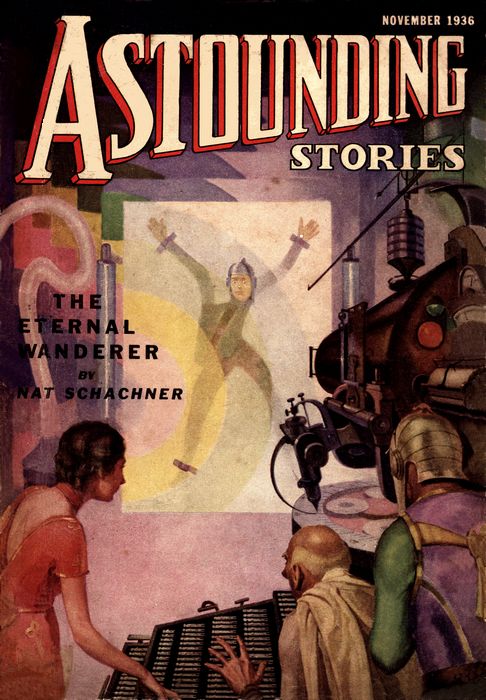
Astounding Stories, November 1936,
with "The Thought Web Of Minipar"

He was free! He could cruise from sun to sun—from planet to planet—until——
JOHN WEATHERBY walked down Broadway at his normal gait—that is, neither too slow nor too fast. It was five thirty in the afternoon, and the famous thoroughfare was crowded with home-hurrying New Yorkers. Another block, and the subway would yawn for his slightly stooped, inconspicuous figure as it had done on innumerable days before. His mind was blank of thought or emotion; vaguely concerned only with traffic lights and jostling passers-by.
Thirty-odd years of bookkeeping was not conducive to bold or original thoughts, nor was the prospect of the tiny home in Astoria, well encumbered with mortgages, his stout, somewhat careless wife, his three spoiled children, the inevitable Monday corned-beef hash that always followed the inevitable Sunday corned beef and cabbage, particular excitants to eager hastening. In short, his mind was—well—a blank, a prepared palimpsest on which former writings had faded to an indistinct gray; a mind in which any forceful outer impulse would have but little difficulty in finding lodgment.
The subway was but a block away. Once inside, sheer instinct would guide his habituated feet through the open door of the Long Island train, would emit him at the proper station, and return him to the bosom of his family. He kept on walking.
THE great science web of Minipar glistened with the quivering bodies of thousands of onlookers. They clung with jointed legs to the outer periphery, to the innumerable spokes and interlacing columns of the famous science web; great, faceted eyes directed toward the common center; hairy, segmented bodies tense with excitement.
The most important scientists of Minipar were gathered in concentric rings at the central interlacement to watch the repetition of an ancient experiment. The fierce green light of binary suns beat down on the angular surface of Minipar, picked out in shining detail the science web that flung its gleaming strands from pinnacle to pinnacle. Other webs, for storaged food, for mating periods, for contemplative solitude, for growth and thought, transference, dotted the vast, rock-tortured landscape. Long, thin strands flung their slimness across the voids for swift intercommunication.
Heurilu felt himself the cynosure of ten thousand eager eyes. He sat at the very pith and core of the science web, his eight segmented legs trying hard not to tremble as they rested on the raised platform. A web of glistening crystal strands enmeshed him close. He knew that swift currents leaped invisibly through the slender threads in closed circuits, ready at the word to interpenetrate his being.
Korm, the chief scientist of Minipar, and director of the experiment, gazed inscrutably from his bulbous, faceted eyes. "Surely you are not afraid, Heurilu?" he rustled softly.
The young volunteer stiffened his trembling legs, spoke as scornfully as he could. "Of course not. Fear does not belong to the sons of Minipar. In the cause of true science no one must falter."
The great web swung and danced with responsive applause. It was a proper answer to have made, worthy of a Miniparian. But inwardly Heurilu raged at himself, at the uncontrollable quivering that made him sway on all eight legs. He was afraid! Afraid of this experiment, afraid of the far-distant unknown to which he would soon be transferred, perhaps never to return. There had been cases like that.
Korm's eyes softened. "It is a brave thing you are doing, Heurilu," he rustled. "Poor Zel never came back. His body still wanders the strands of Minipar, but an alien entity—a disconsolate, uncomprehending spirit from a hidden galaxy across the universe—inhabits his proud, and erstwhile shining form."
A whispering moan arose from the spectators.
"It was with the utmost difficulty," resumed Korm, "that we were able to study the dim thought processes of this inferior being. He comes from a tiny globe that revolves sadly about a modest single Sun. His race knows but little science, their life spans are but pitifully short. His body is a stunted, awkward thing—a shapeless mass of soft, defenseless flesh, with two short legs that move with dreary slowness, and eyes of simple semiblindness that detect only a narrow band of the visible spectrum. Worst of all, these low forms of evolution must depend on the outer elements of their world, painfully excavated and more painfully fashioned, for the low-grade machines of their limited science."
A shudder passed over the audience.
HEURILU straightened himself, held his sensitive antennae erect. "I realize the dangers of the experiment," he said very low. "I know that I, even as poor Zel, may be condemned to inhabit a transitory, indescribably ugly form in a remote corner of a distant universe, but I shall not flinch. Martyrdom in the cause of science is a noble doom. The knowledge of Minipar must be extended beyond the bounds of the visible universe. We must study and examine these strange life forms that inhabit the reaches of inter-galactial space. Even if the immortality that is mine should darken within the limited flesh of an alien being, I shall not draw back."
Korm's antennae caressed him gently. "You are a true son of Minipar," he approved. "You may rest assured that all the mighty science at my command will be invoked to bring you back safely across the gulf. The case of Zel was an unusual one. Somewhere, in the space threads of transference, contact was snapped, condemning him to a lowly, dreadful fate, leaving with us this alien, limited intelligence in the body that once was his. It shall not happen again."
He turned to the clinging scientists. "You see," he explained, "the transference is a delicate process. Pure thought, the motivating impulse that clothes the universe in visible form, is an enmeshing web of infinite strands, bound by no finite circumscription, obeying the laws of material relativity and limiting speeds. Tiny, residual threads of the universal thought inhere in our beings—call their limited complex our spirits, souls, if you wish—and create the entity that is us. Similar segments, grosser, it appears, and clouded by the enveloping brute forms, inhere in all the manifold life forms that spawn the endless universe. That is not to say," he added with a little rustling chuckle, "that there may not be somewhere, somehow, beings of a superior order even to ourselves."
Amusement rippled over the antennae of his listeners. Korm always had been a modest fellow.
"These strands," he continued, "being but part of the universal web, it was comparatively simple in theory, if not in actual practice, to induce, by synchronized vibrational beats, an opening of the thought synapsis, a surge of being along the interrelated web that spans the void, and an induction into the residual termini that inhabit another bodily form in an alien universe."
Heurilu kept his voice steady. As the subject of the experiment he had a right to know. "Is it possible to direct the transference to a definite segment of the universe?" He shrank from the possibility that he might find himself on that minor planet of a minor single Sun, clad in a bestial body similar to that in which poor Zel was condemned to a brief mortality.
"That," acknowledged Korm, "is impossible. We have no way of determining into which of the infinite number of thought strands that encompass the void your particular entity will be projected. Only when the rebeat of the vibratory impulse brings back into the induced vacuity of your body the dispossessed thought spirit of the alien form, and it is examined in the thought analyzer, are we able to determine to which particular area you have been sent.
"But do not worry," he added hastily, "the connecting strands maintain a higher difference of potential because of the induction transference; and a reversal of the current at this end reverses the entire process. There have been no mishaps on that score."
Heurilu thought of Zel and dozens of others, doomed to incredible exiles, and smiled wanly. It was better, no doubt, to think only of the many hundreds who had volunteered for the mighty experiment, and returned, none the worse for the tremendous experience, brimming with strange tales of the far reaches of a universe of infinite variety.
"I am ready," he said quietly.
Korm nodded, spraddled stiffly on all eight legs. A long black antenna contacted a nodule on the inclosing web.
The assembled spectators clung feverishly to the great science web, straining, hissing their excitement. Blinding green flashes played over the crystalline threads, hid the hairy, segmented body of the dauntless adventurer within.
AN imperceptible tremor rippled over the form of John Weatherby. His stooped shoulders straightened a trifle; his eyes, dulled with the weary round of humdrum toil, stared with a new incomprehension at what should have been the thrice-familiar scene of Broadway. The Sun gilded the tops of the midtown towers; fantastic figures danced in daytime static away along blatant advertising signs; autos crawled fender to fender, honking feverish horns; the sidewalks were black with hurrying humanity, and midstreet with agile, dodging jaywalkers; policemen, red-faced and angry, bawled raucously at motorists and pedestrians alike—in short, New York!
But John Weatherby stumbled over feet that suddenly seemed not his, found difficulty in coordinating muscles, glanced with fresh astonishment at Sun and lofty towers and his fellow men. Mechanically, his legs carried him along, up to the very mouth of the subway into whose depths for years he had plunged exactly at five thirty-two each afternoon.
This eventful day, however, there was no break in his stride, no side swerve. He kept on walking——
Stout Clara Weatherby slapped a pestering urchin with one broad hand, yanked viciously at the handle of the oven door with the other for the dozenth time. The corned-beef-hash, piece de resistance of the evening meal, was not only brown; it was positively scorched.
"You hush up, Junior," she snapped. "I'll slam you if you keep up that caterwauling. I know you're hungry. So'm I." Her lips compressed in a tight, ugly line. "Wait'll I get my hands on that good-for-nothing father of yours. He should'a' been home an hour ago." She sniffed. "Him gallivanting around, I'll be bound, while his poor family worries themselves sick, and starves into the bargain! Let him just wait!"
At seven thirty her muttered threats had become open outcries, in the course of which the neighbors, both near and far, were regaled to juicy titbits in the former history of the unoffending paterfamilias—a history, which, by eight o'clock, when the shorn family finally sat down to burned hash and stale coffee had extended backward into the unsavory antiquity of the still missing head of the family's relations, near relations, and forbears.
By nine o'clock Clara Weatherby was still declaiming volubly to a sympathetic circle of similarly slattern women, released from their evening labors by the accustomed arrival of their lords and masters. By nine thirty some one conjured up a dramatic vision of hospital and morgue, with appropriate gory details; whereupon Clara promptly fainted. At ten the police were notified, and a tracer issued by the bureau of missing persons.
But John Weatherby was gone, vanished, swallowed up in the great unknown.
IT was not until two days later that John Weatherby, or what was indubitably the form and lineaments of John Weatherby, was taken into custody within the precincts of one of the plants at Schenectady. A slight, inconspicuous man, gray at the temples, stooped of shoulder, had haunted the vast reaches of that mighty plant all morning staring at the great dynamos, watching the endless winding of armatures, observing the manufacture of electric-light bulbs, without remark from the busy workmen. But when he penetrated the research laboratories the stranger was accosted, and his business demanded. He answered with a spew of thick, unintelligible sounds. Whereupon the police were called, and recognized in the intruder the missing man.
He was brought back to New York and confronted with his wife. That lady promptly cast fleshy arms around the spindly neck of her erring lord and master, mingling copious tears and voluble language in equal proportions. But John Weatherby stared at her with blank and repellent eyes, disengaged himself hastily, and, with a certain distaste, from the smothering embrace. He made certain sounds, which were neither human nor animal, yet somehow indicative that he neither knew the lady formerly, nor, if the truth must be told, did he wish to make her acquaintance now.
They brought his three children before him, striving vainly to excite the recognition signals in his wandering brain. He stared at the three offspring, dressed hastily in their Sunday best, faces for once clean-scrubbed, listened to their shrill pipings: "Daddy! Daddy!" and turned away with that same pitiful attempt to coordinate speech muscles to the uses of recognizable sound.
"A clear case of amnesia," said the police wisely.
"Right!" agreed the doctors in the hospital to which he was finally removed.
Dr. Lionel Gruening surveyed him with interest. "Rather unusual affair," he told his assistant. "For once the popular term of these impairments of memory is correctly used. The ordinary case of complete forgetfulness of the past is really an aphasia, in which the patient is able to begin a new life with unimpaired faculties from the date of the hiatus. The case of John Weatherby, however"—and he turned interested eyes on the patient—"is in fact that rarer form, a true case of amnesia, in which not only is the former personality forgotten, but the victim has also lost the power of intelligible speech or hearing."
"A blow on the head," said the assistant confidently, with the brashness of the young. "It affected not only the memory areas, but injured the motor speech areas as well."
Dr. Gruening did not answer immediately. His eyes clung with a strange, far-away look to the meek-appearing figure of John Weatherby. That worthy was sitting quietly in his chair, his eyes curious, alert, drinking in the details of the hospital, the cabinets of shining instruments, the artificial lighting, even the white smocks of the doctors themselves, with a fresh, greedy avidity, as if he were storing up new and strange sensations against a future day. John Weatherby, the former, had never, in forty-eight years of existence, looked upon the world with such a frank awareness.
"Your diagnosis," commented Dr. Gruening finally, "is, of course, the standard and accepted one. But I sometimes wonder. There is such a complete severance of personalities, and such an obvious inability to speak the language of human beings, though definite sounds can be formed without difficulty, that it has struck me before, and in this case, with even greater force, that there might be another, a very fantastic explanation in back of the phenomenon.
"Who knows but that the medieval idea of the insane being inhabited by devils may not have a certain substratum of truth! Perhaps beings of another planet, or another system, are farther advanced in science and the study of mental phenomena than we are: perhaps they have even accomplished the difficult task of thought transference; or an even greater task, that of the transference of personalities across the void.
"We are ourselves only on the threshold of the study of the mind and its processes. Perhaps amnesia cases, with their awareness of Earthly conditions and speech, without any memory of their former existence, may be, in fact, alien personalities transferred into the repositories of human bodies. Perhaps——"
In his growing excitement Dr. Gruening had forgotten he had an audience. He looked up in time to see his assistant staring at him as if he, the famous psychiatrist, had suddenly gone crazy. He stopped short, bit his tongue, and muttered a confused apology. He had his reputation to consider.
JOHN WEATHERBY felt strange. There was something wrong with him, but for the moment he could not localize the weird sensation. He had been walking on Broadway, intent only on reaching the subway, following the accustomed groove of years, when there had been an attack of dizziness, a fainting spell, a sudden blinking out of Sun and streets and people. His heart, no doubt—the doctor had long ago told him it was not functioning properly.
But the attack had evidently passed quickly. He was quite all right now. Lucky that he hadn't been run over in that momentary darkness.
But was he all right? His brain was unclouded—singularly unclouded, in fact—but obviously he was suffering from hallucinations. For, as he opened his eyes, he found himself gaping at a scene of incredible nightmare, a scene such as he, John Weatherby, even in his wildest, most unbuttoned dreams, had never dared to imagine.
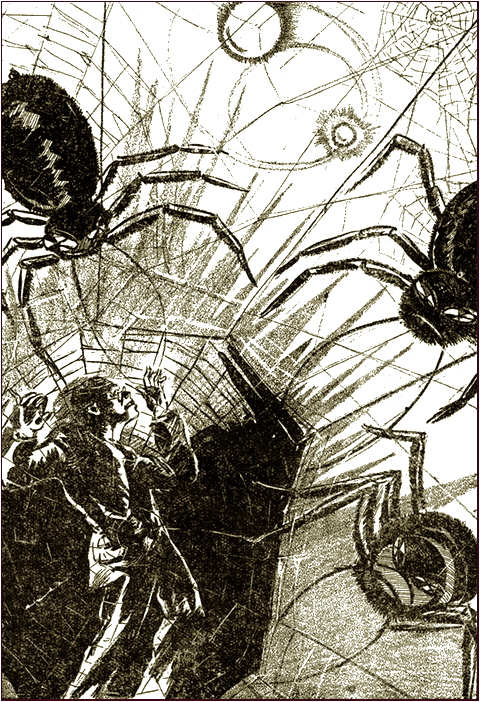
A vast, incredible landscape stretched before him, interminable, alien. Jagged pinnacles darted tremendous distances upward into a virescent bath of vibratory light, themselves black and needled. High overhead, two strange green balls of fire moved slowly about each other in majestic orbit. Then, suddenly, John Weatherby screamed. At least he had tried to scream. But a thin, rustling sound was all that he could emit from a mouth that was curiously stiff and alien. He had seen the monsters of this terrific nightmare. They ringed him round, spraddling with swaying, jointed legs on what seemed the strands of a gigantic spider web.
Their hairy, monstrous bodies were those of magnified spiders, their black, chitinous jaws champed with rustling sounds queerly like those he himself had just emitted. Their huge, faceted eyes glared at him with a speculative luster, just as though he were a strange specimen brought to them for scientific examination. Far beyond them, to his horrified eyes, were webs on webs, of tremendous size, huge as all New York, stretching in endless array to the uttermost limits of vision.
He tried to fling himself backward, to escape this vision of his own contriving. Sharp, stabbing pains lanced his brain. He was jerked back by immovable bands. His cowering gaze went upward, saw the tough, gleaming strands that jutted inward from the spokes of the web, disappeared seemingly into his own head. He flung himself forward with a thin, rustling cry. Pain blasted through him.
"Oh, Lord!" he moaned. "Make me to wake up, in my own bed. I know this is only a dream. It's that damned corned-beef hash. I've told Clara time and again——"
For the first time he saw his legs. There were eight of them, incredibly thin and jointed, blackly hairy, clinging desperately to the swaying cradle of the enmeshing web. He screamed again—and fainted——
Dr. Gruening said to his assistant: "Give him another hypo. Perhaps the sedative, a period of induced sleep, will relieve the pressure on the affected areas of his brain, bring back speech and memory."
The glistening needle plunged. John Weatherby slept. But the psychiatrist was not so sure. The number of such cases had multiplied recently. There was the case of Edward Gore, for instance, similarly attacked. The most that medical science could do had not availed. True, the speech faculty had gradually come back to normal, and——
Gore had learned to talk again, but only as a child learning a new language. Gore professed no memory of his last life, though he had been a biologist of attainments. Furthermore, the new Gore was strangely reserved, unwilling to talk, to lay his soul bare, so to speak, to the expert offices of psychiatrists and psycho-analysist alike.
Yet his brain had been sharpened, made more razor-keen, by his lapse of all former memories. More, all of his traits, characteristics, had changed. Mechanical contrivances interested him most—railroads, bridges, airplanes.
Gruening stared speculatively at the sleeping John Weatherby, who had once been a routine bookkeeper, a mere minor cog in the vast wheel of human affairs. What manifestation would the course of the disease—if it were disease—take in him?
JOHN WEATHERBY awoke from his faint to find himself bathed in an orange glow. It penetrated his being, insinuated itself gently into the remotest corners of his brain. His faculties expanded, basked in the grateful warmth.
He knew now where he was. The monstrous spiders who ringed him round, watching him as though he were a curious animalcule under the microscope, were no longer strange. Their mandibles opened, spewed forth dry, rustling noises. But now he understood them. They were words, familiar to him as though they were the bones of his native English.
"You have awakened, stranger from an alien universe," the largest of the spiders said, "within the bath of the thought analyzer. I am Korm, chief scientist of Minipar, mightiest planet of the galaxy. We have brought you along the thought threads of the void to inhabit the body of our fellow, Heurilu. He is now within your form, treading disconsolately the paths of your native unknown planet, an exile in the cause of science. Tell us your name, and from what corner of the universe you come."
The bookkeeper stirred, reared fumblingly on his eight jointed legs, and answered through stiff, chitinous mandibles. "I'm not sure I understand all you say," he rustled haltingly. "This talk of planets, thought threads, what not, sounds crazy to me. I'm John Weatherby and I want to go home. Yes," he added as an afterthought, "even to Astoria and Clara. She's my wife, you know," he explained lamely.
"You can't go home yet, John Weatherby," Korm told him. "Later, when we have received all the scientific information you can impart to us, you shall be returned. Poor Heurilu will be waiting impatiently for the rebeat of the thought strands. Now answer our questions. What manner of planet do you inhabit? What is the nature of your civilization, if any? What knowledge of the universe do you possess?"
The Miniparian who had once been Heurilu, and was now John Weatherby, gasped feebly. These were questions it was almost impossible for him to answer.
"Gentlemen!" he protested incongruously to these huge enringing spiders. "I am only a bookkeeper. I never troubled my head with matters like that. You see, I left school before I finished the grades. I had to make a living. All that stuff you're asking me about had nothing to do with bookkeeping. All I had to know was to add figures properly and write a fair hand. Thank Heaven I was able to raise a family and own my own home without bothering about all that bunk about science and philosophy and what not."
Korm stared at his fellow Miniparians in amazement. If what he had told John Weatherby was slightly incomprehensible, what John Weatherby had just told him was even more baffling. His antennae gesticulated with excitement and a certain contemptuous disgust.
"What!" he exclaimed. "You lived what you call a life without pondering on scientific matters, without troubling to gain for yourself even the limited awareness of the universe about you that was available to your fellows?"
Weatherby reared higher on his jointed legs in some bewilderment. "Of course!" he answered defensively. "What good would it have been for a bookkeeper to know what some nut thought about Mars and Venus, for instance? Suppose I did find out that people lived on Mars, or that they had canals. (He was rather proud of this; only the Sunday before his strange metamorphosis, the magazine section of his favorite Sunday newspaper, had run an article, with illustrations in color, captioned, 'What Chance Would Even A Martian Have Against A Gorilla?') My boss wouldn't have given me a nickel more salary. You don't know my boss. He's suspicious of fellows that read books. He's a self-made man, you see."
THE council of Miniparian scientists rustled softly. For all their efforts and labors, for all the brave adventurings of Heurilu into the unknown, their web had brought this poorest of specimens out of the illimitable ocean of space. Never, in all their experiments, had they found such a primitive, barren intelligence—not even the last one, in whose behalf poor Zel had been martyred to a hideous doom.
Nevertheless, they did not give up, but went to work. Patiently, they examined John Weatherby's thought processes, sought out all the meager information that he possessed. To their great astoundment they discovered that by some freak of chance he, too, was a denizen of that inferior, remote planet called Earth, in a universe a billion light years away from their own.
This discovery created a sensation. For it meant two things: First, that the thought channels of the void made a synapse with that tiny primitive world; second, that Heurilu was now walking Earth in the monstrously deformed and inefficient body of a human being, subject to accidents, pain, and brief mortality, even as the doomed Zel. Which led to a third consideration which caused them to hasten their studies. If the strand of transference had snapped along the line of Zel, might it not happen as well to Heurilu?
Slowly, John Weatherby grew familiar with his new form and being. Korm conducted him along the webs of Minipar, expatiating on their civilization, their mode of life, their immortality, subject to no pain, no disease, no accident, discoursed to him on the wonders of infinity, the marvels of the galaxy, as well as the strange variousness of outer universes.
At first Weatherby had been horribly homesick. Even the homely smell of cooking corned beef and cabbage would have been ambrosia and nectar to him. The slattern features of Clara softened, became idealized in his memory. His three children swiftly grew angelic wings, and even the heavy jowls of his boss took on a certain nostalgic glamour.
It was difficult, too, to think of himself as a gigantic spider, a creature of eight legs and hairy black body. Gradually these things changed.
The fascination of swift locomotion along the swinging webs of Minipar grew exhilarating; his faceted eyes drank in new colors, new sights invisible to petty human eyes. He could leap from the loftiest pinnacle, secure in the endless cable that spun from his pointed rear. The binary suns overhead were an endless source of delight.
And when, under the tutelage of Korm, he finally evolved from his own body a spun machine that could trap etheric waves in the intricacies of its mesh, and harness them to mighty uses, his exultation knew no bounds. Every day he learned something new, something infinitely thrilling. The bovine bookkeeper was fast on the road to becoming a philosopher, an ardent searcher after truth.
With this inner change came a different orientation of past consciousness. Korm became a beloved teacher, a kind friend. Weatherby no longer thought of him, or of the other Miniparians, as monstrous spiders. Somehow their forms were normal, proper, more graceful, more efficient, more beautiful in every line than the hideous body of John Weatherby, Earthman, which, most fortunately, he had discarded. He tried to hide its very memory, along with the memory of other things on a dim, half-forgotten Earth which now seemed sordid and repellent.
Meanwhile the Miniparians were completing their researches into the physical constitution of Earth and the mentality of its inhabitants, as they glimmered dimly in the consciousness of John Weatherby.
"BUT, doctor," implored Clara, her rouged cheeks streaked with crying, "you've got to do something to get John out of this state of his. He's just being stubborn, that's all, refusing to recognize his own wife. Me, that slaved for him all these years, worked my poor hands to the bone to make him a comfortable home."
The recalcitrant Weatherby sat comfortably in his chair, viewing her with a most unusual sardonic amusement, seeming to study her as if she were some new species of spider. He was gradually regaining his speech, though, like Edward Gore, English seemed to be a new language that he must master. He was surveying everything with that sardonic air, thought Dr, Gruening to himself.
To the bereaved wife he said gently, "It is not that he refuses to recognize you, Mrs. Weatherby. It is simply that he cannot. That is the essence of all forms of aphasia. We must be patient. Time alone may heal the injury to his brain, or some untoward excitement, a blow on the head, may snap him back to his former self. We must wait—and hope."
Mere words, he commented bitterly to himself. The medical profession had made very little progress in the study of these strange cases; knew nothing of the inducing mechanism. His own surmises were too radical even for himself to think out properly. As for revealing them to his fellow physicians——
JOHN WEATHERBY was swinging happily along the great science web of Minipar. He had just fashioned from his inwards a space mesh, and he was inordinately proud of it. He dreamed of excursions through the galaxy of which Minipar was a member, such as others of the Miniparians took at regular intervals. He stared at its shining exterior as a newly made father stares fatuously at his hairless, shapeless offspring.
There was a rustling beneath him, a slight swaying of the strands which his keen tactile senses at once detected and ascribed to the approach of Korm. He swung around on all eight legs, grasping the web firmly as if to the manner born.
His voice whispered dryly. "Look, Korm, what I have made. A space mesh! Think of it, I'll be able to join you the next time you——"
Korm was not listening, did not even trouble to look at the rather crude inclosure. His faceted eyes were preoccupied.
"I have news for you, John Weatherby," he announced, "which doubtless you will be glad to hear."
"Eh, what's that?" Weatherby was rather startled.
"We've completed our researches into your limited intelligence," Korm pursued, "though the results, I must confess, have been rather disappointing. The council has therefore decided not to leave Heurilu in his odious exile any longer, but to return him forthwith to Minipar and his own proper body.
"That requires, of course, that you be transferred as well to that planet Earth from which you came, and to the society of those finite beings from which you were wrested rather unwillingly. They include, I believe, a certain creature whom you called Clara, and spoke of rather amusingly as your wife."
The spider form of John Weatherby sagged on all eight legs. In the rush of events he had completely forgotten that he inhabited the body of an alien, a Miniparian whom he had never seen. He had forgotten even that he was once an Earthman. And now the blow had fallen with crushing force.
"But I don't want to go back to that petty planet," he cried feebly. "I want to stay here always, with you, with Minipar. This is my home, my being." He actually retched at the thought of the ugly body that had once housed John Weatherby.
"There is no alternative," Korm pointed out kindly but firmly. "Heurilu is in exile, awaiting impatiently the resurge of the thought web. The council's decision has been made. You must come with me."
The universe crashed and roared around Weatherby. He did not want to go back! He wouldn't! With a quick backward thrust he sprang into the space mesh, touched certain strands desperately with his antennae. There was a swift upward surge, and he was far above the pinnacles of Minipar, heading outward into the vast unknown of the galaxy. Behind him, faintly heard, was the shrill warning piping of Korm.
He did not care. He was free, free to do as he pleased. The universe spread before him invitingly. He would cruise from sun to sun, from planet to planet, until——
Something whined alongside of him, drew parallel with tremendous acceleration. Long strands, thin as silk, stronger than the strongest steel, drew his space mesh inexorably tight to the pursuing fabric of Korm.
A great despair overwhelmed him. Now he must go back to Earth, to all the finite ugliness that it connoted, to a body that was weak flesh, supported feebly on two bare legs. He offered no resistance. Back to Minipar they sped, back to the science web, back to the thought-transference machine.
JOHN WEATHERBY opened his eyes, looked around him blankly. Strange faces, ugly, distorted, peered anxiously down at him. Then there was a cry—a human cry—and a bulky body hurtled toward him, wet his uplifted face with spatters of fluid. "John! John! Are you hurt?"
"Hello, Clara," he said weakly, and struggled to a sitting position.
"He recognizes me," she shrieked to the bending doctors. "He's cured!"
The brash assistant said confidentially, "He fell out of the window. No one saw him fall. It's just as Dr. Gruening said. A sudden blow, a concussion, would jar his memory back to the normal synapses. It worked just now."
Weatherby looked again at his wife, at the doctors, at the petty crudeness of the hospital, with an inward shudder of disgust. How ugly, how primitive, compared to the beautiful symmetry and mighty science of Minipar! He opened his mouth to express his revulsion, thought better of it. He was back on Earth irrevocably; Heurilu, whose form he had inhabited, was once more back in that infinitely remote galaxy.
If he said anything, if he even hinted of his marvelous transference through the void, these dolts, with their limited minds, would consider him crazy, would lock him up in a madhouse. He must be careful!
They kept him in the hospital for a month, so as to permit his broken arm to mend, and his wits to grow strong. They charitably laid to his recent amnesia the weird remarks that occasionally escaped his unwary lips. Then they discharged him as cured, and sent him back to the bosom of his family.
In fact, by that time, he was cured. That is, the memory of his tremendous experiences on Minipar slowly faded, like the surface texture of a dream. Slowly he slipped back into the accustomed groove of normal Earth existence. Once more he became an inconspicuous, routine bookkeeper, leaving his desk promptly at five, entering the subway, journeying to his home, eating corned beef and cabbage on Sunday and hash on Monday. The glamour faded, until it was a dream, a hallucination of his sickness, something that had never happened. Still, it mustn't do to talk about it to any one, for fear of the asylum.
Thus it was that all of Dr. Gruening's efforts to draw him out met with a stubborn wall of silence. The psychiatrist retired, more baffled than ever, in the reluctant belief that his own wild surmises were just that. So he, too, said nothing.
Roy Glashan's Library
Non sibi sed omnibus
Go to Home Page
This work is out of copyright in countries with a copyright
period of 70 years or less, after the year of the author's death.
If it is under copyright in your country of residence,
do not download or redistribute this file.
Original content added by RGL (e.g., introductions, notes,
RGL covers) is proprietary and protected by copyright.