RGL e-Book Cover
Based on an image created with Microsoft Bing software
Roy Glashan's Library
Non sibi sed omnibus
Go to Home Page
This work is out of copyright in countries with a copyright
period of 70 years or less, after the year of the author's death.
If it is under copyright in your country of residence,
do not download or redistribute this file.
Original content added by RGL (e.g., introductions, notes,
RGL covers) is proprietary and protected by copyright.
RGL e-Book Cover
Based on an image created with Microsoft Bing software
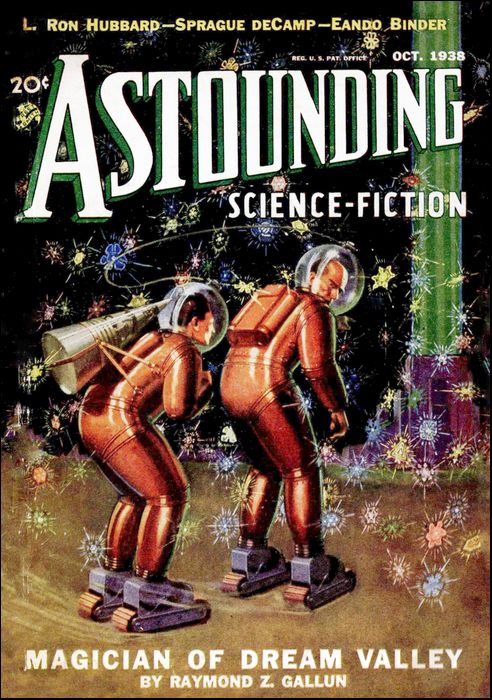
Astounding Science-Fiction, Oct 1930, with "The Sun-World Of Soldus"

IT was hot within the triple-insulated shell of the Sunbeam. In spite of aerating apparatus, in spite of alternate vacuum and asbestophor layers, the curving walls dripped bubbles of wet steam. The small but efficient laboratory hissed with billowing fog.
But the men inside did not seem to mind. All their faculties were absorbed on the task in hand. Two of them were stripped to the waist, their muscular torsos glistening in the haze. The third, a smaller man, dark, immaculately dapper, was fully clad. His suit of somber hue was buttoned up to the neck, the white stock above it prim with starch. His thin face was devoid of expression and perspiration alike. He stood neatly to one side, doing nothing, watching the other two.
The blond giant tossed damp hair out of his eyes. His brawny hand dripped with the sweat of his brow. "Damn it, Vic!" he said cheerfully. "The gelatin on the plates is beginning to crawl. Those pictures you're taking won't mean a thing."
"Can't help it, Jerry." Vic Haskell, astrophysicist, bent over the camera attachment to the helioscope, deftly slid another plate into position. The sweat was pouring in rivulets down his lean, athletic body. Tall himself, well-proportioned, he was nevertheless dwarfed by the giantesque figure of Jerry Ives, millionaire space-sportsman and daredevil hunter of the armored lizeros that lurked in the Venusian swamps. "This is our last chance to find out what's wrong. In another two months the spots are scheduled to reach maximum again."
Jerry Ives wiped sweaty palms on his faded dungarees. "I'm seeing spots right now," he growled. "Look at that needle jump. One-forty Fahrenheit and still moving. I expected to be ray-blasted some day, but never to be roasted to a turn."
The small dark man barely seemed to open his lips. "Carry on!" he said mildly. That was all. Vic Haskell glued his eyes to the coelostat arrangement while his fingers twisted with swift precision at the micrometer screws of the spectro-heliograph. Even Jerry Ives, grumbling, nevertheless washed the plates hastily in the developing bath as they fed automatically out of the instruments. Split seconds in that ruinous heat meant the possible difference between a smudged crawl of surface and a picture.
Caspar Burdock, small, blank-faced, eternally buttoned and always dapper in his stiff white stock, did not look like much. A humble key-pusher perhaps in the Accounting Department of a trading corporation. At most a low-grade clerk in a minor section of the Civil Service. Actually, Burdock was the eyes and ears of the all-powerful Council of Ten who ruled the planetary system—Number One in the Secret Patrol, with a roving commission of unlimited authority.
The heat grew more stifling within the tiny confines of the space craft. Even the tinted lenses on the instruments could not keep out the blinding glare. The two younger men looked like demons in a blast inferno. The older and smaller man still was immaculate in his choking costume.
Jerry Ives stared at the last plate he had developed. His snort of disgust sounded like the gurgling of a drowning man. "It's no go, Vic. The pictures are beginning to look like cubist designs. No rhyme or reason. Might as well give up before we sizzle."
Caspar Burdock, in the background, did not move. Only his eyes seemed alive. "Carry on!" he said softly.
VIC whirled on him, resentfully. His vision was bleared; the instruments were beginning to dance insanely. "I don't know how you do it, Burdock," he almost snarled. "You must be made of asbestophor yourself, with glycerin in your veins instead of blood. We're already closer to the Sun than any man has ever been before. And not a single test has disclosed the slightest reason for the terrible sunspot outburst of eleven years ago. What makes you think——?"
The little man smiled. He smiled only with his lips, but his eyes were glowing embers.
"You are wrong, Haskell," he observed quietly. "We are not the first."
Jerry Ives stared incredulously. "Come now," he protested. "Stop kidding us along. Whoever was crazy enough to have gone closer to the Sun, and when?"
"That," Burdock bit off his words, "is a Council secret. But I'll tell you this. You, Haskell, know it as well as I. The sunspot cycle has been steadily growing more and more severe for the past century. The last series was terrific. It disrupted all communication between the planets for a month, caused electrical storms of devastating intensity as far as the moons of Jupiter."
"I know that," Vic inserted. "That's why I was willing to come along. But there is no evidence now——"
"It is our duty to find the evidence," the Council agent said with surprising energy. "In two months more the period of maximum disturbance begins again. Unless we discover the cause for the progressive increase in intensities, the Council fears——"
The door of the laboratory slid violently open. A man in the horizon blue of the Space Service staggered in. His uniform was wilted, dripping. With an effort he held himself upright, saluted the all-powerful agent of the Council.
"Captain John Cushing reporting, sir," he spoke hoarsely. "We'll have to stop—turn back. The crew have mutinied. They claim it's suicide. No other ship has ever dared venture past the orbit of Mercury. We're already within 11,000,000 miles of the Sun's chromosphere and accelerating steadily. The temperature in the rocket rooms is over 160 degrees. Three of the men are unconscious. The others——"
The little man seemed to increase in stature. His voice cut across the Captain's protestations like a whiplash. "Mutiny? On Council business? You know what that means, Captain."
The officer's eyes wavered. "Yes, sir," he muttered. "But——"
"Get back to your job, Captain Cushing," Burdock said in a terrible voice.
Cushing towered over the little man for a moment with clenched hands, then collapsed. "Yes, sir," he saluted, and was out of the door.
The blond giant grinned. "Nice going, Burdock," he observed. "It's a grand thing to have the backing of the Council."
The agent turned on him. The intensity in his eyes died. A serious look spread over his small, dark features. "It's more to know that perhaps the fate of billions of people depends on you."
"I wish you'd let us in on it," Vic grumbled. His head swam. The glare through even the coelostats from the vast disk of the Sun made spots dance before his eyes where there were no spots. "So far I've not found the slightest sign of anything wrong on the Sun. As for the progression of sunspot maxima, that might be due to natural causes. I've calculated——"
THE words died on his lips. His wandering eyes glued feverishly to the eyepiece of the small but powerful telescanner.
"Found a sunspot before the due date?" demanded Jerry.
But the little man was already at the physicist's side, gripping his shoulder with a terrible grip. "What do you see?"
Vic shoved him off with a twitch of athletic shoulders, continued to stare. Then, suddenly, he swung away, blinking, blinded. His sweaty face was puzzled. "It may be only a meteor," he admitted.
Burdock lost all decorum. He hopped from one foot to another. They had never seen him act this way before. "Meteor be damned!" he screamed. "You know damn well it's no meteor, Haskell. You'd never have stared like that if it were. What—did—you—see?"
Vic said slowly, "If it weren't screwy, I'd say it was an artificial projectile sliding through space, straight from the Sun itself!"
The agent's face lit up. "I—I knew he'd manage it somehow," he whispered. "A brave man. A very brave man!"
"Who?" the two young men cried simultaneously.
"What the devil are you talking about?" added Jerry Ives profanely.
But Burdock's small, dark face was alive with anxiety. "Where is the projectile?" he snapped. "What are its bearings?"
Vic Haskell moved quickly to his instruments, focused spiderweb lines, set automatic tracers on the strange little waif far out in space. Styluses raced, integrators clicked, figures flashed upon' the numerating screen.
"A million, three hundred and ten thousand miles away, at ten-sixteen, Solar time. Angular velocity to our course, plus fourteen——"
But the Patrol Agent of the Council was already at the intra-communications board. Lights glowed, died. The haggard face of Captain Cushing appeared upon the screen, startled. His mouth was set and grim, a short range flashgun snouted in damp fingers. Sullen, half-naked members of the crew staggered about the rocket chamber, cowed by the pointing gun. Five men lay limp, unconscious on the floor.
"Good work," Jerry crowed appreciatively.
But Burdock paid no attention. "Captain Cushing!" he snapped. "Mr. Haskell will give you the figures. You will set the course of the Sunbeam to intersect that trajectory. At the intersection you will find a small, smooth meteor. You will grapple it to the ship—with grappling tongs, mind you, not with the magnetic plates. Draw the object into the forward entrance-port, leave it there untouched. Do you understand?"
Cushing saluted with left hand. His right held the gun. "Yes, sir."
Vic reeled off the coordinates. A howl of rage and mingled fear burst from the hapless crew. But Cushing snapped them forward with his gun. "Get busy, you swabs!" he gritted. "The first man who makes a break dies!"
"A very good man!" grinned Jerry, as the screen faded. "Even though he lost his nerve for a moment a while ago."
Vic's eyes were speculative on the little man. "So you know what the projectile is made of," he said softly. "Even that it is nonmagnetic. Don't you think, Burdock, that it's time to take us into your confidence?"
"Not yet! It's too big a thing to let loose until I'm absolutely sure. Even to you two. You've been patient so far; bear with it a little longer."
It was the first time the powerful agent had condescended that far. "Right you are," Vic answered frankly. "We'll play along."
The Sunbeam shuddered over in a swinging trajectory. Straight for the immensity of the Sun it sped, straight for the shining little meteor that hurtled up to meet it. Silence became a live thing within the throbbing chamber.
Closer, closer, while the chamber steamed, and the men within gasped for breath. Then, while the temperature needle stuttered around 162, and Vic felt darkness press upon him, the vessel shook with the sudden thrust of out-reaching grapples. There was a faint thud, a creaking of once-smooth working locks—a final triumphant slam.
Then the Sunbeam, like a hunted hare, wheeled in an abrupt arc, fled back through space to the comparative cool of trans-Mercurian distances.
WITHIN the Earth-laboratory of Vic Haskell, astrophysicist, three men clustered breathlessly around a yellow-white projectile. Its shape was not unusual—smoothly tapering at both ends—a typical message-carrier that was part of the regular equipment of all space-vessels, to be used in emergencies when radio and other methods of communication were disrupted. But its color, the curious consistency of its surface, were not those of the regular molybdo-beryl employed. It was like no metal or alloy known to Vic.
Caspar Burdock glanced swiftly around. They were alone within the well-equipped lab. All the assistants had been packed out posthaste. A line of Council guards surrounded the building, forbade all entrance.
Jerry Ives stared down at the little Council agent from a height of six-foot four. "Seems like a lot of precautions to open a message-carrier," he remarked. "Reminds me of stories I used to read as a kid about the old days before the Planetary League—spy stuff, hush-hush secrets it was death to know."
"In this case," Burdock replied quietly, "it may be death not to know—death not only for ourselves but for the whole Solar System."
"For Pete's sake, then, open it!" Vic cried with a touch of impatience.
Burdock hesitated, took a deep breath. It looked to Vic as though he were afraid of what he would find. Then his fingers moved rapidly over the control springs. The inner mechanism whirred; there was a groaning, creaking sound. But the nose did not swing open on a hinge, as it should.
"It's stuck," Jerry said unnecessarily.
The Agent's face grew darker. There was a strange fear in his eyes. "No!" he whispered. "It's fused. Quick, have you got some sulphuryl chloride?"
"Of course!" Vic answered. He took a bottle off the shelf, handed it to Burdock. "But why not use an electric arc-cutter?"
"Twenty thousand degrees would not even scar this material. And only sulphuryl chloride will dissolve it." The little man worked swiftly. He dipped a thin glass tube into the corrosive stuff, ran the dripping point around the yellow-white metal.
As the liquid touched, it began to hiss.
Little bubbles frothed up, exploded with little pops. Deeper, deeper, ran the etching groove, until—neatly as if an electro-arc had been employed—the nose dropped to the floor.
Carefully, yet with a certain fierce impatience, Burdock thrust his arm within the hollow chamber, withdrew it. Within his clutching fingers was a sheet of lintex note paper, of the type employed for intra-communication on spaceships.
But the exclamation of triumph died on his lips. The edges of the paper—resistant to ordinary heat—were charred and curling, and big brown splotches discolored the rest.
"By the lizeros of Venus!" cried Jerry, "that message-carrier must have practically skimmed the surface of the Sun."
The Agent withered the giant sportsman with a look. "This was," he said, "within the Sun."
Then he spread the crumbling paper slowly out upon the table, while Vic and Jerry, burning with curiosity, crowded over his narrow shoulders.
THE writing on it was an almost unintelligible scrawl, as if it had been done in terrific haste. Some of the words were charred, half-obliterated. But what remained read as follows:
"Help!... prisoner of the... center... Sun. They are about to... System... danger... planned... spots... maximum... Two parties,... peaceful,... I am trying... coming..."
The words trailed off into a wavering line. The rest of the paper was a blackened char. There was no signature.
"It just doesn't make sense," growled Jerry.
But Vic uttered a startled cry. "By God, it not only makes sense, but incredible sense at that! Listen! It's a call for help from someone who is a prisoner of some race in the center of the Sun. They are about to attack the Solar System. We are all in danger. The attack is planned for the period of sunspot maxima. But there are two parties at odds within this race, one of them peaceful. The writer is trying to work with the peaceful party, or to prevent the other from attacking—it's hard to say which. As for the last word, judging from the trailing scrawl, it sounds as though someone was coming while he was getting off this message. He had to cut short, shove it into the message-carrier, and send it on its way."
"This is absolutely the craziest nonsense I ever heard," Jerry Ives said angrily. "A human being inside the Sun! A race of Sun-people! Melodrama about danger and sudden attacks. Don't you guys know what it's like inside the Sun? We've been wasting our time on some fool practical joke—and a pretty clumsy one at that."
Vic said: "Shut up, Jerry! It's no joke. That metal container is made of no planetary metal."
"But it is," Burdock said quietly.
"Eh, what's that?" queried Vic, startled.
"I don't know just what the formula is," confessed the little man. "The specifications are sealed within the vaults of the Council Chamber, deposited there eleven years ago."
Vic's eyes narrowed. "By the man who wrote this note? Eleven years, a sunspot cycle. Eleven years——" He gripped the Agent fiercely. "By God, it's impossible! Waldo Maynard!"
"Yes! Waldo Maynard!" admitted Burdock.
"That's nonsense," broke in Jerry. "Maynard was lost in his private space-cruiser. A collision with a stray asteroid on the Jupiter voyage. Smashed his vessel to powder. Everyone knows that. The newscasters were full of it. Greatest astrophysicist in the world, specialist in Solar phenomena, and so on."
"The newscasters lied," Burdock told him calmly. "Or rather—they took my official handout at face value. This is the truth. Maynard was worried about the increase in the number and intensity of the sunspot disturbances. Back in 2684 he appeared before the Council. I wasn't an Agent then, but I heard about it afterward. He propounded some pretty wild ideas—claimed that the constant progression in intensity from cycle to cycle was not normal. That forces other than natural were at work. Claimed that intelligent direction was involved—that somehow there was grave danger to the System in what was going on. I've read the Council minutes. Here's an excerpt.
"The Martian Delegate: 'This intelligent direction that you claim, Mr. Maynard. Where would it come from? Our Patrol Agents report no disturbances on any of the planets.'
"Maynard: 'I did not say it came from the planets.'
"The Earth President: 'Then in Heaven's name where could it come from? Alpha Centauri—Sirius?'
"Maynard: 'No. From within the Sun itself.'
"The Council (amid loud laughter): 'Petition dismissed.' "
"Humph!" snorted Jerry. "And damned right! I'd have done the same."
BURDOCK stared down at the charred scrap of paper. "I thought so, too, when Maynard came to me in 2692. I had just been appointed Agent, and was pretty much pleased with myself. Fortunately—or unfortunately—he swore me to secrecy first—even from the Council itself. He had built a new type spacecraft, he said. Small, with automatic controls so that he could navigate it himself. But the important thing was the composition of the sheathing, of the hull of the vessel."
Vic ran his hand gingerly over the yellow-white structure of the message-carrier. "Like this?" he asked.
"Yes. It is an alloy, or alloy-compound, of half a dozen different elements. He wouldn't tell me the details. But it was heat-resistant and pressure-resistant to an incredible degree. He said he had tried it out in an electric fusion arc of 500,000 degrees Centigrade—had placed it in a crusher employing a force of 63,000 tons to the square inch. And it came out unharmed."
Vic whistled. There was awe in his glance at the fragile-seeming carrier. "Those are the highest temperatures and pressures man has been able to create."
Jerry's big, careless features were ludicrously screwed up. "Yet this—this metal is fused. Look how it ran and dogged up the hinge."
"Exactly!" retorted Burdock. "That's why I know the message is no fake. Only within the Sun are there temperatures and pressures higher than that. And deep within at that. The temperature of the photosphere is only about 6000 degrees Centigrade."
"But how could he have penetrated, granting even the impossible? The Sun is——"
"He had a theory that the sunspots—which we have known all along to be vortices of flaming gas, hydrogen chiefly, with an admixture of calcium and titanium oxide—were actually much deeper than we ever believed. In fact, it was his conclusion that they penetrated to the very central core of the Sun. He considered them as funnels to the interior, fields of force that somehow resisted the unimaginable pressure of its walls, and were obscured at the surface—where the sustaining force was weakest—by inrushing clouds of chromospheric gases.
"The strange regularity and systematic progressive increase in the sunspot areas during the past century convinced him that intelligent beings had taken control of what had been before a purely natural phenomenon. He was certain that this intelligent direction was fraught with menace to the rest of the System. Therefore he intended, he said, to investigate for himself in that specially built craft of his. He would take no one else along, because, as he admitted, it was practically a suicide venture. Nor would he announce it to the world. The Council had closed the incident in consideration of his immense services, but others might believe him a dangerous lunatic."
"Yet he came to you," interjected Vic.
"Because he had to leave some knowledge of his plans—of his new discovery. He gave me the formula to seal up. It was just before the time of sunspot maximum. I'll never forget his earnestness. 'If I don't come back,' he told me, 'as is very likely, wait eleven years for the cycle to return. Then cruise as close to the Sun as you can. I'll manage to get through a message to you somehow,' he ended confidently."
"And he got his message through," whispered Vic.
"By the triune rings of Saturn!" Jerry swore. "He was a brave man, even though it still sounds screwy."
VIC whirled on his friend. Jerry Ives had gone along at his own insistence. It was his money that had financed the trip. Burdock had been unwilling to use Council funds, for fear of being made into a laughingstock in case of failure. "Was?" Vic blazed. "Maynard is still alive. That note was recently written. Look at it again. They are about to attack the System, it says, at the period of sunspot maximum. That will be in some two months."
He strode over to the young giant, almost poked his finger in his eye. "Two months!" he repeated.
"Hey, take your finger out of my eye!" yelled Jerry. "What about two months?"
Vic backed the bigger man against the wall. "Two months in which to build a new spaceship of Maynard's material—two months in which to take off and penetrate into the Sun to rescue Maynard."
"You're crazy!" retorted Jerry vigorously. "I'll have no part of it."
"We'll need a good deal of money," Burdock added in speculative tones. "I couldn't tell the Council—yet. I can guarantee swift construction work and total secrecy. But the money——"
"Oh, that?" quoth Vic cheerfully. "Jerry Ives is just dying to contribute. He's filthy with unearned increment, you know. Has a finger in every mine from here to Pluto."
"Now I know you're crazy," yelled Jerry. "If you think you can get another cent from me——"
"SHE'S a beauty, isn't she?" observed Vic Haskell with obvious satisfaction.
"She ought to be," groaned Jerry Ives. "Cost me ten million. I could have outfitted a hundred swell hunting trips to the ice mines of Pluto for that."
"I think," interposed Caspar Burdock gently, "you will find the hunting even better—and far more exciting—on this trip."
It was a month after the discovery of Maynard's hapless note. During that time the three men had barely eaten and never slept. Night and day they had worked, in a terrible race with time. The plans had been unsealed. Vic had set to work at once. The alloy contained seven different elements never before used for such purposes. A strange admixture—yttrium, thulium, hitherto inert xenon, radium-X emanation, moldavium, bromine and martium, a long-term radioactive gas first discovered by Maynard himself in occlusion within the sponge-like ice at the Martian poles. Full directions were appended for the making of the new alloy.
But only the vast authority of the Council Agent could have put it over. He had peremptorily commandeered all available supplies of the precious materials, sent a secret expedition posthaste to Mars to gather the martium gas, placed a thousand PCC men (Planetary Conservation Corps) at the sole disposal of Vic and Jerry. He appropriated an island asteroid that an absentee Ganymedan magnate had made into a private estate at immense expense. Complete with intenso-gravitated atmosphere, transported watercourses from Earth and Venus, sunken gardens warmed by sub-atomic interior fires and profuse with rare blooms from every planet in the System.
It was in the largest of his fabulous sunken gardens that the Suicide was being built. The name was Jerry's bright idea. "Never was truer name," he had grinned.
And now the Suicide rested in its cradle-pit. Yellow-white, cigar-shaped, the ultra in speed, power, navigability and automatic controls. It carried a heavy armament, too, for a craft of its size. Mesh screens of interlocking force, torpedo tubes, blast guns, and hand grenades of intra-atomic disintegration.
"We may need them," remarked Burdock significantly.
Jerry's face lit up. "That's the only part of this whole idea that made me decide to take a hand," he said eagerly.
The small asteroid was deserted except for the trio. All workmen and technicians had been evacuated under oaths of secrecy. It would not do to start a panic.
"We're going blind," Vic had said. "No sense in taking along a heavy crew. Three men are enough to win through to Maynard——"
"Or die," added Burdock quietly.
"We won't die." Jerry flexed a great arm on which the muscles rippled smoothly.
Vic stared at the signal on his wrist.
"Time to get started," he snapped. "In five minutes——"
Simultaneously their eyes lifted. The tiny planet revolved at a furious speed. Through its mile-high atmosphere gleamed the circling heavens. Far to the east, rising rapidly over the circumscribed horizon, came the Sun. A small, dim red ball, fraught with looming menace. Already the spots upon its flaming surface were growing fast, widening with accelerating speed, blanketing its surface almost from equator to the poles.
Already had the new extension of the disturbances aroused the alarm of the System. Only too vividly did it remember the fierce electrical storms, the devastation that had followed the last outburst. And now, from all indications, the new period of maxima would be of unprecedented severity.
Twenty-one days! Twenty-one Earth days in which to hurtle to the mighty orb, and seek to penetrate its terrible secrets.
Simultaneously the three men sucked breath. "Let us go!" said Vic.
WITH a soft roaring of motors, the Suicide spurned the little island in space, rocketed swiftly toward the distant ball of fire. Two days later a fuming Ganymedan magnate, pursy and fat, stared with furious eyes upon the once-sacrosanct confines of his private estate. Sunken gardens trampled, rare blooms drooping on their stems, scraps of metal, litter, all the detritus inevitable from the passage of a thousand men. He lifted pudgy fist, shook it futilely at the sky. "Damn that Council Agent!" he puffed. "It's getting to be a hell of a System when private property has no more rights. I'll send a letter to the Solar Times. I'll——"
But already the objects of his wrath were well past Mars, pushing the straining motors to the limit of endurance. Passing freighters, big space-liners, followed the yellow-white craft of strange design curiously in their telescanners. It hurtled past their lumbering speed like a streaking thunderbolt, every rocket jet blazing with a reckless disregard of fuel.
Twice, space-patrol ships hailed them, but no answer came. Caspar Burdock might have avoided pursuit by flinging out the secret Agent's code, but that would have meant official attention by the Council—even, perhaps, a demand for full explanations.
So that startled cruisers gaped, sent harmless blasts after the already vanishing stranger, and broadcast hasty warnings to the inner patrols.
But by the tenth day the Suicide had flashed by Mercury. Within that dangerous orbit no ship ever ventured.
The Sun had grown from a small disk to a vast, overpowering blaze. Grimly the three men took turns at the telescanners, aided in the operation of the ship. The sunspot areas were increasing hourly. Already they obscured half the median belts of the Sun, were bursting out in new places.
Vic said tensely, "I've never seen spots like these before. Ordinarily, the edges are ragged, irregular, and the sizes range from a few hundred miles to a hundred thousand miles or more. But these are spaced at definite intervals, are uniformly round, and possess an even diameter of about three thousand miles apiece."
Jerry hunched great shoulders. "Looks like our friend Maynard was right. They must have been experimenting before. This time they're ready for the blow-off."
For the hundredth time the Council Agent demanded: "See anything suspicious about your tests, Haskell?"
The young astrophysicist shook his head. "Not a thing. Everything normal. Surface temperatures approximately O.K. Chemical composition of prominences, chromosphere, photosphere, flocculi, unchanged. In only one respect is there a difference."
"Yes?"
"In the intensity of the magnetic field within the spots. The Zeeman effect is terrific. I've never seen anything like it before. The spectral lines are split so wide I have difficulty in tracing them to their unitary source."
THE little man's hand sawed unconsciously at the high collar of his stock. His dark suit was as tight and high-buttoned as always. His costume never changed—in Solar heat or Plutonian cold, at Council functions or wading through the Venusian swamps. "It's lucky," he whispered, "that Maynard's alloy is wholly non-magnetic. Otherwise we'd never get through."
"It'd be luckier still for us, maybe," Jerry Ives grunted, "if we couldn't."
Vic Haskell shivered slightly. "We'll have to fly blind. Every instrument we have will be ripped to pieces by the terrific stresses." Then he forced a grin. "I wonder just how much Maynard's alloy can take. My last calculation as to the temperature within the sun is suspiciously close to 45,000,000 degrees. As for the pressure——"
"Swell!" Jerry groaned comically. "Just about tepid to my tastes. And remember what Maynard's return message looked like."
"That was because the message-carrier had to force its way out through the almost solid surface of the Sun," Burdock retorted instantly. Then his dark eyes grew darker. "If you're afraid, Ives——"
The big man stared down at him incredulously. Then the red started to seep through his blondness. His great hands clenched.
"Hey!" interposed Vic quickly. "You've got Jerry all wrong. The old scow's a pessimist by habit—but you couldn't drag him away from danger with a brace of grapplers. Why, he'd rather go on a forlorn hope than eat. And the Lord knows he's gluttonous enough. I remember once within the Red Spot of Jupiter——"
But the tension had already relaxed. The little man smiled frankly, extended his hand. "Sorry," he said. "I didn't mean it that way."
The red died away. Jerry hesitated, then engulfed the proffered hand in his own paw. Then he grinned. "At that, you little bantam," he admitted, "you're right. I open my big mouth too much."
The spatiometer pointed to a little over 8,000,000 miles from the Sun. Closer than they had been the last time. Closer than any one had ever been before—with the exception of the half-mythical Maynard.
"At this time on our last voyage," declared Jerry with a-cheerful rumble, "we were being baked to a nice, tender turn."
"And now the temperature hasn't shifted the fraction of a degree from its thermostatic setting," added Vic. "The outer hull of the Suicide shows 861 degrees Centigrade. So far the alloy is holding up fine."
"That's great," said the big man heartily. "Only 44,999,139 more degrees to go. A mere nothing." Then he glanced sidewise at the dapper little Agent. "Sorry!" he grunted.
But Burdock's eyes were glued to the instruments. "At a hundred miles per second," he said quietly, "it'll be only about two hours now before——"
Vic galvanized into action, startled. "By the moons of Uranus," he exclaimed, "we'd better get busy."
SILENTLY, efficiently, they went to work. Now that the overwhelming adventure was so close upon them there was no more talk, no more horseplay. Each had his job to do, carefully planned in advance. Each man did it.
The delicate instruments, liable to magnetic disruption, were dismantled and carefully packed in silicon fiber.
Auxiliary instruments, much cruder in operation, but not subject to magnetic stresses, took their place. Heavy plates of alloy slid smoothly over all ports for protection.
This did not mean blind flying. By means of sensitive reflectometers, a limited band of light vibrations were converted to electrical impulses, forced in tight paths through the screening alloy, and flashed upon the visorscreens at any desired intensity.
The Sun was filling the heavens by now. It loomed ahead—a huge, molten lake of fire. So dazzling was its surface, so insupportable its blaze, that again and again Vic had to cut down the visorscreens.
The seconds ticked off, and the minutes. Each stroke of the chronometer seemed a swift advance upon approaching doom.
Vic checked their speed with the forward rockets. They were falling now—falling with gravitational pull and decelerating rockets. Five million miles; three million; one million!
Grimly Vic checked his auxiliary instruments for the last time. The outside surface of the Suicide showed 2400 degrees. Yet within, the aerating apparatus functioned with undiminished efficiency. He turned to the visorscreen. The pallid reflector of the Sun gleamed back at him, pock-marked with smooth, round orifices. Slender flocculi wisps streamed inward, as though sucked by an irresistible force. A spider line bisected a spot close to the equator.
The astrophysicist pointed. "We're heading straight for that one," he said steadily. "There's more chance of its not being a blind alley—of leading to where we want to go."
Jerry looked up from the grenades he was carefully laying out, grumbled irrepressibly. "I wish I knew where we wanted to go."
But the tension increased. Caspar Burdock sawed again at his stock, as if for the first time in his life it had become uncomfortable.
They were dropping fast now. Vic had cut the deceleration. The tremendous gravity of the Sun sucked them down.
Closer! Closer!
Even at minimum intensity the visorscreen showed a blinding surface. Then, suddenly, from the swirling rim of the Sun something shot up. Like a huge waving tentacle it came, red, gigantic, expanding with an incredible velocity, rushing straight for the blue marker that charted the Suicide in space.
Involuntarily Jerry ducked. "Look out!" he yelled.
The next moment the huge red flare engulfed the dot. The very next, the space craft rocked and reeled in a roaring maelstrom of flame.
"A Solar prominence!" gasped Vic, leaping for the controls.
But even as his fingers gripped tight to set the ship back on its course, a new gust shook the staunch vessel until it shivered and groaned in every strut. Outside, the hull temperature showed at 6430 degrees. On the swaying visorscreen the Sun widened, seemed to leap up directly from the shimmering surface. The spots had disappeared. In their place was a seething, swirling cauldron of incandescent gas.
The roar was terrific. It penetrated the triple-insulators; it filled the rocking interior with blasting sound.
"We're within the spot," shouted Vic, twisting with every ounce of strength at the gyrating controls.
The Agent had been flung like a sack against the farther wall. He was reeling painfully to his feet.
Jerry Ives, clutching at a cushioned support, stared wide-eyed at the speed-counter. "Lord!" he yelled. "Seven hundred miles a second! Blast off the forward rockets, Vic, or we'll smash to kingdom come."
"Can't!" Vic shouted back. "The rockets wouldn't mean a thing in that hell outside. We're being sucked down into the interior of the Sun in a whirlpool of inrushing gas."
DOWN, down, always down they fled, through an inferno such as none of them had ever dreamed could exist.
The temperature needle spurted. 25,000! 70,000! 180,000! 340,000!
400,000! 531,000! Then, with a straining heave, the needle snapped off at the farther edge. It was not geared to take higher temperatures, unimaginable on Earth.
"It must be over a million now," Vic shouted to make himself heard.
"And it's beginning to get damn hot!" growled Jerry in return.
It was! Little globules of moisture gathered on the yellow-white walls, coalesced and dripped in damp runlets to the floor. The aerators whirred valiantly, but the atmosphere clouded, shimmered with mounting heat. The men began to gasp.
"We're done for." remarked Burdock with quiet intensity. "It's already 162 Fahrenheit in here, and going up every second. Maynard's alloy could stand so many million degrees, but no more."
"Yet he managed to survive," cried Vic, ripping the clammy shirt from his shoulders.
"At least," spoke Jerry, his huge bulk dim through the steamy haze, "we've stopped tumbling."
Vic staggered to his instruments, wiped them carefully, peered at them with half-blinded eyes. "We must have dropped through the photospheric gases. We're falling free now."
"At what speed?"
"One hundred and forty miles a second."
"What a swell smashup we'll make at the bottom of this hole. Roasted nicely on all sides—then flattened out, pancake style."
Every breath was a torture. Heated air, like live steam, seared their lungs with every gulp. Blindly, groping, they dipped linen cloths in the tepid water, held them tight over their nostrils. It gave but little relief.
"Why in blazes don't you strip the way we did. Burdock?" came Jerry's muffled voice.
The little man was swaying from side to side. There was restrained agony on his face. His hand moved toward the high, neatly folded stock, limp and dripping, at last. There it stayed, came fluttering away. A new horror had appeared on his dark, perspiring features. The man was incurably modest.
"How far do you think we've fallen already?" he cried in a strangled voice.
"It's hard to tell," answered Vic, wiping his eyes. "The spatiometer stopped working. Maybe 200,000 miles."
The Agent groaned. "Still over 200,000 miles to drop!"
Jerry stumbled through the hissing fog. "I wish I knew how many millions of degrees it is outside," he gasped. "Bet you it's close to the 45,000,000 mark already."
"We'll never know." Vic fell limply against the stanchion that supported the instrument panel. There was a peculiar drag on his feet; a sudden feeling of weight that ordinarily was not perceptible in space flight. The intense heat had exhausted him, of course—had sapped all the strength from his legs.
THEN, with a great effort, he pushed himself erect. His feet were like lead now; his heart hammered and tried to push its way up into his throat. A hoarse cry burst from his lips. He forced his weighted eyelids open, stared at the instruments.
"We're decelerating," he almost screamed. "Look! The velocitometer! It's registering only 56 a second—now it's 53!"
"It's broken," Jerry rumbled. "Another instrument gone to pot. Now we'll not even know——"
"Can't you feel the deceleration lag your legs, you fool?"
The Agent's face emerged from behind its screening cloth. It looked distorted in the whitish steam. "I—I think," he managed to ejaculate, "it's not as hot as it was."
Vic groped for the bolometer. "By Deimos and Phobos! You're right! It's only 134 now."
Already the haze was lifting—condensing in little cascades upon the curving walls. They stared at each other incredulously. What mighty force was retarding their fall? Why was it getting cooler? They must be nearing the very center of the Sun, yet——
Animated by a single thought, all eyes turned to the visorscreen. A simultaneous groan burst from their lips.
The visorscreen was a featureless gray. No sign of rushing walls, of flaming, swirling, incandescent gas, was left. Either the reflectometer had broken, or else——
There was no question about it now. The pressure upon their legs, on the organs of their bodies, had become almost insupportable. Limply they swayed against their cushioned straps, seeking ease from the terrific strain. Steadily the temperature dropped. Once more they could hear the cooling whir of the aerators.
Then there was a slight thud. A last crushing weight pressed upon their chests. All motion ceased.
Slowly, unbelievingly, they staggered to their feet.
"We—we've reached the center of the Sun!" husked Burdock.
"But what——" started Vic, and stopped short.
Outside, through the hull of the Suicide, came a sound. Tappings, measured blows, beating out a regular tattoo.
"Signals!" whispered Burdock. "Listen to them—long—short—long—short—long—long—short—long. There's intelligent life down here." His voice lifted unaccountably. "And more:—that's CQ! General attention call—Waldo Maynard! It's he! Quick—open the port!"
Vic gripped the little man as he lurched toward the controls. His face was taut, listening. "Wait a moment. That's space code. It's telling us something."
Silent, breathless, they crouched within the dripping interior, intent upon that measured drumming. Long thuds, staccato raps, spaced in a definite pattern. Slowly it took form and substance in their minds.
"Men of the System! Men of the System!" Over and over again. "Waldo Maynard signalling—Waldo Maynard!" Then the repetitions died. New thumps succeeded, racing, hurrying, slurring long and short together in a frenzy to finish.
"Go back! Go back!" they spelled out. "For Heaven's sake, go back! Warn the System! In five Earth days the Solardi will attack. Force fields—strange new weapons. Quick! Blast off before it is too late!"
"That's Maynard!" gasped the Council Agent. "Giving us warning! Hurry, Haskell, let loose the rockets. We must move——"
Jerry Ives towered over him. His big blond face was set as in a mold. "First," he said with deadly calm, "we get Maynard."
"You can't. Once we open that door—— The System is more important than one man. There are billions——"
AS if the man outside understood, the blows on the shell redoubled their frantic haste. "Men of the System—are you alive? Don't you understand? Take off while the guards are still relaxed. Already they're getting suspicious. I told them I knew how to get you out. They're coming closer—they're shouting angrily. Don't mind me. Hurry——"
The last staccato blow ended in a sickening scrape along the hull. The signals ceased. A wild pounding took their place.
"You see," cried the Agent, wriggling unavailingly in Jerry's bear-like clutch. "Maynard's right. We must get out——"
Vic's face was a hard granite. "Get to the rocket tubes, Jerry. But don't blast until I give you the signal," he said. "And don't let Burdock spill the beans." Already he was across the floor, grabbing up a fistful of the tiny hand grenades.
"I get you, Vic!" the big man grinned. "Come on, Burdock. We'll blast off, all right—but only after Vic is through."
The little man ceased struggling. His dignity returned. "You can release me now," he said quietly. "You're both of you damn fools to pit one man's life against the safety of the System—but I'm with you."
"Good bantam!" Jerry approved, and let go. Burdock picked up more grenades and quietly stuffed his pockets. Vic lunged for the exit-port. The Council Agent was at his side. Outside the banging had risen to an inferno of sound. Then there was a sudden hush.
"I don't like that," whispered Vic as he reached for the mechanism that opened the slide. "They're up to some mischief. Now listen. As I let go, we both shoot out to the entrance-slide. After that——"
"I understand," Burdock said calmly. "Open it!"
The mechanism whirred; the inner slide went noiselessly back. Both men plunged through into the equalization lock, hurled themselves toward the outer slide.
At the very edge they jerked to a halt, mouths agape, frozen in their tracks.
Before them stretched an incredible sight!
A brick-red terrain extended on all sides as far as the eye could see. A land kiln-baked, hard as diamond, gleaming with a pale interior luster. Smooth, level, undifferentiated by hill or valley, stream or forest—all the inequalities, the play of light and shade that make of Earth a thing of joy and beauty.
But from its surface reared spaced towers, thrusting cone-shaped dazzlements of orange high into the atmosphere. From their pointed peaks new cones appeared—inverted, shimmering, lambent with the play of many colors—funnel fields of force that shot up and up to the very roof of this strange interior world.
It was that roof which brought the sudden gasps to the lips of the two Earthmen.
HIGH above, a domed vault that cupped the brick-red land to the farthest horizon, flashed and coruscated in molten flame. A seething, roaring furnace beyond all Earthly conceptions, a blazing inferno that temporarily blinded the eyes of the beholders.
It was only the little man's choked cry of warning that brought Vic's smarting gaze back to the danger that threatened them both.
For the reddish plain was alive with creatures. Creatures shaped like men, yet of a green-gold hue. Men attired in skin-tight costumes of canary yellow, with angular, diamond-hard features and slitted eyes to keep the pouring light from blinding them. In their hands were little rods shaped like double cones, laid base to base, and rounded at the points of jointure.
A dozen of them were banging furiously with hard, angular fists upon the yellow-white hull of the Suicide. Another dozen were dragging away a skinny, elderly man with faded clothes of Earthly design, and tossing, unkempt hair of gray. To one side, a third group were busy with a curious wide-mouthed funnel of orange hue, mounted on a swivel base, which they were swinging around to bear upon the Suicide.
Both Solardi and Earthmen had frozen in mutual astonishment at the unexpected sight of each other. But the white man's strangled cry of warning, the echoing cry of Caspar Burdock, brought both opposing groups to instant life.
Strange, clashing syllables, like the crashing of broken glass, poured from the Sun-men's acute, rhombus-like mouths. The double cones lifted. The creatures at the swiveling funnel swung it hastily around.
But Vic and the Council Agent acted with the instinctive speed of long practice. Up swung their arms, out flung tiny grenades. One sped for the group close to the ship—one for the bunched Solardi around the pointing funnel.
The little balls sailed in an arc, fell to the hard, smooth ground. There was a tremendous flash, a furious detonation. The trigger-like compounds, on impact, released their immense store of intra-atomic energy, expanded into elemental gases.
The two groups vanished in a hurtling pall of destruction. The Suicide rocked and reeled in the blast of light and sound. The third group, struggling with the white-haired Earthman, fell flat on their faces. Then, with harsh cries, they stumbled to their feet, cast weapons aside, and fled screaming across the plain.
Vic, flung against the outer wall, recovered his footing and catapulted forward. "Maynard!" he shouted as he ran, "get into the ship, quickly."
The old man picked himself up from the steel-hard ground and staggered toward him. Blood streamed from his cheeks. Vic caught him as he was about to fall again, lifted him easily as if he were a child, raced back to the Suicide. Burdock was waiting tensely. As Vic flashed through the port, the doors slid into position behind him. Jerry Ives, at the controls, yelled At-a-boy! and punched controls simultaneously.
There was a roar, backward jets of released rockets, and the cigar-shaped ship lifted into the red-tinged atmosphere.
THE rescued Earthman's skinny face contorted. His eyes, indomitable still, blazed with an almost uncomprehending joy. "Thank God!" he cried brokenly. "Thank God you came! I had given up all hope of ever seeing a human face again."
Caspar Burdock shook him warmly by the hand. "It's eleven years since we saw each other last, Maynard. I was sceptical then of your claims. I am sceptical no longer. True to my promise, I cruised close to the Sun, and found your message-carrier. We raced back to Earth, unsealed your plans. Thanks to the genius of Vic Haskell here—a young man who is also an astrophysicist—and the aid of Jerry Ives, that husky youngster over there, we duplicated your own craft, managed to penetrate to the core of the Sun. We were just in time, it seems."
The old physicist shook all their hands. Tears glistened in his tortured eyes. Eleven years of hardship and ill-treatment, eleven years of sickening waiting, knowing himself helpless, knowing that his captors were intending a mass attack on the System of his own kind, had not sapped his vitality. But this rescue did.
"I had given up all hope," he whispered. "It was a desperate chance I took sending off that message. For years I waited for a sunspot opening to appear. When the first tiny one took shape and form, I dared not wait any longer. Every moment meant a century. I had secreted the carrier against just such a day. My own machine is in the hands of the Solardi. But they haven't fathomed the composition of the alloy yet. And even though they tortured me, I refused to tell them." He displayed his skinny arms with a certain shyness. They were scarred and blackened with deep grooves. "My body," he explained, "is like that too."
"I never knew you personally," said Vic Haskell with reverence. "I was still at the School of General Learning when you were supposed to have been—uh—lost. But I knew your reputation. Your discoveries in our special field to this day are the basis of all our work."
Maynard's face lit up with a child-like smile. It was evidently the first time he had smiled in years. "It is good to know that one has not been forgotten," he quavered.
"Sorry to break up this love feast," Jerry broke in suddenly. "But just now we're up against a pretty desperate proposition. How in blazes will we manage to get out of this hole, so as to bring news back to the System?"
The old man's face went haggard. "We can't," he said simply.
"What do you mean?" exploded Burdock. "You had said——"
Maynard shook his head. "I know I did. If you had heeded my warning and gone then, you might have managed to win back through one of the sunspots. The Solardi would have been taken by surprise. But now every one of their force-towers is on the alert. They'd suck you back at once—or close the gaps, if necessary. Look!" He pointed out through a quartzite porthole.
They were flying irregularly over the brick-red landscape at an elevation of some fifty miles. From this height, the curvature of the land beneath was obvious. The home of the Solardi was a stationary ball, centered at the core of the Sun, about 4000 miles in diameter. Around it beat the luminous, reddish atmosphere. High above, circumscribing, held at a distance of a thousand miles by mighty forces, rimmed the blinding, unimaginably hot, unimaginably compressed mass of the Sun.
Beneath, under the quartzite magnification, there was disclosed a scurry of movement. From the towers the force-funnels leaped, glowing with stronger hues. But above, on the dome of the Sun, no further openings appeared. The black-seeming cavities that had radiated upward through the molten mass like spokes of a wheel were gone. Nothing remained but featureless, solid flame.
"They've already closed the gaps," said Maynard quietly. "And now they'll swerve their force-fields to catch your craft, suck it down within reach."
THE three Earthmen looked at each other blankly. For a moment there was hushed silence, broken only by the irregular roar of the rockets as they swerved and dipped to avoid possible attack.
Jerry's big blond features took on a bright smile. Vic recognized the signs. Whenever a fight impended, whenever hopeless odds opposed, the young millionaire smiled like that.
"Then we'll beat them at their own game," Jerry said with casual gayety. "I'm going to dip down and blast them with every weapon we've got. Torpedo tubes, blast guns, and those little playthings—the grenades. I've already got our interlocking screens in place. By the time we'll get through with them, they'll be ready to talk peace."
"None of your weapons will be any good," Maynard interposed in a monotonous voice. "I've been with them for eleven years—and I know what they have. Your first assault caught them off guard. They're prepared now. In the first place, they live in underground cities, deep within that terrifically hard substance of which their planet is composed. You could never blast them out. In the second place, they utilize forces unknown to the System, against which your screen of vibrations would crumble like paper tissue."
Jerry stared at him. Then he took a deep breath. "Swell!" he said finally, with a harsh laugh. "What are we to do then? Lie down and quit cold?"
"No! There is still one small chance. Not all of the Solardi are determined to attack the outer System. There is a party here—I believe I mentioned it in my warning message—who are peaceful by nature. They do not see the necessity of making war on the inhabitants of the System. True, they know it is absolutely essential for them to get away from their old world in this period of sunspot maxima. But they would be content to go peacefully—to seek a measure of accommodation with the System Council. Unfortunately, they are in the minority."
"Where are they?" demanded Burdock eagerly.
"I was coming to that. They inhabit a small territory on the other side of this world. They are friendly to me. In fact, when I crashed through, it was they who picked me up. I was well treated at first. I learnt their language, and they learnt the language of the System from me. I was quite a curiosity, I tell you." Then he interrupted himself. "But wait! First let me set the controls to take us to their territory."
Under his expert fingers the Suicide swerved, darted like a flaming comet at a sharp angle to its former course.
"It was only later," he resumed, "when the other faction of the Solardi listened to my unwitting talk, that things went bad. They seemed too eager to find out all about our weapons of warfare, our populations and their distribution, our Patrol System. But it was especially when they tried to find out the formula of my alloy that I became suspicious. I tightened up—refused to talk any further. Then they showed what they really had in mind. They threatened. I wouldn't budge. My first friends in Tao—their chief city—protested. Especially their Prince, a splendid fellow, named Kra.
"But the other faction was in the overwhelming majority. They were headed by a Prince called Anga, a giant in size—even slightly larger than our friend here, Jerry Ives."
Jerry grinned. His big hands fisted. "I'd like to meet the gentleman," he chuckled.
But Maynard shuddered. "I hope not," he demurred. "Anga is a bad egg. He came with a band of his warriors during the sleep-period and kidnapped me. I've been in his power ever since. Only the stubborn idea on his part that he could eventually get the information he required out of me has kept me alive." His face twisted. "If what I went through could be called life."
AGAIN there was silence. Vic felt a surge of impotent anger. If only the chance would come to avenge the old man's sufferings!
The Council Agent, face impassive, broke the silence. "Then your original wild theories were correct, it seems."
"More than I dreamt in my topmost flights of imagination. The increase from cycle to cycle in the sunspot areas, the new circular regularity of them—all had convinced me that there was an artificial cause, and that it was directed from within the Sun, incredible as that sounded even to my own ears. But I never anticipated this."
Vic stared out at the rushing sun-scape. "It still looks impossible," he murmured. "It's against all the laws of physics and mechanics as we know them."
"Not at all," came the surprising answer. "We've always known the fundamental laws that govern this set-up—but we never dreamt of applying them on such a vast scale. Actually what happened in the very beginning was this, as near as I could determine from the scientists of the city of Tao.
"It seems that our later hypotheses of the origin of the System are only half truths. Much depended as well upon a queer, inverse form of the older nebular hypothesis. Evidently the sun was once a spiral nebula. Gradually, in its whirling motion, a core formed at the center, composed of the heavier elements. A combination of friction and further compression fused them, brought them to incandescence. A miniature sun was born, not much larger than this present world of Soldus, surrounded by a vast spiral nebula."
"But how," frowned Vic, "did that lead to what we see now?"
"It's simple enough. The small sun cooled through the ages. But as it cooled, it grew spongy. It contained the heaviest of the elements, and we know on Earth what happens to platinum, for example, under certain conditions of heat and pressure. As a result, caverns formed beneath the hardening crust, in which water coalesced to form lakes. A certain crumbling made a soil. Soon life came. But not, it seems, a primitive protoplasm such as came eventually to the outer System. The tradition is that an exploratory expedition from some other star crashed with their spaceship on the little world. Unable to take off again, and not finding the essential materials to rebuild their vessel, they settled within the caves, evolved anew the civilization they had known."
"Then they were trapped?" Jerry wanted to know.
"Exactly. Meanwhile the nebula around them was becoming incandescent, and settling down upon the new-formed world. But the Solardi had brought with them the secret of the force that causes cosmic expansion."
"But that force," protested Vic, "acts in inverse ratio to the force of gravitation. Whereas gravitation is inversely proportional to the square of the distances between two bodies, the cosmic force is directly proportional to those squares."
The old man nodded. "You're quite right, Haskell. That is why we have observed its repelling powers only on a cosmic scale—in fact, in an expanding universe. But the Solardi had solved the secret of controlling this terrific force, of condensing it, so to speak, on planetary scales. By means of it, they were able to hold the nebula in a safe roof above. They filled the space between with an atmosphere somewhat like our own, but with added elements of ionized helium and other gases that filter out most of the wave lengths of light and heat. Such an atmosphere would blanket the Earth, even in full day, with icy cold and utter darkness."
"I wondered," nodded Burdock, "how we were able to survive under the fiery dome of the Sun."
"In time, the nebula coalesced into a tremendous Sun around them. But the cosmic force they employed, which streams up in a spreading funnel from those towers, was powerful enough even to withstand that incredible gravitational weight."
"I SUPPOSE," suggested Vic, "that our outside System of planets was formed in the way we have always believed. Another star coming close to the Sun, creating huge tidal waves of flaming matter which spun off into space and in time coalesced into separate planets."
"Yes."
"But weren't the Solardi and their inner world of Soldus affected by such a cataclysm?" Jerry asked.
"In their records, which go back to shortly after what must have been the first landing, there is mention of a huge catastrophe billions of years ago. The circumscribing Sun heaved in giant agonies. In spite of all their hasty efforts, flaming portions tore off and fell to the surface of Soldus. Half their population was wiped out—a good many of their towers destroyed. But then the incalculable pressure lightened, as if outer parts of the Sun had been torn away as well, and they were able to crawl out of their caves and rebuild the damage done."
Caspar Burdock stared out of the lower port. His small, dark face was somber; he was no longer listening. What profited ancient history, when their own lives—and more important still—the fate of that outer System, hung in the balance. Would he ever see the cold pinpricks of the stars again? Would Earth, green-clad, ever revolve welcomingly to his return?
But the scientific spirit was uppermost in Vic. He had almost forgotten their predicament in this bewildering story. "Have they any explanation for the mystery of the sunspots," he queried eagerly, "and their strange eleven-year cycle?"
Maynard shook his wasted head affirmatively. "The sunspots are caused by the application of their cosmic-force repellors. They represent weak places in the Sun's structure—faults such as cause earthquakes back on Earth. The terrific' power of the cosmo-repulsion ferrets out these faults, swirls upward along them, widening and blasting them open. In the process, space itself ridges into swirls and gives rise to tremendous magnetic forces."
"Then how were we able to penetrate the channel against their repelling action?"
"By the time it reaches the outer surface, the force has weakened to an infinitesimal fraction of its original power. And the Solardi can reverse the process at will. Unfortunately, I had been discovered thrusting out the message-carrier along the cosmic field from one of their towers. It was too late for them to recapture it, but they suspected its import, and were expecting your arrival."
"And the eleven-year period?"
"That represents the life of the cosmic-expansion generators themselves. Approximately every eleven years they are charged afresh, and achieve maximum power. Thereafter, they decline slowly to a safety-margin limit, when they are charged again. Maximum of interior power means maximum of outer spots; minimum within means practically a smooth surface above."
JERRY swerved from the locked controls. "If they're so civilized and satisfied here on Soldus, why the devil do the Solardi wish to erupt and attack our System?"
The old scientist smiled wanly. "That question will have to wait. We've arrived at our destination. And we'd better hurry, because I see behind us the pursuing ships of Anga's men."
Startled, they stared out of the rear port. A fleet of curious-looking space-fliers were streaming behind. The cone seemed to be the favorite design of the Solardi, even as the sphere was the most usual construction of the System. Like their weapons, the spaceships were two cones, placed base to base, welded, and the angular points of juncture rounded and streamlined.
From the sharp forward point an inverse funnel spread out even as they watched. It shimmered and leaped in widening volume across the intervening space.
Maynard sprang to the controls. "If we get caught in that," he cried in alarm, "we're lost. It's a pocket edition of the cosmic force repellor."
The Suicide gyrated and spun under his handling. Other glowing cones reached out for them. The Earth-craft did loops and banks and twisting spirals. The many-hued fields closed in upon the frantic vessel, hemming its vain gyrations into more and more narrow compass.
"Whew!" Jerry whistled, clinging to a stanchion for support. "Almost got us that time. The next——"
But Maynard knew what he was doing. Eleven years of agony and despair had sloughed from his shoulders. They were straight, erect now. A grim light illumined his haggard features. Warily he watched his chance. Even as the cones of force tried to close in an unbreakable pattern, he darted the ship through a fast narrowing slit of freedom, plummeted to the brick-red ground.
"Hey!" yelled Burdock. "You're going to crash us!"
But even as the nose of the Suicide, at perpendicular angle, was within a hundred yards of the surface, the steel-hard smoothness seemed to yawn. The craft catapulted down into darkness, decelerated on a retarding Cushion, and came to rest. Above them, the gap had closed silently into unbroken sheathing once more.
"I knew Kra wouldn't let me down," the old scientist said with satisfaction.
EVEN as he spoke, light glowed outside, orange-yellow, soft on the eyes. On the visorscreen appeared a huge, artificially smoothed cavern. A group of Solardi, green-gold in hue, angular of face, clad in skin-tight yellow garments, stood quietly in the center, eyes directed on the invading spaceship. Similar in most respects to the Sun-men among whom the Suicide had first descended, but perhaps of more rounded angles, of more human features. One, slightly taller than the rest, stood a little apart, his arm raised as if in greeting, None of them had weapons.
"That's Kra!" observed Maynard. "Thank the Lord he saw us coming! Here in Tao we're safe—temporarily at least—from Anga and his hordes."
He slid open the ports, rushed out. "Hail, Prince Kra!" he cried. "It is a long time since I saw you last."
The three Earthmen looked blankly at each other.
"I wouldn't trust any of these Sun-birds," grumbled Jerry. "Fill your pockets with grenades."
"Nevertheless," the Council Agent answered with decision, "we've got to take the chance. Come on."
They stepped outside, blinking. Kra had come forward with stately tread to meet Maynard. His eyes were almond rather than slitted. His rhombus-like mouth opened. "Welcome back, Maynard of Earth!" he spoke in precise English, stressing the vowels, however, and flattening their roundness. "We had followed your rescue in our screens with the greatest of interest." He shrugged his angular shoulders a bit sadly. "We could, of course, do nothing to aid you until you appeared right over our city of Tao. Prince Anga is too powerful for our few numbers. But who are these——"
The old man introduced them. "Vic Haskell—Jerry Ives—Caspar Burdock. They are men from my own System—men who had followed in my trail, seeking to find me when I did not return." He cannily made no mention of the message-carrier he had sent out with his call for help. "But how have things been in Tao since I was forced away by the men of Prince Anga?"
Kra smiled queerly. "Surely you must know what is happening, my friend. Surely Anga has told you."
"Only a little," the scientist replied cautiously.
"My poor subjects are gathering around their spacecraft, ready for the tremendous journey. In three sleep-periods we take off. They are sad. For uncounted ages we have lived on Soldus—now we must seek the unknown again." He sighed. "We of Tao are a peaceful race. We would prefer to come to peaceful terms with that System outside which you have described to me. But Anga has other ideas. He and his men are more bellicose than we. And they have enormous numbers compared to ours. I foresee much trouble ahead—both for us and for your fellows who reside in that outside universe."
"I wouldn't be too sure of that," Burdock pushed forward boldly. "We also are a numerous race, peopling all the planets. We outnumber your Solardi a hundred to one. And we have mighty weapons of warfare that will blast your ships as they emerge from the Sun into nonexistence."
Kra looked with a certain degree of astonishment on this dark little man who spoke so confidently. Then he smiled. "I do not think so," he replied. "Before Maynard of Earth was wrested from my protection, I held much conversation with him. Your most potent weapons are but childish toys compared to the mighty sub-space energy of the cosmo-units. Have you any power that would hold up the pressing Sun above us?"
BURDOCK fell silent in some confusion. He had tried a bluff. It had failed. But now Vic spoke up.
"Why," he demanded pointedly, "is it necessary for your race to leave this planet, and in such a hurry?"
Unutterable sadness appeared in the almond eyes. "Because," Kra explained, "it will be our final chance to escape before the ultimate cataclysm."
"What cataclysm?"
"Our cosmo-expansion repellors base their energy fundamentally upon primitive sub-space elements. Those elements—in the course of the eons during which we have lived and flourished within this immurement—have become exhausted. Our scientists, a hundred of your years ago, first discovered the lack. We made careful tests, found that the field of sub-space which our tower generators tapped had barely enough for another century. A great Council was held, and plans unanimously adopted.
"We had observed the waxing and waning of the fissures through the Sun above us with each fresh recharging of the towers. Before, we had not bothered about them. Now we went methodically to work. We strengthened the charges of certain towers, shaped these outlets into funnels through which our ships could, easily pass. We increased their number. Each cycle we added to their number and size, carefully apportioning our precious subspace reserves. Our final estimates showed there was barely sufficient energy remaining for this last recharging to gain the greatest number of outlets, and to equip our space-vessels adequately for exit to the outer universe and for armament. Subspace is now exhausted."
"Completely?" queried Jerry. The familiar bright smile had settled on his careless features.
Prince Kra observed his blond bulk with a certain respect. "We have drawn the very ultimate residue."
Jerry opened his mouth, shut it again. But the smile seemed to broaden. Vic said: "Do you think Anga will use force against you?"
The Solardian shook his head. "It has never been done before. There had been no quarrels among our race until Prince Anga poisoned the minds of his fellows for war and conquest. Because we refuse, he is angry. Now——"
On the curving, reddish wall of the cavern was inset a vast metallic disk. The disk now glowed with color. In its depths appeared a life-like representation of the outer surface. Against a blazing orange sky hovered the duo-cone vessels of the Solardians. Within the largest of the ship, silhouetted against a separate oblong, stood a Sun-man.
He was gigantic, huger than any of his fellows, a full two inches taller than Jerry Ives himself. He carried himself with arrogance. His slitted eyes stared coldly from the visorplate at the men within the city of Tao.
"Prince Anga!"
It was Kra who spoke, mildly, yet with a certain dignity.
The pictured representation narrowed its eyes almost to closing. His rough-angled features turned more green than golden. "Kra!" he retorted harshly, "you are a fool! More, you are a weakling! Give up these spies from the outer System and join your forces to mine."
"Never!" Kra answered with energy. "They are friends of mine, and a Prince of Tao has never yet broken faith. Furthermore, I disapprove of your insane scheme of conquest and destruction. Surely there is room for all of us on those outside planets. Maynard, the Earthman, has assured us of that time and again. If we but come peacefully we will——"
"Bah!" snorted Anga. "He lies! His race would trap us on some sterile planet, lull us with promises, then rise to destroy us. And in any event, we, Solardians, with an incalculable heritage behind us, will not dicker with these upstarts who have barely evolved into men. We will take what we will; if there be lands left over, they may huddle on them as our slaves."
"Nevertheless," returned Kra, "we shall not join with you. Our migration shall be separate, pacific."
ANGA'S face turned an even darker green. Then he chuckled suddenly. "Very well then, you fool! On your own head be the destruction. We do net need your paltry few. We go to conquer this new world. But you, and your men of Tao, will remain to perish miserably when the Sun collapses."
The Prince looked startled. "What do you mean?"
"You do not know then what has happened? To prevent the escape of these newly arrived spies with warning of our plans, I caused the cosmo-force to be reversed in all the towers. But such reversal causes a heavy drain of power. As a result—the period of maxima is past. Already the sun-passages are narrowing—closing up. By next sleep-period they will have narrowed to proportions through which our vessels could not penetrate. Therefore we leave within five daros. We are prepared. But you, my dear Kra, and all your witness followers, will remain to bear the burden of the falling Sun." He bowed mockingly. The metal disk dulled. He and his ships were gone.
For a moment there was stunned silence within the cavern. The Taons moved closer to each other, said nothing. But on their gold-green faces there was a seated resignation.
Burdock said softly: "Five daros? How much time is that?"
"In our time," answered Maynard dully, "it represents six hours."
"Then let us get started at once," Vic burst out. "The Suicide is fully prepared, ready to go. As for Prince Kra and his men, he already said they were massing around their own ships."
Kra's eyes were sad. "They are all ready but one. That one would have been finished within two sleep periods."
"Well, what about it?" Vic retorted impatiently. "Crowd the excess into your other vessels."
"They are crowded to capacity right now."
"Then save those whom you can." The Prince seemed to lift in stature. "You do not understand the laws and customs of Tao. No man of Tao saves himself at the expense of his fellows. We go together, or remain together—to die."
The Sun-men murmured approvingly. Vic stared. "A magnificent sacrifice," he declared, "but not life."
"Nevertheless——"
"Wait a moment," Maynard broke in. "How many men are left over, Prince Kra?"
"Twelve."
"Twelve?" echoed Vic in a gust of relief. "We can crowd twelve more into the Suicide. Let us start at once."
"Just another moment." Caspar Burdock, Agent of the Council of the System, stepped forward quietly. He seemed more inconspicuous than ever. His neatly buttoned clothes and surmounting stock by some inner miracle had re-achieved their former immaculateness. "You all forget what we came here for. One part of our purpose has been gained. We have rescued Maynard. But the second—and far more important—is a total failure. More, by our eruption into Soldus, we have lost for the System even the few days of grace it formerly had. What profit our escape if Anga emerges with all his horde and lays waste the planets?"
"But how can we stop him?" demanded Maynard in an access of despair.
"Prince Kra, perhaps?"
The Prince shook his head. "We are few and they are many. Besides, the Taons are a peaceful race. We shall not fight against your people, nor shall we engage in destruction with our own kind."
VIC swore under his breath. There was such a thing as carrying a theoretically admirable pacifism too far.
But a new voice broke in. It was Jerry Ives, who hitherto had held an unwonted silence. "Tell me. Prince Kra," he said. "This last unfinished ship of yours. Can it fly at all?"
"Of course. It is one of our regular communications vessels. But for the tremendous journey into outer space, its hull must be triple-sheathed against the fury of the Sun. We must——"
"Would you be willing to give it to me personally, as is?"
Kra stared in some surprise. "Naturally. It is of no present use to us, now that your friends have so generously offered to take the balance of my people in their craft. But why do you wish it?"
The blond giant smiled. "Just to play around with," he answered cryptically. "Let me see it now, and explain the controls to me."
The Prince shrugged angular shoulders. "Very well, if you wish. Though I do not understand—— However, we must prepare at once. Already half a daro has vanished, never to return. Please come this way, all of you."
He led them through a vaulted passage. On either side they caught glimpses of huge receding underground chambers—a veritable honeycomb in the curious brick-red texture. The sub-Soldusian city of Tao.
There were vast caverns that hummed with machines of strange shape and function. There were chambers magnificently equipped for sleep, for dining, for leisure and play. The walls were tassellated with glorious patterns, stamped on by some novel process. There were underground gardens; rooms from which sense-disturbing vibrations issued, caressing their flesh, filling their brains with truths never before apprehended. Others were laboratories, libraries in which whole volumes that represented the uninterrupted labor of an Earthly lifetime could be absorbed in a single flash of light.
The ancient civilization of the Solardians was of an extremely high order.
But the hurrying men had no time to catch more than tantalizing glimpses. They were racing to save themselves from inexorable doom. Prince Kra and Maynard were in the lead. Behind them were the silent Sun-men. Then came the three Earthmen.
Jerry quickened his pace. He seemed oddly anxious to keep from speaking to his fellows. But Vic and Burdock caught him on either side, gripped his arms firmly.
"Hold on," said Vic. "You're up to some mischief, Jerry. What is it?"
The blond giant turned innocent face from one to the other of his captors. "Who, me?" he replied. "You're crazy."
"You have a plan," countered Burdock softly, "to put an end to the menace of Anga and his cohorts. Don't deny it."
"All right then, I have. It's simple enough. Let Kra's ships and the Suicide get the jump on Anga's take-off by an hour or so. Scoot up the nearest sunspot exit. The combination of cosmic-expansion and your own rockets should get you through to the surface within that hour, at the most. In the meantime, I'll take off with the Taon ship. I'll stack it full of our grenades. It should be an easy matter to cruise from tower to tower, drop a little love token, and meander on. Anga's forces will think my ship one of their own. By the time they reach for the sky, well—their sky will just close up and tumble down on them. No towers, no cosmo-force; no cosmo-force, and the Sun collapses ahead of schedule. Anga and all his horde become liquid gas at a temperature of 45,000,000 degrees—Centigrade, mind you!—and the System is saved. A pretty picture, don't you think?"
INVOLUNTARILY the others stopped, stared at each other. "Pretty?" echoed the little man enthusiastically. "Hell, it's perfect! It's the greatest thing that——"
"Wait a minute!" snapped Vic. "And where, my fine friend, will you be while all this takes place?"
"I?" Jerry Ives seemed surprised. "Why, I—uh—hell, don't worry about me. I'll be all right."
"Ohhh!" Burdock breathed, diminuendo. "So that's it! You intend to die with the others. Don't interrupt," he warned, as Jerry showed signs of protest. "How else could it be done? Your ship couldn't get out even if there were still a passageway, which there won't be. All right, my boy, that's my job. I'm an official of the Council. I order you to——"
"Hey!" yelled Vic. "Both of you shut up. I'm the guy——"
They wrangled then, furiously, each clamoring for the honor to sacrifice himself for the safety of mankind. Jerry said nothing, just watched with his gayest smile. Then, suddenly, he acted.
His great fist lashed out, caught Vic Haskell squarely on the point of the jaw. The young astrophysicist staggered, went down heavily. Then Jerry whirled, even as Burdock cried out, and connected again. The little man slumped without a sound.
"Sorry, old timers!" Jerry whispered to their unheeding ears, while he rapidly emptied their pockets of grenades, and transferred them to his own already bulging store. "But I had to do it. You'll be all right in half an hour or so."
Then, without a backward glance, he strode after the others.
He found them within a vast underground city, where all was feverish confusion. A hundred duo-coned ships rested in their cradles, ready for the take-off. More than two thousand men, women and children, the total population of the city of Tao, were at work. Supplies were being trundled on board, last minute repairs were being made, power machines of unfamiliar design hummed their full-throated song.
Calmly, Prince Kra organized the confusion, issued orders, directed the hurry and fever of forced departure into efficient channels.
"Hello!" Waldo Maynard greeted him. "Where are Haskell and Burdock?"
"They decided to go back and get the Suicide ready for the return," Jerry lied with a straight face. "Now look, Maynard! There's two things I'd like to have done. First, show me the crate Prince Kra has given me. Second, insist that the Taons take off as soon as possible. But in any event, at least an hour before Anga declared his hordes would depart."
Maynard looked surprised. "There's your ship over there," he pointed to a small craft—a local cruiser, obviously. Over its original shell, the beginning layers of a second sheath showed their bare bones. "But why the rush to beat Anga to it?"
"I think," Jerry said rapidly, "that Anga intends to rise with his fleet and blast the Taons out of existence before he goes."
The old scientist looked impressed. "There may be something in that," he admitted thoughtfully. "I'll speak to Kra."
JERRY wasted no further time. He darted over to the ship assigned him, commandeered a young Taon who had learned some English from Maynard, and raced over the essentials of the controls. They were comparatively simple, and in half an hour Jerry felt that he could master the craft.
Then he leaned out of the open port, shouted across the humming scurry to Prince Kra and Maynard. "How soon do you think you can leave?"
Low, rapid words passed between the pair. Then the Earth scientist turned and shouted back. "Within an hour and a half. That's just about the time you suggested."
"Good! Now please ask the Prince to open the roof so I can fly this crate out. I want to take her back to the place where the Suicide will emerge. You can pick me up there. And you'd better hurry to our ship at once, Maynard. Vic and Burdock are waiting for you. But be sure to take the path back by which we came. No other, under any circumstances."
"I don't see why——" the old man began, bewildered.
"Hurry!" the young sportsman screamed in stentorian tones. "For God's sake, don't argue! And open that roof so I can get out."
The Prince shook his head as at a man bereft. But he crackled out an order in the native tongue. Immediately, the furious blaze of outer day blasted into the underground city.
Jerry gave his ship the gun. She darted up like a thoroughbred; she handled easily. His last glimpse was of openmouthed denizens of the city staring after his flight, quite certain that the giant Earthman was mad. And the more heartening sight of Maynard, shaking his gray head doubtfully, nevertheless trotting into the trunk-passageway.
Jerry grinned wryly. "What a shock he'll get when he stumbles over my two pals! They're just about getting up, wondering what hit them."
A certain wistfulness clouded his eyes. He'd never see them again. Old Maynard, Prince Kra, Burdock, and—what hurt most of all—Vic Haskell. They had been close friends for years, and now——
He shook the strange moisture out of his eyes, settled down to work. He must hurry—hurry—HURRY!
He flew up to a height of several miles, then skimmed fast toward the horizon. He had determined upon his course of action. He would not touch the towers in this sector; upon their continued functioning depended the safe escape of his friends. But on the other side, in Anga's territory——
He passed five spaced towers without stopping. They were still too close. Around each one he saw signs of activity. Spaceships already trundled out from underground cities, hordes of gold-green men swarming like ants. They turned to stare at his solitary flight, then turned back to their work. Doubtless they considered him one of Anga's messengers.
But a cold sweat broke out on Jerry. Had the treacherous Prince in fact lied about the time of his departure? Was he trying to steal a march on Kra and the Earthmen?
His great face hardened. Even in this overwhelming case he had thought things through to a clear-cut decision. Better that all of them crash to instant death—yes, even good old Vic and the others—than that one of Anga's ships, equipped with the mighty cosmo-force, should manage to win through to the outer System.
Nevertheless a prayer formed on his lips. "Lord, let my friends get out in time!"
AT the sixth orange-lined tower he swooped. A duo-cone vessel lay at its base. Sun-men were pouring into its hold. They looked up in alarm at the zooming ship, scattered for their lives. Jerry levelled off at half a mile, dropped a tiny grenade through the bottom port. Then he jerked frantically at the controls, pointed the nose upward again.
But, fast as he climbed, the shock of the tremendous explosion travelled faster. The little Solardian vessel rocked and reeled on the rushing tornado. Jerry, stunned and jarred, fought the craft to safety.
But underneath, where once a tower had stood, where just a moment before a hundred Sun-men and a spaceship had formed a pattern, there was now only a gaping hole. And above, the inverted funnel of many-colored force had vanished.
Jerry blinked upward at the burning ceiling of the Sun. It seemed to him that it sagged a bit. That might have been imagination.
On he sped, methodically, yet with a fierce inner compulsion. Tower after tower he came upon; ship after ship; city after city. At each he swooped and dropped his grim messenger of death.
By this time the alarm had been spread through the underground cities. Cosmo-units blasted up at him; spacecraft frantically tried to take the air to destroy this harbinger of destruction. But a cold fury possessed the Earthman. The blasts passed him harmlessly by. He caught ships just rising into the air with the impact of his grenades, and rushed off to further towers.
By this time there was no doubt of it. The molten sky was sagging lower. In spots it bellied like a huge sow, pressing with unimaginable gravitational weight against the skeleton support of the remaining fields of cosmic expansion.
"Lord, if only Vic is taking off!" groaned Jerry, staring at his wrist-chronometer with feverish eyes. The luminous pointer lay over 5:40 Universal Time. The very moment that Maynard had promised for the take-off.
He yearned to hold off a while, to destroy no more towers, to give his friends and the Taons a chance. But he dared not. Every second counted now. At each tower the defense grew momentarily stronger. The news had flashed around the world of Soldus. He might be caught in a funnel-blast—Anga might have taken alarm, rushed his own ships into the air.
Hurry—hurry—HURRY!
Then his heart gave a great bound. He had nearly circled the brick-red world. Behind him lay smoking ruins, but there was still here and there an untouched tower he had to leave intact in the haste of his progress. On their inverted fields of force rested the circumscribing Sun.
But now the ceiling was less than five hundred Earth miles above. It was getting frightfully hot. The Taon craft was not insulated against heat. And the lowering blaze was almost insupportable.
But straight ahead, Jerry saw a sight, and whooped to the unheeding air. A hundred duo-cone ships lifting up out of the city of Tao, flying with hurtling acceleration straight for the still-remaining sunspot openings overhead.
And in their company was a curious yellow-white, cigar-shaped craft!
Jerry's eyes smarted suddenly. He blinked, swallowed. There went his friends, and the peaceful Taons, out to the world of sanity and illimitable vastness. Out to new life and new adventures. While he——
For a moment he had an overwhelming desire to point the nose of his vessel upward and follow. Then he grinned.
He'd vanish into a puff of superheated gases if he did. They were insulated. He was not. And besides——
The instinct of the hunted made him swerve sharply. A blast of disintegrated air screamed past him. He swung in a tight angle, pushed his vessel forward at full speed.
Another duo-cone had come up fast. It was larger and heavier than his own. Instinctively, Jerry knew that he could not escape again. Already a premonitory shimmer glowed on the enemy's surface. Without hesitation he decided on his course. Vic and the others must have time to make good their escape. Soon the weight of trillions and quadrillions of tons would batter down the resistance of the remaining towers. But if this single ship of the Solardians should manage to crowd through the fast-closing gap, who knew what terrific forces they might be able to unleash against the System?
He struck the Solardian vessel head on. Too late it tried to swerve; it had not anticipated such an insane self-immolation. There was a terrific, rending crash—then darkness.
JERRY IVES came to his senses in a whirl of pain and agony. It was a weaving, strangely shaking world. He opened his eyes, looked hazily around.
He was lying on his back almost against the side of a great tower. Scattered around him was wreckage. The wreckage of two spaceships. Huddled figures of Sun-men lay on the heaving terrain. Some were unmoving; others were moaning and trying to crawl.
The overhang of the Sun seemed terribly close now. The glare of it was blinding. The heat was intense. Beneath him the ground shook and rumbled. On all sides the air was a fiery rain. Fragments of the down-pressing Sun dissociated themselves, streaked like huge meteors through the sizzling atmosphere, shattered the groaning world with huge concussions. The frightful, compressed Sun-stuff exploded into normal matter with violence inconceivable.
Only four towers remained intact, bunched around the deserted city of Tao. Valiantly they thrust great funnels of force against the lowering Sun, braced it with precarious repulsion.
But the end was only a matter of an hour or two at most. Even the mighty push of the overloaded cosmic expansion units could not hold up that frightful roof indefinitely.
Jerry tried to lift himself up. He fell back with a groan. Pain lanced his legs. Both were broken.
As if in answer to his groan, someone spoke. He opened his eyes again wearily. A giant Solardian stood over him. Hate distorted the angular features, clouded the slitted eyes.
"Anga!" he whispered thickly.
"Yes, Prince Anga!" snarled the other. "You've destroyed half my men, crashed my private ship, almost brought destruction to all my plans. But I want you to know, before you die, that you have failed. Look, Earthman! Here come fifty of my ships, fully equipped, armed with cosmo-units. See, one of them is dropping to pick me up."
Jerry peered painfully aloft. It was true. They swung through the murky glare, disciplined, swift. One quit his fellows, pointed down to where their leader stood.
The wounded Earthman licked dry lips. "What good will it do you?" he whispered. "All avenues of escape are closed. Whereas the others——"
"You lie!" exclaimed Anga triumphantly. "There is still one tunnel reaching up through the Sun. It will last sufficient time to permit our passage. And once outside—we'll catch the weakling Kra and your System spies. Our ships are faster by far than theirs. Then on to conquest of the worlds of which Maynard spoke."
Jerry blinked incredulously up.
Above the spreading field of force that emanated from the tower against which he lay, a round gap still showed. A fault greater than the rest, pried open by the cosmo-repellent.
Already the darting ship had settled to the ground. Prince Anga turned for the open port, flung over his shoulder: "And as for you, Earthman with the broken legs, you will die——"
But Jerry was staring at his wrist-chronometer. Strangely enough, the luminous pointer still moved over the disk. Six: seventy-two! By this time Vic and Kra must have cleared.
He twisted his body around. His lips locked tight to hold back the groan of pain. His trembling hand plunged into his pocket, pulled out a grenade. There was a tiny pin that prevented juncture of the inner unstable elements. With a wrench that almost tore his broken body in two, he snapped it off.
Anga, triumphant, sneering, turned for a last look at the dying Earthman.
One foot was already inside the open port. He saw the clenched hand of his antagonist go feebly up. Something small and black lay within the cupped palm. With a cry of fear, the Solardian sprang.
But the fingers opened. The grenade fell in a short arc. Even as it left his hand, a beatific smile of utter content covered the tortured features of Jerry Ives!
The tower seemed to buckle inward. The steel-hard ground gaped and cowered. Tower, ship, Earthman and Solardians ripped into a million fragments.
With an indescribable roar, the long-withheld Sun collapsed upon its inner world. Quadrillions of tons of crushed electron-matter, incandescent with millions of degrees of flaming fusion, caught the fleeing ships, the shards of what had once been men, the puny orb that had defied its might so long, flashed them out of solid existence in the twinkling of an eye.
Roy Glashan's Library
Non sibi sed omnibus
Go to Home Page
This work is out of copyright in countries with a copyright
period of 70 years or less, after the year of the author's death.
If it is under copyright in your country of residence,
do not download or redistribute this file.
Original content added by RGL (e.g., introductions, notes,
RGL covers) is proprietary and protected by copyright.