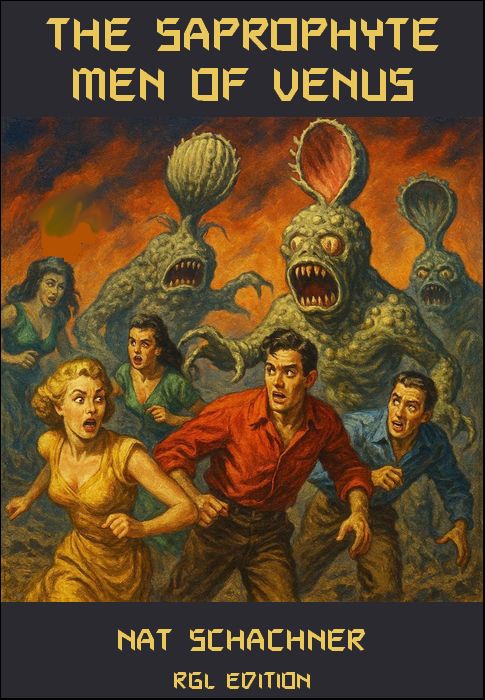
RGL e-Book Cover
Based on an image created with Microsoft Bing software
Roy Glashan's Library
Non sibi sed omnibus
Go to Home Page
This work is out of copyright in countries with a copyright
period of 70 years or less, after the year of the author's death.
If it is under copyright in your country of residence,
do not download or redistribute this file.
Original content added by RGL (e.g., introductions, notes,
RGL covers) is proprietary and protected by copyright.
RGL e-Book Cover
Based on an image created with Microsoft Bing software
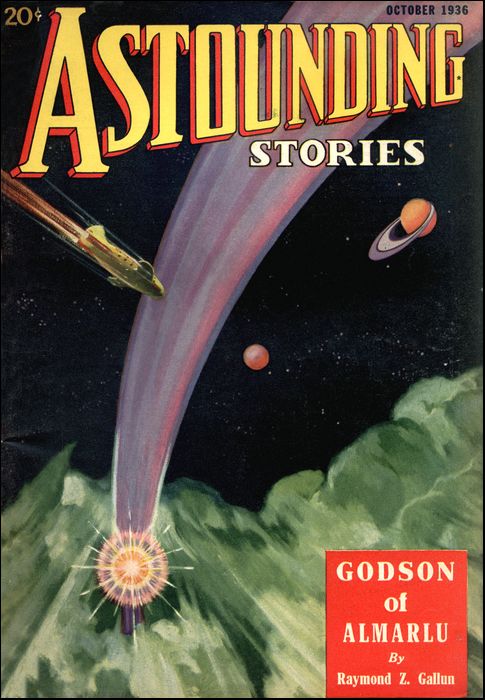
Astounding Stories, October 1936, with "The Saprophyte Men Of Venus"

What was that strange column that ate its way
through cities? That drove men mad? What?
IT was a long, steep climb up the rocky slope of Baldeagle Mountain, and the Sun was a globe of liquid fire almost directly overhead, but Hugh Warner did not mind. In fact, he was enjoying it thoroughly, this pitting of sheer muscular strength against the hard physical surface of things, this momentary release from the four walls of his laboratory that nestled far beneath in the smiling valley.
"Hold on, Hugh!" a voice, half laughing, half panting, sounded immediately behind and below him. "I didn't know you had mountain-goat blood in your veins. I can't keep up with you."
"Sorry, Jane!" he said, as he swung her up to the flat rock beside him, "but I'm so glad to get out into the open, and forget quanta and protons and mass spectrographs and futile experiments, that I think I really could give a mountain goat a run for it."
Jane Castle shaded her eyes against the glare of the Sun, looked back the long way they had come. They were above timber line. Below were stunted dwarf pines, then the wooded flanks, stretching interminably down. Far beneath lay the smiling valley, sun-kissed, threaded by the silvery wind of the river, lush with ripe-eared grain and fat kine and red barns filled to the bursting.
Farther up the glistening stream, sprawled along its banks like a gigantic jig-saw puzzle, stretched Middletown, metropolis of the valley, population 25,000, blessed with Rotary and Lion's Club and Chamber of Commerce and slogans alike.
She took a deep breath. "I'm glad I got you away from that stuffy lab of yours, even if only for the day," she said. "Ever since the foundation placed its research unit here in Vermont I've hardly known what it is to have a fiancé."
Hugh pressed her small fingers. "You've been a brick coming up to see me," he apologized. "But we're tottering on the verge of some important discoveries on the nature of light, and—well"—he grinned down at her—"we scientists are somewhat like soldiers on a battlefield—when the photon bullets are flying and the electron shells are exploding, we can't simply quit and run away because we have sweethearts waiting."
Though it was hot and the Sun's rays beat mercilessly against the tumbled rocks, she shivered a little bit. "I don't like your similes, Hugh Warner," she told him. "War—battlefields—soldiers—I hope we never see those again." She stared down at the valley, at the red brick buildings of the Welles Foundation far below. "Thank heavens your battles are metaphorical only—weapons against the secrets of nature. I don't care at all for the other kind."
"No more do I," he assented gravely. "But the one is just as real as the other, and who knows——"
She sprang to her feet. "We're talking nonsense," she cried. "In the midst of peace we talk of war; overlooking this scene where everything is drowsy, content with mere existence, we discuss bullets and shells. Nothing could ever happen here. Come on, I'll race you to the top."
She was off, light-footed, graceful, clambering swiftly up the rocks. He looked after her quizzically a moment, filled with warm tenderness, then he hallooed, "Look out, I'm coming!" and climbed after her.
A GIGANTIC shadow swept like a hooding shroud over Hugh. One moment there had been the glare of heated rocks, the dazzling vistas of far-off tumbling hills and valleys; the next moment he was plunged in utter darkness. Some one cried out sharply ahead of him—Jane; while his poised foot and extended arm, groping for holds on jutting boulders that had suddenly disappeared, missed their vantage points, and sent him stumbling and rolling. Only the timely interposition of an invisible rock saved him from a clattering fall down the mountainside, and a steep descent to extinction over the terminal precipice. Bruised, battered, he hauled himself gingerly erect.
"Jane!" he shouted hoarsely into the enveloping dark. Fear gripped him—fear for her that was too overwhelming to leave room for fear or wonder at the sudden obliteration of all light.
"Here I am, Hugh, safe and sound," he heard her clear voice, straight ahead, piercing the sudden blackness like a liberating sword. "What's happened?"
"I don't know," he admitted. "But hold on tight. I'm coming up for you." Painfully, on hands and knees, he groped his way upward, seeing nothing, hearing nothing. A cold wind had sprung up, chill with the frigidity of outer space. It whipped through his thin khaki shirt and trousers, froze the perspiration on his side. Finally, hearkening to her repeated calls, he was at her side.
Her cold little hand gripped his tight in the darkness. They clung to each other in thankfulness, though unseeing. "What could it be?" she asked with a little tremor. "An eclipse?"
"None scheduled for now," he answered, and peered into the icy gloom. At one bound the mysterious darkness had fallen upon them. The world was a bottomless void—no sky, no earth, no sign of anything but that strange, weird totality of blankness.
"Perhaps"—and the tremor in her voice betrayed the growing fear—"your experiments are responsible, Hugh. Perhaps your machines have concentrated the light waves, the photons, and sucked them away from the land."
"Nonsense," he told her half angrily. This was no time for jesting. The world had been blotted out, and they were stranded, helpless, shivering, on the top of a mountain. "It's something far beyond any laboratory work. It's—— Hello!" He broke off, stared.
"The stars are out. Look! We were just blinded for the moment by the sudden cessation of light."
Jane looked up. Bright pin points stabbed the pervading gloom, shed their wan feebleness over dimly descried peaks and escarpments. "Then all light isn't gone," she said shakily. "For a while I thought——"
Hugh held her arm very tight. In the dimness his face was a puckered frown. "Then that means it isn't a strange cloud of sorts," he muttered. "It must be the Sun." Almost involuntarily his head went back. As it did a stifled cry came from him. "Good Lord, it is the Sun! Look, Jane."
She followed the shadowed outlines of his arm. Where the Sun had been, seconds before, a blinding, molten glow too dazzling for human sight, there was now nothing—or worse than nothing. There, in the blue-black background of the heavens, surrounded by a guarding circlet of faint stars, was a black hole of nothingness, the exact size of the Sun—a disk of impenetrability, of blankness, of utter extinction.
"Hugh!" she said rapidly. "The Sun's gone. It's vanished—forever!"
She twisted toward him, her face a mere pallid blob.
His arms tightened around her. "Don't be silly," he reproved her. "It's just some natural phenomenon, an eclipse of some kind. Perhaps I slipped up; I've been so busy with my own work. But it's getting frightfully cold; we'd better try to make our way down to the valley. There's ice forming already on the rocks."
HE was not mistaken. Hoarfrost spread with uncanny rapidity, white, glimmering, and solidifying into a smooth, slippery surface. What with ice and darkness, it would be dangerous work getting down.
Hugh had spoken confidently, but in his own mind he was afraid. This was no mere eclipse. In the first place, no eclipse was scheduled for this part of the country, either now or for years to come; in the second place, an eclipse was gradual, while this cessation of light had come on with startling suddenness. And there was no sign of the Sun's reappearance! That sinister black hole in the sky was as complete, as smoothly round, as minutes before.
But of all this he said nothing as they descended cautiously, feeling their way over whitening rocks. The invisible trail led somewhat to the left—of that he was sure. Slowly, panting a little, they turned the heft of a sheer wall, which, he remembered, marked the beginning of the beaten path.
Jane stopped short with a cry of surprise. "Hugh! Look!" Before them, directly ahead, was the weirdest, most wonderful sight on which mortal man had ever laid eyes. Far up the valley, a huge cylinder of flame sprang shimmering out of the earth, and heaved perpendicularly up, up, until Hugh's back-flung head ached from stretching.
Its smooth, round flanks glowed with the fiery colors of the rainbow, weaving and swirling in restless iridescence. So darling was its base, it pierced the eye like red-hot knives; then, as it lifted its huge bulk into the enveloping darkness, it grew less bright, until, at the very limits of Earth's highest stratosphere, it vanished abruptly into surrounding space.
"Hugh!" Jane cried, "I'm afraid. It—it's un-Earthly."
Hugh Warner was astounded. Light was his special province, but never had he seen anything to compare with that vast cylinder of playing colors; nothing on Earth, no phenomenon of nature, could account for this resplendent, yet almost sinister display. Good Lord! it was almost five miles across, blanking the river, the valley fields, barely missing the outskirts of Middletown.
"Have you noticed that it doesn't light up the darkness?" Jane exclaimed. "As though—as though the cylinder of light were self-contained."
"I've noticed it," Hugh remarked grimly. That had been the most surprising feature of the un-Earthly radiance. The shaft of iridescence rose smoothly, sharply, into the black veil of artificial night. The colors swirled and glowed, but held within the round of the cylinder. Darkness, more Stygian by sudden contrast, began where dazzlement ended. There was no penumbra, no twilight zone such as Earth's atmosphere must normally make.
Jane's teeth were chattering. "I'm cold, Hugh. We'll freeze if we don't move."
Hugh came out of his scientific daze. It was cold, and snow—large, dim, soft flakes—was beginning to fall. "We're going," he muttered. "Perhaps down in the lab I'll be able to—— Come on!"
IT was a hard, dangerous climb in the dark. Only the glimmer of white snow, the feeble stars still peering through the swirl held them from missteps and destruction. In the laboratory, they found confusion worse confounded.
The place was in utter darkness; the power seemed to have been abruptly cut off with the first appearance of the artificial night and the cylinder of colored flame.
Men were moving around with kerosene lamps and candles, bundled in sweaters and shivering with cold. All eyes were directed through the gloom at that sinister, sky-piercing shaft; all tongues were chattering with unleashed excitement.
"Thank Heaven you've come back," John Frith shouted at them as they staggered, frozen and stiff with fatigue, into the little circle of bobbing illumination. "We were going to send up a search party soon, though it would have been suicide. But what do you make of it, chief?"
He was Hugh Warner's assistant, a little, wizened old man, with bright eyes and a chirruping, bird-like voice. But he was uncannily deft with his hands, and no one could set up delicate apparatus and make millimicron adjustment as he could.
"John, quick," Hugh ordered. "Take Miss Castle inside, bundle her up well, and give her hot tea with a dash of rum."
"You too, chief," Frith chirruped. "You're practically icicles right now."
It was quite a while before they thawed out in the heat of a log fire some one had kindled. Meanwhile Hugh was machine-gunning staccato questions at his men. But they could add little to what he knew.
"There isn't a bit of juice in the place," Howard Bradshaw, the electrician, interjected. "All power's gone. Telephone, radio, everything. We're isolated from the rest of the world."
"That is—if there is any rest of the world," Oliver Tazewell, assistant physicist, said gloomily. "The blanket of darkness seems interminable. The Sun's wiped out."
But Frith was staring at the log fire; at the lamps. His bony finger shot out suddenly, pointed. "Look at that," he wheezed with excitement. "I've been watching. The tongues of fire are all pointing one way—toward that damned cylinder outside."
They all stared. Sure enough, the flame, from whatever source, was bent over at an acute angle, as if sucked by some invisible force, directly toward the looming shaft.
"That settles it," Hugh said grimly. "That fiery portent is a tube of force, of an order hitherto unimaginable on Earth; and somehow, it sucks all ether vibrations, light, heat, electricity, magnetism, from the surrounding territory into itself to build and renew its vortex of light."
"But where does it come from?" asked Bradshaw.
No one answered. They checked their own apparatus, in the improbable event that it had been responsible. But no experiment had been in progress, and the machinery was inert, dead, sucked of all energy.
They huddled over the dim, pointing light of the fire, arguing excitedly, spinning theories, rearing structures of hypotheses, only to have them crash. Meanwhile the darkness grew more and more intense, the cold more bitter, the great shining cylinder more dazzling, and the Sun was a round hole of extinction in a star-studded sky.
It was Jane, wrapped up in blankets, who put her finger on the semisolution by her innocent question. "How high do you think it extends?" she asked.
Hugh whooped. "Of course. We can check its point of origin from its height. Get out the theodolites."
IN minutes they had taken the altitude, shifted the base out into the brittle snow, taken another reading. Then pencils raced.
John Frith looked up. "Its height," he said slowly, "up to the apex of fading, is 196 miles."
"Exactly," Hugh cried out, "the height of Earth's atmosphere. Gentlemen"—he looked around the tense circle gravely—"that cylinder of flame is no Earthly phenomenon. It is directed at Earth purposely from some point in outer space. Light waves, or photons, are naturally invisible while traveling through airless space; they begin to glimmer faintly in the highest reaches of the stratosphere, and become more and more bright as the denser layers of the atmosphere are reached. But it's more than that.
"To build up such unimaginable compression of light, it was necessary to drain all the Sun's wide-spreading etheric emissions into the tense, hard round of the directive cylinder. That is why we are in darkness, why heat and light and all other manifestations of ether waves have left us. They—or most of them—have by some unimaginable means been sucked away and into the cylinder."
They sat there, huddled, allowing the awesome thought to digest—a bit scared.
"That means," Bradshaw broke the silence, "there are beings somewhere, up there"—his arm went toward the window, out to the frosty stars, past the tremendous column—"who have a science far beyond ours, who for some unimaginable reason have directed that cylinder of etheric force directly at our planet."
"Yes," Hugh said carefully. There was another silence. Thoughts raced. What did it portend? What was going to happen next?
"Do you think," Jane asked, with a little catch in her voice, "this strange darkness covers the entire Earth?" She was thinking of her parents down in New York, of all the peoples of the world. For, with the light of the Sun abstracted, with all manifestations of that orb's etheric energy concentrated in the mysterious cylinder, Earth's peoples were doomed to destruction, to insane deaths from cold, from darkness, from the very cessation of being.
In her mind's eye she could visualize the panic that must ensue, the wild, helter-skelter flight from the growing cold, the huge bonfires of buildings, forests, anything to gain a modicum of warmth and light, the slow, inexorable advance of a new glacial age from the frozen North. The others stirred uneasily; they, too, were thinking along the same lines.
Frith suddenly shook his fist at the inimical, strangely glowing cylinder of flame.
Hugh rose grimly. "I intend finding that out shortly. If my theory is correct, radio etheric waves are flowing past us toward the cylinder. In other words, if stations are still functioning somewhere in the world, undrained of their power, their signals will come to us, even though we can't buck the ether suction by transmitting to them."
"How will we receive?" queried Bradshaw. "Our power lines are dead."
"Our outside lines are," Hugh answered. "But we have powerful storage batteries for emergency use. The chemicals are there, and the potentials are intact. They have as yet no ether waves to drain away. If we connect them in series, we may be able to build up enough current for our sets faster than it can be sucked into the vortex."
HE was right. In half an hour a low, feeble hum and dimly lighted tubes told them that some current was passing through the receiver. Then, as they strained to listen, through crackling static and etheric howls, came faint announcements. New York was calling, over and over, giving news, seeking information from the dead area. Slowly, painfully, overlaid with howls and squeaks and grunts as the ether waves fled blindly past, seeking the swirling surface of that strange beacon of light, they pieced together the story.
The area of darkness extended over a radius of some two hundred miles. New York was on the outer verge of the circumscribing circle. The rim of darkness was as sharply delineated as the cylinder itself; there was no twilight zone between night and day. Outside, the Sun shone, but only as a wan replica of its former self, as though part of its tremendous etheric manifestations had been shorn away. The multicolored portent was visible over half the United States—steady, towering, ominous.
The world was in a panic; scientists were converging to study the strange phenomenon. The people of the blanketed territories were streaming out into the blessed day, with tales of perishing cold and fear. But millions more were buried within the strange pall, unheard from, their situation unknown.
Rescue expeditions were being fitted out to penetrate the frigid darkness, scientific expeditions to try and pierce to the mysterious cylinder itself. But it would be difficult. Already the snow was feet deep on the outer rim; automobiles could not be used, nor any mechanisms powered electrically. Even heat radiated too fast for efficiency. Sledges were being hurried from the North, all the impedimenta of polar exploration. It would take time, and interspersed with these excited announcements came faint calls for the Welles Laboratory, for Hugh Warner himself. Were they alive? Could they do something, study, find some way to circumvent, destroy the cylinder? Frantic calls, barely heard through magnifying ear phones.
Hugh rose slowly from the receiver. His face was lined and taut. "It's up to us," he said quietly. "We're at the very center of things. Before outside help could come, five million people will have perished." He paused, took a deep breath. "That isn't all. That cylinder somehow spells doom to our Earth. It was directed at us deliberately, for a definite purpose. That purpose, gentlemen, I'm afraid is, from the standpoint of Earth, maleficent."
"But what manner of beings, and from where, could have done this?" Jane cried.
Hugh shook his head. "I can't answer the first part of your question, but I can the second."
He strode to the window, rubbed the frost away, peered out. The others crowded around.
It was still snowing, but the sky was cloudless. The swift change in temperature had precipitated and frozen all the moisture in the atmosphere. Above, the stars shone in mockery; to the left the luminous cylinder thrust upward in smooth immobility.
"Venus is now in conjunction with the Sun," Hugh said, "almost in a straight line. Can any of you see the planet?"
THEY shook their heads. Venus was gone, though the other planets—Jupiter, Mars, Mercury even, were visible in the star-studded night. But Venus had vanished, even as the Sun itself. "There's the answer," Hugh told them somberly. "The force ray comes from Venus."
"But how?" demanded Bradshaw. "I thought it was the Sun's rays that were being concentrated."
"Exactly," Hugh explained. "But it is on Venus that the trick is being turned. Venus is nearer to being in a straight line with Sun and Earth than at any time within the past twenty-five years. This is no natural phenomenon," he told them earnestly. "There is evidently a race of beings on Venus far in advance of Earth in scientific achievements. They've been able to do what we here have only been playing around with. They've used their planet as a gigantic focusing lens.
"By some method, as yet unknown to us, they've deflected the etheric vibrations of the Sun over a radius at least equal to that of their planet, and concentrated them into the glowing cylinder of energy. Then, with uncanny powers, they directed it toward Earth through millions of miles of space, to glow into etheric being on striking our atmosphere."
They shuffled their feet and looked uneasily at each other. Beings of such an order of intelligence and power on another planet. What were the implications for Earth and its puny people?
Jane asked the question uppermost in every one's mind. "But what is their purpose?" she insisted. "Is it merely a means of signaling us, in case our planet should be inhabited, or is it——"
She stopped short, but the unspoken thought echoed with hammer blows in all their minds.
Hugh's face was white, yet purposeful in the flickering, turning flame. "That's what I'm going to find out," he announced.
"Alone?" demanded Bradshaw.
"Alone."
Jane came over, put her hand on his arm. "I am going with you," she said determinedly.
He looked at her in consternation. "You can't, Jane!" he cried. "If what I think is true, it may be——" He hesitated, while she finished for him with grave emphasis.
"Dangerous, you meant to say. I know it; that's why my place is with you. The others can take care of the lab, get the messages as they drift through from the outer world, perhaps even rig up some apparatus to establish power again. I'd only be in the way. But out there——"
Hugh's brow furrowed. "All right," he acquiesced reluctantly. "Bundle up well, and take a pistol along."
Ten minutes later they were trudging through the foot-deep snow, guiding their way by the un-Earthly, yet tremendously splendid flare of the gigantic beacon. It was bitter cold, yet strangely windless. All the world seemed frozen into immobility, breathless before that alien cylinder.
Behind them the laboratory had been swallowed up in blanketing darkness. The feeble flicker of the hearth fire was insufficient to penetrate the gloom. The snow had ceased, and the stars were frigid sparkles of distant light. No sound came to them but the crunch, crunch, of their own lagging feet. Houses, looming dark and tenantless, drifted behind them.
"Poor people!" said Jane. "They must be dead from cold or fright."
It was ten miles to Middletown—and the weird force beam; and the highway was obliterated in the uncanny night. But they struggled on and on. Hugh's mittened hand was always close to the pocket of his heavy ulster, where an automatic nestled. Just in case—— In his other pockets were bits of apparatus he had picked out of their store—also just in case——
THEY saw their first human being about three miles out of Middletown. He was staggering wearily through the drifts, wheezing and moaning to himself. He shied away from them, as if they were wild beasts, glared momentarily with the light of madness in his eyes, then fled over the crusted snow, uttering shrill cries.
"Gone crazy," Hugh muttered. "We'll see more of them, I'm afraid."
They did. As they came closer to the darkened town, and the looming cylinder, the tide of fugitives increased. All were hurrying as if their very lives depended on getting away from there as fast as they could! Hugh tried to stop some of them, but they broke away with furious haste, fearing to lose even a second in their dreadful flight. One, more coherent than the others, cried a warning: "For Heaven's sake, don't go! Turn back!"
"But why?" Hugh demanded.
"The things!" the fellow screamed. "They get you." And he took to his heels as if he had already lost too much time.
Hugh's brow furrowed more and more. "Jane," he said abruptly, "you'd better turn back, get to the laboratory."
She faced him in the darkness, punctuated now with the tramp of the fugitives, their panting cries of fear. "And you?"
"I must go ahead."
"Then so must I," she answered quietly, and resumed her forward pace.
About a mile from Middletown the flood of human beings slowed to a trickle, then ceased altogether. The town was a dim, outstretched blob before them, silent as the grave, seemingly altogether deserted. Just outside its limits reared the tremendous structure of the five-mile-wide shaft of iridescent light, supernal in its brilliance and smooth race of shifting colors, piercing into the very heavens themselves.
"I don't like this," Hugh said, as they slogged through the crunching snow.
"What is that?" Jane cried out suddenly.
Hugh stopped, stared. High overhead, launching itself straight out of the mysterious circlet of swirling force, floated a luminous apparition. Then another, and another, until the dun darkness was spangled with gigantic, flitting fireflies, tens of them, scores, and hundreds. They were too high at first for visibility, but soon they straightened out their course, and descended like flakes of flaming snow to the moribund city beneath.
THE two Earth people instinctively shrank behind the sheltering trunk of a tree, not knowing what or why they feared, but filled with ancestral bristlings against the unknown. The luminous blobs of light dropped steadily, lightly, toward Middletown, and, as they poised in a disk of spangled fire before the last vanishing descent into the street of the darkened town, Hugh and Jane were enabled to make out the internal structure of the strange apparitions. With a single accord they turned, stared at each other with blanched faces and gasping breath.
"They're alive," whispered Jane, as if she were afraid of being overheard.
"Sentient, motile plants," added Hugh in a smothered voice. "Gigantic fungi, like spreading mushrooms, with hundreds of waving rootlets like octopus tentacles. Dead-white, too, bleached of all chlorophyll. But of course, for the dense atmosphere of Venus permits hardly any of the Sun's rays to penetrate. Each is surrounded with an incasement of circumscribed light, like the cylinder itself. Their bodies must be powerful magnets, to deflect and concentrate etheric waves in a shell about them. These, Jane, are the plant-men of Venus, shot to Earth through that cylinder of light."
Jane gasped. "But it's impossible, Hugh—living forms to propel themselves over 26,000,000 miles of space without air or food. Even plants and fungi breathe and require nourishment."
"That's true," he admitted, peering vainly toward the unspattered darkness of Middletown. "Unless, within that tube of force, there are space vessels in which they had come. But we must——"
He never completed his sentence. For just then a confusion of faint screams and smothered cries of agony emanated from the too-quiet city. Shrieks as of human beings in the last ecstasy of pain and dread: the deep, lacerated cries of men; the high, piercing screams of women; the frightened, sobbing wails of children.
Hugh started to his feet, his automatic snouting in his hand. "For Heaven's sake, what is that?"
They were to find out only too soon. For the great, luminous fungi rose like petals of fire from the darkened housetops, swollen and extended over their former leanness.
Hugh ripped out an oath, cried vainly to Jane: "Back, back. Don't look!"
But she had seen, and in the seeing, covered her eyes with mittened hands to avoid further sight. For the multitudinous rootlets were anchored deep into the struggling bodies of human beings, limp with the last agony, and they were being borne swiftly aloft, to plunge into the great glowing column in horrible vanishment. Hundreds of Venusian plant-men rose, each with its dreadful load, until once more the city lay dark and silent, and the surrounding night was a pall of horror.
"Oh, the poor, poor people!" Jane moaned. "They must have been hiding in their houses. What frightful things those Venusians are, with all their intellect and scientific knowledge!"
Hugh's face was a grim, tight mask. "From our point of view, yes. But not from theirs. Fungi are saprophytes. They live on dead organic matter, sucking in nutriment through their rootlets. We are natural food to them, just as certain plants and animals are to us. Perhaps that's the reason they migrated from their native home to Earth. The food supply was giving out. We must be fair."
Jane took her hands away from her eyes. "Hugh!" she cried in a shocked voice. "You—you're defending those horrible beings when your own kind are suffering torture and death before your eyes. How could you?"
Hugh smiled painfully. "I've an unfortunate habit of seeing the other fellow's point of view. But," he said, his voice hardened, "that doesn't mean I won't do my best to destroy them. It's the law of self-preservation."
"But how can we?" persisted Jane.
He shook his head. "I don't exactly know. But I'm going to find out soon enough."
"Where?"
"Within that tube of light."
HALF AN HOUR later they had crawled warily up to the very round of the supernal edifice of weaving flame. Everything had been deathly quiet; Middletown was a blob of ravished emptiness, and no more plant-men had erupted.
"Digesting their odious food." Jane shuddered. "Poor people, let's hope their end was swift and painless." Even then they did not realize the full horror of the Venusians' feasting.
They stared up at the high, kadeidoscopic round as it penetrated the topmost sky. A sinking feeling was in their hearts. How could they two puny mortals, with puny Earth weapons, attempt to combat the unbelievable science of these creatures from another planet!
Yet, when Hugh pressed Jane's small hand, she understood the mute question and said steadily: "I am not afraid, Hugh. If we fail, all Earth will succumb to the invader."
"We must succeed," he assured her, but his tone lacked conviction. It was indeed an incredible task they had set themselves.
For a moment they stared at the shimmering, racing light that blocked their path. "It radiates no heat," Jane said. Hugh thrust a wary hand into the fiery glow of colors, bracing himself for—he knew not what? Nothing happened. His hand disappeared into the luminous wall, but he felt nothing. "Cold light," he muttered. "Something our scientists have been vainly seeking for a century. Somehow they've stepped up or stepped down the vibration period of all other forms of ether waves, to extract full efficiency in pure light. I wonder why they formed this space tube, though? It's penetrable, and serves no purpose that I can detect."
They looked at each other gravely, with the rainbow hue upon them, as if they were seeing each other for the last time. Very likely it was. They had no means of telling what lay beyond. Yet, steadily, without a whimper, the two brave humans walked quietly through the wall of light, walked hand in hand for what seemed miles, yet was actually only a hundred yards, to burst upon a scene that held them taut, speechless, hardly recking of their imminent danger.
The huge force tube from outer space was a hollow shell. Within its circumscribed interior a great shaft of darkness extended upward to a seeming infinity. But the shaft was not empty. Everywhere were the Venusian plant-men; great luminous fungi floating in the ambient darkness, or resting on the ground, busy with their myriad rootlets on strange engines and machines of extremely complicated design and outré shapes of which Hugh, with all his scientific knowledge, could only guess the functions.
He watched them eagerly, with a strange fascination, marveling at the deftness of those rootlets, more pliable and skillful than any hands, wondering at those machines compounded of fused and luminescent earth, glassily transparent and whirring at almost invisible speeds. He hardly remembered the purpose of his spying, the immediate danger to themselves. Luckily, their bodies were semisheltered by the wall of colored flame, and the plant-men were engrossed in their tasks.
IT was Jane's shuddering gasp, which brought him to a full realization of the portentousness of the scene. There, on a hundred platforms raised siliceous smoothness, rested the marauders who had descended on Middletown They were feeding.
Hugh started, and swore violently. He raised his automatic in involuntary gesture, lowered it again only at Jane's quick cry. A shot would have been madness—more, it would have meant instant destruction. But his brain seethed with the horror of what he had seen. Forgotten were his philosophical dissertations on fairness and abstract viewpoints. For the moment he wanted to kill and slay with all the narrow hatred of the beast.
For the plant-men were feeding on the live and squirming bodies of their captives. The rootlets had pierced deep into the poor, struggling humans, and they pulsed and contracted in regular peristaltic motion, as the life juices and blood of the victims sucked upward into the bloating forms of the pallid fungi.
"What can we do?" Jane whispered, trembling with nausea.
Hugh plunged his hand into a capacious pocket, took out, with grim intent, a small metal sphere. "Do?" he echoed grimly. "This. I provided myself with a bomb, tiny but powerful. I'll blow them all to kingdom come and rid the Earth of these devils. You start to run back now, Jane. I'll wait until you've reached safely; then I'll throw it."
She looked at him quietly. "And you?"
He avoided her glance. "I'll run then."
"It will be too late. You're going to sacrifice your life."
"To save the Earth."
"Give me another bomb," she ordered. "Two will be more effective. I'm staying."
He would have argued with her, had not something almost directly overhead distracted his eye. Out of the smooth, racing funnel of light, flat disks were catapulting, brown and sere, thin almost to transparency, saucer-like, to float with feathery softness to the ground. As they did, the plant-men left their busy duties, caught them gently with their waving rootlets, transported them carefully to the top of vacant platforms. Machines buzzed, and a deep-purple flame emanated from spiral funnels, to bathe the thin brown disks in eerie glow.
Hugh's voice was a queer compound of groaning and scientific excitement. "That explains the mystery," he cried.
"What does?" Jane asked, clinging to his arm.
"Those papery disks," he pointed. "They are the spores of the Venusians, brought here to germinate and grow to adult form. That's why the Venusians projected this tube of compressed light. It's a means of transportation. Light exercises a definite pressure. They've concentrated it to unbelievable strength, and those spores, incredibly light and flat, are shot along the walls of the tube at almost the speed of the carrier waves.
"Arrhenius long ago surmised that life might be carried from one plant to another by light pressure on spores. Many Earth spores even are resistant to the absolute cold of outer space, and require no air in their inactive state.
"The Venusian scientists are using this principle to colonize the Earth, to get rid of surplus population." Then he groaned wholly. "A mere bomb or two won't be enough. Those spores will be coming in ever-increasing hordes. As long as the tube of light remains, the Earth is doomed."
IN his excitement he had pushed out into the semidarkness of the interior. Jane plucked at him with a strangled cry of warning, but it was too late. Somehow the delicate rootlets of the swarming plant-men had sensed his presence. With lightning speed they whirled, flung themselves like trailing fireballs toward him. Before he could turn to flee, they were upon him, upon Jane. There was a soft, hissing noise, then stabs of unbearable pain.
The next moment he was borne aloft, kicking and struggling, the automatic fallen from his nerveless fingers. A rush of air, then he was upon one of the fused platforms, his body smothered under the luminescence of a gigantic, sentient fungus.
It was a frightful sensation. A fetid, un-Earthly odor enveloped him; microscopically sharp rootlet cells insinuated their way into flesh and muscle tissues, tapping greedily for the arterial blood streams that lay deeply imbedded. A frightful cry came to him, as from an exceeding far distance. It was Jane's voice, calling on him in the last extremity of despair. The sound cleared Hugh's brain from the haze of agony in which he was enveloped; it acted as a stimulant to his failing muscles.
He lashed out violently with feet and flailing fists, and heaved with superhuman strength. There was a sickening, squishy sound; hard flesh smashed through soft, oozy pulp, and the thrusting rootlets ripped out of his body like quivering barbs.
Bloody, dark with pain, he staggered to his feet. His captor lay thrashing feebly to one side on the platform, its great pulpy head a turgid, smelly liquid. Another scream from Jane, then the quick bark of an automatic. Somehow she had retained her grip on the weapon. But, as Hugh swung around toward the sound, he saw her struggling wildly on a neighboring platform, the great Venusian seemingly unharmed, and flinging its rootlets over her writhing form, seeking entrance.
As he dived over the six-foot edge, however, Hugh's brain worked with crystal clearness and furious speed. From all sides, the plant-men were rushing toward him to avenge the wounding of their mate. In seconds they would be upon him. He could not reach Jane in time, and, even if he did, only the bomb in his pocket could hurl both themselves and their attackers to destruction.
But even that would not save the Earth from eventual doom. For, as his feet touched hard ground, more of the brown spores, faintly luminous, catapulted out of the gushing walls of light. They would come on in endless streams, millions on millions, as long as the tube of force remained intact. Remained, intact, his brain echoed. But how to destroy it?
Before expeditions from the outer world could make their painful way through arctic blizzards and the vast area of darkness, a billion plant-men would have germinated and taken flight to suck their nourishment from the juice-laden bodies of men. And even then, the absorption of etheric waves would disarm Earthmen of their most potent weapons.
But here, within the cylinder, his thoughts raced, there was no such absorption, or, if there were, the Venusians had found means to counteract it. For their machines, emanating what seemed a species of ultra-violet light, were bathing the germinating spores, hastening their emergence into adult form. Could it be possible——
All this flashed through his mind in the splitting of an instant, as a whole life is reviewed in the moment of a dream, the suffocation of a man. Jane struggled and cried aloud for help. The Venusians were lunging for him like winged comets, trailing sinister splendor.
He did not hesitate. Jane's life, his own, mattered but little if all Earth could be saved from the spatial peril. It was a chance, an infinitesimal chance that his vague, half-formed theory would work. He must take that chance.
HE dived for the nearest machine, humming with penetrating rays, bathing a hundred spores with its deep-purple light. He had watched the movements of the plant-men carefully when they had turned it on. There was a certain series of coiled tendril levers which had been moved but slightly.
As his desperate fingers reached for the complications of coils, wrenching them open with all the strength he possessed, the machine spun on noiseless gimbals, swung in a wide arc around the inclosing walls of compressed light. The slight hum rose to a full-throated roar; the alien power plant trembled with enormous internal vibrations. The short radius of limited rays gave way to a great scythe of purple, almost black, vibrations that leaped and crashed against the far-spreading cylinder.
It had been as Hugh had hoped. The Venusian scientists had assembled their machines against all eventualities. They would have stricken down all man's puny weapons like so much chaff, have obliterated life within a radius of a hundred miles. Tapping their power from subatomic units, they hurled the infinitely short vibrations of X rays, gamma rays, the whole gamut of ultraviolet wave lengths, with energies of hundreds of millions of volts.
But the plant-men were upon him now, swarming over his head, blanketing his body, digging into his flesh with excruciatingly agonizing rootlets, trying to force him away from the machine he had turned into a tremendous weapon of destruction. He was possessed of the strength of madness, however. Bleeding from a hundred slashes, buffeted, crushed, he clung with a dying clutch to the controls, fighting off the furious Venusians.
The machine roared and thundered, the plant-men hissed their strange, rubbing anger, and the hurtling vibrations beat upon the vast round of the shaft.
Hugh staggered and cried out as a particularly vicious attack flung him away from the coiled levers, and the infuriated Venusians crashed down upon him. But even as he fell, there rose, high above the crackling roar of the machine, high above the scraping squeaks, high above Jane's fast weakening cries, a new sound—a sound as of a thousand Niagaras hurtling their cargoes of water from high precipices, a sound as of a universe booming to its end.
As it smashed and beat upon his deafened ears, the plant-men fell away from him with queer gibberings; a huge wind lashed out of space, caught his bleeding, battered body, whirled it aloft, sent it smashing into unconsciousness——
WHEN he awoke, the blessed light of day bathed his temples. The sun shone, blinding and dazzling as of yore, in a cloudless sky. Jane, swathed in bandages, was calling his name. He opened his eyes wearily—his limbs hart damnably—and blinked. There was no sign of the interplanetary cylinder of light; the machines of the Venusians were twisted wrecks, and of the Venusians themselves, only a few pulped fungi dotted the ground, shorn of the luminescence that enveloped them in life.
Beside Jane there were the men of his own laboratory, clustered anxiously around him, as well as certain khaki-clad and aviation-helmeted strangers. Bombing planes rested on the valley floor, and the drone of motors showed the presence of more high overhead. Puffs of smoke lashed out every now and then as they dived and zoomed.
"They're mopping up the last of the plant-men," explained Frith, his wizened face lighted with exultation, his voice more chirruping than ever. "Thanks to you, Hugh. Those bombers were able to penetrate the dark area only after the cylinder of force had collapsed. But how," he demanded curiously, "did you do it?"
Hugh raised his head weakly. "Those machines of the Venusians turned the trick. Their immensely penetrative emanations threw the photons of circumscribed light out of their locked, tight state; jarred them loose, so to speak. The potential energy of position was transformed into the kinetic energy of action. The wall of light disintegrated into its old components of light, heat, and electromagnetic waves.
"The released heat met the frigid air currents of the dark area, set up a furious convection storm. It was that which ripped the Venusians loose from me, from Jane, and overturned their machines. But the whole structure of the light shaft was highly unstable, brimming with pent-up, explosive energy. The disintegration of the lower structure acted like a catalyst, touching off, trigger-like, more and more disintegration all the way up the tube into space."
He stared up at the bright blue sky where Venus might have been. "Perhaps it even fused or blew up their integrating instruments when it hit the surface of Venus. In that case there would have been a cataclysmic explosion that might have wiped out all Venusia."
Jane cried out, with a certain venom in her ordinarily gentle voice. "It would be a good thing if it did. They were horrible creatures."
"From our point of view only," Hugh amended. Now that the crisis was over, he was once more judicial in his fairness. "According to their own code they were justified—and—they were great scientists as well. But," he continued with a wan smile, "I am not sorry for what I did. We, too, are justified in adopting those measures which are necessary to preserve ourselves and the future of the race."
Roy Glashan's Library
Non sibi sed omnibus
Go to Home Page
This work is out of copyright in countries with a copyright
period of 70 years or less, after the year of the author's death.
If it is under copyright in your country of residence,
do not download or redistribute this file.
Original content added by RGL (e.g., introductions, notes,
RGL covers) is proprietary and protected by copyright.