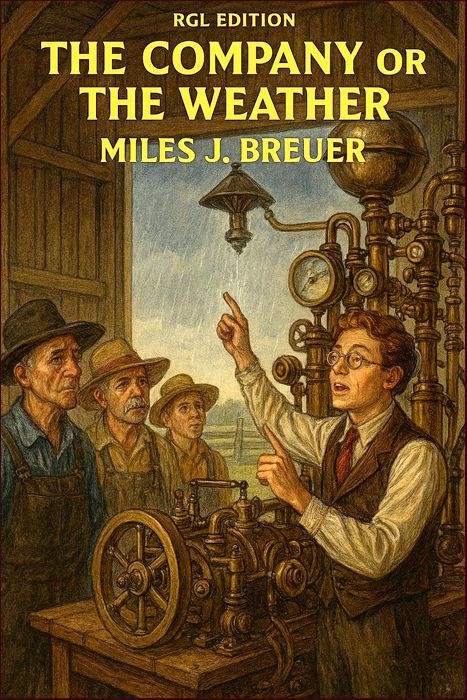
RGL e-Book Cover
Based on an image created with Microsoft Bing software
Roy Glashan's Library
Non sibi sed omnibus
Go to Home Page
This work is out of copyright in countries with a copyright
period of 70 years or less, after the year of the author's death.
If it is under copyright in your country of residence,
do not download or redistribute this file.
Original content added by RGL (e.g., introductions, notes,
RGL covers) is proprietary and protected by copyright.
RGL e-Book Cover
Based on an image created with Microsoft Bing software
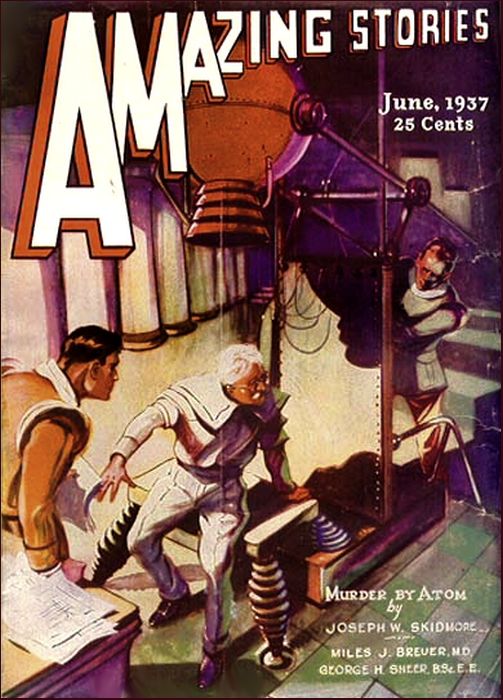
Amazing Stories, June 1937, with "The Company or the Weather"
This very short story from Dr. Breuer is quite char-
acteristic and we are sure it will please our readers.
ON August 5th, two hundred farmers, who for seventeen rainless weeks had helplessly watched the hot winds searing their wilted corn, crowded perspiring in the huge barn, watching the demonstration. The long drought had driven even these hard-bitten skeptics desperate enough to listen to a cracked inventor. His apparatus was simple. A small Cushman motor, such as those used for running binders, its shaft directly connected to a dynamo-generator; an X-ray transformer coil, an Oudin spiral, and a polished chromium ball; that was all there was to it. He had it bolted together into a compact mass that was slung by a rope from the rafters, and dangled high above their heads. In one corner a boiler spouted a little cloud of steam; several electric fans blew about it.
"That," said young Kimmel, pointing to the boiler, "is not an essential part of the apparatus. We need it because we are down on the ground, in the hot winds. Five thousand feet up, there is always plenty of moisture."
He cranked the motor into a steady sputter. The Oudin coil crackled and a purple halo stood out around the spherical terminal. He swung the humming apparatus here and there over the heads of the crowd with his rope. A farmer felt a tiny drop fall on his face. Then another. A misty little shower descended on the gazing, wondering crowd in the barn, and stopped only when the supply of steam from the boiler was used up.
"To scientists this is nothing new," Kimmel said. "It has long been known that to make rain fall, condensation-nuclei are necessary, and that these can be furnished by ionizing the air."
The spokesman for the farmers stood up.
"All in favor—" he began, but was drowned out by a roar of "ayes." Rain was needed immediately in Thayer County to prevent disaster.
The farmers promptly raised the ten thousand dollars, and by four o'clock in the afternoon on August 6th, Kimmel had two airplanes with Oudin discharge generators cruising about over the county. Twilight fell early on the farms, countless faces were turned to the sky to catch the first drop of rain. Slowly a drizzle began, which turned into a steady rain. It rained ail night; the next day there were two or three rainless hours, but the following night the rain continued steadily. Barnyards were a mass of muddy slush, roads were impassable, but the farmers were happy. The corn, the farmer's hope and life, again raised its green and buoyant heads.
Two days later an attorney visited Kimmel and the Secretary of the Farmer's Union. The newspapers announced the most sensational lawsuit ever heard in the West, The Jingling Brothers Mammoth Circuses was suing Harvey Kimmel and the Thayer County Farmers' Union for a quarter of a million dollars to cover the loss of traveling expenses, maintenance, and two days' admission receipts, because the deliberate and intentional efforts of the latter had directly produced and resulted in such heavy rains as to make a trip to and two days' stay at Fairbury a total loss to the circus. The loss was due solely and entirely to the rain-making machine of the defendants.
The defendants were forced to admit the facts of the case; these were too readily proved. But they urged that the loss of a crop and financial ruin had stared the community in the face, and they had resorted to desperate measures to save themselves. The plaintiff urged that they had no legal right to bring financial ruin on the circus; and if they had waited two days, they could have saved their crop without harm to the circus.
The judge was puzzled when he gave his instructions to the jury: "We have no precedents on which to base a decision for this case, because no individual has ever before been able to influence the weather. The gist of the question before us is: Can an individual or a group of individuals be permitted to tamper with conditions that seriously affect the entire community?"
The jury, from which the plaintiff's lawyer had rigorously excluded all persons interested in agriculture, were just about convinced that it was too bad, but that the circus lawyer was technically correct. Technically, the farmers were directly and unavoidably responsible for the damages to the business of the circus. Ruin, worse than they had imagined before, loomed up before Kimmel and the Farmers' Union.
Suddenly outdoors a motorcycle popped, and a messenger in khaki burst in and handed a yellowish-gray card to the lawyer for the defense.
"You almost got here too late," the latter said to the messenger, and then added, under his breath to himself: "There is nothing like being thorough."
He moved to admit new evidence, which was allowed.
"United States Weather Bureau Forecast," he read. "August 5th: heavy continuous rains tomorrow and the next day in Thayer County and vicinity."
The judge rapped with his gavel to a silent courtroom.
"The case is dismissed," he said. "Bailiff, close the court."
Roy Glashan's Library
Non sibi sed omnibus
Go to Home Page
This work is out of copyright in countries with a copyright
period of 70 years or less, after the year of the author's death.
If it is under copyright in your country of residence,
do not download or redistribute this file.
Original content added by RGL (e.g., introductions, notes,
RGL covers) is proprietary and protected by copyright.