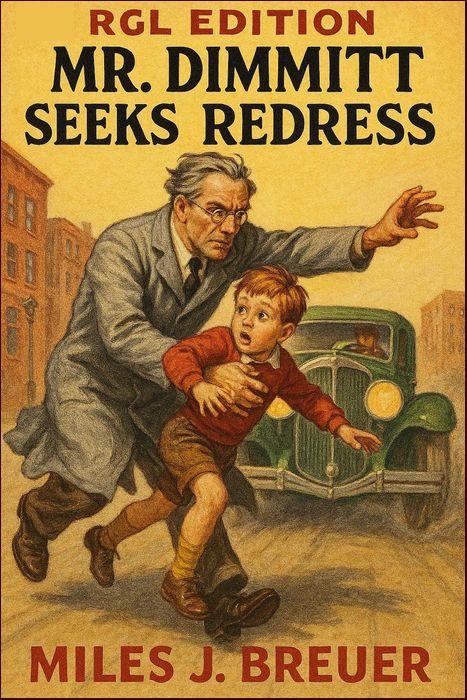
RGL e-Book Cover
Based on an image created with Microsoft Bing software
Roy Glashan's Library
Non sibi sed omnibus
Go to Home Page
This work is out of copyright in countries with a copyright
period of 70 years or less, after the year of the author's death.
If it is under copyright in your country of residence,
do not download or redistribute this file.
Original content added by RGL (e.g., introductions, notes,
RGL covers) is proprietary and protected by copyright.
RGL e-Book Cover
Based on an image created with Microsoft Bing software

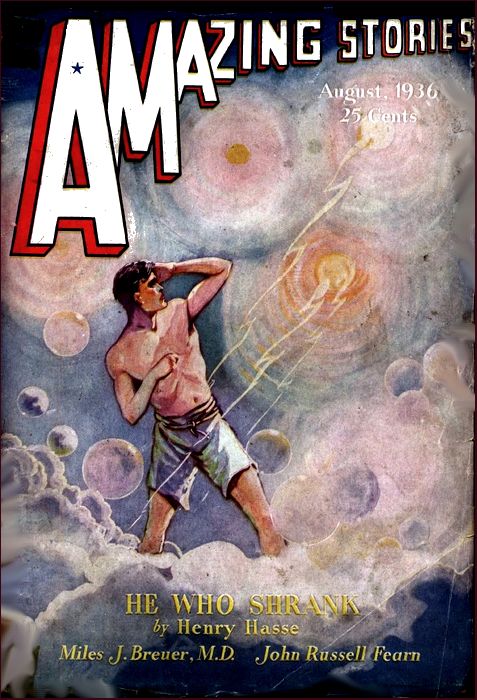
Amazing Stories, August 1936, with "Mr. Dimmitt Seeks Redress"
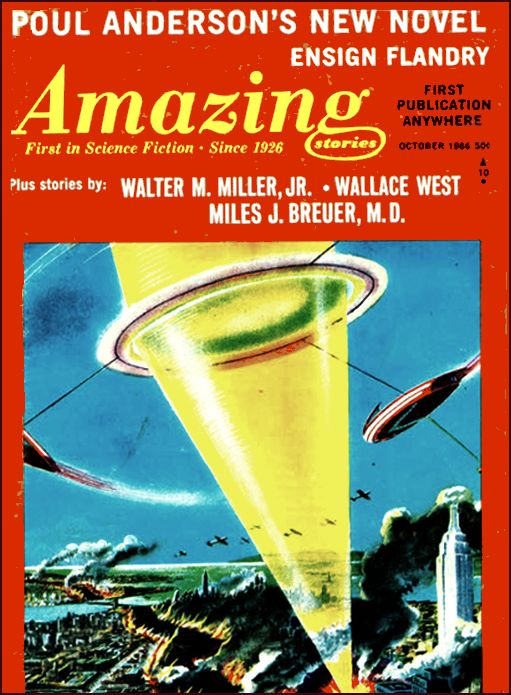
Amazing Stories,
October 1966, with "Mr. Dimmitt Seeks Redress"

A mayor of one of the world's greatest cities has been crusading against automobile accidents. They are generally due to high speed. A short time ago his car in which he was present was stopped and the chauffeur was warned against going so fast. This really happened. In this story we read of a narrow escape and in view of the above it is very timely.
"IT'S no use, Professor," the lawyer said sympathetically to the hopeless-looking little man in spectacles. "You have no witnesses. It is only your word against his. Old Graw is rich and unscrupulous, and a wily old politician."
The little man stared helplessly across the desk at the trim and ample figure of the successful attorney.
"Nothing?" he asked feebly. "He murdered my wife and daughter!"
"I advise against legal action," the lawyer repeated gently but firmly, doing his best to soften the hopeless finality of the statement. "There is nothing to bring before a court. You would not stand a chance in the world. And you have no money to waste.
"No," Dimmitt murmured. "I haven't even enough to get me another car."
He sat silent for a while. Then he rose. Standing up he was only slightly taller than the seated lawyer. The thousand little wrinkles on his face settled into an expression of dull despair.
"What do I owe you?" he asked reluctantly.
"I shouldn't think of charging you a fee under the circumstances," the lawyer replied kindly.
As the bowed little man walked out, the lawyer felt a surge of pity. In front of him on his desk was the pad of notes he had taken of the Professor's story, and in his mind it remained still more vivid. There was the hard-working scientist driving his little Ford on a mountain road near the city, taking his wife and daughter out for an airing. This humble pleasure was about all that his absorbed and retiring life permitted. Then came Graw, the big bully, tearing around the corner at terrific speed in a huge car, blaring his raucous horn.
"Out of the way!" he roared holding his leering red face out of his window, as he perceived the Professor's little car in his way.
The lawyer could readily imagine that the timid little man was startled and disconcerted, and in his panic to get out of the way, got a wheel over the edge of the road; he could also imagine the brutal impatience of the big, coarse man, stepping with a snarl on his pedal and sending his huge car plunging by. It took a mere touch of the big car's fender to send the Ford crashing down the steep slope of the mountain. The big car roared on along the road, and the red-faced man never even looked back. Some hours later tourists found the professor sitting on the wreckage, repeating over and over the license-number of the car that had it him. The dead bodies of his wife and daughter lay crushed under the wreckage. But no one saw the accident. There was no evidence except Dimmitt's recollection of the car number and his identification of Graw, the rich politician, as the roadhog.
"Funny chap," thought the big lawyer, watching the bowed and timid figure of the Professor retreating through the door. "Didn't rave and swear vengeance. Seemed to be studying intently over the thing, and murmured something about having to 'devise some sort of redress.' Queer way to put it."
Out of the window he could see Professor Dimmitt walking slowly and thoughtfully past, along the sidewalk, his head bent down as though in thought. At the corner, a huge, red-faced man stepped out in front of him, as though he had been waiting there. His fat lips were rolled repulsively around a black cigar. He looked every inch a bully. Also, he looked like one of those people who are in danger of a stroke of apoplexy from a sudden fit of temper. He blocked Professor Dimmitt's way, and the latter had to stop.
"If you don't know me, I'm Graw," he said huskily with a coarse, slangy accent. Professor Dimmitt started, but said nothing.
"I want to tell yuh something fer yer own good, "the florid-faced boss continued. "Yuh bin to a lawyer, hey ? Well, take my advice and fergit it. Yuh can't touch me. But if yuh bother me too much, I'll smash yuh, just like I've smashed bigger guys 'n you. Now beat it!"
He gave the little man a shove which sent him stumbling for several steps.
PROFESSOR DIMMITT thanked his lifelong scientific training. It enabled him to recognise with impersonal detachment that anger on his part would do no good at this point. He recovered his balance and did not even look back at Graw.
"It's a problem, all right," he said to himself. "Just as hard as the recrystallization of radium-fluorescin. But, quite as amenable to solution on proper study."
He walked on, talking to himself.
"The man needs a lesson," he said to himself. "The big brute thinks he can commit murder and let it go at that.
*Well," he sighed wearily, "I'll have to take some time away from electromagnetic frequencies to get at this problem."
"Why, how do you do,"Professor Dimmitt?" a cordial voice hailed him.
"Good morning, Mrs. Mathers,"Professor Dimmitt said tonelessly, even though the large and cheerful lady in the blue suit was the wife of a fellow professor.
Mrs. Mathers pitied him. He looked so forlorn that even a tear glistened in his brown eye. She and Mrs. Dimmitt had been intimate friends before the latter's tragical death.
"Can't you come and eat dinner with us tonight?" she said. "Just informally with the family—"
"It is very kind of you," Professor Dimmitt said gently and firmly, "I understand your motive and am grateful to you. But I have things on my mind—"
"I know. I want you to forget," protested Mrs. Mathers.
"I'm not grieving. That is futile. I have work and plans. That is what I have to live for now."
Mrs. Mathers shook her head as she looked after the departing man. That might be the best balm for his sorrow, she thought. Some of the world's best work has been accomplished by lonely, unhappy men. She was the wife of a scientist.
Professor Dimmitt was working on the preparation and purification of a chemical compound in which the sodium of sodium-fluorescin was replaced by radium. It ought to have some remarkable optical and physiological properties, he thought.
"We're near the end of our problem," he said to his laboratory assistant one evening a few days later. "It is rather thrilling, after these tedious weeks of detail work. You may go home now. I'll wait and watch this crystallize."
"I'll be glad to stay and help you, sir," the student said.
"There is nothing to do, thank you. Merely to watch the filtration. You can see the stuff tomorrow. Besides I want to think."
"Ah!" the young man exclaimed. He knew his chief. "You have a new problem on, sir?"
"Oh, of a sort, "the Professor sighed. "There ought to be some automatic, direct way of punishing careless automobile drivers. The law is a joke. I ought to be able to figure out some sort of a device."
The assistant left, and Professor Dimmitt watched the drops come one by one from the end of the funnel. In the bottom of the beaker below it, beautiful iridescent greenish crystals were forming. Splash, splash, splash, went the yellow drops into the beaker. Through the open window came the rattle of the busy traffic from the street below, raised at this moment to its maximum pitch because madly racing homeward from offices and shops.
IT happened suddenly, unexpectedly. A puff of wind blew away the circular sheet of filter paper with which the glass funnel was covered. Professor Dimmitt snatched at it quickly, but it eluded him. He leaned over the table a little too far, and his spectacles came off. They fell with a splash into the fluorescent green beaker. Several drops struck his face. In a moment his eyes were stinging painfully.
His heart gave a wild leap of fear. Both of his eyes had been directly struck by drops of the fluid. Its effect was totally unknown. It was a new substance that the world had never seen before. Through his mind there flashed a vision of himself groping blindly through life for the rest of his years.
But the stinging cleared away promptly, and he found that he could see clearly. Nothing was wrong.
He felt immensely relieved. But, something was wrong. Just what it was, he could not at once recognize. He was under the impression that he had drawn his hand back some minutes ago, from where it had been outstretched, reaching for the flying filter paper. But there it was still, stretched out across the table. A little ahead of it was the piece of filter paper hanging motionless in the air, nothing supporting it. There it hung, steady, suspended, immobile. Before, it had been sailing rapidly floorward. Something was indeed wrong.
Next he found himself gazing fascinatedly at a drop of the yellow fluid, in the air, an inch below the lower end of the funnel. The little globule of yellow liquid hung there, like a planet in the skies, still and motionless in mid-air. It glistened as he stared at it but did not move. Then, as he peered intently at it for a long time, he noted that slowly, very slowly, it moved downward a little and drew further away from the lower tip of the funnel. Also, after many minutes, he could see a change in the position of his hand which had been poised in pursuit of the filter paper. It was closer to him. Intent scrutiny showed that indeed it was moving, but slowly. Just about the speed of the minute hand of a clock, it had. He could not see it move. Only after he had watched it awhile, he could recognize that it had changed position slightly.
In front of him, across the table was the open window. He looked out. But he still saw the beaker and the funnel. That was eerie. He had moved his eyes upwards to look out of the window, but still saw the table-top with its glassware and his outstretched hand. It was many minutes of intense effort before his field of vision moved slowly across the table to the window and outside. Then, for a considerable while, everything was blurred and out of focus. Finally his astonished gaze rested on the street.
The whole scene in front of him, a busy downtown intersection, was paralyzed! Petrified! It looked like a street in excavated Pompeii, with everybody turned to stone. Crowded people were motionless, in the most grotesque of attitudes. Cars stood still. A messenger-boy was rigidly balanced upright on a bicycle defying all laws of equilibrium. People seemed frozen in the most unnatural attitudes, walking with one foot forward at a queer angle, or balanced forever on one toe. Yet, traffic noises came to his ears, the roar and bustle of going-home time downtown.
He stood there and stared at the rigidly motionless street-scene out of the window, amazed. Here were so many queer things to look at, policemen with poised arms, ladies balanced on the edge of a street-car steps, newsboys with mouth wide open permanently, that he spent a long time looking from one to the other out of sheer curiosity. After what seemed ten or fifteen minutes, he noted that the messenger-boy's pedals were vertical instead of horizontal, and the front rim of his bicycle wheel was some inches farther behind the mailbox.
PROFESSOR DIMMITT'S mind was such that he needed a solution for the phenomenon as promptly as possible. It was plain enough after a moment's thought. Al external movement was slowed down. But the change was apparent to vision only. The radium-fluorescin had splashed into his eyes. He had expected this new chemical on theoretical grounds to be a metabolic accelerator. It had simply increased the perception-rate of his retina to about a hundred times more rapid action than normal. As a result, normal motion appeared a hundred times slower to his eye.
Now, what would the substance do if applied to all of the body cells, instead of to a small portion like the eye?
That question occupied him for some time with its thrilling possibilities so that he forgot to watch the grotesquely frozen street scene. He stood there waiting, wondering how long it would take for the substance to be eliminated from his retinal cells, and for the slowing-down effect to wear off.
This was a real discovery. There was money in it. It ought to yield profit, real wealth. And money, which had never appealed to him before, now meant an opportunity to crush Graw. Without money he was helpless. With money, and lots of it, he could get at Graw. He could expose the bully's brutality to the public; he could hire crooked lawyers and fight crookedness with crookedness. He could break Graw. Or, he could fight brutality with brutality. Money would readily hire sluggers to give him the beating of his life. The thought of it was a pleasure.
It seemed to him that he stood there for hours. He had time to think out and prepare details for preparing sterile solutions of his new salt for intravenous injection, and a series of experiments on animals to determine its toxicity. He started to make some notes, but found that his hand moved so slowly that he could not see the movement; it was like the movement of mercury rising in a thermometer.
He gave up the attempt to write, and went over his reasoning several times to fix it in his memory. Then he looked out at the immobilized street again, with the intermediate blurring due to the fact that the retina could see more quickly than the ciliary muscle could adjust the focus of his eye from near to far. The messenger-boy was now a foot further behind the mailbox. A man in light gray whose feet had been far apart now had them together. But everything was motionless, frozen.
He began to be worried. He had read of persons who had tried a dose of cannabis indica having terrifying experiences from the effects of the drug. Was the effect of this thing going to be permanent ? Would he have to drag through all his life this way, with this discrepancy between vision and action? Could a man in such a condition accomplish any work? He spent a good deal of time in uncomfortable misgivings, hours of it, it seemed.
But he began to see signs of beginning movement in the street. The wheels of a long, low car were slowly creeping round in a circle; the spokes actually moved. It was a weird effect as he stared long and patiently and watched it slowly accelerate; wheels beginning to turn, people's legs beginning to swing. Cars and people began moving, past each other, and faster. Long after the scene had resumed its normal swift flurry, he stood there and wondered. Then he looked at the clock. It was 5:35. His assistant had left at 5:30.
BUT, he had something now! He knew that. Just a little more investigation, and he would put it on the market. Money would begin to come in. The thing had commercial
possibilities, as a means of observation for testing rapidly moving machinery, judging and coaching athletics, studying efficiency in industrial movements—many possibilities. But it was pleasanter to turn his thoughts to wealth and powerful lawyers; to the power that money gives one over one's enemies.
So the animal experiments were quickly and satisfactorily accomplished and the dosage for human administration easily determined. One evening, just after his assistant left, he injected the proper sixty milligrams into a vein in his arm.
If he expected any transition sensation, he was disappointed. He felt nothing. There was no change in himself. None in the laboratory. He moved his hands and watched. The movements were natural. He walked about. That all went naturally. He looked out of the window. The street was again frozen. Rigid. Motionless. With the exception of the petrified street, everything else seemed natural.
But no; the traffic noise was absent. He listened. He heard a slow, rhythmic tapping interspersed with low, hoarse tones. It was sound, perceived by his ears a hundred times more rapidly than normal. Sound vibrations came to his brain as though slowed down a hundred times.
He put on his hat and coat and walked out into the motionless street. He found himself walking around the rigid people as though among a vast grouping of statues. Rather they seemed like wax figures, lifelike but motionless. They were in the utmost variety of grotesque attitudes, like the unnatural high-speed snapshot photographs of horses jumping over gates or men diving. Expressions on peoples' faces looked all right at first glance. But they were fixed. They stayed that way. Like highly emotional stone statues. Professor Dimmitt stood within a foot of a man who gazed straight ahead, but showed not the least sign of being conscious that anyone was in front of him. He moved his hands about in front of the man's eyes. There was no change; there was the same rigid, queerly poised statue.
The motionless cars were queer. The drivers were strained, intent; their eyes popping out, their hands gripping steering-wheels—immobile.. He leaned into a car and looked at the speedometer, and repeated it several times. Twenty, thirty miles, they showed, as he stood on the ground, rested a hand on the door, and leaned his head in. The occupants retained their frozen expressions and showed no consciousness of his presence.
He walked about, like an explorer in an ancient city which had been frozen or petrified ages ago. He seemed to be the only man alive. He went into shops, where there were goods on counters. As he walked past trays of jewelry, he realized the possibilities for crime that lay in his invention. As he thought of his own eagerness for wealth he shuddered, and hurried out. He was excited.
He walked to cool down his excitement. He left the downtown district behind and walked first among apartments and then among residences. Everywhere, people and automobiles were motionless, and there was silence except for the tapping. Children were poised in rigid attitudes, with no change in position during the period that it took him to pass out of their sight. The sight of them affected him deeply. Children ought not to be caught up in this business. A pang gripped his heart as he thought of his little daughter crushed under the wreckage of his car.
Then he was startled to find himself walking down the street on which Graw lived. There was Graw's house a half a block away. There was Graw's fat, insolent, five-year old son out on the lawn. The unconscious mind plays odd pranks with the body in which it lives. Unconsciously, Dimmitt had realized that his accelerated state gave him a vast power over other people. It was a simple step in his unconscious reasoning to Graw, the man over whom he most desired power. Unconsciously his footsteps had turned that way.
In the street were several motionless cars. One was in the act of turning into its garage. It was the coming-home hour; men were arriving from downtown and dinners were being made ready. And there, on the boulevard was Graw's long green Pierce-Arrow car. In it sat Graw, hunched over the wheel, head forward, hands tight on the steering-wheel. It was a perfect picture of frozen speed.
"AT it again!" thought Dimmitt. "Laws mean nothing to him."
He walked over to look at Graw's speedometer.
Dimmitt's heart hardened as he saw that the instrument registered fifty-five miles per hour. That was an unreasonable rate on a city street, with children running about. It was not only reckless; it was criminally dangerous. Graw was wont to defy everybody and everything. Dimmitt's timid nature suddenly rose up in anger and determination such as it had never known before.
He acted quickly. He walked over to Graw's front yard and picked up the man's young son. He carried the boy out in the street and set him on the pavement, twenty feet ahead of Graw's big, green car. He figured that this distance was sufficient to permit Graw to see the boy clearly, but not sufficient to enable Graw to check the speed he was making, and prevent the car from running over the boy. If he were not breaking the law, Dimmitt said to himself viciously, he would be able to stop perfectly well within that distance.
Then he stood behind the boy and waited. He took care to stand perfectly motionless, because he wanted Graw to see him. The reason that people could not see Dimmitt in his accelerated state, was that he moved too fast. He was just like the spokes in a flying wheel; he moved so swiftly that they could see right through him.
He waited many minutes. He could not see the car move toward him, but after a long wait, he could see that it was a foot ahead of its original position. A change had begun to creep into the expression of the red-faced man at the wheel. The eyes began to widen. Dimmitt had plenty of time to think. Graw would see him there behind the boy; and he would at first think that Dimmitt was sacrificing his own life to get revenge. But that kind of revenge was not sweet enough for Dimmitt. He would have to let Graw see him afterwards. Such a meeting had dangers, but the details could be planned later. He switched his mind from planning them. It was much more gleeful to contemplate Graw's discomfiture at not being able to produce witnesses, at having no legal redress. No one would believe such a wild tale; that the Professor had dragged his boy in front of the wheels of his car and then escaped himself and disappeared. They would think Graw was crazy. Dimmitt would bow politely to him at that point. Also, he ought to ask for police protection, but that was also a detail to be settled later. The present occasion was too satisfactory to miss.
AFTER many minutes (long periods of waiting, anyway), he found that the car was another foot ahead, and that a stare of horror was taking shape in the bloated red face. The big, fat body seemed to lean back more, as though in the act of raising a foot to a brake pedal.
Dimmitt gloated. Graw had seen the child already. Dimmit looked down at the child, who was still in the same position; and then up at his father's cruel face, the terrified expression on which now delighted Dimmitt's heart. After all, there was something of the primitive human animal, even in the highly cultured little professor. This was atonement for the loss of his wife, child, and car. More and more the foot was poised toward the brake, though no actual move was visible. It was interesting to figure proportionate distances: the distance which the foot and the brake had to move, the distance the car had to go, the time which it would stop, the time in which it would go the remaining seventeen feet.
Dimmitt could also see that the steering wheel was deflected to one side, but not yet enough even to take up the loose play; it would be ages before the steering mechanism engaged the front wheels, which were still headed straight to the front, toward the child. The color of Graw's face was less red than before. Pallor was beginning to appear.
Dimmitt shook his fist at the big man and shouted:
"Ha! ha! Big brute! How do you like it? You can see me, can't you? The helpless little Dimmitt, whom you crushed?"
Dimmitt was forgetting that he was a scientist, in the savage glee of his revenge. It did not occur to him at the moment that his voice was pitched in vibrations one hundred times higher than the normal human voice, which would make his gibe such a high squeak that ears as human as Graw's could never hear it.
By this time the expression of horror was thoroughly established in the big man's face. His complexion was so pale that he looked like someone else. Desperately his foot was reaching toward the brake pedal and his hands tugged sidewards at the wheel.
Dimmitt was losing his professorial dignity. He was astonished to find himself jumping up and down in front of the car, and gibbering like a savage doing a war-dance. His joy at the triumph over his enemy overpowered him. He went into a frenzy of excitement; he yelled and executed a wild, furious dance.
FOR hours, it seemed that he danced, and all of the time, the car crept closer and closer to the child. As Dimmitt danced and yelled taunts at Graw, he noted that the child was in a half sprawling position. The front wheels had begun the slightest swerve. In the back of his mind, as he kicked his heels together, Dimmitt was able to plot the curve on the pavement, and figure that the huge seven inch tire would just about pass over the child's hips. A plaintive, weeping expression had appeared in the child's face by this time.
He stopped a moment. Perhaps it was physical exhaustion. The wild dance was fatiguing, for he was not accustomed to much exertion. He panted; and he wiped his forehead with his handkerchief. He sat down on the curb to rest.
The child's face had a most piteous expression. The heavy tire, with the three tons of metal behind it, was perhaps five feet away from the child. The horror of the impending juggernaut crashing down on him, was reflected in the boy's eyes. Anyone who could have resisted that, would have been made of stone. It was almost instinctive, seeing a human being under approaching wheels, to snatch him out from under them. One did it unconsciously. Professor Dimmitt gradually recollected himself.
"This silly business won't bring back my wife and girl," he said to himself. "And I'm making a big fool of myself."
He determined to get the boy out of the way, put him back in the yard, and forget the whole business, before it was too late. Who wanted the murder of a small boy on his soul? He looked again at the boy and the car.
He was horrified to see that the car was perceptibly moving, creeping toward its tiny victim. He started to rise briskly, from his seat on the curb, to pick up the boy, but found that his motions were laggard. It was difficult to move. It felt like trying to move in a frustration-dream. The accelerator was being eliminated. He had been a long time away from his laboratory. Its effect was passing off.
He made a desperate effort. His muscles, sore from his unwonted exertion of a moment ago, creaked with the work into which he urged them. He found himself progressing toward the boy at a very slow walk.
His mind was still working. He looked ahead. The car was four feet away from the boy. He also was four feet from the boy. His own motion, compared with that of the car, was certainly no faster; and was rapidly becoming slower.
HE was too late! The sinking sensation overwhelmed him that he had started this, he could not prevent its occurring, and he would be forced to stand there and witness the revolting act of madness that he had planned, at a time when he was not himself. Why, the huge car would crush the boy flat to the pavement, no thicker than a pancake. There would be blood, and crunching of bones, and perhaps his metabolism would be slowed down enough so that he could hear the boy shriek. A bloody mass would be picked up off the street and carried away. And, horrors! He would be found there, right beside the spot. How could he explain it? Graw had seen him behind the boy. Now here he was. In a few moments there would be plenty of witnesses. He would be tried and hanged!
The professor swayed with weakness.
However, his methodical mind did not desert him. Repeatedly he had reminded his students, during the course of a lecture, that if they found themselves in a serious emergency in which their time was limited, the best thing they could do toward solving it efficiently, was to sit down and spend half of the available time in thinking. He stopped his panic just as we shut off a light with a switch. He closed his eyes, and began to reason a way out of the pickle.
THE first thing that occurred to him was that the saving of the little lad's life was the more important of his problems. What become of him mattered less. He opened his eyes again, and the looming, bulging tire of the front wheel was only a yard away from the little fellow's hips.
Then came the thought that when he had given himself the injection he had held the syringe in his hand a moment. What had he done with it? He looked down at himself. For the first time he noted that he was still in his gray laboratory smock. Desperately, he reached into the pocket. There was the syringe, needle and all. The drug had acted so quickly that he had not had time to think; unconsciously he had put it into his pocket.
He took it out and looked it over. It was empty! And the supply bottle from which he filled it, stood on the work-table in the laboratory.
But, no, it was not empty. The tube was large, and still contained some of the solution. There was a thin layer of the yellow stuff between the end of the plunger and the bottom of the barrel.
This amount, in a 10 cc syringe, might be considerable. The effective dose, sixty milligrams, after all, was a small amount. The only remaining problem was how to get that small amount out of the syringe.
Simple, if you went at it step by step. By rinsing it out with blood from his vein. His sleeve was still rolled up from his first injection. He plunged the needle into the vein, and drew out the plunger. Now he had to wait, because the blood flowed in slowly. He glanced up at the boy. Another foot had been lost. It seemed that the huge car was upon him!
Again he looked down so that he could not see it. The syringe was full of dark, venous blood. He forced it as hard as he could back into the vein, drew out the syringe and dropped it on the pavement, holding his thumb over the site of puncture. Then he desperately turned his eyes toward the boy, who somehow seemed to him doomed.
Slowly the tire crept toward the little body, which also slowly moved. In fact the movements were more rapid than a moment ago; he could see the tire revolve, and its heavy black tread descend slowly toward the boy. Then, suddenly, a foot away from hi: it stopped, as though suddenly paralyzed. Again, everything was frozen, solid, motionless, rigid.
Dimmitt drew a deep breath. The accelerator had worked again. The foot of space between the wheel and the boy remained unchanged, while he walked over, took the boy away, and set him down in his own front yard. He himself hastily departed from the scene, fearing that the small dose he had taken would not last long, and he did not want to be found anywhere in the vicinity.
He felt a sudden grateful peace within himself as he headed back toward his laboratory. He had not felt this way for many weeks. All ideas of revenge were gone.
"Foolish way of sapping one's powers by emotional indulgence," it now appeared. He was through with it. He had shed it like an old garment. Now he was in a position to devote his full strength to research, with no thought of money.
He felt exalted as he hurried through the petrified streets, where ] he had started out. A lady in a red coat and cap was still standing at the curb waiting for a chance to get across the street. A very young student still stood with a match to his cigarette.
Dimmitt went into the laboratory, where he lay down on a cot. He was trembling from his emotional conflict, and he was exhausted from his physical effort. He forced himself to relax with his eyes shut.
He was aroused by the noise of the traffic from without. Going to the window he could see the busy street swarming and whirling again. The clock said 5:40. The whole thing had taken ten minutes. He felt tremendously exhausted, and lay down and rested again.
It was late in the evening when he approached his lonely apartment. But he had a feeling of peace on earth, good will toward men, which even included Graw. He decided to regard Graw as an unfortunate accident of Nature that could not help being what it was. He could treat him charitably the next time they met. He regarded himself as the bigger man, now.
A newsboy was loudly bawling an "Extry" up the street, as though he would wake the dead. Dimmitt was usually not interested in "Extrys," but something in the boy's incoherently bawled quotations from the headlines struck a chord. He bought a paper.
"BIG BOSS DIES OF STROKE"
the headlines said.
succumbed to a heart attack today at 5:30, while
driving his car, and within sight of his home.
He managed to stop his car, but was dead when reached
by a passer-by who saw him fall out of the seat."
Roy Glashan's Library
Non sibi sed omnibus
Go to Home Page
This work is out of copyright in countries with a copyright
period of 70 years or less, after the year of the author's death.
If it is under copyright in your country of residence,
do not download or redistribute this file.
Original content added by RGL (e.g., introductions, notes,
RGL covers) is proprietary and protected by copyright.