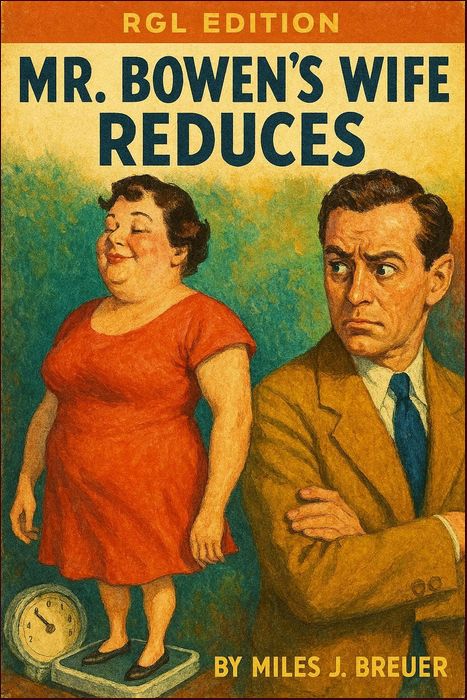
RGL e-Book Cover
Based on an image created with Microsoft Bing software
Roy Glashan's Library
Non sibi sed omnibus
Go to Home Page
This work is out of copyright in countries with a copyright
period of 70 years or less, after the year of the author's death.
If it is under copyright in your country of residence,
do not download or redistribute this file.
Original content added by RGL (e.g., introductions, notes,
RGL covers) is proprietary and protected by copyright.
RGL e-Book Cover
Based on an image created with Microsoft Bing software

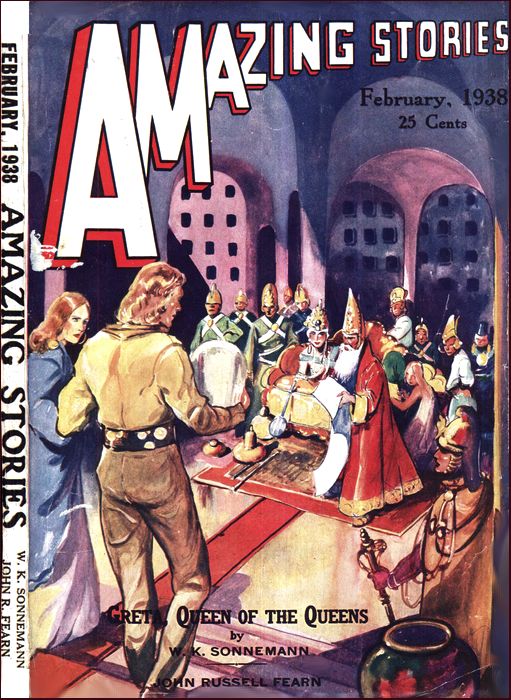
Amazing Stories, February 1938, with "Mr. Bowen's Wife Reduces"

Amazing Science Fiction Stories,
September 1970, with "Mr. Bowen's Wife Reduces"

This is a story of a little man with a wife who did not share that peculiarity.
THE speeding Ford V-8 never wavered an inch from its set route, even though a tremendous disturbance had taken place within it. Only Mr. Bowen's knuckles paled as his hands clenched the steering-wheel with unusual tightness, when, upon looking into the driving-mirror, he saw the sooty smudge on his collar, from his wife's fingers.
Mr. Bowen, in spite of all euphemism, would frankly have to be classified as a small man; five feet three inches and a hundred and ten pounds. He was also dressed with the most fastidious perfection. Every fold, every crease in the right place, not a speck of dust, colors and shades all correct, linen immaculate, except for the horrible smudge (one centimeter in diameter) on the wing of his collar. Furthermore, Mr. Bowen had a quick way about him, the way his eyes moved, the quick gestures of his hands, the way he handled the car.
His disturbance on beholding the gray smudge on the immaculate collar consisted of a silent seething, in which loathing and confusion were mingled. His foot went down on the clutch; the other foot approached the brake pedal. However, the barely perceptible and momentary slowing of the car smoothed back out into its swift progress toward town. For a moment it had occurred to him to drive back home and change his collar; but there was something about the idea that instantly repelled him.
He therefore stopped at a men's furnishing shop as soon as he reached the business district, and bought himself a new collar. Then he clenched his fists, cleared his throat, pondered a moment; and then went to the telephone and made an appointment.
"IT'S driving me crazy," he said to Mr. Leitz, of Hemingway, Dufay, and Leitz, Attorneys, pacing back and forth in their office.
"When I married her, she was trim, neat and vivacious!" he exclaimed.
"Now she weighs two hundred and twenty pounds, and is not even bright," he continued as the attorney waited.
"Not even clean!" he said with a shiver.
"Can't even see that she is driving me nuts. Thinks everything is all right."
"She is that stupid," he added, warming to his complaint.
"Always messing up everything for me. But cunning enough to see me look longingly at slim and lively girls, and to keep a fierce guard over me. Why, I'm practically in custody."
"Once we were happy together."
"Am I going to lose my reason?"
Mr. Leitz was a human sort of person. He did not jump at once to the idea of a divorce, as would have many a mercenary and unfeeling lawyer. He was sorry for the slow and unwieldy Mrs. Bowen, and did not like to think of her being kicked out in her unfortunate condition; not even to save Mr. Bowen's alleged reason. (Besides, Mr. Bowen did not look well enough off for a fat divorce fee and a pile of alimony.)
"Say, Doc!" he called up a medical friend of his. "Would you like to prevent a divorce?"
"Sure, Joe," the doctor replied, "if there is any chance of beating you out of a case."
He listened to the lawyer's tale, and then asked to see the lady.
"Dr. Hanot is a very brilliant man," said Joe Leitz to Mr. Bowen.
Mrs. Bowen followed her little husband stolidly along to the doctor's office, and submitted placidly to the quiz. She was undisturbed by having to lie on a high bed and have a trim and magnificently neat technician fasten things into her mouth for a test on some sort of machine. She took everything as it came, and offered no comment. Mr. Bowen hopped and twittered about the place, now here, now there, like some brilliant and nervous bird.
Even the needle in her arm did not disturb Mrs. Bowen.
"Substance recently isolated from a gland in certain animals," the doctor explained. "Injection once a week. Please be back next Thursday at 2 o'clock."
AT the end of the first week, Mr. Bowen was overjoyed. His wife had lost two pounds. His nimble imagination could already see her rapidly becoming her old, neat, slim self again; and he almost wept with joy. As he thought of the happiness that would bring him, and of the suffering he had gone through in the past two or three years, he became almost hysterical in his joyous anticipation. He was expansive as he drove his wife to the doctor's for the second injection. She hardly seemed to notice what he said.
During the second week, Mr. Bowen watched his wife anxiously every minute of the time. He could hardly contain himself from taking her to the scale and weighing her several times a day. At the end of it, three more pounds were off; and as he took her for the third injection, the world already seemed a different place.
At the end of the fifth week, Mrs. Bowen was definitely smaller. It could be seen at a glance. She was really smaller.
But there seemed to be something wrong about the whole proposition. Her figure was not getting graceful.
Driving along in the Ford V-8 one day, far from home—he was a traveling salesman for a notion house—he reasoned it all out, and it dawned on him that the drug was reducing his wife's stature as well as her girth. She was getting smaller in all dimensions.
He turned right around and drove back to his home city, and hurried up to the doctor's office.
"Don't give her any more of that stuff!" he exclaimed to the doctor.
The doctor patted him on the back.
"She was in about an hour ago and got her last shot," the doctor said. "Now, don't worry; she'll be all right."
MR. BOWEN left the doctor's office, as most of us do, superficially convinced and internally torn by doubts and fears. There followed for him weeks of mental torture which were far worse than those previous months when he had feared he was losing his mind.
For, as he watched her day by day, his wife continued losing weight—and growing smaller! Before his eyes, she grew literally smaller; she was becoming a dwarf. Finally, when he thought he could stand it no longer, he rushed in terrified desperation to the office of Attorney Leitz. His torrent of anxious words alarmed the lawyer, and he accompanied the confused and anxious little man to Dr. Hanot's office.
Mr. Bowen did not remember getting any satisfaction out of either the lawyer or the doctor. They both patted his shoulder in turn. At the moment their explanations seemed satisfactory, and he went out of the office reassured. However, the moment he was in his car again, the doubts began to return. It was all very suspicious. It seemed that they were conspiring against him, and trying to talk him out of something that he could see with his own eyes. Perhaps the two of them were in conspiracy with his wife. When he got home again, there was his wife, the size of a nine-year-old child.
IN another six weeks of agonizing mental torture for Mr. Bowen (during which however, he managed to get about and get orders for notions), she was only two feet high. The devastating thing about it was that Mrs. Bowen did not seem to realize that there was anything wrong or out of the way about the whole business. She insisted on going out to dances and parties with him and mortifying him. She seemed to take especial delight in being with him among people, which made him shiver in shame. He was conscious of everyone staring at his dumpy, waddling companion, tiny, down near the floor beside him. Always it seemed that he could not live another minute. It was always a relief when they got home and closed the door behind them on the outside world. There was no use in protesting to her, nor to anyone else. He bore it in silence.
IT finally came to the point where he refused to go out with her. She was too small. It was odd that she herself did not seem to pay any attention to her small size, nor to be put out about it in any way. If anything, she was more sympathetic with him since she had become tiny, than she had been previously. But, it was all very horrible for Mr. Bowen. When she was only three inches high she was still two inches wide. How could he go about outside, with her that way? Not only did it look impossibly silly; but something might happen to her; he might even lose her.
He did lose her. One day he rushed wild-eyed and dazed into Mr. Leitz's office.
"I have lost her!" he shrieked.
"She got so small, I couldn't see her," he replied to the lawyer's inquiry. "She must have slipped into a crack somewhere, and fallen—"
"She just got so small, I couldn't keep track of her."
The lawyer tried to comfort him, and spoke empty words, that it would come out all right. It was all very conventional comforting, but it was not at all to the point, and did nothing about the fact that Mrs. Bowen had gotten so small that she had disappeared.
"But, they will accuse me of murder. They will think I made away with her," Mr. Bowen urged, wringing his hands.
"Nobody thinks that," the lawyer smiled. "Besides, unless there is a dead body, no one can prove a murder, you know." He did not seem to take the matter very seriously, it seemed to Mr. Bowen.
"Nobody believes me," thought Mr. Bowen.
Oddly enough, though, he felt somewhat consoled as he went out of Mr. Leitz's office. He went to his lonely home, and wept for his vanished wife. Disconsolately he read the evening paper. But there the headlines told him about an Ohio minister burning his wife's body completely in the furnace; but later the deed was proved against him by the identification of the gold from her teeth. Mr. Bowen was in a sweat of panic again.
Then there was a knock at the front door. Already they were after him! Me went out of the back door, and ran.
HE fled out of the city to the mountain. It was a beautiful mountain, several miles away, in plain sight of the city. It was one of the "sights" of the city. He had often admired it: the play of the sunrise behind it and of the sunset upon it; the change in colors from the greenness at the bottom to the blue at the top; of the mysterious valleys and peaks below the highest soaring point that was always fringed with white, fluffy clouds.
He had often meant to go to this mountain; just to explore around in a leisurely way, some time during some lull in his busy life. But he had always been busy; the lull had never come. A multiplicity of details absorbed his life. They prevented his doing big things or enjoying himself, and yet after they were all done, of what value were they to anyone. This was the long wished-for lull. Now he would use it to explore the mountain.
When he reached the mountain and was upon the side of it, it seemed still more beautiful. He loved the green of the trees, the grass in the lower parts and the pine woods above. He loved the sparkle and plash of the brooks, and the crunch of stones under his feet.
He spent hours wandering around, merely enjoying himself, drinking from the streams. He heard no sounds of pursuit, and forgot the possibility of it, until he lay down to rest beside a stream that wandered among the pine trees. Then there were voices in the distance. Again he got up and went on.
He came to a tall, steel fence that stretched impassable across his path. Through it he could see a park-like estate within; it was even more beautiful in there than without. He turned to the right and followed the fence, until he came to a stone gate which was marked: "Private Estate of Andrew Clayton."
ANDREW CLAYTON was a chain-store magnate. Mr. Bowen had met him personally in a business way long ago. At that time Mr. Clayton had been friendly and genial. He had said:
"If you ever pass my place, I want you to stop in, and we will shoot some pheasants."
At the time he had not believed that the big man had meant it; but he had in the meanwhile often imagined himself shooting pheasants with the man who owned half the chain stores in his territory.
On the gate, there was a button to push, and a transmitter to speak into.
Servants graciously conducted Mr. Bowen into the presence of the magnate. Mr. Clayton was glad to see him, and made him feel at home at once. He did not even inquire how Mr. Bowen happened to be up that way. He suggested pheasant-shooting quite promptly. It seemed that all these years, he had been expecting Mr. Bowen. In the afternoon, Mr. Clayton took Mr. Bowen and two other gentlemen pheasant-hunting in the wire enclosure, which seemed to cover many square miles. Mr. Bowen was happy because no pursuers could get in there.
The next day, Mr. Bowen decided that he ought to leave.
"I've had a mighty good time," he said to Mr. Clayton. "But I must not be a burden on you, and I've got to get along."
"If you are really enjoying yourself, why hurry away?" Mr. Clayton urged.
"How long do you think I ought to stay?" Mr. Bowen asked, nothing loath.
"Why decide upon that now?" Mr. Clayton solved it simply.
So, he stayed happily on. There was tennis to play. How hungrily he had wanted to play tennis since his student days! He sat languidly in the afternoons and read books which he had been longing to read for many years, but had been too busy. Life had been a constant drive. Always he had had to do what other people did or what other people wanted him to do, and never what he liked. Here was a chance for some relaxation.
Mr. Clayton's servants were remarkably intelligent and capable people. Mr. Bowen had never been used to having servants do things for him, and to be looked after in smallest details. It was all very gratifying, and made him feel quite important and big.
Mr. Clayton and the house guests were charming. This was Mr. Bowen's opportunity to cultivate the ladies, and he made the most of it. A great hunger was fulfilled in him, in just being able to sit about in a leisurely way and talk to them—especially in the evening on the big veranda with no lights except the moon. They looked thrilling and charming in light-colored wraps.
DAYS and nights passed. He tried to count them, but desisted. Why worry with counting, when other things occupied his attention. The big thrill came several nights after he arrived. One of the ladies agreed to walk with him in the evening by moonlight. Ever since the middle of the afternoon, when they had agreed on the evening walk, his heart bounced away at high speed. She was a very charming lady, about twenty-eight years old, with a most winning smile and an engaging way of talking about everything. She was very beautiful, slim, and petite.
It was a beautiful walk at night with the big round moon over the black pines. All round was the security of the steel fence, to keep out intrusion and trouble from the Outside.
The next afternoon they walked again. She was neat. She smiled. She was interested in him and considerate of him. Again he caught a glimpse of the steel fence. By daylight the thoughts it aroused were different. It made him worry about the time he must think of getting away from here; he could not continue to impose forever on Mr. Clayton's hospitality. He would have to go away. Where would he go?
Then came the thought of his lost wife. The jerky feeling in him changed his mood. But Mrs. Bowman did not even ask him why he felt so sad. She seemed to understand. She understood everything.
He did not want to go home. He wanted more days to talk to her; and many evenings. He loved her by the light of the moon. He asked her for another evening at once. That was nerve! However, she was happy to give it. She was a most friendly lady. Again the thought of his wife barged in, her unwieldiness and her persecution of him. He realized that he was glad that he was not at home. He was glad that she was lost. But on top of that he was worried with thinking he was doing wrong.
In the evening he told Mrs. Bowman that he disliked to think of going away, but that he must no longer continue to take unfair advantage of Mr. Clayton's hospitality.
"Perhaps we shall meet again."
"Do not worry, and try to be happy right now," she said with her bright smile, and seemed quite satisfied about it all.
She was very beautiful. What a contrast to his fat, stupid wife! He realized now how he had really hated his wife, but had refused to admit it to himself. That world back there was indeed a most tragic, difficult and confusing place. He wished that he could stay on at Mr. Clayton's forever. There were some of the guests at least, who seemed to be staying as long as he was.
TIME passed. Mr. Bowen did not know how much. It must have been weeks, though, for here was another evening with a full moon over the black pines. They were beautiful weeks, out of which he had spent with Mrs. Bowman all of the time that men and women guests could find opportunity for being together. When he was in his own room, he could hardly wait for the time to come when he would see her again.
At the same time, thoughts of his job back there in that world came to torture him. The idea of having to go back there brought a sort of terror with it. He knew that if he tried to explain how he had lost the wife whom he had disliked so much, no one would believe him.
There was no question that he was in love with Mrs. Bowman. Of course, such a thing must not go on. His mind was fully made up to that. He could see that she also liked him, and he could not permit her to drift into some kind of a shady affair. He was no kind of person for an honorable woman to be mixed up with. The sooner he broke it up the better it would be for both of them.
It took courage. However, he felt stronger now. He was rested. He was not nervous any more. He was able to stand up and go back and face the music. He would go to the police and tell his story and face the consequences.
"I'm a sort of murderer," he said to Mrs. Bowman, in his effort to explain why he must go away.
"I've killed my wife. Not exactly killed her, but it was my fault that she got lost and disappeared. I did not take the proper care of her. It was all my fault that she got so small."
Mrs. Bowman looked beautiful, but said nothing.
"The companionship with you has been wonderful," he said to Mrs. Bowman. "I hate to leave. But I've got to. I'm going. I shall never forget your kindness."
She still did not say anything, but listened and looked at him with wide-open, amazed eyes. That made it harder for him to go. He could see that she thought a great deal of him. He could even see that she did not want to lose him.
"Don't you want me to go?" he asked.
She shook her head, and a strange light came into her eyes. That made him still bolder.
"Do you mind very much that I fell so foolishly in love with you?"
"No!" she breathed, scarcely audibly. "I have been waiting. A long time."
Mr. Bowen was dazed. Things whirled with him.
"I love you! I love you!" he exclaimed, and repeated it many times, and held her hand in two of his and gazed at it intently, as if in that pale hand lay the answer to all his puzzles.
She seemed happy and pleased, but could not speak.
"Let us both go away tomorrow. Together. And do things!" He held his breath awaiting her answer.
"Yes!"
Radiantly, she spread her arms wide for him.
A STRANGE thing happened to Mr. Bowen. His brain swam. Things clouded and changed about him. He was not unconscious. The change was all in the outer world. Then, suddenly, everything cleared. A wide, solid bridge seemed suddenly to extend back to the morning when he had found the smudge on his collar in the driving-mirror of his Ford V-8.
There was his wife in the room with him. But it was the slim, bright-eyed girl, full of laughing life, whom he had first married. She was smiling at him with a mist in her eyes,—not the fat and sluggish creature who had haunted his recent months, but the beautiful wife of his romantic courtship days.
The room was a simple sitting room, somewhat like a hotel room. Outdoors was a park, grass, trees, flowerbeds; like nothing that he could remember ever having seen. There was something queer about the windows. There was a network on the outside. It was a network of heavy steel wire. When in a moment Mr. Clayton came in, he looked so thoroughly a physician, that there could be no question about it.
The actual steps by which the truth percolated into Mr. Bowen's mind were long and tedious and not interesting to tell about. In his memory the realization still seems a sudden transition rather than a slow development, and it is better that way. For, there never had been any mountain near the city, and Mr. Clayton's estate was a mental sanitarium. Mr. Bowen was now well and cured; but his enjoyable vacation with Mr. Clayton, who was really Dr. Beaton, the well known psychiatrist, was a period of treatment for a genuine mental breakdown.
"But you!" he exclaimed to his sweet and most adored wife. "That terrible—weight—and sluggishness! Certainly that was no illusion?"
"No," she replied. "Dr. Hanot recognized it at once, as a disease that is well known to medical men: hypothyroidism or myxedema. A little gland in the neck here—" her hand was inexpressibly graceful as she indicated her curved, white throat—"falls behind in its function. But it is easily cured by injections of an extract of the same gland from sheep."
"You poor dear," he said. "You've had a terrible time."
"No," she said, laying her hand on his shoulders; "you are the one who has had the terrible time. Dr. Beaton says that your illusion of my growing small was merely a symbol of what you thought of me, and what you wished —especially when I disappeared in a crack in the floor."
Dr. Beaton shook hands with him.
"Your company is anxious for you to get back on your territory," he said. He was an excellent psychiatrist.
Roy Glashan's Library
Non sibi sed omnibus
Go to Home Page
This work is out of copyright in countries with a copyright
period of 70 years or less, after the year of the author's death.
If it is under copyright in your country of residence,
do not download or redistribute this file.
Original content added by RGL (e.g., introductions, notes,
RGL covers) is proprietary and protected by copyright.