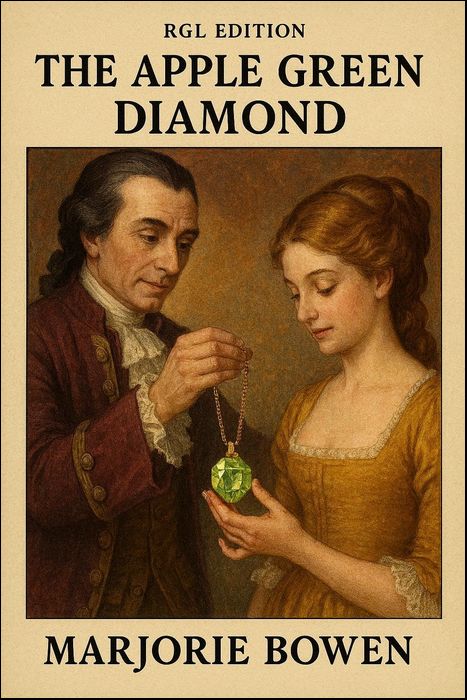
RGL e-Book Cover
Based on an image created with Microsoft Bing software
Roy Glashan's Library
Non sibi sed omnibus
Go to Home Page
This work is out of copyright in countries with a copyright
period of 70 years or less, after the year of the author's death.
If it is under copyright in your country of residence,
do not download or redistribute this file.
Original content added by RGL (e.g., introductions, notes,
RGL covers) is proprietary and protected by copyright.
RGL e-Book Cover
Based on an image created with Microsoft Bing software
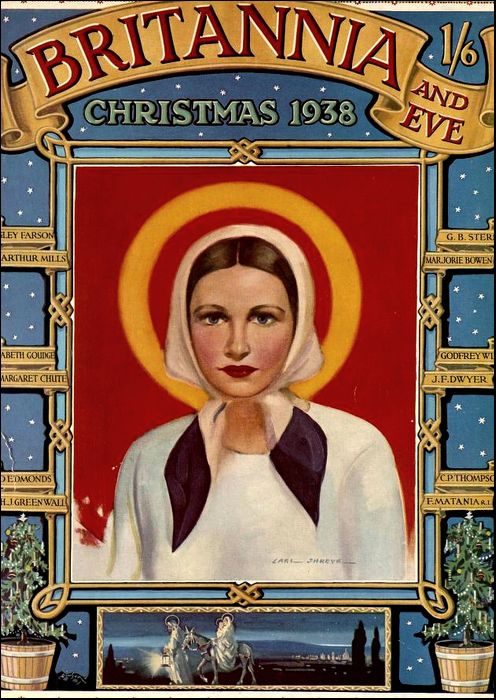
Britannian and Eve, December 1938, with "The Apple Green Diamond"
The Comte de Saint Germain was one of the most mysterious persons of the eighteenth century, that period that abounded in adventurers and charlatans. His origin was unknown, his wealth seemed to be boundless and his friends numbered the most powerful and famous people in Europe. His claims were wildly extravagant, but he found many who believed him to be the Devil himself. Who he really was is still unknown, but it is certain that the name "St. Germain" was assumed. The following is one of the countless legends and stories of which he is the central figure.
LOUISE LANGALLERIE was promised in marriage to the Prince de Croy and if she did not admit to loving him, she was pleased enough with the match that was in "every way suitable" as her aunt, Madame de Guerchy, said.
Louise was one of five sisters who had not so much in the way of money as they had in beauty and it was really very fortunate, her friends thought, that she had made so good a match; she had been brought up in the country and M. de Croy had seen her during a hunting party when he had called at her father's chateau for refreshment.
Madame de Guerchy lived at court, she was lady-in- waiting to the Dauphine and ignored her country relatives, but when she heard how lucky Louise was, she asked her for the pleasure of a visit and Louise came to the Palace of Versailles in the December of the year 1760. Her marriage was to take place in the following month and M. de Croy was with his regiment in the garrison at Strasbourg.
"You are very young," said Madame de Guerchy, with disapproval. "And who is to teach you all that you ought to know?"
Louise felt very lonely; she wished that she had not been brought up in the country; there were very few girls at court and the young married women seemed indeed much older than she was; she regretted M. de Croy, yet wondered if she really loved him and feared that he would soon tire of her rustic prettiness.
The winter was severe; the lakes in the park were frozen, the trees were outlined in crystals and the air full of snowflakes. There were sledge and skating parties but Louise was unused to such sports and kept away. M. de Croy had many relatives but they did not make much of Louise, for as they said: "Perhaps, after all, Hyacinthe will not marry this little nobody."
M. de Croy wrote to her; he told her that he would return to Versailles for the Christmas festivals and he sent her a bouquet of precious stones to wear in her bodice and assured her that he loved her passionately.
Louise blushed when she received these letters and she wore the cluster of cold, brilliant flowers, but Strasbourg was a long way off, and supposing he never returned?
One day she put on her hood and cape of gibe- line and taking a loaf of bread went into the park to feed the birds. There were stiff, icy clouds overhead and a stretch of sky, clear like green water; the ground sparkled with frost that crunched beneath the furred boots that Louise wore.
She was glad to get away from the crowd of people who were amusing themselves on the frozen lake, from their sledges with swans' and herons' heads, from their black pages and lackeys and maids and dogs.
She hastened into the woods beyond the lawns; classic temples showed the whiteness of marble against the whiteness of the snow and a statue of Eros sparkled with icicles.
Louise paused under the bough of a vast oak tree and broke up her bread, scattering the crumbs far and wide. The birds set up a hungry twittering and fluttered to the ground ; they were common sparrows about whom no one concerned themselves save Louise, though there were gorgeous birds in the royal aviary that were very well cared for in the winter.
As Louise watched the birds, a brown monk approached her, he looked himself like a sparrow for he was drab and humble; his sandals made a track between the trees and his feet were blue and glazed with cold.
Louise made her reverence and suggested that the Franciscan should go into the house for warmth and food.
"There is no house here," he replied with a tender look at the birds, "only a palace. And the people in the kitchens are prouder than the people in the state apartments."
Louise was sorry because she knew that was true; she had not before seen a monk at court or anyone who was poor; at home it had been different, there had always been a warm welcome for wandering friars, beggars and straying travellers.
"Are there no cottages, or huts?" she asked, "where one could get some coffee or soup, my father? For I am cold, too."
"There are only," said the monk, "empty temples to pagan gods, and statues to heartless deities."
The birds had eaten all the bread, but they lingered, chirping in the snow that they had criss- crossed with hundreds of little claw-prints ; Louise considered and blushed.
"There is a woodcutter lives near the gates," she said at last. "He will be kind. Will you come with me there, father? I do not like to go to the palace either, for I am lonely and they laugh at me behind their fans."
So they went through the snowy wood and found the hut; the woodcutter gave them some vegetable soup and a piece of black bread.
The Franciscan had two little wooden crosses in his pouch; he gave one to the peasant and one to Louise Langallerie; then he gave them his blessing and went out through the little side gate that stood open while the great main gates were closed.
"My aunt will be angry with me," said Louise. "She will say that I am moping; I must return."
So she gave the woodcutter a piece of money and slipped the friar's cross into her bodice behind the jewels of M. de Croy.
No sooner had she stepped into the crisp, clear air than Louise noted a gentleman standing under one of the high, bare trees as if he was waiting for her; she was surprised and rather flattered, for, though she did not know his name, she had often seen him in attendance on the King and knew him to be a great gentleman.
"Ah, mademoiselle," said this personage smoothly. "I have long noticed you and rejoice at this opportunity of speaking to you."
"Indeed, monseigneur," said Louise with a curtsy. "You are very civil. I am only a country lady and feel rather lonely at court."
"So I have observed. I am the Comte St. Germain. You may have heard of me?"
She had, and not very favourably; she put up her mink muff to hide her flush of fear; he observed this and exclaimed with malice:
"I perceive that my fame has penetrated to the country even! Now what have you heard of me?"
"That you were a wonderful magician," stammered Louise. She was flattered at so great a personage noticing her, and made no demur when he fell into step beside her; she tried to remember at least some of the stories she had heard about him and glanced at him in some apprehension when she recalled that he was supposed to be a thousand years old and to have been present at the marriage feast at Cana and the Council of Trent.
The comte appeared to be no more than fifty years of age; had a dapper figure, a suave countenance, and several rubies of uncommon lustre in his ruffles.
"You must not believe," he remarked with condescension, "all the fables that you have heard of me—if it is true that I was not there when Nero watched Rome burning, it is equally true that I am a good deal older than I look, and that I know a good many precious secrets, even if I do not possess the elixir of life!"
Louise sighed; she felt excited and restless as if about to embark on some important adventure.
"I wish—I wish—" she stammered, and he took her up, gently:
"What do you wish? You are young, very pretty and about to be married to a rich young man."
Louise blushed at this praise and confessed: "In truth, I feel dull. M. de Croy is too long away and I am not at all sure that I care for him very much. Here at court I feel a nobody and my aunt snubs me continually."
"Would you like me to show you a few marvels, such as the apple green diamond?" demanded the comte.
"An apple green diamond!"
"No less. The lustre is the shade of an unripe apple, with undertones of sea and acid green and it shoots out long rays. You know that I have the secret both of washing and fusing diamonds and this is composed of a dozen flawless stones."
Louise instantly longed to see this marvellous gem, but she began to be afraid to be in the company of this magician; the wood seemed very desolate, the wind blew very cold and the palace was very far away. She even thought with tenderness of M. de Croy and faltered:
"Indeed, I must return to feed the birds."
"Perhaps you disbelieve me?" exclaimed M. St. Germain, with an air of offence. "Wait, I will show you an example of my power." He raised his hand and Louise beheld a chapel before them, standing bleakly amid bare trees.
M. St. Germain drew her towards it and the door flew open at their approach; they entered and found themselves in the presence of death.
THE chapel was hung with black velvet, stamped with
armorial bearings in silver; in the centre of the
white marble floor was a catafalque which was reached
by steps covered in black velvet. At each corner stood
a candelabrum, pyramid-shaped, of silver gilt, with
seven branches, each bearing an immense white candle
of pure wax.
At the head and at the foot of the catafalque burned other candelabra, each bearing eight immense candles.
By this light it was possible to see very clearly the coffin, covered with black velvet, and studded with gold nails, that rested on the bier; this was filled with black velvet cushions on which rested the body of a beautiful woman, wrapped in a winding sheet of crimson velvet, adorned with gold fringe, lace and pearls.
Round her head, which was uncovered, was a gold band to which was attached an agraffe of diamonds encircling a portrait.
Gentlemen-in-waiting, maids-of-honour, and pages stood in attitudes of grief, like so many statues, and a quivering vapour seemed to be over the whole scene so that it shimmered as if reflected in lightly-stirred water.
"Why do you show this to me?" exclaimed Louise shrinking back.
"It is your lover's first wife," said the comte. "Go closer and perceive that it is his portrait she is to be buried with; his heart is in her grave, and he only desires to marry you in order to continue his line."
The magician snapped his fingers and the scene vanished as Louise burst into tears.
"Now, perhaps," smiled her companion, "you will forget this man who never cared for you, and pay me a visit in the apartments that His Majesty has given me for my experiments?"
"No," sobbed Louise, struggling against the spell he was putting on her. "No."
"But I can show you the green diamond."
But Louise broke away from him and ran back to the palace. Breathless and crying she broke into her aunt's apartment and told her of her encounter with M. St. Germain.
Madame de Guerchy paled a little, but said coolly:
"You knew that M. de Croy had been married before!"
"I never thought about it! And never guessed he loved her only!"
"Bah! You are a sentimental fool! But avoid M. St. Germain." She added, uneasily, "He is very dangerous."
"Who is he?" asked Louise.
"No one knows. He appeared suddenly at court about three years ago. He has been all over the world—and to other places as well, I fear. He has many names and is an adept in many secret sciences; he speaks many languages, and though no one is sure who he is, he has many patrons."
Madame de Guerchy spoke fearfully.
"Pray," she added in a lower voice, "have nothing to do with this dreadful man. He has manifold abilities and talents; but everyone is afraid of him. All those in whom he has shown his interest have died or come to some terrible misfortune. I am indeed sorry that he has noticed you and I shall write to M. de Croy at once!"
"NO!" exclaimed Louise. "I am no longer betrothed to M. de Croy, who is still mourning his wife—and if I wish to see the green diamond, why should I not do so?"
"Green diamond!" exclaimed Madame de Guerchy. "Have nothing to do with his diamonds! He has them by the box load, but they are avoided like arsenic!"
"What makes you think him so evil?" asked Louise, whose fear of the magician was fading into a deep curiosity.
"Child, don't be foolish. It is believed that M. St. Germain is an emissary of Satan, or something not much better. As such he is always trying to snare souls." The gay lady crossed her breast. "And he likes in particular those who are young and innocent."
Louise shuddered at these earnest words.
"How then, madame, is it that he is tolerated at court?"
"He has given the King a panacea for lengthening life, and Madame de Pompadour a pomade for preserving her beauty," whispered Madame de Guerchy. "Besides, he tells wonderful stories— and every one at court is bored and grateful to him for amusing them."
She then made Louise promise to have nothing more to do with M. St. Germain, but the girl could not get the green diamond out of her mind; she looked at the stones in the bouquet that M. de Croy had sent her and how mean they appeared, like chips of glass!
FOR a few days Madame de Guerchy kept a watch on
the girl, then became again absorbed in her card-
playing and Louise was left to amuse herself. She
wandered about the long galleries, exchanging a few
words with acquaintances and feeling very
dissatisfied.
There were so many mirrors that she saw her own reflection a hundred times, and what a plain little country mouse she looked!
No wonder that the men ignored her, the women tossed their heads at her, and M. de Croy wanted her only out of convenience, to have a mistress for his great Paris hotel, and his vast country chateau.
She sank down in a window place and began to cry; all at once, as if he had been wrapped in a protecting cloud, M. St. Germain stood before her; Louise turned pale and rose.
"Remember that I am a man who cannot die and who knows everything, mademoiselle! You feel neglected, lonely! Now, if you were to wear the green diamond, how different everything would be!"
"Wear the green diamond!" whispered Louise. "Why, then surely I should attract a good deal of attention!"
"No one would look at anyone or anything else," the count answered her. "Besides, I could improve your beauty. I have wonderful recipes for rouge and powder, for pomade and perfume, such as were used by Cleopatra, Thais and Helen of Troy."
"But, my betrothed husband?" faltered Louise.
"Bah! You have seen where his heart is! Have you not already decided to break with him? Come, do you desire to be beautiful, or not?"
"I was always considered pretty," murmured Louise.
"Bah! No one looks at you, do they? Come to my apartments, and I shall show you a few of my secrets."
Louise no longer hesitated; she had lost count of time and place, she burnt with a desire to be beautiful, to have the court at her feet; she forgot her home and M. de Croy.
M. St. Germain lifed an arras and revealed a secret door; Louise followed him through this and down a long passage that was dimly lit by sparse lamps. At the end of this they entered a large chamber that was lofty, plainly furnished and had an unnatural air, for there were no windows and the light came from a lantern hung very high up.
St. Germain begged Louise to seat herself before a tall mirror and clapped his hands. A door opened in the smooth wall that was covered with grey damask and several maids came eagerly in bearing boxes and bottles.
Louise shuddered at their appearance, for they were grey, like the walls, and moved like automata; neat lace caps crowned their ape-like faces and they wore ash-coloured dresses and silver aprons.
The magician stood apart smiling while these attendants performed the toilet of Louise; when they had finished with her face and hair, they put a screen round her, whipped off her clothes and laced her into a dress of white cut velvet with a low corsage, a tight bodice, a huge hoop; they then —still in silence, not one of them had spoken a word—stood aside for her to look into the mirror. Now neither Louise nor her strange grey attendants noticed the modest little wooden cross that the friar had given her, that she had slipped inside her bodice; there it still lay, within her chemise, neither seen nor thought of by the excited young lady.
For, there was no doubt about it, she was becoming, under the ministrations of M. St. Germain's sprites, every moment more beautiful. When they had curled and powdered her brown hair, the white locks showed up the brilliancy of her eyes, the purity of her complexion; the rouging of her cheeks and lips made her appear older, wiser, more alluring. Never had she worn a dress cut so low and never had her bust, shoulders and arms shown to such advantage.
She could scarcely take her eyes from her reflection in the mirror, but, half remorsefully, she put her hand to take up the little bouquet of jewels that M. de Croy had sent her; but at that moment the magician entered the room, bearing a small casket.
"Bah!" he exclaimed. "You do not need to wear that tawdry stuff! The gems are very small—I doubt if they are even real— place this in your bosom my dear child."
He opened the casket and a light, like moonlight reflected from ice, filled the room. Louise exclaimed in rapture as the diamond, in a case lined with white velvet, was held under her gaze.
The colour was, in truth, that of an acid-green apple, but every facet was undershot with light in every dazzling tint of green, that is blue and yellow overlaid and blending into long dazzling shafts and rays of fire. Louise thought: "This is an unnatural colour, that of poison, of decay—"
"It is also that of plants, fruits and the ocean," smiled M. St. Germain, thus showing that he had read her thoughts. "Allow me to fasten it to your corsage. It is mounted with a clip of pure gold."
She shuddered as his cold fingers touched her flesh, but she felt transformed as the jewel blazed on her bosom. The grey attendants faded away, as if blasted by the beams of the apple-green diamond, and the mirror seemed to expand until it filled the entire room and Louise saw herself in a green radiance that flashed and sparkled with herself in the centre.
The light given forth by the jewel sent a greenish, pearl-like hue over her face, bare shoulders and bosom and sparkled on the crystals and silver thread of her dress like moonlight on snow.
M. St. Germain offered his arm to Louise, who thought no longer of her home, of M. de Croy, of Christmastide drawing so near, but only of her own beauty and the fact that she was wearing the green diamond. The doors of the magician's apartment flew open of their own volition, and M. St. Germain proceeded down the mirror gallery with Louise beside him, her finger-tips lightly resting on his brocade cuff.
IT was evening; the musicians were playing in the
gilt galleries and thousands of white wax candles had
been lit in the chandeliers of cut crystal. Yet all
this light was dim compared to that given out by the
green diamond. The courtiers who were waiting for the
King to pass through into the supper room, put up
their quizzing glasses and exclaimed: "What has that
mysterious St. Germain done now? He has made a woman
out of snow and moonlight and fire!"
For none of them could see, because of the lustre of the green diamond, that this great beauty was none other than Louise Langallerie, the rustic little charmer who had taken the fancy of the Prince de Croy.
Even the ladies were impressed, and drew back with curtsies, for they thought that the companion of M. St. Germain must be some great princess. For no one quite knew who the magician was, but it was generally assumed that he was some very important personage incognito.
"Are you enjoying yourself?" he asked Louise. "You will admit that I have some power!"
"What must I pay for this?" asked the girl with a sudden pang, as if something hard and sharp had pressed against her heart.
"We will talk about that presently," said M. St. Germain pleasantly; at that moment they passed Madame de Guerchy, who bowed low, not knowing Louise. The girl made no further protests, for the green diamond had another effect on her, besides entrancing her beauty it was chilling her heart, and the sole reason that it did not turn this completely to ice in her bosom was because of the forgotten wooden cross that lay inside her bodice. The courtiers stood aside to allow the King to pass; he came down the gallery, slowly and with a bored air as usual, but he was startled on looking round to perceive a green-like flash from every one of the mirrors that lined the walls.
He thought vaguely of the star that had guided the Wise Men and he ordered the purple velvet curtains to be drawn that he might see the sky. It was blank of stars, and the King, looking about him again, perceived that the light came from the bosom of a beautiful young woman who was standing quite near him, in a respectful attitude.
Madame Pompadour was beside him, but King Louis paused and gazed at the stranger as if he had never seen loveliness before. The magician whispered in the girl's ear: "You could take the place of Madame Pompadour and enslave the mightiest monarch in the world!"
Louise smiled; she looked with defiance at the favourite and with tenderness at the King, then when His Majesty had reluctantly gone on his way, M. St. Germain took his new protégée into the card room at the end of the gallery.
Louise had never entered this room that was hung with straw-coloured velvet and lit by five hundred candles, before. There was a large circular table in the centre of the room and round this pressed a crowd of men and women with fevered, haggard faces, their anxiety showing through their elegance and their paint; for here came those to whom gambling had become a madness and a ruin; those who used the cards as a diversion merely used the little alcoves in the galleries.
To this room experienced gamblers enticed young nobles who had just made their entrée to court and here women of boundless extravagance, pressed by creditors, came to gamble their jewels on a throw of a dice or a chance of the cards.
"Why should I play?" asked Louise; she felt oppressed, for indeed the air was heavy with a miasma of evil, and what of her heart was not frozen by the apple green diamond stirred in shame and terror.
But M. St. Germain made way for her, obsessed as the gamblers were by their passion, they yet recognised him and shrank from him and allowed his companion to approach the table that was piled with cards, dice, and pyramids of gold. Obeying the whispered instructions of the magician, Louise played, staking on the numbers he told her, for the company were hazarding on a wheel that a tall man with a long white staff, spun at intervals.
Louise won every time she put her stake down, and her companions shrank away from her sinister good luck, and the blaze of the green diamond. Suddenly a clock struck and M. St. Germain touched Louise on the shoulder.
"We must go now, for I have other work to do, but meet me to-morrow evening and we will have supper together." As he spoke the room, the gamblers, the light of the five hundred candles, faded together and all the gold that Louise had been holding fell out of her hands in the shape of breadcrumbs; she found herself in the park with the dusk falling, throwing bread to the little brown birds.
Before her stood M. St. Germain with a smile on his face and in his cravat the green diamond that now cast forth a more subdued ray.
"Oh, you have made fun of me!" exclaimed Louise, looking down at her ordinary clothes. "You have deceived me!"
"Not at all, I merely showed you what it was like to be admired and rich—to be gazed at by a king and to handle gold by the heap. In short, I gave you a taste of my favours. You have taken my fancy and I am prepared to renew them."
LOUISE, now that she no longer wore the green
diamond had recovered most of her human feeling, but
her heart was still cold from contact with the icy
stone, and she was infected with a great longing to
wear it again.
"Allow me to escort you to the palace," said M. St. Germain, "it is dark and cold." Louise felt very humiliated as she passed again through the groups of courtiers in the long gallery of mirrors and no one took any notice of her at all; she heard several people earnestly disputing the identity of the lady who had lately been seen with M. St. Germain and whose beauty had been literally dazzling.
Louise looked at her companion; she noticed that the green diamond he wore had shrunk to the size of a pin point and was, indeed, almost invisible.
As she passed Madame de Guerchy she heard her aunt whisper: "What an extraordinary man M. St. Germain is! He was last seen with a distinguished and lovely stranger and now he is escorting poor little Louise who is really very insignificant."
The magician left the girl at the door of her apartment and she crept into bed feeling strange, excited and restless. She could not sleep, but stood for a long while at the window listening to the bell-ringers practising the Christmas chimes and trying to think of the peaceful merry Christmastide she had enjoyed at home, but her mind was on the green diamond and the beauty and power it had given her—so entrancingly, so briefly.
NOW it chanced that M. de Croy had obtained leave
from his duties at Strasbourg and was hastening home
to spend Christmas with his betrothed; there was not
time to let her know of this for he intended to travel
faster than any post, but as it happened he
encountered a great storm of snow and was forced to
put up at a post-house to rest the weary horses,
himself and his servants.
The tempest continued and M. de Croy, to his intense annoyance found it impossible to continue; he would have risked all possible danger to himself, but no one would guide him and this part of the country was unknown to him; so he sat, fuming, in the parlour of the hostelry, for he was very much in love with his country bride.
As he gazed impatiently into the flames of the great fire, trying to control himself into the composure suitable to his rank, a brown-habited friar entered the room and meekly, in God's name, greeted the young gentleman. M. de Croy was respectful and offered the friar his chair; an expression of pleasure passed over the holy man's face.
"I perceive, monseigneur," he said, "that though you have youth, rank and wealth, you yet offer deference to a poor friar, and that although you are in a bad temper."
"You read me too clearly, my father!"
"If you knew the truth you would be in even more of a hurry. Your betrothed is in great danger of losing her immortal soul."
"Is it possible!" A look of horror passed over M. de Croy's handsome features.
"A magician is enchanting her. He has given her a green diamond, that he confused from the burning sands of Hell, to wear. When she puts it on again her heart will completely freeze. She will sign away her soul at his bidding and follow him to the ends of the earth and beyond, into perdition."
"I must start at once!" exclaimed M. de Croy, springing up so that all the gold lace on his uniform shook and the powder flew from his hair, "but how to obtain a guide!"
"There is white magic as well as black," smiled the friar. "I will guide you myself, monseigneur."
"You! Bare-footed, and in this storm! Besides, I don't suppose you can ride—"
The friar smiled away M. de Croy's objections.
"One must allow something for the fact that it is Christmas Eve. You are both kindhearted; your betrothed offered to find a bowl of soup for a poor wanderer and you offered me a chair by the fire. Come, monseigneur, order out your horse and I will meet you by the porch in a few minute's time."
With this, the brown-robed friar left the room.
"Of course, he is mad," said M. de Croy, "but I will chance that."
SO he called the host, bade his horse be prepared
and ordered his servants to wait until the storm had
subsided. At this there was a great outcry that the
prince was out of his wits, and all his people crowded
about him, begging him not to trust himself to the
crazy friar.
But M. de Croy wrapped his military cloak over his uniform, mounted his white horse and waited for the friar who duly appeared and murmuring a prayer, took the horse's bridle.
It was dark and the snow was falling so thickly that M. de Croy could not see his hand before him, but, after they had proceeded a little way through this murk, a pale light hovered in front of the friar and made a luminous path before him, while a gentle warmth enveloped the travellers, who began to move with incredible swiftness, passing through the storm with the swiftness of light itself. So, before Christmas Eve was over, they arrived at the great gates of Versailles and though these were closed, they passed through, up the great avenue, where the trees bent beneath their weight of snow, to that part of the vast palace where Louise had her rooms.
"Why do you take this trouble for me?" asked M. de Croy, humbly.
"You love her truly and with an undivided heart—she loves you, though the green diamond is making her forget that. I gave her a little cross," added the friar, "and she has kept that over her heart and that has prevented it from becoming quite frozen."
"I do not like to leave my horse in the storm," said M. de Croy, dismounting.
"Do not fear, you will find him quite safe in the morning."
So the young soldier followed the friar up the terrace steps, along the terrace, and through the window of Louise's apartments. She was seated at her dressing-table, with two grey attendants hovering about her, and before her stood M. St. Germain, holding the green diamond in his hand.
"But you really must, before I take you out to supper, throw away that ugly wooden cross," he was saying, as Louise hesitated, her greedy gaze on the diamond. The friar passed between her and M. St. Germain and boldly exclaimed:
"Back to your infernal outposts, fiend!"
The magician gave a cry of rage and terror, the diamond split into sharp flames and he disappeared in a rush of fire, the grey attendants being drawn away in the trailing smoke.
"Louise!" exclaimed M. de Croy, and clasped her in his arms.
Being no longer under the spell of M. St. Germain, she was delighted to see him and forgot about the vision of his first wife, for she saw that she was truly loved.
She also remembered the friar perfectly and when she heard of the service he had just rendered, she turned to thank him, but the holy man had gone.
"In my little room at home is a statue of St. Francis," she said, "and he found me when I was feeding the sparrows."
Then the lovers went on their knees and prayed together before they waited on Madame Guerchy to tell her that they were to be married immediately and before they had finished discussing their plans, the bells rang out for Christmas morning, and Louise took out the friar's gift from her bosom and kissed it humbly.
But M. St. Germain was driving in a sledge across the ice, wrapped in a protecting cloud, with the green diamond to light him on his wanderings.
Roy Glashan's Library
Non sibi sed omnibus
Go to Home Page
This work is out of copyright in countries with a copyright
period of 70 years or less, after the year of the author's death.
If it is under copyright in your country of residence,
do not download or redistribute this file.
Original content added by RGL (e.g., introductions, notes,
RGL covers) is proprietary and protected by copyright.