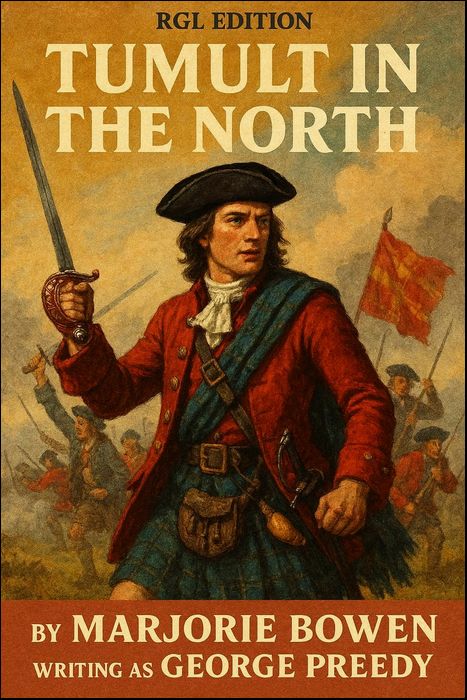
RGL e-Book Cover
Based on an image created with Microsoft Bing software
Roy Glashan's Library
Non sibi sed omnibus
Go to Home Page
This work is out of copyright in countries with a copyright
period of 70 years or less, after the year of the author's death.
If it is under copyright in your country of residence,
do not download or redistribute this file.
Original content added by RGL (e.g., introductions, notes,
RGL covers) is proprietary and protected by copyright.
RGL e-Book Cover
Based on an image created with Microsoft Bing software

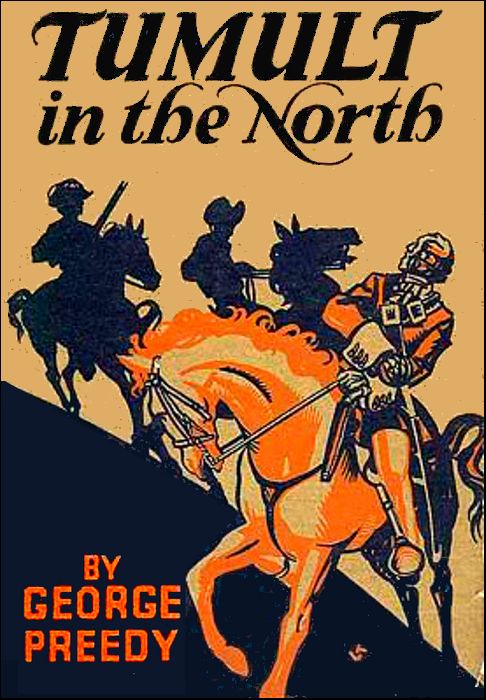
"Tumult In The North," Dodd, Mead, & Co. New York, 1931
"Tumult In The North," Dodd, Mead & Co., New York, 1931
"Tumult In The North," Dodd, Mead & Co., New York, 1931
"Lord, let the Angels praise thy Name,
Man is a Foolish Thing, a Foolish Thing,
Folly and Sin play all his Game,
His house still burns, and yet he still doth sing,
Man is but grass He knows it—fill the glass.
"As Dirty Hands foul all they touch,
And those Things most which are most Pure and Fine,
So our clay hearts, even when we crouch
To Sing Thy Praises make them less Divine.
Yet either this,
Or None—Thy Portion is."
George Herbert.
"Tumult in the North" is a historical romance set in early-18th-century northern England, during the tense years leading up to the Jacobite rising. It blends fact, legend, and invented characters from old Cumberland and Northumberland families. The story unfolds in the years when Queen Anne is dying and Jacobite hopes are rising. The northern Catholic gentry—wealthy, powerful, and long loyal to the Stuarts—are torn between prudence and the temptation to rebel....
The following novel is based on some facts and legends concerning an ancient family of Cumberland and Northumberland. Many episodes are imaginary, details have been added, some sequences of events altered, and the real names of the principal characters and places have not been used, out of respect to the dead and in deference to the descendants of the unhappy and loyal gentlemen whose motto was Sperare Est Timere; it being the opinion of the author that the names of once living people should not be used in a historical novel unless the writer intends to keep to the main truth concerning them. In the present instance some historical personages appear in the background of the story, and these have been treated according to the usually accepted historic version of their characters and actions.
In atmosphere and scenery, in details of period and in the attitude of mind of. the various protagonists in this drama of the past, no pains have been spared to avoid anachronisms. It might be added that precisely those incidents which appear most wild and improbable are those which are true and authenticated.
George R. Preedy.
Keswick, Cumberland, August, 1929.
MR. HARRY LOVELL was gambling at his ease; the bright coins chinked softly across the table; the gentlemen, absorbed in their game, were silent; bluish smoke rose slowly in rings round the crystal candelabra. A negro servant stirred a punch bowl. Through the smell of the spirit Mr. Lovell's nostrils were aware of the perfume of the white rose that drooped in the lapel of his coat.
He lost heavily and leant back in his chair. Glancing up indifferently he was aware of a stranger near him, a quiet, elderly man of a type not common to gambling houses. This personage looked at him earnestly through a pair of horn spectacles and, making a careless shift of his cloak, disclosed, pinned inside his waistcoat, a white rosebud.
Mr. Lovell yawned, stretched, declared he would play no more and got to his feet; his companion, with a secret grin, pocketed his winnings. It was agreeable to play with a reckless young rakehell who lost so coolly, the brother of Lord Langley, one of the richest men in England.
Mr. Lovell understood and resented the stranger's desire to speak with him; he detested politics and had a mind to little besides his pleasures. But the other pursued him with so fixed a glance that he feared the gamblers would notice it, even in the heat of their play. So he resolved to give the affair a natural air, and accosting the stranger demanded:
"Have I not met you, sir, in France?"
"No, Mr. Lovell, we have never met."
"But you know me?"
"From your likeness to your brother."
The stranger spoke modestly yet with dignity; he glanced round the room at the figures of the gamblers, bent over their cards and money, hazed by the smoke and the reddish candle light, at the tall impassive negro, half asleep, who drowsily stirred the punch over the small stove. Then he took from his pocket a card and showed it to Mr. Lovell in the palm of his hand. On this was written in bold characters:
"Go North."
Harry Lovell, of a persecuted faith and loyal to a lost cause and an exiled king, had an acquired prudence that did not belong to his years or his character.
He turned away carelessly, as the other slipped his hand into his breast, and picked up a soiled copy of The Gazette that lay on one of the disused tables. But from the corners of his fine dark eyes he watched the stranger pass unobtrusively through the tall door, and, throwing his embroidered mantle over his arm, and taking up his hat and gloves, followed.
The summer dawn was hyacinth pale over London; the narrow street was quiet in cold shadow; at the angle of the houses an oil lamp flared yellow.
The stranger was leaning against one of the road posts. Mr. Lovell approached him with some impatience.
"Hark ye, sir, though I'm a known Papist and there is no secret as to where my family leans in politics, I'll not be involved in intrigues against the government."
The other replied eagerly:
"For precisely that reason, sir, I sought you out."
"What d'ye mean then by 'Go North'?"
"There's all in that, Mr. Lovell. Were you to go North you would see for yourself what I fear to put into words in the open street."
"Sir, who are you?" asked Mr. Lovell dubiously.
"Edward Tunstall, your brother's chaplain at Develstone."
"He sent you to me?"
"Nay, I meddle on my own. But out of pure love and loyalty to your family, Mr. Harry."
This was spoken with so sober and honest a look and accent that the young man could not doubt the truth behind the words, so he answered warmly (for he had an easy, graceful way in everything):
"I am sorry, Father, that you should have been forced to seek me out in a gambling house."
"I feared to make myself too public," replied the priest quietly. "We are not tolerated In London as we are in the North. The government is very watchful. And you are abroad so often on your pleasures, Mr. Lovell," he added, without reproach, "that it has been difficult to find you. But tonight a friend put me on your way."
"Come home with me," said Mr. Lovell.
The priest protested; he would not be a tale bearer, or a reporter of gossip and rumour, he ,had no more to say than to advise Mr. Lovell to "go North." For himself he had come to London to see Father Giffard, the,Vicar-Apostolic—this inter-meddling of his was but by the way and arising out of his anxious loyalty to the House of Lovell.
The young man listened courteously, but the expression on his handsome face was amused and mocking. They walked slowly down the chill dim street, a pure breeze in their faces, the last glimpse of the stars fading overhead.
"I know something of your troubles, Father. My brother is entangled with a rustic coquette, eh?"
The priest was startled. "You've heard that then?"
"Ay, I have my gossips in Cumberland, good souls who write me all the tattle—but what of it? Tis Frank's own affair."
"I did not wish to stir you about that, but to rouse you on a far more serious matter," replied Edward Tunstall anxiously. "I am sorry," he added heavily, "that they begin to talk of Blanche."
"From what I hear they have long been talking of her, whoever she may be," smiled Mr. Lovell, slightly. "Well, why should I disturb Frank's rustic idyll? I do very well in town."
"It is not what you think," replied the priest, troubled.
He had followed the young man without further protest and was brought to a pause before the town mansion of the Earl of Langley in Arlington Street, where Mr. Lovell lived very sumptuously in the idleness forced on him by his religion and his rank; for, as a Roman Catholic, he was unable to take any of the employments of honour and profit open to the Protestant nobility.
A lamp yet burned in the hall and threw a steady glow over the wide painted stairway. Mr. Lovell preceded the priest into a great chamber, lavishly gilt, with many mirrors that reflected a hundred times the candles in the girandole and threw back in fantastic warm shadows the superb figure of the young man, his dark, rich, generous good looks, at once gay and proud, the fine ardent eyes, the sweeping brows and the arched upper lip, the glowing incarnation of youth and health, the reddish dark ringlets so elegantly arranged.
The priest regarded him with a steadfast affection— "He is only twenty-three, a splendid creature, a Lovell, and as yet shows no taint of vice in his person," and Edward Tunstall added with deep regret in his heart, "This should have been the elder brother, the head of the House." And he was sorry, for he greatly loved the young Earl.
Harry Lovell seemed to sense something of the elder man's thought, for he looked at him, smiled and said:
"This is an idle life, is it not, Father?"
"Does it satisfy you?"
Still smiling Mr. Lovell evaded:
"What else can I do?"
"Go North," replied Father Tunstall with emphasis, "there is much for you to do there."
"Do you seek after all to incite me to join a rising, Father?" asked the young man quietly. "I hear rumours that in Scotland there is likely to be trouble, but, as I said, I'll not be in it."
"But your brother the Earl may be," sighed the priest.
Mr. Lovell was plainly startled.
"Nay, Frank would never be so foolish!" he exclaimed quickly.
"There are hot heads and high hearts in the North, Mr. Lovell, all the gentry are Roman Catholics and loyal to His Majesty, they only .wait a signal—"
"Such as?"
"The death of the present Protestant Queen, as they name Princess Anne, and the coming of the Duke of Brunswick."
" Tis hopeless!" cried Mr. Lovell. "I live in London near the Court; I know! A rebellion would only mean disaster for us all."
"So I believe, Mr. Lovell. Our best course is patience and the nursing of the privileges we have."
"So, too, thought Frank. He returned on license, swore not to disturb the government, was never one for intrigue or politics—what has occurred to change him?"
Father Tunstall replied:
"My lord your brother is the wealthiest man in the North, the chief of the oldest, noblest family—a family famous for loyalty to their Faith and King. There are many who work on him that 'tis his duty to sport the white cockade and ride for,the Stuart."
"But think what he stakes!" exclaimed Mr. Lovell, angry and alarmed. "There is no other who has so much to lose."
Father Tunstall knew that this was true. The young Earl of Langley, most powerful of the Border chiefs, ruled a territory that spread over three counties, his rent-roll and profits from coal and lead mines totalled more than the revenues of the Electorate of Hanover.
"My lord," replied the priest sadly, "is easily persuaded where Faith and honour argue."
"Frank was always a bit of a fool," remarked Mr. Lovell drily. "And you, Father, did well to come to me. I will certainly go North and endeavour to prevent this mischief."
"If I thought there was a chance, Mr. Lovell, I'd not persuade you to hold back."
"And nothing would hold me back," smiled Mr. Lovell. "But I know there is none."
He spoke advisedly; he and his brother the Earl had been brought up with the exiled Stuarts at the Court of St. Germains, in close companionship with the young Prince whom loyalists named James III; and Harry Lovell, shrewd, observant, level-headed, had realized how useless it was to look to France for help, how firmly the revolutionary establishment was settled in England, how utterly lost was the cause of the Stuarts.
It was he who had persuaded his brother to accept the offer to return to his estates on the understanding that he live peaceably without attempting to intrigue against the government, and the young exiled King (as in their hearts they fondly named him) had himself entreated them, with tears, to undertake no desperate folly on his behalf.
Mr. Lovell sat down at the table, unpinned the white rose from his coat and placed it before him.
"I thank you," he said gravely. T will go North and see Frank "keeps clear of all unreasonableness. I will remind him that he imperils me as well as himself, and thousands who would blindly follow him." Mr. Lovell paused and then added thoughtfully: "I suppose this is why Sir Hugh Vavasour has returned from France, why he, too, goes North to fish in troubled waters?"
The priest seemed surprised and troubled at this news; he stammered over the name till Mr. Lovell said drily:
"Yes, 'tis the father of Madame Belle, who was betrothed to Frank, then broke with him to go into a convent."
Father Tunstall asked carefully if the lady had remained in the convent and taken her final vows?
"Why, no, she left as suddenly as she entered. She is here in London with her father. They go to their estate in Yorkshire tomorrow."
Mr. Harry Lovell looked steadily at the priest, wondering how much he knew, wondering if he was aware how passionately Frank .had loved the wayward Belle, how overwhelmed he had been by her loss, how unavailingly he had striven, during the years of travel, to efface the memory of this sweet, bitter, early love of childhood, youth, of, perhaps, all his life.
Father Tunstall did not betray what he might know of this affair, but he appeared much distressed and asked if the young Earl was aware of the sudden reentry of the lady into the world?
"Why, no, I doubt he'll have heard. I was writing to tell him, but, since I'm going North, I'll take the news in person."
"You will go North?" Father Tunstall was gratified to find so much quickness of decision, such a steady resolution in this young Lovell, who was reputed to be a careless, heartless man of pleasure, that dangerous type that hides a wild, lawless heart and violent passions behind the most sophisticated breeding, and who uses a brilliant intellect and a fascinating person merely for purposes of self-indulgence.
Mr. Lovell continued to gaze at the wilting white rose and he smiled in mockery when the priest, rising, commended him for his zeal in posting to Cumberland to save his brother from a probable indiscretion... a possible disaster.
"Why, Father, there's all my interest on it. I'm Frank's heir till he marries. And his revenues supply my necessities."
"Your luxuries," thought the priest, glancing round at the handsome appointments. He knew that the young Earl was more than lavish with his younger brother. There was a deep, fond affection between these two, the last of their famous House. Mr. Lovell raised the white rose to brush it across his beautiful mouth.
"I've no mind for the ax at worst, exile at best, a life of beggary. I want to keep my head and the estates." He rose. "I shall, too. I have some influence with Frank."
"All the influence of a strong mind over a weak one," thought the priest, considering the superb vitality of the young man who stood there so cool, so sure of himself. Father Tunstall felt much relieved, almost easy in his mind that he had put this business which had so troubled him into the capable hands of Harry Lovell.
"It is Lord Mar and Lord Kenmure you must beware of, sir," he advised. "They are hot on a rising and will leave nothing undone to involve your brother. They meet— under the guise of a club for sport and jollity—at The Devil's Nosegay, a lonely inn on the Widrop Fells. All the Northern gentry gather there and, though the Whig magistrates are both timid and tolerant, they are watchful."
"Has it gone as far as that?" exclaimed Mr. Lovell. "I would I had known sooner!"
"I hoped some other friend would warn you, Mr. Lovell. I love my lord and detest to seem to play the spy on him."
"Well," answered the young man, "Frank is not yet openly a rebel and I'll see he never becomes one. What of this other affair?" he added, slightly. "Must I rescue Frank there, too? This Blanche you spoke of—some pastoral charmer who has had the impertinence to involve Frank—"
The priest interrupted with some sternness. "These ladies are friends of mine, and gentlewomen of breeding."
"So there are two of 'em?" smiled Mr. Lovell.
"Stepsisters." Father Tunstall explained himself with some embarrassment. "Mr. Maybraye, your father my late lord's steward for the Keswick estates, was a widower with one daughter, Miss Elisa, when he married a Huguenot lady, ruined but of birth, a refugee with a daughter also— though French, she, the daughter, has been brought up in the North, a charming creature, Mr. Lovell, this Blanche Vallot-Dangeau, and innocent to folly."
Mr. Lovell smiled aside; he believed that he knew the world rather better than this simple, serious old priest.
"How did she come to be spoken of with my brother, Father?"
"He felt lonely, sir, an alien in the North, in all but birth a Frenchman, and Blanche spoke French, and he is naturally so courteous and she lovely enough to make an impression on any man's heart."
"Then she should have been wed and sped before now."
"The rude yeomen of Cumberland are hardly suited to little Blanche," replied the priest, wistfully. "But her stepfather, before his death, was eager to marry her to one Thomas Shaftoe, a gentleman of some standing."
"The father was drowned, was he not?" asked Harry Lovell, "was it not he of whom Frank wrote in some distress?"
"Yes, in my lord's service—a sudden storm on the lake at night. A swift tragedy for these three women. No wonder my lord pensions and protects them. I greatly resent that scandal should have attacked them." The priest's face flushed. "Heretics though they be, and Mrs. Maybraye often intolerant and bitter, I pity and respect them."
"Thou art as simple and foolish as Frank," thought Mr. Lovell, good-humouredly eying Father Tunstall. He had his own opinion of the three women whom the violent death of a trusted servant had left on his brother's hands. One of my lord's neighbours had written to him—"Take heed lest this skilful French coquette do not beguile some promise of marriage out of my lord. She has broken off a sober match with, a yeoman of Bassenthwaite and is too often rambling with thy chivalrous brother."
" Tis all as may be," he said aloud. "When I go North I will deal with it. You'll lodge here tonight, Father?"
But the priest excused himself, he had his modest room with Father Giffard, he would compromise no one... he would see Mr. Harry in the North where he was returning immediately, and where they would be freer, on their own ground, surrounded by friends.
"I'm sorry to have broken in on your pleasures, Mr. Lovell," the kind old man added wistfully.
"I'm not so seduced by what takes the town," replied the other, smiling. " Tis all stale enough, and there is nothing to hold me."
When the priest had gone, Harry Lovell opened the shutters and allowed the hazy light of the summer dawn to fill the sumptuous room, and he repeated to himself, looking out onto the sky flushing with colour above the grim façade of the house opposite, "nothing to hold me."
There was an ache in that; no trust, no employment, no woman to hold him, either in town or anywhere. There were many women in London, as there had been in Paris, who would have gladly detained him, bound him—none whom he regretted.
He thought of his brother's wild devotion, at once passionate and spiritual, to Belle Vavasour, and wondered if love like that would ever come, his way.
And this reflection brought a loneliness to his proud, self-scornful spirit, for he did not think that it would be so. He had been too often cheated by love's counterfeit.
"And Frank? Does Frank remain faithful to Belle? And what is this entanglement with a rustic light o' love? And what will Frank do when he knows Belle is free again?"
Mr. Lovell shrugged his shoulders at his own questioning, went upstairs, roused his negro servant and told him to prepare all for an immediate journey North. "Haste and post haste North, Mustapha."
Then an odd secret impulse led him into a little-used room where his candle revealed furniture in holland covers, candelabra in muslin bags, thick air close with dust. Beside a walnut bureau a picture stood with face to the wall. When the young Earl was in town, it occupied the place of honour; when Mr. Lovell was master of the mansion it stood so, deposed, effaced. He turned it about, peered at it by the light of his candle, like one who puzzles for the answer to an enigma.
It was the portrait of a young girl in an oyster-white satin dress, holding a flesh-coloured gillyflower, her auburn hair falling in formal curls on her sloping shoulders, her gold eyes radiant in a fine, melancholy face. Belle Vavasour—painted just before she broke off one of the most splendid matches in Europe to become an Ursuline novice.
Mr. Harry Lovell frowned at the smooth painted countenance, there was something dangerous in that fair visage. And he had good cause to know just how dangerous.
He had ardently hoped that the convent would close forever on passionate Belle Vavasour. But she was free again, a bright mischief, on his hands.
He looked steadily at the portrait, and his own handsome face took on its most displeasing expression, one of angry cruelty, of intolerant contempt, as if he stared down an enemy.
And Harry Lovell thought of Belle Vavasour as an enemy.
She, too, was going North—"haste and post haste North."
MR. HARRY LOVELL rode rapidly North, only pausing to change horses at the great post-houses; he travelled with postillions, lackeys and body-servants, and made a stir with the extravagant quality of his magnificence that his brother had never made on his return to his estates six months before. Mr. Harry Lovell had not left the town reluctantly; he even wondered why he had not before gone North to view his birthright, why a disheartened indolence had held him so long in the futile pleasures of London.
He felt, as he left the South behind, a stir to action, a sense of excitement, as if some flying hope lured him, he hardly knew why he travelled so swiftly, he felt as if he belonged to his destination and when, during the tedious journey, he leant back in the great coach, swinging on the leathers, and closed his eyes, he could see the scenes of his childhood.
He recalled walking along the shores of Derwentwater, the beauty of the lake, glittering in the last twilight, the dark, richly wooded islands casting long shadows into the still water, the sloping hills rising to majestic heights beyond the south bank, the pellucid skies of greenish pearl above in which sparkled with cold purity the evening star, Hesperus.
And his mood touched ecstasy as he thought he was returning home... a home of brightly remembered majesty, mountain and fell, tarn and beck, wood and pasture, where his ancestors had ruled for a thousand years. And, oddly mingled with the sounds of his impetuous haste, clatter of horses, sting of whips, rattle of wheels, seemed an unknown voice calling him North... North. And, mingled with the landscape that he glimpsed from the windows when he let the leathers down, the full summer trees, the purple hills, the fields of grain, the hedgerows heavy with fruiting flowers, there seemed to his excited fancy to be the outlines of a figure, with faint windblown hair and cloudy draperies, luring him North... North...
At York he sent a courier ahead to his brother at Derwentwater (for there the Earl resided while his larger mansion at Develstone was made ready) to apprise him of his approach.
He doubted if Frank, good-natured to a fault as he was, would welcome his interference either in his politics or his love affairs.
"But he shall not endanger the estates nor make a fool of himself with a village hussy." He was certain, for all Father Tunstall's praise, that this Blanche Vallot-Dangeau was no better, with a sly sister to help her and a scheming French mother In the background. "Frank is too unworldly. I must deal with them—buy 'em off, send 'em away."
As in the early morning his stately equipage prepared to take the great North road, a dusty coach with sweating horses came swinging into the inn yard. When the step was let down, Belle Vavasour appeared in the doorway and her glance met that of Harry Lovell in the clear morning sunlight.
"So, we have overtaken you, Harry," she smiled. "Father, we have overtaken Harry."
She descended into the sunny yard, holding up her long gown, quite at her ease. It was two years since he had last seen her, retiring with hysteric tears into the sanctuary of the Ursuline Convent.
She was not changed—the same Belle of Versailles, of the portrait holding the flesh-coloured gillyflowers, the same Belle whom Harry Lovell knew so well, passionate, determined, violent, beneath her fine airs and smooth breeding.
Sir Hugh Vavasour followed his daughter from the coach. Mr. Lovell knew him for a weak, harassed man who had pampered Belle, his heiress, until the wilful, motherless girl did what she would with him. At the exile court he had been a kindly, ineffectual, gracious figure; he was a hot Papist and Stuart's man, and would have been, Mr. Lovell thought, safer in France.
"I wanted to see you," said Belle, smiling straight at the young man. "I sent to Arlington Street, but you had gone."
"I was tired of the town; I had a mind to see the Border again."
This was all their greeting after two years, but her keen golden eyes showed him that she had not forgotten. He asked her if she went to her father's estate in Yorkshire.
"No, we are staying at Beaufronts, Mr. Errington's place near Hexham. We shall meet each other frequently, belike, Harry."
"Does Frank know this delight in store?"
Mr. Lovell spoke lightly, motioning to his postillions to mount. She saw that he would make no delay for her, and her proud eyes, with the impressive blank gaze, darkened. Sir Hugh put his daughter aside without ceremony; he was a preoccupied and anxious man.
"I'm thankful to meet you, Harry; you'll tell me honestly what you think of this"—his voice sank—"this scheme? I've been persuaded; you know Belle's loyalty and ardour—but, is there any bottom to it?"
"None, sir," replied Harry Lovell decidedly. "I go North to persuade Frank to keep clear of any breath of it."
"Then, if he keeps clear," said Sir Hugh Vavasour in dismay, "we can't prosper. He sways three counties— nay, we were counting on him."
"I know," interrupted Harry Lovell impatiently. "But, for God's sake, sir—I use His Name advisedly—be persuaded to prudence and discretion. For all hot heads say, a rising would be stupid folly. We should lose all we have —even our heads to the scaffold."
Sir Hugh did not answer; too well these direct words expressed his own opinion, but he was easily impressed, quickly overruled. He turned aside to the dark shadows of the wide inner door and nervously rubbed his chin.
"Pray, Belle," said Mr. Lovell, mounting his coach step, "persuade your father to the way of common sense. Whimsies of patriotism and loyalty indulged in now may ruin us all."
"You think I have come up here to intrigue?" she asked in a low voice.
"I know thee fanatic and dangerous, Belle." He looked over his shoulder at her and spoke gravely.
"Delay your journey." Belle Vavasour clasped her hands tightly together. "Harry, it is two years ago. You know why I broke with Frank and went into a convent."
She looked round at the crowded movement of this public place and added on a note of appeal:
"Stay a little, dine and travel with us. Have you nothing to say to me beyond a common greeting?"
"Nothing," replied Mr. Lovell coolly. "And look ye, my dear, don't burn your pretty fingers with any romantical plots. I'll engage to keep Frank out of 'em, and without him you can do nothing but ruin yourselves."
"Leave that, Harry, don't go—"
"I'm on a hasty errand, Belle."
He saluted her with a ceremony that the abruptness of his refusal made ironical, entered his coach and drove away, leaving her standing on the cobbles with her baggage and her maids about her, and her hand tightly over the heart that beat so quickly beneath the laces of her cravat.
When Harry Lovell reached Keswick he found that his courier had mistaken the road and arrived but an hour before; the Earl was therefore unaware of the close approach of his brother and was abroad.
It was early afternoon and the magnificent landscape was lashed by a steady sunshine seldom seen in the North. Harry Lovell felt his spirits mount as he was rowed across the lonely lake to his father's ancient mansion on Lord's Island; he was like a man looking eagerly for an expectant welcome.
But all about him were strangers—the stewards, the servants, the tenants, the townsfolk and peasants who had crowded about his coach in Keswick. His homecoming had been magnificent but lonely.
The mansion on the island had stood empty since my lord's father had followed his sovereign into exile in 1688, and it was partially dismantled, the apartments bare, the furnishings old-fashioned, the air chill with the silence of many years.
The Earl's stewards and friends had urged that he should proceed to Develstone in Northumberland where stood the noblest of his too numerous mansions, but my lord had lingered on Derwentwater as if he hesitated to travel farther North.
Furniture and plate, pictures, tapestries and sculptures had loaded heavy wagons lumbering from York; these were the trophies of my lord's grand tour and the furnishings of his Paris hotel; boats had crowded the lake carrying these riches to Lord's Island. The cases remained unpacked in the austere house—where all was in disarray, save in the few rooms my lord inhabited—and aroused the wonder of the neighbourhood. For they emphasized that the Earl was, in all but birth, a foreigner and alien to the land of his ancestors. Harry Lovell thought of this as he looked round the disarranged mansion and his heart went out to his brother who had inherited such heavy, such difficult responsibilities.
He thought of his brother's life in France, the fetes in the woods at Maili and Fontainebleau, the balls in the galerie des glaces at Versailles, the hunts, the concerts, the theatres... the Earl and the Due de Chartres were accounted the two most accomplished arlequinos. They had lived very agreeably, these English, attached with such deep loyalty to the Queen-Mother and the young King.
'This life will be difficult for Frank after that. Here all is wild and rude, even the gentlefolk have never seen a court, and, though the toleration is wide, there are restrictions which will never allow him to forget that the Protestants rule. He is the first Lovell to stay abroad so long." The younger brother put his hand on the papers on his desk in my lord's closet—rent-rolls, maps of his estates, accounts of his revenues from coal and plumbago mines. "See all this, it is too much." His face was grave. "Sixty thousand a year and a large capital—all these people on his hands or in his employ. It is too much for one man." And Harry Lovell thought of all those dead Lovells who had so steadily and cleverly built up this huge fortune, by marriage, by purchase, by buying out other heirs, from the 12th century to the present day. Manors, baronies, properties in Cumberland, Northumberland, Yorkshire, Lancaster and Westmorland... a great power vested in the Border Earl, largely kept intact down the centuries by intermarriages and the constant absorption of daughters into the Church; few dowries had needed to be carved from the garnered wealth of the Lovells whose women had again and again become Poor Clares at Gravelines or Aire, Benedictines at Bruges or Cambrai....
Harry Lovell could not see his brother In plaid and bonnet, with targe and claymore leading his men through the dark passes of Northumberland; my lord was more in place in the satins and masks of Arlequino, gracefully elegant, with a guitar hung with long ribbons, making music for a group of elegants in an allée at Maili, hung with the gay lamps of festival.
Mr. Lovell questioned Mr. Morpeth, the new steward, who had received him, about many things, but could not ask what he wished to know most keenly—how far his brother had gone in Jacobite intrigue, and what was the common opinion of Blanche Vallot-Dangeau, the girl whose name had been mentioned with that of my lord.
He did, however, bring up the matter of the late steward, Mr. Maybraye's death, but Mr. Morpeth, who was from Durham, knew little of it beyond that it was a tragic, sudden accident leaving three women destitute but for the kindness of my lord.
"They had the steward's house on Friar's Crag, sir, but now my lord has given them one in Keswick, and a pension."
"Do you know anything of 'em?" asked Mr. Lovell casually.
The steward was shrewd enough to know what was behind Mr. Lovell's indifferent air. No doubt he, even in London, had heard of the gossip.
"The girls are pretty creatures, no doubt of it, sir," he replied. "And little Blanche hath airs above her station. But the mother is much disliked—a hard, proud woman, ambitious and malicious."
"Well," smiled Mr. Lovell, "they are, in a manner, on our hands, since their father died in our service. Why don't my lord dower 'em and marry 'em off to tenant farmers?"
Mr. Morpeth answered drily:
"I fear, your honour, they have ideas above tenant farmers. I'm new to Keswick and don't know 'em, but one hears the chitchats, you'll understand, sir. This Blanche was as near betrothed to a hearty, substantial man, one Thomas Shaftoe, as makes no difference. But, on a sudden, she throws this luck away and will have none of him. Not even now, when she's penniless. Well, people talk."
"No doubt of it," remarked Mr. Lovell impatiently.
"And Esquire Shaftoe is very bitter, sir. He is a Whig, a J.P., and a Captain of the Militia—a very staunch government man, with his eyes wide open. And bitter," repeated Mr. Morpeth with meaning. "There is no question but that he was caught by that little French girl and feels the loss of her."
"He is dangerous—our enemy?"
"I would venture to say as much, your honour."
Mr. Lovell needed to hear no more; he understood all that Mr. Morpeth had meant him to understand. The boorish, rustic lover, this Shaftoe had been outraged because his wench had been dazzled by my lord's kindness; the impudent coquette and her designing harridan of a mother had endeavoured to enmesh the young Earl, possibly (though this seemed grotesque) to the extent of a promise of marriage.
"I think these three women had better leave Keswick," said Harry, smiling. "I'll see to it myself. My lord is too delicate-minded to understand the gross imputations that are put on kindness from one of his quality."
"But I'll swear thou knowest all about it," thought Mr. Morpeth with admiration. "Thou art the man shouldst have had this high title, this great fortune. No follies or mistakes for thee."
Harry Lovell was fatigued from long and rapid travelling, he was glad to lean in the window-place and gaze across the remembered beauty of the scene. Though his life was full of uncertainties and difficulties, his heart swelled with a thankful happiness that had no other foundation than the tender saffron of the sky behind the purpling hills, the purity of the air blowing on his tired face, the magnificent vista where the end of the lake passed between the mountains and an azure violet veiled the exquisite distance.
"I could live in this place all my days and love it well—'pox on the foul politics that make a man uneasy on his father's land!" He turned his handsome head, impatient of his own vexation, and asked Mr. Morpeth where the Earl was now.
"But half an hour before your honour's arrival, my lord left for The Devil's Nosegay on Widrop Fells."
Mr. Lovell remembered Father Tunstall's warning that the meetings at the lonely inn were, under disguise of a convivial club, gatherings of Jacobite conspirators.
He bluntly asked the steward (himself a Loyalist and a Papist) what truth there was in the priest's alarms on this point.
"Sir, I do not know," replied Mr. Morpeth uneasily.
"I am new to Keswick and not in the confidence of my lord. One hears so many half-tales and flicking rumours. It is true a number of gentry go to these meetings...."
"I'll go myself today," declared Harry Lovell resolutely. "Fetch me some servant to guide me. I remember Widrop Fells but not the way there."
"Is not your honour fatigued—to set out again so immediately?"
"I'd rather be uneasy in my limbs than in my mind, Morpeth. I'll see for myself how deep my lord goes. Look you, I've come from London to stop this gross folly. There are our lives on it."
Mr. Morpeth himself accompanied his master's brother; he thought it wiser to have no servants in this, beyond Peter Clark, my lord's man, who had gone with him to Widrop Fells.
When they landed on the Keswick shore and were waiting for their horses in the still afternoon, Harry Lovell, standing by the silver green alders that bent to the water's edge, saw a boat coming to the shallows where the spikes of sedges grew about the landing stage.
A solitary girl was in the boat, bending to her oars and singing. She wore a dress of grey Cumbrian wool and a black kerchief; her head was bare and a cloud of ringlets, the colour of dead leaf mould, was blown across her brow.
Harry Lovell, behind the alders, could see her very well, but she could not see him. She sang the old, melancholy Border ballads, yet her air was of untouched youth and happiness. As she sprang ashore and fastened her boat to the posts by the little wharf, he saw that she was tall, graceful, swift, that her face was rosy from the chill breeze that blew over the lake, that she was fresh, strong and fragrant as a beckside flower. She ceased singing and looked across the water in the attitude of listening. An eddy of wind blew back the humble gown showing the shapeliness of her fine outline.
Harry Lovell had a wild fancy that this was his real home-coming, the definite end of his journey. That here, revealed on the lakeside, in this summer solitude, was the veiled and flying figure that had beckoned him North.
He dropped the alder boughs he had caught apart. As the groom brought up the horses from the stables by the wharf, he asked:
"Morpeth, who is that girl who hath just got out from the boat?"
The steward glanced at the lonely figure walking away through the pines at the foot of Friars Crag. In her drab gown, black kerchief and dusky hair she was soon absorbed into the chill darkness cast by the black boughs, a shade among the shades.
"Why, sir, that is one of the wenches you spoke of— Elisa Maybraye, stepsister to the little Blanche."
Harry Lovell sprang into the saddle without replying to these dry words. He looked half-amused, half-angry, as one who has strong dreams but will not be deceived by them.
When they were, out on the solitary fells and but a mile from his destination, he dismissed the steward, saying he knew the way.
As he rode alone across the wide expanse of desolate moor he thought, mocking at his own fancy:
"Elisa Maybraye—'tis a pretty name."
EVEN in the sparkle of a summer day there was a forbidding gloom about the desolate mansion called The Devil's Nosegay and the lonely, sad-hued fells about the stone wall. Tradition and superstition equally oppressed the imagination with memories of spectres which nightly haunted these neglected stretches of coarse grass and heather. Here lingered the legends of old battles, murders and betrayals; the very family who had once inhabited the ill-named hostelry had been exterminated in some bloody feud and nothing but tales of woe and terror hung about the avoided spot, which the Roman Catholic gentlemen of the North had for this very reason chosen for their common meeting-place.
When Mr. Lovell arrived at the inn he found a larger gathering than he had expected.
All the gentry favourable to the cause of King James III had ridden from Northumberland, Cumberland and Westmorland, so that there was not sufficient accommodation for their horses; some animals were picketed along the road, giving the scene the appearance of preparation for battle, as if the Borderers were arming once again after years of peace. There was, however, no muster of common folk. All were gentlemen of arms, blood and estates, with a few yeomen-farmers, and Mr. Lovell was surprised, even alarmed, at their number. There were many there who were strangers to him, inoffensive-looking men in the guise of travellers who had come North under the pretence of a curiosity to see the country, attended by servants who were often no servants at all but priests in disguise.
The young man was received by all with cordiality, his name was sufficient passport to this company. He looked round for his brother, but the Earl had already taken his place at the long table in the great chamber. Mr. Lovell entered the press.
All the gentlemen were loud, jolly and at their ease. They snapped their fingers at the Whigs and the Protestant magistrates. Most of them could put a body of tenantry equal to a regiment into the field; all of them could dispose of considerable money. They were not used to any kind of restraint, and were too far from the seat of government ever to have felt its power. They laughed at authority as represented by the slender garrisons at Carlisle and Newcastle; they believed that by raising their various standards they could have the entire North at their heels, a force sufficient, they all confidently believed, to sweep as far as Derby in a triumphant progress.
Still keeping up a contemptuous pretence of being a convivial club, with the Duke of Norfolk in the chair, the gentlemen, who had spent hours in dining and drinking, gathered themselves round the long table. There were more than could find places there, and some stood round the room, crowding into the window-places and the doorways of the antechamber. They were served with drink and tobacco and the regalia of the Olney Club was placed before His Grace of Norfolk; matters which concerned them all were at once plunged into, and the two agents from London (as they were still laughingly called) were bid to make their report.
Mr. Lovell found these two gentlemen to be no less personages than the Earls of Mar and Kenmure, who had gone to the capital on the pretence of paying their duty to the sick Queen at Kensington, but in reality to sound the situation for His Majesty King James.
Mr. Lovell could no longer feel in any doubt as to the character of the gathering into which he had been so enthusiastically received. He looked about keenly for his brother and saw him seated, with downcast eyes, between two of his neighbours, great Border gentlemen of wealth and blood.
" Tis the last time thou shalt be seen in such mad, ranting company," thought Mr. Lovell angrily, and he withdrew among the crowd in the window-place, impatiently waiting for the conspirators (for he perceived they were no other) to make an end of their business. The young Earl, who was the object of his brother's affectionate and vexed regard, appeared out of place as well as ill at ease in that assembly.
He had nothing of the Border chieftain and little of the soldier. In everything he was grand seigneur, and made these others appear rude as they made him appear too much the courtier, with his elegance, amiability and exceptional good looks. He was no more than twenty-five and not above the middle stature, but of an athletic masculinity, and he carried himself with a grace that made the most of his inches. His hair was bright and abundant and his blond complexion emphasized the brightness of his charming countenance.
Yet he was not insipid or over-soft, for there were lines of a whimsical humour in the constantly smiling lips, dignity in the level brows and ardour in the pale grey eyes behind the oddly dark lashes. The clear skin was freckled and the irregularities in the features, the length of the face, the straightness of the nose, a smooth, fine, narrow look telling of breed and elegance, obviated any appearance of effeminacy.
"Thou art not fitted to cope with these impetuous fools," thought Harry Lovell, as he watched the young Earl sit silent, moodily playing with a paper knife while he heard the Northern gentlemen, one after the other, eagerly putting forward a list of their tenantry, of the arms and ammunition they could provide, and outlines of plans to surprise the garrisons of Carlisle, Newcastle and Preston, with suggestions for seizing the other various strongholds in the North; as he saw maps and plans produced, listened to passwords, reports and confident opinions exchanged, and heard no word of doubt or faltering.
Looking about him while these heated exchanges of boastful confidences took place, Mr. Lovell noticed, what before had been lost to him in the press and clamour, that there were several ladies present, in men's perukes, riding coats and beavers, wearing travelling vizors. These were not easily distinguishable from their male companions, but now Mr. Lovell could plainly see at least three of them seated in the window-place among a group of young cavaliers, and his heart was further sunk, for he knew the vehement, unreasoning patriotism and loyalty of the ladies, whose enthusiasm for the young exiled King was without bounds, and whose influence would be sure to be on the side of the most daring and desperate courses.
The young Earl was now urged by Lord Mar to declare his opinions, and Mr. Lovell listened anxiously as his brother rose, a little pale, for he was the youngest man there and the most important, and conscious of his foreign accent and his misnaming of the Cumbrian places. He hesitated in his speech and saw immediately that his hesitation had made an ill impression. A gentleman of his religion, his affections and sympathies was expected to declare himself passionately for the exiled King. But Harry Lovell was glad indeed that his brother seemed to hold back from the open reckless boasting of the others.
With obvious nervousness the young Earl spoke:
"My lords, I shall take it very kindly if you will put no doubt on my loyalty to His Majesty, but I am here under a license which involves the promise not to disturb the present government. I honestly wish to live at peace with my neighbours. We have secured a certain toleration and a certain goodwill and I entreat you not to jeopardize this by any inauspicious or ill-advised resolve. Gentlemen, we are called upon to show not so much daring as judgment."
The Earl paused. The gentlemen were all considering him in a kindly fashion but without sympathy. Yet he felt it his duty to add earnestly:
"Gentlemen, if we go too far now, we may be all laid by the heels and find ourselves in Newcastle gaol, or Lancaster Castle before the French ships have time to land our succours."
A silence encouraged him; he concluded with moving sincerity:
"Sirs, my lords, I have long been the companion and friend of His Majesty, and again and again I have heard him most ardently declare that sooner than jeopardize the lives of any of his subjects he would remain forever in exile. To risk a bloody and useless revolution is to risk breaking His Majesty's heart."
Lord Mar began to answer in angry tones, but the Duke of Ormonde interrupted him, and said in a kindly fashion:
"My Lord Langley's prudence is very commendable, but I do not think his lordship understands the good grounds we have for our hopes."
To this the Duke of Norfolk replied drily:
"My lord no doubt is considering what he hath to throw upon the hazard, one of the largest fortunes in England and all the prospects of fortunate youth, all, in brief, gentlemen, that life can offer.... But, there are others who have nearly as much at stake and who have not hesitated to put it all at the service of His Majesty."
The young Earl answered with dignity, looking from one to another:
"But, sirs, it seems a responsibility any man might shirk —to stir up a civil war; there hath been so much discord and bloodshed.... You talk of mustering your tenants, gentlemen! What will happen to these,wretched people in the case of failure? You talk of the ease with which our few Northern garrisons will be overpowered. The government can dispose of large trained forces—and what will our raw peasantry be against them?"
The Duke of Norfolk answered with some impatience:
"But there will be no government, my dear lord, when the present Queen is dead. Before the Duke of Brunswick could be gotten over we should be in London with the whole country risen in our favour. Such obstinate fanatics as cannot be bought or will not join us on principle will fly to Germany—the moment is ours for the lifting of a finger. In short, sirs," added the stout nobleman with an air of good-humoured confidence, "no task could be easier than that which we propose."
Harry Lovell was amazed at this robust self-confidence, which seemed to him to verge on boastfulness, and he found it hardly credible that this view should be, as it was, applauded by all, as if everyone had decided to put aside all judgment and prudence when they entered the dark doors of The Devil's Nosegay. He was relieved when his brother rose again and said with an air of impressive warning:
"My lords, I entreat you to remember what we have at issue. If we fail, our lives, our estates are forfeit, and all those dear to us and all those who follow us condemned to perpetual ruin. I know," he added with emphasis, "that in speaking thus to you I give you the mind of His Majesty, for he even, with tears in his eyes, entreated me when I was about to return to England, to stir up no broil that might endanger any."
These serious words, coming from a young man at once attractive and intelligent with his Stuart air and his cousinship to the King, did a little move some. Many of them were of that type which is swept along by the predominant feeling of the assembly in which they find themselves, and many of them, beneath a blustering self-confidence, had felt inner doubts. These now murmured applause for my lord's sentiments. Mr. Lovell was about to step forward, declare himself, and heartily support his brother, stating what he knew of the state of politics in London, when one of the masked women in the window-place came forward to the table. Several gentlemen rose and made way for her. Lord Langley glanced up and stared at her lithe figure in the bronze-coloured riding habit. Her beaver was pulled over a small black peruke. She took a chair hastily placed for her and, leaning forward, glanced confidently through the holes of her vizor round the eager and expectant assembly.
"My Lord Langley did not use to be so confident. He and I are of old acquaintance. I have heard him hold different opinions," she announced.
Her skilful voice was more than familiar to Mr. Lovell, who frowned angrily and watched his brother. The lady went on speaking in terms of the most impetuous and fiery loyalty to the Stuart cause. The Earl did not hear what she said. He poured himself out some wine from a bottle in front of him and drank and stared down at his empty glass, as if stifling, and wishing to be away from this heated and excited crowd, these brags and impatiences that seemed to corrode the Cause.
The lady had finished speaking; she impatiently pulled off her vizor. It was, as both the brothers had known from the first moment she began to speak, Belle Vavasour.
"I might have known," thought Harry Lovell angrily, "that thou wouldst put some such trick on me, vixen as thou art!"
He made his way impatiently through the surging, excited press and got to his brother's side, while the hot loyalists were close round Belle Vavasour, praising her spirit, her courage, her devotion.
The young Earl sat motionless in his place, silent, and thought only of the woman at the other end of the room, who had been restored to the world by what seemed to him no less a miracle than if she had come back from the grave. She was not then a nun—she had never taken the final vows—she had left the Convent of the Ursulines and was hotly engaged in this most perilous conspiracy... he wondered, sickened, why he had not heard this tremendous news before; he wondered, in despair, if she was married. He saw that her father was with her, they must have recently returned to the North.
"Frank, art thou bewitched? Tis I, Harry, come before my messenger."
The Earl turned, startled, but, seeing his brother, greeted him without surprise, so absorbed was he in another amaze.
"Ah, Harry, I had not seen thee, nor looked to see thee at The Devil's Nosegay."
"Let us get out of this press, Frank, we are hemmed in by dangerous braggarts. I do admire your prudence in what you advised just now."
The Earl seemed not to hear any of this. He said in a voice which, Mr. Lovell was ashamed to hear, shook:
"Harry, was not that Isabel Vavasour? Nay, what do I say? I know it was she. But canst thou discover if that is yet her name—and—and some news of her?" faltered the unfortunate young man. "And let Peter Clark bring me, too, I pray thee, some strong coffee, and bid him take my duty to Sir Hugh Vavasour and ask if I may wait on him... But she, tell me of her, Harry." Mr. Lovell answered grimly:
"She has left her convent and she is not wed. I met her in London. I' had meant to bring this news. But she is first."
"Harry, it hardly seems possible—" "I would it were not possible."
My lord rose, not noticing his brother's ill-humour. He took his arm.
"Harry, let us go into some inner room. All my senses ache. The heat here—and the noise..."
Peter Clark, quickly at his master's side, made way for them to a small closet that overlooked the moors at the back of the house, and there the Earl sank at once into one of the rude chairs and took his face in his hands.
"I see," said Mr. Lovell, eying him sternly, "that what has overcome you, Frank, is the sight of Belle Vavasour. I fear that you have never ceased to long for her."
The elder brother looked up, ignoring this, and asked:
"Has she come back to me, Harry? Not only to the world but to me?"
Harry shrugged, walking up and down impatiently.
"How should I know the mind of Belle Vavasour? I hope she will not lead you in politics, Frank, for she is a perilous fanatic."
"Help me in this, Harry, for I hardly know what I do. Ask Sir Hugh if I may wait on him—"
Mr. Lovell turned to the door, paused and asked abruptly:
. "Was there not some rustic coquette, Frank, who was supposed to have charmed away thy regrets for Belle?"
My lord stared uncomprehendingly at his brother, then faintly flushed.
"Have you heard that? You mean poor Maybraye's stepdaughter?"
"Ay, Blanche Vallot-Dangeau."
The Earl replied with emphasis and dignity:
"I am sorry it has become a matter for tattle. The young gentlewoman is the most innocent creature with whom I had the most ingenuous acquaintance—"
"But one you must have managed imprudently, my dear Frank. The tale reached me in London. I heard that she had broken off an honest match for you, and that her clownish lover was furiously malicious."
The Earl answered with impatient disgust:
"Thou art wrong, Harry, and all this is but gossipping lies. The maid could never tolerate Esquire Shaftoe, who is indeed boorish for her, but what should there be between her and myself? Nothing but a pleasant kindliness."
But the young man spoke uneasily and with an increasing embarrassment before his brother's steady, dark gaze. Innocent indeed were his relations with the lovely girl, but in 'his heart he could not deny that she had sweetly caught his fancy, healed his ache for Belle as no other woman had been able to.... Blanche Vallot-Dangeau, brought up since she was a little* child in Cumberland, as French as any lily growing in the valley of the Loire, in her grey gown of English wool, her childish purity and fairness, her early bloom and lustre, startingly radiant; gold, touched with silver, her airy ringlets hung to her waist, and her eyes of that unclouded blue which gives an angelic look to the innocence of extreme youth... no doubt but that she had half-enchanted him... last night, for the first time, he had kissed her... sweet Blanche discovered so unexpectedly in the grandeur of the North, a white bell-flower on the mountainside. He turned aside from Harry's half-mocking scrutiny—Harry, the town rake, would understand none of this.
In the moonlight she had been all silver, yet not the silver of gross metal but of tranquil water, through which the fulgent light flows, or snow with early beams on it, or a lily chalice hanging undisturbed in the dusk. He had lingered, regarding her tenderly, the large leaves of the still flowers encompassed her as she had stood on the steps, the moonlight had made even the shadows luminous. He remembered the echo... Blanche!... Blanche!... when he had called her name up the water-breaks of Lodore and a dank cavern with a Roman altar. He had held her hand between his, lingering; he had been touched by her simplicity—those were no studied looks she gave him, but a modest innocence unspoiled as the dayspring. He had kissed her timid hand and it had been more than a formal salutation, a sparkle of ecstasy had touched him unawares. There had seemed no dissent to happiness. He had raised his head from her hand, but a little higher to her face; their lips had touched, and a drowsy breeze, fanning the silver air, had stirred together their pale locks.
That was all.
As he had left her he had thought:
"She cares nothing for me, she is only a child—I have not disturbed her, but she has a little disturbed me."
But now Belle Vavasour had returned. The whole world was changed.
He came out of his musing to say vehemently:
"Indeed, Harry, you understand none of it. Torment me no more. Be a good fellow and go to Belle, and find her mind, for, faith! I cannot."
MR. LOVELL sent Peter Clark on his errand to seek out Sir Hugh Vavasour and his daughter, but Belle came to him where he stood by the mounting-block beneath the great signboard of The Devil's Nosegay.
"Nay, Belle, it was Frank who would see you—not I."
"You are resolute to that? You won't see me? Do you think I am quite to be despised? See what haste I made here—I passed you on the road."
"My negro was sick, that delayed me at Kendal."
Belle laughed.
"My luck—do you not a little believe in it? Listen, I importune you. See me, listen to me, and I'll let poor Frank be."
Harry Lovell answered with a darkening of his brows that was near a frown: "I cannot."
At this the lady turned and went delicately through the press of people to the little room where Peter Clark said my lord awaited her commands.
The young Earl was at the window and looked out upon that sweep of moors whose sombre aspect had no longer any power to depress his mood or overcast his heart. He would not have believed that it was possible for him to feel such emotion as moved him at this moment; he had not credited how he had longed for her during those two tedious years, how shallow and futile had been the resignation of which he had been so proud, with what reluctance he had resigned her to God. He was as one reprieved, reprieved from torment, from suspense, from vain struggles for patience; all discords and pain had left his life if she had returned, not only to the world, but to him.
Belle Vavasour opened the mean door and stood before him. He could not speak but remained in the window-place. She had taken off her travelling wig with her vizor; she held up her long riding skirt in an ungloved hand. A white rose was in her cravat, she looked at him with those large blue eyes which appeared to behold nothing; he had always been fascinated by her soft unseeing gaze as if she stared over the heads of all.
Though she had entangled him with such an irresistible passion, and had had many other suitors, Belle Vavasour was more agreeable than beautiful in aspect. She was lively and fine, genteel and spirited, her greatest charm lay in her pale, pure complexion and in the quantities of auburn curls which she cunningly arranged about her broad low brow. Her throat was rounded and white, her figure justly formed; she had the serene, slightly contemptuous air of a woman of fashion who is above praise or blame; her look seemed to say: "Few can give me anything and there is very little I would take from any."
"Oh, Belle," breathed the young man at last. "I did not know—I did not know!"
She came across the floor, smiling. Her full musical voice, rich and warm, held for him a thousand delightful associations.
"I did not want you to know, Frank. I would not let my father write. I thought it would be good for us to meet here today. After all, I have much to explain."
"Explain!" he exclaimed, overwhelmed. "Nay, to me nothing."
"To you, everything," said Miss Vavasour quickly. "I left you two years ago, I was wilful and headstrong, but perhaps a woman need not explain her caprices—**
He was almost shocked at that word on her lips.
"Caprices? But you would enter the Ursulines."
She hung her proud head which he had never before seen lowered in humility except in front of an altar.
"I was mistaken," she admitted hurriedly. "You, my father, the nuns, the priests—all were right. I had no vocation. I was made for the world, and all said it was no shame."
"Why did you not tell me? Surely, of all men I might have known—"
"How was I to feel assured that you still longed for any news of me?" she questioned in a voice of enchanting hesitation. "You were travelling—"
"Oh, Belle, I have suffered so much, I didn't know how much till now."
She stood opposite him and traced with her riding whip an aimless pattern on the dusty pane.
"Is it not fitting that we should meet here?" she asked. "I have often desired to come to one of these meetings and today my father brought me. I did not care so much about the cause—I wanted to see you, Frank."
He snatched her hand and pressed kisses upon it. She felt his tears on her fingers and her fine eyebrows went slightly up and her full upper lip curved.
"Still so fond, Frank?"
"Ah, how fond!" He thought that till this moment he had not known. He believed that it would not be possible for him to endure another two such years.
"Harry told me thou wert faithful."
She glanced with an odd expression over his bare head bent over her passive hand. She had rehearsed this moment in her mind many times and it was taking place exactly as she thought it would, so well did she know Francis Lovell. She asked carefully: "Wilt thou forgive me, Frank?"
The young man released her hand and asked her, hoarsely and almost incoherently, if she fooled him, if she was not only free, but his, protesting that he could endure no further divisions, doubts or delays. "For I have loved thee, Belle, beyond what any words of mine can say." He was too overborne by his own disturbed passion to notice how serene she remained, nor the blank look in her unseeing eyes and the little lift of lip and brow which gave her face an expression of irony.
She closed both her hands over her whip but with a deliberate, not a nervous, gesture and answered precisely:
"I left the Convent, Frank, because I was troubled by worldly thoughts and by a vast regret." Here there was no forced accent, but a deep note of pain.
He caught her in his arms with exclamations of rapture, yet she held him off and added:
"Yes, Frank, thoughts of love came between me and God, and I have returned to the world to fulfil, as I suppose, a common fate."
"How I have pined for thee! My prime delight, in what might have been a post for pleasure, was my hid dreams of thee."
"Thy humour still so fond?" she whispered against his heart. "So, some men can still be constant."
"Oh, Belle, if I had foreseen this, how patiently I had waited! But I thought thee caught up to God."
"Chide me, Frank, I have been wilful, all frailty, but I have not juggled with thy heart—I thought this was not for me, but I could not break the link that bound us."
At last, after the yearnings and the waiting, the heartbreak and the tedious strivings for patience and resignation, he held Belle Vavasour against his heart once more.
She returned his gentle caresses, and he was too snatched to heights of joy to notice her absent glance and the diffidence of her low voice. But she told him of practical affairs even while his arms were about her. They would stay, her father and herself, at Beaufronts, and might ride over and visit him at his mansion at Develstone which she had heard was mighty fine. "Frank, thou must speak up more boldly for His Majesty."
"I cannot talk of politics now, Belle."
"This is not politics, but loyalty."
"Nor of loyalty to any, save thyself."
She drew away from him an arm's length and laughed faintly and glanced him up and down as if she searched, almost eagerly, for some change in his person and bearing. He was the same, justly made, set off with every elegance, the fair, sensitive face bespeaking the lofty mind and the honest heart, the blue-grey eyes alight with warm tender love, with ingenuous trust; even in his ecstasy he wondered why she caught her lip between her even teeth and turned away with a glance askance.
"Art thou disappointed in me, Belle? Dost thou question thy heart, even now?"
As she did not answer he added urgently:
"Oh, Belle, was it indeed possible that love troubled thee in the Convent?"
"If it troubled me!"
"Belle, my sweetheart, my darling, my friend, let us go away together somewhere? I have seen an alabaster palace in Italy, a gilded villa in Spain; the North here is cold, even in summertime, and rude—"
"But I have come to live in the North; there is work to be done."
"There is nothing that calls to thee and me, Belle, we are free to take our happiness. Come abroad with me."
"Nay, thou hast a noble heart, Frank, and wast not made for idleness. Thou wouldst not be content with any Southern languors—"
"Content—anywhere—with thee."
Her father, Sir Hugh Vavasour, whom my lord had always regarded with the warmest affection, entered. The slow, kindly man was embarrassed by the presence of the lovers.
"Hath Belle made it right with thee, Frank? She would have it in this romantical fashion, without a letter or a warning."
He smiled as if he begged his indulgence for a beloved creature's whim.
"Sir, I am like one new restored to life."
"Harry encouraged her. He told us thy heart was constant, Frank."
Belle Vavasour broke in on her father's words with an odd hard vehemency:
"What should a rake like Harry know of constancy? He goeth from one to t'other—"
"What shouldst thou know of a rake's strayings?" rebuked her father pleasantly. "Harry is no concern of thine, Belle, and thou wilt not have to complain of Frank's vices."
Miss Vavasour dropped her soft expressionless glance.
"When I am Harry's sister I will reform him and make him sober, too." Then she lifted her head and gave her new-found and yet breathless lover a brilliant smile and left the little inn chamber, her skirts held high above the coarse floor.
"Sir, is it true?" demanded the young man. "Is my good fortune true?" Sir Hugh Vavasour, moved at this devotion of a youth who had so much to offer, assured him warmly that Belle, weeks since, had told him of her desire not only to return to the world but to her contract with the Earl.
"And all is ready for signing, Frank, the deeds prepared and arrangements made. Thou mayest, when thou wilt, take them up, and, there being no obstacle, it were well if thou wert married presently and without much ceremony, for these headstrong times admit of little ado."
"There being no obstacle"—nay, there was none, they had everything in common, even, it seemed, love; and there would be no one to raise an objection to their union, they being of the same Faith, the same rank, the same pretensions, owning allegiance to the same King.
The boisterous cavalcade moved away from The Devil's Nosegay along the narrow road to the signpost where the way branched in several directions. The sky shone with an unclouded lustre; the summer air was sweet with the aroma of heather; the hills were soft with a tender, violet haze; the spirits of all were excited as they rode along, openly discussing their bold plans.
Many wore openly the white rose or a white cockade, and few there were among those who bandied, one from the other, confident predictions and gay hopes, to take any heed of a horseman waiting by the crossroads at the signpost for the riders to divide or pass. Most of the Cumberland gentlemen knew this to be but Thomas Shaftoe, a rude yeoman-farmer, a Protestant, a justice of the peace and captain of the militia, no doubt, but a fellow of no power or influence.
Captain Shaftoe saluted such of them as he knew, sitting steadily the while on his stout black horse by the roadside. He knew their purpose; indeed they almost flaunted It under his nose; and, though he did not recognize some of the London lords, such as the Duke of Norfolk and the Duke of Ormonde, he was very well aware of the identity of most. He had a scowling stare for the young Earl and his brother and one of amaze for the lissom lady riding between them, light and dainty with her curled plumes and braided habit.
Captain Shaftoe did not know who this stranger was, but he thought he could not be mistaken in die nature of the enchanted glances my lord gave her, and he was flattered to see that the young Earl, chancing to look in his own direction, coloured and pulled down his beaver and gave a hasty salutation very unlike his usual cheerful courtesy. Captain Shaftoe pondered on this and sullenly watched the Popish cavalcade go past, as it scattered with loud farewells and noisy greetings, some taking this way and some that, until all had gone and he was alone at the crossways.
"Runagates, Papist runagates," he muttered after them. "How many of ye will see the year out—in gaol, or chains?" And he rode quickly to his lonely house, Holtons by Bassenthwaite, and sent in his report to the Governor of Carlisle, putting laboriously on paper all that he could (without rousing suspicion) discover of the doings of these gentlemen whom he roundly named "conspirators."
The young Earl had indeed been discomposed by the sight of Thomas Shaftoe on his motionless horse at the lonely roadside. The appearance of this man had reminded him of Blanche, and reminded him, too, of his brother's words, and that he had utterly forgotten both from the moment that Belle Vavasour had come Into the closet where he waited.
Mr. Lovell had noted the heavy gloomy-looking man who, seated on his cumbrous mount, had watched them ride across the fells.
"Who was that surly fellow you saluted, Frank?"
My lord replied, not without a faint uneasiness, that it was Esquire Shaftoe, one of his tenants. And Mr. Lovell remembered it as the name of the rejected lover of Blanche Vallot-Dangeau.
'Til warrant he is no friend of ours, Frank, but would willingly do us a mischief." And he glanced shrewdly past the cool fine profile of Belle to see what he might read in his brother's candid face.
The Earl did not reply. He was thinking of Blanche, of those three helpless women, of the kiss... but there had been nothing in that kiss, Blanche would forget.
"I might have made her care for me, but I have not done so; nay, the maiden is free—none the worse for me. Belle shall know them in friendliness and help them."
But, in the midst of his great joy there was this little uneasiness at the thought of Blanche, and he felt curiously ashamed of the impulse with which he vowed to himself that he would see Blanche happily wed and handsomely dowered before the year was over. Why... if she was no concern of his and he felt no remorse? Poisonous fancies beset hint—Blanche beside the waterfall, Blanche standing in the moonlight among her bravery of blooms.... Already she had faded from his mind like the memory of last year's hawthorn buds. The return of this other woman, who offered paradise, had saved him from catching at an illusion, gaily tinted as a rainbow, but as transient.
"Nay, I may acquit myself. What token did she ever give she favoured me? That slight kiss was no loss to her."
Belle swayed toward him from her saddle; behind her the west circled into fronds of golden cloud, the hills, dark now as wood hyacinths in bud, were rimmed with celestial light.
"Didst thou cozen me but now, Frank? I'll swear thee deep in vain and busy thoughts and not of me—"
Her coaxing words allayed his care; that other was but a bubble blown from a waterfall, tinged with the hallucinations of moonshine; nothing could disturb him long when he travelled in Belle's company.
"When, my lovely Belle, shall I ever have thoughts that are not of thee?"
Over his bent head she stared at the authoritative, impassive profile of his brother.
WITH less than her usual complacent sternness Mrs. Maybraye endeavoured to put Thomas Shaftoe from her door.
"I will not be thus importuned nor have Blanche molested. She hath told me that you endeavour to speak to her when she goes abroad—"
The young esquire interrupted, with a grin of anguish:
"We are friends of a lifetime—of her lifetime, anyhow. Am I forbidden to speak to her?"
"I can contrive my own affairs." But the Frenchwoman almost faltered beneath the heavy young man's stern and angry gaze. Quick to seize on this uncommon sign of weakness, Thomas Shaftoe put her gently aside and crossed her threshold, closing the door behind him on the gay peace of the summer garden.
"You have forced your way in," muttered Mrs. Maybraye, clasping and unclasping her hands, "but Blanche will not see you."
"Let Blanche be, 'tis to you I wish to speak."
He strode after her into the little parlour. Thomas Shaftoe glanced round and sighed, flunking of other and happier days, when he had been a welcome visitor. On the smooth walnut table was a large basket of ripe peaches, with a bouquet of rich, dewy, crimson damask roses.
"From the Earl's glasshouses?" asked Shaftoe. "He still trades in courtesies?"
Mrs. Maybraye nodded her head. Her lips were pursed; never had he seen her look so old.
"And that's all you see of him now, eh?—these easy niceties?"
"He hath asked us," replied the Frenchwoman in a low, hurried voice, "to an entertainment he is giving on his return to Lord's Island, nay, more than that, he hath asked us all to Develstone, where he is making great improvements, rebuilding it in the Italian style, they say."
"For whom is he building it?" demanded Thomas Shaftoe, grimly. "For that young woman with whom he is seen about—a creature not beautiful like Blanche, but spruce and genteel, and one that fits my lord like hand to glove."
"That's Mademoiselle Belle Vavasour." The name came stiffly from Mrs. Maybraye's dry lips. "A friend of his youth, nothing more."
"Much more; she's his promised wife, I've heard it whispered everywhere. And now you're punished, Mrs. Maybraye, for your brittle folly and silly presumption, and I hope to God," added the young man, "that Blanche is not punished, too."
Mrs. Maybraye did not answer. It was a fact, which she feared everyone knew, that the Earl, though constant in his messages and attentions to his late steward's family, had not himself been to visit at the little house since the moonlight night when Blanche had said "good-bye" to him in the moonlit garden.
"Yes, he'll marry her. What do you expect?" continued Tom Shaftoe in a low fierce voice. "Money goes to money, Papistry to Papistry, and traitor to traitor. She's thicker in this plot than he, if that's possible, though he acted the lunatic in a way that I could scarcely believe. But, consider, Mrs. Maybraye, that I have my eye on them and send in my report regularly to the government men."
"Is he really involved in treason?" She seemed to relish that thought as if it lulled a pain.
"I don't know that it's open treason yet, but 'twould be if the Queen were to die, or the Pretender—their king as they call him—were to land, and the old King of France were to give the signal. Town lords come up here disguised like gentlemen travelling for curiosity, and this Miss Vavasour is the hottest of all, I've heard. A sly, bold piece, as 111 warrant, and as I judge by the cool, spiteful look of her."
"You shall not come here and torment me, because I am defenceless."
"It is because you are defenceless that I must come," he insisted. "There is no one to look after you, and everywhere I hear talk, talk. I see Blanche no longer goes about with the other maidens. No doubt," he added with a groan, "they have their quips and pleasantries."
Mrs. Maybraye made a piteous effort to maintain her usual hard composure, but she no longer endeavoured to repulse this rude but hearty champion.
"Have you definitely heard," she whispered, shivering, "that my lord is to wed this Belle Vavasour?"
"Aye," he replied, sternly. "They may be man and wife for aught I know. They have their priests and their chapels. She's staying up at Develstone with her father and many of his female relations."
"I will never credit it," protested Mrs. Maybraye, but her face was turned away. "Such a sugared deceit— Blanche so lovely—no, no...."
"You'd rather wait till he calls you to one of his fine houses and bids Blanche curtsey to his lady. How can you live here like this, on his bounty, almost on his charity?"
"We have nothing else, and my husband served him faithfully; it is no more than our due."
"You have something else, Mrs. Maybraye, and that's my offer which always stands. I'll marry Blanche as soon as the banns can be called, and you can come to Bassenthwaite—all of you—and live like gentlefolk, and so save your pride, your pocket and Blanche's good name, which may be blown on with all this foul gossip."
The Frenchwoman had sufficient hard common sense to be able, on occasions, to put aside her pride. She had been very lonely and very distressed of late, and had missed her husband more than she at first would have believed possible, had had to rub her eyes to believe in her own astounding misfortune. Though she despised Thomas Shaftoe, yet he passed for a gentleman, and had a fair estate, and was of her own religion; an honourable if uncouth man, his offer would indeed lift them from obscurity and almost contemptible submission to one of dignity. A poor portion, indeed, after what she had dreamt for Blanche, but better, perhaps, than any other which seemed to offer now; she was greedily quick to snatch at this straw garland now the golden coronet had vanished.
"I can go no further into this now," she replied. "Everything may be different from what we think."
"But you stand my friend, Mrs. Maybraye, will allow me to come to your house?"
"Yes, you may do that," she replied instantly, "but you must be quiet and gentle with Blanche."
"Where is she now?"
"She is staying with my husband's sister at Penrith. She will return tomorrow."
"You had some good sense," he conceded sullenly, "to send her away. Can I see Elisa?"
"Elisa may speak to you if she will."
Mrs. Maybraye left the room. Thomas Shaftoe crept to a little work table which he had eyed since his entrance and, opening the lid, peeped within on Blanche's bobbin and needles, on her little fine, futile pieces of embroidery. He groaned aloud and truly cursed the day when my Frenchified lord appeared in the North and had been led by the sly, detested priest to the candid, sweet, drowsy heart of Blanche.
Elisa entered, grave-eyed, neat, fragrant. She offered him her hand frankly.
*T am glad that Mother hath allowed thee to come again. I don't like ill-will." But she looked troubled. "Have you got hard news?"
He broke out with more confidence and more kindness than he had used to the elder woman.
"Oh, Elisa, I don't know how it hath gone with Blanche, but I fear, indeed I fear, that the fop will marry this Belle Vavasour."
"It don't seem possible," murmured Elisa. She sat down, propped her elbows on her knees and clasped her fingers under her chin. Then her glance, too, fell on Blanche's little work table and tears welled up in the dark eyes and ran down her smooth cheeks. Her face was stained with a tired pallor. She had been abroad in the summer breeze and the loose curls were blown entangled about her head; she looked frail, fine and chilled, like some early wind-flower tossed by a light storm.
"How is it with Blanche?" demanded Tom Shaftoe. "Dost thou know, Elisa?"
"How may I know—how may I tell?" Elisa, loyal to the other maiden's secret, shook her shamed head. "But thou hast seen for thyself, Tom-—as I have seen—his attentions, and believe that we all mistook them."
"What was it but his damned French courtier ways! He makes himself amiable to all."
But Elisa knew of what she could not tell—that last parting, that sacred, trembling kiss, Blanche's wondrous cry in the hush of the little bedroom: "He loves me, oh, indeed, Elisa, he loves me!" There must be some mistake, some confusion, some horrid twist of circumstances. Such terrible treachery was not possible; surely, my lord was kind and noble.... The young esquire exclaimed piteously, striking his palm across his broad brow:
"Speak for me, Elisa, my days and nights are full of suffering. You've no friend who'd stay by you as close as I—I'd take you all away and set you up in Holtons tomorrow."
She was quick to realize that he offered his utmost, and more than many men, placed as he was, would have offered. She answered with a warmth and passion:
"But Blanche, she doth not favour you, poor Tom. And how could we, knowing that—"
"It is true that I was coarse and rough with her, but that was but a violence of pain for her. It will not be again. I would wait and serve, do anything. Oh, speak for me, Elisa."
"I am sorry for you, Tom, indeed I am. Many people give advice and try to be kind to us, but I believe thou art the truest of them all. Tomorrow, when Blanche comes home, I will ask her to be friendly again. But what more can I promise, not knowing her heart?" added the loyal girl resolutely. "And now go, for I am very tired and we have nothing but ill matters to discuss."
When the big man had gone with touching obedience, Elisa's glance fell painfully on the roses and peaches lying on the plain table. She considered them for a moment, then took the sumptuous gift and put it into one of the presses and turned the key on it—rotting sweetness, purging in the dark.... The day, infinitely golden, was of an oppressive warmth. Elisa left the house and, walking rapidly with a purposeful air through the narrow streets of Keswick, came down to the wharf opposite Lord's Island, took out the boat that her father had been wont to use, and which was still left moored to the landing stage among the coarse brown rushes. She would not think that it was the boat he had taken in his impetuous pursuit of Blanche. She rowed herself across the dark blue of the lake to Lord's Island, where the princely mansion, at once grim and noble, rose up (with a menacing aspect, as it seemed to Elisa) from the groves of oaks and elms.
She moored the boat and took her way across the shaven lawns which sloped almost to the water's edge. How often had she made this journey with her father when he had come to inspect the condition of house and grounds. At this memory her heart contracted with a sense of strange loss and she thought, "Oh, Father, if you had not been taken from us for that piece of folly, we should hardly be in this pass now."
A man she knew was cutting the grass round the verges of the parterres, and Elisa asked of him if my lord was returned yet.
"Nay, but expected today, or tomorrow at the latest. The mansion is being gotten ready for many guests. "We are to have much entertainment it seems."
She noticed he did not look at her but was clumsily busy with his scythe. Perhaps he longed to tell her of the proposed marriage and dare not. She hastened up to the house. The door stood open; Mr. Morpeth, the new steward, was crossing the hall. Elisa, hesitant on the spacious threshold, called out to him:
"Sir, I wish to see my lord."
"But my lord is not yet returned, Miss Elisa."
"So I heard, but perhaps if he comes tonight I could wait for him, or at least you may take a message begging him to come and wait on us tomorrow."
Mr. Morpeth glanced at her curiously, with a certain compassion, and also, she thought, tingling with sickened pride, a certain rebuke.
"My lord is overborne with affairs; he has the entertainment of many friends on his hands. But if there is any service I could do, Miss Elisa, my lord left the strictest commands as to that—"
"There is nothing you could do," replied the girl steadily. "I must see my lord and soon. If he is not here now and you'll give no message, I'll come again tomorrow."
She was turning to leave when she saw a gentleman in a red cloak pass along the upper gallery; a cloak braided and turned back with a curious apricot colour, such as she had often seen my lord wear. She believed that it was he and that he was hiding from her, and a spasm of shame swept her into angry courage.
"Is the Earl up there after all?" she asked, raising her voice and, with her wild swiftness, would have turned and made to run across the hall upstairs. But Mr. Morpeth, shocked, restrained her by a hand on her shoulder.
"That is Mr. Harry Lovell, my lord's brother. He knows nothing of your affairs."
"On what affair do you think I am come?" demanded Elisa. Her large eyes, so lately washed with tears, were hard and sparkling. "I will see Mr. Harry, an it please you."
"I advise you not, my dear," smiled Mr. Morpeth. "He's not an easy, amiable man like his brother. You'd best go home like a good child and all will be well. Is your sister still at Penrith?" he asked cautiously.
He led her kindly to the door as he spoke and Elisa knew herself dismissed and rebuked. She hesitated for a second, then that impetuous courage which had always made her refuse to avoid any obstacle or peril made her pause and demand:
"Is it true that my lord is going to marry Miss Belle Vavasour?"
Mr. Morpeth's anxious look was now one of unmistakable compassion, but also one of respect. He paid her the tribute of not attempting evasion.
"Though there is no formal pronouncement, I believe that to be the truth."
Elisa walked away between the shaven grass plats, the knots of box, the glossy sassafras laurels. Once she turned and stared at the mansion above which hung the sable and blue of the Lovell flag, drooping heavy in the heated air. The gentleman in the scarlet cloak had come out into the portico and appeared to be gazing after her, with rancour, her miserable heart said, but he was too far away for her to distinguish his person. Knowing that many spying, callous eyes might be upon her, she comported herself with a decent composure.
When she was in the boat again and alone on the surface of the beloved lake, she cast her eyes up at the mountains, which had never before seemed terrible and unfriendly, and said aloud with clear sincerity:
"I wish I might have died before this happened."
The glorious sky, though yet bright, seemed emptied of gold; the lake was no longer lovely, but the water that had drowned her father; all about her seemed the beauty of an invisible grief.
"Blanche returns home tomorrow. How shall I tell her?"
ELISA MAYBRAYE had spun her last hank of carded yarn. She was alone; Mrs. Maybraye had gone to Penrith to fetch Blanche. The little house was precisely in order, the evening meal prepared, the girl could find no task for her hand which might ease the constant agony of her mind. She would have liked to wander away from the little town up the hills onto the fells where she might see the bittern circling overhead and hear the purl of hidden water, but Blanche must not return to a deserted home.
Elisa had been frightened of herself during those secret hours when she sat and spun her Cumbrian wool, terrified of the ache of her soul and of the phantoms that crept through her mind. Not only she found was life utterly different from what she had supposed it must be, but she herself was such a creature that she did not dream existed. Out of her despair had grown a numbing rage, and out of her rage a hatred. Until this she had known nothing of hatred... words heard in church she had believed forgotten had sounded in the whirr of her wheel—"grief and sin... grief and sin."
The Town Hall clock struck three and after the echoes came a sharp rap upon her door. Elisa thought of some neighbour, kind but inquisitive; as she pulled up the latch she stood on the defensive with a smile.
It was a stranger wearing a thin scarlet cloak lined with apricot silk. By that she knew him—Mr. Harry Lovell, she supposed and, for a glad second, her pain was eased. Possibly all was some dark mistake, and the Earl had sent his brother as a messenger to Blanche. And this gladness was increased by the noble presence of the stranger himself. He pleased Elisa instantly (as the Earl had never pleased her) and she felt confidence in his honour and integrity. This was a friend, nay, almost a champion, come to her rescue. She smiled, panting as one suddenly released from unbearable pain. He passed her, stood in the narrow corridor, closing the door behind him, and regarded her quizzically.
"Was it you who came to Lord's Island yesterday?"
"It was I, sir. I am alone here now. The others are in Penrith."
"Then I must speak to you."
Harry Lovell pulled off his gloves and beaver and flung them on Blanche's work table, glancing shrewdly round the room the while.
Elisa stood shuddering, awaiting his pleasure with an increasing hope. She thought, "If this gentleman had been the Earl, we had had none of this trouble, for surely he is one who knows his own mind and would never be misunderstood."
Harry Lovell had some likeness to his brother, in his smooth attractive features; but he was a taller, heavier man, brightly dark, with those brave good looks which most impress as vital and masculine. He had the air of having always been attended by every variety of good fortune, accomplished, generous, intelligent; he showed the outward flourish of all these qualities and seemed marked for success in everything he undertook; it appeared impossible that he could be younger than my lord, so mature was his air, so imposing was his presence. He had set off his splendid person, too, with every artifice of pomp and fashion, such as my lord neglected or had no taste for, and he seemed to Elisa (as he had seemed to too many other women) a creature who typified every worldly grace and beauty and (again as too many others had fondly thought) every nobility.
Elisa waited in a sweet rapt expectation, thinking he was about to say, "My lord wishes to see thy Blanche and I have come as his ambassador." But Harry Lovell continued to regard her quizzically in silence. He thought the girl odd and therefore she interested him; he was a connoisseur of feminine charm and mere usual graces could never seduce him. But this young woman (no doubt overlooked by the boors about her) had, in the eyes of the sophisticated young gallant, a peculiar fineness; her honey-pale complexion (he had seen that amber ivory hue in the opening buds of a white hyacinth), the small head so graciously set, the dusky dark eyes, the slender neck, the quantity of childish ringlets, and that precise, prim linen dress, no doubt made and laundered by herself, concealing a figure as light and graceful and exquisitely finished as that of a young fawn... all that pleased him.
A peasant, and he had never before given a peasant a second's consideration; the situation piqued him—the sister, too, of poor Frank's would-be enchantress. He smiled and spoke to Elisa who was patiently waiting chivalrous comfort.
"Look ye, my pretty, thou must not come again to any of my lord's houses, and thou must find another lodging farther away, for he will not be plagued; indeed he shall not."
Elisa's dumb look and the colour that rose over her face would have made many wince, but Harry Lovell was not sensitive to women's display of emotions, having found them so often to be false.
"My lord is too easy. Thy sister no doubt is a charming little coquette, but all such plays come to an end, my dear."
"Sir, what have you come to say?"
"You can guess, eh, my pretty? Though you have been brought up in a village there are some affairs the same the world over—"
"But what have you come here to say?" stammered Elisa again. "Who do you think we are?"
"I have heard. The gossip got as far as London, my dear, and was one of the causes of my coming North. My lord, as you have good cause to know, is easy, over-easy, and must be saved from himself."
The full, gross meaning of what lay behind the words, seemingly so casual, smote Elisa. She perceived that outrage, cruelty and insult were coming from the lips of this man, whom she had looked upon at first as a champion of all nobility; and in the shock she cried out with the simplicity of an agonised child, making a blind gesture of self-protection:
"We thought my lord was going to marry Blanche!"
To Harry Lovell, utterly unused to sincerity, this had a fine, droll, theatrical air. He admired the girl for her cleverness as he threw back his handsome head and slightly smiled.
"What salve will you want for that disappointment?" he asked. "Tell me and I will pay it, but there must be an end of all affrights and clamours, for I'll not have it. Come, I'll pay handsomely, since your father, as I hear, was drowned in our service."
"But I don't understand; we want nothing. I thought my lord was going to marry Blanche—"
He yet thought this cunning, and gazed at her with pleasure. What an actress she was! He could see her at the Opera in Paris, or at the Lane in London, moving a rapt audience to tears. Her pallor, her throbbing throat, her parted lips, her lifted eyes, her slender hands clasped on the girlish bosom. A perfect persecuted heroine of the boards I How graceful she would look in classic robes, buskins and fillet! He laughed again good-humouredly and said:
"Thou art wasted up here in these wilds, my dear, why not try thy fortune in town?"
Elisa did not know what these words meant, but she knew the base depths of his contempt, his cruelty, and his complete misunderstanding of all of them. The passion, which had lain corroding in her heart all day and which had died down at his appearance, poisoned her blood again; she stared at him without fear, her courage nourished by hate. Why, bedizened as he was, he was vile, noisome as wormwood.
"Sir, is the Earl going to marry this Isabel Vavasour?"
"Yes, as I believe. But that is neither here nor there, I am come to tell thee, pretty, since thou hast no man of the family with whom I can deal, that thou must leave Keswick and shalt be fee'd handsomely for this complacency."
"Why do you keep speaking of payment?"
"You must be very cunning," he replied with some good-tempered impatience. "Can't we come straightly to the point, since I have no time to idle here? Confound Frank for entangling himself with sly peasants!"
"We are not peasants. Blanche is a gentlewoman and my father was a well-descended yeoman. It seemed strange to none of us that my lord should come wooing Blanche. She is very beautiful and I believed he loved her."
This affectation of a bold, passionate innocency had an agreeable flavour to Harry Lovell; it pleased him like the girl's strange, agonized, distorted beauty, but when he spoke it was in a peremptory fashion:
"I'll not have Frank tormented. You must keep quiet and you must leave Keswick. That's all I have to say."
"We take no orders, even from a Lovell. What my father was paid he earned, and 'tis but just we should have a small pension—and even my share of that I fling back at you! I can work, and will work, where I please. You speak as you would to a dog with a whip in your hand. But I tell you our only fault was in trusting in honour where honour was not, Mr. Lovell. And do you think Blanche is troubled if my lord marries Miss Vavasour?" added the passionate girl wildly. "I tell you she will care nothing. She holds him, as I do, to be but a slight creature, and neither of us would have wed with him had his revenues been twice what they are." These childish words were spoken with an accent that was not childish but charged with a most dreadful anguish.
Harry Lovell found it hard to doubt the reality of the fierce defiance that confronted him; he became even more interested in Elisa and adroitly changed his insolent tone to one amiable and even caressing.
"If that is true then there is no affront either way," he smiled. "For Frank is no libertine, and I'll go warrant never overstepped the bounds of decorum."
Elisa thought of Blanche's one kiss and put her cold hand to her own mouth, her defiance melting again.
"He made no pledge, no promise, eh?" insisted Mr. Lovell, curious to get at the bottom of this rustic affair on which he could get my lord to say no word at all, but of which he had heard many varying and scandalous accounts.
"No pledge, no promise," whispered Elisa, overwhelmed again by the thought of Blanche and her immediate return. Then, half to herself, "There was one kiss..." a wild whisper behind her shaking fingers, but he was quick enough to catch the piteous confession.
Harry Lovell forbore to laugh. He was, for the first time in his dealings with women, baffled, even a little touched. He spoke gravely.
"Tell your sister what I have said, your mother, too— perhaps she will understand if you do not. You may each have some settlement—your father's death will cover all."
She moved dumbly away from him and leant against the press where yesterday she had locked away my lord's sumptuous gift of peaches and roses} she felt the stench of their secret decay in her nostrils.
Mr. Lovell picked up his gloves and beaver from Blanche's work table and sauntered toward the door. In passing Elisa he stopped abruptly and stood close to her where she leant against the press. He was, despite his impetuous arrogance, his heartless selfishness, a gentleman of delicate intentions and sensitive instincts and that magnanimous generosity of spirit that gives a brilliancy even to faults and vices, and so he hesitated in his judgment of Elisa. At first he had been sure that she was a pert, wanton woman, as clever a player as he had ever seen strut the boards; then he had believed her incredibly sincere; then again his decision hung in doubt.
He was very close to her; she had the crouching stillness of a hare, among the heathy grasses, who sees the hawk hover near; her lashes were moist and the distortion of anguish gave a pathetic dignity to her infantile features.
"What is thy distress?" he asked. T might dare promise thee pleasant store of days ahead—"
Her answer came muffled:
"There is no telling it."
"Not to me? I am no despot nor villain—and thou hast touched my fancy, too."
Elisa ventured to look at him; for a second she forgot Blanche as she searched that brilliant face to see if it was that of a friend, for he had bewildered her even more deeply than she had baffled him. Each was entangled with a curiosity about the other. She relaxed her tense attitude and slackened against the press. He so pleased her senses, so enthralled her eyes that, even in her doubt and pain, a smile of welcome and of confidence stirred her lips; admiration, candid and unconscious, flushed her visage like sunlight showing through the petals of a rose.
Never had he been so flattered, and, more by puissant instinct than by designed passion, he stooped immediately (from his greater height) and kissed her, in love with beauty's invitation. She was snatched to an amaze of warm elation, then dropped to a depth of excessive terror and beat at him with a clenched hand.
"Nay, one kiss, what's the price of that, my sweet?"
He did not speak in mockery, for he was always eager in the quest of sensuous delights, and she was to him as lovely as the breath from a clover pasture, or the shapes and hues of the pinks and wallflowers in her own garden besprinkled by the mountain mists; and he was stirred because now again he believed her sincere and but a child, never kissed lover-like before.
Beholding her speechless and drawn away, he delicately perceived the moment ended and left her, leaning against the press that held, rotting sweetness entombed in dark, the crimson roses of Damascus, the luscious decay of tender fruit.
She heard his departing step which she could never confuse again with any other step. As never again would she be safe among inviolate dreams.
She crept into the kitchen endeavouring to reassure herself by the sight of familiar, common things; the broad-leaved tampion, garlic, new-pulled from the loose mould, lying on the scrubbed table, a noggin of water, some crocks of yellow ware, her wheel and staff bedizened with flax. She sat down among these homely objects and stared at a bee languorously clinging to the petals of a pea-flower that waved across the sill. She was as silenced, as amazed as a young eaglet whose lofty eyry, lonely, chill and proudly hidden, is invaded by a stranger who stares him down, intent to rob.
Elisa was alone in the dusk when Mrs. Maybraye and Blanche returned, weary from the ride through the warm afternoon.
The Frenchwoman went at once upstairs, they could hear her walking overhead to and fro, with an uncertain step, but Blanche came and stood by her sister's chair. The window yet was open on the garden and the lane; the scent of pea-flower and of briar were like a faint radiancy in the dusk.
"Don't light the lamp yet, Elisa. I have something to tell thee."
The younger girl slowly untied her hat strings; Elisa, who had scarcely the strength to move or answer, saw her little figure, a luminous, dusky whiteness in the mellow twilight.
"Elisa, sit very still and say nothing. I have heard that the Earl is to be married—to this Miss Vavasour whom he told us of." Blanche had a knot of comfrey and origan pulled from the hedge, withered from her hot hands, at her lips.
"I know," came Elisa's humbled voice from behind the fingers which she had flung up to protect her face. "I heard."
"Even in Penrith they talk of it, and Mother hath been told. There can be no doubt, dear. How the day blazed! There seemed no shade anywhere!"
"No doubt," whispered Elisa; no need to tell then of her impetuous visit to Lord's Island yesterday nor of the coming of Harry Lovell a few hours ago; all was known save what she now could fiercely hide.
Blanche was speaking, steadily, with dignity and a serenity that made a harmony of her simple words.
"You must not think me overwhelmed, Elisa. He was gallant with us, with me.... Mother says Frenchmen are so mannered and he is, on most counts, a Frenchman... and I have been too childish... but, I thought of it—"
"Oh, Blanche, what are you saying? Don't you remember the last time he was here what you told me in the bedroom?"
"Hush!" The white figure drew closer in the dusk. "You must never remember that. See, I am quite calm and possessed, I am not hurt at all. I could never have married a Papist—Mother saith so."
"But at one time Mother overlooked that," cried Elisa, in piteous sympathy.
"He was civil and kindly, I liked him, there is nothing more, Elisa, nothing more... we'll have no pother—"
Elisa sprang up and caught the younger girl in her arms. She, who had always been so much stronger, bolder and gayer, was now the one most completely overborne; she wept on the fragile shoulder of Blanche who, tearless, held her close in an embrace that offered comfort.
"Don't cry for me, Elisa."
"I think perhaps I cry for myself."
"You must not. Nothing has happened—nothing that matters. We will leave here and go to Penrith. I think that will be better."
"Oh, Blanche, all is spoilt, all is different, it seems as if we had not got a home—nor any staying place."
Mrs. Maybraye came into the room carrying a small lamp. As the flickering rays of this disturbed the shadows, Elisa raised her head and stared greedily and eagerly into Blanche's face. She had not believed that the light, soft girl had any courage, but Blanche showed composed, even smiling. She dried Elisa's cheek with her little handkerchief; she took the lamp from her mother and set it on the table. But if Blanche was serene Mrs. Maybraye was all tragedy. Elisa was shocked at the change of twenty-four hours; the neat face looked old and hollowed, sharp and bleak; from her person came a miasma of failure and disappointment. Blanche glanced from one to the other with an air of commanding both. She put back her silvery hair with the hand that yet held the faded wildings.
"We must not speak of this again," she pleaded, "do you hear, Mother and Elisa? It was a mistake, you're not to sorrow for me. I never cared—I—I did not love him— I couldn't have married a Papist and, of course, it was a stupidity to suppose a man of his estates... You will understand," she insisted with delicate tenderness for their distress, "that I never cared."
"I understand," mumbled Mrs. Maybraye. " 'Tis natural. We will not speak of it again, darling Blanche— nay, I never thought—"
"Oh, Blanche, can you do it?" broke from Elisa, incredulous before this steady renunciation of the very sun in the sky.
"We are going to be happy," insisted Blanche, taking a hand of each of the two women, "as we were before Father died. We will go away from here. I think we will not take my lord's money...."
"Will you marry Thomas Shaftoe?" asked Mrs. Maybraye, pressing her nervous fingers into the girl's palm.
Elisa felt the other hand she clasped tremble and saw Blanche's lips move soundlessly.
"Need that be? Blanche don't need—"
Mrs. Maybraye swiftly silenced this loving protest-
"You know nothing, Elisa. The man offers all we must have—protection, money, position—"
The hedgerow wilted flowers fell from the hand Elisa held, and Blanche sighed:
"I know, Mother. Don't con it over... how sweet that pea-blossom is tonight!" She released herself from both of them and went to the window. Elisa, with tender terror watching her leaning on the sill, might, from her look and pose, have believed her happy. "I'll take Tom, if he'll have me after my silly humours."
That same warm, hushed evening Harry Lovell walked where the flowering marshes broke into the rush-grown ooze of the lake overspread to the meadows wedged between the hills. The moon rays slanted through the thick trees behind him; the shaws beyond were enriched with the squandered scents of night, the entangled odours of vigorous weeds enmeshed in brambles; a gold-stained rack encircled the moon and showed, a trembling halo, gilding the darkness of the lake.
The young man, to whom mere fleshly pleasures had always been insufficient, was elated by this Northern beauty he had visited so reluctantly; and many exciting dreams, of which he had long thought he had been reft, in the contamination of cities, returned to him in exultation. She was not to be studied with impunity.... Her scorn of tricks was as potent a spell as that of the sleeping majesty of the pure and peaceful scene to subdue and hold him. But even now he was so court- and city-bred he half feared to find her a cunning slut, after all. But at least he was no longer eager to return to town; the narrow, noisy and filthy streets, agog with catchpoles, reeling topers, pimps and tawdry rufflers, splashed by the wheels of hackneys and coaches, or the close rooms reeking of tobacco and wine where the gamblers' gold winked dull through the fumes of idleness, or the tinsel boudoirs where brutal pleasures were decked with dainty stale devices. In leaving these he felt himself freed from a vain bondage.
He leant through the moonlight to catch hold of the harsh, stiff spears of the rushes, and watched with pleasure the long slow ripples into which his action disturbed the lake.
From out the woods a night bird gave a cry, imperious, implacable, and after floated through the stillness a whimper of the captured prey; in those sounds, too, the strong young man found pleasure.
BELLE VAVASOUR left my lord's imposing mansion, which was alight with the parade for her marriage, and, with a hard little smile upon her inscrutable face, strolled out into the purple lustre of the sunset which flushed lake and hills like spilt Italian wine and made gigantic flares of intangible fire in the many crystal bright windows of the pompous façade of Develstone.
Belle Vavasour sauntered by the water's edge. Along those natural grassy terraces, crowned by glades of oak and elm, were the ruins of a nunnery, long since abandoned, which rose from a sweep of mossy sward. Below these broken walls was a single-arched bridge where the lake tapered into a stream that hurled over splintered rock beneath a cascade of ferns.
Miss Vavasour had great command over herself; she hid her passions under a philosophical air. She was apt, quick and sharp, fine mouche she had been called in France. Every lesson she had ever been taught she had learnt well; she had had great success with everyone whom she had tried to please; she was at her ease in any situation; there might have been considered something masculine in her reserve, her dignity, her smooth good-humour, but she was a woman by reason of her delicacy of taste and person, her capricious fastidiousness, her emotionalism, her indulgence in hysterical scenes, her fits of illness, of fainting, her moods of despairing and pious melancholy.
She paused and turned to look back at the mansion, hating every stone of it. My lord was pulling down his ancestors' castle to pleasure her, and would rebuild it sumptuously in the Italian style, after a noble villa he had seen at Turin. There would be fantastic rose plots and neat lily beds, glasshouses full of orange and citron trees, hanging terraces with marble steps; every device that wealth and taste could command to make the North blossom like the South—all for her, at her bidding.
She hastened on, lightly, glancing at the incredible brightness of the naming sky reflected in the narrow lake. Her yellow taffeta took on something of this universal flame, and her auburn curls, caught back smoothly under the small straw hat, had also a glint of fire as they fell on to her shoulders, hid beneath French gauze.
The ancient groves, the lofty castle on the wooded height with the flag above, the spacious campaign beyond the ancient bridge, the name and history, none of this spoke of home or raised pride and affection in the heart of Isabel Vavasour. She did not relish the summer breeze that stirred the trees, nor the dark grandeur of the ruins, nor the bloomy, reedy banks of the river, nor the fruitful country beyond the bridge glittering into the far west distance. It all seemed to her wild and, even in this golden light, gloomy; she would have loathed the thought of a long residence in these Northern solitudes.
The path, a mere track through the grass, was termed The Maiden's Walk and led directly to the old Roman bridge called Lord's Bridge.
When she had reached this stone arch, which still bore the rude inscription, God Preserve Wilfred Errington Who Builded This Bridge, the lady paused and glanced about with the anxiety of one who has come first to an important rendezvous. The lonely bridge was hung with dark ivy through which the evening air moved with a rustling sound. She leant there, in her yellow silk dress with her fine fastidious bearing, and pulled at her auburn curls with white fingers and frowned, with that unseeing look which often made her face appear heartless, toward the nunnery ruins which rose stark against the dark greenery of the copse clothing the slope. Against the high, foliated, shattered arches gleamed the last radiance of the west. The shallow waters glittering below the bridge made a gentle murmur; a few birds circled homeward overhead. The scene was one of deep peace and serene grandeur, but the lady's heart, beneath her cool exterior, was aching with a tumult of heavy passion.
Belle Vavasour had escaped from flattery, caresses, praises. Her father, her lover, her relations, her friends had all united to do her honour. By her own wish she was to be married that evening ("without parade" as she termed it) to the man who had loved her so patiently for so long. It was the greatest match in England; he was a man, too, eminently lovable and regarded with a universal affection. But Belle Vavasour did not count herself fortunate. She leant on the bridge for as long as her patience could endure, and that was not above a moment or so. Then she struck the stone with a hysterical violence that bruised her open hand and exclaimed, half-aloud:
"If he should not come—" but, as if this desperate cry had fetched him, even against his will, she turned to see him moving among the ruins of the nunnery—a tall figure in a coat of interchangeable silk, his hands clasped behind his back. She left the bridge and crossed the sward until they stood face to face beneath the mutilated outline of the great west window of the nuns' church—Belle Vavasour and Harry Lovell.
"You see I am here, though I find no purpose in meeting you."
"You have evaded me," replied Miss Vavasour, "and so I was forced to make a deliberate chance to speak to you."
"You chose a lonely and romantic spot," said he with a light smile, "and one that is reputed haunted by a spirit unfavourable to our family."
She took this for mockery and cried impatiently:
"Give me at least one gentle look, for I am uneasy and weary with all the display they make of their festivities—"
"Festivities for you," he reminded her, with a most provoking air of boredom.
Miss Vavasour seated herself beneath the tall shaft of the broken window. Sharp ferns and lichen cups grew from the worn stones. These she began to destroy with quick nervous fingers.
"What is your will with me?" asked Harry Lovell, dry and laconic. "Am I brought here to receive a sister's advice?"
"The proudest heart might have spared me that," she replied stormily.
But he was ready with a cool answer.
"It is more than two years since we last spoke privately together, and your mind might have changed. But, learn this," he added, with a rising impatience, "mine hath not. Tonight you are to marry Frank and there's an end on it."
"There may be silence on it, Harry, but that will be all. How do you think I am to endure Frank's fine fondness?"
Mr. Lovell leant against the stonework and turned his clear hazel eyes on the wide dome of heaven, fiery with the reflection of the western flame paling through crimson to saffron and violet.
"You've your own destiny very well in hand, my dear," he replied indifferently. "Your marriage with Frank is of your own making. 'Tis he and not you whom I pity in the matter."
Belle Vavasour leant towards him and timidly touched the hem of his wide-skirted coat.
"Harry, don't turn away, look at me. You know, over two years ago, why I broke off my marriage and went into the convent... You should know why I could not endure to stay there. I told Frank the other day at The Devil's Nosegay. I said there was someone I remembered who came between me and my prayers. It was you, Harry. You are the man I love."
"Love!" cried he. "That is a word easy used. I have heard it often from women who are full of moods and not to be trusted."
"I am to be trusted, Harry. Don't cavil with me, there is just this one truth in all my life."
"So you think, my dear, for the moment. Yet it is but a romantical folly."
"Do you treat so lightly what I say?"
" Tis what I came armed to hear," replied Mr. Lovell coolly. "I was able to guess your mind, without words, but I thought it best to come to tell you I will not have these fancies."
"You will not have these fancies, Harry?"
"Nay, tonight you will be Frank's wife and, I tell thee, girl, that would put any woman beyond my least desire."
"I know," she said. "Therefore I wished to see you now before it is too late. Consider what you do, Harry. I have waited, I am not a child now. You cannot be so indifferent to me. There is still time for me to tell Frank—"
"And break his heart?" asked Mr. Lovell drily. "Why did you come back into his life just for that, Belle?"
Her unspoken answer was, "Because only in that way could I be brought into intimacy with you." Aloud she said: "I thought I could do it. Everyone wished this marriage. Frank is so fond of me. I believed I could make him happy. But, seeing you again brought back the old torment. Harry, I am of your temper and your circumstance—I would make you the wife you need, I would even endure your mistresses."
"That you would not, nor they you. I know you, my lady, and you don't tempt me, nay, that you don't. And I'm confoundedly compassionate for poor Frank, for I don't know which is the worse for him—to lose you, loving as he does, poor fool, or to have you, not knowing what you are."
His mockery had a turn of good humour which took from it insult, as if he wished to lessen her tragedy and her humiliation by refusing to take her seriously; but he spoke the truth, there was no allurement for him in Belle Vavasour and her senseless passion.
Two years ago in France it had been the same; he had not been moved or flattered when her violent fancy for him had caused her to break off her marriage contract and fling herself into a convent in what had seemed a religious fir. If his brother had not been concerned, he might have both taken and left her lightly, as he had taken and left lightly many others of higher worth (as he thought). But she counted as nothing with him against Frank; he did not even feel compassion for her, for he believed her hard and haughty, and thought these two horrid faults in a woman,
"Look up, Belle," he added lightly. "You will forget all when married to Frank. He is fair enough a gallant for any woman and can give you the world's desire* I am but a beggarly younger son and a gambler at that. We should have quarrelled to the death within a couple of months. I am impatient, too. I can't be faithful— I'm only constant to my faults."
"It would have been worth it. I'll risk it, Harry, if you care enough."'
"I don't, my dear. If you can't abide Frank you should, in honesty, tell him so—"
"How am I to marry Frank and live under the same roof with you?"
"You won't, I'm away again. I was only here to help Frank out of some entanglement, as I thought it."
She caught quickly at that. With her least pleasing tones she exclaimed:
"Ah, there was some rustic beauty. I heard of it. You see, he hath not been so constant to his smug dream of me!"
"Constant to the point of witlessness," replied Mr. Lovell sharply, "from all I can hear. This was but a gossamer idyll, such as only a man like Frank could contrive. I saw the girl's sister in Keswick—an uncommon creature, one who pleased and puzzled."
Miss Vavasour bit her full pale lip and leant her head against the stone of the broken arch; she wished that she could hate him as he deserved to be hated.
"Is she to be your play and amusement now?"
"Perhaps, if she be willing," smiled Mr. Lovell. "I shall not stay long here in any case; life is too Inactive. Nay, I'm for France again and will take service with King Louis. What's to do in England for a Papist?" He turned round suddenly, almost violently, and added: "And, lookee, Belle, don't abet Frank with this conspiracy lunacy. You're a hothead for the cause I know, but there's nothing in it—"
"Do you, too, hang back?" she asked. "I would only have Frank play a man's part."
"A fool's part," exclaimed Mr. Lovell sharply. "Don't think you're not marked. Men like my Lord Mar and my Lord Ormonde shout and talk and rant. I never saw such a crowd of simpletons. Even when they are sober they give themselves away, and when they're drunk they blab abroad more than they know. I tell ye, Lord Stair in Paris is watching us all; the government have got a firm hand on the reins—even if the Queen died suddenly the Duke of Brunswick would be here before we could raise a banner. Listen, Belle, this rising in the North is merely an act of folly—do not you be the one to lure Frank into it—I know how he succumbs to thy pleas."
"Why should I make any promises to you?" she demanded, rising. "You who behave to me with such insolent cruelty! I will do what I choose. What to me, either, do you think is this coarse life in the North? Am I to live here like an exile? I want an existence among courts. Those who help to put King James in London will be finely rewarded—"
"And those who try to and fail will lose their heads as well as their estates," replied Mr. Lovell. He frowned sternly and considered her with an indifferent pity worse to bear than any open dislike, stuck his hands in his pockets and kicked at a block of stone.
Miss Vavasour felt as if her heart stood still. Hapless and fond! She did indeed truly love him and had struggled for a space of years to overcome a passion that ate up all her quietude.
Proud, hard, wilful and false she might be, but in this she was humble and sincere. She scorned herself for loving a man who was so many women's desire, so that it had become a jest, to be passed with a smile and a shrug, both in Paris and London, when another fair silly creature ran headlong after his beckoning. Her passion became a commonplace to be shared with expensive wantons and ballet dancers; but she was roused to such a desperation that she had sought this bold opportunity to make this bold appeal.
Keenly as she valued wealth and position, and arrogant as she was, she was eager to throw aside all the Earl could offer for the sake of being Harry's wife... even though she could guess that he would make any woman's life a torment with his extravagances and his infidelities. Even now he was boasting to her face of some girl he had met in Keswick. Heartless, cruel, worthless beneath his fine exterior... and yet the world well lost for him....
"Come, Belle, back to the castle. I would not anyone thought we had stolen talk, and tomorrow 111 be away."
At that her last reserve of pride broke. She flung herself on her knees on the stone so often paced by nuns, long dead, in their quiet meditations, and, before he could extricate himself, had him by the hands, the ruffles, the coat, pleading with him in an incoherent access of emotion, as once he could remember her kneeling before her father and pleading to be allowed to take the vows. He was as disgusted as degraded. This was Frank's beloved—was to be Frank's wife.
"Belle, what art thou come to? This is beneath us both."
She remained sunk on the grass, refusing to accept her misery.
"I can't affront it, Harry, life without thee—nay, I know thee! Not worth this! But I am snared and taken—"
"Belle, I tell thee bluntly this shocks, not moves me."
The proud woman grovelled before him, clinging to his coat; she believed that she must rouse him if she could persuade him of the truth; how often had she rehearsed this passionate abandon before the picture of some saint, and frightened the nuns by the extremity of her devotions.
"Harry, since we were children together I have lived for thee. I can't be mistaken— Oh, I've tried! such suffering! I can't abjure thee, I'll never complain or quarrel."
He dragged her up, loaning her fingers with a force that bruised them, and held her up, weeping and panting as she was, by grasping her above the elbows. The sunset flush had vanished in a pale twilight through which the bats fluttered from the wood.
"Belle, fond, silly woman, these sick fancies will ruin thee."
"I am ruined, despoiled of every hope after tonight. What's your brother to me?"
"Shouldst have let him be, you expensive piece."
"I hardly thought you'd treat me so cruelly." Her voice broke into sobs; the tears trickled under her closed lids. "I came back for you, for you—"
Mr. Lovell was in a position, of all others, that was most hateful to him, and to which he was most unsuited—a trapped, pragmatical fellow repulsing a fond woman. Had she been any but Frank's choice he had soon made an end of her tears and sobs, for she was fine enough to please even a fastidious taste. But because of his brother, the young man's heart ached with rage against the perverse creature.
"Wilful and overbold I always knew thee, but did not guess at this unreasonable violence!" he exclaimed, and released her suddenly so that she nearly fell again.
Belle Vavasour realized the full shame of the scene she had provoked; irrevocable now, to be neither patiently endured nor forgotten. Her hand was bleeding, ripped against one of the cut steel buttons of his coat.
Above the lake hung a solitary star in eternal loneliness. Dales and hills, trees and copses were dark against the limpid pallor of the evening horizon. The silence between the man and woman standing uneasily apart was only disturbed by the sighing of the night breeze and the trickle of the limpid water under the Roman bridge.
"I have tripped, fallen and cut my hand," said Miss Vavasour in a low level tone. She had commanded herself with that deft feminine cunning he did not like. He offered her his large lace handkerchief, then turned immediately aside lest she should veer again to outspoken despair.
"You know your path back?"
"Oh, yes, the Maiden's Walk."
He strode away through the ruins, nor did she look after him. Reticent, as if absorbed in the bandaging of her scratched hand, she stood silent awhile with nothing but the convulsive heaving of her bosom behind the disordered gauze to betray the torment through which she passed. Then she, too, walked back with an exhausted step to the castle, from every window of which glittered the candles lit for her wedding.
BELLE VAVASOUR sat, already attired, behind the lights on her dressing table. She had begged to be left alone and was gazing (with her hands folded before her) into the depths of a large round mirror supported by two porcelain cupidons. She considered her fair reflection, precise as a portrait of parade—the auburn curls touched with powder, the garland of white Stuart roses, my lord's diamonds on the smooth throat, over-pale lips and cheeks white as paper scarcely painted, the silver Paris brocade buttoned with pearls—and wondered how bravely she could hide her maddened heart, her fatigue, her disgust,
"I was worse than a fool to betray myself so to him today. I have these moments when I do not know what I am doing. I must take care; he cannot help seeing me sometimes. Yes, there will be that and that only in this life I shall be forced to live. Was it easier in the convent? I do not know."
The scene in the ruined nunnery seemed to be depicted in the depths of that dark mirror, as if she saw another woman, crazy with misery, with dissatisfaction, with longing, offering herself without shame or reserve to a handsome young rake with the reputation of nothing but gallantry and incessant love affairs, gambling and debts.
"What should I have thought of any other woman?"
Pallid with self-scorn, she whispered to her own reflection:
"Well, you can live down even that and play the game as well as another. You've got nothing from him either way—neither with your waiting, nor your convent, nor your passionate outburst." She stared into her own eyes.
"Well, one doesn't die of these things and I can carry it through. Perhaps I moved him more than he dare show, he's so fond of Frank—his one virtue, I suppose. Why does Frank love me and not he? Frank is a fool not to guess."
She rose, elegant, gracious and careful. She looked at the long red scratch on her wrist, faintly showing through the pomade and between the bracelets of brilliants.
"Well, come, perhaps some day I am bound to move him."
With her little smile, too cool and bitter for one so young, she smoothed the gleaming folds of her wedding gown.
"Well, this man ought to have loved me. How is it that he has slipped through my fingers?"
Without calling any of the women who were waiting for her, she went downstairs. How she disliked the large, old-fashioned, heavy castle, the long, ill-lit corridors, the low-ceilinged chambers, the gloomy panels. She would have it all rebuilt; she would make him spend his great fortune, poured out like water, to indulge her least desire. She searched for Harry Lovell, tripping from room to room, pretending to the company she disturbed that she searched for her bridegroom. She came at last upon the negro servant, turbaned, plumed and collared, playing with a white dog, and sent the fellow for his master.
Mr. Lovell was gambling, and for high stakes, in an ante-chamber near the small domestic chapel which was already illuminated with wax tapers for the marriage. The sensuous perfume of the holy incense was wafted to where Mr. Lovell indifferently played faro as if he had not a trouble in the world.,
Belle Vavasour bad said: "Say that my lord wants him." But, as he rose, the well-trained negro whispered in his ear the truth. Mr, Lovell was not surprised. He went reluctantly to the appointed place, the library; yet he believed he could trust her for, at least, no further open scandal, and, as he was tolerably clever and tolerably well acquainted with the character of Belle Vavasour, he believed that she wished before her marriage to efface the impression she had made by her desperate scene that evening.
The castle was still in some disarray, having been hastily arranged for such a number of guests. Many of the old blue-green tapestries, tarnished and mended, still hung, and the furniture was old-fashioned, sombre and unpolished. No trouble had been taken with the library, and Mr. Lovell found it as it had been in his grandfather's days, with antique bustos between high shelves of ponderous books and heavy dark curtains pulled over the shutters that had not been for long opened to the day.
Belle Vavasour had chosen this remote apartment because she knew it was the last where she was likely to be looked for. She had half an hour of her own yet before her father would come to her rooms and her attendant maids seek her out. She had lit a small hand-lamp in the shape of a skull and set it at the end of the massive, dusty table, seating herself near in a chair of worn, fringed, red velvet. This sickly light made her a figure of dimmed glitter in the wide obscurity. She held her head imperiously and the sparkle of my lord's diamonds gave her an air of costliness and pride; she hardly seemed the same woman as she who, a few hours before, had grovelled on the grass of the ruined cloisters, beseeching this man for the least kindness.
Gripping the lion-headed arms of her chair, she looked straightly at him, daring her heart so far as to venture to frantically imagine he was the man she was about to wed. He waited for her to speak, confident in her good breeding. Belle had always known when and where to set her scenes. He recalled, with humour, how, even as a petulant, pampered child, she had been quick to see just how much her screams and tears could achieve, and adroit enough to stop before the rod came in sight. He recalled, too, that in the worst of her tantrums he had always mastered her, and never been confused either by her sobs, her caresses, her complaints, or her lies.
"This is a dusty, dark rendezvous," he smiled, "but it sets you off finely, Belle. You have all my homage."
She continued to consider him silently in his hateful bravery; the wretch knew well enough how to set himself off finely, too. No doubt Frank paid his tailors' bill. Did he realize the power she would have, even over his purse, when she was Frank's wife? He might not have carried himself so easily had he guessed the spiteful thoughts that lay behind the tragedy of her painted pallor and her heavy-lidded eyes and the fury with which she considered: "Doth not he, who thinks himself so practised with women, suspect that I am perilous?"
"Belle, the future will be a pretty place for thee. Dost thou mind that handful of cherry spray the parroquet stole at Versailles?—and that was all thy world, and thy passion—and the next day thy forgetfulness? And so 'twill be again." This was to make it easier for her, reducing her passion to a childish caprice. An insult, too! She stared at him, leaning forward.
And her thought was: "How is it possible that he could ever be denied anything when he speaks in that voice and with that look?"
"I played the coquette this afternoon, Harry, perhaps went too far and overdid my part. You must forget it, I shall be Frank's wife in half an hour."
"I remember nothing I need forget," he replied, but too carelessly. She saw he undervalued everything she was and did.
She held out her small hand with an appealing but steady gesture past the tiny flame of the silver skull lamp. "Be friends with me, Harry."
He could not refuse her hand; he took it with the patience of an impatient man. If she had not been Frank's betrothed he would have been quite indifferent to her. She was not worthy of poor Frank, but he hoped that the fond, doting husband would never discover as much. "I might warn him, but whoever could warn a man in love?"
"I am your friend, your servant, Belle, and always shall be while—" He paused with an emphasis of silence and she caught him up, pressing her fingers into his palm, staring at the pattern of his laces.
"While what?"
"While thou art kind to Frank, my dear." He spoke seriously and she was quick to take his meaning. She might count on his toleration, even possibly on his intimate acquaintanceship. If she proved all Frank expected in a wife. She gave her bitter little smile—this dole was better than starvation. She was to win him by making Frank happy. Very well, she might try that. It would give her some hold on him, an excuse for the self-torture of seeing him.
"Only forget this afternoon!" Her voice was very humble. "I ache to think of it, I was fatigued, I wished to try my power. It is said that you have never refused a woman anything, but you were not very gallant with me."
"No more of it, we must understand each other."
Mr. Lovell dropped her hand; she rose, snatched up the lamp and, with a flash of open defiance and derision, asked boldly:
"Do you not admire my courage?"
"And your discretion," he replied instantly, with an instant frown and lift of his arched upper lip, a dangerous hint of temper.
She remained motionless, rebuked, holding up the lamp, and he had a horrid fancy that between the delicate face and the silver polished skull was a certain resemblance, as if Death stared through her rose-crowned bravery.
"Poor Frank, what a wedding night for him! I suppose she knows how to play her part, I wish I had not come, but it would have seemed so confoundedly odd to have stayed away."
And the impulsive, reckless, heartless young man, spoilt by every good fortune, was troubled for the first time in his life by another's distress—he, who had always done what he wished to do and never been afraid of anyone's pain or reproaches.
She set down the lamp and said:
"Don't be angry, I shall never vex you again."
And Mr. Lovell was suddenly sorry and wished that it had all been otherwise.
As he opened the door on to the dim light without, where the air was quivering with the distant music of the viola and flute, she quenched the lamp. As she passed him, leaving the sombre chamber, the edge of her wide gown brushed his feet. She left him with a queenly passing, at least. "Is it possible he doth not know he is the incarnation of my heart's desire and believes that I shall tamely suffer this?"
Mr. Lovell lingered in the doorway of the library. She had contrived to redeem the ignoble scene of that afternoon; "but Belle's a bit of a vixen, and Frank's a bit of a fool; I hope I'll never be so lost in love as not to know the manner of woman with whom I deal."
He thought moodily of Elisa Maybraye, her exquisite narrowed eyelids, the unsullied eyes, ineffably expressive, the clear voice, the wild innocency and wild pride, her unconscious look of surrender. "Only an experienced woman knows how to defend herself—she had a perfume of dew—that were a conquest worth some pains. I have been too full of sloth and neglects and become brutish with bought pleasures. How often have I tricked up lust as love? I am stale with cities; she hath known nothing but the lakes and hills." And be thought of that fantasy of his journey, the figure that had seemed to beckon him north.
Belle Vavasour went up to her bedchamber and sat again before the round mirror supported by the porcelain cupidons. She had salved her pride as far as possible. She felt armed at every point, as well-armed as one may be against the inevitable.
She was in her place precisely to the minute, admired, caressed by all. No one could have found fault; even Mr. Lovell glanced at her with encouraging friendliness. Here was enough triumph to dispel the sharpest pain. Her friends, her father, her acquaintances—all combined to applaud and envy.
There were the rallies, the pleasant drollings, the profuse offerings of every prodigal luxury to please and entertain her, the lavish wax lights, the cossetting of the elder women, the laughing jealousies of the maids—the blessings of the priest—the treasure stores of a vast fortune ransacked to flatter her combined to leave Belle "Vavasour no excuse to regret the forfeited splendours of a court.
Border songs and melodies broke the foreign dance measure. The marriage of the chief of the House of Lovell was celebrated first by drinking the health of the Stuart Prince and many a joyous vow to see him safely on the throne. To the sounds of music and gaiety the young Countess crossed the threshold of her nuptial chamber, where so many generations of Lovells had been born and died.
A vast apartment overlooking the lake, now arrayed as a dainty lodging for the bride; everywhere posies, dying in sweetness, gilded satin furniture hurried here for her; such fine array on every side, and her relief to despise it. "If I dare tell them to stop the music and pull the curtains across the moonshine—how may I endure it? If I went to the window I could spy out the stones where I sat today—he could not have been so cold had he not been caught by another—will he sleep smooth tonight, calm and unhaunted?"
Even in the chapel he had come between her and her orisons, even while her husband knelt by her side. "He is but fine clay, inviting to a tainting sin. How am I so defeated? Once in the convent I thought that I had found peace, but now my very soul is diseased."
She tried to pray, kneeling beside her marriage-bed, prayed, not for penitence, but for relief from anguish. What would the priest say to this secret kept from confession? "Daughter, this is unlawful lust." She flinched and revolted from this guessed-at rebuke. Her husband's brother now; but if he should melt toward her, she would not let that stand in her way. For one short hour she would cast away all she knew of honour.
My lord, entering his bridal chamber, thought it lovely and touching to see her at her prayers, her auburn hair unbound over her satin bedgown, her head sunk on her tightly clasped hands resting on the gold-threaded coverlet glittering in the candleshine. He regarded her with inexpressible tenderness. The power of his long, chaste love made him tremble and sent the tears to his eyes. He leant against the gilt pillar of the bed and regarded with a reverent delight his matchless girl.
She had heard him enter, but kept her face hidden; considering how she had lied to this doting lover and must continue to lie to this fond husband, and tame her own miseries; and she steadied herself by thinking: "We shall be dust together, he and I, some day. I suppose they will bury us together in the gate chapel—Harry dead? Yes, even Harry. 'All that is in the world, the lust of the flesh, the lust of the eyes and the pride of life, is not of the Father but is of the World... and the world passeth away and the lust thereof!' Yes, even this pain will be numb at last."
"Belle, my sweet, look up. Dost thou pray or weep? Art thou fatigued?"
Belle rose and looked at him, her master and one who could give her much. She must endeavour to regard him with more than this half-compassionate toleration.
"Frank, so much festival daunts the mind and makes one think of the after griefs and burdens there may be."
"Why should you think sad thoughts tonight? What have I missed in my efforts to pleasure thee? Have I been neglectful or clumsy, Belle?"
She had told him that she had left a convent for his sake, been faithful to him against the very claims of Heaven, and he had come, confidently expectant of love. She was thankful that he was neither suspicious nor shrewd, grateful that he was well-bred, fastidious, would never offend.
"Frank, draw the curtains; the moonshine dazzles—" "The moon is setting, dear."
She watched him pull the lengths of silk across that prospect of the lake, the terraces, the distant Roman bridge, the ruins of the nunnery. When he returned to her she was sobbing.
"I hurt my hand today. It smarts."
He cried out at the tear on finger and wrist; for she had dragged the pin of a brooch along the light scratch made by Mr. Lovell's button, and found the sting of the torn flesh a relief from deeper anguish. She saw him turn sick at sight of her wound. He drew her down to a chair and knelt beside her and kissed the bruised, bleeding hand.
"Foolish, I have my ointment here. I'll bind it up."
"How did you do it, Belle—so savage a gash?"
"A trifle broke in my hand."
She searched his upturned face for some resemblance to his brother; the same line of brow and the curve of the bright hair curling back... a likeness in the arched upper and the full under lip. Were these slight resemblances all that would ever be dear to her in that candid, comely countenance?
"Oh, Frank, don't think too much of me—maybe I'll disappoint thee. Frank, should Harry play so deep? We left him gambling yet?"
"What's that to us tonight?"
"He alarms me, for thee. Surely he lives in wild excess of his portion?"
"My estates will bear it, sweet, be not anxious. I have even over much; I could not be niggard with Harry, seeing there are but two of us."
She could not refrain from saying:
"Harry hath been too early unrestrained."
"Thou shalt reform him, Belle, and find him a sweet wife to hold him steady—"
Belle desperately pulled her loose hair across her mouth.
"Kiss me, Frank, why don't you kiss me?"
"What reason in the world save that I fear to frighten thee?"
How often in the convent had she tried to put from her imaginings of such embraces as these. But that phantom lover had had the guise of Harry; even with her eyes closed she knew this for counterfeit, it took all her courage not to struggle as he, kneeling beside her low chair, clasped and pressed her close with more strength of passion than his restrained fondness had given warrant for. "How can he guess I invited this only to silence myself? If we were to continue to talk, I must shriek out at him the truth. What can I obtain from this—these tremblings of love— so meaningless to me? Power. The man will be wax to my touch if I can deceive him cleverly enough."
She opened her eyes as he rose and pulled her to her feet, kissing the blood into her face, using the language most familiar to their childhood, the courtly, amorous French, calling her "nonpareil" and the perfection of his ecstasy of desire. She stared across the satin shoulder of his chamber-gown and he felt her stiffen with shock.
"Frank, I saw someone beyond the bed—"
He released her instantly to snatch up a branch of candles, incredulous, yet alarmed. He held the light high to disperse the shadows beyond the glittering folds of the bed curtains.
"No one there, my love. Who could there possibly be? I locked the door."
"But I was certain," stammered Belle, "a young woman in a pale greenish dress like water."
He searched again, flushed by the thought of some possible coarse jest; but the gorgeous chamber was empty save for his bride; she was compelled herself to admit an illusion. "Yet I saw so distinctly, I believe I would recognize her again anywhere."
The Earl crossed himself and she smiled at his serious look.
"Do you credit phantoms, Frank? Is there not some warning shape haunts thy house?"
"All the saints forbid that I should see it in such a moment as this."
He put down the stand of candles and leant thoughtfully against the bed pillar. Belle thought how young he looked without peruke or cravat, his throat bare above the open shirt; a youth, sunk in superstition, too.
"It was a trick of my eyes. I told thee the moonlight dazzled. Is Develstone haunted, Frank? I've heard of faery hordes beneath the vaults guarded by corbels and goblins." She began to laugh impatiently and could not stop.
"Belle, why must you have this fancy tonight of all nights?"
" Tis gone; think of it no more."
He was all hers again, grudging this interruption in their delight. She checked her wild sobbing laughter in his embrace. He had extinguished the candles with a shaking hand, but in the dark, sweetened by the odours of bridal flowers and the distant whispers of the viola and flute, she thought she could trace the wavering outline of a woman who seemed shaped from water, a fall of a mountain stream, a wavelet of the lake, and who leant over the marriage bed, silently wringing her hands in an excess of woe.
"Ah, Belle, with thee lie my heart, my hope—all the promises of heaven are fulfilled."
He drew her into the very wild of passion, which to her was but a waste, nor, with all her obedience, could she use his kisses to blot out her poisonous fancies, nor his embraces to gain oblivion.
THAT gilded August day on which Belle Vavasour was married, Elisa Maybraye sat weary in the little house at Keswick. The three women had spent the tedious afternoon in a formal visit to Esquire Shaftoe's house, which would be Blanche's home. Elisa trembled over the thought of Blanche— Blanche who would not disclose herself, who said she was very well and happy to marry Tom Shaftoe— Blanche who never hinted by word or look at that piteous illusion, at that impossible dream.
Mrs. Maybraye had borne gallantly the news of the Earl's approaching marriage. She hid her smarting pride, her humbled ambition under a grim exterior; she loudly praised Tom Shaftoe and his fine prosperous farm at Holtons, and rejoiced in Blanche's luck. "Tom is a good man and will be a kind husband; Blanche will really be very well off."
But Elisa was thinking of the Earl, of the festival at Develstone Castle, of all that wealth and pomp, magnificence and power, of the jewels tossing light on brow and bosom, the metal-run brocades that would adorn Belle Vavasour, the rich wine that would be drunk at her wedding revelry, of all those gay and noble people paying court to her, of the gleaming white horses, of the stately coaches, and the house in London, the gratification of every worldly desire. While, for Blanche—Blanche was lucky with the grim mansion and the prosperous farm on the shores of Bassenthwaite, a little string of seed pearls Tom had given her, the paste rosettes for her ears which she never wore, and the length of white silk for a bridal dress sent from York.
Elisa's thoughts went to Harry Lovell. He would be at his brother's festival. She writhed at her own stupid, childish folly, which had betrayed her into saying: "We thought the Earl would marry Blanche."
If Mr. Lovell recalled her at all (she mused in bitterness) how he must mock at those words of hers. Walking home from Holtons, along the lake edge in the flaming hour of sunset, there had been talk of him, for Captain Shaftoe had begun to speak of the activities of the Roman Catholics ("Papists" as he called them) in the neighbourhood, and of the busy coming and going of strangers, both from Scotland and London, under excuse of my lord's wedding, many of them.
"The Devil's stewing a fine mess of mischief here as it looks to me. God help us all if there should be a rising."
Mrs. Maybraye had muttered under her breath:
"I would they would be such fools so to ruin themselves."
"They say the new countess is hot and unreasonable," remarked Esquire Shaftoe, "but I have heard that Mr. Harry Lovell is a moderate man, though only in politics."
"He knows what he stands to lose," sneered Mrs. Maybraye.
Elisa had looked back on the lake, flaming with the reflection of the sunset and one solitary boat apart from the others, black among the reeds and the tall water plants.
"What do ye know of Harry Lovell, Tom?" she had asked. (She was safe for no one was aware he had visited the house in Keswick.) Now, in her musing, she went over his reply:
"Know? Very little. I have heard nothing good about him, save that he shows no desire to stir up broils here; but then he is a Papist and no doubt sly, brought up as a Frenchman and no doubt false, and as for his gambling, his extravagances and his horse-racing—well, and worse matters than that," he had concluded lamely, conscious of his feminine audience, "I've heard nothing but bad. He's not admired here like his brother either, for he takes very little trouble to be civil. But he can be little concern of yours; he is away soon, I believe, to France."
Elisa bestirred herself. Of what use the turning over of her own distress? She had to help Blanche. As Tom Shaftoe had roughly said, Mr. Lovell was no concern of hers. And soon he would be away. Yes, Harry Lovell would go away. Elisa's heart struggled in her breast like a bird, crushed in a cruel grasp, that yet asserts its desperate, its piteous will to live.
She looked anxiously across the room. Blanche was coming in from the garden. Pea and lily, wallflower and hyacinth were over now; the warmer blooms flared to decay.
Blanche smiled at Elisa. She was so passive and obedient, there was no fault in her, none. At times she seemed gay, too, and to look forward to her marriage, Elisa dared persuade herself. Blanche came slowly into the little parlour and sat down at the table where Elisa was already lighting the lamp. With instant, anxious solicitude, the elder girl spoke:
"You're tired, Blanche. It was a long walk, and we went over that great house so many times."
" Tis a fine mansion," replied Blanche, "and I'll be mistress there. Does that seem strange, Elisa? And live there for the rest of my life, as I suppose, as his mother lived and died there, and his grandmother, and all the women of his family for hundreds of years. It's very lonely, is it not?"
"But you will have company," said Mrs. Maybraye anxiously. "I and Elisa will always be there, and your friends. We will see that it is not desolate for you, Blanche."
Blanche took off her hat.
"When I am married we shall not need to take anything more from the Earl, shall we, Mother—not even the pension?"
"Not even that," agreed Mrs. Maybraye steadily, looking away.
"Though I am sure it is no more than our due," said Elisa, "and he will be hurt."
"Tonight he is to be married," smiled Blanche, "by now as I suppose. I should like to see her, would not you, Elisa?"
"They say she is not beautiful," replied the elder girl quickly, "only smooth and proud."
"I suppose," mused Blanche, playing with her red ribbons, "they will have a shining happiness."
"They're coming back to Lord's Island in a day or so," murmured Elisa, and wondered how this could be borne. ("Blanche will not suffer, of course. Blanche's wound, if ever she had had one, is healed. Yet, my lord and his bride, that will be hard to endure.")
"That big room at Holtons which will be mine," added Blanche, "looks as if it never got the sun. How heavy and dark the bed was, too. I have never slept in a curtained bed—he said he had the curtains for those poles."
She went upstairs lightly, smiling, and the other two women glanced at each other across the circle of lamplight,
"Surely she is happy, Mother?" questioned Elisa nervously.
Mrs. Maybraye replied sharply:
"Why should she not be? That was only a silly fancy about my lord; the child is heart whole."
Yes, it must be so, Elisa agreed in her heart. Otherwise how could she endure to marry another man? And such a one as poor Tom! "If it were I now—and I had so believed in Mr. Lovell as she believed in my lord—why," thought the passionate girl violently, "nothing but death had been any balm to me."
Mrs. Maybraye sank into the large chair by the empty hearth. She seemed in a deep muse and presently, Elisa thought, would fall asleep. It was too early to get the supper. Poor Tom's hospitality had forced them to eat more of his gross store than they wished. Should she go up to Blanche? She heard the light footstep overhead; she believed Blanche would rather be left to herself. Who can comfort one whose flowery garland is withered to straw?
Elisa again fell into musing—snares and surprises at every start....
"I shall live there and try to help Blanche, that will be my life. If she is unhappy, or he is not kind, I must do what I can, but it will be difficult. Oh, I do not like the house; we none of us liked it, and we must live there for the rest of our lives, for I shall never marry." She put her free hand to her lips. "He is base and mighty, too, I suppose I shall never see him again. How tormented I am—if he had not kissed me... I believe I would follow him anywhere, even leaving Blanche. I must be very wicked. The Devil hath gotten hold of me, that Is why I cannot pray."
How silent the house was, Mrs. Maybraye was surely asleep, a poor weary creature; too long had Elisa herself sat there musing, Indulging the selfish doting of those vain, nay, those shameful dreams.
Elisa rose, disgusted with her voluptuous reverie, and ran upstairs to find Blanche. No doubt she would be asleep, poor child, fatigued after the wearisome day. The sun had set and the moon was rising, already silvering the hills. My lord would be married by now, surely} he would be chambered with his bride, looking at this very moon.
Blanche's room was in darkness. Elisa lit a dip and stared round. Empty! and on her bed lay the length of white silk which was on the morrow to be cut and fitted for the bridal gown, by it the little seed pearl necklace, the paste rosettes—Tom's gifts. "She has gone out. That is strange, and neither of us heard her, but I suppose Mother was asleep and I as good as asleep with my wicked dreaming."
Elisa folded away the silk and put the modest jewellery in their cases. It was uncommon for Blanche to go out alone. Was she visiting a neighbour—the little mantua maker—or making some purchase in the town? Elisa, who seemed that night afraid of the dark, set a light in every room of the house and went down and roused Mrs. Maybraye.
"I will get the supper now, though Blanche hath gone out."
"Blanche gone out? Where should she have gone?" "Never mind, Mother, she will have returned in a moment."
The moon was again over the low white wall, the still flowers in the garden, the broad yellowing leaves of the overgrown nasturtiums round the steps, as it had been a month ago when Blanche and Francis Lovell had met for the first time, and Peter Clark had walked the gleaming grey, La Folie, up and down the narrow road before the summer-sweet hedge.
"His wedding night," thought Elisa, "and Mr. Lovell, what will he be doing?"
They heard the clock on the Wool Exchange strike. It was later than they thought; strange what a lethargy of fatigue, drowsiness and dreams they had fallen into....
"Go out and see if you can find Blanche in the town," said Mrs. Maybraye. "I am sure she was tired. I will set the board."
Elisa went out into the warm, breathless night of intense moonlight. She called on the few neighbours where Blanche might likely have gone and went to the mantua maker's who was to cut the wedding dress on the morrow. But Blanche had been to none of these people. Elisa stood hesitant in the little market-place and an old shepherd, coming up with his dogs and observing her, said that he had seen her sister an hour and a half, or maybe more, ago, walking through Keswick toward the lake and, the old man added, " 'Tis a pretty warm night for a walk by the water." But Elisa thought of the solitary boat among the sedges which must have been (as Blanche had whispered) the boat that John Maybraye had taken when he had rowed out recklessly into the storm. She turned and ran in the direction her sister had taken. Young, fleet and strong, it did not take her very long to gain that shore where the boat was moored; it was no longer there, the even surface of the lake was without a ripple; from the drowsy surface exhaled a faint mist.
Elisa wrung her hands and called "Blanche, oh, Blanche!" And she heard the echo hanging mockingly in the air as it had hung above the waterbreak when my lord had gaily called that same name, through his hollowed hands, up the pale tumult of Lodore.
Elisa pressed down into the oozy verge of the lake among the bulrushes and sedges till she felt the chill lapping of water over her feet. "Blanche! Blanche!"
Her calls brought some of my lord's men out from the cottages by the boat houses where the pines of Friars Crag thinned to the wharves. One of them had seen a boat going round Lord's Island not so long before and made no ado of it. "You and your sister, Miss Maybraye, was often on the lake alone."
"But it is late and I must find her, I'll go—"
"Nay." Two of them put out a boat and Elisa sprang in, helping with the oars, her searching eyes striving to penetrate the dim, dead light. Square and massive, my lord's mansion rose above the trees on the island, the bare flagstaff rose into the transparent purity of the night. Elisa, to silence curiosity, spun out her loving lies:
"She told me she would row on the lake tonight—so lovely a moon..."
"The maid is safe," they reassured her, but she knew what they thought and sensed the awe with which they sought for the invisible.
All the short night they searched, resting now and then by solitary shores, while the girl leant across the water, making a trumpet of her cold hands:
"Blanche! Blanche!"
Her shrill long cries rang through the tranquil woods whose shadows darkened the lake; the moon set in remote serenity. The dawn revealed a shining peace. How was it possible that they had overlooked that upturned boat, the object of their urgent prying, dark, close as it was among the alders, the weeds, the overhanging willows of Lord's Island?
The colourless light, broken by the dipping flight of lost and early swallows, showed them dark red wet ribbons among the trumpery, the plumed grasses, the pink flowerets of the reeds in the sombre shadow of the land.
"Oh, Blanche! My little sister! My darling sister!"
A shoot of light broke the radiant pallor of the morning and fell on her face, for she was held nearly upright among the gallant weeds. A cock crowed from the farther shore; the elder of the men leant on his oars; he was lately bereaved and pious and his words muttered against the lamentations of Elisa:
"... for ye know not when the Master of the House cometh, at even, or at midnight, or at the cock crowing, or in the morning."
MR. HARRY LOVELL returned unexpectedly to Keswick a few weeks after the funeral of Blanche Vallot-Dangeau. He wished to see Elisa Maybraye again, and the more so since he had seen my lord, even in the midst of his own rapture, moved to tears by the shock of Blanche's piteous death, disturbed and troubled to such an extent that my lady had become indignant. Mr. Lovell thought that this same indignation was the reason why a visit to Sir Hugh in Yorkshire was substituted for a return to Keswick.
"Did the mad creature drown herself for love?" he mused. "I've read of such things but never known of them, and, if so, it is a strange irony that on the very night when poor Frank thought himself at the very height of felicity, not only was he wedding a woman who did not care a snap of the fingers for him, but another who did was dying for his sake."
When he took up his residence at Lord's Island, Mr. Lovell made careless enquiries about the tragedy. He received from all guarded answers. Everyone agreed that it was an accident.
An accident, a most frightful accident! Yet what more natural? Tempted by the beauty of the night the young girl had rowed herself out into the lake and then-how, In that stillness, had she overturned the boat? Some foolish movement, standing up, frightened by chance by some stray noise? An accident. No one said what they thought.
So much could Mr. Lovell hear of the tragedy.
'Where were the other two women? Twice bereaved in so short a time, and penniless, he supposed, had they returned to London or France? He had seen for himself that the little house in Keswick was empty. For he had been there and stood for a moment looking at the neglected garden and the blank windows... recalling how he had kissed Elisa Maybraye as she stood crouched against the wall.
It was easy for him to discover what had become of them, Mrs. Maybraye and Elisa. They had gone to live in a small cottage which was on Mr. Shaftoe's estates. It was supposed that he helped to support them, but Elisa Maybraye herself went out to work every day, spinning, sewing, and labouring in the harvest, making, no doubt, enough for her keep. Everyone was sorry for Tom Shaftoe. He was like a dead man within; his hair was as if frost had fallen on it, and children avoided Crossthwaite churchyard at night, for he always went there in the gloaming, and his groans through the darkness were terrible. It was an ugly sight, too, to see the strong man brought to his knees before that mound of earth.
Harry Lovell questioned one of the tenant-farmers as to the Maybrayes.
"They are peasants, these people?" he asked.
"No, sir." The man smiled. "Not peasants, they are considered of the gentry."
"You think them honest?" Mr. Lovell recalled his brutal conversation with Elisa.
"I know them to be honest, sir. There has never been any question of the integrity of any of them."
"Is it possible?" smiled Mr. Lovell lightly. To himself he added: "Fools, then—rustic fools? Frank was to blame for setting his folly to match theirs."
Mr. Lovell discovered that Elisa Maybraye was then going every day to help wash and card the new woo! at a great farm on the fells behind Mr. Shaftoe's estate, and he went deliberately to meet her when he knew she must be returning home in the early autumn twilight.
Odd, he told himself, that he should be moved to do this, odd that he did not return to his pleasures in London or Paris, and leave this rustic tragedy, odder still that he waited with impatience to see that strange face again— the face which had seemed to lure and beckon him North....
He saw her In the distance with the sunset behind her, coming slowly across the fell, in her black dress with her hair uncovered. She did not see him until she was almost upon him, and then, raising her eyes which had been bent in musing fashion toward the ground, she observed him seated on a great stone by the side of the track. She lifted her hands on to her heart and turned as if about to run violently away, but when he called her she paused and stood looking at him in what seemed an access of amaze and terror.
She had not changed in those essentials by which he remembered her—the air of swiftness, the delicacy of make, the slender neck, the gracious head with the loose dusky curls, those wide appealing eyes, hyacinth-bud-hued carnation, and those lips that he dare swear no one had ever kissed save himself.
"Miss Maybraye, I entreat you, don't avoid me. I only want to speak to you, or shall I come to your house?" he added cunningly, knowing this was a threat, and that she would sooner speak to him anywhere than in her lowly and, no doubt, miserable dwelling.
He had risen and she came toward him then.
"Don't be shy and frightened, my dear, I have come to tell you—I have long wanted to tell you—how mistaken I was in what I said the last time I saw you—the only time, I believe, yet it seems I know you very well."
"I have forgotten," stammered Elisa. "I—have—forgotten."
"You mean you are too proud to remember?"
"Proud?" echoed the girl with an intense sadness.
"You know you are very proud, Miss Maybraye," he smiled. "Shall we walk together across the fells? Why do you live in this lonely place and work so hard? Your mother, too, is not well, I hear."
They fell into step side by side in the pure solitude; the horizon was far away.
She told him hurriedly, that her mother was well enough, she was beginning to recover, that they were quite happy, and then, as if contemptuous of her own cowardice and subterfuge, she stopped and faced him and demanded:
"What can you want with me, Mr. Lovell?"
This was the spirit that pleased him, for no woman had ever so challenged him before; her defiance lured, stirred, invited, him as no yielding coquetry ever had.
"I don't know. Maybe ye could help me to discover."
"Why should I? I don't understand it, we shall never understand each other. I know what I think of you and of your brother—"
"Now, prithee, have pity on poor Frank who is a sober, married man, and has put chains round his neck he is not like easily to get rid of. For your sister—**
"You must not speak of my sister!"
"Why, I had no hand in that matter."
"You know what you thought of us, Mr. Lovell, no doubt what you think still. We were very stupid and ignorant. Now we are just two women alone. There is only one kindness you could do and that is to forget our existence; that should come easily enough, I should think, sir."
He could not possibly mistake her bitter sincerity, and it amused and stimulated him. He had had so many conquests, never one resistance. This tall, strange girl really looked at him as if she disliked him. His considerable vanity was stung; he felt tike the huntsman who, having never missed his prey, sees a stricken deer suddenly like to escape him in an impassable thicket. The accomplished rake was silent a little, not knowing on what terms to get with this girl and feeling that all his usual methods were useless here. He adopted, at length, a tone of honest candour that he knew very well how to assume, using the softest of looks, the tenderest of tones, as if he coaxed a shy wild creature to his caresses.
"Could I in any way help you, Miss Maybraye? You are very obstinate in refusing to touch the pension my lord offers, he is most grieved over that. I should do him a great service if I could make you change your mind."
"We are very well, Mr. Lovell, and when you try to remind us of our poverty it is like an insult, at least we are not dependent—"
"Fie, now you are cruel! If you blame my brother for anything," he added delicately, "at least allow that I have no fault, save in the error I made when I treated you," he added deliberately, "as what, I have since discovered, you are not. My shame and my abasement are very great. I am here really to ask for your pity," He flattered himself that this was going very far in concession and that he had thrown much feeling into his words, but the girl did not seem moved.
Again she stopped and faced him, and again he thought how perfect she was in that superb and lonely landscape. From the purple flushed heather at her feet to the low range of violet hills behind her head—all became her; she was an oread indeed, rare as lovely, and he became sagacious in his earnest pursuit.
"Mr. Lovell, everything in this world and the next separates us from even a slight acquaintance. If you are sorry for what you said, then I am sorry too, and that's an end on it."
She swung away and would have run, he was sure, and he was almost tempted to let her run that he might show her he could outstrip her (for he was an athlete who had easily learnt the sports of the dales, and had won against the Cumbrians themselves in a race up and down Helvelyn) but he caught her wrist instead and drew her gently toward him, so that she was forced to consider his splendid presence.
"Miss Maybraye," he still preserved his formal address but his eyes were eloquent of a tender admiration. "Please don't leave me like this, now, prithee don't. Do 'ee know I have thought of thee so much?"
"Why?" she demanded fiercely. "You go a-wooing so many women, Mr. Lovell."
"Now what rogue gives me that character? Well, you shall learn that I am a very serious-minded fellow, full of good works." He continued to retain her hand and it seemed impossible for her to make a desperate effort to release it. She began to tremble; the tears stood in her eyes for pity of her own weakness and this nearing of the limits of her endurance.
"My lord is rebuilding Develstone Castle," he went on smoothly. "There are many curiosities being brought there that might amuse you to see—Italian marbles, pictures, furniture—will you ride over one day and allow me to show you these things?"
Elisa shook her head.
"You may mean this kindly," she answered in a low voice, "but I have no heart for any pleasures—"
"And no kindness for me, Miss Maybraye." He bent his handsome face close to hers and the sullen autumn breeze sent a lock of his perfumed hair on to her shoulder. At that she did wrench her hand away, flushed and stood indignant, with him, with herself, with the torment that life had become; at all the guilts and trespasses that swelled misery to a burden incredible.
"I have no kindness for you or any other Lovell," she said. "I do not wish ever to see you again. When I have earned enough money we are leaving Cumberland and going to London, even if I have to work in a shop like my mother did."
"Why so fierce, you wild creature? You are too pretty for such an angry passion; you know nothing, my beauty, but I can teach you that life is not as bleak as you think it."
Elisa dared to look into that face the memory of which, sleeping or waking, had never left her since she had seen it last.
"I believe," she said steadily, "you are base, as they say, and endeavour to make an amusement out of me and my sorrow."
The word she used touched Mr. Lovell through all his superb self-assurance.
"Who says I am base, girl?" he demanded, but instantly recovered his dignity. "But you know not what you say. Nay, 'tis pity you would have us enemies; I would have us friends."
"I dislike you, I could never have you for a friend."
("And she looks as if she meant what she says," thought Mr. Lovell to himself with admiration. "This will be a difficult and a notable struggle.")
He changed his tactics; he became distant and respectful, and swore that he would accompany her no longer, since his society was odious to her; that he had meant nothing that was not in courtesy...
Elisa seemed reassured. Light winds and beams made a stir about them; she pointed out a little cottage on the fells which was, she said, where she and her mother dwelt. A tarn was near, shaded with rowan trees bent beneath scarlet fruit.
"Esquire Shaftoe is kind to us and we, I think, are a little comfort to him. If I have been uncivil, sir, you must forgive me, but we have all been through such a blow of sorrow that our very hearts are shaken."
Mr. Lovell swept off his beaver and seemed about to leave her, with deferential regret, when he paused and exclaimed:
"Why, confound me, I have forgotten the most important thing I had to say, and it is no less than a private message from my lord. Nay, if you knew his grief, you would listen."
"Tell me then," said Elisa, hesitant, half-turning, yet looking at him and glowing in his smile.
"I cannot now, you are within sight of your home and it grows dusk. Meet me here again. I will wait for you on your return, say, tomorrow?"
"I am working there no more; the yarn is all spun."
"Shall I wait on you at your house then?" he asked, knowing full well that she would refuse, as she did most vehemently, saying that Mrs. Maybraye could not endure the sight of a stranger.
"Well then," he came to the point for which he had deployed his artifices from the first, "you know those stones not far from The Devil's Nosegay, that they call King Arthur's Seat. Meet me there." He added casually, as if the matter were of no importance, "Say tomorrow, at four of the clock. The matter I have to speak to you about from my lord is elaborate."
T should not listen, I should not come," hesitated Elisa.
"It's something that concerns your sister," said Mr. Lovell gently, "but if you would prefer to wait and see my lord himself—"
"I never could endure to see my lord himself," exclaimed Elisa In agony. "It is my great wish to be away from here before he returns, or to live at least so retired that we never meet I If you have any pity, sir, give him that message."
"I shall give him no such message until you hear what I have to say," insisted Mr. Lovell, sure, watchful and stately as a gerfalcon, eying his prey.
She looked at him in a desperate uncertainty, as he stood there easily before her, his plumed beaver under his arm, his sparkling hilted sword, surely a figure of gallantry. Surely to a man of this magnificence and splendour the word "base" which she had used could not apply! What had she against him? Nothing, save intangible dread and mistrust. "Why could he not let me be when I was gaining a little peace? Doth he know that I am bound to do whatever he asks me?"
She promised that she would meet him on the morrow and turned aside with a disturbed mien; she had forgotten Blanche for the first time since that girl was laid in earth.
Mr. Harry Lovell, absently slashing the heads off the tall ferns with a brandish of his cane, watched her disappear into the hovel (as it seemed to him) where she lived. He too was disturbed, her niceties uncommon to him; he felt some ruth for her wild innocency, some nascent throb of more than wilful passion; her tragedy and her poverty had ennobled her. He nearly regretted that he had not the power to forego his design. The lovely landscape tempted too; the North stirred his Border blood; here a man felt free, such a space of sky and hill and fell, so pure an air, such a majesty of solitude....
He could not forego her, if on reasonable terms she might be achieved.
But his heart (this to his own anger) was at variance with his mind. He rebelled against his own purpose.
"I become romantical... I must remember 'tis only a pretty, rustic folly."
"MAKE a little fire today, Elisa; the days grow cold. This hath been the longest year I ever remember, even in the North," added Mrs. Maybraye with a shiver, "and the coldest, too; there's been no power in the sun."
Elisa obeyed in silence and Mrs. Maybraye shuddered forward over the first leaping flames. She who had been so active now seldom moved, she who had been so forward with her advice and her directions now seldom spoke, but she and her stepdaughter were united in an affection closer than they had ever been before; each clung with silent desperation to the other as the one companion left In a world of ruin.
"Are you going out this afternoon?" muttered Mrs. Maybraye, drawing her white woollen shawl closer about her bent shoulders and her wizened face.
"Why should I go out?" replied Elisa, wildly. "I have work to do at home, some sewing for Mr. Morpeth's daughter."
"Why do you speak like that, Elisa? Have I said anything to offend you? I think it would be better if we went away, dear, to London; perhaps we might find work in a shop, as I did once—how many years ago that seems!"
"London is such a long way off, Mother, and we know no one there."
The Frenchwoman fell again into her usual silence.
"I wonder," thought Elisa, as she fanned the new-made fire, "if anything could bring her back to life again. It is true that it seems she has nothing left to live for, nor have I."
A four-chambered shepherd's hut was all their pride permitted them to take from Tom Shaftoe, and Elisa's room was a mere partitioning of the kitchen at the back. She went there and fetched her sewing out of the wooden coffer at the foot of the plain bed. One of her treasures fell out of the folds of linen—the black jet necklace which Blanche had once worn. With slow fingers she put this on, then took her sewing and went back to the fire in the outer room.
Mrs. Maybraye noticed the beads at once.
"Why are you wearing Blanche's necklace?"
"I don't know, Mother."
With a sudden force Mrs. Maybraye added:
"Tell Mr. Shaftoe not to go so often to Blanche's grave. People talk; even here they come to me and tell me about him; they think that his reason is unsettled."
"Why should it not be?" asked Elisa. "He must be very lonely in that large house, and he believes, too, that she—"
"Hush, you must not speak of that," interrupted Mrs. Maybraye, feverishly. "It was an accident; the crowner said so, you know, Elisa."
"Yes, Mother, I know. The wind is getting up and the rain."
Elisa threaded her needle and laid her seam. The tall clock which had belonged to Mrs. Maybraye's grandfather struck three. Elisa began to sew. A light rain blurred the thick glass of the small window. Elisa sewed in silence. Whenever she had to raise her head to re-thread her needle or arrange her crewels she glanced at Mrs. Maybraye, who sat drowsing in the deep old chair. The clock struck half past three and Mrs. Maybraye was asleep.
Half an hour's walk across the fells, or less.... Why should she not go and hear what he had to say about Blanche? Useless to tell herself there could be nothing that mattered now about either the Earl or Blanche, since the Earl was married and Blanche was dead. Yet he, Mr. Lovell, must have had something of importance to say. She ought to go and hear it, 'twas her duty to go.
She rose, neatly folded up her work, raked together the fire safely at the back of the hearth, put a cushion under Mrs. Maybraye's head and stepped out of the cottage, crossed the sheep track on to the wide fells, a light grey shawl of her own weaving over her head and the plain woollen gown. The drizzle fell a mist about her as she walked rapidly along the path so familiar to her and Blanche since their childhood. It was a little shepherds-way between the heather, the ferns and the scattered boulders.
As she had long been aware, in her lonely walks, the mist and the traceries of the mist, those interlacing grey shadows, glamorous wreaths and veils, one within the other, played jests with unsettled fancies.
She remembered, as she walked, the story of the man who, lost on the fells, had suddenly seen close to him the face of a friend, dead forty years before; of others who had beheld sights of which they would not speak, even round the cosy warmth of a winter fire; and in and out of her sad mind ran little fragments of all the legends which she had ever heard. Dim spectres and light-walking ghosts lurked about the falls behind The Devil's Nosegay.
Perhaps he would not be there. It had seemed a solemn promise, but why should she suppose he would keep it? The rain drifted aside, the haze of mist lifted, she caught the transient watery gleam of a rainbow, hanging (as it seemed) close beside her and, as she turned, startled by this sudden glitter, out of the enclosing blur of rain, she thought she saw Blanche standing there in her white gown and red ribbons, wringing her hands and moaning "Don't go on, Elisa, don't go on."
So definite was this vision, with the very air, eyes and look of the dead girl, that Elisa paused in her walk and almost turned back; but she was already in sight of the ring of stones, and she thought of what going back meant —the Frenchwoman blighted, old, half-sleeping, half-drowsing at a tiny fire, the long labour for another's bridal, the lonely evening, the lonely night, the long aching thoughts with nothing to distract them, the sense of loss, of waste, of desolation.
" Twas but a fancy. One sees such phantoms on the fells."
The rainbow had vanished and with it the vision of a phantasmagoria which had seemed Blanche. She was alone and she walked steadily to her destination, her hands over Blanche's black beads round her throat.
At first it seemed as if he was not there, and the unhappy girl measured the desperate plight she had got into by her overwhelming sense of sick disappointment.
"If Blanche felt like this for his brother, 'tis a wonder she endured as long as she did—"
But he was there, though hidden by one of the larger stones, and at first his appearance startled her, for he was dressed like one of the dalesmen who came to buy and sell wool in Keswick market-place, in homespuns and a plain hat without a cockade, no sword, but a short knife in a leathern belt, and his own hair tied by a plain ribbon. He had several times attired himself thus when taking part in the fells sports or mingling with the dalesmen, but Elisa had seen him only in the bravery of his rank. He seemed a stranger to her and then, as he had intended, infinitely more intimate; the differences of their station were thus effaced by his homely dress and the solitude that was about them.
Mr. Lovell was almost disappointed that she had come; he had hoped that it would be more difficult than this, yet he would have been angry if he had had to wait alone in this bleak place, and she was delectable to look at in her brown flannel and her grey shawl, that odd string of bright black beads clasping her slender rounded throat, rings of rain-wet hair on her low brow and that small honey-flower face fresh with the rain. She had the purity (he thought) of the water bubbling through the soaked mosses.
He spread his short cloak over one of the stones and asked her to sit beside him. Elisa obeyed, wondering if Blanche had passed that way the day she had run up to The Devil's Nosegay to warn my lord of Tom Shaftoe's jealousy. "That was her story and this is mine.'*
She dared not look at him; she was trembling with an ecstasy that took all her valiancy to subdue.
"Sir, will you tell me what the matter was you had to speak of?"
"What matter?"
"Sir, you said but yesterday something about—my sister."
"Hast thou come up here, pretty one, on a wet day, to talk of thy sister? What should I have to say to thee of thy sister?"
"Did you then make a jest of it?"
"A jest, no; an excuse, perhaps, yes. Come, my beauty, don't be so shy. You and I will have something better to talk about than the dead. I have liked thee well since first I saw thee—"
Elisa dropped her shawl from her head, put back her loose hair and stared at him.
"Hast thou no lover, sweetheart, nor ever had one?"
"No. I'll go home now. Mother will be waiting and I have work to do." She spoke at random, clutching at any words as straying weapons of defence.
"Dost thou truly tell me that thou hast come here to talk of thy dead sister? What could I have to say? As for my brother, he's wed and sped."
"Why else," sighed Elisa, who could not command her voice, "should I have come?"
She got to her feet and leant against one of the cold, wet, upright stones.
"Why shouldst thou have come? I thought that perhaps you might have favoured me a little."
Tired of this dalliance, provoked by her cold, bewildered amaze and inflamed by some quality in her sad beauty which teased him with the desire of possession, Harry Lovell took her in his arms and kissed her in a manner in which she did not know any woman could be kissed. This was, to Elisa, the realization of many undreamt dreams, the blossoming of the most secret and poignant desires and, helpless and hopeless, she allowed him to kiss her, the fine rain falling on her uncovered head, on her closed eyes, on the shoulder pulled bare of the woollen bodice. After a few seconds he, still holding her, lifted his head and laughed excitedly, and at the sound of that her courage rushed back to her beating heart.
"I detest you, Mr. Lovell, above everything I detest you! I see you have a purpose to make a shame and a mock of me!"
"Indeed, these saucy tempers become you mightily, my beauty, yet avail thee nothing. Thou art, indeed, too fine for these rustical fellows. Come, don't pull away, it's useless. I will buy you a silk gown."
"Blanche had a silk gown," thought Elisa. " Twas bought at York for her wedding and she was buried in it." And she recalled the figure she believed she had seen standing against the rainbow when she ran to this meeting across the fells. T was a fool to come and wicked, too."
He saw her sincerity, her desperation, and was angered. Never before had he met a refusal that was not feigned and did not quickly melt into a delicious surrender. But, poorly as he judged woman's power of resistance to youthful passion, he could hardly doubt the force of the fury with which the girl strained to be free of him, and that the flash in her clear eyes was nearer hate than love; and, though he still laughed, but more cruelly, he was roused into a fiercer brutality than he meant to display. A desire to conquer, even to destroy this pride and defiance, made him relentless.
As she flung her head away this way and that to escape from him, the string of the black beads broke and the fragments of jet fell sparkling on to the wet stones.
"Til buy thee another, my sweet, and of a gayer colour. Be still and listen to what I have to say to thee."
Elisa listened, watchful for a chance to escape, should he loosen his grasp.
"Hark ye, this is a hellish life for thee, what hast thou had? Nought. Come with me and trust me for a merrier companion than yon old harridan—"
"With you? Where?"
"I'll put thee in lodgings in York, or London, but that is no setting for thee—where thou wilt, so that I may visit thee."
"To be your mistress?"
"Come, 'tis no such ill offer. I am prodigal when I am pleased, and thou hast had thy glut of wretchedness." But he made his proposals without much trouble in the fashioning of them, for he did not believe that he might not have her that way.
"I'm something you can't buy, Mr. Lovell. I did not know of such vileness—what have I done to deserve it? And yet I heard you were base—"
Her frantic distress did not move him to any pity.
"What I can't buy I can take, I suppose, like the beckside flowers, not to be purchased in any market, eh?"
"Oh, treat me fairly."
"I offered fairly. I'll give thee protection, settlements, hide thee cosily, if thou art shamefaced—"
He could not have spoken to any woman to whom his words could have more poignantly meant infamy, degradation, unspeakable disgrace. Elisa, narrowly, piously bred, had never been permitted to brush, even with her thoughts, such lewd abominations as this man casually and callously (as it seemed to her) proffered. Her world was swept into a chaos of hideous bewilderment. He would have been disappointed had she not received the proposals he made with such weeping dismayed amaze.
"Thou art not for such bargainings," he declared impetuously. "I would not mew thee in a staled cage—that were to slur the potent charm thou hast for me."
This, spoken generously, a little reassured Elisa; but her heart and mind yet swung in a void. The misty rain that enclosed them, the faded, harsh, soaked heather under foot, the looming shapes of the wet, monstrous grey stones, set for the ritual of some forgotten magic, ponderous, menacing, as if they yet held in durance some odious secret —this familiar place was blotted with a lurid unreality.
"If you'd let me go, Mr. Lovell, if you'd release my arms—"
"Don't run then, my pretty silly."
He released her and she moved aside to lean, panting, beneath the stone on which his cloak was spread. She wished to revile him, to reproach his cruelty, his insolence, his vileness, but the magnetism of his presence was more powerful than his offence; her pain was encroached on by a creeping rapture, intolerable, uncontrollable; she could contrive no more than:
"Why must you behave so, Mr. Lovell?"
"Because I am a man and you a woman, I suppose. You please me more than I can say—"
"Then you'll be kind—?"
"My feeling goes not with kindness."
No alluring tricks could have provoked him as much as this astonished innocence. He knew that he could never have her save by force. How often since he had been in the North had he watched a bee deflower a half-closed heather bud in some such still, sweet solitude of the fragrant fells. As he mused over his purpose she thought him softened and forced herself to speak:
" Tis pity we ever met, Mr. Lovell. From the first you have hurt me bitterly. I can't say what I feel—as if my heart had been put in the mire."
"Doth your heart enter into it, then? You have remembered me?"
"Only to hate you," she trembled. The vapour of the rain was between them and she edged away, weak with a misery of shame that he should have so pulled down all her secret fantastic joy in him, degraded her hidden ecstasy. She believed she did hate him, and when she saw him rise, she began to run away from the circle of stones, swift as a hare into the mist across the coarse fell grass and the rough, stiff, dead-hued heather. But he was swifter; he pursued her as an incarnation of the pure solitary beauty of the place and moment; any trammels that in other surroundings might have restrained him counted for nothing here. He was enamoured of something beyond the girl. A flash of some fire that consumed all usual prudences and restraints stirred his eager youth, and he exulted in the spirit's as well as the body's ecstasy as he overtook her where she had fallen, panting and prone, tripped over by a scatter of stones near a stream that oozed through the spongy, peaty heather. Overhead the rain drifts had parted to show a bittern circling against a vaporous blue. He was on his knees beside her, drawing her easily to his heart; he laughed at her stammering terror, her formal address, her piteous threats:
"Mr. Lovell, if you touch me now, I'll harm you one day—111 do you a mischief, much as you despise me."
The bittern circled nearer through the swirling rain mist, and the sunrays fell more strongly through the fine swathes of moisture. She was quite exhausted and lay trembling in his power, conquered by her own passion as definitely as by his strength.
"Indeed, I think thou art a witch, little spitfire, one of the faery creatures who haunt the fells. "Why art thou so moved? If I should say I love thee wouldn't that comfort thee?" He pulled her to his breast again.
"I'm lost! I'm damned!" thought Elisa In anguish, as he stifled her weeping face against his frieze coat and, kissing her ear, whispered:
"I cannot forego thee."
He was invincible; he loomed before her terrible, blotting out the sweet rain, the tender veiled sunshine, and her deepest agony was that, body and spirit, she rejoiced in his victory, and pressed closer to meet his kisses, with a shuddering delight in his caresses for which she loathed herself. So, even while she writhed and wrenched In his embrace, as if she could not abide his touch, frantic as a snared bird, yet all her senses whispered obedience to his will.
The vapours gathered over the sun again; the bittern, flying headlong through the mist, circled above Elisa lying alone on the brown heather.
The mountain drizzle had gathered into a heavy storm of rain. In the autumn gloaming the rough-hewn stones showed with a spectral outline. Elisa dragged herself along through the soaking heather; she felt as if she would never stand upright again. She did not know how long she had lain on the fells. A second time had she escaped him; this time he had not followed, or had missed her. It was growing dark.
She was so alone, even the bittern had flown away, but she did not think of dying. She dragged herself to the edge of the fell, got first on to her knees and then on to her feet, then, as her consciousness of what had happened returned, began to run, not in the direction of the little shepherd's cottage where the Frenchwoman drowsed over the neat fire, but toward Holtons, the big house where Tom Shaftoe sat lonely amid his prosperity. The door was unlatched and Elisa passed in to the room where the big, red-faced man with greying hair sat with pipe and dogs and his half-lunatic thoughts. He had just returned from Penrith where he had laid information before a troubled magistrate against his neighbours.
Elisa came round the table and stood before him. At sight of the girl in her wet, torn clothes, all soaked and clinging to the shape of her figure and head, her dishevelled hair, her face stained by cold drops, fragments of grass and heather clinging to her wet shawl, he gave a cry and leapt to his feet, like a man always on the alert for terrible news.
"Why, Elisa, why, girl, what hath come to thee?"
She placed her wet chilled hands on his arm.
"I thought, Tom—I was walking alone, oh, yes, I was alone, I was walking on the fells by King Arthur's Stones through the rain—and I thought—why do we endure this? —you and I, and Mother—from these Lovells?"
"What do you mean?" he stammered eagerly.
"Don't you think," whispered Elisa, "that 'tis enough to keep Blanche out of her grave—our patience—?"
"You hate them, too, girl, eh? So do I—I daren't talk about it. I've tried even to get the better of it. It's a terrible thing to hate, you don't know what hate might make you do."
"Let it go, Tom, let your hate loose. That would be something to live for, wouldn't it? We might have a chance."
"I'd be with you," answered the young man harshly, "anything—women are cleverer. What have you thought of?"
She shook her head. The close wet hair changed her aspect, she seemed a stranger to him, dark, soiled and exalted.
"Nothing. Ask Agatha for some dry clothes for me and then I'll go home, but I wanted just to tell you what has come to me. Revenge, don't they call it?"
"D'ye suppose I haven't thought of that? I watch 'em cat and mouse—only today I laid an information, but no one will listen as yet, they're too powerful. But come to the fire, Elisa, thou art wet."
"As wet as Blanche when they found her in Derwentwater." But she kept her soaked shawl wrapped over her torn bodice. "I'll go home; I can take no further hurt today."
"Thou art sick and spent—why wert thou straying alone on the fells? And why torment me with talk of—of her?"
"I thought I saw her on the fells. Bear with me. How can we quench this pain? I've no more faith nor patience—"
She was down on her knees in the wet stain her dripping garments had made on the floor. Obsessed by his own misery he believed her struck down by excessive brooding on her sister's tragedy and thought her half-crazed distraction no more than Blanche's due, yet he was moved by some unexpected terror, when he bent and peered over her and saw the tears welling under her swollen lids, mingling with the raindrops on her face. When he made to raise her, she sank half-senseless and cold in his arms. He shouted for his cousin and the maids. Between them they carried the girl up to one of the bleak bedchambers, silent with unuttered thoughts of how Blanche, thus dripping and thus silent, had been rowed across Derwentwater in the dawn and carried through the pine trees.
Elisa lay passive in their hands. Beneath her broken misery she felt a resolute fortitude; even in her abject humiliation she was conscious of a force, a fury, that would enable her to destroy him (some way, even foul), his pride and honour, as he had destroyed her, pride and honour....
WHEN Mr. Lovell returned to the mansion on Lord's Island he heard news that should have put his own affairs out of his head: "The Queen is dead and the Duke of Brunswick gotten to London. He hath been proclaimed without opposition in Newcastle, Carlisle, and all the garrison towns."
Mr. Lovell, however, damned mere politics. He said it was a curst subject and one they were all well out of, and he eyed with no favour the excited gentlemen gathered with my lord in the painted gallery.
"Be not so froward with these plots, Frank," he flung out as he passed his brother, drawn into what seemed an anxious consultation with Mr. Thurston of Bamburgh in the window-place.
Mr. Lovell went to the open fire and dried the frieze garments which gave him so outlandish an air in this company. He was not minded to hear about politics tonight. He had lost her in the trackless wastes, the bewildering mists of the fells. As if she had been indeed an oread, she had evaded him. Conquest by mere force had left a smarting vanity. His handsome face was clouded with a rare discontent. A gratified lust left aches a brutish triumph could not allay. He gave little heed to what the others were so anxiously discussing, but he was forced to listen when the Earl came up to him and said in deeply troubled accents:
"My Lord Mar is summoning his Clan; he hath sent a message to me; he thinks the North should rise to unseat this German—heavy news, Harry."
The other gentlemen turned to look at Mr. Lovell who was known to be very lukewarm in this cause.
"Mar is a hot-head," he declared decisively. "Take no heed of his mandates."
"He holds the commission of His Majesty," remarked the Earl doubtfully.
"You say the Duke of Brunswick hath been peaceably proclaimed at Newcastle?" asked Mr. Lovell.
"Aye, a posse of government men arrived last night. The news came an hour ago."
"Government men," commented Mr. Lovell impatiently, "no doubt with orders to arrest all suspects. They're not asleep in London."
""Why should there be any warrant out against us," exclaimed the Earl, "when as yet we have made no open move? And, as we are surrounded by friends there is no one to lay an information against us."
"We may be apprehended," returned his brother drily, "on the charge of being engaged in some design for invasion of the realm. Your haste shows more love than policy. My God, sirs, do ye realize what ye risk? This foreign government will have no mercy."
"Heaven strike me dead," exclaimed Mr. Thurston of Bamburgh, "if ever I ask for it! I am surprised at your tame counsels, Mr. Lovell."
In a low, troubled voice the Earl supported his brother.
"You may remember, gentlemen, I said as much some months ago at our meeting at The Devil's Nosegay."
Upon this several of the gentlemen broke out impatiently, speaking together and saying from their souls they could not follow these counsels of prudence and delay, the whole North was in their hands and only waited their signal.... Why, they would be in the Midlands before the government could raise a troop...
"And not a trained soldier among us," remarked Mr. Lovell, standing before the fire in his homespun and kicking a smouldering log with his heavy boot while he added: "Come, sirs, this is all moonshine. We've neither generals nor troops. We're a mere horde of unorganized enthusiasts. The money will soon give out, too. How long will that continue to come in once the country is disorganized? Why, Frank himself will be giving away his jewels for food in a fortnight."
"Harry, thou art very vehement!" protested the Earl, troubled, pacing up and down the wax-lit room, between the fire where his brother stood and the table where the other men were gathered. "But it might be possible, a general insurrection in England, Scotland solid for the King—"
" Tis not possible," interrupted Mr. Lovell with some heat of passion. "There are but two courses open to us— either we are to live under this government and quietly (as we promised, mind ye!) and play the underdog with what grace we can manage, or you'll sell your estate, raise all the money you can, go abroad and take service with the King of France."
With that Mr. Lovell left the room (not staying to hear their protests and disputes) and went to the apartments commonly used by the Countess during her brief stay on Lord's Island, which looked through to a charming vista of trees directly on to the lake and the noble rise of the Layrick and Skiddaw behind, darkling now across the silvery waters. A few rain clouds still lingered in the heavens, but the night was cool, sweet and fair after the heavy rains.
In the room that the Countess declared was the only habitable one in the neglected and bleak mansion, were already new costly tapestries from France, gilded furniture, Persian rags, silken lapdogs and orient parrots, with the sheen of enamel, preening themselves in ebony rings. A candelabrum of rosy cut crystal shed a light of false softness over this scene and over my lady, in a satin bedgown, with pearls pendent in her ears, seated at an elaborate bureau inditing a long and elegant correspondence to her friends in London and Paris.
She glanced up as Mr. Lovell impetuously entered. Biting her long goose quill, she regarded him reflectively. They had not spoken alone since her wedding evening. Judging from the continued rapture with which she held the Earl enchained, she had kept her promise to Harry to make his brother happy. She awaited his approval, her gazing soul in her eyes.
"They're hatching a conspiracy in there," stated Mr. Lovell abruptly, "a parcel of ranting hot-heads. Don't let Frank be drawn into commerce with 'em, Belle."
Her impressive blank gaze flickered over his rustic attire and she coolly rebuked him for coming into her presence in such array, still damp and heather-smelling from the moors.
"With equal coolness he replied:
"The only apparel for the dales. I've been walking today. I like the country round here, the people too. If those lackwits in there work on these poor folks' ignorance and induce them into a rebellion, it will be a black deed."
"Are you concerned for them?" she asked mockingly. "I have never known you trouble about other people before, Harry."
"I'm troubled for these," he replied, moody. "What do you think it's going to be if all these poor devils are called up to face regular troops? A massacre like Sedge-moor... and, afterwards, another Bloody Assizes. Those who aren't hanged will be transported."
"Aren't you ashamed," she asked, "to be so lukewarm in His Majesty's cause?"
"I should be ashamed to urge on what my reason tells me is a folly, Belle," he answered impatiently. "But 'tis not an occasion to throw words to and fro. I'm off to France, where a man may fight openly for what he believes in. I am not fitted for a civilian life nor to sneak about in disguises, nor to creep to Mass as if I were a criminal. And yet, 'twill be a wrench too, I love the North. Were I frank," he added with a sudden gravity, "I should be minded to turn Protestant for the sake of keeping the land."
All her subdued bitterness rose to her lips in a reply she could not repress.
"You were always worthless, Harry. Thank God you have no power and that what you do matters very little."
"That's true," he answered, without taking offence, and came nearer to the bureau where she sat, placing his hands in the pockets of his rough coat.
"Now, will you do something for me, Belle?"
She trembled at his near presence. This was an exquisite cruelty. Heavens! how she loved the man. If he had been the Earl and asked her, she would have turned Protestant, too, to keep his lands for him.... How he smote her with the indifference with which he demanded a favour!
He placed on her desk a handful of black beads which he had pulled out from his pocket with broken sprigs of heather and grass.
"I want these matched for another necklace, the exact size. Have you something, Belle—gold or pearl or diamonds, I care not. I can get no jewellery here. When I return to London I will reimburse you."
Belle's long fingers arranged the large jet beads in a circle.
"A slender neck," she remarked. "Whose?" And she could hardly keep the sick jealousy from her voice, from her half-glance.
"No one's," he lied easily. "I bought 'em in a shop at Cockermouth. They took my fancy, as an old odd thing will."
"Why do you want them matched? Of course what you say isn't true, it's for some vulgar, rustic girl. I could find out who, you know, Harry."
"And would you, Belle?" His dark eyes regarded her so quizzically that she winced, disturbing the beads with a shaking finger. He always bested her, always seemed to have her at his mercy.
"But, of course it don't interest me," she replied in self-mockery. "Why don't you ask Frank? He's more jewels than he can count."
"But they're all yours now," he said casually. " Tis no matter, unless you have something which you could get at easily."
And he looked at the beads and recalled that afternoon when he had gone back and searched for them through the rain and picked each up from the wet heather round the shining stones of King Arthur's Seat.
"I'll find you something." She rose and pulled the bell-rope.
This was the first grace he had ever asked of her. She did not know whether to be pleased or angered, but decided that anything that kept them in some intimacy was better than nothing. If it was indeed true that he was returning to France, how should she continue to live in England? In the obscurity of her heart she harboured a drowsy fury.
She asked her maid for her blue satin jewel casket and when it came gave Mr. Lovell the key and told him to take what he wished.
The dark young man in the rough frieze flung himself on her silken settee, unlocked the casket and turned over the contents with a simple, self-absorbed air that amazed and infuriated her. With nice judgment he was recalling the lines and tint of that slender neck, that honey-pale face. He selected a string of gold filigree, rose and matched it against the circle of black beads on the bureau.
"One bead too long." Without asking her permission he snapped off a gold ball, altered the clasp itself and swept the black beads and the filigree string into his pocket.
"Thank you, my dear. Not too valuable, eh? I'll send you the equivalent. You are gracious."
Belle was almost unnerved. Not very long could she be with him and preserve her careful control. If she were to catch him by the hand now and implore him to kiss her, surely he could not refuse.... And yet, how impossible to continue after a kiss... better to wait, to be sly and patient and watchful, as women must be, holding her heart in duress, lulling her impatience, her restlessness, with extravagance, with costly toys and the indulgence of frothy whims.
"Hark ye, Belle, I came to tell thee this. Frank hath a mind to join these blustering malcontents, and thou must keep him clear."
"Must? What power have I?"
"Don't juggle with me, Belle. Thou knowest thou hast him enslaved; thou canst counter-prevail with him against all these others."
"And if I admit I have him doting?" she dared to look at him and with a challenge. "Why should I turn him according to your wish?"
"You know why," he answered with simple directness. "And I've warned you, Belle. What you'd call loyalty to the King, III call treason to Frank."
He left her and she picked up her despoiled casket. She had no inkling of whom the beads were for, nor did she long concern herself with this. She had always been well schooled to endure rivals. It was through Frank that she held him, provoked him, alarmed him, brought him to her side; through Frank she almost had him in her power. She opened her door to listen to the sharp openings and shuttings of doors as other rash Papist or Jacobite gentlemen, violently disappointed by the accession of the German Prince, came to Lord's Island to concert with the Earl how the power might be wrested from the audacious foreigner.
While the hum and pother of this concourse kept the mansion in an unwonted liveliness (all these gentlemen being seemingly puffed up as if they had already achieved great exploits), and while Belle leant against the door listening, and thinking how she might turn these politics to her own advantage, Mr. Lovell had rowed himself across the lake and walked briskly in the starlight to Mrs. Maybraye's cottage near Holtons. There was but a feeble illumination at one of the windows, and the little dwelling had such an air of enclosed misery, poverty and loneliness, that the young man felt a throb of torturing suspense and stared for comfort at the remote serenity of Orion, glittering above the dark fells. "She might be dead."
He had to knock several times before a frightened farm girl, a cup in her hand, opened to him. Mrs. Maybraye was sick abed and she sent to tend her... Elisa Maybraye was at Esquire Shaftoe's house struck with an ague gotten in the storm of rain that evening....
The girl gaped at the superb young gentleman in his rustic attire. He looked gentle and compassionate as he told her that the Countess had asked him to leave a package for Elisa Maybraye. He gave her this, tied with black thread and sealed, and a guinea for herself, and told her to take it to Holtons herself as soon as possible. The girl, stammering in the shadow of grandeur, promised; and Mr. Lovell who, arrogant as he was, never domineered over his inferiors, saluted her with engaging civility.
"Had I found her here, I had taken her away with me, from them all, but I think she will not die of it, nor, when she comes to her senses, any longer deny me."
As he considered the sparkling stars, he repeated, half in self-mockery, the words of a song that had once taken his giddy fancy:
"For I not for an hour did love,
Or for a day desire,
But with my soul had from above
This endless, holy fire."
IN her great mansion at Develstone that her fond lord was rebuilding to please her costly whims, the Countess Belle fretted alone, with her plans and the architects, neither of which could long distract her restless mood.
How dull it all was in the great house in the bleak North, with the wide, lonely landscape! She saw no richness or beauty in any of it. Her heart ached for London, for Maili, for Paris. But the day had yet one poignant pleasure to offer the unhappy woman; the architects had not been gone from her for half an hour before Mr. Lovell arrived at the castle. For several weeks past he had been travelling rapidly round the North, several times crossing the Border.
"Well, what news, Harry? Art thou changed in thy mind and come to persuade Frank to rise for the King?"
"Nay, Belle, I am more fixed in the opinion I held before, and I have come to warn my lord that Mar will certainly march with his Clan and certainly Frank must not join him."
Belle replied coolly:
"But he certainly will if I have any influence over him."
Mr. Lovell was fatigued from riding for many rough miles and exasperated by some private thoughts of his own. Not being used to being crossed, and being violent-tempered when he was so, he turned on the lady without ceremony.
"And why do you want to destroy Frank, you proud foolish woman? Has he not given you everything that even a princess could wish? Cannot you be content?
Where do you find this insatiable ambition?" With a fierceness equal to his own she instantly retorted: "Perhaps if I loved Frank I should give him other counsel."
She rose, and defied him to ignore the distress under which she laboured. At that moment she was indeed hateful to him and he dashed the bright hair out of his eyes with an angry gesture of exhaustion and contempt.
"I believe you intend to plague and destroy us both, you rash, silly piece."
"You may call me what you will, Harry, if you knew how unhappy I am! And what you do know," she said in a low whisper, "is how to make me happy. You could make me act as you wish, Harry."
"I won't understand you," he replied harshly. "You are Frank's wife."
"And if I were not?"
"If you were not," he replied with a brutal emphasis, "'twere also useless, for I am occupied by thoughts of another woman."
"I might have expected that. I knew that some day you would tell me as much, you are so courteous and gallant, Harry." Then, her piteous fury breaking forth, she added, despite herself, "And who is she? One you would not care to name before me, as I suppose?"
"And that's true," he answered, "for she is kind and innocent—and I would not have her exposed to your spite."
"Every time we meet we quarrel, Harry. And yet you ask me favours."
"I ask you favours, Belle?"
"You have but now. You asked me to influence Frank, against my conscience, my wish, my loyalty, my faith—"
"Leave those fine words," he interposed sharply. "I think you drive Frank on to what may be our common ruin because you dislike him and would spite me."
That he should thus read the truth of her wretched heart was beyond everything galling to the unhappy woman. She could not answer, but sank down and sat with averted face, turning over the plans of Develstone Castle and not knowing what she did.
Harry Lovell regarded her with bitter reproach.
"God forgive you! But I doubt if He ever will, Belle, if you so use your power—Frank is in your hands and if you force him to this mournful design—"
"Would it hurt you if I did?" she whispered.
"You know, Belle, the regard I have for Frank—the best of brothers, the kindest—"
"Would you then hear him called a coward?"
Mr. Lovell answered contemptuously: "Women's judgment and women's words! Frank is brave enough. No more on't, you understand what I have said?"
The Countess mechanically rolled up the architects' plans:
"Harry, who is this woman?" "What woman?"
"She who you said occupied all your thoughts—"
"Did I say so? Well, 'tis not true. I have been busied with this confounded distraction, this plot, or rising, or whatever it is."
"How dull you seem on that point. Are you, like Frank, without spirit?"
Mr. Lovell laughed in her face.
"I have too much spirit, my dear, to be cajoled or deluded by a woman into such a stupidity as to sacrifice my safety to a design hatched by unconsiderable enthusiasts."
She had never seen him so spent and angry; it was rare for him to be openly vexed. His attire was careless, muddied and creased; his hair undressed, his eyes heavy with fatigue. He had been riding hard for days, along rough roads, with but snatched intervals of rest. She wondered if he had found occasion to see that woman. He sighed like a man at a loss and flung himself on a chair beneath a vase of her costly exotic waxy blooms; his eye glanced at the scattered plans for the embellishment of Develstone.
"You won't need those, Belle, unless you guide Frank to prudence."
"I suppose you think of yourself, Harry. You are very plausible, but no doubt you remember that you're Frank's heir if I have no son." Trembling with passionate jealousy she hurried on. "Yes, I suppose your motive is to safeguard the estates that may one day be yours—that Is why you are stirred to a briskness I have never seen in you before on any business—"
"Madame, you show yourself very paltry. There's but a year between Frank and me, so I'd be simple as well as knavish to hanker after his estates." He turned in his seat to look at her sternly. "I hope to God Frank may have a son and that he may check and bridle your spites and sallies—Frank's one fault lies in the wife he chose—"
"Oh, heavens! am I to be railed at?"
"You are to be commanded, if you please, madame; you are to leave men's affairs alone—these politics are between Frank and me. I know what I see and hear; these are no pusillanimous alarms and fears to frighten children, but the beginning of a general desolation that may sink our lives and fortunes; it is true I hold myself a guardian of both. I am a Lovell."
""Were Frank as thou, all would be safe enough," she thought bitterly and wildly. "If we are all ruined, 'twill be because of thy obstinate refusal to accept of me. Together we had done much."
As she was silent he thought that he had her subdued and asked:
"Where's Frank?"
"With Mr. Errington of Beaufronts, who no doubt gives him good counsel, like thine."
"Then I will go and second him."
Mr. Lovell rose with the exhausted slowness of a fatigued man. All her soul ached with the desire to weep out her long loneliness on his breast.
"Harry, if you would be a little kind—"
He did not answer her, but put her aside with the back of his hand and left her without a look. She knew he scorned all her tricks and saw her as she was. As the door closed on him, she crossed to where he had sat and tore down and broke up the vigorous sprays of white blossoms, while dry sobs shook her breast. In the vestibule Mr. Lovell met Mr. Errington of Beaufronts, who told him he had had an anxious interview with the Earl.
"Mr. Lovell, you know my sentiments. I'm Papist and King's man, but this is not a time for bravado or a reckless display of loyalty. I have learned that the Earl is being watched and hath been mentioned at Whitehall as an object of suspicion, and I came to warn him."
Mr. Lovell warmly clasped his neighbour's hand.
"You have done kindly, sir, and I thank you from the bottom of my heart. I have been riding to and fro taking up what news, sounding what opinions I may. Though I find many set upon a rising, I find all men of sense considering it but a madness, and I have come here to dissuade Frank. Where is he now?"
"He hath walked out, much distressed in mind, as I think," replied Mr. Errington, who seemed himself discomposed. "He begged to be left alone. He seems infected with these discontents—but surely, your counsels will prevail?"
"We have to reckon with the Countess," replied Mr. Lovell drily. "You know the lady, sir—violent, unreasonable, full of romantical notions about bravery and loyalty."
Mr. Errington did know the Countess and, like most of those who admired the amiable Earl, did not like his lady. Anxiously sounding Mr. Lovell as to his views, he detained him in the hall.
My lord had left the terrace and taken The Maiden's Walk toward the ruined nunnery that Belle wished demolished. The exceeding beauty of the mellow autumn evening failed to soothe his disturbed spirits.
If Belle could only have been with him in this stand he wished to make against impetuous folly, if Belle could have thought and reasoned like Mr. Errington, like Father Tunstall, like Harry. How impossible to withstand the beloved Belle. She thought him faint-hearted and possibly a coward. "And she is right. I am faint-hearted; I am even a coward, when I think of losing this and her and life itself, which hath been a sweet rapture lately almost beyond bearing."
The Earl gazed to where, beneath his noble home, beyond the avenue of chestnut trees, rose the Norman tower of the chapel where so many of his ancestors rested forever. He thought of those black charnel vaults, and his young body shuddered in revulsion from darkness, from extinction of lusts and pleasures, ecstasies and delights. "To be cut off in the bloom of one's days, when all is so delicious, that's difficult."
As his mind turned over the dread of early death, he must think of Blanche and how she had died, alone, a drowned flower among the weeds of Lord's Island. The newly re-aroused and extravagantly gratified passion for Belle had effaced from his mind that faint idyll with Blanche Vallot-Dangeau; but, even through the golden glimmer of the joys that had enthralled him since, he could recall with painful precision that glamorous April day when they had climbed beside Lodore, through light sunshine-transfigured mists and the shivering veils of budding trees, over mosses on which the pure moisture trembled, to the secret cavern behind the wet boulders... where she had shown him the Roman altar....
The Roman altar... "Why had his friends chosen that as the hiding place for their letters? The memory was almost too painful to be endured. Unsullied, dovelike Blanche, why could she not have been happy, too?
My lord glanced sharply round, as if he had been called. Up through the broken arch, in front of him, he had a clear view, in the saffron glow of the sunset, of The Maiden's Walk. He believed that indeed he saw a maiden coming toward him with a slow, light step. She wore a greenish white gown and there appeared to be a gauze scarf round her head, blurring the features. He thought at first it was Belle, but the shape was too small and rounded for that of his wife, and then he thought it was one of the ladies or women from the castle, and then, as it came nearer and passed through the arch with a gliding motion, he was sure that it was none of these, nor indeed a living creature at all, but Blanche herself. She swayed like a feather of light blown toward him, he covered his face with his hands and still saw her, then looked up again in a fascination of terror.
The shape was at his side, then encompassing him, as if she had been moved into a shaft of radiance in the air.
Moaning he heard her whisper, a sighing breeze in his ear: "Don't go, Frank, don't be persuaded."
My lord got to his feet and stared round at emptiness and cursed his fancy, and thought, with a gruesome shiver, of the shape Belle had said she had seen on their wedding night, the young woman in the greenish pale gown, like water, wringing her hands over the marriage bed.
"So do our disordered minds and hearts play traitor to us, enticing us to these fancies we would most avoid."
A fancy; and as such he shook it off; but in his mind persisted the words: "Don't go, Frank, don't be persuaded."
THOMAS SHAFTOE drew himself closer to Mrs. Maybraye's fire. The nights were cold and the first snow had fallen on Skiddaw.
"Where is Elisa?" he asked, lighting his short clay pipe. "The girl's out too late."
"She goes walking on the fells," said Mrs. Maybraye with her usual withdrawn look. "What else is there for her to do? She walks all day, she's lost nearly all her friends."
"By her own fault. Elisa was liked by many."
"She don't care now for anyone's love or liking," replied the widow. "She's bereft like you, Captain Shaftoe," added the pale woman with a grim pride. "My girl took some affection with her to the grave."
Tom Shaftoe gave a stormy look at the mention of Blanche and began to talk harshly of what he had heard as to the intentions of the Jacobites.
"But they won't do anything now," said Mrs. Maybraye, "with the winter coming on and they knowing what the winter is in the North. How will they move, or keep warm, or get food? Tis like a madness."
"A madness it may well prove. I think we've but to wait our time, Mrs. Maybraye, you and I, and spy on their secret contrivances—à la mode of Rome and France."
She rubbed her thin dry hands together and spread them out before the blaze. Something of her old animation returned to her bent figure and sharpened face.
"What part will the Earl take?" she whispered. "Have you heard?"
"He hesitates. He will and he won't. The young Countess, whom nobody likes, urges him on and so do his friends, but his brother and the old priest, who are rogues no doubt, but have some sense, hold him back. That's his story, as I hear it."
"Hell never do it. He can't be such a fool as to be browbeaten into risking all."
"He's a light, queasy fop and, I believe, a coward too. Well, we can't do anything yet; we have no orders to apprehend them on suspicion, but all the efforts of honest men will go to thwart these bloody endeavours of shaven heads and sandals—"
Elisa entered, bringing with her a swift rush of cold air, which made the Frenchwoman shudder over the fire.
"How late you are, Elisa; shut the door!"
The girl obeyed. She dropped her grey cloak on one of the deep shabby armchairs; the firelight softened the sharp outlines of her tired face; the hem of her woollen dress was wet and a few withered leaves clung to it. Tom Shaftoe rose and, with his rough courtesy, placed a chair for her. She sat down and, without a word, handed him a letter which she took from her belt.
"I found it on the Roman altar in the cave above Lodore."
"Why did you go there?" asked Mrs. Maybraye quickly, for she knew that it had been Blanche's favourite walk.
"I don't know," replied Elisa. "Sometimes I feel as if she were with me, asking me to go to places with her— places that we used to visit together."
Captain Shaftoe was turning over the letter which Elisa had already opened and read.
"I saw a little boy in green," continued the girl in the same quiet tones, "creeping out of the cave. I have heard people say there were faeries about there and a goblin, as they called him, but I was close enough to see that it was a human boy and I hid behind a tree. Then, as he ran past, I darted out and caught him. He began to whimper and cry and I saw that he had on a strange little suit, tabbed and fringed, the colour of a beech in spring. I knew who he was—Shepherd Barton's grandchild—and Barton is the only man besides ourselves who knows of the cavern, as I believe."
"Conspiracy," whispered Tom Shaftoe, with quiet gloating fury.
"Aye, the child was too young for his task and easily frightened. He blubbered out that he was paid a sixpence every time he put on the queer clothes and ran to the altar to fetch or leave letters there, that then he gave them to his grandfather who took them he knew not where."
" Tis not in cipher nor even in shorthand," said Thomas Shaftoe, "and it's signed 'M'—from Lord Mar, I dare swear."
"For the Earl," added Elisa.
"You see, for all the nice reluctance he affects, he is a traitor, conspiring against the Government!" shrilled Mrs. Maybraye in a trembling voice. She reached out to snatch the letter, but Tom Shaftoe held it aloft and read it aloud:
" My dear Lord:
"It is becoming too dangerous for me to cross the Border, or even to send you my own proper messenger. You must see yourself that we are being driven to extremities. I hear that Mr. T., though a member of Parliament and a Church of England man, has received notice that he is likely to be arrested, so that it would be as well if you and your brother went into hiding for a day or so, giving such forces of yours as might be considered fit for military service into a neighbour's care. This is a friendly warning but, I believe, my dear Lord, you had better serve yourself as well as your friends by openly proclaiming the Cause to which you belong and which, without the adherence of a gentleman of your influence, has small chance of success. I recommend this thought to your loyalty, and myself to your lady.
"M."
"Shall we put the letter back?" asked Elisa.
"Yes, my girl. You'll go tomorrow and put it back. Perhaps if you've frightened the boy he won't come for it."
"I told him never to say a word and gave him a shilling and promised another if I learnt he had been discreet. He won't speak, he's a cunning little rogue."
"Put it back," said Tom Shaftoe, handing her the letter, "and wait."
As Elisa closed the door she heard her stepmother ask sharply:
"Will the Earl rise, d'ye think, at that letter?"
And Captain Shaftoe's heavy, coarse laugh as he replied:
"Not he; the man's a coward, he'll slip into hiding; but Mr. Lovell's In the neighbourhood, although he's all for prudence, and he might be stung into proclaiming himself, for, though he's wicked, he's a brave, rash man."
Elisa passed into the little room partitioned off from the kitchen, lit the small dip and sat on the edge of her bed. With an almost feverish activity she threw back the coverlet, lifted the mattress and took out a box wrapped in her finest linen kerchief. By the wavering light of the floating wick she unwrapped this and shook on to her lap the broken jet beads and a string of gold filigree.
This last she fitted for a second around her neck, then took it off hastily, as if she had been enclasped by a serpent, put both into the box again, then drew out cautiously, as one who handles something terrible and more deadly than any snake, a strip of paper on which was written—
"Charming Sweetheart:
"I meant thee no harm, indeed I have a true affection for thee. Til not molest thee further but when thou wouldst see me, send for me.
"Harry."
The girl clasped these treasures to her slender bosom. Tears stood in her weary eyes, then ran down her pale cheeks.
"I'm wicked, I can't even destroy these, I can't pray any more, I'm lost."
The kerchief served to dry her shamed face.
She put away her horde in the linen, now wet with her tears, and went on her knees by the bed, cautiously praying in a low voice that she might not be overheard by those two in the outer room, who were talking together in greedy exultation over what they hoped was the approach of the downfall of the ancient line of Lovells.
What pleasure had she now, save to think that again she ran across the fells and he pursued her, that again she lay in his arms and he kissed her, that again he whispered in her ear, "My sweet, I cannot forego thee."?
"I nearly died of ruth when Blanche died, but Blanche was fortunate when compared with me. If I could be revenged, would there be any peace there?"
She rose in her restless misery and quenched the taper impatiently, pulled aside the short dimity curtain and looked out on to the frost-clear night. She stared at the remote stars sparkling above the dark fells where she had hastened to meet him. "I ran through the rain and never heeded that figure of Blanche gleaming in the rainbow."
He had returned for her poor, broken string of beads— that must have been after she had dragged herself away, escaped, and he had matched them with their golden fellows.
How beautiful was that necklace, with a faint perfume unknown to Elisa! She wondered from whom he had obtained it, how long he had had it.... Sometimes in the night she would rise, drugged with dreams, take it out from the case and clasp it round her throat—"a band of disgrace," she told herself with furious self-contempt, yet how delicious to He there in the dark and put her hands over her bosom, her neck, her fine curls and this golden necklet....
In the outer room Thomas Shaftoe was laboriously copying Lord Mar's secret letter, with the intention of taking it immediately to the commander of the garrison at Durham.
Elisa returned from the inner room, her face freshly bathed, her gown adjusted, her hands ready for the evening work of preparing food for the three of them. As she listened to Tom Shaftoe's gloating tirade against the confederate Catholics, French, Scottish and other vagabonds who, under unjust and tyrannical pretences, would blow up a baleful and unnecessary war, bring in brass money, wooden shoes and the Pope, her mind was on the solitary fells, by King Arthur's stones, where she had mused that afternoon, where she had so often wondered. "He is a villain and I have a just cause to destroy him; yet, if it were not for his necklet and his letter, I could not live at all—'tis as if I sucked nourishment from a poisoned wound."
She was out early on the morrow to return the letter to the Roman altar in the secret cave behind Lodore. And when she had done this she lingered on the mountain side and was surprised to see the figure of a man approaching along the top of the fells.
At first she thought it was Mr. Lovell, and the shock was like to have sent her running headlong down the rocks, but it was too slight a figure and as he came nearer she saw that it was the Earl. He saw her immediately and greeted her with some surprise and candid friendliness. She wondered that she was not moved at his well-remembered gentleness, but she gazed at him very curiously, thinking of all that had occurred since last they met.
The Earl wore, and it ill became his elegance, the rough winter attire of a Cumbrian farmer; and it occurred to Elisa that he was in disguise, perhaps in hiding, as Lord Mar had suggested in the intercepted letter.
"It is strange this place should have been chosen," he remarked, "is it not? And why, Miss Maybraye, have you avoided me? Surely, your grief—" and then he faltered and would say no more.
"It was not possible for him to avoid thinking of Blanche here," she thought, and she finished his sentence quietly:
"I come here sometimes. But you, my lord, this is an odd spot for you to be in winter-rime."
"I am in concealment, Miss Maybraye," replied the Earl simply, as if he did not for a moment question her friendliness and sympathy. "The government agents have been to Develstone to ask a number of impertinent questions. My friends thought it best that I should be out of the way. I passed two days at Beaufronts, but now I am at Staward Farm. It is given out that I have gone to Yorkshire and I think it wiser to remain out of the way until the government men have returned. Then, maybe, I shall go to my house in Newcastle, so as to show myself before authority."
He gave her these plans with a dignified candour and she saw that he was so used to being surrounded by friends and adherents, that all his acquaintances and tenantry were so loyal, that never for a second did it occur to him that she might be hostile or capable of betraying anything he did or said.
"You cannot think how strange it is to me to be involved in this. I detest war, or any sort of cruelty or suffering. I believed I could have made everyone content here."
"There is no one here who would not rise for a Lovell, my lord. You would have a large following."
"Of whom? Of poor wretches whom I should be leading probably to death or transportation," he replied sadly. "It is astonishing how men like my Lords Mar and Ken-mure, Mr. Thurston and others whom I take to be of cool resolute minds, should be so raised up that they do not see the lunacy of this affair. My brother Harry—"
"Is Mr. Lovell still in the North?"
"He has stayed because he will not desert me. Also I think," smiled the Earl, "to keep me from foolish counsels. His own wish is to have done with it, go abroad, serve the King, and worship his God openly."
"Mr. Lovell," said Elisa, staring down at the great sullen lake so far below and pressing her hands on to her heart, as if she thrust a knife there, "is not so admired as your lordship."
"Harry carries things with a high hand," replied the Earl. "He is extravagant and often not gracious, but more a true Lovell, a Borderer, than I, Miss Maybraye. But if you have heard evil tales about him you must not believe them."
"Why must I not believe them?"
"Because they are not true, Miss Maybraye. Harry has many noble qualities. If we had peace and good neighbours, blessings unknown since I was born," added the young lord wistfully, "you would see, Miss Maybraye, how Harry would prove himself a true Cumbrian. He would be devoted to the land and to the people. We have already planned together, he and I, many improvements."
She was silent, and this vexed him. He had had several instances of the dislike Mr. Lovell's arrogance had roused in his tenantry.
"You have never seen my brother, Miss Maybraye. I must entreat you not to be prejudiced. Believe me, in this sad affair that occupies us all now, he has done his utmost for moderation and good sense and peace."
"I hope he may prevail," said Elisa, and she added smoothly, "and that when these troubles are overpast we may be again good acquaintances, my lord."
But her thought was:
"And you skulk here! I believe it is the first time a Lovell has refused to face his enemies—he is good and gentle and afraid to die, yet I will destroy him if I can."
But for the moment she could do nothing; there was no warrant out for his arrest, he had not raised a hand against the government, she could only keep intact his complete trust in her. She found herself able to pour out hopes and wishes for his safety with all the earnestness of the hereditary loyalty of the Maybrayes for the Lovells. She told him where she lived, near Holtons, on the fells above Bassenthwaite, and assured him that, if ever he were in need, the secret cavern would be a complete protection. "I will see that it is kept dry, with candles and food."
"I hope it will not come to that, Miss Maybraye," he smiled. "I intend to follow my brother's advice and let this trouble blow over. My brother is meeting the government men at Develstone; he will be able to assure them of our peaceable intent."
He left her, with his amiable courtesy, and returned to the cottage where, in response to his brother's passionate entreaty, he lay concealed.
There were a horse and groom in his own livery outside the shepherd's cottage and, on his hasty entry, he discovered his Countess in the humble room that had been given to his use. She had ridden over, as fast as the rough roads permitted, from Develstone, and the early snow lay on her rosy plumes and melted in the long curls of her auburn hair, knotted on her black, silver-laced habit,
"Frank," she said, putting by his offered caresses and turning on him her splendid eyes in that impressive unseeing glance, "they wait for you at Develstone."
He took no heed of that, but turned aside, distressed.
"Belle, have you ridden here alone? I would not have it; there is much corning and going and the roads are not safe. No one knows what will happen from one day to another—"
"Leave that," she cried impatiently. "I have come to fetch you home, my lord, or to leave you, as I think, forever."
The young man turned wearily to the humble hearth where the large pine logs blazed. His soul ached at the prospect of contention with this angry, unreasonable, beloved woman.
"Hast thou come," he asked quietly, "to draw me from my safety, Belle, to urge me to join the malcontents?"
"There are fifty gentlemen waiting for you at Develstone," she urged vehemently, ignoring this gentle protest. "Mr. Thurston has joined them. He has proclaimed His Majesty King James III and VIII at Warkworth, with sound of trumpets.... I have had the King and the Queen-Mother openly prayed for in our chapel; at Alnwick and Morpeth His Majesty hath been proclaimed—in both these places have the Royal House been prayed for. Lord Widrington and Sir William Blackett await you." "Is Harry still at Develstone?"
"Aye, your brother Harry is there. He refuses to tell your whereabouts, outfaces them with insolence."
"Had I been a wise man," smiled my lord sadly, "I had not told my hiding place even to thee, Belle."
The Countess flung up her head with fierce impatience; without his trappings and rich appointments he looked, she thought, commonplace, even mean.
"Are these loyal gentlemen to ride forth without a Lovell amidst them? You can help the cause more than any— will you hold back? Your tenants refuse to stir without a word from you."
My lord paled at these tempestuous words, strong with contempt, but answered in a steady tone:
"Belle, thou knowest as well as I do that all those who engage upon this frantic enterprise are doomed."
"I know," she retorted hotly, "that those who hang back are cowards."
This startled him, even through his blind love and faith in her, for all her thwarted passion for another, all her hideous disappointment in her marriage embittered her cruel words. Her narrowed eyes and lips, her scornful tone revealed to him a woman he knew not and did not wish to know.
"Affection should not speak so, Belle."
She was reckless; she could not forbear snatching at this opportunity to vent on him all her dislike, contempt and resentment of the detestable circumstances that had made her his wife; she walked up and down the humble room, beating her gloves on her open hand. Oh, heavens, how slight, fair and young he looked, pale, with anxious eyes, and, she dare swear, a trembling hand, in the dress almost of a peasant , . - this was the man she had been forced to take in place of her darling....
"There is not a gentleman in the North but marvels at thy timidity!"
"Belle, listen to me, we must not throw words at each other over this, nor must I be moved by mere womanish enthusiasm. I have responsibilities even afore that of pleasing thee." He spoke with dignity, authority, and for the first time addressed her coldly, which further maddened her; she wrenched her arm away, he added:
"Consider, Belle, thou hast heard the arguments, thou hast heard Harry—"
"Always Harry! He, sunk in gaming and lechery, cares for nothing but to suck gold from thee!"
"Belle, I'll not hear this, thou art unreasonable in thy spite against Harry. Others, too, friends, loyalists, Papists, have warned me—"
"—and thou hast listened!"
"I am the King's cousin; I have too much money; I am a marked man at the German Court," replied my lord earnestly. "There would be no mercy for me if I join this rising. I stake on't not only my estates, my tides, but my life—dost thou," he added tenderly, "wish that, my dear?"
She was silent, standing still with sullen, downcast face.
"And I will tell thee this, Belle, if we rise and fail, we set back the cause of the Roman Catholics by a hundred years, the penal laws will be enforced, others made; the very priests urge moderation."
"Thou shouldst have been a priest thyself—"
"Belle, don't make it so hard for me. We must use reason. I stand to lose more than any other; I have more lives dependent on me; three counties wait my signal." He took her reluctant hand. "And, dearest Belle, God will surely send us sons; we must guard their heritage—"
She darted at this chance to wound.
"I'll bear no children to a coward."
He dropped her hand at once and, as she saw how she had hurt, she felt revenged on Harry Lovell. She struck again wildly:
"Thou wast much applauded as Arlequino at St. Germain; that should have been thy part for life—"
She put her hand to her bosom and drew out a long ivory fan, painted with the gay scenes that they had enjoyed together in France.
"I have brought this," she added, "as a fitting weapon for thee."
She flung it on the rude table. "Give me thy sword, my lord, and I will ride with those loyal gentlemen to represent the House of Lovell."
The young man's pallor became ghastly as he stared at her. Observing this she cried out with even greater force:
"Frank, thou really art afraid!"
"God knows I am afraid," he replied quietly. He drew out his handkerchief and pressed it to his lips. "And God forgive thee, Belle, for goading a man against his conscience and his judgment."
"I think of neither, but of thy honour."
"In this case I know not where honour lies. My King has not asked, and will not ask, that I go to ruin for his sake."
"You're wrong," she answered. "His Majesty is now at Perth." Then she added, in what seemed a passion of shame. "How shall I go back to these gentlemen and say 'I am married to a coward'? Mar and Kenmure are already on the march; the whole of Scotland is rising; the North but waits for you—"
"Hold thy peace, Belle, and put up thy fan," broke in my lord gently, looking aside. "Thou hast said enough."
He spoke steadily, but looked sick and spent as he passed her and opened the door. Barton, the shepherd, and the groom waited like sentinels without. My lord asked for La Folie to be fetched, and, still with his handkerchief to his lips, shuddered in the biting air.
"Barton," said he, "His Majesty King James III has been proclaimed, and I go to Develstone to raise my standard for him. Do you tell all my tenantry and such as follow me to join me at that rendezvous." He crossed himself, glancing upward into the snowy sky.
The shepherd, whose forebears had for centuries been in the service of the Lovells, a tall, bold Borderer, muttered his doubts and regrets as my lord sprang to the saddle. "His lordship is safe here, it is ill leaving loyal servants and giving the "Whigs a chance—"
"My loyal friend," said the Earl, overhearing this, "thy warning cannot prevail with me, since I believe I have had one even from the dead, and disregarded it."
None of them dared to press him as to what this meant, but looked aside through the closer gathering snow; but as Belle rode beside him along the rough roads, she was a little afraid because of her late violence and his uncommon sternness. This silent man in the rough homespun with his hat pulled over his eyes seemed like a stranger.
"Frank, forgive my feebleness, I should not have named you coward."
"A man is as he is," replied my lord negligently, "and it matters not what names are put upon him."
AT supper on an October evening in the great hall at Develstone, which was yet in the architects' hands and had been hastily hung with silken tapestry, new fetched pictures and gilt-framed mirrors to hide the unfinished workmanship, the young Earl received all the chiefs of the enterprise, and left no doubt as to his intentions (which had been so long in an uncertainty) by rising and lifting his glass to the health of His Most Sacred Majesty King James III and VIII. At his wrist two white silk roses were tied with a blue ribbon.
The Earl was listened to and the toast accepted with enthusiastic acclaim and, as he* stood at the head of his own splendid table in his own magnificent apartment, he seemed a figure gallant enough to be the leader of the most romantic of enterprises. He wore* the red silk and azure ribbon of the Garter he had last donned on his wedding night. A fashionable blond peruke, diamonds and costly lace increased his touching likeness to the young cousin for whom he was risking all, and whatever might have been murmured about his hesitancy, lack of courage, or doubtful loyalty, none could find any flaw now in the quiet steadiness with which he stated:
"I have resolved to set* up my standard in the service of His Majesty King James III, whom God bless and preserve. In his service I hazard my fortune, my estates, my tenantry and my life. May He Who reads hearts be witness that I do not draw the sword from love of glory or of bloodshed, but for a peculiar liking for my King and a deep devotion to my God."
The young Countess, radiant as her own jewels, smiled at his side. Among all that excited and applauding company, everyone of whom felt themselves touched with the exaltation of success, there was only one gloomy figure, in the handsome person of Mr. Harry Lovell, who frowned dismally in his place and gave my lady the bitterest looks.
It was well on into the night before the tumult of preparations and consultations permitted the brothers a chance to speak together, and then this opportunity arose only because my lord deliberately sought out Harry and beckoned him into his painted closet,
"Get thee gone, Harry," sighed my lord affectionately. "Thou hast tarried too long. Take the best horse in the stables and be off to the nearest port. Here are such instructions for thee as I have had time to put down, notes of my accounts and possessions and where the titles to the estates are hid, also a packet of such spare money as I have and such jewels as I have left, for I have been forced to pawn and sell many already for this cause, Harry.**
"Dost thou think I will leave the country now? Why, if I'd been going, it had been weeks ago. I am in this with thee."
"Thou art not embroiled," replied my lord, paling and pacing up and down the cabinet. "If thou wilt go now the estates may be saved. Thou art my heir, Harry; it is not like that I will have another. If thou art out of the country soon thou wilt not be involved in these troubles and mayst return when they are over."
"I am riding with thee tomorrow, Frank," replied Harry briefly. "Dost think there is a choice for me? Have we ever been divided in anything?"
"Why add one folly to another?" cried my lord, distractedly.
"Ah, then yon admit it is a folly, Frank?"
"What else? Indeed, I know it. But what's to be done, Harry? The Lovells can't hang back at a moment like this. Besides, Belle—"
"Aye, Belle," interrupted Mr. Lovell grimly. "She drew thee from thy hiding place where I had thee so secure. But for Belle they had risen without thee—Belle may preen herself on a fine day's work I"
My lord was surprised at the vehemence with which his brother spoke of his wife, at Harry's cloudy glance and sombre voice.
" Tis a woman's way, Harry. She has always been frantic with loyalty and devotion to the Church. She cannot see the chances are against us. She believes we'll sweep the King triumphantly to Whitehall."
"It is impossible to believe that she is such a fool, and I would have believed that thou hadst had more courage than to give in to her vanity. I tell thee, we have not one chance in a thousand! Hear how these men rant! None of them with any knowledge or experience, each of them with his handful of peasants, lumbering coach-horses, his old-fashioned blunderbuss, his vapouring talk of surprising Newcastle. My God, it's enough to turn a man mad to be asked to risk all with them!"
"There're Mar, and Mackintosh and Kenmure," put in my lord, but without conviction in his own words.
"Fanatics, hordes of bare-legged Highlanders!"' stormed Mr. Lovell. "Don't talk of it, Frank. Before Christmas we'll all be lodged in London gaols."
My lord closed his eyes and pressed his lips together, leaning against his elegant bureau.
"I can't go back now, Harry, it's too late. But you—"
"Tis too late for me also," put in Mr. Lovell sternly. "We must e'en make the best of it. What do they mean to do? I take Thurston to be a precious fool and I can't forget he's Protestant but I hear he is to be Commander or General—what are his plans?"
"Before God, Harry, I don't know! I've listened to this and that and attended this and t'other meeting, and can't make sense of any of it than that we are to stick on white cockades, call up our men, and ride to the Green Ridge, or Waterfall, rendezvous tomorrow, and after that—" he shrugged his shoulders.
"After that," laughed Harry shortly, "quick march to the Devil, eh? for our heads to be brought to the block, our ancient honours attainted, our ample fortunes confiscated."
The brothers looked at each other and then the elder turned away, fumbling with his papers and keys, and the younger said abruptly:
"Thou art not the first to be overruled by a woman."
"I would," replied the Earl, half frantic, "that thou wouldst escape, and so save the estates. I cannot endure that they should pass into the power of enemies; that's worse than death."
"And for me to leave thee now, worse than either. These keys and papers?"
"The title deeds are hidden behind the picture of our mother in my bedchamber, In a secret panel. Only Peter dark knows of this. These papers tell where some treasure is disposed and give my accounts as accurately as may be. I must sit up half the night to finish 'em."
Mr. Lovell put the precious packet carefully in his breast and avoided his brother's beseeching glance. He thought of the scene in the chapel by the gateway that evening. Not for many years had such a gathering knelt above the ancient vaults that held the bones of a long line of Lovells, and never before had so many old prayers, laden with such a beseeching hope, risen through the incense-perfumed air and around the altar brilliant with the gifts of the loyal and the faithful. There had been something in that hour that had sanctified folly and made of this impetuous revolt a noble madness.
"Maybe Belle is right," mused my lord. "It is perhaps ignoble to consider prudence when 'tis the Faith and the King—but, oh, Harry, 'tis hard—send Father Tunstall to me."
Mr. Lovell was not a religious man, but the solemn service, like a dedication to death, In the chapel of his ancestors, had touched him into a realization of something beyond gross issues. He, at a pinch might have been very willing to die for a cause, for he was rash and generous, but he knew no high-flown motive had inspired Belle to urge her husband to destruction.
"We must have done with talk," he said sternly. "Perhaps by putting all our energies on this reckless enterprise we may bring it to success."
Mr. Lovell found Father Tunstall in anxious talk with the Italian priest, and sent him to my lord's closet.
The Earl sat over his papers, sealing up, docketing, correcting accounts, putting up maps and rent-rolls—a figure of festival in his dark red watered silk, with the wide azure ribbon of the Garter and the brilliants among his laces, his handsome blond peruke framing with full curls his amiable face, so touchingly young to be so shadowed with fatigue and care.
The priest, who was in civilian dress, could hardly* endure to look at him; this wild adventure seemed so senseless a sacrifice.
My lord began to take off his jewels, even to the brooch at his cravat, and, putting them in a primrose-coloured silk purse, gave them to Edward Tunstall, as a secret provision in case of necessity. Much against his will the priest was not to accompany the insurgents but to remain behind at Develstone.
"I rely on your patience and wisdom to protect my lady. I leave her forlorn; I can do nothing for her," said the young Earl. Though his demeanour had been so serene and composed, when he spoke of his wife he became distressingly agitated. "Her father and all her male relations ride with me; she will have nothing, no one. But in case of disaster you, Father, might be able to contrive some means of escape, should she be in any way molested. You know the country, Father, you are a man of feeling and can realize my situation. Upon my soul, I believe few of them do.... The devastation of war, all one holds dear, at the mercy of the enemy." He put his elbows on the bureau and hid his face in his hands. "That I should come to this," he broke out, "I, who was the happiest of men....
"My dear lord, I would cheerfully have given my life that this had not come on you!"
My lord recovered himself and, with his touching amiability, asked pardon for his collapse of spirit.
"I am fatigued, I think, overborne, too, at leaving Belle. How superstitious one becomes at these moments and the least thing disturbs one! I lost the other day a little ring my grandmother gave me with her blessing on it, and Dewbell, my dog, howled dismally when I came home this afternoon."
While the Earl was closeted with the priest, Mr. Lovell, with the help of his negro, was looking out his accoutrements for the morrow. They were to ride at reveille. He had some baggage packed and had made many sarcastic comments on the morrow's folly to the negro, when a maid brought a message from my lady—"She would see him before she slept, and commend my lord's safety to his care."
Mr. Lovell had avoided Belle since she had brought my lord back from Barton's cottage, for he thought it beneath him to quarrel with a woman; but since she forced the issue he was minded to take it up, being in a violent ill-humour.
So he flung down the pistols and followed the maid to Belle's closet. He was not softened by the appealing air of submission with which she received him in the apartment that Frank's love had made sumptuous for her pleasure.
He broke out at once.
"You did well to send for me, Belle; all I could say to you were what you would not greatly care to hear."
"I'll take anything you say, Harry, but you can't be too cruel since we part tomorrow—or need we? It would please Frank if you stayed—to save the estates."
"You think I'd stay here with you while Frank affronted alone?" he asked, eying her sombrely. "Playing the gentleman usher to your whims? By God, madame, you've mistaken me."
"But you don't believe there's any chance of success—"
"The more reason I must stand by Frank—why could you not use these persuasions to him? "well I know he would have kept out of this but for you. Frank doesn't believe there's a chance either, but he's going because of you."
He checked himself, so not to run into fierce accusations against her; he was sorry that, yielding to an impulse of deep rage, he had obeyed her summons.
"Why did you send for me?"
"Because of tomorrow. I had to see you again. Harry, you don't understand how I suffer, I don't know how I'll endure it—"
""wiry, how did you dare meddle with Frank when I had warned you?"
"He's a weakling—to be married to such! I could not forbear goading him, and 'twas to hurt you—"
"Frank is no weakling, but over-fond, the best of men! To hurt me, eh? I had never credited such poor, mean malice."
He was about to break out at her with fierce invective, but saw her wince and clasp her hands with an imploring gesture and observed, beneath her costly bravery, her look of fear and pain. He was to blame for all this; he should have prevented this fatal marriage. He was appalled when he reflected how their several prides, lusts, vanities and follies had brought them to this, the very verge of destruction.
How reckless, heartless and rash he had been himself, going hotfoot after his pleasures and his vices, careless of all but sports, gaming, women, confident in his strength, his rank and Frank's fortune behind him....
Belle stared at him, alarmed by his sudden self-absorption. He leant against the high mantelshelf of pale alabaster, his brow resting on his hand; he still wore the glittering bullion-sewn satins of that evening's festival, which so skilfully set off his grace and strength, the lithe symmetry of his figure.
"Harry, why are you so silent? Are you wishing some evil to me?"
"I am wishing, most earnestly, that I had been another manner of man."
She took this, which he uttered in the sincerest accents of self-reproach, as a sign of some softening toward herself, and every consideration, save that of her passion for this man, spun into nothingness for her, even now, on the very edge of ruin, she might move him to some response.
"I warned you, Harry, on my very marriage day. You would take me as trivial, but now, surely you understand? There can't be anyone feels for you as I do. Don't go tomorrow. If you came to some mischief I should destroy myself—"
Her frantic words came so fast he could not check them, but at that he cried out:
"I would you had destroyed yourself before Frank married you. Can't you remember that you are his wife? If you won't, I'll give you a worse name."
Belle sank on to the settee. She was at the end of her forces; the tears came to her eyes and ran down her unprotected face, as from her colourless lips came the most impotent of human lamentations:
"What have I done! Oh, what have I done! Too late! Too late!"
Mr. Lovell had his answer ready:
"What you have done is enough to keep you the rest of your life in expiation. May you one day be able to forgive yourself; I cannot."
Upon this scene my lord entered, haggard and in a depression that no prayers had been able to soothe. Nausea and shame gripped Mr. Lovell and for the moment he could not command himself; but Belle could turn even her tears and discomposure to account.
"Frank," terror for herself enabled her to simulate a terror for him, "why hast thou been so long? I was frightened, I sent for Harry to keep me company; tonight I could not endure to be alone."
Mr. Lovell could bring out no lies in support of this, but his stern silence passed very well for concern at their common situation, and the Earl regarded them, the two dearest beings on earth to him, with looks of love.
"My spirit fails," sobbed Belle with unfeigned anguish. "There is too much on this, I knew not what I did—I have been entreating Harry even now to forbear—"
My lord smiled gently. He was a man who could countenance any folly in a woman so long as it had tenderness in it; her present tears, which he believed shed for him, easily effaced her taunts of yesterday, when she had called him Arlequino, coward.
"There is no turning back now, Belle, and we must not set out with forebodings. What we undertake is in the way of honour, and who knows but that God may prosper our enterprise for His Church, even against human likelihood."
Belle continued to weep, hiding her disfigured face with the kerchief she had pulled from her bosom.
"1*11 go snatch some sleep and leave Belle to thy consolations, Frank," said Mr. Lovell. He turned briskly to the door. Even her husband's presence could not restrain the distracted woman from crying out:
"Don't leave me like that! Harry, give me a kind farewell—"
My lord believed that they had been at some quarrel, for he had always heard his wife speak harshly of his brother, and that she repented of her severity. He took Harry's hand and drew him toward Belle.
"She is very downcast, poor sweet. Twill not be easy for her, waiting here alone. Dost thou remember what good company we were, we three, in France?"
Belle rose, looking up with wet eyes.
"God bless thee, Harry, and send thee back again."
My lord was hurt by the unresponsive expression on his brother's handsome face and thought him still sullen after a dispute.
"I had not looked for unkindness at this moment. Belle may scold thee, Harry, but she loves thee too."
Mr. Lovell found this hard to endure; there had been other occasions when my lord's candid trust and open generosity had stung his brother, but none so sharply as this. He took and kissed Belle's hand, but the Earl found this too formal and must put his wife into his brother's arms and bid him kiss her lira in a fraternal caress.
Even this cold salutation scorched Belle so that she shuddered. At last his arms about her, his lips on hers, with Frank looking on. She broke from him, to fall on a chair in a storm of weeping, and Mr. Lovell, pale for all his courage, left them with no more than a muttered farewell.
"Hath Harry been plaguing thee with apprehensions, Belle, or hast thou been scolding him for his extravagances?" asked my lord anxiously. "I would not have our parting marred with disputes."
"Harry and I," she panted through her sobs, "must ever be at a difference. How is it possible that he is your brother, Frank, so arrogant, so heartless!"
"Leave him—hell vex thee no more."
My lord crossed to her chair on the marble hearth and, kneeling before her, rested his head on her bosom in an access of tender love and sorrow.
"Oh, Belle, if this should be our last night! Is it possible one can be so suddenly cut from happiness?"
As he caught her to him in the dark he whispered to her the cause of his anguish.
"—If we should have a child and I not live to see him—" She had no comfort for him beyond what her passive surrender could give. While she suffered his endearments, her thoughts were with Harry Lovell who, she was sure, was writing letters to other women; perhaps writing to that woman he had said so cruelly, he loved. This thought made her weep in her husband's arms and he kissed away her tears in a passion of delight, thinking her sorrow was for his departure. At last she slept, snatching greedily at oblivion, but he lay wakeful until the alarum at break of day roused her, trembling, at his side, to spring up, snatch the curtains apart, and stare at his weapons of war lying ready in the blue gloom of dawn.
THE young Countess was on the terrace with the earliest dawn. She took a tender leave of her lord who, arrayed in martial equipment, showed no trace of the fainting spirit which he had displayed last night. His air was serene and resolute.
My lord had placed his brother (whom he knew to be more capable than himself of such a charge) in command of his small body of tenantry and, when Belle had done her duty in her farewells to my lord, she turned to the younger brother, thinking that now, at least, he could not refuse her some regard.
Heavy-eyed from her exhausted, broken sleep, she approached his stirrup, her fine hair bare to the morning beams, her quilted mantle hastily thrown over her satin gown. Holding up her hand to him she said emphatically:
"Harry, we may never meet again; give me a kind word."
Mr. Lovell turned and looked down on her, the dark handsome man, peerless among all of them {to her passionate thought), seemed to hesitate as to what he should say. He, who had lately affected frieze, was flourishing in the extreme of bravery, scarlet velvet coat and gold lace, bullion tassels, sashes and ribbons. He was to rank as "Colonel" and had the full responsibility of his brother's contingent, and must, as he had mockingly declared, make some parade.
The handsome, arrogant countenance, which bore some trace of suffering, the level brows caught in a frown, the dark, clear, agate-hued eyes, the memory of which would forever disturb her peace of mind, turned on her between a frown and a smile.
"I cannot be angry with thee now, Belle," he whispered on a sigh, "but you have done an evil turn!"
"Do not let us part on that," she murmured in an extremity of terror. "Maybe I knew not what I did, maybe I was so obsessed with the thought of thee—"
Mr. Lovell checked her, putting down his hand in the great war glove knotted with the long gold tassels and clasping hers as it rested on the saddle.
"God bless thee. Belle, whatever betide. I would our fates and our desires had been otherwise. I will do what I can to bring back Frank safe to thee..."
And they were gone hastily, clattering through the courtyard down the Nun's Walk, across the Roman bridge, each with his white and red cockade, the Stuart standard and the Lovell flag borne before them, and Belle was alone on the terrace with the priests. About her were all the riches he had lavished at her feet, the Italian marbles and the Venetian pictures, the Flemish tapestries, the waiting women, the jewels, the exotic flowers-—all the extraordinary evidences of his love. She ran to the edge of the terrace as the morning sun rose above the ruins of the nunnery and glittered on the little cavalcade passing two by two over the bridge.
"O Virgin in Heaven, if he should not return!"
Her gaze was on the scarlet-clad figure of Harry Lovell, on his great glossy grey at the head of her husband's men.
Father Tunstall was beside her. The priest was loyal to the promise he had made to the young Earl, but not, for all his kindness and generosity, favourable to my lady, whom he took for a proud and thoughtless woman.
"Madame," said he, "send them on their way with good cheer. See, as they pass the bridge, they look back. Wave to them."
The Countess detached a handkerchief from her bosom and, leaning from the parapet, waved. She saw my lord pause, turn in his saddle and return the salute, raise his hat and circle it above his head.
"If I should never see him again," she repeated, but she was not thinking of him but of Mr. Lovell who rode close behind him and who did not lift his hat from his bright curls, but sat his steed indifferently without a backward glance.
"Madame," said the priest, not without some sternness, "you have taken upon yourself to advise your good lord, who tries to please you in everything, to this rising, and it would best demean you now to be at humility and prayers."
"How can you know," she returned, wildly, "what would best demean me?"
She remained, leaning on the parapet, warm with the October sun that vanquished the snow clouds, and gazed after them till she could see no more, then ran to an upper window for a further glimpse.
The little troop passed the bridge and wound away through the wood to their rendezvous to the southwest on the top of the hill called Waterfall or Green Ridge. The early sun was shining gorgeously over all my lord's wide and splendid demesne, melting the last traces of yesterday's snow.
If Mr. Lovell would not look back at his father's ancient place, my lord did so continually, hoping he might catch a sight of my lady, but she was lost to his view long before the grey majestic walls of the Castle, which he had not yet succeeded in Italianizing to her modern taste, were hidden by the sloping hills.
When, that evening the little troop of Papists, now about five hundred strong, were quartered in houses round about the market-place of Hexham, the two brothers took up their quarters in the old mansion farm of Staward, a mansion close to Staward Peel and but eleven miles from Develstone Castle which my lord had left early that morning, for their march had been roundabout and they had many delays.
"This, Harry, looks as if it will be the last night we shall spend in Northumberland for this many a while. Here, I take it, we shall make no long tarrying. Tell me, Harry, for I am in thy hands."
'Til do what I can, Frank, but we are on a lunatic enterprise. What dost thou think of five hundred men? Any moment I expect to receive news of what the Government send against us."
"If it had not been for Belle," sighed my lord, "I had entered this with a lighter heart. But it's hard to leave great felicity—"
"Look up," cried Mr. Lovell in a jovial tone, "look up, Frank. Maybe thou wilt go back to thy Belle yet, crowned with the laurels of triumph. Consider that Lord Kenmure is determined to unite his forces with mine; he is virtuous, as I hear, sensible, resolute and calm, maybe hell put some order into our tumultuous councils and lead these English hotheads with Scottish prudence. He has at least, I hear, two hundred well-armed horsemen and is Protestant, which will please many."
At Kirkby Lonsdale all the gentlemen of ancient family in the neighbourhood joined them, but several of the yeomen and peasantry hung back, unless compelled by their landlords to join, and the whole of the little army was rent by distraction, discontent, arguments and confusion, and the look of irony on Mr. Harry Lovell's dark face deepened.
The weather was severe, glittering cold by night, murky cold by day; the wind howled mournfully through the woods, early stripped of leafage that year; the white cockades and the jaunty plumes, the standards and banneroles became sodden with gusty storms of rain and sudden snow showers.
Heavy was the heart of my lord as every weary step of La Folie, the gallant grey, bore him farther from Develstone and Belle, and when, in their progress to Lancaster, they rode through Keswick (with the most gallant array they might make) he could scarce bear to look at his ancient demesne with which he had so soon fallen in love and where he had reckoned to be so deliriously happy.
But Mr. Lovell, who kept up the most brilliant appearance of any of the rebels, with his gold, scarlet and crimson sashes, his air of command which overawed the most stubborn of those who followed the Stuart standard, and his great negro following, looked about him as they halted by the wool exchange. He soon descried two figures, both familiar to him—a sullen, coarse, heavy young man with his beaver pulled over his brows, and a tall girl with a shawl wrapped round her head—Elisa Maybraye.
She lifted her eyes as he passed and he looked at her directly, leaning over his saddle-bow. The gloom of a twilight that promised snow was over all; lamps and lanterns were being lit; the wind was very cold.
Mr. Lovell looked at Elisa across the narrow street of Keswick, and it was the first look he had had of her since they had parted by King Arthur's stones. His bold spirit was infinitely pleased that she showed neither fear nor shame but gazed at him steadily, even with pride—pride in him (had he but known) as much as pride in herself, pride in his splendour and his leadership, and the incredibly reckless action he had undertaken; her secret lover... she had his gold beads hidden in her bosom.
As the Jacobites, who numbered now over two thousand, crowded in no regular order through the little town, they were received with approval and even acclamation by all my lord's tenantry, and many men got down their weapons, had out their horses, and clattered up to join the Lovell banners; and those who would not go as far as this gave their goodwill and even their blessing to the Stuart host.
The young Earl was deeply beloved, not only for his position as master of all the wide Lovell lands, but for himself, his gentleness, amiability, charity and equal kindness toward all. And even among these stern and hardy Northerners there were few who did not feel the appeal of his youth, his comeliness, his recent happy marriage, and who were not touched by the rumours of the reluctance with which he had embarked on the desperate struggle.
He took his hat, with the red and white cockade, in his hand and smiled at all, and now and then stopped the beautiful grey to talk to someone whom he knew as he rode through Keswick, and there was not one of them who did not wish him safely back again. When he observed Elisa Maybraye standing beside Thomas Shaftoe he turned his horse aside out of the little cavalcade that pressed about him, and spoke to them, holding out his hand with graceful candour.
"Captain Shaftoe, you are in the Fencibles, I believe, and will be fighting on the other side. I hope that will not interfere with our friendliness."
Captain Shaftoe bowed and did not take my lord's hand. But this seemed more an access of respect than any gesture of contempt, for he answered in the friendliest tones:
"I am sorry that any difference of opinion should divide myself and your lordship. At present I take no part in this affair, nor do I ask where your lordship rides to find the fox." He raised his heavy head and looked the fair young man full in the face. "I wish your lordship 'good hunting,'" he added.
The Earl was pleased; he always responded immediately to any sign of kindness. He turned to the girl in her grey woollen, who stood silent among the curious crowd, shielding her face with her shawl.
"Miss Maybraye, there have been some changes since I came to your house on Friar's Crag. I cannot but think of those days with regret. I ride now to put all on a sharp hazard. May I have your good wishes, too?"
"Always, my lord. Come what may, think of me as a friend." She stared past him at his brother, magnificent among his little troop of hearty gentlemen with their white crests.
Mr. Lovell was still looking at her. The Earl lingered, reluctant to leave the scene that was part of his home to him and all these loyal kindly folk who wished him well, even against their private principles or creeds.
"My lot is hard and bitter," he said in his heart, "and God knows I was not made for this manner of adventure."
As the Jacobite gentlemen halted in the market-place, their followers filling all the narrow streets to the dark lakeside, casks of ale and cider and barrels of wine that had, by my lord's orders, been brought up from his mansion, were broached, and many stirrup cups brought out from the inns; so that there was drinking and merriment and exchange of good wishes and salutations under the cold, paling skies, and a manner of desperate jollity.
In this press and bustle Mr. Lovell contrived to edge his horse to where Elisa Maybraye stood, huddled against a house wall from the chill winds with a new lit lantern swinging above her head.
In his eagerness to see whom he might recognize among "the rebels" (as he named them) Thomas Shaftoe had left her side, and in the excitement, no one noticed that Mr. Lovell bent toward Elisa Maybraye.
"Why hast thou not sent me one word?" She gazed at him without recognition. From so many women he might have had such passionate concern for his safety, yet from this poor creature he had already shamed he might have nothing. He noted the harsh wind blew across her hollowed face the soft locks he had so admired, and what a pallor there was on those features which had lingered so in his memory. The twilight deepened round them; the troop was moving on; the chequered light of lantern and torch fell on steel of sword and claymore.
"Speak to me, Elisa, for it is likely we do not meet again."
She pulled her shawl away from her head and came a step nearer his magnificent horse.
"You see what I am become, Mr. Lovell—ruined for myself—or any other," she whispered. "I don't expect you to have any concern—but I can't give you good wishes—"
My lord called him up; he had to leave her; he unknotted one of the gold tassels from his gauntlet and let it fall at her feet.
"If I live you'll hear from me:—adieu—"
He was gone; and quick as thought she had snatched at the tassel and thrust it in her breast beside the beads; gold again, always he left gold behind him; there was no man there to be compared with him, none....
As die insurgents passed by in the cross lights, four by four and eight by eight, gentlemen on fine mounts, servants and grooms on coach horses and hunters, Highlanders with axes and claymores, farmers on plough horses, armed with broadswords, muskets, blunderbusses and even with scythes and woodmen's knives, all the pride and flower of the manhood of the Border, in every variety of attire and accoutrement (having nothing in common save the badge of the Stuart King) Thomas Shaftoe returned to Elisa and pointed out by name the various gentlemen as they rode past, for many of them were unknown to her; he did not observe that she took no interest.
"The Devil must be in all these," he murmured, "for surely they were once men of sense."
He pointed out to Elisa, General Thurston, as he was now called, stout, easy, mild, in his gay-coloured suit, his gold-laced hat, flowing wig and ornamental sword. By his side rode Mr. Henry Oxbrough, an Irishman and a bigoted Roman Catholic who, nevertheless, by reason of some service once seen as a volunteer in Spain, had been chosen as military adviser to General Thurston.
"But it's Mr. Lovell who's the real leader," added Thomas Shaftoe, and at that Elisa broke her silence:
"Everyone says he is a false villain."
Tom Shaftoe replied that the Earl's younger brother was admitted by all to have great ability and to be full of that spirit and courage, that rash daring, that fiery and spirited temper which are the qualities most likely to endear the possessor to men on such an adventure as the present.
"No experience or knowledge," remarked a bystander.
"But brave and resourceful," replied Thomas Shaftoe, "and would be able to animate his men to some sort of exploit—it is such as he who are dangerous. It is needless, however, to discuss them, they all go to their doom."
Quiet again fell upon Keswick, the troop of insurgents passed through and were well on the road to Penrith by nightfall; many of them turned in their saddles or paused in their march to glance back at scenes which they felt they would never revisit, and the young Earl's wistful gaze turned again and again to the cold wintry sunset lying on the peak of Skiddaw which overlooked the lands of his fathers. With every pace that he took away from his own estates, the shadow of what he was undertaking grew darker round his heart.
And hardly was he out of sight of Derwentwater when he received the discomfiting news that many of his friends, whom he had expected to join him, had been already clapped up as Roman Catholics. Though he had had many expressions of friendliness and sympathy on his march, reinforcements had not come in as quickly as the more sanguine of the Jacobites had hoped. In silence he handed the dispatch to his brother.
"It is as I thought," said Mr. Lovell. "Dost thou now not see the madness of it all, Frank?"
"I never failed to see it," replied my lord mournfully. "But did we not agree to speak no word of discouragement?"
"Discouragement 1 I've spoken none till now," replied Mr. Lovell, as they emerged from the ravine on to the sterile and lonely fells before them. "But, however high one keeps one's bearing, I may confess to thee, my dear, I have a heavy heart."
"And mine should be heavier," smiled my lord, wistfully, "seeing I have left Belle behind."
"And how dost thou know that I have not left some beauty to mourn me?" smiled Mr. Lovell, glancing at the glove which was without the tassel-
KING JAMES'S army, now two thousand strong, set out for Preston. A regiment of dragoons and the militia, who had been sent to intercept them, retired on hearing of their advance. At Preston they were joined by the Roman Catholic gentry of that district to the number of nearly two hundred.
" Tis a rabble," remarked Mr. Lovell, "which forms an encumbrance rather than a succour. Some have no weapons and none have any discipline."
He asked grimly when the Duke of Ormonde was to come up with the three thousand men he had promised; when the Duke of Norfolk, Lord Wharton or die Bishop of Rochester might be expected. No one knew.
Preston became the Jacobites' headquarters; there they held several councils, remarkable for divided opinion and vague designs. General Thurston and his adviser, the Irish gentleman, Henry Oxbrough, were confident that the Whig troops would not face them and would even continue to fall back before them until they had reached the very heart of the country, by which time their numbers would be swelled to a formidable size; and these two suggested a march to the south with a view to secure Warrington Bridge and the towns of Liverpool and Manchester.
"Meanwhile," suggested Mr. Lovell, "would we not do well to fortify Preston? There is the bridge over the Ribble where a few resolute men might withstand an army."
But General Thurston replied, with some contempt for the youth and impetuosity of Mr. Lovell, that he was in command and that neither he nor his adviser had any use for securing the entries to a town that was not likely to be attacked.
The same evening, my lord, dispirited, dismayed by the disputes among the officers and smitten with a bitter nostalgia for his home, received a letter from a friend, telling him that the government troops under General Carpenter were advancing on Preston. He hastened back to his brother in the inn where the Council were still quarrelling among themselves, and read aloud the letter, his voice shaking and his face pale in the murky light of the neglected candles.
No news could have been more startling or more alarming. General Thurston at once showed his incapacity for giving any directions for defence, and the young Earl, sunk silent into his place at the table, around which violent remarks, desperate councils, tumultuously raged, saw his own downfall clearly predicted. He put his hands over his eyes, endeavouring to shut out the picture of the possessions and the fair young wife he had left behind and which now seemed completely lost.
"We must do what we can," said Mr. Lovell, grimly. "There's nothing but to fight for it. I suppose such of us as were bred as gentlemen may make some show."
The Council broke up in confusion and the nobles each took upon themselves to do what they could, with their own men, to defend Preston: none of the Jacobites were drilled and their organization was of the crudest.
My lord and his brother, at the head of their servants and tenantry, were appointed to help defend one of the barricades (a little below the church) which had been thrown up by Brigadier Macintosh; they were supported by gentlemen volunteers gathered in the churchyard under the command of Lord Nithsdale, Lord Wintour and Lord Kenmure, and had with them two pieces of cannon. All my lord's men put themselves naturally under the leadership of Mr. Lovell, for little as he might be loved, he was trusted and respected; for he pretended to no wisdom or virtues that he had not got, he did not wear his heart upon his sleeves nor expect to find the hearts of others there. All recognised in him a proud, capable spirit, to whom any manner of fear was unknown; his officers were Papist gentlemen of the North.
With their coats and wigs off, their bright hair buckled back, the two brothers worked hard among their tenantry, throwing up barricades and fortifying the churchyard as best they could. Several times my lord asked those about him if they knew of any general plan of defence, but no one did; they had merely been commanded by Brigadier Macintosh to defend the churchyard. Out of the icy dark, broken by the red smoking flares of the torches, came Harry's fierce sudden voice:
"For God's sake, Frank, don't question. No one knows anything; we're here to fight, that's all."
The bitter wind blew his voice across the graves. My lord answered in a tone of reproach and anger:
"Have we risked all for this? There can be neither dignity nor glory in such a situation. Thurston is not only a fool but I believe a traitor, too—why don't he secure the bridge and issue some orders?"
The other gentlemen glanced at each other with dismay at the trap they had gotten into.
" Tis each for himself, sir, as I take it," said Mr. Lovell. "We have to defend this churchyard and must even set to work—and the whole town offers natural advantages," he added, grimly, "and could very well have made an effectual resistance had we had one capable officer among us."
The beautiful town, "Proud Preston," lying on the gentle slope above the Ribble, was indeed no ill place for the Jacobites to have made a stand. It had already, in a former civil war, resisted successfully the onslaught of rebels, and had General Thurston secured the bridge over the Ribble and the road through the hollow in the wood beyond, he might with but a few hundred have held the Hanoverians at bay. But every precaution had been neglected until a Highlander came scrambling in with the news that General Carpenter's forces were in sight. Upon this Thurston withdrew into the centre of the town which the Macintosh, who had been pampered by the Englishman's divided mind and infatuated lethargy, was defending by hastily thrown up barricades and the posting of men with good store of ammunition in the loophole houses near the entries to the town.
The Macintosh himself, leading his own clan, undertook to defend the windmill on the Lancaster road. Lord Charles Murray and his Highlanders were at the second barricade. The fourth was in charge of the moss troopers and gentlemen of Teviotdale and Berwick, and the other was by the churchyard under the command of Mr. Lovell, the Earl his brother, Lord Kenmure, Lord Nithsdale and Lord Wintour. Mr. Lovell, saying there was no game so fine as setting up a flag and fighting for it, put up the Stuart standard he had brought from Develstone, above the church porch. A hearty shout arose for—"The King, the cause and the Earl."
"Before God, Frank," cried Mr. Lovell, "we might make it yet, beat these dogs off, and get back into our own lands and the North—"
He, like the Earl, had thrown off his coat and waistcoat, tied back his hair, and helped in the throwing and building up of the barricades. He was, despite the fine sleet falling, flushed and heated, his shirt open on his breast, boots and breeches muddied to the thighs. He had just seen to the posting of the two small pieces of cannon that Brigadier Macintosh had allotted them, and his clear eyes were dark with excitement and enthusiasm. He was (and the only one among so many brave and loyal men) a born soldier, with high gifts for organization and command: since he had left Develstone he had done what was possible for foraging, arming, and discipline of his men.
The Earl, who had been animating his tenantry and servants by his example and gifts of money, leant exhausted against a vast altar tomb. Cressets, stuck here and there, flamed and spluttered into the windy dark; along the barricades the men worked by the glow of lanterns and torches; in the windows of the houses near by clusters of candles and lamps gleamed so that the cold blackness of the night (for there was no moon) was broken by many rays and beams of red and yellow light.
" Tis hopeless,"1 said my lord, sternly; he could not forgive Thurston and the Protestant Jacobites for their dilatory councils, their insistence on advancing into England. "We sacrifice brave, devoted men for nothing— our own fates are taken out of our own power."
"Nay, Frank," replied Mr. Lovell, " 'tis in our own power to die as we choose. For my own part I intend to be neither taken nor defeated, nor to live to see that flag pulled down. Put on thy coat, Frank, the wind bites—"
And Mr. Lovell turned to his negro, who looked a ferocious figure with his gleaming eyes and teeth and cutlass ready drawn, and sent him to the neighbouring inns and houses to obtain a supply of wine and spirits for the defenders of the barricades.
"If that blockhead, Thurston, has but secured the bridge!" he exclaimed, twisting up a clean white ribbon a fair hand had given him earlier in the day into a fresh cockade for his hat, With angry despondency my lord replied that if securing the bridge was a wise action, he dare swear that Thurston had not done it.
A messenger, hotfoot from the Macintosh, confirmed this bitter judgment. General Carpenter's scouts had, to their utter amazement, discovered the bridge open, and the Hanoverians were pouring into the unprotected town with the intention of taking it by assault. Mr. Lovell damned Mr. Thurston heartily and the Earl exclaimed, in a mood far removed from his usual mildness, fiercely against the treachery or lunacy of those into whose hands he had trusted all.
The night was one of keen discomfort. The sleet ceased, driven off by an icy wind that flared the torches and sent more than one hastily set up standard into the mire and tore aside black clouds to disclose a black heaven spangled with ice blue stars.
The brothers had no time for further speech; they were encompassed, there was nothing they could do but fight, as men with backs to the wall; each, in that moment, felt wasted and foredoomed.
"What brought us here, Harry?" smiled my lord, as he stepped through the mire and the graves to the barricades, "when there was nothing in the world that we had not, or might not have had?"
"Belle brought thee," thought Mr. Lovell and, as he looked at the stern, pale face of his brother, he thought of what my lord was like to lose and he cursed himself for not having found some way of better dealing with that malevolent woman who had wrought all this mischief in a wanton access of spite and passion. He wondered whimsically, if, should he be slain tonight (which seemed likely enough), the girl who had refused him her good wishes in Keswick market-place would weep for him or for the memory of that rainy day on the fells by King Arthur's stones.
"Thurston's incapacity is our downfall, and that of His Majesty's cause," said Kenmure, peering across the flame tattered dark; "we have nothing to do now, gentlemen, but to die in defence of what we could, no other way, serve."
Mr. Lovell issued orders to his officers and had hoisted up on the barricades the azure and sable of his standard. He took his place beside it, a target for all in his red coat, vivid in the torch light as he leant his elegant fowling piece against the breastwork. My lord was beside him, and behind him knelt Peter Clark and the negro in the mud, ready with pistols and to reload for their masters.
Hardly were the Jacobites in their place, before two attacking parties, under Captain Dormer and Captain Honeyman, came on at a run through the open parts of the town, the Friargate, and the Back Wynd, from which the inhabitants had instantly fled. Words of command and the crackle of firing broke the grim hush of expectancy. As the advancing red coats charged at the barricades they were met by a withering volley which broke forth at Mr. Lovell's signal, that gentleman himself being a tolerable shot, and picking off the officer leading the assailants instantly.
My lord, despite his peaceful temperament, now showed the most determined resolution, and animated his men by his bold example and his encouraging words; while the priests who mingled with the Jacobites urged the Earl's followers to "think nothing too much in the cause of a persecuted Faith and a wronged King," and to defend themselves boldly against the mercenary troops of a foreign usurper.
So fierce was the fire poured on the attacking party, that, within ten minutes, over a hundred were stretched in the muddy street, and Lord Charles Murray, charging with an axe those advancing by the Back Wynd, had slain near the double of that number. Reinforcements, however, were soon hurried up, and the Highlanders, hard pressed in the narrow street, sent to Mr. Lovell for help. So successfully had the brothers defended their post that they were able to send a hundred and fifty men to Lord Charles Murray. The fighting was maintained desperately on either side, charge after charge being repelled by the Jacobites, until the Hanoverians, swept by a merciless fire from the houses and the barricades, sullenly withdrew, leaving the streets heaped with dead and wounded. The Dragoons were not used to the axe and claymore.
Soon after midnight General Carpenter drew off his forces, burning all the Friargate end of the town which lay between the barricades and the river.
This brief and bloody success did not beguile Mr. Lovell from his grim view of their desperate situation. He knew that reinforcements were on their way, that the town would soon be invested on all sides, and that they would be encompassed not only by the enemy, but by a ring of burning houses. Had the slight wind not been blowing toward the Ribble, the whole of Preston had been consumed; but, owing to this and a veering storm of sleet, the flames did no more than give a lurid signal to the troops under General Willes, who was hastening over the hills, and stain the waters of the Ribble a crimson hue. The air was foul with powder smoke; corpses lay thick behind the barricades; the priests carried the wounded to the shelter of the church; the wind and sleet were stinging and bitter; but there was not a man among the Jacobites whose courage sank nor who thought of anything but costing the enemy as dear as possible.
As no commands came from Thurston, and there seemed no one with whom to take advice, Mr. Lovell and the Northern Lords consulted together hastily during the attack and resolved, if affairs should become desperate, to fight through the flames, each on his own, cut up through the side streets and strive to regain the North, there either to make an attempt to gain Mar's armies, or, at worst, to conceal themselves on the hills of their own estates among their loyal clans or tenantry. These instructions were given to the gentlemen volunteers and the followers of the Lovells.
No further attack was made during the night; and the Jacobites took what rest and refreshment they might find in the defiled streets of Preston, sodden by the intermittent sleet and reddened by blood and the glare of the burning houses. The English gentlemen-began to think what means they might devise for saving their lives and their estates, while the Highlanders were for hacking their way through the enemy and perishing rather than dreaming of submission.
Mr. Lovell remained all night with the two guns of his barricade; the men who had served them were slain and he intended to fire them with his own hands on the next attack. The negro piled the ammunition ready while Mr. Lovell made a meal of bread, cheese and usquebaugh.
Peter Clark, sorely against his will, had been sent off on La Folle by the Earl, to leap the barricades and make his way to Develstone and there secure what treasure he could in hiding, and, if need be, to remove the title deeds of the estates to Staward's Farm.
When my lord had given these earnest instructions, he came and sat down on the pile of earth-filled sacks beneath his brother's guns. A ragged dawn was breaking behind the smouldering ruins of the suburbs of Preston, the dark river and the sombre, distant hills beyond.
"This is a foretaste of Hell, Harry."
Mr. Lovell observed that my lord's right sleeve was ripped to the shoulder and his arm clumsily bandaged.
"Wounded, Frank?"
"A bullet—nothing. Many have been killed—never did I think to see so many of my servants and acquaintances violently slain—a horrible ado, Harry."
"Take some brandy, Frank, and leave these reflections—"
Mr. Lovell had scarcely spoken when Lord Charles Murray came hastening up through the murk, tears of rage and shame in his eyes.
"That hound Thurston hath sent the accursed Irishman, Oxbrough, to Carpenter with offers of surrender—"
"Be damned to him!" shouted Mr. Lovell. "Are we to be dragged to the gallows like felons because he hath not the courage of a hare!"
"Surrender! We have not been defeated!" exclaimed my lord, springing up.
Mr. Lovell ran along the barricades and snatched up the Lovell colours.
"Thurston may put his own infernal neck into the rope—but these have fought like honest men and shan't die like cowards—"
He called on all his troop to follow him and bid Lord Kenmure take the Stuart standard from above the porch. The half soaked, half frozen flag was hauled down in the grey gloom of dawn. Lord Charles Murray shouted up his dogged Highlanders; the Earl put himself at the head of his tenantry. The Jacobites rushed from the barricades to the inn where they had left their horses and cut their way out of Preston, while their coward and incapable leaders were negotiating for their surrender.
"North!" shouted Mr. Lovell. "North!"
Snow clouds laboured over the early sun; all the prospect was wide, dark and desolate, as the little troop with the undefiled flags galloped along the trampled bank of the Ribble, slashing their way through Carpenter's scattered posts, heading desperately for their Northern fastnesses.
"I'd sooner turn freebooter in the Highlands," cried Mr. Lovell, "than beg mercy, as a rebel, from yon foreign pretender."
They rode hard northward, into the misty and snow bound bills, each man thinking of his home.
THE winter had darkened down with cruel rigour, the snow lay a yard deep on the roadsides; the frost was the hardest that had been known in England for thirty years.
Captain Shaftoe, his arm in a sling and his face plastered, knocked at the door of Mrs. Maybraye's cottage. He was glad of the lamplight, the fire-warmth and the sight of the two women sitting quietly there. Mrs. Maybraye, bent and bleak, was absorbed in a book of devotions, and Elisa in a length of sewing that might have been, for plain whiteness, a shroud.
Thomas Shaftoe had seen dread and horror, bloodshed and burnings, despair and humiliation made manifest since last he had spoken with these two women, and his hard face was more than usually grim, his voice quenched to a harsh note. When he had seen the last of the insurgents ride through Keswick a month since, he had turned and joined his own troop of Fencibles and had come up with those forces under General Carpenter which had taken Preston on the surrender of Mr. Thurston.
Mrs. Maybraye gave him scant attention, her spirit seemed to have dwindled to a flicker of malice for all. But Elisa greeted him quietly and pleasantly, brought him warm beer, and told him to draw his chair to the fire.
"We have waited for you long, Tom, I thought to see you before this."
"If you knew what I'd been through, my girl!"
"I daresay. We have heard something, but not everything. Tell us about it."
"I can tell you this, both my lord and Mr. Lovell—confound them—have escaped. But, perhaps that's all the better, since it's left to me to find them."
"Yes, we heard that," said Elisa. "But tell us some details of what happened at Preston. I would have," she added with a strange earnestness, "that picture clear in my mind."
But it was beyond Captain Shaftoe to give any such plain account; he could only recall a red and shrieking confusion.
" Twas a calamity," he said, "worse even than I thought of for them. Seventy-five noblemen and gentlemen of the North were made prisoners and four hundred humble Englishmen, I know not how many of the common Scots there were, but of gentlemen nearly two hundred. They shut 'em up in the churches, in Chester Castle; they've got 'em too in Lancaster Castle, where some have died already from fever and the cold."
"They fell out among themselves, did they not?" asked Elisa.
"Aye, the English and the Scotch. Twas that fool, Thurston of Bamburgh, as I told ye, girl. They were -fighting, and gallantly it seems, but he must lose his head and send, behind their backs, to Carpenter with an offer to surrender all; and when they heard that, they were for hanging him and for fighting among themselves, for the gentlemen could not keep order among their tenantry who felt themselves betrayed. For, look ye, there were many slain, the cannonading was fierce."
"What did my lord do? That's our concern," said Mrs. Maybraye. "What did* my lord do?"
"My lord also thought himself betrayed by General Thurston's cowardice. He said, as I heard, that he would rather throw himself on the mercy of King George than be associated with the cowardly Protestants, as he termed them. Aye, all the Papists turned on their neighbours," Captain Shaftoe chuckled brutally, "for Thurston and the High Church crowd surrendered without any stipulation. So we went into Preston behind General Carpenter and there wasn't much left of the town by then, between the fighting and the burning. All the Pretender's men came into the market-place, gave up their arms and surrendered themselves. We were told that all the great lords and the gentlemen were at the Mitre Tavern and went there, and I contrived to be of the party. There was Lord Kenmure, Lord Nithsdale, the two Macintoshes, Lord Charles Murray, but the two Lovells gone with some others. It was said that my lord, when he found all his endeavours useless through the incapacity of General Thurston, had ridden away followed by his brother, and I believe Peter Clark and the negro."
"What's to be done?" grinned Mrs. Maybraye, "with such as were captured?"
"Those who held commissions in the militia under King George," smiled Captain Shaftoe, "are to be shot at once. Some of the Highlanders were hanged—they had been caught thieving—and many others will be transported to the American plantations."
"The lords, the great lords," asked Elisa, "they are taken?"
"They'll go to London and have their heads off," said Captain Shaftoe. "And you and I, my girl, will find my lord—"
"And his brother," said Elisa, "and his brother."
"I have no such concern for Mr. Harry Lovell," replied Captain Shaftoe. "If we may get him too, so much the better. He's a rebel and a traitor, and there's the end," added the stern man with a grim sigh of satisfaction, "of as crazy a piece of folly as was ever planned."
"Have you any news of the Countess?" asked Elisa- "H must go hard with her."
"She'd best not show herself here, for the people are all against her, believing she lured my lord on to his fate and, according to what Shepherd Barton says, so she did. I believe she'll be yet at Develstone. Perhaps my lord is there hiding, but I believe the place was searched and nothing found. Would I had been there," he added, regretfully, "maybe I'd have discovered him. There are those underground vaults, where the Goblin's horde is supposed to be guarded by ravens, and many secret passages. Aye, my girl, you can swear they've got him hid at Develstone and will endeavour to send him North or out of the country."
"What's to happen to the estates?" asked Mrs. Maybraye, greedily.
"They'll be sequestrated, of course. I don't think there's a soul in the rising who'll be pardoned. Everything will be forfeit; it's the end of the line of Lovell."
"My lord fought like a brave man," said Elisa, quietly, "at least, so I hear."
"Aye, he fought bravely enough when his back was to the wall. He'll need all his bravery, too, when he gets to London and has to face his trial and his death. Tis not so easy, as I take it, to mount the scaffold." Elisa rose and stood directly by the heavy lowering figure of Thomas Shaftoe. She put her hand, so small and frail, on his shoulder and, looking most earnestly into his face, asked:
"Are you quite certain, Tom, that if the Earl is taken he will be beheaded? Remember his situation, his wealth. Many might be moved to pity, many might be bribed to mercy."
"I do not believe in his case pity or bribe would avail.
"From what I can hear from General Carpenter and others who've been sent North, 'tis meant to make an example of all these gentlemen, and how shall he look for pity when he's a friend of the Pretender, and his cousin?"
Elisa returned quickly to the hearth which she swept neatly with a small broom.
"I suppose you mean to make it your best endeavour to find my lord?" she asked.
"What else, girl?"
And both of them were thinking of that marble tomb in Crossthwaite churchyard, now whitened beneath a load of snow.
"Come," added the young man, looking from one to the other of the two women, "I'm able to speak of it now. I've been through fire and blood and it makes a difference to a man's niceness. Don't let's be squeamish any more. We know the truth, the three of us, 'twill be some ease to speak of it."
"The truth," said Elisa.
"The truth," muttered Mrs. Maybraye.
"Aye, the truth," returned Thomas Shaftoe, heavily. "Maybe 'tis not often in life that one can lay one's finger on anything and say 'There's the truth,' so involved we are in guessing and overlaid with dreams, maybe, or other falsehoods. But here's a truth to which we can point. Blanche drowned herself because she loved that man. And he betrayed, not her body maybe, but her spirit. That's true, isn't it, Elisa?"
"I do believe it true."
"I know it's true," said Mrs. Maybraye. "Haven't we lived in the shadow of it all these months? Everyone knows it too for all the gloss that was put over it."
"We lost her through him," continued Captain Shaftoe, staring into the flames in front of him. "She was my girl and might have cared for me had he not come. Well, we'll say no more of that. There's her grave to remind one it was all no dream. Do you remember, Elisa, how you ran in to me that day you was lost on the fells and talked of revenge—"
Elisa quietly took the word from his lips.
"Yes, I spoke of it. It was foolish too, and yet I don't know. D'you think it would heal one's heart, revenge, Tom?"
"I wouldn't call it revenge," he replied. "I'd call it punishment."
"Punishment?" said Mrs. Maybraye. "He loved his young wife to infatuation, as everyone says; he's lost her and his estates like a kingdom, and he's in the pride of his youth—he's punished."
"He might escape," urged Mr. Shaftoe, lowering his voice, "he might get away and hide in Scotland until the troubles are over, or into France. Everyone here stands his friend. There isn't any who wouldn't help him."
"There's only you," Elisa reminded him, "and Mother and I—"
They were all three silent round the small hearth, gripped by a common emotion so powerful as to be almost a fourth presence in the humble room; the wind beat like angry hands against the window; Elisa put away her sewing in Blanche's work basket, which, of late, she used.
"I must be going," said Captain Shaftoe. "I'm still on military duty, but was allowed back as there was much to be seen about on my estate."
"Wait a moment," said* Elisa, rising to leave the room. "I have something else to tell you."
She left them, shutting the door carefully behind her.
"Here's a strong, capable, resolute girl," remarked the young man with admiration. "But why is she so hot on Mr. Harry Lovell? She's not even seen him, has she, save that day they marched to Keswick?"
"Easy to understand," muttered Mrs. Maybraye, "why she hath a keen dislike for anyone of that name."
"Well," replied Esquire Shaftoe, drily, "she's the first woman—wife, maid or widow—whom I've heard express a dislike for Mr. Harry Lovell."
Elisa returned. She held a small taper in her steady hands which cast a golden light over her small fine features and the tendrils of her dusky hair. She spoke in a whisper.
"Can you move quietly, Tom, almost hold your breath? If so, follow me. But promise, not a sound!" The heavy man rose, amazed. "Take off your sword, it clatters."
He obeyed, impressed by her manner, and crept to the door.
She motioned him across to the inner room, the dark kitchen where a few embers still gleamed on the hearth, and opened the inner door which led to her own small partitioned-off bedchamber. There she paused again and in a low whisper bade him come and glance over her shoulder.
Captain Shaftoe did so and stared beyond the tall girl, standing sentinel in the narrow doorway with the little shielded taper. He saw the humble room, a press, a table and strip of Kidderminster, and he saw on the bed my lord, lying in a profound slumber, his bright blond hair scattered over the pillow, his shirt marked with blood, a shawl flung over his body, and on his bosom the hard gleam of a silver cross which depended from a chain beneath his cravat. The fierce sudden glance of Elisa's eyes kept Captain Shaftoe silent, even in the heart of his amaze. She withdrew her guarded light, shut the door and bid the young man follow her to the parlour.
" Tis the Earl?" exclaimed he, smitten.
"Aye, 'tis the Earl. I found him where I thought I would, in the secret cavern of the Roman altar. He was so exhausted, he could tell me very little, save that in the dark he had become separated from the others and lost his horse, and wandered about in a storm on the fells until with daylight he had contrived to find the way North. Several farmers offered him shelter and hiding, but he would not stay long, he said, but had pushed on on his way North. Nothing would content him," she added with the most bitter of sneers, "but he must return to his beloved Belle. Indeed he talks of very little else but how to get to Develstone"
"Why did you not tell me before," asked Captain Shaftoe, "that you had him concealed here** All is very simple now. I am a magistrate and have the power to arrest him immediately."
The girl shook her head, blowing out the taper.
"That won't do, Tom; I want his brother, too."
"He trusts us," smiled Mrs. Maybraye. 'Take care how loud you speak. He might wake suddenly and hear you, the place is so small."
"He trusts us," repeated Elisa, with an awful smile. "He thinks us among the best of his friends. He said he would stay here until the government men have gone from Keswick. He told me that Mr. Lovell and the negro at least must be in the neighbourhood. Peter Clark he sent off on his own grey horse to warn his wife to secure the papers of the estates; he knows, of course, that he's lost everything."
"What does he hope to do?" asked Captain Shaftoe.
"To get to her and then to Scotland or to France, I suppose. He could, you know, very easily—"
"If it wasn't for you, my girl."
"Yes, if it wasn't for me."
"And what do you mean to do, Elisa?"
"I want to keep him here concealed. I want to get him to trust us completely, and I want to lure Mr. Lovell here, so that he can be arrested, top. I must think of some way of finding him," she added rapidly. "It's difficult, for everyone here is his friend."
"Why concern yourself so about Mr. Lovell?" asked Captain Shaftoe, taking the girl's arm roughly. "It's my lord we want."
"It's my lord you want," she corrected him.
"It is both I want," put in Mrs. Maybraye, "to exterminate them so that there's no member of their line left. What else would do?"
"I've trusted you, Tom," said Elisa, sternly. "After all he's my—capture. Leave it to me. I've let you know, that you mayn't waste time searching, that you may help me to think of some expedient to trap Mr. Lovell."
"What have you thought of?" he asked, moving away from her with a curious, unconscious distaste.
"If we could find him," she said rapidly, "and let him know that his brother is here, wounded, not fit to move, he'd come, wouldn't he, to see him for himself?"
"I expect he would, knowing him for the daring fellow he is."
"Well, that's what I mean to do. Now go, Tom, for I want to wake him and bring him out here and show him we are his friends."
Without speech Captain Shaftoe took up his hat, his heavy frieze mantle still wet from the snow, turned and left the two women to their work. It was a moment of triumph, but did not taste as richly as it should have done.
Then Elisa returned to her bedroom, lit her taper again and stood, guarding It with her hand, looking down at my lord.
He moved restlessly in his sleep and woke.
"Did I hear voices, Miss Maybraye, someone without?" he asked, but without concern. He believed himself entirely among friends; how could it be otherwise on his own estates?
"Twas the old shepherd," she replied. "I told him nothing of your being here. It is a secret, my dear lord, best not noised abroad, even among your own people."
The Earl rose, slender, young, anguished, and gazed at her with grateful eyes.
'Til come in to the fire and talk to Mrs. Maybraye and yourself," he said, with his amiable courtesy not besmirched by his misfortunes, "and try to think that it's like the old days last spring at Friar's Crag."
"Yes," said Elisa, "we must make that pretence, save, my dear lord, that then Blanche was there."
The wind struggling against the window seemed to fall into an echo of her name, as had the tumble of half frost bound waters he had heard that morning falling down the grey stones of Lodore when, in an agony of exhaustion, he had fallen asleep in the icy cavern with the Roman altar, thankful for the food and blankets concealed there.
"MOTHER, it was easy done."
Elisa, in the icy dusk, drew closer to her mother, pressing cold hand on cold hand beneath the counterpane she and Blanche had covered with red flowers that spring.
"He told me himself before he went to sleep, so courteous and amiable and candid—"
"Told you what?" whispered Mrs. Maybraye, and cold fingers closed on cold fingers.
"Told me how I may get Mr. Lovell, his brother. He said that Staward's Farm was their rendezvous, and if either were to be lost the other was to make enquiry there. So, under the excuse that it is far, that we have no horse, and he is wounded, I said I would find someone to send and bring Mr. Lovell here."
"Will Mr. Lovell come?" whispered Mrs. Maybraye. "It is a terrible season, Elisa. Never do I remember so sharp a winter, even here."
"Mr. Lovell will come," said Elisa. "Does not everyone say he is brave, reckless?"
She drew the coverlet high over her heart and round her throat. Beneath her pillow was the box she had taken from the bed where my lord now slept in the lassitude of complete fatigue, the collapse of a broken body and overcharged heart,
"How he loves his wife, Mother! I saw him just now, when I went to see if he slept, kneeling beside his bed, praying to that silver cross, and it was his wife's name he had upon his lips." And she dared to add in a fainting whisper, "Would not Blanche, would we not all have been happy if he had loved her like that?"
"Hush," said Mrs. Maybraye. "We must not speak of this. We are happy, Elisa, in that we have this chance of revenge."
Elisa lay silent for a long while listening to the storm. She could not sleep or, presently, lie quiet any longer. She rose and lit the candle and looked down at her stepmother whose face was yellow in the frilled muslin cap as she moaned and muttered in her slumber.
"Will she ever be satisfied, will she ever be content again? I wonder."
The girl crept through the cold room, past the ashes on the hearth that had no longer any glimmer of red, and so softly to the room where the fugitive slept. She opened the door and by her little light looked at him... so young, he seemed a boy. His silver cross and a miniature of Belle were on the table by his side. The blood had soaked through the bandages which Elisa had put upon his arm and shoulder. She observed that his hands were bruised, the knuckles torn.
He was nothing of the great gentleman, the powerful lord now that his kingdom was taken from him, nothing but a homeless, hunted youth.
Elisa shivered in that bitter night air. How grateful he had been, in his dismay still courteous, in his downfall still amiable. With what generosity he had lamented the bloodshed and the trouble caused by what he confessed was a lunatic adventure. What concern he had shown for the safety of Harry and his friends. For the second time in her life Elisa said, "He has no fault, and yet I am impelled to destroy him."
Early on the morrow, through the wild rain and during a lift in the sullen storm of wind and snow, she crossed the fells to Captain Shaftoe's house and told him to contrive a messenger at once to Steward's Farm near Develstone. She had brought a scribbled message from my lord, entreating his brother to meet him at the Maybrayes' hut.
"It is a day's journey and more," grumbled Captain Shaftoe, "especially in this weather. Why not take the Earl and chance the other?"
But Elisa was firm. She would have her part in this. It was owing to her that either of the brothers would be taken. He gave in to what, he thought, her whim; a lust for vengeance not becoming in a woman. For himself he cared very little what happened to Mr. Harry Lovell. It was by the sacrifice of the man whom Blanche had loved and for whom Blanche had died that he hoped to stifle the gnawing rage incessantly at his heart, the impotent fury of a cheated man.
"Can it be done," asked Elisa, anxiously, "without alarming him, so easily?"
"Of course," replied Captain Shaftoe. "There are still soldiers and militia in Keswick. I shall not however say a word to them but do this privately. Everyone thinks I favour my lord; I have let it be so bruited abroad. I'll send some man faithful to the Earl with this message and no doubt, my dear, you'll get your prey."
Elisa turned back wearily through the snow which was again beginning to fall heavily.
She sat in the cottage with my lord; she assured him that he might be free of their three rooms, for she had arranged with Captain Shaftoe that the soldiers should be informed that he, Shaftoe, had searched this place and found no one. But my lord had never discovered much alarm; it was impossible to shake his faith in his own people on his own lands. Had he not been wounded, and the soldiery in Keswick, nay, even in his own mansion on Lord's Island, he would have set out, even through this violent weather, to seek Belle. Elisa believed that, could she have given him a horse, he would still have gone, even despite his aching arm and the watchful soldiers, the snow choked roads and the lowering skies.
Leaning against their ingle he told, in simple anguish, something of the story of Preston fight and, gentle as he was, he could not control his anger against General Thurston and his High Church advisers, as he called them.
"He gave us no chance, Mrs. Maybraye, to fight and die like men, but made us scatter like hares. All—all arrested, you say?" (for Elisa had brought in this news from Captain Shaftoe) "Macintosh, Kenmure and Nithsdale—had it not been for Belle I had stayed with them."
"And what does your brother, what does Mr. Lovell mean to do, my lord?" asked Elisa smoothly.
"God knows! Miss Maybraye. He said he'd not be taken to be dragged to the gallows like a felon. Those were his words—terrible words to hear, Miss Maybraye. It was a terrible sight, women in it, too. I've never seen before dying men and houses burning, and I helped to bring it about, and I should be punished," added the unfortunate young man, "I should be punished."
"How he dreads all that is horrible," thought Elisa. "He is afraid to die—what they call a coward." And her contempt merged into compassion. Her thoughts dragged wearily on. "Blanche was not afraid to die. She could get into that boat and row herself to the centre of the lake and then—" To distract herself from this ghastly memory she asked wildly:
"What induced you to embark on this affair against your reason, sir?"
My lord did not answer, he could not blame his wife; but seated over the fire in his torn, dishevelled garments that he had himself tried to clean and neaten, he told them of that desperate flight from Preston, when the party that had escaped through the enemy's lines had divided, each man making for his own home, scattering among the dales and hills till, when they had reached Cumberland, there had been none with the brothers save their own men.
It had not been difficult to find food and shelter among my lord's tenantry, nor even fresh horses. But near Penrith there had been an alarm of soldiery in wait for them, and in a détour over unknown roads, in a mist of snow, they had become separated. My lord had ridden till his horse was exhausted, left the animal at a farm and had pushed on on foot, avoiding the high road, avoiding Keswick until he had found "as if I was guided there, Miss Maybraye," the cave above Lodore.
When he had finished his relation he added restlessly that he was "minded to set out on foot, even through the storm, to see if my brother is at Staward's Farm, or any news of him."
But Elisa insisted that she would go to Holtons, and, before the dusk of the wild day fell she went again to Captain Shaftoe's house, for he (strangely to her) could not bring himself to see the young Earl until the moment came when he should arrest him.
The messenger had returned from Staward's Farm. The fellow had been most close and refused to say whether or not he knew anything of either of the brothers. He declared that the soldiers had twice searched his house and threatened to burn it about his ears, but they had found nothing. When the messenger, a man well-known to be earnest in my lord's employ, had pressed, however, Staward had admitted that he would contrive to get the billet written by the Earl to his brother who was not, he agreed, so far away, and was believed to be making for Develstone and so across the Border.
"Hell turn back," said Captain Shaftoe with a grin, "when he knows his brother's in peril, and I think you should look for him about tomorrow evening, Elisa. After that 111 have no more delay, whether you agree or not. I'll tell the military to come and search your house about this hour tomorrow. If Mr. Lovell is not there then, well, they can wait for him, but at least we'll be secure of my lord."
Snow fell again with soft violence, the day was hardly distinguishable from the night, for there was no sun, and drab greyness filled the hours; but at night a magnificent new moon struggled sometimes from behind the clouds and beat on the snowy landscape in a medley of thin tumultuous silver.
"How do you endure it, my lord?" asked Elisa, curiously. She sat at her distaff, bedizened with yarn, and spun and spun.
The Earl went to the little spinet which had been brought from Friar's Crag, and turned over the pages of some of Blanche's old books of music, trying to play them with his one hand, for the right was helpless at his side.
T do not know, Miss Maybraye," he answered gravely, and she noticed in the candlelight how anguish had changed his fair face. T pray," he added, simply. "That assists one."
And in her ignorance she pitied him for this as for the confession of base weakness.
"You may be pardoned," she muttered. "You will have friends at court and in town."
"Nay, I have no hope of that," he answered, calmly. "What I did was too open. I have flown in the face of authority by proclaiming His Majesty. Heaven forgive me if I should regret that!"
"You've much else to regret," whispered Elisa, turning her wheel, and staring at the thrum, or tufted end of weaver's thread.
She saw his sensitive features become further pinched with sorrow as his left hand still bravely picked out on the old keys the gay songs of France.
"Men have died because I asked them to follow me, Miss Maybraye. I ought to remember that."
Toward the afternoon she could endure this no longer. Horror, like a whirlwind, stirred her soul.
She stopped her wheel, threw on her hood and her shawl, ran out into the snow and the wind, but came back hastily, pretending that she had received a message from one who was coming to the cottage.
"You are discovered, sir, the soldiers have found out that you are hiding here. There's time, you know your way. Take your sword and your mantle and get through Keswick, get to somebody else's house. Go where you are beloved and may truly trust."
She spoke incoherently in a daze of misery; almost indifferent as to whether he discovered the truth or no.
But he did not comprehend the real meaning of her words; he took them simply at their value.' It was* not so impossible that the soldiers might have found out where he was hidden; he stood at a loss by the spinet; never had she seen him hold himself with such dignity.
"Where shall I go and how, without a horse? My house on Lord's Island is occupied by the military, but I won't stay here, for that would be to bring trouble on you—"
She wished that he had not said that.
"Go across the fells, sir, round by Bassenthwaite. Go to the first house you find. They're all your friends here, anyone will hide you—you're greatly beloved—"
She hastily brought him his sword, his pistol and cloak, forced him to drink a glass of brandy. She urged him vehemently to be gone, weeping and sobbing.
"I've no heart for it, Miss Maybraye, indeed I've no heart, to fly like a hunted hare, like a vagabond, on my own lands. I'd sooner stay here and face 'em."
"Think of your wife," she urged. 'Think of the Countess. You may easily get away."
She had drawn him into her own little room, away from Mrs. Maybraye, who was drowsing over the parlour fire and turning over delicious thoughts of the luscious moment to come when the soldiers should drag away the man who had destroyed Blanche.
Her urgency overcame him. She watched him leave through the back kitchen door. He walked reluctantly, hesitantly, through a grey and snowy twilight, taking the upward path toward a cottage she recommended to him, that of a shepherd who would never betray a Lovell, As he moved slowly with the exhaustion of fatigue and despair, she called after him, urging haste.
"And I'll see that you get money and a horse sent you, sir, so that you can make your way to Develstone."
And she went back to crouch beside Mrs. Maybraye near the fire and told the Frenchwoman that my lord was asleep on his bed. Neither said another word- The dark settled down about them, the wind rose, scurries of snow beat upon the window panes, and the lamp flame shook in the socket, the curled edges of the fire were blown forward over the ashes into the room.
A knock at the door and Mrs. Maybraye whispered:
"The soldiers."
But Elisa, rising, said:
"No, it will be Mr. Lovell."
It was Harry Lovell who stood without in the last glimmer of the winter daylight, unattended, a dark frieze cloak flung over his shoulders and across the lower part of his face, his hat pulled down well over his ears, but she knew him by the heat in her blood and the heavy beat of her heart.
"Come in, sir," she cried. "Come in, Mr. Lovell." And he followed her into the parlour and stood, a little dazzled by the sudden light after his long beating through the snowy dusk.
"Is my brother here, and are you his friend?" he demanded.
"We're both loyal friends and servants of the Lovells," croaked Mrs. Maybraye from the hearth.
She rose and standing erect looked something the precise neat figure of the old days at Friar's Crag. A ghastly inner illumination gave a brightness to her hollow eyes, to her strained lips which were muttering:
"Both of them, eh, both of them! A fine offering to the memory of Blanche."
"Poor Frank," said Mr. Lovell, simply. "Tell him I am here."
It amazed Elisa that he, so much a shrewder and a subtler man than his brother should suspect nothing of treachery.
He flung off his beaver and his heavy wet frieze cloak with a sigh of relief and went to the fire, saluted Mrs. Maybraye courteously, and held out his hands to the warmth.
"Tell him," he said, "that, though he is wounded, I have everything in readiness to go to Develstone and then cross the Border—horses and an escort at least of a hundred men, my negro and Peter Clark. Others might have got off as well as we did had they been more alert. For never, God help! was I so harnessed to such weak-hearted fools!"
"Mother, go into the kitchen, get some warm food and drink. My lord is asleep; we'll not rouse him yet. You're safe here, Mr. Lovell."
Mrs. Maybraye left them.
"So I should suppose."
The handsome man glanced at her. His words were light, but not his look.
"Well, my beauty, we're on a level now, you and I. Do you know how often I have thought of you?"
"I wondered if you ever thought of me at all."
In her bosom were his beads, his tassel, his letter. For the moment she could think of nothing save that he was there, near her in this enclosed intimacy of the small, warm room, embattled as it were against the night, the storm, and all loneliness.
His appearance was as it had been when she had met him in the rain by King Arthur's Seat, the rough yeoman's clothes, the undressed locks wet with rain. But now he was heavily armed, a man in hiding for his life.
"I lacked your good wishes," he said in a voice more gentle than she had believed he could use, "and so fell on misfortune. Are you pleased that Harry Lovell is hunted like the fox—and on his own lands?"
"No doubt, sir, you are sly and cunning as a fox to escape. If I am sorry—out of a womanish pity—there is something in me that overcomes such compassion, and reminds me, Mr. Lovell, that you had no pity for me."
They were alone, they could hear the Frenchwoman's slow step in the kitchen outside. Elisa came round the lamp and stood quite close to Mr. Lovell. Just such a man as this and no other could satisfy her in all the world, in all her dreams—only he... she gloried in his strength and grace and assurance, in his splendour of youth and breeding, courage and accomplishment. She would never have another lover, but, though she would be faithful to him forever, she would destroy him if she could, because of what he had made of her, and because she put some deep pride, some lofty honour above what she contemptuously named a base, carnal passion.
"What do you hope to do?" she asked.
"We shall make for the Scotch Highlands with whoever will follow us—"
"To become a Border cateran—"
"Rather that than be taken to London like a malefactor—"
He was intent on observing her. Why, out of all the women who had pleased him, did this woman stir and hold him so? Much of her beauty and all her lustre and bloom were eclipsed; she was like a flower that has overpast the jocund summer's pleasure and been drenched with chill rains and withered by hostile blasts. Her attire was plain, harsh and careless, yet something more than his senses cried out for her. She was herself; she was Elisa, his oread of the fells; nothing had quite satisfied him since that moment of ecstasy when she had been all his in that rain-sweet loneliness.
"Could you believe I love you?" he asked, and before his words had ended she heard the soldiers knocking at the door.
"THAT will be a friend," remarked Mr. Lovell, smiling at Elisa, and as he spoke the door was opened rudely, letting in a swirl of wind-blown snow.
Captain Shaftoe entered at the head of a file of soldiers, not the native militia, for these could hardly be relied on to arrest a Lovell, but men of the Prince of Wales's Fusiliers who had been sent North under General Carpenter.
Mr. Lovell regarded this violent entry of his enemies with as much coolness as if he had been receiving friends in his drawing room in London; his countenance did not change by a shade.
"I should know you, I think," he said to Captain Shaftoe. "One of my brother's tenants, are you not?"
"Captain of the Militia, Mr. Lovell, and a Justice of the Peace, in both capacities with a warrant for your arrest and for that of my lord also."
"Yours is surely a more odious position than mine," replied Mr. Lovell, courteously* "For we have always accounted you friendly—"
"It happens, Mr. Lovell, that you relied too much on your friends," returned Captain Shaftoe, drily. "I must ask for your sword. I am to take you back to Newcastle and lodge you there. I believe the design is to convey you immediately to London."
Mr. Lovell glanced across the table at Elisa who had made no sign or movement.
"I'm sorry, Miss Maybraye, this should have happened in your house," he said. His smile deepened. "A stupid interruption to a pleasant conversation."
She could not guess whether any knowledge of her treachery lay behind his composure, but she knew that Thomas Shaftoe had been very careful to conceal from everyone her part in the plot to trap the brothers. Their own lives would scarcely have been safe had it been known on my lord's estates how they had worked for his destruction.
"Your sword," repeated Captain Thomas Shaftoe and impatiently. He was really indifferent about Mr. Lovell; he scarcely even disliked him, and his eyes flickered round the walls and to the door. "Where's my lord?"
"The Earl is not here," said Mr. Lovell, abruptly.
"I have had certain information that he is here."
"Who gave you that information?"
"It is you who must be cross-examined, not I, Mr. Lovell," and Captain Shaftoe ordered the soldiers to search the house. But two of them had hardly reached the inner door before Mrs. Maybraye appeared there, the blanched, pinched woman, wringing her hands while her sunken eyes sparkled with malice.
"He's gone I He's disappeared! There's no trace of him or outside in the byre!"
Thomas Shaftoe's face was in a moment livid.
"Gone? Escaped? How is it possible?"
Elisa turned shivering to the inglenook, and Mr. Lovell, with his hand on his hip, stood coolly watchful and delayed to surrender his sword, while the soldiers searched the three small rooms which comprised the rest of the cottage—the little kitchen, the bedroom where mother and daughter had slept the last few nights, and Elisa's closet which had sheltered the fugitive.
Mr. Lovell turned to the crouching girl and touched her shoulder.
"Was he here?" he whispered. "He must have been—I had his letter. Did you have warning of this and advise him to escape? Where has he gone? He was badly wounded."
Elisa shrank away from his touch.
"Hours since he left here," she whispered. "I don't know where he's gone. I advised him to go to any cottage —anywhere save here would be safe."
"Gone! a night like this, alone on the fells, wounded, without a horse—poor Frank!"
"I could do no better," muttered Elisa, still crouching away from him. He stood over her, commanding, formidable, as on that day on the fells.
"Someone betrayed us," said Mr. Lovell, looking at her steadily with his cool agate-coloured eyes. "And that I hardly expected on our own demesne. But, look up, sweetheart; all must have an end. Most things endure too long. I know naught that does not wear its own brightness out, save a display of fireworks."
"They'll take thee to London," whispered Elisa, listening to the sound of the soldiers tramping in and out of the cottage and outside the harsh voice of Captain Shaftoe rising above the clatter, and the whimper of Mrs. Maybraye running beneath it, like two hounds cheated of their prey and nosing for a lost trail.
"Aye, to .London. But no matter for my journey. I would we had some time to speak of what is between thee and me. Didst thou hear what I was saying?"
Elisa answered very low, withdrawn yet farther away from him into the inglenook, glancing up at him with implacable eyes.
"If you've been betrayed, Mr. Lovell (maybe you have, maybe you haven't) perhaps you also think you once played the part of a traitor. You're very jealous of your title as a man of honour, Mr. Lovell, but, remember, there's one woman at least knows you for a villain."
"As for that, my dear," he replied, easily, "a man's whole life is but a balance between his passions and his prudences. God who planted lusts and liking so hotly in our hearts may forgive us if sometimes we brutally snatch at 'em. And I have suffered, too," he added in a lower tone, "but I do believe what I said just now, I do believe I love thee."
"Do you, Mr. Lovell, have you looked at me of late and seen what I have become? How wan and faded I am?" She put her hand to her throat. T believe you could find no pleasure in me now."
The soldiers returned. Thomas Shaftoe was raging.
"How could he have gone? There are but these few rooms and you women nearly always by the doors—"
Mrs. Maybraye swore, her croaking tones hideous to the ear, the fugitive could not have been long from the house, thus giving the lie to Elisa's assertion to Mr. Lovell that he had left hours before, a discrepancy that he instantly noticed, looking keenly from the girl to the woman and wondering which lied and why.
"If that's so," snarled Captain Shaftoe, "the dark coming on, the storm, and.he wounded, he'll not be far."
He instantly sent four of his men to scatter in different directions to search for my lord along the fells and the neighbouring cottages.
"Now, Mr. Lovell, do not continue to defy me."
He thought that the young, lusty and nimble man would resist his captors. Armed as he was he had at least a good chance, but, instead, he surrendered his sword, his knife, and his pair of pistols, and showed no change in the ease of his demeanour.
"Either he's heartless," thought Elisa, "and that's likely enough, or his courage is beyond breaking."
"Well, Captain Shaftoe," smiled the prisoner, "why do we not start on our journey? Is there any need for us longer to incommode these ladies?"
"I'm waiting for them to bring in your brother."
And then Elisa's greedy watching eyes did see a shade pass over the proud handsome face, and did see a glimpse of some intense, concealed suffering, humiliation and fury.
He rested his arms on the mantelpiece with his forehead on his hands and stared down into the fire while the soldiers guarded the door and Thomas Shaftoe sat at the little table, tapping his fingers up and down impatiently. Mrs. Maybraye looked askance at Elisa; the Frenchwoman suspected the sincerity of her ally.
How could my lord have got away without assistance? Why should he have wished to get away, unless she had given him a warning? The girl cared nothing for these malignant glances. From her corner, which was like a lair in the inglenook, she kept her gaze on Mr. Lovell's splendid figure. She told herself—"I shall probably never see him again."
This silent vigil did not last long. Before the dark had wholly fallen the door was flung open and two of the soldiers entered, bringing in my lord whom they had found, the sergeant said, "fallen on the fells not many paces away," thus disproving Elisa's tale that he had left his shelter hours before. Then the girl's cruelty might have been glutted, for Mr. Lovell turned sharply and, seeing his brother's plight, a blush of shame and humiliation swept over his face, his arched lip quivered and she saw his hand go round instinctively to his weaponless hip.
My lord was a dismal sight; he could hardly hold himself upright. The arm that had been shot had broken out in bleeding again from his fall, and the blood had soaked through the fine cloth of his coat. His cravat was awry, his linen soiled, his fair hair dark with wet and on his breast (like a note, Elisa thought, of mockery) gleamed the hard light of the silver crucifix.
Captain Shaftoe and Mrs. Maybraye exchanged a glance of triumph; they rose and stared at the captive.
"I lost my way," murmured the Earl, as if in apology. "I could go no farther."
Mr. Lovell came forward and placed his brother a chair into which he sank, resting his arms on the table in the circle of lamplight.
"No delay," said Captain Shaftoe. "I must take you at once, my lord, to Newcastle."
The Earl did not answer, but placed his hand over his brow, screening his eyes; but Mr. Lovell replied vehemently:
"It's impossible for my lord to move tonight. He is wounded, and has endured great privations. Have you orders for such barbarity, Captain Shaftoe? I had not looked for it in you."
"Why not in me?" asked the Northumbrian, drily. "I have never been a friend to either of you, Mr. Lovell."
"My lord put you under an obligation once," replied Mr. Lovell, sternly, "saved your life, and from the rope, too. Won't that move you to use some consideration now?"
The Earl, without moving his hand, asked:
"Could we not go to my own house on Lord's Island for tonight?"
Captain Shaftoe replied brutally:
"It is no longer your own house, my lord. You own nothing; all your estates are sequestrated. You're stripped, attainted rebels, both of you, and, as I take it, this is the sure end of the line of Lovell."
My lord dropped his hand on the table and looked up with a pitiful smile.
"Is then indeed everything lost?" he murmured.
"Lost indeed!" exulted the Whig. "There'll be no more white crests riding by here, my lord. You've heard, perhaps, that Inverness has been recaptured, and the Scottish defeated at Dumblane. The Pretender—your King Jamie, as you call him—has fled to France."
The Earl rose and replied with dignity:
"These insults are not needed, Captain Shaftoe. I had looked for better treatment at your hands. What we did we have done from a sense of duty and an impulse of loyalty and friendship. I ever had an inclination for service with His Majesty King James, my relation and my friend. What is done is done and we stand by the issue. But courtesy hurts none," added the young man with a flush, "and if you give us despicable treatment, the dishonour is on you."
He turned to Mrs. Maybraye with as kind and amiable an air as when he had spoken to her in the house on Friar's Crag.
"It hurts me to the heart, madam, that this scene should be enacted in your presence, and your house be overrun by soldiery on my account; and I do pray," he turned his soft, generous eyes to Captain Shaftoe, "that these ladies will receive no harm from the fact that in their great generosity they sheltered me when I was spent and wounded."
Thomas Shaftoe could not forbear a wild, harsh grin, which he quickly stifled, as he cried:
"You'll be better treated than many, my lord. You'll be taken to London on a charge of high treason and put to trial before your peers. There's many a miserable wretch, who went into action on your orders, has already been shot or died of the cold."
" Tis a rough, rude fellow," cried Mr. Lovell to his brother. And he turned to Captain Shaftoe. "Am I forced to ask you for further delay that my brother's wound may be attended to and, saving your presence, a glass of brandy—"
My lord interrupted:
"Nay, Harry, if we were to ask for any favours I would say," turning courteously to Captain Shaftoe, "might I send a letter to my Countess?"
"Nothing, my lord," replied Captain Shaftoe, motioning to the soldiers and moving to the door. "My orders are to take you at once to Newcastle. We stop at Keswick for horses, there you may have your wound dressed and some refreshment. But as far as Keswick I fear, my lord, you must go even on foot."
"Never heed him, Frank," cried Mr. Lovell. "Peter Clark has gotten away with the papers and he will give thy news to Belle." He put his arm round his brother saying, with mockery: "I suppose, Mr. Shaftoe, there's nothing against my helping my brother in the march, for indeed he can scarcely stand by himself?"
The young Earl indeed gratefully received his brother's support, leaning against him almost with a sigh. He had already been disarmed; he was hatless and his fair hair, broken from the buckle, falling over his shoulders, gave him a womanish appearance.
The armed men closed round the two, hustling them without ceremony.
Mr. Lovell, taller than any of the soldiers, looked over their heads and smiled at Elisa. My lord, half-fainting, muttered again his thanks, his regrets, and his head drooped on his brother's bosom. They were gone. The door closed on them. The clatter of their departure sounded through the wind struggling at the pane, the wind rattling in the chimney. The snow was over, the moon was high. Elisa ran to the window and saw great clouds, white as milk, sweeping over the icy, dark blue sky arched above the fells. The hut was empty with an appalling loneliness.
Mrs. Maybraye, distorted as if she were about to have another stroke or seizure, was down on her knees on the hearth in the attitude of prayer, muttering maledictions, rejoicings and incoherencies of triumph with which was mingled the name of Blanche. Elisa turned to the broken spinet on which my lord had played so gaily when he had come to Friar's Crag. There were drops of blood from his wounded hand on the keys.
"Oh, Mother, don't say any more, don't exult in it— all is done, all is said—"
"I am thanking God, Who, in His power and goodness, has brought the wicked to confusion."
Mrs. Maybraye muttered like one stricken with palsy, her face pulled awry, her hand clutching at the air. Elisa dragged her up and helped her to her chair; then left her, not being able to endure the sight of this woman, blasted by sorrow and hate, who was like the incarnation of her own fury and despair.
"I believe I do love thee"—when he was dead there would be no one in all the world from whom she would care to hear those words. She could have shrieked aloud at the thought of the loneliness ahead:
"Of all my life I shall cherish only the memory of these moments that I have destroyed him to avenge."
A WOMAN, heavily furred against the January weather, but shivering before the fierce onslaughts of wind and snow, rapped nervously at the door of Mrs, Maybraye's lonely cottage. When the door was opened to her by a slender girl who looked at her with lifeless eyes, she said impatiently:
"Is this the cottage where Mrs. Maybraye, widow of my lord's late steward, lives—the place where my lord and his brother were taken?"
'* Tis here," said Elisa. "But who are you? No one ever comes here. We have been alone since that day. My mother is very ill, she neither moves nor speaks. So this," added the girl in an even lower tone, "is no pleasant spot for you, madam, whoever you be."
"No place is pleasant to me," replied the lady. "It seems I am greatly hated here and must go half in disguise. I am the Earl's wife. Allow me to come in, I am cold."
Elisa drew back and permitted Belle to pass into the parlour where the brothers had been arrested.
"Why have you come?" And she spoke almost as though the dead might speak, reproachfully, to anyone who disturbed the peace of their slumbering.
The Countess sat down by the hearth, pulled off her soaked gauntlets, and stretched out her chilled hands to the blaze. Elisa had not seen her before, but she had lost all curiosity in the person of my lord's wife. She looked dully at this erect, slight figure, this proud face, the impressive eyes shadowed now with violet, the delicate aquiline nose, the long auburn ringlets powdered with snow. This was my lord's wife; this was the woman who had ruined Blanche I Well, it none of it mattered.
"You know my case," said the Countess, "all lost! And my father, too, he has been arrested. The government men hold both the estates. I am permitted to live at Develstone on sufferance. I have been treated with every outrage," added the lady, bitterly. "Now I have at last some mercy, I am permitted to go to London."
"To London?" echoed Elisa.
"You have heard the news from London?" said the Countess, twisting her hands together.
"Very little," said Elisa, "what may one hear here in this place with the roads as they be? No, I hear nothing but the wind, see little but the snow. No one comes near us."
She only knew what all knew of the fate of the Lovells, how through the most violent frost and the deepest snow that had been known for generations the Jacobite gentlemen had been escorted to London and spared no misery, strictly guarded by day, closely confined at night, though the roads were crowded with those who called blessings on them and lamented after them with tears; and when my lord rode through Warrington on a white horse the crowds lined Longford Bridge, calling comfort and praises on him... and all who saw him were to remember for the rest of their lives his face as he turned and bowed to them civilly, thanking them for their goodwill, so young, so comely, so amiable, newly married to a passionately loved wife, the wealthiest man in England. And all lost for the mounting of the white cockade.
Elisa had heard, too, through the bitter rumours of the market town, how, when after this long painful travelling on the Great North Road, the prisoners reached Barnet in Hertfordshire, my lord asked Brigadier Panton, who commanded the escort, Lumley's Regiment of Horse, how they were to be disposed of, and the soldier replied that the nobleman would probably go to the Tower and the rest to the Fleet and Newgate, upon which my lord said:
"There is one house that would hold us all, and we have the best tide to it of any in England, and that," he added with a wistful smile, "is Bedlam Hospital."
"I have heard nothing," repeated Elisa, "save what all hear. No one comes near us."
"My lord was loved," said the Countess. "His people cannot endure to see the place where he was arrested. It was so strange he should be here," she added, "and stranger still that he should have been betrayed."
"Betrayed?"
"It must have been betrayal. Do you know who the traitor was?"
"Listen!" Elisa Maybraye turned about, as if she knew not to whom her words were addressed. "To speak to me is like tapping on a tomb, there'll be no answer."
The Countess took no heed of this; her far gazing eyes stared past Elisa.
"Have you heard how they came to London, Miss Maybraye? As soon as they reached the capital the arms of my lord and Mr. Lovell were pinioned, while the drums beat a triumphal march, thus making them a spectacle for all the vulgar and curious who came out to stare upon them in their misery—"
"How," whispered Elisa, "did they bear themselves?"
"Mr. Lovell remained undaunted, but the Earl was near to fainting under the indecent exposure of the long parade through the streets."
"Mr. Lovell was thrown into Newgate?"
"Aye, the very fate he dreaded, like a common felon, as he said."
"And he's there now, awaiting death."
"He was taken here," said Belle. "That was odd—how did that happen?"
She looked shrewdly at the girl; remembering that Harry Lovell had spoken of her in admiration, but that must have been in irony. She did not believe that this austere, queer woman could ever have attracted the man she had wooed in vain.
Elisa answered her sternly;
"My lord fled here and here was taken. Why must you come to question me about it? Get to London, madam, and comfort him."
T am going to London," said the Countess. "I am on ray way there now. My lord has stood his trial," she added, "and both he and Mr. Lovell have been condemned to death."
"So much I've heard. It was a quick matter, was it not?"
"There was nothing to be said for any of them," said the Countess. "Everything has been done. Sir Robert Walpole has been offered sixty thousand pounds; there have been petitions, entreaties; we had great influence, but I hear it is all for nothing. But I will go myself..." Her voice trailed off. She suddenly seized Elisa's wrist and then demanded: "How strange they should have taken Mr. Lovell! He was so swift and strong, he could have made the Highlands."
"He came back here to see my lord."
"But why? It sounds like a plot, a trap, to me. You are the sister of that girl who died—"
"Don't talk of it," cried Elisa. "One goes on in silence from day to day, from night to night, but to speak of these things...."
The Countess began to walk up and down the room.
"Don't complain to me of suffering," she exclaimed, frantically. "What I have endured—to and fro this wintry weather.... My God! I thought to have died of fatigue."
"Is it that you think of?" asked Elisa, "and he condemned to death."
Belle beat her thin hands together.
"How did they take him, how was it possible? Tell me, did he make no resistance—so strong as he is?"
"He was wounded," said Elisa, "never, as I think, so strong."
"Wounded—he too?"
"I speak of the Earl."
Belle hung her head.
"I was thinking of Mr. Lovell."
She sat down at the table where my lord had sat on the night of his arrest, and she used the words that he had used in his despair. "Lost! all is lost! That anyone can measure my pain! To put him into Newgate, too, with every indignity."
"My lord is in the Tower, but your mind seems to run on Mr. Lovell."
The Countess paused, looked at her and seemed about to break into some passionate confession, instead put her hand to her lips and turned away in silence.
"Well, you can tell me nothing?" she asked after a pause, during which Elisa seemed to have sunk into apathy. "Nothing of what he said or did or was, nor if he mentioned me? I had come here before but I have been ill, so ill, child, that my heart seemed wrenched from my bosom."
T can tell you nothing/' muttered Elisa. "I remember nothing at all. After all, of what importance was it to me?"
"Why are you so unfriendly, Miss Maybraye? Everyone here seems to dislike me, I hardly dare show myself. They believe I hounded my lord on to this, but it's not true. Why, he did no more than any other gentleman in the North."
"He had more to lose than any other gentleman in the North, and I believe Mr. Lovell was against it from the first."
"Did he go quietly?" demanded the Countess. "Did he give up his sword without resistance—did he speak of me?"
"My lord," said Elisa, "was captured on the fells and brought in here half-fain ting. But, if you speak of Mr. Lovell—"
"Why should I speak of Harry?" replied the other woman hastily. "I see you are obstinate, stupid and unkind and will tell me nothing. I daresay you have been very unfortunate, but your troubles are nothing compared with mine."
Elisa looked at her with a cold indifference that chilled even the other woman's haughty hardness. No doubt she was wretched, this young Countess who had hurtled through magnificence to utter ruin, but Elisa had no compassion for anyone, indeed no feeling. Although she moved about the house, did her work and tended Mrs. Maybraye, she was as devoid of emotion as the woman lying there paralyzed and speechless.
She went up to the Countess, took her by the hand and led her to the inner room, showed her the invalid lying on the narrow bed—an ugly figure in her crimped nightcap, her twisted face, her sharp hands clasped on her breast, sleeping and breathing noisily.
"That's the bed where my lord slept," said Elisa, indifferently. "See, my mother's there now. It takes all my time to look after her. I've no one to help me. Miss Shaftoe comes sometimes. Captain Shaftoe's gone South, to gloat, as I suppose, over my lord."
The Countess shuddered away from the sight of the sick woman.
"Why did Captain Shaftoe hate him so, and you, too, as I believe? There's something dreadful here."
"There's silence," said Elisa, "that's all."
As they returned to the parlour she asked:
"Is there no hope at all for your husband?"
"None, I believe, unless he changes his Faith and takes the oath to the Duke of Brunswick."
"Well, then, he's safe, for I believe him a man very much afraid to die. But Mr. Lovell will be obstinate."
The Countess did not seem to hear; she moved restlessly about the room as if she were endeavouring to picture that scene of the capture that had taken place there, and asked again:
"So you can tell me nothing? Well, I will go again. Perhaps you have a lantern. I must walk across the fells, to where my escort waits. I am taking Father Tunstall with me and some servants. There has been much delay about getting the licence for me to travel."
Elisa fetched and lit the lantern and put it into the other young woman's hand, opened the door and watched her until she had taken a few steps in the snowy darkness, then ran after her, caught her by the arm and exclaimed in a sudden, swift abandon of passion:
"Take me with you, take me with you! I dare not stay here any longer!"
The other woman recoiled, startled. The two of them, pale, distracted, peered at each other through the scurry of snow made visible by the long beams of the lantern.
"What torments you, girl, what do you mean? Come with me to London?"
T must come, please take me. 111 go as your servant— anything you wish. I'm strong and hardy and shall be no trouble." She beat her breast as she observed the other's hard silence. "We were friends, all of us, before you came —don't you understand? Blanche...."
"I'd best not hear your sister's name. We can't stand here in the cold. If you came with me who would there be to look after that old woman?"
"Miss Shaftoe would do that, she'd take her up to the big house. We could stop now on the way and tell her."
"I don't see why I should take you, Miss Maybraye. At first you were so cold and seemed half-dead, now you're like one frantic. What's behind all this?"
"I will tell you." Elisa's voice dropped to a cunning note. "There's one among these rebels I love—it's a secret, no one knows. But I love him, and I'll tell you more, my lady—though maybe it will shock your dainty ears—he's my lover. He took me against my will and I hate him for that, but love him for himself, and he's in Newgate and likely to be hanged."
The Countess hesitated, holding high the lamp in the dark and the snow.
"What is this man's name?"
"I can't tell you, that is my secret, a Cumbrian esquire, he is. But won't you have pity on me? You're going to see the man you love," she added with meaning, "you ought to understand."
"I do understand," said the Countess, hurriedly, "and you shall come with me. Go back and get what you need, arrange about your mother and meet me at The White Hart in Keswick."
TRAVELLING steadily with almost intolerable toil and fatigue, amid snow and storm, through narrow ravines and along steep passes, and by the side of frozen lakes, the women, the priest and the servants reached York, there to find that the London coach was not running, owing to the impassable roads, nor could any other carriage or vehicle hope to set out. With this news the travellers were met with other even more dreadful. My lord, despite the utmost efforts on his behalf, was to be beheaded on the 21st of February, unless before then he would abjure his Faith and his King. Lord Kenmure, Lord Nithsdale, Mr. Foster, Mr. Lovell, and many more of the gentlemen who had ridden out so gaily after that festival at Develstone were also condemned to the block.
"Father," asked the Countess of Edward Tunstall, "what do you think my lord will do?"
She stood at the window of the hostelry in the Cathedral Square and stared out at the monstrous towers of the Minster, iron-grey against the snowy sky. The whole world seemed frozen, without light, or colour or movement, save only that slow drifting downward of the snow.
"My lord will be firm to his Faith."
The lady laughed faintly.
"No one would, Father, given such an alternative. And it is you must persuade him," she added listlessly, "of the folly of further resistance. If those are the terms upon which his life is to be spared, why, he must accept them,"
Edward Tunstall gave her a look of anguished pity.
He, too, looked, in his despair, with longing at the great church to which he should have been able to go and pour out his sorely wounded heart in prayer, but which was long since in the cold hands of the heretics.
Elisa had listened to the London news.
They had then only a few weeks to live. She left the straight brick-paved inn, crossed the deep snow and stood in the porch of that vast cathedral, watching the flakes falling, falling, melting into the whiteness.
Two beggars were crouched opposite her, sleeping in their rags beneath the rich sculptured statues of saints and angels. The girl pushed open the heavy door and peeped into the interior of the church—a labyrinth, it looked to her, of pillars leading to some shadowy unreal world, of high springing arches shutting out dreadful hosts of avenging angels, a small cold light sparkling in the black recesses of chapels, dark with tears and sighs.
"Why should I go to London? He destroyed me and I must destroy him. What avails this foolishness which would send me on this fearful journey?"
She let the heavy door close gently on the awful interior of the church. She crept through the massive porch, past the crouching beggars, the sculptured saints, all alike grey and cold, and returned to the hostelry. She saw through a small snow-outlined window the Countess, in a paroxysm of passion, on her knees before Father Tunstall, who was himself too racked by grief to be able to offer comfort.
Elisa entered the inn, came along the passage and opened the door of the parlour. Neither of the occupants of the room observed her, so absorbed were they in their own emotions, and Elisa peered in on the scene with a sense that she was an unreal creature staring at unreality.
The room was small, dark, heavily beamed, lit by coarse candles on the small centre table; a low fire burned on the mean hearth. The priest, in his plain civilian attire, leant, in an attitude of exhaustion, against the mantelshelf, and on her knees before him was the Countess (who never in her life before had lodged so meanly), yet in her snow-stained, muddied black habit, the silver braid tarnished, and in places torn, the lace at her breast soiled, no brightness left anywhere about her person save in the tangle of her glittering auburn hair.
"Father, if you do not persuade him, his blood will be upon me, for I urged him."
"My poor child, you would not listen to the voice of reason, and now we are past reason."
"Past reason, Father?—fallen on lunacy?"
"Fallen on Faith, my daughter."
"You'll not see him taken to that horrible—death?"
"There are worse things than death."
Elisa crept into the room; slowly and softly closing the door behind her. She had a right to be there. She, as much as the other woman, was responsible for the fate of the two men lying under sentence of death in London. Together she and this stranger had conspired to destroy what they loved.
Edward Tunstall raised the woman kneeling before him. For such a grief as hers he had no comfort; he trembled with pity for her despair.
Belle sank into the worn chair by the fireside and put her shaking fingers to her distorted face.
"Father, you'll persuade him to do as they say?"
"It will not rest with me, my poor child. The Vicar Apostolic himself and other priests have visited him."
"You evade me—what will you, what will these others urge?"
Elisa came and stood behind Belle's chair. The Countess, as if thankful for her presence, silently and convulsively clasped her hand.
Edward Tunstall, the gentle, tender-hearted man, could scarcely command himself to reply, but threw off his cowardice with a gesture of shame.
T cannot palter with God. If my lord is offered his life on condition he abjures his Faith, I shall conjure him to remain true to what is dearer than life."
The Countess, speechless, dropped her face into her hands; Elisa said mournfully:
"He is so young, he leaves so much behind—"
"I think, Miss Maybraye, my lord weighed all that before he set up his standard. He was never credulous as to the issue of this enterprise; indeed, he had much advice to stay his hand, but, being in, I do not think he will falter. Nay," added the priest in a kind of exaltation, "I believe we do him wrong by discussing this and considering him as a man likely to be persuaded by another's speech. I take him to be, in his soul, adamant."
"Adamant!" the Countess laughed hysterically, wretchedly. "Poor Frank! My hope lies, Father, in that I take him to be weak as water, and far too much in love with life, with me and the future—far too squeamish and nice, Father, also to die—like—that."
The priest's pity for her withered hi his heart. Those words of hers convinced him that she did not love her husband. As a flash of lightning reveals the bleakness of a dark landscape, so the tone of her voice revealed the soul of Belle. She did not love him; she wished to save him because of remorse and because of the estates, ""woman," thought the priest sternly, "you have destroyed his body; you shall not destroy his soul."
He was silent and Belle pressed her wet handkerchief to her swollen, aching eyes.
"What of Mr. Lovell, Father? Do you intend to persuade him to—this hideous sacrifice?"
The priest did not answer and Belle (Elisa hanging on her words) added with increasing vehemence:
"Is he ready to die? He is not constant and honourable like my lord." She wrung her hands together. "He—in his lusts and lies, a gambler, a loose liver—do you mean to make a martyr of him?"
"Mr. Lovell/* replied the priest, "is a man ardent and sensual, on whom the heats of youth have overborne into grievous faults, but there are worse sins than his, my child." He eyed the drooping woman sternly. "Never hath he done anything In spite or malice, nor in cowardice. He is generous and fearless. Did he not take part in an enterprise he knew foredoomed rather than forsake his infatuate brother? Did he not return for him when he might have made the Highlands—and so fall into his enemies* hands?"
"And do these virtues compensate for all defects?" whispered Elisa.
"God," replied the priest, "hath a deeper compassion for the sins of the flesh than for sins of the spirit, but, in the end, pity for all."
Then he added, turning aside, words dreadful to both these women:
"But I do not think that Mr. Lovell will be given any such chance as my lord. He has no manner of hope and that he knew from the first. He will die as befits his name, but—" burst out the priest bitterly, " 'tis a sorry end for so splendid a youth I"
As neither of the women stirred or spoke, and as the priest could not much longer command himself in their presence, he left them abruptly. He needed all his fortitude for the end of his journey.
As he closed the door behind him, Belle whispered to Elisa:
"Despite all the priests, Frank will not die—I shall persuade him, I can do anything with him, then he will be pardoned, and we shall have the estates again—"
"And Mr. Lovell?"
The name hung in a heavy silence, the women heard the ticking of the clock, the falling of the embers on the hearth, a creaking footstep without, and then the minster bell. The increasing snow darkened the window.
"Men have broken prison before now," muttered the Countess at length. "It Is true that Walpole hath refused sixty thousand for my lord's life—still, money can do much."
She peered at Elisa as if aware for the first time, since her entry, of her presence.
"Have you had news of your lover?" "None."
"He also is in Newgate?" "Yes, I know no more."
"What will you do when you reach London, Miss Maybraye?"
"I don't know."
"You're an odd creature. Why did you importune me to take you with me?"
"I wanted to see him again."
"Have you the fortitude to see him die?"
"I did not think of that—only of seeing him again. He is not my lover, only a man I love. I could not explain to you, Lady Langley. I'm a lost creature according to what I have ever been taught."
Belle had long ceased to set much value on chastity, she was too absorbed in a headlong passion that had carried her beyond all bounds of convention. She looked at Elisa with an odd envy.
"He won't wed you?"
"No."
"You've been his mistress? He had you by force for a passing pleasure?"
Elisa would not reply to these cruel words but her silence answered the Countess, who said bitterly:
"You're lucky, Miss Maybraye. If you really love this fellow, that is—you've something to remember. Why, one kiss, one embrace, that were better than barren dreams."
"What do you make of pride and honour?" asked Elisa, startling away.
"Nothing. No woman does when it is question of love —that's enough for any of us."
"Not for me—not for me." She crept away.
No other incident of that dreadful journey stayed in Elisa Maybraye's recollection. Time seemed suspended, senses dulled, there only remained the tedious urging forward through cold, fatigue, difficulties, the dull heartache, the horrid expectation, the baffling sense of nightmare... that this could not be she, Elisa Maybraye, caught up into this whirl of woe.
Through the darkness of her agony the cold voice of Belle echoed:
"Have you the fortitude to see him die?"
Women had had that much fortitude, so she had heard— stood at the foot of scaffolds and gallows, even beside racks and wheels... but they had been upheld by love. "Don't I love him then? Do I hate him more? Whichever it is, I must see him destroyed, pride and honour, as he destroyed me, pride and honour, as his brother destroyed Blanche."
The wintry, dark city encompassed the two women and the priest as if they themselves had entered a monstrous, hopeless prison. The mansion of the Lovells in Arlington Street, where Harry had ruffled it in his bravery only a few months ago, was confiscate with the rest of my lord's property, and the Countess, desperately straitened in means (for her father was also ruined in the rising), took modest lodgings near Kensington Gravel Pits.
But she had many and high-placed friends who were deeply concerned in her distress and the shocking fate of the young Earl, and who supported her with hopes of a reprieve for her husband.
Her anxious days were spent between the Tower (where she was allowed freely to visit my lord) and in using all her arts towards his deliverance.
There were none who concerned themselves with Elisa Maybraye. Friendless and alone the Cumbrian girl shuddered in the hostile gloom of the great city.
Sometimes the Countess looked at her queerly and would probe into her secret, but Elisa held her off with silence.
Returning, cold and exhausted from the Tower, the Countess told Elisa:
T believe my lord will be pardoned. The House of Lords is to petition on it, but we must lose the estates or a great portion of them. Mon Dieu! beggarly exile!" And the proud woman seemed to find little joy in the probable terms of her husband's reprieve.
Elisa asked, watching the rain wash against the window, "What of Mr. Lovell?"
The Countess, sunk in her chair, with pinched face and closed eyes, replied:
"Harry Lovell, too, has his friends—"
"And his enemies."
Belle's weary lids lifted over her tear-blurred, strained eyes.
"You are a strange creature. I have had no time for you. What of your lover?"
"He is in Newgate under sentence of death." "Have you seen him?"
"No. I would not be brought to his notice. I came to see him die."
"You don't love him then, you cold creature?"
"Maybe I do, and maybe I think there is something above a gross passion."
"You think you're avenged? You are a fool or heartless. Did I love a man in any peril," added the Countess with wild vehemence, "I'd save him or perish with him."
"You have that choice—with my lord."
"Yes, yes. And has not my very heart's blood gone to save him? My lord is safe."
"He'll turn Protestant?"
"If need be. What of that? Tis a question of life."
Elisa half shrunk away from this delicate figure with the shadowed yet glittering tawny eyes, the sharp hollowed face, the air of surging passion and sustained resolve behind the fainting frailty.
"My case is different from yours," she muttered. "You may make your own terms with life, being powerful and gently born...."
She went out into the winter rain and took her now familiar way through the narrow, filthy, loathsome streets. She was indeed helpless, disregarded by all. If she had wished, she could not have seen him or helped his cause or hastened his fate by one iota... so useless was she. The Countess could save her lord, could be with him in love and comfort, but she could do nothing but this, which she did every day—go in foul weather, In foul company, and stand forlorn beneath the hideous walls of Newgate jail. Muffled in her Cumbrian homespun shawl she was like a wild flower from the fells, flung into the city mud and dirt, as she kept her patient vigil insensible to cold, fatigue and insult.
Some day she would see him—when he came out to die. In that moment love and hate would be alike glutted.
THROUGH those prison doors that were so grimly closed to Elisa Maybraye another woman, by money and influence, was enabled to pass. But Elisa, keeping her usual watch by Newgate walls this drab afternoon, did not recognize, in the hooded figure that hurried out of the plain hackney, the young Countess, nor did Belle, desperately intent on her errand, notice Elisa among the company of forlorn wretches who gathered round those dismal portals.
The government had refused Mr. Lovell's petition for an interview with his brother and every other indulgence and favour. Only with the greatest difficulty had the Countess obtained official permission for this visit. Her excuse was that her husband had made her the bearer of a letter which contained probably his dying farewell.
Without wincing or glancing to right or left, shrouded in her humble mantle which served as a disguise, Belle followed the prison marshal to the apartments occupied by Mr. Harry Lovell.
She knew that he, in common with the other gentlemen of the North who shared his captivity, had been that day taken in closed coaches to the Court of Exchequer and there sentenced to death.
She had not seen him since he had ridden forth in all his martial bravery from Develstone at the head of the Lovell tenantry, and at the door of his room she paused, overcome by a sudden blind sickness. How could she endure it if he was changed? Defaced and humbled, reduced from that high magnificence in which she had ever beheld him?
By a supreme effort of will she dumbly followed the turnkey and was conscious, through the darkness of her emotion, of the bleak light that filled the grey stone room, and of Harry Lovell seated there at a bare table, unarmed, in a full suit of black.
"Half an hour, madam," she heard the jailer remind her as she stumbled forward.
"Why, Belle, I did not expect this—" The kindness in his voice further unnerved her. No, he was not changed and that, after all, was harder to bear. Tears washed her eyes clear; she felt him help her to a chair; her sobs hurt her like clutches at her throat; she was bitterly disappointed at her own weakness.
"Oh, I did not come for this." Her thin hands clasped in a convulsive gesture. "Holy Virgin, sweet Mother, give me some strength!"
"Poor Belle, this hath gone hard with thee, poor soul. I had hoped thee in kind hands—they have let me have no news."
If she had found him the same—handsome, easy, cool— he was profoundly shocked by the change in her. She had wasted from all semblance of youth and beauty; her wilful grace was gone; the eyes that had been so clear and proud were swollen and inflamed; her quivering mouth distorted; all that remained of the careless, wilful, courtly charms of Belle Vavasour was the bright richly-curling hair that showed in gallant mockery against the harsh dark hood.
"I am very sorry," said Mr. Lovell, "to see thee thus. How easy all were if one need not involve women 1"
"It is true that I am punished. But I have not come to speak of myself." Her sense of the desperate urgency of the occasion, of the shortness of her allotted time, restored her to a feverish strength. "This weakness is of the body only, Harry; in my spirit I do not faint."
He was standing before her, grave, composed. Never had he regarded her with greater indulgence; never had she gazed at him with greater love. If only he might take her in his arms and she might ease her intolerable weariness by dying on his breast... only that she longed for, his embrace and oblivion.
It was he who dared to speak the name that hung between them.
"Frank, have you seen Frank?"
"I have been with him daily, ever since I came to London, three weeks ago." "And he?"
"Frank is very well, indeed very well. He seems uplifted and to be beyond my interference."
"Will he be pardoned? They will tell me nothing."
"I believe he will be given his life if he sacrifices the Faith, the King and the estates."
With a sigh Mr. Lovell sat down at the small table.
"We could have hoped for nothing better. But I had not thought that Frank had given way."
"You know that he can deny me nothing," said Belle hurriedly. "Frank's life is safe—but you, Harry. You have nothing with which to buy your pardon."
"And so must die, my dear, along with better men. And there's an end on't." Observing her fainting look he added: "D'ye think I did not count this cost from the first? We never had a chance."
"You had—you could have made the Highlands, but must turn back for Frank."
"No more of that, Belle. I've done with regrets. Why, when I was sentenced to death today I felt it a small thing.
I believe this distresses you for nothing. Is there any message from Frank?"
He must continually return to his brother, as if she were no more than a messenger between them... and her time was so short. Mechanically she plucked a letter from her bosom and gave it to him and watched his instant softening look of love as he saw the familiar hand. Mr. Lovell read:
"My dear Brother,
"You have behaved yourself like a man of true bravery and honour and I have recommended your life to those I know. I trust to God that they will be successful on your behalf. My dear wife and others know how great is the love I bear you. I have longed to see you, but have been put off with denials and the constant hurry of my friends. If the need come, bear my death patiently and (if ever in your power) comfort my dear earthly treasure, my wife who has been so good to me. May you have the happiest life. God's will be done on earth as it is in heaven.
"Your constant loving brother,
"Langley.
"Harry, dear brother, adieu!"
"This is a farewell," exclaimed Mr. Lovell, paling. "You told me that Frank was safe—"
"And so he is." She was desperate before his look of reproach. "But may not yet know the certainty."
"Frank will not abjure the Cause. Frank means to die."
"No, I say, no, it is not so. Have I not been on my knees before the Duke of Brunswick? Does not every noble in the kingdom speak for him? Sixty thousand pounds have been offered to Walpole—"
"All that is as nothing if Frank will not take their damned conditions."
"Leave that. You must have some pity for me. Half my time has gone and I am not at the heart of my matter."
He folded up his brother's letter and placed it in his bosom, while he regarded her with a fading kindness, even with suspicion.
"No more can be done for Frank," she hurried on. "I came to talk of you."
"If you have come to disturb my peace of mind—"
"No, understand, Harry, that you have no chance. All say so. You were busier than any in this rising, though against your judgment. There'll be no pity, Harry; they mean to have your life."
"All this I knew."
She had approached so close to him now that she could perceive the pallor and strain of his hard imprisonment, his mental torment, on his dark face, which was emphasized by the mourning clothes (she had never seen him in black before) and the plain dressing of his hair, clasped in a horn buckle. Whatever his stalwart bearing might be, it was plain that he had deeply suffered, the young, strong, proud man....
"Listen, Harry, we must be cool and reasonable. I have been working for you as well as for Frank, with every moment, with every penny. I'll not speak names, even here. I'm sworn mumchance. But 'tis all arranged. You must escape."
"You should not have concerned yourself in this, Belle, all should have been for Frank."
"Has not Frank had my utmost solicitude? Is it not his wish that you should be free?"
With a forced energy he could not interrupt as the unhappy woman hurriedly unfolded her plans, which had indeed been laboriously, cunningly and skilfully conceived. The next day there was an entertainment to be held in the debtors' ward, as frequently was among such debtors as had friends to supply them with funds. Mr. Lovell was to be allowed to exercise in the yard, and a small door in the corner was to be left open through which he could slip and mingle with the revellers in the chamber set apart for them. The bribed turnkey would accompany him. When most of the party were confused with drink, this man would take him into the corridor, give him a fair periwig, a sword, case of pistols and some money. Thus partially disguised he would pass out of the debtors' quarters on the master's side as one of the friends of the prisoners. At the door a hackney, shabby, with a white string on the whip, would be waiting. A swift horse would be in the shafts and the escaped prisoner would be driven direct to the house of one, Madame Luckette, his blood, though distant, relation at Newington. There he would lie till the first heat of the search was over. Friends would be in waiting to take him to the Sussex coast, where a smuggling vessel was in readiness to convey him to France, All was well-planned, well-paid for.
"This has cost you desperate pains, Belle, and much money."
"My own. I hid some jewels when we left Develstone; friends have helped."
"And all has gone for this?"
"What else should it go for?"
"You've lived in poverty for me?"
"Harry, I entreat you, don't make a contention. I have so little strength, so little wit left." She gazed at him with piteous entreaty, only keeping herself erect by holding on to the edge of the table.
"All this should have been for Frank—every effort you have made for me has been one less for him." At that she broke down.
"Oh, heavens! Will you yet be cruel? You know that it is you, not Frank, I love. I have given Frank my duty; I can't do more, indeed I can't. I'm only a woman. I've been wild and wicked; I'll make amends all my life. But I must save you."
She sank into the chair he had left; her hands fell into her lap and the tears ran down her unprotected face. Mr. Lovell felt for her a compassion he had never known before, compassion for her piteous woman's body, so weak and broken, for her wilful woman's heart, so punished and humbled, for her desperate thwarted love of which he did not feel himself worthy.
He looked at her with tender pity. It was the deeper because he knew that she had lied in her terrified passion for him. My lord was not safe; my lord intended to die rather than deny his God, his King. And poor Belle knew this.
"I'm very sorry, dear," he said in a low voice, "but I cannot go and leave Frank under sentence of death. I'm in this with Frank. It is asking too much of me, Belle, to think I could slink away at this juncture."
She had expected this. Even in her agony she was proud to hear it. It gave her a full gleam of that ecstasy that might have been hers if she and this man could have been mated. She was silent, offering none of the pleas he had been prepared for.
"And, Belle, it would not be in honour that I should take this from you, you'll understand? That I should live, you and I should live, and he die. It is because of us he is ruined."
"No, no, you tried to hold him back."
"But you urged him and he listened to you. Belle, it was our dispute moved you. No, I cannot go."
Her next words were totally unexpected by him.
"Is not there someone somewhere whom you love, Harry? Whom you would wish to live for?"
The blood crept faintly under his skin.
" Tis another reason I could not take my life from you, Belle."
"Then there is—?"
"Yes."
"You'll not tell me?"
"Indeed I cannot. But, had I lived, I should have gone to her. I was caught unaware, Belle, but forever."
"I won't ask—listen, I'm not jealous. I ask you, for her sake, take this chance."
"No. And she'll not, as I think, grieve."
"That's impossible if she is flesh and blood."
"Belle, don't importune me. I cannot go, I must share all with Frank to the end."
She rose, strangely, and to his great relief, controlled.
"Should you tell me who this woman is, I would do what I could for her."
Mr. Lovell hesitated. Deeply he desired news of Elisa whom he imagined lonely on the Cumbrian fells, but he schooled himself to silence. This could not be spoken of, least of all to Belle. She read his answer in his silence and did not endeavour to force his secret. As she had declared, she felt no jealousy; she was past that, hardly had she any curiosity as to who, out of all the women who admired Harry Lovell, this chosen woman might be.
She held out her hand, her tears had dried on her cheeks. He admired her courage.
"You've refused then?"
"You see, Belle, that it could not be."
Their hands lay together, she could hope for no more than this clasp; he was adamant in his faith to Frank, as Frank was adamant in his faith to his God, his King. She looked earnestly at his resolute presence, his comely face, frowning with pity, and she said to herself with unflinching passion: "This man must not die."
The turnkey disturbed them, their time was up. The end of their farewells was formal but he kissed her hand, and, as she felt his lips for the first time since he had kissed her at Frank's behest, she repeated: "This man must not die."
In the corridor she had hasty words with the prison marshal.
" Tis as I thought. He'll not do it. You must use this as I instructed you in this case. Don't spare it, 'tis harmless."
When she left the dark hideous walls of Newgate, Elisa Maybraye was yet among the idlers, beggars and forlorn wretches who gathered in the dingy street; and again the two women did not notice each other in that grey winter sleet, in that drab town crowd.
The evening of the next day Elisa Maybraye was again in her place outside the prison, keeping her hopeless vigil in the cold twilight. She had heard of the sentence of death on Harry Lovell and that he was to be executed on the following Tuesday, the day before my lord went to Tower Hill.
"Now they are as humbled as ever I was on the fells by King Arthur's Seat, or Blanche when she took her life. And I betrayed them as they betrayed us. And now I could not save them if I would. Shall I watch him going to death? Watch him die? Tis that or never to see him again."
Elisa closed her eyes to shut out the ugly gloom of her surroundings. She leant against the wet stone of the harsh wall and fell into a manner of rhapsody... she thought she was free again on the wide lonely fells, the pure air blowing about her, a few stars overhead and he, her true lover, by her side.
She did not see a hackney with a white string knotted to the whip waiting outside the entrance to the debtors' prison, nor presently a man in a fair periwig carried out by the gaolers, dead drunk from convivial condolences with his friends the prisoners, amid jests and jeers from the bystanders. In the sleety gloom of winter twilight this man was placed in the hackney, the blinds were drawn and the carriage drove off at a smart pace. No one noticed anything untoward in the common incident.
Within the hackney was Belle, and a doctor. They held between them Harry Lovell, insensible from the opium with which the turnkey had drugged his wine. It had all been skilfully done; Belle had not spent her thousands in Newgate for nothing.
"He is well, doctor? They have not hurt him?"
"Nay, he is very well, but he will be for some time dazed in his wits."
"Until he is on board the ship. If not, you must give him more."
Through the dark streets the hackney hastened toward Newington.
Elisa Maybraye lay awake till the slow dawn that night; then she could endure inaction no longer, but dressed and came down to the little parlour.
There, to her marvel, sat the young Countess as if she had returned from abroad, crouching over a hastily lit fire. Elisa started back.
"What is the matter, girl? I am no ghost."
The two women looked at each other in the sad, grey, uncertain light.
"You've had good news, my lady. Has the Earl been reprieved?"
Belle shook her head and crossed herself.
"Help me get up this fire and make some coffee. Don't stare so."
T was sure," murmured Elisa, "that you had had good news. I saw in your face—"
Belle bent over the mean hearth and plied the bellows.
"Mr. Lovell has escaped," she said carefully, "has broken prison."
Elisa did not reply and the Countess added:
"Please God he'll be out of England by now."
She looked round. Elisa had withdrawn into the shadows at the far end of the room.
"I'll go make the coffee," she said faintly.
She ran upstairs again, threw a few things in a bundle, clutched a purse of money and left the house, hurrying with panting haste to one of the few places she knew in London, the inn where the coaches started for the North.
SO dreadful was this winter that not only all the lakes in the North but even the Thames in the South were frozen over and the roads, with snow to the horses' girths, were impassable even for weeks.
The North lay dark and silent beneath the snowy skies, beleaguered and cut off by winter. After the rapid affray, the tumultuous march, the swift and bloody encounter at Preston, all was silent.
The mansions were closed. Only some of the peasants, sullen and distressed, remained in their homes. Government agents occupied the young Earl's domains, to which he had returned so fondly and with so light a heart only that spring.
With early March came a break in the weather. The snow melted on the roads; the waters of the dark lakes began to stir beneath the cracking ice, and my lord's people, living gloomily on his forfeited lands, began to come out, to walk and ride abroad, and ask for news of him.
Elisa Maybraye waited on the high road that ran from Keswick southward. She had had word that two messengers who had gone to Preston for news of my lord were expected that evening; several of the Earl's former tenants ' and servants had come out on the same business. A There was a dark scatter of people waiting amid the trampled, half-melted snow.
Elisa had the first precious snowdrops in a basket on her arm; they were for Blanche's grave in Crossthwaite churchyard.
With a dull ache of expectancy the people stared sullenly toward the mists of the sad March distance. Elisa, straining her wild eyes along this prospect, saw a cavalcade emerge from the greyness. This, at first but a blackness in the drab vapours of the afternoon, became distinguishable, as it drew nearer, as a hearse drawn by four horses and escorted by a few mounted men and a group of people on foot, all of whom were dressed in full suits of mourning.
"Who's dead?" whispered the people, drawing together on the roadside. They had heard of no death near by.
As this sombre cortege came nearer the shuddering group by the roadside they noticed that it was followed by a long train of people, men, women and children in their ordinary attire moving slowly and winding into sight.
No one spoke, there were no questions asked, nor glances exchanged.
Everyone gazed at the approaching cavalcade which came with such a ghastly steadiness and solemnity along the road where the half-melted snow was piled high on either side. All was shadowed by the mighty hills, white and grey in the twilight, which shut the highway in on either side.
Elisa leant against a birch sapling; the basket fell from her arm; her snowdrops and the moss were scattered on the snow that she had trodden about the thin silver roots of the trees.
As the hearse came closer she saw on the black and sable trappings the arms of the Lovells and among those who rode beside the ghastly carriage, the priest, Mr. Edward Tunstall.
As the coat of arms was noted by the gathered people, a wail of profound sorrow went up into the gloomy twilight. The Papists crossed themselves and fell upon their knees; the Protestants uncovered. So they remained, mute and motionless, until the hearse had passed. Then they rose and in sullen silence joined the other tenants and friends of my lord who followed in this sad retinue.
Mr. Edward Tunstall lifted heavy eyes and observed with a start that they had almost reached the Lake of Derwentwater. He had been too immersed in his thoughts to notice the road which had been to him so long, so monotonous, so cold and bleak. He drew up his horse and raising his hand signalled for the hearse to stop. The black horses stood motionless on the mow-besprinkled ground and a rising wind blew the long crape weepers of the mourners about their weary shoulders. An old man came to the priest's stirrup.
"Who is it?"
The priest replied:
"Have you not heard? It is my lord, and by his own wish we bring him back to his estates. He desired to be buried at Develstone and his friends have contrived as much."
"We thought he had been saved," came in broken murmurs from the crowd.
"He might have been saved," said the priest, "but he refused to abjure his Faith." And with an exaltation in his haggard eyes Edward Tunstall added: "There were those who did not think my lord so brave a man, but when, on the very scaffold, life and his estates were offered him on those conditions, he refused, and knelt with sweet cheerfulness at the block. Let no one think but that my lord comes home in triumph."
Elisa looked upon the coffin covered with a blue and sable cloth fringed with gold on which was embroidered a crucifix, symbol of the Faith for which the young man bad died.
"He will rest tonight at Keswick," said the priest, "though the government refused his request to be buried m Develstone. I think they will not molest us," and he added: "We met my Lord Argyll returning from Scotland, where he hath scattered our hopes, and he stood aside and uncovered to allow my lord to return home."
The priest then bade Peter Clark, for he it was who drove the hearse, to touch up his horses, and they proceeded winding by the path along the lake to Keswick, the watchers by the roadside swelling the retinue of my lord's tenantry who formed his last escort.
Elba walked beside the priest, trudging heavily with bent head and bowed shoulders; she felt the lassitude of a complete fatigue.
When they reached Keswick the little band of faithful attendants put up at The White Hart and themselves bore the body of my lord into the parlour, setting round it the best they had, tapers of plain wax and a crucifix that Father Tunstall carried with him at the head of the coffin. Though there were government men in Keswick, they did not for shame interfere with my lord's homecoming. The Earl, whom some called "fool" in life, was accounted by even his enemies a saint in death.
Elisa was turning away, with the other poor and humble folk who had tramped behind their adored lord for so many bitter miles, when she heard her name called from the porch of the inn.
"Elisa Maybraye, why did you run away from London? Come in and speak to me."
It was the Countess who spoke. In plain, almost masculine, attire, she had been riding behind her husband's hearse, and Elisa had not noticed her before. Reluctantly she followed my lady into the parlour on the other side of the passage from my lord's death chamber.
"So you did not see your lover die after all? Well, I have brought back my husband, dead. Stay with me, I want some woman with me; everyone here is hostile. I never can forget that in your house he took shelter; he must have trusted you."
"I can't speak," muttered Elisa, "I've nothing to say."
"Stay with me; there's no other woman with us. And I have thought upon this journey Northward that sometimes I should become insane."
She walked up and down the room in her plain and draggled riding habit, and Elisa noticed she no longer possessed any beauty. Her face was pinched and thin; even her auburn hair seemed to have lost its colour and become dull, while her eyes, swollen with weeping, were dim and bloodshot.
"It was not my fault," she repeatedly said. "It was not my fault. I was on my knees to him to bid him change his mind, but he was obstinate; and I had reflected on his courage, Miss Maybraye—yes, I had done that."
The Countess paused at the window, she pulled the rough curtain aside and stared through the thick panes.
"What is this—fire?"
A vivid red glow was pouring into the small room.
The two women went to the door. The market-place of Keswick was crowded with people who had gathered to pay their final homage to their beloved lord, and all these were gazing with awe, almost terror, at the open spacious light of the sky. The faint wind had suddenly strengthened and swept aside the heavy drift of snow-clouds from the West, and the arch of heaven blazed .with a deep crimson stain which, spreading in the form of an extended fan, gradually absorbed the whole of the upper air, so that it seemed as if the very firmament was throbbing with celestial fire.
The dark shadows of the day, being thus suddenly merged in this display of ensanguined brilliance, caused the Popish peasants to whisper—"A miracle!" and to declare that these were my lord's funeral lights, the very heavens displaying, the very lakes reflecting the gallant and virtuous blood which had been shed for an ideal of Faith and Loyalty.
Further terror was added to the dreadful crimson sky by the sudden blaze of a meteor which flashed across the West and appeared to fall into the lake behind Lord's Island, seeming, to the astonished Cumbrians, no less than a bolt of vengeance from God, expressive of immortal disdain for the cruelty which had cut off the Earl in the flower of his youth, the blossom of his happiness.
The Countess, standing by Elisa in the doorway, both of the women tinged by that red glow from the empurpled heavens, related how she had contrived to bring my lord's body, wrapped in black cloth, in a hired coach to the Tower and then to the surgery of a Mr. Medcalf, of Brownlow Street, where the head and body were embalmed, and so to the house she had rented at Dagenham Park near Romford, and then (the telling of this gave her relief, it seemed) how she had come slowly Northward, at first resting by day and travelling by night, avoiding the high roads. But when they reached his own lands their modest retinue had swelled to hundreds of his tenantry who would not be pacified but must needs follow even where the snow lay deepest, the way roughest, the progress most painful.
"You see, Miss Maybraye, he was greatly beloved. I alone knew not how to value him."
All the air had put on the colour of fire. Never in the memory of the oldest there had such a sunset stained Derwentwater; the dark hills, still frost-bound, were edged with light, the black, flat boughs of the pines on Friar's Crag were pierced with beams of glory; the semblance of angry torches flared in the windows of the empty house on that promontory and on the windows of the empty mansion on Lord's Island. The thin sheets of ice lingering about the dead weeds where Blanche had been found were broken by the sudden wind that had wafted aside the clouds and the sullen waters were rippled into ruddy eddies, as if the dead girl's cherry ribbons fluttered again beneath the lake.
"The Earl does not come home meanly," whispered his people one to the other. They felt a wild pride in the unnatural red brilliance of the heavens, in the flash of the bolt into the lake.
"Will you see him?" asked the Countess of Elisa, drawing her from the doorway. "You were one of the first to welcome him home to Cumberland before,"
Elisa shook her head in mute terror, but Edward Tunstall, close behind her, laid his hand on her shrinking shoulder.
"He is beautiful to look at, Miss Maybraye, and always accounted you his friend. It grieved him greatly that the distress of his arrest should have fallen on you."
They went into the parlour where the four tapers gleamed in the red glamour that poured through the small window, and there, in the light of that strange sunset, the red velvet coffin with the gilt nails was unscrewed by Peter Clark, and Elisa Maybraye must look down and see who lay within.
He was so little changed. The suture round his neck was concealed by a lace cravat, his fair hair, curled and perfumed, bound with an orle like an Earl's coronet resting on a white satin pillow, his body clothed in a full suit of black velvet. There were paste buckles on his shoes, two books of devotion under his stiff gloved hand and on his bosom sparkled a gold crucifix set with brilliants. His eyes were only partially closed and Elisa thought she could see beneath those white lids a liquid light. The gentle mouth was curved in an amiable smile which made the more horrible the stain of dried blood at the corners.
"I have assisted many dying," said Edward Tunstall, who stood beside my lady and held up the embroidered linen cloth from my lord's face, "but never have I seen any who gave such visible signs of a predestinate happy soul. I heard some say that no Caesar could die greater, and the very executioner knelt down and prayed and wept like a child."
The Countess took the handkerchief from the priest's hand and laid it again over her husband's features.
"I did what I could," she whispered in a low monotonous voice She stared at Elisa across the open coffin. "When I had exhausted all methods for his pardon I endeavoured to persuade him to take the only means of life, but at the end he would not see me."
When the red velvet coffin had been again closed, the little party left the parlour and Elisa turned to the priest, whose face was marred by the difficult tears of age, and whispered to him:
"Perhaps someone betrayed him?"
"Why should he have been hated or betrayed? Everyone loved him." But Elisa insisted:
"Supposing someone had betrayed him?" And the priest replied:
"His last words were—'I forgive all my enemies, I forgive the most malicious of them, I forgive all who are concerned in my execution, and I forgive all the world.'"
Elisa leant for support against the door of the death chamber as if she had no power to leave that dreadful place and, plucking at the priest's sleeve, she whispered again:
"What of Mr. Harry Lovell? I've heard no news of him."
This was a name none had mentioned in Elisa's hearing, nor had she been able, till this moment, to bring it across her lips.
"You mean the present Earl?" replied the priest. "But that's all lost—"
"Not to me, Miss Maybraye," insisted the old man with the vigour of the enthusiast, "There is but one Lovell now and he is Sir Henry Lovell, the seventh Earl. My dear lord is in France, close hid. Pray God that he'll be kept safe from his enemies."
Elisa Maybraye did not say 'Amen' to this prayer.
"Tell me," said Belle, turning to Father Tunstall in the passage, "how women live through hours like these?"
He answered: "By the grace of God, madame."
She replied frantically: "But I have none of that." She saw Elisa and snatched at her hand.
"Stay with me, will you not? I must go to Develstone to bury my lord."
As the girl did not answer she urged:
"Come, are you not free to do me this service?"
"My stepmother is dead," said Elisa. "I live alone, a curst kind of life. I'll come with you to Develstone."
She helped keep the death watch round the coffin of my lord that night, but, before she joined the cavalcade that escorted the Earl on his last journey home, she returned to the cottage by Holtons and fetched her treasures —a string of gold beads, a letter and the bullion tassel of a war-glove.
THE night after the lonely funeral of the young Earl in the chapel of Develstone Castle, his widow kept Elisa Maybraye with her in her chamber in the deserted mansion.
"Come with me to Brussels, Miss Maybraye," she said, rising at length and glancing nervously at the clock to see if the tedious night was passing quick or slow. "I like you better than many women I have met; you say so little and you never reproach me by a look."
"I?" exclaimed Elisa, startled from dark dreams. "I am a stranger to you, madame, I do not know why you have asked me to stay with you even for a little while and, as for reproaches, what have I to reproach you with?"
"Everyone reproaches me. They think I drove my lord to his fate. But let us go to Brussels. After all, we are young," added the lady desperately.
"But do you think we can forget, however young we are?"
"They say that time heals everything. If we come to be old, this will seem a tale. Life goes on, you know, if not for us for others. These things that break our hearts now will be stories that will scarcely bring a sigh in the telling."
"I will not go with you to Brussels, madame. I shall return to Keswick and die where I was born."
"You've never told me of your lover," said the Countess, "who he was and why you fled from London?"
"Let us leave that with other things."
"But, tell me, child, is he—this lover of yours—is he dead?"
Elisa did not answer and the Countess added: "I'll swear he is not dead or you would not be alive, for I believe you are of that nature which would truly love."
"What of you then, madame? Your lord is dead and yet you live."
She thought that the Countess's pale lips just formed the words, almost like an inarticulate sigh: "My lord is dead, but not my lover."
Presently the young Countess slept, fully dressed, upon her bed. Elisa sat by her side and held her hand, now and then loosening her fingers to tend the little lamp which the Countess had entreated her by no means to let go out.
"For if I were to wake up and find it dark, I might think myself in the vault with him."
"She did not love him," thought Elisa, "for she knows what love is when she said I should have died if my lover were dead. No, there is some other, and he is yet saved. Why does she cling to me? I do not like her."
The dark girl looked curiously, without either hostility or compassion, at the fine aquiline face so marred with distress and fatigue, resting in the tangle of auburn hair on the wide pillow. This woman who bad everything— all that Blanche should have had—and enjoyed it but a few months, and now was more friendless, more desolate than even Blanche had ever been.
When she woke the Countess spoke confusedly of a dream she had had—"and yet was not a dream, child, but part of something that happened to me in this castle on my wedding night. Now isn't it odd that I should think of that, for I never believed that I could get the words across my lips? But this dream... I thought there was a pale girl in water, greenish white, who came to the bedside and looked at me very earnestly, yet with terrible eyes, and I believed I had seen her before....
Come, we will not talk of it- Maybe there are phantoms. One finds out when one is still young that all dreadful things are true."
With the dawn they left the deserted gloom of Develstone and turned toward Keswick. It was the intention of the Countess to go immediately to Brussels, taking with her Father Tunstall and Peter Clark, the servant.
As the four travellers neared Keswick they were met by Barton the shepherd's grandson, he who, dressed in green, had been called "the Faery Boy" and taken to and fro the missives on the Roman altar. He said he had been sent by his grandfather to warn them that it was not safe for the Countess to appear in the town, since all were bitterly roused up against her. Though they had treated her with respect out of reverence to my lord when she had followed his body to Develstone, now they spoke violently and there were those among them who would be under no restraint as to her person.
"You see," said the Countess to Father Tunstall, "they blame me. Where shall I go? What shall I do?"
Elisa suggested that they should take bye-roads and paths over the fells and come out at her cottage and hide there. This was agreed on and the travellers told-the boy to spread it abroad that the Countess had travelled South by another route.
Late in the murky afternoon they reached the lonely hut and littered the horses in the cowshed. Fatigued and spent, their hearts very low, they entered the parlour where my lord and Mr. Lovell had been taken by the soldiers. Then it seemed their precautions were useless, for Captain Shaftoe sat before the fire in a melancholy attitude, propping his chin on his knuckles with his elbows on his knees.
"Now," said the Countess, "I am lost, for this is the man who took my lord and came to London to bear evidence against him," and she leant on Elisa's shoulder, at last beginning to weep.
Father Tunstall sent Peter Clark into the outer room or kitchen-place and himself addressed Captain Shaftoe, who had risen and stood facing them with his hands on his hips.
"Captain Shaftoe, we are all at your mercy, Papists and proscribed fugitives. This lady flies even from the anger of her husband's tenantry, who blame on her his death. You must do what you will with us," he added wearily, "but allow us first to rest awhile."
"I was waiting here for Elisa Maybraye," replied Thomas Shaftoe. He looked sharply at Elisa and the girl knew that he suspected she had brought these two here to betray them, and she was under no concern to refute this dumb accusation.
"There's no warrant out against the Countess," added Captain Shaftoe, "and if there is for you and Peter Clark, Mr. Tunstall, I care not, for I am finished with these affairs."
The priest replied mildly:
"May I take it then, Mr. Shaftoe, that we are safe to rest here? It is your cottage, I think, but we have nowhere else to go, except by stages to London, and so abroad."
"You are safe from me," replied Thomas Shaftoe sombrely. "I'll never lift my linger again to do any creature a mischief."
At this the Countess raised her head and said through her tears, which lay hot in her swollen eyes:
"You were keen to do mischief enough to my lord. What has changed your mood?"
Without resentment the heavy man answered gloomily:
"I saw him die."
"And that moved you, Thomas Shaftoe?" asked the priest gently.
"I saw him die. A young man and able to die like that. I was very close, I noted the paleness which overspread his features when he saw the block, and those two waiting there to offer him life and fortune. It's not easy. I could not have done it. He loved you, too, madame, as I once loved another. I could not have done it. I thought him a weakling too.... Will God forgive me?"
"Surely," said the priest, "God will forgive us all. The uncertainties and delusions of life hurry us on to dreadful deeds. But how few of us when we sin know what we do, and afterward, when that knowledge comes, it holds sufficient punishment."
"I was set on my course," replied Thomas Shaftoe, "and could not stay myself. What I did 111 make no moan about, but no one need fear me." He went to the door, then looked back. "I'll send whatever you need; I'll see you're not molested." He looked at the priest and added in a very low voice: "Mr. Tunstall, didn't he say that he forgave his enemies, even his most malicious enemies? Perhaps some day you, and madame here, will learn to forgive me too." He was gone; the door closed after him heavily.
The Countess flung off her hat and gloves.
"The man is no worse than I," she sighed. "My lord's blood lies more heavily on my heart than on his.
"Father," added the Countess, taking the priest's hand, "this is where they were taken, here in this room. My lord, who was exhausted, was sitting at this table and Harry was standing by the fire—"
"And," added Elisa, "there was the spinet on which he tried to play with one hand, the other was ruined.
There are his bloodstains still on the keys. I never could find the will to wipe them away."
They were all so weary, it seemed as if nothing had the power to hurt them. The fatigue of spent passions held them all in a complete exhaustion.
The Countess knelt down and leant her sick head on the arm of the humble chair. Elisa sank on her stool the other side of the ingle. They were all so still that the priest, himself old, fatigued, was frightened. He tried at least to animate my lady into something of her one-time pride and fortitude, but she had passed that and, in answer to his appeals, broke into accusations against herself.
T have brought about this ruin—I, only I—"
"Nay," cried Elisa, T fetched him here. But for me he might have been in the Highlands with his hundred men."
"Ah," whispered Belle, "so you were concerned to fetch Harry here—"
The two young women looked at each other, too fatigued to control themselves, their secrets were on their lips. Edward Tunstall shuddered at what he feared was about to be poured out from these tormented creatures, what avowals of passion, of treachery, of cruelty....
But they subdued themselves to passivity, for the presence of the priest imposed on them this decorum. Afterward, when he had left them, the two women drew close again, and their hearts' secret rushed to their lips.
"Why did you betray Harry, Miss Maybraye? Is he your lover? Is he the man you would go to London to see?"
"Yes, I must tell someone. The old man would not let me speak just now. I love him. He made of me but a trifling pleasure. I hated him too—what name is there for it? I betrayed him."
The other woman, her eyes gleaming behind the swollen lids, clasped Elisa's thin hand and answered:
"I love him too. Because of him I went into the convent—because of him I came out—because of him, to hurt and spite him, I urged on my lord to his destruction. Nothing was anything to me, nothing, beside that—the power of wounding him as he had hurt me. Yes, I love Harry too. How strange to say it aloud to you in this place. But that old man knows nothing. One must speak of these things or become crazed."
"Yes, one must speak of these things. I suppose Mr. Lovell is a man whom any woman would love."
"Too many have loved him," said the Countess. "He never cared for me, yet I was of his rank, long familiar with him, with every opportunity, but he must search out you."
"Hush, don't hate me."
"Nay, I want to talk to you. Tonight is the end of so much for me, the priest don't understand, no one has, but you do."
It was true that they did understand each other completely, the heart and soul of each were clear before the other.
T should have done as you did," added the Countess, "betrayed him. I know what it is to hate and love at once. I am worse than you, very wicked, as I suppose. This insensate passion was too much for me and has brought me to the very dregs of life."
"Say no more," whispered Elisa.
They had quenched the light of the lamp and sat in the glow of the dying fire, on wooden chairs beyond the table and Mrs. Maybraye's bed. The night was dry but stormy; the one consolation of both was the sight of the stars, those flashes of vivid azure fire above the fells which they could see between the homespun curtains.
"I must speak," replied Belle. "This is the place and the moment. After today all will be silence. So long a silence. I am spent."
"You may meet again."
"No. We must avoid each other. There is Frank's blood between us. I never meant that, God judge me! How was I to know he would be stronger than I? I used to despise Frank."
"Blanche loved him; he ought to have married Blanche."
"Yes, I came back—an armed mischief to spoil all. But I shall expiate. Consider that I have nothing. I shall never have a child."
"What will you do, poor soul?"
The Countess clasped her hands in her lap.
"I must find God. I tried before, but this time... the priests don't understand, but God must—is He not the God of the spirits of all flesh? Frank could die cheerfully for his belief, mine must serve me to live a little longer." Her head sunk lower. "Frank is triumphant and I am defeated. I hope I shan't live long, Miss Maybraye, I'm only twenty-three."
"I've no comfort," said Elisa. "I beat about in the dark."
"He was your lover, I've not that memory." Elisa shrank away, drawing her shawl closer round a cold bosom.
"I was his equal in everything, but he shamed me utterly."
"Yet you love to think of it—"
"If I do," broke in Elisa fiercely, "I struggle to overcome it, as if I fought the Devil, I'd tear my heart out before I'd yield to him, or soften to him. If I had to live over again I'd betray him again. I'm sorry for my lord, but Mr. Lovell—"
"Did he give you a necklet of gold beads?" asked the Countess softly, putting out her hand to clasp the chill fingers of Elisa. She felt the girl wince and startle. "He did? Well, he came to me for them—from what he said— I don't know how I am able to tell you this, but I believe the man may love you. I said love, Miss Maybraye. Sometimes these proud, wilful hearts are caught in the springe of their own setting."
"He made a mock of love," whispered Elisa on a sudden sob. "He spoiled all. He blasted all the good in me."
"You're hard, Miss Maybraye, you won't allow for a man of his quality—"
"I know nothing about that. I daresay I was very rustical to him and, maybe, to you, Lady Langley, but I was not bred to be any man's wanton."
"I can say no more, it was on my soul to tell you— if you loved enough you'd forgive everything, nay, there would be nothing to forgive, but if what I think is true, he'll prove it, he'll come back to you."
"To me!" cried Elisa wildly, "I shall never leave the North and his life is forfeit if he touches England!"
Belle answered with intense pride:
"Harry would care for nothing if he, as I think, cares for you. You don't know him. He told me, when last we met—that there was someone—Harry was bound to love some day—a man like that is not satisfied with brutish lusts. I hoped it might be me. Yet I would have been his wanton, as you call it, very gladly. Don't be too nice, or hard and cold, Miss Maybraye."
Elisa did not answer and Belle, leaning forward, drew her gently into the fading firelight,
"So you are the woman Harry chose? How often have I wondered about you and hated you, but now all that is over."
"He don't love me," whispered Elisa hoarsely, "he don't love me."
"You'll see." An access of weariness overcame Belle, nothing mattered to her but sleep, she was broken by long-sustained, desperately overmastered fatigue, she could hardly rise and creep to the inner closet and throw herself on the bed where my lord had lain.
T am exhausted, Miss Maybraye. If only I need never wake again. Oh, God grant I don't dream of Frank!"
She paused.
"But I must tell you this—I saved him. That escape was my plotting, even against his will. He had to be drugged to make him go. He would not leave Frank. Don't you like to think that of him?"
"So you went to London to save him, I to see him die— and we both loved him."
"Remember, if he returns there is a price on his head."
"Why should he return?"
"If he does 'twill be to you—he told me, 'I was caught unaware, but forever, I think."
Belle crossed herself, threw off her coat and sank on to the bed.
Elisa spread a pillow and a coverlet on the floor beside her and lay down, hiding her face in the cold dark, hiding it in her hands and hair; how, from this tempestuous debate of heart and spirit, obtain any peace?
"If he should return! I will resist his lewd arts to bring me down—a price on his life now, as once he set a price on what was more than life to me. If he trusts me again, again I'll betray him—'to him that overcometh will I give to eat of the hidden manna'—but 'twill not be needed, he'll not return."
THE bridge on which Elisa Maybraye stood was in disrepair. The ivy grew dark and thick across the arch and hung in stiff trails above the glancing torrent of the river. The mellow gold of autumn, which overspread the trees, rolled into the September purple of the distant campaign. A light wind sighed through the empty arches of the nunnery and cast a long driftage of leaves across the deserted glades which nevermore would echo to bay of hounds or hunter's horn.
A solitary woodman came along The Maiden's Walk and, perceiving Elisa Maybraye leaning negligently on the bridge, hurried up to her and asked her with some surprise what she did there, and if she had not heard that Develstone was haunted by the ghost of the dead Sir Francis Lovell—"the murdered Earl," as the woodman, in common with all the men of the North, openly named my lord.
"That is why I am here," replied Elisa. "I wish myself to see my lord. Perhaps he has something to ask a friend, or—" she added in tones the woodman could not catch— "to forgive an enemy."
The woodman hesitated, paused on the bridge and looked back at the noble outline of the castle, rising above the river and clear in the transient gold of the sunset.
He did not, he said, live here, but was forced sometimes to come this way on his homeward path at evening, and greatly dreaded that he might see the apparition which had been beheld by so many of his companions as soon as the cold light of the moon threw further desolation over the solitude of Develstone.
"It would be strange," added the rustic simply, "if my lord did not return to this spot which he loved so well and where his body lies."
"They have desecrated the chapel," said Elisa, "and taken away all his Popish furniture. Leave me," she continued, seeing the man's uneasiness as the sunset faded and the dark increased, "for I have a mind to see this apparition."
The man looked at her with some awe. It was well known that she was the woman at whose cottage my lord had been taken, and though there never had been a whisper that she was other than his friend, yet that fearful event had seemed like a curse on her. She was strange and lived solitary. With every month that passed she was the more avoided until, in the eyes of the peasantry of the North, there hung about her that gloomy terror which seems to emanate from those who live alone and have missed all of life.
The woodman went on his way round the lake. Elisa watched his bent figure, earth-coloured and twisted, passing out of sight, and when he had gone she was completely alone.
For two days she had lived in this solitude, subsisting on the food she had brought with her from Keswick, sleeping at night, wrapped only in her shawl, in the ferns and mosses of one of the broken arches of the nunnery.
Elisa left the bridge and turned across the sward beneath the ruins of the nunnery, intending to make her way to the nook where she had arranged her bed of ferns and leaves, and where the last of her slender stock of provisions was concealed. As she left the bridge she gave an eager glance along the overgrown walk which led to the ruins of Develstone and there she beheld the figure of a richly dressed gentleman. He was walking slowly; even in this light the glitter of the gold and scarlet that he wore was strong. A dark cloak crossed his shoulders and over this hung the dark ringlets of his hair. His face was downcast. With a steady step he was coming toward the ruins. No superstitious dread touched the wild heart of Elisa Maybraye. From the first glimpse she knew that she saw the man she had come here to meet.
Wrapping her arms in her shawl and drawing it tightly across her bosom, she awaited him. When he came near enough to see her he stood still and she called across the little space between them.
"Speak to me, Harry Lovell; speak to me."
He approached her then; they stood side by side in the twilight. The last time they had met was when he had been arrested in her cottage, near a year ago. But neither said anything as to the strangeness of this meeting.
"So I do not frighten you into thinking I am Frank's ghost?"
"When I heard in Keswick this tale of a phantom I guessed it must be you." "Why?"
"Because you are like enough to be mistaken by these peasants, and none but you would have so much rash audacity as to return."
They walked by the side of the lake, the wind freshened and she shuddered in her shawl.
"Did you wish to meet me, Elisa? 'Tis all long months ago."
"I came to meet you. I have waited here two days. I brought food with me and I sleep on the ferns."
"So do I sometimes," he answered, "but I have shelter with some of my tenants here," and he added with mockery: "Do not forget, Miss Maybraye, I am now the Earl."
"That's lost with many other things. Why have you come back?"
"I came for the papers which Frank hid, and the lack of which puts the government into sore confusion. I would get them, if not for my own good, at least for their hurt. I have come, too," he added with a touch of wildness in his tones, "because I could not endure to stay away."
She glanced at his foreign uniform which showed beneath his cloak.
"Who are you now and what do you do?" "You've heard no news of me, Miss Maybraye?" "None."
"I am in the service of the King of France. I contrive to employ myself and to live on my pay—"
"And to intrigue also, I suppose?" said Elisa. "You are back, no doubt, to work for your master."
Without looking at her, and as if he spoke to a person he had met in no surprising fashion, to whom he was Indifferent, the Earl proceeded to tell Elisa that he had been in London, residing in Pall Mall under the name of Mr. Johns, with the object of obtaining a pardon or a reversal of the sentence under which he still lay; that this had been without avail for all his influential friends, nor had he been able to save anything from the immense estates and the mighty fortune of the Lovells. He had therefore given up all hope of putting himself on good terms with the present government and intended to return to France and spend the rest of his days in the service of His Most Christian Majesty. But first he had had this unaccountable "fancy, if you like to call it, Miss Maybraye," to revisit Develstone.
"And thus openly," commented Elisa.
The Earl answered carelessly that he was among his own tenantry, loyal people, none of whom would betray him, and as for the government men, they were pleased to take him for his brother's ghost. He then turned to her, looking at her steadily in the twilight.
"Tell me of yourself; you have been here all these months?"
"I have lived in the house that you may remember near Bassenthwaite Lake. I suppose it all seems like a very old tale to you. I work for Captain Shaftoe—I card and spin and weave, and so make my living, and that is all."
"Yes," said the Earl, "a year seems longer to me than to you, no doubt. Yet I have forgotten a great deal that happened in that time."
"You're married?"
"Nay."
"And my lady?"
"She is in Brussels." My lord turned away his face. "She lives very retired and, before long I think, will enter a nunnery. Poor Belle, she has nothing left at all."
They paused before the fallen wall of the nunnery which lay across their path.
"Where will you go tonight, Elisa? Do you sleep here?"
"Yes, I have for two nights; it is very agreeable. I have felt more at peace than for many months past." She sat down on one of the blocks of fallen masonry, folded her hands in her lap and looked at him earnestly. He was no different from the man with whom she was so familiar in her dreams, despite the scarlet and black velvet uniform, the gilt braid and buttons which gave him such a foreign air. Nor did he find her changed; the odd, pure lines of her small face were unaltered and her complexion had yet that tender honeysuckle hue.
"Could any fancy be stranger than this meeting?*' she murmured. He stood quite close to her, leaning against the ruined arch.
"It is not true that I came back for the papers—it was to see thee." Yet he spoke lightly as if it were of no importance. "How much have you remembered?" he asked. Then, as she did not speak: "Have you taken another lover?"
"I am set apart from everyone," replied Elisa, "and no one knows why." Then she added: "Are you not indeed afraid of being captured?"
"If I were," he answered carelessly, "they could not prove my identity. No one here would swear against me, nor reveal who I really am. Everyone in the North is loyal to a Lovell."
"My lord was equally confident," said Elisa, "but he was betrayed."
"If I be," answered the Earl quietly, "I trust I'll find the courage Frank did to die patiently." He put off his cloak, his sword and his pistols, sat down and suddenly laid his head in her lap close to her folded hands. "During many months of action and misery I have not been able to forget thee. How was it that of all here only you guessed who was this poor returned ghost?"
Elisa gazed down on his head resting on her knee and thought of his brother's head resting on the block. She had heard that when he first placed it there he complained of the roughness of the wood and asked the executioner to smooth it away with his axe. So one strove to be rid of little torments when one must face a supreme agony.
"If things had been different! I wonder how often that's been said, Elisa. Well, if things had gone well, and that's as stale! You and I had loved each other, and now there's little left for me to say to you." He looked up at her, half laughed and added: "Come, you know you have waited, too." "Yes, I've waited."
"Come with me to France then. I can contrive it without difficulty."
"How he insults me," thought Elisa, "thinking I can forgive. How cheaply he rates me!" She said aloud through the twilight which was thickening like a veil about them:
"You take me to be of no consequence. Do you know that I betrayed you? But for me you might have got to the Highlands with your hundred men."
"I guessed," he answered indifferently, "even when I heard where Frank was. Yet what could I do but come?"
"As for your brother," whispered Elisa, "I would have let him go—that was for Blanche—"
The Earl interrupted:
"We were from the first foredoomed and wasted. Many treacheries went to bring us down. There was another woman more to blame than thee. Passion breaks our control and sweeps us to destruction. Frank"—here he crossed himself—"died a hero, a martyr, as I believe, God rest his soul! He would bear thee no grudge."
"But do not you?" asked Elisa. She raised her hands and slipped them into the bosom of her dress where she had hidden the chain of gold beads. Neither tried to reveal their innermost thoughts by any word or gesture. Elisa believed that what she felt could only be interpreted by Blanche's little spinet, out of tune (for it was untouched since my lord had played it on the day of his arrest). The dusk was warm still and golden, as if the leaves of autumn served instead of sunlight to illuminate the twilight which gathered closely round them. She put her hands on his hair and again reminded him that she had betrayed him.
""We owe each other much suffering," he replied. "As for betrayal, who shall say that he has not at some time or other betrayed what he loved? The North betrayed me, Elisa. If I had remained South I had been safe. Yet I had such a longing to return. Do you know that Frank's last request was to he at Develstone? And yet to look at it now you would think it desolate enough."
He sat beside her on the fallen masonry and took her hand.
"I meant to come and find thee, though it put me in greater peril than I am now."
They peered at each other, the strangest lovers searching each other's face for the sign of fear. She thought:
"Somewhere behind all this is happiness, but not for me."
She asked him if he had visited the chapel by the ruined tower and looked upon the stone which hid the entrance to the vault where my lord lay in his crimson velvet, gilt-studded coffin.
"Yes, and found fresh autumn wreaths there of berries and ferns."
"I put them there," said Elisa. "How foolish it is for any of us to talk of forgiveness. No one escapes chastisement for the wrong they do."
She told him that she would fetch her provisions, which she had hidden in the ruins of what had once been a nun's cell; she would share her food with him, she said, and afterward they would sit together under the moon which was rising amber yellow through the violet mist around the radiance of the tawny trees.
"Stay thou with me, I have waited long for this, don't shut thy heart and hang thy head—"
Suddenly it was a lover before her. Elisa recalled the words of the Countess the last time they had spoken together—"If what I think is true, he will return."
The twilight deepened in rosy gold about them. Turned for flight, Elisa yet paused to listen.
"Thy memory hath besieged my heart, when I first met thee I was high enough, and then in the dust, but thou hast always been before me unalterable—"
"I am but a ruined piece, my lord, not worth these arts."
"We have had enough delays, though thou dost affect a stony heart, I dare swear thou hast been faithful to me."
"You put me beyond another's liking. I have been faithful to myself. Don't forget that I meant your death when I contrived your coming to my cottage."
"But I have escaped. Frank paid for all. He is free of the tumult and the peril. But we have our lives to live. Think not that thou wert to me a false, short delight—"
"Don't you suppose I've suffered?"
"All who are not dull and senseless must suffer; there's no escape, my girl. What is it to me to stand here now on these lands, mine by the right of a thousand years, and know myself hunted like a vagabond or a malefactor? Don't the sight of Develstone crack my heart? But all must be endured."
He did not say how easily he might have saved his liberty and his great fortune, nor lament that he had thrown all on a folly he knew must lead to perdition; but Elisa thought of that. Had he stayed behind when my late lord had ridden for the King, and changed his Faith and his King, he might have been one of the richest men in England, the honoured, powerful chief of the Lovells. She said to herself—"He threw them all on a cast of honour, doth he not think I shall do the same?"
He had approached her and would have taken her hand had she not withdrawn herself against the mossy arch of the broken window. He could not guess what it cost her to check the impulse to forget everything in his embrace, but with sad sternness she reminded herself: "I must save myself from these deceits which mask as love. He shall not abuse me with these hot fancies and tossings to and fro...."
But her blood was rebellious to her mind and pounded sullenly at her heart. The gold of the twilight vanished, leaving but a grey, glamorous mist through which the river hastened with whispering flow under the Roman bridge and the withered trails of ivy. All the fiery, amber pomp of the trees was muted with a violet dimness.
"Dost thou still doubt me, sweet? Had I not needed thee should I have thus returned? Thou art my sole desire, as friend, companion, lover."
There was restless longing in the glance she would not let him see, for she was pressed and bowed against the wall, but she continued to answer steadily.
"How easy you think me, with these stale lures! Once I was not hard nor doubting, but my very soul hath been infected."
He laughed with a compassionate tenderness.
"How sunk thou art with this long loneliness! Come with me; I have left my idle ranges."
Elisa Maybraye's long-sought-for, frantically hoarded renunciation and resignation were in danger of utter loss, for my lord, with a gentle disregard of her resistance, caught her to him with the eagerness of a wayfarer new come home to his beloved. Her senses swam, but her spirit would not surrender; she had been to the depths of misery in her efforts to find strength to resist him and, even as she sighed against his breast, she strove against her languors of delight. "He is being cunning for my ruin."
He could not see her face, for the blue glooms of the twilight were too thick, but he felt her laugh as she wrenched away.
"It. is cold now, the moon is rising. Come, help me light' a fire in my stone cell. I will show you, sir, where I have been lodging."
She slipped from him and through the broken arch. She heard him following and his voice calling:
"Elba! Elisa!"
So my late lord had once called the name of Blanche up the water breaks. Sly as a fox the girl doubled on her tracks and, hidden by the shades of night and the rising moon mists, ran into the glades beyond the nuns and so into the forest that skirted the high road.
"Nothing but dreams and sorrows," she thought as she moved through the shadows of the trees, walking on withered leaves, her hastening figure lit by the lifeless, mist-tempered radiance of the moon. She came to the bailiff's house, a government man who had been sent to administer the lands of Develstone. There she knocked, her news at once upon her lips.
"Your ghost that frightened you is no phantom, not the dead Earl but the living Earl who hath returned. If you go now to the ruins of the nunnery you may take him."
And the government man, looking askance at her, called up his servants.
Elisa crossed the road, turned again into the forest and flung herself down under a huge oak tree. Patterns of the moonlight glinted on the withered leaves. She could feel her heart beating under her as if she lay on a wild creature that struggled for freedom.
"Perhaps now he will understand I am beyond his snares."
"WOULD even a high-spirited man, to whom the fear of danger was unknown, be so foolhardy?"
"I don't know, sir, I'm sure." The bailiff stroked his chin a little bewildered. "It certainly don't seem likely."
" Tis less than likely, and you had no power to make an arrest," said Thomas Shaftoe sternly.
The London man explained hastily: "I didn't make an arrest—I brought him here to charge him. You'll -have to make the arrest, sir, and the order, as I take it, for him to be sent to Newcastle."
"That is, if you or any other can identify this man as Sir Henry Lovell, calling himself Earl of Langley and half a score of other honours. Why," added the young esquire impatiently, "did you bring him to me? There were other justices of the peace nearer Develstone."
"But all, saving your honour's favour," said the bailiff with a cunning look, "either sick or abroad. I think they were shy of meddling. It seems these Lovells are like kings in the North, and all loyal to 'em, but I heard that you, sir, arrested the late Earl and his brother, therefore were not likely to be nice on that point. Also you must be familiar with the person of this Harry Lovell."
"Can you find no one else to swear to him?"
"None. I have shown him to several as we came along, and all said he was a stranger, but I swear there 'ud be those less tongue-tied in Newcastle."
"He doth not admit his identity?"
"He admits nothing," grumbled the London man sullenly. "A pox on him, he hath an audacious obstinacy, hard to endure. He says he is an officer in the King of France's service and hath his papers right enough—the Count de Lormont he calls himself."
"Well, it may be so. It seems to me, Mr. Bailiff, you had no power to arrest him."
"I tell ye I didn't arrest him; I merely brought him here."
"By force, it seems, without a warrant."
"Well, if he be who I think he be, there's no occasion for a warrant. He's a proscribed traitor and may be taken on sight. He broke gaol and cheated the block and is a damned rebel and Papist."
Thomas Shaftoe sternly eyed the government man and turned in his chair.
"Well, I suppose I must see your prisoner—"
"And I suppose, Captain Shaftoe, you'll know if he be Harry Lovell or no?"
"You speak insolently."
"And you ain't over-civil. I represent the government in these here parts, and I can make it confoundedly unpleasant for them as resists me. I'm getting soldiers to Develstone to lay this here ghost, and who was it but this rogue I've caught? Why was he taken for his dead brother if he weren't like? And what," added the bailiff in a rising triumph, "was any French officer doing hiding round Develstone?"
"A gentleman may travel for pleasure. We ain't at war with France."
"Likely!" The bailiff puffed out his cheeks in scorn. "No, he was searching for those title deeds the loss of which puts us to a confusion. And it's strange to me, Captain Shaftoe, how all combine to screen this traitor. Even you, sir, who are a notable Whig and Protestant, seem loath to take a hand in the affair, but I heard you was keen enough to arrest 'em both last year."
"You'll find it difficult to discover in the North anyone to swear away the life of a Lovell," replied Thomas Shaftoe grimly. "The late Earl was greatly beloved. But fetch in this gentleman."
"A nest of traitors and Papists," muttered the bailiff, going to the door.
Thomas Shaftoe remained alone in his prosperous-looking room which was rendered cheerful by the ruddy light of an autumn afternoon pouring through the wide window. There was heavy silver on the great court cupboard, the oak furniture shone with careful polish, handsome dogs slept on the hearth, the walls were finely panelled, the sconces set with wax lights. For the North, a luxurious apartment. In one corner stood a shabby work table and an old-fashioned spinet. These gave an illusion that the comfortable home had a mistress. When Thomas Shaftoe had found the courage to beg them from Elisa Maybraye, he had placed them there to help the dream which alone made fife endurable—that Blanche was resident under his roof and might, any happy moment, enter the empty room and his barren life.
Thomas Shaftoe lived lonely, avoided for his part in the downfall of the Lovells. Those who had observed him at the tomb in Crossthwaite churchyard whispered of a private malice inspiring his part in the tragedy of my lord and even of treachery. His acquaintance fell away; his friends grew cold. Had not every town and village been deplete of its finest manhood and under the heel of government men and government troops, he would have been openly insulted, even attacked, and he knew this.
He walked about awaiting the prisoner. Well he knew that in the whole of the Lovell estates no one Would give the identification that would send the last of that ancient house to a terrible death.
"Yet, if it is he, why must he return? An incredible audacity!"
The bailiff and two of his men entered, amidst them a tall gentleman in a French uniform, unarmed, bareheaded, easy in his bearing but with something profound under his gaiety. His uncommonly handsome face showed power and courage, his notable eyes, of a clear agate colour, showed the resolution of a man of action and the ardour of one who at times can see visions. He faced Thomas Shaftoe with a smile and gave him a courteous salutation.
The bailiff glanced anxiously from one man to the other as they faced each other, eye to eye (being of an equal height) in the autumn sunlight. There was no sign of recognition in either.
"You, sir, are a magistrate, I take it?" said the prisoner. "I know not on what charge I am brought before you."
"Who are you?" asked Esquire Shaftoe.
"A French officer. I take my name from my estate in France—de Lormont. The French Ambassador will confirm all I say. I have already shown my papers." The prisoner still smiled as he made this declaration.
The bailiff turned angrily to Thomas Shaftoe whose heavy face was expressionless.
"We've heard that already. Now, sir, is this Sir Henry Lovell, calling himself Earl of Langley, who broke out of Newgate nine months ago?"
The two men standing close together continued to eye each other, Thomas Shaftoe frowning, the prisoner smiling with an audacious gleam of challenge in his powerful gaze, as if he really was amused.
"Now, sir," insisted the exasperated government man,
"is this the traitorous rebel we're after? Come, sir, you know it is."
Thomas Shaftoe looked aside, pulled out his handkerchief and pressed it to his face. "No."
"I'll be confounded!" exclaimed the bailiff furiously. "Are you in this, too?"
Thomas Shaftoe turned on him sternly.
"In what? You exceed your duty! I suppose my word is good enough, ain't it? There's no tarnish on my loyalty, I suppose? I fought with the Fencibles under General Carpenter at Preston, didn't I?"
"That's why I thought I could rely on you—"
"And so you can. Why should I lie? Ain't the person of Mr. Lovell well-known to me, and wasn't it through me that he and his brother were arrested after Preston? I had no doubt of him then, did I?"
The bailiff was as bewildered as angry, but overborne by the young esquire's almost savage emphasis.
"So that ain't Mr. Harry Lovell?"
"No, and if you think it is, find someone else to identify him."
The chapfallen bailiff muttered:
"If I could find that hussy who denounced him—"
The prisoner interrupted:
"I believe you have no power to keep me? I would be on my journey after this tedious delay."
"Go, sir," replied Thomas Shaftoe sternly. He gave the other man a darting glance. "And, by my advice, you'll take the first ship sailing from Maryport. England ain't too agreeable for foreigners travelling alone. This mistake might occur again—you take me?"
Pushing his wig back, the exasperated government man muttered:
"She was positive enough, knocking me up to say Mr. Lovell was in the ruins; and there he were, sure enough, but she escaped, the vixen—"
"A sour jest, I suppose," said Thomas Shaftoe grimly. "But you've had my word this ain't Mr. Lovell, but a stranger. And there ain't anyone in the North will tell you different,"
"If I could find but one to swear to him!"
"You won't. And now, I've my affairs to attend to, I might desire your departure, sir, having been sufficiently disturbed by this foolery,"
The bailiff could do nothing but glower and mutter, then, sullenly, under the young esquire's hostile frown, withdraw with his two men, first reluctantly handing back to the newly released prisoner his sword and pistols.
When the door closed Thomas Shaftoe, looking away, said:
"Have you money—and a horse?"
"The first, yes; the second I can easily procure."
"I have in my stables a horse that belonged to the late Earl, La Folie, he named him; he rode him after Preston. His man, Peter Clark, had the animal but was forced to sell him on going abroad—"
"And you bought him?"
"I? No, Peter Clark would hardly have resigned him to me, but I had him from the man to whom Peter Clark sold him. A fine grey. But you, my lord, will find a plenty to lend you horses."
"So I believe."
"But, if—you would like La Folie, my lord, you may ride him to the coast, say, Maryport, and leave him at any alehouse for me."
"That's an odd offer, Mr. Shaftoe. To whom do you pay your rents now?"
"To the government commissioners, my lord, as do all the Lovell tenants. The present Earl must be indeed ruined."
"By no means. Let none call himself ruined who hath health and his sword as, I take it, this last Lovell hath."
Thomas Shaftoe looked shrewdly at the speaker.
"It would take a brave man to affront such a main blow."
"You must allow some courage to all who dare take the name of man." He held out his hand. "I owe you something. You, Mr. Shaftoe, might easily have identified me as this proscribed Harry Lovell."
Thomas Shaftoe did not take that fine outstretched hand; he hid his own behind his back, as if there were blood on it, and answered frowning:
"Maybe, you would rather not, my lord, did you know the part I played last year."
The other answered without fear or malice (neither being in his birth or breeding):
"Your motives, then and now, are your own affair. I remain obliged to you."
"For a small favour, my lord."
"I do not set myself at so low a value," smiled my lord. "I believe I can do something with the life you have— protected."
He turned to the door and had his hand on it when Thomas Shaftoe said abruptly:
"Do you know, sir, who this girl was—this young woman who denounced you, then disappeared?"
"I may, with a tolerable certainty, guess."
The heavy young esquire moved uneasily, his glance was cloudy.
"Was it Elisa Maybraye?"
"Why should you think so?"
"She hath had a wild, deep spite against the name of Lovell," muttered Thomas Shaftoe. "A strange creature, not in her right intellects of late, some say. She lives in a solitude from which she will by no means be drawn. I daresay you know something of the story. She was gay enough once."
"And may be gay again."
"It is," said Thomas Shaftoe, with an air of deep trouble, "a fearful thing to betray a man—one who trusts you without questioning. I saw him die. Well, I have to endure that. And another loss. Sometimes I wake of nights, choking. Get to the coast, sir, and take the grey."
"I thank you. But first I would see Miss Maybraye. She is yet in your cottage on the fells?"
Thomas Shaftoe's rough red cheek paled.
"See her? For God's sake, my lord, you don't understand—"
"Well enough. I must see her. I would like, Mr. Shaftoe, to give her back some of that lost gaiety."
The silence of the lonely house was broken by heavy footsteps; my lord opened the door and looked down the stairs.
"Our London friend returning."
With a bitter oath Thomas Shaftoe cried:
"Shoot him and ride for the coast—"
But my lord stood back and allowed the bailiff and his servants to stride triumphantly into the room. Elisa Maybraye was with them.
"Here's my witness," remarked the government man with panting triumph. "Now, Mr. Henry Lovell, be pleased to hand over your weapons—here's one will swear to ye—"
"Not so fast," interrupted Mr. Shaftoe grimly. "She hath not identified him yet."
"Aye, but she will. Stand forward, my girl, and have a good look at this gallant—didn't she come running up now to ask me if he was sent to Newcastle? She don't love the rebels and Papists. Good cause to hate 'em, she says; swears he shan't escape this time. Now then, my pretty, ain't this the man we want?"
Elisa came forward and looked at my lord, who stood with his back against the wall inside the door. The autumn sun was falling over his foreign, military bravery, his bright hair, his handsome face expressing resolution and power; from head to foot he was revealed clear in every detail in that ruddy light.
"Have a care," said Thomas Shaftoe passionately, "how some mistake of thine may send an innocent man to death. This is a French officer, one de Lormont."
Elisa put her hair back from her brow; a long sigh shook her breast; her inscrutable eyes, heavy with tears and sleeplessness, seemed to be aware of nothing but the man at whom she gazed. And he, too, appeared oblivious of the others as he said gently:
"Madame, if you know me, declare me to be who 1 am."
"For God's sake, Elisa," began Thomas Shaftoe, imploringly, but the bailiff hushed him fiercely with:
"Would ye suborn and pervert a witness?"
Elisa Maybraye was silent.
"Come," said the government man impatiently, "is not this Mr. Harry Lovell?" The girl startled as if aroused from drowsiness. "No."
My lord's demeanour was unchanged, but Esquire Shaftoe clapped his hand to his heart with a sigh of relief. The bailiff broke into fury.
"What mad ploy is this? Was not you keen to fly through the night denouncing this man?"
Elisa answered steadily:
"I told you I'd seen one I took to be Mr. Lovell in the old nunnery—and you find this gentleman—a stranger to me. Maybe, Mr. Lovell was with him; it was a mist and gloom of twilight. I didn't pause to see if there were more than one. The man I saw had no foreign regimentals, but a sober habit—"
"You're lying, my girl, as this here Esquire is lying; that's Mr. Lovell and ye know it."
"Why should we lie?" replied Elisa coldly. "Don't we hate the Lovells, as rebels and Papists? Didn't we get them arrested before? Ask anyone why we're avoided, slighted and insulted. This," she added vehemently, "is not the man you seek. I have no more to say."
The bewildered bailiff was shaken in his conviction that he was being deceived. He stared from one to another, cunningly suspicious, yet bewildered and outmatched, and on Thomas Shaftoe rudely ordering him from his house he could not refuse to depart once more.
Elisa Maybraye instantly followed him and the two men were alone.
The sun had departed from the chamber, which was now full of a warm shadow the colour of the dead heather on the lonely fells.
"A peaceful hour," muttered Thomas Shaftoe. "Good fortune, my lord."
He spoke to the living, but his thoughts were with the dead, and his melancholy gaze fell on Blanche's work table in the corner. He was more at ease than he had been for many months; the days and nights that must be endured before he might lie near Blanche in Crossthwaite churchyard did not seem so hideous a prospect; a glow of comfort overspread what had been so bleak and barren.
"Farewell, Mr. Shaftoe, to you and to the North."
My lord came out on to the fells from which all light had been withdrawn. Calm and unhaunted the far-spread land lay beneath a pellucid sky in which shone the spotless crystal of a crescent moon.
The tumult in the North was stilled; the fatigues, combats, and passions of yesteryear had left no trace upon the noble hills, the shining waters, the wide moors.
Elisa Maybraye was waiting for her lover. Farewells were on her lips; in her complete defeat she already found the balm of victory.
"I have given all for thee, honour, now truth, even what I know of God. I believe I shall be punished because I could not find the strength to destroy thee. How I have prayed for courage to resist thee—but the young Countess was right, better the very dregs of earthly love than the very certainty of Heaven."
This surrender was in her soul, but not on her lips. He did not need to hear it, he took her hand.
"Wilt thou be exiled for me?"
"The only exile is where thou art not."
Thomas Shaftoe brought out La Folie to where they lingered in the blue twilight. The sun had set in storms of fire, but with the faint beams of the pure moon came a more holy glory in the spacious heavens and Elisa took from a remembered command, a sudden comfort in God's compassion—"Go thy ways till the end be, for thou shalt rest and stand in thy lot at the end of thy days."
Roy Glashan's Library
Non sibi sed omnibus
Go to Home Page
This work is out of copyright in countries with a copyright
period of 70 years or less, after the year of the author's death.
If it is under copyright in your country of residence,
do not download or redistribute this file.
Original content added by RGL (e.g., introductions, notes,
RGL covers) is proprietary and protected by copyright.