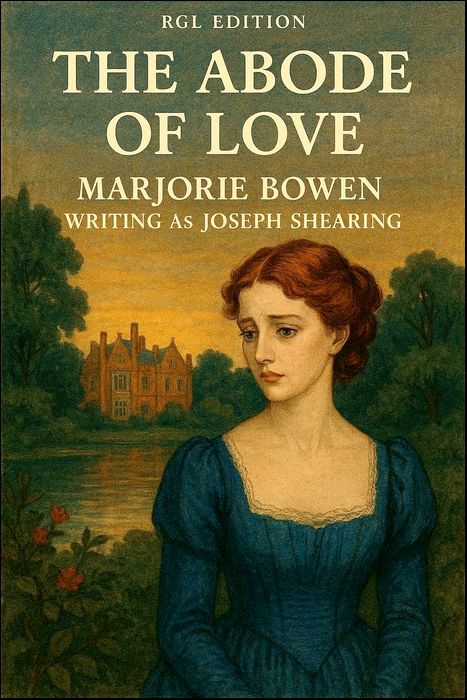
RGL e-Book Cover
Based on an image created with Microsoft Bing software
Roy Glashan's Library
Non sibi sed omnibus
Go to Home Page
This work is out of copyright in countries with a copyright
period of 70 years or less, after the year of the author's death.
If it is under copyright in your country of residence,
do not download or redistribute this file.
Original content added by RGL (e.g., introductions, notes,
RGL covers) is proprietary and protected by copyright.
RGL e-Book Cover
Based on an image created with Microsoft Bing software

"The Abode of Love" plays out in a remote, rain-swept corner of the Wye Valley dominated by the strange, decaying rectory called Didache—a house built by the eccentric religious visionary Gilbert Daunt, who believed he would witness the end of the world from its tower. The story focuses on Agnes Tufnell, a young woman living a life of stifling piety and monotony under the supervision of her dreary Aunt Pamela. Into this stagnant atmosphere steps Stephen Finett, the new curate—charismatic, intense, and increasingly unhinged. He preaches the imminent end of the world, claims divine inspiration, and begins gathering a circle of "chosen" followers. His mixture of sensual charisma and apocalyptic fervour unsettle Agnes deeply....
"HE married her in order to mortify the flesh," said Mrs. Glascott. "She is a very saintly woman."
"Why did she marry him?" asked Agnes Tufnell.
"To help him in his work, dear."
"What is his work, Aunt?"
"Doing the Lord's will, Agnes—as you know."
"Yes, but what is the Lord's will?"
"Everything that Mr. Finett says, dear."
The vague talk had formed a loop and become knotted, Agnes thought, like the half-wound wool in her hands; she tucked her merino skirts under her feet; there was a draught under the door, under the french windows, down the chimney; the house had been built with spiritual aims by one who defied human weaknesses; nobly disregarding comfort he had indulged ostentation in the service of his Maker.
A windy site had been chosen on the summit of a low hill overlooking the valley of the Wye, the mansion had been planned with a northern frontage, large cellarage, large rooms on the ground floor, with glass along the façade that opened on to a shaggy lawn without paths, on which sheep grazed and goats were tethered and which were continually swept with wind and rain; the house was so damp that it could not receive any more moisture; bricks and timber were saturated.
The drawing-room was papered in white with a silver stripe, smeared and blotted into delicate shades of water stain and splitting at the joins; from the high cracked plaster of the ceiling, where a generation of cobwebs and dust were undisturbed, hung an elaborate candelabra—vases of sickly green colour with white Flaxman classic figures, fitted with milky tinted globes and gas jets, these pulled up and down on tarnished chains. A vast mirror, speckled where it was beyond the reach of any but flies, and blocked by monstrous metal figures of Arab horsemen flanking an ungainly clock that supported a figure of Time, stood above the mantelpiece, where it was useless. The solid part of the furniture had a look of persistent permanency, the upholstery was parting warp from woof, the carpet, too cumbersome to turn about, was rubbed to the canvas in the centre of the room, and luxuriantly rich, like scarlet and orange moss, under the massive unmovable sofa and cabinets.
It was boasted of Didache that it "commanded magnificent views," the builder, however, had nullified this advantage by planting yew and cedar trees as close as possible to the long low house; from the ground-floor windows the trunks and from the upper windows the flat black green foliage of these gloomy aliens shut out the changing beauties of the wide expanse of valley and hills. Agnes Tufnell could see the spume of the grey rain, the plump shapes of the sodden fleeces of the sheep, the goats straining at their stakes; beyond was a row of tattered thorn bushes, and a drop into a mist that might have concealed the gaping abyss at the end of the world.
It was too early for fires, being early November, and the iron grate and surround shone with black-lead that smartly contrasted with the grey hearthstone; a pole screen with a small square of needlework representing a parrot with scarlet plumes could not hide this emptiness, but did draw the eye to note that the fireplace was better kept than any other part of the pretentious, neglected room.
"It is a dreary house," said Agnes, suddenly sighing.
"We ought to be thankful to Mr. Daunt for building it," replied Mrs. Glascott briskly. "I believe the old rectory was quite tumble-down, damp and most inconvenient, really not fit for gentlefolk—even forty years ago. It was kind of Mr. Daunt to spend his money on this fine mansion for his successors."
"He found a gold mine," remarked Agnes without interest. "I wish he hadn't—the old rectory is better, even now...."
"Nonsense, it is a ruin! Gold was it, or coal? Or iron ore? I don't know. One hears different tales, but dear Mr. Daunt found something, and put the fortune he made into this house—I must remember to place some flowers, no, the flowers are all faded—a wreath of cypress, perhaps?—on his grave to-morrow."
"The house is silly, too," mused Agnes, taking no heed of this, and twisting up the soiled brown wool in her hands. "That square tower—suddenly sticking up at one end of a low building like this."
"Mr. Daunt raised it so that he might view the end of the world, as you know—it faces west, and the view is quite uninterrupted, there is no doubt that he would have seen everything excellently."
"But he saw nothing," protested Agnes.
"Only because he died too soon, my love, who can say, we may enjoy his foresight, and have the great privilege of beholding the Resurrection Mom."
"Shall not we be resurrected also, Aunt Pamela?"
"Not if still in the body, dear." Mrs. Glascott shivered as a gust of outer air tore through the cracks in the window frames and rushed to escape between the cracks of the door, smiting the ladies in its passage.
"I don't understand what Mr. Daunt was thinking of." Agnes was obstinate. "Nor what you are thinking of, Aunt—yet he must have been sane, and you seem sane..."
"Holy Writ makes it clear as crystal," replied Mrs. Glascott, "but you have no imagination, Agnes. Such a pity! The last trump will sound..."
"I'm sure trumpet is a more majestic word," murmured Agnes, "trump makes me think of cards."
"For that matter," resumed Mrs. Glascott sharply, "trumpet reminds one of crumpet—you have no poetical fancy, my love. For my part, I intend to enjoy the Day of Judgment. I especially look forward to seeing sheep separated from the goats."
Agnes glanced through the tall windows where these animals were gathered with no sign of mutual interest.
"I don't suppose they would object," she remarked. "If those goats outside weren't tethered they'd get far away from the sheep."
"No doubt, and do a power of mischief—they'll eat anything. I can only repeat, Agnes, that you are a very prosaic person. I can perfectly well imagine what it would feel like to stand on Mr. Daunt's tower and watch the last day dawn."
"Do you believe that the end of the world will come in our lifetime?" Agnes would not allow the subject to drop.
"Mr. Finett says so, and I hope he is right. Personally I feel I should put in a much better appearance before the Great White Throne as I am now, than if I had to rise from the grave."
"We should be clothed with the spirit, Aunt Pamela."
"Yes, no doubt, but that might not be very easy to manage. I'll say this for the body, one is accustomed to it, and knows how to manage it."
"It is you who have no poetical fancy," Agnes half laughed, then added quietly, "I wish the end of the world would come—at least it would break up our petty customs, our trivial languors."
"We can only be prepared," answered Mrs. Glascott placidly, only keep our minds and hearts pure, and our actions spotless."
Agnes again felt the talk had become twisted like the yarn for her charity socks; she never reached any conclusion when discussing religion; even Mr. Finett could explain nothing to her satisfaction though he talked so often and at such length. It was the boredom that Agnes wanted to understand; why did God make this brief earthly prelude to "everlasting bliss" so amazingly dull? And what was "everlasting bliss"? Agnes could get no further than negations in her conception of Heaven, no damp, no draughts, no sick brother, no hard beds, no coarse food, no country walks, no ugly dresses, no idle solitude, above all no Aunt Pamela. To Agnes this amiable woman's personality was spread over the days as the mists were spread over the valley, blotting out any possibility of any brilliance, cheerfulness or promising hope. She seemed 'left over' from life, as the cabinet pudding and the hashes were 'left over' from drab meals; no one wanted remnants, but they had to be endured because of economy.
Once Pamela Glascott must have been a child, once young, once a bride, once, surely, touched by surprise, curiosity, tenderness, perhaps passions, but for years she had been dowdy, respectable, static, unwondering, uncomplaining, uttering truisms and absurdities in sunken tones, going through the meagre routine of every day supported by platitudes as by crutches, encouraged to exist by conventionalities, as by cordials.
All her belongings were drab, ugly, all had once been in the possession of the dead, and were preserved because of sentimentality and avarice; they represented emotions that ought to have been felt, and money that might be made. Locks of colourless hair stood for people Mrs. Glascott could only recall by an effort, but whom she believed she had felt an affection for; fluted silver sugar basins, and half sets of Crown Derby tea services, lockets adorned with small greenish pearls, and greenish turquoises set in pinchbeck represented a vague resource for some 'rainy day,' when Mrs Glascott's pension might fail, or her home with her brother's children be closed to her; possibilities she never seriously considered, but that sometimes, when she woke in the dark, flashed on her with the nightmare's power. She had no comeliness, no experience, she was secretly mean and wasteful, untidy and unclean, but outwardly neat, precise and full of domestic chitchat, so she passed for a good housekeeper; she had a keen glance to discover and an unchecked tongue to scold the faults of her social inferiors; towards her social equals she was monotonously civil, towards her social superiors genteelly servile; daughter and widow of clergymen of good families, her satisfaction appeared to be that she was a lady on earth and would be a saint in heaven, those pale comforts seemed to give her sufficient warmth to prevent her from completely congealing into extinction.
What depressed Agnes so profoundly was that there were so many women like Aunt Pamela; women without histories, or futures, characters or fortunes, were scattered over the country thick as seed-blown weeds. They attracted no attention yet were forever in the way, they had suffered losses, misfortunes and grief, as was always vaguely allowed, yet they knew nothing of humanity or of what humanity had done, without roots, they were yet always established in the homes of others, tolerated, useless, respected and resented. As poor relations, as housekeepers, nurses, governesses, school-mistresses, as music teachers, widows or spinsters, these women were so alike that they seemed but different versions of one woman. No one was interested in them nor in the tales they might have to tell, it was always understood that they were past all human needs, failings and enthusiasms, and that to allow them to uphold decorum and all the displeasing virtues in return for their keep was to be very charitable.
Everyone whom Agnes knew had one of these featureless chaperones, companions or secretaries; at school she had known them, dessicated as the subjects they taught, in every novel she read they were used to fill in gaps in the story; in every crisis of the heroine's adventures "a respectable female" or "a severe, decent gentlewoman" appeared to save appearances and whatever else there might be in need of rescue, holding at bay the yappings of the scandalmongers since society, while sternly maintaining that young women could not live alone, also conceded that no impropriety could exist in the same house with a decayed gentlewoman of unspotted repute.
Mrs. Finett, Agnes reflected, was another of this sombre company of the unwanted and the indispensable, so was Mrs. Concommon who lived with Mr. Bagot and his granddaughter at Bagot House, near Haye; these women spread round them a blight of shabby suffering, of futile endurance, of an acquiescence in adamantine pettiness that was partly heroic, partly imbecile.
Agnes tried again to fumble her way out of the disorder of her own confused impressions of the world in which she found herself; Mrs. Glascott was expected, as part of her duty, to listen to youthful curiosity and to quell it, to draw out youthful enthusiasms and to crush them; she was an adept in disillusionment, Agnes was the last of many young women who had submitted to her frosty soothings, her muddled and self-contradictory advice.
"When will Adam come home?" Agnes began to probe with unhopeful persistency; her aunt was her only companion; the servants she was not allowed to consort with and an icy etiquette prevented her from confidences with the neighbours in this lonely place where after two years' residence, she was still a stranger.
"When he has recovered his health," asserted Mrs. Glascott. "Dear me! That pretty paper fan I pleated for the grate has gone!"
"Have you just noticed that? It has been blown up the chimney. What is Adam's illness?"
"A derangement of the nervous system, he was never strong, he takes after your poor father."
Agnes puzzled over this reference to a long-felt bewilderment; so many people were "not strong" or "in delicate health," so many people seemed to be invalids, fading, withering, resting on sofas, in easy chairs—"in constant pain, bravely borne" she murmured to herself, recalling the countless times she had heard and read those words.
"Yes," agreed Mrs. Glascott. "He has much to bear, it is his cross—two years in bed, far from his loved ones. But Mr. Finett has taken his place in the best possible way; Mr. Finett is a true Evangelical, poor Mr. Ditton lacked the strength for the work."
"Adam used to dislike Evangelicals," said Agnes. "Father used to say that Evangelicals were no better than Radicals, he always said he was an Anglican, he never countenanced the Dissenters."
"Neither does Mr. Finett—and how many there are here! Your dear father would understand were he with us now, what a power for good the Evangelicals are—such high ideals, and principles, so unswerving in their duty."
"Would you call them reformers?" ventured Agnes.
"What ideas you have, my love, for a young lady strictly brought up! Reformers are quite wrong always. When I was a girl there were some very mischievous reformers about, Chartists, women wanting rights, and other shocking movements I can't mention. All so wrong. Mr. Finett is so sound on these points, so unflinching in upholding the word of God."
Agnes stopped the numbing flow of words.
"Will nothing ever change?" she asked.
"Why should it?" demanded Mrs. Glascott. "Mr. Finett thinks the world may end any day now, so why should the Almighty trouble to make changes so near the end?"
"The history books teach us things used to be different," urged Agnes. "Have we—in 1865—come to—a completion?"
"I do not see any objection to such a belief, and how incorrectly you talk, Agnes, 'things' is such an untidy word."
"Well, if everything has stopped, I wish the rain would, and the wind, and those sheep and goats, always cropping, even in that downpour!"
"You talk nonsense," reprimanded Mrs. Glascott. "Count your blessings."
"What are they?"
"You are a member of a Christian community, of God's chosen church, you have been educated in lofty principles, then you have an income of £500 a year and some very pretty jewellery, a brother to protect you, his home to receive you, a shelter from the temptations and distractions of the great cities where so many souls are lost."
"Are no souls lost in Ross or Monmouth or Exeter where we used to live?"
"I hardly like to speak for this part of the country—I know so little of it, and the people are not quite English—but Exeter contains a very large proportion of the saved."
"Could I go to Buxton and nurse Adam?"
"Certainly not. St. Faith's Home, for all the name is objectionable, is excellently run. Adam requires no nursing beyond what the matron gives him. She is most scrupulous in reporting every week. Adam sleeps continuously, supports his pain with fortitude, reads theological works and is acutely conscious of his human frailty. We can ask for no more."
"Mr. Finett sent him some pamphlets on Hell," remarked Agnes dubiously. "I hope they won't upset Adam, Mr. Finett is very downright."
He has filled the church and made the Dissenters very uneasy with that downrightness that I term zeal," replied Mrs. Glascott. "Adam was never severe enough, he would not have been so disappointed in Paulchurch had he been more energetic and told people of their sins."
"He did not wish to offend. Father seldom preached of sin either, and mother often told me it was too large a subject ever to be mentioned."
"In society, certainly; in the pulpit, certainly not." Mrs. Glascott displayed a glimmer of animation as she added: "I am sure that Mr. Finett has not really begun to display his full powers yet, he is holding himself in check, when he does let his ardour and piety blaze out—a number of people will feel very uneasy indeed. The watch-night services, the fasts, the personal confessions are offending many."
"We were counting my blessings," said Agnes, she rose, allowing the sock, the pins, the iron gray wool, to fall off her lap, she advanced, stood under the cluttered lamps of the gasolier and stretched in an unladylike, catlike manner. "Do you include tolerable looks, health, youth, an inquiring mind among blessings?"
"No. These are pernicious vanities. I do count your privileges in being able to help in the Sunday School classes, the church socials, in being able to set an example to the poor, and to assist them if worthy. I do count, Agnes, a material blessing, your residence in this fine mansion with such wonders of science as gas, laid on water and a bathroom."
"I suppose so."
Think of your forebears who had nothing but candles and lamps! Did I have a bath room, Agnes? No, a hip bath in my chamber was considered more than sufficient when I was young."
The last three words sang in the vacant mind of Agnes; she shivered at this juxtaposition of youth and Aunt Pamela; a clock in the passage chimed midday; that on the mantelpiece had stopped at the tenth hour for years; this always aided Mrs. Glascott's mental confusion and the lassitude of Agnes, giving them a chance to exclaim—'I never thought it was so late' as a gloss for laziness, whenever the monitor in the passage gave his warning "that we are one hour nearer death" as Mrs. Glascott continually and mechanically remarked. The quarter chimes had been silenced as they, too, constantly proclaimed this melancholy truth.
"No one would think," remarked Agnes, "that we were earnest church workers, we have done nothing the entire morning."
With that dogged refusal to see herself adversely that seemed Mrs. Glascott's one positive quality, she countered, "Really, my dear, there was nothing for us to do."
MARTHA FINETT'S presence stifled all emotion as surely as did Mrs. Glascott; when with her Agnes felt that life had sunk to a pulse so slow that it merely sufficed for existence, yet she talked to the dim woman because they were employed together in the Rectory, sorting and addressing Stephen Finett's pamphlets.
"I wish you would come and live here, Mrs. Finett, it is such a large house."
"We are content at the lodge. Stephen, as the curate in charge, would not wish to presume on your dear brother's prerogatives, Miss Tufnell. How is he? Better in health and spirits?"
Mrs. Finett was so much the same in appearance as Mrs. Glascott that Agnes hardly knew to which of them she was speaking; both had bilious complexions, greasy banded pepper-and-salt hair, pinched features, pallid lips and eyes the colour of stale coffee dregs, both of them wore buttoned bodices, stiffened with whalebone and flounced, gathered skirts so cumbrous that the women appeared to be, clothes and body, a solid mass of upholstery; their figures had lost human shape and they looked as if, day and night, they remained the same, never free of their garments, never relaxed; their clothes, whatever their original colours might have been, were faded to a hempen grey or a sage green; when they moved stale odours were disturbed; both endured gastric torments and their breaths were faintly soured by ill-digested food.
Agnes recalled her aunt's statement that Stephen Finett had married his wife as a mortification to the flesh. She was a very good woman, many years older than her husband.
The timid curiosity of Agnes expressed itself obliquely as she tied up the bundles of pamphlets; she knew nothing of the Finetts, save that Stephen Finett had been a student at the College of St. Giles near Cusap Dingle where he had founded a group movement, named the St. Giles Brethren, that, after entering Holy Orders he had been appointed to a curacy in a Cornish village, then to one in a London suburb and then to this at Paulchurch, where the Rector, Adam Tufnell, had been for two years in a nursing home at Buxton.
"Illness is a great purifier, don't you think, Mrs. Finett?
When I last saw Adam he was so pale and spiritual in appearance...
Mrs. Finett agreed. "My husband had a long illness just before I married him, Miss Tufnell, he was much reduced, it was then he heard the Divine call, and was given the strength to rise from his bed."
Agnes looked at the titles of the tracts, glanced at the contents, turning the leaves slyly as Mrs. Finett, creaking and rustling as she moved, unpacked the printer's parcels; Agnes could not understand even one sentence of the pamphlets.
"What is Mr. Finett's aim?" she asked gently. "I mean—how are we to reach Heaven?"
Mrs. Finett answered both questions in two words, "Sinless perfection."
"Oh, yes, the Wesleyans teach that, don't they?"
"The Wesleyans are wrong," Mrs. Finett stated flatly.
"I'm surprised you know anything of the teaching of the Dissenters."
"They are not Dissenters, dear Mrs. Finett, Adam said so—isn't it all difficult? Please do explain—" she hesitated, then used the word of which her aunt had complained—"things. Evangelicals don't have confession, do they? A watch-night service? Yet Mr. Finett approves the High Church."
The curate's wife had Mrs. Glascott's habit of underlining both the spoken and the written word.
"Nothing is difficult, if you have faith."
Agnes addressed the bundles of tracts carefully; they were directed to societies with long titles, all engaged in combating sin, in particular the sin of unbelief.
"Some are to be encouraged, others to be converted," remarked Mrs. Glascott. "The societies, I mean."
"There must be a great deal of sin in the world," sighed Agnes; she wondered about the past history of the Finetts, what had they been doing, she for perhaps fifty, he for perhaps thirty years, before they met? Martha Finett always spoke as if they had come together by a mysterious mandate of God, after existing unspotted in voids.
"The Devil is still strong," replied Mrs. Finett. "He is unchained and roaring about, but the time is nearly over, when all shall be judged."
"Does Mr. Finett really think the end of the world is near?" asked Agnes idly.
"My husband never thinks. He is divinely inspired. He knows we have not much longer in this vale of tears."
"What will happen? My aunt doesn't seem to know—shall we watch from the tower here?"
"The saved will be saved. My husband will have further revelations when God so pleases. Shall I send your dear brother some more of these tracts?"
"Yes, he likes reading." Agnes selected three of the Rev. Stephen Finett's works. "The Sinner's Slide to Hell,"
"God's Judgment on the Wicked,"
"An Urgent Call to Repentance."
"Did you ever hear, Mrs. Finett, of anything save sin and religion? I mean, there are wonderful discoveries being made, and books written, and foreign countries, and people who don't live as we do—"
"Where did you get such ideas?" demanded Mrs. Finett straightening herself with a jerk. "What have you been reading, Miss Tufnell?"
"Nothing but the Bible, the Pilgrim's Progress and now and then Good Words, and a few novels written for young ladies." Agnes hurried to excuse herself. "Rosa Bagot lent them to me."
"Rosa Bagot inclines to frivolity," remarked Mrs. Finett. "She seldom helps with the church work."
"She has to look after her grandfather, you know, Mrs. Finett," pleaded Agnes, "it is such a large house, too, larger than this, with no modern conveniences." She sighed, thinking how dull it must be for Rosa with whom she had a timid sympathy, for Rosa also had lost her parents and was left with an unsympathetic grandfather to care for, as Agnes was left with a sick brother, thinking of the two other great mansions in the neighbourhood, Magna Towers, always shut up and Newmarch always empty, she sighed again; prosperity had some time ago left the valley, with the supposed exhaustion of the coal mines and the end of the search for gold mines.
"You should be grateful to Mr. Daunt for building this commodious residence," said Mrs. Finett, "so full, too, of the divine spirit; this room is named, is it not, 'Sacrifices of Joy'?"
"Yes, because it is the drawing-room, and one could amuse oneself here, but Mr. Daunt thought it better one shouldn't."
"How right! And every place in the house reminds one of holiness. Mr. Daunt built himself a wonderful shrine for his memory."
Agnes, however, was now accustomed to the names of the rooms, they meant little to her, especially as the servants shortened them; the drawing-room was named 'Sacrifices,' the study and library adjoining, that Gilbert Daunt named 'From the Pit of Corruption' meaning that there he read and wrestled to subdue his earthly grossness, was now known as 'Corruption.' The symbolism of the other names had been largely forgotten; the two rectors since Mr. Daunt's day had ceased to speak of the modern sanitary system as 'the brook Cherith,' or the bathroom as 'Now ye are clean through the Lord'; it was the influence of the Finetts that had revived the zealous attentions of Gilbert Daunt; they lived in White Lodge, named after the fleece of the Lamb, as the other lodge was named Red Lodge after the blood of the Lamb and inhabited by a half-witted peasant and his mother, David and Mary Evans, who 'looked after' as Mrs. Glascott termed it, the Rectory.
"The villagers will say 'Did-ache' when meaning the Rectory," complained Mrs. Finett. "A barbarous, I fear even a Pagan word—Mr. Daunt wished it named 'His Banner.'"
"'His banner was over me with love,'" added Agnes mechanically. "'Stay me with raisins, comfort me with apples, for I am sick of love. His left hand is under my head, his left hand does embrace me.'"
It is quite easy to remember, you see, but people backslide so easily. Now, that is the last of the tracts. I must send the accounts, at fourpence each the printing costs are barely covered."
Adam will send the shilling for his three copies Mrs. Finett, I have no money now," apologized Agnes.
Mrs. Finett smiled; her gums and her lips merged into one stretch of pale red flesh; she put a withered hand with bluish fingers to her wan cheek; it was really cold in the large, draughty room, even her chilled blood felt depleted of its tepid energy.
"My husband begins to move the inhabitants of Paulchurch, does he not, Miss Tufnell? The church was full, last Sunday, people talk, also."
"Yes," agreed Agnes. "Mr. Ditton never had such congregations."
She referred without regret to her brother's former curate; she felt an unadmitted capricious dislike of him because of his chronic catarrh and "sandy" hair that was not the colour of sand.
"It is nothing," asserted Martha Finett, "to what you will see. My husband will come upon Paulchurch like a whirlwind, he will purge the floor and gather the wheat, but the chaff," she added sombrely, "he will burn with a fire unquenchable."
"I thought God did that," said Agnes.
"My husband is God's instrument, as yet, Miss Tufnell, you understand very little."
The curate's wife left the gusty, vast room in silence, as if the moment was too solemn for mundane courtesies.
Agnes went into the passage; she could think of nothing but the speculation as to whether this, the Paulchurch Rectory, the meagre vicarage in Devon where she had grown up, or the poor and rigid school where she had passed most of her girlhood was the most detestable. "I am foolish and unworthy of my opportunities of salvation," she accused herself; she was also surprised at her secret discontent; her surroundings had always been much the same, the atmosphere about her always unchanged, by what standard did she consider them unsatisfying?
How was it that she was conscious of another world? The cathedrals at Exeter and Hereford, the landscapes of the west of the Wye valley, the useless, pretty wares in town shops, the glimpse of the rich in their carriages, the sunset and the moonrise, all these were like little peepholes into some realm different from any she had ever known and these glimpses disturbed her bitterly.
All this pricking curiosity could be comfortably ascribed to the Devil, she assured herself. The cathedrals could not really disturb one with excitement or wonder, because they were built for the worship of God; even if the Roman Catholics had raised them, the Reformation had purged them; the landscapes were made by God, also, and could not, therefore suggest nameless longings for lawless adventure, the rich people must be in divinely ordained stations; and as for the shops, Agnes had only to remember Vanity Fair and Madame Bubble.
A long corridor ran the length of the Rectory, empty save for the tall clock; inner doors with glass panels decorated with sulphur yellow vine leaves, and grapes the hue of raspberry jam, cut off some of the gusts that forced under and beside the ill fitting outer doors, but admitted keen draughts that whistled down the passage to the other door that led to the tower; two rooms only, 'Sacrifice' and 'Corruption' occupied the northern frontage that was to the right hand of Agnes, to her left were the kitchens and offices, stone floored, vast, but sunny, and attached to them a small breakfast room with a buttery hatch.
Mr. Daunt had built glass houses along this southern side of Didache, as he recognized that plants must have the warmth that humanity did not need; while his wife and daughter lived, damp ferns and starved flowers known as 'exotics' had been cultivated there as an excuse for the anaemic women to linger behind the sun heated glass. When they had coughed and shuddered into the quiet of the churchyard mould, the conservatories had been neglected but never tidied; Agnes avoided them; Mrs. Price Evans and Griffith, the dwarfish boy who Agnes saw carrying chicken mash or pig food, had broken the panes with stone throwing, the shelves had rotted and the wire baskets and stands had corroded into heaps of rust, while the outlook had always been onto a worn slope of grass where pens of fowls were set, flanked by rotting pig-styes on the right, and bordered at the bottom by a low stone wall, beyond which the road to Paulchurch ran between rough hedges.
Agnes went up the stairs, these were set so steeply that their name 'Jacob's Ladder' was well suited; at the top was another corridor, the bedrooms to the north, the bathroom, closets and servants' quarters to the south, at the end another door to the tower. Mr. Daunt had designed the house himself so it was very simple; a man of some means, he had invested in the exploitation of a gold mine that had been found in the forest, as well as speculating in coal, and with the quick and impressive returns he had built the new Rectory at his own expense. He was considered eccentric by the Bishop and his naming of the rooms of his pretentious house from the texts was coldly regarded as smacking of dissent; this was one reason why the Biblical names had been ignored by so many inhabitants of Paulchurch; no one now recalled what words from Holy Writ had once inspired the occupants of the bedrooms, though everyone vaguely remembered that Gilbert Daunt had become a solitary in his later years, when his family was dead, and had shown a tendency to join the sect of the Plymouth Brethren who then had owned a chapel in Paulchurch forty years ago that was now empty, ruined, encumbered by briars, while that of the Primitive Methodists had a following that yearly dwindled.
Gilbert Daunt had spent money extravagantly on the building that he believed would house him until the end of the world; an untrained aptitude for science had resulted in the modern improvements he had made in his old age; though he lived alone he had visited the Great Exhibition in Hyde Park and brought home the gasolier, the plans for the new sanitation, the hall clock, and several pictures and ornaments; just before his death he had installed the engine for pumping water and the carbide gas that were causes of pride to Mrs. Glascott.
The bedroom given to Agnes was full of the cold but not the freshness of the hilltop air; a fire had never been lit in the black burnished grate; dusting and sweeping had never dislodged the dirt ingrained in the tidy, heavily upholstered furniture; the bleak northern light picked out the chill unchanging bluish white of the massive wash-hand stand, the dead white of the large ewer and basin, the slop pail, and the water green of the glass bottle that flanked the soap bowl; sometimes when Agnes woke on a moonlit night these gloomy adjuncts to cleanliness appeared like a tumble of tombstones and reminded her of the judgment day which Mrs. Glascott placidly believed to be so near.
The dark boughs of the cedars obscured the view and pressed against the dirty glass of the windows; Mr. Daunt had transplanted them, at great expense, from Bagot House, and they had grown higher than the roof of Didache; peeping between the gloomy spread of evergreen foliage Agnes gazed at the valley and the ranges of hills fading into the faint purple azure of the aerial perspective.
She had seen so many engravings of scenes like this that they seemed more real than nature; such vistas were drawn by illustrators of Biblical scenes to convey the impression of tremendous supernatural events and so impressed was Agnes by these plates, so often gazed at either in books too heavy to hold, or in frames that added to their grim darkness, that she always felt as if the New Jerusalem, not Ross or Monmouth, was concealed in those glimmering distances, those delicate peaks rising out of softly changing shadows.
The prospect was wide and Agnes could contrive out of it, according to the seasons and the weather, the appalling splendour of the Book of Revelations, the mystic glories of Paradise, or the unfathomed gulfs of Hell; under any aspect she found it displeasing and she sometimes startled herself by an inner admission that she liked neither nature nor those imagined upper regions where the saved might enjoy their reward, for the joys of Heaven could by no means be pictured by Agnes Tufnell.
At the large bureau she wrote to her brother, quickly penning her concern for his health, the success of Mr. Finett, the new curate, the piety of his wife, and her own even existence—"full of good works such as you would approve, my dear Adam."
A vigorous knock on the door preceded the entry of Maud, a lively girl who never looked suited to her cap and apron; her darkness, her gestures, her odd speech had prejudiced Mrs. Glascott against her; Agnes was in awe of her round, steady eyes, her cheerful manner. Miss Bagot was in the drawing-room, Maud announced and flipped away, her broken heels clip-clopping on Jacob's Ladder.
Agnes sealed up her letter and followed; it was always exciting to see Rosa, who was her own age; their conversations were such as the invisible witnesses whom they feared might have noted with approval, nevertheless, they always felt as if there was the bond of conspiracy between them. Rosa was huddled on the horsehair sofa, her hands in a muff of ruffled green velvet; both girls gave an involuntary glance at the empty grate, then sat together for warmth; Rosa Bagot was pretty and dressed with the style of one who had access to fashion magazines and a dressmaker in Monmouth; Agnes's clothes, homemade and mostly inherited from her mother were dowdy; cold and lowness of spirits made her appear dim and blurred, like a half-melted wax doll, but Rosa admired her fair hair and complexion and the grace of her body that could carry her ugly clothes with ease.
"I have news," said Rosa. "Newmarch has been sold! A wealthy widow has taken it and is coming to live there at once."
Agnes thought of another segment of Mrs. Glascott, of her own invalid, dead mother, of the grey housekeeper, Mrs. Concommon at Bagot House, but Rosa added:—
"There are three daughters! Imagine what company it will be for us!"
Agnes admitted pleasure; she knew Rosa's unspoken regret, however; three more women in a desolate countryside already overstocked with females, why could it not have been three sons? Futile wish, no men ever stayed here, at least, no gentlemen, and the miners, foresters and tradespeople were socially impossible, merely part of the background.
"Why do they come here?" Agnes asked; Rosa had heard the news from her grandfather and retailed it eagerly; Mrs. Purcell was the relict of a wealthy paper manufacturer who had died when his three girls were leaving school, the lady had connections with the Welsh border and wished to renew the associations of her youth and to introduce the three co-heiresses into county society.
"There isn't any," added Rosa, "the few great families never reside here long, and I am sure they would never call on a merchant's wife—but it will be some company for us, dear."
"Girls," objected Agnes, "are always the same, they never know anything. I discovered that at school."
"They can help in the parish," suggested Rosa who was of a genial disposition. "And perhaps they will entertain, Mrs. Purcell has bought all the furniture at Newmarch."
"I wish they had bought Magna Towers," sighed Agnes. "That is such a splendid place."
"No one could buy that, Lord Eign would never sell it, though he seldom resides there, Newmarch is much finer than Bagot House, dear, or this rectory. When is your brother returning?" Rosa had been taught to give polite turns to the conversation to change the subjects as she changed places in a room full of company.
"I don't know, Mr. Finett is very successful."
"Yes, grandpapa thinks he is too full of zeal, grandpapa disapproves of—" Rosa sorted out, from many possible words, "display in the pulpit—what do you think of him, dear? Grandpapa doesn't like personal confession."
The question and the reply were formal; as a clergyman and a married man, neither of the girls had considered Stephen Finett; his innovations at the church services made little difference to them.
"His aim is sinless perfection," said Agnes. "He is a very good man."
"Of course. Grandpapa says he may go too far," replied Rosa vaguely.
"Could one—in goodness?" Agnes now glided to another matter. "I wish one could begin fires before December 1st, don't you? when there is so much coal and wood in the forest."
"Grandpapa has fires in his bedroom and in his study." The girls looked at the silent clock, at the figure of Time with scythe and hour-glass; Time had mown all about Agnes and Rosa, leaving only an aunt and brother to one, a grandparent, a great aunt to the other; consumption, shipwreck, ague, nameless fevers had been the strokes whereby he had swept away these Tufnells and Bagots, even as they were counting their gilt-edged stock, buying safe property, reading their Bibles.
"Time," remarked Rosa wistfully, "is always shown as old, threatening death, but Time brings life, too, doesn't he? The spring, and the flowers and—and—babies."
"We must be reminded of our latter end," said Agnes, who had been more severely educated because she came from a clerical family, "'cometh up as a flower,' Rosa, but—"
"I know. Did you see the river to-day?" Miss Bagot rose and went to the window. "How it swirled and raced."
"I saw the moon rise last night," said Agnes. "I hardly felt on the earth—'Sun, stand thou still on Gideon, and thou, Moon, in the valley. And the sun stood still and the moon stayed until the people had avenged themselves upon their enemies.'"
"There are no enemies here," smiled Rosa gently.
"I sometimes think there are—in my own thoughts you know," answered Agnes. "We ought to go visiting, dear. I wonder if Mrs. Evans has had my basket filled." She pulled the cord by the fireplace and a bell jangled. "Oh, I ought not to have done that, Aunt has a headache."
We shall have a guest soon," Rosa hurried over this almost uneasily, a son of one of my father's friends—an engineer, he made a large fortune in rather a vulgar way, canals, and, I fear, drains—I mean old Mr. Petty did, of course the son can't help it, he is an engineer, too, but only for coal, and gold perhaps. Grandpapa think the mines are not exhausted. Mr. Petty is quite middle-aged and a widower."
"He will stay at Bagot House?" asked Agnes who had instantly understood the implication of this incoherence.
"Yes, for a time. I don't suppose I shall see much of him, Grandpapa says he will be absorbed in business."
"I wish I understood more, about such matters, don't you, Rosa? We know nothing about anything. Don't you sometimes wonder what all this 'business' really is?" She could not express herself any better than could Rosa, but she stumbled on. "I mean engineering and science, and all the discoveries being made, and even, though this is different—what people's lives were."
"Whose lives?"
"Mr. Bagot's, my aunt, the Finetts, my brother, why everyone we know, could they always have been as they are now? Then the people one sees working in the forest, in the town—does nothing ever happen to them? Did nothing ever happen to our relatives, and will nothing ever happen to us?" As Rosa was silent, Agnes answered herself. "Of course, Mr. Finett thinks the end of the world is near."
Disbelief, that they knew to be wicked, hovered in the silence that followed; Agnes asked without interest about the Purcells, but Rosa knew nothing more of the new owner of Newmarch. Maud came in answer to the bell, she brought a basket of food covered with a clean, rough napkin; Agnes went upstairs to put on her mantle and bonnet, then the two girls set off towards the long village, Rosa also carrying a basket she had left in the Rectory porch; their days were organized idleness and piety was over them as the moisture was over the landscape, quenching their native spirits.
Rosa gave many of her empty hours to helping the Rector's sister with her Bible classes and her visits to the sick poor, for her mother who had died after years of nameless illness had earnestly enjoined on her the need to save her soul.
The Bagots of Newmarch were a branch of an illustrious family who had settled in the Valley, near the Forest, two centuries before, making their living by mining and farming and holding the position of country gentry; old Mr. Bagot was still energetic and rode about his property of which he told Rosa nothing, they met only at meal times for in the evenings he played chess with himself or any chance visitor and made wordy notes in his diary; Mrs. Concommon, the housekeeper, and Mrs. Dower, the nurse, chaperoned Rosa and ran the domestic affairs; nothing had been altered in the establishment since Simon Bagot's youth; the deaths of his wife, sons, daughters and all his grandchildren but Rosa had made no difference in his tastes or ideas.
The girl had gone to school in Ross and knew nothing of any place but this part of the border, yet she felt as alien as did Agnes from the civil, round-faced, dark, short inhabitants of the Forest—these Celts who made such slatternly servants, whose homely dwellings were so dirty, who had nothing of the smug neatness of the English villagers Agnes had known.
A warm autumn had kept the earth sodden, humid, the weeds fat under the heaps of rotting leaves, the slopes of wood, showing along the sides of the valley were still tinged with tatters of brown foliage; there were rich berries in the hedgerows and the hollow stems of wild parsley thrust up between the tussocks of rank grass; apples, red as fire, hung out of reach in the gray trees in the cider orchards; the farm carts loaded with turnips dripped yellow mud from the wheels, the men leading the horses were earth coloured also and trudged silently; in front of every field gate was a morass trampled by the large white-and-purple cattle, in front of every farm gate were wet ruts and spreads of the yellow mud, in every farmyard were dung heaps, half floated away, geese, pigs and fowls, spattered and draggled.
Gathering up their heavy skirts, the two girls minced uneasily along the drier, upper path that bordered the road and delivered their bounties at those cottages where sickness or old age burdened the hale and the youthful.
They were received with an easy air of equality very different from the respectful hostility that Agnes was accustomed to from the English villagers who showed both servile gratitude and sly resentment; if these Celts were not cringing, neither were they critical; many of those who accepted so cheerfully the screws of tea, the stale cakes, the congealed puddings in the shining basins, mentioned with relish the sermons of the Rev. Stephen Finett, his tireless labours among his flock, and his exciting changes in the services. The benevolent errands ended by a visit to Mrs. Gwyn, who lived up a hilly lane that drained into the main road, so that it was fairly dry; as the girls went up this incline wide expanses of rich and rolling champaign showed to right and left; farms with patches of cultivated fields and wind screens of oak and birch, mansions set in parks, the church and the old Rectory, lonely cottages and slanting woods, rippling with an uncertain light all looked charming from a distance, like, Agnes thought, vignettes in a book; she would have been more at home with them if they had been merely pictures, to know that they really existed and were not in the least as they seemed when seen from afar was disconcerting.
Rosa talked of her expected guest, not that she supposed she would see much of him, she repeated as her grandfather had told her that Mr. Petty was very serious minded and absorbed in business, besides he was, in Rosa's judgment, old, still his coming gave some point to the future. Guests were infrequent at Newmarch, Mr. Bagot not caring to have his routine disturbed.
As they paused before Mrs. Gwyn's cottage, the girls could see for miles; a random beam of sun picked out the church, St. Paul's that gave the name to the village, with the empty, decayed old rectory the other side of the graveyard, then shifted and glimmered for an instant on that bend in the valley named golden and showed Magna Towers, nearly hidden by the lofty trees of the grandiose park; nearer, visible in a moving shadow was Rosa's home, Bagot House, square, of pinkish stone with sloping lawns and again, woods enclosing it, and beyond, rising above the chestnuts and oaks the chimneys of Newmarch.
Mrs. Gwyn's grandchild opened the door to the ladies, she peered into their baskets, empty save for Bibles and tracts and hid her disappointment with civility; she and the cottage were both dirty, a faint, sick smell filled the unaired outer room, this thickened as they went into the chamber where Mrs. Gwyn had lain in bed for twenty years; she resembled a toadstool in the soft texture and damp colouring of her shapeless face, a hodden grey shawl was over her shoulders, a carefully made quilt of diamond shaped cotton patches covered the bed; she began at once in praise of Mr. Finett who visited her frequently, never before had she received such attention.
"He is very zealous," agreed Agnes, reflecting with discomfort on the languid administrations of her brother and his long absence from his parish; Rosa opened the Bible, she knew the older woman's tastes, violence, vengeance and slaughter or tender promises of comfort and peace beyond even the comfort and peace that she already enjoyed in her cosy idleness.
"Woe unto the land shadowing with wings
Which is beyond the river of Ethiopia,
That sendeth ambassadors by the sea
Even in vessels of bulrushes upon the waters."
Agnes half listened, staring at the mud even her lifted hems had gathered; there was no meaning in the words, any more than there was any meaning in life or in the landscape of the Wye that seemed the landscape of the steel engravings, and the landscape of the Bible. What was a "nation scattered and peeled"? "a cloud of dew in the heat of harvest"? "a clear heat on herbs"? Who was the writer, that terrible Isaiah, who had such vast, dreadful visions of wrath and destruction? Agnes did not know beyond that the awful prophet had foretold the coming of Christ and that all his utterances were full of warnings and threats. She closed her eyes as Rosa lisped and droned the powerful words, discounted by her small lady's voice. Agnes placed these wastes, howlings, these bewailings and ruinous heaps in the prospects that had been for two years familiar to her; she could imagine the weeping fugitives through the golden valley, the Wye full of blood, the grass withering in the bordering fields, Ross and Monmouth forsaken, the whirlwinds carrying away Didache and Mrs. Glascott, Mrs. Finett and all other lifeless and pallid women being swept away like 'forsaken boughs,' or 'rolling things' or 'as the chaff of the mountains.'
Mrs. Gwyn was complaining that Mr. Finett read so much better than Miss Rosa, such a fine voice he had, so loud and clear, a poor woman could believe it was the prophet himself calling down woe on the sinful; the girl goodnaturedly turned to the passages more suited to her thin, gentle voice, the heavy Bible made her wrists ache, she shifted in her wooden chair. Agnes was a poor reader, she stumbled over the stiff names to which she could never become used and over the odd sentences, the grotesque imagery, her throat soon went dry, she coughed and fidgeted, behind her closed lids as she listened she beheld a rushing and confused pageantry of unreal troops of angels and saints speeding down from the clouds they had torn apart to blow their monstrous trumpets over the valley of the Wye.
"'My sheep hear my voice, and I know them, and they follow me and I give unto them eternal life and they shall never perish, neither shall any man fetch them out of my hand,'" Rosa intoned; the book slipped from her cold fingers, she caught it fearfully, as if she had been guilty of blasphemy; Mrs. Gwyn had been lulled to sleep, however, and the girls tip-toed away, the foul air was making them drowsy, yet they flinched before the blast that met them in the lane, and that, to both of them, was like those tempests of Divine fury of which Rosa had been reading.
"Do you think," asked Agnes, holding her bonnet down, "that Mr. Finett resembles Isaiah? He preaches the approaching doom in the same impressive manner."
"Isaiah had a beard," replied Rosa. "All the prophets were the same, lamentations and end of everything—thousands of years ago—and the world is still here, perhaps Mr. Finett doesn't really know either."
She spoke in gasps as the wind beat on her face, her skirts, her hat; struggling with their clumsy clothes the girls descended into the road that led to the village street.
Here they met the man they had been considering; the new curate was walking swiftly, his head high, and his thick coarse locks tossed in the breeze. As he greeted the girls they considered him with a secret interest they had never felt before; perhaps he did resemble Isaiah or Jeremiah or one of those gigantic and ghastly figures who had so bitterly predicted woe.
Stephen Finett was a handsome man, tall and well made, his eyes close set and light gray were constantly changing in expression, narrowing and widening according to the emphasis of his speech; his complexion once bloodless had been warmed by the wind and rain of the valley into a ruddy glow, his slightly thick features were refined by his serious expression and the fleshiness of his limbs was not to be distinguished under the flapping, black, clerical garments; if he had not been in Holy Orders neither of the girls would have considered him a gentleman, his manners were too obliging and he was too conscious of things well-bred people took for granted, the presence or absence of good food and good fires, for instance; Agnes and Rosa had been well-trained to never remark on their surroundings, but Stephen Finett relished openly every detail of his wordly circumstances, or, as openly, regretted them. But he was quiet, self controlled and used nothing in his daily speech of the rambling and formidable tropes and similes that choked the meaning of his sermons and his tracts.
Rosa began a wavering conversation about the tenants of Newmarch, but the curate rolled his smooth rich tones over her hesitating accents.
"I have heard all particulars, Miss Bagot. Mr. Carey Purcell and three sisters, one widowed, not a mother as you have been informed. The elder acts as chaperone for the others—" Mr. Finett gave the names precisely. "Mrs. Hislop, who was Eva Purcell, Millicent and Maude Purcell and their brother, Carey, who is engaged in his father's business of paper-making at Maidstone and will be seldom at Newmarch—very agreeable neighbours for us all," he concluded abruptly, then as abruptly began, "Your coming guest, Miss Bagot, is an old friend of mine."
The girls fluttered in the incessant breeze, the Bibles in their baskets weighed them down; they smiled and spoke meaningless phrases, waiting for the curate to pass on his busy way; but Mr. Finett lingered and strong excitement showed in his light eyes.
"Mr. Petty is a very wealthy man, a very clever man, a very pious man. I met him recently in Balham, I advised him to come to the valley, a district he had already in mind—the coal, you understand, or gold, new prospects, I hear. But I digress, ladies do not understand. Mr. Petty had a friend in Mr. Bagot, it was easily arranged."
"Did you go to London, Mr. Finett?" surprise made Rosa articulate; she had always thought he went to Ross or Monmouth on his short absences from Paulchurch.
"I lived in London for many years, Miss Bagot. Occasionally I visit my old friends—Mr. Petty is one of them. But I must not allow you to stand in the rain."
Unsmiling, he stepped aside, the girls passed on with jerking steps that now and then slipped into ruts or potholes. At the gates of Didache they parted, Rosa to return along lanes she had known all her life to Bagot House, Agnes to climb the slope to the cypress-shadowed walls of Didache, still to her alien.
Her spirits, already low, sunk into a passive melancholy, it was late afternoon and the twilight hours were always the most dismal of all the long hours, they brought to Agnes, not only hopelessness, but even a sense of panic; she stood in the large windowplace of the drawing-room and stared from another sun than that which warmed the earth.
With amazement that was pleasurable, for she so rarely felt emotion that any sensation was exciting, Agnes turned to see Stephen Finett in the room; he must have followed her, swiftly and silently.
"I beg your pardon for coming in unannounced—I urgently wished to see you. I have long had—shall we say an ambition, an ideal—it seems likely to be fulfilled."
"Pray sit down, Mr. Finett—shall I send for my aunt?" No, it is to you I wish to speak—as your ghostly counsellor, and as, I trust, one divinely inspired."
He spoke serenely and with no hint of conventionality or insincerity; Agnes took one of the stiff, stuffed chairs, forgetting her muddy boots, her splashed skirts.
"You have often preached about the end of the world," she murmured.
"It is that I desire to speak of. At St. Giles' College I heard the warning and saw light. Those who are sinless need not fear judgment, those already immortal can never be destroyed. The chosen must be gathered together and shall live forever, beginning the holiness, the eternity of Heaven upon earth—you have often heard me preach thus, Miss Tufnell, you have read my tracts?"
"Yes, yes, indeed." Agnes was more conscious of the man than of his words; his shapeless trousers, long coat, high waistcoat of black cloth, his soiled clerical collar did not obscure his personality as they had hitherto obscured it; he had never spoken to her alone before; she sensed, without understanding, vigour, strength and powerful purpose behind the ugly clothes, the garb of dedication to spiritual issues, that had also disguised her father and her brother.
"I have brought here," he continued quietly, "these people, whom I regard as followers, I do not include Mr. Carey Purcell, his sisters are independent, however. I do not include Mr. Bagot, his sole interest in his guest is a worldly one—the gold, the coal—Has Rosa," he again abruptly changed the subject, "told you her grandfather's opinion of me—of the innovations that I have made here?"
"Oh, no," replied Agnes, shocked at this bold speech.
"I know what is said, the complaints that are made. I am used to strife. I met much opposition in the College—but I had my faithful brethren. Now I am in the world I intend a larger movement," he made a sweeping gesture round the dreary, cold room. "Do you feel it is the Lord's will you should live in this miserable discomfort?"
Agnes was startled into replying: "You fare no better at White Lodge—"
"Penury," explained Mr. Finett. "But your brother has means, and you, Miss Tufnell, have you no income of your own? Has not Mrs. Glascott a pension?"
He stared at her earnestly and she was alarmed, for never before had she heard such sentiments expressed.
"You preach mortification of the flesh," she stammered and confusedly recalled what Mrs. Glascott had said of Martha Finett.
"You do not understand."
"I am told that so frequently. And it is quite true."
"Society shields innocence as regards the world," he replied impressively, "and spiritual insight is given to few females. They can only be saved by obeying their masters. You are sure that you have heard of no complaint of me?"
"None, only talk—perhaps uneasy. People here were very slothful, I fear."
"In Paulchurch and everywhere. In Cornwall and in Clapham I was deprived, Miss Tufnell. I rejoice in these encounters with the purblind and the obstinate, truly a generation of vipers, that I do not come to save, only the chosen, Miss Tufnell, only the chosen."
"Oh," said Agnes, feebly; she grasped none of his meaning but she liked the sound of his virile voice, she was flattered by his confidence that made her feel more important than she had ever felt before.
"You are one whom I select," he declared, rising. "Miss Bagot is another—in Mr. Petty and the Purcells I have other disciples. Some day you will all know me—the St. Giles' brethren already acknowledge me."
Superstition curdled the wan girl's blood; the curate's sombre, heavy figure seemed to enlarge in the evening darkness that was spreading in the chill, ugly room, his carriage had a noble air, there was the haughty outline of the heroic in the manner in which he lifted his head; she rose also, out of respect; she longed to ask him what he meant, but she could not find any words; her numbed nature had become inarticulate.
"The Church," he announced, "is moribund, desperately in need of salvation, but the awful moment of awakening approaches." He took her limp hand and pressed her wrist.
"I came to ask you to trust me, and to contain yourself hopefully, Miss Tufnell, my revelations are not complete, I, too, must wait, labour and be patient," he fingered her arm under the harsh braid tucker. "Even to me, the future is sometimes dim. Does the body require so much torment and misery? No, for it is already non-existent, save as a sheaf for the immortal soul, therefore Miss Tufnell, why not warmth, beauty, all that is splendid and lovely to accustom the spirit to the future delights of Heaven?"
"I never heard that suggested before." Agnes felt a faint glow from the touch of his strong fingers and did not withdraw her cold hand. "How could one obtain such—luxuries—only the rich and the sinful have them."
"And so the Devil triumphs. How much wickedness there is in Paulchurch! And how much resentment when it is exposed! My sermons anger many, do they not, Miss Tufnell? Perhaps they anger even you?"
"I am so used to sermons," Agnes apologized.
"There shall be a forerunner and the Messiah shall come again." murmured Mr. Finett. "I have many glimpses of the ultimate purpose. Neither my words nor my actions are my own. Much is not yet clear. Hold yourself in constant readiness."
He dropped her hand, and pulled some papers from his pocket, impulsively displaying them.
"I drew these designs myself. I wish I could afford to have blocks made for my handbills and pamphlets."
Agnes took these drawings to the withdrawing light that fell through the long glass windows; she was conscious of the wet gray sheep, the wet black goats, the soaked grass, the dark trees, the encroaching vapours rising from the valley.
The coloured pencillings she gazed at seemed to her a loathsome jumble of human and animal limbs, men's faces, birds' wings and beaks, mingled with cartwheels, lamps and the hoofs of oxen.
"The 'four living creatures' described by the prophet Ezekiel," explained Stephen Finett. "They should be carved about the Church, my Church."
"I never could imagine what they were like," murmured Agnes. "Perhaps we are not meant to do so."
"The forms we may reduce to pencil or to stone—but 'the brightness the colour of amber' the colour of 'burnished brass' and 'the terrible colour of crystal' we can only see in a vision, Miss Tufnell—'their wings were about their eyes, the wheels were like fire and the living creatures were lifted up in the wheels,'" his voice fell softly, as if he caressed a creature he loved.
The drawings, daubed with red and yellow chalk, shook in the girl's hand; the man stood close to her, she looked out at the darkening prospect, yet she was acutely conscious of his presence, his melodious voice, and an astringent perfume from his dingy clothes, like crushed herbs and a body meticulously clean, very different from the stale odours she was used to avoid in others; she returned him the drawings and he left her suddenly; as he opened the door cold air blew in and shook her. She felt disturbed, slightly excited. She was so forlorn that she dared to permit herself some expectancy as to the future from his words, ambiguous, confusing as they were, to her they had some throb of inner meaning, and he had stated clearly one need not wait in discomfort for the end of the world, not if one was chosen, as she was.... Agnes rang the bell and when Maud came shuffling in on her broken shoes, ordered the fire to be laid and lit.
SIMON BAGOT resented any attempt to interfere with his well-ordered existence; he had always accepted life, he had never thought it might be different, he found no fault with anything save the taxes, disagreed with none but the rebels, and these he refused to combat, by ignoring them he thrust them out of his self-contained life; he was not stupid and was quite prepared to defend, if need be, his orthodoxy, though he would always do so in a manner that would not in any way trouble his own concerns.
"At seventy-five years of age, my dear," he told Rosa, "I have acquired a little wisdom. I know the uselessness of advice. Admit that I never give you any."
Rosa thought that she would have liked it better if he had done so; he was so aloof that his kindness seemed to arise from principle, not affection, and to be tinged with the remoteness of the many deaths that had left her lonely.
The old man eyed his chessmen, they were more interesting to him than was Rosa, the girl of eighteen years who was his sole relation save his younger maiden sister who resided in Felixstowe; he then considered Rosa tolerantly, cynically; she was just another woman, very silly, rather touching, troublesome because she represented a duty, unimportant because there were so many like her....
Rosa shuddered towards the fire; she knew that she interrupted her grandfather's cool pleasure in his intricate game, but she could not face the desolation of the drawing-room, so comfortable, so warm, so empty.
"What is to become of me? Please, Grandpapa, often I feel frightened."
"A foolish girl," he was resigned, even amiable, he remembered these quavering doubts, these timid struggles in other young women, his sister, his daughter, his older granddaughters; all had been quiet long before death silenced them. "You will stay with me until I die—not many more years, then, if you are not married, you will go to live with your Aunt Priscilla—until you do marry."
These matter-of-fact words, intended to soothe, chilled Rosa, her sanguine nature was shaken by her circumstances; she could not smile, she ventured on boldness.
"What chance have I of marrying?"
Mr. Bagot sighed.
"You are a child, you can think of that ten years hence. You will be well provided for..." he made an effort to see her point of view. "No doubt it is dull here—but you have fresh friends at Newmarch."
"They are dull, too," sighed Rosa. "Very quiet girls and so much the same. Mrs. Hislop's husband died of typhus and she is still in mourning, they feel depressed at Newmarch, they would not have left London save for Mr. Finett—"
"They admire him?" Mr. Bagot stroked his beard, then polished his glasses, thoughtfully.
"They believe in him, and so do I," replied Rosa defiantly "and so does Agnes."
"And a large number of other weak-minded women, no doubt. He provides the excitement of novelties." Mr. Bagot spoke with even contempt; he smiled, to soften his rebuke.
"Why should we not have some excitement?" asked Rosa, staring into the flames, at least fire was brilliant and mobile.
"It is not suitable for women—unseemly, unbecoming. Mr. Finett is unsound in his teachings which are, besides, incoherent. He is undisciplined, he has twice been deprived. The Bishop considers him dangerous, he told me as much when I waited on him the other day. A bad influence."
"How can you say so, Grandpapa? Mr. Finett preaches nothing that is not in the Bible."
"The Bible teachings, my dear, must be selected and quoted with discretion. Mr. Finett is not an educated man. No one here knows his history before he went to St. Giles. He is a fanatic and stirs up trouble. I have said as much before. All sober folk here agree with me."
These kindly meant words sent the tears flowing down Rosa's cheeks; she hunched herself together as if the shabby, tasteless, but comfortable library was a prison and she shrank from its confining walls.
"Why shouldn't Mr. Finett be right?" she whispered.
Mr. Bagot sighed; it was fruitless, he knew, to argue with his grandchild, so ignorant, so emotional.
"I fear you are not very well, my dear, perhaps you had better visit your Aunt Priscilla, she always declares the bracing northern air is what keeps her alive; it might do you good."
Rosa sobbed to think of dingy Priscilla Bagot and dingy Selina Wyatt, her companion, the long dingy beach, the long dingy sea, the narrow dingy house, musty, silent and crowded with useless objects; and sobbed also because of her grandfather's snub.
"Mr. Finett says," she struggled to protest, "that the world ends soon. Agnes hopes it will, and so do I."
Mr. Bagot roused himself; it was obviously his duty to try to help the foolish, tiresome little creature who was his second son's daughter by a silly woman.
"Stephen Finett talks a great deal of nonsense, it is astonishing that he has such a hold over so many. I can't blame you for being impressed by him, when even Edward Petty is...."
"Yes, even Mr. Petty," put in the girl eagerly.
"If I had known that was why he asked to come here I should have excused myself, Rosa, well as I knew his father. Mr. Finett, it seems, has gathered a party of his old supporters about him because he expects serious opposition."
"Isn't Mr. Petty interested in the mining, Grandpa?"
"Yes, of course, there seems a good prospect of some of the old shafts being re-opened, not that I would put any money into Edward Petty's schemes, but I mustn't talk to you of what you can't understand.
"What can we understand? Women, I mean?" Rosa dried her smarting eyes. "Agnes is bewildered, too—I mean, about the Bible, and Mr. Finett, and the end of the world."
Mr. Bagot further roused himself, as a sacrifice and a penance he gently knocked over the chessmen; that interesting game would never be finished; he gave his whole attention to the plump dark-haired little girl at his feet who was scorching her cheeks before the fire.
"You and Agnes have both been upset by this preacher. I said he was dangerous, I said that the Bishop didn't regard him with favour. There is nothing either you or Agnes need to understand, Rosa, you are both well placed, well protected, you will find your lives all arranged for you, in due course you will marry and in the shelter of your homes you will find all you require. Or, if you do not marry, well, there is much that single ladies can occupy themselves with, there are honoured places they can fill."
"Yes," agreed Rosa meekly. "But Mr. Finett—"
The old man stopped her at once; she was not, he knew, worth listening to....
"You must not fall under his influence, I am surprised that Mrs. Glascott encourages him. Paulchurch is unlucky, Daunt was a crank with that absurd house of his, a sensible man would have repaired the old Rectory; he was a Dissenter at heart, I always felt. I was surprised that the Bishop gave him so much licence, then Mordaunt, the man after him, was a recluse, he neglected his duties and was mentally unstable, I do believe, now there is this spineless fellow Tufnell, two years in a nursing home, his first curate Ditton a fool, his second something worse."
"Oh, Grandpapa! Do, please, explain—Mr. Finett surely speaks God's words—"
"I fear you were not very well instructed at school, Rosa, and are too frequently with Mrs. Dimpsey, a good soul, who is very ignorant and superstitious. I wish I could make it clear to you, my dear, that the conventions, orthodoxy, are essential to society. Rebels and heretics there are in numbers, but they only bring disasters on themselves and others." Mr. Bagot spoke earnestly, convinced of the truth and importance of what he said. "There must be rules. Those who break them, pay. Mr. Finett breaks rules—those drawn up by the Church. No one can understand the Divine will or purpose, all we can do is to be guided by the Church—a compromise, no doubt, but it suits our English nature, it casts out the wild visionary, the raving charlatan, it orders everything smoothly—don't you see? Rules are always justified, Rosa."
"How has Mr. Finett broken them, Grandpapa?"
"You know—these watch-night services, personal confession, these theatrical sermons, this obsession with sin, this gathering together of followers. Who does the fellow pretend to be? He is neither Evangelical nor High Church, but seems to aim at some party of his own."
"He has power," protested Rosa. "Agnes says so, she becomes daily more impressed by him, he has revelations—"
"Nonsense, my dear child. Don't believe a word of such stuff. The man is half-witted, like Daunt, or a rogue, after all, as I remarked, we know nothing about him—"
The girl was shocked and startled, but stifled her protests. She realized that her grandfather would not enlighten her on any of the points on which she longed for knowledge, she wished she had not asked him; he sensed her disappointment and if he had not been both weary and disinterested he would have tried to console her; but the subject was too intricate and she was too stupid for further argument to be of use; he could assure himself that she lacked nothing and that there was no cause for her restlessness, her touch of discontent; perhaps she was pampered, yes, that was it, Rosa was what the nursemaids termed 'spoilt'; he had given her too much attention; she had been so even tempered and cheerful until the last few months—'it is that fellow Finett,' he thought, 'upsetting all the women.' Rosa saw his angry smile and suspected it was at feminine folly, she got to her feet, smoothing down the flounces of her heavy dress; reluctantly she made a last attempt to draw the stern old man into a conversation from which she might get some sparkles of encouragement, hope or knowledge.
The end of the world... she began timidly; Mr. Bagot checked her with stern patience.
"Mr. Finett, my dear, knows no more about that than I do. Don't muddle your head about such mysteries. Do your duty, say your prayers, and trust in God."
"Good night, Grandpapa," whispered Rosa. "I shall go upstairs and read in my room for a little—may I rearrange your chess men?"
"No, thank you, my dear. I have a letter to write." Mr. Bagot, politely receiving the girl's soft kiss on his brow, did not add that this letter was to the Bishop on the subject of the eccentric behaviour of the curate of Paulchurch, that was fast becoming a scandal.
ROSA went upstairs to the room that had been the nursery for herself and her dead brothers, sisters and cousins; Bagot House was solidly built, and when occupied by a large family a pleasant dwelling-place, but now there were too many empty rooms, too few inhabitants, and the girl was glad, especially in the winter, to hide herself in the retreat that had for her the pleasantest memories of her life. In the old nursery she could sit by the fire and read fairy tales out of the coverless, dog-eared book, and return in fancy to the days when other children had played and laughed, pulling about the toys now shut in the blue-painted cupboard; often, Rosa, drowsy in the old nursing rocker, would imagine she could hear them coming up the stairs. They had all died when she was too young to miss them, yet she remembered them very vividly, not their persons or their actions, only their laughter and the difference they had in brightening the days.
Mamma had gone with the last of them and Papa had never returned from one of his voyages; among the huddled toys was a shell he had given Rosa; when she held it to her ear, she could hear the sound of the waves that had drowned him, Rosa was not melancholy, as Agnes was, but sometimes she was thoughtful, a little sad. Since Mr. Finett's preaching had revived that contemplation of the end of the world, roused in her early childhood by the sight of Mr. Daunt's tower and the hearing of its history, she had often considered the enchanting prospect of soon meeting her family in the brightness of the Resurrection morning.
"You should not sit alone, Miss," protested a warm, beloved voice, and Mrs. Dimpsey brought affection and cheerfulness into the silent room and into Rosa's brooding mood; Douce Dimpsey was stout, soft and comely, fragrant in her person, serene in her disposition, she had loved and served, so often and so much, that a strength and gentleness of which she was unconscious were implicit in her homely person; death had ended her perfect marriage and taken away her nurslings long since; only Rosa was left her and Rosa she surrounded with an uncritical affection and an untaught wisdom.
"You've been crying, my dear," she said, as the girl slipped to the worn footstool leaving the rocker to her old nurse. "I'm glad I had the fire lit here for you, what a baby it is still, to be sure."
"I want to be happy," said Rosa quickly, before she lost confidence, for she was afraid of what she was trying to say, even before this one person with whom she was absolutely at ease. "Agnes Tufnell wants to be happy—so do the Purcell girls—what is the matter, please? Grandfather won't tell me."
"Happiness is a big thing, darling, maybe we've no right to expect it, any of us—we rely on the other poor human beings, dear, and they die or don't understand."
"To rely just on oneself is to be very lonely, isn't it, Douce?" The girl drew closer to the old woman's knee. "And 'understand' that is a hard word. Grandfather says I don't understand, that women can't, what can one do? Live blindly?"
"You used to, dear, and be quite content. What is troubling you now, my pet?"
"The new curate at Paulchurch—his sermons and what Agnes tells me about him, what does he mean? Suppose the world did really end?"
"Well, that would clinch all arguments, dear, what matters surely, is life as we have it now, it's all we've got, Miss Rosa, darling, all we're sure of, I mean."
The girl agreed eagerly. "Yes, that is what I want to know—how can I make the best of it? What is wrong, Douce, darling, that we all feel so uneasy as we grow up? I wish I lived in a fairy story." She touched the tattered book on the floor beside her.
"Tell me, Miss Rosa, my dear, what you like in fairy stories."
The girl sighed, expanding in the warmth of this sympathy; she rested her head on the nurse's knee and felt gentle hands caressing her tumbled hair. The fire burnt fiercely, there was a clean steady flame in the homely lamp, the hearth was freshly swept, the old, cheap furniture was newly polished; from the faded wallpaper, intertwined roses, pink and yellow, still bloomed from yellow trellis work; warm light and warm shade pulsed on the ceiling; Rosa felt drowsy, yet, comforted and secure, she was able to express herself according to her simplicity without feeling frightened or ashamed.
I like the cottage, Douce dear, in the forests, and the children seated at their meals, little bowls of soup and the mother putting up their satchels with buns and primers, and the father coming home to a lively welcome, and the cat and the kettle singing together, and the clock ticking—a garden outside and an orchard, a wood-cutter's cottage, isn't it? And not in this country."
"That is the trouble, Miss Rosa, not in this country, and no one could have it for long in any country, those old tales..."
"Don't say they are not true," begged Rosa, "they are the truest stories I know."
"Yes, they are true, darling. But you forget the other parts—there is always a traveller, isn't there? He looks in at the cottage window, he may stop for a bite and a sup, but he has to go on through the forest, where it is cold and dark and there are dangers, wild beasts and evil things, always he has to go on. As we have to go through life, Rosa."
Oh Douce, I don't want to go on. I want to go back—to this room, and you and Mother and all the other children, years ago."
"You can't, Miss Rosa, none of us can do that, it's dangerous to try to do so, the traveller who turns back gets lost, perhaps forever; if he finds his way again, it is only after a deal of trouble, my dear." Mrs. Dimpsey rocked the chair, lulling the girl who leaned against her warmth and affection.
"What is the other side of the forest, Douce?"
"No one knows."
I suppose it is God—as Mr. Finett says. I am so overpowered by the thought of God, Douce, I want to hide from Hun. I fear I am very wicked, I often wake in the night, wondering why I am so horrified, and then slowly, as I lie in the dark, I know I have been dreaming of Hell."
"There, there, no need for that, my pretty."
"But what is worse, I don't want to go to Heaven. I think it would be so lonely there. I would rather find the little cottage, Douce, hidden away; yes, that is what I want, to hide away from God and the Devil."
"What makes you think of such things, my pretty one?"
"The new curate, Douce, Agnes and the Purcell girls talk of little else, and then every Sunday one hears him, and I feel as if he were haunting me, Douce, can you imagine the end of the world?"
"No, I don't think that we are meant to, Miss Rosa. Mr. Finett is a strange man. He worries me, too, I feel as if he means more than he says, and what he does say is too much for an ignorant old woman like me."
"No one understands him, Douce, he just excites them," Rosa frowned with the effort to express her callow thought, "that is what we need, isn't it, Douce, excitement, something happening, if one tries to be good, everything is so dull. Sometimes I feel sick and shivering when I realize how dull life is."
"You want companions of your own age, Miss Rosa, it isn't natural, you alone in this large house with an old man, and Miss Agnes alone in a big house with an old woman, and those three ladies in Newmarch, poor souls, all strangers here because of their mamma's whim, and she dead." Mrs. Dimpsey was breathless from the rush of warm words; she embraced Rosa tenderly. "Something is very wrong that we all have to suffer so, Miss Rosa, dear, I know. Loss and duty and the days falling behind one like sand out of an hour-glass and nothing to show for them, I know what you feel, and all you want to do, forbidden—and how does Mr. Finett with his old wife and his preaching of Hell-fire help any of us?"
"He preaches how to avoid Hell, Douce, dear."
"That isn't enough," replied the old woman firmly, "there is something besides Heaven and Hell, and that is the Earth. What was there in the forest, dear, besides the good spirits and the bad? Little live, busy things eating, drinking, sleeping, not knowing anything of these mighty affairs."
"I wish I were one of them, Douce! That is what I mean, the earth, I suppose, to get away from all these tremendous events, why even the people in the towns here, and some in the village seem like that, content, and even laughing." Rosa pressed closer to the soft bosom and encircling arms of the old nurse. "Tell me what is on the earth, Douce."
"I mustn't do that! It's being a lady makes you shut away—you and Miss Agnes and the others, life is hard on ladies, people forget they are women, too."
"Tell me something, though, don't, oh, pray don't, put me off like everyone else does! Think of Grandpapa shut away with his chess and Mr. Petty shut away with his business papers and all the empty rooms in this house, and Agnes and Mrs. Glascott shut away in the new Rectory and all the empty rooms, and the Purcell girls shut away in Newmarch and all the empty rooms, all shivering, and lonely, and only you and I a little comfort to one another, thinking of fairy tales!"
"Why, my pet, what has come over you? There, there, you are quite flushed and hot and crying again, I declare—of course I won't shut you away, you just lie still, against my knee and I'll tell you some of the things on the earth—just near at hand, too."
"What are they, please?"
"There are the ruins of pagan camps and pagan altars in the fields, and houses where the grand folk lived in the merry times, there are caves where warriors hid from their enemies and roads built long ago..."
Rosa interrupted—"long ago—I mean, I want something to happen now. You live on memories, don't you, Douce, and we live on hopes, and sometimes both get so dim."
"Ay, you're too young to know as much, though, well, over all this old earth I've told you of the moon shines, and there is magic abroad and queer things happen, the moon is kind to women...."
"Oh, the moon is so cold! I've watched it, rising, high, sinking, and the river catching the glitter in the valley—who would come but into such a light save witches?"
"There is much to learn about witches," replied Mrs. Dimpsey softly, "but I mustn't tell you now."
"Agnes spoke of witches, the other day—she said it might be a way of escape, for all of us, and that if we once danced naked under the moon we should never be afraid of Hell again."
"Eh!" cried the old muse startled, "that is no way for the vicar's sister to be talking, those are no words for you to be repeating! Who put such ideas into your head?" she added suspiciously.
Rosa's reply increased Mrs. Dimpsey's surprise and alarm. "Mr. Finett. He talked to Agnes about Hecate, who was a Pagan goddess, but who means something important, he said she was all the natural feelings we are ashamed of, and that have to come out somehow, and if people—women, didn't worship her in secret they would go mad and upset society, and he said society had been made by the men—who didn't know anything about women."
"Mr. Finett talking of heathens and witches." Mrs. Dimpsey spoke carefully. "And why, dear?"
"I don't quite know—he meant there was a way out—out of the moonlight, where the witches are, where women have to go, and that God could make us all tranquil and happy—in the sunlight, with love—do you understand?"
"That's a word you don't want me to use, isn't it? I think we ought to keep it all simple, Miss Rosa. Mr. Finett has been to college. I suppose he is a learned man and so can twist his words about so they lose their meaning."
Rosa began to laugh; she had reached the limit of the strength that inspired her curiosity, her yearning, she was so drowsy and wanted to curl up like a cat and sleep; all she had said, all Mrs. Dimpsey had said, hummed in her ears like the nonsensical jingle of a nursery rhyme, she glanced round gratefully at the shabby, homely, cosy little room that was her one refuge from all perplexities and distresses. The coals had sunk to an even fire and a steady glow filled the old nursery, outlining with light the old woman, comfortably resting in the worn rocker, and the girl comfortably resting against her nurse's knee, outlining with light the torn book of fairy tales, bringing out from the suffused glow of the small lamp, the toy cupboard, the high chair, the crude pictures of Red Riding Hood running through the wood, of Dick Whittington journeying an endless road.
AGNES TUFNELL was searching for holly in the garden of the old Rectory; many days before Christmas she and Mrs. Glascott made wreaths for the church festival; the villagers took all the holly in the hedges and in the wood, no matter how early Agnes was out she found the trees stripped and a spatter of crushed berries beneath them showing that some lusty youth had been before her; but no one save herself came to the long-deserted Rectory by the churchyard.
It was more than half a century since the wilful and eccentric Gilbert Daunt had forsaken it for his hideous dwelling on the hill, when his new fortune had enabled him to indulge in an outward expression of his beliefs, and people avoided the old Rectory; though they did not believe it to be haunted they shunned it as a desolate place.
But Agnes could imagine it as it once must have been, built for a home, lived in by contented people, never a freakish erection like Didache, designed by a lonely old man and lived in by those who loathed it. There had never been any children at the new Rectory, never any young people until she came there, and it was so forbidding with the vast, cold rooms, swept by draughts, the stairs like a ladder, the long passages, the shut-up tower.
The old Rectory was a ruin, not worth letting, not worth pulling down, it had been allowed to fall into decay; only a few gray apple trees rising out of brambles and weeds showed where the orchard had been, the old pink kitchen-garden stone wall had partly fallen down, and the espalier pears and peaches, for so long carefully tended, had twisted into freedom, borne small, sour, untended fruit and perished long ago.
Lost, too, were the roses and the borders of flowers that had once made the lawns pleasant, the bow windows, from which the shutters had rotted away now faced broken walls and the ivy that had spread from the graveyard; elder trees had grown high by the gate posts and the pale stems still bore the last purple withering of the unplucked fruit.
Agnes admired the hollies, growing between the orchard and the garden, six of them even spaced, with stiff, prickled leaves of shining green, with clusters of scarlet berries, with smooth gray trunks; she reached up her hooked stick, dragged the sprays down and cut them off with her strong scissors, laying them in the flat shallow baskets she carried; it was slow and difficult work, the air was heavy and humid, too warm for December. Moisture beaded Agnes's woollen clothes; as she snipped the holly she saw an angry thrush who leapt from branch to branch of the bright trees.
"You are taking his winter store," said a voice behind her; Edward Petty had come up quietly through the damp, broken grasses, "the bird, I mean."
"Oh," said Agnes, used, as the Rector's sister, to make silly conversation with every newcomer or chance passerby, was not perturbed by this sudden meeting. She had frequently met Edward Petty walking in the forest or the lanes, on business, she supposed, connected with his mining prospects; she considered him very uninteresting, he was heavy, gray-whiskered, slow of speech, yet, though he had nothing but trivialities to say, he always spoke to her, and always seemed reluctant to continue on his way.
"I have often wanted to look at the old Rectory," he said. "Shall I help you with those upper boughs?"
"I suppose that we ought to leave some berries for the thrush," replied Agnes, dubiously. "Will he starve if we don't?"
Mr. Petty smiled, and looked directly at the girl, showed her his wild eyes that contradicted his stern, expressionless dull face.
"Yes, he might starve, he has marked those trees as his winter store, and driven all other birds away."
"Did God put the berries for him, or for the adornment of His church?" sighed Agnes, as the bird, alarmed, indignant, fluttered from bough to bough.
"Holly is ugly when made into wreaths," replied Mr. Petty at a tangent. "I see much of nature in my solitary walks, Miss Tufnell—there is much in the forest besides coal and gold, if gold there be."
Agnes left the trees, her hands were damp and red; she was pleased with this unexpected company, dull and heavy as the man seemed to her, he was a newcomer with whom she could share some of her hitherto solitary pleasures.
"Come and look at the old house," she said. "I could wish that it had never been abandoned, see, there are no paths, you must push through the overgrowth."
"It is nothing but a min," he said, but he seemed interested and he drew close to the unshuttered windows and peered into the empty rooms.
"There is an ancient grace about the place," insisted Agnes, standing beside him. "Don't you feel it, Mr. Petty? The wide hearth, the corner seat, the low ceiling; people lived here, laughed and quarrelled, and were comfortable, the house was built to live in—at Didache one only exists."
"You don't care about those modern improvements, then?"
"Oh, no," there was only one of these that she could speak of with decorum. "The gas hisses and smells and often goes out—only solitary men, with desolate thoughts have ever lived at Didache."
"It was badly planned and built," remarked Mr. Petty, "the tower is absurd, the situation is storm bitten, a poor use to make of wealth...."
This reminded Agnes that Edward Petty was a rich man, what had he done with his money? She did not dare to ask; she withdrew from the fallen house and looked up with pleasure at the tall chimney stacks of patterned tiles that still rose into the unstirring mists.
Edward Petty stared also; he wore a dark town suit, puckered and slack from the damp, that hung awkwardly on his robust figure; Agnes thought that he looked as ridiculous against this background as did Mr. Daunt's tower that he had just condemned.
"You know Mr. Finett, don't you?" she asked. "He is causing excitement here, is he not?" Convention prevented her from pressing him. Curious as she was on this most important subject she could not forget that she was a lady, alone with a man she did not know very well.
"I met him at Balham," replied Edward Petty quickly, "at a great crisis of my life—I went to his church, he had a strange influence on me, he persuaded me to come here."
"How odd," said Agnes; it seemed natural that clergymen should affect women, strange that they should make any impression on men, she had never known this to happen before. "But you came for the mining?"
"Yes, my father was a friend of Mr. Bagot's. Yes. I am interested in the mining; there can be no doubt there is gold in the forest."
"What good will it do?" asked Agnes. "Mr. Daunt found gold and built Didache."
"I should build something more noble, Miss Tufnell, or, perhaps not build at all. Magna Towers is a splendid mansion."
"Oh, do you think of buying it!" she exclaimed.
He smiled, indulging her vapid candour; they had sauntered to the gate that led into the churchyard; the mutilated and grand outline of the collegiate church faced them beyond the graves; the remains of the magnificent edifice were still majestic, though despoiled by both time and ignorance; the original design was as neglected as the original usage, plundered, broken and weathered walls and tower rose, definite as the statement of a creed, into the slowly shifting vapours.
Neither Agnes nor Mr. Petty was conscious of the ugliness of their appearances that were so harsh and incongruous in the scene that was toned and tuned to minor keys and half tints, the pause of winter without winter's stir and tempest. The gravestones had weathered to the hue of the lichens that overspread them, and the dark, firm shapes of the ivy trails that clung to them with fine reddish yellow, threads, formed a precise and flowing pattern that made of the churchyard one design, broken here and there by human interference, rigid wreaths of holly propped against headstones, or the last of sodden white chrysanthemums plucked from sheltered gardens; the neglected graves were pleasing to the eye, those that were tended looked desolate.
"It is a fine church," said Agnes, remembering the guide book, "it used to be an abbey, it was named the golden church, because it is in the golden valley."
Mr. Petty knew better; the word 'or' did not mean gold, it was the name of the loop of the river that had penetrated between the hills.
"I don't like it," he added unexpectedly. "A charnel house—as derelict as an abandoned ship. I should never come here if Stephen Finett were not preaching."
Agnes did not like the church either, but the habit of reverence was so ingrained in her that she was shocked at this plain speaking.
"I want to set up house here," added the heavy man brusquely, "that is why I went to look at the old Rectory—but it is far too ruinous. I must search for something else," he added slowly. "Yes, something entirely different."
Agnes was not roused to any interest in the speaker or his project; she thought only of her wreaths and the dull dread of returning to Didache; they were not only unsubstantial, but incredible to one another; all the girl knew of the man was that he was wealthy, an engineer, had 'lost his wife' and had come to the Valley on Stephen Finett's persuasion. All the man knew of the girl was that she was the sister of the sick and absent Rector of Paulchurch, and dim and pious; Agnes was suppressed to a mere thin trickle of life, Edward Petty was self-controlled until he appeared to be a negation of humanity; as they stared at the remote beauty of the deserted church, they had the air of scarecrows, so did their hideous clothes disguise their native comeliness; the desolation of the empty scene swallowed them up, they were mere blobs of drab and unsightly garments among the damp tombstones. Agnes had a faint sensation that something precious was being wasted, she could not have said what it was; both curiosity and distrust were almost extinct in her; even the emphatic thunders of Stephen Finett's sermons, even the stir and whisper he had caused in Paulchurch had passed her by.
Mr. Petty raised his hat, mumbled and passed on, leaving the graveyard by the far gate that opened on to the high road. Agnes entered the church and peered about, trying to estimate how many wreaths would be needed; though not aware of it she was near to a self-disgust that touched despair; she unconsciously shuddered in the interior of the church; the place frightened her, an infection of gloom arose from these heavy pillars, these high walls, disfigured by mural tablets, stone and marble statues, reclining in the murk of shadows that never lifted, or kneeling in a thick uncertain light under windows filled with a jumble of coarse glass fragments, reset at random. Agnes knew and secretly loathed these dismal people, they seemed as alive as Mrs. Glascott, as Mr. Petty, as Mrs. Bagot; the alabaster woman in the smooth robe pulled to her feet, with hands upraised in prayer had a sly smile, the man beside her an expression of menacing vacancy; the kneeling personages seemed cold and uncomfortable in their impossible attitudes, all of them were blotted with dust and dirt; high above, in deeper shades were funeral escutcheons of Eigns from Magna Towers and of some other families, now extinct.
The noble church had been built for other usages, for another people; it seemed plundered, and the design had been distorted by decay and rebuilding even before this portion was restored; the spruce hymn board, the brass lectern, the pitch pine pews, the mean altar with the insignificant candlesticks were emphasized in their ugliness and cheapness by contrast with the grand remains of a grand past.
Agnes rubbed her cold hands; the holly pricked her elbow through the shabby coat; the tables of the ten commandments faced her like threats; she was faintly conscious of terror and suspense, of a groping after something essential to her existence, of a withdrawing from something else deadly to the slow pulse she still possessed; in her mind she was using the word "thing" that her aunt had said was vague. The creeping chill in the ancient building that had been shut away from the sun and air for centimes, numbed the girl almost into insensibility. "Two for the font, sprays for the pulpit—I suppose the steward at Magna Towers will send some hothouse flowers for the altar, then yew and mistletoe—there should be enough, no, not yew, of course, but a few boughs of cypress, to set off the alpine roses. What use are any of these garlands? They don't make one forget the vaults full of dead bones, the statues staring and peering, the tablets with the names of the dead on them—we ought not to forget either—in the midst of life we are in death. Why does death seem so much more real than the Resurrection?"
Agnes left the church and looked across the graves at the empty old Rectory, the chimney stacks showed above the untended trees that were bloomed by a flush of false, winter buds; then went reluctantly home, hampered by the basket of stiff holly boughs, by her cumbersome skirts, by her unmanageable, broken thoughts and sensations that trembled into passivity beneath the weight of custom and the deep striking chill of convention.
AGNES found her brother standing by the hearth in the large, draughty drawing-room at Didache; he was shivering, though huddled in his great-coat and lit from head to foot by the glow of the fire; she thought she beheld some phantom of the newly dead and screamed ineffectually.
"My dear girl!" exclaimed the Rev. Adam Tufnell, "what a welcome! I have been here two hours. Aunt Pamela did not know where you had gone!"
"I thought you were ill; you never sent a telegram or even a letter...."
"You have a rare gift for remarking on the obvious," he retorted with a resigned moan. "I am ill," he glanced at her and glanced away, as if her mild presence exasperated him deeply, "how cold this place is—how draughty."
"But you have your great-coat on, and have heaped up the fire," protested Agnes, thinking how long she had shuddered unprotected against the cold and damp in this very room. "If you are ill, dear Adam, why did you not stay at St. Faith's? Do sit down—you look so weak."
"I have been two years in bed," he retorted peevishly. "Of course I have very little strength. I believe that it was a miracle that enabled me to return here—I mean that. I have returned to preach to the people of Paulchurch—no, I won't sit down, I might not be able to rise again, I suffer from nervous paralysis, as you should know, Agnes."
There was no affection between them, they had done their duty by one another too long for any warm sentiment to be felt by either; he was a vapid, ineffective, feeble-looking creature, neither comely nor plain, with small regular features, weak eyes and thin hair, a type to antagonize any woman, while she, in her indifference to life, her dowdy dressing, her trite speech, her slow way of clumsily performing her daily routine was a type to antagonize any man.
"What brought you back, Adam? I hope it was wise for you to travel."
"My good girl, did I not tell you it was a miracle? The nurse couldn't believe her eyes when she saw me out of bed and dressed. What brought me? Stephen Finett's pamphlets."
"Oh" said Agnes flatly; she had never expected anyone's tracts to have any effect on anyone; that Adam should have been brought home from Buxton by his curate's written word seemed to her indeed like a miracle; she wished she had read the booklets that she had so apathetically packed.
Adam Tufnell began to complain, in an exhausted voice, of his long, tedious journey, of many railway changes and a bumping ride in a farm cart over wretched roads, as he had not announced his coming, there had not been a carriage to meet him at Ross station; Mrs. Glascott had given him some thick sugary tea, but it merely made him feel squeamish; he drew his coat tightly about him as his sister helped him into the sagging comfort of the old armchair.
"I saw him, Agnes," muttered the vicar. "His wife noticed me riding past among those turnips, she was looking from the lodge window and told him, of course he came up at once. We just clasped hands. I said—'I have come'—no more, the emotion was too great. Nor was there need of speech, he understood everything. He told me he was sure I should come."
"Do you think him a wonderful man?" asked Agnes, baffled and doubtful.
"I am impatient with your fantastic ignorance. Stephen Finett is divinely inspired, nay, he may be a divine messenger. How is it possible," he added fretfully, "that you have not observed this? Really, Agnes, you must be very worldly."
"I did see Mr. Finett was different from other clergymen," replied Agnes, blushing unbecomingly at the rebuke. "I've thought a great deal about what he says, but I don't understand what he means, and no one seems to—you see dear Adam," she added, gathering a little courage, "he disturbs people, and many are afraid, and many mock—but no one grasps clearly—what, well what it is all about."
"Foolish girl." Adam Tufnell closed his eyes and leaned back in the chair. "Does it not occur to you that all this could have been said of Our Lord Himself?"
Agnes was startled; this seemed to her plain blasphemy, but she had a deep respect for her brother's education if little for his capacities; she believed that no one who was learned could escape wisdom.
"None of the women like him very much," she murmured diffidently. "Mrs. Finett is so old."
"Please," the Rector raised a protesting hand. "I perceive you have, as usual, idled your time away in gossip—I can't say I think the house well kept, and how I am expected to get up those stairs to my bedroom!"
"I didn't design the house," sighed Agnes. "It is thought to be very modern and commodious—there is gas, running water and a bathroom. I suppose you were very comfortable at St. Faith's."
"It was detestable, but I was too ill to notice the many inconveniences. I had to resign myself to the ministrations of strangers since I had none of my own kin to nurse me—more, I had to avoid the matrimonial traps constantly set for me by matron and nurse, both single and, I fear, cunning women."
Agnes considered this unfair and discourteous; she had forgotten how much she disliked Adam.
"What did the doctor say?" she asked, as if she requested an oracle to solve a puzzle.
"He is a fool," moaned the Rector, his eyes still closed, his pale lips moving languidly, "instead of recognizing that only a miracle could have got me to my feet, he had the impertinence to say—'boredom overcomes sloth, I see, at last.' I was cast down, Agnes I am lifted up."
"Because of Mr. Finett?"
"Undoubtedly. 'Many shall run to and fro and knowledge shall be increased.' I shall preach the sermon, Agnes, the first Sunday after Christmas, until then let there be a lull, a truce, a peace."
"I hope you will be strong enough," muttered Agnes as she crept into the circle of warmth.
Adam Tufnell made weak movements with his hands as if pushing her away; he sniffed as he savoured the odour of dust and camphor, lavender water and drying wool that came from her damp clothes.
"You understand nothing," he groaned. "Has not Stephen Finett brought followers to the valley?"
"There is Mr. Petty, who is staying at Bagot House. I met him to-day, a very dull sort of man, he is looking for a house—then there are the Purcells at Newmarch."
"Do you like them? Well placed, gentlefolk?"
"Mr. Carey Purcell is in trade," replied Agnes, "but they are like ladies, at least, all are in mourning for Eva's husband, Mr. Hislop; nice, of course, but I can't really distinguish them from anyone else—lonely, too, I think they are, Mr. Finett knew them in Clapham or Balham."
"My dear Agnes, how many words you take to answer a simple question! How dull you are yourself, my good girl—I come home after two years, return with the most extraordinary news—"
"Of the end of the world, Adam?"
"Don't interrupt—really, Agnes, do you speak almost flippantly of such a subject as the Resurrection?"
"No, I don't, Adam, but I have heard so much about it, and I don't understand, everyone tells me I don't, and it is true," tears of self pity reddened her mild eyes. "Aunt Pamela doesn't understand either, though she won't admit it, nor does Rosa, nor do the Purcell girls..."
"Spare me this acknowledgment of feminine imbecility," groaned the Rector, "and assist me to rise."
He extended his bony hands and she pulled him to his feet; he declared that he must retire to bed at once and hoped that Mrs. Glascott had made his room comfortable, that some chicken broth would soon be ready, and that his flannel night garments were well aired.
"Maud and Mrs. Evans aren't really English," apologized Agnes, "though they hate the Welsh, I mean nothing is ever quite tidy, or quite ready, but Aunt Pamela will see to everything herself to-night."
"I hope so, I sincerely hope so, I must lean on your arm, Agnes, up those steep stairs."
"Jacob's Ladder," Agnes reminded him, on which he fretfully retorted—"That was designed for angels, we are still cumbered with the body."
As the girl helped her brother up this wide and gloomy staircase, he groaning and clinging to the banisters, pausing at every step and lamenting his own lack of strength, Maud lit the gas in the passage below, the hissing, acid flame, white and blue, lit a dismal void beneath the stairs, above was a darkness that nearly obscured the long lines of the passage, the tarnished frame of the one picture on the wall, a bitumen blackened oil painting of The Deluge, where wan faces, clutching hands, and drifting corpses could still be seen on the dark cracking canvas.
Agnes led her brother to the best bedchamber, that in his honour had been left empty for two years; he had only slept in it for a few days before he had been taken away to Buxton for a 'change of air,' from one closed room to another. Agnes was relieved to see that the fire was lit and burning well, the curtains drawn, the door pads ready, an array of red flannel chest protectors and belts warming over a chair, the glacial expanse of linen sheets turned down across the blotched colours of the eiderdown broken by the homely squatness of a stone hot-water bottle.
"Would you like a bath, Adam?" she suggested timidly. "I daresay Mrs. Evans could get the fire up."
The Rector smiled wanly.
"How your thoughts run on the mundane, dear girl! I might have supposed that without any comment, a footbath, with hot water and a little mustard might have been provided."
"Yes, of course, I shall tell Maud, sleep well, dear Adam, and tell me all the exciting things in the morning. Of course now Maude Purcell is here, we ought to find another name for a servant—you can't hear the 'e'..."
Her brother groaned at her shallowness; her inability to grasp his tremendous news.
"'If one arose from the dead ye would not believe,'" he quoted bitterly, as Agnes awkwardly left the room that had been named "Because of fear in the night" by Gilbert Daunt, a title long since discarded.
MR. BAGOT, once every year, gave a dinner party, early, for the occasion was always Christmas Day, and everyone liked to get home in "good time," very quiet, for there were no children to romp and laugh and no young men to encourage and admire the girls; Rosa, however, always enjoyed these modest festivals, but Agnes preferred secret talks in the old nursery when they could try to fumble out something of what lay behind their lives.
To-day there were strangers present. Mr. Petty, the Purcells, the Rector, and everyone was restrained and nervous except the Finetts and the host. The morning service had been orthodox; the choir was out of tune in the carol singing, the organist more than usually strident, while some of Agnes's clumsy decorations had fallen down from the pillars; the curate's sermon had been very conventional, and many members of the congregation had coughed continually though the strong scent of medicinal lozenges being sucked mingled with the usual musty odours of the church; Agnes often thought one might as well eat sweetmeats in church as these nasty pastilles that never stopped anyone's cough; to-day she had felt as if the dark, cold statues were jeering at the feeble human attempts at celebrating what they termed the most joyous event that had ever happened.
At the dinner she was consoled by the rich food and warmth; Mr. Bagot was a correct if not a jovial host; the goose and beef, the pudding and tarts were excellent, the fruits, nuts and raisins smooth, plump and shining in silver dishes, in between the handsome vases of hothouse-grown white heather and winter aconite were little trays of chocolate creams that Agnes kept on stealthily pilfering; the other ladies, being better fed, could wait until the dessert.
After having eaten greedily of the warm meat and pudding and drunk her tiny allowance of red wine (for her brother warned in a quick aside the servant who would have refilled her glass) Agnes looked, in a shamefaced manner round the table; Rosa was very pretty in a red gown the colour of the flower of her name, with velvet bows in her fresh dark curls, but really, Agnes thought, no one else seemed to have made any effort to celebrate this great day; the Purcell ladies had conceded gray dresses in place of mourning, but the widow wore a white cap with black ribbons and they all had disinterested expressions, expensive dishes and fine wines were no novelties to them. Mr. Petty looked withdrawn; superficially polite, he made small talk with Rosa and Agnes either side of him, but his glances were all for Mr. Finett who sat with his wife on one hand and Mrs. Glascott on the other; the Rector was beside his sister; he, too, often stared at Stephen Finett and showed but a querulous interest in the pale fish and pallid milk tapioca slop served to him in place of the seasonal fare he might not eat.
Mr. Bagot surveyed his guests coldly; he was doing his duty very well, but longing to retreat to his study, with his glass, his pipe, his chessmen.
Agnes had sensed disappointment in the church that morning; she was sure that everyone, as herself, had expected something dramatic from the swift and sudden return of the Rector, had hoped for a climax to the fiercely energetic sermons and measures of Stephen Finett with his half unexplained doctrines, emphatic tumultuous sermons and unrestrained gestures.
Perhaps, mused Agnes, he had been warned by the Bishop; it was all very disheartening; surely Mr. Petty and the Purcells had not come to the Valley for this? And Adam, too, why had he rushed back, even travelling in a turnip cart, just to crouch over the fire, complaining about everything?
She darted a glance at the curate; he certainly did not look afraid; his self-assurance was unshaken, his heavy face, thick hair and clumsy clothes combined into a sombre darkness that the rosy shaded lamps could not efface, but his pale eyes were intensely sparkling, and his air, as if he was intent on some inner beatitude in comparison of which his surroundings were as chaff, was of one resolutely containing mighty words. He ate little and drank nothing; odd, thought Agnes, that the woman beside him was his wife, she would have seemed old for his mother, in her high buttoned lavender wool dress, with the soiled tucker, the bunch of yellow lace with artificial parma violets on her sleek snuff-coloured hair, her face like a sheep, long nose, and a mouth always inanely smiling and eyes always inanely staring, and ears that seemed tucked back.
Crackers and snapdragons were brought in with the coffee, this was as far as Mr. Bagot would go in frivolity; the lamps were turned down as Mrs. Dimpsey hurried in with the dish of almonds and raisins; the master of the house poured on the brandy and the blue alcoholic flames danced in the warm half-darkness of the room.
Agnes felt faintly excited; hands snatched at the raisins, uncertain laughter rose in the golden shadows, the crackers exploded as the guests politely tugged them; chairs were pushed back, she heard her brother protesting, because some burning snapdragon had been dropped on his coat, then she heard Rosa scream. She knew it was Rosa, she had such a pretty voice, even as she shrieked there was a caress in it, a hint of laughter.
Mrs. Glascott turned up the lamp, remarking; "I hope there isn't an accident."
"Oh, no," cried Rosa. "I was pulling at a cracker and it went off suddenly."
She was flushed almost to the colour of the velvet flowers in her hair; the torn tinsel and scarlet paper of the cracker was still in her hand; Mr. Finett held the other half; they must have changed places quickly in the partial darkness.
"What a merry party," said Mrs. Hislop faintly. "We must be going, though, but pray do not let us break up any amusement, only we ordered the carriage for half past six."
"I know," Mr. Bagot agreed with a cold smile, "this little feast is really more luncheon than dinner—just because everyone has to get home."
They moved about, giving thanks, saying 'goodbyes.' All were really reluctant to leave the warmth, the smell of rich food, the still unemptied dishes of pastry and fruit save, it appeared, the curate and his wife, who were early away with their usual air of smiling detachment. The Rector, Agnes knew, secretly envied Mr. Petty who would, of course, go into Mr. Bagot's study for port and cigars, but then Adam did not smoke, she reflected, and he would soon be ill with the tobacco fumes.
The girls went upstairs to Rosa's bedroom that was neatly and attractively furnished, to put on their mantles, scarves and shawls; there was a log fire on the open hearth, and Agnes reflected how she disliked grates and black-lead, the Purcell sisters murmured that Newmarch was too large, very expensive to keep up and not nearly as comfortable as the Maidstone house; they regretted that this old home had been sold, and that they were committed to their dead mother's caprice and the persuasions of Stephen Finett, they missed Carey, their strong-minded, even-tempered brother who refused to leave the business, who had luxuriously established himself in bachelor quarters; Mrs. Hislop regretted her house in Bayswater where everything had been delightful save the drains that had slain her husband; the sisters did not complain in words, but stood about lazily admiring the fittings of the room. Agnes drew close to Rosa and whispered.
"What made you scream, dear?"
"It was just a scream, because of the cracker."
"No, it wasn't; do tell, Rosa, dear."
The other girl, sorry in her good-natured heart for Agnes, and eager to share any scrap of excitement, whispered, very low, "I suddenly found Mr. Finett beside me, he gave me the cracker and said, in a funny voice, that sounded close to my ear, but far off—'Soon you will see a real love least, Rosa.'"
"Oh, no!" squeaked Agnes. "He couldn't, dear!"
"Someone did," insisted Rosa. "Who else could it have been. It wasn't Grandpapa, or your brother, or Mr. Petty."
It might have been God," shivered Agnes. "Only He could have used your Christian name with propriety. Oh, what does it all mean—is it a warning about the end of the world?"
"It was the curate," persisted Rosa firmly. '"A love feast' he said—it sounds attractive, Christmas dinner isn't a real love feast, is it? I mean we don't all love one another, do we?"
Mrs. Hislop, drawing on her gloves, approached them with an indolent step: "What are you two girls chattering about?"
"Religion," replied Rosa with a promptness that surprised Agnes, who thought this swift excuse disingenuous. "Mr. Finett preaches sinless perfection you know, it's difficult to understand."
"Oh," Mrs. Hislop spoke vaguely, looked about vaguely. "He is a wonderful man, we came here because of him, he was at Maidstone for a time, you know."
"He is often deprived," added Millicent Purcell, coming up slowly and speaking with a dull pride. "The Bishops don't understand."
"Oh," interrupted Agnes, "I thought that it was only females who didn't understand."
"Very few understand a man like Mr. Finett," replied Millicent. "We are all waiting for him to have a revelation, wasn't it wonderful how your dear brother came home, from a bed of sickness, just as if Mr. Finett had summoned him—we do so look forward to his sermon—he has never preached here before, has he?"
"No, he was taken ill as soon as we arrived at Didache, he has never been strong, and he was sorry to leave Exeter, we've always lived in Devonshire," Agnes explained herself awkwardly, conscious of the strange young women's eyes on her, kindly, of course, but still the gaze of strangers. Rosa helped her embarrassment.
"Mr. Petty thinks a very great deal of Mr. Finett, he even says—what do you think, that if Mr. Finett is deprived again, he, Mr. Petty, will build him a church!"
The young women all exclaimed together, Agnes added reproachfully, "You never told me, Rosa!"
"Grandfather said so," the girl blushed at the sensation she had caused. "He was annoyed about it—he thinks Mr. Petty a crank, he wishes he would leave us, and I think he will, Mr. Petty, I mean."
"I met him looking at the old Rectory," put in Agnes.
Mrs. Hislop countered, rather disdainfully, "We met him riding over to see Magna Towers."
Rosa nodded. "Grandpapa says he is thinking of buying that, if Lord Eign will sell, isn't it odd?"
Reluctantly they moved apart and their conversation that had been stirring into animation fluttered into trite expressions of good will, for Mrs. Glascott had entered the cosy bedroom; she had been to see Mrs. Dimpsey about supplies of food and coal for the poor, for she was annoyed both with her nephew and the Finetts who neglected their duties in this direction, and so allowed the chapel folk to insinuate themselves with tea and other gifts among the miners and foresters; full of her errand, she voiced her grievances rousing Agnes to feeble self-defence.
"I'm sure I do what I can, Aunt Pamela, no one seems very poor, or really to want anything, except Mrs. Gwyn with her Bible readings, and I go there frequently."
"Don't be so voluble," retorted Mrs. Glascott, snatching her thick, worn mantle from the pretty bed. "Please forgive my niece, Mrs. Hislop," she addressed the married woman, pointedly ignoring the others, "for discussing our private affairs in public."
Overcome by the injustice of this rebuke, Agnes hurried out on to the stairs, even in her humiliation, she was conscious of the delight of a warm staircase and well, of treads that had not been set, not to imitate Jacob's Ladder, but to ease the human foot in ascent and descent.
"Don't cry." Rosa had rushed after her friend. "She began it—of course the poor are looked after, you are low-spirited, Agnes! Smile now, do, and I'll tell you an awful secret."
Agnes felt her spirits lift, as they always did when the younger girl brought her soft, fragrant caressing personality close and spoke affectionately.
"Mind, you must not tell—Mrs. Hislop mustn't know about it, or any of the others. I only tell you, dear, to cheer you."
"Well..." Agnes gasped, quivering with expectancy.
Rosa brought her charming face near to her friend's ear. "Grandpapa told me that Mr. Petty was not responsible for his actions since the shock of losing his wife—and the awful secret is," Rosa sighed the next words in one breath—"Mrs. Petty isn't dead—she went to Paris with a man!"
"Oh, no!" Agnes felt a strange agitation, she thought of the word she had only heard when the ten commandments were spoken and only read in the prayer book and the Bible. "Oh, Rosa! Mr. Bagot should never have told you! And Mr. Petty should not be staying here."
"It isn't his fault. I don't like him, but you can't blame him."
"They are not going to be divorced?" whispered Agnes.
A petulant voice rose from the dark well of the stairs: "My dear girl! How much longer do you intend to be? You know how these evening mists afflict me."
"Oh, dear, I have kept Adam waiting," wailed Agnes.
She had actually forgotten about her brother and about the hired carriage from Ross that must not be kept waiting, but when she joined the Rector in the hall her defence was ready. "Aunt Pamela is still upstairs."
The words died away on her tremulous lips; Mr. Petty was waiting beside the Rector and his dark history now removed his person from the commonplace. She hesitated in the presence of the man whose wife had left him, who was, possibly, going to be divorced; did Adam know? Of course not, for he and Mr. Petty seemed to be on intimate terms, they were talking closely together, and the peevishness of the Rector's call had been merely a routine vexation, for clearly he was interested in what Mr. Petty was saying; Agnes was sure she heard the name 'Magna Towers'; then Mrs. Glascott came downstairs, there were more farewells and Agnes was bundled into the musty carriage; she was too agitated to be as discreet as fear usually made her, besides the darkness of the brougham was like a shelter, so she ventured: "What is a love feast, Adam?"
There was a second's pause before the Rector answered, not as she had dreaded, harshly, but in a still, cautious tone.
"A love feast is the Eucharist, the communion of bread and wine, the Moravians and the Wesleyans have tea and buns; it is the same, a drawing together of our spirits into the Divine spirit, the food, of course, is symbolical."
"Thank you, Adam," Agnes was very grateful for his kindness, the more so as Mrs. Glascott coughed in an offended manner. "Is Paris a wicked place?" the girl dared to ask, encouraged by the uncommon mildness of her brother's mood.
"Of course, all large cities are, but Paulchurch is as full of sin as any of them—for its size."
Agnes, who had never heard of anything sinful in the neighbourhood, said so, timidly; Mrs. Glascott instantly rebuked her; of course the place was crammed with sinners, she doubted if one single soul was really safe, of course, also Agnes did not know of such things, it would have been disgraceful if she had. "And where," added Mrs. Glascott, the question shot out of her with the bumping of the carriage, "did you, pray, hear of love feasts and Paris?"
The Rector came unexpectedly to his sister's rescue; he seemed in feverish high spirits.
"I have had," he declared, "some amazing talks with Stephen Finett, he is quite unappreciated here."
"And everywhere," added Mrs. Glascott. "In five years, since he left the college, he has been deprived five times, though he is really a blameless man."
"He will I daresay be deprived again," remarked the Rector with relish. "And very likely I shall be also. After my sermon next Sunday, we intend to refuse the Eucharist to unrepentant sinners."
The two women sat taut in the murk of the carriage with emotions of dread and agitation that were quite luxurious, Agnes closed her eyes, shutting out even the dimly seen muffled shape of her brother, the bulk of her aunt blocking the straggling light from the head lamps that picked out the winter hedge-rows; she felt as if there was another person shut up in this moving darkness, so unlike all she knew of him was Adam's speech, his voice had changed also; it sounded more sly than peevish and in between his words he made little chittering sounds.
"We are strong," he declared. "Stephen Finett has drawn here a comfortable support. The Divine purpose fulfils itself admirably."
"You mean that disagreeable man, Edward Petty, and those tedious Purcells?" asked Mrs. Glascott quickly.
"I do. They are of the elect. Edward Petty is a very wealthy man."
Mrs. Glascott felt her way on this delicate subject; from the moment she had seen Maude and Millicent she had thought that either of them would make an admirable wife for her nephew.
"The Purcells are well off, too, aren't they?"
"Yes," replied the Rector decisively. "Mrs. Hislop, so sadly widowed, was left a fortune by her husband, a very successful lawyer, her sisters have each a dowry of six thousand pounds."
"Perhaps Eva Hislop would be more suitable," thought Mrs. Glascott; aloud she simpered—"They are such admirable girls, Adam, truly pious and well bred, don't you think so? I shall ask them to tea at Didache."
The Rector again surprised his hearers.
"Pray don't, Aunt Pamela," he requested sharply. "I find them very insipid. They have so little character one is hardly to be distinguished from another, their clothes offend the eye."
"You are talking very strangely," observed Mrs. Glascott severely. "I begin to wonder, well, almost to wonder if Mr. Finett is a good influence, you are very changed since you went away."
Agnes felt a delicious confusion at this lively conversation that was quite different from the trite speech she had been used to all her life; she gave a shrill cry of excitement as her brother pulled up one of the carriage blinds, revealing the Valley, filled with moonlight, below the road, the hills, in ethereal shades of azure and muted silver, receding into an expanse of glittering mist.
"You'll catch cold," said Mrs. Glascott mechanically, but Agnes saw that her eyes were gleaming, and she too peered forward and stared out of the carriage window at the enchanting vistas.
They stared intently, as if expecting to see something unnatural; full of curiosity they peered into the deceptive perspectives of the moonlit woods and glades, the winding and remote gleams of the river.
"I always used to think," murmured the Rector, "that I understood my duties as a Christian, a humble follower of Our Lord, but during two years of sickness I learned very much, very much of which I was before ignorant, yes, I learned what might be hidden in yonder delusive mists, on a night like this, when the moon is bright."
"Only witches, goblins and horrid heathen creatures would be abroad at this hour," suggested Mrs. Glascott; Agnes noted that she was breathing heavily and that she kept her face pressed to the window; the Rector suddenly let down the glass and the chill night air was over them like fine sprays from a cold fountain; the two women gasped, shuddering into their scarves and shawls, but the sickly man did not flinch.
"Precisely," he agreed, "though you use vulgar names, Aunt Pamela, I consider the subject altogether beyond a woman's scope. I should like to dismount and walk, it is a night full of wonder."
"I often feel like going out when the moon shines," whispered Agnes trembling. "I can see the Valley, like this, from my window, but of course I never do go out. Could we walk now, perhaps?"
"No, we should never keep up with the carriage, we must not delay the man, his charges are high as it is, but the time may come, Agnes, when we shall not be so trammelled by human rules of conduct."
"Adam, I hope you aren't ill!" croaked Mrs. Glascott. "I never heard you talk like this before." She jerked the window up. "Moonlight is dangerous,"—she nearly added, "to people of weak minds" but came out safely with "delicate constitutions." She soon had the blind in place again, stale, murky, frosty air soon encompassed them. Agnes felt like crying with disappointment; as if some entrancing prospect had been suddenly shut off, as indeed it had. Yet it was one with which she was very familiar and that she would see again from her bedroom window; it was all so agitating, Rosa, with her glowing cheeks and the red blooms in her soft locks, giving such astonishing confidences, and then Adam so altered, and Aunt Pamela not really silencing his queer talk of money and the strange inhabitants of the tranquil valley moving in the moon mists.
An incoherent imagery filled her confused mind, the focus of it seemed Stephen Finett, whom, hitherto, she had regarded dully, as merely part of the pattern of clerical life, now he seemed detached from the numbing monotony of an oppressive creed, a stern code; he was, surely, something more than a clergyman, with his serene air of power, his quick moving from parish to parish, like a flame, his sympathetic glances, his rebellious defiance of the Bishop, his mysterious attraction that had brought Mr. Petty and the Purcells to this lonely part of the country; if she had hardly listened to his sermons and never read his tracts, that was her fault, she was stupid and took religion too much for granted, just like Edward Petty took his whiskers, his gold watch, his Tory politics, his copy of The Times for granted, as Adam took his chest protector, his pills, his sago and tapioca puddings for granted—"I ought to rouse myself and look into things," she decided, "even 'sinless perfection' and the end of the world, I never took as seriously as I ought to have done, I must try to understand, perhaps I could have a little talk with Mr. Finett one day soon."
The carriage drew up at the inner gates that enclosed the rough lawn of Didache; as these were kept permanently closed, the little party had to alight, and enter by the small side gates; the carriage turned cautiously down the sloping way to the outer gates that led to the high road.
Agnes looked at the comfortless outline of the house; it suggested a barracks, the tall square tower rose up like a narrow watch place, the dense black foliage of the cypress and yews cast shadows that appeared deep as gullies on the grass, and deep as fissures on the Rectory; the sheep were huddled away in the darkness of the ragged hedges, the staked goats cropped steadily, straining at their chains; there were no lights in any of the windows.
"You were asleep, Agnes, surely, you did not hear what I was saying," remarked the Rector reproachfully.
"I heard," said Mrs. Glascott with a peculiar accent; Agnes felt even more confused; she had not supposed that she had slept in the carriage, surely she had only been thinking?
The gentle, vaporous light of the moon blurred her vision, she lifted up her skirts before the shadows as if she feared that they were obstacles to trip her up; looking between the flat foliage of the boughs overhead, she stared at the moon and remarked that the full orb was there, but only three quarters of it was luminous.
"What is the dark side of the moon?" she asked drowsily, clinging to her brother's arm.
"The triple Hecate," he answered sharply, "in Pagan lore, I mean," he added at once. "There is a light on it—you observe?"
"A star," murmured Agnes, "Yes, I have often noticed that pale little star on the dark side of the moon."
"It is not that—the moon mountain Aristarchus reflects that glow—that is what science says."
"Is it true? It is a very blue and ashy light—let us go indoors."
"Perhaps it is the reflection of our earth, Agnes, I have heard it termed earth shine."
"Let us talk of the man in the moon, while we are about it," snapped Mrs. Glascott. "He has been there for centuries, exiled for Sabbath breaking by gathering sticks, you can see his thorn bush."
"It is Cain who is in the moon," interrupted the Rector violently. "Please, Aunt Pamela, spare us old wives' tales!"
He passed into the oblivion of the portico; they crowded after and heard his heavy key turn in the lock; they all hastened into the silent house as if seeking a refuge, but, when they passed the inner doors, the sight of the long ugly corridor, lit by a speck of gas glimmering, unshaded by a globe, on an iron bracket, depressed them; the Rector hurried upstairs, scaling them easily, arms and legs sprawling, like a black insect on a beanstalk.
"He knows there will be a fire in his room," sneered Mrs. Glascott, opening the drawing-room door and gazing at the reddish cinders that choked the grate. "He knows that Maud will hurry up to him with comforts. We have none."
"Do we deserve them?" stammered Agnes. You always taught me it was only the frailty of human nature made us repine, Adam is ill—"
"I wonder," doubted Mrs. Glascott. "This house is shocking cold and draughty, it is warmer outside in the moon, shine, the old fool who built the place might have been better employed."
"Oh, Auntie, you are ill!" Agnes was frightened, Mrs. Glascott had repeated, almost daily, that ladies restrained themselves even under trying conditions and now she was speaking like this, about the late Mr. Daunt, who was almost a saint, perhaps quite a saint by now.
"I shall be," retorted Mrs. Glascott, "if I don't get some warmth." She tugged at the bell-pull in the corridor; a burst of laughter came from the kitchens, then Maud flushed and untidy appeared with a jug of hot water.
"Have you set everything ready for your master?" asked Mrs. Glascott bitterly.
"Yes, Madam, there is a fine, roaring fire, a hot-water bottle, the posset on the hearth, as you ordered, and I'll bring the tray."
Mrs. Glascott interrupted.
"No, leave that hot water—for the footbath, I suppose—outside the door, and that will do for to-night." She hesitated with a stern look, then added, "You might have kept the drawing-room fire in."
"It's that Welsh coal, Madam."
No Welsh coal in the kitchen, I suppose? I felt the warmth gush out, when you opened the door, and what were you laughing about?"
"It is Christmas," grinned Maud coolly. "So I am not to make the master any gruel, or sago, or flip, Madam?"
"No, he has sufficient for to-night, come, Agnes, it is still early, but our bedrooms are warmer than the drawing-room. I didn't see you at church, Maud, or the Evans."
"We're Plymouth Brethren, Madam."
"Not on Christmas Day, it was always understood that you would attend the Established Church on Christmas Day. Besides, you and Mrs. Evans must be Plymouth Sisters." After delivering her rebuke with dignity, Mrs. Glascott swept up the bleak stairs; "We," she continued morosely, "must suffer and submit, while those horrid foreigners—they are not English, Agnes enjoy themselves, a heaped-up fire, a rifled larder, beer and gin, no doubt, little better than Pagans I shouldn't be surprised if they didn't perform heathen rites in the moonlight."
These familiar sentiments soothed Agnes into thinking that everything was normal, she was the more startled when Mrs. Glascott, peering slyly over her shoulder, added with a grin, "They have more sense than we have."
Agnes tingled; everyone seemed bewitched, she was sure that her aunt had almost ordered a fire in her bedroom, then Rosa's amazing confidences, and Adam's rambling talk in the carriage, that funny conversation about the moon, now her aunt's words that surely she could not have heard rightly; she mumbled, 'good night' ran to her room, to the window and stared down past the bluff where the goats cropped, past the pillar-like trunks of the crowding trees, into the swathes of pearly vapour; "We are all changing," she thought with terror. "Why did dear little Rosa tell me that awful secret, as she truly named it? Did not Our Lord Himself say—'He who marries a divorced woman commits adultery'—but perhaps Mr. Petty won't marry again, nor Mrs. Petty, is it for men too? Had not our Lord said that if the woman was faithful she might marry again?"
The coldness of the room increased her mental confusion, the sight of the Valley, suddenly become remote, dreadful, made her recoil, yet she clung to the dusty curtain, staring out until the thin wisps of vapour, shot with the tremulous moonbeams, seemed to twist into inhuman shapes; the goats peered up, a gleam in their slant eyes, on their polished horns; what had Adam meant by the triple Hecate?
Agnes did not feel the acute despondency that was usual to her when she was alone; life had, in some obscure fashion, quickened this Christmas Day, she was ashamed to think how interesting she had found all the little out of the way incidents, the subtle change in the behaviour of so many people, yet she was also excited; it was as if her shrivelled personality had begun to expand, timidly, blindly, but with a luxurious sensation of ease; the silver haze without, the foreground of dark and monstrous trees, the black shapes of the goats, wagging their heads, munching with sneering lips, stirred Agnes to admiration and awe, yet it was a common scene, in the daylight she would find it even dull and melancholy.
She felt an illusion of being on the frontiers of the invisible world, that only dedicated saints were allowed to enter; she was too feeble to be permitted visions of the eternal radiance beyond human darkness, but was it possible that, led by a strong hand, she might some day glimpse the eternal brilliancy of that region that she had not been able even to imagine, because her faculties were not equal to the effort of piercing the darkness that crowds in on all the human senses? Stupid, that was what she, and so many others, were when they declared dully that they did not understand, they were like blindfold fools. Perhaps, if helped by some powerful, some venerated hand, she might stumble towards the truth, might prepare herself for the Final Judgment that was so near. Was Stephen Finett, with his imperious gaze, his controlled steadfastness, his strange doctrines, such a guide?
Agnes was not strong enough to grapple with these bizarre speculations; she had not the energy to search for the matches with the sinister name of Lucifer and smelling of brimstone, to light the gas that would hiss and flare and give a cold illumination to show all the shabbiness of the ugly room, better, early as it was, to slip into the chilly bed and slowly shudder into warmth; lonely, bewildered and fearful, she carefully opened her door and listened; up the dark well of the stairs, from behind the closed kitchen door came the muffled sounds of the wild songs and gusty laughter of the old women, the imbecile, the peasant girl; from the Rector's room came his voice, an agreeable tenor, singing—"Come, Holy Ghost, our hearts inspire."
Agnes cautiously shut herself into the moon-scattered darkness; she was safe from the mystery of the Valley, from the pagan ribaldry of the outlandish folk in the kitchen, from the thin high voice of her brother who seemed to be warbling to himself in a manner not at all pleasant, from the closed door that concealed an Aunt Pamela, who was alarmingly changed, yet in all this she felt an interest that she was not at all sure was righteous.
THE congregation did not expect much from the Rector's first sermon; the comment about his sudden return had died away; he was only, after all the drama of his abrupt arrival at Paulchurch, a coddled invalid, who relegated all his duties to his curate, who himself had been effaced during the last few weeks. Intimidated perhaps by the Bishop, the gentry or the hostility of the chapel-goers, the miners, the quarrymen, the foresters, the farmers and their labourers, were partly relieved because Stephen Finett had not crossed the border of heresy, and partly disappointed that there had not been a sensational clash between authority and a rebel. The Purcells and Mr. Petty as newcomers and followers, it was whispered, of the curate, were regarded with suspicion; followers of what teacher, believers in what creed? No one knew; the curate was much withdrawn into himself, and when curious callers tapped at the door of White Lodge, Mrs. Finett would come herself, to explain gently that her husband was absorbed in meditation.
Not even his priestly garb could give Adam Tufnell much dignity; feebleness showed in his anaemic features, his futile gestures, his hesitating step; a permanent cold inflamed his nose and eyes, his sniffings, coughs and flourishes of his handkerchief had assumed the character of a rite, enriched by the constant polishing of his glasses that had not checked his habit of peering, the congregation, shuffling up and down, from hard seats to hard hassocks, cold and yet half choked by the musty air that seemed tainted by the pollution of decayed and powdered bones, contrasted the Rector with the curate, a handsome man, with a commanding gaze, and a fine figure, one who doubtless was keeping his opinions to himself, and the full force of his personality in abeyance.
The church was a portion of a ruined abbey that a noble patron had had roofed off and repaired a century before; it remained a makeshift, a sham, where an intricate and sumptuous ritual that represented the whole of man's philosophy and recreations had been celebrated with a worship so methodical as to absorb the individual in the spreading glories of mass worship was now celebrated the remnants of the spent forces of Protestantism, gathered to reiterate needless testimony to their once heroic heresy; repellent in their ugly clothes, in their restless indifferences, the congregation was as out of place in the mutilated edifice as were the boards, the pews, the organ, the oval marble medallions with which their forefathers had eagerly disfigured the Popish church.
Mr. Petty, eyed uncivilly, sat by Mr. Bagot and Rosa, in another front pew were the Purcell women, close to them Agnes, Mrs. Finett and Mrs. Glascott, among this group of drab femininity, Rosa alone showed animation and prettiness; if the others had charms, veils and bonnets blotted them from consideration, artificial flowers crinkling in the damp, jet bugles, ribbons too often re-tied, sagging veils and uncurled boas effectually prevented any female seductiveness from disturbing the worship of the pious males.
The Anglicans had discovered some Dissenters near the door and gave them scornful glances whenever possible; the orthodox were pleased that the unorthodox should have nothing to complain of in the service of the Church 'as by law established' and yet chagrined that there was nothing tremendous with which to astonish and overthrow these shameless curiosity mongers.
The English strangers spoilt the true native rendering of the hymns "Let saints on earth in concert sing" and "O Love, how deep! how broad! how high!" that were not really the correct hymns for the day, but chosen by Stephen Finett, with his usual disregard for custom; slow, flat and wavering, the English voices jarred on the steady pulse of the rich tones of the Border folk, led by the florid bass of Stephen Finett, who, in this, as in much else, seemed a foreigner; the natives, however, admired him for his strong gift of music.
Agnes faltered along, her voice squeaking on the high notes, until she was mumbling breathlessly in her throat, far behind even the drawl of the Purcells, Mrs. Finett and her aunt; only Rosa's voice piped out prettily like a robin's chirp.
"All we, like sheep," when Agnes had muttered that thrice familiar confession of faith, her mind had begun to play tricks with her; the muddled imagery bothered her earnest attempts to seek the truth; Martha Finett was indeed like a sheep, but of course, a spiritual meaning was intended; why did sheep stray? Why weren't they tethered like the goats? As far as Agnes had observed, they remained, passively where they were, and only wandered off when there was nothing left to eat; so did the cows and every other creature. Agnes tried to forget it all as she settled back for the sermon; a fugitive glance round the congregation gave her the impression more of resignation than expectancy, as Adam climbed into the pulpit; he stared down at the open Bible and then stared across the church; as he did not immediately read the text, there was a little stir of interest, especially among the hostile Chapel folk, as he continued to stare, speechless, the silence became absolute, even the coughs ceased.
Agnes was alarmed; Adam was clutching the edge of the pulpit, his thin face flushed to the scanty fair hair, his mouth opened convulsively, a strong tremor passed over his body; he writhed and glared; the congregation bowed their heads, though some looked through their fingers; Agnes began to whimper, the Purcell women bent over their handkerchiefs, Edward Petty paled and his capable, trained hands shook on his prayer book that he grasped as if it were a weapon of defence.
Several moments passed; Adam Tufnell stood rigid, his spectacles fell off, as he twisted his head, and clattered to the ancient stones covering the vaults; there could be no doubt of it, he was struck dumb; the curate remained motionless, his face averted; the Purcell women began to sob aloud; with stiff movements the Rector descended from the pulpit.
THERE was a certainty of a full church on the following Sunday for the story of "the dumb parson" had spread up and down the Valley and the Rector of Paulchurch had announced that he would continue to take the sermon at the afternoon service until the Lord opened his lips; on the secular days his speech returned to him; fretful as usual, he shut himself into his comfortable room, accepted the administration of his household of women without acknowledgment and refused all visitors save Stephen Finett, who came and went quietly and never revealed to anyone the matter of his secret conversations with the afflicted Rector.
"It is his illness," said Agnes uneasily. "Everyone says we ought to ask Dr. Martin to see him."
"Mr. Finett refuses, he declares that we must not interfere with the Divine will," answered Mrs. Glascott coldly. "Perhaps next Sunday Adam will be able to preach. I don't know why everyone need get so excited, those silly Purcell women are making themselves ill about it, and even a responsible man like Mr. Petty is quite agitated. I wish they would not call so continually, Maud so soon becomes rude when she has to go to the door so often."
"Mr. Bagot is rude, too," remarked Agnes. "Rosa told me that he considered Adam's affliction a scandal, he is coming next Sunday to see for himself what happens, then he is writing to the Bishop."
"He is continually doing so," replied Mrs. Glascott scornfully. "The Bishop is in a very delicate position, it is awkward for him, he can't very well interfere until Adam does something wrong, and until it is certain it is not God's will that the poor fellow should be dumb. I always feel for Bishops, I don't think that God keeps them sufficiently well informed of His wishes, that is why they always have to hedge."
"It is so perplexing," sighed Agnes. "I do wish that Adam would make a confidante of me, he is so cross, and his cold seems worse."
"Mr. Finett is treating his cold, Agnes, please get on with your duties, and don't see so much of that chattering Rosa."
"People ask such tiresome questions," lamented Agnes. "As if I knew what is the matter with Adam."
Mrs. Glascott made a startling and irrelevant remark.
"If you would take a little trouble with yourself, you would be quite a nice looking girl," and left the room.
"Something queer is happening to everyone," shuddered the Rector's sister. "Aunt Pamela has always warned me against vanity."
She went to the chimney place; the grate, choked with the embers and cinders of the engine coal Maud persistently used, gave out little heat. Agnes was able to lean forward and peer behind the Arab horsemen and the figure of Time bending over the ponderous clock into the mirror. What had Mrs. Glascott meant? Rosa was pretty, everyone could see that, though she was not in the least conceited, but Agnes could discover no charms in her straight, string-coloured hair, always untidy, and skewered with iron pins, her indeterminate features, her pallid mouth, ordinary hazel eyes, and turnip complexion. She was, without question, a plain young woman and it was cruel of Aunt Pamela to make jokes about her appearance; like Adam, she suffered from continuous head colds and her nose was usually red and slightly swollen. Certainly the Purcell girls were very little better looking, though their clothes were so much more expensive than those that Agnes bought, only Eva Hislop, the very sister who, as a widow, should have been effaced by grief, had a bright attractiveness and dressed with taste even though enveloped in bombazine, crepe and black cloth.
Agnes sighed away from the mirror; it was all very well for her aunt to tell her to turn to her duties, but she really had not any; there was so much that wanted doing in the house that it was no use beginning to do anything, besides Mrs. Evans and Maud always resented Agnes's 'interference as they termed her efforts to help; they were quite insolent when she tried to perform some of their neglected duties, then, it was useless to go to the village where she was simply an object of curiosity, it was too far to walk to Bagot House very often, besides Mrs. Glascott had warned her that she must not visit Rosa too frequently while Mr. Petty stayed with Mr. Bagot or he might suspect that she, Agnes, was, as the elder lady put it, "setting her cap at him."
Agnes had asked, "What about Rosa?" but Mrs. Glascott said that Rose was not her concern, as if she did not quite approve of that lively maiden. Obviously Mrs. Glascott did not know about the possible divorce.
Mr. Finett was upstairs with Adam; Agnes, idle and worried by inconsequent thoughts felt it unbearable that the two men should have these mysterious conferences; with sudden boldness she opened the door and listened, cocking her ear up the dismal stairs; the gigantic clock struck twelve strokes and Stephen Finett emerged from the darkness of the upper passage and came slowly downstairs with the stately step of superb self-confidence. Agnes was abashed at her good luck; she clasped her hands, ashamed of her petty troubles but resolved not to be distracted from her intention.
"Mr. Finett, could I, please, speak to you for a moment?"
Her voice quavered disagreeably she knew, but the curate was generous, with a magnanimous smile he followed Agnes into the bleak drawing-room.
"Oh, please," she stammered, "do tell me what is happening to Adam?"
"It is a sign," he replied, "and a wonder. I have not yet had a full revelation."
Agnes looked at him intently; how could she have ignored him as merely another curate? He was imposing, majestic as a prophet, sunk in meditation, his light sparkling eyes were fixed on something far beyond the Rectory, had not Martha Finett told the ladies of Didache that he laboured and meditated, without food or sleep, in long solitudes? The grandeur of these sublime withdrawals, the fire of those secret ecstasies were about him now; his nostrils flared, his thick brows contracted downwards, his eloquent lips quivered with enthusiasm.
Agnes shrank from this powerful presence; she wanted to kneel, to stretch out her hands to him, to entreat him to take on the burden of her troubled hopes, her quavering fears; surely he could teach her to understand!
He appeared to divine her unspoken problem, for he said, his well-controlled, florid bass voice soft with encouragement. "Have patience, Miss Agnes, I have long since perceived that I may count on you among my followers. If I have spoken little to you, it has been because I saw a mighty stirring in your spirit, that I dare not disturb."
Never had the timid girl felt so important; she clasped her bony hands, imploring.
"Please make it all a little clearer."
"I shall, in the fulness of time, make it entirely clear. Miss Agnes—'as in a glass, darkly, but then face to face.' Now I may only tell you that in a state of sinless perfection there is no suffering, no sickness, no death, the body, as the pure vessel containing the immortal soul, will also become purified and immortal, and so, already sublime, will await the Last Day when it will glide into Heaven."
"Where will they—the chosen—wait?"
"In the Ark of the Covenant. It will be provided," he closed his eyes. "Despite the opposition of the profane, the fears of the wicked. Within it will gather, in perfect love and peace, those who believe in me."
Agnes could scarcely control her tearful gratitude.
"Is Adam dumb because of—believing in you?"
"Your brother is dumb, Miss Agnes, because he hears a message too mighty for his mortal mouth, we must pray that he gathers strength. Do you watch and be ready. When the time is ripe I shall call you, I know your worth."
He raised his hand as if in blessing, not until he was gone, did she realize that he had spoken as if he were God.
FOR three successive Sundays Adam Tufnell grimaced and gesticulated in the pulpit of Paulchurch without one word issuing from his writhing lips, while his curate, too, remained silent, gazing with pale, steadfast eyes over the crowded congregation; people came from far to see, and to pass judgment on, this remarkable spectacle; the dark and desolate graveyard was filled by those unable to enter the church, the ruinous rectory was used by those who had come long distances in which to rest and gossip over the scraps of information passed to them by others who had been able to see "the dumb parson;" the muddy side road that led to the church was blocked by carriages, gigs, and farm wagons; there was little mockery or laughter, those who came to jeer or to condemn soon felt uneasy before this phenomenon. Medical men left their own places of worship, to shoulder in the press, but their opinions were not asked for, nor were they allowed to examine or interview the Rector, who, after his painful, abortive efforts, was huddled into a closed brougham Mr. Petty had provided for him, accompanied by his weeping, abashed sister, his impassive curate and the veiled, elderly ladies, Mrs. Finett and Mrs. Glascott. Many of those who had been moved by mere curiosity in coming to these exhibitions, set so grotesquely in the midst of the routine of an orthodox ritual, became troubled, could not sleep well, dreamed heavily and confessed themselves overpowered by a fascination that brought them, again almost against their volition, to Paulchurch.
The Chapel folk gloomily kept away, they would not suffer themselves to be influenced by what they termed a blasphemous display; some said openly that the Devil was at work, and accused Stephen Finett of practising the black arts on the feeble, half-demented priest. The people who came from many generations of a fierce, passionate race who had survived the rule of Roman and of Norman, who could still see in the tall stones hidden thickets of ash and wild cherry, the monuments of the worship of the Druids, who had lived always in the Forest, the Valley, by dark pools, majestic gorges and the rich windings of the river, by dismantled castles, ruined abbeys and places haunted by nameless phantoms, could readily accept the supernatural, even in that unlikely setting, an Anglican church. A murmuring and a whispering went round, old legends never to be forgotten were revived, beliefs, never quite discarded, tormented and perplexed even those who disclaimed superstition.
There were those who reminded themselves of John Wesley's emphatic pronouncement: "To give up witchcraft is to give up the Bible."
On the third Sunday several women began to weep and shake visibly, yet they could not be induced to remain away. On the fourth Sunday the people standing in the ambulatory were so pressed together that some of the girls fainted and had to be lifted out into the crowded churchyard, where the sightseers were unpacking luncheon baskets on the altar tombstones, and walking about in heavy clothes in order to keep themselves warm, mild as was this January, the air was damp, and when the mists thinned away, a chill wind blew.
The complete seclusion of the Rector between his attempted sermons added to the mystery and the excitement; nothing could induce the curate, his wife, or the two women who lived with Adam Tufnell to speak on this subject that was occupying the attention of all in the valley; Edward Petty, understood to be a loyal friend to Stephen Finett was also obstinately silent; he had left Bagot House, at his host's request and lodged at 'The Miner's Arms' in Paulchurch and the fantastic story arose that from this poor place he was negotiating the purchase of Magna Towers; it was certain that he had been visited both by Lord Eign's steward and a London lawyer.
Mrs. Hislop and her sisters, also known to have come to the Valley on Stephen Finett's suggestion, offered an alarmed resistance to any attempt to question them; their mother, was all they would say, had much admired the curate and his wife, and it was she who had arranged for the removal of the family to Newmarch, both because the Finetts were living near, and her own early associations with the Valley; agitated and bewildered Maude Purcell admitted that Carey, the sole man in the family, had been against the plan, and frequently wrote remonstrances from Maidstone.
THERE were those in the church and graveyard of Paulchurch who had come a long way and who gathered apart under the yew trees, by the hedgerow elms, and who spoke together privately and discreetly; they had been drawn to this, to them, out of the way spot by a motive more noble than curiosity. "Is the human mind the yardstick of the possible?" one asked, another said "All these people exist in little hells and heavens created by their own imaginations. Can we consider such phenomena pathological? A case for blood-letting and dosing? Have we come to an end of superstition? And if so, does that mean we have come to an end of Divine Acts, of Divine Grace?" Yet another mused as to whether miracles might be possible in the age that had produced Charles Darwin, and several endeavoured to probe into the nature of human delusion, and the effect of emotion on the body; to declare that the Rector was in a state of nervous derangement was obviously to beg the question. And what might be the truth as to the enigmatic personality of the curate, whose early history was unknown, who had passed from parish to parish, disturbing the indifferent, agitating authority. Did he suffer from bodily illness, if so, what was it? And what were his pretensions? Cloudy as were the expressions he used in his tracts (that lately had a ready sale) ambiguous as were all his known assertions, it appeared that he claimed to be directly inspired by the Holy Ghost and at the same time to be little less than the forerunner of the coming of the Lord to announce the end of the world.
"A clever charlatan," suggested one.
"That definition is too easy. Cheat or magician, saint or rogue, the day will come when his followers will demand too much of him—and he will become but another legend."
"Those who will not submit to human reason, cannot expect to become more than myths. The generality will never believe in what is contrary to commonsense and that cannot be proved."
These learned, impartial and wise people discontinued their appraisal of the case after that fourth Sunday; too detached to be perturbed, too open minded to either ridicule or undervalue what they saw or heard, they slipped away quietly, unnoticed in the uproar, some of them to dismiss the incident from minds overweighed by other problems, some to write privately and courteously to the Bishop, representing to him that, in the interests of humanity he should use his authority to stop what might end in disaster for many harmless people.
ON that fourth Sunday after Christmas, 1866, Adam Tufnell preached in Paulchurch.
Into the tense silence, disturbed only by repressed sobbing and the slight shuffling of the swaying crowd in the ambulatory, from which the chairs had been removed, a voice fell clearly; it did not seem to come either from the Rector, sagging over the pulpit, or from the curate who was looking at him fixedly, but from the upper darkness of the roof. Without reading the text for the day, this voice, much deeper than Adam Tufnell's tones, shrieked "Repent! Repent!"
A deep sigh broke from the congregation, a gasp of mingled relief and dread.
It was the Rector speaking, in the harsh tones of a ventriloquist's puppet.
"Thrice have I endeavoured to deliver the message to you, and thrice did the Lord deny me strength, now I speak, ay, even with the tongue of angels, to warn you of the tremendous fury of His wrath that shall soon envelop you in a cold, and in a darkness, in a desert and in a loneliness such as in your most dismal miseries you have not conceived as possible!"
His words were the commonplace of Christian invective, there were few there who had not heard similar phrases and read them, even mingled with poems and tales meant to amuse, there were none there who had heard them spoken with such a tone, such a look, of fervour, of anguish, of utter self-abandonment. Some of the women began to rise in their pews, but were pulled down by the men, some began to wail aloud, others pressed their hands over their eyes, short cries and ejaculations struck, like pebbles against a mountain stream, into the torrent of the Vicar's discourse.
A girl pressed against one of the noble pillars screamed. "I see the Pit! Here, opening beneath me!" and the old woman beside her dragged her bonnet over her face to silence her; a mother fought for the side door with her two children, a boy fell down between the bystanders and was thrust out; with clarity, with fluency Adam Tufnell spoke as he had never spoken before, in deeper tones than those usually his, that penetrated to every corner of the sombre church and echoed in the roof.
"Do you realize the magnitude of your punishment? Or the power of the evil that shall be loosened on you? As there is a hierarchy of angels, Seraphim, Cherubim, Thrones, Dominions, Virtues, Powers, Principalities, Archangels and Angels, there is a hierarchy of fallen spirits, now named devils, ay, those who fell with Lucifer, and who have been traced and named after much labour of learned men—thus Agares, Belial and Bartotos have been of the order of Virtues, Bileth, Focalor and Phoenix of the order of Thrones, Purson the Order of Thrones and Virtues, and Murmur of Thrones and Angels, these are majestic kings, ay, haughty monarchs and captains beneath them, of the ranks of Dukes, Marquesses, Prelates and Presidents, commanding legion upon legions, ay, each marshalled with precision, each in his place, with rolling drums and pealing trumpets, ay, Goap, Prince of the West, Gorson, King of the South, the monarch of the North and he who rules the West, shall be set on you, as the storms are set on the last leaves of autumn, tearing them to destruction!"
These words lulled the senses like an incantation; fear passed from one to another of the listeners, as if, with their breath each infested the other with dread. Many whispered that they saw visions, others sank in their places as if entranced, these beheld the preacher changing, to some he was a huge black and white bird, with a pale flesh coloured beak that clacked up and down, to others, he appeared dusky in outline, edged with flame; many beheld the figure of Stephen Finett rising calm and mighty behind the preacher, most became acutely aware of their imperfection and sins; soon, no one heard what the Rector said, only his meaning; that they clearly understood, it was that if they did not repent, they were damned to all eternity, that went round and round in an endless ring of piercing searching fire.
Some of the men who had come from curiosity struggled to withstand the influence that was pervading the church; clutching their throats as if they were choking they endeavoured to cry out: "This is Pagan nonsense, this is a cheat."
One such stood behind the Purcell ladies who were weeping without restraint; Maude turned round, without trying to disguise her tears and gasped:
"You blaspheme—do you not see the bright spirits crowding in the choir?"
"No, madam, be assured this is jugglery."
The Rector had paused, but he was neither breathless nor exhausted, in a gentle voice he cried into the silence that had fallen at his silence—"There is a church in Sardis where sit those in white who have not sinned."
"Sir!" exclaimed the agitated man standing behind Maude Purcell. "Your discourse is not founded on the Bible and you preach without a text!"
Those who were about him clamoured him down, exclaiming—"Do you not see who spread their wings to guard the speaker?"
And suddenly the doubter shrieked:
"I see them! I see them now!"
Other cries, equally desperate, arose, the people no longer needed the voice of the Rector, the gaze of the curate; powerful passions suddenly raised burst through all restraints, the reserves of lifetimes were cast away, reality ceased to exist, some beheld sublime landscapes, others troupes of angels, all the secret spiritual faculties that feed the human soul in secret were loosened, with a hue and cry after God, with yells for pardon, with screams of terror, the congregation surged to and fro, pouring out of all the dark doorways into the churchyard, where, bruised, dishevelled, laughing and weeping, they rushed on the quivering watchers among the tombs and infected them with their incoherent enthusiasm. Other expectant sightseers ran out of the old Rectory, breaking down the rotting gate and joined the rout; some women fainted, some men fell in convulsions, upsetting the picnic baskets set on the tombstones; slices of ham, rolls of butter, cold plum pudding, tarts and oranges were knocked over and trampled underfoot, flasks of wine and spirits were broken and the liquids spread like libations over the mossy stones.
The women had lost their bonnets, their veils, their man-ties, their nets and pins; with long locks flying and open necks, they laughed and shouted; clapping her hands as if it was a game she played, Rosa, agile as a faun, tucked up her skirts and jumped over an infant grave, Agnes, rigid and half unconscious whimpered that the triple Hecate was pursuing her, and Mrs. Glascott, drawing the spirit from a cracked bottle, toasted the Judgment Day. The Purcell sisters, with linked hands, danced in and out of the headstones, not realizing that anything solid existed, until they tripped over the tombs one on another; flannel petticoats, daintily scalloped with white silk, were torn and stained with green lichens, elastic-sided boots splashed with mud were split off the gay, dancing feet, bundled skirts were ripped out at the waist, showing the coiled springs of bustles, false hair, damp feathers and artificial flowers were tossed like votive offerings into the air, to fall among the Christmas wreaths on the tombs, now trampled into the grasses with wings of cold chicken, pots of butter and wedges of cheese.
Many remained in the church, either sunk moaning along the pews, panting after their visions, or huddled in trances at the bases of the massive pillars; the Rector, after tearing his garments with feeble, forceful fingers, had sunk down in the pulpit in a snoring swoon; Mrs. Finett, cool and well trained, knelt beside him and bent her inane, sheep-like face above him, while she held a green bottle of stale smelling salts to his twitching nostrils.
Ignoring the collapse of the preacher, the curate stood by the chancel rails, his hands clasped before him, his noble head bent, the coarse hair tossed over his eyes, prostrate before him was the stout figure of Edward Petty, lying uneasily on the steps, groaning and sighing; collarless and with his frock coat burst at the seams, he appeared to have escaped from some loutish brawl.
Stephen Finett spoke to him in low, insinuating tones; "You have seen that we can be made worthy of supernatural visitations, by abstinence and meditation—and," he added gently, "by the purification of grief."
The forsaken husband groaned at this reference to his misfortune that had become an obsession with him and the curate bent graciously above him, as if offering celestial comfort.
"Does not Scripture declare that the spirits of creation are at our service? Assuredly we have had them among us to-day. I have been given the power to evoke them, Adam Tufnell is my mouthpiece. Do you doubt that I am directly inspired by God?"
"I never did so doubt. I always knew you were in touch with the higher spirits," the stout engineer rolled over, grasped at the rails and heaved himself to his knees. "Who are you?" he stammered. "How shall I name you?" His tone and his look were humble, despairing. "What can I do to be saved?"
"I shall tell you when the time is ripe," explained Stephen Finett in a tone of tender pity. "You have mystical energy and may soon have visions—but you are human and have limitations. Obey, continue to be zealous and you shall glimpse the truth that is beyond the limits of this world." He gazed at the pulpit, where his wife was leading the Rector down the steps, awkwardly pushing him in front of her; as she seemed equal to this deed of mercy, Stephen Finett again cast his eyes on his cringing disciple and with a touch of sternness repeated one word of his discourse. "Obey."
"In everything." Edward Petty bowed his head, dabbing at his moist red forehead with a newly laundered handkerchief. "I consider you a divine messenger."
"What I am shall be revealed later. You asked me how I was to be named? It has been revealed to me that you may speak of me as Beloved."
BEFORE dusk had fallen the congregation and the sightseers had dispersed, exhausted, in a state of lassitude, shivering and crying they had departed; the Chapel folk, hearing of this visitation to the church that they openly derided and secretly envied, crept up, in twos and threes through the trampled leaves, inspected the littered churchyard and then peered through the church door that was, for a wonder, unlocked. Among the scattered trash were gold watches, jewelled scent bottles, silk umbrellas, sets of false teeth, cutlery from the picnic baskets and useful torn fragments of silk, merino and velvet.
This abandonment of valuable articles convinced the Dissenters that the frenzy that had overtaken the Anglicans was sincere; prowling cautiously, the Chapel folk gathered up the gold and silver, the jewelled trifles and the broken false teeth and laid them, with expressions between contempt and awe, round the font, glancing about the disordered church with distaste, then silently departing. The other things they regarded as lawful spoil, and divided them silently among themselves, then hastened away in the shadows, down the trampled lanes, with umbrellas, odd boots and shoes, bundles of torn feminine finery under their shawls knives, forks, handkerchiefs, brooches, packets of cough drops, gloves and reticules in their pockets; the scattered coins they left in the grass and on the tombstones, from motives of scrupulous honesty as they believed, but really as an offering to the native spirits of the place, who might well be abroad.
In the early morning the church was clean, the graveyard tidy, the money gone, the curate and his wife, in composed and saintly attitudes, praying before the clean cold altar.
BEFORE the fifth Sunday after Christmas, the Rector of Paulchurch and his curate were both deprived and warned that it would be useless for either of them to expect other livings. Thus, as Agnes remarked, God was, without a chance to explain Himself, driven out of all His churches.
A STRING of carriages waited outside the gates of the formal grounds abutting Clapham Common that sheltered the new church that was better attended than any in London; the wealthy inhabitants of this fashionable suburb not only crowded every Sunday to hear the Rev. Stephen Finett preach, they had subscribed to build him a handsome house adjoining that was named, very properly, The Laurels, since fine bushes of this urban shrub effectively backed the railings that kept out intruders, and with their permanent leafage, spotted like leprous flesh, effectively baffled the curiosity of the vulgar.
Edward Petty had paid for the building of the church that was named "The Ark of the Covenant," he had designed it himself, so it was solid and commodious, though as hideous is the heavy ostentatious houses of the city merchants that surrounded it in unbroken rows; crude statues, ugly and impassive as idols, representing the Four Beasts of Ezekiel treading on men, were set at the corners of the squat tower, other images equally symbolic and unintelligible circled the sham Norman door; signs only to be interpreted by the initiates were painted in pale colours in the glass of the sham Gothic windows; exterior and interior were clean and neat; Edward Petty had not only paid sixteen thousand pounds to build the church, he paid cleaners to polish the woodwork, shine the brass, dust the walls—painted a trim Indian red, and undisfigured by tablets—and sweep the floors, as well, he paid the stipend of the Vicar, known as Beloved to his closest followers and those of the four clergymen who assisted him and whom he termed his deacons.
Stephen Finett remained a member of the Church of England and a clerk in holy orders, as did his assistants, and he altered little of the Anglican liturgy though his methods were empirical and when he chose he followed the "Revelations" that were frequently granted him, without deference to his spiritual superiors; the Church ignored the eccentric clergyman who was not openly a rebel or a heretic, whose "conduct was blameless," and who preached nothing more dangerous than the second coming of Christ, the approaching day of Judgment and his own importance as a Divine mouthpiece.
There were delicate subjects with which no Consistory Court felt competent to deal; mystical experiences when discussed in public were likely to bring confusion on all concerned, arguments as to the touchstone for real or false prophets were likely to end in the ridiculous and Stephen Finett was less trouble to authority when his activities were confined to the church especially built for him by private enthusiasm than when he had been moved from curacy to curacy bringing with him turmoil and dispute. At the most, neither he nor his deacons cost the Church a penny, three of these deacons were St. Giles's students, who had all been severally deprived, so they, also, were shut away from any chance of possible mischief-making in the orthodox Church; the fourth was the Rev. Adam Tufnell. The local vicar of St. Jude's, Maxwell Road, eyed his diminishing flock without much chagrin, lazy, good-natured and possessed of private means, he amused himself by reading the classics and planning books he never would write.
Among the waiting carriages were those of the earliest and most ardent of Stephen Finett's disciples, the Purcells, who had abandoned Newmarch in order to take a house in Clapham; that belonging to Edward Petty; and the neat little brougham belonging to Rose Bagot, who, with Mrs. Dimpsey as housekeeper, and her aunt, Priscilla Bagot as chaperone, had also settled herself in a genteel Clapham villa residence.
The peaceful scene was extremely respectable; there had never been a repetition of the emotional display at Paulchurch five years ago; everyone who attended the services at "The Ark of the Covenant" was of the highest character, for the most part the womenfolk of the rich city men, who relished being left alone to sleep away the languor of the Sundays, and who liked their wives and daughters to be safely in church, as long as there was a female servant left to attend to the cold but sumptuous meals that supported them through the day of rest. None of these heavy, hearty and shrewd men could find any objection to Stephen Finett and his deacons, three of whom lodged with him in The Laurels. Mrs. Finett was sufficient evidence of the spotless purity of that well-run household, aged yet vigorous, obviously withdrawn from the world, yet well able to deal with such mundane affairs as came her way, she maintained a silence that was understood to cover a holiness hardly to be expressed.
Mrs. Hislop and her two unmarried sisters lived with an exceptionally rigid observance of all the conventions, Edward Petty was really a model of a Christian gentleman and very generous to local charities; his great wealth added lustre to a neighbourhood that was, rightly enough, purse proud. Nor could anything be said against the Bagot establishment where Miss Priscilla's enthusiastic piety rivalled the calm saintliness of Mrs. Finett; Rosa was too pretty for local female tastes but she lived like a recluse and was a most diligent church worker; the same praise could be given to Mrs. Glascott and Agnes Tufnell who kept house for the fourth deacon, Adam Tufnell. In their eager labours among the nearby slum districts to which their carriages so quickly took them, these ladies had no more faithful and tireless helper than Lily Imrie who lived with her widowed father in one of the most expensive houses in Clapham; her brougham was among those who waited, this Sunday afternoon in May, and it was she, who was driven round the common, when the service was over, to take tea with Mrs. Glascott and her niece in the porticoed house in Glen Garth Road.
Miss Imrie had expected to find Rosa Bagot in the drawing-room, but she was surprised at the presence of a strange gentleman, who seemed not only out of place in this peaceful retreat but even hostile to the ladylike atmosphere; he was engaging Mrs. Glascott in what seemed a sharp conversation, while Agnes sat mute, with a reproachful air gazing at the tea cosy where cotton copies of spider's webs, her own handiwork, sprawled over the padded blue silk.
The newcomer was presented to Lily Imrie as Mr. Carey Purcell, and then she at once placed him; he was the brother of Eva, Maude and Millicent, who so often gently complained of his worldliness, obstinacy and interference in their affairs.
"Pray continue," she smiled, with a fond glance for Agnes and Rosa seated together on the sofa; Lily was a graceful girl with a dull complexion and neglected hair in a sagging net, her lips were pale and her eyes, the colour of wood ash, expressionless; her dress was nicely calculated to conceal any possible charms and she wore a veil as thick as if it covered a disturbing beauty; the two other young women were dressed with equal decorum; though the weather was warm, they still wore flounced woollen dresses, with tight boned bodices, tucked high under their chins and round, massive gold brooches containing skilfully woven locks from the heads of their dead mothers.
Mr. Purcell gave them a brief flickering glance, then looked away; they reminded him, too sharply, of his own sisters, though he instantly excepted Rosa, as being remarkably attractive, for all her lumpy, ill-made clothes.
"There is really nothing more to be said," he remarked pleasantly, "except to thank you, Mrs. Glascott, for answering questions I had no right to ask."
"I hope, sir, you are satisfied as to the welfare of your dear sisters," replied the matron complacently. "Now dear Lily is here we shall have tea. I wish we could induce you, Mr. Purcell, to settle in Clapham, near your loved ones."
"No, indeed, I have the business to attend to, I don't believe in relegating that to anyone and I am very comfortable in Maidstone." Mr. Carey, a handsome, healthy man in the prime of life, smiled. Everything about him was agreeable; he was well-dressed and well-mannered; not a trace of his private opinion of the four women in front of him showed in his genial expression.
"I do feel," he added, "the girls can't settle down into old maids, they must find husbands—Eva is nearly thirty years of age."
Agnes winced—how coarse to say 'old maids'—what did he consider her, then, and Rosa and Lily? Mr. Finett had told them that they were consecrated virgins.
"Why don't you marry, Mr. Purcell?" asked Mrs. Glascott, precisely pouring out the tea.
"A man is different," he glibly passed over the mystery of this difference that had so often puzzled the girls. "I still don't approve," he added smiling, "of the way in which my sisters live."
"Oh," cried Agnes passionately, "if only you would listen to Mr. Finett!"
"I have done so, at Paulchurch, Brighton, Weymouth and here, I'm sorry to say, Mrs. Glascott, I have a poor opinion of him."
This bold blasphemy fascinated the three young women; Mrs. Glascott, sternly offering yesterday's cakes, enlarged on it coolly.
Mr. Carey thinks the Finetts have a bad influence, he doesn't trust them."
The girls gave little cries of dismay.
"One must consider facts," replied Mr. Purcell unconcerned by this fluttering. "We don't even know who the Finetts are, he is not an educated man, not a gentleman, he has been deprived several times and the Church ignores him..."
"But can find nothing against him," put in Mrs. Glascott.
"Because of his cleverness. I grant he is very able, after that scandal at Paulchurch he quickly took the chance to preach in Assembly Rooms—he is adroit enough, moreover, to ingratiate himself with wealthy people."
"Really—" protested Mrs. Glascott shaking her head.
"Without Edward Petty's money, he would not have either a church, a house or an income—there are facts for you. My sisters devote much of their money to this Ark place, and so, no doubt, do you," a slight bow included all the ladies in a graceful compliment that Mrs. Glascott calmly accepted.
"We have few worldly needs, Adam—I am so sorry he is indisposed to-day—takes only a modest stipend."
"Indeed," replied Mr. Purcell, "I don't doubt that many others besides yourselves are honestly deluded."
"Deluded!" shivered the girls, crouching together. Mrs. Glascott replied firmly. "No, not deluded, I, at least, know perfectly well what I am about, so do many of us, believe me."
Then why do you allow these people of whom you know nothing, neither their birth, their means, nor their histories, to dictate your actions and plunder your pockets?"
"I don't," smiled Mrs. Glascott. "Of course there are always some fools in every crowd, I daresay you would have seen them among those listening to the Sermon on the Mount."
Mr. Carey controlled his exasperation, and changed his attack.
"The three so-named deacons—who knows anything about them? They are merely three wretched students whom Finett got under his thumb at St. Giles's College."
"It is sufficient that they serve God faithfully," said Mrs. Glascott serenely. "Sufficient that their lives are spotless."
"Not sufficient for me," replied the young man briskly. "The whole affair is—well, against the rules, I can't condemn it more severely. What everyone does is likely to be right and safe. Those who want adventure or different customs should go abroad to find them, in this country tradition is very strong and very wise. No good comes of being eccentric and breaking the laws."
He spoke pleasantly, his voice was attractive, the girls could not deny to themselves that he was handsome, strong looking and well bred, but as he spoke against what had been, for many years, their world, they supposed he must belong to the Devil.
Setting his cup down, the young man looked at his watch cheerfully announcing that he was returning to Maidstone that night, his callous reference to Sunday travelling hushed the girls into a sad silence. Ignoring this touch of paganism Carey Purcell asked:
"One other question, Mrs. Glascott. I know that Petty bought Magna Towers some time ago and that he has spent a good deal of money on it—for what purpose?"
"It is the Abode of Love," smiled the lady with an aloof stare.
"You admit that!" Mr. Purcell was plainly startled.
"What could come nearer heaven, sir, than an abode of love?"
"An agapemone—love feasts—and that sort of—worship!"
"Why not? The Wesleyans have love feasts."
"I am not a Wesleyan. I can't say here, what I should like to say. I am glad I know, I must place strict injunctions on my sisters never to go there."
"No ladies ever do go there, not even Mrs. Finett, or myself," replied Mrs. Glascott primly. "Only Beloved, the four deacons and Mr. Petty."
"What do they do?"
"They perform rituals and mysteries, they commune with spirits—besides Magna Towers is to serve as an Ark in which the saved may dwell in safety."
"Really, Mrs. Glascott, this is nonsense, is the fellow expecting the Deluge as well as the end of the world? His teachings are really chaotic. And the rituals and mysteries?"
"We must not pry into sacred matters."
Mr. Purcell seemed about to say something in a very emphatic manner, but checked himself, baffled by the shrinking hostile femininity confronting him so solidly. Mrs. Glascott was not offended by his bold enmity towards her spiritual leader; she smoothly pointed out the saintly life, the respectable followers of Stephen Finett and the fact that the Church, if she ignored him, made no attempt to silence him, and that, in sum, there was nothing whatever to be said against a man who worked so strictly within orthodox rules of love, charity and obedience to God.
Mr. Purcell protested here, the Abode of Love at Magna Towers, was a definite heresy in his opinion; eyeing him coolly Mrs. Glascott replied: "The early Christians, when enduring heavy persecution, met in the fellowship of the Agape, thereby showing their brotherly love and devotion to our Lord later, the poor and outcast were asked to share this symbolic meal, and this was the origin of our present charities—surely, Mr. Purcell, you were brought up to believe in the fellowship of the Apostles, the common breaking of bread, the common prayers?"
Mr. Purcell, wary before this unfeminine display of erudition replied shrewdly: "All of this that is allowable is contained in the Anglican Liturgy—such teachings, however, might be stretched to pagan times, and pagan rites, that some claim have never become extinct, White Magic, Mrs. Glascott, lies very close to Black Magic."
He glanced with vexed compassion at the mute and motionless girls, so antagonistic yet so interested and added vigorously.
"Above all, let us keep to commonsense, while on this earth let us be of it."
"Do you not recognize that there is an invisible world?" asked Agnes fearfully, forced into speech by horror of this blasphemer.
"I know nothing about it, Miss Tufnell. I do know that many abuses grow about such pretences as Mr. Finett makes. Though he may be sincere and deluded, I see nothing to prevent me from thinking he is a charlatan—if he is a true mystic why does he not lead an ascetic life in seclusion?"
Mrs. Glascott glanced towards Agnes, who, flushing, was thus encouraged to answer the unbeliever.
"Mr. Finett does much good, I assure you."
"I don't doubt, Miss Tufnell, that you and other ladies spend much, or even most of your time, in charitable works—but what does Mr. Finett do, besides handle the money side of his organization, and preach sermons of self-aggrandisement?"
"He spends his time in solitude, meditating, awaiting revelations." Mrs. Glascott spoke, seeing Agnes was painfully shocked and beginning to stammer.
"And so do his deacons, I suppose? I don't forget Mr. Tufnell, madam, I think him merely misled, I wish he would speak with me."
"Adam is unwell, indigestion," Mrs. Glascott excused her nephew civilly. "Besides, you arrive on a Sabbath, Mr. Purcell, a day, at least to us, sacred."
"I have come up on a week day," replied the young man unperturbed, "and never been able to see any of the men engaged in this—affair—to argue with ladies is hopeless."
"I trust it is," said Agnes, nervously pressing the hands of Lily and Rosa, "we have faith, haven't we?"
The other girls nodded seriously, Lily still kept her veil over her face; a plate of untouched bread and butter was still on her knee, Rosa had been eating and drinking while this curious conversation was taking place, while her mild eyes turned looks of sweet astonishment on the handsome blasphemer.
"That is the worst of it," smiled Carey Purcell, picking up his gloves from the bamboo table laden with tracts. "I have to look after my sisters, they have no other near relation, I am their trustee, until they marry. I have to see they don't squander their money."
Mrs. Glascott rose and held out her hard hand.
"I must decline to argue with a materialist about money—dross, Mr. Purcell, dross—on a Sunday afternoon."
"Mr. Finett," replied the young man pleasantly, "does not object to taking a collection every Sunday. I should respect him more if he presented accounts in the usual manner, I understand that he doesn't do so, nor has he churchwardens."
"We know nothing of such sordid matters," Mrs. Glascott smiled. "Mr. Petty, a business man like yourself, Mr.
Purcell, does so, surely you respect his integrity and judgment?"
"He inherited too large a fortune, that he did not know how to manage, it was not dropped from Heaven, Mrs. Glascott, it came from his father, who built bridges and docks and invested in railways, besides Petty's divorce completely crazed him—I don't think he was ever mentally stable."
Mrs. Glascott held up her hand.
"You speak in the presence of unmarried ladies, sir." I beg your pardon, "his unabashed courtesy included them all, the three girls had risen when their aunt did so. I thank you for your civility and bid you good afternoon."
Mrs. Glascott rang the bell as a signal to the maid "to show the visitor out"; when he had departed, she remarked:
"There goes an enemy."
"He was very well behaved," sighed Lily Imrie "and very nice looking."
The matron stared at the girl who had spoken for the first time since she had entered the room, and pointed out that, in rising she had dropped her bread and butter on the floor—'butter side down, of course,' then she repeated, "There goes an enemy—as for your indulgent remarks, Miss Imrie the same could be made of the Devil."
MRS. GLASCOTT had spoken more truly than her hearers had believed; when the Purcell ladies met their fellow workers in the large room assigned to them next the vestry in the Ark of the Covenant, they confessed themselves much disturbed by the behaviour of their brother, that had, in their house been very different from that he had shown in the establishment of Adam Tufnell.
"Carey can be violent," sighed Maude. "He used to distress Mother so much—he said terrible thing. Oh, I can't repeat them! He threatened us too."
Surely not, dear!" cried Agnes alarmed.
"What with?" asked Lily quickly.
"How horrid!" exclaimed Rosa.
"I don't know," it was Eva Hislop who replied. "We really don't know his powers over the fortunes of Maude and Millicent. I am independent, under my husband's will. Carey was very definite about using his authority, as he termed it, he declared that no one should 'get the better of him,'"
"He used even more vulgar expressions," added Millicent. "We are so grieved for Carey."
Rosa and Lily did not know what to say, they were relieved when the agitated sisters left, taking Lily Imrie with them, on their round of visits to hospitals and charitable institutions where they delivered tracts, Bibles and gifts of food for the better behaved inmates.
"Mr. Purcell isn't a gentleman," sighed Agnes, "he is in a trade—Mr. Petty is different, engineering is a profession, like the Church."
Rosa was indifferent to these social distinctions, since she was, beyond cavilling, well born.
"Oh, Agnes!" she exclaimed. "How much longer are we to wait, in loneliness and monotony! It is five years since the revelation at Paulchurch!"
Agnes was utterly surprised, first that the meek Rosa should feel this impatience with Divine decree, second that she should refer to a subject never mentioned among the disciples of Stephen Finett, that tumultuous withdrawal from Paulchurch, outwardly so ignominious, inwardly so triumphant, for it had been the casting away of many fetters, the assertion of many freedoms.
Rosa was not dismayed by the shocked silence of her friend.
"We were among the first followers, Agnes, we gave up everything, willingly, ardently, I know—we have struggled, and wrestled with—all temptations—we have obeyed—the final revelation, why doesn't it come?"
"We are not in a state of sinless perfection," replied Agnes feebly.
"I don't feel as if I could do any more," sighed Rosa. "It is the weakness of the flesh, of course, but how am I to subdue it? At first it was easy! Such marvellous promises! Such heavenly prospects! But nothing happens, we just visit the sick, and pray and go to meetings."
"What else could we do?" whispered Agnes trembling.
"I wish we could go to the Abode of Love, I wish we were worthy to join in those sacred ceremonies, I want to feel lifted up, excited, as I felt at first."
Agnes glanced round the neat, clean room, with bare, white-washed walls, deal chairs and tables, shelves full of tracts and Bibles, at the small window where a white starched curtain decorously kept out the sunlight, she glanced at her friend, softly elegant despite her clumsy dress, that pressed her yielding shape into the form of a violin case; there was nothing of Rosa to be seen save her face and her hands, so carefully was she concealed in dark cloth but Agnes saw, with secret disapproval, that she was even prettier than she had been when she lived at Paulchurch; surely prettiness was wrong?
"I am twenty-four," mused Rosa. "You are twenty-five. Millicent is twenty-seven and Maude twenty-four, Mrs. Hislop will be thirty in June..."
"What have our ages to do with anything?"
"I don't know. Unless the end of the world is coming soon—aren't we wasting something? Do tell me, Agnes, please, because we were always friends, what you feel honestly, about this waiting."
Agnes did answer sincerely; she was glad to be able to put her position into words.
"I don't feel that I am waiting but that I've settled down. I am quite content, really, Rosa. For one thing I don't think any more, I mean I don't try to think, I leave it all to Beloved. Then I am comfortable, it is so cosy after Didache! Aunt Pamela is much more even tempered than she used to be, and Adam is away at the Abode of Love a good deal, it's peaceful—yes, I like it, just waiting, and being told what to do," she glanced nervously at her friend. "It is different for you, Rosa, you were always comfortable, I have gained, while you gave up—but still I don't understand why you are restless, dear, I fear that it is because you go to see your grandfather—and then Mr. Purcell's coming..."
"I must go to Bagot House, sometimes, Grandpapa is very severe with me, but he can't control me, as I am independent, it isn't that, I'm sure—I mean it isn't the outside people who affect me—it is the waiting, Agnes. That wonderful day, at Paulchurch, when your brother preached—an exultation, what an ecstasy! I don't know what happened, but I felt like a spirit."
Agnes pondered this, she did not know, either, what had happened only that it had been an amazing experience, and wonderful to follow Beloved when he wandered forth "with nowhere to lay his head," and soothing to obey him blindly; she did not irk at the lulling monotony of her life, that followed much the same routine as had all her days, with added comfort and with added expectancy of some vast dramatic event some time when she should be perfected to take part in it. If none of her puzzles was solved, at least she no longer wanted to solve them, sunk in the drowsiness of organized laziness, Agnes had not yet lost her gratitude for her escape from Paulchurch, and her dim life before that dreary episode.
"We go nowhere profane, we read nothing profane," said Rosa, "we go on from day to day. Aunt Priscilla—she is my great-aunt really, you know, is very old...."'
"We are a sisterhood," interrupted Agnes quickly. "You, I and the Purcells and Lily Imrie...."
"Maude and Millicent feel as you do," sighed Rosa, "but Eva Hislop sympathizes with me, she has gone as far as to ask Mrs. Finett—when?"
"I suppose because she was married she has more courage, but, Rosa, I do wish you wouldn't either of you, question anything, I mean, all we have to do is to love one another, and we do, don't we?"
"Of course," agreed Rosa earnestly. "But how long must we love one another before anything happens?"
Agnes roused her energies to combat what seemed to her a heresy, however gently put forward.
"If you absorb Beloved's teaching, Rosa, you—I—all of us, will become, in time, capable of rising to Heaven in our bodies, they will be so purified that they will be fit vessels for our souls, we shall move in a light beyond any taint of shadow, we shall travel swift as a swallow through space, and finally be absorbed into the glory of God."
"I know, but, Agnes, that Christmas Day, when Beloved pulled the cracker with me, and spoke of the Love Feast, I felt such a longing, such a joy, I can't explain it, and then, that wonderful sermon, surely the Spirit of God moved among us then."
"Do you no longer feel," asked Agnes, "the awful fascination of Beloved? Does he not seem inspired, with his vehement speech, his noble gestures, his flashing looks?"
"Yes, of course. I wish I could speak with him—we only hear him when he preaches, save on Sundays he is always shut up at The Laurels, or away at the Abode of Love, that is where I should like to go, to join the ceremonies."
"There was no woman at the Last Supper," protested Agnes shrinking. "Do you know, Rosa, dear, I think that old nurse of yours puts odd ideas into your head, she always seemed to me a worldly person."
"Douce? She is very fond of me, she never interferes with me, she is a darling! She believes, too, really she does. She tells me what Grandpapa says—often horrid things—for instance, that Mr. Purcell has been to Bagot House—" Rosa silenced herself; she had not meant to betray Mrs.
Dimpsey, but she reflected that she must not have any secrets from Agnes; or indeed, from anyone else, the pure in heart should have nothing to conceal.
"When I last went to Bagot House, dear, Grandpapa spoke to Douce about me, he thinks I lead a very unnatural life. Then he told her that Mr. Purcell had been to see him, and something very dreadful was said." Rosa sighed. "Mr. Purcell is a paper manufacturer, you know, and he declared, so Douce says, that he would go to some horrid newspaper people he knows, and make, what he called 'a stir' there—in the newspapers, about what he termed the irregularities among us—I mean, the disciples of Beloved."
"How disgusting," exclaimed Agnes, very hurt, why must people interfere when everything was so peaceful and pleasant? When the little band of the faithful were waiting for the Revelation, so serenely? And why was Rosa so passive?
"I do believe," added Agnes reproachfully, "that you don't mind—that you would like these low vulgar men to come prying here."
The other girl hesitated.
"It would resemble an attack by the Devil," she ventured. "Something would have to be done. Beloved would have to declare himself."
"How blasphemous to try to force God into action! No one could."
"Lucifer did. God had to do something then, and Beloved would have to do something if we had a crowd of the wicked here." Rosa's native sweetness saved these words from blasphemy, but Agnes was silent, much disturbed, and mainly because she herself began to feel certain nameless urgings and stirrings that had not troubled her since those days at Paulchurch, when she had been enthralled, almost entrapped by the Valley and the Forest. She had never seen them since, her brief holidays were spent at quiet seaside resorts, nor had Adam ever spoken again of the Triple Hecate; she recalled Didache, the browsing goats, the wet sheep, the moon mists, her own rising excitement, the thrilling expectancy of the end of the world; she represented these troublesome memories, obviously sinful, to confess to any disappointment would be a sad backsliding.
"I have faith," she declared, forcing herself to a display of firmness. "Even if the time seems long, we must have faith, come, Rosa, we have those leaflets to distribute."
Obediently the other girl gathered up the piles of printed papers and placed them in her satchel; the two left the building together; to comfort herself Agnes turned her gaze towards the four Beasts, each trampling on a human being, at the corners of the towers, so would the newsmongers be dealt with, she thought, but Rosa glanced at the lilac bushes by the tall gates and inhaled, with sighing breath, their dusty, sweet odour.
THE Ark of the Covenant began to be the centre of undesirable attention, strange men, ill bred, some quite rough, attended the services, loitered about the gates of The Laurels, tried to stop and question members of the congregation; sternly rebuffed at every turn, they frequented the public houses and the shops, endeavouring to pick up gossip. Paragraphs that angered the inhabitants of Clapham began to appear in some of the cheaper newspapers; these referred, in terms of discreet insult, to the peculiar position of the Rev. Stephen Finett and the four Anglican clergymen who supported him; it was true that the newsmongers could not point to any particular scandal, the conduct of these men and their congregation was, doubtless, not only respectable but virtuous, but, with professional skill, the journalists insinuated hints as to the obscure origins of the Rev. Stephen Finett, and of three of his assistants; while the Rev. Adam Tufnell was of good birth, known antecedents and means, the same could not be claimed for the others, in sinister contrast to the poverty and unknown history of their spiritual leader was the wealth of the congregation of "the Ark," and in particular the considerable fortunes known to be possessed by the closest followers of the eccentric clergyman who had followed him to Clapham and were absolutely under his influence. Some of the newsmongers heard whispers in Clapham, of the Abode of Love established at Magna Towers and thought it worth while to undertake the long journey to the Welsh border. The fact that they could not see or hear anything out of the way either in Paulchurch or the neighbouring villages (even though the clergy established there were not charitable towards Stephen Finett) did not deter the journalists from writing dramatic accounts of their visits.
What took place in this large mansion, standing in vast grounds, surrounded by high walls, that had been bought at a considerable price from an owner who lived abroad and had other houses in England, and on which so much money had been spent?
The name 'Abode of Love' was one easily turned to ridicule and as it was impossible to obtain access to Magna Towers or to question anyone who went there, the journalists judiciously invented stories of unhallowed rites, of meetings of a secret society devoted to the practice of black magic; searching books for long unread, they learned the history of the Agape, and published it without commentary, in a popular form.
WHAT was an Agape or Love Feast? What was an Agapemone or Abode of Love? The journalists set out to satisfy the curiosity that they themselves had awakened. The first Agape could be traced to the pagans who held annual festivals, dedicated to their patron gods. Bacchus would be worshipped by the wine dealers, Diana by the hunters, Sylvanus by the wood workers, and the modern scribblers were pleased to be able to find records of the banquets provided by the Guild of Rag Sellers, the bill of fare, that comprised onions, pork and wine, was sure to raise smiles in every British household.
Of course these hack writers had to be very careful when touching on the adoption of the Love Feast by the early Christians, sanctified by our Lord Himself, nothing could be written here to offend, but, by maintaining that this ritual and mystery in one had been forever expressed in the Eucharist, the journalists could touch on the abuses which these feasts, when held outside the Church had been subject. Did not even St. Paul have to rebuke the partakers of the Love Festivals for eating and drinking too much? Was not the sole purpose of the gathering forgotten when the rich man gorged up the food he had brought without offering a crumb to garnish the wretched fare of his poor neighbour?
And in later ages did not many abuses pollute this mystic feast, or rather the imitations of it? Had not one outraged sage written of gluttony, drunkenness and even more lurid sins which a respectable newspaper could not discuss in its columns—though they could print the ancient gibe "Your love is in the saucepans, your faith is in the kitchen, your hope is in the plates."
And what was likely to follow all this gluttony when sisters and brothers sat together at the board? Why the rebukes of the elders against blackened eyebrows and reddened lips?
But enough hints had been given to stir the most sluggish imagination.
There were no women at Magna Towers, certainly; even the villagers who went in to clean the splendid rooms were only admitted when the brothers were absent and they were locked out of the chamber termed the sanctuary, by the custodian of the Agapemone who was one of the Deacons of the Ark of the Covenant, this office being taken by them in turn. Mr. Petty himself would always be there to receive the van loads of furniture and cases that came from London and to supervise the workmen whom he so constantly employed; nothing that either the cleaners or the carpenters, plumbers and painters saw was extraordinary. Nothing could be more commonplace than all this, the decorating and furnishing of a fine home by a wealthy man, but why an Abode of Love, at all? Ancient Christian Love Feasts had been held in the churches, those revived by the Moravians and Methodists had, at least, taken place in open halls, and even they were regarded doubtfully by the established Church.
Why this mystery? These high walls at Magna Towers? At the Ark of the Covenant? At The Laurels? This refusal to answer questions? To state aims and doctrines? What did the Rev. Stephen Finett preach? The approaching end of the world with the second coming of Christ? Another Deluge? What were his personal claims? Would he not be wise to disclose his history, his intentions, his beliefs?
THE personal followers of Beloved did not read the vulgar Press; most of the other male residents of Clapham did, or heard of what was published in their sprightly pages, and by midsummer of the year 1871 in which the subtle attacks began, there was a notable falling off in the numbers who attended the Ark of the Covenant and a notable increase in the number of those attending St. Jude's, the temple of orthodoxy.
ON the last day of June, of that year, the Rev. Stephen Finett convened a gathering of his most faithful disciples in the drawing-room at The Laurels; with them was Lily Imrie, who among the many ladies who had eagerly served the Ark of the Covenant, had distinguished herself by her bright enthusiasm and her incessant labours, the more commendable as Miss Imrie, a good-looking heiress, might have spent her days very differently.
Agnes, Rosa and the Purcell girls were delighted that Lily had been accorded this honour, for, so far, none of the eager members of the Clapham congregation had been permitted to attend these private meetings where the Rev. Stephen Finett would exhort and encourage those whom he regarded as his disciples, and, occasionally impart to them his revelations, the result of so much meditation and prayer.
Agnes was always very excited when she heard one of these gatherings was about to take place. Very few had been held since the Rev. Stephen Finett had moved to Clapham, and at none of them had he disclosed anything 'sensational,' indeed they had been, save for the fascination of his eloquent speeches (quite incomprehensible to Agnes) similar to ordinary prayer meetings, but she found it delightful to be in warm communion with these people who thought and believed as she did, she was always very conscious of the bond of love between them; closing her eyes and listening intently to the fine tones of the preacher's bass voice, she would throb with joy in her fellows and feel able to credit the possibility of sinless perfection.
At these meetings too, her sense of gratitude would gush up in tears when she thought of the melancholy, the gloom and the discomfort of the past; never would she be able to show sufficiently her thankfulness for the clean cheerful church that had no memorials to the dead, no dark statues, no shadowed, dirty corners, that stood in a trim garden where no one was buried, never able to express adequately her deep valuation of the neat house in which she now lived, which was new, too, and bright and gay. There were no fires in the bedrooms, for reasons of health, economy and self discipline, nor in the bathroom, but the rooms were small and not draughty and Agnes was very thankful for these easy conditions of living, and showed it in a humble endeavour to please everyone.
To-day as she walked beside her aunt and brother, towards The Laurels, she remembered to tell them something she had heard, casually, from Rosa.
"Didache, Adam, is not an old Celtic word, as we used to think. Mr. Bagot told Rosa, and Rosa told me."
The Rev. Adam Tufnell interrupted.
"My dear girl, whoever thought it was an old Celtic word?"
"Someone said so." Agnes was brightly vague. "And I always said so, and no one contradicted me, I thought Mr. Daunt named it 'Under His Banner.'"
"So he did at first, but afterwards, Didache, one word, Agnes, and meaning 'the Teaching of the Twelve Apostles,' a Christian document of the second century."
"So you knew! Oh, dear, I never seem to get these things correctly, how can one express so many words in one?"
"Really, Agnes, I do think you should keep yourself better informed, such mistakes are ludicrous."
"I thought it was a Celtic name, myself," put in Mrs. Glascott coolly. "A princess or maybe an ogre."
"You ladies!" sighed the clergyman; his sister was humbly apologetic and implored forgiveness with admiring eyes; Adam was so much better tempered than he had been before they came to Clapham, even when he had his bouts of gastric trouble he was not unreasonable, because Mr. Finett said the illness was a Divine Call, and that he had had himself in his youth, similar painful reminders from above that he must devote himself to godliness.
"What made you think of that word?" added the Rev. Adam Tufnell. "'The Didache' is of great importance as regards Love Feasts."
"That is why Rosa was reminded of what her grandfather had said," replied Agnes eagerly. "Mr. Dyke told her he was studying 'The Didache.'"
She was silent, blushing, as her brother raised his hand, she knew that they must not go chattering into the garden of The Laurels, she knew that she ought to have said "Brother Sylvanus," not "Mr. Dyke," but it was difficult for her to become used to the changes of names and titles to which all the others so quickly became accustomed; she always hesitated before she named Mr. Finett 'Beloved,' that did not really matter, since he was only 'Beloved' to his intimate followers, to others 'the Vicar' a title to which he had no right. Agnes still thought of her brother as 'the Rector' and she considered it noble of him to have taken a position under a man who had once been his subordinate, even while she recognized that Stephen Finett could never really be subordinate to anyone, this feeling was just her social sense that had nothing to do with religion; she always thought of Pontius Pilate, for instance, as a gentleman, and felt that any of the Disciples would have been flattered if he had called on them, without, of course, any reference to the wickedness of the Roman Governor, and the saintliness of those rough men who followed Our Lord. Agnes, knowing nothing of logic, never tried to balance these deep-seated convictions that were as unconscious as reflexes.
It was pleasant to close the gate of The Laurels behind one, and to feel shut away from the Common; the shrubs were rank and coarse, but they were high and thick; pleasant too, was the precise expanse of grass, the two circular beds of geraniums, the borders of iris along the side walls, the edging of lobelias in front of the house; the jobbing gardener did his work very well; the potted-out flowers were always in their places at the proper seasons, the patriotic monotony of their red, white and blue being explained because they were the only varieties "to stand the soot" which was always, it seemed, in the London air.
The house was of the type known as 'villa,' very pretty and neat in Agnes's opinion, with the two gables, red brick, stone facings, and low windows, which were divided in two parts by clean muslin curtains topped by flat brass bands.
The elderly maid was very tidy, too, a scraper, a mat, an umbrella-stand and coat-hanger in one, furnished the entrance; when these defences against dirt and disorder had been passed, the visitors were allowed to enter the drawing-room on the ground floor, this gave by the low window onto the garden. Agnes relished it as a nice, peaceful place, so very clean, so full of charming nick-nacks and with a different pattern on everything so that there was no need to be dull, if one had to wait there alone, as Agnes sometimes did, when she called to see Mrs. Finett about some "errand of mercy." The wallpaper had a gay design of small pink roses twisting in and out of blue lattices, there were big red roses on the green carpet, while the chintz covers of the chairs and sofa were brilliant in geometric rings and squares of several shades of brown, that looked like puzzles; the tiles on the hearth showed storks and water lilies, while the black lead surround of the grate was adorned by a wreath of ivy leaves in has-relief; added to this all the vases, filled with pampas grasses and painted poppy heads, had a different design of flower painted on each of them, the long curtains were green chintz (a different tone from the carpet) with exotic birds perching on orange coloured boughs, and the walls were liberally decorated with crossed Japanese fans, others shaped like spearheads of dried palm leaves, and segments of wood, mounted on azure velvet and painted with scenes of the Holy Land; indeed, Agnes acknowledged gratefully, though there was little space in the room in which to move, there was something of interest to look at, whichever way one turned. Now, she was too excited, however, to enjoy Mrs. Finett's taste, for her party was the last arrival, and there were all the others, already there, to greet them with little cries of affection for the women, and earnest handclasps for the men.
When they were all settled in their places, it was found that Mr. Finett had skilfully arranged the ladies in a group together; Mrs. Glascott, Miss Priscilla Bagot, and the hostess herself on the sofa. Lily and Agnes on cushions placed on the floor, in front of them, Maude, Millicent and Eva Hislop on chairs towards the door, and Rosa on a hand-painted milking stool in the window place. Agnes, Maude and Millicent in their plain dark dresses, their pale faces hidden by veils, their hair hidden by shapeless hats, their gloved hands convulsively clasping reticules or handkerchiefs, seemed like repetitions of the same young woman, and Mrs. Glascott, Miss Bagot and Mrs. Finett like repetitions of the same old woman, save that the last wore a cap instead of a bonnet, but the peculiar grace of Lily, and the peculiar brightness of Rosa and the elegance of Eva Hislop were not to be disguised even by their swaddling of dingy cloth, imitation lace and limp ribbons.
Facing them, on the harder stiffer chairs, were the deacons, whom Agnes always thought of as "the curates," since their garb and their aspect were such as she had always associated with these familiar figures.
In the intimacy of gatherings such as these, the deacons were known as Brother Sylvanus, Brother Adam, Brother Thomas and Brother Alfred. Mr. Petty, who, in a frock coat and baggy striped trousers, sat near them, was Brother Edward; between these two groups was a table and an armchair awaiting the arrival of the Rev. Stephen Finett.
Adam Tufnell appeared by reason of his ill health the oldest of the deacons, for everything in his person was faded and shrunken, he stooped and his spectacled eyes were dim, he was however, younger than either Thomas Codd or Alfred Sorell, the first of whom was stoutly built, florid, dark, nearly forty years of age, the second spare, athletic, with abundant light hair and small features but slightly his junior; Sylvanus Dyke was slender, even more youthful in appearance than his age of twenty-eight years, his round head, boot-button eyes, and close dark hair, rosy cheeks and prim smiling red mouth made him, Agnes thought privately, resemble a newly painted Japanese doll. Edward Petty had a sombre air compared with the even cheerfulness of these three clerics. Adam Tufnell's slight pettishness had not the weight of the gloom that darkened the heavy features of the engineer; Agnes often reproached herself for disliking this massive nondescript man to whom the cause (as she thought of Stephen Finett's mission) owed everything, for without his money, none of their activities would have been possible, but she found his jutting jowl, his scowling brows, his hair and whiskers, speckled gray, brown and black, like a tweed cloth, his bulky outline, his tread without elasticity and his harsh voice, repellent.
Beloved made a quiet entry, everyone rose in silence and he with a slow upraising of his hand in acknowledgment passed to his seat.
Stephen Finett's personality, always impressive, had become at once more refined and more formidable since he had ruled at ease the flock he had gathered into the shelter of the Ark of the Covenant; now that he had, if not defied authority, at least successfully evaded it, he had assumed an air of power before which even the strong-willed hesitated to dispute; always self-confident, he now seemed unconscious of any possible opposition to his wishes, any possible obstacles in his way, rather he appeared one above not only human weaknesses, but the human laws; his figure, his gestures had the cool certainty and grace that is given by careful training and perfect self command; his voice was also used to the best possible advantage, without fault or affectation his tones varied musically with the matter he was delivering, and even when they understood nothing of what he said, intensely affected the nerves of the women, often causing their emotions to slip beyond their control into sobs and weeping.
The former suggestion of coarseness in his features was now gone; his fasts, his vigils, his silent, secluded contemplations had given his face a hollowed outline without lessening the commanding strength of his expression; his fine light eyes, of a size and lustre uncommon to the English race, were clear and brilliant, as if filled by unshed tears, his black hair was thick and smooth, and, though he was but in his thirty-fifth year, a patch of gray, shaped like a wing, was brushed flat behind each of his well shaped ears; such a man was obviously possessed of immense spiritual forces, free from any gross taint, inspired by virtue and wisdom, a noble hierophant to grace any faith.
His clerical cassock was emphasized by the sharp line of the white linen collar, his simplicity and dignity, the authority of his presence reduced the gaudy fripperies of the room to a mere blur of background in the eyes of his female disciples; even Agnes no longer was aware of Mrs. Finett's decorative achievement. Casting an abstracted and lofty glance over his disciples Stephen Finett commanded prayers; he recited these, standing, his eyes closed, while the others knelt. Agnes could never understand the meaning of prayers, sermons, the Bible or any book on religion; these all used a special language, unintelligible, but warm, even cosy to the ear, the use of it always created a holy temperature; the Rev. Stephen Finett composed his own petitions to God, but Agnes was sure he merely changed about sentences from other supplications, just as in his sermons he surely alternated a few themes and a few terms, undoubtedly it had long since been ordained that God should be addressed only with these selected phrases and Agnes was glad it was so, since these lulling repetitions soothed her into a drowsy sense of well being and made her feel she must be 'saved' indeed. To-day the prayers and blessings were brief; then in sonorous accents Stephen Finett announced that he had received another Divine Revelation that he had already imparted to all the men save Adam Tufnell. Agnes shivered, fearing her brother was in disgrace and she looked with sympathy at his pale blink of surprise as the other deacons and Edward Petty by bowing their heads gave reverent assent to their leader's statement.
The Rev. Stephen Finett turned to the women and exclaimed, with a sudden raising of his voice, "I have toiled long and sorely to lead you to truths more sublime than any you have known, to guide you to the plenitude of wisdom, of purity that awaits only those who exist but in the spirit, you have been docile and patient, obedient and laborious, it has been revealed to me that your reward is near, that you are indeed of the Elect, of those who will in the body reach Heaven."
The women clutched each other's hands convulsively.
"You have all," continued the Rev. Stephen Finett, in more impassioned tones, "learned self-abnegation, that the body is merely a vessel for the soul, and that it is, therefore, nothing, yet that it may be purified even into a vase of refined gold or fine alabaster, empty save for the spirit that is the Holy Ghost. This is the mystery, the flesh is as dross, yet it may be raised to Heaven by the spirit."
He paused, the men sat mute, with downcast eyes and clasped hands, save Adam, who peered anxiously at his leader, the women trembled, even Mrs. Glascott, usually so hard-headed, was subdued by the emphatic vigour of this peroration; Mrs. Finett had her hands, distorted with swollen purple veins, over her bent face.
"We will sing," said the Rev. Stephen Finett, and smoothly gave the lead in—"Who are these like stars appearing?" the others falling in easily, for he had well taught them all to sing in time and harmony, his own gift of music enabling him to dispense on these occasions with the organ that Sylvanus Dyke played in the church.
The singing brought an emotional release to the women, even Miss Bagot, who was very deaf, understood the sublimity of the moment; unable to hear the hymn properly, she beat time with her foot to the nervous tapping of Eva Hislop's hand on the sofa arm. When the hymn ended, the Rev. Stephen Finett asked them all to remain standing and again, in an accent soft, yet imperious, reminded them of the mysteries he would shortly disclose, the glories that awaited them.
There will be no death, no suffering, no grief, no ugliness, no discomfort, prodigious marvels are at present concealed from you; the beloved dead await you, these marvels will shortly be made abundantly clear to those who obey." As if taking this obedience for granted, he proceeded, with a majestic stare at the women; Eva Hislop was weeping, her handkerchief to her eyes.
"My Revelation is that you all be joined in holy matrimony."
Dismayed, shocked and overcome with shame, yet excited, the women made moans of protest, stifled at their leader's fiery glance.
"Have I to tell you that if but one stumbles or falters, all will stray from those radiant paths I have prepared for you? These marriages are needful as a symbol of our union, one with another, as final seals on carnal desires, for they will be entirely spiritual, also, they will be legal, so no one can hanker after other and base alliances. A spiritual marriage is as armour for chastity and a sword for renunciation. As we may soon be changing our abode," he paused on the word, "these marriages will not be made public and all of you will live as before. Brother Edward and the deacons have already been informed of the Divine Commands, they obey without question, without presuming to name their spouses. My Revelation is that Brother Edward will take to wife Sister Agnes, Brother Sylvanus will take Sister Maude, Brother Thomas Sister Millicent, Brother Alfred Sister Priscilla, and it is commanded that those named after our first parents should come together, Brother Adam and Sister Eva."
Alarmed and confused, the women fell on their knees unable to speak, hardly wishing to speak. Miss Bagot had been informed previously in writing what the Revelation was, so she was placid, unhandicapped by her deafness she nodded across at her chosen spouse Alfred Sorell who smiled graciously in return.
"Two maidens, Sister Rosa and Sister Lily and one matron Sister Pamela, will remain unwed," added the Rev. Stephen Finett, "and await the future reward of their diligence and obedience. You will now retire to meditate on what I have revealed to you by Divine command." He addressed the women, the men were to remain with him in prayer; without looking at their future husbands, the females left the room. Mrs. Finett accompanied them to the door, smiling, she lauded this striking revelation.
"I have been spiritually married myself," she said, "for ten years, it is a blessed state, near that of the angels, and nothing more surely shuts one away from the temptations of the world."
IT was astonishing, Agnes thought, how soon the sisters became used to this new arrangement that she had found at first so startling, so overwhelming; even as they walked home together they were all discussing it calmly, without any vulgar excitement, or worldly speculations; only the two girls and Mrs. Glascott who had been, as Agnes put it to herself, "left out" were silent and rather downcast.
"I don't see there is anything to mind about, as it isn't a real marriage," remarked Millicent placidly.
"But, dear, it is the most real sort of marriage," replied Maude, "a spiritual union."
"It can't be discussed," remarked Mrs. Glascott suddenly, "since it is God's command. Of course, if anyone else had arranged it, I should have disapproved."
She glanced at Eva Hislop, her nephew's betrothed, always the most elegant, sedate and intelligent of the sisters; that young woman turned and looked at her through the meshes of her light veil.
"I know what you are thinking, Mrs. Glascott," she said, quickly, "that I, at least, would never have gone so far as this, but I happen to believe—there are promises made, that we shall be re-united with the dead—if we obey—well, I mean to obey."
She broke away from the group and hastened away up the sunlit street, as if blown by an invisible wind Maude, in a tone of rapture, betrayed for the first time, her sister's secret.
"She loved Henry, her one hope and aim is to meet him again."
"She will," sighed Millicent, tenderly, "we have been promised, as she said—to meet the dead."
None of them recalled how many hateful, disagreeable people were in the other world. These symbolic marriages were no more to any of the women than a step on the way to their ultimate initiation in the sacred mysteries that should bring them to immortal joys that they could now, even after years of hard striving hardly realize; all of them were wondering if their unions were to mean their admission to Magna Towers, to the secret rites and ceremonies that the men performed under the guidance of Stephen Finett. Agnes now reproached herself for disliking Edward Petty; if she did not rid herself of these sinful weaknesses, how could she attain perfection, a boundless love for all her fellow creatures? She willed herself to think kindly of her future husband. In any case, these marriages were of little importance since they would not alter anyone's manner of life, and would even be kept secret until Beloved gave permission to have them announced.
Miss Bagot considered the arrangement from a practical point of view; deaf as she was, she had understood the gist of the matter; from her withdrawn, inner world, she brought out some of the social axioms of her life-long training.
"It will obviate scandal, I think it so wise. We could all go to Magna Towers without the least impropriety, there would be so many married ladies, that dear Lily and Rosa could accompany us without the slightest suspicion of indiscretion."
ROSA told Mrs. Dimpsey of Beloved's decision, and of the golden hope held out that they might all, after this long preparation, be permitted to go to Magna Towers.
The old nurse expressed herself cautiously.
"Your grandfather won't like this, Miss, nor will Mr. Carey Purcell."
"They need not know, we are all independent, besides, I am not going to be married, Douce."
"That is one blessing—not that Mr. Finett isn't a very good man, a saint as one might say, and Mrs. Finett too, but it's all a little unnatural."
"Of course it is," smiled Rosa, "it is just our nature we have to subdue, that we have subdued."
"And you so young, pretty and full of spirit! To be talking like that," Mrs. Dimpsey was very careful what she said. "You're never going to repent it, Miss? Never going to fall in love and want to be married—in the ordinary way?"
"Haven't I been happy, here? Haven't we all been happy?" asked Rosa. "You know we have."
"Yes, indeed, and nothing to be complained of, good works as many as anyone could wish, and all you ladies so loving together—and the brothers, too, nothing but praise for them, I'm sure, and Mr. Petty. Still, these marriages, even Miss Priscilla, she must be sixty-five...."
"So is Mrs. Finett—or fifty-five, oh, old!"
"Yes, indeed, and then it is all spiritual. I'm sure, I don't know. You've changed, Miss Rosa, since we have been at Clapham, you don't come to me to listen to fairy tales now."
"No?" replied Rosa absently. "But I love you just as much, Douce. I love everyone."
"You don't wear the nice clothes you used to, Miss, and your hair is all hidden under that ugly net, and you have no fun or pleasure."
"That is all to come! Don't you understand, Douce? A little sacrifice now is worth what is coming, a thousand times worth it—Agnes says so, too."
"Miss Agnes had never much to look forward to—if you'll excuse me, Miss, and Miss Millicent and Miss Maude, they are very nice young ladies, but very simple and plain. Mrs. Hislop, now, I don't understand her."
"I do," replied Rosa quietly. "She loves her husband, and he is dead—she expects to meet him."
"In Heaven, when she gets there, poor soul, why does she try to see him before?" Mrs. Dimpsey's mild eyes looked anxiously at the girl who answered warmly.
"Oh, would you not try? In the flesh made perfect!"
"You talk like that so often, Miss, words that don't sound quite proper, except in the pulpit. I've not sense enough to understand much. I'm here because I wouldn't leave you, Miss, and everything seems good, I'll say that, but just tell your old nurse one thing." Mrs. Dimpsey sighed after the effort of this long speech, then hurried on, "What do you expect, Miss, at Magna Towers?"
"'The eye of man hath not seen,'" murmured Rosa, then she turned, as if suddenly arousing herself. "Oh, Douce, what we all expect is another manner of life—something different, something lovely and joyous, a vast happiness, a soaring away from ourselves into bliss."
She sank on to the stool at the old woman's feet, her softly rounded limbs, that the homely, ugly dress could not wholly disguise, shook with emotion; Mrs. Dimpsey caressed the bright hair hidden behind the closely knotted brown chenille net. "Ay, it's the fairy tale after all," she whispered, "if there wasn't so many good people in it—I'd say you were all under a spell."
"If we are, don't break it," whispered Rosa passionately. "I could never live any ordinary life, like I used to at Bagot House again. I must go on. There was a book of old poems at Bagot House, Douce—I learned one, long ago, because it expresses exactly what I feel, what I expect, what I long for, what I shall know"—softly she recited,
"Here at the fountain's sliding foot,
Or at some fruit tree's mossy root
Casting the body's vest aside,
My soul into the boughs does glide,
There, like a bird, it sits and sings,
Then wets and combs its silver wings,
And, till prepared for longer flight
Waves in its plumes the various light."
"Miss Imrie, now," the old nurse deftly changed the subject, ignoring the whispered verse. "She is one of your inner circle, isn't she? I just wondered why she was, dear, out of all the ladies who go to the church."
"For the last two years, Douce, Lily has been very earnest, very obedient. Beloved singled her out for the great honour of being one of us. I love Lily, Douce, oh, so sincerely."
AS Stephen Finett's church was not licensed for marriages, a civil ceremony was quietly conducted at a distant registry office in Leeds where the Brethren had taken lodgings for a month, that united Agnes Tufnell and Edward Petty, Adam Tufnell and Mrs. Hislop, Priscilla Bagot and Alfred Sorell, Sylvanus Dyke and Maude Purcell, Thomas Codd and Millicent Purcell; Stephen Finett and his wife were the witnesses to these marriages and husbands and wives separated at the doors of the Registry Office, returning, severally as they had come, to Clapham.
IN the late summer and early autumn of that year, the atmosphere of Clapham was subtly charged with apprehension and expectancy; many strangers visited the severe streets, the well-run shops, in carriages, cabs, on bicycles and on foot, severally and secretively visited this fashionable suburb so fastidiously situate beyond the energetic vulgarities and the courageous poverties of Battersea, so close to the opulent establishments with which the rich and the successful had honoured Balham, Tooting and Streatham. The tradespeople who displayed goods in the High Street windows, or along Lavender Hill, likely to please the flat taste and the round purse of the opulent middle classes, were discreetly questioned by skilful spies as to the secrets that might be behind the walls of the new unconsecrated church that stood at the junction of the north and south side of the Common, behind the high hedge of the gardens of The Laurels that stood a few yards back from the south Common and behind the trim windows of the villa in Garnet Road, where Mrs. Hislop lived with two unmarried sisters, behind the neat façade of the similar house where Mrs. Glascott kept house for her nephew and niece, that in which Mr. Imrie had long been decorously established, and that in which Miss Priscilla Bagot resided with her niece, Rosa Bagot. All these houses were grouped about the Common, all the occupants save Mr. Imrie, had been there but a few years, all were known to be passionate adherents to the Rev. Stephen Finett's creed; crooked whispers and twisted gossip blurred the outlines of these followers of the Ark, even to the neighbours. The newspaper hints had been very effective, where nothing could be proved, everything might be imagined. The implacable reserve of all these people was like a challenge to curiosity; their servants were cunningly questioned, but these had all been as cunningly chosen, from reformatories and orphanages, they were inarticulate, timid and knew nothing. The tradesmen who dealt with these members of Stephen Finett's congregation were paid promptly, the outward behaviour of the suspects was beyond any possible carping, but suspects they became, and many of those who had been their acquaintances, even their admirers now only sought their company to spy on them.
The greatest inquisitiveness was shown about the Abode of Love, known to have been established by Mr. Petty near the Forest and the Valley on the Welsh Border. What could be said against a retreat to which ascetic clergymen retired to meditate, even if it had a name somewhat smirched by the excesses of sinners? There was so little to stir the public imagination in the hints the journalists had given and continued to give, but it was stirred. The vast, costly, lonely mansion remote on the Celtic marshes, the stories of the luxurious interior that had somehow been picked up by persistent newsmongers, the facts that the five clergymen were deprived, and their benefactor was eccentric, that Mrs. Hislop was wealthy, her sisters well dowered, that Lily Imrie was an heiress, and both the Bagot ladies rich, with further expectations on the death of an old man, that even Mrs. Glascott and her nephew and niece were 'comfortably off" while no one could discover that Stephen Finett and his other three deacons possessed a penny beyond the stipends that Mr. Petty paid, all this could easily be given a sinister interpretation. Had Mr. Finett carefully handpicked his chosen disciples? Odd that none of them was poor, as were their holy exemplars. The frequent absences of the brothers from Clapham had been noted, and also the one absence of the brothers and sisters together; they were not traced to Leeds for their journeys were well planned, but some hint of possible marriages between these bachelors and spinsters was not unnaturally spread in the newspaper that was enrolling new readers by these continuous, prudently expressed commentaries on the curious state of affairs that they named, with professional use of overstatement, The Clapham Common Mystery."
The better-class residents of Clapham became gradually aware of the unwelcome interest of what they termed the gutter press" in a district that they had rightly considered 'select'; unable to retaliate, even to object, disliking to mention, even, that they knew of these low news sheets, they revenged themselves by withdrawing as much as possible from the society of Stephen Finett's disciples, while not cutting off all sources of satisfying their curiosity that quickly became malicious on the part of the women, and contemptuous on the part of the men. Stephen Finett and his followers, for long not only tolerated but popular, had committed an offence not easily forgiven, they had jarred the smooth harmony of a comfortable way of living and attracted attention to a residential neighbourhood that prided itself on being beyond the slightest suspicion of unorthodoxy. The low-class residents of Clapham, however, relished the fame that seemed to be approaching their quiet streets and uneventful Common; for them, the 'gutter press' was romantic and stimulating reading; they hoped that 'Abode of Love' meant what the papers insinuated it did, and that the proper, stiff-necked young women, and the hard-featured old women, who drove about in their carriages, distributing tracts and tea, sugar and good advice would prove to be very human, after all.
Absorbed in their own special, narrow interests and their own spiritual lives, the band who toiled so strenuously in "good works" were out of touch with the independent lower middle class, who had remained faithful to St. Jude's and the chapels, and who had provided no applicants for a seat in "the Ark," these people now observed with some spite the thin cloud of slander that was obscuring the pristine brightness of the saintly strangers, who kept so much to themselves and who were accused of intolerable conceit.
Seen through the eyes of these ungenteel outsiders, the elected women were dowdy, dull, plain, fanatical, though grace was allowed to Lily Imrie, elegance to Eva Hislop, while all agreed "it was a pity that bright, pretty girl, Rosa Bagot should have got mixed up with that lot." Seen through these same eyes the men were ineffective, feeble, idle, hypocritical bigots; it was readily believed that the press writers were correct in hinting they might have many more faults. Opinion was reserved as regards Stephen Finett himself whose personality was certainly impressive, and whose iron fidelity to his old wife could not be but admired; but on the whole, the Ark had few well wishers among the humbler citizens of Clapham, and now the carriages of the wealthy no longer in such numbers edged the south side of the Common on Sundays, these same humble citizens expressed themselves more openly about Mr. Finett and his flock, while continuing to take their money in lawful ways of business.
Nor had the little group of earnest, eager followers of Stephen Finett been very successful in arousing the goodwill of the poor among whom they laboured; this failure was no matter to them, since the sufferings of the unfortunate were the raw material of their efforts after personal salvation, as the clay is the sculptor's material for his statue. Even the meek Agnes, the gentle Rosa, the sentimental Maude and Millicent never realized the tragedies, the wrongs that they so eagerly tried to alleviate by their visits, their prayers, their meetings, readings, their gifts and smiles. Dazzled by their own secret election to brilliant destinies they regarded the poor as an impersonal mass of humanity provided as an exercise for their self-abnegation, their love and charity.
They kept carefully away from anything or any person who might have proved gross or vulgar, or wicked, they hardly came into contact even with the selected objects of their sincere ministrations; they drove about in carnages, they delivered their parcels by the hands of servants, the tracts they put through letter-boxes or sent through the post and they would have nothing to do with those who were not respectable, industrious and religious.
Even in this limited sphere, they were not loved or admired for egotism, inexperience and the dogmatic certainty of their beliefs prevented them from arousing much good will in those whom they 'served' (in their own word), the innocence of the young women and the respectability of the old women was not denied by any, but only Rosa Bagot was allowed to be single hearted, in each of the others there was some flaw, though those who attended the meetings and the services in return for the food, clothes, coals and careful doles, could not have named these faults. Thus it was that when waves of faint hostility began to beat against the Ark there was no impassioned rally of Clapham to its support; even the wives and daughters of the rich city men who had been so fascinated by Stephen Finett, now withdrew slightly astonished that they had not before observed that he was not really a gentleman.
Now and then some of them went almost furtively into his services, to return half regretful, half relieved to the safety of St. Jude's, only Lily Imrie was constant, never failing in her attendances, long after her father returned to the fold; the gossip went that Mr. Imrie had quarrelled with his daughter on the subject of the Ark, but both were discreet as were the other ladies on the interference of their male relatives. All the neighbours knew was that Mr. Carey Purcell had several times visited his sisters who had also been waited on by city lawyers; this much the sisters did not disguise, but they refused to speak of their affairs even to the other members of the band, indeed they had all sworn never to discuss mundane matters during this period of intense spiritual concentration on their sublime destinies.
The Ark was always full during the services, but the congregation was largely composed of aliens, curiosity mongers, newspaper men and a few thoughtful people; the press had revived memories of the scene at Paulchurch when "the dumb parson" at last spoke; that episode had been effectively 'hushed up' but the Chapel people had spread lively reports of what they had not seen, and it was the general opinion that the hope of a repetition of this spectacle was sufficient to make the journey to Clapham worth while.
In September the state of affairs became very uneasy; the very inaccessibility of Stephen Finett and his followers was considered suspicious by those who had their curiosity continually stirred by the press who reported some of the sentences from Stephen Finett's sermons and demanded their meaning. Rambling, incoherent, even foolish, the utterances of an uneducated man, as they appeared on paper, were they not dangerous when propounded from the pulpit by a dramatic personality, speaking with force, fervour and in melodious, impassioned tones? Was not this constant reference to the second coming of Christ, to the end of the world, blasphemous?
One paper asked the opinion of the Bishop, who officially, "had nothing to say," but who, unofficially informed the editor that if the press would leave in peace these harmless people there need be no scandal, whereas, if they continued to goad them, lamentable excesses might be committed.
Thus encouraged, the journalists drove home their attacks, and the vicar of St. Jude's, unfolding The Church Herald, was startled when a paper intended for the kitchen, dropped out, and he read the bold headlines: "Christ or Antichrist on Clapham Common?"
ALERT, restless, conscious of tension, expectancy and a throbbing excitement, Agnes passed her days, either seated with the other sisters in the chamber off the sacristy at the Ark, or alone in meditation; she could always keep awake by reading the prayers, and she often had moods when she seemed to herself really to be transported with ecstasy.
Maude and Millicent confided to her that they shared this marvellous sensation, though Eva remained enclosed in her bedroom as much as possible, poring over, her sisters whispered, her dead husband's love letters. Lily was almost too enthusiastic, Agnes felt that, as a newcomer, she could not really be so sure that she was 'saved,' and Rosa seemed to draw apart from her exuberant piety.
Of their husbands they saw nothing save when they met in public; their marriages had been so secret that they themselves hardly remembered them; Agnes still sometimes found herself viewing Mr. Petty with a dislike she instantly checked, willing to love everyone.
It was Agnes who was the comforter when Maude and Millicent called on Mrs. Glascott after their district visiting that they had put through in a daze of discomfort; Carey had insisted on seeing them that morning and "made a scene"; Eva had as usual shut herself in her bedroom and refused to see Carey so the younger sisters had had the full brunt of the brotherly wrath.
"The maid must have heard," whimpered Maude, "he said the most shocking things—about—Beloved—about us all, he said, oh, Agnes, that if we ever thought of marrying any of the brothers—he would have us put in lunatic asylums!"
"But we did," said Agnes. "Marry them, I mean."
"I know, but we never said a word," put in Millicent. "We are loyal, but, how horrible it is—dear Lily has to tell untruths to her father, too."
"She isn't married," said Agnes absently.
"No," answered Maude, who often spoke for both the sisters. "But she has been chosen by Beloved—she dare not tell Mr. Imrie that, she has to deceive him, to say she really only likes the services at the Ark. She promised him, too, never to go to Magna Towers and we promised that to Carey—"
"I never promised," Agnes smiled. "But shall we any of us ever be allowed to go there?"
"Oh, yes." Maude was agitated, her weak eyes blinked, she held Millicent's hand tightly. "We must. Eva will be very ill, if we don't. I mean, we must go, all of us, and soon. Rosa is tormented by old Mr. Bagot to go home, yet Carey said he was too indifferent. Carey went to see him, 'to stir him' as he put it, but Mr. Bagot said there was no harm in us being fools if we kept out of mischief."
"I can't think," said Agnes, "that at this glorious time, it matters what anyone says."
"But Carey is so violent," protested Millicent. "None of the brothers will see him, of course, and that makes him very angry—just imagine, Agnes, he has been so often, and so persistently, that Mrs. Finett threatened him with the police."
"We should not discuss such vulgar things," put in Agnes. "We should concentrate on love."
"But what are we to do about Carey?" sighed Maude. "I do wish Beloved would speak to him, it is so disturbing, I'm really afraid of him, I feel sometimes as if he were wicked."
"Wickedness can't touch us," said Agnes; she recalled the triumphant scene in Paulchurch. "Please, both of you," she added earnestly, "do forget Mr. Purcell, and everything coarse and worldly—remember that Beloved said one stumbling would spoil it for everyone."
The sisters gazed at Agnes with timid admiration.
"You are always so calm, so certain, dear," sighed Maude. "I suppose it is from being in a clerical family."
"I wasn't always, I used to be very muddled and bothered, trying to think things out you know, and wondering. When I was at Paulchurch I used to brood over horrid heathen things—Adam used to speak, well, he once spoke, as if they were there—in the Valley, by moonlight."
"Rosa says the same, she always lived in the Valley of course," Maude clutched her sister's hand. "I think old Mrs. Dimpsey tells her too many fairy stories."
"Fairies or devils," added Millicent. "There was nothing of that kind at Maidstone. I did begin to find the Valley lonely. Oh, Agnes, that reminds me, Carey was so vulgar, he said that if Mr. Petty wanted a house in the Valley, he might have bought Newmarch, because it is still on our hands, Carey thinks Mama should never have purchased it—and that once she had, we should have lived in it."
"Milly, darling, that sort of thing doesn't matter," urged Agnes. "Do forget it."
"We can't forget," said Maude, "that Carey says he'll challenge Beloved, somewhere, somehow—"
"Supposing," whispered Millicent, "there was a brawl in the street? I mean, Carey waiting for Beloved—"
"I hope your brother is a gentleman," said Agnes, "but even if he isn't, it's of no consequence."
She looked with compassion at the other two young women, whose sense of divine security seemed to have been assailed by the mean and stupid threats of their brother; how strange that they should weaken! She felt herself so safely enclosed in her certainties that she marvelled at anyone else's doubt; as she was again beginning to stumble out her ill-chosen awkward phrases the door opened on Rosa, and, to the dismay of Agnes, the Purcell sisters at once told her, speaking together, of the atrocious behaviour of Carey, Maude adding—"And we think, don't we Millicent, that it was Carey sent all those horrid journalists to Clapham—there is quite a hostile air about now, I feel it, and so many people have gone back to St. Jude's—then all those strangers in church—"
"We think," sighed Millicent, "that Carey really means to do something—to challenge Beloved."
"I wish he would," said Rosa quickly, "then Beloved would have to do something."
"We agreed before," answered Agnes, "that God cannot be forced to do anything."
"We agreed on what Lucifer did!" cried Rosa quickly. "And Judas—"
At this name there was silence.
"If Beloved is—" mused Rosa, checking herself and asking a question. "Who is Beloved?"
The others trembled and sighed.
"Does God speak through him, is he God?" continued Rosa quietly. "The second coming of the Messiah? God must be betrayed before He is made manifest."
"We touch on mysteries," said Agnes hastily. "And Mr. Carey isn't Judas, of course."
"What will you do?" asked Rosa; she sat down on the hard chair and leaned against the white-washed wall, her face was dull, her hair hidden by the shapeless bonnet, a drab coloured shawl was over the shoulders of her ill-fitting merino dress; once always elegant in appearance she was now as nondescript as the Purcell sisters, without having the wistful plainness of Agnes.
"We told Mrs. Finett—Sister Martha," said Millicent. "We went to The Laurels, at once, Beloved was praying; we did not see him, she told us not to be disturbed, everything will be locked and guarded, no strangers are to be allowed in the church from next Sunday, Brother Thomas and Brother Alfred will be doorkeepers."
"Do you suppose," asked Rosa, "that Mr. Purcell would wish to come to the services—he has been before."
"Not for a long time," replied Millicent. "He said he was disgusted—and—and—other horrible things—but he might try to come now, just to challenge Beloved."
"And if he did," interrupted Rosa. "Beloved would have to answer. Then we should know, then we should all be caught up, snatched away, as we were at Paulchurch, then we should go to Magna Towers."
"You think it might be meant?" suggested Maude.
"If it is," put in Agnes, quickly, "Mr. Carey will get in, despite the guards."
Rosa leaned forward, pushing a lock of uncombed hair away from her eyes.
"I am so weary of Clapham," she confessed, "and of myself, and of all of us, and of waiting."
Agnes reflected nervously—"How can we, poor creatures that we are, ever reach a state of sinless perfection? Maude and Millicent are frightened, Rosa is impatient." Aloud she forced herself to say cheerfully. "I am so grateful to be in Clapham—how different from Paulchurch! Everything so neat, clean and safe. No graveyards, or old statues staring in church, no moonlight in the Valley."
"The Abode of Love is in the Valley," remarked Rosa absently.
"Magna Towers is closed in, walled in, and I am sure that it is comfortable,'" Agnes smiled bravely.
"Oh, to be there!" Rosa tossed her head against the wall. "Doesn't anyone know when we shall go? Won't the Brothers speak?"
"We never see them, or Mr. Petty." Agnes vaguely recalled the Leeds marriages. "When we are there we shall have our rings or bracelets. Beloved said so, didn't he?"
"The token of the bridal with the Lamb," murmured Rosa; the other three girls were not aware that they secretly noted, in a flicker, that she alone among them was not espoused.
Maude and Millicent tidied the book-shelves, filling the time with futile actions that had a spurious air of industry, now and then they whispered roundabout the subject of their brother, and roundabout the subject of Eva, who was behaving in a sad manner and who would surely be ill—"if something didn't happen soon."
"Mr. Purcell isn't staying in Clapham, is he?" asked Rosa, who was sitting idle, watching Agnes, at a deal side table labouring over the accounts with the printers.
"Oh no!" exclaimed Millicent fearfully, Maude adding, "But he hasn't returned to Maidstone, either—he is in London."
"Where?" asked Rosa moving her head against the wall. "I mean—near?"
"I don't know—St. Martin's Hotel, off the Strand, I can't remember the name of the street," replied Maude; none of them knew London, though Clapham and the adjacent districts were as familiar to them as the palms of their hands.
"I suppose it wouldn't be far—in a cab," suggested Rosa. "Nowhere in London would be, I suppose?"
After fidgeting aimlessly for a while, the sisters, looking limp and dejected, left, anxious to return to Eva, who for so long the quietest, steadiest member of the Band, had now collapsed in a manner so alarming.
As soon as they had gone Rosa became animated.
"Agnes, do stop."
"I am checking the figures for that last tea—we spent too much—I finished the other accounts."
"Never mind, dear, will you come with me to see Beloved?"
Turning quickly in her Windsor chair Agnes stared, a dull flush mounting to her oatmeal coloured face and greasy hair fringe.
"Why not?" hurried on Rosa. "He might wish it, might be waiting. I, at least shall go, the Brothers are continually with him, we never see him save in the pulpit."
Agnes was infected by this steadfast enthusiasm; she had always felt Rosa to be her superior in everything; unable to speak, she shuffled her papers together with quivering hands.
THE two young women went directly to The Laurels; Mrs. Finett opened the door; this was unusual and her intent look heightened the sense of crisis that excited the two young women; this increased as the mistress of the house invited them into the drawing-room that Agnes admired so sincerely; Rosa whispered her errand and they were not rebuked; Mrs. Finett herself appeared agitated.
"These have been tranquil, happy years," she vaguely stated. "We have all worked together in harmony, have we not? All loved one another?"
"Oh, yes," agreed Rosa, eagerly. "But something has happened—suddenly we are beset, as by enemies."
"Enemies," repeated Mrs. Finett, nervously straightening her soiled cap. "I dismissed Alice to-day, she had been talking to the newspaper men."
"Like it was before," interrupted Rosa, tightly clasping her dimpled hands. "There was a scourging, and a crown of thorns—the Messiah may be among us now—in Clapham!"
Mrs. Finett's dim eyes turned on her with a steady gaze. "What do you want with—Beloved?" she asked timidly.
Agnes, huddled on the painted milking stool, began to cry.
"To tell him of our zeal," answered Rosa earnestly. "Do we not, after such long waiting, deserve to be admitted into his presence?"
"He has been shut away, even from me," whispered Martha Finett. "There is a tremendous struggle of the spirit, a deep anguish of the soul—"
"We might comfort him," sobbed Agnes, rising and leaning on Rosa's delicately curved shoulder.
"I shall ask," replied Mrs. Finett; skilfully making her way between the closely set furniture, she left them.
"Don't speak, but pray," commanded Rosa; as there was not space in which to kneel, the two young women gripped their hands and closed their eyes, uttering soft ejaculations of entreaty and praise.
Martha Finett quietly opened the door, beckoned to them and as they followed her murmured, "He knew that you would come."
Neither of them had before been in this plain little room at the back of the house that they entered now with trembling trepidation, Rosa half lifting Agnes over the threshold, for the sublimity of the moment had weakened the elder girl's feeble body.
Mrs. Finett closed the door on them, after a reverent glance at her husband.
Beloved sat at a deal table, piled with books, newspapers, various envelopes and packets, tied with tape, strapped with elastic; there was nothing in the pale background of bare floor, whitewashed walls, office furniture to detract from the majesty of Stephen Finett as he rose to greet his disciples; his ascetic face was hollowed even more severely than usual, the intent and sparkling eyes had the blank expression of extreme fatigue, his thick hair was tossed untidily on his brow, the wing shaped patches mingled with the darker locks; his expression was one of grandeur and pride, so might Jacob have looked when wrestling with the Angel.
"We have come to testify our faith," whispered Rosa, bold yet shrinking, "that we feel is to be put to the proof."
"It was made known to me that you would come—no obscure doubts torment you?"
"No, no," the girls spoke together, standing meekly just within the room, panting yet resolute.
"It is but a small remnant that believe," said Beloved sombrely. "Many have fallen away, the mockers and the scorners take their places. The Devil and his cohorts have been set on me."
"Is it not time," asked Rosa with vivid daring, "that the truth was made known?"
Agnes shivered at this audacity, but Stephen Finett replied without heed of the bold request.
"I die daily. My inward life is gradually destroyed, consciousness of self is an evil. We must become passive to the will of God, utterly absorbed in Him, so that we are able to follow the prompting of the Spirit unimpeded by the flesh. Do you feel, Sister Rosa, that you have passed through earthly life into God?"
"Yes," murmured Rosa with a sudden drowsiness, if you will guide me, I can follow—it is five years now I have obeyed, have had no wishes of my own, done nothing without prayer."
"You know what you are offered?"
"Complete salvation of body and soul—ascent into Heaven in the flesh—"
"And do you fear," he asked softly, "that I shall not keep my promise? If you are indeed dead in the flesh you are aware of your resplendent heritage. And you, Sister Agnes, is your spiritual development such as you can despise that which was yourself?"
Agnes gazed at the speaker with a humble adoring look, she was too overwhelmed to answer and leaned against Rosa who with the passion of one who tries to force the truth from a sacred oracle, persisted:—
"Will you not teach us more? Reveal who you are? Take us from this earth we now despise? Let us taste of glory? Unite Eva to her husband—"
"There is no marriage among us, we are all brothers and sisters in the eyes of God."
"But you promised," urged Rosa, "that we should meet the dead."
"I have to speak in allegories and parables gradually, as you can bear the truth," he answered solemnly. "Believe in me." He sighed deeply and passed his firm hand over his wide brow, adding, as if speaking to himself, "The Messiah takes into his own body, the corrupt and mortal fruit of the man and the woman together with the devil that is their sin. God was hidden from him, he was hidden from himself, until the Father revealed it to him."
"Will it be soon—the Revelation?" asked Rosa.
"When he is revealed unto himself, the eyes of the chosen shall be opened, they shall worship him as the Lamb that was slain and shall love him as their bridegroom."
Rosa drooped her head but turned her hot eyes towards Beloved.
"They move against you," she whispered; as if without her own volition she repeated hoarsely the threats of Carey Purcell. The curiosity, pride and ambition, the spite and envy that, suddenly, after so many and such serene years were menacing the Ark; she spoke of her grandfather's definite, though aloof disapproval of her own actions, of Mr. Imrie's daily increasing hostility to Lily's inclusion in the Band of Sisters, she mentioned the spreading of lies and slanders in the London press, that even she had heard of. Becoming vehement, she asked what would happen if the Leeds marriages became known? Carey Purcell had declared that if his sisters should ever be united to any of the brothers he would hale them to an asylum.
She put her fingers to her cheeks, now painfully flushed, and then to her smarting eyes. "Cannot we," she muttered, "escape this persecution?"
"What do you fear?" demanded Stephen Finett advancing slowly towards her; convulsed by a terrible excitement, Agnes answered—
"That you will vanish and forsake us! We shudder at the fear of losing you! We are absolutely in your power and you may forsake us!"
"No," Rosa firmly dismissed these fears. "Agnes was always afraid, and willing, and happy to wait—but I—I am impatient."
"And for glory," Stephen Finett dropped his heavy lids, his fascinating voice had fallen to low, tired notes, agreeably easy and fluent, "I say have faith."
He spoke for a while, and they listened, shading their eyes with their hands, understanding nothing of what he said, thankful merely to hear him utter words mysterious and soothing as an incantation; suddenly he paused and with a raised hand appeared to bless them in silence more enticing than speech.
Rosa dropped her hands and whispered, beseechingly.
"Take us to the Abode of Love."
"Everywhere that the pure in spirit are, love abides," answered Stephen Finett tenderly.
"She means Magna Towers," Agnes sobbed in a thrilling agitation.
Beloved moved away towards the window and the two young women clung together, neither conscious of the proximity of the other, nor of the room, only of that dark looming figure that stood between them and the light so that he was halo'ed in brightness; without moving he said:—
"One shall be chosen, the Bride of the Lamb."
Agnes dragged at Rosa's heavy dress.
"We must go," she sobbed. "He dismisses us—but he has promised."
"The regeneration of the body is immortality," added Stephen Finett without turning.
Rosa's courage now drooped, abashed by the splendour and compassion that Beloved gave out, even now, with his face hidden from them; she fumbled for the door and fled, Agnes clumsily pulling at her sleeve.
Martha Finett lurked in the passage as if she had been waiting for them; her sagging, blotched face looked strained, her tucker was awry, her hands disfigured by swollen veins, quivered; without speaking she conducted the girls from the house; as they passed the open door of the drawing-room they saw Edward Petty and Sylvanus Dyke poring, with haggard faces, over sheaves of newspapers that they had rapidly shuffled across a table crowded with Japanese vases, unused ink-stands and pen-wipers of blue flannel.
THE Sisters were held in a languor that forbade any action until the next Sunday; they sat in their rooms praying and weeping softly; Eva Hislop slept badly, tormented by nightmares she would start up in a convulsion that would pass into a shuddering rapture; none of them noticed what was happening about them save Mrs. Glascott who did her housekeeping with her usual efficiency, deaf and complacent, Rosa's aunt was the steadiest of any, but even she had grasped that some tremendous crisis was at hand and was never without her Bible.
Agnes was scarcely aware that her brother was continually at The Laurels; when, from her window, or on the paths that crossed the Common, where she daily slouched along, taking a brief walk, she passed one of the Brothers, she hardly saw them.
"I must cease to exist in the flesh," she told herself nervously. "What are even they but shadows?"
Meeting Lily Imrie on one of these habitual, purposeless rambles that she undertook mechanically "for her health" she clutched the tall girl by the sealskin jacket and asked her if she did not feel she had vanquished the Devil?
"Long ago," replied Lily firmly, with a steel cold look of triumph.
They clasped hands nervously and walked together across the Common, gazing at the thin spire of the Ark, that rose, to a needle fineness into the milky blue of the mild autumn sky, unconscious of the stares from the passers-by and loiterers who, some inhabitants of Clapham and some strangers, were walking or lingering on the dirty grass this pleasant day.
The Sisters were early in their pews of yellow varnished pitch pine; in order to show their complete self-forgetfulness, they wore shabby dingy clothes, their untidy hair gathered into dusty nets, bonnets pulled out of old trunks and cotton gloves that Agnes had found in a servant's shop near Lavender Hill; even Eva Hislop lost her elegance in the six-year-old suit of mourning from which she had ripped the velvet trimmings, and that now was too large round the waist, even Rosa's prettiness was eclipsed by the grey poplin dress and hodden grey mantle she had begged from the Matron of the St. Mary's orphanage, the ugly massive bonnet she had borrowed from Mrs. Dimpsey.
The three old women had not thought it needful to disfigure themselves, dowdy as always, they sat together, coughing, turning over the pages of their prayer books, adjusting their spectacles, peering at the altar; all the women wore thick, wispy veils, that resembled in hue and texture the straggling ends of hair that fell out of their nets and pins; as they moved the smell of sweat, camphor, hair oil, throat lozenges and dust tainted the enclosed air; neat, clean and decorous, Mrs. Dimpsey sat behind them, her blue eyes placid and watchful, her lips firmly and gently set.
The Ark was full, but all doubtful elements had been excluded by two of the deacons who had stood sentinel at the iron gates; only the faithful followers and obviously respectable newcomers were admitted; as soon as the seats were all occupied, the gates had been closed and locked.
The deacons sat in the stalls, two either side, there was no choir since Stephen Finett had taught his own peculiar disciples to raise their voices with a harmonious vigour sufficient to overwhelm any false notes, or lagging discords contributed by over zealous strangers, Brother Sylvanus was clever at the organ, skilful at leaving his conspicuous place when required in the left, and at returning to it, without disturbing the service.
Agnes felt warm and comfortable, as if she really was in an Ark, quite safe, with wind, rain and water held at bay without; a delicious laziness pervaded her body, she remembered feeling like this in a full bath, when the water was really hot; it was surprising that Rosa looked red eyed and tense, Eva really ill, and her two sisters really miserable, while Lily surely should not be so neat, with kid gloves and a nice, well cut, dark green, mantle? Was it possible that they had not faith? Even now? Edward Petty sat across the aisle, he, too, appeared morose and anxious, his face the texture and hue of suet and his draggled whiskers unkempt; the deacons were, as always, expressionless; though of sharply different types, they still contrived to look like repetitions of one man, as the sisters still looked like repetitions of one woman.
Agnes glanced delicately and reverently round the congregation; the background of Indian red walls made the London faces appear sickly; clothes and hair were mouse tint, tones of dirty drab ran with tones of brown-black, there was nothing definite, vivid anywhere; the congregation seemed to be a congealed lump of imbecile humanity that had been poured into the church and set there, like soiled jelly in a mould; Agnes sighed with rapture, she loved them all, everyone.
The Rev. Stephen Finett entered alone and abruptly from the sacristy; the congregation, taken by surprise, rose, umbrellas were dropped, hats trodden on, there was a disorganized shuffling; the lame and the stout heaved and gasped. To-day there had been no music, the four deacons prayed in their stalls; the Sisters drooped at attention like puppets waiting to be jerked into movement; Stephen Finett slowly ascended the shallow steps covered by the Persian carpet that had cost Edward Petty a hundred pounds; by the chancel rails Beloved turned, the rigid, bright, well-cleaned and polished sanctuary behind him, the kneeling figures motionless in their places, the prim altar arranged with smug conventionality, furnished by expensive standard items from a tradesman's catalogue. The clergyman's light penetrating glance moved round the congregation; each individual thought he or she was especially selected for scrutiny; Agnes shivered; though there was nothing concealed in the church, the tension was as if everyone waited for the curtain to go up on a mighty drama.
A man in a dark overcoat moved slightly forward from the left end of the front pew and cried out, strongly, "Who are you? Answer me, or I shall denounce you as a cheat and an impostor!"
Stephen Finett received these rapid, totally unexpected words as if they were thrust directly at his heart; he was instantly, passionately on the defensive; silencing the swelling uproar with one hand flung forward, he declared loudly, triumphantly, "I am He that liveth, and behold, I am alive for evermore."
"You are a blasphemer as well as a charlatan!" cried the man in the black overcoat, advancing menacingly towards the altar steps.
"I am He who died and rose again and ascended into Heaven. I am come in the body to save those who believe in me from death and Hell."
Rosa screamed: "God has spoken! He is here!" and the Sisters snatched up the chorus with cries, with groans, with clapping of hands; the tension snapped at last, a tension stretched over many years for some of them, and this release of long suppressed emotion loosened the control of the other women present, protected by the anonymity of their crowded ranks, and the sanctuary that enclosed them, their voices rose with an incessant appeal, many thrusting out their hands like beggars, throwing back their heads like supplicants, quivering, writhing and falling; their mingled entreaties blended into one entreaty—'Take us away—make us other than we are!' There were many separate truths among the one moaning truth—'Oh, God, who has arisen among us, make us happy!'
"Nothing has ever come to me! Oh, God, make something come into my emptiness!"
"I am old! Oh, God, take away age and death!"
"I can't endure any longer! Oh, God, make my burden lighter!"
"Take away the pain!"
"A miracle!"
"Give me back the dead!"
"Make me loved!"
"Forgive me! I have sinned!"
To Agnes, these cries seemed all to come from her own lips, grotesque and confused images baffled her excitement. Rosa was on the floor beside her, crouched over the carpet footstool, Eva was pushing forward to join the women, transported with thankfulness and love who pressed forward to throw themselves at Stephen Finett's feet.
Agnes saw him, through the haze of her ecstasy, standing godlike above them, ready to take up all their loads and fardels, to fill their loneliness, to soothe their pains; he gazed over their heads, folding his strong hands on his broad chest unflinching, majestic, as if he had indeed been, at last, revealed unto himself, had, at last, stepped into the glorious world of the spirit where he was one with God; the deacons were kneeling, touching the hem of his gown; he appeared to hear nothing, to see nothing, but to be raised above them all into regions of incalculable dimensions; he was oblivious of the foe, who, taking the part of Judas, of the devil, had challenged him into the supreme revelation and who had now disappeared.
Maude and Millicent had recognized their brother in this enemy, but they were too exalted to reproach him; even Edward Petty, breaking into a deep song of thanksgiving, forgot the blasphemer, he, too, was caught up on the waves of light, drawn into the glory that was God, that was everlasting life; Carey Purcell was suffered to push his way out of the crowd, followed by a few other men still subject to mental constraint, still unable to join in the tumult of thanksgiving, of nameless joy and hope that convulsed the congregation heaving and straining towards the inflexible figure on the altar steps who seemed to them the apotheosis of humanity, God descended, man ascended, in one.
THE idlers and the journalists outside the locked gates of the Ark were delighted to notice that several members of the congregation were scaling the walls; those were readily helped to the ground and eagerly questioned; some pushed away across the Common, others told their tale; within a few moments the news was spreading, Stephen Finett had proclaimed himself Christ come again.
Soon, the soiled grass of the Common was covered by a hurrying crowd, there were yells of ribaldry, demands for a miracle, that the water in the pond should be changed into wine, that the Pretender should walk across it, that he should ascend to Heaven; the coachmen on the waiting carriages had to turn their frightened horses; police whistles were blown, and the constables cleared the jeering, cruel, excited crowd from before the locked gates. Hoots of laughter greeted the amusing spectacle of a stout policeman being hoisted over the wall; was he going to warn the new Messiah of the danger of appearing among those who thought him a charlatan? To disperse the congregation through the sacristy, by the back gate that led to the quiet of a grim crescent? The mob began to surge round the Common in order to cut off the possible retreat of the new Messiah, some tried to climb the walls and follow the constable; the law had for some time been aware that there might, any Sunday, be disturbances in this sedate suburb, and the vicar of St. Jude's together with several of the more important residents had taken their precautions; orthodoxy was alert and armed, efficient and powerful in Clapham as it had been in Jerusalem. Mr. Purcell had soon fetched the mounted police who kept the crowd pressed together until they became weary, disillusioned and chilled, ready to disperse. They were quieted by the most powerful of weapons—boredom. Nothing happened. Gradually they drifted off to the public houses, to their Sunday suppers, to the oyster and fish shops; a damp wind had risen, the thickening clouds were oppressive, when the lamps were lit round the Common the misty circles of light they cast were melancholy reminders that it was autumn, a cheerless evening and that the age of miracles was past.
Only a few scattered journalists lingered, their collars turned up, yawning, but sharp eyed.
INSIDE the Ark also nothing happened.
Stephen Finett slowly left his place and, followed by the deacons, retired to the sacristy; lassitude overcame the congregation, laughing, weeping, excusing themselves, they sank down in their places, sang, prayed and, in groups, at length began to stumble and stagger away. The locked gates and the hum of the crowd beyond them confused the visionaries, the moist evening air on their faces startled them; dishevelled, trembling, the women submitted to the guidance of the constables, who discreetly escorted them, a few at a time, through the back entrance, that the law had unobtrusively forced; the men, silent, as if ashamed took their own way through the dusk; some of the carriages returned; their owners climbed in, were driven into obscurity; the number of police increased, a fine chill rain quenched the last flicker of curiosity among the last remnants of the crowd, only the journalists remained at the back of the Ark. When three broughams drew up with constables on the boxes, some people, huddled, swift, like fugitives ran across the wet gravel walk and scrambled into the carriages; police helped them in what was obviously a flight, and ordered away the clamouring press men who, however, guessed that this ragged band consisted of the new Messiah and his most faithful disciples, who had waited in the Ark until all was quiet. Six men in macintoshes and tweed caps lent by the constables, nine veiled women, shambled, untidy and near to collapse were hastily raised and pushed into three carriages, that quickly drove away, followed by the random shouts, stupid jeers, and good-natured yells of a few urchins and passers-by who scattered through the gloom, perceived what they thought might be some of the followers of Stephen Finett, ignominiously fleeing into the safety of the commonplace.
The journalists gave up their vigils; they were accustomed to these long, tenacious and generally fruitless pursuits of the romantic, the horrible, the strange or the tragic events that enlivened the dim lives of their readers, but this tedium had been especially vexatious, this day's work exceptionally barren.
"A damp squib," sneered one, turning towards London, turning towards the mist and rain, half seen in the twilight, that seemed to be blowing, too, with the wind like a mourning veil, out of the invisible sky.
Another journalist, with a drunkard's face, answered from behind his upturned, worn collar, "I daresay it seemed like that to many of 'em eighteen hundred and seventy-one years ago, waiting outside the house of Pontius Pilate."
THE two young women stood naked at the edge of the sunk bath from which a thin perfumed steam rose into the warm air, one unlaced the scarlet cords of her cork soled sandals, the other tied up her light brown hair in a strip of apple green ribbon. Mats of white fleece lay on the floor of yellow-veined Greek alabaster, cloths of white wool hung from cedarwood rods fixed into the gold-lacquered wall, through high-set lattice windows the morning sun cast a fine mist into the circular chamber; three other young women, wearing loose white silk robes sat on the black marble bench fixed to the wall; either side the cedarwood door were shelves on which stood boxes, vases and bottles of onyx, crystal and Venetian glass; frankincense burned in a silver lamp, the fine blue smoke slowly mingled into the faint motes dancing in the diffused sun rays. The young women stepped into the water on which floated crimson rose leaves, and laughed to see the instant distortion of their limbs beneath the pure but greenish water for the sunk bath was lined with peacock blue-coloured mosaic; Rosa made a swimming movement, dipping her piled curls under the ripples, Lily held her head erect, the green ribbons holding her locks clung like seaweed to her smooth pearly shoulders; their flawless bodies in fore-shortened and broken sections showed translucent as jade beneath the water they stirred with their rosy hands.
Agnes, seated between Millicent and Maude, watched the bathers in lazy content; she had already been in the bath and was dressing, with an ivory comb, her long hair, that nine months of attention had changed into soft, fragrant ringlets, the colour of a new hazel nut, that were never confined by anything harsher than a fillet; Agnes, as all the other Sisters, had developed her potential beauties; delicate arts had been skilfully employed to restore to them their natural graces, long obscured and fast fading under the artificial conditions of their lives. Tranquillity of mind, an existence passed drenched in air and light; easy movements in garments without weight or strictures, sleep on down, food as different from their accustomed diet as nectar and ambrosia from the fare of coarse mortals had made them into creatures as lovely as imaginary dryads or nymphs. Rose shone, a halo of radiance seemed to tremble about her limbs, shell hued, pearl hued, flushed with pale rose, with faint amber, richly contrasting with her burnished bronze-tinted locks, with a sheen like a starling's breast, that she wore in a garland on her small head; while the topaz tarn-stream colour of her eyes showed brilliantly. Lily rivalled her in beauty, her body was speckless, warm white as a privet flower, pale gold when shadowed, her limbs long and graceful, her bright fair hair coiling tightly in stiff curls, her gray eyes clear as glass.
The three other Sisters were not as lovely as these two, because they lacked the firm precision of feature, the sweeping line of limb, but they were fresh and comely, charming in their youth, their pale complexions, the ease and grace of their movements, their glistening locks; Agnes had more charms than the Purcell women who even now were insipid, yet with the insipidity of colourless flowers.
Rosa climbed out of the bath and shook herself, the crystal drops flew about her, she laughed, moving her coral pink toes on the alabaster edge; Lily continued to float in the water, idly watching the crimson rose petals washing against her fair rounded arms as she raised them to the surface.
Agnes offered Rosa a phial of Bulgarian attar that she broke over her body, allowing the precious perfume to run over her breast and thighs, the fragments of thin gold pencilled glass she cast into a basket of woven silver cords that hung from the cedarwood rails. Agnes, overflowing with love, thought how beautiful Rosa was, she had never seen the human body, not even her own, less than a year before, now she gloated over it, as if she had discovered a new flower, more exquisite and wonderful than any bloom she had ever seen; Rosa and Lily were fairer than any blossom. Agnes did not need to be told by the rich and tender tones of Beloved, that she was now in the antechamber of Heaven, she felt that truth with every breath she drew; she seemed to view, not only from a distance, but from a height, the old sinful, ugly days of dirt, sickness, discomfort, shyness, pain and foolishness; she was sure the other Sisters felt this also, though none of them ever spoke of the past, vanished for them when the gates of the Agapemone had closed on them after their bold flight from the world and its corruptions.
On the orders of Beloved, after the revelation in the Ark, they had come directly to Magna Towers, only returning to their homes to fetch their valuables; so swift had been their escape that they did not even know if there had been any hue or cry after them; no communications had been received from those whom they had left in the murk and agitation of unregeneracy; completely shut away in the Abode of Love, they had swiftly forgotten everything save the bliss of the present and the even more dazzling expectancy of the future; garments and jewels, every beauty of surrounding were provided for them without any exertion on their parts. All naturally indolent, pliant and trained to nothing but the endurance of conventionality they unconsciously detested, they soon forbore to ask even the slightest question about the running of the Agapemone that was entirely in the hands of Beloved, Sister Martha and Sister Pamela. Was it not, indeed, blasphemous as well as ungrateful to ask the how and why of the functioning of the Divine Will?
When they had arrived, after that hasty, breathless and exciting flight from the domain of wicked mortality they had found everything in the Abode of Love as exquisitely appointed, as convenient as they had always supposed it would be in Paradise, and with the solemn burning of the clothes in which they had arrived they had put away all ties with the frailty of mankind.
There had been one rebel; either because she did not understand, being deaf, or because the Devil had worked with her, Priscilla Bagot had refused to enter the Agapemone and' had returned to Bagot House; Mrs. Dimpsey had gone with her; Rosa had forgotten both her aunt and her faithful nurse as the Purcell sisters had forgotten their fallen and probably damned brother.
Undisturbed, they moved like doves in the tops of blossoming trees, through stirs of perfume and the wafting of heavenly clouds; their feminine desires were, for the while, satisfied and unabashed, they enjoyed the luxury that was their due as the Elect who would live forever and be raised in the body to the skies, while the rest of mankind was wallowing in sin awaiting the terrors of the Judgment Day.
As they had served faithfully for several years of dull routine, without murmur, so without demur they accepted their ordered existence as their due, believing implicitly what Beloved had told them: "Love is spiritual, it needs to be cultivated on earth, that in Heaven it may unfold all its golden blooms."
None of them doubted that their love was perfect, no harsh thought, unkind act, cold word had marred the peaceful atmosphere of the Agapemone since the Sisters had fled there from the prison of carnal desires.
The days went by, smooth as silk unwound from a reel, there was nothing to jar, nothing to irritate, nothing to depress these timid sensuous women, now at last, entering their natural heritage that they had nearly lost, that most of their sex knew in dreams only.
Beloved put no obligations on them, save a daily appearance at the common feast, a daily appearance at the simple morning rites in the chapel, a weekly appearance at the Festival of Love; with flowers, birds, embroidery, singing, music, games of ball, of chess and shuttlecock they passed the time; boredom was impossible, for any hour might bring a further revelation that would raise yet brighter joys.
Beloved they saw only at the feasts and the rituals, he dwelt in the pavilion in the thicket where no women save Sister Martha ever went; the Brothers they seldom saw for the Abode was divided, the left wing for the women, the right wing for the men, moreover, the male followers of Beloved had been translated into heavenly honours, while the female disciples remained under their former names, as became their passive obedient sex.
Brother Adam and Brother Edward were now The Two Anointed Ones, with mystic powers, Brother Sylvanus, who because of his pagan name had been rebaptized Gabriel, was the Angel of the Last Trumpet. Brother Alfred had a manifold personality as The Seven Witnesses, Brother Thomas was The man who is known as Branch, besides, they had places in the heavenly hierarchy hardly to be comprehended by the simplicity of the Sisters, Brother Gabriel being an Archangel, Brother Alfred a Throne, and Brother Thomas a Dominion, Brother Adam a Principality and Brother Edward a Seraph.
Lily stepped out of the bath and slowly dried her long smooth limbs on the cloths hanging against the lacquered wall; from a grating in the floor came a delicate heat, near this fine garments hung on a moon-shaped ebony stool, smiling at one another and at the three drowsy sisters on the bench, Lily and Rosa attired themselves in azure, violet and purple vestures of Indian gauze and Chinese silk, over which they tied the full straight robes of finely woven white cashmere with silken cord girdles, scarlet for Rosa, green for Lily; the five young women were attired in the same manner, though their garments were costly, they were simple without embroidery, laces or ornaments of any kind; on the left wrist each wore a bracelet of diamonds hung with a diamond star.
Languidly Agnes rose, Maude and Millicent sighed and stirred, all of them left the bathing-room and passed into a corridor lined with blue marble one side, the other latticed to the ground with silver trellis; outside this the purple crimson flowers of the clematis trembled amid the delicately hung leaves and fine twisting tendrils, the mosaics that covered the floor in a design of trailing ribbon seaweeds, the muted colours of dimlit oceans, showed the faintly stirring shadows of the clematis sprays that passed faintly over the brightness of the girls as they walked, erect and well poised on sandaled feet, their damp locks winding and curling off their fresh brows and down their slender shoulders.
The corridor led by a silver door on to the lawn at the back of Magna Towers; stepping on to this close grass the sisters were in the full sunshine of a high summer. At a distance from the stately mansion, a wide spread cedar, the dense boughs proof against even midday brilliance showed dark blue-green before the native hues of the corpse of larch, oak and beech saplings that bordered the end of the lawn and concealed the high walls that shut in the grounds; to right and left these walls were concealed by gently swelling hillocks, each surmounted by a small circular marble temple in a grove of hawthorn and rose trees. Austerity and a singular taste showed in the gardens as in the interior of Magna Towers, there were no parterres nor rich displays of flowers, no stove house for rarities; the rose trees, the blooms deep crimson or pure white, were set precisely in round beds of carefully turned earth, against the silver lattice the massed petals of the clematis were purple as a Tyrian dye, there were no other flowers in sight so these glowed more vividly and took on a special importance.
The Sisters seated themselves in the unflecked shade of the cedar trees where silken rugs, cushions of tissue and shawls in harmonious shades of blue and purple were spread ready for their use. On a low table of ivory inset with mother of pearl was an alabaster bowl, the colour of dusky amber, filled with grain; as the sisters approached the wide sweep of shade, prepared for them like a chamber, doves and pigeons, glistening and flushing with iris hues came, whirling and circling, to be fed. The girls tossed the grain, Rosa sang a low almost hushed song, the others stretched on their cushions, plucking at the sweet grass or gazing up into the scented canopy of flat foliage and balanced boughs that tented them, were silent, while their dreams hovered about them and took flight on the beating wings of the doves, like themselves unreproved and unspied upon.
MAGNA TOWERS, so named after a castle long since demolished, had been much altered before the Sisters had entered this sanctuary of the immortals where all spiritual delights flourished, but the exterior, of pale gray stone was little changed since the Palladian façade had been, a hundred years before, built in front of the late Tudor mansion; the divided corridor on to the back of the house and the circular bathing-rooms at either end had been added, as had the chapel adjoining the right wing; the Sisters could see the straight outline of the rounded walls, the roof, shaped like half an inverted flower cup, and the large silver star above, in the place of a cross or weathervane, that crowned a silver clapper hung in a small open belfry.
The flat square windows all had casements and the plain curtains of purple linen drawn aside so that the soft heavenly winds blew through the house; though they were alone and there was no sound, the Sisters felt protected by invisible guardians. The silver door opened and Sister Eva crossed the sunlit grass towards them; her robe was blue, her bracelet and star fashioned of Indian sapphires; her beauty was more mature, more emphatic than that of the other women, her majestic elegance, her withdrawn, thoughtful expression, the musing glance of her gray eyes made all of them save Rosa appear slight and passive as reflections in water; they did not often see her, she lived apart in her chamber that no one entered and where she communed, spirit to spirit, with one she loved.
Raising her right arm towards the doves as if she invoked their invisible aerial companions, Eva stepped into the space of shade.
"Sweet rest," she said, smiling tenderly.
"It is sweet," replied Agnes; her voice thrilled with love.
"Complete bliss," smiled Lily, turning sideways on her satin cushion, dropping her long, fine fingers into the grass, her bosom heaving beneath the lawn vest.
"Not complete," Eva, with sweet grace, sat down near Lily and Rosa, "this is but a foretaste."
"My fancy can rise no higher than this." Millicent caressed the meek head of the dove perching on her hand. "Can you, Maude?"
Without lifting her gentle head from the grass her sister answered "No."
"Our joys are secret," whispered Eva. "We should not speak of them, save that we all share them in an exceeding love. How full of delight the stillness is! And the air softly rushing, as music by our ears."
She drew aside the sheen of the blue gauze about her bosom and the breeze stirred the thin loosened lawn above her heart; the others were silent; their former vain chatter, their foolish needless, heedless words had been left outside the Abode of Love, with other human hindrances and deceptions; they had been taught to speak seldom and then only in slow, carefully chosen words.
In the middle air the vapours curdled into clouds that floated over the celestial azure, casting moving shadows on the shaven turf and the ash gray walls of Magna Towers.
"Come and look at the lilies," invited Rosa rising and setting the empty bowl on the table; Agnes followed her, the others drowsed in the mellow shade, Maude, prone on the earth seemed to sleep; the birds circled up and away towards the golden gossamer mists, the two young women, in unconscious enjoyment of their soft, easy garments, their free sandaled feet, the summer turf beneath them, the summer sky above, turned along one of the paths that wound by the slopes of the hillocks near the chapel and came out onto a field of trumpet lilies growing, as they seldom grow in England, together, like meadow flowers. A space had been cleared for them in front of the little thicket of nut and hawthorn that concealed the pavilion on the outer walls, free to sun and air the curled bells bloomed, lustrous and luminous amid the elegant crimped, shining leaves; an almost inaudible music was wafted from the unceasing stir among the rising leaves and down hung flowers. Agnes and Rosa gazed as they might have gazed on the meadows of Paradise, absorbing the sweetness and the beauty, then each carefully plucked two blooms just unfurled and returned to the house, now skirting the chapel and entering by the front door.
The façade of the Abode of Love was severe; there were three pavilions, the centre sunken to allow of a balcony supported on two slender pillars before the three centre upper windows that cast into shade the door and the windows either side it; the mansion was of but one storey, and in the side pavilions were six windows, three above three; a deep pediment of square blocks divided the slanting roof of gray tiles from the gray stone frontage, a circular gravel drive, allowing ample room in which to turn a coach and four, came smoothly to the house, it was broken by four equally spaced stone jars in which were green miniature cypress trees; beyond the drive a close cut lawn spread to the chestnut avenue that led to the park gates; one of the wings that formed the back court remained and contained the kitchens and servants' offices, this was concealed from those looking at the front of the house; the right wing had been taken down for the building of the chapel, the roof, belfry and star of which showed above the house, in odd juxtaposition to the precision of that simple yet elegant mansion.
Agnes and Rosa entered a corridor that had not been altered, and entered to the right, the dining-hall with three windows, this also was unchanged save for the furnishing; the walls were covered by wood cut from a fellow of the gigantic cedar on the lawn, that had been uprooted in a tempest long recalled with horror, and these brown pink, odorous panels and mouldings had been left broken only by the mantelpiece and fireplace of banded white alabaster and black marble; when there was no fire on the open hearth, purple silk curtains to match those that hung at the three windows took the place of the scented logs of apple wood. A long board of oiled oak ran almost the length of the room and was set with places for the Elect, the Sisters with their backs to the windows, the Brothers opposite; the plain oak chairs were marked with names in silver and had purple cushions; at the head of the table was a throne on a raised dais also of oak, and surmounted by a seven-pointed silver star; to the right of this throne was the door into the chapel where the Sisters now went with their lilies held like sceptres.
This sanctuary did not show its cost by ostentation; lined with cedar wood like the dining-hall, the roof was open, the beams gilded, and all the daylight entered from circular apertures either side of the belfry that could be closed at will by curtains of dark blue velvet attached to heavy gold tasselled cords that were hooked back against the walls. The altar was set in an alcove hung with white satin, the table itself was draped, in brocade of many shifting colours and bore a seven-branched gold candlestick, a gold chalice and a paten; lamps of plain silver hung either side this alcove, and beneath these brackets were others on which stood censers of the same metal. The floor space of the chapel was filled by the silver stools and purple cushions of the Elect, the women the left side of the altar, the men the right side; a lectern of silver, supporting a book sumptuously bound in blue velvet, a throne of carved alabaster to the right of the altar table, draped with crimson, purple and white satin completed the furnishing of the chapel.
Above the alcove was inscribed in flowing silver letters, repeated in Greek, Hebrew, Latin and English:—"In the name of the Son of Man will I set up my standard, Love under Judgment and Judgment unto Victory."
On the white satin panel behind the altar glittered seven silver stars, before the altar were four crystal vases filled with pure water into which Rosa and Agnes delicately set their four lilies.
Then, in silence, they turned to the stools marked with their names and knelt to meditate on the teachings of Beloved, who was God come again, but who, until the Judgment Day, remained in the guise of man.
Agnes knew his doctrines by heart; they had taken the place of everything else she had ever been taught and satisfied her completely; as she accorded them perfect faith, she did not need to think about them, so she was utterly free from doubts, bewilderment and wonder.
Beloved's teachings changed with his several revelations but these promises always remained; the Dispensation of Judgment that he offered saved body as well as soul; his followers could no longer sin, no longer feel carnal lusts. The Devil had created the consciousness of self, and through that sin, had come the whole tragedy of man; the Messiah, in his second coming, had destroyed the consciousness of self and sin, and thus, body and soul, his believers became one with him, spouses of Christ, and all the ceremonies of the Agapemone were celebrations of this mystical union, the only union possible to those already translated, in the flesh, to an immortal spirituality.
The Marriage Supper of the Lamb was the sacrament with which the Elect reminded themselves of their marvellous destinies.
It took place weekly in the chapel shrouded by the purple curtains and lit by the silver lamps, and consisted of an eating together of fruit, honey, white bread, a drinking of wine and milk, listening to the messages delivered by Beloved from the alabaster throne, singing and praying on themes of joy and love.
The daily meal together in the dining-hall was a more simple form of this ritual love feast, for then Beloved was always present to bless and exhort and all the speech was of heavenly concerns, no worldly subject being allowed to be mentioned; the food served was simple and exquisite, there was seldom flesh, fish or fowl, the wine was light and dry, the Elect waited on one another in love and courtesy, frequently dipping their fingers into crystal bowls of pure water and wiping them on napkins of pure linen.
Agnes and Rosa entered the dining-hall as the invisible bell sounded, the others came in silently, respectfully, punctually and stood in their places until Beloved appeared, walking down the men's side of the table his hand raised in benediction; behind him came the two matrons, Sister Pamela and Sister Martha, robed in dark violet-coloured wool, with veils of the same hue strictly bound round their heads, concealing their hair, and bands of smooth gold on each wrist; they took their seats either side the throne Of Beloved, he blessed the food and the gracious meal, served with every possible delicacy and refinement, began.
A residence of many months in the Agapemone had endowed the brothers with the dignity given by reserve, health, a formal garb of white robe and cowl, the ease given by a life secure, serene and blessed; each had many and separate duties, diligently fulfilled, of which the Sisters knew nothing, all acted on an equality under Beloved; as the matrons sat either side the Throne, five Brothers faced five Sisters, Eva, as one who had known a worldly union, being set at the end of the table. Divested from their hideous clothes, their dusty cares, their fugitive fears, the Brothers showed as calm, even noble creatures, the meanness of Brother Adam's appearance, the grossness of Brother Edward's had been refined to the stateliness of a cloistered bearing, the other three, bathed, anointed, perfumed, close-shaven, with well-brushed locks and clear eyes were comely men in the flower of their days.
Sex was ignored, neither men nor women, but spirits enclosed in redeemed bodies that were freed from all taint of self-awareness and so sin, they smiled on one another, breaking the fine bread, drinking the golden wine together, as Beloved, majestic with his warm pallor, his gracious port, his crimson robes, his exact gestures and noble features, spoke the familiar words that stressed the double meaning of the word Agape. "Love is a celestial food, a feast of the spirit, Love does not consist of a feast, but the feast consists of Love."
WITH affectionate playfulness Rosa twined her little fingers in the ends of the long hazel coloured tresses that hung over the white robe and gauzy scarf of Agnes who lay stretched at ease on her blue satin coverlet and down bed.
These two were much together; the upper floor of the left wing of the house was used as the sleeping quarters of the sisters; each had a bedchamber that also served for meditation and amusement, Eva having the largest room in the front, where she kept herself apart; at the back were the apartments of the matrons and the back staircase that led down to the dividing silver corridor and the women's bathing-rooms; on the ground floor were two large apartments, that in the front where the Sisters met for common recreation, and that at the back where the matrons directed the material side of this commonwealth. As the ground floor of the right wing was occupied by the dining hall and the chapel, and that above by the sleeping quarters of the Brothers, a pavilion had been built in the midst of the copse beyond the lily field for the accommodation of Beloved; no one entered this save Sister Martha and such of his male disciples as he chose to honour, now and then, with a private conversation.
The wide main stair with shallow treads and curving balusters divided the dwelling of the men from that of the women.
Agnes felt a surge of happiness beyond even her wonted content; she never could quite realize her own supreme felicity.
The day had been as wonderful as all the days; in the afternoon the Sisters, plain gray cloaks and hoods covering their beautiful garments had driven in open carriages about the neighbouring villages and farms, dispensing not only money, but the sacred bounties of the Agapemone, roses, lilies, peaches, nectarines and quinces, children's lawn garments stitched by themselves and shawls for old people woven from thrice spun, undyed wool.
They felt that because of this loving kindness they were respected as they had been angels; if at first some had mocked, now the saintly life and abundant benevolences of the little community evoked nothing but praise. No servant resided in the Agapemone, but many of the villagers worked in the gardens under the supervision of the Brothers and in the house under the supervision of the matrons, as these were well paid, well treated and never saw anything to rouse their curiosity they spread fair reports of Beloved and his disciples through the forest and the valley.
"Why are you laughing?" asked Rosa.
"Am I? My heart is always laughing."
"But for me you would not be here, my darling sister."
These words, soft as a sigh, checked the innocent mirth of Agnes. She waited, with a mild flutter of surprise.
"How do you think," asked Rosa in the accents of a charming, teasing child, "Carey Purcell got into the Ark, that wonderful Sunday?"
"Rosa!" deplored Agnes, with averted face. "We must not remember such things!"
"Oh, but I do—I sent him the keys of the back gate and the sacristy door, you know we each had those—and he forced Beloved to declare himself and us to flee to Magna Towers."
"I never heard you speak like that—since you have been here." Agnes sat up on the yielding couch the last beams of the sun aslant her timid comeliness.
"I must tell someone. I got his address, he was very grateful for the chance to denounce Beloved."
"He took the part of the Devil, Rosa, we must not remember him—as we are now in a state of perfection."
"That is why we can," smiled Rosa. "The angels discuss Satan I am sure. Do you remember Beloved promised us rings?"
"We have bracelets," replied Agnes, abashed and startled. "He said," murmured the dark and shining beauty, "One will be the Bride of the Lamb."
"All are," engrossed in her own faith Agnes also smiled. "Even the Brothers?" asked Rosa winding the other's long tresses round her lovely hands.
"It is mystical." Agnes was absorbed in her radiant assurance.
"I know." Rosa's caressing voice diminished to a whisper. "But—there can only be one Bride who will wear the ring and sit enthroned by Beloved."
"Then it will be Sister Martha."
"Because she was his wife on earth?" Rosa reproved. "Oh no, there is no marriage here."
"No sex," agreed Agnes, "we are all spirits."
"But the mystical Bridals of the Lamb are of the spirit."
"We have them, every time that we eat or worship together and at our weekly feasts."
"There might be an even higher festival," repeated Rosa; she looked so brilliant in the last rosy glow of day that streamed through the open window that a throb of concern touched Agnes lest this beauty should not be wholly of the soul, but she immediately humbled herself.
"It may be so, dearest, Lily suggested the same."
"Lily? She spoke of the Divine Espousals—the ring?"
"Yes. It is a mystery."
"Lily," smiled Rosa. "Were you not surprised that she was elected? She was a newcomer."
Agnes blenched; the other reassured her, throwing a soft arm about her shoulders.
"We are as spirits, we can talk of these matters without human feelings, Agnes. We may even wonder what is happening in the world. Do you not ever wonder?"
"Oh, no, never!"
"Well, I do—I wonder if my grandfather is alive, and Aunt Priscilla, I wonder what Mr. Purcell is doing about his sisters and Mr. Imrie about Lily."
These were to the elder girl harsh reminders of what she had indeed forgotten, the very names grated on her ear; she glanced round the noble proportions, the plain spotless hangings, the simple furniture of her beautiful room in order to reassure herself that she had not awoken from a ravishing dream to find herself in Clapham.
"They could none of them touch us here," she said eagerly. "Of course not. Do you think that Maude will soon be pure spirit? I mean she talks so little, is always drowsy, in a muse, and looks so—far away—is she going to Paradise?"
"Rosa, we are in Paradise, no one here can die, we shall go to Heaven in the body."
"I know, but Maude looks different from the others, listless and so still—Millicent, too, they never spin or sew now."
"I never noticed this, they were always quiet."
Rosa moved to the window and drew the pink silk curtains together. "Had you been in Eden you would never even have seen the snake," she remarked sweetly.
Agnes was shocked but refused to admit it; she clung to the doctrine that they had all reached sinless perfection; Rosa could not think, say or do anything wrong.
"We lack nothing," she affirmed. "This is a perfect existence."
"Almost. Spirits have their wishes. I miss something even here."
"Is that possible, Rosa? What can it be?"
"A mirror." The lovely girl lit the silver lamp. "Why should they be forbidden considering we are no longer capable of vanity?"
"Oh, I don't know! I heard Lily ask Sister Martha for one and she said—never."
Lily wants a mirror? Well, there is the pool in the copse the bath, so many silver objects in which to see one's face, but I should like a long mirror."
"I never miss them. I used to dislike them."
"But now you are pretty, Agnes, you would not look in a mirror in order to straighten your hat or to see if your nose was red, but to enjoy the reflection of your lovely spirit." Agnes rose from the bed that was draped in pink sarcenet and violet velvet; by an effort of will she threw off the prick of uneasiness that Rosa's words, feather light as they were, had given her; how delightful it was to move in these flowing robes in this seemly room where there was nothing jarring or ugly or commonplace. Rosa drew her into the cushioned chair by the window and knelt beside her, spreading her beauties, like sprays of blossoms over the other's soft arms and bosom.
"Listen, Agnes," she coaxed. "I have really forgotten all these people and things, they are like old tales to me. There is only one tale—my nurse Douce Dimpsey used to tell it to me—there! I recall her name, nothing more, I don't know if she is dead or alive!"
"What is your tale, darling?"
"So ancient! You know it before ever you hear it—there is the hut on the verge of the forest—always the same forest, Agnes, and the children must wander in it and lose themselves. There is everything in the forest to make them afraid, but guardian angels, also, there is a castle in the forest—you see the lights through the trees when the stars sparkle down."
"This is the enchanted castle," interrupted Agnes. "This is the House Beautiful."
"Yes—this is a resting place, as they were resting places, one must go on, beyond the forest in the valley and beyond that a river, and beyond that the mountains, and after all these wanderings one is home again in the little hut, as dusk falls."
"You must say what you wish, darling, but that sounds like a worldly story to me, we don't need it, here."
"No, I suppose not." Rosa released Agnes from her perfumed embrace, and sat back on her heels. "Of course I am very happy. Do you know what I heard Maude ask Brother Gabriel? She wanted to know if the Angels walked in Heaven upside down, like flies on a ceiling."
"There are no flies here—how sad that Maude remembers such defilements!"
"I have seen some, and gnats, spiders and worms, I like them all—as well as birds and animals. Brother Gabriel said that Heaven was as an upper storey of the earth and that the celestial spirits walked upright."
Agnes felt a dreadful spasm of the old tormenting confusion, in hasty self defence she exclaimed.
"It must be faith, Rosa."
"Brother Gabriel answered Maude, and he is the Angel of the Last Trumpet. Maude is learning the harp."
"We shall all know how to play the harp when the Time comes—without lessons," said Agnes earnestly. "Faith," she urged. "We need nothing else."
"Oh, I have faith," smiled Rosa, daintily piling up her bright glistening hair.
Agnes heart the penetrating note of a plucked string and followed Rosa to Maude's open door; the sisters sat at ease in the beautiful room hung with saffron coloured satin; each held a small Irish harp, Maude's was on her lap, but Millicent was pulling at the strings of hers while she stared at a sheet of music propped on a gilt stand; Agnes smiled with pleasure at this charming scene; the sisters were so pretty in their white robes, blue sandals and soft tresses, their doll like faces were expressionless as the faces of those possessed in sinless perfection must be.
Sister Martha, stately in her purple robe and veil, was instructing the young musician.
"I used to play the harmonium," she informed Agnes standing smiling in the silver frame of the door. "Millicent is learning one of the most precious of our hymns—'Oh love, how deep! how broad! how high!'"
"'And wide!' put in Maude rapturously. "How wide! Does Brother Gabriel play the trumpet? I have never seen him practise," she giggled. "But I suppose he has one to blow on Judgment Day."
"There are mysteries," replied Sister Martha gently. "As the Brother of the Last Trumpet, he has the key to these marvels—and you would neither see the trumpet nor hear him practise, of course."
"No," murmured Maude. "We still are not told much, are we? I mean, the Brothers do not expound the mysteries do they?"
"You could not understand them," smiled Sister Martha and Agnes supported her with earnest warmth.
"No, of course, and I don't want to know them, I am so happy, why one seems so invisibly protected from everything worldly that one hardly exists!"
Then Sister Martha made a comment that quite baffled Agnes. "That could always have been said of women of your class, dear."
"I mean one only exists in the spirit," explained Agnes.
"Of course, dear, that is what I mean," the Matron placidly agreed.
Agnes passed on down the corridor as Maude in slurred tones asked: "Why is Brother Thomas named 'The Man known as Branch'?"
"What a pity," thought Agnes, "that they will ask questions!" Why could they not all have faith, as she had? Surely it was lack of faith even to learn the harp! One ought to be sure one would be able to play that celestial instrument when in Heaven.
Although she resolved never to be troubled about anything and was truly happy, Agnes who usually forgot so much, did not forget this day; there had been Rosa's strange conversation, the first mundane talk Agnes had heard since she had come to Magna Towers, and that queer remark about the serpent in Eden. Agnes had never seen a serpent, only unpleasant pictures of them in Natural History books, but she knew that the serpent was one of the Satanic disguises; she had ventured to argue once on this matter with Adam who had spoken of the serpent 'creeping' into Eden, while she had reminded him that the Devil must have entered Paradise walking on his tail tip, since the 'creeping on his belly' was part of the curse; then she had heard the expression 'snake in the grass' as a symbol for treachery, a reptile that hid, that coiled, leapt, stung—why had Rosa mentioned this detested emblem of evil?
The last door in the corridor led to Lily's room, beyond were the two chambers belonging to Eva; Agnes unavowedly needing a little comfort opened Lily's door and at once her discomfort was much increased and she swiftly drew back.
Lily, tall and lovely, draped in rainbow gauze was the familiar Lily, sweet and sainted, the room was fair and orderly as usual, but Lily was lifting one of the panels of mignonette green velvet from the wall and gazing into a fixed mirror that reflected her rippling hair, her graceful robe, her blush rose flesh, bright girdle and gleaming sandals, in faint shades of burnished copper, silver warm bloom white and flushing pink, pricked with a sparkle of light where the diamond bracelet and star shook from her upraised hand.
She dropped the tapestry as Agnes shut the door, telling herself at once 'I didn't see it,' 'We should have no secrets' and 'I will forget it—dear Lily is not doing wrong. How could she be? She looked so happy.'
BUT though Agnes did not forget the incidents of that full summer day, she was able to persuade herself that she had done so. The rigid asceticism of the life in the Abode of Love, combined with the severely beautiful luxury of the existence, soon closed over these little wounds so that she was not aware that they were not healed; she knew that it was herself not Rosa or Lily whom she had to absolve, had her faith been perfect she would not have seen or heard anything offensive. The dark Beauty had said 'Had you been in Eden you would not have noticed the serpent,' but she, Agnes, had noticed the fair Beauty's hidden, secret mirror; she could not, then claim the perfect innocence for which she longed.
She worked even more zealously than before in the villages of the Valley and in the Porch of the Temple, as the new, plain building erected on the last grounds bought by the Agapemone was named. Here were lodged a number of novices, mostly women, who hoped, after prolonged training, to be allowed to enter the Abode of Love. They lived in a tranquil, well-ordered community, with their own officers, learning the doctrine of sinless perfection; once a month, when the moon was full, they were admitted into the chapel at Magna Towers where Beloved himself would propound to them as much of the Heavenly mysteries as they could endure. On their departure they always left, as those who had crowded to hear Beloved in the Brighton and Weymouth assembly rooms had left, golden coins, jewels and rich ornaments as offerings in the alabaster bowls inside the doors.
The Brothers and Sisters regularly visited these neophytes and Agnes liked to talk with the kind, gentle people who, timid, frustrated, bruised by the world, had found peace, even happiness, in this retreat that was set in such a grove of young elms as once were planted by the priests of Balder's golden bough.
Some did not remain long in this seclusion, Agnes never asked where they went, nor did she know how they were elected, certainly with care, for there never appeared to be either the least discord among the inmates of the Porch of the Temple themselves or between them and the Agapemone, nor any suggestion that a newsmonger or a spy had contrived to get into the quiet hostel in the secluded grove. Agnes would have not have thought of the words "newsmonger" or "spy" had they not been put to her by Brother Thomas, who bore the obscure and she could not doubt, mighty title, 'The Man known as Branch,' and who was, after Brother Edward, the most imposing of the Brothers; his carefully fashioned white robe and cowl set off in a stately manner his tall and powerful figure, his florid face, refined by his ascetism showed a proud, composed outline and his deeply waving hair was skilfully arranged in massive locks about his well-set, well-shaped head, moreover he had learned to walk inside his flowing garment, merely rippling the hem when he advanced, so that he appeared to glide, like an angel just alighting on the ground. None of the older Brothers could walk thus, Brother Edward often spoilt his handsome, majestic appearance by gathering up his robe from his feet, only Beloved and Brother Thomas seemed to move without walking, to vanish out of doorways as if treading air, an illusion the more effective as both were tall, heavy men.
Brother Thomas met Agnes as she was returning from The Porch of the Temple and stopped her on the lawn by the cedar tree; it was September and the sun was setting in mellow mists.
Agnes often saw the Brothers but so seldom spoke to them and had such a vague idea what their lives were that she regarded these white-robed figures with their smiling faces and stately tread almost as superhuman beings; it was therefore with some surprise as well as with delicious excitement that she paused at Brother Thomas's gentle command.
"You do not talk—of what passes in the Agapemone—to the novices?" he asked, kindly.
"Why not?" Agnes was confused. There is nothing but what is beautiful to tell them."
"Certainly. But the evildoer can find evil everywhere, spies and newsmongers might insinuate themselves among these strangers, dear Sister, though we are very careful."
Agnes gave him a stare of such complete incomprehension that he added quietly:—"You recall how we were set on at Clapham?"
"We were to forget Clapham, dear Brother."
"Clapham might not forget us. Because we have shut out the world and the Devil, it does not mean alas! that they do not still flourish, fat and rank as dung heap weeds."
"I am not troubled," Agnes smiled, "by any memories."
"Perfect faith." Brother Thomas bowed his handsome head in acknowledgment of this virtue, but added:—"You have told no one, however, of the papers you signed—you and the other Sisters?"
"No—I had forgotten that, too, but what harm if I did tell? We signed a declaration of our allegiance to Beloved."
"Certainly, yet do not give these novices any knowledge they cannot yet bear—let what they see at the monthly ritual feast suffice," advised Brother Thomas; Agnes's smile deepened with easy self-confidence, she could not have been indiscreet for she had never noticed anything that it would have been indiscreet to mention; she repressed sternly all memory of a mirror.
Brother Adam, who had not lost either a slightly mincing step or a slightly excited manner shambled across the lawn towards them; Agnes never looked at him without strong pleasure arising from the realization that this lively and amiable personage had once been her peevish, sickly and tiresome brother; she was the more disappointed to observe that he had now a cold in the head and was caressing a swollen red nose with a damp handkerchief in a manner that reminded her of a past she had long trampled down into as complete an oblivion as she could find.
"You are not ill, you can't be," she protested. "We have never had any illness since we have been here."
"I was attacked by the weak sinful thoughts of others when I went to Ross the other day," he replied meekly; his weak face, one trembling line of insignificance, his small skull and thin hair were given a measure of dignity by his monkish habit, and considering he had been forbidden the spectacles to which he was accustomed, he walked rapidly and seldom stumbled or collided with obstructions.
"I have told Sister Agnes," smiled Brother Thomas, with a friendly hand on the other's bent shoulder, "that she must not, in her innocence, be unwary of speech before the novices."
"Yes, dear Agnes, you must be careful," agreed Brother Adam. "Sometimes I wonder if we should allow these people in the grounds, even the other side of the wall."
"Beloved knows. See, dear Agnes looks quite startled and distressed!" Brother Thomas was concerned with her obvious dismay.
She whispered uneasily. "I supposed that we had done with suspicion and unkind thoughts—done with evil."
Brother Adam answered vehemently.
"Do you remember the Valley? The moonlight? The Triple Hecate? The goats at Didache? These are still there though we have shut them out."
The young woman's pale eyes turned an anxious glance from one Brother to the other; why did they want to remind her of what she had forgotten? What did it matter about the horrors outside, if they were all safe?
"Cannot we all remain here, as if sealed in? Never going out, until Brother Gabriel sounds the Trump?" she asked clasping her thin hands.
Brother Thomas replied soothingly.
"You need not go out unless you wish. Neither Sister Rosa nor Sister Lily do now, nor Sister Eva, and Sister Maude and Millicent only with the matrons."
"I have hardly noticed them," she admitted. "I hardly notice anything. I feel so heavenly. No, I don't go out myself much—but I meant, need we have the servants, the novices? Need any of us ever leave Magna Towers?"
"The servants see nothing, Sister Martha is very careful," Brother Thomas, still thinly smiled, "they are all away by midday. The carriages and horses are kept at stables outside the estate, the men live over them."
Agnes felt herself misunderstood; precautions, secrecy, surely these were not needful? What she wished to plead for was a complete shutting away from the world so that they should not any of them even re-call evil—nor how powerful evil was. If Brother Adam had not gone to Ross (why had he gone?) he would not have been infected by that disgusting cold.
"Don't be frightened," commanded Brother Thomas with an air of dreamlike serenity as he saw her timid, weak bewilderment. "You must not be frightened. Here is peace and security. Beloved has been vouchsafed another Revelation."
"Next Friday," added Brother Adam snuffling from behind his handkerchief, "you must prepare by meditation in seclusion—the other sisters have been told—the Bride of the Lamb will be chosen."
Agnes felt herself faced by the unknown and shrank as if she had stepped, unwittingly to the edge of an abyss; she stood silent as the two Brothers, pleasantly saluting her, passed away across the lawn; she watched their enigmatic figures, more like symbols of divine and hidden meaning than human beings in their muffling garb that was the mark of withdrawal from the pomps and pleasures of the world. She could not entirely thrust away the remembrance of Rosa's words, " One shall be chosen...." If Beloved had had a Revelation any doubt or question would be blasphemous, but Agnes had been so sure that all of them were Brides of the Lamb; she upbraided herself for the confusion of her thoughts as she loitered until the faint chill in the gold, blue air prickled her skin under the woollen vestment, then she turned towards the lily field that she might restore her confidence in her own security by gazing at that luminous purity of the blooms in the delicate darkening of the autumn day; she was disappointed; since she had last been here, the lilies had been nearly all removed, those left to linger until the first frosts were flaccid and brown, they gave off no light.
WHEN she entered the chapel to hear the Divine Revelation Agnes had subdued her little quaver of apprehension, she was happy as she took her pace with the other Sisters, now placed in a row directly facing the altar, a matron either end, the body of the chapel was filled by the novices in decent habits of dark blue who sat reverently, their gaze fixed on the altar space that was hung with white satin and lit by silver lamps; on the altar table was a tabernacle curtained with gold brocade, beside this stood crystal vessels. Beloved was seated on his throne, his upper, garment of vermilion silk was lined with silver tissue that flashed when he moved and sleeves or front fell apart over the under robe of crinkling lawn; he kept a regal pose, his eyes were bright, yet appeared unseeing, as if he gazed through all the material splendour that surrounded him, only his long fingers tapped firmly, lightly on the crimson velvet-bound psalter he held; his stiff hair was brushed up into the resemblance of a diadem, and the ashy locks at the temples shone like silver wings even more emphatically than usual; a scapular of ivory hued brocade set with a design of stars in rubies crossed his wide shoulders, one of his gold-sandaled feet was set well forward; it was the attitude of a crowned and sceptred monarch, awaiting homage. Brother Gabriel was before the gilt organ, his full habit was girdled with a grass green cord, a grass green fillet bound his smooth black locks, when he glanced over his draped shoulder at the congregation his black eyes shone in the beam of the candles that lit his music. Brother Thomas, sedate and majestic, stood one side the altar, Brother Alfred, slender, fair and graceful, the other side; behind the first was Brother Adam, behind the second Brother Edward, whose appearance approached the dignity and power of Beloved, his hair and face close-shaven, his massive features expressing a noble inward withdrawal, his heavy figure impressive beneath the straight robe; his garments were a dark green colour, the other three Brothers wore purple habits, the colour deeper than the grayish hue of the matron's cloaks and veils.
Agnes breathed a stir of essences from the cambrics and gauzes, the lawns and fringed shawls of the other Sisters and from her own; all were newly bathed and perfumed, combed and shining as was their wont at the love feasts; skilfully preserved scents of sweet briar, marjoram, musk roses, water mints, and strawberry leaves mingled with the incense smoke. The air was warm and delicious from this fine vapour rising from the cassia and myrrh burning in the silver censers; the thick blue velvet curtains excluded all natural light, the subdued glow of the silver lamps muted to half tones everything save the vivid robes of Beloved and cast a glow of hazel pink on the cedar wood walls. Agnes, drowsy with delight, suddenly noticed a large casket covered with white satin before the altar; the materials being the same, she had not before observed the shape; she quivered with a glad wonder, grateful to God for His constant surprises and glanced at the other Sisters; they seemed not to have seen the dainty chest, all were gazing at Beloved, their face expressing expectancy and fulfilment, how beautiful they were, the dear Sisters! How very beautiful Rosa and Lily were! "I love everyone," whispered Agnes rapturously.
They began the feast by a burst of harmonious praise from organ and voices, "Come let us sing our cheerful songs!" then they prayed in silence; Agnes was withdrawn into the sanctuary of the Temple; she inhaled the incense fumes and felt her senses dazzle slightly; everything about her was unsubstantial; Maude and Millicent, who carried their little harps, Lily with her coiled, radiant curls and rose white face might have been winged angels hovering to earth, so might Rosa who seemed to burn in beauty, like a fire mist, so overpowering was the glow and colour of her loveliness; Agnes shielded her eyes with her frail hand. Beloved had risen; he was speaking, all were subdued to a thrill of expectancy.
"It is revealed that the Bride of the Lamb must be chosen, the task of reconciliating the Creator with his creature must be completed by Beloved who has died in the flesh and become one with God, now he must take on flesh once more in the name and power of God, so that the Creator shall know the creature in the flesh and so that mankind shall be saved, body and soul."
Agnes forbade herself the reflection 'were we not saved before' and crushed the small bones of her hands together in ecstasy. Was not that what Beloved told them a command from Heaven?
"The Devil must be driven from the body, the earth returned to God."
Beloved gazed at the Sisters, carefully, one by one, then descended, godlike, as from a cloud and walked slowly, with his gliding motion round the incense hazed chapel and gazed with rigorous eyes at the young women among the novices, who huddled with awe, sank together on their stools, then he paced again to the altar front, stepped up to Rosa and took her hand, bending to kiss her forehead, she gazing up at him, motionless.
"This," he announced, "is a mark of God's charity towards the flesh." Returning to the altar he spoke in loud melodious tones that had the rise and fall of an incantation when the words are a meaningless charm.
"The Holy Ghost has taken the body in the presence of those whom he has called in the body. He has taken it in free grace, as it is, ignorant, indifferent, independent, at enmity with God, and having nothing that pleases Him. He has taken it in love, not because it loved Him, for it did not, but because it pleased Him to set His love on it. And though He takes it in absolute power and authority, without consulting its pleasure or giving it a choice, yet He takes it in love."
Rosa advanced with steadfast modesty and knelt before the altar, the Sisters swayed slightly together as she bent her head.
"There is no person here," declared Beloved loudly. "The Holy Ghost knows no individual amongst you, He does not desire a human creature, it is the body which is taken."
He stretched out his hands to Rosa and drew her towards the altar, she rising and coming lightly as in the steps of a mystic dance.
"After this feast and these espousals," he added sternly, "Sister Rosa will not exist any longer, free from all sin, or possibility of sin, she will be spirit only. Whatever she does she cannot sin."
"It is symbolic for all of us," thought Agnes, "it is quite impersonal—it is absolutely innocent and childlike—we are all safe now, we cannot sin, we cannot die."
She glanced at the other Sisters, their faces were hidden by their trembling hands; the matrons knelt demurely with severe countenances; Brother Thomas and Brother Alfred fetched from behind the altar silver trays containing small cakes, white porcelain jugs full of milk, crystal jars full of honey and purple glass decanters of wine; while Brother Gabriel played a soothing melody the food and drink was passed among the congregation.
"Dwell together in God," said Beloved, upright, glittering. "And in love."
When all had had some scrap or sip of the sacred repast, Beloved blessed the novices and dismissed them bowing before him and the Bride of the Lamb, they humbly and reverently departed, satisfied, indulging dreams.
Rosa now raised her bright head that had been so modestly bowed. Agnes gazed at her with love and awe, seeing herself in this fair consecrated creature raised to divine heights, she blamed herself bitterly because it seemed to her that Rosa's expression was exultant.
Brother Thomas and Brother Alfred took the crystal vessels, bowls and vases of water, on their arms napkins of fine linen and coming down from the recess of the sanctuary, bathed their own hands and those of the Sisters, and the two widows dedicated to God, drying them on the fine cloths. Beloved blessed the second feast that was a binding of these initiates in the inner mysteries, and that consisted of honey from the virgin bee who, Beloved taught, brings forth her young in chastity, wine and water and broken white loaves were given by the Brothers. Brother Gabriel's fingers moved softly on the stops, whilst Brothers and Sisters sang the Psalm 133, "Behold, how good and how pleasant it is for brethren to dwell together in unity!" Sweetly, without expression, the women's voices trembled amid the deeper masculine tones. Brother Adam then came forward, joined the passive hands of Beloved and Rosa, murmuring a benediction, after this pronouncing, "Her name is now Eirene for she is Peace and brings peace. By this name the risen Lord greets and espouses her."
The bent and homely Brother then passed in front of Rosa and unclasped her mantle of fine undyed wool, as this fell to the costly silken mat she stood straightly in her cashmere robe, this too Brother Adam loosened and she was in an iris hued gauze vestment through which showed the pearly sheen of her smooth limbs. Brother Adam untied the silver cords that held this filmy covering about her slim neck and Rosa was revealed naked before the altar more beautiful and wonderful than any perfect flower that had ever decked it, the gold and silver, the shimmering pearl white satin, the glittering brocade, flashing together like sunlight and moonlight mingled behind her; the air, now thickened by the suspended fumes of the burning incense was like a delicate veil over her long, justly balanced, perfectly curved limbs and dimmed her long dark ringlets to a tint of bronze.
The Sisters and the matrons stared at her as if they gazed at a sacred image; Brother Edward and Brother Alfred opened the satin covered chest.
"This is the cordona," said Beloved in a tone so level as to be sad and fearful, "in which we take the oblations given by the novices; gifts in kind, and the gems the Lord has set in the earth for the adornment of His Bride."
He took a little vase of sweet oil, and a little flask of red wine from the altar and poured their contents over Rosa's shoulders, the trickles of red and yellow ran down her gentle bosom, over her curved arms, along her slim thighs; Brother Thomas lifted a coronet from the chest; it was a band of twisted gold wires, with seven diamond stars raised one above the other at the back; this Beloved placed on Rosa's perfumed head, then, as Brother Thomas offered them from the cordona Beloved clasped a string of sapphires round the Bride's neck, a girdle of emeralds about her waist, bracelets of rubies round her arms, and on the third finger of her left hand, he set an enormous brilliant; so that she flashed from head to waist, in those deep colours that belong alone to jewels for they contain changing fires and are not of one hue. At the bottom of the casket was a robe of finest spun silk, bloom-white embroidered with golden stars, this Beloved placed over the naked Bride, then clothing her in a mantle of chalk white satin clasped with diamonds at the throat.
"The Bride decked; Eirene, who can sin no more, Eirene who has been taken by the Holy Ghost as His spouse. The communion of the mysteries is complete. Evil has been exorcized forever from the Earth. We have met in love, we have drunk and eaten in love, and let us depart in Love."
So speaking Beloved took Rosa by the hand; Agnes who was half unconscious from her rapturous identification of herself with the Bride, made a forward movement, to welcome humbly the mystic spouse of God, on her return to the virgin ranks.
But the Bridals had, for her, an unexpected ending; the music rushed up, absorbing the senses, the silver lamps were extinguished by the Brethren as they paced round the temple chanting softly; the sole illumination was from the tapers either side the organ, these revealed Brother Gabriel, black-haired, youthful, rounded profile, shadowed habit against the blur of incense smoke and the slender gold pipes of the organ, vanishing into the upper obscurity.
The intoning of the devotional canticles was intensified by a shriek out of the amber-hued half darkness, and the sound of heavy falling; the Brethren took no heed, but Agnes could hear the Sisters crying and sobbing in the overpowering confusion of time and place; Sister Martha's voice was demanding light. Brother Alfred went to the organ and relit the extinguished lamp he carried from one of the tapers while Brother Gabriel sat silent, smiling, as Brother Alfred returned across the altar recess, the rays of this lamp fell across the sanctuary and revealed that it was empty; Beloved and his Bride had gone; the cordona, open and empty stood before the altar; it was Brother Thomas who brought the lamp to where the sisters crouched, some kneeling, some seated on their stools; he held it up and looked aslant at Maude who had fallen on her face, her little harp beside her; Millicent expressionless, stared down at her sister over whom bent Sister Martha. Eva and Lily were withdrawn out of the circle of light, into the shadows that also completely effaced Sister Pamela.
"Take her up," said Brother Thomas. "She has witnessed the spiritual betrothal, the spiritual marriage! Mysterious and sublime! Not for her this clear sight of God's majesty!"
"Were we not all in a state of sinless perfection!" cried Agnes forced into speech by the shaft of disappointment these words struck into her heart, with bent knee she sank beside Maude, helping Sister Martha to raise her slack body encumbered by the flowing habit.
"There are some mysteries that it is given to few to understand," replied Brother Thomas; the light of the lamp he held, cast into shadow the hollows in his face, so that he appeared older than his years; Agnes shivered away from him; for the first time since she had entered the Agapemone she was conscious that she was surrounded by human beings.
"I love everyone," she whispered, as if the words contained a spell; the other Brothers gathered round and raised Maude; she stirred and laughed, steadied by Sister Martha. Millicent who also seemed likely to swoon, began to giggle, and there were echoes of this unbidden mirth, that must come, Agnes supposed, from the three women who remained in the shadows as if they had retreated behind a curtain.
By the flitting gleam of the trembling lamplight in the shaking hand Agnes saw Maude leaning against the matron's shoulder, laughing, her eyes closed. Millicent still laughed in unison, plucking at her little harp. Agnes fumbled on the floor, her fingers smeared in drops of spilt honey, crumbs of white bread; the organ music faded on the ear, like a sea wave receding; Agnes hid her face from the glitter of the lamp; she alone did not laugh, deep in the ground shade she debased herself; she could not understand her own loneliness that had come on her like a curse; as soon as she saw that the crowned and jewelled Bride had disappeared with Beloved a door had closed on the visionary world in which she had been so happy.
Why was the laughter of the other women so pitiful and so detestable? Why should they not laugh with joy at the Divine Espousals? Agnes groped to her feet, stumbling over Maude's fallen harp; she peered into the face of Brother Thomas that was painfully contracted, and then into the wan visage of Sister Martha that shone with sweat.
Someone had opened the chapel on to the outer air, the pure wind of the autumn evening blew in dispersing the incense fumes and extinguishing the tapers burning by the golden organ pipes.
"Is not Rosa coming with us?" asked Agnes in desolation.
"The Bride dwells with the Bridegroom," said Brother Thomas; he lowered his arm and the flame in the lamp he held fluttered and expired.
"Dwells with the Bridegroom?" repeated Sister Martha out of the warm, scented, amber shadow.
"Myths, images, metaphors, fables," remarked the effable voice of Brother Alfred. "How else can we teach what is beyond words? How convey what is incomprehensible? Neither the Bride nor the Groom exist in the flesh—their union is spiritual."
The outer door was closed again and some of the wall lamps relit; the Sisters left the chapel; the Brothers remained by the altar; "I have lost my harp," complained Maude. "Who laughed?"
"No one laughed, save in joy," replied Sister Martha. "We have seen the symbol of the transcendent love of God, love that comes stripped and naked and then is decked with gorgeous jewels."
"You mean it isn't real?" asked Millicent; Agnes hastened ahead that she might hear no more of this distressing weakness; they all said something different, once they tried to explain was not everything spoiled? Was not the only hope of sinless perfection in unquestioning faith?
She turned into her beautiful room and left the door ajar so that the light from the corridor lamps gave her a dim illumination; the matron went past, supporting Maude, Millicent followed, with a dragging step; behind came Eva and Lily, their faces veiled.
Agnes was pricked by stings of recollections which she could not be rid of, although she endeavoured to send her heart on a flight into rapture; Adam still had a head cold and spoke hoarsely, the espousals had been held on a Friday, at the full moon, Adam had said there was evil still, in the Valley, in the Forest, that the Triple Hecate might bring her troop to the very walls of the sanctuary; Brother Alfred, who seldom spoke at all, had spoken of images and parables; here was difficulty, was not the Bride of the Lamb, Rosa, standing naked before the altar? Agnes could not doubt the Divinity of the Espousals, yet why Rosa and not all of them, as had before been promised, Rosa, who had wanted a mirror, why not Lily who had a secret mirror, or one of the other Sisters who had never even mentioned such a vanity?
The mysticism of Agnes wavered away, like a mist before a beam of light, if this beam was very feeble, so the mist was very thin; a timid stir of reason disturbed her faith; symbolism was baffling; the Lamb meant God, she remembered the Pascal Lamb, but he had no bride, was the Lamb a Bridegroom and a sacrifice? And the cutlets they had all eaten in the summer so often, when Sister Pamela and Sister Martha who both relished meat had so frequently remarked with zest—"This is really very tender lamb."
Agnes knew that to consider these things was blasphemy and that she was wrong and weak; she had renounced the world and all human passions, in the faith to which she had attained she had been happy, confident that she was doing God's will and at one with God. "This is a temptation," she cried desperately, "I am allowing evil to enter the Abode of Love." She closed her door to shut out the glow of the lamp without, then drew her curtain to shut out the moon high and pale, the even light looking like frost on the lawn, like melting snow on the upper branches of the huge black cedar, like silver veils over the groves of golden leaved trees where stood the Pavilion that was the sanctuary of Beloved and his Bride.
Agnes fervently endeavoured to do as she had been so often exhorted to do, die unto herself; kneeling in the dark, she forced herself to dwell on holiness and in a little while was asleep.
WHEN the Brothers and Sisters met again in the chapel there were two alabaster thrones and Rosa, wearing her diadem and jewels was seated on one of them; she blazed, not only with these gems, but with some rich and varied inner fire.
Beloved was beside her in his imperial pose, in his kingly robes, his blank, majestic stare, dark and flashing, rested on the Sisters in an impersonal regard. Brother Alfred came forward, fair, tall and noble, he had a lofty, almost an angelic air, as he expounded the mysticism of heavenly love, the grace of God in taking flesh, the redemption of man now secured by this spiritual union of Beloved with the body.
"We," continued Brother Alfred, "understand this mystical purity, this flame of Heavenly love, we live and shall forever live, in stainless perfection, if one of us failed to understand this, sin and death would be amongst us," he lowered his rich tones, then added, in a note of tender compassion, "You miss to-day one who thus failed, who had a secret yearning for corruption, who has been cast out. Sister Maude has left the Agapemone."
MILLICENT hesitated in the rich scented purple shade of the cedar; she felt so much safer when hidden under the spreading tree; she clutched her little harp nervously as if it was a weapon, but one that she did not know how to use; she peered round furtively; there was no one in sight but a solitary gardener turning the loose soil round the rose bushes set by the temple, these showed small points of glossy leaves; snowdrops glittered in the winter grass, the February air was bleak, the light was without colour; Millicent ventured across the lawn, drawing her white wool cloak about her throat, and turned hurriedly towards the copse of beach and oak, thorn and elm that hid the outer walls, glancing over her shoulder she saw that the gardener had left his work and was following her; she began to run, but the trees impeded her, the lower boughs, the fox-red brambles caught her garments; the man overtook her and spoke quietly.
"Always trying to get out, aren't you, Miss?"
"You have seen me?" stammered Millicent.
"Yes, Miss—just move a little, I'll bend down and seem to take the brambles off your dress, one never knows who's watching."
"Who are you?" whispered Millicent fearfully.
"Now don't you get frightened, I'm here to help you. I've been waiting for this chance for a goodish time. I had great difficulty getting in."
"I want to find Maude—I am not allowed to speak of her, you understand—Maude?"
"I've come to take you to your sister, Miss," the gardener was thrusting back the twisted briars and branches. "I've been sent by her, she's quite safe and well."
"Dear Maude! I've been so lonely! You know we never are allowed out now—it is years since Maude went away."
"Five months, Miss, now, you must trust me and do as I say, if you want to see her."
"Anything, anything, I often try to escape, I never can find the door."
"Follow me," said the gardener after a keen, sweeping glance across the lawn and the gray façade of the Abode of Love; the gravel drive was neatly raked, the shining panes of the flat windows glittered brightly, the belfry of the chapel raised the seven-rayed silver star against the delicate hazes of the low clouds.
Millicent stumbled after her guide who was a stoutly built young man in working clothes whom she had never noticed before. "If anyone sees us, they will think I am humouring you by clearing the path," he muttered. "They'll remember the walls."
He held out his firm coarse hand and Millicent slipped her cold fingers into his palm, obeying his injunctions to be swift and silent; he had soon guided her through the saplings and the undergrowth; when she beheld the ten foot brick wall she began to whimper—"I can't get out, I can't get out."
"Now, Miss, you be quiet, and you'll soon see your sister—you've had a great bit of luck—I had to rely on your being so persistent, Miss, always slipping out of the house when you could."
He led her along the wall to where a wheelbarrow stood by a small tool shed, screened by maple trees.
"You just take off those silly clothes, Miss, and get into these," he instructed her anxiously, "more suited to a Christian lady," he pulled a sack off the wheelbarrow, took out a bundle of garments and thrust them into Millicent's arms, then gently conducted her to the shed door.
Millicent laughed joyously; in the obscurity of the hut she rent and tore off her costly robes of wool and gauze and dragged on the gathered skirt of gray mohair, buttoned crookedly the tight matching bodice and screwed up her hair in the black chenille net; there were stockings and boots, but both were too small and her guardian was rapping on the door. "Make haste, Miss, it doesn't matter what you look like, as long as you don't attract attention."
Millicent came out into the spring air, the gold sandals showing beneath the drab ruffles of her dress.
"I like these clothes," she chattered, grinning. "You are so very kind. My feet—I can't get the boots on."
"That doesn't matter, Miss," he gave her a glance of pity. "You don't want that harp."
"Oh, yes, I do. I must keep that."
"Very well, then, don't make a fuss."
He hurried her on until they reached a postern gate hidden by the trees.
"It is locked!" wailed Millicent instantly dismayed.
"There is someone without who has the key, Miss," replied the young man rapping sharply on the door which was instantly opened; he drew Millicent after him and they were outside the Abode of Love.
A travelling carriage was waiting on the side road that bounded the walls of Magna Towers; a gentleman in a travelling coat was pacing up and down with an angry step, an older man peered from the carriage window, a servant had opened the postern door and now closed it softly.
"At last!" exclaimed Mr. Carey Purcell, wheeling round and showing a ruddy flushed face. "I thought you'd never do it, Lacey—day after day waiting for hours at a stretch."
"It's been difficult, sir, but here is Miss Purcell."
The brother stared at the sister; she was clutching her lyre, giggling, asking for Maude, her lovely sandals sunk in the mud of the road.
"No—this is an old woman," he exclaimed, "her hair is gray—Millicent are you ill?" he recovered himself quickly.
"Take me to Maude," she implored, her reddened eyes flickering at him without recognition.
"By God," he cried. "She is imbecile!"
"Seems like it, sir," agreed the young detective respectfully.
"Dr. Hoare—come here—look at this." Carey Purcell called the watchful spectator from the carriage, he let down the window and remarked quietly.
"What did you expect, my dear sir? Let us be thankful that we have come to an end of all your exertions and expenses."
"Take me to Maude," begged Millicent, gazing from one to the other of the five men (the coachman was staring down at her from the box, the groom eyeing her furtively); the doctor descended from the carriage and grasped her arms.
"My dear young lady, of course, we are taking you to your sister, at once—now, come along."
She followed obediently; the three men entered the dusky interior of the carriage.
"I have my harp, I am to meet Maude in Heaven?"
The horses began to move, Dr. Hoare brought a flask from his hip pocket, detached a cup from the bottom, unscrewed the top and poured out some liquid.
"The love feast," panted Millicent. "Heaven, we go to Heaven?"
"Drink this," said Dr. Hoare smoothly while Mr. Purcell averted his face, groaning. "And I daresay it will be the same as Heaven."
Millicent drank gratefully.
MILLICENT drove through splendid gates towards a noble building; she must, she knew, have lost her body, she felt so light and everything about her was so unfamiliar, clouds on the ground, like soft billows, and overhead great flashes of brilliancy; the gates clanged, the world was shut out.
"Maude," whispered the young woman. "Where did they hide you? Among the stars?"
Steps, up and up, she surely had wings she ascended so easily, figures that gleamed pure white like the lilies at Magna Towers gathered about her yielding form; she put out her quivering hands searching: "Which of you is Maude?"
She was on a couch, the angels came and went, their brows bound with radiant pinions; darker shades hovered near, behind all was a swelling refulgence; space was about her, pulsating with sparkles of blue and purple fire; she peered and fumbled for Maude, and she whimpered to her attendants who bowed over her and then receded, that her sister had long since been raised to Heaven and she must find her; with feeble reachings she tried to grasp her harp.
It was gone and her feet were bare; robe and sandals—she should have both now; bewildered by the flashing flames that pricked the darkness and the pall of mist that floated among them obscuring now this, now that, she asked humbly, "Where am I?"
A cold, fatigued voice answered, "Where you ought to have been long ago."
Millicent shuddered at a sting in her arm, "The brambles are in the way," she murmured, "and the gate is always locked."
Moving heavily she found herself treading mountain tops where fields of trumpet lilies were blowing in the heavy scent of the cedar trees, black against the sunset sky of sombre yellow streaked with gloomy purple clouds. Out of this ever deepening glow she saw her harp appear and she laughed joyfully as it floated nearer to her, hovering above the black perfumed boughs, then descending towards her; she climbed the undulating hillside and raised her hands, struggling upwards she seized the wires of the harp; they were black, thick and taut; she pulled at them, but there was no music; the landscape slipped beneath her, she was staring out of a barred window to which she was clinging; as she shrieked, the chill and weary voice reprimanded her: "Come down, or don't make so much noise—even if you are in a madhouse."
TO Agnes that spring seemed very long; the sun was clouded, the air had no warmth, in the middle of April there were still slight frosts at nightfall; no one in the Valley could remember such a protracted winter; there was a rule now that the Sisters should never leave the grounds of Magna Towers, only the two matrons went abroad on household business, only they saw the servants for the Sisters were ordered to stay in their apartments every morning while the housework was done; Beloved had told them that this seclusion was necessary if they were to retain their state of sinless perfection; contact with the world had infected Maude with sin, worse even, her sister, enticed by evil, had escaped from the Abode of Love that she could never enter again.
Agnes refused to allow the tragedies of these two offenders against the light to depress her; she doggedly maintained her faith and denied to herself that she was not as happy as she had been those first glorious months, denied that neither she or the other women appeared as fresh and comely as they had appeared then, that the robes and mantles, the gauzes and linen were thickened by washing, soiled or torn; she stitched and cleaned her attire, but Eva and Lily were becoming careless; their hair was frequently uncombed, the thongs of their sandals were broken, they seldom came to the baths—merely because the water was never hot; but Agnes persuaded herself that she enjoyed the icy immersion and the drying on the cold, wet mosaic. The rooms were not well warmed either, it was only really comfortable round the log fires; Brother Edward had installed the heating system after a plan of his own; it had failed and he had not been successful in having it repaired. Then the cooking was not so good as it had been, nor the chambers so nicely kept; the Sisters were expected to clean and polish the chapel and the chapel ornaments, and though they led even lazier lives than at Clapham, Eva and Lily worked slowly and negligently at these sacred tasks.
The matrons' thin faces were tired, sometimes anxious and irritable in expression; the Brothers were often away; Brother Edward and Adam alone remained frequently in Magna Towers and in them alone did Agnes discern the former fervour that had once possessed them all. The feasts were still held with a passionate reverence and on these occasions Agnes again experienced the ancient delight swell her heart with rapture, then she would renew her vows of complete faith in Beloved and in her immortality.
But Beloved himself was sometimes absent, even from the feasts, and Agnes did not find the same ecstasy in seeing Rosa (none of the sisters used the name Eirene) on her throne beside the empty throne, and to hear Brother Thomas pray, sing and exhort, though she repeated emphatically to herself—"I love the Bride of the Lamb, I love Brother Thomas, I love everyone."
She missed the companionship of Rosa who lived apart in the pavilion and who was seen only on the feast days, and she missed the visits to the villages and the farms, and the warm feeling of a crowd of eager worshippers behind her in chapel, there were no longer the novices to partake humbly of the love feast for the Porch of the Temple was closed.
Rosa was very beautiful, Agnes was glad that there was no taint or flaw in her; smiling proudly and easily, wearing her starry crown and glittering robes she would sit, like a bedecked image to be worshipped, by the side of the altar so that she appeared part of the rich pattern of brocade hung wall and satin hung altar table, laden with vessels of gold, crystal, silver and agate.
By closing her eyes Agnes could persuade herself that it was she who was seated there in splendour, the Spouse of Beloved, as, of course, it was, since Rosa was only a symbol for them all.
She was sorry that the lovely Bride of the Lamb never came to the meals in the dining hall, where Beloved now seldom joined the little community of which there were only two maiden sisters now left, Eva being a dedicated widow, and the other two women, matrons, when Beloved and his Bride were absent, there were an equal number of men and women facing one another across the spread table.
Among the many things that Agnes refused to allow herself to remember were the Leeds marriages, Millicent had been united to Brother Thomas, Maude to Brother Gabriel, neither of them had mentioned the Sisters who had disappeared in disgrace; this was what was to be expected since no member of the Agapemone existed as an individual, but some flickers of earthly love and compassion warmed the sanctified heart of Agnes, and she felt pricks of a guilty wonder as to how the two Brothers could remain so indifferent to the fate of the miserable outcasts.
Eva and Brother Adam never took the least heed of one another, nor did Brother Alfred ever refer to Sister Priscilla, who had never entered the Agapemone at all, but Agnes no longer disliked Brother Edward, rather she was drawn to one whose unflickering zeal equalled her own, and whose frame, once so heavy and massive, had become emaciated, and whose face, once so florid and coarse, was now hollowed and refined; she was glad that he sat opposite to her, and often smiled on him with spiritual love.
On this day in late April when they sat at the board that Agnes had adorned with bowls of early white roses from the beds round the little Temple, Rosa suddenly entered and approached the head of the table; she held her azure coloured cashmere mantle up to her chin, so that her figure was completely shrouded, her hair, in fine black-bronze spirals, hung on to her shoulders and curled on her low brow.
"Sister Martha," she said quietly. "Please do send someone to work at the pavilion. The village women are so clumsy and there is so much that needs doing."
The gray matron did not reply, Sister Pamela answered vaguely, "It is not easy to obtain labour now, the gardens are quite neglected."
"Will not Sister Lily come and help me?" asked Rosa smiling sweet and shifting her mantle with the hand on which shone the Bridal ring. "It is lonely when Beloved is away."
The brothers looked down on their plates with a reserved air as if they knew this to be a woman's affair on which they intruded by their mere presence.
"Will you come, Lily?" urged Rosa using her beguiling coaxing manner of holding her head a little on one side and showing her dimpled smile.
The fair young woman averted her face and said distinctly, "No."
Agnes was too shocked to offer her services as she wished most eagerly to do; she sat staring at Lily who had so rudely broken the bonds of love. But Rosa laughed prettily and remarked—"Poor Lily, you should never have come, you were always an outsider. I'm afraid it is very dull for you. I thought to give you some diversion, come now, be good humoured—you've no idea how charming it is in the Pavilion."
"Rosa cannot sin," Agnes repeated to herself. "Rosa cannot sin."
The Bride moved towards her and she stammered. "Oh, Rosa, I love you and I love Lily, and I shall so gladly come to work for you."
"Yes. I was sure you would," smiled the Bride. "But would Eva? Lily has refused. Sister Martha doesn't speak and Sister Pamela does not speak to any purpose." Rosa's voice was caressing, she lightly and affectionately touched the loose locks piled on the small head of Agnes. "You have faith, have you not?"
"We must all have faith." Agnes trembled but was firm. "If we had not, could we live in the Abode of Love?"
Brother Edward glanced up uneasily.
"No, Sister Agnes, you have spoken for all of us—the name of the serpent is doubt."
Flushing with joy at this support, Agnes spoke again, fervently.
"Rosa, you once said I would never see the serpent—I don't now, I must not."
"Is there one?" asked the Bride. "I did not say so. Why doesn't Sister Martha, that precise Matron, speak?"
"Because I do see the serpent." The woman addressed got to her feet, her eyes squinted and her voice was harsh, she dragged her purple draperies closely like a protection round her gaunt figure.
Rosa laughed untroubled and turned away with a dainty step, walking lightly, carelessly as if the Bridal crown was firmly on her little head as were her own clustering tresses.
Brother Adam jerked in his seat and stared after her, muttering, "We have been too confident, have we been snared? Have we overcome the black night? Have we forgotten one who should never be forgotten when any ritual is held? Since she is all powerful—with philtre and malison?"
Rosa had gone, the door draperies had fallen into place behind her; Brother Edward rebuked Brother Thomas for his dismal words, and Brother Thomas remarked, with cool impatience:
"Your mind runs too much on superstitions, Brother Adam. How can one who is immortal allow his mind to linger over cross roads, troops of ghostly hounds, spectres hovering above groves and Pagan sacrifices? Of such base matters you murmur too often, beware lest you do not bring evil into the sanctuary."
Agnes shuddered at this rebuke and at the sidelong look with which Adam received it; she closed her eyes, feeling that some intangible fault in all of them was sullying the air, struggling against a dread of the old enemy, evil. Brother Alfred did not comfort her by his comment, given with edge and sharp glance.
"You confuse black magic and white magic, dear Brother Adam, beware lest you faint by the way, yesterday you said that she also required sacrifices of lambs and honey, black lambs though and rank honey are Hecate's due."
"Let not her name be mentioned," put in Brother Gabriel hastily. "Bind your tongue, Brother Adam."
Whom did you speak of when the wind blew fast the other night? retorted Brother Adam. "The Harpies who sweep off men forever in the swift storm." As if expecting hostility he added nervously. "There is the Valley, the upper air and the forest outside, one can never forget that, nor the groves with the ancient shrines."
A formidable tense silence fell; Agnes struggled to speak, rose and ran away, as her brother's thin voice wavered after her—"We all have our evil genius or our doom, who follows us and will strike at the time the Gods have decided—beware the Fates, my dear Agnes!"
She hurried the faster, trying to strengthen herself by repeating, "I love everyone—we are safe, we cannot sin, it is my fault that I feel uncertain and shocked. Those words, those looks must have existed in my mind only."
She touched the walls of the passage as she fled, thankful to feel them secure about her, when she reached her room she closed the door; as she never reasoned about anything it did not trouble her that bricks and wood fashioned by human hands should give her a pledge of security against the intangible forces of Satan.
THAT evening a Love feast was held in the chapel but there was no music; Brother Gabriel and Brother Thomas were absent and Brother Alfred was deputy for Beloved, standing by Rosa, resplendent in her place and by the vacant throne.
The speaker's light-pitched tenor voice had, Agnes felt, a nervous note, he fingered the clasp of his mantle and now and then touched his crisp fair locks; the rosy lamp light cast heavy sombre ruby-hued shadows on the long folds of his robe and face so that he seemed a sculptured figure that moved by some secret mechanism, endeavouring with menacing gestures, to defend a position most assailable; Agnes recalled the threatening stone images at Paulchurch and peered furtively at Lily, Eva and the matrons, seated veiled on their carved stools; why had they hidden their faces? Agnes shuddered before her own failure to recover her once enjoyed buoyant spirits, she stared at her brother who seated alone the other side of the altar was talking rapidly to himself, and marking off the fingers of one hand with those of the other and taking no heed of Brother Alfred's forced insistence on the doctrines of the Agapemone. Agnes did not heed these thin and meagre sentences, nor did the striving voice even affect her like an incantation; it was the Bride's courtly glance, the Bride's gracious smile that held her in a painful fascination; Rosa, who alone of all the women showed her face, had a brilliancy that dimmed the lamplight, with a mocking awareness she gazed over the shrouded women in the shadowed recesses of the chapel; Agnes, abashed and nervous, stared through the square of gauze she had dropped over her meek features.
"Death is a word belonging to Time," intoned Brother Alfred. "We who do not live in Time know nothing of death, sin or fear—we who dwell forever in the ever-living God. Sin alone can bring death," he insisted. "We cannot expect the Resurrection—millions outside the Agapemones are lost, we are safe in the Ark and, as Elijah shall be raised to Heaven in the flesh."
Agnes forcing herself to attention, suddenly tried to press forward with all the force of her spirit, as if to receive these words like a hand on her soul, desperately striving to absorb herself in these familiar doctrines; she wished that her brother, instead of counting his fingers, would bring round the baskets of white bread, the trays with the milk, honey and wine; neither did Brother Edward, sunk in the far depths of the sanctuary, make any effort to move; Agnes peered at him, into the distance, the shadows, with sympathy; his attitude suggested loneliness, even internal misery; why did he not rouse himself to offer the harmless, the sacred food of the Love feast?
Brother Alfred also appeared to expect the ritual to begin, for he glanced over his shoulder into the golden murk behind the altar, and nervously recited a passage often repeated at these festivals.
"We have not changed, Heathen blood offerings into Agapae—for the Lord hath said—'I will have mercy rather than slaying.' Our Agapæ are to bind together the faithful in a brotherly meal, which is of food and drink that is pure, of the earth. With love and reverence we share this ceremony, which has nothing in common with Pagan orgies and debauched carousals such as the carnal vulgar rejoiced in, here we break bread and drink together in piety, virgins, decent matrons, dedicated widows and brothers abstaining from worldliness, all dwelling together in spiritual grace and sinless perfection."
"You are wrong," exclaimed Brother Adam sharply, jerking to his feet, shambling before the altar with his twitching hands dangling. "And I could prove it, I studied this very subject when ill in the nursing home, were there not in Sparta, Rhodes and in Rome such feasts? Did not the worshippers of Diana eat together when her priest had slain his elder in the dark grove by Nemi?—and hung the golden-berried cluster in the bare tree?"
Brother Alfred raised his hand as if to silence these trembling words, Brother Edward rose in the shadows and stammered—"You blaspheme"—but Brother Adam turned his dim glazed eyes towards the enthroned Bride and continued. "Who do we worship here? What holy virgin is this? None, but Hecate who is Diana of the mystic wood by the lake named her mirror when the moon falls on these accursed waters."
Sister Martha rose and called to the other women, "Come! Come!"
Agnes moaned and stumbled to her feet, Sister Pamela grasped her arm firmly and drew her away as Adam Tufnell was pointing at Rosa Bagot, crying shrilly, "Were not the modest virgins forbidden to use mirrors, to put lampblack on their eyebrows or even to wash their faces?"
The Bride laughed pleasantly, easily reclining on her throne; the other women left the chapel in clumsy haste with the agitated movement of chaste femininity suddenly confronted with the brazen brow and mocking eyes of the Babylonish woman who flaunted the swathed, embroidered robe of Tyrian scarlet and who rode the monstrous beast.
AGNES was cowering on her rich untidy bed in the dark unable to subdue the incoherent images that faltered through her mind, not daring to weep or to pray, when some sturdy raps on the door caused her to start up in an anguish of nervous dread.
"Come along to my room," commanded the voice of Sister Martha as the door was slightly opened and a crack of light fell into the shadowed chamber. "We—the women—are all there."
Agnes was choked by a surge of an unnamable emotion that was not without a tinge of relief at the prospect of company; and Sister Martha's voice had sounded human, even kind and solitude had suddenly become horrible to Agnes; she stumbled off the couch and hurried down the corridor to the apartment where Sister Martha had lived since the Bride had resided in the Pavilion; the closed door of that glorious creature's empty room had to be passed and Agnes shuddered away from it with a revulsion that sent her, without pause, into Sister Martha's chamber that she had never entered, complete privacy always being the privilege of the matrons. At what she saw Agnes began to reel and exclaim when a sharp voice bade her—"Shut the door and don't be a fool."
It was Mrs. Finett who spoke, and Mrs. Finett who stood before her in a handsome and fashionable dress of prune-coloured merino, flounced, ruffled and gathered into folds on the bustle; her tight bodice was trimmed with black braid, a fresh tucker fringed her thin, yellowish face, her sand-white hair was smoothly banded beneath a frilled top-knot of lace, crowned by a large bow of violet ribbon. She was serving tea from a low table, the other side of this sat Aunt Pamela, in a new gray gown of like mode with garnet-coloured ribbons on her cap; she was eating cake that she examined shrewdly before each bite, that she might anticipate in fancy the taste of the plump, purple currants, amber-hued sultanas and brilliant almonds. Lily and Eva sat either side of the wood fire that was very agreeable this damp evening of late spring, they wore their white robes, carelessly, and their veils were flung aside; the background was even more surprising to Agnes than the attire of the two matrons, for instead of the mosaics, the brocades, the gilding and the silks to which she had become accustomed, she found herself in as exact a replica of the drawing-room at The Laurels as Mrs. Finett could achieve when handicapped by the permanent decorations of the gorgeous chamber. The wallpaper crinkled unevenly over the panelled walls, the carpet was drawn with a vicious tightness over the tessellated floor, the curtains were carefully adjusted over the purple draperies that must show from the outside of Magna Towers, and Mrs. Finett had had to concede an open hearth impossible to adorn with fripperies, but she had succeeded in reproducing her cherished schemes so well that Agnes felt a warm gush of the cosy past, before she had entered the way of sinless perfection, overwhelm her and she began to weep; Mrs. Finett was gratified even in her painful, obvious emotion.
"Like it?" she asked, glancing round complacently at the whatnots, brackets, fans, pampas grasses and fake oriental pottery. "Well, at least it is civilized. Sit down and have a cup of tea, we have all had an upsetting day."
"Do pull yourself together, Agnes," said Mrs. Glascott. "We don't want anyone else to collapse."
Agnes sagged into the vivid chair Lily pushed towards her.
"What do you mean—collapse?" She moaned, adding in tribute to the matron's changed appearance by saying, "Aunt Pamela—"
"I mean we don't want to have to deal with another halfwit and that is a kind way to speak of your brother, I'm sure."
"I love everyone, I love everyone," muttered Agnes hurriedly, closing her eyes and clasping her hands.
"No, you don't," said Mrs. Glascott. "Neither do I, nor does anyone here. Some of us dislike one another very much, and we all dislike Rosa."
"Oh, no!' shuddered Agnes with genuine disgust. "I am dreaming this—it is a temptation. I feel so ill."
"You had nothing to eat in the chapel, dear." Mrs. Finett offered her cakes, sandwiches and buns on a well-plenished, three-tiered, bamboo cake stand. "Not that there has been sufficient at the feasts lately. I send up enough, but how much comes round to us?"
"The men eat half before they fill the baskets and trays," Mrs. Glascott stated calmly. "There was never sufficient food from the first, of course, like you, Mrs. Finett, I always kept a good stock of provisions in my room."
"I can't eat," whispered Agnes. "I don't feel sick in that way. Oh, what has happened?"
"With two unmarried girls present I can't really say," replied Mrs. Glascott. "Do, pray, Agnes, control yourself, see how Miss Imrie, dear Lily, and Mrs. Tufnell, dear Eva—"
Agnes screamed. "Mrs. Tufnell! That is my name!"
"No," said Mrs. Finett sadly. "You are Mrs. Petty. I don't think you can be quite so confused, dear, as to have forgotten the Leeds marriages."
"They were spiritual," Agnes protested faintly.
"They were legal," replied the elder lady. "Please eat something, we have a great deal of talking before us."
"You see," added Lily languidly. "This is a council meeting, Agnes, and rather like one of those new Trade Unions." Agnes sipped the tea Mrs. Glascott brought her, then warily helped herself to cake; she was hungry both for the food and the kindness, but she remained alert and hostile beneath her desperate bewilderment. "Nothing can make any difference to me," she asserted bravely. "Nothing."
Mrs. Finett looked at her with understanding compassion. "I once believed in him, also," she said.
"I am sure you did," Mrs. Glascott assented courteously.
"Of course I saw through him, at once, but then I've lived with clergymen all my life."
"Those divines were gentry," remarked Mrs. Finett sadly. "Stephen is very common. I always felt that, being well brought up myself—and St. Giles's College is very different from a University like Oxford or Cambridge."
"Oxford did Adam no good," declared Mrs. Glascott. "He merely became pedantic there, and never having a strong mind his studies upset him considerably. A mistake, don't you think, for a Christian priest to pore over the classics? So likely to get the Church and the Heathens mixed—you heard him tonight."
"Stop talking!" sobbed Agnes. "This is blasphemy. I think you must all be mad! Common! There was a carpenter's son—"
"And those who followed Him were of His own class, dear," replied Mrs. Glascott firmly. "I quite understand what dear Mrs. Finett means, her father was in the Indian Army, and her mother was a second cousin to Lady Beechwood—so it wasn't easy for her—" she broke off tactfully and Mrs. Finett added:—
"I'll tell you all I can about him."
Lily Imrie interrupted. "We don't need to hear, I daresay we've guessed enough."
"I'd rather know," put in Eva. "We must trust one another, for mutual benefit—we are sorry for Mrs. Finett."
"You must hear what my case is, before you say so," replied that lady. "I've tried never to shirk things, I must not do so now. It's a relief, too, to speak out—the truth."
"Yes," agreed Mrs. Glascott. "We are all weary of myths, fables and shams. They are dangerous to play with, for too long, we must keep our feet on the earth, or be put behind bars."
Agnes was listening, in a cunning silence; she was shocked, startled and extremely interested; she had eaten all the sweet food from the cake stand without noticing; and the others ignored her; the faces of the two young women were tired and expressionless, that of Mrs. Glascott composed in lines of perplexity, Mrs. Finett's sunk cheeks flushed in patches as she forced herself on with her tale; her careful speech sounded hard and compact, the sentences like pellets of lead rattling into the sombre reserve of those who listened; her self torment tinged the tale.
"I WAS sent home to be educated, Wandsworth—then Brussels. I found life agreeable. I didn't expect or want it to be exciting. I had relatives and friends who were kind. Without ambition, I fitted in to everything pretty well. My parents died of cholera in Calcutta. I was engaged to a cousin who was drowned at sea, to keep myself from brooding I became a social worker. I believed that God was pleased that I was helping so much suffering, fighting so many wrongs and forgetting myself and my own hopes. I was an unpaid secretary and treasurer for several Homes—never mind that—I decided to go abroad on a mission to China, and I was refused. 'You see, we want a younger woman.' Until then I had not realized I was past fifty years of age, nor that all my relatives and friends were dead or scattered, nor that my income had diminished. I had two hundred and fifty pounds a year in railways and I found a post as assistant matron in a Home for the First Fallen, it was solid rescue work for young women who had taken one false step, I lodged near the Institution in Bloomsbury. A genteel woman in reduced circumstances kept the house in Godalming Street and my fellow lodgers were serious people like myself. After some years of this life Stephen Finett came to stay there, he was then a young clergyman who had been over-working in a Dublin Mission chapel. He seemed to me to be lonely and that made me realize that I, too was lonely. When he became ill, with a gastric disease, I nursed him for months and helped him with my savings. He was as a son to me and he vowed he confided in me as if I had been his mother. I had never had a close personal relationship before, and it was very wonderful, the world looked different. He never told me what his class was, I could see he was not a gentleman, of course, but I did not care—then. He said that he had trained as a medical man at Bristol Hospital, that he had abandoned that profession and gone to South America, that he had been a coffee planter, a sailor and a professional boxer, and that always he had felt as he termed it—'God on his heels.' He was still very young when he put his little capital into training for Holy Orders. St. Giles's College is cheap and can confer degrees, Stephen was clever, he was ordained deacon and priest and became a curate in several small parishes, but he was restless, and joined various church societies—then he went to Dublin on a mission as I said, and then he was appointed Chaplain to a Christian Home for Inebriates—that was when I met him. He had been working very hard and was half starved, I brought him back to health by the energy of love, and he felt this his illness was a Divine Call, he had the first of his Revelations, that we were to be married, a spiritual union. He had acquired a vast power over me. I believed in him. I was very honoured to serve him. He obtained a curacy at Mildmay Park and I saw how he affected the parishioners, then he brought three of his fellow students from St. Giles, to see me, I thought they believed in him also, perhaps they did. I heard who they were—Mr. Dyke—Brother Gabriel—was the son of a haberdasher in Bath, he was sent to St. Giles's against his will, he wished to be a musician, and had taught himself the organ, Stephen had a gift for music, and helped him, then converted him. Stephen had formed a sect—the St. Giles's Brethren—two others came to Mildmay Park—Mr. Cobb, Brother Thomas, was the son of a very respectable butler, he ran away from home and went to America and had adventures, he used to say he was the strong man at a circus until he became converted, then he returned to England and found his father had died and left him a little money, so he went to St. Giles to study theology. Mr. Sorell, Brother Alfred, was the son of a publican at Horsham who educated him at a grammar school and then went bankrupt, Alfred went on the stage, but was a failure then an aunt paid for him at St. Giles. I used to think how wonderful the divine plan was that had brought these men together from such humble beginnings to spread His Word. We moved about, and I was very happy. You will remember when we came to Paulchurch."
"DID you still believe, then?" asked Mrs. Glascott as Mrs. Finett ceased to speak and sat staring down at the trembling, thin hands in the lap of her neat dress.
"That he was a good man, a saint, yes—then when your nephew, Mr. Tufnell was converted—and there was that scene in the church—when you all fell under his influence, when Mr. Petty offered to build him a church, yes, I believed Stephen was God's mouthpiece."
"And at Clapham?" Mrs. Glascott was the spokeswoman for the others who waited and listened, earnestly.
"I was not so sure," confessed Martha Finett. "I enjoyed the power, the excitement, the, well, the fun, I was dazzled, all that money, then, my beautiful home, it was the first time I had had a home."
"But when he declared that he was the Messiah?" urged Mrs. Glascott kindly.
"Don't press me—I don't know. I hoped for a miracle, I tried to have blind faith."
"Those Leeds marriages," smiled the other matron. "You had no doubts, there?"
"Yes," replied Mrs. Finett with sad courage. "Yet doubts only—was it not reasonable that these marriages should take place in order to avoid scandal? Don't question me any more, I have so little else to say—when we came here, I was so overwrought—it was a wonderful life, at first—we all felt that, such ease, such luxury. I used to think, there can be nothing but good in this, even if Stephen is not the Messiah. Maude went, then Millicent, but I was loyal. I accepted his explanations, then the Bridals, and I could believe in those, also—now Mr. Dyke and Mr. Cobb have gone—and—and—" She choked and picked up a cup of cold tea that she drank hastily.
"And Adam's mind is failing again," added Mrs. Glascott. "And Brother Alfred is not to be trusted—he will make a run for it, any moment."
"Mr. Petty believes—still," murmured Mrs. Finett. "Nothing can shake him——"
Agnes broke in, passionately.
"Nothing can shake me, nothing. I don't know if you are trying to test me, or if the Devil has enticed you, but I'm not disturbed by anything you've said."
"We must speak plainly," replied her aunt, looking at her with impatience. "Mr. Finett was summoned before a Consistory Court and unfrocked on a charge of immorality."
"That only proves the Devil's wickedness," shuddered Agnes. "Who betrayed him? Who bore false witness?"
"I denounced him," declared Mrs. Finett, an overawing force suddenly strengthening her cracked voice. "I worshipped him, he was all I had. I was quiet even when he took Rosa to the Pavilion and left me here alone—a spiritual marriage, I thought, like mine."
"And so it is!" shrieked Agnes. "We are all brides of the lamb!"
"But only Rosa," replied Martha Finett, "is going to have a child—"
"No! No! No!" moaned Agnes.
"It's a shock and very indelicate to mention it before unmarried girls. I hoped we need not," sighed Mrs. Glascott kindly. "I can't say I didn't expect it—after poor Maude."
"What happened to Maude?" sobbed Agnes desperately.
"Maude had to be sent away—because of that—of course she was married—but spiritually, and her husband, Mr. Cobb blamed her—as if she could have done it by herself—I took her secretly to Mr. Purcell and he began a lawsuit against Mr. Cobb for her dowry—six thousand pounds. Then Maude and the baby died, she was so frightened. Mr. Purcell had Millicent kidnapped and put into an asylum—certified as a religious maniac—the lawsuits are still being fought."
"You are telling me this to defeat me," said Agnes suddenly fierce.
"Be quiet—it's true." Lily Imrie spoke decisively, yet as if rousing herself from a lethargy. We've all known this—except you—"
"Did you never believe in Beloved, then, why did you come here if you didn't?" screamed Agnes.
"I was bored at Clapham," admitted Lily wearily. "My father drinks, the business is going down, we were losing money, he wanted me to marry his partner, an old widower, to keep the capital in the firm. This idea—the Agapemone—excited me, attracted me."
"And you wanted to cut out Rosa as the Bride, didn't you?" asked Mrs. Glascott smoothly.
"Yes." Lily was insolent in an impersonal way. "Mr. Finett promised me I should be—but I suppose Rosa had the larger fortune."
Agnes tried to keep some control over her wretchedness.
"Please, please," she implored. "How do you know this—horror—about Rosa?"
"She told me herself—triumphantly," whispered Mrs. Finett. "I went to see her doctor in Ross—it's true. I wrote to the Bishop."
"What does this make Rosa?" stammered Agnes wildly.
"Don't ask," advised Mrs. Glascott.
"I'll tell you," grinned Martha Finett, "it makes her a harlot and her child a bastard."
"That is what she looked like to-day—throned by the altar." Eva spoke for the first time since Mrs. Finett's tale. "Lost and damned."
Lily laughed contemptuously.
"Don't be theatrical. I would like to be in her place, so would you, I suppose—there'll be a divorce and he'll marry her, she has a large fortune. There's the core of it!"
"I've no doubt you were all in love with him," accused Mrs. Finett bitterly. "I blinded myself and trusted you."
"I never was," Eva spoke coolly. "I loved Henry, my husband, always, I do still. Mr. Finett promised that I should see him again."
"You and your sisters are all hysterical, unstable. Your brother shows the family weakness in temper," sneered Lily.
"She is not the first to be enticed by the hope of meeting the dead—it's the lure of most religions," remarked Mrs. Glascott. "I think you were happy for a while, weren't you?" Eva faltered, turned her head aside, while Lily laughed again.
"Did you see him?" asked Agnes. "Oh, you ought to bear testimony, if you did."
"I thought I met him," murmured Eva still with averted face. "I can't talk about it now."
"No need," agreed Mrs. Glascott. "Everyone understands except Agnes, of course."
"Why did you pretend, Aunt Pamela?" cried Agnes goaded by wrath out of her confusion, speaking at last directly and clearly. "Why did you come here?"
"I was bored, like Miss Imrie," replied Mrs. Glascott undisturbed. "I have a very small income, I could only eke out by living with you and Adam, that was very tedious, and very uncomfortable, remember Didache? Clapham was quite agreeable and this was better. I don't like the Eastern decorations, but Mrs. Finett and I had our rooms furnished properly and these clothes to put on when we were alone. Such ease, and luxury, and always something interesting happening. I should have been content here for the rest of my life."
"I, also," said Mrs. Finett. "I was happy."
"You're old," remarked Lily Imrie softly. "Both of you."
"Yes," agreed Mrs. Glascott, "that is why it suited us."
"Don't you believe in God?" cried Agnes rising.
"Yes, I do believe in God." Mrs. Glascott faintly sighed. "But God is everywhere—or nowhere. Do you think he can be caged in churches or shut up in Abodes of Love?"
"You are a hypocrite!" stormed Agnes. "You played a part, you were never sincere."
"I hadn't enough money," said Mrs. Glascott, "and it wasn't worth while. I saw no wrong in this life, even when Maude went it seemed the best thing for her, she was married and had a brother to look after her, when they shut up Millicent, I wasn't so sure."
"How did you know these things? Cloistered here?" demanded Agnes.
"Mrs. Glascott and Mrs. Finett go into Ross every day," said Lily, "and bring all the papers back, do be quiet, Agnes, you'll find yourself under lock and key, if you're not careful."
"It's dangerous to be a fanatic," agreed Mrs. Finett. "I was—almost—until I knew about Rosa."
"Why did Rosa come here?" asked Agnes, collapsing on her chair again. "All this horror, this misery is through Rosa."
"Rosa is a born hussy," replied Mrs. Glascott firmly, "heartless minx under all her pretty ways, quite amoral. Did you know that her aunt and grandfather are dead? She is very rich."
"Rosa wicked! How could I have been so deceived!" wailed Agnes. "But I won't believe it!"
"I did not say wicked," replied Mrs. Glascott. "I said amoral. Rosa had a very eventless life with old people and a nurse who filled her shallow mind with superstition. I daresay she saw it all like a fairy tale and you must recall the five years steady good church work she did at Clapham."
"Rosa is not the only one to blame for this scheme failing," remarked Lily ironically. There was Maude and her husband, there is Mr. Dyke, he has taken away many valuables that no one will be able to claim—he will not return."
"Valuables!" gasped Agnes.
"Yes," answered Mrs. Glascott. "I thought that the climax. If the place is to be stripped and deserted we had better take some action. I have long known that most of the jewels were paste and that much of what glittered was pinchbeck, but some real gems there were and Mr. Dyke has disappeared with them. Mr. Cobb left later, with the intention of fighting Mr. Purcell for Millicent's estate. No doubt Mr. Dyke will do the same as regards his poor wife's fortune."
"I feel as if I were going crazy," interrupted Agnes with glances of wild appeal round the sombre faces of the other women. "What of Brother Alfred? Has he committed some crime?"
"You use very crude expressions," said Mrs. Glascott. "Mr. Sorell has done nothing wrong that I know of, he is a widower now and poor old Priscilla Bagot that was, though she would not come here, left him a handsome legacy."
"Need we talk any longer now?" pleaded Eva. "I feel sick and dizzy."
Mrs. Glascott's clear eyes, set in fine wrinkles, turned towards the sadly drooping figure of Mrs. Finett who pressed her handkerchief to unsteady lips and stared at the gaudy carpet.
"Mrs. Finett can hardly be expected to take charge at this crisis," declared the other matron. "And something must be settled at once—at least about the money. As I said I have a small income, but it is intact—can any of you say as much?"
"Everything I had is his," murmured Martha Finett. "I am dependent on his charity—this house, everything in it, the grounds, everything are in his name."
"Exactly," nodded Mrs. Glascott. "There is a legal dispute pending about the fortunes of Maude and Millicent that they signed away, I believe, to their husbands—so did you, dear Eva, but Adam gave it all, I know, to Mr. Finett, so you, too, are penniless."
"I had not as much as people supposed, as I told you," said Lily. "What I had I, also, signed away, as you call it—I thought I should live here indefinitely—"
"—in luxury," added Mrs. Glascott mildly. "And as the Bride—it is all so understandable, my dear."
"What of Rosa's money?" demanded Lily rising. "She must have everything."
"She is rich and independent," replied Mrs. Glascott, "and as long as she has an ascendancy over Mr. Finett she will be able to handle the fortune he has acquired, none of us can interfere with her, but it is not true that she has everything. I cannot suppose that Mr. Petty has given away all his great wealth to the Abode of Love—Agnes is his wife, so both have considerable worldly means as well as abundant faith."
These words, sneering as they were, brought a gush of joy to ease the torment that Agnes was enduring. She felt most warmly towards Brother Edward for being steadfast in his belief and the realization that he had financed the Agapemone and that she was his legal wife gave her confidence, a sense of power; she rose, flushed, heated, unsteady in movement and gesture and declared:
"I will not stay to hear all this blasphemy and nonsense—I think—" an image she had believed forgotten rose in her disordered mind, "I think, Aunt Pamela, you are a snake in the grass—yes, the snake in Paradise—I really do—"
Mrs. Glascott rose also.
"Don't go away in a temper, Agnes. I know I must seem like a hypocrite. A woman can't afford to be a sceptic even in an age of scepticism, not in this country, anyhow. I've lived all my life behind the scenes of orthodoxy, I read a good deal, privately, and I travelled a little. I know how ancient all this symbolic worship is, and how meaningless—I wanted to speak of it to you and Adam before, but you were both too bigoted and too confused. A snake? Emblem of healing, of eternity, guardian of the hearth—you see, the muddle?"
Mrs. Finett had looked up during this long speech and she added faintly.
"I accepted it all—now I cannot, I can look back and see how all this took shape with Stephen and how he convinced me. There was a print he had of the Mystic Lamb, an old Flemish picture—the blood being caught in a chalice, the holy virgins coming out of the sacred wood, angels and saints with harps and trumpets worshipping, he used to pore over that, and another of the mystic marriage of St. Catherine, with the Infant putting the ring on her finger, then he knew a Moravian who informed him about Love Feasts and lent him books on them, many of his speeches are quotations from old writers, he would translate them from the Latin with the help of a crib—the Agapæ were charity suppers copying the Pagan rites—Eirene was the name given to the feast once I remember—this is what Rosa was re-baptized—"
At this recollection of the blooming and insolent Beauty, Martha Finett's speech sighed into silence and difficult tears reddened her worn eyes.
"Did you speak to Beloved?" asked Agnes, standing defiantly by the door, "on this—about Rosa?"
"Yes, I did," the old woman struggled for control. "He seemed to be in a trance—I reminded him that his spiritual marriage was to end death and sin, that we were all innocent, like angels, with neither marriage, nor birth, nor dying, and that Rosa's child would bring back the world to us, yes, the corruption and evil of the world."
"What did he answer?" asked Agnes sternly.
"He admitted that the Holy Ghost had been betrayed and he seemed most miserable. I left him praying. When I saw him again, he declared that the Abode of Love was saved, for he had had another Revelation—the Devil could not be cast out save by a bitter fight, the child would be Satan's offspring in the flesh—Satan's last victory—"
"There!" cried Agnes triumphantly. "How disloyal of you not to say that before! I believe it, I remain faithful to Beloved and Rosa. Don't any of you?"
"Oh, I did, I did, for years, and years!" sobbed Mrs. Finett, the hard, desperate grief of old age shaking her.
"Why not now, then?" Agnes bent over her bent figure and spoke imperiously.
"I cannot endure it, not that, after so long. I've nursed him, and supported him, and helped him with his writing and his sermons, and believed in him, I've loved him and followed him, and had nothing. I stood aside and allowed her to be crowned. I thought it was spiritual, as with me—But I cannot endure the child, no, no, no!"
"It isn't right that you should," said Mrs. Glascott kindly. "He is an impostor."
"No!" cried Martha Finett again, looking up with a distorted face that was puckered into the likeness of a shrivelled child. "No! He believes in himself or he did, he was sincere—he isn't the first to be deceived—is he? He thought he heard voices, didn't he? And saw visions?"
"Then why are you turning on him?" demanded Lily impatiently. "For my part I don't believe and never did—or only now and then—I wondered—"
At these cold tones, Mrs. Finett gave way again, and sobbed—"The child. I can't forgive the child."
"I can," declared Agnes firmly. "I quite understand about Satan." She looked round at all of them, secure in the knowledge of Brother Edward's constancy and money. "Am I the only believer left? Eva, you have not spoken—has your faith failed, too?"
"I have nothing to say," whispered Eva, turning away against the wall, "except that I do not think Mr. Finett is divine—I did once."
"Then I'll never have anything to do with any of you, ever again," retorted Agnes bitterly and fiercely. "Sinless perfection indeed! None of you seem in that state!"
She left them on that, ostentatiously refraining from banging the door.
"I should never have thought she could have been so forceful," remarked Lily contemptuously.
"She is obsessed," sighed Mrs. Glascott. "Everyone is strong when a treasure is threatened, maybe I ought to have tried to save her, years ago, and Adam, too, now it is hopeless—sensuous mysticism always attracts the weak-minded. I don't mean you, Eva, you were snared by longing for the dead, and I don't mean you, Lily, you know your own motives."
"What shall we do?" cried Mrs. Finett desperately. "I feel as if I had just come out of some grotesque dream—as long as Stephen was at the Ark, everything seemed wonderful and correct—but ever since we have been in this place I've felt a little uneasy—and now this horrible awakening."
Eva rose from her corner; the steady warm light from the sinking embers was over her dismayed face and fallen tresses, her loose gown and disordered veil.
"I do not want to hear any more to-night," she stammered. "I shall go and take these clothes off—they are very uncomfortable—I have some others I bought secretly when we were allowed to go out."
"You had decided nothing," Mrs. Glascott reminded her gently; with averted face Eva went to the door, whispering—"I can't decide now."
Into the silence that fell on her departure Lily threw the cold comment.
"Do you think she is half imbecile, like her sisters?"
"No," replied Mrs. Glascott tartly. "Nor were they—just honest, simple, ignorant girls who couldn't understand what had happened to them and were frightened—let me tell you, Miss Imrie, it is the innocent who lose their wits over this kind of thing, humbugs like you and me go unscathed."
"I may as well get to bed, also," Lily yawned. "I can't decide either—"
She rose, graceful, indolent, cool, and turned to leave the chamber; as she passed Martha Finett that distracted woman caught her gown.
"A moment—you, and Rosa and Agnes, at least, and maybe the others all followed him—what did you see in him? He must have seemed inhuman to you—just a puppet—just a cardboard figure—what did you know of him, as a man? I loved him because I knew him, his weaknesses, his struggles, because I was old, and alone, because he was all I had—but what was he to the young and pretty girls, girls with money and friends?"
Lily gave her a sidelong glance of pity.
"You could never understand anything I could tell you," she said. "Ask Agnes, she feels like you felt."
Lily was gone and the two ageing women sat alone by the cold tea pot, the soiled cups, the empty cake-stands, against the background of the imitation of the Laurels drawing room.
"PENNY numbers." Mrs. Glascott tried to soothe Agnes, "there is much to be learned in penny numbers."
"What did you learn from them?" sighed Agnes suspiciously.
"Some of the discoveries, inventions of to-day—some of the superstitions of yesterday."
Agnes looked sullen in the twilight; her untidy room was unlit, a white gleam that fell between the half-drawn curtains was reflected in a mirror and large medicine bottle, but gave no light.
"About the moon," added Mrs. Glascott. "Adam read too many old stories, there is nothing in any of them, merely because the moon gives a cold radiance, people were afraid of it, and invented all these fables. You can make them all symbolic, if you like, but did symbols ever help anyone to understand anything? I always thought, why not say out what you mean? It has been very interesting, but we have all gone too far into matters better left alone."
"Don't you believe in God?" asked Agnes bitterly.
"How often we ask one another that! I'm sorry for you, Agnes, you've been sincere—now you must save yourself."
"From what? I am saved. I am in the Ark, I shall live forever in sinless perfection."
"Sinless perfection is imbecility," sighed Mrs. Glascott. "People want to run away from trouble and difficulty—to make someone else responsible, so they throw the whole mess on to a scapegoat and pretend he is a god—that is all there is to sinless perfection, Agnes. Do try to think it out, you heard some plain speaking the other evening."
"I must not think, that was understood, I just had to believe."
"That is what I said—only the feeble-minded could believe without understanding—it is the feeble-minded who make all religions possible—the fools following the rogues—"
"Then, why did you come here—if you didn't believe?"
"I told you—life was so dull. We are expected to be so much better than we can be that we become worse than we need be. If I'd had some honest fun, some work worth while I'd never have bothered about this kind of nonsense—but it was the only means I had of getting some excitement, some luxury, and that is true for all of us."
"Oh, no!"
"It was for you," persisted Mrs. Glascott, "but you and Adam are too sickly, and I'm too old to feel—nature—the others weren't so lucky."
Agnes gazed at the medicine bottle on which the moon ray was breaking in split rays.
"Maude and Millicent couldn't understand—they were trapped, Rosa and Lily, they understood, Eva deceived herself, she persuaded herself she wanted a spiritual union with the ghost of her husband, she really wanted to be married again—Rosa and Lily wanted to be the Bride."
"It is not true."
"It is such an old story. Mankind hasn't much power of invention, Agnes, always the same rubbish—sacrifices, giving God his share of your meal, or cutting God up to eat so that his power passes into you, or turning your natural feelings from another human being towards some image or statue and writing love poems to that instead of to your mate, and going crazy and ill with the strain, always lambs and stars, and prophets and wise men and sacred virgins, and love feasts, and always human nature breaking through—"
"The Devil you mean," sobbed Agnes.
"I don't know," replied Mrs. Glascott slowly. "I'm confused myself. I wish I'd had more money, and I should never have bothered with any of this metaphysical stuff. I should have travelled and adopted a child, someone healthy and sensible, not like you and Adam—the Devil? I'd say he is always there when people go mad—when the priest begins to believe what he's preaching, and the people begin to believe the priest then you've got the devil abroad."
"I won't listen, you must be mad, Aunt Pamela." Agnes stretched out an unsteady hand towards the large Bible bound in crimson morocco that glowed in the shadows by the medicine bottle. "And I shall go mad if I listen." She grasped the book as if it were a charm, and the whites of her eyes showed faintly as she cast them upwards, "there is nothing of anything—horrible—like that in Holy Writ."
"Isn't there?" Mrs. Glascott's voice sounded old, tired, with a croak in the thin tones. "How much of it have you read? Do you remember 'the wizards who peep and mutter'? And 'the four horns'? And the sorcerers? And 'the familiar spirits'?"
"You said you came to give me good advice, instead you are tormenting me."
"I can't give you good advice if you won't try to under stand a few simple things—I'll go." Mrs. Glascott, a shadow among shadows, rose and pressed towards the door.
"No, please!" wailed Agnes. "I'm frightened! I'll try to be patient—there is no one else to whom I can talk—and it seems so queer now." Mrs. Glascott turned and sat down on the edge of the untidy luxurious couch.
"It was not fair to allow you to come here," she accused herself. "I might have known what would happen. I suppose I did know, but not that it would all go to pieces so soon—and where else could I have had a chance of pleasure and luxury?" With the vexation bred of fatigue she added sharply. "Then, I never thought you would be all either hussies or fools—"
"Holy virgins—" began Agnes feebly.
"If all women had always married young and had large families there would never have been any religions—the men might have invented gods to help them in the fightings and cheatings, but they'd never have bothered to keep them going. The women did that—"
"Why?"
"Because they were crossed in love, or fancied the priest, or not being able to get a real sweetheart, they liked to think they were married to a god—or they wanted power and to feel superior to better looking women, you ought to know all this," replied Mrs. Glascott. "It's all so old," her hand, dimly perceived by Agnes, pointed to the chemist's bottle. "Moonshine, reflected in a bit of glass, or a piece of water."
"The moon is pure," gabbled Agnes. "And we are pure here, in the Ark."
"There are shadows on the moon, mountains and lakes some say, others tell us they are cast by the earth, yes, earthshine—but dark, dark rays—well, you are fond of symbolism—if you think Magna Towers is as the moon, you'll admit there is some earthshine on it."
"Evil has entered in," said Agnes, more firmly. "I don't look so well, I've had indigestion and pimples, and that medicine does me no good."
"You were happy," interrupted Mrs. Glascott. "We all were, but that happiness could not last—how happy Rosa was, crowned by the Altar!"
"What went wrong? Do you mind if I don't light the lamp? The room is so untidy—"
"I prefer the dark, but there is nothing much more that I can say. Money—that did not continue to come in as it did at first—the followers went away because of the scandals.
Then Mr. Carey Purcell has been a stout enemy from the first—but the money is the greatest difficulty."
"Rosa has a fortune."
"She won't spend it on anyone save herself. Besides she may have overspent, she put all her affairs into Mr. Finett's hands, you have no idea of what this place cost to build, is costing, even now to run." Mrs. Glascott checked herself, became practical. "There, I've kept my little capital intact, I shall leave quietly, with a few souvenirs, if there is anything of value left, and you had better come with me."
"Where are you going?"
"Not to the Welsh Border and not to Clapham, to Harrogate perhaps. I do not know what you feel about Mr. Petty, he is legally your husband, you could insist on a handsome allowance."
"I never liked him, but I feel now that he is a friend, a believer."
"So strange," murmured Mrs. Glascott. "I believe he is—We might have gone on for years with his money and attracted fresh disciples and lived very comfortably had not Mrs. Finett discovered about Rosa's baby."
"That was explained."
"It never required explaining."
"Aunt Pamela—what do you think of Beloved—of Mr. Finett?" asked Agnes, shivering into the folds of the handsome curtains.
"He is unsettled in his mind—a doctor might know why, he pretended to himself until he persuaded himself, and that old woman had a deal of stored up energy to give him, you can't have a god without a disciple—any more than you can have a noise in the desert with no one to hear it—she made him and now she has lost him."
"What will she do?"
"She is thinking that out—I cannot assist her, I never liked her much. I think I have done my duty in advising you to leave with me. If you must be obstinate, well, you are a married woman and you have your husband to whom you can turn—there, good night, now, I am quite tired."
Ignoring feeble whines from Agnes Mrs. Glascott went slowly, but without hesitancy from the room. Agnes, suddenly afraid of the diffused light the rising moon was casting into her fantastic room, rose quickly, casting the forgotten Bible to the ground, and moved the bottle of magnesia so that the livid reflection above the chemist's label was blotted out.
"REMEMBER," said Adam Tufnell, "those in Sardis who kept their garment undefiled."
"Yes, yes," replied Agnes eagerly; she felt comforted, enthusiastic, because of her brother's support; she rejoiced at her own piety in coming into the deserted chapel to cleanse it, for there she had met Adam tending the lamps and candles; everything the other women had spoken of became as a little dust in her blurred memory, "there were but few of them, they worshipped the Lamb, slain for them, I never knew why it had seven eyes."
"The seven churches of Asia, Agnes."
Agnes liked not understanding this; she felt comfortable in the familiar cosy confusion where there was no attempt at thought expected and everyone fumbled with grand, incongruous images; the smell of the beeswax polish she used was pleasant, the fine wood panels shone under her cloth, in the light of the newly filled lamps; everything was in good order, for Mrs. Glascott had worked carefully until her departure, and Mrs. Finett kept the kitchen tidy, though she had no one save an oddity named Jeffery to assist her indoors or out.
"We are but a few, as those in Sardis," she murmured; it was agreeable to say the last word, that reminded her of the sardine stone of which the heavenly throne was carved, not the fish, Adam had informed her once, peevishly, but a sand onyx, there must be a connection, but the fishes gleamed probably when not in boxes, and came from streams in Sardis, and the stone gleamed, too. She blinked affectionately at Adam; clean, his soft dull pink face haggard and his loose lips continually moved, he neatly dusted the altar appointments, muttering as he missed this and that, why there was hardly anything left, neither brocades, vessels, books, censers, shrines or crosses, perhaps the candle sconces and lamp brackets had been left only because they were screwed so firmly to the wall; but there was a precedent for everything—with thieves in the temple, the warnings about the vanity of laying up earthly treasure; wickedness was not a matter for wonder.
"Have they all gone?" Agnes asked.
"Brother Edward and Sister Martha remain, and the Bride—Sister Pamela—I should term her Aunt Pamela now, since she has returned to the world—spoke to both of them, urging their departure, without effect, of course."
"Eva has gone?" Agnes has been moping, hiding in empty rooms, fed by food on trays brought to her chamber by Mrs.
Finett and Mrs. Glascott. "And Lily? Eva is your wife," she murmured vaguely.
"Not spiritually, what is a worldly ceremony to me? Were not those who were redeemed from the earth virgin and undefiled? Did not these become the first fruits unto God and the Lamb? Is it not they who have gotten the victory over the Beast, over his mark, his Image and the number of his name?"
"Of course," smiled Agnes. "We are the Elect. I thought the others were, also." An unexpected reflection caused her to add—"What will become of them? Those who have fled?"
Adam turned and waved his arms, shouting with a weak fury as he had shouted at Paul church.
"The wine of the wrath of God, and the waters made bitter by the fall of the star wormwood into them shall be their drink, they shall rest neither night nor day, the bottomless pit shall receive them and the Angel of that pit who is Abaddon, but in Greek Apollyon, shall torment them for ever and ever and ever." He paused, gulped and added. "As I explained in my pamphlets."
"Aunt Pamela said she was going to Harrogate," remarked Agnes, to whom her brother's language had a familiar, an agreeable ring; it reminded her of the marvellous preaching in Paulchurch, when, for the first time she had felt as if she were not Agnes Tufnell but someone beautiful, important and loved.
"It is written," continued Adam, "that those at the marriage of the Lamb are blessed, these were present, yet were accursed. Yet was she not in fine linen, the righteousness of the saints? Here are mysteries."
"Yes." agreed Agnes complacently. "It is a mystery for it all happened once and is happening now, isn't it?"
"We are out of time, into eternity," said her brother, picking up his duster. "Besides, who knows how the Revelation has been corrupted and mistranslated. Many scholars believe that it refers to the time to come, the time we are in, now—Agnes."
"Do we have to wait for the end of the world, or are we in Heaven now?" she asked questions as she might have threaded beads at random, not to make a pattern, but to hear a jingle.
Adam was flattered at being consulted on so important a point; he put his fingers together judicially.
"The Lamb is slain, and after that he rises and judges, and the devil is chained, and we are in glory, and the damned in Hell."
Agnes thought of Aunt Pamela, who had said such wicked things, of Eva who was so dumpish and silly, always shut away, of Lily who was spiteful and conceited, who had had a mirror concealed in her lonely bedchamber, who had wished to be the Bride, of those vague creatures, Brother Thomas, Brother Gabriel, Brother Alfred, all of whom had eaten too much and never taken any notice of her—how right she had been not to like any one of them, though of course, she had felt it her duty to persuade herself that she loved everyone, now she knew that her secret dislike of them all had been a sign of her own saintliness. Her bloomless cheeks coloured with excitement and there danced into her consciousness the title of a small book she had read a long while ago, in the Didache days, she had bought it in a secondhand bookshop in Ross because she had liked the title, A Little Cloud of Unknowing; she had also liked portions of the contents, but mistrusted others, then Mrs. Glascott had found it and taken it away, declaring it was Popish in spirit if not openly so.
However that might be it was mystical, much as Beloved's teachings were mystical, there had been much in it about trances and visions and the Heavenly Bridegroom that had been fascinating, as had the account of miracles and showers of roses from the ceilings of sick rooms in winter time, and saints who had smelt of violets in the middle of the desert; the title remained very attractive in the remembrance, Agnes much relished the idea of a warm little fog about her head quite muffling any possible stir of reason, yes, that was the comfort, "A little cloud of unknowing," being at one with God, the precious spiritual union; she had been told that the way of the mystic was very intricate and difficult, but surely the way of easy imbecility lay there, also?
Those who knew too much had gone astray; Lily had played Judas, or was that Rosa?—in betraying Beloved to Carey Purcell—both Rosa and Lily had been vain and intrigued to be the Bride, Millicent and Maude had known about having babies and running away, the Brethren had known about money and robbing it and escaping to the world of sin.
Agnes was satisfied with this easy application of the story of the tree of knowledge; through ignorance and muddle alone was salvation, so much was certain.
The three faithful disciples walked together by the gray empty Temple on the slope, set with rose beds; these were neglected, the winter-bitten grass straggled over the earthen beds, the unclipped twigs sprouted thin and pale, there were but a few pinched buds. Since a spy disguised as a gardener had contrived to enter the Abode of Love, and since the many slurs on the credit of that establishment there had been common suspicion between the Brethren and the neighbours and very little hired labour had been employed; now there was Jeffrey only and he was half-witted and sullen, an ageless creature in appearance who had no home or kin, who slept in the disused potting shed and worked when and how he would; the disciples could see him now below them, working in what had once been the lily field; the thin shoots of these flowers were rising from amid sturdy weeds, Jeffrey was attacking these with a hoe; beside his earth coloured figure in the thick rags stood a watering can.
"It must all be as it was before," said Adam Tufnell. "He must die and rise again. And the time is at hand."
"Yes," cried Agnes eagerly. "I, too, feel that." She blinked into the unhealthy faces of her companions; both were as untidy, as unkempt as she was herself; they had tacitly decided that the sweet cleanliness and delicate, elegant luxury that had first made the Agapemone so delightful were wrong and due to the influence of the backsliders now cast out; Beloved had allowed them to sin in this way in order that the others might shine by contrast, as indeed they did. They were entirely indifferent to earthly unions, to money, to possessions, to luxuries, to dirt. Besides these mystical reasons for their soiled robes, lank hair and sallow faces, were others; there was no one to do the well-organized, hard work that had been the foundation of their costly ease and they were weary even of cleaning the chapel.
"We must know who we are," added Agnes. "Sister Martha is named already, isn't she? Is Rosa Mary Magdalene?"
"No," replied Brother Edward sternly. "She has not repented. The Magdalene went into the desert long ago, and wept herself to death over a skull. I saw a picture of her, it was painted on copper."
"I am John," smiled Brother Adam, "but I keep my name. Everything is hidden, symbolic, of course. And you are Peter, poor, weak fellow—"
"No," said the other. "I am not. I am James, but I also, shall not speak of it—and you, Agnes are a holy woman, or a deaconess of the early church."
Agnes was disappointed to the point of rebellion, why could not she, the only faithful sister save Mrs. Finett, whose part was already cast, be the Bride? Seeing her blubbering face, Adam remarked.
"Doubtless you will be crowned in Heaven, Agnes, much is mystery. Recall that Agnes was but a saint—"
"—who carried a Lamb," put in Agnes triumphantly.
"That is Popish," retorted Adam on a sharp note. "Oh, dear," Agnes trembled, "was the Early Church before Popery? If I am a deaconess could I not be a saint?"
"Women had very little to do with it," scowled her brother, "they were merely weepers, or mourners, you should be thankful to be here at all, the most benighted Pagans were women, as witness Hecate, the moon. Brother Edward and I shall arrange everything."
Agnes withdrew, sighing, into "the little cloud of unknowing," but the other man objected to the word 'arranged' as applied to these awful mysteries, what was to occur was a revelation, not to be planned, Beloved must die and rise, but not as He had died and risen before.
"How, then?" asked Adam sharply, caressing his scraggy throat. "How must he die? There are neither Romans to slay Him, nor Jews to betray Him here."
"Only me and Jeffery and you two," said Agnes. "Rosa betrayed him once, do you remember? Or was it Lily? Who is Rosa?"
She glanced sideways at the ruined lily field where the odd job man was stubbornly and uselessly labouring, curved and dark in the lessening light and the slight stir of evening breeze that was not powerful enough to ruffle the ungirt robes of the disciples and their slipping cloaks.
"Rosa is not the Bride," announced Adam, "in fact, my dear Brethren, I believe the Bride to be merely a symbolical name for the Church—"
He continued a dull sermon in a high, self-satisfied voice, occasionally bowing across the empty gardens, the empty temple, the rose bushes' feeble shoots, the green slope, the misted unshaven lawns and the great cedar tree below.
Brother Edward talked through this preaching in a low thick voice, repeating that it did not matter what any of them said, Beloved would die and rise again without any intervention from them.
The excited tones of Agnes pierced the monotonous clamour made by the men.
"God uses human instruments," she whispered. "Beloved must really die. I think he should be tortured, also."
"I think so, also," agreed Adam. "Gods were always killed, sacrificed, and rose again, the flesh, the blood, the corn, the wine, the earth must be replenished before there is a harvest and a vintage to feed us all and to give us dreams, bread to make the body live, wine to indulge the soul. I read much of this ancient lore when I was in the nursing home."
"We must await the revelation," remarked Edward Petty stubbornly. "You, as the Forerunner, should know that."
"I am not the Baptist, but the Disciple," smiled Adam suddenly peaceful and amiable. "I am also He of Patmos—'there shall be no more sea.' I never liked the coastal towns. Yes, the Revelations, truly in them I predicted everything. Beloved's own writings are full of allusions to them. From them he obtained the descriptions of the four beasts on the Ark at Clapham."
"Each killing a man, but Ezekiel is the source," added Brother Edward. "And torturing him—do you not think that they were torturing him?"
"There must be torture, of course, for the wicked, consider the sufferings of those who have forsaken us, the wicked. Aunt Pamela, Eva, Maude, Millicent, the Brethren—"
"Do they suffer?" asked Agnes.
"Did you not hear Beloved say so, when he preached last Sunday?" asked Adam blandly.
"I was rapt away," replied Agnes, who liked that expression; she peered down at Jeffery, grubbing among the fallen spikes of sorrel and darnel, the flannel-like leaves of foxgloves, the feathery clumps of camomile, clearing the feeble stems and dank yellowish leaves of the stifled lilies; now and then he watered the ground, slowly and cautiously, from his large, rusty can.
"What is he doing?" she asked stupidly, distracted by the dark creature's absorption in his homely task, so near to their celestial conserve.
"I suppose he is trying to destroy the weeds, it is all symbolic," answered Adam indifferently. "He never glances up, you observe."
"Will he also rise to Heaven?" Agnes wondered. "He seems to have been strangely sent, no one knows who he is."
"Maybe as well," said Adam. "Strangely sent by whom? I mistrust him, as an evil creature from the Forest, perhaps sent to spy on us, I would dismiss the wretch," he added gloomily. "Did not Sister Martha declare that without him she could not give us any food or fire."
"Leave him," suggested Brother Edward. "He might even be an instrument in divine hands. What of this passion? Holy Friday and Easter have passed, unrecognized as every other ancient feast since we came here."
"We make our own history, why quibble on the eve of the Judgment Day?" answered Brother Adam. "Our feast shall come, the last, the supreme love feast."
Agnes felt soothed and excited by these words, as if she were going drowsily to sleep, in a soft bed, with some shining happiness to look forward to on the morrow; the wind was sweet on her tired face, birds that were probably angels flew overhead in the dusky sky; she regarded tenderly the exact, unshadowed, but dim hulk of Magna Towers with the new chapel at the side and the passage on whose walls the first twisting tendrils of the clematis darkened the stone with involved tracery. The building seemed to pulse, to recede and swell, like music, as the sea that Adam said would soon disappear for ever; high in Heaven, high above the Welsh hills, high above Didache Tower, she would look down and see the waters drawn together and vanish as she had once, at play with the other Sisters on the lawn, spread out, then slowly dragged away her gauze scarf on the fragrant grass; but what position would she occupy in Heaven? Merely a holy woman? A deaconess of the Early Church? She turned to the two men who were whispering together. "Who is to be the Bride?" she asked sharply. "And who is Rosa?"
Edward hesitated and pulled at his lower lip, Agnes felt a sickly qualm, for fear that he should declare that Rosa was the Bride, after all, but Adam, always the leader of these two, replied decidedly: "I know who Rosa is, nothing could be more plainly indicated—the reign of Antichrist, that we have endured, but the woman remains 'the moon under her feet, and upon her head a crown of twelve stars, and she being with child cried, travailing in birth.'"
"But the woman had wings and fled into the desert," objected Brother Edward, "and the Dragon threatened her son, and she was nourished for a time, and times, and half a time, you have told me as much yourself."
"Yes, yes," cried Adam, becoming excited, and moving his hands up and down feebly, like soiled rags in the receding light. "Is not there a woman on a scarlet-coloured beast, arrayed in scarlet and purple colour, and decked with gold, and precious stones and pearls, and holding a golden cup, even as Rosa was adorned and held a glittering vessel? Did she not also boast 'I am a queen and no widow and shall see no sorrow'?"
"Yes, yes," exclaimed Agnes in delight, clapping her hands. "She boasted! The horrid thing! She had a mirror hidden!"
"She glorified herself and lived deliciously," quoted Adam, "but she was cast down and made desolate and naked, and burned with fire. She was the great harlot."
"Yes, yes, yes," gabbled Agnes. "Sister Martha said just that." She shrieked instead of repeating the word that she dare not utter lest it should wither her tongue; she began to dance, sidling about clumsily on the coarse grass; Jeffery peered up from the task that he was blindly working at; Agnes stared down and saw his face, like a dropped curd cheese.
"The marriage of the Lamb is come and His wife maketh herself ready," she quavered. "Clean linen, clean and white. Blessed are they which are called to the marriage supper of the Lamb."
The Brothers turned towards the house, moving slowly with fumbling movements, in their dragging robes, in the thick dust; they seemed to have forgotten Agnes who scrambled down into the lily plot, where Jeffery, whistling an ancient tune was swinging the watering pot aimlessly.
Agnes, shuddering slightly in the chilling wind from which the warmth had now vanished, began to recount her version of the disciples' conversation and her conviction as to the true character of Rosa, even now snugly hidden in the pavilion sheltered by the grove. Jeffery appeared to understand it all and to make nothing much of the tale; he had heard stranger, he declared, in the Forest; Agnes asked him how he could work in the dark and he answered that he was staying out there so that he should not have to work, once he went inside the house Mrs. Finett always found him plenty to do in the kitchens. Agnes asked, in a gossiping manner, who did the work at the pavilion, Rosa was so very lazy, was it true that Douce was really there? Jeffery grinned, she could just see that, and said that Mrs. Finett would go over secretly and make domestic matters comfortable at the pavilion.
Agnes lost interest in this point; she told Jeffery of the mighty drama soon to be enacted, the last love feast, the death of Beloved and his rising again to take them all to heaven—"perhaps including, you, Jeffery."
Jeffery goggled into the blackness of the empty can and asked how Beloved was going to die?
Agnes did not know, the two Brothers were not agreed on this matter, there might be a revelation.
Jeffery spoke in his native tongue, that spattered quickly with sudden lilts.
"How could he die?" mused Agnes. "None of us would know how to kill him."
Jeffery thrust the can at Agnes, who dropped it, he dragged his ragged sleeve across his dun face; she saw the flat outlines of weeds, yarrow and ginger, resembling those in one of the pictures in the Devon Rectory—the door choked by tares and the Holy Figure with the lantern, knocking.
"Could show ye," said Jeffery in English.
"Are you the divine instrument?" she wondered. "Am I?"
"Come along of me," he suggested indifferently.
She followed him to the large potting shed, skilfully hidden behind some flowering laurels; memories of Paulchurch floated before her, that entrancing Sunday when they had all been taken out of themselves by Adam's sermon; memories of the dark church, in the great forest of Anderida, with the north door left open at the nearby font, so that the devil could escape after being expelled by the rite of Baptism, the hare and the dragon on the dripstones, the rigid stone figures, the sea sand and shell lime of the outside walls, greenish gold, as the ocean, remaining in her mind even when imprisoned in the interior, the badges in the west door, the double rose, the trefoil, the Lover's knots, emblems of the Trinity, of the union of spirit and spirit to which she was not so near—true Lover's knot.
THE dining-hall was disused, the floors were unswept, the curtains dusty, the unclouded sunshine showed a gray film on the glass panes of the high windows, seated at the end of the long, bare table, Agnes and Mrs. Finett ate their midday meal that the latter had cooked with disinterested care; Agnes missed the zestful wines that had once graced the love feasts. Mrs. Finett's dishes, as her dresses, had reverted to orthodox styles; Agnes felt that the plain, elderly woman looked out of place in her stiff attire; with boned bodice and flounced skirt of a dark green, that, with tucker and lace cap, would have been so suitable for Clapham or Paulchurch, but that surely, Agnes frowned, jarred in this ante-chamber to Heaven; for herself, she could not imagine enduring corsets and buttons, hooks and eyes, high collars and elastic sided boots after her loose gown, sandals and veils (that these were torn and soiled did not detract from the comfort they provided); she sat slumped and bumped in a position of natural ugliness that Mrs. Finett studied with aloof, compassionate distaste. Why, the girl had been quite pretty when she had first come to Magna Towers, fresh, healthy and graceful, with a clear complexion and shining hair, now she had the dun look of the inhabitants of towns who slept in airless rooms and breathed in dust through open mouths. Girl? Mrs. Finett questioned her own term for Agnes—who was probably thirty years of age and who looked older and yet younger than that early maturity, as a bud that withers before it blooms, Agnes had lost her transient air of youth and comeliness without gaining one of maturity.
"That absurd robe," reflected Martha Finett, "how can she wear it?"
The elder woman turned a weary glance on the prominent eyes, the suet-like complexion, the pallid, moist mouth, the damp forehead, the sweat dust dark hair of her companion, who was talking in a quick, excited manner, making ungainly movements of her thin hands and sometimes knotting the ends of her half unravelled girdle together.
"Doesn't she realize," thought Mrs. Finett, "that the show is over? Are they really all mad now? Not only imbecile, but mad? This poor wretch, her brother and Edward Petty, am I the only sane one? I and the horrible, horrible creature, Rosa Bagot?"
Aloud, she said, dully, into the midst of the smirking chatter Agnes tossed into the silence—"Everything has come to an end, don't you understand?"
"Of course, I have been telling you about that! We shall soon all be in Heaven! But first he must die and rise again and we must share the final love feast!"
"Does Mr. Petty say that?" asked Mrs. Finett cautiously. "I've tried to find him. I want to talk with him, but he is always away with your brother. The house," she added on a sigh, "is much too large for us, now. So many empty rooms, so easy for one to hide from another."
"Why do you name Mr. Petty instead of Brother Edward?" giggled Agnes. "And what does it matter what he says?"
"He has all the money," replied Mrs. Finett flatly. "He is your husband. Stephen and I wanted all the property made into a trust, but Mr. Petty has lawyers who have looked after his interests and everything is in his name, or so I think. Then we had to repay the Purcell dowries and that disgusting girl is cunning, she doles out her money, on herself she spends it—what you and the others paid over has gone."
It was no matter that this was incoherent, for Agnes was not listening, these financial problems that weighed Mrs. Finett with sharp burdens meant nothing to the younger woman before whose inner eye sparkled the refulgence of the golden streets of Heaven. She exulted in these fanciful riches, while Mrs. Finett sat withered, impoverished, helpless as a spider in a destroyed web. Presently she began to listen to what before she had allowed to flow by her for nonsense, to listen shrewdly, gathering crumbs from the table in one hand and turning them into the other, and as she listened she became convinced that Agnes believed in Beloved with a powerful conviction.
"Have you forgotten what I told you when I spoke of the past?" she asked. "What we all discussed, in my room?" Agnes answered at once with a tone of inflexible purpose. "I only remember what I want to remember, the good and the holy happenings." Her eyes glinted unpleasantly. "If anything wicked occurred I have forgotten it—I am so glad that the little cloud of unknowing is about me."
"That is a Papist book," said Mrs. Finett with mechanical prejudice. "You were always very muddle-headed."
"God's dear imbecile," smiled Agnes. "Adam said all the saints were feeble-minded—but, oh, so strong in spirit! Rosa," she added confidentially, "is too intelligent—that is one reason why she can't be the Bride..."
"She is no one's Bride..."
"She is the woman of the Revelations and she will be cast out—to perish—by us. I am the Bride, don't you think so, Sister Martha? I am the only virgin who has been faithful and chaste and never stepped aside, I ought to be crowned."
"What do you suppose I am?" asked Mrs. Finett trembling, "and what do you think is owing to me? But it is useless talking sense to you," she muttered, casting down the crumbs and rising.
"Are you going to the pavilion?" Agnes clapped her hands. "You mean to make it clean and tidy don't you?"
"I'm used to making him comfortable." Mrs. Finett was ashamed; she stared past Agnes down the deserted dining-hall. "Once it all seemed so harmless, little by little it began, but who would have thought it would come to this? Just because I was lonely—and something seemed to fill the air and changed all."
"When is it to be? The Last Love Feast?" shrilled Agnes, her light lashes flickering and a slight convulsion twitching her face.
"Take the dishes down to the kitchen," replied Mrs. Finett steadily, making her decision as she spoke. "This evening I shall bring you and the Brethren a message from—Beloved."
"A revelation?" grinned Agnes, eagerly clattering the soiled plates together.
"Yes."
MARTHA FINETT walked in the grounds of Magna Towers, stars were visible in the daylight sky, the daisies were folded in the thick uncut grass, the topmost boughs of the trees, oaks, poplars and beeches, that hid the wall, trembled in the breeze; Martha Finett was exhausted, she wondered at her own tenacity in fastening on to life; she told herself that she was old, that she had done with events and was fit only to pass between chair and bed, nursing aching limbs, but she could not feel old, though she knew how she looked, the fallen cheeks, the skin as tissue paper, the hair as frayed silk, showing the pink flesh between the greased strands, the lavender-hued lips, the dark teeth and the glazed eyes, an old woman, one who had never been fair or loved, and who was surely ready to crumple into the mould.
So she might assure herself, yet something in her was neither aged nor fatigued, but alert to fight, to deploy secret forces in another plot to preserve one who had all her tenderness and to be rid of one whom she hated.
She glanced up into the evening sky, and stood still; she had been thinking all the afternoon, but everything was not yet clear. When she had returned to the house from straightening and dusting the furniture in the pavilion, she had found Agnes again, and listened to her carefully, then she had found Adam Tufnell and listened to him—how eager they all were to talk!
She dared not examine her own mind; once she had spoken the truth as far as she knew it, but she had not gone with those who had believed her; she had remained behind, for all their arguments about the folly, the disgrace and even the wickedness of the life she was leading in Magna Towers.
She had not seen either Stephen or Rosa when she had visited the pavilion earlier in the day, she had been alone there save for Jeffery, who had come with her to wash the dishes and clean the hearths, for Rosa did no work of any kind; she wondered where the others were; they had left so quickly, in a flight back to the world; Eva was married to Mr. Tufnell—what would she do? Mrs. Finett thought she was away with one of the Brothers, Gabriel or Thomas, common men, dishonest, too, yet Eva had long since forgotten her husband and it had not been a phantom she had entertained in her chamber of sorrow. Mrs. Glascott had her income safely, Lily had probably taken something, perhaps some of the altar jewels; Martha Finett had never been interested in any of them; they were like cut-out cardboard patterns to her, as Stephen must be to them, save to Rosa. They were no longer any concern of hers, she did not miss them and soon she ceased to think of them, even casually.
The pavilion was distasteful to her, and not only because of Rosa. The furniture was odd and plain, and there were too many curtains and couches, and large windows that opened on to the belt of trees that hid the wall, as Magna Towers all this was outlandish to Martha Finett; it comforted her to know that her own room, so faithful a copy of the happy abode at Clapham, was always there for her to retreat into and dream that she was again the wife of the curate-in-charge of the Ark, holding her head high among a very respectable, well-to-do congregation, with many younger, prettier women envying her proud position.
Stephen Finett was at the open door of the pavilion; he stood aside, without greeting, to allow her to pass into the gray light of the outer room, Martha felt a little stir of satisfaction at the prospect of danger that she knew she could face.
"You look tired," she whispered. "Come and sit down."
Timidly he turned, murmuring that Rosa was asleep.
"I have often wished that you would come, Martha."
He slowly and carefully lit a silver oil lamp that stood on the table of inlaid wood; to her he looked young, confused and weary; she saw where his white robe needed darning, then, hanging in an open cupboard that was usually locked, his Anglican clergyman attire, last worn when he had appeared before the Consistory Court; at this reminder of her once glorious brightness, Martha winced.
"Yes, I wish to speak to you, after all, I should never have done it, save for you, it is true that my illness unbalanced me, but I should never have dared."
He seated himself, staring at her piteously.
"There must be no explanations," she replied sternly. "We never planned anything, never plotted, never arranged anything, did we?"
"No, no."
"I believed—for a while," she whispered. "I had to believe. I must believe now."
"You are the only one who does, then."
"There are three others—Adam Tufnell and his sister, and Edward Petty."
He glanced at her, startled, used to defer to her judgment, to rely on her powerful love, he was silent.
"If you were not divine, you would be a miserable cheat, a poor, disgraced, unfrocked clergyman—a charlatan," she said. "And I won't allow you to be vile."
"Those accusations are made against me."
"Does the opinion of the world concern us?" she demanded scornfully, adding—"if we remain here?"
"Can we remain?" he hesitated, his fine light eyes had an imploring look. "I have no guidance, I am much forsaken," he put out his hand and she grasped it, as she had often done when he had been feverish and wandering in his wits when she had nursed him in the shabby genteel lodging house.
"Rosa," he began with a sob of self reproach, but she silenced him immediately.
"It was her fault," then, in instant contradiction. "A symbolic union—the Lamb and the Bride."
"It was my human weakness. To grow old, and never to have known earthly love."
Mrs. Finett shivered.
"You said, Stephen, you could never have done it without me."
"That is true, I found her through you. Our union was spiritual."
I had to take the crumbs," she whispered, "better than nothing. Why did I not meet you when I was young? I was quite pretty, though not—like she is. I would have liked a proper marriage. I have had to cheat so much to get so little. What am I saying? I never meant you to go so far. As soon as they began to demand a miracle it was too difficult—then those wicked girls, they were all corrupted by the luxury here, the ease, and the lack of restraint, all except Agnes, and all are gone, save Agnes and—Rosa."
"Rosa is leaving," he said rapidly. "She has money and can do as she pleases. She wished to be the Bride, but now there is no one to admire her, she is weary—she longs for new clothes, also, and her old way of life—she has been generous you know, her gifts have been splendid."
"She is ruined and disgraced, whether she goes or stays—in the eyes of the world." Mrs. Finett checked herself, gripped her husband's hand and added. "You will miss her?"
"I don't know. She is so selfish and indifferent to everything save herself—she laughs at me, and tries to humble me. Really she is as an animal, so sleek and self-absorbed," he spoke rapidly, as if alarmed. "The child will be Satan's gift, I have nothing to do with it—I admit I was attracted, for a short time, oh, a short time..."
"Hush," whispered Mrs. Finett, drawing her chair closer to him. "You are tired, and not very well. We can be happy again, as we used to be—we could live here—well enough, couldn't we? I make you comfortable, don't I?"
"You are the only person who ever understood me—"
"I know. Don't interrupt. Mr. Petty owns the place, he has a great deal of money, Agnes is his wife, Adam his brother-in-law—they believe in you, they want a miracle."
"Oh!"
"You must die and rise again. There must be a final love feast."
Martha Finett spoke slowly, seriously, as if tenderly giving a child a lesson; she pressed his thin, moist hand as she murmured, "We were happy until we were interfered with—those young women—Miss Bagot betrayed you at Clapham because she was weary of good works, they all came here just for excitement."
"It was their fault," he agreed quickly, "that I took on too much. I never promised a miracle, they goaded me—" She gently checked any further self revelations.
"Of course, Stephen. Miss Bagot is a bad woman."
"I don't like her any more," he declared nervously. "I would much rather be with you, the pure, the spiritual, the sinless union—just for a while, you know, the earthly temptation was there—I never was tempted before—but that has gone, has gone. Please stay with me, Martha."
She gazed with yearning at his handsome face, the expression so noble and refined, the eyes so dark and weary, the thick hair tumbled richly on the high brow; she was the only human being who knew him for what he was, a lost child groping for his mother. She patted his hand as, with a quaver in his beguiling voice, he asked:—
"Can we not leave this place?"
She shook her head; they had no disciples save the three who were her sole hope, no money and they were worse than disgraced, they were ridiculed. She was thankful that he did not understand any of this; she peered at him steadily and saw a sublime self-confidence behind his nervousness, he had not, after all the shocks he had received, lost faith in himself; that fact made everything she planned to do easy, she even felt a tingle of the deep agitation with which she had once persuaded herself that it was divinity that she had rescued from the lonely misery of an apartment house.
"You have had a revelation?" she suggested warmly caressing his hand. "That this is what must be done? After the last love feast," she prompted, "you will die and rise again. Your body will give out a fragrance of violets. Agnes read of that in some book. She expects that you will tell them that this is Heaven, the Ark, the Abode of Love."
"I have said so," he frowned sombrely, slightly bewildered. "They do not believe—they returned to the world."
"Three are faithful, and one has money," persisted Martha Finett. "You must persuade them now."
She felt that she was influencing, inspiring him, as she had influenced and inspired him from the moment that she had crept into his lonely room, stifling her distaste at his low birth and dingy past, his unbecoming sickness, grasping at his need of her. He had developed since those days, but not beyond needing her as his mother as strongly as she, the woman who had never known lover, husband or child needed him as her infant and her god; she felt as if they were one person, the old woman, the middle-aged man forming one power, they might have been supposed in a difficulty, facing a defeat, but though she knew herself so tired, so exasperated, she was confident that, for him she could still achieve a triumph, not over circumstances alone, but over herself. Of course she believed in him, in his revelations, could not their life in Magna Towers truly be Heaven? They would not need to face the jeers and hurts of the world, they would not need to hear what had befallen Maude and Millicent, nor of the baseness of the other lost disciples, she need never meet again those to whom she had betrayed Stephen, showing herself as bitter, jealous, mean, because of Rosa. She could forget this ugly episode as Agnes had forgotten it, now she was no longer wounded and angry, he needed her, the wise and valiant old woman, not the sly, vain and silly girl who was forsaking him; leaning forward she instructed him, and listened to her own voice as if there had been a third person present who was speaking these clear words; she could believe that there was, that an angel hovered over them—a white bird—that was as near as anyone had ever come to imagining an angel—fluttering in the lamplight.
Stephen Finett sat still, with his heavy brows drawn together, his pale lips quivering, yes, he understood, it was ordained that there should be one more love feast, that he should die and rise again that after that there would be heaven at Magna Towers.
"I shall like to continue with my writing," he said suddenly. "I have many messages to deliver—"
"Yes, indeed—you shall have a room fitted up—like that you had at Clapham," Martha Finett thought—'I shall get him away from the pavilion and then have it destroyed—'
She sat exhausted, she had put so much fierce energy into her persuasion that was more than speech, that was a giving out of her entire powers, she placed his hand gently on his knee and patted her shining hair and adjusted her cap over the blue-veined temples.
Rosa came through the inner door; Martha Finett was instantly aware that she had been listening—'not that it mattered.'
Stephen Finett rose, stared blankly and haughtily at Rosa and moved behind his wife's chair; Rosa laughed, a deep, rich generous laugh, she had a look of drowsy animal indifference, healthy, contented without malice or compassion she glanced at the old woman who sternly told herself—"it is Satan's child—Stephen had nothing to do with it."
"I am going away to-night," smiled Rosa, "with Douce—she has bought me a widow's wardrobe and a wedding ring, we shall go to France, and it will all be very respectable."
"Shameless liar," whispered Mrs. Finett softly.
"And you?" whispered Rosa mildly, she shone on them both, as moonlight on tinsel, making them appear shabby. "But your lies are so unhappy, Mrs. Finett, mine are fun."
"Fun, are they? They brought down my kingdom and his—" Mrs. Finett was vehement again. "Fun—fun—" the word showed her the bleakness of her existence, with an intolerably lurid clarity, bleak, indeed, cold, acid, horrible, were the ways of the spirit compared to the ways of the flesh—staring at the brilliant young beauty who had, as by the touch of a witch's wand, awakened humanity in Stephen Finett, the old woman screened her mouth in pain—'fun—second best is sour stuff' the thought was jagged as lightning—"how women must have suffered before they could be forced, cheated into the nonsense of spirituality"—passionately repudiating this reflection, she said primly. "I pity and forgive you, I hope you will repent of your great sins and all the wickedness you have done."
"It has long been uncomfortable here," yawned Rosa, with tranquil grace, "but I was too lazy to move. It has all been so muddled, never mind, I got what I wanted. It really was fun..."
"I pay no heed to you," interrupted Stephen Finett violently. "You were never more than part of the pattern, an evil to be encountered and overcome."
"You make him crabbed and dull," remarked Rosa. "When we have been in the Forest together, under the moon, he was a dear companion."
"You bewitched him, you vile creature," whispered Mrs. Finett, grasping her husband's hand. "It was you who spoilt everything. We were happy at Paulchurch, at Clapham—then you—" her tired voice came haltingly, "—you and your curiosity—Adam Tufnell and his moon—you and the moon," she made an effort to creep into the shelter of the commonplace. "We were respected, well liked. Even the Bishops did not dare move. It was you brought him before the Consistory Court."
"You denounced him," smiled Rosa. "You too are human, so is he—" she went up to Stephen Finett and put a warm, white soft hand on either shoulder, looking with searching, tender eyes into his reluctant face. "Goodbye, poor soul—you had a little wonder and excitement, did you not? And so did I—and what else is worth while striving for!"
"I defy you," he answered harshly. "I repudiate you. I remember nothing of the Forest, or the moon. I defy the Bishops also. They could not prove that I was not divine."
He shook off her hands and drew back towards his gaunt wife, as seeking protection.
Rosa also withdrew, shifting her fine cloak closer round her shoulders.
"It is time I was away—with all the other sensible people," she said gently. "It seems you cannot be wholly spiritual and wholly sane."
"Oh blasphemy!" muttered Mrs. Finett swaying on her feet.
"You're tired. I won't bother you any more," replied Rosa, moving towards the inner door behind which a cheerful light shone and Douce, homely in a dove gray shawl, could be seen moving placidly among open trunks, her fat arms full of silks and linens.
"She reeks of the earth," shuddered Stephen Finett. "Martha, I'll return with you to Magna Towers."
They both stumbled slightly across the grass as if stones were in their way, it was true that she was very tired but she must keep some vital powers until this last test was over, mindful of her task, she paused by the edge of the copse; she had to use the moonlight by which to see, much as she feared it, she went stiffly on her knees, groping in the lush growing plants; the curled shape of the sought violets touched her fingers, the sweetness was too faint; she had never noticed if it was more pungent by day, but she was sure that this was not the perfume Agnes had meant when she had chattered of the fragrance of the dead saints. Martha stared up at her husband, he remained as she had left him, as a blind man brought to a halt by lack of a guide, when she had stopped to search for the flowers, rugged and stark as a scarecrow against the gray air, his eyes screwed tight against the moonbeams on his face.
Martha scrambled to her feet and led him to Magna Towers, led him to his former room and shut him in; she longed to struggle against her own fatigue and pet him with food, drink, soft pillows and a willing ear for his plaints, but there were the others to think of, she must not, she knew, leave them too long without encouragement and guidance.
She limped to Agnes's room, for light showed beneath the door, and peered in; Agnes had brought the mirror from Lily's chamber and set it at the end of her bed where she crouched, staring into the glass, looping up her hair in different styles and grimacing.
Mechanically Martha Finett moved the lamp tilting on the chair near the bed—"it is dangerous," she countered the girl's hostile protest that the light in the mirror was spoiled.
"Where are the Brothers, Agnes?"
"In the Chapel praying—dear Adam had a vision but it wasn't exciting like that wonderful time at Paulchurch. Oh, Sister Martha! When are we to have the last love feast?"
"Quite soon, I must go into Ross for some shopping." She hesitated at the door, wishing that Agnes would not kneel on the bed in that unnatural position, almost as if she was on all fours—controlling senses that began to reel, the old woman said—"Rosa has gone—into the desert with her sin. Beloved is here, enclosed in his room. Do not disturb him, he awaits the final revelation."
MRS. FINETT moved meekly and cautiously through the streets of Ross, ignoring the thoughtful stares that she could not hope to escape. The newspapers had left no one in doubt or charity with regard to the Agapemone, but the wife of the unfrocked clergyman was of an appearance so gray, orthodox and drably virtuous that it hardly seemed possible to associate her with the repellent orgies confidently believed to take place at Magna Towers. But some of the Celts fingered secret charms in their pockets; in this likeness witches went abroad.
Her purchases were commonplace save for one item; a large bottle of Violette de Parme perfume, the grass-green essence showed in the clear glass, a mauve ribbon held the skin cap over the cork, and on the label was a gaudy print of the double Italian violet that has no scent.
Jeffery drove her home in the gig, behind the little Welsh pony whose winter coat had not been cut; she closed her wrinkled lids, rehearsing the final love feast in her mind; she knew how to manage that, the food, the wine, the lights, the shadows—a pity there was no one to provide the music; she knew how to give the signal without his knowing she had given it, then he would stiffen into a trance, die, before their eyes, the brothers would carry him upstairs and she would watch by him, anoint him (remember to hide the green bottle with the mauve ribbon) tend him, and he would rise—at the head of the stairs he would stand in the robes of the Lamb—if they were not stolen. She hoped desperately nothing would go amiss, she hoped the disciples would be satisfied and live quietly at Magna Towers, she and Stephen ought to be able to persuade them they were all in the Ark, in Heaven, alive, immortal—only three now and she despised them all; she pulled herself up sharply and glanced suspiciously at the earth-coloured back of Jeffery, whose lustreless hair lay in matted lumps on his hunched shoulders; she wished that she could be rid of the half-witted lazy wretch, she yearned for the prim maids of The Laurels, but she could not do all the work by herself even though very little work was done; the brothers occasionally cleaned the chapel, and Agnes was completely idle since she had given up her visits of charity. As the memory of Agnes drifted into her tired brain Mrs. Finett recalled, through the haze of her other anxieties, that the young woman had been gossiping with Jeffery lately, while he had leaned on his spade or hoe, or loitered on an errand, Agnes had earnestly spoken to him; Mrs. Finett had never been able to overhear this, doubtless, tittle-tattle.
"What does Sister Agnes say to you?" she demanded, tapping Jeffery smartly on the shoulder, he replied with his usual good humour and in what was, to Martha Finett, his usual gibberish, on her testy complaint he said in English that Sister Agnes had wanted something he kept in the potting shed, but that he had shown her some bits of wood that had suited her better.
"What was the 'something'?"
Jeffery had forgotten, or would not say, he began to talk about the lily field, and the lusty nettles and burdocks, then about a saw and a plane and all the nails in the tool shed drawers being rusty.
"Be quiet," commanded Mrs. Finett, to whom the idiot's nonsense was detestable; he obeyed cheerfully, whipped up his shabby stout little beast and drove briskly along the Valley road, she saw neither the hills nor the Forest, only the twisting way that led to the Abode of Love.
MRS. FINETT sternly enlisted the services of Agnes in cleaning the dining-hall and chapel and the girl was cheerfully eager when she associated her labour with the enormous event for which she was setting the scene, she also swept, polished and dusted in the chapel, filled the lamps and set out new candles in the sticks; Martha Finett supervised carefully, she was too tired to do much more after she had prepared the oil, the wine, the honey, the butter and bread, the services of white porcelain and cut glass with sharp bluish facets; there was little left that was both valuable and portable save these goblets and plates that Mrs. Finett had kept locked in a kitchen cupboard; she tried to flick aside the anguished knowledge that much of this stuff might have been saved if Stephen had not given Rosa all his keys, she, utterly careless, had left them lying about for the false brethren to find; some were costly and even the paste and pinchbeck worth money. She must not, she threatened herself, think of these trifling annoyances, but rather of the stability proved by Edward Petty's fortune; how lucky he was a fanatic, her tired mind replaced the word with disciple; she must believe, she did believe—"even Pamela Glascott admitted we were all divine."
She stared at Agnes and again her mind betrayed her—'was it possible that young woman did not realize that she was Edward Petty's legal wife and might have claimed a share of his fortune? But if she had so realized she could never have divorced him from his obsession,' Martha Finett checked her wandering reflections, thrusting them down as temptations of the devil.
"Ask Adam to help you," she suggested as she watched Agnes rubbing beeswax into the chairs set by the long board. "They are helping Jeffery to make something—in the shed."
"What is it? I've seen you talking to that poor imbecile, what about?" Mrs. Finett spoke without interest, her thoughts were with her husband, praying in his chamber, beside the bed arranged like a bier, piled with linen and pillows, the bottle of Violette de Parme hidden under the mattress.
"Jeffery has seen the light, he is converted," replied Agnes happily. "I told him about Beloved and he understood at once. He is a disciple now and must join the Love Feast." Mrs. Finett's social sense was outraged, but she did not know how to object; the chapel and the dining-hall would be forlornly empty, each with many empty places even with the inclusion of the odd job man among the scant salvage of humanity from death and damnation.
"Jeffery understands about the rising again." Agnes babbled, smearing on too much wax with a dirty rag so that the chairs were streaked and sticky. "Watching him among the weeds made me think of asking him—how do you kill them? He showed me. He said they always come up again unless you are very careful. But the watering-can doesn't cause them enough suffering, he knew of a better way—he told the Brethren—"
"Are they all absorbed in gardening at such a moment as this?" asked Mrs. Finett. She sat down in the murk of the chapel and rested her head in her hand.
"Not gardening," smiled Agnes. "They are preparing for the last love feast."
Martha Finett nodded, she envied Agnes who was so happy, she felt oppressed by the light of the single lamp with the thick yellowish glass shade, that fluttered like a live thing in the chapel, up and down, sighing, pulsing, in the shadows. "Make haste, Agnes," she said, forcing herself to rise.
"Tidy yourself for the Love Feast, dear, do—"
"What does it matter what I look like, now?" asked Agnes proudly.
Mrs. Finett went upstairs and peeped into her husband's room; he was seated near the window in a grand, melancholy attitude; the dusk was slowly overcoming the hard lines of his impressive face, the thick folds of his robe.
"You will soon be ready to come down?" her voice croaked, old and thin; his rich tones answered with sombre gravity.
"I shall be ready."
Mrs. Finett closed the door as softly as if on a sleeping infant and went into the garden; it was time the others were in their places; she saw Agnes before her blundering through the twilight like a soiled moth, thick, untidy, smudged in contour. She was going, to the large potting shed; vexed, Mrs. Finett limped after her as she entered the wooden structure with the lit window, orange in the purple air.
Mrs. Finett heard her clap her hands and squeal with pleasure, then the sound of sawing, then Adam Tufnell saying petulantly, "It is not ready yet, this place is too small—the weed-killer would have been better."
Then Edward Petty replied—"No, no—we can manage even if not before dark there is a moon to-night—a full moon. Where shall it be set? On a hill of course? By the Temple?"
"And I can stand by it!" screamed Agnes. "That is finer than being the Bride! But I am the Bride too!"
Mrs. Finett cautiously approached the window and stared into the shed; the three men and the woman were massive in the heavy shadows; the brethren had bare arms, Adam clutched a jam-pot full of nails, Agnes was twining a sharp toothed branch of budding bramble into a garland, Edward was sawing on a carpenter's bench; Jeffery was on his knees, all were eagerly gazing at planks of wood on the floor, laid in the shape of a large cross.
MRS. FINETT went into the pavilion, it was just light enough for her to find the discarded clerical suit where she had seen it hanging, holding it to her breast she hurried back to Magna Towers; the sound of hymns, disconnected verses and melodies, came from the shed, the beautiful true voice of the Celt rose above the cracked, husky tones of the others. Mrs. Finett reached her husband's room as swiftly as if she had been young; she threw his suit on the bed. "Put that on, quickly. When I said we had no money, it was not true. I've still a little, in cash, enough to go on with—we must get away. At once."
She spoke so rapidly that he, half entranced as he was could hardly understand. "I am coming down," he began majestically, she cried out piteously. "Make haste, I must get the money."
He lapped up her terror as he had lapped up her courage and began to tremble and obey.
She hobbled to her room, scrabbled out her hoard of notes and gold pieces, her few jewels from a drawer in one of the what-nots and hurried back; "False names for us, too—a boarding house—well, no need of a sham wedding ring for me."
When she returned, ready with bonnet, mantle, and carpet bag full of treasure, he was clothed in his clerical garments, staring at her with haunted eyes. Martha slipped an unsteady hand under the mattress, and took out the bottle of perfume.
"Why must we go?" he asked, watching her as a child watches a nurse.
"Because they are mad," she answered. "Make haste." He picked up his hat, poignant, regretful memories of Clapham enforced her iron emphatic purpose. "Do come, Stephen, there's a dear boy."
"I shall be glad to get away," he sighed.
Unobserved, they left Magna Towers; they had to skirt the copse near the shed; the sounds of singing and sawing came through the silver clarity of the night. The Forest closed round them; he took her arm, helping her along, she was so small and old, he murmured encouragement, the path led to safety, obscurity, no one would be concerned with so poor a couple, modestly consoling one another for their great lackings. The others had fled, as phantoms, only the moon remained and the warm, scented Forest, and the track to a hiding place.
Mrs. Finett dropped the grass-green bottle into the uncurling fern fronds; she did not wish to be associated with such vulgarity.
They rested in a clearing, seated on the smooth surface of a beech stump, polished and hard as gray alabaster; the wind-flowers were folded on the open earth as lightly as if cast by the moonlight; there was a stir of violet perfume in the opal-hued air.
Martha opened the carpet bag and brought out some biscuits and cough lozenges.
"You must be careful of your throat, dear," she said; he pressed her hand; it was a feast, it was heaven, it was love; the earth was shining on the moon.
Roy Glashan's Library
Non sibi sed omnibus
Go to Home Page
This work is out of copyright in countries with a copyright
period of 70 years or less, after the year of the author's death.
If it is under copyright in your country of residence,
do not download or redistribute this file.
Original content added by RGL (e.g., introductions, notes,
RGL covers) is proprietary and protected by copyright.