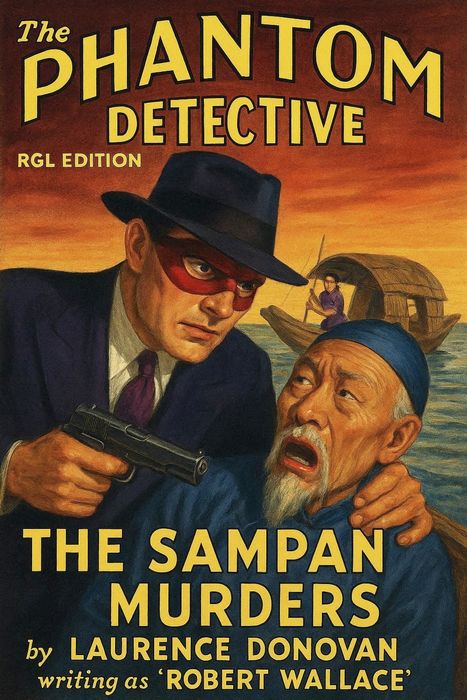
RGL e-Book Cover
Based on an image created with Microsoft Bing software
Roy Glashan's Library
Non sibi sed omnibus
Go to Home Page
This work is out of copyright in countries with a copyright
period of 70 years or less, after the year of the author's death.
If it is under copyright in your country of residence,
do not download or redistribute this file.
Original content added by RGL (e.g., introductions, notes,
RGL covers) is proprietary and protected by copyright.
RGL e-Book Cover
Based on an image created with Microsoft Bing software
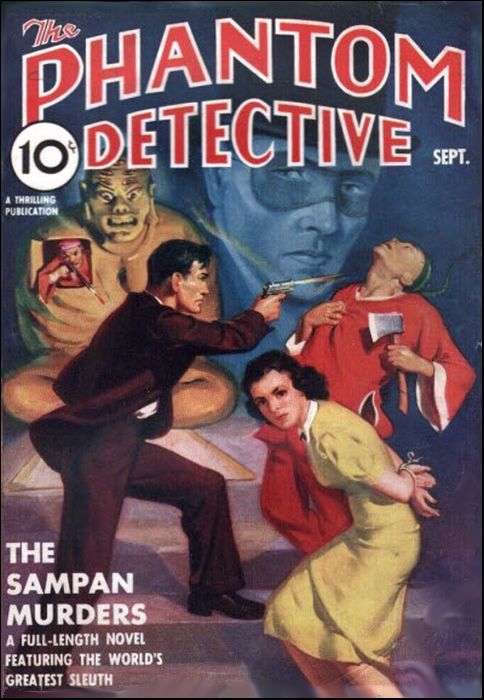
The Phantom Detective, September 1939, with "The Sampan Murders"
The grinning Idol of the Seven Sacred Suns unleashes a reign of terror that sweeps the miracle land of the Treasure Island World's Fair—and the nation's greatest sleuth goes into action to probe a baffling mystery of invisible death! Follow the Phantom as he uncovers a nest of oriental crime and treachery!
FOUR men with furtive, watchful eyes boarded the huge Chinese junk. They came separately in colorful sampans. But their arrival was cloaked to bring them aboard almost at the same minute. Reaching the deck by different sloping gangways, their presence went unnoticed by other gay visitors thronging about them.
The eyes of the four men darted about until they marked each other. Their concerted gaze then turned toward the front of the glassed-in forward cabin. In this they were joined by all of the others who had just come from the sampans.
"Ohs" and "Ahs" were breathed by women in the throng. Speculative interest showed in the faces of men. All were intent on the exhibit, except the four who had made sure of each other's presence, and who were moving, still separately, around the fringe of the crowd.
"It is the Idol of the Seven Sacred Suns!" a woman, obviously a school teacher from the Mid-west, said eruditely. "It came from the temple of Rais Laimur. They say"—she hastily consulted her little guide book—"it is worth at least five million dollars."
"An' try an pick out anyone o' them red eyes an' see what it gets you!" grunted a red-faced man nearby. He waved a pudgy hand at four guards, two Americans and two Chinese, armed with machine guns. "Or s'pose you grab the whole idol or any of them other gimcracks, an' whatcha got? Read them signs, folks. It's a phony."
Ranged around the squat and benevolently grinning Idol of the Seven Sacred Suns were other gleaming treasures. Marvelously hand-wrought, delicately leaved trees that looked like spun gold. Scores of smaller objects in which hundreds of jewels scintillated. Vessels and mitres, tapestries apparently woven with precious threads and inset with gems of fabulous value representing millions.
But a sign on the window announced in small golden letters:
THE ORIENTAL TREASURES DISPLAYED ARE
PERFECT REPLICAS OF THE ORIGINALS BROUGHT
TO THE UNITED STATES UNDER CUSTOMS BOND
FROM RAIDED PROVINCES OF OLD CHINA.
ALTHOUGH IMITATIONS, THEY ARE OF THEMSELVES
OF HIGH INTRINSIC VALUE. ALL PERSONS ARE
WARNED NOT TO APPROACH BEYOND THE RAIL.
PHOTOGRAPHS MAY BE TAKEN.
The armed guards stood inside a rail separating the window and the sightseers by a good ten feet. The grinning Idol of the Seven Sacred Suns had seven, great red eyes like faceted rubies. It had seven gem-encrusted arms that hugged the squat, ugly body adding to its grotesqueness.
THE idol's benevolent grin seemed to become one of derisive amusement as the crowd read the sign. Then all eyes lifted to gaze upon the only living figure inside the glassed-in show place.
At least he was real. The thrill-seeking sightseers saw an aged Chinese who stood with folded arms beside the idol. He was tall and broad. His face had the impassive smoothness of yellow oil and exhibited about as much emotion.
He was garbed in Chinese dress. His blouse was of finest silk, loose flowing and hand woven with the designs of hooded falcons across the wide shoulders. His loose pantaloons were of equally costly material. One little finger protruded over a folded arm, with a nail that was inches long. A spiraling protective sheath of gold enclosed that fingernail. In his tight skull cap, he bore startling resemblance to the idol beside which he stood.
The half-veiled eyes of the old Chinese sleepily surveyed the crowd. But that sleepy gaze took in more than the crowd. For unerringly it picked out the four men who moved furtively along the rails of the junk. Each of the four men in turn sought and met the inscrutable eyes of the Chinese. His slight shoulder gesture was lost upon the sightseers. The four men moved unobtrusively past the exhibition cabin toward the after side deck.
Two went in one door; two in another. All darted fearful glances over their shoulders as they disappeared.
Poled sampans took some of the sightseers off the big junk. A few others replaced them, but the crowd was thinning. It was late, though it did not seem so with the brilliance of thousands of varicolored lights reflecting in the shimmering water.
Except for this gorgeous radiance, the sampans might have been moving upon a murky river of old China. High-bowed junks and other Oriental craft dotted the water. But behind them myriad walls glowed with moonlight rose, blue, and green.
For the setting for the Oriental craft was the Pacific Basin. It was but a small part of Treasure Island, the world's largest man-made island. Throughout more than four hundred acres thousands were in the gay mood of the "Never-Never Land."
The four-hundred-foot Tower of the Sun reared its glowing brilliance above scores of oddly fashioned walls. A five-thousand-pound Phoenix, its feathers of plated gold, topped the Tower of the Sun—the spirit of risen San Francisco!
Treasure Island! The San Francisco World's Fair of the Pacific and the Great West!
Though midnight was nearing thousands still thronged the island, gazing raptly at the gigantic murals by Covarrubias and other famous artists, studying the dioramas of the thrilling voyages of Drake, Magellan, Vizcaino, Cabrillo and other great explorers who first had looked upon this Golden Gate.
"Look! Look! Look!" sang a barker. "Positively last show for the night! See Sally Rand's nude ranch!" Laughing crowds, still surged through the amusement section in a mood of festive gayety. In the faces and voices of carefree mid-summer vacationers was the spirit of carnival.
BUT there was no gayety, no lightheartedness in the faces of the men who sat about a carved teakwood table in a small aft cabin of the junk of the Idol of the Seven Sacred Suns. A gray fog already creeping-through the Golden Gate to herald the dawn, still hours ahead, reached out like the fingers of gigantic ghosts to touch with their grayness the faces of four white men who sat there, hunched forward, elbows upon the table, eyes on the fifth man who sat at the head of the table.
In the smooth, yellow face of this apparent leader was neither the tenseness, the suspicion, nor the fear displayed by the others. He was of great age, this Chinese, but he was unwrinkled, and the oily yellowness of his features showed only blankness.
"The house of Luy Wong is given to this decision we have made together," he said in a soft, low tone. "We do not commit our minds to writing, for wise men read what fools set down. We stand together, and it is written only in our thoughts that the first one of us to violate our agreement through fear or ambition for personal profit at the expense of the other four shall be held accountable."
The eyes of the four darted to the faces of his companions, as if each sought to read the others' inner thoughts. But in the countenances of each of the four white men showed only determination. But in the very furtiveness of the glances it was plain that no one of them fully trusted the others. Attention turned back to old Luy Wong. The eyes of the Chinese were as sleepy, as inscrutable as ever. But each man before him believed that when he spoke of "the house of Luy Wong," he meant the hatchet tong they knew to be at his command.
One white man had a huge stomach. His round face was filled with little, purple veins. They made a peculiar crisscross coloring over the unnatural whiteness of his skin.
"We have learned that crime becomes an endless cycle," he said heavily and pompously. "We go on and on, committing new crimes to cover up those that already burden us."
His words, if uttered elsewhere, would have shocked a city, a whole state. For the man who spoke was no less a personage than the magistrate of a city court that handled the bulk of criminal cases that were discharged, or held for the grand jury—Judge H.T. Wandersee.
"Possibly that's not so necessary to the rest of us as to you, Judge," drawled a small, wiry, olive-skinned man with piercing black eyes. "Our acts do not come so widely into the public eye."
But that speech, accompanied by a sardonic twist of lips, would have highly interested some officials of the government. His words might have been illuminating on the subject of outside activities of Tony Decano, agent of the United States Customs Service.
Luy Wong's expression still remained done in yellow oil and as unreadable, although a glint was in his half-lidded eyes. He spoke with slow deliberation, as he swiveled his glance at another of the men facing him.
"And you, Lomar, do you agree with Judge Wandersee that nothing but more criminal acts can save the guilty from retribution?"
A bony-faced man with straw-colored hair stared at Luy Wong. There was grim, ironic humor in his eyes, blue and sea-washed, as befitted the head of a Pacific-Oriental shipping line. For such was Lomar Sunderson.
"I agree with the judge, unless a man wants to sink himself as a ship is sunk at sea, and permit his heirs to collect the insurance," he said resignedly. "There has been great profit in the trade I have enjoyed, thanks to Decano. But now—" He shrugged.
THE fourth white man, ascetic-looking, thin, and white to the point of emaciation, twisted his long, pale fingers together as his brown eyes glowed with fiery impatience.
"We have come to a decision, and made an agreement that Luy Wong has indirectly informed us is nothing less than a death pact and still you speak as if you were afraid!" he cried heatedly. "We may meet death one way or another. But I, for one, will stick by our bargain!"
"A soul long attuned to beauty may often lose itself in the unreality of reckless courage," Luy Wong said quietly.
There was real tribute to the courage of Aturis Camaris in Luy Wong's tone. Camaris, fancier of the fine and liberal arts, was one of the directors of the Oriental exhibit on Treasure Island.
"We have all permitted our thinking to loosen our tongues," Luy Wong murmured, "but we still seem agreed. The years still before me are fewer than yours, and the sunset of a wise man's life never will be obscured by the clouds of past storms. If need requires, the blood on a hatchet can cleanse the soul."
Aturis Camaris shrugged his thin shoulders with a nervous jerk. But old Luy Wong suddenly ceased to notice the reaction of his queer companions to his cryptic philosophy. The lids of his eyes raised although his countenance betrayed no alarm or other emotion. He was looking intently at a small porthole window. What he had seen there he did not say, but his voice lowered to a hissing whisper.
"We must leave at once. Go separately as you arrived. Under no circumstances shall two of you be seen together. Mingle with those who are leaving, on separate sampans."
"Could we have been suspected—" the stout man began uneasily.
"Silence is wisdom, Judge Wandersee," murmured Luy Wong.
As if his words were a signal, the two light bulbs abruptly snapped out. The cabin, the whole junk was left in blackness. Feet scurried on the decks. Voices rose in anxious questioning tones.
"Take it easy, folks!" rapped the voice of one of the armed guards near the Idol of the Seven Sacred Suns and the other replicas of Oriental treasure. "Nothing to get upset about. Something just went wrong with the lights. They'll be on again in a minute! Stay back from the rail, everybody!"
On deck, old Luy Wong shuffled among those boarding one of the sampans. He saw Judge Wandersee on another boat, and two of the others hastening to obey his warning to separate. Luy Wong's long fingernails touched the front of his silken blouse. The shadow of a sad smile played over his lips.
"Perhaps only foolish ones pronounce their own death sentence," he murmured. "The Lee Tai Tong may strike quickly."
But in his eyes was a flicker, as if he were aware that already the Lee Tai Tong had struck. He was watching all of the boats. He failed to see Aturis Camaris aboard any of the sampans.
A goggle-eyed guard was first to discover why the art fancier had not departed with his companions. He found Aturis Camaris slumped over the teakwood table in the junk's cabin. A member of the police himself, the guard sent out no alarm but summoned one of the basin patrol boats.
ONLY a few minutes later an Oakland headquarters medico assigned to the World's Fair announced to the detective-sergeant in charge: "It's cold-blooded murder, Sarge! Killed with something like a stiletto or an ice pick—stabbed right in the eye! It wasn't a fight, for his clothes are not even disarranged."
There was a clean, small hole through Camaris's right eye into his brain. His death must have been instantaneous.
The Oakland policeman whirled to the four staring treasure guards. "Who was back here with him?" he demanded.
The two Chinese guards made no reply.
"Luy Wong, the importer an' the boss of Sunset Street, was all we knew was inside the junk. But he comes every night to look at the exhibit, an' we didn't know anybody was back here with him. I saw Luy Wong leaving just after the lights went out, an' then the lights come on again."
"Damned if it looks like a Chinee bump-off to me!" growled the sergeant. "Old Luy Wong, huh? You can't ever tell! But he's too high up to nab on suspicion, and it'll be a headache findin' a Chinese that'll talk! I ain't ever run onto one yet!"
The Oakland sergeant was glad the questioning of Luy Wong would fall to the San Francisco department. And he was also due to be a busy man, in short order. For at this moment yellow-skinned men were stalking on Treasure Island with hatchets under their coats.
Incredible, bloody evil menaced the World's Fair of the Pacific.
SHORTLY before midnight the sight-seeing crowd had been drawn to the Carlos Zandu demonstration as a focal point of interest. The famous Zandu was giving his performance in the glassless window of the Palace of Fine and Liberal Arts.
Within that building was housed forty million dollars' worth of modern paintings and old masters, rare books, tapestries and prints from Pacific nations. Day and night armed guards stood before the Japanese National Treasure, a priceless collection, never before permitted to leave Nippon.
Carlos Zandu was noted for his expertness in makeup which was almost magical. He was engaged now in fashioning miniature women in wax, using more than willing society leaders as models. The images were to occupy one of the thirty-three miniature rooms of the Thorne exhibit in which, though the rooms were only three feet high, every detail of furniture, textiles and decoration was exquisitely made to perfect scale.
Interestedly watching the master artist in wax, Frank Havens, publisher of the San Francisco Clarion, the New York Clarion, and a chain of other newspapers, stood with a red-faced tourist. Apparently, the tourist was from the Middle West, for his face seemed burned by a mid-Western sun and his voice had the distinctive twang associated with that section of the country.
"I don't see how a man can do so much thinkin' with his hands, Mr. Havens," the Westerner drawled.
Havens' grayish blue eyes held a glint of amusement, as he glanced at the Westerner and his other companion, a dapper Chinese, smartly dressed in the latest American fashion. Havens indicated the Chinese now, as he spoke to the sun-burned tourist.
"I think Zandu is one of Mr. Kee's finds, Mr. Roker," said Havens. "Naturally the man who is responsible for the Oriental exhibits would be interested in all artists and their work. Isn't that true, Mr. Kee?"
"Yes, Mr. Roker, that's right," Mr. Kee said gloomily, stroking his smooth chin. "I only wish our own exhibits from the Orient had one-tenth as much pulling power as Zandu. Sometimes I'm sorry I induced him to come here from Hollywood. Too much competition." He glanced at the Westerner. "You're right about him thinking with his hands. He's probably the only artist in the world who can do it, Mr. Roker."
A slight smile touched Frank Havens' face as he glanced at Roker and observed his red, farmer-like hands.
"Zandu didn't get those hands of his from pushing a plow in Iowa," he said to Roker, meaningly, with a grin.
"Reckon that's right," drawled Roker, glancing at Havens from under thick, bushy brows. "But somebody's got to raise crops. Everybody can't be making fancy wax faces for a living."
Havens managed to repress a laugh. For this "Mr. Roker" to whom he was talking could do so much more than fashion women's faces in wax. In fact, the man who appeared to be a lumbering, gawky farmer was world-famous as "the man of a thousand faces." He could have given Zandu lessons, but he never neglected a chance to learn anything new in the makeup art, hence his present interest.
That enthralled crowd would have swung away from the artist in wax, with no afterthought for him had they guessed the identity of the mid-Western farmer. For the Mr. Roker, standing beside Frank Havens, was the Phantom!
THE Phantom—the world's greatest detective. And he was also Richard Curtis Van Loan, multi-millionaire playboy. But in his true identity, which was a secret known only to Frank Havens, he was a gay, sardonic spender in that half of his strangely divided life.
Not only was the famous newspaper publisher the closest friend of the Phantom, or Van Loan, and the sole possessor of the secret of his identity, but he was the instigator of the wealthy young society man's career as a scourge of evil-doers. Richard Curtis Van Loan had chosen to visit Treasure Island with Havens as a plain Middle Westerner, because of a direct purpose to meet Carlos Zandu and learn at first hand of his reputed miracles of makeup.
To have made direct inquiries and to have studied Zandu's methods as Richard Curtis Van Loan could scarcely have escaped comment. Too many friends of his lighter life were seeing the Exposition of the Pacific. Van Loan never overlooked a detail of precaution to prevent his amazing double identity from being suspected. He did not choose to be called upon suddenly to explain a curiosity over advanced methods of makeup.
Mr. Kee had for some time been a friend of Havens, having sought publicity at a time when he was given charge of one of the Oriental art exhibits. Aside from his position here, Mr. Kee also conducted an importing office. It was at Havens' request that he had consented to conduct Roker and the publisher through some of the chief exhibits, explaining them.
"You mean, Mr. Kee, that many of the Oriental exhibits aren't doing so well?" questioned Havens. "It couldn't be that Chinatown rackets have taken a hand?"
Mr. Kee nodded gravely. "That's exactly what seems to have happened, Mr. Havens. At least, one mysterious racket of Chinatown has hit Treasure Island. Most of the concessionaires have been compelled to raise prices, and many have closed. From some of the threats that have been reported to me, the entire Oriental section of the fair is menaced, and it wouldn't surprise me to see the rotten extortion extended."
Havens was watching Roker closely. But the Phantom did not appear to be listening. He was watching Zandu's work. He noted automatically that Zandu moved with a queer, stiff-legged walk, not as if he were crippled, but as if it were a habit.
Zandu was tall and dark. His eyes glowed like black pools as he worked and occasionally he shot glances at the faces of those watching him. Suddenly his hand slipped and partly marred the wax face he was modeling. The social matron who was his subject frowned.
The Phantom's gaze instinctively followed Zandu's eyes. He saw a dignified, fat-stomached man standing near the window. Except that the dignified fat man kept glancing nervously over his shoulders, the Phantom could see nothing to account for Zandu's clumsy reaction to his presence.
"The man you seem interested in, Roker, is Judge Wandersee," Havens said. "Rather an interesting character, at that, or"—he laughed a little—"it might be interesting to know how he hangs onto his bench after the number of times he has been the target of the press because of his free and easy system of dealing with some of the best known criminals."
"It's his kind that help the racket menace," averred the pessimistic Mr. Kee. "We've had killings in Chinatown because of such laxity with criminals as his, and if murder comes to Treasure Island before the Fair is over it will not be surprising."
HIS gloomy forebodings were cut short by a Fair police guard who hurried up and touched his shoulder.
"They're looking for you at Pacific Basin, Mr. Kee," he said in a low voice. "Mr. Camaris has been found dead on one of the junks—murdered!"
"Murdered?" exclaimed Havens, staring unbelievingly, "Aturis Camaris? Good God, man! He's one of the Fair's biggest men! Why, he—" Then Havens' newspaperman's instinct asserted itself. "What happened? How was he killed?"
"They don't quite know." The police guard shook his head. "There was just a hole in one eye, but no weapon, and—"
Both the fervently uttered oaths in English of Mr. Kee, an American Chinese, and the guard's explanation were suddenly cut off by a gurgling scream. The scream and the awful clunking of some weapon into bone came together.
The Phantom pivoted just in time to see a Chinese in American garb pitch to his face. Women who had been watching Zandu added their terror-filled voices to the instantaneous tumult.
The impeccable Mr. Kee became suddenly, bitterly calm.
"I've been expecting something like this to happen," he said. "But Camaris! It doesn't make sense. He had no exhibit—was only an expert on art."
But the Phantom was already moving on amazingly light feet, surprising in the heavily built Roker. One glance had shown him what had happened. The Chinese who had fallen had a hatchet imbedded in the back of his skull. Blood spurted, though the yellow man was already dead. Sidestepping, the Phantom made his way around the ring of panic-stricken sightseers pushing back from the body. His lightning sense of detail had taken in much more than the fallen Chinese. He had seen a tall, broad old Chinese in native garb and with a face that might have been painted in yellow oil, and who was fast shuffling away from the fringe of the crowd.
Frank Havens attempted to follow the Phantom, but was blocked off.
"He's seen something, all right," Havens grunted to himself. "Maybe those eyes he seems to have in the back of his head have spotted the killer."
"Looks as if your friend, Mr. Roker, doesn't want to be close to any dead men, the way he dashed off," Mr. Kee remarked to Havens. "But I can't wait here. Do you want to find out more about what happened to Camaris?"
"Yes, that would be a good idea," assented Havens, but he was more curious over the Phantom's abrupt action. He guessed shrewdly that this amazing detective he had sponsored had seen a great deal more than any other person in the crowd.
The Phantom had indeed observed more than any other individual. Even before he had seen the huge old Chinese in the gorgeously be-flowered and hand-worked blouse, he had noted that the fat-stomached Judge Wandersee had been quick to waddle away the second after the hatchet had struck and the dying man had screamed. Scarcely the action to be expected of a jurist and a sworn officer of law enforcement in such a situation, was the Phantom's quick thought. Why should an official deliberately avoid becoming a witness to a murder?
BUT Van Loan's pursuit was directed toward the old Chinese. He had no means of knowing that the ancient Oriental was Luy Wong, who this very moment was wanted for questioning by the police in the death of Camaris. Van saw only that the hatchet-slain Chinese must have been one of four yellow men guarding the richly appareled older man. For three other Chinese closed in around Luy Wong as he moved swiftly away.
"It has all the marks of a tong killing," Van told himself. "But unless I'm far off, there's more to it than that. A judge should have no reason to flee from the scene of a murder." Instantly he was recalling, too, what the American Chinese Mr. Kee had just said to him and Frank Havens.
"You'd almost think Kee had advance information on what was about to happen, from the way he was talking," Van muttered. "But of course, if he had, he wouldn't have said what he did. Or would he?"
Because he was as elusive as the wraith from which he took his name, the Phantom merged with the thick shadows leading toward the parking grounds. He was sure he was unobserved. And he did not want to overtake Luy Wong at the moment.
Old Luy Wong shuffled ahead of his three guards until he came to a limousine almost as long as a railroad coach. The costly car plainly was a machine of special design, befitting a potentate. And Luy Wong was a potentate of sorts, though Van did not know it. He was the boss of Sunset Street.
The aged Chinaman was first to reach the car. The Phantom saw him glance inside, then step back as quickly as if some venomous reptile had confronted him. A sibilant command was rapidly sing-songed in Chinese. One of the guards darted forward. The other pair stepped quickly around the other side of the car.
The guard beside Luy Wong pulled open the driver's door. A body came tumbling out into the glare of the nearest light. It was that of a uniformed Chinese chauffeur. A hatchet was still buried in his skull—a weapon identical with the one just used to murder another Chinese.
Van Loan started swiftly forward. The time had arrived for questioning the ancient Chinese, though he had originally intended trailing him from Treasure Island. But even as he moved Van heard a swishing sound over his head. His hand snapped instinctively under his coat to a holstered automatic, but a silk cord whipped over his face and tightened instantly, although the Phantom set his powerful neck muscles against it.
Perhaps he would have beaten the silk cord, but a weapon with a metallic ring clunked upon his skull. Van was not wholly out, but between being half stunned and half strangled, he was powerless to bring his holstered automatic into play. He could still hear, though, and as through a tortured dream he heard the voice of the keen-witted old Chinese he had so fatuously followed.
"Bind him swiftly and well," directed Luy Wong in his native tongue. "Only a dangerous adversary with a purpose would have had the wisdom to observe and pursue this humble one. We cannot tarry here, but we must know more of this so curious person."
LUY WONG—though Van did not as yet know the name of the old Chinese dignitary in the silken garb—and two guards rode in the back of the car with Van cramped on the floor bound with silken cords and gagged. The body of the murdered chauffeur was hidden from sight on the floor beside the driver. Apparently the old Oriental had no intention of reporting this second hatchet killing to the police.
Van had no faintest inkling of what these yellow-skinned men meant to do with him, but it had always been his philosophy that while there was life there was hope; and always he had taken advantage of any situation to listen and learn what he could. If he did live, there was always the chance that stray information picked up could be useful. So he listened now, with a fleeting thought to be glad his bonds were silken. Perhaps later...
The old Chinaman was talking some. His speech was a Chinese dialect of one of the remote western provinces of the once mighty empire of Khubla Khan.
The Phantom had few, if any, equals among white men versed in the various Chinese dialects. He was listening keenly as the limousine slid from the big parking lot.
"The heads of those who betray a trust never can be secure," said the old Chinese. "These two might have realized they would be the first to fall before the hatchets of Lee Tai. It is regrettable that Aturis Camaris should also have died so quickly."
Lee Tai! The name of the tong head hit the listening Phantom. Could this old Chinese be Lee Tai, the brutal Oriental whose wrath was so greatly feared?
TRUE, there was a trace of sadness in the voice of the ancient Oriental as he spoke of Camaris, but Van knew the Chinese way of thinking and speaking contrary to the evidence of his own acts.
"The wily old devil might murder his best friend, and then be politely sorry about it," ran through Van's mind. "Wonder how long before he'll discover he's been riding the Phantom around town?"
Already the Phantom was aware that he would have to pit his sharpest wits against the wiliness of this ancient Chinese—if he got the chance. Given anything like a break, though, he was fairly certain he could outwit the Oriental. For he was the possessor of resources that probably belonged to no other one man. He was the master of makeup, mimicry, ventriloquism and hypnotism. And at his fingertips was all the knowledge acquired by an intensive study of science in all its branches, and of criminology.
He knew he was embarked now upon an adventure that would test all of his knowledge and skill—if he got that break, and somehow his uncanny sixth sense told him he would.
The limousine slid silently through the Treasure Island driveway and onto the causeway crossing to Yerba Bueno Island and the world's most magnificent bridge, the Bay Bridge connecting San Francisco's Embarcadero waterfront with the waterfront at Oakland. On Bay Bridge it drew up at the bridge toll house. A tall policeman stood beside the man collecting the tolls. He did not even glance into the car, and somehow, in spite of his predicament, Van was oddly satisfied that he could not call out for rescue. Somehow he wanted to go on with this thing, with the feeling that he would win out at the end, and that he would be responsible for putting a finish to one more orgy of crime. How these Orientals were implicated in the murder of Aturis Camaris, or how in the crime rackets that Mr. Kee was so certain would end in murder carnage, he could not guess. But he meant to find out.
The toll was paid and the car rolled on. Weaving through the after-midnight truck traffic of the Embarcadero, it crossed over the four tracks of Market Street and headed for Chinatown.
Van checked off the streets as the car moved. He was familiar with San Francisco, as he was with many other cities.
Gray fog sent its chill into the car as it entered America's most colorful Chinatown, making for the upper part of the Oriental section where pagodaed buildings were ranged along the slope that had the exclusive residential section of Nob Hill at its top.
"We will go to the house of the vaults," murmured Van's captor. "There I will learn more of this person whose curiosity is greater than his caution. He is not of the police, but the manner in which we were followed and the weapon we have taken proves he is no ordinary individual overcome by a desire to know what is not of his concern."
VAN saw what appeared to be a blank wall when he was lifted from the car by two of the guards. The wall opened to the knuckles of one yellow man. It closed, then Van was being carried along a narrow, warm passage that reeked of incense fumes.
Again Van heard his aged captor speak.
"We must hasten. Our enemies may come at any moment seeking the jewels of Rais Laimur's Seven Sacred Suns. The unworthy spawn of the evil one have known of my movements this night and may have seized their opportunity."
Van's carriers emerged from the narrow passage into a rounded room. In it was but one great chair, black, polished and grotesquely carved. Long purple draperies entirely concealed the walls.
Ceremoniously the huge old Chinese seated himself in the big chair. His sleepy eyes regarded the Phantom, laid upon a costly rug before him. Studying him, Van shrewdly decided that by remaining anonymous now he could accomplish nothing. As only a morbidly curious tourist, he was in greater danger than if the truth were known.
"I am the Phantom," Van said suddenly and calmly in bold challenge.
The eyes of the Chinese did not so much as blink in his emotionless yellow face.
"Luy Wong is honored, but not wholly surprised," he said. "Unworthy hands now will unbind the Phantom that he may stand before Luy Wong."
The smart old man had addressed him in Chinese. Van smiled a little as he replied. Luy Wong's quick tribute to his identity made Van aware that pretended ignorance of the Chinese language was useless. The old fellow would be fully aware that the Phantom could speak his own tongue with facility.
"It is I who am honored to be in your house, Luy Wong," said Van. "Perhaps the circumstances are not to my liking. But they may be of mutual advantage. An all-wise man does not find it necessary to speak with a double tongue."
Van could see a questioning glint in the half-closed eyes. So Luy Wong was trying to guess what his real purpose might be!
Luy Wong showed the ghost of a smile as he ordered tea served.
"It is regrettable that such a remarkable person must be detained for the time, but as we converse, that may be revealed which will make such detention of short duration."
The Phantom bowed, but in his mind was the thought: "Yes, you wily old heathen, my detention may be short. You have sent your men away, but you know they are close behind those drapes. So my detention might become permanent by means of a knife or a hatchet at any time you see fit."
"The outcome of your enforced visit depends upon yourself," Luy Wong said blandly.
Van bowed and seated himself, sipped his tea. Where he would have tackled this problem with direct questions to a white man, he waited, saying nothing important.
He was fully aware that only some break of luck could bring him reliable information about what was going on at Treasure Island in which Luy Wong and other Orientals were apparently at cross purposes. And he sensed that old Luy Wong was alert and watchful, stalling for time, waiting for something that he expected to happen...
SHORTLY before the time the apparently blank wall of Sunset Street opened to admit Luy Wong and the Phantom, two flashily dressed men were moving through the thick, early morning fog. They crossed Market Street into Kearney Street, then went on down the hill toward Chinatown.
They were soon two shadowy figures among the pointed pagodas and towers that loomed like strange Asiatic ghosts in the soupy bay mist. A Chinese with his hands under his blouse for warmth shuffled toward them.
One of the flashy men shouldered him roughly off into the gutter.
"Some of them yellow guys think they're as good as white men!" growled the aggressor. "An' that goes for the boss, as well as the others. Tell yuh, Scrump, I'm thinkin' the time's come for us boys to take over the racket from that Chinee. We can handle this old fool, Luy Wong!"
The other man grunted in agreement. So it could be taken that this pair of nice boys, well known to the police as "Hoppy" Beylor and "Scrump" Golan, had great contempt indeed for the intelligence of the Chinese.
"It's been a pushover so far," stated Scrump Golan. "But there ain't no percentage in bein' paid collectors when we could just as well be glomming the whole take! An' the boss ain't been puttin' the bug on more'n half the dumb Chinese that's in the dough!"
"Keno!" agreed Hoppy Beylor. "He's protectin' his friends, an' all we get outa doin' the hard work is a few drops of the gravy that spills over. Now if we took it over, we could double the protection while the World's Fair is on an' a big bunch of saps is payin' fancy prices for their knick-knacks from China and such places."
"Yeah." Scrump nodded. "Whatcha say we make a start on this roll Luy Wong's handin' us tonight? We could put the pressure on that old fool an' hold him up for some of the rest of that dough he's always got in his safe."
Hoppy rubbed a hand nervously across his nose. He had hopped himself up for this early morning foray into Chinatown, but apparently he would have to have another pinch or two of dope if they were to start any rough stuff.
"Yeah," he agreed. "I've been hearin' Luy Wong's got plenty rocks stowed away in the tunnels at his house of the vaults. Whyn't we crack down the next time, Scrump, an' bring some of the boys? We could strong arm Luy Wong's dumb bunnies an' make a killin' before we give the boss the run-around. I ain't never liked workin' for no Chinese."
Contempt was in the voices of both men when they spoke of the man they called their boss, clearly a Chinese. Also they were itching to pull a doublecross on him. Only Hoppy and Scrump lacked the mental capacity to handle the racket now holding Chinatown in its slimy tentacles.
For, until this Chinese boss they mentioned had come along, no racket had ever been worked among the shopkeepers of the colorful section. Rich as it was with its profitable tourist trade among the hundreds of curio shops, it had required a Chinese mind to take advantage of that profit.
BUT Hoppy and Scrump were blissfully unaware that only a Chinese mind could match wits with other Chinese minds. In some other part of the big city, the strong arm boys would have been furtive and on their guard against being tailed. Down here in old Chinatown they strode along, believing themselves secure enough.
But furtive figures shuffled through the foggy night. Visitors seeing Chinatown during the day would never have imagined that those apparently blank walls could open in so many odd places. Hidden, mysterious doors spewed forth bent, shuffling Chinese. The sandaled feet of Orientals slapped and rasped along the wet sidewalks.
Overhead, strings of paper lanterns always hung. Whether it was a Chinese feast time or not, it was good business to keep up a decorative effect. The tourists liked it.
Hoppy and Scrump paid no attention to the shuffling yellow men. They had such little respect for Chinese that they were unaware that they were being closely shadowed by two of them.
The two Chinese kept an even distance behind the white men. Characteristically, they moved silently, without speaking. One had his hands folded within his blouse. The other carried a queer, cage-like object, which was partly concealed by his loose garments.
A low, gray wall loomed out of the fog ahead of Hoppy and Scrump.
"You just follow my lead, Hoppy," said Scrump. "We'll throw old Luy Wong for a loss, an' before he finds out what it's all about we'll take a rap at that safe where he keeps the dough."
The wall looked blank. Back of it a square cupolaed pagoda tower seemed to rise out of the steep hill itself. A gold sign in a window beside the wall read:
LUY WONG
IMPORTER
Hoppy felt along the stone, touched it and a section swung open on oiled hinges. A yellow face jumped into view under a dim light globe. The Chinese had his hand thrust suggestively into his blouse.
"Beat it!" ordered Scrump, putting a hand against the yellow man's breast and giving him a sudden shove. "We come to see the big boss man!"
The guard caught a heel and fell back against the wall of the narrow tunnel. His head banged smooth stone with a crunch that was a big laugh to Hoppy and Scrump. That appealed to their particular brand of humor.
The guard was half stunned, so that when he scrambled to his feet he moved slowly and failed to close the wall door quickly. As noiseless as shadows, two Chinese floated through the opening, closing the door behind them. Hoppy and Scrump heard nothing as they hurried ahead. There was little to hear, anyway—only the sound of a harshly drawn breath and a dull thud.
But when the two Chinese invaders shuffled silently forward, keeping Hoppy and Scrump in sight, the unlucky guard lay queerly crumpled against the tunnel wall. His eyes were open, but seeing nothing.
His right eye had a hole in its pupil that might have been drilled with an ice pick. The hole went all the way into his brain.
Hoppy and Scrump strolled nonchalantly into the room with the purple draperies, Scrump flicking a lighted cigarette onto the priceless rug.
THE Phantom became aware there must have been some insidious drug in Luy Wong's hospitable tea. He drowsed, but fought his eyelids open. Old Luy Wong watched him imperturbably, rubbing the golden sheaths around his long fingernails together as if he were speculating what to do with the Phantom.
Coming to a sudden decision, he touched a button with his foot. He seldom employed his hands. When a servant with an ugly, scarred face appeared, he said:
"Our guest should be rewarded for the remarkable will power that has the force to fight off the Nirvana of the drink. You will bring him the wine of the restoration. Wise men and fools are alike in that they can change their minds quickly.
The wine Van drank was bitter. But its immediate effect was such that he quickly thought how useful it could be to him on other occasions when he might be drugged. His senses became instantly alert, and strength flowed through his numbed limbs.
Old Luy Wong was scrutinizing him with the drooping-lidded eyes that were the merest slits of liquidly black friendliness—or menace. No man could have judged which. They told nothing.
Luy Wong spoke. "It is the whim of ill fortune perhaps that the great Phantom has intruded upon those affairs which can in no way be retarded by white man's laws and still serve the ends of justice. If it were not violating a respected confidence, much might be divulged. But there are cords of injustice which may be severed only with the keen blade of violence."
"Where there is law and order, no man can justifiably take the administration of justice into his own hands," stated Van.
"This humble one, Phantom, has the greatest respect for your point of view," said Luy Wong. "It is most unfortunate that you appear to be all that those of us who sometimes pursue a necessary evil course have heard of you. We could not expect you to compromise with extra-legal forces, so restraint becomes most important for the time."
Van was about to reply when Hoppy and Scrump made their sudden, cocky advance into the luxurious room. Van saw the lighted cigarette contemptuously tossed onto the costly rug, the thin smoke of it curling to blend with the hazy incense fumes haloing Luy Wong's yellow face.
Luy Wong did not appear to notice the insulting act.
Scrump strode over, planted himself in front of Luy Wong's chair, his mouth twisting.
"You ain't doin' so good with the boss, Luy Wong," he blatted. "He says you're a week late comin' across with the mazuma this time. If it ain't laid on the line, he'll be turnin' the collectin' over to us straight, instead of you gettin' your yellow paws on the dough."
Luy Wong sleepily inspected his gold-sheathed fingernails. The mobsters gave no heed to the Phantom. One glance had showed him to be one of the tourist sucker class and of no concern to them.
Luy Wong's voice was not raised because of the insult he had been handed. And knowing how the Chinese insist on respect, Van was instantly on his guard. He had a vastly different view of the intelligence of the Orientals these mobsters despised.
SO he was not surprised at Luy Wong's low, soft words.
"I have decided to pay no more to the one you call your boss," he said. "It is written that the weakest sometimes become the strong. You can convey the word there will be no more collections among my people. I have so informed them."
"What?" snapped Scrump, his flat face betraying his disbelief. "Why, you old yellow punk! D'yuh think you can get away with that? Hell! You'll keep on collecting, but it'll be for white men smart enough to hold you in line! Which means, you dumb mug, us boys are taking over the racket! An' if the boss squawks, we'll take care of him in our own way!"
Van's nerves went taut. The movement he saw in the purple curtains was not caused by a breeze, for no breath stirred in this exotic, underground stronghold in Sunset Street.
Old Luy Wong neither moved nor spoke again. He surveyed Hoppy and Scrump as if he were looking into the distance. But there was a sudden whispering rush. It was in the air above, something of bloody evil, ominous. Swiftly the mobsters swung around, but that was all they could do.
The room darkened almost instantly. There was only the dull, sinister glowing of the little fires in the swinging incense pots of gold before Luy Wong. That, and a queer, indefinable, pale light that seemed to emanate from one of the mobsters.
Van was given no time to study that vague, luminous mist. For he was aware that it was death whispering. It was a moment for swift, striking action. Van sprang from his toes. Where Luy Wong sat was fixed in his mind. His powerful hands shot out.
A scream that was the chilled agony of a tortured brain rang through the room. A hoarse, gurgling squawk. Two words came.
"God! Hoppy!"
Van had meant to seize Luy Wong and make him a temporary shield against any rush of his men. But Luy Wong must have been prepared for any such attack. Van collided with the big, carved chair, crashing into it with the speed of his own rush.
But only empty space met his reaching hands. Luy Wong was not in the chair.
Van pivoted, his trained ears strained for a rustle of sound that would betray Luy Wong's whereabouts. There was only the hideously harsh breathing of one of the mobsters. Then a gun erupted its yellowish-blue flame, spatting viciously.
Lead hammered into the carved wood of the chair close to Van. Perhaps that was why Luy Wong had removed himself with such celerity. For if he had remained seated, he would have been perforated by slugs.
Then the lights flashed on as suddenly as they; had gone out. There was no more whispering in the air and the luminous mist had vanished. One mobster, wild-eyed, his emptied automatic held stiffly in his hand, was looking at old Luy Wong's empty chair. Van could see the sudden shine of perspiration beading the thug's forehead.
Then the mobster was turning, staring down at his companion. Scrump lay on his back looking at the patterned ceiling, but he was seeing nothing. One eye was glazed, hideous. The other eye was even more horrible.
There was a hole through the middle of that eye and the ball of it had collapsed. Van knew there was no doubt but that the hole went all the way into the mobster's brain.
SEEING Van by Luy Wong's chair, the mobster cursed with quivering lips, yanking a second rod from his coat pocket. The gun came up, but the Phantom had been given a second to prepare for that. His lithe, powerful body shot from his toes and he dived under the rod as it flamed.
The mobster received the hard impact of Van's weight at the knees. He folded as quickly as if he had been cut down by machine gun slugs. But he rapped at Van's head with the weapon as Van's fist shot to his chin.
Half a dozen yellow men seemed to flow silently through the purple curtains. They buried both the mobster and Van with the sheer weight of numbers, but no blows were struck. Instead, the low, calm voice of Luy Wong came from the side of the room close to the big chair.
"We have ceased to contribute to those who would mock the wisdom of our ancestors," he said. "Death has come as an unbidden guest for which this humble one was not the host, but the obtuse brain of the one who has survived could not encompass that truth."
Van was on his feet between two of the yellow guards. Resistance was futile at the moment. He saw now why his rush to seize old Luy Wong had failed. That wily Oriental no doubt had long before prepared for just such an emergency. For he was still seated in his big, carved chair. This chair was swinging back along a noiseless slot to the place where it had been. And the empty chair was receding into the floor.
Luy Wong was not being trapped in any position where quick action would be required of his flabby, aging muscles.
"I must utter a thousand apologies, Phantom, but it is necessary that you again be restrained," he said, and a guard started whipping silk cords around Van's arms and legs. "As for this other unthinking one it would be most unwise for him to bear away the tale of all that has happened. There remains only the keen blade of violence."
"No! My God, no!" screamed the white-faced, shaking Hoppy. "I won't turn squealer, Luy Wong! I wasn't in on all that hooey Scrump was spillin' about us takin' over! I won't be tellin' the boss nothin', except that Scrump met with an accident!"
Old Luy Wong almost smiled at that.
"The truth is aptly spoken, my misguided friend," he said. "You will not convey the sad tidings to Lee Tai. For it was not the house of Luy Wong that so conveniently removed the other evil one. It was the work of Lee Tai himself, you foolish person. Do you think he did not know what has been in your minds? Remove him."
Again bound by the cords and hemmed in by the yellow men, the Phantom was helpless. The gibbering, pleading Hoppy was almost carried behind the purple curtain.
"But Luy Wong—" Van started to protest.
A crunching blow behind the curtain punctuated his speech. A long sighing groan quivered through the air. The purple curtain bulged at the bottom, swayed back, and part of Hoppy's body was exposed.
The blade of a hatchet was buried in Hoppy's skull. The brain that had so scorned the thinking capacity of the despised Chinese was split. Gouts of red blood gushed from the death wound.
VAN was staring at the hatchet, thinking hard. How could the boss of the Chinatown rackets have known what was in the minds of his white mobsters? How could his killers who administered the strange death by the eye have entered Luy Wong's guarded sanctum?
Van judged it was about time now he began to think of a way out himself. Luy Wong was nobody's fool. Would he ever risk releasing the Phantom, knowing his world-wide reputation for never quitting when it came to the punishment of crooks and killers?
The Phantom had seen Luy Wong cold-bloodedly order a murder. The hatchet killing had been promptly and horribly executed. Van could not have much sympathy for a racket mobster like Hoppy Beylor, but this mobster's end had been horrible.
While the Phantom never killed except in self-defense, and was always observant of the law, he could not avoid often thinking that a more prompt dispensation of justice might be good public policy. Those who knew him only as Richard Curtis Van Loan, gay spender of an inherited fortune, would never have guessed he had such thoughts.
For none of his society friends took "Dick" Van Loan seriously. To them, he didn't appear to have a serious thought at any time. Society idler, bon vivant he was, to all intents and purposes engaged only in spending the millions his father had grubbed to accumulate.
Dick Van Loan as a detective, now pitted against the most cunning brains of the world, those of the Orient, would have been fantastically amusing to his social friends. Nevertheless, in old Luy Wong's searching scrutiny of the Phantom at this moment appeared the deepest respect and even a hint that the wise Oriental would much rather have Van for a friend than an enemy. There was a touch of reluctant fear, too, in Luy Wong's studiedly sleepy expression, although not one white man in a million could have read it in the smooth, yellow face.
The gruesome corpse of Scrump Golan was removed before Luy Wong spoke. His remark to the Phantom then was casually calm.
"When the years of a man become few, and life of itself holds but little more purpose, one can then devote himself to spilling the blood of evil men without fear or conscience."
Van bowed agreement, with a serious smile.
"But I must remind Luy Wong that individuals cannot thus take the law of violence into their own hands," he said. "It might become an epidemic that would spread to those unworthy to administer it. Once the Vigilantes hanged killers from the lamp-posts in old San Francisco, but that was before there was constituted and dependable law enforcement."
AGAIN bound with the silken cords, Van was thinking with lightning rapidity. The mobster had just been killed by a hatchet. Two of Luy Wong's own men had been killed on the World's Fair island with hatchets. What did it mean? Could it be that Luy Wong was ruthlessly waging some warfare of his own, and had sacrificed two of his own men to cast suspicion upon others? Could it be that... But his thoughts were swiftly jarred to a stop when to his ears came the sound of voices hissing and muttering excitedly. They were behind the purple drapes where Van guessed the tunnel leading from Sunset Street to be. The drapes parted and two of Luy Wong's men strode in, carrying an inanimate form between them.
The figure was that of a shapely girl. Her clothing was torn. One of her stockings had been loosened and a gouged scratch appeared along a well formed leg. There was another furrowed mark across the girl's cheek under a taped blindfold.
But the parted, red lips and the straight nose were those of an unusually pretty white girl. A girl who had been seized and brought to Luy Wong by his tong killers!
IT had been instinctive with Van to go to work on the silken cords that bound his wrists behind his back the moment the men who had bound him backed away. Now he began to work desperately, in spite of the odds against him. For with the appearance of the girl, the whole situation changed. More than his own life and safety was at stake now. This girl... He had to get loose!
Cords of silk lend themselves to easy unknotting or tightening, because of their slickness. But the result depends upon whether the bound victim is a fumbler or an expert. The Phantom, however, was possibly the equal of the late Houdini when it came to freeing himself. That had been tested many a time, recompensing him for the long hours he had spent in patient practice.
Touching the silken knots gently with his long fingers, Van worked slowly, with meticulous care. The wrong pull or movement would only make the bindings more secure. They must be worked loose with infinite patience. And it seemed scarcely a time for such patience.
As his hidden fingers writhed, Van watched Luy Wong's reaction to the sudden appearance of the girl And in the yellow face he observed the nearest to a shadow of surprise that had yet appeared there. Plainly old Luy Wong had not expected this girl to be brought to him.
What, then, did it mean?
A tall, thin Chinese whom Luy Wong called Ty Hu, was summoned from among the men. He appeared to be Luy Wong's chief lieutenant. They conferred briefly in tones so low that Van could make out no word.
Wily old Luy Wong's sheathed fingers continually touched his lips as he talked. Van knew the Oriental suspected that he could read his lips, which was true. Therefore, he concealed them.
Luy Wong removed his hands from his mouth and waved it in a gesture of command.
"It would be well that our latest guest be confined until we have learned more of what meaning this may have, he said. "For the present she must continue to be a prisoner, and—
A little gust of icy, fogged air stirred the drapes over the tunnel from the street. A small Chinese came in swiftly, crossed to Luy Wong. He spoke quickly, with that lack of calmness which is all that ever betrays a perturbed Oriental mind.
"This humble one must report that the police are at hand, Luy Wong," he said. "They would question the All Wise One in the death of Aturis Camaris. Also, Ku Soo, the guard at the north gate, is dead of the hole in his eye. The police unfortunately have seen him."
It leaped instantly into Van's mind that his suspicion of Luy Wong must be more than nebulous theory. If the police were coming to question old Luy Wong, and had discovered one of his guards also dead with a hole in his eye, the aged Chinese would be very much on the spot in the minds of the questioning authorities.
The same death that had struck down one of the racket mobsters—whether for his insult to Luy Wong, or for his attempted double-crossing of his Chinese boss, it was hard to say.
And now Luy Wong was to be questioned about the murder of Aturis Camaris!
Van hoped mightily that he could hear the police questioning. But he might have known this would not be.
Luy Wong was sing-songing commands even as his big chair started moving along the concealed, oiled slots.
"Remove the Phantom to the vault of the idol! Place the girl with him for the time!"
A BIG, empty, carved chair arose magically from the floor. Luy Wong was removing himself from the ordeal of questioning by the police. The chair in which he sat passed through parted drapes and the drapes closed.
Van had no doubt but that Luy Wong would, within seconds, be safely conveyed to one of myriad tunnels that wound in a bewildering labyrinth under the hill above Chinatown.
What disturbed Van was that he, too, was being removed, when he so heartily wished to hear what the police had to say, and perhaps learn more of what all this was about.
As the Phantom, he always had received police cooperation wherever he might be. His domino badge was known to every law enforcement officer in the nation. But for his own reasons he did not care to now disclose what he had already learned, and what was still only a jumbled intricacy of crime and death in his own mind, so perhaps it was just as well he would not be there to see the police.
Van did not care to divulge the knowledge he had gained, or to explain his presence in the house of Luy Wong. Four Chinese picked him up and the purple drapes rubbed softly over his face. He saw the bound, unconscious girl being brought along beside him.
"Listen, you yellow heathen!" boomed the hard voice of a policeman in the exotic room from which Van had been carried. "You know damn' well where Luy Wong is! That old devil's got some tall explainin' to do! First, there's this big shot at Treasure Island, then we find Scrump Golan in a gutter with the same kind of a hole in his eye, an' then one of your men right here! Where's Luy Wong?"
The voice faded out as what seemed a part of an inner wall became a door leading into a dank, odorous tunnel. But Van could still hear well enough to judge grimly that Luy Wong's yellow men had not replied to the police officer's demand.
Van reflected grimly that the police were tackling a considerable task. It might take days, weeks to investigate all of the tunneled hill into which he himself was now being carried, in a search for Luy Wong—and then not find half of them.
The men carrying Van proceeded along a grimy passageway, guided by only the flashes in their hands. Four great doors opened and closed behind them.
From one thing the policeman had said, it was plain to Van that Luy Wong must have had the body of murdered Scrump Golan placed where he would be found. The police must know some of Scrump Golan's contacts with Chinatown. It seemed to Van that Luy Wong must have known he would be questioned in the murder of Aturis Camaris. The cunning Oriental must, therefore, have figured the police might be led into some other line of suspicion, if Scrump were found dead outside.
The labyrinth of twisting tunnels they had been following now became split into wider spaces, into vast, arched rooms or vaults, far under the slope of Nob Hill. Van could detect the long stale odor of opium smoke that still clung to some of the slanted walls.
SCORES of such underground dens once were the abode of old San Francisco's greatest evil. Van had an image in his mind of the hundreds of women and men who once had lain upon luxurious couches in these dens, giving themselves up to the fantastic dreams of the poppy.
Nor was he so sure that all of the drug odor was from time gone by. There a sickening pungency that bespoke more recent usage of some of these hellish vaults.
The great vault into which Van and the girl were last carried and laid down, was exotically fitted up. And there was a gleaming figure set at one side—a squat, ugly idol with seven, glowing eyes of ruby red.
At first, the Phantom jumped to the conclusion that he had been brought into a smugglers' den. For the squat, ugly idol, with its seven, writhing, gem-encrusted arms was but one of the apparently valuable objects in this underground vault.
There were several smaller statues. Each was heavily jeweled enough to represent a fortune. And there were hand-wrought objects in gold and silver, some with the delicate tracery of flowers. They were of the long-lost craft of the ancient Chinese of the Inner Kingdom of centuries before.
Van's eyes came back to the ugly idol, which was small enough in size to have been transported by two strong men. He had seen the replica of this image on the junk in the Pacific Basin.
"This must be the real Idol of the Seven Sacred Suns," he mused. "And old Luy Wong is keeping it safe enough. But if some of the white mobsters he's evidently been playing with had an idea this was here, they'd get it if they had to dynamite the whole of Nob Hill and Chinatown."
The tall, thin Ty Hu, chief aide to Luy Wong, had accompanied the bearers of the prisoners. His face was so sharp it looked not unlike one of the hatchets so readily employed by the yellow men. He spoke to Van in Chinese.
"It is the will of Luy Wong that you remain here for the present, Phantom," he said. "As long as you are peaceful, I can convey the assurance that no harm will come to you. It is a matter of expediency."
Van nodded. "I can do nothing but accept my position," he said, "but this girl should have medical attention."
"She will be treated with the greatest consideration," promised Ty Hu. "Luy Wong has ample reason to desire that she be unharmed."
Van had mental reservations on that subject, but he nodded.
Two guards were left behind. Evidently they were men who had come from China's western hills, for they were above six feet in stature and, like old Luy Wong, of enormous breadth. They did not appear to be armed, but Van had no doubt but that their flowing garments concealed murderous hatchets or knives, or both.
The guards seated themselves stoically upon a thick rug that must have been worth thousands. All of the vault reeked with opulence. Golden braziers gave forth tiny threads of perpetual incense.
Van saw an embrasure in the wall which openly displayed cooking utensils and the inevitable pipes of opium smokers. So he had guessed right that some of the drug fumes were of recent origin! He set himself to considering the location of the vault.
"It must be well under the highest part of Nob Hill," he reflected. "And if the stories about these tunnels are to be given credence, there must be more than one exit."
THE girl was lying, inertly, near him. She was breathing regularly. He detected a quivering movement of her chest and her head turned a little, as if she were trying to see through the taped blindfold.
Van had been seated on the rug near the wall where the jeweled idol leered at him mockingly. His huge guards sat cross-legged, their slanted eyes upon him steadily. They conversed in tones so low that Van could not make out what they said.
Again Van's long fingers had been busy with the silk cords. His hands were concealed behind him, so that he was able to flex and relax the wiry muscles of his forearms and wrists. And once more the silken knots were loosening until Van made sure that one quick movement would free his hands.
But his legs were bound rigidly. They were under the eyes of the guards. He could not be quick enough to liberate them, even with his adept hands, before the guards would see and be on him.
The girl moved a bit more, moaned a little. Then she mumbled in a wistful, frightened voice.
"If you won't harm him, I'll write the note," she murmured. "Only promise me it isn't just a trick to get my father into your hands. He isn't a rich man, so you cannot ask much ransom money."
The Chinese guards jabbered harder at each other in their guttural undertones. Then they spoke louder, so Van could hear.
"She has been told it is ransom to be demanded for her freedom," said one guard.
"She is more valuable as a prisoner than any ransom could be," replied the other guard.
Van slipped one hand from the cord bindings, keeping it behind him. If only he had a weapon! But the single automatic he had been carrying had been taken from him.
Yet the Phantom possessed another weapon that was not a mere mechanical contrivance of death. That weapon was in the strength in the whipcord muscles of his arms that he was now slowly flexing as he watched the guards. But more important than strength was his knowledge of a fighting art possessed by but few men except those of the Oriental nations.
But to apply that weapon, with his legs tightly bound, presented a problem that appeared unsolvable. And the guards were watching him closely as if they had been warned that the greatest of all detectives might prove to them that he had been fitly named Phantom.
Van coughed suddenly, a dry, rasping cough.
"Would one of you be good enough to bring me a drink?" he asked hesitantly. "The wine I had has made my throat very dry."
One huge guard nodded, arose, and poured some liquid from a demijohn enclosed in wickerwork into a cup. He shuffled over and towered above the Phantom. Then he bent, holding the cup to Van's lips.
Van's hands shot into view with the speed of light. A gripping thumb and fingers clamped upon the shoulder muscles of the big guard. The thumb went deep into the armpit, as Van's other hand fastened with the hold of a steel vise upon the side of the guard's neck.
"Aw-r-r-r-gh!" groaned the guard, but the sound was emitted when he was being jerked through mid-air above Van's head.
Van had applied one of the toughest of jiu jitsu holds. It had been the spasmodic action of the guard's own suddenly agonized nerves that had shot him into space. Van whirled over, coming to his hands and knees.
But this guard required no more attention just now. His head had collided with the stone wall behind Van. He rolled over, his heavily muscled arms stretched inertly at his side.
VAN could hear the scuffling feet of the other guard as he rushed to his companion's aid. Van went to his back, doubling his legs as best he could against the cords that bound them. This second guard would probably come at him with a hatchet or a knife.
Instead, there was a hard, confident grin across the yellow face. He held out his hands, the fingers spread and reaching. "So you know jiu jitsu, do you?" he said. "I can give you a few lessons."
The big Chinese grunted as he jumped from his toes, his head driving toward Van's chin and, in spite of Van's agile ducking, his clawed hands digging into Van's pectoral muscles.
In sporting parlance that jiu jitsu hold is known as a "honey." With it, a good little man can throw a giant high into the air. Van kicked out with both feet, but the big guard was an expert. Van's kick was restrained by his bindings and the guard sidestepped. He then twisted his fingers and threw himself upon his own back.
It was Van's turn now to have the agony of his nerves react to lift him. The liquid fire of pain darted from the nerves over his heart to the base of his brain. The man on the flying trapeze never made a cleaner, more headlong leap.
Handicapped by his bound legs, Van crashed on his side. He had just time to turn as the evilly grinning guard was again upon him. But this time, Van was set. Instead of attempting to dodge, he permitted the guard's hands to dart in, reaching for a neck hold.
One of Van's hands trapped a wrist, twisted a little and jerked the guard straight toward him. In just the nick of time, Van flicked his face downward, bringing the hard bone of his skull uppermost.
The Chinese was quick enough to get the neck hold, and it seemed to burn all the way along Van's side, partly paralyzing him clear to his toes. But his counter-hold rammed the man's chin against his own hard skull in a collision that dizzied Van himself.
Cursing in Chinese, the guard slid to his side, but shot out both legs, catching Van in the stomach with a grinding heel. The blow was sickening, and Van gasped for the breath that was driven from his lungs in that solar plexus kick.
The contenders were hurled apart. Van attempted to pull himself to his lashed feet but the guard's toe hooked him behind one knee. Once more molten fire poured into Van's brain, setting him upon his haunches. The guard was getting up as Van fell.
And again Van braced himself to meet an attack with a weapon, but the huge Chinese proved sporting enough to stick to jiu jitsu rules. Even when Van suddenly caught him with his bound feet, employing an abrupt, nerve-tearing ankle twist. That over-ended the guard, and this time Van succeeded in rearing himself erect.
The Chinese came up with blood dripping from his mouth where his face had struck bare stone floor of the vault. Van admired his gameness so much at this moment that only the desperate need to escape and to free the girl caused him to use the most effective and most dangerous hold known to jiu jitsu.
Doubling down on his bound knees, driving his flattened hand low under his opponent's short-ribs, Van's other hand was a mere blur of speed as it shot out now, hooking behind the big guard's neck.
ONLY a man possessed of super-strength would have dared risk bringing himself thus within the grappling radius of his enemy. Van had that strength. More than two hundred pounds of Chinese fighting man seemed to be trying to imitate a pinwheel over Van's head.
And when Van released him, the guard smashed into the Idol of the Seven Sacred Suns, starting that squat and sacred image to rocking upon its base. Van thought, regretfully, for a minute, that he had cracked the neck of his antagonist. But the big fellow groaned, breathed deeply, then lay inert, but alive.
The other guard was still out. Van found a keen knife under the blouse of the guard he had bested in one of the toughest bouts of jiu jitsu in which he had ever engaged. Quickly loosening this own bonds about his feet, he slit the wrappings of tape that bound the arms of the girl prisoner. Moistening the tape blinding her eyes he set about rubbing life back into her numbed limbs.
"We'll have to act quickly and find a way out," he told her, when he saw that she was conscious. "So suppose you tell me who you are, and what this is all about."
She had enough tape off to see him now. She was looking at the broad, sun-burned face of a Middle-westerner, or so she thought. To outward appearance Van still was "Mr. Roker." His body-fitting makeup case was still strapped under his clothes, though. It contained everything necessary to convert him into any one of a dozen different characters, all greatly at variance with Mr. Roker.
"I'm Lora Wandersee," the girl said tremulously, as she stared at the two unconscious guards. "Who are you?"
The Phantom smiled. "For the present you might as well call me Mr. Roker. I happen to have been a fellow prisoner when you were brought in by Luy Wong's men."
"Luy Wong?" gasped the girl, her eyes widening. The eyes were nice, very blue, but deeply troubled. "But it couldn't have been Luy Wong, could it?"
That puzzled Van. And it was just then his mind jumped back to her name.
"Did you say Lora Wandersee?" he questioned. "I've heard of a Judge Wandersee—well, just tonight."
"Oh, do you know him, Mr. Roker? He's my father. That's why—I mean, he seems to be associated with Luy Wong. But I guess I shouldn't tell that. I'm afraid Luy Wong has some strange influence over my father. But it wasn't Luy Wong that had me kidnapped. That was a tall Chinese with a scar across his chin who wanted me to write a note telling my father I was his prisoner."
By this time the girl was sobbing with her released emotions.
"Take it easy, Miss Wandersee," advised Van. "We'll have the rest of it later. First, I'd best see if there's some other way out of this vault we are in."
But Van was considering what strange influence old Luy Wong could have over Judge Wandersee. And the pattern of crime and mystery was growing even more complicated.
The Phantom could see that something more than fear for her personal safety was troubling Lora Wandersee. The world's most famous detective owed a great part of his success to his ability to read character, his understanding of hidden human emotions.
THIS frail, lovely girl should have been riven by terror. She should have been eagerly anxious to escape from the deadly danger that apparently threatened her. But there was about her something wholly apart from fear for her own safety and welfare.
Van read it quickly as resignation to almost any fate for herself, that could be the result only of her having already suffered greatly. Her eyes failed to reflect that eagerness for life that should have been in the eyes of a girl so young.
"You are greatly concerned for your father?" Van questioned gently. "Your own life has not been pleasant recently? Tell me of it, Miss Wandersee. I may be able to help you." Her gaze sought his face. Even in the guise of the red-cheeked Mr. Roker, there was reassurance, warm sympathy in Van's features.
"How did you know my life has been unpleasant?" she asked, her voice tense.
"You are too young, too lovely to regard your own plight with so little concern."
"Yes—yes," she breathed. "You are a very wise man, Mr. Roker. I haven't been like other girls. My father is wealthy, but I am left alone a great deal. I cannot have friends, because my own father is too much condemned for the way he conducts his court. I am almost ostracized by the society I have been educated to seek."
"You spoke of some influence you believe Luy Wong might have over your father, Miss Wandersee?"
The girl glanced swiftly about the great underground vault, as if she suspected there might be listening ears in the darkly shadowed corners. The seven great red eyes of the ugly idol glowed weirdly beneath the dimly shaded electric bulbs.
"I know that Luy Wong sometimes visits my father late at night," said the girl. "He never comes by the front entrance. There are others, too, who sometimes arrive at about the same time as Luy Wong."
Van was listening, but he was not wasting time. He was sharply scrutinizing the mysterious shadows of the underground vault.
"You know these others?" he questioned.
"Yes." Plainly the girl meant to keep nothing back now from the man she instinctively trusted, the man who had offered to help her. "There is Tony Decano, a customs man, she murmured. "And Lomar Sunderson, a ship owner. And Aturis Camaris, who is known as an expert in art. Sometimes they appear in our house in the early morning hours, and once I saw them coming up from the basement."
Van's quick brain instantly seized upon this information. The girl, apparently, had not learned of the murder of Camaris.
"Just where is your home situated, Miss Wandersee?" Van asked.
"Why—" She hesitated. "Well, it is on Nob Hill just above Sunset Street. Tony Decano has the adjoining residence. Mr. Decano and my father do not seem to be the friends that neighbors should be. Yet he has been with the others visiting our house in the night."
Van's mind was considering a startling theory. If Judge Wandersee's residence on Nob Hill was just above Sunset Street, then it would be somewhere over this labyrinth of tunnels that old Luy Wong now called the vault of the idol.
Van's gaze went to the idol. He was struck by the quality of one of the seven great eyes. Something about that leering masterpiece of Chinese sacred art did not ring true to the swift inspection of the Phantom's trained eyes.
"We'll defer discussing all this now," he said quickly. "We must discover if there isn't some way out besides back through Luy Wong's house. Remain here a moment."
Van crossed swiftly to the squat idol. With the guard's knife he had taken he pried at one of the big red eyes. It dropped into his hand. Lora Wandersee stared at him, wide-eyed, as if she believed this Mr. Roker she had trusted was a thief, deliberately stealing a great ruby.
As the gleaming gem dropped into his palm, Van stood transfixed, staring into the blacker shadows back of the image. Where the electric lights failed to penetrate, he detected a luminous, misty glowing.
"Stay where you are!" he abruptly commanded the girl.
He started around the idol. Several small boxes nearby bore stamps of the United States customs. Apparently other bonded treasures of old China, thus protected by Uncle Sam until such time as they could be returned to their ancient temples in the Orient.
The vague, glowing luminance was back among more of these boxes. Suddenly, Van seemed to be in the midst of the elusive light. It was the same glow that had hovered about Scrump Golan who had been murdered with a hole in his eye.
Van gripped the knife in his hand. He stumbled over a concealed box in the darkness. And at that instant he saw what appeared to be the dim, arched entrance to another tunnel leading from the vault.
Swiftly he was remembering—the girl had said her home, Judge Wandersee's home, was above Sunset Street on Nob Hill. Tony Decano had an adjoining house. Luy Wong and others had come to her father through the basement.
There were other boxes here besides those marked with the stamps of the government. It was about these boxes in the darkness that the mysterious light originated.
Van's muttered words were cryptic. "Decano, a customs agent... Sunderson, a ship owner... Camaris, an art fancier... Old Luy Wong...
It might add up. Yes, there might be a reason for Judge Wandersee receiving visitors through his basement. And it may also be a way out of this tunnel.
Van stooped, conscious of the glowing luminance near him. His hand found a small, square box, felt over it. His lips were tight, thinking of this night's bloody evil, the murders by the hole through the eye.
"It's connected some way—?"
His reverie was cut short by the chilling hiss of a thrown weapon, so close that its breeze touched an ear. Metal clunked against the idol's hollow shape behind him. Lora Wandersee screamed shrilly.
Whirling, Van saw the girl gripped by two powerful yellow men. One clamped a hand over her mouth to muffle her screams. Another weapon clunked among the boxes close to Van. Then the vague blur of the tunnel arch he had just discovered was blackened out by moving figures.
Van leaped forward and threw himself past the idol. A hatchet that had grazed his skull lay there. Somebody uttered a command in Chinese.
"Seize the white man! He knows too much!"
Dim light struck upon the face of the speaker, a tall, gaunt Chinese that Van had not seen before. A deep, livid scar ran from one temple down his cheek to his chin. His head was encased in a tight skull cap. For all of his sharp command, and the consequent rush of other yellow men across the boxes from the tunnel arch, this leader stood with his hands folded into the sleeves of a loose, native blouse.
VAN'S position was precarious now, for sure. That voice of command carried sinister implication. It might as well have said, "And one who knows too much must be removed permanently."
Van was certain now that two opposing factions were involved in the crimes of the night. These attackers were aware that he was a menace to them. Then they must have known this before he was brought to the house of Luy Wong. His mind went back to the first hatchet murder. His pursuit of Luy Wong must have been witnessed at that time.
Then, before any yellow man could reach him, Van was lunging past the ugly idol. His eyes were fixed upon the wires running to the shaded lights in the vault. Gripping these wires, Van threw all of his weight upon them. The wires loosened, and one broke with a bluish flash of flame that burned across Van's face.
But in the second before the lights went out, a hoarse cry rasped through the vault. Van had a glimpse of the Luy Wong guard who had put up a sporting jiu jitsu battle. It was his cry Van heard as a hatchet crunched through the gallant Chinaman's forehead.
All light was blanked out then. Van was down, rolling out into the open before yellow men could reach him. But it was not only his own safety he was thinking of in this critical situation. The girl—Lora Wandersee! He must get to her! The Phantom's brain never ceased to function even in the gravest emergencies.
Because of the crowding yellow men, revealed by their shuffling feet and their mutterings as they bumped into each other, it was impossible to attempt to rescue Lora Wandersee now, though. But somehow he must. Now was Van's chance to slip past the attackers to the arched tunnel and escape, since they were without flashlights.
Another voice than that of the scarred leader shouted in Chinese:
"We haven't any time to waste, Chee Lo! We can grab the idol! You can't hold that truck for it long!"
Van could hear cursing yellow men swarming around the jeweled Idol of the Seven Sacred Suns. The killers, then, had come there only to steal the fortune in gems, and their attack upon him must have been a chance. They had been surprised at finding him and the girl in the vaulted cellar.
Then he heard the shout of Chee Lo, the scarred leader.
"Some of you get the idol! Remove the girl! This time she shall not escape! We are in luck! But this Roker must be found and removed!"
Roker? Chee Lo, whoever he was, had called him that! Van's mind leaped back to the scene at the Fair, before Zandu's glassless window. Havens and Mr. Kee had called him by that name there. Zandu's hand had slipped, and he had seemed gravely disturbed. Judge Wandersee also had been within earshot. Had it been by this or some other means that his disguised identity had been revealed?
No time to think more about that. All of the rush, the seizing of the girl, the murder of the guard, and Van's blanking out the lights had been within the space of less than two minutes. Many things could happen in an incredibly short time whenever the Phantom was involved.
NEW voices suddenly jabbered angrily in Chinese. They came from the direction of the tunnel that led from Luy Wong's house. Then hatchets were being hurled. Crouching to the stone floor, Van judged that the new attackers were Luy Wong's own men.
Their rushing attack was being wisely conducted. The wily brain of old Luy Wong must be in this. For the defenders of the vault of the idol seemed to be advancing in a line in the darkness. Thus they could hurl their deadly hatchets at all figures who moved before them, although unseen.
Cries of death agony rang out. Those hatchet men were of the giants of Western China. Van heard one of the men attempting to get the Idol of the Seven Sacred Suns away, go down with a gurgling groan.
"Get back!" commanded the voice of Chee Lo. "Bend low that the death may pass!"
CRAWLING along the stone floor among the boxes, the Phantom's hand had come upon a fallen hatchet. He gripped it, making his way toward the dimly revealed arch of the tunnel. It might be a way of escape or it could be a swift death trap.
For Van was sure now that this tunnel or some other one of the mysterious passages honeycombing the side of Nob Hill connected with the basement of Judge Wandersee's home. For another reason, he believed that this same tunnel might also lead to the residence of Tony Decano.
He didn't reach the tunnel arch. Chee Lo's command to "bend low that the death might pass" was followed by crackling little explosions. They could scarcely be termed blasts, but were more like the sharp breaking of electric light globes when thrown upon a hard floor.
Van was halted then as there arose a wavering, luminous wall. The cries of dismay from Luy Wong's line of hatchet men voiced their alarm. And well they might, for their figures were showing as if they had become blurred, moving ghosts.
"It is the death of the Lee Tai Tong!" a voice cried out.
A sibilant, hissing sound filled the vault, like that Van had heard when Scrump Golan had been struck down in Luy Wong's den. But now it was magnified many times. Oriental screams and curses filled the underground space, making it an inferno, a bedlam of dying men.
But disaster and death were also overtaking many of Chee Lo's minions. For there was a crackling burst and the mysterious light marked the figures of some who had come to loot the treasure vault.
"You blundering fool!" rasped Chee Lo. "You have dropped one! Get back, away, before many of us die!"
Not all of Chee Lo's men got away. Only those who had escaped the blighting, murderous touch of that yellowish luminance. Possibly a score were rushing from the vault, escaping into the tunnel for which Van had been making. To become mixed with them was certain to bring quick doom upon the Phantom.
Within the big vault, in the darkness was now only the chilling moans of dying men. After her first scream, Van had not heard Lora Wandersee. He could only guess that she had been taken away.
Van's ways of escape were blocked by enemies, but he was working fast in the blackness. Crawling to the body of a dead yellow man, Van began stripping off his own outer clothes. Touching the makeup case strapped to his body, he murmured inaudibly:
"This is one face that can be made without a mirror," and again the thought of Carlos Zandu, the face-maker of the Fair on Treasure Island shot into his mind.
And somehow that thought brought him a mental picture of the scarfaced Chee Lo, that he had seen but momentarily, just before the lights had been snapped out. Van groped in his memory to recall what it was that now so suddenly made him connect Chee Lo with Carlos Zandu.
"That's it!" he muttered abruptly. "Zandu walked stiff-legged. So did... It mightn't mean a thing, but it's more important than ever now that I get closer to Chee Lo."
Van was working fast in the darkness. Moulages of wax that had broadened his face as Mr. Roker were taken out. An effective cleansing cream was rubbed thoroughly over his face and neck, and over his hands that had apparently been reddened by sunburn.
BECAUSE of the idea he was now carrying out, it was unnecessary now for the "man of a thousand faces" to resemble any particular person. But the slanted brows he applied, the coarsened, greasy, hair plastered tightly to his head and the coloring were converting him into a Chinese. Any yellow man. The real necessity was for haste.
So swiftly did he work that Van was divesting the corpse beside him of its blouse and pantaloons before the sounds of Chee Lo's retreat ceased to come from the arched tunnel. But as he came erect, a short-handled hatchet gripped in his hand, he heard Chee Lo's men returning.
"We must find this Roker, if he is still in the vault or the tunnels!" came the voice of Chee Lo. "And it isn't too late to seize the idol!"
Van smiled grimly in the darkness. They would not find Roker. Possibly, there never would be another Roker for them to find. He slipped among the boxes, crouched by the tunnel arch.
He was waiting to mingle with Chee Lo's yellow men. And remembering, with tightened lips, what he had discovered with his sensitive fingers as he had undressed the dead Chinese.
That man had died because of a hole through his eye. It came to Van in a flash. That yellow, ghostly luminance—it had much to do with the fantastic murders. But no vague, shadowy light could bore a mortal wound through an eye into a man's brain.
Van moved with the hatchet men as Chee Lo's men surged back into the vault. He was close beside another yellow man who suddenly bumped his knee on a hidden box and cursed. And that oath added one more angle to all of this amazing mystery.
There was quickly another strange angle. Van's arm accidentally struck the hand of the man beside him. And that Chinese was armed with a gun now, not a hatchet! Few Orientals Van had ever encountered had ever used guns. They had all seemed to do very well with a hatchet, a knife or a strangling cord.
It brought the theory that a white man might be the big boss.
Chee Lo's yellow minions swarmed into the vault of the Idol of the Seven Suns. Van purposely dropped back, trailing the leader. He confirmed his hitherto vague idea that Chee Lo walked stiff-legged. And Carlos Zandu had walked that way when he had seen him in the display window on Treasure Island. As if the walk had become a fixed habit rather than being the result of some infirmity.
But Van failed to get closer to Chee Lo. The invaders of the vault had brought flashlights this time. The beams sliced over the wide floor. They revealed a bloody shambles.
Guttural Chinese curses filled the air. Many of the attacking Luy Wong hatchet killers must have been killed. Yet no yellow man lay dead where that line had been. And, although Van had been but a few yards away, among the boxes near the tunnel arch, he had heard nothing.
It was Chee Lo's grunted curse though that announced another discovery. The jeweled Idol of the Seven Sacred Suns had disappeared. With it had gone all of those other objects that had gleamed with stones. It was unbelievable to Van. How had all of these, and the corpses been removed so silently in so short a space of time?
And he had been so close. Then he recalled that Chee Lo's men had been making considerable racket as they had returned. Also, he remembered Luy Wong's vanishing chair in the den. Van scrutinized the floor and the surrounding walls closely, his eyes following the darting flash beams.
Then he had it. One side of the great big, deep rug in the middle of the vault floor was disarranged, A slotted crack appeared there. With one foot, Van unobtrusively got the rug back into place when the light beams were not upon him. He wanted to investigate what might lie below that floor later.
Van had heard much of the "catacombs" under old San Francisco. It had been said that many men had entered the labyrinth of underground passages never to reappear. Van was sure, at least, that several fresh dead men had recently joined such yellowed bones as might be buried here and there under the lights and laughter of exclusive Nob Hill.
"We have been tricked!" raged scarfaced Chee Lo. "This may be the work of Luy Wong! But until we find Roker, we can't be sure! Anyway, it is not safe to linger! We have the girl, and with the right pressure, we will force Luy Wong to disgorge all that he is holding from us!"
Van was noting that several of Chee Lo's original attacking force lay dead in their own blood, hatchets having split their heads. And here again was another mystery. For there were also three of Chee Lo's men who had not been killed by hatchets. They had holes in their eyes. One died because of a hole in the right eye. Two others had been murdered through their left eyes. It was while he was cautiously observing these bodies that Van almost ran into disaster.
One of the Chee Lo's men halted beside him, pointing.
"Chee Lo!" he shouted. "Look at this! His clothes! They have been taken away! This one has been stripped!"
Chee Lo strode over on his stiffly lifting legs. He moved as if he were marching to some tune. As if he might have a man close in front of him and another close behind. In but one institution are men marched like that. It was the close lockstep of a convict.
Chee Lo's reaction to the stripped corpse was instant.
"Be on your guard!" he ordered. "If we look around, we might discover the clothing worn by Roker! Perhaps he is one of us now! And if he is, we are entertaining the Phantom!"
VAN had hidden his Roker clothes over toward the arched tunnel. It was time for him to be moving now, before Chee Lo had the benefit of more than these flashlights. Chee Lo had seized one flash and was slicing it about, holding it upon the faces of his score of yellow men.
The light struck full upon Van's features. He stood motionless. His slanted eyes did not so much as blink as he faced the blinding beam. For a minute he held the hatchet gripped, ready to strike if it was forced upon him. He estimated the distance to the tunnel, and judged he might make it if he was given a second's start.
Then he breathed easier. Chee Lo's light swung to the face of the man beside him. Apparently the scarred leader had failed to penetrate Van's disguise. He imagined the yellow leader might not be too familiar with all of his men.
Chee Lo was swearing fluently. Van detected an odd note in his Chinese oaths. But when Chee Lo gave an order to leave the vault Van moved with the men.
Clawed, yellow hands suddenly darted. The surprise was so complete that Van was held, helpless to resist.
"So you imagined I had missed you, Mr. Roker!" jeered the hard voice of Chee Lo. "But you didn't fool me, Phantom!"
GAGGED and tightly taped, but not blindfolded, pretty Lora Wandersee was seated upon a box in the closed body of a big truck. The Phantom, tightly secured with cords binding his arms behind him, was pushed into the truck. Judge Wandersee's daughter stared at him as he was lifted in, a prisoner.
The quick, passing light in her blue eyes faded swiftly when she saw that he was Chinese. No doubt she imagined he was one of Luy Wong's hatchet men. Probably she had expected to see the Mr. Roker who had befriended her in the vault.
"It's just as well for the present she doesn't know me," reflected Van grimly. "But it might be worth something to know why Chee Lo thinks putting pressure upon the girl will force Luy Wong to surrender the Idol of the Seven Sacred Suns?" This was an angle which, like the sinister link the girl had talked about, between her father, Luy Wong, and the three other men, had to be established. Chee Lo turned away without speaking to the Phantom and the big truck rumbled away.
Van had been brought out of the vault tunnel into a side alley where the truck was waiting for the vanished idol. He had not been carried through Judge Wandersee's basement, as he had hoped he might be.
But there were other branches to the tunnel, he had discovered. So he might still be correct in his conjecture that a passage led to Judge Wandersee's residence, and to that of Tony Decano, the customs agent.
Van had a glimpse through the rear door of the truck of the twinkling lights high upon Nob Hill. Yes, the vault of the idol must lie approximately under some of those exclusive mansions.
The truck jounced over the cobblestones of Chinatown's narrow streets. Van was aware when it crossed the four-car tracks of Market Street, one of the widest "Main Streets" of any big town in America.
Next, the tang of weedy salt water sifted through the fog of early morning. Daylight had come, an early grayness. Frank Havens would be frantically wondering what had happened to Van. From the moment of the announcement of Aturis Camaris' murder, he had been unable to inform Havens of what his motive had been in suddenly disappearing.
From the salty tang of the tidal basin, Van became aware the truck had entered the Embarcadero district. This had been and still continued to be one of the toughest sections of the Bay City.
Van imagined for a few minutes that Chee Lo might be heading toward Treasure Island, because the Bay Bridge had its long land viaduct in this section. But the truck was driven past this, then followed the line of old warehouses along rotting wharves.
The Phantom reached most solutions because he never wasted any minute that might be devoted to analyzing angles of the strange cases he had solved. So now even though he might be going to his death, he was summing up all that had happened during the furious carnival of blood and murder that had spotted the past night.
Of one thing he was sure. The murder of Aturis Camaris, that had sent him off on his wild chase, was linked to everything else that had happened. If only the Phantom were free now! For fervently he was wishing he might have a look at the body of Camaris, at the morgue or wherever it had been taken.
He wanted to examine the clothes that Camaris had been wearing. He was convinced the police would overlook something that he now knew to be vitally important to the solution of the murder. It would have been missed by the smartest of detectives. It would not have been any reflection upon police intelligence either. For the police had not seen the luminous light of the hole-in-the-eye murders.
Van considered the motive for the killings. To be sure the Idol of the Seven Sacred Suns was a five-million-dollar treasure, enough to pay any mob, white or yellow. But Van was convinced the motive had its roots far deeper, was something far more sinister.
The racket in Chinatown was one of the connections. The miscarriage of justice in Judge Wandersee's court was another. And, having seen the many small boxes in the underground vault, which had undoubtedly come off of ships, Van was sure that smuggling was another angle of the amazing tangle.
Adding these together, and shaking them up in his mind with the hatchet killings of a Chinese tong feud, the Phantom arrived at a confusion of issues that would have completely balked lesser deductive powers than his own. And one deduction actually touched the fantastic hole-in-the-eye murders, and how they were accomplished.
However, it was clear to the Phantom that any one of at least half a dozen figures might be the boss of all this scramble of death and crime.
Luy Wong was, without doubt, a cunning-brained Oriental, whose power was far-reaching.
Judge Wandersee was magistrate of a court, and was openly accused of consorting with and aiding criminals of the underworld.
Chee Lo was attempting to steal the Idol of the Seven Sacred Suns, and was indisputably the boss of killers. He was also the enemy of Luy Wong, or so it would appear.
Tony Decano and Lomar Sunderson, customs man and ship owner, respectively, were hand in glove with Luy Wong and the crooked judge.
Not to mention the discovery that Chee Lo had a walk similar to that of Carlos Zandu, the face-maker of the International Exposition of the Pacific.
And, apart from all else, who was Lee Tai? First mentioned by Luy Wong, it was not so positive that Lee Tai was not old Luy Wong himself. Anyway, the hole-in-the-eye murders had been termed the "death of the Lee Tai Tong."
It was thinking of this last feature that the Phantom came to a startling truth. It was because of his knowledge of Chinese dialects that it was brought home to him.
"The Lee Tai Tong," his lips moved to say soundlessly. "That would mean something from the dialect of the far western deserts of old China. But it doesn't explain the mysterious light."
The truck jolting to a stop put an abrupt end to Van's musings. The truck had rolled through the old and sagging doors of an ancient warehouse. From the rumbling under the wheels, it was passing over a plank flooring that must lie over the tide water.
Chee Lo ordered Van and the girl removed from the truck. They were taken through two heavily padded doors into a long room that was unexpectedly lavish in its furnishings. Costly objects from the Orient converted what might have been an old ship chandlery into a palatial setting that far outrivaled the exotic den of old Luy Wong.
CHEE LO came and stood beside the Phantom.
"Well, Phantom," he said in the American tongue, "you have proved yourself clever enough this past night. But even the powers of the great Phantom can be overcome by a master. So old Luy Wong wasn't so smart when he called you into this game."
Still gagged, Lora Wandersee was staring at Van. He could see an understanding look come into her blue eyes. Her lovely face almost at once seemed to brighten with a wistful hope. But when Chee Lo referred to the possible employment of the Phantom by Luy Wong, the hopeful look died swiftly.
"If the master is yourself, Chee Lo, you have erred slightly," the Phantom replied to the taunt. "I never am employed by anyone, and work solely in the interests of justice."
"To hell with that pose!" snapped Chee Lo. "Search him! Don't overlook anything!"
It was not important to Van now whether his diamond-studded platinum badge should be discovered. But it was not. In fact the search was terminated abruptly by Van's own quick ruse.
He might have juggled the great red eye he had taken from the Idol of the Seven Suns in such a fashion that it would have been as well concealed as his badge. But he had placed the gleaming, red stone casually into a pocket. He had left it there, instead of hiding it in some more baffling place. When the great, flashing stone was produced, Chee Lo uttered a startled oath, seizing upon the find and holding it before him.
"So the secret is made known, and you are a thief as well as a famous detective!" mocked Chee Lo. "Luy Wong hired you to guard the idol, and you have repaid his trust by stealing one of the rarest rubies in the world! So you know where the Idol has been taken!"
Another man of less quick reasoning might have denied Chee Lo's blazing accusation. Not so the Phantom. He was thinking of the safety of Lora Wandersee, and of some plan by which he might delay an order to destroy him. This was better than if he had deliberately contrived it.
"No living man has ever forced me to disclose a secret," he stated quietly. "And this secret is as sacred as the idol itself. I will never divulge what I know."
Chee Lo's slanted eyes were knives of glittering menace.
"So?" He smiled evilly. "The Phantom boasts? I have heard that you have many times defied torture. I repeat, you have come to one of the times where you are meeting a master. If you do not tell where the idol was taken, within the next three minutes, we will see if your reputed heroism is real!"
SLOWLY, the heated splinters off of a match were forced under the Phantom's fingernails. Van's flesh crawled with the molten fire running along his nerves. He could feel sweat popping from his pores and turning to icy drops on his forehead.
Yet his tight smile was infuriating to Chee Lo who stood watching. An order was given.
"Perhaps the Phantom has steeled himself to endure much," said Chee Lo. "I have never heard, though, of any man sacrificing himself to the extent of going through the remainder of his life a maimed and pitied object. So we will start all over again, but with your face this time. When we have finished, the greatest surgeon would be unable to restore it."
The yellow man who stepped forward with a pair of long, pointed pincers had a crumpled ear. It might have been the result of ring experience, or perhaps those same pincers had once been applied to him. However, Van was instantly more interested in that cauliflower ear at the moment than in the pincers being thrust toward his head.
The misshapen ear was white. It was not because of scar tissue either. The yellow over the man's face had not been spread to take in the ear. The man was a white man, although he was jabbering in Chinese. The swift thought came—the jarring oaths he had heard—the yellow man armed with a gun...
Was it possible that all of these Chinese speaking killers were white men? Van's gaze slanted to Chee Lo again.
The Chinese leader's eyes were as black and inscrutable as those of old Luy Wong himself. The yellow man with the pincers held them close to the Phantom's face. Van shuddered inwardly, but his brown eyes were agate hard.
Chee Lo rubbed his gaunt, yellow hands together. His fingers were long and pliable. They seemed to express him more than his narrow eyes, as if his very soul were in those fingers.
"Removing an ear will not be pleasant, my good Phantom," he purred softly. "Or the eyes. Surely, the great Phantom would be helpless without his eyes. Perhaps it would be wisdom to forego loyalty to Luy Wong. He would not expect the Phantom to sacrifice himself for the Idol of the Seven Sacred Suns, for a superstitious belief to which a white man could not give personal devotion."
"So much speech proves Chee Lo's doubt of his own torture," Van stated quietly.
Chee Lo muttered suddenly, waving his hands.
"Never mind it, Wang!" he rasped. "There is another, a surer way! One that not even the Phantom can endure! Bring the girl to the table! Remove her gag, so she can scream! Fetch a hatchet! I wish anyway, to send a finger, or perhaps a hand to Judge Wandersee as proof we have his daughter! We will remove a hand, one finger at a time—" Slowly he swiveled his eyes to the Phantom. "Unless our worthy friend finds suitable speech concerning the hiding place of the idol."
Swiftly, the girl was seated before a wooden table. One hand was spread upon it, held there. Wang's lips curled as he picked up a hatchet. He raised the weapon high above the girl's fingers.
REGRET for his own well intentioned ruse flooded through the Phantom. He had not expected anything like this! The devils!
He strained at the cords binding his arms firmly. This time his feet had been left free, for his captors had not wanted to carry him. The torturer called Wang was savoring the slow anguish of both of the victims, which delighted his sadistic soul.
The hatchet was poised above the girl's white hand. The blade was as keen as a razor. Pressure upon the girl's wrist by another yellow man flattened her fingers.
"One finger only for the present," said Chee Lo softly. "Unless the great Phantom has a merciful heart and will speak. Where has the idol been taken, Phantom?"
"No, Phantom, no! If you tell, they will kill you, anyway! Don't speak, I tell you."
Lora Wandersee's voice was clear and calm, although it was on a high note. Courage shone in her blue eyes as she looked at Van. Except for the drawn whiteness around her curving lips, in her face was only the utmost resignation.
She was looking intently at Van, as if she wished she might penetrate through his Chinese disguise to the real Phantom whose stoicism under torture had so impressed her.
But Van knew he could not heed the girl's advice. The Idol of the Seven Sacred Suns itself was to him but a minor pawn in this greater tangle of crime. In fact, all of the millions in gems were worth less than one white finger from the hand of this wistful-eyed girl.
"If I must speak—"
Van uttered only these words. His gaze was on the poised blade, wondering if what little he could tell could save the girl. Chee Lo had said they had already determined to send Judge Wandersee the girl's hand to prove she was being held a prisoner.
A whizzing hatchet put a period to Van's speech. The weapon flashed across the big room with the speed of gleaming light. It had been thrown by an expert hand, for it flew lying flat.
Wang, the torturer, emitted a squawking scream. His own hatchet went flying away. Two of his own yellow fingers fell off and lay upon the table. Wang was waving the bloody stumps.
Van's eyes darted across the room. More yellow men seemed to be erupting from the floor through a lifted trapdoor. Van heard a boat scraping upon piling underneath the warehouse.
The first attackers to reach the room cut down two of Chee Lo's men almost before they could turn. And Van saw that the tall, thin Ty Hu, the first aide of Luy Wong was in the lead. Ty Hu had thrown the hatchet that had disarmed Wang.
But Van was already in motion even as he observed these details of the attack. Although his hands were still bound behind him, he was driving straight for Chee Lo who had leaped across the room and was near the open trapdoor. If Van could lunge into Chee Lo, carry him down through that door...
A sinewy yellow man thrust out a foot, and followed it with a straight blow of his fist. Tripped, the blow staggered Van.
"Quick!" Chee Lo was shouting. "The lights! Release the death!"
IT was daylight outside, though foggy. But instantly inside, the room darkened until men were only moving, striking shadows. Hatchets clashed as yellow men fought blade to blade in bloody duels.
Van didn't reach Chee Lo. As he fell, he heard again the crackling little explosions. Yellow luminosity enveloped some of the attackers. And at once the bedlam was punctuated with death screams.
Van was striving valiantly to down with his feet, the hatchet man who had thrown him. His opponent fell upon him, jamming Van's head upon the plank floor beyond the edge of a thick rug. With his hands tied, Van was helpless. He was stunned, half insensible, as the yellow man lifted him.
Van had the sensation of falling. He went down through the trapdoor to the tune of the screams and blows of a tong battle above him. Then the murky, salt water of the bay under the warehouse closed over his head. The chill of the swirling tidal rip revived him. Under the water, Van held the breath in his lungs to the limit of their trained capacity.
Few swimmers could outlast the Phantom under water. He did not make the mistake of attempting to hold all of his breath. He permitted the air to bubble slowly from his lips, knowing that in such manner an experienced swimmer can almost double the time of a dive.
"Whoever wins, they've got the girl again," was Van's thought even now. "And if ever a girl rated being rescued, it is Judge Wandersee's daughter."
With his own life in deadly peril, he was swiftly remembering her unquenchable loyalty to her father, her willingness to sacrifice herself to torture on behalf of the Phantom.
But all thoughts save his own acutely threatening problems were quickly swept away. Van realized that the swift tidal rips of San Francisco Bay were more than any man might hope to cope with unless he could have the freedom of his hands, even such a swimmer as he knew himself to be.
The swift current turned him over and over. He finally managed to kick himself to the surface, but the rip caught him and hurled him violently against a wharf piling. His breath was partly driven out of his body and he felt as if he had been snapped in the middle as he was wrapped about the piling.
Van fought himself free, but as he did, the barnacled surface of the piling rasped the skin from one side of his face. And as he was submerged again, his wounded, smarting cheek gave him an idea. He trod water again, poked his head up and drew in a reviving breath.
Just ahead of him he saw where a piling had been rotted off. It had fallen against another. Van rolled, managed to let the tide rip shoot him between the barnacled timbers. Then he was wedged there, feeling as if tons of water were beating him to a jelly.
Countless times the Phantom's ability to think on the spur of the moment had saved his life. Now he had his bound arms against one of the pilings. The barnacled surface was made sharper by hundreds of black mussel shells with knifelike edges.
The tide swung Van's body up and down, threatening to tear him loose from his position. He was chilled through, and arms and wrists were freely bleeding before he had rasped the barnacles and the mussel shells through the binding cords.
HOLDING to the pilings until he had gained a portion of strength, Van then swam cross-wise of the tide toward the shore under the warehouses. He followed the tidal mud flat until he was again under the warehouse stronghold of the Chee Lo killers.
Ominous silence greeted him. The boat in which Ty Hu and his hatchet men had arrived was gone.
Two minutes later, when he had climbed back up through the trapdoor, Van was gazing upon half a dozen corpses. There was one living man among them, but the ghastly hatchet wound in his head showed he would not last long. The dying Chinese was one of the larger Orientals, one of Luy Wong's western China minions.
Luy Wong's tong had wreaked havoc in the place. Not satisfied with killing, they had made a complete wreck of the exotic headquarters den of Chee Lo, or the mysterious Lee Tai, whichever he might be. Furniture was splintered, art objects shattered, and even the costly Oriental rug had been burned in spots.
Abruptly Van's eyes centered on two corpses of Luy Wong's big Chinese. Each had a hole bored through one eye, a hole bored into the brain. Van was about to turn back to the man still living, when a tiny object near one of the hole-in-the-eye victims caught his attention. It was a gray-black feather, with a long, pointed quill. If driven with force, it could have pierced a man's eye.
Van scooped it up, holding it between his thumb and forefinger.
"So that's it!" he grated. "Clever as all sin! It would take a Chinese to think of it!" He considered his own words. "Or some smart white man deliberately using this death to throw suspicion upon the Chinese. If Chee Lo should be Zandu in disguise, he could be the real boss. But there must be also a deliberate purpose to inspire terrorism with the mystery of the murders."
The dying Chinese moaned and tried to speak. Van thrust the feather he had picked up into an inner pocket and bent over the dying Chinese. The man painfully opened his slanted, black eyes.
"The Phantom?" he murmured in his own tongue. "The All Wise One informed us that you bore a charmed life."
The "All Wise One." Luy Wong, of course. And he smiled slightly; he saw instantly that there was nothing he could do to save the fearfully wounded Chinese.
"Can you tell me," Van asked quickly, "if the girl was rescued by Ty Hu and returned to Luy Wong?"
"No, the tong of Luy Wong was beaten by the Lee Tai death," The dying man whispered huskily. "Chee Lo escaped with Judge Wandersee's daughter."
"If you could but inform me as to why the girl is being held, I might become of service to your All Wise One, Luy Wong," Van said gently.
The Chinaman closed his already dulled, black eyes, then opened them again.
"It is written that before one is taken to his ancestors, it is well to purge his soul," he said slowly. "We know of this daughter of Judge Wandersee that she is being held for a purpose. The father will be informed that his girl will be put to death, tortured, if he fails to release 'Gunner' Lorton, big racketeer, who is to be brought before him to be arraigned tomorrow on a serious charge."
THE wounded Chinaman smiled a little sadly. Death might be near, and his ancestors were doubtless waiting. But his spirit was calm.
"I cannot now speak of a compact that has been made," he went on in a low voice. "But the powerful Lee Tai tong has reason to fear that Judge Wandersee will not free Gunner Lorton unless he is forced to do so. So the life of his daughter is being staked against the freedom of this—"
The speech of the Chinese did not trail off. It ceased abruptly. He was with his ancestors.
Only minutes later, Van was making his way swiftly from the Embarcadero district. He was headed for a garage in Geary Street, where, as Roker, he had left one of his own specially built cars.
"I'll have just about time to make a call upon the police," he told himself. "Judge Wandersee will be next. Then perhaps another visit to the vault of the idol."
But reaching the garage, he ran into unexpected difficulties.
"I'm afraid I'd have to have an order from Mr. Roker himself before I let you take his car," the solemn-faced garage attendant told him. "Seein' the Fair's on, we have to be careful." At this moment Richard Curtis Van Loan was not a reassuring specimen of humanity. Not only was he a shuffling Chinese, but his face bore bruises from the battering he had received. His Oriental blouse and pantaloons were torn and soaked with salt water.
Van smiled a little. "Give Ching Lung a few minutes' time," he said. "I only want to visit the car like Mr. Roker told me when he sent me. Then I'll bring Mr. Roker."
The garage man nodded slowly. "Well, since he's seen fit to hire you as his Number One boy," he said reluctantly, "I'll let you into the car for a minute. But no tricks, mind you. Them fellows from the Middle West are tough, and I don't want anything to happen."
Van slipped into the car. The garage man snapped a padlock on the steering wheel when he opened the car door, then muttered impatiently as a customer called him away.
Van pressed a secret button in the car dash. It opened a compartment. In flat boxes, neatly contrived, were all of the materials for any kind of a makeup. Van swiftly cleansed the yellow from his face. His slanted brows disappeared. Moulages went into his cheeks.
He applied a reddish mixture to his face and hands. The black coloring and coarseness disappeared from his hair with another application, then with another swift touching up, his hair was that of Mr. Roker. His own hair served when touched a bit. His hands slipped to the back of the seat. The back opened. Half a dozen varied suits appeared. Within four minutes, Van had put away the Chinese clothes, and was into Mr. Roker's Sunday suit.
The garage man was returning when Van stepped out. Probably he had decided he was taking too much of a chance permitting the Chinese to enter the car, even if he did have Mr. Roker's ticket.
THE garage man looked at Van, surprised, then looked inside the coupé. He walked around the car and glanced all about.
"Sa-ay!" he exploded. "Listen, Mr. Roker, didja or didn'tja send a Chink named Ching Lung to get your car?" The red-faced Mr. Roker stared at him coldly.
"You haven't been drinking, have you?" he said. "I've been waiting all of five minutes. I see you padlocked my steering wheel, too. Please unlock it. I'm in a hurry."
The garage man scratched his head. He was sure he had not been drinking, but he was more sure he needed a drink. Van handed him a five dollar bill as a tip. The garage man turned it over and over, as if he were afraid it might turn into a scrap of paper.
Van did not often employ a disguise thus lightly, but he was in haste, and did not care to reveal his Phantom identity here. He was aware there already had been comment in the garage concerning the engine of superpower concealed under the battered hood of his road-worn coupé.
When Van arrived at the police precinct morgue, where he had learned the body of Aturis Camaris had been taken, Inspector Murphy, in charge, glowered at him. Van's Mr. Roker disguise put him in the class of Fair tourists, in the officer's mind.
"You'll have to have more reason than just curiosity to have a look at this Camaris' clothes," he said sharply. "We've already had too many visitors interested in the Treasure Island murders and some other crazy killings. You wouldn't know anything about them, would you?"
"Luy Wong, of Sunset Street, hasn't been among your visitors, has he, Inspector?" asked Van.
"Are you trying to be funny?" snapped Murphy. "The damn newspapers have told too much about that! No! We haven't had Luy Wong—wish to hell he would show up!"
With a slight smile, Van palmed a gleaming, diamond-studded domino of platinum and held it where Inspector Murphy could see it. The inspector shot from his chair as if it had suddenly become hot.
"The Phantom!" he exclaimed. "Well! That's different! Sure you can see Camaris' clothes, or anything else we have."
A BADGE that was known to every police officer of experience throughout the length and breadth of the nation was the Phantom's badge. It was a legend, too, in Scotland Yard, the French Sûreté and police of a dozen or more other countries where the Phantom's fame had spread, and where he was almost equally well known.
Less than two minutes later, the Phantom, with Inspector Murphy, was looking at the dead man's clothing. To the inspector, he did not seem to make a close examination.
"This murder and the others that seem to hook up with it, including some dead Chinese in a warehouse this morning have got us run ragged, Phantom," Murphy said heavily. "If you know anything that might help us—"
The Phantom shook his head, smiling wryly.
"I'll have to confess that the murders have got me down more than they have the police. Possibly I have been closer to some of them than you, however. When I have something definite, I will get in touch with you immediately."
Inspector Murphy was on the phone, talking with Headquarters the minute Van left.
"If it had been anyone but the Phantom, I'd have locked him up as a material witness!" he snorted. "Says when he has something definite, he'll let us know! I saw a couple of bumps on his head that looked damn definite to me! One thing, though, with the Phantom at work, we'll get somewhere!"
Van's examination of the clothing of Aturis Camaris had been satisfactory. But he was not yet ready to divulge that to the police. For he was fully aware that the real key to the whole situation, the man with the keen mind who was directing the various angles of crime, had yet to be discovered.
The chief criminal might be any one of several persons. If it turned out to be Judge Wandersee, it would be a shock, perhaps, but not too great a one under the circumstances. Clouds of suspicion had long hung over the judge and his court. Van reflected they were so heavy that they had already nearly blighted the life of as pretty a girl and as loyal a daughter as he had ever met.
Van had already decided to see Judge Wandersee as his next step in the twisting course he was following. First, however, he sent a brief message to Frank Havens. It read:
Will see you soon. See your Clarion says the police suspect Luy Wong in the Camaris murder. I am not so sure. I would like to learn more about Camaris, and what were his associations, from Mr. Kee, if possible. Will you have Kee at your office tomorrow morning? Roker.
Van dispatched the note by messenger. Even if it had been perused by others, the message was in code, a simple one known to but two persons in the world—Richard Curtis Van Loan and Frank Havens.
Half an hour later, Van was sleeping soundly in his room at the St. Francis Hotel. His bruised and battered body needed that rest.
Late darkness had fallen when the Phantom again came down to the hotel lobby. He had donned another disguise and was now an "average citizen." Van rather prided himself on his ability to merge himself into such a character—the colorless, ordinarily met type, with no particularly distinguishing feature. Such a man usually escaped special notice. If identification became necessary at any time later, it was almost impossible. Being inconspicuous had immense value to Richard Curtis Van Loan in his chosen avocation.
THE night editions of the papers informed the Phantom that the police were still without a clue to the hole-in-the-eye murders. They stated it as their theory, however, that the man who had killed Camaris had been after the jewels of the Idol of the Seven Sacred Suns, and had killed Camaris in order to reach them, only to discover later, undoubtedly, that they were imitations.
Attendance at the Fair had fallen off more than half. With the murder of Camaris, and the later hatchet killings, people were afraid to risk their lives on Treasure Island. Exposition authorities demanded that the police get results quickly, to save the Fair a tremendous loss.
Van parked his battered coupé on a side street off one of the steep, hill streets leading to the top of Nob Hill. A cable car groaned and clanked its way upward. Stately residences stood along the rim of the hill. They were like huge observation towers, from which all the lights of the lower city, of the vessels upon the bay, and of the beaded illumination of the long Bay Bridge could be seen.
Judge Wandersee's palatial home was such a tall mansion, standing like some gloomy guardian castle at the top of the slope leading down into colorful Chinatown. Merging with shadows along the stone wall surrounding the judge's grounds, Van could pick out the quaintly shaped pagoda that marked the location of old Luy Wong's house of the vaults. It was directly above Sunset Street.
Van did not plan to see the judge at once, openly. Cautious observation, he decided, might avail him more, as he set himself for a long wait. It was not difficult to locate Judge Wandersee's room on the second floor of his home, for the Phantom could see the shadow of the fat-stomached jurist as he paced back and forth across a lighted, double window above a projecting balcony.
"When a man walks like that at this hour, he is greatly worried, or is expecting someone," Van muttered softly. "Probably he has received word of his daughter's danger. If he has, he hasn't dared report it to the police."
It was easy enough to deduce that. There had been nothing in the papers about Lora Wandersee. And there was no police record of the judge having reported his daughter's disappearance.
"Judge Wandersee may have visitors coming in through his basement again," mused Van, realizing what Lora had told him. "It might be a good idea to gain an entrance there myself."
He dropped lightly over the stone wall into the grounds. Light from the judge's window laid a white square over the roof of the balcony. Sheltered in the shrubbery, Van was looking for a basement window when suddenly he tensed. His hand slipped to his automatic, holstered under his arm.
For he had seen a shadowy figure snakily stealing along toward the judge's balcony.
Van's first swift thought was that danger threatened Judge Wandersee. He was all set to lunge forward, hurl himself on the prowler, when it came to him that it was more likely the snooping man was a messenger from Lora's kidnappers. Van tensed again as he heard a low, peculiar whistle. Judge Wandersee came to his open window. The next moment the fat judge was unrolling an odd-shaped bundle.
He tossed something out the window and a rope ladder unwound to the ground.
THE skulking figure went up quickly, over the balcony and in through the window.
At that instant, a low-pitched voice called out:
"Hold it a minute, Judge, until I come up."
A second figure appeared and ascended quickly. By this time, Van was merged with the shadows close to the house and was creeping toward the balcony. He could hear low voices above him. It required keen ears to catch any of the conversation.
"Has Luy Wong arrived?" Van made that out.
"He'll come up through—"
The rest of that sentence was cut off as the window was closed. But Van could finish that sentence. Luy Wong would come up through the basement of the judge's home.
Van grinned when he saw Judge Wandersee had left the rope ladder conveniently in place. He ascended lightly, reached the roof of the balcony. The shades of the double windows had been drawn, but Van could see into the room through a crack at the edge of the shades. He had just set himself to watch when the tall, bulky figure of old Luy Wong, murder suspect and fugitive from the police, appeared in an inner doorway.
The faces of Judge Wandersee and his two other midnight visitors were drawn and strained, as they looked at Luy Wong.
There was no doubt of it—in the hearts of those three men was some great fear!
Van had instantly recognized Judge Wandersee's surreptitious night callers, from descriptions he had heard of them.
Swarthy of face, with piercing black eyes, Tony Decano, customs agent, looked to be the most cold-blooded of the trio of white men. His nationality identified him to the Phantom. And the bony-featured man with sea-washed, blue eyes, could be no other than the ship owner, Lomar Sunderson. Watching these two, Van was thinking rapidly—a customs agent and a ship owner... the evidence of smuggling in Luy Wong's mysteries. It lined these two.
In Luy Wong's manner was his customary smoothness and lack of visible emotion. Judge Wandersee's thick, trembling lips were the first to emit speech. The judge's eyes were bloodshot, his face like marble under the criss-crossing purple veins. His hands shook with nervousness.
The window was closed tightly against transmission of sound, even to the trained ears of the Phantom. He remedied that in short order. A shining contrivance with a rubber mouthpiece came from his clothes. Van fitted the rubber against the glass, pressed, and the suction of a vacuum held it.
Hooked earphones went to Van's ears.
These connected with a super-sensitized microphone inside the rubber vacuum. The delicate instrument was Van's own invention, one of countless devices he had made from time to time, in his own laboratory. It was one of the aids he kept on his person in case of sudden need for it.
THE Phantom's laboratory, in which that device and many others had been made, was one of the most complete in the world for analyzing crime, for devising means of battling crooks whose clever brains brought the latest in science to their own aid. It was situated in the Bronx, in New York City. Neighbors knew the occupant of the drab building housing the laboratory only as Dr. Paul Bendix. They looked upon him as a gentle old owl who wore thick-lensed glasses and puttered about interminably. None of them even guessed the extent of the remarkable equipment with which the mild, gray-haired Dr. Bendix worked.
Van called the instrument he was now using on the window of Judge Wandersee a vibraphone. With it, he could hear distinctly through thick paneled doors, even walls. Voice vibrations were transmitted clearly.
So, as Judge Wandersee stood, swaying slightly, waving his fat, nervous hands, outside the window the Phantom heard the judge's tear-filled, yet somewhat defiant words.
"I'm telling you, I cannot hold Gunner Lorton for the grand jury, although I know him to be guilty!" said the judge, looking steadily at old Luy Wong. "I have called you here to inform you of this! Our enemy—his friend—has my daughter! She is all I live for! I have been sent word that she will be tortured and killed, if Gunner Lorton isn't freed!"
Judge Wandersee's love for his daughter was too real to be mistaken. Van silently scored one good mark for the judge.
Decano and Sunderson were also watching Luy Wong, waiting for him to speak. But the oily-featured Luy Wong seemed unimpressed. The old boss of Sunset Street casually rubbed the gold spirals sheathing his long fingernails.
"One with too much devotion in his heart for another is not always a whole man," he intoned softly. "We must remember our motive for deciding to change our past ways, Judge Wandersee. The names in the red book you have in your desk inform us that we are about to see many others held by the same power that has ruled us. It means that hundreds of persons will be made to suffer. The death strike so strangely in the eye is intended, as you must believe, to inspire greater terror by its mystery.
"Judge Wandersee, reason should tell you your daughter will not be so sacrificed. Another measure of greed will keep her alive. A smart man does not destroy a potent weapon he possesses."
"Smart old devil," whipped soundlessly from Van's lips. "He knows that girl is to be used to compel him to reveal the hiding place of the idol! His words are wise enough, but Judge Wandersee has all the blindness now of a frightened father!"
JUDGE WANDERSEE was shaking his huge head, clenching and unclenching his hands.
"It is too much to ask that I take that chance, Luy Wong," he said miserably.
"Nevertheless, that which I have spoken is the truth," stated Luy Wong. "The compact we reached before Camaris was removed must prevail, no matter where death must strike. We know now that the power over us is to be extended widely. We may have the strength to end that power. We insist, therefore, that Gunner Lorton be held for trial, so that he may inevitably pay the penalty for his measureless crimes."
"No! No!" Judge Wandersee's words were a desperate challenge. "Anything but this, I might do! My daughter's life is a million times more valuable than the compact that has resulted from our series of crimes! I shall set Gunner Lorton free!"
The shadow of a pitying smile seemed to float across the yellow oil of old Luy Wong's face.
"What is written, is written," he said cryptically. "What of the lives and safety of many others who will be directly menaced by this compliance with orders we have so long submitted to?"
"Others?" shouted the trembling judge. "I am thinking only of my girl, my baby!"
Tony Decano suddenly spoke.
"The judge is right, Luy Wong," he said. "As for Sunderson and myself, we find the time is not yet ripe to disobey orders. We will be compelled to bring more stuff ashore from Sunderson's ships."
Old Luy Wong's features were a puzzle to the Phantom. Could it be that the wily Chinese had fully expected this reaction to his advice? The sleepily lidded orbs seemed to betray that Luy Wong might even have been fishing for just this result. The Oriental principle of obtaining a definite object by indirection, even by flat opposition, came to Van's mind.
And old Luy Wong's next words and gesture might have been confirmation of Van's keen understanding. The old Oriental bowed slightly, resignedly.
"The wise one must always bend to the will of the majority," he said quietly. "The house of Luy Wong will raise no obstruction to the decision you have made. The vault of the idol will continue open. But you must be warned that a new threat has entered. The greatest of all the world's investigators is openly pitted against us." The three white men stared. Judge Wandersee licked at his dry lips.
"I have entertained the Phantom, gentlemen, in the house of Luy Wong,' stated the Chinese. "And he has robbed us of one of the eyes from the Idol of the Seven Sacred Suns. So he must have discovered our secret of the idol. He has been with the captors of your daughter, Judge Wandersee. But he is no longer with them. Even at this moment that one may be aware of what we do. It may be that for our own salvation, he will have to be destroyed."
SHOCKED and visibly shaken, Decano and Sunderson came to their feet.
"Then we certainly have no further business together!" exclaimed Decano sharply. "We must not come again to the judge's house!"
"You have uttered a simple fact, of which I should have warned you before we assembled," said old Luy Wong. "You have decided that our agreement has failed. I can no longer oppose your setting Gunner Lorton free, Judge Wandersee. I fear only that your action will have no effect upon your daughter's safety."
Luy Wong, Decano and Sunderson walked slowly from the room.
"We will depart by the passage, Judge Wandersee," said Luy Wong at the door. "Carry out your purpose in court tomorrow. Tonight this humble one sees clearly the shortened number of his own suns. A life that has been lived to its full can be only valuable now as it may serve those who have gladdened its days."
Van would have given much to have clearly understood Luy Wong's final words. All he could arrive at definitely was that the old Chinese had decided to interfere directly in the matter of freeing Gunner Lorton. And if that interference cost Luy Wong his life, he meant to convey that it already had been well lived.
HASTILY, Van removed the vibraphone, stored it away. Judge Wandersee was coming toward the window. The rope ladder still hung there. The judge unlocked the window, swung it open, and leaned out. Van crouched to one side until Judge Wandersee hauled in the rope ladder and started to close the window.
Then the Phantom stepped into view and through the open window, landing lightly beside the jurist. Judge Wandersee made a quick, if ponderous movement, toward his old, flat-topped desk, as if his first thought was of the red book there—the book that had been mentioned by Luy Wong. And he seemed to sense instantly that this intruder was the Phantom, prepared as he had been by Luy Wong's warning.
"I would think twice, before I tried to use that gun, Judge Wandersee," Van said calmly. "We have much to discuss, and—"
"Damn you!" shouted the judge. "I've nothing to talk about! You may be the Phantom, but all you'll get from me is a chance to go out the way you came in! If you don't, so help me God, I'll kill you!"
Facing a short-barreled, old-fashioned bulldog revolver, Van smiled indifferently.
"I am the Phantom," he said calmly. "But I come to you with word from your daughter!"
Instantly, Van realized that Judge Wandersee was temporarily beyond all reasoning. A flame of insane rage appeared in the bloodshot eyes. The bulldog revolver came up.
"You can't lie to me!" the judge croaked hoarsely. "Luy Wong said you had to be destroyed! Get out quickly, before I shoot!"
There was no arguing with a man who was for the moment mad. Van smiled, nodded, and said, "I suppose I'll have to obey."
He half turned, but his suddenly doubled legs shot him across the flat desk in a sliding dive. He had to be quick, strike silently and hard, if he hoped to avert a gun explosion that would arouse the judge's servants.
So quick were Van's darting hands that he blocked the gun, even as Judge Wandersee tightened his finger on the trigger. The hammer raised, started to snap down. But experience in the art of close-in fighting served the Phantom.
The gun's hammer snapped down. But the flesh of Van's hand was pinched between it and the shell. He had no choice now. He buried a fist with plenty of force behind it in the judge's double chins.
Judge Wandersee's fat stomach was deceptive. He was as strong as he was huge. He proved it now as he smashed his own free knuckles into the Phantom's face. The blow dizzied Van. He was compelled to drive the judge to his knees and half stun him with straight punches before the man yielded.
Pocketing the bulldog gun, Van got the judge's sagging body into a chair. The gun, which many must know the judge owned, all at once gave Van one of the most daring ideas of his adventurous career.
A FEW minutes later Judge Wandersee faced the Phantom across his desk. Van had secured the fat jurist to his big chair with handcuffs. Van's brown eyes were piercing, compelling now, as he looked deep into the eyes of the man who was prisoner in his own home.
"You are determined to free Gunner Lorton in your court?" Van asked, but it was as much a statement as a question.
"What I do is my own affair, and you cannot interfere!" raged the judge.
"I can but repeat the words of old Luy Wong, who has told you that your decision probably will neither save nor condemn your daughter," said Van. "But either way, Gunner Lorton will not be allowed to go free, and will be sentenced to the maximum term. You will write out your decision now."
"Not by a damn sight, I won't!" came the judge's clipped reply. "I cannot be compelled to—"
"We are wasting time," interrupted Van. "You will write out and sign your decision now, or tomorrow one of the leading newspapers will carry a detailed story of your association with Luy Wong, Decano and Sunderson. Within an hour after the story is on the streets, you and the others will be under arrest for complicity in the murder of Aturis Camaris. The story will tell of the compact between you, the dead Camaris, and the others. I will see to that."
"God!" The judge's livid lips quivered. "You can't do that! It will be sentencing my girl to death, as surely as—"
"We have no time to discuss it," cut in Van. "You will dictate that Lorton must be held, and I will type it on your machine here. You will sign it. Any other judge sitting in your place will not go against your wishes."
Judge Wandersee's voice became the whimpering huskiness of a defeated, frightened man. In that moment Van might have gleaned much more from the frightened judge concerning the agreement in crime that evidently existed among those he had named. But he preferred to have Judge Wandersee believe that he was fully informed.
"You know why we have been forced—" the judge began.
Van wisely cut him off again. "I know all about you... You can start dictating now."
"But, Phantom, a written decision in this case will be of no value, unless I give it myself in open court, and that I will never do."
"Perhaps not in open court, but you will make it," Van said grimly. "You can begin, or I will write on your typewriter what appears to be a full confession by you of the motive behind the Camaris murder. It will be checked by the police to this machine. You know best where that will place you and your associates, and what it may do to your daughter."
Stark fear showed in the judge's red-rimmed eyes. He knew well enough what it would do. He would have been amazed to know that the Phantom wished he were as well informed.
Van freed Judge Wandersee's hands as he signed a typed decision that would hold Charles (Gunner) Lorton for the grand jury on a manslaughter charge which, when brought to jury trial, would bring him from eighty years to life in Folsom Prison, as a foregone conclusion. And the notorious racketeer had been depending upon the crooked court to turn him loose, as he had been so many times before.
"Now will you go?" asked the judge slowly. "I suppose you plan to take my decision to court tomorrow?"
"I plan to do just that," Van said grimly.
HIS sinewy hands shot out. They gripped the judge's fat neck. Two minutes later Judge Wandersee was sleeping under a powerful anesthetic that had come from one of Van's hidden pockets.
Even Van's tremendous strength was taxed in getting the bulky, unconscious jurist upstairs into the attic. There, Van saw to it that Judge Wandersee was effectively bound and gagged. For the Phantom had grimly determined the judge should remain there for twelve or more hours.
As he came back to the judge's study, which adjoined a bedroom, Van was musing upon the effect his threat of exposure had so quickly had upon Judge Wandersee. There could no longer be any doubt but that the judge, Luy Wong and the others were partners in crime, perhaps of long standing.
Nor could it be doubted but that their public exposure would directly link them with the men who held Lora Wandersee prisoner. Judge Wandersee's stark fear that such publicity would cost his daughter her life had told that as plainly as words.
"I might as well have been playing a hand in blind poker," Van muttered. "I play a card without knowing whether it's an ace or a deuce, and it turns out an ace. If I only could know what cards I really am holding, why—"
Van was not forgetting Luy Wong's statement that many others would be menaced if the mysterious compact of these men were to be violated—nor the little red book. Van made quick work of going through Judge Wandersee's desk.
The little red book was in the secret compartment of an upper drawer. Van found the secret space by the simple means of estimating the length inside the drawer as he drew it out. It appeared too short for the space it filled.
A low whistle of amazement came from Van's pursed lips when he opened the book. Not at any explanatory information the book supplied, but at the number of names it contained, and their importance.
More than a score of names were listed. The president of a railroad line. Three nationally known physicians. Two scientists. Three lawyers. Others occupying positions that controlled the lives and happiness of hundreds of other persons.
Above these names was typed the simple sentence:
Marked by the Lee Tai Tong.
Van pondered thoughtfully. In their own sphere, Judge Wandersee, Luy Wong, Decano and Sunderson were important to the welfare of many persons. Aturis Camaris had been less so. Was that why he had been the first to die?
The riddle of the hatchets was in no way solved. But a new red signal of bloody danger was flying in the Phantom's astute brain. No one thing was now so vital as a direct drive to discover the identity of the real boss of the Lee Tai Tong.
Making sure of silence throughout the big house, Van seated himself before the flat desk. A fair likeness of Judge Wandersee was before him in an enlarged photograph. But he needed much more than this for what he intended doing. And his transformation must be accomplished at once.
Moulages, coloring and a flat package that unfolded into a wig that showed a partly bald head came from his makeup case. Van studied the photograph as he worked, but actually depended more on his photographic memory. Carlos Zandu, at his best, had never delineated the face of another more perfectly.
EVEN the crisscrossing purple veins were penciled underneath a white, skin-glaze cream that made the veins appear real. Van built up a bulbous nose. Converting his own body into the fat-stomached judge was more of a problem, to make it seem natural. It would be embarrassing for the judge's huge stomach to slip from place.
Fortunately the Phantom had Judge Wandersee's own over-size clothing, and the judge's bedroom from which to select materials to pad out his own relatively slender figure. And when he was finished, even his hands had been fattened, again with moulages and an outer skin that was pulled over his hands like big gloves.
In the judge's study Van practiced Judge Wandersee's wobbling walk, his mannerisms, including the nervous waving of his hands, before a mirror. His makeup would have fooled the closest of the judge's friends, Van was sure.
"All except one," he murmured, with a slow grin. "Old Luy Wong has eyes as keen as those of the falcons he has woven into his silk blouse. Hope I don't encounter the cunning old scoundrel too close up."
Van was playing the role of judge all the way. He intended sleeping in Judge Wandersee's bed. Doubtless a valet, or the butler came up to awaken the judge in the morning. Van intended to be prepared.
Clink!
A pane of glass in the double window shattered and tinkled to the floor inside. A revolver snout, enclosed in a clumsy silencer of an early pattern, was jammed into view. Van's startled eyes saw a scrawny hand and wrist behind the weapon, with a ragged coat sleeve above them.
The breaking of the glass, the thrusting in of the gun, its spiteful little explosion, like a dry stick cracking, all seemed to come at once. And with them, Van fell sideward, one hand clutching at the flat top of the desk.
If he had been Judge Wandersee, with all of that wide spread of stomach and body, a painful if not serious wound would have been inflicted. As it was, Van felt the blow of the slug as it drove into the padding over the ribs on his left side.
As he was apparently falling, wounded, Van heard a hand fumbling at the side lock of the window. The midnight assassin was coming in! Van slowly completed his fall. Another bullet could not be fired at once; not until that silencer was removed.
Van made his "wound" appear possibly mortal by rolling over and permitting his arms to relax limply. His eyes closed to merest slits. But he was watching the figure that followed the thin, dirty hand and ragged coat sleeve into the room through the glass.
The Phantom drew in a deep breath of amazement. The face of the "gunman" was as scrawny and pinched as his hand. It was also as dirty. Black eyes that looked too big for the pinched features showed in the shaded light on the judge's desk.
The starved, gaunt young body, the thinly drawn white lips, and the tousle of black hair made it difficult to fix the small gunman's age. The Phantom judged him to be somewhere in his early twenties.
WATCHING, his breathing well concealed by the voluminous padding that gave him the girth of Judge Wandersee, Van quickly decided the youth was not a hardened criminal. He looked young and scared under the light. For, while the chin was square and determined, the drawn mouth suddenly quivered, and two shiny tears rolled from the blinking black eyes to make tracks in the smudge on the young man's cheeks. Van did not move as the youth stood over him, the gun dangling loosely in his hand, with threads of smoke still filtering from the silencer.
"I hadda do it! I hadda do it!" the young fellow muttered between gritted teeth. "Chee! If they git me. I'll be hung! But I gotta git them papers, or they'll hang my brother for what he didn't do!"
Van guessed instantly that silenced gun must be a left-over from a brother who was to be hanged for "what he didn't do." And as the young fellow turned toward Judge Wandersee's desk, Van's quick hands trapped his ankles and sent him plunging to the floor.
To smother the youth's cry, Van clamped a hand over his mouth. Seeing that he was thin and small, and apparently half starved, Van had expected little resistance. He met with a surprise.
Twisting like an eel, sobbing, attempting to bite, and clawing at Van's face, the young assailant of "Judge Wandersee" was about as easy to subdue as so much wildcat. It was clear to Van that the young gunman had come up the hard way, and learned to fight for his rights in back streets.
"Easy takes it, kid," grunted Van, after a silent two minutes of a battle in which the Phantom carefully avoided really hurting the young fellow he had captured. But it was only after administering a nerve-paralyzing hold that Van was able to place the youth in a chair, subdued.
"Now perhaps you'll let me in on why you come prowling into my home with murder in your mind, young fellow?" said Van, his voice and manner that of Judge Wandersee. "Do you make a practice of going around shooting at judges, or is it me especially you set out to get?"
The captive's thin lips twisted. He had been subdued, but he was sullen and defiant.
"I hate yuh, Judge Wandersee! I'm Chip Dorlan, an' yuh went and held my brother Bugs for the grand jury so's he was tried and sent to San Quentin to be hung for a murder he didn't do! You knowed he didn't do it, too! Yuh let that Gunner Lorton mob frame 'im, an' yuh knowed it! Now I'm hearin' Gunner is gonna be turned loose after pullin' another bump-off."
JUDGE WANDERSEE had failed to create much sympathy for himself in the clear analysis of the Phantom—except for the love he had evinced for his daughter. Because the judge held a position of public trust, which he had obviously violated, the Phantom considered Judge Wandersee far less deserving of sympathy than men in private life. Of course there was the chance that Judge Wandersee, as well as Luy Wong, Decano and Sunderson were being forced to comply with the demands of some sinister leader of evil, who had somehow found a hold over them, but Van was not convinced of that.
"It could just as well be one of these four who is the guiding hand in this network of crime," Van thought. "Too often a super-crook hides his identity by posing as one of his own tools, or even one of his own victims."
This youth of the streets facing him, who called himself Chip Dorlan, was a concrete example of the far-reaching effect of purchased influence that aided crime from high places. The Phantom was not given to impulsive action, but his reading of character sometimes brought him to swift, decisive conclusions.
He must, however, determine the truth of what Chip Dorlan had so defiantly imparted before he acted. For young Dorlan evidently expected to be punished to the limit for his act of violence. And he was not whining about it.
Only his glowing, defiant eyes spoke for him.
They seemed to say, "You're a big man, and a judge. I'm just a fellow who never had a chance. But I despise you, as well as hate you. Inside, I'm a bigger man than you are. I can take my medicine, without crying about it."
"Tell me about your mother and father," Van said quietly.
"Tell you? " Chip Dorlan's voice was scornful. "You know all about 'em! Wasn't my Dad killed, 'cause he spilled what he knowed about a big shot in your court? An' didn't my brother Bugs try to git Gunner Lorton after my mother died? So they framed Bugs for murder, 'cause they knowed he was carryin' a gat to git Lorton! Yuh was afraid to let my brother go, on account of the mob gittin' yuh!"
Van judged the youth's version of his brother's conviction might be somewhat distorted. He paid that much tribute to Judge Wandersee, even if he was aiding criminals in his court. But he had adequately measured the lad of the back streets.
"Then you haven't anyone who looks out for you, have you?" asked Van in a kindly tone.
"Naw!" Chip Dorlan snarled. "What's the big idea puttin' me on the pan? If yuh think I'm gonna do any more talkin', you're cuckoo!"
His thin lips showed contempt as he met what seemed to him to be an unctuous tone, a smile on Van's face that was the broad countenance of Judge Wandersee.
"What would you say, if I told you I'm not Judge Wandersee?" Van asked abruptly.
Derision curled Chip Dorlan's thin lips. Van saw the knuckles whiten as fists were clenched.
"I'd know yuh anywhere!" he cried. "I'll always know yuh! An' if my brother is hung, you'd better look out! I ain't got no reason to be afraid anymore!"
VAN smiled a little, but on the fat face of his disguise it must have seemed to the youth that he was only mocking him.
"Chip," said Van, "I'm going to show you the real Judge Wandersee, just to convince you that you can, be wrong."
"Yuh can't fool me!" blurted Chip. "If you're gonna call the cops, call 'em! I ain't fallin' for no trick to git me outta the way without me talkin'!"
An odd idea came into Van's mind. He swiftly inspected the gun he had taken from Chip Dorlan, removing the silencer. The gun was still loaded. Van turned it, extended it butt first.
"I've told you, Chip, I am not Judge Wandersee," he said calmly. "You can keep me covered until I show you the real judge. Then I'll tell you who I am. Suppose I put you upon your honor not to fire until you are sure?"
Chip Dorlan's peaked face expressed his incredulity. He took the weapon gingerly, though hate for Judge Wandersee was still in his black eyes.
But he justified the Phantom's keen judgment.
"Yuh show me Judge Wandersee, then," he said.
Van didn't look around until he had led Chip Dorlan to the top of the attic stairs. He snapped the light switch. The bound and gagged figure of Judge Wandersee leaped into view.
Van heard the quick, indrawn breath, a gasp. He was wondering how quick the youth's mind might be. The gun was not far from Van's back.
"Cripes! Cripes!" The words were gulped, then, "If you ain't him, who are yuh?"
"Have you ever heard of the Phantom, Chip?"
"The Phantom?" Chip's voice was filled with awe. "Yuh mean the—the detective that helps folks that's needin' it? Yuh can't be!"
"Yes, Chip, I do happen to be," said Van. "And if you can trust me, we'll see what can be done to help your brother."
Chip looked as if he would break down and cry. Then he showed the sharpness of his mind.
"Yuh don't hafta prove to me you're the Phantom," he said. "Judge Wandersee wouldn't have had the guts to gimme back my gun, like you just done. Wait'll I tell the gang—"
"Good!" approved Van, snapping out the light and closing the attic door. "Only I wouldn't tell the gang."
Downstairs, Chip reversed the gun and extended it silently to the Phantom. He was finding it difficult to speak. Van saw more hero worship in the young fellow's eyes than he desired to have enlarged upon. He took a folded bill from his pocket.
"Go out the way you came in, Chip," he said. "In the morning, buy yourself some new clothes. You can come to Judge Wandersee's court later. I can't promise for sure, but possibly something will happen that will bring out the truth about your brother Bugs."
Chip Dorlan backed through the open window. His eyes did not turn away from the Phantom until he had shinnied down over the edge of the portico roof...
THE Phantom had slept soundly in Judge Wandersee's bed, and it was not yet nine in the morning when he alighted from a big, shiny sedan near the building that housed Frank Havens' San Francisco Clarion. The slanted eyes of Judge Wandersee's Chinese chauffeur watched him. The man's face did not betray his surprise at this visit to the Clarion office, but Van was fully aware that the chauffeur was amazed that his employer should be paying an early morning call there.
For the Clarion had long been demanding the resignation of the allegedly crooked jurist. Frank Havens was an openly avowed enemy of Judge Wandersee, just as he was the foe of all others of a criminal bent, especially those who held positions of power.
From the elevator man to the office boy outside Frank Havens' door, all inside the Clarion Building stared at Van, whispering among themselves.
Judge Wandersee calling upon Frank Havens! What did it mean? And this was the day when Gunner Lorton was to be arraigned. Was the judge here to talk to Havens about the sharp editorial printed in the Clarion that morning?
The Phantom smiled to himself over the furore his appearance was arousing. Before leaving the Wandersee mansion he had doubly assured himself of the effectiveness of his disguise. He had been served breakfast by Judge Wandersee's butler, and had passed this supreme test.
Frank Havens looked up from some papers on his desk. The publisher's usually kindly face was sternly set as he saw the judge waiting. He did not even extend the courtesy of arising. Nor did he comment. Havens was a blunt and straight from the shoulder enemy or friend.
"I was surprised when you were announced, Judge Wandersee," he finally remarked. "To what am I so indebted? I cannot truthfully say it is either an honor or a pleasure."
"I imagined Mr. Havens, you might be interested in this," replied Van, laying the signed Gunner Lorton decision upon the desk.
Havens glanced over it quickly. His eyes lifted.
"This is about as surprising as your visit," he said coldly. "But if you imagine the Clarion will make a splurge over your doing your sworn duty for a change, you are mistaken, Judge. Or is it that the orgy of murder in the city and on Treasure Island are at last making you afraid?"
"Possibly it is the latter," stated Van.
He was tugging gently at the lobe of his left ear. That was one long understood sign by which Havens alone could identify the Phantom when misled by a disguise. Havens stared intently.
"Great heavens, Dick!" he ejaculated. "You don't mean to tell me... Dick! Are you intending to attempt impersonating Judge Wandersee on the bench? Impossible! You wouldn't dare go that far, anyway."
"Judge Wandersee's butler and his chauffeur have been with him for years," said Van, grinning. "Yet I slept in the judge's bed and ate breakfast in his home. Judge Wandersee has retired temporarily."
HAVENS was still sleepy-eyed from an all-night vigil. He had the appearance of having been desperately worried.
"I don't know what you have discovered, Dick," he said. "If you have a lead to who or what lies behind these devilish fantastic murders, I wish you'd tell me. Some action must be taken to end them, or the Fair on Treasure Island will be ruined and the whole city thrown into turmoil." His eyes narrowed with worry. "Surely you don't mean to impersonate a sworn judge in court, Dick!"
"Perhaps not in court, Frank," said Van. "But in another way. It seems the quickest means at the moment of driving the real boss of the hole-in-the-eye murders and the tong killings into the open."
Briefly Van sketched what had happened to him during the crowded hours since he had left Treasure Island.
"And you must have a direct suspicion of the boss killer's identity," Havens said positively when the Phantom had finished.
"Perhaps." Van nodded. "But from the way it now looks he could be any one of the Luy Wong crowd, which includes Judge Wandersee, or the one who is behind the hatchet men headed by Chee Lo. I also have reason to suspect Carlos Zandu of having a hand in it all. Because... Frank, the Chinese tong killers headed by Chee Lo are not Chinese! They are white men. And Chee Lo, I firmly believe is—Zandu!"
Accustomed as he was to the Phantom's amazing deductive powers, Frank Havens stared at him with surprise.
"You mean that Carlos Zandu is heading a white mob masquerading as Chinese?"
Van nodded. "I believe Zandu either has been a convict, or is an escaped one. If he is a fugitive, and anyone knows it, he would be likely to do whatever that person directs. But right now, Frank, I want to learn something of the past history of Judge Wandersee, Luy Wong and their associates."
"If anyone can tell you that, its Mart Conners," Havens said. "He's been a reporter on the Clarion for thirty years. In charge of our morgue now. I'll call him."
Gray-haired Mart Conners had age-wearied, reminiscent eyes. In them was an unmistakable glint of dislike—dislike for Judge Wandersee—when he came in.
"The judge wants to know some of his own past history?" Conners asked oddly, when Havens questioned him. "Surely the judge has not forgotten when he first came to San Francisco—in the Twenties. Of course you remember the importing company you helped to form, and how it went busted, Judge Wandersee?"
Van inclined his head. "I only want to find out if it is a matter of record, Mr. Conners."
"Everything is a matter of record in the Clarion morgue!" snapped Conners. "If Mr. Havens says so, you can see the clippings!"
"I imagine it will be all right," said Havens, with an almost imperceptible droop of an eyelid at Van.
Less than ten minutes later, the Phantom had learned that Judge Wandersee, old Luy Wong, Tony Decano, Lomar Sunderson and Aturis Camaris had been the incorporators of a small importing company in the Twenties. The company had gone bankrupt. The five men had then engaged in various other enterprises, although Luy Wong had continued in the importing business on his own.
VAN'S dark eyes indicated that the clippings merely verified a few facts he already had in mind. Casually then unnoticed, he produced the little book of names taken from Judge Wandersee's desk. He mentioned two of the names listed.
Grumbling a little Mart Conners produced clippings to show that these two men had come to San Francisco later than the judge and his former partners. Before he was through questioning Van was aware that all of those listed in the little book had arrived in San Francisco several years before, but all at a later date than Judge Wandersee and his close companions.
Van found a clipping of Judge Wandersee's induction into his official position. It stated that the judge had been born in California, near Vallejo, in 1881. He found nothing to indicate the birthplace of any of the others.
"That might indicate that all these in the little red book may be of alien birth," he mused. "Of course a judge would have to establish either his birth or citizenship—and Tony Decano would have to be a citizen to hold a customs job."
Van considered this a moment thoughtfully.
"It wouldn't be difficult to claim native birth, at that," he considered. "There were no official birth certificates issued back in those days. Many a man, born abroad, could easily perjure himself and claim he was born in this country. It has been done many times in getting passports."
He was handing the clippings back to the resentful Mart Conners when Frank Havens' inter-office announcer spoke with a hollow voice.
"Mr. Kee and Mr. Zandu are on their way up, Mr. Havens. Mr. Kee says he has an appointment."
"So Zandu is with Mr. Kee?" exclaimed Van as Conners went on.
"I didn't invite Zandu," said Havens. "Shall we see him? How about Mr. Kee being informed of your real identity?"
"Let's have Zandu, by all means, Frank. But don't reveal other than that I am Judge Wandersee. I had planned to talk with Mr. Kee concerning any intimate information he might have with regard to Aturis Camaris, but it isn't important now. We will pass that for the time, and listen, Frank. This time there is one other person beside yourself who knows of my assuming the role of Judge Wandersee, though the judge himself may have guessed it by now. No one else must be told. The other one who knows is a fighting youngster named Chip Dorlan."
"CHIP DORLAN?" exclaimed Havens. "The kid brother of Bugs Dorlan who is to be hanged at San Quentin next month? Dick, I'm afraid you're getting neck deep in mob crime that has terrorized this city for a long time. How did you meet Chip Dorlan?"
"He made a fair attempt to kill me," Van said quietly. "And, if what he tells is true, I can't say that I hold it against him."
Havens spread both hands in a gesture of surrender.
"When you get into anything, Dick, trouble just naturally gravitates toward you," he sighed. "But it's bad—Chip Dorlan knowing you're taking the place of Judge Wandersee. A fellow like that will talk—"
"Possibly," said Van, and smiled. "And the word may get to Gunner Lorton's friends. That might help along what I have in mind. However, even if Chip doesn't talk, I want the Lorton mobsters to be among the first to find out how their sweet frame-up for Lorton's release has certainly gone wrong."
Havens' forehead was creased by an apprehensive frown.
"Be careful, Dick," he advised. "Making yourself the bait for racket killers is gambling with death."
Van merely nodded, as Mr. Kee and Zandu were shown in.
MR. KEE'S long, light yellow face was gloomy. Its characteristic pessimistic aspect became even deeper as he saw that Judge Wandersee was Havens' companion. He spoke to Havens, and waited, ignoring the judge with imperturbable Oriental detachment.
Van noted that Zandu's piercing black eyes studied him intently. Van had the feeling that if anyone could penetrate his disguise, it would be the expert face-maker.
"I have to disappoint you, Mr. Kee," said Havens. "I had intended for you to meet and talk with the Phantom. About Camaris. He failed to come. Judge Wandersee was just leaving."
"I would have greatly appreciated talking with the Phantom of whom I have heard much." Mr. Kee bowed, his slant eyes upon Van. "The police are getting nowhere in the murder case, and all of the Fair art exhibit is losing business. The Phantom never was more needed. I understood I was to meet him, and Mr. Zandu begged to come with me, wanting to see the only man in the world he admits may be as good as himself in the art of makeup. And that's quite an admission."
"That is right." Zandu bowed also, his piercing eyes never seeming to leave Van. "I have heard he is a wizard at makeup. As Mr. Kee says, he is sorely needed in these murders. I'm sorry to have intruded, Mr. Havens, and if Mr. Kee will excuse me. I'll be going. Thanks for the favor, Mr. Kee."
"For your information, gentlemen," said Havens. "The Phantom is in this case. He has been from the beginning. You'll recall Mr. Roker, Mr. Kee? He was the Phantom."
"It is to be regretted that Mr. Zandu could not have met the Phantom," stated Kee, as Zandu walked out stiffly. "They have much in common. Mr. Zandu is a strange person. He never overlooks meeting anyone who understands his art."
Kee continued to ignore Van, as Judge Wandersee, and Van took the opportunity to depart. It seemed to Van that Kee was no hypocrite when it came to displaying his dislike for the crooked judge.
As for the visit of Zandu, it could have been as Kee had explained.
The Phantom reached the courthouse a little less than an hour after leaving the Clarion office. As he alighted from Judge Wandersee's sedan and walked through a sidewalk crowd, he could hear muttered oaths, hard-voiced proof of the judge's standing.
So great was the gathering of citizens, that special police had been assigned. They were forced to clear the way for the unpopular judge. Two deputies fell in behind him as Van walked on heavy feet through the passage leading to the door of Judge Wandersee's private chambers.
"I'll have to warn Your Honor to be watchful," one deputy said in a low voice. "All precautions have been taken to be sure no spectators are armed, but we can't be too sure. Three men with guns have been arrested. We have been keeping an eye out for Gunner Lorton's friends, but I guess they know he won't be held. None of his mobsters have appeared so far."
Van could detect the scorn for Judge Wandersee in the deputy's tone. The deputies would safeguard the judge, because that was their duty. But they were none too enthusiastic about it. And they took it for granted that Gunner Lorton would not be held for the grand jury, would be set free.
"A low esteem, indeed, for a judge to have earned," was Van's thought.
He never had filled a harder role. An air of unfriendliness was all about him. Until just before he reached the door of his chambers. There he saw a pair of glowing black eyes shining between the shoulders of two scowling citizens.
All other eyes centered upon him might portray contempt and dislike. But that one pair of black eyes was warming. One person in all the crowd was backing this Judge Wandersee.
Chip Dorlan was squeezed in there. He was wearing a new suit and his face was scrubbed until it showed white and clean.
Van gave Chip a straight, understanding glance for half a second as he passed. He could see the young fellow's head lift with pride. Chip's chin was thrust out. His thin face showed hope and confidence. Perhaps this was the happiest moment in his hard life. For wasn't he, alone of all these people, possessed of inside knowledge? If he had divulged his secret to some of his cronies outside, that remained to be seen.
The Phantom's quick eyes took in the luxurious chambers of Judge Wandersee. In this dignified setting, with its massive and costly furnishings, a sworn servant of the people had long dispensed injustice to the public, and favoritism to murderous rats.
Van waved the deputies out. He was alone when he walked over to the big, polished desk. And there lay a red signal of danger, more potent than all the hate in the voices of the crowd outside.
In the middle of the big blotter on the judge's desk a small square of paper had been fastened. And it was held by the sharply pointed quill of a feather!
It was a long feather, grayish, black. Like the feather Van found upon the Chinese who had been killed by the hole-in-the-eye death in the Embarcadero warehouse.
Van read the three brief lines upon the paper, without touching it.
You know the penalty for delivering the decision you have prepared in the Gunner Lorton case. The death may strike quickly, or slowly. You have ignored the safety of your daughter.
Van seated himself in the judge's big chair at the desk. His dark eyes were hard with grim satisfaction and anticipation.
"So, in a few brief lines, we have a direct clue to the boss and the hole-in-the-eye murders," he muttered thoughtfully. "And when Gunner Lorton is not set free, but held, his mobsters probably will lead me directly to that boss."
Van swept the note of warning and the sharp quill feather into a pocket and touched a button on the judge's desk. When a deputy responded, Van instructed: "You will bring Gunner Lorton to me at once. Have him sufficiently guarded, and permit no one but Lorton and his guards to enter. He will be arraigned here in my chambers, not in open court."
As the deputy went out, Van was scrutinizing the interior of the judge's chambers intently. Two big windows faced a building across an alley. He was considering investigating further but the door opened and a flat-faced, manacled man was escorted in. Six armed police officers swiftly stationed themselves about the room.
THE handcuffed man was tall, flat-nosed and beady-eyed. But his twisted mouth smiled both with confidence and with scorn for the judge who was about to arraign him.
"I guess you let all them mugs out there in the court room get your nerve, huh?" he sneered. "Let's get it over with, Judge Wandersee. I'm keepin' a date with a friend in an hour, an' she ain't much on bein' stood up."
The deputies smiled nervously. They saw Judge Wandersee pick up a paper, appraise his prisoner with one, quick look.
"I'll dispense with the reading of the whole decision," he said quietly, in the husky voice of Judge Wandersee. "I might say that I have considered deeply since you were first arraigned before me and my decision postponed, but this is it now. Briefly, Gunner Lorton, for the killing of Homer Howard, as the result of the thieving racket in which you have aided, you are hereby held for the grand jury. They will in all probability hold you for a jury trial—with the reasonable certainty that you will be sentenced to from eighty years to life in Folsom prison. I am hereby setting bail at five million dollars."
"What—what in hell—"
Gunner Lorton gulped and swallowed hard. Then he cursed.
"Why, damn yuh! Yuh think yuh can get away with that? Why, you—"
"You may have the privilege of sending word to your friend that she will have a long wait, Gunner Lorton," interrupted the Phantom. "Unless she is ready to put up your five million dollar bail." He waved to a uniformed officer. "Take him away!"
Gunner Lorton jerked his hands suddenly free from the officer beside him. He almost gibbered from slack lips. His face with its pointed chin made him closely resemble the rat that he was.
"So Hennessy let me down!" he shouted. "Why, the dirty double-crosser! Said he had you fixed! Said they would put the thumbs on your girl! It was Hennessy paid—"
The nearest officer made a lunge to restrain the raging prisoner. The glass in two windows crashed at the same time. An automatic in one window chopped with a wicked sound. Two rods started snapping in the other window, the windows facing the alley.
Gunner Lorton pitched forward, clawed at the big desk, and rolled to the floor. One of the bluecoats coughed and fell upon his face. Slugs scoured the polish of the desk in front of Van. Lead tugged at the voluminous padding that caused him to resemble Judge Wandersee.
One of the bullets bit in deep enough to bring blood from Van's own heavy chest muscles. The door leading from the corridor burst open at the sound of the shooting. The first man through the door, ahead of other surprised citizens, was thin-faced Chip Dorlan.
With only his bare hands, the youth of the alleys hurtled toward one of the mobsters who had come rolling through the windows. Then the amazed citizens saw "Judge Wandersee" raise a stubby, bulldog revolver.
The weapon belched death from the judge's pudgy hand. Two mobsters quit shooting, went to their knees, then lay like limp bundles.
"It's Judge Wandersee!" shouted one citizen. "Great glory! He's killed Gunner Lorton, an' he's fightin' the mob himself! Look out, everybody!"
ONE of the dead men, doubled on the floor inside the window, was quickly identified as "Smoker" Hennessy. Long been associated with half a dozen thieving rackets, Gunner Lorton had been one of his mob.
Three of the mobsters who had invaded the judge's chambers were dead. All had bullets in their heads. The slugs had come from the bulldog revolver that Judge Wandersee held in his hand. Two officers were seriously wounded. Three other killers had escaped through the windows.
Then the crowd pouring into the room were being thrust aside by the stocky figure of Frank Havens. The pessimistic, yellow face of Mr. Kee showed beside him. He had accompanied Havens to court.
"Judge Wandersee got 'em himself! He held Gunner Lorton! He fought the mob with his own gun!" This word passed like a wave through the court crowd. Hundreds thronged about the building. The name of Judge Wandersee was upon every tongue. He had, Van thought grimly, at least restored the long-lost reputation of Judge Wandersee. It was hardly a part of his planning, but it might serve a good purpose.
"You're hurt—"
Frank Havens had pushed his way to Van's side. Van's words were a low, quick warning.
"I'm still the judge, Frank. As such, I have to get out of here without medical attention. Look—wait a moment!"
Chip Dorlan had a bloody nose and a purpling eye. But he was proudly holding onto an automatic pistol. He had dived into the mobster pointing that weapon just in time to save the Phantom. Or at least he believed he had.
Van favored him with a slow wink. Chip nodded slightly. Van had not missed in his reading of the young fellow's character. Chip was too smart to make the mistake of exposing the Phantom now.
A blue-coated officer arose from beside the desk, pointing.
"Gunner Lorton's still alive, an' he's talking, Judge Wandersee," the policeman said. "Something about Bugs Dorlan. Can't quite make it out."
Although Van's shirt and vest were reddening with the seepage of blood from his wound, he went around the desk. When he knelt beside Gunner Lorton, the dying mobster was babbling.
"Hennessy—got me—same as he got Luck Carter. Bugs Dorlan didn't bump Carter—Hennessy done it. Get Hennessy, same as he got me—let me down—Bugs Dorlan was framed—Hennessy paid for—Howard killin'—get the—"
Blood suddenly gushed from Gunner Lorton's lips. Then he was dead.
"You heard his dying confession, Mr. Havens?" Van asked the publisher, so all in the room could hear. "It means Bugs Dorlan must be freed."
Voices murmured approval throughout the crowded room. Van came to his feet. Havens put a hand under his arm.
"I'll help you to your car, Judge Wandersee," he said.
Mr. Kee took Van's other arm. "This is a notable day for San Francisco, Judge Wandersee," stated Kee. "I am indeed honored to claim your friendship, and I humbly apologize for any past coolness that has been between us."
"Your attitude has been well justified, Mr. Kee," said Van. "I am able to go to my car, and I will have this slight wound attended to in no time at all."
VAN was looking into the bright, black eyes of Chip Dorlan who was quivering with excitement. He had just heard the confession that gave his brother his life. If there ever was a time that a fellow as young as Chip might be expected to forget himself, use poor judgment, it was now. And what was it he meant to do—or say? For Chip had pushed his way past others until he stood in front of Van.
Then Chip Dorlan's thin, high voice rang out.
"It ain't no fault o' your'n, Judge Wandersee, that my brother won't be hung! If Hennessy hadn't bumped off Gunner Lorton, yuh would have let my brother die, an' yuh knowed he didn't do it!"
Chip's tousled head was thrown back defiantly. His fists were clenched, and he was putting what sounded and looked like vengeful hate into his speech and action. It was plain to everyone listening that Chip Dorlan blamed Judge Wandersee above all others for his brother's predicament. Bugs Dorlan may have had a fair or an unfair trial before he was sentenced to death, but somehow Chip seemed to have got it in his mind that the judge who had first held Bugs was to blame.
And all the time, Chip Dorlan knew that he was talking to the Phantom! It was a clever piece of acting, cleverly done.
"I hope someday you'll realize your mistake, my boy," was all Van said. "When you do, get in touch with me through Mr. Havens at the office of the Clarion. I would like to do something for you and your brother."
"We ain't needin' or takin' any help from you!" was Chip's parting shot.
"I thought you said he knew you, Dick?" Frank Havens said in Van's ear.
"He does, and that's the best part of it," grunted Van.
DEFINITELY the death of Gunner Lorton, and the battle, had upset Van's plans to get on the trail of baffled mobsters who, he had believed might have led him straight to the boss controlling Judge Wandersee's court. But that death feather and note of warning on the desk had now become more important than any other clue he had obtained.
Van desired to change into another role as quickly as possible. But first it was necessary to return to Judge Wandersee's home. In a short time, he would be able to inform the real judge that he had suddenly become Public Hero Number One, and that he would have to live up to it.
Van could not get out of his mind for a single minute the sinister threat hovering over the loyal Lora Wandersee. He could but guess what might happen to her when the news of Gunner Lorton's death hit the streets.
Van could rely upon but one element to safeguard the girl. She was still being held as a pawn, he had reason to believe, in the hope of bringing pressure upon old Luy Wong. And Van hoped now that Judge Wandersee might be induced to talk more concerning his relations with Luy Wong and the others.
Reaching the sidewalk, Van said to Havens and Mr. Kee.
"I prefer to go on to my car alone from here. I'm somewhat unaccustomed to so much attention, at least of this kind."
Extra police were now holding back the crowd for a different reason than when Judge Wandersee had entered the court building. Ringing cheers for him went up from hundreds of throats. Havens released Van with reluctance. He did not quite understand Van's reason, but he gathered that the Phantom wanted to ease himself out of this situation as quickly as possible. But Havens knew Van would communicate with him as soon as circumstances permitted.
The sight of blood on Van's clothes sent the crowd into a renewed frenzy of cheering as Judge Wandersee's long, closed sedan glided up, driven by the Chinese chauffeur. Van stepped into the car, as the chauffeur held the door open. The door closed quickly behind him. And a voice spoke from the floor of the car.
"Don't speak or move! This time, I won't miss! An' them mugs outside won't even hear it, the way they're yellin'!"
A ratty-mouthed mobster was crouched low, jabbing a silenced pistol into the padding over Van's stomach. The padding would be little protection for a direct bullet. Another mobster was lying flat on the wide rear seat.
"So you thought you could give the boss the run-around, you fat-bellied porpoise?" snarled this second mobster. "You're in for a swell time, Judge, an' there ain't no out!"
Two steadily held rods menaced Van as the big sedan glided sedately away from the court where he had just rebuilt the fallen reputation of Judge Wandersee. But now, as Judge Wandersee, he realized he was probably in greater danger than if his true identity were known.
However, for the present, he decided to retain his status as a judge who had crossed the mobsters. Apparently he was being taken directly to the boss.
While the gunman on the floor kept him covered, the other mobster bound and gagged Van with tape. And tape went over his eyes. He was then pushed to the floor. The Chinese chauffeur turned down Market Street, then northward, heading for the long Bay Bridge.
HIS nose and his ears informed the Phantom he was being taken back onto Treasure Island. He heard the thunderous beating of plane propellers, and cheers. That would be the giant China Clipper taking off from its exposition runway. The tinkling Chimes Curtain was passed.
Next came the heavy, sweet scent of flowers and shrubs. This came from the banks of red blooms about the Court of Reflections. The Phantom envisioned his surroundings, as he had seen them, trying to judge the direction the sedan was proceeding.
There would be the golden Court of Flowers, with its forty-five thousand specimens of forty-six different varieties of blossoms. There would be the blue-and-white in the Court of the Moon. The yellow and white would mark the Court of the Seven Seas. And beyond them would be a "Persian Rug," twenty-five acres of living flowers.
The Phantom knew then he was being taken toward the Pacific Basin. Would he wind up on the junk of the Idol of the Seven Sacred Suns?
Although it was well past mid-day, there was a lack of crowd movement. An ominous silence seemed to pervade the great exposition. Visitors did not so readily attend exhibits where red murder had so recently been stalking.
Van realized now that Judge Wandersee's Chinese chauffeur must be a spy, a hireling of the Lee Tai Tong. Moreover the progress of the car was not challenged, although it must now be following roads reserved for special privilege vehicles.
The sedan suddenly entered some building and purred to a stop.
"Here's where you get out, Judge Wandersee!" curtly commanded one of the mobsters. "An' if you've got ideas, forget 'em! We're takin' a little ride in one of them boats!"
Van knew they were crossing quiet lagoons in a sampan. Temples, pagodas and native buildings from Japan, Bali, Java, Johore, Indo-China and other countries were all about, though he could not see them. And through all this, a man believed to be an American judge was being taken for what might well be his last ride.
"Pull up close to the stern of the big junk!" ordered one of the mobsters. "The boss said he'd be waiting!"
Incense fumes pervaded the great room into which Van was taken. It was an immense space, but the shape of its walls proved it to be somewhere below decks on a clumsy Chinese junk. Pushed through a low doorway, the Phantom suddenly sensed that he was now closer to the boss of the hole-in-the-eye murders and the hatchet killings than he had been at any previous time.
His belief was abruptly confirmed. A low, sibilant, muffled voice gave quick commands.
"Prepare the death," it said. "We have had evidence that the agreement against us is to be carried out. And let it be Judge Wandersee, the first of those acting upon this pact, to persuade the others that a grave mistake has been made."
Van heard slowly shuffling feet. His taped eyes prevented him from seeing the man who came close to him and the man spoke from between his teeth in such manner as to make his voice unidentifiable.
"So you have taken the risk of defying the Lee Tai Tong, Judge Wandersee," Van's captor said. "And it is the agreement between you and the others to no longer obey my commands. I hoped that when Camaris died, that would be sufficient warning to you of what to expect from disobedience. I find that it is not. Now you can only save your own life and that of your daughter by changing your own and the conduct of the others. What have you to say?"
THE tape over Van's mouth was ripped loose, painfully. Van believed he could discover more by continuing in his role of judge. So he said, defiantly:
"My own act speaks for itself. The others will likewise refuse to heed further commands of the Lee Tai Tong. Even if it means death."
The sibilant voice that answered was as venomous as that of any reptile it resembled.
"It is indeed a pact of death you have made, Judge Wandersee. Either you will promise now to convince the others of their grave error, or your agreement, made on this same junk, will surely become a pact of death. The Lee Tai Tong can still use you, but neither you, Luy Wong, Decano or Sunderson are any longer so important. There are many others now."
Van's mind jumped to the names in the little book. It was still on his person. If it should be discovered, his fate would certainly be sealed. And he was being given a new and surprising angle on the agreement that he already knew existed between Judge Wandersee and his companions.
Judge Wandersee and his companions had not been planning more criminality, as he had supposed, but instead were planning to go straight, to defy the boss who apparently had been ruling their acts and their lives. His own action in Judge Wandersee's court had seemed to carry out the pact.
"My own act stands, and the others will stick with me," decided Van aloud. "The Lee Tai Tong does not hold the power of life or death. We are too valuable to be sacrificed."
It was sheerest bluff. For Van had just felt something like fingertips, or perhaps a wide brush suddenly rubbed across his breast. And with the touch came an instant pungent odor. It was as if someone had rubbed the heads of many sulphur matches into flame.
"So?" said the sibilant voice in the barest whisper. "You imagine you are too valuable to die. Judge Wandersee, both you and your daughter are about to perish horribly. The Lee Tai Tong has no alternative. And though you die one by one, none of you will ever know the real identity of Lee Tai, the man who has so thoughtfully guided your lives and brought fortune to all of you."
So that was how and why the control over the wise old Luy Wong had been so absolute. The sinister killer, known as Lee Tai, leader of the Lee Tai Tong, had succeeded in keeping his identity from even the wily old boss of Sunset Street. It seemed incredible that any man could be so much smarter than Luy Wong.
Could it be that Carlos Zandu, the white face-maker, with the coal black hair and the opaque eyes, was himself the real head of the tong—or at least the boss of it?
Van's time to think was cut short, however.
"Release his hands'!" came the command. "Tear the tape from his eyes, that he may see in the darkness, to fend off the death if he can!"
Van's eyelids suddenly felt as if they were being pulled off. The tape was torn away. The tape around his arms was snipped loose at the same instant. And all within that second, the lights in the junk cabin were snapped off. But the quick eyes of the Phantom had taken in many details. One of these was a painting. It showed two Chinese hunting falcons. One killing bird was striking at the eyes of a tiger. The other falcon was driving at the eyes of a huge Mongolian native.
Van knew that falcons were trained to kill big game by hitting at the eyes and blinding victims. And in that instant before the lights went out Van had marked one detail clearly. That painting bore a new metal inscription that proved it to have been a part of one of the Oriental art exhibits at the Treasure Island Fair.
Now all was darkness. Even the small porthole windows had been closed off. Blackness—except for a faint, misty glowing that seemed to emanate from Van's own body. It was wavering paleness, with an odor like sulphur matches.
"Release the death!" snarled the killer in command.
EVEN before the whispering rush, as of many wings, came to his ears, Van's head was bent. His arms were crossed over his eyes. And he knew but for this quick defense his brain would have been swiftly punctured. For what felt like pointed needles drove into his crossed arms.
The frustrated squawking of birds came with the attack. Savage wings beat about his ears. Beaks like knives ripped at exposed portions of his face.
And the Phantom knew that had his eyes been glowing against that misty light coming from his own clothing, his brain would have been almost instantly punctured. For he was fighting the murder riddle of the hole-in-the-eye death. A riddle he had already solved with the finding of the feathers with the sharp quills.
Although he could not see them, Van knew he was being attacked by the fiercest flying killers known to man—the trained, hooded falcons of western China; game hawks that were educated to hunt down tigers and panthers, and other game, both large and small. They were taught to strike directly at the eyes of any large animal. Thus they could have conquered even an elephant, blinding it and leaving it to starve.
Van was fully aware that the curved beak of the falcon was not sufficient to drive a clean hole into a man's brain, even through the eye. And though his face and arms were being cut and slashed, he darted a hand and gripped the legs of one of the murder birds.
Grasping the bird's throat, keeping his head down and his eyes closed, Van thumbed the struggling killer's beak. He had guessed something else, of which he wanted to make sure. He was right! The upper part of the beak was enclosed by a metal sheath. Pointed to needle-like sharpness, it projected for at least two inches.
"Lights!" came the sudden order. "Something's gone wrong with the death!"
Even before the lights came on Van spoke in the hoarse voice of Judge Wandersee.
"Your falcons do not strike at eyes they cannot see. We have long known the secret of your death, Lee Tai. You would have done better to have selected a better false name for yourself than Tai, for that is the only word for falcon in the desert dialect of western China."
The sibilant voice was raging as the lights flashed on.
"Luy Wong's smartness has served to warn you!" the leader spat out. "It is to be regretted that he did not have the chance to inform Camaris also of this death!"
Van strove to see the owner of the voice, but he had moved into deep shadows. With the return of the lights, the flying falcons darted swiftly to the far side of the room. Van saw them entering a dozen cages.
Van's face and hands were torn and bleeding from the attack of the birds. One falcon, the one he had caught, lay dead at his feet. He was wondering what form of compulsion Lee Tai—if this were indeed the tong leader, and not a masquerader—would hit upon next.
And he had not long to wait to learn. For the second time during this orgy of murders, he was to see a loyal, pretty girl used as torture bait.
"Bind the judge's arms and close his mouth, so that he cannot cry out!" commanded the voice. "Leave his eyes free, so that he may see what fate is to overtake his daughter. We will see if he values this pact against the Lee Tai Tong more than he values his daughter's beauty and life!"
A DOOR opened at the end of the room. Judge Wandersee's daughter was led out. She was not bound or gagged. When she saw Van, she cried out:
"Father! Father! I have heard everything! No matter what happens, do not yield to their demands! I have been told what you did in court today! I'm proud of you! I would rather die, knowing of that, than to live at the expense of—"
"Shut her up!" commanded the unseen leader. "We'll now see! Mark her! Seize her arms then, but do not close that pretty mouth! It would be a pity to smother the screams from such beautiful lips!"
Helpless, unable to speak because of the tape over his lips, his arms tightly secured, the Phantom chilled. He could only work his wet tongue against the tape over his mouth, attempting to get it into his teeth, so that he might free his voice to warn the girl.
He was still working at the muffling tape, when the lights again were cut off. Before the birds could be released, even as Van saw the first faint death light glowing where the girl stood, Van launched himself from his doubled legs.
His flying body rammed into the man nearest him, either a Chinese, or a disguised white mobster. The man went down as Van's shoulder drove into his stomach. He cursed and cried out loudly.
"The lights again!" ordered the leader.
Illumination flooded the room. And Van, at last tearing some of the tape from his mouth with his teeth and by rubbing his face across the rough floor, cried out.
"Torturing or killing the girl will accomplish nothing for you, Lee Tai! You are not playing upon the emotions of a father! I do not happen to be Judge Wandersee! I am the Phantom!"
Van hoped by the surprise to draw this Lee Tai into view. But the ruse failed.
"You think to trick us, you fool, but you cannot!" jeered the voice of the invisible one. "Let the death strike! Seize him!"
But Van had seen the yellow man who stood by the light switch. He leaped toward this man.
"The next time you meet the Phantom, you will know him!" he shouted.
He crashed head-on into the yellow man, almost flattening him against the wall. A hatchet whizzed by his head, thudding into the wood. Van sprang up, jamming his face forward and seizing the light switch in his teeth. He jerked back with such force that the switch broke, as the room again was plunged into blackness.
Many of the Phantom's most effective weapons were intangible. If he had always been forced to depend upon a gun or other mechanical violence, his life would have been forfeited long before this. So it was that as he broke the switch, and the lights went out, he had a distinct mental picture of his enemies and their location. There were perhaps a score of the killers. Only two, the mobsters who had seized him in Judge Wandersee's sedan, were openly white men. The others had yellow skins, but Van was certain the coloring was the result of makeup artifice and not Nature's pigmentation.
The leader with the disguised voice who remained out of Van's vision might have been one of several persons. He could be Carlos Zandu, but that was not proved beyond the shadow of a doubt.
WHEN it came to applying one of his most potent weapons for a situation of the kind in which he now found himself, Van had hoped that he might expose the real identity of this Lee Tai. But the presence of Lora Wandersee as a prisoner was a tough complication.
The girl must be freed. There was about to be killing in this big room below decks on one of the big Chinese junks on Pacific Basin. The Phantom's voice suddenly rang out. It sounded from a point across the room from the broken light switch.
"Your hatchets strike only at space, Lee Tai! They never will cleave the skull of the Phantom!"
"Strike to kill!" snarled Lee Tai. "The Phantom is no longer valuable in finding the idol!"
A flying blade clunked hollowly against the wall of the room over where the Phantom's voice had sounded. Immediately, the Phantom was speaking again. It sounded yards away from its first location.
"You will never find the idol, Lee Tai!"
Another hatchet whizzed. The groaning oath of one of Lee Tai's men proved this blade had found a human mark. Feet shuffled. Bodies moved, collided. Steel rang against steel as hatchets were swung.
Yet the Phantom, living up to his name in the darkness, had moved only a few feet away from the light switch, edging slowly toward where he remembered Lora Wandersee to be.
The weapon he was using was ventriloquism. His voice jumped again, taunting the leader of the bewildered killers. Perhaps Lee Tai began to realize the trick.
"We will find the idol!" he challenged. "The Phantom is not important, I tell you! We have captured Luy Wong! With the girl, we will compel him to tell where the idol has been taken!"
Was Lee Tai talking merely for effect? Or had old Luy Wong fallen into his hands? Knowing the slipperiness of Luy Wong, Van doubted that Lee Tai spoke the truth.
Van was near Lora Wandersee now. Another man, struck down by a hatchet, moaned and flopped about. Van's eyes had become accustomed to the darkness so that he could dimly see the figures of the yellow killers around him.
Head down, he drove into one man's middle, doubling him over. A hatchet grazed his ear. Van hooked another killer's ankle with a forceful toe, upsetting the fellow. As he came up, he bumped into the soft body of the girl.
"Hand on my shoulder," he whispered. "Stick to me! I've located the door!"
With the girls hands touching him, her wrists still bound together as were his own, the Phantom pulled his supreme trick.
It was Lee Tai's voice that echoed throughout the room, filling it.
"Over here, all of you! I have the Phantom!"
The words were in Chinese, which made the deception all the more effective. The yellow men cried out, muttered. There was a concerted rush in the direction from which Lee Tai apparently had spoken. The noise for a second or two drowned out Lee Tai's attempt to set his men right.
For it was the Phantom who had spoken, closely imitating the sibilant voice of the murder boss. And his trick pulled the mass of yellow men away from the door long enough for Van and the girl to reach it.
WHIRLING, using his hands behind his back, Van turned a big key and unlatched the door. Short steps led to a side deck. Only, as Van and the girl sprang up these stairs, daylight over Pacific Basin flooded into the doorway behind them.
Van had not taken time to close the door, knowing it to be useless. He had counted upon one detail in his attempt to rescue Lora Wandersee. He had no doubt that the Lee Tai killers had guns. But they would hardly dare to use them now. Shots anywhere on Treasure Island would bring police patrol boats. Any cutting down of the fleeing Phantom and the girl had to be accomplished with the more silent hatchets and the killers realized that. Blades whizzed and banged into the steps as Van's feet touched them, went up.
"I'm hit!" Lora Wandersee cried out. "Go on, Phantom!"
Van's bound hands could not catch the girl as her fingers started slipping from his shoulder. But the side deck was just another step higher. He maneuvered his body around, caught the girl's wrists with his hands behind his back, and put all of his tremendous strength into the leaping thrust of his corded legs.
He lunged into the thick bulwark of the junk's rail. As roaring oaths and hatchets came up the short stairway together, Van made one mighty effort. Plunging head foremost over the rail, he carried the girl with him.
They went deep under the blue water of the Pacific Basin lagoon.
"Lee Tai's yellow killers cannot follow into the open," was Van's thought. "We'll be picked up. Lee Tai will be compelled to stay under cover, or to flee from the junk."
The water in the lagoon was clear, fed as it was from the cascading fountains of the great Fair. Van could see clearly. He was using his legs to swim under water, but the girl's dragging weight pulled him down.
Suddenly, the girl's weight seemed lessened, as Van's lungs began to ache for renewal of the air he was slowly expelling. And at that instant Van saw he had driven himself under the hull of the junk from which they had dived. He half turned over. A feeling of relief flooded through him.
A small, red furrow showed across the girl's forehead where a hatchet had struck her. But her bright, blue eyes were open. She was stroking with her bound hands, and kicking expertly with her feet.
Lora Wandersee was a swimmer.
Van saw the links of one of the junk's anchor chains near its blunt bow. With his last reserve of breath he made it to this chain. The girl could use her hands, for she was bound by the wrists; and she was quick. Gripping the chain, her white legs wrapped about it, she climbed.
FREED for the moment, it was easy enough for Van to drive himself upward with his legs. He held the chain behind him, close to the girl. His lungs ceasing hurting as he breathed fresh air. Lora Wandersee was staring at him.
"I suppose I don't much resemble your father now," Van said wryly. "But don't worry, your father is safe, anyway. I haven't time to explain everything now."
He liked the girl more than ever three seconds later. In spite of her harrowing experience, Lora had not lost her sense of humor. Her red lips and her blue eyes smiled together amusedly.
"You don't at this minute resemble anything human, Phantom," she said. "But if you say my father is safe, I know he is."
Van's makeup had not been intended to stand up under the fury of battle, and he had been struck several times. His partly bald wig was twisted to one side. Some of the padding that gave him Judge Wandersee's girth had slipped badly. He laughed shortly.
"Our next move is to get away from here," he said. "Lee Tai doesn't dare to pursue us in the open. We can—" Van paused. Sampans were moving away from the side of the junk, filled with yellow men. Lee Tai and his men were making their getaway while they had a chance.
The voice of one man drifted to them.
"Even the Phantom couldn't swim with his hands bound behind him. It's too damn bad the girl had to drown with him. But the police will have only another mystery when the bodies are found."
Van made an effort to determine which man in the sampans was Lee Tai. It was impossible. The sampans were poled quickly away among other craft. A few Chinese, as these men seemed to be, were only a part of the usual picture on Pacific Basin.
A few minutes later, directed by Van, Lora had found a knife concealed in his clothes. She cut the tape from his arms, and then he freed her. Van made use of another sampan tied to the big junk.
The appearance of Van and the girl failed to arouse much attention. There were many odd figures afloat on Pacific Basin.
Reaching a landing place, Van made some hasty repairs to his ravaged disguise. He bought a flowing Chinese kimono and some other garments at a nearby curio shop.
"Go directly home, as soon as you can find a taxicab," he instructed the girl. "But first, call Frank Havens at the Clarion office. He will see that you are given protection and that your father is freed. I can't delay to tell you more."
"Phantom, when do I see you as you really are?" she questioned.
"Only one person has ever seen the Phantom as he really is," he told her, shaking his head and smiling.
When the girl had gone, the Phantom moved toward a coupé in the Fair parking lot. He was planning to strike again...
LORA WANDERSEE did not go directly home. Nor did she call Frank Havens at once. Clad in the flowered kimono the Phantom had procured for her, she started through the Treasure Island ground, looking for a taxi.
Sick reaction overcame the brave girl. Now that she was safe, she swiftly succumbed to illness and faintness. She attempted to reach a taxicab stand, but her senses passed out on a wave of blackness and nausea.
It was more than two hours before she recovered in one of the emergency first aid stations. She was clever enough to conceal her real identity there. She told a story of having been with a party and of falling overboard from a pleasure sampan.
The hatchet cut on her head was explained by saying she had struck her forehead.
Lora Wandersee wished to get away as quickly as possible without being questioned too much. She gave another name, and insisted she could take care of herself. But another hour passed before the nurse in charge would permit her to leave.
It was far into the night before she finally got a taxicab. Then she waited until she was outside the grounds before calling the Clarion office. Frank Havens was absent then and she was compelled to make that call later.
So it was in the early morning hours when the taxicab turned into a fogged street at the edge of Chinatown. The taxi driver saw a huddled figure in the gutter. He wanted to drive on, but the girl insisted on stopping.
"It's Luy Wong, of Sunset Street," she said quickly. "He has been beaten and is badly hurt. We must get him home."
"I don't like it, Miss," the taximan argued. "I don't want to tangle with the police either. I've been havin' trouble."
"I'll take the responsibility," Lora said promptly. "Get Luy Wong into the cab. I'll call the police, and you can be gone before they get to Luy Wong's house."
The taximan shook his head. "Okay—but I don't like to get in jams with the boys that might have done this."
Old Luy Wong was unconscious. His gorgeous attire was torn and stained with blood. Apparently he had been left for dead, or believed to be dying.
Lora Wandersee was gravely concerned for her father, but realized that Luy Wong must have attention first—and the Phantom had said her father was safe; though that had been hours ago. When the taxi was near the house of Luy Wong, the girl stopped and phoned Frank Havens again. This time she got him.
She also called the police, informing them that if they would come to Luy Wong's house in Sunset Street they might learn something of interest from old Luy Wong himself.
The girl had no means of knowing that by her long delay, and by her merciful attention to Luy Wong, she was about to place the Phantom in the tightest spot, the gravest danger he had ever been in. For nearly four hours had now passed since she had left the Phantom. And these hours had been filled with amazing action.
When he had left Lora Wandersee, Van had visited a parked car he had left on Treasure Island and made a swift change. He might have been any tourist as he made his next move.
BACK near Pacific Basin, he entered a pagoda-topped building that advertised an Oriental art exhibit. Inside, only two Chinese guards were lounging about now.
Van studied the rows of Oriental paintings for a few minutes. Suddenly he found what he was seeking. Faint marks showed where a painting had recently been removed. Van approached one of the guards, assuming an air of disappointment.
"I was studying one of the paintings a few days ago," he said. "It showed some hunting falcons attacking a tiger and a man. I see it has been taken away."
The guard was courteous. But Van did not miss his quick glance at the other guard.
"Yes, sir," he said. "I believe that painting was purchased by some art fancier from the East. It was taken away three days ago."
The Phantom knew the guard was lying, but only murmured that he was sorry, and walked away.
"It wasn't purchased and taken East," he told himself. "That painting is in the hands of the killer, Lee Tai. And it's there because he's afraid the police or other persons might connect the picture of the falcons' attack with the hole-in-the-eye murders."
Van knew now why he had seen that painting on the junk cabin from which he had rescued Lora Wandersee.
It checked in Van's mind with a suspicion as to how Chee Lo's tong members had identified him as Mr. Roker back in the vault of old Luy Wong. Watchful guards, probably Lee Tai's spies, had seen him there with Frank Havens and Mr. Kee, had heard him called by name, and reported it. When he had immediately set out after old Luy Wong, when the Oriental's guard had been killed, some keen mind had at once pigeonholed him as the Phantom, because of that interest—and because he had been with Frank Havens who alone always knew the Phantom's whereabouts...
Red sunset dusk over the pagodas and minarets of Treasure Island's Oriental Pacific Basin slowly gave way to the more brilliant effulgence of myriad lights.
Many of the exhibits on junks were being well patronized. But no sampans moved toward one big junk that floated near the lagoon channel that opened into San Francisco Bay. Pleasure boats seemed to avoid the junk that housed the Idol of the Seven Sacred Suns.
Since the murder of Aturis Camaris, and the hatchet killings on Treasure Island and elsewhere, a strict tabu had been placed upon the treasures that had come from the Temple Rais Laimur of western China. Only two guards now were stationed upon the junk. Both were Chinese. The evening stretched along, with a noticeable lack of gayety until at last the hour of midnight approached. On the big junk the guards smoked lazily. The crowds thinned in the sampans on the basin. In the quiet, at last one of the guards spoke, in his native tongue. "For two nights, Luy Wong has not come," he said.
"Misfortune must have befallen," said the other.
They failed to see a sampan gliding noiselessly toward the stern of the big junk. They were unaware of the soft-soled feet of two men creeping toward them along a side deck. Although they were armed, the two guards were given no chance to fight.
THE sharp, dark features of Tony Decano, the customs agent, showed briefly in the light. His hands were fast and strong as he throttled one of the guards. He disarmed the Chinese, as his companion subdued the other guard. The sea-hardened, bony hands of Lomar Sunderson, the ship owner, were as effective as those of Decano.
The black eyes of Decano, and the blue, sea-washed eyes of Sunderson scrutinized the nearby water. Their own sampan apparently was the only craft that had approached the junk.
"We'll drop both anchor chains, Tony, without racket," said Sunderson. "At slow speed, the junk motor won't be noticed. If we make it through the channel, the ebb tide drift will carry us to the cove over on the peninsula."
Tony Decano walked over to the rail, squinting at the ugly idol.
"You heathen contraption!" he grated harshly. "You've cost many lives! I wonder if we can make you pay for them?"
Sunderson was busy with the anchor chains. He pulled pins that unfastened links, and the chains rattled but little as they slipped to the bottom of Pacific Basin.
The junk turned slowly. Its motor was not noisy enough to be heard at any great distance. The blunt bow turned toward the narrow channel that led to the tide rips of the open bay.
The two Chinese guards lay bound and helpless back of the idol in the display room of the treasures that the signs announced were only imitations. But even so, these were immensely valuable...
The Phantom might have been any other tourist pleasure seeker, drifting about alone in a sampan. But his drifting was guided by a carefully used pole. After checking on the removal of the falcon painting from an Oriental exhibit, Van had set out to pay a visit to the junk of the idol.
"If I am correct in what I believe," he mused, "once again the astuteness of Luy Wong will be proved. But I wonder what purpose Decano and Sunderson have in visiting the junk?"
For the sampan carrying the customs agent and the ship magnate had passed the Phantom shortly before. Van held his craft off. He was concealed by shadows when he heard the rattle of a dropped anchor chain, and saw the junk begin to move from its moorings.
Van shot his light sampan under the low stern of the slowly departing junk. Dangling chains of the big, square rudder were above him. Van swung himself lightly upward.
"We'll be in the clear in another five minutes," came the edged voice of the bony-faced Sunderson.
"It will break Luy Wong's spirit to know that we have deceived him, but there is no other way," said Decano. "If we are caught, though, we'll land in another place on the peninsula, and it won't be the cove you're heading for."
Van well understood what Decano meant. The "other place" would be San Quentin prison. But their words gave no hint as to why they were mysteriously seizing the Idol of the Seven Sacred Suns.
"Lee Tai must now have the stone I took from the idol in Luy Wong's vault," mused Van, as he crouched, watching Sunderson and Decano. "Could it be possible that Decano and Sunderson are working with Lee Tai?"
ONLY a short distance away, the junk was close to the entry of the island canal leading out into the bay. The flow of fresh water created a perpetual current here. The junk picked up speed. If he was to overpower the pair of thieves and rescue the idol, Van realized he must act quickly.
He was starting to lift himself over the stern rail, one hand seeking his holstered automatic, when suddenly the dark water around the junk seemed to erupt loaded sampans, filled with yellow men. And in the light from the junk, Van saw the tall figure of Chee Lo, the scar-faced, skull-capped leader of the hatchet killers.
"Decano! Sunderson!" Van shouted. "Look out!"
His warning cry was too late. Flung hatchets whistled over the junk's thick rail. Van saw one blade strike Decano with a slapping side blow that sent him pitching to the junk's deck.
Sunderson ducked another flying hatchet, whipping a gun from his coat pocket. Another whizzing blade struck his arm, brought a deep groan, and sent his weapon clattering to the planks. Van sprang toward the rail, automatic gripped in his hands, eyes centered upon Chee Lo.
"It's about time to hamper your style a bit," gritted Van.
He was aiming at Chee Lo, drawing a bead that would have crippled the yellow leader he believed to be none other than Carlos Zandu. But Van's automatic did not explode. A cracking blow from behind sent him to his knees. All the myriad lights of the Oriental basin faded out.
Instantly Chee Lo was snarling commands. His yellow men, armed with hatchets, were climbing over both rails. Chee Lo came on board. He stood over the Phantom, looking at the face of a strange tourist. And right then Chee Lo proved himself to be a man to whom face-making was a common art.
"Again we have the rare fortune to capture the Phantom," he stated. "And he is smart enough to know of the fortune that has been for weeks within touching distance of thousands. Throw all three of these men into the hold. Batten down the hatches. They won't be able to talk much, if a sunken junk is ever found, which may never be in the tide rips of the bay."
VAN'S senses returned as Chee Lo was speaking. He realized that if Chee Lo confined them in the hold of the junk, it was unlikely that he or the others would come out alive.
For it was apparent now that Chee Lo knew the amazing truth. There had been a fortune within touching distance of thousands! The great, red eye that Van had taken from the idol in the vault of old Luy Wong had informed him of that. For it was the stone in the idol kept in the vault that was a clever imitation of a rare ruby.
Trust the superior reasoning of Luy Wong for that trick. For weeks, the real Idol of the Seven Sacred Suns had displayed its millions in gems before the eyes of the thousands who had visited Treasure Island. Labeled an imitation, it had been poorly guarded for the fortune it represented.
And the phony ruby had fallen into the hands of Chee Lo. Van was quick to judge that Chee Lo, and Lee Tai—or perhaps he was one and the same—had discovered the deception only a short time before. His attack upon the junk had, therefore, been made at the first opportune moment. It had proved most inopportune for the Phantom, Decano and Sunderson.
The knowledge made it all the more certain that there was no more motive for keeping the Phantom alive. And realizing that, Van knew that he must act instantly. Swiftly he calculated the distance to an open doorway that led into the display room where the Idol of the Seven Sacred Suns seemed to gleam with malicious joy over new deaths about to be brought about by his own sacred presence.
Van rolled, his weight striking Chee Lo's stiff legs. Chee Lo cried out, attempted to jump aside, but fell heavily to the deck. Then Van was up. Snatching a hidden gun from inside his coat, he jammed it into Chee Lo's side.
"Get up!" he commanded. "Tell your fake Chinese hatchet men to hold off, or I shall most certainly divide your spine!"
A dozen crowding hatchet men were raising their weapons. They hesitated, for Van's automatic would explode, even if a bullet or a thrown hatchet struck him down. Death could not come quickly enough to avert fatal reaction for the scar-faced leader.
"Do as he commands!" The voice of Chee Lo betrayed no fear; only calm, bitter acceptance of defeat.
Van swung Chee Lo around, backed with him toward the open door into the idol's throne room. The leader's balked hatchet killers appeared to have no resourcefulness by which they could overcome the Phantom's advantage. Suddenly, though, Van's keen intuition told him the yellow men were accepting his victory too calmly.
His gaze followed the direction of their eyes. He was sure he was being menaced from behind, from inside the idol's throne room. And an automatic cracked out at his back. Only his quick sensing of the danger saved Van's life. He dropped as the wind of a slug passed his face and whipped across the room.
Another shot barked. Chee Lo twisted away to one side, and Van's advantage was snatched from him. For one smart yellow hatchet man had rounded the junk decks and entered the throne room, had crept inside the hollow idol from the back.
The front of the Idol of the Seven Sacred Suns had opened. The yellow man was thrusting an automatic through the right-hand space where the idol's right ribs had been, while he was himself well protected from any returning slugs from Van's gun.
Once that hollow opening had probably been the hiding place for priests of the Temple Rais Laimur. Or it may have been that gifts had been brought and placed there. Anyway, it was the undoing of the Phantom. For Chee Lo's men were hurtling upon him.
It was useless to kill the two or three he might have picked off. They had him...
Boiling tide rips swirled around the blunt-bowed Chinese junk. The grinning, ugly Idol of the Seven Sacred Suns rode in its floating throne room. But few craft were to be seen in the darkness. By order of Chee Lo, even the riding lights of the junk were extinguished and its motor was cut off.
"With these ebb-tide rips, we will be carried straight into the Golden Gate and out to sea," Chee Lo told his henchmen. "In open water, we will start the motor and make southward. It will be well to have the junk somewhere near the harbor at Santa Cruz in the morning. There are many hiding places there."
"It's a smart idea, Chief," agreed one of the yellow men. "And we could forget to return with the rocks, huh?"
CHEE LO'S scarred face hardened into mask-like cruelty. His lips tightened and he did not speak. A small automatic came from the folds of his blouse. It spat fire. A surprised yellow man clutched with futility at a red patch which appeared and spread upon the breast of his blouse. He fell backward and lay quite still.
"And that will always be the answer to any suggestion of that kind," stated Chee Lo. "Drop him overboard." And then, as if the order carried with it a finality, he calmly returned to what he had been saying. "The tides will carry us out to sea," he murmured. "It is well, for there is none among us who could navigate any vessel at night."
The cold, cruel killer, Chee Lo, was mistaken. There was one man aboard who could have navigated the big junk. In fact, he was at this moment plotting the junk's course in his mind.
The Phantom lay with Decano and Sunderson in the bilge-water of the junk's filthy hold. Decano and Sunderson were reviving. Down here a dim light had been permitted to burn. It showed the inner teakwood ribs of the Oriental craft.
"We are drifting due west," mused the Phantom, listening intently to the wash of the tide along the hull. "We are getting that swinging movement from the ebb of San Pablo Bay meeting the current from the lower flats. It will hold us upon nearly a direct course until we hit—"
Abruptly Van's amazing knowledge of navigation, the tides, and the main channels of America's major harbors had jumped a fantastic thought into his mind.
"And we'll hit upon the Rock, on Alcatraz, if that motor isn't started," he said slowly.
Again he listened and studied the swinging of the junk. A stiff breeze that had been coming into the Gate off the Pacific was now holding the high-decked, light-riding junk nearly broadside to the current. In his mind the Phantom charted the course the junk was following. There was shoal water about halfway between Treasure Island and the Rock, the famous Federal prison.
Van hit upon a great idea then, one that he felt sure would save the real idol and the other millions in real treasure. If the junk could be sunk in this shallow water, it could easily be recovered by Luy Wong or its rightful owners.
By noting the wind swing and tidal pull, he judged accurately when the junk was drifting over the shoal.
Van became aware that Decano and Sunderson were sitting up, staring at him. Chee Lo had not believed it worthwhile to bind the three men, battened under thick plank hatches making it impossible for them to escape. Van grinned a little at the questions in the eyes of Decano and Sunderson.
"It doesn't make much difference now who I am," he said pleasantly. "I happen to be known as the Phantom, but we're all in the same boat, literally."
"The Phantom?" barked Decano. "Then Luy Wong was right in his estimate of you! You know—"
"That the real idol, and the real treasure of the Temple Rais Laimur are up above us," Van said. "And that Luy Wong was only giving his enemies a nice run-around with phony gems and the idol in his house of the vaults. I'm not quite clear on why you were making away with the treasure."
"IT doesn't matter much now, does it?" said Decano.
"Not much," assented Van. "For if a way can be found, the idol and all that goes with it will soon be at the bottom of San Francisco Bay. Unless"—he grinned again—"it lands upon Alcatraz."
"Alcatraz?"
"Alcatraz," repeated Van. "So, being in the same boat, I judge you will be smart enough to join me in trying to find a way out."
"There's no way out," said Sunderson calmly. "I know this damn junk. We can only hope they don't send us to Davy Jones' locker after they remove the idol somewhere. For they'll sure sink the junk as soon as possible."
"It won't be quick enough," stated Van. "I mean to sink it first, if possible. If those hatches are tight enough, it will be a tough job, but I'll try it. You might help, Sunderson, by opening the sea-cocks. You'll know where they are."
"But that would be suicide!" protested Sunderson. "And... No, by heavens, Phantom! You've got something there! The yellow devils would have to open the hatches and climb down to close the cocks when the junk starts listing! That's smart!"
With Sunderson and Decano using improvised levers on rusted sea-cocks, slowly opening the valves, Van quickly decided the intake of water would be too slow.
"I'm having a look up forward," he said. "There may be a quicker method of wrecking us."
Three minutes later, Van called back in a guarded tone.
"I've got it, up here. There's a whole arsenal of firecrackers and Chinese gunpowder stored in the forepeak. Hunt yourself the safest place you can find, while I fix a fuse."
"Good gravy!" roared Sunderson. "You don't intend blowing us up?"
"Both up and down," replied the Phantom. "Or so I hope."
Decano and Sunderson were crouched behind wooden cases when Van came toward them. Behind him, a thin, blue thread of smoke was rising. Van was carrying two life preservers.
"In two minutes we'll know how we stand, one way or the other," he advised grimly. "Sunderson, you and Decano put these on. You may be able to find some kind of a raft in the wreckage."
"No," Decano said slowly. "Luy Wong didn't overestimate you. And you wanted to know why we seized the idol—"
"It doesn't matter," interjected Van. "Five minutes from now, the Idol of the Seven Sacred Suns will be safe enough, on bottom in shallow water. It can be recovered with little difficulty."
"That's it," said Sunderson. "I recall now that Luy Wong had that gunpowder stored here to sink the junk in case of an emergency—"
The big Chinese junk seemed to lift its blunt bow straight toward the sky. A rush of air almost as solid as a tangible wall swept the three men from their feet. Decano and Sunderson had struggled into the life preservers. The junk lifted, then settled as a whooming blast roared across San Francisco Bay.
Van struggled to his feet in the fast settling craft. He didn't see Decano and Sunderson again, for he was forced to dive quickly through a jagged hole torn through the side of the hull. The junk of the idol was going down by the head.
A fierce rip tide, and a returning wave of the explosion swept Van back against the junk's hull, battering him. The explosion had ripped out all of the forepeak of the vessel. In the awesome after silence following the blast, Van heard the curses and cries of many yellow men.
THEN he saw that a number of them were escaping. They were sliding sampans into the water from the decks, now almost flush with the surface of the bay. In the darkness, it was impossible for Van to seek his late companions.
He hoped the life preservers had been sufficient to sustain them. As for himself, he turned easily upon his back and permitted the fast currents of the tidal rips to carry him toward what looked like a big blob of illumination almost in the middle of the bay.
It was the Rock—Alcatraz. For a wailing siren cut through the night. A score of knifelike beams leaped into life, shooting out over the dark swirling water. The siren and the lights meant that Federal guards had heard the explosion.
"They'll think they're being attacked in force," said Van grimly. "It is said that no prisoner ever escaped from Alcatraz. But that isn't saying a man can't escape into Alcatraz!"
BOTH Decano and Sunderson probably had perished, came swiftly to Van's mind. If they did still live, though, only a chance rescue would keep them from being swept out to sea.
A blinding light struck into Van's eyes. He lifted his body and swam easily toward the beam. He estimated that five million dollars' worth of idol, and possibly that much more in other treasure now reposed on the silted bottom of the bay, in less than five fathoms of water.
"That idol's safe enough from Lee Tai now," he murmured.
The great rock of Alcatraz seemed destined to be the Phantom's finish. So swift was the tide that the rearing prison fortress appeared to be rushing toward him.
Van would have been swept past, except for a motorboat that shot toward him. The single, bright light never had quit playing upon him. Van knew that possibly a dozen rapid-fire guns also were centered upon him. Alcatraz thus stood ready to welcome uninvited visitors.
A Federal prison captain was the first to confront the Phantom, as he was lifted into the motorboat. The captain was hard-faced, unsmiling.
"This may be an accident," snapped the captain, "but this is one place where an accident that sends us a visitor has to be a good one."
"It was a good one," Van declared, recovering his breath. "A ten-million-dollar accident. A Chinese junk just blew up, and an Idol of the Seven Sacred Suns is having its first bath." The captain's eyes were cold. His cutting tone proved he did not appreciate jokes.
"You'll have to have a better story than that, brother!" he barked. "We heard the blast, and we saw some boats going away! So talk straight, before I take you before the Rock warden!"
This was one spot where humor had no place. Nor did the Phantom wish any delay in his departure from the Rock. He fished into his sogged clothing. A platinum badge reflected the light playing upon the boat from the diamond points of a domino.
"The Phantom?" The Federal captain's tone changed instantly. "I guess you'll think we're pretty hard-boiled. But it's our duty."
"If I had the position of caring for as many of the Nation's leading rats as you, I'd probably be even more hardboiled," said Van, grinning. "I never imagined I would ever be the first man to escape into Alcatraz, but that's one of the whims of Fate. I'll want to see the warden at once, as it is imperative I be sent back to the mainland without delay."
Boats were fussing about the bay. Whistles clamored and bells rang. But among all of the bustling craft, their pilots uncertain as to what had happened, the sampans of Chee Lo's killers must have passed unnoticed.
The Phantom was accorded every courtesy at the Rock. Even among prisoners who were outside as trusties, there was a deep respect for the Nemesis of criminals. But he had not long to observe them. For the warden was prompt in acceding to the Phantom's wishes to be sent ashore at once.
When the Phantom was landed near the foot of Market Street, at the Ferry Building, he seized a taxi. A few minutes later, he was in a battered coupé, pressing a secret button.
He was unusually meticulous and took some time to prepare the amazing disguise he was working upon from memory. When he finished, he turned the coupé toward old Chinatown.
ANY Chinese in the fog-ridden streets of early morning would have sworn he had seen old Luy Wong, the boss of Sunset Street, at the wheel of the little car. A short time later he had passed the guard on duty at Luy Wong's door, and was seated in the old Oriental's private audience room, facing Ty Hu, the first aide of old Luy Wong.
Ty Hu had black, gimlet eyes in his hatchet-shaped face. They seemed to the Phantom to bore through the yellow, silken blouse he was wearing across his broadened shoulders. The smart Ty Hu appeared to be studying every golden thread that formed the hooded falcons hand-worked across the breast.
But those same boring eyes gave back nothing of his thoughts. They were made only for seeing into the thoughts of others. Whatever his suspicions, Ty Hu did not betray himself by words.
"What is it the All Wise One would command?" he said in the dialect of western China. "This humble one is indeed grateful that the master has returned. A word has but to be spoken to bring about the removal of the enemies who have defiled the All Wise One with their unholy touch."
"It is written," replied Van in Luy Wong's measured accents, "that no one man shall be worthy of the sacrifice of the lives of others. As the honorable and devoted Ty Hu can observe, this lowly one has not been harmed. Bring a scroll that I may write a command."
If there happened to be any doubt in Ty Hu's mind concerning the identity of his master, the Phantom believed he could remove it. A scroll of parchment was brought and placed upon a stand before him.
Van manipulated the golden sheaths around the false fingernails adorning his yellow hands. He selected a brush with square-faced bristles, dipped it into a golden pot of thick ink. The printed symbols of Chinese words do not bear the handwriting mark of script in other languages. Therefore, Van did not have to attempt copying the handwriting of Luy Wong, which would have been impossible.
Without hesitating over a single symbol, Van inscribed an order upon the scroll, beginning at the right-hand bottom side, and working up and to the left.
Van doubted if Ty Hu himself could have so quickly written the order in the difficult Chinese letters, each one of which was a word of itself. And it commanded that Judge Wandersee be brought to him.
TY HU did not appear to study the Chinese characters. But Van knew that if he had made one wrong mark, one amateurish twist of a curlycue upon any symbol, his life would be at stake.
Few white men have ever achieved the ability to produce writing that will pass Chinese inspection. Van was one of these few. Ty Hu's expression was unchanged, but when he poured out a voluble command to half a dozen men he had summoned, Van breathed easier.
Ty Hu turned back to the Phantom. Van's written command had included the information that Judge Wandersee was imprisoned now in his attic. Ty Hu appeared to have expected just such an order.
"It has long been written that Judge Wandersee should die," he said. "One worthy to judge others must have been aware that he signed his own decree of death by the action in his court yesterday. He will be brought before the All Wise One at once."
This attitude of Ty Hu toward Judge Wandersee failed to agree with what Van had learned concerning the compact between Luy Wong, Judge Wandersee and the others. When Lee Tai had threatened Van, in the role of Judge Wandersee, it had seemed that the agreement had been for Luy Wong's companions to cease breaking the laws.
Now Ty Hu clearly showed his belief that it was otherwise. He had said Judge Wandersee had invited death by sentencing Lorton and bringing on a mob fight. And Lee Tai had said that Luy Wong was now in his power, a captive.
Van could only guess about this. Could Luy Wong be absent only because he was enacting a double role?
The Phantom's reasoning went deeper. Lee Tai had professed to have chief concern for the whereabouts of the Idol of the Seven Sacred Suns that had been hidden by Luy Wong. Might that not be a subterfuge, put forth to deceive that strange hatchet mob of part white men and part Chinese?
For there was no longer any doubt but that Chee Lo, or Carlos Zandu, as Van was now positive the man was, was masquerading, and working for the mysterious Lee Tai. So Lee Tai might be conspiring to steal the real idol from the junk, and still be Luy Wong? Luy Wong, who had been trusted to look after this sacred fortune from western China, but whose avarice could be exceeding his superstitious zeal?
Or was it Zandu with his artistry in face-making, who was also enacting the role of Lee Tai?
The Phantom had all of the ingredients for a double distilled headache at this moment. Yet, with all of this juggling of thought, he had most convincing reason to believe it possible that still another man was Lee Tai, leader of the tong that employed hooded falcons and hatchets for its bloody murders.
The Phantom preserved an imperturbable face before the continuously boring eyes of Ty Hu. His countenance was as nearly smooth, unruffled, as the unemotional features that old Luy Wong himself presented to all the world about him.
"And I'm damned if I don't still like the old scoundrel," Van told himself silently.
Waiting patiently for the return of those sent to bring Judge Wandersee before him, Van ordered tea. As it was being brewed, he covertly studied the big, carved chair in which he sat. His life might depend at any moment upon knowledge of Luy Wong's secret devices for his own safety.
In only moments Van was sure he had found the control of the lights and the mechanism that caused this same great chair to disappear with the slothful person of the great Luy Wong. And his discovery of the odd control buttons hidden in the intricate hand carving of the chair came just in time!
When an icy breath of air, chilled by the outside fog, was wafted suddenly into the exotic den, the Phantom tensed. It was too soon for Ty Hu's emissaries to return with Judge Wandersee. And it was not these who came bursting into the draped room of the House of the Vaults.
Under other circumstances, Van would have warmed with welcome relief at seeing Tony Decano and Lomar Sunderson. He had feared they might be dead, drowned in San Francisco Bay. But they were very much alive, though much the worse for having passed through an explosion and immersion in the bay's cold waters.
"LUY WONG?" Decano gulped the name, as if he could not believe he actually was seeing the boss of Sunset Street. It put Van instantly on guard, for the tone told him that Decano and Sunderson knew Luy Wong was absent, or had been captured.
And if Decano and Sunderson had been trying to steal the Idol of the Seven Sacred Suns from Luy Wong, it was incredible that they should come directly to him to report, as Decano did.
For Decano waved Ty Hu away abruptly. He stood close before Van. Evidently he was a master of Chinese, for he spoke in a low, quick tone, in English that only Van could possibly hear.
"We sought to be of service, Luy Wong," said Decano. "Thinking you were held in peril of your life, we attempted to remove the idol and treasures to a safe hiding place. The Phantom and Lee Tai interfered with our plan."
"The Phantom?" said Van slowly. "But I don't quite understand that he should have been with Lee Tai? Word came to me that the Phantom had been put to death by Lee Tai."
"He wasn't, not by a damn sight!" Decano's hands waved. "He was fighting them. He was fighting us! Then Lee Tai's hatchet hoods got all of us! They locked us in the hold of the junk! The Phantom blew up the whole works, and us with it! The real idol is at the bottom of the bay! The Phantom must be with it! He had no life preserver, and he couldn't have survived!"
Van nodded slowly. He inspected his gold-sheathed, false fingernails thoughtfully, watching Ty Hu from sleepily lidded eyes. For Decano's final speech had come with a burst of emotion that carried the words to Ty Hu's ears.
For once, Ty Hu's hatchet face showed something, momentarily betraying his thoughts. His lips moved, and Van read the silent words behind them.
"This means the death for all of us, to save our faces. We have failed in the sacred trust by losing the treasures of the temple."
So Van knew that Ty Hu was aware that the real idol had been aboard the junk, and on display all of the time.
Van had the quick thought that now would be his time, in the role of Luy Wong, to get Decano and Sunderson alone with him, and to gain from them a better understanding of the crimes they had been committing, and the compelling force behind them. Van was preparing to bring this about, when there was another interruption.
It was a double interruption that spelled disaster.
Grim-faced yellow men shuffled in. Judge Wandersee walked stiffly among them. His arms still were bound. His mouth still was taped, as the Phantom had left him hours before. The judge's eyes were bloodshot, and his cheeks were sunken, as if all of the fat under the skin had been melted by his ordeal.
Plainly Judge Wandersee was suffering. He was in physical and mental torment. For he could not have learned of what had transpired in his court, otherwise he would have been set free.
"He's Public Hero Number One, and doesn't know it," Van reflected with hard humor. "But in a way, this is perfect. With Judge Wandersee, Decano and Sunderson, myself as Luy Wong, all of the mystery behind the many crimes should soon be solved. All I have to do is play out the hand of old Luy Wong and lead the others to talk."
VAN'S reflection was guided somewhat by the information he had already gained from clippings at the Clarion office. With this, he expected to bring out not only the menace that had hovered over these men before him, but the further menace that was to be extended to those named in the little red book.
Van slowly lifted his hands.
"Ty Hu will leave us now," he commanded. "See that no one is permitted to enter. Free Judge Wandersee that he may tell us what fantastic happening is responsible for his detention thus, after he so heroically performed his duty in sentencing Gunner Lorton and destroying Smoker Hennessy."
The gag came swiftly from Judge Wandersee's mouth. The jurist's thick lips writhed with choked, husky speech.
"But I did not do these things! The Phantom—"
He got no farther than that, for a clear, young voice cried out as the purple curtain parted behind him.
"Father! Father! Do not say more! You must not talk! Thank God, you are safe! I feared—"
All eyes turned upon the slim figure of Lora Wandersee, standing inside the waving curtain. But it was to the figure beside her that all eyes then flashed. A figure supported by Lora and a Chinese taxicab driver.
It was old Luy Wong himself standing there. His silken garb was torn and streaked with blood. The smooth, yellow oil of his face was bruised and gouged. Perhaps worse than all else, his hands lifted almost impotently, and the long, sacred fingernails were broken off. The golden sheaths were gone.
The gleaming, gimlet eyes of Ty Hu turned swiftly upon the Phantom in Luy Wong's big chair. Other eyes also came about. And in them was written death.
As for Luy Wong himself, in spite of his wounds, his sagging figure, he was looking at the image of himself in the big chair with a deadly intentness that Van had not before seen in his half-lidded eyes.
Lora Wandersee sensed what might be coming.
"No, Luy Wong!" she cried. "We saved you when you would have died in the gutter! I think I can explain! He is—"
Old Luy Wong's tongue found cold speech.
"The fair one need not defile her lips with his name. He is the Phantom. Seize that one who would sit in the great chair within the House of Luy Wong."
QUIVERING with fright, Lora Wandersee screamed frantically. The hatchet face of Ty Hu became a hard mask of murder. The swinging command of his thin, yellow hands was expressive of death. And as his yellow men moved with swift dispatch to obey, Ty Hu himself produced a keen-edged hatchet that seemed almost to materialize from thin air.
Desperate as was his situation, the Phantom could not help recalling, in that flashing instant, how this same Ty Hu had amputated the fingers of Wang, the torturer of Lora, in a warehouse clash. The aide to Luy Wong was as skilled and deadly with that hatchet as another man would have been with a bullet.
Van could have shot Ty Hu, or any of the others. His hand under his big sleeve was gripped upon an automatic. But the Phantom stayed his defense.
"No!" Lora screamed again. "It was the Phantom who saved me! He is your friend! He—"
"Silence the fair one," cut in Luy Wong, breathing heavily with the mere effort of speech. "What is written, must be."
"Lora!" cried Judge Wandersee. "The Phantom saved you? But he holds the doom of all of us in his hands!"
Ty Hu's gimlet eyes were upon the Phantom's concealed hands. He held the hatchet loosely at his side, but Van could almost see the crawling of his muscles. Even if he had wanted to kill Ty Hu, Luy Wong or any of his men, it would have taken more than even his own speed to produce and fire a gun.
Van was compelled to take one other chance. One hand flicked out with the speed of light. Thumb and fingers contacted the carving of the big chair. As the lights blanked out, Van jerked to one side. Ty Hu was so quick that the flung hatchet blurred toward Van's head in the last instant of fading light.
The keen blade split the chair back, so close to Van's skull that the vibrating handle cracked him cruelly across one ear. But the big chair was swiftly sliding to one side in the darkness. Van was employing Luy Wong's own trick to remove himself from danger of death.
But Luy Wong's trick was handicapped for Van by the knowledge of Luy Wong's own men, and Ty Hu of its mechanics. A shuffling rush of bodies hurtled upon the Phantom. He was hampered by the long fingernails and his padded makeup. But he used his feet with telling effect.
The first pair of Chinese to reach him went end over end, with the shock of heels planted in their stomachs. Van knew he must be about to pass through the purple drapery. Beyond that must be some secret tunnel into which Luy Wong had previously disappeared when threatened by the police.
Ty Hu confirmed it, with a harsh command in Chinese.
"Block the tunnel! Release the water!"
Still sliding in the chair, Van realized that old Luy Wong's trick might be safe escape for him, but it probably was a trap of death for any other man. He lifted on his toes.
"Take them all!" rang out a new voice. "Let no one escape this time! Spare neither the girl nor Luy Wong! All must die!"
The horrible, crunching sound of a hatchet splitting human bone followed that voice. The blackness was suddenly filled with the noises of attacking men, of blows being struck, of hoarse commands and groaning curses in Chinese.
"Lora! Lora! Where are you?" Judge Wandersee was crying out.
LORA screamed once, a high shrill of pain. Then she was silent. And Van, an automatic clutched in his hand, dared not shoot, having no means of distinguishing the killers from their victims. A bullet might have struck Lora or any of the others.
Van's attempt to spring from the chair failed. For the drapes dropped over him and he bumped into a solid, smooth wall. It hurled him back into the chair. Then he discovered that a silent, airtight door must have closed him off, for the bedlam of screams and curses, the impact of hatchets was ended instantly. Not a whisper came to him.
He now had room to leave the chair. He was in a tunnel with curving sides, constructed of metal and slick with oil.
But the madness of murder battle outside was swiftly replaced with another sound; one more definitely ominous for the Phantom. Chill air rushed past his face. It had the feel of being compressed. It was being forced about him by a rush of gurgling water that he could hear.
His feet were in the water. It was rising quickly to his knees. This, then, was the death trap that old Luy Wong had prepared for any who might have succeeded in pursuing him into his secret escape tunnel.
Van got back to the point where he had entered. The water was coming up fast. It was around his thighs. His breathing became labored. He knew then that the tunnel being airtight was all that prevented the water from more quickly engulfing him. Drowning him, like some rat immersed in a closed cage.
Then, with the water creeping upward, Van sensed that the compression of the air above it was beginning to hold the water at a more slowly rising level. And tall as he was, his head almost touched the top of the curving tube.
Slow minutes passed as he felt about the closed, circular door that sealed what promised to be his tomb. But, in spite of his own extreme peril, Van was thinking, hopelessly, of the fate that must have overtaken the others.
Brave, loyal Lora Wandersee! Her father, the judge! Old Luy Wong—Tony Decano and Lomar Sunderson—even that taxicab driver who had no part in this orgy of killing.
Van felt slowly around every inch of the enclosing, circular door. There was no break anywhere along the smooth angle of its curve, not even when Van bent and ran his hand all the way about, under water. He started wading through the breast-high water, which had stopped rising. It had evened up its pressure against the confined air that had saved Van's life, but which must soon be exhausted.
Van bumped into the big chair he had left. Remembering the secret buttons that had put out the lights and started the chair moving, his fingers groped along the carved arms, seeking other buttons. But there appeared to be none. It was shrewd logic that gave Van his final hope.
"Old Luy Wong had the means of moving the chair to escape, so it's only reasonable to suppose that the smart devil would also have the means of returning in the chair," he muttered hoarsely. "Surely, for he sent that chair out with himself in it, and he brought it back the first time he used the trick to avoid my own attempt to seize him.
HIS fingers slid along the other arm of the chair. A little round knob came under his thumb. He pressed it. The response was so immediate that Van was pushed backward suddenly. The chair was moving, jamming into him with resistless force.
Van was being shoved, faster and faster, back toward the closed, solid door. A chilling thought became a freezing hand around his heart. Suppose that door failed to open? He would be crushed!
Then, the air and water enclosing him seemed to explode with a mighty rush. The pressure so quickly leaving his lungs was suffocating. Knifelike pains tore across his breast, threatened to stop his heart, to tie his muscles into knots.
The Phantom came from the tunnel on a hissing roar. With great effort he managed to throw himself to one side. The lights had come on again in Luy Wong's big room. The flooding water was ruining the costly rug. But the carved chair was back in its place.
The Phantom was a little sick as he saw bodies upon the floor. Blood mingled with and stained the water coming from the tunnel. But the flow had ceased. Only what had been in the tube had poured out. Evidently, the returning of the big chair had also cut off the supply intended for the drowning of Luy Wong's enemies.
Heads of the gruesome bodies had been split with hatchets. So it must have been Chee Lo heading the last attack. But it had not been his voice that had commanded it.
Van managed to examine the corpses. He breathed easier when he saw that only Luy Wong's lesser minions were dead, with the single exception of Ty Hu. Ty Hu's skull had been divided.
But Luy Wong, Lora Wandersee and the others were gone. There was no living person in the room, only corpses.
Straightening, the Phantom saw a yawning tunnel mouth behind torn draperies. Had all the missing disappeared through that?
The Phantom hastily removed his sogged clothing and the makeup of Luy Wong. He worked so fast, that within a few minutes he was clad in other, dry Chinese garments. Some deft changes in moulages and he was no longer in the role of the boss of Sunset Street. He retained, however, a Chinese face.
He went through the same tunnel through which he once had been led to the Luy Wong vault of the idol. He took no time now to observe the walls of the maze that wound under Nob Hill.
The dimly lighted vault of the idol, the one that had proved to be phony, was just ahead. He heard a sibilant, muffled voice that could not be mistaken. That was the manner of speech used by the mysterious murder boss, Lee Tai.
"We are ready, Luy Wong!" announced the voice. "You pay for your challenge to the power that has made your fortune! Unfortunately all in this room must die!"
Van dropped into a crouch. The mysterious speaker was concealed from those who were in the great vault beyond him. Van caught the outline of his body, because he was sheltering himself at the jutting corner of the tunnel, between Van and the light in the vault.
"You made a great mistake, Luy Wong!" sneered the voice. "You should not have ordered the seizure of the Phantom! He had learned all of the riddle! I believe he would have aided you, although your crimes have been many!"
VAN crept forward, eyes fixed upon the shadowy figure. Then he could see those who were to die. They were stiffly bound. They lay side by side, helpless to move either their arms or their legs. But they were neither gagged nor blindfolded. Across the vault, Van saw dim figures waiting. In their hands were a dozen wicker cages.
And in those cages were the hooded falcons!
Old Luy Wong spoke with slow effort. It was evident to Van that the ancient Chinese required no eye-piercing falcon to shorten his days. His numbers, as he had often said, were nearly run out. His days were now hours.
"Would not the death of this unworthy one suffice, Lee Tai?" begged old Luy Wong. "These others would never speak of what they know. It is the House of Luy Wong alone that has been responsible for resistance to Lee Tai. See the new boxes of contraband that have only just come from the ship of Sunderson? Decano helped with getting them through. They are marked as usual, with the light, so they might easily be found in the dark hold."
"It sounds sweet, a plea for mercy upon the lips of the honorary boss of Sunset Street!" came the sibilant voice with relish. "But when your soul is gone, it must bear the burden of having caused the deaths of these others!"
"Lora! My daughter! Oh, God, that I should be responsible for this!"
That was Judge Wandersee, lying close beside Luy Wong.
"It is better this way, Father," said the girl. "I would not want to live without you."
Van could see Lora move slightly, her eyes caressing the father who had loved her, no matter how woefully he had otherwise failed.
Decano and Sunderson lay beyond the others. Then Van saw Chee Lo, with his scarred face, his fixed, unholy smile. He was standing beside the white men disguised as mobsters who held the cages of the birds. A score of mobsters, white and Chinese, were in the room.
All were armed. Against their numbers, the Phantom had no chance. Although he might hold them off for a moment, the death would strike one way or another. As it was planned, or in the hopeless battle.
VAN was moving forward with infinite caution. He guessed that the bound victims on the floor of the vault were already marked with the death light—with the same light by which those boxes were designated, so smuggled goods could be separated from honest shipments in the dark holds of ships. Doubtless that was what had given this mysterious Lee Tai his idea of marking his victims, and training the death falcons to strike only those whose faces showed in a luminous mist.
"We are ready, Chee Lo!" singsonged the shadow, now close ahead of Van. "I wish only to learn first what has become of the red book in which the names of others are inscribed! You can tell me, Judge Wandersee, before you die!"
"No!" cried out Lora. "Don't tell, Father! We will die anyway!"
Van could hear the doors of the wicker cages grate a little as they were being opened. One mobster had a bird out, affixing the pointed, steel sheath to its beak. So Lee Tai intended to leave these victims as a final mark of his hole-in-the-eye murders. And he meant to use the horror of his hole-in-the-eye murders to compel those named in the little red book to obey his will. Like other killers before him, he was making this his own mysterious brand of death.
VAN was close to the speaker now.
He might have produced his automatic, but he did not. The small instrument he took from an inner pocket was like a gleaming syringe. Gripping it lightly in his left hand, he crept forward another pace. He saw Lee Tai lift his hand. Chee Lo moved toward a light switch on the wall.
The Phantom sprang. Before his hands seized upon Lee Tai, the one holding the syringe pressed a plunger. Liquid sprayed from it, falling across Lee Tai's shoulders, and rising in a fine mist over his face.
Lee Tai started to cry out, but he made no sound. He attempted to turn, to strike. He also failed in that. For the Phantom's lightning hands darted in. The syringe was dropped. One vising set of fingers closed around Lee Tai's throat. Van's other hand trapped both of Lee Tai's wrists and, despite his struggles, drew them together and behind his back, with resistless strength.
At that instant, Chee Lo's hand pulled the light switch. The vault darkened instantly. And there, in the row as they had been placed, the victims lay like luminous mummies.
It was then that Van's voice said sibilantly, in exact imitation of that of Lee Tai, now firmly held with agonizing hands:
"Hold back the death, Chee Lo! Let the birds see a moment in the darkness before they are released!"
WITH pain tearing at his throat, Lee Tai was gasping, unable to breathe. There was more to his reaction than Van's gripping hand about his throat. For Lee Tai was concealed from his own murder minions, and they could not see that Lee Tai's face and his clothing also gave out a misty, luminous light.
"You know, Lee Tai, if anything goes wrong, you will die of the hole-in-the-eye murders—like the others," said the Phantom close to Lee Tai's ear. "It was you who took the painting of falcons from the art exhibit, wasn't it? You can nod, that's all." Lee Tai's body quivered. His head jerked as he nodded against the Phantom's gagging fingers. Van could feel the terror that seemed to flow like a hellish stream through Lee Tai's figure.
"What are you waiting for, Boss?" came Chee Lo's voice.
Van spoke again, in perfect simulation of Lee Tai's speech.
"Hold up the death, Chee Lo!" he ordered. "I've got some of the damnable light upon my clothes! I have a new plan. I want all but you, Chee Lo, to leave at once! Go to the big junk in Pacific Basin and await me there!"
The Phantom realized he was pitted against overwhelming odds. Only by tricking the mixed white and Chinese mobsters out of the vault, could he hope to keep his whip-hand. And only by sending the killers where they could be seized by the police, could the mob be prevented from escaping.
Chee Lo mumbled suspiciously. Van was tense. Would his ruse work? He spoke in the sibilant voice once more.
"If we would salvage the idol from the bay, we must keep these fools alive for the time. We will force the recovery of the idol by the guidance and protection Decano and Sunderson can give us. If they accomplish that, we will have the millions to divide."
Chee Lo assented this time, supplementing Van's order with a terse command of his own. The Phantom could hear the mobsters shuffling away. Chee Lo closed the light switch.
The vault of the idol was flooded with illumination.
Chee Lo cursed loudly, as he turned. For Van was pushing Lee Tai into the big vault. Toward the exit tunnel that led toward the side street where a truck once had waited for the idol, Van saw the yellow faces of the mobsters as they turned back in alarm.
Van's hand jerked from Lee Tai's throat, snapped an automatic from the loose sleeve of his Chinese blouse. Chee Lo was quick, also. He already had a rod in his hand.
"The Phantom!" shouted Chee Lo.
They were the last words Chee Lo ever uttered. His rod flamed, but it was on the convulsive movement of his finger. Van's automatic spurted fire a split second ahead of the other. Chee Lo went down with blood spurting from his throat.
Van's gun prodded Lee Tai's spine.
"One way or the other, it seems you have to die, Lee Tai," he snapped tersely. "Order your men out of the vault. I have called the police!" The cringing Lee Tai gave the order.
"For God's sake go!" he cried. "While you have the chance!"
The mobsters looked at the dying Chee Lo. They looked at the sure death thrust by the Phantom into Lee Tai's back. They turned, and their shuffling feet broke into a run.
A most amazing thing happened. It was more amazing because it was a complete surprise to the Phantom. His statement that he had summoned the police had been the sheerest bluff.
BUT guns started cracking in the tunnel exit to the street. Police whistles shrilled in the passageway behind him.
"I called the police and Mr. Havens!" Lora Wandersee cried. "I told Mr. Havens I was taking Luy Wong to his House of the Vaults!"
Police were pouring into the vault from two directions. Cowed mobsters ceased fighting. The wicker cages of birds thumped to the floor, and half a dozen falcons whizzed aimlessly about in the vault. Without the guidance of the death light, they made no effort to strike.
With the police who had come through the wrecked shambles that was old Luy Wong's audience room, loomed the tall figure of Frank Havens. By his side was Chip Dorlan, his black eyes shining with excitement.
Havens crossed the vault as Van put away his automatic and released the man who had been known as Lee Tai.
Van tugged at the lobe of his left ear, although Havens was fairly quick to pick him out, in spite of his Chinese face and attire, due to having seen him holding Lee Tai. Havens stared at the prisoner.
"Good glory, Phantom! Mr. Kee! It doesn't seem possible!"
The pessimistic Mr. Kee, director of a Treasure Island display, looked at the Phantom with venomous eyes.
"If you hadn't had luck, you would never have detected me," he said gloomily. "And I will have the satisfaction of making these others pay in full for defying me. I know that—"
"Luy Wong, Judge Wandersee, Tony Decano and Lomar Sunderson were smuggled illegally into the United States," interrupted Van. "And because of that ax over their heads, you have compelled them to obey your commands, without revealing your real identity. It was not luck, Mr. Kee. Or would you prefer to be called Lee Tai, the cowardly killer?"
Mr. Kee stared at him. "You knew all that?" he said.
"Yes," stated Van. "In a certain little red book you know about were many names. A few had been crossed out. I checked those especially in clippings from the Clarion. These showed that several of those you had marked off as useless had been convicted of entering the United States illegally. So you could not blackmail them into being useful to you.
"As for these first ones, upon whom you have built a criminal fortune through rackets, smuggling and control of a court, I found out they had joined together in forming an importing company. Their names all showed foreign origin, different nationalities. It was easy enough to surmise they were together because they must have entered the country together."
A police captain had Kee's wrists locked in cuffs now.
Van went on. "Judge Wandersee and Tony Decano swore falsely as to their native birth, in order to gain the positions they held. It was lucky, or unlucky, for them that birth registration has become a universal practice in recent years in most states.
"You were in position, Kee, to check on many coming into the country illegally. You intended to compel all who became prominent into obeying your criminal orders or face exposure. Your falcon killings were intended to be a terrorizing murder mystery to aid you in forcing compliance. It was on that you slipped."
MR. KEE did not speak, but his slanted eyes burned with questions.
"You feared the painting in the Chinese exhibit might tip off the police or others to the hole-in-the-eye murders. So you took the painting to the junk where you attempted to kill Lora Wandersee and myself.
"It is commonly known that Chinese hunting falcons can be trained to strike at the eyes. You went a step further, by training them to strike persons who were illuminated by phosphorus paint."
"Damn him, Phantom!" shouted Decano. "He got that idea from our practice of marking contraband boxes with phosphorus paint in the holds of Sunderson's ships, so they could be easily picked out in the darkness!"
"I learned that from some of the boxes here in this vault," said Van. "Kee did not relish it so much though, when I sprayed him with some of the phosphorus and made him believe he would become a victim of his own falcons. I first found out about the boxes after seeing a mobster killed in Luy Wong's den. Later, I checked and discovered Aturis Camaris had been marked with the death light before he attended a conference on the junk of the idol."
Mr. Kee's lightish yellow features suddenly became brighter than his pessimistic character justified. Van was watching him closely. Kee appeared to have come upon some suddenly cheerful idea.
Van addressed Havens. "And Frank—when I was attacked first in the Luy Wong vault, the hatchet killers knew I was Mr. Roker. So someone close to me on Treasure Island had to know or guess my identity. I judged it could have been Carlos Zandu, Judge Wandersee, Mr. Kee, or some person I did not observe.
"Then when the falcon painting was hidden, it pointed directly to Mr. Kee, as he had direction of that exhibit. His guards were poor liars when they explained the painting had been sold to an Easterner. They thought I was a tourist and unaware the paintings were Chinese property, under customs bond, and could not be sold."
Mr. Kee's defiant little smile remained, as if he were planning some master stroke.
"You have had a bent toward using the weaknesses of others to your own profit," said the Phantom. "You learned that Carlos Zandu, the face-maker, was a fugitive from Devil's Island, and you evolved the bright idea of having white mobsters transformed into Chinese hatchet men—and of having Zandu himself serve you in the role of the Chinese Chee Lo. It was thorough, for it put the blame for many murders upon what you let become known as the Lee Tai Tong. Thus you succeeded in concealing your true identity from even old Luy Wong."
But Kee still smiled. His optimism seemed increasing in the face of disaster.
"Old Luy Wong is a man of wonderful wisdom," said Van. "I first discovered that the Idol of the Seven Sacred Suns he kept in this vault was the imitation, and that he had put the real idol, worth many millions, publicly on display. It makes me believe, Mr. Kee, that in what I am sure you now are thinking, you may yet be outwitted by Luy Wong."
"I'll never be beaten by old Luy Wong," sneered Kee. "For even now, I shall publicly proclaim the disgrace of Judge Wandersee, Tony Decano and Lomar Sunderson before I can be prevented. I have always meant to carry all of my threats to a conclusion. So—"
The Phantom's eyes had whipped over to Luy Wong. He saw old Luy Wong's hand, with its broken sacred nails, slowly coming from under his torn and bloody blouse. The ancient face was still smooth, yellow oil, without a disturbing emotion.
Metal gleamed in Luy Wong's hand. The Phantom sprang toward him, but he was the fraction of a second too late. A shot echoed throughout the cave. Old Luy Wong turned a flat automatic in his hand and extended it toward Van.
"You will take it, Phantom," he said quietly. "It is written that one who has lost face may seek in his final moments to regain it."
The cheerful, little smile was gone from Kee's lips. Blood foamed and bubbled over them. He put his hand up to the hole in his throat before he fell. "Mr. Kee will have much more to explain to his ancestors," said the Phantom. "You need have little fear of the law for this, Luy Wong."
A peaceful smile ruffled the yellow oil of Luy Wong's features.
"I once would have seized you, believing you would expose my friends of many years," stated Luy Wong. "It is the lot of a wise man to rejoice that his errors sometimes become failures. The clock hands will not move all the way around again for me, Phantom. My friends now will retire from those places where they have been compelled to sin against their will. They will be robbed of all material gain."
Old Luy Wong sighed deeply.
"But even in that, Mr. Kee has failed," he went on slowly, his great body quivering with his effort. "For I have built a great fortune that did not come from crime. That fortune is to be equally divided between Judge Wandersee, Tony Decano and Lomar Sunderson, that they may live out their lives honorably."
Old Luy Wong breathed deeply and closed his eyes. The Phantom thought he was gone, but without opening his tired eyes, he spoke once more.
"Continue with your greatness, Phantom," he said softly. "Your own ancestors must be great indeed to be worthy of you."
Old Luy Wong's breath ceased. His hands with the broken fingernails lay inertly at his side.
"Chee! Oh, Chee!" exclaimed Chip Dorlan.
The Phantom was looking at the thin-faced youth. An idea had been growing in his mind. He put it into words, speaking to Havens.
"Frank, I believe Chip here should have a chance," he said. "He has shown loyalty and courage, and above all, ability to think quickly. Chip, how would you like to go to a big school, and some day perhaps become a great detective?"
Tears came to Chip Dorlan's eyes. Frank Havens was first to speak.
"I see what you mean, Phantom," he said. "I'd say it would be a great thing for Chip, and sometimes I wouldn't worry so much about you if you weren't playing a lone hand." The three left the vaults of old Luy Wong together—Chip Dorlan, Frank Havens and the Phantom, the youth to begin a new life that was to him a grand dream, the publisher to continue on guard against injustice in his newspapers, and the Phantom to return to his own lighter life as Richard Curtis Van Loan. But only until such time as his marvelous powers were required to bring evil-doers to justice, and right the wrongs of the oppressed.
Roy Glashan's Library
Non sibi sed omnibus
Go to Home Page
This work is out of copyright in countries with a copyright
period of 70 years or less, after the year of the author's death.
If it is under copyright in your country of residence,
do not download or redistribute this file.
Original content added by RGL (e.g., introductions, notes,
RGL covers) is proprietary and protected by copyright.