RGL e-Book Cover
Based on an image created with Microsoft Bing software
Roy Glashan's Library
Non sibi sed omnibus
Go to Home Page
This work is out of copyright in countries with a copyright
period of 70 years or less, after the year of the author's death.
If it is under copyright in your country of residence,
do not download or redistribute this file.
Original content added by RGL (e.g., introductions, notes,
RGL covers) is proprietary and protected by copyright.
RGL e-Book Cover
Based on an image created with Microsoft Bing software

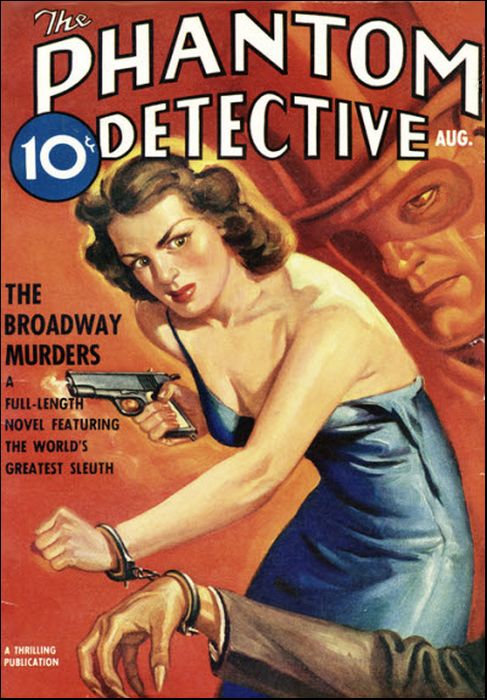
The Phantom Detective, August 1938, with "The Broadway Murders"
Two flaming corpses, doomed pawns in a daring killer's game, are hurled into the midst of a throng of Manhattan merrymakers—and catapult The Phantom into action as he embarks on one of his most exciting manhunts.
A MILLION lights! Broadway! The heart of Manhattan!
New Year's Eve! Ear-splitting sound and fury! The Old Year marching out to a cacophony of blaring horns, racketing noise-makers, and the screeching, roaring joyousness of thousands of throats.
Throats of thousands given to unfettered merriment and mirth as they voiced humanity's ever reborn hope for the New Year, due to arrive in four short hours. Thousands who surged and swirled in the aimless, purposeless tide of packed bodies flooding the width of Broadway in the space above the grey old wedge of the Times Building, with its flashing, brilliant band of ceaselessly moving words in news parade.
Words conveying the news of the world to those who paused long enough in the mad carnival to lift their eyes. Ever-moving words of silver light that could exhilarate or play upon the fear-chilled senses of throngs avid for sensation, or quick to sense through the glittering words the pulse of a moving world.
It was still early, but already human bodies packed the street, a solid mass from sidewalk to sidewalk. An hour before the theaters raised their curtains upon mock mystery, murder intrigue or comedy. And although motorized traffic was jammed in side streets and Broadway's expanse was given over to the thrill-seeking crowds, the spirit of revelry rose, to permeate the river of humanity in the mass, and to be expressed in voices and pictured upon happy faces.
But the faces of four men who stood apart, withdrawn to the haven of an unoccupied doorway, were drawn and white, and their voices were low and tense. One man who wore evening clothes and a tall hat had cleanly-carved, strong features and his mouth was wide and thinned about the lips.
"Gentlemen," he said in a low, hard voice, "until five minutes ago I believed myself the only man gullible enough to accept an invitation to witness a murder."
"That goes for me, too," said a paunchy, double-chinned man with nervously working thick lips. "I was unaware there would be any others here."
A tall, thin man whose long nose seemed always about to touch his upper lip when he talked, said:
"It's too incredible for the imagination, but we are here. It was only when the third message came by long distance phone to the Philadelphia office that I decided to make a fool of myself. In fact, I suspected one of you, thinking it a New Year's joke."
"And that's what I still think it is!" grated the fourth man irascibly, his small, black eyes glinting in the pouches of his round face. "I received three messages, too, up in Hartford! I had planned for a New Year's Eve with my family! Even if there could be a murder in all this crazy mob, how in hell could we see it?"
The three others nodded frowning agreement. The doorway in which they had met, learning that the messages to each had summoned him there at this hour, was tightly hedged in by the jostling, slowly moving stream of humanity.
The eyes of the four went to the shifting crowd, came back to each other's faces. The thought that even the cleverest of killers could not commit a murder close enough to be seen, then escape in that packed mob was reflected in their expressions.
The tall-hatted man forced sudden jocularity into his voice.
"All right, we've been made suckers for someone's idea of a holiday hoax, so what do you say we adjourn to the nearest bar and drink to our unexpected reunion?"
The three others nodded. They gave agreement in relieved grunts. Then, as if it were disembodied, a voice, thin and sepulchral, suddenly spoke.
"Wait! You will see it happen soon."
OATHS leaped to the lips of the four as they shot suspicious glances at each other. They swung, eyes running along the crowd. The voice might have come from anyone of a hundred people inching along near them. But there was no possibility of identifying the speaker.
Indeed, as the words were spoken, all four men had snapped their faces upward where there was nothing but the vaulted arch over the doorway. Evidently each had the impression the voice was above. It had the peculiar quality of ventriloquism, as if a malicious Charlie McCarthy had suddenly materialized to taunt them.
And, unnoticed by any of the four, moving with the crowd, a heavy, squat man with piggishly pale eyes wedged a pathway for himself through the throng. He was closely followed by another bulky but taller man whose hands were thrust oddly into his coat in a Napoleonic attitude.
"You're sure everything is ready, Loder?" asked this second man.
"Within five minutes you will have your first revenge," said the squat man over his shoulder. "So they think they will not see this murder, huh?"
ACROSS Broadway from the four skeptical but somewhat shaken men in the doorway, the square's newest and most elaborate electrical sign flamed with life. Tonight, New Year's Eve, it had been illuminated for the first time. Segments of the holiday crowd blocked the street tide as fascinated eyes took in the movement cleverly simulated by the flashing lights.
A miniature ship, a liner, sailed along a blue sea. The illusion of the lighting caused it to show even the smoke pouring from its funnels. The sign ran along a quarter of the block, set upon a two-story building, one of the few remaining among its skyscraper kin.
Among myriad signs of various lifelike design which have caused this blazing vista of Broadway to become one of the stock shots of nearly all movies showing New York, the spectacle of the sailing ship was outstanding as an example of electrical ingenuity. In its lifelike effect, it approached perfection.
Now, adding to the attraction for the crowd, the tiny figure of a workman was swinging high above, across the face of the sign. His support was a swing-like board supported by ropes which disappeared into the darkness above the upper edge of the great sign. Up there another workman was answering his signals and moving the swing.
The suspended workman, no doubt long accustomed to height, was expertly replacing burned-out bulbs here and there. Nothing odd about that, any more than there would have been about a window cleaner who toils high above the crowds in the streets below.
Having replaced what appeared to be the last burned-out bulb, the workman flicked a signal and casually lighted a cigarette. His board swing started upward, and in less than half a minute he was engulfed in the sharply contrasting darkness at the top of the sign.
Most of the hundreds who had been watching started to move on, pushing with the crowd. But suddenly the rope-suspended seat was again descending, more swiftly than it had been pulled up. And close beside the man in the swing, another human figure, made small by distance, was also dropping in front of the blazing lights.
"Holy cow!" exclaimed a man in the crowd. "He ain't holdin' onto nothin'!"
The second man was not, however, defying gravity as it appeared. The abruptly halting, jamming crowd below could now see the thin line of a single rope. It was fastened to the figure being lowered, under his arm-pits. Now a low murmur started through the throng watching.
The man on the single rope was writhing, twisting, making acrobatic efforts to set his feet upon some of the projecting lights. A few bulbs were shattered, leaving a line of darkness as the man's body came down.
"Boy! They're puttin' on a special show!" chortled a youngster in the crowd.
"You never know what them advertisin' people will think up next," said a woman. "Look! He's goin' to land on that ship!"
The chorus of the crowd rose and fell, those closest caught by the hush that always uncannily and instinctively comes in some critical moment. For it did seem that the man suspended by the single rope was attempting to perform the impossible feat of setting his feet upon the foredeck of the intangible ship of moving lights.
The man in the workman's swing was a little to one side. And he was reaching out, as if he had been sent down to help the other man. Yet in all of that crowd no individual seemed to sense that anything was wrong, or that this was not a part of some advertising stunt.
Thousands were seeing it now, for the sign was high. A brief wave of comparative quiet absorbed the hundreds nearest the scene, as they forgot their horns and noise-makers. The crowd ceased jostling. Even the police handling the night's celebration relaxed and welcomed the opportunity to draw a few easy breaths before the revelers again swirled into motion.
IN all the vast expanse of dense humanity, only four men were attempting to move fast, the four from the arched doorway nearly a block away, led by the tall-hatted man. A blue-clad police officer started to check them as they sought to thrust their way into the crowd, through which they could make no headway.
"Hey!" growled the policeman. "Be takin' it easy there! Yuh got as good a look here as up closer!"
"For God's sake!" snapped the tall-hatted man. "Get us through! A murder is to be committed!"
"Now, now, fella!" the cop soothed grinning. "It's early in the night to be gettin' so addled!" He saw the direction of their startled gaze. "Oh, that? That's just one of them screwy stunts—"
Piercing and shrill, sudden cries of women's terrified voices rang out. The swaying man on the single rope could not succeed, of course, in resting his kicking feet upon the deck of a sailing ship that was nothing but a blazing effect in lights. But as he had seemed to be thus landing upon the miniature craft, something like a firefly had sparked down the rope supporting his shoulders.
The hands of the man in the swing were at this instant touching his writhing figure. From the clothing of both men a flaring, smoky flame leaped out, running in tongues around their bodies, within the space of three seconds converting both into blazing torches.
The brilliance of the flame made the twisting bodies stand out against the colored lights.
"Boy howdy!" cried out a man below. "What a stunt! Damned if it don't look like the real thing!"
Then, as the crowd again hushed momentarily, the burning men began screaming. Uttering the kind of animal screams that can come only from the human throat in an extreme of tortured agony. Their arms flailed agonizedly, their hands clawing at nothing.
Even then, as women cried out and fainted, as the hundreds directly below the burning men started a wild surging back upon the others, the crowd divided. Some were beginning to become sick with the appalling knowledge that they were in fact seeing unutterable horror, the burning of two living men before their eyes.
But still others were shouting with the hard, skeptical voices of Manhattanites who too often had witnessed crazy stunts. And nearly a block away, the tall-hatted, thin-lipped man of the four from the doorway turned upon his three companions with a bitter oath.
"By God!" he groaned. "It's happened! There's nothing we can do here now! Let's get out of it!"
His words were no more than uttered before they were drowned in a hoarse roar of human panic, sweeping over what had been a joy-mad, rejoicing crowd. For first the single rope of one screaming man burned off, and then the ropes at one side of the board swing supporting the other man.
The blazing bodies struck the jutting edge of the base of the sign. The screams of both men stopped. The bodies rolled off, thudded down. Men and women jammed, fought and attempted desperately to escape the menace of the flaming figures.
A horrible thing happened. A pretty young woman had cried out and fallen to her knees. The body of one burning man struck her as she fell, and almost at once the girl's clothes caught fire. By this time all of the crowd was in mad motion.
Two minutes later three charred corpses were ghastly heaps under the still moving, still brilliant sign of the Sunny Seas Cruise Line.
WOMEN were shrieking, men were shouting madly. Many women and girls fainted, but were mercifully jammed in the wave of the crowd and carried along, still upright. But many more slipped down and were trampled by the heedless, panic-stricken mob. Some died and others were seriously injured.
This conversion of the holiday carnival spirit into black panic demanded the immediate attention of the scores of policemen in Broadway. Every police officer who had witnessed the burning in all of its stark frightfulness was aware that fiendish killers must be escaping. But the saving of lives, the prevention of further fatal catastrophe by the quelling of the human stampede was paramount.
And before the horribly flaming men had fallen from the electric sign of the Sunny Seas Cruise Line, half a dozen vague figures were moving off the roof of the building behind the brilliant ship of the lights, which still appeared to sail on and on through a calm and sunny blue sea.
Four of these men carried human burdens of which they were not too careful. For they dropped them from the edge of the back roof to the street below, afterward swarming down rope ladders to pick them up.
Two other men were the last to leave the roof. One was the man with piggishly pale eyes who had previously answered to the name of Loder. The other was the bulky, tall man who had been his companion in the street a short time before.
"Now they will believe," this tall man said. "They will know now what it is to lose everything, and the others will pay."
Loder's reply was like an animal grunt. "And while the damn' cops are running in circles, we will strike again."
"We will strike again," repeated the tall man. "It has been arranged. But first we must remove the girl." The piggish eyes of the man Loder narrowed and glinted.
Three minutes later, while the spreading terror of the panic in Broadway was at its height, a light, closed truck threaded its way out of the comparatively deserted East Side street, going toward East River. The truck bore as a sign a single name:
JOHN L. DOLAN
INSPECTOR THOMAS GREGG, Chief of Homicide, ordinarily displayed a smooth and placid face. Unraveling of homicidal mystery was his routine business and his rugged countenance but rarely reflected his inner emotions. Still there were horrors on which even his seasoned eyes could not look placidly, and here was one of them.
Arriving on the heels of the panic, Inspector Gregg quickly deployed his men to discover every possible lead. For once his face was a grim mask as the police medical examiner swore under his breath at the uselessness of his presence, so far as the three charred corpses were concerned. The doctor turned to give what aid he could to the injured persons nearby.
"I saw all of it, Inspector," a policeman who had witnessed the burning reported. "These two dead men were working on the sign, and they were sliding down together, maybe to fix something, when a short circuit or something set 'em on fire." Inspector Gregg looked at the ghastly remains of the two men. The flesh had dropped from their faces. Every shred of clothing was burned off. Even their shoes had been reduced to shriveled leather.
"There was more to it than that," he observed. "A man's clothes would not be so inflammable unless they were saturated with a combustible liquid. Be careful of the things that fell from their pockets."
Gregg's men already had collected two bunches of keys, a wrist-watch and some other metal objects that undoubtedly had been in the burned men's pockets. In the blackened faces the teeth of the corpses protruded as from skeleton skulls. The upper teeth of one man showed two bright, gold crowns, which gave his mouth the appearance of a gruesome grin.
Little could be done here to establish identification. Gregg ordered the bodies, including that of the unfortunate young woman, removed to the morgue. He went around into the side street and ascended the fire-escape at the back where the police had pulled down the short ladder.
Although the front of the electrical sign was bright, back on the roof the prowling police were employing flashlights. A tall captain came over to meet Inspector Gregg, holding a small object in his hand.
"What is it, McGuire?" said Inspector Gregg.
"You'll have to tell me, Inspector," said the captain, puzzled. "It might be some gadget they use in electrical work, but damned if it don't look more like a finger made of steel. And that's all the sign there is that anything happened back here, except for the rope they might have been using anyway in their work."
Flash beams were still spotting every inch of the roof with searching light. But all that had been found, except for that queer bit of steel, was a box of extra light bulbs, an electrician's tool kit and the burned off ropes and pulleys through which they had been reeved at the top of the sign.
For the time it appeared that only the two workmen had been on the roof. Inspector Gregg weighed the steel thing in his hand. It was shaped like a human finger, even to the reproduction of two flexible joints. A socket at its base indicated that it might have been fitted over a stump on a man's hand.
"It would seem to be a definite clue," Gregg stated in a musing tone. His lips tightened. "Perhaps too damn' definite."
The name of John L. Dolan was stamped into the leather side of the electrician's tool kit.
"We will have to contact this man Dolan for identification of the dead men," said Gregg.
A perspiring policeman came up the fire-escape, breathing hard.
"There's a fella down in the street who says he saw a light truck drivin' away, Inspector," he said. "An' look at this. I got that wrist-watch pried open."
Inspector Gregg took the watch in his hand. Its burned leather strap and the fire glaze on the metal had proved it was on the wrist of one corpse. Engraved inside the back of the case was a name.
ANDREW HOYT
Inspector Gregg ejaculated a hard oath. The murders by fire of two workmen had afforded a death horror to be solved, but here was something bigger, something incredibly greater in all that it implied.
For Andrew Hoyt was not only a multi-millionaire, or reputed to be, but he was much more than that. He was the president and chairman of the board of the Sunny Seas Cruise Line. The shipping corporation operated small luxury liners in tropical cruises, and for that publicized itself as the "Sunny Seas" Line.
If that wrist-watch had been rightfully upon the wrist of its owner, Andrew Hoyt had been murdered horribly by fire, affording a New Year's Eve spectacle for thousands, upon the elaborate electrical ship advertising his own corporation.
Newspaper reporters were swarming about. Inspector Gregg thrust the wrist-watch into his pocket. The sudden discovery must be subject to all possible verification before the news of it was given out.
GREGG climbed heavily from the roof.
At this same moment the four men who had been invited to witness a murder were in a taxicab being slowly driven through congested traffic. The man in the tall silk hat had apparently assumed leadership. Fear was in the eyes of the four, showed plainly in their bearing.
"I would have called in the police or a detective agency before this happened," one man said, "only I guess all of us had the same idea. Our companies would have been made ridiculous if nothing had happened, and I didn't dare take a chance on publicity. Even now any publicity would lose us prospective clients."
"Publicity is not my purpose," the tall-hatted man retorted grimly. "Luckily we have one newspaper publisher in New York whose civic conscience is greater than his desire for sensation. Frank Havens, of the Clarion, knows the one man in all the world we can trust. I should have sought him before, but like you three, I feared making myself ridiculous if it had been a hoax. Now, where the police are baffled, this one man known to Frank Havens is our only hope."
"We can only trust that is so," replied one of the others.
The taxicab eased through the jammed streets toward the spiring tower above the building that housed the Clarion, one of a nation-wide chain of Frank Havens' great newspapers.
It was evident that none of the four men could be aware of the identity of the man whose aid they were about to enlist. And had they known his true identity at the moment, the confidence of the tall-hatted leader might have been considerably shaken.
For as they rode to seek his aid two couples were riding through wide New York streets in an open sports model car of luxurious and powerful design. They had come from a late afternoon party in an exclusive apartment on Central Park West. Already a generous quantity of New Year's Eve spirit had been absorbed by at least three of the four persons in the car.
The two young women in the costliest of evening wraps were in high spirits. The prettiest one was in the front seat beside the driver, and her hand strayed intimately to his arm.
"But, Van, why waste time driving the parkway, when we could go directly to the Cotton Club?" she inquired with a petulant note in her voice.
THE driver was immaculately turned out, his silk hat setting a little back on his head, giving him a slightly rakish appearance, and not in the least the appearance of a man accustomed to driving his own car. The tilt of the hat, however, was contradicted by the cool and steady eyes, the firm and strong lines of his jaw, if anyone had given these special attention.
But there were few of those who usually were his social companions who ever gave the character in his or any man's features a second thought. This "Van" was one of them; Richard Curtis Van Loan, himself a playboy of substantial wealth.
Van's restrained but pleasant laugh at the young woman's question was an indication that one of the most serious things in his life was this trivial debate over whether they should go at once to the revelry of a night club, or continue for a time to enjoy the cool, fresh air along the Hudson.
"I thought it might be a good idea to fill our lungs with some ozone while we can," Van told the girl. "The atmosphere will be thick enough later on."
"Always the fresh air fiend," said the youth in the rear seat, a bit thickly. "Anyway, I've got a big idea. Why not drive to Broadway, ditch the bus and let's have some fun with the rest of the mob for awhile."
Van's young woman companion shrugged with distaste. The girl in the rear seat, though, gave laughing agreement.
"I'd like it," she said with enthusiasm. "But could you ever picture Van permitting himself to be jostled around in a crowd? Let's do it, anyway."
"All right, Van, if they must," agreed the pretty girl beside him. "It might be fun to see you with a rumpled shirt and your tie pulled crooked."
And in those few words they had presented their own picture of Richard Curtis Van Loan as they knew him. A quizzical smile played across his clean-cut features.
"The majority wins," he said quietly.
He was bringing the long, powerful car out of a parkway turnaround, with his eyes fixed upon the brilliant, white glare of the sky over mid-town Manhattan. Suddenly he stepped hard on the accelerator and sent the car leaping ahead.
Van said nothing as he twisted the wheel abruptly at the first parkway switch-off and sent it down into a West Side street. Then he braked to the curb, slid from under the wheel and stepped out.
"Suppose you take the girls from here, Ronald," he said. "I believe I would skip the Broadway celebration and take them to a night club. The New Year's crowd does manage to become a bit rough."
His tall, broad-shouldered form was striding away while surprised protests were coming from the others. The young woman who had been beside him was highly indignant, but he strode on purposefully.
"Now wouldn't you know he would worm out of mixing with the mob?" she sighed, disappointedly. "That's the second time he's walked out on me when something unusual was suggested. Van!" she called out to him. "Have you ever done anything out of the ordinary in your whole life?"
Van's reply was inaudible, for he did not turn his head to answer, or pause in his steady stride. A quiet, grim smile had touched his face that transformed it. That handsome face abruptly took on a ruggedness, the square set that belongs only upon the countenance of a man of action, a fighting man. And he was no longer thinking of his recent companions. For he was looking at a red light blinking on and off at the tip of a spiring tower off Broadway in mid-Manhattan.
THE rangy, quick-moving figure stepping from a small coupe less than a half hour after Van had so abruptly deserted his companions of the Hudson River Parkway would never have been identified by his friends as Richard Curtis Van Loan. He wore a quiet, grey business suit, like that of a man who had neither means nor time to array himself in formal clothes for New Year's Eve.
The squareness of his features was magically metamorphosed to the roundness of much plumper cheeks. By his own wizardry of disguise he had transformed himself into a casual young man who might have been a newspaper reporter or a clerk. Surely, he never would have been suspected of being Richard Curtis Van Loan, Park Avenue society playboy.
As he strode swiftly toward the elevator under the tall tower of the Clarion Building, Van was still enjoying in retrospect the indignant protests of the young social registerite he had deserted. So he would not care to mingle with a New Year's Eve crowd that might jostle him around? He laughed.
If that young woman, or any of his society friends could have known of the many bullet scars upon his amazingly powerful body, what would they have thought, or said? Or if they could have known of other scars?
Yes, he reflected, in spite of what they thought, he had been jostled around from time to time. But many of those who had jostled Richard Curtis Van Loan never would be so rude again. For some were dead. Others were behind prison bars serving long terms.
Only one man among all the millions of Manhattan knew of this; knew that Van's was a dual personality, that the man was a Nemesis of crookdom and a living weapon of justice. And the man who knew this was the one man who had himself helped to create Van Loan's alter ego.
The Phantom! That mysterious person whose very name was anathema among some of the world's cleverest and most dangerous criminals; whose solutions of crimes that had baffled the police of several countries had gained for him a world-wide respect.
Van had been bored with his purposeless life as a society playboy when this one man had supplied him with a new and keener zest in living. The man was Frank Havens, owner of a chain of newspapers from coast to coast.
The blinking red light on the Clarion tower had called Richard Curtis Van Loan, the world's greatest detective. As a society playboy he always felt himself to be nobody. But now he was the Phantom, suddenly called into being, to test the steel of his trained and versatile powers against some major crime.
For never had Frank Havens called upon him unless the need was urgent and the menace involved affected the lives and fortunes of many. And because of the super-crimes he had been forced to combat, the Phantom had become a human machine, as adequate in his powers as the combined forces of those criminals with whom he was at war.
The Phantom was to others a figure of incredible mystery and uncanny force. But to himself he was simply a man whose brain and strength had been developed to the highest degree. He had a thorough knowledge of the latest word in criminology, he had become a master of disguise, and had perfected the arts of mimicry, ventriloquism, hypnotism and scientific aids. He was master of a dozen languages and dialects.
But over and above all else, he was always a cold-nerved, fearless fighter, hating crime and injustice, and ready to gamble his life for the protection of others.
Radio and newspapers already had spread the story of horror that had come from the heart of Manhattan. At this moment, Van knew just as much of it as did thousands of others—only what he had heard over the radio while he had been making his change in personality. But while he did not yet know of the astounding information in the hands of the police, his more keenly developed intuition had told him that the burning murders on Broadway were much too bizarre to fall into the category of common crime with a trivial motive.
Van went directly to Frank Havens' office. He saw instantly, from the frown on Havens' kindly rugged features, that something far beyond the ordinary had engaged the publisher's attention. Havens' hand touched his shoulder with almost fatherly affection.
"Of course, you would already know of the atrocious murders in Broadway, Van," he said. "But I have called you to meet four men who were invited yesterday and again today to witness those murders."
"That would be about the oddest circumstance we have ever encountered, Frank," said Van, with the hint of question in his voice. "They knew hours in advance, and the police were not informed or put on guard?"
Havens nodded gravely. "They could scarcely go to the police, when no one knew in advance of the invitations to the other three. Nor did any one man know who was to be murdered, or that the message he received was not a crude and brutal holiday hoax. But each man was made to realize if it were not a joke, it stood to cost his business a huge sum of money. None of the four knew where or how the death was to be brought about."
FRANK HAVENS was not a man to talk in riddles, or ever to be deliberately confusing or dramatic. Van simply waited, for he knew that Havens had a reason for putting his explanation as he had.
"I had never met any of these four men before," went on Havens. "But I have known them by name, of course. They are the heads of four leading insurance companies, specializing in life risks. And each was informed by mysterious phone calls that tonight one of his largest policy holders would be murdered in Broadway."
"Largest policy holders?" repeated Van. "The news reports I have heard tell only of two supposed electricians being burned to death. If these insurance officials know no more than that, why should they have come to you? Surely two workmen would not be insured for big amounts!"
"They seem convinced that when the bodies are identified, they will not be those of workmen, Van. In fact, though they are hard-headed financiers, they are badly scared. They tell me they heard a voice that seemed to come from nowhere, a Charlie McCarthy kind of a voice, telling them it would happen—just a few minutes before the murders took place."
"Now that might prove interesting," Van said thoughtfully.
Havens pressed a button on his desk as he said to Van Loan: "I'm going to have these insurance officials shown in."
The four men who had stood in that arching doorway on Broadway and watched the murder horror glanced at each other as they were introduced to the Phantom. Poorly concealed disappointment was in their faces as they sized up this tall, round-faced young man who had the appearance of a clerk.
The Phantom read their thoughts. His features had deliberately been shaped to a mildness that directly belied any conception they might have formed of the famous detective. Only by looking intently into his quiet eyes could they have got the right impression of his extraordinary character.
Those same quiet eyes missed no feature of the four insurance men as they were introduced and he catalogued them.
Seymour Bryan, of the Actine Corporation, New York, had a carved and strong face, with a broad, thin mouth.
Lark Grayson, Argus Limited, New York, was a paunchy short man with a double chin.
Samuel Hawther, Futurity Incorporated, Philadelphia, was tall and thin, with a long and predatory nose.
Luke Graves, Paramount Surety, Hartford, Connecticut, had a round face with small, shoe-button black eyes.
Seymour Bryan spoke for the others.
"Phantom," he said promptly, "we would not have determined to ask for your assistance if we were not admittedly badly jolted by what has happened. Each of us, in his own office, received this message to be here tonight to witness the murder of one or more of our biggest policy holders. Well, we saw the terrible thing that took place. It would seem that two humble workmen were killed, but we don't believe it."
"Any special reason, other than the strange messages?" asked Van.
The four shook their heads in frustration.
"It was too well worked out," Bryan said, "and only a few minutes before we heard—"
Thin, as if it were disembodied, a sepulchrally hollow voice seemed to speak from nowhere.
"It will happen in a few minutes!"
BRYAN'S broad mouth slacked open, his eyes darting around. A combined gasp of incredulous amazement came sibilantly from the lips of the other three men. That voice—it must be the same they had heard before—had seemed to float over their heads.
The gaze of three of the men flashed upward instinctively, as if they expected to see the origin of the sound. The Phantom was looking directly at the four, and one man's eyes stared straight at his face.
The Phantom had imitated the voice of the radio dummy, Charlie McCarthy, mentioned by Frank Havens. He knew the four men had heard the voice but once and such "dummy" tones sound much alike. These men had heard it in a crowd.
"Did it sound like that?" the Phantom said.
"Yes," said Bryan, "quite a bit like it, ghostly and indistinct. It came from someone close to us in the crowd."
The Phantom merely nodded. He was watching Frank Havens who was on the telephone.
"Gregg?" he heard Havens say. "Yes? What? Good Lord, Gregg! Yes, of course I'll hold out on it until you give the word!"
Havens turned from the phone. His usually ruddy face was grim.
"Gentlemen," he said slowly, "I'm sorry to say your worst fear has been confirmed. The two men burned to death in Broadway were Andrew Hoyt, president of The Sunny Seas Cruise Line, and O.T. Young, a director in the same line. Both have been identified in the morgue by Amos Hoyt, the brother of Andrew, who is himself the dentist who cared for their dental work."
"Andrew Hoyt?" came the strained voice of Seymour Bryan. "My God! Then it's true! He carried three-quarters of a million life with Actine!"
The double chin of Lark Grayson was trembling and his round mouth made a gulping sound.
"Young?" he said. "Argus was carrying him for four hundred thousand!"
But while the others were seemingly stricken speechless after that, it was Bryan who kept his head.
"Havens," he asked quickly, "can that part of it be kept from the newspaper temporarily?"
Havens nodded. "As long as it can be kept from other papers," he assured. "What's on your mind, Bryan?"
"That this is only the beginning," said Bryan heavily. "As for the Phantom, we will pay any—Why, where is he?"
Covered by their shock and exclamations, the Phantom had withdrawn from the office with all the silent swiftness that justified his name.
THE old newspaperman in charge of the Clarion morgue, the repository of all story clippings and pictures from the news for years past, gave one glance at the platinum badge in Van's palm. It was like a domino set with diamonds, the badge of the Phantom that was known to nearly all police and too many others where his identity was never otherwise revealed.
The old morgue keeper smiled a little. "Anything you want, Phantom," he said. "If Mr. Havens himself showed me that badge, I'd know he was you."
Van riffled swiftly through the stacks of clippings labeled "Andrew Hoyt" and "O.T. Young." He seemed merely to be skimming through the many items, and he barely glanced at a few photographs. But his dexterous fingers were sorting and in a few minutes he had laid aside half a dozen clippings.
Most of those he retained showed yellowing age on the pulp print paper. But two were more recent and the paper still was white. His attention lingered longest on one yellow clipping as he gave it two or more minutes. The clipping bore a heading:
CARRANTIC BURNS! 214 DEAD!
The story was long, a turnover to another page, but the Phantom absorbed certain outstanding details only.
The steamer Carrantic, owned by the Sunny Seas Cruise Line, burned off the Jersey coast last night with an estimated loss of 214 lives—
And again:
The Carrantic was under charter to officials of several insurance companies for their annual cruise to Havana, with a group of notables as guests—
Still once more:
Among the less seriously injured were officials of the Sunny Seas Cruise Line themselves. Andrew Hoyt, president of the line, was picked up unconscious, clinging to a life raft. He was suffering from—
The Phantom scanned this, then turned to the two more recent stories. They were headed:
WRESTLER AND ACTOR
SUE SUNNY SEAS LINE
IN CARRANTIC DISASTER
HASTILY the Phantom read through the clipping of the most recent story. His quick eyes absorbed paragraphs at a single glance. In less than a minute he had fixed the information in his mind.
Two years before, Brutus Bolo, once known as "Bolo the Brute," heavyweight wrestler, and James Roselyn, actor, had entered joint suit against the Sunny Seas Cruise Line for injury sustained during the fire on the Carrantic. Their suit was strengthened by the fact that the loss of the ship had later been officially laid by investigators to the negligence of the captain, Joseph Sterne, who had lost his master's papers as a result of the fire. Van made a mental note to look into the circumstances of Captain Sterne's disgrace.
Brutus Bolo's suit was based on the loss of the fingers of both his hands, thereby ending his ring career. He sought a hundred thousand dollars.
Roselyn, the actor, based his suit on disfigurement of his face, removing him from a romantic pedestal. He asked the same amount.
Near the ending of the clipping Van Loan read:
John L. Dolan, electrical contractor, has a similar suit pending in the death of his wife, Elsie, aboard the Carrantic.
The Phantom looked up, to see Frank Havens standing in the morgue doorway and the reference room man nowhere in sight.
"Our visitors have gone, Van," Havens said. "I judge they don't put any too great confidence in the Phantom, due to your sudden departure. I guessed you would be here. What do you think?"
"I think, Frank, the murders could be the beginning of a new and a gigantic form of insurance racket. But now that I know these same insurance officials and others were the charterers of the Carrantic when it burned two years ago, and that a few of their biggest policy holders happened to be guests, the angles become rather complicated. As soon as I have had a little talk with Inspector Gregg, I may have more information."
The burned bodies of Andrew Hoyt and O.T. Young were not pleasant to contemplate when Van Loan reached the police morgue. Stripping back the covering sheets he scrutinized the bodies closely. All of the flesh had been burned off the faces and the legs of the two murdered men. The bodies were scarcely more than the blackened bones of skeletons.
Van leaned more closely over the corpse of Andrew Hoyt. His keen eyes took in every detail from head to feet. The terribly grinning teeth of the dead man showed two gleaming gold crowns. Van Loan touched one of these crowns and it moved loosely under his fingers.
Inspector Gregg stood beside the Phantom, a deep scowl on his face.
"I am glad to know you've been called into this, Phantom," he said sincerely. "But this is one time I believe we have a direct lead to the murderers. Already I have an alarm out to pick up one man."
VAN stood still for a full minute before replying. He seemed hardly to hear what Gregg had said. He was himself possessed of a lead that he was sure Inspector Gregg did not suspect, and one of such amazing possibilities as to be almost beyond belief.
"Are you listening?" said Gregg. "I wanted to show you this. It didn't look like much when it was picked up, but I'm counting on it to arrest one man that even you could not have in your mind."
Van glanced at the bright, metal object Gregg held toward him.
"Sorry to disappoint you, Inspector," he said quietly, "but you probably expect to pick up one Brutus Bolo, a former wrestler, who would be equipped with just such artificial fingers. I have checked and learned that he has recently been playing a vaudeville engagement at the Odeon Theater. His fingers were burned off in the fire of the Carrantic, so it will be in some other capacity than as a wrestler he will be appearing. You probably have learned that Bolo has not shown up for his act for several days."
Gregg could only stare at the Phantom. "I might have known it," he muttered. "Anyway, I did connect up that Carrantic fire, seeing these murders were committed the way they were. And I've sent two men out to see John L. Dolan who built that electrical sign. It's more than just a coincidence that this Dolan lost his wife on the Carrantic when it burned."
GREGG was undoubtedly pleased with having ascertained so much about John L. Dolan. Van nodded.
"That might be considerably more than a coincidence," he agreed.
He was holding the artificial metal finger in his hand, weighing it. Briefly examining the grooved socket in the base, he returned it to Gregg. He did not divulge further what he had in mind, but promised the inspector to keep in touch with him.
Outside, Van glanced at his watch and noted it lacked still two hours until the New Year would come in on the midnight whistles and bells. It hardly seemed possible that but two hours had elapsed since the horrible burnings in Broadway, and that already so much had been investigated and discovered.
It was in as short a time as his speedy car could make it, after leaving the police morgue that Van stopped his fast car a short distance off Northern Boulevard in the suburb of Jackson Heights. Two minutes later he was being admitted to a rambling residence standing back in a small estate.
The young woman who came into the living room to meet him was small and pretty, but with an unconscious dignity that bespoke her position. She was Audrey Hoyt, only daughter of Andrew Hoyt. Briefly she explained that, for Van had asked to see Amos Hoyt, the brother of Andrew.
Amos Hoyt had identified the bodies in the morgue, presenting himself as the dentist who had attended both his brother and O.T. Young. Van was planning to represent himself as a representative of the insurance company, checking up on Amos Hoyt's identification of his brother. He had changed his makeup and now appeared as a solemn but important young man wearing thick-lensed glasses.
Plainly Audrey Hoyt had been weeping, but she was standing up gallantly under the shock of the blow which had been given her within the last hour. Her eyes were reddened from grief, but they were beautiful eyes.
"Uncle Amos has gone to get in touch with some of the ship line directors, I believe," she told Van. "I don't know where he went first, but I do know he said he might drive up tonight or tomorrow morning to Riverside, Connecticut, to see Charles Thornton, who is one of the directors who was closest to my Father. Is there anything I can do?"
Van did not want to harry the grieving girl with questions, so he said:
"I'm sorry to have troubled you, Miss Hoyt. I'll call again tomorrow," he added.
The thought flashed to him of the fortune this girl probably would inherit, plus the seven hundred and fifty thousand dollars insurance mentioned by Seymour Bryan, of the Actine Corporation. And he was adding that up to more recently acquired knowledge from the police morgue. The answer to it all was more than a hunch or a mere premonition. It came in the nature of a sudden shock.
The feeling grew strong that lovely Audrey Hoyt was in danger; immediate danger!
The butler who had admitted him had disappeared. Van had hesitated at the threshold, before leaving, considering the problem of some reasonable excuse for inducing the girl to leave her home temporarily—when it happened!
SUDDENLY all the lights went out! Van was instantly aware that this was no pulling of a single switch for all lights, inside and outside the house, were out simultaneously, leaving the place in shrouding blackness. Only cutting the wires on the outside could have caused that.
"Miss Hoyt!" warned Van tensely. "Don't move! Stay where you are until I return!"
"Oh, what is it?" gasped the girl. "How could—"
Her words were drowned by a hissing explosion and a wall of blue fire that momentarily blinded Van. It came from the outer hallway, rolling into the main drawing room in a wave of gaseous flame—an incendiary bomb! The flame scorched Van's face as he dived into the room.
His hard arms went around Audrey Hoyt who stood stock-still, paralyzed with fear. He swept her light body from the floor.
"Don't breathe!" he said through clenched teeth, expelling his own breath.
The tall windows at the side of the room were closed, but Van found the catch of one and opened it noiselessly. Someone inside the house must have set off that bomb. With the girl in his arms, he saw thick evergreen bushes below the window which would conceal her temporarily, safe from the flaming gas inside.
"Stay hidden in the bushes and don't make an outcry," he instructed as he quickly lowered her to the ground.
As the draught from the outside swept the billowing, fiery gas back, Van crouched, listening. Another door leading to the rear of the house was lighted by the blue flame. He judged the fire bomb had not penetrated back there, so he started forward on his toes, yanking his automatic from his shoulder holster.
He hoped to reach the open door, confident that whoever had set off the bomb was still in the house and might be outwitted. Because of the thickening darkness caused by the gas, he believed he had not been seen placing the girl outside the window. Possibly he could circle the flame thrower.
But as he reached the doorway a second bomb let go. A blazing wall jumped toward him, snatched away his breath. Somewhere in the house a man screamed hoarsely. Possibly the butler or one of the other servants.
Van sprang back. The open window now was his only possible avenue of escape. He dived through it, rolling over in the bushes. He arose, calling out quietly. He received no reply. Ten seconds later he knew that Audrey Hoyt either had not obeyed him or had been seized by someone outside.
Fire already was licking from the inside under the eaves and up over the tiles of the roof.
Within five minutes, before the first drawn-out wails of fire sirens came, the interior of the Andrew Hoyt residence, with all its costly furnishings, was a seething inferno. Van darted around to where a group of screaming, frightened servants had fled through the rear doors.
There was no sign of Audrey Hoyt, nor had any of the servants seen her. One maid finally recalled that she had heard a car leaving.
"I thought it went out of our driveway, but I couldn't be sure," she said. "Two or three minutes ago."
During the first ten minutes when it was discovered that the arriving fire department could not save the flaming Hoyt mansion, Van conducted a fruitless search with two policemen to whom his diamond-studded domino badge was an incentive to do their utmost.
But Audrey Hoyt had vanished.
The Phantom could do no more now than put through a call to Inspector Gregg and inform him of this latest development. None of the servants could supply any information. None had seen anyone about who might have been suspected of having set off those incendiary bombs.
The blaze was a furious yellow glare behind Van as he headed toward Manhattan. He was convinced if Audrey Hoyt were not found within a few hours, she would never be found alive. And Van had a grim conviction that Amos Hoyt could have had a reason for being absent.
IN a swift mental summation the Phantom lined up in his mind the several possible leads to the Broadway burnings which he had so quickly assembled. As he sent his powerful coupe rocketing across Queensboro Bridge he became convinced that a long and tortuous trail must be followed before the various threads of the crime could be woven into a definite pattern for action.
His reasoning began with the four insurance magnates he had met in Frank Havens' office. One man had failed to give the normal response to the haunting voice of ventriloquism. While three had exhibited surprise, that one had kept his eyes upon the Phantom as if he had reason to know his ventriloquism was a trick.
Yet that was not convincing proof that this one man had any guilty knowledge or that he had been responsible for the "voice throwing" in Broadway. He might only possess a little keener intellect than the others.
But the Phantom never overlooked such a point. It was his extraordinary ability to seize upon the simplest idea and convert it to his own purpose that had helped make him a detective so outstanding that his fame was world-wide.
Next, the Phantom had come upon an amazing truth in the police morgue when he had viewed the bodies of Andrew Hoyt and O.T. Young. It was a discovery that he had refrained from disclosing to Inspector Gregg, but Van now was fingering the gold crown of a tooth in his pocket. One of the crowns from Andrew Hoyt's teeth, the one that had been loose, and which he had so expertly removed that Inspector Gregg had been unaware of it.
The crown of that tooth and something else had sent the Phantom seeking Amos Hoyt, the dentist brother. It had put him upon the scene at the time Andrew Hoyt's residence had been blasted by fire and beautiful Audrey Hoyt had been abducted.
Van was fully aware that his presence in the role of a supposed insurance investigator could have had no connection with the arson and the seizure of the girl. At least his inopportune appearance had not inspired them. The stage for this new crime had been set and timed before his unexpected arrival.
The arch-criminal behind all of this had employed fire in the Broadway murders. Fire again at the Andrew Hoyt home. A criminal acting upon the necessity; of the moment would not have incendiary bombs so ready to hand.
This brought Van's reasoning back to the clippings of the Carrantic burning of two years before. The murders on Broadway tonight unquestionably had been a direct blow at high officials of the Sunny Seas Cruise Line, and had been fantastically carried out on an electrical sign advertising the shipping line.
Plainly this might be the result of a harsh vengeance that long had smoldered in some warped and hellish brain, but it had been devilishly and perfectly managed. And from the Broadway murder-burnings the police had an artificial steel finger as a possible clue!
MOREOVER, Inspector Gregg knew one man who would be wearing such a steel finger. Brutus Bolo, the wrestler known as Bolo the Brute. But Inspector Gregg did not have the owner of the finger. Van considered fully that Bolo, robbed of a career and with a persecution mania, might thus have hit at those he held responsible for his infirmity.
But the printed stories of the Carrantic catastrophe had informed the Phantom of at least two others who might have been similarly inspired.
James Roselyn, the disfigured actor, had been a close associate of Bolo in a court suit. And he and Bolo were both playing at the Odeon Theater now, the Phantom had learned. Roselyn's motive, had he the warped and distorted brain to conceive such revenge, was as strong as Bolo's.
But Van did not overlook another man who not only had been connected with the old Carrantic fire, but had a Broadway connection also, though of a different kind. John L. Dolan had lost his wife, Elsie, on the Carrantic. And Dolan was the electrical genius responsible for the Sunny Seas sign over Broadway. Dolan himself had constructed that sign. Had it given him a murder thought to avenge the burning of his wife?
Van's astute mind had long been trained to assort every possible lead and catalogue each in his brain as it was related to every other lead. As his coupe slid off Queensboro Bridge, he had one immediate objective. He must discover the whereabouts of Amos Hoyt.
Three-quarters of a million was involved in the death of Andrew Hoyt alone. Undoubtedly all or the greater part of that was directly assigned to the missing Audrey Hoyt.
Stopping at a pay telephone station, the Phantom called the residence of Charles Thornton at Riverside. Audrey Hoyt had said her Uncle Amos intended to go up there either tonight or tomorrow.
A VOICE hard and curt with police authority replied to Van's call. A Greenwich police sergeant was the speaker, but as he made known his identity he was inclined to be uncommunicative. His voice lost its curtness, though, when Van made known his own identity.
"The Phantom, eh?" he said, in a tone of respect. "That's different. I'm here at the Thornton place with some men at the request of Inspector Gregg, to keep an eye on John L. Dolan."
"Dolan?" said Van, surprised. "At Thornton's residence?"
"Yes, that's it. Dolan is one of them electrical wizards. But he hasn't been quite all there since his wife was burned two years ago. Thornton provided Dolan and his daughter, Barbara, with a home and a workshop here on his shore estate. A kind man, Thornton, but Dolan never has appreciated it. He hates Thornton and everybody else that was connected with that Carrantic fire."
More and more the revealed pattern of human relations growing out of that one burned ship was becoming clearer, yet it was such as to have provided a headache for an average detective. This last news of how one of the Sunny Seas Line directors was befriending the husband and daughter of one of the Carrantic's victims would have been bewildering to any other investigator. But it was in just such confused angles that the Phantom delighted to set his teeth.
"I called to speak with Amos Hoyt, if he happens to be there," Van said to the police officer on the phone.
"Haven't seen him," was the answer. "Mr. and Mrs. Thornton ain't here either. The butler says they left to attend a New Year's midnight show at the Odeon Theater in New York. Maybe Thornton would know where to find Amos Hoyt, if he was supposed to be here, but I don't know."
Van hung up the receiver with a brief, "Thanks."
So Charles Thornton and his wife were supposed to be at the Odeon Theater where Bolo the Brute had been sought immediately after the Broadway murders, and could not be found, and where James Roselyn was now playing in an act. The Phantom took a long, deep breath as he stepped from the phone booth.
Each time a new character had moved into the set-up of this case, devious though it had only started, an added possibility was provided. Then Van juggled the facts and judged it might not be mere coincidence bringing Charles Thornton, a Sunny Seas director, to the Odeon Theater this New Year's Eve.
Thornton would, of course, have by now known all of the facts of the Broadway murder burning of his ship line colleagues, including the finger that pointed to Bolo the Brute. Thornton would know, too, of Bolo's close association with James Roselyn, the actor. Perhaps Thornton was planning a bit of sleuthing himself, a talk with Roselyn?
It all indicated a quick little trip to the Odeon for the Phantom himself. For it was close to midnight now.
Van had little difficulty finding Charles Thornton and his wife. In the Clarion morgue's collection of photographs he had seen pictures of Mr. and Mrs. Thornton. They were seated alone in a box on the orchestra floor.
Van found a single seat not far away. He believed he had judged correctly; that Thornton had come there to interview James Roselyn. For Thornton, a half bald-headed man with wisps of grey hair over his ears that gave him a timid-soul appearance, was watching the stage with a furtive nervousness. He was a little man, his shining pate coming inches below the brightly blondined head of his wife.
Mrs. Charles Thornton had all the hard, artificial beauty of an old-time chorus girl. Her face was heavily rouged and her figure majestic, her buxomness emphasized by a glittering necklace. She was many years younger than her husband, and while he was a modest figure, she was blatant proof of the fact that she was the wealthy Mrs. Thornton.
Where, her husband's observance of the performance was nervously self-conscious, as though he wished he had not come, Mrs. Thornton's own gaze was steady and speculative. Van made a quick guess that it was the woman's idea that they were here.
Van had seen photographs of James Roselyn before and after the Carrantic fire, but he had been unprepared by even these for the fearfully changed appearance of the actor when Roselyn finally made his appearance in a skit. Roselyn had once been a matinee idol, sought after by women. But now—
Few women would be attracted now to this man forced to appear in the role of an old man, doing a minor bit in a brief dramatic act. Roselyn's body was still big and his movements had the litheness of youth. But his face was an aged and shrunken countenance with drawn lines. His black hair still looked youthful, though, but Van quickly realized that was because he was wearing a well-made wig. The newspaper clipping had told how his scarred head was one of the reminders of the Carrantic. In his profession a wig was natural.
HOWEVER, Roselyn played his bit in a manner that "stole the show" from the principals in the act. His role in the one-act playlet was that of a crafty lawyer, and Van was conscious that Roselyn put the dramatic fervor of all the bitterness and hatred in his soul into his lines.
As a part of the act, Roselyn was supposed to be unfriendly to the others and he won rounds of applause by making that unfriendliness so realistic that it amounted to what seemed murderous personal feeling. Keenly Van sensed that Roselyn was doing more than acting. He was doing a good job of hating—hating the whole world.
Then, just before the act closed, Van saw Roselyn's sunken, burning eyes turn toward the Charles Thornton box. Both Thornton and his wife were looking directly at the actor. Van's quick eye saw something then, no more than a flash, but it was there.
Roselyn, still putting venom into his closing lines, was apparently giving his bitterness extra measure for the Thorntons. One jeweled hand of Mrs. Thornton went to her face and Van saw one finger point—and that gesture was toward backstage.
Roselyn nodded, almost imperceptibly, but Van caught it. Some current of understanding had passed between the hard-faced Mrs. Thornton and the actor. It might have been a warning, or it might have been something else.
At that moment an usher stepped into the Thornton box. He spoke to Mr. Thornton, gestured outside. Thornton's expression was mildly puzzled when he glanced up, then spoke to his wife as he arose from his seat. The woman shook her head in a gesture of refusal.
It was clear to Van then, as Thornton picked up his coat, that someone had summoned him and that Mrs. Thornton had refused to accompany him. Her hand moved impatiently, and Van was reading her lips.
"You go on, Charles," she was saying. "Leave the car and I'll follow you when the show is over. I may want to join some friends at one of the night clubs too, and I know you're not feeling up to any hilarity this New Year's night."
She turned impatiently back to the stage as Thornton went out. The curtain was falling on the dramatic act. Van saw Thornton pass toward the theater exit from the boxes. Mrs. Thornton sent a hasty glance after her husband, then quickly arose.
She left the box and Van knew she had gone backstage.
Van speedily headed for the stage entrance himself—but he had to go to the outside entrance at the side of the old theater. Brief as the time had been, however, the vividly clad Mrs. Thornton had made better time and now came hurrying from the stage door. Van stepped to one side as she passed him, heading toward the street.
Van slipped a bill into the stage doorman's hand with a mumbled, "Friend of Roselyn's," that got him by. Another act was going on and stage hands were moving about in the wings. From an inside pocket Van pulled a flat package, swiftly applied some bits of wax inside his jaws, and with charcoal gave his face a grimy appearance. He shucked off his coat when he saw an overall blouse hanging on a projecting peg.
His quick and expert change made him resemble any other stage hand when he softly tried a dressing room door. He opened the door quietly. And then he just as quickly snapped it shut as he stepped in.
James Roselyn was lying there on his face—with blood oozing from his back!
SWIFTLY turning the key in the door the Phantom bent over James Roselyn. That the actor had been struck from behind without having a chance was evident. But it had been the very fact that murder had been attempted thus hastily that had saved the man's life.
Van quickly saw that Roselyn was not going die; had not even been seriously wounded. A keen-bladed knife had been used, but the knife had been withdrawn and taken away. The blade had been deflected by the shoulder bone and only a gashed flesh wound had resulted. If it had been half an inch to one side, it would have been driven directly into the man's heart.
But something else drew Van's quick attention. Roselyn had been slugged, perhaps at almost the same instant he had been stabbed. The bruise showed at the base of his skull, but the skin was intact, as if the blow had been delivered by a padded blackjack or, was Van's quick thought, by a woman's handbag containing some hard object, possibly a gun.
This, however, was not the mark upon which Van's eyes were fixed. It looked as if someone had lifted the actor's head, possibly turned his face to see if he were dead. And across one scarred and shrunken cheek were four reddened marks as if the ends of fingers had been roughly used.
They were not the marks of human fingernails, though. The gouges were too broad and too deep for that. It was as if four blunt steel fingers had raked Roselyn's cheek.
Roselyn was breathing heavily, but regularly. Van debated less than ten seconds. The owner of those gouging fingers was important, but it was doubtful if he were still in the theater building now. The Phantom decided it would be best to get Roselyn's own story of what had happened before the actor had time to think it over.
Employing swift and efficient manipulation of his facile fingers upon Roselyn's nerve ends, a method of the quickest possible restoration to consciousness, a system he had developed, the Phantom worked rapidly. When the actor opened his sunken eyes and stared at the man above him, he was seeing what he believed to be one of the stage hands.
"I was just passin' your door, Mr. Roselyn," said Van, "an' it was part open. Who done it to you, Mr. Roselyn? I didn't see nobody comin' out, but there was a high-hat dame leavin' the stage door. Did she—" Roselyn passed a hand across his forehead.
"No!" he blurted instantly. "There wasn't any woman! It was a man! He was hiding in here when I came in, but he hit me from behind before I could see him clearly!"
"An' pushed a shiv into your back, too?" said Van.
"My back?"
ROSELYN squirmed, and the Phantom was sure the man was feeling the flesh wound of the knife for the first time.
"I guess he must have done that, too," he said. "Say, fellow! Listen! I'm not badly hurt, so what do you say we forget it? Maybe you know how it is. There aren't so many jobs and publicity like this won't help me any. I've had a lot of hard luck, and—Well, if you haven't seen anything it will be worth a ten spot."
"But," insisted Van, with the proper hesitation, "I'll bet that woman I seen goin' out had somethin' to do with it. I don't know about coverin' up a dame like that. You musta seen her, Mr. Roselyn."
Roselyn came heavily to his feet and anger blazed across his shrunken face, in his intense, sunken eyes.
"There wasn't any woman, you understand," he said emphatically. "If you want to keep your job here, fellow, you'll take a tenner and you didn't see a woman!"
Plainly enough Roselyn was determined to cover up the attempt on his life, and Van was positive that the actor knew it was Mrs. Charles Thornton he was protecting. While the motive for the murder attempt was obscure, Van wondered if it could be that Roselyn was merely playing wise for his own ends.
Whatever the incentive for Mrs. Thornton to attack him, Roselyn would hold all the cards for a juicy slice of hush money, if there existed no other imperative reason for concealing the name of the wealthy woman. But there was one other item, and in his role of stage hand, Van Loan put out a question with all the deftness of a verbal fencer.
"I thought I seen Mr. Bolo comin' out of your dressing room, Mr. Roselyn. It couldn'ta been him that sapped you, huh?"
Roselyn's hands clenched with his rage.
"You didn't see any woman, and you didn't see Bolo, for you know damned well he is out of town! Now get out, and if you talk, you'll be fired!"
Van took one step backward as Roselyn's clenched hand waved in front of his nose. Then Van's pliant hands shot out to a hold upon Roselyn's lower jaws. Because the actor was wounded, Van's treatment of paralyzing nerves was as gentle as he could make it, but James Roselyn was sleeping as soundly as he ever would when he thumped to the floor.
Van already knew that his next interview was to be with Mrs. Charles Thornton—had known that the instant he saw Roselyn was determined not to talk. In that bewildering speed with which he could think in a crisis, he had evolved what should be a perfect situation to start Mrs. Thornton talking.
No doubt she believed she had killed James Roselyn. Well, James Roselyn himself would walk in upon her. But he would be present only in appearance. Van would see what surprise and shock could do to break the armor of Mrs. Charles Thornton's hard-boiled pose.
Never had the Phantom essayed a more difficult make-up. The scarred, deeply-lined and shrunken face of Roselyn presented a problem that would have stumped the greatest wizards of disguise. The only easy part about it was the wig, and even if Mrs. Thornton should see that Van wore a wig—Roselyn's wig—she undoubtedly knew that the actor wore one. Van was devoutly thankful for that one break, in his haste.
But Van had the features of Roselyn before him, as the actor lay on the floor. He had Roselyn's own make-up table and mirror, and his own perfected first aid items for make-up in the flat pocket from his clothes.
HE worked upon his own face as an artist might have created a careful portrait, finishing the job by placing over his smoothed-down hair the actor's own wig. Fortunately Roselyn was a big man, and the Phantom's size conformed.
A few minutes only, and anyone peering into the dressing room would have sworn James Roselyn had dressed for the street and was giving himself a final inspection in the mirror. Securely bound and gagged, the real James Roselyn lay in a closet, but anyone who had seen him lying there would not have known it was James Roselyn.
For as soon as he had finished, using the actor's face for a model, Van had gone to work on Roselyn's own face, and the actor now looked like some man approaching sixty or seventy; any man who might have been an old-time actor who was no longer walking the boards before the footlights. Or perhaps some relative of Roselyn's who could have dropped into his dressing room to see him. Without the black wig the effect was heightened, for the Carrantic tragedy had made of the actor's head a bald and scarred expanse, on which only tufts of white hair grew here and there.
Though it had been necessary to render James Roselyn mercifully unconscious temporarily, and though he knew the actor was not badly injured, never would the Phantom have left any man without medical attention and care when it was needed. But by the plan that had been swiftly evolved in Van's keen brain, James Roselyn shortly would not only have the best attention, but he would also be in no position to interfere with what the Phantom had in mind.
Snapping out the light, Van walked behind the stage wings. He faced the first test of his newly assumed identity at the street door. The aged doorkeeper peered up at him and said:
"Good night, Mr. Roselyn, an' a happy New Year to ye."
Outside the bells were pealing, horns were blaring and the New Year was being greeted at the stroke of midnight. It did not occur to the Phantom that he had passed a hectic few hours such as few men would ever know in a lifetime. There had been many such in his adventurous career. And tonight there loomed the probability that the coming hours ahead, beginning with the New Year's first day, might be even more filled with flashing action.
VAN stepped jauntily along the sidewalk toward his own coupe where he had left it in a parking lot. The Broadway burning murders promised to turn up the beginning of an action-packed year.
Perhaps for once in his life the Phantom was feeling slightly too secure in his role of James Roselyn, or it may have been the effect of the madly pealing bells making a bedlam of sound throughout Manhattan. Anyhow, he was just a little off guard as he walked to his coupe in the dark parking lot.
He had just reached his car when he heard a snapped command: "Take him, Loder!"
He had no time to see the man somebody called Loder, or to get a glimpse of piggishly pale eyes and brows. For even as the crisp words snapped him into action about to open the door of his coupe, something like rasping claws were clamped around his throat from behind.
Van tensed the powerful muscles of his neck, but he could feel the clawlike fingers cutting through the skin. He realized he was not being throttled by human hands, but that hard steel fingers were biting in, constricting his windpipe.
One of Van's heels came up and raked his attacker's kneecap with painful force, bringing a groan of agony. His hand was darting for the weapon under his arm, even as he saw three or four shadowy figures converging upon him.
Van shot out one fist on a straight arm and had the momentary satisfaction of feeling his own knuckles split where skin was drawn tightly over the bone of a jaw. That man went down. But Van's effort to get his .45 automatic into his hand failed.
It might have been another gun or it might have been a club but suddenly something clunked solidly upon his head, driving James Roselyn's hat hard onto his skull. A wave of nausea sent him to his knees as the weapon struck again and all the New Year's bedlam seemed to be transmuted into a singing in his ears.
Van barely retained his senses as he fell, all of his rangy body numbed by the blows. Then a flashlight snapped on and played in his face.
"Hell!" ejaculated a hard voice. "It ain't the Phantom! It's Roselyn! Cripes! The boss don't want him hurt!"
Feet shuffled in the cinders as the Phantom's attackers swiftly faded into the darkness of the parking lot.
Van's greatly developed physical powers always enabled him to withstand much and to recover quickly from the most grueling punishment. But even so, the brutal blows that would have killed many another man had left him numb and powerless to act before the sound of the retreating men had died out.
Here was another complexity. Steel fingers had throttled him. But the voice had said, "The boss don't want him hurt." So the fiend with the steel fingers, in this instance, could not be the "boss." Which might or might not eliminate the suspected Bolo from being the brain beneath tonight's Broadway murders.
But his assailants had believed him to be the Phantom—correctly. They had been lying in wait for him beside his car. That meant only one thing. He must have been trailed from the Clarion office, and there could be but two answers to that, which one correct, he could not guess.
Either one of the four insurance men was himself the brains behind the brutal murders, so of course knew that the Phantom had been called in and what he meant to do, or the insurance men themselves had been trailed directly to the Clarion and somebody else had known they were seeking the help of the Phantom. The insurance men undoubtedly had talked about him, too, as they'd left the newspaper office, and they could have been overheard.
This man the Phantom had just a moment or so ago heard called Loder, or others, had then waited outside the newspaper building until the Phantom himself had come from it, and then had followed his car. They had been spotting the car while he had been in the Odeon Theater, and if other men, reporters or others, had been followed from the Clarion also, on the off chance that one of them might be the Phantom, it had been easy enough before long for Loder and his men to know which was the real Phantom, from the itinerary he had followed.
Momentarily the tangle became more snarled. James Roselyn had not wanted it suspected that he might have been stabbed by Mrs. Charles Thornton. Why? And now—The brain behind all this, the boss, as Van had heard him called, had not wanted James Roselyn hurt!
In a way that eliminated James Roselyn as a possible suspect; or did it? Perhaps Van's attackers had not known the real identity of the brain directing them, but they had been instructed to "lay off" Roselyn.
For the moment, until he could gather more ends into his capable hands, the Phantom was puzzled. But his original idea to surprise Mrs. Charles Thornton, himself in the role of the actor, still stood.
THE Thornton estate at Riverside was his next objective, but if it should not be possible to reach Mrs. Thornton tonight, that might be just as well. It would give the Phantom time to go home and not only repair his mussed make-up, but to perfect it, so that there would be no possible doubt in the woman's mind that she was facing the actor.
Besides, it would give Van time to do a little more research in his own complete filed and catalogued "morgue" about all the actors in this tragedy who had so far appeared; and perhaps he could even send out a tracer or so by phone that would give him a hint about where Audrey Hoyt had been taken. A little snatched sleep would not be amiss, either, for Van could see that in the hours immediately to come he might be greatly in need of all his reserve strength, splendid as it was.
At the present moment, finding the nearest telephone was the most important matter; but not near here. So within a few short minutes after the silent and nearly disastrous attack upon him in the parking lot, Van eased his fast coupe into the street in search of a phone.
When he parked before a quiet uptown drug store, his first call was to Inspector Gregg at Police Headquarters. And again he gave the inspector a shock, as accustomed as that official was to getting surprises from the Phantom.
"I can't explain now, Inspector," he said rapidly. "There is not time and it is best not to discuss certain matters over the telephone, anyhow. But here's what I want you to do. Go yourself, with some plainclothes men, to the dressing room of James Roselyn at the Odeon Theater. Make some excuse about wanting to question him about the Carrantic catastrophe, or something—the excuse is important, even if you are the inspector.
"In the closet in Roselyn's dressing room you will find him, though you nor anyone else will know he is Roselyn. To you he will be some old actor friend of Roselyn's who, calling on the actor and finding him gone, met with a mysterious accident, and you've 'accidentally' found him in the dressing room while looking for Roselyn yourself. Roselyn is injured slightly—I'll tell you my deductions about that later—but the important thing now is to get him out of there, without it being known he is Roselyn, and have him given medical attention. I have—ah—taken his identity for the time being, for a reason you will agree is a good one.
"If he has regained consciousness before you find him, don't let him say a word! Take him to some private hospital or doctor's place, and set a guard over him so that he cannot get away or speak to anyone until you hear from me. Get all that, Inspector?"
Gregg's voice was rueful. "I get it, but as usual, I don't. I'll do what you say, Phantom, but I'll be damn' glad when you can get down here to do a little elucidating."
"Thanks," said Van. "I knew you would." And he hung up quickly before Gregg could ask any questions. No time for that now.
He was feeling better about James Roselyn as he called the Connecticut home of Charles Thornton. It was important for him to know accurately what new developments there were out there, if any, before he presented himself as James Roselyn, the actor.
Inspector Gregg, he learned, had Greenwich police watching the place, keeping an eye on John L. Dolan, the queer electrical contractor, and upon the place itself. That reassured Van, though he realized immediately, with something like a sigh of relief, that there would be no need for him to make a trip to Connecticut tonight. Neither Mr. Charles Thornton nor his wife had returned from the city, he was told.
The Phantom had not much expected to find Mrs. Thornton at home either then or later. She would probably be celebrating the New Year with friends until all hours—the best alibi she could have.
Satisfied for the time being, the Phantom went home to further mull over his problem and get a little sleep.s
IN between times of being busy over a bunch of details the next day, including a visit to James Roselyn in the home of a doctor friend of Inspector Gregg's—a well-guarded Roselyn—Van made repeated calls to the Thornton home in Connecticut. He got no more information whatever from the surly actor about his assailant, and all he could learn from the Thornton place was that neither Mr. nor Mrs. Thornton had returned from their New Year's trip to the city.
Night was coming on before the Phantom finally made up his mind to drive to Riverside and wait for Mrs. Thornton, if necessary. His confronting the woman, disguised as James Roselyn, might be all the greater shock and surprise to her now, since she must have had plenty of time to conclude that Roselyn was dead, hearing nothing.
Before leaving, Van called Frank Havens.
"It's lucky you called, Van," said the publisher quickly. "I judged you might be following the Dolan angle, as well as others, so I sent Steve Huston out to Riverside. Of course you know Dolan is living on the Thornton estate out there. The police are having trouble with Dolan. And something else. A few minutes ago Charles Thornton himself arrived alone from the city, after being gone all night and day, and went at once to a houseboat he has moored in the river. He left word for Ralph Stevens, another Sunny Seas director, to meet him on the houseboat when he arrives. Steve says that Seymour Bryan, one of the four insurance men who came here to the Clarion office, has arrived out there, with one of his own private insurance investigators, a man named Lafe Donner."
"I take it that Charles Thornton is also carrying heavy insurance?" said the Phantom.
"Half a million with Bryan's Actine Corporation," said Havens, laconically. "We checked on it. Steve wants you to contact him if you go there."
Van hung up the phone with a double purpose now. First he would see what the surprise of meeting "James Roselyn" alive would elicit from the hard-boiled Mrs. Thornton. Then he must contrive somehow to learn what passed between Thornton and Stevens, the two Sunny Seas directors.
VAN'S dextrous driving skill held his coupe at a good clip through heavy traffic when he reached Boston Post Road. At the top of the hill when he passed through the town of Cos Cob, in Connecticut, he parked beside a drug store in a turn-off road.
He called the Thornton home once more, and was at last rewarded with the news that Mrs. Thornton had phoned that she was driving back from New York and expected to arrive shortly after dark. It was already dark now, so Van was satisfied. He would not have long to wait.
A big limousine was waiting for the traffic light as Van came from the drug store. If he had seen the woman who sat beside the Negro chauffeur in that car, he would have been more on guard, but the idea that this particular woman would be anywhere near was the farthest thought from his mind.
It would have interested him, too, had he been aware of that woman's reaction when she saw his face. She gave a sharp, gulped cry as her hands unconsciously; grasped the chauffeur's arm in a grip of steel. She choked—for she believed she was seeing James Roselyn!
A PLEASANT surprise it had been to the Phantom to know that Steve Huston was at Riverside. Huston was the Clarion's ace reporter. A seasoned go-getter, he had more than once been helpful to the Phantom by furnishing information obtained in covering crime stories.
Steve Huston had an unbounded admiration for the infallible Phantom, though he had no more idea of his real identity than had others. But always he lived in the hope that some day he would be let into the secret; in the meantime happy in the reflected glory of working with the Phantom.
Van sent his coupe sliding into the turn-off road where he had parked, and he had passed from a rear-view glimpse of the limousine, held by the red light, before the bigger car in which the woman rode also turned into the road. The estate of Charles Thornton lay two miles from the Post Road on the shore of the river near the Sound.
The Phantom passed no other car as his powerful coupe took the final mile of the road where it swung down to the little river and followed the rocks of its shore. A few lights of anchored small craft dotted the river. Van could see, possibly a hundred yards from shore, the white outlines of a houseboat, which he judged would be that belonging to Charles Thornton.
He welcomed the knowledge that Thornton would be out on the houseboat, clearing the way for the Phantom's forthcoming interview with the insurance official's violent wife. Her reaction, her reason for visiting Roselyn, her murderous attack upon the actor might be altogether apart from the major crime of the night. That was to be found out.
But in the singularly astute brain of the Phantom, the most trivial circumstance was never overlooked. Even though Mrs. Thornton's reason for visiting the actor last night might have been purely personal, Van now knew that James Roselyn must be in some way tied in with those who had wanted to remove the Phantom. The "boss" had not wanted Roselyn hurt. Mrs. Thornton, apparently, had had no such feeling.
As the wide, glittering sheen of the river lay to one side of the twisting, narrow road, Van was given a distant view of both the white houseboat and the imposing residence of Charles Thornton, setting on the shore above the river. Because of the sharp curves, he was forced to hold the coupe to a moderate speed. He planned to leave the car some distance from the house and approach his destination on foot.
The Phantom had reached a point where the road was on an overhang above the river and he could look almost directly down upon the black shine of the water when broad bands of light suddenly knifed the darkness behind him. A big car showed in the rear-view mirror so suddenly that Van knew immediately it must have been running without lights up to this moment.
The big car was coming fast, its rubber squealing a protest at the speed with which it took the curve a short distance behind him. The lights fairly leaped toward the coupe. The driver was in so great a hurry that he took no thought for his own or others' safety.
"And I'll wager that will be Mrs. Thornton herself," muttered Van, sending his coupe close to the river edge of the road. "She strikes me as a very 'sudden' woman."
It was the hard but still handsome face of Mrs. Thornton of which he then had a flashing glimpse as the limousine shot alongside the coupe. And he had just a glimpse, too, of the face of the Negro chauffeur.
Then, at the instant Van expected the big car to clear his coupe as it careened past, the limousine swerved and broadsided with a metallic crash into the front of the smaller car. The side-swiping collision came with such unexpectedness and driving force that Van was sent lurching from under the wheel, even though he instinctively braced himself for the shock.
FOR the photographic interval of a split second, he was looking directly at the hate-distorted face of Mrs. Charles Thornton, her eyes turned full upon him as the outside wheels of his coupe were jammed and lifted over the protecting rocks on the river side of the highway.
His coupe was crashing down upon the rocks at the water's edge and Van was, luckily, being catapulted through the ripped-open door at the side in the same instant that he saw the woman's face. Yet as he was hurtling through the air, his lanky body twisted with the instinctive trained celerity of an expert diver and split the cold water of the river with but little commotion.
Van went deep, but emerged quickly, swimming easily. He saw the Thornton limousine vanish around the first curve of the road, its speed having been but little checked. And the Phantom knew beyond doubt, that that collision had been a deliberate attempt at murder!
His retentive mind now recalled the limousine he had seen standing at the stop-light on the Boston Post Road, something he had apparently not noticed at the time, but now brought forward from his subconscious mind. He swore under his breath in disgust at himself for not having paid more attention at the time, since he had known Mrs. Thornton was on her way from New York.
Also, he was chagrined at the upset in his plan to confront the woman in the role of the actor. For now she had seen him. With the wrecking of his coupe, no doubt she now believed this second attempt at murder had been successful. Nevertheless, his appearance now as the actor who had been "twice murdered" could not get the surprise result he wanted.
His planning for his next move was abruptly terminated for the moment. He had been a bit stunned by the smashing plunge into the river, and the cold water had chilled him through and through.
But there was something else now that brought all of his senses on the alert. It was a sharp odor assailing his nostrils, a sudden dry, burning sensation as the night air played over his face.
"Gasoline!" he exclaimed, one hand playing along the surface of the black river. "Now what—"
The Phantom was swimming soundlessly. His gaze went along the shadows of the shore, searching. He could feel the slight tug of the outflowing tide toward the Sound. The current was carrying him out, toward Charles Thornton's white houseboat, which showed squares of light in windows and doors.
Then, looking up the river, Van saw them—the glistening new circular tanks of a gasoline company storage plant on the shore. The gasoline filming the surface of the river had come from those two tanks, he was sure. And after several yards of quiet swimming, he became acutely aware that the inflammable stuff was not there in small quantity, nor was it there by accident.
All of the river, or at least this side of it, was covered with the gasoline; a floating menace that would require but the touch of a match to convert the whole stream into the fiercest blaze. At the moment he realized this, he reflected wryly that if the murderous Mrs. Thornton knew of this, and of his escape alive from his wrecked coupe, no doubt she would be taking advantage of this opportunity of making sure of his finish.
With powerful strokes he started swimming to the Thornton houseboat. His deductive brain had jumped to a definite conclusion.
The third crime by fire, following the Broadway murders last night, on New Year's Eve, was in the making! Another "accident" was due to take place at any minute now with Charles Thornton in his houseboat as the victim! Once that gasoline was touched off, only a miracle could save any man on that white houseboat.
Had there been time, Van might have headed for the shore to strike at the fire assassins before they could act. Too late for that now. Thornton had to be warned or, if already knocked out and helpless, he must be rescued.
The Phantom could hear conversational voices of men over on the shore near the Thornton grounds. But he dared not shout for aid. That would only be a positive signal for the mysterious burning mob to set off the gasoline in the river. He had to reach the houseboat in time!
Van was less than twenty yards from the white boat when the lights aboard it went out. He put all of his immense strength into driving his body through the gasoline-slicked water. The touch of a flame might be applied at any instant now, and that combustible film on the surface would explode with the swiftness of fired powder.
At the moment of abrupt blanking out of the houseboat lights Van was making sure his .45 automatic was ready for instant use. But he had a bitter hunch that already he was too late to save Charles Thornton. Whoever had planned this river cremation would take no chances on their victim being alive and with any possibility of escape.
But the river had not flamed when his fingers touched the edge of the boat deck and he heaved himself upward with desperate effort. On the deck, he suddenly crouched, listening.
A faint, moaning cry came to his ears. From inside the houseboat. It was a woman's choking voice. And Thornton was supposed to have gone to his houseboat alone to wait for a fellow shipping director!
AUTOMATIC in one hand, waterproofed flashlight in the other, Van Loan glided into the houseboat's main cabin, a step down from the deck.
The woman's moaning voice came from a stateroom. Van halted at its door, poised and listening. The well muffled engine of a motorboat had exploded at the other end of the houseboat; was moving away on the river. Van flicked off his flashlight, darting toward the doorway at that end of the cabin.
And at that instant the darkness outside was erupting a mushroom glare of reddish light! Blinding! The gasoline in the river had been touched off!
No time now to attempt halting that motorboat. Van sprang back, flung open the door of the stateroom where the woman had moaned. His flashlight sliced a ray into the room.
The small, almost nude figure of Audrey Hoyt lay on the stateroom floor, tightly bound. Tape crossed her mouth and eyes. She was fighting desperately to free herself from more strong tape that was bound tightly about her ankles and her knees. Still more of it fastened her hands together firmly behind her back.
THE white glare of the flaming river now lighted the houseboat through every door and window, and smoky fumes were beginning to fill the cabin. But as he saw this, and knew how hopeless it was to imagine the wooden houseboat might escape the fire, Van saw the second figure.
A man was lying crumpled in the door of a stateroom across the cabin. So they had done for Thornton before setting off the blaze! Van sprang to the man's side, shooting the flash into his face.
Glazed eyes stared upward, eyes that saw nothing; never would again. Van instantly recognized the clothes as those Charles Thornton had been wearing at the theater last night. Apparently he had not taken time to change before coming here for his appointment. Quickly he also recognized a ring set with a red stone that he had noticed on Thornton's hand.
But he could not recognize the face of the dead man. It was too bruised and torn. Almost mechanically, even in the face of such danger that momentarily threatened, and the need for haste, Van scooped up a tiny white object from the floor. It was a tooth recently extracted. He slipped the tooth in his pocket. That tooth, along with the gold crown from Andrew Hoyt's mouth, might change the whole theory of the Broadway murders and their attendant crimes, if he ever got out of here.
Van bent and was about to lift the dead man. Flames from the river were leaping about the houseboat, but the billowing smoke was thick and inside was a murky gloom. Out of this murk a heavy figure hurtled upon Van with the force of a projectile.
Fingers like metal raked across his skull, clutched for his throat. The surprise and the weight of his attacker drove the Phantom's face hard into the floor, but his lithe body arched, his hand shot up and locked in a sudden head hold.
Van's attacker somersaulted over him, but a hard heel glanced off Van's chin. Van dived then, striking in the darkness for the man's stomach. His arms enclosed heavy, muscular legs. They rolled together and again he heard metal fingers clinking.
The Phantom had not glimpsed his attacker's face and had not heard the man's voice except for a muffled grunt that could have been made by anyone. Van punched a hard fist upward, striking for the jaw. But the man was quick and Van's knuckles only raked his head. Dropping to one knee, Van hooked a fast hold on the back of his antagonist's neck. It was time to put a finishing touch to this encounter right here and now.
Vainly he tried to make out the man's features—a move that should not have been made just then. For, with all the skilled suddenness of a professional wrestler, his opponent snapped his head down and smashed his skull into Van's chin. It was like a club hitting the Phantom between the eyes.
Then metal fingers, doubled into a steel fist, caught Van on an ear. Van did not know, if he lost consciousness wholly or had merely been stunned, but when his senses came back it was to the grim reality that heat was scorching his skin, singeing his hair with a sickening odor, and that he was on his hands and knees.
The houseboat was flaming on three sides now. Only the suck of the fire-created draught on the leeward side of the boat was keeping that side clear.
Sheer power of will drove the Phantom's body as he staggered to his feet. His one hope had been that the film of gasoline would quickly burn itself out, but he became aware of another odor now. Oil of a denser gravity and slower combustion had been released, was making the river livid with its lurid flame and ghastly heat.
Van became aware of a gurgling sound beneath his feet. The houseboat was sinking! Even as he was fighting for the strength he must have for what lay ahead, the devilish ingenuity of the fire mob was filling his mind. That man with whom he had fought—the steel-fingered man who had knocked him out. That had been, a final act.
The houseboat had been scuttled then. It would sink. There was devilish reason for that, too. The killers meant to make sure that the bodies aboard were not wholly consumed in the burning craft. The charred bodies could be recovered and identified, but they would be identified only by the bodies and not by the burned faces.
Desperate determination drove Van now. He lifted the corpse of the man, staggered with it to the nearest clear door and slipped it overboard. Then he groped his way to the stateroom where the bound girl lay.
Lifting her light body, he again made the clear door just as tongues of flame whipped across it. There was no choice. With the girl tightly clasped by his hard left arm, he dived straight into the flaming river.
The chilling shock of the water revived him a little, but flame was running across the surface above him and to emerge, to attempt to breathe, would have been inhaling death. It looked as if his only choice was whether to die underneath water or in flame above it, but under the surface he had a slim chance. He could—and he did—swim desperately, hampered as he was by the limp figure of the girl.
RARELY if ever had the Phantom's immense reserve of power been called into such play as now. With open eyes he could see the glare of death above him. His own lungs had vast capacity, but even if he survived to make the shore, he feared for the life of Audrey Hoyt.
The girl was helpless, with the tape binding her, but she had become as inert as an empty sack in the crook of his arm. Her weight was impeding his movements and he could not be sure that he was swimming directly toward the shore. But not for one moment did Van even consider letting the limp girl loose, who probably was already drowned, in order to make stronger his own thread of chance. Never would the Phantom sacrifice the thinnest chance to save the life of another in order to preserve his own.
In the final few yards before his feet were among the shore rocks, he was hardly conscious whether he was still moving or not. The long breath of fresh air he took as he rose to the surface, where the fire had burned out close to the land was like hundreds of twisting knives tearing into his lungs.
But he did not pause because of that. He had a long way to go yet. Then he was hastily pulling the tape from Audrey Hoyt's mouth, giving her first aid with little hope that she could still be alive.
He had landed well above a crowd which had quickly gathered opposite the flaming, sinking houseboat, and in the darkness he could hear shouts.
"Oh, my poor Charles!" a woman was screaming. "Can't somebody save him! Charles! Charles!"
VAN clicked his teeth hard together. Mrs. Thornton's grief was even more spurious than the pinkness of her high cheeks.
The fire now was clearing enough so that attempts were being made to put out small boats. And even as Van glimpsed those futile attempts, and while his facile hands were literally forcing breath into Audrey Hoyt's lungs, the flaming houseboat went down in a sizzling mushroom of smoky steam. Then the girl's bosom heaved, and she moaned. She was breathing, alive.
The Phantom picked her up and carried her, bound as she was, into the concealment of thick bushes above the shore.
"That's the latest of all ways to keep someone under water and yet save them from being drowned," he muttered.
For it had been the Phantom's own quick wit during that underwater swim that had kept the girl alive. Her mouth had been tightly closed by the tape. And as he had been swimming with her, to prevent the involuntary filling of her lungs with water, he had clamped the girl's nostrils between the fingers of the hand that held her.
It had been desperate, rough treatment, but it had worked. It is doubtful if such a rescue had ever before been achieved, and the Phantom realized that.
Hidden in the bushes, he whispered to her, each word carrying distinctly to her ears, but low-pitched:
"Can you hear me, Miss Hoyt? I am a friend."
"Yes, I can hear you," the girl murmured. "Oh, what has happened to me?"
"That will have to wait, and you will have to trust me," said Van. "You are believed to be dead. For the present it is best to leave it that way. It would take time to take the tape from your eyes and body without making it very painful, and I must act quickly, so I will leave you bound for the time. Other lives may depend upon my moving fast."
Van realized the girl must still be suffering with hysterical fear, and judged that leaving her as she was, unable to wander away, was the safest plan.
"You are the man who saved me last night," she said. "And now again. I know your voice. I trust you. How could I do anything else except what you ask?"
Leaving the girl, the Phantom made his noiseless way close to the crowd on the shore. One group stood apart from other hastily gathered residents who were now putting out boats—uselessly.
Van had a feeling that the fire murder boss might be one of the men in that group, or at least that if he got close enough to that particular group, he might see the man with whom he had fought on the houseboat. He had a canny idea that man might be the "boss" of whom he had heard others speak.
HIS hunch told him the man might be the chief plotter of the Broadway murders, himself, but it was only a hunch. He had no proof, but he was certainly out to get it, no matter who the chief fiend and his henchmen might be.
The Phantom realized, naturally, that his immersion and the fire must have pretty effectively removed much of his disguise as James Roselyn, the actor. But he would have no further need to play the actor's role again, though there were some things he meant to learn before making his next move.
Two local policemen were standing close guard beside a thin, small man who was shouting in a hoarse voice and dancing about. Long, grey hair was plastered over the man's forehead and ears. His eyes were peering, brilliant, but darting about as if at any minute he might seek to escape.
A dark-haired girl of Junoesque proportions was attempting, without much success, to quiet the shouting man. And the Phantom knew he was looking at John L. Dolan, the grief-crazed electrical contractor.
"They're all dying like Elsie died," Dolan was shouting. "They will all burn! Damn you, Thornton, now you know how it feels to have the fire all around you!"
The dark-haired girl must be Barbara Dolan. The Phantom saw her catch her father's arm and for a moment or two he subsided to muttering.
Nearby was Mrs. Charles Thornton, and she was putting on a convincing act. Her blondined hair was hanging in strings and she was crying and wringing her hands. A Negro chauffeur with an impressive face was standing near her. Mrs. Thornton was still wailing about her "poor Charles."
Van saw the stocky figure of Inspector Gregg, with Steve Huston close to him. Gregg must have made as quick a trip up here as Van himself. They were talking with four men. Van instantly identified Seymour Bryan, of the Actine Corporation, and Lafe Donner, an investigator for that insurance company.
Bryan was still wearing the tall silk hat he had worn when the Phantom had met him, and the man's broad mouth was thinned to greater grimness than when Van had seen him the last time in the Clarion office.
"So your life was threatened, Stevens?" the Phantom heard Bryan say heavily to the Sunny Seas director who had an appointment with Charles Thornton on the doomed houseboat. "Yours and Thornton's and Captain Sterne's? And you didn't seek police protection because you thought it was the work of some crank?"
Van had a clear view of the face of Ralph Stevens in the bright glare of the headlights of cars that had been run down to the shore in order to illuminate the scene. Stevens was a middle-aged, heavy man, whose face now was drawn with fear and anxiety.
"Yes," the Phantom heard Stevens reply, "our lives and those of Hoyt and Young. But there was nothing on which we could put a finger. All of us agreed that it would have seemed foolish to go to the police. For there was no demand made for money. Just phone threats, saying some of us would never see the New Year."
Inspector Gregg spoke in an accusing hard voice.
"And two of you didn't," he said. "They got Hoyt and Young before the New Year, and Thornton less than twenty-four hours later. And you say none of you had the slightest idea as to the identity of the voice that made the threats?"
It was a big man with a prematurely aged face and black hair streaked with white who answered. Captain Joseph Sterne, who had been the captain of the old Carrantic, now without papers.
"The message I got," he said, "was in a muffled voice, as if some fellow was trying to disguise his tones. You say, Inspector Gregg, that your only clue might point to Bolo, the ex-wrestler. The voice I heard could have belonged to him or to any other man, as far as that goes. The fellow didn't ask for anything, but he said I was to die soon, and then he laughed. If I could hear him laugh again, a kind of a croaking laugh it was, I would know him."
IT was just then the mad John L. Dolan gave a squawking, terrible yell that was partly a laugh and partly a curse. Van saw Captain Sterne pivot, looking at Dolan intently. Then the former ship's officer slowly shook his head.
"Nope," he said. "You asked me to come up here to listen to this Dolan talk, but I don't think the voice could have been his. Besides, his mind doesn't seem to me capable of playing that kind of a part, disguising his voice and all."
Stevens, whose eyes kept moving furtively, as if he feared death might strike him and Captain Sterne from the shadows, said:
"Unless right now this man is playing a part for the benefit of the police."
Van could tell from Inspector Gregg's expression that this had been the police head's own thought.
"Then there's the other part of the message all of us got," added Captain Sterne. "The same voice said to all of us, 'You'll die like those on the Carrantic because I'll never be what I once was!'"
VAN'S thoughts shifted rapidly. Those who'd never be what they once were—Bolo? Roselyn? Dolan? And no doubt there were others who had not yet come prominently into the picture, if at all.
Then Captain Sterne laughed bitterly, though apprehensively.
"That part of the message could apply to several persons, even to me," he said. "In the prime of life I lose my ship papers, and I'm raising ducks. On top of that I have the hatred of many who were on the Carrantic, though I swear before God that no man could have averted the Carrantic fire."
Seymour Bryan and Lafe Donner had been listening intently.
"I don't quite believe the Carrantic fire has a damned thing to do with those Broadway murders or with this murder business here," Bryan said flatly. "It's nothing but a throw-off. Three men, Hoyt, Young and Thornton are dead. They are among the biggest policyholders around New York. They have been insured by different companies, but that only makes the possibility bigger. Somebody could be using his knowledge of the Carrantic fire victims to start a racket that couldn't be beaten."
"Any racket can be beaten, if the police get co-operation!" snapped Inspector Gregg, who detested all racket rats and was firmly convinced they could be exterminated if it were not for the fear of honest citizens to speak. The inspector believed he was confronted by just such fear now on the part of Stevens and Captain Sterne. But in view of the night's horrible deaths, he could hardly blame them for that.
Out on the wide river the oil fire had died to occasional smudgy blazes. A dozen boats already were dropping drag hooks in the vicinity of the burned and sunken Thornton houseboat.
Van suddenly called in a low voice from the bushes where he could remain in the darkness.
"Inspector Gregg! Could I see you alone?"
The voice had a twang that might have been that of any fisherman. And even when the grave-faced inspector was peering closely at Van in the darkness and saying, "What do you want?" he did not immediately identify him as the Phantom. And he had not seen James Roselyn, either, before Van had disguised the actor.
But he knew ten seconds later. Van revealed himself by letting the faint light play upon the domino shape of the sparkling diamonds in the platinum badge palmed in his hand.
"Good Lord, Phantom!" exclaimed Gregg in a tense voice. "I've been wondering what leads you have been following, ever since that last phone call. God, man! You've been in the river!"
"That's right," said Van quickly. "And I was on that houseboat when the fire started."
"Then—Thornton, Phantom? You saw him? What happened to him?"
"There was a corpse on the boat, Inspector Gregg," said Van regretfully. "I saved it from fire by throwing it into the river. I'm afraid, however, there will be difficulty recovering the body, for the ebb tide is running strong into the Sound. The police here might as well hold up on searching the sunken houseboat."
Van said nothing of the tooth he had placed in his pocket.
"Phantom," Inspector Gregg said, "what is all this? Can't you tell me more of what is behind it?"
"As to that, right now I know no more than you," said Van. "You haven't found any new lead to the whereabouts of Brutus Bolo?"
"Seems to have taken a permanent powder," said Gregg.
"By the way," said Van, "have you found out whether Amos Hoyt has been seen around out here at any time last night, today, or tonight?"
"Amos Hoyt?" ejaculated Gregg. "Don't tell me I've got to add him to my headaches! I haven't seen Amos Hoyt since he identified the two bodies in the morgue right after those Broadway murder burnings. And we haven't got the slightest lead to what might have happened to that girl, Audrey Hoyt."
The Phantom had many times jarred Inspector Gregg with a quietly worded bombshell. But the one he passed out now made Gregg's lower jaw drop, and an oath came from his constricted throat.
"It might be given out that Audrey Hoyt also was found burned to death on that houseboat," the Phantom said soberly.
"Dammit, man! No! No!" came finally from Gregg.
"To ease your mind, Gregg, no," said the Phantom. "But she was on that boat, all right, tied up like a mummy. She isn't there now. I know you'll trust me to see that she is all right."
Gregg's shoulders heaved with the release of his breath. The rugged police official tried never to show it too much, but he was almighty human beneath his veneer of hardness.
What more might have passed between Inspector Gregg and Van was suddenly terminated. All the time the group that included Stevens and Captain Sterne had been talking, the crazed John L. Dolan had been craftily edging closer.
Suddenly Dolan screamed: "You'll all die! I'll make the world know—"
Before the police guards or his daughter, Barbara, could intervene, Dolan flung himself upon Ralph Stevens with clawed hands that raked the man's face. The police guards threw themselves forward. But after his surprise attack, Dolan turned and dashed past them, his cracked voice still screaming.
INSPECTOR GREGG moved fast to help catch the fleeing man, and others joined in the chase. Van caught a glimpse of Lafe Donner, the insurance investigator, and Captain Sterne trailing after those who ran off into the darkness toward the Sound.
But Van himself at this minute was watching Mrs. Thornton and her Negro chauffeur. The weeping widow seemed only awaiting just such an opportunity. Van saw her touch the chauffeur's arm and they moved in an opposite direction from the headlong pursuit of Dolan.
Van watched as they reached the big limousine that had almost cost him his life. The motor purred and the big car moved into the road and back toward the main road. It was going back toward the scene of the wreck. The Phantom was sure of that. It was not far from that spot where Van had left Audrey Hoyt hidden in the bushes.
Following in less than five minutes, the Phantom had reason to believe that Mrs. Thornton had seized upon the opportunity to return to what she and her chauffeur believed to be a murder spot. They would probably be uneasy until they confirmed the death of "James Roselyn."
Following on foot, he shortly came upon the big limousine, empty, its motor still running. He could hear the low voice of Mrs. Thornton and the chauffeur down by Van's wrecked car that lay partly submerged.
"You're sure, Cato," he heard Mrs. Thornton say, "that he was thrown clear into the river and didn't come up?"
"Yessum!" came the broad tones of the Negro. "The way he hit, he'd never come up again! An' after that fire, he's sure gone!"
"Well, get inside that car of his and look into the car pockets, anyway," came the woman's voice.
The Phantom was moving swiftly away.
"DON'T talk now or make a sound," instructed the Phantom quickly. He was back in the bushes, lifting the dainty, bound figure of Audrey Hoyt. She was as light as a child in his arms as he slipped quickly along to where Mrs. Thornton had left her limousine. His face wore a grim smile as he opened the door of the big car, put the girl carefully in the rear seat and then slipped under the wheel.
He eased in the clutch and the limousine slid away so smoothly and silently that neither Mrs. Thornton nor her chauffeur heard it go. Perhaps at the moment both were busily engaged in puzzling over a strange variety of objects they had discovered in the pockets of Van's smashed coupe and brought back with them.
They would probably imagine that various flat boxes of make-up could have belonged to James Roselyn, but they would be wondering about some of the extra clothing in certain compact compartments, if they had discovered them. But just now, Van himself had a puzzle he had not expected.
It came the instant he slipped into the driver's seat of the limousine. A rough, hard object ground into his flesh. It was a stone and it had a white paper wrapped around it.
Van slid it to one side and drove on, having no desire to be near the spot when Mrs. Thornton found out she was minus one expensive limousine. He crossed the Post Road to a back highway leading around Greenwich to White Plains and drove on into the Bronx before he drew up at the side of the road.
He had handed out a slight shock or two to Inspector Gregg this same night, and now the Phantom himself was due for a surprise.
The note wrapped around the rock was written in capital letters on a typewriter. There was no attempt whatever to conceal the identity of the sender who had chosen this mysterious manner to deliver it.
The note read:
IF YOU HOPE TO COLLECT THE INSURANCE, GET TOGETHER $75,000 IN CASH. I WILL GO DOWN AS USUAL ON SUNDAY FISH TRAIN. MEET AT BOATHOUSE SHACK. YOU TRIED ONCE TO KILL ME FOR $100,000 INSURANCE WHEN I WAS ON TOP. NOW YOU WILL HAVE MUCH MORE AT STAKE. YOU TRIED TO KILL ME AGAIN TONIGHT. YOU FAILED. IF YOU DO NOT BRING $75,000 AND THE JEWELS YOU WILL BE EXPOSED FROM THE STAGE IN MY VAUDEVILLE ACT. I HAVE NOTHING TO LOSE. DO NOT FAIL. AT SUNSET IN THE SHACK AT MONTAUK.
J.R.
"J.R." could be none other than James Roselyn. Then he had somehow managed to escape from his guards in that doctor's house. And he had immediately come up here to the home of Mrs. Thornton.
But Van was thinking mostly of how close he must have been to the actor when that note had been placed in Mrs. Thornton's car. And in that case Roselyn must have seen the Phantom when he had put Audrey Hoyt in the limousine and driven away. Or had the actor merely left his note in the car and hurried away?
Van started the big car and drove swiftly to a secluded section of the Bronx. At this hour the section was fairly well deserted. Van parked and went to a telephone at the first filling station.
He called the house of Roselyn's doctor guardian and learned that James Roselyn had indeed escaped, and that a couple of plainclothesmen were considerably worried about how they were going to explain to Inspector Gregg.
ABILITY to think and act fast in an emergency was perhaps the Phantom's greatest asset. It was now imperative that Mrs. Thornton receive the message that Roselyn had placed in her limousine. He put through a call to the Thornton residence at Riverside, giving the servant who answered, the name of James Roselyn.
It worked. Mrs. Thornton came to the phone, her voice edged and petulant with emotion. Van could surmise what that might be. The woman would be nonplussed but furious over the disappearance of her big car, more upset over that likely than by the death of her husband. Van's voice was that of James Roselyn when he spoke to her.
He said, chancing the relationship between the pair:
"You're rather an amateur at murder, my dear. You failed twice tonight, like that other time you tried for a measly hundred grand insurance. Now listen—"
The impressive Mrs. Thornton was not hard-boiled enough to repress a sharply caught breath of surprise when she heard that voice. That was all Van needed to know. She had not made contact with the real Roselyn after her limousine vanished.
Then Van repeated substantially all that was in the note, demanding that she meet him Sunday night in the boathouse fishing shack at Montauk. He did not, of course, know the location of that shack, but he could count on Mrs. Thornton herself leading him to it.
If Roselyn believed she had received the note, he would be there. But Van was too thorough to overlook that end of it.
"I'll be there, Jim!" the woman promised breathlessly.
Van hung up. Digging for paper and an envelope, he wrote just those four words, "I'll be there, Jim," on the paper. He enclosed it in the envelope and dropped it into a mailbox at the corner when he left the filling station. The note was addressed to James Roselyn.
If nothing slipped, Mrs. Thornton would meet Roselyn at Montauk.
During all of this interlude in the filling station phone booth, Van had kept the big limousine under a sharp eye. He moved to it quickly now. And as he did, he became aware that other eyes than those of the station attendant were upon him. It was neither a sixth sense nor a hunch, although in almost any other man who had not the Phantom's acute perceptions it would have been attributed to the extra sense.
With him it was simply that all of his normal faculties had been developed to a hypersensitive degree. So his photographic brain had pictured all of that block in the Bronx when he had gone into the filling station. Now he checked against that image in his mind and the details failed to harmonize.
Where there had been seven empty cars parked in the block, there now were eight. The eighth car's lights were clicked off, but Van's keen eyes detected the wavering rise of steamy air above its radiator in the night's chill.
The car's motor was still running. It had moved in there quietly while he was using the phone.
Van gave no sign that he had observed this. Only he made sure that Audrey Hoyt was comfortable and safe in the rear of the limousine as he slid under the wheel. But when he was at the first intersection, his mirror showed the car he had noted, moving behind him without flashing on its lights.
It became clear then that he had been watched when he put the girl in the limousine out at Riverside and that he had been cleverly shadowed ever since. James Roselyn might be following him—or others might be in that trailing car. Only, his trailers had been given no opportunity to strike. Or perhaps they wished him to lead them to a more definite goal before they acted.
VAN'S firm mouth was a grimly humorous line.
"You're asking for it," he said softly. "I've waited some time for just such a chance. If you think you're following the Phantom, you are waiting to discover what many would like to know—where the Phantom is going now; who he is." Van's mysterious, mumbled monologue would not have made sense to a listener. For he alone knew of the old building on the East Side of the Bronx where a drab and inconspicuous man known only as Dr. Bendix was the lessee. In that old building was perhaps the most complete laboratory of criminology outside of the Department of Justice in Washington.
The Phantom's enemies in the underworld suspected he had a hideout somewhere, but where it was no one had ever been able to discover, not even by the most astute trailing of the Phantom when he was discovered in any of his various disguises. Now he was being cleverly shadowed. No doubt these pursuers believed they were smart enough to trace the Phantom to his own reputed lair.
Van had long been prepared for this emergency.
He suddenly pressed the accelerator of the limousine and it became a flying, almost noiseless shadow under a pallid half-moon. But he did not altogether lose the other car, and he had no such intention.
The long, low building on an empty street was not the laboratory of Dr. Bendix. Yet, when the Phantom went into it with Audrey Hoyt's light figure in his arms, it might have been seen that its interior, too, had been fitted up for the use of a master sleuth.
Long tables contained many metal and glass retorts for chemical analysis. Walls were lined with volumes of works dealing with crime, and with subjects relating to the high development of every human faculty. In the middle of the long, low-ceilinged room was set a square, glass tank that contained rare varieties of fish.
This tank enclosed a concealed, glowing light.
Van passed swiftly by it to a book-lined wall, touched a spot near the end of the case and the wall itself seemed to separate. Within two minutes, Audrey Hoyt had been freed from her taping bonds and for the first time the game, white-faced girl drew a long, free breath.
But she had been so tightly fettered that she was almost powerless to move her legs or arms. Van judged she would not be able to walk away for some time, even had she cared to try.
The small room hidden behind the sliding wall panel was fitted up with all conveniences for any person to remain there indefinitely. All of this, as well as the laboratory outside, had been contrived by the Phantom for a "red herring." Should he ever be trailed to this place whoever did it would believe they had come upon his main laboratory and hideout.
As he gave Audrey Hoyt stimulants and helped restore her more to her normal self, Van was forced to admire the girl's nervy coolness, and the way she kept to herself the grief for her father and his terrible death by burning on Broadway, though that must have been searing her very soul.
"I have but a minute to talk," he said to her. "I am compelled to leave you alone in here. It will not be long until daylight now, so try to get some rest. You need it. Whatever you may hear outside, stay here until all is quiet. There is the phone, and I shall try to reach you and tell you what to do. Now tell me quickly who you may have seen when you were taken away from your home."
SHE shook her head. "I did not see anyone. I was caught too suddenly for that. I was blinded by that terrible gas, too. I knew but one voice of those I heard. I was taken to a launch and then to the houseboat. It hurts to confess it, but as I was put on the houseboat, I heard the voice of Uncle Amos Hoyt in the launch with those who had seized me."
The Phantom made no comment. "Now I must act fast," he said. "I am expecting visitors quickly, although I believe they will reconnoiter before they arrive. I will not entirely close the sliding wall, so you can be sure to leave when your proper chance comes."
Van glided away even as the girl was murmuring words of gratitude.
Amos Hoyt! The brother of Andrew Hoyt! The man who stood to benefit greatly from a huge insurance policy should the girl be removed.
But Amos Hoyt's connection with all of this could be much more than that. So he had been with those who had abducted his niece! And there had been fast, crude dental work done upon a corpse in the houseboat.
Van was alert, listening for any sound near the single door at the front. But he was wasting no second. Over by the chemical table he was applying liquids to that gold crown from a tooth that had come from the burned, almost skeleton head of Andrew Hoyt. The solution was intended for the detection of certain bacteria which might be expected inside a loose crown that had long been in the mouth of any man, but Van got no reaction. That may have been due to the fire that already had destroyed the bacteria.
A microscopic examination revealed another item that was highly important, however. The cement employed to set a dental crown will harden continually up to a certain age. The flecks of cement still clinging to the outside of this gold crown were still soft and crumbly. That indicated the crown had been recently applied, and its looseness proved it had not been snugly fitted over a molar that had been properly ground to fit.
Van had this information in less than two minutes. And his suspicion of Amos Hoyt was becoming stronger.
PLACE a glass tank in the middle of any room, have a light glowing and strange, rare fish swimming within it, and the human eye will be irresistibly drawn to it. Possibly that was why the Phantom had placed the unusual tank in the very middle of his emergency laboratory.
Finished with his analysis of the Andrew Hoyt dental crown, Van moved swiftly to prepare and plant a curious black box in the imitation castle inside the fish tank. He then ran thin wires to a connection in the floor. The box showed the gleaming lens of a camera in its side.
It was then that Van heard the first rustling movement by the entrance door. Yet he went on with his fast preparations as calmly as if he did not suspect an enemy within miles. The clothes he had worn were nearly dried now and salt-caked. He made a quick change and certain objects, including a flat make-up box and another box of almost the same shape went into concealed pockets.
He was given time for no more than this. Metal grated in the lock of the thick door as the Phantom moved to it and crouched, listening. The men outside would have been amazed to know that the door was fitted with a microphonic channel that could bring their most cautiously whispered words to ears inside.
"Damn' funny place," came a man's hoarse voice. "If he's the Phantom, then maybe he's got this Roselyn with him. Loder wouldn't take a chance on coming close enough to see who went in."
"Why'd you suppose the boss don't want that ham actor's hair mussed?" the muffled voice of another man said. "We had one crack at him, an' now Loder says the boss wants him taken alive."
So that was why the "boss" did not want James Roselyn hurt! Somehow he wanted to use the actor.
VAN'S instant conclusion was that perhaps the vicious fire murder boss was intending to use Roselyn to extort money from Mrs. Thornton. That in itself jumped suspicion from those who might merely be seeking revenge in staging the Broadway murders, to others. Could it be that Amos Hoyt had planned to capitalize on his brother's murder? If so, a brain clever enough for that might go to greater lengths.
Amos Hoyt would of course know all about the Charles Thorntons, too, since Thornton had been his brother's associate.
There still remained the four insurance men to be taken into consideration, one of whom could have been with the others, invited to the murders, simply as a smart cover-up for himself. The smoothest plan for any super-crook is to appear to be one of his own victims.
These were but flashing theories in the Phantom's kaleidoscopic mind, even as he set himself for the meeting of the men working at the lock of the door. He judged they were not too expert at picking locks. He stepped to the door with a grim smile.
The door swung open so suddenly that the two men were almost catapulted inside. They were roughly dressed, both big men of the strong-arm type.
"What is it you want?" demanded Van, stepping back as they plunged in. "You could have rapped. No need to try to break in."
"Oh, yeah!" snarled one man. "Smart, ain'tcha? Freeze, mug!" They had been surprised, but both men were swift in action. In a flash they had whipped automatics into their hands and were holding them steadily on the Phantom.
Van's hands did go up slowly, and he started backing away in the dim light of the place. One man took a quick step toward him.
"Wotta'd you do with that actor Roselyn?" he demanded. "I guess you're the Phantom, all right but you ain't wise enough to fool our boss! C'mon! You might as well spill it! Where's that ham actor?" The Phantom "came on" but not in the fashion that had been demanded. His arms were raised, but that did not impede the swiftness of his movement. Crouching with lightning speed he dived, apparently straight at the menacing rod, which flamed and spewed out lead. But it seemed as if Van had actually changed the direction of his dive in midair. Burning powder may have smoked close to his hair, but his lanky body hit the gunman with a shoulder like a battering ram.
Van's feet struck the man above the knees and one long arm shot a fist into the thug's stomach as they went down. The man's belly muscles must have felt as if they made contact with his spine before that terrific impact of knuckles.
But he was altogether out and as Van went on into a somersault and a roll to escape a blasting from the other thug's gun, the man on the floor still gripped his rod. Van's rolling movement carried him to his feet.
It seemed for the instant that the roughneck still on his feet was too surprised to squeeze his automatic. Van did not count on that surprise lasting too long. He lunged in, striking the rod to one side and lashing out with a grinding blow that made the proper contact on the jaw, back of the man's chin. The fellow could not have been out colder if Joe Louis had connected with him.
BUT quick as Van had been, the other man was shooting again. A slug scored Van's hip. The gunman was coming to his feet. He had produced a second rod, although he was still groaning from the effect of the blow to his stomach.
Van, a little off balance as he turned, faced an abrupt and fatal conclusion of the encounter unless he could beat the gunman to a death shot. There was no alternative as Van's hand came from his pocket, so swiftly as to be almost invisible, his automatic spitting just once even before it seemed to be aimed.
The gunman's body dropped. He was a killer, one of the Broadway fire murder mob, or he had been. The Phantom had little mercy for such as he. The hole in the thug's forehead was proof of this.
Van gave one glance to assure himself that the second man he had hit was still unconscious. The man's limp sprawl was indication enough that he might continue dreaming for a long time.
Lifting the bulky body of the dead killer, Van carried it to the end of the long room and swiftly divested the corpse of its clothing. He had never worked faster or with greater artistry. The dead man's black eyes were open, staring at him. One eyelid drooped queerly as if a bullet scar had drawn it down. The man's nose was broad and his face unusually brutal.
Wax inside his cheeks, eye-shells, the forced drawing of an eyelid downward and other changes were required, but the Phantom had the dead man's face before him, and in so short a time that the change seemed impossible he was standing in the corpse's clothes. The dead thug's own brother would have mistaken Van for his close kin.
Another half minute and the stripped corpse was in a cache under the floor and the apparently solid hardwood section was back in place. Since the men had talked for quite awhile outside his door, before Van had flung it open, he had heard the one still alive called Joe.
Van went toward him, passing the slight crack in the panel of the room where Audrey Hoyt had been left. Van spoke quickly in reply to a note of alarm in the girl's inquiring voice.
"Everything's all right, Miss Hoyt. Do as I instructed and wait for a phone message from me. If I do not call you before noon, you call Inspector Gregg at Police Headquarters, and stay here until he arrives."
"I'm scared," whispered the girl frankly. "But I'll do as you say."
The thug called Joe pulled himself to a sitting position under Van's manipulating fingers. He blinked stupidly, his brain undoubtedly still doing a merry-go-round.
He stared at Van with no other idea than that he was seeing the companion with whom he had entered. He was also hearing his voice. For the Phantom was swearing violently.
Among other things he was saying, "That damn' ham actor was hid out, an' just when I had the Phantom knocked over, he let me have it from behind! When I come outta the ether, they was both gone! We'd better scram!"
JOE shook his head.
"Listen, Cane," he said thickly, "you know Loder'll raise hell. The boss wanted that actor."
The Phantom had been given one thing he wanted. Joe had called him Cane, so he knew the name of the mobster he was impersonating. Evidently it was this mob, instead of Roselyn, which had seen him leave Riverside in the Thornton limousine, but they must have failed to see Audrey Hoyt. That made it safe enough for the girl to remain here in the Phantom's hide-out.
Then Van was handed a surprise from Joe that changed his thinking.
"Listen, Cane," said Joe, "maybe this makes trouble for us. I guess Loder's about the only mug who's ever seen the boss, ain't he? Or maybe you've seen him yourself?"
"The less you find out about the boss, Joe," Van growled, "the longer you'll stay healthy."
But as he said it, Van's keen perception was telling him there was something oddly familiar about this Joe, though he could not identify it. Joe had a bulging lower jaw that did not look quite real, and he had reddish hair. But his eyes were nearly black, as Cane's had been; an odd combination.
"C'mon!" the Phantom said. "Let's scram! That damn' Phantom may be having the cops down on top of us!"
He was anxious to leave his emergency laboratory quickly, before the others of the mob became impatient and came to investigate. Feeling that Audrey Hoyt would be secure until he could find opportunity to phone, or in case he could not, she could buzz Inspector Gregg, Van strode from the place with Joe trudging beside him.
Outside, Joe headed for a closed car parked half a block away, and as the first grey fingers of daylight were beginning to streak the sky the Phantom was all set for his encounter with Loder, whom he now knew to be but a lieutenant of the Broadway fire murder.
Unluckily for the Phantom's plans with respect to Audrey Hoyt, a man whom he had not glimpsed at all had been observing the entrance to the long, low building from the moment Joe and Cane had attempted entry. And when he saw them emerge, he moved quickly through the darkness close to the nearby buildings.
There was a metallic rubbing as the newcomer easily opened the door of the laboratory. And when a faint light from inside glowed upon him, there was a gleaming about his hands. For these hands were equipped with flexible, artificial fingers of steel.
As the bulky figure moved cautiously to the inside of the building, he was muttering.
"Damn 'em! They bungled the whole thing. I should have known the Phantom was too much for a pair of dumb mugs. But the Phantom and Roselyn never left this building from the front. I'd swear to that myself."
The muttering man suddenly stood rigid. He had closed the thick door behind him. He now saw that the only light in the place came from a queer square fish tank, a glowing of an invisible bulb.
An automatic appeared in his steel fingers and he held it clumsily. His eyes darted furtively to all the shadows as he walked toward the tank of deep sea fish. He halted once, his automatic whipping up. For he had the impression that a pair of human eyes was staring at him from the water of the tank ahead. Perhaps someone was lying in wait behind it.
Then the man chuckled deeply. He had identified that pair of eyes and the deep sea creature to which they were affixed. These eyes were protruding, globular knobs. The intruder bent, peering intently at the strange fish and walking closer to the tank.
There was a slight click, but the man's ears were not keen enough to pick up the sound. Then there came another sound that he could not miss.
"Is that you? Have you come back?"
It was the voice of Audrey Hoyt. The man slipped to the floor and crept toward the wall. He could see a light behind the girl's slim and perfect figure, outlining her in the space where a bookcase wall panel had slid back.
There was suddenly the scuffling of feet, the brittle, metallic sound of steel snapping against steel. One short, terrified scream came from the girl and then all was ominously silent.
And at this same moment the Phantom was standing beside the mobster Joe, listening to the vituperation spilling from the thick lips of a squat man with piggishly pale eyes and brows. He was meeting Loder for the first time, and one glance at the small, swinish eyes was enough to convince any man that here was a ruthless killer.
Van was facing the murder tool, the fiend who would burn men alive for a miserable price.
Loder climaxed a vile string of profanity with:
"So you let the Phantom outsmart you, and you believe Roselyn, the actor, went away with him?"
"It was the damn' actor that conked me," grunted Van, as he stood open to full inspection in the person of "Cane."
"But I found this on a table."
He laid a man's tooth in Loder's hand and the man stared at it.
VAN LOAN saw Loder's thick lips working over soundless oaths. His move had been a daring attempt to bring a double result. The tooth was the one that had been extracted from the mouth of the corpse on the burned houseboat. Van hoped both to surprise this pig-eyed Loder and at the same time keep the leader's attention from centering too directly upon himself. He succeeded in one angle of this. "So the boss was right, by hell!" Loder burst out. "It was the Phantom on the houseboat and he didn't die. The boss was close enough to hear him call Inspector Gregg to one side, and he heard Gregg call him the Phantom. It was him that grabbed that actor Roselyn and carried him to that Thornton car."
So the boss had been close enough to hear the Phantom summon Gregg. Had he been hidden nearby, or had he been one of that group which Gregg had left when he had been called?
The lack of any hint from the mobsters about Audrey Hoyt was explained. The Phantom had been in the dark when he had carried the girl to the limousine. Doubtless Roselyn had placed his note to Mrs. Thornton in the car only seconds before, and the spying mobsters had mistaken the girl in the Phantom's arms for that of the actor.
This explained their close pursuit to his emergency hide-out.
LODER was speaking again.
"If the Phantom was smart enough to keep that tooth, we've got to move quick!" he spouted. "We cannot wait as we had planned! I'll have to get in contact with the boss at once!"
There were three other men of the strong-arm, brutish type who were taking orders from Loder. All piled into the closed car and Loder himself sent the car toward the Triboro Bridge leading from the Bronx to Manhattan and the Long Island parkways. But before reaching the bridge, Loder pulled up to a lunch room of the all-night variety.
The grey of early dawn had been transformed into a misty, dirty daylight as Loder went inside and into a phone booth. It was ten or more minutes before he emerged. And as they waited in the car, Van was summing up the situation and the reason for Loder's haste.
Plainly the discovery of the dental work upon the corpse by the Phantom was about to cause a change in their plans, whatever they might be. Van believed he held the key to that, though he was not clear as to the ultimate intention of the killers, especially if Amos Hoyt and Mrs. Thornton were to be considered as a part of their plot for a big stake.
Van was still puzzling over this angle when Loder strode from the lunch room with his eyes screwed to points and his face working with rage. He sprang into his seat, ground the car away in a high second and turned at the first side street corner.
Loder drew up near vacant lots in a deserted part of the street before he divulged the reason for his agitation. Van was tense, speculating upon what was in the wind. He was all set for the trouble he could see coming.
Loder stepped out. "Joe," he barked, "you and Cane come over here!"
Van followed without hesitation, watching the lumbering Joe. There was no missing the apprehension in Joe's furtive glances at the Phantom over his shoulder.
"Well, you fellas maybe got a big break!" snarled Loder. "Didn't either one of you happen to see that damn' Hoyt dame in the Phantom's joint, didja?"
Van believed in always beating the other fellow to the punch. "The Hoyt dame, hell!" he said quickly. "If there was any moll in there she must have been under the floor! I seen the whole works after Roselyn and the Phantom lammed! There wasn't no dame in sight!"
"Okay, I can't lay it to you then, Cane," said Loder unexpectedly. "The Hoyt dame was cozied in behind a wall, an' the boss himself grabbed onto her."
Van pretended not to notice Loder's eyes playing over him like a pair of probing gimlets and Van himself was filled with sick rage at having thought that Audrey Hoyt would be safe.
"The boss himself will talk to you," Loder said. "Listen!"
The voice that suddenly reached them then was like that of a ventriloquist's dummy. It might have come from beyond a nearby billboard or a ramshackle shed close to it. And swiftly Van was remembering about the voice that the four insurance men in Frank Havens' office had reported hearing on Broadway.
In addition to his fiendish cleverness in other things, the brain of the Broadway murders fire mob had ventriloquial powers. The boss had seized Audrey Hoyt, and now he was here within the distance of speech, yet Van was in a position where wisdom told him the girl's safety and probably his own life depended on playing his part of Cane straight through.
Loder's right hand was thrust suggestively into his pocket. Van set himself, listening. If Loder's hand so much as twitched the wrong way, he would be compelled to act. Van measured the distance to the old shed and waited.
THE voice came again, a hollow, floating sound.
"Cane," it said, "we'll have to move up on what we planned. We have the stuff to wipe out the hulk of the old wreck. It will be brought over from Montauk tomorrow afternoon. You're sure you've handled it before and that it will do the work?"
Never had the Phantom been put to a sterner test. And unquestionably that question had a hidden meaning.
Instantaneously he juggled possibilities for the meaning. The men burned on the sign? The burning of the houseboat? A wreck meant salt-soaked timbers, hard to burn? Ordinary fire would never do it, and he dared not commit himself too far.
Few men could have managed the cool, casual reply he gave.
"Yeah, sure, it'll do the work, an' I can handle it," he said. "You only spill that junk on you once and see. It'll do more than any fire. It'll eat up everything it touches."
The Phantom's mind was fixed upon the one element that would do as he said. He was thinking of pyrosulphuric acid. He waited tensely, ready to spring into action. But there was no sign of movement near the billboard or the shed and apparently the invisible boss was satisfied.
The sepulchral voice came again. "Joe, you'll drop off and give your brother Marty a buzz before you reach Easthampton. Tell him to have the big truck at the old yacht club at Three-Mile Harbor."
Van was watching Joe closely, more certain than ever now that he had seen Joe or someone like him before, and that recently. Joe lifted his red head quickly, but his words sounded as if his tongue were rasping on a dryness inside his mouth.
"Sure, Chief, sure!" he replied. "Marty'll be waiting for me to ring! I'll call him from down the line after we cross the Triboro Bridge!" The floating voice gave a cackling hollow laugh. "He's the one, Loder!" it said. "You know what to do!" Loder's left fist shot out so suddenly that Van doubted if his own speed could have averted the sickening impact. Joe's mouth was mashed and bloody as he heeled over and fell. The other men were running from the car, rods in their hands. There was but one way open for Van now. He had to continue in the role of Cane.
"Take'm, boys!" snapped Loder. "Joe ain't got any brother Marty, there ain't any truck, an' we've got the Phantom himself!"
Loder bent and fastened his fingers in Joe's mat of red hair. It was a tousled wig and the hair underneath was black and smooth. Van knew then why Joe had seemed so familiar. He was looking at Lafe Donner, the insurance investigator who had been with Seymour Bryan at Riverside.
Still Van heard no movement from the nearby shed as he stood motionless, digesting the amazing truth. Lafe Donner was smart at make-up. Somewhere in the Riverside mixup he must have put a real mobster away and assumed his identity. And the invisible boss had trapped him with his damnable cleverness.
It was as surprising a situation as had ever confronted the Phantom. Safe, temporarily, in his own impersonation of one of the mob, and another man was being held as the Phantom!
Two minutes later, the unfortunate Lafe Donner, who had given the wrong answer to a trick question was under the feet of the men in the back of the closed car, with his own handcuffs locking his wrists behind him. And it was the grimmest of ironical humor that it was the real Phantom's feet that rested upon Donner's limp body.
As the fast closed car traversed the parkways and hit into the new highway of the old Jericho Turnpike leading to the Hamptons, a hundred miles from Manhattan, the Phantom was fully aware of the fact that he was playing a lone hand against a mob of killers whose numbers he did not know—a band of ruthless fire murderers directed by some super-mind seeking revenge for the Carrantic fire apparently, also having in view some way of making his vengeance pay its own way.
Above all else calling for the Phantom's greatest courage and ingenuity was the knowledge that Audrey Hoyt was once more in the hands of the killers. If not already dead. The thought tortured Van, spurred him to greater effort.
And in the back of the Phantom's mind was an amazing deduction.
If she were a prisoner, and not yet done away with, the brave, lovely girl was not alone. The mention of the old hulk of a wreck by Loder had given the Phantom a new and clearer conception of what might lie ahead.
For, beginning with so small a thing as the gold crown of a tooth, he had reasoned his way to an astounding theory. Loder had said an old wreck was to be destroyed. What would be found there?
Charles Thornton was supposed to be dead. Andrew Hoyt and O.T. Young were also listed publicly as fire victims. Would—there be others?
The Phantom feared there would be. Others held as prisoners, as hostages in some gigantic plot. Hostages of hell!
FOG had rolled in between the horns at the eastern end of Long Island, one of which was Montauk. The Phantom stood with Loder and the others after they left the closed car at Three-Mile Harbor, three miles from Easthampton.
The fog was a regular pea-souper, thick, clammy and opaque, as often comes in the mid-winter season. There was barely a breath of a wind to stir the enveloping mist. Loder was directing the others to board a vessel that might have been merely a ketch, but a purring from inside its hull, gave promise of tremendous auxiliary power.
It was a difficult situation for Van, seeing the unconscious Lafe Donner carried aboard. Somehow the Phantom had to see to it that Donner should not answer for the hatred and fear these killers held for himself, the real Phantom. How, he did not yet know, but Van was already considering the means to turn this highly complicated circumstance to his own advantage.
Half a dozen other men were aboard the camouflaged ketch, a craft of the sort to pass unnoticed anywhere in these waters in any season. Ketches and fishing schooners such as this could rub hulls with customs cruisers and never be suspected.
They were no more than aboard before Van became aware of other modern devices aboard the ketch. There was the retractable antenna for a wireless, and back of the motor room were gleaming instruments that proved the vessel to be equipped for both short-wave receiving and broadcasting.
LODER clumped through the main cabin, his mouth a twisted slit as his piggish eyes glinted.
"We'll have a listen in on the little show," he growled. "The boss is smart to fix it so's they can listen to 'em squeal. It ain't never been done this way before."
The ketch was making speed out of Three-Mile Harbor into Gardner's Bay. Visibility was nearly zero in the pea-soup.
The Phantom had been convinced that a superior brain was directing the killer forces, but he was unprepared for what came now. Loder crossed the motor room and fussed with radio dials. A low murmur filled the cabin. It increased in volume until the sound was a moaning chorus of human voices. Van's hands were clenched until the nails bit into his palms.
Men were screaming hoarsely as if in torment. The voices might have come from the depths of hell itself. They were so mingled in their agonized moaning that no individual voice could be separated from the others, until one shriller, higher than the others rang through the cabin.
"Oh, God in heaven! Don't do that! Kill me! I'll do anything! Only don't whip him again! Oh-h-h!"
The screamed words were distinguishable and distinct because they were in the voice of a woman, the voice of the girl for whom the Phantom felt more responsible than for the others. Audrey Hoyt! And she was pleading, not for herself, but for someone else who was being tortured.
It is doubtful if the Phantom in all of his hectic career had ever needed greater will power to control an impulse to start an immediate battle against hopeless odds. Body and soul and nerves were strained to keep his hands off the pig-eyed Loder's thick neck.
Then Loder switched off the reception, and swaggered back into the main cabin, a cruel light in his piggish eyes.
"They've been told to listen in," he said enigmatically. "I guess when they hear it with their own ears, they'll know the boss ain't playin'. An' there ain't a damn' thing they can do about it until the boss gives the word."
Who would be listening in to that evidence of inhuman, fiendish torture? How many short-wave amateurs might pick up that torment, that agony as it was given to the shuddering air?
Van realized, however, that probably only one such short-wave radio would be tuned in. Any man smart enough to devise this means of communicating the actual torture of victims to those he wished to reach, would be sure that the broadcast reached but one receptive instrument.
Even if others picked up the hoarse moaning, perhaps it would sound like some unusual static. The tracing of its origin would be a matter of a long time, possibly days. Or it could be mistaken for a dramatic program.
Loder was laughing brutally, gloatingly.
"The dame ain't goin' to live to talk, the way it's figured," he said.
Van still controlled himself with vehement effort. Loder swung upon him.
"Cane," he said, "I wantcha to have a look at the brute as soon as we hit the island. He ain't had any grub for a couple days. He'll be nuttier now than this Dolan mug." It was a miracle of will power that Van kept his voice cold and casual as he replied:
"Sure. I'll take 'im his feed the first thing."
The brute? And almost as crazy as John L. Dolan? Who or what would he be? Who or what could he be except some tortured man driven to insanity?
THE ketch glided into a miniature bay and beside a wooden wharf. There were a few other boats in the tiny harbor, some of the open commercial fishing type. Through the fog loomed the ghostlike timbers of a wreck, half buried in the washing sand of half a century or more.
The blackened hulk still showed lines that indicated it to have been a whaler, in the days when whaling was an industry in the nearby Long Island waters.
The Phantom recognized the spot—one of the uninhabited islands of Gardner's Bay. Only a few miles from the palatial summer homes of millionaires, the islands in this bay, especially in the winter season, were as remote from civilization as the land in some distant, uncharted sea. After the fall season of hunting closed, none came to these bleak islands, although in the summer the bay would have been dotted with luxurious pleasure craft.
Van was tense as they approached the old wreck. He could see a few gleams of light coming from the edges of old portholes that had been partly covered. From the position of the skeleton hulk, it was evident that entrance to it had been made at one end, for the long hull was canted and angled into the sand that had been driven over a buried end.
Though there had been indescribable hell in the sound of human misery flooding into the ketch over the special short-wave radio, there was no sound outside the wreck on the fogged island to indicate any life inside that ancient ghost of a whaler.
Lafe Donner had recovered consciousness and staggered toward the old wreck with the others. Van judged, however, that now was no time to give the man any assurance that he could expect help. The slightest betrayal of his own identity at this time would bring a swift and most unpleasant finish to the real Phantom.
More than his own life—or Lafe Donner's—was at stake. There were Audrey Hoyt and others. Whoever they were, the moment would come when he would see them. He was sure that his startling theories of the whole murder plot of fire would be confirmed, then, at least in part.
But he was not to see them at once. Loder turned as a thick plank door opened and the others were taking Lafe Donner inside the wreck.
"You go have a look at the brute, Cane," he commanded. "If he ain't hungry there ain't no use wastin' grub."
"Okay!" grunted Van, his keen observation following the involuntary direction of Loder's eyes. "I'll see, an' if he ain't too bad I'll take him the grub."
Van was acting upon something that would have amazed Loder. He had not the slightest idea of where "the brute" might be, but because of his trained resourcefulness, he knew that when any man speaks of someone else nearby his gaze will automatically turn that way.
So, stemming the surge of desire to see the tortured hostages inside the wreck, Van turned and strode away into the fog as if he had long been familiar with all the setup of the incredible island. Almost at once he was in the scrub bushes back of the sandy spit.
As he passed the stern of the old whaler where it was buried in the sand, a slice of light that seemed to come from ground level drew him to it. He was looking into a small room, enclosed behind a bulkhead. It was almost all underground, separated from the other part of the old hull.
VAN saw a setup of short-wave radio instruments, quickly noted that the enclosed room contained fittings that marked it for the headquarters of the fire murder mob. And there was a door at the rear that must have opened into a timbered tunnel under the sand, a means of entering and leaving this room without passing into the main hold of the vessel.
"Sometimes I do get a lucky break," Van muttered with satisfaction. "This couldn't be better." He was pulling a flat case from inside his clothes, a case that contained a coil of the thinnest black wire and a flat, compact storage battery. There was a small disc that looked like a microphone in miniature, and it was exactly that.
For the flat box contained a dictograph of the Phantom's own designing. Its chief advantage was its compactness. Where earphones might have been expected, the wires carried two small plugs of soft rubber. Van was watching the interior of the empty room as he slipped these into his ears where they were almost lost to view. Yet those plugs contained the sensitive diaphragm of dictograph receivers.
Swiftly the dictograph disc was planted in that slight crack in the warped hull. Van trailed the thin wires along the wreck, realizing that he must not arouse suspicion by too long an absence in his visit to the mysterious "brute."
Far toward the rearing, black prow of the wreck, he found a porthole with a broken slit through which he could see some of the interior. This part of the wreck was dimly lighted by a single, swinging electric bulb, probably fed from storage batteries, as was the radio.
Van slipped the receiving plugs and the ends of the thin wires to the inside as he fingered another flat case in his clothes. Metallic, glass-like cylinders the size of a man's little finger reposed in cotton packing when he opened it.
The space for these to pass through the porthole was narrow, and Van handled the objects with infinite caution, wrapping as much loose cotton around each one as he could before letting it slide down the sloping side of the interior hull.
He scarcely breathed until the last of half a dozen of these small cylinders reposed in the darkness inside the wreck. His smile was grim when he had finished and waited, but no other sound than the hoarse mutter of voices came to him. When no more moans of suffering reached him he judged that the prisoners had ceased to be tortured.
"The damned devils put on that torture act as they would a radio program!" he gritted. "When the time comes—"
Abruptly he strode away in the thick fog toward the brushy interior of the island, knowing that all of his mysterious preparation had occupied less than five minutes. When the time came, the Phantom had his own ideas of the price to be exacted for the human agony to which he had listened.
It was impossible to ascertain the extent of the island in the thick fog. Van was not sure it was not the large Gardner's Island itself, one of the largest areas of hunting preserve along the Long Island coast.
He was sure he would find a building or a shack of some sort within a short distance, probably a stout hunting cabin in which a man could be imprisoned, perhaps chained. The ground was swampy and the scrub bushes impeded his stride, for if there had been a worn trail, he had missed it.
Still he did not see any shack looming in the clogging mist, and most positively Van wanted to see this "brute." That was important to the theory that he had formed.
He halted, peering intently in all directions. He might as well have been floating in a void for all he could see or hear. And then he found the "brute."
The hulking shape that came hurtling upon him out of the fog was a huge man, taller and heavier than himself. An incredible apparition as it was magnified by the grey mist. A real brute that lunged upon him, growling in his throat as a beast of prey might have rumbled.
Van's hands shot up to stave off the attack, and one fist thudded into a body where there should have been the softness of a stomach, but where there was all the hard resistance of a board. He could see a big face with distorted flat features and a broad nose.
Then a weight that could have been no less than a hundred pounds greater than his own crushed through his own powerful hands. The brute's hands came up, one heeling Van's chin with a smash as disastrous as if a club had been used upon it.
And the palm striking his face was doubly effective because gleaming steel fingers raked the side of his head and barely missed tearing off an ear. Van was driven to his knees, the blood salty in his mouth, with the desperate thought—too late—that had he been prepared, this attack might have been staved off, no matter how great the odds.
THE brute was laughing, snarling laughter, employing the forceful tactics of a professional wrestler. Van was trained in those same tactics and he could handle a wrestler of much greater weight than his own, but the suddenness of the stunning blow to his chin, the unexpectedness of powerful arms locking a head hold upon him, sent him down on weakened knees.
Even then, Van fought off his dizziness and automatically fastened upon one of the brute's ankles, twisting with a force that brought a growled oath and threw his assailant off balance. The brute employed all the resourcefulness of the professional canvas, proving that once he must have been supreme among the groan and grunt brethren.
And added, to his immense strength, with which he broke the ankle hold, bent and lifted the Phantom clear, there was a tearing, ruthless madness in his attack. There was madness, too, in the mouthed oaths, and laughter burbling from his mouth.
The steel fingers lifted Van clear, started spinning him. And in that moment the Phantom knew, that in spite of all his trained powers, he was for the moment helpless in the clutch of a maniacal giant.
For this was Bolo the Brute himself! The wrestler who had been on his way to a world championship when the Carrantic fire had ended his ring career.
Even as the fog and the island became a swinging, dizzy void into which he was being whirled to helplessness, Van realized he had come upon one answer to the murders by fire. But as his whole body threatened to crack under the inexorable strength of the steel fingers swinging him, he also realized that he might never pass along his information.
GYRATING, until all of the blood in his body seemed to be rushing into his brain, clogging his thought and his action, the Phantom instinctively crooked his legs and started bunching himself for the coming fall. He would be slammed to the ground, and if the laughing maniac followed through on his unmistakable killer impulse, all of his great weight would be descending upon the Phantom.
Bolo the Brute had the advantage, but Van was all set with a trick that might meet it, provided he did not lose consciousness. Then it was as if the earth heaved up to meet him, instead of his own body striking. Van's bones seemed almost to crack and crunch, and he could not be sure that some of his ribs had not been ripped loose from his spine.
Then the brute was sailing through the air, his huge head coming toward him like a battering ram, driven with all the force of his nearly three hundred pounds. The brute's scream then was a maniacal yell of a killer. Killer hate that had been nurtured by all that had been done to him, all the torture that had driven him mad.
Van could use but one doubled leg. And if his timing was off one-tenth of a second, his defense would fail. His foot shot upward. His hard heel caught Bolo the Brute in the exact spot that made Van's leg an irresistible fulcrum.
The brute's body was whirled in midair, and his head drove into the sandy ground, skull grazing skull as Van twisted. Instantly their positions were reversed and Van dared have no compunction now about the foulness or fairness of tactics to be employed.
The brute's body shivered and went limp under the impact of the Phantom's driving feet. Then Van was down beside him, feeling for a short length of broken chain trailing from beside Bolo's head. It was attached to an iron collar riveted around the wrestler's thick neck. Apparently he had snapped that chain with his great strength.
The Phantom's lips and eyes were grim as he stared down at the man before Bolo opened his eyes. Reason enough for any man's madness here, in all that had been done to Bolo's magnificent body.
Nothing less than insanity could have driven him in his attack upon Van, either. For the tendons under one of his columnar knees had been severed. There had been other mutilations.
Van was observing another thing intently. The full set of ten steel fingers were intact upon Bolo's hands. Yet Inspector Gregg had a steel finger, that had been left upon the Broadway roof. Bolo would scarcely have been equipped with a spare steel finger to replace one that had been lost.
Van inspected the fingers closely. Outwardly they were like that picked up on the roof, but in the way Bolo's artificial digits were hollowed out and fitted there was a distinct difference. Bolo's steel fingers were made to fit over burned stumps while the finger found by Gregg was a little larger and could have fitted over a man's entire finger.
Both madness and strength had flowed from Bolo with his defeat. Five minutes later after Van had hurriedly spoken to him, he sent the former Wrestler staggering and limping away toward the wilderness interior of the island. He believed it best for Bolo to remain lost there for the time.
LODER was outside the wreck when Van returned. Van bore bloody marks of his encounter, and Loder swore fervidly when he was informed that Bolo had broken his chain and attacked the man Loder believed to be Cane. Half a dozen men were started out at once to search for the escaped wrestler.
Van was fairly sure they would not come upon him. He had to chance that.
"Come on in and get yourself patched up," growled Loder. "Hell, you're the only mug that knows how to handle that damn' acid."
For the first time Van passed inside the old wreck.
Van plodded ahead beside Loder, his mind again on those torture screams he had heard over the radio. They had come from somewhere in this hold, from other prisoners besides Audrey Hoyt. Who would they be?
In line with what had happened, they must be persons identified with the Carrantic wreck and fire. Their torture indicated the fire murder boss, whoever he was, took insane satisfaction in their suffering. And there might be still other prisoners, held so they could hear those tortured cries over the short-wave.
Who? The Phantom recalled the four insurance men, Bryan, Grayson, Hawther and Graves, had been among the charterers of the Carrantic for the fatal cruise. Revenge might be made to include them as well as officials of the Sunny Seas Line. Were the insurance men among the prisoners?
The Phantom discovered that he must wait before he could determine this. For the single light bulb in the wreck's interior did not penetrate to one wall where the clanking of chains and the hoarse mumbling of voices proved there were prisoners in the darkness.
There were four captives enough in the light to be identified, and the Phantom drew in a breath of surprise. For two were Ralph Stevens, the Sunny Seas director who had been at Riverside and chained close beside him, Captain Joseph Sterne.
Stevens' bared torso was covered with red welts where a whip had been used. His head was slumped on his breast and he appeared to be unconscious. Captain Sterne's sunken eyes were burning as he watched the Phantom and Loder pass.
The two other prisoners visible were Lafe Donner, whose wrists were fastened around an iron stanchion with his own handcuffs, and Audrey Hoyt. Instead of being chained, the girl again was thoroughly taped too helpless to move.
But in the darkness where only shadowy forms could be vaguely seen, other men rattled chains. They were ranged along the side of the old ship, as miserably and pathetically as galley slaves of old.
"Cane," Loder growled, "the carboys of stuff were brought over today. They are up by the entrance. Even this water-soaked old hulk will burn with that stuff, and so will any mugs that happen to be in it. The boss has everything fixed."
The words came to Van as words uttered in some hideous nightmare. Loder was saying that these prisoners in chains were to be burned along with the wreck!
STILL Van could only pretend unconcern as he stole one poignant glance at Audrey Hoyt's fear-ravaged face and saw the hopelessness in her eyes that had not been in them when he had rescued her from the burning houseboat. And bitterly he was condemning his own confidence in himself that had impelled him to withhold from Inspector Gregg some of the truth that he suspected, because it still had to be proved.
Not for an instant had Van ceased to fit all parts of the horror puzzle together in order to make positive the identity of the fire murder boss. Much was plain now, too. From the beginning, the man had used a set of steel fingers for the purpose of directing suspicion upon Bolo the Brute, who had undoubtedly been his prisoner from the start of this reign of terror. The plan unquestionably had been to turn the mad Bolo free to fall into the hands of the law—after the revenge campaign of horror. And two things stood out. That murder boss had the talent of a ventriloquist and knew something about dentistry.
Amos Hoyt was a dentist, and Audrey Hoyt had heard his voice in a launch when she had first been taken prisoner. Van had never seen Amos Hoyt, but he doubted if Audrey's uncle was the fire murder brain.
True, Amos Hoyt stood to benefit from a huge insurance policy from the death of his brother, Andrew, and Amos could be in the plot to murder his niece. Amos Hoyt might be smart enough to employ his knowledge of the Carrantic fire to shift suspicion to Bolo the Brute, too, or to others who had suffered from that fire. Still none of that was sufficient to convince Van's reason.
For Amos Hoyt's personal greed could hardly be stretched to cover a murder of Charles Thornton, or to include the inexplicable relations of Mrs. Thornton and James Roselyn. And of all the figures that had passed in and out of this kaleidoscopic murder picture, it came to Van that Roselyn, the actor, was the most likely to have ventriloquial talent.
But beyond this, there was seething in Van's brain now an even more amazing theory, based on positive facts. A super-fiend could be using both Amos Hoyt and James Roselyn as mere puppets in a bigger scheme, because these two represented a means of getting at the insurance money of both Andrew Hoyt and Charles Thornton.
The Phantom had never been presented with a case that had more cross-angles. And to add to its tangle, there was the short-wave broadcast of tortured prisoners and the screaming pleas of Audrey Hoyt.
That there was a plot being directed to still more culminative horror was certain now, also; the employment of the frightful, searing pyrosulphuric acid that could be designed to involve more murder. These prisoners here—even Audrey Hoyt—were to die.
The Phantom's usually methodical brain was burning with speculation in an attempt to concentrate upon some one of all the figures passing through it as impossible of elimination. If he could reach that point of argument, the man who could not be eliminated would be the boss himself.
But who could that be? John L. Dolan, the crazed electrical contractor? James Roselyn, the actor? Mrs. Charles Thornton, with her murderous disposition?
How about the four insurance officials, if they were not among the prisoners in the darkness of the old wreck? Seymour Bryan, Lark Grayson, Samuel Hawther and Luke Graves—the four who had been invited to the original Broadway burnings.
The whole complex puzzle was at this moment what Inspector Gregg would have called a double-barreled headache. The Phantom had much more astounding information than had Inspector Gregg, but still not enough. He could only play his hand now and gamble that he himself would survive to bring the fire murder mob to justice.
VAN was under the porthole through which he had pushed the dictograph ear-plugs when he saw Loder move toward the stern of the wreck. Loder went on through a door set in the bulkhead into the room that Van had spotted from the outside, with its tunnel entrance.
The manner of the pig-eyed leader informed Van that something had happened, that someone must have come into the headquarters room from the tunnel, which probably led up from the shore of the bay. He heard Loder swear at a mobster, who had come too close to him.
"You know damn' well nobody's to come back here! Scram up front where you belong!"
The mobster shuffled away. Loder went into the room and closed the door. The Phantom appeared to be leaning idly against the wall, waiting. There was a score or more of men moving about, but none of them could have noticed anything unusual.
Van's hands moved quickly. He had the rubber ear-plugs attached to the dictograph wires. No one could have detected them in his ears. Loder's thick voice came through distinctly.
"Hell, I didn't expect you! Cane said he saw you with the Phantom at his hide-out in the Bronx!"
Van's body stiffened as he awaited the reply. Had there been the one little mischance against which he had been gambling? In one split second all of his carefully built-up role, his cleverness in outwitting the fire murder boss when he had been tested with a question, the possibility of further strategy to save many lives might be destroyed.
The reply came. In the voice of James Roselyn, the scarred and broken actor! But before a word was uttered, Van made sure his automatic was ready and that the glass-like cylinders he had put through the porthole were in place and intact. If he were betrayed now, at least he would have part of a minute the advantage before Loder could give an alarm.
Roselyn made no denial of having been with the Phantom. He spoke angrily.
"Where I've been is my own business, Loder. Charles Thornton's body has not been recovered from that burned houseboat. It was not in the sunken wreck. That's why I came. I must be sure before tomorrow that Thornton's body will be found."
Loder's voice was insolent as he answered.
"I ain't tellin' anything, Roselyn. You make all of your deals with the boss. He said you was meetin' Mrs. Thornton tomorrow night, an' I don't know any more than that."
Van's tense nerves relaxed. The danger to himself seemed over for the moment.
"Where is the boss now?" demanded Roselyn. "He didn't meet me at the place in Montauk."
Loder spilled something unexpectedly. "The boss happens to be right here in this wreck," he said. "But he won't see you now. You go back to Montauk and wait."
The boss here? Van's gaze probed the darkness around the prisoners.
JAMES ROSELYN'S voice came over the dictograph in an oath. He was departing the way he had come. But the Phantom had been unexpectedly supplied with a new theory for thought and action.
He dropped his ear-plugs and moved out into the dimly lighted space, mingling with others of the mob, a forbidding lot. And many of these had been drinking.
With their unshaved faces and unkempt clothes it had been apparent to the Phantom from the beginning that these men were not of the average type of city strong-arms. There was more of the slouching and rolling swagger of the sea about them, as if they were more accustomed to the heaving decks of ships than to solid ground.
The Phantom scrutinized faces. It was possible that the elusive boss might be one of these men, thus concealing his identity. That might be highly desirable should there be a slip and any of these prisoners escape.
Van had given cautious observation to but a few of the men when Loder strode from the headquarters room and spoke to him sharply.
"Come on, Cane, the boss wants us to make a record of the Phantom," he growled, grouchily. "Hell, here we've done what hundreds of others have been trying to do for a long time, and the damn Phantom is to be turned loose."
Loder was moving toward the handcuffed Lafe Donner. Van's pulse quickened. So they intended to free the man they had mistaken for himself. A theory that Van had been building was confirmed, but it seemed incredible that the much feared Phantom should be permitted to escape. Why?
Lafe Donner was conscious and his black eyes were defiant. Captain Joseph Sterne clinked the chains holding him and cursed at Loder. Audrey Hoyt was a vision of despair as she watched Loder and Van approach Donner. Again Van attempted to see the faces of the other prisoners back by the wall of the hull, but none was clear enough for him to identify.
Donner swore at Loder.
"It wouldn't do me any good to tell you I'm not the Phantom," he snapped. "I only wish I was half as good as they say the Phantom is. Anyway, your dumb mistake leaves him still on your trail. He never quits and I wouldn't want to be in your shoes."
"Nuts!" rapped Loder. "It's a good line, Phantom, but it won't wash! There won't be any trail left when they find you wanderin' around loose!"
Loder's fist lashed out and smashed into Donner's chin. With all his force Van restrained himself as the fist smashed the second time. Donner's head drooped. He was out.
"You want to remember this, Cane," grunted Loder. "The Phantom gets a break for awhile, but the next time he pulls a phony there'll be one way he'll be spotted. You note this down."
He passed Van a little notebook and a pencil. He jerked Donner's head up and brutally pulled back the bruised lips.
"Okay, Cane," said Loder. "Gold filling in the right eye-tooth. A crown on the left lower wisdom. Pivot tooth, lower front. Bridge brace of gold on right upper side. I guess that'll be something won't lie if he falls into our hands again." Loder stepped back. It did not seem to Van that the pig-eyed Loder could ever have been a dentist, but his quick identification of Donner's dental work revealed that he had unusual knowledge. In that moment Van juggled with an amazing idea that contradicted every theory he had formed.
LODER was far from being as dumb as his lapse into mob slang and his heavy face indicated. Could it be possible that Loder himself was the fire murder boss? Much of Van's conclusions thus far had been based upon odd dental work that had been done for some puzzling purpose—and Loder seemed to have an uncanny knowledge of dentistry.
Loder took the notebook, but not before Van's quick fingers had riffled a couple of pages and he had seen the name Charles Thornton, and under the name a record of dental work similar to that he had just set down. Yet from the beginning there had been but one man identified with all of the murders who was known to be a dentist—Amos Hoyt! The one man whom Van had not encountered.
Glancing at Audrey Hoyt, Van saw that the girl was looking at Loder in a strange fashion, as if there were something about him she had recognized, but still was not quite sure. But when Van gave Loder a quick, comprehensive scrutiny, he decided that Loder was in no way disguised. He was just what he seemed to be—a thick-featured man with pale, deadly eyes and whitish brows and hair.
Van knew disguises too well to be deceived, and he had seen a photograph of Amos Hoyt in the Clarion files. Amos Hoyt was a dandified playboy type, something that Loder could never have been.
"The Phantom won't be turned loose until we break the works tomorrow night," Loder said, "but keep an eye on him, Cane. We don't want him hurt. The boss has got a reason."
Van was digesting this information and they were turning away when there came a raging, bellowed oath from Captain Joseph Sterne. The iron chains that held him seemed to have snapped apart by a sudden application of tremendous strength that never would have been expected of the sagging body of the defeated man.
Captain Sterne, still shouting oaths, was free, springing forward. His doubled hands struck Loder heavily between the shoulders, sending him to his knees. The snapped chains jangled on his wrists and Sterne had turned and was dashing toward the exit door at the end of the wreck.
Van's instant action was instinctive and automatic. His .45 came into his hand, for he judged that this was one time to make his position as Cane more secure. He whipped up the gun, but Loder had plunged against his legs and Loder's hands flailed out and struck Van's knees as the pig-eyed man attempted to rise.
Nevertheless Van squeezed the automatic and lead sped after the fleeing Captain Sterne. Others of the mobsters, taken by surprise, did not get into action before Sterne was leaping through the exit door.
"Don't kill him!" yelled Loder. "He can't get away! Take him alive! Hell, Cane! He ain't any good dead!"
But Van was following up his faked attempt to stop Captain Sterne. He had freed himself from Loder's awkward grip and was plunging toward the doorway. Two of the mob were almost to the door when Van hit it. He had a glimpse of Captain Sterne disappearing into the fog around the side of the old wreck.
Van's foot seemed to catch on a piece of old timber. He uttered a sharp oath as he went down. But the two men behind him tumbled headlong over his body as it lay crosswise on the doorway. Cursing, they untangled themselves from the awkward heap and Van was first on his feet. Loder was up and coming toward them, shouting more curses.
"Damn your blundering, Cane!" he yelled. "If he makes it back into the island, it'll be a helluva job!"
"Do I go after him?" Van said.
"You stick here!" commanded Loder. "Hey, Buck! And you, Chalk! You two know the island—you round him up! He can't get off, but the boss'll raise hell about this! Bring Sterne back alive, you hear!"
TWO of the fire mob headed hellbent into the fog, but Van judged his own intentional blundering had given Captain Sterne a long enough start to lose his pursuers in the tangled wilderness of the island. And Van was employing the moment for keenest observation of all the fire mobsters who had thronged around the doorway of the old wreck. Surely, at a time like this, if the real boss were one of them he would have betrayed himself.
But not a single man showed any more than the reaction to be expected among those taking orders from Loder.
Van slipped back inside and headed quickly for the prisoners chained in the darkness. Lafe Donner had recovered consciousness, was looking around. Van meant to accomplish two things. One was to learn the identity of the prisoners he had not seen; and the time had come now to tip Lafe Donner off to be ready for a break to escape.
He failed to accomplish either purpose. For Loder was in the doorway, shouting.
"Cane! Everybody! Drift outside! The boat's coming! See that you stay out and lay low! We're havin' a visitor!"
Van turned back and went out. He could hear a boat's muffled motor, then the scraping of its hull at the old wharf in the fog.
"Cane," Loder instructed, "keep a sharp eye out that there ain't any snoopin'. The boss wouldn't like it. If Buck and Chalk round up that damn' greasy captain, keep 'em out here until I give you the word." Van saw the mobsters drifting away some distance with a bottle or two to keep them company. He moved with them, but managed to saunter back in the direction of the wreck as he heard men tramping up from the newly landed boat.
"Okay, Hoyt," he heard Loder say, "we'll take off the blinders when we're ready. The less you see, the less you'll have on your conscience. Boss' orders."
Loder was holding the arm of a well-dressed, dandified figure, Van could not make out the face, but he heard the name. That would be Amos Hoyt. Here was an unexpected break—one that at least removed Amos Hoyt from suspicion of being the mysterious boss.
Just as Loder and Amos Hoyt reached the wreck, Buck and Chalk came out of the fog from back on the island. One hailed Loder.
"We done all we could, Chief," he said. "We was close onto him when we heard a big splash in that old channel that cuts across. The tide was rippin' through it, an' when we got there we couldn't see anything. He musta been sucked down, for he didn't come up on the other side." Loder swore heavily. The report that Captain Sterne had likely been drowned was greeted with cold rage.
"You two had better make yourself scarce before the boss finds out he's dead!" Loder snapped. "An' you might as well go back and prowl around, just to make sure!" Loder pulled Amos Hoyt along and they went inside the wreck. Van slipped back alongside the old hulk, unnoticed, carefully pulled the thin wires of the dictograph and stuffed the rubber plugs in his ears. Then he walked away a distance and stood in full view of the men who were drinking.
None would have suspected that he was about to hear every word of conversation that might take place in the little headquarters room.
And a moment later Van was handed one of the first real surprises on the amazing trail he had followed. Amos Hoyt was unaware of the identity of the fire murder boss!
THE voice that came into the Phantom's ear-plugs was the hollow tone of a ventriloquist's dummy.
"I am making the terms, Amos Hoyt," it said. "You have believed your brother Andrew and his daughter Audrey to be dead. The way has seemed clear for you to collect three-quarters of a million in insurance. You have helped me in vengeance against those who have made me what I am as a result of the Carrantic fire. For that you will be paid, but all but a hundred thousand of the insurance money will come to me."
Amos Hoyt's voice was raspish. "You'll pay me!" he exploded. "Like hell you will! I'll pay you a reasonable amount, but suppose I put the finger on you as the killer?" The hollow, mocking laugh of a ventriloquist came back.
"I had foreseen that, Hoyt, knowing you. Because you were blindfolded when you came in, you did not see your pretty niece, Audrey. Apparently she was rescued by the Phantom from that houseboat. And there is one other you did not see."
"You damn' fool!" shouted Amos Hoyt. "I'm not that dumb! My brother is dead and in the morgue along with O.T. Young! I didn't go on the houseboat, but my niece never came off of it either!"
"Bring them in, Loder," said the hollow voice.
In a minute the rattling clank of loose chains sounded in Van's listening ears. And then Amos Hoyt cried out: "Andrew? Audrey? What in all hell does this mean?"
Van heard an accusing, grieved voice, and the cry of a girl.
"So my own brother Amos is responsible! You have always hated me, but I never suspected you were a criminal."
Amos Hoyt's words tumbled out of him.
"But the teeth?" he gulped. "I saw them in the mouth of the burned corpse! The teeth I worked on myself! Your teeth and those of Young!"
"Take them back, Loder," commanded the dummy's voice. "I believe, Amos Hoyt, you now see why the greater part of three-quarters of a million will come to me. When you agree to that, I assure you that Andrew Hoyt and his daughter really will die. Until then, they live."
LISTENING to the now thick, mumbling words of Amos Hoyt, the Phantom knew that seeing his brother and niece alive had made of him a cringing and frightened man. In mumbled accents he was agreeing to the bold demand of the mysterious boss.
And it was plain to Van that Amos Hoyt, while he had believed he was conspiring to do murder, had himself been tricked. The dentist had really believed he was identifying the burned body of his brother. Perhaps, because he was so sure of it in advance, he had only glanced at the dental work of the corpse. Thus he had missed the crudeness, or he may have blamed the fire and the manner of death for any fault he might have detected.
In Van's mind Amos Hoyt was cleared of being an integral part of the more spectacular and mysterious Broadway fire murder plot, though all he was now uttering proved him to be an avaricious, cold-blooded murderer at heart, a human wolf in the disguise of a man.
"I'll give you half when you prove to me my brother and the girl are dead," he offered. "But I must see their bodies and know."
"You will give what I designate," countered the dummy voice. "You will now sign an agreement that would send you to the chair if placed in the proper hands. Your brother and the girl will die. In fact, Amos Hoyt, it is a part of my plan that the girl is to be found with a knife in her heart, and the fingerprints on that knife will convict another man and clear you and myself. We never will be suspected. Do you sign?"
There was a brief space of silence. And in that silence Van heard the metallic rubbing that might have been made by steel fingers. He waited to hear no more. The real identity of the fire murder boss was no longer a secret to him.
For now he knew he had before this seen the fingers that had been rubbed by false steel fingers, made to fit the hands in imitation of those worn by the mad Bolo the Brute. It was clear then that the original plan of the fire murder devil was to exact fiendish vengeance upon officials of the Sunny Seas Line, then to see that the insane Bolo fell into the hands of the police to pay for those murders the former wrestler had not committed.
But the plot of the boss must have been changed. Someone else than Bolo was to pay now for a crime he had not committed. For steel fingers could not leave fingerprints on the handle of a murder knife, and Amos Hoyt had been told that Audrey Hoyt's death was to fix the crimes upon one who could leave fingerprints.
Almost from the first, Van had been certain that Andrew Hoyt was alive. His discovery of the loose gold dental crown and his chemical analysis of it had proved that to his own satisfaction. And Andrew Hoyt's being alive gave the murder boss the whip-hand over Amos Hoyt.
But Van also knew now that there was a far greater purpose behind the murders already committed, and others still planned to come. It was a purpose that made Amos Hoyt and the huge insurance he had hoped to collect but a minor part of the whole.
There was the Charles Thornton angle. And Mrs. Thornton. The actor, Roselyn, too, and Van was sure now that the murder boss intended to use the same methods upon Roselyn that had just been employed upon Amos Hoyt. In this deduction he might be mistaken, but that seemed little likely.
None of this, however, explained the motive for the short-wave broadcast of the cries of torture, and that was one thing about which—the reason for it—the Phantom must be positive.
The fog had thickened, reducing visibility to but a few yards with its clammy wetness when Amos Hoyt left the small room in the wreck. Van heard the dummy voice instruct Loder:
"Send Hoyt away. I will be going ashore."
Swiftly Van slipped the dictograph plugs from his ears. He mingled with the other men, guiding himself by the sounds of Loder and Amos Hoyt reaching the shore and the boat going away. The murder boss himself must have gone to the shore through the tunnel from the little room, for the sound of another boat's motor reached his ears. And with knowledge that Audrey Hoyt and her father, possibly others, were to die—and soon—Van decided the time had come to strike.
Easing away from the other men, he slipped unobserved through the doorway of the old wreck. This time he passed close enough to all of the chained prisoners to see their faces. His lips tightened grimly. He had been correct in his guess as to who they might be.
And more rapid deduction told him now which of these prisoners was to have his fingerprints left upon a knife to be found in the heart of the murdered Audrey Hoyt. For he had seen one man there who had suffered most in the Carrantic fire and who, while he might even be convicted of murder, never would go to the electric chair.
The grey-haired, crazed John L. Dolan, the electrical genius, was among the prisoners.
Yes, Audrey Hoyt would be found murdered, but it would be unnecessary for the body of Andrew Hoyt to be found. In the minds of the police and public, Andrew Hoyt had already died on a Broadway sign.
Wordlessly Van moved swiftly to Lafe Donner. From many little keys he took from a pocket he inserted one that unlocked the handcuffs around the iron stanchion.
DONNER stared in unbelief.
"You, Cane?" he mumbled. "Where are you taking me? Where are the others? Cane, all of you think I'm the Phantom, but I'm not."
"That is no information to me, Lafe Donner," Van said quietly, and the man's eyes popped, looking at him. "I'm getting you out of here for my own reasons. If we miss getting by outside, make a run back onto the island. If they start a search for you, which I believe they will, that is what I want."
He had Donner moving ahead of him then through the doorway of the wreck and they made it safely outside in the thick fog. Van turned Donner facing toward the scrubby wilderness.
"Donner," Van said, "tell me quickly all you know of all this. You may have some leads I have not uncovered."
Donner stared blankly. "So that's how it is! I should have known. You're the real Phantom! You are clever as hell, but how will I get away and how can I help—"
"Hunt for a boat down the island somewhere, but I don't need help yet," said Van. "What do you know?"
A mobster darting from the wreck's doorway broke off his words.
"Loder!" he was shouting. "The Phantom! He's gone! He broke his cuffs!"
"Run!" snapped Van. "Hurry! I can't be suspected yet! Keep on going!"
Van heard the bellowing oaths of Loder, the trampling feet and the voices of the other men. Donner started away, running blindly into the fog. Van himself shouted, and started shooting. He had to divert Loder and his men, turn them in the wrong direction, toward the bay.
"Stop him, Cane!" yelled Loder. "It's the Phantom! Get him, but don't kill him! We're not ready yet!"
"I see him!" Van yelled back, shooting again. "He's making for the boats!"
Loder lumbered close behind him and some of the other men were shooting. Van was running toward the bay shore, praying his ruse would work. Donner had to have time to lose himself on the island. Then Van heard Donner's voice cry out as if he had been hit.
The insurance investigator had lost his sense of direction in the fog. He was dashing straight toward the shore and the water. Van could do no more then than keep ahead of Loder and the others. And as he ran, he was making a swift alteration of his own plans.
The murder boss had gone ashore. Perhaps James Roselyn also was still in the fishing village of Montauk. Whatever culminating murders or other horrors were planned, they would await the return of the boss. Van believed he could find him, and with Donner at this instant splashing into the bay ahead of him, he was given the best opportunity he would have to get ashore himself.
Loder had changed his mind, too, seeing that Donner, whom he believed to be the Phantom, was escaping. All that could be done now was to kill the Phantom. He must not escape.
As Donner struck the water in the fog and became a black dot swimming away, bullets peppered the surface around him.
"Don't kill him!" Van yelled. "I'll bring him back!"
HE went off the wooden wharf in a long, clean dive. He came up in the icy water, swimming rapidly away. He saw immediately that Donner had acted from sheer terror and had not considered his ability as a swimmer, for he was slapping the water with clumsy strokes as a fast running tide caught him and swept him along the shore.
Van himself was cleaving the water with swift strokes. Donner was but a few yards away and Loder's men had stopped shooting. Then Donner turned, lifted himself high in the water and cried out faintly:
"They've got me. Phantom! They've finished—"
Donner's hands ceased to beat the water and he went down. The rush of the tide helped Van reach the spot and he dived. But though he searched as long as breath lasted, Donner had disappeared.
Knowing that the insurance investigator had been hit, Van realized there was no hope for him. By this time the voices of Loder's men had become faint and the tide was carrying Van along the side of the island.
Loder's own voice carried.
"Damn that Cane! Nobody could swim in that icy water!"
Though a powerful swimmer, the Phantom was not reckless enough to attempt the more than two-mile crossing through the chilly tide rips to the mainland. But Loder's belief that both the man he believed to be Cane and the man he believed to be the Phantom had died in the bay, while it temporarily destroyed the identity of Cane, afforded a big chance to seek and strike directly at the fire murder boss.
Audrey Hoyt and the other prisoners would be safe in the old wreck until the time set for the culminating coup that had been mentioned by Loder. So he swung back toward the island at a distance of more than a mile from the wreck.
It was only after more than an hour of searching that he discovered a hunter's boat beached. Van's preparations were quickly made. He produced a flat, oilskin-covered makeup kit which had been close to his body. In an incredibly brief space of time his whole appearance was changed.
With heavy but totally different features from those of Cane, he might have been mistaken for some Portuguese fisherman—
VAN did not appear in the old fishing village of Montauk until the daylight fog had begun to merge with the increasing darkness of the early night. He had landed his boat on a strip of deserted beach above the clutter of shacks that made up the old section of Montauk on the bay shore.
Many other fishermen of his type were to be seen about. The older part of Montauk, the shore village, was but little changed from what it had been fifty years before. Ramshackle buildings and old boathouses were along the edge of the water.
Van was seeking the fire murder boss. But it was now his belief that the man might not be in the village of Montauk itself. He went to the one garage in the village and hired a car, asking that it be kept ready for him.
Returning to the waterfront he debated putting in a call to Inspector Gregg, but decided to wait. He was crossing the sandy street when he suddenly was halted by the appearance of a man swinging toward one of the old boathouses that jutted out over the water.
The man was James Roselyn, the actor. Van had judged that Roselyn would have left Montauk and returned to New York immediately after he had left Loder at the old wreck. What did his presence still here mean?
Then Van recalled that Loder had told Roselyn he must see the boss if he desired any information. Would Roselyn be waiting now for a rendezvous?
He was, but not with the murder boss. Van had not been given time to move closer to the old boathouse when a long, sleek limousine glided along the sandy street. It was being driven by a Negro chauffeur. In the rear window appeared the face of Mrs. Charles Thornton, her hard contours showing briefly as the big car passed Van, turned at a corner and went into a vacant lot and parked.
Mrs. Thornton descended from the car and started walking along the street. Van slipped between old shack buildings to an overturned small boat and pushed it into the water. He could just make out the old boathouse that James Roselyn had entered. Mrs. Thornton was making straight for it with grim, purposeful strides.
Van knew then that in coming ashore as he had, he had been given a lucky break. The meeting arranged between Mrs. Thornton and Roselyn for the following night must have been advanced. Perhaps, after his interview with Loder, Roselyn had contacted the murder boss to make certain of Thornton's death. Then he must have got word to Mrs. Thornton, somehow, demanding an immediate meeting.
Van might have been any other unkempt Portuguese fisherman as he shoved the small boat into the water and paddled it toward the old boathouse. There was space enough for the boat to glide easily under the stilted floor.
The Phantom was not forgetting the hate and the lust to murder in the twisted soul of this Mrs. Thornton. And probably her attack upon Roselyn with a knife at the Odeon Theater, and her later mistake in running the Phantom himself off the road at Riverside, would make her all the more bitter.
Drifting in the boat under the creaking floor of the boathouse Van noted with satisfaction that the planks over his head were worm-eaten and rotten. It would be simple enough to straighten up in the boat and break through, if it became necessary. In the darkness he had been unseen, and the lapping of waves on the shore would have covered any slight noise made by his boat.
He could hear Mrs. Thornton's feet tripping determinedly along the plank runway leading to the boathouse. If Roselyn were smart, he would be ready for her, would have a weapon at hand or be ready with some other move to forestall any violence on the woman's part.
Then, before she reached the door of the boathouse, Van became aware that still a third figure was about to enter the strained situation. Another small boat grated at the other side of the long building and Van saw long, shadowy legs dangling as a man hoisted himself upward.
There was a light on inside the boathouse, and the glimmer of it came through cracks in the floor. Van found a spot where the planking had been split loose, through which he could see the shore side door and about half of the interior.
The door opened and the buxom figure of Mrs. Thornton stood there. She was holding a package in her hands. Knowing her, Van would not have been surprised if it had been a bomb.
Roselyn spoke, softly, mockingly. "Maralyn, my own sweet little wife."
MOCKING welcome from James Roselyn brought no shock of surprise to the Phantom. He had long before this determined that Roselyn's hold upon Mrs. Thornton was one much stronger than mere clandestine romance. The hard-boiled Mrs. Thornton had too much pure cobra blood in her ever to have permitted anything savoring of extortion without the greatest pressure.
So Mrs. Charles Thornton was the wife of James Roselyn!
"You can eliminate the dramatics, Jim," the woman said in a voice controlled, deadly. "You may take it that I am sorry I failed to kill you. I would still do it, only now I know you are prepared. But in the end I will even up the score."
To Roselyn, always the actor, apparently this was his big scene.
"The feeling is mutual, my dearest Maralyn," he said. "Only it happens I still need you alive, while you could dispense with me. On the other hand, it would be disappointing if you could not collect that sweet chunk of insurance for your husband, and if you couldn't continue to pose as the influential Mrs. Thornton of Riverside. You thought that after we had so neatly framed to shake down the old geezer I would really go to Mexico and free you with a divorce?"
The woman's hard laugh had murder in it.
"No, my dear Jim, I wouldn't expect you to keep your word on anything whatever," she said. "I realize I am still Mrs. James Roselyn. I've done as you asked this time, but there will be no more. I had to risk suspicion in raising seventy-five thousand dollars cash, but I did, and the diamond necklace is worth thirty thousand. That should keep you in caviar and champagne for a long time."
Van saw the actor's thin, white hands reach for the flat package the woman extended.
"I warn you," she fairly spat at him, "if you don't let up, I'll end it, if it means I have to go with you! Believe it or not, I intend to continue being Mrs. Thornton!"
"I haven't a doubt of that, my dear," Roselyn said dryly. "It's too bad, now that Thornton is dead, that you couldn't bring yourself to the nice, long vacation we had planned, and do you know, Maralyn darling, I have a grave suspicion everything is not all as rosy as it might be."
"Just what do you mean by that?"
"Well, of course, until Thornton's body is recovered, there is the little matter of delay. I believe when insurance runs so high, the company is quite particular about a corpus delicti."
"He is dead and if the body never is found, they'll have to pay," said Mrs. Thornton firmly. "There are enough witnesses to prove he burned on that houseboat."
From some indistinguishable spot inside the boathouse floated a hollow-sounding voice.
"I wouldn't be too sure of that, Mrs. Thornton."
Roselyn spun around and Van heard a clinking as of metal fingers.
"Bolo!" the woman suddenly cried out. "No!"
That dummy voice with sepulchral intonation came again.
"You're a fool, Roselyn! Give me that money and the diamonds! You would keep her alive to blackmail her, but there is more in it for me the other way! Both of you have become dangerous to the final satisfaction of my vengeance!"
Van's broad shoulders heaved against the rotten planks of the floor. The boards burst upward and inward. His wiry hands gripped the edge of the opening and he fairly catapulted himself into the room. And at that instant there came the brittle crack of a silenced pistol.
It felt to Van as if a finger of fire had run through one eye and removed a considerable slice of his brain. Then he felt nothing whatever, for perhaps a full minute. He was not aware that the nicking bullet had cut through and that blood was streaming over his face. Nor did he hear a second and a third crack of the gun.
Van was unable to see through the red fog in his eyes as consciousness whipped back into his brain with the dancing pain of devils prodding his nerves. His auditory sense was the first to become active.
He heard a deep voice, and it was not the voice of a ventriloquist's dummy now.
"That damn' Portuguese fisherman is done for," it said, "and so is Roselyn. Cato, get her into the car, and put the gun with her. Take it slow to the top of the ridge, and everything will be prepared. I'll dump this fisherman into the bay."
Feet scuffled and Van heard Cato, Mrs. Thornton's Negro chauffeur say:
"Sure, Boss. Then I go back with the boys."
VAN had but one fear as he felt himself lifted into powerful arms—that it would be discovered that he was still alive. The shock of the bullet seemed to have numbed every nerve. He did not have to feign the limpness of his body.
He was fully conscious that he was in the arms of the fire murder boss and that the hands holding him were equipped with rasping steel fingers. His presence there had undoubtedly been laid to the curiosity of the Portuguese fisherman he appeared to be, and disposition of his body in the cold water of the bay was the quickest means of removing him from the picture.
Luckily, the murder boss was in haste to remove his own person from the vicinity of the old boathouse. His long stride carried him to the outer side of the boathouse and his powerful, steel-fingered hands gave Van's body a tremendous heave.
The Phantom felt the icy water divide, then close over him. He continued sinking, trying to bring his muscles into play. He had hoped that the shock of the cold water would snap the paralysis that had held him helpless. But his body went down like a stone, was actually on the bottom in a dozen feet of water and all he could do was hold onto the breath he had pulled into his lungs.
THE impinging of the bullet upon the bone of his skull was a shock that temporarily appeared to have frozen his brain and his motor nerves. Oddly, where all of another man's life might have passed through his mind at a moment when death seemed imminent, as it is said occurs, in the brain of the Phantom was but the continuing deductive reasoning that seldom ever was absent.
Even while he was bringing all of his will power to bear upon the inertia that gripped him, he was thinking of this most recent, most upsetting angle to the case of the Broadway fire murders. Where it had appeared that the murder boss with the dummy voice was out for a huge slice of Andrew Hoyt's insurance money by extortion, in the case of Mrs. Thornton and James Roselyn there appeared to be no such objective.
The murder boss had carried out a well laid intention to kill both the woman and the actor. That flatly removed them as possible victims of blackmail for the greater amount of the Thornton insurance. The boss had been satisfied to seize a relatively small amount of $75,000 and a diamond necklace.
And he had said, "There is more in it for me the other way," meaning in the death of Mrs. Thornton. More in it? How? More revenge for the Carrantic fire? That did not fit. Yet the murder boss wanted Roselyn and the woman out of the way.
Several times the case had had the Phantom traveling in dizzy, mental circles, but never more so than now, when he lay for long seconds on the bottom of the bay in the icy water; long seconds that seemed at least no less than a minute each. He lay there until he had slowly, desperately permitted the air to slip from his lungs in a rising stream of silvery bubbles.
Then it was as if the biting chill of the water had penetrated all the way into his skull and brought agonized nerves to life.
As he came up, Van swam silently, careful to create no disturbance that might be noted if the place was still being observed. He was sure the murder boss must be convinced that his body had not come to the surface. At last he crawled painfully out on the pebbly shore some distance from the old boathouse, lay on the beach to catch his breath.
The single sandy street through the old fishing village ran straggling among the cluttered shacks. It crossed the end of the Long Island Railroad line near the garage where the Phantom had engaged a car, with the sole thought of having it ready for an emergency.
The garage man eyed the soaked clothes of the disreputable fisherman and shook his head dubiously. Still, this apparently half-drunk Portuguese had put up a big deposit for the use of a car.
"Yes," said the garage man, "a big closed car with a Negro driving and a woman in the rear passed about ten minutes ago. They come in half an hour or more before that. We get some funny visitors down to the village."
Van did not trouble disputing that assertion. These were perhaps much funnier visitors than even the garage man guessed. It was evident that the shooting in the old boathouse had not been heard and the body of Roselyn still was undiscovered, or the man would have been babbling about it.
VAN shot the small car away, crossed the end of the railroad and went around the big pond toward the main highway. At the highway junction he parked long enough to go to a restaurant telephone.
"Great glory, Phantom!" exploded the voice of Inspector Gregg at Manhattan headquarters. "Where have you been? Havens is talking to himself and we've got the police of every borough, and the state cops all around trying to get a lead to this damnable mess. Dolan, Ralph Stevens, Captain Sterne and Lafe Donner disappeared and they may be dead. We've found a body in the Sound at Riverside, but it isn't Charles Thornton's body, and we're still dragging the river for him."
"The police can quit wasting their time looking for Thornton," said the Phantom. "Charles Thornton is not dead."
"By all hell, Phantom!" roared Inspector Gregg. "What are you trying to tell me? You said you dropped his corpse overboard when the houseboat burned!"
"If you'll recall, Inspector, I did not mention whose corpse, for the simple reason that I did not know. But I do know it was not that of Thornton, for I have seen him alive in the past few hours. Anyhow, I have little time to waste, Gregg. We must act fast if the lives of several pretty important persons are to be saved, including that of Audrey Hoyt."
Van then went on talking, telling as much as he could, speaking rapidly and ignoring the muttered oaths of Inspector Gregg.
"The State Police will have to come in on this," stated Van. "But unless everything is carried out just as I direct there will be no way to avert more horrible murders than those of which we already know. Were ten thousand police now to surround the fire murder mob, still the murders would take place in a manner that might destroy every vestige of the bodies. The murder boss himself would undoubtedly escape, so the police can strike only after I have returned as one of the mob and all has been permitted to go ahead to the finish the murder boss has planned."
Inspector Gregg was protesting, declaring the Phantom was risking too much.
"I am risking too much?" Van said, his laugh short, dry. "That's a minor matter, Gregg, when the lives of more than half a dozen important persons are at stake."
He gave swift instructions then as to the calling of Long Island State Police and holding them ready.
"And if you fail?" Inspector Gregg said heavily.
"I can only hope to make that failure a benefit for others," said Van. "Now there is one other thing, Inspector Gregg. Something that may be important if we succeed." He gave an address in the Bronx. "Go there and find a camera concealed in a glass fish tank castle," he instructed. "Have the plate in it developed. It may show nothing, and if it does what you will see will mean nothing to you. But it may mean much if we trap the fire murder boss, for I have a feeling he is the last man anybody would ever suspect."
Inspector Gregg probably was shouting at the other end of the wire, wanting the Phantom to give a name to his suspicion, but the line was dead. Van was moving back to his car. He might still be in time to overtake the limousine in which the very dead Mrs. Thornton was riding with her Negro chauffeur, Cato. For he had heard the murder boss instruct the chauffeur to go slow along the ridge highway.
Van had laid out his immediate campaign. If he could trap this Cato and compel him to talk, the ultimate aim of the fire murder boss might be learned from the Negro's lips. Then Van planned to return at once to the island, change his identity back to that of Cane who was believed to be drowned, and return to the old wreck.
His story of having come ashore at a distance and having become lost in the island wilderness could hardly be denied. That would place him in position to gamble his own life against the chance of saving the prisoners chained in the old wreck. For he fully believed if police were able to descend upon the place without this inside assistance, the girl and the living men in the wreck would become victims of the pyrosulphuric acid.
They would be burned alive, and when it was finished, as he had said, there would be not even the trace of a body remaining.
His hired car took the ridge highway at fast speed. There were few cars moving. He judged he should be coming close upon the Thornton car. Then, around a short curve ahead, sounded a crashing impact of metal!
OVER the wintry road the Phantom's small car was shooting along the concrete at high speed. Thickly timbered slopes dropped abruptly away at both sides in a country that, little more than a hundred miles from America's great city, might still be primitive wilderness.
As he sped around the curve Van clamped on the brakes and slewed his car into a skid.
He was out and running almost before the car had stopped sliding, moving so fast that he was in time to see the black bulk of another car still tumbling down the slope among the trees, and sudden white flames bursting from its sides.
The Thornton limousine, all right. The flame of ignited gasoline was a consuming blaze as the big car came to a smashing stop, hooked between two trees. The fire caught and ran up the trunks to the winter-dry branches overhead.
But Van had paused to send a searching glance around on the highway at the spot where the limousine had catapulted from the concrete.
Producing a flashlight the Phantom sent its beam along the concrete. There was no mark of brakes having been suddenly applied. No streaks of skidding rubber on the white cement, and there was a lack of slewed gravel on the shoulder.
That Thornton car had been stopped, deliberately headed for the fence, then had been started again and had gone crashing through. And of course its fuel tank had been fired at the last instant.
Conscious that his flashlight made him a shining mark, Van flicked it out and sprang quickly over the road shoulder among the trees. His automatic .45 came into his hand as he made his way from tree to tree with darting, noiseless speed, heading toward the burning car.
THE costly limousine was a flaming mass, a funeral pyre, before the Phantom's eyes, as he well knew.
All of her criminal machinations, all of her avarice and impulse to commit murder to satisfy her vanity for wealth and position, all that was Mrs. Charles Thornton, socialite of Riverside, was being swiftly consumed. As Van watched, the hard beauty of her dead face suddenly appeared, ringed by the leaping tongues of fire.
The flames rose higher, obliterating her features. Except for such jewelry as she wore, and for the remains of the car itself, there would be nothing to identify Mrs. Thornton. The scene in itself was hideous horror, but Van was not thinking of that at this moment. He was seeing the face of lovely, appealing Audrey Hoyt framed by another fire. A fire of acid that would be even more terrible.
Van had followed the exact track of the burning car as closely as possible. And the light of the car itself revealed what he was seeking. The dull metallic gleam of a weapon showed, and when he picked it up, he discovered it was an automatic pistol with a silencer. It would have been discovered, as if it had fallen from the limousine when it came crashing down the hill.
With the weapon in one hand and his own .45 in the other, Van sidestepped out of the light of the fire in among the trees. He was fully aware that eyes were watching his every movement. He had expected that from the first, and he had counted upon the watcher failing to identify him as the supposed fisherman who had been shot and thrown into the bay back at the village of Montauk.
For he was sure the watcher wanted that pistol discovered. It was part of the setup, intended to fix upon the dead and burned Mrs. Thornton the murder of James Roselyn whose body was still undiscovered in the boathouse at Montauk. The fire murder boss had planned it that way, and Cato, the Negro chauffeur, had carried out the frame—up to this point.
Van thrust the silenced pistol into his pocket and his eyes probed the surrounding darkness.
The eyes of a man will glow like those of an animal with the reflection of light. Quickly the Phantom picked out closely set orbs that showed with a yellowish illumination. They were in a clump of berry bushes off to one side of the fire, and Van knew positively now that he had been observed when he picked up the murder weapon.
Sure that his identity could not be suspected, he began whistling as if to overcome his own horror at what he had witnessed. He started moving, as if climbing toward the road, but circling above the clump of bushes.
The reflection of the eyes disappeared and above the crackling of the flames, Van heard the slighter snapping of dry branches below him. Guided by that sound alone, he poised an instant on his toes and threw himself into space above the bushes.
The full weight of his hurtling figure struck the yielding weight of another body. Van's fist lashed out in the darkness. His knuckles made a flat nose even flatter and evoked a cursing cry.
Cato, the Negro chauffeur, had waited, watching, as the Phantom had guessed. The surprise of Van's diving attack took all the fight out of him and he lay still in the bushes, groaning. Which was better for Van's present purpose. Van believed the Negro chauffeur to be alone, counted strongly on the fire murder boss and any others of his mob keeping their distance from the scene of the wreck.
The scared Cato made no resistance when Van lifted him bodily and carried him off to one side, farther from the light.
"You see this gun!" grated Van, as his left hand held the Negro pinned against a tree. "Take it! Look at it! Who'd you see have it before it fell out of that wrecked car?"
CATO'S eyeballs were rolling, showing their white. Van had judged, although he had been knocked out too quickly to resist, that Cato was crafty and dangerous, and he was playing upon that knowledge.
He extended the silenced automatic to Cato, and the Negro's face betrayed his sudden shrewd hope.
"Yessir," Cato was saying, "I know that gun, Mister, an' it belonged to my mistress, Mrs. Thornton, who's dead in the car."
If Cato had possessed a more reasoning mind, he would have known that his captor could hardly be dumb enough to hand him a loaded gun. But the Negro was in a desperate spot and he realized it. His fingers closed over the automatic.
With a quick motion he jammed the pistol into Van's stomach and squeezed the trigger. The weapon clicked metallically. Van's hand snapped down, with the hard edge of his palm striking Cato's wrist. The weapon slipped from his suddenly nerveless fingers and Van caught it neatly by the barrel.
"Now I imagine, Cato, you'll be ready to tell me a few things," he said quietly. "There's no magazine in the pistol, of course. But I am now sure that it has only your fingerprints upon the grip. Do you know what that means to you, Cato?"
The Negro started shaking. The bit of applied psychology was working, as Van had thought it would. This fellow would never talk as long as he believed he was clear of the law. But once he thought he would be accused of murder, his purely physical courage and craftiness would be destroyed.
"You killed Roselyn, the actor, Cato!" rapped Van. "Then you put a bullet in Mrs. Thornton and set that car afire to hide your crime! But your fingerprints on this gun and the bullet that will be taken from Roselyn's body will be enough to burn you, Cato! Ever read how they keep them for weeks, waiting, and how they slit their trousers and shave a place on their head—"
"No—no!" exploded the suddenly trembling Negro. "I didn't do no killin'! You cops can't blame me!"
Van had been sure, too, that Cato would mistake him for a policeman.
"But the fingerprints, Cato?" insisted Van. "They're now on the gun! Perhaps I already know who did murder Roselyn and Mrs. Thornton, but I'll never tell that unless you give the right answers to a few questions. How about it? Or would you rather burn?"
There seemed to be nothing but whites to the Negro's eyes. His thick lips worked.
"Wha-what you want to know, Mister?"
"Suppose you tell me what your boss has promised to pay you and the others, and what he intends to do with the prisoners on—"
"Okay, Phantom!" commanded a voice behind him. "When you turn around, do it slow an' careful! So you was a better swimmer than Cane! Keep your hands high, or this chopper will make a dirty job of it!"
Loder and another man stood there. The fire mobster beside Loder was holding a tommy gun steadily upon the Phantom's middle. Van was too wise to think that he would be spared two seconds if he made the wrong move. He heard the scared black Cato slipping away into the bushes.
Loder ran a hand into Van's clothes and took his automatic.
"I told the boss it wasn't any Portuguese fisherman in Montauk," he said. "I knew damn' well it would be you, for I've been told you have more lives than the ship's cat. You're finished this time, though. Seeing what you've found out, the boss can't use you any more to tell the story of what you've seen—which was what he wanted before."
So that had been the reason they had been intending to set the Phantom free—for a time! No, the boss could not use him now. For had Lafe Donner been the Phantom, and had he escaped, Van knew he would have related a story that would have turned all suspicion away from the man who really was the fire murder boss. Just as other prisoners would be ready to swear that the real boss was an innocent man.
The Phantom himself was the only living man, outside of Loder, who knew the true identity of the fiend. And it looked as if it would do him no good now. For even in the few seconds he stood there facing Loder, Van fully appreciated his helpless position.
Here was a spot from which it was unlikely he could be extricated in time by the police who would be summoned by Inspector Gregg. They would know nothing of this place. Loder seemed to be reading Van's thoughts.
"When the help you must have summoned by this time gets on the job, Phantom," he gloated, "there won't be a damn' thing left to give 'em a lead. Including the much overrated Phantom. So—" Loder's automatic arose and fell with a crunching sound.
The Phantom knew his death had been decreed when he awoke to discover himself bound hand and foot aboard a pitching boat.
CLAMMY grey fog reached in and touched the Phantom's face with a cool reviving finger. But it also conveyed the chill of despair and the understanding of a hopeless situation. Death had never before menaced the Phantom with more apparent certainty.
The first attempted movements of his arms, tightly enwrapped with tarred fishing line, convinced Van that an expert had done the tying. He breathed a little with relief that more clogging tape had not been employed, as in the case of Audrey Hoyt, but that was cold comfort. He tested his fingers and, though they were numbed, they could be moved. Working his right thumb across, the palm of his hand, he finally managed to touch a thick ring with a seal setting on his middle finger.
Van had no doubt but that his clothing and body had been thoroughly searched. Loder was too smart to have overlooked any weapon. But the plain seal ring of thick, white gold was still in place.
He was lying on the floor inside the cabin of the same ketch in which he had first gone to the island. Half a dozen of the mob were on the boat. Loder was quick to notice the moment Van's eyes were open. The pig-eyed man came and stood over him.
"So you had it all figured out how you could make that dumb Cato spill his guts?" said Loder. "I have to hand it to you, Phantom, you are a smart one. The boss hates to know you got yourself mixed up this way. He don't like any killin' unless it has to be done."
"Unless he happens to want to substitute some innocent person for a Sunny Seas ship official he likes to have others believe has been murdered," said the Phantom with quick coldness. "Like the man he killed with the dental work of Andrew Hoyt in his jaws, and the other with the dentistry of Charles Thornton."
LODER'S pale eyes screwed up with sudden rage.
"Them that got it had it comin'!" he snapped. "They went into court an' swore to lies to—Why, damn you! So you think you'll trick me into squealin', huh?"
Loder's knuckles slapped brutally across Van's unprotected face. The chief aide to the fire murder boss had been tricked into saying too much.
The Phantom's quick wit had carried him onward into another point of the fire murders that had been a sticker. His mind flashed back to the stories he had read in the Clarion files concerning the suits in court over personal damages from the fire. And to all the other accounts of the loss of the ship.
So revenge continued to loom up as the biggest motive for all of the intrigue and crime, and still Van was unsatisfied. The biggest angle of all was still missing. The broadcasting of the torture by radio stuck in his brain.
As if his own thought of the radio had started it off, a call in some sort of code began filling the cabin. Loder went around the ketch's motor housing and entered the cubicle where the short-wave instruments were housed.
"LR! Stand by for SE!"
Loder replied and his answer was a confusion of isolated words and figures. Hearing Loder speak gave Van only a jumble of characters. The voice coming in had the weird, hollow accents of a ventriloquist's dummy and Van knew he was listening to the boss himself.
Then the dummy voice was speaking words distinctly.
"Quote hyphen dollar nine zero star one-half cent eight hyphen five interrogation."
Even to the Phantom, the possessor of many codes, the message at first made no sense. Then it came to him that every word uttered represented some punctuation mark, symbol or figure on the keyboard of a typewriter.
Then he had it. The message was becoming clear to a memory like an index file. This was one of the simplest of codes. A code used by newspaper telegraphers for many years.
It was based upon the fact that the typewriter used by telegraph operators on newspapers and elsewhere have a special keyboard, not like the standard machine. For it has but twenty-six keys, and these keys contain the letters in capitals only!
The telegraph typewriter has no figure keys, no keys with punctuation marks and other characters on a standard machine. Therefore, in sending news, telegraphers long ago devised a code whereby each letter is made to represent one of the missing figures or other characters.
Thus:
2-Q $-W ?-J 3-U ,-P
And so on.
That is why a telegram contains the word STOP in place of a period, and no punctuation mark or figures are ever found in a message, except as the figures are spelled out in capital letters.
Van realized that Frank Havens probably would be among the few persons understanding this code, if he were by any chance to hear that short-wave signal—that is, anyone who would also be likely to overhear the short-wave.
Because of this code, the message being received by Loder from the murder boss was lengthy in wordage, but extremely brief in what it conveyed. For each of the dummy voice's words was but a single letter spelling out another word.
Even the Phantom's highly trained memory was taxed to make sense of the message, and he was sure that Loder was being compelled to set down the symbols.
The message named a place. It specified an amount of money. It gave a time to the hour and minute. Finally it came to:
"When you get the call, use acid as already instructed—make sure Phantom dies—"
WHEN Loder came back into the cabin, the Phantom's eyes were closed. His face was as impassive as if he were again unconscious. But locked behind the grim mask of his emotionless face was the complete answer to all of the horror, the intrigue and the abysmal crime.
Loder again stood beside the bound Phantom, taunting words on his lips.
"You thought you tricked me into talking too much," he said. "But you'll die never knowing that you missed solving the greatest case of your career."
Van's eyes opened and surveyed his tormentor calmly. He smiled without speaking. An angry, startled oath ripped from Loder's tongue. He dropped beside the Phantom, his thick fingers gripping and pulling Van's lips apart.
Strangely, Van's mind was not fully upon the profane surprise of Loder. He was thinking of the murder boss himself, and with the heartiest respect for the boss' almost uncanny smartness. For Van knew that the murder boss was playing his own game, even against Loder and his dumber men.
The dead Lafe Donner was known to the murder boss. In fact, Van had reason to know that the boss had been in the old wreck when Loder had told James Roselyn he was there, and that the boss could not have missed seeing and recognizing Lafe Donner for who he was, an insurance investigator.
Therefore, the boss must have known all the time that Lafe Donner could not possibly be the Phantom, and yet he had permitted the deception to go on so far as Loder and his men were concerned. For the murder boss himself had been close to Lafe Donner at Riverside before the insurance detective had made the mistake of attempting to impersonate the mobster, Joe.
The Phantom was convinced now, had been for some time, that the fire murder boss was the most extreme type of ruthlessness he had ever encountered. In the pledged murders of Andrew Hoyt and his daughter by agreement with Amos Hoyt, and in the killing of Mrs. Charles Thornton and James Roselyn was exemplified a character that would never hesitate to remove any living person standing as a possible menace to his own safety.
So the permitting of Loder and others to imagine they had captured the Phantom in the person of Lafe Donner might be a key to even greater ruthlessness in the end. It might mean the ruthless removal of Loder and the mobsters the murder fiend had used, to insure his own personal security when he was finished with them.
At this minute the Phantom could not see how this deduction could be applied with any advantage to himself or others and yet there was the possibility it might, providing he could find some means of convincing Loder that the boss had deliberately withheld his knowledge of Lafe Donner's true identity.
THE strangest circumstance of all, however, was that even while he was permitting Loder to be deceived, the murder boss apparently had had no inkling that the real Phantom was among his men in the person of Cane. But the boss must know by now that the supposed Portuguese fisherman he had thrown into the bay was the real Phantom, and that he had survived.
Perhaps the boss had not counted upon Loder having time to do what he was now doing, examining the real Phantom's perfect and unmarred white teeth with brutal force.
"Hell!" howled Loder, summoning two of his men. "This ain't the Phantom! I took a record of his dental work when we had the real one, and—"
His clawed fingers fastened in Van's hair. The knuckles of his other hand ground into Van's nose until the cartilage yielded and tortured nerves screamed.
"Who are you?" he demanded. "By all hell! I'll make mincemeat of your pan if you don't talk! You're not the Phantom! We had him before. The boss knew! He wouldn't have said that other guy was the Phantom if—"
"Don't be too damn' sure the boss would tell if he did know!" grated Van.
Loder's knuckles doubled and crossed Van's chin with a twisting blow that rasped the skin away.
"You ain't the Phantom!" he yelled. "Wait till the boss finds this out! Say! You was followin' the boss to that boathouse! Maybe you are—By all the livin' devils! You must've been Cane!"
Despite the painful treatment he had received, Van mustered an insolent grin.
"Look out for yourself after you've collected, Loder," he mocked.
"What? What?" exploded Loder, and he motioned to his nearest men. "Get the hell up forward while I sound out this mug! He's the real Phantom, all right! And so—"
Loder's knuckles moved to the Phantom's throat, pressed cruelly upon the Adam's apple.
"How do you know about any collection I'm going to make? Talk straight or I'll fix your damn' gullet so's you'll never be able to talk!"
He released the terrible pressure and the salty taste of blood came into Van's throat. Van sensed that Loder had swallowed the seed of doubt he had intended to implant concerning the double dealing of the boss. The Phantom decided to leave the startling information he had put into Loder's mind right where it was. Why tell Loder that any information he had had come from that coded short-wave message?
Van shook his head and said nothing. He was still saying nothing after perhaps ten minutes during which Loder applied every form of minor torture at his command.
Van knew that Loder would have liked to kill him in his anger, but that Loder wanted more than that to keep him alive, to force more of what he might know from his bloody lips. Van left it right there. A doubting man is dangerous.
Loder's face was beaded with globules of sweat and his pale, piggish eyes were bloodshot. He had come to appreciate that in attempting to extract more information from the Phantom he might as well have been applying his brutal methods to a nerveless figure of wood. There was even a faint admiration for Van's endurance in Loder's mad, baffled eyes.
Men were moving on the foredeck of the ketch and it was slowing in the clammy, almost zero fog. They were coming close to the island and the hidden bight and wharf. Loder stood up and managed a hard laugh.
"Some of what you've spilled might be so," he said. "But I can always look out for myself. You're the Phantom, okay. And so you have to die. Maybe I'll give you a break and see that you get it quick. Any mug with your guts has got that comin' to him, and that acid is hell."
NOT many moments later, the Phantom lay upon the reeking floor inside the old wreck. He had heard the hollow, dummy voice of the boss giving quick orders.
Chains were clanking in the darkness over by the wall of the hull. There was now but one prisoner still in position where the Phantom could see. Audrey Hoyt. Her head had fallen forward and she was unconscious, a forlorn and wretched-looking creature.
The murder boss still chose to remain apart from his men, like some fiendish spirit moving about in the darkness.
He gave another order to Loder in his dummy voice, and one of Van's faint hopes was removed. For the Phantom had been thinking of every possible avenue of escape, if he could contrive to free himself, of every means whereby he might save himself and the others. One of these had been his knowledge of the tunnel passage from the old wreck that led down to the shore from the bulkheaded headquarters room.
"Touch off that stuff back there, Loder!" was the order of the dummy voice. "Close off that exit now, and when the wreck is burned there will be nothing the law can get its teeth into!"
Obediently Loder moved into the little room, emerged in less than half a minute. A few seconds later there came a dull, thumping explosion that jarred the old wreck. The tunnel had been blown up.
Van was estimating time, considering the possible movements of Inspector Gregg and the State Police. Van had told Inspector Gregg to refrain from action against the fire murder mob until he received an arranged signal of shots from Van's pistol.
He had planned that, judging that the safety of the prisoners in the wreck depended upon it, upon them being freed from their chains and beyond the zone of the destructive pyrosulphuric acid before the murder mob became aware that the hand of the law was reaching out to thwart the final, incredible purpose of the murder boss.
And now Van could give no signaling shots.
More orders from the dummy voice. Audrey Hoyt slowly lifted her head, her white face a mask of suffering. Van swore bitterly, for he had hoped the girl might remain insensible to the horror that was about to come.
Van himself was lying with his wrists tightly bound behind him with wrappings of the tarred fishing line. More of the line made his legs stiff and useless. He had been placed not far from the single electric bulb and the light revealed any movement he might make.
Loder was busy carrying out the orders of the dummy voice, but the pig-eyed lieutenant never seemed too far away to prevent him keeping the Phantom under his observation. Loder exhibited great respect for the Phantom's powers.
The murder boss might have been expected to come to the Phantom, to mock at him over his failure, taunt him with his impending doom, but he did not.
The man was still unknown to all of his mobsters except Loder. And since the boss knew that the Portuguese fisherman he had failed to drown must be the Phantom himself, he would also know that the Phantom must have seen him and heard his natural voice in the boathouse. But the boss apparently meant to retain his cloak of anonymity against others of his own mob.
From the beginning Van had known that the binding line that held him could not be escaped by either strength or by his ability to make his trained muscles contract and expand. But there was just one thing that Loder had overlooked when he had stripped the Phantom of all weapons. He had not removed that thick, white gold ring from the middle finger of Van's right hand. A thumb now was slowly moving this ring, working it over the middle joint and up toward the fingertip.
"Okay, Loder!" came the dummy voice. "The boats are ready! Bring out Andrew Hoyt! He will remain to keep the Phantom company! Everybody outside! I want two men by the boats to help Loder!"
Van saw Loder's pale eyes travel over him as the pig-eyed lieutenant walked into the darkness where the chains of the prisoners clinked. One voice arose, shrieking.
"She's dying! Damn all of you! You'll burn, too! Like Elsie burned while she was still alive!"
Audrey Hoyt's sobbing came to the Phantom. She was bending her neck, seeming to seek escape from the gibbering shrieks of John L. Dolan, the crazed electrician. Perhaps the girl had heard the shaping of the plot's finale against herself, and knew that she was destined to die with a knife in her heart. A knife upon which would be Dolan's fingerprints.
ANDREW HOYT was being brought now.
"What are you doing with me?" he croaked, gasping the words. "If you will let my daughter go, I will pay—any amount you ask! I'll never speak of what I've seen! Never tell where I've been!"
Loder gave Andrew Hoyt a final, brutal shove and the tortured father fell to his knees close beside the Phantom.
Loder stepped to one side.
"Okay, boss!" he said. "He's ready!"
After all he had seen, knowing all that he did, the horrible thing that happened then seemed to be the most fiendish, the most cold-blooded act he had ever witnessed. Spat! Spat! The pistol cracked twice from the darkness up toward the exit from the wreck.
Andrew Hoyt's head, with its sparse grey hair, jerked back. His white, seamed face was lifted, and the light over him showed his eyes abruptly filled with incredulous unbelief. They could not have done this to him! They could not!
But, as two reddening spots leaped out upon the front of his bare, white body, Andrew Hoyt went to his knees and then to his face, all of his unbelief at an end. He was dead before he fell and lay but a few feet from the Phantom.
Audrey Hoyt fainted on her own heart-chilling scream.
"Give them the acid!" ordered the dummy voice. "That stuff won't leave so much as a metal button of their clothes to be found! It will destroy everything!"
Loder carried a carboy of the pyrosulphuric acid from among those that had been set in the passageway leading into the wreck. He placed the carboy between Andrew Hoyt's body and the living Phantom.
Van's right thumb was pressed at this instant to the thick gold ring on his middle finger. His thumb slipped and the ring seemed about to snap off. His breath caught with sheer panic. But he managed to keep the ring.
Obeying an order, two men came back into the wreck. They took the taped body of Audrey Hoyt between them and started out. Then Loder was over by the other chained prisoners.
FOR the first time the dummy voice addressed itself directly to Van. "It is unfortunate for you, Phantom, that you have seen too much," it stated calmly. "For others and for myself, I am seeing to it that your death will not be too easy. There will be no trace to inform those who may seek you what has become of the great Phantom. When that carboy of acid bursts, from the impact of a bullet sent into it, I will see that Loder is careful not to permit a bullet to strike you. Such an easy death for you would not be to my liking."
So that was to be the way out. Bullets would smash through that carboy of terrible acid. When air struck the acid it would flame and consume all that it touched. Flesh and bone and metal would become powdered nothingness.
The Phantom's thumb and middle finger were twirling the thick gold ring between their tips. He squeezed the inert gold with desperate strength.
"Come on, all you!" Loder grunted over in the darkness. "You get a break!"
The horror of what they had seen when Andrew Hoyt had been shot down was in the haggard, bloodless faces of three of the four men who walked into the light. The identity of these men would have started Inspector Gregg to swearing mightily.
For one was O.T. Young, the Sunny Seas director whose body Inspector Gregg had believed to be in the police morgue along with the body of Andrew Hoyt. For that was the third case in which dental work had been used to fake an identity. O.T. Young had been in the hands of the fire murder mob at the time another man had died on the Broadway sign.
The second haggard man was Ralph Stevens, the Sunny Seas director who had been summoned to Riverside with Captain Joseph Sterne, to meet Charles Thornton on his houseboat.
The third man was Charles Thornton himself, who had not died on that houseboat.
Of the three, Thornton, though still a pale and shrinking timid soul in appearance, was the most self-possessed.
Charles Thornton was marched with the others toward the exit doorway and passage. The dummy voice of the murder boss had ceased to speak. The boss already had passed outside to complete preparation for his final murder stroke.
John L. Dolan was the fourth man, and two fire mobsters were called in by Loder to handle the crazed electrician.
The four prisoners were herded from the Phantom's view. Audrey Hoyt already was outside. Not only did the Phantom now face terrible extinction, but as he died he could be thinking about the devilish act drawing to its final curtain. A knife plunged deep in the heart of Audrey Hoyt.
Loder stepped back into view. He held a machine gun cradled across his arm.
"Too damn' bad, Phantom!" he said harshly, and lifted the weapon.
KNOWING an inferno of anticipation the Phantom waited. Damnable despair was in both brain and heart.
He had created a doubt of the fire murder boss in the mind of Loder, his chief henchman, but it had not been enough to give the Phantom any chance. One way or the other, Loder meant for him to die.
The tommy gun spat smoky fire from its slim snout and its stream of whining lead laid a straight pattern along the packed sandy floor inside the old wreck. The line of bullets crept on slowly, as if Loder were relishing to its last fiendish inch the torture he was inflicting.
The crawling stream of slugs plucked at the body of Andrew Hoyt and sand spurted over the Phantom's face. The carboy of acid came directly into line.
Van could just see Loder's evil, wavering face as he exerted the last ounce of his strength and the fishing line binding his wrists snapped loose. The twisting thumb and finger had found the combination at last, and from the thick gold ring there popped out a slender, razor-edged blade in the form of a straightening coil spring that severed the line binding his wrists.
The Phantom did not wait for the cutting of the line binding his legs. With the strength of his arms and the unleashed power of his body, he heaved to his feet and sprang upward. The astounded Loder was not quick enough with the chopper.
Van's flat hand smashed at the single light bulb and as it broke, he was tumbling end over end into the darkness. Roaring curses Loder swung the chopper and lead spewed this way and that. But it failed to reach Van behind a cross rib of the old wreck.
"Buck! Chalk! All yuh!" Loder was shouting. "The Phantom's loose! Get in there an' smoke him down!"
The Phantom's queer knife of the gold ring sliced the cords from his legs. He was on his feet when he heard the first rush of the mobsters.
"Wait!" snapped Loder. "We must be sure he's dead before we set off the rest of this acid out here. Be careful! Don't break that other carboy while you're in there! Get the Phantom without shooting, if you can!"
Flashlights came on in the hands of two men. Van heard the dummy voice of the boss speaking.
"Take him alive, men!" it ordered. "Damn you, Loder! Why all that rotten shooting?"
A dozen men had spread out in a line across the wreck. The beams of the two flashlights jumped from side to side. One man near the middle of the line was cradling a tommy gun in the crook of his arm.
Because of the closeness of the formation, no man could have succeeded in passing the line. And if he had, there was still Loder with the other chopper in the passageway at the exit.
The Phantom was moving with soundless speed. He passed the inert body of the luckless Andrew Hoyt, knowing that his very life depended upon avoiding the flashlights. One of the mobsters let out a shout.
"There's the mug! Over there! I heard him!"
Two lights shot their beams across the wreck. There had been a thumping crash against the wall. It was a loose bit of wreckage thrown by the Phantom. Van was on his knees, groping along the floor under a porthole. He scooped up three silvery metal objects of the size of a man's little finger. They were the same he had dropped through the porthole when he had first arrived on the island.
Van could dimly see the mobster with the tommy gun in the center of the line. He took a long, deep breath, closed his eyes and hurled the three metal objects with a scattering fling of his hand.
Before the first man yelled wildly, and another one cursed and began shooting, Van was darting forward on his toes. Bedlam was breaking loose. Each of the fingers of metallic brightness had broken with a little popping sound. A thin blue haze filmed out through the beams of the flashlight.
"Tear gas!" screamed one man. "Get out!"
"Shoot him down!" yelled another.
Some tried to do one thing; some the other. The dozen men, unprepared, drawing in breaths of the choking tear gas before they became aware of its presence, were trying to escape, clawing at their eyes and screaming.
Van's forward leap carried him straight to the mark he had selected before breaking the tiny bombs. His thrusting shoulder rammed into a man's stomach and his right fist shot up. The mobster with the tommy gun grunted and went down. Van caught up the chopper.
The Phantom's own eyes were still tightly closed. The long breath he had pulled into his lungs was still there. But his collision with the gunner had lost him the sense of direction.
It was the eerie, hollow voice of the dummy, the fire murder boss, that spun him around, facing the exit. That voice delivered the most merciless of commands.
"Loder, let all of them have it! We have finished with them! Smash the acid in the passageway! I'll take care of the girl. The others are already adrift in the open boat! When we finish, Loder, nobody will be left but you and me!"
It came to the Phantom that surely Loder must see the truth now. The atrocious command from the boss meant the wiping out of mobsters who had helped carry out all of the fire murders.
Perhaps Loder could believe now what the Phantom had told him, but he was obeying the order. His chopper became a spewing instrument of bluish red flame and death into that inferno of darkness and screaming men inside the old wreck.
Van lifted his own tommy gun, aiming it by the sound of Loder's shooting. The rapid-firing weapon vibrated like a riveting hammer in his hands. Loder did not scream. He uttered no sound as Van went surging forward.
More by remembered sense of direction and instinct than by any other means, Van projected himself into the passageway. His feet touched Loder's riddled body. But he could not take a chance on opening his eyes or on breathing now, for the blast of his machine gun had shattered the carboys of pyrosulphuric acid.
Already the deadly chemical was leaking out, spreading all around where Loder's body lay. A wind now beginning to rise off the water kept the fumes down, sent them in fiery destruction into the wrecked whaler.
Van drew in the grateful coolness of windy air, as smoky yellow flame started sheeting through the old hulk behind him. And, in the searchlight of the ketch down by the shore, he saw three men—O.T. Young, Charles Thornton and Ralph Stevens—seated in an open boat, their wrists chained behind them.
On the shore were three fire mobsters, casting wild glances at the blaze in the wreck, but acting upon orders being issued from the darkness near them by the eerie, hollow voice of the dummy.
The fire murder boss was retaining his anonymity to these men even now. His identity was nothing but a voice to the three Sunny Seas directors about to be set adrift in the boat.
The rising wind was breaking up the grey fog in ragged banners. The open boat containing the three men had a small outboard motor. One mobster sent the craft off, and it vanished quickly in the rifted fog.
But just before it was sent away, a peculiar thing was happening. The crazed John L. Dolan was standing apart. And from his gibbering lips was coming the weird voice of the dummy. Apparently it was Dolan himself crying out in the cracked voice.
"I had you all fooled! You see now and you know! Elsie burned on the Carrantic! The daughter of Andrew Hoyt will die!"
Dolan's hands were uplifted. In one appeared the gleaming blade of a knife. His ragged figure on the shore, with the upheld weapon in his hand, was the last the three men in the moving boat could see.
The maniacal Dolan must have been temporarily paralyzed by words that seemed to issue from his own mouth. It was the final touch of hellish genius on the part of the murder boss, leaving that unforgettable impression upon the freed directors of the Sunny Seas Line.
But as the boat vanished, a fire mobster who had been gripping Dolan's knees let go his hold and jerked the knife from Dolan's hand. The dummy voice came now from its originator.
"Drive it into her heart! Put his fingerprints upon it and throw her body into that other boat!"
Van was running toward the scene, gun uplifted. The girl was gripped and supported by another mobster. Audrey Hoyt's binding tape had been removed. Her white body showed in the light through the many rents of her thin dress.
The mobster with the knife sprang forward, lifting it.
Van touched his deadly chopper. It responded with a blast of death.
USELESS, a glittering knife dropped from fingers already nerveless, as a mobster doubled. The man closest to John L. Dolan whirled.
His automatic's blazing muzzle laid a line with the Phantom's chattering tommy gun. The night was rent with gunfire.
Audrey Hoyt fell to the ground without a sound. Van's effort to swing the machine gun upon the two surviving fire mobsters failed for the simple reason that one of his knees collapsed.
Van fell, too, but steadied himself in time to lift the tommy gun again and place a line of fire directly between the moored ketch and the pair of fleeing mobsters. They went down, screaming and writhing.
Van's right leg was useless, but his eyes were still keen and unclouded. Swinging the tommy gun, he searched the darkness from which the dummy voice had come. A shadow seemed to move and again he put pressure on the gun trip. It clicked metallically. Empty!
Bluish flame stabbed toward Van from the void of blackness shoreward from the ketch. And two things happened simultaneously. One finger of light, then two, then others appeared on the bay nearby. They sliced through the remnants of the fog, ran along the shore line, rested upon the ketch, picked out the grotesque figure of John L. Dolan and the inanimate form of Audrey Hoyt on the ground.
The old wreck flamed higher, helping to illuminate the island with its smoky, yellowish glare of blazing pyrosulphuric acid. Van's vision was blinded by sand and gravel spewing up from the ground where he lay as bullets hit the ground close to his head.
Then one came closer, and with an uncontrollable slight moan, Van sank back. The murder boss must have judged he had at last destroyed the Phantom, though it was a bit of rock that had struck Van's temple, stunning him. The Phantom's consciousness faded almost completely for minutes. He was only vaguely aware that half a dozen boats of the cruiser type were grounding and that men were wading ashore—
A STATE policeman was staunching the flow of blood from his leg when Van became fully conscious that the grave, stern face of Inspector Gregg was also hovering above him and that Frank Havens' voice was speaking.
"It will always be a mystery to me how he manages to collect so many wounds and miss the fatal ones by a hair," Havens was saying. "Sure, I know he looks like some bunged-up Portuguese fisherman, but they didn't find the diamond domino badge and here it is. Which of these would you think is the leader of this hellish mob, Inspector Gregg?"
Van lifted himself and his firm mouth showed a hard grin.
"Hello, Frank," he said quietly. "Sorry, Inspector Gregg, but I had no chance to signal as I promised. Perhaps it is just as well, except that Andrew Hoyt's life might have been saved. What have you found?" Inspector Gregg swallowed hard.
"Dammit, Phantom!" he exploded. "We've managed to round up several persons, but we know no more than we did before. They are down there in the light."
Van discovered he was on the deck of the fire mob's ketch. State policemen and several of Inspector Gregg's own men from the city were clearly revealed in the lights from the boats.
The Phantom's eyes swiveled around to others. He saw a tall man, roughly dressed, with a hard, gaunt face and a general air of toughness about him that was amazing, considering who he was. For the man was Seymour Bryan, head of the Actine Corporation, who had first appeared with the four insurance men at the time of the Broadway burnings. He was now handcuffed to a state policeman.
"We picked up Bryan in an old fishing cruiser with four other fellows as tough as any I've ever seen," Inspector Gregg was explaining. "Bryan was trying to make a getaway, with two suitcases stuffed with money—several hundred grand. The boys are still counting it."
Van smiled a little and eased his punctured leg.
"When it is counted, the money will come out an even million, Inspector Gregg," he said calmly. "Seymour Bryan was not trying to make a getaway, but I assume he did refuse to talk."
"Exactly," said Gregg incisively. "Clammed up on us—didn't even say anything when I ordered the bracelets clapped on him. How do you know there was a million in those suitcases, Phantom?"
"Because," said Van, "that was the amount of ransom or murder money that was demanded of Bryan and his insurance company associates to save the lives of some of their biggest policyholders."
"You mean Young, Thornton and Stevens?" asked Frank Havens quickly. "The boys found them drifting in an open boat. They were babbling about John L. Dolan having killed Audrey Hoyt, but when we got ashore the girl was unharmed and Dolan was wandering around talking to himself."
"That's right," said Van. "That million was supposed to be one of the biggest payoffs ever demanded, with the threat that not only would it cost the companies more in the deaths of these three big policyholders if they refused, but that the murder boss of all this already had the finger upon many others. The insurance officials were informed these hostages they now held would die horribly. They had even supplied the officials with a short-wave radio set over which they heard cries of torture to prove their point.
"The murder fiends further convinced the insurance officials that if they went to the police, all evidence of the murders would be destroyed, and only burned bodies would be found. The officials were told that even after they paid the million, if they made any effort to find the murder boss, they themselves would be abducted again, though they are to be released now. Other big policyholders would be kidnapped too, and they had it diabolically impressed on them that the way had been paved to make some of the biggest companies pay off or submit to the death racket and consequent loss of millions in business."
"Great glory!" rapped Inspector Gregg. "Even with the payment of a million, the insurance companies never could have been sure that this murder racket would not be repeated."
Van shook his head in disagreement.
"Oddly enough," he said, "in this case I believe the payment of the million would have ended it. In the beginning this was made to look like the work of a revengeful maniac as the result of the Carrantic fire. That's exactly what it was, in fact, though the murderer was not and is not insane and saw an opportunity to enrich himself as well as take revenge for that Carrantic fire."
Van's eyes were searching among the many persons moving through the lights. He saw. O.T. Young and Ralph Stevens, two of the Sunny Seas directors. He saw John L. Dolan, haggard, his greyish hair streaming over his sunken eyes. And he saw Charles Thornton, the timid-soul man, with his scrawny body untouched by punishment that had been visited upon the others.
"But who, where is this murder boss, Phantom?" snapped Frank Havens eagerly. "Is he dead in that burning wreck, or is he one of the dead men here on the shore?"
"Neither, Frank," stated Van. "You have wondered about Charles Thornton. His wife was murdered because she was in the way of the murder boss. The boss planned to free Thornton. Mrs. Thornton was really the wife of James Roselyn, the actor. Roselyn was extorting money from her. The boss saw a good way to take a big slice of that money and then get rid of both of them."
"But what has been behind all of this different kind of business?"
"Simple enough, when you combine a desire for revenge and greed with smartness," said Van. "It all began with a man who was on the old Carrantic before it burned—a man who had odd talents, being an amateur ventriloquist and physician and dentist of sorts. These gifts came in very opportunely. But I suppose I might as well go back to the beginning right here and now, Inspector. That will be the quickest way to clear up the motive as I have figured it out.
"To start with, when the Carrantic burned, this peculiarly gifted man lost everything he had, including his future. Embittered and broke, he went into the courts and lost there. He hated Andrew Hoyt, Thornton, O.T. Young and Stevens because they did not aid him. He hated others who had been on the Carrantic because they testified against him.
"This man had learned that Hoyt, Thornton, Young and Stevens were insured for large amounts. Officials of companies in which they were insured had been charterers of the Carrantic at the time of the fire. When his future was lost, this man plotted revenge. He knew enough of the men he hated to discover that Amos Hoyt, Andrew's brother, was of the type to wish to benefit by his brother's death. He learned that Mrs. Charles Thornton was the sort, too, who would play along with him for sufficient profit to herself.
"None of them could guess, of course, that while he figured how he might benefit most financially and gain the greatest revenge, he was also plotting how he could put suspicion of the crime upon others. He knew of James Roselyn's misfortune, and of the insane John L. Dolan, and of Bolo the Brute. Any of the three had a strong motive for revenge. He judged, however, that putting the crime upon Bolo would be easiest, because of his steel fingers.
"Then he plotted even more cleverly. The apparent murder of Andrew Hoyt would pave the way for quick money he needed by extorting it from Amos Hoyt. Charles Thornton's apparently horrible death made Mrs. Thornton another extortion possibility. But these would be only the beginning, for he had figured out that he could make those and other apparent murders a club over four big insurance companies, as he already knew their high officials.
"Therefore, came the Broadway murders on the sign. He had already abducted Bolo the Brute, Andrew Hoyt and O.T. Young. A public horror, he cannily decided, one witnessed by the insurance heads themselves, would produce an effect of extreme terror. They would believe big policyholders had been burned on Broadway, and besides the direct loss, the public horror could also be used as a club over their other business.
"This, judged the murderer, would make 'ransom' collection an easy matter when the insurance officials were informed the supposed murder victims were still alive, and that they could free them by paying a huge sum. At the same time, the revengeful man believed his revenge would be more complete if he permitted Hoyt, Young, Thornton and Stevens to live in constant fear that their own abduction and torture might be repeated.
"He did not decide to kill Andrew Hoyt until later, when Amos Hoyt insisted upon it. So the murderer framed his first burnings with devilish ingenuity. Murders that, at first, would deceive even Amos Hoyt. There were other men the murder fiend hated, men who had been on the Carrantic—the men I mentioned who had testified against him in court—so he seized them and went to work upon their teeth, giving two the dental work of Andrew Hoyt and O.T. Young. Another was given the dentistry of Charles Thornton.
"As I've said, the murderer had three men upon whom suspicion could be cast. Bolo the Brute, James Roselyn and John L. Dolan. So he selected the electric sign created by Dolan, and had steel fingers made to imitate those of Bolo. One of those faked fingers was deliberately left at the scene of the Broadway burnings.
"This finger and the sign itself directed Inspector Gregg's suspicions toward Bolo and John L. Dolan. Roselyn, the actor, was kept as a kind of reserve suspect. I happen to know that, because my own life was spared when it was believed I was Roselyn. But Roselyn was eliminated after his relations with Mrs. Thornton were brought out.
"Then the third man was burned instead of Thornton on the houseboat at Riverside. It was here that the murderer discovered that I was alive, after he had left me to burn on the houseboat, and that I probably had learned of the dental deception.
"The murderer not only left a steel finger for the police, but he used steel fingers several times where they might be seen. He was clever enough to keep his identity from the mobsters who helped him, except for his chief lieutenant, Loder, who is now dead. He was even cleverer, in being in that old wreck as a supposed prisoner himself, and right now I will venture that Young, Thornton and Stevens, even Audrey Hoyt would be ready to swear he could not be the guilty man.
"He used a special short-wave radio to let the insurance officials hear the tortured voices of their policyholders. He employed a code system, one with which he also had undoubtedly furnished them, and—"
A sergeant of the State Police, yelling excitedly, suddenly broke in on the Phantom's narrative. He was pointing to two figures staggering past the dying blaze of the old wreck.
"Bolo the Brute!" exclaimed Inspector Gregg.
Bolo the Brute stumbled into the ring of light and fell to his knees. But a hand maintained a firm grip upon his collar. Bolo's steel-fingered hands clawed at the sand, and one of his artificial steel fingers was now missing.
Inspector Gregg started forward, but Van caught his arm.
The man holding Bolo was Captain Joseph Sterne. The clothes of the tall, bulky captain were soggy and torn. The captain released Bolo to the ready hands of the State Police sergeant.
"I was hiding in the swamp when I ran into him," said Captain Sterne. "He was pretending to be crazy, but he isn't. He said he was tortured by the mob that brought all of us here as prisoners. I was nearly drowned myself after I escaped."
One of the captain's shoes was gone and his foot was bleeding. Charles Thornton stepped toward him.
"I was afraid they hit you when you escaped from the wreck, Captain Sterne," said Thornton.
"They nicked one leg," said the captain. "But I managed to get away from two men who followed me, by diving into a channel. I—"
The Phantom edged forward on the deck of the ketch, looking down. Strength had come back, in spite of his wounded leg. And it was the Phantom who finished, with curt, cold precision, what the captain was saying.
"And you thought you had killed the Phantom, Captain Sterne, or you would not have come back!"
VAN was sending his lanky body in a long dive from the ketch even as the words struck upon the amazed ears of his companions. For Captain Sterne's hand had darted inside his clothes as the Phantom came into view, and a snub-nosed automatic was in his hand.
The weapon cracked, but the Phantom's flying figure was a poor target. Van's hard shoulder snapped ribs as he struck and a fast uppercut to Captain Sterne's chin sent the automatic flying from his hand.
Van rolled over and an iron grip held the captain helpless.
"The murder boss!" the Phantom rapped. "He believed his last shots had killed me. A chunk of lead still in the muscles of my leg will match that automatic there on the ground, Inspector Gregg."
Thornton, Young and Stevens were staring.
"But Captain Sterne also was a prisoner—" Thornton was saying.
"Yes," said Van. "A bogus prisoner, until he faked an escape. He went outside the old wreck and through a little tunnel back into the little room at the stern. See his fingers, Inspector Gregg? They are scratched and bruised by the artificial steel fingers he had made to fit over his own.
"Captain Sterne, you are on your way to die, as surely as you burned three former members of the Carrantic crew on Broadway and in the Thornton houseboat. Three men you hated because they testified against you in a Federal hearing and were the cause of your losing your master's papers."
Frank Havens had helped to create the Phantom, but he had never been more astounded at the man's super-reasoning.
"Perhaps you would have stopped at a million, Captain Sterne," said Van grimly. "But you would have laid the foundation for other criminals to build up a gigantic racket against national insurance, and—"
"Damn you!" shouted Captain Sterne. "You haven't any proof that will stand in any court! Others wanted revenge! I'll—"
Van turned to Inspector Gregg. "You brought the print developed from the plate I told you about?"
"Yes, but I can't see that it's any good, Phantom," said Gregg regretfully. "You intended, I suppose, to have the camera in that fish tank in the Bronx, picture the face of the man who entered and seized Audrey Hoyt—but all there is on the plate is a pair of eyes."
"Right," said Van, taking the print into his hands. "A special magnifying lens did that. See those crisscross veins and the flecks in a cornea, Inspector?"
"Yes, but they are only eyes after all—any man's eyes, and not like fingerprints."
"Right again, Gregg, but these are eye-prints. You hear, Captain Sterne? Your eye-prints, made when your curiosity drew you to the fish tank. I gambled on that curiosity.
"Eye-prints are as individual as fingerprints. And in this case, Captain Sterne, they will help to burn you. It is to be regretted that you can only burn once, and that too quickly."
SEYMOUR BRYAN was looking intently at the Phantom.
"I don't understand how you could have read that short-wave message telling us to have a million here tonight," he said. "We were a long time figuring it out, and we had been given a telegraph typewriter code. Now I am sure you must be a newspaperman."
The Phantom smiled.
"The Phantom is all things that he wants to be," said Havens. "Yes, when it is required, he is a newspaperman. Tomorrow he may be a member of any other profession, of any craft, if the safety of society depends upon it. That is now, and has always been, his paramount purpose."
Roy Glashan's Library
Non sibi sed omnibus
Go to Home Page
This work is out of copyright in countries with a copyright
period of 70 years or less, after the year of the author's death.
If it is under copyright in your country of residence,
do not download or redistribute this file.
Original content added by RGL (e.g., introductions, notes,
RGL covers) is proprietary and protected by copyright.