RGL e-Book Cover
Based on an image created with Microsoft Bing software
Roy Glashan's Library
Non sibi sed omnibus
Go to Home Page
This work is out of copyright in countries with a copyright
period of 70 years or less, after the year of the author's death.
If it is under copyright in your country of residence,
do not download or redistribute this file.
Original content added by RGL (e.g., introductions, notes,
RGL covers) is proprietary and protected by copyright.
RGL e-Book Cover
Based on an image created with Microsoft Bing software

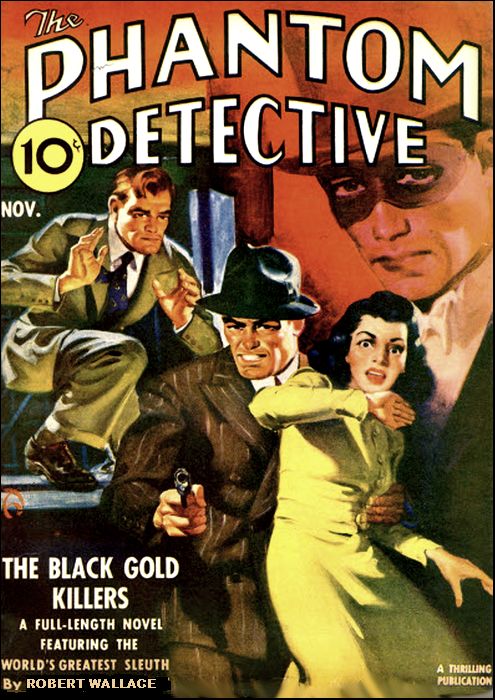
The Phantom Detective, November 1941, with "The Black Gold Killers"
Follow the Phantom across the country as he tears down, piece by piece, an intricate structure of deadly crime—fighting against the grim reign of murder that holds sway over the oilfields when a ruthless schemer plans a sinister coup!
SCORES of persons saw the bodies come hurtling down from the Empire State Building. But only one woman saw that it was murder.
It seemed unlikely that the woman would become a witness. She was dead before the bodies landed more than five hundred feet below the Empire State observation tower.
Yet she was to give some mighty powerful testimony for the prosecution.
The world famed Phantom Detective was to produce silent evidence that a knife in her heart could not obliterate.
The bodies were first seen in midair nearly a hundred stories above West Thirty-fourth Street. They looked like dolls falling in slow motion.
Two wide-brimmed black sombreros came sailing down slowly. These were torn to bits by morbidly-minded memento seekers when they landed.
The bodies were stopped by a building shoulder, still high above the street.
Immediately prior to the frightful plunge of the bodies, the observation space of the Empire State Building, highest in the world, was occupied by only a few persons. There were but two figures on the north side.
These men were conspicuous for the cowpuncher clothes they disported. Their sombreros were Mexican, black and expensive. They wore plaid shirts and high-heeled riding boots.
Joel March and Charles Young were visitors from southwest Texas. The letters BB were worked into their hats. This stood for Big Basin, the BB brand of the Texas ranch from which they hailed.
March and Young had lean faces, tanned leathery brown by a western sun. They were looking over the shoulder-high parapet off toward the Hudson River. Evidently they possessed the far-sighted vision of the ranges.
"That's the French liner, the Normandie." said Young. "I can see men like ants on her deck."
"She's been laid up since the war," said March. "The cars down there in the street look like June bugs."
Both buckaroos stood on tiptoe, bending over the parapet to look down. They failed to see the two men who glided furtively from the indoor space of the restaurant and bar.
These men were swarthy and quick-moving. Sloe-black eyes were darting, as if to make sure they were unobserved.
"That ees them, Tarantula," said one of these men softly. "We must be queek."
The speaker was short and broad. He talked and looked like a Mexican. "Tarantula" had a scar like a white cross in the center of his forehead. He was tall, with long arms.
Tarantula moved with the catlike grace of a beast of prey.
He spoke without accent, though he mangled his grammar occasionally to betray his foreign origin.
"It is good," he said. "They are dressed like vaqueros. If they die by the accident, who will ever know they are other than they appear to be?"
Joel March and Charles Young failed to hear the sinister shuffling of quick-moving, soft-soled shoes.
One second they were keen with life. In the next they were hurtling outward into space, downward to death.
One woman, a tourist, had just appeared in a little passageway where she could see the north side of the observation platform. She may have been too paralyzed to scream.
Only her hands moved, instinctively, as if she were fending off the scene of awfulness upon which she had unwittingly come.
The long arm of Tarantula shot out. His free hand flashed with the whip-like motion of a striking rattler. The woman fell. She moaned once and was still.
Strangely, no blood came from her death wound.
SEVERAL persons were in the glass-enclosed observation room back of the north side platform. One building guard was there. But none had witnessed the swift strike of tragedy outside.
The pair of swarthy killers came hastily into the enclosed room. Both appeared to be casual tourists, with cameras strapped over their shoulders.
"Dios!" cried out the tall Tarantula. "The terrible thing has happen! Out there!"
His extended hand was shaking visibly.
"The two vaqueros! They are fallen! Dios! It is awful! One, he is drunk maybe! He climbs up to walk the stone, and the other he is grab for him when he slips! They are gone!"
THE little crowd turned white faces. The guard swore and led the rush to the doorway. The word spread quickly. In less than a minute, three guards and employees from the refreshment bar were having their hands full keeping back the rush of those who fought to lean over the parapet and look down at death.
Thus it was, that no person, for the moment, thought of the swarthy tourist who had given the alarm, or of his companion. They were in the little group that entered the first elevator and were dropped noiselessly and swiftly down to the street floor, from which there were many exits.
Three persons were seated at a table near the restaurant bar. They faced south windows, and thus failed to see the tragedy or the rush of the small crowd to the north platform.
Kay Seibert was one of the three. She was a glamorous girl if there ever was one. She had tightly curled chestnut hair. Her wide-spaced, brown eyes had the intelligent trick of talking when her curved lips were silent.
Kay Seibert was the delight of newspaper cameramen. She was lithe, slender and desirable. And the look that now appeared in the tired but intense eyes of her father said that she was his pride and glory. Clyde Seibert, reputedly millionaire broker, had lost the mother of Kay when she had been a little girl.
Carl Kraft was the third figure at the table. He wore western garb like that of the two men who had just died horribly. And he was one of the three cowpunchers from southwest Texas who had been entertained for the past two days by Seibert, the broker, and Seibert's glamorous daughter.
Just before the murmured, awful word of the tragedy came into the restaurant, Kay Seibert was talking in a cool, low voice.
"If Dad has his way, Mr. Kraft, I'll be wearing buckskin myself and going west to grow up with what's left of the country," said Kay laughingly. "I'm beginning to think he had you cowboys come to New York to kidnap me and spoil my summer at Southampton."
There was something of deadly seriousness in Clyde Seibert's voice and eyes, even though he laughed.
"Perhaps you've guessed it, Kay," he said. "Many of your friends will be paying big to make monkeys of themselves on dude ranches this summer. There's good fishing and hunting, and you like to ride.
"I've been thinking, I owe myself a vacation, and you might like to go with me out to the BB. Perhaps I can build up the cattle business some, what with war prices."
Kay Seibert did not miss the sudden wistfulness in her father's eyes. She saw and sensed more than he imagined. She knew he believed she was all given to having a good time.
"Yes, you hope you can make something of the cattle business," she was thinking. "You haven't wanted to tell me, but you plunged in Slide Mountain Oil stock, and the bottom has dropped out of it. Unless I am badly mistaken, Dad of mine, you are about cleaned out.
"The Big Basin cattle ranch is the best and about the only property you have left. You don't want me to know that, but you had three of your western riders come here to paint a romantic picture."
"You know, Dad," she said quietly. "I've a notion to call off all other dates and trail along with you, as your cowboys would say."
SHE was looking at the sharp featured Carl Kraft as she spoke. She liked him the least of the three riders she had been helping her father entertain for two days. Kraft's eyes were too small, his nose was too sharp and he did not have enough chin.
Kay liked the other riders, Joel March and Charles Young, with their frank, almost boyish appearance and manners.
And she knew their report that the ranch seemed to be prospering meant a great deal to her father.
Carl Kraft frowned a little at Kay's apparent willingness to fall in with her father's scheme.
"It's hotter than blisters on the BB this time of year, Miss Kay," he said, and her father scowled at him and muttered.
"Sometimes we get some tough hombres from that Slide Mountain oil field over on the BB," the rancher continued.
"Nonsense, Kraft!" snapped Kay's father. "March and Young say there is always a cool wind from the mountains. Besides that, the Slide Mountain oil field is about petered out and—"
Kay knew why he paused abruptly. Her father had not wanted to mention Slide Mountain oil. It had wrecked him, she was sure.
"Well, yes, the oil field has about dusted," admitted Kraft. "But it is hot on the BB."
"For some reason, he doesn't want me to visit the BB ranch," was Kay's thought.
"Anyway, I think I'll take a chance and go," she said, smiling.
She could almost feel her father's deep, pleased breath of relief. His eyes lighted.
One of the waiters touched Seibert's shoulder. His whisper was intended to be secretive, but it was hoarsely audible.
"The two other cowboys, your friends, Mr. Seibert. It's them they're talkin' about. They've fallen, sir, off the building."
Seibert started to his feet, exclaiming aloud. Carl Kraft sprang up, clapping his sombrero on his head.
"Joel and Charley, good God! That's impossible!"
Kay did not know why. It may have been her inexplicable dislike for the man, but Kraft's words sounded forced.
She caught her father's arm. He did not seem to see her.
She heard him mutter, as if he were all alone.
"It can't be, but if it is, then someone knows."
"Stay here, Mr. Seibert. I'll see about it," said Kraft.
Kay kept her composure because her father seemed close to collapse. She stayed beside him. But her eyes followed Kraft.
She saw him push out with the crowd. Then she saw him glance around quickly, furtively, and turn to one side. She was sure that he entered one of the public phone booths instead of going directly to find out what had happened.
KAY SEIBERT had watched her father heroically facing the loss of his fortune. Because of his cheerful courage, she had pretended that she did not know the truth. Yet all of the time she had been convinced that his supposedly subtle scheme to interest her in the Texas cattle ranch was a brave, desperate attempt to fit her into another way of life before she would discover that his fortune was gone.
But now he had dropped into his chair. His chin was on his breast. His eyes were dull and hopeless.
"Wait, Dad," she said. "There may be some mistake. How could it be Mr. March and Mr. Young? They couldn't fall."
"There isn't any mistake, darling," he said, almost as if he were talking to himself. "And they didn't fall. They have been murdered. Kay, go after Kraft. Bring him back. We must get out of here quickly. Get Kraft, please."
"Dad, you're all upset," soothed Kay. "Wait until Mr. Kraft comes back."
Her father's words had been fantastic. And yet Kay had the sudden conviction that he was speaking of something he might have expected. Her heart seemed to skip beats. Her father had murmured something when the news had come.
"It can't be, but if it is, then someone knows."
What was it that someone knew? What was it that could bring her level-headed, cool thinking father to speak of murder? He was not given to morbid imagination or hasty judgments.
She grew a little sick, dizzy, looking at his suddenly gray and hopeless face. And she recalled that Carl Kraft had turned aside into a phone booth.
"I'll bring Mr. Kraft back at once," she said. "Whatever has happened, we must get home. You have been under a strain, and the first thing we know I'll have a sick man on my hands."
She started to move away. But her father called her.
"Wait a minute, Kay. Don't think I don't know what I'm talking about. Something may happen to Kraft, too. And then, Kay, if anything should happen to me—I mean if I should have trouble with my heart, there's one person I want you to reach."
In her quick apprehension for her father, Kay tried to dismiss for the moment the other tragedy. "Don't be silly, Dad. You're overwrought."
"No, Kay. I mean it. You know Steve Huston, the Clarion reporter. I've asked him to do me a big favor. I have wanted the one man who can be reached through Frank Havens, the publisher of the Clarion, to look into some personal matters. I have asked Steve Huston to bring the great detective known as the Phantom to talk with me and with—
Seibert bowed his head. His thin shoulders quivered with a great sob.
"It will be only with me and Kraft now," he added. "I want to see the Phantom, and if anything happens to Kraft and me, I want you to tell the Phantom—"
"Dad! What are you saying?" Seibert appeared to be brought up short by Kay's alarmed voice. He shook his head as if to clear away some sort of fog.
"That's right, darling," he said and smiled a little. "What am I saying? Go on, Kay, and bring Kraft."
Kay left him, moving quickly toward the row of public phone booths where she had last seen Carl Kraft. She tried to believe that her father had not been himself, because of shock. But it was not like him to voice imaginary fear, or even a real fear, unless the threat was great.
Kay did not reach the phone booths. For she saw Carl Kraft's peaked sombrero over the heads of a small crowd that was pushing toward the down elevators.
"Mr. Kraft! Wait!" she called.
Perhaps Kraft did not hear her. He was gone in the swiftly descending elevator.
Kay suddenly judged she was foolish. Why shouldn't Kraft go down to the street? He would be hastening below to do what he might for his dead companions.
Another elevator filled just as Kay entered it.
She was in time to again see Kraft's peaked sombrero passing through a street exit. Perhaps she could reach him and bring him back to her father. If there was anything at all to what her father had been saying, it might be dangerous for Kraft to mix with the street crowd.
At the street exit, Kay halted in amazement. For Carl Kraft did not go in the direction of the crowd interested in the bodies of the two westerners. He summoned a taxicab.
The cab turned and sped westward. Carl Kraft was deliberately leaving the vicinity of the Empire State Building.
WHAT could it mean? The surviving member of the BB ranch trio had gone straight to a telephone on word of the tragedy to Joel March and Charles Young. Now, without doubt, he was leaving without a word of explanation to her father.
Kay turned back into the building. As she did, she became aware of watching eyes. Quick, cold fear ran through her.
She saw two dark faces. The men were seated in a low-slung, new car, parked at the curb near the building entrance. One dark face was hard featured and thin. Dark eyes seemed to glow under a forehead that was marked.
The mark was distinctive. It was like a white cross. The scar was so outstanding, that it seemed to have been drawn with chalk. The owner of that scar, if Kay had but known it, was called by the peculiarly venomous name of Tarantula.
Kay almost ran when she saw the white-scarred man get out of the car and glide after her into the building corridor. She hurriedly bought another ticket for the top and darted to the first up elevator.
As she entered the elevator, Kay saw the owner of the white cross scar pause by a corridor corner. Kay was sure she never had seen a more malevolent smile upon a human face. It was as if the swarthy man's evilly grinning countenance assured her that he would see her again, and soon, where she would be defenseless.
She tried to shake off her fear before she should return to her father.
At the door of the restaurant, Kay halted, her sick terror coming back. Her father was not in sight. She started toward the crowd still morbidly crowding the north side platform.
A waiter touched her arm.
"I hope Mr. Seibert has gone home, Miss Kay," he said. "He seemed to be ill, but he hurried out as soon as you were gone. Possibly the shock has been too much for him."
Kay's mind jumped to the scarfaced man who had followed her on the ground floor. If that man knew her, then he would know her father.
Her father had spoken clearly and concisely of murder, of possible danger for Carl Kraft and himself. Kay's first impulse was to rush back to the elevators. A flurry of excitement stayed her.
The police had arrived. A brisk medical examiner bent over a woman lying upon a reception room couch. The woman was portly, with the inevitable tourist's camera still lying upon her expansive bosom. She was quiet, dead.
"She must have seen the men fall," said the police doctor. "It was too much for her heart. Too bad. She might have told us exactly how it happened."
A sweating police captain spoke up. "Yes, she might. But who did see it who is still here?"
"Why," said a building guard, "there were two fellows, a couple of Spanish looking visitors who gave the alarm. I guess they beat it. I haven't seen them since."
Spanish looking, was in Kay's mind? That terrible man with the white cross scar on his forehead was dark?
She moved closer and looked at the still face of the dead woman. The open, staring eyes chilled her. It was as close as the glamorous girl had ever been to death.
If the woman could but talk?
Kay Seibert possessed much more than a playgirl brain. It was seething with questions now.
Back to the beginning she went. Her father had lost his fortune in an oil stock plunge. And she knew there had been word of some trouble on his one hobby, the Big Basin ranch in Texas.
Two or three riders had been killed in fights with cattle thieves, he had told her. Then had come her knowledge that his oil stock had practically broken him. Slide Mountain Oil had been a legitimate proposition, at first.
Slide Mountain Oil field was near the Big Basin ranch. When her father had bought his stocks, it had been a big producer. But something had been said of it being a small pocket underground that had quickly played out.
Her father's fortune had played out with the oil field.
Then her father had said he had a report of the ranch beginning to straighten out, to pay a profit. The three riders had been brought East. Kay was sure they were intended to influence her to go to Texas with her father.
Now what could all of this mean?
Two of the riders were dead. Her father said they had been murdered. That had sounded fantastic when he had said it. But now Kay had seen that scar-faced man!
She felt she must get to her father. She was inclined to tell the police what she knew. But her father had said something about telling the Phantom Detective.
Yes, she had heard of the famous Phantom. To her, as to many, he was almost legendary. Still, there were too many accounts of the Phantom's exploits, his war upon crime, to doubt his existence.
Well, she must go home now. She decided to call by phone, hoping her father had arrived. Their apartment was only a few minutes away, in Gramercy Park.
Three minutes later she came from a phone booth. She was white-faced and sick. Stevens, their butler, had said her father had not arrived at home.
Kay decided she must get in touch with the Phantom Detective.
QUIET was shattered as police cars, the fire department emergency trucks and ambulances wailed in the vicinity of West Thirty-fourth Street and famous Fifth Avenue.
Red-headed Steve Huston, ace crime reporter of the New York Clarion, had his special privileges. He sent his press car rocketing along Fifth Avenue. His own siren was screaming at towering, double-decked busses and a multitude of taxicabs.
Steve wore a delighted grin at his own speed as he sent his coupé slithering through places where even hardened taxi drivers would have hesitated. The man beside him had a youthful face, piercing blue eyes and hair as rusty as Steve's own.
This man wore an expensive brown suit and a snap-brimmed hat. His smile at their speed and Steve's skill was as pleased as Steve's.
"Lucky I was around when Clyde Seibert called you, Steve," the man said. "And you have a hunch that this trouble may be mixed up with the failure of Slide Mountain Oil stock which has cost Seibert most of his fortune?"
"Right, Phantom," said Steve from the corner of his mouth. "I've followed that story. Three suicides of ruined oil stockholders, and at least one murder because of embezzlement to buy the stock when it was good must mean something. Seibert isn't the sort of guy who gets jittery."
"And Seibert phoned, saying these two dead men, Joel March and Charles Young have been murdered," said the Phantom musingly. "Strange, if they were riders from Seibert's ranch somewhere in Texas. That's the Big Basin brand. They have produced a few good polo ponies on that ranch."
Steve Huston shot a glance at his companion.
"Doggonit, Phantom! Some day I'm going to start playing detective long enough to find out who you really are. I've an idea you're someone I ought to know, yet all these years we have kicked around together on this and that, only the boss has known your real identity. It ain't right."
The Phantom smiled. The coupé was being pulled up at the edge of the police car jam in Fifth Avenue. Steve had voiced the truth.
The reporter had aided him often. And Steve had frequently met him at the polo field, in Broadway night clubs, and at other society spots in his true identity.
For the Phantom Detective was Richard Curtis Van Loan, gay spender of his dead father's fortune.
As Dick Van Loan his one and only care seemed to be getting rid of huge amounts of money as quickly as was possible.
Frank Havens, publisher of the New York Clarion and a chain of nation-wide newspapers, was responsible for his notable career as the Phantom Detective. And for several years this had remained a secret between them, for Havens had been a close friend of Dick Van Loan's father.
"When you called me," said the Phantom, "I made up quickly. I thought becoming redheaded like you might hold us together, if this Seibert matter turns out to be a real case."
"Yeah," drawled Steve. "Look out that turning redheaded doesn't get you into my kind of jams. I'm always wondering what kind of a face you'll pull out of the bag next."
The famous Phantom could truly pull any kind of a face out of the bag, any kind of a voice or mannerism that he had ever heard or seen. He was a man of a thousand faces. He had the means of making countless changes always upon his person.
AND the Phantom had more than that. For years he had trained himself in every form of physical combat. He had learned all of established criminology from soup to nuts. To this he had added numerous improvements of his own, in laboratory and in action.
The cleverest of world crooks knew and feared him. None ever knew when he met a stranger that he would not turn out to be the Phantom.
The Phantom could go Edgar Bergen one better at ventriloquism. He knew many languages. He had moved in all strata of humanity.
They were climbing from the coupé. As Richard Curtis Van Loan, the Phantom would have been a tall, broad-shouldered young man, with dark hair and mild, humorous brown eyes.
Beside Steve Huston, entering the Empire State Building, he might have been another redheaded newspaperman.
They were alone with the operator in the elevator shooting silently skyward.
"You know polo ponies, so perhaps you know the swell gal who could be number one glamor girl right now, but who is too smart to be ticketed," said Steve.
"Kay Seibert, sure," said the Phantom. "Where another girl would be a little crazy over her own looks, she has other ideas."
"Yeah," said Steve. "But a little on the wacky side, if you ask me. Wouldn't be engaged to Ward Thayer, if she showed the sense she seems to have. He's pretty much an all-out heel, and almost broke. She's nuts about her old man though."
"Ward Thayer plays a good game of polo," observed the Phantom noncommittally. "Pulls his shots though in tight spots."
"Heck!" exploded Steve. "Some day I'll find out who you are. Next, you'll be telling me you might go for the Seibert child."
The Phantom smiled. The elevator was stopping under the tall tower. Neither as the Phantom nor as Dick Van Loan had he ever considered any young woman too seriously.
His dangerous way of life precluded having a woman in it, to the Phantom's way of thinking. If it ever would be anyone, there was Muriel Havens, the dark-haired daughter of Frank Havens, who was herself half in love with both the Phantom and Dick Van Loan.
She did not know they were the same person.
Kay Seibert's big, brown eyes seemed to talk as they met the Phantom's gaze. She had briefly related all that had happened, including the white-scarred man who had followed her downstairs.
"I have just called home again, Phantom," she said. "My Father has not gone there. First of all, he must be found. I have never had silly notions, but I can't avoid the feeling that his life is threatened right now."
The police doctor was waiting for the dead woman tourist to be removed. She had been identified by her cards as a Mrs. Horton Talley, of Terre Haute, Indiana.
"I'll have a look at the woman, if you don't mind," said Van.
The police doctor glanced at Steve Huston.
"You reporters are always a pain in the neck," he said.
Van was suddenly holding his partly closed hand where only the doctor could see its palm. A bright platinum badge gleamed there. It was shaped like a domino mask. Tiny diamonds were set in it. That badge was known to nearly all police authorities.
"Well, that's different," said the doctor in a low tone. "And if the Phantom comes into this, it must be something more than it has been reported. It looks as if this woman died of shock when those two nutty fools fell off the building."
The Phantom was studying the woman's still staring eyes. His gaze went to her hands. They had not been moved. They seemed to have been clutching desperately at her camera when she died.
Van's knowledge of medicine, and of violent means of death probably exceeded that of the police doctor.
"Steve, there's a developer for films back of that automatic machine for tourists. Suppose you see what you can find in this woman's camera. Doctor, let's have a private examination before the body is moved. It may turn up what an autopsy will show more positively."
"What do you mean, Phantom?"
"This woman died of a heart attack, Doctor. But it was not natural. Her heart has been ruptured. I would say she has been murdered."
Kay Seibert suddenly clamped her white hand against her teeth. Her willowy, graceful body swayed.
"Steady, Miss Seibert," said Van quickly. "I would advise that you go home at once and wait there for me. I'll have one of the detectives accompany you. As soon as possible, I will join you. There are some things I must know from your father as soon as he is found."
ONLY the doctor and two policemen were beside the Phantom when he pointed to the tiny puncture. The wound was directly over the heart of Mrs. Horton Talley. It was so small that it had not bled.
"A stiletto of the finest kind," announced Van. "It was needle-pointed. Her heart was punctured. Seeing that no one else has come forward, I would say that she was the only witness to a double murder, and she had to die."
The doctor was swearing. Steve Huston poked his rusty head between him and the Phantom.
"Lookit! There's the dope, Phantom! It's as positive as if the woman could still talk!"
Steve was waving a wet film from the woman's camera.
The film showed two figures in sombreros being lifted from behind. Two men whose faces were away from the camera, had a football tackle grip on the knees of Joel March and Charles Young. The Westerners were going over the parapet, their arms waving.
One killer was tall and lanky. The other was short and broad.
"The two Mexicans who had the nerve to give the alarm, the way I get it!" exclaimed the police doctor. "This makes it triple murder, right here on top of the highest building in town, and they got away with it!"
"For the present," stated Van.
He was thinking of the scar-faced man Kay Seibert had reported as following her, and of Carl Kraft, the third Westerner, who had undoubtedly taken a runout powder after phoning someone on the outside.
Kay Seibert had followed Van's advice. The Phantom wished now he had kept the girl here. His analytical mind was adding up several angles brought out by Steve Huston to what Kay had told him of her father's strange fear of murder.
He pulled Steve quietly to one side.
"The queerest element in this so far is the action of Carl Kraft. I believe Clyde Seibert is in imminent danger. Kay Seibert may or may not be menaced. I am going directly to Seibert's home. There may be some connection between all of this and the sudden collapse of that Slide Mountain Oil stock."
"Possibly. Many people lost a lot of money on that stock. This is one time, too, when the stock was on the up and up. I judge that Sidney Lester, the Kentucky colonel guy that handled it here, is himself as much a loser as the others."
"Sidney Lester," mused Van. "Yes, I've heard of him. I understand that even Frank Havens took a flier in some of that Slide Mountain Oil stock, regarding it as a good investment. Steve, would you know where to find Sidney Lester at this hour?"
"Wait," said Steve. "I think you've got something there."
A minute later Steve was back from a phone booth. His homely face wore a grin of enthusiasm. His red hair fairly bristled.
He was all newshound with a new angle on what promised to be a whale of a story.
"Lester is working late in his office, I found out," he said. "His gal secretary says he's getting ready to leave town."
"Cover him, Steve," directed Van. "Just keep him in sight a short time. I may not be long at Seibert's place. I'll join you in the Randolph Building, and we'll interview Lester together.
"And keep an eye out for Carl Kraft, Steve. It's only an idea, but you may find him not far from Sidney Lester."
One of the policemen came over.
"Steve Huston," he said, "there's a call for you. A young woman—Kay Seibert."
When Steve went into the phone booth, the Phantom slipped in beside him. For the Phantom had that sudden tenseness which always came to him when he was convinced that swift action was about to become necessary.
"Yes, Miss Seibert," said Steve. He then held the receiver so that the girl's excited voice came to both of them.
"Please, Mr. Huston! I called you, to have the Phantom come here as quickly as possible! My father is here, but he seems to have lost his mind! He has taken some kind of a box with express labels on it into his library! He has locked me out! He is hammering the box open, and he won't let me in or answer me!"
The Phantom was moving fast when he came from the phone booth. Steve almost ran beside him to keep pace with his gliding steps.
"You still take Sidney Lester, Steve," said Van. "I'll join you as quickly as I can! I'm taking your car!"
The redheaded reporter muttered ruefully.
"Right away this story's beginning to bust, and all I have to do is play watchdog," he complained.
Five minutes later Steve was in a taxicab bound for the Randolph Building and Sidney Lester's office.
The Phantom was sending Steve's coupé at reckless speed over into the East Side toward Gramercy Park. He was hoping that Kay Seibert's frantic call might be no more than the result of overtaxed nerves.
But within the hour past there had been three murders, the most daring he had ever encountered.
And already there were several loose ends that might be connected with the evident fear and as yet inexplicable actions of Clyde Siebert, normally a cool and unexcitable stock broker.
"YES, Miss Seibert and her father are in," said Stevens, the dignified butler at the Clyde Seibert home. "I haven't been called upstairs since Mr. Seibert himself took away an express box that arrived for Carl Kraft, one of those Western men."
"Miss Seibert called for me. I'm a friend," said the Phantom. "If you have a key to Mr. Seibert's library, you had best come with me."
Van had more than a premonition that deadly danger was at hand, here in the Seibert home. The big, luxurious apartment occupied two whole floors of the exclusive Gramercy Park Place. Van started for the wide, polished stairway.
From behind a closed door at the head of the stairs came a scream. It was muffled, but it was undoubtedly Kay Seibert's voice, and it held the ultimate note of terror.
The dignified, lumbering Stevens was but halfway up the stairs when the Phantom hit the door at the top. He snapped it open. Kay Seibert screamed again. The cry came from another room behind still another closed door.
Van found that this door was locked. Evidently the girl had wished to keep the secret of her father's queer behavior from the butler or other servants.
The door was of heavy oak. Its lock was of a late, complicated type. Van wasted no time upon it. The butler had just come from the head of the stairs when Van hit the door with the force of a battering ram.
VAN had taken a short running plunge. The oak door shook, and a panel splintered under the shock of his first tremendous blow. When he hit it again, the lock itself snapped, and Van's weight projected him into the inner room.
Never had a more weird scene suddenly flashed before the Phantom. And in that eerie moment, Van knew that death was already here.
Clyde Seibert lay prone upon the floor near what Van saw was the open door of his library. Seibert was still alive. But Van's keen senses told him there was no hope of saving him.
It was the position, and the imminent danger of a terrible death for Kay Seibert herself that sent Van hurtling forward.
The slender, lovely girl stood close beside her father. Her white hands gripped a slippery, squirming mass. Van saw instantly that it was a huge diamond-backed rattlesnake, of a variety found in Texas, Florida and other Southern states.
Kay was holding the writhing snake just below its triangular head. She was squeezing tightly, but the folds of the slick body were whipping about. The snake's fiery red tongue darted and its cruel, white fangs were set to strike.
But it was more than this amazing scene that lifted Van from his feet in a headlong dive. For there was another great diamond-backed rattler coiled, buzzing fiercely, and drawn back to strike at the brave girl.
Gripping the rattler that Van saw had undoubtedly bitten her father, delivering what could be no less than a death blow on Seibert's throat, the girl was cornered and helpless before the second snake.
Seibert lay on the floor on one side of the girl, and the long box from which the snakes evidently had come was on the other. Perhaps Kay had not seen the second snake in time, or she had been too intent upon her desperate effort to cling to the snake that had bitten her father.
Never had Van been compelled to act with greater speed, or to take a greater chance. Without time to draw either of his guns, he was forced to rely upon the speed and skill of his body and hands.
The coiled rattler shot upward, striking, just as Van's body lunged for it and his vise-like fingers fastened upon the slimy body. Van rolled, conscious only that the impact of his weight had thrown the snake to one side and that Kay had been saved for the moment.
But the hissing, buzzing rattler whipped its head around. For a split second Van saw the terrible white fangs almost touching his face. There was no time to change his chance grip from the middle of the snake's body to a safer hold close to the head.
Kay screamed shrilly as Van brought his hands around with incredible speed. The snake struck and missed. Van came to his feet as if his muscles were of elastic whipcord.
His hands whirled, and the rattler straightened out. Van hit the wall with it but once, smashing the head, then dropped it, squirming, to the floor.
He shot out a hand and closed upon the rattler that was slipping through Kay's fingers.
KAY was on her knees beside her dying father. Van saw there was no hope for Clyde Seibert. The rattler had sunk its poison fangs into the side of his neck. An awful purple swelling was spreading from Seibert's throat to his face.
But Seibert was talking, mumbling, as might a man in his sleep, a tortured sleep filled with nightmares. Only this was the final nightmare of death itself.
"Kay, honey—don't ever give it up. Keep the BB. Don't let them take it from you. It's all there is."
The girl was sobbing, crying out.
"Dad! We won't let you die! Phantom! You can save him!"
Looking into her wide-spaced, pleading, brown eyes, Van would have surrendered all of his fortune, all of the happiness he might ever hope to gain to have been able to give this girl her father's life.
"We'll do all we can," was all he could murmur, lifting Clyde Seibert's head.
The dying broker's tired blue eyes were sanely clear, and filled with the knowledge that his life had but seconds to go.
"Phantom," he said huskily. "You will look after Kay? There are those who would destroy her."
He breathed heavily, deeply.
"If I had time to tell what I know, but it is better that I do not now," said Seibert. "Kay, darling, never give up or sell the BB ranch. Go there, live on it, keep it. For there is—"
The poison must have closed his throat then. Seibert raised one hand. His fingers gently touched the soft cheek of the weeping girl. He smiled faintly and was dead.
"I've told all I know, Phantom," said Kay Seibert a few minutes later. "I don't want to talk about it now, but I suppose I must. Dad had nearly a million in that Slide Mountain Oil stock. It is worth nothing now. He has some fifty thousand in a deposit box, and that is all the cash.
"He loved the West. He seemed to believe he could make a go of raising cattle. The Big Basin ranch appears to be all that is left."
Van studied the girl's attractive features. He glanced at the soft, jeweled hands. He judged there could be no chance that Kay, who might have been Number One glamor girl, could ever take over a Western ranch.
He was looking at the fatal express box. Its address was plain.
TO CARL KRAFT,
IN CARE OF CLYDE SEIBERT,
GRAMERCY PARK,
NEW YORK CITY.
Only initials were marked as a return address.
J.L., EL PASO, TEXAS
"It would seem that someone in El Paso, Texas, had every intention of removing our missing friend, Carl Kraft," he said. "Or perhaps Carl Kraft would have known what was in that box. I can only judge that your father opened it, Kay, believing that he might be protecting Carl Kraft from some danger."
KAY stared at Van a long minute, her eyes troubled.
"Perhaps I should not say it, but I did not like Carl Kraft," she said. "Even before he acted so strangely after Joel March and Charles Young were killed, he seemed to be concealing something, to be always watching my father as if he expected something to happen."
"We may find Carl Kraft very soon, Miss Seibert. In the meantime, I suppose you will try to hire someone to manage that ranch in Texas. It would hardly be a place for you."
The girl's slender shoulder straightened. Her brown eyes were determined.
"Phantom, I am going to the ranch myself," she said. "I intend to do as my father wished. I'll never sell the ranch or let anyone take it over. And out there, perhaps I am silly, but I am sure I will find the murderer of my father."
The same thought had been in the back of Van's mind. He merely nodded now. There was in Kay Seibert's voice something far removed from the hothouse tone of a glamor girl.
Stevens, the butler, had called for the police. There was a buzz at the door. Stevens went out and came back.
"There is a man with a message for you, Miss Seibert," he said. "He asks to see you personally. He is waiting."
Van was suddenly tense.
"I'll see him, Miss Seibert," he offered.
Stevens walked ahead of him. Intent upon averting any possible trick that might be some further trap for the girl, Van was watching the stairs as he went down. Because of that, he missed seeing a second floor window sliding upward.
A swarthy hand was raising the sash. A figure that was shadowy in the early darkness was on the fire-escape outside.
When Van reached the foot of the steps, he saw that the outer door was open. Stevens exclaimed behind him:
"Pardon, but the man seems to have gone!"
Van was at the door with two long strides. There was no one outside.
For the second time, Van was at the foot of the stairs and heard Kay Seibert scream. Bitter at himself for being tricked, he bounded back to the door above.
As he slammed it open, he saw the girl writhing in the grasp of a tall, swarthy man. Van had one glimpse of a scar like a white cross in the man's dark forehead, and of a thin-nosed face with beady eyes.
Kay Seibert must have had much greater strength than her slender frailness indicated. For she was clinging to the man's wrist, holding it desperately.
With one arm crooked around the girl, the scar-faced man was attempting to free his hand to strike. Van saw a needle-pointed blade hovering above the girl's throat.
It was impossible to reach the assassin as he tore his wrist free and struck.
EVEN seated behind his mahogany desk, Sidney Lester was a big man with powerful shoulders. He looked all of what he represented himself to be.
For Lester was one of the few Kentucky colonels extant. Bushy gray hair gave his head a leonine appearance. When he talked with a soft, slurring accent, his chin wagged a perfect goatee that matched the trim mustache on his upper lip.
"Ah tell yuh, suh, if a ca'less hand brushed that vial off mah desk, it'd blow us to Kingdom Come," he was saying to a pair of visitors. "Ah'm not so shuah it wouldn't have been a good thing to happen befoah Slide Mountain dusted out."
"We hadn't heard about that, Colonel Lester," said one of his visitors, arising hastily from his chair. "Landon and I have just come back from a trip upstate. We haven't followed the stock market. We thought we might still pick up some of the stock, but if you say it's through, I guess we made a mistake."
Both visitors were on their feet. They were staring at a little vial, some five inches high. It was set into a silver bracket in the middle of Lester's big desk. The vial contained a colorless liquid that might have been water.
"Ah greatly regret what has happened, suh," said Lester. "Ah've lost heavily myself. Ah rega'd it as a reflection upon mah integrity, gentlemen. Slide Mountain is done. About that nitro. Ah've found it interesting at times to—"
One visitor glanced nervously at the other.
"I guess we'll be going, Colonel Lester," he said quickly.
The visitors wasted no time leaving the office. As they passed a tall, plain-featured girl at an outside desk, they glanced apprehensively back at Sidney Lester's private office door.
Outside, one of them mopped a damp brow.
"Whew! I'm glad I'm out of there," he said. "The colonel's as crazy as a coot. I guess perhaps he is taking that Slide Mountain thing hard."
They hurried away down the corridor.
Inside his private office, Lester, who styled himself, "Colonel Lester," sat motionless for several minutes. His eyes were deep and black. They glowed with a vitality that did not harmonize with the gray of his bushy hair.
The phone on his desk buzzed. Lester picked up the instrument. When he spoke now, his soft, southern accent was gone.
"All right. The police do not seem to have discovered anything but an accident in the March and Young deaths," he said. "But if they were murdered, then my own life isn't safe. I'll be the next. Some of the Slide Mountain stockholders are desperate enough to kill, and they won't believe that I'm as much a loser as they are."
The plain girl outside was a Miss Stanton. The inner office door was open. She could hear Lester's words clearly. He seemed to be speaking deliberately loud.
Miss Stanton changed her position a little. She could see Lester at his desk. He was rubbing one hand nervously over his forehead. As Miss Stanton told it later, Colonel Lester appeared to be fearful for his own safety.
Miss Stanton glanced at the vial on Lester's desk. She had seen several visitors depart from the offices hastily. They had been told the little vial contained nitroglycerine, the explosive most employed in the oil fields.
Miss Stanton had become accustomed to Colonel Lester's story. She regarded it as his little joke. She judged there was water in the little vial.
Miss Stanton heard Lester drop his voice. He was speaking rapidly now, for only the man on the phone wire to hear.
"Listen, Kraft, don't come up here openly," he cautioned. "But I'd like to talk things over. If you want to climb ten stories up the back stairway, you will be right alongside the office. Don't come up if anyone sees you. It wouldn't be smart for either of us."
THE voice of Carl Kraft rasped in his ear.
"I'm coming up then, Lester, right away."
Miss Stanton did not see Lester close the phone connection with one finger. She heard him speaking again.
"We're all washed up then! I don't know what you'll do, but I have my own plans!" Lester was emphatic.
He got up and stepped to the office door. Later, Miss Stanton was to say that Colonel Lester looked like a beaten man when he last spoke to her. She observed now that his big shoulders sagged and that his goatee touched his white shirt bosom.
"You may go now, Miss Stanton," he said dolefully. "I've some work to finish up. You can take tomorrow off, and here's a month's pay in advance."
Miss Stanton was about to speak, but when she looked into Lester's black eyes, they were so dull that she thanked him and left.
AS soon as Miss Stanton went out, Lester went quickly to her typewriter. He appeared to measure the distance of Miss Stanton's desk from the door of his inner office. He nodded to himself with a smile.
Lester typed a few lines and left the paper in the typewriter. He closed the desk when he heard quick steps in the corridor.
Carl Kraft stepped in. The Westerner peered about, listened, then closed the outside door.
"I made it without being seen," he said, removing his high-peaked sombrero and wiping sweat from his forehead. "Lordy, but this whole thing has been close. Tarantula played a long shot, and I've just got more news. The snake trick worked."
"Seibert got it?"
Lester's black eyes glittered.
"Yeah. And his girl will be okay. Tarantula will see to that."
Lester seemed suddenly to explode. "I told Tarantula to lay off that end of it! It won't work that way! Everything's got to be straight and legal with Kay Seibert! She must live to carry out her father's crazy plan!"
"It can be fixed," said Kraft. "It might be just as well if we finished our own personal business."
Lester nodded.
The door to the private office closed. It was dark now, well after office hours. It was most unfortunate that a lawyer and his stenographer were working late in an office directly over Lester's private room.
Steve Huston was standing in the shadows at the end of the long tenth floor corridor. He had hoped the Phantom would appear. The redheaded reporter was burning up over this waiting game when he was sure something must be happening to the Phantom at the Seibert home.
"Might be a good idea to see if I can smoke something out of Lester," muttered Steve. "I'll have everything ready when the Phantom shows up." He started out, then ducked back into the shadows. He saw Miss Stanton come from Lester's office. The girl was hurrying, but she looked back several times before she reached the elevator bank.
"Acts like she's afraid she's being chased," murmured Steve.
He waited. Then he saw a tall figure appear. From the description he had been given, it could be no other than Carl Kraft. The light was dim, but the peaked cowboy hat was unmistakable, as was the clumping noise of the Westerner's riding boots.
"The Phantom never misses when it comes to ideas," said Steve. "I guess I'll wait this one out."
Not many minutes passed before Lester's outside door opened softly. Steve saw the high peaked sombrero poked out as its wearer looked both ways along the corridor.
Then the figure in the cowboy outfit strode swiftly toward the rear stairway, and disappeared.
Steve once more started toward the Lester offices. But the thought that he should talk to the Phantom first, or at least call the Seibert home turned him toward the public phone booth at the end of the corridor.
That sudden decision probably saved Steve's life.
He was just entering the phone booth when all of the Randolph Building seemed to have been rocked by an earthquake. The outside door of the Lester offices bulged outward.
Blue smoke billowed into the corridor. A brief wind that had cyclone force struck Steve and knocked him from his feet.
FASTER than sound is sight. A bullet will beat the report of a gun to its mark. The hand is quicker than the eye.
But the Phantom's voice was quicker than a killer's needle-pointed knife. A murderer with a white-cross scar in the middle of his dark forehead was in the act of striking a death blow when the Phantom saw beautiful Kay Seibert in his brutal grasp.
Van's hand could move quicker than human vision, but not fast enough to snatch even his ready sleeve gun and beat the killer's blade with a bullet. It was impossible to hurl himself upon the murderer in time to save the girl's white throat from the descending knife.
"Look out!"
A harsh voice snapped that command with the cracking effect of a whiplash. The words jarred the scarred killers' nerves. And they came from behind him, as if some attacker had crept up and was about to strike.
The sudden, startling voice was so close that the knifer instinctively ducked, throwing his head sideways. Even that was not sufficient to stay his striking hand. But his attempt to avoid the attack implied by the harsh warning deflected the pointed blade in its descent.
Kay Seibert twisted desperately. The stiletto grazed her throat. Its point furrowed the smooth, white skin of her shoulder, but not deeply.
And in that split second of time when the knife wielder was off balance, his black eyes flashing around to meet the threat he believed behind him, the Phantom was a flying body, propelled from his toes.
Van might have, more easily, employed one of his deadly guns as the knife blow missed, but he wanted this scarred killer alive. From him might be gained vital information.
Under justified compulsion, this swarthy murderer with the strange white cross on his forehead probably could reveal that which the dead Clyde Seibert had been unable to tell.
Van's driving shoulder struck the swarthy man at the knees. The killer bent under the drive of hard weight like a reed whipped by the wind. His arm still was curled about the girl's slim body. Van's tackle carried the three of them to the floor with smashing impact.
Stevens, the butler, stood dazed, too paralyzed to move. He was not a quick thinking man. He had been as much amazed as the knife wielder at the harsh voice that had turned him about, saving Kay's life.
For Stevens knew nothing of the Phantom's versatile powers. He knew little of ventriloquism. If he had been watching the Phantom's lips, he would not have seen them move.
Yet the voice behind the killer that had saved Kay had been that of the Phantom.
Long training, experience in combat with every variety of skilled fighter, had taught the Phantom much. The eel-like twist of the swarthy man as his shoulder hit him and his powerful arms locked around his knees informed Van that here was a fighter who knew all of the ordinary tricks.
For, though he had been surprised and his death blow had been thwarted, the knifer was instantly a fighting animal with a shrewd brain. As Van and the girl rolled with him, the knifer had the quick sense to keep and tighten his brutal arm around the girl's frail body.
Kay moaned with pain as her slight ribs were crushed almost to the breaking point. At the same time, the knifer whipped his needle-bladed stiletto up with his free hand.
"Diablo!" jerked from his tight, thin mouth.
NEVER had Van been closer to death than at this moment. He ducked his head to one side as the deadly, polished steel made a swift gleam of darting light. He could not move fast enough to release the knifer and roll free.
He was convinced this must be the same needle blade that had punctured the heart of the woman tourist on the Empire State Building. Its drive would carry it to a mortal spot in his throat.
Van did not make the mistake of trying to escape the stiletto blow entirely. To have done that would have left the killing blade still in the murderer's hand. It would have given the knifer one more sure chance at either Kay Seibert or himself.
Van took the blow. He jerked one shoulder high above his throat. The stiletto pierced cloth and flesh. It felt as if a red-hot blade had entered his shoulder when it struck the point of bone.
But Van came up then, making sure that he received the full impact of that needle point. He twisted. The finely tempered blade remained imbedded and snapped off.
The swarthy killer snarled like some suddenly trapped beast. He struck at Van's face with the haft and what remained of the terrible steel. He was too late this time.
Van's arms released the man's knees. One fist blurred and smashed into the murderer's swarthy face. It made a sound as of a wooden mallet hitting other wood.
Kay Seibert uttered an agonized cry. For the shock of the blow seemed only to have tightened the long, beast-like arm of the killer around her body. Van was amazed at the stamina of this man.
But few living men could have taken the impact of Van's fist and have remained conscious.
The swarthy knifer apparently was striving to crush the life from the girl. At the same time, he slashed again at Van's face with the broken stiletto.
Van's hand shot out. His fingers wrapped around the man's gaunt throat. And it was as if he had fastened upon something of rigid bone rather than upon flesh. The killer's neck muscles were stiffened to iron resistance, a trick that Van himself had long ago learned and had employed at times.
This swarthy man was seemingly much more than a human fighting machine. Van's hard thumb went to the ganglia of nerves at the base of the swarthy jaw, usually a knockout jiu-jitsu hold.
The man's head snapped down. His knee jerked upward into the pit of Van's stomach with sickening force.
Van had a flashing glimpse of Kay Seibert's face. Her eyes were closed. She was limp in the killer's arms, her breath driven from her lungs.
The Phantom always was coolest when the need was the greatest. Yet now it appeared that the girl might be mortally hurt. His swift knowledge of this was like some electrical impulse tapping and releasing all of Van's enormous strength.
The pain of the broken stiletto held solidly in his shoulder bone was excruciating. It passed away now.
Van's muscles contracted. With but the one hand gripping the killer's throat, he lifted the weight of both the man and the girl clear of the floor. It was a spine-stretching movement that at last compelled the other man to drop Kay Seibert and attempt to fight with both hands.
With Kay released, a still bundle on the floor, Van went to one knee. He could feel warm blood welling from the effect of blows upon his face and head. He was dizzy with pain, but his movement to one knee jockeyed the other man into a position above him.
When Van bent backward, he put every ounce of his strength into the arm and the hand that still met the iron resistance of the other man's stiffened neck. The killer somersaulted over him as if he had been flung from a catapult. He thudded into the wall at the other side of the room.
Two strange things seemed to scuttle from the killer's coat pockets as he fell. One was a fuzzy-legged, giant spider, the deadly tarantula. The other was brown, about four inches long, with a barbed, curling tail. It was a stinging whip scorpion, known in Old Mexico as the vinegarroon.
Van heard the screaming siren of a police car.
"Look out! The window!"
The cry came from Stevens, the butler, who had appeared to be paralyzed until this moment. The gun that crashed from the fire-escape could have been none other than an old-fashioned, thundering .45 caliber weapon, of a type now seldom found in the East.
ONLY the butler's sharp warning saved the Phantom's life. Van's instinctive movement came with his glimpse of the new attacker's gun hand, the dark, broad face behind the weapon. A bullet that probably would have smashed into his skull, laid an ugly furrow through his hair, the red hair he had made of the same color of that of Steve Huston.
The whole room wavered then into a kind of fog, in which Van felt himself sinking down. He clung to consciousness though long enough to hear the heavy .45 explode again—and to hear a man's gurgling death scream.
That scream came from Stevens, the butler.
But Van was out cold for perhaps two to three minutes. During that period policemen from a squad car were entering the Seibert apartment, downstairs. Unfortunately the police had no reason to surround the building.
A broad, swarthy man with a smoking gun in his hand sprang into the upstairs room. Stevens, the butler, lay on his back.
Blood from a death wound spread a red blotch upon his white shirt front.
"Tarantula!" exclaimed the gunman. "W'at for you go loco? Queek! Zee police!"
The tall, enormous fighter, Tarantula, staggered dizzily. He stared down at Kay Seibert's white, still face.
"She is call that dead one the Phantom," he muttered. "They are finish. I will leave the mark. Martinez will pay extra that he is dead."
Tarantula's hand dipped into his coat pocket. His companion gasped.
"Madre de Dios! You weel be zee fool one too many!"
Another fuzzy, wiggling tarantula spider dropped from the tall killer's hand. A second whip scorpion came from the pocket and crawled up the sleeve of his coat. The killer's name of Tarantula appeared to be well deserved.
He dropped the great, poison spider of South American countries. It fell upon Kay Seibert's white throat, curled its legs and lay there.
The killer, even while moving fast, found time to return the scorpion from his sleeve to his pocket. He did not seem to worry about its poisonous stinger.
The Phantom indeed appeared to be dead. Blood smeared his face. The wound in his hair looked ugly.
The two men disappeared through the open window. Less than a minute later a police sergeant was bringing the Phantom back to consciousness.
Policemen had investigated the fire-escape, but had been too late. When Van had identified himself, a police doctor removed the broken stiletto point from his shoulder.
The doctor shivered as the bone grated.
"Hard luck, Phantom, that shiv hit the bone," said the doctor, patching the bullet wound in Van's hair.
"Harder luck if it hadn't," smiled Van. "How about Miss Seibert?"
"Okay, except perhaps a cracked rib," said the doctor. "She will be in bed a few days."
"Not that girl," said Van. "She believes she has a ranch to boss out West, and her father's murderer to find. Nothing less than a broken neck will stop her."
"Holy mackerel!" a policeman suddenly exclaimed, kicking with one, broad-toed shoe. "Would you look at that now! First it's poison snakes, an' then it's an Eye-talian shiv, an' then it's a monster spider!"
The spider had scuttled from Kay's dress. The girl was sitting up, supported by a policeman's arm. The spider crossed the floor and started up the wall.
The Phantom trapped it with a quick movement. He held it in his fingers, secured against the use of its poison bite. The police doctor swallowed hard.
"Kill it, Phantom!"
"Not for awhile," said Van calmly. "I may have use for it alive. Even a tarantula might know its master, or join others of its kind."
He wrapped it carefully in a handkerchief and put it inside his clothes.
Kay Seibert's wide, brown eyes had been staring dully. They suddenly came to intelligent life.
But her voice and words indicated she was under the hypnosis of pain, or of the relieving hypo the doctor had administered.
"I must start west tonight," she murmured. "Dad would want to be buried on the BB ranch. He loved it."
ALTHOUGH Kay Seibert may have been but half conscious, she voiced her astounding determination to go West at once, to see that Clyde Seibert was buried on the BB ranch in Texas.
She was fully conscious a few minutes later. Her declared intention remained the same. She had opposition now. It came from a blond young man who had rushed in and gathered her into his arms.
He was Ward Thayer. The Phantom, in his own person of Richard Curtis Van Loan, had known him a long time. They moved in the same society set. They played polo on the same fields.
"You're not yourself, Kay," asserted Ward Thayer, his tone indicating he was confident the girl would heed his advice. "Your father had some queer ideas lately. Among them was holding onto that Texas cow ranch after he had lost everything else."
Ward Thayer was a big man. His size was impressive. Only his pale blue eyes had a habit of shifting this way and that. His mouth twitched occasionally, and his lips were too full and red.
This was Kay Seibert's fiancé, of whom Van had said to Steve Huston, "he pulls his polo shots in tight spots."
Thayer was still too young for dissipation to show prominently, but there were the signs of little lines at the corners of his eyes.
Kay Seibert freed herself abruptly from his arms.
"Dad never had queer ideas," she said indignantly. "He wanted me to go to the Big Basin ranch, and to keep it. He knew what he was doing."
Thayer drew his brows together unpleasantly. Van thought of Steve Huston's idea that Thayer had thrown away most of his money, and that his attachment to Kay Seibert might have a mercenary interest.
"Perhaps you don't know, Kay, that your father had just been offered two hundred thousand for the BB ranch," said Thayer. "I know he had intended to accept the offer, for he told me so."
The girl stared at her fiancé. Van caught the quick shifting of Thayer's eyes.
"I don't believe you, Ward," said the girl flatly. "The BB ranch is big but it had been allowed to run down. The land itself isn't worth that much."
"You wouldn't by any chance be calling me a liar, Kay?" said Thayer harshly. "If you look through your father's papers, you'll probably find a letter from a banker and land buyer. His name's Landon, and he is located at El Paso."
"I don't have to look, I know," said Kay. "John Landon, of El Paso. What I don't believe is that my father ever told you he intended to accept the offer."
Van was grasping at a startling fact.
"John Landon, of El Paso," he said softly to himself. "And that box of rattlers came from El Paso, with the initials J.L. on the return."
Thayer was arguing stubbornly.
"I don't like your tone, Kay. Your father did tell me he intended to sell the ranch."
"Well, not to John Landon, or to any other man," said the girl firmly. "Two hundred thousand, or two million. It would be all the same. I'm going to the BB, and I'm staying."
Thayer muttered. Only Van's keen ears caught his words.
"Little fool—two hundred grand! I'll see that you change your mind."
"All right, Kay," Thayer said more loudly. "It's your idea, and I don't want to disagree with you. Perhaps I was mistaken about your father's intention. And if you can't be persuaded to act sensibly, I'll go with you."
"I'm not sure I want you to go, Ward," the girl said.
"Don't be like that, Kay," replied Thayer. "I only want to help. With your father gone, you haven't anyone but me. I guess I can forget little old New York for your sake, until you find out that a cattle ranch is the last place you'll want to stay."
KAY nodded. Van judged it was more because she was ill, and tired, and grief-stricken that she assented to Thayer's announced intention.
They were alone, the three of them, in the dead Clyde Seibert's library. Thayer moved to leave.
"If you are determined to take your father to Texas tonight, I have some arrangements to make," he said. "I want to be with you, Kay."
"Thanks, Ward. But I'll not talk again about selling the ranch."
When Thayer was gone, Van was considering an odd fact. Two hundred thousand was a great deal of money for a rundown, Texas ranch, regardless of its extent.
Adding this to Clyde Seibert's insistence that Kay keep the property, and to the sudden murders of supposed cowpunchers from Texas, the answer appeared to be something more than the profit to be had from raising cattle.
"You really intend to take over the ranch, Miss Seibert?" said Van. "It will be a tough life for a woman."
"Phantom, it is Dad's wish, and if he had left millions, I would follow it," the girl said simply. "I have no choice. Dad's papers show nearly a million in now worthless Slide Mountain Oil stock. I hope the fifty thousand remaining in cash will get the ranch going."
"I'm for you, Miss Seibert," stated Van. "Has your father ever hinted there might be something more than cattle profit from that ranch?"
"You heard tonight all that he has ever told me, Phantom."
"Which makes these murders today a deeper mystery than ever," said Van, musingly. "We have at hand the man who tried to kill you, and his companion who carried an old-fashioned Western gun? And there is Carl Kraft who is missing?"
"It is terrible," said the girl. "And I can't understand any of it. Joel March and Charles Young were friendly, good-natured cowboys. Carl Kraft was moody, and seemed to be expecting something to happen. Dad said they had come to report to him that with rising prices, the BB cattle could begin to make a profit this year."
"Queer that three cowhands should come all the way to New York to visit your father," said Van. "Did you notice anything about them, Miss Seibert, that made you suspect they might not be the ranch hands they seemed.
"Well, only about Carl Kraft," said the girl. "He spoke once or twice about Dad's oil stock and employed some technical terms I did not quite understand. But I believe that Dad wanted the three cowboys to appear romantic to influence me to go West. Dad always had a sentimental streak. March and Young did seem to be romantic."
"Perhaps too romantic," said Van quietly. "Now there's the matter of Sidney Lester, the promoter of the Slide Mountain stock? Had your dad said anything about him?"
The library phone buzzed.
"It's for you, Phantom," said Kay. "It's Steve Huston's voice. He sounds excited. He can hardly talk."
One minute later the Phantom was pulling his hat over the bandage taped over one ear. His shoulder was stiff and sore from the stiletto wound, but Steve Huston's message made him forget his own injuries.
Several policemen were still on guard about the apartment.
"Don't go out under any circumstances, Miss Seibert," instructed Van. "The police will maintain a guard about the place until I return. Whatever Sidney Lester may have said or done may be more important than ever now. And it seems that Carl Kraft probably is much more than a romantic, wandering cowboy."
"What's happened?"
"There's been an explosion in the Randolph Building. Sidney Lester has apparently ended his own life. There might be another cowboy wandering around New York in a Mexican sombrero, but it is scarcely likely. Steve Huston says Carl Kraft left Sidney Lester's offices just before the blast came."
As the Phantom whirled Steve Huston's press car through traffic over to the Randolph Building on the West Side, he was juggling the weird angles of what appeared to be a sudden, swift reign of crime.
Carl Kraft was foremost in his mind. The cowboy whom Kay Seibert admitted she had suspected and disliked, had disappeared from the Empire State Building when his two companions had been hurled from it.
Two swarthy men who undoubtedly had been the murderers of the two Westerners and a woman tourist, had attempted to kill Kay Seibert and himself. And now Sidney Lester had been annihilated, and Steve Huston had seen Carl Kraft enter and leave the Lester offices.
As he parked his coupé and pushed through the milling crowd near the Randolph Building, the Phantom meditated upon another angle of the puzzling crimes. Someone initialed J.L., or assuming those initials had expressed deadly snakes from El Paso.
John Landon, a banker, was said by Ward Thayer to be offering two hundred thousand for the Big Basin ranch. Clyde Seibert had impressed upon Kay that she must keep the ranch.
"It would seem that the beginning and end of all this will be found somewhere in the Southwest," said Van softly.
TWO persons who could be identified were dead. They were a lawyer and his secretary who had been working in an office above the Sidney Lester rooms. The floor under the unfortunate lawyer and the young woman had blown upward, hurling them into their own ceiling.
The floor of Sidney Lester's private office had been blasted downward. Luckily the office underneath had been unoccupied. The Sidney Lester office looked like a place where an RAF bomb had made a direct hit.
Sidney Lester's outer office was also wrecked, but much of it was left intact.
Plain featured Miss Stanton, stenographer and secretary to Sidney Lester, had tears streaming down her cheeks.
"The poor man!" she kept crying out. "I ought not to have left him alone! He talked to someone on the phone! Then he gave me a month's pay! He has been despondent ever since the oil field went dry! It wasn't his fault! He was honest!"
"Looks that way," admitted a police detective, reading a paper he had taken from Miss Stanton's typewriter.
The desk had been wrecked, and the typewriter was broken. But the paper had been untouched.
It read:
I take the only way. I placed the nitro on my desk when things were slipping. I have always been an honest man. I will die that way, although those who have lost will disbelieve me. Slide Mountain Oil was only a pocket. It played out. All of my own fortune and my reputation went with it. No man can ever say that Sidney Lester ever took a dollar that did not belong to him. My last word to all Slide Mountain Oil stockholders is to hold onto their stock. Something may happen. A last chance well is being drilled in a new location. There is a thousand-to-one chance it might come in right.
Miss Stanton mopped at her tear-soiled face.
"The poor man! He must have written that as soon as I went out. I stopped for a cup of coffee downstairs, and I knew what it was when I heard the explosion."
"It's suicide, all right, and what a rubout," said the detective in charge. "Look in there, would you? Imagine the guy keeping that kind of death on his desk."
"The poor man!" sobbed Miss Stanton. "I thought all the time it was water, that he was using it only as a joke to scare off visitors who stayed too long."
The Phantom had been climbing about in the blasted private office. There was evidence that a man had been there when the explosive let go. One wall was gruesomely bloody.
Van saw some bits of bone. There were other fragments of a human body which indicated that the victim must have been in close contact with the explosive.
Steve Huston had told Van what he had seen. He was keeping close beside the famous detective.
Sidney Lester's mahogany desk was a mass of splinters. Apparently the blast had been accompanied by a quick flash of fire that had died instantly.
The heavy steel and concrete wall outside had fortunately confined the blast to the interior.
"Just what nitroglycerin would do," said a homicide explosives expert. "A tough way to commit suicide, but quick. And not enough left of the poor fellow to even identify him."
The Phantom had picked up two small objects. One of these was a broken piece of coiled steel spring. The other was a rounded, hard piece of leather filled with long, bright nails.
The Phantom had identified himself, but had said nothing until he came out of the wreckage. His face and hands were blackened by his exploration.
He spoke now to the homicide explosives expert.
"Nitroglycerin placed in a vial would require only a sharp blow in case any man wanted to commit suicide," he said. "So the blast wasn't caused by nitro, and it wasn't suicide. It was murder. I might advise you to look for a man wearing cowboy clothes, known as Carl Kraft, but I am sure you will not find him."
"What," gasped the homicide man. "Not nitro? Not suicide?"
The Phantom produced the small bit of coiled, steel spring.
"This would seem to be all that is left of the time mechanism that undoubtedly set off the blast," he said. "Nitro would not have required a time clock, if it were suicide. And the other man, Carl Kraft, was seen to enter and leave the Lester offices just before the explosion."
VAN said nothing of the leather with the long nails in his pocket. He had said the police might look for a man wearing cowboy clothes, but he was sure they would not find him.
Perhaps he believed that Carl Kraft would be smart enough to change his whole appearance and disappear, even if the murderer imagined that the explosion would seem to be plain suicide.
Steel cabinets had been blown apart. As evidence that Sidney Lester had believed his Slide Mountain Oil stock was now worthless, many thousands of shares were scattered about, unburned. There were no other papers or letters that gave any hint of Sidney Lester, oil stock promoter, having had any connection with the series of grisly murders of the past few hours.
Yet the Phantom was convinced that he had come upon a direct hookup. He had Steve Huston to one side.
"Steve, get in touch with Chip Dorlan," he directed. "Meet me at the La Guardia Airport in about one hour. When you phone in your story, as you have it thus far, I would emphasize the murder of Sidney Lester. And pour it on some about Lester having been a man of honor who preferred death to disgrace."
"I don't believe that's what you're thinking, Phantom," said Steve Huston.
"Nevertheless, it makes good reading, Steve," smiled Van. "I'll communicate with Frank Havens. I imagine he will agree with me that a little trip West will be good for your health. Can you ride a bronco and rope a cow, Steve?"
"Can I ride a bronco!" snorted Steve. "I can ride one of those sacred bulls if it'll break this story, Phantom. Will I pack a suitcase or roll my tarp, as they say out there where men used to be men?"
"I'd make sure only of a spare automatic," advised Van.
The Phantom found that Kay Seibert was already packing. Her face was drawn with grief for her father. But her brown eyes were steady and determined.
"I don't like to speak of this, Phantom," she said. "But I'm asking you if you think Ward Thayer should go with me? I've always believed Ward was in love with me. But lately, since Father has been in trouble, he has been cool and stayed away. I wasn't aware that Ward knew of that offer to buy the ranch, and I don't like his insistence that I should sell."
The Phantom seldom interfered in personal human relations, except where they related directly to a crime upon which he was engaged. But in this case, it seemed that everyone in any way connected with Kay Seibert and her father's affairs should be kept under surveillance.
HE did not want to express his real thought that Ward Thayer might have been after Kay Seibert's fortune, at first. Then had tried to drop her when he had believed it was lost. And that now even a mere two hundred thousand might be attractive.
"Perhaps Thayer wishes to look after you," said Van. "Under any circumstances, I would permit him to accompany you."
The girl nodded agreement. But Van saw that whatever love she might have had for Thayer was now dimmed by a suspicion she could not avoid.
"I am going West myself tonight, Miss Seibert," stated Van. "But I desire that it remain a secret between you and myself. Just now, I want to know how closely you can describe Carl Kraft."
Kay was quick.
"It may be a coincidence, Phantom," she said. "But I happen to be able to do more than describe him. Today on the Empire State Building, all of us were having automatic photographs taken, and we recorded our voices on the phonograph machine. You know, the machine that repeats what you say, so that it can be mailed to friends. I have the Carl Kraft picture and record."
"Excellent," approved Van. "That is a lucky break."
A few minutes later he listened to a harsh, nasal voice coming from a photograph. The words and the tone were those of the mysteriously missing Carl Kraft.
The machine photograph was unfinished, but Kay Seibert said it was a good picture of the erstwhile Westerner.
Van pocketed the little record and the picture.
"Because it is my business to bring criminals to justice. Miss Seibert," he said. "You can count on me to follow through until a murderer or murderers have been caught.
"I would advise that you pick out those you can trust as soon as you arrive on the ranch, and see that a close guard is maintained against strangers."
"A 'Slim' Smith has been my father's foreman," said Kay. "I don't know too much about him. But there's Pancho, the old Mexican, who has been on the ranch for years. If there is anyone who knows the BB ranch and is thoroughly loyal, it is old Pancho."
Van was quick to note that Kay frowned slightly.
"Pancho is only a Mexican, but Dad said he had a wild daughter who broke his heart. She is called Ramona, and she left home to work in some gambling place in Juarez, across from El Paso."
"In Juarez," mused the Phantom. "Ramona? And her other name?"
"Ramona is all that I've ever heard," said Kay. "That goes for Pancho, too."
"One more thing, Miss Seibert," said Van. "There have been offers to buy the ranch. Has there been any trouble that your dad has ever mentioned?"
"Just recently he had letters about cattle being stolen, and some of the range was burned off a few months ago," said Kay. "But that might happen on any ranch."
"It might," conceded Van. "Again, be careful until you hear from me, Miss Seibert."
JOHN LANDON was a bald-headed, bluff man with a broad mouth apparently designed mostly to display gold teeth when he laughed. He was mirthful most of the time.
Just now, sitting in the back office of his bank, a smile spread over his face and his gold teeth gleamed.
"Excellent, Martinez!" His exclamation was directed at a big man seated across the desk. "The only angle that I don't like is the survival of the Phantom after Tarantula made the mistake of trying to kill Kay Seibert. I have heard that once a man has crossed with this Phantom, he might as well say his prayers."
The big man smiled complacently. He rubbed a dark-skinned hand over close-cropped, coal-black hair. His face was smooth and oily and, except for the occasional smile, showed little emotion.
"I have heard that of the Phantom Detective," he said. "But even the world's most noted detective must know who he is really fighting before he can score. He has never heard of the great Carlos Martinez who now owes nothing to the law, and who seeks only to become the cattle king of the Big Basin country."
John Landon frowned, looking out the window at the white, blistering sun beating down upon the El Paso, Texas, street.
"But this Kay Seibert promises to be difficult, Martinez," he said. "She must be persuaded. At the same time, she must not be harmed. When she sells, it must be strictly legal, appearing to be that Carlos Martinez is the ambitious but friendly neighbor who is willing to pay a fair price for the BB spread."
"Exactly," nodded Martinez. "Now as for the Phantom. I will have him taken care of in my own way. He has been in El Paso and Juarez for two days, and he has found out nothing. He has a redheaded newspaperman, Steve Huston, and his other aide, Chip Dorlan, with him. We must see to it that they do not go to the BB ranch. I do not like this El Paso visit, for he must have suspected something that holds him here."
"Tarantula is prepared?" said John Landon.
"Him and his little pets," smiled Martinez, easing his two hundred pounds out of his chair. "I shall go to the Box-J tonight, Landon. You are sure that no one suspects the truth about March, Young and Carl Kraft, or why they went East?"
"They were bound in confidence to Clyde Seibert, and it was only luck for us that Carl Kraft had got in with Joel March and Charles Young, and they believed he was a square shooter."
"The way is all clear then, Landon," said Martinez. "I am taking over the Box-J ranch, and some other property. I am the one-time outlaw who paid up the law in state prison, and I am now an honest cattleman on the way to becoming a range king."
"And Carl Kraft, Martinez? I am worried that he has not appeared. Not that I give a hoot, but I don't trust him."
The smooth, dark face of Martinez showed no emotion. But the name of Carl Kraft had brought hate into Landon's eyes.
"Still holding a grudge against Kraft for his love affairs, Landon?" said Martinez. "Forget it. Personal revenge won't pay off. Kraft was paid off, and he will live high and handsome until his money's gone. Then he'll be back for more. That will be time enough for Tarantula to take care of him."
"One other thing, Martinez," said Landon. "Some wildcatter is drilling in a new part of the Slide Mountain pocket. Suppose he should by chance strike oil, perhaps bring in another short-lived gusher. Wouldn't Kay Seibert's stock jump back to a point where she would have too much money to listen to any offer, no matter how hard her luck on the BB spread?"
Martinez' piercing, black eyes were as cold as those of a desert snake.
"Don't worry about the gusher angle, Landon," he said. "I'll see to it that the right kind of a charge is placed to blow the whole thing up and everyone with it."
MARTINEZ strode to the side door of the office and glanced up and down the white-hot street. Spurs jingled on his hand-sewn boots. He pulled a wide, Mexican sombrero over his close-cropped black hair.
"Adios, Landon," he said. "And don't trust Ramona with too many secrets. It might be well to get her out of the Hell's Bells in Juarez and ship her back to keep an eye on old Pancho. If any hombre knows too much, it's that greaser."
"Ramona will do as I say!" said John Landon explosively. "Carl Kraft found that out, playing around her! She may be more valuable than all of your cow rustlers and range burners!"
Thus, between these two men, was revealed an understanding of plotted crime that would have been valuable indeed, to the Phantom.
THE Phantom at this moment had apparently made little progress toward putting a finger upon any person or circumstance in El Paso that might affect the affairs of the Big Basin ranch, near Slide Mountain. Arriving two days before by his own plane in El Paso, the Phantom was aware that he must wait for several other persons to arrive by slower train or automobile from New York.
For his own purposes, the Phantom was still in the guise of a redheaded young man, the same as in New York. He was desirous that attention should be temporarily attracted to himself and his companions.
He was sure that the murderous Tarantula would come to El Paso, the jumping off place to Big Basin, Texas, by automobile or otherwise. John Landon had spoken one truth.
Never had a vicious killer crossed the Phantom and survived. Tarantula had virtually signed his final death warrant back in New York City. But the Phantom wanted him alive, wanted to make him talk.
The white-hot sun was slanting low over the Rio Grande valley. Chip Dorlan had been fretting. The Phantom's aide, hardened by his boyhood in San Francisco slums, and trained for long months in the Phantom's methods, was ever eager for action.
Steve Huston, the redheaded reporter, was likewise impatient. He was all newspaper man. He wanted to see something breaking that would make a story.
It was coming now. The Phantom stood at a corner watching the huge figure of Martinez stride down the street from John Landon's bank office.
He had been keeping a close eye upon all of Landon's visitors.
"Phantom," said Steve Huston, "if all those Mex sombreros didn't match up, that fellow would look just like Carl Kraft when he went down the corridor from Sidney Lester's office before the murder explosion that killed Lester."
"It's an idea, Steve," said Van. "Suppose you tail him. Chip, you've watched John Landon go across the International bridge two nights to Juarez, You've seen the Mexican girl who runs a game in the El Amigo cantina. Keep an eye upon Landon again when he comes from the bank. Don't approach me if you do happen to identify me in the cantina a little later, which you probably won't without our signal."
"Steve. Just a minute," said Van to the impatient reporter. "Those two Mexicans loafing over in the plaza are prepared to follow you. They seem to be some kind of a rear guard for the man who reminds you of Carl Kraft."
STEVE nodded and set out briskly. At this moment, red-faced John Landon came from his bank office and signaled to his car, drawn up close by.
Chip Dorlan went toward a taxicab at the nearest corner.
The Phantom turned and went three blocks down the baking street. He had the quick sense that told him he, too, was being tailed. Everything was shaping up as he had hoped it would.
Carlos Martinez had been much mistaken when he had told John Landon that the Phantom had been in El Paso two days and had got nowhere.
The Phantom turned into the doorway of the express office. The clerk behind the counter was nearsighted and squinted. The Phantom had identified himself to this clerk two days before. He was convinced the word had immediately been passed along to John Landon.
The Phantom wanted it that way. He had not been surprised when the clerk had reported the initials J.L. on the rattlesnake murder box addressed to Carl Kraft in New York, had been sent by a Mexican, one Juan Lopez.
The Mexican could not be located. The initials matched John Landon's. Not that it mattered. The New York police were not interested. Under the law Clyde Seibert had not been murdered when he had opened a box of snakes sent to another man, Carl Kraft.
If Carl Kraft had opened that box and met death, it could not have been proved murder either. Van had pondered upon this.
If John Landon had sent the rattlers, it could have been with intent to get Carl Kraft.
Or the snakes might have been intended for Carl Kraft to use in a bizarre killing of Clyde Seibert. Then it would seem that Carl Kraft had really murdered Sidney Lester in the fatal office explosion.
The Phantom knew, from the El Paso police, that New York had made inquiries concerning Carl Kraft. The El Paso police had no record of him.
New York also had been much more interested in two swarthy Mexican killers, Tarantula of the white-cross scar, and his companion. For the police had definite evidence against these two in the Empire State murders and the killing of Stevens, the butler.
Again the El Paso police had been of little help.
"We have heard of a bad Mexican in Juarez who is called Tarantula because of some peculiarly poisonous pets," an El Paso captain had told the Phantom. "He has no record in El Paso."
The express clerk squinted impatiently at Van.
"No, we haven't found any trace of Juan Lopez today," he said without being asked.
"I didn't expect you would have," said Van quietly.
Van's eye was cocked upon two squat Mexicans who had taken up lounging positions in the sunshine outside the doorway. When it came to playing shadows, the Mexicans were about as efficient as brass bands.
Van took a small box from his pocket. The express clerk stared at him.
Van fumbled the box on the counter. A big, fuzzy spider jumped out and scuttled over the boards. It dropped to the floor in a patch of sunshine.
"Tarantula!" exclaimed the clerk. "Then you know!"
THE clerk snapped his teeth to shut off his surprised speech. "Thanks," said Van dryly. "Perhaps your Juan Lopez would be now with Tarantula in Juarez."
"I don't know what you are talking about," mumbled the clerk.
Van was watching the two Mexicans at the doorway. They jabbered in Spanish. Van understood the language.
"He must know about this at once," said one.
"I'll go to him," said the other. "You must get word to Ramona. She will pass it along."
Evidently the odd fact of the Phantom having a tarantula that seemed to be a pet was more important to them than continuing to trail him. The Mexicans separated.
The Phantom ignored the tarantula on the floor. He stepped to the door. He glided down the street after the Mexican who had said he'd go to "him."
He hoped the trail might lead to Tarantula, the killer.
CRUMBLING 'dobe houses and plain board shacks were jumbled near the river some distance below the International bridge. They made up the ramshackle Mexican quarter of El Paso. None but the Phantom could have tailed another man so expertly in the still bright daylight. He was a noiseless gliding shadow as he saw his Mexican disappear in a narrow street ahead.
Here the Rio Grande, at summer low water, was a mile or more of yellow sand and rocks. There were pools of water and a main but shallow stream. At this season, it was a place of easy crossing for those nefarious persons who would wish to evade scrutiny of immigration and customs men on the bridge to Juarez.
"If the killer Tarantula is in some hideout on the American side, undoubtedly he has his own means of crossing," mused Van.
He was in the narrow street between 'dobes and shacks. Brown Mexican babies rolled in the dust. Dogs yapped at Van. Here it was impossible to remain effectively concealed, with all of his skill.
He moved cautiously, walking casually, but keeping close to the squat, open-windowed houses on one side of the street. His heavy automatic, usually in his armpit holster, was ready in his coat pocket.
Fat señoras stared at this redheaded American. Two or three sloe-eyed señoritas ogled him hopefully. Van studied all of the little houses. The Mexican he had trailed had apparently passed on through this street.
Van suddenly heard a horse champing. He halted, listening. It came to him that any man, especially the Tarantula, would be using a horse if he crossed the wide river bed at night. The beast appeared to be tied, from the manner of its stomping, for the flies were everywhere.
Van was beginning to believe he had lost his man altogether. Perhaps he had not been detected trailing along. He could see the river bank sloping away from the end of the street. A figure was moving out upon the sand. For the moment, Van cast aside caution, stepping ahead.
Only that instinct, which had come with years of exposure to sudden death, served him then. There was shadowy movement in a dark slit of a sashless window ahead—as if a man inside had whipped up a hand.
Van dropped flat as a thundering revolver roared out. This quick movement undoubtedly saved him from death or a serious wound. Lead thudded into the 'dobe wall directly above him.
Never had the Phantom been faster. He triggered the gun in his pocket from ground level. His coordination of brain muscles was such that only the one smashing shot came from his ambusher.
Inside the darkened window a man uttered a half scream, half groan. He pitched outside into the street. A big .45 of an old pattern slapped into the dust. The ambusher's face plowed into the dirt and he lay still.
Van waited, edging closer to the wall. There had been some scurrying sounds behind him. Fat señoras, señoritas and tumbling babies vanished into houses as if by magic.
Deathly silence brooded. It was broken by the tied horse stomping flies. Van had hoped to come upon Tarantula, the killer. But when that revolver had slammed, he had been sure this was another man.
Tarantula was a killer who employed quieter weapons.
Van waited a long minute. Then he arose and glided quickly to the side of the dead man. He was puzzled. And he was to be further puzzled. His single bullet had gone cleanly through the ambusher's heart.
Van's amazement came when he saw that this man was not a Mexican. He was a roughly bearded white man of middle age. His hair was matted and dirty. He wore patched levis, rundown riding boots and the customary wool shirt, with a bandanna around his neck.
Keeping his eyes alert, Van made a quick search. A knife, cigarette makings and an old leather wallet afforded no clue to the dead man's identity. Van was again surprised.
The old wallet contained several thousand dollars in fifties and hundreds. A glance showed Van there was dried sand sticking to the corpse's boots and levis, as if he had been afoot in the river bed.
THE Mexican quarter street was as quiet now as if it had no inhabitants. Van's searching eyes could find no movement in any of the windows. He had a good view of the river bed, but the figure he had seen a moment before the shooting had disappeared.
He did not think too highly now of his tarantula trick, which he had supposed sent the Mexican shadows seeking Tarantula, the killer, and a girl called Ramona. For it came to him that this had been prepared as a trap before he had freed the deadly spider to surprise the express agent who, he was convinced, was playing along with the mysterious killers.
The Mexicans had intended to cause him to trail one or the other, he thought. There probably was a two-way trap.
Suddenly he saw the figure in the river bed again. The man was far out, dodging from rock to rock, and plodding through sand. He was making for the Mexican side. Van had no doubt but this was the Mexican he had trailed.
Only Van's lightning quickness with his gun, and his instinct for danger had saved him. He was aware that all of this Mexican quarter must be against him. There was no evidence of an alarm having been given.
THE final surprise was greater than the discovery of the white renegade in cowboy clothes. It was the tied horse. Without doubt it belonged to the dead rider.
And the brand was a BB burned into the roan hip. The riding gear was first class, a good, new saddle, and a handworked bridle. Evidently the dead man had cared more for his horse than his own person.
It seemed, he had been a rider from the Big Basin ranch. Van had estimated the BB spread to be about two hundred miles from El Paso.
That was a long way for even a cowpuncher to ride a horse.
Kay Seibert should be on her way to the BB tonight, with her father's body, if she were not already there.
Van could interpret the incredible situation in but one way.
"A cowpuncher would never ride this far on a horse, unless he was upon other business that carried him below the Border, then to Juarez and El Paso," mused Van. "That money in his wallet would mean a big payment. It would be for cattle, undoubtedly rustled cattle, that most likely have been stolen from the BB spread."
Van was fully aware that the old methods of cattle rustling were now almost obsolete. Thieves of the ranges employ modern trucks for their thievery. But if the stolen stock was to be sold in Old Mexico, a drive across the river somewhere might be necessary to avoid Border guards.
Continued silence kept Van's nerves on edge. He wondered how many pairs of spying eyes might be upon him. As was his habit, he came to a swift, remarkable decision.
He did not wish to arouse the police. Across the wide, shallow river, he was sure Tarantula and other killers would be found. He did not want to be delayed.
Van led the horse away slowly, keeping a close watch. There was no pursuit or open spying upon him that he could see. The river shore below the Mexican quarter was rocky and thickly grown with dusty mesquite.
When he was concealed from the shacks, Van swung into the dead man's saddle. He pushed the horse on through the thorny bushes and rocks until he was a mile or more from the edge of the town.
All of this was a remarkable experience. That such a shooting, a killing could take place in the evening daylight with many witnesses and no alarm was fantastic.
Yet to the Phantom, it was not so extraordinary. Death by violence is common among the Mexicans. In their own quarters they are a constant headache to the police.
Seldom a night in such a quarter but a knife is used fatally. Not one in ten of the killers are ever found. The Mexicans have a habit of keeping their mortal disputes in the family.
The Phantom waited patiently, watching the river. He could see the International bridge at a distance when the first lights beaded it. Then, in the darkness, he worked with lightning speed.
A body-fitting make-up case came from under his clothing. A tiny light reflected his face in the mirror. First, he began stripping off the suit he had been wearing. Under it another type of clothing appeared.
There was a rough, woolen shirt. A folded hat opened into a high-peaked, wide-brimmed Mexican sombrero. Otherwise, except for his footwear, he might have been wearing the outfit that had been upon Carl Kraft, the mysterious cowpuncher missing after the Sidney Lester explosion in New York.
The photograph that had come from an automatic machine, furnished by Kay Seibert, was set beside the make-up mirror. Then came the real display of the Phantom's reason for being widely noted as the man of a thousand faces.
Wax moulages seemed to thin and lengthen his nose. Eye-shells made his eyes look close together and small. His hair was dusted to a light, straw color with a waterproof chemical of his own composition.
Within ten minutes, the replica of Carl Kraft, romantic cowboy, if he was a cowboy, stood beside the roan horse from the BB, the horse that had strangely borne an ambusher, a white renegade, more than three hundred miles from the ranch where he had been branded.
Van spoke to the animal in a nasal tone. His memory was perfect for the voice of Carl Kraft preserved upon an automatic record in the tower of the Empire State Building.
Full dark held the river now. Van could hear motors crossing the International bridge. He led the horse through the rocks and mounted him.
He was convinced that the dead rider had crossed to El Paso during the previous night and had been hiding all day in the Mexican quarter.
"Probably sent directly to act as the assassin in the trap intended to finish me off," said Van wryly. "Soon we will see the kind of a reception John Landon, the banker, would extend to Carl Kraft in person. Perhaps Tarantula may also be in the vicinity of the El Amigo cantina."
INSCRIBED over the door of the garish cantina were two names, one Spanish the other English. One name was El Amigo, "the friend." The other was evidently a bid for devil-may-care trade of the gringos from the States. The English name was in lights, Hell's Bells.
A score of different games of chances were running wild. Slot machines clattered. Glasses clinked. Stringed music put pep in the feet of visitors on a small dancing floor.
Of all the short-skirted girls with tinkling bangles, the doll-like Ramona, with her dusky, warm brown skin was the biggest drawing card. Visitors from the States waited in line to dance with her.
Her face was child-like in its prettiness, with hot red lips and hotter black eyes. Her midnight hair was entwined with tiny, red rosebuds.
Hell's Bells was well filled at this hour. The long bar that fronted the street was serving fifty or more celebrants, the majority Americans.
Except for its brilliantly lighted cantinas, and the Foreign Club, the town of Juarez was little better than a spreading nuisance of 'dobe and board shacks. Like its Pacific Coast sister town of the Border, Tijuana, all of its romance had to be in the eyes of the beholder, and those eyes had to be much fogged with liquor.
But John Landon's hard, blue eyes were anything but fogged as he strode into the place to the dancing floor. His gold teeth gleamed and he appeared to be good-humored.
However, there was no humor in his eyes when he looked at the tiny, hot-lipped Ramona in the arms of a drunken American.
John Landon gestured imperiously. Ramona instantly freed herself and came toward him. She walked with supple grace that displayed all of her rounded shapeliness.
LANDON took the girl to a table. He was laughing now, loudly. Thin-faced Chip Dorlan sat alone. He was choking down pepper-hot frijoles, cooling their bite with milk. It was not a pleasant spot for the Phantom's diminutive, fighting aide.
Chip did not indulge in liquor. He did not gamble. He did not dance with the brand of señoritas supplied by Hell's Bells. It was a dull assignment for Chip. His snapping blue eyes roved in the hope that something might happen.
Even if he burned out his throat on Mex edibles, his assignment was to keep an eye upon Ramona. He hoped the Phantom would soon arrive, or that he might be here already in some new guise.
Chip sensed tension in the air of the place. One group of glowering Mexicans kept to themselves at a table. They looked to Chip as if sticking knives into white backs would be immensely enjoyed.
A tall, blond young man with unsteady, somewhat dissipated eyes, was standing at the bar. He moved unsteadily over toward John Landon and the Mexican girl.
The scene within Hell's Bells was thus set when the Phantom came clumping along the sidewalk. He was now wearing cowpuncher riding boots. The magic of his platinum badge had worked, even here in Old Mexico. A Mexican rurale had supplied the boots that made him the perfect image of Carl Kraft.
Next would come the effect of Carl Kraft's walking into the cantina. Especially was Van concerned with the effect upon John Landon, the banker who had expressed the rattlers to New York.
Either Landon was working with Kraft, or he hated him and was seeking his removal when he sent the snakes, Van thought, studying the cantina crowd. "That makes my reception extremely doubtful."
It was to be a greater surprise for Van than he anticipated. This surprise was to come from other than John Landon.
Van smiled as he saw Chip Dorlan's gustatory occupation. Then he stiffened as the blond young man walked over to John Landon, weaving a little on his feet.
"Ward Thayer!" exclaimed Van harshly. "So this is his idea of looking out for Kay Seibert."
Van saw John Landon scowl, then rise. He said something to the girl Ramona. She moved back toward the dancing floor. Evidently John Landon had met Ward Thayer, Kay Seibert's fiancé before, or was expecting him.
Thayer sat down. Their heads moved close together.
Van sent his eyes over a group of Mexicans at a table. In New York he had been given but one glimpse of a broad-faced man who had wounded him in the Seibert home. He never forgot a face. He was looking at the murderous companion of Tarantula.
But he did not see the killer with the white-cross scar.
Van took in a row of doors back of the dancing floor that apparently led to dressing rooms. He judged that Tarantula might be here. He might find it convenient to remain out of sight of the rurales.
Van recalled that Juarez police more or less cooperated with the law of the States in serious crimes. Tarantula's offense of brutal murders could not be condoned, even by lax Mexican opinion.
He remained motionless for some three minutes. Like Chip, he sensed the elements of violence being built up in men's eyes and attitudes. The Mexicans seemed to be keeping watchful orbs upon John Landon.
There is something about some men that will draw the eye. A tall, loose-jointed American at the end of the bar pulled Van's gaze to him. This man was lounging on the bar.
His clothes were out of place in this cantina. They were markedly of the range, and he wore riding boots and a battered Stetson hat pulled low over his eyes.
The man's face was as unprepossessing as his clothes. He was a week or so away from a shave. His hard, angular jaw was bristled, pugnacious. But Van noted mostly the easy flow of muscles when the man moved slightly.
There was vast power in the man, and Van was an expert judge. There was quickness, too, and alertness for all that was transpiring in the cantina.
Van saw this apparent range tramp's gaze go from the Mexicans at the table over to John Landon and Ward Thayer. Once he hitched his coat a little, and Van saw the bright muzzle of a six-gun in an open-ended holster.
He picked out Ramona, again dancing with a celebrant. It struck him that she was potential dynamite. He could well understand why her father, an aged, hardworking ranch hand could be grieved by the wildness of this vivid señorita.
Again he sensed that the cantina was like some explosive force of human hate and violence, only waiting for a spark to set it off. He had a definite feeling that his appearance might be that spark.
He saw to it that his own weapons were ready for quick action. For here, he was convinced, was the seething heart of human lawlessness that had pulsed into widespread murder in far off New York City.
And it would pulse again, Van was sure. Here, he judged, might lie the solution to all of the tragic mystery which appeared to menace the Big Basin ranch, and the lone, glamorous girl with the loyal, fighting heart who had determined to live up to her father's last wishes, if she must defy death to do it.
Landon and Thayer were deep in low conversation when Van at last stepped into the cantina. John Landon did not see him at first.
CHIP DORLAN, on the watch for the Phantom, was quick. For he had seen that photograph of the missing Carl Kraft in the Phantom's possession. He did not require the gentle tug that Van gave the lobe of his left ear as he passed Chip's table.
That was their signal when Van employed some new disguise. Chip ceased to mind the stinging Mex pepper in his throat.
Van strode first to the bar, where John Landon could see him when he lifted his head. He was watching Landon mostly. But he saw the roughly bearded, loose-jointed man bend his eyes upon him.
He was conscious that the man's whole body stiffened with recognition. The man's long, strong fingers curled into tightly clenched fists. Then his eyes went swiftly back to Landon's table.
Van took a drink. He turned to the open floor. He started walking toward John Landon and Ward Thayer. Hard eyes gleamed like black coals in the faces of the Mexicans.
But Van's instinct told him the Mexicans must be friends of Carl Kraft rather than enemies. He noted that they spoke together and glanced toward a door back of the dance floor.
He saw the word "Tarantula" form upon one pair of lips.
Still John Landon had not looked up, or noticed him. Van was set for Landon's first start of surprise, which might guide his own action.
"Mia Carido!" a clear, musical voice cried out.
BEFORE he could turn, the tiny Ramona was flying toward him from the dance floor, as if blown on her light feet by the emotional wind of her delight. Again she cried out to her sweetheart.
Van was wise enough not to sidestep or evince the shock of surprise. For Ramona sprang at him like a tiny tigress. She was half sobbing, half laughing.
Not often did the Phantom have soft, warm arms about his neck. Nor had he often had curved lips pressing his face in a lingering caress. Words tumbled from Ramona's excited tongue like running water. She was speaking in Spanish.
It was well that Van could understand.
"Mia Carido! I did not know you had come back! Eet must be you have zee big dinero now! You weel tell me zee secret as you have promeese, why you play zee cowboy!"
It was a startling surprise. Van did not dislike Ramona's warm kisses either. She had just revealed not only that Carl Kraft had been her sweetheart, but that Kraft expected big money for some secret, and that Kraft must have been only playing a role in cowboy clothes.
This was upsetting to his present plan.
Then, before he could put the girl from him, he was whirled about by a hand that gripped his arm. John Landon was beside him, his beet-red face burning with anger.
"You! You!" Landon roared the words. "You dare to come back here! Ramona! You little fool!"
Landon's self-control was completely lost. Otherwise he would not have swung the back of his hand as he did, slapping his knuckles across tiny Ramona's mouth. The blow knocked her to the floor, her lips crushed upon her even, white teeth.
For once there was no cool, calculating thought behind Van's action. It was a distinct pleasure to feel his own knuckles smash into John Landon's flesh-bulged jaw, and to see the portly banker's sudden, stupid look of surprise as his feet left the floor and he landed flat on his back.
All of Van's carefully contrived plan to appear as Carl Kraft was blasted to bits. But he had no time to think of that. Almost in the same second that his fist sent Landon down, other knuckles with the bony hardness of a club struck him under one ear and sent him staggering.
"I've been waiting a long time for that one, Kraft!"
The voice was edged like steel. Van pivoted groggily, and again an iron-hard fist caught him, squarely under the jaw this time.
With all of his trained power, the double blows sent him to his knees. The face of the bearded man who had been at the bar wavered in a haze over him. Van could see eyes that glittered and a broad mouth that bared white teeth in a derisive grin.
"Get up, you double-crossing skunk!"
The stranger made a mistake then as he rapped out the words. He sent one boot toe straight at Van's throat in a kick that probably would have hooked under his jaw and lifted him.
Long experience with that kind of fighting shot Van's hand out with a lightning thrust. Although half stunned by the blows, his strength was still ample, and the Oriental hold was sure.
The contraction of his arm and shoulder whirled the fighting stranger into a backward somersault. He smashed into the bar. There was a quick thud. Van saw a thrown knife stick, quivering, in the wood not an inch above the fallen man's head.
Twisting, coming to his feet, Van saw the dark face, and the white-crossed forehead of the deadly killer, Tarantula.
He heard Ramona scream. The girl was running across the dancing floor. And Van saw Chip Dorlan hurling his light weight toward the swarthy Tarantula.
NEVER before had the Phantom been so suddenly mixed up in such a fantastic, cross-angled fight. Even as he saw Chip Dorlan heroically chop into the bigger Tarantula's face with small fists that whirled like buzz-saws, other dark-faced Mexicans with knives in their hands were rolling in a wave upon the man trying to regain his feet beside the bar.
Van had no choice but to add what he could to the rough-and-tumble battle by taking those nearest to him. His own fists smashing into greasy faces cleared his senses. His knowledge of the French art of savate, kicked the knives from the hands of two Mexicans who were driving in upon the man who had apparently wanted, to even some old score with Carl Kraft.
John Landon was up. Blood was smearing his mouth and he was roaring curses.
"Kill him! Get Kraft! You hear! You fools! That's the wrong hombre!"
Landon's portly figure waded into the bedlam of fists and knives. Van had already broken two knife wrists. He turned, back to the bar alongside the man who had tried to knock him out. The bearded stranger was confirming Van's first estimate of him.
He caught two Mexicans by their throats and their heads came together with a solid, sickening clunk. The men collapsed. Another Mexican threw a knife. It struck the stranger's arm and stayed there until he pulled it out and knocked out the teeth of one attacker with its handle.
Gunplay started then, probably from some of the drunken Americans. The long mirror behind the bar splintered into jagged glass. Van's fists and feet were working havoc with the numbers hurling upon him. The Mexicans still standing started backing off.
"By heaven, Kraft!" The stranger's voice exploded. "I hate to thank you for saving my life! I didn't think you had it in you!"
Van caught the man's eyes, steadied, looking at him queerly. He sensed that Carl Kraft had not been regarded as a brave man or a fighter by this stranger who evidently had known him well.
Chip Dorlan's thin voice rang out in pain. Freed from the rush upon him, Van saw Chip lifted high over the head of Tarantula. The apparent leader of the Mexican knife wielders rapped out a command in Spanish.
"Vámanos, pronto! The rurales!"
Van threw himself over the Mexicans piled on the floor. Someone, probably the owner of the cantina, pulled the lights. In the darkness a chair swung down upon Van's shoulder and sent him off his feet.
He came up in blinding darkness, relieved only by lights in the street outside.
"Chip! Chip! Where are you!" he shouted.
He received no reply. Whistles were blowing in the street. Mexicans and Americans were rushing to the broad exits. Dancing girls and other women screamed and fought to get away.
It was amazing how quickly the fighting died. A hand was upon Van's arm.
The fighting stranger spoke into his ear.
"I do owe you something, Kraft! Get out through the rooms back of the dance floor! I'll do that much, but don't count on anything more from 'Hell-for-Leather' Doyle, and you know why! The next time I see you, I'll kill you with pleasure!"
Because Van was sure Chip Dorlan had been taken in that direction, and still hopeful that in his role of Carl Kraft, he might turn up something, Van availed himself of the opportunity to get out.
The lights flashed on as he banged open the door of a girl's dressing room. He heard Ramona's voice cry out in alarm.
He saw the pretty daughter of old Pancho cowering at one side of a velvety room that was sweet with perfume. But he heard the hoarse mutter of voices at the back of the cantina. He had no time for Ramona now, or for what might come of a further encounter with John Landon, the banker.
At least he had learned that Landon hated Carl Kraft. And the swift attack of Tarantula and the outlaws upon the stranger proved that Kraft was somehow in league with these Mexicans.
Furthermore, Ramona had made it known that Carl Kraft had told her he expected to have some big money for some secret which he had not divulged to the girl.
The cross angles of the BB ranch mystery were increased.
MEN were mounting horses not far away as Juarez police invaded the Hell's Bells cantina. The Phantom counted upon his disguise. He called out in Spanish, in the harsh voice of Carl Kraft.
"Tarantula! It is Kraft! Where are you? We must get away!"
His ruse failed. Another Mexican replied gutturally. His words were cheerless for the Phantom.
"Tarantula has that Chip Dorlan! He weel make him tell where to find zee Phantom before he leave heem in zee grave of the scorpion! If you ride with us away, we will see zee fun!"
Van found himself among saddled horses. He judged that some of the riders were out cold back in the cantina. He swung into the saddle of the first horse he found unattended.
Perhaps a dozen Mexicans were around him. The leaders sent the horses away into the hot Mexican night. Van could tell from the lights of the town that they were headed southward into the foothills of Old Mexico.
A leaping fire of piled greasewood lighted a weird scene. Close to the blaze was an oblong pit perhaps six feet in depth. A long strong pole was placed in the notch of a sawed-off tree at one end of the pit.
Secured tightly by rawhide strips around his ankles, Chip Dorlan swung head downward from the end of this long pole. Two men operated it, swinging the pole up and down with the motion of a well sweep.
Tarantula, his dark face bloody, making the white-cross scar all the more vivid, stood at the side of the pit that was like a grave. New dirt was piled beside this, and shovels lay across it.
Chip's coat and shirt had been torn off until he was stripped to the waist. His body twisted and turned. He was looking down into what appeared to be an open grave.
Tarantula spoke good English in the clipped speech of a foreigner. The Phantom was standing quietly with others of the outlaw crowd. He was quick to judge that Tarantula was not Mexican.
"First you will see the little pets of mine," said Tarantula, his venomous black eyes upon Chip. "Only one other has make my face bloody and live. You have the good chance to live when you tell me where that other one has taken himself. I mean the Phantom who has kill one hombre this day. Where is it he will be found?"
Chip strained against the rawhide cutting into his ankles. But his reply was defiant. He could not see Van in the darkness.
"You can kill me, but I'll never tell you anything!"
"You think that is so, eh?" said Tarantula softly. "When you have see my pets, you will change the mind. Bring them, Jose!"
A Mexican came with a tightly woven basket. He placed it at the edge of the grave-like pit.
Tarantula caught the basket cover. He looked up at Chip.
"Again I say, will you make talk, or do you choose to play with my little vinegaroons until you have swell up like the balloon before the grave is close?"
Van's nerves tightened. He was estimating his chances against overwhelming odds.
"Vinegaroons," he whispered. "The terrible whip scorpions of Old Mexico."
He saw that Chip only clenched his teeth to indicate his refusal to speak.
Tarantula swore hoarsely. He flipped the cover from the basket. Even the hard-bitten Mexicans about Van edged back.
Tarantula tipped the basket. A flood of big brown scorpions with whiplike, spiked tails, poured down into the grave-like pit. The sting of any one of the vinegaroons would make an instant, poisonous wound.
The sting of the Mexican whip scorpion was reputed to be fatal. Van knew that it was not, but that the poison of only a few could kill. This poison would burn like fire.
"Lower the fool that he may know!" said Tarantula harshly.
Van was all set. He estimated the distance between him and the swarthy killer. The end of the sweeping pole started downward. Chip's upper torso was exposed, gleaming white in the blaze of the greasewood.
THE outlaws around Van moved, craning forward with malicious, glittering eyes to see the fun. Chip's exposed shoulder touched the edge of the pit. One of the scorpions was clinging there. Its deadly tail whipped over and Van heard Chip groan.
Van was on his toes, both hands on his guns. He might have to shoot fast. He must get to the leader before he would be suspected of being other than Carl Kraft, and apparently in league with the Mexicans.
He had to save Chip, yet he desired greatly to retain the identity of Carl Kraft. And in his astute brain came the idea that might do both. There was a cross-up here somewhere.
Back in New York the movements of Carl Kraft had been mysterious. In Juarez the banker, John Landon, had betrayed his jealous, murderous hate. It had been evident that Kraft must have stolen Ramona from the banker.
As Van moved, he decided to play upon that angle, making it appear he was pursuing a course that Carl Kraft would have taken.
The banging, clattering roar of an old automobile sounded abruptly. The Mexicans were instantly alert. Tarantula turned toward the sound, his hand moving.
"Wait!" he commanded. "Hold him up!"
A jalopy of ancient vintage bounced into view. It was topless. Several figures showed in the jolting seats.
Van was poised, as motionless as a statue. He was close to Tarantula, but had not yet showed his hand.
Van first saw the portly figure of John Landon getting out of the car. Three Mexicans pulled something like a tightly tied sack from the jalopy's floor.
Steve Huston's red hair showed, and not much else. He had been trussed up like some wild animal. Very evidently he had given his captors a hard battle. And the redheaded reporter was still untamed.
As he was dumped roughly upon the ground, Steve yelled with anger.
"You white-livered, yellow-faced, skunk-hearted greasers! You big bag of high blood pressure! Wait until the Phantom catches up with you?"
There was no doubt but that the final insult was applied to red-faced John Landon. But instead of openly resenting Steve's unflattering words, Landon showed his gold teeth and laughed heartily. When he spoke, he seemed to have no anxiety over the Phantom's possible actions.
"And what could the Phantom or any other man find wrong with me, snooper?" he said pleasantly. "Whatever I do is all my own business. I only came along to persuade these men I happen to know that your spying upon some of my friends means nothing."
VAN did not believe one word of that. And his chance had come. Chip Dorlan was swinging in midair. He had a welted wound from a vinegarroon's stinging tail across one white arm.
John Landon did not see Van, or as he believed, Carl Kraft, until Van was beside Tarantula. Then his gold teeth showed in a snarl of hate. "What in—"
Landon did not finish. Van had one automatic jammed into Tarantula's back, hard. Another gun bored a steady, imaginary line to a spot directly between John Landon's eyes.
"Hold it! You, Tarantula! You, Landon! I'll be happy to rub you both out!"
Tarantula started to turn. Van's gun moved with lightning speed. He rapped the killer's head just enough, staggering him. Then the gun was back in Tarantula's ribs. He followed up the idea on which he had acted.
"It was a swell double-cross you tried on me back in New York!" he rapped out. "Now it's my turn! If your outlaws make one move, I'll drill both of you! Tell them to get on their horses and ride, and make it quick! I'll count five!"
TARANTULA had more nerve than John Landon. Killer that he was, he had the courage of a trapped beast. He uttered an oath, started to turn.
Van let him have it then, sharply, with the flat of his gun. The blow on Tarantula's skull stopped the quick hand that was whipping a shining stiletto from his shirt. Also, it sent him plunging forward into the grave-like pit of the scorpions.
Van knew the outlaws leader was out cold. In that pit he would get a taste of his own torture. He did not feel sorry for Tarantula. If the killer swelled up as he had said Chip would, it was his misfortune.
But Van was too smart to attempt to push his play too far. He noted that some of the Mexicans were edging into the darkness away from the fire. As soon as one of the back-stabbing fighters felt he was safe, he might take a chance on letting the Phantom have it, hoping to beat a bullet that could kill either Tarantula or Landon.
Van's gun stayed steadily upon Tarantula in the pit. His other weapon must have held John Landon's eyes fascinated with fear. And Van was still determined to make his role of Carl Kraft count for a later play.
"Get away from that car, Landon!" he said harshly. "Find a horse! Order these other men to ride with you! It's the only chance you'll have! I prefer to settle with you later, alone, for trying to kill me in New York, sending those snakes!"
"No! Kraft! I was mad tonight! But that was quick! I swear I didn't want to kill you! You'll be paid more—"
"Get a horse! Ride, Landon! I won't speak again!"
Landon moved with astonishing celerity for his size.
"Do as he says, or you'll lose everything! This strange order moved the Mexicans. In half a minute horses clattered away.
KILLER Tarantula was unconscious. His eyes were swollen shut by scorpion stings. But the poison had affected him much less than it might any normal person.
The Phantom judged that Tarantula had made pets of scorpions and other poisonous insects. Doubtless he had built up some immunity against their stings, like the resistance of Seminole Indians to the fangs of poisonous snakes.
Van released Chip Dorlan and Steve Huston.
"Just give me one more chance at the lowdown greasers!" raged Steve. "I certainly wouldn't have known you in that Carl Kraft make-up, Phantom!"
They were in darkness. Van's first move had been to kick out the fire.
But first, he had made his move to take Tarantula out of the pit while the fire gave plentiful light.
"Some of the outlaws probably have dropped back, keeping an eye upon us," he said. "As long as we have Tarantula, they will delay an open attack. I have a theory that John Landon depends greatly upon Tarantula."
Steve grinned.
"Chip and I are safe enough, Phantom. As long as John Landon believes you are Carl Kraft, he's afraid to have anything happen to us. That's why he was in that car—to prevent Tarantula from going all the way and killing Chip. Landon has but one great fear, and that's you—Phantom."
Van dumped the unconscious Tarantula into the bottom of the car. He kept the car lights dark. The distant lights of Juarez and El Paso made a glow in the sky. He judged he could head that way without using the car lamps.
"I see, Steve," he said. "John Landon is in this crime puzzle up to his ears. And he is afraid that I might go after him for personal revenge if anything happens to you or Chip? Is that it?"
"That's what I heard him telling the Mex outlaws in the car," said Steve. "He talked Spanish, not believing I understood it. As for being mixed up in the murders and what seems to be a campaign against the Big Basin ranch, I heard him say that he was all in the clear legally, that the law could not pin anything on him."
The Phantom was sending the old jalopy bouncing and rocking over uneven ground. But he kept the lights dark.
"He is the type that would commit his crimes inside the law," said the Phantom. "I had figured that. It may be that only as Carl Kraft I will be able to trick him into a trap. And how did you become a prisoner, Steve?"
"Walked right into it, Phantom," said the redheaded reporter. "Two Mexicans trailed me when I followed that big rancher from Landon's bank. He's a cattleman named Martinez, I learned, listening to the Mexicans who grabbed me."
"And he was headed for Big Basin?" supplied Van.
"That's right, Phantom. Martinez has recently bought a ranch called the Box-J, not far from the Kay Seibert BB spread. I heard the Mex who got me talking about that. But according to the Mexicans, Martinez isn't in on any of this. They were talking of a new raid on cattle, and they mentioned making a drive on BB, the Martinez Box-J and two other ranches. It's going to be a nice, hot spot for one New York glamour girl."
"A raid on Box-J?" said Van musingly. "And it's a ranch near the Big Basin spread, where Kay Seibert is just about now learning what she has tackled. Your ears take in anything else, Steve? You're doing fine."
"Well, the greasers that got me were talking about waiting for some payoff man who had the money for some cattle they ran across the river to Old Mexico a few days ago," said Steve.
"It seems that a fellow named Carter is supposed to have been paid off for the stolen stock in Juarez, with American money. But he hasn't showed up, and the greasers were sore about it. That's why they started out to find Tarantula and brought me along."
A great light burst upon the Phantom.
"And they picked up John Landon in Juarez?" he asked.
"That's right, Phantom. They were asking him about the pay-off guy. So I guess Landon has something to do with the money, possibly handling it through his bank."
"I'm just as sure of it as I am that Carter never will show up to pay off," stated Van. "Undoubtedly he is the white man I was forced to shoot in El Paso. Probably he has been a rider for the BB ranch. He was taking orders from Tarantula, and he was laying for me. The money is still on him. The El Paso police may have it by this time."
Van glanced back at the sleeping Tarantula. Some of the mystery of the murders was beginning to add up, but not as much as he desired. He intended that Tarantula should talk, as soon as possible. He had no idea of being gentle about that.
But the Phantom was keeping quiet about one other odd angle. He was not as convinced as Steve Huston that the rancher known as Martinez was in the clear. He imagined that Tarantula could be made to clear that up.
"And he'll tell how far John Landon is in this thing, or he'll wish he had never been born," said Van, thinking of the torture of the whip scorpions and of Tarantula's handy stiletto.
BECAUSE the car lights were out, and he was driving a dim, rough trail, the Phantom became aware of trailing shadows. He gave Steve Huston a sign.
"The Mexican horses are faster than the car on this kind of ground," he said. "I haven't any doubt but that Landon and the Mexicans are watching us, and that some are up ahead.
"Landon may be afraid to attack for fear of killing Tarantula, as much as he would like to get Carl Kraft. Or it may be as you have said, that he doesn't want you or Chip Dorlan hurt until he has the Phantom out of the way."
"Quite an ironical situation," said Steve cheerfully. "The greasers are afraid of your guns, but they can't shoot at the noise of the car in the dark. They have to get close to be sure they don't hit their boss.
"And Landon has it in for Carl Kraft and would do anything to get you, thinking you are him. Phantom, what do you suppose became of Carl Kraft?"
"That's an open question," said the Phantom. "It's one that may be answered by another man than Landon. We must wait to see. As soon as we hit El Paso, we're jumping to the BB ranch in the plane. I have a hunch that Kay Seibert will be needing help, although I'll gamble that she will not be harmed personally."
The Phantom was watching the darkness around them. Drifting shadows of riders had been in evidence. Now the night seemed empty. Van stopped the car and the noisy motor.
The quick silence failed to catch a single hoofbeat, or other movement.
"Perhaps they've given us up, now that we're close to town," said Steve.
"Only perhaps," said Van. "I'll have a look at Tarantula."
The outlaw killer was still unconscious. When he started the car again, Van switched on the lights. They were following a low, rocky trail. It had been raining, and in spots the wheels splashed into mud and water.
Van was thinking now of Ward Thayer, the fiancé of Kay Seibert. He was glad that he had seen Thayer with John Landon. At least he could set the heroic girl straight there. There seemed little doubt that Thayer was working with those who were trying to get hold of the BB spread.
Van regarded Thayer as a cheap fortune hunter.
He thought of the stranger who had called himself by the peculiar name of Hell-for-Leather Doyle. And he came to the conclusion that if he could find this man Doyle again, he might explain much of the Big Basin mystery.
He was sure that it would be a part of Doyle's reason for despising Carl Kraft.
Van's rather random thinking was suddenly cut off.
Not far from the rough trail ahead, a girl's voice cried out in pain and fear. It was a low-pitched cry for help. Van quieted the motor, slowing the car.
The cry came again.
"Help! Help! Oh, I'm sinking! Help!"
VAN'S every sense was alert. Rain-filled mudholes lay off to one side of the trail. Back of these ran a broken ridge of rocks and mesquite. For some time there had been no evidence of trailing horsemen.
"Great Scott," cried Steve. "There's a horse in the road! It has fallen. I see the girl's face and dress! Say! Quick! She must be in soft mud! She's up to her waist!"
The impetuous Steve sprang from the slowed car, running.
"Wait, Steve!" Van was sharp. "Come back!"
But in the lights of the car, the girl's hands waved helplessly. She cried out again. Steve disregarded Van's warning.
"Out of the car, Chip!" ordered Van. "Lie down and don't move!" Chip who had been silent in the rear seat, nursing his scorpion stung arm, obeyed instantly. Van gave the unconscious Tarantula a quick glance, then sprang out, keeping low.
He saw that Steve was close to the girl, evidently determined to save her from what seemed a slow and terrible death.
A horse lay in the road, so still it seemed dead. Van made a quick play to prove what he suspected. Still in the person of Carl Kraft, he jumped squarely into the beams of the cars, then beyond the light and flattened himself.
His idea worked. Half a dozen guns spewed blue flame from the rocks on the ridge.
Steve Huston was intent upon rescuing one of the prettiest girls he had ever seen. The light was full upon a vivid, red-lipped face. Loose hair framed eyes that glowed. The girl's shapely arms waved frantically.
"Oh, please! Queek!"
Steve knew she was Mexican. But she was as pretty as they came. He threw himself on the ground extending his hands. He grasped tight, clinging fingers and was lifting the girl from the waist-deep mud.
It was then that the rocks above blossomed with gunfire. And the Phantom's voice rang out.
"It's a trap, Steve! Get clear of the lights!"
Underneath his hardboiled reporter exterior, Steve Huston had a lot of sentiment. He was at this moment picturing himself as a heroic figure.
He guessed that saving the girl would make him rate. She might be a Mexican, but she could be nice. His sentimental bubble burst with the Phantom's cry. Also, lead pounded the ground not far from him.
He got it then.
"Why, you so-and-so!" he yelled.
And he let go of the girl's hands, slamming her back into the mudhole. She screamed at him then with very expressive Mexican oaths, floundering deeper into the mud.
STEVE rolled away from the lighted space. Then he heard what he knew to be the staccato report of the Phantom's deadly automatics. They were singing a regular tune, also up in the rocks.
At the same time, half a dozen different voices shouted in the night.
They were heard by the several Mexicans who had laid the ambush with the girl, Ramona, as murder bait. The Mexicans, undoubtedly directed by John Landon to get Carl Kraft alone when the car stopped, were suddenly in the midst of slugs that buzzed among them like hornets.
Of some six Mexicans, only three got to their feet, running for their horses. Many voices still seemed to shout at them from different directions. They must have imagined they had been attacked by a whole posse.
Yet it was only the Phantom who quit shooting to slip new clips into his two automatics. He reached the rocks and attacked openly. The many voices were all his own, differently toned and directed from many points.
The surprised ambushers pounded away into the night. Then Chip Dorlan called out from near the car.
"Phantom! Tarantula! He is gone!"
It was true. Revived, but unable to see with his blinded eyes, the killer must have staggered away into the darkness. A swift circle of the spot failed to reveal his whereabouts.
With the ambushers fleeing, Steve Huston moved back to the girl floundering in the mudhole. This time he pulled her out roughly and set her upon her feet.
"Peeg! Greengo fool!"
She slapped Steve with her open hand so hard that he staggered. The redheaded reporter only grinned.
"It's the beginning of a beautiful friendship," he said. "What's your name, sweetheart?"
But the fiery, violent Ramona was not listening. She had just seen the Phantom, and she was staring.
"Carlos! Carido!" She cried out, running toward Van.
Her wet, muddy clothing clung to her tiny person.
"Carido?" gulped Steve. "You, Phantom? She said sweetheart."
It was too late for Van to save the situation. Ramona, the wild daughter of old Pancho of the BB ranch, was looking at him.
"The Phantom!" gasped the girl. "Then eet ees a treek! You are not Carlos, mia carido!"
She came at Van like a sudden whirlwind. One small hand snatched a gleaming Mexican dagger from her dress. Van shot out a hand and disarmed her.
Ramona started to scream. Van clamped a hand over her mouth.
"Too bad," he said. "Then you didn't know you were being used to trap Carl Kraft? John Landon made you bait to kill your sweetheart? You made a mistake, Ramona, calling for help in English. Being Mexican, if you hadn't thought you were trapping some Americans, you would have used Spanish."
Ramona was suddenly quiet, sobbing.
"John Landon ees tell me the lies," she said. "He ees t'rough weeth me, theenking I would queet heem for Carlos. I theenk John Landon wanted me to be keeled. Yes, I theenk so. What weel I do? I cannot go back to thees Hell's Bells."
"You will go back to the BB ranch, Ramona, to Pancho who is waiting," stated the Phantom.
OLD Pancho was as brown and as wrinkled as if he had been one hundred years under the Texas sun. He was two-thirds of that age, but wiry and spry.
"Why for you theenk Señorita Kay no like the BB?" he said to "Slim" Smith, the foreman.
"This ain't any dude ranch," complained Slim Smith, whose face was as thin as his body and the color of leather. "It ain't got any water runnin' out of pipes in the house. There ain't even a telephone. And I'll bet Miss Kay Seibert ain't seen no kerosene lamp in her soft-bedded life."
"She weel be like old cheep off the block," stoutly maintained old Pancho. "Good water ron all time in two creeks. Nize stove for her to cook in keechen. She's got sheets on bed in house. W'at she wants eh? Theese girl she ees woman, no? What she do, nobody ees know."
Old Pancho and Slim Smith were beside the thorny ocotillo fence near the unpainted bunkhouse.
"I make you one bet, Pancho, that Miss Kay Seibert takes one look an' high-tails back for the nighest railroad. An' when she's seen the whole greasy outfit, she ain't seen none of the trouble that keeps on comin'."
Kay Seibert was in the pickup truck with BB Ranch lettered on its side. The sun was high. She had attempted to leave all of her sadness at her father's grave.
Clyde Seibert had been buried the afternoon before in a clump of cottonwoods on a hill.
Kay's wide, intelligent eyes took in the tumble-down buildings ahead.
"Is that the house," she asked, dispirited in spite of herself.
The white-hot sun beat down upon a rusty roof of corrugated iron. A sagging wall showed back of a porch from which one post was missing.
FOR the first time Kay's resolution wavered some. But she clicked her white teeth now and replied to her own question.
"Of course it's the house, and I'll have the time of my life fixing it up, Ward," she said. "Can you imagine it? We've driven eighteen miles from the front gate to the front door. And the mountains are beautiful. Look, Ward!"
"I didn't think any place would be so awful. You won't even unpack," he said.
Ward Thayer had arrived this morning at Slide Mountain Junction. He explained that he had missed a train and had been held over in El Paso. He did not speak of having visited Juarez or of having sneaked out of a wild ruckus in a cantina.
"I'll unpack," said Kay firmly. "But I hope you won't. I don't need pessimism now."
She tried to muster a smile. But her chestnut curls were plastered to her neck. She knew her face was sweaty. She felt as if she had been a thousand miles in the sun instead of only eighteen miles from her front gate to her front door.
There was no top on the pickup truck. Ward Thayer had been swigging beer from bottles. The cowhand driving had offered no encouragement to speech with him.
"Look, Kay," said Thayer. "Before it's too late, why don't you admit that this devil's pasture is hoodooed and sell out to John Landon, at El Paso? He'll still give two hundred grand, although I don't know why."
"Now I know you needn't unpack," flared the girl. "That was the train you missed at El Paso. It's too bad you came on at all."
Ward Thayer shrugged his big shoulders.
"I'm staying," he said disgustedly, "until you get some sense. Look at those things they call cows up here. They're so skinny they can hardly stand up."
The truck was rattling over a bridge with loose boards. A dead creek underneath was covered with green scum.
The steers that Thayer pointed out were longhorns. They were so gaunt they seemed to be all bones, their curved white horns, too heavy for them to support.
The truck was down in a rough arroyo as it approached the tumble-down buildings called the ranch home. Wires sagged into low curves on the ill-kept fence high above the trail.
Kay Seibert felt that she already knew old Pancho, the Mexican who had long been trusted by her father. If she could have heard his argument with Slim Smith, she would have felt better.
In the blue distance loomed the jagged range of Slide Mountain. Kay could not keep her mind off that name. It had been the cause of her father's ruin, she was sure.
Across that range, she had been informed, was the disastrous oil pocket that had dusted out, the Slide Mountain field in which thousands in stock had been sold by Sidney Lester, in New York.
SUDDENLY there was a throbbing high up. A speck in the sky grew into a plane. It seemed to drop swiftly from the top of the mountain range. Its motor thundered as it dived, jockeyed down toward the wide pasture above the trail in which the pickup truck now was approaching the house.
Perhaps it was a backfire of the plane motor, Kay heard, but the succession of sharp explosions sounded much like shots. And all at once the cowhand driving the truck swerved it to one side.
Distance and vision were highly deceptive in that rare, dry air. The truck was still a quarter of a mile from the buildings Kay had seen so clearly.
As the plane dropped from sight to land and the explosions stopped, there was a rumbling, as if of low thunder in the pasture above the trail. A short distance ahead of the truck, Kay saw a line of waving white horns appear high up on the bluff by the fence.
Then wires were snapping. The thunder increased. Scores of panicked longhorns poured down into the trail, bellowing and gaining speed. Either the plane or something else had started a quick stampede.
Kay shuddered. And she wasn't thinking of danger to herself at the moment. She saw many of the steers fall as they plunged down the sharp grade. Then other heavy bodies and driving hooves seemed to grind the bellowing animals into the ground.
The cowhand driver emitted a short oath. He saw that the tide of the stampede was turning down the trail toward the truck. He attempted to make a short twist to bring the vehicle around.
Kay did not know how it happened, it was so quick. One forward wheel sagged into a deep rut. The truck reared on its side and went over.
She was half stunned when she landed heavily in the trail. She saw Ward Thayer, who had said he was here to look after her, turn and run back toward the creek bridge. Perhaps he was only confused, but inside her Kay had another name for it.
The cowhand was still under the wheel of the truck. He was swearing lustily. One of his legs had been trapped and he was fighting to free himself.
Kay Seibert might have been voted a glamor girl. But not one pretty beauty of Broadway in a carload would have had her coolness now. She saw the line of white horns, the dust spurting from driving feet of a hundred or more frightened, steers not more than fifty yards away.
She got to her feet, thinking rightly that the truck would afford some protection. And she fell again with the first step.
One of her slender ankles had been twisted.
Before she could get to her feet, the oncoming stampede was so close that she shut her eyes, trying to think what to do. But there was no time to think.
Then above the thunder of the oncoming, panicked cattle, staccato shots sounded. Kay opened her eyes as the legs and body of a horse seemed to flick past her like a shadow. There were two more horses.
THREE riders were sending their horses straight at the leaders of the small stampede. Guns in their hands were exploding. Kay was fascinated, watching the first steers go down. She held her breath, for it appeared that the three riders and their horses would be crushed.
But the guns still flamed. The longhorns were dividing, some crowding the grade above the trail and others stringing into the wide ditch below it. A big man on one of the horses turned his animal expertly, riding sideways, still shooting.
When he was alongside Kay, his heavy body leaned from the saddle. Kay felt a strong hand grip her shoulder. She was lifted, and held in the big man's arm as he reined his horse around behind the overturned truck. The other two riders were coming back.
"Sure now, Miss Seibert—I reckon you are Miss Seibert—it's all right," said a deep, soothing voice. "Almighty ructious welcome for a new neighbor, I'd say. Sure pleased I happened to be riding this way to pay my respects."
The man had close-trimmed black hair. His black eyes smiled. His long upper lip lifted to show perfect teeth.
"Thanks," said Kay weakly. "I guess I was scared. I hurt my ankle when I fell. It is lucky you came along."
"Martinez is the handle, Ma'am," the big man supplied. "I judge I'm your nighest neighbor to the south, east and west, an' there ain't any on the north. I'm the owner of the Box-J. I come ridin' in hoping we would become friends."
"We could scarcely be less than that," smiled Kay, although she winced with pain.
The big man was instantly sympathetic. He dismounted and removed Kay's tight boot.
His two cowboy riders were rounding up the rest of the strayed and quieting steers.
"I judge you're Martinez, of the Box-J," said a cold, quiet voice. "That was nice stopping of a stampede, if I ever saw one. But I'm wondering just why it was started?"
Kay saw the most disreputable figure it had ever been her experience to have that close to her. Up to now her life had been "soft bedded," as Slim Smith had told old Pancho.
Kay's eyes first saw riding boots that were split and worn. The man's face seemed to be a thicket of bristles, as if he had forgotten to care how he looked.
His wool shirt was torn at the throat. One coat sleeve was soiled with dried blood. A battered Stetson with a hole in its peak was pulled down over red-rimmed, unfriendly eyes.
A man seeing those eyes would have thought of a hawk caught in a steel trap, the kind of eyes that hated the whole world.
The big man who had saved Kay suddenly matched the other man's voice with his own edged words.
"Sure I stopped the stampede," he said sharply. "An' if you come from that plane, you know well enough what started it. It was that ship being set down in a cow lot where it had no business to be. Yes, I'm Martinez, and I take it you are the drifter known hereabouts as Hell-for-Leather Doyle."
"I'm known as Hell-for-Leather Doyle, yes," said the man too quietly, his long fingers curling. "If I wasn't looking for a job riding on this range, I'd take you up on your words, Martinez. However, if you want to know what started the stampede, it was shootin'. There are two steers up behind the fence with their hides furrowed by bullets."
KAY managed to stand on her feet. She had been warned there might be trouble to face on the vast Big Basin spread. It seemed as if trouble had reached out to welcome her to her new and only home in the world at this moment.
The big man, Martinez, was standing level-eyed with the man called Hell-for-Leather Doyle. Kay knew little about the wider West, and had read but little of it. But as she looked into Doyle's hawk-like eyes, she knew why he was called Hell-for-Leather.
Now old Pancho was coming down the trail on the double-quick. Beside him was lanky Slim Smith.
"Eet ees Mees Kay," said old Pancho, twirling his sombrero awkwardly in his hands. "Thees ees one too bad howdeedo for zee welcome home, Mees Kay."
"Howdy-do, Miss Seibert," said Slim Smith. "I'm Smith, your foreman. I'm sorry as—well, I'm sorry about them bad cows."
Kay looked from Slim Smith to old Pancho. She extended a slim hand to each. Old Pancho rubbed his brown palm vigorously before he shook hands.
Then it was that Kay came to a sudden decision. Again she was looking into the eyes of Hell-for-Leather Doyle. It seemed funny standing here on one foot, surrounded by the roughest type of men, and feeling suddenly at home and safer than she had felt for days.
She did not know from what depths she brought her decision.
"Those were not bad cows, Mr. Smith," she said quietly. "They were being shot at. They were scared. This is Hell-for-Leather Doyle, Mr. Smith. He is looking for a job. You will give him a job, Mr. Smith, and I want him to find who did that shooting the first thing."
Hell-for-Leather Doyle stared at Kay with the others. It seemed as if he had not noticed her much until this minute. And there was no gratefulness in his voice when he spoke.
"I'll take the job, Miss Seibert," he said. "Don't get the idea that you are giving it out of charity. I'll earn my keep and more."
"I would say you are almighty hasty, ma'am," said Martinez, his black eyes hard. "I'll give Doyle a job if he's down on his luck. I was intending to speak to you about the BB before you got yourself settled. I was planning to offer a right nice price for it, because I'm wanting to add to the Box-J range."
"I don't want any job with an ex-convict, Martinez," said Hell-for-Leather Doyle evenly. "I hear you have gone straight, but I doubt it. An' if I was Miss Seibert, I'd find out about some of the BB's troubles an' why it is rundown before I'd consider selling."
LONG seconds of silence fell upon all of them. Kay Seibert may have thought she had lived before. Now she knew, all at once, that she was alive for the first time.
And her blood was tingling. For the new, fast pulse beating outward from her heart was because of the sharp conflict between men. She did not know why, but she was sure there was death just around the next corner of words, if any man spoke too quickly.
Perhaps Martinez, the Box-J rancher, knew it, too. For Doyle's long fingers were touching the worn, bone butt of a gun holstered in front of his hip.
Old Pancho's brown hands were making quick, furtive signs across his breast. Tall Slim Smith was turned sideways, his blue eyes, washed pale by much sun, warily watching both Doyle and Martinez.
Martinez broke it. Kay could feel the effort at control in his voice, an underlying hardness, although his speech was soft.
"I'm not making an issue of this now, Doyle," he said. "It will be taken up in good time. I have no reason to deny having paid with a term in prison for past mistakes. I am square."
Hell-for-Leather Doyle turned abruptly, walking away. Then Ward Thayer was back.
"What happened, Kay?" said her fiancé, his hands twitching. "I seemed to have been stunned. But I just heard you hiring that ragged looking fellow. And I heard Martinez here make you an offer for the ranch. Are you ever going to get some sense, Kay?"
Ward Thayer, playboy fortune hunter, on either a large or small scale, apparently, did not know that a new Kay Seibert had been born in the past few minutes. And he had walked right into it.
"Mr. Smith—Slim," said Kay, turning to her foreman. "Mr. Thayer will be going back to Slide Mountain Junction as soon as you can fix that truck. And if Mr. Martinez will accept, we will have some coffee at the house. We do have a cook, do we not, Slim?"
"Pancho's been doing the cookin', Boss," said Slim Smith. "If he don't suit, I can roust up a Chink."
"Pancho will do very well, Slim," said Kay.
The pulse of new life was beating more strongly than before. Slim Smith had called her boss. And he had spoken like he meant it.
Martinez's black eyes studied the girl. She did not know it, but the owner of the Box-J was seething inside.
He had suddenly discovered that Miss Kay Seibert was a whole lot more than a mere glamor girl.
But Martinez made no outward showing that this discovery displeased him.
"You are gracious, ma'am," he said. "But I'll be ridin'—"
A sudden flurry and a pounding of hooves interrupted. A rider on a lathered horse came into the BB home trail, his sorrel gelding nearly winded. He pulled up sharply, addressing everyone there.
In his excitement he paid no attention to Kay Seibert.
"Yippee!" the rider yelled. "I just heard down at Slide Mountain Junction that they've struck it again in the petered out oil field. They're thinkin' they'll be bringing in a gusher, but it's like the old ones. They have to blow it out before they're sure. There'll be better jobs than ridin' if it comes in big."
Martinez was swinging into his saddle.
"Some other day, ma'am, I'll be dropping in for coffee," he said, as he put spurs to his horse.
WARD THAYER was still standing there, his face red with sun, alcohol and anger. Kay noticed that Hell-for-Leather Doyle had halted a short distance away, watching Martinez and his two Box-J riders gallop off.
Thayer suddenly decided to disregard this suddenly new Kay Seibert and her suggestion that he would be returning to Slide Mountain Junction. He spoke to the rider with the news of the gusher.
"Do you mean a new oil well has been found in the Slide Mountain oil field? That it is likely to be a paying one?"
"If she's a gusher, she'll like as not be a hell rigger, Mister!" exclaimed the rider. "Some of us has got stock in the same, an' maybe so we'll collect!"
"You hear that, Kay," said Thayer, turning to the girl. "You see, it will not be necessary to turn wild Western now. We will get back, and I'd advise you to dump all of your stock as soon as the news gets around."
Kay's brown eyes took the place of her silent tongue. If Ward Thayer, playboy wastrel, had been less impervious to contempt, he would have shriveled under the impact of her look.
Then, before she could speak, Hell-for-Leather Doyle had walked back. His eyes were level with those of Thayer. Both were of the same height, although Thayer was the heavier.
"I think Miss Seibert should know, Thayer, that you offered John Landon, of El Paso, to persuade her to sell the BB spread to him, if he would cut you in on the price, or add a commission of ten thousand," said Doyle. "I can read lips, a trick I once learned. I was in the Hell's Bells cantina, Thayer."
Kay thought that Thayer would explode.
"Why, you no-good tramp!" he shouted. "I'll teach you to mind your own business!"
Thayer no doubt counted upon his having been a good amateur boxer. He swung with his words. He must have been sure that this down-at-the-heels drifter would go down under his unexpected punch.
Kay saw Doyle merely snap his head back, rolling a little on his worn boots. She did not see his strong-fingered hand move, but Ward Thayer was stopped and turned as if iron claws had gripped his neck.
And Ward Thayer, of the aristocratic Thayers of Park Avenue, polo player and what-not, was ignominiously hoisted from the ground by that neck hold and the seat of his trousers.
Doyle seemed to carry Thayer's two hundred pounds of bar-bred weight without effort.
He strode over the shallow ditch where the truck lay. There was a resounding splash. Thayer landed in the slimy, green weeds of the stagnant creek. He got to his feet, choking and sputtering.
"I reckon, Boss, I'd best be havin' a nag brought up for Mr. Thayer to ride back to the railroad station," said Slim Smith.
But Hell-for-Leather Doyle had other ideas. He stood on the creek bank as Thayer came out, puffing and forgetting the presence of Kay in his outpouring of profanity.
"Out that way, Thayer," said Doyle calmly. "It would be a grave mistake for Miss Seibert to be wastin' needed saddle stock. It's eighteen miles to Slide Mountain Junction. You'll have a lot of that poison red-eye sweated out of your hide before you finish shagging it."
Thayer's profanity died out. He wiped green ooze from his face.
"Kay, for Pete's sake, you don't believe—"
"I have many things to do, Ward," cut in Kay with an icy tone that she could scarcely believe was her own. "If you are not off of my ranch in the shortest time it requires to walk eighteen miles, I shall take whatever steps Hell-for-Leather Doyle recommends.
"I hope that oil well gusher comes in, as they say, and Dad's stock becomes worth a million again. But if it does, I shall still stay right here, if I have to spend every dime of it building up the BB."
"You heard it, Thayer," said Doyle quietly. "Start shagging."
WARD THAYER looked straight into the eyes that appeared to have the coldness of hate for the whole world. He limped away.
"Thees ees that day I have been wait for," said old Pancho fervently. "Mees Kay, I am cook up some flapperjacks now like nobody's beezness."
"About this oil well," said Kay questioningly, to Doyle and Slim Smith. "Do you suppose it is really true?"
"Boss," said Slim Smith, "I'm hopin' she is, an' I'm hopin' she ain't. One way you might have the dinero to buy the BB back to what she ought to be. The other way, we'd maybe so have a chance to fight off these here lobos that have been skinnin' the spread down to hides an' bone, an' burnin' off the range."
Doyle's voice again was unfriendly. "You'd probably return to your own social set, Miss Seibert, if that well comes in," he said. "You're all steamed up over a new toy, and you think you want to stay on the ranch. If the well comes in, I'd advise you not to bank on its production.
"I would do as your nice boy friend advised, and sell your stock quickly if you have a chance. There may be reasons that well won't ever produce, even if it comes in."
Kay had never been more greatly angered. But Doyle gave her no chance to reply to his almost insolent advice. He was making his way up toward the cattle pasture with long strides.
She turned to Slim Smith.
"Perhaps I made a mistake in hiring him," she said. "But we will leave it as it is for the time."
Slim Smith had a deep twinkle in his sun-washed eyes. He nodded without much expression on his long face, "Hell-for-Leather might be right val'able, Boss," he said. "We've been hearin' of him for some spell. Not likin' to mention it, but he once killed a man in self-defense over on the Slide Mountain Oil outfit, on account of a—"
Slim Smith glanced quickly at old Pancho, and coughed to cover the rest of his speech.
"Eet was of Ramona, my leetle girl, he speaks," said old Pancho. "Thees was before Ramona went away with Carl Kraft."
Something much more than her instantly aroused interest was in Kay's throat, preventing her from speaking quickly. Here were wheels within wheels, she was thinking.
From the high pasture on the bluff came a sharp cry of alarm.
"Slim Smith! Pancho! Look!"
It was Doyle's voice. Kay's eyes followed the direction of Doyle's extended arm. All she could see was a sudden cloud back toward Slide Mountain range. But it was a strange, bluish cloud that appeared to be rising from the earth.
"Blast 'em!" jumped from Slim Smith's tongue. "They're at it again! That's our best canyon pasture where we're fattenin' what young stock ain't been rustled!"
Slim Smith whirled, running stiffly on his high-heeled boots. Already, Kay could see a dozen other men rushing for horses in the corral with its thorny fence. She knew then the cloud was fire.
THE Phantom had never before essayed a queerer or more unusual role than this one. Seated in a deep Mexican saddle, he urged a high-headed black gelding into an easy lope. His horse gear was good but not extravagant.
He appeared to be a working Mexican cowpuncher. A lasso rope was coiled at his saddle-horn. He wore bearskin chaps. But he had not made the mistake of overdressing the part.
For the levis under the chaps were worn and patched. His wool shirt was old.
His sombrero bore the marks of hard wear, of having been beaten around the ears of unbroken broncs.
Van had picked up the outfit quickly only a few miles from the blue, ragged range of Slide Mountain. He had bought the horse and all at double price on a mountain ranch, not far from where he had landed his low-winged monoplane and concealed it in scrub pine just after daylight.
He was alone now. He had shrewdly judged that the presence of Chip Dorlan and Steve Huston might be a handicap on Kay Seibert's BB ranch. For Chip and Steve had become known to John Landon and the killers under Tarantula. They were not easy to disguise without arousing suspicion.
The Phantom was convinced that the mysterious murderers, cattle rustlers and general terrorists of the Big Basin were all closely linked with some one resident nearby. And he was sure that Martinez, the owner of the recently acquired Box-J spread, was the man with whom he would come into conflict.
Moreover, Van had learned from El Paso police records that Martinez was a former Border outlaw who had served ten years in New Mexico state prison.
"Seems to be going straight, and becoming quite a big cattle king," a police captain had said. "Nothing on the books against him, and he brags he has paid up the law. He must have had quite a cache of loot somewhere after he served his stretch to buy up the Box-J."
Van had his own ideas about Martinez's cache of loot, but of this he said nothing. For it was linked with other murders earlier, in New York City.
Because of this, Van had contacted New York police. Certain fingerprints taken from one scene of murder had reached him overnight by airmail to El Paso.
Riding now on the big, black horse, a fiddle-footing beast called Whirlwind, the Phantom felt that he was beginning to draw together the loose ends of one of the most amazing plots he had ever encountered.
One thing stood out. There were reasons yet to be discovered why Kay Seibert should hold onto her BB ranch. Van was convinced the real motive behind the offer of John Landon to buy the spread was not concerned with the raising of cattle. He was sure it was tied up with some secret connected with Carl Kraft, and that Carl Kraft had been expected by Ramona to sell that secret for a high price.
However, Van was not riding directly to the BB. He was now coming into a spread-out canyon. Its rocky walls enclosed a vast oblong pocket. Just ahead he could see the skeleton shapes of oil derricks.
This was the Slide Mountain oil field that had dusted out for the dead Clyde Seibert and many others, including Sidney Lester, the promoter who, it appeared, had lacked the nerve to face ruin and go on living.
For a mile or more, the oil field was as silent as some ghost town of the old gold days. Numerous cabins were tumbling down. The grimy rigging, still black with crude oil, pointed spectral arms in silence to the sky.
From somewhere far ahead came a throbbing. It rode on the air with a steady clunk-clunk-clunk. The intermittent explosions were those of a gas engine.
"That clunking would be drilling," said Van thoughtfully. "It is the wildcat well that is being mentioned. If there should be one chance in a thousand of its coming in, then Kay Seibert would be rich again."
THE Phantom rode slowly along a greasy road. Sump holes were still filled with waste oil from the dead wells. Van could see where the many wells had been linked to the pumping rods that had drawn several millions from the now exhausted oil pocket.
Van smiled as he thought of Steve Huston and Chip Dorlan. He had left them with assignments that had caused Steve to swear openly, and Chip to wear a tight grin of disappointment.
"You will keep an eye upon the movements of John Landon, but stay out of the hands of his Mexicans," had been Van's order to Chip.
Steve did not require instructions. Van judged he would be the busiest of the two. For Steve had been left to guard Ramona, the wild, hot-eyed, scrappy señorita from Juarez.
"And I had to get acquainted with the dame by pushing her into a mud-hole," had been Steve's complaint. "I see where this will be a swell weekend, having to act as jailer to Ramona. If she gets a chance, she'll take the greatest pleasure in slitting my throat."
Ramona had to be held prisoner. While she had argued that she wanted to return to old Pancho, on the BB, Van had his doubt of her intentions. She had professed to fear death at the hands of John Landon or Tarantula's Mexicans, but she knew too much to be permitted freedom.
"She might try buying back into Landon's favor by spilling all she knows," Van had said. "I don't want Landon to know yet that Carl Kraft has not returned to plague him."
So Steve Huston had his job cut out. It aroused Van's keen sense of humor. For Steve had a way with most pretty girls. Under other circumstances he might have made his custody of Ramona a pleasant little holiday.
The Phantom reined up Whirlwind suddenly. Some distance ahead he saw the new clean timbers of the wildcat derrick. The steady clunking had ceased. He saw two figures ascending the high rigging.
Van judged they were pulling the tools. That meant they were lifting the drill, which might be anywhere from 5,000 to 7,000 feet underground. A racket set of power pulleys was dragging the cable up through the steel casing at the top.
Eyes upon this, Van almost rode into a high fence of tight barbed wire.
"Hold it, buddy!" commanded a hard voice. "Where do you think you're going?"
A bearded man in greasy overalls was inside the fence. He held a Winchester in the crook of his arm.
"I was just riding along," said Van in Spanish, testing out the guard.
"Cut out the greaser talk!" snapped the rifleman. "This place is closed, unless you're looking for a job. And by that outfit, you wouldn't want to grease your hands."
"Sure, I grease my hands much for a job," said Van in English. "I am good worker. You take me to boss?"
The guard looked him over carefully. He saw a wide, good-humored, brown face and pleasant black eyes, that he had no means of knowing were but the thinnest and finest of make-up shells.
"Okay, buddy, but watch your step," said the guard. "We've been havin' trouble around here. If the boss thinks you're clean, we can sure use you. We're short, and the pay's good. Looks like we've got something, and if she comes in, this would be a better job than nursin' cows."
Van readily discounted the guard's enthusiasm. He had met wildcatters before. They always talked like that until their drill brought up salt water or nothing but a few whiffs of gas.
"Who is boss man?" he said.
"Anthony Barton, up there on the riggin'. You'll have to wait around. Packin' any hardware in them pockets? We don't allow guns on the job."
"Look-see once," invited Van.
THE guard slapped the saddle pockets. He looked Van over carefully. He saw no hint of a weapon. He would have been amazed to know that this Mexican rider was double-armed with the finest of automatics.
The guard held him back, perhaps fifty yards from the derrick rigging. Van saw four men at work. Two were brown Mexicans in overalls. Two Americans were climbing the rigging, making ready to fasten the turning cable and swing the tool drill from the casing when it finally emerged.
Suddenly Van stiffened. Whether he saw a man once or many times, he never forgot a face. One of the Mexicans had turned toward him, staring curiously.
Van was looking at the broad, malevolent features he had seen several times before. The first time had been over a flaming gun at the Clyde Seibert home. The next time had been in the Hell's Bells cantina in Juarez.
This was none other than the murderous companion of Tarantula in the Empire State Building deaths and the killing of the Seibert butler. The Mexican gave Van the once-over, and turned back to his work on the casing top.
"Men work here long time?" said Van to the guard.
"Heck, no! They draw a pay, get a skinful and blow out! Took on them two over there this morning! We'll have to—"
One of the Americans on the rigging shouted, "Yippee! She's showin' stuff! All she'll need will be a blowin'!"
Van judged that the rising drill cable was marked by traces of oil. He took time to think that it would be a big break for Kay Seibert if the well really came in with enough black gold to revive her dead father's worthless stock.
The Americans were now at the top of the rigging. They were swinging over a new set of lifting pulleys. Van saw the long, solid shape of the steel drill lifted out below.
"That's Barton that yelled," said the guard. "Boy, howdy! He's got everything and his shirt in that hole!"
But Van was rolling from the black horse, slapping the animal across the rump, and starting him back toward the barbed wire fence.
The guard whipped his rifle up quickly.
"What in blazes? Whadda you think—"
"Run!" rapped out Van. "Get away! Yell at your pardners up there! Get them down!"
"You gone crazy?" barked the guard. "Stay where you are!"
He had the rifle in line with Van's head. Van dived so suddenly the gun exploded above him. His shoulders hit the guard's knees. He had no time to argue.
For Van had seen the murderous Mexican beside the casing drop a shining cylinder into the casing just as the tool swung out. And as he dropped the cylinder, the Mexican had jumped from the derrick platform, dashing away toward the nearest wall of the canyon.
The other Mexican had stood as if stupefied for three or four seconds, then he also had started running away. It happened so quickly that neither of the Americans high on the rigging had seen what had taken place.
AS Van's hard weight snapped the cursing guard off of his feet, his powerful hands locked the man in an unbreakable hold. He was forced to reveal his identity part way, in the hope of saving the guard and the others.
"I'm police!" he snapped. "That Mex running away just sent an explosive down the casing! Now get away!"
He wrested the guard's rifle from his hands. He was in full stride himself, running, shouting at Barton and the other man on the derrick. But he brought the guard's rifle to his shoulder.
"He has it coming, anyway!" grated Van.
The Mexican killer who had dropped the explosive was just then jumping for a rock shoulder that would cut him off from the wildcat well. He did not make that shoulder.
Van fired the Winchester once. The Mexican leaped higher than he had intended. He lay on his face when he fell.
His skull had been split between his ears.
He was one murderer the taxpayers of New York would not have to pay to execute.
Van was almost to the edge of the derrick platform. He could but guess what manner of bomb had been dropped into the casing. He could judge that it was timed for a few seconds, enough to permit the blaster to escape.
His movement and warning confused the two Americans in the wooden rigging. Van saw one man start sliding down the oily cable to the drilling tool.
As this man acted, the other man turned, reaching for the rough ladder nearby. The set of pulleys the men had been handling broke loose.
As Van landed upon the greasy platform, he saw one of the heavy pulley blocks swing sharply downward upon the top man's head. The man failed to reach the wooden ladder. He slumped limply.
Only the twisting of his body into the tangle of pulley cables prevented the unconscious American from falling.
The other man on the cable reached the drill tool, let go and fell a few feet.
"Barton! What's the matter? Get down!" he yelled.
The Phantom did not pause. He was past the lower man with a lithe movement that carried him to the wooden ladder.
"Keep going! That stuff may let go! I'll bring him down!" he yelled.
The man below seemed paralyzed. Perhaps he had never seen the most expert oil rigger go up a ladder at that speed. Van appeared to disregard the wooden rungs. He was going up, swinging hand over hand.
The strain of ascending the high derrick swiftly would have tested the best rigger living. Van's arms seemed to go dead, but they moved automatically. Inside him was that sensation that comes to every man who realizes the next split second may be his last.
He was fighting against time, and a time he had no means of judging. He kept his eyes upon the inert body lodged in the pulley rigging.
STEVE HUSTON could not understand why Ramona, of the hot eyes and the inviting, sullen mouth, had never tried for the movies. He recalled certain prominent, dark-skinned "wildcats" of the screen.
The girl had it all over them in looks, shape and fire, especially fire. He decided to relieve the depressing heat and the tedium of the El Paso afternoon by suggesting to the nice package of chile con carne that a career might await.
The afternoon was already hot. Steve had no idea of how much hotter it was about to become.
Ramona was sitting at the fourth floor window of the hotel suite the Phantom had engaged. Steve had to put up with an airless, stifling back room in order to keep a watchful eye upon the recent high spot of the Hell's Bells cantina.
This was the second afternoon of Steve and Ramona's enforced toleration of each other's company.
"I was just thinking, sweetie," Steve began, walking into the girl's room, "that the big boys of Hollywood have missed something in not scouting around Juarez."
It did not seem to be such a good beginning, Ramona's hot, black eyes turned all of their volcanic force in Steve's direction.
"Eef Señor Redhead stays een hees room, thees babee weel be pleeze weeth thees place much better," she intoned with an air that suggested Steve was something a little closer to the ground than a lizard.
He hadn't known so many ee's could be strung together.
"Look, darling," he said, edging warily closer, and watching her hands. "I'm a newspaperman, see? I write pieces for the biggest chain of newspapers in America."
"Señor Redhead weel pleeze go write heem a piece for hees newspaper, an' I am not hees darleeng!" flared Ramona.
"Okay, but we're stuck with being together until the Phantom sends a release, so we might as well have a good time," said Steve cheerfully, concentrating upon Ramona's trim figure.
He would have done much better at the moment if he had been putting his attention upon other matters. For instance, he should have noticed that a pitcher of ice water that had been on a table was now missing.
"Eef Señor Redhead weel only go away," said Ramona.
She had promised the Phantom she would not go near John Landon or any of his Mexican friends, even if she were free. She had insisted that she had discovered she was much reformed by having had the experience of being made murder bait and facing what was probably intended to be her own death.
She had declared she intended to go back to her father, old Pancho. And while the Phantom had approved that, he had wanted to have a free hand at the BB ranch. He judged that Ramona would be about as trustworthy as a pet rattlesnake.
Steve said, wearily, "Have it your own way, baby," and he made another mistake. He turned around, placing his back toward Ramona.
STEVE never had been attacked by a wildcat. He could only guess at what a wildcat might do. The fiery Ramona was doing all of the things he could guess and a few more, before Steve could so much as bat an eye.
She was hissing in his ears. Sharp fingernails tore at his face, pulling his head sharply backward. Pointed toes kicked furiously at the tender spots under his knees.
Steve had not imagined Ramona could have all of that fury and driving weight in so small and tempting a package. He was beaten to his hands and knees in the first five seconds of round one. There was to be no second round. Steve was too much of a gentleman to hook the girl with a neck lock and break her lovely spine, as he felt he should do.
Neither did he want to deliver a knockout punch, as he might have done by snapping a fist back into Ramona's face. And he discovered quickly enough that sometimes chivalry doesn't pay.
"Stop it, you bobcat!" protested Steve. "Let up, and you can be twice as much alone as Greta Garbo ever wanted to be!"
She must have caught him with a real rabbit punch under the back of his skull. Angered beyond endurance at last, Steve reached up and fastened his fingers in the Mex wildcat's clustering black hair.
That was about the last he knew clearly. It seemed that Ramona had only been ripening him up for the kill. He did not see her small hand dart out. All he knew was that something smashed him between the ears and the floor came up and hit him on the chin.
Steve would have been amazed at what happened next. For Ramona dropped the ice water pitcher she had kept concealed on the floor near her chair, and with which she had delivered the knockout blow.
She bent down beside the unconscious Steve and pulled his face into her arms. Then she kissed him squarely on the mouth, as big tears ran down her brown cheeks.
"Eef I have keel heem I weel keel myself, too!" she cried out. "Señor Redhead, I weesh thees had not to be!"
She was still weeping copiously as she pulled Steve into the clothes closet. She locked the door on that airless space. A minute later, Ramona was descending from the fourth floor window on tough vines on which bloomed scarlet flowers.
Steve Huston awoke with small demons beating anvils inside his skull. He was close to suffocation and weak as he got to his feet in the darkness.
He was hammering on the closet door when a colored maid outside screamed and ran for help.
Two minutes later Steve was outside, accepting a stimulant and hoping his head would not fall apart. The means of Ramona's departure was plainly indicated.
A piece of silk torn from a bright skirt clung to vines near the ground in the alley back of the hotel.
Steve went into action with a bursting head. He must find Chip Dorlan and check on John Landon, was his thought. Ramona must be stopped from exposing the Phantom as Landon's hated rival, Carl Kraft.
CHIP DORLAN was in a drug store half a block from John Landon's bank when Landon came out and got into his big car, alone. Chip scurried around the first corner to a coupé he had parked there.
Out near the western edge of El Paso, Chip still had Landon's big car in sight, two blocks ahead. He pulled up his coupé as Landon's car stopped and two figures crossed the sidewalk to enter it.
Chip was too far away to see the new passengers of John Landon clearly, but from their quick, skulking movements, he judged they were Mexicans.
The Landon car was on the main Old Spanish Trail highway, a mile outside El Paso, headed westward, when Chip saw what he imagined to be a girl hitch-hiker. Landon's car slowed suddenly, and Chip's coupé shot closer.
Chip braked to a stop. Then he uttered an imprecation and started up fast in second gear. He had almost reached the Landon car, driving recklessly, when he saw the girl hitchhiker start to run away from the highway.
Two Mexicans sprang from the Landon sedan. They overtook the girl in few yards. Chip went out of his coupé as he saw the girl fighting, using both hands and feet upon her captors.
Chip went faster when he saw that without doubt the girl hitch-hiker was Ramona, the girl from Juarez.
Except for the two cars, the stretch of highway was deserted at this moment. Chip discarded all caution. The Phantom long had taught him that the advantage is always with the one who strikes first and hardest.
Chip's remembrance of these Mexicans of John Landon's was inseparably linked with the grave-like pit of the whip scorpions, with the poisonous sting that still burned along his shoulder. And with murder cruelty.
Ramona screamed wildly. Chip saw one Mexican strike her across the mouth, knocking her down. From Chip's coat came the one automatic he carried. It jumped with its explosion.
The Mexican who had hit the girl turned with surprised eyes. They were not surprised for long. For they were sightless, staring at nothing as the Mexican fell.
The other Mexican was as clever as he was cruel. As his companion fell, he swung Ramona to her feet, shielding himself with her body. A knife flashed into his hand and its keen edge was laid along the girl's smooth, dusky throat.
Chip could not understand the words the Mexican shouted in his own jabbering tongue. But he gathered the meaning.
If he did not stop, Ramona would die, horribly.
John Landon's voice sounded behind Chip as he halted.
"You again? You're smart to stop! Don't move! Drop your gun!"
Ramona was looking at Chip with tear-wet eyes.
"Again I am cause zee troubeel, Cheep!" she cried. "I am no good! I keel Señor Redhead, an' only for thees!"
She had killed Steve. Chip had to agree with his own sick feeling that she was no 'good'.
But Chip was sure he was faced with death if he fell into John Landon's hands. He made a move as if to drop his automatic. Instead he whipped it up and snapped a shot at the Mexican threatening Ramona with his sharp knife.
Chip did not hear the crash of John Landon's gun. His skull seemed to explode. He went down on his face, fighting to keep his senses.
He was still conscious, but he played smart and lay as if lifeless. He heard Ramona sobbing, and then Landon's hard voice.
"Shut up, you little fool! Now we will find the elusive Phantom! And I think there will be one argument that will cause Kay Seibert to sell her ranch! A pretty fool of a woman would not want to feel she was responsible for the death of another pretty fool of a woman!"
Chip heard the Landon car going away. He was as sick as he had ever been. But he got to his hands and knees and started to crawl. The warm blood running over the back of his neck informed him why Landon had left him here. Landon had believed him dead.
"He thought I was finished," muttered Chip. "Well, I'll show him a trick or two."
He reached his small car. A minute later he was studying a road map. It showed the Old Spanish Trail and a turn-off road near Slide Mountain. It also showed several smaller roads branching into the hills.
Chip was weak, but he got the car moving. He kept the map on the seat beside him. Unless the map was wrong, he believed he could take a cross-road and cut off a wide curve of the main highway.
Thus it came about that late in the afternoon, Chip Dorlan stood on a ragged hill overlooking the BB ranch. He was watching a car circle around the ranch buildings and make into the first foothill hogbacks a few miles above the home ranch-house.
John Landon and Ramona were in that car. Chip started afoot toward the point in the foothills which seemed to be Landon's immediate goal. He feared that if he tried to arouse those at the BB ranch, he might be too late.
MANY times the Phantom had fought toe to toe with death. He always took the keenest enjoyment in matching his wits with open violence and brutal strength.
Regardless of odds, the chance of combat always brought out new physical and mental powers. It was the sort of danger that Van relished.
But this was something else again. He was compelled to cling with his legs to the wooden rungs of the oil derrick ladder as he freed an unconscious man from entangling pulley cables.
And all the time he was trying to keep his mind off of that shining cylinder he had seen dropped into the open casing that penetrated perhaps thousands of feet into the earth. For he was sure that it must be some high explosive.
He could picture it, perhaps wedged in the casing only a short distance below the surface. Its blast might be sufficient to blow the derrick timbers to splinters. It would be a dreadful death.
Van got Barton over one shoulder, like a limp sack. He had to feel his way slowly down the ladder, projecting nearly a hundred feet into the air. He knew that each downward step brought him closer to doom.
It seemed hours to Van before he was halfway down. Then he saw the other American and the guard. Despite his warning and the imminence of death, they were recklessly standing their ground, waiting.
Van's voice was sharply commanding.
"Get away, you fools, while you have a chance!"
Instead of obeying, the two men came to the foot of the ladder, ready to help one they believed to be an heroic Mexican who was risking his life.
Then Van saw the curl of blue smoke come from the casing. He had not been close enough to detect a fuse attached to the explosive, but he suspected the smoke came from one.
"Quick! Water! Drown that smoke!"
Van was close to the bottom of the ladder when he uttered the words. Never had he thought faster or more cleverly. For he knew the only water was that running from a pipe off to one side.
He wanted the two men off of the platform. He was well aware that water would have no effect upon any powder fuse. And he hoped that the two men would not think of that.
He was mistaken. The guard did jump away toward the running pipe and the tank. But the other man stayed there, shouting.
"Water won't help! Drop Barton to me!"
Instead, Van himself dropped the final ten feet. He landed lightly, supporting all of the limp Barton's weight.
It seemed as if his slamming feet had set off a terrific explosion. The heavy planks of the platform heaved upward. Somewhere, not so far below the surface, the cylinder had exploded with devastating effect.
VAN was lifted as if he had been a feather. The smashing impact of the sudden vacuum in the air seemed to burst his ear drums. Parts of the derrick became a flying confusion, in which Van was carried into the air.
The more terrible the force, the less is registered by limited human nerves. The greater the shock, the more numbing is its effect. An aviator will walk away from a crash before he begins to recall what happened just before the impact. The interval of disaster does not register at all.
Thus it was with the Phantom. With the breath pounded from his body, a great numbness upon all of his muscles, he was lying far to one side of the riven oil derrick. Where the high rigging had been, there was only an inextricable tangle of splintered wood and cables.
A slow hissing sound acted as a stimulant. Van discovered he was still holding onto the man he had brought down from the blasted top of the derrick. And that man, Barton, had his eyes open.
He was looking at Van vacantly. His consciousness had not yet aroused his reasoning senses. But Van could see that he appeared to be unmarked about his face, so he judged he must be unharmed.
Van flexed his muscles then. To his amazement, he discovered the only pain to be in his shoulder. And that was the old wound where he had deliberately taken the point of a stiletto back in the Seibert home, to balk Tarantula in his murder attack.
But when Van sat up, he became sick all over. It seemed impossible that Barton and he could be alive, apparently not seriously hurt, and that two others had died so terribly. But there it was.
The guard and the man who had been with Barton were lying closer to the place where the drill casing had been. One glance was sufficient to show that they were broken beyond all hope.
The hissing that had aroused Van became louder.
GAS and blue mud and black oil shot from the smashed wreckage with roaring force. It buried the dead men almost instantly.
Van was on his feet, lifting Barton as the mud and oil sprayed out and came down in a greasy, smelly shower. Barton put one hand over his eyes, then he spoke.
"God! It's awful! Who are you, Mex? How did we come here together? Crowell and Harler? What happened?"
Barton was moving his feet. He freed himself, climbing with Van through the broken timbers.
"One of your men set off a blast down below," said Van. "I happened to be close, mister. We were thrown out together, but the others didn't make it. The man who set the blast died trying to get away."
That was the Phantom all over. He did not mention then, or later, that he had brought Anthony Barton from the top of his wildcat derrick where he would have surely died. Nor did he tell how the Mexican who had set the murder blast had been killed by a rifle bullet.
Barton was a big man, but his huge shoulders now were bowed until it seemed they never would straighten again.
"Crowell and Harler," he repeated the names. "They put all they had into this with me. And they've gone with it. There ain't a barrel of good oil ever coming out of that hole. She's blown all she has, and it was a good gamble."
He limped slowly back toward the spraying geyser of gas and oily mud. Van could tell he was an oil man who knew his stuff. He was of that pioneer stock of wildcatters who would and did go through hell and high water, with their last dollar, to bet on what might turn out to be only a hole in the ground.
And this was just a hole in the ground now. For Barton's words were being proved. The small gas pocket had blown. The geyser was already losing force. The oily mud was thinning out.
The wildcatter's curse, salt water, was beginning to come.
"It was only a long chance," Barton told Van a few minutes later. "Gold may be where you find it, but oil is different. The Slide Mountain pocket is proof to a geologist that there must be a greater pool nearby."
"And perhaps an upheaval millions of years ago caused some tilted mountain strata to cut off the pocket," stated Van.
He had fully revealed his true identity to Anthony Barton.
"That's the way of it, Phantom," said Barton. "You have an amazing knowledge for a detective."
"A detective must know a little about many things," said Van. "So you were seeking what might be the edge of a greater oil pool?"
"Exactly," said Barton.
The Phantom was thinking far back.
Sidney Lester's suicide note had spoken of this same wildcat well. Then Lester had known that another try was being made for oil here.
And Van had his own reason now for being sure that Lester might not have wanted this well to come in and again boost the stock of Slide Mountain.
This, in Van's mind, tied up with the murder drive being made for the purchase of the BB ranch.
"The first wells here were promoted and financed by Sidney Lester. With his death, whatever chance there might be was left open," he said.
"That's why we are wildcatting," said Barton sadly. "Lester took the easiest way after he plunged and lost."
Van nodded. Then he suddenly turned and left Barton. A movement near the rocky wall had attracted his attention.
THE Mexican who had been with the powder fiend was trying to get away unobserved. Van wasted but little time upon him. In his mind and heart was the awfulness of the double murder by the blast.
An Oriental hold, increasing pressure, and the cringing Mexican was spilling all that he knew. He was hoping to escape punishment.
He asserted he had not been one of Tarantula's killers, but admitted the powder blaster had tried to persuade him to join up with them.
"Tonight they go for the big raid," the Mexican said. "Today Tarantula set the great fire on the BB spread. The young stock, a herd of nearly four thousand steers, is being driven from upper pasture lands down to grazing fields near the Box-J."
Then, as he told it, his face contorted with the pain of Van's hold, Tarantula was making his big raid. The killer rustlers expected to get together some five to six thousand cattle from the BB and the Box-J, a great haul.
No, the Mexican did not know of any purpose in this drive other than the profits from the cattle to be sold over the Border. Yes, much money had been paid through the John Landon bank in El Paso.
But this Mexican did not think that John Landon was the big boss. Money went through his bank to pay for rustled cattle, but that was all so far as the Mexican knew.
The Phantom turned the Mexican over to Barton. He would be held for the law.
Van was sure that he could trust Barton. The wildcatter was a square shooter all the way through. What had been divulged by the Mexican called for quick action on Van's part. It changed his plans considerably.
The Phantom had considered all angles of the necessity for swift, direct action. He was convinced that his own continued eluding of those who had sought to prevent his activities was responsible for the big drive planned upon the Big Basin ranch.
"I have expected to have more time, and was prepared to enjoy a whirl at being a cowpuncher," he told Barton. "This explosion and the planned attack already begun at Big Basin indicates that Kay Seibert is to be forced to sell her ranch, or meet with dire consequences."
The Phantom was performing what to Barton was an incredible miracle as he talked. He was swiftly changing back to the redheaded character that Tarantula and, doubtless, John Landon must know as the Phantom.
"Because of this, I am going directly to the one man who, I am sure, can tell more about all of this mystery and the murders than any other person," said Van.
"If you run across an hombre known as Hell-for-Leather Doyle," said Barton, "you can trust him, although he is a surly fellow. And he can be a killer when aroused. I happen to know he went over to the BB ranch in his crazy old airplane."
Van smiled a little.
"I have no doubt that Hell-for-Leather is a killer," he said. "I have met him. He especially dislikes a man known as Carl Kraft, a former cowpuncher on the BB."
"Carl Kraft a cowpuncher?" exclaimed Barton. "He's punched about as many cows as I have, and that isn't any. He was a no-good wildcatter, the last I heard of him."
Van did not change expression. So Carl Kraft had been an oil man, and not a cowboy! Ramona had expected Kraft to have big money for selling some secret.
And Carl Kraft apparently had killed Sidney Lester by an explosion. Steve Huston had seen Kraft come directly to Lester's offices after the murders of Joe March and Charles Young in New York.
"Which ties that up," said Van softly, speaking to himself. "Carl Kraft was selling out on a secret. He could have collected and then have killed the man who paid him, but it doesn't seem likely. There was too much of a future for blackmail to have done that, and so—evidently Sidney Lester would have thought of that, too."
Van swung into his black horse's saddle. Shortly after noon he turned the horse loose near his low-winged monoplane.
The Phantom lifted the plane over Slide Mountain. Flying low, he saw a scene of smoking desolation.
HE scanned the vast area of Big Basin ranch through the special magnifying window set at his feet in the plane. Here was a kingdom, he thought, these thousands of acres of cattle land.
"But it would seem to be a lost kingdom, as ruined as any of the shambles in Europe," said Van grimly, as he saw smoke-blackened acreage covering several miles. "Certainly, Kay Seibert's soft hands, made for jewels, never can cope with this. She is a brave and intelligent young woman, but even her devotion to her father cannot prevent her from being beaten."
In this bit of reasoning the Phantom was logical, but sometimes all logic can be overturned. As old Pancho would say, "Who ees know zee heart of a woman."
And Kay Seibert was at this very moment paying little heed to burning blisters upon those soft hands. For that incredibly reborn young woman had ridden side by side with fighting men, dragging killed cattle behind their horses as they sought to stamp out fire that had destroyed nearly all hope for the BB's best young herd.
Van saw that straggling fire fighters had won for the time. He saw some riders herding panicked longhorns across the range. In the distance he could see buildings of a ranch that neighbored with the BB.
"That should be the Martinez Box-J," mused Van. "Yes, the Mexican must have been telling me the truth. The BB stock is being forced into the good position for a doubled raid on the two ranches tonight."
He was thinking of the report in El Paso that Martinez, the supposedly reformed outlaw, was building himself up to become a cattle king.
"If that is true, then Martinez should be informed that a raid is to be made," said Van dryly. "And it may be interesting to discover how he will react to being warned directly by the Phantom."
He could see fifty or more riders now trailing back toward what seemed to be the buildings of the BB ranch. Van banked, and flew low over these buildings.
Suddenly he held the plane in a tight spiral, after dropping to but little more than one hundred feet. For he had seen a bareheaded figure running out into an open space near the horse corral.
Van added powerful glasses to the magnifying window. There was an instant surge of apprehension within him. He saw the red hair of Steve Huston, and his white face turned upward.
Steve recognized the Phantom's plane. He was signaling wildly. Van saw a new coupé in the ranch yard.
"Ramona!" grated Van. "It's an even bet that Mex wildcat escaped. Well, it doesn't matter now, seeing I must drop all disguise. If only she doesn't reveal I was Carl Kraft."
Then a daring, dangerous idea grew into a plan. Van sent the plane back three or four miles from the ranch buildings. He picked out a landing pasture in the burned off land, where no living thing moved within a mile or two.
"If I am correct, I'm setting a wonderful trap for myself," said Van softly. "It's the only way. This will have to be the showdown. The one man who most wants the Big Basin ranch, and probably the only man who knows why he wants it must be smoked out into the open."
THE Phantom was handed one more item for deep thought just before he cut off his motor for a landing. He saw two figures hurrying into the burned-off land. They were moving toward the first hogbacks of the Slide Mountain foothills.
Once more Van's powerful glasses brought those below close up. He could see brown faces. One face was surmounted by snowy white hair.
"Old Pancho, or he has been described wrongly," said Van. "And that other Mexican is leading the way. It adds up. Steve is down there because Ramona escaped. Now a Mexican is taking old Pancho into those foothills. Old Pancho is doubtful and afraid."
It was remarkable what the Phantom could read in the movements of any man. He could see that old Pancho scarcely noticed the circling plane. He was hurrying, but constantly turning his head, as if he feared he was being followed.
Van at last made his landing some distance away. He strode directly toward the BB ranch buildings.
Except for her wide brown eyes, now feverishly bright with excitement, Kay Seibert never could have been recognized along the glamour girl way of old New York.
"Phantom!" she greeted. "I'm glad you've come. You don't know how glad. We have just beaten a fire and saved what Slim Smith tells me is the ranch's only hope for this season."
Van liked the lean competence of Slim Smith. He glanced at one other man. Except for his gray, hawk-like, hating eyes, this man might have been a scarecrow.
It had been Hell-for-Leather Doyle who had led the fight against the grass fire.
"So you're the Phantom?" said Doyle, running his eyes over Van, "I'm afraid you've come upon something a little out of your line. We've had a great fight, and if you knew Miss Seibert back in New York, let me say you've just met another girl."
Van's intuition was sharp. He saw the gray eyes of Doyle, and the brown eyes of Kay meet and clash.
"A few hours ago, he was calling me names, and when he looked at me, you would have thought he was a wolf looking at a rabbit," laughed Kay.
Doyle smiled a little, but his face was set and hard.
"And Ward Thayer?" said Van, as Doyle walked away.
"If he hasn't collapsed," said Kay, "I imagine Ward is still walking in the general direction of New York."
Before Van could speak again, a big man, with his hair singed by fire, and his horse showing lathered evidence of having been ridden to the limit, pulled up.
VAN knew he was looking at Martinez, even if Kay had not spoken. "This is Mr. Martinez, Phantom," she said. "If he hadn't come with some of his riders, I think the fire would have beaten us and got our cattle."
Van's eyes studied the hard, black orbs looking down at him.
"The Phantom?" questioned a slow voice. "I'm right pleased to meet you. You couldn't have come at a more propitious time. I had been hoping you would appear after your friend, Steve Huston, arrived."
Steve Huston had quickly told Van about Ramona's escape, but was waiting impatiently to tell him more.
The Phantom walked over beside Martinez' horse.
"I've been told that you're hoping to become a cattle king, Martinez?" said Van when the others had dropped away. "I assume then that you would like to own the BB ranch?"
"Surely would, Phantom," said Martinez promptly. "Seeing Miss Kay is your friend, I would appreciate it if you could persuade her she has tackled too big a job for a woman."
Van shook his head dubiously. "Don't know as I could help you any there, Martinez," he said, studying the reformed outlaw. "But perhaps the bad luck the BB seems to be having may make her more agreeable."
"I am hoping it won't be for such a reason," said Martinez sympathetically. "I'm having my own troubles. The Border rustlers have made off with most of my profits this year. I am taking on some hands that can shoot like the old days. I'm not so slow with a six-gun myself."
"I run onto a Mex today," said Van slowly, "who seemed to believe a big raid was about to be staged, Martinez. I hadn't mentioned it, but I saw him over in the Slide Mountain oil field.
"The wildcat well was blown up there, and two men were killed. I had to take care of one myself, the Mex who set the shot. He was a former partner of the killer known as Tarantula. I'm flying back to the oil field before it comes on dark."
Van could not have told from Martinez' expression or the glowing of his black eyes what his thoughts might be, or if he had ever heard of Tarantula.
"That's too almighty bad," said Martinez. "I had heard the wildcat was likely to come in big. Too bad so many folks lost their money in that field. This ain't an oil country, except for some freak spots like Slide Mountain. You think you might find out who blew up that well by going back there?"
"I'm sure of it," said Van.
"I'm grateful for your warning, and I hope you can be of some help in saving our stock from the rustlers, Phantom, but I guess that's out of your line."
WHEN Martinez then said he would have to be riding home and putting on extra line riders if there was to be more trouble, the Phantom had apparently gained no headway in discovering why Martinez was associated with John Landon.
But Van was sure that he had set and baited a trap for himself.
Steve Huston came up then.
"It's about Chip Dorlan, Phantom," he said. "I wanted to get you alone. I tried to find him, but he had disappeared. And John Landon seems to have left El Paso at about the same time. I'm afraid that perhaps Chip was following Landon, and that Ramona was also picked up."
"Pancho?" jumped into Van's mind.
He sought out Slim Smith. "Did you see Pancho leave, or did you send him on some chore?" he inquired.
"No," said Slim Smith. "He was out by the horse corral, and then I suppose he was making coffee for the boys and the neighbors. But he disappeared."
Hell-for-Leather Doyle touched the Phantom's arm. He pointed at a cloud of dust over toward the Box-J.
"You know your own stuff, Phantom, and I'm not set against any man who tries to go straight," he said. "But I've never seen the Martinez kind of a snake that ever lost its poison until someone pulled its fangs."
Van smiled.
"I'm glad to find you keeping an eye out for Kay Seibert, Doyle. Your little ruckus with Carl Kraft at the Juarez casino and the fight that followed were great. When you're shaved and in your right mind, you'd make a right smart man for any woman, as they would say out here.
Van was striding away before the staring Hell-for-Leather Doyle could speak.
WITH this the Phantom headed back toward his distant plane in the burned land. He went quickly, without explanation. This was a lone play. And he had not cared to spread the alarm that he himself suddenly experienced.
"Pancho was summoned to the hogback malpais," he said grimly. "That means that some word of Ramona must have been brought to him. John Landon left El Paso, and Chip disappeared without seeing Steve Huston. It can add up to but one thing.
"If my theory is correct, Landon would go to some secret hideout up here until after dark. He would not want to be directly linked with Tarantula and the other Mexicans on this side of the Border.
"If Landon wished to communicate with Martinez, who seems to be the logical one putting himself in position to buy the BB and have the good excuse he wishes to add it to his Box-J range, then Landon would wait until dark.
"In the meantime, if the trap I have set for myself is sprung, it is Martinez alone who knows I am going directly back to the plane. That would mean that Martinez does not want the Slide Mountain oil well blast solved, or any interference on my part in the affairs of the BB ranch."
Because of the rough going, Van neared his plane possibly an hour after he had talked with Martinez. He was wary and watchful. In the vicinity of the plane there was open pasture for a mile in every direction.
Van saw no movement. He turned aside, making toward the nearest hogback hills and the point where he had seen Pancho. He had sighted an arroyo, through which he believed he could approach the foothills unobserved.
And then he saw a figure dart from the cabin of his plane and run quickly across the burned land. The skulker was too distant to chance a shot, and Van could not be sure that shooting was justified.
"It might be only some wandering rider who was curious," said Van. "And again, that which I expected may have happened. A bit of tampering in the right places and a hop over the mountain would be disastrous."
His mind was upon this as he came up to the silent monoplane. The skulker had left the door swinging open in his haste to depart. Van saw the small black cloud from the burned ground where the man evidently had reached his horse and was speeding away.
His glimpse of the fleeing man lessened Van's watchfulness. He walked around the front of the plane before going to the open door. He stood beside the door, sending keen eyes over the dual control seats and the instrument section.
There was no sign of vandalism. He judged that only a man familiar with planes could have tampered with vital parts and concealed his work. Van got in and moved up between the seats.
The blow that started a million stars dancing before his eyes came from behind. Even in the short interval while his senses were fading, Van's quick mind bitterly grasped the trick that had been worked.
The skulker who had darted away had no doubt made sure that the Phantom had observed him. He had planned it that way. For he had apparently counted upon Van doing what he did, coming to the plane in the belief that someone bent upon damaging the ship had been frightened away.
Another man had lain in wait, inside the plane.
Vibration of the plane jolted consciousness back to Van's aching brain. As he opened his eyes, he was looking at a figure in the pilot's seat.
THE man was Tarantula. And he held an automatic, taken from Van, lightly in his hand, its muzzle pointed steadily. He was flying the ship with the casual skill of one familiar with the airways. He glanced down and saw Van's open eyes.
"It is at last the chance is come to Tarantula," he said just loud enough to make his voice heard. "The Phantom is much surprise, yes? He would not have heard of Tarantula Luzon who was what you say the ace in the South American revolution, no."
Van did not reply. Tarantula's words had fixed a vague identity that Van had already guessed. He had known that this swarthy killer was not a Mexican. Because of his venomous nickname, he had suspected him of being of South American origin.
Tarantula then was a Venezuelan.
Not that this mattered now. Nothing mattered, but that Van had deliberately set a trap for himself, and then had been cleverly tricked by a double play.
"Having kept the one parachute for the finish, and there being not one other, it will be most interesting for the Phantom to watch Tarantula presently jump," said the killer pleasantly.
"And the controls will be of no good then. With the light to the oiled waste which is already in place, the Phantom will have a little time to think that no hombre ever has beaten Tarantula and lived."
The automatic never wavered from Van's face. He saw that Tarantula was wearing the only seat 'chute left in the plane.
"And it is your idea, Tarantula, that I will be burned in the plane, and it will look like a crash over the mountains?" said Van calmly. "If I compel you to shoot, there will be a bullet-hole, even if I burn."
Van could see the murderous hate fill Tarantula's black eyes. His face was still swollen from scorpion stings. Now the killer's mocking, sadistic laughter filled the space of the cabin.
He pulled the controls, putting the plane into a reach for more altitude. Van judged Tarantula's moment had arrived.
Van's gaze went from the unwavering muzzle of his own automatic, in Tarantula's hand, to the instrument board. The indicator showed slightly above ten thousand feet.
That meant the killer had lifted above the Slide Mountain range. Van twisted slightly, glancing down through the window at Tarantula's feet. He could see the ragged range projecting up into a blue haze left by the smoke from the burned BB land.
"Because of that smoke the plane will be almost invisible from any person on the ranch," decided Van. "When Tarantula gets ready to jump and fire the plane, his descending parachute will carry him back over the foothills."
The killer was an expert pilot. He held the ship easily in a tight, climbing spiral, but his burning, black eyes never left the Phantom.
Suddenly Tarantula jerked his head quickly to one side, then back again. Van grew tense. He was watching the killer's thumb on the side of the gun.
This was not the first time Van had been menaced by his own weapons, taken from him by captors. A few times he had been close to death because of it. Once it had been so close that one of his own bullets had scored his skull, leaving one of the many marks that lay under his thick hair.
Because of that, the Phantom's automatics had become peculiarly his own. And it was upon this slight margin of chance he was now forced to depend.
"Those friends of the Phantom who see the ship fall like a burning comet and then come to find what is left, will be sure that he has die by his own accident," said Tarantula.
"But if there should be a bullet-hole, it would be known it was no accident," said Van quietly. "Burning will not destroy such a hole in the bone."
The killer pulled the plane to a level keel. A scowl darkened the white-cross scar on his forehead.
LEVELED, the plane took on a rush of speed. Tarantula cut down on the throttle, cruising. Van could hear the rush of a head wind and he noted its direction.
"It will carry a parachute right back over the BB," said Van under his breath.
He saw the killer glance at the gun in his hand. Then Van's words had their effect.
"I would say that you have an order from your boss to make sure my death looks like an accident," said Van. "So what are you going to do about it, if I compel you to shoot me?"
The killer spat out an oath in Spanish. He started to free his other hand from the controls. He was deflecting Van's gun for the first time.
Van's body seemed to be animated with electrical power. From his flat, helpless position on his back he snapped upward. At that instant Tarantula had been tricked into the act of making sure that the death of the Phantom would leave no trace of murder.
The hand taken off the controls was whipping a needle-pointed stiletto from the front of his shirt. His boring black eyes detected Van's lightning movement.
Tarantula's thumb flicked on the safety catch of Van's automatic. He was being forced to change his intention to employ the stiletto. His hand tightened.
Lethal lead should have exploded into Van's body. It would have, if this had been other than Van's own gun. But nothing happened, except that Tarantula collected a smashing blow from Van's hard driving fist.
The punch staggered the killer, almost lifted him from the seat. The plane, freed of control without the stabilizing robot, started into a spin. Again Van smashed at Tarantula's jaw, but the killer was strong and tough.
He had been balked, thrown off by the failure of Van's gun to send the expected death bullet. Had Tarantula but known, only the Phantom could use his automatics quickly and effectively.
The safety catch he had clicked was disconnected.
Van had set the real safety catch of his guns in the tracing of the butts, where one of his fingers could find it.
The killer was hurled sideways by Van's second blow. Van sprang back. Tarantula, snarling curses, and ignoring the dangerous spin of the ship, lunged desperately at Van with his pointed stiletto.
Never had an enemy of the Phantom been given a cleaner exhibition of Van's lightning quickness and trained fighting skill.
Van's fingers vised upon the killer's wrist. The long blade was turned inexorably.
The two of them crashed to the floor of the slanted cabin.
It was the Phantom who arose, hanging onto the back of the pilot's seat until he could get to the controls.
Tarantula, the Empire State Building killer, the murderous torturer, lay on the pitching floor, his open black eyes staring at nothing. The white bone haft of the deadly stiletto stuck out of his breast.
THE following five to seven minutes called forth all of the Phantom's tricks of make-up and speed. With the plane banking in a slow spiral on its stabilizer, Van was employing his body-fitting case of "a thousand faces."
And within that time, there high above Slide Mountain, he had exchanged his outer clothing with the dead man.
The dusk, blued with the hanging smoke of the burned over BB grass, hung low over the Slide Mountain range.
Half a mile above the jagged ridges of the hogbacks the Phantom's low-winged monoplane seemed to explode in one billowing cloud of flame.
Out of this flame, the ship dived, its tortured motor screaming with sound that carried for miles. But those at a distance who had heard the explosion and could see the flaming ship, could not make out the dot that hurtled from the wreckage.
Low in the blue dusk, the dot spread into a parachute.
Anyone of Tarantula's own Mexicans would have said that their torturing, killer boss landed in that parachute. The survivor was wearing Tarantula's beaded clothes and his hand-sewn boots. And an ugly white cross scar showed plainly in the middle of a swarthy forehead above a pair of hate-filled black eyes.
The Phantom uttered a few words in the exact voice of the dead man who was in the flaming coffin that had already crashed back in the foothills.
For Van himself had lighted the oily waste that Tarantula had prepared for the funeral pyre of his hated enemy. He had regarded the destruction of his plane as small loss compared to the greater gain he felt might now be made.
He was in the upper edge of the burned land again. He stood there, looking toward the foothills. Somewhere in those rocky badlands would be Ramona and old Pancho.
Van was sure that John Landon must be there, too. He thought Chip Dorlan might have trailed Landon. But with darkness closing in, the Phantom had to choose for the greatest good of the greatest number. Unless he made use of his Tarantula personality quickly, it might be too late to save many lives, and bring to justice the arch-murderer behind all of the crimes from New York's highest building to this rangeland of New Mexico.
DORLAN trailed John Landon with tireless persistence. He crouched now within a few yards of Landon, his killer Mexicans, and their prisoner, Ramona.
Concealed in manzanita bushes, Chip could see and hear Landon and his Mexicans distinctly. Yet he was separated from them by the deep, open space of a split between two broken walls.
Chip believed that Ramona, the wildcat daughter of Pancho, had killed Steve Huston. That was on her own word.
But he now tried to pull his eyes away from such a torture as he had never before witnessed.
Ramona's pretty, dusky face was contorted with agony. But her curved, bloodless lips were set against crying for mercy.
"I weel not care eef you keel me. Padre Pancho must not be made to betray those he loves," the girl said tensely. "Keel me, but make it queek."
They were not making it quick. It promised to be slow, lingering death of indescribable awfulness.
"We will take our time, Ramona," said John Landon, his beet-red face a picture in studied cruelty. "You tricked me for your Carl Kraft, so for your disloyalty your father's love for you will be made to pay. When old Pancho tells of what he has seen to Kay Seibert, she will gladly sell the BB ranch and go away without a word. Then perhaps you will die, anyway. We will see."
Chip Dorlan had been confused by the ragged hills. He had come upon this fantastic scene of torture at last, guided by the gray smoke of a small fire.
Chip was confronted now by the handicap of having arrived at the rim of a deep chasm. He could see two Mexicans in the mouth of a cave with John Landon. He heard Landon say that another Mexican should soon be here, having been sent for old Pancho.
Ramona lay at the outer side of the cave.
To the casual observer, it did not seem that Ramona could be suffering greatly. For the strips that bound her arms to her sides and were wrapped around her shapely legs, holding them to each other, seemed to have been prepared to prevent cutting into the soft flesh.
But Chip knew that was the catch. The wide strips were of rawhide, or rather of still bloody skin cut from the body of a BB steer that had been killed in a stampede away from the fire.
Ramona had been placed close to a hot fire of greasewood, at the outer edge of the cave. The heat of the fire struck upon the tight skin bindings. And the rawhide was drying fast.
Hidden, Chip was close enough to see the girl plainly in the light from the small fire. As it dried the rawhide was tightening. The strips were slowly constricting the girl's body. Chip could tell that her feet and hands were swelling enormously.
Ramona's face at first was dark with checked blood. But now her lips had whitened like those of a corpse. Her black eyes were dulled, and all of the wildcat fire seemed to have left her.
Chip gripped his automatic. But he dared not risk shooting. He knew he might get Landon, perhaps one of the others, but he could not be sure of getting more than one man.
If he killed or wounded Landon, that would leave the two Mexicans to dart into the cave. Or if there were but one survivor, still Ramona would be at his mercy.
Chip could see no quick way around or across the broken crevasse, without attracting attention. Now Landon's voice floated up to him, and Chip stiffened.
"When we have convinced Pancho of what he must do," said Landon, "we will be in the clear. We have removed Chip Dorlan. And the great Phantom is on his way to death."
"Si! Si!" exclaimed one of the Mexicans.
"I had a message over the two-way radio in the car when I went over there," continued Landon. "So I sent Tarantula. And—listen!"
There came the quick thunder of a plane taking off from below the foothills.
"That's it!" exclaimed Landon jubilantly. "The Phantom's plane! But it is Tarantula flying it! Soon it will crash in the mountains, and the smart Phantom will be in it, but Tarantula will not."
CHIP had a sick feeling that Landon might be telling the truth. The Phantom had been trapped. At that moment, he saw an old Mexican with a wrinkled face and snow-white hair come to the cave, accompanied by a younger Mexican. He knew this must be Ramona's father, old Pancho.
When old Pancho saw Ramona, he halted. The face, like some carved old cartoon, showed no expression. But Chip saw the old man's wrinkled hands draw into tightly knotted fists.
"Padre, mia!" the girl gasped.
The tight words she uttered then were in Spanish, which Chip had not yet learned well enough to understand. But he judged, from her tone, that Ramona was asking forgiveness and trying to explain what had happened.
Old Pancho spoke in English. Chip did not know that the old retainer of the BB took pride in his English and never used the Spanish language when he could avoid it.
"There ees notheeng to forgeeve, mia chiquita," said old Pancho. "What ees wanted that I should do? Eef eet is to be of harm to any I weel not do eet."
John Landon stood on braced feet before old Pancho.
"I'll tell you what you will do, and you will never speak of it afterward. If you do, or if you fail, Ramona will die in such a manner that you will see her in your dreams as long as you live, Pancho.
"You will tell Kay Seibert she must sell the BB ranch, or the blood and the torture of Ramona will be upon her heart. Do you understand?"
Confined by the drying rawhide, her body squeezed until every nerve must have been screaming with protest, Ramona proved then that there was some good underlying all of her fiery nature.
"No! Do not do eet, padre! See, I weel end eet now! Go and tell—"
She broke the middle of her own words with a sudden wrenching and rolling of her body. She had covered her intended movement with her speech, so that she was into the blazing greasewood fire before Landon or the Mexicans could stop her.
Ramona's raven black hair flamed up sickeningly. The light skirt where it was not covered with the strips of rawhide became instant fire. Chip groaned, trying to pull his eyes away.
Old Pancho threw himself forward. The old man's hands were burned as he caught the girl in his arms, staggering away from the fire and then slapping out the blaze.
Chip would have killed John Landon then but Landon had moved from his view just inside the mouth of the cave. It was then that Chip, desperate, thinking only to reach the banker torturer, started down the side of the chasm.
He had to descend to the bottom to cross. His movement dropped him from the possible view of Landon and those back in the cave. He could hear Landon cursing, then he heard a brutal command.
"Take the girl away! Do with her as you have been instructed! Now, Pancho, you will have but little time to make your choice! Your word is good with Kay Seibert! She will sell out, go away and keep silent to save you and Ramona! We have been forced to take this step to get a legal deed to the BB!"
"I weel die first!" cried Pancho.
LANDON said something in the Mexican tongue that Chip could not understand. Then he spoke in English.
"You have heard, Pancho. Ramona will be left in an arroyo, bound as she is. As the rawhide dries, she will suffer more. Through that arroyo tonight, hundreds of BB cattle will be stampeded by the rustlers who are making the big drive.
"No one will know where to find Ramona in the darkness. Only my Mexicans will know that. You will be kept with us until we have your word to bring Kay Seibert to us alone. Unless Kay Seibert does as requested, Ramona will still die horribly."
Chip had reached the bottom of the chasm. He was climbing slowly on the side next to the cave. He had broken rock and crevices for holds, with the edge of the cave high above him.
Chip could still hear the plane that had taken off. It seemed to be circling back over the mountains.
Then he heard horses being ridden away from the cave toward which he was climbing. He judged that he was too late to save Ramona, but his fingers and toes still dug into the rocks of the steep wall.
Chip was only a few feet below the cave ledge when he heard Landon's exultant voice again. Landon's words came with the distant thunder of a plane in a power dive.
"Tarantula has finished the Phantom! Look! The ship is on fire! It's diving like a comet!"
Chip imagined he could hear faintly the sound of a crash. Sheer madness drove him upward, and over the ledge of the cave. In that instant he had no thought of odds, nor did he care what they might be.
A flat shelf ran away from the cave. John Landon was there, his back turned to Chip. In that minute, Chip could have killed him with a bullet in his back.
Chip had a glimpse of Pancho standing to one side. One Mexican was beside old Pancho, holding the point of a knife in his ribs.
Chip gained his feet. Landon was still staring away where the plane had fallen. Instead of shooting, Chip hurled himself upon the banker's back. He hit him with all of his light but hard weight.
Because of his early training, Chip then forgot his gun, dropping it to the ground in favor of his fists.
LANDON was a big man, but he was soft. He tried to pull a gun from inside his coat as Chip's tough fists short-punched into his beet-red face.
Chip was no Joe Louis. But he had come up the hard way in back alley fighting. He blinded Landon with a terrific tattoo of many blows rather than with the weight of a single punch.
The banker went down, with Chip's fingers wound into his hair. The maddened youth, now fearing the Phantom had died in his plane, pounded Landon's head upon the ground until the banker went limp.
Chip arose, thinking of the Mexican threatening old Pancho with a knife. To his amazement, old Pancho was standing there, the knife in his own hand, and the Mexican was stretched on the ground.
The Mexican had made the mistake of watching Chip's flying attack. Chip quickly explained who he was, and how he had come here.
Old Pancho's head bowed, although he could be forgiven for using the knife that had come into his hand.
"I am glad to know Chip Dorlan," said old Pancho. "Thees ees the first blood ever to be on Pancho's hands. You weel help me find mia Chiquita, si?"
Chip nodded.
"But first, Pancho, I must tie up Landon," he said. "And we must move cautiously so as not to warn those who have taken Ramona away. She is a brave girl, Pancho."
"Eet ees to be regretted that one does not pay weeth a single act for a life that has been of bad omen to many," said Pancho. "But Ramona ees not all bad. We weel find her, and I weel take her away."
With Landon tied up, Chip started out with old Pancho.
"There are many of zee arroyos," said Pancho. "Only geeve us time an' we weel find her."
Old Pancho was a good trailer, but in burned ground, many minutes later and a mile from the cave in the hills, the darkness concealed the sign of the horses and riders that had taken Ramona.
A long half hour passed. Old Pancho circled patiently. Chip could only stay by his side.
Perhaps we should get help from the ranch, Pancho," suggested Chip.
"I have zee feeling eet ees too late," said Pancho. "Eef Ramona ees put in the path of a stampede, we weel only be calling others into danger of death. So now we must geeve up hunting, and go to the ranch to warn Slim Smith."
Chip ached inside, and it was not from physical pain. Old Pancho was ready to do the one last thing that would apparently doom Ramona to death, because he felt that the lives of many others might be endangered.
Chip could only shake his head.
They started slowly in the direction of the BB ranch-houses, the lights of which could be but faintly seen when shots rang out. Cattle bawled. The ground suddenly shook with thunder.
BRASHLY the Phantom strode into the group of Mexicans sheltered in a shallow coulee among the rocks. He had reached them by the sound of their staked, restless horses.
Equipped with his ear-plug microphones, Van had picked up the presence of the horses and the murmur of men's low voices when he was nearly a quarter of a mile away.
Only the glowing tips of hand-made cigarettes showed in the darkness. Van had to depend upon sheer bluff now and his impersonation of Tarantula.
"All ready?" he called out in Spanish. "You saw the plane fall?"
The grouped outlaws believed they heard the voice of their leader, Tarantula. They had seen and heard the plane dive to a blazing crash in the nearby foothills.
"Si! Si!" cried several voices.
"The Phantom is dead in his ship," said Van, striding among the horses.
A nearby Mexican struck a light. Its blaze flared and showed Van's face. It brought out the glowing, black eyes and the livid white-cross scar.
"Si, buena!" exclaimed the man with the match.
"We ride quickly!" ordered Van. "I have new orders. We strike for the line between the Box-J and the Big Basin ranchos."
Van knew this was a ticklish moment. He did not know how many other outlaws there might be or where they were placed. Nor did he know where Tarantula's horse might be waiting.
Any mistake now would arouse question. Van's fingers tightened on his own reclaimed guns. The next few seconds would tell whether his daring plan could be passed on to the Mexicans.
To Van's relief one of the Mexicans brought up a horse. Van had to cover up, to refrain from addressing any man by a name. He was sure of but one thing, and that was that John Landon had been giving all of the direct orders to Tarantula.
He believed, however, that the man behind Landon was not openly known to Tarantula or any of his outlaws. And upon this assumption he was acting.
He headed this band of outlaws toward the Box-J spread. From both sides other Mexicans rode in, joining the main body. One man pushed close.
"Will we start herding the BB stock?" he asked in Spanish.
Van took the long chance he had been waiting for.
"No," he replied sharply. "We send men to surround the Box-J cattle in the nearest pasture to the line. We are taking only Box-J stock tonight."
He sensed the ripple of surprise running through the outlaw riders. Then the man riding beside him murmured assent and passed the orders along quickly.
The Phantom saw the dark bulk of some of the BB cattle, the best of the ranch's young stock, held for the night close to the Box-J line. Whispered movement ran along the herd of more than three thousand young steers.
Van could hear the BB riders calling out to each other. They had not heard the movement of the Mexican outlaws, about forty in number. Then Van sensed the whole setup.
About one hundred of Martinez' Box-J cows were being held by two Martinez riders close to the BB fence line.
Van judged instantly these were the few cows that were to have been run off with the BB herd.
"So Martinez could report that he also had been raided, and perhaps produce a few steers with his own brand to prove it." But beyond this small herd lay a broad pasture. The black bulk of a greater Box-J herd was moving there.
Van gave his command sharply.
"Separate here! Surround all of the Box-J cows in the big pasture and make the drive straight south on Box-J land! And be prepared for trouble!"
There was some hesitation. "It is a funny change of plans," the man beside Van muttered.
"Our job is to obey!" snapped Van. "Now ride!"
Evidently enough, the Box-J riders were taken completely by surprise. Guns started flaming. The crackle of shots in the darkness told of the first clash of outlaws and Box-J riders.
"What is this, Tarantula? We expected no trouble," Van's companion said.
The rider got his trouble swiftly. Van spurred his horse and swept the Mexican from his saddle with a straight punch. The Mexican went down and out to stay for some time.
Van roweled his horse toward the main body of the Box-J cows, which were already moving. He could see the buildings of the Box-J. And then came that for which he had been playing.
Roaring oaths, Martinez himself came thundering into the sudden raid, in which his few riders had been driven back by the more numerous Mexicans.
"What is this?" He was bellowing. "Driving off my stock? I'll teach you dumb greasers a lesson!"
A .45 exploded in Martinez' hand. Two Mexicans went out of their saddles. But the panicked stampede of Martinez' own cattle forced him back. Van rode closer in the darkness, holding his horse to one side of the stampeding herd.
The thunder of moving cows drowned out Martinez's shouts. There was more shooting. But the Box-J riders were not putting up much of a fight. Van chuckled.
"Those riders may or may not have known of a raid to be staged, but they certainly are not prepared for a battle," he said softly.
Southward, the Box-J herd swept along. The outlaws rode the herd's tails, shooting and yelling. Van kept circling in the darkness. He could hear Martinez' raging voice again.
The former convict, the man who planned to become a cattle king, as he told it, was swearing at his own riders. Now a few riders of the BB ranch were coming over.
"What happened?" rang out a clear voice. Van identified it as that of Slim Smith. "We heard men riding. They passed our herd and drove on over the line of the Box-J!"
Van at this moment was wishing that Hell-for-Leather Doyle would be with the BB men. He was convinced that Doyle must know much of the real mystery of the Big Basin, Carl Kraft's connection, and the secret he had told Ramona he intended to sell out.
"What happened!" It was Martinez. He was choking with rage. "The Mex raiders, that's what! They're into my best herd!"
Then it was that Van sent his voice floating. He was employing his trained ventriloquistic power. Weird words seemed to come from the sky.
"Your mistake, Martinez! You did not expect Carl Kraft to return! You forget that Tarantula is my friend! He does not know about you! I wouldn't form a posse, Martinez!"
"What in all time?" exclaimed Slim Smith. "That does sound like Carl Kraft! What in thunderation does he mean?"
Again Martinez seemed to be choking.
"I don't know!" he gulped harshly. "But I'll find him! No, stay back! This is my job! I'll ride him down! Robbing me!"
Van heard Martinez spurring his horse in his direction. He waited until the shadowy bulk of Martinez and his horse loomed close. He then roweled his own beast and started to race away.
Both horses were fresh, but Van was a better rider than the heavier Martinez. He crossed back onto the BB land. He held back, keeping enough distance to draw Martinez along.
In spite of Martinez' wish to get him alone, Van could hear Slim Smith and other riders coming behind Martinez. Van waited until he reached a shallow arroyo.
There he slipped from the saddle and hit the ground. His horse continued running. In a moment Martinez' beast flashed down into the arroyo and out after the fleeing horse.
Slim Smith and his riders with some men from the Box-J were trailing along. Van permitted all of them to pass.
"We will now put on the pressure," said Van softly. "It's to be regretted that Hell-for-Leather Doyle cannot be warned."
He made one of the swiftest changes of his career. Within a few minutes he was once more the thin-nosed, nasal-voiced Carl Kraft.
He started walking in the direction of the BB ranch buildings. A low moaning came to him from the arroyo. A minute later Van was removing tightened rawhide from the bruised body of the Mexican girl, Ramona.
He realized that from her position in the arroyo, she would have been trampled into the earth had the BB cows been stampeded.
RAMONA was but half conscious. She thought she heard Carl Kraft's voice. She seemed to believe Kraft had really returned, was carrying her.
"We weel go away now as you have promeese, carido?" murmured Ramona. "You have zee monee?"
"I have the money, Ramona," said Van softly.
"You weel no longer be zee vaquero, an' you weel find zee beeg oil fortune in zee ground, as you have say?"
"Yes, Ramona," replied Van.
All of his theorizing was now at an end. He had but one more angle to explore. He feared that Ramona was close to death.
"First I must see Hell-for-Leather Doyle, Ramona," said Van.
This seemed to restore Ramona to her senses.
"No, mia carido!" she cried. "You say he ees know the secret you sell! He weel keel you! He did not want I should go away weeth you!"
"Never mind, Ramona," said Van.
They were near the BB ranch buildings. He now knew what he had suspected. Hell-for-Leather Doyle was more than a drifting cowpuncher. He had been around the Slide Mountain field. Van had no doubt but that Doyle was himself an oil man, probably an engineer.
So he judged it was much more than chance that had brought Doyle to the Big Basin ranch. Doyle, too, knew the secret that Carl Kraft had undoubtedly sold out to Sidney Lester back in New York.
In the ranch-house, Kay Seibert sprang forward, taking Ramona into her arms. She was staring at Van. He spoke quickly.
"I am the Phantom, but do not so identify me when others appear," he said. "Listen! Some of the men are riding up! Where is Hell-for-Leather Doyle?"
"In the corral," said Kay. "He will be coming in."
"Say nothing," cautioned Van. "I will fade out for a moment. Stay out of the way. There may be shooting."
Perhaps only Ramona's need took the heroic Kay Seibert from the main room for the time. Van stepped into the shadows.
Slim Smith and Martinez were the first to climb from their horses. Back of them trailed old Pancho and some other riders.
As they came into the long room, Hell-for-Leather Doyle stepped in through another doorway.
Martinez was burning with anger. He stared at Doyle.
"You blasted drifter!" he shouted. "My best herd has been run off! You know something about this! Miss Seibert was loco to hire you! She wouldn't know that you're a faker, one of the engineers responsible for her father's losses in Slide Mountain Oil! You knew another man was planning to rob me!"
Van saw Martinez whip his gun into his hand. He was fast. But Doyle also had his gun bearing down.
"Hold it, both of you!" commanded Van, using Carl Kraft's nasal tones, and stepping into view.
Never had he more openly invited probable death from two guns, and Van knew it. Martinez and Doyle whirled. It appeared to be a race to see which would win in sending a bullet into the man they both believed to be Carl Kraft.
The black eyes of Martinez seemed bugging out.
"You, Kraft? Why, you're—"
It seemed that the guns of Martinez and Doyle both flamed together.
But in that split second, Van dropped and rolled. There was a sharp crack from one of his hands.
MARTINEZ' arms flew up. His gun fell to the floor. Before Doyle could shoot again, Van's shoulder swept Martinez' legs from under him. Van locked Martinez in an unbreakable hold.
"Hold it, Doyle!" he commanded. "I'm the Phantom! I know you're not on the BB to punch cows! You're checking up on an oil survey made by Carl Kraft, Joel March and Charles Young."
Van saw Doyle's face mirror his surprise. Martinez was helpless and Van pulled him to his feet. Martinez groaned from the pain of a shattered arm.
"You were sure Carl Kraft was dead, weren't you, Martinez?" said Van. "For you left him in your offices in New York to be blown to bits! Martinez, you are or were Sidney Lester, Slide Mountain Oil promoter!"
"I don't know what you're talking about!" fumed Martinez. "Who is Sidney Lester?"
"In good time, Martinez!" snapped Van. "Just now you acted quickly to kill me, thinking that, somehow, Carl Kraft had survived your explosion plot, and wanting to prevent him from talking."
Van swung to Doyle.
"Doyle, you were aware that the Big Basin ranch lies over a great oil dome," he said. "You also knew that Carl Kraft, March and Young had discovered that pool, and were making a secret report to Clyde Seibert in New York.
"I judge that Joel March and Charles Young were engineer friends of yours, and that you believed their deaths were a part of Carl Kraft selling out the BB secret to Sidney Lester. So you were prepared to avenge March and Young by killing Kraft. Is that not true?"
Hell-for-Leather Doyle's eyes held that trapped hawk bleakness again.
"You have come very close to it, Phantom, although I do not understand how," said Doyle. "So it would seem that I have come to the BB as a rider to, somehow, get possession of the ranch.
"Yes, there is a great oil pool under the BB, of which the Slide Mountain pocket was only an off-shot. The real dome is under here. Kraft and the others tested while pretending to be cowhands."
"And Seibert wanted to keep this a secret from everyone until he could finance drilling," stated Van. "He had the three men—Kraft, March and Young—appear in New York as cowboys to cover up the truth."
Van saw Kay Seibert come into the room. The girl was looking at Hell-for-Leather Doyle.
"Perhaps you had your own ideas as to how you might gain control of the BB ranch, Doyle?" said Van deliberately.
Doyle's rage was cold and his words cut like steel.
"I should cut you down for that, Phantom or no Phantom," he said. "But I'll only say that I was and now I am leaving the BB. I wanted to see that Miss Seibert got a square deal. Naturally I would not and cannot take any advantage of what I have known."
Kay moved toward Doyle, her hands reaching. Van turned to Martinez.
"Martinez, you were working with John Landon to get possession of the BB ranch. You were clever, and you look far different from Sidney Lester.
"But, knowing Sidney Lester was alive, and checking your contact with Landon who was trying to buy the BB, together with the time of your appearance here on your Box-J, it was certain that you had built up two identities.
"I made your guilt positive this afternoon. I told only you I was returning to my plane. Through Landon, you had Tarantula lying in wait to kill me.
"But it was Tarantula who died, Martinez. Tarantula's men took my orders and ran off your cattle. It smoked you out, Martinez."
FROM the corner of his eye Van saw that Kay Seibert was holding Doyle's arm.
"A wildcat well was blown up over Slide Mountain, Martinez," continued Van. "Two men were murdered. Too bad Sidney Lester mentioned the possibility of that well in his supposed suicide note.
"You wanted the BB oil pool, and so you had to have the ranch. If that well had come in big, Miss Seibert would have had an extra million, and any offer for the BB ranch would have been foolish.
"You had that well blasted, Martinez, just as you had Joel March and Charles Young killed in New York, because they and Carl Kraft were all, you believed, who would stand between you and the Big Basin oil, once Clyde Seibert was out of the way."
Martinez still blustered.
"A remarkable story!" he jeered. "You're trying to pin all this on me because I was once an outlaw. I paid my debt. I want only to build a great cattle range to prove I have gone straight. You cannot prove otherwise."
"Yes?" said Van quietly. "The simplest of all proof is in my hands, Martinez. I had El Paso police obtain your prison fingerprints. The New York police took and sent fingerprints from Sidney Lester's suicide note and some of his furniture.
"The prints of Martinez, ex-convict, and Sidney Lester, oil promoter in New York, are the same."
"That is mere coincidence," said Martinez. "Even if the prints are the same, it doesn't prove I have killed anyone myself or had anything to do with the crimes."
Van smiled.
"As usual, one little thing stands out," stated Van. "Carl Kraft sold out to you the secret of the BB ranch. You framed him into visiting your New York offices. You had a powder blast set to kill him.
"You knocked out Kraft. You wanted it to seem you had been killed and that Carl Kraft had left your office. You put on Kraft's cowboy clothes, and Steve Huston did see you and took you for Kraft.
"But you missed one trick, Martinez. Perhaps you had no time to change your shoes for Kraft's boots. Or possibly the boots would not fit. The boots stayed there, probably upon Kraft's feet."
Van suddenly produced a charred object. It was leather, held together by long, bright nails.
"In no other way could this remains of the high heel of a Western riding boot have come into the wrecked office of Sidney Lester," stated Van. "And your buildup of the nitro on your desk was out, too. For the clockwork of a time bomb was uncovered."
"That's crazy! Sidney Lester is dead!" Martinez was shouting. "There is no way to prove otherwise!"
There was some commotion at the doorway. Chip Dorlan, his thin face shining, pushed a portly man into the room.
John Landon's arms were still tied. Chip was holding an automatic in Landon's back.
"I got Landon, Phantom," said Chip. "But I haven't been able to make him talk. If you'll give me a little time—"
"Never mind, Chip," said Van. "This ties it up. Martinez, meet John Landon. Landon, meet Sidney Lester, or did you know? If you did, you should have been smart enough to expect that Martinez would murder you as soon as you had served his purpose."
"I don't know anything," mumbled Landon.
"You don't have to," said Van. "Martinez here was smart. Too smart. He carefully kept Tarantula and his Mexicans from knowing he was the kingpin of their murder raids. He imagined he could get the Big Basin with a clean slate.
"Then oil would be discovered some time later. It was a nice setup."
Hell-for-Leather Doyle was smiling.
"Well, it's a neat chore you've turned in, Phantom. So I'll be drifting along in my old crate."
"Hell-for-Leather! Turn around! Come here!" said Kay Seibert with quiet authority.
Doyle walked over to her.
"You said something about a society girl running out on the BB ranch," she said. "But old Pancho has told me you are a geologist, but preferred an easier life. Now who's running out?"
"I can't trust myself to stay here," said Doyle. "But you wouldn't understand. You'll be worth millions."
"If you don't kiss me right now and take over developing oil on the Big Basin spread, I'll sell out the whole business to the first one who offers, Hell-for-Leather Doyle," said Kay, her brown eyes alight. "We'll run this BB outfit together."
Old Pancho was twisting his hat in his hands.
"Thees ees great day," he said. "Ramona an' Pancho weel clear out, Mees Kay. We weel—"
"You will get into the kitchen and cook the doggonedest stack of flapper-jacks the BB ever saw," interrupted Kay.
Roy Glashan's Library
Non sibi sed omnibus
Go to Home Page
This work is out of copyright in countries with a copyright
period of 70 years or less, after the year of the author's death.
If it is under copyright in your country of residence,
do not download or redistribute this file.
Original content added by RGL (e.g., introductions, notes,
RGL covers) is proprietary and protected by copyright.