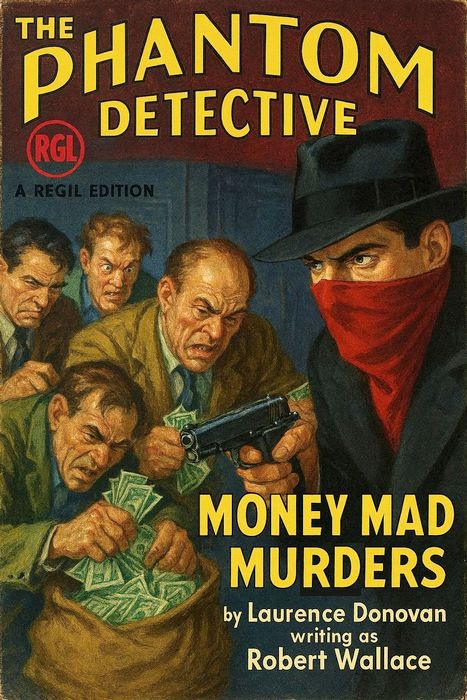
RGL e-Book Cover
Based on an image created with Microsoft Bing software
Roy Glashan's Library
Non sibi sed omnibus
Go to Home Page
This work is out of copyright in countries with a copyright
period of 70 years or less, after the year of the author's death.
If it is under copyright in your country of residence,
do not download or redistribute this file.
Original content added by RGL (e.g., introductions, notes,
RGL covers) is proprietary and protected by copyright.
RGL e-Book Cover
Based on an image created with Microsoft Bing software
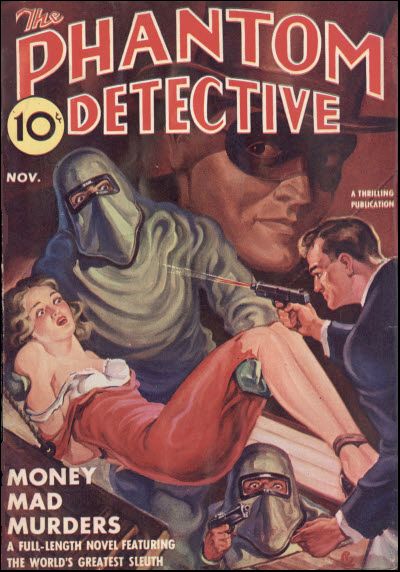
The Phantom Detective, November 1939, with "Money Mad Murders"
The Phantom Detective joins a three-cornered fight on crime in the Florida Everglades, pitting his power against the might of a deadly gang! Follow the ace of sleuths as he trails his foes from the Hialeah Track to a grim gambling ship where human lives are the high stakes in a game of greed!
THREE types of players crowded the ramp at Hialeah Park. One type consulted carefully figured form charts. They then calmly placed their bets at the pari-mutuel windows. Win or lose, they had figured on past performances of the ponies.
The second type of players hung around, watching the changing figures of the big board that gave the betting odds. These players were nervous. They watched the long shots, where the odds were big and they might win a good stake, if they won. They would rush over just before the race started and slap down their bets on the ponies least likely to win, place or show.
The third type was made up of players not risking much, and not sure whether they would risk anything. Of these was a chubby-bodied, round-faced young man in a new Palm Beach suit. He hesitated before a pari-mutuel grille-work.
The young man swallowed hard, and said, "You think Flying Fish has a chance to—"
"Read the board!" snapped the blue-visored clerk behind the grillework. "Get your money down, or quit holdin' up the customers!"
"Yeah—yeah," mumbled the chubby young man, sweating. "I'm chancing ten dollars, sir. I—"
"A'right! A'right! Here's your ticket! Betcha work in a bank! Next! They're leadin' 'em out!"
The chubby young man swallowed again. "How did you know I work in a bank?"
"Shove along, mug!" grunted a fat man behind him. "Century on Fancy Dan, Mart! Ain't much pickin's, but it's sure! Whatcha know about that sucker failin' for Flyin' Fish?"
MART, the clerk, grinned. This was the big Getaway Stake race, the feature of the closing day. Flying Fish was priced on the board at 30-to-l. There had not been bets enough placed to shorten these odds any.
Most of the customers were riding with Fancy Dan, the favorite at l-to-5, and almost sure, if small money. Or they were laying their dough on Madcap Miss and Hurricane, figured to give the long-striding Fancy Dan a finish fight.
And if anything happened to the favorite, Madcap Miss and Hurricane should be in a position to cop. They were nice ponies for the wise ones to be riding with. They were almost sure to place or show.
The chubby young man edged nervously off the ramp into the stand. His round face was screwed up, and he was still swallowing as if he wished he had his ten back. Even if by some miracle that ten might get him three hundred.
The ponies were going to the post. Their sleek, streamlined bodies showed like beautiful, living statues of perfect horseflesh against the scarlet hibiscus flaming along the inner fence. Thousands of winter tourists from the North jammed the big triple-decked stands.
Perspiration and gay talk flowed under the white Florida sun. Long-legged flamingoes, standing solemnly in the shimmering pool inside the big racing oval, were the only calm and unperturbed living things in America's most beautiful racing park. Fancy Dan might win, as the odds board indicated he would, or that rank outsider, Flying Fish, might come into the money by a miracle.
The flamingoes would have fish for dinner, anyway. Some of the horse players might not have any dinner.
With the ponies at the post, the pari-mutuel windows were being closed until after the race. A sallow-faced clerk, with furtive eyes that had studied each customer laying a bet, seemed in haste to get his window shut. His light hair was plastered over his forehead and his collar was limp with sweat.
As he was about to drop the glass behind the grille-work, a knotted, heavy hand was pushed part way in, blocking the window. Two men wearing flashy suits and snap-brimmed Panama hats were suddenly standing there.
"Just a minute, Thurston!" snapped one man at the clerk. "I thought maybe you'd change your mind! The boss figured you'd like to be able to move North on your own feet! I thought maybe I'd give you a last chance!"
"No—I quit—don't hold up the window—I can't talk to customers. I—"
The clerk called Thurston spoke in a panicky, quick tone. His hands jerked in the same kind of panic. The window slammed down and the knotted hand was withdrawn just in time to miss being crushed.
The owner of the hand slanted his black marble eyes toward his hard-faced companion.
"We can't say he didn't ask for it, Burke," he said sadly. "Might as well pick our spot now. The suckers'll be jammin' the ramp as soon as the dogs make it around."
"Okay," said the other man, and it sounded as if he sighed over something inevitable as one hand caressed the lapel of his flashy coat. There was a slight bulge under that lapel.
LIKE recurring waves of rolling surf, the roar of the crowd in the stands rose and fell. The ponies were in the back stretch now. The roar became sharp. Then it hushed abruptly to a mere whisper.
"Of all the damn' luck!" groaned a coatless tourist, occupying a box. "Fancy Dan hit the fence! He's limpin'. He's out of it, sure as hell! What's that nag with the purple colors? Lord, look at 'im comin' through!"
"It's Flyin' Fish," said a companion mournfully. "And he's thirty to one! I'll bet there ain't a handful of eggs got their dough on him."
One of the eggs who had that luck was just behind the box. He was the chubby young man who had laid ten dollars on Flying Fish's nose. His round face wore a beatific smile, but his hands worked with nervous apprehension. Anyone could see he had a mathematical mind that was already figuring how much longer three hundred smackers would extend his Florida vacation.
And the rank outsider, Flying Fish, a nondescript pony about midway between a bay and a sorrel, came flying through in a photographic finish that nosed out Madcap Miss and Hurricane. Madcap Miss and Hurricane did their best to make up for the accident to Fancy Dan, but they placed and showed in the order named.
The chubby young man knocked off a young woman's hat fighting his way back to the pari-mutuel ramp. He did not even pause to say he was sorry. He acted as if he feared there might be some hitch in the payoff on his ten-dollar ticket.
The sallow-faced clerk called Thurston was even more furtive-eyed as he pushed up his window. The few lucky customers, riding by dumb luck with Flying Fish, were among the first to battle their way to the windows.
Back of the first to collect came the greater crowd of others who had laid their bets upon Madcap Miss and Hurricane, to show and place. Those wise ones who had ridden with the sure thing, Fancy Dan, had the consolation of missing the window crowds. All they could do was tear up their tickets and curse.
Thurston, the clerk, was beginning to riffle sheaves of nice, new bills for the payoff. But very apparently his mind was not upon his job. His eyes darted from one face to another of those crowding toward his window. His long, gaunt body was slightly scrooched down, as if he feared too much exposure.
Jubilant voices of the holders of winning tickets made a bedlam of sound. Thousands leaving the stands set up a shuffling with their feet. A ticket was shoved in to Thurston.
"Two dollar tick on Flyin' Fish," the clerk mumbled, but his eyes still roved over the heads of the customers, and he was not even looking at the money he counted out.
"Next! Five on Flyin'—"
The clerk did not say "Fish." He never did say "Fish." His thin hands slapped out and bills scattered like cards from a dropped deck. His customer was a woman with a double chin.
"Look!" the woman screamed. Her chins quivered.
Those nearest her were looking, as the woman fainted ungracefully. They saw a blue hole appear just above the nose of the clerk in the window. The clerk's hands slipped off his money counter and his sallow face disappeared.
PERHAPS some of the hundreds on the ramp had heard the snapping shot that had caused that fatal blue hole in the clerk's forehead. There was too much getaway noise just then to be sure.
Officials inside got to the window, and one stepped over the body on the floor.
"Take your tickets to other windows!" commanded one man.
Clerk Thurston's window was closed for the day, and for the winter meet. Thurston wasn't going North this year. Hialeah track police wedged in. The holders of tickets flowed toward other windows.
Only those close enough to see realized there had been a murder. Police Sergeant Moran collared half a dozen of those who had been nearest the window.
"Well!" he snapped at each one in turn. "Well! You saw who did the shootin'! Who was it?"
Not one of those he questioned had. No one there had. Detectives, some imported from New York for the season, started a systematic hunt for a gun, but they found none. No person could be found who had even seen the smoke of a gun. Possibly that was because blue and gray smoke spiraled, upward from dozens of cigars and cigarettes.
And holders of 30-to-l tickets on Flying Fish were not disposed to become too interested in a crime that might delay their cashing in and getting away from Hialeah Park.
IN the midst of this, an unpleasant voice arose at another window, still open and still paying off.
"Here, you take this fifty! You can't pass off a phony on me! I always examine money! I ought to know!"
"Save it, brother!" barked another voice. "You're drunk! Get movin' so's I can cash my ticket! Get out—say!"
There was a blow. The same chubby young man with the round face who had so timidly ventured a whole tenspot on the nose of the winning Flying Fish, snapped up his pudgy fist the second time. A profane customer who had tried to shove him out of the way would have fallen, but many hands held him up.
The chubby young man was waving a fifty-dollar bill.
"I'm telling all of you, this is a counterfeit!" he yelled. "I work in a New York bank, and I know money! You can see—"
"Hey! Wait a minute!" a man wearing a big hat cut in, shouting. "Where you goin', smart guy? Hey! Somebody call the cops! Damned if that clerk in there ain't taking a powder!"
Oaths dripped from other tongues. Excited ticket holders surged toward the windows. The clerk who had paid off to the chubby young man on his Flying Fish ticket had not paused to argue over the claim that a fifty-dollar bill was counterfeit.
Oaths and shouts came from another nearby window. Another clerk had disappeared from his cage. The manager of the pari-mutuels was issuing sharp orders. Some windows were dropping.
The chubby young man was suddenly the center of thronging players who had been paid off. They were thrusting money at him.
"Here, have a look at these!"
"Knew something would happen, the first time I made a killing!"
The chubby young man appeared willing to help. He spotted what he said was a phony fifty, and then two tens.
A tall man with piercing gray eyes under a snap-brimmed hat pushed into the crowd. He took the chubby young man's arm.
"Here," he said, "come with me. I guess you're okay, but we ought to have a talk."
THE young man would have pulled away. The gray-eyed man palmed a bit of metal.
He was from the Federal Bureau of Investigation.
"I'm Mort Andras, from New York, and I had a cashier's job in a bank," said the chubby young man. "That's how I happen to know bad money. I can always spot it. It's a habit."
"It's a damn' good one," agreed the F.B.I. agent. "My name's Conners. We'll go inside, and see what's what." Two pari-mutuel clerks were gone. The denouncement of the fifty-dollar bill as a counterfeit had apparently caused their hurried departure. Conners, of the F.B.I., and Andras, of the New York bank, sorted over the thousands in the two suddenly deserted cages.
"It's quite a stack," said Conners. "Reckons up to some twenty grand between them, with the phonies mixed in with the payoff cash. Lucky you happened along, Andras. I think we'll have a look at the money in the cage of that clerk who was shot."
The fussy pari-mutuel manager stood beside Conners and Andras back of the cage. Clerk Thurston's body was lying upon a table. One of his hands still gripped several crumpled bills.
Conners went through the payoff money in the cage rapidly. His sensitive fingers and keen eyes ran over the bills. He passed them along to Mort Andras.
"Can't find anything wrong with this cash," announced Conners. "What do you make of it, Andras?"
"All genuine," said the chubby young man instantly. "There isn't a bad bill in the whole hundred and thirty-six thousand."
The pari-mutuel manager said abruptly, "What did you say? A hundred and thirty-six thousand? You mean sixty-eight thousand?"
"No, a hundred and thirty-six," repeated Andras.
"That's right," corroborated Conners of the F.B.I. "That's what I made it."
"That's funny, damn' funny," said the pari-mutuel manager. "Why, the money for the cages is always checked, and Thurston had exactly sixty-eight thousand dollars in his cage for the payoff. There's some mistake."
There was no mistake. The dead clerk, the sallow-faced Thurston who had died with a hole between his eyes, had double the amount of payoff money he had been allotted.
As Conners and the manager were talking, Mort Andras suddenly looked closely at a fifty-dollar bill. He stepped to one side, unobserved. He took a fifty from his own billfold.
His round face wore a strange look. He compared the two bills. Then, making sure he was not watched, he quietly appropriated the fifty he had taken from the dead clerk's money. For this he substituted still another good fifty of his own.
"It doesn't seem possible," he muttered.
IT was night over semi-tropical Miami, and a full, romantic moon was a huge silver globe over Biscayne Bay. Chubby, round-faced Mort Andras was sweating in a public pay station phone booth.
"I'm telling you, Mr. Burton, these fifty-dollar bills are identical, and the serial numbers match," Andras was saying. "I had one bill in my fold that matched with that at the Hialeah track. But I'm not positive where I picked up that bill."
The call was long distance. In a penthouse of the East River Fifties in New York City, a short man with a huge, perspiring face dabbed at his wet cheeks with a spotless white handkerchief. He was Jacklin Burton, internationally famous banker.
"It's incredible, Andras," he said into his private telephone. "But I never knew you to be fooled on bad money. If you can't detect a counterfeit flaw, it's damnably serious. So serious as to be highly dangerous to the whole currency system."
"I'll take my oath on what I've told you, Mr. Burton," said Andras.
"Then, for our own protection, there is but one man who should pursue an investigation independent of the Federal Bureau," said Burton. "To secure the services of that man, we will have to see Frank Havens, the publisher, and he is in Miami at this time. I will be flying down tomorrow. I will bring Lamont Shrove, and you see that Hermann Lister meets us."
Mort Andras nodded solemnly to himself. "Mr. Shrove has had plenty of experience with the cleverest money shovers in the business," he said. "Mr. Lister will be surprised and worried when I tell him about this. I'm staying at the Surf Hotel, on Miami Beach, and you can get in touch with me as soon as you arrive."
In New York, the banker replaced the phone receiver. His huge face seemed to perspire pure spring water. He used his white handkerchief ceaselessly, but it remained spotless.
He said, thoughtfully, "If it's true, it could upset the whole currency system. Yes, it's a job worthy of the Phantom. I'll call Frank Havens, and make sure we can secure his services. If this becomes public, we'll be having a run that will close some of the biggest banks."
Burton dialed long distance. He put in a call for Frank Havens, publisher of the New York Clarion and a chain of nationally important newspapers.
"If it were anyone but Mort Andras, with his camera eyes and his one-track conscience, I'd hope it might be a mistake," he murmured, as he waited to contact Havens in Miami. "I only hope Lamont Shrove can give us some sort of a lead."
As midnight neared, the silvery substance of the famed Miami moon seemed to drip its light upon the calm sea. Where fish rippled the surface at the edge of the warm Gulf Stream, some twenty miles off-shore from Miami Beach, the ocean was molten, phosphorescent flame.
On this quiet sea of cold, sparkling fire, rode the dark hulk of a one-time sailing ship. The masts of the ancient barkentine had been sawed off, and the long, black hull was held against the tidal currant by anchors at bow and stern.
RED and blue light stabbed the night from the rows of portholes. Outwardly, the ancient ship was disreputable in appearance. Not so its interior, where cabin bulkheads had been torn out to convert the vessel into one long inner room.
The long cabin was luxuriously, exotically furnished. Priceless Oriental rugs covered varnished planking. Men and women in sportily formal evening clothes moved over these rugs, or stood before tables where the little ball bounced around the colors of the roulette wheels, or luminous dice rolled across green baize.
Voices were gay and jesting at some tables. They were hushed and portentous at others, depending upon the play. Some occupied tables where dealers with magically deft hands shuffled the cards.
All in all, the scene inside the old barkentine was a miniature Monte Carlo. A Monte Carlo afloat, where the stakes sometimes ran as high as they ever did at the famed casino overseas.
A floating Monte Carlo it was, which defied all law. For it was beyond all state law out here at the edge of the Gulf Stream, far outside the twelve-mile limit.
Gilded letters high upon the upthrust bow of the old ship proclaimed the name Golden Dream. The real golden dream of thousands of winter residents of Miami with gambling corpuscles running red in their blood.
Out here, the Golden Dream defied shore police and coast guard alike. For it was beyond all law affecting ordinary crime. Only a major offense of murder, or its like, could bring an application of the rather vague authority traditionally known as international law.
Sea-going launches, converted Gulf Stream fishing craft, plied constantly between the Golden Dream and Miami. They cut out through the Narrows from Biscayne Bay, and seldom did they lack numerous passengers.
Among the gayest of those before a roulette table was a slim, sparkling girl with raven black, shining hair and dancing dark eyes. Most of the socially important players knew Lela Murtroyd by sight. Her vivid face, and her delightful figure had been too often in the tabloids of New York, Miami and Paris to be missed.
For she was Lela Saunders Dorr Murtroyd, giving two previous married names. From the envious glances cast, and the whispers of other women guests aboard the Golden Dream, it could be judged that Lela Murtroyd was regarded as a society play girl, with too much luck and having too much fun in life.
"Look at her stack of blue chips," said a jeweled woman nearby. "Every time I've been out here, she's been winning like that."
A slightly built, but tall man in formal evening clothes paused near the table. He eyed Lela Murtroyd's stacked winnings calmly. His eyes were slate gray, but they warmed as he spoke.
"You've done well again, Miss Murtroyd," he said quietly.
The girl's dark eyes flashed up to meet his gray ones. Her spirit of gayety took on a suddenly sober tone that made her lovely dark face serious.
"Yes, Joe," she said, so that only the man could hear. "I was about to cash in for the night. I want to have a talk."
The man bowed, and said, "I'll wait outside."
"That's Honest Joe Arden, and they say he's the reason the games out here are run on the square," said the jeweled woman to a companion. "Wouldn't it be funny if a common gambler would be Lela Murtroyd's next?"
J
OE ARDEN was in charge of the games on the Golden Dream. He was called "Honest Joe." It was widely reported that he was a gambling man who never had run other than strictly honest games wherever he had been. The way Lela Murtroyd's dark eyes followed him as he passed to the outside deck indicated there might be considerable truth in what the jeweled woman had said.
Lela Murtroyd cashed her chips and placed a healthy roll of centuries in her purse. She followed Honest Joe to the deck.
A portly man, with small, watchful eyes and black hair slicked off a low forehead, was watching the girl and Honest Joe intently. He was Arthur Crayton, the manager of the gambling ship. He had a smooth, unwrinkled face that probably never showed an emotion. But his eyes were like gimlets, and they were thoughtful as he saw the girl join Honest Joe.
Outside, concealed by the darkness, Honest Joe took Lela Murtroyd in his arms and kissed her. She freed herself.
"Joe, darling, I'm scared," she said in a husky tone. "I guess I didn't quite realize what being in this game might mean, until they got Thurston at Hialeah this afternoon. Joe, I want to get out of it."
Honest Joe's steady gray eyes took in all the shadows of the deck. He could see Arthur Crayton standing inside, watching the door through which they had passed.
"I'm afraid I don't quite understand about everything, dear," said Honest Joe. "Crayton promised when I took over the games that all would be run on the square. Mostly they are, but he's been putting something over on me now and then."
"Joe, are you afraid there may be more killings?" said the girl. "I'm more afraid for you than for myself. Up until this Hialeah murder, and the rumpus raised about phony money in the pari-mutuels, I felt it was just a game, and fun. But—"
"I know what you mean, sweetheart," cut in Honest Joe. "Next something will happen on the ship. And right now, contrary to Crayton's promises, one customer inside is being rooked. James Rocklin is playing, and he's in over his ears."
"Darling, you'll have to quit," said the girl in a tense voice. "I'm sticking until you do. We both have to quit."
"And when we do," said Honest Joe soberly, "we'll have to take a long trip, destination unknown."
The James Rocklin to whom Honest Joe had referred had been a Golden Dream player continuously for more than a week. Just now he was haggard of face, and a little drunk. The wheel before him spun, and the little silver ball bounced and stopped.
Rocklin arose and staggered a little. He spoke to the croupier, and the man shook his head, gesturing toward Arthur Crayton. The portly manager came over and touched Rocklin's shoulder.
"We can't take any more IOUs, Mr. Rocklin," he said softly. "But come into my office a moment. Perhaps we can talk it over."
Crayton raised his voice so others could hear.
"We never want a guest to leave the Golden Dream too unhappy," he said.
AMONG the patrons were many spectators not then playing. Two well dressed men stood together. They had been watching James Rocklin's play for more than an hour. One man now nodded to the other, and said in a low voice, "I think it is time for us to leave. The Plymallac Corporation will be next on their list. So Rocklin's our man."
The two men departed unobtrusively as James Rocklin followed Crayton to his private office at the end of the long game cabin. As this happened, a number of players were cashing in their chips. Many had amazingly large winnings. These were happy, and ready to confirm the report that the Golden Dream games were square.
The private office door closed behind Crayton and James Rocklin.
Honest Joe Arden pressed Lela Murtroyd's arm. "I'm having a showdown with Crayton right now," he said quietly. "This James Rocklin happens to be the official paymaster for the Plymallac Automobile Corporation, of Cleveland, Ohio. It won't be so good if he goes away talking about how he was taken for a sucker."
"Joe, darling, be careful," warned the girl.
Honest Joe reached Crayton's private office with a purposeful stride. But a woman player called to him, and he was delayed for several minutes. Ridding himself of the woman, he rapped at the office door. His grim face was evidence that he intended to raise a row over the manner in which James Rocklin had been "taken" in the supposedly honest games.
Honest Joe closed the door behind him and stared without speaking. He saw that Rocklin was no longer downcast. And Crayton's portly body shook with laughter.
"Just lettin' Mr. Rocklin know that our games are right, Joe," he said cheerfully. "He had a run of hard luck, so we've made good all of his losses."
Rocklin was smiling, a little drunkenly.
"That's right, even if it is hard to believe," he said. "I guess I plunged a bit too heavily, Mr. Crayton. I'll know better the next time."
Rocklin was stowing away a flat packet of bills in pockets that already appeared to bulge with money. Honest Joe nodded slowly.
"That's the way we run our games out here, Mr. Rocklin," he said, his gray eyes slanting to Crayton. "By the way, aren't you the paymaster for the Plymallac Corporation?"
"Yeah, that's right," said Rocklin. "Make it look bad for me, too, if I dropped too much of a roll."
Honest Joe pivoted and went out, without again glancing at Crayton.
The two men who had been watching James Rocklin during the evening had departed on one of the Golden Dream launches, headed back for Biscayne Bay.
Rocklin boarded another launch that slid away on a purring motor. Everyone aboard was happy, including Rocklin, who occasionally patted his well lined pockets.
LYING low over the fog-steamed Everglades, the silver moon had turned red now. A deceptive light played across the Narrows joining Biscayne Bay to the open sea.
James Rocklin's hands patted his fat pockets. Others in the shore-bound launch had nice, fat rolls of money. There were half a dozen women passengers in sporty silks, with jewels gleaming on tanned necks and arms.
"I never had any luck much at roulette at any other place," trilled one of the women. "I've won so much the past week, I don't know how I'll ever explain to my husband."
"Ain't that one helluva worry, now?" growled a male passenger. "And suppose you'd lost as much, ma'am?"
"Oh, then I get some more from my husband," laughed the woman.
"Which is only one of the reasons I ain't never married," said the male passenger. "Now—Look out there! Hiya! Port, yuh damn' fool! Hard over!"
The male passenger apparently knew ships as well as he knew women. He hurtled from his toes in the midst of his speech, lunging toward the wheel of the launch. His shoulder struck the pilot and knocked him to one side. His hands gripped the steering spokes.
But he had acted too late. Apparently shooting in from the open sea, a lightless black cruiser was doing at least twenty knots. Its high prow was carrying a phosphorescent bone in its teeth. The small launch was brilliantly lighted, but the cruiser wheelman was heading directly for it amidships.
The quick-witted passenger swung the launch wheel hard over, but he was thrown from his feet as he did. With a grinding crash, to the shrill accompaniment of terrified women screaming, the steel cutter of the cruiser knifed into the launch near the prow as though it were so much cheese.
The launch took the impact, heeled over, and the next instant the cruiser tore free. Passengers were spilling from the launch into the sea. Because of its weight and narrow beam, the cruiser was but little more than jarred by the collision. The sea boiled and churned at the cruiser's stern on a reversed screw.
The unlucky pilot of the launch scrambled to his feet. The small craft was going down by the head, as if sucked by some huge sea monster. But the pilot had the presence of mind to release and throw off nearly a dozen life preservers before the deck washed from under his feet. He yelled a warning against dangerous barracuda.
"Keep kickin'! Grab the preservers! There may be sharks about!"
He was a brave pilot and he knew his stuff. He got to two women who were screaming and strangling. With cool calmness he slammed life preserver straps around them.
The pilot thereupon devoted his breath to kicking furiously, in the hope of frightening off any lurking barracuda, with which the Narrows usually was filled. What breath he had left, he used in a rare brand of profanity directed at the nameless so-and-so's of the black cruiser.
"Damn' louts!" he shouted. "You could at least have picked us up!"
UNTIL that moment the collision had appeared to be an accident. But the low black cruiser circled only once. Then its motor hummed to full speed ahead. Leaving men and women struggling in the sea, which luckily was warm, the murderous craft headed back for the open sea. Being without lights, it was swallowed up just as another launch appeared, coming from the Golden Dream.
All but one woman of the passengers pulled from the water were alive and little the worse for their ducking. But the woman, not identified until later, had unfortunately been sitting where the cruiser's steel prow had struck the ill-fated launch.
The woman's neck was limp. She had been supported in the water by one of the other passengers. Her spine had been fractured when the boats collided.
The launch pilot made a swift tally.
"That's all," he said, then he added. "Wait a minute! There was another fellow! We'll have to make another search!"
"Sure," said a passenger. "I know him. It was James Rocklin, that automobile man from Ohio. He was sitting right alongside me."
Rocklin apparently had gone down. After ten minutes' combing of the surface, the pilot of the rescuing launch was compelled to give up the search. Except for a few life preservers, nothing now floated near the scene of the tragedy.
The report was chalked up that James Rocklin had been lost, probably drowned or, like the woman, killed or injured when the cruiser had struck.
But James Rocklin was alive. His face was as haggard again, as it had been when he had estimated his losses on the Golden Dream. He was in a lighted space, a cramped cabin of a moving craft.
Rocklin was sweating, and he could see only blurred shadows of several men around him. For a brilliant light was directed so that it beat into his eyes. Yet once or twice, he saw one shadowy face and head.
And that strange face wore a pair of the longest ears that Rocklin had ever seen.
"You mean that launch was run down, and maybe some of those women drowned just to get me?" said Rocklin thickly. "Why, that's coldblooded murder, nothing else!"
A metallic voice rasped out. It came from in front of the long, shadowy ears of the man whose face Rocklin could not see against the light.
"Perhaps you'll keep that in mind, then, Rocklin," the voice said. "Lives are sometimes unimportant. Have you got the idea?"
Rocklin licked at his dry lips and croaked that he had.
"Then," went on the voice, "you will appear ashore, and tell how you swam to safety. You will play the game with that money you were given aboard the Golden Dream tonight. After that, you will make a demand for more money."
"But I—I'm afraid now that—"
"You have greater reason to be afraid if you don't follow our instructions," cut in the voice. "When you are again given money, you will then be so involved that someone will talk. You will try to learn the source of the money, and who the man is that has come to be known as the Shark."
"The Shark?" gulped Rocklin. "I never heard the name before. I don't want anything more to do with this. I won't—"
"We are putting you overboard here," went on the voice. "It is shoal water. You are in lower Biscayne Bay. That would be about where the tide would have carried you had you swum all the way. You will do as you are told, and you will have some reminder of us after you reach Cleveland."
FEET clumped down the companionway from the deck.
"There's a customs boat prowling the lower bay, Satan," said the new arrival. "We'll have to swing out soon."
Rough hands seized Rocklin. He went, splashing into the warm water of Biscayne Bay. He came up sputtering and found that he could wade easily to the breakwater nearby.
The Miami newspapers carried the story of James Rocklin's escape from the sea. The Ohio auto official related how he had swum blindly from the Biscayne Bay Narrows, crossed the bay and landed not far from the Pan-American airport.
The newspapers stated that harbor police, and the customs guard boats had failed to sight the black cruiser responsible for the Narrows collision and the death of a wealthy Mrs. Colver.
In a small bungalow beside Little River, in North Miami, a tall, dark-featured young man in sport slacks scanned the headlines and the story. He had no personal interest in the tragedy at this time, and had no inkling then that he might have.
But as he emerged from the bungalow, and slid under the wheel of a powerful car, the young man said thoughtfully:
"That Rocklin is one of the few who ever swam the Biscayne Bay Narrows and lived. The sharks must have taken a night off."
It was the mind of the Phantom, the world's greatest detective, responsible for that swift, deductive reasoning. But as he was now the rich playboy, Richard Curtis Van Loan, enjoying a winter holiday, the young man had no thought that the miraculous feat of James Rocklin, as it was reported, might soon become of absorbing interest.
Two other persons read the report of James Rocklin's escape. One was Honest Joe Arden. The other was Lela Murtroyd. The girl immediately called Honest Joe on the radiophone to the ship.
"I must see you at once, Joe," said the girl. "You've never really known how much I am mixed up in all this. But I saw that poor Mrs. Colver's body this morning. Joe, will you go with me tonight to see Frank Havens, the publisher? He is staying at the Strand Hotel."
"You can't do that, darling!"
"I'm going to see Frank Havens, if I have to go alone, Joe!"
"I'll meet you at the Causeway at nine tonight then."
ONE last bound, and the little ball stopped at No. 13. The croupier behind the roulette wheel wore a crooked grin. He pushed over a little stack of blue chips. He raked in many others. A cute trick of a blonde, with Park Avenue socialite written all over her sporty little dress, laughed delightedly.
"Didn't I tell you, Dick, anyone can win on the Golden Dream?"
The tall young man with the wide shoulders and a bare, dark head laughed a little.
"You win, anyway, on your claim," he said. "Either I'm all the way lucky, and can't give my money away, or the little gods are favoring. And I am forced to agree that from what I can see all the games seem to be run honestly."
"That's right, Mr. Van Loan," spoke a quiet voice at the young man's shoulder. "Our games are run on the square."
The young man was Richard Curtis Van Loan. He turned apparently careless brown eyes upon the speaker. He saw a slightly built, but wiry, tall man with steady gray eyes.
"This is Honest Joe Arden," trilled the blond socialite. "I told you he didn't get his name for nothing."
"Delighted to meet a gambling man with such a reputation," said Dick Van Loan, with just a hint of skepticism. "And either the games are giving all of the suckers a break, or some of the hands around here are much quicker than my eyes."
"From the different ones you've bucked this early in the evening, you ought to know, Mr. Van Loan," said Honest Joe. "But I'd advise you not to plunge so recklessly in some of the spots ashore. You must be several grand ahead by this time, and it isn't eight o'clock yet."
It was early evening aboard the Golden Dream gambling ship. Honest Joe Arden glanced at his wrist watch.
"I'm far enough ahead to justify the curiosity of my friends, as to what would happen to me," laughed Dick Van Loan.
Dick did not say it, but his tone implied that several girls and two other youths in the party had lured him to the gambling ship with the idea that he would be taken for a sucker. For they knew Van Loan as a reckless spender, a plunger with his inherited money, a playboy whose limit was the blue sky and who didn't have a care in the world.
These same friends would have been amazed to know that Van Loan's seemingly careless eyes had been scrutinizing a dozen different games. If a single control had been employed on the wheels, or at the dice tables, he would have detected it.
For none of these play-time friends suspected that Dick Van Loan ever had a serious thought. Gay and cynical, careless with his inherited fortune, many often predicted he would eventually meet the usual fate of the playboy with too much money.
"Wouldn't imagine your profit would be too great, with the games run this way," commented Dick to Honest Joe, at the same time reading the gambling man's clear eyes.
He liked Honest Joe's quiet, friendly smile as he replied.
"Often, and believe it or not with Mr. Ripley, our games do take a beating for a few nights at a time, Mr. Van Loan. As for myself, I've always enjoyed taking that risk, and I wouldn't get any kick out of being a gambler if I didn't play it that way."
DICK VAN LOAN was sure at this minute that Honest Joe Arden was telling the truth. But while he might believe Honest Joe, it was instinctive for the real man inside the person of Dick Van Loan to look for the catch in this setup.
There certainly was no great profit in the Golden Dream's games, as he had seen them played. Dick judged from Honest Joe's manner of addressing him that the gambler had heard in advance of the status of the wealthy young heir. Naturally the gambling man made it his business to keep a finger on the rating of the ship's guests.
Van Loan chuckled silently to himself. He wondered what Honest Joe's reaction would be, could he know that he was being a little patronizing to the world's acknowledged master detective?
Or what his gay, reckless friends would think? They couldn't have been made to believe it. What? Dick Van Loan, the Phantom? Ridiculous! Absurd!
For there was but one man who knew that secret, Frank Havens, the New York publisher, whose Clarion chain of papers were a power from coast to coast The same Frank Havens who had given a real interest in life to the playboy Richard Curtis Van Loan.
After the death of his father, Havens had suggested that Dick take up the science of crime detection. At that time, even Havens had no means of knowing what Nemesis to all the underworld he was to create.
Today there was no living sleuth with finer scientific training than the Phantom. For, once embarked upon his career, Van Loan was thorough. When he was not actively engaged in running dangerous major criminals to earth the Phantom was constantly studying all of the means of prevention and detection of every sort of crime.
It had always been agreed that Frank Havens would always maintain the utmost secrecy concerning the Phantom's real identity. As Richard Curtis Van Loan, the Phantom had his only disguise in which he could thoroughly relax and rest.
Although it was early evening, Van Loan had satisfied his impulse to gratify his friends by visiting the gambling ship. For one thing, he had a young protege of his own. This young man was Chip Dorlan, whose brother the Phantom had saved from the gallows at San Quentin prison in California.
A likely lad, Chip Dorlan, a boy of the streets whose father had been slain by mobsters, and who had thus learned in the hard way to hate all crooks. He had proved to the Phantom that he was loyal, and quick-witted, during the thrilling adventure in which the Phantom had solved the Sampan Murders in San Francisco's Chinatown.
Chip had been placed in a military school on the St. John's river near St. Augustine, in Florida. And during Frank Havens' visit to Miami, the Phantom had arranged for Chip also to have a holiday. Van Loan thought of this now, and how he would have to drop his own role of Richard Curtis Van Loan and take on one of his own Phantom characters to meet Chip.
For Chip knew him only in various disguises as the Phantom. As such, Chip firmly believed the Phantom to be the greatest of all living detectives, and one he hoped some day to emulate:
So now, aboard the Golden Dream, Dick Van Loan had Chip and Frank Havens in mind. Once more Honest Joe Arden glanced at his wrist watch.
"Sorry, Mr. Van Loan," he said, "but I have an appointment ashore tonight. Hope to see you on our ship again."
AS Honest Joe gripped his hand, again Van Loan had the feeling that a real man was under the gambler's cold, quiet exterior.
"Mr. Van Loan! Mr. Van Loan!" A ship's page boy came over. "You're wanted on the radiophone, Mr. Van Loan," said the boy.
Van Loan excused himself a moment. The call was from Havens. But the publisher's voice was far from casual, as Van spoke to him. Moreover his words would have made little sense to any other person. His jumbled speech was really a code that Havens and Van Loan employed in emergencies, when it was important that possible listening ears could not understand their conversation.
The gist of Havens' talk:
"Dick, Chip is on his way to meet you here at the Strand Hotel. But there are more important callers. And if what they suspect is true, the murder at Hialeah Park yesterday, and the death of the woman on the gambling ship boat last night are but side issues of a menace that threatens the country's whole banking structure."
One of the characteristics that made the Phantom one of the greatest of man hunters was his instant reaction to a call such as this. He asked for no more details, but merely said, "A Mr. Randall will call upon you within an hour or so. I will leave for shore at once."
Havens said, "Good, Dick! But there is another strange item that may be connected with this other! A Lela Murtroyd has phoned me. She asked if she could see me privately at about ten o'clock tonight. She says she will be accompanied by a gambler known as Honest Joe Arden, and that what she had to tell is of the gravest importance to many persons."
Havens' words still were a jumble but Van read his speech as clearly as if he had spoken directly. As he replaced the receiver, Van thought of the coincidence that he should have been talking with Honest Joe, and that the gambler had excused himself for an engagement ashore.
"You're always giving us some run-around, Dick," complained the cute blond socialite, who would have gladly taken a much more than friendly interest in Richard Curtis Van Loan.
Van merely grinned at her, as he cashed in his chips, and went with an order for his winnings to one of the cashier's windows. Because of Havens' call, Van was all at once much more alert to what was happening about him.
Honest Joe Arden had taken a boat for shore. Van stood among several arriving guests who were buying chips, and some other early players who were cashing in on fairly large winnings. His jesting friends were at his elbow.
Suddenly Van ceased to hear the badinage of his expense. He was watching the cashier in his barred cage. And he noted there were two cash drawers. The cashier was accepting money from newly arrived guests, and it was going into a drawer at his left hand.
But he was paying out some big winnings from the drawer at his right hand.
Perhaps it was merely a system for keeping track of the money paid in, and that paid out. But seeing the large amounts that had been won by some of the players, Van watched the cashier closely.
VAN'S own winnings came from the right-hand drawer. Van stepped back. His facile fingers ran over the tens, fifties and centuries.
He was thinking he would put up tonight's unexpected luck money as part of a trust fund for Chip Dorlan when a rattle of automatic shots sounded from the deck outside. Somewhere a woman screamed.
"Oh, you've killed him! Please!"
Van was among the first to reach the side deck of the Golden Dream. The cap of a man fell and tumbled almost at his feet. The owner of the cap was on his hands and knees. Before Van could reach him, the man flattened on the planks. Blood poured from the man's mouth before he quivered, then lay still.
Van's broad arms blocked his friends for the moment. For two members of the gambling ship's crew still were shooting. Van saw a swimming pair of arms beating up a phosphorescent glow in the sea.
One of the ship's men lifted his pistol and aimed pointblank at the swimmer. Van forgot his own natural identity for the instant, as he sprang forward. He merely lunged with his weight, as if he had stumbled, but the collision with the gunman was sufficient to disconcert his aim and send streaming lead to one side of the helpless swimmer.
"What the hell'd you do that for?" cursed the ship guard.
Before Van could have replied, the portly Arthus Crayton, manager of the gambling ship, was beside them.
"That's enough, Carter!" commanded Crayton sharply. "Never speak that way to a guest! Give me your gun! You, too, Ramon! Now what's this all about?"
Van swung, and he was watching Crayton's small eyes. They belied the order he was giving his men. Van judged instantly that Crayton regretted exceedingly that the ship visitors had seen the shooting.
"Damn 'em!" snarled the man called Carter. "Them two was making a break to get into the hold through the forward hatchway! They started the shootin'! That one's makin' it to that cruiser, and if that ain't the same boat that sunk our launch—"
"That'll be all, Carter!" snapped Crayton. "Please, everyone, go back into the cabin! I'm sorry about all this!"
Not many were inclined to return to the gambling cabin. The guests were much more disposed to board launches going for shore.
Van saw that the man Carter might have been telling the truth about the shooting. An automatic lay close to the body of the dead man on the deck.
And Van saw the escaping swimmer climbing aboard a low black cruiser that was lying to some hundred yards away. The cruiser got under weigh at once and its motor purred at high speed as it swiftly vanished.
"We'll be getting ashore, I think," said Van to his friends.
He had brought them to the gambling ship in his own fast launch. That launch had power enough to have given the black cruiser a chase. But Van was now but the millionaire playboy. Moreover, he had no means of knowing at this moment that the shooting might be connected with the conference to which Frank Havens had summoned him.
Portly Arthur Crayton was keenly studying each one of his departing guests. He spoke so all might hear.
"I regret this trouble, and I assure you that a thorough investigation will be made! While we are beyond the law when it comes to gambling, concerning which all of us have our own ideas, we do not wish to be thought beyond the law in a murder!"
Van doubted Crayton's word very much. Yesterday there had been a murder at Hialeah Park. Last night a woman had died in a collision between a launch and a black cruiser. A James Rocklin had rather mysteriously claimed to have saved himself by swimming a barracuda-infested Narrows.
And here was a black cruiser again.
Perhaps what Frank Havens had on his mind might be linked with all of these?
RICHARD CURTIS VAN LOAN was often an enigma to his friends. The gorgeous little blond socialite squeezed in beside him as the party crowded into a long, powerful Bugatti, near the Miami Beach Causeway.
"Sorry, but I'll have to drop all of you up on Flagler Street," said Dick. "I've had a hurry call."
Newsboys were crying extras in Flagler Street, as Van managed to ease his guests from the big car.
"New murder on gambling ship!"
Van judged that the ship Golden Dream would be under the close surveillance of the U.S. Coast Guard and the shore police from now on. The shooting and the appearance of the mysterious black cruiser were food for thought, following upon the Hialeah killing and the collision of the night before.
Van was convinced that when he had Frank Havens' story all of these would be linked together. His own swift, deductive reasoning told him that the black cruiser visit to the gambling ship had all of the marks of a hijacking attempt.
But what could there be aboard the Golden Dream to interest hijackers? And where did the running down of a gambling ship launch fit into it? Arthur Crayton's quick effort to minimize the importance of the most recent shooting, and the reported effort of the two cruiser men to get into the Golden Dream hold hinted at some rival gang trying to muscle in upon the gambling ship setup. But why?
Van Loan shot the Bugatti back out Biscayne Boulevard. He did not turn off until he reached Seventy-ninth Street and the meandering creek called Little River. He ran the Bugatti into a rambling garage that held two other smaller cars.
One car was an apparently old and battered coupé. No one would have suspected that this coupé had a motor under its hood more powerful than that of the Bugatti. Moreover, its interior was composed of paneled compartments that opened to a series of secret buttons.
Van Loan took some clothing, a square box, a small automatic, a larger, holstered gun and some other equipment from three of these compartments. Inside the small bungalow fronting Little River, Van pulled the shades and stood before a mirror.
The square box lid opened upon a series of trays. The contents might have belonged to some character actor. Van Loan was much more than that. He was about to become the Phantom, the man of a thousand faces. And not only faces, for he could transform himself into characters of as many personalities, different in voice and manner.
The Phantom had neglected no detail of training to fit himself to cope with the world's cleverest criminals. His flexible vocal cords could simulate any voice after he had heard it once. He was a master of ventriloquism. And in the arts of fighting he excelled in ju-jutsu, as well as in the ordinary accomplishments of boxing and wrestling.
He worked with deft fingers. Makeup pencils put shadowed lines here and there upon his face. Moulages of wax were inserted in cheeks and nostrils. His skin was reddened and roughened, as might be that of some business man from the North who had suffered too much sudden exposure to the burning Florida sun.
LESS than ten minutes elapsed, and a slightly stoop-shouldered, middle-aged man with mild, blinking eyes stood in a rumpled Palm Beach suit. "Mr. Randall" was all ready to appear in the suite of Frank Havens at the Strand Hotel.
Van parked his battered coupé twenty minutes later at one of the meters in Biscayne Boulevard.
Frank Havens' broad, usually good humored face was set in lines of worry as he met Van at the elevator in the tenth floor corridor. The Clarion publisher was watching, but did not immediately identify the nearsighted Northerner with the sunburned face who stepped from the car.
Van started to pass Havens, then reached up and tugged slightly at his left ear lobe.
"I'm glad you're here," Havens responded instantly. "As usual you could pass your closest friends without being recognized."
That ear lobe touch was a signal between Havens and Van, useful when others were present, or when hidden eyes might be watching. It was apparent from Havens' attitude, his quick glances up and down the corridor, that he suspected such furtive shadows.
"There was another shooting, this time on the Golden Dream, after I called you," said Havens. "Knowing you were out there, I feared you might be mixed up in it."
"No, but it might have something to do with what you have on your mind, Frank," said Van. "Has Chip Dorlan arrived?"
"Sure, and Chip's fine," said Havens quickly. "But he'll have to wait awhile. Dick, I have three of the biggest men in the East in my room. That is, they're big when it comes to financing. But I wanted to meet you out here first for another reason."
Van never wasted words. He waited.
"It's about this Lela Murtroyd and the gambler called Honest Joe Arden," went on Havens, a crease appearing between his eyes. "The girl called me and said she had to see me. Said she had heard I could put her in touch with the Phantom. And Dick, she didn't have to tell me. Her voice did. That young woman is badly frightened about something."
"I met Honest Joe Arden," said Van. "If he is coming to see you with the girl, at least he's not frightened. He isn't that kind. He's a gambler, Frank, but I was attracted to the man."
"You seldom go wrong, Dick," said Havens. "Just the same, I judged that Lela Murtroyd is afraid of something or someone. She was desperately anxious to see me at once, and secretly."
Van nodded. "And these others?"
"The Hialeah Park murder of the pari-mutuel agent, and the finding of counterfeit money in the race payoff has brought Jacklin Burton and Lamont Shrove from New York, and Hermann Lister, the owner of the Regal Film theaters, from Jacksonville, Dick, And I've already gathered it isn't the counterfeit money they detected at the track, but the odd incident of too much good money in the murdered clerk's cage that has them worried."
Jacklin Burton was dabbing at his huge face with a spotless, white handkerchief. Yet he continued to perspire profusely.
Lamont Shrove was a thin man, with a fishlike skin that looked as if it never would give forth sweat. His crooked smile seemed to be permanently sewn to his face with a scarlet thread.
Hermann Lister was big and bluff, and hearty of voice and manner. He was the typical showman, and he was the first to take Van's hand in a hard grip.
"GENTLEMEN, the Phantom," presented Havens. "He comes to us as Mr. Randall. I want him to hear your story."
The huge, shining face of Jacklin Burton and the narrowed, dark eyes of Lamont Shrove portrayed surprise and some disappointment. They saw the mild-mannered, blinking Mr. Randall, and it was plainly evident that their opinion of the famed Phantom went down several notches.
Van smiled slightly. He was accustomed to having himself thus appraised. He bowed and spoke. "Well, gentlemen, Mr. Havens tells me you have sufficient worries to bring you flying to Miami!"
Burton elected himself spokesman. "Yes, Phantom—or Mr. Randall," he said slowly. "We are waiting for Mort Andras, a cashier who worked for me for a long time and who is a money expert. He has lately been employed by Mr. Lister on a job of auditing the affairs of the Regal Film theaters. Briefly, Andras is the man who turned up the counterfeit money at Hialeah Park yesterday."
The Phantom nodded. "A good piece of work," he said. "But that is already in the hands of the Federals."
Burton mopped at his trickling face.
"Such counterfeit money doesn't worry us much," he said slowly. "It was something that Andras claims to have discovered later. It was a good fifty-dollar bill. And when Andras judges money to be good, it would probably pass the best man they have in the United States Treasury. But Andras told me by phone that this bill happened to have the identical serial number of a bill he happened to have in his own possession.
"That strange piece of currency came from the cage of Thurston, the pari-mutuel clerk who was murdered. Moreover, the pari-mutuel manager claimed the dead clerk had double the amount of money he should have had for the payoff. Connors, an FBI expert, found nothing wrong with any of Thurston's money—it was only by a long coincidence that the two identical bills came together in the hands of Andras.
"You can see what it would mean if a counterfeiter is putting out bad money that is not only perfect in paper and printing, but actually corresponds to the serial numbers of bills already in circulation. No man could be sure whether the money in his pocket was good or bad. Even if the Treasury should call in all recent issues of currency, the Government would be forced to pay for the good and bad bills alike, if there was no way of distinguishing between them. It would wreck the nation's financial set-up."
The Phantom looked grave. "You don't think Andras could have been mistaken?" he suggested. "You rate his opinion highly?"
"With good reason," put in Hermann Lister's hearty voice. "I agree with Mr. Burton that Andras knows his business better than any man I ever met. He's been auditing the Regal Film accounts, and he's a wizard." He allowed a worried frown to cross his face.
BURTON explained. "I asked Mr. Lister to come here because there is a possibility that Andras' own fifty-dollar bill came from the Regal Films cash. Ordinarily we wouldn't worry about stray counterfeit pieces turning up in any organization that handles large sums of money, but this seems to be an extraordinary case because of the perfection of the bad bills. We can't overlook the slightest clue. It might just be possible that criminals have found a way to put their bad money through the Regal ticket offices, or through some firm with which Regal deals."
"We'll find out as soon as Andras gets here," put in Havens. "He'll probably know where his money came from. They said at the Turf Hotel that Andras started from there several minutes ago. He should be here very quickly. Naturally, he gave very little detailed information to Mr. Burton over the telephone."
Lamont Shrove opened his red-line mouth for the first time to utter a few grudging words.
"I had an idea I knew most of the queer money producers," he said. "A long-eared fellow called 'Satan' Crass has turned out some near-perfect stuff, and as far as I know he's still in the running. There's a John Mogrum, a former Treasury engraver, who came nearest to turning out unidentifiable bills—but he was convicted several years ago, and I understand he turned over a new leaf and retired permanently from a life of crime."
The Phantom was thoughtful. "If there was detectable counterfeit money in some of the pari-mutuel cages—and yet this supposedly perfect money in the cage of the clerk who was shot—what would you make of that?"
Lister rubbed his hands together. "I'm not a banker," he said, "but it seems to me that this clerk, Thurston, might have been killed for something he refused to do. Let us say he was told to pass some of the counterfeit money found in the other cages and was killed for declining to have any part of it.
"I have heard of this Satan Crass, mentioned by Mr. Shrove. In fact, the authorities believed it was some of his gang who once attempted to bribe some of my employees to handle his phony money in the Regal Film ticket offices."
Lamont Shrove nodded. He said tersely, "A set-up like that would be perfect for Satan Crass."
Burton dabbed at his perspiring face. The Phantom marveled at the spotlessness of his white handkerchief. It seemed as if the huge face of the banker was sweating pure water.
Burton went to the telephone table. He returned a minute later.
"I'm worried," he said. "The Turf Hotel says Andras left there half an hour ago or more. He could be over here in ten minutes and he told me he would hurry."
FRANK HAVENS glanced at his watch nervously.
"We may have some other callers soon who may shed some light on the Hialeah murder," he said. "A girl and a gambler from the gambling ship Golden Dream have promised to meet me here."
Hermann Lister was beginning to fidget. "I don't like to have Andras held up this way. He was the man who turned up the counterfeit money at Hialeah, and if the Satan Crass crowd is in that, Andras won't be any too popular with them."
"Satan's dangerous," agreed Lamont Shrove laconically.
"That's one of the reasons," Burton said, "why we think it is advisable for the Phantom to pursue an investigation independently of the Federal men. And if Andras is correct, publicity would be costly to the whole banking structure. Let depositors get the idea that a quantity of undetectable counterfeit money is floating around, and we would have some disastrous runs. One can't afford bank runs any more."
The banker got up and walked to the window, mopping his sweating face. He looked down ten stories into Biscayne Boulevard where it fronted the tropical bay park.
A tinny crash and a woman's scream floated up from the street.
VAN LOAN moved with incredible speed and decision. He had heard the crash and the woman's scream. Burton jammed out the window screen, leaning out to peer down into the street. Lister and Shrove rushed across the room to join him. Frank Havens caught the Phantom's eye as he reached the door. Havens' lips formed words.
"You don't believe it could be this Andras or—"
But the Phantom was already outside and gliding toward the elevator. The automobile crash on the boulevard might be associated with Havens' expected visitors, or it might not.
The Phantom made the elevator as it stopped for another passenger. He wedged through a clamoring crowd at the hotel entrance. There was a huddled figure in a light evening dress lying crumpled on the broad sidewalk. She was appallingly still.
The plate-glass in a big window had been broken. Blood trickled from the face of the huddled young woman. She had glossy black hair. Her shoulders where her dress was torn showed white and lovely.
"The damn' car jumped the curb! The fool driver must've been drunk! But he was smart enough to pull right out!"
Voices jabbered. The Phantom bent over the quiet girl. Her soft throat throbbed, so she was still alive. He had seen too many newspaper pictures of Lela Murtroyd to make any mistake about her identity.
A uniformed policeman was coming through the crowd, blowing his whistle. The Phantom straightened. He saw some of the crowd looking after the tail lights of a car going out Biscayne Boulevard toward Bay Front Drive where it crossed the Miami River. And he saw Chip Dorlan coming toward the officer.
The young man taken under the wing of the Phantom in San Francisco had a thin face, with unnaturally large, bright eyes. Shrewd intelligence showed. Chip was about to inform the policeman of something he had seen.
"Chip! Hello!" the Phantom called. "You can tell me!" He gripped Chip's arm, and added, "Call me Mr. Randall."
"The Phantom? Chee! Ain't I glad yuh showed up! The mugs in that bus knocked over a guy that was with the dame there! They grabbed him and throwed him into the car and then lammed! I got the number, an' it's a gray sedan with a chrome metal stripe! A Buick!"
"Good, Chip!" The Phantom spoke in a low voice. "My coupe's around that first corner! Get to it!"
Van turned back to the bluecoat. A uniformed sergeant was crossing the boulevard. Van stepped in front of him.
"It'll be a good idea to put a special guard on the girl that's hurt," he said. "This wasn't an accident!"
"Say!" snapped the sergeant. "Who the hell are—"
Van suddenly palmed a glittering jewel of the shape of a domino. It was pure platinum. Diamonds marked its spots. The sergeant changed his tone abruptly.
"The Phantom?"
Van nodded. The sergeant said, "If you say it wasn't an accident we'll see the woman's looked after! Know her?"
"Lela Murtroyd," said Van, and the sergeant whistled softly.
He could not seem to take his eyes from the Phantom. That domino badge of platinum, with its diamonds, was widely known among the police. It was as quickly recognized by Scotland Yard and the French Surete, as by American officers.
And never was that badge of authority questioned by officers of the law. The Phantom had accomplished too many amazing feats of crime detection to be refused the utmost cooperation.
Lela Murtroyd would be safeguarded.
Chip Dorlan was in the Phantom's battered old coupé. Van could hear the Miami squad cars screaming toward the scene of the "accident," as he slid his long legs under the coupe's wheel.
"How have you been, young fellow?" he said to Chip. "I invited you down to have a holiday with Mr. Havens. I'm afraid you've formed a habit of homing into trouble, haven't you?"
Chip Dorlan grinned a little.
"Chee, Phantom! It ain't much fun drillin' up at that school! Nothin' ever happens! I heard that car crash, and I handed myself onto a fire-escape and come down! That's how I saw 'em snatch that guy they knocked down along with the dame!"
The Phantom frowned through a smile.
"I'll have to speak to the school about a little more drilling in grammar, I'm afraid, Chip. But it's lucky you were on the spot this time. Now where would you say that car was heading, taking the Bay Front Drive?"
"Ain't no way out, except over the Tamiami Trail," said Chip promptly. "And with the cops on their tail, them mugs wouldn't be hittin' that hundred-mile stretch with no side roads, 'less they had some hideout, maybe in the Everglades."
"Good reasoning, Chip," approved Van. "So we'll cut across to the Tamiami Trail and check first at the Coral Gables intersection. We'll be out there before the police get going."
THE speed of the coupé proved good the Phantom's word. Van shot the car across the river and hit a broad boulevard that angled toward the Tamiami Trail where it passed through South Miami.
"Sure did," said a man at the Coral Gables Gateway filling station, in reply to the Phantom's question. "Gray Buick sedan! Went by here like a streak of grease, heading for Naples! Ain't been past more'n a minute!"
The powerful motor sent the coupé leaping away. Except for the hourly busses, the Tamiami Trail through the heart of the Everglades, the long, cross-state connecting highway between the east and west coasts, was little traveled at night. Its ghostly loneliness, and its dangerous, deep, black water canals, where the swamp muck had been dredged out to create the highway grade, did not inspire confidence in motorists. Filling stations were twenty miles apart.
"This is one time I think moonlight will do for driving," said Van, switching off their lights.
Even the gritty Chip felt shivery. For the needle crept up to seventy, then eighty, and the big motor was purring like some live animal. The full moon sprayed the straight ribbon of white concrete, and it was outlined more distinctly by the eerie black canals on both sides.
The coupé was doing ninety before Van eased up on the accelerator. Two glowing red eyes showed ahead. Chip breathed easier as the car slowed. He had been tense, watching the black canals, where more than one car had gone to its doom in the forty-foot depths.
And because his eyes were fastened upon the swiftly flowing edge of the highway, instead of upon the red lights showing ahead, Chip suddenly gripped the Phantom's arm.
"Chee, Phantom!" he gulped. "Ain't that a man lying up there?"
VAN burned rubber braking down.
He was out of the coupé almost before it stopped. Chip was at his heels as he bent over the mangled body that had been a living man.
The corpse was gruesome in appearance. For the body apparently had been shoved from a speeding car. Smears of blood showed in the moonlight for a distance of several yards where the inert figure had tumbled over and over.
"The poor devil was alive when he was thrown out," said the Phantom, noting the blood marks. "If he had been dead, there would have been no fresh blood."
One eye still following the fast-moving red eyes of the killer car, Van found a wallet in the soaked clothing of the dead man. A sheaf of banknotes came into his hand, so robbery was not involved. And there was a card.
"Yeah," snapped Van. "I suspected this!"
The white card read:
MORTON T. ANDRAS
Auditing Specialist
New York City
The skull of Mort Andras was caved in. It was impossible to tell whether this had been caused by the impact with the concrete, or by some previous blow. At least, Andras had been alive when he was thrown from the car.
Van wasted less than a minute before he directed Chip to open the coupe's trunk lid. He closed it over the broken body of Andras.
"Our bloodthirsty friends seem to be acting on the principle that corpses can't talk, Chip," he said. "Take the wheel. We have no time to lose." Chip's shining eyes showed how pleased he was at being trusted at the wheel of the Phantom's car. The Phantom sat calmly beside him, riffling through the money taken from the wallet of the murdered Mort Andras.
Van examined each of a score of bills by the instrument lights. He nodded without speaking when he had made sure he had missed none. There were seven fifty-dollar notes, but there were no two identical serial numbers.
"Chip," he said slowly, "this man was murdered for one fifty-dollar bill. But it may involve hundreds of thousands or even millions."
"Chee, Phantom! Yuh mean somebody didn't want him to tell where he got that missing fifty, because it matched another one?"
"Good enough, Chip," approved Van, but he glanced sharply at the smart young man. "By the way," he added, "you couldn't have been listening to a conversation you weren't supposed to hear?"
"Aw, Phantom," pleaded Chip, "I was in one of Mr. Havens' rooms, and I couldn't help gettin' an earful."
Van shook his head. "I'm afraid, Chip, you have about the kind of ethics that makes a good detective." The coupé was closing up on the red lights ahead again. The fast little car made scarcely a whisper of sound. Without its lights beaming, it could not be picked up either in the mirror or through the rear window of the sedan it was pursuing.
ALONG here the cypress trees were draped with Spanish moss. The huge arms extending over the canals made the trees look like giant ghosts. Van touched a button and a compartment opened. A compact machine gun came into his hands. Van put the gun on the seat beside him.
"I would say they snatched Honest Joe Arden to keep him from talking, from coming to Mr. Havens with Lela Murtroyd," he said. "So they may have reason to keep him alive. He wouldn't be of much use to us, either, if he died suddenly. Chip, we'll have to stop that car without gunfire, if possible."
"Sure thing!" grunted the delighted Chip. "I'll run 'em right off the road!"
"Honest Joe wouldn't be much more use drowned than he would be shot," said the Phantom dryly. "But, if we're lucky and not seen too soon, run alongside the sedan as closely as possible. But don't clash fenders. I have a plan."
THE Phantom's black coupé was suddenly as noiseless as a gliding ghost. By switching on a specially designed muffler, Van choked down all but the hissing of the tires over the concrete. It felt to Chip, at the wheel, as if they were floating instead of riding upon solid highway.
Ahead, there was a stretch where the tall cypress trees leaned far over the canals. This created a dark tunnel, in which only the center of the white concrete was visible. Chip was following this steadily, closing the gap between the cars.
"Ready, Chip!" The Phantom spoke tersely, opening the door on his side of the coupé. "Give it the gas, and slide in close. But don't let them crowd you off on your side. Head into the sedan before that happens."
Chip's thin hands were white-knuckled with his tense grip on the steering wheel. He understood what the Phantom was about to do, and he gritted his teeth to keep back a protest. Van was crouched, his wide shoulders filling the coupé doorway, as he forced the door open against the push of the wind.
Chip glanced at the speed needle. It was around seventy now. He nosed the coupe's hood forward, stepped on the gas just as a hoarse, wild shout of alarm came from the flying sedan.
"Look out! It's a sneak car! Get 'em!"
Chip nosed the coupé over until the running boards of the two cars touched. With the warning yell from the killer sedan, a rod started spitting out jerky stabs of flame. It seemed to Van, in the act of transferring from one running board to the other, that both powder and lead clipped his hair.
Brakes ground on the sedan. Its long hood started to swerve. The rod spatted again over Van's head. The wielder was attempting to get it down over the side of the sedan door. At the same instant, the driver sensed his danger, and he tried to jam open his own door in such a way as to force the Phantom off.
That was the driver's mistake.
"Step on it, Chip!" yelled the Phantom. "Keep off the edge!"
Van's long arm shot out and into the sedan, while he clung to the door the driver had swung open. His fist blurred with speed as his knuckles rapped the jawbone of the driver. Then Van's hand dropped onto the wheel.
The Phantom might have held the killer car in the road, but one of the men in the rear seat was too determined to blast him. As the sedan veered, crowding Chip's coupé, the rod flamed again. The driver of the sedan groaned and his head jerked back.
Bullets intended for the Phantom were in the driver's spine. The sedan went out of control and veered still more toward the side of the road. The driver's inert weight blocked Van's hand on the steering wheel, and he felt his side of the big car rising into the air.
At the speed they were traveling, the sedan would have turned turtle half a dozen times, if it had remained upon the concrete. But it leaped from the highway edge and turned completely over but once.
The Phantom felt the inner lightness that comes with flying into space. He described a nice half-arc, twisting, and striking the black water in a sprawling dive. The sickening ooze of the canal bottom filled Van's nostrils as he went deep. There was the dank taste of rotting vegetation in his mouth as he drove himself back to the surface.
SHAKING the black water from his eyes, he saw the surface break where three men were swimming. There was not light enough to make sure, but Van judged that none of the three would be Honest Joe Arden.
Honest Joe would either be unconscious, or bound. So he must still be in the sunken sedan. There was twenty feet of water at this point. The Phantom took a deep breath and dived.
Capable of remaining under the surface for a good three minutes, nearly equal to the time of the longest winded South Seas diver, Van was at the limit of his capacity before he got inside the sunken sedan and found the half-floating body bound with tape. He knew this must be Honest Joe.
Bringing the unconscious man to the surface was a feat in itself. Van feared that Honest Joe had taken water into his lungs, being unconscious. But he made the surface and rested, holding Honest Joe in position to breathe.
There was a long cut across Honest Joe's forehead, which possibly had been inflicted when he had been run down in Miami. But the gambler sighed, pulled in a long breath and opened his eyes. The Phantom stroked toward the highway bank.
As he reached it, Chip Dorlan was there, reaching. Chip was saying over and over again, "You can't kill the Phantom! You can't kill the Phantom!"
"Thanks for the confidence," said Van. "I wish I believed it. Give me a hand with Honest Joe."
The Phantom came to his feet. The eerie, low-hanging Spanish moss trailed nearly to the swampy ground over beyond the canal. Van failed to see any movement where the three men had been swimming. But there were suddenly some moving lights coming through the huge bends of the cypress toward the canal. Van knew that up here the Miami River was joined with the highway canals and other channels.
Honest Joe was trying to talk.
"Keep an eye out, Chip!" commanded the Phantom, as he plunged again into the canal, swimming toward the lights.
A long old barge floated into view. It was piled high with vegetable crates. Everglades truck garden stuff made a bright, green fringe along all of the crates. A cadaverous man with a straggling beard and a lower lip bulging with snuff was at the wheel on the foredeck of the barge.
The Phantom hooked onto a trailing rope bumper and went up over the side easily. The man at the steering spokes spat solemnly toward the side of the barge and looked at Van without changing his position, or betraying any great surprise.
"Swamp angel," was the Phantom's deduction. "Probably he has been a victim of hookworm so long that an earthquake wouldn't jar an extra effort or word out of him."
A wheezy gas motor was chugging away down in the bowels of the old truck barge. The Phantom said, "Did you see anyone swimming or making it into the swamp hammocks? I thought perhaps some men out of a wrecked car made it to your boat?"
"Waal now, that's a funny how-de-do, yo' askin' me that," drawled the swamp angel, thoughtfully.
The swamper waited so long that Van snapped, "Well, make up your mind! Did you see anyone?"
"Come to think on it," the swamp angel drawled again, "Ah reckon Ah did see some fellas that looked like they'd been swimmin', and they was shaggin' off inta the hammocks to'ad Big Cypress. Ah'da hauled up, but Ah'm two houahs late now gittin' to'ad Miami."
A GREASY face appeared in the lighted hatchway door of the motor room. Another native swamp angel, masticating the end of a snuff stick, rolling it inside one cheek.
"Who all yo' chinnin' with, Jake?" the greasy face inquired with a tired effort to show some curiosity.
"Jest a fella come swimmin' abo'd," drawled the wheelman.
The Phantom snorted. He was only wasting time on these natives. He took a running dive back over the side. The barge held upon its slow, crawling course toward the Miami River. Possibly the natives operating it knew of too many fugitives in Big Cypress swamp to be concerned. More possibly they both suffered with hookworm.
Beside the highway, Honest Joe Arden was sitting up. He stared at the Phantom as he emerged from the canal, dripping.
"Thanks for getting me out of that car," said Honest Joe calmly. "I thought I was a goner. Your young friend here tells me the police took Miss Murtroyd to a hospital, and that you ordered her placed under guard. That's a good thing, but who are you?"
"I'm known as the Phantom," said Van. "I judged it best to have Miss Murtroyd guarded. I can't say how seriously she was hurt."
Van could see Honest Joe's jaws work as his teeth clenched. The gambler's face showed white, even in the moonlight.
"If she dies I'll get—"
He clicked his teeth together and was silent.
"You'll get who, Joe?" said Van quickly.
"I've heard a great deal about the Phantom, and I'd be glad to tell you who I'd get," said Honest Joe. "The trouble is, I don't know who. I can't even tell you exactly why Miss Murtroyd was going to see Frank Havens tonight. She asked me to accompany her, and she is afraid of something happening either to her or myself. That's all I know."
The Phantom studied Honest Joe's eyes half a minute.
"Strangely enough, Joe, I believe you," he said. "Would you know if Miss Murtroyd had any dealings with a counterfeiter known as Satan Crass? It might have something to do with the attempt to rub out Miss Murtroyd tonight."
"I've heard of Satan Crass, that's all," said Honest Joe. "I don't know who was behind the attack on Miss Murtroyd and myself."
"What did you hear before they threw Morton Andras out of the car on the Tamiami Trail?" the Phantom asked.
"Andras? The bank cashier who kicked up the row over the phony money at Hialeah? I didn't hear a thing. I was out cold till the car dived into the canal. Do you mean there has been another murder?"
Before Van could reply, Chip Dorlan came out of the canal, dripping. He held a card in a leather case, the kind that is usually attached to a car's steering post. Also he carried a man's wallet.
"The title for the car," said Chip, holding out the leather case. "I grabbed the pocketbook of the guy that was drivin', too. He's still in the car."
VAN took sogged bills from the dead driver's wallet. There was one fifty-dollar note. He compared the fifty with the money taken from the dead Andras.
He frowned, also, at a torn scrap of paper that had been in the wallet. On it someone had penciled crudely, "Andras—Turf Hotel—Important!" But what caught the Phantom's eye particularly was the fragment of a monogram, or engraved coat-of-arms, in a corner of the scrap.
At first he thought it was the familiar design of skull and crossed bones, but on closer inspection it seemed to be the likeness of a crown with crossed scepters beneath it. He was trying to remember where he had seen such a design before.
All at once his eyes glittered and he smiled.
"You'll do, Chip," he said approvingly. "The title card shows the car belonged to Andras. They must have kidnapped him while he was on his way to Frank Havens' rooms to keep his appointment."
Van did not reveal two more interesting items, one of which was the fact that the dead driver's sogged fifty had numbers identical with one he had previously taken from Morton Andras.
"I'd like to see Miss Murtroyd as soon as possible," said Honest Joe. "Can we get back to Miami in a hurry?"
"We're starting back now," declared the Phantom. "I've got a little plan, though, if you will play along. You're going to stay at my place on Little River for awhile, Joe—and at the same time you're going back to the gambling ship to do some scouting."
Honest Joe Arden stared at the Phantom.
"That," he said, "certainly sounds screwy!"
HONEST Joe Arden was restless, fretting, as a man will who knows the woman he loves is close to death. The Phantom gave him all the reassurance he could, from the newspapers and by phoned information. "Miss Murtroyd's been taken to a private hospital at Coconut Grove for her own safety," stated Van. "The police and ourselves are the only ones who know of her whereabouts. She is still unconscious but has a good chance to recover."
Van could see Honest Joe was a man who acted upon his own decisions and judgment. So there was a strong, tasteless sedative in the black coffee Van gave the gambler when they had breakfast in his Little River bungalow. He did not want his plans upset by some sudden impulse of Honest Joe to see Lela Murtroyd, regardless of consequences.
While the sedative was taking effect, the Phantom was busy. His activity and purpose intrigued the sleepy gambler. For Van seated Honest Joe near a long mirror and studied his lean, hard-jawed face and his tall, spare figure.
"Too bad I'm so much broader than you, Joe," said Van. "But I hope that can be remedied. I'll ask you to observe."
The suit Van took from an assortment matched Honest Joe's in color and texture, but was of slightly larger size. Van swiftly removed shoulder padding, and gathered in the sides of the coat.
He pulled it on. It altered the massive lines of the Phantom's muscled figure.
"I wouldn't have believed it," murmured Honest Joe, nodding against sleepiness. "You look a third smaller in size, Phantom."
Honest Joe now was to be really amazed. Van was comparing Honest Joe's face with his own in the mirror. Wax moulages were inserted in his nostrils, and they seemed to make his nose sharper and longer. A pair of gray eye-shells came from the makeup box. They matched Honest Joe's orbs. More moulages were thrust into Van's cheeks, and his firm, wide chin actually appeared to become longer. He changed from the identity of Randall to Joe Arden without revealing Dick Van Loan.
Instead of employing a wig, Van used a coloring that shaded his own natural hair. Honest Joe was nodding, his chin sunk upon his chest. He jerked suddenly, staring.
"How do we compare, Joe?" was Van's question.
One look had the effect of bringing Honest Joe almost fully awake.
"It doesn't seem possible! I'd say you were my twin brother. Mostly it's because you look thinner than you are. But what do you intend to do?"
"One question, Joe. Come clean on your real status on the gambling ship. You say you run honest games? Is there anything about the ship that is crooked, in which you are involved?"
"Nothing of which I can be sure, Phantom. Recently I've suspected luck was running too bad for some of the customers, and a few have lost a lot of money, but that could be the break of chance. Some other customers more than make it up by the big amounts they win. I have begun to believe Arthur Crayton has some kind of a tie-up with crooks, but I don't really know what their game might be."
"And Miss Murtroyd?"
"She has been a steady winner, Phantom. And I have understood she may have been paid something for bringing players with plenty of dough to the ship. There must be something behind all that, for she suddenly grew afraid. I had hoped to find out more about it when we saw Frank Havens. I know that Arthur Crayton has come to dislike me."
JOE ARDEN was nodding, nearly asleep. Two minutes later Van placed him on a couch. Chip Dorlan came in, open-mouthed at Van's makeup as Honest Joe.
"Some of these days I'm learnin' them things, Phantom," said the thin-faced young man.
"Those things, Chip," corrected the Phantom. "You'll do well to get some sleep yourself. I'll want you to stay by Honest Joe tonight, and if he awakens, don't let him leave."
Chip nodded. Van went into a smaller room and closed the door. He laid some money on a glass. A small cabinet opened to show gleaming tubes and instruments.
He placed two fifties side by side. They were identical in their serial numbers. Van used a powerful glass, studying the money. Perhaps no other man knew as well the trivial discrepancies between good and bad money to be sought.
First, he tested the paper itself. Under microscopic examination, the almost invisible silken threads appeared. Again they proved to be all right in number and placement.
"Couldn't be better if they had washed out dollar bills for their material," mused Van aloud. "But this paper never has been given that kind of treatment."
Van referred to a common practice of counterfeiters. Chemicals are employed to remove all printing from dollar bills. The paper is then used to print tens, twenties and fifties. These cause banks more trouble than any others.
But this paper evidently was freshly used.
"If they have the proper shadings, there wasn't a chance in a million these identically numbered bills would ever come together while in circulation," mused Van. "They never should have been detected until both were returned to the Treasury Department as worn out. It would have been years in most cases—if it hadn't been for Morton Andras."
And in every degree of light, the Phantom found the identical fifties more and more puzzling. Suddenly he discovered that he no longer was sure which of the fifties was good and which was counterfeit. They had become mixed up during his tests. And he doubted now whether the dead driver of the murder sedan could have detected the difference.
"So all he did was to take one of the identical bills," he said thoughtfully. "It's time to do something about the body of Mort Andras. Somewhere in Miami are several persons much interested in what has happened to the corpse, if—"
The Phantom had a quick inspiration. "If they are sure there is a corpse," he added. "Andras wasn't dead when he was thrown from that sedan. Because the meeting in Frank Havens' rooms was a secret, the newspapers and the police haven't been informed of anything."
Van was weary, needing rest. He had intended awaiting night before making another move. But now he made quick telephone connections with Frank Havens.
Using their code of mixed words, the Phantom quickly related all that had happened. He heard Havens' gasp when he informed him that he still had the mangled corpse of Mort Andras.
"I want the body to be cared for secretly, as soon as possible," went on Van. "You can take care of the newspapers, and I'll contact the police. It's important that the story I've just outlined shall appear in the next editions."
"That may or may not relieve a few minds," replied Havens. "I have been called a dozen times by Lister, Burton and Shrove. They don't want the truth to come out, but they want a police search for Andras. The story you want will be good bait, Dick. But I don't like your idea of going to the gambling ship."
TEN minutes later the Phantom was sleeping.
In the meantime, the next editions of the afternoon papers carried a new sensation. It was a follow-up on the disappearance of the carload of killers, after the running down of Lela Murtroyd.
CAR ASSASSINS FLEE INTO EVERGLADES;
NEW MURDER ATTEMPT FAILS
Would-be killers who attempted to run down and crush Miss Lela Murtroyd last night, have been traced to the Everglades on the Tamiami Trail. The car has been found in the canal, with a dead driver who is unidentified.
Morton Andras, bank cashier and auditor, who was given publicity in the bad money murder at Hialeah Park, was picked up on the highway by a swamper, who telephoned the police. The swamper gave the name of Martin and said he had taken the seriously injured Morton Andras to his cabin in Big Cypress swamp.
Martin, for some unexplained reason, refused to divulge the exact location of his cabin. He informed police that he identified Andras by his cards, and that Andras is suffering with a fractured skull, but may survive.
Evidently there had been a gun battle before the killer's car plunged into the canal. An empty wallet, believed to be that of the dead man in the car, was found on the highway. It contained neither money nor identification.
The police refuse to divulge the whereabouts of Miss Murtroyd, but state the young woman is expected to live.
There was considerable more detail to the story. A newspaper headlining it was spread upon a table in the cabin of a long, black cruiser. It was late in the afternoon. The cruiser was concealed from all passing boats where it was tied in the depths of a mangrove thicket where a channel penetrated one of the numerous islands of lower Biscayne Bay.
A long-eared man spoke with lips thinly compressed.
"It's up to us to find this Mort Andras," he said peremptorily. "If we can get him, and then Lela Murtroyd, this Shark and his men will be finished making a fool of Satan Crass. Have we any further report on the girl's whereabouts?"
"I'm thinking there's someone smarter than the Shark responsible for Lela Murtroyd's disappearance, Satan," said one of his men. "Seeing we didn't wreck that car up in the Everglades, and it belonged to the Shark's crew, I would say there is but one man we have now to fear the most. He's the Phantom."
Satan Crass nodded, scowling. "We've got to find out more about Andras and the girl," he said. "And I'm still betting we'll find the answer to this damned new money in the gambling ship. It looks to me like old John Mogrum has come back into the game."
IN another smelly craft moored alongside a dock in Miami River, another group of men surrounded a spread-out newspaper. One of them, taller than the rest, sat at the head of the table. His eyes glittered through the slits of a black mask and a black handkerchief was knotted over his mouth and chin.
Portholes showed the cabin to be deep in the hold of the moored vessel. The tall figure slapped an impatient hand upon the newspaper headlines before him.
"With the Phantom arrayed against us, I can't accuse you of botching the job last night," said the leader. "It was careless though not to make sure that Mort Andras was dead. And it was a damnable break of luck that Johnson had that other fifty on him when he was killed. We can be sure now that the Phantom has one duplicated bill. It's up to us to find this swamper's cabin and finish the Andras job."
Another man at the table spoke.
"Now that we've located Lela Murtroyd, Shark, will we take care of her first?" His voice held soft, murder menace.
"You will be prepared to strike shortly after sunset tonight," replied the tall figure, thus identifying himself as the Shark. "The police feel the girl is safe enough in the Coconut Grove place. You will run the boat into the Coral Gables canal close to Tahiti Beach, and take the girl there in the car. Then bring her here at once."
"But the Phantom, Chief?"
"It will be simple enough to learn from Frank Havens where to find the Phantom," stated the Shark grimly. "When we do, we will get Honest Joe Arden. He may know a great deal too much."
The Shark never would learn of the Phantom's whereabouts from Havens. But what he had said indicated he was one man who had been in close contact with the Phantom.
The men left the moored craft in three fishing boats. To any who saw them, they might have been only anglers on their way to a night of fishing at the edge of the blue Gulf Stream.
About the time the fishing boats passed down the river, the Phantom drove an old sport car southward from Little River. He had just been informed that Lela Murtroyd had regained consciousness. So, in the character of Honest Joe, he hoped to learn the secret of the girl's fear and of the attempted murder.
After seeing her, Van intended to go directly to the Golden Dream . He had no means of knowing what effect had been created by his cooked-up story of Mort Andras being still alive in a swamper's cabin in Big Cypress swamp.
The sun was dropping. Within the hour, two boats laden with killers would be converging upon the Phantom's destination.
SUNSET came to a warm, glowing sky in Miami. Later, the same sunset showed in a colder and grayer west for the smoky city of Cleveland, Ohio. Red-faced James Rocklin seemed to be habitually a little drunk. His bulky figure weaved unsteadily as he crammed his linen and other clothing into a pair of traveling bags.
It might have been seen that the bottom of one of these bags was well padded with sheaves of banknotes. Although he seemed in a hurry to be packed, Rocklin paused several times to peer down from the window into the murky dusk of the street.
"For heaven's sake, Jim, if you've got the jimmies that bad, why take a powder at all?" exclaimed a blond girl who was smoking a cigarette in a jade holder. "A hundred and seventy-four grand is a lot of dough, but you said yourself you might run it to a million on this setup."
"Yes!" jerked out Rocklin nervously. "But this Satan Crass doesn't care whose throat he slits or when, just so he finds out what he wants to know. I've got the real dough of the plant payroll here, and how do I know that some of that other stuff won't be spotted? Then where'll I be?"
"You don't act like you'd have any fun either way," yawned the blonde. "I guess you weren't cut out to be a crook, Jim."
"Hell!" exploded Rocklin. "It isn't crooked exchanging this money for money that's just as good, as long as it keeps moving! But my books won't stand too much digging into after that last trip to Miami, Margie, and you know it."
It was plainly apparent that Rocklin might believe substituted money to be just as good as any that ever came from Washington, but he was not risking his hide upon it. He clicked both bags shut.
"You got the reservations all okay at the Akron airport, Margie?"
"Sure," said the blonde. "I was thinking it might be a good idea for me to run down on the interurban and you came along in the car. Accidents sometimes happen, and it isn't likely I'd ever be mistaken for Mrs. Rocklin.
"You're riding through with me!" snapped Rocklin. "I've two days' leave, and we'll be safe enough on a ship to South America before I'm missed. Let Satan Crass find out for himself who is putting out this phony dough."
James Rocklin may have believed in the money he had substituted for the regulation currency for the Plymallac payroll, but nevertheless he drove through South Cleveland along the back streets. At the city limits he swung over to the four-track boulevard leading southward to Akron.
The blonde lounged at his shoulder, smoking. He sent the car along the fast inside lane of traffic as the boulevard lights started winking on. Commuters' cars crowded the parkway, headed for country homes.
Suddenly a low-slung sedan came up fast behind the Rocklin coupé. If Rocklin had seen that same sedan parked in the street near the apartment he had left only a few minutes before, his imagined fears would have become real.
"Is that a police bus trying to hog the boulevard?" Margie asked.
ROCKLIN shot a glance into the windshield mirror. He saw the lights of another car. The driver was taking a long chance. He was deliberately shooting out into the northbound lane to pass other cars, and dodging those he chanced to meet. "Some fool in a hurry to get home!" growled Rocklin. "He is the kind of a driver who causes crashes! I'm givin' him all the room he wants! We can't afford to be ditched!"
Rocklin right-handed his wheel, making a gap in the outside lane. And the blonde dropped her green cigarette holder and screamed.
The low-slung sedan that had been dodging death in the wrong lane now swerved abruptly. Its long hood became a flying projectile aimed directly at Rocklin's coupé. Rocklin cursed, jammed his foot hard down upon the gas. He was a split second too late.
"Look out, Jim! For God's sake!" The blonde screamed shrilly. The sedan's bumper drove into Rocklin's rear fender. The long hood seemed to scoop up the smaller coupé, hurling it sideward across the few inches of snow on the wide parking strip.
"The damned fool—"
They were James Rocklin's last words. The impact of the cars turned the steering wheel upward and forward. Rocklin's skull broke the shatter-proof windshield as his weight drove his head through the glass. His neck seemed to be compressed to half its natural length before the coupé turned completely over.
Rubber burned and screamed as drivers skidded and braked. The driver of the killer sedan was an expert. He kept the low-slung car upright on its wheels, sliding sideward in the snow. Two figures boiled from the sedan's doors.
A spurt of black smoke tinged with red flame shot upward from the crumpled hood of the coupé. The blonde had been thrown out, and she was on her hands and knees, crawling blindly through the snow, directly into the pathway of other cars.
"Oh, great heavens! That woman, John! Look out!"
These words were screamed by a pudgy woman beside a homeward bound motorist. But John had an eye on the blaze leaping from the wrecked coupé. He could only shudder and get sick as he felt the right front wheel jolt over a soft body.
The two men who had come from the offending sedan were back to the parkway and in another green car before all of the traffic was pulled down. The driver of the sedan did something to his motor, then he also ran toward the green car. The sedan burst into flames with a quick, whooshing explosion.
The extra green car slid out, made a complete turn in the confusion, and went off the parkway at the first exit. Two men in the rear seat were opening a pair of new leather traveling bags.
"Here's the dough all okay," one said. "That Rocklin was plenty yellow. And Satan is smart. He tried a getaway just as Satan said he would. Here's a pair of tickets for an airplane out of Akron."
Highway police roared into the scene where two cars were burning. The fears of James Rocklin were gone forever. His charred body was stuck halfway through his windshield.
Officers carried the blond Margie over on the snow. It reddened around the spot where they laid her head. But she was still alive and conscious.
"Who was in that coupé?" demanded a uniformed man.
"Jim Rocklin—Plymallac—payroll's bad money."
THE woman's words were whispered. The police saw she had but a few minutes to live.
"Miami—gambling ship Golden Dream—the money—that was it—find Satan Crass—Miami—in the bags—"
Margie told no more. Her blood had reddened the snow all around her head as she closed her eyes.
When the police got into the burned coupé, there were no bags to be found. But one motorist spoke up. "I saw two guys dragging something out of the car, but I didn't see where they went. Looked like they took a coupla suitcases."
The police failed to gain a trace of the vanished green car.
In less than half an hour the police had a report from officials of the Plymallac Corporation.
"It's very funny," said an assistant paymaster. "We've checked, and there hasn't been a single complaint of the payroll money. It's okay, and a regular issue from the treasury. But our auditor says Rocklin's books are in a mess. Rocklin narrowly escaped death in a boat collision before he flew North yesterday."
Cleveland police contacted the Miami department. So, within an hour, Captain Mahoney of the Miami force, called Frank Havens.
"We must get in touch with the Phantom, Mr. Havens," said Mahoney. "The James Rocklin who escaped death down here was killed at Cleveland a little while ago. He was all mixed up in some phony deal over money. It might have some connection with the accident to the Golden Dream, launch. He had an unusual amount of money on him when he swam Biscayne Bay."
Havens was thinking how he might contact the Phantom quickly, knowing him to be now on his way to the gambling ship.
"Call me back, Captain Mahoney," he said. "Give me half an hour."
The room buzzer sounded. Hermann Lister, Jacklin Burton and Lamont Shrove stood there. Burton came in, mopping his sweaty face with a spotless white handkerchief. Shrove's red mouth looked more sewn into a smile than ever before. Lister was white-faced and had lost much of his bluff heartiness.
Jacklin Burton spoke. "We've just had word from Cleveland that a James Rocklin has been killed there. A dying woman said he had put over phony money in the Plymallac payroll. One of my bank connections wired me they had checked, and the money seems okay."
"Which means," said Lister, "that this undetectable money is being shoved in many places."
"Yes," said Havens, "but the origin of this money seems also to be Miami, and Rocklin had a big amount when he came off the gambling ship two nights ago."
Lister screwed up his face thoughtfully, and said, "You've seen the story about Mort Andras, Mr. Havens. We must find him in that swamper's cabin in Big Cypress, on the chance he may regain consciousness long enough to tell us where he got the fifty he matched with that Hialeah banknote."
Havens put the ends of his fingers together, his eyes studying the men before him.
"I know of a swamper, a skin hunter named Martin, who has a cabin in Big Cypress," he said slowly. "It must be the same man. But it will require daylight and a Seminole Indian guide to take you in. I've been there and will be glad to arrange a trip tomorrow."
HAVENS was carefully following instructions given him by the Phantom. He saw the small eyes of Burton suddenly glitter. The banker used his spotless handkerchief, glancing shrewdly at the others.
"That's splendid, Mr. Havens," he said. "I suppose the Indian guide would be one of those fellows at the village this side of Naples on the Tamiami Trail?"
"Yes," nodded Havens. "Called Pokola, meaning Wildcat. I'll try and contact him in the morning."
"I think that's all then tonight," said Burton quickly. "I intend getting a night's sleep."
"I'll go along with you, for I need a drink," said Lamont Shrove.
Lister hesitated. "We should have the Phantom with us in the Everglades."
"He'll probably be there," stated Havens.
He was sure the Phantom would be present. For Van would be Pokola, the Seminole.
The phone rang. It was Captain Mahoney.
"Some kind of hell has broken loose at Coconut Grove," he said.
CORAL SANITARIUM was set upon a white eminence of the purest coral rock, which forms most of the foundation for the city of Miami, for Coconut Grove and Coral Gables. Except for a winding driveway, the exclusive private hospital was surrounded by thorny mangroves of a black-water swamp.
The Phantom, in the person of gray-eyed, quiet Honest Joe Arden, sent his sport car along the concrete leading from Coconut Grove to the small resort known as Tahiti Beach. It was after a gorgeous red sunset out over the Everglades, and blackness fell swiftly over the swamp.
Little frogs piped, and bigger ones clugged bass notes on their deep-throated pipes. The Phantom could see the white walls of the small sanatarium, the only relief from the eeriness of the desolate stretch of highway.
A lonely white light marked the turn-off into the sanitarium driveway.
"If Lela Murtroyd will tell her secret, it's likely it will account for double money drawers on the gambling ship," mused Van. "But it's more important that she give the names of those who have been paying her. There must have been a good reason for her spotting wealthy visitors with plenty of money to gamble on the Golden Dream."
For the Phantom expected to confirm a suspicion he already had formed concerning the separate money drawers on the gambling ship. And this was that those permitted to win big stakes on the Golden Dream were being used to circulate the undetectable counterfeit currency.
Van slowed to turn into the narrow driveway. Startling shots crackled abruptly. They came from the direction of the white sanitarium. Van's foot pressed down and the sport car leaped ahead.
"You might have known something would slip!" he chided himself. "There's someone in this setup who is too close to what has been happening! That Arthur Crayton, on the gambling ship, looks as if he would have some inside leads. Otherwise, the girl and Honest Joe wouldn't have been run down, and Mort Andras might still be alive!"
Van's rubber screamed as he turned at a dangerous angle into the narrow, winding driveway. There was but a black tunnel ahead. His car beams bored through it. Suddenly the tunnel changed from black to a reddish glow. Then a forked tongue of flame shot high into the sky above the white sanitarium.
An explosion rocked the ground and slapped the soggy air.
Van sent his car around a sharp curve so fast the body lay far over on the springs. And then he abruptly locked the wheels and skidded up the road.
For another car came jumping out of the red glow from the increasing blaze ahead. Less than fifty yards separated the hurtling autos. Van shot his front wheels off the driveway and onto a mangrove hammock of the swamp. The hood reared up and the little car stopped as if the mangrove had been so much rubber.
At that, the heavy car shooting upon him tore off one of Van's rear fenders as it scraped past. Reddish blue fire sliced out of the bigger car like a long knife. A piece chipped from the steering wheel under Van's fighting hands. The little breeze around his ears was filled with the buzzing of lead.
VAN flattened on the seat, but not before he saw queer figures rearing up in the big car. Van's lights caught them just before the cars scraped and jolted. Half a dozen men were wearing hoods that might have been a survival of the K.K.K., only the hoods and robes around the men's shoulders were all green.
In their midst, and his glimpse was so brief it was like a sharply outlined tableau, the figure of a girl in a flimsy white garment was struggling. Van saw white arms and hands writhing, as the girl apparently fought her abductors.
There could be no mistaking the midnight hair, the vivid face of Lela Murtroyd. During that flashing view, Van saw the girl struck down.
It was all over in two seconds, and the big car was roaring away toward the wider concrete highway. Van could still work the wheel of the little car, so he judged that the wild bullets had missed him. In less than ten seconds, he had reversed and backed the car off the mangrove hammock.
The sanitarium was burning rapidly. High, thin screams floated over the black water swamp. Van seldom used oaths, but he employed several bitter ones now. He was fearing that lives of innocent persons were being sacrificed to the maw of human greed.
Doubtless guards had been murdered. A sanitarium was being burned, all because one slender society playgirl possessed a secret that might upset the plans of money-mad men. The abduction was a daring crime, but it stuck with Van that only someone higher up, and well informed on all that had transpired could have engineered it.
"It will endanger the girl even more, but that big car's going off the highway!" gritted the Phantom, when he had its tail lights in view. "Her life isn't worth a dime, if they get her away!"
For a small car, Van's sport roadster had a remarkable motor. In less than a mile, he was closing up on the fleeing sedan. The green-robed killers were heading southward, and Van was aware they had no way to turn off after they would cross a blue-water canal cut through the white coral rock from Tahiti Beach to the heart of Coral Gables, one of the swankiest suburbs of Miami City.
Although he was driving at desperate speed, Van took one dexterous hand from the wheel. He extracted a snub-nosed machine gun from a secret compartment under the seat. The weapon was a peculiar, special automatic weapon.
A curving loop served for a butt. It could be hooked over one arm and worked with one set of fingers. Van shifted the gun to his left hand, grasped the wheel to his right.
The big car ahead was topping a slight rise. Van's left arm quivered with deadly, rippling explosions. He was aiming low, his stream of lead following the concrete. He had the satisfaction of seeing the rear lights of the green-robed men's sedan swerve sharply to one side.
Then a chattering chopper started replying. A maze of tiny cracks spread across the sport car's bulletproof windshield. The driver of the big car held to the highway by miraculous skill. His car still swayed and bumped up and down, its rear tires shot out.
The rise of the highway suddenly showed the bridge over the coral rock canal. Van thought for half a second that the sedan had at last been ditched. For it now angled off to one side, before it reached the bridge.
At that instant, one of Van's front tires blew out, punctured by the kidnappers' gunfire. The chopper ceased crackling, but the sport car went off the road and into shallow, black water.
Van cleared the steering wheel, sprang in to the middle of the highway. He could neither hear nor see the vanished sedan. But he ran the few yards up the highway, and was starting to follow the way taken by the other car when he saw the sedan bogged down in sand that topped the coral wall.
His special machine gun empty Van was gripping a heavy .45 automatic. The blue water of the canal was shining under a light down under the sharply defined wall of coral. Queer, ghostly figures in green robes were lifting Lela Murtroyd's limp, lovely form into an open speedboat. The boat evidently had been waiting, for there was a churning turmoil of water under the stern. The craft was already backing away from the wall.
"You've got it coming!" rasped the Phantom, thinking of the women's screams he had heard at the burning sanitarium.
The high light of the blazing hospital was spreading a glow over all of the swampy terrain now. Death was back there, murder of the most cold-blooded variety.
Van sprang off the coral wall, judging his distance to the moving speedboat some eight or ten feet below. The automatic erupted in his hand while he was in mid-air. A green-robed man grabbed at his throat with both hands. He curved over and made a neat dive into the canal.
GUN still flaming, the Phantom struck the polished deck of the speedboat on his toes. Another green-robed figure made a sudden, rigid cross of his spread arms and pitched to his face.
"It's Honest Joe!" yelled a voice. "Burn him down!"
Van, still balancing precariously, stopped the owner of the warning voice from speaking again. He could see a scarlet thread that meandered over Lela Murtroyd's soft cheek from one temple. The girl's limpness was such that she might have been either dead or alive.
There were still four men and the operator, all in green robes. Two gloved hands came up and red blazes spouted toward Van. He felt slugs plucking at his clothes. His chance of surviving became all at once less than one in a thousand.
As desperately as he had been determined to rescue the girl, he would be of little service to her if he died. And as his automatic clicked on an empty chamber, Van took the only course open. He went overside, turning and making a wedge of his hands to carry him far under in the deep canal.
Knowing his appearance on the surface would be the signal for obliterating lead, Van stroked for bottom, finding it at a depth of about twenty feet. He turned toward the wall, eased along it by clinging to ragged coral and growing kelp.
Thus he emerged slowly without causing a ripple, his face hidden by the kelp. The first sound to greet him was the sharp staccato of guns. He realized the robed men were not firing at him, or at the water where he had disappeared.
Then he saw it. A long, low, black cruiser was gliding along the middle of the canal. The speedboat bearing Lela Murtroyd away, was making across the cruiser's bow. The guns were blasting from the speedboat, but none were replying from the cruiser.
From its steady holding upon its course, Van judged the crewmen of the black cruiser were well sheltered by steel walls. There was a sickening crash of steel grinding into wood. Part of the open speedboat disappeared on one side, and part on the other side of the black cruiser.
VAN saw the water boil at the black cruiser's stern as the propeller reversed. A green-robed man in the water reached up and clutched at a trailing rope. A single gun cracked above him. He lost interest in the rope, threw up his hands and went under. He did not come up again.
Van swore under his breath, dived and swam toward the black boat. He came up, seeking the low-lying stern of the craft, hoping for rudder chains and a chance to get aboard the cruiser. It was a blind chance that he might be unseen.
But the propeller turned again at full speed ahead. Its powerful kick sent a streaming current that caught the Phantom and swept him back. The cruiser resumed its course down the canal toward open Biscayne Bay.
The Phantom was deeply worried. He could not be sure whether Leia Murtroyd had been hurled into the depths of the canal from the wrecked speedboat, and was dead and lost beyond recovery, or whether she had been taken aboard the black cruiser during its brief lying-to and was still living.
He made one swimming circle. The only floating thing that caught his eye was a warped cockpit cover from the sunken craft.
Gaining the shore under the coral wall, Van muttered grimly, "Alive or dead, Lela Murtroyd has been important to several persons. And, at the very least, I have discovered beyond question that there are two separate and distinct gangs of killers involved in this mad money scramble. If only they'd kill each other off completely, it would be a break for the world."
Saddened by the news he must take back to Honest Joe, the Phantom decided that his visit to the gambling ship had become more urgent than ever. One of the green-robed men had believed him to be Honest Joe Arden. But it was a more than even chance that none of those men was alive to tell of his attempt to rescue the unfortunate girl.
Whatever had happened at Coral Sanitarium, there was nothing there now but death and ruins. There was no likelihood of finding a new lead there to the identity of the men behind these killer gangs of money manipulators.
Not even the grotesque green-robes would be a clue. For Van saw instantly that they were too impractical a garb to be employed often. Here in the Everglades they had served the double purpose of disguising the features of the criminals and, in their color, acting as camouflage in the flat green wastes—but anywhere else they would be only a handicap to any band of outlaws.
He wondered whether Arthur Crayton, from the Golden Dream, had been one of the men who had raided the sanitarium. In any case, it was clearly essential that the Phantom reach the gambling ship as quickly as possible. If Crayton was absent, so much the better. As Honest Joe, he might have the opportunity to investigate more thoroughly some of the ancient vessel's secrets at least.
Within a few minutes Van had repaired his water-damaged disguise from a compact, body-fitting makeup kit. He was making his way toward the Tahiti Beach boat-renting concession when a big car whirled upon the bridge over the canal.
The Phantom saw Jacklin Burton climb from the car and stand revealed by its lights. The banker stared down into the canal's opaque water for a long minute.
JUST conjecture was all the Phantom could do about what had brought Burton to the scene of the sanitarium fire and the ensuing gun-fight and murder in the Coral Gables Canal.
He dared not delay his visit to the gambling ship.
He moved along the wall of the canal. Then something even more amazing than the appearance of Burton halted him. A second portly man walked into the lights of the car toward the banker.
And this second figure was that of Arthur Crayton, manager of the Golden Dream. Van debated swiftly whether to make his presence known, and decided against it. Burton and Crayton got back into the car that had brought the banker. The muffled voice of a third man sounded within the car, too blurred for identification.
The car moved away. The sirens of police machines were wailing from the direction of Coconut Grove. Van realized that sufficient time had elapsed for them to cover the ten miles from Miami.
"Another matter to look into," he said musingly. "What is the hookup between Burton and Crayton?"
The rented launch from Tahiti Beach was none too fast. Two regular gambling ship launches passed the Phantom after he had passed through the Biscayne Bay Narrows and headed for the Golden Dream. He had somewhat dried his clothes and restored his appearance as Honest Joe before he ran the small launch alongside the anchored hulk.
Members of the crew stared at him strangely, but they secured his launch and moved away as he came up the gangway onto the deck of the gambling ship. Van was unable to guess what they might have heard concerning all that had happened to Honest Joe Arden. It was impossible to tell how many of the gambling ship crew might be connected with the bloody happenings of the past two nights.
Van first planned to walk through the busy gambling cabin, and go directly to Arthur Crayton's office. Following up the clue of the separate money drawers, he was desirous of having one look into the Golden Dream's safe.
He crossed the deck to a point where he could see across the exotically furnished gambling cabin. Already the night's play was in full swing. There were more than two hundred red-blooded sporting plungers about the tables and the wheels.
But the Phantom drew back abruptly. His plan to go boldly through the cabin to the ship's office was upset.
Arthur Crayton had returned. He was standing over by the roulette wheel nearest the cashier's cage. Although Van now was aware that several members of the crew outside had remained where they could see him, he waited.
For Crayton leaned over a man playing the wheel. The man was thin-faced. His mouth wore a fixed smile, as if it had ben sewn on with a red thread.
He was Lamont Shrove. And as Van watched, Shrove arose and walked with Crayton over to the cashier's cage. They were conducting a low, animated conversation.
THE Phantom was an expert at lip reading. But he had only the back of Crayton's head. He could see the red line of Shrove's hard, thin mouth. No man's lips ever moved less than those of Shrove when he talked.
"It must add up to something," murmured Van. "But what? Only an hour ago, Crayton was with Jacklin Burton at Coconut Grove. Now it's Lamont Shrove, and it isn't the first time they've been together. They have some understanding."
Van watched the pair a minute, then turned. He judged there must be a door leading from the deck into Crayton's private office. Then he had a glimpse of another part of the gaming cabin. And he saw Frank Havens and the bulky figure of Hermann Lister.
From the manner in which Havens was walking about, shooting glances toward the entry doors, Van was convinced that the publisher was seeking him. He knew that Havens knew he was aboard the ship in some guise or other, and that the publisher must have missed the murders, the abduction of Lela Murtroyd and the destruction of the Coral Sanitarium.
But Van was anxious to carry out the rest of his plan before contacting Havens. He had the grim satisfaction of knowing now that Havens must have carried out one part of his plan ashore.
By this time, surely he had informed Lister and the others of the possibility of reaching the swamper's cabin where Mort Andras was believed to have been taken. Therefore, Lister, Burton and Shrove must by this time be thinking that a Seminole guide called Pokola was the Indian who could find the swamper's cabin.
The remaining hours of tonight promised to be among the busiest the Phantom had ever passed. He glided swiftly toward the door he was sure opened into Crayton's office. He was playing in luck. For a member of the crew came from the office to the deck, closing the door behind him. The man turned a key. The Phantom had just missed encountering him inside.
The Phantom imagined the members of the crew had lost interest in the return of Honest Joe to the ship. At least, he saw no one taking visible interest in him now. A slender steel tool made quick work of the lock on Crayton's office.
Van toed over to the huge safe at one side. It was of an old-fashioned type. He realized he might be interrupted disastrously at any minute, but he wanted one look inside the great black box.
It was well for the sake of law and order that Van was the world's greatest living detective. He could as easily have been its most famous crook, so familiar was he with nefarious methods.
Ear pressed to the steel door, he turned the safe's combination slowly. In three minutes he had the safe unlocked.
Trays of greenbacks showed inside as the ponderous door opened. At a glance Van estimated there were several hundred thousands on those trays. He worked fast, making selections of fifties, twenties and hundreds and putting them separately in his pockets.
Then he saw two trays of ten-dollar bills. Swift inspection proved them to be as perfect under casual examination as the other money. In fact, there was nothing about any of the currency to afford the least suspicion that any of it might be counterfeit.
VAN closed the safe and went over to a big desk. There he saw a Western Union telegraph pad. The imprint of a message that had been written upon the last sheet torn off was faintly visible.
The Phantom brought a glass into play. The message had been dated some two weeks before. Van judged it had been sent ashore for transmission, rather than trust it to the gambling ship's radiophone.
A low whistle came to Van's lips when he made out the name of the addressee. The message was signed, "Cray." Undoubtedly that was Crayton. It read:
We can use data on J.B. Wire L.S. to make New York contact. J.B. should pay a hundred grand. Do not come to ship. Meet you hotel.
And the message had been addressed to "Morton Andras, Park Hotel, Jacksonville, Florida."
"J.B. and L.S.?" muttered Van musingly. "Jacklin Burton and Lamont Shrove? Or would it be? And what data would be worth a hundred thousand to Jacklin Burton?"
Van wasted no time. He had not locked the safe door. A minute later he had a small steel box opened. There was an envelope marked "Andras-Burman Letters." The Phantom was about to stuff this into his inner pocket when the door creaked behind him.
The Phantom was quick. He dropped the small steel box, letting its other contents scatter. A crack showed between the planking of the floor and the baseboard.
Van dropped to his knees, turning. Arthur Crayton closed the door behind him and stood there with a stubby automatic pointed at Van's middle. Van's hands moved with lightning speed, before he put them into the air, thrusting the packet into the floor crevice.
"So Honest Joe is back with us?" snarled Crayton. "Get up! Stand over there!"
"Okay, Crayton," he said calmly, faithfully copying Honest Joe's voice and manner. "I guess you thought I was rubbed out, eh? Well, I came back for a little visit."
"Yeah?" snapped Crayton. "So you heard something, huh? Maybe you were playing along with Mort Andras yourself?"
Crayton kept his rod steadily upon the Phantom. He glanced at the papers scattered out of the little box. He hesitated, then he said, "All right, Joe! Pick up them letters and stuff, a piece at a time, and put 'em on the desk where I can see 'em!"
Van's eyes kept cornered upon Crayton. But the portly man's hand was too steady with the gun to take a chance. Van put the papers on the desk, one by one.
When he had finished, Crayton's small eyes were vicious.
"And now where's that Andras-Burman envelope?" he demanded. "You have five seconds to tell me where it is! Maybe Mort Andras talked, and you thought you'd horn in on the Burton deal? You won't! And Andras will never cash in on what he knows? That's one hand I'll play alone! The envelope, Joe!"
"I haven't—"
Knuckles hammered at the inside door, leading from the gaming cabin.
"Crayton!" called a voice. "Crayton! Are you in there?"
The Phantom had just time to identify the voice of Frank Havens, and to hear the hearty tones of Hermann Lister. He didn't have any added seconds to guess what Crayton would do about it.
Crayton was portly and heavy, but his movement was unexpected. One step, as if he were about to move toward the door. His hand swung with a darting backhand blow. The heavy automatic crashed across Van's temple.
The Phantom went down in a red haze that turned black, even as he sensed that the door into the office from the side deck was being opened and men of the crew were rushing in.
WHATEVER it was, something was galling the Phantom's neck. Coming to his senses slowly, he strained forward, attempting to breathe. A tight band seemed to choke him and pull him back.
Due to his perfect physical condition, the Phantom reacted quickly. He opened his eyes, listening to the swishing gurgle of water that seemed to be all around him. Rancid odors assailed his nostrils and informed him why water appeared to be swirling all about him.
He was in the dimly lighted hold of a ship. One glance proved it could be none other than the gambling ship Golden Dream. An attempt to move again caused steel links to clink behind his neck. A rusty iron collar enclosed his throat. It was attached by a rusty chain to the hull of the old barkentine behind him.
The Phantom could see other dangling neck bands of rusted iron that looked like small hoops. He instantly judged that this once had been the prison brig of the ancient ship.
Van discovered his hands and feet were free. His captors had put all their faith in the collar and chain of steel. He realized that he had been seized, hurried out of Crayton's office and confined below decks before his presence might be discovered by Frank Havens and Hermann Lister.
"And they didn't overlook much in going through me," he muttered a moment later. "Took about everything. But they didn't find that Andras-Burton envelope. I hope they don't find it. I'd give a great deal to know what's in it."
Van was sure he knew at least the general nature of the envelope's contents. Mort Andras had once been employed by Jacklin Burton. It was more than possible that the supposedly honest cashier and auditor possessed some secret of Burton's. Some shady deal that was worth money to Burton to have concealed.
"It must be important to make Crayton think it's worth a hundred grand," said Van. "And that may explain why Crayton was with Burton tonight, and why he was talking with Lamont Shrove. Also, perhaps that's more why Burton and Shrove are in Miami than their interest in the counterfeit money. Or could it be that Burton has somehow been forced into the counterfeiting game?"
Van was going over his clothing. He found that one item had been overlooked in searching him. It was the platinum domino badge of the Phantom. Never had his hiding place for that identifying symbol been discovered.
He also found that little attention had been paid to the currency stuffed into his inside pockets. Some of the fifties and a few of the ten-dollar bills were still upon him.
"Not that they'll do me much good at the present rate of progress," he said grimly. "Anyway, that chain is rusty."
He got his hands up, feeling of the links holding his confining collar. His sensitive fingertips found the thinnest of these. He set about rubbing this link across the one next to it.
From the gaming cabin above, came the faint sounds of voices raised in gay abandonment to a night of pleasure. Van could hear launches chugging to and away from the ship.
If only he had given Frank Havens a hint of his presence before he had been seized? Too late to do anything about that now. As nearly always, he must depend upon his own ingenuity to escape.
CRAYTON undoubtedly believed him to be Honest Joe Arden. And Van wagered that he was still alive only because Crayton had not been able to find the Andras-Burton envelope upon him.
The Phantom suddenly ceased rasping the chain links together. Sharp voices came to his ears suddenly. The teakwood planks behind his head seemed to act as a sounding board. He turned his head and he could see thin cracks in a bulkhead only a few feet away.
The voices were coming from beyond this.
"All right, Mogrum!" came the vicious tone of Arthur Crayton. "Maybe you think you'll die before you'll replace the plates you destroyed. It won't be as easy as all that. You can't stand much more of that water, and the light. We'll make you as crazy as a loon, and ripen you up for the Shark."
A quavering voice replied, weak enough, but still defiant.
"I'll never handle another tool for the Shark! I'm through! I've been a crook, but I never murdered anyone! I don't intend dying in the chair! The Shark never will have another set of perfect plates! I'm the only living man who can make them! The Shark now has only the ten-dollar plates left to him!"
There was the sound of a slapping blow.
"Damn you, Mogrum!" snarled Crayton. "When you're loony, the Shark will be able to handle you! He always could make crazies do what he ordered! You'll be insane, but you'll reproduce the plates you dumped in the canal, even if you won't be conscious of it!"
"I'll kill myself first!" The old man's wavering voice arose to a thin scream. "I'll strangle to death on that water! I'll never be made into a murderer for the Shark!"
"So?" rasped Crayton. "You'll strangle yourself on the water, huh? Well, try this one! Turn him over, boys! Screw his head down! Now we'll see if you can choke to death through your ear!"
"No! No! Don't—"
Van was now working the chain links attached to his collar so fast that the thin, rusty iron was burning his fingers.
"When we come back you'll be all ripened up for the Shark," mocked Crayton's voice. "You'll probably be babbling like a baby. Too bad the Shark didn't dump you in the Everglades before you got away with the plates. Anyway, we still have the print paper, and in a few weeks we'll be turning out the stuff again."
The Phantom heard Crayton and his men clumping away. A hatch cover closed somewhere. The light through the thin cracks of the bulkhead were a brilliant blue.
The old man in the other compartment uttered a spine-chilling groan.
"Oh, God!" he moaned. "If I could only die!"
The Phantom suddenly applied all of his strength. The rusty chain links broke apart in his hands. He quickly sought and found a bolted door in the bulkhead. He worked fast, judging that Crayton would not leave him long alone.
Gray-haired John Mogrum, once an expert engraver for the United States Treasury, who later had served a prison term for counterfeiting money plates, lay bound on his side. Wheezing, heartrending moans came from the old man whose body was writhing.
Van saw that Mogrum's head and neck were held firmly in place by a screwed device that clamped his jaws and neck. It was impossible for him to move his head the fraction of an inch. Water dripped from a brass faucet some three feet above Mogrum's ear.
EACH time the water struck, the old man's whole body jerked and his muscles flinched. For the drops were falling directly into the left ear. Van could readily imagine that those drops were hitting the old man's ear drum with the terrific force of a sledge hammer striking.
"Let me go," the weak voice pleaded, whispered. "I can't stand it. My brain's burning up."
The drops fell slowly. No doubt they were like molten fire searing the brain.
A blinding blue light of several hundred watts blazed directly into old John Mogrum's eyes. The Phantom froze, listening.
"The heartless fiends!" ripped from his lips.
For he saw that old Mogrum's eyelids were open, queerly so. They were pulled up and sewed tightly to his wrinkled forehead with stout linen thread.
With the hellishly slow drops pounding at his brain through the tortured ear, the blinding light was likewise hammering at his mind with its dazzling brilliance. No man could stand this double torture for many hours and retain his reason.
The Phantom smashed the bright light with a quick blow. Only a dim, small bulb remained, and the space appeared to be in total darkness by comparison. As he turned off the water, worked at unfastening the screw device holding Mogrum's head, Van judged he would have to learn what he could quickly.
"I'm Honest Joe Arden, Mogrum," he said. "I'll get you out of here! The Shark did this! Who is the Shark? Tell me!"
A thin, cackling laugh became a horror in John Mogrum's throat.
"Heh! Heh! Heh! I fooled you, Shark! The little 'gators are eating up all of the big ones! You can't make enough tens!"
The Phantom caught old Mogrum's shoulders. He shook him and slapped his shrunken cheeks. The sunken blue eyes that looked at him were vacant.
Incoherent words and the cackling laughter filled the space of the ship with maudlin sound.
Van was convinced that John Mogrum's reason had fled from him temporarily. But as a lunatic, it was possible he might be controlled if the mysterious Shark possessed hypnotic powers.
Among his attainments, the Phantom numbered that of hypnotism. It could be employed only to a limited extent upon unwilling subjects. Perhaps a weakened and unbalanced mentality would yield.
Van permitted the old engraver to slide to the planks for a moment. He made a quick investigation of their prison. There was but one hatchway ladder leading upward. The old portholes were too small to permit of exit.
Van decided to get Mogrum out through the bulkhead and make a try for some way out in the forepeak of the ship. He tried once more to see if some spark of reason remained in Mogrum's brain.
"Look!" he said, producing one of the ten-dollar bills. "We need print paper, Mogrum! Got to have it! See? Paper for the money? Where is it?" The old man nodded solemnly.
"I know," he said confidentially. "The little 'gator ate up the big 'gator. The ten-dollar plates will get you, Shark."
Van tried again. "Mogrum," he said slowly, putting an arm around the thin, old shoulders, "where are the money presses? The printing presses?"
"Heh! Heh! Heh!" cackled Mogrum. "In the strawberries, of course! You don't fool me, Shark. You put 'em in the strawberries!"
THE Phantom judged nothing could penetrate the tortured brain of the engraver. Nothing he said made sense. But suddenly the incoherent mumbling began falling into a sort of pattern.
"'Gator ate up the big 'gator?" he repeated thoughtfully. "In the strawberries, of course? 'Gator would mean the Everglades. And strawberries—now where have I seen strawberries lately?"
Van's mind did not come to a definite conclusion. But he was making an almost incredible connection.
"Anyway, the plant isn't on the Golden Dream—"
"Turn around, slow," said the soft, menacing voice of Arthur Crayton behind him. "So you got loose, Joe, and you're wanting to know about the plant, huh? Well, I'm wanting to know something, Joe, and you're telling it, if I have to keel-haul the hide off of you!"
ARTHUR CRAYTON appeared to be more worried about the missing Andras-Burton envelope than over the apparent destruction by John Mogrum of the larger "perfect money" plates. The Phantom's astute brain, within a space of seconds, swiftly added up all angles of the amazing murders and the counterfeiting setup.
First, Mort Andras must have had something on Jacklin Burton that he had placed in the hands of Arthur Crayton. That something might have been used as direct blackmail for a huge amount, or it might have involved the noted banker deeply in the counterfeiting ring. Burton had certainly been quick enough to come upon the scene. And yet it did not quite fit, for Burton, Lister and Shrove really had wanted the Phantom to investigate.
Or was it that one of the three had desired to draw the Phantom into the case, with the idea of permanently eliminating him? It was a scheme that had been attempted in other cases where it had been known the Phantom probably would become involved.
Second, the grim determination to eliminate Mort Andras, Lela Mortroyd and Honest Joe Arden hinted at some desperate reason for removing them. Surely there must be more to Lela Murtroyd's secret than the simple fact that she had been employed to lure persons of wealth to the Golden Dream gambling ship.
Third, there was Jacklin Burton's appearance at Coconut Grove with Arthur Crayton. To the Phantom this betokened an unusual interest in the fate of Lela Murtroyd. In this connection, Van was fully convinced of the integrity of Honest Joe Arden. Van was recalling the stories of Lela Murtroyd's past romances. Probably the girl had been keeping a considerable part of her past history from Honest Joe, for the gambling man undoubtedly was head over heels in love with her.
Fourth, here was the matter of old John Mogrum. It had become instantly paramount in the Phantom's mind. With all of his craziness, the tortured engraver had intimated that in destroying plates, he had left those for making ten-dollar bills for the Shark. Was there in the warped old brain some knowledge of a trick in those plates?
The Phantom determined to make a closer examination of the tens he had taken from the Golden Dream safe, as soon as he got a chance.
For Crayton's little eyes were sparks of murder done in rolls of fat. And Crayton followed his low-voiced threat with a signal to half a dozen of the gambling ship crew who had followed him down the hatchway ladder.
The Phantom realized the uselessness of resistance as the men closed upon him.
"One more chance, Joe, to talk," offered Crayton. "Where did you hide the Andras-Burton envelope, and how much do you know of its contents?"
The Phantom used the cool, clipped speech of Honest Joe. His mind was still upon the possible fate of Lela Murtroyd. He ventured a wild shot, hoping it might strike home.
"Perhaps I know enough of the Burton matter to be sure why you had Lela Murtroyd seized, and why you have probably murdered her," he said quietly.
The shot struck home, but still Van was not sure that he had rubbed Crayton himself.
"So that damned wench talked too much!" snarled Crayton. "That's always been her trouble! You got around her, pretending to make love and she fell for it, the same as she did with Mort Andras! Are you telling me where you hid that envelope?"
"I'm afraid not, Crayton," said Van calmly. "That's apparently the only reason I'm alive. I prefer to remain so. And you won't kill me until you've got the Burton stuff."
Van thought for a moment that Crayton would burst. His pudgy face looked as if he had an attack of apoplexy. And Van had hit, thanks to Crayton, upon a startling new angle of the Lela Murtroyd connection with the money crime ring.
Among her other romances, there had been this murdered Mort Andras. Van was convinced that Honest Joe Arden knew nothing of this. Perhaps that was why the vivid society playgirl had been trying to keep all of her secret from the gambling man.
"A sting of salty brine ripping through your hide and a few swallows of the Atlantic will change your mind fast enough, Joe," promised Crayton.
Tape was slapped over Van's mouth. His arms and legs were left free, but the muzzle of an automatic pressed into his ribs. A couple of the men surrounding him opened a concealed door in the side of the old barkentine's hull. A low-lying cruiser launch lay alongside, its motor purring.
"Put John Mogrum back under the drip," directed Crayton. "He has talked too much to Honest Joe already. By the time we finish this job for the Shark, the stubborn old geezer will be a raving lunatic. Then the Shark will know what to do."
It was a revealing remark, Van thought, seeming to make it evident enough now that Crayton himself could not be the Shark.
The Phantom was roughly shoved into the rear cockpit of the cruiser launch. He could tell it was a converted fishing boat, one of the type used for convoying players to the Golden Dream.
The rising full moon was spraying white radiance over the calm Gulf Stream as the cruiser's propeller took hold and sent a wake of phosphorescent fire streaming from its squatting stern counter.
Crayton stood among his men, sweeping the surrounding sea with his eyes. "We'll make contact with the Shark about five miles out. Reeve a line around Joe's legs and fasten it."
The Phantom's keen eyes picked out figures against the lighted doorways of the Golden Dream's gaming cabin. He was sure he saw the stocky figure of Frank Havens step into view, with the bulk of Hermann Lister beside him.
Van chuckled grimly. He knew the cruiser launch was almost invisible to Havens. The publisher could not suspect that the Phantom was out there in deadly danger.
Rope was knotted about Van's ankles. He saw the other end of this line given a double hitch around the mooring bitts on the small deck back of the after cockpit, in which he now lay. Crayton looked down at him.
"Being a land-man, you wouldn't know about being keel-hauled, Joe," said Crayton, licking his thick lips. "When we turn on the speed of this motor, you'll know what it is to feel your hide being dragged off a little bit at a time. We'll be nice and careful Joe, to see that you don't drown. Want to talk now?"
CRAYTON reached out and tore the tape roughly from Van's lips. The Golden Dream had become merely a hazy blur on the horizon. The warm Gulf Stream appeared to be as deserted as some Sargasso Sea.
"I'm not talking, Crayton," stated Van. "I haven't anything to say." The cruiser motor gave forth a sudden purring roar. The craft lifted its prow and cut the water at what must have been better than twenty knots.
"Heave the stubborn fool over!" rasped Crayton.
It felt to the Phantom as if his body had been slammed upon solid rock. He struck feet first, and the hundred feet of line went taut and jerked him flat. It started him whirling at first, like some human top spinning in the sea.
Torturing pain racked every muscle and bone. The speed of the cruiser was increased. It seemed that the dragging line at his ankles must pull his legs from the sockets of his hips. The back of his neck and his spine were completely numbed for several seconds.
Van tried flattening his arms to stop the spinning movement, aware that clothing was being shredded from his body by the rush of the sea. Then he was flapping up and down, as if he were a human surfboard being yanked over the jouncing waves created by the wash of the boat.
Gulping for air, he strangled some on brine that hit in his throat with the force of sand blown on a cyclone wind. His dizzied mind could fix upon but one thing for the moment.
"Crayton may want to keep me alive," he whispered grimly. "But I'm not so sure."
The sea roared in Van's ears like the tons of Niagara. It seemed as if his ears had been dragged off. He wondered if Honest Joe would have lost his nerve under this torture, and talked?
"No," he decided. "Honest Joe's one cool cucumber. He would die before he would let go of a secret."
All at once, the whirling line twisted Van over, throwing him face downward. His breath was stopped. He was not sure that his ribs weren't already pounded in. And it was the imminence of death that called forth all of the Phantom's immense reserve of strength.
He threw out his arms, corkscrew fashion. That brought him to his back and a long breath of air again. He strained every corded muscle. Slowly, so slowly it seemed he could never accomplish it, Van doubled his tremendous body, his fingers gripping for holds upon his own clothing.
This way he became almost a human ball, bouncing through the flying cloud of spray that he was sure concealed him from the fiends on the towing cruiser. At last he had his hands upon his ankle ropes. After that his fingers vised upon and clung to the taut towline.
Never had the Phantom displayed greater physical powers, and never before had his endurance been so tested. Foot by foot, he drew himself along the taut line. It seemed to him he was crawling only by endless inches.
Bruised and battered to a point where his formerly shrieking nerves failed to register more pain, Van drew closer to the low stern of the launch. Here he was uncertain what would happen. If any of the line tangled in the spinning propeller, he would be so swiftly drawn down and killed that he would not have a chance.
THE taut line jumped him almost clear of the water. He fully expected to see some of the watching men spot his Herculean trick. Here he got a big break. All of the cruiser crew were turned, looking forward.
A green light flashed on and off, a short distance from the speeding cruiser. And suddenly the motor was cut off. It happened so quickly, that Van's own momentum helped carry him to the stern. He reached up, gripping the counter, and heaved himself over.
"Great glory! Look out!"
Two members of the crew had been watching the flashes of the green light. They turned. One yelled. But he was too late. Battered, half-stripped as he was, blood trickling from his nose and mouth, the Phantom became a raging madman for the moment.
The man who yelled tumbled face foremost all the way from the small rear deck into the boat's cockpit. Van's blurring knuckles had hit him at the base of the brain. He was not sure but that he had broken the man's neck, and he was not caring much if he had.
The other man whirled. Van drove a fist into his throat. As the fellow squawked and fell, Van's fingers struck a hard lump in a side pocket. He dived his fingers in, dropping to his knees as an automatic came into his hand.
Crayton and his other men had no more than turned in that instant of blinding action. Van centered the gun in his hand upon Crayton. His words jumped out from a gasping, constricted throat.
"Turn this boat, Crayton! Run for the gambling ship, or I'll drop you where you are, and do it myself!"
Crayton's little eyes bugged.
"You ain't Joe—you're the Phantom!" he gulped out.
NOT until then did the Phantom realize, in an enlightening flash, that he no longer resembled Honest Joe Arden. The make-up did not exist that would have resisted that terrific pounding of the sea. None of his thousand faces was ever designed to be hauled as he had been.
Van at this moment looked little like any identifiable human. His face was gouged and swollen. He judged that Crayton had made a wild guess as to his identity, when it was plainly to be seen that he was not Honest Joe. Possibly Crayton knew considerable of the Phantom's activities in the pursuit of the Andras murder car.
"Yes, I'm the Phantom, Crayton," admitted Van. "Now order this cruiser back to the Golden Dream. Don't imagine I won't kill you, if you don't obey. I can think of no good reason why you should continue to live."
"All right—all right," muttered Crayton hastily, from a thickened tongue. "I'll—"
The Phantom was abruptly bathed in the flooding beam of a green and blinding searchlight. It originated on the sea from a distance of not more than fifty yards. And with the flashing of the light, a machine gun racketed viciously.
Lead chewed at the rim of the cockpit, furrowed the little deck almost at Van's feet. The gunfire came with a burst. It ceased as quickly. In front of Van, Crayton dropped flat. One of his men threw himself to one side.
A stubby rod in the man's hand was aimed.
"Drop that gun, Phantom! Or the next burst of this chopper will remove you permanently! Drop it! You haven't a chance!"
Van realized he was completely balked for the moment. For the dazzling green light hazed his vision. Crayton and his men became blurred objects. There was no doubting but that the machine gun behind that searchlight could obliterate him with a single burst.
Van permitted the automatic to drop from his fingers. He turned his head, attempting to see against the eye-piercing beam that sliced into his face. But he could make out only the shadowy shape of another boat, lying to a short distance away.
The same hard voice spoke again. Van's vision cleared a little as his eyes became accustomed to the glare. Figures moved upon the deck of the other boat. The Shark's killers, he guessed.
"You've done a very slick job," came the voice, now without the emphasis of command, but containing clear mockery. "But for once, my good Phantom, you have tackled the impossible. You are through, my good Phantom, as you may well realize. I would give the word for you to die now, and gladly, except that you have two secrets which you will tell us."
Van was following each syllable and intonation of the voice. It had vague familiarity as if he had heard some person who spoke in that same tone, and yet it was definitely not quite the same. Van knew, too, that the speaker apparently was making no effort to disguise his speech.
IT was as if he were listening to the brother, or the son, or the other close kin of some man with whom he had talked. It was elusive, yet it started Van groping in his memory as to whose voice the Shark's most resembled.
"And those secrets," stated Van promptly, "are the present whereabouts of Honest Joe Arden, and the imagined hiding place of the Andras-Burton papers, which I have destroyed."
The final words brought a snarled oath from the Shark.
"You lie, damn you, Phantom! You would never destroy those—"
Van had gained exactly what he had played for.
"Letters!" he finished for the Shark. "And why not?"
Raging oaths poured from the Shark's tongue. Van was tense, not sure for the few seconds of the outburst if he had been wise to taunt the leader of killers who held the power of instant annihilation. He breathed easier.
"Crayton!" rapped out the Shark. "Take him back to the Golden Dream! Release the crazy Mogrum and put the Phantom in his place! Close the gaming room of the ship at once, and when all have gone, I will then see if the reputation of the Phantom is deserved!"
Under the green glare, Van made no resistance when rough hands again secured him firmly.
"You will talk, gladly enough, when we meet again!"
With that promise, the Shark's craft blinked out its light. A motor rumbled and the shadowy shape started moving away.
Crayton stood beside the bound Phantom. In the dim cockpit light, Van could see the fat face, the little eyes. There was not the scornful look that had been there when Crayton had imagined he was looking at Honest Joe Arden. There was fear in its place.
But Crayton said, "I suppose you realize you know too much to live, unless you bargain with the Shark?"
"I never bargain with rats," said Van cheerfully. "As for Honest Joe, I can't tell where he is, as I don't happen to know that myself."
The Phantom, for his own good reason, believed he was creating an excuse that would give him an opportunity to stall for time. He was to learn not much later, that he was telling the truth.
Up in the gambling cabin of the Golden Dream, one little word was fast emptying the luxurious palace of chance. Wealthy winter tourists were hurriedly cashing in their chips, stuffing packets of bills into their clothes, and crowding into the shore-going boats.
The single word given out by Crayton was:
"Raid!"
Dealers passed it along. Frank Havens said to Jacklin Burton and Lamont Shrove, who had suddenly joined him, after having been absent for some time:
"I don't quite believe there will be a raid. It's something else. I had the hope I might find the Phantom on the ship before we left, but something has happened."
Havens did not miss the swift glance that passed between the bankers from the North. Burton mopped his wet face with a spotless white handkerchief.
Shrove's red-lined mouth scarcely opened, but he said:
"I'm thinking we've had about enough excitement for tonight. I'm wanting to get some sleep, if we're taking that trip into the Everglades in the morning. The hours have been crowded. It's still short of midnight."
"You sure, Mr. Havens, this Seminole Pokola will be where we can reach him?" asked Burton.
"I contacted the Seminole camp by phone," stated Havens. "Yes, even Seminole villages are modern these days."
Havens was still relying upon the Phantom. But his forehead was creased with worry. He wished he knew more about why he had not found the Phantom masquerading in some guise aboard the gambling ship.
Havens was also sure that Crayton did not fear a raid. For the publisher believed he would have been informed if the law had decided to give the gambling ship a looking over. But he knew there was always a chance that Federals might have some secret reason for boarding the ship.
Yet Havens could find no excuse for staying as the Golden Dream was being swiftly emptied of its guests. As Havens and the two bankers were getting aboard a launch, the figure of Hermann Lister appeared.
LISTER greeted them heartily, drawing them away from others. "Good money or bad," he said jovially, "my luck seems to be good. I found a nice, quiet game and made quite a killing."
He displayed a tight package of fifties, and his pockets were bulging.
"What time in the morning will we meet to go into the Everglades, Mr. Havens?" he queried. "Are you sure this Pokola will be on hand? And have you had any more word of Mort Andras through the police?"
Havens studied Lister with a sidelong glance. He never wished for the Phantom more than at this minute. For it seemed to Havens that Lister's tone was too elaborately casual.
"We should start right after seven o'clock breakfast," said Havens. "I've contacted Pokola, and he'll be waiting. Yes, this swamper, Martin, has called the police again. He says Andras shows some signs of improving, and talks a little, but hasn't been able to tell what happened to him."
Havens was playing the Phantom's game through.
Down in the hold of the deserted gambling ship, the drops of water were cold. Or they had been. Now they seemed like falling globules of liquid fire. The Phantom now realized from personal experience why the brain of old John Mogrum had broken under the dripping torture, and the blinding light that had seared his eyeballs.
The Phantom had the privilege of closing his eyes, which old Mogrum had not been given. Still, the brilliant illumination was like a fire upon the outside of his eyelids, just as the drops of water were like flame inside his left ear-drum.
It seemed to Van that hours had passed since he had been put in the place of the tortured engraver. Mogrum had been removed to a chain and a neck hasp, where he alternately babbled and screamed words that had no meaning.
In fact, but about one hour had elapsed since Crayton had cleared the ship. Van was trying to make his thinking alleviate the impact of the slow dropping of water into his ear.
He judged he had no chance whatever of carrying out his plan to become a Seminole Indian guide for a definite purpose. Not to lead anyone to Mort Andras, who was dead, but to discover which man was the most anxious to reach Andras?
He wondered now where Lister and Burton and Shrove might be.
He wished for the appearance of the Shark, or of anyone that would give him relief from the hammering of tiny drops of water into his swollen, throbbing ear.
He had no means of knowing that the three men, Lister, Burton, and Shrove, had left Frank Havens some time before, after accompanying him ashore.
The passage of time seemed interminable. The fever in Van's brain gave him fantastic thoughts. Such as "Money printing press in the strawberries—"
VAN'S mentality must be slipping.
"Where did you hide those—"
The Phantom was keenly aware that fantasy could merge into temporary insanity. He steeled himself against permitting his throbbing brain from wandering, slipping.
But his mind kept repeating, "Where did you hide those strawberries? Where is Honest Joe Arden?"
He could imagine the words were being spoken. Then there was a little scuffling sound in the dim space of the hold where his light-blinded eyes could detect only fanciful shadows. It was much the scratching sound that a rat might have made. He had seen several big gray rodents scuttling about the ill-smelling hold of the Golden Dream.
The light prevented him from seeing if the hatchway had been opened above the single ladder leading into the space. He imagined he had seen it slide back, then close, but he had been seeing many other moving objects that were not there.
"But it is someone," he gritted suddenly. "Right over there. It's someone crawling."
But the shadow he had seen seemed to disappear abruptly. Then there was a thin, husky voice.
"Phantom! Phantom!"
It sounded like Chip Dorlan's voice, so Van groaned and laid it to the pounding in his ear that was curdling his ability to see or hear anything real. He strained his ears, listening.
The cover of the hatchway really slid back this time. For it grated and a man's legs came through. Then another man appeared, came down the ladder. Until there were half a dozen.
All of them were masked with black dominoes except Crayton, who came last. Van attempted to single out one commanding figure. The glare in his eyes prevented him distinguishing one man from another.
"Give him a chance to talk!"
The crisp command was in a hearty voice. But the roaring inferno created by the steady dropping of the water removed all tone from it. It might as well have been the croaking of a frog for all that Van could tell.
Even when the dripping faucet was turned off, the thunder and the agony persisted in Van's ears. The light remained full in his eyes.
"Perhaps the great Phantom is ready to give us some answers?" said one of the men. "Needless to tell one of your reputation that you have but one chance to live. Send us to Honest Joe Arden, reveal the place where you hid the Burton envelope, pledge your word to drop this case cold, and the Shark gives you your freedom."
Van could tell that his own voice was harsh and discordant when he laughed.
"You believe I am that stupid?" he said. "On the contrary, I judge I'll live anyway until you have made sure the Andras-Burton envelope was destroyed."
The Shark revealed himself by striding over. The back of his hand stung Van's face, bringing blood from his nose.
"We have still sweeter ways of making you talk," said the Shark.
Van's ears were clearing a little. Again he had the sense of having heard someone who spoke like the Shark, and still it was not quite the same voice.
"I might make a trade with you," said Van suddenly. "Suppose I tell you where to find Honest Joe, after you have told me where you took Lela Murtroyd, and if she is still alive?"
The Shark spoke, and the quick instinct of the Phantom made him aware, from the resentful tone, that the Shark was not lying.
"You are in no position to trade, but it won't do any harm for you to know that if Lela Murtroyd is still living, she is in the hands of Satan Crass," said the Shark.
If there had remained any doubt whatever that two separate bands of criminals were warring in this bloody money muddle, it would not have withstood that statement. Perilous as his position was, the Phantom's quick mind sketched out the battle lines—the forces of Satan Crass versus the cruel followers of the Shark, with Crayton's gambling ship a stronghold of the latter, and with Burton and Andras and the lovely Lela Murtroyd somehow deeply involved.
"You wanted her dead, didn't you?" the Phantom asked.
"Perhaps," admitted the Shark calmly. "However, your death has become even more important to me, unless you tell me where the Burton stuff is hidden and pledge your word to forget everything you know about this affair."
Crayton reached up and flicked off the bright light. Van's eyes were useless for several seconds. He appeared to be considering the proposition that had been made to him, but actually he was watching the far, dim corner of the hold between the end bulkheads.
If he had not seen a moving figure there, then his brain was of no more use than John Mogrurn's. And the glimpse he had caught made it appear to be the thin, lithe Chip Dorlan.
Van saw, too late, that Crayton was following the direction of his gaze.
"Wait a minute, Shark!" rapped out Crayton. "There's somebody else down here. Over this way!"
Van stiffened, bitter at himself for having betrayed what he had seen. Crayton led the rush of men toward the end of the hold.
They flashed on new lights. Crayton cursed.
"There isn't anyone here!" someone said. "It's one of the Phantom's tricks!"
Van could now see that the speaker was apparently telling the truth. For the men with Crayton were prodding into dark corners, moving boxes and barrels, and it seemed they must surely have discovered any hidden person before this.
Perhaps, he thought, he was still seeing things.
"Forget it!" growled Crayton, his enthusiasm for the search dying quickly. "Nobody could hide a cat in here. How could a guy get aboard the ship, anyway? There ain't any launches running, and the deck crew wouldn't let anyone climb aboard."
He picked up a sharp iron rod with the intention of poking it into an uncovered barrel that was jammed into a narrow space.
His aim lifted and then stopped, rigid.
ON the deck of the Golden Dream a shot rang out. There was another shot, and another. The scattered reports were swallowed up in the barking staccato of tommy guns at a little distance from the gambling ship.
Voices yelled and oaths echoed. A man screamed with pain. A pair of feet struck the edge of the open hatchway and a body plunged through, falling with a sodden thud to the planking below.
The fallen man babbled, "Chief! By all that's holy, Chief! Tell the Shark—we're bein' pirated!"
Crayton swore luridly. "Topside!" he bellowed. "Guns out! Shoot to kill, men!"
The Shark leaped for the ladder. His followers jammed it. The thumping of guns grew louder. Screams and groans came from the deck. Lead made a death hail against the superstructure of the ship.
There sounded the grating clank of chains. Through the hammering of guns that raked the Golden Dream fore and aft came the unmistakable chugging of tugs working under forced draft.
The Phantom felt the hull of the gambling ship tremble. It seemed to him that one end was beginning to swing. Then he was sure of it. The other end was swinging, too. The gunfire died out, but the harsh scraping of metal against metal came more loudly.
Still vised down at neck and jaw in the infernal torture contraption, Van fought vainly to free himself. He was unable to master the tight screws, which had been turned with a big wrench that lay beyond his reach.
"The little 'gators eat the big 'gators!" screamed old John Mogrum, still chained by the neck. "The Shark put it in the strawberries!"
Up above, the Shark's voice rang out.
"Take to the boats! Speed's our only chance! Bring all the stuff from the safe! They won't find a damned thing, except old Mogrum, and he's too crazy to do them any good! Satan Crass can have him, and welcome!" A more savage tone came into his voice. "Crayton—come here!"
Van's ears were sharpened. What he heard seemed too unreal to be true.
"You lost the Burton stuff because of your damned carelessness, Crayton. You let the Phantom outwit you. You stopped being valuable to me when you went sweet on that Murtroyd dame!"
Crayton's voice was cracked with terror.
"No, Shark! Don't do it—"
A single shot banged out.
The gambling ship Golden Dream was moving, swinging into the trough of the Gulf Stream, listing a bit as her anchors were weighed from the bottom ooze. The seemingly impossible was happening. The puffing tugs were literally stealing the floating Monte Carlo.
Satan Crass was in command of the attacking party, according to the Shark, but the Phantom wondered whether the Shark might not be wrong.
Perhaps the long outraged law, state or federal, was adopting this drastic plan to bring the Golden Dream at last into the jurisdiction of shore authority.
THE Phantom was still powerless to free himself. He listened to the sounds of men clambering over the sides of the vessel, and launches heading shoreward under full power. He glanced toward the lighted end of the hold where the men had lately been searching for an intruder.
"Chip!" he cried. "Are you there, Chip? Can you hear me?"
The barrel from which Crayton had been diverted by the shooting stirred. A familiar thin face appeared above its rim.
Chip Dorlan's eyes peered about cautiously.
"Chip!" cried the Phantom. "How did you get here? Not that you're unwelcome. Get this thing off my head, Chip—and tell me why you left Honest Joe!"
Chip Dorland clambered from the barrel.
He started to grin, and then his expression changed to one of apprehension.
"Honest Joe?" he repeated. "Chee, Phantom—I ain't fit to be trusted! I thought the mug was out cold, but he pulled a fast one! I had my back turned, and he conked me. When I come outa it he was gone. He left a note."
The screws loosened under Chip's nimble fingers. Van read the scrap of paper the lad held before his eyes. On it Honest Joe had written in a small, neat hand:
Sorry to have to treat you so rough, Chip, but I have to try to find a certain young lady. I am sure the Phantom will understand.
"Sorry, he says!" Chip rubbed the back of his head ruefully. "Me, I'm sorry, too."
THE Phantom glided over to old John Mogrum. He loosened the iron hasp around the old man's neck. Mogrum stared at him with dull, dead eyes. Van doubted if any spark of reason remained in his tormented brain.
"Chee!" Chip gulped as they reached the deck of the Golden Dream." First time I ever heard of a ship bein' snatched. Watcha think they're after, Phantom?"
"That is something of a puzzle just now," stated Van, getting a comprehensive view of what was happening. "I had hoped we might be in the hands of the law. Instead, we seem to have run afoul of a certain Satan Crass, and we're heading for the open sea. And they've employed a clever rigging, Chip."
Two tugs were towing the Golden Dream seaward into the Gulf Stream. Long cables had been hooked to the two anchor chains with free running loops. As the Golden Dream crew had been held back by gunfire, the tugs had pulled, the loops had slipped down the anchor chains and lifted the hooks.
When the Phantom reached Crayton's office, he held Chip back.
Arthur Crayton lay there, flat on his back, staring at nothing. Spreading blood made a horrible blotch upon the front of his silk shirt.
FRIGHTFUL, this swift removal of Arthur Crayton. To the Phantom it centered the counterfeiting murders more and more about the vivid personality of Lela Murtroyd. If it really had been for that reason that Crayton had been shot down.
Perhaps, with the gambling ship seized by the rival Satan Crass, Crayton's usefulness had come to an end. Or, if Jacklin Burton was secretly backing the Shark, possibly that Andras-Burton envelope gave sufficient reason for disposing of Crayton.
Little time now to consider this new puzzle. Having heaved the Golden Dream's anchors, the pair of tugs were working side by side, drawing the gambling ship out to sea. The Phantom darted glances about the moonlit horizon. In only one direction could he see other lights.
"There's some kind of a vessel lazing along about a mile away, Chip," he said. "How are you for swimming?"
"Same as a duck," grinned Chip, his oil-blackened face becoming eager. "Wasn't a waterfront rat for nothin' in 'Frisco."
"We'll have to make a try at getting Mogrum away," said Van. "I've an idea—yes, here they come!"
He was about to say he believed the seizing of the ship was an attempt to get at the crooked engraver, and to discover what, if any, counterfeiting equipment was concealed in the hold of the Golden Dream. An effort had been made to do that, and a man had been killed, during the Phantom's first visit to the ship as Richard Curtis Van Loan.
Chip Dorlan was casting sharp glances at the Phantom. The Honest Joe disguise was a wreck, but Van's towing experience had battered him to where he hardly resembled anything very human, much less the widely known playboy and spender, Van Loan. Chip had not the remotest idea as to Van's real identity. Frank Havens alone held that secret.
The Phantom was looking at a dory on its way toward the ship from one of the tugs. It was well filled with men. The moon glinted upon guns. Satan's high-sea pirates were about to board.
If Van had possessed weapons, which he lacked, he felt there would have been no object in resisting the raid. His more definite interest lay with the Shark, his cutthroat followers and others of the gambling ship crew who had slipped away in the night.
"Can you understand?" Van said to old Mogrum. "We must leave the ship at once, and try to make it to that vessel about a mile away."
"Heh! Heh! Heh!" cackled the sunken-eyed engraver wildly. "The little 'gator ate the big 'gator!"
The Satan dory was swinging closer on thudding oars. Van saw but one answer to their problem. He would have to knock out Mogrum, get a life preserver on him, and escape quickly into the sea. He reached for a preserver rack on the superstructure.
"Phantom! Quick!"
Chip's voice uttered a sharp warning. Old Mogrum screamed. His attenuated figure made two humping leaps. He went over the ship rail in spraddling fashion, splashing loudly into the sea.
"There's one of 'em!" yelled a voice from the oncoming dory. "Hell! It looked like Mogrum himself! Hard to port! Fish him out!"
Gritty Chip Dorlan would have gone overside after the floundering old man. Van gripped his arm.
"Off the other side, Chip! We can do nothing for him! They'll pick him up, and we can do nothing against them now! We must be well away before they come aboard and discover all of their piracy has netted them but one crazed old man who will be of no service to them. But they will explore the ship's hold."
Van went into Crayton's office and retrieved the hidden envelope.
They went quietly into the sea off one of the launch gangways. Van was pleased to find that Chip's boast was good. He slipped along beside the easily swimming Phantom with the grace of an eel.
Shouts came from the gambling ship. Men ran along the rails, peering across the calm water.
"Float, Chip," commanded Van. "Don't move a hand now. If we stir up the little animalcules that create the phosphorescence, we'll be shining targets for their guns."
They floated, as lifelessly as might two inanimate bodies. The men went away from the rail of the ship. Shouts carried to the swimmers across the quiet water. It was evident that the vessel toward which they were making had laid to, observing, for they were nearing the lights.
Behind them a wide mushroom of light suddenly blazed. It shot high into the sky with a soft explosion. The blaze quickly broadened and crackled.
"Oil!" stated Van. "And that's the end of one golden dream! If that is Satan Crass, then he knows now that the ship was not the location of the money plant! He has only Mogrum!" They were close to the drifting lights. A wheezy motor started chugging.
"Think we can make it, Phantom?" said Chip. "If we miss, we ain't doin' so good."
Van angled their course, saw they would make the craft, for it was slowly turning.
"And then what do we do?" asked Chip. "Want I should go prowlin' and see if I can find Honest Joe?"
"No, Chip. I have an idea that Honest Joe will be all right. If we make out okay, we will try playing Indian for awhile."
"Indians, Phantom?"
Van chuckled to himself. He swung to a buffer rope trailing from the green-slimed hull of the ancient vessel. And in that moment he discovered something that caused him to exclaim with amazement.
"By gravy, Chip! It's the same swamp angel truck barge I was on in the Everglades!"
They pulled themselves to a deck that was piled high with crates of green vegetables. The same lantern-jawed swamp angel was at the wheel. He saw the figures come out of the sea, and he looked discouraged as he spat to the windward. A wad of snuff worked under his lower lip.
"Yo' saved yo'selves off the ship?" drawled the swamp angel. "'Pears we made ouah run out heah with table stuff and gits nawthin' fo' ouah pains. Some o' the truck'll spile fo' we git it to the ma'ket in Miami."
"Who's them?" said a grease-smeared face from the companionway door leading into the motor room.
"Couple folks come swimmin'," ventured the wheelman. "Reckon we could perk 'em up some with co'n likkah?"
VAN grinned at Chip's wide-open mouth. The Phantom recalled his previous experience with the hook-wormers from Big Cypress. He had been in another role then, so he was sure his present battered appearance would not identify him.
"Yes," he said. "There was a fight, and the ship caught fire. We've been working on it. Just got off in time."
"Fightin'," said the swamp angel, after long seconds. "Ain't sech a good place to be doin' sech. Dangnation! We alius sold 'em a load o' table stuff every week."
The crates piled around the deck of the slow-moving old barge were fringed with vegetable tops. The Phantom saw a small boat with an outboard motor. It would carry them ashore in one-third of the time the barge would make it.
"Give you double price for the boat and motor," offered Van, pulling sogged bills from inside his clothing.
The swamper wheelman almost showed some interest.
"Ah reckon," he drawled. "Cost us fo'ty. Yo' kin have it fo' that. We ain't nowise grabbin'. Chuck'll bring yo all some co'n likkah."
Van decided the white corn liquor was all right. He took a healthy swallow. Then he paused to watch the swamper wheelman. For the first time the Everglades native showed signs of life. He held the bills Van gave him, turning each one over under the little light near the wheel.
"Cain't be too ca'ful," he said slowly. "Got us ho'nswoggled wunst on Satan Crass money."
Van's keen perception told him something, sounded a bell of warning in his brain. For all of his lack of animation, the swamp angel's eyes had gleamed in the light as he had inspected the bills.
The swampers helped them put the small boat overboard. As it slid into the sea, the Phantom's big shoulders struck the corner of some crated cabbage. Two crates bounced to the deck.
Van paused, staring. But he gave no sign, and turned back to the small boat quickly. Chip was spinning the outboard motor. It exploded to life. Van did not speak until the little boat rounded the barge and headed for the glow in the sky that lay over Miami.
Then he said, "Strawberries! Dozens of crates of red strawberries! And I'd gamble that swamp angel knows the difference between good money and bad. Chip, as soon as we've finished playing Indian in the morning, we're going out to buy some strawberries."
"Huh?" grunted Chip. "I don't like 'em much, but if you say so, I'll eat 'em."
A new and fantastic idea was forming in the Phantom's mind. It might be that these swamp angels could be of real help in leading him to the arch-criminals he was seeking. True, if they were in league with either Satan Crass or the Shark, they would not have been ready to aid the Phantom to reach shore—but it was also true that they had no cause for believing that either of the two swimmers from the Golden Dream was the Phantom.
UNRECOGNIZABLE as he was, Van would have appeared to them as just what he had pretended to be—a lucky employee of the gambling ship who had missed the first fleeing launches, but nevertheless had escaped the explosion. As such, the swampers would have no cause to fear him.
It was two hours after midnight when the Phantom and Chip crossed upper Biscayne Bay near the Seventy-ninth Street Causeway, and turned the motorboat up Little River. When they were in the bungalow, Van immediately called Frank Havens.
Havens' worried voice demanded to know what had happened. Van disposed of all he had to tell quickly.
"The rest of it will keep, Frank," he said. "I'll be at the Seminole Indian camp in two hours. We'll see how the visit to Big Cypress works out. After that, I have a little game in mind with ten-dollar bills and strawberries—red strawberries."
Havens groaned over the wire.
"You said you were all right, Dick? You sure?"
"Never felt better," assured the Phantom.
He hung up and proceeded to open the Andras-Burton envelope which had caused so much trouble. After a bit he was ready to transform himself into an Indian.
Chip Dorlan stood in open-mouthed amazement a few minutes later. He had watched the application of skin coloring, a change in eye-shells, the shaping of a face that made the Phantom into a tall, dignified Seminole.
"The name will be Pokola, so don't forget it, Chip," advised Van. "Now you can try it."
Van looked on, smiling, while Chip wasted some five minutes.
"Can't seem to get the hang of it," muttered Chip. "I ain't never gonna to ever make my mug look different."
"Wait a minute, Chip," encouraged Van. "Now watch this."
Van's hands moved expertly. In but little time, a young, slim Indian stood beside him.
"Now when it comes to talking, Chip, you just grunt," he directed. "Come on, we've a long, fast ride ahead."
Shortly under two hours, the Phantom and Chip reached the midst of the motley, thatched shacks that made up the Seminole village near Naples, south of Big Cypress swamp.
QUIETLY the Phantom and Chip came to the Seminole village in a manner that did not betray their swift drive over the Tamiami Trail. For Van had unearthed a hollowed cypress dug-out a mile up the trail, and they had arrived, Indian style. Their car was safely hidden.
"We made a wise move," stated the Phantom. "There's a car on the highway waiting. I'll venture to say the Seminoles have a visitor who is seeking Pokola."
Rodum, the headman of the Seminole village, was as big around as a tub. His coppery face was full of humor, and his black eyes twinkled.
"We meet again, Phantom," he said in a low voice, speaking in the Seminole tongue.
"We have had some good hunting together, Rodum," said Van, in the same tongue.
The world's greatest man hunter knew many languages perfectly. He had mingled with many diverse peoples. The Seminoles of Florida, the only Indians of America independent of the United States government, had long been numbered among his friends.
"A man is waiting," stated Rodum. "As Mr. Havens instructed, I have told him that you were fishing in Big Cypress and would return soon."
The Phantom directed Chip to remain with the dugout canoe. He then strode into the thatched shack that was the home of Rodum. It was still lacking three hours until daylight. The swamp seemed an eerie place, filled with the buzzing of insects and the chorus of thousands of frogs.
A barefooted squaw in a beaded dress of myriad colors shuffled away, her many skirts rustling. Her black hair was combed high, and many folds of bright beads enwrapped her coppery throat.
The Seminoles believe in keeping out heat with much clothing. At least it was protection against mosquitoes and black gnats. The squaws rarely wore shoes, even in the city on the hottest streets.
A low oil lamp burned in Rodum's shack. Van knew the headman and others had electric lights, but the primitive stuff looked much better to the visiting tourists.
A man was arising from a handmade chair of cypress.
All the way to the camp, Van had been conjecturing if anyone would take the chance on seeking out Pokola. It was upon this he was staking a chance to bring one man into the open.
One man who wanted to be the first to get to Mort Andras, supposed to be alive in a swamper's shack in Big Cypress.
And the Phantom had no means of knowing which man it might be.
For from the Andras-Burton envelope Van had finally learned much. It confirmed part of a startling theory he had formed.
So the visitor to Pokola might be Jacklin Burton. Or it might be Lamont Shrove.
One man had good reason to desire the permanent silence of Morton Andras. The other had equal reason to make sure that he lived, but that he did not talk too much.
"Pokola?" said a deep, inquiring voice.
It was the hearty tone of Hermann Lister.
"Yes," said Van, speaking in terse, broken English. "What you want of Pokola?"
HERMANN LISTER stood uncertainly for a moment, glancing at Rodum. The tub-like headman smiled and glided from the room.
"I have come to you, being informed you could guide the way to the cabin of a swamper named Martin," said the picture-show magnate.
"Maybe, maybe not," grunted Van. "Me got more white men to guide to cabin pretty soon. You come along, too?"
Lister rubbed his hands together. He was studying Van's coppery countenance. Apparently he had heard that all Indians may be purchased for a price. Which proved he had lacked contacts with Florida Seminoles.
"It is highly important that I reach the swamper's cabin first, and talk with a man who is there, Mort Andras," said Lister. "It would be worth a hundred, or two hundred dollars."
"Me give word to Mist' Havens," said Van with dignity. "Me wait."
"But—"
Lister was fishing for words. He was trying to fathom the inner thoughts of this Seminole guide, who seemed to have some contempt for him in his voice.
"I am a friend of Andras—in fact, he was working for me," he went on. "I have good reason to believe that those who tried to kill him once will get to him again, if I do not reach him first."
"You mean, maybe men I guide will kill him?" asked Van.
Lister hesitated. Then he nodded, spoke in a low tone.
"Yes—yes, that's it," he said. "But this must be between us. I must save Andras, if I can. It's worth five hundred, if perhaps you can direct me. I can secure some men and go in alone, some other Indians, possibly—"
The crack of a rifle silenced the throaty chorus of the frogs. Its explosion was so sudden that Van was unable to fix the direction from which the shot came. Lister grunted, threw out his hands and fell. Van glimpsed the blood jump from the skin of his forehead.
Big Rodum sprang into an inner doorway. Van was already lunging for the outside, making for the trestle-work foot-bridge crossing from the camp to the Tamiami Trail. Outside, Van had an automatic ready in his hand, as he crouched, keeping himself in the shadows.
But there was no one, no shadow moving in the white moonlight on the concrete. Van thought he heard the slap of a canoe paddle. It was on the other side of Rodum's shack. He catfooted around.
"Chip! Did you see that rifle flash?" he called.
The dugout canoe slid into view. Chip replied excitedly.
"Yeah, I seen it! Up along the canal! Looked like two men in a boat, but I couldn't be sure! Went in among them trees!"
Van glanced at the tangle of great cypress, at the maze of black-water passages under the hanging Spanish moss. Give anyone familiar with the swamps two minutes start, and he could easily lose himself to any pursuit.
Nevertheless, Van sprang into the dugout alongside Chip. The broad paddle bent as he shot the canoe in among the cypress. In less than two minutes, he realized that pursuit was useless. There was not even the slap of a paddle or the splashing of a pole to give him direction.
At this moment, a car's motor sprang into life. Big Rodum was on the little platform built around his shack.
"Pokola!" he called out cautiously in Seminole. "Pokola! It is useless to seek in the swamp! The man has gone away!"
THE car was speeding out the highway. Van brought the canoe back. "It seems that my little plan is getting results a bit too quickly," said Van.
Rodum pointed to a bullet imbedded in a carved beam of his shack.
"The man, he was only stunned," he said. "He got up, and he rubbed his head, and he ran out very fast to his car."
Lister's car already was out of sight. It was headed back toward Miami. Van was wearing a grim smile. Chip was watching him.
Suddenly there was the sound of another motor. It was that of a boat. It was back among the cypress, and it sounded as if some craft had been lying there, and was just starting away. Its explosions diminished rapidly.
"Well, that seems to be an end to that," said Van thoughtfully. "It's scarcely possible that the others—"
"Another car is coming, Pokola," interrupted Rodum. "But it may be only someone who is driving early from the west coast."
The car was coming from the direction of Naples, not Miami. It was moving fast, and Van was suddenly sure of something his trained senses had told him.
That car might be coming from the direction of Naples, but it had been parked not far away. His photographic brain told him when the sound of its motor had first registered, and that had included the shifting of gears within hearing distance.
The car rolled up and stopped. Van looked quickly around.
"Leave me alone, Rodum, Chip," he said. "There is no sign but that I have been sleeping."
A man was clumping across the wooden foot-bridge. Van stretched himself lazily, turned up the oil lamp a little higher. He waited, rubbing his eyes.
"I am looking for a guide called Pokola," spoke a voice.
The man in the doorway had a huge face. He was mopping it with a spotless white handkerchief. He was Jacklin Burton, the banker.
"Me Pokola," said Van. "You just come from Fort Myers, or maybe Tampa?"
"It doesn't matter!" snapped Burton. "It is important that I am in a hurry! I have been told you can guide me to a swamper's cabin in Big Cypress where a man named Andras has been taken! It's worth a thousand dollars to me, if we can start at once!"
Van chuckled inwardly. There was about Burton all the arrogance of a New York banker of power, who expects to have all persons, even a Seminole, jump at his word.
But Burton was facing one Seminole who was not keen on jumping to any man's command. Seminoles generally never are.
"Me busy," said Van quietly. "Pokola would not guide you for a hundred times a thousand dollars. Who are you?"
"I am—well, it doesn't matter to you!" said Burton, his spotless handkerchief mopping at his huge face. "I'll give you a thousand to tell me how I can get into Big Cypress. I'll find some other Indian to take me."
"No other Indian can do it," stated Van. "Are you a friend of Andras?"
"Certainly, I am his friend! There are some who want his life! If I can get him out first, I can save him!"
IT seemed to Van that Mort Andras was being made the object of too much humanitarianism. Anyway, it did not matter now.
Van said slowly, "Pokola has a map. Maybe you buy—"
"Yes—the map!" cut in Burton. "I'll pay you half of the thousand for it now! And—"
Two things happened together. Another car burned rubber, stopping on the highway some distance from the Seminole camp. Burton jerked around. And Chip Dorlan came bursting in from the platform.
The excited young man had partly lost control. He kept only enough of a hold upon himself not to call Van the Phantom.
"Honest Joe Arden!" he cried out. "There was a light showed up in one of them canoes! I saw Honest Joe's face, Pokola! He went back into the swamp!"
Burton was staring at the young Seminole, Chip. Van could see by the banker's eyes that Chip's language had told him that Chip was not a Seminole. Van tried to cover the betrayal of Chip, by curtly speaking in the Seminole tongue, in such a manner as to make Chip know he was not wanted.
And Chip was quick-witted enough to grunt and nod, and back out of the shack. Van pulled a rolled paper from his beaded coat and extended it to Burton.
"Pokola take no pay for this," he said, watching the banker's face.
Burton was bewildered, but he extended one pudgy hand. And Van saw a long smear of black swamp mud along the banker's light linen sleeve. The mud was fresh. It was apparent that Burton had only just come from the swamp to get into his car a short distance up the highway.
But Van permitted him to clump back across the small bridge. It might or might not have been Burton who had fired that rifle shot at Hermann Lister.
Perhaps he had waited, only to see that the bullet had missed, and that Lister had driven away. And then, Van heard voices across the bridge. And the second voice was the terse, grudging accent of Lamont Shrove.
"I saw Lister come out here," said Shrove.
"Yes, I know," replied Burton. "And so you came after him, or had you some purpose of your own?"
"I think we had better come to a better understanding, Burton," was Shrove's reply. "Perhaps all of us would do better to wait for the Havens party."
Van watched. Burton shot a cautious glance over his shoulder. If Van's ears had not been doubly keen, he would not have caught Burton's next words.
"We're fools, Shrove! There isn't any Pokola! The Phantom got off of that gambling ship some way! But we still have to run Lister down!"
Van did not move outside until Shrove had gone back to his car, up the road a short distance, and Burton had driven furiously away.
"Well, Chip," said Van slowly, "we got some results unexpectedly, and we are right back where we started from, if not further back. It's evident enough that Lister, Burton and Shrove all want to get to Mort Andras first. Now Burton will probably be smart enough to figure out that Andras is dead. In the meantime, we'll have to see if we can find Honest Joe."
"What would Honest Joe be hangin' around the swamp for?"
Van was thinking swiftly. There had been a motor launch going away. A rifle shot had been fired from a canoe. Honest Joe was down here. That meant that Honest Joe must have some lead, must be trailing those who might have Lela Murtroyd alive.
And if that were true, as the Phantom said to Chip, "It might have been Burton or Shrove who shot at Lister, and it might have been some other person."
Big Rodum brought out a long boat with a fast motor that barely whispered. The craft was of shallow draught. It could make its way through the intricate passages of Big Cypress at high speed.
The boat was equipped with a light of unusual power.
Shortly after Burton and Shrove departed, the Phantom and Chip were speeding silently into the maze of channels leading to Big Cypress swamp, the least charted of all the wilderness of the Everglades.
DAWN became a hush over Big Cypress. First beams of the sun stilled the croaking of frogs and the buzzing of millions of insects. Other life stirred to lazy wakefulness. A monster alligator, a century or so in age, climbed slothfully onto a mud flat and blinked lidded eyes at the long, silent speedboat.
"He's got cotton in his mouth," said Chip of a mottled brown snake curled upon a cypress knee.
"And deadly poison," said Van, "but if we were real Seminoles, he could bite us and we would go on about our business. That's a cotton-mouthed moccasin. A diamond-backed rattler is a gentleman alongside him." He nodded toward a small kit attached to the belt at Big Rodum's waist. "The Seminoles carry a supply of anti-venom with them when they travel in the swamp. It is a secret drug."
"We reach the place of the live-oaks soon," said Big Rodum, steering the fast, noiseless boat. "If this Honest Joe came in here, he probably would be headed for that island. It's the only high land, in a thousand square miles of Everglades."
The rising sun slanted behind the sudden, uprearing green tops of live-oak trees. They jutted high above the surrounding mangrove and hammocks of palmettos.
"Be ready to duck, Chip," advised Van. "I have an idea we may be heading into something. The more I consider it, the more certain I am that Satan Crass had a hand in the shooting at Hermann Lister. But Burton and Shrove must have been in the swamp for some reason. It's still an open guess who is the Shark."
Big Rodum suddenly held up his hand, cut out the boat's motor. The long craft glided silently under his skilled hand between huge knees of a spreading cypress. Rodum pointed ahead.
A dugout canoe was beached upon a low hammock. The head of a man showed in the black water. He was swimming, all but concealed, toward the wide hump that marked the high island of the live-oaks.
"Honest Joe!" exclaimed the Phantom. "There's something funny about that humped island. Listen!"
A low humming filled the air. It was the vibrant, steady rhythm of a dynamo. Then could be heard the low coughing of a gasoline engine.
"Sounds like a power plant," said Van. "One that needs electricity. Possibly printing machinery."
"You ain't supposin' we've bumped onto the counterfeiters' hideout?" queried Chip, quivering with excitement.
Van's only reply was to examine his automatic .45, placing it beside him on the seat of the boat.
"Look-see!" said Big Rodum. "It is new like I have not seen when I was here before. A fence, it is shining like a trap. That Honest Joe he is swimming for it. It runs all around." Van saw the gleaming metal of a fine-meshed wire. It followed all of the low shore line of the high live-oak island. There appeared to be two fences, one line inside the other and about twenty feet apart.
Honest Joe had ceased swimming. He was crawling flat on his stomach through the rank shore weeds, gradually working toward the outer line of wire mesh.
"The fool!" exclaimed Van abruptly. "That's a power plant, and I'll wager that wire is carrying enough juice to kill a man! That's why we don't see any guards around!"
"Over there, Phantom," said Chip. "Ain't that the top of some kind of a boat?"
VAN could discern the low-lying cabin behind a clump of mangroves. It was painted black. Van's mind went instantly to the black cruiser he had seen run down the speedboat in the Coral Gables canal when Lela Murtroyd had disappeared.
It explained why, but not how, Honest Joe happened to be here. In some manner, the gambling man must have traced the captors of the girl.
Van's belief was abruptly, startlingly confirmed. High-pitched, filled with agony, a scream rang out. It came from among the live-oaks. It was repeated three times.
"No! No! No! You can kill me, but I'll never tell you where Honest Joe—" Lela Murtroyd's vibrant voice. The final scream ended on a definite note of pain. Van saw the tall figure of Honest Joe come erect. The gambling man was a bedraggled object, looking like some flapping scarecrow. He had cast aside all caution, after approaching the island so silently.
Then Van shouted.
"No, Joe! No! Don't do it!"
For Van had seen at this instant why no men with guns guarded the live-oak island where the dynamo hummed. His eyes had been drawn to scores of writhing things upon the ground, inside the two lines of fine mesh.
The first beams of the sun showed them. Some of the twisting figures were giving back a coppery shine. Others flashed with more color, and were marked with many diamonds.
The double wire mesh surrounding the island was no less than a corridor of virulent snakes. Cotton-mouthed moccasins and diamond-backed rattlers reared, and writhed and hissed with deadly menace. A dry moat of death!
Honest Joe, if he heard Van's shout, paid no heed. The scream of the girl he loved was still echoing across the flat swampland. Honest Joe never hesitated.
With one leap, his long legs carried him over the outer line of fence, in among the hissing snakes. Inside, he sprang again, almost halfway across the den.
"Damn!" exploded the Phantom. "If he's fast enough, he has one chance in a thousand of missing their fangs! If he—"
"Gosh! Oh, gosh!" groaned Chip. "Look, Phantom! He's down!"
But the Phantom was already in the water, taking it with a long dive from the speedboat. As he came up, he called back, "Keep the boat hidden, Rodum! We may need it! If we're trapped, get Chip out of the swamp! Notify Miami!"
Chip was on his feet, yanking off his coat. Big Rodum laid a coppery hand upon his arm.
"No," he said quietly. "Do not disobey the Phantom. I have known him long. He never says what is wrong."
Chip stood still, quivering, looking out across the bent knee of the cypress. Van was shooting his powerful body across the water at a speed that carried him halfway to Honest Joe before the boat's motor could have been started.
Van heard the girl scream again. A horrible thing happened. The tall figure of Honest Joe came up. The gambling man was on his feet, staggering, but fighting to make his way to the inside fence.
And snakes were writhing around him. One mottled brown moccasin was whipping about, its fangs imbedded in one of Honest Joe's arms. Poisoned, facing almost certain death, a horrible death, the gambler was loyally, blindly attempting to reach the screaming girl.
THE Phantom's feet touched bottom. He came out of the water with a rush. He glanced once only at the ground inside the wire mesh. It was carpeted with slimy, hideous forms of both diamond-backs and moccasins.
The Phantom did not hesitate. He went over the low outer fence with a long jump. His legs seemed made of rubber as he bounded ahead. All about him the deadly snakes hissed and struck. Their heads slapped the cloth of his trousers.
It was Van's almost incredible, flashing movement that caused the fangs to miss. Then he was beside Honest Joe.
"Let me go! You damned Indian! Let me go!"
Honest Joe mistook Van for the Seminole he seemed to be. Van's fist shot out, crashed upon Honest Joe's mouth. But he caught the gambling man as he fell, and heaved him bodily over the inside fence.
"Hey! Look at 'em! One of them damn' Seminoles! And a white man! Grab 'em!"
The harsh voice shouted from the hump of the island. Van himself was over the fence. Snakes had struck at him a score of times, but he had not been so much as scratched by a single fang.
But Honest Joe lay where he had been thrown. He was gasping with pain. Van judged his effort had been useless. He was diving into his clothes, ready to produce his gun again. He let it stay where it was.
A dozen men were rushing from the trees, nearly all armed. The odds made a fight hopeless. Van faced the men. All were bearded, in rough garb. They had the stamp of some lower order of crooks.
But there was one tall man coming behind them.
This man rapped out, "Take them alive! They've been hit! They won't last, anyway! So Honest Joe comes to us at last!"
The man had the longest ears that Van had ever seen. They gave him the appearance of a satyr, of Satan himself. And Van knew he was meeting Satan Crass face to face.
Honest Joe was still lying upon the ground. The men crowded around the Phantom.
"Now, Injun, what the hell's your idea?" demanded Satan Crass.
"No time for talk," said Van. "Maybe you have snake medicine on hand to save Honest Joe. Me guide him."
"Save him?" snarled Satan. "I couldn't if I wanted to, and we haven't—"
"Get me past your snakes, Satan Crass," spoke a calm voice. "I have remedy that will save him. I came to save him and Pokola."
The Phantom swore under his breath. Big Rodum and Chip Dorlan stood there, at the mercy of Satan's men. The Seminole headman had put greater value upon the possible chance of saving the Phantom and Honest Joe Arden than he had upon his own safety.
Satan Crass grinned evilly.
"Maybe you rate a chance at that, Injun," he said to Big Rodum. "Anyway, there may be things that Honest Joe can tell us, if you can keep him alive for awhile."
Big Rodum and Chip were brought past the snakes through an ingenious folding bridge that stretched above the death pit. Big Rodum produced a flat syringe from the breast of his shirt.
DROPS of a clear liquid showed on the needle. He thrust this into Honest Joe's breast just over his heart. Honest Joe groaned as the liquid made a swelling when it was injected.
Van knew that the Seminole antidote for snake poison was effective. Honest Joe would be a sick man, but he would live.
"Bring Honest Joe into the works," commanded Satan. "Put these damn' Indians in with the presses. Something tells me we won't be needing the machinery much longer. And if we don't, who would know what had happened to a couple of Injuns, anyway—"
It was then that the heroic Honest Joe inadvertently played into the hands of Satan Crass. The gambling man opened his eyes. Perhaps his nearness to death gave him some insight, but more likely it was Chip's appearance.
For although he appeared to be a Seminole, Chip's half-open mouth showed a missing tooth. Honest Joe looked from him to Van.
"You found me, Phantom?" he whispered.
"The Phantom?" Satan Crass snapped out the words. "Seize them!" he added. "Don't take any chances! Boys, we've had a break of luck at last! I'll bet the Phantom knows more about that money by this time than the Shark does himself!"
It was a tribute that Van would have been glad to have missed.
BIG RODUM carried Honest Joe's limp figure. The gambler's face was horribly swollen. He had been bitten by myriad insects before being bitten by the snakes. His breathing had been convulsive, but it was becoming steady.
The Phantom said to his companions, "We will go quietly."
With many guns hedging them in, there was no choice. Van saw what resembled an over-sized bomb-proof vault. It was shaped like those being built overseas against possible air raids. It was set back in the edge of an unusual hill of sand matted with vegetation, similar to a huge Indian mound.
Van noticed that wooden chutes extended from this hill into the roof of the huge, curved vault. The purpose of these chutes was a mystery as they were conducted inside through a heavy, low door.
"Everybody out!" commanded Satan Crass. "Have the cruiser ready to cast off! I think we are leaving soon!"
All but four men with their guns guarding Van and the others, obeyed Satan. A gas engine ceased to cough. The dynamo's hum died out. Van saw two small printing presses. Greenish paper was stacked near them. There were stacks of printed banknotes near a paper cutter.
"I see you specialize in tens and twenties," observed Van, as casually as if they had been conducted into a room of the United States mint. "But they are not good enough. So you had to have old John Mogrum again. The Shark took him from you. Who is the Shark?"
Satan's teeth snapped like a trap.
"You live up to your reputation, Phantom!" he said harshly. "You probably know the identity of the Shark as well as I do, or better, for I don't know! And you know too damn' much! It's too bad that you never talk, and that the nice Miss Murtroyd won't talk, either! She knows the Shark, but she's stubborn!"
Van saw Lela Murtroyd. The dark girl was lying upon the hard cement of the vault floor. Her lovely figure was clothed in little more than a few silken rags, all that was left of an evening gown.
Van's fingernails dug into his hands. The girl's ankles were secured to the base of a printing press. Three white-mouthed moccasins were in a wire mesh cage near her head. The cage was only a few inches from her face.
Lela Murtroyd seemed unconscious of the presence of others. Her eyes were wide open, they were too bright, and they were staring at the snakes as if she were hypnotized.
"That's a pretty lowdown form of torture, Satan," observed the Phantom. "It bears out what I have heard of you. So the girl has refused to tell you the name of the Shark?"
Satan's eyes were as dull and deadly as those of the poisonous reptiles. He stood quietly before the Phantom.
"She wouldn't talk," said Satan slowly. "But I've an idea you will. Or Honest Joe, as soon as he comes to his senses. It won't be nice, seeing those swamp pets pushed close enough to get at the girl's face through the mesh. Yes, that's—"
Perhaps it was the mention of Honest Joe's name.
"No! No!" The girl screamed the words. "Let them kill me! Joe! Joe! Are you here? Tell them you don't know the Shark! I've never told you that!"
Satan snarled out a hard oath. He twisted a hand in the girl's midnight hair, yanking. Heedless of the menacing guns, Van sprang from his toes. A fist blurred, and one of Satan's long ears mashed between knuckle bones and his own skull.
As Satan went to his knees, Van pivoted. Gun flame slashed at him. Big Rodum had acted swiftly. The tubby Seminole's hands were as deadly as twin vises. Even as lead sliced into Big Rodum's stomach, the spinal column of the killer snapped like a bundle of dried-out sticks under the Seminole's powerful fingers.
Chip Dorlan squealed with rage. He went under another man's belching automatic, hitting the gunman at the knees, his small fists driving into the man's stomach.
But Big Rodum was down. He was smiling only because the killer who had got him was dead beside him. Van saw the two remaining men swing their guns to Chip. Satan was on his hands and knees. Then a bullet went ping against the steel of a printing press, flattened and scored Van's head.
Van was springing to Chip's aid, but he failed to make it. He scarcely felt the cement floor as his face plowed into it. The guns made no more racket that he could hear. He went out on a red wave that turned black.
"Phantom! Phantom! Can't you hear me?"
Chip Dorlan was holding the Phantom's head. He was spilling fiery liquid over Van's face from a jug he had found. It was swamp corn liquor. Some of it burned Van's throat.
Van recovered, dizzy, but fully conscious. He pulled himself up. Big Rodum, the headman of the Seminole camp, was still smiling a little. But the smile was horribly fixed and Big Rodum's black eyes were open and glazed. The gunman who had killed him was still lying beside him.
Chip's face was swollen and bleeding.
"Phantom? You okay?" Chip's voice was strained. "They went out," he added. "I ain't wise to what Satan meant, but he turned them snakes loose. And he said there wouldn't nobody ever know what'd become of the Phantom and the rest of us."
Van's head was throbbing. But he could hear the low hissing of the snakes. The deadly moccasins were coiled together in a corner, still close to Lela Murtroyd. The girl was lying rigid, her eyes turned toward the reptiles.
Then Van saw Honest Joe. The gambler was still too weak and sick to get to his feet, or to move more than an inch at a time. But he was crawling, hunching himself toward the girl.
"Wait, Joe," said Van quietly. "If you cause her to move too quickly, the moccasins will strike. Something has held them back. It isn't like moccasins to hold off like that."
Van put out a hand and gripped Honest Joe's shoulder. The gambler turned pain-filled eyes toward him.
"She'd die before she'd be disloyal," he whispered hoarsely. "I want to get between her and the snakes."
Van's admiration for the cold nerve of the gambling man went up several degrees. But he held him easily.
"She's worth all of that, Joe," he said. "But we'll save her another way. Something's the matter with those snakes—"
VAN ceased speaking, glancing upward at the curved, concrete roof of the wide counterfeiting vault. He blinked and rubbed one eye. Fine sand was sifting from the roof, falling upon his face. The sand had been unnoticed before, and it was already inches deep over the floor. Its powdery substance lay over the printing presses, the few stacks of counterfeit bills and Lela Murtroyd's lovely figure.
Chip looked upward. "Chee, Phantom!" he gasped. "It's rainin' sand! It's comin' through little holes up there!"
"Joe! Stay where you are!" Van snapped. "Those snakes have instinct enough to flee from fire or any other form of death!"
The pain of his own wound was forgotten. Van made a quick inspection of the vault's interior. He realized, with gripping coldness around his heart, that a fiendishly slow death was coming upon all of them with that fine rain of sand.
The chutes from the hill of sand over the curved vault were all too clearly explained now. The arched concrete overhead was pierced with hundreds of tiny holes. Noiselessly, but all the more horrible because its sifting made no sound, the sand was pouring in.
Van fixed the location of the one heavy door. He made toward that side. He was stopped abruptly here by piled sand that flooded down. It was coming in faster here than elsewhere, blocking the way to the door so effectively that digging to it became impossible.
Often enough, the world-famed Phantom had faced the imminence of dying. Sometimes swiftly, sometimes slowly. But never had he been trapped with others where there seemed less hope.
"Chip!" he commanded. "Start around the walls! Go over every inch one way, and I'll meet you, coming the other way! Look for the smallest break in the cement! There might be a chance to loosen an iron from the presses and batter our way out!"
Chip sprang to obey. Van's eyes caught the flutter of paper in the sand on one of the presses. It was white and had writing upon it.
My Dear Phantom: I hope you regain your senses to read this: All of you know too much to live now. I no longer need to know the identity of the Shark. I have John Mogrum, and he has been sane enough to talk. I know where he buried the Shark's money plates, and they are perfect. I have always planned to hide my Everglades printing plant some day. I never expected to have the pleasure of burying the one man I might have to fear, the Phantom with it. Within a few hours there will be only a wider hill of sand upon Live Oak Island. The law will never find anything there, even if some lead is found. I almost got you earlier, when I shot at you in the Seminole camp. I thought then you were only an Indian guide who might lead others to cause me trouble. But I hit the wrong man. I heard Hermann Lister asking you to guide him to Mort Andras in Big Cypress. I don't believe Andras is in Big Cypress or that he is alive. You, and Lela Murtroyd, and Honest Joe Arden are the three persons who might interfere with my use of John Mogrum and his good money plates. And you never will be found. The vault concrete is reinforced with steel and too thick to be broken through, even if you had tools. But I have been merciful. I have freed the moccasins. That would be a much more painless death than slowly choking to death on sand.
Satan Crass.
Chip had come nearly all the way around the vault.
"There ain't no break, Phantom," he reported sadly. "Chee! I ain't scared, but I don't want to see you and them others dyin'!"
"Never mind it, Chip," said Van calmly. "Perhaps there will be a way."
Two electric lights were burning dimly. Van quickly discovered that these were hooked up to storage batteries, for use when the dynamo was not working. Inch by inch, he tested the walls. Hours would be required to smash the concrete with the pieces of iron from the presses, lacking tempered drills.
THE sand was slowly, surely piling up. Van got to Lela Murtroyd, loosened her ankles, and placed her on top of one of the presses. Honest Joe was on his feet now, weak, but able to stand.
"I'm sorry, darling," the girl said, pressing Honest Joe's hand. "It's all my fault you are here. I should have told you everything, but I didn't want to give you up. And—"
"I'd never have given you up no matter what you told me," said Honest Joe. "I suspected you were doing more than bringing the money gamblers to the Golden Dream. Then when they tried to kill us, and murdered Mort Andras—"
"Murdered Mort Andras, Joe?"
The question sprang from the girl's pallid lips.
"Why, yes, Lela," said Honest Joe. "I forgot you didn't know all that was happening."
The sand was rising like water flowing. It was around Van's knees. Some air was coming through the holes in the roof, but soon that would be insufficient. Already Van could see that Chip and the others were having difficulty in breathing.
Van turned, and Lela Murtroyd's dark eyes were fixed upon him strangely. She was quiet a full minute after learning Mort Andras had been murdered. Honest Joe's arm was around her.
"I wanted you, Joe," said the girl quietly. "So I didn't tell you why—"
Van's hand went inside his shirt. He interrupted the girl.
"If we have to die," he said. "There are a few things I would not want to have found upon me."
He seemed to consider several seconds, as he looked at a sheaf of letters he took from a crumpled envelope.
"Arthur Crayton met sudden death on the gambling ship," he said. "Andras died out on Tamiami Trail. They had some shady connections. These letters might cause some trouble for a banker from up north. So, I judged it would be better if they were never found."
Lela Murtroyd's dark eyes were wide and fixed. Van found a match. He applied its flame to the sheaf of paper, and he held it in his hand until it charred under the blaze. The blackened fragments fluttered to nothing upon the sand now rising to his waist.
"That was evidence that could have caused at least one person a lot of trouble," stated Van. "But when something in the past is only a mistake, it should pass away with the dead, and the living never should talk."
VAN saw the girl's luscious lips move slightly. She was only whispering to herself. But he read her lips.
"The living should never talk," she was repeating after him.
"Phantom," she said aloud, "whether we die or live, I owe you the greatest debt one person could owe to another."
Van smiled a little. The girl's arms were around Honest Joe's neck and she was sobbing softly.
The contents of those burned letters were their secret. Letters written by Jacklin Burton, the banker, to Lela Murtroyd, only she had not been Lela Murtroyd then. She had been Mrs. Mort Andras.
That marriage had been kept a secret. Burton, the banker, had fallen in love with the society playgirl. The letters Arthur Crayton had kept in the safe of the Golden Dream were fervid enough to have blackmailed Jacklin Burton into paying a huge amount.
Or, and this had been in the Phantom's mind, they might have been used as a club to involve Burton, the banker, in the widespread counterfeiting ring. If Burton himself was not the Shark, he could at least have been forced to back the Shark in his crimes, or suffer the humiliation of a court suit that had been threatened by Mort Andras.
But at this moment, it was worth more to the Phantom's keen sense of justice that Lela Murtroyd be freed of haunting fear, than that the extortion letters be saved for possible future evidence.
Suddenly Chip cried out. "Phantom! The snakes! Look, they're coming for us!"
The moccasins were beginning to wriggle over the sand. They were making for the largest printing press, close to the vault wall.
YELLING, Chip Dorlan caught up a long strip of metal. It was the brass column rule from one of the printing forms.
He started to spring toward the wriggling moccasins. Van's hard hand shot out, threw him back.
"But Phantom!" gulped Chip. "Look-it! Them snakes is—"
The moccasins were passing close to Honest Joe and the girl.
"Keep quiet, all of you!" rapped out Van. "The snakes know what they're doing! Watch them!"
The pall of death rain was engulfing them now. Breathing was difficult. Van's own nostrils were filled with the sand. But he saw the moccasins make their hissing way over the sliding sand toward the press by the wall.
One snake, then another went under the top of the press. Van saw that the floor, in the darkness under the flat-topped press, was still clear of the deadly sand, although some was piled on top of it.
The snakes disappeared. Their hissing died away.
"Keep back!" snapped Van, lunging forward. Then he called out, "Chip! Rake away all the sand you can from this press!"
Van was down, squirming under the machinery. If the moccasins were still there in the darkness, he was tempting the strike of their fangs. But the snakes were not there. Instead, Van's hands encountered dry, loose earth that was porous with many holes.
As he had said twice before, the instinct of the moccasins had told them that to stay in the death rain of the vault was to die. So they had found the way out, by that same instinct.
Van dug with his hands, burrowing deep. He saw now that the heavy printing press had been set upon a rim foundation, and that close to the wall no cement had been poured. There was a way out under the vault wall.
Even Lela Murtroyd and Honest Joe were spurred to new life and activity with the hope that came to them. Back of Van they fought the sand, pulled away the black dirt he was digging from under the press.
Chip Dorlan became a human mole, burrowing after Van, then digging alongside him. Van could only hope this wall was on the open side and not built against the hill of sand. And that the wall had not been set too deep, or that water would not begin seeping in.
The air became fetid and the earth was damp under Van's clawing hands. It seemed long hours before he broke through. He pulled Chip after him. Then together they brought the girl and Honest Joe out of the tunnel.
Perhaps the morning sun had never been as bright as it was for Van and his companions over the Everglades at this moment.
Van was already figuring how they might make the quickest escape from this live-oak island of death. He was sure that Big Rodum's boat would have been taken away, and that no evidence of the island's occupancy would have been left.
THE shimmer of the sun on the water over toward the black-water channel leading through the gloomy cypress was suddenly blotted by a strange, bluish haze. The long shape of a vessel drifted in this low-lying cloud, floating broadside before the light wind from the gulf over the west coast.
"Now what would you suppose that to be?" said Honest Joe.
"It looks like the cruiser I was on with Satan Crass," replied Lela Murtroyd.
Chip Dorlan was looking at the drifting craft, back to the Phantom. For once Van was puzzled. He saw that the blue-gray fog enveloping the boat seemed to emanate from below its own deck, coming up from a companionway door and through the foredeck hatchway.
"There ain't nobody movin'," said Chip. "Don't see any one of them mugs. Whatcha s'pose happened to them?"
Van had observed that. No person was moving on the cruiser. Its motor was silenced. Van saw the long speedboat that had belonged to Big Rodum swinging to a painter at the stern of the larger craft.
"Wait here!" said Van tersely. "Best slip behind the mangroves and keep out of sight! If anything happens to me, stay where you are and remain hidden! I'll investigate. Any way, we want one of those boats."
Nothing happened as Van swiftly overhanded himself across the calm expanse of water. Then he swam slowly around the black cruiser. The bluish fog was clearing. Van saw a man's hand and arm hanging over the cruiser rail.
He did not have to be informed that the owner of the dangling hand was dead.
The blue cloud was almost all gone, but Van tore off a strip of his shirt, dipped it in the water and bound it over his mouth and nostrils. From Big Rodum's speedboat, he went over the rail onto the cruiser deck.
A more gruesome spectacle had never before greeted the famous detective. Half a dozen of Satan's bearded gunmen were outside the cruiser cabin. Only two of these had any visible wounds. They had been shot.
The others had fallen into grotesque postures. All were gripping weapons. Two had machine guns. The small wheelhouse showed the marks of bullets, and the glass was broken out.
And Satan Crass himself was gripping the spokes of the pilot wheel. He was leaning forward, his eyes bulging, one ear seeming longer than ever because its mate was a crushed blob where the Phantom's fist had smashed it.
It seemed almost as if Satan Crass were still alive, the way he was peering intently ahead. But he was seeing nothing.
One minute later, Van was looking into a luxuriously fitted cabin. Its walls were lined with gun racks. Rifles and machine guns were sufficient to comprise a small arsenal. But the men who had used these guns were finished.
Through the wet cloth over his face, Van detected the lingering odor of the deadly poison gas that had wiped out Satan Crass and his crew. He made a swift search. Broken paneling showed where the metallic death bombs had burst inside the cabin.
Van discovered a queer, black box. Handling it with infinite care, he discovered that it held a time clock.
"Someone among Satan's own men planted those bombs," decided Van. "Or the bombs were ready and the Shark's mob ambushed the cruiser as it was making out."
HE went up and had a closer look at Satan Crass. He could feel no sympathy for the chief of killers, whose idea of being merciful was to plant cotton-mouthed moccasins as a means of suicide for his victims, if they wished to save themselves from slow suffocation by sand.
But Van noted there was one missing figure. Satan had boasted of having John Mogrum. The old engraver was not among the corpses.
"I wonder if Mogrum was as crazy as he seemed?" mused Van. "He might have had a hand in planting the death bombs. Anyway, it would appear that he is now back with the Shark."
A few minutes later, the Phantom had the black cruiser moored with its ghastly corpses in a hidden channel of the mangroves. He decided to use Big Rodum's speedboat, it being the faster. And he did not desire to show up outside Big Cypress with a cargo of dead men just at this time.
For the Shark was still about as much of a mystery as ever.
Eventually, back in his Little River bungalow, the Phantom riffled half a dozen ten-dollar banknotes in his long fingers. He compared them carefully. Those tens had come from the vault of Satan Crass' counterfeiting plant on the live-oak island. They were very good imitations. Probably about as good as an average counterfeiter ever had turned out.
Good enough tens to get by, even in a bank, unless suspected and given several tests. Yet the Phantom noted the trivial faults that marked them as far less perfect than the money he had found in the safe on the gambling ship Golden Dream, or that fifty taken off the murdered Mort Andras.
The telephone buzzed.
"Ready with your call to Washington, Mr. Randall," said the long distance operator.
Van once more was the mild-eyed, inconspicuous Mr. Randall, as he had first appeared to Hermann Lister, Jacklin Burton and Lamont Shrove in Frank Havens' hotel. He spoke into the phone.
"You have checked on these sets of serial numbers?" he said.
A voice replied, "They have been checked. All of several different series cover nearly five million dollars. All of these series were issued to banks in cities of the Southeast, in Georgia, Alabama, South Carolina, and Florida."
Van smiled grimly. He consulted a list of serial numbers he had made up.
All of these numbers came from the money he had found on the Golden Dream, and some that had been in the cage of the murdered pari-mutuel clerk at Hialeah Park. In addition, he had serial numbers from money that had gone to make up the James Rocklin payroll at the Plymallac Corporation in Cleveland, Ohio.
When he replaced the phone, Van said, "And all of that money, in the different series, was taken from banks in nine different cities. A single corporation does business in all of those cities."
"Chee, Phantom!" exclaimed Chip Dorlan. "I didn't know bein' a sleuth had so many angles. A guy has to study an awful lotta stuff that don't seem like it means nothin'."
Van grinned at the young man. "That's right, Chip. It's knowing many little things that comes in handy almost any time. Also, you can do with some more study of the English language."
Van marked Chip's hopeless expression, and he added, "But you had the nerve to tackle a few moccasins with a brass column rule, so other things should come easy, Chip. Next in order, I am about to determine how good judges of money a few financiers may be."
JACKLIN BURTON mopped at his huge face with a spotless white handkerchief. Lamont Shrove sat motionless, the sewn, red-line smile a little tighter on his mouth than the Phantom had ever seen it.
Hermann Lister rubbed his hands together.
"You called us to report on what you have discovered about this perfect money, Phantom?" boomed Lister. "We had hoped to get to Mort Andras while he could talk, but Mr. Havens informs us that he died without becoming coherent."
"That's correct," said the Phantom. He was the mild Mr. Randall, blinking near-sightedly at the three financiers. "We have had a mad orgy of killings and destruction. I had hoped to be able to take you to Mort Andras in Big Cypress, with the aid of Pokola, the Seminole guide. Unfortunately it is now too late."
Van did not appear to notice the quick, furtive glances of the three financiers at each other. He could only conjecture what was in the minds of these men. Burton and Shrove had betrayed that they had known the Seminole, Pokola, to be the Phantom.
What were they thinking now? Plainly enough they were on their guard, but they had responded to Havens' call to be present in his hotel rooms.
And Hermann Lister? Did he also know Pokola had been the Phantom? Did he know of the visit of Burton and Shrove to Pokola?
The Phantom had given out no word of the annihilation of Satan Crass and his killers. The news of the wholesale murders had not yet become public.
Yet the Phantom was convinced that one or more of these three men knew all about the boatload of corpses, and the whereabouts of John Mogrum.
"So you believe, Phantom," Frank Havens said, "that the engraver, either intentionally or by accident, failed to produce as perfect plates for ten-dollar bills, as for the larger denominations."
Van agreed with a little smile. He placed half a dozen ten-dollar bills upon the table.
"Gentlemen, these are tens that came from the safe of the Golden Dream," he said. "I have fifties, twenties and hundreds that also came from there. No ordinary test will reveal a flaw in the larger bills. But the tens—"
Van placed his finger on a bill. "This one seems to be perfect," he said. "The reproduction of Hamilton is exact in its screening and shading. The shading and lines of the borders are as perfect as if they came from the United States Treasury itself. The size is within a hundredth of an inch, which is as close as may be expected in the cutting of paper money. But—" He turned the bill over, his finger touching the picture of the Treasury Building.
"Here is where the engraver slipped," he said. "And it is in the shadow of the Treasury Building gallery that most counterfeiters fail. Note where the sun's shadow appears to fall across the building pillars. It seems that John Mogrum either by accident or design failed to bring out that shadow in the engraving screen. The shading between other pillars is too light in some places and too heavy in others."
GINGERLY Jacklin Burton was the first to pick up a bill and he began to study it intently.
"Where does that bring you, Phantom?" Lamont Shrove asked.
"I have sent out a warning for all banks to watch for this output of spurious tens," said the Phantom. "The three of you can assist materially. Burton and Shrove can send out word to their branch banks. Lister can have special watch kept at the several theaters of the Regal Films."
"That's a good idea," agreed Lister. "The movie houses are more victimized with bad money than any other business."
"You haven't had time for any results, of course," said Burton, his spotless white handkerchief busier than ever. He seemed to be sweating more profusely than usual. "You say you got money from the safe of the Golden Dream, Phantom? Were there tens there in broken packages, as if some already had been floated?"
The Phantom hesitated, his mild eyes fixed upon the speaker.
"There were broken packages," he said slowly. "Some of these tens are already in circulation. I should have cleaned out the safe, I suppose, but I wanted some of the money to trap the Shark. It will do it, too."
Burton's hands were trembling. His eyes seemed lost in his huge face as he scrutinized the Phantom's countenance. Van knew he would have given a great deal to ask another question. It would have concerned the letters which the banker had written to Mrs. Mort Andras.
"If that is all, we can only await results," stated Shrove. "I planned a round of golf this afternoon, and I'm late."
Burton seemed relieved that Shrove broached the matter of leaving first.
"I should get off several messages before bank closing time," said Burton. "If you'll excuse me, too. Shall we check up tomorrow?"
"It would be a good idea," stated the Phantom. "I have had a rather strenuous two days, and need rest. Nothing much can be done now until we get a direct line on those persons who may be detected passing some of these poorly designed tens."
Lister lingered a few minutes after the others were gone.
"Mind if I take along a few of these tens?" he said. "I would like to have some of the Regal Films cashiers examine them, so they will know what they are looking for."
"Help yourself," agreed the Phantom. "Proper shadings on bills are the most difficult flaws for the average person to detect."
When Lister went out, the mild manner of "Mr. Randall" vanished. The Phantom spoke quickly to Frank Havens.
"It might be well to contact the Miami police, Frank, and have a few cars sent out along the Tamiami Trail, with harbor boats ready for a call," he advised. "Chip and I are going out to sample some strawberries."
"You believe this will be the showdown, Phantom?"
"I'm hoping it will," answered the Phantom grimly.
LESS than half an hour later, what appeared to be a sluggish, low-powered fishing cruiser pointed its prow up the winding Miami River. A black thunderstorm was gathering over the Everglades. The dark, yellowish clouds lowered until their misty pall mingled with the moss-draped trees.
A slight chill was preceding the storm, but that hardly accounted for the driver of a small coupé on the Tamiami Trail having the high collar of a winter coat pulled well up around his face. A snap-brimmed hat was pulled down until its rim almost touched the collar of the coat.
All that was visible of the driver's face was glittering eyes and part of a nose. Possibly it was because of the unusual attire for Florida, but the man's face was glistening with globules of sweat.
There were few craft upon the lower Miami River. Above the city there were none at all, except occasional rowboats of bass fishermen who sought sport in the upper river and the canals.
The two men in the sluggish fishing craft were wearing slacks. They were dark-skinned and wore sun goggles. The glasses were always a sure mark of visitors who liked to exhibit themselves as tourists.
The Phantom was at the wheel. He looked like a business man on a winter vacation. Chip Dorlan could have been his secretary, or his valet.
"We'll pick up that coupé a few miles out," stated the Phantom. "Unless I'm mistaken in the brand of strawberries we want, the driver will swing over to the Miami River before he gets too far out to turn off the Tamiami Trail. Hello, there are our old friends of the vegetable barge."
The Phantom's fishing craft was proceeding at about twelve knots. He slowed even more to match the lesser speed of the old truck barge.
"Take the wheel, Chip," he directed.
Van pressed levers in the side of the cockpit. The equipment springing into view was scarcely designed for angling. Under a canvas wrapping, brass showed, but it was invisible to anyone who might have passed the fishing craft. The equipment was a special heavy duty, rapid-fire gun.
Chip's eyes sparkled. But not for long.
"It probably will never be used," Van said of the gun. "But it can make noise enough to attract all of the police within ten miles."
WITH Chip at the wheel, Van got out a trolling rod. Keeping out of the wake of the lumbering old vegetable barge, he affixed a gleaming spoon and carefully let out some line behind the boat. He then seated himself, hunched and watching.
Where the river bent sharply toward the canals leading into the Everglades, closer to the Tamiami Trail, the coupé with its muffled driver showed up. It followed the river for a little distance, until the highway touched a cleared space between the road and the shore.
The driver in the coupé suddenly thrust out his hand. The old vegetable barge was edging in close to the overhanging green bank. The Phantom snapped a pair of glasses to his eyes. He could see the cadaverous figure of the swamp angel wheelman leaning upon the steering spokes.
Van thrust Chip aside, taking the wheel of their clumsy appearing craft. He threw a lever hard over. The driver of the coupé snapped his outthrust hand downward. The Phantom's apparently slow-moving boat came to sudden life with a streaming boil of water at its stern.
Within the next thirty seconds, several things happened. The coupé driver, his face still well concealed between his hat brim and his coat collar, sprang from the little car. The vegetable barge scraped the overhanging shore. The coupé driver jumped, caught the low rail of the barge and heaved himself onto the deck.
And the Phantom's deceptive appearing craft took a bone of white water in its teeth and surged forward. At the same time, a wisp of grayish smoke arose from among the piled crates on the barge deck, and a grotesque, ragged figure of loose-jointed shape came into view.
"Mogrum!" rapped out Van. "Perhaps he's as crazy as he seemed, and perhaps he isn't!"
The wisp of smoke mushroomed. There was a squashy explosion that obscured the barge wheelman in a bluish cloud. The vegetable barge yawed widely, swinging cross-wise of the narrow, crooked river. The Phantom's craft leaped ahead, swift as a speeding arrow.
"DUCK, Chip!" warned Van. "Hang on!"
A disastrous collision was inevitable. But instead of choking down his motor, Van gave it a final, extra burst of speed. The man from the coupé had disappeared among the high-piled crates, most of which were now empty. Evidently the swamp angels had sold their stuff at the Miami market.
A porthole in the barge erupted the stabbing flame of a machine gun. Its lead laid a smoky stream across the rearing prow of Van's speeding boat. Van felt lead whistle and breeze close to his face. But he had the broad, rotten hull of the barge directly before him.
The fishing boat was hitting nearly thirty knots when the crash came. Its prow mushed into the ancient timbers as if they were so much butter. Van was on his toes, one hand gripping Chip's thin arm. The first impact hurled them clear and, aided by the spring of Van's wiry muscles, the Phantom and Chip landed, sprawling, upon the barge's slippery deck.
"Stay here, Chip!" grated Van. "Signal the police when they arrive!"
A forked tongue of fire was shooting up from the grayish smoke of the barge astern. Van snapped out an automatic. Its shots racketed in continuous crackling as he held the trigger down. In this suburb of Miami, with police cars and boats close, the shooting should bring them roaring to the scene.
His clothes smoking, the swamp angel wheelman had come to life. He leaped, a grotesque figure, toward the Phantom. All of his hookworm lethargy seemed to have faded.
He jerked up a stubby revolver, aimed at Van.
Piled crates were near to the Phantom. His lithe movement was the instinct of long training. He sprang, not toward the swamp angel with the smoking gun, but sideward into the crates. A hot slug scored his shoulder and numbed his arm.
The crates crashed down. The barge deck turned red as Van rolled and caught the charging swamper with the smashed boxes. Van's fist blurred, hit but once. The swamper flattened, swallowing his snuff and choking.
The red along the deck came from the squashed strawberries in the crates. Where the crates had fallen, an inside superstructure of the old barge loomed up. Men were crowding a doorway.
"Grab him! Bring him down! He's the Phantom!"
It was the voice of the Shark. And it was like a voice that the Phantom had heard several times. Only it had the difference of being younger, more vibrant in tone. Like that of a youthful brother or of a son. Some close kin to the man whose voice was known to Van.
"Hold him alive!" commanded the Shark. "He has much that we want! Swing out the boats!"
Men were pouring out of the superstructure companionway. Van saw the tall figure of the Shark among them. His face was obscured by a handkerchief knotted over his mouth and nose, but his build and his voice were unmistakable. Another man was beside the Shark. He was not disguised, but his coat collar was pulled up and his hat brim was pulled down.
"Burn the money, the tens, and throw the plates overboard!"
This man's voice was like that of the Shark, only older in tone. And suddenly hearing it, Van knew he had found the key to the deadly puzzle.
The men from the bowels of the barge were brandishing guns. On the deck back of him, Van saw Chip locked in a struggle with another swamp angel. He was the one of the greasy face, who evidently was the engineer.
Van groaned inwardly, as he saw Chip's thin figure entangled with that of the bulkier swamper. They crashed into the barge rail, and it broke under their weight. There was a resounding splash. Van poised, fixed his eyes upon the man in the coat and the concealing hat, and threw himself into the fray.
Counting upon the order to take him alive, the Phantom made an amazing use of his advantage. His opponents slashed at him with their ready guns, but the Phantom's fists seemed to be everywhere at once. It might have seemed like wild, random hitting to the other men, but whenever Van's arms pistoned, there was uncanny and calamitous contact with a vulnerable spot on the anatomy of his attackers.
Half a dozen men went down, as Van plunged down the companionway stairs. One of the smashed strawberry crates was at the bottom of the steps. Scarlet juice ran from the crushed berries.
"In the strawberries!" said Van between set teeth. "That's what John Mogrum was thinking about in his first moments of insanity, if he really was insane."
For he was seeing an amazing setup, enclosed and concealed by the crates of truck and fruit that had been carried by the old vegetable barge. The cabin had been taken out of the slow-moving Everglades carrier. Its hold was a veritable maze of machinery and other equipment.
"And all of the time the old barge was traveling up and down the Miami River and in the swamp channels, this plant was working full time at printing John Mogrum's nearly perfect money," was the Phantom's thought, as his straight, hard arms shot toward the man in the turned-up coat and the pulled-down hat.
PLIED like an ax to wood, the metal barrel of a gun chopped across Van's head. Only his swift rolling with the blow saved his skull. It dizzied him, sent him spinning to one side. His aching eyes caught a swimming vision of many eyes glittering. He vaguely heard Chip's thin, high-pitched voice. That young man had escaped the river.
"I'm comin', Phantom! I'm comin'!" But Van's blurred vision showed Chip going down under a mass of struggling bodies. A snap-brimmed hat was in Van's hand. His fist shot out once again. A chin parted under his knuckles, cutting to the jawbone.
The Shark's voice rang out behind him.
"Hold him! The money's burning! Get the boats out! Get out, Dad, while you've got a chance! They won't spot us by those tens!"
Dried old timbers were crackling into flame. The old barge was burning fast from a blaze originating in the rear hold. A screaming scarecrow of a man crossed Van's vision. He held a round object in his bony hand.
"Stop!" he cried out. "Stop! Or you'll all die, like Satan's men died!" Van's senses were fading out. He saw the face of the man whose hat he had snatched off. The man who had been driving the coupé. It was a sweating, shining face. The eyes were strained, desperate.
"Okay, Herm! The old man's crazy! Humor him!"
There were poised, hanging seconds. The Phantom could feel death in the air. Old John Mogrum's eyes were sunken, but bright, too bright. The side of the lower hold cabin of the old vegetable barge was being opened. The innocent barge that had traveled to market many times, out to the gambling ship Golden Dream.
And among its piled crates of strawberries had been the counterfeiting plant. Twice before the Phantom had visited this old barge. Now he knew how the killers from the death car of Mort Andras had so mysteriously disappeared that other night in the Everglades. They had climbed aboard this craft, were aboard it while the apparently dull-witted swampers informed Van they had seen men shagging it into Big Cypress.
Old John Mogrum's warped mind had given him the lead. The engraver had said "in the strawberries." He had meant that was where the counterfeiting plant had been placed.
"Little 'gators eat big 'gators" had been Mogrum's insane way of boasting that the imperfect ten-dollar plates would eventually trap the Shark, who had been putting out "perfect money" in the bills of larger denomination.
Van was thinking of the ghastly death spread among the crew of Satan Crass as he watched John Mogrum. The mad engraver stood there, relishing his moment. His sunken eyes burned like deep points of fire in their sockets. He was prepared to destroy all of those who had converted the fruits of his genius into murder.
But now that he had the identity of the Shark, and of the man from the coupé clearly established, Van could only fight the numbness of paralysis from the effect of the blow he had received. He was hemmed in by numbers.
The side of the barge finished opening. Two cruisers slid into view. Van was lifted, carried toward the boats. Flames broke through, licking at the inside walls of the powdery dry barge.
WITH a cackling scream, John Mogrum hurled the bomb. And the tall man that Van knew to be the Shark, shot out his hand and caught the missile of death.
The Phantom felt strength surge into his nerves and muscles. The heat of the creeping fire inside the hull became a blasting breath upon his face.
The barge listed. Water poured through the gap where the hull had been broken by the Phantom's fishing cruiser. It hissed into the blaze and steam filled the confined space. The Phantom waited until the moment when he was being lifted aboard one of the waiting cruisers.
He struck with the impact of an explosive. Fists and feet worked in beautiful coordination.
"Put him out! Kill him! We can't delay!"
It was the voice of the Shark again.
Van's sudden drive carried him to the side of the Shark. Gripping the handkerchief that concealed the man's face, Van was tearing it away. Guns were bearing upon him, the minions of the Shark edging around. Fear of hitting their chief made them hold their fire.
A siren screamed. Its piercing shriek ended in a crash. A high-prowed, brass-mounted police boat smashed into one of the waiting escape cruisers.
"Hold it! So help me. I'll turn this thing loose!"
It was the hard voice of Police Captain Mahoney. He stood prepared to carry out his threat with a swiveled machine gun that covered all of the interior of the barge.
"Careful—don't shoot the Phantom!" cautioned Frank Havens, standing beside Mahoney.
The Shark's mask came away in the hands of the Phantom.
The Shark's face, revealed for the first time, was so startlingly like the face of one of the three financiers that Havens gasped. He looked from the Shark to that financier—the man who had worn the snap-brim hat and the high-collared coat—and who stood now with his plump face twisted with hatred and bafflement.
"Hermann Lister, Junior!" Havens cried. "So he was behind those murders, that mad money plot!"
The Phantom nodded grimly.
"Hermann Lister, Senior, was the brains of the scheme, the respectable front behind which the machinery of crime operated. His son was the Shark—killer, torturer and counterfeiter. This is the finish for both of them!"
THE Phantom saw Chip Dorlan rubbing a hand over his battered countenance. With a swollen nose, split lips and a pair of black eyes, the young man from 'Frisco mustered a cheerful grin.
"Chee!" he said. "It was some scrap!"
Two men were handcuffed together. Their faces were as much alike as their voices had been.
Jacklin Burton and Lamont Shrove were standing close to Frank Havens. The police and their prisoners were grouped upon the shore of the Miami River. One charred and blackened end of the old truck barge was visible above the surface.
"When you have all of the plant, and the paper on which the money was printed, you will find it the most perfect counterfeit currency ever produced," stated the Phantom. "And it was the brains of a nearly bankrupt corporation that worked out the system. There was, by the law of average, not more than one chance in a million that identical serial numbers ever would come together.
"That millionth chance came to Mort Andras at the Hialeah race track. He was already blackmailing Jacklin Burton for another reason that has no bearing on this case. The fifty-dollar bill that matched the other serial number had been taken from money of the nearly defunct corporation."
"The Regal Films?" asked Frank Havens.
"Yes," said the Phantom. "Hermann Lister's chain of theaters. Lister's son, Hermann, Jr., had been kicked out of the Treasury Department at Washington. Unfortunately, he was able to duplicate money print paper perfectly on a small scale. John Mogrum's experience as an engraver completed the cycle.
"Hermann Lister, Sr., devised a way of hoarding nearly five millions in regular currency, although his corporation was on the verge of bankruptcy. He hypothecated all his available resources and securities, sold everything he owned, and borrowed every cent he could get. When he got the cash in his hands, he simply put it in a vault.
"That cash constituted his 'assets.' But he got a double use out of the money. He used counterfeit bills bearing the same serial numbers to keep his business afloat. His plan was to hold back the good money from circulation until identical serial numbers on the queer bills had been well scattered.
"I had my first lead on the Golden Dream, when I saw money taken into one cash drawer and paid out from another. That was the reason for the gambling ship being in the tie-up—it was an ideal spot for putting huge sums of the phony cash into circulation. The second money drawer contained only counterfeit money, as did the safe.
"That's why the games weren't exactly straight, as Honest Joe Arden was beginning to find out. The men who operated the Golden Dream could afford to let players win more than was lost, since chips were bought with good money, but winnings were paid off with near-perfect counterfeits. And some persons, who were themselves in a position to circulate a good deal of the queer stuff, were deliberately fleeced so that they would be in the Shark's power, with no choice but to do his bidding or take the consequences of exposure."
"What made you suspect Lister?" asked Havens.
Van smiled grimly. "The very first night, when Andras was killed, I was given a pretty direct clue. A clue which didn't click with me until recently. In the wallet of the driver of the death car, which Chip salvaged from the canal along the Tamiami Trail, was a note—Andras' name and address and the word 'Important'.
"It was the killer's order to get that matching fifty-dollar bill from Andras at all costs. But more important was what was left of an engraved trade-mark on the torn piece of paper-scepters and a crown. That was the trade-mark of the Regal Films people, a fact which I discovered in time.
"Lister had to separate the identical fifty-dollar bills. Then there would be nothing at all to show that Andras hadn't been drunk or dreaming, and the whole thing would have fizzled down to an unsolved killing at the race track, and any investigation into Regal Films would have been averted."
"And the imperfect tens?" the publisher persisted.
The Phantom smiled grimly.
"The tens were as perfect as the other money," he said. "It was John Mogrum's insane ravings—utterly meaningless in the ordinary sense—that gave me the idea of playing a bluff. The bad ten I laid before Lister, Burton and Shrove came from Satan Crass's counterfeit money. I was practically certain that Lister would immediately try to stop his own ten-dollar issue from getting into circulation, and thus would reveal himself.
"Having already decided that the printing plant was hidden on the vegetable barge—another point I owe to Mogrum's ravings, coupled with the fact that the barge was showing up too often at the psychological moment—all I had to do was keep an eye on it and act at the proper time."
"But the murders, Phantom?" Havens persisted.
"Lister couldn't afford to have it shown that Mort Andras got his first matching fifty from the Regal Films money," said Van. "There was a bare possibility that that fact would have started an investigation, and any investigation would have been fatal to his plans. Then Lister was aware that Honest Joe and Lela Murtroyd were on their way to tell what the girl knew.
"Lela met the Shark, Lister's son, and was literally blackmailed into helping put the counterfeit money into circulation on the Golden Dream."
"Blackmailed, Phantom?"
Captain Mahoney rapped out the question. Jacklin Burton was mopping his sweaty face with a spotless white handkerchief. Lamont Shrove's mouth was a straight, unsmiling line.
"Blackmailed," repeated the Phantom, his eyes holding Burton's. "But all parties to that are dead. All evidence of it has been burned."
"The Golden Dream fire," said Havens.
"The evidence was in the safe of the Golden Dream," Van said truthfully.
IT seemed to Van that for the first time since he had known him, Jacklin Burton ceased perspiring and put his spotless handkerchief into his pocket.
"The regular currency was issued by the Treasury in some ten different sequences," said Van. "Having Mort Andras' fifty, I was able to check with Washington. All of that five millions went into banks of the cities where there were Regal Film theaters, and thence to Lister's firm." Old John Mogrum was sitting on the grass. His knotted hands were fashioning a green chain from weeds. He was viewing his effort with the pleased smile of a little child.
"Mogrum is in no degree responsible for the murders that started when Thurston, the Hialeah Park clerk, was killed," said Van. "That murder was committed by Satan Crass' men, because other clerks were handling Satan's counterfeit money, and Thurston had begun using the more perfect money for the Shark."
Herman Lister and his silent son were taken to a car. Frank Havens paused beside the Phantom.
"You can begin enjoying your winter holiday now, Phantom," said Havens.
"Beginning with a wedding tonight," smiled Van. "Lela Murtroyd and Honest Joe Arden."
"And I'm invited," said Chip Dorlan. "Got to wear soup and fish, and eat dinner with 'em."
Jacklin Burton walked beside the Phantom as they turned toward the cars waiting on the Tamiami Trail.
"Miss Murtroyd and Mr. Arden will have a surprising bank account as a wedding present, Phantom," he said earnestly. "I admire your keen intelligence, but that is slight compared to my regard for you as a fighter for human justice."
The Phantom smiled. Soon he would be Richard Curtis Van Loan, a sardonic, spendthrift playboy, enjoying a winter holiday. But when the call would come, again he would be the matchless detective whose brain and training had made him feared by criminals the world over.
Roy Glashan's Library
Non sibi sed omnibus
Go to Home Page
This work is out of copyright in countries with a copyright
period of 70 years or less, after the year of the author's death.
If it is under copyright in your country of residence,
do not download or redistribute this file.
Original content added by RGL (e.g., introductions, notes,
RGL covers) is proprietary and protected by copyright.