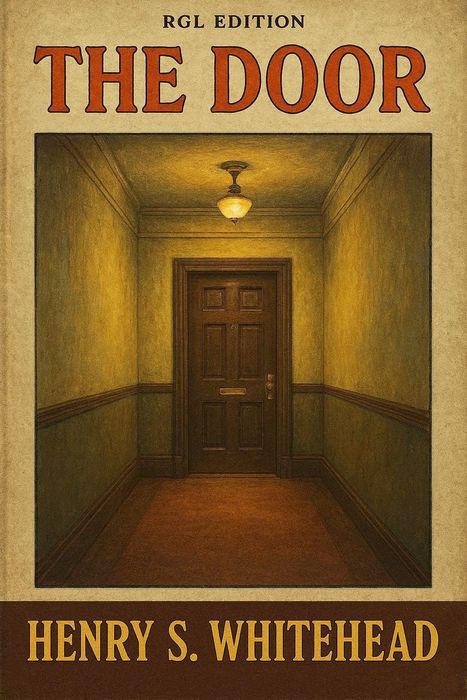
RGL e-Book Cover
Based on an image created with Microsoft Bing software
Roy Glashan's Library
Non sibi sed omnibus
Go to Home Page
This work is out of copyright in countries with a copyright
period of 70 years or less, after the year of the author's death.
If it is under copyright in your country of residence,
do not download or redistribute this file.
Original content added by RGL (e.g., introductions, notes,
RGL covers) is proprietary and protected by copyright.
RGL e-Book Cover
Based on an image created with Microsoft Bing software


Weird Tales, Novenber 1924, with "The Door"

THOSE in the motor car hardly felt the slight, though sickening impact. It was rather, indeed, because of the instinct for something-gone-wrong, than because of conviction that he had struck anything more important than a roll of tangled burlap from some passing moving van, that the driver brought his heavy car to a stop with a grinding of brakes strenuously applied, and went back to see what he had struck.
He had turned the corner almost incidentally; but when he alighted and went back, when the thin gleam of his flashlight revealed to him the heap of huddled pulp which lay there, the driver realized in the throes of a hideous nausea what it was his heavy machine had spurned and crushed...
ROGER PHILLIPS, intent upon the first really decent act of his whole life, hardly noticed what was forward. He had been crossing the street. He continued to be intent on his own concerns. Interrupted only by a kind of cold shudder to which he gave only passing thought as if with the very outer edge of his mind, he did not stop, but crossed the sidewalk, looking up as he had done many times before to reassure himself that the lights were out in the living-room of the apartment up there on the third floor of the apartment house.
They were out, as he had confidently anticipated, and, reassured, he quickly mounted the steps to the front entrance. Someone came out, hurriedly, and passed him as he entered, the rush taking him by surprise. He turned his head as quickly as he could, to avoid recognition. It was old Mr. Osler, his father's neighbor, who had rushed out. The elderly man was in his shirt sleeves, and appeared greatly agitated, so much so that young Phillips was certain he had not been recognized, hardly even noticed, indeed. He breathed an audible sigh of relief. He did not want old Osler to mention this chance meeting to his father the next time he should see him, and he knew Osler to be garrulous.
The young man mounted lightly and hurriedly the two flights of steps that led to the door of his father's apartment. He thrust his key into the patent lock of the apartment door confidently, almost without thought—a mechanical motion. As mechanically, he turned the key to the right. It was an old key, and it fitted the keyhole easily. He knew that his father and mother were at the symphony concert. They had not missed one for years during the season for symphony concerts, and this was their regular night. He had chosen this night for that reason. He knew the colored maid was out, too. He had seen her, not five minutes earlier, getting on a car for Boston. 'The coast,' as he phrased the thought to himself, somewhat melodramatically, 'was clear!' He was certain of security from interruption. Only let him get safely into the apartment, do what he had to do, and as quietly and unobtrusively depart, and he would be satisfied, quite satisfied.
But the lock offered unexpected resistance. It was inexplicable, irritating. His overtensed nerves revolted abruptly at this check. The key had slipped into the slot, as always, without difficulty—but it would not turn! Furiously he twisted it this way and that. At last he removed it and stared at it curiously. There was nothing amiss with the key. Could his father have had the lock changed?
Anger and quick shame smote him, suddenly. He looked closely at the lock. No, it was unchanged. There were the numberless tiny scratchmarks of innumerable insertions. It was the same.
Gingerly, carefully, he inserted the key again. He turned it to the right. Of course it turned to the right; he remembered that clearly. He had so turned it countless times.
It would not move. He put out all his puny strength, and still it would not turn. Hot exasperation shook him.
As he swore under his breath in his irritation at this bar to the fulfillment of his purpose, he became for the first time conscious of a rising commotion in the street below, and he paused, irresolutely, and listened, his nerves suddenly strung taut. Many voices seemed to be mingled in the excited hum that came to his ears. Bits of phrases, even, could be distinguished. Something had happened down there, it seemed. As he listened, the commotion of spoken sound resolved itself into a tone which, upon his subconscious effort to analyze it, seemed to him to express horror and commiseration, with an overtone of fear. The fear communicated itself to him. He shook, as the voice of the growing throng, a blended, corporate voice, came up to him in sickening waves of apprehension.
What if this should mean an interruption? Impatiently wrenching himself away from his preoccupation and back to his more immediate concern with the door, he thrust the key into the lock a third time, this time aggressively, violently. Again he tried to snap the lock. Again it resisted him, unaccountably, devilishly, as it seemed to him.
Then, in his pause of desperation, he thought he heard his own name spoken. He could feel his face go white, the roots of his hair prickle. He listened, intently, crouching catlike there on the empty landing before the door of his father's apartment, and as he listened, every nerve intent, he heard the entrance-door below flung open, and the corporate voice of the throng outside, hitherto muffled and faint, came to him suddenly in a wave of sound, jumbled and obscure as a whole, but with certain strident voices strangely clear and distinct.
A shuffle of heavy feet came to his ears, as if several persons were entering the lower hallway, their footsteps falling heavily on the tiled flooring. They would be coming upstairs!
He shrank back against the door—that devilish door! If only he could get it open!
Something like this, he told himself, in a wave of self-pity that swept him—something like this, unexpected, unforeseen, unreasonable—something like this was always happening to him!
That door! It was an epitome of his futile, worthless life! That had happened to him, just the same kind of thing, a month ago when he had been turned out of his home. The events of the intervening weeks rushed, galloping, through his overtensed mind. And now, as ever since that debacle, there was present with him a kind of unforgettable vision of his mother—his poor mother, her face covered with the tears which she made no effort to wipe away—his poor mother, looking at him, stricken, through those tears which blurred her face: and there was his father, the kindly face set now in a stern mask, pale and with deep lines—his father telling him that this was the end. There would be no public prosecution. Was he not their son? But he must go now! His home would be no longer his home...
He recalled the dazed days that followed: the mechanical activities of his daily employment; his search, half-hearted, for a furnished room. He recalled, shuddering, the several times when, moved by the mechanism of long-established usage, he had nearly taken an Allston car for 'home', which was to be no longer his home...
He had not sent back the key. He could not tell why he had kept it. He had forgotten to hand it back to his father when he had left, and his father, doubtless unthinkingly, had not suggested its return. That was why he still had it, and here he stood, now, on the very threshold of that place which had been 'home' to him for so many years, about to make the restitution that would do something to remove the saddest of all the blots on his conscience—and he could not get in!
The men, talking with hushed voices, had reached the first landing. Young Phillips, caught by a sudden gust of abject terror, shrank against the stubborn door, the door which, unaccountably, he could not open. Then, his mind readjusting itself, he remembered that he had no reason for concealment, for fear. Even though he might be seen here, even though these people should be coming all the way up the stairs, it could not matter. Let him be seen: what of it? He was supposed to live here, of course. It was only a short time since he had actually ceased to live here, and his father had said nothing. No public charge had been made against him. How one's conscience could make one a coward!
Under the invigorating stress of this reaction, he straightened himself, stood up boldly. Realizing that it might appear odd for him to be discovered standing here aimlessly on the landing, he started to go downstairs. But by now the narrow staircase was completely blocked by the ascending group. He stopped, halfway from that flight. The men were carrying something, something heavy, and of considerable bulk, it would seem. He could not see clearly in that dim light just what it was. He stopped, halfway down, but none of the men carrying the awkward bundle, covered with what looked like an automobile curtain, looked up, nor appeared to notice him. Neither did the straggling group of men, and a woman or two, who were following them.
Fascinated, he gazed at what they were carrying. As they approached and took the turn in the stairs, so that the electric light on the upper landing shone more directly upon it, he looked closer. It was the body of a man! It hung, limp and ungainly in their somewhat awkward grasp as they shouldered up toward him.
Something about it seemed vaguely familiar, the details presenting themselves to his fascinated gaze in rapid succession: the trouser-ends, the shoes...
THE men turned the last corner in the winding stairway and came into full view. As they turned the corner, the leather curtain slipped and the face of the dead man was for a moment exposed to view. Roger Phillips looked at it, fascinated, horrified. Then one of the men, halting for an instant, drew the corner of the curtain over the face again, and he could no longer see it. The head rolled. The broken body had been grievously crushed.
Roger Phillips, utterly distraught, cowered, a limp heap, against the unyielding door of his father's apartment. He had looked for one horrific instant into his own distorted, dead face!
The men, breathing hard, reached the landing. One of them, gingerly shifting his portion of the burden upon the shoulder of another, stepped forward to ring the bell of the Phillips apartment. No one answered the ring, and the man rang again, impatiently, insistently. The bell trilled inside the empty apartment. The men stood, silently, shifting uneasily from one foot to another. Behind them, a thin mutter came from the waiting stragglers who had followed them, moved by an inordinate curiosity.
'Here's a key sticking in the door,' said the man who had rung the bell. 'Guess we'd be all right if we opened the door and took the young fellow in. There doesn't seem to be anyone home.'
A murmur of assent came from the other men.
He turned the key to the left, then to the right, and the door opened. They carried the broken body inside and carefully laid it out on the sofa in the living-room.
Roy Glashan's Library
Non sibi sed omnibus
Go to Home Page
This work is out of copyright in countries with a copyright
period of 70 years or less, after the year of the author's death.
If it is under copyright in your country of residence,
do not download or redistribute this file.
Original content added by RGL (e.g., introductions, notes,
RGL covers) is proprietary and protected by copyright.