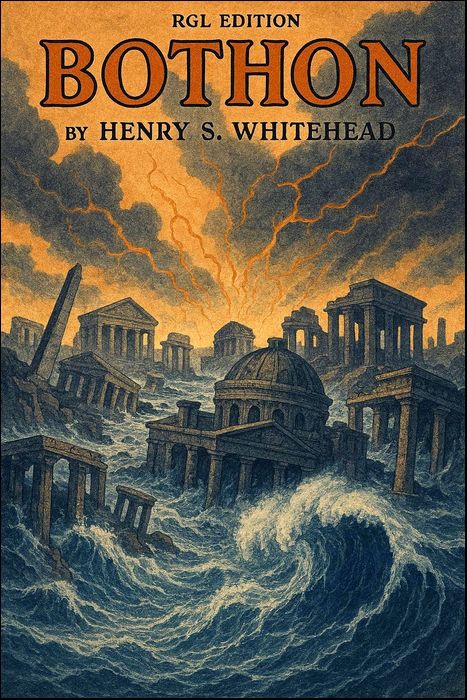
RGL e-Book Cover
Based on an image created with Microsoft Bing software
Roy Glashan's Library
Non sibi sed omnibus
Go to Home Page
This work is out of copyright in countries with a copyright
period of 70 years or less, after the year of the author's death.
If it is under copyright in your country of residence,
do not download or redistribute this file.
Original content added by RGL (e.g., introductions, notes,
RGL covers) is proprietary and protected by copyright.
RGL e-Book Cover
Based on an image created with Microsoft Bing software


Amazing Stories, August 1946, with "Bothon"

POWERS MEREDITH, at his shower-bath before dinner in the bathroom adjoining his room in his New York City club, allowed the cake of soap to drop on the tiled floor. Stooping to recover it he rapped the side of his head smartly against the marble sidewall. The resulting bruise was very painful, and almost at once puffed up into a noticeable lump. Meredith dined in the grill that evening. Having no after-dinner engagement he went into the quiet library of the club, empty at this hour, and settled himself with a new book beside a softly-shaded reading lamp.
From time to time a slight, inadvertent pressure of his head against the chair's leather-upholstered back would remind him unpleasantly of his accident in the shower-bath. This, after it happened several times, became an annoyance, and Meredith shifted himself into a preventive attitude with his legs draped over one of the big chair's rounded arms.
No one else came into the library. Faint, clicking noises came in from the nearby billiard-room where a couple of men were playing, but, absorbed in his book, he did not notice these. The only perceptible sound was that of the gentle, steady rain outside. This, in the form of a soothing, continuous murmur, came through the partly-opened, high windows. He read, interestedly, on and on in his book.
As he turned over the ninety-sixth page of his book, at precisely that instant's brief and almost unnoticed interruption of the thread of the story which this mechanical act involved, he heard a dull, overwhelmingly heavy sound, like a very large explosion plainly coming from a vast distance. It was the kind of deep booming dull roar which would accompany the destruction of several city blocks simultaneously.
Suddenly alert now, his finger holding his place in the book, he listened, horrified, for the aftermath—some stupendous crashing of falling masonry.
After several apprehensive instants, his mind entirely engaged with that keen process of listening, he heard it, almost with relief. It was a rumbling roar as though of countless tons of wrecked masonry; falling; falling; clearly, unmistakably, the remote thunder of some catastrophic ruin. He dropped his book, and, obeying his most prominent reactive impulse, literally leaped to his feet and started for the door.
HE met nobody as he rushed down the stairs. At the coat-room, which he had to pass on his way to the doorway, two fellow members were chatting urbanely together as they took their checks. Meredith glanced at them, surprised at their callousness. He rushed on, to the doorway, and out into the street, where he paused. An empty street!
As he shoved his way impatiently through the heavy revolving door an imperturbable doorman checked him out on the club-membership list-board beside his standing desk. Meredith thought, fleetingly, of the sentinel of Pompeii! He turned automatically, naturally, to the right, in the general direction from which that terrific sound had appeared to come. He had been visualizing streets thronged with horror-stricken people crowding westward; mad rush of fire apparatus, clanging raucously westward along crosstown streets; platoons of reserve police moving at the double in the same direction in their disciplined, orderly ranks. He half expected to see some lurid glow, searing the heavens over towards the Hudson River.
There was, strangely, as it seemed to him, disappointingly, almost startlingly—none of these things. The rain, reduced now to the merest light drizzle, made the asphalt of the street shimmer as it reflected upwards innumerable slightly distorted lights. Over towards Broadway, certainly, there was clamor. On this his expectant mind seized avidly. But, as he analyzed this automatically, it reduced itself to an accustomed note, heightened and intensified, now, by the emptying of the theaters. It was only the compound eleven o'clock bedlam of Times Square.
Along Sixth Avenue as he approached it with hurried strides, a pace just short of running, countless weaving taxicabs in a many-hued stream jockeyed for position in the maelstrom of the night-traffic about the Hippodrome. On the corner, a solitary, conspicuous figure, a rubber-coated and helmeted policeman, swinging long efficient arms like a pair of mechanical semaphores, skillfully directed the hypersensitive, crawling traffic, soundless on its multitudinous rubber tires save for the sustained, growling, compound cachinnation of shifting gears and squawking protesting brakes. Against him, as he stood now irresolutely on the curb, scores of hustling pedestrians jostled unheedingly. To his ever-increasing wonderment, all these seemed uniformly to be unmoved, to be totally unconcerned, by what, he supposed, must of necessity be one of the major destructive calamities of modern times.
Now thoroughly disturbed, vastly perplexed and reeling under this sense of quite inexplicable incongruity, Meredith turned and walked back towards the club. He was at a complete loss now, his mind at a standstill as though reason itself had failed to function. He sought for refuge, to find quickly some mental relief in palliative explanations—the terrific explosion he had heard might, of course, have taken place at some very great distance. On that grand scale one could not easily determine either the source or the direction of sound. The lower end of Manhattan Island might have given way! Like everyone else he had read from time to time varying predictions of such a possible calamity in the pseudo-scientific write-ups which now and again and at almost regular intervals made their appearance in the Magazine Sections of the Sunday newspapers. That vast, pro-gravitational, and ever-increasing accumulation of pressure from the crowding sky-scrapers—the well-nigh incalculable massed weight of towering structural steel and heavy stone blocks always encroaching more and more upon the uncalculated supporting strength of the island's lower stratum of bedrock—the reckless undermining of that same solid bedrock by more and more tunnels and subways!
A new idea, a possible explanation! The sudden blowing up of one of the great manufacturing plants across the Hudson in New Jersey! All that territory was to the west and there were many such manufactories far inland. One of them, an ammunition-plant, had blown up during the War. He remembered that that explosion, although some twenty miles away, had blown out windows right here in New York City.
He came abreast of the club entrance, hesitated, a deep frown corrugating his puzzled brow, mounted the three steps hesitatingly, and entered. He paused at the doorman's desk. No, that liveried automaton, his whole attention, as always, concentrated upon his duties, had heard of nothing. Neither had the somewhat sleepy clerk at the cigar counter.
'Send me up an "extra", please, if one comes out,' Meredith requested of the other clerk at the mail desk. He went up in the elevator to his bedroom completely nonplussed.
HALF an hour later as he lay in bed wakeful and trying to compose in his thoughts the varying, incongruous aspects of this strange affair, he was all at once acutely conscious of a distant, thin, confused, roaring hum apparently the resultant of several composite sounds. These were such sounds as would be made under the stress of a common excitement by a huge concourse of people at a vast distance. The most prominent element in this sound was the deep, soft, and insistently penetrating blending of countless voices. Through it ran a kind of dominant note—a note of horror. The sound positively chilled his blood. It was horrible, eerie. He found himself holding his breath as he listened, straining every faculty to take in that faint, distant, terrible clamor of fear and despair.
Of just when he fell asleep he had no recollection but when he awakened the next morning there hung over his mind a shadow of remembered horror, not wholly dissipated until he had bathed and begun to dress. He heard none of the sounds at the time of his awakening.
No 'extra' lay outside his bedroom door, and a little later at breakfast he opened expectantly and scanned several newspapers vainly and with a mounting sense of wonderment for any account of a catastrophe which could have caused the sounds. The implication grew upon him staggeringly. He had, actually, heard the convincing, unmistakable evidence of such a catastrophe —and no one else knew anything about it!
He reasoned himself deliberately away from the mist of something like cold fear that gripped chillingly at his heart with a kind of internal chill. There was quite a variety of news in the papers that morning, too. He glanced through the headings—crimes of violence; the execution of a famous criminal; the earthquake in Tokyo; several divorces; a notable prize-fight; the simultaneous crises of two European cabinets. But there was literally nothing which would account for what he, alone, apparently, had heard.
Strange dreams, the details gone, dissipated, the vague, devastating general recollection only remaining now, adumbrated in his mind in the form of an intense, horrific recollection. He had been one of those intimately, indeed poignantly, concerned in some vast and deep, some almost cosmic, cataclysm.
The dreadful thing, vague, disquieting memories of which had seared his mind and heart in those broken, horrific dreams, was not—and this element was entirely clear in his waking thoughts—was not as yet consummated. It was as though in the dream-state, he had been living—that phase of it was also very clear and unmistakable; stamped into his mind—an extraordinarily vivid, tense, and active life in some great urban community, wherein the utter certainty of some forthcoming and inevitable catastrophe was surely impending, a cataclysm the general knowledge of which had keyed up to the boiling-point the whole activity and the entire mental outlook of that community in which he had found himself, and in which he seemed to have been living for a long time under some kind of handicapping condition very irksome to him.
The one element of the horror and disturbance which lingered on, coloring powerfully that overhanging sense of destruction and sheer, paralyzing terror which had shadowed his waking day, was a sound—a vast, ear-filling, nerve-shattering dull roar as of the rising, menacing commotion of all the waters of the world.
Much more vaguely, a visual memory, the memory of a view point, lingered in the very back of Meredith's mind, bound up with, and seemingly a part of the general setting of those horrible dreams. He had been, somehow, under physical restraint in his dreams. It had been through great, massive walls all about him that the roar of impending catastrophe had come, muffled and dreadful, to his ear. And it was not wholly eradicated from his waking consciousness that he had seen through a barred aperture a flaming, red sky and had glimpses of tall towers tottering to the aural accompaniment of soul-shattering detonations, against that awful sound-background of the preternatural roaring of the fury-lashed, earth-shaking, near but unseen ocean.
He did his sensible best to account for these dreams of horror by attributing their outstanding features to his reading of the now detailed accounts of the great earthquake which had occurred in the Japanese capital, a catastrophe which had aroused the horror and sympathy of the whole civilized world. This, he told himself, was the necessary, the obvious, explanation of such dreams. So very keen and vivid had been the dreams' import in his mind, that although he attached no significance to the fact, he had to repeat this process of self-assurance, of everyday, material-background explanation to himself, again and again, throughout a day colored by an ever-recurrent, inescapable preoccupation with those night-dreams of dread, and horror, and impending destruction.
That evening, with his fianceé, Lois Harding, he had a dinner-and-dance engagement. Miss Harding thought him preoccupied; told him he was working too hard.
It was late when he came home to the club afterwards. He was physically tired and he fell asleep immediately after turning in. The following morning was Sunday. The reading-room was full and he carried his book up to his bedroom after late breakfast to read the rest of it in peace. He was soon immersed in it. Some time later his attention was distracted by the tapping of a window-shade, blown in and out by the breeze. It was annoying and he paused in his reading, intending to rise and adjust the shade.
As he withdrew his eyes, and part of his attention, from his book, all at once he heard a new sound. It was precisely as though a distant, sound-proof door had been abruptly opened. The new and different sound came through that imaginary door in the form of the composite noise of a distant battle. The details were vague but not so vague as to impair the certainty that what he was hearing now was conflict, the secondary or accompanying element in the compound aural impact being as unmistakably the sounds of conflagration—the crackle and roar of seething, devouring flame, rampant, uncontrollable. And back of these sound-elements, and carrying with it the recrudescence of the dreams' well-remembered aspect of a communal terror, the deep, underlying, dominating roar of a merciless, barbaric sea.
A mental picture leaped forthwith into his mind, the precise visual 'atmosphere' of those dreams of Friday night.
As he listened, fascinated, there came back to him and grew upon him a paralyzing, cold fear. There was no stopping it now. It was the fear of that which cannot be related to any previous experience; the fear of the unknown; the fear of certain and imminent destruction.
Cold sweat suddenly beaded his forehead. The faint penumbra of a slight nausea shook him. He could distinguish overtones now, high tones, cries of battle; the impact of a charge against a resistant horde; noise of plied weapons.
THE window-shade tapped again against the window casing. He snapped back into the familiar environment of his bedroom. He felt a little sick and weak. He rose, rather shakily, walked across the room and into the bathroom, and, noisily splashing the water about, washed his trembling hands and his face. Anything, to disperse those dreadful, haunting sounds from that incalculable world; that No Man's Land of rending destruction which had begun to project its echoes of cosmic calamity into his mind.
He paused, suddenly to listen again, a towel gripped between his shaking hands. But he could 'hear' nothing now, nothing except the tapping of that window-shade in the fresh breeze blowing through the open window. He hung the towel on its porcelain rod and walked back to his chair. He had seen his face, ghastly, in the bathroom mirror.
It was an hour too early for lunch, but he wanted urgently to be where there were people about, even waiters, people who were not 'hearing things'!
In order to prolong his companionship with old Cavanagh, the only other early luncher, Meredith ate somewhat more than usual. The unaccustomed heavy meal at such an hour made him drowsy and after lunch he stretched out on a davenport before one of the two open fireplaces in the now unoccupied reading-room, and fell at once into an uneasy sleep.
A little before three he awakened, stale, and as he came to conscious wakefulness he began to 'hear', at first quite distinctly, and then with increasing loudness and clarity as though a steady hand were opening up a loudspeaker, that same sound of fire and human conflict, and the dreadful, menacing roar of a thunderous ocean's incalculable anger.
Then, Old Cavanagh, napping on the other davenport, struggled with senile deliberation to his feet with many accompanying 'hums' and 'ha's', and began lumbering across the room towards him.
Meredith pulled himself together, forced away from him the idea that his sanity was dissolving into something like imbecility, and sat up; but his face, as his fellow club-member saw it, was again drawn and ghastly. Old Cavanagh plopped down beside him on the davenport. The old gentleman's kindly, florid face puffed with startled emotion. His eyes goggled. His mouth opened slackly.
'Lord's sake, what's the matter?' he demanded.
Kindly goodwill looked out of the old man's distorted countenance. Meredith, as though a spring within him had been released, stammered out his incredible story, the older man studying him narrowly as he talked and nodding sympathetically from time to time.
'Hm! mighty queer!' was his comment when Meredith had ended. He produced, lighted deliberately, and puffed upon an enormous cigar. He seemed to cogitate as the two sat side by side in a pregnant silence of many minutes. At last he spoke.
'You're upset, my boy, naturally. But, you can hear everything that's going on around you, can't you? Your actual hearing's all right, then. Hm! This other "hearing" starts up and goes on only when everything's perfectly quiet. First time, you were here reading; second time, in bed; third time, reading again; this time—if I wasn't snoring—you were in perfect quiet once more. Let's test that out, now. Keep perfectly still, and I'll do the same. Let's see if you hear anything.'
They fell silent once more, and for a while Meredith could hear nothing of the strange sounds. Then, as the silence deepened, once again came that complex of sounds indicating devastatingly battle, murder, and sudden death.
He nodded silently at Cavanagh, and at the old man's acquiescent murmur the sounds ceased abruptly.
IT took urging before Meredith could be persuaded to consult an aurist. Medical men, Cavanagh reminded him, would keep quiet about anything strange or embarrassing. Professional ethics...
They went uptown together that afternoon to Dr. Gatefield, a noted specialist. The doctor heard the story with close-lipped, professional attention. Then he tested Meredith's hearing with various delicate instruments. Finally he gave an opinion.
'We are familiar with various "ear-noises", Mr. Meredith. In some cases the location of one of the arteries too close to the ear-drum gives "roaring" noises. There are others, similar. I have eliminated everything of that kind. Your physical organism is in excellent condition, and unusually acute. There is nothing wrong with your hearing. This is a case for a psychiatrist.
'I am not suggesting anything like mental derangement, you will please understand! But I recommend Dr. Cowlington. This seems to be a clear case of what is sometimes called "clairaudience", or something similar—his department; not mine. The aural equivalent of "clairvoyance" is what I am indicating, you see what I mean. "Second-sight" has to do with the eyes, of course, but it is mental, although there is often some physical background. I have no knowledge of those phenomena. I hope you will take my advice and allow Dr. Cowling—'
'All right!' interrupted Meredith. 'Where does he live? I might as well go through with the thing now as later.'
Dr. Gatefield showed traces of sympathy under his rather frosty professional exterior. He dropped the diagnostician, became the obliging, courteous gentleman. He telephoned to his colleague, the psychiatrist, and then surprised both Meredith and Cavanagh by accompanying them to Dr. Cowlington's. The psychiatrist proved to be a tall, thin, and rather kindly person, with heavy, complex spectacles on a prominent nose, and then, sand-colored wisps of hair in a complication of cowlicks. He showed marked interest in the case from the start. After hearing Meredith's story and the aurist's report he subjected Meredith to an examination of more than an hour from which, feeling more or less as though he had been dissected, he nevertheless derived a considerable sense of relief.
It was decided that Meredith should arrange at once to take several days off, come to Dr. Cowlington's house, and remain 'under observation'.
HE arrived at the doctor's the next morning and was given a pleasant, upstairs room, with many books and a comfortable davenport on which, in a recumbent position, the psychiatrist suggested, he should spend most of his waking hours reading.
During Monday and Tuesday, Meredith, now after Dr. Cowlington's skillful reassurances no longer upset at 'hearing' the strange sounds, listened carefully for whatever might reach him from what seemed like another—and very restless—world! He 'heard' as he 'listened' for long periods uninterrupted by any aural distractions, the drama of a great community in the paralyzing grip of fear—fighting for its corporate life—against irresistable, impending, dreadful doom.
He began, about this time, at Dr. Cowlington's suggestion, to write down some of the syllabification of the cries and shouts as well as he could manage it, on a purely phonetic basis. The sounds corresponded to no language known to him. The words and phrases were blurred and marred by the continuous uproar of the fury of waters. This was invariably, and continued to be, the sustained, distinctive background for every sound he heard during the periods while he remained passive and quiet. The various words and phrases were entirely unintelligible. His notes looked like nothing which either he or Cowlington could relate to any modern or ancient tongue. When read aloud they made nothing but gibberish.
The strange terms were studied over very carefully by Dr. Cowlington, by Meredith himself, and by no less than three professors, of Archaeology and Comparative Philology, one of whom, the Archaeologist, was a friend of Cowlington's and the other two called in by him. All of these experts on ancient and obsolete languages listened with the greatest courtesy to Meredith's attempt to explain the apparent setting of the sounds—most of them were in the nature of battle-cries and what Meredith took to be fragments of desperately uttered prayer—some of the material having come to him in the form of uncouth, raucous howls—and with the greatest interest to his attempts at reproducing them orally. They studied his written notes with the most meticulous care. The verdict was unanimous, even emphatic on the part of the younger and more dogmatic philologist. These sounds were quite utterly at variance with, entirely different from, any known speech, including Sanskrit, Indo-Iranian and even the conjectural Akkadian and Sumerian spoken tongues. The transcribed syllables corresponded to nothing in any known language, ancient or modern. Emphatically they were not Japanese.
The three professors took their departure, the younger philologist showing almost plainly his opinion that Meredith was either slightly demented or trying to put something over on him!
Meredith and the psychiatrist Dr. Cowlington went over the list again after the experts had taken their departure. They had to agree that the words heard were probably unique in the history of human speech.
Meredith had written: 'Iï, Iï, Iï, Iï—R'ly-eh!—Ieh nya—Ieh nya—Zoh, zoh-an-nuh!' These strange words and various others quite as uncouth occurred mostly as monosyllabic exclamations. There was only one grouping of the words which formed anything like a section of continuous speech, or sentence, and which Meredith had been able to capture more or less intact and write down—'Ióth, Ióth—Natcal-o, do yan kho thút-thut.'
There were many other cries and, as he believed, desperately uttered prayers quite as strange and off the beaten tracks of recognized human speech as those noted down.
IT was quite possibly because of his concentration on this affair of the remembered words—his own interest in them being naturally enhanced by Dr. Cowlington's and that of the three experts—that Meredith's dream-state impressions just at this time, and suddenly, became markedly acute. These dreams had been continuous and consecutive since their beginning several nights before, but on this night after the rather elaborate investigation of the words and syllables, Meredith began in earnest, so to speak, upon getting the affair of his environment in the strange city of the flames and conflicts and confusion and of a roaring ocean, cleared up with a startling abruptness. His dream impression that night was so utterly vivid; so acutely identical with the terms of the waking state; so entirely free of the blurred penumbras which accompany nightmares, as to cause him suddenly to feel the cold sweat running down his back when he paused on the way to his shower-bath, in the middle of his bedroom floor, confronted without warning with the unexpected question which sprang into his mind: 'Which of these two is my real life!!!'
Everything that he had derived mentally out of that night's sleep was clearly and definitely present in his mind. It seemed to him precisely as though he had not been asleep; that he had not emerged from an ordinary night's rest into the accustomed circumstances of an early morning's awakening. It was, rather, as though he had very abruptly passed out of one quite definite life into another; as though, as it came to him afterwards, he had walked out of a theatre (where his interest in a scene being enacted had so thoroughly absorbed his attention as to identify him with it as an active participant), into the wholly unrelated after-theatre life of Times Square.
One of the radical phases of this situation was not only that the succession of dream experiences had been continuous, with time-allowances for the intervening periods of those days-in-between which he had spent here in Dr. Cowlington's quiet house; not only that, extraordinary as this realization seemed to him. The nearly consecutive dream experiences had been the events of the past few days in a life of thirty-two years, spent in that same environment and civilization of which the cataclysmic conditions which he had been envisaging appeared to presage a direful end.
HE was, to set out plainly what he had brought out of that last night's dream-experience, one Bothon, general of the military forces of the great district of Ludekta, the southwesterly provincial division of the continent of Atlantis, which had been colonized, as every Atlantean school child was well aware, some eighteen hundred years before by a series of emigrations from the mother continent. The Naacal language—with minor variations not unlike the differences between American speech and 'English English'—was the common language of both continents. From his native Ludekta the General Bothon had made several voyages to the mother land. The first of these had been to Ghua, the central eastern province, a kind of grand tour made just after his finishing, at the age of twenty-two, his professional course in the Ludekta College of Military Training. He was thus familiar by experience, as were many other cultivated Atlanteans of the upper classes, with the very highly developed civilization of the mother continent. These cultural contacts had been aided by his second visit, and further enhanced not long before the present period of the dream-experiences when, at the age of thirty-one, Bothon, already of the rank of general, had been sent out as Ambassador to Aglad-Dho, joint capital of the confederated south-eastern provinces of Yish, Knan, and Buathon, one of the most strategic diplomatic posts and the second most important provincial confederation of the mother continent.
He had served in his ambassadorial capacity for only four months, and then had been abruptly recalled without explanation, but, as he had soon discovered upon his arrival home, because of the privately communicated request of the Emperor himself. His diplomatic superiors at home offered him no censure. Such Imperial requests were not unknown. These gentlemen were, actually, quite unaware of the reasons behind the Imperial request. No explanations had been given them, but there had been no Imperial censure of any kind.
But the General, Bothon, knew the reasons very well, although he kept them strictly to himself. There was, indeed, only one reason, as he was acutely and very well aware.
The requirements of his office had taken him rather frequently to Alu, the continental capital, metropolis of the civilized world.
Here in the great city of Alu were assembled from all known parts of the terrestrial globe the world's diplomats, artists, philosophers, traders and ship-masters. Here in the great warehouses of solid stone and along the innumerable wharves were piled the world's goods—fabrics and perfumes; strange animals for the delectation of the untravelled curious. Here in the endless stalls and markets were dyed stuffs and silks; tubas and cymbals and musical rattles and lyres; choice woods and implements for the toilet—strigils, and curiously carved hand-fitting little blocks of soap-stone, and oils innumerable for the freshening of beards and the anointing of bodies. Here were tunics and sandals and belts and thongs of soft-tanned, variously perfumed leathers. Here were displayed carved and cunningly wrought pieces of household furniture—glowing, burnished wall-mirrors of copper and tin and steel, bedsteads of an infinite range and design, cushions of swans' feathers, tables of plain and polished artizanship and of intarsia with metal scrolls set flush to their levels; marquetry work of contrasting woods—chairs and stools and cupboards and chests and foot-rests. Here were ornaments innumerable—fire-screens, and spindles for parchment-rolls, and tongs, and shades for lamps made of the scraped skins of animals; metal lamps of every design, and vegetable oils for the lamps in earthenware jars of many sizes and shapes. Here were foods and wines and dried fruits, and honey of many flavors; grains and dried meats and loaves of barley and wheat-meal past computation. Here in the great street of the armorers were maces and axes and swords and daggers of all the world's varieties and designs; armor of plate and chain—hauberks, and greaves, and bassinets, and shelves with rows and rows of the heavy plate and helmets standardized for the use of such fighting men as Bothon himself commanded in their thousands.
HERE were to be seen and examined costly canopies and the elaborate litters in which the slaves of the rich carried their masters through the narrow streets and broad, airy avenues of Alu. Rugs there were in an endless profusion of size and shape and design; rugs from distant Lemuria and from Atlantis and from tropical Antillea, and from the mountainous interior regions of the mother continent itself, where thousands of cunning weavers of fabrics worked at their looms; ordinary rugs of pressed felt, and gorgeous glowing rugs of silk from the southern regions where the mulberry trees grew; rugs, too, and thin, soft draperies of complex patterns made of the wool of lambs and of the long, silk-like hair of the mountain sheep.
Here in Alu, center of the world's culture, were philosophers with their groups of disciples, small or great, propounding their systems on the corners of streets and in the public squares, wrangling incessantly over the end of man, and the greatest good, and the origin of material things. Here were vast libraries containing the essence of all that had been written down concerning science and religion and engineering and the innumerable fine arts, of the civilization of forty thousand years. Here were the temples of religion where the hierarchs propounded the principles of life, colleges of priests studying incessantly more and more deeply into the mysteries of the four principles; teaching the people the endless applications of these esoteric affairs to their conduct and daily lives.
Into this fascinating treasure house of a great civilization the ambassador Bothon had penetrated as often as possible. The excellence of his family background, his own character and personal qualities, and his official position, all combined to make him a welcome guest in the mansions of the members of the emperor's court and of the highest stratum of social life in Alu.
An impressionable young man, most of whose life previous to his appointment as ambassador had been spent in hard training for his military duties and in the rigorous prosecution of those as he rose rapidly grade by grade by hard man's work in camp and field during his many campaigns in the standing army of Ludekta, the general, Bothon, revelled in these many high social contacts. Very soon he found within himself and growing apace, the strong and indeed natural desire for a type of life to which his backgrounds and achievements had amply entitled him, but of which he had been, so far, deprived because of the well-nigh incessant demands upon him of his almost continuous military service.
In short, the ambassador from Ludekta very greatly came to desire marriage, with some lady of his own caste, and, preferably, of this metropolitan city of Alu with its sophistication and wide culture; a lady who might preside graciously over his ambassadorial establishment; who, when his term of office was concluded, would return with him to his native Ludekta in Atlantis, there permanently to grace the fine residence he had in his mind's eye when, a little later, he should retire from the Ludektan army and settle down as a senator into the type of life which he envisaged for his middle years.
HE had been both fortunate and unfortunate in his actual falling in love. The lady, who reciprocated his ardent advances, was the Netvissa Ledda, a daughter of the Netvis Toldon who was the emperor's brother. The fortunate aspect of this intense and sudden love affair which set all social Alu to commenting upon it, was the altogether human one of a virtually perfect compatibility between the two. Their initial mutual attraction had become a settled regard for each other almost overnight. Within a few days thereafter they were very deeply in love. Humanly considered, the affair was perfection itself. Every circumstance save one, and that a merely artificial side of the case, gave promise of an ideal union.
The single difficulty in the way of this marriage was, however, most unfortunately, an insuperable one. The Netvissa Ledda, niece of the emperor, belonged of right to the very highest social caste of the empire. The rank and degree of Netvis lay next to Royalty itself and in the case of the family of the Netvis Toldon partook of royalty. Against this fact, basic in the structure of the empire's long-established custom, the Ambassador, General Bothon of Ludekta—although a gentleman of the very highest attainments, character, and worth, whose family records reached back a thousand years into the dim past before the colonization of Atlantis, whose reputation was second to none in the empire—the General, Bothon, was a commoner. As such, according to the rigid system prevalent at the court in Alu, capital of the Empire, he was hopelessly ineligible. The marriage was simply out of the question.
The Emperor, being called upon to settle this awkward affair, acted summarily, quite in the spirit of one who destroys a hopelessly wounded and suffering creature as an act of mercy. The Emperor took the one course open to him under these circumstances, and the General, Bothon, without any choice being open to him save submission to an Imperial request which had the force of law, took ship for Ludekta, leaving behind him in Alu the highest and dearest hope of his life, irreparably shattered.
For the subsequent conduct of the General Bothon, recently Ludektan Ambassador to Aglad-Dho, there were three very definite contributing reasons. Of these the first and most prominent was the depth and intensity and genuineness of his love for the Netvissa Ledda. Beyond all possible things, he wanted her; and the proud soul of Bothon was very grievously racked and torn at the sudden unexpected and arbitrary separation from her which the Imperial request had brought about.
The voyage from Aglad-Dho to Ludekta, across the two sections of the globe's great oceans and through the ship canals and lakes which bisected the southern continent of the western hemisphere, occupied seven weeks. During this period of enforced inaction the bitter chagrin and deep disappointment of Bothon crystallized itself by means of the sustained reflection inevitable under the circumstances. General Bothon arrived in Ludekta in a state of mind which made him ready for anything, provided only it was action. This state of mind was the second of these contributory factors.
The third was the immediate satisfaction of his desire for activity. During the course of his voyage home the ghoulish and, indeed, subhuman factory slaves, the shockingly Simian Gyaa-Hua, had inaugurated a revolt. This had spread, by the time of Bothon's arrival, throughout the entire province of Ludekta. The state sorely needed the efficient services of this, the youngest and most brilliant of its generals, and his reception on landing was more nearly that of a savior of his country than what a virtually disgraced diplomat might expect.
INTO this campaign, which he prosecuted with the utmost rigor and a thoroughgoing military effectiveness, Bothon threw himself with an abounding energy which even his most ardent Ludektan admirers had not anticipated. At the end of an intensive campaign of less than three weeks, with this very dangerous revolt completely crushed and the leaders of the Gyaa-Hua to a man hanging by great hooks through their neck muscles in dreadful rows along the outer city walls on either side of the great archway that pierced the defense of Ludekta's capital, the General Bothon found himself the hero of Ludekta and the idol of his admiring troops. A rigid disciplinarian, the attitude of the officers and men of the Ludektan standing army towards this general had hitherto been based upon the respect which his great abilities had always commanded. Now he found himself the recipient of something almost like worship because of this last brilliant campaign of his. It had been a tour de force.
Although it is highly probable that they would have advanced him because of this achievement in any event, the actual occasion for the action of the Ludektan Senate in rewarding Bothon with the supreme command of the standing army was the speech before that body of the aging generalissimo Tarba. Old Tarba ended his notable panegyric by laying his truncheon, emblem of the supreme command, on the great marble slab before the presiding senator, with a dramatic gesture.
Bothon thus found himself suddenly possessed of that intensive hero worship which would cause the state to acquiesce in anything which its object might suggest. He was, at the same time, in supreme command of the largest sectional standing army of the entire continent of Atlantis; an army, thanks chiefly to his own efficiency, probably the best trained and most effective fighting unit then extant.
Under the combined effect of the contributing causes and his new authority General Bothon made up his mind. On the eleventh day after his triumphal entry into Ludekta's capital city forty-seven Ludektan war vessels freshly outfitted, their oar-slaves supplemented by a reserve of the Gyaa-Hua, selected for the power and endurance of their gorillalike bodies, with new skin sails throughout the fleet, and the flower of the Ludektan army on board, sailed out from Ludekta westward for Alu under the command of the General Bothon.
IT was precisely simultaneous with the arrival of this war fleet off the shores of the great city of Alu that there began unprecedented natural disturbances affecting the entire area of the mother continent. These were comparable to nothing recorded in the capital's carefully kept slate and parchment records, which went back over a period of thousands of years.
The first presage of these impending calamities took the form of a coppery tinge which replaced the blue of the sky. Without any premonitory warnings the long ground-swell of this Western Ocean changed abruptly, along with the color of the water, into a kind of dull brick-grey, to short, choppy, spray-capped waves. These tossed even the great Ludektan war galleys so violently as to shatter many of the sweeps. The wind, to the consternation of several of Bothon's captains, appeared to come from every quarter at once! It tore the heavy skin sails of the Ludektan galleys away from their copper rings and bolts in some cases. In others it split the sails in clean straight lines as though they had been slit with sharp knives.
Undaunted by these manifestations and the reports of his augurs who had cast their lots and slain their sheep and fowls in a hasty series of divinations to account, if possible, for this unfavorable reception at the hands of the elements, the indomitable will of Bothon forced his fleet to an orderly landing. He sent forthwith as his herald to the Emperor himself, his highest ranking sub-general, accompanied by an imposing guard of honor. On slate tablets Bothon had set forth his demand in his own hand. This was in the form of a set of alternatives. The emperor was asked to receive him as Generalissimo of the military forces of Ludekta, and to consent to his immediate marriage with the Netvissa Ledda; or, he, Bothon, would proceed forthwith to the siege of Alu and take the lady of his heart by force and arms.
The message prayed the Emperor to elect the first alternative. It also set forth briefly and in formal heraldic terms the status of the ancient family of Bothon.
The Emperor had been very seriously annoyed at this challenge, as he chose to regard it. He felt that his office and dignity had been outraged. He crucified Bothon's entire delegation.
The siege of Alu began forthwith under that menacing copper-tinted sky and to the accompaniment of a rumbling series of little earthquakes.
NOT only not within the memory of living men, but, as the records indicated, during its entire history over thousands of years as the metropolis of the civilized world, had there been any previous hostile manifestations against the great city of Alu. That anything like this terrible campaign which the renowned General Bothon of Ludekta set in motion against her might come to pass, had never even remotely occurred to anyone in Alu. So promptly did Bothon launch his attack that the tortured bodies of the members of his delegation to the Emperor had not yet ceased writhing on their row of crosses before he had penetrated, at the head of his trained legionaries, to a point within two squares of the Imperial Palace which stood at the center of the great city.
There had been virtually no resistance. This intensive campaign would have been triumphantly concluded within twenty minutes, the Emperor probably captured along with all his Palace guards and household, the person of the Lady Ledda secured by this ardent lover of hers, and the entire objective of the expedition accomplished, save for what in modern legal phraseology would have been described as 'An Act of God'.
The premonitory earth-shakings which had accompanied this armed invasion culminated, at that point in the advance of Bothon's army, in a terrific seismic cataclysm. The stone-paved streets opened in great gaping fissures. Massive buildings crashed tumultuously all about and upon the triumphantly advancing Ludektans. The General, Bothon, at the head of his troops, dazed and deafened and hurled violently upon the ground, retained consciousness long enough to see three quarters of his devoted following engulfed, smashed, torn to fragments, crushed into unrecognizable heaps of bloody pulp; and this holocaust swiftly and mercifully obliterated from before his failing vision by the drifting dust from millions of tons of crumbled masonry.
He awakened in the innermost keep of the dungeon in Alu's citadel.
COMING quietly into Meredith's bedroom about ten o'clock in the morning, Dr. Cowlington, who had made up his mind overnight on a certain matter, quietly led his initial conversation with his observation-patient around to the subject which had been most prominent in his mind since their conference of yesterday over the strange linguistic terms which Meredith had noted down.
'It has occurred to me that I might very well tell you about something quite out of the ordinary which came under my notice seven or eight years ago. It happened while I was chief intern in the Connecticut State Hospital for the Insane. I served there for two years under Dr. Floyd Haviland before I went into private practice. We had a few private patients in the hospital, and one of these, who was in my particular charge, was a gentleman of middle-age who had come to us because of Haviland's enormous reputation, without commitment. This gentleman, whom I will call "Smith", was neither legally nor actually "insane". His difficulty, which had interfered very seriously with the course of his life and affairs, would ordinarily be classified as "delusions". He was with us for nearly two months. As a voluntary patient of the institution, and being a man of means, he had private rooms. He was in every way normal except for his intensive mental preoccupation with what I have called his delusions. In daily contact with him during this period I became convinced that Mr. Smith was not suffering from anything like a delusive affection of the mind.
'I diagnosed his difficulty—and Dr. Haviland agreed with me—that this patient, Smith, was suffering mentally from the effects of an ancestral memory.
'Such a case is so rare as to be virtually unique. The average psychiatrist would go through a lifetime working at his specialty without encountering anything of the sort. There are, however, recorded cases. We were able to send our patient home in a mental condition of almost complete normality. As sometimes occurs in mental cases, his virtual cure was accomplished by making our diagnosis very clear to him—impresssing upon his mind through reiterated and very positive statements that he was in no sense of the word demented, and that his condition, while unusual, was not outside the range and limitations of complete normality.'
'It must have been a very interesting case,' said Meredith. His reply was dictated by nothing deeper than a desire to be courteous. For his mind was full of the affairs of the General, Bothon, raging now in his prison-chamber; his mind harried, anxious over the fate of his surviving soldiers; that lurid glare, dimmed by the remoteness of his flame-tinted prison-chamber, in his eyes; his mind tortured and his keen sense of hearing stultified by the sustained, dreadful roaring of that implacable sea. He, Meredith, for reasons far too deep for his own analysis, felt utterly incapable of telling Dr. Cowlington what was transpiring in those dreams of his. All his inmost basic instincts were warning him, though subconsciously, that what he might tell now, if he would, could not possibly be believed! Dr. Cowlington, looking at his patient, saw a face drawn and lined as though from some devastating mental stress; a deeply introspective expression in the eyes, which professionally speaking, he did not like. The doctor considered a moment before resuming, erect in his chair, his knees crossed, his finger-tips joined in a somewhat judicial attitude.
'Frankly, Meredith, I emphasized the fact that the man I have called Smith was in no sense insane because I feel that I must go farther and tell you that the nature of his apparent "delusions" was, in one striking particular, related to your own case. I did not wish to give you the slightest alarm over the perfect soundness of your own mentality! To put the matter plainly, Mr. Smith "remembered", although rather vaguely and dimly, certain phases of those ancestral memories I mentioned, and was able to reproduce a number of the terms of some unknown and apparently prehistoric language. Meredith—' the doctor turned and looked intensely into the eyes of his now interested patient, ' —there were three or four of Smith's words identical with yours!'
'Good God!' exclaimed Meredith, now thoroughly aroused. Then, after a minute's anxious reflection: 'What were the words, Doctor? Did you make notes of them?'
'Yes, I have them here,' answered the psychiatrist, and brought a thin sheaf of papers out of his breast-pocket.
Meredith was out of his chair and leaning eagerly over the doctor's shoulder long before Cowlington had his papers arranged. He gazed with a consuming intensity at the words and phrases carefully typed on several sheets of foolscap; listened, with an almost tremulous attention, while Dr. Cowlington carefully reproduced the sounds of these uncouth terms. Then, taking the sheets and resuming his chair, he read through all that had been written down, pronouncing the words, though very quietly, under his breath, his lips barely moving.
HE was pale, and shaking from head to foot when he rose at last and handed back, hands trembling, the thin fascicle of papers to its owner. Dr. Cowlington looked at him anxiously, his professional mind alert, his fears somewhat aroused over the wisdom of this experiment of his in bringing his former case thus abruptly to his patient's attention. Dr. Cowlington felt, if he had cared to put his impression into words, somewhat baffled. He could not, despite his long and careful training in dealing with mental, nervous, and 'borderline' cases, quite put his acute professional finger upon just which one of the known simple and complex emotions was, for this moment, dominating this very interesting patient of his.
Dr. Cowlington would have been even more completely puzzled if he had known.
For Meredith, reading through the strange babblings of the patient, Smith, had recognized all the words and terms, and had lit upon the phrase—
'Our beloved Bothon has disappeared.'
Dr. Cowlington, sensing accurately that it might be unwise to prolong this particular interview, concluded wisely that Meredith would most readily regain his normal poise and equanimity if left alone to cope with whatever, for the time being, held possession of his mind, rose quietly and walked over to the bedroom door.
He paused there, however, for an instant, before leaving the room, and looked back at the man now introspectively relaxed in a comfortable lounge-chair. Meredith had not, apparently, so much as noted the doctor's movements towards departure. His mind, very obviously, was turned inward. He was, it appeared, entirely oblivious to his surroundings.
And Dr. Cowlington, whose professional outward deportment, acquired through years of contact with abnormal people, had not wholly obliterated a kindly disposition, noted with a certain emotion of his own that there were unchecked tears plainly visible in his patient's inward-gazing eyes.
SUMMONED back to Meredith's room an hour later by one of his house nurses, Dr. Cowlington found his patient restored to his accustomed urbane normality.
'I asked you to come up for a moment, Doctor,' began Meredith, 'because I wanted to inquire if there is anything that you would care to give a patient to induce sleep.' Then, with a deprecating smile: 'The only such things I know about are morphine and laudanum! I don't know very much about medicine and naturally you wouldn't want to give me one of those any more than I would want to take it.'
Dr. Cowlington resumed his judicial manner. He thought rapidly about this unexpected request. He took into consideration how his story about the patient, Smith, had appeared to upset Meredith. He deliberately refrained from inquiring why Meredith wanted a sleeping potion. Then he nodded his head.
'I use constantly a very simple preparation,' said he; 'it is non-habit-forming; based on a rather dangerous drug, chloral; but, as I use it for my patients, compounded with an aromatic syrup and diluted with half a tumbler of water, it works very well. I will send some up to you at once, and you can take it yourself. Remember, please, four teaspoonfuls of the syrup is the outside dose. Two will probably be enough. Never more than four at any time, and not more than one dose in twenty-four hours.'
Dr. Cowlington rose, came over to Meredith, and looked at the place where he had struck the side of his head against the marble wall of his shower-bath. The bruise was still swollen. The doctor passed his fingers lightly over this contusion.
'It's beginning to go down,' he remarked. 'It's just at the posterior edge of the mastoid process of the temporal bone. You're fortunate, I think, that we didn't have to put you through an operation for mastoiditis. A bruise over the network of little laminated bones that are under that spot is always a risk, you know.'
The doctor smiled pleasantly, again nodded his head at Meredith, and started to leave. Meredith stopped him as he was about to go out of the room.
'Yes?' said the doctor inquiringly, as he turned, his hand on the bedroom door-handle.
'I wanted to ask you,' said Meredith—and the acute-minded Cowlington suspected a faint note of diffidence in his patient's tone—'I wanted to ask you, Doctor, if you would be willing to put me in touch with the man to whom you referred as "Smith".'
The doctor shook his head. 'I'm sorry, Mr. Smith died two years ago.'
IN ten minutes the house nurse fetched in a small tray. On it was a tumbler, a mixing spoon, and a freshly put up eight-ounce bottle containing a reddish colored, pleasant-tasting syrup.
Twenty minutes later, Meredith, who had compromised on three teaspoons, was deeply asleep on his bed; and the General, Bothon, in the innermost dungeon-chamber of the great citadel of Alu, was standing poised in the center of that dungeon's smooth stone floor, tensed to leap in any direction; while all about him the rending crashes of thousands of tons of the riven and falling masonry of the citadel itself was deafening him against all other sounds except the incessant and indescribably thunderous fury of the now utterly maddened ocean. The lurid glare of the fires from without had been markedly heightened. Detonation after rending detonation came to Bothon's ears at frequent intervals. The Aluans were blowing up this central portion of their great city, as he was able quite easily to guess, in order to check the advance of the terrific conflagration which had raged for days and nights and was utterly beyond control. These detonations seemed actually faint to the alert man in that prison room against the hideous crashing of the sections of the citadel itself, and the well-nigh unbearable sustained roar of the ocean.
Abruptly the crisis for which he had been waiting arrived. The stone flooring beneath his feet buckled and sagged at his right. He whirled about and leaped far in the other direction, pressing himself, hands and arms stretched out above his head, against the wall of the prison-chamber, his heart pounding wildly, his breath coming in great gasps and sobs as the stifling, earthquake-deadened air about him shrank to a sudden and devastating attenuation. Then the solid wall opposite split in a tearing gap from top to bottom; and an even more stifling cloud of fine white dust sifted abruptly through the room as the ceiling was riven asunder.
Stifling, choking, fighting for breath and life, the General, Bothon, lowered his arms and whirled about again in the direction of this thunderous breakage, and groped his way across the now precarious flooring in the faint hope of discovering an avenue of escape. He struggled up a steep mound of débris through the grey darkness of the hanging dust where a few seconds before had been a level floor of solid masonry. He groped his way through thicker clouds of the drifting, settling stone-dust, skirted the irregular edges of yawning holes and toiled up and down mounded heaps of rubble, far past the place where the confining wall of his dungeon had stood, onward and forward resolutely towards that vague goal of freedom.
At last, the resources of his mighty body well-nigh spent, himself a solid grey from hair to sandals from the thickly clinging dust, his eyes two tortured red holes, his mouth and throat one searing pain, his heart and lungs well-nigh bursting, the General, Bothon, emerged across the last hill of rubbish which had been the citadel of Alu, and came out upon the corner edge of one of the largest of the city's great public squares.
FOR the first time in the course of his progress out of that death trap, unscathed save for a long shallow gash where in the darkness he had scraped the upper portion of his right thigh sharply against the rough cutting-edge of a great chunk of granite, but now barely able either to see or breath, Bothon suddenly trod on something soft and yielding. He paused. He could hardly see, and he crouched and felt with his hands, under the thickly mounded dust. It was the body of a man, in chain mail. The General, Bothon, exhaled a painful breath of satisfaction. He rolled the body over, freeing it from the pounds of dust upon it, and slid his hand along the copper-studded leather belt to where a short, heavy, one-handed battle-axe was attached. This he drew from its sheath. Then from the dead man's silken tunic which his hand had encountered he tore off a large section and with this cleansed his eyes and mouth and wiped the sweat-caked dust from his face and arms and hands. Finally he took from the corpse a heavy leathern purse. He sensed that this nook where he had discovered his unknown benefactor was a secluded spot where the dust had concealed the body from looters or the horrible attentions of the ghoulish Gyaa-Hua, mobs of which creatures, freed as he had been from their strict confinement, had added to the city's horrors their bestial chitterings and unspeakable feastings on the bodies of the dead. He lay down for a few moments beside the dead soldier on the soft dust for a brief respite and to rest the tissues of his body and to permit his tear and salivary glands to readjust themselves to their normal functions and so somewhat to relieve the burning torture of his mouth and nose and eyes.
Some ten minutes later he rose to his feet, wiped his lips and the now freely flowing tears from his restored eyes, stretched himself mightily, tested the heavy axe with three or four singing strokes through the clearing air, and dusted out and readjusted his garments, finally tightening a loosened sandal thong. General Bothon, inured to mere physical hardships by the many years of rigid military activity, was his own man again. He stood now free in the center of Alu. He was adequately armed. A great gust of energy surged through him. He oriented himself; then he turned with an instinct as sure as a homing bee's in the direction he had been seeking, and began to march at the unhurrying, space-devouring pace of a Ludektan legionary, straight for the Imperial Palace.
Bothon had thoroughly settled in his mind the answer to a question which, for the first few days of his captivity had puzzled him greatly. Why had he been left alone and undisturbed in that confinement; food and water brought him at regular intervals in accordance with the ordinary routine of the citadel? Why, to put the matter plainly, having been obviously captured by the Emperor's retainers while lying unconscious within two squares of the Imperial Palace, had he not been summarily crucified? His keen trained mind had apprised him that the answer was to be found in the hideous turmoil of the raging sea and in the fearful sounds of a disintegrating city. The Emperor had been too greatly occupied by those cataclysms even to command the punishment of this leader of such an armed attack against the world's metropolis as had not been known in all the long history of the mother continent.
Skirting its enormous outer walls, Bothon came at last to the massive chief entranceway to the Imperial Palace. This enormous structure, its basic walls eight feet thick, stood massive, magnificent, intact. Without any hesitation he began mounting the many broad steps straight towards the magnificent entrance-gates of copper and gold and porphyry. Before these gates, in a rigid line and under the command of an officer beneath whose corselet appeared the pale blue tunic of the Emperor's household-guards, stood a dozen fully armed soldiers. One of these, at a word from the officer, ran down the steps to turn back this intruder. Bothon slew him with a single crashing stroke and continued to mount the steps. At this a shouted command of the officer sent the entire troop down the steps upon him in close order. Bothon paused, and, waiting until the foremost was no more than the space of two of the broad steps above him, leaped lightly to his right. Then as the foremost four of the soldiers passed beyond him under the impetus of their downward charge, Bothon as lightly leaped back again, his heavy axe fairly singing now as he fell upon the troop's flank with deadly, short, quick-swinging blows. Before they could collect themselves the officer and five of his men lay dead upon the steps. Leaving the demoralized remainder to gather themselves together as best they might, Bothon leaped up the intervening steps and was through the great entrance-doors, and, with a pair of lightning-like right-and-left strokes of his axe, had disposed of the two men-at-arms; stationed just inside the doorway.
HIS way into the Palace now entirely unobstructed, Bothon sped through well-remembered rooms and along broad corridors into the very heart of the Imperial Palace of Alu.
Traversing the very last of these, that leading to the quarter of the palace occupied by the Netvis Toldon, brother of the Emperor, with his family, it abruptly occurred to Bothon that the deafening intensity of the long-sustained roaring of the ocean and the crashing clamor from the city had lessened. His hearing, after many days of that unspeakable bedlam, had, as he realized, necessarily become adjusted to the incessant impact of the conglomerate thunderings. Might it be breaking down now under the strain of such unwonted continuity? He dismissed that solution as merely improbable. In every respect the terrific complex clamors continued, only there was that general and quite obvious softening in their general effect to be accounted for. Lowered vitality from the wound in his thigh? His long military training had brought that possible solution uppermost. His commonsense dismissed it, together with the problem itself, from his mind. He had something of greater import to tax his energies than troubling his mind over a question of acoustics.
Within thirty seconds he had located the entrance to the Netvis Toldon's apartments, and had passed through the doorway.
He discovered the family reclining about the horseshoe-shaped table in the refectory, for it was the hour of the evening meal. He paused in the refectory doorway, was met with a semicircular row of surprised glances, bowed low to the Netvis Toldon.
'I beseech you to pardon this intrusion, my Lord Netvis. It were inexcusable under other circumstances, at a more favorable time.' The utterly stultified nobleman returned no answer, only stared in the throes of his paralysis of surprise. Then, the dear lady of his heart, the Netvissa Ledda, rose to her feet from her place at her father's table, her eyes wide with wonderment, and a dawning realization of what this strange invasion might mean, her lovely face suddenly of the hue of the Aluan roses. She looked at this heroically formed lover of hers, her whole soul in her eyes.
'Come, my Lady Ledda!' said Bothon quickly, and as lightly as a deer the Netvissa Ledda ran to him.
He took her arm, very quietly, and, before the assembled members of the family of Toldon had recovered from their utter stupefaction, the two were hastening along the corridor towards the palace entrance.
From around the first corner before them came then abrupt sounds of armed men, hastening, the authoritative voices of military commands. They paused, listening, and Bothon shifted his axe into his right hand and stepped before the Lady Ledda to meet whatever force might come into sight within the instant.
But the Netvissa Ledda laid firm hands upon his left arm. 'This way, swiftly!' she whispered, and led him down a narrow passageway at the wide corridor's left. This they traversed in haste, and had barely negotiated a sharp turn when they heard the guard-troop rush along the main corridor, and a voice, insistent, commanding: 'To the apartment of my Lord, the Netvis Toldon!'
The narrow passageway led them past cook-rooms and scullery-chambers, and ended at a small door which opened upon a narrow court. Rapidly traversing this, they emerged upon a square at the west side of the palace, and well before any pursuit could have traced their course, were indistinguishable among the vast concourse of the people who thronged the wide avenues of Alu.
Bothon now resumed the direction of their course of escape, with a few low and hurried words of thanks to his companion for her timely guidance out of the palace to the freedom of the streets. Leading the way across a larger adjacent square, he reached the secluded corner, mounded about with débris, where he had secured his weapon. It was not yet past the early dusk of a midsummer evening, and now there was nothing to interfere with his keen vision.
Yes, it was as he had guessed from the quality of that torn fragment of silken tunic with which he had wiped his tortured eyes free of the stone-dust. The dead man was an officer of one of the Imperial Legions.
Seating the Lady Ledda upon a block of granite and requesting her to watch for any intrusion on their comparative privacy, Bothon knelt swiftly beside the dead body and busied himself upon it energetically with his two large and capable hands.
AT the end of two intensive minutes the Netvissa Ledda looked up at his light summoning touch upon her shoulder to see her lover for whom she had unhesitatingly abandoned all else that life held dear to her, apparelled from head to foot in the uniform, armor, and accoutrements of an Elton of the Imperial Legion of the Hawk.
Then they hurried southward, side by side, across the great square with its desolation of shattered buildings, towards one of the few remaining residences of the rich before which four coal-black slaves in the livery of their household were lowering an ornamental litter to the ground.
From the luxurious vehicle, as they arrived beside it, there emerged a stout citizen who stared at them enquiringly, his initial obvious fear of molestation disappearing at his recognition of the Emperor's niece and the uniform of an Imperial Legion.
'We request the loan of your litter, my Lord,' said Bothon.
'Most willingly,' returned the citizen, smirking and flattered at this form of address.
Bothon expressed hearty thanks, handed his companion into the litter, distributed a handful of silver among the four slaves, and gave the destination to the Negro who stood beside the forward lefthand pole. Then he climbed in himself and drew the red silk curtains together.
The strong litter-poles strained and creaked as the load was hoisted to four brawny shoulders, and then the litter swung away from the residence of its still bowing and smirking owner towards the military enclosure which housed and guarded the flying-vessels of the Aluvian standing army.
'You may have observed how very completely I have entrusted my Imperial person to you,' remarked the Netvissa Ledda, smiling. She was very well aware of the reasons for the Imperial request which had sent Bothon back to Ludekta, and for the first armed invasion against the Aluvian metropolis. 'I have not so much as enquired our destination!'
'It is my intention to seek safety to the northwest,' answered Bothon gravely. 'I have become convinced, I may say to you plainly, my beloved, that the prediction of Bal, Lord of Fields, as to the destruction of the Mother Continent, is not a mere classic to be learned, as we learned it in our childhood, as a formal exercise in rhetoric. Here, all about us, is the evidence. More, my four augurs warned me of the continent's danger ere I brought my war-galleys up upon the beaches of Alu. The four great forces, they insisted, were in collusion to that end. Do we not see and hear them at their work? Fire raging through the land; earth shaking mightily; winds such as never were encountered hitherto upon the planet, else the old records lie! Water, the commotion of which surpasses all experience—is it not so, my beloved? Am I not constrained to speak thus to be heard amidst this hellish tumult?'
THE Lady Ledda nodded, grave now in her turn.
'There are many deafened in the palace,' she remarked. 'Where are we to go for refuge?'
'We depart straight this night, for the great mountains of 'A-Wah-Ii,' answered Bothon, 'if so be the four great forces allow us possession of a war-chariot. And, to that end, your ring, my beloved.'
The Lady Ledda nodded again, understandingly, and removed from the middle finger of her right hand the ring of the two suns and the eight-pointed star which, as a member of the Royal Family, she was entitled to wear. Bothon received it, and slipped it upon the little finger of his right hand.
The sentinel on guard before the barracks of the officer commanding the military enclosure of the Aluvian supply-barracks saluted the commanding-looking Elton of the Legion of the Hawk who stepped down from the gorgeously ornamented litter at the entrance to that military residence. The Elton addressed him in formal military phrases. It was evident to the sentinel that this officer was here on official duty.
'Report at once to the Ka-Kalbo Netro, the arrival of the Elton Barko of the Legion of the Hawk, conveying a member of the Imperial household into exile. I am requisitioning one battle-chariot of capacity for two persons, and officer's rations sufficient for fourteen days, together with the medicinal supply for a full kit-va of men. My authority, the Imperial Signet. Behold!'
The sentinel saluted the sun-and-star ring of the Emperor, repeated his orders like an efficient automaton, saluted the Elton of the Hawk Legion, and departed at the double to fetch the commandant, the Ka-Kalbo Netro.
The Ka-Kalbo arrived promptly in answer to this summons. He saluted the Imperial Signet, and, as a Ka-Kalbo outranked an Elton by one full grade, was punctiliously saluted according to military usage by the Elton Barko of the Legion of the Hawk, an officer whose personal acquaintance he had not previously made. Within ten minutes the Netvissa Ledda had been ceremoniously carried to and placed upon her seat in the commandeered battle-chariot, and the Elton Barko had taken his place beside her. Then, the dozen sweating mechanicians who had carried out their commandant's orders in record time, standing in a stiff, saluting row, the battle-chariot started off at a stiff gallop, the driver standing and plying his long thong with loud, snapping reports over the horses' backs, while at the great chariot's rear the spare-horse leader whistled continuously to the four relay animals which galloped behind. The empty litter, its bearers freshly rewarded with another heaping handful of coins by this generous officer, swung swiftly through the dust-heaped streets and square towards its owner's residence.
The heights of 'A-Wah-Ii, to the northwest, gave some promise, in Bothon's opinion, of security from the anciently predicted submersion of the continent. Those towering mountains would, at least, be among the last sections to sink, should the gas belts, hypothecated by the scientists of the mother continent, explode, and remove the underseas support of this great land of the globe's most ancient and noble civilization.
Shortly after daybreak, and accurately, according to the map and careful explanations of the painstaking Ka-Kalbo Netro, the chariot paused in the centre of a great level tableland one quarter of the way to his destination. The country hereabouts was utterly uninhabited. They were relatively safe here in a region only lightly visited by the earthquakes, and not at all by fires. The roar of the north wind troubled the Netvissa Ledda severely. Bothon barely noticed it. He was now convinced that he was losing his sense of hearing.
They ate and slept and resumed their journey at noon after a readjustment of the provisions and a change of the now rested animals.
Their four days' journey steadily northwest was uneventful. The charioteer drove onward steadily. On the fourth day, as the coppery ball which was the smoking sun reached and touched a flat horizon, they caught their first view of the lofty summits of the 'A-Wah-Ii region, goal of a possible immunity.
DR. COWLINGTON, an anxious look in his face, was standing beside Meredith's bed when he awakened in the middle morning. He had slept twenty hours. However, what the doctor thought of as his patient's 'mental condition' was so entirely normal, and his cheerfulness so pronounced after his protracted sleep, that Dr. Cowlington was reassured, and changed his mind about removing the bottle of sleeping medicine. Plainly it had had an excellent effect on Meredith.
Stretched out in his usual quiet-inducing attitude on the davenport just before lunch, Meredith suddenly ceased reading and laid down his magazine. It had occurred to him that he had 'heard' none of the turmoil of Alu during that waking period. He sat up, puzzled. Bothon, he remembered, had been hearing the sounds about him only dimly, a strange, perhaps a significant, coincidence.
He felt the bruise behind his right ear. It was no longer even slightly painful to the touch. He pressed his finger-tips firmly against the place. The contusion was now barely perceptible to the sense of touch.
He reported the apparent loss of what the ear-specialist Gatefield had named his 'clairaudience' to Dr. Cowlington after lunch.
'Your bruise is going down,' said the doctor significantly. He examined the posterior edge of Meredith's right temporal area.
'I thought so,' remarked the doctor, nodding. 'Your secondary "hearing" began with that injury to your head. As it goes down, some obscure stimulation of the auditory apparatus, which accounts for your ability to "hear" those sounds, diminishes accordingly. You could probably "hear" only some stupendous sound from "there" now. And in a day or so I predict that you will be "hearing" nothing more, and then you can go home!'
And, within an hour came the 'stupendous sound' in very truth. It broke in upon Meredith's quiet reading once more as though someone had opened that sound-proof door.
A curious, secondary mental vision accompanied it. It was as though Meredith, in his own proper person, yet through the strange connection of his personality with the General, Bothon, stood on the heights of Tharan-Yud, overlooking the stricken city of Alu. The utter fury of mountainous waves accompanied the now titanic rumblings of malignant earth, the wholesale crashing of the cyclopean masonry of Alu as the vast city crumbled and melted beneath his horrified eyes. With these hellish horrors went the wild roaring of ravaging flame, and the despairing, hysterical cacaphony of Alu's doomed millions.
Then there came, at last, a sound as of the veritable yawning of the nethermost watery gulf of earth, and the high sun itself was blotted out by a monstrous green wall of advancing death. The sea rose up and fell upon accursed Alu, drowning forever the shrieks of utter despair, the piping and chittering of the obscurely gnawing Gyaa-Hua distracted at last from their loathsome banquet—hissings, roarings, shriekings, whinings, tearings, seethings—a cacophony more than human ears might bear, a sight of utter devastation more onerous than man might look upon, and live.
THERE came to Meredith a merciful stupor, as the waters of Mu-ladon closed in forever over the mother continent, and as his consciousness failed him, he emerged once more out of that quiet bedroom—away from his overlooking of the world's major catastrophe, and as Bothon, walked beside the Lady Ledda along a wooded ravine in 'A-Wah-Ii, goal of safety, among laden fruit trees, yet not, it seemed, upon the towering heights of those noble mountains but upon an island about the shores of which rolled and roared a brown and viscid ocean choked with the mud which had been the soil of the mother continent.
'We are safe here, it would appear, my Bothon,' said the Netvissa Ledda. 'Let us lie down and sleep, for I am very weary.'
And after watching for a little space while the Lady Ledda reclined and slept, Bothon lay down beside her and fell at once into the deep and dreamless slumber of utter physical exhaustion.
MEREDITH awakened on his davenport. The room was dark, and when he had risen, switched on the lights and looked at his watch, he found that it was four o'clock in the morning. He undressed and went to bed and awakened three hours later without having dreamed.
A world and an era had come to its cataclysmic end, and he had been witness of it.
The contusion on his head had disappeared, Dr. Cowlington observed later in the morning.
'I think you can go home now,' said the doctor, in his judicial manner. 'By the way, Meredith, what, if anything, was the name of that "mother continent" of yours?'
'We called it Mu,' said Meredith.
The doctor was silent for a while; then he nodded his head. He had made up his mind. 'I thought so,' said he, gravely.
'Why?' asked Meredith, intrigued.
'Because "Smith" called it that,' replied the doctor.
Meredith returned home that afternoon, his mind at rest. He has had no recurrence of his 'clairaudience'; there has been no resumption of the vivid, lifelike dreams.
And he is, probably, since 'Smith' is dead, the only person who knows, at first-hand, of the existence and of the high civilization, and of the utter ultimate destruction of that vast continent of the Pacific, mother of all the world's subsequent civilizations, whose traces are manifold, whose very physical fragments survive in fair Hawaii, through whose fruited ravines walked Bothon and the Lady Ledda; in eikon-shadowed Easter Island; in Megalithic Ponape, brooding cryptically under the drenching Polynesian sunlight. There, from the midst of that indigo sea twenty millennia in the past, departed mighty Mu, which colonized the world and ruled imperially from Alu the Great City, until the four great forces conspired to end her glory in cataclysmic doom.
Roy Glashan's Library
Non sibi sed omnibus
Go to Home Page
This work is out of copyright in countries with a copyright
period of 70 years or less, after the year of the author's death.
If it is under copyright in your country of residence,
do not download or redistribute this file.
Original content added by RGL (e.g., introductions, notes,
RGL covers) is proprietary and protected by copyright.