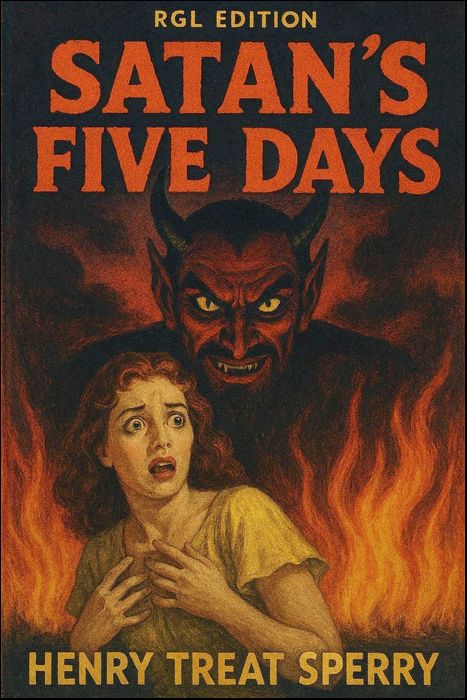
RGL e-Book Cover 2018©
Roy Glashan's Library
Non sibi sed omnibus
Go to Home Page
This work is out of copyright in countries with a copyright
period of 70 years or less, after the year of the author's death.
If it is under copyright in your country of residence,
do not download or redistribute this file.
Original content added by RGL (e.g., introductions, notes,
RGL covers) is proprietary and protected by copyright.
RGL e-Book Cover 2018©

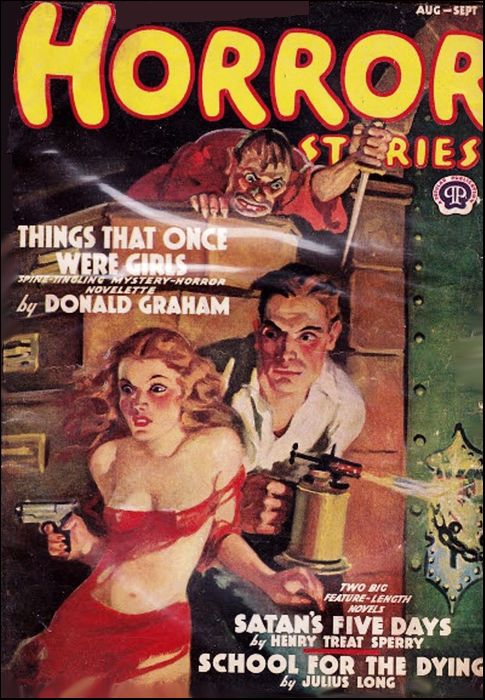
Horror Stories, Aug-Sep 1938, with "Satan's Five Days"
Like a vast, unquenchable plague, death and terror laid waste the countryside, and when they passed on, only bundles of clean white bones and gaunt desolation remained to tell what had happened. For the god of Evil held sway and the satanic hordes of the Black Friar would not halt—until they had sated their unholy desires!
THE President of the United States turned pale as the evening light from the windows of the north chamber fell on the little man sitting on the other side of the great desk, illuminating his dark, sharp-featured face with a strange, unearthly glow. The little man glanced at the watch on his slender, bony wrist. "In exactly thirty seconds," he said, "I shall be dead. My master, of course, did not expect a favorable answer to the—suggestion—which he has just made to you through me. It is too early, as yet. You and the nation are still skeptical, but unfortunately the delay will be responsible for many deaths and much destruction of property. Last night, I need not remind you, a considerable portion of the State of Washington was laid waste. Every tree in that area, every blade of grass, every stalk of grain—and every human being—was destroyed. Tonight, another section of the nation will be destroyed in precisely the same manner—and on the night following, and the night after that. Until either you and the people have come to your senses—or the entire nation has been—"
Suddenly the little man slumped side-wise in his chair, his pointed chin falling on his chest. His eyes closed and he spoke no more.
The President was on his feet, his eyes fixed in unbelieving horror on that small, relaxed figure. For a moment he stood as though turned to stone. Then his shaking hand reached out and pushed four call buttons simultaneously. He was still pushing them insistently, frantically, when the persons whom they summoned appeared at the door of the north chamber...
ON the evening of May 23rd, but a few moments after the dark little man had expired in the private office of the President of the United States, Lemuel Hulkins entered the kitchen door of his little farm-house and called to his wife.
"Mame, come here a minute."
Hulkins' wife had been setting the table for the evening meal. She entered the kitchen obediently and joined her husband at the window. The latter pointed a gnarled and grimy finger at a strange apparition which had suddenly appeared on the northern horizon.
"What," said Farmer Hulkins, "do y' make of that?"
The light of the westering sun flamed on a huge disk which stood on its edge at the visual limit of the flat farmlands. Apparently about a hundred feet in diameter, it gradually shaded from its light-colored periphery to a dark crimson splotch in its center. But the tinting might be due to the hues of the sunset.
"Gracious sakes!" exclaimed Mame Hulkins. "What is that thing, Lem?"
But Hulkins didn't answer. A sudden recollection sent him on the run to the living room. From the table next to his easy chair he snatched up a day-old paper. Ignoring the headlines, his eyes fell to the bottom of the first column of the lead story. He read:
"... It was reported by an Alberta farmer, located near Rossland, that just at dusk he had seen a huge circular shape rise in the air south of his farm, apparently right at, or very near, the U.S. border. It is thought the apparition may have some bearing on the disaster. Officials are investigating..."
Hulkins carefully folded the paper and lay it back on the table with hands which had begun to tremble a little. "That one was in the south," he muttered, "an' this one's in the north. An it was south of that other where the farms an' people was wiped out... That means—"
Suddenly he whirled and ran back to the kitchen. "Mame!" he shouted. "Mame, we gotta git outta here! Somethin's comin'—"
Mame was still at the window. Now she turned back to her husband, her lined face white and her worn old eyes large with terror.
"Yes, Lem," she whispered, "somethin's comin'." She reached toward him, clutched his shoulders with her bony hands and tried to force his grizzled head down on her wasted breast. "Let's pray, Lem..."
But in spite of his wife's efforts, Lem Hulkins saw the approach of his doom before it struck him—and heard it. The sound was like the roaring of a waterfall, gradually magnified until the whole world seemed drowned in mighty, tumbling waves. But what he saw was only a swift, all encompassing blackness which arose out of the north and engulfed his universe swifter than the fall of night, itself.
IT was a big moment in the life of Julie Winters. She was sorry that little Mary Walsh, her schoolfellow, was sick, of course—and that Miss Mason had decided to visit her in the hospital down at Flathead Lake, because it was Mary's birthday. But there was no denying that the schoolmistress's absence gave Julie a chance to exercise her organizing and managerial abilities to their fullest extent. And not only over her classmates, but the grown-ups as well. The "sociable" being held in the little frame schoolhouse had been an unqualified success, up to now—but it had bored Julie Winters. She had been waiting for the time when the last plate of ice cream and final portion of cake had been consumed, and she could order the assembled students and parents into their seats for the beginning of the "program of entertainment." For, with Miss Mason absent, she had been selected to act as Mistress of Ceremonies.
Standing on the little platform, from which Miss Mason's desk had been removed to make way for the entertainers, Julie smoothed the front of her new pink voile dress and waited calmly for silence. Finally the bustlings, whispers and muted chuckles died down, and Julie announced in a clear, young voice:
"The first number on this evening's program is a recitation by Mister Georgie Balmer. Come on up, Georgie!"
She bowed gracefully as applause resounded through the room and retired to her seat in the front row.
But Mister Georgie Balmer failed to put in an appearance. He was sitting in his chair, clutching its seat with small hands, and his eyes, in his freckled, newly scrubbed face, were getting larger and larger. For with the last words of Julie Winter's announcement, he, and every other person in the schoolroom, had become aware of an ominous roaring sound which seemed to come from the north and increase in volume with every passing second until it had swiftly assumed the proportions of a cataclysm of noise.
The windows, all open to catch whatever vagrant breeze might be astir on that sweltering evening of May 23rd, admitted the formless flood of sound—admitted, too, the black, roaring clouds which swept down from a little north of the Canadian border to engulf, sweep over, obliterate every atom of organic life in its path.
The living clouds passed on, and the roaring diminished and died away in the south. But little Georgie Balmer did not take his place on the platform to recite his poem. He would never speak or move again—and neither would a single one of the persons, young and old, who were to have been his auditors...
DAWN was just breaking over Flathead Lake as Dr. Delevan emerged from the elevator at the ground floor of the hospital and approached the four people sitting in a tense little group on the bleak benches of the reception foyer. He was careful to wear a smile as he walked toward them. Mr. and Mrs. Walsh, Virginia Mason and Peter Long were on their feet by the time he reached them.
"She's coming along fine," announced Dr. Delevan, still smiling. "The operation was a complete success."
"Oh, thank God!" Mrs. Walsh turned and buried her face against Gregory Walsh's muscular shoulder, sobbing with relief.
"Swell!" grinned Pete Long. He turned suddenly and planted a kiss full on Virginia Mason's red lips.
"Pete!" exclaimed the girl, as soon as she could speak. "You—you shouldn't—"
"Why shouldn't I?" exclaimed Long. "We've got to celebrate, haven't we?"
The girl at the desk interrupted them. "The Park is calling, Mr. Long," she said. "They say it's very important."
"All right. Coming right away." Pete Long turned back to Virginia Mason and whispered into her ear, "I'll give you several hundred other reasons why I should, as soon as I get back."
Then he went into the booth at the side of the information desk and closed the door.
When he emerged, white and trembling, a few minutes later, the Walshes and Virginia had walked with Dr. Delevan to the entrance.
At the sound of the opening telephone booth door, Virginia turned.
"Come on, Pete," she called, "we're going—" Then she saw Pete Long's face. Her heart suddenly gave a great thump, and then seemed to stop altogether. She started walking toward him. Pete leaned against the desk and watched her approach.
"Oh, God," he muttered to himself, "how can I tell her... Those kids..."
Virginia stopped in front of him. "What is it, Pete?" she whispered.
Pete Long straightened and grasped Virginia Mason gently by her slender shoulders. "Take it easy, Virgie," he said hoarsely. "I've got some—some very bad news... The thing that happened over in Washington yesterday, up near the line—it's—it's happened here, up north."
"Where— where!" gasped Virginia. "Not at Paulston—not in our country?"
Silently Pete Long nodded. "A patch ten miles deep and twenty miles wide. Every living thing, vegetable and animal, killed. Not a single survivor. Herman Lund just called me from Glacier Park. He's been over there—"
Then he grabbed at the girl, saving her, just in time, from slumping to the floor. He gently lifted her soft, lax body and carried her to the settee on the north side of the room. Dr. Delevan came hurrying toward them...
ON the evening of May 24th, the Secretary of State looked up from his desk at the agitated entrance of his secretary.
"There's a man out here, sir," he said, "who says he has important information regarding the devastation which has occurred in Washington and Montana during the past two days. He says—"
"Show him in immediately. Then call the office of the Attorney General and the Secretary of the Interior. Tell them to come to my office immediately. Also call the President—"
"And—and the police, sir?" interrupted the subordinate.
"Under no circumstances," snapped the Secretary of State. "And be sure you are not overheard when you make the calls. The press must not get wind of this. Show the man in immediately—and then get busy!"
"Yes, sir."
In a few moments a gaunt, fanatic-eyed man appeared in the doorway. His clothes hung with strange lankness on his wasted form, and the Secretary knew without doubt that they would turn out to be made of cheap muslin, of a type turned out in millions of yards by every textile mill in the country, and sold at every sort of dry-goods store from coast to coast. It would be without markings or means of identification of any kind. His shoes would be of pasteboard, cleverly fashioned to simulate leather, and as untraceable as the material of his suit and shirt. He was without a hat.
With a kind of horror the Secretary watched the man amble loose-jointedly toward him, and pause on the far side of the desk. As he came to a stop the man grinned like a death's head.
"I have timed matters rather badly," he said. "It took longer than I had anticipated to reach you... I have only a few seconds left—"
He coughed hackingly, but before the Secretary could speak he continued in a croaking voice:
"The President has turned a deaf ear to the request of the Black Friar. You, too, of course, will be adamant. As a consequence many more people must die, tonight, and much property be destroyed. Yet I must repeat the request of my master: In the name of the Universal Kingdom, will you and all other members of this government—the President, his cabinet, the two houses of Congress, the Justices of the United States Supreme Court, and all its subsidiary judicial personnel, the persons and officials in all branches of federal organization—immediately resign and retire to private life to await the coming of the just and righteous government of the Ruler of the World?"
As the harsh voice fell silent, the Secretary tensed his muscles, his eyes fixed rigidly on the gaunt figure opposite him. He did not speak or move, until, suddenly clutching at the region over his heart, the weird emissary grimaced, stooped slowly forward and suddenly dropped to the floor...
The Secretary sprang from his chair and, kneeling beside the wasted body on the floor, thrust his hand beneath the muslin coat. No life-pulse met his questing fingers, and he slowly rose to his feet, his eyes fixed in awed terror at the figure at his feet.
He was still standing there, when five minutes later, the Secretary of the Interior and the Attorney General of the United States burst into his office.
PETE LONG, government plant biologist employed in Glacier National Park, was a fairly tough-fibered young man. He had to be. His job, while nominally concerned with the welfare of such arboreal reservations as were put in his charge, had also a great deal to do with the men employed by the government in similar work. They were, for the most part, a hard-bitten crew—and a few, like Herman Lund, for instance, the man Pete Long had deposed as head of the biology division in the Park—were a trifle overly obstreperous.
But Long wasn't thinking of Lund at the moment—and he decidedly wasn't feeling tough. He was nearer to being physically sick with horror than he had been in his life.
Steve Tressiter, laboratory chief, stood at Long's side in the little schoolroom where Virginia Mason had taught the youngsters from the surrounding country for three years.
"Good God—" said Tressiter, over and over—"Good God..."
Mixed up with over-turned desks and chairs near the center of the room was a mass of what had been the bodies of sixty-two men, women and children. But they weren't really bodies, any more—they were just skeletons. Skeletons clothed in what had been their owners' best raiment. Skeletons without the merest fraction of an ounce of tissue, blood or sinew remaining upon them—as cleanly picked as though they had lain for months in the sun of a vast desert.
Outside the building the hum of an automobile rose and subsided. Pete Long turned from the grisly chaos of the room and looked out the door. The next instant his lank but powerful frame was darting across the bleak, barren school-yard toward the car which had just come to a stop at the gate.
"Lund," he shouted as he reached the machine, "haven't you got any better sense than to bring her here before—"
Virginia Mason, the other occupant of the car raised a slender hand. "Please, Pete," she pleaded. "I begged Herman to bring me. I've got to do something. Surely there's some way I can help—"
The girl broke off and began sobbing. Pete shot Lund a barbed glance which was returned with venomous interest, then reached out a gentle hand to the girl's shoulder.
"There isn't anything you can do," he said quietly. "Not a thing, Virginia. The coroner and the sheriff and Dr. Delevan will be here presently—though even they can do nothing but—but take care of the bodies. Please go back home. I'll do what I can, and come down as soon as I get through."
Lund's thick upper lip curled in a sneer, but he said nothing. At an imperious jerk of the head from Long, he slipped the car into gear, turned around in the center of the road and headed back in the direction from which he had come. Pete stood there at the gate watching the car until it was out of sight. You really couldn't blame Lund for hating him, he reflected. Long had taken his job—and now was determined with every fiber of his being to take Lund's girl. It wasn't fair, maybe—but it couldn't be helped. He sighed and walked slowly back to the shambles of the schoolroom.
WHEN the sheriff arrived he summoned Pete outside with a motion of his grizzled head.
"Look at this," he said, when the young man had joined him in a corner of the school-yard. He handed Pete a crumpled paper on which words had been printed, apparently with one of those sets of rubber stamps usually employed by children:
THE BLACK FRIAR REGRETS THE DISASTER WHICH HAS OVERTAKEN THE PEOPLE OF GLACIER COUNTY. BUT IT IS BETTER THAT A FEW SHOULD DIE AND A SMALL PORTION OF THIS VAST COUNTRY LAID WASTE THAN THAT VILLAINY AND SINFULNESS SHOULD CONTINUE UNCHECKED IN THE OFFICES OF GOVERNMENT. THE REMEDY, BOTH FOR THESE VISITATIONS AND THE EVILS OF THE ADMINISTRATION, IS IN YOUR HAND. LET ALL PEOPLE COMMUNICATE WITH THE GOVERNMENT, DEMANDING ABDICATION OF EVERY OFFICIAL. FROM THE CHIEF EXECUTIVE DOWN TO THE MEANEST CLERK IN FEDERAL OFFICE, LET THEM ORDER THE DISSOLUTION OF THE ARMY AND THE NAVY, OF THE AIR CORPS, THE COAST GUARD AND ALL BRANCHES AND DIVISIONS OF THE NATIONAL DEFENSE. AND LET NOT THE PEOPLE FEAR THAT THIS LAYING DOWN OF ARMS SHALL PLACE THEM IN JEOPARDY—FOR SOON THEY SHALL BE TAKEN UP AGAIN BY THE PEOPLE, THEMSELVES, HEADED BY A LEADER WHO SEEKS NOT GLORY NOR HONOR NOR WEALTH—BUT ONLY THE LASTING SALVATION AND HAPPINESS OF ALL THE PEOPLES OF THE EARTH, IN THE NAME OF THE UNIVERSAL KINGDOM.
HE RULER OF THE WORLD.
"What do ye make of it?" asked the sheriff as Long finished reading the strange document.
"Have you shown this to anybody, yet?" returned Pete.
"No—I hain't. It was on the door of my office this morning—tacked there durin' the night, I reckon. I figured to wire Washington about it, but just as I got to the depot, Jeff Yardley, the agent, handed me a message from the Department of Justice, sayin' some officers were flyin' out here, an' would git here sometime today. I figured to wait and show it to them."
"Better wire Washington, anyhow," advised Pete. "Or I'll do it, if you want me to—I'm going back to town. There's nothing I can do here."
"Okay," said the sheriff, "I'll copy 'er down for ye."
After he had painstakingly transcribed the message, Long folded the paper containing it and slipped it into the pocket of his flannel shirt. Then he got in his car and headed back toward the village of Burke's Crossing, his brain still stunned with the magnitude of the disaster which had transformed this formerly thriving farm and lumbering belt into an expanse of unimaginable desolation.
As he traveled he gazed with eyes which contained a smouldering, bitter rage at the tall, naked poles which had been trees, at the barren, vegetationless wastes which had been farms. At the silent, tenantless houses which had been homes. But as yet, he reminded himself, they were not quite tenantless. Most of them still contained the white, dry bones of people who, but a short day since, had lived and breathed and moved about, filled with hope and purpose.
"God!" he muttered to himself. "What does it mean? How was it done?"
It was as though a flameless fire had swept through that two hundred square miles of the country—a fire which burned every living thing in its wake—vegetable or animal—but left no charred remnants, no smoking particles to proclaim that it was the sort of fire which any human being had ever heard of before.
He had not visited the country over west, in the adjoining state of Washington, which had suffered this same fate—but he knew from the newspaper accounts which had swept from one end of the nation to the other on the day previous, that the devastation wrought there had been similar in every respect to that which lay before his eyes.
He shuddered, then, recollecting the narrowness with which the girl he had learned to love in the few short weeks he had been in this north country, had avoided the fate of her pupils. Only the fact that little Mary Walsh had been stricken with mastoiditis, and that Virginia had insisted on visiting her had prevented her from being present at the time the scourge had struck...
PETE'S car rolled to a stop in the rear of the tiny railroad station at Burke's Crossing. He got out and went inside, began to write out his message to Washington on a telegraph form at the desk.
"Been out to Paulson?" queried Jeff Yardley, the agent, and at Pete's nod, he continued: "There's goin' to be big doin's around here before long. A hull slew of gov'ment and state officials are comin' in on No. 9. Some comin' by plane, too. And the Gov'nor's ordered out the militia. Un'erstand Canada and the U.S. is goin' to mass troops all along the border—"
Pete thrust his message through the wicket. "Send this right away, Jeff," he said. "And don't talk to anybody about it, please."
Jeff looked injured. "Who—me? Why, I never breathe a word of what goes over the wires—not a word!"
Pete grinned at him quizzically and left. He drove out to Glacier Park and went to his quarters—a fairly commodious log house which he shared with Lund, Tressiter and Clark, the three men, who under his direction, supervised the care of the vegetation in the huge Federal reserve. A small object in the center of the living room floor caught his eye as he entered. He stooped and picked it up. It was a small wooden block, lathed out on two sides to furnish a grip for the fingers and having a rubber letter "E" glued to the base. He examined it absently, his mind full of the horrors he had lately seen, and tossed it on the table at the west side of the room.
He had not gone to Virginia's home, as he had promised, because he felt the need to be alone for awhile. There was something about this disaster which plagued him in a mysteriously persistent fashion—some lurking idea in the back of his mind which it seemed to be striving to evoke. What was it?
He wracked his brain for several minutes, trying to analyze the reminiscent quality of what had happened in the State of Washington yesterday, and in Montana last night. He gave it up, temporarily, at last, and went to the phone. He called Virginia's home, and was answered by Mrs. McLeod, mother of the family Virginia boarded with.
"No, Virginia ain't come in yet, Pete," reported Mrs. McLeod. "Sure, I'll have her call you as soon as she does..." She asked him about conditions at the school, gasped and made shocked exclamations as he told her. He hung up, finally, and turned away from the phone to find Tressiter and Clark had entered while he had been talking.
"Hymenoptera gall's busted out again in the black poplars," reported Clark. "I've excised three trees and treated 'em with this salve of yours." He held out a circular tin box about three inches in diameter and an inch and a half deep. Long took it absently, opened it, and smelled of the resin-like salve which it contained.
"Okay," he said. "This is part of the new batch. It ought to work." He closed the box and put it in his breeches pocket. "I'll treat a few of them this afternoon."
The conversation revolved about the work to be done in the park, all three men avoiding mention of what had happened near Paulson during the night. Appalled though they had been at the destruction of human life, these tree men were really much more concerned with the possibility that the scourge would strike their beloved forests, than that they, themselves, might fall victims to its devastating fury. Tough-fibered they might be—but they were attached to their towering, leafy charges with a selfless devotion.
A car braked to a stop in front of the cabin, and in a few moments Herman Lund entered. Pete looked up. Then he went immediately to the phone and called Virginia's home again. Mrs. McLeod still reported that the girl had not put in an appearance.
"Do you mind telling me where Virginia went after you left her, Lund?" he asked.
"No, I don't mind," said Lund in a deliberately insolent tone. "I took her to old lady McLeod's—and she went in."
"That's rather strange," said Pete. "Mrs. McLeod just reported that she hadn't returned yet."
Lund favored him with a nasty grin. "I'm afraid you're being a little naive, old man. When a girl wants to get rid of an undesirable caller, she usually leaves word that she isn't in."
Pete's fists clenched automatically, but he controlled himself. He doubted seriously that Virginia, granting that she didn't want to see him, would prevail upon Mrs. McLeod to lie for her. Virginia didn't do things that way. He suddenly found himself getting worried—but he knew it would be worse than useless to question Lund any further. He put on his hat and had started for the door, when a sudden exclamation from Lund, who had stopped at the side of the table, brought him to a halt.
"Hello—what's this?" Lund was holding up the rubber stamp which Pete had found on the floor as he entered.
"I found it," said Pete, "on the floor." A sudden thought came to him, and he hesitated for a moment. But concern for Virginia gripped him again—locating her was the most important thing at the moment.
He went out and got into his car.
"THAT Herman Lund was jest tellin' a big story," insisted Mrs. McLeod emphatically. "Virginia left with him not half an hour after you brought her home early this mornin'. She was bound an' determined she was goin' out to the school. She ain't been home since." Pete thanked her and left. He headed the car for Burke's Crossing, hoping to find that Virginia was visiting some friends in the village. On the way in he stopped at the homes of two of them, but there was not a person in either house. Finally he entered the village, itself, and came to a stop in front of the "Post Office and General Store."
Apparently everyone within miles around had congregated in the village. The people were obviously half-frantic with excitement and fear. Hysteria was beginning to sweep over the north country in the wake of the mysterious scourge. No one knew where or whom it would strike next. As he dismounted from his machine, it occurred to Pete that the devastated areas were probably safest—since it would be improbable that a second visitation would occur in the same section. The only trouble with that was, of course, the inability of such sections to support human life for any protracted length of time—at least until new crops had time to grow...
Suddenly Pete was mildly surprised to find himself in the center of a crowd on the sidewalk—a crowd which, it was soon apparent, was distinctly hostile.
"There he is," a voice suddenly shouted. "There's the black-hearted murderer. Git him!"
The shout was echoed by the crowd—and in an instant Pete found himself held by a dozen men, and unable to move a muscle.
"What the devil is this?" he exclaimed. "What's the matter with you people?"
For answer, a fist shot out and smashed him in the mouth. "String him up!" someone yelled.
"No—not yet!" shouted another. "Find out what he knows, first. Make him tell who his boss is—and where we can find him. If he don't want to talk, I reckon I kin g'arantee to make him!"
Pete spat the blood from his mouth, and with a sudden furious wrench, tore loose from the grip of the men who were holding him. Then his big, hard fists lashed out, and in a few seconds he had cleared a considerable space about him, and the crowd was drawing back out of range. Pete stopped then, and made no effort to break out of the circle of men who ringed him in.
"Now," he said, "will someone be kind enough to tell me what all this nonsense is about?"
There was a moment's silence. Then one of the men in the back of the crowd handed forward something to one of the men in front. "Here, Bob," he said. "Show him these—as if he ain't never seen 'em before!"
Pete looked down at the objects in the man's hands. One was a piece of paper, and the other was a small open cardboard box containing a set of printing blocks, like the one he had found on the floor of the cabin. Silently he took the paper and unfolded it. It was the message the sheriff had shown him that morning—or one precisely like it.
"Where did you get this?" he asked quietly.
"Off'n the Post Office door—where you put it," came a shout. "An' it was printed by that set—which was found in yore trunk by yore bunkmates. I suppose yore goin' to deny you ever seen 'em—or that you sent the self-same message to Washin'ton, this mornin'."
Pete looked steadily at his accuser. "I've seen this message—or one like it," he said. "The sheriff showed it to me this morning; he said he had found it tacked to his door. I sent a copy of it to Washington at his direction. I've never seen the printing set before, and haven't any idea how it got into my trunk—unless it was put there by someone who wants to throw suspicion on me and direct it away from himself. Supposing you send someone out to the schoolhouse. The sheriff can verify part of my story."
One of the men laughed sarcastically. "Nacher'ly he wants to send for the sheriff," he said. "He knows the sheriff'll try to keep us from lynchin' him!"
"Anyways," added another, "the sheriff cain't explain how that printin' set got into yore trunk, kin he?"
Pete reflected for a moment. These men weren't thinking normally or clearly. They had been wrought up, made savage by the events of the past two days. They were faced with horrible disaster—and none of them knew how to combat it. The suspicious circumstances which were centered about Pete—a comparative stranger in their midst—gave them something tangible to grasp at, to wreak their thirst for vengeance upon. He was in a bad spot, and he knew it.
"Come on—let's stop stallin'," someone shouted. "The sheriff'll be comin' back soon. Let's put the screws on this guy—and then string him up!"
Pete fought hard, but they were too many for him. "Take him around in Sturtevant's Alley," advised one of them. "We'll give him a taste of one of Sturtevant's black-snakes, first."
Sturtevant ran the town's harness store. The alley behind his store was narrow and walled-in on either side by high board fences. Pete realized that, of necessity, part of his captors would have to fall back as they entered it. If only too many of them didn't precede him he might be able to make a break...
As it turned out, no one preceded him. All the men fell back, except two on either side. Pete chose the moment before they were to turn into the yard behind Sturtevant's store to make his bid for freedom.
He gave a tremendous lurch, throwing two men sprawling, and found himself in the clear. Then he raced off down the alley with every ounce of speed in his body. The men howled, and set off in pursuit, but Pete soon distanced them. He turned out of the alley and headed across an open pasture, backed by a dense clump of trees. The forest, he knew, extended as far north as the border. Ten minutes steady running through it left all sounds of pursuit far behind.
BY sundown, May 25th, troops from Forts Benton and Logan, in Montana, had been massed along the border between Canada and the United States. Canadian Cavalry from the Ninth District were patrolling the other side of the line from French River as far east as Boissvaine. A detachment had been sent north from Fort Berthold, North Dakota, but had not yet arrived. However, both United States and Canadian pursuit planes were flying above the border at low altitudes between Fort William, near Lake Superior, and North Portal in Saskatchewan. The enlisted men and the pilots had been instructed to watch especially for the appearance of large discs, or cones; but up to nightfall none had been reported.
Had their search been centered about an area exactly 300 miles to the south of the border, and approximately ten miles east of the town of Sheridan, in the State of Wyoming, they might have been more successful.
At four o'clock in the evening six huge tank trucks passed through Sheridan, headed east. The trucks were painted grey, and aside from the fact that they bore no lettering of any description, differed in no respect from thousands of other such trucks which had passed through the town since the opening of the Gray Bull and Mid-West oil fields near the mid-section of the state. They attracted no more than passing attention.
The main highway turns south, shortly after passing through Sheridan, but the trucks took a little-traveled lane which branches off from it, and continued east. At length the lane faded out and disappeared, but the trucks kept on, rumbling over the sun-baked earth on their enormous tires, crashing through sagebrush and scrub-oak imperviously.
When they had covered ten miles, the last truck in the line came to a stop; but the other two kept on. However, the driver of the truck which had halted made no move to get out. He turned off his engine, but remained in his seat, watching the others disappear into the distance. Three miles and a half farther on, the second truck stopped—and the same distance beyond that the first came to a halt. The driver glanced at his watch.
"Just in time," he muttered to the two men seated at his right in the commodious cab of the truck. "Let's get busy."
The three men dismounted and went to the rear of their great machine. The driver opened a sort of locker-cupboard which had been erected in the rear of the huge tank, and began to pull out voluminous rolls of canvas. One of his mates dragged forth a series of steel tubes which had been suspended beneath the chassis, and the third man began bolting them together.
At precisely the same moment identical operations were being performed by the personnel of the trucks which had been left behind. Likewise, at three points on a line ten miles directly south, other trucks were standing in the twilight of the prairie. Their crews were engaged in the same operations as those being performed by the men in the north.
Before the sun had sunk entirely below the western horizon, six huge canvas cones had been erected at the site of the six trucks; the large ends of the ones in the south faced north, while those in the north faced south. Between these yawning orifices stretched a fertile grazing country, populated by approximately 800 souls, and furnishing subsistence to herds of cattle numbering in the neighborhood of twenty thousand. As twilight deepened into darkness, a deep roaring arose from the cones in the north, and strange black clouds emerged from their vertices, expanded, and swept toward the south, propelled by a blowing mechanism located in the rear portions of the tanks to which the cones were connected by thick canvas tubes. Within four hours the clouds had passed over the entire section of country between the two lines of trucks, and had been sucked into the cones in the south, leaving behind them nothing but fleshless bones and vegetationless fields...
ON the morning of May 26th, the House of Representatives in the national capitol at Washington, D. C, was in a state bordering on turmoil. The Speaker rapped repeatedly and in vain with his gavel. The Sergeant-at-Arms circulated among the excited, arm-waving legislators, fruitlessly striving to restore order. Suddenly a fist-fight broke out between two representatives, from Minnesota and Idaho, respectively, and the Sergeant-at-Arms gratefully abandoned his attempts at diplomacy and forcefully ejected the belligerent members.
After that some degree of decorum reigned. The Speaker's voice became audible.
"Gentlemen! Gentlemen! We must have order. The gentleman from Wyoming has the floor. You will all be given an opportunity to address the Chair later... Proceed, Mr. Carpenter."
The Representative from Wyoming was a tall, broad-shouldered man with a wind and sun-tanned face. His deep but quiet voice now rolled out over the chamber.
"As I was sayin'," he announced, "I, for one, vote on complyin' with this Black Friar's demands—until such a time as he comes out in the open, or we get some lead as to his whereabouts. Any other course, it seems to me, means death to an increasin' number of our citizens. So far we have been helpless to keep this 'Ruler of the World', as he calls himself, from doin' exactly as he wishes. Apparently he has at his command some power or force which is new to us. How do we know that he cannot, if he wants to, obliterate the whole nation, overnight? We are unable to stop him, at present, anyway. It behooves us, therefore, to take thought of those who look to us for safety and guidance in these troublous times, and reserve any action which we may decide to take until it is apparent that such action will stand a reasonable chance of succeedin'..."
He paused for a moment and looked about him. His colleagues had fallen silent, watching him with varying expressions of apprehension and strain.
"Gentlemen," he continued, "because neither I nor anyone else has been able to suggest a reasonable course of action in this contingency, I herewith bow to the unseen menace which hangs over us all. I resign from my seat." He turned and walked out of the chamber, leaving reborn bedlam behind him.
After a prolonged struggle, the Speaker was again able to restore order. Lucius Pointer, Representative from the fourth district, Delaware, got the floor.
"Mr. Speaker," he shouted excitedly, "the action of the gentleman from Wyoming sets a dangerous precedent which must not be permitted to stand, cost us what it may. It is obvious that we are dealing with an unknown force, as he stated—but the way to meet force is with force. Let us mobilize our army and our air corps. Let us march upon this menace with colors flying and with courage and determination in our hearts. Let us run the enemy to earth before he can again exercise his powers of destruction and—"
Suddenly there was a disturbance in the jammed upper gallery. A deep sepulchral voice boomed out.
"The Representative from Wyoming showed good judgment," said the voice. "Follow his example—or you will live to regret it. The Master makes nothing of your military forces or your courage and determination. He has at his command a force so powerful, so destructive, that the massed armies of the world are as helpless as babes to stand against it. Be warned! Resign—and wait the coming of the Universal Kingdom—"
"Get that man!" yelled the Delaware Representative. "Hold him—" He made a dash for the corridor, raced down it and up the staircase leading to the gallery. He elbowed his way through the crowd jamming the entrance, and presently reached the side of the individual who had interrupted him.
The latter was a middle-aged man with a full, heavy-jowled face and close-cropped grey hair. He was sitting on the floor of the gallery with his head slumped forward on his chest, supported on either side by an usher. He was quite dead.
AS the afternoon wore away, Pete Long found himself nearing the northern edge of the forest. He debated the advisability of turning back, or pushing on toward the border—and finally compromised by turning to the left and taking a course which paralleled it. Some instinct began leading him toward the section which had been devastated. Perhaps there might be a clue to the identity of the monster who was perpetrating these stupendous crimes—and he could skirt the area on the way back to Burke's Crossing and Paulson with less chance of running into his former captors.
Pete was worried about Virginia. There were dozens of reasons to account for her absence from home—and for Lund's lying report that he had taken her there. But with an unknown menace stalking the country, all logic and reason had been distorted, and to Pete her absence was beginning to assume a sinister significance. He had to get back, if only to assure himself that his too imaginative fears were groundless...
Immersed in his thoughts, Pete came to the wasted area and walked into it almost without realizing it. He halted and looked about him.
With an uncanny exactness, the foliage of the spruce, pines, poplars, beech and birch trees, and the grasses and grains of the earth, ceased to exist at this point. In front of him, and extending as far on either side as he could see, lay an unbroken area of leafless, vegetationless land. A hundred yards from where he stood ran a north-and-south highway. Nearly opposite him on this road stood an old spring wagon, between the shafts of which lay the skeleton of a horse, gleaming in the afternoon sun. On the near side of the road was a crumpled heap of clothing which likewise showed gleaming patches of white—all that was left of the bodily structure of him who had been the driver.
Pete shuddered, and turned toward the south, skirting the area of desolation and heading back toward the town he had so precipitately left; but he had taken no more than a score of paces when he came to a halt, stooped and picked a small, shiningly black object which had caught his eye in the dust.
Of necessity, Long was something of an entomologist—but he had never before seen the like of the insect which he now held in his hand. It was about an inch and a half long, and gave the superficial appearance of being some sort of outsize, winged ant. But it was like no ant the young scientist had ever heard of before. Armed with a vicious pair of mandibles which accounted for a full third of its length, its body was covered on the top and sides with a glittering black calcareous sheathe which seemed, to the touch, as hard as steel. The under side of the insect, on the other hand, was so soft and pliable as to respond to the faintest pressure. It was much distended, and bulged out beneath its top armour like a sponge in a teacup. One of its large gossamer wings was broken off. The insect was dead.
For a long time the young biologist examined his discovery. Then, with a thousand excited speculations revolving in his mind, he placed it carefully in a pocket of his shirt. This strange new formican might mean only that his entomological education was sadly incomplete—or it might contain a secret of untold importance...
As he started walking again, the corner of his eye caught a movement to the left and a little behind him, in back of the tree nearest him. He attempted to spring away, but he had seen the movement too late. He felt an iron grip close on his arm and saw something swing in the air above his head. He had just time for the bitter realization that his neglect in watching his back trail had given his pursuers an opportunity of closing in on him—when something crashed down on the back of his skull, and he fell headlong into the black sea of unconsciousness...
PETE LONG regained consciousness with a feeling of cold dampness in his face and the penetrating odor of ammonia in his nostrils.
"There," said a low, vibrant voice, "he's coming to nicely. You may go, now."
Dizzily Pete opened his eyes. Through fogs of pain, he saw that he was in a large chamber. Its walls, floor and roof seemed to be of dried clay—but an incongruous contrast to this were the electric lights strung overhead on scantlings secured to the ceiling, the large desk opposite him which supported a lamp, telephone, and was littered with papers—and most incongruous of all—the man who sat behind the desk.
It was this man who had spoken; but in spite of his faultless accent, Pete knew at a glance that he was a foreigner. His swarthy, olive-hued skin, his dark, glittering eyes and the continental twist of his waxed black mustache gave indisputable evidence of that. He was dressed in a military appearing tunic which, however, was closed with plain buttons and bore no insignia. As the man arose and came around the side of the desk, Pete saw that the lower portion of his body was encased in fawn-colored riding breeches and ox-blood cavalry boots. A second man, bearing a small bottle and a damp cloth in one hand, was just disappearing through the steel door set into the wall to the right. Pete noted that the door closed—and then sprang back a little way, so that it stood slightly ajar.
The man before him was short but slender and compactly built. He folded his arms and negligently leaned back against his desk. "How is your head?" he asked in his low tones.
"Not so good," said Pete shortly. "Where am I?"
"That you will discover in due time, doubtless. In the meantime it is I who must ask the questions. To whom have you reported your findings?"
Pete rubbed his hand over his eyes. He believed that the pounding in his head was receding a little, but it still hurt.
"Findings?" he echoed. "What do you mean?"
The man paused for a moment as though to add weight to his next words. Then he said. "Let us understand each other at once. I have at hand the means to force you to tell me the things I desire to know. You are a brave man, or you would not be engaged in your present activities—but, story books to the contrary, no man was ever able to keep a secret under the last extremities of expertly administered torture. But I shall not argue with you. Nothing carries home a message like an illustration. We have lately discovered in our ranks a man who planned to betray us to our enemies. I will permit you to witness our method of dealing with recalcitrant persons."
The dapper little man turned and pressed a button on his desk. In a few moments a soldier in a grey uniform and trench cap entered, came up to the desk and saluted.
"Bring Sellini," said Pete's captor.
The soldier saluted again and retired. In a few seconds he returned with another soldier. Between the two men was a third, in shirt and breeches, his hands were tied behind his back, and his face was very pale. He kept his eyes fixed in a kind of anticipatory horror on twin steel doors opposite the door by which he had entered.
The little man now turned back to his desk again, and pressed another button. The steel doors drew back and the prisoner between the two soldiers screamed.
Pete hardly blamed him. A huge, circular disk of heavy plate glass was revealed, about ten feet in diameter. Behind it swarmed a myriad horde of small, shining black bodies, and Pete instantly recognized them as blood-brothers to the one he had picked up just before being knocked out and captured. The only difference was that these insects were very much alive, crawling about and tumbling over each other in a constant if purposeless moil of activity.
"Only the feet and ankles," said the little man—and the prisoner screamed again. Then he suddenly broke into an incoherent babble in a language strange to Pete—but it was plain that he was pleading for mercy. The little man said nothing, and the soldiers dragged him remorselessly toward the glass barrier.
They led him around to one side where a series of steps had been built into the earthen wall of the place. Pete saw that the receptacle enclosing the insects was really a large tank with a small platform on top. The soldiers led their prisoner up these steps, then paused on the platform while one of them picked up a square piece of board with two holes cut in the middle. The board was in two sections, hinged laterally. While the other soldier removed the struggling prisoner's shoes and socks, this man opened the two sections of the board and then, as soon as the prisoner's feet were bare, clamped them about his ankles, locking them in position with an adjustable hasp.
The soldier who had removed the prisoner's shoes now forced him to stand up on the forward section of the platform, while the other uniformed man bent suddenly and with a quick motion, pulled back what was evidently a sliding trap-door. The prisoner immediately sank into the tank to the level of the boards about his ankles—and his screams became a thing of blood-curdling horror.
The ordeal was over in less than five seconds—although it seemed like an hour to Pete. At a word from the man before him, one of the soldiers jerked the prisoner upward, and the other pushed back the open section of the platform in a flash. The prisoner drooped between them in unconsciousness—and a strong shudder shook Pete to his heels.
In that short time the prisoner's feet and ankles had been completely denuded of flesh!
"AND now," said the dapper little man, "I think it must be clear that I mean business."
Pete looked at him with sick eyes. He was seeing the whole countryside swarming with the little black monsters behind that glass. He was seeing flesh stripped from human bodies with incredible speed; seeing those bodies eviscerated, left skeletons almost before one could count ten. But how in the name of all that was horrible had it been managed? Were these insects trained to go out at their master's bidding—and return after their grisly mission had been accomplished?
"Listen, you," said Pete, "I don't know who you are, or what you want of me—but whatever it is, you aren't going to get it."
The little man smiled with an assumption of amused tolerance. "I call myself the Black Friar," he said. "It's just a whim—and I must be called something. You see, I once studied for Holy Orders... You are an agent of the government of the United States. The guard who picked you up found one of our little flying emmets in your shirt pocket, along with a copy of one of my latest manifestos. We found a pay envelope in your wallet bearing the great seal of the government—and as if that wasn't enough, we found also a letter bearing the heading of the Department of the Interior, authorizing you to increase your working staff by the addition of two men...
"Now you will kindly tell me the extent of your information about us, whether you had actually discovered the secret entrance to these tunnels, toward which you were heading at the time of your apprehension—and how much of your information you have communicated to your superiors. And I warn you, do not lose time. It is very important for me to know."
Pete opened his mouth to say that he knew nothing—and that he was not, as this man supposed, an agent of the Intelligence Bureau. He would not be believed—and he would be tortured to death if he stuck to his story. In fact, he was doomed, anyway. He closed his mouth again, and considered.
The last time the door had opened, he had not seen the guard outside whom he had supposed was stationed there. The door had sprung back a little way, again, but he now believed that its action was due to faulty hanging. God knew where that corridor led—or how many soldiers were stationed beyond it—but it would be better to die fighting them than to perish under the fangs of those little black monsters behind that glass.
He arose from his chair in leisurely fashion and took a step toward the little man who called himself the Black Friar.
"All right," he said, "I'll tell you—" Then he lunged.
But the Black Friar, the moment Pete rose to his feet, had reached for the automatic holstered at his side—and by the time Pete made his lunge it was out.
Pete grabbed at it with his left hand, as his right rose in a smashing blow to the little man's chin. It connected, and the Black Friar went down.
Pete's left hand had retained its grip on the automatic. He whirled toward the door and kicked it open. A long, dimly lighted corridor stretched ahead of him, showing a turn to the left at its far end. He reached the turn in a headlong dash, rounded it—and found himself confronted by two men in uniform.
Pete's gun blasted twice—and the two soldiers went down before they had time to realize what was happening He hurdled their bodies and sped on.
Suddenly the tunnel took an upward slant—in the next moment Pete suddenly popped through a leafy bank of tree branches and found himself in the open.
Night had fallen, and a full moon rode the sky—but the fugitive took no time to note his surroundings. He plunged for the obscurity of the woods ahead of him—speeded on by the sudden roar of a pistol behind him, and the whine of a bullet near his head. Then he had reached the shelter of the trees and was dodging through them with the speed of a hounded deer, hurdling clumps of brush and tearing through webs of vines like a human juggernaut...
PETE could not keep up the killing pace he had set for himself all the way back to Burke's Crossing; but he alternately walked and ran, and made good enough time, he was confident, to keep well ahead of his pursuers—if any still followed him. At length he reached the village. He kept to back streets and alleys and made his way to the railroad station.
A glance through the window assured him that the night man was on duty, and that no one else was in the place. He went in, and holding in prominent view the automatic he had wrested from the Black Friar, he said:
"I have a message which I want you to send to the War Department in Washington, D. C. If you try to call anybody until after you have sent it, I'll kill you."
The agent-telegrapher cringed visibly. "Gosh, Mr. Long," he said, "I ain't goin' to call nobody—honest."
Pete put his weapon down on the counter and picked up a pencil. He rapidly wrote out a description of the place he had just escaped from, giving its location as nearly as he could, and suggesting certain precautions to be taken before it was attacked.
He finished the message, handed it to the telegrapher and waited long enough to be sure, from his knowledge of code, that the fellow was actually sending it. Then he interrupted the man long enough to ask:
"Have you heard whether or not Miss Mason has been found, yet?"
"No, she ain't, Mr. Long. Don't git sore—but folks say it—it was you who tuk her away. Course, I know that's crazy, myself—"
Pete swore briefly, and walked out of the building. He turned sharply to the right, then to the left—into the alley which paralleled the main street on the south side. He determined to get out to the park, find Lund and force the truth concerning Virginia out of him—at the point of a gun, if necessary. There was only one possibility now: Lund, himself, had abducted Virginia. He had sequestered her in some well-concealed place, and returned to provide himself with an alibi—and incidentally take advantage of the temper of the townspeople to throw suspicion on Pete Long...
The eastern boundary of Glacier Park is only about five miles from Burke's Crossing, but Pete's cabin was nearly three miles further on toward the interior. His path led him past a small storage shack, located just inside the boundary which had been erected prior to his arrival, and which had been used by Lund for the protection of extra supplies such as climbing gear, tarpaulins, pruning shears, tar, etc. A vagrant impulse led Pete to pause at the door of the shack. After all, there were not so many places in the vicinity where a human being could be hidden without considerable chance of discovery within a short time—but this, now that he thought of it, happened to be one of them...
The ground was carpeted with pine needles, and so revealed no footprints, new or old; but Pete suddenly began working at the padlock on the door with growing excitement.
Lund had the only key to this lock, but using the butt of his gun as a hammer, the young biologist sprung the link with a few solid blows, and opened the door.
The moonlight, pouring into the little building, faintly illuminated a greyish shadow lying on the floor at the back—a shadow which now moved, accompanied by a thumping sound. Pete sprang inside—and the next moment was raising the bound and gagged figure of Virginia Mason in his arms. A moment's swift work with the gag and the ropes which bound her—and the girl was free.
Virginia immediately threw her arms about Pete's neck. He held her close...
"He asked me to marry him—and I refused," explained Virginia, after a few moments. "Then, instead of taking me home, he drove me out here. As soon as we got near the park he stopped the car, dragged me off into the trees and tied me up. Then he carried me to this place and left me here. He said he was going to get a high post in the revolutionary government which was coming to power in a day or two—and that I'd be glad enough to accept him, then—"
The muscles at the sides of Pete's jaw bulged, but he said nothing concerning his plans for the re-arrangement of his colleague's features which the girl's story had given birth to in his mind.
"Let's get out of here," he suggested, instead. "There may be some people on my back-trail whom it would be just as well for us to avoid—"
He led Virginia out of the cabin into the moonlight—and came to a sudden halt. Facing them were two soldiers of the Black Friar with large-bore automatics in their hands.
"Yes," hissed one of them, "it would be just as well, signor—but unfortunately for you, impossible!"
Pete took an involuntary step toward the speaker, and saw his finger tighten on the trigger of his gun.
"I advise, come quietly," said the fellow. "In case you resist, we must regretfully kill the young signora. You, we must bring back alive, if possible."
The man advanced, pushed the muzzle of his gun into Pete's mid-section and took the automatic from his belt. Then, at the low-voiced command of his captor, he turned and headed back toward the eastern boundary of the park, followed by the soldier, Virginia and her captor, in single-file...
The journey back, through circuitous routes which avoided all roads and habitations, seemed to Pete to take a lifetime. He knew that the soldier had not been lying when he said that any break for liberty on his part would inevitably result in Virginia's death. They would be glad to get rid of the girl, and only allowed her to live, probably, in order to insure his non-resistance.
They entered the underground headquarters of the Black Friar by the same leaf-screened portal whose threshold Pete had twice crossed before. But this time they turned off to the right through a corridor new to the tree-expert, and were halted, at last, before a grilled door set in a hollowed-out crypt in the side of the wall. Pete's captor produced a ring of keys, unlocked the door and thrust him inside. Virginia followed him, and they found themselves in a cage having a steel floor and enclosed on all sides by stout iron rods. It was lit by a single overhead bulb of low wattage, whose fluctuating gleam gave evidence that the current supplying it originated in a small portable gasoline generator.
The soldiers slammed the door, locked it, and disappeared.
In the dim light Virginia came close to Pete, and he put his arm around her.
"What will they do to us, Pete?" she asked.
He tried to smile at her reassuringly. "Nothing, darling," he said. "I've sent—"
He was about to tell her of his wire to the War Department—and then realized that, if someone had not been stationed outside the door to listen, the cell was probably provided with a concealed microphone. Their captors would hardly overlook the possibility that the conversation of the prisoners might reveal the information they wanted.
He whispered his fears with his lips pressed against her small ear—and added the information about the telegram. "The Department will direct the troops nearby to this place immediately. Undoubtedly they are on the way, already. We have nothing to fear—"
He wished he could believe his own words. Even as he whispered to her, he shuddered. He could not keep from his mind the vision of this girl's lovely body buried beneath a horde of the devilish insects he had seen strip the flesh from a man's feet and ankles within the space of a single breath...
THE night of May 27th saw outbreaks of the scourge in northeastern Colorado, central Nebraska, north-central and southwestern Kansas, and two places in northern Texas.
Both houses of Congress were in session all night long. Telegrams and letters by the tens of thousands had begun to pour in upon the Senate and the House, a few advocating staunch resistance to the Unseen invader—but the vast majority urging the resignation of the government in a body, at least temporarily. Most of the latter came from states which already bore the marks of the Black Friar's visits—and from states immediately adjoining them.
To most of the people the idea of resistance to a power which struck apparently at will, and which retired without leaving a single survivor in its path, was tantamount to challenging the supernatural puissance of the Devil, himself. Morale was swiftly breaking down under the lash of the unknown and the unpredictable. The army, apparently, was helpless; and the areas devastated—although representing but a microscopic fraction of the entire nation—loomed large and frightening in the public imagination. It was the completeness of the annihilation which impressed them—and the lack of any first-hand observers to describe the manner in which it had been accomplished.
The newspapers broadcast photographs of the blighted areas—and special issues of the "picture magazines" rushed to the newsstands with even more graphic and imagination-stirring mementos of the havoc. One showed a pitiable skeleton in a housedress, clutching in its grisly, fleshless arms a tiny replica of itself in a "jumpersuit." Aerial photographs delineated the unprecedented desolation of the stricken areas in a manner to drive eerie dread deep into the stoutest heart.
The War department was plagued with a sense of its own incompetence to cope with the menace—and painfully impressed with the inadequacy of its equipment and personnel to police the three million square miles comprising the United States of America. For it was rapidly becoming clear that nothing short of constant patrol of every one of those square miles could hold forth any hope of running the invader to earth. The enemy's ability to appear in sections widely separated from each other, deliver his staggeringly effective blows—and then seemingly disappear into thin air led many to believe that no human agency actually visited such areas, but that the havoc was accomplished by a species of remote control—an "invisible ray" or a new form of radio activity.
The proponents of this theory urged the use of directional radio beam finders, and many such were employed in and near the states which had been affected—without result.
Pete Long's wire to the War Department was only one of many hundreds of such messages which had been received during the past few days—all giving a definite location where suspicious activity had been observed, or accusing certain individuals or groups of individuals of having caused the scourges. It was filed with the rest—to be considered and acted upon when its turn came...
SEATED on the cold floor of their cell, Virginia napped fitfully with her dark head against Pete's shoulder. There was, however, no sleep for Pete. Throughout the long night he cudgeled his brain for some plan which would provide at least Virginia with a chance for freedom—but he could think of none. If he told their captor all he knew, the end would be the same. They might escape the ants—but some form of death would be awaiting them, just the same.
A glance at his wristwatch told him that dawn was breaking outside. He changed his position slightly, careful not to disturb the girl sleeping on his shoulder. The movement brought the pressure of something hard against his right thigh. He reached into his breeches pocket and drew out the thing which had caused the pressure. It was the can of gall paste which he had compounded for the purpose of treating trees afflicted with "wasp gall," and which Clark had returned to him that morning.
A sudden thought caused Pete to take his arm from about Virginia's shoulders and use both hands to open the can. The movement disturbed the girl, and she awakened, sleepily asking what was the matter.
Pete disregarded her. The can, he found, was about three-quarters full. Suddenly he turned and looked steadily into the brown eyes of the girl beside him.
"Virginia," he said, "take off your clothes."
The girl, shocked by his strange command into full wakefulness, stared at him with widening eyes.
"Why—why, Pete," she gasped, "what do you mean!"
"I mean just what I said," Pete insisted grimly. "Take off your clothes. I want to cover your skin with this salve."
He dared not tell her that he had the forlorn hope that this unguent, which was potent enough to keep wasps away from such trees as it had been smeared on, would insulate her against the attacks of the horrible black ants—in the event that she should need such protection.
She looked from the can in his hand back to his eyes, and something in the latter stopped the questions rising to her lips and compelled her obedience. Quietly Virginia began undressing.
Presently the girl stood before him in unabashed nakedness, a warm light in her eyes mirroring complete trustfulness, unbounded love. Something clutched Pete by the throat, but his lips pressed firmly together and he resisted the all but overpowering urge to gather that perfect, alluringly sculptored body into his arms.
"Turn around," he said with unintentional gruffness, and as the girl complied, he began rubbing the clear, odorless ointment onto her smooth, dimpled back with a hand that shook a little.
Presently he said, in as impersonal a voice as he could muster, "I—I've done your back—all the places you can't reach. You do the rest—"
He was blushing furiously as he handed her the can. Virginia laughed suddenly. "You'd better look the other way," she said, with a shameless mischievousness twinkling in her eyes. "I'm sure this is embarrassing you much more than it is me!"
Pete gulped, and turned his face to the wall. The girl's unquestioning obedience to his request, which to her must seem a trifle insane, touched him—but a lurking horror in his heart overshadowed all other emotions. He had no assurance that this stuff would be effective in the case of this new species of insect...
After awhile Virginia said, "All right," and he turned around. The girl had resumed her clothes and was standing there looking at him with quizzical eyes, the half-emptied can in her outstretched hand.
"I don't know why you made me do this;" she said, "but it seems only fair that you should be made to do it, too."
Pete grinned faintly and took the can. "Okay," he said. "Look the other way." And he began to undress.
FIFTEEN minutes later the same two soldiers who had captured them appeared at the door of their cell. One of them thrust a key into the lock and swung back the grille.
"Come," he said, and motioned them out with his gun.
Pete gave Virginia's arm a reassuring squeeze, but his heart was cold with foreboding and his knees felt suddenly loose and strengthless. What horrors were awaiting them—what would be the fate of the girl he adored with every atom of his being?
They proceeded as before, with Pete in the lead, closely followed by one of the soldiers, Virginia next and the other soldier last. Pete was utterly powerless to make a move toward liberty without instantly causing Virginia's death... But maybe that sort of death would be better than the one to which his inactivity might condemn her.
However, he could not bring himself to act. Perhaps Virginia would not be given to those murdering little black beasts—and if she were, perhaps the salve would protect her. Or maybe the troops would arrive in time... Actually, he had no hope. They were doomed—and he cursed his weakness in not assuring them both a quick and relatively clean death on the spot.
Presently they arrived at the door which, a few hours ago, Pete had kicked open in his dash for liberty. At the command of the soldier behind him he opened it and entered the room.
The Black Friar, seated behind his desk, greeted him with a calm smile, the serenity of which was slightly marred by a bluish bulge on the left side of his jaw.
"Ah," he said, "so happy to see you again—doubly so, since you are with such a charming companion." His black, reptilian eyes slid appraisingly over Virginia's delectable figure. "However, I fear that we have no time for the exchange of amenities. We are quitting this sector in a few minutes—and I must insist that you give me the information I desire, immediately..."
He turned to the soldiers. "Take the girl to the platform—and strip her."
With a growl rising in his throat Pete took a step toward the Black Friar. Instantly an automatic appeared in the hand of the little man. "You move quickly, my young friend," he said, "but this time your agility will only hasten the death of your wife—or sweetheart, whichever she may be. Now then—tell me quickly how much information you have given to your government—and what action they are planning to take against us in this locality."
Burning with helpless rage, Pete watched the soldiers brutally stripping Virginia's clothes from her body on the platform over the grisly tank. The girl had screamed at first sight of its crawling denizens, but she had uttered no sound since. White to the lips she stood unresisting as her clothes were torn from her, her eyes steadfastly fixed on those of her lover.
"Listen," said Pete, "I'll tell you anything—everything—if you'll promise to let her go free—unharmed."
"Very well," said the Black Friar, "I promise."
Pete looked at him with desperate eyes. He knew that the man's word was not worth the breath which had been used to utter it—yet he had no choice but to accept.
"I told you the truth, in the first place," said Pete. "But after I escaped, I went to the telegraph office and wired the War Department, giving the location of the tunnel opening as accurately as I could. I described your bugs and advised them to provide themselves with flame-throwers to combat them with. That's all. What they're doing about it, I don't know. Apparently no one has been able to discover how you operate, or where you are located. I seriously doubt whether the troops will even be able to find the entrance from my description."
He paused, and the Black Friar smiled. "I believe you," he said after a moment. "But naturally you must realize that we can neither liberate you and your fair companion, nor carry you about with us as prisoners."
He turned his head slightly and nodded to the soldiers on the platform. "All right, men," he said quietly.
Virginia was now completely nude. At the Black Friar's command one of the soldiers bent and pulled back the trapdoor of the platform. The other seized her about the middle, clamping her arms to her sides, and before Pete had time for more than a single shout of agonized horror, he hurled her through the opening into the swarming pit beneath—and the door slid shut!
Pete reached the steps leading up the tank in a single bound. He reached the top, and sent a fist crashing into the face of the nearest soldier. The other swung at him with the butt of his pistol and missed, lost his balance and fell headlong down the earthen stairs. A shot crashed out from below, and Pete felt a whiplash of air past his cheek.
By that time he had slid back the trap door, and the Black Friar ceased firing, apparently sensing his intention. Pete hurled himself through the opening into the horrible sea of black death, where the body of his beloved had preceded him. The soldier whom he had knocked down made a desperate effort and slammed shut the trap-door before any of the insects could escape.
Below, the Black Friar smiled appreciatively. "A brave man," he murmured, "and quite ridiculously under the spell of love!"
"THERE really might be something in this," said the Secretary of War. "It is very specific. Advise Fort Logan, in Montana, of its contents, and have them radio the forces on the border. Find out if we have any flame-throwers stored in that vicinity, and order the nearest ones flown to the border to Major Brown's headquarters."
He handed a telegram to an aide and turned to the one next below it...
A little less than an hour later, just at dawn of May 28th, two huge Boeing bombers took off from the field at Fort Bridger, Wyoming, their bomb-bays filled with the tanks, hoses and nozzles of every Flammenwerfer in the arsenal of the fort. An hour and a half later the two planes landed in a stubble field, near which was pitched the camp of Sixty-first Pursuit Squadron, Minnesota National Guard. Enlisted men quickly unloaded the great planes and a few minutes later heavily laden army trucks were rolling southward down the road in the wake of the platoon which, two hours earlier, had marched off toward the point specified in Pete's telegram as the location of the entrance of the tunnel from which he had escaped.
By a fortunate circumstance, the trucks reached this point, or a spot nearby, within five minutes of the time that the troops had been ordered to proceed further south by a Captain of Infantry who did not believe he had identified, as yet, the locality referred to in his instructions. But the arrival of the trucks' caused him to countermand his order, and his men were immediately set to work unloading the flame-throwers and putting them in commission to work.
As the last of the deadly machines was being unlimbered and adjusted to the person of a soldier schooled in its use, a terrific clamor broke out in the woods to the west of the road, and the troops were stricken in their tracks with stupefying amazement as an enormous black cloud rose above the trees—and then, as though directed by a malevolent intelligence, swooped down upon them with a roar like a great wind... The flame-throwers went into action and soon the wind was silent and the great black cloud was only a curious layer of ashes on the ground.
PETE LONG kept his eyes tightly shut as he plunged into the midst of the swarming millions of the steely-carapaced insects. He fought his way blindly through them to the bottom of the tank, hardly realizing that, as yet, he had not been attacked. He held his breath as though submerged in water—and at length he felt the cold smoothness of the glass front of the tank beneath his fingers. He drew back his fist and smashed at the heavy plate glass with all his force... But the thick plate held...
The eyes of the man who called himself the Black Friar suddenly dilated in horror. The head and face of a man with eyes tightly closed, suddenly appeared behind the glass butt of the insect tank—and the fist of the man crashed against it... If the glass broke...
Almost automatically the Black Friar snatched his gun from its holster and fired at the struggling figure behind the glass.
The shot, partially deflected by the surface of the transparent barrier, did not strike Pete Long—but its impact accomplished what his fist was powerless to do. It cracked the glass—and Pete's next blow shattered it into a thousand fragments...
In an instant the underground chambers and corridors of the Black Friar's headquarters were swarming with millions of maddened creatures whose flight was arrow-swift, and whose destructive ability was like that of unchecked fire. The bodies of the Black Friar and his two henchmen were set upon and devoured in a matter of seconds, and the black stream poured through the crack in the entrance with such force that the portal was swung violently back on its hinges!
Within five minutes everything in the room which could be devoured and digested had been demolished, and the last insect had fled—in search of more food to gulp into its insatiable belly.
Pete bent above the figure of Virginia in the now empty tank. The girl sat with her head bowed on her crossed fore-arms in an attitude of defense. At his touch she looked up at him, wonder, and terror which was rapidly fading, in her eyes.
"Oh, Pete," she quavered, "I was scared to death. I hate bugs!"
THE President of the United States smiled at the young man and young woman standing opposite him—and a small army of newspaper reporters and cameramen recorded the fact. "I repeat," said the Chief Executive, "you are, in a very literal sense, the savior of your country. Your timely message to the War Department, your discovery of the detailed plans and maps in the desk of the inhuman monster who styled himself 'the Black Friar', and your ingenuity in escaping from your late captors are deserving of the highest honor within the power of this nation to grant.
"We all recognize the fact that the hardest enemy to combat is the one who bores from within, treacherously and silently—and so well had this monstrous Black Friar succeeded in keeping secret his source of power that until your indomitable courage and skill showed us the way, this great country was doomed.
"Due directly to your activities we were able to track down and exterminate all the stations which that man had so far been able to locate and put in operation in this country. We know, now, that his power was only beginning to show itself. We know that many thousands of persons, enjoying the benefits of our nation's hospitality and protection, have been secretly preparing for many months—yes, for years—to overthrow our government. And we know that given only a few days more, they would have come perilously close to succeeding.
"The 'black emmets' as our enemy called the destructive insects which for a period of months had been bred at his various stations about the country, were, in actuality, merely the advance guard of his attack. Their purpose was to undermine the morale of the people of this nation—to implant in the minds of the more impressionable the idea that a supernatural agency was at work. But the lists of hundreds of thousands of names which you obtained from the Black Friar's records constitutes the key to the real menace which was besetting us. With those lists in our hands, we know our enemies—and we have placed them where they can not wreak their merciless and destructive will upon this great land of ours...
"So, in the name of the people of the United States of America, I thank you, Peter Long—and you, Mrs. Long—and I pin this badge upon your coat in token of the gratitude of a nation!"
The clicking cameras recorded the presidential smile as the gleaming bit of metal was pinned to Pete Long's chest, and the microphones carried to every part of the land the rocking billows of applause which ascended from the multitude of spectators to this ceremony. Pete returned the warm clasp of the President's hand—but much more, to him, meant the less muscular pressure which was being exerted on his other fingers, the ones Virginia was gripping in ecstatic excitement...
Roy Glashan's Library
Non sibi sed omnibus
Go to Home Page
This work is out of copyright in countries with a copyright
period of 70 years or less, after the year of the author's death.
If it is under copyright in your country of residence,
do not download or redistribute this file.
Original content added by RGL (e.g., introductions, notes,
RGL covers) is proprietary and protected by copyright.