RGL e-Book Cover
Based on an image created with Microsoft Bing software
Roy Glashan's Library
Non sibi sed omnibus
Go to Home Page
This work is out of copyright in countries with a copyright
period of 70 years or less, after the year of the author's death.
If it is under copyright in your country of residence,
do not download or redistribute this file.
Original content added by RGL (e.g., introductions, notes,
RGL covers) is proprietary and protected by copyright.
RGL e-Book Cover
Based on an image created with Microsoft Bing software


Short Stories, 10 September 1935, with "The Seventh Child"
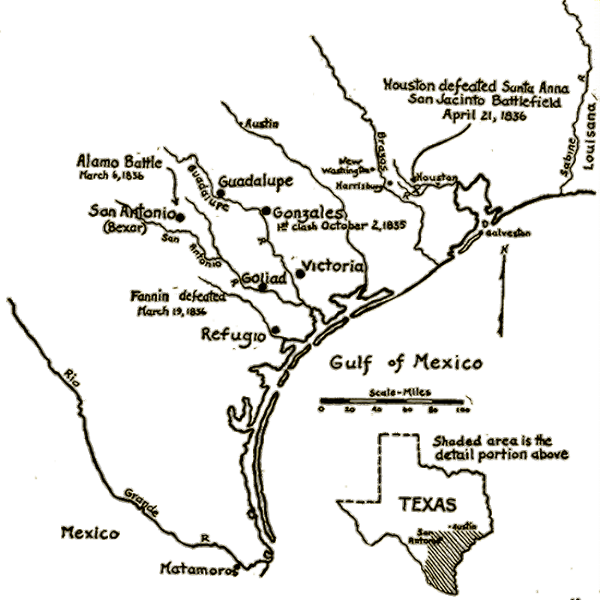
I WAS standing beside the wall of the ancient Concepcion Mission, outside San Antonio. Here had been the refectory of the monks, now destroyed on three sides, the walls pock-marked with bullet holes. It was here that James Bowie, most tragic of all the Texan heroes, had fought for freedom in 1835. And as I stood, an echo of voices came to me, then the words of a man singing. I was alone here, yet laughing tones sounded distinctly, until the lilting words reached to me more clearly.
"Yankees and courtly Spaniards, Tennessee mountaineers,
Creoles and Dutch and slavers (gentlemen in arrears)
Shoulder to shoulder gathered, answering blow with blow—
For by God, sir! We fought in Texas a hundred years ago!"
I listened, astonished. A raucous burst of cheering sounded from the air around. Then, amid thin drumming hoofbeats of spurring men, a ragged hearty chorus came to me, a chorus as of distant, shouting men:
"Here's to you, Colonel Bowie, damn your eyes!"
What did it mean? Not even a tourist was in sight; was this some delusion of the senses? And yet, men had died here for liberty a hundred years ago....
THE saloon in San Felipe was well filled, and blue with tobacco smoke. Voices rose in a steady blare of sound. Here in San Felipe men were gathered from all over the Texas settlements in this year of 1835. A new government had been formed, but the convention was riddled with politics, jealousy and diversity of aims.
Alone at the end of the bar stood a man whose hat was pulled far over his eyes. He was drinking, and drinking hard. He had traveled hard to get here, he had spurred hard, day and night; and the man he had come to find was not here.
"Old Houston's plumb locoed!" rose a rough voice down the bar. "We got no call to fight Mexico. All we want is our own state gov'ment back again, ain't it?"
"And be a part of Mexico again? Not much!" shouted another man. "Houston's right. We got to cut loose and have our own republic. We can lick them greasers easy."
"And lose everything doing it, too. Fannin and Bowie and them crazy galoots are fighting along the Border now, raiding Mexican settlements and killing soldiers. Is it true that there's been a fight at Gonzales?"
"Dunno," came the reply. "Some rumors come in, that's all. If fighting's started, boys, hurray for it!"
Argument rose high and impassioned, as confused as the turmoil which prevailed all over Texas. And as it rose, an old Mexican woman came threading her way among the men, a crone whose black eyes glittered from beneath her black shawl. She spoke, now to one man, now to another; she was met with laughter or rebuffs.
The two men next the solitary drinker were engaged in hot argument. Both were from the Brazos settlements, big, powerful men, rough of tongue and of hand. One was discussing Jim Bowie in no uncertain terms.
"Calls hisself a colonel now, does he? Huh! Made his money running slaves. Married into a high-toned Spanish family in Bexar, got a big land grant, and now he's raiding the greasers on the Border. Santy Anny has put a price on his head. Drunken rat, that's what this Bowie is! Fighting grizzly, huh? Well, he's a hell of a man to be a Texian, and I don't care who hears me. Huh? Who in hell are you? I don't savvy your lingo."
The old crone was mumbling something. The other man laughed.
"She wants to tell your fortune, Joe."
"Fortune, hell! She's a spy, that's what." The first speaker flushed darkly, then reached out and gripped the crone by the shoulder. "Sneaking in here to listen. By God, if I had my way I'd hang every greaser in Texas. Come on, you, spit it out; who's paying you to spy on us, huh?"
The crone shrank back, the man gripping her the more fiercely.
The man at the end of the bar moved suddenly. He had hot bright eyes, very blue in color, with reddish brown side-whiskers. He came up to the three, and took hold of the man's wrist. His movements were surprisingly swift and agile.
"I reckon, suh, you aren't used to womanfolks," he said calmly. His words reached out upon the startled hush. "Apologize to the lady."
"Huh? Me apologize? Leggo my wrist, damn you!" cried out the big man. "Joe Harkness don't apologize to no Mexican slut—"
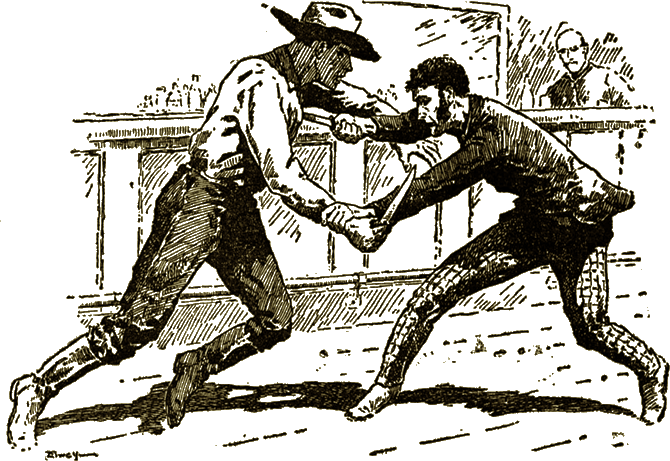
HIS voice died. The grip of the smaller man tightened on his wrist. His fingers loosened, and the old crone slipped away. A grimace of pain crossed his face, then he swung with his free hand. Instead of hitting the smaller man, he himself was hit across the mouth. He staggered back against the bar, and a knife flashed out in his hand.
"By God, you'll pay for that with your ears!" he roared out, passion flooding in his face. He was oblivious to the swift mutter going around the circle of watchers; he did not catch the name of "Jim Bowie!" that flashed from mouth to mouth. "I'll slit them ears off'n you for that, hear me!"
He hurled himself at the slim figure, but Bowie did not move or evade the rush. Instead, Bowie met him breast to breast, with a ferocity that drew a gasp from those about. The two figures locked. Bowie caught the other's wrist in a steel grip—then suddenly lashed out with terrific speed and savagery.
The fight was over almost as it had started. Harkness staggered away and sank down, groaning. Bowie put away his pearl-handled knife.
"He won't die," he said calmly. "Better get a doctor, to make sure—"
"Jim Bowie!"
The words fairly exploded on the room from all sides, and men crowded in with delighted yells. Drinks were passed. Five minutes later, the magnetic personality of the one man was dominating the whole place, for Jim Bowie had a peculiar charm that held men and gripped them.
They crowded about him in wonder and awe and friendship. Tales of him had gone afar. His prowess as a fighter was already a frontier fable, but he was also a great man, or had been. He had married into one of the proudest families of Mexico, he was wealthy, a golden future had opened out to him; then came the cholera and swept away his wife and children.
And now Jim Bowie was a heartbroken, terrible man who sought only liquor and freedom, for all life was wreckage behind him.
A gust of yells swept down the street. Men came running, bursting into the place.
"Hey! It's true, it's true!" arose the shout. "Fighting at Gonzales, and the boys there whipped the greasers! Licked the best cavalry a-going! Licked 'em!"
"Hear that, Bowie?" screamed somebody.
"I heard it a while back," he rejoined. "I just come from there."
The voices became frenzied, exultant; amid all the uproar, Jim Bowie slipped out unobserved. He passed around to the side of the saloon and stood there in the darkness, trying to decide what to do. He had wanted to find Sam Houston, but Houston was away. As he stood, he could hear the wave upon wave of exultant shouting that spread through town. The finest cavalry of Mexico had been licked by a handful of Texians!
BOWIE grimaced sourly. He had been raiding the Mexicans down on the Border; he and Fannin had formed bands of hot-heads whose sole purpose was to clear Texas of the Mexican yoke. The deputies here in San Felipe did not know whether to fear or admire these raiders.
San Antonio, which the Texians called Bexar, was held by the Mexican General Cos with fifteen hundred men, and President Santa Anna was said to be moving north with a huge army. The half-organized settlers were in chaos. Houston was nominally in command of the army, but had no army. Politics seethed. Rivalries and jealousies were rife. There was no imminent crisis to spur either side to action, unless the battle at Gonzales should set a spark to the powder. Texas was in open revolt, but Cos hesitated to attack, and the settlers sparred for time. Patriotism was, as ever, the cloak of selfish interest.
Bowie heard a step beside him. A hand touched his arm; he recognized the old Mexican woman who had disappeared from the saloon.
"Señor, I owe you thanks, many thanks."
"It is nothing, señora. You had best stay away from such places." Bowie, who spoke her tongue fluently, pressed money into her palm. "Here, this may help you."
"May God requite you! Do you wish me to tell your destiny?"
"I have none." He perceived that he was quite unknown to her. "My destiny lies all in the past."
"There is always death," she said, with a cackle of stark mirth. "Are you curious?"
"No," grunted Bowie. "But if it will humor you, tell me when I shall die."
She took his hand, drew him over to the lighted window in front, and there peered attentively at his palm. Then she looked up into his bright blue eyes.
"Caballero, you are a seventh child."
Bowie started, then laughed. "True true!"
"The past—ah, what a life, what sorrows! Qué lástima—what a pity! But I shall tell you the truth, caballero. Death is not far away from you."
"So much the better." Bowie's voice was skeptical and harsh. "By a bullet?"
"No, caballero. I can see you very clearly, dying in bed—"
"In bed?" he broke in scornfully. "Poder de dios! Little you know me."
"You are a seventh child; I cannot mistake your future, caballero. You shall die in bed, with the arm of a woman about you—"
As though stung, Bowie jerked away his hand.
"You accursed liar! No woman has any place in my life—"
"By the mother of God, I speak the truth! You may believe me or not, but you shall die in bed—"
Bowie drew back, with a storm of objurgations in angry Spanish. "Devil, fly away with you and your croaking. It's impossible, absurd. Get out!"
HE THRUST her aside and went his way, anger spurring at his brain. The old fool was out of her head. A woman, indeed—die in bed! It was sheer lunacy. He, the most famed duelist and fighter on the frontier, die in bed! He, whose whole heart and soul had died with the woman and two children dead of cholera, have a woman's arms around him! It all angered him past bearing. Yet, how the devil had she known that he was a seventh child?
"Bowie! Hey, Jim, is that you?"
An indistinct figure was approaching him. Under the starlight, he could smell it before he could see it—an indescribable odor of sweat, liquor, horse. A man dusty like himself, whose seamed features suddenly came clear.
"Houston! Why, Sam, of all people! They told me you were out of town. I came here for a confab with you."
"Just got in." The two men struck hands heartily. "Heard you were here and come to run you down. I been ridin' for a week without takin' off my clothes. Come on to the shack; I got a room in back of a store, yonder. Need a drink powerful bad."
Houston's voice was weary, and his shoulders drooped. Like Bowie, he had the wreckage of life and greatness behind him; but, unlike Bowie, he aimed ever at a fresh career, a newer vision. A hard, rough, patient man, Houston's right arm was a bit stiff from an old shoulder wound that would never heal; his calm poise was fathomless.
The two walked along in silence. Presently they were ensconced in a littered room whose desk was heaped with documents and letters. Houston lit candles, then got out a whiskey jug and drank deeply. Bowie followed suit. With a sigh, Houston sank down on the tumbled blankets of the bed.
"Good to see you, Jim. I been orating all over, trying to raise men, and damned poor luck. Something's got to happen."
"I know it," said Bowie. "When are you folks going to settle on readjustment or liberty?"
"God knows. These damned politicians talk and talk. If I had some men, we'd take action durned quick. Jim, it's a mess," said Houston dejectedly. "They're all holding out to support the Mexican constitution of 1824. Damn it, they can't see the idea of liberty. They don't realize that we must have complete freedom or nothing!"
"Heard about the scrap at Gonzales?"
Houston nodded. "Austin's just gone there to take charge—"
"Then you'd better send somebody after him," Bowie said grimly. "I have three men camped outside town. One of 'em met me here tonight, just come from Bexar. He says General Cos is leaving in a few days with five hundred men for Gonzales to wipe it out."
Houston whistled softly. But Jim Bowie went on without pause.
"You know what that means. We got to carry the fight to him—drive him out of Bexar, drive every Mexican back across the Rio Grande! And I'm starting it. Fannin has thrown his men in with mine. We're riding for Goliad and we'll smash the garrison there, then turn and make for Bexar. Now, old hoss, say your piece!"
HOUSTON came to his feet and began to pace up and down. Fire gleamed in his eyes, his unshaven, grim features took on new life.
"Jim, that's great news! If Cos is attacking, then we can force things. I'll stay here, get the organization moving. Austin will whip up an army and move on Bexar—if you can answer for Goliad! That means everything."
"Upon my honor, Sam," said Bowie gravely. "The Mexicans will be chased out of Goliad if I have to do it by myself. But I shan't. Fannin's waiting for me. In three days, we'll have the town."
"I count on that, then," Houston said curtly. "But remember, Cos has artillery—"
"We have men, by God!" With a laugh, Bowie drank deeply. He knew that Bexar was the key to all Texas. "I'm sending word to Fannin that the army is on the move at last. I'll stop and scout Bexar a bit, and spread news there that the Texians are coming. That'll keep Cos from moving out—"
"Do it if you like, but it'll be known. We've a plague of spies here." Houston swung around, aflame with energy. "You've heard of Colonel Crockett? He's headed this way to throw in with us; I got a letter from him last week. I wish we could get hold of a few regular army officers, Jim! If we had Ben Milam and a few more like him—"
Bowie shook his head. Ben Milam had been a distinguished officer in both the American and Mexican armies. A representative in the Texas legislature at Coahuila, he had been flung into prison when Santa Anna dispersed the state government.
"Well, Sam, we haven't got him, that's all. By the way, how about making Fannin a colonel of volunteers? He's only a cap'n now, and if you folks would give him a rank he'd have more authority."
"Right. You also; I'll have it done tomorrow. What's that paper you've got?"
Bowie grinned and opened the printed broadside he had dug out of his pocket.
"Compliment. A proclamation ordering a bunch of Texians arrested on the charge of treason. Me and Travis and some more—"
"Why, damn you—hurray!" Houston seized the paper avidly, his eyes blazing. "Just the thing we need, Jim; glory be, now we'll stampede these fellows! I'll send the news on to Austin tonight. How long are you staying in town?"
"About two minutes more. Got to be moving. How soon do you reckon Austin can march?"
"At once, with this news you've brought to stir things up. Jim, you've turned darkness into glory! You can't imagine the jealousy, the squabbles, the petty politics, here! But now it's all different. We'll stampede 'em, and no mistake. I'll guarantee that Austin will march for Bexar inside of five days—if I can send him word that you're attacking Goliad."
"Send him word that Goliad has been captured," said Bowie soberly. "I mean it. You can gamble that much on me."
"Agreed." Houston seized his hand, looked into his eyes. "God bless you, Jim! Take care of yourself; you don't realize how much I'm counting on you in the days to come. We haven't many men like you."
"Damned good thing you haven't," said Bowie with a laugh, and crammed his hat over his eyes. Next moment, he was gone.
AS HE strode along the muddy road, heading for the edge of town where his companions were camped to await him, he became lost in bitter thought. He could not get that old crone out of mind.
Die in bed? Absurd. A woman's arms around him? The idea maddened him. That was the most unlikely of all fates for Jim Bowie—partner of Lafitte the pirate, slave-runner, grandee and landowner, mill-owner, son-in-law of the great Veramendi, and now a broken man and hopeless. It was true, however, that he had been the seventh child. How the devil did that old hag guess it? Or did she have second sight?
His morose meditations were abruptly shattered. Too late, he wakened to dim shadows closing in upon him. A terrific blow on the back of the head crushed his hat and sent him staggering, to fall upon his face in a daze. Only the stout beaver hat saved him from complete oblivion.
He lay motionless, half-stunned, and to all appearance dead.
"Excellent work, my Diego!" sounded a Mexican voice. "It was the blow of a true caballero. We are sure of our money now; dead or alive, said the general. Ha, Mendez! Go you and fetch the other men and the horses, while we tie him hard and fast. Dead or not, he is a devil incarnate and safer if well tied. Hurry!"
There was a soft pad-pad of moccasined feet receding into the obscurity.
"Where is the riata, Diego?" came the voice again. Bowie's head was clearing. His thoughts went swiftly back to that night in Natches-under-the-Hill when, prone upon a saloon floor, he had knifed two men to death. Hard-fighting men. He smiled grimly as he lay.
"Alive or dead, once he reaches San Antonio, the money is ours. You have a good eye, my Diego; you did well to recognize him in that saloon. And it was a lovely blow. Well, take him by the feet; I'll tie up his arms. Wind the riata into the flesh, mind; we must take no chances, for this Bui is a devil. Here, turn him over."
Bowie's figure was rolled over in the mud. Hands seized upon his left arm, but the fingers of his right hand had already closed on the pearl haft of his knife.
The knife drove suddenly upward. There was a choked cry, then a furious and deadly struggle took place in the darkness. One man fell forward, his weight lying across the legs of Bowie and pinning him down as the second Mexican drove in with knife stabbing viciously.
Somehow, Bowie avoided that frantic, panicky stroke. His left hand caught the assailant and dragged him down, with remorseless grip. What passed in the obscurity was impossible to say. Presently there was a bleating cry, then a slapping of spasmodic feet against the ground, and silence.
THE harsh, mirthless laugh of Jim Bowie sounded. He rose, picked up his crushed hat, and went staggering away. His head was still ringing from that blow; but, if a blow is to change the current of history, there must be no error in its delivery.
Now across the autumn plains of Texas, men spurred fast. Vigilance committees were formed, from near and far the summons brought men with their rifles and powder-horns to gather at Gonzales and elsewhere. Rumors were startling—some said that Goliad had been taken, others said that General Cos was marching on San Felipe. Couriers killed their horses, dust-white men rode shouting past groups of cabins, and from Louisiana parties of frontiersmen were heading fast and hard for Texas. What was actually happening, what would soon happen, no one dared to say.
Upon a chill evening, with a serape flung about his shoulders, Jim Bowie swaggered past the sentinels at the ford, and made his way into Bexar. His glib Spanish tongue, his forged papers, gained him free passage from the ex-convicts in Mexican uniform.
Old Bexar was purely a Mexican city, save for a few American traders. As he strolled about, Bowie was chuckling to himself at the changes in the town he knew so well. Far from marching against the settlers at Gonzales, shrewd General Cos had flung all his energy into preparing against the Texian attack. The stone houses were converted into forts, the streets were barricaded and commanded by batteries of artillery.
Across the river lay the old San Antonio mission, now called the Alamo because a company of soldiers from Alamo de Parras, in old Mexico, had once garrisoned it. It was vastly altered; the outer arches were gone, pulled down to help make a rubble heap, over which artillery could be pulled to the roofs. The barracks windows had been walled up, entrenchments and batteries and outer works had been constructed,, and there was not such another fortress in all Texas. No Texian army, without artillery, could take this place.
Bowie was inclined to agree with his Mexican assurance. He turned back into the town and presently came to a halt on the bridge across the upper stream. He stood in moody abstraction, his figure dimly revealed by the starlight, listening to the idle talk of soldiers and women strolling by the stream. Death to the Texian traitors; no quarter; the plunder and loot of land and settlements—he vaguely heard the words, but paid scant attention.
For, there close by, were the lights of the one place he might still call home: the Veramendi mansion with its pleasant gardens. There, as elsewhere, he was welcome. All about in this city were warm sympathizers with the cause of Texas; here were friends, relatives, helpers. Yet he stood alone, staring grimly at the place.
ALONE; he would always be alone now. In that house he had lived and loved and won. Ursula Veramendi, fairest of all Texian women, was his bride. From here he had taken her to Saltillo and built his cotton mills; glittering vistas of wealth, position, influence were open to him. The two children whom he idolized had been born here in this house, had been baptized in the church across the plaza. And then the swift coming of cholera, and everything swept away in a day. Everything except the wealth which he cursed and flung aside.
He pulled his serape closer, staring moodily at the house where he would be so warmly welcomed, did he but make himself known. So he would die in a bed, eh? His harsh laugh sounded softly. He, who had not so much as a bed to his name! Yet the old hag had sworn by the Virgin that she told the truth. Bah! He shrugged and turned away. He was alone, yes, but there remained Texas. Here was something to work for, to fight for, to give himself for; a cause, the only thing left in life. A thing intangible, without self-interest....
"Señor Bui!"
At the soft voice, Bowie turned quickly; his name was pronounced alike in Spanish or English. Close to him in the darkness stood a Mexican soldier, uniform untidy in the starlight, cigarillo gleaming with a red point, hat pulled low.
"You speak to me, caballero?" Bowie said quietly, hand on knife.
"But yes," was the response. "I recognize you, señor. You are, no doubt, spying upon our glorious city, upon our soldados, our dispositions—"
Bowie's left arm shot out. He caught the speaker by the tunic and was in the very act of stabbing when he was paralyzed in every nerve.
"Hey! For gosh sake, Jim, hold on! It's me, 'Rastus Smith!"
"Deaf Smith!" Bowie drew a deep breath. Another instant, and he would have killed the most famous scout and spy on the frontier. The two of them stood quite alone.
"Why, you damned fool, trying out your jokes on me! You ought to have a knife in your gizzard; and you came close to it. Where'd you get that uniform?"
"Took it off a greaser; he didn't need it no more. By gosh, you've got a grip! I been follerin' you quite a spell. Thinks I, that ain't Jim Bowie, but it sure is Jim's walk. I'm on my way to locate you at Goliad."
"You look it," snapped Bowie, throwing an affectionate arm about the shoulders of the taller man. "How'd you know I was here?"
"Didn't. Just took a notion to scout Bexar a bit, and seen you. I hear they got Maverick and the other Americans here safe in jail."
"And cannon to hold the place. Anybody send you to find me?"
"Yeah," said Deaf Smith. "Gin'ral Austin allowed I might locate you. Seems like the boys are all het up over Goliad being captured."
Bowie laughed softly. "It will be, day after tomorrow. What's your message?"
"Well, Austin's getting the army on the move. Marching tomorrow."
"Marching?"
"Sure. Heading for Bexar lickety-split; coming like hell, Jim. Austin says for you and Fannin to fetch along your outfits and scout the place, and get a good spot for a camp. He's durned uneasy and wants to be sure you're ready to join up."
"Take back word that we're ready and waiting," said Bowie, a warm vibrancy in his words. "I got to meet Fannin and jump those Mexicans in Goliad."
Deaf Smith chuckled. "You don't need to hurry, Jim."
"Eh?" Bowie stared at him in the starlight. "What do you mean?"
"You'll be too late, I reckon. I met up with a feller on my way here, one of them settlers under Cap'n Collingsworth."
"Yes; he was going to raise men and meet us at Goliad."
"I reckon he's done took Goliad already, Jim. This feller allows that Collingsworth got tired of waiting for you and Fannin to come along and was a-heading for Goliad hisself. Aimed to git there yesterday and jump the place. He had forty-odd men."
Bowie whistled. "And Colonel Sandoval there has a hundred Mexicans with cannon—good lord! I've got to be off—"
They moved off, and the obscurity swallowed them up.
IN DEFIANCE of the rainy season, Austin's alleged army was moving forward on Bexar. Sam Houston had sent out a call for five thousand men; five hundred responded. An army without artillery, with little powder, with no discipline. From New Orleans came the Grays, a troop of adventurers burning to liberate Texas, only to find that Texas had no anxiety to be liberated, but wanted to stay in the Mexican federation.
Desperately, vainly, Steve Austin endeavored to beat some cohesion into his rabble. These settlers, hunters, adventurers would acknowledge no authority, and jeered at orders which did not suit them. At the moment, they were aflame with zealous ardor, but not to the point of facing the artillery of General Cos.
Great news reached them. Collingsworth had taken Goliad by assault. Colonel Ben Milam had unexpectedly appeared, having escaped from his Mexican prison. Bowie and Fannin were scouring the plains. With wild cheers, the army pressed on to Salado, five miles from Bexar, and settled in camp. Here Bowie joined them, with Fannin, Milam and ninety men, to be received with great acclaim.
Privately, however, Austin was hopeless and despondent.
"What can we do against Mexican discipline and cannon?" he said to Bowie that night. "And we're far outnumbered."
"What of it? What are you here for?" Bowie snapped.
"To hold Cos in check and gain time. More men are on the march. We have a cannon and ammunition coming sometime. We can't assault Bexar, of course; we'll form a secure camp outside town and wait for reinforcements. Have you selected any camp site?"
"Hell, no. One of the missions might do."
"Then suppose you go ahead tomorrow with your company, choose a secure spot, and we'll move up. Cheer up, Jim; in a week's time we'll have a thousand men gathered!"
Bowie, disgusted, yet realizing the hard sense of Austin's viewpoint, acceded. There was but one gleam of light. Mexican prisoners reported that General Cos, astounded by the assault and capture of Goliad, intended to stay safe behind his defenses.
With morning, Bowie and Fannin moved their ninety men ahead. Bowie had already decided that the Concepcion Mission presented the desired site, as it was on the river and close to Bexar.
EVENING found him camped in and around the outlying mission buildings. He was in morose, surly humor. The prospect of capturing Bexar seemed fantastic, for the boasted army of Texas was no more than a straggling mob of riflemen.
With daybreak, he rose feeling feverish and uncertain. Outside, the camp was rolled in a blanket of dense fog, so thick that nothing could be seen fifty feet away. Bowie went to one of the outposts, and stood talking with the men there. After a little, he knelt and put an ear to the ground.
"Strange!" he said, "I could have sworn that I heard voices and hoof beats. You've seen nothing all night?"
"Nary a thing, Cunnel," was the response. "All quiet."
Rejoining Fannin for breakfast, Bowie had barely risen from table when a man came running and shouting that he had seen Mexican lancers in the trees, at the south end of camp. While a laugh went up at his expense, there came a yell from the northern outpost, then a discharge of pistols. Instantly, the camp leaped into activity.
"Looks like they're all around us, Jim," said Fannin coolly. "Who'd have thought old Cos would have the nerve to attack!"
Bowie grunted. Before he could reply, the fog was split by a blazing volley of musketry, and as bullets rained upon the camp, the shrill voices of Mexican bugles began to blare unseen.
Volley after volley was poured into the camp from all directions. That they were completely surrounded was now obvious to all; but the men were kept out of sight, and ordered to shelter among the trees and vines below the mission buildings. Until the fog lifted, nothing could be done.
The sun rose, and gradually the fog began to clear. The Mexican fire had ceased; Bowie waited, impatient and anxious. That his force was surrounded and cut off, he quite realized. His head ached, and he knew now that fever had seized upon him.
A shout pealed up, and another. "There they are!"
To the right of the camp, the thinning fog disclosed lines of infantry deploying. Cavalry were wheeling and taking position. A cannon was being brought up and placed in readiness. Fannin uttered a cool laugh.
"Looks like they're out to get us, Jim! How many do you make it?"
"Four hundred, about," Bowie rejoined.
"Thought so. Orders?"
"Take the south side. I'll take the north—"
A rifle cracked. The battle had begun.
Bowie kept his men under cover, restrained their fire, and waited. From the Mexican lines, volley after volley rang out in an almost continuous fire that did little damage, except to the mission buildings. Estimating that the cannon was not more than eighty yards distant, Bowie, picking out his best riflemen, sent them forward to open fire upon it.
"Spread out, boys, and let 'em have it!"
As he spoke, the cannon erupted in smoke. A storm of grape and cannister whined through the brush. Immediately after, the bugles shrilled, and the lines of cavalry wheeled into a charge.
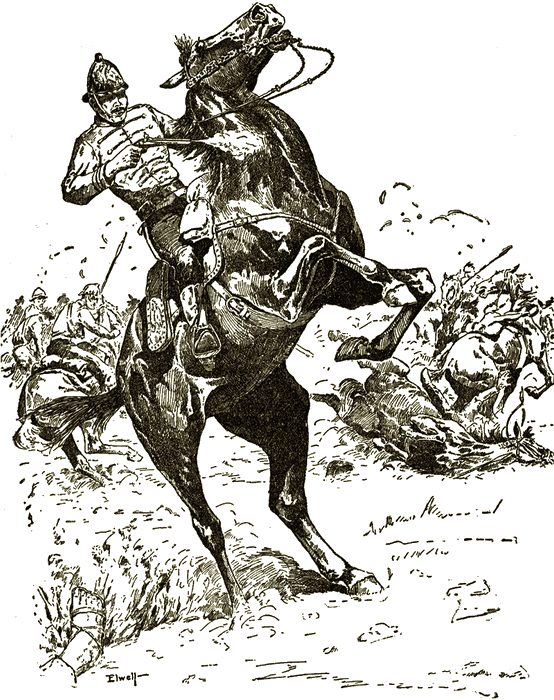
A RIPPLE of rifle-fire broke out from the Texian lines. The men serving the cannon were dropped as though by magic. The cavalry fell into confusion; men and horses rolled in the brush, the charge was broken. A ragged cheer rang out, to be instantly checked as the lines reformed. The artillerymen, although dropping fast under the galling fire, served their piece bravely. Again it spouted death, and again.
The cavalry, spreading out now, came galloping and thundering forward, carbines banging, pennons and lances glittering. Again their ranks fell into disorder, as death smote among them. The gold-laced officers suffered heavily. Bowie, yelling with sheer frenzied delight, saw the charge broken and falling back.
"We've got 'em, boys, we've got 'em!" he shouted. "Get on up closer around that cannon! If they try it again, go for 'em!"
The cannon crashed out. The man next to Bowie coughed and fell against him with a spurt of lifeblood; grape shrieked through the air.
The infantry lines were wavering; most of their officers were down by this time. Their blaze of fire continued, but the bullets went high. Now the bugles were again shrilling, the squadrons of horsemen reformed. From the ground between, where horses kicked and men lay heaped, arose a terrible sound of shrieks and groans, drowned out by the crack of rifles.
The men around the cannon fell fast, yet it was fired again, and yet again, holding the Texian riflemen in check. The cavalry spread out farther, ringing in the whole position, the bugles sounded the charge. This time they meant business.
They swept forward with shrill yells. The rifles began their deadly cracking, front rank firing then falling back to reload while the second rank fired. Officers went down. The ranks were broken, went sweeping aside in wild disorder.
"Go get 'em!" yelled Bowie, and his men obeyed.
Forth from their covert for the first time broke the Texians. They charged upon the cannon, they went running at the infantry lines, hurled themselves at the broken cavalry. A panicky bugler sounded the retreat.
The lines broke and fled. The cannon was abandoned. The lancers and dragoons headed about in precipitate flight for Bexar's protection. The ninety had smashed the four hundred, captured their positions and their cannon.
Fannin and Bowie slapped each other on the back, dancing about in boyish exultation. Men shouted until they were hoarse, ran down horses and captured them, brought in the wounded, looted the dead.
"Jim, after this we can do anything!" exclaimed Fannin eagerly. "If we had the army here, we could keep 'em on the run and take Bexar!"
"Sure, but there's no army," said Bowie drily. His face was hot and flushed, his eyes very bright. Fannin surveyed him with a frown.
"Looks to me like you got fever, Jim."
"I know it. No matter. Come on, we got plenty to do!"
Plenty to do, yes—couriers to send out, wounded to take care of, dead to bury. Bowie settled down to write his report. The words came hard.
"I reckon I need a drink," he murmured, and got it. Then he looked down at a ragged wound in his coat—a bullet had torn through, not touching him. He broke into his harsh, mirthless laugh.
"I always heard a seventh child was born lucky," he observed. "Reckon it's so, too. And maybe that old hag knew her business. By godfrey, I may have to die in bed yet, just to prove that she did! I'm sure going to be ill. And if I am—"
His eyes warmed suddenly. Old Ben Milam, of course! There was the man to take over the company from him, if he was ill. Ben Milam!
Roy Glashan's Library
Non sibi sed omnibus
Go to Home Page
This work is out of copyright in countries with a copyright
period of 70 years or less, after the year of the author's death.
If it is under copyright in your country of residence,
do not download or redistribute this file.
Original content added by RGL (e.g., introductions, notes,
RGL covers) is proprietary and protected by copyright.