RGL e-Book Cover
Based on an image created with Microsoft Bing software
Roy Glashan's Library
Non sibi sed omnibus
Go to Home Page
This work is out of copyright in countries with a copyright
period of 70 years or less, after the year of the author's death.
If it is under copyright in your country of residence,
do not download or redistribute this file.
Original content added by RGL (e.g., introductions, notes,
RGL covers) is proprietary and protected by copyright.
RGL e-Book Cover
Based on an image created with Microsoft Bing software

Short Stories, 25 October 1935, with "The Rifleman"
VERY late one night, I was standing by the bullet-scarred entrance to the old chapel of the Alamo, in darkness and silence. Around hummed and throbbed the citied life of San Antonio, ablaze with neon lights and loud with sound; but here was silence, where a hundred years ago Mexican soldiers had come charging to death. Upon this silence broke a voice, singing. Some radio, I thought. Yet the voice seemed to echo from the very stones beside me; presently the words came more clearly and distinctly—
"We gambled and chawed terbaccer, we did as we had a mind,
We'd fight for a horn of liquor, and we left our wives behind;
We scalped and we cussed and ranted, we could wrassle heel and toe—
And by God, sir! We wrassled for Texas a hundred years ago!"
Then there was a rush of voices together. This time from inside the dark closed chapel. I heard a trampling of feet, a storm of rough, hoarse accents in chorus:
"Here's to you, Davy Crockett, damn your eyes!"
Was it mere fancy? Impossible to say. Here had died men, rough, hearty, lusty men of a past century, who had wrangled, disobeyed orders, hesitated, and finally fought to the death. Very human men, no prating, smug heroes—
WASHINGTON'S birthday had come with great celebration in San Antonio. The prolonged fandango had left headaches in its wake. On this morning after, really early afternoon, Colonel Davy Crockett of Tennessee was enjoying a horn of liquor in the back room of Colorado Smith's store.
Crockett was rough and hearty of speech and action. His shrewd gaze surveyed the red-headed Smith, and a quizzical expression lay in his bronzed, square-hewn features.
"Prime liquor, Red. Dog-gone, that sure was one wild night! I come to Texas looking for a scrap, and all I see is fandangoes. Pretty soon, me and Jim Bowie are going down into Mexico and lift some scalps, you bet. Say, is that there state convention up at San Felipe going to declare for independence or not?"
"Nobody knows what that bunch of politicians will do," said Smith disgustedly. "Sam Houston's the only real man in the whole crowd. He's for independence, but most of 'em want to stay in Mexico as a state. Any news at the fort from Santa Anna's army?"
Crockett tasted the liquor, rolled it judicially on his tongue, and shook his head.
"Nope. Ain't no army, far's we can tell; looks like that's all hogwash. All hands wrangling and cussing at headquarters. Colonel Travis, he's got a new gray uniform and a commission, and allows he's the prime egg; and Jim Bowie allows he's in command. And both being Texas cunnels, and me only a Tennessee cunnel, I ain't claiming no command at all. The Mexicans have been chucked out o' Texas and now we got time to fight among ourselves. Well, suh, here's to your hopes!"
He drank solemnly, his twinkling eye belying his words. Smith, who was one of the two or three American merchants in Bexar—what is now San Antonio—followed suit. After the riotous celebration of last night they felt a drink necessary.
"I dunno, Davy," said Smith, reflectively. "There's plenty of Mexicans who are the salt o' the earth. There's plenty, like Captain Seguin, fighting with us Texians. But this here Santa Anna—well, he's plain bad. An opium fiend. When he does come, I'll gamble he raises hell."
Davy Crockett guffawed. "Say! I've heard that song and dance for months. When I got here, what happened? Ben Milam and three hundred men had kicked out Gin'ral Cos, his fifteen hundred, and all his cannon—booted his backside clear over the Border. I'm real disap'inted, Red. I ain't seen a scalp lifted yet."
"You will," said Smith ominously, and Crockett guffawed again.
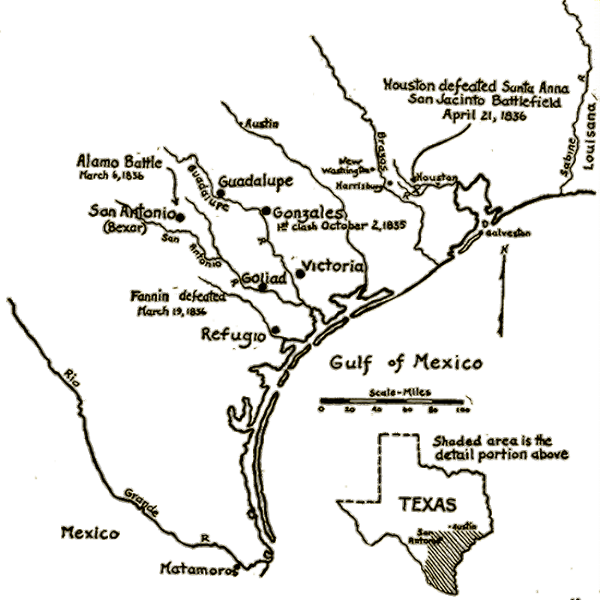
Half a mile from town and across the river was the old Alamo chapel, fortified in case of need by Travis and his garrison of a hundred and fifty Texians. Like many another, Crockett had come as a volunteer to aid the cause of Texas—but at the moment this cause was in some doubt.
After sharp fighting, every Mexican soldier had been expelled from Texas. At San Felipe, a convention of settlers was now in session. Whether to secede from Mexico and declare Texas a republic, or come to terms with Santa Anna and remain as a state in the Mexican federation, was the burning issue. Santa Anna and his armies had started north long ago to crush the rebels of Texas, but where he was, nobody knew.
THE convention had named Sam Houston commander in chief of the Texian forces—but Houston had enemies. Few of the leaders would obey his orders, and the convention had deposed him again. Everything was in absolute chaos, in this February of 1836.
"I've heard that Houston ordered Colonel Travis to abandon Bexar," Smith said slowly. "You're a military man, Davy. What do you think of the situation?"
Crockett chuckled. "I'm like the feller put up a tree by a b'ar," he said. "My thoughts ain't suitable to utterance. We got a hundred and fifty men here in Bexar. Colonel Fannin is over to Goliad with three hundred men. Near as I can see, that's the whole dummed Texian army."
"Sure. But what about Houston's orders?"
"I reckon that's right. He tells Fannin to abandon Goliad and fall back on the Guadalupe River—and Fannin thumbs his nose. He tells Travis to blow up the Alamo and abandon Bexar—and Travis thumbs his nose. Them boys ain't running from no yeller belly Mexican general, and allows as much. And now who's in command? Nobody knows, and every feller is baiting a hook to catch the fish."
"Well, I don't like it," said Smith anxiously. "We drove out the Mexicans last year—"
"And that's just the trouble," broke in Crockett shrewdly. "You-all drove 'em out and allowed Mexico was licked. Then the dummed politicians got busy, and instead of being a republic like Sam Houston wanted from the first, what is it? Look at the flag acrost the river. We're fighting for Mexico, durn it!"
True. Over the Alamo floated the striped flag of republican Mexico with the date of 1824, when its constitution was adopted. Santa Anna, proclaiming himself dictator, had abolished that constitution. Texas alone resisted his dictatorship; and now, in its lack of all discipline and cohesion, Texas was about to suffer his wrath. Goliad and the Alamo were the only points which could pretend to fortification.
Shrill voices suddenly rang out from the street and the store front. Smith went to see what was up. Colonel Crockett, who understood no Spanish, leisurely poured himself another drink; when it came to hunting or drinking, speechifying or fighting, he was ever in the forefront.
SUDDENLY Smith came rushing into the back room, blazing with excitement.
"Good God! The Mexicans are here, Davy—the dragoons are coming from San Pedro Hill this minute! Santa Anna's almost in the town itself. Run for it, man! We're caught!"
As though to emphasize his wild cry, the heavy report of an alarm-cannon boomed forth, and a tumult of voices eddied up after it.
By the time they reached the street the whole town was in uproar and confusion. The Mexican dragoons were, indeed, among the outlying farms. Due to the rival factions of Bowie and Travis, the garrison had sent out no scouts, and was totally unaware of Santa Anna's rapid advance. The surprise was complete.
The town itself was defenseless, with so small a body of garrison. The Alamo was the one rallying point. Crockett found himself running with the rest, through the streets to the river and across to the fortress. Mexicans, women, Americans—all poured in wild panic past him. Shopkeepers abandoned their stores and ran for it. Captain Dickinson, with his wife and child, dashed along on horseback, better late than never.
No quarter! Santa Anna had sworn it, and the thought was in all minds.
The buildings of the Alamo were ample. About the little chapel centered breastworks, batteries, enclosures for cattle; to the right stretched two-story barracks, with batteries defending them. The whole covered about two acres.
Once he reached this point, Crockett paused, aghast. True, most of the garrison were now retiring to the fort in good order, but the lack of all preparation was painfully evident. Upon reaching the walls, they fell into wild disorder. Everyone gave orders, no one obeyed them. Men who had sold muskets and rifles for liquor, were yelling for weapons. Others were rushing about or trying to load the cannon, of whose use they knew nothing. Women and children were being hurried into the chapel.
Crockett threaded his way through the tumult to the south battery, where his equipment had been left. There he found Captain Ward, an Irishman, whom he had drunk under the table the preceding night. With a score of men, Ward had his guns loaded and was calmly awaiting orders. Crockett got rifle and powder horn, and grinned at Ward.
"Howdy, Cap'n! By gum, if you ain't sober! First time I've seen you so."
"True for you, Colonel," and the other chuckled. "Devil and all, I ran out of whiskey just at the proper time, eh? Hello! There's Bowie."
ORDER began to come out of the chaos. Bowie, who disputed the command with Travis, took a detachment and began to scour the nearer houses of the town in search of food. Another squad was rounding up cattle and driving them into one of the enclosures. Travis, redheaded, feverish, resolute, began whipping the men into shape and seeing to the guns.
The afternoon wore on. Into Bexar were pouring dragoons and engineers and infantry of Santa Anna. Apparently an endless stream of them. A burst of music from regimental bands and volleys of cheering tokened the arrival of El Presidente himself. As evening approached, dragoons came galloping close. Travis ordered Captain Ward to fire his eighteen-pounder at the enemy. The cannon crashed out.
Later, a number of horsemen rode toward the fort, bugle blowing and a white flag raised. Travis, who was in the battery with Crockett, shook his head at those around.
"Ignore it, ignore it!" he exclaimed hotly. "If they want to parley, let 'em come to the gate and be admitted—what the devil!"
From the side entrance, where Bowie commanded the barracks and batteries off to the right, a party of men were leaving the fort with a white flag. Travis cursed, then fell silent. He was in command of the troops of the alleged Texas government. Bowie was the idol of the volunteers. One had been placed in command of Bexar by the Convention, which was anti-Houston, and the other had been unanimously elected by the garrison. For the past two weeks, both factions had been engaged in a heated quarrel over authority.
When the white flag returned, the message from the Mexicans was simple. Surrender at discretion as rebels—which meant execution. Already, no quarter had been proclaimed. The red flag blowing at the tower of San Fernando church, in the town, announced it. The alternative was to fight—or run.
EVENING. In the great open courtyard in front of the chapel and behind the main batteries, Crockett looked on with his shrewd, patient eyes as the garrison assembled. Among the volunteers were Captain Seguin and other Mexicans. There were Negro slaves. There were women. Bowie was surrounded by his wild fighters; Travis by his more disciplined men. The two leaders conferred and shook hands. Bowie, a dark flush in his features, a feverish glitter in his bright blue eyes, waved an arm.
"All right, boys!" he lifted his voice. "Travis is in command. Take his orders!"
A wild joyous yell pealed up. The common peril had ended all dissension. Travis was an accomplished, even dramatic, speaker, and harangued the garrison briefly. The Mexican troops and batteries had spread out, but on the east side were none. The garrison could get away. A man was taking out dispatches. All could leave if they so desired.
"We've plenty of powder," he concluded. "Fannin has three hundred men at Goliad, and can join us. The government can get an army here if we give 'em time. Fight or run?"
He was answered by a tumultuous roar. Fight!
"By thunder," lifted the whimsical voice of Davy Crockett, "I sure hope Santy Anny comes a-piling in! If somebody will grease him, I'll guarantee to swaller him, head, horns and all."
There was a rollicking burst of laughter.
Next morning the news spread that Jim Bowie was down with some kind of fever. The Mexican townfolk who sought refuge here, had sneaked home during the night. Ten of their women remained in the chapel, and one of these, Andrea Candelaria, took her place as nurse for Bowie, who was moved into an upper room of the barracks.
The cannon had begun to thunder.
Nine batteries in all were planted, and now Davy Crockett began to enjoy himself. The Mexicans attempted no assault, but Crockett led out parties of skirmishers by day and night. An uninterrupted rain of shell, ball and bombs was maintained upon the devoted group of buildings; not a man inside was killed, but a huge breach was laid open at the northeast angle, the roofs were riddled, the walls smashed in.
Better than the cannon that made reply, were the rifles. Crockett was deadly at this work, bringing down man after man about the Mexican pieces. The besieged were by this time jesting at the cannon which killed nobody, but Colonel Travis knew better. His messengers went forth to Fannin, to Houston, to the Convention, for aid. Jim Bowie lay upon the bed from which he would never rise, being delirious with pneumonia and nursed constantly by the faithful Andrea Candelaria, He would meet death in a woman's arms—as had been foretold him ere this.
THE 29th of February. That night Captain Seguin, with his Mexican orderly, rode through the fire of the dragoons, in a desperate attempt to bring Fannin to the rescue. Next night, thirty-two men from Gonzales rode in, with Colorado Smith guiding them. Smith turned around and departed two nights later, taking the last word from Travis.
"I have held this place ten days... and I shall continue to hold it till I get relief from my countrymen, or I will perish in the attempt."
No bombast there; the old dramatic Travis was stilled. Perhaps the calm, shrewd genius of Crockett helped him write those words. The men from Gonzales had told the worst—Houston was desperately trying to rally men and could not. Another Mexican column was holding Fannin in check. One hundred and eighty-three men now, within the walls, and thousands around them under the blood-red flag that still drooped from the high church tower. There was no doubt of the issue.
"I reckon," drawled Crockett, "that as long as we can enjoy a dram o' liquor and keep plugging away at them 'tarnal Mexicans yonder, we're safe enough behind these walls. Safer, anyhow, than if we tried to skedaddle!"
Bonham came in next night, too—chivalrous Bonham, with definite news that there was no relief, and no hope. Day and night, the cannon were smashing away. Bonham rode in through the enemy, knowing he came to a certain ending here. Crockett struck hands with him quickly, harshly, gladly; and together Tennessee and South Carolina enjoyed a horn of liquor to the safe arrival.
Two tentative attacks, mere feelers toward assault, had been repulsed.
On the night of the fifth, Crockett heard the word that Bowie was dying. He went to the upper room and sat there for a time to relieve the nurse. Bowie was conscious, but weak. Not too weak to lift his brass pistols, however. He had Davy Crockett load them and leave them on his cot, and fell asleep again.
A damp, misty night. In the cattle enclosure where the men bivouacked in shelter from the cannon balls, Crockett came down in time to help barbecue some meat and get his share of it. They had counted thirty corpses that day, lying out around the main Mexican battery, and Crockett came in for hearty congratulations.
A MIXED lot, these shadowy figures crowded about the fires. Irish, Scotch, French, English, German, Dane, Mexican; cobblers, army men, adventurers, settlers, Indian fighters, store clerks, gentlemen. Crockett's droll stories set them all to laughing, and after a time he departed to his cot in the officers' quarters, between the chapel and the barracks. In the room overhead lay Bowie.
"How's Betsy behaving?" demanded Bonham jocularly, coming in to retire. Crockett glanced at his rifle and grunted.
"Oh, me and Betsy are still friends, I reckon. I'm itching to get me a shot at one o' them gold-laced officers, suh."
"Maybe you will yet," and Bonham laughed as he drew off his boots. "By the way, Travis wants you to relieve him at midnight, in charge of the guard. He'll wake you."
"Fine and dandy," said Crockett, with a nod. "Then I'll snooze off. 'Night!"
He turned his back to the light and was asleep almost at once.
Midnight. An occasional cannon sent its load tearing into the buildings. Travis, when Crockett joined him, peered out anxiously at the lights of the batteries and the town, and shook his head.
"Keep a sharp eye, Colonel. A good many lights have been bobbing around out there. They may try to make another night assault, though I doubt it."
"You bet I'll keep awake," and Crockett chuckled. "Ain't anxious to get my scalp lifted, not by a good deal! Sleep tight."
Only trained frontier senses could make anything of a damp, murky night like this. The river-mist reeked up and hid the stars, though not thickly enough to cast any fog around the buildings. From the parapet, Crockett listened, took a dram now and then to keep out the cold, chatted with the sentries. The hours drew on. The voices of women praying came at times from the former chapel, and the voices of wounded men.
To the left of this chapel and its barricaded courtyard in front, rose the barracks. Out in front of all these, across the open space, lay the main breastworks, the cannon. There at the northeast corner was the breach, wide open to assault. This breach, however, was commanded by the artillery to either side.
Dawn lifted and stirred. A man wakened Travis, shaking him.
"Look alive, Cunnel? Cunnel Crockett allows you'd better step out."
A WORD to Bonham, and Travis was gone, buckling on his tunic. He found Crockett in the dawn-darkness.
"What's up?"
"Troops a-moving, I reckon," drawled the man from Tennessee. "If I was you, I'd rouse all hands—"
A crash came from the nearest Mexican battery, re-echoed from the barracks roof as the ball tore through, showering stone and plaster about. Ward's voice broke from the darkness. The red roar of his gun made instant response. Gun for gun.
"Look alive, boys!" Travis started the word. "Every man to his post."
Crockett sauntered away to the battery in front of the chapel, exchanged a jest with Ward, shared a last dram with him. Then to work loading Betsy.
Movement out there, no mistake about it; the movement of companies and regiments tramping along. From the walls came the tamp-tamp of ramrods tapped down, as rifles and muskets were loaded. Low voices rose from about the cannon. Crockett waited, immobile, leaning on his rifle, coonskin cap shoved back on his head.
Tension grew and grew, so that men fell silent, staring into the darkness. They could feel it now, could sense the gathering forces, the coming of the moment.
"Think they're coming, Cunnel?" one of the men exclaimed.
"I reckon," said Crockett calmly. "Give 'em hell, boys, when they do!"
Murmurs, reassuring, stout-hearted, made response. The darkness was thinning out now. Things began to take shape in the grayness. Then, sudden as death, a clear silvery bugle lifted a quick double-step note. Cheers made answer—a wild chorus of voices out in the grayness.
"Viva Mexico! Viva El Presidente!"
"Let 'em have it!" shouted Travis.
Things were moving—masses of things. Rifles barked here and there. The cannon began to roar. The cheers changed to yells, to screams. Crockett waited. Three columns—one of them here, coming straight at the walls. A storm of musketry burst forth on all sides; bullets sang and whistled, chipped the stones, brought men down to death.
Crockett lifted his long rifle. He saw now the thing he had waited this long while, the gaudy figure surrounded by aides. Santa Anna himself? Perhaps; his finger pressed the trigger. Not Santa Anna, but another.
SUDDEN, upon the roar and banging and shouting, grew a great burst of music from the Mexican battery by the bridge, five hundred yards away. All Santa Anna's massed bands were there, and into the dawn the brazen throats trumpeted out the deguello—the "no quarter" music, played for generations at bullfights when the bull was about to die. Now it was no bull dying.
As though in response, the cannon along the walls belched smoke and grape into the masses below. The dawn was clearing fast; men could see to shoot. Crockett was firing as rapidly as he could load, picking off the officers. The column below was halted, smashed, repulsed. It broke up and flooded out around the walls—no more cannon now. The Mexicans were under the walls, too close to reach.
"Smashed 'em, by God!" yelled somebody, exultantly.
But from the north came shouts that fetched Crockett around, aghast. Travis dead! Yells burst out on all sides. The Mexicans were pouring in at the breach, flooding into the courtyard; they had taken the outer barricade and the guns. Bayonets out, muskets spitting—
"Back, everybody!" yelled Crockett.
Full daylight coming rapidly. The Mexican columns were everywhere, over the outer walls; the defenders fell back to the buildings. Crockett gained the twelve-cannonade on the west wall, and found men loading it.
"Let 'em have it!" he ordered, helping them swing it around. Below, the Mexicans were filling the whole courtyard. The carronade belched and roared, the stones shook. A terrible scream rose from those massed victims below.
"Keep it up, boys!" panted Crockett, and caught up his rifle.
They began to load and ram, while a hail of bullets flitted around them. Others came up and joined them. The range of barracks was turned into a hell. The cursing Texians, broken and shattered, filled the rooms, were on the walls—rifles sending death into the Mexican ranks filling the courtyard. Again the carronade roared forth, and again shrieks arose at its voice.
CROCKETT saw a gun being wheeled from the outer work. He dropped the officer in command; another took his place. The gun was loaded and discharged. Its ball smashed into the first room of the barracks, burst down the doors. Hard upon it flooded Mexicans, a solid mass of them pouring in upon the barracks room. Shots, the glint of knives, wild yells and a swirling of men for a little space; then the bayonets were red. Again the cannon smashed forth at the next room—no communication here.
Crockett was turned half-around, staggered, caught himself. Half the men were dead, here around the carronade. As he rammed home the charge in his rifle, blood was running from his sleeve. The carronade belched once more, and once more shrieks welled up from the mass of troops below—but this was the last time. Balls hailed around. The Mexicans were up on the roofs now, clearing them, bayonets flashing. The men around the carronade wilted and drooped and died.
With a leap, Crockett was gone. His eagle eye perceived that everything was lost; the last stand would come by the chapel. As he left the roof, he saw Dickinson, with his child in his arms, leap from the east wall for the irrigation ditch below—leap, and be mowed down by a storm of musketry. He and the child both.
Then Crockett was gone from the wall, gone to the old chapel. His rifle spoke there for a little while, as rapidly as might be.
In the upper room of the officers' quarters, the savage swart faces blocked in at the door and halted. Bowie lay there in bed, his blue eyes glittering, his pistols lifting; they fired, as Andrea Candelaria shrieked in horror. She shrieked at her own people, these Mexicans. She flung herself forward, caught the head of Bowie in her arms, tried to shield him with her own body. A musket roared. The bullet drew blood from her chin, passed on into Bowie's heart.
Men surged in. They tore her away, tore the dead thing from the cot, lifted it on their bayonets and so passed it out and hurled it into the courtyard below. The cannon was crashing again. A room crowded with wounded men; a blast of grape tore through doors and walls and flesh, and when the soldiers burst in there were few to feel the bayonet.
CLEARED, now. A few men on the chapel roof, others in the chapel. From the battery by the bridge, Santa Anna and his staff advanced. The men on the roof fired right willingly, and balls whistled, so that El Presidente scampered back in all haste. And, above everything, the shrill music of the deguello pealed unto heaven, its reiterant refrain maddening the blood.
Crockett fired methodically, mechanically, carefully, dropping only officers. Men he knew well were sprawled in death, or writhing in agony. Closer now, all of them, swarthy Mexicans, alert graceful officers—he killed them very neatly. The fighting was drawing near him. He retreated into a corner of the embrasures, and a few men with him. The old doors of the former chapel were shut and barred. Across the courtyard, he saw Ward's gun being wheeled around and loaded. Not by Ward; the happy Irishman lay across the parapet.
Five or six Mexicans clumped together—Mexicans of the garrison, fighting with all the ferocity of the Texians, knife aflash and defiance on their lips. Never a whine for mercy. An officer and a score of soldiers came at them with the bayonet. Crockett grimaced and dropped the officer in his tracks. The bayonets plunged and plunged again, and the little clump was gone, still stabbing for a space, then sprawled in death.
Bullets buzzing like bees all around. Crockett dashed blood out of his eyes. His? No time to think about that. Five or six men around him now, rifles reloading, faces grim, eyes staring death in the face. Then a cannon-blast—Ward's cannon, full at the chapel doors. They splintered under the hurtling iron, splintered and crashed and gaped. A howling flood of soldiery went at them, burst them in.
Screams from the chapel. The women were not hurt. Crockett had one wild glimpse of Major Evans, lighted match in hand, rushing for the powder magazine. Then Evans was down, hit. He struggled to one knee. Half a dozen bayonets darted into him all at once, and the magazine was not fired.
A white thing out there in the courtyard, lifted on the bayonets of blood-mad soldiers. A white thing, mangled and ripped. That had been Jim Bowie.
"By God, give 'em hell!" yelled Crockett in a sudden spasm of unleashed ferocity. The little knot of men around him echoed the yell. The rifles barked out—the last shot. Stark berserk rage fell upon them all, gripped them up in a whirlwind. Half-a-dozen wounded men were dragged out of the old chapel and butchered on the stones.
"See you in hell, Davy—here they come!" rang a shout.
A sudden rushing wave of them, swart, sweating faces, white teeth, staring eyes, bayonets a-glitter—a wave that crested upward over the heaps of corpses and broke. The long rifles fell and smashed. The iron barrels fell and fell again. The wave was shattered, it fell back in wild fear and terror of these flailing demons. Five left on their feet.
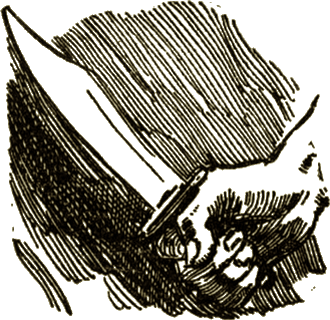
Knives out now. Bowie knives, hunting knives, as the ring of bayonets hurtled in over the corpses. Five of them in a corner of the wall. Two or three up on the roof, shooting straight down into the heads of the Mexicans. Bullets swept the roof and they were silent. Five left here in the swirling tide of uniforms, breaking them, stabbing in dread silence, stabbing against the long bayonets. Breaking them again, by the Lord! Breaking them, until the Mexicans yelled in sudden panic that these were devils, not men, and drew back.
Three on their feet now, hands and arms red, knives red, silent. The bayonets drew back and back. An officer cracked out orders. Crockett stooped, caught the barrel of his rifle, and with one swing sent it at the squad—a last gesture of flying iron that struck down a man.
The muskets crashed. Inside the ring of corpses, only corpses were left.
Music swirled higher and higher. Yells and cheers rang out. "El Presidente! Viva! Viva Santa Anna!"
HE came, slender, gold-laced, erect, his glittering staff around him; came now, when bullets flew no more. Short, sharp orders. Among the heaps of death, wounded men were brought forth, and the bayonets became red again, stabbing them anew. All of them, without mercy. No quarter to these rebels!
A sudden burst of shouts, of wild yells. A swirl of men staggering out all in a knot, then disintegrating. Half-a-dozen Texians found in a room somewhere. An officer saluted El Presidente, asked for their lives.
"You have your orders. Obey them."
The muskets crashed again, for the last volley.
The women were brought out. El Presidente bowed to them gracefully, saluted them, shrugged at sight of the two negroes—body servants of Bowie and Travis. Andrea Canderalia, with blood on her chin, drew his curious glance for an instant. But it was diverted by excited yells, a streaming hurry of soldiers—a handful of the rebels found somewhere. The yells died out in hysteric laughter as the red bayonets drove down.
More wounded. A few men outside, who had jumped from the walls. They were hunted down with shout and jeer. Now a search was begun for any other survivors.
The sun was just rising. It was thirty-two minutes from the time the first signal bugle had sounded the assault.
El Presidente sent for his negro cook, Ben, who knew most of the Texian leaders by sight. With his aide, Almonte, he had Ben move about among the dead, displaying the corpses and picking out those of the leaders. Terrified, shaking, the frightened negro identified Travis, then the mangled body of Bowie. Then in the southwest corner he pointed to a bullet-riddled thing in blood-smeared fringed leather garments.
El Presidente looked, and turned away with a shrug.
"El Coronel Crockett?" he repeated. "There must be some mistake. I never heard of him. He is not of Texas, eh? Come, Almonte; it's time for breakfast. The breakfast of victory!"
"Another such victory," said Almonte in a low voice, "and we are ruined."
THE sun rose higher, the full day sprang into life. The dead were sorted out and laid aside; the Mexican dead, for burial. The wounded were carried to hastily constructed shelters along the river—the Mexican wounded.
As the day wore on, a few more survivors turned up—some men hiding in a loft, a man who had gained an irrigation ditch and shelter of a bridge there. The volleys rang out once again; the bodies were pitched into the courtyard with the rest. The place was looted of arms and aught else that could be worth while.
Wood was gathered from near and far. Wood from field and forest, wood from the shattered barracks, beams from the breached defenses, old black oak from the organ-loft in the former chapel. Three great piles grew up, piles of bodies and of wood intermingled.
Santa Anna came again to the scene of his conquest and watched the work go forward. Here was the last gesture of contempt, of insult toward rebels. He examined the wounds of these dead men with curious interest. Two soldiers lifted a white mangled thing that El Presidente recognized. He checked the men.
"Wait," he said irresolutely. "Wait. Señor Bowie—he was too brave a man to be burned like a dog. He should have burial."
He caught the curious stares of his staff. What! A moment of weakness in the conqueror? Santa Anna read the looks aright, and irritation seized upon him. He turned away with a shrug.
"Well, never mind; throw him in."
The three piles grew and grew until all was done and the torch applied. Three columns of smoke blended and lifted into the sky. They swung in the eddying breeze and then were caught and carried toward the Mexican camp, with a splutter of sparks and a rain of fiery particles.
And the Mexicans, some of them, looked up with terrified eyes and crossed themselves. An omen, they muttered; an evil omen.
They were right. While these men died and were burned, the Convention had at last declared for independence. The die was cast. Texas was no longer a part of Mexico.
Roy Glashan's Library
Non sibi sed omnibus
Go to Home Page
This work is out of copyright in countries with a copyright
period of 70 years or less, after the year of the author's death.
If it is under copyright in your country of residence,
do not download or redistribute this file.
Original content added by RGL (e.g., introductions, notes,
RGL covers) is proprietary and protected by copyright.